KR20230079110A - Manufacturing method of glass direct roving - Google Patents
Manufacturing method of glass direct roving Download PDFInfo
- Publication number
- KR20230079110A KR20230079110A KR1020237013498A KR20237013498A KR20230079110A KR 20230079110 A KR20230079110 A KR 20230079110A KR 1020237013498 A KR1020237013498 A KR 1020237013498A KR 20237013498 A KR20237013498 A KR 20237013498A KR 20230079110 A KR20230079110 A KR 20230079110A
- Authority
- KR
- South Korea
- Prior art keywords
- glass
- regressions
- direct roving
- winding
- strand
- Prior art date
- Legal status (The legal status is an assumption and is not a legal conclusion. Google has not performed a legal analysis and makes no representation as to the accuracy of the status listed.)
- Granted
Links
Images


Classifications
-
- B—PERFORMING OPERATIONS; TRANSPORTING
- B65—CONVEYING; PACKING; STORING; HANDLING THIN OR FILAMENTARY MATERIAL
- B65H—HANDLING THIN OR FILAMENTARY MATERIAL, e.g. SHEETS, WEBS, CABLES
- B65H54/00—Winding, coiling, or depositing filamentary material
- B65H54/02—Winding and traversing material on to reels, bobbins, tubes, or like package cores or formers
- B65H54/38—Arrangements for preventing ribbon winding ; Arrangements for preventing irregular edge forming, e.g. edge raising or yarn falling from the edge
-
- B—PERFORMING OPERATIONS; TRANSPORTING
- B65—CONVEYING; PACKING; STORING; HANDLING THIN OR FILAMENTARY MATERIAL
- B65H—HANDLING THIN OR FILAMENTARY MATERIAL, e.g. SHEETS, WEBS, CABLES
- B65H54/00—Winding, coiling, or depositing filamentary material
- B65H54/02—Winding and traversing material on to reels, bobbins, tubes, or like package cores or formers
- B65H54/06—Winding and traversing material on to reels, bobbins, tubes, or like package cores or formers for making cross-wound packages
-
- C—CHEMISTRY; METALLURGY
- C03—GLASS; MINERAL OR SLAG WOOL
- C03B—MANUFACTURE, SHAPING, OR SUPPLEMENTARY PROCESSES
- C03B37/00—Manufacture or treatment of flakes, fibres, or filaments from softened glass, minerals, or slags
- C03B37/10—Non-chemical treatment
- C03B37/12—Non-chemical treatment of fibres or filaments during winding up
-
- B—PERFORMING OPERATIONS; TRANSPORTING
- B65—CONVEYING; PACKING; STORING; HANDLING THIN OR FILAMENTARY MATERIAL
- B65H—HANDLING THIN OR FILAMENTARY MATERIAL, e.g. SHEETS, WEBS, CABLES
- B65H54/00—Winding, coiling, or depositing filamentary material
- B65H54/02—Winding and traversing material on to reels, bobbins, tubes, or like package cores or formers
-
- B—PERFORMING OPERATIONS; TRANSPORTING
- B65—CONVEYING; PACKING; STORING; HANDLING THIN OR FILAMENTARY MATERIAL
- B65H—HANDLING THIN OR FILAMENTARY MATERIAL, e.g. SHEETS, WEBS, CABLES
- B65H54/00—Winding, coiling, or depositing filamentary material
- B65H54/02—Winding and traversing material on to reels, bobbins, tubes, or like package cores or formers
- B65H54/06—Winding and traversing material on to reels, bobbins, tubes, or like package cores or formers for making cross-wound packages
- B65H54/08—Precision winding arrangements
-
- B—PERFORMING OPERATIONS; TRANSPORTING
- B65—CONVEYING; PACKING; STORING; HANDLING THIN OR FILAMENTARY MATERIAL
- B65H—HANDLING THIN OR FILAMENTARY MATERIAL, e.g. SHEETS, WEBS, CABLES
- B65H55/00—Wound packages of filamentary material
- B65H55/04—Wound packages of filamentary material characterised by method of winding
-
- B—PERFORMING OPERATIONS; TRANSPORTING
- B65—CONVEYING; PACKING; STORING; HANDLING THIN OR FILAMENTARY MATERIAL
- B65H—HANDLING THIN OR FILAMENTARY MATERIAL, e.g. SHEETS, WEBS, CABLES
- B65H2701/00—Handled material; Storage means
- B65H2701/30—Handled filamentary material
- B65H2701/31—Textiles threads or artificial strands of filaments
- B65H2701/312—Fibreglass strands
Landscapes
- Engineering & Computer Science (AREA)
- Chemical & Material Sciences (AREA)
- Life Sciences & Earth Sciences (AREA)
- General Life Sciences & Earth Sciences (AREA)
- Geochemistry & Mineralogy (AREA)
- Manufacturing & Machinery (AREA)
- Materials Engineering (AREA)
- Organic Chemistry (AREA)
- Textile Engineering (AREA)
- Filamentary Materials, Packages, And Safety Devices Therefor (AREA)
- Winding Filamentary Materials (AREA)
- Yarns And Mechanical Finishing Of Yarns Or Ropes (AREA)
Abstract
단면(端面)에 있어서의 유리 다이렉트 로빙의 풀림성(解舒性)을 향상시키는 것을 과제로 한다. 유리 다이렉트 로빙의 제조 방법은, 유리 스트랜드를, 교차된 사선 모양(綾)으로 걸면서 원통 형상으로 감는 권취 공정을 구비하고 있다. 권취 공정에 있어서, 교차된 사선 모양 걸기의 회귀수(回歸數)가 10 이상이며, 회귀수를 「A」, 회귀수의 1/2 이하의 최대의 정수(整數)를 「(A/2)*」, 회귀수의 1/4 이하의 최대의 정수를 「(A/4)*」라 하고, 교차된 사선 모양 걸기의 사이클 와인드수를 대분수 「a+(b/A)」로 나타내었을 때, 「b」 및 「A-b」 중 작은 쪽의 값인 간격 파라미터가 「(A/2)*-(A/4)*」 이상 「(A/2)*-1」 이하가 되는 조건으로 교차된 사선 모양으로 걸면서 유리 스트랜드를 감는다.It is an object to improve the loosening property of glass direct roving in the end surface. The manufacturing method of glass direct roving includes a winding step of winding a glass strand into a cylindrical shape while hanging it in an intersecting oblique shape. In the winding step, the number of regressions of crossed oblique crosses is 10 or more, the number of regressions is "A", and the largest integer less than 1/2 of the number of regressions is "(A/2)" * ”, when the largest integer less than 1/4 of the number of regressions is “(A/4) * ”, and the number of cycle winds of the intersected diagonal line is expressed as a mixed number “a+(b/A)”, Oblique shape intersected under the condition that the interval parameter, which is the smaller of “b” and “Ab”, is “(A/2) * -(A/4) * ” or more and “(A/2) * -1” or less wind the glass strand while walking.
Description
[0001] 본 발명은, 유리 다이렉트 로빙의 제조 방법에 관한 것이다.[0001] The present invention relates to a method for producing a glass direct roving.
[0002] 특허문헌 1에 개시된 바와 같이, 직접 권취법에 의해 제조되는 유리 다이렉트 로빙(DWR: Direct Wound Roving)은, 예컨대, 인발 성형이나 필라멘트 와인딩법 등의 성형법에 있어서, 수지와 보강재를 조합한 복합 재료의 보강 섬유로서 사용된다.[0002] As disclosed in Patent Document 1, glass direct roving (DWR: Direct Wound Roving) produced by a direct winding method is a combination of a resin and a reinforcing material in a molding method such as pultrusion molding or a filament winding method, for example. Used as reinforcing fibers in composite materials.
[0003] 일반적으로, 유리 다이렉트 로빙은, 다음과 같이 하여 제조된다. 우선, 수백~수천 개의 노즐을 가지는 백금제 부싱(bushing)으로부터 인출된 용융 유리를, 수(數) 미크론 내지 이십여 미크론의 유리 필라멘트로 늘인다. 그 후, 각각의 유리 필라멘트의 표면에 집속제(集束劑)를 도포한 후, 유리 필라멘트를 수백~수천 가닥(本) 모아서, 유리 스트랜드로 하고, 회전하는 콜릿에 교차된 사선 모양(綾)으로 걸면서 원통 형상으로 감는다.[0003] In general, glass direct roving is manufactured as follows. First, molten glass taken out from a bushing made of platinum having hundreds to thousands of nozzles is stretched into a glass filament of several microns to twenty microns. After that, a bundling agent is applied to the surface of each glass filament, and then hundreds to thousands of glass filaments are collected to form a glass strand, which is intersected with a rotating collet in an oblique shape. While walking, wind it into a cylindrical shape.
[0005] 종래의 유리 다이렉트 로빙은, 풀어서 유리 스트랜드를 인출할 때, 단면(端面)에 위치하는 유리 스트랜드의 방향전환점에 있어서 걸림이 발생하는 경우가 있었다.[0005] In the conventional glass direct roving, when the glass strand is pulled out by unwinding, jamming may occur at the direction turning point of the glass strand located on the end face.
[0006] 본 발명의 목적은, 단면에 있어서의 유리 다이렉트 로빙의 풀림성(解舒性)을 향상시키는 데 있다.[0006] An object of the present invention is to improve the unwindability of glass direct roving in the cross section.
[0007] 상기 과제를 해결하는 유리 다이렉트 로빙의 제조 방법은, 유리 스트랜드를, 교차된 사선 모양으로 걸면서 원통 형상으로 감는 권취 공정을 구비하며, 상기 권취 공정에 있어서, 교차된 사선 모양 걸기의 회귀수(回歸數)가 10 이상이며, 상기 회귀수를 「A」, 상기 회귀수의 1/2 이하의 최대의 정수(整數)를 「(A/2)*」, 상기 회귀수의 1/4 이하의 최대의 정수를 「(A/4)*」라 하고, 교차된 사선 모양 걸기의 사이클 와인드수를 대분수 「a+(b/A)」로 나타내었을 때, 「b」 및 「A-b」 중 작은 쪽의 값인 간격 파라미터가 「(A/2)*-(A/4)*」 이상 「(A/2)*-1」 이하가 되는 조건으로 교차된 사선 모양으로 걸면서 상기 유리 스트랜드를 감는다.[0007] A method for producing glass direct roving that solves the above problems includes a winding step of winding glass strands into a cylindrical shape while hooking them in an intersecting diagonal pattern, wherein in the winding step, regression of the intersecting diagonal winding When the number is 10 or more, the regression number is “A”, the largest integer less than or equal to 1/2 of the regression number is “(A/2) * ”, and 1/4 of the regression number is When the following maximum integer is set to "(A/4) * " and the number of cycles of intersected diagonal lines is expressed as a mixed number "a+(b/A)", the smaller of "b" and "Ab" The glass strand is wound while hanging in an intersecting oblique shape under the condition that the spacing parameter, which is the value of the side, is "(A/2) * -(A/4) * " or more and "(A/2) * -1" or less.
[0008] 상기 구성에 의하면, 유리 다이렉트 로빙의 단면에 있어서의 유리 스트랜드의 방향전환점 간의 거리가 길어진다. 이에 의해, 유리 다이렉트 로빙을 풀어서 유리 스트랜드를 인출할 때, 유리 스트랜드의 방향전환점끼리의 간섭이 억제되어, 단면에 있어서의 유리 다이렉트 로빙의 풀림성이 향상된다.[0008] According to the above configuration, the distance between the direction turning points of the glass strands in the cross section of the glass direct roving is increased. Accordingly, when the glass direct roving is unwound and the glass strand is drawn out, interference between direction turning points of the glass strand is suppressed, and the unwindability of the glass direct roving in the cross section is improved.
[0009] 상기 유리 다이렉트 로빙의 제조 방법에 있어서, 상기 간격 파라미터가 「(A/2)*-1」이 되는 조건으로 교차된 사선 모양으로 걸면서 상기 유리 스트랜드를 감는 것이 바람직하다.[0009] In the method for producing the glass direct roving, it is preferable to wind the glass strand while hanging in an intersecting oblique shape under the condition that the interval parameter is "(A/2) * -1".
[0010] 상기 구성에 의하면, 단면에 있어서의 유리 다이렉트 로빙의 풀림성을 향상시키는 효과가 보다 현저하게 얻어진다.[0010] According to the above structure, the effect of improving the unwindability of the glass direct roving in the cross section is obtained more remarkably.
[0011] 본 발명에 의하면, 단면에 있어서의 유리 다이렉트 로빙의 풀림성이 향상된다.[0011] According to the present invention, the unwindability of the glass direct roving in the cross section is improved.
[0012] 도 1은, 유리 다이렉트 로빙의 사시도이다.
도 2는, 권취 공정의 설명도이다.
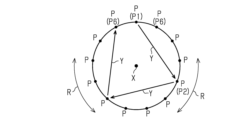
도 3은, 1회의 왕복 이동에 따른 방향전환점의 둘레방향(周方向) 위치의 변위를 나타낸 설명도이다.
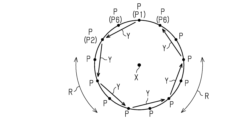
도 4는, 왕복 이동마다의 방향전환점의 둘레방향 위치의 변위를 나타낸 설명도이다.
도 5는, 제1 예에 있어서의 왕복 이동마다의 방향전환점의 둘레방향 위치의 변위를 나타낸 설명도이다.
도 6은, 제2 예에 있어서의 왕복 이동마다의 방향전환점의 둘레방향 위치의 변위를 나타낸 설명도이다.
도 7은, 제3 예에 있어서의 왕복 이동마다의 방향전환점의 둘레방향 위치의 변위를 나타낸 설명도이다.1 is a perspective view of glass direct roving.
2 : is explanatory drawing of a winding process.
Fig. 3 is an explanatory diagram showing the displacement of the position of a direction turning point in the circumferential direction according to one reciprocating movement.
Fig. 4 is an explanatory diagram showing the displacement of the position of the turning point in the circumferential direction for each reciprocating movement.
Fig. 5 is an explanatory diagram showing the displacement of the position of the turning point in the circumferential direction for each reciprocating movement in the first example.
Fig. 6 is an explanatory diagram showing the displacement of the position of the turning point in the circumferential direction for each reciprocating movement in the second example.
Fig. 7 is an explanatory diagram showing the displacement of the position of the turning point in the circumferential direction for each reciprocating movement in the third example.
[0013] 이하에서는, 본 발명의 일 실시형태를 설명한다.[0013] Hereinafter, one embodiment of the present invention will be described.
[0014] 도 1에 나타낸 바와 같이, 유리 다이렉트 로빙(10)은, 유리 스트랜드(GS)를 감음으로써 원통 형상으로 형성되어 있다. 유리 다이렉트 로빙(10)의 권취 형상은, 예컨대, 스퀘어 엔드 치즈(square-end cheese) 형상(원통 형상)이다. 또한, 이하에서는, 유리 다이렉트 로빙(10)의 축방향 길이를 감김폭(H)이라고 기재한다.As shown in FIG. 1, the glass
[0015] 유리 다이렉트 로빙(10)의 제조 방법은, 용융 유리로부터 유리 스트랜드(GS)를 얻는 방사(紡絲) 공정, 및 유리 스트랜드(GS)를 감는 권취 공정을 구비하고 있다.[0015] The manufacturing method of the glass
[0016] 방사 공정으로서는, 부싱을 사용하여 용융 유리를 방사하는 주지된 방법을 이용할 수 있다. 예컨대, 복수의 노즐을 가지는 부싱으로부터 인출된 용융 유리를 유리 필라멘트로 늘인다. 그 후, 각각의 유리 필라멘트의 표면에 집속제를 도포한 후, 유리 필라멘트를 수백~수천 가닥 모아서, 유리 스트랜드(GS)로 한다.[0016] As the spinning process, a well-known method of spinning molten glass using a bushing can be used. For example, molten glass drawn from a bushing having a plurality of nozzles is stretched into a glass filament. Thereafter, after applying a bundling agent to the surface of each glass filament, hundreds to thousands of glass filaments are collected to form a glass strand GS.
[0017] 유리 스트랜드(GS)의 직경은, 예컨대, 1mm 이상 10mm 이하이다. 유리 스트랜드(GS)는, 예컨대, 100~10000가닥의 유리 필라멘트로 구성된다. 유리 스트랜드(GS)를 형성하는 유리 필라멘트의 직경은, 예컨대, 3μm 이상 30μm 이하이다.[0017] The diameter of the glass strand GS is, for example, 1 mm or more and 10 mm or less. The glass strand GS is composed of, for example, 100 to 10000 glass filaments. The diameter of the glass filament forming the glass strand GS is, for example, 3 μm or more and 30 μm or less.
[0018] 유리로서는, 예컨대, E 유리(알칼리 함유량 2% 이하의 유리), D 유리(저유전율 유리), AR 유리(내알칼리성 유리), C 유리(내산성의 유리), M 유리(고탄성율의 유리), S 유리(고강도, 고탄성율의 유리), T 유리(고강도, 고탄성율의 유리), H 유리(고유전율의 유리), NE 유리(저유전율 유리) 등을 들 수 있다. 예컨대, E 유리의 조성은, 산화물 기준의 질량%로, SiO2: 52~62%, Al2O3: 10~16%, B2O3: 0~8%, MgO: 0~5%, CaO: 16~25%, 및 R2O(단, R은, Li, Na 및 K 중 적어도 하나): 0~2%인 것이 바람직하다.[0018] As the glass, for example, E glass (glass having an alkali content of 2% or less), D glass (low dielectric constant glass), AR glass (alkali resistant glass), C glass (acid resistant glass), M glass (high modulus glass) glass), S glass (high strength, high elastic modulus glass), T glass (high strength, high elastic modulus glass), H glass (high dielectric constant glass), NE glass (low dielectric constant glass), and the like. For example, the composition of the E glass is SiO 2 : 52 to 62%, Al 2 O 3 : 10 to 16%, B 2 O 3 : 0 to 8%, MgO: 0 to 5%, CaO: 16 to 25%, and R 2 O (provided that R is at least one of Li, Na and K): 0 to 2% is preferable.
[0019] 집속제 중의 피막 성분(수지 성분)으로서는, 예컨대, 우레탄계 수지, 에폭시계 수지, 아세트산비닐계 수지 등을 들 수 있다. 집속제에는, 필요에 따라, 윤활제, 실란 커플링제 등을 함유시킬 수도 있다.[0019] Examples of the film component (resin component) in the bundling agent include urethane-based resins, epoxy-based resins, and vinyl acetate-based resins. The bundling agent may contain a lubricant, a silane coupling agent, and the like as needed.
[0020] 도 2에 나타낸 바와 같이, 권취 공정에서는, 회전하는 원통 형상의 콜릿(11)에 대해, 트래버스(12)를 이용하여 교차된 사선 모양으로 걸면서 유리 스트랜드(GS)를 감음으로써, 유리 다이렉트 로빙(10)을 제조한다. 트래버스(12)로서는, 예컨대, 와이어 트래버스, 모터의 회전력을 왕복 직선 운동으로 변환하는 캠 기구를 이용한 트래버스 등의 공지된 것이 이용된다.As shown in FIG. 2, in the winding step, the glass strand GS is wound around the rotating
[0021] 권취 공정에서는, 하기의 제1 조건 및 제2 조건을 만족하는 회귀수 및 사이클 와인드수가 되도록 교차된 사선 모양 걸기를 행한다. 우선, 교차된 사선 모양 걸기의 회귀수 및 사이클 와인드수에 대해 설명한다.[0021] In the winding step, cross-slanting is performed so that the number of regressions and number of cycle winds satisfy the following first condition and second condition. First of all, the number of regressions and the number of cycle winds of crossed oblique line patterns will be described.
[0022] 회귀수는, 권취 축선(X)의 축선방향으로의 유리 스트랜드(GS)의 편도 이동분(分)의 이동, 즉, 유리 다이렉트 로빙(10)의 감김폭(H)만큼의 이동을 1단위로 하고, 유리 스트랜드(GS)의 권취 축선(X) 둘레의 둘레방향 위치가 동일한 위치로 되돌아올 때까지의 이동 횟수를 나타내는 값이다.[0022] The number of regressions is the movement of the one-way movement of the glass strand GS in the axial direction of the winding axis X, that is, the movement by the winding width H of the glass
[0023] 예컨대, 회귀수가 「10」인 경우, 축선방향으로의 유리 스트랜드(GS)의 편도 이동을 10회 반복하는 것, 즉, 왕복 이동을 5회 반복하는 것에 의해, 유리 스트랜드(GS)의 권취 축선(X) 둘레의 둘레방향의 위치가 동일한 위치로 되돌아온다. 회귀수가 짝수인 경우에는, 동일한 축선방향 위치, 즉, 권취 축선(X)에 직교하는 동일 평면상에서, 유리 스트랜드(GS)의 권취 축선(X) 둘레의 둘레방향의 위치가 동일한 위치로 되돌아온다. 회귀수가 홀수인 경우에는, 축선방향으로 편도 이동한 축선방향 위치에서, 유리 스트랜드(GS)의 권취 축선(X) 둘레의 둘레방향의 위치가 동일한 위치로 되돌아온다.[0023] For example, when the regression number is "10", by repeating the one-way movement of the glass strand GS in the
[0024] 유리 다이렉트 로빙(10)의 단면을 포함하는, 권취 축선(X)에 직교하는 동일 평면상에 있어서는, 유리 스트랜드(GS)는, 권취 축선(X) 둘레로 등간격으로 나란한 회귀수와 동수(同數)의 둘레방향 위치 중 어느 곳에 위치하며, 그 위치는, 권취가 진행됨에 따라 서서히 반경방향 바깥쪽으로 이동해 간다. 유리 다이렉트 로빙(10)의 양 단면에 있어서의 유리 스트랜드(GS)의 위치는, 유리 스트랜드(GS)의 방향전환점의 위치가 된다.[0024] On the same plane that includes the cross section of the glass direct roving 10 and is orthogonal to the winding axis X, the glass strand GS has the number of regressions parallel to the winding axis X at equal intervals and It is located at any of the same number of positions in the circumferential direction, and the position gradually moves outward in the radial direction as winding progresses. The position of the glass strand GS in both end surfaces of the glass direct roving 10 becomes the position of the turning point of the glass strand GS.
[0025] 사이클 와인드수는, 유리 스트랜드(GS)가 왕복 이동하는 동안의 유리 스트랜드(GS)의 감김수이다. 다시 말해, 유리 다이렉트 로빙(10)의 감김폭(H)을 유리 스트랜드(GS)가 이동하는 동안의 콜릿(11)의 회전수의 2배의 값이다.[0025] The number of cycle winds is the number of winds of the glass strands GS during the reciprocating movement of the glass strands GS. In other words, the winding width H of the glass direct roving 10 is twice the number of rotations of the
[0026] 또한, 사이클 와인드수는, 정렬 본수(本數)와 회귀수로부터 구할 수도 있다. 정렬 본수는, 유리 스트랜드(GS)의 권취의 개시점으로부터, 유리 스트랜드(GS)의 둘레방향 위치가 개시점의 둘레방향 위치로 최초로 되돌아올 때까지의 동안에, 유리 스트랜드(GS)가 콜릿(11)의 둘레를 회전하는 횟수이다. 정렬 본수를 회귀수로 제산(除算)함으로써, 유리 스트랜드(GS)가 편도 이동하는 동안의 유리 스트랜드(GS)의 감김수인 웨이 와인드수가 얻어진다. 그리고, 웨이 와인드수의 2배의 값으로서 사이클 와인드수가 얻어진다.[0026] The number of cycle winds can also be obtained from the number of alignments and the number of regressions. As for the number of alignments, from the starting point of winding of the glass strands GS until the circumferential position of the glass strands GS returns to the circumferential position of the starting point for the first time, the glass strands GS collet 11 ) is the number of times it rotates around the circumference. By dividing the number of alignments by the number of regressions, the number of way winds, which is the number of turns of the glass strands GS during one-way movement of the glass strands GS, is obtained. And, the number of cycle windings is obtained as a value twice the number of way windings.
[0027] 다음으로, 제1 조건 및 제2 조건에 대해 설명한다.Next, the first condition and the second condition will be described.
[0028] 제1 조건은, 회귀수를 10 이상으로 하는 것이다. 회귀수는, 바람직하게는 11 이상 60 이하이고, 보다 바람직하게는 13 이상 30 이하이다.[0028] The first condition is that the number of regressions is 10 or more. The number of regressions is preferably 11 or more and 60 or less, more preferably 13 or more and 30 or less.
[0029] 제2 조건은, 회귀수를 「A」라 하고, 사이클 와인드수를 대분수 「a+(b/A)」로 나타내었을 때, 「b」 및 「A-b」 중 작은 쪽의 값인 간격 파라미터를 특정 범위 R 내로 하는 것이다. 상기 특정 범위 R은, 회귀수의 1/2 이하의 최대의 정수를 「(A/2)*」, 회귀수의 1/4 이하의 최대의 정수를 「(A/4)*」라 하였을 때, 「(A/2)*-(A/4)*」 이상 「(A/2)*-1」 이하의 범위이다.[0029] The second condition is that when the number of regressions is "A" and the number of cycle winds is expressed as a mixed fraction "a+(b/A)", the interval parameter, which is the smaller of "b" and "Ab", is It is to be within a specific range R. The specific range R is when the largest integer of 1/2 or less of the regression number is "(A/2) * " and the largest integer of 1/4 or less of the regression number is "(A/4) * " , "(A/2) * -(A/4) * " or more and "(A/2) * -1" or less.
[0030] 회귀수의 1/2 이하의 최대의 정수는, 회귀수의 1/2의 수치의 소수점 이하를 버린 수치와 동일하다. 회귀수의 1/4 이하의 최대의 정수는, 회귀수의 1/4의 수치의 소수점 이하를 버린 수치와 동일하다. 예컨대, 회귀수가 「13」인 경우, (A/2)*는, 6(=13/2=6.5→6)이고, (A/4)*는, 3(=13/4=3.25→3)이다.[0030] The largest integer equal to or less than 1/2 of the regression number is equal to the value obtained by truncating the decimal point of the value of 1/2 of the regression number. The largest integer equal to or less than 1/4 of the regression number is equal to the value obtained by truncating the decimal point of the value of 1/4 of the regression number. For example, when the regression number is "13", (A/2) * is 6 (= 13/2 = 6.5 → 6), and (A/4) * is 3 (= 13/4 = 3.25 → 3) am.
[0031] 도 3 및 도 4는, 유리 다이렉트 로빙(10)의 편측(片側)의 단면에 있어서의, 왕복 이동마다의 유리 스트랜드(GS)의 방향전환점의 둘레방향 위치 P의 변위를 화살표(Y)로 나타낸 설명도이다. 도 3은, 1회의 왕복 이동에 따른 방향전환점의 변위를 나타내고, 도 4는, 방향전환점이 최초의 둘레방향 위치 P로 되돌아올 때까지의 왕복 이동마다의 방향전환점의 변위를 나타낸다.3 and 4 show the displacement of the position P in the circumferential direction of the direction turning point of the glass strand GS for each reciprocating movement in the cross section of one side of the glass direct roving 10 by an arrow (Y) ). Fig. 3 shows the displacement of the turning point according to one reciprocating motion, and Fig. 4 shows the displacement of the turning point for each reciprocating motion until the turning point returns to the initial position P in the circumferential direction.
[0032] 도 3에 나타낸 바와 같이, 유리 다이렉트 로빙(10)의 편측의 단면에 있어서, 유리 스트랜드(GS)의 방향전환점이 취할 수 있는 둘레방향 위치 P의 수는, 회귀수와 동수이며, 각 둘레방향 위치 P는 각각, 360°를 회귀수로 나눈 값인 각도 간격 θ로 둘레방향으로 나란하다. 도 3 및 도 4는, 회귀수 13인 경우를 도시하고 있다. 이 경우, 둘레방향 위치 P의 수는, 13이며, 각 둘레방향 위치 P의 각도 간격 θ는, 약 28°(≒360/13)이 된다.[0032] As shown in FIG. 3, in the cross section on one side of the glass direct roving 10, the number of positions P in the circumferential direction that can be taken by the direction turning points of the glass strands GS is the same as the number of regressions, and each Each of the positions P in the circumferential direction is parallel in the circumferential direction at an angular interval θ, which is a value obtained by dividing 360° by the number of regressions. 3 and 4 show the case where the number of regressions is 13. In this case, the number of circumferential positions P is 13, and the angular interval θ of each circumferential position P is approximately 28° (≒360/13).
[0033] 도 3에 나타낸 바와 같이, 사이클 와인드수를 대분수로 나타내었을 때의 상기의 「b」 및 「A-b」는 각각, 유리 스트랜드(GS)를 1회, 왕복 이동시킨 경우에, 왕복 이동 전의 방향전환점의 둘레방향 위치 P(P1)와, 왕복 이동 후의 방향전환점의 둘레방향 위치 P(P2) 사이의 둘레방향 간격을 나타내는 파라미터이다.[0033] As shown in FIG. 3, the above "b" and "A-b" when the number of cycle winds is expressed as a mixed fraction, respectively, when the glass strand GS is reciprocated once, before reciprocation This parameter represents the circumferential distance between the circumferential position P(P1) of the turning point and the circumferential position P(P2) of the turning point after reciprocating.
[0034] 구체적으로는, 왕복 이동 전의 방향전환점의 둘레방향 위치 P(P1)와, 왕복 이동 후의 방향전환점의 둘레방향 위치 P(P2) 사이의 반시계방향의 둘레방향 간격이, 각도 간격 θ의 「b」배의 각도와, 권취 축선(X)과 둘레방향 위치 P 사이의 거리로부터 구해지고, 왕복 이동 전의 방향전환점의 둘레방향 위치 P(P1)와, 왕복 이동 후의 방향전환점의 둘레방향 위치 P(P2) 사이의 시계방향의 둘레방향 간격이, 각도 간격 θ의 「A-b」배의 각도와, 권취 축선(X)과 둘레방향 위치 P 사이의 거리로부터 구해진다. 따라서, 1회의 왕복 이동 후의 유리 스트랜드(GS)의 방향전환점의 둘레방향 위치 P(P2)는, 왕복 이동 전의 방향전환점의 둘레방향 위치 P(P1)로부터 반시계방향으로 각도 간격 θ의 「b」배의 각도만큼 어긋난 둘레방향 위치 P, 및 시계방향으로 각도 간격 θ의 「A-b」배의 각도만큼 어긋난 둘레방향 위치 P가 된다.[0034] Specifically, the circumferential distance in the counterclockwise direction between the circumferential position P(P1) of the turning point before reciprocating and the circumferential position P(P2) of the turning point after reciprocating is angular distance θ The circumferential position P(P1) of the direction turning point before reciprocating and the circumferential position P of the direction turning point after reciprocating, obtained from the angle of "b" times and the distance between the winding axis X and the circumferential position P, The clockwise circumferential interval between (P2) is obtained from the angle "A-b" times the angular interval θ and the distance between the winding axis X and the circumferential position P. Therefore, the circumferential position P(P2) of the turning point of the glass strand GS after one reciprocating movement is "b" of the angular interval θ in the counterclockwise direction from the circumferential position P(P1) of the turning point before the reciprocating movement. A circumferential position P shifted by the double angle, and a circumferential position P shifted clockwise by an angle "A-b" times the angular interval θ.
[0035] 다음으로, 「b」 및 「A-b」 중 작은 쪽의 값인 간격 파라미터가, 「(A/2)*-(A/4)*」 이상 「(A/2)*-1」 이하의 특정 범위 R 내인 점에 대해 설명한다.Next, the interval parameter, which is the smaller value of “b” and “Ab”, is “(A/2) * -(A/4) * ” or more and “(A/2) * -1” or less Points within a specific range R are described.
[0036] 간격 파라미터가 특정 범위 R 내인 것은, 1회의 왕복 이동 후의 유리 스트랜드(GS)의 방향전환점의 둘레방향 위치 P(P2)가, 해당 단면에 있어서 방향전환점이 취할 수 있는 둘레방향 위치 P 중, 왕복 이동 전의 방향전환점의 둘레방향 위치 P(P1)로부터 가장 이격된 둘레방향 위치 P(P3)의 근방에 있음을 의미한다.[0036] The reason why the interval parameter is within the specific range R is that the circumferential position P(P2) of the turning point of the glass strand GS after one reciprocating movement is among the circumferential positions P that the turning point can take in the cross section. , means that it is in the vicinity of the circumferential position P(P3) most distant from the circumferential position P(P1) of the turning point before reciprocating.
[0037] 특정 범위 R은, (a) 둘레방향 위치 P(P1)로부터 가장 이격된 둘레방향 위치 P(P3)로부터, 각도 간격 θ의 1배의 각도만큼 둘레방향 위치 P(P1)에 근접한 둘레방향 위치 P(P4)와, (b) 상기 (a)에 있어서 지정된 둘레방향 위치 P(P3)로부터, 각도 간격 θ의 (A/4)*배의 각도만큼 둘레방향 위치 P(P1)에 근접한 둘레방향 위치 중, 보다 둘레방향 위치 P(P1)에 가까운 둘레방향 위치 P(P5)의 사이가 되는 범위이다. 또한, 도 3과 같이, 둘레방향 위치 P의 수가 홀수인 경우, 둘레방향 위치 P(P1)로부터 가장 이격된 둘레방향 위치 P(P3)는 2군데 존재하게 된다. 도 3에서는, 2군데의 둘레방향 위치 P(P3)를 각각 P31(P3), P32(P3)로서 나타내고 있다.[0037] The specific range R is: (a) from the circumferential position P(P3) most distant from the circumferential position P(P1), the circumference close to the circumferential position P(P1) by an angle of one times the angular distance θ directional position P(P4), and (b) from the circumferential position P(P3) designated in (a) above, an angle of (A/4) * times the angular distance θ proximate to the circumferential position P(P1). Among the circumferential positions, it is a range between the circumferential position P(P1) and the circumferential position P(P5). 3, when the number of circumferential positions P is an odd number, there are two circumferential positions P(P3) most distant from the circumferential position P(P1). In Fig. 3, two positions P(P3) in the circumferential direction are indicated as P31(P3) and P32(P3), respectively.
[0038] 간격 파라미터는, 회귀수가 10 이상 17 이하인 경우에는, 「(A/2)*-2」 또는 「(A/2)*-1」인 것이 바람직하고, 「(A/2)*-1」인 것이 보다 바람직하다. 또한, 간격 파라미터는, 회귀수가 18 이상인 경우에는, 「(A/2)*-3」 이상 「(A/2)*-1」 이하인 것이 바람직하고, 「(A/2)*-2」 또는 「(A/2)*-1」인 것이 보다 바람직하고, 「(A/2)*-1」인 것이 더욱 바람직하다.[0038] The interval parameter is preferably "(A/2) * -2" or "(A/2) * -1" when the number of regressions is 10 or more and 17 or less, and "(A/2) * - 1” is more preferable. In addition, when the number of regressions is 18 or more, the interval parameter is preferably "(A/2) * -3" or more and "(A/2) * -1" or less, and "(A/2) * -2" or It is more preferably "(A/2) * -1", and more preferably "(A/2) * -1".
[0039] 제1 예로서, 회귀수가 「13」이며, 사이클 와인드수가 「10.38」인 것으로 한다. 이 경우의 왕복 이동마다의 유리 스트랜드(GS)의 방향전환점의 둘레방향 위치 P의 변위를 도 4 및 도 5에 나타낸다. 제1 예의 사이클 와인드수의 대분수는, 「10+(5/13)」이다. 따라서, 「b=5」, 「A-b=8」이 되어, 간격 파라미터는, 「5」가 된다. 또한, 「(A/2)*-(A/4)*」 이상 「(A/2)*-1」 이하의 특정 범위 R은, 「3(=6-3)」 이상 「5(=6-1)」 이하가 된다. 제1 예는, 회귀수가 10 이상인 제1 조건, 및 간격 파라미터가 특정 범위 R 내인 제2 조건을 동시에 만족한다.As a first example, it is assumed that the number of regressions is “13” and the number of cycle winds is “10.38”. The displacement of the position P in the circumferential direction of the turning point of the glass strand GS for each reciprocating movement in this case is shown in FIGS. 4 and 5 . The major fraction of the number of cycle winds in the first example is “10+(5/13)”. Therefore, "b = 5" and "Ab = 8", and the interval parameter becomes "5". In addition, the specific range R of "(A/2) * -(A/4) * " or more and "(A/2) * -1" or less is "3(=6-3)" or more "5(=6 -1)” or less. The first example simultaneously satisfies the first condition that the number of regressions is 10 or more and the second condition that the interval parameter is within a specific range R.
[0040] 제2 예로서, 회귀수가 「13」이며, 사이클 와인드수가 「10.70」인 것으로 한다. 이 경우의 왕복 이동마다의 유리 스트랜드(GS)의 둘레방향 위치 P의 변위를 도 6에 나타낸다. 제2 예의 사이클 와인드수의 대분수는, 「10+(9/13)」이다. 따라서, 「b=9」, 「A-b=4」가 되어, 간격 파라미터는, 「4」가 된다. 특정 범위 R은, 제1 예와 마찬가지로 「3」 이상 「5」 이하가 된다. 제2 예는, 회귀수가 10 이상인 제1 조건, 및 간격 파라미터가 특정 범위 R 내인 제2 조건을 동시에 만족한다.As a second example, it is assumed that the number of regressions is “13” and the number of cycle winds is “10.70”. The displacement of the circumferential direction position P of the glass strand GS for every reciprocation in this case is shown in FIG. The mixed fraction of the number of cycle winds in the second example is "10+(9/13)". Therefore, "b = 9" and "A-b = 4", and the interval parameter becomes "4". The specific range R is "3" or more and "5" or less, similarly to the first example. The second example simultaneously satisfies the first condition that the number of regressions is 10 or more and the second condition that the interval parameter is within a specific range R.
[0041] 제3 예로서, 회귀수가 「13」이며, 사이클 와인드수가 「10.16」인 것으로 한다. 이 경우의 왕복 이동마다의 유리 스트랜드(GS)의 둘레방향 위치 P의 변위를 도 7에 나타낸다. 제3 예의 사이클 와인드수의 대분수는, 「10+(2/13)」이다. 따라서, 「b=2」, 「A-b=11」이 되어, 간격 파라미터는, 「2」가 된다. 특정 범위 R은, 제1 예와 마찬가지로 「3」 이상 「5」 이하가 된다. 제3 예는, 회귀수가 10 이상인 제1 조건을 만족하고, 간격 파라미터가 특정 범위 R 내인 제2 조건을 만족하지 않는다.As a third example, it is assumed that the number of regressions is “13” and the number of cycle winds is “10.16”. The displacement of the circumferential direction position P of the glass strand GS for every reciprocation in this case is shown in FIG. The mixed fraction of the number of cycle winds in the third example is “10+(2/13)”. Therefore, "b = 2" and "A-b = 11", and the interval parameter becomes "2". The specific range R is "3" or more and "5" or less, similarly to the first example. In the third example, the first condition that the number of regressions is 10 or more is satisfied, and the second condition that the interval parameter is within a specific range R is not satisfied.
[0042] 이와 같이, 회귀수가 동일하더라도, 사이클 와인드수에 관한 제2 조건을 만족하는 감기 방법과, 만족하지 않는 감기 방법이 존재한다. 본 실시형태의 권취 공정에서는, 상기의 제1 조건 및 제2 조건을 동시에 만족하는 회귀수 및 사이클 와인드수가 되도록 교차된 사선 모양 걸기를 행하고 있다.[0042] In this way, even if the number of recursion is the same, there are a winding method that satisfies the second condition regarding the number of cycle winds and a winding method that does not satisfy the second condition. In the take-up step of the present embodiment, cross-slanting is performed so that the number of recursion and cycle winding simultaneously satisfies the first condition and the second condition described above.
[0043] 다음으로, 본 실시형태의 작용에 대해 설명한다.[0043] Next, the operation of the present embodiment will be described.
[0044] 본 실시형태의 유리 다이렉트 로빙(10)의 제조 방법은, 회전하는 콜릿(11)에 교차된 사선 모양으로 걸면서 유리 스트랜드(GS)를 원통 형상으로 감는 권취 공정에 있어서, 상기의 제1 조건 및 제2 조건을 동시에 만족하는 회귀수 및 사이클 와인드수가 되도록 교차된 사선 모양 걸기를 행하고 있다.[0044] In the manufacturing method of the glass direct roving 10 of the present embodiment, in the winding step of winding the glass strand GS into a cylindrical shape while intersecting the rotating
[0045] 간격 파라미터가 「(A/2)*-(A/4)*」 이상임으로써, 유리 다이렉트 로빙(10)의 편측의 단면에 형성되는 유리 스트랜드(GS)의 방향전환점 중, 연속하여 형성되는 2개의 방향전환점 사이의 둘레방향의 거리, 즉, 1회의 왕복 이동의 전후의 방향전환점 사이의 둘레방향의 거리가 길어진다.[0045] When the interval parameter is "(A/2) * -(A/4) * " or more, among the direction turning points of the glass strands (GS) formed on the cross section on one side of the glass direct roving 10, formed continuously The distance in the circumferential direction between the two turning points, that is, the distance in the circumferential direction between the turning points before and after one reciprocating movement becomes longer.
[0046] 간격 파라미터가 「(A/2)*-1」 이하임으로써, 유리 다이렉트 로빙(10)의 편측의 단면에 형성되는 유리 스트랜드(GS)의 방향전환점 중, 둘레방향으로 서로 이웃하는 2개의 방향전환점 사이의 반경방향에 있어서의 거리가 길어진다.[0046] When the spacing parameter is "(A/2) * -1" or less, two adjacent to each other in the circumferential direction among the direction turning points of the glass strands GS formed on the cross section on one side of the glass direct roving 10 The distance in the radial direction between the turning points of the dog becomes longer.
[0047] 예컨대, 도 5에 있어서 5개의 화살표(Y)로 나타내는 바와 같이, 제1 예에서는, 최초의 방향전환점의 둘레방향 위치 P(P1)로부터, 그 옆의 둘레방향 위치 P(P6) 중 어느 한쪽에 이를 때까지, 유리 스트랜드(GS)가 5회, 왕복 이동한다. 이 경우, 둘레방향 위치 P(P1)에 위치하는 방향전환점과, 그 옆의 둘레방향 위치 P(P6)에 위치하는 방향전환점은, 유리 스트랜드(GS)의 5회의 왕복 이동분만큼, 반경방향으로 이격되게 된다.[0047] For example, as indicated by five arrows Y in FIG. 5, in the first example, from the circumferential position P(P1) of the first turning point, to the circumferential position P(P6) next to it. Until reaching either side, the glass strand GS reciprocates 5 times. In this case, the direction turning point located at the circumferential position P (P1) and the direction turning point located at the circumferential position P (P6) next to it are radially by 5 reciprocating movements of the glass strand GS. become separated
[0048] 간격 파라미터가 「(A/2)*-1」 이하인 경우, 유리 스트랜드(GS)의 방향전환점이 옆의 둘레방향 위치에 이를 때까지의 왕복 이동의 횟수가 3회 이상이 된다. 그 때문에, 둘레방향으로 서로 이웃하는 2개의 방향전환점 사이의 반경방향에 있어서의 거리를, 3회의 왕복 이동분 이상으로 이격시킬 수 있다.[0048] When the spacing parameter is "(A/2) * -1" or less, the number of reciprocating movements until the direction turning point of the glass strand GS reaches the position in the circumferential direction next to it is three or more times. Therefore, the distance in the radial direction between the two direction turning points adjacent to each other in the circumferential direction can be separated by more than three reciprocating movements.
[0049] 이와 같이, 유리 다이렉트 로빙(10)의 단면에 있어서의 유리 스트랜드(GS)의 방향전환점 간의 둘레방향의 거리 및 반경방향의 거리가 길어짐으로써, 유리 다이렉트 로빙(10)을 풀어서 유리 스트랜드(GS)를 인출할 때, 유리 스트랜드(GS)의 방향전환점끼리 간섭하는 것이 억제된다. 그 결과, 단면에 있어서의 유리 다이렉트 로빙(10)의 풀림성이 향상된다.[0049] In this way, the distance in the circumferential direction and the distance in the radial direction between the direction turning points of the glass strands GS in the cross section of the glass direct roving 10 are increased, so that the glass direct roving 10 is unwound and the glass strands ( When the GS) is drawn out, interference between the direction turning points of the glass strands GS is suppressed. As a result, the unwindability of the glass direct roving 10 in the cross section is improved.
[0050] 실제로, 하기 조건으로, 제1 예~제3 예의 회귀수 및 사이클 와인드수가 되도록 교차된 사선 모양으로 거는 권취 공정을 행함으로써 제조한 유리 다이렉트 로빙에 대해, 풀림성의 평가 시험을 행하였다. 평가 시험으로서는, 바닥(床)으로부터 높이 1m의 받침대 위에, 축방향이 수평이 되도록 유리 다이렉트 로빙을 놓은 상태로 하고 유리 스트랜드를 자유 낙하시키는 시험을 5회 행하였다. 그리고, 10회 왕복분(分)의 유리 스트랜드가 낙하할 때까지의 동안에, 방향전환점의 걸림에 의해 유리 스트랜드의 낙하가 정지된 횟수를 카운트하였다. 그 결과를 표 1에 나타낸다.[0050] In practice, a glass direct roving manufactured by performing a winding step in an intersecting oblique shape so that the number of turns and the number of cycle winds of Examples 1 to 3 are set under the following conditions, was tested for unwindability evaluation. As an evaluation test, a test in which glass strands were freely dropped was performed five times in a state where the glass direct roving was placed on a pedestal 1 m in height from the floor so that the axial direction was horizontal. Then, the number of times the fall of the glass strand was stopped due to the jamming of the direction turning point was counted until the glass strand fell for 10 reciprocations. The results are shown in Table 1.
[0051] 유리 다이렉트 로빙의 감김폭: 325mm[0051] Winding width of glass direct roving: 325mm
유리 다이렉트 로빙의 내경(콜릿의 외경): 150mmInner diameter of glass direct roving (outer diameter of collet): 150mm
유리 다이렉트 로빙의 번수(番手): 2400TEXNumber of glass direct roving: 2400TEX
[0052] [표 1][0052] [Table 1]

[0053] 표 1에 나타낸 바와 같이, 상기의 제1 조건 및 제2 조건을 동시에 만족하지 않는 제3 예와 비교하여, 제1 조건 및 제2 조건을 동시에 만족하는 제1 예 및 제2 예는, 낙하 시험에 있어서의 정지 횟수가 감소하였다. 특히, 간격 파라미터가 「(A/2)*-1」인 제1 예는, 낙하 시험에 있어서의 정지 횟수가 「0」으로, 단면에 있어서의 풀림성이 현저하게 높은 결과였다.[0053] As shown in Table 1, the first and second examples that simultaneously satisfy the first and second conditions are compared to the third example that does not simultaneously satisfy the first and second conditions. , the number of stops in the drop test decreased. In particular, in the first example in which the spacing parameter was "(A/2) * -1", the number of stops in the drop test was "0", and the loosening property in the cross section was remarkably high.
[0054] 다음으로, 본 실시형태의 효과에 대해 기재한다.[0054] Next, effects of the present embodiment will be described.
[0055] (1) 유리 다이렉트 로빙(10)의 제조 방법은, 유리 스트랜드(GS)를, 교차된 사선 모양으로 걸면서 원통 형상으로 감는 권취 공정을 구비하고 있다. 권취 공정에 있어서, 교차된 사선 모양 걸기의 회귀수가 10 이상이며, 회귀수를 「A」, 회귀수의 1/2 이하의 최대의 정수를 「(A/2)*」, 회귀수의 1/4 이하의 최대의 정수를 「(A/4)*」라 하고, 교차된 사선 모양 걸기의 사이클 와인드수를 대분수 「a+(b/A)」로 나타내었을 때, 「b」 및 「A-b」 중 작은 쪽의 값인 간격 파라미터가 「(A/2)*-(A/4)*」 이상 「(A/2)*-1」 이하가 되는 조건으로 교차된 사선 모양으로 걸면서 유리 스트랜드(GS)를 감는다.[0055] (1) The manufacturing method of the glass direct roving 10 includes a winding step of winding the glass strands GS into a cylindrical shape while intersecting them obliquely. In the winding step, the number of regressions of crossed diagonal lines is 10 or more, the number of regressions is "A", the largest integer less than 1/2 of the number of regressions is "(A/2) * ", and the number of regressions is 1/ When the largest integer of 4 or less is set to "(A/4) * " and the number of cycles of intersected oblique dialing is expressed as a mixed fraction "a+(b/A)", among "b" and "Ab" Glass strands (GS) while hanging in an oblique shape crossed under the condition that the gap parameter, which is the smaller value, is "(A/2) * -(A/4) * " or more and "(A/2) * -1" or less wind up
[0056] 상기 구성에 의하면, 유리 다이렉트 로빙(10)의 단면에 있어서의 유리 스트랜드(GS)의 방향전환점 간의 거리가 길어진다. 이에 의해, 유리 다이렉트 로빙(10)을 풀어서 유리 스트랜드(GS)를 인출할 때, 유리 스트랜드(GS)의 방향전환점끼리의 간섭이 억제되어, 단면에 있어서의 유리 다이렉트 로빙(10)의 풀림성이 향상된다.[0056] According to the above configuration, the distance between the direction turning points of the glass strands GS in the cross section of the glass direct roving 10 is increased. As a result, when the glass direct roving 10 is unwound and the glass strands GS are drawn out, interference between the direction turning points of the glass strands GS is suppressed, and the unwindability of the glass direct roving 10 in the cross section is improved. It improves.
[0057] (2) 간격 파라미터가 「(A/2)*-1」이 되는 조건으로 교차된 사선 모양으로 걸면서 유리 스트랜드(GS)를 감는 것이 바람직하다.(2) It is preferable to wind the glass strand GS while walking in an oblique shape intersecting under the condition that the spacing parameter is "(A/2) * -1".
[0058] 상기 구성에 의하면, 단면에 있어서의 유리 다이렉트 로빙(10)의 풀림성을 향상시키는 효과가 보다 현저하게 얻어진다.[0058] According to the above structure, the effect of improving the unwindability of the glass direct roving 10 in the cross section is obtained more remarkably.
[0059] 다음으로, 상기 실시형태로부터 파악할 수 있는 기술적 사상을 이하에 기재한다.[0059] Next, the technical idea grasped from the above embodiment is described below.
[0060] (가) 유리 스트랜드가 교차된 사선 모양으로 걸리면서 원통 형상으로 감겨 이루어지는 유리 다이렉트 로빙으로서, 교차된 사선 모양 걸기의 회귀수가 10 이상이며, 상기 회귀수를 「A」, 상기 회귀수의 1/2 이하의 최대의 정수를 「(A/2)*」, 상기 회귀수의 1/4 이하의 최대의 정수를 「(A/4)*」라 하고, 교차된 사선 모양 걸기의 사이클 와인드수를 대분수 「a+(b/A)」로 나타내었을 때, 「b」 및 「A-b」 중 작은 쪽의 값인 간격 파라미터가 「(A/2)*-(A/4)*」 이상 「(A/2)*-1」 이하인 것을 특징으로 하는 유리 다이렉트 로빙.[0060] (A) Glass direct roving in which glass strands are wound in a cylindrical shape while being crossed in an oblique manner, wherein the number of regressions of the crossed oblique hanging is 10 or more, the number of regressions is "A", and the number of regressions is 1 The largest integer less than /2 is "(A/2) * ", the largest integer less than 1/4 of the above regression number is "(A/4) * ", When expressed as a mixed number "a+(b/A)", the interval parameter, which is the smaller value of "b" and "Ab", is "(A/2) * -(A/4) * " or more "(A/ 2) Glass direct roving characterized in that it is less than * -1 ".
[0061] (나) 상기 간격 파라미터가 「(A/2)*-1」인 상기 유리 다이렉트 로빙.(B) The glass direct roving in which the spacing parameter is “(A/2) * -1”.
[0062] (다) 권취 형상이 스퀘어 엔드 치즈인 상기 유리 다이렉트 로빙의 제조 방법 또는 상기 유리 다이렉트 로빙.(c) The method for producing the glass direct roving or the glass direct roving wherein the winding shape is square end cheese.
[0063] GS…유리 스트랜드
10…유리 다이렉트 로빙[0063] GS... glass strand
10... glass direct roving
Claims (2)
상기 권취 공정에 있어서,
교차된 사선 모양 걸기의 회귀수(回歸數)가 10 이상이며,
상기 회귀수를 「A」, 상기 회귀수의 1/2 이하의 최대의 정수(整數)를 「(A/2)*」, 상기 회귀수의 1/4 이하의 최대의 정수를 「(A/4)*」라 하고, 교차된 사선 모양 걸기의 사이클 와인드수를 대분수 「a+(b/A)」로 나타내었을 때,
「b」 및 「A-b」 중 작은 쪽의 값인 간격 파라미터가 「(A/2)*-(A/4)*」 이상 「(A/2)*-1」 이하가 되는 조건으로 교차된 사선 모양으로 걸면서 상기 유리 스트랜드를 감는 것을 특징으로 하는 유리 다이렉트 로빙의 제조 방법.A glass direct roving manufacturing method comprising a winding step of winding glass strands into a cylindrical shape while hanging them in an intersecting oblique shape, comprising:
In the winding process,
The number of regressions of crossed oblique bets is 10 or more,
The regression number is “A”, the largest integer less than or equal to 1/2 of the regression number is “(A/2) * ”, and the largest integer less than or equal to 1/4 of the regression number is “(A/ 4) * ”, and when the number of cycles of intersected oblique beating is expressed as a mixed number “a+(b/A)”,
Oblique shape crossed under the condition that the interval parameter, which is the smaller of “b” and “Ab”, is “(A/2) * -(A/4) * ” or more and “(A/2) * -1” or less A method for producing a glass direct roving, characterized in that the glass strand is wound while hanging.
상기 간격 파라미터가 「(A/2)*-1」이 되는 조건으로 교차된 사선 모양으로 걸면서 상기 유리 스트랜드를 감는 유리 다이렉트 로빙의 제조 방법.According to claim 1,
A method for producing a glass direct roving in which the glass strand is wound while hanging in an intersecting oblique shape under the condition that the spacing parameter is "(A/2) * -1".
Applications Claiming Priority (3)
| Application Number | Priority Date | Filing Date | Title |
|---|---|---|---|
| JPJP-P-2020-165166 | 2020-09-30 | ||
| JP2020165166A JP7581746B2 (en) | 2020-09-30 | 2020-09-30 | Manufacturing method of glass direct roving |
| PCT/JP2021/036028 WO2022071456A1 (en) | 2020-09-30 | 2021-09-30 | Method for producing glass direct roving |
Publications (2)
| Publication Number | Publication Date |
|---|---|
| KR20230079110A true KR20230079110A (en) | 2023-06-05 |
| KR102899607B1 KR102899607B1 (en) | 2025-12-11 |
Family
ID=80951694
Family Applications (1)
| Application Number | Title | Priority Date | Filing Date |
|---|---|---|---|
| KR1020237013498A Active KR102899607B1 (en) | 2020-09-30 | 2021-09-30 | Method for manufacturing glass direct roving |
Country Status (5)
| Country | Link |
|---|---|
| US (1) | US12319534B2 (en) |
| JP (1) | JP7581746B2 (en) |
| KR (1) | KR102899607B1 (en) |
| CN (1) | CN116209632B (en) |
| WO (1) | WO2022071456A1 (en) |
Families Citing this family (1)
| Publication number | Priority date | Publication date | Assignee | Title |
|---|---|---|---|---|
| EP4502931A1 (en) | 2022-03-30 | 2025-02-05 | Canon Kabushiki Kaisha | Image processing device, image processing method, and program |
Citations (2)
| Publication number | Priority date | Publication date | Assignee | Title |
|---|---|---|---|---|
| JP2003040640A (en) * | 2001-07-30 | 2003-02-13 | Nippon Electric Glass Co Ltd | Glass roving |
| JP2003212590A (en) * | 2001-11-16 | 2003-07-30 | Nippon Electric Glass Co Ltd | Glass roving |
Family Cites Families (12)
| Publication number | Priority date | Publication date | Assignee | Title |
|---|---|---|---|---|
| US2871569A (en) * | 1954-12-17 | 1959-02-03 | American Enka Corp | Method and apparatus for winding cones with equal thread lengths |
| DE2735538A1 (en) * | 1977-08-06 | 1979-02-15 | Bayer Ag | FIBER COMPOSITE PROFILES |
| JP2909294B2 (en) * | 1992-03-16 | 1999-06-23 | 日東グラスファイバー工業株式会社 | Method for producing glass yarn |
| JPH09124232A (en) * | 1995-10-30 | 1997-05-13 | Nitto Boseki Co Ltd | Glass fiber winder |
| JP5190681B2 (en) * | 2007-06-26 | 2013-04-24 | 日本電気硝子株式会社 | Manufacturing method of glass fiber winding tube |
| JP5057286B2 (en) * | 2007-08-30 | 2012-10-24 | 日本電気硝子株式会社 | Glass roving |
| JP2010248030A (en) * | 2009-04-16 | 2010-11-04 | Nippon Electric Glass Co Ltd | Glass roving, method for manufacturing glass roving and glass fiber-reinforced composite resin material |
| JP5610887B2 (en) * | 2010-07-16 | 2014-10-22 | 株式会社ベステック | Winding machine and winding method for split core type work |
| JP6830613B2 (en) * | 2015-12-28 | 2021-02-17 | 日本電気硝子株式会社 | Fiberglass strands, glass fabrics, and cement products |
| JP7238341B2 (en) * | 2018-10-31 | 2023-03-14 | 東レ株式会社 | fabric |
| KR102147369B1 (en) * | 2019-08-01 | 2020-08-24 | 킴텍(주) | Facility for manufacturing the composite pole |
| JP7338454B2 (en) * | 2019-12-24 | 2023-09-05 | 日本電気硝子株式会社 | Glass direct roving and its manufacturing method |
-
2020
- 2020-09-30 JP JP2020165166A patent/JP7581746B2/en active Active
-
2021
- 2021-09-30 KR KR1020237013498A patent/KR102899607B1/en active Active
- 2021-09-30 US US18/246,630 patent/US12319534B2/en active Active
- 2021-09-30 CN CN202180065745.4A patent/CN116209632B/en active Active
- 2021-09-30 WO PCT/JP2021/036028 patent/WO2022071456A1/en not_active Ceased
Patent Citations (2)
| Publication number | Priority date | Publication date | Assignee | Title |
|---|---|---|---|---|
| JP2003040640A (en) * | 2001-07-30 | 2003-02-13 | Nippon Electric Glass Co Ltd | Glass roving |
| JP2003212590A (en) * | 2001-11-16 | 2003-07-30 | Nippon Electric Glass Co Ltd | Glass roving |
Also Published As
| Publication number | Publication date |
|---|---|
| JP2022057091A (en) | 2022-04-11 |
| US20230339718A1 (en) | 2023-10-26 |
| WO2022071456A1 (en) | 2022-04-07 |
| CN116209632B (en) | 2025-09-09 |
| US12319534B2 (en) | 2025-06-03 |
| JP7581746B2 (en) | 2024-11-13 |
| CN116209632A (en) | 2023-06-02 |
| KR102899607B1 (en) | 2025-12-11 |
Similar Documents
| Publication | Publication Date | Title |
|---|---|---|
| CN109281053A (en) | Equipment and process for composite weaving | |
| KR20230079110A (en) | Manufacturing method of glass direct roving | |
| WO2016125666A1 (en) | Concrete reinforcing material and concrete formed body | |
| JP7338454B2 (en) | Glass direct roving and its manufacturing method | |
| DE69720434T2 (en) | CARBON FIBER BUNDLE AND PACKAGING BODY THEREFOR | |
| RU2389853C1 (en) | Process line for manufacture of composite reinforcement | |
| KR100270170B1 (en) | Process for preparing steel cord and the apparatus for the same | |
| JP6830613B2 (en) | Fiberglass strands, glass fabrics, and cement products | |
| JP5057286B2 (en) | Glass roving | |
| EP1321547B1 (en) | Cross-wound bobbin of cylindrical shape, and corresponding winding method | |
| JP3656871B2 (en) | Carbon fiber package and manufacturing method thereof | |
| EP1321412B1 (en) | Conical cross-wound bobbin and method for winding the yarn package of a conical cross-wound bobbin | |
| JP4110923B2 (en) | Glass roving and manufacturing method thereof | |
| JP5101254B2 (en) | Method for producing reinforcing fiber assembly | |
| JPH02243469A (en) | Partial winding method and device for glass fiber strand | |
| JP2007112636A (en) | Glass roving | |
| JP4756479B2 (en) | Glass roving manufacturing method and glass roving | |
| CN118946532A (en) | Glass wound body and method for producing the same, and method for producing composite material | |
| RU2236716C1 (en) | Method for making article of fiber glass reinforced plastic material | |
| IT202100027383A1 (en) | PRE-SOPPING MACHINE | |
| CN117432921A (en) | A kind of basalt fiber composite bar and preparation method | |
| JP5266637B2 (en) | Roving, roving package, and method for producing fiber reinforced resin molding | |
| JP2022049755A (en) | Roving, production method thereof, and roving package | |
| DE1784614C3 (en) | Conical hollow mast | |
| JP4102961B2 (en) | Method for producing FRP molded body using glass roving |
Legal Events
| Date | Code | Title | Description |
|---|---|---|---|
| PA0105 | International application |
St.27 status event code: A-0-1-A10-A15-nap-PA0105 |
|
| PG1501 | Laying open of application |
St.27 status event code: A-1-1-Q10-Q12-nap-PG1501 |
|
| R17-X000 | Change to representative recorded |
St.27 status event code: A-3-3-R10-R17-oth-X000 |
|
| R18-X000 | Changes to party contact information recorded |
St.27 status event code: A-3-3-R10-R18-oth-X000 |
|
| A201 | Request for examination | ||
| PA0201 | Request for examination |
St.27 status event code: A-1-2-D10-D11-exm-PA0201 |
|
| E902 | Notification of reason for refusal | ||
| PE0902 | Notice of grounds for rejection |
St.27 status event code: A-1-2-D10-D21-exm-PE0902 |
|
| P11-X000 | Amendment of application requested |
St.27 status event code: A-2-2-P10-P11-nap-X000 |
|
| D22 | Grant of ip right intended |
Free format text: ST27 STATUS EVENT CODE: A-1-2-D10-D22-EXM-PE0701 (AS PROVIDED BY THE NATIONAL OFFICE) |
|
| PE0701 | Decision of registration |
St.27 status event code: A-1-2-D10-D22-exm-PE0701 |
|
| F11 | Ip right granted following substantive examination |
Free format text: ST27 STATUS EVENT CODE: A-2-4-F10-F11-EXM-PR0701 (AS PROVIDED BY THE NATIONAL OFFICE) |
|
| PR0701 | Registration of establishment |
St.27 status event code: A-2-4-F10-F11-exm-PR0701 |
|
| PR1002 | Payment of registration fee |
St.27 status event code: A-2-2-U10-U12-oth-PR1002 Fee payment year number: 1 |
|
| U12 | Designation fee paid |
Free format text: ST27 STATUS EVENT CODE: A-2-2-U10-U12-OTH-PR1002 (AS PROVIDED BY THE NATIONAL OFFICE) Year of fee payment: 1 |
|
| PG1601 | Publication of registration |
St.27 status event code: A-4-4-Q10-Q13-nap-PG1601 |
|
| Q13 | Ip right document published |
Free format text: ST27 STATUS EVENT CODE: A-4-4-Q10-Q13-NAP-PG1601 (AS PROVIDED BY THE NATIONAL OFFICE) |