KR20180098408A - Conductive composition, method for producing the same, and conductive material - Google Patents
Conductive composition, method for producing the same, and conductive material Download PDFInfo
- Publication number
- KR20180098408A KR20180098408A KR1020187022980A KR20187022980A KR20180098408A KR 20180098408 A KR20180098408 A KR 20180098408A KR 1020187022980 A KR1020187022980 A KR 1020187022980A KR 20187022980 A KR20187022980 A KR 20187022980A KR 20180098408 A KR20180098408 A KR 20180098408A
- Authority
- KR
- South Korea
- Prior art keywords
- group
- copper powder
- conductive
- resin
- copper
- Prior art date
- Legal status (The legal status is an assumption and is not a legal conclusion. Google has not performed a legal analysis and makes no representation as to the accuracy of the status listed.)
- Granted
Links
- 239000000203 mixture Substances 0.000 title claims abstract description 69
- 239000004020 conductor Substances 0.000 title claims description 8
- 238000004519 manufacturing process Methods 0.000 title description 5
- RYGMFSIKBFXOCR-UHFFFAOYSA-N Copper Chemical compound [Cu] RYGMFSIKBFXOCR-UHFFFAOYSA-N 0.000 claims abstract description 170
- 229920005989 resin Polymers 0.000 claims abstract description 83
- 239000011347 resin Substances 0.000 claims abstract description 83
- CIWBSHSKHKDKBQ-JLAZNSOCSA-N Ascorbic acid Chemical compound OC[C@H](O)[C@H]1OC(=O)C(O)=C1O CIWBSHSKHKDKBQ-JLAZNSOCSA-N 0.000 claims abstract description 53
- 239000011230 binding agent Substances 0.000 claims abstract description 46
- 239000002270 dispersing agent Substances 0.000 claims abstract description 44
- 229960005070 ascorbic acid Drugs 0.000 claims abstract description 25
- 239000011668 ascorbic acid Substances 0.000 claims abstract description 22
- 235000010323 ascorbic acid Nutrition 0.000 claims abstract description 22
- 238000000034 method Methods 0.000 claims description 50
- 239000012691 Cu precursor Substances 0.000 claims description 20
- 239000002253 acid Substances 0.000 claims description 20
- 230000002378 acidificating effect Effects 0.000 claims description 20
- 239000000758 substrate Substances 0.000 claims description 19
- 239000000126 substance Substances 0.000 claims description 16
- 125000003277 amino group Chemical group 0.000 claims description 14
- 125000004435 hydrogen atom Chemical group [H]* 0.000 claims description 12
- 125000001424 substituent group Chemical group 0.000 claims description 12
- 125000002252 acyl group Chemical group 0.000 claims description 9
- 125000000217 alkyl group Chemical group 0.000 claims description 8
- NBIIXXVUZAFLBC-UHFFFAOYSA-N Phosphoric acid Chemical group OP(O)(O)=O NBIIXXVUZAFLBC-UHFFFAOYSA-N 0.000 claims description 6
- 239000012298 atmosphere Substances 0.000 abstract description 7
- 230000001747 exhibiting effect Effects 0.000 abstract description 2
- 239000010408 film Substances 0.000 description 45
- 150000000996 L-ascorbic acids Chemical class 0.000 description 43
- YXFVVABEGXRONW-UHFFFAOYSA-N Toluene Chemical compound CC1=CC=CC=C1 YXFVVABEGXRONW-UHFFFAOYSA-N 0.000 description 36
- 239000010949 copper Substances 0.000 description 35
- 229910052802 copper Inorganic materials 0.000 description 34
- -1 isobalyl Chemical group 0.000 description 31
- 239000002245 particle Substances 0.000 description 28
- 150000001875 compounds Chemical class 0.000 description 27
- 239000002904 solvent Substances 0.000 description 25
- 230000000052 comparative effect Effects 0.000 description 21
- 238000006243 chemical reaction Methods 0.000 description 18
- 238000010304 firing Methods 0.000 description 17
- 125000002887 hydroxy group Chemical group [H]O* 0.000 description 16
- 238000000576 coating method Methods 0.000 description 15
- MTHSVFCYNBDYFN-UHFFFAOYSA-N diethylene glycol Chemical compound OCCOCCO MTHSVFCYNBDYFN-UHFFFAOYSA-N 0.000 description 14
- 239000002609 medium Substances 0.000 description 14
- 229920005862 polyol Polymers 0.000 description 14
- 150000003077 polyols Chemical class 0.000 description 14
- 229920005749 polyurethane resin Polymers 0.000 description 14
- 239000000243 solution Substances 0.000 description 14
- KFZMGEQAYNKOFK-UHFFFAOYSA-N Isopropanol Chemical compound CC(C)O KFZMGEQAYNKOFK-UHFFFAOYSA-N 0.000 description 13
- 239000011248 coating agent Substances 0.000 description 13
- 230000003647 oxidation Effects 0.000 description 13
- 238000007254 oxidation reaction Methods 0.000 description 13
- ZWEHNKRNPOVVGH-UHFFFAOYSA-N 2-Butanone Chemical compound CCC(C)=O ZWEHNKRNPOVVGH-UHFFFAOYSA-N 0.000 description 12
- PPBRXRYQALVLMV-UHFFFAOYSA-N Styrene Chemical compound C=CC1=CC=CC=C1 PPBRXRYQALVLMV-UHFFFAOYSA-N 0.000 description 12
- 150000002148 esters Chemical class 0.000 description 12
- IJGRMHOSHXDMSA-UHFFFAOYSA-N Atomic nitrogen Chemical compound N#N IJGRMHOSHXDMSA-UHFFFAOYSA-N 0.000 description 11
- IISBACLAFKSPIT-UHFFFAOYSA-N bisphenol A Chemical class C=1C=C(O)C=CC=1C(C)(C)C1=CC=C(O)C=C1 IISBACLAFKSPIT-UHFFFAOYSA-N 0.000 description 11
- 238000001035 drying Methods 0.000 description 11
- 239000003822 epoxy resin Substances 0.000 description 11
- 229920000647 polyepoxide Polymers 0.000 description 11
- 229920003226 polyurethane urea Polymers 0.000 description 11
- 239000004593 Epoxy Substances 0.000 description 10
- BQCADISMDOOEFD-UHFFFAOYSA-N Silver Chemical compound [Ag] BQCADISMDOOEFD-UHFFFAOYSA-N 0.000 description 10
- 150000002009 diols Chemical class 0.000 description 10
- 238000010438 heat treatment Methods 0.000 description 10
- GSEJCLTVZPLZKY-UHFFFAOYSA-N Triethanolamine Chemical compound OCCN(CCO)CCO GSEJCLTVZPLZKY-UHFFFAOYSA-N 0.000 description 9
- 125000003178 carboxy group Chemical group [H]OC(*)=O 0.000 description 9
- 238000001723 curing Methods 0.000 description 9
- 239000000463 material Substances 0.000 description 9
- 229920000728 polyester Polymers 0.000 description 9
- 238000007639 printing Methods 0.000 description 9
- 230000001603 reducing effect Effects 0.000 description 9
- 239000004332 silver Substances 0.000 description 9
- 239000007788 liquid Substances 0.000 description 8
- 239000011572 manganese Substances 0.000 description 8
- 239000000843 powder Substances 0.000 description 8
- 229910052709 silver Inorganic materials 0.000 description 8
- 239000003795 chemical substances by application Substances 0.000 description 7
- 230000007613 environmental effect Effects 0.000 description 7
- 239000010419 fine particle Substances 0.000 description 7
- 239000011521 glass Substances 0.000 description 7
- 229920001225 polyester resin Polymers 0.000 description 7
- 239000004645 polyester resin Substances 0.000 description 7
- 239000007787 solid Substances 0.000 description 7
- XEKOWRVHYACXOJ-UHFFFAOYSA-N Ethyl acetate Chemical compound CCOC(C)=O XEKOWRVHYACXOJ-UHFFFAOYSA-N 0.000 description 6
- GLUUGHFHXGJENI-UHFFFAOYSA-N Piperazine Chemical compound C1CNCCN1 GLUUGHFHXGJENI-UHFFFAOYSA-N 0.000 description 6
- 239000004721 Polyphenylene oxide Substances 0.000 description 6
- WYURNTSHIVDZCO-UHFFFAOYSA-N Tetrahydrofuran Chemical compound C1CCOC1 WYURNTSHIVDZCO-UHFFFAOYSA-N 0.000 description 6
- 125000001931 aliphatic group Chemical group 0.000 description 6
- 239000002131 composite material Substances 0.000 description 6
- 150000001879 copper Chemical class 0.000 description 6
- 238000005227 gel permeation chromatography Methods 0.000 description 6
- 229910052757 nitrogen Inorganic materials 0.000 description 6
- 239000004417 polycarbonate Substances 0.000 description 6
- 229920000570 polyether Polymers 0.000 description 6
- 150000007519 polyprotic acids Polymers 0.000 description 6
- 230000008569 process Effects 0.000 description 6
- 239000004925 Acrylic resin Substances 0.000 description 5
- LYCAIKOWRPUZTN-UHFFFAOYSA-N Ethylene glycol Chemical compound OCCO LYCAIKOWRPUZTN-UHFFFAOYSA-N 0.000 description 5
- OFOBLEOULBTSOW-UHFFFAOYSA-N Propanedioic acid Natural products OC(=O)CC(O)=O OFOBLEOULBTSOW-UHFFFAOYSA-N 0.000 description 5
- 239000002585 base Substances 0.000 description 5
- 239000011324 bead Substances 0.000 description 5
- 125000000113 cyclohexyl group Chemical group [H]C1([H])C([H])([H])C([H])([H])C([H])(*)C([H])([H])C1([H])[H] 0.000 description 5
- 238000009826 distribution Methods 0.000 description 5
- 125000000524 functional group Chemical group 0.000 description 5
- 150000002500 ions Chemical class 0.000 description 5
- 239000010410 layer Substances 0.000 description 5
- 238000005259 measurement Methods 0.000 description 5
- 230000005012 migration Effects 0.000 description 5
- 238000013508 migration Methods 0.000 description 5
- 238000002156 mixing Methods 0.000 description 5
- VLKZOEOYAKHREP-UHFFFAOYSA-N n-Hexane Chemical compound CCCCCC VLKZOEOYAKHREP-UHFFFAOYSA-N 0.000 description 5
- 229920006122 polyamide resin Polymers 0.000 description 5
- 229920001721 polyimide Polymers 0.000 description 5
- 239000000523 sample Substances 0.000 description 5
- OZAIFHULBGXAKX-UHFFFAOYSA-N 2-(2-cyanopropan-2-yldiazenyl)-2-methylpropanenitrile Chemical compound N#CC(C)(C)N=NC(C)(C)C#N OZAIFHULBGXAKX-UHFFFAOYSA-N 0.000 description 4
- 229920000178 Acrylic resin Polymers 0.000 description 4
- OKTJSMMVPCPJKN-UHFFFAOYSA-N Carbon Chemical compound [C] OKTJSMMVPCPJKN-UHFFFAOYSA-N 0.000 description 4
- QPLDLSVMHZLSFG-UHFFFAOYSA-N Copper oxide Chemical compound [Cu]=O QPLDLSVMHZLSFG-UHFFFAOYSA-N 0.000 description 4
- 239000005751 Copper oxide Substances 0.000 description 4
- RTZKZFJDLAIYFH-UHFFFAOYSA-N Diethyl ether Chemical compound CCOCC RTZKZFJDLAIYFH-UHFFFAOYSA-N 0.000 description 4
- PXHVJJICTQNCMI-UHFFFAOYSA-N Nickel Chemical compound [Ni] PXHVJJICTQNCMI-UHFFFAOYSA-N 0.000 description 4
- KKEYFWRCBNTPAC-UHFFFAOYSA-N Terephthalic acid Chemical compound OC(=O)C1=CC=C(C(O)=O)C=C1 KKEYFWRCBNTPAC-UHFFFAOYSA-N 0.000 description 4
- 125000004018 acid anhydride group Chemical group 0.000 description 4
- WNLRTRBMVRJNCN-UHFFFAOYSA-N adipic acid Chemical compound OC(=O)CCCCC(O)=O WNLRTRBMVRJNCN-UHFFFAOYSA-N 0.000 description 4
- 239000003849 aromatic solvent Substances 0.000 description 4
- 125000003118 aryl group Chemical group 0.000 description 4
- 229910052799 carbon Inorganic materials 0.000 description 4
- 229910000431 copper oxide Inorganic materials 0.000 description 4
- HFDWIMBEIXDNQS-UHFFFAOYSA-L copper;diformate Chemical compound [Cu+2].[O-]C=O.[O-]C=O HFDWIMBEIXDNQS-UHFFFAOYSA-L 0.000 description 4
- 125000001511 cyclopentyl group Chemical group [H]C1([H])C([H])([H])C([H])([H])C([H])(*)C1([H])[H] 0.000 description 4
- JQVDAXLFBXTEQA-UHFFFAOYSA-N dibutylamine Chemical compound CCCCNCCCC JQVDAXLFBXTEQA-UHFFFAOYSA-N 0.000 description 4
- 125000005442 diisocyanate group Chemical group 0.000 description 4
- 239000003759 ester based solvent Substances 0.000 description 4
- 238000005530 etching Methods 0.000 description 4
- 238000007731 hot pressing Methods 0.000 description 4
- HJOVHMDZYOCNQW-UHFFFAOYSA-N isophorone Chemical compound CC1=CC(=O)CC(C)(C)C1 HJOVHMDZYOCNQW-UHFFFAOYSA-N 0.000 description 4
- UAEPNZWRGJTJPN-UHFFFAOYSA-N methylcyclohexane Chemical compound CC1CCCCC1 UAEPNZWRGJTJPN-UHFFFAOYSA-N 0.000 description 4
- 229920006287 phenoxy resin Polymers 0.000 description 4
- 239000013034 phenoxy resin Substances 0.000 description 4
- BASFCYQUMIYNBI-UHFFFAOYSA-N platinum Chemical compound [Pt] BASFCYQUMIYNBI-UHFFFAOYSA-N 0.000 description 4
- 229920000137 polyphosphoric acid Polymers 0.000 description 4
- 238000010992 reflux Methods 0.000 description 4
- 238000012360 testing method Methods 0.000 description 4
- CSCPPACGZOOCGX-UHFFFAOYSA-N Acetone Chemical compound CC(C)=O CSCPPACGZOOCGX-UHFFFAOYSA-N 0.000 description 3
- 239000004970 Chain extender Substances 0.000 description 3
- LFQSCWFLJHTTHZ-UHFFFAOYSA-N Ethanol Chemical compound CCO LFQSCWFLJHTTHZ-UHFFFAOYSA-N 0.000 description 3
- JOYRKODLDBILNP-UHFFFAOYSA-N Ethyl urethane Chemical compound CCOC(N)=O JOYRKODLDBILNP-UHFFFAOYSA-N 0.000 description 3
- 239000002211 L-ascorbic acid Substances 0.000 description 3
- 235000000069 L-ascorbic acid Nutrition 0.000 description 3
- OKKJLVBELUTLKV-UHFFFAOYSA-N Methanol Chemical compound OC OKKJLVBELUTLKV-UHFFFAOYSA-N 0.000 description 3
- LRHPLDYGYMQRHN-UHFFFAOYSA-N N-Butanol Chemical compound CCCCO LRHPLDYGYMQRHN-UHFFFAOYSA-N 0.000 description 3
- AFBPFSWMIHJQDM-UHFFFAOYSA-N N-methyl-N-phenylamine Natural products CNC1=CC=CC=C1 AFBPFSWMIHJQDM-UHFFFAOYSA-N 0.000 description 3
- CTQNGGLPUBDAKN-UHFFFAOYSA-N O-Xylene Chemical compound CC1=CC=CC=C1C CTQNGGLPUBDAKN-UHFFFAOYSA-N 0.000 description 3
- REYJJPSVUYRZGE-UHFFFAOYSA-N Octadecylamine Chemical compound CCCCCCCCCCCCCCCCCCN REYJJPSVUYRZGE-UHFFFAOYSA-N 0.000 description 3
- 239000004962 Polyamide-imide Substances 0.000 description 3
- DNIAPMSPPWPWGF-UHFFFAOYSA-N Propylene glycol Chemical compound CC(O)CO DNIAPMSPPWPWGF-UHFFFAOYSA-N 0.000 description 3
- RWRDLPDLKQPQOW-UHFFFAOYSA-N Pyrrolidine Chemical compound C1CCNC1 RWRDLPDLKQPQOW-UHFFFAOYSA-N 0.000 description 3
- 239000000853 adhesive Substances 0.000 description 3
- 230000001070 adhesive effect Effects 0.000 description 3
- 230000015572 biosynthetic process Effects 0.000 description 3
- 150000001732 carboxylic acid derivatives Chemical class 0.000 description 3
- 239000003638 chemical reducing agent Substances 0.000 description 3
- 238000001816 cooling Methods 0.000 description 3
- 229920001577 copolymer Polymers 0.000 description 3
- 125000004122 cyclic group Chemical group 0.000 description 3
- 230000006866 deterioration Effects 0.000 description 3
- 150000001991 dicarboxylic acids Chemical class 0.000 description 3
- 239000004210 ether based solvent Substances 0.000 description 3
- RAXXELZNTBOGNW-UHFFFAOYSA-N imidazole Natural products C1=CNC=N1 RAXXELZNTBOGNW-UHFFFAOYSA-N 0.000 description 3
- 239000012948 isocyanate Substances 0.000 description 3
- 239000005453 ketone based solvent Substances 0.000 description 3
- 150000002576 ketones Chemical class 0.000 description 3
- GVWISOJSERXQBM-UHFFFAOYSA-N n-methylpropan-1-amine Chemical compound CCCNC GVWISOJSERXQBM-UHFFFAOYSA-N 0.000 description 3
- 230000003287 optical effect Effects 0.000 description 3
- 229920002312 polyamide-imide Polymers 0.000 description 3
- 229920000515 polycarbonate Polymers 0.000 description 3
- 125000003367 polycyclic group Chemical group 0.000 description 3
- 229920000139 polyethylene terephthalate Polymers 0.000 description 3
- 239000005020 polyethylene terephthalate Substances 0.000 description 3
- 230000009467 reduction Effects 0.000 description 3
- 150000003839 salts Chemical class 0.000 description 3
- 238000007650 screen-printing Methods 0.000 description 3
- 238000001308 synthesis method Methods 0.000 description 3
- 238000003786 synthesis reaction Methods 0.000 description 3
- CXWXQJXEFPUFDZ-UHFFFAOYSA-N tetralin Chemical compound C1=CC=C2CCCCC2=C1 CXWXQJXEFPUFDZ-UHFFFAOYSA-N 0.000 description 3
- 229920001187 thermosetting polymer Polymers 0.000 description 3
- XLYOFNOQVPJJNP-UHFFFAOYSA-N water Substances O XLYOFNOQVPJJNP-UHFFFAOYSA-N 0.000 description 3
- 238000010947 wet-dispersion method Methods 0.000 description 3
- 239000008096 xylene Substances 0.000 description 3
- KMOUUZVZFBCRAM-OLQVQODUSA-N (3as,7ar)-3a,4,7,7a-tetrahydro-2-benzofuran-1,3-dione Chemical compound C1C=CC[C@@H]2C(=O)OC(=O)[C@@H]21 KMOUUZVZFBCRAM-OLQVQODUSA-N 0.000 description 2
- JVYDLYGCSIHCMR-UHFFFAOYSA-N 2,2-bis(hydroxymethyl)butanoic acid Chemical compound CCC(CO)(CO)C(O)=O JVYDLYGCSIHCMR-UHFFFAOYSA-N 0.000 description 2
- VXQBJTKSVGFQOL-UHFFFAOYSA-N 2-(2-butoxyethoxy)ethyl acetate Chemical compound CCCCOCCOCCOC(C)=O VXQBJTKSVGFQOL-UHFFFAOYSA-N 0.000 description 2
- PTTPXKJBFFKCEK-UHFFFAOYSA-N 2-Methyl-4-heptanone Chemical compound CC(C)CC(=O)CC(C)C PTTPXKJBFFKCEK-UHFFFAOYSA-N 0.000 description 2
- KDSNLYIMUZNERS-UHFFFAOYSA-N 2-methylpropanamine Chemical compound CC(C)CN KDSNLYIMUZNERS-UHFFFAOYSA-N 0.000 description 2
- QNVNLUSHGRBCLO-UHFFFAOYSA-N 5-hydroxybenzene-1,3-dicarboxylic acid Chemical compound OC(=O)C1=CC(O)=CC(C(O)=O)=C1 QNVNLUSHGRBCLO-UHFFFAOYSA-N 0.000 description 2
- RSWGJHLUYNHPMX-UHFFFAOYSA-N Abietic-Saeure Natural products C12CCC(C(C)C)=CC2=CCC2C1(C)CCCC2(C)C(O)=O RSWGJHLUYNHPMX-UHFFFAOYSA-N 0.000 description 2
- PAYRUJLWNCNPSJ-UHFFFAOYSA-N Aniline Chemical compound NC1=CC=CC=C1 PAYRUJLWNCNPSJ-UHFFFAOYSA-N 0.000 description 2
- 229930185605 Bisphenol Natural products 0.000 description 2
- SOGAXMICEFXMKE-UHFFFAOYSA-N Butylmethacrylate Chemical compound CCCCOC(=O)C(C)=C SOGAXMICEFXMKE-UHFFFAOYSA-N 0.000 description 2
- JPVYNHNXODAKFH-UHFFFAOYSA-N Cu2+ Chemical compound [Cu+2] JPVYNHNXODAKFH-UHFFFAOYSA-N 0.000 description 2
- OIFBSDVPJOWBCH-UHFFFAOYSA-N Diethyl carbonate Chemical compound CCOC(=O)OCC OIFBSDVPJOWBCH-UHFFFAOYSA-N 0.000 description 2
- QUSNBJAOOMFDIB-UHFFFAOYSA-N Ethylamine Chemical compound CCN QUSNBJAOOMFDIB-UHFFFAOYSA-N 0.000 description 2
- KMTRUDSVKNLOMY-UHFFFAOYSA-N Ethylene carbonate Chemical compound O=C1OCCO1 KMTRUDSVKNLOMY-UHFFFAOYSA-N 0.000 description 2
- IAYPIBMASNFSPL-UHFFFAOYSA-N Ethylene oxide Chemical compound C1CO1 IAYPIBMASNFSPL-UHFFFAOYSA-N 0.000 description 2
- VZCYOOQTPOCHFL-OWOJBTEDSA-N Fumaric acid Chemical compound OC(=O)\C=C\C(O)=O VZCYOOQTPOCHFL-OWOJBTEDSA-N 0.000 description 2
- PEDCQBHIVMGVHV-UHFFFAOYSA-N Glycerine Chemical compound OCC(O)CO PEDCQBHIVMGVHV-UHFFFAOYSA-N 0.000 description 2
- QIGBRXMKCJKVMJ-UHFFFAOYSA-N Hydroquinone Chemical compound OC1=CC=C(O)C=C1 QIGBRXMKCJKVMJ-UHFFFAOYSA-N 0.000 description 2
- JLTDJTHDQAWBAV-UHFFFAOYSA-N N,N-dimethylaniline Chemical compound CN(C)C1=CC=CC=C1 JLTDJTHDQAWBAV-UHFFFAOYSA-N 0.000 description 2
- AMQJEAYHLZJPGS-UHFFFAOYSA-N N-Pentanol Chemical compound CCCCCO AMQJEAYHLZJPGS-UHFFFAOYSA-N 0.000 description 2
- 239000004677 Nylon Substances 0.000 description 2
- NQRYJNQNLNOLGT-UHFFFAOYSA-N Piperidine Chemical compound C1CCNCC1 NQRYJNQNLNOLGT-UHFFFAOYSA-N 0.000 description 2
- 239000005062 Polybutadiene Substances 0.000 description 2
- 239000004734 Polyphenylene sulfide Substances 0.000 description 2
- 239000004793 Polystyrene Substances 0.000 description 2
- GOOHAUXETOMSMM-UHFFFAOYSA-N Propylene oxide Chemical compound CC1CO1 GOOHAUXETOMSMM-UHFFFAOYSA-N 0.000 description 2
- KAESVJOAVNADME-UHFFFAOYSA-N Pyrrole Chemical compound C=1C=CNC=1 KAESVJOAVNADME-UHFFFAOYSA-N 0.000 description 2
- KHPCPRHQVVSZAH-HUOMCSJISA-N Rosin Natural products O(C/C=C/c1ccccc1)[C@H]1[C@H](O)[C@@H](O)[C@@H](O)[C@@H](CO)O1 KHPCPRHQVVSZAH-HUOMCSJISA-N 0.000 description 2
- ATJFFYVFTNAWJD-UHFFFAOYSA-N Tin Chemical compound [Sn] ATJFFYVFTNAWJD-UHFFFAOYSA-N 0.000 description 2
- 229920002433 Vinyl chloride-vinyl acetate copolymer Polymers 0.000 description 2
- MCMNRKCIXSYSNV-UHFFFAOYSA-N Zirconium dioxide Chemical compound O=[Zr]=O MCMNRKCIXSYSNV-UHFFFAOYSA-N 0.000 description 2
- 125000002777 acetyl group Chemical group [H]C([H])([H])C(*)=O 0.000 description 2
- NIXOWILDQLNWCW-UHFFFAOYSA-N acrylic acid group Chemical group C(C=C)(=O)O NIXOWILDQLNWCW-UHFFFAOYSA-N 0.000 description 2
- 239000001361 adipic acid Substances 0.000 description 2
- 235000011037 adipic acid Nutrition 0.000 description 2
- 230000001476 alcoholic effect Effects 0.000 description 2
- ARCGXLSVLAOJQL-UHFFFAOYSA-N anhydrous trimellitic acid Natural products OC(=O)C1=CC=C(C(O)=O)C(C(O)=O)=C1 ARCGXLSVLAOJQL-UHFFFAOYSA-N 0.000 description 2
- 238000005452 bending Methods 0.000 description 2
- PXKLMJQFEQBVLD-UHFFFAOYSA-N bisphenol F Chemical compound C1=CC(O)=CC=C1CC1=CC=C(O)C=C1 PXKLMJQFEQBVLD-UHFFFAOYSA-N 0.000 description 2
- BTANRVKWQNVYAZ-UHFFFAOYSA-N butan-2-ol Chemical compound CCC(C)O BTANRVKWQNVYAZ-UHFFFAOYSA-N 0.000 description 2
- WERYXYBDKMZEQL-UHFFFAOYSA-N butane-1,4-diol Chemical compound OCCCCO WERYXYBDKMZEQL-UHFFFAOYSA-N 0.000 description 2
- DKPFZGUDAPQIHT-UHFFFAOYSA-N butyl acetate Chemical compound CCCCOC(C)=O DKPFZGUDAPQIHT-UHFFFAOYSA-N 0.000 description 2
- 125000000484 butyl group Chemical group [H]C([*])([H])C([H])([H])C([H])([H])C([H])([H])[H] 0.000 description 2
- 238000011088 calibration curve Methods 0.000 description 2
- 125000004432 carbon atom Chemical group C* 0.000 description 2
- 125000002915 carbonyl group Chemical group [*:2]C([*:1])=O 0.000 description 2
- YCIMNLLNPGFGHC-UHFFFAOYSA-N catechol Chemical compound OC1=CC=CC=C1O YCIMNLLNPGFGHC-UHFFFAOYSA-N 0.000 description 2
- 229920006217 cellulose acetate butyrate Polymers 0.000 description 2
- 239000000919 ceramic Substances 0.000 description 2
- 239000011247 coating layer Substances 0.000 description 2
- YEOCHZFPBYUXMC-UHFFFAOYSA-L copper benzoate Chemical compound [Cu+2].[O-]C(=O)C1=CC=CC=C1.[O-]C(=O)C1=CC=CC=C1 YEOCHZFPBYUXMC-UHFFFAOYSA-L 0.000 description 2
- 229910001431 copper ion Inorganic materials 0.000 description 2
- 230000001186 cumulative effect Effects 0.000 description 2
- JHIVVAPYMSGYDF-UHFFFAOYSA-N cyclohexanone Chemical compound O=C1CCCCC1 JHIVVAPYMSGYDF-UHFFFAOYSA-N 0.000 description 2
- PAFZNILMFXTMIY-UHFFFAOYSA-N cyclohexylamine Chemical compound NC1CCCCC1 PAFZNILMFXTMIY-UHFFFAOYSA-N 0.000 description 2
- 238000000354 decomposition reaction Methods 0.000 description 2
- SWXVUIWOUIDPGS-UHFFFAOYSA-N diacetone alcohol Chemical compound CC(=O)CC(C)(C)O SWXVUIWOUIDPGS-UHFFFAOYSA-N 0.000 description 2
- 150000004985 diamines Chemical class 0.000 description 2
- 238000007865 diluting Methods 0.000 description 2
- IEJIGPNLZYLLBP-UHFFFAOYSA-N dimethyl carbonate Chemical compound COC(=O)OC IEJIGPNLZYLLBP-UHFFFAOYSA-N 0.000 description 2
- 239000006185 dispersion Substances 0.000 description 2
- 230000000694 effects Effects 0.000 description 2
- 150000002168 ethanoic acid esters Chemical class 0.000 description 2
- LZCLXQDLBQLTDK-UHFFFAOYSA-N ethyl 2-hydroxypropanoate Chemical compound CCOC(=O)C(C)O LZCLXQDLBQLTDK-UHFFFAOYSA-N 0.000 description 2
- JBTWLSYIZRCDFO-UHFFFAOYSA-N ethyl methyl carbonate Chemical compound CCOC(=O)OC JBTWLSYIZRCDFO-UHFFFAOYSA-N 0.000 description 2
- 125000005843 halogen group Chemical group 0.000 description 2
- ZSIAUFGUXNUGDI-UHFFFAOYSA-N hexan-1-ol Chemical compound CCCCCCO ZSIAUFGUXNUGDI-UHFFFAOYSA-N 0.000 description 2
- 230000006872 improvement Effects 0.000 description 2
- APFVFJFRJDLVQX-UHFFFAOYSA-N indium atom Chemical compound [In] APFVFJFRJDLVQX-UHFFFAOYSA-N 0.000 description 2
- IQPQWNKOIGAROB-UHFFFAOYSA-N isocyanate group Chemical group [N-]=C=O IQPQWNKOIGAROB-UHFFFAOYSA-N 0.000 description 2
- QQVIHTHCMHWDBS-UHFFFAOYSA-N isophthalic acid Chemical compound OC(=O)C1=CC=CC(C(O)=O)=C1 QQVIHTHCMHWDBS-UHFFFAOYSA-N 0.000 description 2
- GWYFCOCPABKNJV-UHFFFAOYSA-N isovaleric acid Chemical compound CC(C)CC(O)=O GWYFCOCPABKNJV-UHFFFAOYSA-N 0.000 description 2
- 230000031700 light absorption Effects 0.000 description 2
- VZCYOOQTPOCHFL-UPHRSURJSA-N maleic acid Chemical compound OC(=O)\C=C/C(O)=O VZCYOOQTPOCHFL-UPHRSURJSA-N 0.000 description 2
- WPBNNNQJVZRUHP-UHFFFAOYSA-L manganese(2+);methyl n-[[2-(methoxycarbonylcarbamothioylamino)phenyl]carbamothioyl]carbamate;n-[2-(sulfidocarbothioylamino)ethyl]carbamodithioate Chemical compound [Mn+2].[S-]C(=S)NCCNC([S-])=S.COC(=O)NC(=S)NC1=CC=CC=C1NC(=S)NC(=O)OC WPBNNNQJVZRUHP-UHFFFAOYSA-L 0.000 description 2
- 229910052751 metal Inorganic materials 0.000 description 2
- 239000002184 metal Substances 0.000 description 2
- GYNNXHKOJHMOHS-UHFFFAOYSA-N methyl-cycloheptane Natural products CC1CCCCCC1 GYNNXHKOJHMOHS-UHFFFAOYSA-N 0.000 description 2
- 239000012046 mixed solvent Substances 0.000 description 2
- 125000002950 monocyclic group Chemical group 0.000 description 2
- BDJRBEYXGGNYIS-UHFFFAOYSA-N nonanedioic acid Chemical compound OC(=O)CCCCCCCC(O)=O BDJRBEYXGGNYIS-UHFFFAOYSA-N 0.000 description 2
- 229920001778 nylon Polymers 0.000 description 2
- IOQPZZOEVPZRBK-UHFFFAOYSA-N octan-1-amine Chemical compound CCCCCCCCN IOQPZZOEVPZRBK-UHFFFAOYSA-N 0.000 description 2
- RZXMPPFPUUCRFN-UHFFFAOYSA-N p-toluidine Chemical compound CC1=CC=C(N)C=C1 RZXMPPFPUUCRFN-UHFFFAOYSA-N 0.000 description 2
- DPBLXKKOBLCELK-UHFFFAOYSA-N pentan-1-amine Chemical compound CCCCCN DPBLXKKOBLCELK-UHFFFAOYSA-N 0.000 description 2
- 239000005011 phenolic resin Substances 0.000 description 2
- 229920000058 polyacrylate Polymers 0.000 description 2
- 229920000768 polyamine Polymers 0.000 description 2
- 229920002857 polybutadiene Polymers 0.000 description 2
- 229920005906 polyester polyol Polymers 0.000 description 2
- 239000009719 polyimide resin Substances 0.000 description 2
- 229920000069 polyphenylene sulfide Polymers 0.000 description 2
- 229920002223 polystyrene Polymers 0.000 description 2
- 229920002635 polyurethane Polymers 0.000 description 2
- 239000004814 polyurethane Substances 0.000 description 2
- 238000003825 pressing Methods 0.000 description 2
- BDERNNFJNOPAEC-UHFFFAOYSA-N propan-1-ol Chemical compound CCCO BDERNNFJNOPAEC-UHFFFAOYSA-N 0.000 description 2
- WGYKZJWCGVVSQN-UHFFFAOYSA-N propylamine Chemical compound CCCN WGYKZJWCGVVSQN-UHFFFAOYSA-N 0.000 description 2
- RUOJZAUFBMNUDX-UHFFFAOYSA-N propylene carbonate Chemical compound CC1COC(=O)O1 RUOJZAUFBMNUDX-UHFFFAOYSA-N 0.000 description 2
- CYIDZMCFTVVTJO-UHFFFAOYSA-N pyromellitic acid Chemical compound OC(=O)C1=CC(C(O)=O)=C(C(O)=O)C=C1C(O)=O CYIDZMCFTVVTJO-UHFFFAOYSA-N 0.000 description 2
- CXMXRPHRNRROMY-UHFFFAOYSA-N sebacic acid Chemical compound OC(=O)CCCCCCCCC(O)=O CXMXRPHRNRROMY-UHFFFAOYSA-N 0.000 description 2
- 230000002194 synthesizing effect Effects 0.000 description 2
- 125000003396 thiol group Chemical group [H]S* 0.000 description 2
- 239000011135 tin Substances 0.000 description 2
- VZCYOOQTPOCHFL-UHFFFAOYSA-N trans-butenedioic acid Natural products OC(=O)C=CC(O)=O VZCYOOQTPOCHFL-UHFFFAOYSA-N 0.000 description 2
- KHPCPRHQVVSZAH-UHFFFAOYSA-N trans-cinnamyl beta-D-glucopyranoside Natural products OC1C(O)C(O)C(CO)OC1OCC=CC1=CC=CC=C1 KHPCPRHQVVSZAH-UHFFFAOYSA-N 0.000 description 2
- RIOQSEWOXXDEQQ-UHFFFAOYSA-N triphenylphosphine Chemical compound C1=CC=CC=C1P(C=1C=CC=CC=1)C1=CC=CC=C1 RIOQSEWOXXDEQQ-UHFFFAOYSA-N 0.000 description 2
- POXUQBFHDHCZAD-MHTLYPKNSA-N (2r)-2-[(4s)-2,2-dimethyl-1,3-dioxolan-4-yl]-3,4-dihydroxy-2h-furan-5-one Chemical compound O1C(C)(C)OC[C@H]1[C@@H]1C(O)=C(O)C(=O)O1 POXUQBFHDHCZAD-MHTLYPKNSA-N 0.000 description 1
- BJEPYKJPYRNKOW-REOHCLBHSA-N (S)-malic acid Chemical compound OC(=O)[C@@H](O)CC(O)=O BJEPYKJPYRNKOW-REOHCLBHSA-N 0.000 description 1
- 229920003067 (meth)acrylic acid ester copolymer Polymers 0.000 description 1
- SHVRRGGZMBWAJT-ODZAUARKSA-N (z)-but-2-enedioic acid;copper Chemical compound [Cu].OC(=O)\C=C/C(O)=O SHVRRGGZMBWAJT-ODZAUARKSA-N 0.000 description 1
- QGLWBTPVKHMVHM-KTKRTIGZSA-N (z)-octadec-9-en-1-amine Chemical compound CCCCCCCC\C=C/CCCCCCCCN QGLWBTPVKHMVHM-KTKRTIGZSA-N 0.000 description 1
- DHKHKXVYLBGOIT-UHFFFAOYSA-N 1,1-Diethoxyethane Chemical compound CCOC(C)OCC DHKHKXVYLBGOIT-UHFFFAOYSA-N 0.000 description 1
- PXGZQGDTEZPERC-UHFFFAOYSA-N 1,4-cyclohexanedicarboxylic acid Chemical compound OC(=O)C1CCC(C(O)=O)CC1 PXGZQGDTEZPERC-UHFFFAOYSA-N 0.000 description 1
- FJLUATLTXUNBOT-UHFFFAOYSA-N 1-Hexadecylamine Chemical compound CCCCCCCCCCCCCCCCN FJLUATLTXUNBOT-UHFFFAOYSA-N 0.000 description 1
- PVOAHINGSUIXLS-UHFFFAOYSA-N 1-Methylpiperazine Chemical compound CN1CCNCC1 PVOAHINGSUIXLS-UHFFFAOYSA-N 0.000 description 1
- RRQYJINTUHWNHW-UHFFFAOYSA-N 1-ethoxy-2-(2-ethoxyethoxy)ethane Chemical compound CCOCCOCCOCC RRQYJINTUHWNHW-UHFFFAOYSA-N 0.000 description 1
- JOLQKTGDSGKSKJ-UHFFFAOYSA-N 1-ethoxypropan-2-ol Chemical compound CCOCC(C)O JOLQKTGDSGKSKJ-UHFFFAOYSA-N 0.000 description 1
- WGCYRFWNGRMRJA-UHFFFAOYSA-N 1-ethylpiperazine Chemical compound CCN1CCNCC1 WGCYRFWNGRMRJA-UHFFFAOYSA-N 0.000 description 1
- BMVXCPBXGZKUPN-UHFFFAOYSA-N 1-hexanamine Chemical compound CCCCCCN BMVXCPBXGZKUPN-UHFFFAOYSA-N 0.000 description 1
- ARXJGSRGQADJSQ-UHFFFAOYSA-N 1-methoxypropan-2-ol Chemical compound COCC(C)O ARXJGSRGQADJSQ-UHFFFAOYSA-N 0.000 description 1
- 125000001088 1-naphthoyl group Chemical group C1(=CC=CC2=CC=CC=C12)C(=O)* 0.000 description 1
- PTBDIHRZYDMNKB-UHFFFAOYSA-N 2,2-Bis(hydroxymethyl)propionic acid Chemical compound OCC(C)(CO)C(O)=O PTBDIHRZYDMNKB-UHFFFAOYSA-N 0.000 description 1
- YQTCQNIPQMJNTI-UHFFFAOYSA-N 2,2-dimethylpropan-1-one Chemical group CC(C)(C)[C]=O YQTCQNIPQMJNTI-UHFFFAOYSA-N 0.000 description 1
- GQHTUMJGOHRCHB-UHFFFAOYSA-N 2,3,4,6,7,8,9,10-octahydropyrimido[1,2-a]azepine Chemical compound C1CCCCN2CCCN=C21 GQHTUMJGOHRCHB-UHFFFAOYSA-N 0.000 description 1
- IMSODMZESSGVBE-UHFFFAOYSA-N 2-Oxazoline Chemical compound C1CN=CO1 IMSODMZESSGVBE-UHFFFAOYSA-N 0.000 description 1
- POAOYUHQDCAZBD-UHFFFAOYSA-N 2-butoxyethanol Chemical compound CCCCOCCO POAOYUHQDCAZBD-UHFFFAOYSA-N 0.000 description 1
- ZNQVEEAIQZEUHB-UHFFFAOYSA-N 2-ethoxyethanol Chemical compound CCOCCO ZNQVEEAIQZEUHB-UHFFFAOYSA-N 0.000 description 1
- LTHNHFOGQMKPOV-UHFFFAOYSA-N 2-ethylhexan-1-amine Chemical compound CCCCC(CC)CN LTHNHFOGQMKPOV-UHFFFAOYSA-N 0.000 description 1
- HCGFUIQPSOCUHI-UHFFFAOYSA-N 2-propan-2-yloxyethanol Chemical compound CC(C)OCCO HCGFUIQPSOCUHI-UHFFFAOYSA-N 0.000 description 1
- RNLHGQLZWXBQNY-UHFFFAOYSA-N 3-(aminomethyl)-3,5,5-trimethylcyclohexan-1-amine Chemical compound CC1(C)CC(N)CC(C)(CN)C1 RNLHGQLZWXBQNY-UHFFFAOYSA-N 0.000 description 1
- GWYFCOCPABKNJV-UHFFFAOYSA-M 3-Methylbutanoic acid Natural products CC(C)CC([O-])=O GWYFCOCPABKNJV-UHFFFAOYSA-M 0.000 description 1
- SXFJDZNJHVPHPH-UHFFFAOYSA-N 3-methylpentane-1,5-diol Chemical compound OCCC(C)CCO SXFJDZNJHVPHPH-UHFFFAOYSA-N 0.000 description 1
- OGIQUQKNJJTLSZ-UHFFFAOYSA-N 4-butylaniline Chemical compound CCCCC1=CC=C(N)C=C1 OGIQUQKNJJTLSZ-UHFFFAOYSA-N 0.000 description 1
- QXBYUPMEYVDXIQ-UHFFFAOYSA-N 4-methyl-3a,4,5,6,7,7a-hexahydro-2-benzofuran-1,3-dione Chemical compound CC1CCCC2C(=O)OC(=O)C12 QXBYUPMEYVDXIQ-UHFFFAOYSA-N 0.000 description 1
- FKBMTBAXDISZGN-UHFFFAOYSA-N 5-methyl-3a,4,5,6,7,7a-hexahydro-2-benzofuran-1,3-dione Chemical compound C1C(C)CCC2C(=O)OC(=O)C12 FKBMTBAXDISZGN-UHFFFAOYSA-N 0.000 description 1
- GZVHEAJQGPRDLQ-UHFFFAOYSA-N 6-phenyl-1,3,5-triazine-2,4-diamine Chemical compound NC1=NC(N)=NC(C=2C=CC=CC=2)=N1 GZVHEAJQGPRDLQ-UHFFFAOYSA-N 0.000 description 1
- 229910001316 Ag alloy Inorganic materials 0.000 description 1
- 239000004114 Ammonium polyphosphate Substances 0.000 description 1
- 229910001020 Au alloy Inorganic materials 0.000 description 1
- LSNNMFCWUKXFEE-UHFFFAOYSA-M Bisulfite Chemical compound OS([O-])=O LSNNMFCWUKXFEE-UHFFFAOYSA-M 0.000 description 1
- 229920002799 BoPET Polymers 0.000 description 1
- KYXHKHDZJSDWEF-LHLOQNFPSA-N CCCCCCC1=C(CCCCCC)C(\C=C\CCCCCCCC(O)=O)C(CCCCCCCC(O)=O)CC1 Chemical compound CCCCCCC1=C(CCCCCC)C(\C=C\CCCCCCCC(O)=O)C(CCCCCCCC(O)=O)CC1 KYXHKHDZJSDWEF-LHLOQNFPSA-N 0.000 description 1
- 239000004215 Carbon black (E152) Substances 0.000 description 1
- BVKZGUZCCUSVTD-UHFFFAOYSA-L Carbonate Chemical compound [O-]C([O-])=O BVKZGUZCCUSVTD-UHFFFAOYSA-L 0.000 description 1
- 229920008347 Cellulose acetate propionate Polymers 0.000 description 1
- 229910000881 Cu alloy Inorganic materials 0.000 description 1
- XDTMQSROBMDMFD-UHFFFAOYSA-N Cyclohexane Chemical compound C1CCCCC1 XDTMQSROBMDMFD-UHFFFAOYSA-N 0.000 description 1
- ZZZCUOFIHGPKAK-UHFFFAOYSA-N D-erythro-ascorbic acid Natural products OCC1OC(=O)C(O)=C1O ZZZCUOFIHGPKAK-UHFFFAOYSA-N 0.000 description 1
- BRLQWZUYTZBJKN-UHFFFAOYSA-N Epichlorohydrin Chemical compound ClCC1CO1 BRLQWZUYTZBJKN-UHFFFAOYSA-N 0.000 description 1
- 229910000846 In alloy Inorganic materials 0.000 description 1
- 239000005058 Isophorone diisocyanate Substances 0.000 description 1
- QAQJMLQRFWZOBN-LAUBAEHRSA-N L-ascorbyl-6-palmitate Chemical compound CCCCCCCCCCCCCCCC(=O)OC[C@H](O)[C@H]1OC(=O)C(O)=C1O QAQJMLQRFWZOBN-LAUBAEHRSA-N 0.000 description 1
- 229920000877 Melamine resin Polymers 0.000 description 1
- 239000004640 Melamine resin Substances 0.000 description 1
- CERQOIWHTDAKMF-UHFFFAOYSA-N Methacrylic acid Chemical compound CC(=C)C(O)=O CERQOIWHTDAKMF-UHFFFAOYSA-N 0.000 description 1
- NTIZESTWPVYFNL-UHFFFAOYSA-N Methyl isobutyl ketone Chemical compound CC(C)CC(C)=O NTIZESTWPVYFNL-UHFFFAOYSA-N 0.000 description 1
- UIHCLUNTQKBZGK-UHFFFAOYSA-N Methyl isobutyl ketone Natural products CCC(C)C(C)=O UIHCLUNTQKBZGK-UHFFFAOYSA-N 0.000 description 1
- QCOGKXLOEWLIDC-UHFFFAOYSA-N N-methylbutylamine Chemical compound CCCCNC QCOGKXLOEWLIDC-UHFFFAOYSA-N 0.000 description 1
- XTUVJUMINZSXGF-UHFFFAOYSA-N N-methylcyclohexylamine Chemical compound CNC1CCCCC1 XTUVJUMINZSXGF-UHFFFAOYSA-N 0.000 description 1
- 229910000990 Ni alloy Inorganic materials 0.000 description 1
- 239000000020 Nitrocellulose Substances 0.000 description 1
- 229910019142 PO4 Inorganic materials 0.000 description 1
- YGYAWVDWMABLBF-UHFFFAOYSA-N Phosgene Chemical compound ClC(Cl)=O YGYAWVDWMABLBF-UHFFFAOYSA-N 0.000 description 1
- LGRFSURHDFAFJT-UHFFFAOYSA-N Phthalic anhydride Natural products C1=CC=C2C(=O)OC(=O)C2=C1 LGRFSURHDFAFJT-UHFFFAOYSA-N 0.000 description 1
- 239000004952 Polyamide Substances 0.000 description 1
- 239000004695 Polyether sulfone Substances 0.000 description 1
- 239000004642 Polyimide Substances 0.000 description 1
- 239000004372 Polyvinyl alcohol Substances 0.000 description 1
- 229910001260 Pt alloy Inorganic materials 0.000 description 1
- WTKZEGDFNFYCGP-UHFFFAOYSA-N Pyrazole Chemical compound C=1C=NNC=1 WTKZEGDFNFYCGP-UHFFFAOYSA-N 0.000 description 1
- 239000006087 Silane Coupling Agent Substances 0.000 description 1
- 229910001128 Sn alloy Inorganic materials 0.000 description 1
- 229910000831 Steel Inorganic materials 0.000 description 1
- 239000002174 Styrene-butadiene Substances 0.000 description 1
- ZJCCRDAZUWHFQH-UHFFFAOYSA-N Trimethylolpropane Chemical group CCC(CO)(CO)CO ZJCCRDAZUWHFQH-UHFFFAOYSA-N 0.000 description 1
- 229920001807 Urea-formaldehyde Polymers 0.000 description 1
- 229930003268 Vitamin C Natural products 0.000 description 1
- 239000006096 absorbing agent Substances 0.000 description 1
- 230000001133 acceleration Effects 0.000 description 1
- 239000011354 acetal resin Substances 0.000 description 1
- 150000008065 acid anhydrides Chemical class 0.000 description 1
- 125000003647 acryloyl group Chemical group O=C([*])C([H])=C([H])[H] 0.000 description 1
- 125000005073 adamantyl group Chemical group C12(CC3CC(CC(C1)C3)C2)* 0.000 description 1
- 239000000654 additive Substances 0.000 description 1
- 230000002776 aggregation Effects 0.000 description 1
- 238000004220 aggregation Methods 0.000 description 1
- 238000007605 air drying Methods 0.000 description 1
- 239000005456 alcohol based solvent Substances 0.000 description 1
- 150000001298 alcohols Chemical class 0.000 description 1
- 150000001299 aldehydes Chemical class 0.000 description 1
- 150000007933 aliphatic carboxylic acids Chemical class 0.000 description 1
- 239000003513 alkali Substances 0.000 description 1
- 229920000180 alkyd Polymers 0.000 description 1
- BJEPYKJPYRNKOW-UHFFFAOYSA-N alpha-hydroxysuccinic acid Natural products OC(=O)C(O)CC(O)=O BJEPYKJPYRNKOW-UHFFFAOYSA-N 0.000 description 1
- WUOACPNHFRMFPN-UHFFFAOYSA-N alpha-terpineol Chemical compound CC1=CCC(C(C)(C)O)CC1 WUOACPNHFRMFPN-UHFFFAOYSA-N 0.000 description 1
- 229910052782 aluminium Inorganic materials 0.000 description 1
- XAGFODPZIPBFFR-UHFFFAOYSA-N aluminium Chemical compound [Al] XAGFODPZIPBFFR-UHFFFAOYSA-N 0.000 description 1
- 229910000147 aluminium phosphate Inorganic materials 0.000 description 1
- 125000003368 amide group Chemical group 0.000 description 1
- 150000001408 amides Chemical class 0.000 description 1
- 150000001412 amines Chemical class 0.000 description 1
- 229920003180 amino resin Polymers 0.000 description 1
- 235000019826 ammonium polyphosphate Nutrition 0.000 description 1
- 229920001276 ammonium polyphosphate Polymers 0.000 description 1
- 150000003863 ammonium salts Chemical class 0.000 description 1
- 229940072049 amyl acetate Drugs 0.000 description 1
- PGMYKACGEOXYJE-UHFFFAOYSA-N anhydrous amyl acetate Natural products CCCCCOC(C)=O PGMYKACGEOXYJE-UHFFFAOYSA-N 0.000 description 1
- 239000003831 antifriction material Substances 0.000 description 1
- 239000003963 antioxidant agent Substances 0.000 description 1
- 230000003078 antioxidant effect Effects 0.000 description 1
- 235000006708 antioxidants Nutrition 0.000 description 1
- 150000004982 aromatic amines Chemical class 0.000 description 1
- QVGXLLKOCUKJST-UHFFFAOYSA-N atomic oxygen Chemical compound [O] QVGXLLKOCUKJST-UHFFFAOYSA-N 0.000 description 1
- WPYMKLBDIGXBTP-UHFFFAOYSA-N benzoic acid Chemical compound OC(=O)C1=CC=CC=C1 WPYMKLBDIGXBTP-UHFFFAOYSA-N 0.000 description 1
- 125000003236 benzoyl group Chemical group [H]C1=C([H])C([H])=C(C([H])=C1[H])C(*)=O 0.000 description 1
- 150000003939 benzylamines Chemical class 0.000 description 1
- 125000002619 bicyclic group Chemical group 0.000 description 1
- MTAZNLWOLGHBHU-UHFFFAOYSA-N butadiene-styrene rubber Chemical compound C=CC=C.C=CC1=CC=CC=C1 MTAZNLWOLGHBHU-UHFFFAOYSA-N 0.000 description 1
- HQABUPZFAYXKJW-UHFFFAOYSA-N butan-1-amine Chemical compound CCCCN HQABUPZFAYXKJW-UHFFFAOYSA-N 0.000 description 1
- JHIWVOJDXOSYLW-UHFFFAOYSA-N butyl 2,2-difluorocyclopropane-1-carboxylate Chemical compound CCCCOC(=O)C1CC1(F)F JHIWVOJDXOSYLW-UHFFFAOYSA-N 0.000 description 1
- 238000004364 calculation method Methods 0.000 description 1
- 239000003660 carbonate based solvent Substances 0.000 description 1
- 150000001735 carboxylic acids Chemical class 0.000 description 1
- 150000005678 chain carbonates Chemical class 0.000 description 1
- 230000008859 change Effects 0.000 description 1
- 238000009833 condensation Methods 0.000 description 1
- 230000005494 condensation Effects 0.000 description 1
- XTVVROIMIGLXTD-UHFFFAOYSA-N copper(II) nitrate Chemical compound [Cu+2].[O-][N+]([O-])=O.[O-][N+]([O-])=O XTVVROIMIGLXTD-UHFFFAOYSA-N 0.000 description 1
- DOBRDRYODQBAMW-UHFFFAOYSA-N copper(i) cyanide Chemical compound [Cu+].N#[C-] DOBRDRYODQBAMW-UHFFFAOYSA-N 0.000 description 1
- OPQARKPSCNTWTJ-UHFFFAOYSA-L copper(ii) acetate Chemical compound [Cu+2].CC([O-])=O.CC([O-])=O OPQARKPSCNTWTJ-UHFFFAOYSA-L 0.000 description 1
- JIDMEYQIXXJQCC-UHFFFAOYSA-L copper;2,2,2-trifluoroacetate Chemical compound [Cu+2].[O-]C(=O)C(F)(F)F.[O-]C(=O)C(F)(F)F JIDMEYQIXXJQCC-UHFFFAOYSA-L 0.000 description 1
- ITFUHOHJQIDNQW-UHFFFAOYSA-L copper;2,2-dimethylpropanoate Chemical compound [Cu+2].CC(C)(C)C([O-])=O.CC(C)(C)C([O-])=O ITFUHOHJQIDNQW-UHFFFAOYSA-L 0.000 description 1
- RSJOBNMOMQFPKQ-UHFFFAOYSA-L copper;2,3-dihydroxybutanedioate Chemical compound [Cu+2].[O-]C(=O)C(O)C(O)C([O-])=O RSJOBNMOMQFPKQ-UHFFFAOYSA-L 0.000 description 1
- CMRVDFLZXRTMTH-UHFFFAOYSA-L copper;2-carboxyphenolate Chemical compound [Cu+2].OC1=CC=CC=C1C([O-])=O.OC1=CC=CC=C1C([O-])=O CMRVDFLZXRTMTH-UHFFFAOYSA-L 0.000 description 1
- SEKCXMNFUDONGJ-UHFFFAOYSA-L copper;2-ethylhexanoate Chemical compound [Cu+2].CCCCC(CC)C([O-])=O.CCCCC(CC)C([O-])=O SEKCXMNFUDONGJ-UHFFFAOYSA-L 0.000 description 1
- HXXRDHUDBAILGK-UHFFFAOYSA-L copper;2-hydroxyacetate Chemical compound [Cu+2].OCC([O-])=O.OCC([O-])=O HXXRDHUDBAILGK-UHFFFAOYSA-L 0.000 description 1
- DYROSKSLMAPFBZ-UHFFFAOYSA-L copper;2-hydroxypropanoate Chemical compound [Cu+2].CC(O)C([O-])=O.CC(O)C([O-])=O DYROSKSLMAPFBZ-UHFFFAOYSA-L 0.000 description 1
- BUPJZQRRAZTKOV-UHFFFAOYSA-N copper;2-methylpropan-1-olate Chemical compound [Cu+2].CC(C)C[O-].CC(C)C[O-] BUPJZQRRAZTKOV-UHFFFAOYSA-N 0.000 description 1
- ZKXWKVVCCTZOLD-UHFFFAOYSA-N copper;4-hydroxypent-3-en-2-one Chemical compound [Cu].CC(O)=CC(C)=O.CC(O)=CC(C)=O ZKXWKVVCCTZOLD-UHFFFAOYSA-N 0.000 description 1
- PUHAKHQMSBQAKT-UHFFFAOYSA-L copper;butanoate Chemical compound [Cu+2].CCCC([O-])=O.CCCC([O-])=O PUHAKHQMSBQAKT-UHFFFAOYSA-L 0.000 description 1
- LSIWWRSSSOYIMS-UHFFFAOYSA-L copper;diformate;tetrahydrate Chemical compound O.O.O.O.[Cu+2].[O-]C=O.[O-]C=O LSIWWRSSSOYIMS-UHFFFAOYSA-L 0.000 description 1
- NQDSPXCXIOLFGI-UHFFFAOYSA-L copper;heptanoate Chemical compound [Cu+2].CCCCCCC([O-])=O.CCCCCCC([O-])=O NQDSPXCXIOLFGI-UHFFFAOYSA-L 0.000 description 1
- SMNMOEIFYRALNM-UHFFFAOYSA-L copper;hexanoate Chemical compound [Cu+2].CCCCCC([O-])=O.CCCCCC([O-])=O SMNMOEIFYRALNM-UHFFFAOYSA-L 0.000 description 1
- HZULDDWVCRWYCB-UHFFFAOYSA-L copper;nonanoate Chemical compound [Cu+2].CCCCCCCCC([O-])=O.CCCCCCCCC([O-])=O HZULDDWVCRWYCB-UHFFFAOYSA-L 0.000 description 1
- VNZQQAVATKSIBR-UHFFFAOYSA-L copper;octanoate Chemical compound [Cu+2].CCCCCCCC([O-])=O.CCCCCCCC([O-])=O VNZQQAVATKSIBR-UHFFFAOYSA-L 0.000 description 1
- QYCVHILLJSYYBD-UHFFFAOYSA-L copper;oxalate Chemical compound [Cu+2].[O-]C(=O)C([O-])=O QYCVHILLJSYYBD-UHFFFAOYSA-L 0.000 description 1
- YXKOWHMCBBEJPS-UHFFFAOYSA-L copper;oxaldehydate Chemical compound [Cu+2].[O-]C(=O)C=O.[O-]C(=O)C=O YXKOWHMCBBEJPS-UHFFFAOYSA-L 0.000 description 1
- NBPFTDFXKORRKN-UHFFFAOYSA-L copper;pentanoate Chemical compound [Cu+2].CCCCC([O-])=O.CCCCC([O-])=O NBPFTDFXKORRKN-UHFFFAOYSA-L 0.000 description 1
- PJBGIAVUDLSOKX-UHFFFAOYSA-N copper;propanedioic acid Chemical compound [Cu].OC(=O)CC(O)=O PJBGIAVUDLSOKX-UHFFFAOYSA-N 0.000 description 1
- LZJJVTQGPPWQFS-UHFFFAOYSA-L copper;propanoate Chemical compound [Cu+2].CCC([O-])=O.CCC([O-])=O LZJJVTQGPPWQFS-UHFFFAOYSA-L 0.000 description 1
- 150000005676 cyclic carbonates Chemical class 0.000 description 1
- HPXRVTGHNJAIIH-UHFFFAOYSA-N cyclohexanol Chemical compound OC1CCCCC1 HPXRVTGHNJAIIH-UHFFFAOYSA-N 0.000 description 1
- 125000006639 cyclohexyl carbonyl group Chemical group 0.000 description 1
- 125000006638 cyclopentyl carbonyl group Chemical group 0.000 description 1
- 125000002704 decyl group Chemical group [H]C([H])([H])C([H])([H])C([H])([H])C([H])([H])C([H])([H])C([H])([H])C([H])([H])C([H])([H])C([H])([H])C([H])([H])* 0.000 description 1
- 239000013530 defoamer Substances 0.000 description 1
- 238000006297 dehydration reaction Methods 0.000 description 1
- SQIFACVGCPWBQZ-UHFFFAOYSA-N delta-terpineol Natural products CC(C)(O)C1CCC(=C)CC1 SQIFACVGCPWBQZ-UHFFFAOYSA-N 0.000 description 1
- 238000010586 diagram Methods 0.000 description 1
- 125000005265 dialkylamine group Chemical group 0.000 description 1
- FWBOFUGDKHMVPI-UHFFFAOYSA-K dicopper;2-oxidopropane-1,2,3-tricarboxylate Chemical compound [Cu+2].[Cu+2].[O-]C(=O)CC([O-])(C([O-])=O)CC([O-])=O FWBOFUGDKHMVPI-UHFFFAOYSA-K 0.000 description 1
- HPNMFZURTQLUMO-UHFFFAOYSA-N diethylamine Chemical compound CCNCC HPNMFZURTQLUMO-UHFFFAOYSA-N 0.000 description 1
- 229940019778 diethylene glycol diethyl ether Drugs 0.000 description 1
- 229940028356 diethylene glycol monobutyl ether Drugs 0.000 description 1
- XXJWXESWEXIICW-UHFFFAOYSA-N diethylene glycol monoethyl ether Chemical compound CCOCCOCCO XXJWXESWEXIICW-UHFFFAOYSA-N 0.000 description 1
- 229940075557 diethylene glycol monoethyl ether Drugs 0.000 description 1
- SBZXBUIDTXKZTM-UHFFFAOYSA-N diglyme Chemical compound COCCOCCOC SBZXBUIDTXKZTM-UHFFFAOYSA-N 0.000 description 1
- 239000000539 dimer Substances 0.000 description 1
- 229910001873 dinitrogen Inorganic materials 0.000 description 1
- ROORDVPLFPIABK-UHFFFAOYSA-N diphenyl carbonate Chemical compound C=1C=CC=CC=1OC(=O)OC1=CC=CC=C1 ROORDVPLFPIABK-UHFFFAOYSA-N 0.000 description 1
- 239000002612 dispersion medium Substances 0.000 description 1
- GMSCBRSQMRDRCD-UHFFFAOYSA-N dodecyl 2-methylprop-2-enoate Chemical compound CCCCCCCCCCCCOC(=O)C(C)=C GMSCBRSQMRDRCD-UHFFFAOYSA-N 0.000 description 1
- 125000003438 dodecyl group Chemical group [H]C([H])([H])C([H])([H])C([H])([H])C([H])([H])C([H])([H])C([H])([H])C([H])([H])C([H])([H])C([H])([H])C([H])([H])C([H])([H])C([H])([H])* 0.000 description 1
- JRBPAEWTRLWTQC-UHFFFAOYSA-N dodecylamine Chemical compound CCCCCCCCCCCCN JRBPAEWTRLWTQC-UHFFFAOYSA-N 0.000 description 1
- 230000005684 electric field Effects 0.000 description 1
- 239000003480 eluent Substances 0.000 description 1
- 238000002149 energy-dispersive X-ray emission spectroscopy Methods 0.000 description 1
- 230000002708 enhancing effect Effects 0.000 description 1
- 125000003700 epoxy group Chemical group 0.000 description 1
- 150000002169 ethanolamines Chemical class 0.000 description 1
- 125000001495 ethyl group Chemical group [H]C([H])([H])C([H])([H])* 0.000 description 1
- 229940116333 ethyl lactate Drugs 0.000 description 1
- 239000000835 fiber Substances 0.000 description 1
- 238000011049 filling Methods 0.000 description 1
- 238000001914 filtration Methods 0.000 description 1
- 125000002485 formyl group Chemical group [H]C(*)=O 0.000 description 1
- 239000001530 fumaric acid Substances 0.000 description 1
- 239000007789 gas Substances 0.000 description 1
- 230000009477 glass transition Effects 0.000 description 1
- 235000011187 glycerol Nutrition 0.000 description 1
- PCHJSUWPFVWCPO-UHFFFAOYSA-N gold Chemical compound [Au] PCHJSUWPFVWCPO-UHFFFAOYSA-N 0.000 description 1
- 229910052737 gold Inorganic materials 0.000 description 1
- 239000010931 gold Substances 0.000 description 1
- 238000007646 gravure printing Methods 0.000 description 1
- MNWFXJYAOYHMED-UHFFFAOYSA-M heptanoate Chemical compound CCCCCCC([O-])=O MNWFXJYAOYHMED-UHFFFAOYSA-M 0.000 description 1
- 125000003187 heptyl group Chemical group [H]C([*])([H])C([H])([H])C([H])([H])C([H])([H])C([H])([H])C([H])([H])C([H])([H])[H] 0.000 description 1
- 125000005842 heteroatom Chemical group 0.000 description 1
- 125000004051 hexyl group Chemical group [H]C([H])([H])C([H])([H])C([H])([H])C([H])([H])C([H])([H])C([H])([H])* 0.000 description 1
- 125000000717 hydrazino group Chemical group [H]N([*])N([H])[H] 0.000 description 1
- 229930195733 hydrocarbon Natural products 0.000 description 1
- 150000002430 hydrocarbons Chemical class 0.000 description 1
- WGCNASOHLSPBMP-UHFFFAOYSA-N hydroxyacetaldehyde Natural products OCC=O WGCNASOHLSPBMP-UHFFFAOYSA-N 0.000 description 1
- 229910052738 indium Inorganic materials 0.000 description 1
- AMGQUBHHOARCQH-UHFFFAOYSA-N indium;oxotin Chemical compound [In].[Sn]=O AMGQUBHHOARCQH-UHFFFAOYSA-N 0.000 description 1
- 230000006698 induction Effects 0.000 description 1
- 238000002347 injection Methods 0.000 description 1
- 239000007924 injection Substances 0.000 description 1
- 239000001023 inorganic pigment Substances 0.000 description 1
- GJRQTCIYDGXPES-UHFFFAOYSA-N iso-butyl acetate Natural products CC(C)COC(C)=O GJRQTCIYDGXPES-UHFFFAOYSA-N 0.000 description 1
- ZXEKIIBDNHEJCQ-UHFFFAOYSA-N isobutanol Chemical compound CC(C)CO ZXEKIIBDNHEJCQ-UHFFFAOYSA-N 0.000 description 1
- 125000000959 isobutyl group Chemical group [H]C([H])([H])C([H])(C([H])([H])[H])C([H])([H])* 0.000 description 1
- FGKJLKRYENPLQH-UHFFFAOYSA-M isocaproate Chemical compound CC(C)CCC([O-])=O FGKJLKRYENPLQH-UHFFFAOYSA-M 0.000 description 1
- 150000002513 isocyanates Chemical class 0.000 description 1
- NIMLQBUJDJZYEJ-UHFFFAOYSA-N isophorone diisocyanate Chemical compound CC1(C)CC(N=C=O)CC(C)(CN=C=O)C1 NIMLQBUJDJZYEJ-UHFFFAOYSA-N 0.000 description 1
- JMMWKPVZQRWMSS-UHFFFAOYSA-N isopropanol acetate Natural products CC(C)OC(C)=O JMMWKPVZQRWMSS-UHFFFAOYSA-N 0.000 description 1
- 229940011051 isopropyl acetate Drugs 0.000 description 1
- JJWLVOIRVHMVIS-UHFFFAOYSA-N isopropylamine Chemical compound CC(C)N JJWLVOIRVHMVIS-UHFFFAOYSA-N 0.000 description 1
- OQAGVSWESNCJJT-UHFFFAOYSA-N isovaleric acid methyl ester Natural products COC(=O)CC(C)C OQAGVSWESNCJJT-UHFFFAOYSA-N 0.000 description 1
- 125000000400 lauroyl group Chemical group O=C([*])C([H])([H])C([H])([H])C([H])([H])C([H])([H])C([H])([H])C([H])([H])C([H])([H])C([H])([H])C([H])([H])C([H])([H])C([H])([H])[H] 0.000 description 1
- 239000007791 liquid phase Substances 0.000 description 1
- 230000014759 maintenance of location Effects 0.000 description 1
- 239000011976 maleic acid Substances 0.000 description 1
- 239000001630 malic acid Substances 0.000 description 1
- 235000011090 malic acid Nutrition 0.000 description 1
- 238000013507 mapping Methods 0.000 description 1
- 230000007246 mechanism Effects 0.000 description 1
- 238000002844 melting Methods 0.000 description 1
- 230000008018 melting Effects 0.000 description 1
- 239000012528 membrane Substances 0.000 description 1
- QSHDDOUJBYECFT-UHFFFAOYSA-N mercury Chemical compound [Hg] QSHDDOUJBYECFT-UHFFFAOYSA-N 0.000 description 1
- 229910052753 mercury Inorganic materials 0.000 description 1
- 229910001507 metal halide Inorganic materials 0.000 description 1
- 150000005309 metal halides Chemical class 0.000 description 1
- 239000007769 metal material Substances 0.000 description 1
- 125000002496 methyl group Chemical group [H]C([H])([H])* 0.000 description 1
- 230000004048 modification Effects 0.000 description 1
- 238000012986 modification Methods 0.000 description 1
- ZQGJEUVBUVKZKS-UHFFFAOYSA-N n,2-dimethylpropan-2-amine Chemical compound CNC(C)(C)C ZQGJEUVBUVKZKS-UHFFFAOYSA-N 0.000 description 1
- RIWRFSMVIUAEBX-UHFFFAOYSA-N n-methyl-1-phenylmethanamine Chemical compound CNCC1=CC=CC=C1 RIWRFSMVIUAEBX-UHFFFAOYSA-N 0.000 description 1
- IHFXMTOFDQKABX-UHFFFAOYSA-N n-methylhexadecan-1-amine Chemical compound CCCCCCCCCCCCCCCCNC IHFXMTOFDQKABX-UHFFFAOYSA-N 0.000 description 1
- SZEGKVHRCLBFKJ-UHFFFAOYSA-N n-methyloctadecan-1-amine Chemical compound CCCCCCCCCCCCCCCCCCNC SZEGKVHRCLBFKJ-UHFFFAOYSA-N 0.000 description 1
- SLCVBVWXLSEKPL-UHFFFAOYSA-N neopentyl glycol Chemical compound OCC(C)(C)CO SLCVBVWXLSEKPL-UHFFFAOYSA-N 0.000 description 1
- 238000006386 neutralization reaction Methods 0.000 description 1
- 229910052759 nickel Inorganic materials 0.000 description 1
- 125000002560 nitrile group Chemical group 0.000 description 1
- 150000002825 nitriles Chemical class 0.000 description 1
- 229920001220 nitrocellulos Polymers 0.000 description 1
- 239000012299 nitrogen atmosphere Substances 0.000 description 1
- 125000004433 nitrogen atom Chemical group N* 0.000 description 1
- 125000001400 nonyl group Chemical group [H]C([*])([H])C([H])([H])C([H])([H])C([H])([H])C([H])([H])C([H])([H])C([H])([H])C([H])([H])C([H])([H])[H] 0.000 description 1
- 125000002868 norbornyl group Chemical group C12(CCC(CC1)C2)* 0.000 description 1
- TVMXDCGIABBOFY-UHFFFAOYSA-N octane Chemical compound CCCCCCCC TVMXDCGIABBOFY-UHFFFAOYSA-N 0.000 description 1
- 125000002347 octyl group Chemical group [H]C([*])([H])C([H])([H])C([H])([H])C([H])([H])C([H])([H])C([H])([H])C([H])([H])C([H])([H])[H] 0.000 description 1
- 238000007645 offset printing Methods 0.000 description 1
- 125000001117 oleyl group Chemical group [H]C([*])([H])C([H])([H])C([H])([H])C([H])([H])C([H])([H])C([H])([H])C([H])([H])C([H])([H])/C([H])=C([H])\C([H])([H])C([H])([H])C([H])([H])C([H])([H])C([H])([H])C([H])([H])C([H])([H])C([H])([H])[H] 0.000 description 1
- 239000011368 organic material Substances 0.000 description 1
- 239000012860 organic pigment Substances 0.000 description 1
- 150000002902 organometallic compounds Chemical class 0.000 description 1
- AHHWIHXENZJRFG-UHFFFAOYSA-N oxetane Chemical compound C1COC1 AHHWIHXENZJRFG-UHFFFAOYSA-N 0.000 description 1
- JCGNDDUYTRNOFT-UHFFFAOYSA-N oxolane-2,4-dione Chemical compound O=C1COC(=O)C1 JCGNDDUYTRNOFT-UHFFFAOYSA-N 0.000 description 1
- 229910052760 oxygen Inorganic materials 0.000 description 1
- 239000001301 oxygen Substances 0.000 description 1
- 125000004430 oxygen atom Chemical group O* 0.000 description 1
- WXZMFSXDPGVJKK-UHFFFAOYSA-N pentaerythritol Chemical compound OCC(CO)(CO)CO WXZMFSXDPGVJKK-UHFFFAOYSA-N 0.000 description 1
- 125000001147 pentyl group Chemical group C(CCCC)* 0.000 description 1
- 239000002304 perfume Substances 0.000 description 1
- WVDDGKGOMKODPV-ZQBYOMGUSA-N phenyl(114C)methanol Chemical compound O[14CH2]C1=CC=CC=C1 WVDDGKGOMKODPV-ZQBYOMGUSA-N 0.000 description 1
- 235000021317 phosphate Nutrition 0.000 description 1
- 150000003013 phosphoric acid derivatives Chemical class 0.000 description 1
- XNGIFLGASWRNHJ-UHFFFAOYSA-L phthalate(2-) Chemical compound [O-]C(=O)C1=CC=CC=C1C([O-])=O XNGIFLGASWRNHJ-UHFFFAOYSA-L 0.000 description 1
- 230000000704 physical effect Effects 0.000 description 1
- 239000004014 plasticizer Substances 0.000 description 1
- 229910052697 platinum Inorganic materials 0.000 description 1
- 229920000747 poly(lactic acid) Polymers 0.000 description 1
- 229920002037 poly(vinyl butyral) polymer Polymers 0.000 description 1
- 229920002647 polyamide Polymers 0.000 description 1
- 229920001707 polybutylene terephthalate Polymers 0.000 description 1
- 229920006289 polycarbonate film Polymers 0.000 description 1
- 229920005668 polycarbonate resin Polymers 0.000 description 1
- 239000004431 polycarbonate resin Substances 0.000 description 1
- 229920006393 polyether sulfone Polymers 0.000 description 1
- 229920006290 polyethylene naphthalate film Polymers 0.000 description 1
- 239000004848 polyfunctional curative Substances 0.000 description 1
- 239000004626 polylactic acid Substances 0.000 description 1
- 229920000642 polymer Polymers 0.000 description 1
- 238000006116 polymerization reaction Methods 0.000 description 1
- 229920005672 polyolefin resin Polymers 0.000 description 1
- 229920006324 polyoxymethylene Polymers 0.000 description 1
- 229920001296 polysiloxane Polymers 0.000 description 1
- 229920002451 polyvinyl alcohol Polymers 0.000 description 1
- 239000004800 polyvinyl chloride Substances 0.000 description 1
- 229920000915 polyvinyl chloride Polymers 0.000 description 1
- 238000012545 processing Methods 0.000 description 1
- 230000001737 promoting effect Effects 0.000 description 1
- FZJCXIDLUFPGPP-UHFFFAOYSA-N propan-2-ol;toluene Chemical compound CC(C)O.CC1=CC=CC=C1 FZJCXIDLUFPGPP-UHFFFAOYSA-N 0.000 description 1
- 125000001501 propionyl group Chemical group O=C([*])C([H])([H])C([H])([H])[H] 0.000 description 1
- 125000001436 propyl group Chemical group [H]C([*])([H])C([H])([H])C([H])([H])[H] 0.000 description 1
- 230000005855 radiation Effects 0.000 description 1
- 239000002994 raw material Substances 0.000 description 1
- 238000006479 redox reaction Methods 0.000 description 1
- 238000012827 research and development Methods 0.000 description 1
- GHMLBKRAJCXXBS-UHFFFAOYSA-N resorcinol Chemical compound OC1=CC=CC(O)=C1 GHMLBKRAJCXXBS-UHFFFAOYSA-N 0.000 description 1
- 229960001755 resorcinol Drugs 0.000 description 1
- 229920006395 saturated elastomer Polymers 0.000 description 1
- UQDJGEHQDNVPGU-UHFFFAOYSA-N serine phosphoethanolamine Chemical compound [NH3+]CCOP([O-])(=O)OCC([NH3+])C([O-])=O UQDJGEHQDNVPGU-UHFFFAOYSA-N 0.000 description 1
- 229920002050 silicone resin Polymers 0.000 description 1
- 238000005245 sintering Methods 0.000 description 1
- YXTFRJVQOWZDPP-UHFFFAOYSA-M sodium;3,5-dicarboxybenzenesulfonate Chemical compound [Na+].OC(=O)C1=CC(C(O)=O)=CC(S([O-])(=O)=O)=C1 YXTFRJVQOWZDPP-UHFFFAOYSA-M 0.000 description 1
- 238000002336 sorption--desorption measurement Methods 0.000 description 1
- 239000007921 spray Substances 0.000 description 1
- 125000003696 stearoyl group Chemical group O=C([*])C([H])([H])C([H])([H])C([H])([H])C([H])([H])C([H])([H])C([H])([H])C([H])([H])C([H])([H])C([H])([H])C([H])([H])C([H])([H])C([H])([H])C([H])([H])C([H])([H])C([H])([H])C([H])([H])C([H])([H])[H] 0.000 description 1
- 125000004079 stearyl group Chemical group [H]C([*])([H])C([H])([H])C([H])([H])C([H])([H])C([H])([H])C([H])([H])C([H])([H])C([H])([H])C([H])([H])C([H])([H])C([H])([H])C([H])([H])C([H])([H])C([H])([H])C([H])([H])C([H])([H])C([H])([H])C([H])([H])[H] 0.000 description 1
- 239000010959 steel Substances 0.000 description 1
- 238000003756 stirring Methods 0.000 description 1
- 238000005728 strengthening Methods 0.000 description 1
- 239000011115 styrene butadiene Substances 0.000 description 1
- 229920003048 styrene butadiene rubber Polymers 0.000 description 1
- 125000000542 sulfonic acid group Chemical group 0.000 description 1
- 229910052717 sulfur Inorganic materials 0.000 description 1
- 125000004434 sulfur atom Chemical group 0.000 description 1
- 229920003002 synthetic resin Polymers 0.000 description 1
- 229940116411 terpineol Drugs 0.000 description 1
- YBRBMKDOPFTVDT-UHFFFAOYSA-N tert-butylamine Chemical compound CC(C)(C)N YBRBMKDOPFTVDT-UHFFFAOYSA-N 0.000 description 1
- YLQBMQCUIZJEEH-UHFFFAOYSA-N tetrahydrofuran Natural products C=1C=COC=1 YLQBMQCUIZJEEH-UHFFFAOYSA-N 0.000 description 1
- 238000001029 thermal curing Methods 0.000 description 1
- 229920002803 thermoplastic polyurethane Polymers 0.000 description 1
- 239000010409 thin film Substances 0.000 description 1
- 229910052718 tin Inorganic materials 0.000 description 1
- VSRBKQFNFZQRBM-UHFFFAOYSA-N tuaminoheptane Chemical compound CCCCCC(C)N VSRBKQFNFZQRBM-UHFFFAOYSA-N 0.000 description 1
- 239000006097 ultraviolet radiation absorber Substances 0.000 description 1
- 125000003774 valeryl group Chemical group O=C([*])C([H])([H])C([H])([H])C([H])([H])C([H])([H])[H] 0.000 description 1
- 235000019154 vitamin C Nutrition 0.000 description 1
- 239000011718 vitamin C Substances 0.000 description 1
- 239000002699 waste material Substances 0.000 description 1
- 239000013585 weight reducing agent Substances 0.000 description 1
- 229910052724 xenon Inorganic materials 0.000 description 1
- FHNFHKCVQCLJFQ-UHFFFAOYSA-N xenon atom Chemical compound [Xe] FHNFHKCVQCLJFQ-UHFFFAOYSA-N 0.000 description 1
- PAPBSGBWRJIAAV-UHFFFAOYSA-N ε-Caprolactone Chemical compound O=C1CCCCCO1 PAPBSGBWRJIAAV-UHFFFAOYSA-N 0.000 description 1
Images

Classifications
-
- H—ELECTRICITY
- H01—ELECTRIC ELEMENTS
- H01B—CABLES; CONDUCTORS; INSULATORS; SELECTION OF MATERIALS FOR THEIR CONDUCTIVE, INSULATING OR DIELECTRIC PROPERTIES
- H01B1/00—Conductors or conductive bodies characterised by the conductive materials; Selection of materials as conductors
- H01B1/02—Conductors or conductive bodies characterised by the conductive materials; Selection of materials as conductors mainly consisting of metals or alloys
- H01B1/026—Alloys based on copper
-
- C—CHEMISTRY; METALLURGY
- C08—ORGANIC MACROMOLECULAR COMPOUNDS; THEIR PREPARATION OR CHEMICAL WORKING-UP; COMPOSITIONS BASED THEREON
- C08K—Use of inorganic or non-macromolecular organic substances as compounding ingredients
- C08K3/00—Use of inorganic substances as compounding ingredients
- C08K3/02—Elements
- C08K3/08—Metals
-
- C—CHEMISTRY; METALLURGY
- C08—ORGANIC MACROMOLECULAR COMPOUNDS; THEIR PREPARATION OR CHEMICAL WORKING-UP; COMPOSITIONS BASED THEREON
- C08K—Use of inorganic or non-macromolecular organic substances as compounding ingredients
- C08K9/00—Use of pretreated ingredients
- C08K9/04—Ingredients treated with organic substances
-
- C—CHEMISTRY; METALLURGY
- C08—ORGANIC MACROMOLECULAR COMPOUNDS; THEIR PREPARATION OR CHEMICAL WORKING-UP; COMPOSITIONS BASED THEREON
- C08L—COMPOSITIONS OF MACROMOLECULAR COMPOUNDS
- C08L101/00—Compositions of unspecified macromolecular compounds
-
- C—CHEMISTRY; METALLURGY
- C08—ORGANIC MACROMOLECULAR COMPOUNDS; THEIR PREPARATION OR CHEMICAL WORKING-UP; COMPOSITIONS BASED THEREON
- C08L—COMPOSITIONS OF MACROMOLECULAR COMPOUNDS
- C08L101/00—Compositions of unspecified macromolecular compounds
- C08L101/02—Compositions of unspecified macromolecular compounds characterised by the presence of specified groups, e.g. terminal or pendant functional groups
- C08L101/06—Compositions of unspecified macromolecular compounds characterised by the presence of specified groups, e.g. terminal or pendant functional groups containing oxygen atoms
-
- C—CHEMISTRY; METALLURGY
- C08—ORGANIC MACROMOLECULAR COMPOUNDS; THEIR PREPARATION OR CHEMICAL WORKING-UP; COMPOSITIONS BASED THEREON
- C08L—COMPOSITIONS OF MACROMOLECULAR COMPOUNDS
- C08L101/00—Compositions of unspecified macromolecular compounds
- C08L101/12—Compositions of unspecified macromolecular compounds characterised by physical features, e.g. anisotropy, viscosity or electrical conductivity
-
- H—ELECTRICITY
- H01—ELECTRIC ELEMENTS
- H01B—CABLES; CONDUCTORS; INSULATORS; SELECTION OF MATERIALS FOR THEIR CONDUCTIVE, INSULATING OR DIELECTRIC PROPERTIES
- H01B1/00—Conductors or conductive bodies characterised by the conductive materials; Selection of materials as conductors
- H01B1/20—Conductive material dispersed in non-conductive organic material
- H01B1/22—Conductive material dispersed in non-conductive organic material the conductive material comprising metals or alloys
-
- H—ELECTRICITY
- H01—ELECTRIC ELEMENTS
- H01B—CABLES; CONDUCTORS; INSULATORS; SELECTION OF MATERIALS FOR THEIR CONDUCTIVE, INSULATING OR DIELECTRIC PROPERTIES
- H01B5/00—Non-insulated conductors or conductive bodies characterised by their form
- H01B5/14—Non-insulated conductors or conductive bodies characterised by their form comprising conductive layers or films on insulating-supports
-
- C—CHEMISTRY; METALLURGY
- C08—ORGANIC MACROMOLECULAR COMPOUNDS; THEIR PREPARATION OR CHEMICAL WORKING-UP; COMPOSITIONS BASED THEREON
- C08K—Use of inorganic or non-macromolecular organic substances as compounding ingredients
- C08K3/00—Use of inorganic substances as compounding ingredients
- C08K3/02—Elements
- C08K3/08—Metals
- C08K2003/085—Copper
-
- C—CHEMISTRY; METALLURGY
- C08—ORGANIC MACROMOLECULAR COMPOUNDS; THEIR PREPARATION OR CHEMICAL WORKING-UP; COMPOSITIONS BASED THEREON
- C08K—Use of inorganic or non-macromolecular organic substances as compounding ingredients
- C08K2201/00—Specific properties of additives
- C08K2201/001—Conductive additives
Landscapes
- Chemical & Material Sciences (AREA)
- Health & Medical Sciences (AREA)
- Chemical Kinetics & Catalysis (AREA)
- Medicinal Chemistry (AREA)
- Polymers & Plastics (AREA)
- Organic Chemistry (AREA)
- Physics & Mathematics (AREA)
- Dispersion Chemistry (AREA)
- Spectroscopy & Molecular Physics (AREA)
- Conductive Materials (AREA)
- Compositions Of Macromolecular Compounds (AREA)
- Non-Insulated Conductors (AREA)
Abstract
본 발명은, 대기하에서 소성한 경우에도, 양호한 도전성 및 내습열성을 나타내는 도전막을 형성할 수 있는 도전성 조성물을 제공하는 것을 과제로 한다. 구리 분말(A)의 표면에 아스코르브산 또는 그 유도체(B)가 부착되어 있는 표면처리 구리 분말(AB)과, 바인더 수지(C)와, 산성기를 갖는 분산제(D)를 포함하는 도전성 조성물에 의해, 상기 과제를 해결한다. An object of the present invention is to provide a conductive composition capable of forming a conductive film exhibiting good conductivity and resistance to humidity and humidity even when baked under atmosphere. A conductive composition comprising a surface-treated copper powder (AB) having ascorbic acid or its derivative (B) adhered on the surface of the copper powder (A), a binder resin (C) and a dispersant (D) , And solves the above problems.
Description
본 발명은 도전성 조성물 및 그 제조 방법에 관한 것이다. 또한, 본 발명은 기재 및 도전성 조성물의 건조물 또는 경화물인 도전막을 구비한 도전성 재료에 관한 것이다.The present invention relates to a conductive composition and a method for producing the same. The present invention also relates to a conductive material comprising a substrate and a conductive film which is a dried product or a cured product of the conductive composition.
전자 부품, 도전성 시트용의 박막 형성 수단, 또는 도전 회로의 형성 수단으로서, 에칭법 및 인쇄법이 알려져 있다. 에칭법은, 금속 피막의 일부를 에칭액으로 제거함으로써 소망하는 형상의 회로 패턴을 얻는 방법이지만, 일반적으로 공정이 복잡하고, 또한 별도의 폐액 처리가 필요하기 때문에 비용이나 환경 부하의 문제가 있다. 또한, 에칭법에 의해 형성된 도전 회로는 알루미늄이나 구리 등 금속 재료 등으로 형성된 것이기 때문에, 절곡 등의 물리적 충격에 대해 약하다는 문제가 있다.As an electronic component, a thin film forming means for a conductive sheet, or a means for forming a conductive circuit, an etching method and a printing method are known. The etching method is a method of obtaining a circuit pattern of a desired shape by removing a part of the metal coating with an etching solution. However, since the process is complicated and a separate waste solution treatment is required in general, there is a problem of cost and environmental load. Further, since the conductive circuit formed by the etching method is formed of a metal material such as aluminum or copper, there is a problem that it is weak against physical impact such as bending.
따라서 이러한 문제를 해결하고 보다 저렴하게 도전 회로를 형성하기 위해 도전성 페이스트가 주목을 받고 있다. 도전성 페이스트를 인쇄함으로써, 용이하게 도전 회로를 형성할 수 있다. 또한 전자 부품의 소형 경량화, 생산성의 향상, 저비용화의 실현을 기대할 수 있으므로, 인쇄 가능한 도전성 페이스트에 대한 연구 개발이 활발하게 이루어지고 있으며, 많은 제안이 이루어지고 있다.Accordingly, a conductive paste has been attracting attention in order to solve such a problem and to form a conductive circuit at a lower cost. By printing a conductive paste, a conductive circuit can be easily formed. In addition, since it is expected to realize miniaturization and weight reduction of electronic parts, improvement of productivity, and cost reduction, research and development of a printable conductive paste has actively been made, and many proposals have been made.
도전성 페이스트로서는 높은 도전성을 확보하는 관점에서, 은(Ag)을 주성분으로 한 페이스트가 주로 이용되고 있었다. 그러나, 은 페이스트는 고온·고습하에서의 통전(通電)으로 은 원자가 이온화하여 전계에 이끌려 이동하는 이온 마이그레이션(ion migration; 전석)이 발생하기 쉽다. 배선 회로상에 이온 마이그레이션이 발생하면, 회로 사이의 단락이 일어나, 배선 회로의 신뢰성이 저하될 우려가 있다.As the conductive paste, a paste mainly containing silver (Ag) has been mainly used from the viewpoint of ensuring high conductivity. However, silver paste is prone to ion migration (ion migration) in which silver atoms are ionized by electric conduction under high temperature and high humidity, and are moved by an electric field. If ion migration occurs on the wiring circuit, a short circuit may occur between the circuits, thereby reducing the reliability of the wiring circuit.
따라서, 전자 기기나 배선의 신뢰성을 높이기 위해, 은을 대신하여 구리를 이용한 도전성 페이스트를 이용하는 기술이 제안되고 있다. 구리는 이온 마이그레이션이 발생하기 어렵기 때문에, 전기 회로의 접속 신뢰성을 높이는 것이 가능하다. 또한, 그 이온 마이그레이션성의 낮음으로 인해 은에서는 곤란하였던, 배선 간에 전기 신호를 교대로 보내는 회로 패턴도, 구리 페이스트를 이용함으로써 가능하게 된다.Therefore, in order to increase the reliability of electronic devices and wiring, a technique of using a conductive paste using copper instead of silver has been proposed. Since copper does not easily cause ion migration, it is possible to enhance the connection reliability of the electric circuit. In addition, a circuit pattern for alternately sending electrical signals between wirings, which is difficult in silver due to the low ion migration property, can also be achieved by using copper paste.
그러나, 일반적으로 구리 분말은 산화하기 쉽고, 고습도의 환경하에 노출되면 환경 중에 포함된 수분이나 산소 등의 반응에 의해 구리 산화물이 발생하기 쉽다. 따라서, 구리 페이스트를 소성하여 형성한 도전막은, 산화 피막의 영향에 의해 도전막 전체의 체적 저항률이 높아지기 쉽다는 문제가 있다.However, in general, the copper powder is easily oxidized, and when exposed under a high humidity environment, copper oxide is liable to be generated by reaction of water, oxygen, and the like contained in the environment. Therefore, the conductive film formed by baking the copper paste has a problem that the volume resistivity of the entire conductive film tends to increase due to the influence of the oxide film.
이러한 문제를 해결하기 위해, 구리 페이스트에 함유되는 구리 분말을 습식 환원법에 의해 제조하는 기술이 제안되고 있지만, 회로 배선용의 도전 페이스트에 있어서의 체적 저항률의 상승이 충분히 개선되지 않는 실정이었다.In order to solve such a problem, a technique of producing copper powder contained in copper paste by a wet reduction method has been proposed, but the increase in the volume resistivity in the conductive paste for circuit wiring has not been sufficiently improved.
회로 배선용의 구리 페이스트에서의 통전의 메커니즘은, 소성 시의 도막의 체적 변화에 의해 구리 분말끼리 압착되는 것에 따른 것이므로, 구리 분말 표면의 산화 상태나 도막 내의 수지의 충전 구조에 의해 도전성은 크게 영향을 받는다.The mechanism of energization in the copper paste for circuit wiring is due to the fact that the copper powders are pressed together by the volume change of the coating film at the time of firing and therefore the conductivity is greatly influenced by the oxidation state of the copper powder surface and the filling structure of the resin in the coating film Receive.
종래부터, 구리 페이스트 중에 카테콜, 레조르신, 하이드로퀴논과 같은 환원 작용을 갖는 물질(이하, 환원제라고 한다)를 배합하여 구리 분말 표면의 산화를 방지하는 기술이 제안되고 있다(예를 들면, 특허 문헌 1). 또한, 아스코르브산의 환원 작용을 이용하여 구리 분말 표면의 산화를 방지하는 기술이 제안되고 있다(예를 들면 특허 문헌 2 및 3).Conventionally, a technique has been proposed in which a substance having a reducing action (hereinafter referred to as a reducing agent) such as catechol, resorcin, and hydroquinone in a copper paste is mixed to prevent oxidation of the surface of the copper powder (see, for example, Patent Document 1). Further, techniques for preventing the oxidation of copper powder surface by using the reducing action of ascorbic acid have been proposed (for example, Patent Documents 2 and 3).
[선행기술문헌][Prior Art Literature]
특허 문헌 Patent literature
특허 문헌 1: 일본 특개평8-73780호 공보 Patent Document 1: JP-A-8-73780
특허 문헌 2: 국제공개 제2014/104032호 공보 Patent Document 2: International Publication No. 2014/104032
특허 문헌 3: 일본 특개2015-049988호 공보Patent Document 3: JP-A-2015-049988
상기한 바와 같이, 구리 분말 표면의 산화를 억제하는 것은, 구리 페이스트를 이용하여 형성하는 도전막에 있어서 중요하다. 그러나, 특허 문헌 1 내지 3에 기재된 방법으로는 배합한 환원제가 구리의 산화를 충분히는 억제할 수 없다. 본 발명은 대기하에서 소성(이하, 건조 또는 경화라고도 하는 경우가 있음)한 경우에도, 양호한 도전성과 내습열성을 나타내는 도전막을 형성할 수 있는 도전성 조성물을 제공하는 것을 목적으로 한다.As described above, suppressing the oxidation of the surface of the copper powder is important in the conductive film formed using the copper paste. However, in the methods described in Patent Documents 1 to 3, the incorporated reducing agent can not sufficiently suppress the oxidation of copper. An object of the present invention is to provide a conductive composition capable of forming a conductive film exhibiting good conductivity and resistance to moisture and humidity even when baked under atmosphere (hereinafter sometimes referred to as drying or curing).
본 발명자들은 상기 과제를 해결하기 위해 예의 검토한 결과, 구리 분말 표면의 산화를 억제함과 동시에 구리 분말 사이의 접촉을 공고히 하는 것이 중요하다는 것을 발견하고, 본 발명을 완성하기에 이르렀다.As a result of intensive studies to solve the above problems, the present inventors have found that it is important to suppress the oxidation of the surface of the copper powder and ensure the contact between the copper powders, and accomplished the present invention.
즉, 본 발명은, 구리 분말(A)의 표면에 하기 화학식 1 또는 화학식 2로 표시되는 아스코르브산 또는 그 유도체(B)가 부착되어 있는 표면처리 구리 분말(AB)과, 바인더 수지(C)와, 산성기를 갖는 분산제(D)를 포함하는 도전성 조성물에 관한 것이다: That is, the present invention relates to a surface-treated copper powder (AB) to which an ascorbic acid or its derivative (B) represented by the following Chemical Formula 1 or 2 is adhered on the surface of a copper powder (A) , And a dispersant (D) having an acidic group:
[화학식 1][Chemical Formula 1]

(상기 화학식 1 중, R1 및 R2는, 각각 독립적으로 수소 원자, 또는 치환기를 가져도 되는 아실기를 나타낸다.)(Wherein R1 and R2 each independently represent a hydrogen atom or an acyl group which may have a substituent).
[화학식 2](2)
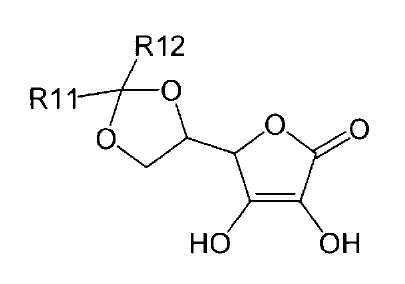
(상기 화학식 2 중, R11 및 R12는 각각 독립적으로 수소 원자, 또는 치환기를 가져도 되는 알킬기를 나타낸다.) (Wherein R11 and R12 each independently represent a hydrogen atom or an alkyl group which may have a substituent).
또한, 본 발명은, 구리 분말(A)의 표면에 상기 아스코르브산 또는 그 유도체(B)를 부착시켜, 표면처리 구리 분말(AB)을 수득하고, 상기 표면처리 구리 분말(AB)과 바인더 수지(C)와 산성기를 갖는 분산제(D)를 혼합하는 도전성 조성물의 제조 방법에 관한 것이다.The present invention also provides a method for producing a surface-treated copper powder (AB) by adhering ascorbic acid or its derivative (B) to the surface of the copper powder (A) C) and a dispersant (D) having an acidic group are mixed with each other.
또한, 본 발명은, 기재와 상기 도전성 조성물의 건조물 또는 경화물인 도전막을 구비한 도전성 재료에 관한 것이다.The present invention also relates to a conductive material comprising a substrate and a conductive film which is a dried product or a cured product of the conductive composition.
본 발명에 의해, 대기하에서의 소성에서도 양호한 도전성을 나타내고, 전기 회로 형성에 사용 가능한 도전성 조성물 및 그 경화물, 적층물을 제공할 수 있게 되었다.According to the present invention, it has become possible to provide a conductive composition, a cured product thereof, and a laminate which exhibit good conductivity even under firing in the atmosphere and can be used for forming an electric circuit.
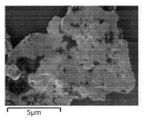
도 1은 실시예 1에서 이용한 표면처리 구리 분말(AB)의 입자 표면의 상태를 주사형 전자 현미경으로 관찰한 도면이다.
도 2는 실시예 1에서 이용한 표면처리 구리 분말(AB)의 입자 표면의 상태를 에너지 분산형 X선 분석 장치로 관찰하여, 탄소와 구리를 원소 맵핑한 도면이다.BRIEF DESCRIPTION OF THE DRAWINGS Fig. 1 is a diagram showing the state of the surface of the surface of the surface-treated copper powder AB used in Example 1 with a scanning electron microscope. Fig.
Fig. 2 is a graph showing the state of the surface of the surface of the surface-treated copper powder AB used in Example 1 with an energy dispersive X-ray analyzer and showing the elemental mapping of carbon and copper.
[도전성 조성물] [Conductive composition]
본 발명의 도전성 조성물은 상기한 바와 같이 구리 분말(A)의 표면을 아스코르브산 또는 그 유도체(B)(이하, 단순히 아스코르브산 유도체(B)라고도 함)로 처리하여 이루어진 표면처리 구리 분말(AB)과, 바인더 수지(C)와, 산성기를 갖는 분산제(D)를 포함한다.The conductive composition of the present invention is a surface-treated copper powder (AB) obtained by treating the surface of copper powder (A) with ascorbic acid or its derivative (B) (hereinafter, simply referred to as an ascorbic acid derivative (B) , A binder resin (C), and a dispersant (D) having an acidic group.
<표면처리 구리 분말(AB)> <Surface-treated copper powder (AB)>
본 발명에 사용되는 표면처리 구리 분말(AB)은, 도전성 조성물의 도전성 성분이 되는 것이다. 표면처리 구리 분말(AB)은 구리 분말(A) 표면의 적어도 일부에 아스코르브산 유도체(B)가 부착되어 있는 것이다. 아스코르브산 유도체(B)로 구리 분말(A) 표면의 적어도 일부를 피복하는 것에 의해, 구리 분말(A) 표면 근방에 환원성 물질인 아스코르브산 유도체를 존재시킬 수 있게 되는 결과, 도전성 조성물을 대기 중에서 소성할 때에 형성되는 구리 산화물을 보다 효율적으로 환원시켜, 구리로 되돌릴 수 있어서 도전성을 향상시킬 수 있다.The surface-treated copper powder (AB) used in the present invention is a conductive component of the conductive composition. The surface-treated copper powder (AB) is obtained by adhering an ascorbic acid derivative (B) to at least a part of the surface of the copper powder (A). Ascorbic acid derivative, which is a reducing material, can be present near the surface of the copper powder (A) by covering at least a part of the surface of the copper powder (A) with the ascorbic acid derivative (B). As a result, It is possible to more efficiently reduce the copper oxide to be formed and to return it to the copper, thereby improving the conductivity.
<구리 분말(A)> ≪ Copper powder (A) >
구리 분말(A)의 D50의 평균 입경은 0.1 내지 30㎛의 범위 내에 있는 것이 바람직하고, 0.1 내지 10㎛의 범위 내에 있는 것이 보다 바람직하다. D50 평균 입경이 0.1㎛ 이상인 것으로, 도전막 내에서의 입자끼리의 접촉 저항을 보다 저감하고, 도전성을 향상시킬 수 있다. 또한, D50 평균 입경이 30㎛ 이하인 것으로, 스크린 인쇄를 수행하여 도전막을 제작할 때, 보다 평활한 도전막을 형성할 수 있다. 또한, D50 평균 입경은 레이저 회절 입도 분포 측정 장치를 이용하여 구한 체적 입도 분포의 누적 50 %에서의 입도를 의미한다.The average particle diameter of D50 of the copper powder (A) is preferably in the range of 0.1 to 30 mu m, more preferably in the range of 0.1 to 10 mu m. The D50 average particle diameter is 0.1 占 퐉 or more, whereby the contact resistance between the particles in the conductive film can be further reduced and the conductivity can be improved. Further, when the D50 average particle diameter is 30 占 퐉 or less, a smoother conductive film can be formed when a conductive film is produced by screen printing. The D50 average particle diameter means the particle size at a cumulative 50% of the volume particle size distribution obtained by using the laser diffraction particle size distribution measuring apparatus.
구리 분말(A)의 형상은 소망하는 도전성을 얻을 수 있으면 되고, 형상은 한정되지 않는다. 구체적으로는, 예를 들면, 구상, 플레이크상, 엽상, 수지(樹枝)상, 플레이트상, 침상, 봉상, 포도상 등의 공지의 형상의 것을 사용할 수 있다. The shape of the copper powder (A) is not limited as long as it can obtain desired conductivity. Specifically, for example, a known shape such as a spherical shape, a flake shape, a leaf shape, a resin, a plate, a needle, a rod or a staple can be used.
<아스코르브산 유도체(B)> ≪ Ascorbic acid derivative (B) >
본 발명에서 이용하는 아스코르브산 또는 그 유도체(B)는 하기 화학식 1 또는 화학식 2로 표현되는 것이다. 구리 산화물에 대한 환원력은 아스코르브산 유도체(B) 중의 엔디올 구조에 기인한다. 따라서, 상기 구조를 남기는 형태로 아스코르브산의 유도체를 합성하여 용해도나 극성을 적절히 조절하여 이용하는 것도 가능하다.The ascorbic acid or its derivative (B) used in the present invention is represented by the following formula (1) or (2). The reducing power for copper oxide is due to the endiol structure in the ascorbic acid derivative (B). Therefore, it is also possible to synthesize derivatives of ascorbic acid in such a form as to leave the above structure, and to appropriately control solubility and polarity.
[화학식 1][Chemical Formula 1]

(상기 화학식 1 중, R1 및 R2는, 각각 독립적으로 수소 원자, 또는 치환기를 가져도 되는 아실기를 나타낸다.)(Wherein R1 and R2 each independently represent a hydrogen atom or an acyl group which may have a substituent).
화학식 1 중의 R1 및 R2에서의 아실기(-COR)는, 탄소수 1 내지 18의 직쇄상, 분지쇄상, 단환상 또는 축합 다환상의 지방족이 결합된 카보닐기, 또는 탄소수 6 내지 10의 단환상 또는 축합 다환상 아릴기가 결합된 카보닐기를 나타낸다.The acyl group (-COR) in R1 and R2 in the general formula (1) is a linear, branched, cyclic or condensed polycyclic aliphatic-bonded carbonyl group having 1 to 18 carbon atoms, or a monocyclic or bicyclic Represents a carbonyl group to which a condensed polycyclic aryl group is bonded.
아실기로서 구체적으로는, 예를 들어, 포르밀기, 아세틸기, 프로피오닐기, 부틸기, 이소부틸기, 발레릴기, 이소발레릴기, 피발로일기, 라우로일기, 미리스틸기, 팔미토일기, 스테아로일기, 시클로펜틸카보닐기, 시클로헥실카보닐기, 아크릴로일기, 메타크릴로일기, 크로토노일기, 이소크로토노일기, 올레오일기, 벤조일기, 1-나프토일기, 2-나프토일기 등을 들 수 있으나, 이에 한정되는 것은 아니다.Specific examples of the acyl group include acyl groups such as formyl, acetyl, propionyl, butyl, isobutyl, valeryl, isobalyl, pivaloyl, lauroyl, , A stearoyl group, a cyclopentylcarbonyl group, a cyclohexylcarbonyl group, an acryloyl group, a methacryloyl group, a crotonoyl group, an isocrotonoyl group, an oleyl group, a benzoyl group, a 1-naphthoyl group, A diary, and the like, but is not limited thereto.
R1 및 R2에서의 아실기는 각각 아실기 내의 수소 원자가 치환기로 치환되어 있어도 되고, 이것에 의해, 추가로 용해성이나 극성을 조절하는 것도 가능하다. 여기서 치환기로는 히드록시기, 할로겐 원자 등을 들 수 있으나, 이에 한정되는 것은 아니다.The acyl groups in R 1 and R 2 may each have a hydrogen atom in the acyl group substituted by a substituent, whereby the solubility and the polarity can be further controlled. Examples of the substituent include a hydroxy group, a halogen atom and the like, but are not limited thereto.
[화학식 2](2)

(상기 화학식 2 중, R11 및 R12는 각각 독립적으로 수소 원자, 또는 치환기를 가져도 되는 알킬기를 나타낸다.)(Wherein R11 and R12 each independently represent a hydrogen atom or an alkyl group which may have a substituent).
화학식 2는, 아스코르브산의 측쇄에 존재하는 2개의 수산기를 알데히드 또는 케톤과 반응시킴으로써 아세탈 구조 또는 케탈 구조가 형성된 유도체이다.Formula (2) is a derivative in which two hydroxyl groups present in the side chain of ascorbic acid are reacted with an aldehyde or a ketone to form an acetal structure or a ketal structure.
화학식 2 중의 R11 및 R12에서의 알킬기로는, 탄소수 1 내지 18의 직쇄상, 분지쇄상 단환상 또는 축합 다환상 알킬기를 들 수 있다. 구체적으로는, 예를 들면, 메틸기, 에틸기, 프로필기, 부틸기, 펜틸기, 헥실기, 헵틸기, 옥틸기, 노닐기, 데실기, 도데실기, 옥타데실기, 이소프로필기, 이소부틸기, 이소펜틸기, sec-부틸기, tert-부틸기, sec-펜틸기, tert-펜틸기, tert-옥틸기, 네오펜틸기, 시클로프로필기, 시클로부틸기, 시클로펜틸기, 시클로헥실기, 아다만틸기, 노보닐기 및 4-데실시클로헥실기 등을 들 수 있으나, 이에 한정되는 것은 아니다.Examples of the alkyl group represented by R11 and R12 in the general formula (2) include a straight chain, branched chain monocyclic or condensed polycyclic alkyl group having 1 to 18 carbon atoms. Specific examples thereof include a methyl group, an ethyl group, a propyl group, a butyl group, a pentyl group, a hexyl group, a heptyl group, an octyl group, a nonyl group, a decyl group, a dodecyl group, an octadecyl group, A cyclohexyl group, a cyclopentyl group, a cyclohexyl group, a cyclopentyl group, a cyclohexyl group, a cyclopentyl group, a cyclopentyl group, a cyclohexyl group, a cyclohexyl group, An adamantyl group, a norbornyl group, and a 4-dechlohexyl group, but the present invention is not limited thereto.
R11 및 R12에서의 알킬기는, 각각 알킬기 내의 수소 원자가 치환기로 치환되어 있어도 되고, 이것에 의해, 추가로 용해성이나 극성을 조절하는 것도 가능하다. 여기서, 치환기로는 히드록시기, 할로겐 원자 등을 들 수 있으나, 이것에 한정되는 것은 아니다.Each of the alkyl groups represented by R11 and R12 may have a hydrogen atom in the alkyl group substituted with a substituent, whereby the solubility and the polarity can be further controlled. Examples of the substituent include a hydroxy group and a halogen atom, but are not limited thereto.
또한, R11 및 R12는 일체로서 환 구조를 형성하여도 된다.R11 and R12 may form a ring structure as a whole.
화학식 1 또는 화학식 2로 표시되는 아스코르브산 유도체(B) 중, 가장 저렴하게 입수할 수 있고 또한 용해도가 낮기 때문에 구리 분말(A)의 표면으로부터 용해 또는 이탈하기 어렵다는 점에서, 화학식 1에서의 R1 및 R2가 수소 원자인 아스코르브산이 바람직하다. 또한, 아스코르브산 유도체(B)는, 구리 분말(A)에 대해 2종 이상을 병용하여도 된다.(1) or (2), it is preferable that R1 and / or R1 in the formula (1) is at least one selected from ascorbic acid derivatives And ascorbic acid in which R 2 is a hydrogen atom. The ascorbic acid derivative (B) may be used in combination with two or more kinds of copper powder (A).
본 발명에 이용되는 '아스코르브산'은 일반적으로 비타민 C로 호칭되는 L-아스코르브산, 즉 (R)-3,4-디히드록시-5-((S)-1,2-디하이드록시에틸)푸란-2(5H)-온 뿐만 아니라, 그 광학이성질체(D형)를 포함한다. 또한, 이들의 입체이성질체인 에리소르빈산의 D형과 L형을 포함한다. 입체이성질체나 광학이성질체라도 환원능의 발현에 필요한 엔디올 구조를 가지며, 동등의 환원능을 발현할 수 있다. 또한, 이들의 광학이성질체의 혼합물인 DL형도 본 발명에서의 "아스코르브산"으로서 사용할 수 있다.Ascorbic acid " as used herein refers to L-ascorbic acid, commonly referred to as vitamin C, i.e., (R) -3,4-dihydroxy-5 - ((S) -1,2-dihydroxyethyl ) Furan-2 (5H) -one, as well as its optical isomer (D form). Also included are D-form and L-form of the stereoisomers erisorbic acid. Even a stereoisomer or an optical isomer has an endol structure necessary for the expression of a reducing ability, and can exhibit equivalent reducing ability. Also, a DL type which is a mixture of these optical isomers can be used as "ascorbic acid" in the present invention.
본 발명에서의 아스코르브산 유도체(B)로는 이하에 나타낸 것과 같은 화합물을 예시할 수 있다. 또한, 본 발명에서의 아스코르브산 유도체(B)는, 이들의 대표예에 한정되는 것은 아니다. 각 화학 구조 중의 "*"은 X, Y 또는 Z가 아스코르브산의 오원환 부위에 결합하는 위치를 나타낸다.As the ascorbic acid derivative (B) in the present invention, the following compounds can be exemplified. In addition, the ascorbic acid derivative (B) in the present invention is not limited to these representative examples. "*" In each chemical structure represents the position where X, Y or Z bonds to the pentavalent ring part of the ascorbic acid.

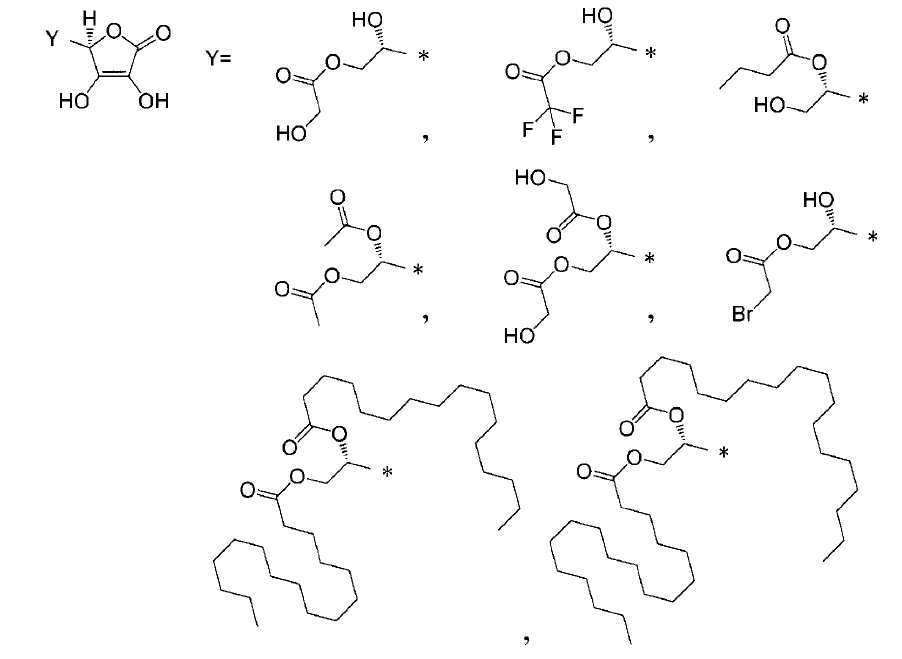
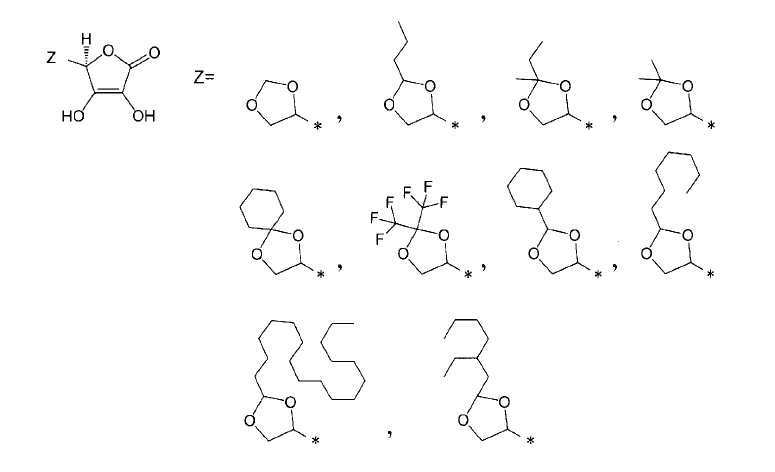
<표면처리 구리 분말(AB)의 제조 방법> ≪ Process for producing surface-treated copper powder (AB) >
표면처리 구리 분말(AB)은 이하의 방법으로 한정되는 것은 아니지만, 예를 들어, 분산용 또는 변형용 매질(media)을 이용하여, 구리 분말(A)과 아스코르브산 유도체(B)를 충돌시킴으로써 얻을 수 있다. 분산용 또는 변형용 매질로는 유리, 스틸, 지르코니아 등을 재질로 하는 구상 비즈를 이용할 수 있다.The surface-treated copper powder AB is not limited to the following method. For example, the surface-treated copper powder AB is obtained by colliding the copper powder A and the ascorbic acid derivative B using a dispersing or deforming medium . As the dispersing or deforming medium, spherical beads made of glass, steel, zirconia or the like can be used.
이 접촉 공정은 건식, 습식 중 어느 방법으로도 할 수 있다.This contacting step can be carried out by dry or wet method.
즉, 건식의 경우, 예를 들어, 구리 분말(A), 아스코르브산 유도체(B) 및 분산용 또는 변형용 매질을 용기에 넣고 밀봉한 후, 용기마다 회전하거나 진동하거나 또는 용기 내부를 교반하거나 함으로써, 이들을 충돌시켜, 구리 분말(A)을 변형시키면서 아스코르브산 유도체(B)의 일부 또는 전부를 구리 분말(A)의 표면에 부착시킨 후, 분산 또는 변형용 매질을 분리하는 것으로써, 표면처리 구리 분말(AB)을 얻을 수 있다.That is, in the case of the dry method, for example, the copper powder (A), the ascorbic acid derivative (B), and the dispersing or deforming medium are sealed in a container and then rotated or vibrated or stirred inside the container , And colliding them to deform a copper powder (A) while attaching a part or the whole of the ascorbic acid derivative (B) to the surface of the copper powder (A), and then separating the dispersing or deforming medium, Powder (AB) can be obtained.
또한, 습식의 경우에는, 구리 분말(A), 아스코르브산 유도체(B), 액상 매체, 분산용 또는 변형용 매질을 용기에 넣고, 상기와 같이 회전·진동·교반 등을 함으로써, 이들을 충돌시킨 후, 나일론 메쉬나 스테인레스 메쉬 등으로 분산 또는 변형용 매질을 제거하고, 이어서 액상 매체를 제거하고, 건조함으로써, 표면처리 구리 분말(AB)을 얻을 수 있다.In the case of the wet type, the copper powder (A), the ascorbic acid derivative (B), the liquid medium, the dispersing medium or the deforming medium are placed in a container and subjected to rotation, vibration, , The surface-treated copper powder (AB) can be obtained by removing the dispersing or deforming medium with nylon mesh or stainless mesh, then removing the liquid medium and drying.
상기 분산용 또는 변형용 매질을 구리 분말(A)에 충돌시키는 분산 공정을 실시할 때에는, 비즈 밀, 볼 밀, 쉐이커 등의 공지의 분산 방법을 사용할 수 있다.When the dispersing step for impinging the dispersing or deforming medium on the copper powder (A) is carried out, a known dispersing method such as a bead mill, a ball mill or a shaker can be used.
습식 분산을 할 경우에 사용하는 액상 매체는 알코올계, 케톤계, 에스테르계, 방향족계, 탄화수소계 등의 공지의 액상 매체를 들 수 있고, 이들 중 2종 이상을 혼합하여 사용하여도 되며, 분산이 실시되는 온도에서 액상을 이루는 것이라면 특별히 한정되지 않는다.The liquid medium to be used in the wet dispersion may be a known liquid medium such as alcoholic, ketonic, ester, aromatic, or hydrocarbon liquid. Two or more kinds of liquid mediums may be used in combination, Is not particularly limited as long as it forms a liquid phase at the temperature at which it is carried out.
이러한 액상 매체 중에서, 아스코르브산 유도체(B)의 용해도가 비교적 낮은 빈(貧)-용매를 사용하면, 특히 효율적으로 소망하는 양으로 구리 분말(A)의 표면에 아스코르브산 유도체(B)를 부착시킬 수 있게 되기 때문에 바람직하다. 아스코르브산 유도체(B)의 빈-용매로는 톨루엔, 크실렌, 헥산, 옥탄, 이소프로판올, 에틸아세테이트, 나아가 이들의 혼합 용매를 들 수 있으나, 이에 한정되는 것은 아니다.Among such liquid mediums, when a poor solvent having a comparatively low solubility of the ascorbic acid derivative (B) is used, the ascorbic acid derivative (B) is adhered to the surface of the copper powder (A) So that it is preferable. Examples of the bin-solvent of the ascorbic acid derivative (B) include toluene, xylene, hexane, octane, isopropanol, ethyl acetate, and mixed solvents thereof, but are not limited thereto.
특히, 분산용 또는 변형용 매질과 액상 매체를 이용하는 습식 분산은, 간편한 조작으로, 구리 분말(A) 표면을 아스코르브산 유도체(B)로 균일하고 또한 효율적으로 피복하기 쉽다는 점에서 바람직하다. 또한, 이 습식 분산은, 입자끼리의 접촉 면적이 큰 플레이크상 또는 엽상의 피복 구리 분말(AB)이 얻어지고, 그 결과, 우수한 초기 도전성을 발현하고, 또한 그 도전성을 유지할 수 있기 때문에 바람직하다.Particularly, the wet dispersion using the dispersion medium or the medium for modification and the liquid medium is preferable from the viewpoint that the surface of the copper powder (A) can be uniformly and efficiently coated with the ascorbic acid derivative (B) by a simple operation. This wet dispersion is preferable because a coated copper powder (AB) in the form of flakes or leaves having a large contact area between the particles can be obtained, and as a result, excellent initial conductivity can be exhibited and conductivity can be maintained.
아스코르브산 유도체(B)는, 구리 분말(A) 100 질량부에 대하여 1 내지 30 질량부 이용하는 것이 바람직하고, 5 내지 10 질량부의 범위 내에 있는 것이 더욱 바람직하다. 아스코르브산을 1 질량부 이상으로 함으로써, 소성 시에서의 표면처리 구리 분말(AB)의 구리의 산화를 억제하고, 또한 표면처리 구리 분말(AB)과 바인더 수지(C)의 친화성을 높일 수 있다. 또한, 아스코르브산을 30 질량부 이하로 함으로써, 표면처리 구리 분말(AB)끼리의 응집을 억제할 수 있다.The ascorbic acid derivative (B) is preferably used in an amount of 1 to 30 parts by mass, more preferably 5 to 10 parts by mass, per 100 parts by mass of the copper powder (A). When the ascorbic acid content is 1 part by mass or more, the oxidation of copper in the surface-treated copper powder AB at the time of firing can be suppressed and the affinity between the surface-treated copper powder AB and the binder resin C can be increased . Further, by making the amount of ascorbic acid 30 parts by mass or less, aggregation of the surface-treated copper powders AB can be suppressed.
<바인더 수지(C)> ≪ Binder Resin (C) >
바인더 수지(C)는 바인더 수지(C)와 표면처리 구리 분말(AB)의 합계 100 질량% 중, 5 내지 40 질량%를 배합하는 것이 바람직하고, 5 내지 25 질량%가 보다 바람직하다. 5 질량% 이상이 됨으로써, 도전성 피막의 기재와의 밀착성이 보다 향상되고, 기계 강도도 향상된다. 또한 40 질량% 이하가 됨으로써, 도전성이 보다 향상된다.The binder resin (C) is preferably blended in an amount of 5 to 40 mass%, more preferably 5 to 25 mass%, of 100 mass% of the total of the binder resin (C) and the surface- treated copper powder (AB). When the content is 5% by mass or more, the adhesion of the conductive film to the base material is further improved, and the mechanical strength is also improved. When the content is 40 mass% or less, the conductivity is further improved.
바인더 수지(C)로서는, 예를 들면, 아크릴 수지, 폴리부타디엔계 수지, 에폭시 화합물, 옥세탄 수지, 피페라진폴리아미드 수지, 부가형 에스테르 수지, 축합형 에스테르 수지, 아미노 수지, 폴리락트산 수지, 옥사졸린 수지, 벤조옥사진 수지, 비닐계 수지, 디엔계 수지, 테르펜 수지, 석유 수지, 셀룰로오스계 수지, 폴리에스테르 수지, 우레탄변성 폴리에스테르 수지, 에폭시변성 폴리에스테르 수지, (메타)아크릴 수지, 스티렌 수지, 스티렌-(메타)아크릴 수지, 스티렌-부타디엔 수지, 에폭시 수지, 변성에폭시 수지, 페녹시 수지, 염화비닐-아세트산비닐 공중합체, 부티랄 수지, 아세탈 수지, 페놀 수지, 폴리카보네이트 수지, 폴리에테르 수지, 폴리우레탄 수지, 폴리우레탄우레아 수지, 폴리아미드 수지, 폴리이미드 수지, 폴리아미드이미드 수지, 알키드 수지, 폴리올레핀 수지, 불소 수지, 케톤 수지, 벤조구아나민 수지, 멜라민 수지, 요소 수지, 실리콘 수지, 니트로셀룰로오스, 셀룰로오스·아세테이트·부틸레이트(CAB) 수지, 셀룰로오스·아세테이트·프로피오네이트(CAP) 수지, 로진, 로진 에스테르 및 말레인산 수지 등의 공지의 수지를 들 수 있으며, 본 발명의 도전성 조성물, 도전막, 및 도전성 재료에 요구되는 물성에 따라 적절하게 선택할 수 있다. 또한, 바인더 수지(C)는 단독 또는 2종 이상을 병용할 수 있다.Examples of the binder resin (C) include acrylic resin, polybutadiene resin, epoxy compound, oxetane resin, piperazine polyamide resin, addition type ester resin, condensation type ester resin, amino resin, polylactic acid resin, oxazoline (Meth) acrylic resin, a styrene resin, a styrene resin, a styrene resin, a styrene resin, a styrene resin, a styrene resin, a phenol resin, (Meth) acrylic resin, styrene-butadiene resin, epoxy resin, modified epoxy resin, phenoxy resin, vinyl chloride-vinyl acetate copolymer, butyral resin, acetal resin, phenol resin, polycarbonate resin, Polyurethane resin, polyurethane urea resin, polyamide resin, polyimide resin, polyamideimide resin, alkyd resin (Meth) acrylate resin, a polyolefin resin, a fluororesin, a ketone resin, a benzoguanamine resin, a melamine resin, a urea resin, a silicone resin, a nitrocellulose, a cellulose acetate butyrate (CAB) resin, a cellulose acetate propionate Rosin, rosin ester and maleic acid resin, and can be appropriately selected depending on the physical properties required for the conductive composition, conductive film, and conductive material of the present invention. The binder resin (C) may be used alone or in combination of two or more.
상기 폴리에스테르 수지는 수산기 및 카복실기의 적어도 어느 하나를 갖는 것이 바람직하다. 폴리에스테르 수지는, 다염기산과 폴리올 등의 반응, 또는 다염기산 에스테르와 폴리올 등의 에스테르 교환 반응 등 공지의 합성법으로 합성할 수 있다. 또한, 폴리에스테르 수지에 카복실기를 부여하는 방법은, 공지의 방법을 사용할 수 있으나, 예를 들어 폴리에스테르 수지를 중합한 후, 180 내지 230℃에서 ε-카프로락톤 등의 환상 에스테르를 후-부가(개환부가)하여 블록화하는 방법, 또는 무수트리멜리트산, 무수프탈산 등의 산 무수물을 부가하는 방법 등을 들 수 있다. 또한, 폴리에스에르 수지는 포화 폴리에스테르가 바람직하다.The polyester resin preferably has at least one of a hydroxyl group and a carboxyl group. The polyester resin can be synthesized by a known synthesis method such as a reaction between a polybasic acid and a polyol or an ester exchange reaction between a polybasic acid ester and a polyol. A known method can be used for imparting a carboxyl group to the polyester resin. For example, after the polyester resin is polymerized, a cyclic ester such as ε-caprolactone at 180 to 230 ° C. is post- A method in which an acid anhydride such as anhydrous trimellitic acid or phthalic anhydride is added, and the like. The polyesters are preferably saturated polyesters.
상기 다염기산은, 예를 들어 방향족 디카복실산, 직쇄 지방족 디카복실산, 환상 지방족 디카복실산 등, 및 3관능 이상의 카복실산 등이 바람직하다. 또한, 다염기산은, 산 무수물기 함유 화합물을 포함한다. 다염기산은, 단독 또는 2종 이상을 병용할 수 있다.The polybasic acid is preferably an aromatic dicarboxylic acid, a straight chain aliphatic dicarboxylic acid, a cyclic aliphatic dicarboxylic acid, etc., and a trifunctional or higher carboxylic acid. The polybasic acid includes an acid anhydride group-containing compound. The polybasic acids may be used alone or in combination of two or more.
방향족 디카복실산은, 예를 들면 테레프탈산 및 이소프탈산 등을 들 수 있으나, 이에 한정되지 않는다. 또한 직쇄 지방족 디카복실산, 예를 들면 아디프산, 세바스산 및 아젤라산 등을 들 수 있으나, 이에 한정되지 않는다. 또한, 환상 지방족 디카복실산, 예를 들면 1,4-시클로헥산 디카복실산, 디카복시수소첨가 비스페놀 A, 다이머산, 4-메틸헥사히드로 무수프탈산 및 3-메틸헥사히드로 무수프탈산 등을 들 수 있으나, 이에 한정되지 않는다. 또한, 3관능 이상의 카복실산은 무수트리멜리트산 및 무수피로멜리트산 등을 들 수 있으나, 이에 한정되지 않는다. 그 밖의 카복실산은, 푸마르산 등의 불포화 디카복실산, 5-설포이소프탈산 나트륨염 등의 설폰산 금속염 함유 디카복실산 등을 들 수 있으나, 이에 한정되지 않는다.Examples of the aromatic dicarboxylic acid include, but are not limited to, terephthalic acid and isophthalic acid. And straight chain aliphatic dicarboxylic acids such as adipic acid, sebacic acid and azelaic acid, but are not limited thereto. Further, cyclic aliphatic dicarboxylic acids such as 1,4-cyclohexanedicarboxylic acid, dicarboxy hydrogenated bisphenol A, dimeric acid, 4-methylhexahydrophthalic anhydride and 3-methylhexahydrophthalic anhydride can be used, But is not limited thereto. The carboxylic acid having three or more functional groups can be exemplified by anhydrous trimellitic acid and anhydrous pyromellitic acid, but is not limited thereto. Other carboxylic acids include, but are not limited to, unsaturated dicarboxylic acids such as fumaric acid and dicarboxylic acids containing sulfonic acid metal salts such as sodium 5-sulfoisophthalate.
상기 폴리올은, 디올 및 3개 이상의 수산기를 갖는 화합물이 바람직하다. 디올은, 예를 들면 에틸렌글리콜, 프로필렌글리콜, 및 1,4-부탄디올 및 네오펜틸글리콜 등을 들 수 있으나, 이에 한정되지 않는다. 3개 이상의 수산기를 갖는 화합물은, 트리메틸올프로판, 글리세린 및 펜타에리트리톨 등을 들 수 있으나, 이에 한정되지 않는다. 폴리올은 단독 또는 2종 이상을 병용할 수 있다.The polyol is preferably a compound having a diol and at least three hydroxyl groups. Examples of diols include, but are not limited to, ethylene glycol, propylene glycol, 1,4-butanediol, and neopentyl glycol. Examples of the compound having three or more hydroxyl groups include, but are not limited to, trimethylolpropane, glycerin and pentaerythritol. The polyols may be used alone or in combination of two or more.
상기 폴리우레탄 수지는, 폴리올과 디이소시아네이트와 쇄 연장제의 디올 화합물을 반응시킨, 말단에 수산기를 갖는 화합물이다. 폴리우레탄 수지는, 쇄 연장제를 사용하여 분자쇄를 연장시킬 수 있다. 쇄 연장제는, 일반적으로 디올 등이 바람직하다. 폴리우레탄 수지는, 공지의 합성법으로 합성할 수 있다.The polyurethane resin is a compound having a hydroxyl group at the end thereof, which is obtained by reacting a polyol, a diisocyanate and a diol compound of a chain extender. The polyurethane resin can extend the molecular chain by using a chain extender. As the chain extender, diol and the like are generally preferred. The polyurethane resin can be synthesized by a known synthesis method.
폴리우레탄 수지의 합성에 사용하는 폴리올은, 폴리에테르폴리올, 폴리에스테르폴리올, 폴리카보네이트폴리올 및 폴리부타디엔글리콜 등이 바람직하다. 폴리올은 단독 또는 2종 이상을 병용할 수 있다.The polyol used for the synthesis of the polyurethane resin is preferably a polyether polyol, a polyester polyol, a polycarbonate polyol, and a polybutadiene glycol. The polyols may be used alone or in combination of two or more.
폴리에테르폴리올은, 산화에틸렌, 산화프로필렌 및 테트라하이드로퓨란 등의 중합체, 및 이들의 공중합체이다.Polyether polyols are polymers such as ethylene oxide, propylene oxide, and tetrahydrofuran, and copolymers thereof.
폴리에스테르폴리올은, 상기 폴리에스테르 수지에서 설명한 폴리올과 다염기산의 에스테르이다.The polyester polyol is an ester of a polyol and a polybasic acid described in the polyester resin.
폴리카보네이트폴리올은, 1) 디올 또는 비스페놀과 탄산에스테르를 반응시킨 화합물, 및 2) 디올 또는 비스페놀을 알칼리의 존재하에서 포스겐과 반응시킨 화합물 등이 바람직하다. 탄산에스테르는, 예를 들어 디메틸카보네이트, 디에틸카보네이트, 디페닐카보네이트, 에틸렌카보네이트, 및 프로필렌카보네이트 등을 들 수 있으나, 이에 한정되지 않는다.The polycarbonate polyol is preferably a compound obtained by reacting 1) a diol or a bisphenol with a carbonic ester, and 2) a compound obtained by reacting a diol or bisphenol with phosgene in the presence of an alkali. Examples of the carbonic ester include, but are not limited to, dimethyl carbonate, diethyl carbonate, diphenyl carbonate, ethylene carbonate, and propylene carbonate.
디이소시아네이트는, 방향족 디이소시아네이트, 지방족 디이소시아네이트, 지환족 이소시아네이트 등이 바람직하다. 디이소시아네이트는 단독 또는 2종 이상을 병용할 수 있다.The diisocyanate is preferably an aromatic diisocyanate, an aliphatic diisocyanate, an alicyclic isocyanate, or the like. The diisocyanate may be used alone or in combination of two or more.
상기 폴리우레탄우레아 수지는 폴리올과 이소시아네이트를 반응시켜, 말단에 이소시아네이트기를 갖는 우레탄 프리폴리머를 합성하고, 추가로 폴리아민과 반응시킨 화합물이다. 또한 폴리우레탄우레아 수지는 분자량을 조절하기 위해 필요에 따라 반응 정지제를 반응시킬 수 있다. 폴리올과 디이소시아네이트는 상기 폴리우레탄 수지에서 설명한 화합물을 사용하는 것이 바람직하다. 폴리아민은 디아민이 바람직하다. 반응 정지제는 디알킬아민, 모노알코올 등이 바람직하다. 폴리우레탄우레아 수지는, 공지의 합성법으로 합성할 수 있다.The polyurethane-urea resin is a compound obtained by reacting a polyol and isocyanate to synthesize a urethane prepolymer having an isocyanate group at the terminal thereof and further reacting with a polyamine. In addition, the polyurethane-urea resin can be reacted with a reaction terminator as needed to control the molecular weight. The polyol and the diisocyanate are preferably the compounds described in the polyurethane resin. The polyamine is preferably a diamine. The reaction terminator is preferably a dialkylamine, a monoalcohol or the like. The polyurethane-urea resin can be synthesized by a known synthesis method.
폴리우레탄 수지 및 폴리우레탄우레아 수지는, 수산기 이외에 카복실기를 갖는 것이 바람직하다. 구체적으로는, 합성할 때에 디올의 일부를 카복실기 함유 디올로 치환하여 합성하는 방법으로 얻을 수 있다. 상기 디올은, 디메틸올프로피온산 및 디메틸올부탄산 등이 바람직하다.The polyurethane resin and the polyurethane-urea resin preferably have a carboxyl group in addition to the hydroxyl group. Specifically, it can be obtained by a method in which a part of the diol is substituted with a carboxyl group-containing diol in the synthesis. The diol is preferably dimethylolpropionic acid or dimethylolbutanoic acid.
도전성 페이스트가 폴리우레탄 수지 또는 폴리우레탄우레아 수지를 포함하는 경우, 형성되는 도전성 피막의 경도가 보다 향상된다.When the conductive paste contains a polyurethane resin or a polyurethane-urea resin, the hardness of the conductive film to be formed is further improved.
폴리우레탄 수지 또는 폴리우레탄우레아 수지를 합성할 때에는 용제를 사용할 수 있다. 구체적으로는, 에스테르계 용제, 케톤계 용제, 글리콜에테르계 용제, 지방족계 용제, 방향족계 용제 및 카보네이트계 용제 등이 바람직하다. 용제는 단독 또는 2종 이상을 병용할 수 있다.When synthesizing a polyurethane resin or a polyurethane-urea resin, a solvent may be used. Concretely, ester solvents, ketone solvents, glycol ether solvents, aliphatic solvents, aromatic solvents and carbonate solvents are preferable. The solvent may be used alone or in combination of two or more.
에스테르계 용제는, 예를 들면 아세트산에틸, 아세트산이소프로필, 아세트산n-부틸, 아세트산이소부틸, 아세트산아밀, 락트산에틸 및 탄산디메틸 등을 들 수 있으나, 이에 한정되지 않는다.Examples of the ester solvent include, but are not limited to, ethyl acetate, isopropyl acetate, n-butyl acetate, isobutyl acetate, amyl acetate, ethyl lactate, and dimethyl carbonate.
케톤계 용제는, 예를 들면 아세톤, 메틸에틸케톤, 메틸이소부틸케톤, 디이소부틸케톤, 디이소부틸케톤, 디아세톤알코올, 이소포론 및 시클로헥사논 등을 들 수 있으나, 이에 한정되지 않는다.Examples of the ketone solvent include, but are not limited to, acetone, methyl ethyl ketone, methyl isobutyl ketone, diisobutyl ketone, diisobutyl ketone, diacetone alcohol, isophorone, and cyclohexanone.
글리콜에테르계 용제는, 예를 들면 에틸렌글리콜모노에틸에테르, 에틸렌글리콜모노이소프로필에테르 및 에틸렌글리콜모노부틸에테르 등의 모노 에테르, 및 이들의 아세트산 에스테르; 디에틸렌글리콜디메틸에테르, 디에틸렌글리콜디에틸에테르, 디에틸렌글리콜모노에틸에테르, 디에틸렌글리콜모노부틸에테르, 프로필렌글리콜모노메틸에테르, 및 프로필렌글리콜모노에틸에테르 등 및 이들의 아세트산 에스테르 등을 들 수 있으나, 이에 한정되지 않는다.Examples of the glycol ether solvent include monoethers such as ethylene glycol monoethyl ether, ethylene glycol monoisopropyl ether and ethylene glycol monobutyl ether, and acetic acid esters thereof; Diethylene glycol dimethyl ether, diethylene glycol diethyl ether, diethylene glycol monoethyl ether, diethylene glycol monobutyl ether, propylene glycol monomethyl ether, propylene glycol monoethyl ether and the like, and acetic acid esters thereof. , But is not limited thereto.
지방족계 용제는, 예를 들면 n-헥산, 시클로헥산, 메틸시클로헥산, 메틸시클로헥산 등을 들 수 있으나, 이에 한정되지 않는다.Examples of the aliphatic solvent include, but are not limited to, n-hexane, cyclohexane, methylcyclohexane, and methylcyclohexane.
방향족계 용제로서는, 톨루엔, 크실렌 등을 들 수 있으나, 이에 한정되지 않는다.Examples of the aromatic solvents include, but are not limited to, toluene, xylene, and the like.
카보네이트계 용제로는, 디에틸카보네이트, 에틸메틸카보네이트 등의 쇄상 카보네이트, 에틸렌카보네이트, 프로필렌카보네이트 등의 환상 카보네이트 등을 들 수 있으나, 이에 한정되지 않는다.Examples of the carbonate-based solvent include, but are not limited to, chain carbonates such as diethyl carbonate and ethyl methyl carbonate, and cyclic carbonates such as ethylene carbonate and propylene carbonate.
상기 에폭시 수지는, 에폭시기 및 수산기를 갖는 화합물이며, 공지의 화합물을 사용할 수 있다. 에폭시 수지는 비스페놀 A 및 비스페놀 F로 대표되는, 방향족 디올과 에피클로로히드린을 반응시켜 얻어진 폴리글리시딜에테르가 바람직하다. 에폭시 수지는 고분자 에폭시 수지인, 이른바 페녹시 수지를 사용하는 것도 바람직하다. 이들은 단독 또는 2종 이상을 병용할 수 있다.The epoxy resin is a compound having an epoxy group and a hydroxyl group, and a known compound can be used. The epoxy resin is preferably a polyglycidyl ether obtained by reacting an aromatic diol and epichlorohydrin represented by bisphenol A and bisphenol F. It is also preferable to use a so-called phenoxy resin, which is a high molecular weight epoxy resin. These may be used alone or in combination of two or more.
이하, 본 발명의 도전성 조성물에 사용되는 바인더 수지(C)의 선정의 구체예로서, 도전성 페이스트 및 도전성 접착제나 도전성 시트의 두 가지 예에 대해 서술한다. 또한, 본 발명의 용도는 이에 한정되는 것은 아니다.Hereinafter, as concrete examples of the selection of the binder resin (C) used in the conductive composition of the present invention, two examples of the conductive paste, the conductive adhesive and the conductive sheet will be described. Further, the use of the present invention is not limited thereto.
<도전성 페이스트에 사용하는 경우> <When used in conductive paste>
먼저, 본 발명의 도전성 조성물을 배선 회로를 제작하기 위한 도전성 페이스트에 사용하는 경우, 바인더 수지(C)로서는, 기재에 대한 밀착성, 용제에 대한 용해성, 도전성 조성물에 필요한 도막의 기계 강도의 관점에서, 페녹시 수지, 폴리에스테르 수지, 폴리우레탄 수지, 폴리우레탄우레아 수지 및 에폭시 수지로 이루어진 군으로부터 선택되는 것이 바람직하다. 또한, 이들은, 산성기를 갖는 분산제(D)와 조합되는 경우에, 표면처리 구리 분말(AB)의 분산성이 우수한 측면에서도 바람직하다. 이러한 바인더 수지는 단독으로 또는 2종 이상을 병용할 수 있다.First, in the case where the conductive composition of the present invention is used for a conductive paste for producing a wiring circuit, the binder resin (C) is preferably used in view of adhesiveness to a substrate, solubility in a solvent, and mechanical strength of a coating film required for the conductive composition. A phenoxy resin, a polyester resin, a polyurethane resin, a polyurethane-urea resin and an epoxy resin. In addition, when they are combined with the dispersant (D) having an acidic group, they are also preferable in terms of excellent dispersibility of the surface-treated copper powder (AB). These binder resins may be used alone or in combination of two or more.
이 경우의 바인더 수지(C)의 수 평균 분자량(이하, Mn이라 한다)은, 10,000 내지 50,000이 바람직하고, 20,000 내지 40,000이 보다 바람직하다. Mn이 10,000 이상이 됨으로써, 도전성 조성물의 환경 신뢰성이 향상되고, 특히 내습열성이 보다 향상된다. 또한, Mn은, GPC(겔 투과 크로마토그래피)로 측정한 폴리스티렌 환산 수치이다. 또한, 배선 회로의 환경 신뢰성이란, 85℃, 습도 85%의 환경하에 놓이더라도, 도전성 조성물이나 도전막 자체의 산화에 의한 열화가 없으며, 도전막의 기재(예를 들면 ITO 필름)에 대한 밀착성이 열화하기 어렵다는 의미이다. The number average molecular weight (hereinafter referred to as Mn) of the binder resin (C) in this case is preferably 10,000 to 50,000, more preferably 20,000 to 40,000. When Mn is 10,000 or more, the environmental reliability of the conductive composition is improved, and particularly, the heat and humidity resistance is improved. Further, Mn is a polystyrene reduced value measured by GPC (gel permeation chromatography). The environmental reliability of the wiring circuit means that the conductive composition or the conductive film itself does not deteriorate by oxidation even when placed under an environment of 85 캜 and 85% humidity, and the adhesion of the conductive film to a substrate (for example, ITO film) It is difficult to do.
이 경우의 바인더 수지(C)의 유리전이온도(이하, Tg라고 한다)는 5 내지 100℃가 바람직하고, 10 내지 95℃가 보다 바람직하다. Tg가 5℃ 이상이 되면 배선 회로의 내습열성이 보다 향상된다. 또한, Tg가 100℃ 이하가 되면 배선 회로와 기재와의 밀착성이 보다 향상된다. 또한, Tg는 DSC(시차 주사 열량계)로 측정한 수치이다.The glass transition temperature (hereinafter referred to as Tg) of the binder resin (C) in this case is preferably 5 to 100 占 폚, more preferably 10 to 95 占 폚. When the Tg is 5 ° C or more, the resistance to moisture and humidity of the wiring circuit is further improved. Further, when the Tg is 100 DEG C or less, adhesion between the wiring circuit and the substrate is further improved. Tg is a value measured by DSC (differential scanning calorimeter).
이 경우의 바인더 수지는, 상기 Mn과 상기 Tg를 동시에 만족하면 배선 회로의 신뢰성이 보다 향상되기 때문에, 가장 바람직하다.The binder resin in this case is most preferable because the reliability of the wiring circuit is further improved if both Mn and Tg are satisfied.
<도전성 접착제나 도전성 시트에 사용하는 경우> ≪ When used in conductive adhesive or conductive sheet >
다음으로, 본 발명의 도전성 조성물을 도전성 접착제나 도전성 시트 등에 사용하는 경우, 바인더 수지(C)로서는, 접착성, 가요성, 도장 가공성의 관점에서, 폴리우레탄 수지, 폴리우레탄우레아 수지, 부가형 에스테르 수지, 에폭시 수지, 페녹시 수지, 폴리이미드 수지, 폴리아미드 수지, 피페라진폴리아미드 수지, 폴리아미드이미드 수지가 특히 바람직하다. 또한, 이들은 산성기를 갖는 분산제(D)와 조합된 경우에, 표면처리 구리 분말(AB)의 분산성이 우수한 측면에서도 바람직하다. 이러한 바인더 수지는 단독으로 또는 2종 이상을 병용할 수 있다.Next, when the conductive composition of the present invention is used for a conductive adhesive or a conductive sheet, the binder resin (C) is preferably a polyurethane resin, a polyurethane-urea resin, an addition-type ester resin , An epoxy resin, a phenoxy resin, a polyimide resin, a polyamide resin, a piperazine polyamide resin and a polyamideimide resin are particularly preferable. In addition, when these are combined with the dispersant (D) having an acidic group, they are also preferable in terms of excellent dispersibility of the surface-treated copper powder (AB). These binder resins may be used alone or in combination of two or more.
이 경우의 바인더 수지는 열경화성인 것이 더욱 바람직하며, 구체적으로는 구조 중에 경화 반응의 기점이 되는 카복실기를 갖는 것이 바람직하다. 또한, 이러한 바인더 수지(C)와 경화제를 병용하는 것도 가능하다.The binder resin in this case is more preferably thermosetting, and specifically, it is preferable to have a carboxyl group as a starting point of the curing reaction in the structure. It is also possible to use the binder resin (C) in combination with a curing agent.
이 경우의 바인더 수지(C)의 산가는 특별히 한정되지 않지만, 3 내지 100mgKOH/g이 바람직하고, 3 내지 70mgKOH/g이 보다 바람직하다. 특히 바람직하게는, 3 내지 40mgKOH/g이다. 바인더 수지(C)의 산가를 3 내지 100mgKOH/g의 범위로 함으로써 가요성과 환경 신뢰성이 보다 향상된다.In this case, the acid value of the binder resin (C) is not particularly limited, but is preferably 3 to 100 mg KOH / g, more preferably 3 to 70 mg KOH / g. Particularly preferably 3 to 40 mg KOH / g. When the acid value of the binder resin (C) is in the range of 3 to 100 mgKOH / g, flexibility and environmental reliability are further improved.
이 경우의 바인더 수지(C)의 Tg는 -30 내지 30℃가 바람직하고, -20 내지 20℃가 보다 바람직하다. Tg를 -30 내지 30℃의 범위로 함으로써, 가요성 및 접착 강도가 보다 향상된다.In this case, the Tg of the binder resin (C) is preferably -30 to 30 占 폚, more preferably -20 to 20 占 폚. By setting the Tg in the range of -30 to 30 占 폚, the flexibility and the bonding strength are further improved.
이 경우의 바인더 수지(C)의 중량 평균 분자량(이하, Mw라고 한다)는 20,000 내지 100,000이 바람직하다. Mw 20,000 내지 100,000로 함으로써 가요성 및 접착 강도가 보다 향상된다. The weight average molecular weight (hereinafter referred to as Mw) of the binder resin (C) in this case is preferably 20,000 to 100,000. When the Mw is 20,000 to 100,000, the flexibility and the bonding strength are further improved.
열경화성의 바인더 수지(C)와 병용하는 경화제로는 바인더 수지(C) 중의 카복실기와 반응할 수 있는 관능기를 복수 갖는 재료이다. 예를 들면 에폭시 화합물, 이소시아네이트 화합물, 아민 화합물, 아지리딘 화합물, 유기금속 화합물, 산 무수물기 함유 화합물, 페놀 화합물 등의 공지의 화합물을 들 수 있다. 바람직하게는, 에폭시 화합물 또는 아지리딘 화합물이다. 경화제는 단독으로 또는 2종 이상을 병용할 수 있다.The curing agent used in combination with the thermosetting binder resin (C) is a material having a plurality of functional groups capable of reacting with a carboxyl group in the binder resin (C). For example, known compounds such as an epoxy compound, an isocyanate compound, an amine compound, an aziridine compound, an organometallic compound, an acid anhydride group-containing compound, and a phenol compound. Preferably, it is an epoxy compound or an aziridine compound. The curing agent may be used alone or in combination of two or more.
<산성기를 갖는 분산제(D)> <Dispersant (D) Having Acid Group>
본 발명에 있어서 산성기를 갖는 분산제(D)는, 분산하기 어려운 표면처리 구리 분말(AB)을 도전성 조성물 중에 분산하기 위해 사용한다. 또한, 도전성 조성물이 분산제를 포함하면 바인더 수지와 표면처리 구리 분말(AB)의 입자가 혼화되기 쉬워지고 분산성이 향상되기 때문에, 페이스트의 점도가 낮아지고 인쇄 시에 도공막 내의 표면처리 구리 분말(AB)의 미립자가 보다 조밀하게 배열하기 쉬워져서, 입자 사이의 접점을 향상시킬 수 있게 된다. 이러한 분산제는, 수지형 분산제인 것이 바람직하다.In the present invention, the dispersant (D) having an acidic group is used for dispersing the surface-treated copper powder (AB), which is difficult to disperse, in the conductive composition. Also, when the conductive composition contains a dispersant, the binder resin and the particles of the surface-treated copper powder (AB) are easily mixed and dispersibility is improved, so that the viscosity of the paste is lowered and the surface-treated copper powder AB can be arranged more densely, so that the contact between the particles can be improved. Such a dispersant is preferably a resinous dispersant.
수지형 분산제는, 일반적으로, 분산 대상인 입자에 흡착하는 친화성 부위와, 바인더 수지에 친화성이 높은 부위를 갖는 폴리머(수지)의 분산제이다. 상기 친화성 부위는, 카복실기, 인산기, 설폰산기, 수산기, 말레인산기 등의 산성기 등을 들 수 있다. 본 발명에서는, 표면처리 구리 분말(AB)에 대한 친화성 부위로서 산성기를 갖는 것이 필요하다. 표면처리 구리 분말(AB)에 공고하게 흡착해 버리면, 소성 시에도 구리 입자 사이의 도전 경로(pass)를 막아 버리기 때문에, 적당한 흡착능을 갖는 산성기가 바람직하다. 또한, 산성기 중에서도 구리와의 흡탈착이 좋은 인산기가 바람직하다.The resinous dispersant is generally a dispersant of a polymer (resin) having an affinity site adsorbed on the particles to be dispersed and a site having a high affinity for the binder resin. Examples of the affinity site include an acid group such as a carboxyl group, a phosphoric acid group, a sulfonic acid group, a hydroxyl group, and a maleic acid group. In the present invention, it is necessary to have an acidic group as an affinity site for the surface-treated copper powder (AB). If the surface-treated copper powder AB is solidly adsorbed, an acidic group having suitable adsorptivity is preferable because it blocks the conductive path (pass) between the copper particles even during firing. Among the acidic groups, a phosphoric acid group having good adsorption / desorption with copper is preferable.
본 발명에 있어서, 산성기를 갖는 분산제(D) 중에서 수지형 분산제로는, 시판되고 있는 것을 사용할 수도 있다. 시판품으로는, 예를 들어, 빅케미사 제조의 DISPER BYK-102, 110, 111, 118, 170, 171, 174, 2096, BYK-P104, P104S, P105, 220S, 코오에이샤화학 주식회사 제조의 후로렌 G-700, GW-1500 G-100SF, AF-1000, AF-1005, LUBRIZOL사 제조의 SOLSPERSE-3000, 21000, 36000, 36600, 41000, 41090, 43000, 44000, 46000, 55000, SOLPLUS-D520, D540, L400 등을 들 수 있다.In the present invention, as the resinous dispersant among the dispersant (D) having an acidic group, a commercially available one may be used. As commercial products, for example, DISPER BYK-102, 110, 111, 118, 170, 171, 174, 2096, BYK-P104, P104S, P105, 220S manufactured by Big- SOLSPERSE-3000, 21000, 36000, 36600, 41000, 41090, 43000, 44000, 46000, 55000, SOLPLUS-D520, D540 manufactured by LUBRIZOL, AF-1000, AF-1005, GW- , L400, and the like.
본 발명에서 이용하는 산성기를 갖는 분산제(D)는 아미노기를 추가로 갖는 것이 바람직하다. 아미노기는 1급, 2급, 3급 중의 어느 것이어도 된다. 아미노기는 상기 산성기를 중화하고 있는 것이 바람직하다.The dispersant (D) having an acidic group used in the present invention preferably has an amino group. The amino group may be any of primary, secondary and tertiary. The amino group preferably neutralizes the acidic group.
상세한 이유는 아직 불분명하지만, 아미노기를 갖는 물질로 산성기를 중화한 수지형 분산제가 바람직한 이유는 이하와 같이 생각하고 있다. 도전성 조성물에 있어서, 아미노기를 갖는 물질이 표면처리 구리 분말(AB) 중의 아스코르브산에 배위되고, 소성 시에 열이 가해지면 아미노기를 갖는 물질이 표면처리 구리 분말(AB) 중의 아스코르브산을 활성형의 분자 골격으로 변화시켜, 소성 시에 형성된 구리 산화물과 아스코르브산의 산화 환원 반응을 촉진시킨다. 또한, 가열에 의해 아스코르브산이 소비되고, 노출된 구리 표면에 아미노기를 갖는 물질이 배위됨으로써, 소성에서의 구리의 산화, 및 습열 환경하에서의 구리의 산화를 억제할 수 있다고 고찰하고 있다.The reason for the detailed explanation is still unclear, but the reason why a resinous dispersant in which an acid group is neutralized with a substance having an amino group is considered as follows. In the conductive composition, when a substance having an amino group is coordinated to ascorbic acid in the surface-treated copper powder (AB) and heat is applied during firing, a substance having an amino group reacts with ascorbic acid in the surface-treated copper powder (AB) Molecular skeleton, thereby promoting the redox reaction of ascorbic acid and copper oxide formed during firing. It is also contemplated that ascorbic acid is consumed by heating and the substance having an amino group on the exposed copper surface is coordinated to inhibit copper oxidation in baking and oxidation of copper under a humid environment.
배위 강도를 고려하면, 아미노기를 갖는 물질은 분자 말단에 수산기를 보유하는 알칸올아민 골격을 갖는 것이 더욱 바람직하다.Considering the coordination strength, it is more preferable that the substance having an amino group has an alkanolamine skeleton having a hydroxyl group at the molecular end.
수지형 분산제에 있어서, 바인더 수지에 친화성이 높은 부위로는, 예를 들면 폴리우레탄 및 폴리아크릴레이트 등의 폴리카복실산 에스테르 폴리아미드; 폴리카복실산, 폴리카복실산 (부분)아민염, 폴리카복실산 암모늄염, 폴리카복실산 알킬 아민염, 폴리실록산, 장쇄 폴리아미노아마이드 인산염 및 수산기 함유 폴리카복실산 에스테르; 폴리(저급 알킬렌이민)과 유리(遊離)의 카복실기를 갖는 폴리에스테르와의 반응으로 합성한 아미드 및 그 염 등을 들 수 있다.Examples of sites where the binder resin has high affinity in the resinous dispersant include polycarboxylic acid ester polyamides such as polyurethane and polyacrylate; Polycarboxylic acid (partial) amine salts, polycarboxylic acid ammonium salts, polycarboxylic acid alkylamine salts, polysiloxanes, long-chain polyaminoamide phosphates and hydroxyl group-containing polycarboxylic acid esters; Amides synthesized by reacting poly (lower alkyleneimine) with a polyester having a free carboxyl group, and salts thereof.
또한, 다른 바인더 수지에 친화성이 높은 부위로서는, 폴리에스테르, 폴리에테르, 폴리에스테르에테르, 폴리우레탄 등의 폴리인산(염); 폴리인산, 폴리인산 (부분)아민염, 폴리인산 암모늄, 폴리인산 알킬아민염 등을 들 수 있다.Examples of the site having high affinity for other binder resins include polyphosphoric acid (salt) such as polyester, polyether, polyester ether, and polyurethane; Polyphosphoric acid, polyphosphoric acid (partial) amine salt, ammonium polyphosphate, polyphosphoric acid alkylamine salt and the like.
또한, 다른 바인더 수지에 친화성이 높은 부위로는, (메타)아크릴산-스티렌 공중합체, (메타)아크릴산-(메타)아크릴산에스테르 공중합체, 스티렌-말레산 공중합체, 폴리비닐알코올, 폴리비닐피롤리돈, 염화비닐-아세트산비닐 공중합체, 폴리에스테르계, 변성폴리아크릴레이트계, 에틸렌옥사이드/프로필렌옥사이드 부가 화합물 및 섬유계 유도체 수지 등을 들 수 있다.Examples of sites having a high affinity for other binder resins include (meth) acrylic acid-styrene copolymer, (meth) acrylic acid- (meth) acrylic acid ester copolymer, styrene-maleic acid copolymer, polyvinyl alcohol, Vinyl chloride-vinyl acetate copolymer, polyester-based, modified polyacrylate-based, ethylene oxide / propylene oxide addition compound, and fiber-based derivative resin.
본 발명에 있어서, 산성기를 갖는 분산제(D) 중에서, 추가로 아미노기를 갖는 수지형 분산제로는, 시판되고 있는 것을 사용할 수도 있다. 시판품으로는, 예를 들어, 빅케미사 제조의 ANTI-TERRA-U, U100, 204, DISPER BYK-106, 130, 140, 142, 145, 180, BYK-9076, 교에이샤화학주식회사 제조의 후로렌 G-820XF, LUBRIZOL사 제조의 SOLSPERSE-26000, 53095, SOLPLUS-D530 등을 들 수 있다.In the present invention, among the dispersant (D) having an acidic group, a commercially available resin dispersant having an amino group may be used. As commercially available products, for example, ANTI-TERRA-U, U100, 204, DISPER BYK-106, 130, 140, 142, 145, 180, BYK-9076 manufactured by Bigkema, G-820XF, SOLSPERSE-26000, 53095 and SOLPLUS-D530 manufactured by Lubrizol Corporation.
본 발명의 도전성 조성물은 표면처리 구리 분말(AB) 100 질량부에 대하여, 산성기를 갖는 분산제(D)를 0.1 내지 10 질량부 포함하는 것이 바람직하고, 0.6 내지 1 질량부가 보다 바람직하다. 분산제(D)를 0.1 질량부 이상 포함함으로써 표면처리 구리 분말(AB)의 분산성이 보다 향상된다. 또한, 분산제(D)를 10 질량부 이하로 함으로써 도전성 피막의 도전성이 보다 향상된다.The conductive composition of the present invention preferably contains 0.1 to 10 parts by mass of the dispersant (D) having an acidic group per 100 parts by mass of the surface-treated copper powder (AB), more preferably 0.6 to 1 part by mass. The dispersibility of the surface-treated copper powder (AB) is further improved by containing at least 0.1 part by mass of the dispersant (D). When the amount of the dispersant (D) is 10 parts by mass or less, the conductivity of the conductive film is further improved.
<구리 전구체(Y)> ≪ Copper precursor (Y) >
본 발명의 도전성 조성물은 추가로 구리 전구체를 포함할 수 있다. 구리 전구체란, 소성 시에 구리로 변화하는 물질이다.The conductive composition of the present invention may further comprise a copper precursor. The copper precursor is a substance that changes to copper upon firing.
구리 전구체(Y)는, 구리 전구체(Y) 및 표면처리 구리 분말(AB)의 합계 100 질량% 중, 0.1 내지 50 질량%를 배합하는 것이 바람직하고, 1 내지 15 질량%가 보다 바람직하다. 0.1 질량% 이상으로 함으로써 표면처리 구리 분말(AB)끼리를 연결하고 도전 경로가 보다 공고하게 되는 접점 강화 효과에 의해 도전성이 향상된다. 또한, 50 질량% 이하로 함으로써, 표면처리 구리 분말(AB)의 내산화 효과가 충분히 발휘된다.The copper precursor (Y) is preferably blended in an amount of 0.1 to 50 mass%, more preferably 1 to 15 mass%, of the total 100 mass% of the copper precursor (Y) and the surface-treated copper powder (AB). When the amount is 0.1% by mass or more, conductivity is improved by connecting the surface-treated copper powders AB to each other and enhancing the conduction path by the contact strengthening effect. When the content is 50 mass% or less, the oxidation resistance effect of the surface-treated copper powder AB is sufficiently exhibited.
본 발명에 있어서, 구리 전구체(Y)로서는, 예를 들어, 아세트산 구리, 트리플루오로아세트산 구리, 프로피온산 구리, 부틸산 구리, 이소부틸산 구리, 2-메틸부틸산 구리, 2-에틸부틸산 구리, 발레르산 구리, 이소발레르산 구리, 피발산 구리, 헥산산 구리, 헵탄산 구리, 옥탄산 구리, 2-에틸헥산산 구리, 노난산 구리 등의 지방족 카복실산과의 구리염, 말론산 구리, 숙신산 구리, 말레인산 구리 등의 디카복실산과의 구리염, 벤조산 구리, 살리실산 구리 등의 방향족 카복실산과의 구리염, 포름산 구리, 히드록시아세트산 구리, 글리옥실산 구리, 락트산 구리, 옥살산 구리, 주석산 구리, 말산(malic acid) 구리, 구연산 구리 등의 환원력을 갖는 카복실산과의 구리염, 질산 구리, 시안화 구리, 및 구리 아세틸아세토네이트 등을 들 수 있다. 이 중에서도, 성분 중의 구리 함량이 높은 포름산 구리가 바람직하다.In the present invention, examples of the copper precursor (Y) include copper acetate, copper trifluoroacetate, copper propionate, copper butyrate, copper isobutylate, copper 2-methylbutylate, copper 2- , Copper salts with aliphatic carboxylic acids such as copper valerate, copper isovalerate, copper pivalate, copper hexanoate, copper heptanoate, copper octanoate, copper 2-ethylhexanoate and copper nonanoate, copper malonate, Copper salts with dicarboxylic acids such as copper and copper maleate, copper salts with aromatic carboxylic acids such as copper benzoate and copper salicylate, copper formate, copper hydroxyacetate, copper glyoxylate, copper lactate, copper oxalate, copper tartrate, malic acid copper, copper salt with a carboxylic acid having a reducing power such as copper citrate, copper nitrate, copper cyanide, and copper acetylacetonate. Of these, copper formate having a high copper content in the component is preferable.
본 발명의 도전성 조성물이 구리 전구체(Y)를 포함하는 경우는, 추가로 구리 전구체에 대한 구리화 반응촉진제도 포함하고 있어도 된다. 구리 전구체에 대한 구리화 반응촉진제란, 구리 이온이나 구리염에 대한 배위 능력을 갖는 관능기를 분자 내에 하나 이상 갖는 화합물이며, 구리 전구체(Y)와 혼합함으로써 상호작용하여 구리 전구체(Y)의 분해 온도, 즉 구리화 온도를 저하시키는 재료이다. 구리 이온이나 구리염에 대한 배위 능력을 갖는 관능기는, 주로 산소 원자, 질소 원자, 황 원자 등의 헤테로 원자를 갖는 관능기이고, 더욱 구체적으로는, 예를 들어, 티올기, 아미노기, 하이드라지노기, 아미드기, 니트릴기, 히드록시기, 히드록시카보닐기 등을 들 수 있다. 또한, 구리화 반응촉진제는 저분자 화합물이어도, 고분자 화합물이어도 된다.When the conductive composition of the present invention contains the copper precursor (Y), it may further include a copperation reaction promoter for the copper precursor. The copperation reaction accelerator for the copper precursor is a compound having at least one functional group having a coordination ability to copper ion or copper salt in the molecule and interacts by mixing with the copper precursor (Y) to decompose the copper precursor (Y) That is, a material that lowers the copperization temperature. The functional group having coordination ability to copper ions or copper salts is a functional group having a hetero atom such as an oxygen atom, a nitrogen atom and a sulfur atom, and more specifically, for example, a thiol group, an amino group, a hydrazino group, An amide group, a nitrile group, a hydroxy group, and a hydroxycarbonyl group. The copperation reaction promoter may be a low molecular compound or a high molecular compound.
구리화 반응촉진제의 구조는 특별히 한정되는 것은 아니지만, 구리 전구체의 분해 온도의 저하 폭이 크고, 도전성 조성물의 소성 온도를 낮게 유지할 수 있는 점에서, 아미노기를 갖는 화합물, 티올기를 갖는 화합물로부터 선택되는 것이 바람직하고, 나아가 분해 온도의 저하 폭이 가장 크고 악취도 적은 점에서 아미노기를 갖는 화합물이 가장 바람직하다.Although the structure of the copperation reaction promoter is not particularly limited, it is preferable to use a compound having an amino group or a compound having a thiol group in view of a large decrease in the decomposition temperature of the copper precursor and a low sintering temperature of the conductive composition More preferably a compound having an amino group in view of a great decrease in decomposition temperature and a low odor.
아미노기를 갖는 구리화 반응촉진제로는, 지방족 아민, 환상 아민, 방향족 아민을 들 수 있고, 더욱 구체적으로는, 에틸아민, n-프로필아민, 이소프로필아민, n-부틸아민, 이소부틸아민, t-부틸아민, n-펜틸아민, n-헥실아민, 시클로헥실아민, n-옥틸아민, 2-에틸헥실아민, n-도데실아민, n-헥사데실아민, 올레일아민, 스테아릴아민, 에탄올아민, 벤질아민, N-메틸-n-프로필아민, 메틸-i-프로필아민, 메틸-i-부틸아민, 메틸-t-부틸아민, 메틸-n-헥실아민, 메틸시클로헥실아민, 메틸-n-옥틸아민, 메틸-2-에틸아민, 메틸-n-도데실아민, 메틸-n-트리데실아민, 메틸-n-헥사데실아민, 메틸스테아릴아민, 디에틸아민, 디부틸아민, 디옥틸아민, 디도데실아민, 디스테아릴아민, 디에탄올아민, 트리에틸아민, 디에틸트리에틸아민, 트리부틸아민, 트리옥틸아민, 트리도데실아민, 트리스테아릴아민, 트리에탄올아민, 메틸벤질아민, 아닐린, N,N-디메틸아닐린, p-톨루이딘, N-메틸아닐린, 4-부틸아닐린, 피롤리딘, 피롤, 피페리딘, 피리딘, 헥사메틸렌이민, 피라졸, 이미다졸, 피페라진, N-메틸피페라진, N-에틸피페라진, DBU 등을 들 수 있으나, 이에 한정되는 것은 아니다.Examples of the copperation reaction accelerator having an amino group include aliphatic amines, cyclic amines and aromatic amines, and more specifically, ethylamine, n-propylamine, isopropylamine, n-butylamine, isobutylamine, t -Butylamine, n-pentylamine, n-hexylamine, cyclohexylamine, n-octylamine, 2-ethylhexylamine, n-dodecylamine, n-hexadecylamine, oleylamine, stearylamine, ethanol Amines, benzylamines, N-methyl-n-propylamine, methyl-i-propylamine, methyl-i-butylamine, methyl-t-butylamine, methyl-n-hexylamine, methylcyclohexylamine, N-octylamine, methyl-n-hexadecylamine, methylstearylamine, diethylamine, dibutylamine, dioctylamine Amine, triethanolamine, triethanolamine, triethanolamine, triethanolamine, triethanolamine, triethanolamine, triethanolamine, triethanolamine, And examples thereof include aliphatic amines such as stearylamine, triethanolamine, methylbenzylamine, aniline, N, N-dimethylaniline, p-toluidine, N-methylaniline, 4-butylaniline, pyrrolidine, pyrrole, piperidine, Pyrazole, imidazole, piperazine, N-methylpiperazine, N-ethylpiperazine, DBU and the like, but are not limited thereto.
<도전성 입자, 도전성 복합 미립자> <Conductive particles, conductive composite fine particles>
본 발명의 도전성 조성물은, 추가로 도전성 입자를 포함할 수 있다. 도전 입자로는, 예를 들면, 은, 금, 백금, 구리, 니켈, 망간, 주석, 인듐 등을 들 수 있다.The conductive composition of the present invention may further include conductive particles. Examples of the conductive particles include silver, gold, platinum, copper, nickel, manganese, tin and indium.
본 발명의 도전성 조성물은, 추가로 도전성 복합 미립자를 포함할 수 있다. 도전성 복합 미립자는 핵체의 표면을 피복한 피복층을 갖는 도전성 미립자이다. 여기서, 핵체는 저렴하고 도전성이 높은 구리이며, 피복층은 도전성이 높고 산가에 의한 저항값의 열화가 적은 은이다. 은은 예를 들어, 금, 백금, 은, 구리, 니켈, 망간, 주석 및 인듐 등과의 합금이어도 좋다.The conductive composition of the present invention may further comprise conductive composite fine particles. The conductive complex fine particles are conductive fine particles having a coating layer covering the surface of the core. Here, the core is inexpensive and high-conductivity copper, and the coating layer is silver with high conductivity and low resistance value deterioration due to acid value. The silver may be, for example, an alloy of gold, platinum, silver, copper, nickel, manganese, tin and indium.
도전성 입자 및 도전성 복합 미립자의 형상은, 소망하는 도전성이 얻어지면 되고, 형상은 한정되지 않는다. 구체적으로는, 예를 들어, 구상, 플레이크상, 엽상, 수지상, 플레이트상, 침상, 봉상, 포도상이 바람직하다. 또한, 이들의 상이한 형상의 도전성 입자 또는 도전성 복합 미립자를 2종류 혼합하여도 된다. 도전성 입자 및 도전성 복합 미립자는, 단독 또는 2종 이상을 병용할 수 있다. The shape of the conductive particles and the conductive composite fine particles may be any shape as long as the desired conductivity is obtained. Specifically, for example, a spherical shape, a flaky shape, a leaf shape, a dendritic shape, a plate shape, a needle shape, a rod shape, and a staple shape are preferable. Two kinds of these conductive particles or conductive composite fine particles having different shapes may be mixed. The conductive particles and the conductive composite fine particles may be used alone or in combination of two or more.
<용제> <Solvent>
본 발명의 도전성 조성물은, 추가로 용제를 포함할 수 있다. 용제를 포함함으로써 표면처리 구리 분말(AB)의 분산이 용이하게 되고, 인쇄에 적합한 점도로 조정하기 쉬워진다. 용제는, 사용하는 수지의 용해성이나 인쇄 방법 등의 종류에 따라 선택할 수 있다. 용제는, 단독 또는 2종 이상을 병용할 수 있다.The conductive composition of the present invention may further include a solvent. The inclusion of a solvent makes it easy to disperse the surface-treated copper powder AB and to adjust it to a viscosity suitable for printing. The solvent can be selected depending on the kind of the resin used, the printing method, and the like. Solvents may be used alone or in combination of two or more.
구체적으로는, 에스테르계 용제, 케톤계 용제, 글리콜에테르계 용제, 지방족계 용제, 방향족계 용제 및 알코올계 용제 등이 바람직하다.Concretely, ester solvents, ketone solvents, glycol ether solvents, aliphatic solvents, aromatic solvents and alcohol solvents are preferred.
에스테르계 용제로는, 폴리우레탄 수지 또는 폴리우레탄우레아 수지를 합성할 때에 사용할 수 있는 용제로서 예시한 것을 동일하게 예시할 수 있다. 또한, ε-카프로락톤 및 γ-부티로락톤 등의 환상 에스테르계 용제도 예시할 수 있다. As the ester-based solvent, those exemplified as solvents which can be used for synthesizing a polyurethane resin or a polyurethane-urea resin can be exemplified. Also, cyclic ester solvents such as? -Caprolactone and? -Butyrolactone can be exemplified.
케톤계 용제, 글리콜에테르계 용제, 지방족계 용제는, 폴리우레탄 수지 또는 폴리우레탄우레아 수지를 합성할 때에 사용할 수 있는 용제로서 예시한 것을 동일하게 예시할 수 있다.Ketone solvents, glycol ether solvents and aliphatic solvents can be exemplified by the same solvents exemplified as solvents which can be used in the synthesis of polyurethane resins or polyurethane-urea resins.
방향족계 용제는, 예를 들어 톨루엔, 크실렌, 테트랄린 등을 들 수 있으나, 이에 한정되지 않는다.Examples of the aromatic solvent include, but are not limited to, toluene, xylene, tetralin, and the like.
알코올계 용제는, 예를 들면, 메탄올, 에탄올, n-프로필알콜, i-프로필알코올, n-부틸알코올, i-부틸알코올, sec-부틸알코올, 펜탄올, 헥산올, 헵탄올, 옥탄올, 시클로헥산올, 벤질알코올, 터피네올 등을 들 수 있으나, 이에 한정되지 않는다.Examples of the alcoholic solvent include alcohols such as methanol, ethanol, n-propyl alcohol, i-propyl alcohol, n-butyl alcohol, i-butyl alcohol, sec-butyl alcohol, pentanol, hexanol, But are not limited to, cyclohexanol, benzyl alcohol, terpineol, and the like.
용제의 양은 특별히 한정되지 않지만, 표면처리 구리 분말(AB), 바인더 수지(C) 및 산성기를 갖는 분산제(D)의 총 질량 100 질량부에 대하여, 5 내지 400 질량부 정도가 바람직하고, 더욱 바람직하게는 5 내지 300 질량부 정도이다. 용제의 양이 상기 범위에 있음으로써, 후술하는 인쇄 내지 도공 방법에 바람직하게 대응하는 것이 가능해진다.The amount of the solvent is not particularly limited, but is preferably about 5 to 400 parts by mass, more preferably about 5 to 400 parts by mass with respect to 100 parts by mass of the total mass of the surface-treated copper powder (AB), the binder resin (C) Is about 5 to 300 parts by mass. When the amount of the solvent is in the above range, it is possible to suitably cope with the printing or coating method described later.
<그 밖의 첨가제> <Other additives>
본 발명의 도전성 조성물은 필요에 따라 바인더 수지에 대한 경화제, 환원제, 내마찰 향상제, 적외선 흡수제, 자외선 흡수제, 방향제, 경화제, 산화방지제, 유기 안료, 무기 안료, 소포제, 가소제, 난연제 및 보습제 등을 포함할 수 있다.The conductive composition of the present invention may contain a curing agent, a reducing agent, an anti-friction agent, an infrared absorber, an ultraviolet absorber, a perfume, a hardener, an antioxidant, an organic pigment, an inorganic pigment, a defoamer, a plasticizer, can do.
<도전성 조성물의 제조 방법> <Method for producing conductive composition>
본 발명의 도전성 조성물은 상단에서 설명한 원료를 소정의 비율로 배합하여 교반기로 혼합함으로써 조제할 수 있다. 교반기는, 유성 믹서(planetary mixer) 및 디스퍼 등의 공지의 장치를 사용할 수 있다. 또한, 교반기에 더해, 분산을 수행함으로써 표면처리 구리 분말(AB)을 보다 미세하게 분산시킬 수 있다. 분산기는, 볼 밀, 비즈 밀, 3-롤 등을 들 수 있다.The conductive composition of the present invention can be prepared by mixing the raw materials described above at a predetermined ratio and mixing them with a stirrer. The stirrer may be a known apparatus such as a planetary mixer and a dispenser. In addition to the stirrer, the surface-treated copper powder (AB) can be more finely dispersed by performing dispersion. Examples of the dispersing machine include a ball mill, a bead mill, and a 3-roll mill.
[도전성 재료] [Conductive material]
본 발명의 도전성 조성물을 이용하여, 도전성 재료를 얻을 수 있다. 즉, 기재상에, 본 발명의 도전성 조성물을 인쇄 또는 도공하고, 건조 또는 소성함으로써 기재상과, 도전성 조성물의 경화물인 도전막을 구비한 도전성 재료를 얻을 수 있다.By using the conductive composition of the present invention, a conductive material can be obtained. That is, a conductive material comprising a base material and a conductive film as a cured product of the conductive composition can be obtained by printing or coating the conductive composition of the present invention on a substrate, followed by drying or firing.
이 인쇄 또는 도공은, 예를 들어 스크린 인쇄, 플렉소 인쇄, 오프셋 인쇄, 그라비아 인쇄, 그라비아 오프셋 인쇄의 외에, 그라비아 코터 방식, 키스 코터 방식, 다이 코터 방식, 립 코터 방식, 콤마 코터 방식, 블레이드 방식, 롤 코터 방식, 나이프 코터 방식, 스프레이 코터 방식, 바 코터 방식, 스핀 코터 방식, 딥 코터 방식 등의 공지의 도공 방법을 사용할 수 있다.The printing or coating may be carried out by various methods such as a gravure coater method, a kiss coater method, a die coater method, a lip coater method, a comma coater method, a blade method, etc., in addition to screen printing, flexo printing, offset printing, gravure printing, Known coating methods such as a roll coater method, a knife coater method, a spray coater method, a bar coater method, a spin coater method, and a dip coater method can be used.
또한, 인쇄 후, 열에 의해 건조 또는 소성 공정을 수행하는 것이 바람직하다. 건조 또는 소성 공정은 열풍 오븐, 적외선 오븐 및 마이크로웨이브 오븐, 및 이들이 복합된 복합 오븐 등의 공지의 건조 또는 소성 장치를 들 수 있다.Further, it is preferable to perform drying or firing process by heat after printing. The drying or firing process includes a known drying or firing apparatus such as a hot air oven, an infrared oven and a microwave oven, and a composite oven in which these are combined.
또한, 열에 의한 소성 시에는 이른바 광 소성을 채용할 수 있다. 광 소성은 도공막이 갖는 광 흡수 파장역 내의 파장의 광을 순간적으로 도공막에 조사하여, 수광한 도공막이 복사(輻射)에 의해 가열 또는 광분해 반응이 발생하여, 단시간에 도공막을 소성하는 방법이다. 조사하는 광의 종류는 특별히 한정되지 않지만, 예를 들면, 수은 램프, 메탈할라이드 램프, 케미칼 램프, 크세논 램프, 카본아크 램프, 레이저 등을 들 수 있다. 열풍 오븐 등에 의한 일반적인 열 소성에 비해 광 소성은 단시간에 소성할 수 있기 때문에 구리 분말의 산화를 억제할 수 있고, 장시간의 가열에 의한 기재의 열화를 억제할 수 있으므로 바람직하다. 또한, 조사광에 광 흡수대를 갖지 않으면, 열에 약한 기재를 사용하는 것도 가능하게 된다. 또한, 레이저를 조사광으로 한 경우는, 그 조사 면적을 변화시킴으로써, 도공막상의 임의의 개소에 도전성을 발현시키는 것도 가능하다.In the case of baking by heat, so-called photopolymerization can be employed. Photopolymerization is a method in which light of a wavelength within a light absorption wavelength range of a coating film is instantaneously irradiated onto a coating film, and a heating or photolytic reaction is caused by the radiation of the received coating film, thereby firing the coating film in a short time. The kind of light to be irradiated is not particularly limited, and examples thereof include a mercury lamp, a metal halide lamp, a chemical lamp, a xenon lamp, a carbon arc lamp, and a laser. Compared with general thermo-plasticity by a hot-air oven and the like, photo-firing can be carried out in a short time, so oxidation of the copper powder can be suppressed and deterioration of the substrate by heating for a long time can be suppressed. In addition, it is also possible to use a substrate which is weak against heat, unless the light absorption band is provided in the irradiation light. When the laser is used as the irradiation light, it is also possible to develop conductivity at an arbitrary point on the coating film by changing the irradiation area thereof.
또한, 대기 중에서의 소성 시의 구리 분말의 산화를 억제하기 위해, 도전성 조성물을 인쇄하고, 건조한 후, 가압하고, 표면처리 구리 분말(AB)끼리의 사이의 공극을 없애고, 소성 전의 도전막 중의 공기를 줄이고나서 소성하거나, 또는 가압하면서 소성 도중의 도전막 중의 공기를 줄이면서 소성하는 것이 바람직하다. 또한, 가압 시의 환경은 상압 환경이어도 감압 환경이어도 된다. Further, in order to suppress the oxidation of the copper powder during firing in the atmosphere, the conductive composition is printed, dried and then pressurized to remove voids between the surface-treated copper powders (AB) And then firing while reducing the air in the conductive film during firing while pressurizing. The pressurization environment may be an atmospheric pressure environment or a reduced pressure environment.
가압하고나서 소성하는 경우에는, 열풍 오븐 등에 의한 일반적인 열경화 이외에, 전술한 광 소성도 채용할 수 있다. 가압하면서 소성하는 경우에는, 특히 그 방법이 한정되지 않지만, 예를 들면 가열시킨 롤을 이용한 가압, 열 프레스 등을 들 수 있고, 그 중에서도 보다 균일하게 열 및 압력을 가할 수 있는 열 프레스의 이용이 바람직하다.In the case of baking after pressurization, the above-described photocasting may be employed in addition to general thermal curing by a hot air oven or the like. In the case of baking while pressurizing, the method is not particularly limited. For example, pressurization using a heated roll, hot press, and the like can be exemplified. Among them, the use of a hot press capable of applying heat and pressure more uniformly desirable.
열 프레스의 가공 조건은 특별히 한정되지 않지만, 온도 120 내지 190℃ 정도, 압력 1 내지 3MPa 정도, 시간 1 내지 60분 정도의 조건에서 수행하는 것이 일반적이다. 또한, 가열 압착 후에 120 내지 190℃에서 10 내지 90분간 열 경화를 수행하는 경우도 있다.The processing conditions of the hot press are not particularly limited, but it is generally carried out under the conditions of a temperature of about 120 to 190 DEG C, a pressure of about 1 to 3 MPa, and a time of about 1 to 60 minutes. In addition, the thermosetting may be carried out at 120 to 190 캜 for 10 to 90 minutes after hot pressing.
기재로는, 다양한 형상의 것이 있고 특별히 한정되지 않지만, 시트상 기재가 바람직하다. 시트상 기재로는 특별히 한정되는 것은 아니고, 예를 들면, 폴리이미드 필름, 폴리아미드이미드 필름, 폴리페닐렌설파이드 필름, 폴리파라페닐렌테레프탈아미드 필름, 폴리에테르니트릴 필름, 폴리에테르설폰 필름, 폴리에틸렌테레프탈레이트 필름, 폴리에틸렌나프탈레이트 필름, 폴리부틸렌테레프탈레이트 필름, 폴리카보네이트 필름, 폴리염화비닐 필름 및 폴리아크릴 필름 등을 들 수 있다. 또한, 이들의 필름상에 ITO(인듐 주석 산화물)층을 형성한 ITO 필름 및 유리판상에 ITO층을 형성한 ITO 유리도 들 수 있다. 또한, 시트상 기재는, 세라믹판상에 ITO층을 형성한 ITO 세라믹도 들 수 있다, 또한 ITO층은, 필름 내지 판의 전면에 형성할 필요는 없고 부분적으로 형성되어 있어도 된다. 시트상 기재는, 리플로우 공정을 수행하는 경우, 폴리페닐렌설파이드 및 폴리이미드가 바람직하고, 리플로우 공정을 수행하지 않는 경우, 폴리에틸렌테레프탈레이트가 바람직하다. 시트상 이외의 기재로는, 유리 섬유에 에폭시 수지를 함침한 기판 등을 들 수 있다.As the substrate, there are a variety of shapes and is not particularly limited, but a sheet-like substrate is preferable. The sheet-like substrate is not particularly limited, and examples thereof include a polyimide film, a polyamideimide film, a polyphenylene sulfide film, a polyparaphenylene terephthalamide film, a polyether nitrile film, a polyethersulfone film, a polyethylene terephthalate A phthalate film, a polyethylene naphthalate film, a polybutylene terephthalate film, a polycarbonate film, a polyvinyl chloride film and a polyacrylic film. An ITO film in which an ITO (indium tin oxide) layer is formed on these films and an ITO glass in which an ITO layer is formed on a glass plate are also exemplified. The sheet-like substrate may be an ITO ceramic in which an ITO layer is formed on a ceramic plate. The ITO layer is not necessarily formed on the entire surface of the film or plate but may be partially formed. The sheet-like substrate is preferably polyphenylene sulfide and polyimide when performing the reflow process, and polyethylene terephthalate is preferable when the reflow process is not performed. Examples of the substrate other than the sheet-like substrate include glass substrates impregnated with an epoxy resin.
시트상 기재의 두께는 특별히 한정되지 않지만, 50 내지 350㎛ 정도이며, 100 내지 250㎛가 보다 바람직하다. 상기 범위의 두께에 의해, 시트상 기재의 기계 특성, 형상 안정성, 치수 안정성 및 핸들링 등이 적절하게 되기 쉽다.The thickness of the sheet-like base material is not particularly limited, but it is about 50 to 350 mu m, more preferably 100 to 250 mu m. The mechanical properties, shape stability, dimensional stability, handling and the like of the sheet-like substrate are likely to be appropriate depending on the thickness in the above range.
도전막 두께는, 특별히 한정되지 않지만, 회로 묘화 용도로는 통상적으로 3 내지 30㎛가 바람직하고, 4 내지 10㎛가 보다 바람직하다. 두께가 3 내지 30㎛로 됨으로써 시트상 기재와 밀착성이 보다 향상된다. 또한, 도전막을 시트상의 도전층 등으로서 취급하는 용도로는 1 내지 100㎛가 바람직하고, 3 내지 50㎛가 보다 바람직하다. 두께가 1 내지 100㎛의 범위에 있음으로써 도전성과 절곡내성 등의 기타 물성을 양립시키기 쉬워진다.The conductive film thickness is not particularly limited, but is usually 3 to 30 占 퐉, more preferably 4 to 10 占 퐉, for circuit writing purposes. When the thickness is 3 to 30 占 퐉, adhesion with the sheet-like base material is further improved. In addition, for the purpose of treating the conductive film as a sheet-like conductive layer or the like, the thickness is preferably 1 to 100 mu m, more preferably 3 to 50 mu m. When the thickness is in the range of 1 to 100 占 퐉, it becomes easy to balance other properties such as conductivity and bending resistance.
도전막에는, 다른 재료를 적층하여도 된다.Other materials may be laminated on the conductive film.
본 발명에 따른 도전성 조성물을 이용하여 형성한 배선 회로는 예를 들어, 휴대 전화, 스마트폰, 태블릿, 노트북 PC, 네비게이션 등의 터치 패널 디스플레이에 바람직하게 이용할 수 있다. 또한, 디스플레이가 없어도, 배선 회로를 구비한 전자 기기, 예를 들어 디지털 카메라, 비디오 카메라, CD·DVD 플레이어 등에 제한 없이 사용할 수 있다. 또한, 도전성 조성물을 사용하여 형성한 배선 회로를 이용한 RFID의 안테나 회로, 무선 급전 장치의 수신용 코일 및 송신용 코일에 대해서도 사용할 수 있다.The wiring circuit formed using the conductive composition according to the present invention can be preferably used for a touch panel display such as a cell phone, a smart phone, a tablet, a notebook PC, navigation, and the like. In addition, even without a display, it can be used without limitation in electronic equipment having a wiring circuit, for example, a digital camera, a video camera, a CD and a DVD player. It can also be used for an RFID antenna circuit using a wiring circuit formed by using a conductive composition, a receiving coil for a wireless power supply device, and a transmitting coil.
또한, 본 발명에 따른 도전성 조성물은 대기 소성에서도 양호한 도전성을 가짐과 동시에, 기재 밀착성, 내열내습도 환경 신뢰를 유지하는 도전성 시트를 제공 할 수 있다. 도전성 시트의 종류로는, 이방 도전성 시트, 정전제거 시트, 접지용 시트, 멤브레인 회로용, 도전성 본딩시트, 열전도성 시트, 점퍼 회로용 도전 시트, 전자파 차폐용 도전성 시트 등을 바람직하게 들 수 있다.In addition, the conductive composition according to the present invention can provide a conductive sheet having good conductivity even in air-fired state, and maintaining the substrate adhesion, heat resistance and moisture resistance, and environmental reliability. The conductive sheet is preferably an anisotropic conductive sheet, an electrostatic eliminating sheet, a grounding sheet, a membrane circuit, a conductive bonding sheet, a thermally conductive sheet, a conductive sheet for a jumper circuit, or a conductive sheet for shielding electromagnetic waves.
실시예 Example
이하, 실시예, 비교예를 들어 본 발명을 상세하게 설명하지만, 본 발명은 이하의 실시예로만 한정되는 것은 아니다. 또한, '부'는 '질량부'이고 '%'는 '질량%'를 의미한다. Hereinafter, the present invention will be described in detail with reference to examples and comparative examples, but the present invention is not limited to the following examples. In addition, 'part' means 'mass part' and '%' means 'mass%'.
[구리 분말(A)] [Copper powder (A)]
A1: 수지 구리 분말(D50 입자경 10 ㎛, BET 비표면적 0.3 ㎡/g)A1: Resin copper powder (D50 particle diameter 10 mu m, BET specific surface area 0.3 m < 2 > / g)
A2: 구상 구리 분말(D50 입자경 6.5 ㎛, BET 비표면적 0.13 ㎡/g) A2: spherical copper powder (D50 particle diameter 6.5 mu m, BET specific surface area 0.13 m < 2 > / g)
A3: 구상 구리 분말(D50 입자경 1.1 ㎛, BET 비표면적 0.64 ㎡/g)A3: spherical copper powder (D50 particle diameter 1.1 mu m, BET specific surface area 0.64 m < 2 > / g)
<구리 분말의 D50 입자경 측정> <D50 particle size measurement of copper powder>
레이저 회절 입도 분포 측정 장치 'SALD-3000'(시마즈제작소사 제조)을 이용하여, 체적 입도 분포의 누적 입도(D50)를 측정하였다.The cumulative particle size (D50) of the volume particle size distribution was measured using a laser diffraction particle size distribution analyzer 'SALD-3000' (manufactured by Shimadzu Corporation).
<BET 비표면적> <BET specific surface area>
유동식 비표면적 측정 장치 '플로우소브 II'(시마즈제작소사 제조)를 이용하여 측정한 표면적로부터 하기의 계산식에 의해 산출한 값을 비표면적으로 정의하여 기재하였다. The value calculated from the surface area measured using a flow-type specific surface area measuring apparatus 'Flowsorb II' (manufactured by Shimadzu Corporation) by the following equation is defined as the specific surface area.
비표면적(㎡/g) = 표면적(㎡)/분말 질량(g)Specific surface area (m 2 / g) = surface area (m 2) / powder mass (g)
[아스코르브산 또는 그 유도체(B)] [Ascorbic acid or its derivative (B)]
B1: L-아스코르브산 B1: L-ascorbic acid
B2: 6-O-팔미토일-L-아스코르브산 B2: 6-O-palmitoyl-L-ascorbic acid
B3: (+)-5,6-O-이소프로필리덴-L-아스코르브산B3: (+) - 5,6-O-isopropylidene-L-ascorbic acid
[표면처리 구리 분말(AB)] [Surface treated copper powder (AB)]
유리병 내에 구리 분말(A1): 26.87g과, 아스코르브산 유도체(B1): L-아스코르브산: 1.34g과, 톨루엔 33g과, 1mm의 유리 비즈 25g을 가하여, 격렬하게 흔들어 섞었다. 그 후, 나일론 메쉬를 이용하여 여과함으로써, 교반물로부터 유리 비즈를 제거하고, 추가로 감압 여과하고 교반물로부터 톨루엔을 걸러서 제거하여 고형물을 얻었다. 고형물을 추가로 진공 건조함으로써, 표면처리 구리 분말(AB)을 얻었다.26.87 g of copper powder (A1), 1.34 g of ascorbic acid derivative (B1): L-ascorbic acid, 33 g of toluene and 25 g of 1 mm glass beads were added to the glass bottle and vigorously shaken. Thereafter, the glass beads were removed from the agitated product by filtration using a nylon mesh, further filtered under reduced pressure, and toluene was removed from the agitated material to obtain a solid. The solids were further vacuum-dried to obtain a surface-treated copper powder (AB).
얻어진 표면처리 구리 분말(AB)의 입자 표면의 상태를 주사형 전자 현미경 S-4300(HITACHI사 제조)에서 가속 전압 5kV, 10000배에서 관찰하고(도 1), 또한 에너지 분산형 X선 분석 장치 EX-370(호리바제작소 제조)를 이용하여, 탄소와 구리를 원소 맵핑하였다(도 2). 탄소의 분포는 아스코르브산 유도체(B1)에 해당하므로, 상기의 관찰로부터, 구리 분말(A1)의 표면에 아스코르브산 유도체(B1)이 부착되어 있는 표면처리 구리 분말(AB)인 것이 확인되었다.The state of the surface of the obtained surface-treated copper powder AB was observed with a scanning electron microscope S-4300 (manufactured by HITACHI) at an acceleration voltage of 5 kV and 10,000 times (FIG. 1), and the energy dispersive X-ray analysis apparatus EX -370 (manufactured by Horiba Ltd.), carbon and copper were element-mapped (Fig. 2). The distribution of carbon corresponds to the ascorbic acid derivative (B1). From the above observation, it was confirmed that the surface-treated copper powder (AB) having the ascorbic acid derivative (B1) adhered on the surface of the copper powder (A1).
또한, 표면처리 구리 분말(AB)을 질소하에서 550℃까지 승온하여, 유기물에서 유래되는 중량 감소를 조사한 결과, 첨가한 아스코르브산 유도체(B1)의 거의 전량이 구리 분말(A1)과 일체화하고 있다는 것을 확인하였다.Further, the surface-treated copper powder AB was heated to 550 DEG C under nitrogen, and the reduction in weight derived from the organic material was examined. As a result, it was found that almost all of the added ascorbic acid derivative B1 was integrated with the copper powder A1 Respectively.
[구리 전구체(Y)] [Copper Precursor (Y)]
포름산 구리 4수화물을 40℃에서 진공 건조하여 무수 포름산 구리를 얻은 후, 유발에서 5분간 파쇄하였다.Copper formate tetrahydrate was vacuum dried at 40 占 폚 to obtain anhydrous copper formate, and then pulverized for 5 minutes in induction.
[바인더 수지(C)] [Binder resin (C)]
<바인더 수지(C1)> ≪ Binder Resin (C1) >
JER1256(비스페닐 A형 에폭시 수지, Mn = 25,000, Tg 95℃, 에폭시 당량 7,500, 수산기가 190, 미츠비시 화학사 제조) 40부를 이소포론 30부, γ-부티로락톤 30부에 용해하고, 불휘발분 40%의 바인더 수지(C1) 용액을 얻었다.40 parts of JER 1256 (bisphenol A type epoxy resin, Mn = 25,000, Tg 95 ° C, epoxy equivalent 7,500, hydroxyl value of 190, manufactured by Mitsubishi Chemical Corporation) were dissolved in 30 parts of isophorone and 30 parts of? -Butyrolactone, % Of a binder resin (C1) solution.
<바인더 수지(C2)> ≪ Binder Resin (C2) >
교반기, 온도계, 환류 냉각기, 적하 장치, 질소 도입관을 구비한 반응 용기에, 아디프산과 테레프탈산 및 3-메틸-1,5-펜탄디올로부터 얻어진 Mn=1006인 디올 414부, 디메틸올부탄산 8부, 이소포론디이소시아네이트 145부, 및 톨루엔 40부를 넣고 질소 분위기하 90℃에서 3시간 반응시켰다. 여기에, 톨루엔 300부를 첨가하고, 말단에 이소시아네이트기를 갖는 우레탄 프리폴리머 용액을 얻었다. 다음으로, 이소포론디아민 27부, 디-n-부틸아민 3부, 2-프로판올 342부 및 톨루엔 576부를 혼합한 것에, 얻어진 우레탄 프리폴리머의 용액 816부를 첨가하고, 70℃에서 3시간 반응시켜, 폴리우레탄 수지의 용액을 얻었다. 여기에, 톨루엔 144부, 2-프로판올 72부를 첨가하여 고형분 30%인 폴리우레탄 수지(바인더 수지(C2)) 용액을 얻었다. Mw는 54,000, Tg는 -7℃, 산가는 3mgKOH/g이었다.In a reaction vessel equipped with a stirrer, a thermometer, a reflux condenser, a dropping device, and a nitrogen inlet tube, 414 parts of adipic acid, terephthalic acid and a diol having Mn = 1006 obtained from 3-methyl-1,5-pentanediol, 8 parts of dimethylolbutanoic acid , 145 parts of isophorone diisocyanate, and 40 parts of toluene, and the mixture was reacted at 90 占 폚 for 3 hours under a nitrogen atmosphere. To this, 300 parts of toluene was added to obtain a urethane prepolymer solution having an isocyanate group at the terminal. Subsequently, 816 parts of the obtained urethane prepolymer solution was added to 27 parts of isophorone diamine, 3 parts of di-n-butylamine, 342 parts of 2-propanol, and 576 parts of toluene, and the mixture was reacted at 70 DEG C for 3 hours to obtain poly To obtain a solution of urethane resin. To this, 144 parts of toluene and 72 parts of 2-propanol were added to obtain a polyurethane resin (binder resin (C2)) solution having a solid content of 30%. Mw was 54,000, Tg was -7 占 폚, and the acid value was 3 mgKOH / g.
<바인더 수지(C3)> ≪ Binder resin (C3) >
교반기, 온도계, 적하 장치, 환류 냉각기, 가스 도입관을 구비한 반응 용기에 메틸에틸케톤 50부를 넣고, 용기에 질소 가스를 주입하면서 80℃로 가열하고, 같은 온도에서 메타크릴산 3부, n-부틸메타크릴레이트 32부, 라우릴메타크릴레이트 65부, 2,2'-아조비스이소부티로니트릴 4부의 혼합물을 1시간에 걸쳐 적하하여 중합 반응을 수행하였다. 적하 종료 후, 추가로 80℃에서 3시간 반응시킨 후, 아조비스이소부티로니트릴 1부를 메틸에틸케톤 50부에 용해시킨 것을 첨가하고, 추가로 80℃에서 1시간 반응을 계속한 후, 실온까지 냉각하였다. 이어서 메틸에틸케톤으로 희석함으로써 고형분 30%의 카복실기를 함유하는 아크릴 수지(바인더 수지(C3)) 용액을 얻었다. Mw는 27,000, Tg는 -11 ℃, 산가는 20mgKOH/g이었다.50 parts of methyl ethyl ketone was placed in a reaction vessel equipped with a stirrer, a thermometer, a dropping device, a reflux condenser, and a gas introducing tube, and heated at 80 DEG C while introducing nitrogen gas into the container. Then, 3 parts of methacrylic acid, A mixture of 32 parts of butyl methacrylate, 65 parts of lauryl methacrylate and 4 parts of 2,2'-azobisisobutyronitrile was added dropwise over 1 hour to carry out the polymerization reaction. After completion of the dropwise addition, the mixture was further reacted at 80 ° C for 3 hours, and then 1 part of azobisisobutyronitrile was dissolved in 50 parts of methyl ethyl ketone. The reaction was further continued at 80 ° C for 1 hour, And cooled. Subsequently, the solution was diluted with methyl ethyl ketone to obtain an acrylic resin (binder resin (C3)) solution containing a carboxyl group having a solid content of 30%. Mw was 27,000, Tg was -11 占 폚, and the acid value was 20 mgKOH / g.
<바인더 수지(C4)> <Binder resin (C4)>
교반기, 환류 냉각관, 질소 도입관, 도입관, 온도계를 구비한 4구 플라스크에 폴리카보네이트 디올(클라레폴리올 C-2090) 195.1부, 주쇄용의 산 무수물기 함유 화합물로서 테트라하이드로무수프탈산(리카시트 TH: 신니혼리카주식회사 제조) 29.2부, 용제로서 톨루엔 350부를 넣고, 질소 기류하 교반하면서 60℃까지 승온하고, 균일하게 용해시켰다. 이어서, 상기 플라스크를 110℃로 승온하고, 3시간 반응시켰다. 그 후, 40℃로 냉각한 후, 비스페놀 A형 에폭시 화합물(YD-8125: 신닛데츠화학주식회사 제조: 에폭시 당량 = 175g/eq) 26부, 촉매로서 트리페닐포스핀 4부를 첨가하여 110℃로 승온하고, 8시간 반응시켰다. 실온까지 냉각한 후 측쇄용의 산 무수물기 함유 화합물로서 테트라하이드로무수프탈산 11.56부를 첨가하고, 110℃에서 3시간 반응시켰다. 실온까지 냉각한 후, 톨루엔으로 고형분 30%가 되도록 조정하여, 부가형 폴리에스테르 수지 용액(바인더 수지(C4))을 얻었다. Mw는 15,000, Tg는 -25 ℃, 산가는 25mgKOH/g이었다.195.1 parts of polycarbonate diol (Claripolol C-2090) was added to a four-necked flask equipped with a stirrer, a reflux condenser, a nitrogen inlet tube, an inlet tube and a thermometer, and 17.1 parts of tetrahydrophthalic anhydride as a compound containing an acid anhydride group 29.2 parts of car seat TH: manufactured by Shin-Nippon Rika KK) and 350 parts of toluene as a solvent were charged, and the mixture was heated to 60 DEG C under stirring in a nitrogen stream and uniformly dissolved. Then, the flask was heated to 110 DEG C and reacted for 3 hours. After cooling to 40 캜, 26 parts of a bisphenol A type epoxy compound (YD-8125; manufactured by Shin-Etsu Tetsu Chemical Co., Ltd., epoxy equivalent: 175 g / eq) and 4 parts of triphenylphosphine were added. And reacted for 8 hours. After cooling to room temperature, 11.56 parts of tetrahydrophthalic anhydride as a compound containing an acid anhydride group for the side chain was added and reacted at 110 DEG C for 3 hours. After cooling to room temperature, the mixture was adjusted to a solid content of 30% with toluene to obtain an addition type polyester resin solution (binder resin (C4)). Mw was 15,000, Tg was -25 占 폚, and the acid value was 25 mgKOH / g.
<바인더 수지(C5)> ≪ Binder Resin (C5) >
교반기, 환류 냉각관, 질소 도입관, 도입관, 온도계를 구비한 4구 플라스크에, 세바스산 54.5부, 5-히드록시이소프탈산 5.5부, 다이머디아민 '프리아민 1074 '(쿠로다 재팬 주식회사 제조, 아민가 210.0mgKOH/g) 148.4부, 이온교환수를 100부 넣고, 발열의 온도가 일정하게 될 때까지 교반하였다. 온도가 안정되면 110℃까지 승온하고, 물의 유출을 확인하고나서, 30분 후에 온도를 120℃로 승온하고, 그 후 30분마다 10℃ 씩 승온하면서 탈수 반응을 계속하였다. 온도가 230℃가 되면, 그대로의 온도에서 3시간 반응을 계속하고, 약 2KPa의 진공하에서 1시간 유지하였다. 그 후, 온도를 저하시키고, 톨루엔 146부, 2-프로판올 146부로 희석하여, 폴리아미드 수지(바인더 수지(C5)) 용액을 얻었다. Mw는 36,000, Tg는 5℃, 산가는 12mgKOH/g이었다.To a four-necked flask equipped with a stirrer, a reflux condenser, a nitrogen inlet tube, an inlet tube, and a thermometer, 54.5 parts of sebasic acid, 5.5 parts of 5-hydroxyisophthalic acid, 1 part of dimer diamine 'free amine 1074' 210.0 mg KOH / g), and 100 parts of ion-exchanged water, and the mixture was stirred until the exothermic temperature became constant. When the temperature stabilized, the temperature was raised to 110 ° C. After confirming the outflow of water, the temperature was elevated to 120 ° C for 30 minutes, and the dehydration reaction was continued while the temperature was elevated by 10 ° C every 30 minutes. When the temperature reached 230 deg. C, the reaction was continued at the same temperature for 3 hours, and the reaction was maintained under a vacuum of about 2 KPa for 1 hour. Thereafter, the temperature was lowered, and 146 parts of toluene and 146 parts of 2-propanol were diluted to obtain a polyamide resin (binder resin (C5)) solution. Mw was 36,000, Tg was 5 占 폚, and the acid value was 12 mgKOH / g.
또한, 바인더 수지의 Mn, Mw, Tg 에폭시 당량, 산가 및 수산기가는 이하의 방법에 따라 구하였다. The Mn, Mw and Tg epoxy equivalent, acid value and hydroxyl value of the binder resin were determined by the following methods.
<Mn, Mw의 측정> <Measurement of Mn and Mw>
장치: GPC(겔 투과 크로마토그래피) Apparatus: GPC (gel permeation chromatography)
기종: 쇼와덴코(주)사 제조 Shodex GPC-101 Model: Shodex GPC-101 (manufactured by Showa Denko Co., Ltd.)
컬럼: 쇼와덴코(주)사 제조 GPC KF-G + KF805L + KF803L + KF8 02 Column: GPC KF-G + KF805L + KF803L + KF8 02 manufactured by Showa Denko K.K.
검출기: 시차 굴절률 검출기 쇼와덴코(주)사 제조 Shodex RI-71 Detector: Differential refractive index detector Shodex RI-71 manufactured by Showa Denko Co., Ltd.
용리액: THF Eluent: THF
유량: 샘플 측: 1mL/분, 레퍼런스 측: 0.5mL/분 Flow rate: sample side: 1 mL / min, reference side: 0.5 mL / min
온도: 40℃ Temperature: 40 ° C
샘플: 0.2% THF 용액(100μL 인젝션) Sample: 0.2% THF solution (100 [mu] L injection)
검량선: 도소(주)사 제조의 하기의 분자량의 표준 폴리스티렌 12점을 이용하여 검량선을 작성하였다. Calibration curve: Calibration curve was made using 12 standard polystyrenes of the following molecular weight, manufactured by Tosoh Corporation.
F128(1.09 × 10⁶), F80(7.06 × 10⁵), F40(4.27 × 10⁵), F20(1.90 × 10⁵), F10(9.64 × 10⁴), F4(3.79 × 10⁴), F2(1.81 × 10⁴), F1(1.02 × 10⁴), A5000(5.97 × 10³), A2500(2.63 × 10³), A1000(1.05 × 10³), A500(5.0 × 10²). F128 (1.09 × 10 6), F80 (7.06 × 10 5), F40 (4.27 × 10 5), F20 (1.90 × 10 5), F10 (9.64 × 10 4), F4 (3.79 × 10 4), F2 ( 1.81 x 10 4 ), F1 (1.02 x 10 4 ), A5000 (5.97 x 10 3 ), A2500 (2.63 x 10 3 ), A1000 (1.05 x 10 3 ), and A500 (5.0 x 10 2 ).
베이스 라인: GPC 곡선의 최초의 피크의 상승점을 기점으로 하고 정체 시간(retention time) 25분 (분자량 3,150)에서 피크가 검출되지 않았기 때문에 이를 종점으로 하였다. 그리고 두 점을 연결한 선을 베이스 라인으로 하여 분자량을 계산하였다.Baseline: Since the peak was not detected at the retention time of 25 minutes (molecular weight: 3,150) with the starting point of the first peak of the GPC curve as the starting point, this was regarded as the end point. The molecular weight was calculated using the line connecting the two points as a baseline.
<Tg의 측정> ≪ Measurement of Tg >
장치: 세이코 인스트루먼트(주)사 제조, 시차 주사 열량 분석기 DSC-220C Device: Differential Scanning Calorimeter DSC-220C, manufactured by Seiko Instrument Co., Ltd.
시료: 약 10mg(0.1mg까지 측정) Sample: Approximately 10 mg (measured to 0.1 mg)
승온 속도: 10℃/분으로 200℃까지 측정 Temperature rise rate: Measured up to 200 ° C at 10 ° C / min
Tg 온도: 저온 측의 베이스 라인을 고온 측으로 연장한 직선과, 융해 피크의 저온 측의 곡선에서 기울기가 최대가 되는 점에서 그은 절선의 교점의 온도로 하였다.Tg temperature: The temperature at the intersection point of the straight line extending from the base line on the low-temperature side to the high-temperature side and the point at which the tilt becomes maximum on the curve on the low-temperature side of the melting peak.
<에폭시 당량의 측정> ≪ Measurement of epoxy equivalent &
JIS K 7236에 준거하여 측정하였다.And measured according to JIS K 7236.
<수산기가, 산가의 측정> <Measurement of hydroxyl value and acid value>
JISK 0070에 준거하여 측정하였다.And measured in accordance with JIS K 0070.
[분산제(D)][Dispersant (D)]
D1: 인산기를 함유하는 폴리에스테르/폴리에테르 분산제이며, 산기를 알칸 올아민으로 중화한 분산제(빅케미사 제조 DISPER BYK-180) D1: Dispersing agent (DISPER BYK-180, manufactured by BICKEMISA), which is a polyester / polyether dispersant containing phosphoric acid and neutralized with an alkanolamine,
D2: 인산기를 함유하는 폴리에스테르/폴리에테르 분산제(빅케미사 제조 DISPER BYK-110) D2: polyester / polyether dispersing agent containing phosphoric acid group (DISPER BYK-110 manufactured by BICKEMISA)
D3: 국제 공개 제2008/007776호 공보에 기재된 방향족 카복실산을 갖는 폴리에스테르 분산제 D3: Polyester dispersant having an aromatic carboxylic acid described in International Publication No. 2008/007776
D4: 분산제 D3를 알칸올아민으로 중화 D4: neutralization of dispersant D3 with alkanolamine
D5: 아크릴기를 함유하는 실란 커플링제(신에츠화학공업사 제조 KBM-5103)D5: Silane coupling agent containing acrylic group (KBM-5103 manufactured by Shin-Etsu Chemical Co., Ltd.)
[경화제] [Curing agent]
경화제 1: 에폭시 화합물(아데카레진 EP-4100, 비스페놀 A계, 에폭시 당량 = 190g/Eq, ADEKA사 제조) Curing agent 1: Epoxy compound (ADEKA RESIN EP-4100, bisphenol A type, epoxy equivalent = 190 g / Eq, manufactured by ADEKA)
경화제 2: 아지리딘 화합물(케미타이트 PZ-33, 닛폰쇼쿠바이사 제조)Curing agent 2: aziridine compound (Chemitite PZ-33, manufactured by Nippon Shokubai Co., Ltd.)
[도전 입자] [Conductive particles]
은 코팅 구리: 수지상 분말(D50 입자경: 11㎛, 은 코팅률: 10%, BET 비표면적: 0.2㎡/g)(D50 particle diameter: 11 mu m, silver coating rate: 10%, BET specific surface area: 0.2 m < 2 > / g)
<실시예 1> ≪ Example 1 >
바인더 수지(C1) 용액: 25 부(고형분 40질량%), 분산제(D1): 0.68부(고형분 80질량%), 상기 표면처리 구리 분말(AB): 90부(구리 분말(A1): 85.7질량부, 아스코르브산 유도체(B1): 4.3질량부를 포함함), 디에틸렌글리콜모노부틸에테르아세테이트: 3.2부를 유성 믹서로 혼합한 후, 이어서 3-롤을 사용하여 분산함으로써 도전성 조성물을 조제하였다. 얻어진 도전성 조성물은 불휘발분이 약 84.6%이고, 불휘발분 중 표면처리 구리 분말(AB)이 약 89.5%이고, 에폭시 수지가 약 10%, 분산제가 약 0.5%이었다.(Copper powder (A1): 85.7 mass%) was prepared in the same manner as in Example 1, except that 25 parts of the binder resin (C1) solution (solid content: 40 mass% , And 4.3 parts by mass of ascorbic acid derivative (B1)) and 3.2 parts of diethylene glycol monobutyl ether acetate were mixed with an oil mixer and then dispersed using a 3-roll to prepare a conductive composition. The obtained conductive composition had a non-volatile content of about 84.6%, a surface-treated copper powder (AB) of about 89.5%, an epoxy resin of about 10%, and a dispersant of about 0.5%.
<실시예 2 내지 22> ≪ Examples 2 to 22 >
실시예 1과 동일하게, 구리 분말(A) 및 아스코르브산 유도체(B)의 종류와 양을 변경하여, 표면처리 구리 분말(AB)을 얻은 후, 분산제(D)의 종류와 양을 변경하여, 표 1 내지 3에 나타낸 조성의 도전성 조성물을 조제하였다. 또한, 실시예 2 내지 22에서 이용한 표면처리 구리 분말(AB)은 어느 것도 실시예 1과 동일하게, 구리 분말 표면에 아스코르브산 유도체(B)가 부착되어 존재하고 있는 것을 확인하였다. The kind and amount of the copper powder A and the ascorbic acid derivative B were changed to obtain the surface-treated copper powder AB and then the kind and amount of the dispersing agent D were changed, Conductive compositions having the compositions shown in Tables 1 to 3 were prepared. It was also confirmed that the surface-treated copper powders (AB) used in Examples 2 to 22 had an ascorbic acid derivative (B) adhered to the surface of the copper powder in the same manner as in Example 1.
<실시예 23, 24> ≪ Examples 23 and 24 >
실시예 1과 동일하게 하여, 바인더 수지(C1)의 용액: 25부(바인더 수지(C1): 10질량부를 포함함), 분산제(D1): 0.68부(불휘발분: 0.54부를 포함함), 상기 표면처리 구리 분말(AB): 81부(구리 분말(A1): 77.1질량부, 아스코르브산 유도체(B1): 3.9질량부를 포함함), 무수 포름산 구리: 9부, 디에틸렌글리콜모노부틸에테르아세테이트: 3.2부를 유성 믹서로 혼합한 후, 이어서 3-롤을 사용하여 분산함으로써 도전성 조성물을 조제하였다. 얻어진 도전성 조성물은, 불휘발분이 약 84.6%이고, 불휘발분 중 표면처리 구리 분말(AB)이 약 80.6%, 에폭시 수지가 약 10 %, 분산제가 약 0.5%이었다.(Containing 10 parts by mass of the binder resin (C1)), 0.68 parts of the dispersant (D1) (containing 0.54 parts of nonvolatile components), 25 parts of the solution of the binder resin (C1) , 81 parts of surface-treated copper powder (AB) (containing 77.1 parts by mass of copper powder (A1) and 3.9 parts by mass of ascorbic acid derivative (B1)), 9 parts of anhydrous copper formate, diethylene glycol monobutyl ether acetate: 3.2 parts were mixed in a planetary mixer and then dispersed using a 3-roll to prepare a conductive composition. The resulting conductive composition had a non-volatile content of about 84.6%, a surface-treated copper powder (AB) of about 80.6%, an epoxy resin of about 10%, and a dispersant of about 0.5% in non-volatile components.
<실시예 25, 26> ≪ Examples 25 and 26 >
표 4에 나타낸 바와 같이, 실시예 23의 조성에 추가로 구리화 반응촉진제로서 스테아릴아민을 첨가하고, 실시예 23과 동일하게 조작함으로써, 도전성 조성물을 얻었다.As shown in Table 4, a conductive composition was obtained by adding stearylamine as a copperation reaction promoter to the composition of Example 23, and operating in the same manner as in Example 23. [
<실시예 27 내지 40> ≪ Examples 27 to 40 >
각각의 고형분이 표 4 및 5에 나타낸 조성이 되도록 배합하고 희석 용매로서 톨루엔-이소프로필알코올(질량비 2:1)의 혼합 용매를 추가로 첨가하여 불휘발분 농도가 45%가 되도록 하였다. 이 혼합물을 디스퍼에서 10분간 교반함으로써 도전성 조성물을 얻었다.Each of the solid components was blended so as to have the composition shown in Tables 4 and 5, and a mixed solvent of toluene-isopropyl alcohol (2: 1 by mass ratio) as a diluting solvent was further added to make the nonvolatile matter concentration to be 45%. This mixture was stirred in a disper for 10 minutes to obtain a conductive composition.
<비교예 1> ≪ Comparative Example 1 &
표 3에 나타낸 바와 같이, 아스코르브산 유도체(B1)도 분산제(D1)도 이용하지 않고 도전성 조성물을 조제하였다.As shown in Table 3, the conductive composition was prepared without using the ascorbic acid derivative (B1) or the dispersant (D1).
<비교예 2> ≪ Comparative Example 2 &
표 3에 나타낸 바와 같이, 분산제(D1)은 이용하였으나, 아스코르브산 유도체(B1)을 이용하지 않고 도전성 조성물을 조제하였다.As shown in Table 3, the dispersant (D1) was used, but the conductive composition was prepared without using the ascorbic acid derivative (B1).
<비교예 3> ≪ Comparative Example 3 &
표 3에 나타낸 바와 같이, 구리 분말(A1)을 바인더 수지(C1)에 분산할 때에, 아스코르브산 유도체(B1)과 분산제(D1)를 이용하여 도전성 조성물을 조제하였다. 즉, 표면처리 구리 분말(AB)은 이용하지 않았다.As shown in Table 3, when dispersing the copper powder (A1) in the binder resin (C1), the conductive composition was prepared using the ascorbic acid derivative (B1) and the dispersant (D1). That is, the surface-treated copper powder (AB) was not used.
<비교예 4> ≪ Comparative Example 4 &
표 3에 나타낸 바와 같이, 표면처리 구리 분말(AB)은 이용하였으나, 분산제(D1)은 이용하지 않고 도전성 조성물을 조제하였다.As shown in Table 3, the surface-treated copper powder (AB) was used, but the conductive composition was prepared without using the dispersant (D1).
<비교예 5> ≪ Comparative Example 5 &
표 3에 나타낸 바와 같이, 표면처리 구리 분말(AB)은 이용하였으나, 산성기가 없는 분산제(D5)를 이용하여 도전성 조성물을 조제하였다.As shown in Table 3, the surface-treated copper powder (AB) was used, but the conductive composition was prepared using the dispersant (D5) having no acidic group.
<비교예 6, 7> ≪ Comparative Examples 6 and 7 >
표 5에 나타낸 바와 같이, 아스코르브산 유도체(B1)을 이용하지 않고 도전성 조성물을 조제하였다.As shown in Table 5, the conductive composition was prepared without using the ascorbic acid derivative (B1).
또한, 비교예 1 내지 5의 분산·혼합 방법은 실시예 1과 동일하게, 또한 비교예 6, 7의 희석, 분산·혼합 방법은 실시예 27과 동일하게 각각 실시하였다.The dispersion and mixing methods of Comparative Examples 1 to 5 were the same as those of Example 1, and the diluting, dispersing and mixing methods of Comparative Examples 6 and 7 were performed in the same manner as in Example 27, respectively.
<도전성 시트의 제작> <Fabrication of Conductive Sheet>
실시예 1 내지 26 및 비교예 1 내지 5에 대해서는, 두께 75㎛의 코로나 처리 한 폴리에틸렌테레프탈레이트 필름(이하, PET 필름이라 한다)상에, 얻어진 도전성 조성물을, 세로 15mm × 가로 30mm의 패턴 형상으로 스크린 인쇄하고, 다음의 어느 하나의 조건으로 건조·가열시켜, 막 두께가 약 10 내지 25㎛인 도전성 시트를 얻었다. 또한, 도전성 시트의 두께는 MH-15M형 측정기(니콘사 제조)를 이용하여 측정하였다.For Examples 1 to 26 and Comparative Examples 1 to 5, the obtained conductive composition was applied on a corona-treated polyethylene terephthalate film (hereinafter referred to as PET film) having a thickness of 75 占 퐉 in a pattern shape of 15 mm length x 30 mm width Screen printing, and dried and heated under any of the following conditions to obtain a conductive sheet having a thickness of about 10 to 25 탆. The thickness of the conductive sheet was measured using an MH-15M type measuring instrument (Nikon Corporation).
실시예 27 내지 40, 비교예 6, 7에 대해서는, 폴리이미드 필름에 바 코터를 이용하여 도공하고, 이하의 어느 하나의 조건에서 건조·가열시켜, 막 두께가 약 5 내지 12㎛인 도전성 시트를 얻었다. 또한, 도전성 시트의 두께는 MH-15M형 측정기 (니콘사 제조)를 이용하여 측정하였다.Examples 27 to 40 and Comparative Examples 6 and 7 were prepared by coating a polyimide film using a bar coater and drying and heating under any one of the following conditions to form a conductive sheet having a thickness of about 5 to 12 μm . The thickness of the conductive sheet was measured using an MH-15M type measuring instrument (Nikon Corporation).
건조·가열 조건은 이하과 같다. The drying and heating conditions are as follows.
가열 조건 1: 150℃ 오븐에서 30분간 대기 중에서 건조시켰다. Heating condition 1: Drying in the oven at 150 ° C for 30 minutes in the air.
가열 조건 2: 80℃에서 30분간 대기 건조한 후, 150℃로 1MPa에서 2분 동안 대기하에서 가열가압 프레스하였다. 이어서, 프레스기에서 꺼내고 150℃ × 30분간 대기 가열하였다. Heating condition 2: Atmospheric drying was performed at 80 캜 for 30 minutes, followed by heating and pressing at 150 캜 and 1 MPa for 2 minutes under atmospheric pressure. Then, it was taken out from the press machine and heated at 150 ° C for 30 minutes.
가열 조건 3: 80℃에서 30분간 대기 건조한 후, 150℃로 1MPa에서 30분간 대기하에서 가열가압 프레스하였다. Heating condition 3: After air-drying at 80 DEG C for 30 minutes, the resultant was heated and pressed under 150 DEG C and 1 MPa atmosphere for 30 minutes.
가열 조건 4: 100℃에서 2분간 대기 건조한 후, 150℃로 2MPa에서 30분간 대기하에서 가열가압 프레스하였다.Heating condition 4: Atmospheric drying at 100 ° C for 2 minutes, followed by hot pressing under 150 ° C and 2 MPa for 30 minutes in air.
<초기·내습열성 시험 후의 표면 저항값> ≪ Surface resistance value after initial / humid heat resistance test >
·초기 ·Early
도전성 시트 제작 후 3시간 이내에, 도전성 시트의 표면 저항값을 25℃, 습도 50% 분위기하에서 로레스타 GXMCP-T610 측정기(미츠비시화학애널리테크사 제조)의 직렬 4 탐침 프로브(LSP)를 이용하여 측정하였다. The surface resistance value of the conductive sheet was measured using a series 4 probe probe (LSP) of a Loresta GXMCP-T610 measuring instrument (manufactured by Mitsubishi Chemical Engineering Co., Ltd.) under an atmosphere of 25 ° C and a humidity of 50% Respectively.
·내습열성 시험 후 · After Humidity Resistance Test
얻어진 도전성 시트를 별도 85℃, 습도 85%의 환경하에 24시간 방치한 후, 25℃, 습도 50% 분위기하에 이동시킨 후, 동일하게 하여 표면 저항값을 측정하였다.The obtained conductive sheet was allowed to stand in an environment of 85 ° C and 85% humidity for 24 hours, and then moved at 25 ° C under a humidity of 50% atmosphere, and then the surface resistance value was measured in the same manner.
<체적 저항률의 산출> <Calculation of Volume Resistivity>
상기 방법으로 측정된 표면 저항값 및 막 두께를 이하의 식에 대입하여 도전성 시트의 체적 저항률을 산출하였다. The volume resistivity of the conductive sheet was calculated by substituting the surface resistance value and the film thickness measured by the above method into the following equation.
체적 저항률(Ω·cm) = (표면 저항률: Ω/□) × (막 두께: cm) Volume resistivity (Ω · cm) = (surface resistivity: Ω / □) × (film thickness: cm)
또한, 1.0 × 10⁵를 초과하는 것에 대해서는, OVER RANGE로서 '1.0 × 10⁵ ↑'로 표기하였다.In addition, for those exceeding 1.0 x 10 < 5 & gt ;, it is expressed as '1.0 x 10 5 ' as the overrange.
[표 1][Table 1]

[표 2][Table 2]
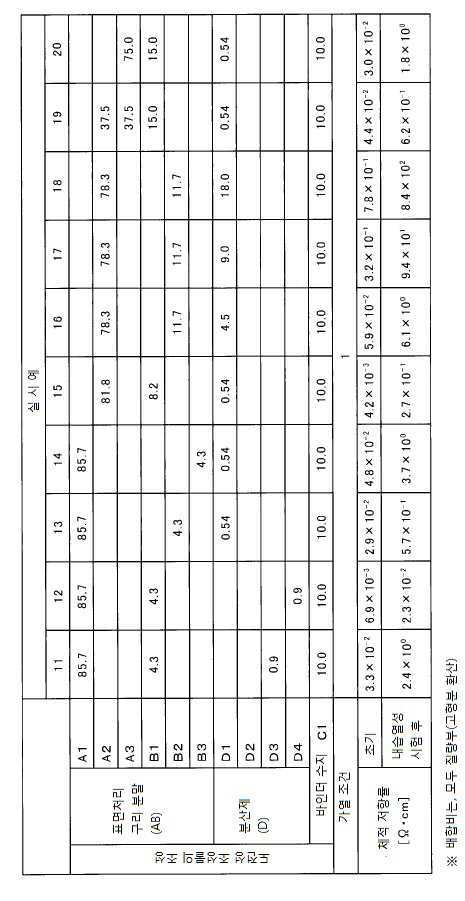
[표 3][Table 3]
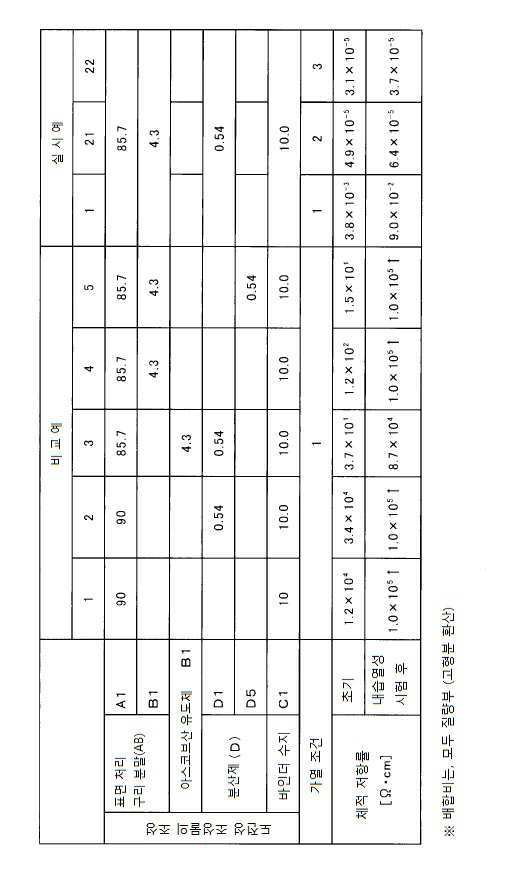
[표 4][Table 4]
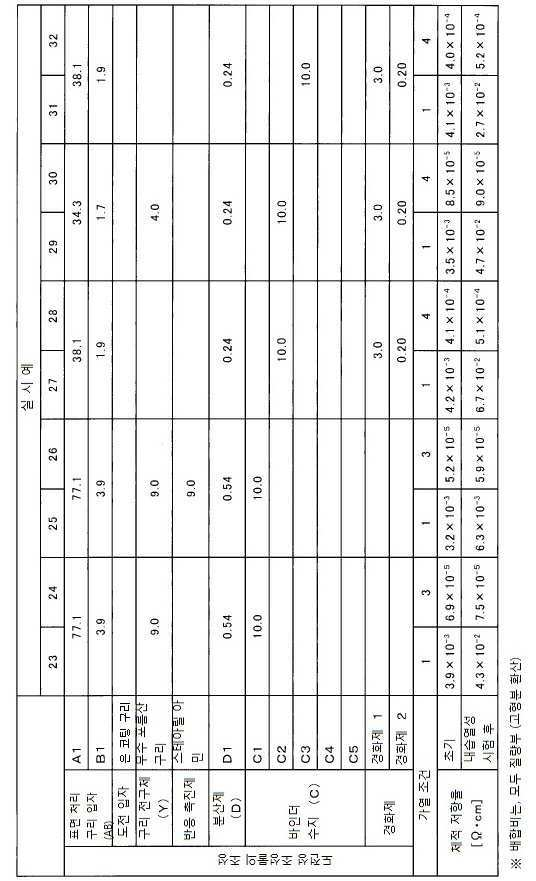
[표 5][Table 5]

표 1 및 2에서 명확한 바와 같이, 실시예 1 내지 20의 도전성 조성물은 양호한 도전성 및 내습열성을 나타낸다.As is clear from Tables 1 and 2, the conductive compositions of Examples 1 to 20 exhibit good conductivity and resistance to humidity.
한편, 표 3에 나타낸 바와 같이, 아스코르브산 유도체를 전혀 포함하지 않는 비교예 1, 2는, 초기 저항값조차 104Ω·cm를 크게 초과하여, 도전성 페이스트, 도전성 시트와는 거리가 멀다. 아스코르브산 유도체를 포함한다고는 하지만, 미리 구리 분말의 표면을 처리하지 않고 바인더 수지와의 분산 시에 단순히 배합한 비교예 3은, 비교예 1, 2보다는 초기 저항값이 작아지지만, 내습열성이 좋지 않다. 또한, 표면처리 구리 분말(AB)을 사용하여도 바인더 수지와의 분산 시에 분산제(D)를 이용하지 않는 비교예 4나 산성기가 없는 분산제(D5)를 이용하는 비교예 5도 비교예 3과 동일하게, 비교예 1, 2보다는 초기 저항값이 작아지지만, 내습열성이 좋지 않다.On the other hand, as shown in Table 3, Comparative Examples 1 and 2 which did not contain any ascorbic acid derivative greatly exceeded the initial resistance value of 10 4 ? 占 cm m and were far from the conductive paste and the conductive sheet. Comparative Example 3 in which the surface of the copper powder was simply mixed with the binder resin without being subjected to the treatment of the surface of the copper powder in advance had a smaller initial resistance value than Comparative Examples 1 and 2, not. Comparative Example 5 using Comparative Example 4 in which the dispersant (D) was not used and dispersant (D5) having no acidic group at the time of dispersing the surface-treated copper powder (AB) with the binder resin was also the same as Comparative Example 3 , The initial resistance value is smaller than that of Comparative Examples 1 and 2, but the resistance to humidity resistance is poor.
구리 전구체를 포함하는 실시예 23은, 구리 전구체를 포함하지 않는 실시예 1에 비해, 내습열성 시험 후의 도전성의 저하가 억제된다.Example 23 including the copper precursor suppressed the deterioration of the conductivity after the wet heat resistance test as compared with Example 1 which did not include the copper precursor.
표 3 및 4에 나타낸 바와 같이, 열 프레스한 실시예 21, 22, 24, 26, 28, 30, 32, 34, 36, 38, 40은, 프레스하지 않은 경우에 비해 양호한 도전성을 나타내고, 그 도전성이 내습열성 시험 후에도 높은 수준으로 유지된다.As shown in Tables 3 and 4, the heat-pressed Examples 21, 22, 24, 26, 28, 30, 32, 34, 36, 38, and 40 exhibited better conductivity as compared with the case without pressing, Is maintained at a high level even after the humid heat resistance test.
구리 전구체를 포함하고 있어도 아스코르브산 유도체를 전혀 포함하지 않는 비교예 6의 초기 도전성은, 구리 전구체와 아스코르브산 유도체를 포함하는 실시예 29의 초기 도전성에 못 미친다.The initial conductivity of Comparative Example 6, which does not include an ascorbic acid derivative even though it contains a copper precursor, is inferior to the initial conductivity of Example 29 including a copper precursor and an ascorbic acid derivative.
또한, 구리 전구체를 포함하고 있어도 아스코르브산 유도체를 전혀 포함하지 않는 도전성 페이스트는, 열 프레스한 경우(비교예 7), 열 프레스하지 않은 경우(비교예 6)보다는, 다소는 초기 도전성의 향상이 인정되지만, 내습열성 시험에 의해 도전성이 현저하게 저하된다.In addition, the conductive paste containing the copper precursor but not including the ascorbic acid derivative at all did not show improvement in the initial conductivity, rather than the case of the hot press (Comparative Example 7) and the case without the hot press (Comparative Example 6) However, the conductivity is remarkably lowered by the resistance to humidity and humidity.
한편, 구리 전구체와 아스코르브산 유도체를 포함하는 도전성 페이스트는, 열 프레스한 경우(실시예 30), 열 프레스하지 않은 경우(실시예 29)보다 초기 도전성이 현저하게 향상됨과 동시에, 내습열성 시험 후에도 그 도전성을 극히 높은 수준으로 유지할 수 있다.On the other hand, the conductive paste containing the copper precursor and the ascorbic acid derivative remarkably improved the initial conductivity as compared with the case where the hot paste was applied (Example 30) and the case without the hot press (Example 29) The conductivity can be maintained at an extremely high level.
본 발명에 따른 도전성 조성물은, 대기 소성에 있어서, 열 프레스하지 않아도 양호한 도전성을 발현할 수 있고, 열 프레스함으로써, 기재 밀착성, 내열내습도 환경 신뢰를 유지하는 도전성 시트를 제공할 수 있다. 또한, 본 발명에 따른 도전성 조성물을 이용하여 형성한 배선 회로는, 예를 들어, 휴대 전화, 스마트폰, 태블릿 PC, 노트북 PC 등의 터치 패널 디스플레이, RFID용 안테나 회로, 무선 급전용 코일에 바람직하게 이용할 수 있다.INDUSTRIAL APPLICABILITY The conductive composition according to the present invention can exhibit good conductivity even when it is not subjected to hot pressing in air firing, and can provide a conductive sheet that maintains environmental friendliness, heat resistance and moisture resistance, and environmental reliability by hot pressing. The wiring circuit formed by using the conductive composition according to the present invention is preferably used for a touch panel display such as a cell phone, a smart phone, a tablet PC, a notebook PC, etc., an antenna circuit for RFID, Can be used.
Claims (9)
[화학식 1]

(상기 화학식 1 중, R1 및 R2는 각각 독립적으로 수소 원자, 또는 치환기를 가져도 되는 아실기를 나타낸다.)
[화학식 2]

(상기 화학식 2 중, R11 및 R12는 각각 독립적으로 수소 원자, 또는 치환기를 가져도 되는 알킬기를 나타낸다.)A surface-treated copper powder (AB) to which an ascorbic acid or its derivative (B) represented by the following Chemical Formula 1 or 2 is adhered on the surface of the copper powder (A), a binder resin (C) D). ≪ / RTI >
[Chemical Formula 1]
(Wherein R1 and R2 each independently represent a hydrogen atom or an acyl group which may have a substituent).
(2)
(Wherein R11 and R12 each independently represent a hydrogen atom or an alkyl group which may have a substituent).
화학식 1로 표시되는 아스코르브산 또는 그 유도체(B)의 R1 및 R2가 수소 원자인, 도전성 조성물.The method according to claim 1,
Wherein R 1 and R 2 in the ascorbic acid or derivative (B) represented by the general formula (1) are hydrogen atoms.
산성기를 갖는 분산제(D)의 산성기가 인산기인, 도전성 조성물.3. The method according to claim 1 or 2,
Wherein the acid group of the dispersant (D) having an acidic group is a phosphoric acid group.
산성기를 갖는 분산제(D)가 아미노기를 추가로 갖는, 도전성 조성물.4. The method according to any one of claims 1 to 3,
The dispersant (D) having an acidic group further has an amino group.
구리 분말(A) 100질량부에 대하여, 아스코르브산 또는 그 유도체(B)가 1 내지 30질량부인, 도전성 조성물.5. The method according to any one of claims 1 to 4,
Wherein the ascorbic acid or its derivative (B) is contained in an amount of 1 to 30 parts by mass based on 100 parts by mass of the copper powder (A).
표면처리 구리 분말(AB) 100질량부에 대하여, 산성기를 갖는 분산제(D)가 0.1 내지 10질량부인, 도전성 조성물.6. The method according to any one of claims 1 to 5,
Wherein the amount of the dispersant (D) having an acidic group is 0.1 to 10 parts by mass relative to 100 parts by mass of the surface-treated copper powder (AB).
구리 전구체(Y)를 추가로 함유하는, 도전성 조성물.7. The method according to any one of claims 1 to 6,
A conductive composition further comprising a copper precursor (Y).
상기 표면처리 구리 분말(AB)과, 바인더 수지(C)와, 산성기를 갖는 분산제(D)를 혼합하는, 도전성 조성물의 제조 방법.
[화학식 1]

(상기 화학식 1 중, R1 및 R2는, 각각 독립적으로 수소 원자, 또는 치환기를 가져도 되는 아실기를 나타낸다.)
[화학식 2]
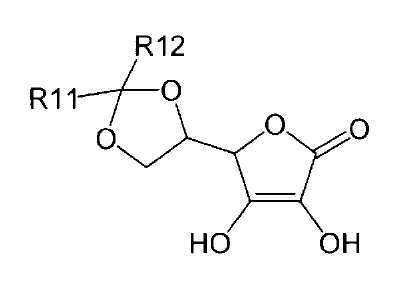
(상기 화학식 2 중, R11 및 R12는 각각 독립적으로 수소 원자, 또는 치환기를 가져도 되는 알킬기를 나타낸다.) A surface-treated copper powder (AB) is obtained by adhering ascorbic acid or its derivative (B) represented by the following formula (1) or (2) to the surface of the copper powder (A)
Wherein the surface-treated copper powder (AB), the binder resin (C), and the dispersant (D) having an acidic group are mixed.
[Chemical Formula 1]
(Wherein R1 and R2 each independently represent a hydrogen atom or an acyl group which may have a substituent).
(2)
(Wherein R11 and R12 each independently represent a hydrogen atom or an alkyl group which may have a substituent).
Applications Claiming Priority (5)
| Application Number | Priority Date | Filing Date | Title |
|---|---|---|---|
| JP2016015287 | 2016-01-29 | ||
| JPJP-P-2016-015287 | 2016-01-29 | ||
| JP2016211923A JP6103126B1 (en) | 2016-01-29 | 2016-10-28 | Conductive composition, method for producing the same, and conductive material |
| JPJP-P-2016-211923 | 2016-10-28 | ||
| PCT/JP2017/001539 WO2017130812A1 (en) | 2016-01-29 | 2017-01-18 | Electroconductive composition, production process therefor, and electroconductive material |
Publications (2)
| Publication Number | Publication Date |
|---|---|
| KR20180098408A true KR20180098408A (en) | 2018-09-03 |
| KR101960238B1 KR101960238B1 (en) | 2019-03-19 |
Family
ID=59366083
Family Applications (1)
| Application Number | Title | Priority Date | Filing Date |
|---|---|---|---|
| KR1020187022980A Active KR101960238B1 (en) | 2016-01-29 | 2017-01-18 | Conductive composition, method for producing the same, and conductive material |
Country Status (7)
| Country | Link |
|---|---|
| US (1) | US20190035513A1 (en) |
| EP (1) | EP3409729B1 (en) |
| JP (1) | JP6103126B1 (en) |
| KR (1) | KR101960238B1 (en) |
| CN (1) | CN108473780A (en) |
| TW (1) | TWI669358B (en) |
| WO (1) | WO2017130812A1 (en) |
Cited By (7)
| Publication number | Priority date | Publication date | Assignee | Title |
|---|---|---|---|---|
| WO2024167224A1 (en) * | 2023-02-08 | 2024-08-15 | 엔젯 주식회사 | Anisotropic conductive connection method |
| WO2024167225A1 (en) * | 2023-02-08 | 2024-08-15 | 엔젯 주식회사 | Anisotropic conductive connection structure |
| KR20240124156A (en) * | 2023-02-08 | 2024-08-16 | 엔젯 주식회사 | Anisotropic conductive connection structure |
| WO2025005757A1 (en) * | 2023-06-30 | 2025-01-02 | 엔젯 주식회사 | Anisotropic conductive connector |
| KR20250003257A (en) * | 2023-06-30 | 2025-01-07 | 주식회사 이엔머티리얼즈 | Anisotropic Conductive Connection Structure |
| WO2026005503A1 (en) * | 2024-06-26 | 2026-01-02 | 엔젯 주식회사 | Anisotropic conductive material composition |
| WO2026005504A1 (en) * | 2024-06-26 | 2026-01-02 | 엔젯 주식회사 | Connection structure |
Families Citing this family (12)
| Publication number | Priority date | Publication date | Assignee | Title |
|---|---|---|---|---|
| JP6967839B2 (en) * | 2016-03-23 | 2021-11-17 | 日東電工株式会社 | Heat bonding sheet, heat bonding sheet with dicing tape, manufacturing method of bonded body, power semiconductor device |
| CN111433866B (en) * | 2017-12-22 | 2021-10-08 | 三井金属矿业株式会社 | Manufacturing method of conductive film |
| JP7099867B2 (en) * | 2018-05-16 | 2022-07-12 | 日本化学工業株式会社 | Photosintered composition and method for forming a conductive film using the same |
| JP6528914B1 (en) * | 2018-06-12 | 2019-06-12 | Dic株式会社 | Highly conductive silver ink composition and wiring using the same |
| JP7465747B2 (en) * | 2020-07-31 | 2024-04-11 | 京セラ株式会社 | Coated copper particles, method for producing coated copper particles, copper paste, method for producing copper paste, and semiconductor device |
| CN112086254B (en) * | 2020-08-12 | 2021-12-21 | 西安宏星电子浆料科技股份有限公司 | Environment-friendly thick-film resistor paste |
| JP7433653B2 (en) * | 2020-11-06 | 2024-02-20 | 北川工業株式会社 | heat conduction material |
| CN116323044B (en) * | 2020-12-15 | 2024-11-15 | 国立研究开发法人物质材料研究机构 | Conductive ink for copper-nickel alloy electrode, substrate with copper-nickel alloy electrode, and method for producing these |
| CN116652174A (en) * | 2022-02-17 | 2023-08-29 | 深圳先进电子材料国际创新研究院 | A kind of copper nanomaterial and its preparation method and application |
| WO2023190471A1 (en) * | 2022-03-31 | 2023-10-05 | 東洋製罐グループホールディングス株式会社 | Metal microparticle-containing dispersion exhibiting antimicrobial property with excellent long-term stability |
| CN116013580B (en) * | 2023-01-05 | 2023-11-28 | 哈尔滨理工大学 | Self-reduction copper sintering slurry for power semiconductor packaging and preparation method and application thereof |
| CN121393990A (en) * | 2025-12-25 | 2026-01-23 | 苏州星翰新材料科技有限公司 | Preparation method and application of high-oxidation-resistance copper paste |
Citations (2)
| Publication number | Priority date | Publication date | Assignee | Title |
|---|---|---|---|---|
| JP2007184143A (en) * | 2006-01-06 | 2007-07-19 | Sumitomo Metal Mining Co Ltd | Conductive powder surface treatment method, conductive powder and conductive paste |
| JP2014111800A (en) * | 2012-12-05 | 2014-06-19 | Nippon Handa Kk | Pasty metal particulate composition, method for manufacturing solid metal or solid metal alloy, method for joining metallic members, method for manufacturing print wire board, and method for manufacturing bump for connecting electric circuits |
Family Cites Families (12)
| Publication number | Priority date | Publication date | Assignee | Title |
|---|---|---|---|---|
| JPH0873780A (en) | 1994-08-31 | 1996-03-19 | Sumitomo Bakelite Co Ltd | Conductive copper paste composition |
| JP3662715B2 (en) * | 1997-06-16 | 2005-06-22 | アルプス電気株式会社 | Conductive material, conductive paste and electronic device |
| KR101354265B1 (en) | 2006-07-14 | 2014-01-22 | 토요잉크Sc홀딩스주식회사 | Polyester dispersant, process for production of the same, and pigment composition using the same |
| US8404160B2 (en) * | 2007-05-18 | 2013-03-26 | Applied Nanotech Holdings, Inc. | Metallic ink |
| TW200930481A (en) * | 2008-01-11 | 2009-07-16 | Qiu-Lang Lai | Anti-oxidative fine copper powder and conductive paste with anti-oxidative fine copper powder |
| CN101486094B (en) * | 2008-01-16 | 2010-12-29 | 赖秋郎 | Oxidation-resistant fine copper powder and conductive slurry with same |
| CN102341416B (en) * | 2009-07-01 | 2014-06-04 | 积水化学工业株式会社 | Binder resin for conductive paste, conductive paste, and solar cell element |
| WO2014104032A1 (en) | 2012-12-25 | 2014-07-03 | 戸田工業株式会社 | Method for producing copper powder, copper powder, and copper paste |
| CN104755196B (en) * | 2013-05-10 | 2016-07-27 | Lg化学株式会社 | Cupric granule and preparation method thereof |
| CN103341633B (en) * | 2013-06-24 | 2015-10-28 | 深圳先进技术研究院 | A kind of preparation method of conductive ink nanometer copper |
| DE102013108664A1 (en) * | 2013-08-09 | 2015-02-12 | Leibniz-Institut Für Neue Materialien Gemeinnützige Gmbh | Surface-modified metal colloids and their preparation |
| JP6067515B2 (en) | 2013-08-30 | 2017-01-25 | 富士フイルム株式会社 | Conductive film forming composition and method for producing conductive film using the same |
-
2016
- 2016-10-28 JP JP2016211923A patent/JP6103126B1/en active Active
-
2017
- 2017-01-18 EP EP17744042.7A patent/EP3409729B1/en active Active
- 2017-01-18 US US16/072,883 patent/US20190035513A1/en not_active Abandoned
- 2017-01-18 WO PCT/JP2017/001539 patent/WO2017130812A1/en not_active Ceased
- 2017-01-18 CN CN201780007109.XA patent/CN108473780A/en active Pending
- 2017-01-18 KR KR1020187022980A patent/KR101960238B1/en active Active
- 2017-01-24 TW TW106102514A patent/TWI669358B/en active
Patent Citations (2)
| Publication number | Priority date | Publication date | Assignee | Title |
|---|---|---|---|---|
| JP2007184143A (en) * | 2006-01-06 | 2007-07-19 | Sumitomo Metal Mining Co Ltd | Conductive powder surface treatment method, conductive powder and conductive paste |
| JP2014111800A (en) * | 2012-12-05 | 2014-06-19 | Nippon Handa Kk | Pasty metal particulate composition, method for manufacturing solid metal or solid metal alloy, method for joining metallic members, method for manufacturing print wire board, and method for manufacturing bump for connecting electric circuits |
Cited By (7)
| Publication number | Priority date | Publication date | Assignee | Title |
|---|---|---|---|---|
| WO2024167224A1 (en) * | 2023-02-08 | 2024-08-15 | 엔젯 주식회사 | Anisotropic conductive connection method |
| WO2024167225A1 (en) * | 2023-02-08 | 2024-08-15 | 엔젯 주식회사 | Anisotropic conductive connection structure |
| KR20240124156A (en) * | 2023-02-08 | 2024-08-16 | 엔젯 주식회사 | Anisotropic conductive connection structure |
| WO2025005757A1 (en) * | 2023-06-30 | 2025-01-02 | 엔젯 주식회사 | Anisotropic conductive connector |
| KR20250003257A (en) * | 2023-06-30 | 2025-01-07 | 주식회사 이엔머티리얼즈 | Anisotropic Conductive Connection Structure |
| WO2026005503A1 (en) * | 2024-06-26 | 2026-01-02 | 엔젯 주식회사 | Anisotropic conductive material composition |
| WO2026005504A1 (en) * | 2024-06-26 | 2026-01-02 | 엔젯 주식회사 | Connection structure |
Also Published As
| Publication number | Publication date |
|---|---|
| WO2017130812A1 (en) | 2017-08-03 |
| CN108473780A (en) | 2018-08-31 |
| EP3409729B1 (en) | 2019-12-18 |
| KR101960238B1 (en) | 2019-03-19 |
| TW201741405A (en) | 2017-12-01 |
| EP3409729A4 (en) | 2018-12-05 |
| TWI669358B (en) | 2019-08-21 |
| JP2017137472A (en) | 2017-08-10 |
| EP3409729A1 (en) | 2018-12-05 |
| US20190035513A1 (en) | 2019-01-31 |
| JP6103126B1 (en) | 2017-03-29 |
Similar Documents
| Publication | Publication Date | Title |
|---|---|---|
| KR101960238B1 (en) | Conductive composition, method for producing the same, and conductive material | |
| TWI638013B (en) | Conductive composition for film printing and method for forming conductive pattern of thin film | |
| KR101118962B1 (en) | Conductive ink, and laminated body with conductive pattern and its manufacturing method | |
| JP6543005B2 (en) | Transparent conductive substrate and method of manufacturing the same | |
| JP5742112B2 (en) | Curable electromagnetic wave shielding adhesive film and method for producing the same | |
| CN106085274B (en) | Conductive adhesive, conductive adhesive sheet, and wiring element | |
| CN110343241B (en) | Thermosetting resin composition, adhesive sheet, cured product, and printed wiring board | |
| KR101632780B1 (en) | Viscosity modifier for high concentration dispersion of inorganic fine particles and high concentration dispersion of inorganic fine particles which contains the same | |
| WO2014050156A1 (en) | Conductive composition and conductive molded body using same | |
| TW201312598A (en) | Method for manufacturing conductive coating film and conductive coating film | |
| JP2011171522A (en) | Curable electromagnetic shielding adhesive film and method for producing the same | |
| JP2008171828A (en) | Conductive paste, and printed circuit using it | |
| JP5767498B2 (en) | Conductive paste | |
| JP2016029638A (en) | Conductive paste for laser machining | |
| KR101774069B1 (en) | Electrically conductive paste and metal thin film | |
| JP6001265B2 (en) | Conductive paste | |
| JP4514390B2 (en) | Conductive paste and printed circuit using the same | |
| CN114761491A (en) | Resin composition, laminate with resin composition layer, laminate, flexible copper-clad laminate, flexible flat cable, and electromagnetic wave shielding film | |
| JP6631352B2 (en) | Reactant, conductive composition, and method for producing surface-treated copper powder | |
| HK40009438B (en) | Transparent conductive substrate and method for producing same | |
| HK40009438A (en) | Transparent conductive substrate and method for producing same | |
| JP2018045853A (en) | Conductive paste for laser processing |
Legal Events
| Date | Code | Title | Description |
|---|---|---|---|
| A201 | Request for examination | ||
| A302 | Request for accelerated examination | ||
| PA0105 | International application |
Patent event date: 20180809 Patent event code: PA01051R01D Comment text: International Patent Application |
|
| PA0201 | Request for examination |
Patent event code: PA02012R01D Patent event date: 20180809 Comment text: Request for Examination of Application |
|
| PA0302 | Request for accelerated examination |
Patent event date: 20180809 Patent event code: PA03022R01D Comment text: Request for Accelerated Examination |
|
| PG1501 | Laying open of application | ||
| E902 | Notification of reason for refusal | ||
| PE0902 | Notice of grounds for rejection |
Comment text: Notification of reason for refusal Patent event date: 20181001 Patent event code: PE09021S01D |
|
| E701 | Decision to grant or registration of patent right | ||
| PE0701 | Decision of registration |
Patent event code: PE07011S01D Comment text: Decision to Grant Registration Patent event date: 20190219 |
|
| GRNT | Written decision to grant | ||
| PR0701 | Registration of establishment |
Comment text: Registration of Establishment Patent event date: 20190313 Patent event code: PR07011E01D |
|
| PR1002 | Payment of registration fee |
Payment date: 20190313 End annual number: 3 Start annual number: 1 |
|
| PG1601 | Publication of registration | ||
| PR1001 | Payment of annual fee |
Payment date: 20220216 Start annual number: 4 End annual number: 4 |