KR20180098289A - Resin composition - Google Patents
Resin composition Download PDFInfo
- Publication number
- KR20180098289A KR20180098289A KR1020187019520A KR20187019520A KR20180098289A KR 20180098289 A KR20180098289 A KR 20180098289A KR 1020187019520 A KR1020187019520 A KR 1020187019520A KR 20187019520 A KR20187019520 A KR 20187019520A KR 20180098289 A KR20180098289 A KR 20180098289A
- Authority
- KR
- South Korea
- Prior art keywords
- general formula
- resin
- carbon atoms
- group
- organic group
- Prior art date
- Legal status (The legal status is an assumption and is not a legal conclusion. Google has not performed a legal analysis and makes no representation as to the accuracy of the status listed.)
- Granted
Links
Classifications
-
- C—CHEMISTRY; METALLURGY
- C08—ORGANIC MACROMOLECULAR COMPOUNDS; THEIR PREPARATION OR CHEMICAL WORKING-UP; COMPOSITIONS BASED THEREON
- C08L—COMPOSITIONS OF MACROMOLECULAR COMPOUNDS
- C08L75/00—Compositions of polyureas or polyurethanes; Compositions of derivatives of such polymers
- C08L75/02—Polyureas
-
- C—CHEMISTRY; METALLURGY
- C08—ORGANIC MACROMOLECULAR COMPOUNDS; THEIR PREPARATION OR CHEMICAL WORKING-UP; COMPOSITIONS BASED THEREON
- C08G—MACROMOLECULAR COMPOUNDS OBTAINED OTHERWISE THAN BY REACTIONS ONLY INVOLVING UNSATURATED CARBON-TO-CARBON BONDS
- C08G12/00—Condensation polymers of aldehydes or ketones with only compounds containing hydrogen attached to nitrogen
- C08G12/02—Condensation polymers of aldehydes or ketones with only compounds containing hydrogen attached to nitrogen of aldehydes
- C08G12/04—Condensation polymers of aldehydes or ketones with only compounds containing hydrogen attached to nitrogen of aldehydes with acyclic or carbocyclic compounds
- C08G12/06—Amines
- C08G12/08—Amines aromatic
-
- C—CHEMISTRY; METALLURGY
- C08—ORGANIC MACROMOLECULAR COMPOUNDS; THEIR PREPARATION OR CHEMICAL WORKING-UP; COMPOSITIONS BASED THEREON
- C08G—MACROMOLECULAR COMPOUNDS OBTAINED OTHERWISE THAN BY REACTIONS ONLY INVOLVING UNSATURATED CARBON-TO-CARBON BONDS
- C08G12/00—Condensation polymers of aldehydes or ketones with only compounds containing hydrogen attached to nitrogen
- C08G12/02—Condensation polymers of aldehydes or ketones with only compounds containing hydrogen attached to nitrogen of aldehydes
- C08G12/04—Condensation polymers of aldehydes or ketones with only compounds containing hydrogen attached to nitrogen of aldehydes with acyclic or carbocyclic compounds
- C08G12/06—Amines
-
- C—CHEMISTRY; METALLURGY
- C08—ORGANIC MACROMOLECULAR COMPOUNDS; THEIR PREPARATION OR CHEMICAL WORKING-UP; COMPOSITIONS BASED THEREON
- C08G—MACROMOLECULAR COMPOUNDS OBTAINED OTHERWISE THAN BY REACTIONS ONLY INVOLVING UNSATURATED CARBON-TO-CARBON BONDS
- C08G18/00—Polymeric products of isocyanates or isothiocyanates
- C08G18/06—Polymeric products of isocyanates or isothiocyanates with compounds having active hydrogen
- C08G18/08—Processes
- C08G18/0804—Manufacture of polymers containing ionic or ionogenic groups
- C08G18/0819—Manufacture of polymers containing ionic or ionogenic groups containing anionic or anionogenic groups
- C08G18/0823—Manufacture of polymers containing ionic or ionogenic groups containing anionic or anionogenic groups containing carboxylate salt groups or groups forming them
-
- C—CHEMISTRY; METALLURGY
- C08—ORGANIC MACROMOLECULAR COMPOUNDS; THEIR PREPARATION OR CHEMICAL WORKING-UP; COMPOSITIONS BASED THEREON
- C08G—MACROMOLECULAR COMPOUNDS OBTAINED OTHERWISE THAN BY REACTIONS ONLY INVOLVING UNSATURATED CARBON-TO-CARBON BONDS
- C08G18/00—Polymeric products of isocyanates or isothiocyanates
- C08G18/06—Polymeric products of isocyanates or isothiocyanates with compounds having active hydrogen
- C08G18/28—Polymeric products of isocyanates or isothiocyanates with compounds having active hydrogen characterised by the compounds used containing active hydrogen
- C08G18/30—Low-molecular-weight compounds
- C08G18/32—Polyhydroxy compounds; Polyamines; Hydroxyamines
- C08G18/3225—Polyamines
-
- C—CHEMISTRY; METALLURGY
- C08—ORGANIC MACROMOLECULAR COMPOUNDS; THEIR PREPARATION OR CHEMICAL WORKING-UP; COMPOSITIONS BASED THEREON
- C08G—MACROMOLECULAR COMPOUNDS OBTAINED OTHERWISE THAN BY REACTIONS ONLY INVOLVING UNSATURATED CARBON-TO-CARBON BONDS
- C08G18/00—Polymeric products of isocyanates or isothiocyanates
- C08G18/06—Polymeric products of isocyanates or isothiocyanates with compounds having active hydrogen
- C08G18/28—Polymeric products of isocyanates or isothiocyanates with compounds having active hydrogen characterised by the compounds used containing active hydrogen
- C08G18/30—Low-molecular-weight compounds
- C08G18/32—Polyhydroxy compounds; Polyamines; Hydroxyamines
- C08G18/3225—Polyamines
- C08G18/3237—Polyamines aromatic
- C08G18/3243—Polyamines aromatic containing two or more aromatic rings
-
- C—CHEMISTRY; METALLURGY
- C08—ORGANIC MACROMOLECULAR COMPOUNDS; THEIR PREPARATION OR CHEMICAL WORKING-UP; COMPOSITIONS BASED THEREON
- C08G—MACROMOLECULAR COMPOUNDS OBTAINED OTHERWISE THAN BY REACTIONS ONLY INVOLVING UNSATURATED CARBON-TO-CARBON BONDS
- C08G18/00—Polymeric products of isocyanates or isothiocyanates
- C08G18/06—Polymeric products of isocyanates or isothiocyanates with compounds having active hydrogen
- C08G18/28—Polymeric products of isocyanates or isothiocyanates with compounds having active hydrogen characterised by the compounds used containing active hydrogen
- C08G18/30—Low-molecular-weight compounds
- C08G18/38—Low-molecular-weight compounds having heteroatoms other than oxygen
- C08G18/3819—Low-molecular-weight compounds having heteroatoms other than oxygen having nitrogen
- C08G18/3821—Carboxylic acids; Esters thereof with monohydroxyl compounds
-
- C—CHEMISTRY; METALLURGY
- C08—ORGANIC MACROMOLECULAR COMPOUNDS; THEIR PREPARATION OR CHEMICAL WORKING-UP; COMPOSITIONS BASED THEREON
- C08G—MACROMOLECULAR COMPOUNDS OBTAINED OTHERWISE THAN BY REACTIONS ONLY INVOLVING UNSATURATED CARBON-TO-CARBON BONDS
- C08G18/00—Polymeric products of isocyanates or isothiocyanates
- C08G18/06—Polymeric products of isocyanates or isothiocyanates with compounds having active hydrogen
- C08G18/28—Polymeric products of isocyanates or isothiocyanates with compounds having active hydrogen characterised by the compounds used containing active hydrogen
- C08G18/30—Low-molecular-weight compounds
- C08G18/38—Low-molecular-weight compounds having heteroatoms other than oxygen
- C08G18/3855—Low-molecular-weight compounds having heteroatoms other than oxygen having sulfur
- C08G18/3863—Low-molecular-weight compounds having heteroatoms other than oxygen having sulfur containing groups having sulfur atoms between two carbon atoms, the sulfur atoms being directly linked to carbon atoms or other sulfur atoms
- C08G18/3865—Low-molecular-weight compounds having heteroatoms other than oxygen having sulfur containing groups having sulfur atoms between two carbon atoms, the sulfur atoms being directly linked to carbon atoms or other sulfur atoms containing groups having one sulfur atom between two carbon atoms
- C08G18/3872—Low-molecular-weight compounds having heteroatoms other than oxygen having sulfur containing groups having sulfur atoms between two carbon atoms, the sulfur atoms being directly linked to carbon atoms or other sulfur atoms containing groups having one sulfur atom between two carbon atoms the sulfur atom belonging to a sulfoxide or sulfone group
-
- C—CHEMISTRY; METALLURGY
- C08—ORGANIC MACROMOLECULAR COMPOUNDS; THEIR PREPARATION OR CHEMICAL WORKING-UP; COMPOSITIONS BASED THEREON
- C08G—MACROMOLECULAR COMPOUNDS OBTAINED OTHERWISE THAN BY REACTIONS ONLY INVOLVING UNSATURATED CARBON-TO-CARBON BONDS
- C08G18/00—Polymeric products of isocyanates or isothiocyanates
- C08G18/06—Polymeric products of isocyanates or isothiocyanates with compounds having active hydrogen
- C08G18/70—Polymeric products of isocyanates or isothiocyanates with compounds having active hydrogen characterised by the isocyanates or isothiocyanates used
- C08G18/72—Polyisocyanates or polyisothiocyanates
- C08G18/74—Polyisocyanates or polyisothiocyanates cyclic
- C08G18/76—Polyisocyanates or polyisothiocyanates cyclic aromatic
- C08G18/7614—Polyisocyanates or polyisothiocyanates cyclic aromatic containing only one aromatic ring
-
- C—CHEMISTRY; METALLURGY
- C08—ORGANIC MACROMOLECULAR COMPOUNDS; THEIR PREPARATION OR CHEMICAL WORKING-UP; COMPOSITIONS BASED THEREON
- C08G—MACROMOLECULAR COMPOUNDS OBTAINED OTHERWISE THAN BY REACTIONS ONLY INVOLVING UNSATURATED CARBON-TO-CARBON BONDS
- C08G18/00—Polymeric products of isocyanates or isothiocyanates
- C08G18/06—Polymeric products of isocyanates or isothiocyanates with compounds having active hydrogen
- C08G18/70—Polymeric products of isocyanates or isothiocyanates with compounds having active hydrogen characterised by the isocyanates or isothiocyanates used
- C08G18/72—Polyisocyanates or polyisothiocyanates
- C08G18/74—Polyisocyanates or polyisothiocyanates cyclic
- C08G18/76—Polyisocyanates or polyisothiocyanates cyclic aromatic
- C08G18/7614—Polyisocyanates or polyisothiocyanates cyclic aromatic containing only one aromatic ring
- C08G18/7621—Polyisocyanates or polyisothiocyanates cyclic aromatic containing only one aromatic ring being toluene diisocyanate including isomer mixtures
-
- C—CHEMISTRY; METALLURGY
- C08—ORGANIC MACROMOLECULAR COMPOUNDS; THEIR PREPARATION OR CHEMICAL WORKING-UP; COMPOSITIONS BASED THEREON
- C08G—MACROMOLECULAR COMPOUNDS OBTAINED OTHERWISE THAN BY REACTIONS ONLY INVOLVING UNSATURATED CARBON-TO-CARBON BONDS
- C08G18/00—Polymeric products of isocyanates or isothiocyanates
- C08G18/06—Polymeric products of isocyanates or isothiocyanates with compounds having active hydrogen
- C08G18/70—Polymeric products of isocyanates or isothiocyanates with compounds having active hydrogen characterised by the isocyanates or isothiocyanates used
- C08G18/72—Polyisocyanates or polyisothiocyanates
- C08G18/74—Polyisocyanates or polyisothiocyanates cyclic
- C08G18/76—Polyisocyanates or polyisothiocyanates cyclic aromatic
- C08G18/7657—Polyisocyanates or polyisothiocyanates cyclic aromatic containing two or more aromatic rings
- C08G18/7664—Polyisocyanates or polyisothiocyanates cyclic aromatic containing two or more aromatic rings containing alkylene polyphenyl groups
- C08G18/7671—Polyisocyanates or polyisothiocyanates cyclic aromatic containing two or more aromatic rings containing alkylene polyphenyl groups containing only one alkylene bisphenyl group
-
- C—CHEMISTRY; METALLURGY
- C08—ORGANIC MACROMOLECULAR COMPOUNDS; THEIR PREPARATION OR CHEMICAL WORKING-UP; COMPOSITIONS BASED THEREON
- C08G—MACROMOLECULAR COMPOUNDS OBTAINED OTHERWISE THAN BY REACTIONS ONLY INVOLVING UNSATURATED CARBON-TO-CARBON BONDS
- C08G18/00—Polymeric products of isocyanates or isothiocyanates
- C08G18/06—Polymeric products of isocyanates or isothiocyanates with compounds having active hydrogen
- C08G18/70—Polymeric products of isocyanates or isothiocyanates with compounds having active hydrogen characterised by the isocyanates or isothiocyanates used
- C08G18/72—Polyisocyanates or polyisothiocyanates
- C08G18/74—Polyisocyanates or polyisothiocyanates cyclic
- C08G18/76—Polyisocyanates or polyisothiocyanates cyclic aromatic
- C08G18/7657—Polyisocyanates or polyisothiocyanates cyclic aromatic containing two or more aromatic rings
- C08G18/7678—Polyisocyanates or polyisothiocyanates cyclic aromatic containing two or more aromatic rings containing condensed aromatic rings
-
- C—CHEMISTRY; METALLURGY
- C08—ORGANIC MACROMOLECULAR COMPOUNDS; THEIR PREPARATION OR CHEMICAL WORKING-UP; COMPOSITIONS BASED THEREON
- C08G—MACROMOLECULAR COMPOUNDS OBTAINED OTHERWISE THAN BY REACTIONS ONLY INVOLVING UNSATURATED CARBON-TO-CARBON BONDS
- C08G69/00—Macromolecular compounds obtained by reactions forming a carboxylic amide link in the main chain of the macromolecule
- C08G69/02—Polyamides derived from amino-carboxylic acids or from polyamines and polycarboxylic acids
- C08G69/26—Polyamides derived from amino-carboxylic acids or from polyamines and polycarboxylic acids derived from polyamines and polycarboxylic acids
-
- C—CHEMISTRY; METALLURGY
- C08—ORGANIC MACROMOLECULAR COMPOUNDS; THEIR PREPARATION OR CHEMICAL WORKING-UP; COMPOSITIONS BASED THEREON
- C08G—MACROMOLECULAR COMPOUNDS OBTAINED OTHERWISE THAN BY REACTIONS ONLY INVOLVING UNSATURATED CARBON-TO-CARBON BONDS
- C08G69/00—Macromolecular compounds obtained by reactions forming a carboxylic amide link in the main chain of the macromolecule
- C08G69/02—Polyamides derived from amino-carboxylic acids or from polyamines and polycarboxylic acids
- C08G69/26—Polyamides derived from amino-carboxylic acids or from polyamines and polycarboxylic acids derived from polyamines and polycarboxylic acids
- C08G69/32—Polyamides derived from amino-carboxylic acids or from polyamines and polycarboxylic acids derived from polyamines and polycarboxylic acids from aromatic diamines and aromatic dicarboxylic acids with both amino and carboxylic groups aromatically bound
-
- C—CHEMISTRY; METALLURGY
- C08—ORGANIC MACROMOLECULAR COMPOUNDS; THEIR PREPARATION OR CHEMICAL WORKING-UP; COMPOSITIONS BASED THEREON
- C08G—MACROMOLECULAR COMPOUNDS OBTAINED OTHERWISE THAN BY REACTIONS ONLY INVOLVING UNSATURATED CARBON-TO-CARBON BONDS
- C08G73/00—Macromolecular compounds obtained by reactions forming a linkage containing nitrogen with or without oxygen or carbon in the main chain of the macromolecule, not provided for in groups C08G12/00 - C08G71/00
- C08G73/06—Polycondensates having nitrogen-containing heterocyclic rings in the main chain of the macromolecule
- C08G73/10—Polyimides; Polyester-imides; Polyamide-imides; Polyamide acids or similar polyimide precursors
- C08G73/1046—Polyimides containing oxygen in the form of ether bonds in the main chain
- C08G73/105—Polyimides containing oxygen in the form of ether bonds in the main chain with oxygen only in the diamino moiety
-
- C—CHEMISTRY; METALLURGY
- C08—ORGANIC MACROMOLECULAR COMPOUNDS; THEIR PREPARATION OR CHEMICAL WORKING-UP; COMPOSITIONS BASED THEREON
- C08G—MACROMOLECULAR COMPOUNDS OBTAINED OTHERWISE THAN BY REACTIONS ONLY INVOLVING UNSATURATED CARBON-TO-CARBON BONDS
- C08G73/00—Macromolecular compounds obtained by reactions forming a linkage containing nitrogen with or without oxygen or carbon in the main chain of the macromolecule, not provided for in groups C08G12/00 - C08G71/00
- C08G73/06—Polycondensates having nitrogen-containing heterocyclic rings in the main chain of the macromolecule
- C08G73/10—Polyimides; Polyester-imides; Polyamide-imides; Polyamide acids or similar polyimide precursors
- C08G73/1067—Wholly aromatic polyimides, i.e. having both tetracarboxylic and diamino moieties aromatically bound
-
- C—CHEMISTRY; METALLURGY
- C08—ORGANIC MACROMOLECULAR COMPOUNDS; THEIR PREPARATION OR CHEMICAL WORKING-UP; COMPOSITIONS BASED THEREON
- C08G—MACROMOLECULAR COMPOUNDS OBTAINED OTHERWISE THAN BY REACTIONS ONLY INVOLVING UNSATURATED CARBON-TO-CARBON BONDS
- C08G73/00—Macromolecular compounds obtained by reactions forming a linkage containing nitrogen with or without oxygen or carbon in the main chain of the macromolecule, not provided for in groups C08G12/00 - C08G71/00
- C08G73/06—Polycondensates having nitrogen-containing heterocyclic rings in the main chain of the macromolecule
- C08G73/10—Polyimides; Polyester-imides; Polyamide-imides; Polyamide acids or similar polyimide precursors
- C08G73/1067—Wholly aromatic polyimides, i.e. having both tetracarboxylic and diamino moieties aromatically bound
- C08G73/1071—Wholly aromatic polyimides containing oxygen in the form of ether bonds in the main chain
-
- C—CHEMISTRY; METALLURGY
- C08—ORGANIC MACROMOLECULAR COMPOUNDS; THEIR PREPARATION OR CHEMICAL WORKING-UP; COMPOSITIONS BASED THEREON
- C08K—Use of inorganic or non-macromolecular organic substances as compounding ingredients
- C08K3/00—Use of inorganic substances as compounding ingredients
-
- C—CHEMISTRY; METALLURGY
- C08—ORGANIC MACROMOLECULAR COMPOUNDS; THEIR PREPARATION OR CHEMICAL WORKING-UP; COMPOSITIONS BASED THEREON
- C08K—Use of inorganic or non-macromolecular organic substances as compounding ingredients
- C08K3/00—Use of inorganic substances as compounding ingredients
- C08K3/18—Oxygen-containing compounds, e.g. metal carbonyls
- C08K3/20—Oxides; Hydroxides
- C08K3/22—Oxides; Hydroxides of metals
-
- C—CHEMISTRY; METALLURGY
- C08—ORGANIC MACROMOLECULAR COMPOUNDS; THEIR PREPARATION OR CHEMICAL WORKING-UP; COMPOSITIONS BASED THEREON
- C08K—Use of inorganic or non-macromolecular organic substances as compounding ingredients
- C08K3/00—Use of inorganic substances as compounding ingredients
- C08K3/18—Oxygen-containing compounds, e.g. metal carbonyls
- C08K3/24—Acids; Salts thereof
- C08K3/26—Carbonates; Bicarbonates
-
- C—CHEMISTRY; METALLURGY
- C08—ORGANIC MACROMOLECULAR COMPOUNDS; THEIR PREPARATION OR CHEMICAL WORKING-UP; COMPOSITIONS BASED THEREON
- C08K—Use of inorganic or non-macromolecular organic substances as compounding ingredients
- C08K5/00—Use of organic ingredients
- C08K5/16—Nitrogen-containing compounds
- C08K5/17—Amines; Quaternary ammonium compounds
-
- C—CHEMISTRY; METALLURGY
- C08—ORGANIC MACROMOLECULAR COMPOUNDS; THEIR PREPARATION OR CHEMICAL WORKING-UP; COMPOSITIONS BASED THEREON
- C08K—Use of inorganic or non-macromolecular organic substances as compounding ingredients
- C08K5/00—Use of organic ingredients
- C08K5/16—Nitrogen-containing compounds
- C08K5/34—Heterocyclic compounds having nitrogen in the ring
- C08K5/3412—Heterocyclic compounds having nitrogen in the ring having one nitrogen atom in the ring
- C08K5/3432—Six-membered rings
-
- C—CHEMISTRY; METALLURGY
- C08—ORGANIC MACROMOLECULAR COMPOUNDS; THEIR PREPARATION OR CHEMICAL WORKING-UP; COMPOSITIONS BASED THEREON
- C08L—COMPOSITIONS OF MACROMOLECULAR COMPOUNDS
- C08L61/00—Compositions of condensation polymers of aldehydes or ketones; Compositions of derivatives of such polymers
- C08L61/20—Condensation polymers of aldehydes or ketones with only compounds containing hydrogen attached to nitrogen
- C08L61/22—Condensation polymers of aldehydes or ketones with only compounds containing hydrogen attached to nitrogen of aldehydes with acyclic or carbocyclic compounds
-
- C—CHEMISTRY; METALLURGY
- C08—ORGANIC MACROMOLECULAR COMPOUNDS; THEIR PREPARATION OR CHEMICAL WORKING-UP; COMPOSITIONS BASED THEREON
- C08L—COMPOSITIONS OF MACROMOLECULAR COMPOUNDS
- C08L77/00—Compositions of polyamides obtained by reactions forming a carboxylic amide link in the main chain; Compositions of derivatives of such polymers
- C08L77/06—Polyamides derived from polyamines and polycarboxylic acids
-
- H—ELECTRICITY
- H01—ELECTRIC ELEMENTS
- H01G—CAPACITORS; CAPACITORS, RECTIFIERS, DETECTORS, SWITCHING DEVICES, LIGHT-SENSITIVE OR TEMPERATURE-SENSITIVE DEVICES OF THE ELECTROLYTIC TYPE
- H01G11/00—Hybrid capacitors, i.e. capacitors having different positive and negative electrodes; Electric double-layer [EDL] capacitors; Processes for the manufacture thereof or of parts thereof
- H01G11/22—Electrodes
- H01G11/30—Electrodes characterised by their material
- H01G11/32—Carbon-based
- H01G11/38—Carbon pastes or blends; Binders or additives therein
-
- H—ELECTRICITY
- H01—ELECTRIC ELEMENTS
- H01G—CAPACITORS; CAPACITORS, RECTIFIERS, DETECTORS, SWITCHING DEVICES, LIGHT-SENSITIVE OR TEMPERATURE-SENSITIVE DEVICES OF THE ELECTROLYTIC TYPE
- H01G9/00—Electrolytic capacitors, rectifiers, detectors, switching devices, light-sensitive or temperature-sensitive devices; Processes of their manufacture
- H01G9/0029—Processes of manufacture
-
- H—ELECTRICITY
- H01—ELECTRIC ELEMENTS
- H01G—CAPACITORS; CAPACITORS, RECTIFIERS, DETECTORS, SWITCHING DEVICES, LIGHT-SENSITIVE OR TEMPERATURE-SENSITIVE DEVICES OF THE ELECTROLYTIC TYPE
- H01G9/00—Electrolytic capacitors, rectifiers, detectors, switching devices, light-sensitive or temperature-sensitive devices; Processes of their manufacture
- H01G9/004—Details
- H01G9/04—Electrodes or formation of dielectric layers thereon
- H01G9/042—Electrodes or formation of dielectric layers thereon characterised by the material
-
- H—ELECTRICITY
- H01—ELECTRIC ELEMENTS
- H01M—PROCESSES OR MEANS, e.g. BATTERIES, FOR THE DIRECT CONVERSION OF CHEMICAL ENERGY INTO ELECTRICAL ENERGY
- H01M10/00—Secondary cells; Manufacture thereof
- H01M10/05—Accumulators with non-aqueous electrolyte
- H01M10/052—Li-accumulators
-
- H—ELECTRICITY
- H01—ELECTRIC ELEMENTS
- H01M—PROCESSES OR MEANS, e.g. BATTERIES, FOR THE DIRECT CONVERSION OF CHEMICAL ENERGY INTO ELECTRICAL ENERGY
- H01M10/00—Secondary cells; Manufacture thereof
- H01M10/05—Accumulators with non-aqueous electrolyte
- H01M10/058—Construction or manufacture
- H01M10/0585—Construction or manufacture of accumulators having only flat construction elements, i.e. flat positive electrodes, flat negative electrodes and flat separators
-
- H—ELECTRICITY
- H01—ELECTRIC ELEMENTS
- H01M—PROCESSES OR MEANS, e.g. BATTERIES, FOR THE DIRECT CONVERSION OF CHEMICAL ENERGY INTO ELECTRICAL ENERGY
- H01M4/00—Electrodes
- H01M4/02—Electrodes composed of, or comprising, active material
- H01M4/04—Processes of manufacture in general
- H01M4/0402—Methods of deposition of the material
-
- H—ELECTRICITY
- H01—ELECTRIC ELEMENTS
- H01M—PROCESSES OR MEANS, e.g. BATTERIES, FOR THE DIRECT CONVERSION OF CHEMICAL ENERGY INTO ELECTRICAL ENERGY
- H01M4/00—Electrodes
- H01M4/02—Electrodes composed of, or comprising, active material
- H01M4/13—Electrodes for accumulators with non-aqueous electrolyte, e.g. for lithium-accumulators; Processes of manufacture thereof
- H01M4/131—Electrodes based on mixed oxides or hydroxides, or on mixtures of oxides or hydroxides, e.g. LiCoOx
-
- H—ELECTRICITY
- H01—ELECTRIC ELEMENTS
- H01M—PROCESSES OR MEANS, e.g. BATTERIES, FOR THE DIRECT CONVERSION OF CHEMICAL ENERGY INTO ELECTRICAL ENERGY
- H01M4/00—Electrodes
- H01M4/02—Electrodes composed of, or comprising, active material
- H01M4/13—Electrodes for accumulators with non-aqueous electrolyte, e.g. for lithium-accumulators; Processes of manufacture thereof
- H01M4/139—Processes of manufacture
- H01M4/1391—Processes of manufacture of electrodes based on mixed oxides or hydroxides, or on mixtures of oxides or hydroxides, e.g. LiCoOx
-
- H—ELECTRICITY
- H01—ELECTRIC ELEMENTS
- H01M—PROCESSES OR MEANS, e.g. BATTERIES, FOR THE DIRECT CONVERSION OF CHEMICAL ENERGY INTO ELECTRICAL ENERGY
- H01M4/00—Electrodes
- H01M4/02—Electrodes composed of, or comprising, active material
- H01M4/36—Selection of substances as active materials, active masses, active liquids
- H01M4/48—Selection of substances as active materials, active masses, active liquids of inorganic oxides or hydroxides
- H01M4/485—Selection of substances as active materials, active masses, active liquids of inorganic oxides or hydroxides of mixed oxides or hydroxides for inserting or intercalating light metals, e.g. LiTi2O4 or LiTi2OxFy
-
- H—ELECTRICITY
- H01—ELECTRIC ELEMENTS
- H01M—PROCESSES OR MEANS, e.g. BATTERIES, FOR THE DIRECT CONVERSION OF CHEMICAL ENERGY INTO ELECTRICAL ENERGY
- H01M4/00—Electrodes
- H01M4/02—Electrodes composed of, or comprising, active material
- H01M4/62—Selection of inactive substances as ingredients for active masses, e.g. binders, fillers
- H01M4/621—Binders
- H01M4/622—Binders being polymers
-
- H—ELECTRICITY
- H01—ELECTRIC ELEMENTS
- H01M—PROCESSES OR MEANS, e.g. BATTERIES, FOR THE DIRECT CONVERSION OF CHEMICAL ENERGY INTO ELECTRICAL ENERGY
- H01M4/00—Electrodes
- H01M4/02—Electrodes composed of, or comprising, active material
- H01M4/62—Selection of inactive substances as ingredients for active masses, e.g. binders, fillers
- H01M4/621—Binders
- H01M4/622—Binders being polymers
- H01M4/623—Binders being polymers fluorinated polymers
-
- H—ELECTRICITY
- H01—ELECTRIC ELEMENTS
- H01M—PROCESSES OR MEANS, e.g. BATTERIES, FOR THE DIRECT CONVERSION OF CHEMICAL ENERGY INTO ELECTRICAL ENERGY
- H01M4/00—Electrodes
- H01M4/02—Electrodes composed of, or comprising, active material
- H01M4/62—Selection of inactive substances as ingredients for active masses, e.g. binders, fillers
- H01M4/624—Electric conductive fillers
- H01M4/625—Carbon or graphite
-
- C—CHEMISTRY; METALLURGY
- C08—ORGANIC MACROMOLECULAR COMPOUNDS; THEIR PREPARATION OR CHEMICAL WORKING-UP; COMPOSITIONS BASED THEREON
- C08G—MACROMOLECULAR COMPOUNDS OBTAINED OTHERWISE THAN BY REACTIONS ONLY INVOLVING UNSATURATED CARBON-TO-CARBON BONDS
- C08G8/00—Condensation polymers of aldehydes or ketones with phenols only
- C08G8/04—Condensation polymers of aldehydes or ketones with phenols only of aldehydes
-
- C—CHEMISTRY; METALLURGY
- C08—ORGANIC MACROMOLECULAR COMPOUNDS; THEIR PREPARATION OR CHEMICAL WORKING-UP; COMPOSITIONS BASED THEREON
- C08K—Use of inorganic or non-macromolecular organic substances as compounding ingredients
- C08K3/00—Use of inorganic substances as compounding ingredients
- C08K3/18—Oxygen-containing compounds, e.g. metal carbonyls
- C08K3/24—Acids; Salts thereof
- C08K3/26—Carbonates; Bicarbonates
- C08K2003/262—Alkali metal carbonates
-
- H—ELECTRICITY
- H01—ELECTRIC ELEMENTS
- H01M—PROCESSES OR MEANS, e.g. BATTERIES, FOR THE DIRECT CONVERSION OF CHEMICAL ENERGY INTO ELECTRICAL ENERGY
- H01M10/00—Secondary cells; Manufacture thereof
- H01M10/05—Accumulators with non-aqueous electrolyte
- H01M10/052—Li-accumulators
- H01M10/0525—Rocking-chair batteries, i.e. batteries with lithium insertion or intercalation in both electrodes; Lithium-ion batteries
-
- Y—GENERAL TAGGING OF NEW TECHNOLOGICAL DEVELOPMENTS; GENERAL TAGGING OF CROSS-SECTIONAL TECHNOLOGIES SPANNING OVER SEVERAL SECTIONS OF THE IPC; TECHNICAL SUBJECTS COVERED BY FORMER USPC CROSS-REFERENCE ART COLLECTIONS [XRACs] AND DIGESTS
- Y02—TECHNOLOGIES OR APPLICATIONS FOR MITIGATION OR ADAPTATION AGAINST CLIMATE CHANGE
- Y02E—REDUCTION OF GREENHOUSE GAS [GHG] EMISSIONS, RELATED TO ENERGY GENERATION, TRANSMISSION OR DISTRIBUTION
- Y02E60/00—Enabling technologies; Technologies with a potential or indirect contribution to GHG emissions mitigation
- Y02E60/10—Energy storage using batteries
-
- Y—GENERAL TAGGING OF NEW TECHNOLOGICAL DEVELOPMENTS; GENERAL TAGGING OF CROSS-SECTIONAL TECHNOLOGIES SPANNING OVER SEVERAL SECTIONS OF THE IPC; TECHNICAL SUBJECTS COVERED BY FORMER USPC CROSS-REFERENCE ART COLLECTIONS [XRACs] AND DIGESTS
- Y02—TECHNOLOGIES OR APPLICATIONS FOR MITIGATION OR ADAPTATION AGAINST CLIMATE CHANGE
- Y02P—CLIMATE CHANGE MITIGATION TECHNOLOGIES IN THE PRODUCTION OR PROCESSING OF GOODS
- Y02P70/00—Climate change mitigation technologies in the production process for final industrial or consumer products
- Y02P70/50—Manufacturing or production processes characterised by the final manufactured product
-
- Y—GENERAL TAGGING OF NEW TECHNOLOGICAL DEVELOPMENTS; GENERAL TAGGING OF CROSS-SECTIONAL TECHNOLOGIES SPANNING OVER SEVERAL SECTIONS OF THE IPC; TECHNICAL SUBJECTS COVERED BY FORMER USPC CROSS-REFERENCE ART COLLECTIONS [XRACs] AND DIGESTS
- Y02—TECHNOLOGIES OR APPLICATIONS FOR MITIGATION OR ADAPTATION AGAINST CLIMATE CHANGE
- Y02T—CLIMATE CHANGE MITIGATION TECHNOLOGIES RELATED TO TRANSPORTATION
- Y02T10/00—Road transport of goods or passengers
- Y02T10/60—Other road transportation technologies with climate change mitigation effect
- Y02T10/70—Energy storage systems for electromobility, e.g. batteries
Landscapes
- Chemical & Material Sciences (AREA)
- Chemical Kinetics & Catalysis (AREA)
- Medicinal Chemistry (AREA)
- Organic Chemistry (AREA)
- Polymers & Plastics (AREA)
- Health & Medical Sciences (AREA)
- Engineering & Computer Science (AREA)
- Electrochemistry (AREA)
- General Chemical & Material Sciences (AREA)
- Power Engineering (AREA)
- Manufacturing & Machinery (AREA)
- Materials Engineering (AREA)
- Microelectronics & Electronic Packaging (AREA)
- Inorganic Chemistry (AREA)
- Battery Electrode And Active Subsutance (AREA)
- Compositions Of Macromolecular Compounds (AREA)
- Polyurethanes Or Polyureas (AREA)
- Macromolecular Compounds Obtained By Forming Nitrogen-Containing Linkages In General (AREA)
- Secondary Cells (AREA)
- Polyamides (AREA)
- Adhesives Or Adhesive Processes (AREA)
Abstract
본 발명은, 수계 결합제로서 사용 가능하며, 충분한 결착성을 갖는 수지를 제공하는 것을 목적으로 한다. 본 발명은, a) 하기 일반식 (1) 내지 (3) 중 어느 것으로 표시되는 구조를 갖는 중합체 및/또는 그들 구조의 공중합체를 포함하는 수지, b) 염기성 화합물을 함유하는 수지 조성물.
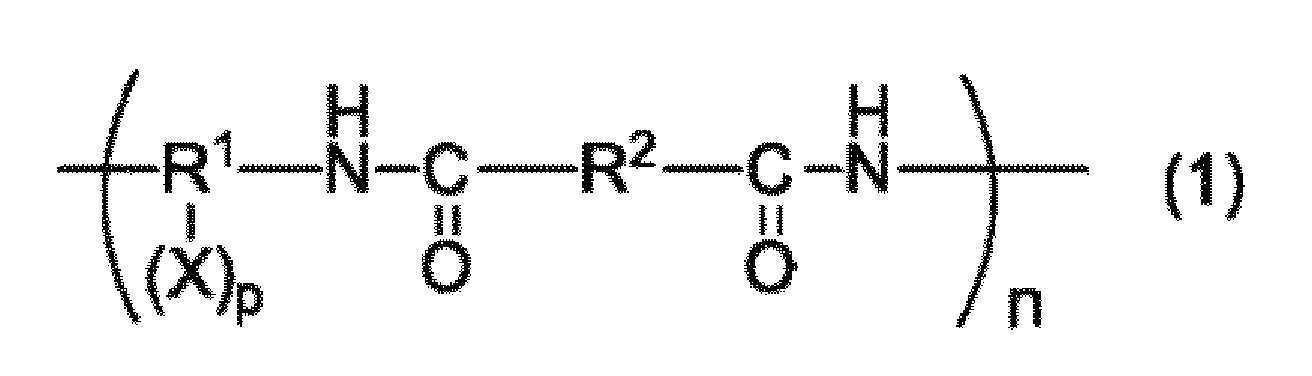
(상기 일반식 (1) 중, R1은 탄소수 4 내지 30의 2가 내지 6가의 유기기를 나타낸다. R2는 탄소수 4 내지 30의 2가의 유기기를 나타낸다. X는 술폰산기, 수산기 또는 카르복실기를 나타낸다. p는 1 내지 4의 정수를 나타낸다. n은 2 내지 100,000의 범위를 나타낸다.)

(상기 일반식 (2) 중, R3은 탄소수 4 내지 30의 2가 내지 6가의 유기기를 나타낸다. R4는 탄소수 4 내지 30의 2가의 유기기를 나타낸다. Y는 술폰산기, 수산기 또는 카르복실기를 나타낸다. q는 1 내지 4의 정수를 나타낸다. m은 2 내지 100,000의 범위를 나타낸다.)

(상기 일반식 (3) 중, R5는 탄소수 4 내지 30의 2가 내지 6가의 유기기를 나타낸다. R6은 탄소수 4 내지 30의 2가의 유기기를 나타낸다. Z는 술폰산기, 수산기 또는 카르복실기를 나타낸다. r은 1 내지 4의 정수를 나타낸다. l은 2 내지 100,000의 범위를 나타낸다.) An object of the present invention is to provide a resin which can be used as a water-based binder and has a sufficient binding property. The present invention relates to a resin composition comprising a) a resin comprising a polymer having a structure represented by any one of the following general formulas (1) to (3) and / or a copolymer thereof, and b) a basic compound.
(In the general formula (1), R 1 represents a divalent to hexavalent organic group having 4 to 30 carbon atoms, R 2 represents a divalent organic group having 4 to 30 carbon atoms, and X represents a sulfonic acid group, a hydroxyl group or a carboxyl group p represents an integer of 1 to 4, and n represents a range of 2 to 100,000.
(In the general formula (2), R 3 represents a divalent to hexavalent organic group having 4 to 30 carbon atoms, R 4 represents a divalent organic group having 4 to 30 carbon atoms, and Y represents a sulfonic acid group, a hydroxyl group or a carboxyl group and q represents an integer of 1 to 4. m represents a range of 2 to 100,000.
(In the general formula (3), R 5 represents a divalent to hexavalent organic group having 4 to 30 carbon atoms, R 6 represents a divalent organic group having 4 to 30 carbon atoms, and Z represents a sulfonic acid group, a hydroxyl group or a carboxyl group and r represents an integer of 1 to 4. l represents a range of 2 to 100,000.
Description
본 발명은, 수지 조성물에 관한 것이다. 상세하게는, 축전 디바이스 전극용 수계 결합제에 바람직하게 적용할 수 있는 수지 조성물에 관한 것이다.The present invention relates to a resin composition. More particularly, the present invention relates to a resin composition which can be suitably applied to a water-based binder for electric storage device electrodes.
리튬 이온 전지는 충전 가능한 고용량 전지로서, 전자 기기의 고기능화, 장시간 동작을 가능하게 하였다. 또한 자동차 등에 탑재되며, 하이브리드 차, 전기 자동차의 전지로서 유력시되고 있다. 현재 널리 사용되고 있는 리튬 이온 전지는, 코발트산리튬 등의 활물질과 폴리불화비닐리덴(PVDF) 등의 결합제를 포함하는 슬러리를 알루미늄박 상에 도포하여 형성되는 정극과, 탄소계의 활물질과 PVDF나 스티렌·부타디엔·고무(SBR) 등의 결합제를 포함하는 슬러리를 구리박 상에 도포하여 형성되는 부극을 갖는다.A lithium ion battery is a high capacity rechargeable battery capable of high-performance and long-time operation of electronic devices. They are also mounted on automobiles, etc., and are becoming more popular as batteries for hybrid cars and electric vehicles. A widely used lithium ion battery includes a positive electrode formed by applying a slurry containing an active material such as lithium cobalt oxide and a binder such as polyvinylidene fluoride (PVDF) to an aluminum foil, a carbon-based active material, a PVDF or styrene And a negative electrode formed by applying a slurry containing a binder such as butadiene rubber (SBR) on a copper foil.
리튬 이온 전지의 용량을 더욱 크게 하기 위해, 부극 활물질로서 실리콘, 게르마늄 또는 주석을 사용하는 것이 검토되어 있다(예를 들어, 특허문헌 1 참조). 실리콘, 게르마늄, 주석 등을 사용한 부극 활물질은, 리튬 이온을 대량으로 수취할 수 있기 때문에, 충분히 충전이 행해졌을 때와 충분히 방전이 행해졌을 때의 부피의 변화가 크고, PVDF, SBR 등의 결합제에서는 활물질의 부피 변화에 추종할 수 없어, 보다 기계 특성이 우수한 폴리이미드계의 수지를 부극의 결합제로 하는 검토가 이루어지고 있다(예를 들어 특허문헌 2 참조). 그러나, 이들 수지는 N-메틸피롤리돈이나 N,N'-디메틸아세트아미드 등의 유기 용제에밖에 용해되지 않고, 환경 부하가 높다는 문제가 있다. 이로 인해, 수지를 수계의 용매에 혼화하여, 수계 결합제로서 사용하는 검토가 진행되고 있다.In order to further increase the capacity of the lithium ion battery, use of silicon, germanium or tin as the negative electrode active material has been studied (see, for example, Patent Document 1). Since the negative electrode active material using silicon, germanium, tin or the like can receive a large amount of lithium ions, the change in volume when charging is sufficiently performed and when discharging is sufficient is large, and in the case of a binder such as PVDF or SBR It has not been possible to follow the volume change of the active material and a polyimide resin having better mechanical properties has been studied as a binder for the negative electrode (see, for example, Patent Document 2). However, these resins are only dissolved in organic solvents such as N-methylpyrrolidone and N, N'-dimethylacetamide, and have a problem of high environmental load. As a result, studies have been made to use a resin as a water-based binder by mixing it with an aqueous solvent.
폴리이미드계의 수지의 수용액에 관해서는, 폴리이미드 전구체에 아민을 부가시킨 수용액이나(예를 들어, 특허문헌 3 내지 4 참조), 측쇄에 수산기, 카르복실기 및 술폰산기를 도입한 폴리이미드와, 알칼리 금속의 수산화물을 혼합시킨 수용액이 알려져 있다(예를 들어, 특허문헌 5, 비특허문헌 1 참조).Examples of the aqueous solution of the polyimide resin include an aqueous solution in which amine is added to the polyimide precursor (see, for example, Patent Documents 3 to 4), a polyimide having a hydroxyl group, a carboxyl group and a sulfonic acid group introduced into the side chain, (See, for example, Patent Document 5 and Non-Patent Document 1).
폴리아미드계의 수지의 수용액에 관해서는, 아민 성분보다 산 성분을 과잉으로 사용하여 중합시킨 폴리아미드 수지와, 암모니아 또는 유기 아민을 포함하는 수지의 수용액이 알려져 있다(예를 들어, 특허문헌 6 참조).As to the aqueous solution of the polyamide-based resin, there is known an aqueous solution of a resin containing a polyamide resin and ammonia or organic amine polymerized by using an acid component in excess of an amine component (see, for example, Patent Document 6 ).
그러나, 폴리이미드 전구체의 수용액은 가수분해를 받기 쉽기 때문에 용액으로서의 안정성이 불충분하였다. 폴리이미드 수지 수용액은 용해성이 낮기 때문에 용액으로서의 안정성이 불충분하며, 또한 측쇄가 이온화됨으로써 측쇄에 의한 수소 결합이 저해되기 때문에, 기재와의 밀착성이 불충분하다는 과제가 있었다. 산 성분을 아민 성분보다 과잉으로 사용한 폴리아미드 수지 수용액은, 그의 구조의 특징으로부터 수지의 분자량이 낮아지기 때문에, 결착성이 불충분하였다.However, since the aqueous solution of the polyimide precursor is susceptible to hydrolysis, stability as a solution is insufficient. The aqueous solution of the polyimide resin has insufficient stability as a solution because of low solubility and the side chains are ionized to inhibit hydrogen bonding by the side chain. The polyamide resin aqueous solution in which the acid component is used in excess of the amine component is insufficient in binding property because the molecular weight of the resin is low due to the characteristics of its structure.
본 발명은, 상기 과제를 감안하여, 수계 결합제로서 사용했을 때의 용액 안정성이 높고, 충분한 기재와의 밀착성과 결착성을 갖는 수지 조성물을 제공하는 것을 목적으로 한다.In view of the above problems, it is an object of the present invention to provide a resin composition having high solution stability when used as a water-based binder, and having sufficient adhesiveness and bondability to a substrate.
본 발명은, a) 하기 일반식 (1) 내지 (3) 중 적어도 어느 것의 구조를 갖는 중합체 및/또는 그들 구조의 공중합체를 포함하는 수지, b) 염기성 화합물을 함유하는 수지 조성물이다.The present invention relates to a resin composition comprising a) a resin comprising a polymer having a structure of at least any one of the following general formulas (1) to (3) and / or a copolymer comprising such a copolymer, and b) a basic compound.

(상기 일반식 (1) 중, R1은 탄소수 4 내지 30의 2 내지 6가의 유기기를 나타낸다. R2는 탄소수 4 내지 30의 2가의 유기기를 나타낸다. X는 술폰산기, 수산기 또는 카르복실기를 나타낸다. p는 0 내지 4의 정수를 나타낸다. n은 2 내지 100,000의 범위를 나타낸다.)(In the general formula (1), R 1 represents a 2 to 6-valent organic group having 4 to 30 carbon atoms, R 2 represents a divalent organic group having 4 to 30 carbon atoms, and X represents a sulfonic acid group, a hydroxyl group or a carboxyl group. and p represents an integer of 0 to 4. n represents a range of 2 to 100,000.

(상기 일반식 (2) 중, R3은 탄소수 4 내지 30의 2 내지 6가의 유기기를 나타낸다. R4는 탄소수 4 내지 30의 2가의 유기기를 나타낸다. Y는 술폰산기, 수산기 또는 카르복실기를 나타낸다. q는 0 내지 4의 정수를 나타낸다. m은 2 내지 100,000의 범위를 나타낸다.) (In the general formula (2), R 3 represents a 2- to 6-valent organic group having 4 to 30 carbon atoms, R 4 represents a divalent organic group having 4 to 30 carbon atoms, and Y represents a sulfonic acid group, a hydroxyl group or a carboxyl group. q represents an integer of 0 to 4, and m represents a range of 2 to 100,000.

(상기 일반식 (3) 중, R5는 탄소수 4 내지 30의 2 내지 6가의 유기기를 나타낸다. R6은 탄소수 4 내지 30의 2가의 유기기를 나타낸다. Z는 술폰산기, 수산기 또는 카르복실기를 나타낸다. r은 0 내지 4의 정수를 나타낸다. l은 2 내지 100,000의 범위를 나타낸다.)(In the general formula (3), R 5 represents a 2 to 6-valent organic group having 4 to 30 carbon atoms, R 6 represents a divalent organic group having 4 to 30 carbon atoms, and Z represents a sulfonic acid group, a hydroxyl group or a carboxyl group. and r represents an integer of 0 to 4. l represents a range of 2 to 100,000.
본 발명에 의해, 수계 결합제로서의 사용했을 때의 용액 안정성이 높고, 충분한 기재와의 밀착성과 결착성을 갖는 수지 조성물을 얻을 수 있다.According to the present invention, it is possible to obtain a resin composition having a high solution stability when used as an aqueous binder, and having sufficient adhesiveness to a substrate and bondability.
본 발명은, a) 상기 일반식 (1) 내지 (3) 중 적어도 어느 것의 구조를 갖는 중합체 및/또는 그들 구조의 공중합체를 포함하는 수지, b) 염기성 화합물을 함유하는 수지 조성물이다.The present invention relates to a resin composition containing a) a resin containing a polymer having a structure of at least any one of the above general formulas (1) to (3) and / or a copolymer thereof, and b) a basic compound.
상기 일반식 (1) 내지 (3)으로 표시되는 구조는, 술폰산기, 수산기 또는 카르복실기를 측쇄에 갖는다. 이들 산성 관능기를 측쇄에 가짐으로써, 수용성의 용매 또는 수중에서의 분산성이 우수한 수지를 얻는 것이 가능하게 된다. 상기 일반식 (1) 내지 (3)으로 표시되는 어느 것의 구조를 적어도 1종류 포함하는 수지이면, 그의 공중합비나 배열은 특별히 한정되지 않지만, 그 구조가 전체 반복 단위 중 50몰% 이상인 것이 수용성 용매에 대한 용해성·분산성을 향상시키는 데 있어서 바람직하다. 70몰% 이상이 보다 바람직하고, 90몰% 이상이 더욱 바람직하다. 상기 일반식 (1)로 표시되는 구조를 포함하는 것이 특히 바람직하다. 또한, 중합체의 각 중합체쇄에 있어서는, 일반식 (1) 내지 (3) 중의 l, m 및 n은 모두 정수이지만, 중합체 전체의 분석에 의해 구해지는 l, m 및 n은 정수가 되지 않는 경우가 있다.The structure represented by the general formulas (1) to (3) has a sulfonic acid group, a hydroxyl group or a carboxyl group in the side chain. By having these acidic functional groups in the side chain, it becomes possible to obtain a resin that is excellent in dispersibility in a water-soluble solvent or water. The copolymerization ratio or arrangement thereof is not particularly limited as long as it is a resin containing at least one of the structures represented by any of the general formulas (1) to (3), but it is preferable that the structure is 50 mol% It is preferable in improving the solubility and dispersibility. More preferably 70 mol% or more, and still more preferably 90 mol% or more. It is particularly preferable to include the structure represented by the above general formula (1). In each polymer chain of the polymer, l, m and n in the general formulas (1) to (3) are all integers, but the case where l, m and n obtained by analysis of the entire polymer is not an integer have.
이하, 각 구조를 포함하는 수지에 대하여 설명한다.Hereinafter, the resin containing each structure will be described.
일반식 (1)로 표시되는 구조를 포함하는 수지는, 구조 중에 술폰산기, 수산기 또는 카르복실기를 갖는 디아민과, 디카르복실산을 용매 중에서 중축합함으로써 얻을 수 있다. 일반식 (1) 중의 R1은 디아민 잔기, R2는 디카르복실산 잔기를 나타낸다.The resin containing the structure represented by the general formula (1) can be obtained by polycondensation of a diamine having a sulfonic acid group, a hydroxyl group or a carboxyl group in its structure with a dicarboxylic acid in a solvent. R 1 in the general formula (1) represents a diamine residue, and R 2 represents a dicarboxylic acid residue.
디아민의 예로서는, 파라페닐렌디아민, 메타페닐렌디아민, 3,3'-디아미노디페닐에테르, 4,4'-디아미노디페닐에테르, 3,4'-디아미노디페닐에테르, 4,4'-디아미노디페닐메탄, 3,3'-디아미노디페닐술폰, 4,4'-디아미노디페닐술폰, 3,3'-디아미노디페닐술피드, 4,4'-디아미노디페닐술피드, 1,3-비스(4-아미노페녹시)벤젠, 1,4-비스(4-아미노페녹시)벤젠, 2,2-비스(트리플루오로메틸)벤지딘, 9,9'-비스(4-아미노페닐)플루오렌, 헥사메틸렌디아민, 1,3-비스(3-아미노프로필테트라메틸디실록산) 등 또는 이들 화합물의 수소 원자 1 내지 4개를 수산기, 카르복실기, 혹은 술폰산기로 치환한 것을 들 수 있다.Examples of the diamine include paraphenylenediamine, metaphenylenediamine, 3,3'-diaminodiphenyl ether, 4,4'-diaminodiphenyl ether, 3,4'-diaminodiphenyl ether, '-Diaminodiphenylmethane, 3,3'-diaminodiphenylsulfone, 4,4'-diaminodiphenylsulfone, 3,3'-diaminodiphenylsulfide, 4,4'-diaminodi (4-aminophenoxy) benzene, 2,2-bis (trifluoromethyl) benzidine, 9,9'- Bis (4-aminophenyl) fluorene, hexamethylenediamine, 1,3-bis (3-aminopropyltetramethyldisiloxane), etc., or a compound obtained by substituting 1 to 4 hydrogen atoms of these compounds with a hydroxyl group, a carboxyl group or a sulfonic acid group ≪ / RTI >
또한, 본 발명의 수지는, 유기 용매 및 수용성의 용매에 대한 용해성을 양립시키기 위해, 상기 일반식 (1) 중의 R1-(X)p, 일반식 (2) 중의 R3-(Y)q, 일반식 (3) 중의 R5-(Z)r의 각각 20몰% 이상, 나아가 50% 이상, 특히 80몰% 이상이 하기 일반식 (4) 및 (5) 중 적어도 어느 것으로 표시되는 디아민 잔기인 것이 바람직하다. 이들 잔기를 많이 포함할수록, 유기 용매와 수용성의 용매 양쪽에 대한 용해성을 확보할 수 있다.The resin of the present invention is preferably a resin in which R 1 - (X) p in the general formula (1) and R 3 - (Y) q in the general formula (2) , At least 20 mol%, more preferably at least 50 mol%, especially at least 80 mol% of R 5 - (Z) r in the general formula (3) is at least one diamine residue represented by any one of the following general formulas (4) . The more these residues are contained, the more the solubility in both the organic solvent and the water-soluble solvent can be secured.

(R7은 할로겐 원자 또는 탄소수 1 내지 8의 1가의 유기기를 나타낸다. s는 0 내지 3의 정수를 나타낸다. t는 1 또는 2의 정수를 나타낸다.) (R 7 represents a halogen atom or a monovalent organic group having 1 to 8 carbon atoms, s represents an integer of 0 to 3, and t represents an integer of 1 or 2.)

(R8 및 R9는 각각 독립적으로 할로겐 원자 또는 탄소수 1 내지 8의 1가의 유기기를 나타낸다. u, v는 각각 0 내지 3의 정수를 나타낸다. w, x는 각각 1 또는 2의 정수를 나타낸다. R10은 단결합, O, S, NH, SO2, CO 혹은 탄소수 1 내지 3의 2가의 유기기 또는 그들이 2 이상 연결되어 이루어지는 2가의 가교 구조이다.) (R 8 and R 9 each independently represent a halogen atom or a monovalent organic group having 1 to 8 carbon atoms, and u and v each represent an integer of 0 to 3. w and x each represent an integer of 1 or 2. R 10 is a single bond, a divalent organic group of O, S, NH, SO 2 , CO, or a divalent organic group having 1 to 3 carbon atoms, or a divalent crosslinked structure formed by connecting two or more thereof.
상기 일반식 (4) 또는 (5)로 표시되는 디아민 잔기를 갖는 디아민으로서는, 3,5-디아미노벤조산, 3,4-디아미노벤조산, 5,5'-메틸렌비스(2-아미노벤조산), 비스(3-아미노-4-카르복시페닐)술폰, 2,2-비스(3-아미노-4-카르복시페닐)프로판, 2,2-비스(3-아미노-5-카르복시페닐)프로판, 2,2-비스(4-아미노-3-카르복시페닐)프로판, 2,2-비스(3-아미노-4-카르복시페닐)헥사플루오로프로판, 2,2-비스(3-아미노-5-카르복시페닐)헥사플루오로프로판, 2,2-비스(4-아미노-3-카르복시페닐)헥사플루오로프로판, 비스(3-아미노-4-카르복시페닐)에테르 등을 들 수 있다.Examples of the diamine having a diamine residue represented by the general formula (4) or (5) include 3,5-diaminobenzoic acid, 3,4-diaminobenzoic acid, 5,5'-methylenebis (2-aminobenzoic acid) Bis (3-amino-4-carboxyphenyl) sulfone, 2,2-bis (3-amino-3-carboxyphenyl) propane, 2,2-bis (3-amino-4-carboxyphenyl) hexafluoropropane, Bis (4-amino-3-carboxyphenyl) hexafluoropropane, bis (3-amino-4-carboxyphenyl) ether and the like.
일반식 (4)로 표시되는 디아민 잔기의 비율이 높은 수지는 결합제로서의 결착성이 높고, 일반식 (5)로 표시되는 디아민 잔기의 비율이 높은 수지는 용제에 대한 용해성이 높아진다. 결착성과 용해성을 양립하는 데 있어서는, 일반식 (4)와 (5)의 몰비는, 일반식 (5)로 표시되는 디아민 잔기의 100에 대하여 일반식 (4)로 표시되는 디아민 잔기의 비율이 0.1 내지 100,000이 바람직하고, 1 내지 10,000이 보다 바람직하다.The resin having a high proportion of the diamine residue represented by the general formula (4) has high binding property as a binder, and the resin having a high proportion of the diamine residue represented by the general formula (5) has high solubility in a solvent. The molar ratio of the diamine residues represented by the general formula (4) to the diamine residues represented by the general formula (5) is preferably 0.1 To 100,000, and more preferably 1 to 10,000.
디카르복실산의 예로서는, 테레프탈산, 이소프탈산, 디페닐에테르디카르복실산, 나프탈렌디카르복실산, 디페닐술폰디카르복실산 등을 들 수 있다. 이들을 2종류 이상 사용해도 된다. 수용성 용매에 대한 용해성·분산성을 향상시키기 위해, 하기 일반식 (6)으로 표시되는 디카르복실산 잔기를 갖는 디카르복실산을 전체 디카르복실산 중의 20몰% 이상 사용하는 것이 바람직하다. 이에 의해, 일반식 (1) 중의 R2의 20몰% 이상, 나아가 50몰% 이상, 특히 80몰% 이상이 하기 일반식 (6)으로 표시되는 구조를 갖는 수지를 얻을 수 있다.Examples of the dicarboxylic acid include terephthalic acid, isophthalic acid, diphenyl ether dicarboxylic acid, naphthalene dicarboxylic acid, and diphenylsulfone dicarboxylic acid. Two or more of these may be used. In order to improve solubility and dispersibility in a water-soluble solvent, it is preferable to use dicarboxylic acid having a dicarboxylic acid residue represented by the following general formula (6) in an amount of 20 mol% or more in the total dicarboxylic acid. This makes it possible to obtain a resin having a structure represented by the following general formula (6) in which 20 mol% or more, more preferably 50 mol% or more, and particularly 80 mol% or more of R 2 in the general formula (1)
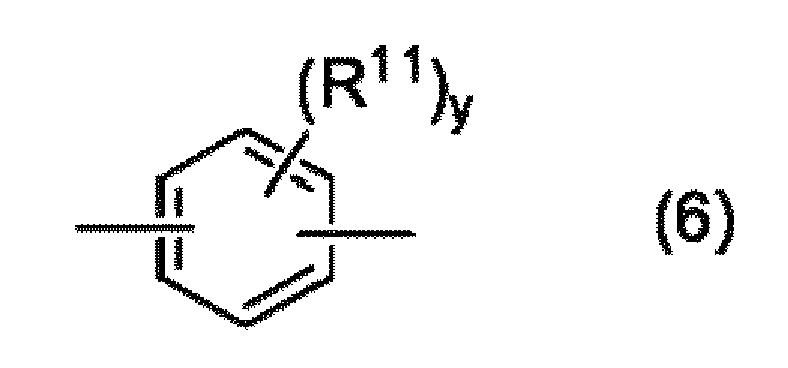
(상기 일반식 (6) 중, R11은 각각 독립적으로 할로겐 원자 또는 탄소수 1 내지 8의 1가의 유기기를 나타낸다. y는 0 내지 4의 정수를 나타낸다.) (In the general formula (6), R 11 independently represents a halogen atom or a monovalent organic group having 1 to 8 carbon atoms, and y represents an integer of 0 to 4.)
통상의 중축합 반응과 마찬가지로, 디아민과 디카르복실산의 투입 비율(몰비)이 1:1에 가까울수록 생성되는 중합체의 중합도는 커지고, 중량 평균 분자량이 증가한다. 본 발명에 있어서는, 중량 평균 분자량 10,000 이상 150,000 이하인 것이 바람직하다. 중량 평균 분자량은, GPC(겔 투과 크로마토그래피)에 의한 폴리스티렌 환산으로 10,000 이상으로 함으로써, 결합제로서 충분한 결착성을 갖게 할 수 있다. 한편, 중량 평균 분자량을 150,000 이하로 함으로써, 용매에 대한 높은 용해성을 유지할 수 있다. 상기한 중량 평균 분자량을 갖는 중합체를 얻기 위해서는, 디아민과 디카르복실산의 투입 비율(몰비)은 100:50 내지 150인 것이 바람직하다.As in the case of the usual polycondensation reaction, the closer the charging ratio (molar ratio) of the diamine and the dicarboxylic acid is to 1: 1, the larger the degree of polymerization of the resulting polymer increases and the weight average molecular weight increases. In the present invention, a weight average molecular weight of 10,000 or more and 150,000 or less is preferable. When the weight average molecular weight is 10,000 or more in terms of polystyrene by GPC (gel permeation chromatography), sufficient binding property can be obtained as a binder. On the other hand, when the weight average molecular weight is 150,000 or less, high solubility in a solvent can be maintained. In order to obtain a polymer having a weight average molecular weight as described above, the charging ratio (molar ratio) of the diamine and the dicarboxylic acid is preferably 100: 50 to 150.
상기 중축합 반응에 사용되는 용매로서는, 생성된 수지가 용해되는 것이면 특별히 한정되는 것은 아니지만, N-메틸-2-피롤리돈, N-메틸카프로락탐, N,N-디메틸아세트아미드, N,N-디메틸포름아미드, 디메틸술폭시드, γ-부티로락톤, 디메틸이미다졸린 등의 비프로톤성 극성 용매, 페놀, m-크레졸, 클로로페놀, 니트로페놀 등의 페놀계 용매, 폴리인산, 인산에 5산화인을 가한 인계 용매 등을 바람직하게 사용할 수 있다.The solvent used in the polycondensation reaction is not particularly limited as long as the resulting resin dissolves, and examples thereof include N-methyl-2-pyrrolidone, N-methylcaprolactam, N, N-dimethylacetamide, N, N - aprotic polar solvents such as dimethylformamide, dimethylsulfoxide,? -Butyrolactone and dimethylimidazoline; phenol-based solvents such as phenol, m-cresol, chlorophenol and nitrophenol; A phosphorus-containing solvent to which phosphorus oxide is added, and the like can be preferably used.
일반적으로는, 이들 용매 중에서 디카르복실산의 산 염화물 또는 활성 에스테르와 디아민을 30℃ 이하의 온도에서 반응시킴으로써 중합체를 얻는다. 또한 반응시에, 트리에틸아민, 피리딘 등의 염기류를 촉매로서 첨가할 수 있다. 그 후, 물 등에 투입하여 수지를 석출시키고, 건조시킴으로써 중합체를 고체로서 얻을 수 있다.Generally, a polymer is obtained by reacting an acid chloride or an active ester of a dicarboxylic acid with a diamine in these solvents at a temperature of 30 ° C or lower. In the reaction, bases such as triethylamine and pyridine can be added as a catalyst. Thereafter, the polymer is added to water or the like to precipitate a resin and then dried to obtain a polymer as a solid.
상기 일반식 (2)로 표시되는 구조를 포함하는 수지는, 구조 중에 술폰산기, 수산기 또는 카르복실기를 갖는 디아민과, 디이소시아네이트를 용매 중에서 중축합함으로써 얻을 수 있다. 상기 일반식 (2) 중의 R3은 디아민 잔기, R4는 디이소시아네이트 잔기를 나타낸다.The resin containing the structure represented by the general formula (2) can be obtained by polycondensation of a diamine having a sulfonic acid group, a hydroxyl group or a carboxyl group in its structure with a diisocyanate in a solvent. R 3 in the general formula (2) represents a diamine residue and R 4 represents a diisocyanate residue.
디아민의 예로서는, 상기 일반식 (1)로 표시되는 구조를 포함하는 수지에 있어서의 디아민으로서 예시한 것을 들 수 있다.Examples of the diamine include those exemplified as diamines in the resin containing the structure represented by the general formula (1).
디이소시아네이트의 예로서는, 1,3-페닐렌디이소시아네이트, 1,4-페닐렌디이소시아네이트, 2,4-톨루엔디이소시아네이트, 2,6-톨루엔디이소시아네이트, 4,4'-디페닐메탄디이소시아네이트, 1,5-디이소시아네이트나프탈렌 등을 들 수 있다. 수용성 용매에 대한 용해성·분산성을 향상시키기 위해, 일반식 (6)으로 표시되는 디이소시아네이트 잔기를 갖는 디이소시아네이트를 전체 디이소시아네이트 중의 20몰% 이상 사용하는 것이 바람직하다. 이에 의해, 일반식 (2) 중의 R4의 20몰% 이상, 나아가 50몰% 이상, 특히 80몰% 이상이 일반식 (6)으로 표시되는 구조를 갖는 수지를 얻을 수 있다. 일반식 (6)으로 표시되는 디이소시아네이트 잔기의 비율이 높을수록, 수계 결합제로 했을 때의 용액 안정성을 향상시킬 수 있다.Examples of the diisocyanate include 1,3-phenylene diisocyanate, 1,4-phenylene diisocyanate, 2,4-toluene diisocyanate, 2,6-toluene diisocyanate, 4,4'- 5-diisocyanate naphthalene, and the like. In order to improve solubility and dispersibility in a water-soluble solvent, it is preferable to use a diisocyanate having a diisocyanate residue represented by the general formula (6) in an amount of 20 mol% or more in the entire diisocyanate. This makes it possible to obtain a resin having a structure represented by the general formula (6) in which 20 mol% or more, more preferably 50 mol% or more, and particularly 80 mol% or more of R 4 in the general formula (2) The higher the proportion of the diisocyanate residue represented by the general formula (6), the better the solution stability when the water-based coupling agent is used.
상기 일반식 (1)로 표시되는 구조를 포함하는 수지의 경우와 마찬가지로, 디아민과 디이소시아네이트의 투입 비율(몰비)은, 디아민 100에 대하여 디이소시아네이트가 50 내지 150의 범위 내인 것이 바람직하다.As in the case of the resin containing the structure represented by the general formula (1), it is preferable that the input ratio (molar ratio) of the diamine and the diisocyanate is in the range of 50 to 150 diisocyanate to 100 diamine.
상기 중축합 반응에 사용되는 용매로서는, 상기 수지의 중축합 반응에 사용되는 용매로서 예시한 것을 들 수 있다.Examples of the solvent used in the polycondensation reaction include those exemplified as solvents used in the polycondensation reaction of the resin.
일반적으로는, 이들 용매 중에서 디아민과 디이소시아네이트를 30℃ 이하의 온도에서 반응시킴으로써 중합체를 얻는다. 반응시에, 트리에틸아민, 피리딘 등의 염기류를 촉매로서 첨가할 수 있다. 그 후, 물 등에 투입하여 수지를 석출시키고, 건조시킴으로써 중합체를 고체로서 얻을 수 있다.Generally, a polymer is obtained by reacting a diamine and a diisocyanate in these solvents at a temperature of 30 DEG C or less. In the reaction, bases such as triethylamine, pyridine and the like can be added as a catalyst. Thereafter, the polymer is added to water or the like to precipitate a resin and then dried to obtain a polymer as a solid.
상기 일반식 (3)으로 표시되는 구조를 포함하는 수지는, 구조 중에 술폰산기, 수산기 또는 카르복실기를 갖는 디아민과, 디알데히드를 용매 중에서 중축합함으로써 얻을 수 있다. 상기 일반식 (3) 중의 R5는 디아민 잔기, R6은 디알데히드 잔기를 나타낸다.The resin containing the structure represented by the general formula (3) can be obtained by polycondensation of a diamine having a sulfonic acid group, a hydroxyl group or a carboxyl group in its structure with a dialdehyde in a solvent. R 5 in the general formula (3) represents a diamine residue and R 6 represents a dialdehyde residue.
디아민의 예로서는, 상기 폴리아미드 수지에 있어서의 디아민으로서 예시한 것을 들 수 있다.Examples of the diamine include those exemplified as diamines in the above-mentioned polyamide resin.
디알데히드의 예로서는, 이소프탈알데히드, 프탈디알데히드, 4,4'-비페닐디카르복시알데히드, 2,2'-옥시디벤즈알데히드 등을 들 수 있다. 수용성 용매에 대한 용해성·분산성을 향상시키기 위해, 상기 일반식 (6)으로 표시되는 디알데히드 잔기를 갖는 디알데히드를 전체 디알데히드 중의 20몰% 이상 사용하는 것이 바람직하다. 이에 의해, 일반식 (3) 중의 R6의 20몰% 이상, 나아가 50몰% 이상, 특히 80몰% 이상이 일반식 (6)으로 표시되는 구조를 갖는 수지를 얻을 수 있다. 일반식 (6)으로 표시되는 디알데히드 잔기의 비율이 높을수록, 수계 결합제로 했을 때의 용액 안정성을 향상시킬 수 있다.Examples of the dialdehyde include isophthalaldehyde, phthalaldehyde, 4,4'-biphenyldicarboxyaldehyde, 2,2'-oxydibenzaldehyde and the like. In order to improve solubility and dispersibility in a water-soluble solvent, it is preferable to use at least 20 mol% of a dialdehyde having a dialdehyde residue represented by the above general formula (6) in the total dialdehyde. This makes it possible to obtain a resin having a structure represented by the general formula (6) in which 20 mol% or more, more preferably 50 mol% or more, and particularly 80 mol% or more of R 6 in the general formula (3) The higher the proportion of the dialdehyde residue represented by the general formula (6), the better the solution stability when the water-based coupling agent is used.
상기 일반식 (1)로 표시되는 구조를 포함하는 수지의 경우와 마찬가지로, 디아민과 디알데히드의 투입 비율(몰비)은, 디아민 100에 대하여 디알데히드가 50 내지 150의 범위 내인 것이 바람직하다.As in the case of the resin including the structure represented by the general formula (1), it is preferable that the input ratio (molar ratio) of the diamine and the dialdehyde is in the range of 50 to 150 in terms of dialdehyde to 100 diamine.
상기 중축합 반응에 사용되는 용매로서는, 상기 수지의 중축합 반응에 사용되는 용매로서 예시한 것을 들 수 있다.Examples of the solvent used in the polycondensation reaction include those exemplified as solvents used in the polycondensation reaction of the resin.
일반적으로는, 이들 용매 중에서 디아민과 디알데히드를 30℃ 이하의 온도에서 반응시킴으로써 중합체를 얻는다. 반응시에, 트리에틸아민, 피리딘 등의 염기류를 촉매로서 첨가할 수 있다. 그 후, 물 등에 투입하여 수지를 석출시키고, 건조시킴으로써 중합체를 고체로서 얻을 수 있다.Generally, a polymer is obtained by reacting a diamine and a dialdehyde in these solvents at a temperature of 30 DEG C or less. In the reaction, bases such as triethylamine, pyridine and the like can be added as a catalyst. Thereafter, the polymer is added to water or the like to precipitate a resin and then dried to obtain a polymer as a solid.
상기 일반식 (1) 내지 (3) 중 어느 것으로 표시되는 구조를 갖는 중합체 및/또는 그들 구조의 공중합체를 포함하는 수지와 염기성 화합물을 포함함으로써, 구조에 포함되는 술폰산기, 수산기 또는 카르복실기와 염기성 화합물이 염을 형성하여, 물에 대한 용해성·분산 안정성이 높은 수지 조성물을 얻을 수 있다.By including a basic compound and a resin containing a polymer having a structure represented by any one of the above-mentioned general formulas (1) to (3) and / or a copolymer thereof, it is possible to obtain a copolymer having a sulfonic acid group, The compound forms a salt, whereby a resin composition having high solubility and dispersion stability in water can be obtained.
염기성 화합물로서는, 알칼리 금속의 수산화물, 탄산염, 유기 아민류 등을 들 수 있다.Examples of the basic compound include hydroxides, carbonates, organic amines and the like of an alkali metal.
알칼리 금속의 수산화물의 예로서는, 수산화리튬, 수산화나트륨, 수산화칼륨, 수산화루비듐, 수산화세슘 등을 들 수 있다. 이들을 2종류 이상 함유해도 된다. 용해성, 안정성을 향상시키는 관점에서, 수산화리튬, 수산화나트륨, 수산화칼륨이 바람직하다.Examples of hydroxides of alkali metals include lithium hydroxide, sodium hydroxide, potassium hydroxide, rubidium hydroxide, cesium hydroxide and the like. Two or more kinds of these may be contained. From the viewpoint of improving solubility and stability, lithium hydroxide, sodium hydroxide and potassium hydroxide are preferable.
알칼리 금속의 탄산염의 예로서는, 탄산리튬, 탄산수소리튬, 탄산나트륨, 탄산수소나트륨, 탄산칼륨, 탄산수소칼륨, 탄산수소루비듐, 탄산세슘, 탄산수소세슘, 탄산나트륨칼륨을 들 수 있다. 이들을 2종류 이상 함유해도 된다. 용해성, 안정성 등의 관점에서, 탄산나트륨, 탄산수소나트륨, 탄산칼륨, 탄산수소칼륨, 탄산나트륨칼륨이 바람직하다.Examples of the alkali metal carbonate include lithium carbonate, lithium hydrogen carbonate, sodium carbonate, sodium hydrogen carbonate, potassium carbonate, potassium hydrogen carbonate, rubidium hydrogen carbonate, cesium carbonate, cesium hydrogen carbonate and potassium carbonate. Two or more kinds of these may be contained. From the viewpoints of solubility and stability, sodium carbonate, sodium hydrogen carbonate, potassium carbonate, potassium hydrogencarbonate and potassium carbonate are preferable.
유기 아민류로서는, 트리메틸아민, 트리에틸아민, 트리이소프로필아민, 트리부틸아민, 트리에탄올아민, N-메틸에탄올 아민 등의 지방족 3급 아민이나, 피리딘, N,N-디메틸아미노피리딘, 루티딘 등의 방향족 아민, 테트라메틸암모늄히드록시드, 테트라에틸암모늄히드록시드 등의 4급 암모늄염 등을 들 수 있다. 이들을 2종류 이상 사용해도 된다.Examples of the organic amines include aliphatic tertiary amines such as trimethylamine, triethylamine, triisopropylamine, tributylamine, triethanolamine and N-methylethanolamine; aliphatic tertiary amines such as pyridine, N, N-dimethylaminopyridine, Aromatic amines, quaternary ammonium salts such as tetramethylammonium hydroxide and tetraethylammonium hydroxide, and the like. Two or more of these may be used.
본 발명의 수지를 수용액으로서 사용하는 경우, 염기성 화합물의 함유량은 상기 수지 중의 산성 관능기에 대하여 수지를 충분히 용해할 수 있다는 점에서, 0.2몰 당량 이상이 바람직하고, 0.5몰 당량 이상이 보다 바람직하다. 또한, 수지의 분해나 도막으로 했을 때의 크랙의 발생을 방지할 수 있다는 점에서, 4몰 당량 이하가 바람직하고, 3몰 당량 이하가 보다 바람직하다.When the resin of the present invention is used as an aqueous solution, the content of the basic compound is preferably 0.2 mol equivalent or more, more preferably 0.5 mol equivalent or more, from the viewpoint that the resin can be sufficiently dissolved in the acidic functional group in the resin. Further, the amount is preferably not more than 4 molar equivalents, more preferably not more than 3 molar equivalents, from the viewpoint of preventing decomposition of the resin and generation of cracks in the case of forming a coating film.
본 발명의 수지 조성물은 임의의 용매 및 첨가제를 가하여 사용할 수 있으며, 본 발명의 수지 조성물을 용매에 용해시키거나, 또는 분산시켜, 결합제 조성물로서 사용할 수 있다.The resin composition of the present invention can be used by adding any solvent and additives, and the resin composition of the present invention can be dissolved or dispersed in a solvent and used as a binder composition.
결합제 사용시의 환경 부하를 낮출 수 있다는 관점에서, 용매는 물을 주성분으로서 사용하는 것이 바람직하고, 또한 조성물의 보존 안정성을 향상시킨다는 관점에서 수용액으로 하는 것이 바람직하다.From the viewpoint of reducing the environmental load at the time of use of the binder, it is preferable to use water as the main component of the solvent and to make the aqueous solution from the viewpoint of improving the storage stability of the composition.
본 발명의 수지 조성물을 사용한 수용액 또는 수분산액은, 상기 수지 100질량부에 대하여 물 50 내지 1,000,000질량부를 함유하는 것이 바람직하다. 일반적으로 도포성의 관점에서는, 상기 수지 100질량부에 대하여 겔화를 억제할 수 있는 점에서 물 50질량부 이상이 바람직하고, 100질량부 이상이 보다 바람직하다. 분해를 억제할 수 있다는 점에서, 상기 수지 100질량부에 대하여 물 100,000질량부 이하가 바람직하고, 3,000 질량부 이하가 보다 바람직하다.The aqueous solution or aqueous dispersion using the resin composition of the present invention preferably contains 50 to 1,000,000 parts by mass of water relative to 100 parts by mass of the resin. Generally, from the viewpoint of coatability, water is preferably not less than 50 parts by mass, more preferably not less than 100 parts by mass in view of suppressing gelation with respect to 100 parts by mass of the resin. Water is preferably 100,000 parts by mass or less, more preferably 3,000 parts by mass or less, based on 100 parts by mass of the resin from the standpoint of suppressing decomposition.
또한, 수용액의 점도는, 작업성의 관점에서 25℃에서 1mPa·s 내지 100Pa·s의 범위 내인 것이 바람직하다.The viscosity of the aqueous solution is preferably in the range of 1 mPa · s to 100 Pa · s at 25 ° C. from the viewpoint of workability.
상기 수용액 및 수분산액은 계면활성제 등을 함유해도 되어, 도포성을 향상시킬 수 있다. 또한, 에탄올이나 이소프로필알코올 등의 저급 알코올, 에틸렌글리콜이나 프로필렌글리콜 등의 다가 알코올과 같은 용제를 함유해도 된다. 용제의 함유량은, 수용액 전체의 50질량% 이하가 바람직하고, 10질량% 이하가 보다 바람직하다.The above-mentioned aqueous solution and aqueous dispersion may contain a surfactant and the like, so that the coating property can be improved. In addition, a solvent such as a lower alcohol such as ethanol or isopropyl alcohol, or a polyhydric alcohol such as ethylene glycol or propylene glycol may be contained. The content of the solvent is preferably 50 mass% or less, more preferably 10 mass% or less, of the entire aqueous solution.
상기 수용액 및 수분산액을 제작할 때의 방법에 특별히 제한은 없지만, 소정량의 염기성 화합물을 물에 용해시킨 후에, 수지 분말을 조금씩 용해시키는 것이 안전성의 관점에서 바람직하다. 중화 반응이 느린 경우에는, 30 내지 110℃ 정도의 수욕이나 유욕에서 가온해도 되고, 초음파 처리해도 된다. 용해한 후에, 추가로 물을 가하거나, 농축하거나 하여 소정의 점도로 조정해도 된다.There is no particular limitation on the method for preparing the above aqueous solution and aqueous dispersion, but it is preferable from the viewpoint of safety to dissolve the resin powder slightly after dissolving a predetermined amount of the basic compound in water. When the neutralization reaction is slow, it may be warmed in a water bath or an oil bath at about 30 to 110 ° C or may be subjected to ultrasonic treatment. After dissolution, water may be added or concentrated to adjust the viscosity to a predetermined value.
본 발명의 수지 조성물은, 필러를 첨가하여 슬러리로서도 사용할 수 있다. 필러를 첨가함으로써, 기계 강도나 내열성의 향상을 기대할 수 있다. 또한, 도전성의 입자나 고굴절 필러 또는 저굴절 필러의 첨가에 의해, 전자 재료나 광학 재료에 이용하는 것도 가능하다.The resin composition of the present invention can also be used as a slurry by adding a filler. By adding a filler, improvement in mechanical strength and heat resistance can be expected. Further, it can be used for an electronic material or an optical material by adding conductive particles, a high refractive index filler or a low refractive index filler.
본 발명의 수지 조성물에 첨가하는 필러로서는, 탄소, 규소, 주석, 게르마늄, 티타늄, 철, 코발트, 니켈, 망간 등의 원자를 포함하는 화합물을 들 수 있다. 이들 화합물을 필러로서 사용하면, 필러가 활물질로서의 역할을 한다. 이로 인해, 본 발명의 수지에 필러를 첨가하고, 슬러리로 함으로써, 이차 전지나 캐패시터의 전극용 슬러리로서 사용할 수 있다.Examples of the filler added to the resin composition of the present invention include compounds containing atoms such as carbon, silicon, tin, germanium, titanium, iron, cobalt, nickel and manganese. When these compounds are used as a filler, the filler serves as an active material. As a result, a filler is added to the resin of the present invention to form a slurry, which can be used as a slurry for an electrode of a secondary battery or a capacitor.
정극용의 필러의 예로서는, 인산철리튬, 코발트산리튬, 니켈산리튬, 망간산리튬, 활성탄, 카본 나노 튜브 등을 들 수 있다.Examples of the positive electrode filler include lithium iron phosphate, lithium cobalt oxide, lithium nickel oxide, lithium manganese oxide, activated carbon, and carbon nanotubes.
부극용의 필러의 예로서는, 규소, 산화규소, 탄화규소, 주석, 산화주석, 게르마늄, 티타늄산리튬, 하드 카본, 소프트 카본, 활성탄, 카본 나노 튜브 등을 들 수 있다. 특히, 규소 및 산화규소를 합계로 필러 전체를 100질량%로 하여 10질량% 이상 포함하는 필러를 사용하는 경우, 충전시에 활물질의 부피 팽창이 크기 때문에, 상기 수지와 같은 기계 강도가 높은 수지를 결합제로서 사용하는 것이 활물질의 미분화를 방지하는 데 있어서 바람직하다. 또한, 필러가 티타늄산리튬인 경우에는, 레이트 특성이 우수한 이차 전지나 캐패시터를 얻을 수 있다.Examples of the negative electrode filler include silicon, silicon oxide, silicon carbide, tin, tin oxide, germanium, lithium titanate, hard carbon, soft carbon, activated carbon and carbon nanotubes. Particularly, when a filler containing 10% by mass or more of silicon and silicon oxide as a whole in an amount of 100% by mass as a total filler is used, the volume expansion of the active material is large at the time of filling, It is preferable to use it as a binder in order to prevent the non-micronization of the active material. When the filler is lithium titanate, a secondary battery and a capacitor excellent in rate characteristics can be obtained.
본 발명의 슬러리에 있어서의 필러의 함유량은, 상기 수지 100질량부에 대하여 기계 강도나 내열성을 향상시킬 수 있다는 점에서 0.01질량부 이상이 바람직하고, 0.1질량부 이상이 보다 바람직하다. 또한, 도막 강도를 유지할 수 있다는 점에서 100,000질량부 이하가 바람직하고, 10,000질량부 이하가 보다 바람직하다.The content of the filler in the slurry of the present invention is preferably 0.01 part by mass or more, more preferably 0.1 part by mass or more from the viewpoint of improving the mechanical strength and heat resistance of 100 parts by mass of the resin. Further, the amount is preferably 100,000 parts by mass or less, more preferably 10,000 parts by mass or less, from the standpoint of maintaining the strength of the coating film.
상기 슬러리는, 예를 들어 수지를 물 또는 용제에 용해 혹은 분산시킨 것에 필러와, 필요에 따라 그 밖의 성분을 첨가하여 균일하게 혼합함으로써 얻을 수 있다. 혼합에는, 플라네터리 믹서, 자전 공전식 믹서, 3축 롤, 볼 밀, 메커니컬 스터러, 박막 선회형 믹서 등을 사용하는 방법을 들 수 있다.The slurry can be obtained by, for example, homogeneously mixing a resin with a filler dissolved or dispersed in water or a solvent, and optionally adding other components. For the mixing, a method using a planetary mixer, a revolving mixer, a triaxial roll, a ball mill, a mechanical stirrer, a thin film swirling mixer, or the like can be used.
상기 슬러리를 지지 기판의 편면 또는 양면에 도포하고, 건조시킴으로써 필러 함유 수지막을 얻을 수 있다. 지지 기판으로서는, 구리박, 알루미늄박, 스테인리스박 등의 금속박이나, 실리콘 기판, 유리 기판, 플라스틱 필름 등이 바람직하게 사용된다. 도포 방법으로서는, 롤 코터, 슬릿 다이 코터, 바 코터, 콤마 코터, 스핀 코터 등을 사용하는 방법을 들 수 있다. 건조 온도는, 물을 완전히 제거하는 데 있어서 30℃ 이상이 바람직하고, 50℃ 이상이 보다 바람직하다. 또한, 전극의 크랙을 방지하는 관점에서 500℃ 이하가 바람직하고, 200℃ 이하가 보다 바람직하다.The slurry is coated on one side or both sides of the support substrate and dried to obtain a filler-containing resin film. As the supporting substrate, a metal foil such as a copper foil, an aluminum foil, and a stainless steel foil, a silicon substrate, a glass substrate, a plastic film and the like are preferably used. As a coating method, there can be mentioned a method using a roll coater, a slit die coater, a bar coater, a comma coater, a spin coater and the like. The drying temperature is preferably 30 占 폚 or higher, more preferably 50 占 폚 or higher, in completely removing water. From the viewpoint of preventing electrode cracking, the temperature is preferably 500 DEG C or lower, more preferably 200 DEG C or lower.
또한, 전극용 슬러리로 하는 경우에 있어서는, 아세틸렌 블랙, 케첸 블랙, 카본 나노 튜브 등의 도전 보조제를 함유해도 된다. 이들 도전 보조제를 함유함으로써, 충방전 레이트를 향상시킬 수 있다.In the case of the electrode slurry, a conductive auxiliary agent such as acetylene black, ketjen black, or carbon nanotube may be contained. By containing these conductive auxiliary agents, the charge / discharge rate can be improved.
도전 보조제의 함유량은, 도전성과 용량을 양립하는 데 있어서 활물질 100질량부에 대하여 0.1 내지 20질량부가 바람직하다. 또한, 점도 조정을 위해, 카르복시메틸셀룰로오스의 나트륨염 수용액을 함유해도 된다. 이들 함유량은, 용량을 유지하는 관점에서 활물질 100질량부에 대하여 50질량부 이하가 바람직하다.The content of the conductive auxiliary agent is preferably 0.1 to 20 parts by mass relative to 100 parts by mass of the active material in terms of both conductivity and capacity. For adjustment of the viscosity, an aqueous solution of sodium salt of carboxymethyl cellulose may also be contained. These contents are preferably 50 parts by mass or less based on 100 parts by mass of the active material from the viewpoint of maintaining the capacity.
상기 전극용 슬러리를 구리박, 알루미늄박, 스테인리스박 등의 집전체의 편면 또는 양면에 도포하고, 건조시킴으로써 2차 전지용 전극 또는 캐패시터용 전극을 얻을 수 있다. 이와 같이 하여 얻은 정극 및 부극에 대하여, 세퍼레이터를 개재하여 복수 적층시킨 것을 전해액과 함께 금속 케이스 등의 외장재에 넣고, 밀봉함으로써, 2차 전지나 캐패시터와 같은 축전 디바이스를 얻을 수 있다. 세퍼레이터의 예로서는 폴리에틸렌, 폴리프로필렌 등의 폴리올레핀이나, 셀룰로오스, 폴리페닐렌술피드, 아라미드, 폴리이미드 등의 미다공 필름이나 부직포 등을 들 수 있다. 내열성을 높이기 위해, 세퍼레이터의 표면에 세라믹 등의 코팅을 해도 된다. 전해액의 용제로서는, 프로필렌카르보네이트, 에틸렌카르보네이트, 디메틸카르보네이트, 에틸메틸카르보네이트, 비닐렌카르보네이트 등의 카르보네이트계 화합물이나, 아세토니트릴, 술포란, γ-부티로락톤 등을 사용할 수 있다. 이들을 2종류 이상 사용해도 된다. 전해질의 예로서는, 헥사플루오로인산리튬, 붕불화리튬, 과염소산리튬 등의 리튬염, 테트라에틸암모늄테트라플루오로보레이트, 트리에틸메틸암모늄테트라플루오로보레이트 등의 암모늄염 등을 들 수 있다.The electrode slurry is coated on one or both surfaces of a collector such as copper foil, aluminum foil or stainless steel foil and dried to obtain an electrode for a secondary battery or an electrode for a capacitor. A battery device such as a secondary battery or a capacitor can be obtained by inserting a plurality of positive electrodes and negative electrodes thus obtained with a separator interposed therebetween together with an electrolyte in a casing such as a metal case and sealing them. Examples of the separator include polyolefins such as polyethylene and polypropylene, and microporous films and nonwoven fabrics such as cellulose, polyphenylene sulfide, aramid and polyimide. In order to increase heat resistance, the surface of the separator may be coated with ceramics or the like. Examples of the solvent for the electrolytic solution include carbonate-based compounds such as propylene carbonate, ethylene carbonate, dimethyl carbonate, ethyl methyl carbonate and vinylene carbonate, acetonitrile, sulfolane, Lactone and the like can be used. Two or more of these may be used. Examples of the electrolyte include lithium salts such as lithium hexafluorophosphate, lithium borofluoride and lithium perchlorate, and ammonium salts such as tetraethylammonium tetrafluoroborate and triethylmethylammonium tetrafluoroborate.
실시예Example
본 발명을 더욱 상세하게 설명하기 위해 실시예를 이하에 들지만, 본 발명은 이들 실시예에 의해 하등 제한되는 것은 아니다. 각 실시예 및 비교예에 있어서의 수지의 중량 평균 분자량 측정, 용해성, 보존 안정성 및 도포막의 평가는 이하의 방법으로 행하였다.EXAMPLES Hereinafter, the present invention will be described in more detail. However, the present invention is not limited by these Examples. The measurement of the weight average molecular weight, the solubility, the storage stability and the evaluation of the coating film of the resin in each of the examples and comparative examples were carried out by the following methods.
<수지의 중량 평균 분자량 측정> ≪ Measurement of weight average molecular weight of resin &
수지의 분자량은, GPC(겔 투과 크로마토그래피) 장치 Waters 2690-996(닛본 워터스(주)제)을 사용하고, 전개 용매를 N-메틸-2-피롤리돈(이하, NMP라 칭함)으로 해서 측정하고, 폴리스티렌 환산으로 중량 평균 분자량(Mw)을 계산하였다.The molecular weight of the resin was measured by using a GPC (gel permeation chromatography) apparatus Waters 2690-996 (manufactured by Nippon Waters Corporation) and using a developing solvent as N-methyl-2-pyrrolidone And the weight average molecular weight (Mw) was calculated in terms of polystyrene.
<용해성·분산성 및 보존 안정성의 평가> <Evaluation of Solubility, Dispersibility and Storage Stability>
각 실시예 및 비교예에서 제작한 수용액 또는 수분산액을 눈으로 봐서 관찰하고, 초기 용해성·분산성을 확인하였다. 수용액이 된 것을 용해, 안정된 수분산액이 된 것을 균일 분산, 용기의 바닥에 고체가 침강된 것을 침강으로 해서, 상태를 기재하였다. 또한, 용해된 것과 균일 분산된 것에 대해서는 실온(25℃) 및 냉장고 내(4℃)에서 1개월 보존하여, 보존 안정성을 평가하였다. 석출, 겔화, 점도 저하, 침강이 모두 인정되지 않는 것을 ○, 어떤 변화가 있었던 것은 일어난 변화를 기재하였다.The aqueous solution or aqueous dispersion prepared in each of the Examples and Comparative Examples was visually observed to confirm initial solubility and dispersibility. A state in which the solution which became an aqueous solution was dissolved, a stable aqueous dispersion became a homogeneous dispersion, and a solid was settled on the bottom of the vessel. In addition, the dissolved and uniformly dispersed samples were stored at room temperature (25 DEG C) and in a refrigerator (4 DEG C) for 1 month to evaluate storage stability. Precipitation, gelation, viscosity decrease, and sedimentation were all not recognized, and what change occurred was the change that occurred.
<도포막의 평가(결착성의 평가)> ≪ Evaluation of Coating Film (Evaluation of Bonding Property) >
각 실시예 및 비교예에서 제작한 수지 수용액 또는 수분산액 중, 수분산액에는 증점제로서 카르복시메틸셀룰로오스((주)다이셀제, #2200)를 용액 100중량부에 대하여 2중량부 첨가하였다. 이들 수용액 또는 카르복시메틸셀룰로오스 첨가 수분산액을 알루미늄박 상에 바 코터로 도포하였다. 도포 후, 50℃에서 30분간 건조하고, 그 후 150℃까지 30분에 걸쳐서 승온하고, 150℃에서 1시간 열 처리한 후, 50℃ 이하로 냉각한 시점에 취출하였다. 취출한 후, 도포막을 눈으로 봐서 관찰하여, 크랙이 없이 형성될 수 있는 최대의 막 두께를 평가의 지표로 하였다.2 parts by weight of carboxymethylcellulose (Daicel Chemical Industries, Ltd., # 2200) was added as a thickening agent to 100 parts by weight of the aqueous dispersion of the resin aqueous solution or aqueous dispersion prepared in each of the Examples and Comparative Examples. These aqueous solutions or aqueous dispersion of carboxymethylcellulose-added water were applied onto aluminum foil with a bar coater. After the application, it was dried at 50 ° C for 30 minutes, then heated up to 150 ° C over 30 minutes, heat treated at 150 ° C for 1 hour, and then taken out at the time of cooling to 50 ° C or lower. After the film was taken out, the coated film was visually observed, and the maximum film thickness that could be formed without cracking was regarded as an evaluation index.
<밀착성의 평가> ≪ Evaluation of adhesion &
실리콘 웨이퍼 상에 구리를 스퍼터링하고, 각각 200nm의 두께로 형성된 금속 재료층을 표면에 갖는 기판(구리 스퍼터 기판)을 준비하였다. 이 기판 상에 각 실시예 및 비교예에서 제작한 수지 수용액, 또는 상기 도포막의 평가에서 제작한 카르복시메틸셀룰로오스 첨가 수분산액을 스피너(미카사(주)제)를 사용하여 도포하고, 120℃로 설정한 핫 플레이트에서 3분 건조시켜, 두께 8 내지 10㎛의 박막 구비 웨이퍼를 제작하였다. 박막의 두께는 막 두께 측정기(다이니폰 스크린 세이조(주)제, 람다에이스 ST-M602J)로 측정하였다. 얻어진 박막 구비 웨이퍼를 이너트 오븐(고요 서모 시스템제, INH-9)에서 산소 농도 20ppm 이하가 되도록 질소를 흘리면서, 50℃에서 30분 가열한 후, 매분 3.5℃의 속도로 150℃까지 승온하고, 150℃에서 1시간 열 처리하였다. 큐어 후의 막에 한쪽 날을 사용하여 2mm 간격으로 10행 10열의 바둑판 눈금 형상의 칼집을 넣었다. 이 중 한쪽의 샘플 기판을 사용하여, 셀로판 테이프(등록 상표)에 의한 박리에 의해 100칸 중 몇 칸 남았는지를 계수하여, 금속 재료/수지 경화막간의 밀착 특성의 평가를 행하였다.Copper was sputtered on a silicon wafer, and a substrate (copper sputter substrate) having a metal material layer formed to a thickness of 200 nm on each surface was prepared. A resin aqueous solution prepared in each of Examples and Comparative Examples, or a dispersion of carboxymethylcellulose-added water prepared by the evaluation of the coating film was applied on this substrate using a spinner (manufactured by MICA INC.), And dried on a hot plate for 3 minutes to prepare a thin film-coated wafer having a thickness of 8 to 10 mu m. The thickness of the thin film was measured with a film thickness meter (Laminar Ace ST-M602J, manufactured by Dainippon ScreenSeijo Co., Ltd.). The wafer with the thin film thus obtained was heated at 50 占 폚 for 30 minutes while flowing nitrogen through an inert gas oven (INH-9 made by Goyo Thermo System Co., Ltd.) so as to have an oxygen concentration of 20 ppm or less and then heated to 150 占 폚 at a rate of 3.5 占 폚 / Followed by heat treatment at 150 占 폚 for 1 hour. A cage-shaped sheath of 10 rows and 10 columns was inserted at intervals of 2 mm using a single blade on the membrane after curing. Using one of the sample substrates, the number of the remaining 100 cells was counted by peeling with a cellophane tape (registered trademark), and the adhesion property between the metal material and the resin cured film was evaluated.
합성예 1: 수지 A의 합성 Synthesis Example 1: Synthesis of Resin A
잘 건조시킨 4구 플라스크 중에서, NMP 131.79g에 3,3'-디카르복시-4,4'-디아미노디페닐메탄(와카야마 세이카 고교(주)제, 상품명 「MBAA」) 28.63g(100mmol)을 질소 분위기하에 교반하면서 용해시켰다. 그 후, 플라스크를 빙냉하고, NMP 15.00g에 용해시킨 이소프탈로일클로라이드(도쿄 가세이 고교(주)제, 이하, IPC) 20.30g(100mmol)을 용액의 온도를 30℃ 이하로 유지하면서 적하하였다. 전량을 넣은 후 30℃에서 4시간 반응시켰다. 이 용액을 물 3L에 투입하고, 얻어진 침전을 여과 분별하고, 물 1.5L로 3회 세정하였다. 세정 후의 고체를 50℃의 통풍 오븐에서 3일간 건조시켜, 상기 일반식 (1)로 표시되는 구조를 갖고, 일반식 (1) 중의 R1-(X)p의 100몰%가 상기 일반식 (5)로 표시되는 구조이며, 일반식 (1) 중의 R2의 100몰%가 상기 일반식 (6)으로 표시되는 구조인 수지 A의 고체를 얻었다. 수지 A의 중량 평균 분자량은 75000이었다.In a well dried four-necked flask, 28.63 g (100 mmol) of 3,3'-dicarboxy-4,4'-diaminodiphenylmethane (trade name: MBAA, manufactured by Wakayama Seika Kogyo Co., Ltd.) was added to 131.79 g of NMP And dissolved under stirring in a nitrogen atmosphere. Thereafter, the flask was ice-cooled and 20.30 g (100 mmol) of isophthaloyl chloride (IPC, manufactured by Tokyo Kasei Kogyo Co., Ltd.) dissolved in 15.00 g of NMP was added dropwise while the temperature of the solution was maintained at 30 ° C or lower. The reaction mixture was reacted at 30 ° C. for 4 hours. This solution was poured into 3 L of water, and the obtained precipitate was separated by filtration and washed three times with 1.5 L of water. The washed solid was dried in a ventilated oven at 50 캜 for 3 days to obtain a resin composition having a structure represented by the general formula (1), wherein 100 mol% of R 1 - (X) p in the general formula (1) 5), and a resin A solid in which 100 mol% of R 2 in the general formula (1) was the structure represented by the general formula (6) was obtained. The weight average molecular weight of Resin A was 75,000.
합성예 2: 수지 B의 합성 Synthesis Example 2: Synthesis of Resin B
잘 건조시킨 4구 플라스크 중에서, NMP 97.55g에 3,5-디아미노벤조산(도쿄 가세이 고교(주)제, 상품명 「3,5-Diaminobenzoic acid」, 이하, 3,5-DAB) 7.61g(50mmol)과 4,4'-디아미노디페닐에테르(와카야마 세이카 고교(주)제, 상품명 「코우 DA」, 이하, 4,4'-DAE) 10.01g(50mmol)을 질소 분위기하에 교반하면서 용해시켰다. 그 후, 플라스크를 빙냉하고, NMP 15.00g에 용해시킨 IPC 19.90g(98mmol)을 용액의 온도를 30℃ 이하로 유지하면서 적하하였다. 전량을 넣은 후 30℃에서 4시간 반응시켰다. 이 용액을 물 3L에 투입하고, 얻어진 침전을 여과 분별하고, 물 1.5L로 3회 세정하였다. 세정 후의 고체를 50℃의 통풍 오븐에서 3일간 건조시켜, 상기 일반식 (1)로 표시되는 구조를 갖고, 일반식 (1) 중의 R1-(X)p의 50몰%가 상기 일반식 (4)로 표시되는 구조이며, 일반식 (1) 중의 R2의 100몰%가 상기 일반식 (6)으로 표시되는 구조인 수지 B의 고체를 얻었다. 수지 B의 중량 평균 분자량은 56000이었다.In a well dried four-necked flask, 7.61 g (50 mmol) of 3,5-diaminobenzoic acid (trade name: 3,5-Diaminobenzoic acid, hereinafter abbreviated as 3,5-DAB manufactured by Tokyo Kasei Kogyo Co., ) And 10.01 g (50 mmol) of 4,4'-diaminodiphenyl ether (trade name: "Kohde", hereinafter referred to as 4,4'-DAE) were dissolved in a nitrogen atmosphere while stirring. Thereafter, the flask was ice-cooled and 19.90 g (98 mmol) of IPC dissolved in 15.00 g of NMP was added dropwise while the temperature of the solution was maintained at 30 ° C or lower. The reaction mixture was reacted at 30 ° C. for 4 hours. This solution was poured into 3 L of water, and the obtained precipitate was separated by filtration and washed three times with 1.5 L of water. The washed solid was dried in a ventilated oven at 50 캜 for 3 days to obtain a composition represented by the general formula (1), wherein 50 mol% of R 1 - (X) p in the general formula (1) 4), and a solid of Resin B in which 100 mol% of R 2 in the general formula (1) was the structure represented by the general formula (6) was obtained. The weight average molecular weight of the resin B was 56,000.
합성예 3: 수지 C의 합성 Synthesis Example 3: Synthesis of Resin C
잘 건조시킨 4구 플라스크 중에서, NMP 149.36g에 2,2-비스(3-아미노-4-카르복시페닐)헥사플루오로프로판(AZ 일렉트로닉 머티리얼즈(주)제, 상품명 「AZ6F-AP」, 이하, 6FAP) 32.96g(90mmol)과 3,5-DAB 1.52g(10mmol)을 질소 분위기하에 교반하면서 용해시켰다. 그 후, 플라스크를 빙냉하고, NMP 15.00g에 용해시킨 테레프탈산클로라이드(도쿄 가세이 고교(주)제, 이하, TPC) 20.30g(100mmol)을 용액의 온도를 30℃ 이하로 유지하면서 적하하였다. 전량을 넣은 후 30℃에서 4시간 반응시켰다. 이 용액을 물 3L에 투입하고, 얻어진 침전을 여과 분별하고, 물 1.5L로 3회 세정하였다. 세정 후의 고체를 50℃의 통풍 오븐에서 3일간 건조시켜, 상기 일반식 (1)로 표시되는 구조를 갖고, 일반식 (1) 중의 R2의 100몰%가 상기 일반식 (6)으로 표시되는 구조인 수지 C의 고체를 얻었다. 수지 C의 중량 평균 분자량은 80000이었다.(3-amino-4-carboxyphenyl) hexafluoropropane (trade name "AZ6F-AP", manufactured by AZ Electronic Materials Co., Ltd.) was added to 149.36 g of NMP in a well- 6FAP) and 1.52 g (10 mmol) of 3,5-DAB were dissolved under stirring in a nitrogen atmosphere. Thereafter, the flask was ice-cooled and 20.30 g (100 mmol) of terephthalic acid chloride (TPC manufactured by Tokyo Kasei Kogyo Co., Ltd.) dissolved in 15.00 g of NMP was added dropwise while maintaining the temperature of the solution at 30 ° C or lower. The reaction mixture was reacted at 30 ° C. for 4 hours. This solution was poured into 3 L of water, and the obtained precipitate was separated by filtration and washed three times with 1.5 L of water. The washed solid was dried in a ventilated oven at 50 캜 for 3 days to obtain a resin composition having a structure represented by the general formula (1) and 100 mol% of R 2 in the general formula (1) being represented by the general formula (6) To obtain a resin C solid. The weight average molecular weight of Resin C was 80000.
합성예 4: 수지 D의 합성 Synthesis Example 4: Synthesis of Resin D
잘 건조시킨 4구 플라스크 중에서, NMP 140.44g에 MBAA 22.90g(80mmol)과 4,4'-DAE 3.60g(18mmol)을 질소 분위기하에 교반하면서 용해시켰다. 그 후, 플라스크를 빙냉하고, NMP 15.00g에 용해시킨 2,6-나프탈렌디카르복실산클로라이드(이하라 닛케 가가꾸 고교(주)제, 상품명 「26NADOC」, 이하, NDCC) 25.31g(100mmol)을 용액의 온도를 30℃ 이하로 유지하면서 적하하였다. 전량을 넣은 후 30℃에서 4시간 반응시켰다. 이 용액을 물 3L에 투입하고, 얻어진 침전을 여과 분별하고, 물 1.5L로 3회 세정하였다. 세정 후의 고체를 50℃의 통풍 오븐에서 3일간 건조시켜, 상기 일반식 (1)로 표시되는 구조를 갖고, 일반식 (1) 중의 R1-(X)p의 82몰%가 상기 일반식 (5)로 표시되는 구조인 수지 D의 고체를 얻었다. 수지 D의 중량 평균 분자량은 52000이었다.In a well dried four-necked flask, 22.90 g (80 mmol) of MBAA and 3.60 g (18 mmol) of 4,4'-DAE were dissolved in 140.44 g of NMP while stirring under nitrogen atmosphere. Thereafter, the flask was ice-cooled, and 25.31 g (100 mmol) of 2,6-naphthalenedicarboxylic acid chloride (trade name "26NADOC", hereinafter referred to as NDCC, manufactured by Hara Nisseki Chemical Industries, Ltd.) dissolved in 15.00 g of NMP The solution was dropped while keeping the temperature at 30 캜 or lower. The reaction mixture was reacted at 30 ° C. for 4 hours. This solution was poured into 3 L of water, and the obtained precipitate was separated by filtration and washed three times with 1.5 L of water. The washed solid was dried in a ventilated oven at 50 占 폚 for 3 days to obtain a resin having a structure represented by the general formula (1), wherein 82 mol% of R 1 - (X) p in the general formula (1) 5). ≪ / RTI > The weight average molecular weight of Resin D was 52,000.
합성예 5: 수지 E의 합성 Synthesis Example 5: Synthesis of Resin E
잘 건조시킨 4구 플라스크 중에서, NMP 170.42g에 6FAP 36.63g(100mmol)을 질소 분위기하에 교반하면서 용해시켰다. 그 후, 플라스크를 빙냉하고, NMP 15.00g에 용해시킨 NDCC 25.18g(99.5mmol)을 용액의 온도를 30℃ 이하로 유지하면서 적하하였다. 전량을 넣은 후 30℃에서 4시간 반응시켰다. 이 용액을 물 3L에 투입하고, 얻어진 침전을 여과 분별하고, 물 1.5L로 3회 세정하였다. 세정 후의 고체를 50℃의 통풍 오븐에서 3일간 건조시켜, 상기 일반식 (1)로 표시되는 구조를 갖는 수지 E의 고체를 얻었다. 수지 E의 중량 평균 분자량은 61000이었다.In a well-dried four-necked flask, 36.63 g (100 mmol) of 6FAP was dissolved in 170.42 g of NMP while stirring under a nitrogen atmosphere. Thereafter, the flask was ice-cooled and 25.18 g (99.5 mmol) of NDCC dissolved in 15.00 g of NMP was added dropwise while maintaining the temperature of the solution at 30 캜 or lower. The reaction mixture was reacted at 30 ° C. for 4 hours. This solution was poured into 3 L of water, and the obtained precipitate was separated by filtration and washed three times with 1.5 L of water. The washed solid was dried in a ventilated oven at 50 DEG C for 3 days to obtain a resin E having the structure represented by the above general formula (1). The weight average molecular weight of Resin E was 61,000.
합성예 6: 수지 F의 합성 Synthesis Example 6: Synthesis of Resin F
잘 건조시킨 4구 플라스크 중에서, NMP 78.35g에 4,4'-DAE 20.02g(100mmol)을 질소 분위기하에 교반하면서 용해시켰다. 그 후, 플라스크를 빙냉하고, NMP 15.00g에 용해시킨 IPC 20.30g(100mmol)을 용액의 온도를 30℃ 이하로 유지하면서 적하하였다. 전량을 넣은 후 30℃에서 4시간 반응시켰다. 이 용액을 물 3L에 투입하고, 얻어진 침전을 여과 분별하고, 물 1.5L로 3회 세정하였다. 세정 후의 고체를 50℃의 통풍 오븐에서 3일간 건조시켜, 상기 일반식 (1)로 표시되는 구조를 포함하지 않는 수지 F의 고체를 얻었다. 수지 F의 중량 평균 분자량은 77000이었다.In a well-dried four-necked flask, 20.02 g (100 mmol) of 4,4'-DAE was dissolved in 78.35 g of NMP while stirring under a nitrogen atmosphere. Thereafter, the flask was ice-cooled and 20.30 g (100 mmol) of IPC dissolved in 15.00 g of NMP was added dropwise while maintaining the temperature of the solution at 30 DEG C or lower. The reaction mixture was reacted at 30 ° C. for 4 hours. This solution was poured into 3 L of water, and the obtained precipitate was separated by filtration and washed three times with 1.5 L of water. The washed solid was dried in a ventilated oven at 50 캜 for 3 days to obtain a resin F solid that does not contain the structure represented by the general formula (1). The weight average molecular weight of Resin F was 77,000.
합성예 7: 수지 G의 합성 Synthesis Example 7: Synthesis of Resin G
잘 건조시킨 4구 플라스크 중에서, NMP 122.88g에 MBAA 28.63g(100mmol)을 질소 분위기하에 교반하면서 용해시켰다. 그 후, 플라스크를 빙냉하고, NMP 15.00g에 용해시킨 디이소시안산톨루엔(도쿄 가세이 고교(주)제, 이하, TDI) 17.33g(99.5mmol)을 용액의 온도를 30℃ 이하로 유지하면서 적하하였다. 전량을 넣은 후 30℃에서 4시간 반응시켰다. 이 용액을 물 3L에 투입하고, 얻어진 침전을 여과 분별하고, 물 1.5L로 3회 세정하였다. 세정 후의 고체를 50℃의 통풍 오븐에서 3일간 건조시켜, 상기 일반식 (2)로 표시되는 구조를 갖고, 일반식 (2) 중의 R2-(Y)q의 100몰%가 상기 일반식 (5)로 표시되는 구조이며, 일반식 (2) 중의 R2의 100몰%가 상기 일반식 (6)으로 표시되는 구조인 수지 G의 고체를 얻었다. 수지 G의 중량 평균 분자량은 66000이었다.In a well dried four-necked flask, 28.63 g (100 mmol) of MBAA was dissolved in 122.88 g of NMP while stirring under a nitrogen atmosphere. Thereafter, the flask was ice-cooled and 17.33 g (99.5 mmol) of toluene diisocyanate (manufactured by Tokyo Kasei Kogyo K.K., hereinafter referred to as TDI) dissolved in 15.00 g of NMP was added dropwise while the temperature of the solution was maintained at 30 ° C or lower . The reaction mixture was reacted at 30 ° C. for 4 hours. This solution was poured into 3 L of water, and the obtained precipitate was separated by filtration and washed three times with 1.5 L of water. The washed solid was dried in a ventilated oven at 50 캜 for 3 days to obtain a composition represented by the general formula (2), wherein 100 mol% of R 2 - (Y) q in the general formula (2) 5), and a resin G solid in which 100 mol% of R 2 in the general formula (2) was the structure represented by the general formula (6) was obtained. The weight average molecular weight of Resin G was 66,000.
합성예 8: 수지 H의 합성 Synthesis Example 8: Synthesis of Resin H
잘 건조시킨 4구 플라스크 중에서, NMP 112.79g에 3,3'-디아미노-4,4'-디히드록시디페닐술폰(AZ 일렉트로닉 머티리얼즈(주)제, 상품명 「DABS」) 23.83g(85mmol)과 1,4-페닐렌디아민(도쿄 가세이 고교(주)제, 상품명 「PDA」) 1.35g(12.5mmol)을 질소 분위기하에 교반하면서 용해시켰다. 그 후, 플라스크를 빙냉하고, NMP 15.00g에 용해시킨 TDI 17.42g(100mmol)을 용액의 온도를 30℃ 이하로 유지하면서 적하하였다. 전량을 넣은 후 30℃에서 4시간 반응시켰다. 이 용액을 물 3L에 투입하고, 얻어진 침전을 여과 분별하고, 물 1.5L로 3회 세정하였다. 세정 후의 고체를 50℃의 통풍 오븐에서 3일간 건조시켜, 상기 일반식 (2)로 표시되는 구조를 갖고, 일반식 (2) 중의 R2의 100몰%가 상기 일반식 (6)으로 표시되는 구조인 수지 H의 고체를 얻었다. 수지 H의 중량 평균 분자량은 45000이었다.In a well dried four-necked flask, 23.83 g (85 mmol) of 3,3'-diamino-4,4'-dihydroxydiphenyl sulfone (AZ Electronic Materials Co., ) And 1.35 g (12.5 mmol) of 1,4-phenylenediamine (trade name "PDA", manufactured by Tokyo Kasei Kogyo K.K.) were dissolved under stirring in a nitrogen atmosphere. Thereafter, the flask was ice-cooled and 17.42 g (100 mmol) of TDI dissolved in 15.00 g of NMP was added dropwise while maintaining the temperature of the solution at 30 DEG C or lower. The reaction mixture was reacted at 30 ° C. for 4 hours. This solution was poured into 3 L of water, and the obtained precipitate was separated by filtration and washed three times with 1.5 L of water. The washed solid was dried in a ventilated oven at 50 캜 for 3 days to obtain a composition represented by the general formula (2), wherein 100 mol% of R 2 in the general formula (2) To obtain a resin H solid. The resin H had a weight average molecular weight of 45,000.
합성예 9: 수지 I의 합성 Synthesis Example 9: Synthesis of Resin I
잘 건조시킨 4구 플라스크 중에서, NMP 110.29g에 3,5-DAB 10.65g(70mmol)과 4,4'-DAE 6.01g(30mmol)을 질소 분위기하에 교반하면서 용해시켰다. 그 후, 플라스크를 빙냉하고, NMP 15.00g에 용해시킨 4,4'-디이소시아나토-3,3'-디메틸비페닐(도쿄 가세이 고교(주)제, 이하, TODI) 25.11g(95mmol)을 용액의 온도를 30℃ 이하로 유지하면서 적하하였다. 전량을 넣은 후 30℃에서 4시간 반응시켰다. 이 용액을 물 3L에 투입하고, 얻어진 침전을 여과 분별하고, 물 1.5L로 3회 세정하였다. 세정 후의 고체를 50℃의 통풍 오븐에서 3일간 건조시켜, 상기 일반식 (2)로 표시되는 구조를 갖고, 일반식 (2) 중의 R2-(Y)q의 70몰%가 상기 일반식 (4)로 표시되는 구조인 수지 I의 고체를 얻었다. 수지 I의 중량 평균 분자량은 32000이었다.In a well dried four-necked flask, 10.65 g (70 mmol) of 3,5-DAB and 6.01 g (30 mmol) of 4,4'-DAE were dissolved in 110.29 g of NMP while stirring under nitrogen atmosphere. Thereafter, the flask was ice-cooled, and 25.11 g (95 mmol) of 4,4'-diisocyanato-3,3'-dimethylbiphenyl (Tokyo Kasei Kogyo Co., hereinafter referred to as TODI) dissolved in 15.00 g of NMP The solution was dropped while keeping the temperature at 30 캜 or lower. The reaction mixture was reacted at 30 ° C. for 4 hours. This solution was poured into 3 L of water, and the obtained precipitate was separated by filtration and washed three times with 1.5 L of water. The washed solid was dried in a ventilated oven at 50 캜 for 3 days to obtain a composition represented by the general formula (2), wherein 70 mol% of R 2 - (Y) q in the general formula (2) 4). ≪ / RTI > The weight average molecular weight of Resin I was 32,000.
합성예 10: 수지 J의 합성 Synthesis Example 10: Synthesis of Resin J
잘 건조시킨 4구 플라스크 중에서, NMP 95.24g에 4,4'-DAE 20.02g(100mmol)을 질소 분위기하에 교반하면서 용해시켰다. 그 후, 플라스크를 빙냉하고, NMP 15.00g에 용해시킨 TDI 16.72g(96mmol)을 용액의 온도를 30℃ 이하로 유지하면서 적하하였다. 전량을 넣은 후 30℃에서 4시간 반응시켰다. 이 용액을 물 3L에 투입하고, 얻어진 침전을 여과 분별하고, 물 1.5L로 3회 세정하였다. 세정 후의 고체를 50℃의 통풍 오븐에서 3일간 건조시켜, 상기 일반식 (2)로 표시되는 구조를 갖고 있지 않은 수지 J의 고체를 얻었다. 수지 J의 중량 평균 분자량은 40000이었다.In a well dried four-necked flask, 20.02 g (100 mmol) of 4,4'-DAE was dissolved in 95.24 g of NMP under stirring in a nitrogen atmosphere. Thereafter, the flask was ice-cooled and 16.72 g (96 mmol) of TDI dissolved in 15.00 g of NMP was added dropwise while keeping the temperature of the solution at 30 캜 or lower. The reaction mixture was reacted at 30 ° C. for 4 hours. This solution was poured into 3 L of water, and the obtained precipitate was separated by filtration and washed three times with 1.5 L of water. The washed solid was dried in a ventilated oven at 50 캜 for 3 days to obtain a resin J having no structure represented by the general formula (2). The weight average molecular weight of Resin J was 40,000.
합성예 11: 수지 K의 합성 Synthesis Example 11 Synthesis of Resin K
잘 건조시킨 4구 플라스크 중에서, NMP 91.00g에 3,5'-DAB 7.61g(50mmol)과 MBAA 14.31g(50mmol)을 질소 분위기하에 교반하면서 용해시켰다. 그 후, 플라스크를 빙냉하고, NMP 15.00g에 용해시킨 이소프탈알데히드(도쿄 가세이 고교(주)제), 이하, IPA) 13.41g(100mmol)을 용액의 온도를 30℃ 이하로 유지하면서 적하하였다. 전량을 넣은 후 30℃에서 4시간 반응시켰다. 이 용액을 물 3L에 투입하고, 얻어진 침전을 여과 분별하고, 물 1.5L로 3회 세정하였다. 세정 후의 고체를 50℃의 통풍 오븐에서 3일간 건조시켜, 상기 일반식 (3)으로 표시되는 구조를 갖고, 일반식 (3) 중의 R3-(Z)r의 50몰%가 상기 일반식 (4)로 표시되는 구조, 50몰%가 상기 일반식 (5)로 표시되는 구조이며, 일반식 (3) 중의 R3의 100몰%가 상기 일반식 (6)으로 표시되는 구조인 수지 K의 고체를 얻었다. 수지 K의 중량 평균 분자량은 76000이었다.In a well dried four-necked flask, 7.61 g (50 mmol) of 3,5'-DAB and 14.31 g (50 mmol) of MBAA were dissolved in 91.00 g of NMP while stirring under nitrogen atmosphere. Then, the flask was ice-cooled and 13.41 g (100 mmol) of isophthalaldehyde (manufactured by Tokyo Kasei Kogyo Co., Ltd., hereinafter abbreviated as IPA) dissolved in 15.00 g of NMP was added dropwise while the temperature of the solution was maintained at 30 ° C or lower. The reaction mixture was reacted at 30 ° C. for 4 hours. This solution was poured into 3 L of water, and the obtained precipitate was separated by filtration and washed three times with 1.5 L of water. The washed solid was dried in a ventilated oven at 50 캜 for 3 days to obtain a resin composition having a structure represented by the general formula (3), wherein 50 mol% of R 3 - (Z) r in the general formula (3) 4), 50 mol% of the resin K having a structure represented by the formula (5) and 100 mol% of R 3 in the formula (3) being the structure represented by the formula (6) A solid was obtained. The weight average molecular weight of Resin K was 76,000.
합성예 12: 수지 L의 합성 Synthesis Example 12: Synthesis of Resin L
잘 건조시킨 4구 플라스크 중에서, NMP 91.07g에 3,3'-디히드록시벤지딘(이하, HAB) 16.22g(75mmol)과 MBAA 5.73g(20mmol)을 질소 분위기하에 교반하면서 용해시켰다. 그 후, 플라스크를 빙냉하고, NMP 15.00g에 용해시킨 IPA 13.41g(100mmol)을 용액의 온도를 30℃ 이하로 유지하면서 적하하였다. 전량을 넣은 후 30℃에서 4시간 반응시켰다. 이 용액을 물 3L에 투입하고, 얻어진 침전을 여과 분별하고, 물 1.5L로 3회 세정하였다. 세정 후의 고체를 50℃의 통풍 오븐에서 3일간 건조시켜, 상기 일반식 (3)으로 표시되는 구조를 갖고, 일반식 (3) 중의 R3-(Z)r의 20몰%가 상기 일반식 (5)로 표시되는 구조이며, 일반식 (3) 중의 R3의 100몰%가 상기 일반식 (6)으로 표시되는 구조인 수지 L의 고체를 얻었다. 수지 L의 중량 평균 분자량은 82000이었다.16.22 g (75 mmol) of 3,3'-dihydroxybenzidine (hereinafter referred to as HAB) and 5.73 g (20 mmol) of MBAA were dissolved in 91.07 g of NMP in a well-dried four-necked flask while stirring under nitrogen atmosphere. Thereafter, the flask was ice-cooled, and 13.41 g (100 mmol) of IPA dissolved in 15.00 g of NMP was added dropwise while maintaining the temperature of the solution at 30 DEG C or lower. The reaction mixture was reacted at 30 ° C. for 4 hours. This solution was poured into 3 L of water, and the obtained precipitate was separated by filtration and washed three times with 1.5 L of water. The washed solid was dried in a ventilated oven at 50 캜 for 3 days to obtain a composition represented by the general formula (3), wherein 20 mol% of R 3 - (Z) r in the general formula (3) 5), and a resin L solid in which 100 mol% of R 3 in the general formula (3) was the structure represented by the general formula (6) was obtained. The resin L had a weight average molecular weight of 82,000.
합성예 13: 수지 M의 합성 Synthesis Example 13: Synthesis of Resin M
잘 건조시킨 4구 플라스크 중에서, NMP 152.71g에 MBAA 12.88g(45mmol)과 6FAP 19.59g(53.5mmol)을 질소 분위기하에 교반하면서 용해시켰다. 그 후, 플라스크를 빙냉하고, NMP 15.00g에 용해시킨 안트라센-9,10-디카르복시알데히드(도쿄 가세이 고교(주)제, 이하, ADCA) 23.43g(100mmol)을 용액의 온도를 30℃ 이하로 유지하면서 적하하였다. 전량을 넣은 후 30℃에서 4시간 반응시켰다. 이 용액을 물 3L에 투입하고, 얻어진 침전을 여과 분별하고, 물 1.5L로 3회 세정하였다. 세정 후의 고체를 50℃의 통풍 오븐에서 3일간 건조시켜, 상기 일반식 (3)으로 표시되는 구조를 갖고, 일반식 (3) 중의 R3-(Z)r의 46몰%가 상기 일반식 (5)로 표시되는 구조인 수지 M의 고체를 얻었다. 수지 M의 중량 평균 분자량은 57000이었다.In a well dried four-necked flask, 12.88 g (45 mmol) of MBAA and 19.59 g (53.5 mmol) of 6FAP were dissolved in 152.71 g of NMP while stirring under nitrogen atmosphere. Thereafter, the flask was ice-cooled, and 23.43 g (100 mmol) of anthracene-9,10-dicarboxylic aldehyde (manufactured by Tokyo Kasei Kogyo Co., Ltd., hereinafter referred to as ADCA) dissolved in 15.00 g of NMP was added to the solution at 30 ° C or lower While keeping it. The reaction mixture was reacted at 30 ° C. for 4 hours. This solution was poured into 3 L of water, and the obtained precipitate was separated by filtration and washed three times with 1.5 L of water. The washed solid was dried in a ventilated oven at 50 캜 for 3 days to obtain a resin having a structure represented by the general formula (3), wherein 46 mol% of R 3 - (Z) r in the general formula (3) 5). ≪ / RTI > The weight average molecular weight of Resin M was 57,000.
합성예 14: 수지 N의 합성 Synthesis Example 14: Synthesis of Resin N
잘 건조시킨 4구 플라스크 중에서, NMP 70.29g에 4,4'-DAE 10.012g(50mmol)과 PDA 5.41g(50mmol)을 질소 분위기하에 교반하면서 용해시켰다. 그 후, 플라스크를 빙냉하고, NMP 15.00g에 용해시킨 IPA 13.01g(97mmol)을 용액의 온도를 30℃ 이하로 유지하면서 적하하였다. 전량을 넣은 후 30℃에서 4시간 반응시켰다. 이 용액을 물 3L에 투입하고, 얻어진 침전을 여과 분별하고, 물 1.5L로 3회 세정하였다. 세정 후의 고체를 50℃의 통풍 오븐에서 3일간 건조시켜, 수지 N의 고체를 얻었다. 상기 일반식 (3)으로 표시되는 구조를 갖지 않는 수지 N의 중량 평균 분자량은 43000이었다.In a well dried four-necked flask, 10.012 g (50 mmol) of 4,4'-DAE and 5.41 g (50 mmol) of PDA were dissolved in 70.29 g of NMP while stirring under nitrogen atmosphere. Thereafter, the flask was ice-cooled, and 13.01 g (97 mmol) of IPA dissolved in 15.00 g of NMP was added dropwise while maintaining the temperature of the solution at 30 DEG C or lower. The reaction mixture was reacted at 30 ° C. for 4 hours. This solution was poured into 3 L of water, and the obtained precipitate was separated by filtration and washed three times with 1.5 L of water. The washed solid was dried in a ventilated oven at 50 DEG C for 3 days to obtain a resin N solid. The weight average molecular weight of the resin N having no structure represented by the general formula (3) was 43,000.
합성예 15: 수지 O의 합성 Synthesis Example 15: Synthesis of Resin O
잘 건조시킨 4구 플라스크 중에서, NMP 178.06g에 MBAA 28.63g(100mmol)을 질소 분위기하에 교반하면서 용해시켰다. 그 후, 무수 피로멜리트산(도쿄 가세이 고교(주)제, 이하, PMDA) 21.59g(99mmol)을 투입하고, 40℃에서 2시간 반응시켰다. 그 후, 180℃로 승온하고, 6시간 더 반응시켰다. 이 용액을 물 3L에 투입하고, 얻어진 침전을 여과 분별하고, 물 1.5L로 3회 세정하였다. 세정 후의 고체를 50℃의 통풍 오븐에서 3일간 건조시켜, 수지 O의 고체를 얻었다. 수지 N의 중량 평균 분자량은 51000이었다.In a well-dried four-necked flask, 28.63 g (100 mmol) of MBAA was dissolved in 178.06 g of NMP under stirring in a nitrogen atmosphere. Thereafter, 21.59 g (99 mmol) of pyromellitic anhydride (manufactured by Tokyo Kasei Kogyo Co., Ltd., hereinafter referred to as PMDA) was added, and the mixture was reacted at 40 ° C for 2 hours. Thereafter, the temperature was raised to 180 DEG C and the reaction was further continued for 6 hours. This solution was poured into 3 L of water, and the obtained precipitate was separated by filtration and washed three times with 1.5 L of water. The washed solid was dried in a ventilated oven at 50 DEG C for 3 days to obtain a resin O solid. The weight average molecular weight of Resin N was 51,000.
합성예 1 내지 15의 수지의 조성 및 분자량을 표 1에 나타낸다.Table 1 shows the compositions and molecular weights of the resins of Synthesis Examples 1 to 15.

[실시예 1] [Example 1]
플라스크 내에서 수산화나트륨 2.45g과 물 49.81g을 혼합하고, 여기에 수지 A 10.00g을 가하고, 40℃에서 교반하여 수지 수용액을 얻었다.2.45 g of sodium hydroxide and 49.81 g of water were mixed in a flask, and 10.00 g of Resin A was added thereto, followed by stirring at 40 캜 to obtain a resin aqueous solution.
[실시예 2] [Example 2]
수산화나트륨 2.45g을 탄산나트륨 13.00g으로, 물의 첨가량을 206.97g으로 변경한 것 이외는 실시예 1과 마찬가지로 하여 수지 수용액을 얻었다.A resin aqueous solution was obtained in the same manner as in Example 1 except that 2.45 g of sodium hydroxide was changed to 13.00 g of sodium carbonate and the addition amount of water was changed to 206.97 g.
[실시예 3] [Example 3]
수산화나트륨 2.45g을 트리에틸아민 1.04g으로, 물의 첨가량을 20.50g으로 변경한 것 이외는 실시예 1과 마찬가지로 하여 수지 수용액을 얻었다.A resin aqueous solution was obtained in the same manner as in Example 1 except that 2.45 g of sodium hydroxide was changed to 1.04 g of triethylamine and the addition amount of water was changed to 20.50 g.
[실시예 4] [Example 4]
수산화나트륨의 첨가량을 0.245g으로, 물의 첨가량을 75.13g으로 변경한 것 이외는 실시예 1과 마찬가지로 하여 수지 수용액을 얻었다.An aqueous resin solution was obtained in the same manner as in Example 1 except that the addition amount of sodium hydroxide was changed to 0.245 g and the addition amount of water was changed to 75.13 g.
[실시예 5] [Example 5]
수산화나트륨 2.45g을 탄산나트륨 15.17g으로, 물의 첨가량을 94.68g으로 변경한 것 이외는 실시예 1과 마찬가지로 하여 수지 수용액을 얻었다.A resin aqueous solution was obtained in the same manner as in Example 1 except that 2.45 g of sodium hydroxide was changed to 15.17 g of sodium carbonate and the addition amount of water was changed to 94.68 g.
[실시예 6] [Example 6]
수산화나트륨의 첨가량을 32.70g으로, 물의 첨가량을 313.13g으로 변경한 것 이외는 실시예 1과 마찬가지로 하여 수지 수용액을 얻었다.An aqueous resin solution was obtained in the same manner as in Example 1 except that the addition amount of sodium hydroxide was changed to 32.70 g and the addition amount of water was changed to 313.13 g.
[실시예 7] [Example 7]
수지 A 10.00g을 수지 B 10.00g으로, 수산화나트륨 2.45g을 탄산나트륨 2.12g으로, 물의 첨가량을 68.67g으로 변경한 것 이외는 실시예 1과 마찬가지로 하여 수지 수용액을 얻었다.A resin aqueous solution was obtained in the same manner as in Example 1 except that 10.00 g of Resin A, 10.00 g of Resin B, 2.45 g of sodium hydroxide, 2.12 g of sodium carbonate and 68.67 g of water were added.
[실시예 8] [Example 8]
수지 A 10.00g을 수지 C 10.00g으로, 수산화나트륨 2.45g을 트리에틸아민 3.69g으로, 물의 첨가량을 41.08g으로 변경한 것 이외는 실시예 1과 마찬가지로 하여 수지 수용액을 얻었다.A resin aqueous solution was obtained in the same manner as in Example 1 except that 10.00 g of Resin A, 10.00 g of Resin C, 2.45 g of sodium hydroxide, 3.69 g of triethylamine and 41.08 g of water were added.
[실시예 9] [Example 9]
수지 A 10.00g을 수지 D 10.00g으로, 수산화나트륨의 첨가량을 2.47g으로, 물의 첨가량을 49.88g으로 변경한 것 이외는 실시예 1과 마찬가지로 하여 수지 수용액을 얻었다.An aqueous resin solution was obtained in the same manner as in Example 1 except that 10.00 g of Resin A, 10.00 g of Resin D, 2.47 g of sodium hydroxide, and 49.88 g of water were added.
[실시예 10] [Example 10]
수지 A 10.00g을 수지 E 10.00g으로, 수산화나트륨 2.45g을 수산화칼륨 2.27g으로, 물의 첨가량을 22.79g으로 변경한 것 이외는 실시예 1과 마찬가지로 하여 수지 수용액을 얻었다.A resin aqueous solution was obtained in the same manner as in Example 1 except that 10.00 g of Resin A, 10.00 g of Resin E, 2.27 g of potassium hydroxide, 2.45 g of sodium hydroxide, and 22.79 g of water were added.
[비교예 1] [Comparative Example 1]
수지 A 10.00g을 물 56.67g과 혼합하여 수지 수용액의 제작을 시도했지만, 수지는 용해되지 않고, 균일한 분산액을 얻었다.10.00 g of Resin A was mixed with 56.67 g of water to prepare an aqueous resin solution, but the resin did not dissolve and a uniform dispersion was obtained.
[실시예 11 내지 16 및 비교예 2 내지 7] [Examples 11 to 16 and Comparative Examples 2 to 7]
수지, 염기성 화합물, 수첨가량을 표 2와 같이 변경한 것 이외는 실시예 1과 마찬가지로 하여 수지 수용액을 얻었다.An aqueous resin solution was obtained in the same manner as in Example 1 except that the amounts of resin, basic compound, and water added were changed as shown in Table 2.
실시예 1 내지 16 및 비교예 1 내지 7의 평가 결과를 표 2에 나타낸다.The evaluation results of Examples 1 to 16 and Comparative Examples 1 to 7 are shown in Table 2.

[실시예 17] [Example 17]
실시예 1에서 얻은 수지 수용액 50.00g에 아세틸렌 블랙(덴끼 가가꾸 고교(주)제) 10.00g을 첨가하고, 호모 디스퍼로 교반하였다. 또한, 산화 실리콘 분말(시그마 알드리치 재팬 고도 가이샤제) 180.00g을 첨가하고, 물 260g을 조금씩 가하면서 교반하여 부극 페이스트를 얻었다. 이 부극 페이스트를 구리박(후쿠다 긴조쿠 하쿠훈 고교(주)제)에 닥터 블레이드로 도포하였다. 부극 페이스트를 도포한 구리박을 이너트 오븐(고요 서모 시스템제, INH-9)에서 산소 농도 20ppm 이하가 되도록 질소를 흘리면서, 50℃에서 30분 가열 후, 매분 3.5℃의 속도로 150℃까지 승온하고, 150℃에서 1시간 열 처리하였다. 그 후, 오븐 내의 온도가 80℃ 이하가 된 시점에 취출하여, 부극을 얻었다.To 50.00 g of the aqueous resin solution obtained in Example 1, 10.00 g of acetylene black (manufactured by Denki Kagaku Kogyo K.K.) was added and stirred with a homodisper. Further, 180.00 g of silicon oxide powder (manufactured by Sigma Aldrich Japan Kogyo Co.) was added, and 260 g of water was added little by little while stirring to obtain a negative electrode paste. This negative electrode paste was coated on a copper foil (made by Fukuda Kikuchi Hakuho High Co., Ltd.) with a doctor blade. The copper foil coated with the negative electrode paste was heated at 50 占 폚 for 30 minutes and then heated to 150 占 폚 at a rate of 3.5 占 폚 per minute while flowing nitrogen through the inner oven (INH-9 made by Koyo Thermo System Co., Ltd.) And subjected to heat treatment at 150 ° C for 1 hour. Thereafter, when the temperature in the oven reached 80 占 폚 or less, it was taken out to obtain a negative electrode.
Claims (16)
b) 염기성 화합물
을 함유하는 수지 조성물.
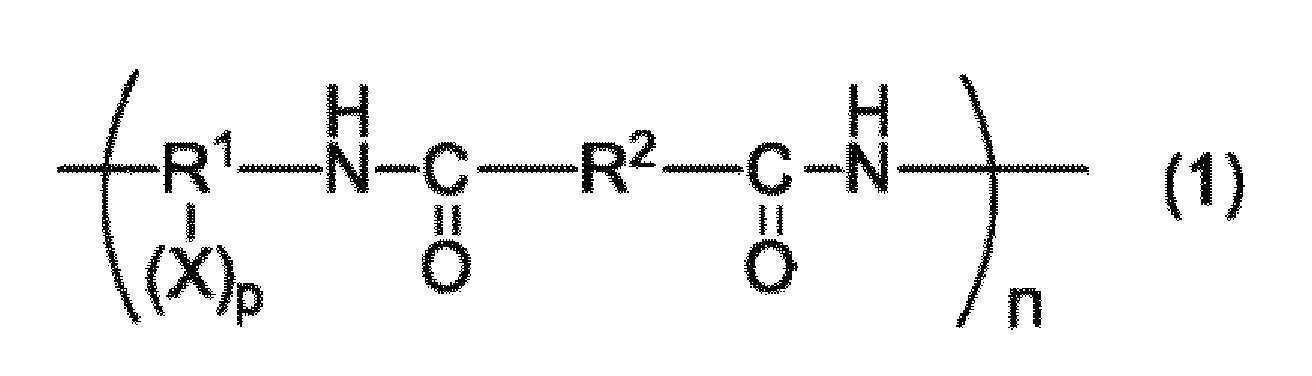
(상기 일반식 (1) 중, R1은 탄소수 4 내지 30의 2 내지 6가의 유기기를 나타낸다. R2는 탄소수 4 내지 30의 2가의 유기기를 나타낸다. X는 술폰산기, 수산기 또는 카르복실기를 나타낸다. p는 1 내지 4의 정수를 나타낸다. n은 2 내지 100,000의 범위를 나타낸다.)
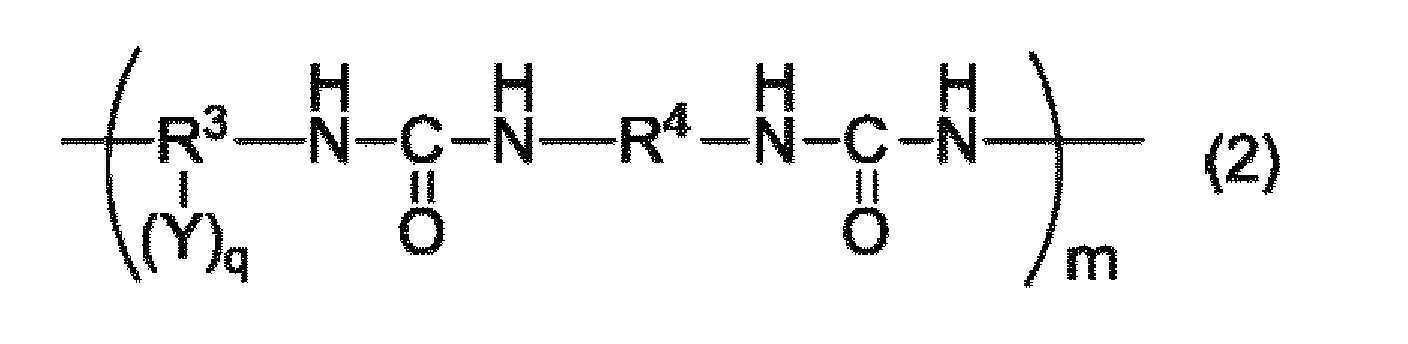
(상기 일반식 (2) 중, R3은 탄소수 4 내지 30의 2 내지 6가의 유기기를 나타낸다. R4는 탄소수 4 내지 30의 2가의 유기기를 나타낸다. Y는 술폰산기, 수산기 또는 카르복실기를 나타낸다. q는 1 내지 4의 정수를 나타낸다. m은 2 내지 100,000의 범위를 나타낸다.)

(상기 일반식 (3) 중, R5는 탄소수 4 내지 30의 2 내지 6가의 유기기를 나타낸다. R6은 탄소수 4 내지 30의 2가의 유기기를 나타낸다. Z는 술폰산기, 수산기 또는 카르복실기를 나타낸다. r은 1 내지 4의 정수를 나타낸다. l은 2 내지 100,000의 범위를 나타낸다.) a) a resin comprising a polymer having a structure represented by any one of the following general formulas (1) to (3) and / or a copolymer thereof,
b) Basic compound
.
(In the general formula (1), R 1 represents a 2 to 6-valent organic group having 4 to 30 carbon atoms, R 2 represents a divalent organic group having 4 to 30 carbon atoms, and X represents a sulfonic acid group, a hydroxyl group or a carboxyl group. p represents an integer of 1 to 4, and n represents a range of 2 to 100,000.
(In the general formula (2), R 3 represents a 2- to 6-valent organic group having 4 to 30 carbon atoms, R 4 represents a divalent organic group having 4 to 30 carbon atoms, and Y represents a sulfonic acid group, a hydroxyl group or a carboxyl group. q represents an integer of 1 to 4. m represents a range of 2 to 100,000.
(In the general formula (3), R 5 represents a 2 to 6-valent organic group having 4 to 30 carbon atoms, R 6 represents a divalent organic group having 4 to 30 carbon atoms, and Z represents a sulfonic acid group, a hydroxyl group or a carboxyl group. and r represents an integer of 1 to 4. l represents a range of 2 to 100,000.

(상기 일반식 (4) 중, R7은 할로겐 원자 또는 탄소수 1 내지 8의 1가의 유기기를 나타낸다. s는 0 내지 3의 정수를 나타낸다. t는 1 또는 2를 나타낸다.)

(상기 일반식 (5) 중, R8 내지 R9는 각각 독립적으로 할로겐 원자 또는 탄소수 1 내지 8의 1가의 유기기를 나타낸다. u, v는 0 내지 3의 정수를 나타낸다. w 및 x는 각각 독립적으로 1 또는 2를 나타낸다. R10은 단결합, O, S, NH, SO2, CO 혹은 탄소수 1 내지 3의 2가의 유기기 또는 그들이 2 이상 연결되어 이루어지는 2가의 가교 구조이다.) The method of claim 1 or claim 2, wherein the formula (1) in the R 1 - (X) p, in the general formula (2) R 3 - (Y) q, and the general formula (3) in R 5 - (Z ) r has a structure represented by the following general formula (4) or (5).
(In the general formula (4), R 7 represents a halogen atom or a monovalent organic group having 1 to 8 carbon atoms, s represents an integer of 0 to 3, and t represents 1 or 2.)
(In the general formula (5), R 8 to R 9 each independently represent a halogen atom or a monovalent organic group having 1 to 8 carbon atoms, u and v represent an integer of 0 to 3. w and x are each independently Or 1 or 2. R 10 is a single bond, a divalent organic group of O, S, NH, SO 2 , CO or a divalent organic group having 1 to 3 carbon atoms, or a divalent crosslinked structure formed by connecting two or more thereof.

(상기 일반식 (6) 중, R11은 각각 독립적으로 할로겐 원자 또는 탄소수 1 내지 8의 1가의 유기기를 나타낸다. y는 0 내지 4의 정수를 나타낸다.) The positive resist composition according to any one of claims 1 to 3, wherein at least 20 mol% of R 2 in the general formula (1), R 4 in the general formula (2) and R 6 in the general formula (3) (6). ≪ / RTI >
(In the general formula (6), R 11 independently represents a halogen atom or a monovalent organic group having 1 to 8 carbon atoms, and y represents an integer of 0 to 4.)
Applications Claiming Priority (3)
| Application Number | Priority Date | Filing Date | Title |
|---|---|---|---|
| JP2015253478 | 2015-12-25 | ||
| JPJP-P-2015-253478 | 2015-12-25 | ||
| PCT/JP2016/087712 WO2017110710A1 (en) | 2015-12-25 | 2016-12-19 | Resin composition |
Publications (2)
| Publication Number | Publication Date |
|---|---|
| KR20180098289A true KR20180098289A (en) | 2018-09-03 |
| KR102380921B1 KR102380921B1 (en) | 2022-04-01 |
Family
ID=59090315
Family Applications (1)
| Application Number | Title | Priority Date | Filing Date |
|---|---|---|---|
| KR1020187019520A Expired - Fee Related KR102380921B1 (en) | 2015-12-25 | 2016-12-19 | resin composition |
Country Status (6)
| Country | Link |
|---|---|
| US (1) | US10703850B2 (en) |
| JP (1) | JP6923841B2 (en) |
| KR (1) | KR102380921B1 (en) |
| CN (1) | CN108368259B (en) |
| TW (1) | TWI721071B (en) |
| WO (1) | WO2017110710A1 (en) |
Families Citing this family (6)
| Publication number | Priority date | Publication date | Assignee | Title |
|---|---|---|---|---|
| WO2019065883A1 (en) * | 2017-09-28 | 2019-04-04 | 出光興産株式会社 | Binder for electrochemical elements |
| KR20200081362A (en) * | 2017-10-31 | 2020-07-07 | 가부시키가이샤 아데카 | Manufacturing method of organic sulfur-based electrode active material |
| KR102299419B1 (en) * | 2018-02-28 | 2021-09-06 | 주식회사 엘지화학 | Photosensitive resin composition and cured layer |
| CN110911642B (en) * | 2018-09-14 | 2021-05-11 | 多氟多化工股份有限公司 | Binder for pole piece, preparation method of binder, silicon-based pole piece and lithium ion battery |
| CN114335438A (en) * | 2021-12-23 | 2022-04-12 | 南昌大学 | Preparation method of high-performance silicon-based negative electrode plate of lithium ion battery |
| CN117117170B (en) * | 2023-08-30 | 2024-09-06 | 安徽皓飞新材料有限公司 | Ternary positive electrode slurry and preparation method and application thereof |
Citations (9)
| Publication number | Priority date | Publication date | Assignee | Title |
|---|---|---|---|---|
| US3386965A (en) * | 1964-08-31 | 1968-06-04 | Monsanto Co | Aromatic polyamides having pendent carboxyl groups and process therefor |
| JPH0778122A (en) | 1993-06-23 | 1995-03-20 | Koninkl Ptt Nederland Nv | Processor circuit composed of first processor, of memory and of peripheral circuit and system composed of said processor circuit and of second processor |
| JP2002226582A (en) | 2001-02-05 | 2002-08-14 | Ube Ind Ltd | Water-soluble polyimide precursor, aqueous solution of polyimide precursor, its production method and polyimide |
| JP2002280019A (en) * | 2001-03-16 | 2002-09-27 | Mitsui Chemicals Inc | Ion conductive polymer membrane for fuel cell and fuel cell using it |
| JP2009199761A (en) | 2008-02-19 | 2009-09-03 | Nissan Motor Co Ltd | Lithium ion battery |
| JP2009245773A (en) | 2008-03-31 | 2009-10-22 | Sanyo Electric Co Ltd | Lithium secondary battery and its manufacturing method |
| JP2011137063A (en) | 2009-12-28 | 2011-07-14 | Toray Ind Inc | Polyimide resin aqueous solution, polyimide-based resin aqueous solution, polyazole resin aqueous solution |
| KR20130117910A (en) * | 2012-04-16 | 2013-10-29 | 삼성에스디아이 주식회사 | Water soluble binder composition, method of producing the same and electrode for a rechargeable battery employing the same |
| JP2014067592A (en) * | 2012-09-26 | 2014-04-17 | Sanyo Electric Co Ltd | Negative electrode for lithium secondary battery use, lithium secondary battery, and method for manufacturing negative electrode for lithium secondary battery use |
Family Cites Families (15)
| Publication number | Priority date | Publication date | Assignee | Title |
|---|---|---|---|---|
| JPS4214469Y1 (en) * | 1964-05-29 | 1967-08-17 | ||
| JPS4419555Y1 (en) * | 1966-07-12 | 1969-08-21 | ||
| JPS4419556Y1 (en) * | 1966-07-27 | 1969-08-21 | ||
| US4722963A (en) | 1985-12-20 | 1988-02-02 | Henkel Corporation | Aromatic dicarboxylic acid polyamide having acid value greater than 35 |
| DE3833440A1 (en) * | 1988-10-01 | 1990-04-05 | Hoechst Ag | POLYHARM AND FILM MADE OF AT LEAST ONE MONOMOLECULAR LAYER OF A POLYHARM |
| JPH083445A (en) | 1994-06-27 | 1996-01-09 | Toray Ind Inc | Water-soluble polyimide precursor, polyimide precursor aqueous solution, and method for producing the same |
| US6547381B2 (en) * | 2000-06-23 | 2003-04-15 | Canon Kabushiki Kaisha | Ink, image recording process, ink cartridge, recording unit, ink set, crust-preventing method and image forming apparatus |
| KR100403754B1 (en) * | 2001-06-19 | 2003-10-30 | 송민규 | Composite Polymeric Electrolyte Membrane, Preparation Method Thereof and Fuel Cell Containing the Same |
| JP2007280740A (en) * | 2006-04-06 | 2007-10-25 | Hitachi Ltd | Electrolyte, electrolyte membrane, membrane electrode assembly using the same, fuel cell power supply and fuel cell power supply system |
| EP2284235B1 (en) * | 2008-06-02 | 2016-08-31 | Dainichiseika Color & Chemicals Mfg. Co., Ltd. | Coating liquid, coating liquid for manufacturing electrode plate, undercoating agent, and use thereof |
| JP5534012B2 (en) * | 2010-08-02 | 2014-06-25 | 日産自動車株式会社 | Negative electrode for lithium ion secondary battery and method for producing the same |
| US9991510B2 (en) * | 2012-07-06 | 2018-06-05 | Toray Industries, Inc. | Negative electrode material for lithium ion secondary battery, composite negative electrode material for lithium ion secondary battery, resin composition for lithium ion secondary battery, negative electrode for lithium ion secondary battery, and lithium ion secondary battery |
| JP2015005391A (en) * | 2013-06-20 | 2015-01-08 | 三井化学株式会社 | Binder resin composition used in manufacturing lithium ion secondary battery, electrode mixed material paste, manufacturing method thereof, lithium ion secondary battery electrode, and lithium ion secondary battery |
| JP6235028B2 (en) * | 2013-09-18 | 2017-11-22 | 三洋化成工業株式会社 | Method for producing coated active material for lithium ion battery |
| TW201531499A (en) * | 2014-02-13 | 2015-08-16 | Tosoh Corp | Hydrophilic polymer, manufacturing method of the same, and application of hydrophilic polymer |
-
2016
- 2016-12-19 JP JP2016574297A patent/JP6923841B2/en not_active Expired - Fee Related
- 2016-12-19 KR KR1020187019520A patent/KR102380921B1/en not_active Expired - Fee Related
- 2016-12-19 US US16/063,415 patent/US10703850B2/en not_active Expired - Fee Related
- 2016-12-19 WO PCT/JP2016/087712 patent/WO2017110710A1/en not_active Ceased
- 2016-12-19 CN CN201680074370.7A patent/CN108368259B/en not_active Expired - Fee Related
- 2016-12-20 TW TW105142156A patent/TWI721071B/en not_active IP Right Cessation
Patent Citations (9)
| Publication number | Priority date | Publication date | Assignee | Title |
|---|---|---|---|---|
| US3386965A (en) * | 1964-08-31 | 1968-06-04 | Monsanto Co | Aromatic polyamides having pendent carboxyl groups and process therefor |
| JPH0778122A (en) | 1993-06-23 | 1995-03-20 | Koninkl Ptt Nederland Nv | Processor circuit composed of first processor, of memory and of peripheral circuit and system composed of said processor circuit and of second processor |
| JP2002226582A (en) | 2001-02-05 | 2002-08-14 | Ube Ind Ltd | Water-soluble polyimide precursor, aqueous solution of polyimide precursor, its production method and polyimide |
| JP2002280019A (en) * | 2001-03-16 | 2002-09-27 | Mitsui Chemicals Inc | Ion conductive polymer membrane for fuel cell and fuel cell using it |
| JP2009199761A (en) | 2008-02-19 | 2009-09-03 | Nissan Motor Co Ltd | Lithium ion battery |
| JP2009245773A (en) | 2008-03-31 | 2009-10-22 | Sanyo Electric Co Ltd | Lithium secondary battery and its manufacturing method |
| JP2011137063A (en) | 2009-12-28 | 2011-07-14 | Toray Ind Inc | Polyimide resin aqueous solution, polyimide-based resin aqueous solution, polyazole resin aqueous solution |
| KR20130117910A (en) * | 2012-04-16 | 2013-10-29 | 삼성에스디아이 주식회사 | Water soluble binder composition, method of producing the same and electrode for a rechargeable battery employing the same |
| JP2014067592A (en) * | 2012-09-26 | 2014-04-17 | Sanyo Electric Co Ltd | Negative electrode for lithium secondary battery use, lithium secondary battery, and method for manufacturing negative electrode for lithium secondary battery use |
Non-Patent Citations (2)
| Title |
|---|
| Macromol Symposia, 1996, 106, p.345-351 |
| 일본 특허 공개 평8-3445호 공보 |
Also Published As
| Publication number | Publication date |
|---|---|
| CN108368259B (en) | 2020-11-20 |
| JPWO2017110710A1 (en) | 2018-10-11 |
| TW201736501A (en) | 2017-10-16 |
| KR102380921B1 (en) | 2022-04-01 |
| US10703850B2 (en) | 2020-07-07 |
| CN108368259A (en) | 2018-08-03 |
| WO2017110710A1 (en) | 2017-06-29 |
| US20180371146A1 (en) | 2018-12-27 |
| JP6923841B2 (en) | 2021-08-25 |
| TWI721071B (en) | 2021-03-11 |
Similar Documents
| Publication | Publication Date | Title |
|---|---|---|
| KR102380921B1 (en) | resin composition | |
| CN103097463B (en) | Aqueous polyimide precursor solution composition and method for producing aqueous polyimide precursor solution composition | |
| KR101355288B1 (en) | Binder composition for electrically storage device electrode | |
| CN102484254B (en) | Binder resin composition for electrode, electrode mixture paste, and electrode | |
| JP5984325B2 (en) | Binder for lithium ion battery electrode, paste for lithium ion battery electrode using the same, and method for producing lithium ion battery electrode | |
| KR102511725B1 (en) | Resin composition, laminate and manufacturing method thereof, electrode, secondary battery and electric double layer capacitor | |
| JP2011137063A (en) | Polyimide resin aqueous solution, polyimide-based resin aqueous solution, polyazole resin aqueous solution | |
| TW201830754A (en) | Separator for nonaqueous-electrolyte cell, and nonaqueous-electrolyte cell | |
| KR20170047281A (en) | Varnish for porous polyimide film production and method for producing porous polyimide film using same | |
| JPWO2018105338A1 (en) | Binder composition for power storage element, slurry composition for power storage element, electrode, electrode manufacturing method, secondary battery, and electric double layer capacitor | |
| JP2015213061A (en) | Electrode manufacturing method | |
| JP6241213B2 (en) | Binder resin composition for electrode, electrode mixture paste, and electrode | |
| CN120109162A (en) | A negative electrode sheet for a lithium-ion battery and a method for preparing the same | |
| JP2010009917A (en) | Composition for electrode, electrode for battery, lithium secondary battery, and method of manufacturing lithium secondary battery | |
| TWI872187B (en) | Resin composition, laminate and method for producing the same, electrode, and power storage device | |
| TWI409839B (en) | An electrochemical capacitor electrode, a composition for the electrode, and a method for manufacturing the same, and an electrochemical capacitor using the same | |
| JP7846958B2 (en) | Electrode forming materials, electrode mixtures, electrodes for energy devices, and energy devices | |
| JP2022151684A (en) | Slurry composition, electrode, and secondary battery and electric double layer capacitor including the electrode |
Legal Events
| Date | Code | Title | Description |
|---|---|---|---|
| PA0105 | International application |
St.27 status event code: A-0-1-A10-A15-nap-PA0105 |
|
| PG1501 | Laying open of application |
St.27 status event code: A-1-1-Q10-Q12-nap-PG1501 |
|
| A201 | Request for examination | ||
| A302 | Request for accelerated examination | ||
| P11-X000 | Amendment of application requested |
St.27 status event code: A-2-2-P10-P11-nap-X000 |
|
| P13-X000 | Application amended |
St.27 status event code: A-2-2-P10-P13-nap-X000 |
|
| PA0201 | Request for examination |
St.27 status event code: A-1-2-D10-D11-exm-PA0201 |
|
| PA0302 | Request for accelerated examination |
St.27 status event code: A-1-2-D10-D17-exm-PA0302 St.27 status event code: A-1-2-D10-D16-exm-PA0302 |
|
| E902 | Notification of reason for refusal | ||
| PE0902 | Notice of grounds for rejection |
St.27 status event code: A-1-2-D10-D21-exm-PE0902 |
|
| E13-X000 | Pre-grant limitation requested |
St.27 status event code: A-2-3-E10-E13-lim-X000 |
|
| P11-X000 | Amendment of application requested |
St.27 status event code: A-2-2-P10-P11-nap-X000 |
|
| P13-X000 | Application amended |
St.27 status event code: A-2-2-P10-P13-nap-X000 |
|
| E701 | Decision to grant or registration of patent right | ||
| PE0701 | Decision of registration |
St.27 status event code: A-1-2-D10-D22-exm-PE0701 |
|
| GRNT | Written decision to grant | ||
| PR0701 | Registration of establishment |
St.27 status event code: A-2-4-F10-F11-exm-PR0701 |
|
| PR1002 | Payment of registration fee |
St.27 status event code: A-2-2-U10-U12-oth-PR1002 Fee payment year number: 1 |
|
| PG1601 | Publication of registration |
St.27 status event code: A-4-4-Q10-Q13-nap-PG1601 |
|
| PC1903 | Unpaid annual fee |
St.27 status event code: A-4-4-U10-U13-oth-PC1903 Not in force date: 20250329 Payment event data comment text: Termination Category : DEFAULT_OF_REGISTRATION_FEE |
|
| H13 | Ip right lapsed |
Free format text: ST27 STATUS EVENT CODE: N-4-6-H10-H13-OTH-PC1903 (AS PROVIDED BY THE NATIONAL OFFICE); TERMINATION CATEGORY : DEFAULT_OF_REGISTRATION_FEE Effective date: 20250329 |
|
| PC1903 | Unpaid annual fee |
St.27 status event code: N-4-6-H10-H13-oth-PC1903 Ip right cessation event data comment text: Termination Category : DEFAULT_OF_REGISTRATION_FEE Not in force date: 20250329 |