JP7704635B2 - Method for suppressing generation of eye plug during extrusion molding of polystyrene resin composition - Google Patents
Method for suppressing generation of eye plug during extrusion molding of polystyrene resin composition Download PDFInfo
- Publication number
- JP7704635B2 JP7704635B2 JP2021160520A JP2021160520A JP7704635B2 JP 7704635 B2 JP7704635 B2 JP 7704635B2 JP 2021160520 A JP2021160520 A JP 2021160520A JP 2021160520 A JP2021160520 A JP 2021160520A JP 7704635 B2 JP7704635 B2 JP 7704635B2
- Authority
- JP
- Japan
- Prior art keywords
- polystyrene resin
- polystyrene
- resin composition
- polypropylene wax
- extrusion molding
- Prior art date
- Legal status (The legal status is an assumption and is not a legal conclusion. Google has not performed a legal analysis and makes no representation as to the accuracy of the status listed.)
- Active
Links
Landscapes
- Processing And Handling Of Plastics And Other Materials For Molding In General (AREA)
- Compositions Of Macromolecular Compounds (AREA)
Description
本発明は、ポリスチレン系樹脂組成物の押出成形時の目ヤニ発生抑制方法に関する。 The present invention relates to a method for suppressing the generation of eye boogers during extrusion molding of a polystyrene resin composition.
ポリスチレン系樹脂は熱可塑性樹脂の中でも安価で高い加工性を有しており、食品の包装材、CDケース、家電製品の筐体等幅広い分野で使用されている。 Polystyrene resins are inexpensive thermoplastic resins that are highly processable and are used in a wide range of applications, including food packaging, CD cases, and housings for home appliances.
ポリスチレン系樹脂は、一般的に、耐衝撃性改良剤、滑剤、充てん剤等の様々な添加物を配合したうえで押出成形されるが、これらの添加物等が原因となり、押出成形時に「目ヤニ」と称される付着物が押出機のダイス口に堆積してしまうことがある。その発生量が多量な場合、成形品に異物として付着することで、不良品が発生してしまうという問題がある。 Polystyrene resins are generally extruded after being mixed with various additives such as impact modifiers, lubricants, and fillers. However, these additives can cause a deposit known as "eye plaster" to accumulate at the extruder die opening during extrusion. If a large amount of this deposit is generated, it can adhere to the molded product as foreign matter, resulting in defective products.
ポリスチレン系樹脂組成物の押出成形時の目ヤニの発生を抑制する従来技術としては、ゴム変性ポリスチレン系樹脂からなり、ペレット水分量が150ppm以下であるペレット、及びそれを用いたゴム変性ポリスチレン系樹脂の溶融押出方法(特許文献1)、樹脂流路に面した部分の表面を、窒化チタン又はタングステンカーバイトのいずれかでコーティングし、若しくは前記樹脂流路に面した部分の表面を窒化処理したアウトリングと、により形成される前記樹脂流路を有することを特徴とする、樹脂発泡シート製造装置用ダイ(特許文献2)等が開示されている。 Conventional techniques for suppressing the generation of resin deposits during extrusion molding of polystyrene resin compositions include pellets made of rubber-modified polystyrene resin with a pellet moisture content of 150 ppm or less, and a method for melt extrusion of rubber-modified polystyrene resin using the pellets (Patent Document 1), and a die for a resin foam sheet manufacturing device characterized in having a resin flow path formed by an out ring whose surface facing the resin flow path is coated with either titanium nitride or tungsten carbide, or whose surface facing the resin flow path is nitrided (Patent Document 2).
しかし、原材料の水分量調整は原材料の種類や製造時期によってはコントロールが難しく、特殊コーティングを施したダイスの設計は成形品種ごとにダイスを設計する必要があり煩雑である。そこで、より優れた、ポリスチレン系樹脂組成物の押出成形時の目ヤニ発生抑制技術が求められていた。 However, controlling the moisture content of raw materials can be difficult depending on the type of raw material and the time of production, and designing a die with a special coating is complicated as it requires a different die for each molding type. Therefore, there was a need for a better technology to suppress the generation of resin during extrusion molding of polystyrene-based resin compositions.
本発明の目的は、ポリスチレン系樹脂組成物の押出成形時における目ヤニの発生を抑制できる方法を提供することである。 The object of the present invention is to provide a method for suppressing the generation of eye boogers during extrusion molding of a polystyrene resin composition.
本発明者らは、上記課題を解決する為に鋭意研究を重ねた結果、ポリスチレン系樹脂に特定の分子量のポリプロピレンワックスを配合することにより、上記課題を解決できることを見出した。本発明者らは、これらの知見に基づき更に研究を重ね、本発明を完成するに至った。
即ち、本発明は、ポリスチレン系樹脂に重量平均分子量27,000~45,000のポリプロピレンワックスを配合することを特徴とするポリスチレン系樹脂組成物の押出成形時の目ヤニ発生抑制方法、からなっている。
As a result of intensive research into solving the above problems, the present inventors have found that the above problems can be solved by blending a polystyrene-based resin with a polypropylene wax having a specific molecular weight. Based on this knowledge, the present inventors have further researched and completed the present invention.
That is, the present invention comprises a method for suppressing the generation of die marks during extrusion molding of a polystyrene resin composition, which comprises blending a polypropylene wax having a weight average molecular weight of 27,000 to 45,000 with the polystyrene resin.
本発明を用いることにより、ポリスチレン系樹脂組成物の押出成形時の目ヤニの発生を抑制できる。 By using this invention, it is possible to suppress the generation of eye boogers during extrusion molding of polystyrene-based resin compositions.
本発明に用いられるポリスチレン系樹脂としては、ポリスチレン系樹脂の成形品に一般的に用いられるポリスチレン系樹脂であれば特に制限は無く、例えば、スチレン系単量体(例えば、スチレン、メチルスチレン、クロロスチレン等)の1種類の単独重合体(例えば、ポリスチレン、ポリメチルスチレン、ポリクロロスチレン等)、スチレン系単量体の2種類以上の共重合体、スチレン系単量体と他の単量体との共重合体、スチレン系単量体とエラストマーとの共重合体等が挙げられる。また、これらのポリスチレン系樹脂の2種類以上の混合物、これらのポリスチレン系樹脂と他の熱可塑性樹脂との混合物であっても良い。 The polystyrene resin used in the present invention is not particularly limited as long as it is a polystyrene resin generally used in molded products of polystyrene resin, and examples thereof include a homopolymer (e.g., polystyrene, polymethylstyrene, polychlorostyrene, etc.) of one type of styrene monomer (e.g., styrene, methylstyrene, chlorostyrene, etc.), a copolymer of two or more types of styrene monomer, a copolymer of a styrene monomer and another monomer, a copolymer of a styrene monomer and an elastomer, etc. Also, a mixture of two or more types of these polystyrene resins, or a mixture of these polystyrene resins and another thermoplastic resin may be used.
上記「スチレン系単量体と他の単量体との共重合体」を構成する他の単量体としては、例えば、アクリロニトリル、メタクリニトリル等のアクリロニトリル類、アクリル酸、メタクリル酸等の不飽和カルボン酸類、アクリル酸メチル、メタクリル酸メチル等の不飽和カルボン酸エステル類、クロロプレン、ブタジエン、イソプレン等のジエン類、1‐ブテン、1‐ペンテン等のオレフィン類、α,β‐不飽和カルボン酸(例えば、無水マレイン酸等)又はその無水物等が挙げられる。 Examples of other monomers constituting the above-mentioned "copolymer of a styrene-based monomer and another monomer" include acrylonitriles such as acrylonitrile and methacrylonitrile, unsaturated carboxylic acids such as acrylic acid and methacrylic acid, unsaturated carboxylic acid esters such as methyl acrylate and methyl methacrylate, dienes such as chloroprene, butadiene, and isoprene, olefins such as 1-butene and 1-pentene, α,β-unsaturated carboxylic acids (for example, maleic anhydride, etc.) or their anhydrides, etc.
上記「スチレン系単量体とエラストマーとの共重合体」を構成するエラストマーとしては、例えば、ブタジエンゴム、クロロプレンゴム、イソプレンゴム等のポリジエンゴム、スチレン-ブタジエンゴム等のスチレン-ジエンエラストマー、スチレン-ブタジエン-スチレンゴム等の分子構造中にポリジエンブロックを有するブロック共重合体エラストマー等が挙げられる。 Examples of elastomers constituting the above-mentioned "copolymer of styrene-based monomer and elastomer" include polydiene rubbers such as butadiene rubber, chloroprene rubber, and isoprene rubber, styrene-diene elastomers such as styrene-butadiene rubber, and block copolymer elastomers having polydiene blocks in the molecular structure such as styrene-butadiene-styrene rubber.
本発明に用いられるポリプロピレンワックス(以下単に「ポリプロピレンワックス」ともいう)は、プロピレンを重合又は高分子量ポリプロピレンを解重合して得られるポリプロピレンであって、重量平均分子量が27,000~45,000、好ましくは35,000~45,000のものである。重量平均分子量の測定方法としては特に制限は無いが、例えば、GPC(ゲルパーミエーションクロマトグラフィー)により、下記の測定条件で行ったポリスチレン換算の重量平均分子量を採用することができる。
[測定条件]
カラム:TSKgelカラム(東ソー社製)×4
温度:140℃
溶離液:o-ジクロロベンゼン
流速:1.0mL/min
サンプル濃度:0.15mg/mL
換算標準:ポリスチレン
The polypropylene wax used in the present invention (hereinafter also simply referred to as "polypropylene wax") is a polypropylene obtained by polymerizing propylene or depolymerizing high molecular weight polypropylene, and has a weight average molecular weight of 27,000 to 45,000, preferably 35,000 to 45,000. There are no particular limitations on the method for measuring the weight average molecular weight, but for example, the polystyrene-equivalent weight average molecular weight measured by GPC (gel permeation chromatography) under the following measurement conditions can be used.
[Measurement conditions]
Column: TSKgel column (Tosoh Corporation) × 4
Temperature: 140℃
Eluent: o-dichlorobenzene Flow rate: 1.0 mL/min
Sample concentration: 0.15 mg/mL
Conversion standard: Polystyrene
ポリプロピレンワックスとしては、例えば、ビスコール330P(商品名;重量平均分子量40,000;三洋化成工業社製)、ハイワックスNP805(商品名;重量平均分子量32,600;三井化学社製)、ビスコール440P(商品名;重量平均分子量30,000;三洋化成工業社製)、LICOCENE PP2602(商品名;重量平均分子量29,700;メタロセン系ポリプロピレンワックス;クラリアントケミカルズ社製)等が商業的に製造及び販売されており、本発明にはこれらを用いることができる。 Examples of polypropylene waxes that can be used in the present invention include commercially manufactured and sold Viscol 330P (trade name: weight average molecular weight 40,000; manufactured by Sanyo Chemical Industries, Ltd.), Hiwax NP805 (trade name: weight average molecular weight 32,600; manufactured by Mitsui Chemicals, Inc.), Viscol 440P (trade name: weight average molecular weight 30,000; manufactured by Sanyo Chemical Industries, Ltd.), and LICOCENE PP2602 (trade name: weight average molecular weight 29,700; metallocene-based polypropylene wax; manufactured by Clariant Chemicals, Inc.).
本発明において、ポリスチレン系樹脂に対するポリプロピレンワックスの配合方法としては、ポリスチレン系樹脂にポリプロピレンワックスを均一に分散させることができれば特に制限は無いが、押出機を用いてポリスチレン系樹脂及びポリプロピレンワックスを加熱混練するのが好ましい。押出機を用いた場合、加熱混練によるポリスチレン系樹脂に対するポリプロピレンワックスの配合と、配合後のポリスチレン系樹脂組成物の押出成形とを同時に行うことができる。押出機を用いた配合及び押出成形の具体的な方法としては、ポリスチレン系樹脂及びポリプロピレンワックスを押出機に投入し、加熱混練によりポリプロピレンワックスを配合したポリスチレン系樹脂組成物が得られ、更に該ポリスチレン系樹脂組成物が押出成形される。用いる押出機としては、例えば、単軸押出機、二軸押出機等が挙げられ、混練力及び生産性の観点から、二軸押出機を用いるのが好ましい。二軸押出機の種類としては、例えば、二軸異方向非噛み合わせ型押出機、二軸異方向噛み合わせ型押出機、二軸同方向非噛み合わせ型押出機、二軸同方向噛み合わせ型押出機等が挙げられる。 In the present invention, the method of blending polypropylene wax with polystyrene resin is not particularly limited as long as the polypropylene wax can be uniformly dispersed in the polystyrene resin, but it is preferable to heat-knead the polystyrene resin and the polypropylene wax using an extruder. When an extruder is used, blending of the polystyrene wax with the polystyrene resin by heating and kneading, and extrusion molding of the polystyrene resin composition after blending can be performed simultaneously. As a specific method of blending and extrusion molding using an extruder, the polystyrene resin and the polypropylene wax are fed into the extruder, and a polystyrene resin composition blended with the polypropylene wax is obtained by heating and kneading, and the polystyrene resin composition is further extruded. Examples of the extruder used include a single screw extruder and a twin screw extruder, and from the viewpoint of kneading power and productivity, it is preferable to use a twin screw extruder. Examples of the type of twin screw extruder include a twin screw counter-rotating non-intermeshing type extruder, a twin screw counter-rotating intermeshing type extruder, a twin screw co-rotating non-intermeshing type extruder, and a twin screw co-rotating intermeshing type extruder.
本発明において、ポリスチレン系樹脂に対するポリプロピレンワックスの配合温度としては、押出機を用いた場合の加熱混練する温度(押出機のバレル温度)として、ポリスチレン系樹脂及びポリプロピレンワックスが溶融する温度以上であり、且つこれらの成分が劣化し過ぎない程度の範囲の温度であれば特に制限は無いが、120~230℃が好ましい。 In the present invention, the temperature at which the polystyrene resin and the polypropylene wax are mixed is not particularly limited as long as it is the temperature at which the polystyrene resin and the polypropylene wax melt when an extruder is used (extruder barrel temperature) and is within a range in which these components do not deteriorate excessively, but is preferably 120 to 230°C.
本発明において、ポリスチレン系樹脂に対するポリプロピレンワックスの配合の際、あらかじめポリスチレン系樹脂に対してポリプロピレンワックスを配合したマスターバッチを作製し、該マスターバッチをポリスチレン系樹脂に配合する方法が好ましい。該方法は、ポリプロピレンワックスをポリスチレン系樹脂中に効果的に分散させるために有効である。該マスターバッチ100質量%中のポリプロピレンワックスの配合量は、通常5~40質量%、好ましくは10~30質量%である。 In the present invention, when blending polypropylene wax with polystyrene resin, a method is preferred in which a master batch in which polypropylene wax is blended with polystyrene resin is prepared in advance, and the master batch is blended with the polystyrene resin. This method is effective for effectively dispersing the polypropylene wax in the polystyrene resin. The blending amount of polypropylene wax in 100% by mass of the master batch is usually 5 to 40% by mass, and preferably 10 to 30% by mass.
本発明において、ポリスチレン系樹脂に対するポリプロピレンワックスの配合量としては、ポリプロピレンワックス等の配合後のポリスチレン系樹脂組成物100質量%中、通常0.1~20質量%、好ましくは1~5質量%である。 In the present invention, the amount of polypropylene wax blended with the polystyrene resin is usually 0.1 to 20% by mass, preferably 1 to 5% by mass, based on 100% by mass of the polystyrene resin composition after blending with the polypropylene wax, etc.
本発明において、ポリスチレン系樹脂に対し、ポリプロピレンワックス以外の成分を配合しても良い。該成分としては、ポリスチレン系樹脂に通常配合される成分であれば特に制限は無いが、例えば、耐衝撃性改良剤、滑剤、充てん剤、帯電防止剤、酸化防止剤、熱安定剤、紫外線吸収剤、中和剤、可塑剤、顔料、染料、導電剤等が挙げられる。 In the present invention, components other than polypropylene wax may be blended with the polystyrene resin. There are no particular limitations on the components as long as they are components that are typically blended with polystyrene resins, but examples of such components include impact modifiers, lubricants, fillers, antistatic agents, antioxidants, heat stabilizers, UV absorbers, neutralizing agents, plasticizers, pigments, dyes, and conductive agents.
以下に本発明を実施例で説明するが、これは本発明を単に説明するだけのものであって、本発明を限定するものではない。 The present invention will be described below with reference to examples, which are merely illustrative of the present invention and are not intended to limit the present invention.
[ワックス成分を含むマスターバッチの製造]
(1)原材料
1)ポリスチレン系樹脂(商品名:トーヨースチロールHRM‐12;汎用ポリスチレン;東洋スチレン社製)
2)ポリプロピレンワックス1(商品名:ビスコール330P;重量平均分子量40,000;三洋化成工業社製)
3)ポリプロピレンワックス2(商品名:ハイワックスNP805;重量平均分子量32,600;三井化学社製)
4)ポリプロピレンワックス3(商品名:ビスコール440P;重量平均分子量30,000;三洋化成工業社製)
5)ポリプロピレンワックス4(商品名:LICOCENE PP 2602;メタロセン系ポリプロピレンワックス;重量平均分子量29,700;クラリアントケミカルズ社製)
6)ポリプロピレンワックス5(商品名:ハイワックスNP505;重量平均分子量25,700;三井化学社製)
7)ポリプロピレンワックス6(商品名:ハイワックスNP105;重量平均分子量11,200;三井化学社製)
[Production of master batch containing wax component]
(1) Raw Materials 1) Polystyrene resin (product name: Toyo Styrol HRM-12; general-purpose polystyrene; manufactured by Toyo Styrene Co., Ltd.)
2) Polypropylene wax 1 (product name: Viscol 330P; weight average molecular weight 40,000; manufactured by Sanyo Chemical Industries, Ltd.)
3) Polypropylene wax 2 (product name: Hiwax NP805; weight average molecular weight 32,600; manufactured by Mitsui Chemicals, Inc.)
4) Polypropylene wax 3 (product name: Viscol 440P; weight average molecular weight 30,000; manufactured by Sanyo Chemical Industries, Ltd.)
5) Polypropylene Wax 4 (Product name: LICOCENE PP 2602; metallocene-based polypropylene wax; weight average molecular weight 29,700; manufactured by Clariant Chemicals)
6) Polypropylene wax 5 (product name: Hiwax NP505; weight average molecular weight 25,700; manufactured by Mitsui Chemicals, Inc.)
7) Polypropylene wax 6 (product name: Hiwax NP105; weight average molecular weight 11,200; manufactured by Mitsui Chemicals, Inc.)
(2)配合
上記原材料を用いて作成したマスターバッチの配合を表1に示す。
(2) Composition The composition of the master batch prepared using the above raw materials is shown in Table 1.

(3)製造方法
表1に記載の原材料の合計が1000gとなるように量り取り、二軸同方向回転噛み合わせ型押出機(型式:KZW15TW‐45MG‐NH;スクリュー直径=15mm;L/D=45;テクノベル社製)を用いて、バレル(C1~C6、H/D)温度を140~220℃(C1=140℃、C2~C6=220℃)、スクリュー回転数300rpmにて加熱混練し、ワックス成分を含有するポリスチレン系樹脂組成物を押出成形した。ストランド状に押し出されたポリスチレン系樹脂組成物をペレタイザーでカットして円柱状(直径3mm、長さ3mm)のマスターバッチ1~6を製造した。
(3) Manufacturing method The raw materials listed in Table 1 were weighed out so that the total amount was 1000 g, and were heated and kneaded using a twin-screw co-rotating intermeshing extruder (model: KZW15TW-45MG-NH; screw diameter = 15 mm; L/D = 45; manufactured by Technovel Co., Ltd.) at a barrel (C1 to C6, H/D) temperature of 140 to 220 ° C. (C1 = 140 ° C., C2 to C6 = 220 ° C.) and a screw rotation speed of 300 rpm, and a polystyrene-based resin composition containing a wax component was extruded. The polystyrene-based resin composition extruded in a strand shape was cut with a pelletizer to produce cylindrical (diameter 3 mm, length 3 mm) masterbatches 1 to 6.
[目ヤニ発生抑制評価試験]
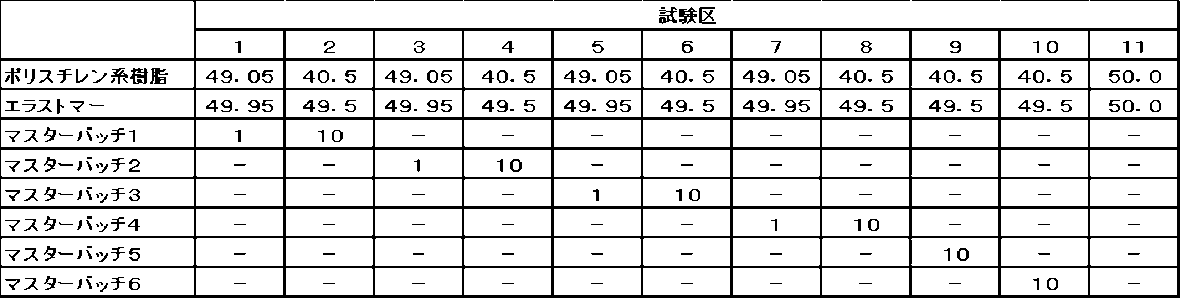
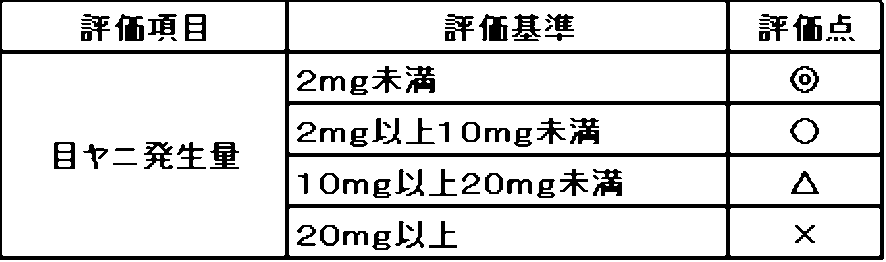
ポリスチレン系樹脂(商品名:トーヨースチロールHRM‐12;汎用ポリスチレン;東洋スチレン社製)、エラストマー(商品名:JSR‐RB810;1,2‐ポリブタジエン;JSR社製)、マスターバッチ1~6のいずれかを、表2の配合にて合計2000gとなるように量り取り、これらの原材料をビニール袋に入れて手で持ち、30秒間均一になるよう混合した。得られた混合物を二軸同方向回転噛み合わせ型押出機(型式:MFU15TW‐60HG‐NH;スクリュー直径=15mm;L/D=60;テクノベル社製)を用いて、バレル(C1~C6、H/D)温度140~220℃(C1=140℃、C2~C6=220℃)、スクリュー回転数300rpm、押出量3kg/hの条件で、20分間加熱混練し、ポリスチレン系樹脂組成物の押出成形を行った。20分経過時点で、ダイス口付近に発生していた目ヤニをヘラで全て除去し、更に20分間加熱混練して、ポリスチレン系樹脂組成物の押出成形を行い、試験区1~11とした。各試験区につき、ダイス口付近に発生していた目ヤニをピンセットで採取して質量を測定し、下記表3の評価基準で評価した。結果を表4に示す。
[Eye gunk generation suppression evaluation test]
A total of 2000 g of polystyrene resin (product name: Toyo Styrol HRM-12; general-purpose polystyrene; manufactured by Toyo Styrene Co., Ltd.), elastomer (product name: JSR-RB810; 1,2-polybutadiene; manufactured by JSR Corporation), or any one of masterbatches 1 to 6 was weighed out according to the formulation in Table 2, and these raw materials were placed in a plastic bag and mixed by hand for 30 seconds until uniform. The resulting mixture was heated and kneaded for 20 minutes using a twin-screw co-rotating intermeshing extruder (model: MFU15TW-60HG-NH; screw diameter = 15 mm; L/D = 60; manufactured by Technovel Co., Ltd.) under the conditions of barrel (C1 to C6, H/D) temperature of 140 to 220°C (C1 = 140°C, C2 to C6 = 220°C), screw rotation speed of 300 rpm, and extrusion rate of 3 kg/h, to perform extrusion molding of a polystyrene resin composition. After 20 minutes had elapsed, all of the gunk that had formed around the die opening was removed with a spatula, and the mixture was heated and kneaded for another 20 minutes, after which the polystyrene-based resin composition was extrusion-molded to give test plots 1 to 11. For each test plot, the gunk that had formed around the die opening was collected with tweezers, the mass was measured, and the results were evaluated according to the evaluation criteria in Table 3 below. The results are shown in Table 4.
各試験区において、ポリスチレン系樹脂組成物中のポリスチレン系樹脂(マスターバッチに含有されるポリスチレン系樹脂を含む)及びエラストマーの配合量は、常に同量になるよう調整した。なお、各試験区において、エラストマーは耐衝撃性改良剤として、ポリスチレン系樹脂に配合した。また、試験区1~8は本発明の実施例であり、試験区9及び10は本発明の比較例であり、試験区11は本発明の参考例である。 In each test plot, the amount of polystyrene resin (including the polystyrene resin contained in the master batch) and elastomer in the polystyrene resin composition was adjusted to always be the same. In each test plot, the elastomer was mixed into the polystyrene resin as an impact resistance improver. Test plots 1 to 8 are examples of the present invention, test plots 9 and 10 are comparative examples of the present invention, and test plot 11 is a reference example of the present invention.
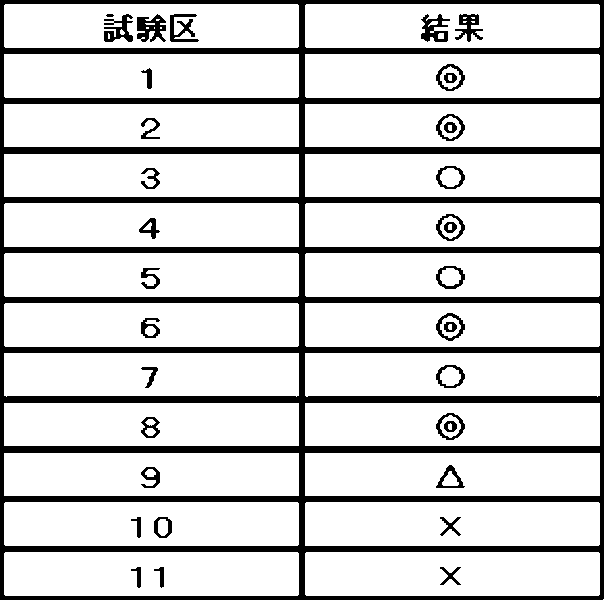
結果から明らかなように、試験区1~8は「〇」以上の結果であり、優れた目ヤニ発生抑制効果が得られた。一方、試験区9及び10は「△」又は「×」の結果であり、目ヤニ発生抑制効果がなかった。 As is clear from the results, test plots 1 to 8 were rated "Good" or better, and showed excellent eye discharge suppression effects. On the other hand, test plots 9 and 10 were rated "Good" or "Poor," and showed no eye discharge suppression effects.
Claims (1)
該マスターバッチをポリスチレン系樹脂に配合することを特徴とするポリスチレン系樹脂組成物の押出成形時の目ヤニ発生抑制方法であって、該マスターバッチ100質量%中の該ポリプロピレンワックスの配合量が5~40質量%である、ポリスチレン系樹脂組成物の押出成形時の目ヤニ発生抑制方法。 A master batch is prepared in advance by blending a polystyrene resin with a polypropylene wax having a weight average molecular weight of 27,000 to 45,000,
The method for suppressing the generation of eye boogers during extrusion molding of a polystyrene-based resin composition is characterized by blending the masterbatch with a polystyrene-based resin, wherein the blending amount of the polypropylene wax in 100% by mass of the masterbatch is 5 to 40% by mass .
Priority Applications (1)
| Application Number | Priority Date | Filing Date | Title |
|---|---|---|---|
| JP2021160520A JP7704635B2 (en) | 2021-09-30 | 2021-09-30 | Method for suppressing generation of eye plug during extrusion molding of polystyrene resin composition |
Applications Claiming Priority (1)
| Application Number | Priority Date | Filing Date | Title |
|---|---|---|---|
| JP2021160520A JP7704635B2 (en) | 2021-09-30 | 2021-09-30 | Method for suppressing generation of eye plug during extrusion molding of polystyrene resin composition |
Publications (2)
| Publication Number | Publication Date |
|---|---|
| JP2023050430A JP2023050430A (en) | 2023-04-11 |
| JP7704635B2 true JP7704635B2 (en) | 2025-07-08 |
Family
ID=85805915
Family Applications (1)
| Application Number | Title | Priority Date | Filing Date |
|---|---|---|---|
| JP2021160520A Active JP7704635B2 (en) | 2021-09-30 | 2021-09-30 | Method for suppressing generation of eye plug during extrusion molding of polystyrene resin composition |
Country Status (1)
| Country | Link |
|---|---|
| JP (1) | JP7704635B2 (en) |
Citations (2)
| Publication number | Priority date | Publication date | Assignee | Title |
|---|---|---|---|---|
| JP2004323635A (en) | 2003-04-23 | 2004-11-18 | Asahi Kasei Chemicals Corp | Styrenic resin composition and molded body |
| JP2006335849A (en) | 2005-06-01 | 2006-12-14 | Daicel Polymer Ltd | Thermoplastic resin composition for white color marking use |
-
2021
- 2021-09-30 JP JP2021160520A patent/JP7704635B2/en active Active
Patent Citations (2)
| Publication number | Priority date | Publication date | Assignee | Title |
|---|---|---|---|---|
| JP2004323635A (en) | 2003-04-23 | 2004-11-18 | Asahi Kasei Chemicals Corp | Styrenic resin composition and molded body |
| JP2006335849A (en) | 2005-06-01 | 2006-12-14 | Daicel Polymer Ltd | Thermoplastic resin composition for white color marking use |
Also Published As
| Publication number | Publication date |
|---|---|
| JP2023050430A (en) | 2023-04-11 |
Similar Documents
| Publication | Publication Date | Title |
|---|---|---|
| JP6364490B2 (en) | High heat resistant ABS resin composition suitable for blow molding and method for preparing the same | |
| EP0755972B1 (en) | Styrenic polymer composition | |
| CN111825801B (en) | Toughening agent composition and preparation method thereof | |
| EP0293490B1 (en) | Heat and impact resistant resin composition | |
| JP2004323635A (en) | Styrenic resin composition and molded body | |
| JP2023050430A (en) | METHOD FOR SUPPRESSING DRILL GENERATION DURING EXTRUSION MOLDING OF POLYSTYRENE-BASED RESIN COMPOSITION | |
| JP2006045487A5 (en) | ||
| JP4105814B2 (en) | Method for producing thermoplastic resin composition | |
| JPH1067901A (en) | Thermoplastic polymer composition | |
| JPH0253454B2 (en) | ||
| JP6235301B2 (en) | Resin composition and molded body comprising the same | |
| JPH10217325A (en) | Method for producing plate-shaped resin molded product having grain pattern | |
| CN114149642B (en) | High-rigidity and toughness vitreous ABS alloy material and preparation method and application thereof | |
| JP2005219398A (en) | Cleaning agent for molding machine | |
| JP2004509193A (en) | Method for producing thermoplastic molding composition | |
| JPS5915942B2 (en) | thermoplastic resin composition | |
| JP4090129B2 (en) | Method for producing styrenic resin molding | |
| JP3500265B2 (en) | Styrene resin composition | |
| JP4484126B2 (en) | Rubber reinforced resin, composition thereof, and material for sheet blow molding | |
| JPH10330500A (en) | Method for producing plate-shaped resin molded product having grain pattern | |
| JP3549718B2 (en) | Method for producing styrenic resin composition | |
| JPH0241541B2 (en) | ||
| JP4722237B2 (en) | Thermoplastic resin composition and profile extrusion product using the same | |
| JP3107607B2 (en) | Thermoplastic resin composition | |
| JPH0912838A (en) | Resin composition excellent in flowability |
Legal Events
| Date | Code | Title | Description |
|---|---|---|---|
| A621 | Written request for application examination |
Free format text: JAPANESE INTERMEDIATE CODE: A621 Effective date: 20240709 |
|
| A977 | Report on retrieval |
Free format text: JAPANESE INTERMEDIATE CODE: A971007 Effective date: 20250226 |
|
| A131 | Notification of reasons for refusal |
Free format text: JAPANESE INTERMEDIATE CODE: A131 Effective date: 20250311 |
|
| A521 | Request for written amendment filed |
Free format text: JAPANESE INTERMEDIATE CODE: A523 Effective date: 20250425 |
|
| TRDD | Decision of grant or rejection written | ||
| A01 | Written decision to grant a patent or to grant a registration (utility model) |
Free format text: JAPANESE INTERMEDIATE CODE: A01 Effective date: 20250624 |
|
| A61 | First payment of annual fees (during grant procedure) |
Free format text: JAPANESE INTERMEDIATE CODE: A61 Effective date: 20250626 |
|
| R150 | Certificate of patent or registration of utility model |
Ref document number: 7704635 Country of ref document: JP Free format text: JAPANESE INTERMEDIATE CODE: R150 |