JP7686893B2 - Flavor deterioration inhibitor - Google Patents
Flavor deterioration inhibitor Download PDFInfo
- Publication number
- JP7686893B2 JP7686893B2 JP2024563742A JP2024563742A JP7686893B2 JP 7686893 B2 JP7686893 B2 JP 7686893B2 JP 2024563742 A JP2024563742 A JP 2024563742A JP 2024563742 A JP2024563742 A JP 2024563742A JP 7686893 B2 JP7686893 B2 JP 7686893B2
- Authority
- JP
- Japan
- Prior art keywords
- beverage
- flavor
- deterioration
- light
- juice
- Prior art date
- Legal status (The legal status is an assumption and is not a legal conclusion. Google has not performed a legal analysis and makes no representation as to the accuracy of the status listed.)
- Active
Links
Classifications
-
- A—HUMAN NECESSITIES
- A23—FOODS OR FOODSTUFFS; TREATMENT THEREOF, NOT COVERED BY OTHER CLASSES
- A23L—FOODS, FOODSTUFFS OR NON-ALCOHOLIC BEVERAGES, NOT OTHERWISE PROVIDED FOR; PREPARATION OR TREATMENT THEREOF
- A23L2/00—Non-alcoholic beverages; Dry compositions or concentrates therefor; Preparation or treatment thereof
- A23L2/52—Adding ingredients
- A23L2/66—Proteins
-
- A—HUMAN NECESSITIES
- A23—FOODS OR FOODSTUFFS; TREATMENT THEREOF, NOT COVERED BY OTHER CLASSES
- A23B—PRESERVATION OF FOODS, FOODSTUFFS OR NON-ALCOHOLIC BEVERAGES; CHEMICAL RIPENING OF FRUIT OR VEGETABLES
- A23B2/00—Preservation of foods or foodstuffs, in general
- A23B2/70—Preservation of foods or foodstuffs, in general by treatment with chemicals
- A23B2/725—Preservation of foods or foodstuffs, in general by treatment with chemicals in the form of liquids or solids
- A23B2/729—Organic compounds; Microorganisms; Enzymes
- A23B2/762—Organic compounds containing nitrogen
-
- A—HUMAN NECESSITIES
- A23—FOODS OR FOODSTUFFS; TREATMENT THEREOF, NOT COVERED BY OTHER CLASSES
- A23F—COFFEE; TEA; THEIR SUBSTITUTES; MANUFACTURE, PREPARATION, OR INFUSION THEREOF
- A23F5/00—Coffee; Coffee substitutes; Preparations thereof
- A23F5/24—Extraction of coffee; Coffee extracts; Making instant coffee
- A23F5/243—Liquid, semi-liquid or non-dried semi-solid coffee extract preparations; Coffee gels; Liquid coffee in solid capsules
Landscapes
- Life Sciences & Earth Sciences (AREA)
- Engineering & Computer Science (AREA)
- Chemical & Material Sciences (AREA)
- Food Science & Technology (AREA)
- Polymers & Plastics (AREA)
- Wood Science & Technology (AREA)
- Zoology (AREA)
- Health & Medical Sciences (AREA)
- Nutrition Science (AREA)
- Non-Alcoholic Beverages (AREA)
Description
本発明は、飲食品用の風味劣化抑制剤に関する。 The present invention relates to an agent for suppressing flavor deterioration in food and beverages.
飲料は、嗜好性の高い商品であり、例えば、果汁及び果汁含有飲料は、その爽やかな香味、味覚から醸し出される嗜好性が重要な価値の一つである。また、野菜汁及び野菜汁含有飲料は、青臭さやエグミ等の風味を有する事から、一般的に嗜好性は高くないものの、高い栄養価より、可能な限り、悪風味を低減する事が望まれる。また、コーヒーを代表する子実類もしくは茶葉の抽出液は、その特有の風味が嗜好性に直結する。
これらは、天然由来の各種香味成分や、味覚成分等を含有するところを特徴とする飲料であるが、一方で、温度や、光、酸化に対して劣化を生じ易い成分が多く含まれる。したがって、飲料においては、製造時、或いは、流通段階及び保存段階における香味成分や、味覚成分等の光曝露による劣化に対しては、多大な注意が払われる。しかしながら、基本的に金属容器以外の容器、例えば紙容器において問題となり、更にプラスチックやガラスビン等の透明容器によっては深刻なのが現状である。例えば、店舗等に陳列された飲料は、光に照射されることによって、経時的に好ましくない臭気(本明細書において、このような臭気を「光劣化臭」ともいう。)を生じ得る。このような飲料は、風味に劣り、商品価値が著しく低下してしまうという問題がある。
Beverages are products that are highly palatable. For example, the palatability of fruit juice and beverages containing fruit juice is one of the important values, which is derived from their refreshing aroma and taste. Vegetable juice and beverages containing vegetable juice generally are not highly palatable because of their grassy or bitter flavors, but it is desirable to reduce the unpleasant flavors as much as possible, in order to maintain their high nutritional value. Extracts of grains, such as coffee, or tea leaves have a unique flavor that is directly linked to their palatability.
These beverages are characterized by containing various flavor and taste components derived from nature, but on the other hand, they contain many components that are easily deteriorated by temperature, light, and oxidation. Therefore, in beverages, great attention is paid to the deterioration of flavor and taste components due to exposure to light during production, distribution, and storage. However, this is basically a problem in containers other than metal containers, such as paper containers, and is even more serious in transparent containers such as plastic and glass bottles. For example, beverages displayed in stores, etc. may generate an undesirable odor over time when exposed to light (such odor is also referred to as "light-degraded odor" in this specification). Such beverages have a problem of poor flavor and a significant decrease in commercial value.
これら飲料の光劣化等を防止する一般的な方法としては、酸化防止剤を添加する方法、低温での流通、保存を行う方法、光や外気を遮断した容器を使用する方法、または他の風味剤を添加する方法等が行なわれているが、対象とする飲料によっては、適用が難しかったり、或いは、香味や、味覚の劣化防止効果が十分でない等の問題があり、十分な結果を得るまでには至っていない。 Common methods for preventing light deterioration of these beverages include adding antioxidants, distributing and storing them at low temperatures, using containers that protect against light and outside air, or adding other flavorings. However, depending on the beverage in question, these methods can be difficult to apply, or there are problems such as an insufficient effect in preventing deterioration of flavor and taste, and satisfactory results have not yet been obtained.
酸化防止剤としては、ジブチルヒドロキシトルエン、ブチルヒドロキシアニソール、トコフェロール、アスコルビン酸、エリソルビン酸、トコフェロールが使用されているが、場合によっては、酸化防止剤自体が酸化して色が付いたり、食品本来の風味を損なうといった問題がある。また、ブチルヒドロキシアニソール、ジブチルヒドロキシトルエン、ノルジヒドログアヤレチック酸等の合成酸化防止剤は消費者の安全性に対する意識の高まりにより、使用しないことが望まれている。Dibutylhydroxytoluene, butylhydroxyanisole, tocopherol, ascorbic acid, erythorbic acid, and tocopherol are used as antioxidants, but in some cases, the antioxidants themselves can oxidize and cause coloring or impair the original flavor of the food. In addition, due to growing consumer awareness of safety, it is desirable to avoid the use of synthetic antioxidants such as butylhydroxyanisole, dibutylhydroxytoluene, and nordihydroguaiaretic acid.
従来より、果汁飲料等の飲料の光劣化等の製造、流通、販売時の光や熱、酸化等による劣化を抑制する方法としては、各種の方法が開示されている。 Various methods have been disclosed to suppress photodegradation of beverages such as fruit juice drinks due to light, heat, oxidation, etc. during production, distribution, and sales.
特許文献1には、赤ぶどう風味飲料における光劣化臭を、中短鎖脂肪酸エステルによる所定の香気成分を配合することでマスキングする方法が提案されている。特許文献2には、レモン等の柑橘系の果実フレーバーを含む透明飲料における果実フレーバー由来の異臭を、所定の香気成分を配合することでマスキングする方法が提案されている。
特許文献3には、果汁含有飲料において、飲料全量に対して、トコフェロールを0.00006~0.03重量%(0.6~300ppm)、ルテインを0.0000005~0.0005重量%(0.005~5ppm)、及び酵素処理ルチンを0.00002~0.01重量%(0.2~100ppm)の含有割合となるように配合含有させたことを特徴とする、光劣化が抑制された果汁含有飲料が提案されている。
特許文献4には、ペプチドを配合する事による、ソフトフルーツ果汁含有飲料において光劣化臭の抑制法が提案されている。
特許文献5には、焙煎コーヒーの水性溶媒抽出物を限外濾過膜で処理して得られる、分画分子量約6,000以上の画分を有効成分として配合することを特徴とするコーヒーフレーバーの劣化防止方法が提案されている。しかしながら、本方法は、コーヒーフレーバーに有効である事が示されている。
Patent Literature 1 proposes a method for masking the photodegradation odor in a red grape flavored beverage by blending a specific aroma component derived from a medium- to short-chain fatty acid ester. Patent Literature 2 proposes a method for masking the off-odor caused by fruit flavor in a clear beverage containing citrus fruit flavor such as lemon by blending a specific aroma component.
Patent Document 3 proposes a fruit juice-containing beverage in which photodegradation is suppressed, characterized in that the fruit juice-containing beverage contains 0.00006 to 0.03 wt % (0.6 to 300 ppm) of tocopherol, 0.0000005 to 0.0005 wt % (0.005 to 5 ppm) of lutein, and 0.00002 to 0.01 wt % (0.2 to 100 ppm) of enzyme-treated rutin, relative to the total weight of the beverage.
Patent Document 4 proposes a method for suppressing light deterioration odor in soft fruit juice-containing beverages by incorporating peptides.
Patent Document 5 proposes a method for preventing deterioration of coffee flavor, which is characterized by incorporating as an active ingredient a fraction with a molecular weight cutoff of about 6,000 or more, obtained by treating an aqueous solvent extract of roasted coffee with an ultrafiltration membrane. However, this method has been shown to be effective for coffee flavor.
特許文献1および2の方法では、香料成分を配合する必要があり、昨今の天然志向、無添加志向においては、忌避される傾向にあり、また、香料成分による、風味の変質も課題となる。特許文献3の方法では、主に疎水性成分の酸化を抑制するのみであり、光劣化による風味劣化を完全に抑える事はできない。特許文献4の方法では、ペプチドを比較的多量に配合する必要があり、ペプチド由来の風味が、飲料本来の風味を損なう事がある。
特許文献5の方法は、コーヒーにおいての有効性は示されていない。また、光照射に起因する光劣化抑制に関しても有効性は示されていない。更に、特定分子量の画分を得る必要があるため、高コストとなる。
飲料は天然の風味を特徴とするために、劣化抑制成分の添加による有効な劣化抑制効果と同時に、飲料自体の本来の風味への影響を極力回避し、かつ、有効な劣化抑制効果を有する劣化抑制方法の更なる開発が望まれるところである。
The methods of Patent Documents 1 and 2 require the incorporation of flavoring ingredients, which is avoided in the recent trend toward natural and additive-free beverages, and the deterioration of flavor due to flavoring ingredients is also an issue. The method of Patent Document 3 mainly only suppresses the oxidation of hydrophobic components, and cannot completely suppress flavor deterioration due to photodegradation. The method of Patent Document 4 requires the incorporation of a relatively large amount of peptides, and the flavor derived from the peptides may impair the original flavor of the beverage.
The method of Patent Document 5 has not been shown to be effective for coffee. It has also not been shown to be effective in suppressing photodegradation caused by light irradiation. Furthermore, it is necessary to obtain a fraction with a specific molecular weight, which results in high costs.
Since beverages are characterized by their natural flavor, it is desirable to further develop a deterioration inhibition method that has an effective deterioration inhibition effect by adding a deterioration-inhibiting component while minimizing the impact on the original flavor of the beverage itself.
本発明は、このような実情に鑑みて提案されたものであり、飲料に用いて飲料本来の風味を損なうことなく、保存環境に起因する風味の劣化、特に光照射に起因する風味の劣化を抑制する、風味劣化抑制剤及び該風味劣化抑制剤を含む飲料を提供することを目的とする。The present invention has been proposed in light of these circumstances, and aims to provide a flavor deterioration inhibitor that can be used in beverages to suppress flavor deterioration caused by the storage environment, particularly flavor deterioration caused by exposure to light, without impairing the original flavor of the beverage, and a beverage containing the flavor deterioration inhibitor.
本発明者らは上記課題を解決するために鋭意研究を重ねた結果、特定の性質を有したたん白素材を飲料に添加することにより、飲料における光照射に起因する風味の劣化を抑制する事を見出し、本発明を完成するに至った。As a result of extensive research into solving the above problems, the inventors discovered that adding a protein material with specific properties to a beverage can suppress the deterioration of flavor caused by exposure to light in the beverage, and thus completed the present invention.
即ち、本発明は
(1)下記AおよびBの性質を有するたん白素材を含有する、飲食品用の風味劣化抑制剤。
(A)粗蛋白質量20質量%の水溶液を80℃,30分加熱後、25℃で測定時の粘度が10,000mPa・s以下。
(B)0.22MのTCA可溶化率が30%~95%。
(2)飲食品が飲料である、(1)に記載の風味劣化抑制剤。
(3)飲料が果汁、野菜汁、またはコーヒーから選択される1種以上である、(2)記載の風味劣化抑制剤。
(4)果汁が柑橘類、リンゴ、またはブドウから選択される1種以上である、(3)記載の風味劣化抑制剤。
(5)風味劣化が光照射に起因する光劣化によるものである、(1)記載の風味劣化抑制剤。
(6)風味劣化が光照射に起因する光劣化によるものである、(2)記載の風味劣化抑制剤。
(7)風味劣化が光照射に起因する光劣化によるものである、(3)記載の風味劣化抑制剤。
(8)風味劣化が光照射に起因する光劣化によるものである、(4)記載の風味劣化抑制剤。
(9)下記AおよびBの性質を有するたん白素材を10~1,500ppm含む、果汁、野菜汁、またはコーヒーから選択される1種以上の飲料。
(A)粗蛋白質量20質量%の水溶液を80℃,30分加熱後、25℃で測定時の粘度が10,000mPa・s以下。
(B)0.22MのTCA可溶化率が30%~95%。
(10)アスコルビン酸脂肪酸エステル類を5~1,000ppm含む、(9)記載の飲料。
(11)豆科植物由来の水溶性多糖類を1ppm以上含む(10)記載の飲料。
(12)柑橘類、リンゴ、またはブドウから選択される1種以上である、(9)に記載の飲料。
(13)柑橘類、リンゴ、またはブドウから選択される1種以上である、(10)に記載の飲料。
(14)柑橘類、リンゴ、またはブドウから選択される1種以上である、(11)に記載の飲料。
(15)下記AおよびBの性質を有するたん白素材を飲料に配合する、飲料の風味劣化抑制方法。
(A)粗蛋白質量20質量%の水溶液を80℃,30分加熱後、25℃で測定時の粘度が10,000mPa・s以下。
(B)0.22MのTCA可溶化率が30%~95%。
(16)風味劣化が光照射に起因する光劣化によるものである、(15)記載の風味劣化抑制方法。
に関するものである。また本発明は、
(1)下記AおよびBの性質を有するたん白素材を含有する、飲食品用の風味劣化抑制剤。(A)粗蛋白質量20質量%の水溶液を80℃,30分加熱後、25℃で測定時の粘度が10,000mPa・s以下。(B)0.22MのTCA可溶化率が30%~95%。
(2)風味劣化が光照射に起因する光劣化によるものである、(1)記載の風味劣化抑制剤。
(3)飲食品が飲料である、(1)または(2)に記載の風味劣化抑制剤。
(4)飲料が果汁、野菜汁、またはコーヒーから選択される1種以上である、(3)記載の風味劣化抑制剤。
(5)果汁が柑橘類、リンゴ、またはブドウから選択される1種以上である、(4)記載の風味劣化抑制剤。
(6)下記AおよびBの性質を有するたん白素材を10~1,500ppm含む、果汁、野菜汁、またはコーヒーから選択される1種以上の飲料。(A)粗蛋白質量20質量%の水溶液を80℃,30分加熱後、25℃で測定時の粘度が10,000mPa・s以下。(B)0.22MのTCA可溶化率が30%~95%。
(7)アスコルビン酸脂肪酸エステル類を5~1,000ppm含む、(6)記載の飲料。
(8)豆科植物由来の水溶性多糖類を1ppm以上含む(7)記載の飲料。
(9)柑橘類、リンゴ、またはブドウから選択される1種以上である、(6)乃至(8)のいずれかに記載の飲料。
(10)下記AおよびBの性質を有するたん白素材を飲料に配合する、飲料の風味劣化抑制方法。(A)粗蛋白質量20質量%の水溶液を80℃,30分加熱後、25℃で測定時の粘度が10,000mPa・s以下。(B)0.22MのTCA可溶化率が30%~95%。
(11)風味劣化が光照射に起因する光劣化によるものである、(10)記載の風味劣化抑制方法。
に関するものでもある。
That is, the present invention provides (1) an agent for suppressing flavor deterioration for food or drink, which comprises a protein material having the following properties A and B:
(A) An aqueous solution containing 20% crude protein by mass is heated at 80°C for 30 minutes, and then the viscosity when measured at 25°C is 10,000 mPa·s or less.
(B) 0.22 M TCA solubilization rate: 30% to 95%.
(2) The flavor deterioration suppressor according to (1), wherein the food or drink is a beverage.
(3) The flavor deterioration inhibitor according to (2), wherein the beverage is one or more selected from fruit juice, vegetable juice, and coffee.
(4) The flavor deterioration suppressor according to (3), wherein the fruit juice is one or more selected from citrus fruits, apples, and grapes.
(5) The flavor deterioration suppressor according to (1), wherein the flavor deterioration is due to photodeterioration caused by exposure to light.
(6) The flavor deterioration inhibitor described in (2), wherein the flavor deterioration is due to photodeterioration caused by exposure to light.
(7) The flavor deterioration suppressor according to (3), wherein the flavor deterioration is due to photodeterioration caused by exposure to light.
(8) The flavor deterioration suppressor according to (4), wherein the flavor deterioration is due to photodeterioration caused by exposure to light.
(9) One or more beverages selected from fruit juice, vegetable juice, and coffee containing 10 to 1,500 ppm of a protein material having the properties A and B below.
(A) An aqueous solution containing 20% crude protein by mass is heated at 80°C for 30 minutes, and then the viscosity when measured at 25°C is 10,000 mPa·s or less.
(B) 0.22 M TCA solubilization rate: 30% to 95%.
(10) The beverage according to (9), containing 5 to 1,000 ppm of ascorbic acid fatty acid esters.
(11) The beverage according to (10) containing 1 ppm or more of water-soluble polysaccharides derived from legume plants.
(12) The beverage according to (9), which is one or more selected from citrus fruits, apples, and grapes.
(13) The beverage according to (10), which is one or more selected from citrus fruits, apples, and grapes.
(14) The beverage according to (11), which is one or more selected from citrus fruits, apples, and grapes.
(15) A method for suppressing deterioration of the flavor of a beverage, comprising blending a protein material having the following properties A and B into the beverage:
(A) An aqueous solution containing 20% crude protein by mass is heated at 80°C for 30 minutes, and then the viscosity when measured at 25°C is 10,000 mPa·s or less.
(B) 0.22 M TCA solubilization rate: 30% to 95%.
(16) The method for suppressing flavor deterioration described in (15), wherein the flavor deterioration is due to photodeterioration caused by exposure to light.
The present invention also relates to
(1) A flavor deterioration inhibitor for food and beverages, containing a protein material having the following properties A and B. (A) An aqueous solution containing 20% crude protein by mass is heated at 80°C for 30 minutes, and the viscosity measured at 25°C is 10,000 mPa·s or less. (B) The solubilization rate of 0.22M TCA is 30% to 95%.
(2) The flavor deterioration suppressor according to (1), wherein the flavor deterioration is due to photodeterioration caused by exposure to light.
(3) A flavor deterioration inhibitor according to (1) or (2), wherein the food or drink is a beverage.
(4) The flavor deterioration inhibitor according to (3), wherein the beverage is one or more selected from fruit juice, vegetable juice, and coffee.
(5) The flavor deterioration suppressor according to (4), wherein the fruit juice is one or more selected from citrus fruits, apples, and grapes.
(6) One or more beverages selected from fruit juice, vegetable juice, and coffee, containing 10 to 1,500 ppm of a protein material having the following properties A and B: (A) An aqueous solution containing 20% crude protein by mass is heated at 80°C for 30 minutes, and the viscosity measured at 25°C is 10,000 mPa·s or less. (B) The solubilization rate of 0.22M TCA is 30% to 95%.
(7) The beverage according to (6), containing 5 to 1,000 ppm of ascorbic acid fatty acid esters.
(8) A beverage according to (7) containing 1 ppm or more of water-soluble polysaccharides derived from legumes.
(9) A beverage described in any one of (6) to (8), which is one or more selected from citrus fruits, apples, and grapes.
(10) A method for suppressing flavor deterioration of a beverage, comprising blending a protein material having the following properties A and B into the beverage: (A) An aqueous solution containing 20% by mass of crude protein is heated at 80°C for 30 minutes, and then the viscosity measured at 25°C is 10,000 mPa·s or less. (B) The solubilization rate of 0.22M TCA is 30% to 95%.
(11) The method for suppressing flavor deterioration described in (10), wherein the flavor deterioration is due to photodeterioration caused by exposure to light.
It is also related to.
本発明に従えば、飲料本来の風味を損なうことなく、保存環境に起因する風味の劣化、特に光照射に起因する風味の劣化を抑制する風味劣化抑制剤及び該風味劣化を抑制した飲料を提供する事ができる。According to the present invention, it is possible to provide a flavor deterioration inhibitor that suppresses flavor deterioration caused by the storage environment, particularly flavor deterioration caused by exposure to light, without impairing the original flavor of the beverage, and a beverage in which such flavor deterioration is suppressed.
以下に本発明を詳しく説明する。
(風味劣化抑制剤)
本発明の風味劣化抑制剤とは、飲料に添加することにより、飲料を保存する間の風味の劣化を抑制するものである。風味の劣化とは、好ましい風味が減少し、およびまたは、好ましくない風味が増加する現象である。例えば果汁であれば、果物に由来するエステル類やラクトン類等の芳香が減少し、アルデヒド類、ケトン類、脂肪酸類等の不快臭が増加することが例示できる。本発明の風味劣化抑制剤では、芳香の減少と、不快臭の増加をどちらも抑えることができる。
更に本発明では、光照射に起因する風味劣化に特に好適である。
The present invention will be described in detail below.
(Flavor deterioration inhibitor)
The flavor deterioration inhibitor of the present invention is added to a beverage to suppress the deterioration of the flavor during storage of the beverage. Deterioration of flavor is a phenomenon in which a desirable flavor decreases and/or an undesirable flavor increases. For example, in the case of fruit juice, the aroma of esters, lactones, etc. derived from fruit decreases, and the unpleasant odor of aldehydes, ketones, fatty acids, etc. increases. The flavor deterioration inhibitor of the present invention can suppress both the decrease in aroma and the increase in unpleasant odor.
Furthermore, the present invention is particularly suitable for preventing flavor deterioration caused by exposure to light.
(たん白素材)
本発明に用いるたん白素材は、加熱後の粘度が低いものが必要である。すなわち、たん白素材を粗蛋白質量が20質量%となる水溶液を調製し、80℃,30分の加熱の後、25℃にて粘度測定する事により測定できる。加熱後粘度は10,000mPa・s以下であり、好ましくは5,000mPa・s以下、1,000mPa・s以下、500mPa・s以下であり、更に好ましくは200mPa・s以下、100 mPa・s以下である。
また、本たん白素材は一定サイズの分子量が必要となる。分子量は、TCA可溶化率で定義される。本発明においてTCA可溶化率は、総粗蛋白質量に対する0.22M TCA中で溶解する粗蛋白質量の比率で定義される。TCA可溶化率は30~95%であり、好ましくは35~90%、更に好ましくは40~85%、50~80%である。TCA可溶化率が低すぎると加熱後粘度が増加する傾向となり、また、透過率が低下する。一方、TCA可溶化率が高すぎると、風味劣化の抑制効果に寄与する蛋白質量が低下し、たん白素材を多く配合する必要が生じるため、配合の自由度が低下する場合がある。
(Protein ingredients)
The protein material used in the present invention must have a low viscosity after heating. That is, the viscosity can be measured by preparing an aqueous solution of the protein material with a crude protein content of 20% by mass, heating at 80° C. for 30 minutes, and then measuring the viscosity at 25° C. The viscosity after heating is 10,000 mPa·s or less, preferably 5,000 mPa·s or less, 1,000 mPa·s or less, or 500 mPa·s or less, and more preferably 200 mPa·s or less, or 100 mPa·s or less.
In addition, the protein material needs to have a certain molecular weight. The molecular weight is defined by the TCA solubilization rate. In the present invention, the TCA solubilization rate is defined as the ratio of the amount of crude protein dissolved in 0.22M TCA to the total amount of crude protein. The TCA solubilization rate is 30-95%, preferably 35-90%, more preferably 40-85%, or 50-80%. If the TCA solubilization rate is too low, the viscosity after heating tends to increase, and the transmittance decreases. On the other hand, if the TCA solubilization rate is too high, the amount of protein that contributes to the effect of suppressing flavor deterioration decreases, and it becomes necessary to add a large amount of protein material, which may reduce the freedom of addition.
本たん白素材は、タンパク質の溶解性の指標として用いられているNSI(Nitrogen Solubility Index:窒素溶解指数)が80以上のものであることが好ましい。より好ましくはNSIが85以上、90以上、95以上、又は97以上のものを用いることができる。タンパク素材のNSIが高いことは、水への分散性が高いことを示し、本発明である風味劣化の抑制効果に寄与し得る。NSIが低すぎると沈殿が生じやすくなる。また、たん白素材中の粗蛋白質含量についても、30質量%以上が好ましく、40質量%以上、50質量%以上がより好ましく、60質量%以上、70質量%以上が最も好ましい。粗蛋白質含量が多いたん白素材の方が、より少量で機能を出すことが可能となる。
このようなたん白素材は、後述する変性および分子量調整処理等により得ることができる。市販例としては、不二製油製「MIRA-MAP2.0」が例示される。また、市販の大豆たん白素材、例えば「フジプロR」、「フジプロ748」、「フジプロCL」、「ハイニュートDC6」(以上、不二製油社製)等は、本要件に該当しない。
The present protein material preferably has an NSI (Nitrogen Solubility Index), which is used as an index of protein solubility, of 80 or more. More preferably, an NSI of 85 or more, 90 or more, 95 or more, or 97 or more can be used. A high NSI of a protein material indicates high dispersibility in water, which can contribute to the flavor deterioration suppression effect of the present invention. If the NSI is too low, precipitation is likely to occur. In addition, the crude protein content in the protein material is preferably 30% by mass or more, more preferably 40% by mass or more, more preferably 50% by mass or more, and most preferably 60% by mass or more, 70% by mass or more. A protein material with a high crude protein content can exert its function in a smaller amount.
Such protein materials can be obtained by denaturation and molecular weight adjustment treatments, etc., which will be described later. An example of a commercially available product is "MIRA-MAP2.0" manufactured by Fuji Oil. In addition, commercially available soy protein materials such as "Fujipro R", "Fujipro 748", "Fujipro CL", and "Hi-Nute DC6" (all manufactured by Fuji Oil) do not meet this requirement.
上記の調製を行う対象のたん白素材の由来は特に限定されないが、植物性、動物性または微生物由来の蛋白質が使用できる。植物性蛋白質としては、大豆、エンドウ、緑豆、ルピン豆、ヒヨコ豆、インゲン豆、ヒラ豆、ササゲ等の豆類、ゴマ、キャノーラ種子、ココナッツ種子、アーモンド種子等の種子類、とうもろこし、そば、麦、米などの穀物類、野菜類、果物類、藻類、微細藻類などに由来する蛋白質が挙げられる。一例として大豆由来のたん白素材の場合、脱脂大豆や丸大豆等の大豆原料からさらに蛋白質を濃縮加工して調製されるものであり、一般には分離大豆たん白質、濃縮大豆たん白質や粉末豆乳、あるいはそれらを種々加工したものなどが概念的に包含される。
また、動物性の蛋白質としては、卵白アルブミンを含む卵蛋白質、カゼイン、乳清、ラクトアルブミン、ラクトアルブミンなどの乳蛋白質、血漿、血清アルブミン、脱色ヘモグロビンなどの血液に由来する蛋白質、畜肉に由来する蛋白質、魚介類に由来する蛋白質等が挙げられる。更に、酵母、カビ、細菌類等の微生物由来の蛋白質が利用できる。水への溶解性に劣る蛋白質であっても、後述する処理により、本発明に使用できるたん白素材を調製することができる。
The origin of the protein material to be prepared as above is not particularly limited, but proteins derived from plants, animals, or microorganisms can be used. Examples of vegetable proteins include proteins derived from beans such as soybeans, peas, mung beans, lupine beans, chickpeas, kidney beans, lentil beans, and cowpeas, seeds such as sesame seeds, canola seeds, coconut seeds, and almond seeds, grains such as corn, buckwheat, wheat, and rice, vegetables, fruits, algae, and microalgae. As an example, in the case of a protein material derived from soybeans, it is prepared by further concentrating and processing the protein from soybean raw materials such as defatted soybeans and whole soybeans, and generally includes isolated soybean protein, concentrated soybean protein, powdered soybean milk, or various processed products thereof.
Examples of animal proteins include egg proteins including egg white albumin, milk proteins such as casein, whey, lactalbumin, lactalbumin, blood proteins such as plasma, serum albumin, and decolorized hemoglobin, meat proteins, and seafood proteins. Proteins derived from microorganisms such as yeast, mold, and bacteria can also be used. Even if the protein is poorly soluble in water, the protein material usable in the present invention can be prepared by the treatment described below.
(変性および分子量調整処理)
本発明に用いられるたん白素材は、蛋白質を分解及び/又は変性させる「分解/変性処理」と、蛋白質の分子量分布の調整する「分子量分布調整処理」を組み合わせて適用することにより得られる。上記「分解/変性処理」の例として、酵素処理、pH調整処理(例えば、酸処理、アルカリ処理)、変性剤処理、加熱処理、冷却処理、高圧処理、有機溶媒処理、ミネラル添加処理、超臨界処理、超音波処理、電気分解処理及びこれらの組み合わせ等が挙げられる。上記「分子量分布調整処理」の例として、ろ過、ゲルろ過、クロマトグラフィー、遠心分離、電気泳動、透析及びこれらの組み合わせ等が挙げられる。「分解/変性処理」と「分子量分布調整処理」の順序及び回数は特に限定されず、「分解/変性処理」を行ってから「分子量分布調整処理」を行ってもよいし、「分子量分布調整処理」を行ってから「分解/変性処理」を行ってもよいし、両処理を同時に行ってもよい。また、例えば2回以上の「分子量分布調整処理」の間に「分解/変性処理」を行う、2回以上の「分解/変性処理」の間に「分子量分布調整処理」を行う、各々複数回の処理を任意の順に行う、等も可能である。なお、「分解/変性処理」によって所望の分子量分布が得られる場合は、「分子量分布調整処理」を行わなくてもよい。これらの処理を組み合わせて、複数回行う際、原料から全ての処理を連続で行ってもよいし、時間をおいてから行ってもよい。例えば、ある処理を経た市販品を原料として他の処理を行ってもよい。なお、上記特性を満たす限り、分子量分布調整処理を経たたん白素材と、分子量分布調整処理を経ていないたん白素材を混合して、特定のたん白素材としてもよい。この場合、両者の比率(処理を経たたん白素材:処理を経ていないたん白素材)は上記特性を満たす範囲で適宜調整可能であるが、質量比で例えば1:99~99:1、例えば50:50~95:5、75:25~90:10等が挙げられる。ある実施形態では、本態様に用いられるたん白素材は、「分解/変性・分子量分布調整処理」を経たたん白素材からなる。
(Modification and molecular weight adjustment treatment)
The protein material used in the present invention can be obtained by applying a combination of a "decomposition/denaturation treatment" for decomposing and/or denaturing a protein and a "molecular weight distribution adjustment treatment" for adjusting the molecular weight distribution of the protein. Examples of the "decomposition/denaturation treatment" include enzyme treatment, pH adjustment treatment (e.g., acid treatment, alkali treatment), denaturant treatment, heat treatment, cooling treatment, high pressure treatment, organic solvent treatment, mineral addition treatment, supercritical treatment, ultrasonic treatment, electrolysis treatment, and combinations thereof. Examples of the "molecular weight distribution adjustment treatment" include filtration, gel filtration, chromatography, centrifugation, electrophoresis, dialysis, and combinations thereof. The order and number of times of the "decomposition/denaturation treatment" and the "molecular weight distribution adjustment treatment" are not particularly limited, and the "decomposition/denaturation treatment" may be performed before the "molecular weight distribution adjustment treatment", the "molecular weight distribution adjustment treatment" may be performed before the "decomposition/denaturation treatment", or both treatments may be performed simultaneously. In addition, for example, it is possible to perform the "decomposition/denaturation treatment" between two or more "molecular weight distribution adjustment treatments", to perform the "molecular weight distribution adjustment treatment" between two or more "decomposition/denaturation treatments", or to perform each treatment multiple times in any order. If the desired molecular weight distribution can be obtained by the "decomposition/denaturation treatment", it is not necessary to perform the "molecular weight distribution adjustment treatment". When performing these treatments multiple times in combination, all the treatments may be performed continuously from the raw material, or may be performed after a time interval. For example, a commercially available product that has been subjected to a certain treatment may be used as a raw material and subjected to another treatment. As long as the above characteristics are satisfied, a protein material that has been subjected to a molecular weight distribution adjustment treatment and a protein material that has not been subjected to a molecular weight distribution adjustment treatment may be mixed to produce a specific protein material. In this case, the ratio of the two (protein material that has been subjected to treatment: protein material that has not been subjected to treatment) can be appropriately adjusted within a range that satisfies the above characteristics, and examples of the ratio by mass include 1:99 to 99:1, for example 50:50 to 95:5, 75:25 to 90:10, etc. In one embodiment, the protein material used in this embodiment is a protein material that has been subjected to a "decomposition/denaturation and molecular weight distribution adjustment process."
蛋白質を分解又は変性させる処理の条件、例えば酵素、pH、有機溶媒、ミネラル等の種類や濃度、温度、圧力、出力強度、電流、時間等は、当業者が適宜設定できる。酵素の場合、使用される酵素の例として、「金属プロテアーゼ」、「酸性プロテアーゼ」、「チオールプロテアーゼ」、「セリンプロテアーゼ」に分類されるプロテアーゼが挙げられる。反応温度は20~80℃、好ましくは40~60℃で反応を行うことができる。pH調整処理の場合、例えばpH2、2.5、3、3.5、4、4.5、5、5.5、6、6.5、7、7.5、8、8.5、9、9.5、10、10.5、11、11.5、12の任意の値を上限、下限とするpH範囲、例えばpH2~12の範囲で処理し得る。酸処理の場合、酸を添加する方法であっても、また、乳酸発酵などの発酵処理を行う方法であってもよい。添加する酸の例として、塩酸、リン酸等の無機酸、酢酸、乳酸、クエン酸、グルコン酸、フィチン酸、ソルビン酸、アジピン酸、コハク酸、酒石酸、フマル酸、リンゴ酸、アスコルビン酸等の有機酸が挙げられる。また、レモンなどの果汁、濃縮果汁、発酵乳、ヨーグルト、醸造酢などの酸を含有する飲食品を用いて酸を添加してもよい。アルカリ処理の場合、水酸化ナトリウム、水酸化カリウム等のアルカリを添加し得る。変性剤処理の場合、塩酸グアニジン、尿素、アルギニン、PEG等の変性剤を添加し得る。加熱又は冷却処理の場合、加熱温度の例として、60℃、70℃、80℃、90℃、100℃、110℃、120℃、125℃、130℃、135℃、140℃、145℃、150℃の任意の温度を上限、下限とする範囲、例えば60℃~150℃が挙げられる。冷却温度の例として、-10℃、-15℃、-20℃、-25℃、-30℃、-35℃、-40℃、-45℃、-50℃、-55℃、-60℃、-65℃、-70℃、-75℃の任意の温度を上限、下限とする範囲、例えば-10℃~-75℃が挙げられる。加熱又は冷却時間の例として、5秒、10秒、30秒、1分、5分、10分、20分、30分、40分、50分、60分、70分、80分、90分、100分、120分、150分、180分、200分の任意の時間を上限、下限とする範囲、例えば5秒間~200分間が挙げられる。高圧処理の場合、圧力の条件の例として、100MPa、200MPa、300MPa、400MPa、500MPa、600MPa、700MPa、800MPa、900MPa、1,000MPaの任意の圧力を上限、下限とする範囲、例えば100MPa~1,000MPaが挙げられる。有機溶媒処理の場合、用いられる溶媒の例として、アルコールやケトン、例えばエタノールやアセトンが挙げられる。ミネラル添加処理の場合、用いられるミネラルの例として、カルシウム、マグネシウムなどの2価金属イオンが挙げられる。超臨界処理の場合、例えば、温度約30℃以上で約7MPa以上の超臨界状態の二酸化炭素を使用して処理できる。超音波処理の場合、例えば100KHz~2MHzの周波数で100~1,000Wの出力で照射して処理し得る。電気分解処理の場合、例えば蛋白質水溶液を100mV~1,000mVの電圧を印加することにより処理し得る。具体的な実施形態において、蛋白質を分解及び/又は変性させる処理は、変性剤処理、加熱処理、及びそれらの組み合わせから選択される。The conditions for the treatment to decompose or denature proteins, such as the type and concentration of enzymes, pH, organic solvents, minerals, etc., temperature, pressure, output strength, current, time, etc., can be appropriately set by those skilled in the art. In the case of enzymes, examples of enzymes that can be used include proteases classified as "metal proteases", "acid proteases", "thiol proteases", and "serine proteases". The reaction can be carried out at a reaction temperature of 20 to 80°C, preferably 40 to 60°C. In the case of pH adjustment treatment, the treatment can be carried out in a pH range with upper and lower limits of any of the following values, for example, pH 2, 2.5, 3, 3.5, 4, 4.5, 5, 5.5, 6, 6.5, 7, 7.5, 8, 8.5, 9, 9.5, 10, 10.5, 11, 11.5, and 12, for example, in the range of pH 2 to 12. In the case of acid treatment, a method of adding an acid or a method of carrying out a fermentation treatment such as lactic acid fermentation may be used. Examples of the acid to be added include inorganic acids such as hydrochloric acid and phosphoric acid, and organic acids such as acetic acid, lactic acid, citric acid, gluconic acid, phytic acid, sorbic acid, adipic acid, succinic acid, tartaric acid, fumaric acid, malic acid, and ascorbic acid. Acid may also be added using foods and beverages containing acid, such as fruit juice such as lemon, concentrated fruit juice, fermented milk, yogurt, and brewed vinegar. In the case of alkali treatment, alkali such as sodium hydroxide and potassium hydroxide may be added. In the case of denaturant treatment, denaturants such as guanidine hydrochloride, urea, arginine, and PEG may be added. In the case of heating or cooling treatment, examples of the heating temperature include a range with any of the following temperatures as the upper and lower limits, for example, 60°C to 150°C. Examples of cooling temperatures include a range with any of the following temperatures as upper and lower limits: -10° C., -15° C., -20° C., -25° C., -30° C., -35° C., -40° C., -45° C., -50° C., -55° C., -60° C., -65° C., -70° C., and -75° C., for example, -10° C. to -75° C. Examples of heating or cooling times include a range with any of the following times as upper and lower limits: 5 seconds, 10 seconds, 30 seconds, 1 minute, 5 minutes, 10 minutes, 20 minutes, 30 minutes, 40 minutes, 50 minutes, 60 minutes, 70 minutes, 80 minutes, 90 minutes, 100 minutes, 120 minutes, 150 minutes, 180 minutes, and 200 minutes, for example, 5 seconds to 200 minutes. In the case of high pressure treatment, examples of pressure conditions include a range with any pressure of 100 MPa, 200 MPa, 300 MPa, 400 MPa, 500 MPa, 600 MPa, 700 MPa, 800 MPa, 900 MPa, and 1,000 MPa as the upper and lower limits, for example, 100 MPa to 1,000 MPa. In the case of organic solvent treatment, examples of solvents used include alcohols and ketones, such as ethanol and acetone. In the case of mineral addition treatment, examples of minerals used include divalent metal ions such as calcium and magnesium. In the case of supercritical treatment, for example, carbon dioxide in a supercritical state at a temperature of about 30° C. or higher and a pressure of about 7 MPa or higher can be used for treatment. In the case of ultrasonic treatment, for example, treatment can be performed by irradiating with a frequency of 100 KHz to 2 MHz and an output of 100 to 1,000 W. In the case of electrolysis treatment, for example, a protein aqueous solution can be treated by applying a voltage of 100 mV to 1,000 mV. In a specific embodiment, the treatment that degrades and/or denatures proteins is selected from treatment with a denaturing agent, heat treatment, and combinations thereof.
蛋白質の分子量分布を調整する処理の条件、例えばろ材の種類、ゲルろ過の担体、遠心分離回転数、電流、時間等は、当業者が適宜設定できる。ろ材の例として、ろ紙、ろ布、ケイ藻土、セラミック、ガラス、メンブラン等が挙げられる。ゲルろ過の担体の例として、デキストラン、アガロース等が挙げられる。遠心分離の条件の例として、1,000~3,000×g、5~20分間等が挙げられる。 Treatment conditions for adjusting the molecular weight distribution of proteins, such as the type of filter medium, gel filtration carrier, centrifugation speed, current, time, etc., can be appropriately set by those skilled in the art. Examples of filter medium include filter paper, filter cloth, diatomaceous earth, ceramic, glass, membrane, etc. Examples of gel filtration carriers include dextran, agarose, etc. Examples of centrifugation conditions include 1,000 to 3,000 × g, 5 to 20 minutes, etc.
(飲料)
本発明において、飲料とは、果実もしくは野菜類を原料として、これらの圧搾汁、摩砕汁、水や温水による抽出液、または、子実類もしくは茶葉を原料として、これらの水や温水による抽出液を、単独または組み合わせたものである。更には糖類、色素、香料等を添加したものである。原料は、熟成、発酵、ロースト、その他の加工を行うこともある。好ましくは果汁、野菜汁、コーヒーまたはこれらの1種以上の混合物があげられる。
(beverage)
In the present invention, the beverage refers to a beverage obtained by squeezing or grinding fruits or vegetables, or by extracting them with water or hot water, or by extracting nuts or tea leaves with water or hot water, either alone or in combination, and further containing added sugars, colorants, flavors, etc. The raw materials may be aged, fermented, roasted, or otherwise processed. Preferred examples include fruit juice, vegetable juice, coffee, or a mixture of one or more of these.
(果汁)
ここで、果汁とは、果実を搾汁または摩砕することにより得られるものである。果汁の原料となる果実は、当業界で通常用いられているものを用いることができ、特に限定されない。その具体例としては、例えば、柑橘類(オレンジ、みかん、温州ミカン、ネーブル、ポンカン、夏ミカン、レモン、グレープフルーツ、ライム、ハッサク、イヨカン、ユズ、カムカム、シイクワシャー、かぼす、マンダリン、タンジェリン、テンプルオレンジ、タンジェロ、カラマンシー等)、いちご、ラズベリー、ブルーベリー、ブラックベリー、カシス、さくらんぼ、リンゴ、ブドウ、ザクロ、キウイ、マスカット、モモ、パイナップル、グアバ、バナナ、パッションフルーツ、マンゴー、アセロラ、プルーン、パパイヤ、パッションフルーツ、ウメ、ナシ、アンズ、ライチ、メロン、スイカ、西洋ナシ、柿、びわ、イチジク、スモモ類等が挙げられる。これらの中でも、光劣化への脆弱性と本発明の有効性の観点から、果汁としてグレープフルーツ、オレンジ等の柑橘類、ブドウ、リンゴである事が好ましい。なお、果汁は、上記果実のいずれか1種を単独で用いたもの、或いは、2種以上を併用したもののいずれであっても構わない。
(fruit juice)
Here, the fruit juice is obtained by squeezing or grinding fruits. Fruits that are the raw material of the fruit juice can be any fruit that is commonly used in the art, and are not particularly limited. Specific examples thereof include citrus fruits (orange, mandarin orange, unshu mandarin orange, navel orange, ponkan, summer mandarin orange, lemon, grapefruit, lime, hassaku, iyokan, yuzu, camu camu, shiikuwasha, kabosu, mandarin, tangerine, temple orange, tangelo, calamansi, etc.), strawberry, raspberry, blueberry, blackberry, blackcurrant, cherry, apple, grape, pomegranate, kiwi, muscat, peach, pineapple, guava, banana, passion fruit, mango, acerola, prune, papaya, passion fruit, plum, pear, apricot, lychee, melon, watermelon, European pear, persimmon, loquat, fig, plum, etc. Among these, from the viewpoint of vulnerability to photodegradation and the effectiveness of the present invention, the fruit juice is preferably from citrus fruits such as grapefruit and orange, grapes, or apples. The fruit juice may be any one of the above fruits used alone or two or more of them used in combination.
果汁は、上述した果実を必要に応じて洗浄、殺菌、剥皮、粉砕等の前処理を行った後、当業界で公知の手法により搾汁または摩砕することにより、得ることができる。公知の手法としては、例えば、必要に応じて洗浄、殺菌、剥皮、皮や種子等の除去、破砕、裏ごし等の前処理を行った原料となる果実を、油圧プレス機、ローラー圧搾機やインライン搾汁機を用いて圧搾し搾汁する方法、パルパー・フィニッシャー等を用いて破砕し搾汁する方法、並びにクラッシャー等を用いて破砕した後、エクストラクター等を用いて搾汁する方法等が挙げられる。破砕処理の前後に、水や温熱水を更に添加することも可能である。圧搾や摩砕の後に、繊維等の積極的な分離を行わない場合もある。さらに、これらの方法に従って搾汁または摩砕されたものを、所望により、ペクチナーゼやセルラーゼといった酵素処理を行ったり、ジューサーにかけたり、殺菌を行ってもよい。また、果汁に酵母を加えてエタノール発酵を行ったり、他で調製したエタノールを添加して、果実酒や果汁含有酒として用いることもできる。
また、必要に応じて果汁を濃縮してもよく、この場合の濃縮方法としては、例えば、通常の加熱による濃縮、減圧濃縮、低温濃縮、真空濃縮、凍結濃縮、及び逆浸透濃縮等が知られている。
Fruit juice can be obtained by subjecting the above-mentioned fruits to pretreatment such as washing, sterilization, peeling, and crushing as necessary, and then squeezing or grinding the fruits by a method known in the art. Examples of known methods include a method of squeezing and juicing the raw fruit, which has been pretreated as necessary by washing, sterilization, peeling, removing skin and seeds, crushing, straining, etc., using a hydraulic press, a roller press, or an in-line juicer, a method of crushing and juicing using a pulper finisher, etc., and a method of crushing the fruit using a crusher or the like and then squeezing the juice using an extractor or the like. It is also possible to add water or hot water before or after the crushing treatment. In some cases, active separation of fibers, etc. is not performed after squeezing or grinding. Furthermore, the juiced or ground fruit according to these methods may be subjected to enzyme treatment such as pectinase or cellulase, passed through a juicer, or sterilized as desired. In addition, yeast may be added to the fruit juice to perform ethanol fermentation, or ethanol prepared elsewhere may be added to use it as fruit wine or fruit juice-containing wine.
If necessary, the fruit juice may be concentrated. Known methods for concentration include, for example, ordinary heating concentration, reduced pressure concentration, low temperature concentration, vacuum concentration, freeze concentration, and reverse osmosis concentration.
なお、上述した果汁の調製は、市販品を入手することによって省略することができる。ストレートジュース、ストレート果汁、濃縮還元果汁、ピューレ、濃縮ピューレ等が、市販品として入手可能である。ここで、ストレートジュースとは、JAS規格にて指定されているもの、すなわち果実を搾汁して得られるそのもの、又は、JAS規格により許容されている成分のみが添加されたものである。また、ストレート果汁及び濃縮還元果汁とは、果汁を所定割合で果実を搾汁して得られるものに必要に応じてJAS規格により許容されている成分が添加されたもの及びこれを所定割合で濃縮したものである。The above-mentioned preparation of fruit juice can be omitted by purchasing a commercially available product. Straight juice, straight fruit juice, concentrated and reconstituted fruit juice, puree, concentrated puree, etc. are commercially available products. Straight juice here refers to what is specified by the JAS standard, i.e., the juice obtained by squeezing fruit juice, or juice to which only ingredients permitted by the JAS standard have been added. Straight fruit juice and concentrated and reconstituted fruit juice refer to fruit juice obtained by squeezing fruit juice at a specified ratio to which ingredients permitted by the JAS standard have been added as necessary, or this is concentrated at a specified ratio.
(野菜汁)
ここで、野菜汁とは、未乾燥の野菜を搾汁または摩砕することにより得られるものである。野菜汁の原料となる野菜は、当業界で通常用いられているものを用いることができ、特に限定されない。その具体例としては、例えば、ニンジン、タマネギ、ブロッコリー、カブ大根、キャベツ、芽キャベツ、芽キャベツの葉、セロリ、ホウレンソウ、ピーマン、アスパラガス、大麦若葉、春菊、白菜、カラシ菜、サラダ菜、小松菜、チンゲン菜、明日葉、甘藷、馬鈴薯、トマト、モロヘイヤ、パプリカ、クレソン、パセリ、セロリ、三つ葉、レタス、ラディッシュ、ケール、メキャベツの葉、紫蘇、茄子、大根、インゲン、カボチャ、牛蒡、ネギ、生姜、大蒜、ニラ、高菜、カリフラワー、トウモロコシ、さやえんどう、オクラ、かぶ、きゅうり、コールラビ、ウリ、ズッキーニ、へちま、もやし、各種スプラウト類等が挙げられる。これらの中でも、光劣化への脆弱性と本発明の有効性の観点から、野菜汁としてケール、大麦若葉、小麦若葉、明日葉、クワ若葉、ホウレンソウ、モロヘイヤ、メキャベツ、ケールなどの緑葉野菜の混合物、所謂、青汁である事が好ましい。なお、野菜汁は、上記野菜のいずれか1種を単独で用いたもの、或いは、2種以上を併用したもののいずれであっても構わない。2種以上を併用する場合、各野菜(野菜汁)の割合は、必要に応じて適宜調整することができ、特に限定されない。
(Vegetable juice)
Here, the vegetable juice is obtained by squeezing or grinding undried vegetables. The vegetables used as the raw material for the vegetable juice may be any vegetables commonly used in the industry, and are not particularly limited. Specific examples of such vegetables include carrots, onions, broccoli, turnip radishes, cabbage, Brussels sprouts, Brussels sprout leaves, celery, spinach, bell peppers, asparagus, young barley leaves, chrysanthemum, Chinese cabbage, mustard greens, salad greens, komatsuna, bok choy, angelica tree, sweet potato, potato, tomato, mulukhiyah, paprika, watercress, parsley, celery, mitsuba, lettuce, radish, kale, Brussels sprout leaves, shiso, eggplant, radish, kidney beans, pumpkin, burdock, green onions, ginger, garlic, Chinese chives, takana, cauliflower, corn, snow peas, okra, turnip, cucumber, kohlrabi, melon, zucchini, loofah, bean sprouts, and various sprouts. Among these, from the viewpoint of vulnerability to photodegradation and the effectiveness of the present invention, the vegetable juice is preferably a mixture of green leafy vegetables such as kale, young barley leaves, young wheat leaves, angelica tree leaves, young mulberry leaves, spinach, molokheiya, Brussels sprouts, and kale, so-called green juice. The vegetable juice may be any one of the above vegetables used alone or two or more of them used in combination. When two or more of them are used in combination, the ratio of each vegetable (vegetable juice) can be appropriately adjusted as necessary and is not particularly limited.
野菜汁は、上述した野菜を当業界で公知の手法により搾汁することにより、得ることができる。公知の手法としては、例えば、必要に応じて洗浄、殺菌、剥皮、皮や種子等の除去、プランチング、破砕、裏ごし等の前処理を行った原料となる野菜を、油圧プレス機、ローラー圧搾機やインライン搾汁機を用いて圧搾し搾汁する方法、パルパー・フィニッシャー等を用いて破砕し搾汁する方法、並びにクラッシャー等を用いて破砕した後、エクストラクター等を用いて搾汁する方法等が挙げられる。破砕処理の前後に、水や温熱水を更に添加することも可能である。圧搾や摩砕の後に、繊維等の積極的な分離を行わない場合もある。さらに、これらの方法に従って圧搾(搾汁)されたものを、所望により、ペクチナーゼやセルラーゼといった酵素処理を行ったり、ジューサーにかけたり、殺菌を行ってもよい。また、必要に応じて野菜汁を濃縮してもよく、この場合の濃縮方法としては、例えば、通常の加熱による濃縮、減圧濃縮、低温濃縮、真空濃縮、凍結濃縮、及び逆浸透濃縮等が知られている。The vegetable juice can be obtained by squeezing the above-mentioned vegetables by a method known in the art. Examples of known methods include a method of squeezing and juicing the raw vegetables, which have been pretreated as necessary by washing, sterilization, peeling, removing skins and seeds, planking, crushing, straining, etc., using a hydraulic press, roller press, or in-line juicer, a method of crushing and juicing using a pulper-finisher, etc., and a method of crushing using a crusher or the like and then squeezing using an extractor or the like. It is also possible to add water or hot water before or after the crushing process. In some cases, active separation of fibers, etc. is not performed after squeezing or grinding. Furthermore, the vegetable juice squeezed (squeezed) according to these methods may be treated with enzymes such as pectinase or cellulase, passed through a juicer, or sterilized, if desired. In addition, the vegetable juice may be concentrated as necessary. In this case, known methods of concentration include, for example, normal heating concentration, reduced pressure concentration, low-temperature concentration, vacuum concentration, freeze concentration, and reverse osmosis concentration.
なお、上述した野菜汁の調製は、市販品を入手することによって省略することができる。ストレート野菜汁、ミックス野菜汁、ペースト、ピューレ、濃縮ピューレ等が、市販品として入手可能である。ここで、ストレート野菜汁とは、単一の野菜を搾汁して得られるそのものである。また、ミックス野菜汁とは、複数の野菜を搾汁して得られるものである。The above-mentioned preparation of vegetable juice can be omitted by purchasing a commercially available product. Straight vegetable juice, mixed vegetable juice, paste, puree, concentrated puree, etc. are commercially available products. Here, straight vegetable juice is the juice obtained by squeezing the juice from a single vegetable. Mixed vegetable juice is the juice obtained by squeezing the juice from multiple vegetables.
(子実類もしくは茶葉の抽出液)
子実類としては、コーヒー豆、大豆、米、蕎麦、大麦等が挙げられる。子実類もしくは茶葉を直接、または、熟成、発酵、ロースト等の操作を施した後に、水または熱温水にて乾燥物から抽出し、必要により繊維等を分離する。典型的には、コーヒー、麦茶、緑茶、紅茶、ウーロン茶等が挙げられる。
(Extract of fruits or tea leaves)
Examples of grains include coffee beans, soybeans, rice, buckwheat, barley, etc. The grains or tea leaves are extracted from the dried product with water or hot water directly or after being subjected to operations such as aging, fermentation, roasting, etc., and the fibers, etc. are separated as necessary. Typical examples include coffee, barley tea, green tea, black tea, oolong tea, etc.
(コーヒー)
本発明において、「コーヒー及びコーヒー飲料」には、1977年に制定された「コーヒー含有飲料等の表示に関する公正競争規約」に記載されているような、コーヒー豆を原料とした飲料およびこれに糖類、乳製品、乳化された食用油脂その他の可食物を添加して容器に密封した飲料が包含される。また、「飲用乳の表示に関する公正競争規約」によれば、2017年現在、重量百分率で乳固形分3.0%以上の成分を含有するものについては「乳飲料」として扱われるが、上記「コーヒー飲料」の定義を満たす限り、そのような「乳飲料」も本発明の「コーヒー飲料」に包含されるものとする。
(coffee)
In the present invention, "coffee and coffee beverages" include beverages made from coffee beans and beverages sealed in containers with added sugars, dairy products, emulsified edible oils and fats, and other edible substances, as described in the "Fair Competition Code for the Labeling of Coffee-Containing Beverages, etc." enacted in 1977. In addition, according to the "Fair Competition Code for the Labeling of Drinking Milk," as of 2017, any beverage containing 3.0% or more milk solids by weight is treated as a "milk beverage," and as long as it meets the definition of a "coffee beverage" above, such a "milk beverage" is also included in the "coffee beverage" of the present invention.
(アスコルビン酸脂肪酸エステル類)
本発明において、アスコルビン酸脂肪酸エステル類を併用することにより、風味劣化の抑制効果を向上させる事ができる。アスコルビン酸脂肪酸エステル類としては、アスコルビン酸パルミテート、アスコルビン酸ステアレート等が例示される。
(Ascorbic acid fatty acid esters)
In the present invention, the effect of suppressing flavor deterioration can be improved by using an ascorbic acid fatty acid ester in combination. Examples of the ascorbic acid fatty acid ester include ascorbic acid palmitate and ascorbic acid stearate.
(豆科植物由来の水溶性多糖類)
本発明において、豆科植物由来の水溶性多糖類を併用することにより、風味劣化の抑制効果を向上させる事ができる。
本発明に用いる豆科植物由来の水溶性多糖類は、水溶性酸性多糖類であり、大豆、エンドウ豆、小豆、ササゲ、インゲン豆、ソラ豆、ヒヨコ豆、レンズ豆等の豆科植物より得ることができ、これらは1種、または2種以上を併用して使用することができる。好ましくは、大豆、エンドウ豆由来のものである。
水溶性多糖類が大豆由来のものである場合の、製造法の好ましい一例を示すと以下の通りである。おから等の大豆由来の原料を酸性乃至アルカリ性の条件下、好ましくはpH3~6で、温度として好ましくは80℃以上150℃以下、より好ましくは100℃を超え、130℃以下にて加熱分解して水溶性大豆多糖類を抽出し、これを遠心分離等で固液分離することにより水溶性画分を得る。この水溶性画分をそのまま乾燥するか、例えば活性炭処理或いは樹脂吸着処理或いはエタノール沈澱処理して疎水性物質あるいは低分子物質を除去した後乾燥することによって、水溶性大豆多糖類を得ることができる。
また、水溶性多糖類がエンドウ豆由来のものである場合、例えば、国際公開WO2012/176852号や国際公開WO2014/103833号に記載の方法で水溶性エンドウ多糖類を得ることができる。
(Water-soluble polysaccharides derived from legumes)
In the present invention, the effect of suppressing deterioration of flavor can be improved by using a water-soluble polysaccharide derived from a legume plant in combination.
The water-soluble polysaccharides derived from legumes used in the present invention are water-soluble acidic polysaccharides, which can be obtained from legumes such as soybeans, peas, adzuki beans, cowpeas, kidney beans, broad beans, chickpeas, lentils, etc., and these can be used alone or in combination of two or more kinds. Those derived from soybeans and peas are preferred.
A preferred example of the production method when the water-soluble polysaccharide is derived from soybeans is as follows: A soybean-derived raw material such as soybean pulp is subjected to thermal decomposition under acidic or alkaline conditions, preferably at pH 3 to 6, at a temperature of preferably 80° C. or higher and 150° C. or lower, more preferably above 100° C. and 130° C. or lower, to extract water-soluble soybean polysaccharides, which are then subjected to solid-liquid separation by centrifugation or the like to obtain a water-soluble fraction. The water-soluble fraction can be dried as it is, or treated with activated carbon, resin adsorption, or ethanol precipitation to remove hydrophobic substances or low molecular weight substances, and then dried to obtain the water-soluble soybean polysaccharides.
Furthermore, when the water-soluble polysaccharide is derived from peas, the water-soluble pea polysaccharide can be obtained, for example, by the methods described in International Publication WO2012/176852 or International Publication WO2014/103833.
(配合比率)
以下に配合を説明する。本発明の風味劣化抑制剤は、飲料中に、0.001~0.15質量%(10~1,500ppm)含有する事が好ましい。更に好ましくは0.003~0.08質量%(30~800ppm)であり、最も好ましくは0.004~0.03質量%(40~300ppm)である。0.001~0.15質量%(10~1,500ppm)とすることにより、優れた風味劣化の抑制効果が得られる。
(Blending ratio)
The formulation is explained below. The flavor deterioration inhibitor of the present invention is preferably contained in the beverage at 0.001 to 0.15% by mass (10 to 1,500 ppm). More preferably, it is contained at 0.003 to 0.08% by mass (30 to 800 ppm), and most preferably, it is contained at 0.004 to 0.03% by mass (40 to 300 ppm). By containing it at 0.001 to 0.15% by mass (10 to 1,500 ppm), an excellent effect of inhibiting flavor deterioration can be obtained.
本発明ではアスコルビン酸脂肪酸エステル類を飲料中に、0.0005~0.1質量%(5~1,000ppm)含有することにより風味劣化抑制効果を更に向上できる。好ましくは0.001~0.05質量%(10~500ppm)であり、更に好ましくは0.002~0.04質量%(20~400ppm)である。0.0005~0.1質量%(5~1,000ppm)とすることにより、優れた風味劣化の抑制効果が得られ、費用対効果も優れる。In the present invention, the flavor deterioration suppression effect can be further improved by including 0.0005 to 0.1% by mass (5 to 1,000 ppm) of ascorbic acid fatty acid esters in the beverage. The content is preferably 0.001 to 0.05% by mass (10 to 500 ppm), and more preferably 0.002 to 0.04% by mass (20 to 400 ppm). By including 0.0005 to 0.1% by mass (5 to 1,000 ppm), an excellent flavor deterioration suppression effect can be obtained and the cost-effectiveness is also excellent.
本発明では豆科植物由来の水溶性多糖類を飲料中に、0.0001質量%(1ppm)以上含有することにより風味劣化抑制効果を更に向上できる。好ましくは0.0002質量%(2ppm)以上であり、更に好ましくは0.001質量%(10ppm)以上である。上限は特に設けないが、1質量%(10,000ppm)以下、0.3質量%(3,000ppm)以下、0.1質量%(1,000ppm)以下、0.03質量%(300ppm)以下を設定することもできる。これらの範囲に設定することにより、優れた風味劣化の抑制効果が得られ、費用対効果も優れる。In the present invention, the flavor deterioration suppression effect can be further improved by including 0.0001% by mass (1 ppm) or more of water-soluble polysaccharides derived from legumes in the beverage. It is preferably 0.0002% by mass (2 ppm) or more, and more preferably 0.001% by mass (10 ppm) or more. There is no particular upper limit, but it can be set to 1% by mass (10,000 ppm) or less, 0.3% by mass (3,000 ppm) or less, 0.1% by mass (1,000 ppm) or less, or 0.03% by mass (300 ppm) or less. By setting it within these ranges, an excellent flavor deterioration suppression effect can be obtained and it is also cost-effective.
(その他の成分)
なお、本実施形態の飲料は更に、当業界で公知の他成分を含んでいてもよい。かかる他成分としては、例えば、野菜や果実に由来する水以外の水(ミネラル水、天然水、イオン交換水、精製水、脱気水、水道水等)、果糖ブドウ糖等の糖類、酸類等の酸味料、ソルビトールやアスパルテーム等の甘味料、アミノ酸類、電解質溶液、酵素、増粘剤、ペクチン等の安定剤、天然色素や合成色素等の着色料、ビタミン類、亜鉛、カルシウム、鉄、銅、マグネシウムなどのミネラル類などの強化剤あるいはその塩、pH調整剤、酸化防止剤、天然色素や合成色素等の着色料、天然香料や合成香料等の香料、二酸化炭素、エタノール若しくはエタノールを含む他の飲料等が挙げられる。
これらの中で、JAS規格により許容されている成分としては、例えば、ビタミン類やミネラル類などの強化剤あるいはその塩、砂糖、はちみつ、天然香料等が挙げられる。なお、糖類の具体例としては、例えば、砂糖、異性化糖、果糖、ブドウ糖、麦芽糖、乳糖、トレハロース、天然糖類、糖アルコール類等が挙げられるが、これらに特に限定されない。また、酸味料の具体例としては、例えば、クエン酸類、アスコルビン酸類、リンゴ酸類、酒石酸類、乳酸類等が挙げられるが、これらに特に限定されない。これらは、1種のみを単独で、或いは2種以上を組み合わせて、用いることができる。なお、このように添加可能な他成分については、例えば、『食品表示マニュアル』(食品表示研究会編集、中央法規出版、平成元年2月改訂)にも記載されている。
(Other ingredients)
The beverage of the present embodiment may further contain other components known in the art, such as water other than water derived from vegetables or fruits (mineral water, natural water, ion-exchanged water, purified water, deaerated water, tap water, etc.), sugars such as fructose glucose, acidulants such as acids, sweeteners such as sorbitol and aspartame, amino acids, electrolyte solutions, enzymes, thickeners, stabilizers such as pectin, colorants such as natural pigments and synthetic pigments, vitamins, strengthening agents such as minerals such as zinc, calcium, iron, copper, and magnesium, or salts thereof, pH adjusters, antioxidants, colorants such as natural pigments and synthetic pigments, flavors such as natural flavors and synthetic flavors, carbon dioxide, ethanol, or other beverages containing ethanol, etc.
Among these, ingredients permitted by the JAS standard include, for example, fortifiers such as vitamins and minerals or their salts, sugar, honey, natural flavors, etc. Specific examples of sugars include, but are not limited to, sugar, isomerized sugar, fructose, glucose, maltose, lactose, trehalose, natural sugars, sugar alcohols, etc. Specific examples of acidulants include, but are not limited to, citric acids, ascorbic acids, malic acids, tartaric acids, lactic acids, etc. These can be used alone or in combination of two or more. Other ingredients that can be added in this way are also described in, for example, the "Food Labeling Manual" (edited by the Food Labeling Research Group, Chuohoki Publishing, revised in February 1989).
(殺菌)
本発明の一態様による飲料を容器詰めする前、或いは後に加熱殺菌を行う場合、その種類は特に限定されず、例えば転倒殺菌、UHT殺菌およびレトルト殺菌等の通常の手法を用いて行うことができる。加熱殺菌工程の温度は特に限定されないが、例えば65~130℃、好ましくは80~120℃で、1~40分間である。ただし、上記の条件と同等の殺菌価が得られれば115℃で数秒、例えば5~60秒間での殺菌でも問題はない。
(sterilization)
When heat sterilization is performed before or after packaging the beverage according to one embodiment of the present invention, the type of heat sterilization is not particularly limited, and can be performed using a conventional method such as sterilization by inversion, UHT sterilization, retort sterilization, etc. The temperature of the heat sterilization step is not particularly limited, and is, for example, 65 to 130°C, preferably 80 to 120°C, for 1 to 40 minutes. However, as long as a sterilization value equivalent to that under the above conditions is obtained, sterilization at 115°C for a few seconds, for example 5 to 60 seconds, is also acceptable.
(飲料の調製)
以下に調製方法の一例を記載する。まずは水にたん白素材、必要に応じアスコルビン酸脂肪酸エステル類を加え、溶解する。使用する水の温度は特に限定しないが、温水が好ましく、40~80℃が適切である。
果汁、野菜汁及びコーヒーから選ばれる1種或いは複数種に、必要に応じ水および/または豆科植物由来の水溶性多糖類を加え、攪拌等により溶解させる。使用する水の温度は特に限定しないが、冷水が好ましく、5~15℃が適切である。
これらを混合し、必要に応じて、充填、殺菌を行う。充填と殺菌工程の順書は限定されない。
あるいは、上記の原料を同時に混合し、攪拌等により溶解させることもできる。混合に必要に応じて、充填、殺菌を行う。充填と殺菌工程の順書は限定されない。
(Preparation of beverages)
An example of the preparation method is described below. First, add the protein material and, if necessary, the ascorbic acid fatty acid ester to water and dissolve them. There is no particular limit to the temperature of the water used, but warm water is preferable, and 40 to 80°C is appropriate.
Water and/or a water-soluble polysaccharide derived from a legume plant is added as necessary to one or more selected from fruit juice, vegetable juice, and coffee, and dissolved by stirring, etc. There is no particular limitation on the temperature of the water used, but cold water is preferred, and a temperature of 5 to 15°C is appropriate.
These are mixed, and then filled and sterilized as necessary. The order of filling and sterilization steps is not limited.
Alternatively, the above-mentioned raw materials may be mixed at the same time and dissolved by stirring, etc. If necessary, the mixing may be filled and sterilized. The order of the filling and sterilization steps is not limited.
本発明の風味劣化抑制剤については、以下の手順にてその性質を特定する。 The properties of the flavor deterioration inhibitor of the present invention are determined by the following procedure.
<粗蛋白質含量>
ケルダール法により測定する。具体的には、たん白素材質量に対して、ケルダール法により測定した窒素の質量を、乾燥物中の粗蛋白質含量として「質量%」で表す。なお、窒素換算係数は6.25とする。基本的に、小数点以下第2桁の数値を四捨五入して求められる。
<Crude protein content>
It is measured by the Kjeldahl method. Specifically, the mass of nitrogen measured by the Kjeldahl method is expressed as the crude protein content in the dry matter in "mass %" relative to the mass of the protein material. The nitrogen conversion coefficient is 6.25. Basically, it is calculated by rounding off the value to the second decimal place.
<NSI>
たん白素材試料3gに60mlの水を加え、37℃で1時間プロペラ攪拌した後、1,400×gにて10分間遠心分離し、上澄み液(I)を採取する。次に、残った沈殿に再度水100mlを加え、再度37℃で1時間プロペラ撹拌した後、遠心分離し、上澄み液(II)を採取する。(I)液及び(II)液を合わせ、その混合液に水を加えて250mlとする。これをろ紙(No.5)にてろ過した後、ろ液中の窒素含量をケルダール法にて測定する。同時に試料中の窒素量をケルダール法にて測定し、ろ液として回収された窒素量(水溶性窒素)の試料中の全窒素量に対する割合を質量%として表したものをNSIとする。基本的に、小数点以下第2桁の数値を四捨五入して求められる。
<NSI>
Add 60 ml of water to 3 g of protein material sample, stir with a propeller at 37°C for 1 hour, then centrifuge at 1,400 x g for 10 minutes, and collect the supernatant (I). Next, add 100 ml of water to the remaining precipitate, stir with a propeller at 37°C for 1 hour again, then centrifuge and collect the supernatant (II). Combine (I) and (II) solutions, add water to the mixture to make it 250 ml. Filter this through filter paper (No. 5), and measure the nitrogen content in the filtrate by the Kjeldahl method. At the same time, measure the amount of nitrogen in the sample by the Kjeldahl method, and the ratio of the amount of nitrogen (soluble nitrogen) recovered as the filtrate to the total amount of nitrogen in the sample, expressed as a mass%, is the NSI. Basically, it is calculated by rounding off the value to the second decimal place.
<TCA可溶率>
たん白素材試料の2質量%水溶液に、0.44M トリクロロ酢酸(TCA)を等量加え、0.22M TCA溶液とし、可溶性窒素の割合をケルダール法により測定した値とする。基本的に、小数点以下第2桁の数値を四捨五入して求められる。
<TCA solubility rate>
The soluble nitrogen content is determined by adding an equal amount of 0.44M trichloroacetic acid (TCA) to a 2% by weight aqueous solution of a protein material sample to make a 0.22M TCA solution, and measuring the percentage of soluble nitrogen using the Kjeldahl method. Basically, the value is calculated by rounding off the second decimal place.
<粘度(加熱後粘度)>
たん白素材の粘度は、B型粘度計(東機産業社製、タイプBM)を用い測定する。粗蛋白質量が20質量%となるようにたん白素材水溶液を調製し、測定容器に充填、ロータをセットし、密閉の後、湯浴中にて80℃,30分間の加熱を行う。次いで、25℃にて、任意の回転数で測定し、指針値を読み取り、ロータNo.と回転数に対応した換算乗数を掛けて、粘度を算出する。(単位:Pa・s)1分後の測定値とする。基本的に回転数は60rpmとする。高粘度のサンプルはロータNo.を1→4とし、6rpmまで回転数を低下させる。尚、本測定の測定上限粘度は100,000mPa・sとなる。ロータNo.4と回転数6rpmで測定レンジを超過する場合は、即時に加熱後粘度は100,000mPa・s以上と判定する。
<Viscosity (viscosity after heating)>
The viscosity of the protein material is measured using a B-type viscometer (Toki Sangyo Co., Ltd., Type BM). A protein material aqueous solution is prepared so that the crude protein content is 20% by mass, and then filled into a measurement container. The rotor is set, and the container is sealed and heated in a water bath at 80°C for 30 minutes. Then, the viscosity is measured at 25°C at any rotation speed, the indicator value is read, and the viscosity is calculated by multiplying it by a conversion factor corresponding to the rotor number and rotation speed. (Unit: Pa・s) This is the measured value after 1 minute. The rotation speed is generally 60 rpm. For high-viscosity samples, change the rotor number from 1 to 4 and reduce the rotation speed to 6 rpm. The upper limit of viscosity for this measurement is 100,000 mPa・s. If the measurement range is exceeded with rotor No. 4 and a rotation speed of 6 rpm, the viscosity after heating is immediately determined to be 100,000 mPa・s or more.
以下に実施例を示し、本発明をより具体的に説明するが、本発明はこれらの実施例に何ら限定されるものではない。なお、実施例において「部」や「%」は質量基準である。The present invention will be described in more detail below with reference to examples, but the present invention is in no way limited to these examples. In the examples, "parts" and "%" are based on mass.
<原材料>
実施例及び比較例で使用した原料は以下の通りである。
<Ingredients>
The raw materials used in the examples and comparative examples are as follows.
(たん白素材)
たん白素材として以下を用いた。
大豆たん白素材A:「MIRA-MAP2.0」・不二製油社製、粗蛋白含量 79.3%、TCA可溶化率 61.8%、加熱後粘度28mPa・s、NSI 98.1)
エンドウたん白素材A:エンドウタンパク質の分解/変性・分子量分布調整処理品。(不二製油株式会社テスト製造品、水分1.1%、粗蛋白含量 72.4%、TCA可溶化率 45.9%、加熱後粘度 43mPa・s、NSI 98.9)原料 エンドウタンパク質:PP-CS(オルガノフードテック(株)社製、粗蛋白質含量 79.1%)
(Protein ingredients)
The following protein materials were used:
Soy protein ingredient A: "MIRA-MAP2.0" manufactured by Fuji Oil Co., Ltd., crude protein content 79.3%, TCA solubility 61.8%, viscosity after heating 28mPa・s, NSI 98.1)
Pea protein material A: Pea protein decomposed/denatured and molecular weight distribution adjusted. (Test product manufactured by Fuji Oil Co., Ltd., moisture 1.1%, crude protein content 72.4%, TCA solubility 45.9%, viscosity after heating 43mPa・s, NSI 98.9) Raw material Pea protein: PP-CS (manufactured by Organo Food Tech Co., Ltd., crude protein content 79.1%)
以下には、比較例として用いた、本発明の要件を満たさないたん白素材を示した。
大豆たん白素材B:「フジプロR」・不二製油社製、粗蛋白質含量 87.2%、TCA可溶化率12.2%、加熱後粘度 10万mPa・s以上、NSI 81.2)
大豆たん白素材C:「フジプロCL」・不二製油社製、粗蛋白質含量 88.0%、TCA可溶化率 23.0%、加熱後粘度 10万mPa・s以上、NSI 65.0)
大豆ペプチド素材A:「ハイニュートDC6」・不二製油社製、粗蛋白質含量 90.0%、TCA可溶化率100.0%、加熱後粘度 17mPa・s、NSI 100)
カゼインナトリウム:「SodiumCaseinate180」・Fonterra社製、粗蛋白質含量 92.3%、TCA可
溶化率0.0%、加熱後粘度 10万mPa・s以上、NSI 98.1)
The following are comparative examples of protein materials that do not satisfy the requirements of the present invention.
Soy protein material B: "Fujipro R" manufactured by Fuji Oil Co., Ltd., crude protein content 87.2%, TCA solubilization rate 12.2%, viscosity after heating 100,000 mPa・s or more, NSI 81.2)
Soy protein ingredient C: "Fujipro CL" manufactured by Fuji Oil Co., Ltd., crude protein content 88.0%, TCA solubility 23.0%, viscosity after heating 100,000 mPa・s or more, NSI 65.0)
Soybean peptide material A: "Hinute DC6" (manufactured by Fuji Oil Co., Ltd., crude protein content 90.0%, TCA solubilization rate 100.0%, viscosity after heating 17 mPa・s, NSI 100)
Sodium caseinate: "Sodium Caseinate 180" manufactured by Fonterra, crude protein content 92.3%, TCA solubilization rate 0.0%, viscosity after heating 100,000 mPa s or more, NSI 98.1)
(他の原料)
他の原料は、以下のものを用いた。
L- アスコルビン酸パルミチン酸エステル: L- アスコルビン酸パルミチン酸エステル・DSM社製
水溶性大豆多糖類:「ソヤファイブ-S-DA100」・不二製油製
L- アスコルビン酸:L- アスコルビン酸・富士フイルム和光純薬社製
55°BX赤ぶどう透明果汁・日本果実加工社製
58°BXグレープフルーツ果汁・日本果実加工社製
40°BXりんご混濁果汁・日本果実加工社製
64°BXオレンジ混濁果汁・日本果実加工社製
トマトピューレ ・カゴメ社製
青汁飲料:伊藤園社製
原材料は、野菜汁(大麦若葉、ケール)、大麦若葉粉末、抹茶、亜鉛酵母/増粘多糖類、ビタミンEと記載。
ワイン・メルシャン社製
コーヒー豆・コロンビア産、キャメル珈琲社製
(Other ingredients)
The other raw materials used were as follows:
L-Ascorbyl palmitate: L-Ascorbyl palmitate, manufactured by DSM Water-soluble soybean polysaccharide: "SOYAFIBE-S-DA100", manufactured by Fuji Oil
L-Ascorbic Acid: L-Ascorbic Acid, 55°BX Red Grape Clear Juice (FUJIFILM Wako Pure Chemical Industries), 58°BX Grapefruit Juice (NIPPON FRUITS PROCESSING CO., LTD.), 40°BX Cloudy Apple Juice (NIPPON FRUITS PROCESSING CO., LTD.), 64°BX Cloudy Orange Juice (NIPPON FRUITS PROCESSING CO., LTD.), Tomato Puree (NIPPON FRUITS PROCESSING CO., LTD.), Kagome Green Juice Drink: ITO EN Co., Ltd. Ingredients are listed as vegetable juice (young barley leaves, kale), young barley leaves powder, matcha, zinc yeast/thickening polysaccharides, and vitamin E.
Wine: Mercian Coffee beans: Colombian, Camel Coffee
<ぶどう果汁含有飲料の製造及び評価 >
表1に示す割合で各成分を混合した後、PETボトルに入れ、85℃,30分間の加熱殺菌を行った。得られたぶどう果汁含有飲料を用い、劣化試験前の、抑制剤由来の風味を評価した。次いで、5℃・LED光源 40,000Lxの条件下にて、72時間保持した後、光劣化臭の評価を行った。尚、無添加である比較例1の暗所保存品を参考例1とし、評価を行った。抑制剤由来の風味の評価が3点以上かつ、光劣化臭の評価が3点以上の試験区を総合的に合格と判断した。更に、風味の評価点の二乗と、光劣化臭の評価点の二乗を合計し、総合評価点とした。総合評価点は、合格した試料を更に順位付けする際の目安として用いた。結果を表1にまとめた。
<Production and evaluation of grape juice-containing beverages>
After mixing the components in the ratios shown in Table 1, the components were placed in a PET bottle and sterilized by heating at 85°C for 30 minutes. The obtained grape juice-containing beverage was used to evaluate the flavor derived from the inhibitor before the deterioration test. Next, the beverage was kept for 72 hours under conditions of 5°C and 40,000Lx LED light source, and then the photodegradation odor was evaluated. The dark-stored product of Comparative Example 1, which was additive-free, was used as Reference Example 1 and was evaluated. Test plots in which the flavor derived from the inhibitor was evaluated as 3 points or more and the photodegradation odor was evaluated as 3 points or more were judged to be overall pass. Furthermore, the square of the flavor evaluation score and the square of the photodegradation odor evaluation score were summed up to obtain the overall evaluation score. The overall evaluation score was used as a guide for further ranking the passed samples. The results are summarized in Table 1.
(抑制剤由来の風味の評価基準)
熟練した10人のパネラーが、無添加区、劣化試験前の参考例1に対し各評価を行い、その評価点の平均値にて評価した。点数が高い程、飲料本来の風味が良好であり、飲料本来が有する風味とは異なる風味が弱い事を示す。
5点:参考例と同等で、抑制剤由来の風味を全く感じず、飲料本来の風味が全く損なわれていない。
4点:参考例に対し、抑制剤由来の風味をごく僅かに感じるが、飲料本来の風味が損なわれていない。
3点:参考例に対し、抑制剤由来の風味を僅かに感じるが、飲料本来の風味が損なわれていない。
2点:参考例に対し、抑制剤由来の風味を感じ、飲料本来の風味がやや損なわれている。
1点:参考例に対し、抑制剤由来の風味を強く感じ、飲料本来の風味が損なわれている。
(Evaluation criteria for flavor derived from suppressants)
Ten experienced panelists evaluated the non-additive group and Reference Example 1 before the deterioration test, and the average score was used to evaluate the results. A higher score indicates a better original flavor of the beverage and a weaker flavor different from the original flavor of the beverage.
5 points: Same as the reference example, no flavor derived from the suppressant was detected at all, and the original flavor of the beverage was not impaired at all.
4 points: Compared to the reference example, there is a very slight taste of the suppressant, but the original flavor of the beverage is not affected.
3 points: Compared to the reference example, there is a slight taste of the suppressant, but the original flavor of the beverage is not impaired.
2 points: Compared to the Reference Example, the flavor derived from the suppressant was felt, and the original flavor of the beverage was slightly impaired.
1 point: Compared to the reference example, the flavor derived from the suppressant was felt strongly, and the original flavor of the beverage was impaired.
(光劣化臭の評価基準)
熟練した10人のパネラーが、無添加区、暗所保存の参考例1に対し各評価を行い、その評価点の平均値にて評価した。点数が高い程、飲料本来の風味が良好であり、光劣化臭が弱い事を示す。
7点:参考例と同等で、飲料本来の風味が維持され、光劣化臭が全く感じられない
6点:参考例に対し、飲料本来の風味が僅かに劣るが、光劣化臭がほとんど感じられない
5点:参考例に対し、飲料本来の風味がやや劣るが、光劣化臭が僅かに感じられる
4点:参考例に対し、飲料本来の風味が少し劣るが、光劣化臭が少し感じられる
3点:参考例に対し、飲料本来の風味が劣り、光劣化臭がやや感じられるが、商品品質上は問題ないレベルである
2点:参考例に対し、飲料本来の風味が大きく劣り悪く、光劣化臭が感じられる
1点:参考例に対し、飲料本来の風味が非常に悪く、強い光劣化臭が感じられる
(Evaluation criteria for light deterioration odor)
Ten experienced panelists evaluated the non-additive group and Reference Example 1 stored in the dark, and the average score was used to evaluate the beverage. A higher score indicates a better original flavor of the beverage and a weaker light deterioration odor.
7 points: The same as the reference example, the original flavor of the beverage is maintained, and there is no noticeable light degradation odor. 6 points: The original flavor of the beverage is slightly inferior to the reference example, but there is almost no noticeable light degradation odor. 5 points: The original flavor of the beverage is slightly inferior to the reference example, but there is a slight noticeable light degradation odor. 4 points: The original flavor of the beverage is slightly inferior to the reference example, but there is a slight noticeable light degradation odor. 3 points: The original flavor of the beverage is inferior to the reference example, and there is a slight noticeable light degradation odor, but there is no problem with the product quality. 2 points: The original flavor of the beverage is significantly inferior to the reference example, and there is a noticeable light degradation odor. 1 point: The original flavor of the beverage is very poor and there is a strong light degradation odor compared to the reference example.
<光劣化抑制効果の分析>
実施例及び比較例で得られた各飲料の香気分析を以下の条件で行った。ピーク強度の比較より、効果の考察を行った。
(香気成分の分析条件)
○SPME(固相マイクロ抽出)条件
20mlバイアルにサンプリングして抽出した。
使用ファイバー:DVB/PDMS/CAR,1cm
抽出条件:60℃,30分間保温→60℃,30分間吸着→240℃,1分間脱着
ベイク条件:250℃,30分間
○GC-TOF-MS(ガスクロマトグラフ飛行時間型質量分析計)分析条件
MS:PegasusBT(LECOジャパン製)、 GC:Agilent7890B(アジレント・テクノロジー製)、AS:MPS robotic pro(ゲステル製)
カラム:RESTEK製 stabil-WAX 長さ30m 内径0.25mm 液相膜厚0.5μm
カラム温度:40℃(2min) → 12℃/min → 240℃(10min)
キャリアガス制御:流量一定、 注入方法:スプリットレス
カラム流量:1.0ml/min
インターフェース温度:250℃,イオン源温度230℃
データ取り込み速度:20spectra/s
イオン化電圧:70eV,検出器ゲイン:2190V
○解析条件
解析はChroma TOF BT(LECO)で行い、成分名はNISTライブラリーで推定した。
<Analysis of photodegradation suppression effect>
Aroma analysis of each beverage obtained in the Examples and Comparative Examples was carried out under the following conditions. The effects were discussed based on a comparison of peak intensities.
(Conditions for analysis of aroma components)
○SPME (solid phase microextraction) conditions
Sampling was performed in 20 ml vials.
Fiber used: DVB/PDMS/CAR, 1cm
Extraction conditions: 60℃, 30 minutes of incubation → 60℃, 30 minutes of adsorption → 240℃, 1 minute of desorption Bake conditions: 250℃, 30 minutes
○GC-TOF-MS (Gas Chromatograph Time-of-Flight Mass Spectrometer) Analysis Conditions
MS: PegasusBT (LECO Japan), GC: Agilent7890B (Agilent Technologies), AS: MPS robotic pro (Gestell)
Column: RESTEK stabil-WAX, length 30m, inner diameter 0.25mm, liquid phase film thickness 0.5μm
Column temperature: 40℃(2min) → 12℃/min → 240℃(10min)
Carrier gas control: constant flow rate, Injection method: splitless column flow rate: 1.0 ml/min
Interface temperature: 250℃, ion source temperature: 230℃
Data acquisition speed: 20spectra/s
Ionization voltage: 70 eV, detector gain: 2190 V
Analysis conditions: Analysis was performed using a Chroma TOF BT (LECO), and component names were estimated using the NIST library.
(表1)各たん白素材によるぶどう果汁の劣化抑制効果

表1の実施例から理解されるとおり、ぶどう果汁含有飲料において、本発明に規定される特定の性質を有するたん白素材を含有することにより、飲料本来の風味を損なわず、光劣化臭を低減できた。更に、アスコルビン酸脂肪酸エステル類を併用することにより、光劣化臭を更に低減できた。加えて、豆科植物由来の水溶性多糖類を併用することにより、光劣化臭を更に低減できた。As can be seen from the examples in Table 1, by including a protein material having the specific properties specified in the present invention in a grape juice-containing beverage, the original flavor of the beverage is not impaired and the light-deterioration odor can be reduced. Furthermore, by using ascorbic acid fatty acid esters in combination, the light-deterioration odor can be further reduced. In addition, by using water-soluble polysaccharides derived from legumes in combination, the light-deterioration odor can be further reduced.
表1の比較例から理解される通り、本発明に規定される特定の性質を有するたん白素材を含有しない全てのケースで、光劣化臭を十分に抑制することはできなかった。As can be seen from the comparative examples in Table 1, in all cases that did not contain a protein material having the specific properties defined in the present invention, it was not possible to sufficiently suppress the light degradation odor.
(表2)香気成分分析
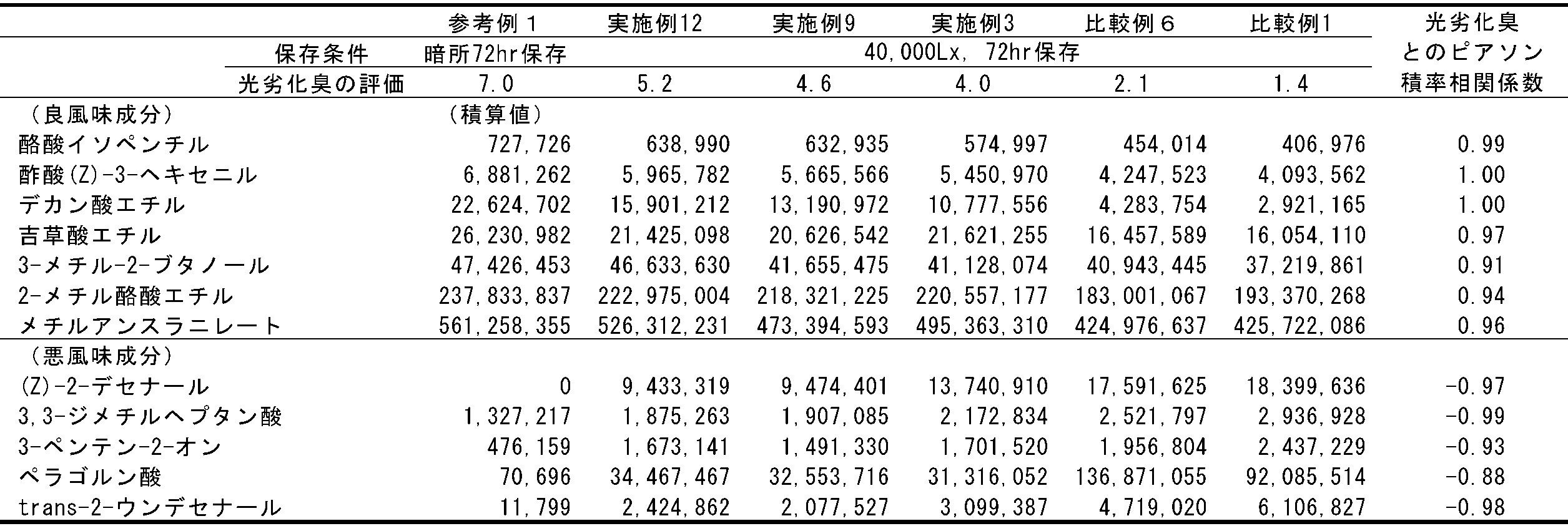
代表的な香気成分について、ビーク強度の積算値と光劣化臭の評価点のピアソンの積率相関係数を求め、積算値と共に表2に示した。実施例においては、ぶどう果汁に含まれる良好な風味成分として知られる、酪酸イソペンチル、酢酸(Z)-3-ヘキセニル、デカン酸エチル、吉草酸エチル、3-メチル-2-ブタノール、2-メチル酪酸エチル、メチルアンスラニレートの減少が抑制されており、光劣化臭の評価点とも正の相関が認められた。また、悪臭成分として知られる(Z)-2-デセナール、3,3-ジメチルヘプタン酸、3-ペンテン-2-オン、ペラゴルン酸、trans-2-ウンデセナールの生成が抑制されており、光劣化臭の評価点とも負の相関が認められた。これらの結果から、本発明に規定される特定の性質を有するたん白素材が有効な風味劣化抑制剤として機能していると考えられた。For representative aroma components, the Pearson product moment correlation coefficient between the integrated value of peak intensity and the evaluation score of light deterioration odor was calculated and is shown in Table 2 together with the integrated value. In the examples, the decrease of isopentyl butyrate, (Z)-3-hexenyl acetate, ethyl decanoate, ethyl valerate, 3-methyl-2-butanol, ethyl 2-methylbutyrate, and methyl anthranilate, which are known to be good flavor components contained in grape juice, was suppressed, and a positive correlation was observed with the evaluation score of light deterioration odor. In addition, the production of (Z)-2-decenal, 3,3-dimethylheptanoic acid, 3-penten-2-one, pelagolic acid, and trans-2-undecenal, which are known to be bad odor components, was suppressed, and a negative correlation was observed with the evaluation score of light deterioration odor. From these results, it was considered that the protein material having the specific properties specified in the present invention functions as an effective flavor deterioration inhibitor.
<グレープフルーツ果汁含有飲料の製造及び評価 >
表3に示す割合で各成分を混合した後、PETボトルに入れ、85℃,30分間の加熱殺菌を行った。得られたグレープフルーツ果汁含有飲料を用い、劣化試験前の、抑制剤由来の風味を評価した。次いで、5℃・LED光源 40,000Lxの条件下にて、72時間保持した後、光劣化臭の評価を行った。尚、無添加である比較例9の暗所保存品を参考例2とし、評価を行った。抑制剤由来の風味の評価が3点以上かつ、光劣化臭の評価が3点以上の試験区を総合的に合格と判断した。結果を表3にまとめた。
<Production and Evaluation of Grapefruit Juice-Containing Beverages>
After mixing the components in the ratios shown in Table 3, the mixture was placed in a PET bottle and heat sterilized at 85°C for 30 minutes. The resulting grapefruit juice-containing beverage was used to evaluate the flavor derived from the inhibitor before the deterioration test. Next, the beverage was kept for 72 hours under conditions of 5°C and an LED light source of 40,000Lx, and then the light deterioration odor was evaluated. The dark-stored product of Comparative Example 9, which was additive-free, was used as Reference Example 2 and was evaluated. Test sections in which the flavor derived from the inhibitor was evaluated as 3 points or more and the light deterioration odor was evaluated as 3 points or more were judged to have passed the test overall. The results are summarized in Table 3.
(表3)各たん白素材によるグレープフルーツ果汁の光劣化抑制効果

表3の実施例から理解されるとおり、グレープフルーツ果汁含有飲料において、本発明に規定される特定の性質を有するたん白素材を含有することにより、飲料本来の風味を損なわず、光劣化臭を低減できた。更に、アスコルビン酸脂肪酸エステル類を併用することにより、光劣化臭を更に低減できた。加えて、豆科植物由来の水溶性多糖類を併用することにより、光劣化臭を更に低減できた。As can be seen from the examples in Table 3, by including a protein material having the specific properties specified in the present invention in a grapefruit juice-containing beverage, the original flavor of the beverage is not impaired and the light-deterioration odor can be reduced. Furthermore, by using ascorbic acid fatty acid esters in combination, the light-deterioration odor can be further reduced. In addition, by using water-soluble polysaccharides derived from legumes in combination, the light-deterioration odor can be further reduced.
表3の比較例から理解される通り、本発明に規定される特定の性質を有するたん白素材を含有しない全てのケースで、光劣化臭を十分に抑制することはできなかった。As can be seen from the comparative examples in Table 3, in all cases that did not contain a protein material having the specific properties defined in the present invention, the light degradation odor could not be sufficiently suppressed.
(表4)香気成分分析
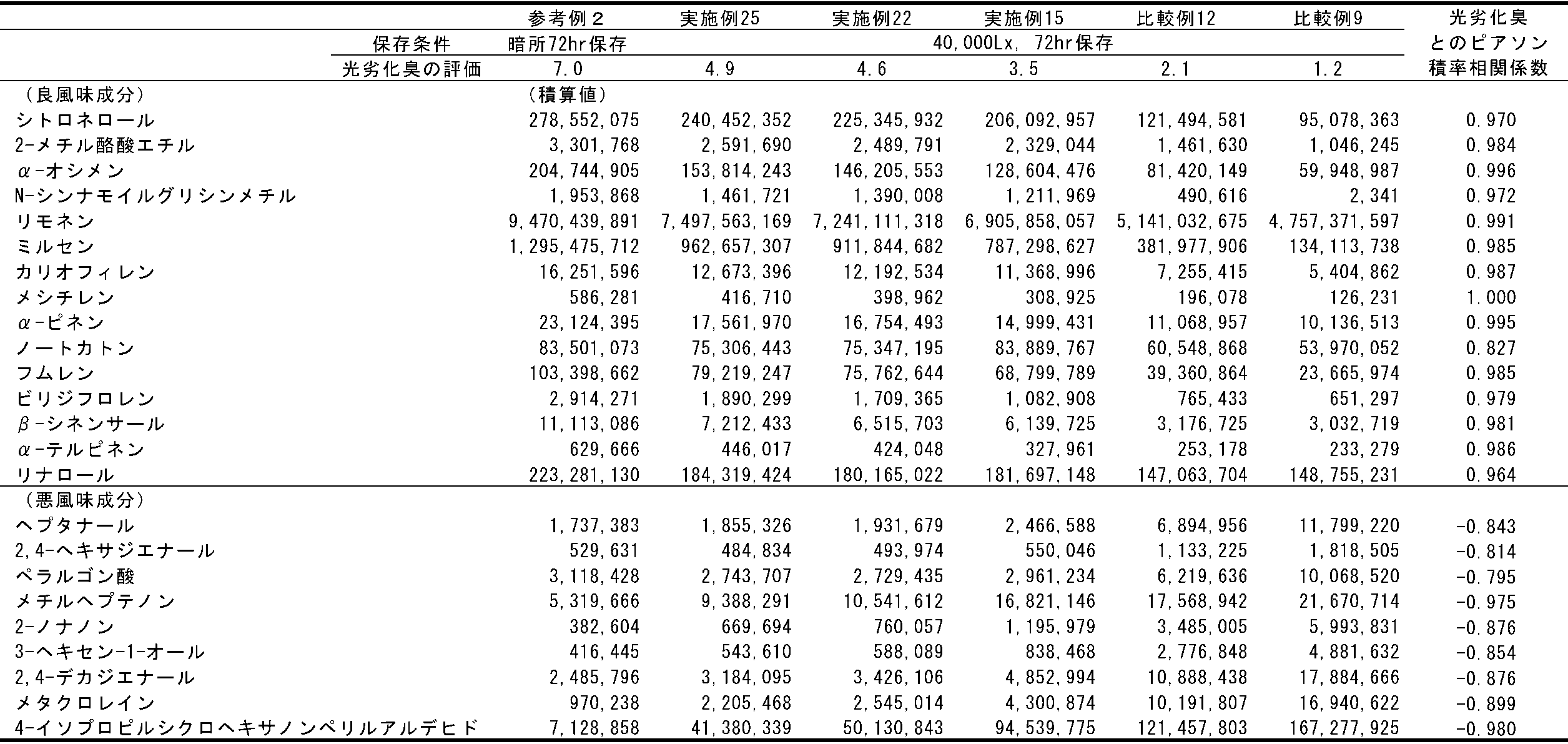
表4の分析例から理解される通り、実施例においては、グレープフルーツ果汁に含まれる良好な風味成分として知られる、シトロネロール、2-メチル酪酸エチル、α-オシメン、N-シンナモイルグリシンメチル 、リモネン、ミルセン、カリオフィレン、メシチレン、α-ピネン、ノートカトン、フムレン、ビリジフロレン、β-シネンサール、α-テルピネン、リナロールの減少が抑制されており、光劣化臭の評価点とも正の相関が認められた。また、悪臭成分として知られるヘプタナール、2,4-ヘキサジエナール、ペラルゴン酸、メチルヘプテノン、2-ノナノン、3-ヘキセン-1-オール、2,4-デカジエナール、メタクロレイン、4-イソプロピルシクロヘキサノンペリルアルデヒドの生成が抑制されており、光劣化臭の評価点とも負の相関が認められた。これらの結果から、本発明に規定される特定の性質を有するたん白素材が有効な風味劣化抑制剤として機能していると考えられる。As can be seen from the analysis example in Table 4, in the examples, the decrease of citronellol, 2-ethyl methylbutyrate, α-ocimene, N-methyl cinnamoylglycine, limonene, myrcene, caryophyllene, mesitylene, α-pinene, nootkatone, humulene, viridiflorene, β-sinensal, α-terpinene, and linalool, which are known to be good flavor components contained in grapefruit juice, was suppressed, and a positive correlation was observed with the evaluation score of the light deterioration odor. In addition, the production of heptanal, 2,4-hexadienal, pelargonic acid, methylheptenone, 2-nonanone, 3-hexen-1-ol, 2,4-decadienal, methacrolein, and 4-isopropylcyclohexanoneperillaldehyde, which are known to be odorous components, was suppressed, and a negative correlation was observed with the evaluation score of the light deterioration odor. From these results, it is believed that the protein material having the specific properties defined in the present invention functions as an effective flavor deterioration inhibitor.
<りんご果汁含有飲料の製造及び評価 >
表5に示す割合で各成分を混合した後、PETボトルに入れ、85℃,30分間の加熱殺菌を行った。得られたりんご果汁含有飲料を用い、劣化試験前の、抑制剤由来の風味を評価した。次いで、5℃・LED光源 40,000Lxの条件下にて、72時間保持した後、光劣化臭の評価を行った。尚、無添加である比較例17の暗所保存品を参考例とし、評価を行った。抑制剤由来の風味の評価が3点以上かつ、光劣化臭の評価が3点以上の試験区を総合的に合格と判断した。結果を表5にまとめた。
<Production and evaluation of beverages containing apple juice>
After mixing the components in the ratios shown in Table 5, the components were placed in a PET bottle and heat sterilized at 85°C for 30 minutes. The resulting apple juice-containing beverage was used to evaluate the flavor derived from the inhibitor before the deterioration test. Next, the beverage was kept for 72 hours under conditions of 5°C and an LED light source of 40,000Lx, and then the light deterioration odor was evaluated. The evaluation was performed using the dark-stored product of Comparative Example 17, which was additive-free, as a reference example. Test sections in which the flavor derived from the inhibitor was evaluated as 3 points or more and the light deterioration odor was evaluated as 3 points or more were judged to have passed the test overall. The results are summarized in Table 5.
(表5)各たん白素材によるりんご果汁の光劣化抑制効果
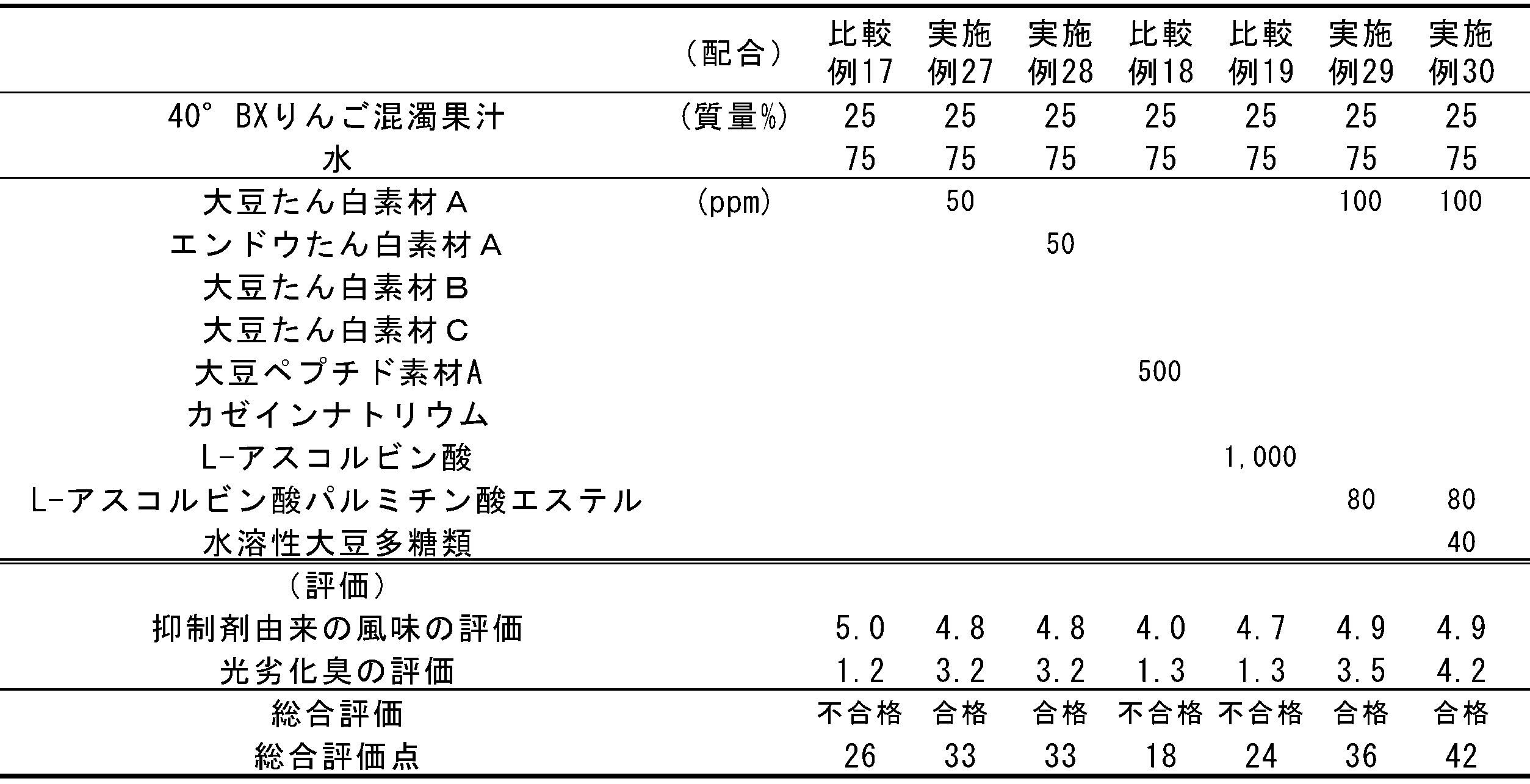
表5の実施例から理解されるとおり、りんご果汁含有飲料において、本発明に規定される特定の性質を有するたん白素材を含有することにより、飲料本来の風味を損なわず、光劣化臭を低減できた。更に、アスコルビン酸脂肪酸エステル類を併用することにより、光劣化臭を更に低減できた。加えて、豆科植物由来の水溶性多糖類を併用することにより、光劣化臭を更に低減できた。また、比較例から理解される通り、アスコルビン酸、または大豆ペプチド素材単独では、光劣化臭を十分に抑制することはできなかった。As can be seen from the examples in Table 5, by including a protein material having the specific properties specified in the present invention in an apple juice-containing beverage, the light-deterioration odor could be reduced without impairing the original flavor of the beverage. Furthermore, by using ascorbic acid fatty acid esters in combination, the light-deterioration odor could be further reduced. In addition, by using water-soluble polysaccharides derived from legumes in combination, the light-deterioration odor could be further reduced. Furthermore, as can be seen from the comparative examples, ascorbic acid or soybean peptide material alone was not able to sufficiently suppress the light-deterioration odor.
<オレンジ果汁含有飲料の製造及び評価 >
表6に示す割合で各成分を混合した後、PETボトルに入れ、85℃,30分間の加熱殺菌を行った。得られたオレンジ果汁含有飲料を用い、劣化試験前の、抑制剤由来の風味を評価した。次いで、5℃・LED光源 40,000Lxの条件下にて、120時間保持した後、光劣化臭の評価を行った。尚、無添加である比較例20の暗所保存品を参考例とし、評価を行った。抑制剤由来の風味の評価が3点以上かつ、光劣化臭の評価が3点以上の試験区を総合的に合格と判断した。結果を表6にまとめた。
<Production and Evaluation of Orange Juice-Containing Beverages>
After mixing the components in the ratios shown in Table 6, the mixture was placed in a PET bottle and heat sterilized at 85°C for 30 minutes. The resulting orange juice-containing beverage was used to evaluate the flavor derived from the inhibitor before the deterioration test. Next, the beverage was kept for 120 hours under conditions of 5°C and an LED light source of 40,000Lx, and then the light deterioration odor was evaluated. The evaluation was performed using the dark-stored product of Comparative Example 20, which was additive-free, as a reference example. Test sections in which the flavor derived from the inhibitor was evaluated as 3 points or more and the light deterioration odor was evaluated as 3 points or more were judged to have passed the test overall. The results are summarized in Table 6.
(表6)各たん白素材によるオレンジ果汁の光劣化抑制効果
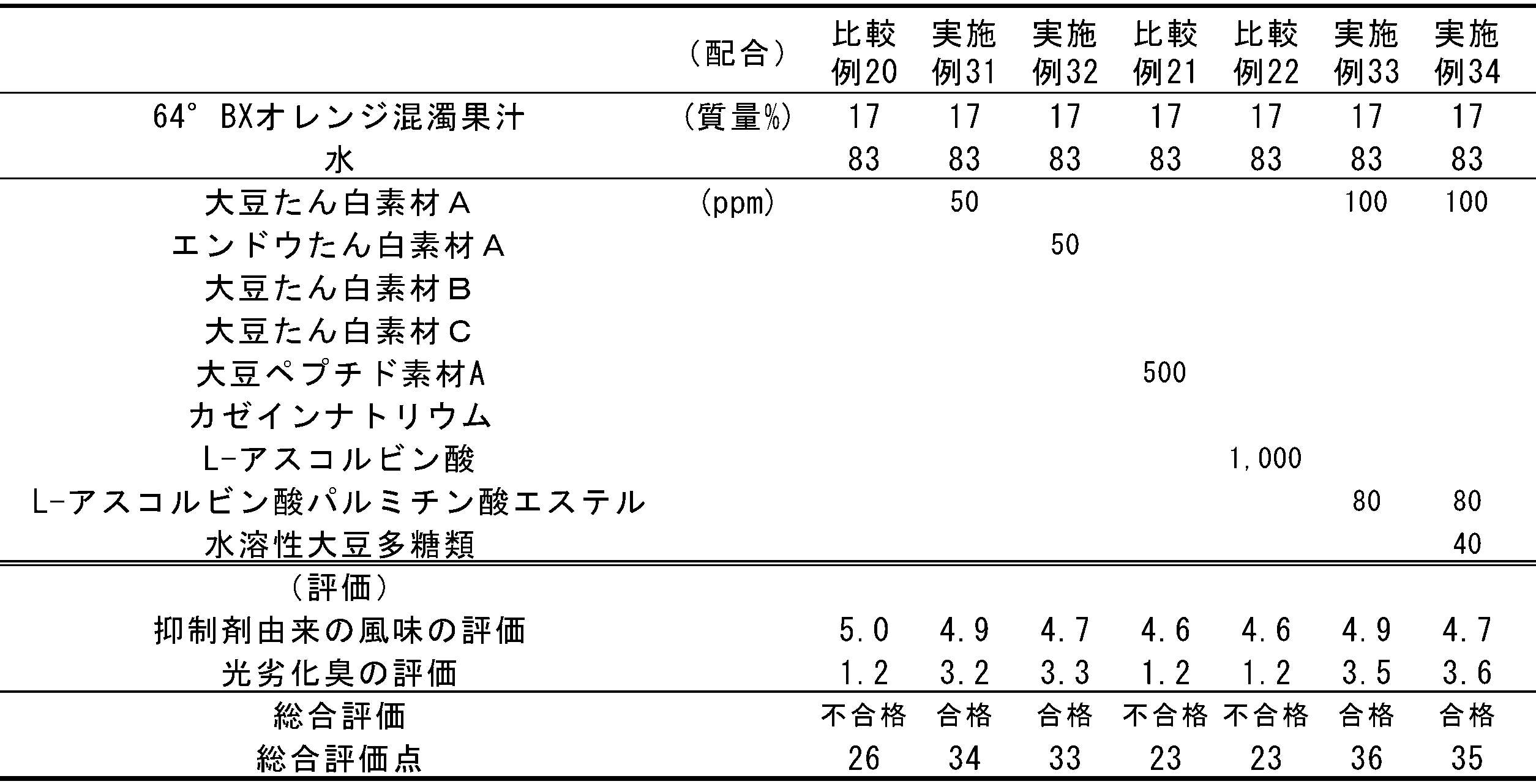
表6の実施例から理解されるとおり、オレンジ果汁含有飲料において、本発明に規定される特定の性質を有するたん白素材を含有することにより、飲料本来の風味を損なわず、光劣化臭を低減できた。更に、アスコルビン酸脂肪酸エステル類を併用することにより、光劣化臭を更に低減できた。加えて、豆科植物由来の水溶性多糖類を併用することにより、光劣化臭を更に低減できた。また、比較例から理解される通り、アスコルビン酸、または大豆ペプチド素材単独では、光劣化臭を十分に抑制することはできなかった。As can be seen from the examples in Table 6, by including a protein material having the specific properties specified in the present invention in an orange juice-containing beverage, the light-degradation odor could be reduced without impairing the original flavor of the beverage. Furthermore, by using ascorbic acid fatty acid esters in combination, the light-degradation odor could be further reduced. In addition, by using water-soluble polysaccharides derived from legumes in combination, the light-degradation odor could be further reduced. Furthermore, as can be seen from the comparative examples, ascorbic acid or soybean peptide material alone could not sufficiently suppress the light-degradation odor.
<トマト汁含有飲料の製造及び評価 >
表7に示す割合で各成分を混合した後、PETボトルに入れ、85℃,30分間の加熱殺菌を行った。得られたトマト汁含有飲料を用い、劣化試験前の、抑制剤由来の風味を評価した。次いで、5℃・LED光源 40,000Lxの条件下にて、72時間保持した後、光劣化臭の評価を行った。尚、無添加である比較例23の暗所保存品を参考例とし、評価を行った。抑制剤由来の風味の評価が3点以上かつ、光劣化臭の評価が3点以上の試験区を総合的に合格と判断した。結果を表7にまとめた。
<Production and evaluation of tomato juice-containing beverages>
After mixing the components in the ratios shown in Table 7, the mixture was placed in a PET bottle and sterilized by heating at 85°C for 30 minutes. The resulting tomato juice-containing beverage was used to evaluate the flavor derived from the inhibitor before the deterioration test. Next, the beverage was kept for 72 hours under conditions of 5°C and an LED light source of 40,000Lx, and then the light deterioration odor was evaluated. The evaluation was performed using the dark-stored product of Comparative Example 23, which was additive-free, as a reference example. Test sections in which the flavor derived from the inhibitor was evaluated as 3 points or more and the light deterioration odor was evaluated as 3 points or more were judged to have passed the test overall. The results are summarized in Table 7.
(表7)各たん白素材によるトマト果汁の光劣化抑制効果

表7の実施例から理解されるとおり、トマト汁含有飲料において、本発明に規定される特定の性質を有するたん白素材を含有することにより、飲料本来の風味を損なわず、光劣化臭を低減できた。更に、アスコルビン酸脂肪酸エステル類を併用することにより、光劣化臭を更に低減できた。加えて、豆科植物由来の水溶性多糖類を併用することにより、抑制剤由来の風味を低減できた。また、比較例から理解される通り、アスコルビン酸、または大豆ペプチド素材単独では、光劣化臭を十分に抑制することはできなかった。As can be seen from the examples in Table 7, by including a protein material having the specific properties specified in the present invention in a tomato juice-containing beverage, the light-degradation odor could be reduced without impairing the original flavor of the beverage. Furthermore, by using ascorbic acid fatty acid esters in combination, the light-degradation odor could be further reduced. In addition, by using water-soluble polysaccharides derived from legumes in combination, the flavor derived from the inhibitor could be reduced. Furthermore, as can be seen from the comparative examples, ascorbic acid or soybean peptide material alone could not sufficiently suppress the light-degradation odor.
<青汁含有飲料の製造及び評価 >
表8に示す割合で各成分を混合した後、PETボトルに入れ、85℃,30分間の加熱殺菌を行った。得られた青汁含有飲料を用い、劣化試験前の、抑制剤由来の風味を評価した。次いで、5℃・LED光源 40,000Lxの条件下にて、72時間保持した後、光劣化臭の評価を行った。尚、無添加である比較例26の暗所保存品を参考例とし、評価を行った。抑制剤由来の風味の評価が3点以上かつ、光劣化臭の評価が3点以上の試験区を総合的に合格と判断した。結果を表8にまとめた。
<Production and evaluation of green juice-containing beverages>
After mixing the components in the ratios shown in Table 8, the mixture was placed in a PET bottle and heat sterilized at 85°C for 30 minutes. The resulting green juice-containing beverage was used to evaluate the flavor derived from the inhibitor before the deterioration test. The beverage was then kept for 72 hours under conditions of 5°C and an LED light source of 40,000Lx, after which the light deterioration odor was evaluated. The evaluation was performed using the dark-stored product of Comparative Example 26, which was additive-free, as a reference example. Test sections in which the flavor derived from the inhibitor was rated at 3 points or more and the light deterioration odor was rated at 3 points or more were judged to have passed the overall test. The results are summarized in Table 8.
(表8)各たん白素材による青汁飲料の光劣化抑制効果
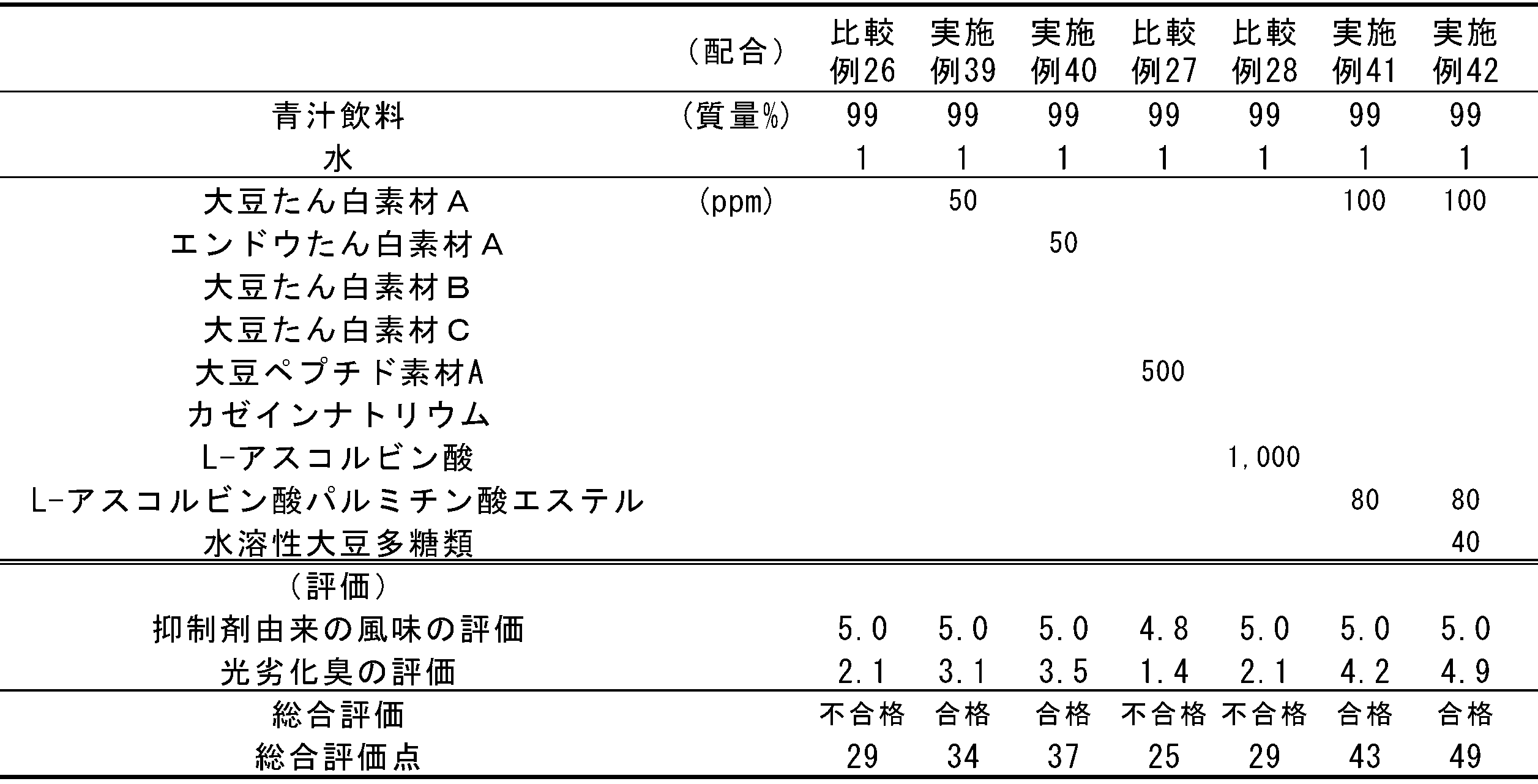
表8の実施例から理解されるとおり、青汁含有飲料において、本発明に規定される特定の性質を有するたん白素材を含有することにより、飲料本来の風味を損なわず、光劣化臭を低減できた。更に、アスコルビン酸脂肪酸エステル類を併用することにより、光劣化臭を更に低減できた。加えて、豆科植物由来の水溶性多糖類を併用することにより、光劣化臭を更に低減できた。また、比較例から理解される通り、アスコルビン酸、または大豆ペプチド素材単独では、光劣化臭を十分に抑制することはできなかった。As can be seen from the examples in Table 8, by including a protein material having the specific properties specified in the present invention in a green juice-containing beverage, the light-degradation odor could be reduced without impairing the original flavor of the beverage. Furthermore, by using ascorbic acid fatty acid esters in combination, the light-degradation odor could be further reduced. In addition, by using water-soluble polysaccharides derived from legumes in combination, the light-degradation odor could be further reduced. Furthermore, as can be seen from the comparative examples, ascorbic acid or soybean peptide material alone was not able to sufficiently suppress the light-degradation odor.
<果実酒の製造及び評価 >
表9に示す割合で各成分を混合した後、PETボトルに入れ、85℃,30分間の加熱殺菌を行った。得られた果実酒を用い劣化試験前の、抑制剤由来の風味を評価した。次いで、5℃・LED光源 40,000Lxの条件下にて、48時間保持した後、光劣化臭の評価を行った。尚、無添加である比較例29の暗所保存品を参考例とし、評価を行った。抑制剤由来の風味の評価が3点以上かつ、光劣化臭の評価が3点以上の試験区を総合的に合格と判断した。結果を表9にまとめた。
<Production and evaluation of fruit wine>
After mixing the components in the ratios shown in Table 9, the components were placed in a PET bottle and heat sterilized at 85°C for 30 minutes. The obtained fruit wine was used to evaluate the flavor derived from the inhibitor before the deterioration test. Next, the wine was kept for 48 hours under conditions of 5°C and LED light source 40,000Lx, and then the light deterioration odor was evaluated. The evaluation was performed using the dark-stored product of Comparative Example 29, which was additive-free, as a reference example. Test sections with an evaluation of 3 points or more for the flavor derived from the inhibitor and an evaluation of 3 points or more for the light deterioration odor were judged to have passed the test overall. The results are summarized in Table 9.
(表9)各たん白素材による果実酒の光劣化抑制効果
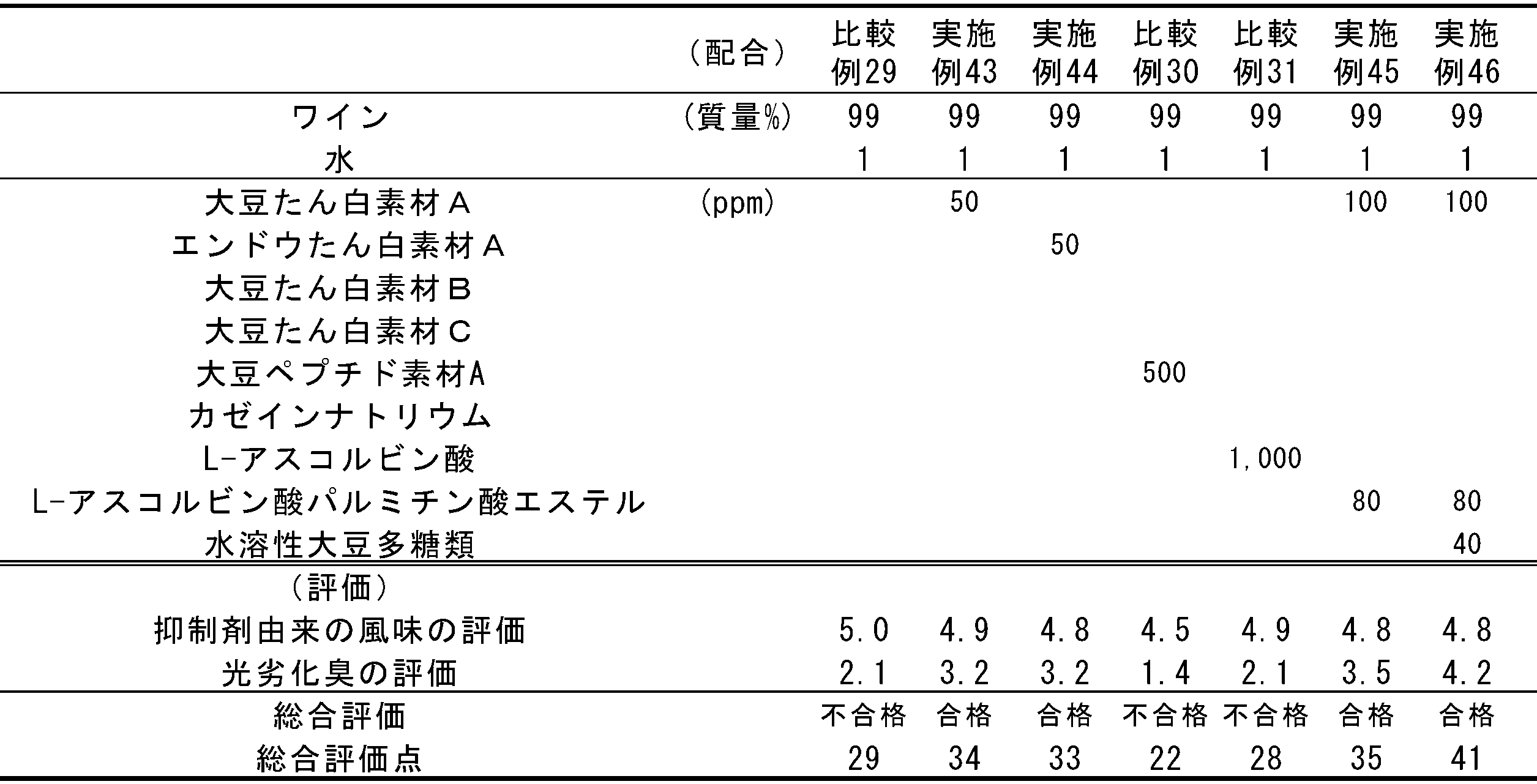
表9の実施例から理解されるとおり、果実酒において、本発明に規定される特定の性質を有するたん白素材を含有することにより、飲料本来の風味を損なわず、光劣化臭を低減できた。更に、アスコルビン酸脂肪酸エステル類を併用することにより、光劣化臭を更に低減できた。加えて、豆科植物由来の水溶性多糖類を併用することにより、光劣化臭を更に低減できた。また、比較例から理解される通り、アスコルビン酸、または大豆ペプチド素材単独では、光劣化臭を十分に抑制することはできなかった。As can be seen from the examples in Table 9, by including a protein material having the specific properties specified in the present invention in a fruit wine, the light-deterioration odor could be reduced without impairing the original flavor of the beverage. Furthermore, by using ascorbic acid fatty acid esters in combination, the light-deterioration odor could be further reduced. In addition, by using water-soluble polysaccharides derived from legumes in combination, the light-deterioration odor could be further reduced. Furthermore, as can be seen from the comparative examples, ascorbic acid or soybean peptide material alone could not sufficiently suppress the light-deterioration odor.
<コーヒー飲料の製造及び評価 >
ロースト後に粉砕したコーヒー豆10質量部に対し100質量部の熱水を加え、不溶物を分離したのちに固形分1.2質量%となるように加水調整したコーヒー抽出液を得た。その後、表10に示す割合で各成分を混合した後、PETボトルに入れ、85℃,30分間の加熱殺菌を行った。得られたコーヒー飲料を用い、劣化試験前の、抑制剤由来の風味を評価した。次いで、5℃・LED光源 40,000Lxの条件下にて、48時間保持した後、光劣化臭の評価を行った。尚、無添加である比較例32の暗所保存品を参考例とし、評価を行った。抑制剤由来の風味の評価が3点以上かつ、光劣化臭の評価が3点以上の試験区を総合的に合格と判断した。結果を表10にまとめた。
<Production and evaluation of coffee beverages>
100 parts by mass of hot water was added to 10 parts by mass of ground coffee beans after roasting, and after separating insoluble matter, the coffee extract was adjusted by adding water to a solid content of 1.2% by mass. Then, the components were mixed in the ratios shown in Table 10, placed in a PET bottle, and heat sterilized at 85°C for 30 minutes. The obtained coffee beverage was used to evaluate the flavor derived from the inhibitor before the deterioration test. Next, the coffee beverage was kept for 48 hours under conditions of 5°C and LED light source 40,000Lx, and then the photodegradation odor was evaluated. The evaluation was performed using the dark storage product of Comparative Example 32, which was additive-free, as a reference example. Test sections in which the flavor derived from the inhibitor was evaluated as 3 points or more and the photodegradation odor was evaluated as 3 points or more were judged to be comprehensively passed. The results are summarized in Table 10.
(表10)各たん白素材によるコーヒー飲料の光劣化抑制効果
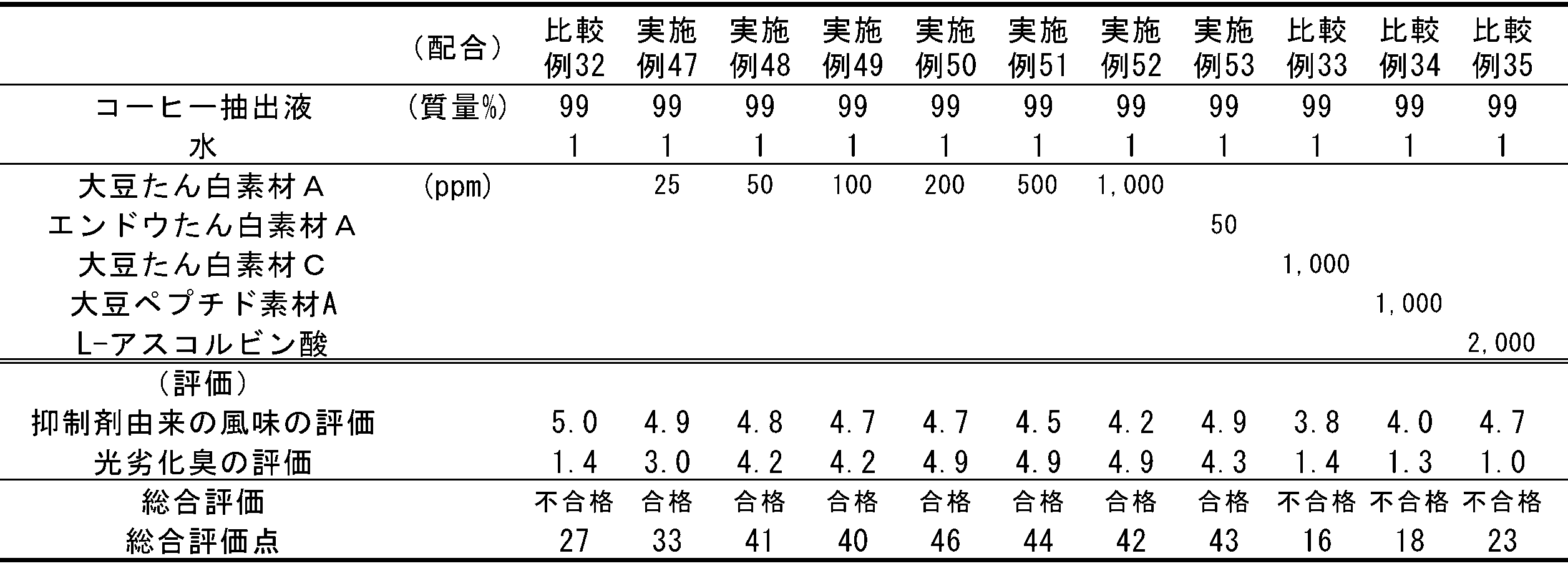
表10の実施例から理解されるとおり、コーヒーにおいて、本発明に規定される特定の性質を有するたん白素材を含有することにより、飲料本来の風味を損なわず、光劣化臭を低減できた。また、比較例から理解される通り、アスコルビン酸、本発明の要件を満たさない大豆たん白素材、または大豆ペプチド素材単独では、光劣化臭を十分に抑制することはできなかった。As can be seen from the examples in Table 10, the inclusion of a protein material having the specific properties specified in the present invention in coffee reduced the light-degradation odor without impairing the original flavor of the beverage. Also, as can be seen from the comparative examples, ascorbic acid, a soy protein material not satisfying the requirements of the present invention, or a soy peptide material alone was not able to sufficiently suppress the light-degradation odor.
本発明に従えば、飲料に用いて飲料本来の風味を損なうことなく、保存環境に起因する風味の劣化、特に光照射に起因する風味の劣化を抑制する、風味劣化抑制剤及び該風味劣化抑制剤を含む飲料を提供する事ができる。According to the present invention, it is possible to provide a flavor deterioration inhibitor and a beverage containing the flavor deterioration inhibitor, which can be used in beverages to suppress flavor deterioration caused by the storage environment, particularly flavor deterioration caused by exposure to light, without impairing the original flavor of the beverage.
Claims (9)
(A)粗蛋白質量20質量%の水溶液を80℃,30分加熱後、25℃で測定時の粘度が100mPa・s以下。
(B)0.22MのTCA可溶化率が40%~85%。 A flavor deterioration inhibitor for food and drink, comprising a legume-derived protein material having the following properties A and B , except when the protein material is used as an oil-in-water emulsion.
(A) An aqueous solution containing 20% crude protein by mass is heated at 80°C for 30 minutes, and then the viscosity when measured at 25°C is 100 mPa・s or less.
(B) 0.22 M TCA solubilization rate: 40% to 85% .
(A)粗蛋白質量20質量%の水溶液を80℃,30分加熱後、25℃で測定時の粘度が100mPa・s以下。
(B)0.22MのTCA可溶化率が40%~85%。 A method for suppressing deterioration of flavor of a beverage, comprising blending a bean-derived protein material having the following properties A and B into the beverage , except when the protein material is used as an oil-in-water emulsion:
(A) An aqueous solution containing 20% crude protein by mass is heated at 80°C for 30 minutes, and then the viscosity when measured at 25°C is 100 mPa・s or less.
(B) 0.22 M TCA solubilization rate: 40% to 85% .
Applications Claiming Priority (3)
| Application Number | Priority Date | Filing Date | Title |
|---|---|---|---|
| JP2023097367 | 2023-06-14 | ||
| JP2023097367 | 2023-06-14 | ||
| PCT/JP2024/019464 WO2024257597A1 (en) | 2023-06-14 | 2024-05-28 | Flavor deterioration inhibitor |
Publications (3)
| Publication Number | Publication Date |
|---|---|
| JPWO2024257597A1 JPWO2024257597A1 (en) | 2024-12-19 |
| JPWO2024257597A5 JPWO2024257597A5 (en) | 2025-05-27 |
| JP7686893B2 true JP7686893B2 (en) | 2025-06-02 |
Family
ID=93851788
Family Applications (1)
| Application Number | Title | Priority Date | Filing Date |
|---|---|---|---|
| JP2024563742A Active JP7686893B2 (en) | 2023-06-14 | 2024-05-28 | Flavor deterioration inhibitor |
Country Status (4)
| Country | Link |
|---|---|
| EP (1) | EP4728877A4 (en) |
| JP (1) | JP7686893B2 (en) |
| CN (1) | CN121038621A (en) |
| WO (1) | WO2024257597A1 (en) |
Families Citing this family (1)
| Publication number | Priority date | Publication date | Assignee | Title |
|---|---|---|---|---|
| JP7714752B1 (en) | 2024-03-29 | 2025-07-29 | 三栄源エフ・エフ・アイ株式会社 | Masking agent for the stagnant odor of acidic dairy products |
Citations (6)
| Publication number | Priority date | Publication date | Assignee | Title |
|---|---|---|---|---|
| JP2013215128A (en) | 2012-04-09 | 2013-10-24 | Sanei Gen Ffi Inc | Method of manufacturing acidic milk beverage containing chondroitin sulfate |
| JP5718741B2 (en) | 2011-06-24 | 2015-05-13 | カルピス株式会社 | Enzymatic production of peptide for improving brain function |
| JP2018191584A (en) | 2017-05-18 | 2018-12-06 | アサヒ飲料株式会社 | Beverages containing hydrolyzed peptides and milk |
| JP2021061777A (en) | 2019-10-11 | 2021-04-22 | アサヒ飲料株式会社 | Beverage, photo-degradation odor inhibitor, and photo-degradation odor inhibition method |
| WO2022185958A1 (en) | 2021-03-04 | 2022-09-09 | 不二製油グループ本社株式会社 | Aqueous composition inhibited from flavor deterioration caused by light irradiation |
| JP2024003289A (en) | 2022-06-27 | 2024-01-15 | 不二製油株式会社 | Oil-in-water emulsion and alcoholic beverage using it |
Family Cites Families (10)
| Publication number | Priority date | Publication date | Assignee | Title |
|---|---|---|---|---|
| JPH0799999B2 (en) | 1988-10-14 | 1995-11-01 | 長谷川香料株式会社 | How to prevent coffee flavor deterioration |
| JP4807348B2 (en) * | 2007-06-06 | 2011-11-02 | 不二製油株式会社 | Gel food |
| JP5397499B2 (en) * | 2011-06-07 | 2014-01-22 | 不二製油株式会社 | Soy foods and beverages with improved flavor, and methods for producing them |
| FR2976945B1 (en) | 2011-06-24 | 2017-12-29 | Fuji Oil Co Ltd | PECTIC POLYSACCHARIDE AND PROCESS FOR PRODUCTION THEREOF |
| US20150342200A1 (en) | 2012-12-26 | 2015-12-03 | Fuji Oil Company Limited | Water Soluble Pea Polysaccharide-Containing Physical Property Improvement Agent for Wheat-Based Food |
| JP6758034B2 (en) | 2015-02-25 | 2020-09-23 | サントリーホールディングス株式会社 | Transparent beverage containing fruit flavors |
| JP2017189119A (en) | 2016-04-11 | 2017-10-19 | キリン株式会社 | Fruit juice-containing beverage having suppressed photodegradation |
| JP7265846B2 (en) | 2018-08-17 | 2023-04-27 | アサヒ飲料株式会社 | Red grape-flavored beverage, display method for transparent container packed beverage, masking agent for photo-deterioration odor of red grape-flavored beverage, method for masking photo-deterioration odor of red grape-flavored beverage |
| CN114449903A (en) * | 2019-09-30 | 2022-05-06 | 不二制油集团控股株式会社 | Method for preparing plant-based emulsified food |
| WO2023162607A1 (en) * | 2022-02-28 | 2023-08-31 | 不二製油グループ本社株式会社 | Hydrophilic powdered oil and fat and method for producing same |
-
2024
- 2024-05-28 JP JP2024563742A patent/JP7686893B2/en active Active
- 2024-05-28 CN CN202480027626.3A patent/CN121038621A/en active Pending
- 2024-05-28 WO PCT/JP2024/019464 patent/WO2024257597A1/en not_active Ceased
- 2024-05-28 EP EP24823217.5A patent/EP4728877A4/en active Pending
Patent Citations (6)
| Publication number | Priority date | Publication date | Assignee | Title |
|---|---|---|---|---|
| JP5718741B2 (en) | 2011-06-24 | 2015-05-13 | カルピス株式会社 | Enzymatic production of peptide for improving brain function |
| JP2013215128A (en) | 2012-04-09 | 2013-10-24 | Sanei Gen Ffi Inc | Method of manufacturing acidic milk beverage containing chondroitin sulfate |
| JP2018191584A (en) | 2017-05-18 | 2018-12-06 | アサヒ飲料株式会社 | Beverages containing hydrolyzed peptides and milk |
| JP2021061777A (en) | 2019-10-11 | 2021-04-22 | アサヒ飲料株式会社 | Beverage, photo-degradation odor inhibitor, and photo-degradation odor inhibition method |
| WO2022185958A1 (en) | 2021-03-04 | 2022-09-09 | 不二製油グループ本社株式会社 | Aqueous composition inhibited from flavor deterioration caused by light irradiation |
| JP2024003289A (en) | 2022-06-27 | 2024-01-15 | 不二製油株式会社 | Oil-in-water emulsion and alcoholic beverage using it |
Also Published As
| Publication number | Publication date |
|---|---|
| EP4728877A4 (en) | 2026-08-12 |
| EP4728877A1 (en) | 2026-04-22 |
| JPWO2024257597A1 (en) | 2024-12-19 |
| CN121038621A (en) | 2025-11-28 |
| WO2024257597A1 (en) | 2024-12-19 |
Similar Documents
| Publication | Publication Date | Title |
|---|---|---|
| Zhu et al. | Ultrasonic and other sterilization methods on nutrition and flavor of cloudy apple juice | |
| CN105263335B (en) | Method for improving aftertaste of fruit and vegetable juice, method for improving aftertaste of food and drink, and food and drink | |
| JP2012512652A (en) | Citrus extract rich in flavonoids (hesperidin, naryltin, didimine) | |
| CA2560495A1 (en) | Phytase-treated acid stable soy protein beverages | |
| JP2014161319A (en) | Radish juice with suppressed occurrence of offensive odor | |
| WO2024257597A1 (en) | Flavor deterioration inhibitor | |
| KR20170120760A (en) | The manufacture method of apple drink | |
| JP7773293B2 (en) | Beverages, photodegradation odor inhibitors, and photodegradation odor suppression methods | |
| KR102049769B1 (en) | Amino acid beverage comprising allulose | |
| Aguiló-Aguayo et al. | Innovative Technologies in Beverage Processing | |
| JP6883125B2 (en) | Vegetable and fruit mixed beverage and its manufacturing method | |
| JP2005278605A (en) | Fruit juice beverage | |
| KR102408512B1 (en) | Apple beverage and manufacturing method of the same | |
| JP6934928B2 (en) | A method for producing high lycopene ketchup, a method for increasing the concentration of high lycopene ketchup and lycopene, and a method for suppressing an increase in viscosity. | |
| KR20130000517A (en) | Method for manufacturing functionality drink protected active ingredient of fruit-vegetable and composition thereof | |
| JP4943770B2 (en) | Container drink | |
| JP6588146B1 (en) | High lycopene ketchup manufacturing method, high lycopene ketchup, and method for achieving both high concentration of lycopene and suppression of increase in viscosity | |
| EP3595460B1 (en) | Process for making a plant composition | |
| Latif et al. | Effect of some chemical preservatives and storage condition on phytochemical components and antioxidant activity of some fruit pulp | |
| JP6821848B1 (en) | Beverage | |
| JP7828596B1 (en) | Low-fruit juice acetic acid content beverage and method for improving fruit juice flavor | |
| JP7727068B2 (en) | Method for producing carrot juice and carrot-containing beverages, and method for improving milkiness in carrot juice and carrot-containing beverages | |
| JP7475266B2 (en) | Tomato-containing beverage and method for producing tomato-containing beverage | |
| JP6736238B2 (en) | Method for producing high lycopene ketchup, high lycopene ketchup, and method for achieving both high lycopene concentration and suppression of increase in viscosity | |
| WO2026003398A1 (en) | Method for obtaining natural olive juice and use thereof as an ingredient in a food or beverage |
Legal Events
| Date | Code | Title | Description |
|---|---|---|---|
| A521 | Request for written amendment filed |
Free format text: JAPANESE INTERMEDIATE CODE: A523 Effective date: 20241028 |
|
| A621 | Written request for application examination |
Free format text: JAPANESE INTERMEDIATE CODE: A621 Effective date: 20241028 |
|
| A871 | Explanation of circumstances concerning accelerated examination |
Free format text: JAPANESE INTERMEDIATE CODE: A871 Effective date: 20241028 |
|
| A131 | Notification of reasons for refusal |
Free format text: JAPANESE INTERMEDIATE CODE: A131 Effective date: 20241203 |
|
| A521 | Request for written amendment filed |
Free format text: JAPANESE INTERMEDIATE CODE: A523 Effective date: 20250110 |
|
| TRDD | Decision of grant or rejection written | ||
| A711 | Notification of change in applicant |
Free format text: JAPANESE INTERMEDIATE CODE: A712 Effective date: 20250415 |
|
| A01 | Written decision to grant a patent or to grant a registration (utility model) |
Free format text: JAPANESE INTERMEDIATE CODE: A01 Effective date: 20250513 |
|
| A61 | First payment of annual fees (during grant procedure) |
Free format text: JAPANESE INTERMEDIATE CODE: A61 Effective date: 20250521 |
|
| R150 | Certificate of patent or registration of utility model |
Ref document number: 7686893 Country of ref document: JP Free format text: JAPANESE INTERMEDIATE CODE: R150 |