JP5516640B2 - Thermosetting resin composition - Google Patents
Thermosetting resin composition Download PDFInfo
- Publication number
- JP5516640B2 JP5516640B2 JP2012099828A JP2012099828A JP5516640B2 JP 5516640 B2 JP5516640 B2 JP 5516640B2 JP 2012099828 A JP2012099828 A JP 2012099828A JP 2012099828 A JP2012099828 A JP 2012099828A JP 5516640 B2 JP5516640 B2 JP 5516640B2
- Authority
- JP
- Japan
- Prior art keywords
- general formula
- group
- resin composition
- hydroxyl groups
- resin
- Prior art date
- Legal status (The legal status is an assumption and is not a legal conclusion. Google has not performed a legal analysis and makes no representation as to the accuracy of the status listed.)
- Active
Links
- 0 C*NC(O*O)=N Chemical compound C*NC(O*O)=N 0.000 description 2
Classifications
-
- C—CHEMISTRY; METALLURGY
- C08—ORGANIC MACROMOLECULAR COMPOUNDS; THEIR PREPARATION OR CHEMICAL WORKING-UP; COMPOSITIONS BASED THEREON
- C08L—COMPOSITIONS OF MACROMOLECULAR COMPOUNDS
- C08L75/00—Compositions of polyureas or polyurethanes; Compositions of derivatives of such polymers
- C08L75/04—Polyurethanes
-
- C—CHEMISTRY; METALLURGY
- C08—ORGANIC MACROMOLECULAR COMPOUNDS; THEIR PREPARATION OR CHEMICAL WORKING-UP; COMPOSITIONS BASED THEREON
- C08G—MACROMOLECULAR COMPOUNDS OBTAINED OTHERWISE THAN BY REACTIONS ONLY INVOLVING UNSATURATED CARBON-TO-CARBON BONDS
- C08G18/00—Polymeric products of isocyanates or isothiocyanates
- C08G18/06—Polymeric products of isocyanates or isothiocyanates with compounds having active hydrogen
- C08G18/28—Polymeric products of isocyanates or isothiocyanates with compounds having active hydrogen characterised by the compounds used containing active hydrogen
- C08G18/30—Low-molecular-weight compounds
- C08G18/34—Carboxylic acids; Esters thereof with monohydroxyl compounds
- C08G18/343—Polycarboxylic acids having at least three carboxylic acid groups
- C08G18/345—Polycarboxylic acids having at least three carboxylic acid groups having three carboxylic acid groups
-
- C—CHEMISTRY; METALLURGY
- C08—ORGANIC MACROMOLECULAR COMPOUNDS; THEIR PREPARATION OR CHEMICAL WORKING-UP; COMPOSITIONS BASED THEREON
- C08G—MACROMOLECULAR COMPOUNDS OBTAINED OTHERWISE THAN BY REACTIONS ONLY INVOLVING UNSATURATED CARBON-TO-CARBON BONDS
- C08G18/00—Polymeric products of isocyanates or isothiocyanates
- C08G18/06—Polymeric products of isocyanates or isothiocyanates with compounds having active hydrogen
- C08G18/28—Polymeric products of isocyanates or isothiocyanates with compounds having active hydrogen characterised by the compounds used containing active hydrogen
- C08G18/30—Low-molecular-weight compounds
- C08G18/34—Carboxylic acids; Esters thereof with monohydroxyl compounds
- C08G18/343—Polycarboxylic acids having at least three carboxylic acid groups
- C08G18/346—Polycarboxylic acids having at least three carboxylic acid groups having four carboxylic acid groups
-
- C—CHEMISTRY; METALLURGY
- C08—ORGANIC MACROMOLECULAR COMPOUNDS; THEIR PREPARATION OR CHEMICAL WORKING-UP; COMPOSITIONS BASED THEREON
- C08G—MACROMOLECULAR COMPOUNDS OBTAINED OTHERWISE THAN BY REACTIONS ONLY INVOLVING UNSATURATED CARBON-TO-CARBON BONDS
- C08G18/00—Polymeric products of isocyanates or isothiocyanates
- C08G18/06—Polymeric products of isocyanates or isothiocyanates with compounds having active hydrogen
- C08G18/28—Polymeric products of isocyanates or isothiocyanates with compounds having active hydrogen characterised by the compounds used containing active hydrogen
- C08G18/40—High-molecular-weight compounds
- C08G18/54—Polycondensates of aldehydes
- C08G18/542—Polycondensates of aldehydes with phenols
-
- C—CHEMISTRY; METALLURGY
- C08—ORGANIC MACROMOLECULAR COMPOUNDS; THEIR PREPARATION OR CHEMICAL WORKING-UP; COMPOSITIONS BASED THEREON
- C08G—MACROMOLECULAR COMPOUNDS OBTAINED OTHERWISE THAN BY REACTIONS ONLY INVOLVING UNSATURATED CARBON-TO-CARBON BONDS
- C08G18/00—Polymeric products of isocyanates or isothiocyanates
- C08G18/06—Polymeric products of isocyanates or isothiocyanates with compounds having active hydrogen
- C08G18/28—Polymeric products of isocyanates or isothiocyanates with compounds having active hydrogen characterised by the compounds used containing active hydrogen
- C08G18/40—High-molecular-weight compounds
- C08G18/62—Polymers of compounds having carbon-to-carbon double bonds
- C08G18/6204—Polymers of olefins
- C08G18/6208—Hydrogenated polymers of conjugated dienes
-
- C—CHEMISTRY; METALLURGY
- C08—ORGANIC MACROMOLECULAR COMPOUNDS; THEIR PREPARATION OR CHEMICAL WORKING-UP; COMPOSITIONS BASED THEREON
- C08G—MACROMOLECULAR COMPOUNDS OBTAINED OTHERWISE THAN BY REACTIONS ONLY INVOLVING UNSATURATED CARBON-TO-CARBON BONDS
- C08G18/00—Polymeric products of isocyanates or isothiocyanates
- C08G18/06—Polymeric products of isocyanates or isothiocyanates with compounds having active hydrogen
- C08G18/70—Polymeric products of isocyanates or isothiocyanates with compounds having active hydrogen characterised by the isocyanates or isothiocyanates used
- C08G18/72—Polyisocyanates or polyisothiocyanates
- C08G18/721—Two or more polyisocyanates not provided for in one single group C08G18/73 - C08G18/80
- C08G18/724—Combination of aromatic polyisocyanates with (cyclo)aliphatic polyisocyanates
-
- C—CHEMISTRY; METALLURGY
- C08—ORGANIC MACROMOLECULAR COMPOUNDS; THEIR PREPARATION OR CHEMICAL WORKING-UP; COMPOSITIONS BASED THEREON
- C08G—MACROMOLECULAR COMPOUNDS OBTAINED OTHERWISE THAN BY REACTIONS ONLY INVOLVING UNSATURATED CARBON-TO-CARBON BONDS
- C08G18/00—Polymeric products of isocyanates or isothiocyanates
- C08G18/06—Polymeric products of isocyanates or isothiocyanates with compounds having active hydrogen
- C08G18/70—Polymeric products of isocyanates or isothiocyanates with compounds having active hydrogen characterised by the isocyanates or isothiocyanates used
- C08G18/72—Polyisocyanates or polyisothiocyanates
- C08G18/73—Polyisocyanates or polyisothiocyanates acyclic
-
- C—CHEMISTRY; METALLURGY
- C08—ORGANIC MACROMOLECULAR COMPOUNDS; THEIR PREPARATION OR CHEMICAL WORKING-UP; COMPOSITIONS BASED THEREON
- C08G—MACROMOLECULAR COMPOUNDS OBTAINED OTHERWISE THAN BY REACTIONS ONLY INVOLVING UNSATURATED CARBON-TO-CARBON BONDS
- C08G18/00—Polymeric products of isocyanates or isothiocyanates
- C08G18/06—Polymeric products of isocyanates or isothiocyanates with compounds having active hydrogen
- C08G18/70—Polymeric products of isocyanates or isothiocyanates with compounds having active hydrogen characterised by the isocyanates or isothiocyanates used
- C08G18/72—Polyisocyanates or polyisothiocyanates
- C08G18/74—Polyisocyanates or polyisothiocyanates cyclic
- C08G18/75—Polyisocyanates or polyisothiocyanates cyclic cycloaliphatic
- C08G18/751—Polyisocyanates or polyisothiocyanates cyclic cycloaliphatic containing only one cycloaliphatic ring
- C08G18/752—Polyisocyanates or polyisothiocyanates cyclic cycloaliphatic containing only one cycloaliphatic ring containing at least one isocyanate or isothiocyanate group linked to the cycloaliphatic ring by means of an aliphatic group
- C08G18/753—Polyisocyanates or polyisothiocyanates cyclic cycloaliphatic containing only one cycloaliphatic ring containing at least one isocyanate or isothiocyanate group linked to the cycloaliphatic ring by means of an aliphatic group containing one isocyanate or isothiocyanate group linked to the cycloaliphatic ring by means of an aliphatic group having a primary carbon atom next to the isocyanate or isothiocyanate group
- C08G18/755—Polyisocyanates or polyisothiocyanates cyclic cycloaliphatic containing only one cycloaliphatic ring containing at least one isocyanate or isothiocyanate group linked to the cycloaliphatic ring by means of an aliphatic group containing one isocyanate or isothiocyanate group linked to the cycloaliphatic ring by means of an aliphatic group having a primary carbon atom next to the isocyanate or isothiocyanate group and at least one isocyanate or isothiocyanate group linked to a secondary carbon atom of the cycloaliphatic ring, e.g. isophorone diisocyanate
-
- C—CHEMISTRY; METALLURGY
- C08—ORGANIC MACROMOLECULAR COMPOUNDS; THEIR PREPARATION OR CHEMICAL WORKING-UP; COMPOSITIONS BASED THEREON
- C08G—MACROMOLECULAR COMPOUNDS OBTAINED OTHERWISE THAN BY REACTIONS ONLY INVOLVING UNSATURATED CARBON-TO-CARBON BONDS
- C08G18/00—Polymeric products of isocyanates or isothiocyanates
- C08G18/06—Polymeric products of isocyanates or isothiocyanates with compounds having active hydrogen
- C08G18/70—Polymeric products of isocyanates or isothiocyanates with compounds having active hydrogen characterised by the isocyanates or isothiocyanates used
- C08G18/72—Polyisocyanates or polyisothiocyanates
- C08G18/74—Polyisocyanates or polyisothiocyanates cyclic
- C08G18/76—Polyisocyanates or polyisothiocyanates cyclic aromatic
- C08G18/7607—Compounds of C08G18/7614 and of C08G18/7657
-
- C—CHEMISTRY; METALLURGY
- C08—ORGANIC MACROMOLECULAR COMPOUNDS; THEIR PREPARATION OR CHEMICAL WORKING-UP; COMPOSITIONS BASED THEREON
- C08G—MACROMOLECULAR COMPOUNDS OBTAINED OTHERWISE THAN BY REACTIONS ONLY INVOLVING UNSATURATED CARBON-TO-CARBON BONDS
- C08G18/00—Polymeric products of isocyanates or isothiocyanates
- C08G18/06—Polymeric products of isocyanates or isothiocyanates with compounds having active hydrogen
- C08G18/70—Polymeric products of isocyanates or isothiocyanates with compounds having active hydrogen characterised by the isocyanates or isothiocyanates used
- C08G18/72—Polyisocyanates or polyisothiocyanates
- C08G18/74—Polyisocyanates or polyisothiocyanates cyclic
- C08G18/76—Polyisocyanates or polyisothiocyanates cyclic aromatic
- C08G18/7614—Polyisocyanates or polyisothiocyanates cyclic aromatic containing only one aromatic ring
- C08G18/7621—Polyisocyanates or polyisothiocyanates cyclic aromatic containing only one aromatic ring being toluene diisocyanate including isomer mixtures
-
- C—CHEMISTRY; METALLURGY
- C08—ORGANIC MACROMOLECULAR COMPOUNDS; THEIR PREPARATION OR CHEMICAL WORKING-UP; COMPOSITIONS BASED THEREON
- C08G—MACROMOLECULAR COMPOUNDS OBTAINED OTHERWISE THAN BY REACTIONS ONLY INVOLVING UNSATURATED CARBON-TO-CARBON BONDS
- C08G18/00—Polymeric products of isocyanates or isothiocyanates
- C08G18/06—Polymeric products of isocyanates or isothiocyanates with compounds having active hydrogen
- C08G18/70—Polymeric products of isocyanates or isothiocyanates with compounds having active hydrogen characterised by the isocyanates or isothiocyanates used
- C08G18/72—Polyisocyanates or polyisothiocyanates
- C08G18/77—Polyisocyanates or polyisothiocyanates having heteroatoms in addition to the isocyanate or isothiocyanate nitrogen and oxygen or sulfur
- C08G18/78—Nitrogen
- C08G18/79—Nitrogen characterised by the polyisocyanates used, these having groups formed by oligomerisation of isocyanates or isothiocyanates
- C08G18/791—Nitrogen characterised by the polyisocyanates used, these having groups formed by oligomerisation of isocyanates or isothiocyanates containing isocyanurate groups
- C08G18/792—Nitrogen characterised by the polyisocyanates used, these having groups formed by oligomerisation of isocyanates or isothiocyanates containing isocyanurate groups formed by oligomerisation of aliphatic and/or cycloaliphatic isocyanates or isothiocyanates
-
- C—CHEMISTRY; METALLURGY
- C08—ORGANIC MACROMOLECULAR COMPOUNDS; THEIR PREPARATION OR CHEMICAL WORKING-UP; COMPOSITIONS BASED THEREON
- C08G—MACROMOLECULAR COMPOUNDS OBTAINED OTHERWISE THAN BY REACTIONS ONLY INVOLVING UNSATURATED CARBON-TO-CARBON BONDS
- C08G59/00—Polycondensates containing more than one epoxy group per molecule; Macromolecules obtained by polymerising compounds containing more than one epoxy group per molecule using curing agents or catalysts which react with the epoxy groups
- C08G59/18—Macromolecules obtained by polymerising compounds containing more than one epoxy group per molecule using curing agents or catalysts which react with the epoxy groups ; e.g. general methods of curing
- C08G59/40—Macromolecules obtained by polymerising compounds containing more than one epoxy group per molecule using curing agents or catalysts which react with the epoxy groups ; e.g. general methods of curing characterised by the curing agents used
-
- C—CHEMISTRY; METALLURGY
- C08—ORGANIC MACROMOLECULAR COMPOUNDS; THEIR PREPARATION OR CHEMICAL WORKING-UP; COMPOSITIONS BASED THEREON
- C08G—MACROMOLECULAR COMPOUNDS OBTAINED OTHERWISE THAN BY REACTIONS ONLY INVOLVING UNSATURATED CARBON-TO-CARBON BONDS
- C08G73/00—Macromolecular compounds obtained by reactions forming a linkage containing nitrogen with or without oxygen or carbon in the main chain of the macromolecule, not provided for in groups C08G12/00 - C08G71/00
- C08G73/06—Polycondensates having nitrogen-containing heterocyclic rings in the main chain of the macromolecule
- C08G73/0622—Polycondensates containing six-membered rings, not condensed with other rings, with nitrogen atoms as the only ring hetero atoms
- C08G73/0638—Polycondensates containing six-membered rings, not condensed with other rings, with nitrogen atoms as the only ring hetero atoms with at least three nitrogen atoms in the ring
-
- C—CHEMISTRY; METALLURGY
- C08—ORGANIC MACROMOLECULAR COMPOUNDS; THEIR PREPARATION OR CHEMICAL WORKING-UP; COMPOSITIONS BASED THEREON
- C08G—MACROMOLECULAR COMPOUNDS OBTAINED OTHERWISE THAN BY REACTIONS ONLY INVOLVING UNSATURATED CARBON-TO-CARBON BONDS
- C08G73/00—Macromolecular compounds obtained by reactions forming a linkage containing nitrogen with or without oxygen or carbon in the main chain of the macromolecule, not provided for in groups C08G12/00 - C08G71/00
- C08G73/06—Polycondensates having nitrogen-containing heterocyclic rings in the main chain of the macromolecule
- C08G73/10—Polyimides; Polyester-imides; Polyamide-imides; Polyamide acids or similar polyimide precursors
- C08G73/1003—Preparatory processes
- C08G73/1035—Preparatory processes from tetracarboxylic acids or derivatives and diisocyanates
-
- C—CHEMISTRY; METALLURGY
- C08—ORGANIC MACROMOLECULAR COMPOUNDS; THEIR PREPARATION OR CHEMICAL WORKING-UP; COMPOSITIONS BASED THEREON
- C08G—MACROMOLECULAR COMPOUNDS OBTAINED OTHERWISE THAN BY REACTIONS ONLY INVOLVING UNSATURATED CARBON-TO-CARBON BONDS
- C08G73/00—Macromolecular compounds obtained by reactions forming a linkage containing nitrogen with or without oxygen or carbon in the main chain of the macromolecule, not provided for in groups C08G12/00 - C08G71/00
- C08G73/06—Polycondensates having nitrogen-containing heterocyclic rings in the main chain of the macromolecule
- C08G73/10—Polyimides; Polyester-imides; Polyamide-imides; Polyamide acids or similar polyimide precursors
- C08G73/1042—Copolyimides derived from at least two different tetracarboxylic compounds or two different diamino compounds
-
- C—CHEMISTRY; METALLURGY
- C08—ORGANIC MACROMOLECULAR COMPOUNDS; THEIR PREPARATION OR CHEMICAL WORKING-UP; COMPOSITIONS BASED THEREON
- C08G—MACROMOLECULAR COMPOUNDS OBTAINED OTHERWISE THAN BY REACTIONS ONLY INVOLVING UNSATURATED CARBON-TO-CARBON BONDS
- C08G73/00—Macromolecular compounds obtained by reactions forming a linkage containing nitrogen with or without oxygen or carbon in the main chain of the macromolecule, not provided for in groups C08G12/00 - C08G71/00
- C08G73/06—Polycondensates having nitrogen-containing heterocyclic rings in the main chain of the macromolecule
- C08G73/10—Polyimides; Polyester-imides; Polyamide-imides; Polyamide acids or similar polyimide precursors
- C08G73/1046—Polyimides containing oxygen in the form of ether bonds in the main chain
- C08G73/1053—Polyimides containing oxygen in the form of ether bonds in the main chain with oxygen only in the tetracarboxylic moiety
-
- C—CHEMISTRY; METALLURGY
- C08—ORGANIC MACROMOLECULAR COMPOUNDS; THEIR PREPARATION OR CHEMICAL WORKING-UP; COMPOSITIONS BASED THEREON
- C08G—MACROMOLECULAR COMPOUNDS OBTAINED OTHERWISE THAN BY REACTIONS ONLY INVOLVING UNSATURATED CARBON-TO-CARBON BONDS
- C08G73/00—Macromolecular compounds obtained by reactions forming a linkage containing nitrogen with or without oxygen or carbon in the main chain of the macromolecule, not provided for in groups C08G12/00 - C08G71/00
- C08G73/06—Polycondensates having nitrogen-containing heterocyclic rings in the main chain of the macromolecule
- C08G73/10—Polyimides; Polyester-imides; Polyamide-imides; Polyamide acids or similar polyimide precursors
- C08G73/1085—Polyimides with diamino moieties or tetracarboxylic segments containing heterocyclic moieties
-
- C—CHEMISTRY; METALLURGY
- C08—ORGANIC MACROMOLECULAR COMPOUNDS; THEIR PREPARATION OR CHEMICAL WORKING-UP; COMPOSITIONS BASED THEREON
- C08G—MACROMOLECULAR COMPOUNDS OBTAINED OTHERWISE THAN BY REACTIONS ONLY INVOLVING UNSATURATED CARBON-TO-CARBON BONDS
- C08G73/00—Macromolecular compounds obtained by reactions forming a linkage containing nitrogen with or without oxygen or carbon in the main chain of the macromolecule, not provided for in groups C08G12/00 - C08G71/00
- C08G73/06—Polycondensates having nitrogen-containing heterocyclic rings in the main chain of the macromolecule
- C08G73/10—Polyimides; Polyester-imides; Polyamide-imides; Polyamide acids or similar polyimide precursors
- C08G73/14—Polyamide-imides
-
- C—CHEMISTRY; METALLURGY
- C08—ORGANIC MACROMOLECULAR COMPOUNDS; THEIR PREPARATION OR CHEMICAL WORKING-UP; COMPOSITIONS BASED THEREON
- C08L—COMPOSITIONS OF MACROMOLECULAR COMPOUNDS
- C08L63/00—Compositions of epoxy resins; Compositions of derivatives of epoxy resins
-
- C—CHEMISTRY; METALLURGY
- C08—ORGANIC MACROMOLECULAR COMPOUNDS; THEIR PREPARATION OR CHEMICAL WORKING-UP; COMPOSITIONS BASED THEREON
- C08L—COMPOSITIONS OF MACROMOLECULAR COMPOUNDS
- C08L79/00—Compositions of macromolecular compounds obtained by reactions forming in the main chain of the macromolecule a linkage containing nitrogen with or without oxygen or carbon only, not provided for in groups C08L61/00 - C08L77/00
- C08L79/04—Polycondensates having nitrogen-containing heterocyclic rings in the main chain; Polyhydrazides; Polyamide acids or similar polyimide precursors
- C08L79/08—Polyimides; Polyester-imides; Polyamide-imides; Polyamide acids or similar polyimide precursors
-
- C—CHEMISTRY; METALLURGY
- C09—DYES; PAINTS; POLISHES; NATURAL RESINS; ADHESIVES; COMPOSITIONS NOT OTHERWISE PROVIDED FOR; APPLICATIONS OF MATERIALS NOT OTHERWISE PROVIDED FOR
- C09D—COATING COMPOSITIONS, e.g. PAINTS, VARNISHES OR LACQUERS; FILLING PASTES; CHEMICAL PAINT OR INK REMOVERS; INKS; CORRECTING FLUIDS; WOODSTAINS; PASTES OR SOLIDS FOR COLOURING OR PRINTING; USE OF MATERIALS THEREFOR
- C09D179/00—Coating compositions based on macromolecular compounds obtained by reactions forming in the main chain of the macromolecule a linkage containing nitrogen, with or without oxygen, or carbon only, not provided for in groups C09D161/00 - C09D177/00
- C09D179/04—Polycondensates having nitrogen-containing heterocyclic rings in the main chain; Polyhydrazides; Polyamide acids or similar polyimide precursors
- C09D179/08—Polyimides; Polyester-imides; Polyamide-imides; Polyamide acids or similar polyimide precursors
-
- H—ELECTRICITY
- H05—ELECTRIC TECHNIQUES NOT OTHERWISE PROVIDED FOR
- H05K—PRINTED CIRCUITS; CASINGS OR CONSTRUCTIONAL DETAILS OF ELECTRIC APPARATUS; MANUFACTURE OF ASSEMBLAGES OF ELECTRICAL COMPONENTS
- H05K3/00—Apparatus or processes for manufacturing printed circuits
- H05K3/46—Manufacturing multilayer circuits
- H05K3/4644—Manufacturing multilayer circuits by building the multilayer layer by layer, i.e. build-up multilayer circuits
- H05K3/4673—Application methods or materials of intermediate insulating layers not specially adapted to any one of the previous methods of adding a circuit layer
- H05K3/4676—Single layer compositions
Landscapes
- Chemical & Material Sciences (AREA)
- Chemical Kinetics & Catalysis (AREA)
- Organic Chemistry (AREA)
- Health & Medical Sciences (AREA)
- Medicinal Chemistry (AREA)
- Polymers & Plastics (AREA)
- Life Sciences & Earth Sciences (AREA)
- Engineering & Computer Science (AREA)
- Materials Engineering (AREA)
- Wood Science & Technology (AREA)
- Polyurethanes Or Polyureas (AREA)
- Epoxy Resins (AREA)
- Macromolecular Compounds Obtained By Forming Nitrogen-Containing Linkages In General (AREA)
- Compositions Of Macromolecular Compounds (AREA)
Description
本発明は、耐熱性、電気特性、および柔軟性に優れる硬化物が得られ、また、硬化前の保存安定性も優れ、各種耐熱性コーティング材料や電気絶縁材料、例えばプリント配線基板の層間絶縁材料、ビルドアップ材料、半導体の絶縁材料、耐熱性接着剤等の分野に好ましく用いることができる熱硬化性樹脂組成物に関する。 The present invention provides a cured product having excellent heat resistance, electrical properties, and flexibility, and excellent storage stability before curing, and various heat resistant coating materials and electrical insulation materials, for example, interlayer insulation materials for printed wiring boards. The present invention relates to a thermosetting resin composition that can be preferably used in fields such as build-up materials, semiconductor insulating materials, and heat-resistant adhesives.
耐熱性コーティング材料、電気絶縁材料、例えばプリント配線基板の層間絶縁材料、ビルドアップ材料、半導体の絶縁材料、耐熱性接着剤等の電気電子産業分野に用いられる樹脂組成物の硬化物の耐熱性、低誘電率や低誘電正接などの電気特性、柔軟性に加え、硬化前の樹脂組成物の保存安定性等の向上が要望されている。特にコンピューター等の電子機器では、信号の高速化や高周波数化に伴いプリント基板の信号の伝達遅延やクロストークの発生等の伝達特性が問題となっている。また、プリント基板に使用される樹脂組成物については得られる硬化物の誘電率の低い材料が求められている。 Heat resistance of a cured product of a resin composition used in the electric and electronic industries such as a heat resistant coating material, an electrical insulating material, for example, an interlayer insulating material of a printed wiring board, a build-up material, a semiconductor insulating material, a heat resistant adhesive, In addition to electrical characteristics such as low dielectric constant and low dielectric loss tangent and flexibility, there is a demand for improvement in storage stability of the resin composition before curing. In particular, in electronic devices such as computers, transmission characteristics such as signal transmission delay of a printed circuit board and occurrence of crosstalk become a problem as the signal speed and frequency increase. Moreover, about the resin composition used for a printed circuit board, the low dielectric constant material of the hardened | cured material obtained is calculated | required.
耐熱性に優れる硬化物が得られる樹脂組成物としては、例えば、エポキシ樹脂を含有する樹脂組成物が多く用いられている。該樹脂組成物としては、例えば、重量平均分子量35,000未満のエポキシ樹脂、多官能フェノール樹脂、重量平均分子量35,000以上の高分子量エポキシ樹脂、硬化促進剤、還元剤及び尿素化合物を配合してなるエポキシ樹脂組成物が開示されている(例えば、特許文献1参照。)。しかしながら、該エポキシ樹脂組成物を用いて得られる硬化物でも耐熱性、電気特性、寸法安定性が満足できるものではない。 As a resin composition from which a cured product having excellent heat resistance is obtained, for example, a resin composition containing an epoxy resin is often used. Examples of the resin composition include an epoxy resin having a weight average molecular weight of less than 35,000, a polyfunctional phenol resin, a high molecular weight epoxy resin having a weight average molecular weight of 35,000 or more, a curing accelerator, a reducing agent, and a urea compound. An epoxy resin composition is disclosed (for example, see Patent Document 1). However, even a cured product obtained using the epoxy resin composition is not satisfactory in heat resistance, electrical characteristics, and dimensional stability.
また、他の樹脂組成物として、例えば、ポリイミド樹脂を含有する樹脂組成物も多く用いられている。該樹脂組成物としては、例えば、カルボキシル基と数平均分子量300〜6,000の線状炭化水素構造とを有するポリイミド樹脂と、エポキシ樹脂とを含有する熱硬化性ポリイミド樹脂組成物が知られている(例えば、特許文献2参照。)。しかしながら、該特許文献2に記載された熱硬化性ポリイミド樹脂組成物の硬化物でも耐熱性も十分ではなく、寸法安定性にも劣る。 As other resin compositions, for example, many resin compositions containing a polyimide resin are also used. As the resin composition, for example, a thermosetting polyimide resin composition containing a polyimide resin having a carboxyl group and a linear hydrocarbon structure having a number average molecular weight of 300 to 6,000 and an epoxy resin is known. (For example, refer to Patent Document 2). However, even the cured product of the thermosetting polyimide resin composition described in Patent Document 2 is not sufficient in heat resistance and inferior in dimensional stability.
本発明の課題は、耐熱性、電気特性、および柔軟性に優れる硬化物が得られ、また、硬化前の保存安定性も優れる熱硬化性樹脂組成物を提供することにある。 An object of the present invention is to provide a thermosetting resin composition in which a cured product having excellent heat resistance, electrical characteristics, and flexibility is obtained, and storage stability before curing is also excellent.
本発明者は、鋭意検討を重ねた結果、下記の知見を見出した。
(1)フェノール系化合物の構造残基と、フェノール性水酸基およびイソシアネート基の反応にて生成されるウレタン結合とを有するポリウレタン樹脂と、エポキシ樹脂とを含有する樹脂組成物の硬化物は、耐熱性、電気特性、柔軟性に優れる。
As a result of intensive studies, the present inventor has found the following knowledge.
(1) A cured product of a resin composition containing a polyurethane resin having a structural residue of a phenolic compound, a urethane bond formed by a reaction of a phenolic hydroxyl group and an isocyanate group, and an epoxy resin is heat resistant. Excellent electrical properties and flexibility.
(2)フェノール系化合物の構造残基と、フェノール性水酸基およびイソシアネート基の反応にて生成されるウレタン結合とを有するポリイミド樹脂と、エポキシ樹脂とを含有する樹脂組成物を用いて得られる硬化物は、前記ポリウレタン樹脂を含有する樹脂組成物を用いて得られる硬化物以上に耐熱性に優れる。 (2) Hardened | cured material obtained using the resin composition containing the polyimide resin which has the structural residue of a phenolic compound, the urethane bond produced | generated by reaction of a phenolic hydroxyl group and an isocyanate group, and an epoxy resin Is more excellent in heat resistance than a cured product obtained using a resin composition containing the polyurethane resin.
(3)前記樹脂組成物は保存安定性にも優れる。
本発明は上記の知見を基に完成したものである。
(3) The resin composition is also excellent in storage stability.
The present invention has been completed based on the above findings.
即ち、本発明は、下記一般式(1)および/または下記一般式(2)で表される構造を有するポリウレタン樹脂(A)と、エポキシ樹脂(B)とを含有することを特徴とする熱硬化性樹脂組成物を提供するものである。 That is, the present invention includes a polyurethane resin (A) having a structure represented by the following general formula (1) and / or the following general formula (2), and an epoxy resin (B). A curable resin composition is provided.
また、本発明は、下記一般式(1)および/または下記一般式(2)で表される構造を有するポリイミド樹脂(C)と、エポキシ樹脂(B)とを含有することを特徴とする熱硬化性樹脂組成物を提供するものである。 Moreover, this invention contains the polyimide resin (C) which has a structure represented by the following general formula (1) and / or the following general formula (2), and an epoxy resin (B), The heat | fever characterized by the above-mentioned. A curable resin composition is provided.
本発明のポリウレタン樹脂を含有する熱硬化性樹脂組成物やポリイミド樹脂を含有する熱硬化性樹脂組成物は、耐熱性、電気特性、および柔軟性に優れる硬化物を提供できる。
また保存安定性も優れる熱硬化性樹脂組成物である。従って、本発明の熱硬化性樹脂組成物は耐熱性コーティング材料や電気絶縁材料に好適に使用できる。
The thermosetting resin composition containing the polyurethane resin of the present invention and the thermosetting resin composition containing a polyimide resin can provide a cured product having excellent heat resistance, electrical properties, and flexibility.
Moreover, it is a thermosetting resin composition having excellent storage stability. Therefore, the thermosetting resin composition of the present invention can be suitably used for a heat resistant coating material and an electrical insulating material.
本発明で用いるポリウレタン樹脂(A)は、下記一般式(1)および/または下記一般式(2)で表されるように、ポリウレタン結合としてイソシアネート基とフェノール性水酸基とが連結した構造を有する。ポリウレタン樹脂(A)としては、なかでも有機溶剤に溶解するポリウレタン樹脂が取り扱い易いことから好ましい。 The polyurethane resin (A) used in the present invention has a structure in which an isocyanate group and a phenolic hydroxyl group are linked as a polyurethane bond as represented by the following general formula (1) and / or the following general formula (2). As the polyurethane resin (A), among them, a polyurethane resin that is soluble in an organic solvent is preferable because it is easy to handle.
前記一般式(1)で表される構造を有するポリウレタン樹脂としては、例えば、下記一般式(3)で表される構造を有するポリウレタン樹脂等が挙げられる。 Examples of the polyurethane resin having a structure represented by the general formula (1) include a polyurethane resin having a structure represented by the following general formula (3).
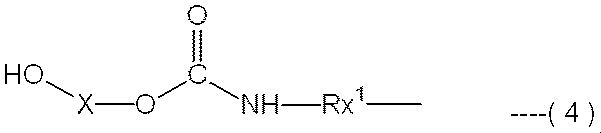
また、前記一般式(2)で表される構造を有するポリウレタン樹脂としては、例えば、下記一般式(4)で表される構造を有するポリウレタン樹脂等が挙げられる。 Examples of the polyurethane resin having the structure represented by the general formula (2) include a polyurethane resin having a structure represented by the following general formula (4).
前記一般式(3)及び一般式(4)中のRx1やRx2はそれぞれ同一でも良いし異なっていても良い。 Rx1 and Rx2 in the general formula (3) and the general formula (4) may be the same or different.
ここで、上記一般式(3)においてRx1および/またはRx2が後述する一般式(15)のR5に該当すると、一般式(15)に一般式(1)が結合した構造を有した分岐状ポリウレタン樹脂となる。上記一般式(4)においてRx1が後述する一般式(15)のR5に該当すると、一般式(15)に一般式(2)が結合した構造を有した分岐状ポリウレタン樹脂となる。 Here, when Rx1 and / or Rx2 in the general formula (3) corresponds to R5 of the general formula (15) described later, the branched polyurethane having a structure in which the general formula (1) is bonded to the general formula (15) It becomes resin. In the general formula (4), when Rx1 corresponds to R5 of the general formula (15) described later, a branched polyurethane resin having a structure in which the general formula (2) is bonded to the general formula (15) is obtained.
前記一般式(1)〜一般式(4)中のXとしては、例えば、下記構造等が挙げられる。 Examples of X in the general formulas (1) to (4) include the following structures.
本発明で用いるポリウレタン樹脂(A)としては、一般式(1)及び(2)のXが、前記一般式(5)、(6)、(7)、および(9)の群から選ばれる一種以上の構造を有するポリウレタン樹脂が、耐熱性に優れる硬化物を提供できるため好ましく、中でも、一般式(5)および一般式(6)で表される構造がより好ましい。特に本発明で用いるポリウレタン樹脂が後述するように硬化物に柔軟性を付与する構造を有する、例えば、後述する一般式(13)等の構造を有するポリウレタン樹脂の場合、一般式(1)や一般式(2)中のXは、一般式(6)で示される構造を有することが好ましい。 As the polyurethane resin (A) used in the present invention, X in the general formulas (1) and (2) is a kind selected from the group of the general formulas (5), (6), (7), and (9). The polyurethane resin having the above structure is preferable because it can provide a cured product having excellent heat resistance, and among them, the structures represented by the general formulas (5) and (6) are more preferable. In particular, the polyurethane resin used in the present invention has a structure that imparts flexibility to the cured product as described later. For example, in the case of a polyurethane resin having a structure such as the general formula (13) described later, the general formula (1) and the general X in the formula (2) preferably has a structure represented by the general formula (6).
前記一般式(5)や一般式(6)で示される構造中のR1としては、例えば、直接結合;カルボニル基、スルホニル基、メチレン基、イソプロピリデン基、ヘキサフルオロイソプロピリデン基、オキソ基、ジメチルシリレン基、フルオレン−9−ジイル基、およびトリシクロ[5.2.1.02,8]デカン−ジイル基等の2価の連結基等が挙げられる。R2としては、例えば、水素原子、メチル基、エチル基、プロピル基、ブチル基、ペンチル基、ヘキシル基、オクチル基、ノニル基、デシル基、ウンデシル基、ドデシル基、ヘキサデシル基、およびステアリル基等の炭素原子数1〜18のアルキル基等が挙げられる。また、一般式(7)で示される構造中のR3としての炭素原子数1〜18のアルキル基としては、例えば、メチル基、エチル基、プロピル基、ブチル基、ペンチル基、ヘキシル基、オクチル基、ノニル基、デシル基、ウンデシル基、ドデシル基、ヘキサデシル基、およびステアリル基等が挙げられる。 Examples of R1 in the structure represented by the general formula (5) or the general formula (6) include a direct bond; a carbonyl group, a sulfonyl group, a methylene group, an isopropylidene group, a hexafluoroisopropylidene group, an oxo group, and dimethyl group. And divalent linking groups such as a silylene group, a fluorene-9-diyl group, and a tricyclo [5.2.1.02,8] decane-diyl group. Examples of R2 include a hydrogen atom, methyl group, ethyl group, propyl group, butyl group, pentyl group, hexyl group, octyl group, nonyl group, decyl group, undecyl group, dodecyl group, hexadecyl group, and stearyl group. Examples thereof include an alkyl group having 1 to 18 carbon atoms. Examples of the alkyl group having 1 to 18 carbon atoms as R3 in the structure represented by the general formula (7) include a methyl group, an ethyl group, a propyl group, a butyl group, a pentyl group, a hexyl group, and an octyl group. , Nonyl group, decyl group, undecyl group, dodecyl group, hexadecyl group, stearyl group and the like.
尚、本発明において、カルボニル基は下記構造式(1a)、スルホニル基は下記構造式(1b)、メチレン基は下記構造式(1c)、イソプロピリデン基は下記構造式(1d)、ヘキサフルオロイソプロピリデン基は下記構造式(1e)、オキソ基は下記構造式(1f)、ジメチルシリレン基は下記構造式(1g)、フルオレン−9−ジイル基は下記構造式(1h)、そしてトリシクロ[5.2.1.02,8]デカン−ジイル基は下記構造式(1i)で表される。これらは、ビフェノール、テトラメチルビフェノール、ビスフェノールA、ビスフェノールF、ビスフェノールS、ナフタレンジオール、およびジシクロペンタジエン変性ビスフェノール等の残基である。(なお、図中の*は結合部位を表す。)また、ポリフェノール化合物、例えば、フェノールノボラック樹脂やクレゾールノボラック樹脂、ナフトールとアルキルフェノールとホルムアルデヒド縮合物とから合成されるポリフェノール樹脂等から2つの水酸基を除いた構造残基等でもよい。 In the present invention, the carbonyl group is the following structural formula (1a), the sulfonyl group is the following structural formula (1b), the methylene group is the following structural formula (1c), the isopropylidene group is the following structural formula (1d), and hexafluoroisopropylidene. The redene group has the following structural formula (1e), the oxo group has the following structural formula (1f), the dimethylsilylene group has the following structural formula (1g), the fluorene-9-diyl group has the following structural formula (1h), and tricyclo [5.2. The 1.02,8] decane-diyl group is represented by the following structural formula (1i). These are residues such as biphenol, tetramethylbiphenol, bisphenol A, bisphenol F, bisphenol S, naphthalenediol, and dicyclopentadiene modified bisphenol. (In the figure, * represents a binding site.) In addition, two hydroxyl groups are excluded from polyphenol compounds such as phenol novolac resin, cresol novolac resin, polyphenol resin synthesized from naphthol, alkylphenol and formaldehyde condensate. It may be a structural residue.
前記一般式(5)中のR1の中でも、直接結合、前記一般式(1b)、一般式(1c)、および一般式(1d)で示される構造が溶解性、相溶性に優れる熱硬化性ポリウレタン樹脂組成物が得られ、また、ポリウレタン樹脂(A)を得る際の合成もしやすいことから好ましい。また、前記R2の中でも、水素原子およびメチル基が好ましい。また、前記一般式(6)中のR1の中でも前記一般式(1i)で示される構造が耐熱性に優れる熱硬化性ポリウレタン樹脂組成物が得られることから好ましい。尚、前記一般式(1i)で示される構造は以下、下記に示す一般式(11)として表す。 Among R1 in the general formula (5), a thermosetting polyurethane in which the structure represented by the direct bond, the general formula (1b), the general formula (1c), and the general formula (1d) is excellent in solubility and compatibility. A resin composition is obtained, and it is preferable because synthesis is easy when obtaining the polyurethane resin (A). Of the R2, a hydrogen atom and a methyl group are preferable. Moreover, among R1 in the general formula (6), the structure represented by the general formula (1i) is preferable because a thermosetting polyurethane resin composition having excellent heat resistance can be obtained. The structure represented by the general formula (1i) is represented as the following general formula (11).
本発明で用いるポリウレタン樹脂(A)は、前記一般式(1)で表される構造および/または一般式(2)で表される構造を有すれば良いが、中でも前記一般式(1)で表される構造および一般式(2)で表される構造を有するポリウレタン樹脂を使用すると、硬化性が良好な熱硬化性樹脂組成物が得られることからより好ましい。ここで、前記一般式(1)で示される構造及び前記一般式(2)で示される構造中のXは同一でも良いし異なっていても良い。 The polyurethane resin (A) used in the present invention may have a structure represented by the general formula (1) and / or a structure represented by the general formula (2). It is more preferable to use a polyurethane resin having a structure represented by the structure represented by the general formula (2) and a thermosetting resin composition having good curability. Here, X in the structure represented by the general formula (1) and the structure represented by the general formula (2) may be the same or different.
また、前記一般式(6)で表される構造を有するポリウレタン樹脂としては、例えば、以下の構造を有するポリウレタン樹脂が挙げられる。 Moreover, as a polyurethane resin which has a structure represented by the said General formula (6), the polyurethane resin which has the following structures is mentioned, for example.
Rx1は、同一であっても異なっていても良く、ポリイソシアネート化合物から二つのイソシアネート基を除いた残基を示す。aおよびbは、それぞれ1〜10の整数であり、おのおの括られた核単位は、ランダムにつながっている。
そして1)aが1の場合は、一般式(2)の末端にポリフェノール構造が存在する形態となり、2)aが2の場合は、一般式(1)の分子主鎖中にポリフェノール構造が存在する形態となり、3)aが3以上の場合は、ポリウレタン樹脂の構造が分岐の形態となる。
更にaが1、2および3以上の形態が分子内に同時に存在していても良い。
Rx1 may be the same or different, and represents a residue obtained by removing two isocyanate groups from a polyisocyanate compound. a and b are each an integer of 1 to 10, and each of the bundled nuclear units is connected at random.
1) When a is 1, the polyphenol structure is present at the end of the general formula (2). 2) When a is 2, the polyphenol structure is present in the molecular main chain of the general formula (1). 3) When a is 3 or more, the polyurethane resin structure is branched.
Furthermore, a form in which a is 1, 2, and 3 or more may be simultaneously present in the molecule.
ポリウレタン樹脂(A)として前記一般式(1)で表される構造と一般式(2)で表される構造とを有するポリウレタン樹脂の具体例としては、例えば、下記一般式(12)で表される構造を有するポリウレタン樹脂等を挙げることができる。 Specific examples of the polyurethane resin having the structure represented by the general formula (1) and the structure represented by the general formula (2) as the polyurethane resin (A) include, for example, the following general formula (12). And a polyurethane resin having a structure.
ポリウレタン樹脂(A)の中でも、前記一般式(3)及び一般式(4)で示されるポリウレタン樹脂で、Rx1およびRx2が2官能のジイソシアネート化合物から2つのイソシアネート基を除いた残基である場合は、前記一般式(12)で示される様な線状の構造を有するポリウレタン樹脂となる。また、Rx1およびRx2が3官能以上のポリイソシアネート化合物から2つのイソシアネート基を除いた残基である場合は、分岐状の構造を有するポリウレタン樹脂となる。 Among the polyurethane resins (A), when Rx1 and Rx2 are residues obtained by removing two isocyanate groups from a bifunctional diisocyanate compound in the polyurethane resins represented by the general formula (3) and the general formula (4) The polyurethane resin has a linear structure as represented by the general formula (12). When Rx1 and Rx2 are residues obtained by removing two isocyanate groups from a tri- or higher functional polyisocyanate compound, a polyurethane resin having a branched structure is obtained.
前記一般式(2)中の末端の水酸基はフェノール性水酸基であり、このフェノール性水酸基は、多官能フェノール化合物の1個の水酸基がウレタン結合で樹脂骨格に連結した以外の残りのフェノール性水酸基である。一般式(2)で示される構造を得る際に用いる多価のフェノール性水酸基含有化合物は、2官能フェノール化合物が好ましいが、2官能フェノール化合物以外に3官能以上のポリフェノール化合物を使用あるいは併用し、末端に複数のフェノール性水酸基を残存させても良い。 The terminal hydroxyl group in the general formula (2) is a phenolic hydroxyl group, and this phenolic hydroxyl group is a remaining phenolic hydroxyl group other than one hydroxyl group of the polyfunctional phenol compound linked to the resin skeleton by a urethane bond. is there. The polyfunctional phenolic hydroxyl group-containing compound used for obtaining the structure represented by the general formula (2) is preferably a bifunctional phenol compound, but in addition to the bifunctional phenol compound, a trifunctional or higher polyphenol compound is used or used in combination. A plurality of phenolic hydroxyl groups may be left at the terminal.
本発明で用いるウレタン樹脂(A)は、一般式(1)および/または一般式(2)で示される様に、フェノール性水酸基とイソシアネート基とからなるウレタン結合を有する。
一般に、フェノール性水酸基とイソシアネート基とによるウレタン結合は、高温下で解離する為、フェノールやクレゾール等の低分子モノフェノール化合物などをイソシアネート基のブロック剤として使用することがある。しかしながらこうしたブロック剤は塗膜や成型物の硬化反応において解離し、揮発成分として気泡やボイドの発生原因となり、好ましいものではない。
本発明では、2価以上のポリフェノール化合物を用いてフェノール性水酸基の導入を行うため、硬化時の高温状況下で樹脂から解離しても揮発せず系内に残存する。その為、ポリウレタン樹脂(A)は積極的にエポキシ樹脂と架橋反応してより硬化する。また、イソシアネート基は、このフェノール性水酸基とエポキシ基との反応により生成するアルコール性水酸基とさらにウレタン化反応を行い、分子の新たな架橋構造を構築し、誘電特性に不利な水酸基をブロックすると考えられる。つまり、生成するウレタン結合が樹脂骨格と新たなネットワークを形成し、これにより良好な耐熱性あるいは機械物性を発現すると本発明者らは考えている。
The urethane resin (A) used in the present invention has a urethane bond composed of a phenolic hydroxyl group and an isocyanate group, as represented by the general formula (1) and / or the general formula (2).
In general, since the urethane bond between a phenolic hydroxyl group and an isocyanate group is dissociated at a high temperature, a low-molecular monophenol compound such as phenol or cresol may be used as an isocyanate group blocking agent. However, such a blocking agent is not preferable because it dissociates in the curing reaction of a coating film or a molded product and causes generation of bubbles and voids as volatile components.
In the present invention, since a phenolic hydroxyl group is introduced using a polyphenol compound having two or more valences, it does not volatilize and remains in the system even when dissociated from the resin under high temperature conditions during curing. Therefore, the polyurethane resin (A) is more cured by positively crosslinking with the epoxy resin. In addition, the isocyanate group is considered to block the hydroxyl group that is disadvantageous in dielectric properties by further urethanizing with the alcoholic hydroxyl group produced by the reaction between this phenolic hydroxyl group and the epoxy group, and building a new crosslinked structure of the molecule. It is done. That is, the present inventors consider that the urethane bond to be formed forms a new network with the resin skeleton, thereby expressing good heat resistance or mechanical properties.
また、本発明で用いるポリウレタン樹脂(A)が、前記一般式(2)で表される構造を有するポリウレタン樹脂である場合、末端にフェノール性水酸基を有するが、この水酸基もエポキシ樹脂と反応して硬化に寄与する。 Further, when the polyurethane resin (A) used in the present invention is a polyurethane resin having a structure represented by the general formula (2), it has a phenolic hydroxyl group at the terminal, and this hydroxyl group also reacts with the epoxy resin. Contributes to curing.
本発明の熱硬化性樹脂組成物に用いるポリウレタン樹脂(A)としては、更に下記一般式(13)で示される構造を有するポリウレタン樹脂を用いることにより、伸度が大きく、柔軟性に優れる硬化物が得られる。その為、例えば、ポリウレタン樹脂(A)の中でも、下記一般式(13)で示される構造を有するポリウレタン樹脂を含有する熱硬化性樹脂組成物はフレキシブル基板用の絶縁層用の樹脂組成物として好ましく用いることができる。 As the polyurethane resin (A) used in the thermosetting resin composition of the present invention, a cured product having high elongation and excellent flexibility by using a polyurethane resin having a structure represented by the following general formula (13). Is obtained. Therefore, for example, among the polyurethane resin (A), a thermosetting resin composition containing a polyurethane resin having a structure represented by the following general formula (13) is preferable as a resin composition for an insulating layer for a flexible substrate. Can be used.
前記一般式(13)中のYで示される少なくとも2個のアルコール性水酸基を有するポリオール化合物から2つの水酸基を除いた残基(残基構造)としては、例えば、1分子中に少なくとも2個のアルコール性水酸基を有するポリオレフィンポリオールから2つの水酸基を除いた残基、1分子中に少なくとも2個のアルコール性水酸基を有するポリエーテルポリオールから2つの水酸基を除いた残基、1分子中に少なくとも2個のアルコール性水酸基を有するポリカーボネートポリオールから2つの水酸基を除いた残基、1分子中に少なくとも2個のアルコール性水酸基を有するポリエステルポリオールから2つの水酸基を除いた残基および1分子中に少なくとも2個のアルコール性水酸基を有するポリシロキサンポリオールから2つの水酸基を除いた残基等を好ましく挙げることができる。さらにこれらの残基構造から選ばれる1種以上の残基構造及び/又は共重縮合体としてもよい。 Examples of the residue (residue structure) obtained by removing two hydroxyl groups from the polyol compound having at least two alcoholic hydroxyl groups represented by Y in the general formula (13) include at least two in one molecule. Residues obtained by removing two hydroxyl groups from a polyolefin polyol having an alcoholic hydroxyl group, residues obtained by removing two hydroxyl groups from a polyether polyol having at least two alcoholic hydroxyl groups in one molecule, and at least two in one molecule Residues obtained by removing two hydroxyl groups from a polycarbonate polyol having one alcoholic hydroxyl group, and residues obtained by removing two hydroxyl groups from a polyester polyol having at least two alcoholic hydroxyl groups in one molecule and at least two in one molecule Of two hydroxy acids from polysiloxane polyols with different alcoholic hydroxyl groups It can be exemplified preferably obtained by removing residues such as the. Furthermore, it is good also as 1 or more types of residue structures chosen from these residue structures, and / or a copolycondensate.
なお、前記一般式(13)中のYとしては、塗膜の柔軟性に加えて特に誘電特性等を向上させたい場合は、1分子中に少なくとも2個のアルコール性水酸基を有するポリオレフィンポリオールから2つの水酸基を除いた残基が好ましい。また、物性と耐加水分解性とを向上させたい場合は、1分子中に少なくとも2個のアルコール性水酸基を有するポリカーボネートポリオールから2つの水酸基を除いた残基が好ましい。 In addition, as Y in the general formula (13), in addition to the flexibility of the coating film, in particular, when it is desired to improve dielectric properties and the like, it is 2 from a polyolefin polyol having at least two alcoholic hydroxyl groups in one molecule. Residues excluding one hydroxyl group are preferred. Moreover, when improving physical properties and hydrolysis resistance, a residue obtained by removing two hydroxyl groups from a polycarbonate polyol having at least two alcoholic hydroxyl groups in one molecule is preferable.
前記一般式(13)中のYとしては、硬化物の伸度が大きく、且つ、柔軟性を保有させることができることから、数平均分子量が300〜5,000が好ましく、500〜3,000がより好ましい。また、一般式(13)中のYのガラス転移温度(Tg)としては0℃以下が好ましく、0〜−150℃がより好ましい。 As Y in the general formula (13), the number average molecular weight is preferably 300 to 5,000, and more preferably 500 to 3,000 because the elongation of the cured product is large and flexibility can be retained. More preferred. Moreover, as glass transition temperature (Tg) of Y in General formula (13), 0 degrees C or less is preferable and 0-150 degreeC is more preferable.
前記一般式(1)および/または一般式(2)、および一般式(13)で表される構造を有するポリウレタン樹脂としては、例えば、下記一般式(14)で表される構造を有するポリウレタン樹脂等が挙げられる。 Examples of the polyurethane resin having a structure represented by the general formula (1) and / or the general formula (2) and the general formula (13) include a polyurethane resin having a structure represented by the following general formula (14). Etc.
前記一般式(13)で表される構造を有するポリウレタン樹脂としては、前記一般式(1)および/または一般式(2)で表される構造および一般式(13)で表される構造を有すれば良いが、中でも前記一般式(1)で表される構造、一般式(2)で表される構造、および一般式(13)で表される構造をすべて有するポリウレタン樹脂が、耐熱性と硬化性とに優れる硬化物を提供できるため好ましい。ここで、前記一般式(1)で示される構造及び前記一般式(2)で示される構造中のXは同一でも良いし異なっていても良い。 The polyurethane resin having the structure represented by the general formula (13) has a structure represented by the general formula (1) and / or the general formula (2) and a structure represented by the general formula (13). However, the polyurethane resin having all the structure represented by the general formula (1), the structure represented by the general formula (2), and the structure represented by the general formula (13) This is preferable because a cured product having excellent curability can be provided. Here, X in the structure represented by the general formula (1) and the structure represented by the general formula (2) may be the same or different.
本発明で用いるポリウレタン樹脂(A)は下記一般式(15)で示される構造にて分岐しているポリウレタン樹脂が、他の樹脂成分との相溶性、溶剤溶解性の向上や得られる硬化塗膜の耐熱性が良好なことから好ましい。 The polyurethane resin (A) used in the present invention is a cured resin film in which the polyurethane resin branched in the structure represented by the following general formula (15) is improved in compatibility with other resin components and in solvent solubility. It is preferable because of its good heat resistance.
前記一般式(15)中のR5としては、例えば、芳香族系の残基構造、脂肪属系の残基構造、および脂環族系等の残基構造等が挙げられる。中でも、炭素原子数が4から13のものを好ましく使用することができる。R5の構造は、結晶化の防止や溶解性向上の面から2種以上の構造を併用したほうが好ましい。特に芳香族系の残基構造と脂肪族あるいは脂環族の残基構造との併用が好ましい。 Examples of R5 in the general formula (15) include aromatic residue structures, aliphatic residue structures, and alicyclic residue structures. Among these, those having 4 to 13 carbon atoms can be preferably used. As for the structure of R5, it is preferable to use two or more kinds of structures in combination from the viewpoint of preventing crystallization and improving solubility. In particular, the combined use of an aromatic residue structure and an aliphatic or alicyclic residue structure is preferred.
前記一般式(15)で示される構造にて分岐しているポリウレタン樹脂は、例えば、原料としてイソシアヌレート型ポリイソシアネート化合物を用いて合成することにより得られる。 The polyurethane resin branched in the structure represented by the general formula (15) can be obtained, for example, by synthesis using an isocyanurate type polyisocyanate compound as a raw material.
本発明で用いるポリウレタン樹脂(A)は、例えば、2個以上のフェノール性水酸基を有するポリフェノール化合物(a1)とポリイソシアネート化合物(a2)とを反応させることにより容易に得ることができる。具体的には、攪拌装置、温度計及びコンデンサーを付けたフラスコにポリフェノール化合物(a1)とポリイソシアネート化合物(a2)とを仕込み、攪拌を行いながら発熱に注意して昇温し、反応させる。50℃から250℃の範囲で昇温させることができるが、反応速度と副反応防止との面から70℃から180℃の温度で行うことが好ましい。また、ウレタン結合の解離を防ぐ為に70〜140℃で反応を行うことが更に好ましい。反応する際の時間としては、通常1〜20時間である。 The polyurethane resin (A) used in the present invention can be easily obtained, for example, by reacting a polyphenol compound (a1) having two or more phenolic hydroxyl groups with a polyisocyanate compound (a2). Specifically, the polyphenol compound (a1) and the polyisocyanate compound (a2) are charged into a flask equipped with a stirrer, a thermometer, and a condenser, and the temperature is raised while reacting while stirring and the reaction is performed. Although the temperature can be raised in the range of 50 ° C. to 250 ° C., it is preferably performed at a temperature of 70 ° C. to 180 ° C. in terms of reaction rate and prevention of side reactions. Moreover, in order to prevent dissociation of a urethane bond, it is still more preferable to react at 70-140 degreeC. The reaction time is usually 1 to 20 hours.
前記2個以上のフェノール性水酸基を有するポリフェノール化合物(a1)としては、例えば、ハイドロキノン、ビフェノール、テトラメチルビフェノール、エチリデンビスフェノール、ビスフェノールA、ビスフェノールF、ビスフェノールS、シクロヘキシリデンビスフェノール(ビスフェノールZ)、ジメチルブチリデンビスフェノール、4,4’−(1−メチルエチリデン)ビス〔2,6−ジメチルフェノール〕、4,4’−(1−フェニルエチリデン)ビスフェノール、5,5’−(1−メチルエチリデン)ビス〔1,1’−ビフェニル−2−オール〕、ナフタレンジオール、ジシクロペンタジエン変性ビスフェノール、9,10−ジヒドロ−9−オキサ−10−フォスファフェナンスレン−10−オキサイドとハイドロキノンとの反応生成物等が挙げられる。 Examples of the polyphenol compound (a1) having two or more phenolic hydroxyl groups include hydroquinone, biphenol, tetramethylbiphenol, ethylidene bisphenol, bisphenol A, bisphenol F, bisphenol S, cyclohexylidene bisphenol (bisphenol Z), and dimethyl. Butylidenebisphenol, 4,4 ′-(1-methylethylidene) bis [2,6-dimethylphenol], 4,4 ′-(1-phenylethylidene) bisphenol, 5,5 ′-(1-methylethylidene) bis [1,1′-biphenyl-2-ol], naphthalenediol, dicyclopentadiene-modified bisphenol, 9,10-dihydro-9-oxa-10-phosphaphenanthrene-10-oxide and hydroquinone Response product, and the like.
ポリフェノール化合物(a1)として、フェノールノボラック樹脂、クレゾールノボラック樹脂及びノニルフェノールノボラック樹脂等のアルキルフェノールのノボラック樹脂等の3官能以上のフェノール化合物も使用可能である。 As the polyphenol compound (a1), a trifunctional or higher functional phenol compound such as a novolak resin of an alkylphenol such as a phenol novolak resin, a cresol novolak resin, and a nonylphenol novolak resin can also be used.
ポリフェノール化合物(a1)としては2個のフェノール性水酸基を含有するポリフェノール化合物、つまり2官能のポリフェノール化合物を使用することが好ましい。中でも、ビスフェノールA、ビスフェノールF、およびビスフェノールS等のビスフェノール系化合物がより好ましい。 As the polyphenol compound (a1), it is preferable to use a polyphenol compound containing two phenolic hydroxyl groups, that is, a bifunctional polyphenol compound. Among these, bisphenol compounds such as bisphenol A, bisphenol F, and bisphenol S are more preferable.
また、難燃性や耐熱性に優れる硬化物が得られることから、ポリウレタン樹脂(A)を得る際に、ナフタレンジオールや9,10−ジヒドロ−9−オキサ−10−フォスファフェナンスレン−10−オキサイドとハイドロキノンとの反応生成物を使用することが好ましい。 Moreover, since the hardened | cured material excellent in a flame retardance and heat resistance is obtained, when obtaining a polyurethane resin (A), naphthalene diol, 9,10-dihydro-9-oxa-10-phosphaphenanthrene-10 It is preferred to use a reaction product of oxide and hydroquinone.
尚、本発明の効果を損なわない範囲で一部、フェノールやクレゾール等の一官能性のフェノール化合物を併用しても良い。 In addition, you may use together monofunctional phenolic compounds, such as a phenol and a cresol, in the range which does not impair the effect of this invention.
本発明で用いるポリイソシアネート化合物(a2)としては、例えば、芳香族ポリイソシアネート化合物、および脂肪族ポリイソシアネート化合物等が使用可能である。 As a polyisocyanate compound (a2) used by this invention, an aromatic polyisocyanate compound, an aliphatic polyisocyanate compound, etc. can be used, for example.
前記芳香族ポリイソシアネート化合物としては、例えば、p−フェニレンジイソシアネート、m−フェニレンジイソシアネート、p−キシレンジイソシアネート、m−キシレンジイソシアネート、2,4−トリレンジイソシアネート、2,6−トリレンジイソシアネート、4,4′−ジフェニルメタンジイソシアネート、3,3′−ジメチルジフェニル−4,4′−ジイソシアネート、3,3′−ジエチルジフェニル−4,4′−ジイソシアネート、m−キシレンジイソシアネート、p−キシレンジイソシアネート、1,3−ビス(α,α−ジメチルイソシアナートメチル)ベンゼン、テトラメチルキシリレンジイソシアネート、ジフェニレンエーテル−4,4′−ジイソシアネート、およびナフタレンジイソシアネート等の芳香族ジイソシアネート化合物等が挙げられる。 Examples of the aromatic polyisocyanate compound include p-phenylene diisocyanate, m-phenylene diisocyanate, p-xylene diisocyanate, m-xylene diisocyanate, 2,4-tolylene diisocyanate, 2,6-tolylene diisocyanate, 4,4. '-Diphenylmethane diisocyanate, 3,3'-dimethyldiphenyl-4,4'-diisocyanate, 3,3'-diethyldiphenyl-4,4'-diisocyanate, m-xylene diisocyanate, p-xylene diisocyanate, 1,3-bis Aromatic diisocyanates such as (α, α-dimethyl isocyanate methyl) benzene, tetramethylxylylene diisocyanate, diphenylene ether-4,4′-diisocyanate, and naphthalene diisocyanate Over preparative compounds.
前記脂肪族ポリイソシアネート化合物としては、例えば、ヘキサメチレンジイソシアネート、リジンジイソシアネート、トリメチルヘキサメチレンメチレンジイソシアネート、イソホロンジイソシアネート、4,4′−ジシクロヘキシルメタンジイソシアネート、水素添加キシレンジイソシアネート、およびノルボヌレンジイソシアネート等が挙げられる。 Examples of the aliphatic polyisocyanate compound include hexamethylene diisocyanate, lysine diisocyanate, trimethylhexamethylenemethylene diisocyanate, isophorone diisocyanate, 4,4′-dicyclohexylmethane diisocyanate, hydrogenated xylene diisocyanate, and norbornylene diisocyanate. .
また前記ポリイソシアネート化合物(a2)として、前記ポリイソシアネート化合物(a2)と各種ポリオール成分とをイソシアネート基過剰で予め反応させたイソシアネートプレポリマーを使用または併用することも可能である。 As the polyisocyanate compound (a2), an isocyanate prepolymer obtained by reacting the polyisocyanate compound (a2) and various polyol components in advance with an excess of isocyanate groups can be used or used in combination.
本発明の熱硬化性ポリウレタン樹脂組成物に用いるポリウレタン樹脂(A)は、分岐構造をとることにより、溶剤溶解性や硬化剤等その他の樹脂成分との相溶性が向上するためより好ましい。かかる分岐の手法としては、ポリイソシアネート化合物(a2)として、例えば、前記ジイソシアネート化合物等のイソシアヌレート体であるイソシアヌレート環を有する3官能以上のポリイソシアネート化合物の単独、あるいはこうしたポリイソシアネート化合物と前記ジイソシアネート化合物との混合物を使用することが好ましい。 The polyurethane resin (A) used in the thermosetting polyurethane resin composition of the present invention is more preferable because of having a branched structure, the solubility in solvents and the compatibility with other resin components such as a curing agent are improved. As the branching method, as the polyisocyanate compound (a2), for example, a tri- or higher functional polyisocyanate compound having an isocyanurate ring, which is an isocyanurate body such as the diisocyanate compound, or such polyisocyanate compound and the diisocyanate is used. Preference is given to using mixtures with compounds.
前記イソシアヌレート環を有する3官能以上のポリイソシアネート化合物は、例えば、1種または2種以上のジイソシアネート化合物を第4級アンモニウム塩等のイソシアヌレート化触媒の存在下あるいは非存在下において、イソシアヌレート化することにより得られるものであって、3量体、5量体、および7量体等のイソシアヌレートの混合物からなるもの等が挙げられる。前記ポリイソシアネート化合物のイソシアヌレート体の具体例としては、イソホロンジイソシアネートのイソシアヌレート型ポリイソシアネート、ヘキサメチレンジイソシアネートのイソシアヌレート型ポリイソシアネート、水素添加キシレンジイソシアネートのイソシアヌレート型ポリイソシアネート、ノルボルナンジイソシアネートのイソシアヌレート型ポリイソシアネート等脂肪族系ポリイソシアネート類やジフェニルメタンジイソシアネートのイソシアヌレート型ポリイソシアネート、トリレンジイソシアネートのイソシアヌレート型ポリイソシアネート、キシレンジイソシアネートのイソシアヌレート型ポリイソシアネート、およびナフタレンジイソシアネートのイソシアヌレート型ポリイソシアネート等が挙げられる。 The trifunctional or higher functional polyisocyanate compound having an isocyanurate ring is formed by, for example, converting one or two or more diisocyanate compounds into an isocyanurate in the presence or absence of an isocyanuration catalyst such as a quaternary ammonium salt. And those made of a mixture of isocyanurates such as trimer, pentamer, and heptamer. Specific examples of the isocyanurate form of the polyisocyanate compound include isophorone diisocyanate isocyanurate type polyisocyanate, hexamethylene diisocyanate isocyanurate type polyisocyanate, hydrogenated xylene diisocyanate isocyanurate type polyisocyanate, norbornane diisocyanate isocyanurate type. Aliphatic polyisocyanates such as polyisocyanate, isocyanurate type polyisocyanate of diphenylmethane diisocyanate, isocyanurate type polyisocyanate of tolylene diisocyanate, isocyanurate type polyisocyanate of xylene diisocyanate, isocyanurate type polyisocyanate of naphthalene diisocyanate, etc. It is done.
ポリイソシアネート化合物(a2)として、ジイソシアネート化合物とイソシアヌレート環を有する3官能以上のジイソシアネート化合物と併用する場合、ジイソシアネート化合物としての芳香族ジイソシアネートと、前記イソシアヌレート環を有する3官能以上のジイソシアネート化合物としての脂肪族ジイソシアネートのイソシヌレート型ポリイソシアネートおよび/または脂環式ジイソシアネートのイソシヌレート型ポリイソシアネートとを含有する混合物を用いるのが好ましい。 When the polyisocyanate compound (a2) is used in combination with a diisocyanate compound and a trifunctional or higher functional diisocyanate compound having an isocyanurate ring, the aromatic diisocyanate as the diisocyanate compound and the trifunctional or higher functional diisocyanate compound having the isocyanurate ring are used. It is preferable to use a mixture containing an isocyanurate type polyisocyanate of an aliphatic diisocyanate and / or an isocyaninate type polyisocyanate of an alicyclic diisocyanate.
前記ポリイソシアネート化合物(a2)として脂肪族ジイソシアネート化合物を用いると、溶解性に優れる熱硬化性ポリウレタン樹脂組成物が得られ、且つ、電気特性が良好な硬化塗膜が得られることからより好ましい。 When an aliphatic diisocyanate compound is used as the polyisocyanate compound (a2), a thermosetting polyurethane resin composition having excellent solubility can be obtained, and a cured coating film having good electrical characteristics can be obtained, which is more preferable.
更に、ポリイソシアネート化合物(a2)は、前記以外のポリイソシアネート化合物、例えば、前記ジイソシアネート化合物や前記ジイソシアネートのビュレット体、アダクト体、アロハネート体、あるいはポリメチレンポリフェニルポリイソシアネート(クルードMDI)等と併用しても良い。 Furthermore, the polyisocyanate compound (a2) is used in combination with a polyisocyanate compound other than the above, for example, the diisocyanate compound, a buret body, an adduct body, an allohanate body of the diisocyanate, or a polymethylene polyphenyl polyisocyanate (crude MDI). May be.
本発明で用いるポリイソシアネート化合物(a2)は、溶剤溶解性が良好な熱硬化性ポリウレタン樹脂組成物が得られることから、2種以上のポリイソシアネート化合物を併用することが好ましい。加えて耐熱性に優れる硬化塗膜が得られることから上述のイソシアヌレート体を併用することが好ましい。イソシアヌレート体を併用する場合は、全ポリイソシアネート化合物(a2)量の70重量%以下に設定することが樹脂の高分子量化やゲル化を防ぐ意味で好ましい。 The polyisocyanate compound (a2) used in the present invention is preferably a combination of two or more polyisocyanate compounds since a thermosetting polyurethane resin composition having good solvent solubility can be obtained. In addition, since the cured coating film excellent in heat resistance is obtained, it is preferable to use the isocyanurate body in combination. When using an isocyanurate body together, it is preferable to set it to 70 weight% or less of the amount of all the polyisocyanate compounds (a2) in the sense of preventing the high molecular weight and gelation of the resin.
ポリフェノール化合物(a1)とポリイソシアネート化合物(a2)との反応に際しては、ポリイソシアネート化合物(a2)に対してポリフェノール化合物(a1)が反応する。末端をフェノール性水酸基として残存させる為には、ポリフェノール化合物(a1)中のフェノール性水酸基のモル数がポリイソシアネート化合物(a2)中のイソシアネート基のモル数より大きくなる条件で反応させることが好ましい。合成上の安定性や硬化物の各種性能を考慮すると、上記フェノール性水酸基のモル数とイソシアネート基のモル数との比〔(a1)中のフェノール性水酸基のモル数/(a2)中のイソシアネート基のモル数〕が1から10の範囲が好ましく、より好ましくは1.05から7の範囲である。 In the reaction of the polyphenol compound (a1) and the polyisocyanate compound (a2), the polyphenol compound (a1) reacts with the polyisocyanate compound (a2). In order to leave the terminal as a phenolic hydroxyl group, the reaction is preferably performed under the condition that the number of moles of the phenolic hydroxyl group in the polyphenol compound (a1) is larger than the number of moles of the isocyanate group in the polyisocyanate compound (a2). Considering the stability in synthesis and various performances of the cured product, the ratio of the number of moles of phenolic hydroxyl group to the number of moles of isocyanate group [number of moles of phenolic hydroxyl group in (a1) / isocyanate in (a2) The number of moles of the group] is preferably in the range of 1 to 10, more preferably in the range of 1.05 to 7.
得られるポリウレタン樹脂の安定性が良好となることから、反応はイソシアネート基がほぼ全て反応するまで行った方が好ましい。また、若干残存するイソシアネート基に対して、アルコールやフェノール化合物を添加し反応させても良い。 Since the stability of the resulting polyurethane resin becomes good, it is preferable to carry out the reaction until almost all isocyanate groups have reacted. Moreover, you may make it react by adding an alcohol and a phenol compound with respect to the isocyanate group which remains a little.
ところで、前記一般式(13)で表される構造を更に有するポリウレタン樹脂は、例えば、前記2個以上のフェノール性水酸基を有するポリフェノール化合物(a1)と前記ポリイソシアネート化合物(a2)とポリオール化合物(a3)とを反応させる製造方法により容易に得ることができる。 By the way, the polyurethane resin further having the structure represented by the general formula (13) is, for example, the polyphenol compound (a1) having two or more phenolic hydroxyl groups, the polyisocyanate compound (a2), and the polyol compound (a3). ) Can be easily obtained by a production method.
前記ポリオール化合物(a3)としては、例えば、ポリオレフィンポリオール、ポリエーテルポリオール、ポリカーボネートポリオール、ポリエステルポリオール、ポリシロキサンポリオール等が挙げられる。ポリオール化合物(a3)は単独あるいは2種以上を併用しても良い。また、ポリオール化合物(a3)としては、前記ポリオレフィンポリオール、ポリエーテルポリオール、ポリカーボネートポリオール、ポリエステルポリオール、およびポリシロキサンポリオール等の2種以上の共重縮合構造を有するポリオール類も使用しても良い。 Examples of the polyol compound (a3) include polyolefin polyol, polyether polyol, polycarbonate polyol, polyester polyol, and polysiloxane polyol. The polyol compound (a3) may be used alone or in combination of two or more. Moreover, as the polyol compound (a3), polyols having two or more kinds of copolycondensation structures such as the polyolefin polyol, polyether polyol, polycarbonate polyol, polyester polyol, and polysiloxane polyol may be used.
前記ポリオレフィンポリオールとしては、例えば、ポリオレフィン構造やポリジエン構造を有するポリオール化合物等が挙げられる。具体的には、例えば、ポリエチレン系ポリオール、ポリプロピレン系ポリオール、ポリブタジエンポリオール、水素添加ポリブタジエンポリオール、ポリイソプレンポリオール、および水素添加ポリイソプレンポリオール等が挙げられる。なかでもポリブタジエンポリオールおよび/または水素添加ポリブタジエンポリオールが好ましく、さらにそのなかでも水素添加ポリブタジエンポリオールがより好ましく、ポリオレフィンジオールが特に好ましい。
また、前記ポリオレフィンポリオールの脂肪族構造部分の数平均分子量は300〜6,000の範囲が好ましい。
Examples of the polyolefin polyol include polyol compounds having a polyolefin structure or a polydiene structure. Specific examples include polyethylene polyols, polypropylene polyols, polybutadiene polyols, hydrogenated polybutadiene polyols, polyisoprene polyols, and hydrogenated polyisoprene polyols. Of these, polybutadiene polyol and / or hydrogenated polybutadiene polyol are preferable, and hydrogenated polybutadiene polyol is more preferable, and polyolefin diol is particularly preferable.
The number average molecular weight of the aliphatic structure portion of the polyolefin polyol is preferably in the range of 300 to 6,000.
前記ポリエーテルポリオールとしては、例えば、ポリエチレングリコール、ポリプロピレングリコール、ポリテトラメチレングリコール、ポリブチレングリコール等のアルキレンエーテルポリオールやこれらポリアルキレンポリオールの共重合体が挙げられる。また、単独で用いても2種類以上併用しても良い。 Examples of the polyether polyol include alkylene ether polyols such as polyethylene glycol, polypropylene glycol, polytetramethylene glycol, and polybutylene glycol, and copolymers of these polyalkylene polyols. Moreover, you may use individually or may use 2 or more types together.
前記ポリカーボネートポリオールとしては、例えば、プロピレンジオール、ブタンジオール、ペンタンジオール、ヘキサンジオール、メチルペンタンジオール、シクロヘキサンジメタノール等から得られるポリアルキレンカーボネートポリオールやビスフェノールAやビスフェノールF,S等のアルキレンオキサイド付加ジオール等から得られるポリカーボネートポリオールやこれらの共重合体等が挙げられる。 Examples of the polycarbonate polyol include polyalkylene carbonate polyols obtained from propylene diol, butane diol, pentane diol, hexane diol, methyl pentane diol, cyclohexane dimethanol and the like, and alkylene oxide addition diols such as bisphenol A and bisphenol F and S. Polycarbonate polyols obtained from the above, copolymers thereof, and the like.
前記ポリエステルポリオールとしては、例えば、アルキレンジオールと、多価カルボン酸とのエステル化物、多価カルボン酸のアルキルエステルとのエステル交換反応物、およびεカプロラクトン系ポリラクトンポリオール等のポリラクトンポリオール等が挙げられる。 Examples of the polyester polyol include esterification products of alkylene diols and polyvalent carboxylic acids, transesterification products of alkyl esters of polyvalent carboxylic acids, and polylactone polyols such as ε-caprolactone-based polylactone polyols. It is done.
前記ポリシロキサンポリオールとしては、例えば、ジメチルポリシロキサンポリオールやメチルフェニルポリシロキサンポリオール等が挙げられる。 Examples of the polysiloxane polyol include dimethyl polysiloxane polyol and methylphenyl polysiloxane polyol.
本発明で用いるポリオール化合物(a3)としては、特に誘電特性等を向上させたい場合は、ポリオレフィンポリオールやポリシロキサンポリオールが好ましく、物性と耐加水分解性とを向上させたい場合は、ポリカーボネートポリオールが好ましい。 The polyol compound (a3) used in the present invention is preferably a polyolefin polyol or a polysiloxane polyol, particularly when it is desired to improve dielectric properties, and a polycarbonate polyol is preferred when it is desired to improve physical properties and hydrolysis resistance. .
本発明で用いるポリオール化合物(a3)としては、水酸基を1.5〜4個有するポリオール化合物が合成しやすいので好ましく、そのなかでも水酸基を2個有するポリオール化合物、つまりジオール化合物がより好ましい。 As the polyol compound (a3) used in the present invention, a polyol compound having 1.5 to 4 hydroxyl groups is easily synthesized, and among them, a polyol compound having 2 hydroxyl groups, that is, a diol compound is more preferable.
前記ジオール化合物の中でも、ポリオレフィンジオール、ポリエーテルジオール、ポリカーボネートジオール、ポリエステルジオール、およびポリシロキサンジオールからなる群から選ばれる1種以上のポリオール化合物がより好ましい。 Among the diol compounds, one or more polyol compounds selected from the group consisting of polyolefin diol, polyether diol, polycarbonate diol, polyester diol, and polysiloxane diol are more preferable.
また、前記ポリオール化合物(a3)としては、十分な伸度が得られ、且つ、強度も強い塗膜が得られることから、数平均分子量300〜5,000のポリオール化合物が好ましく、数平均分子量500〜3,000がより好ましい。 The polyol compound (a3) is preferably a polyol compound having a number average molecular weight of 300 to 5,000 because a sufficient elongation and a strong coating film can be obtained. -3,000 is more preferable.
ポリオール化合物(a3)のTgは、0℃以下であることが硬化物の伸度や柔軟性を高く設計できる点で好ましく、0〜−150℃がより好ましい。 The Tg of the polyol compound (a3) is preferably 0 ° C. or less from the viewpoint that the degree of elongation and flexibility of the cured product can be designed to be high, and more preferably 0 to −150 ° C.
本発明で用いるポリウレタン樹脂(A)として前記一般式(13)で表される構造を更に有するポリウレタン樹脂を調製する際には、ポリイソシアネート化合物(a2)に対してポリフェノール化合物(a1)とポリオール化合物(a3)とがおのおの反応する。末端をフェノール性水酸基として残存させる為には、ポリフェノール化合物(a1)中のフェノール性水酸基のモル数(m(a1)モル)とポリオール化合物(a3)中のアルコール性水酸基のモル数(m(a3)モル)との合計モル量が、ポリイソシアネート化合物(a2)中のイソシアネート基のモル数(m(a2)モル)より大きくなる条件で反応させることが好ましい。合成上の安定性や硬化物の各種性能を考慮すると、{m(a1)+m(a3)}/m(a2)が1から10の範囲であり、より好ましくは1.1から7の範囲である。またm(a1)とm(a3)との合計の重量に対してm(a1)およびm(a3)はおのおの5重量%以上存在していることがより好ましく、10%以上存在していることがより好ましい。 When preparing the polyurethane resin further having the structure represented by the general formula (13) as the polyurethane resin (A) used in the present invention, the polyphenol compound (a1) and the polyol compound with respect to the polyisocyanate compound (a2). (A3) reacts with each. In order to leave the terminal as a phenolic hydroxyl group, the number of moles of the phenolic hydroxyl group (m (a1) mole) in the polyphenol compound (a1) and the number of moles of the alcoholic hydroxyl group in the polyol compound (a3) (m (a3 ) Mol) is preferably reacted under the condition that the total molar amount with respect to the number of moles of isocyanate groups in the polyisocyanate compound (a2) (m (a2) mol) is larger. Considering the stability in synthesis and various performances of the cured product, {m (a1) + m (a3)} / m (a2) is in the range of 1 to 10, more preferably in the range of 1.1 to 7. is there. Further, it is more preferable that m (a1) and m (a3) are present in an amount of 5% by weight or more, and more preferably 10% or more of the total weight of m (a1) and m (a3). Is more preferable.
本発明で用いるウレタン樹脂(A)の製造方法において、有機溶剤を使用すると均一な反応を進行できるため好ましい。ここで有機溶剤は、系中にあらかじめ存在させてから反応を行っても、途中で導入してもよい。また、適切な反応速度を維持するためには、系中の有機溶剤の割合は、反応系の80重量%以下であるが好ましく、10〜70重量%であることがより好ましい。かかる有機溶剤としては、原料成分としてイソシアネート基を含有する化合物を使用するため、水酸基やアミノ基等の活性プロトンを有しない非プロトン性極性有機溶剤が好ましい。 In the method for producing the urethane resin (A) used in the present invention, it is preferable to use an organic solvent because a uniform reaction can proceed. Here, the organic solvent may be present after being present in the system in advance or may be introduced in the middle. In order to maintain an appropriate reaction rate, the proportion of the organic solvent in the system is preferably 80% by weight or less of the reaction system, and more preferably 10 to 70% by weight. As such an organic solvent, since a compound containing an isocyanate group is used as a raw material component, an aprotic polar organic solvent having no active proton such as a hydroxyl group or an amino group is preferable.
前記非プロトン性極性有機溶剤としては、例えば、ジメチルホルムアミド、ジメチルアセトアミド、N−メチル−2−ピロリドン、ジメチルスルフォキシド、スルホラン、およびγ−ブチロラクトンなどの極性有機溶媒を使用することができる。また、上記溶媒以外に、溶解可能であれば、エーテル系溶剤、エステル系溶剤、ケトン系溶剤、および石油系溶剤等を使用しても良い。また、各種溶剤を混合して使用しても良い。 As the aprotic polar organic solvent, for example, polar organic solvents such as dimethylformamide, dimethylacetamide, N-methyl-2-pyrrolidone, dimethyl sulfoxide, sulfolane, and γ-butyrolactone can be used. In addition to the above solvents, ether solvents, ester solvents, ketone solvents, petroleum solvents and the like may be used as long as they are soluble. Various solvents may be mixed and used.
かかるエーテル系溶剤としては、例えば、エチレングリコールジメチルエーテル、エチレングリコールジエチルエーテル、エチレングリコールジブチルエーテル等のエチレングリコールジアルキルエーテル類;ジエチレングリコールジメチルエーテル、ジエチレングリコールジエチルエーテル、ジエチレングリコールジブチルエーテル、トリエチレングリコールジメチルエーテル、トリエチレングリコールジエチルエーテル、トリエチレングリコールジブチルエーテル等のポリエチレングリコールジアルキルエーテル類;エチレングリコールモノメチルエーテルアセテート、エチレングリコールモノエチルエーテルアセテート、エチレングリコールモノブチルエーテルアセテート等のエチレングリコールモノアルキルエーテルアセテート類;ジエチレングリコールモノメチルエーテルアセテート、ジエチレングリコールモノエチルエーテルアセテート、ジエチレングリコールモノブチルエーテルアセテート、トリエチレングリコールモノメチルエーテルアセテート、トリエチレングリコールモノエチルエーテルアセテート、トリエチレングリコールモノブチルエーテルアセテート等のポリエチレングリコールモノアルキルエーテルアセテート類; Examples of the ether solvent include ethylene glycol dialkyl ethers such as ethylene glycol dimethyl ether, ethylene glycol diethyl ether, and ethylene glycol dibutyl ether; diethylene glycol dimethyl ether, diethylene glycol diethyl ether, diethylene glycol dibutyl ether, triethylene glycol dimethyl ether, and triethylene glycol diethyl. Polyethylene glycol dialkyl ethers such as ether and triethylene glycol dibutyl ether; ethylene glycol monoalkyl ether acetates such as ethylene glycol monomethyl ether acetate, ethylene glycol monoethyl ether acetate and ethylene glycol monobutyl ether acetate; Ethylene glycol monomethyl ether acetate, diethylene glycol monoethyl ether acetate, diethylene glycol monobutyl ether acetate, triethylene glycol monomethyl ether acetate, triethylene glycol monoethyl ether acetate, polyethylene glycol monoalkyl ether acetates such as triethylene glycol monobutyl ether acetate;
プロピレングリコールジメチルエーテル、プロピレングリコールジエチルエーテル、プロピレングリコールジブチルエーテル等のプロピレングリコールジアルキルエーテル類;ジプロピレングリコールジメチルエーテル、ジプロピレングリコールジエチルエーテル、ジプロピレングリコールジブチルエーテル、トリプロピレングリコールジメチルエーテル、トリプロピレングリコールジエチルエーテル、トリプロピレングリコールジブチルエーテル等のポリプロピレングリコールジアルキルエーテル類;プロピレングリコールモノメチルエーテルアセテート、プロピレングリコールモノエチルエーテルアセテート、プロピレングリコールモノブチルエーテルアセテート等のプロピレングリコールモノアルキルエーテルアセテート類;ジプロピレングリコールモノメチルエーテルアセテート、ジプロピレングリコールモノエチルエーテルアセテート、ジプロピレングリコールモノブチルエーテルアセテート、トリプロピレングリコールモノメチルエーテルアセテート、トリプロピレングリコールモノエチルエーテルアセテート、トリプロピレングリコールモノブチルエーテルアセテート等のポリプロピレングリコールモノアルキルエーテルアセテート類;低分子のエチレン−プロピレン共重合体等の共重合ポリエーテルグリコールのジアルキルエーテル類;共重合ポリエーテルグリコールのモノアセテートモノアルキルエーテル類;共重合ポリエーテルグリコールのアルキルエステル類;および共重合ポリエーテルグリコールのモノアルキルエステルモノアルキルエーテル類等が挙げられる。 Propylene glycol dialkyl ethers such as propylene glycol dimethyl ether, propylene glycol diethyl ether, propylene glycol dibutyl ether; dipropylene glycol dimethyl ether, dipropylene glycol diethyl ether, dipropylene glycol dibutyl ether, tripropylene glycol dimethyl ether, tripropylene glycol diethyl ether, tripropylene glycol Polypropylene glycol dialkyl ethers such as propylene glycol dibutyl ether; propylene glycol monoalkyl ether acetates such as propylene glycol monomethyl ether acetate, propylene glycol monoethyl ether acetate, propylene glycol monobutyl ether acetate; Polypropylene glycol monoalkyl ether acetate such as triglycol monomethyl ether acetate, dipropylene glycol monoethyl ether acetate, dipropylene glycol monobutyl ether acetate, tripropylene glycol monomethyl ether acetate, tripropylene glycol monoethyl ether acetate, tripropylene glycol monobutyl ether acetate Dialkyl ethers of copolymerized polyether glycols such as low molecular weight ethylene-propylene copolymers; monoacetate monoalkyl ethers of copolymerized polyether glycols; alkyl esters of copolymerized polyether glycols; Examples include ether glycol monoalkyl esters and monoalkyl ethers. It is.
エステル系溶剤としては、例えば、酢酸エチルおよび酢酸ブチル等が挙げられる。
ケトン系溶剤としては、アセトン、メチルエチルケトン、およびシクロヘキサノン等が挙げられる。
また、石油系溶剤としては、トルエン、キシレンやその他高沸点の芳香族溶剤等や、ヘキサン、シクロヘキサン等の脂肪族および脂環族溶剤を使用することも可能である。
Examples of the ester solvent include ethyl acetate and butyl acetate.
Examples of the ketone solvent include acetone, methyl ethyl ketone, and cyclohexanone.
In addition, as the petroleum solvent, it is also possible to use toluene, xylene, other high-boiling aromatic solvents, and aliphatic and alicyclic solvents such as hexane and cyclohexane.
本発明で用いるポリウレタン樹脂(A)の重量平均分子量は、溶剤溶解性が良好な熱硬化性樹脂組成物が得られ、且つ、種々の物性に優れる硬化塗膜が得られることから、800〜50,000が好ましく、1,000〜20,000がより好ましい。 The polyurethane resin (A) used in the present invention has a weight average molecular weight of 800 to 50 because a thermosetting resin composition having good solvent solubility is obtained and a cured coating film having various physical properties is obtained. 1,000 is preferable, and 1,000 to 20,000 is more preferable.
尚、本発明で用いるポリウレタン樹脂(A)およびポリイミド樹脂(C)等の樹脂の重量平均分子量の測定は、ゲルパーミエーションクロマトグラフを用い、下記の条件でポリスチレン換算により求めた。
測定装置 ; 東ソー株式会社製 HLC−8220GPC
カラム ; 東ソー株式会社製ガードカラムSUPER HZ−H
+東ソー株式会社製 TSKgel SUPER HZm−mを4本
検出器 ; RI(示差屈折計)
データ処理:東ソー株式会社製 GPC−8020
測定条件: カラム温度 40℃
溶媒 テトラヒドロフラン
流速 0.35ml/min
標準 ;ポリスチレン
試料 ;樹脂固形分換算で0.2重量%のテトラヒドロフラン溶液をマイクロフィルターでろ過したもの(100ml)
In addition, the measurement of weight average molecular weights of resin, such as a polyurethane resin (A) used in this invention and a polyimide resin (C), was calculated | required by polystyrene conversion on the following conditions using the gel permeation chromatograph.
Measuring device: HLC-8220GPC manufactured by Tosoh Corporation
Column: Guard column SUPER HZ-H manufactured by Tosoh Corporation
+ 4 TSKgel SUPER HZm-m manufactured by Tosoh Corporation Detector; RI (differential refractometer)
Data processing: GPC-8020 manufactured by Tosoh Corporation
Measurement conditions: Column temperature 40 ° C
Solvent tetrahydrofuran
Flow rate 0.35ml / min
Standard: Polystyrene sample: 0.2% by weight tetrahydrofuran solution in terms of resin solids filtered through a microfilter (100 ml)
本発明で用いるポリウレタン樹脂(A)のフェノール性水酸基当量は、400〜50,000が好ましい。 The phenolic hydroxyl group equivalent of the polyurethane resin (A) used in the present invention is preferably 400 to 50,000.
本発明で用いる熱硬化性樹脂組成物中のポリイミド樹脂(C)は、前記一般式(1)および/または前記一般式(2)で表されるようにウレタン結合としてイソシアネート基とフェノール性水酸基とが連結した構造を有する。ポリイミド樹脂(C)としては、なかでも有機溶剤に溶解するポリイミド樹脂が取り扱い易いことから好ましい。 The polyimide resin (C) in the thermosetting resin composition used in the present invention has an isocyanate group and a phenolic hydroxyl group as urethane bonds as represented by the general formula (1) and / or the general formula (2). Have a connected structure. As the polyimide resin (C), a polyimide resin dissolved in an organic solvent is particularly preferable because it is easy to handle.
前記一般式(1)で表される構造を有するポリイミド樹脂(C)としては、例えば、前記一般式(3)で表される構造を有するポリイミド樹脂等が挙げられる。 Examples of the polyimide resin (C) having a structure represented by the general formula (1) include a polyimide resin having a structure represented by the general formula (3).
また、前記一般式(2)で表される構造を有するポリイミド樹脂(C)としては、例えば、前記一般式(4)で表される構造を有するポリイミド樹脂等が挙げられる。 Moreover, as a polyimide resin (C) which has a structure represented by the said General formula (2), the polyimide resin etc. which have a structure represented by the said General formula (4) are mentioned, for example.
前記一般式(3)及び一般式(4)中のRx1およびRx2は同一でも良いし異なっていても良い。 Rx1 and Rx2 in the general formula (3) and the general formula (4) may be the same or different.
ここで、前記一般式(3)においてRx1および/またはRx2が前記一般式(15)のR5に該当すると、一般式(15)に一般式(1)が結合した構造を有した分岐状ポリイミド樹脂となる。上記一般式(4)においてRx1が前記一般式(15)のR5に該当すると、一般式(15)に一般式(2)が結合した構造を有した分岐状ポリイミド樹脂となる。 Here, in the general formula (3), when Rx1 and / or Rx2 corresponds to R5 in the general formula (15), the branched polyimide resin having a structure in which the general formula (1) is bonded to the general formula (15). It becomes. When Rx1 corresponds to R5 in the general formula (15) in the general formula (4), a branched polyimide resin having a structure in which the general formula (2) is bonded to the general formula (15) is obtained.
本発明で用いるポリイミド樹脂(C)が有する一般式(1)および/または一般式(2)中のXとしては、例えば、前記一般式(5)、(6)、(7)、(9)、および(10)で表される構造等が挙げられる。ここで、一般式(5)中のR1及びR2、一般式(7)中のR3としては、例えば前記ポリウレタン樹脂(A)の説明で例示したR1、R2及びR3等が挙げられる。 Examples of X in the general formula (1) and / or the general formula (2) of the polyimide resin (C) used in the present invention include, for example, the general formulas (5), (6), (7), and (9). And the structure represented by (10). Here, examples of R1 and R2 in the general formula (5) and R3 in the general formula (7) include R1, R2, and R3 exemplified in the description of the polyurethane resin (A).
本発明で用いるポリイミド樹脂(C)としては、一般式(1)及び(2)のXとして前記一般式(5)、(6)、(7)及び(9)からなる群から選ばれる一種以上の構造を有するポリイミド樹脂が耐熱性に優れる硬化物が得られる硬化性樹脂組成物が得られることから好ましく、中でも、一般式(5)および一般式(6)で表される構造がより好ましい。特に本発明で用いるポリイミド樹脂(C)が後述するように硬化物に柔軟性を付与する構造を有する、例えば、前記一般式(13)等の構造を有するポリイミド樹脂の場合、一般式(1)や一般式(2)中のXとしては、一般式(6)で示される構造が好ましい。 The polyimide resin (C) used in the present invention is one or more selected from the group consisting of the general formulas (5), (6), (7) and (9) as X in the general formulas (1) and (2). The polyimide resin having the following structure is preferable because a curable resin composition is obtained from which a cured product having excellent heat resistance is obtained, and among them, the structures represented by the general formulas (5) and (6) are more preferable. In particular, the polyimide resin (C) used in the present invention has a structure that imparts flexibility to the cured product as described later. For example, in the case of a polyimide resin having a structure such as the general formula (13), the general formula (1) As X in the general formula (2), a structure represented by the general formula (6) is preferable.
前記したとおり一般式(5)や一般式(6)で表される構造中のR1は単結合あるいは2価の連結基である。2価の連結基としては、例えば、前記構造式(1a)、前記構造式(1b)、前記構造式(1c)、前記構造式(1d)、前記構造式(1e)、前記構造式(1f)、前記構造式(1g)、前記構造式(1h)、および前記構造式(1i)等が挙げられる。 As described above, R1 in the structure represented by the general formula (5) or the general formula (6) is a single bond or a divalent linking group. Examples of the divalent linking group include the structural formula (1a), the structural formula (1b), the structural formula (1c), the structural formula (1d), the structural formula (1e), and the structural formula (1f). ), The structural formula (1g), the structural formula (1h), the structural formula (1i), and the like.
一般式(5)や一般式(6)で表される構造中のR1としては前記一般式(1b)、一般式(1c)、および一般式(1d)で示される構造が溶解性、相溶性に優れる熱硬化性樹脂組成物が得られ、また、ポリイミド樹脂(C)を得る際の合成もしやすいことから好ましい。また、前記R2の中でも、水素原子およびメチル基が好ましい。また、前記一般式(6)中のR1の中でも前記一般式(11)で示される構造が耐熱性に優れる熱硬化性ポリイミド樹脂組成物が得られることから好ましい。 As R1 in the structure represented by the general formula (5) or the general formula (6), the structure represented by the general formula (1b), the general formula (1c), or the general formula (1d) is soluble or compatible. It is preferable because a thermosetting resin composition having excellent heat resistance can be obtained, and it is easy to synthesize the polyimide resin (C). Of the R2, a hydrogen atom and a methyl group are preferable. Moreover, among R1 in the general formula (6), the structure represented by the general formula (11) is preferable because a thermosetting polyimide resin composition having excellent heat resistance can be obtained.
本発明で用いるポリイミド樹脂(C)としては、前記一般式(1)で表される構造および/または一般式(2)で表される構造を有すれば良いが、中でも前記一般式(1)で表される構造および一般式(2)で表される構造を有するポリイミド樹脂が硬化性が良好な熱硬化性樹脂組成物が得られることから好ましい。ここで、前記一般式(1)で示される構造及び前記一般式(2)で示される構造中のXは同一でも良いし異なっていても良い。 The polyimide resin (C) used in the present invention may have a structure represented by the general formula (1) and / or a structure represented by the general formula (2), and above all, the general formula (1) And a polyimide resin having a structure represented by the general formula (2) is preferable because a thermosetting resin composition having good curability can be obtained. Here, X in the structure represented by the general formula (1) and the structure represented by the general formula (2) may be the same or different.
前記一般式(6)で表される構造を有するポリイミド樹脂としては、例えば、以下の構造を有するポリイミド樹脂が挙げられる。 As a polyimide resin which has a structure represented by the said General formula (6), the polyimide resin which has the following structures is mentioned, for example.
R1は、同一であっても異なっていても良く、上記と同じである。Rx1は、ポリイソシアネート化合物から二つのイソシアネート基を除いた残基を示す。R9はテトラカルボン酸無水物から酸無水物基を除いた残基構造を示す。sおよびtは、それぞれ1〜10の整数であり、おのおの括られたsおよびtの各単位は、ランダムにつながっている。そして1)sが1の場合は、一般式(2)に該当する末端にポリフェノール構造が存在する形態となり、2)sが2の場合は、一般式(1)に該当する分子主鎖中にポリフェノール構造が存在する形態となり、そして3)sが3以上の場合は、ポリイミド樹脂の構造が分岐の形態となる。更にsが上記1,2および3以上の形態が分子内に同時に存在していても良い。 R1 may be the same or different and is the same as described above. Rx1 represents a residue obtained by removing two isocyanate groups from the polyisocyanate compound. R9 represents a residue structure obtained by removing an acid anhydride group from tetracarboxylic acid anhydride. Each of s and t is an integer of 1 to 10, and each unit of s and t enclosed is randomly connected. 1) When s is 1, the polyphenol structure is present at the end corresponding to the general formula (2). 2) When s is 2, the molecular main chain corresponding to the general formula (1) The polyphenol structure is present and 3) When s is 3 or more, the structure of the polyimide resin is branched. Furthermore, the form in which s is 1, 2, and 3 or more may be present in the molecule at the same time.
前記一般式(6−2)において、sが1の場合の代表的な構造として、例えば以下一般式(6−3)に示される構造を例示できる。 In the general formula (6-2), as a typical structure when s is 1, for example, a structure represented by the following general formula (6-3) can be exemplified.
一般式(6−3)においてR6は、水素原子または炭素原子数1〜18のアルキル基を示す。R7は、水素原子または下記一般式(6−4)で示される構造であり、R8は、一般式(6−4)で示される構造である。uは、1〜100の整数である。 In General Formula (6-3), R6 represents a hydrogen atom or an alkyl group having 1 to 18 carbon atoms. R7 is a hydrogen atom or a structure represented by the following general formula (6-4), and R8 is a structure represented by the general formula (6-4). u is an integer of 1 to 100.
前記一般式(6−2)において、sが2の場合の代表的な構造として、例えば以下一般式(6−5)に示される構造を例示できる。 In the general formula (6-2), as a typical structure when s is 2, for example, a structure represented by the following general formula (6-5) can be exemplified.
一般式(6−5)においてRX1、R6、R7、R8、およびR9は上記と同じである。R10は、下記一般式(6−6)で表される構造を有する。 In the general formula (6-5), RX1, R6, R7, R8, and R9 are the same as described above. R10 has a structure represented by the following general formula (6-6).
一般式(6−6)においてR1およびR2は上記と同じである。Wは0〜8の整数である。 In general formula (6-6), R1 and R2 are the same as described above. W is an integer of 0-8.
また、一般式(6−2)、(6−3)、(6−4)、(6−5)、および(6−6)において、ポリイミド樹脂合成時にテトラカルボン酸二無水物を使用した場合には、イミド結合を示す部位は下記一般式(6−7)で表される構造を有し、トリカルボン酸無水物を使用した場合は、下記一般式(6−8)または一般式(6−9)で表される構造を有する。一般式(6−7)、一般式(6−8)および一般式(6−9)で表される構造は、おのおの単独でも混在していても良い。 In the general formulas (6-2), (6-3), (6-4), (6-5), and (6-6), when tetracarboxylic dianhydride is used at the time of polyimide resin synthesis , The portion showing an imide bond has a structure represented by the following general formula (6-7). When tricarboxylic acid anhydride is used, the following general formula (6-8) or general formula (6- 9). The structures represented by general formula (6-7), general formula (6-8), and general formula (6-9) may be used alone or in combination.
R9はテトラカルボン酸無水物から酸無水物基を除いた残基構造を示す。R11はトリカルボン酸無水物から酸無水物基とカルボキシル基とを除いた残基構造を示す。 R 9 represents a residue structure obtained by removing an acid anhydride group from a tetracarboxylic acid anhydride. R 11 represents a residue structure obtained by removing an acid anhydride group and a carboxyl group from a tricarboxylic acid anhydride.
ポリイミド樹脂(C)として前記一般式(1)で表される構造と一般式(2)で表される構造とを有するポリイミド樹脂の具体例としては、例えば、下記一般式(12−1)で表される構造を有するポリイミド樹脂等を挙げることができる。 Specific examples of the polyimide resin having the structure represented by the general formula (1) and the structure represented by the general formula (2) as the polyimide resin (C) include, for example, the following general formula (12-1). The polyimide resin etc. which have the structure represented can be mentioned.
前記一般式(3)及び一般式(4)で示される構造を有するポリイミド樹脂中でRx1およびRx2が2官能のジイソシアネート化合物から2つのイソシアネート基を除いた残基である場合は、前記一般式(12)で示される様な線状の構造を有するポリイミド樹脂となる。また、Rx1およびRx2が3官能以上の多官能のイソシアネート化合物から2つのイソシアネート基を除いた残基である構造をとる場合は、分岐状の構造を有するポリイミド樹脂となる。 In the polyimide resin having the structure represented by the general formula (3) and the general formula (4), when Rx1 and Rx2 are residues obtained by removing two isocyanate groups from a bifunctional diisocyanate compound, the general formula ( It becomes a polyimide resin having a linear structure as shown in 12). In addition, when Rx1 and Rx2 have a structure that is a residue obtained by removing two isocyanate groups from a trifunctional or higher polyfunctional isocyanate compound, a polyimide resin having a branched structure is obtained.
前記一般式(2)で表される構造を有するポリイミド樹脂(C)は末端にフェノール性水酸基を有しており、後述するエポキシ樹脂(B)と反応し硬化することが可能である。
一般のフェノール化合物とエポキシ樹脂との硬化物では、ガラス転移温度(Tg)や耐熱性、誘電特性、機械物性、および線膨張等の面で限界があるが、前記一般式(2)で表される構造を有するポリイミド樹脂は樹脂骨格にイミド構造を有しているために従来の技術では得られない高い性能を有する硬化物を得ることが可能である。
The polyimide resin (C) having the structure represented by the general formula (2) has a phenolic hydroxyl group at the terminal and can be cured by reacting with the epoxy resin (B) described later.
A cured product of a general phenol compound and an epoxy resin has limitations in terms of glass transition temperature (Tg), heat resistance, dielectric properties, mechanical properties, linear expansion, etc., but is represented by the general formula (2). Since the polyimide resin having the structure has an imide structure in the resin skeleton, it is possible to obtain a cured product having high performance that cannot be obtained by conventional techniques.
更に、ポリイミド樹脂(C)は一般式(1)および/または一般式(2)で示される様にフェノール性水酸基とイソシアネート基とからなるウレタン結合の構造を有する。一般に、フェノール性水酸基とイソシアネート基とによるウレタン結合は解離温度が低い為、フェノールやクレゾール等の低分子モノフェノール化合物などが、イソシアネート基のブロック剤として使用されることがある。しかしながらこうしたブロック剤は、塗膜や成型物の硬化反応において解離して揮発成分となり、気泡やボイドを発生させるため好ましいものではない。本発明では、2価以上のポリフェノール化合物を用いてフェノール性水酸基の導入を行うので、硬化時の高温状況下で樹脂から解離しても揮発せず系内に残存する為、ポリイミド樹脂(C)は積極的にエポキシ樹脂との架橋反応してより硬化する。さらにイソシアネート基は、このフェノール−エポキシ間の反応により生成する水酸基とさらにウレタン化反応を行い、分子の新たな架橋構造の構築を行う。これにより、誘電特性に不利な水酸基をブロックすると考えられる。つまり、生成するウレタン結合により、樹脂骨格である剛直なイミド構造を結びつけるネットワークが形成され良好な耐熱性あるいは機械物性を発現すると本発明者らは考えている。 Furthermore, the polyimide resin (C) has a urethane bond structure composed of a phenolic hydroxyl group and an isocyanate group as represented by the general formula (1) and / or the general formula (2). In general, since a urethane bond formed by a phenolic hydroxyl group and an isocyanate group has a low dissociation temperature, a low-molecular monophenol compound such as phenol or cresol may be used as an isocyanate group blocking agent. However, such a blocking agent is not preferable because it dissociates in the curing reaction of the coating film or molded product to become a volatile component and generates bubbles and voids. In the present invention, since a phenolic hydroxyl group is introduced using a polyphenol compound having a valence of 2 or more, it does not volatilize even if it is dissociated from the resin under high temperature conditions during curing, so that it remains in the system. Is hardened more actively by cross-linking reaction with epoxy resin. Furthermore, the isocyanate group further undergoes a urethanation reaction with the hydroxyl group produced by the reaction between the phenol and the epoxy, thereby constructing a new crosslinked structure of the molecule. This is thought to block hydroxyl groups that are disadvantageous for dielectric properties. In other words, the present inventors consider that a network that connects rigid imide structures, which are resin skeletons, is formed by the urethane bonds that are formed, and that excellent heat resistance or mechanical properties are expressed.
また、本発明で用いるポリイミド樹脂(C)として前記一般式(2)で表される構造を有するポリイミド樹脂を使用した場合、末端のフェノール性水酸基もエポキシ樹脂と反応し硬化する。 Moreover, when the polyimide resin which has a structure represented by the said General formula (2) is used as a polyimide resin (C) used by this invention, a terminal phenolic hydroxyl group also reacts with an epoxy resin and hardens | cures.
本発明の熱硬化性樹脂組成物に用いるポリイミド樹脂(C)として、更に前記一般式(13)で示される構造を有するポリイミド樹脂を用いることにより、伸度が大きく、柔軟性に優れる硬化物が得られる。その為、例えば、ポリイミド樹脂(C)の中でも、前記一般式(13)で示される構造を有するポリイミド樹脂を含有する熱硬化性樹脂組成物は、フレキシブル基板用の絶縁層用の樹脂組成物として好ましく用いることができる。 By using a polyimide resin having a structure represented by the general formula (13) as the polyimide resin (C) used in the thermosetting resin composition of the present invention, a cured product having high elongation and excellent flexibility is obtained. can get. Therefore, for example, among the polyimide resins (C), a thermosetting resin composition containing a polyimide resin having a structure represented by the general formula (13) is used as a resin composition for an insulating layer for a flexible substrate. It can be preferably used.
塗膜の柔軟性に加えて特に誘電特性等を向上させたい場合は、前記一般式(13)中のYは1分子中に少なくとも2個のアルコール性水酸基を有するポリオレフィンポリオールから2つの水酸基を除いた残基であることが好ましい。物性と耐加水分解性とを向上させたい場合は、1分子中に少なくとも2個のアルコール性水酸基を有するポリカーボネートポリオールから2つの水酸基を除いた残基が好ましい。 When it is desired to improve dielectric properties in addition to the flexibility of the coating film, Y in the general formula (13) excludes two hydroxyl groups from a polyolefin polyol having at least two alcoholic hydroxyl groups in one molecule. It is preferable that it is a residue. When it is desired to improve physical properties and hydrolysis resistance, a residue obtained by removing two hydroxyl groups from a polycarbonate polyol having at least two alcoholic hydroxyl groups in one molecule is preferable.
前記一般式(13)中のYとしては、硬化物の伸度が大きく、且つ、柔軟性を保有させることができることから、その数平均分子量は300〜5,000が好ましく、500〜3,000がより好ましい。また、一般式(13)中のYのガラス転移温度(Tg)としては0℃以下が好ましく、0〜−150℃がより好ましい。 As Y in the general formula (13), since the elongation of the cured product is large and flexibility can be retained, the number average molecular weight is preferably 300 to 5,000, more preferably 500 to 3,000. Is more preferable. Moreover, as glass transition temperature (Tg) of Y in General formula (13), 0 degrees C or less is preferable and 0-150 degreeC is more preferable.
前記一般式(1)および/または一般式(2)、および一般式(13)で表される構造を有するポリイミド樹脂としては、例えば、下記一般式(14−1)で表される構造を有するポリイミド樹脂等が挙げられる。
一般式(14−1)においてBは一般式(1)、(6−7)、(6−8)、(6−9)及び一般式(13)で示される構造からなる群から選ばれる構造であるが、必ず一般式(6−7)、(6−8)、(6−9)からなる群から選ばれる一種以上の構造と一般式(13)で示される構造を有する。また、mは1〜100である。 In the general formula (14-1), B is a structure selected from the group consisting of the structures represented by the general formulas (1), (6-7), (6-8), (6-9) and the general formula (13). However, it always has at least one structure selected from the group consisting of general formulas (6-7), (6-8), and (6-9) and a structure represented by general formula (13). Moreover, m is 1-100.
本発明で用いるポリイミド樹脂(C)としては、前記一般式(1)および/または一般式(2)で表される構造を有すれば良いが、中でも前記一般式(1)で表される構造と一般式(2)で表される構造とを有するポリイミド樹脂が硬化性、耐熱性に優れる硬化物が得られることからより好ましい。 The polyimide resin (C) used in the present invention may have a structure represented by the general formula (1) and / or the general formula (2), and above all, a structure represented by the general formula (1). And a polyimide resin having a structure represented by the general formula (2) is more preferable because a cured product having excellent curability and heat resistance can be obtained.
また、前記一般式(13)で表される構造を有するポリイミド樹脂の場合、前記一般式(1)および/または一般式(2)で表される構造および一般式(13)で表される構造を有すれば良いが、中でも前記一般式(1)で表される構造、一般式(2)で表される構造、および一般式(13)で表される構造をすべて有するポリイミド樹脂が柔軟性に優れながら耐熱性に優れる硬化物が得られることからより好ましい。ここで、前記一般式(1)で示される構造及び前記一般式(2)で示される構造中のXは同一でも良いし異なっていても良い。 In the case of the polyimide resin having the structure represented by the general formula (13), the structure represented by the general formula (1) and / or the general formula (2) and the structure represented by the general formula (13). The polyimide resin having all the structure represented by the general formula (1), the structure represented by the general formula (2), and the structure represented by the general formula (13) is flexible. It is more preferable because a cured product that is excellent in heat resistance but excellent in heat resistance can be obtained. Here, X in the structure represented by the general formula (1) and the structure represented by the general formula (2) may be the same or different.
本発明で用いるポリイミド樹脂(B)としては、前記一般式(15)で示される構造にて分岐しているポリイミド樹脂が、他の樹脂成分との相溶性、溶剤溶解性の向上や得られる硬化塗膜の耐熱性が良好なことから好ましい。 As the polyimide resin (B) used in the present invention, the polyimide resin branched in the structure represented by the general formula (15) has improved compatibility with other resin components, improved solvent solubility, and obtained curing. It is preferable because the heat resistance of the coating film is good.
また、本発明で用いるポリイミド樹脂(C)は下記一般式(16)、下記一般式(17−1)または下記一般式(17−2)で示されるイミド結合を有するポリイミド樹脂が好ましい。 In addition, the polyimide resin (C) used in the present invention is preferably a polyimide resin having an imide bond represented by the following general formula (16), the following general formula (17-1), or the following general formula (17-2).
一般式(16)式中のR9はテトラカルボン酸無水物から酸無水物基を除いた残基構造を示す。一般式(17−1)および(17−2)中のR11はトリカルボン酸無水物から酸無水物基とカルボキシル基とを除いた残基構造を示す。 R 9 in the general formula (16) represents a residue structure obtained by removing an acid anhydride group from a tetracarboxylic acid anhydride. R 11 in the general formulas (17-1) and (17-2) represents a residue structure obtained by removing the acid anhydride group and the carboxyl group from the tricarboxylic acid anhydride.
上述したとおり、前記R9は、テトラカルボン酸無水物の酸無水物基を除いた残基である。こうした構造としては、例えば以下の構造が例示される。 As described above, R 9 is a residue obtained by removing the acid anhydride group of the tetracarboxylic acid anhydride. Examples of such a structure include the following structures.
上述したとおり、前記R11は、トリカルボン酸無水物から酸無水物基とカルボキシル基を除いた残基構造である。こうした構造としては、例えば以下の構造が例示される。 As described above, R 11 is a residue structure obtained by removing an acid anhydride group and a carboxyl group from a tricarboxylic acid anhydride. Examples of such a structure include the following structures.
前記一般式(16)で表される構造を有するポリイミド樹脂としては、例えば、下記一般式(18)で表される構造を有するポリイミド樹脂等が挙げられる。 Examples of the polyimide resin having the structure represented by the general formula (16) include a polyimide resin having a structure represented by the following general formula (18).
上記一般式(18)においてRx1および/またはRx2が前記一般式(15)のR5に該当すると、一般式(15)に一般式(18)が結合した構造を有した分岐状ポリイミド樹脂となる。 In the general formula (18), when Rx1 and / or Rx2 corresponds to R5 in the general formula (15), a branched polyimide resin having a structure in which the general formula (18) is bonded to the general formula (15) is obtained.
前記一般式(17−1)で表される構造を有するポリイミド樹脂としては、例えば、下記一般式(19−1)、一般式(19−2)で表される構造を有するポリイミド樹脂等が挙げられる。 Examples of the polyimide resin having the structure represented by the general formula (17-1) include a polyimide resin having a structure represented by the following general formula (19-1) and general formula (19-2). It is done.
上記一般式(19)においてRx1および/またはRx2が前記一般式(15)のR5に該当すると、一般式(15)に一般式(19)が結合した構造を有した分岐状ポリイミド樹脂となる。 In the general formula (19), when Rx1 and / or Rx2 corresponds to R5 in the general formula (15), a branched polyimide resin having a structure in which the general formula (19) is bonded to the general formula (15) is obtained.
本発明で用いるポリイミド樹脂(B)としては、前記一般式(15)で示される構造にて分岐しているポリイミド樹脂が、他の樹脂成分との相溶性、溶剤溶解性の向上や得られる硬化塗膜の耐熱性が良好なことから好ましい。 As the polyimide resin (B) used in the present invention, the polyimide resin branched in the structure represented by the general formula (15) has improved compatibility with other resin components, improved solvent solubility, and obtained curing. It is preferable because the heat resistance of the coating film is good.
前記一般式(15)中のR5としては、例えば、芳香族系の残基構造、脂肪属系の残基構造、脂環族系等の残基構造等が挙げられる。中でも、炭素原子数が4から13のものを好ましく使用することができる。R5の構造は、結晶化の防止や溶解性向上の面から2種以上の構造を併用したほうが好ましい。特に芳香族系の残基構造と脂肪族あるいは脂環族の残基構造との併用が好ましい。 Examples of R5 in the general formula (15) include aromatic residue structures, aliphatic residue structures, alicyclic residue structures, and the like. Among these, those having 4 to 13 carbon atoms can be preferably used. As for the structure of R5, it is preferable to use two or more kinds of structures in combination from the viewpoint of preventing crystallization and improving solubility. In particular, the combined use of an aromatic residue structure and an aliphatic or alicyclic residue structure is preferred.
本発明で用いるポリイミド樹脂(C)は、例えば、2個以上のフェノール性水酸基を有するポリフェノール化合物(a1)と、ポリイソシアネート化合物(a2)と、酸無水物(a4)とを反応させる製造方法により容易に得ることができる。 The polyimide resin (C) used in the present invention is produced by, for example, a production method in which a polyphenol compound (a1) having two or more phenolic hydroxyl groups, a polyisocyanate compound (a2), and an acid anhydride (a4) are reacted. Can be easily obtained.
前記2個以上のフェノール性水酸基を有するポリフェノール化合物(a1)としては、例えば、前記ポリウレタン樹脂(A)の調製に用いる化合物等を用いることができる。尚、本発明で用いるポリイミド樹脂(C)の調製に用いるポリフェノール化合物(a1)として2個のフェノール性水酸基を含有するポリフェノール化合物、つまり2官能のポリフェノール化合物を使用する場合、例えば、ビスフェノールA、ビスフェノールF、およびビスフェノールS等のビスフェノール系化合物が好ましい。 As said polyphenol compound (a1) which has a 2 or more phenolic hydroxyl group, the compound etc. which are used for preparation of the said polyurethane resin (A) can be used, for example. When a polyphenol compound containing two phenolic hydroxyl groups, that is, a bifunctional polyphenol compound is used as the polyphenol compound (a1) used for the preparation of the polyimide resin (C) used in the present invention, for example, bisphenol A, bisphenol Bisphenol compounds such as F and bisphenol S are preferred.
また、2個のフェノール性水酸基を含有するポリフェノール化合物以外のポリフェノール化合物として3官能以上のポリフェノール化合物、例えば、フェノールノボラックやクレゾールノボラック、ノニルフェノールノボラック等のアルキルフェノールノボラックやザイロック型ポリフェノール樹脂等も使用できる。更に、フェノールやクレゾール等の一官能性のフェノール化合物も本発明の効果を損なわない範囲で使用できる。 Further, as a polyphenol compound other than the polyphenol compound containing two phenolic hydroxyl groups, a polyphenol compound having three or more functional groups, for example, an alkylphenol novolak such as phenol novolak, cresol novolak, nonylphenol novolak, sylock type polyphenol resin, or the like can be used. Furthermore, monofunctional phenolic compounds such as phenol and cresol can be used as long as the effects of the present invention are not impaired.
前記ポリイソシアネート化合物(a2)としては、例えば、前記ポリウレタン樹脂(A)の調製に用いる化合物等を用いることができる。 As said polyisocyanate compound (a2), the compound etc. which are used for preparation of the said polyurethane resin (A) can be used, for example.
本発明に用いるポリイミド樹脂(C)が分岐構造をとると、溶剤溶解性や硬化剤等その他の樹脂成分との相溶性が向上するためより好ましい。かかる分岐の手法としては、ポリイソシアネート化合物(a2)として、例えば、前記ジイソシアネート化合物等のイソシアヌレート体であるイソシアヌレート環を有するポリイソシアネート化合物の単独、あるいはこうしたポリイソシアネート化合物と前記ジイソシアネート化合物との混合物を使用することが好ましい。 When the polyimide resin (C) used for this invention takes a branched structure, since compatibility with other resin components, such as solvent solubility and a hardening | curing agent, improves, it is more preferable. Examples of such a branching method include, as the polyisocyanate compound (a2), for example, a polyisocyanate compound having an isocyanurate ring which is an isocyanurate body such as the diisocyanate compound alone, or a mixture of such a polyisocyanate compound and the diisocyanate compound. Is preferably used.
前記イソシアヌレート環を有するポリイソシアネート化合物は、例えば、前記ポリウレタン樹脂(A)の調製に用いることができる化合物等を用いることが挙げられる。 Examples of the polyisocyanate compound having an isocyanurate ring include a compound that can be used for the preparation of the polyurethane resin (A).
ポリイソシアネート化合物(a2)として、ジイソシアネート化合物とイソシアヌレート環を有するジイソシアネート化合物とを併用する場合、ジイソシアネート化合物としての芳香族ジイソシアネートと、イソシアヌレート型ポリイソシアネートとしての脂肪族ジイソシアネートのイソシアヌレート型ポリイソシアネートおよび/または脂環式ジイソシアネートのイソシアヌレート型ポリイソシアネートとを含有する混合物を用いるのが好ましい。 When the diisocyanate compound and the diisocyanate compound having an isocyanurate ring are used in combination as the polyisocyanate compound (a2), an aromatic diisocyanate as the diisocyanate compound, an isocyanurate type polyisocyanate of an aliphatic diisocyanate as the isocyanurate type polyisocyanate, and It is preferable to use a mixture containing / and an isocyanurate type polyisocyanate of an alicyclic diisocyanate.
本発明で用いるポリイミド樹脂(C)を調製する際に、前記ポリイソシアネート化合物(a2)として脂肪族ジイソシアネート化合物を用いると、溶解性に優れる熱硬化性樹脂組成物が得られ、且つ、電気特性が良好な硬化塗膜が得られることからより好ましい。 When an aliphatic diisocyanate compound is used as the polyisocyanate compound (a2) in preparing the polyimide resin (C) used in the present invention, a thermosetting resin composition having excellent solubility can be obtained, and electrical characteristics can be obtained. It is more preferable because a good cured coating film can be obtained.
本発明で用いるポリイミド樹脂(C)を調製する際に用いるポリイソシアネート化合物(a2)は、溶剤溶解性が良好な熱硬化性樹脂組成物が得られることから、2種以上のポリイソシアネート化合物を併用することが好ましい。 Since the polyisocyanate compound (a2) used when preparing the polyimide resin (C) used in the present invention is a thermosetting resin composition having good solvent solubility, two or more polyisocyanate compounds are used in combination. It is preferable to do.
さらには、耐熱性に優れる硬化塗膜が得られることから、前記イソシアヌレート体を併用することが好ましい。イソシアヌレート体を併用する場合、その使用量は、全ポリイソシアネート化合物(a2)量の70重量%以下に設定することが樹脂の高分子量化やゲル化を防ぐ意味で好ましい。 Furthermore, since the cured coating film excellent in heat resistance is obtained, it is preferable to use the said isocyanurate body together. When using an isocyanurate body together, the usage-amount is preferable to set to 70 weight% or less of the amount of all the polyisocyanate compounds (a2) in the meaning which prevents high molecular weight and gelatinization of resin.
前記酸無水物(a4)としては、例えば、1個の酸無水物基を有する酸無水物や2個の酸無水物基を有する酸無水物等が挙げられる。前記1個の酸無水物基を有する酸無水物としては、例えば、無水トリメリット酸、ナフタレン−1,2,4−トリカルボン酸無水物等の芳香族トリカルボン酸無水物等が挙げられる。 Examples of the acid anhydride (a4) include an acid anhydride having one acid anhydride group and an acid anhydride having two acid anhydride groups. Examples of the acid anhydride having one acid anhydride group include aromatic tricarboxylic acid anhydrides such as trimellitic anhydride and naphthalene-1,2,4-tricarboxylic acid anhydride.
前記2個の酸無水物基を有する酸無水物としては、例えば、ピロメリット酸二無水物、ベンゾフェノン−3,3′,4,4′−テトラカルボン酸二無水物、ジフェニルエーテル−3,3′,4,4′−テトラカルボン酸二無水物、ベンゼン−1,2,3,4−テトラカルボン酸二無水物、ビフェニル−3,3′,4,4′−テトラカルボン酸二無水物、ビフェニル−2,2′,3,3′−テトラカルボン酸二無水物、ナフタレン−2,3,6,7−テトラカルボン酸二無水物、ナフタレン−1,2,4,5−テトラカルボン酸二無水物、ナフタレン−1,4,5,8−テトラカルボン酸二無水物、デカヒドロナフタレン−1,4,5,8−テトラカルボン酸二無水物、4,8−ジメチル−1,2,3,5,6,7−ヘキサヒドロナフタレン−1,2,5,6−テトラカルボン酸二無水物、2,6−ジクロロナフタレン−1,4,5,8−テトラカルボン酸二無水物、2,7−ジクロロナフタレン−1,4,5,8−テトラカルボン酸二無水物、2,3,6,7−テトラクロロナフタレン−1,4,5,8−テトラカルボン酸二無水物、フェナントレン−1,3,9,10−テトラカルボン酸二無水物、ベリレン−3,4,9,10−テトラカルボン酸二無水物、ビス(2,3−ジカルボキシフェニル)メタン二無水物、ビス(3,4−ジカルボキシフェニル)メタン二無水物、1,1−ビス(2,3−ジカルボキシフェニル)エタン二無水物、1,1−ビス(3,4−ジカルボキシフェニル)エタン二無水物、2,2−ビス(2,3−ジカルボキシフェニル)プロパン二無水物、2,3−ビス(3,4−ジカルボキシフェニル)プロパン二無水物、ビス(3,4−ジカルボキシフェニル)スルホン二無水物、ビス(3,4−ジカルボキシフェニル)エーテル二無水物、 Examples of the acid anhydride having two acid anhydride groups include pyromellitic dianhydride, benzophenone-3,3 ', 4,4'-tetracarboxylic dianhydride, diphenyl ether-3,3'. , 4,4'-tetracarboxylic dianhydride, benzene-1,2,3,4-tetracarboxylic dianhydride, biphenyl-3,3 ', 4,4'-tetracarboxylic dianhydride, biphenyl -2,2 ', 3,3'-tetracarboxylic dianhydride, naphthalene-2,3,6,7-tetracarboxylic dianhydride, naphthalene-1,2,4,5-tetracarboxylic dianhydride , Naphthalene-1,4,5,8-tetracarboxylic dianhydride, decahydronaphthalene-1,4,5,8-tetracarboxylic dianhydride, 4,8-dimethyl-1,2,3 5,6,7-Hexahydronaphthalene- , 2,5,6-tetracarboxylic dianhydride, 2,6-dichloronaphthalene-1,4,5,8-tetracarboxylic dianhydride, 2,7-dichloronaphthalene-1,4,5,8 -Tetracarboxylic dianhydride, 2,3,6,7-tetrachloronaphthalene-1,4,5,8-tetracarboxylic dianhydride, phenanthrene-1,3,9,10-tetracarboxylic dianhydride , Berylene-3,4,9,10-tetracarboxylic dianhydride, bis (2,3-dicarboxyphenyl) methane dianhydride, bis (3,4-dicarboxyphenyl) methane dianhydride, 1 , 1-bis (2,3-dicarboxyphenyl) ethane dianhydride, 1,1-bis (3,4-dicarboxyphenyl) ethane dianhydride, 2,2-bis (2,3-dicarboxyphenyl) ) Propane dianhydride, 2 1,3-bis (3,4-carboxyphenyl) propane dianhydride, bis (3,4-carboxyphenyl) sulfone dianhydride, bis (3,4-carboxyphenyl) ether dianhydride,
エチレングリコールビスアンヒドロトリメリテート、プロピレングリコールビスアンヒドロトリメリテート、ブタンジオールビスアンヒドロトリメリテート、ヘキサメチレングリコールビスアンヒドロトリメリテート、ポリエチレングリコールビスアンヒドロトリメリテート、ポリプロピレンレングリコールビスアンヒドロトリメリテートやその他アルキレングリコールビスアンヒドロキシトリメリテート等が挙げられる。 Ethylene glycol bisanhydro trimellitate, propylene glycol bis anhydro trimellitate, butanediol bis anhydro trimellitate, hexamethylene glycol bis anhydro trimellitate, polyethylene glycol bis anhydro trimellitate, polypropylene lenglycol bis Anhydro trimellitate, other alkylene glycol bisan hydroxy trimellitate, etc. are mentioned.
前記酸無水物(a4)のなかでも、ピロメリット酸二無水物、ベンゾフェノン−3,3′,4,4′−テトラカルボン酸二無水物、ジフェニルエーテル−3,3′,4,4′−テトラカルボン酸二無水物、ビフェニル−3,3′,4,4′−テトラカルボン酸二無水物、ビフェニル−2,2′,3,3′−テトラカルボン酸二無水物、およびエチレングリコールビスアンヒドロトリメリテートが好ましい。 Among the acid anhydrides (a4), pyromellitic dianhydride, benzophenone-3,3 ', 4,4'-tetracarboxylic dianhydride, diphenyl ether-3,3', 4,4'-tetra Carboxylic dianhydride, biphenyl-3,3 ', 4,4'-tetracarboxylic dianhydride, biphenyl-2,2', 3,3'-tetracarboxylic dianhydride, and ethylene glycol bisanhydro Trimellitate is preferred.
酸無水物(a4)としては、これらの1種又は2種以上を用いることが可能である。また、芳香族テトラカルボン酸二酸無水物に芳香族トリカルボン酸無水物や芳香族テトラカルボン酸一酸無水物を混合して使用してもよい。 As the acid anhydride (a4), one or more of these can be used. Further, an aromatic tricarboxylic acid anhydride or an aromatic tetracarboxylic acid monoacid anhydride may be mixed with an aromatic tetracarboxylic acid dianhydride.
先に説明したように、本発明の熱硬化性樹脂組成物に用いるポリイミド樹脂(C)は、2個以上のフェノール性水酸基を有するポリフェノール化合物(a1)と、ポリイソシアネート化合物(a2)と、酸無水物(a4)とを反応させる製造方法により得ることができる。 As explained above, the polyimide resin (C) used in the thermosetting resin composition of the present invention comprises a polyphenol compound (a1) having two or more phenolic hydroxyl groups, a polyisocyanate compound (a2), and an acid. It can be obtained by a production method in which an anhydride (a4) is reacted.
上記ポリイミド樹脂の製造方法では、ポリイソシアネート化合物(a2)に対してポリフェノール化合物(a1)と酸無水物(a4)とが反応する。末端をフェノール性水酸基として残存させる為に、ポリフェノール化合物(a1)中のフェノール性水酸基のモル数と酸無水物(a4)中の酸無水物基のモル数との合計モル数が、ポリイソシアネート化合物(a2)中のイソシアネート基のモル数より大きくなる条件で反応させることが好ましい。合成上の安定性や硬化物の各種性能の面で、〔{(a1)中のフェノール性水酸基のモル数+(a4)中の酸無水物基のモル数}/(a2)中のイソシアネート基のモル数〕が、1から10の範囲が好ましく、より好ましくは1.1から7の範囲である。またポリフェノール化合物(a1)の重量と酸無水物(a4)の重量との合計重量に対して(a1)および(a4)はおのおの5%以上存在していることが好ましく、さらに10%以上存在していることがより好ましい。 In the method for producing the polyimide resin, the polyphenol compound (a1) and the acid anhydride (a4) react with the polyisocyanate compound (a2). In order to leave the terminal as a phenolic hydroxyl group, the total number of moles of the phenolic hydroxyl group in the polyphenol compound (a1) and the acid anhydride group in the acid anhydride (a4) is the polyisocyanate compound. It is preferable to make it react on the conditions which become larger than the number of moles of the isocyanate group in (a2). In terms of synthesis stability and various performances of the cured product, [{number of moles of phenolic hydroxyl group in (a1) + number of moles of acid anhydride group in (a4)} / isocyanate group in (a2) The number of moles] is preferably in the range of 1 to 10, more preferably in the range of 1.1 to 7. Further, (a1) and (a4) are preferably present in an amount of 5% or more, and more preferably 10% or more, based on the total weight of the polyphenol compound (a1) and the acid anhydride (a4). More preferably.
本発明で用いるポリイミド樹脂は1段反応で製造を行っても、2段以上の反応工程を有する反応で製造を行っても良い。
1段反応で製造を行う場合は、例えば、反応容器にポリフェノール化合物(a1)とポリイソシアネート化合物(a2)と酸無水物(a4)等との原料を仕込み、攪拌を行いながら昇温することで脱炭酸させながら反応を進行させる。
2段以上の反応工程を有する反応で製造を行う場合は、例えば、ポリイソシアネート化合物(a2)存在下に酸無水物(a4)を仕込んで反応中あるいは反応後に残存するイソシアネート基とポリフェノール化合物(a1)のフェノール性水酸基とを反応させることで製造が可能である。また、ポリフェノール化合物(a1)とポリイソシアネート化合物(a2)とを仕込んで、反応中あるいは反応後、酸無水物(a4)を仕込むことにより反応を行うこともできる。
The polyimide resin used in the present invention may be produced by a one-stage reaction or by a reaction having two or more stages of reaction steps.
In the case of producing in a one-stage reaction, for example, a raw material such as a polyphenol compound (a1), a polyisocyanate compound (a2) and an acid anhydride (a4) is charged in a reaction vessel, and the temperature is raised while stirring. The reaction is allowed to proceed while decarboxylating.
When the production is carried out by a reaction having two or more reaction steps, for example, an acid anhydride (a4) is charged in the presence of the polyisocyanate compound (a2), and an isocyanate group and a polyphenol compound (a1) remaining during or after the reaction. ) Can be produced by reacting with a phenolic hydroxyl group. The reaction can also be carried out by charging the polyphenol compound (a1) and the polyisocyanate compound (a2) and charging the acid anhydride (a4) during or after the reaction.
更には、ポリフェノール化合物(a1)存在下に酸無水物(a4)を仕込んで反応中あるいは反応後に残存するイソシアネート基と酸無水物(a4)とを反応させても良い。 Furthermore, the acid anhydride (a4) may be charged in the presence of the polyphenol compound (a1), and the isocyanate group remaining during or after the reaction may react with the acid anhydride (a4).
反応温度としては、50℃から250℃の範囲で行うことが可能であり、反応速度と副反応防止の面から70℃から180℃の温度で行うことが好ましい。 The reaction temperature can be in the range of 50 ° C. to 250 ° C., and is preferably performed at a temperature of 70 ° C. to 180 ° C. in terms of reaction rate and prevention of side reactions.
本発明で用いるポリイミド樹脂の製造方法では前記2個以上のフェノール性水酸基を有するポリフェノール化合物(a1)と、ポリイソシアネート化合物(a2)と、酸無水物(a4)とを、(a1)、(a2)および(a4)の合計重量に対してそれぞれ5〜50重量%、20〜70重量%、および20〜70重量%となるように用いて反応させるのが好ましい。 In the method for producing a polyimide resin used in the present invention, the polyphenol compound (a1) having two or more phenolic hydroxyl groups, the polyisocyanate compound (a2), and the acid anhydride (a4) are converted into (a1), (a2 ) And (a4) are preferably used so as to be 5 to 50% by weight, 20 to 70% by weight, and 20 to 70% by weight, respectively.
反応は、イソシアネート基がほぼ全て反応するまで行った方が得られるポリイミド樹脂の安定性が良好となることから好ましい。また、若干残存するイソシアネート基に対して、アルコールやフェノール化合物を添加し反応させても良い。 The reaction is preferable because the stability of the resulting polyimide resin is improved when the reaction is performed until almost all isocyanate groups have reacted. Moreover, you may make it react by adding an alcohol and a phenol compound with respect to the isocyanate group which remains a little.
ところで、ポリイミド樹脂(C)のなかでも、前記一般式(13)で表される構造を更に有するポリイミド樹脂は、例えば、前記2個以上のフェノール性水酸基を有するポリフェノール化合物(a1)と、前記ポリイソシアネート化合物(a2)と、、酸無水物(a4)と、さらにはポリオール化合物(a3)とを反応させる方法により容易に得ることができる。具体的には、例えば、以下の方法等が挙げられる。 Incidentally, among the polyimide resins (C), the polyimide resin further having the structure represented by the general formula (13) includes, for example, the polyphenol compound (a1) having two or more phenolic hydroxyl groups and the polyresin. It can be easily obtained by reacting the isocyanate compound (a2), the acid anhydride (a4), and further the polyol compound (a3). Specifically, the following method etc. are mentioned, for example.
1.ポリイソシアネート化合物(a2)存在下に酸無水物(a4)を仕込んで(混合して)イミド化反応中あるいはイミド化反応後に、残存するイソシアネート基とポリフェノール化合物(a1)のフェノール性水酸基とポリオール化合物(a3)のアルコール性水酸基とを反応させて、ウレタン化反応を行う方法 1. In the presence of the polyisocyanate compound (a2), the acid anhydride (a4) is charged (mixed) during or after the imidization reaction, and the remaining isocyanate group and the phenolic hydroxyl group and polyol compound of the polyphenol compound (a1) Method of reacting with alcoholic hydroxyl group of (a3) to perform urethanization reaction
2.ポリフェノール化合物(a1)とポリオール化合物(a3)とポリイソシアネート化合物(a2)とを仕込んでウレタン化反応中あるいはウレタン化反応後、残存するイソシアネート基と酸無水物(a4)の酸無水物基とを反応させてイミド化反応を行う方法 2. The polyisocyanate compound (a1), the polyol compound (a3), and the polyisocyanate compound (a2) are charged and the remaining isocyanate group and the acid anhydride group of the acid anhydride (a4) are added during or after the urethanization reaction. Method of performing imidization reaction by reaction
3.ポリフェノール化合物(a1)および/またはポリオール化合物(a3)存在下に酸無水物(a4)を仕込んで(混合して)、反応中あるいは反応後にポリイソシアネート化合物(a2)を添加してウレタン化反応とイミド化反応を行う方法。 3. In the presence of the polyphenol compound (a1) and / or the polyol compound (a3), the acid anhydride (a4) is charged (mixed), and during or after the reaction, the polyisocyanate compound (a2) is added to the urethanization reaction. A method of performing an imidization reaction.
4.ポリイソシアネート化合物(a2)とポリオール化合物(a3)とを仕込んで(混合して)ウレタン化反応を行って、ポリフェノール化合物(a1)を添加し更にウレタン化反応させた後、更に酸無水物(a4)を添加し残存するイソシアネート基と酸無水物基とのイミド化反応を行う方法。 4). The polyisocyanate compound (a2) and the polyol compound (a3) are charged (mixed) to carry out a urethanization reaction, the polyphenol compound (a1) is added and further urethanated, and then an acid anhydride (a4). ) And an imidation reaction between the remaining isocyanate group and acid anhydride group is performed.
5.ポリイソシアネート化合物(a2)とポリオール化合物(a3)とを仕込んで(混合して)ウレタン化反応を行った後、ポリフェノール化合物(a1)と酸無水物(a4)を添加し残存するイソシアネート基と酸無水物基とのイミド化反応及びポリイソシアネート化合物(a2)とポリフェノール化合物(a1)とのウレタン化反応を行う方法。 5. After the polyisocyanate compound (a2) and the polyol compound (a3) are charged (mixed) to perform the urethanization reaction, the polyphenol compound (a1) and the acid anhydride (a4) are added and the remaining isocyanate group and acid are added. A method of performing an imidization reaction with an anhydride group and a urethanization reaction between a polyisocyanate compound (a2) and a polyphenol compound (a1).
6.ポリイソシアネート化合物(a2)とポリオール化合物(a3)とを仕込んで(混合して)ウレタン化反応を行った後、酸無水物(a4)を添加し、イソシアネート基と酸無水物基とのイミド化反応を行い、更にポリフェノール化合物(a1)を添加し反応させる方法。 6). After the polyisocyanate compound (a2) and the polyol compound (a3) are charged (mixed) to perform a urethanization reaction, an acid anhydride (a4) is added, and imidation of an isocyanate group and an acid anhydride group A method in which a reaction is carried out and a polyphenol compound (a1) is further added and reacted.
前記製造方法の中でも6.の方法が末端にポリフェノール化合物が存在する可能性が高く、エポキシ樹脂との硬化性を向上させることができることから好ましい。 Among the manufacturing methods, 6. This method is preferable because it is highly possible that a polyphenol compound is present at the terminal and the curability with the epoxy resin can be improved.
2個以上のフェノール性水酸基を有するポリフェノール化合物(a1)とポリイソシアネート化合物(a2)とポリオール化合物(a3)と酸無水物(a4)とを反応させる際の反応温度は50℃から250℃の範囲で行うことが可能であり、反応速度と副反応防止との面から70℃から180℃の温度で行うことが好ましい。 The reaction temperature when the polyphenol compound (a1), polyisocyanate compound (a2), polyol compound (a3) and acid anhydride (a4) having two or more phenolic hydroxyl groups are reacted is in the range of 50 ° C to 250 ° C. In view of reaction rate and prevention of side reaction, it is preferable to carry out at a temperature of 70 ° C. to 180 ° C.
上記製造方法では前記2個以上のフェノール性水酸基を有するポリフェノール化合物(a1)とポリイソシアネート化合物(a2)とポリオール化合物(a3)と酸無水物(a4)とを、(a1)、(a2)、(a3)及び(a4)の合計重量に対してそれぞれ5〜50重量%、10〜70重量%、10〜70重量%、および10〜70重量%となるように用いて反応させるのが好ましい。 In the above production method, the polyphenol compound (a1), the polyisocyanate compound (a2), the polyol compound (a3) and the acid anhydride (a4) having two or more phenolic hydroxyl groups are converted into (a1), (a2), The reaction is preferably carried out using 5 to 50% by weight, 10 to 70% by weight, 10 to 70% by weight, and 10 to 70% by weight based on the total weight of (a3) and (a4).
反応は、イソシアネート基がほぼ全て反応するまで行った方が得られるポリイミド樹脂の安定性が良好となることから好ましい。また、若干残存するイソシアネート基に対して、アルコール、フェノール化合物、およびオキシム化合物等を添加し反応させても良い。 The reaction is preferable because the stability of the resulting polyimide resin is improved when the reaction is performed until almost all isocyanate groups have reacted. Moreover, you may make it react by adding alcohol, a phenol compound, an oxime compound, etc. with respect to the isocyanate group which remains a little.
前記ポリイミド樹脂の製造方法では、有機溶剤を使用すると、均一な反応を進行できるため好ましい。有機溶剤としては、例えば、前記ポリウレタン樹脂の製造に用いることができる有機溶剤等が挙げられる。有機溶剤は、系中にあらかじめ存在させてから反応を行っても、途中で導入してもよい。また、この反応に際して適切な反応速度を維持するために系中の有機溶剤の割合は、反応系の80重量%以下であるが好ましく、10〜70重量%であることがより好ましい。 In the method for producing the polyimide resin, it is preferable to use an organic solvent because a uniform reaction can proceed. As an organic solvent, the organic solvent etc. which can be used for manufacture of the said polyurethane resin are mentioned, for example. The organic solvent may be present after being present in the system in advance, or may be introduced in the middle. In order to maintain an appropriate reaction rate during this reaction, the proportion of the organic solvent in the system is preferably 80% by weight or less of the reaction system, more preferably 10 to 70% by weight.
本発明で用いるポリイミド樹脂(C)の重量平均分子量は、溶剤溶解性が良好な熱硬化性樹脂組成物が得られ、且つ、種々の物性に優れる硬化塗膜が得られることから、800〜50,000が好ましく、1,000〜20,000がより好ましい。 The weight average molecular weight of the polyimide resin (C) used in the present invention is 800 to 50 because a thermosetting resin composition having good solvent solubility is obtained and a cured coating film having various physical properties is obtained. 1,000 is preferable, and 1,000 to 20,000 is more preferable.
本発明で用いるポリイミド樹脂(C)のフェノール性水酸基当量は、400〜10,000が好ましい。 The phenolic hydroxyl group equivalent of the polyimide resin (C) used in the present invention is preferably 400 to 10,000.
本発明で用いるエポキシ樹脂(B)は分子内に2個以上のエポキシ基を有していることが好ましい。こうしたエポキシ樹脂としては、例えば、ビスフェノールA型エポキシ樹脂、ビスフェノールS型エポキシ樹脂、ビスフェノールF型エポキシ樹脂等のビスフェノール型エポキシ樹脂;フェノールノボラックエポキシ樹脂、クレゾールノボラック型エポキシ樹脂、ビスフェノール型ノボラック等のノボラック型エポキシ樹脂;ジシクロペンタジエンと各種フェノール類と反応させて得られる各種ジシクロペンタジエン変性フェノール樹脂のエポキシ化物;2,2′,6,6′−テトラメチルビフェノールのエポキシ化物等のビフェニル型エポキシ樹脂;ナフタレン骨格を有するエポキシ樹脂;フルオレン骨格を有するエポキシ樹脂等の芳香族系エポキシ樹脂やこれら芳香族系エポキシ樹脂の水素添加物;ネオペンチルグリコールジグリシジルエーテル、1,6−ヘキサンジオールジグリシジルエーテル等の脂肪族エポキシ樹脂;3,4−エポキシシクロヘキシルメチル−3,4−エポキシシクロヘキサンカルボキシレート、ビス−(3,4−エポキヒシクロヘキシル)アジペート等の脂環式エポキシ樹脂;トリグリシジルイソシアヌレート等のごときヘテロ環含有エポキシ樹脂等が挙げられる。中でも、芳香族系エポキシ樹脂が、硬化塗膜の機会物性に優れる熱硬化性ポリウレタン樹脂組成物が得られることから好ましい。 The epoxy resin (B) used in the present invention preferably has two or more epoxy groups in the molecule. Examples of such epoxy resins include bisphenol type epoxy resins such as bisphenol A type epoxy resin, bisphenol S type epoxy resin, and bisphenol F type epoxy resin; novolak types such as phenol novolac epoxy resin, cresol novolac type epoxy resin, and bisphenol type novolak. Epoxy resins; epoxidized products of various dicyclopentadiene-modified phenol resins obtained by reacting dicyclopentadiene with various phenols; biphenyl type epoxy resins such as epoxidized products of 2,2 ', 6,6'-tetramethylbiphenol; Epoxy resin having naphthalene skeleton; aromatic epoxy resin such as epoxy resin having fluorene skeleton and hydrogenated product of these aromatic epoxy resins; neopentyl glycol diglycidyl Aliphatic epoxy resins such as ether and 1,6-hexanediol diglycidyl ether; fats such as 3,4-epoxycyclohexylmethyl-3,4-epoxycyclohexanecarboxylate and bis- (3,4-epoxycyclohexyl) adipate Cyclic epoxy resins; and heterocyclic ring-containing epoxy resins such as triglycidyl isocyanurate. Among these, an aromatic epoxy resin is preferable because a thermosetting polyurethane resin composition excellent in opportunity physical properties of a cured coating film can be obtained.
前記ポリウレタン樹脂(A)とエポキシ樹脂(B)との配合量は、樹脂分の重量比として(A)/(B)が1/100から50/1の割合で使用することができ、さらに好ましくは、1/10から20/1である。
また、前記ポリイミド樹脂(C)とエポキシ樹脂(B)との配合量は、樹脂分の重量比として(C)/(B)が1/100から50/1の割合で使用することができ、さらに好ましくは、1/10から20/1である。
The blending amount of the polyurethane resin (A) and the epoxy resin (B) is preferably such that (A) / (B) can be used in a ratio of 1/100 to 50/1 as a weight ratio of the resin. Is from 1/10 to 20/1.
Moreover, the compounding quantity of the said polyimide resin (C) and an epoxy resin (B) can be used in the ratio of (C) / (B) 1/100 to 50/1 as a weight ratio of a resin part, More preferably, it is 1/10 to 20/1.
本発明の熱硬化性樹脂組成物には、更に、前記ポリウレタン樹脂(A)やポリイミド樹脂(C)が有するフェノール性水酸基と反応する化合物を添加することができる。具体的には、例えば、前記エポキシ樹脂(B)以外のエポキシ化合物、イソシアネート化合物、シリケート、およびアルコキシシラン化合物等が挙げられる。 The thermosetting resin composition of the present invention may further contain a compound that reacts with the phenolic hydroxyl group of the polyurethane resin (A) or the polyimide resin (C). Specific examples include epoxy compounds other than the epoxy resin (B), isocyanate compounds, silicates, and alkoxysilane compounds.
前記イソシアネート化合物としては、例えば、芳香族系のイソシアネート化合物、脂肪族系のイソシアネート化合物および脂環族系のイソシアネート化合物等が使用できる。好ましくは、1分子中に2個以上のイソシアネート基を有するポリイソシアネート化合物が好ましい。また、ブロックイソシアネート化合物も使用可能である。 Examples of the isocyanate compound include aromatic isocyanate compounds, aliphatic isocyanate compounds, and alicyclic isocyanate compounds. Preferably, a polyisocyanate compound having two or more isocyanate groups in one molecule is preferable. A blocked isocyanate compound can also be used.
更に本発明の熱硬化性樹脂組成物にはポリエステル、ポリイミド樹脂、フェノキシ樹脂、PPS樹脂、PPE樹脂、ポリアリレーン樹脂等のバインダー樹脂、フェノール樹脂、メラミン樹脂、アルコキシシラン系硬化剤、多塩基酸無水物、シアネート化合物等の硬化剤あるいは反応性化合物やメラミン、ジシアンジアミド、グアナミンやその誘導体、イミダゾール類、アミン類、水酸基を1個有するフェノール類、有機フォスフィン類、ホスホニュウム塩類、4級アンモニュウム塩類、光カチオン触媒等の硬化触媒や硬化促進剤、さらにフィラー、その他添加剤等添加することも可能である。 Furthermore, the thermosetting resin composition of the present invention includes polyester resins, polyimide resins, phenoxy resins, PPS resins, PPE resins, polyarylene resins and other binder resins, phenol resins, melamine resins, alkoxysilane curing agents, polybasic acid anhydrides. Curing agents such as cyanate compounds or reactive compounds, melamine, dicyandiamide, guanamine and derivatives thereof, imidazoles, amines, phenols having one hydroxyl group, organic phosphines, phosphonium salts, quaternary ammonium salts, photocationic catalysts It is also possible to add a curing catalyst such as, a curing accelerator, a filler, and other additives.
また、上記硬化促進剤として、ウレタン化触媒の併用が好ましい。かかるウレタン化触媒としては、例えば、1,8−ジアザビシクロ[5,4,0]ウンデセン‐7(以下DBU)やその有機塩化合物、トリエチレンジアミン、ジブチルチンジアセテート、ジブチルチンジラウレート等のジアルキル錫のアルキルエステル類、ビスマスのカルボキシレート等挙げられる。 Further, as the curing accelerator, a urethanization catalyst is preferably used in combination. Examples of such a urethanization catalyst include 1,8-diazabicyclo [5,4,0] undecene-7 (hereinafter DBU) and its organic salt compounds, dialkyltin alkyls such as triethylenediamine, dibutyltin diacetate, and dibutyltin dilaurate. Examples thereof include esters and carboxylates of bismuth.
本発明の熱硬化性樹脂組成物の調製法には、特に限定はないが各種成分を機械的に混合しても、熱溶融により混合しても、溶剤に希釈してから混合しても良い。 The method for preparing the thermosetting resin composition of the present invention is not particularly limited, and various components may be mechanically mixed, mixed by hot melting, or diluted in a solvent and then mixed. .
また、本発明の熱硬化性樹脂組成物は、更に必要に応じて、種々の充填材、有機顔料、無機顔料、体質顔料、防錆剤等を添加することができる。これらは単独でも2種以上を併用してもよい。 Moreover, the thermosetting resin composition of this invention can add a various filler, an organic pigment, an inorganic pigment, an extender pigment, a rust preventive agent, etc. further as needed. These may be used alone or in combination of two or more.
前記充填材としては、例えば、硫酸バリウム、チタン酸バリウム、酸化けい素酸粉、微粒状酸化けい素、シリカ、タルク、クレー、炭酸マグネシウム、炭酸カルシウム、酸化アルミニウム、水酸化アルムニウム、雲母等が挙げられる。 Examples of the filler include barium sulfate, barium titanate, silicon oxide powder, fine particulate silicon oxide, silica, talc, clay, magnesium carbonate, calcium carbonate, aluminum oxide, aluminum hydroxide, mica and the like. It is done.
前記有機顔料としては、アゾ顔料;フタロシアニン・ブルー、フタロシアニン・グリーンの如き銅フタロシアニン系顔料、キナクリドン系顔料等が挙げられる。 Examples of the organic pigment include azo pigments; copper phthalocyanine pigments such as phthalocyanine blue and phthalocyanine green, and quinacridone pigments.
前記無機顔料としては、例えば、黄鉛、ジンククロメート、モリブデート・オレンジの如きクロム酸塩;紺青の如きフェロシアン化物、酸化チタン、亜鉛華、ベンガラ、酸化鉄;炭化クロムグリーンの如き金属酸化物、カドミウムイエロー、カドミウムレッド;硫化水銀の如き金属硫化物、セレン化物;硫酸鉛の如き硫酸塩;群青の如き珪酸塩;炭酸塩、コバルト・バイオレッド;マンガン紫の如き燐酸塩;アルミニウム粉、亜鉛末、真鍮粉、マグネシウム粉、鉄粉、銅粉、ニッケル粉の如き金属粉;カーボンブラック等が挙げられる。 Examples of the inorganic pigment include chromates such as chrome lead, zinc chromate and molybdate orange; ferrocyanides such as bitumen, titanium oxide, zinc white, bengara, iron oxide; metal oxides such as chromium carbide green, Cadmium yellow, cadmium red; metal sulfides such as mercury sulfide; selenides; sulfates such as lead sulfate; silicates such as ultramarine; carbonates, cobalt biored; phosphates such as manganese purple; aluminum powder, zinc dust Metal powders such as brass powder, magnesium powder, iron powder, copper powder and nickel powder; carbon black and the like.
また、その他の着色、防錆、体質顔料のいずれも使用することができる。これらは単独でも2種以上を併用してもよい。 In addition, any of other coloring, rust prevention, and extender pigments can be used. These may be used alone or in combination of two or more.
本発明の熱硬化性樹脂組成物は、有機系、無機−金属系のフィルム状基材やガラスクロス、ポリアラミドクロス等の織物基材に通常、キャスト法、含浸、塗装等目的の方法で塗工施行される。硬化温度は80〜300℃で、硬化時間は20分間〜5時間である。 The thermosetting resin composition of the present invention is usually applied to an organic or inorganic-metal film substrate, or a textile substrate such as glass cloth or polyaramid cloth by a method such as casting, impregnation or coating. Construction is carried out. The curing temperature is 80 to 300 ° C., and the curing time is 20 minutes to 5 hours.
次に、本発明を実施例および比較例によりさらに具体的に説明する。以下において、部および「%」は特に断りのない限り、すべて「重量%」である。 Next, the present invention will be described more specifically with reference to examples and comparative examples. In the following, all parts and “%” are “% by weight” unless otherwise specified.
合成例1〔ポリウレタン樹脂(A)の製造〕
攪拌装置、温度計およびコンデンサーを付けたフラスコに、γ−ブチロラクトン 57gと、BPF(ビスフェノールF)80.8g(0.4モル)と、TDI(トリレンジイソシアネート)52.2g(0.3モル)とを仕込み、攪拌を行いながら発熱に注意して80℃に昇温し、この温度で5時間反応させた。反応後、γ−ブチロラクトンにて樹脂固形分濃度を60%に調整し、25℃での粘度が180Pa・sの無色透明なポリウレタン樹脂(A−1)の溶液を得た。
Synthesis Example 1 [Production of polyurethane resin (A)]
In a flask equipped with a stirrer, a thermometer and a condenser, 57 g of γ-butyrolactone, 80.8 g (0.4 mol) of BPF (bisphenol F), and 52.2 g (0.3 mol) of TDI (tolylene diisocyanate) The temperature was raised to 80 ° C. while paying attention to heat generation while stirring, and the mixture was reacted at this temperature for 5 hours. After the reaction, the resin solid content concentration was adjusted to 60% with γ-butyrolactone to obtain a colorless transparent polyurethane resin (A-1) solution having a viscosity at 25 ° C. of 180 Pa · s.
得られたポリウレタン樹脂(A−1)の溶液をKBr板に塗装し、溶剤を揮発させた試料の赤外線吸収スペクトルを測定した結果、イソシアネート基の特性吸収である2270cm−1が完全に消滅していた。これによりイソシアネート基は、BPFの水酸基と共にウレタン結合を形成し、BPFの水酸基を除いた残基を骨格中に有し、且つ、末端がBPFの水酸基となっているポリウレタン樹脂が得られたと結論される。 The obtained polyurethane resin (A-1) solution was coated on a KBr plate, and the infrared absorption spectrum of the sample obtained by volatilizing the solvent was measured. As a result, 2270 cm-1 which is the characteristic absorption of the isocyanate group was completely disappeared. It was. As a result, it was concluded that a polyurethane resin in which the isocyanate group formed a urethane bond with the hydroxyl group of BPF, had a residue in the skeleton excluding the hydroxyl group of BPF, and the terminal was a hydroxyl group of BPF was obtained. The
合成例2(同上)
攪拌装置、温度計およびコンデンサーを付けたフラスコに、γ−ブチロラクトン 200gと、TMBP(テトラメチルビフェノール) 121g(0.5モル)と、TDI 69.6g(0.4モル)とを仕込み、攪拌を行いながら発熱に注意して90℃に昇温し、この温度で7時間反応させた。反応後系内はクリアなオレンジ色の液体となり、ここに不揮発分が40%になるようにγ−ブチロラクトンで調整し、25℃での粘度が6.2Pa・sのポリウレタン樹脂(A−2)の溶液を得た。
Synthesis example 2 (same as above)
A flask equipped with a stirrer, a thermometer and a condenser was charged with 200 g of γ-butyrolactone, 121 g (0.5 mol) of TMBP (tetramethylbiphenol), and 69.6 g (0.4 mol) of TDI. While performing the reaction, the temperature was raised to 90 ° C. while paying attention to heat generation, and the reaction was carried out at this temperature for 7 hours. After the reaction, the inside of the system becomes a clear orange liquid, which is adjusted with γ-butyrolactone so that the non-volatile content is 40%, and a polyurethane resin having a viscosity at 25 ° C. of 6.2 Pa · s (A-2) Solution was obtained.
得られたポリウレタン樹脂(A−2)の溶液をKBr板に塗装し、溶剤を揮発させた試料の赤外線吸収スペクトルを測定した結果、イソシアネート基の特性吸収である2270cm−1が完全に消滅していた。これによりイソシアネート基は、TMBPの水酸基と共にウレタン結合を形成し、TMBPの水酸基を除いた残基を骨格中に有し、且つ、末端がTMBPの水酸基となっているポリウレタン樹脂が得られたと結論される。 The obtained polyurethane resin (A-2) solution was coated on a KBr plate, and the infrared absorption spectrum of the sample in which the solvent was volatilized was measured. As a result, 2270 cm-1 which is the characteristic absorption of the isocyanate group was completely disappeared. It was. As a result, it was concluded that a polyurethane resin in which the isocyanate group formed a urethane bond with the hydroxyl group of TMBP, had a residue in the skeleton excluding the hydroxyl group of TMBP, and the terminal was a hydroxyl group of TMBP was obtained. The
合成例3(同上)
攪拌装置、温度計およびコンデンサーを付けたフラスコに、γ−ブチロラクトン 200gと、BP(ビフェノール) 93g(0.5モル)と、TDI 69.6g(0.4モル)を仕込み、攪拌を行いながら発熱に注意して90℃に昇温し、この温度で7時間反応させた。反応後系内はやや濁りのある無色の液体となり、ここに不揮発分が38%になるようにγ−ブチロラクトンで調整し、25℃での粘度が2.8Pa・sのポリウレタン樹脂(A−3)の溶液を得た。
Synthesis example 3 (same as above)
A flask equipped with a stirrer, a thermometer and a condenser was charged with 200 g of γ-butyrolactone, 93 g (0.5 mol) of BP (biphenol), and 69.6 g (0.4 mol) of TDI, and generated heat while stirring. The temperature was raised to 90 ° C., and reaction was carried out at this temperature for 7 hours. After the reaction, the inside of the system becomes a slightly turbid colorless liquid, which is adjusted with γ-butyrolactone so that the non-volatile content is 38%, and a polyurethane resin having a viscosity at 25 ° C. of 2.8 Pa · s (A-3 ) Was obtained.
得られたポリウレタン樹脂(A−3)の溶液をKBr板に塗装し、溶剤を揮発させた試料の赤外線吸収スペクトルを測定した結果、イソシアネート基の特性吸収である2270cm−1が完全に消滅していた。これによりイソシアネート基はBPの水酸基と共にウレタン結合を形成し、BPの水酸基を除いた残基を骨格中に有し、且つ、末端がBPの水酸基となっているポリウレタン樹脂が得られたと結論される。 The obtained polyurethane resin (A-3) solution was coated on a KBr plate and the infrared absorption spectrum of the sample in which the solvent was volatilized was measured. As a result, 2270 cm-1 which is the characteristic absorption of the isocyanate group was completely disappeared. It was. It is concluded that this resulted in a polyurethane resin in which the isocyanate group formed a urethane bond with the hydroxyl group of BP, had a residue in the skeleton excluding the hydroxyl group of BP, and the terminal was a hydroxyl group of BP. .
合成例4(同上)
攪拌装置、温度計およびコンデンサーを付けたフラスコに、γ−ブチロラクトン 200gと、HCA−HQ(9,10-ジヒドロ-9-オキサ-10-フォスファフェナンスレン-10-オキサイドとキノンとの反応物:三光株式会社製)162g(0.5モル)と、MDI(ジフェニルメタンジイソシアネート)100g(0.4モル)とを仕込み、攪拌を行いながら発熱に注意して90℃に昇温し、この温度で7時間反応させた。反応後系内はクリアな茶色の液体となり、ここに不揮発分が40%になるようにγ−ブチロラクトンで調整し、25℃での粘度が10.2Pa・sのポリウレタン樹脂(A−4)の溶液を得た。
Synthesis example 4 (same as above)
In a flask equipped with a stirrer, a thermometer and a condenser, 200 g of γ-butyrolactone and a reaction product of HCA-HQ (9,10-dihydro-9-oxa-10-phosphaphenanthrene-10-oxide and quinone) : Sanko Co., Ltd.) 162 g (0.5 mol) and MDI (diphenylmethane diisocyanate) 100 g (0.4 mol) were charged, and the temperature was raised to 90 ° C. while paying attention to heat generation while stirring. The reaction was performed for 7 hours. After the reaction, the inside of the system becomes a clear brown liquid, which is adjusted with γ-butyrolactone so that the nonvolatile content is 40%, and the viscosity of the polyurethane resin (A-4) at 25 ° C. is 10.2 Pa · s. A solution was obtained.
得られたポリウレタン樹脂(A−4)の溶液をKBr板に塗装し、溶剤を揮発させた試料の赤外線吸収スペクトルを測定した結果、イソシアネート基の特性吸収である2270cm−1が完全に消滅していた。これによりイソシアネート基はHCA−HQの水酸基と共にウレタン結合を形成し、HCA−HQの水酸基を除いた残基を骨格中に有し、且つ、末端がHCA−HQの水酸基となっているポリウレタン樹脂が得られたと結論される。 The obtained polyurethane resin (A-4) solution was coated on a KBr plate and the infrared absorption spectrum of the sample in which the solvent was volatilized was measured. As a result, 2270 cm-1 which is the characteristic absorption of the isocyanate group was completely disappeared. It was. As a result, a polyurethane resin in which the isocyanate group forms a urethane bond with the hydroxyl group of HCA-HQ, has a residue in the skeleton excluding the hydroxyl group of HCA-HQ, and the terminal is a hydroxyl group of HCA-HQ. It is concluded that it was obtained.
合成例5(同上)
攪拌装置、温度計およびコンデンサーを付けたフラスコに、γ−ブチロラクトン 295gと、BPS(ビスフェノールS)175g(0.7モル) IPDI−N(イソホロンジイソシアネートのイソシアヌレート化3量体;NCO%=18.03%)69.9g(イソシアネート基として0.3モル)と、MDI(ジフェニルメタンジイソシアネート) 50g(0.2モル)とを仕込み、攪拌を行いながら発熱に注意して90℃に昇温し、この温度で7時間反応させた。反応後系内は無色クリアな液体で、不揮発分が50%で、25℃での粘度が5.2Pa・sのポリウレタン樹脂(A−5)の溶液を得た。
Synthesis example 5 (same as above)
In a flask equipped with a stirrer, a thermometer, and a condenser, 295 g of γ-butyrolactone and 175 g (0.7 mol) of BPS (bisphenol S) IPDI-N (isocyanurated trimer of isophorone diisocyanate; NCO% = 18. 03%) 69.9 g (0.3 mol as an isocyanate group) and 50 g (0.2 mol) of MDI (diphenylmethane diisocyanate) were charged, and the temperature was raised to 90 ° C. while taking care of heat generation while stirring. The reaction was carried out at temperature for 7 hours. After the reaction, the inside of the system was a colorless and clear liquid, and a polyurethane resin (A-5) solution having a nonvolatile content of 50% and a viscosity at 25 ° C. of 5.2 Pa · s was obtained.
得られたポリウレタン樹脂(A−5)の溶液をKBr板に塗装し、溶剤を揮発させた試料の赤外線吸収スペクトルを測定した結果、イソシアネート基の特性吸収である2270cm−1が完全に消滅していた。これによりイソシアネート基はBPSの水酸基と共にウレタン結合を形成し、BPSの水酸基を除いた残基を骨格中に有し、且つ、末端がBPSの水酸基となっているポリウレタン樹脂が得られたと結論される。 The obtained polyurethane resin (A-5) solution was applied to a KBr plate, and the infrared absorption spectrum of the sample in which the solvent was volatilized was measured. As a result, 2270 cm-1 which is the characteristic absorption of the isocyanate group was completely disappeared. It was. It is concluded that this resulted in a polyurethane resin in which the isocyanate group forms a urethane bond with the hydroxyl group of BPS, has a residue in the skeleton excluding the hydroxyl group of BPS, and the terminal is a hydroxyl group of BPS. .
合成例6(同上)
攪拌装置、温度計およびコンデンサーを付けたフラスコに、γ−ブチロラクトン 265.2gと、1−6ND(1,6ジヒドロキシナフタレン) 64g(0.4モル)と、TMBP 96.8g(0.4モル)と、TDI 104.4g(0.6モル)とを仕込み、攪拌を行いながら発熱に注意して90℃に昇温し、この温度で7時間反応させた。反応後系内はクリアな濃い茶色の液体となり、ここに不揮発分が40%になるようにγ−ブチロラクトンで調整し、25℃での粘度が2.6Pa・sのポリウレタン樹脂(A−6)の溶液を得た。
Synthesis example 6 (same as above)
In a flask equipped with a stirrer, a thermometer and a condenser, 265.2 g of γ-butyrolactone, 64 g (0.4 mol) of 1-6ND (1,6 dihydroxynaphthalene), and 96.8 g (0.4 mol) of TMBP And 104.4 g (0.6 mol) of TDI were added, the temperature was raised to 90 ° C. while paying attention to heat generation while stirring, and the mixture was reacted at this temperature for 7 hours. After the reaction, the inside of the system becomes a clear dark brown liquid, which is adjusted with γ-butyrolactone so that the nonvolatile content is 40%, and a polyurethane resin having a viscosity at 25 ° C. of 2.6 Pa · s (A-6) Solution was obtained.
得られたポリウレタン樹脂(A−6)の溶液をKBr板に塗装し、溶剤を揮発させた試料の赤外線吸収スペクトルを測定した結果、イソシアネート基の特性吸収である2270cm−1が完全に消滅していた。これによりイソシアネート基は1−6ND及びTMBPの水酸基と共にウレタン結合を形成し、1−6ND及びTMBPの水酸基を除いた残基を骨格中に有し、且つ、末端が1−6NDの水酸基および/またはTMBPの水酸基となっているポリウレタン樹脂が得られたと結論される。 The obtained polyurethane resin (A-6) solution was coated on a KBr plate and the infrared absorption spectrum of the sample in which the solvent was volatilized was measured. As a result, 2270 cm-1 which is the characteristic absorption of the isocyanate group was completely disappeared. It was. Thus, the isocyanate group forms a urethane bond with the hydroxyl group of 1-6ND and TMBP, has a residue in the skeleton excluding the hydroxyl group of 1-6ND and TMBP, and has a hydroxyl group with a terminal of 1-6ND and / or It is concluded that a polyurethane resin having a TMBP hydroxyl group was obtained.
合成例7(同上)
攪拌装置、温度計及びコンデンサーをつけたフラスコに、γ−ブチロラクトン1188gとフェノールノボラック樹脂(軟化点90℃ フェノール性水酸基当量103g/eq)618g(フェノール性水酸基として6モル)とを仕込んで、80℃に昇温、溶解させた。ついでTDI 174g(1モル)を1時間かけて分割で仕込んで90℃に昇温してさらに7時間反応を行った。反応後はクリアな濃い黄色の液体となり、不揮発分40%で粘度Pa・sのポリウレタン樹脂の溶液(A−7)を得た。
Synthesis example 7 (same as above)
A flask equipped with a stirrer, a thermometer and a condenser was charged with 1188 g of γ-butyrolactone and 618 g of phenol novolac resin (softening point 90 ° C. phenolic hydroxyl group equivalent 103 g / eq) (6 mol as phenolic hydroxyl group), and 80 ° C. The solution was heated and dissolved. Next, 174 g (1 mol) of TDI was charged in portions over 1 hour, the temperature was raised to 90 ° C., and the reaction was further continued for 7 hours. After the reaction, a clear deep yellow liquid was obtained, and a polyurethane resin solution (A-7) having a nonvolatile content of 40% and a viscosity of Pa · s was obtained.
得られたポリウレタン樹脂(A−7)の溶液をKBr板に塗装し、溶剤成分を揮発させた試料の赤外吸収スペクトルを測定した結果、イソシアネート基の特性吸収である2270cm−1が完全に消滅していた。これによりイソシアネート基は、フェノールノボラック樹脂中のフェノール性水酸基と共にウレタン結合を形成し骨格中にフェノールノボラック樹脂のフェノール性水酸基を有し、一部のフェノール性水酸基がウレタン結合で変性されたポリウレタン樹脂が得られたと結論される。 The obtained polyurethane resin (A-7) solution was applied to a KBr plate and the infrared absorption spectrum of the sample in which the solvent component was volatilized was measured. As a result, 2270 cm-1 which is the characteristic absorption of the isocyanate group was completely disappeared. Was. As a result, an isocyanate group forms a urethane bond with the phenolic hydroxyl group in the phenol novolac resin, has a phenolic hydroxyl group of the phenol novolak resin in the skeleton, and a polyurethane resin in which a part of the phenolic hydroxyl group is modified with a urethane bond. It is concluded that it was obtained.
合成例8(同上)
攪拌装置、温度計及びコンデンサーをつけたフラスコに、γ−ブチロラクトン50.6gと、ソルベッソ150(芳香族炭化水素系溶剤)101.2gと、ノニルフェノールノボラック樹脂溶液(水酸基当量 288g/eq 不揮発分79.5%のミネラルスピリッツ溶液 4.26官能)85.9g(フェノール性水酸基量として0.298モル)と、ポリブタジエンジオール(分子量3550)124.3g(0.035モル)とを仕込んで、80℃に昇温、溶解させた。ついでMDI 17.5g(0.07モル)を1時間かけて分割で仕込んで80℃にて7時間反応を行った。反応後はクリアな濃い黄色の液体となり、不揮発分54%で粘度4Pa・sのポリウレタン樹脂の溶液(A−8)を得た。
Synthesis example 8 (same as above)
In a flask equipped with a stirrer, a thermometer and a condenser, 50.6 g of γ-butyrolactone, 101.2 g of Solvesso 150 (aromatic hydrocarbon solvent), nonylphenol novolak resin solution (hydroxyl equivalent 288 g / eq, nonvolatile content 79. 55.9% mineral spirits solution (4.26 functional) 85.9 g (0.298 mol as phenolic hydroxyl group amount) and 124.3 g (0.035 mol) polybutadiene diol (molecular weight 3550) were charged at 80 ° C. The temperature was raised and dissolved. Next, 17.5 g (0.07 mol) of MDI was charged in portions over 1 hour and reacted at 80 ° C. for 7 hours. After the reaction, a clear deep yellow liquid was obtained, and a polyurethane resin solution (A-8) having a nonvolatile content of 54% and a viscosity of 4 Pa · s was obtained.
得られたポリウレタン樹脂(A−8)の溶液をKBr板に塗装し、溶剤成分を揮発させた試料の赤外吸収スペクトルを測定した結果、イソシアネート基の特性吸収である2270cm−1が完全に消滅していた。これによりイソシアネート基は、ノニルフェノールノボラック樹脂中のフェノール性水酸基と共にウレタン結合を形成し骨格中にノニルフェノールノボラック樹脂のフェノール性水酸基を有し、一部のフェノール性水酸基がウレタン結合で変性されたポリウレタン樹脂が得られたと結論される。 The obtained polyurethane resin (A-8) solution was coated on a KBr plate, and the infrared absorption spectrum of the sample in which the solvent component was volatilized was measured. As a result, 2270 cm-1 which is the characteristic absorption of the isocyanate group completely disappeared. Was. As a result, an isocyanate group forms a urethane bond with the phenolic hydroxyl group in the nonylphenol novolac resin, and has a phenolic hydroxyl group of the nonylphenol novolac resin in the skeleton, and a polyurethane resin in which a part of the phenolic hydroxyl group is modified with a urethane bond. It is concluded that it was obtained.
合成例9〔ポリイミド樹脂(C)の製造〕
攪拌装置、温度計およびコンデンサーを付けたフラスコに、DMAC(ジメチルアセトアミド)140gと、TMEG(エチレングリコールビスアンヒドロトリメリテート)98.4g(0.24モル)と、BPS(ビスフェノールS)40g(0.16モル)と、MDI(ジフェニルメタンジイソシアネート)40g(0.16モル)と、HDI(ヘキサメチレンジイソシアネート)26.9g(0.16モル)とを仕込み、攪拌を行いながら発熱に注意して80℃に昇温し、この温度で1時間かけて溶解、反応させ、更に2時間かけて120℃まで昇温した後、この温度で1時間反応させた。反応は炭酸ガスの発泡とともに進行し、系内は茶色の液体となった。DMACにて樹脂固形分濃度を55%に調整し、25℃での粘度が100Pa・sのポリイミド樹脂(C−1)の溶液を得た。
Synthesis Example 9 [Production of polyimide resin (C)]
In a flask equipped with a stirrer, a thermometer and a condenser, 140 g of DMAC (dimethylacetamide), 98.4 g (0.24 mol) of TMEG (ethylene glycol bisanhydrotrimellitate), and 40 g of BPS (bisphenol S) ( 0.16 mol), 40 g (0.16 mol) of MDI (diphenylmethane diisocyanate) and 26.9 g (0.16 mol) of HDI (hexamethylene diisocyanate), and paying attention to heat generation while stirring. The temperature was raised to 0 ° C., dissolved and reacted at this temperature for 1 hour, further heated to 120 ° C. over 2 hours, and then reacted at this temperature for 1 hour. The reaction proceeded with the foaming of carbon dioxide, and the system became a brown liquid. The resin solid content concentration was adjusted to 55% with DMAC to obtain a polyimide resin (C-1) solution having a viscosity at 25 ° C. of 100 Pa · s.
得られたポリイミド樹脂(C−1)の溶液をKBr板に塗装し、溶剤を揮発させた試料の赤外線吸収スペクトルを測定した結果、イソシアネート基の特性吸収である2270cm−1が完全に消滅し、725cm−1と1780cm−1と1720cm−1とにイミド環の特性吸収が確認された。また炭酸ガスの発生量は、フラスコ仕込み重量の変化で追跡し、21.1g(0.48モル)であった。これよりTMEGの酸無水物基の全量0.48モルの全量がイミド結合に変換していて、残りのイソシアネート基は、BPSとウレタン結合を形成して樹脂に連結されていると結論される。 As a result of coating the obtained polyimide resin (C-1) solution on a KBr plate and measuring the infrared absorption spectrum of the sample in which the solvent was volatilized, 2270 cm-1 which is the characteristic absorption of the isocyanate group completely disappeared, Characteristic absorption of the imide ring was confirmed at 725 cm −1, 1780 cm −1 and 1720 cm −1. Further, the amount of carbon dioxide generated was 21.1 g (0.48 mol), which was traced by the change in the weight charged to the flask. From this, it is concluded that the total amount of 0.48 mol of TMEG acid anhydride groups has been converted to imide bonds, and the remaining isocyanate groups are linked to the resin by forming urethane bonds with BPS.
合成例10(同上)
攪拌装置、温度計およびコンデンサーを付けたフラスコに、DMAC 156.8gと、TMEG 65.6g(0.16モル)と、BP(ビフェノール)29.8g(0.16モル)と、MDI 40g(0.16モル)と、1,6−ヘキサンジイソシアネートから誘導されるイソシアヌレート環を有するポリイソシアネート(以下、HDI−Nと略記する。イソシアネート基含有率23.5%、イソシアヌレート環含有トリイソシアネート含有率63.3%)21.4g(イソシアネート基として0.12モル)とを仕込み、攪拌を行いながら発熱に注意して100℃に昇温し、この温度で7時間反応させた。反応は発泡とともに進行し、系内はクリアな茶色の液体となった。25℃での粘度が15Pa・sのポリイミド樹脂(C−2)の溶液を得た。
Synthesis example 10 (same as above)
A flask equipped with a stirrer, thermometer and condenser was charged with 156.8 g of DMAC, 65.6 g (0.16 mol) of TMEG, 29.8 g (0.16 mol) of BP (biphenol), and 40 g of MDI (0 .16 mol) and a polyisocyanate having an isocyanurate ring derived from 1,6-hexane diisocyanate (hereinafter abbreviated as HDI-N. Isocyanate group content 23.5%, isocyanurate ring-containing triisocyanate content) 63.3%) 21.4 g (0.12 mol as an isocyanate group) was charged, and the temperature was raised to 100 ° C. with attention to heat generation while stirring, and the mixture was reacted at this temperature for 7 hours. The reaction proceeded with foaming, and the system became a clear brown liquid. A solution of a polyimide resin (C-2) having a viscosity at 25 ° C. of 15 Pa · s was obtained.
得られたポリイミド樹脂(C−2)の溶液をKBr板に塗装し、溶剤を揮発させた試料の赤外線吸収スペクトルを測定した結果、イソシアネート基の特性吸収である2270cm−1が完全に消滅し、725cm−1と1780cm−1と1720cm−1とにイミド環の特性吸収が確認された。また、1690cm−1と1460cm−1とにイソシアヌレート環の特性吸収が確認された。 As a result of coating the obtained polyimide resin (C-2) solution on a KBr plate and measuring the infrared absorption spectrum of the sample in which the solvent was volatilized, 2270 cm-1 which is the characteristic absorption of the isocyanate group completely disappeared, Characteristic absorption of the imide ring was confirmed at 725 cm −1, 1780 cm −1 and 1720 cm −1. Further, characteristic absorption of the isocyanurate ring was confirmed at 1690 cm −1 and 1460 cm −1.
炭酸ガスの発生量は、フラスコ仕込み重量の変化で追跡し、12.3g(0.28モル)であった。これよりTMEGの酸無水物基の全量0.32モルの内、0.28モル(87.5%)がイミド結合に変換していて、さらにMDIとHDI−Nとのイソシアネート基全量0.44モルの内、0.28モル(63.6%)がイミド結合に変換され、残りのイソシアネート基はBPとウレタン結合を形成して樹脂に連結されていると結論される。 The amount of carbon dioxide generated was 12.3 g (0.28 mol), which was monitored by the change in the weight charged to the flask. Thus, 0.28 mol (87.5%) of the total amount of acid anhydride groups of TMEG was converted to imide bonds, and the total amount of isocyanate groups of MDI and HDI-N was 0.44. It is concluded that 0.28 mole (63.6%) of the moles are converted to imide bonds and the remaining isocyanate groups are linked to the resin by forming urethane bonds with BP.
合成例11(同上)
攪拌装置、温度計およびコンデンサーを付けたフラスコに、γ−ブチロラクトン 184gと、TMEG 82.0g(0.2モル)と、BPF(ビフェノールF)40.4g(0.2モル)と、TDI(トリレンジイソシアネート) 34.8g(0.2モル)と、1,6−ヘキサンジイソシアネートから誘導されるイソシアヌレート環を有するポリイソシアネート(以下、HDI−Nと略記する。イソシアネート基含有率23.5%、イソシアヌレート環含有トリイソシアネート含有率63.3%)26.8g(イソシアネート基として0.15モル)とを仕込み、攪拌を行いながら発熱に注意して120℃に昇温し、この温度で7時間反応させた。反応は発泡とともに進行し、系内はクリアな茶色の液体となった。25℃での粘度が7Pa・sのポリイミド樹脂(C−3)の溶液を得た。
Synthesis example 11 (same as above)
To a flask equipped with a stirrer, a thermometer and a condenser, 184 g of γ-butyrolactone, 82.0 g (0.2 mol) of TMEG, 40.4 g (0.2 mol) of BPF (biphenol F), and TDI (triol) (3) Diisocyanate) 34.8 g (0.2 mol) and a polyisocyanate having an isocyanurate ring derived from 1,6-hexane diisocyanate (hereinafter abbreviated as HDI-N. Isocyanate group content 23.5%, Isocyanurate ring-containing triisocyanate content 63.3%) 26.8 g (0.15 mol as an isocyanate group) was added and the temperature was raised to 120 ° C. while taking care of heat generation while stirring. Reacted. The reaction proceeded with foaming, and the system became a clear brown liquid. A solution of a polyimide resin (C-3) having a viscosity at 25 ° C. of 7 Pa · s was obtained.
得られたポリイミド樹脂(C−3)の溶液をKBr板に塗装し、溶剤を揮発させた試料の赤外線吸収スペクトルを測定した結果、イソシアネート基の特性吸収である2270cm−1が完全に消滅し、725cm−1と1780cm−1と1720cm−1とにイミド環の特性吸収が確認された。また、1690cm−1と1460cm−1とにイソシアヌレート環の特性吸収が確認された。 The resulting polyimide resin (C-3) solution was coated on a KBr plate and the infrared absorption spectrum of the sample in which the solvent was volatilized was measured. As a result, 2270 cm-1 which is the characteristic absorption of the isocyanate group completely disappeared. Characteristic absorption of the imide ring was confirmed at 725 cm −1, 1780 cm −1 and 1720 cm −1. Further, characteristic absorption of the isocyanurate ring was confirmed at 1690 cm −1 and 1460 cm −1.
炭酸ガスの発生量は、フラスコ仕込み重量の変化で追跡し、15.4g(0.35モル)であった。これよりTMEGの酸無水物基の全量0.4モルの内、0.35モル(87.5%)がイミド結合に変換していて、さらにTDIとHDI−Nとのイソシアネート基全量0.44モルの内、0.55モル(63.6%)がイミド結合に変換され、残りのイソシアネート基はBPFとウレタン結合を形成し樹脂に連結されていると結論される。 The amount of carbon dioxide gas generated was 15.4 g (0.35 mol), which was monitored by the change in the weight charged to the flask. From this, 0.35 mol (87.5%) of the total amount of TMEG acid anhydride groups converted to imide bonds was 0.44, and the total amount of isocyanate groups of TDI and HDI-N was 0.44. It is concluded that 0.55 moles (63.6%) of the moles are converted to imide bonds and the remaining isocyanate groups form urethane bonds with BPF and are linked to the resin.
合成例12(同上)
攪拌装置、温度計及びコンデンサーをつけたフラスコに、γ−ブチロラクトン536.1gと、フェノールノボラック樹脂(軟化点90℃ フェノール性水酸基当量103g/eq 平均官能基数 6.7)61.8g(フェノール性水酸基として6モル)と、TMEG(エチレングリコールビスアンヒドロトリメリテート)164.0gと、TMAN(無水トリメリット酸)76.8g(0.4モル)とを仕込んで、1時間かけて90℃に昇温、溶解させた。ついでTDI 87.0g(0.5モル)とMDI 100.0g(0.4モル)とを仕込んで150℃に昇温してさらに7時間反応を行った。反応後はクリアな濃い黄色の液体となり、ここに不揮発分40%で粘度75Pa・sのポリイミドアミド樹脂の溶液(C−4)を得た。
Synthesis example 12 (same as above)
In a flask equipped with a stirrer, a thermometer and a condenser, 536.1 g of γ-butyrolactone and 61.8 g of phenol novolac resin (softening point 90 ° C. phenolic hydroxyl group equivalent 103 g / eq average functional group number 6.7) (phenolic hydroxyl group) 6 mol), TMEG (ethylene glycol bisanhydro trimellitate) 164.0 g, and TMAN (trimellitic anhydride) 76.8 g (0.4 mol) were charged to 90 ° C. over 1 hour. The temperature was raised and dissolved. Next, 87.0 g (0.5 mol) of TDI and 100.0 g (0.4 mol) of MDI were charged, the temperature was raised to 150 ° C., and the reaction was further continued for 7 hours. After the reaction, a clear dark yellow liquid was obtained, and a polyimide amide resin solution (C-4) having a nonvolatile content of 40% and a viscosity of 75 Pa · s was obtained.
得られたポリイミドアミド樹脂(C−4)の溶液をKBr板に塗装し、溶剤成分を揮発させた試料の赤外吸収スペクトルを測定した結果、イソシアネート基の特性吸収である2270cm−1が完全に消滅していて、725cm−1と1780cm−1と1720cm−1とにイミド環の吸収が確認された。また1670cm−1にアミド結合の吸収が確認された。また1540cm−1にウレタン結合の吸収が確認された。また、イミド化、アミド化の進行に伴う炭酸ガスの発生量は、フラスコ仕込み重量の変化で追跡し、70.4g(1.6モル)であった。これによりイソシアネート基全量1.8モルの内、1.6モル(88.9%)分がイミド結合あるいはアミド結合に変換され、残りのイソシアネート基はフェノールノボラック樹脂中のフェノール性水酸基と共にウレタン結合を形成し、これにより骨格中にフェノールノボラック樹脂のフェノール性水酸基を有し、一部のフェノール性水酸基がウレタン結合で変性されたポリウレタンイミドアミド樹脂が得られたと結論される。 The solution of the obtained polyimide amide resin (C-4) was coated on a KBr plate, and the infrared absorption spectrum of the sample in which the solvent component was volatilized was measured. As a result, 2270 cm-1 which is the characteristic absorption of the isocyanate group was completely obtained. It disappeared, and absorption of the imide ring was confirmed at 725 cm −1, 1780 cm −1 and 1720 cm −1. Absorption of an amide bond was confirmed at 1670 cm-1. Absorption of urethane bonds was confirmed at 1540 cm-1. Further, the amount of carbon dioxide generated with the progress of imidization and amidation was 70.4 g (1.6 mol) as monitored by the change in the weight of the flask. As a result, 1.6 mol (88.9%) of the total isocyanate group amount of 1.8 mol is converted into an imide bond or an amide bond, and the remaining isocyanate group forms a urethane bond together with the phenolic hydroxyl group in the phenol novolac resin. It is concluded that this resulted in a polyurethaneimidoamide resin having the phenolic hydroxyl group of the phenol novolac resin in the skeleton and a portion of the phenolic hydroxyl group modified with a urethane bond.
合成例13(同上)
攪拌装置、温度計およびコンデンサーを付けたフラスコに、γ−ブチロラクトン203.5gと、TMEG(エチレングリコールビスアンヒドロトリメリテート)57.4g(0.14モル)と、BPF(ビスフェノールF)28.28g(0.14モル)と、TDI(トルエンジイソシアネート)48.72g(0.28モル)と、HGMPD−C(1,6−ヘキサンジオールとメチルペンタンジオールから得られるポリカーボネートジオール:水酸基当量=113.7KOH−mg/g)69.08g(水酸基量として0.14モル)とを仕込み、攪拌を行いながら発熱に注意して80℃に昇温し、この温度で1時間かけて溶解、反応させ、更に2時間かけて120℃まで昇温した後、この温度で4時間反応させた。反応は炭酸ガスの発泡とともに進行し、系内は黒茶色の液体となった。25℃での粘度が15Pa・sのポリイミド樹脂(C−5)の溶液(樹脂分48.4%)を得た。
Synthesis example 13 (same as above)
In a flask equipped with a stirrer, a thermometer and a condenser, 203.5 g of γ-butyrolactone, 57.4 g (0.14 mol) of TMEG (ethylene glycol bisanhydrotrimellitate), BPF (bisphenol F) 28. 28 g (0.14 mol), 48.72 g (0.28 mol) of TDI (toluene diisocyanate), and HGMPD-C (polycarbonate diol obtained from 1,6-hexanediol and methylpentanediol: hydroxyl group equivalent = 113. 7KOH-mg / g) 69.08 g (0.14 mol as the amount of hydroxyl group), and while stirring, paying attention to heat generation, the temperature was raised to 80 ° C. and dissolved and reacted at this temperature for 1 hour. The temperature was further raised to 120 ° C. over 2 hours, and the reaction was carried out at this temperature for 4 hours. The reaction proceeded with the foaming of carbon dioxide, and the system became a black-brown liquid. A solution (resin content: 48.4%) of a polyimide resin (C-5) having a viscosity at 25 ° C. of 15 Pa · s was obtained.
得られたポリイミド樹脂(C−5)の溶液をKBr板に塗装し、溶剤を揮発させた試料の赤外線吸収スペクトルを測定した結果、イソシアネート基の特性吸収である2270cm−1が完全に消滅し、725cm−1と1780cm−1と1720cm−1とにイミド環の特性吸収が確認された。また炭酸ガスの発生量は、フラスコ仕込み重量の変化で追跡し、12.32g(0.28モル)であった。これよりTMEGの酸無水物基の全量0.28モル(0.14モルのTMEGは、0.14モルの酸無水物基を有する)の全量がイミド結合に変換していて、残りのイソシアネート基は、BPFとHGMPD−Cとのウレタン結合にて樹脂に連結されていると結論される。 The resulting polyimide resin (C-5) solution was coated on a KBr plate, and the infrared absorption spectrum of the sample in which the solvent was volatilized was measured. As a result, 2270 cm-1 which is the characteristic absorption of the isocyanate group completely disappeared. Characteristic absorption of the imide ring was confirmed at 725 cm −1, 1780 cm −1 and 1720 cm −1. The amount of carbon dioxide gas generated was 12.32 g (0.28 mol), which was traced by the change in the weight charged to the flask. Accordingly, the total amount of TMEG acid anhydride groups of 0.28 mol (0.14 mol of TMEG has 0.14 mol of acid anhydride groups) is converted to imide bonds, and the remaining isocyanate groups Is concluded to be linked to the resin by a urethane bond between BPF and HGMPD-C.
合成例14(同上)
攪拌装置、温度計およびコンデンサーを付けたフラスコに、DMAC(ジメチルアセトアミド) 161.42gと、TMAN(無水トリメリット酸) 19.2g(0.1モル)と、BP(ビフェノール)18.6g(0.10モル)と、MDI 35g(0.14モル)と、1,6−ヘキサンジイソシアネートから誘導されるイソシアヌレート環を有するポリイソシアネート(以下、HDI−Nと略記する。イソシアネート基含有率23.5%、イソシアヌレート環含有トリイソシアネート含有率63.3%)10.7g(イソシアネート基として0.06モル)と、HGPD−C(1,6−ヘキサンジオールとペンタンジオールから得られるポリカーボネートジオール:水酸基当量=57.6KOH−mg/g)77.92g(水酸基量として0.04モル)とを仕込み、攪拌を行いながら発熱に注意して140℃に昇温し、この温度で5時間反応させた。反応は発泡とともに進行し、系内はクリアな茶色の液体となった。25℃での粘度が40Pa・sのポリイミド樹脂(C−6)の溶液(樹脂分48.6%)を得た。
Synthesis example 14 (same as above)
In a flask equipped with a stirrer, a thermometer and a condenser, 161.42 g of DMAC (dimethylacetamide), 19.2 g (0.1 mol) of TMAN (trimellitic anhydride), and 18.6 g (0 of biphenol) (0 .10 mol), 35 g (0.14 mol) of MDI, and a polyisocyanate having an isocyanurate ring derived from 1,6-hexane diisocyanate (hereinafter abbreviated as HDI-N. Isocyanate group content 23.5) %, Isocyanurate ring-containing triisocyanate content 63.3% 10.7 g (0.06 mol as isocyanate group), HGPD-C (polycarbonate diol obtained from 1,6-hexanediol and pentanediol: hydroxyl group equivalent) = 57.6 KOH-mg / g) 77.92 g (with the amount of hydroxyl groups) They were charged 0.04 mol) and Te, by paying attention to heat generation while stirring the temperature was raised to 140 ° C., and reacted for 5 hours at this temperature. The reaction proceeded with foaming, and the system became a clear brown liquid. A solution (resin content 48.6%) of a polyimide resin (C-6) having a viscosity at 25 ° C. of 40 Pa · s was obtained.
得られたポリイミド樹脂(C−6)の溶液をKBr板に塗装し、溶剤を揮発させた試料の赤外線吸収スペクトルを測定した結果、イソシアネート基の特性吸収である2270cm−1が完全に消滅し、725cm−1と1780cm−1と1720cm−1とにイミド環の特性吸収が確認された。また、1690cm−1と1460cm−1とにイソシアヌレート環の特性吸収が確認された。 As a result of coating the obtained polyimide resin (C-6) solution on a KBr plate and measuring the infrared absorption spectrum of the sample in which the solvent was volatilized, 2270 cm-1 which is the characteristic absorption of the isocyanate group completely disappeared, Characteristic absorption of the imide ring was confirmed at 725 cm −1, 1780 cm −1 and 1720 cm −1. Further, characteristic absorption of the isocyanurate ring was confirmed at 1690 cm −1 and 1460 cm −1.
炭酸ガスの発生量は、フラスコ仕込み重量の変化で追跡し、8.8g(0.2モル)であった。これよりTMANの酸無水物基とカルボキシル基とTMEGの酸無水物基との全量がイミド結合とアミド結合とに変換していて、さらにMDIとHDI−Nとのイソシアネート基全量0.34モルの内、0.2モル(47.1%)がイミド結合およびアミド結合に変換され、残りのイソシアネート基は、BP及びHGPD−Cとウレタン結合を形成し樹脂に連結されていると結論される。 The amount of carbon dioxide gas generated was 8.8 g (0.2 mol), which was monitored by the change in the weight charged to the flask. As a result, the total amount of the acid anhydride group, carboxyl group and TMEG acid anhydride group of TMAN is converted into an imide bond and an amide bond, and the total amount of isocyanate groups of MDI and HDI-N is 0.34 mol. It is concluded that 0.2 mol (47.1%) is converted to imide bonds and amide bonds, and the remaining isocyanate groups form urethane bonds with BP and HGPD-C and are linked to the resin.
合成例15(同上)
攪拌装置、温度計およびコンデンサーを付けたフラスコに、γ−ブチロラクトン 102.7gと、ソルベッソ150(芳香族炭化水素系溶剤)102.7gと、BPF 20.2g(0.1モル)と、TDIを 34.8g(0.2モル)と、HPB(水添ポリブタジエンジオール:水酸基当量=51.3KOH−mg/g)109.4g(0.05モル)とを仕込み、攪拌を行いながら発熱に注意して80℃に昇温し、この温度で2時間反応させた。ついでTMEGを41g(0.1モル)添加し140℃まで1時間で昇温させ反応を行った。反応は発泡とともに進行し、系内はやや濁った黒茶色の液体となった。25℃での粘度が27Pa・sのポリイミド樹脂(C−7)の溶液(樹脂分48.9%)を得た。
Synthesis example 15 (same as above)
In a flask equipped with a stirrer, a thermometer and a condenser, 102.7 g of γ-butyrolactone, 102.7 g of Solvesso 150 (aromatic hydrocarbon solvent), 20.2 g (0.1 mol) of BPF, and TDI were added. 34.8 g (0.2 mol) and HPB (hydrogenated polybutadiene diol: hydroxyl group equivalent = 51.3 KOH-mg / g) 109.4 g (0.05 mol) were charged, and attention was given to heat generation while stirring. The temperature was raised to 80 ° C. and reacted at this temperature for 2 hours. Next, 41 g (0.1 mol) of TMEG was added, and the temperature was raised to 140 ° C. over 1 hour to carry out the reaction. The reaction proceeded with foaming, and the system became a slightly turbid black-brown liquid. A solution (resin content: 48.9%) of a polyimide resin (C-7) having a viscosity at 25 ° C. of 27 Pa · s was obtained.
得られたポリイミド樹脂(C−7)の溶液をKBr板に塗装し、溶剤を揮発させた試料の赤外線吸収スペクトルを測定した結果、イソシアネート基の特性吸収である2270cm−1が完全に消滅し、725cm−1と1780cm−1と1720cm−1とにイミド環の特性吸収が確認された。 As a result of coating the obtained polyimide resin (C-7) solution on a KBr plate and measuring the infrared absorption spectrum of the sample in which the solvent was volatilized, 2270 cm-1 which is the characteristic absorption of the isocyanate group completely disappeared, Characteristic absorption of the imide ring was confirmed at 725 cm −1, 1780 cm −1 and 1720 cm −1.
炭酸ガスの発生量は、フラスコ仕込み重量の変化で追跡し、8.8g(0.2モル)であった。これよりTMEGの酸無水物基の全量0.2モルが全量イミド結合に変換していて、さらにTDIのイソシアネート基全量0.4モルの内、0.2モル(50%)がイミド結合に変換され、残りのイソシアネート基は、BPF及びHPBとウレタン結合を形成し樹脂に連結されていると結論される。 The amount of carbon dioxide gas generated was 8.8 g (0.2 mol), which was monitored by the change in the weight charged to the flask. From this, 0.2 mol of TMEG's acid anhydride groups are all converted to imide bonds, and 0.2 mol (50%) of TDI's total isocyanate groups of 0.4 mol are converted to imide bonds. It is concluded that the remaining isocyanate groups are linked to the resin by forming urethane bonds with BPF and HPB.
合成例16(同上)
攪拌装置、温度計及びコンデンサーをつけたフラスコに、γ−ブチロラクトン517.3gと、ソルベッソ150391.3gとIPDI(イソホロンジイソシアネート)222g(1モル)と、HPB〔水添ポリブタジエンジオール(分子量1514)〕757.1g(0.5モル)とを仕込んで50℃で2時間反応を行った。ついでノニルフェノールノボラック樹脂溶液(水酸基当量 288g/eq 不揮発分79.5%のミネラルスピリッツ溶液 4.26官能) 613.5g(フェノール性水酸基量として2.13モル)と、TMEG102.5g(0.25モル)とを仕込んで、2時間かけて150℃に昇温、反応させた。ついでTDI 87.0g(0.5モル)と、MDI 100.0g(0.4モル)とを仕込んで150℃に昇温してさらに5時間反応を行った。反応後はクリアな濃い茶色の液体となり、不揮発分59%で粘度 25Pa・sのポリイミド樹脂溶液(C−8)を得た。
Synthesis example 16 (same as above)
In a flask equipped with a stirrer, a thermometer and a condenser, 517.3 g of γ-butyrolactone, 150391.3 g of Solvesso, 222 g (1 mol) of IPDI (isophorone diisocyanate), HPB [hydrogenated polybutadiene diol (molecular weight 1514)] 757 0.1 g (0.5 mol) was charged and reacted at 50 ° C. for 2 hours. Next, nonylphenol novolak resin solution (hydroxyl equivalent: 288 g / eq, mineral spirits solution with a non-volatile content of 79.5%: 4.26 functional) 613.5 g (2.13 mol of phenolic hydroxyl group amount) and TMEG: 102.5 g (0.25 mol) ) And the temperature was raised to 150 ° C. over 2 hours and reacted. Next, 87.0 g (0.5 mol) of TDI and 100.0 g (0.4 mol) of MDI were charged, the temperature was raised to 150 ° C., and the reaction was further performed for 5 hours. After the reaction, a clear dark brown liquid was obtained, and a polyimide resin solution (C-8) having a nonvolatile content of 59% and a viscosity of 25 Pa · s was obtained.
得られたポリイミド樹脂(B−8)の溶液をKBr板に塗装し、溶剤成分を揮発させた試料の赤外吸収スペクトルを測定した結果、イソシアネート基の特性吸収である2270cm−1が完全に消滅していて、725cm−1と1780cm−1と1720cm−1とにイミド環の吸収が確認された。また1540cm−1にウレタン結合の吸収が確認された。また、イミド化、アミド化の進行に伴う炭酸ガスの発生量は、フラスコ仕込み重量の変化で追跡し、22g(0.5モル)であった。これによりイソシアネート基全量2モルの内、0.5モル(25%)分がイミド結合に変換され、残りのイソシアネート基はHPBの水酸基とNPN樹脂中のフェノール性水酸基と共にウレタン結合を形成し、これにより樹脂にフェノールノボラック樹脂のフェノール性水酸基を有し、一部のフェノール性水酸基がウレタン結合で変性されたポリウレタンイミド樹脂が得られたと結論される。 The obtained polyimide resin (B-8) solution was applied to a KBr plate, and the infrared absorption spectrum of the sample in which the solvent component was volatilized was measured. As a result, 2270 cm-1 which is the characteristic absorption of the isocyanate group completely disappeared. Then, absorption of the imide ring was confirmed at 725 cm −1, 1780 cm −1 and 1720 cm −1. Absorption of urethane bonds was confirmed at 1540 cm-1. The amount of carbon dioxide generated with the progress of imidization and amidation was 22 g (0.5 mol) as monitored by the change in the weight charged to the flask. As a result, 0.5 mol (25%) of the total 2 mol of isocyanate groups is converted to imide bonds, and the remaining isocyanate groups form urethane bonds together with the hydroxyl groups of HPB and the phenolic hydroxyl groups in the NPN resin. Thus, it is concluded that a polyurethaneimide resin having phenolic hydroxyl groups of phenol novolac resin in the resin and in which some phenolic hydroxyl groups are modified with urethane bonds was obtained.
合成例17〔比較対照用ポリイミド樹脂(C´)の製造
攪拌装置、温度計およびコンデンサーを付けた20リットルのフラスコに、ジエチレングリコールモノエチルエーテルアセテート4951gと、IPDI−N2760g(イソホロンジイソシアネートのイソシアヌレート化合物、イソシアネート基含有率18.26%、イソシアネート基として12モル)と、ポリテールHA〔三菱化学(株)製の両末端に水酸基を有する水素添加液状ポリブタジエン、数平均分子量2,100、水酸基価51.2mgKOH/g〕2191g(水酸基として2モル)とを仕込み、攪拌を行いながら発熱に注意して80℃に昇温した後、3時間反応を行った。次いで、さらにジエチレングリコールモノエチルエーテルアセテート1536gと、トリメリット酸無水物1536g(8モル)とを仕込み、160℃まで昇温した後、4時間反応させた。反応は発泡とともに進行した。系内は薄茶色のクリアな液体となり、ポリイミド樹脂(C′−1)の溶液(樹脂分47.1%)を得た。
Synthesis Example 17 [Production of Comparative Control Polyimide Resin (C ′)] In a 20-liter flask equipped with a stirrer, a thermometer and a condenser, 4951 g of diethylene glycol monoethyl ether acetate and 2760 g of IPDI-N (isocyanurate compound of isophorone diisocyanate, Isocyanate group content 18.26%, isocyanate group 12 mol) and polytail HA [Mitsubishi Chemical Co., Ltd. hydrogenated liquid polybutadiene having hydroxyl groups at both ends, number average molecular weight 2,100, hydroxyl value 51.2 mgKOH / G] 2191 g (2 moles as a hydroxyl group) was added, and the temperature was raised to 80 ° C. while paying attention to heat generation while stirring, followed by reaction for 3 hours. Subsequently, 1536 g of diethylene glycol monoethyl ether acetate and 1536 g (8 mol) of trimellitic anhydride were charged, and the temperature was raised to 160 ° C., followed by reaction for 4 hours. The reaction proceeded with foaming. The inside of the system became a light brown clear liquid, and a polyimide resin (C′-1) solution (resin content: 47.1%) was obtained.
得られたポリイミド樹脂(C′−1)の溶液を用いた以外は合成例1と同様にして赤外線吸収スペクトルを測定した結果、イソシアネート基の特性吸収である2270cm−1が完全に消滅し、725cm−1と1780cm−1と1720cm−1とにイミド環の特性吸収、1690cm−1と1460cm−1とにイソシアヌレート環の特性吸収、そして1550cm−1にウレタン結合の特性吸収が確認された。また、ポリイミド樹脂の酸価は79(樹脂固形分換算)で、イソシアヌレート環の濃度は0.66mmol/g(樹脂固形分換算)であった。 The infrared absorption spectrum was measured in the same manner as in Synthesis Example 1 except that the obtained polyimide resin (C′-1) solution was used. As a result, 2270 cm−1, which is the characteristic absorption of the isocyanate group, disappeared completely, and 725 cm. -1 and 1780 cm −1 and 1720 cm −1 showed characteristic absorption of imide rings, 1690 cm −1 and 1460 cm −1 showed characteristic absorption of isocyanurate rings, and 1550 cm −1 showed characteristic absorption of urethane bonds. Moreover, the acid value of the polyimide resin was 79 (resin solid content conversion), and the concentration of the isocyanurate ring was 0.66 mmol / g (resin solid content conversion).
実施例1
第1表に示す配合にて本発明の熱硬化性樹脂組成物1を調製した。得られた熱硬化性樹脂組成物1の硬化塗膜の電気特性、耐熱性、寸法安定性、及び熱硬化性樹脂組成物1の寸法安定性を下記方法に従って評価した。その結果を第4表に示す。
Example 1
The thermosetting resin composition 1 of the present invention was prepared with the formulation shown in Table 1. The electrical properties, heat resistance, dimensional stability of the cured coating film of the obtained thermosetting resin composition 1 and dimensional stability of the thermosetting resin composition 1 were evaluated according to the following methods. The results are shown in Table 4.
(1)電気特性の評価
電気特性は塗膜の誘電率(ε)と誘電損失(Tanδ)とを測定することにより評価した。熱硬化性樹脂組成物1を硬化後の膜厚が80μmになるようにブリキ基板上に塗装し、70℃の乾燥機で20分間乾燥した後、200℃で1時間硬化させ冷却した後、剥離した硬化塗膜を切り出した測定用試料を、アジレントテクノロジー社製4291Bを用いて、周波数は100MHzの条件で、測定雰囲気の温度は23度の条件で誘電率(ε)と誘電損失(Tanδ)とを測定した。
(1) Evaluation of electrical characteristics The electrical characteristics were evaluated by measuring the dielectric constant (ε) and dielectric loss (Tanδ) of the coating film. The thermosetting resin composition 1 was coated on a tinplate substrate so that the film thickness after curing was 80 μm, dried for 20 minutes with a dryer at 70 ° C., cured for 1 hour at 200 ° C., cooled, and then peeled off. The measurement sample obtained by cutting out the cured coating film was measured using a 4291B manufactured by Agilent Technologies, with a frequency of 100 MHz and a measurement atmosphere temperature of 23 degrees, and a dielectric constant (ε) and dielectric loss (Tanδ). Was measured.
(2)耐熱性の評価及び寸法安定性の評価
耐熱性の評価は硬化塗膜のガラス転移点(Tg)を測定することにより行った。寸法安定性の評価は線膨張係数を測定することにより行った。
<試験用試験片の作製>
熱硬化性樹脂組成物1を硬化後の膜厚が50μmになるようにブリキ基板上に塗装し、70℃の乾燥機で20分間乾燥した後、200℃で1時間硬化させ冷却した後、剥離した硬化塗膜を幅5mm、長さ30mmに切り出し、測定用試料とした。
(2) Evaluation of heat resistance and evaluation of dimensional stability Evaluation of heat resistance was performed by measuring the glass transition point (Tg) of the cured coating film. The dimensional stability was evaluated by measuring the linear expansion coefficient.
<Preparation of test specimen>
The thermosetting resin composition 1 was coated on a tin plate so that the film thickness after curing was 50 μm, dried for 20 minutes with a dryer at 70 ° C., cured for 1 hour at 200 ° C., cooled, and then peeled off. The cured coating film was cut into a width of 5 mm and a length of 30 mm to obtain a measurement sample.
<Tg測定方法>
セイコー電子(株)製熱分析システムTMA−SS6000を用いて、試料長10mm、昇温速度10℃/分、荷重30mNの条件でTMA(Thermal Mechanical Analysis)法により測定した。なお、Tgは、TMA測定での温度−寸法変化曲線からその変極点を求め、その温度をTgとした。Tgが高いほど耐熱性に優れることを表す。線膨張係数は温度域50〜60℃、及び110〜120℃での試料長の変位より求めた。線膨張係数が小さいほど寸法安定性に優れることを示す。
尚、第4表及び第5表において温度域50〜60℃における線膨張係数の測定結果を「線膨張係数1」と、温度域110〜120℃における線膨張係数の測定結果を「線膨張係数2」と略記する。線膨張係数の単位はPPM(cm/cm/℃)×106である。
<Tg measurement method>
Using a thermal analysis system TMA-SS6000 manufactured by Seiko Electronics Co., Ltd., measurement was performed by the TMA (Thermal Mechanical Analysis) method under the conditions of a sample length of 10 mm, a heating rate of 10 ° C./min, and a load of 30 mN. In addition, Tg calculated | required the inflection point from the temperature-dimensional change curve in TMA measurement, and made the temperature Tg. It represents that it is excellent in heat resistance, so that Tg is high. The linear expansion coefficient was determined from the displacement of the sample length in the temperature range of 50 to 60 ° C. and 110 to 120 ° C. The smaller the linear expansion coefficient, the better the dimensional stability.
In Tables 4 and 5, the measurement result of the linear expansion coefficient in the temperature range of 50 to 60 ° C. is “linear expansion coefficient 1”, and the measurement result of the linear expansion coefficient in the temperature range of 110 to 120 ° C. is “linear expansion coefficient”. 2 ”. The unit of the linear expansion coefficient is PPM (cm / cm / ° C.) × 106.
(3)保存安定性(熱硬化性樹脂組成物1の保存安定性)
熱硬化性ポリウレタン樹脂組成物1を密栓したガラスビンに保存し、40℃で1週間後の状態を観察した。目視にて下記基準に従って評価した。
○:凝集物、沈殿物がなく、且つ、高粘度化せずに流動性があるもの。
△:凝集物、沈殿物がなないもののテーリングまたは高粘度化が起こったもの。
×:ゲル化がおこったもの。
(3) Storage stability (storage stability of thermosetting resin composition 1)
The thermosetting polyurethane resin composition 1 was stored in a sealed glass bottle, and the state after one week at 40 ° C. was observed. Visual evaluation was made according to the following criteria.
○: There are no aggregates and precipitates, and there is fluidity without increasing the viscosity.
Δ: A tailing or a high-viscosity product having no aggregate or precipitate.
X: Gelation occurred.
実施例2〜9及び比較例1〜5
第1表〜第3表に示す配合で配合した以外は実施例1と同様にして熱硬化性樹脂組成物2〜9及び比較対照用熱硬化性樹脂組成物1´〜5´を調製した。これを用いて実施例1と同様に各種評価を行い、その結果を第4表及び第5表に示す。
Examples 2-9 and Comparative Examples 1-5
Thermosetting resin compositions 2 to 9 and comparative thermosetting resin compositions 1 'to 5' were prepared in the same manner as in Example 1 except that the compositions shown in Tables 1 to 3 were added. Using this, various evaluations were performed in the same manner as in Example 1, and the results are shown in Tables 4 and 5.
実施例10
第6表に示す配合にて本発明の熱硬化性樹脂組成物10を調製した。得られた熱硬化性樹脂組成物10の硬化塗膜の相溶性、塗膜造膜性、耐熱性、機械物性、電気特性、寸法安定性及び熱硬化性樹脂組成物10の保存安定性を下記方法に従って評価した。その結果を第8表に示す。
Example 10
The thermosetting resin composition 10 of the present invention was prepared by the formulation shown in Table 6. The compatibility of the cured coating film of the obtained thermosetting resin composition 10, coating film forming property, heat resistance, mechanical properties, electrical properties, dimensional stability, and storage stability of the thermosetting resin composition 10 are as follows. Evaluation was made according to the method. The results are shown in Table 8.
(1)相溶性の評価
熱硬化性樹脂組成物10を調製した際の相溶状態と、調製後の熱硬化性ポリイミド樹脂組成物1をガラス板に塗装し、120℃で乾燥した後の塗膜の状態を、下記の評価基準で評価した。
評価基準
◎:熱硬化性樹脂組成物10の調製において攪拌により容易に均一となり、塗膜面にも異物等が見られない。
○:熱硬化性樹脂組成物10の調製において攪拌により均一となり、塗膜面にも異物等が見られない。
△:熱硬化性樹脂組成物10の調製において攪拌により均一になりにくく、塗膜面にもやや異物等が見られる。
×:熱硬化性樹脂組成物10の調製において均一に溶解せず、塗膜面は、はじき、異物、不溶解物が確認できる。
(1) Evaluation of compatibility The coating state after coating the glass plate with the thermosetting polyimide resin composition 1 after preparing the thermosetting resin composition 10 and drying it at 120 ° C. The state of the film was evaluated according to the following evaluation criteria.
Evaluation criteria A: Uniformity is easily obtained by stirring in the preparation of the thermosetting resin composition 10, and no foreign matter or the like is observed on the coating surface.
○: It becomes uniform by stirring in the preparation of the thermosetting resin composition 10, and no foreign matter or the like is seen on the coating surface.
(Triangle | delta): It is hard to become uniform by stirring in preparation of the thermosetting resin composition 10, and a foreign material etc. are seen a little on the coating-film surface.
X: It does not melt | dissolve uniformly in preparation of the thermosetting resin composition 10, and a coating film surface can confirm a repelling, a foreign material, and an insoluble matter.
(2)塗膜造膜性の評価
熱硬化性樹脂組成物10を乾燥後の膜厚が30μmになるようにブリキ板にアプリケーターにて塗布後、110℃で30分間乾燥させて得た試験片を、室温にて24時間放置し、塗膜外観を以下の評価基準で評価した。
評価基準
○:塗膜にクラック等の異常は見られない。
△:塗膜に若干クラックが見られる。
×:塗膜全面にクラックが発生した。
(2) Evaluation of film-forming property Test piece obtained by applying thermosetting resin composition 10 to a tin plate with an applicator so that the film thickness after drying was 30 μm, and then drying at 110 ° C. for 30 minutes. Was allowed to stand at room temperature for 24 hours, and the appearance of the coating film was evaluated according to the following evaluation criteria.
Evaluation criteria ○: No abnormalities such as cracks are observed in the coating film.
Δ: Some cracks are observed in the coating film.
X: Cracks occurred on the entire surface of the coating film.
(3)耐熱性の評価
耐熱性の評価は硬化塗膜のガラス転移点(Tg)を測定することにより行った
<試験用試験片の作製>
熱硬化性樹脂組成物10を硬化後の膜厚が50μmになるようにブリキ基板上に塗装し、70℃の乾燥機で30分間乾燥した後、200℃でそれぞれ1時間硬化させて、硬化塗膜を作成し、室温まで冷却した後、硬化塗膜を塗装板から切り出し、Tg測定用試料とした。
(3) Evaluation of heat resistance The evaluation of heat resistance was performed by measuring the glass transition point (Tg) of the cured coating film.
<Preparation of test specimen>
The thermosetting resin composition 10 was coated on a tinplate substrate so that the film thickness after curing was 50 μm, dried with a dryer at 70 ° C. for 30 minutes, and then cured at 200 ° C. for 1 hour, respectively. After forming a film and cooling it to room temperature, the cured coating film was cut out from the coated plate to obtain a sample for Tg measurement.
<Tg測定方法>
前記Tg測定用試料を用い、下記の条件で動的粘弾性を測定し、得られたスペクトルのTanδの最大の温度をTgとした。Tgの値が高いほど耐熱性に優れる塗膜であることを表す。
測定機器:レオメトッリク社製粘弾性測定装置RSA−II
治具:引張試験用治具
チャック間:20mm
測定温度:25〜300℃
測定周波数:1Hz
昇温速度:3℃/min
<Tg measurement method>
Using the Tg measurement sample, dynamic viscoelasticity was measured under the following conditions, and the maximum temperature of Tan δ of the obtained spectrum was defined as Tg. It represents that it is a coating film which is excellent in heat resistance, so that the value of Tg is high.
Measuring instrument: Viscoelasticity measuring device RSA-II manufactured by Rheometric
Jig: Tensile test jig Between chucks: 20 mm
Measurement temperature: 25-300 ° C
Measurement frequency: 1Hz
Temperature increase rate: 3 ° C / min
(4)機械物性の評価
機械物性は塗膜の引張試験を行うことにより評価した。
<試験片の作製>
熱硬化性樹脂組成物10を硬化後の膜厚が50μmになるようにブリキ基板上に塗装した。次いで、この塗装板を70℃の乾燥機で20分間乾燥した後、200℃で1時間硬化させて硬化塗膜を作成した。室温まで冷却した後、硬化塗膜を所定の大きさに切り出し、基板から単離して測定用試料とした。
(4) Evaluation of mechanical properties Mechanical properties were evaluated by conducting a tensile test of the coating film.
<Preparation of test piece>
The thermosetting resin composition 10 was coated on a tinplate substrate so that the film thickness after curing was 50 μm. Next, this coated plate was dried with a dryer at 70 ° C. for 20 minutes and then cured at 200 ° C. for 1 hour to prepare a cured coating film. After cooling to room temperature, the cured coating film was cut into a predetermined size, isolated from the substrate, and used as a measurement sample.
<引張試験測定方法>
測定用試料を5枚作成し、下記の条件で引張試験を行い、破断強度と破断伸度を求めた。破断強度と破断伸度の値が高いほど機械物性に優れる塗膜であることを表す。
測定機器:東洋ボールドウィン社製テンシロン
サンプル形状:10mm×70mm
チャック間:20mm
引張速度:10mm/min
測定雰囲気:22℃、45%RH
<Tensile test measurement method>
Five samples for measurement were prepared and subjected to a tensile test under the following conditions to determine the breaking strength and breaking elongation. It represents that it is a coating film which is excellent in mechanical physical property, so that the value of breaking strength and breaking elongation is high.
Measuring instrument: Tensilon manufactured by Toyo Baldwin, Inc. Sample shape: 10 mm x 70 mm
Between chucks: 20 mm
Tensile speed: 10 mm / min
Measurement atmosphere: 22 ° C., 45% RH
(5)電気特性の評価
電気特性は塗膜の誘電率(ε)と誘電損失(Tanδ)とを測定することにより評価した。
熱硬化性ポリイミド樹脂組成物1を硬化後の膜厚が100μmになるようにブリキ基板上に塗装し、70℃の乾燥機で20分間乾燥した後、200℃で1時間硬化させ冷却した後、剥離した硬化塗膜を切り出した測定用試料を、アジレントテクノロジー社製4291Bを用いて、周波数は500MHzの条件で誘電率(ε)と誘電損失(Tanδ)とを測定した。
(5) Evaluation of electrical characteristics The electrical characteristics were evaluated by measuring the dielectric constant (ε) and dielectric loss (Tanδ) of the coating film.
The thermosetting polyimide resin composition 1 was coated on a tinplate substrate so that the film thickness after curing was 100 μm, dried for 20 minutes with a 70 ° C. drier, then cured at 200 ° C. for 1 hour and cooled, A dielectric sample (ε) and dielectric loss (Tan δ) were measured using a 4291B manufactured by Agilent Technology Co., Ltd., with a frequency of 500 MHz.
(6)寸法安定性
寸法安定性は塗膜の線膨張係数を測定することにより評価した。
<試験用試験片の作製>
熱硬化性ポリイミド樹脂組成物1を硬化後の膜厚が50μmになるようにブリキ基板上に塗装し、70℃の乾燥機で20分間乾燥した後、200℃で1時間硬化させ冷却した後、剥離した硬化塗膜を幅5mm、長さ30mmに切り出し、測定用試料とした。
(6) Dimensional stability Dimensional stability was evaluated by measuring the linear expansion coefficient of the coating film.
<Preparation of test specimen>
The thermosetting polyimide resin composition 1 was coated on a tinplate substrate so that the film thickness after curing was 50 μm, dried for 20 minutes with a dryer at 70 ° C., then cured at 200 ° C. for 1 hour and cooled, The peeled cured coating film was cut into a width of 5 mm and a length of 30 mm, and used as a measurement sample.
<線膨張係数測定方法>
セイコー電子(株)製熱分析システムTMA−SS6000を用いて、試料長10mm、昇温速度10℃/分、荷重49mNの条件でTMA(Thermal Mechanical Analysis)法により測定した。なお、線膨張係数に使用した温度域は40〜50℃での試料長の変位より求めた。線膨張係数が小さいほど寸法安定性に優れることを示す。単位はPPM(cm/cm/℃)×106である。
<Method of measuring linear expansion coefficient>
Using a thermal analysis system TMA-SS6000 manufactured by Seiko Electronics Co., Ltd., measurement was performed by the TMA (Thermal Mechanical Analysis) method under the conditions of a sample length of 10 mm, a heating rate of 10 ° C./min, and a load of 49 mN. In addition, the temperature range used for the linear expansion coefficient was calculated | required from the displacement of the sample length in 40-50 degreeC. The smaller the linear expansion coefficient, the better the dimensional stability. The unit is PPM (cm / cm / ° C.) × 106.
(7)保存安定性(熱硬化性ポリイミド樹脂組成物1の保存安定性)
熱硬化性ポリイミド樹脂組成物1を25mlのガラス容器に20ml入れて密封した。
この状態で室温で1週間放置した後の状態を観察した。
(7) Storage stability (Storage stability of thermosetting polyimide resin composition 1)
20 ml of thermosetting polyimide resin composition 1 was placed in a 25 ml glass container and sealed.
In this state, the state after standing for 1 week at room temperature was observed.
実施例11〜14及び比較例6〜8
第6表及び第7表に示す配合で配合した以外は実施例10と同様にして熱硬化性樹脂組成物11〜14及び比較対照用熱硬化性樹脂組成物6´〜8´を調製した。これを用いて実施例10と同様に各種評価を行い、その結果を第8表及び第9表に示す。
Examples 11-14 and Comparative Examples 6-8
Thermosetting resin compositions 11 to 14 and comparative thermosetting resin compositions 6 ′ to 8 ′ were prepared in the same manner as in Example 10 except that the compositions shown in Tables 6 and 7 were added. Using this, various evaluations were performed in the same manner as in Example 10, and the results are shown in Tables 8 and 9.
実施例15〜実施例19
第10表に示す配合にて本発明の熱硬化性樹脂組成物15〜19を調製した。得られた熱硬化性樹脂組成物15〜19の硬化塗膜の相溶性、塗膜造膜性、耐熱性、機械物性、電気特性、寸法安定性及び熱硬化性樹脂組成物10〜19の保存安定性を下記方法に従って評価した。その結果を第11表に示す。
Examples 15 to 19
Thermosetting resin compositions 15 to 19 of the present invention were prepared with the formulation shown in Table 10. Compatibility of cured coating films of the obtained thermosetting resin compositions 15 to 19, coating film-forming properties, heat resistance, mechanical properties, electrical properties, dimensional stability, and storage of thermosetting resin compositions 10 to 19 Stability was evaluated according to the following method. The results are shown in Table 11.
(1)相溶性の評価
実施例10と同様にして行った。
(1) Evaluation of compatibility It carried out similarly to Example 10.
(2)塗膜造膜性の評価
実施例10と同様にして行った。
(2) Evaluation of film-forming property It carried out similarly to Example 10.
(3)耐熱性の評価
<試験片の作製>
熱硬化性ポリイミド樹脂組成物1を硬化後の膜厚が50μmになるように銅泊がラミネートされたガラスエポキシ基板上に塗装し、70℃の乾燥機で30分間乾燥した後、170℃でそれぞれ1時間硬化させた後、室温まで冷却し硬化塗膜を作成した。
(3) Evaluation of heat resistance
<Preparation of test piece>
The thermosetting polyimide resin composition 1 was coated on a glass epoxy substrate laminated with copper stays so that the film thickness after curing was 50 μm, dried for 30 minutes with a 70 ° C. drier, and then at 170 ° C. After being cured for 1 hour, it was cooled to room temperature to prepare a cured coating film.
<耐熱性試験方法>
硬化塗膜を260℃の溶融ハンダ浴に30秒浸漬し、室温に冷却した。このハンダ浴の浸漬操作を合計3回行い、硬化塗膜の外観について以下の評価基準で評価した。
○:塗膜に外観異常は見られない。
△:塗膜にフクレ、はがれ等異常が若干見られる。
×:塗膜全面にフクレ、はがれ等異常が見られる。
<Heat resistance test method>
The cured coating film was immersed in a molten solder bath at 260 ° C. for 30 seconds and cooled to room temperature. This solder bath immersion operation was performed three times in total, and the appearance of the cured coating film was evaluated according to the following evaluation criteria.
○: Appearance abnormality is not observed in the coating film.
Δ: Abnormalities such as swelling and peeling are slightly observed in the coating film.
X: Abnormalities such as swelling and peeling are observed on the entire surface of the coating film.
(4)機械物性の評価
実施例10と同様にして行った。
(9)保存安定性
実施例10と同様にして行った。
(4) Evaluation of mechanical properties Performed in the same manner as in Example 10.
(9) Storage stability It was carried out in the same manner as in Example 10.
表の脚注
N680:クレゾールノボラック型エポキシ樹脂、エポキシ当量214 軟化点81℃ EP2050:固形ビスフェノールA型エポキシ樹脂、エポキシ当量640
DBTL:ジブチルチンジラウレート
2E4MZ:2−エチル−4−メチル−イミダゾール
DBTA:ジブチルチンアセテート
HP4032:ナフタレン型エポキシ樹脂、エポキシ当量150
TD2131:ノボラック型フェノール樹脂、水酸基当量103、軟化点80℃
TPP:トリフェニルフォスフィン
CNR:オルソクレゾールノボラック型樹脂 融点 90℃ 水酸基当量=105
BPF:ビスフェノールF
Table footnote N680: Cresol novolac type epoxy resin, epoxy equivalent 214 Softening point 81 ° C. EP2050: Solid bisphenol A type epoxy resin, epoxy equivalent 640
DBTL: dibutyltin dilaurate 2E4MZ: 2-ethyl-4-methyl-imidazole DBTA: dibutyltin acetate HP4032: naphthalene type epoxy resin, epoxy equivalent 150
TD2131: Novolac type phenolic resin, hydroxyl group equivalent 103, softening point 80 ° C
TPP: Triphenylphosphine CNR: Orthocresol novolac resin Melting point 90 ° C. Hydroxyl equivalent = 105
BPF: Bisphenol F
表の結果から明らかなように、実施例の熱硬化性樹脂組成物からなる硬化塗膜は、非常に高いTgを示しており、高温においても耐熱性を発揮できる材料と言える。さらに、こうした高Tgを有しながら、誘電率と誘電正接とが低く誘電特性が良好である As is clear from the results in the table, the cured coating film made of the thermosetting resin composition of the example shows a very high Tg and can be said to be a material that can exhibit heat resistance even at high temperatures. Furthermore, while having such a high Tg, the dielectric constant and dielectric loss tangent are low and the dielectric properties are good.
一方、比較例の熱硬化性樹脂組成物からなる硬化塗膜は、本発明の熱硬化性樹脂組成物からなる硬化塗膜に比較して、誘電率と誘電正接とが高く、Tgも低い。 On the other hand, the cured coating film made of the thermosetting resin composition of Comparative Example has a higher dielectric constant and dielectric loss tangent and lower Tg than the cured coating film made of the thermosetting resin composition of the present invention.
Claims (13)
Priority Applications (1)
| Application Number | Priority Date | Filing Date | Title |
|---|---|---|---|
| JP2012099828A JP5516640B2 (en) | 2005-12-15 | 2012-04-25 | Thermosetting resin composition |
Applications Claiming Priority (7)
| Application Number | Priority Date | Filing Date | Title |
|---|---|---|---|
| JP2005361691 | 2005-12-15 | ||
| JP2005361691 | 2005-12-15 | ||
| JP2006009823 | 2006-01-18 | ||
| JP2006009823 | 2006-01-18 | ||
| JP2006070715 | 2006-03-15 | ||
| JP2006070715 | 2006-03-15 | ||
| JP2012099828A JP5516640B2 (en) | 2005-12-15 | 2012-04-25 | Thermosetting resin composition |
Related Parent Applications (1)
| Application Number | Title | Priority Date | Filing Date |
|---|---|---|---|
| JP2006334351A Division JP5040284B2 (en) | 2005-12-15 | 2006-12-12 | Thermosetting resin composition |
Publications (2)
| Publication Number | Publication Date |
|---|---|
| JP2012162736A JP2012162736A (en) | 2012-08-30 |
| JP5516640B2 true JP5516640B2 (en) | 2014-06-11 |
Family
ID=38163034
Family Applications (1)
| Application Number | Title | Priority Date | Filing Date |
|---|---|---|---|
| JP2012099828A Active JP5516640B2 (en) | 2005-12-15 | 2012-04-25 | Thermosetting resin composition |
Country Status (7)
| Country | Link |
|---|---|
| US (1) | US8168729B2 (en) |
| EP (2) | EP2805977B1 (en) |
| JP (1) | JP5516640B2 (en) |
| KR (1) | KR101321458B1 (en) |
| CN (1) | CN101370847B (en) |
| TW (1) | TWI443120B (en) |
| WO (1) | WO2007069732A1 (en) |
Families Citing this family (14)
| Publication number | Priority date | Publication date | Assignee | Title |
|---|---|---|---|---|
| JP4872125B2 (en) * | 2006-06-28 | 2012-02-08 | Dic株式会社 | Curable resin composition for multilayer printed wiring board, thermosetting adhesive film, and multilayer printed circuit board |
| JP5609110B2 (en) * | 2007-06-14 | 2014-10-22 | 味の素株式会社 | Resin composition for interlayer insulation of multilayer printed wiring board |
| JP5579603B2 (en) * | 2008-07-22 | 2014-08-27 | 株式会社カネカ | Novel polyimide precursor composition and use thereof |
| TWI428390B (en) | 2011-10-21 | 2014-03-01 | Ind Tech Res Inst | Low dielectric constant resin formulation, prepolymer, composition, and composite thereof and method for preparing low dielectric constant resin prepolymer solution |
| JP5861915B2 (en) * | 2011-11-09 | 2016-02-16 | Dic株式会社 | Thermosetting resin composition and interlayer adhesive film for printed wiring board |
| WO2013072224A1 (en) * | 2011-11-16 | 2013-05-23 | Basf Se | Polymeric material, and the production and use thereof |
| KR102020256B1 (en) * | 2012-07-20 | 2019-09-10 | 디아이씨 가부시끼가이샤 | Heat sealing agent, laminate using same, and solar cell module |
| US9828457B2 (en) * | 2013-07-19 | 2017-11-28 | Dic Corporation | Compound containing phenolic hydroxy group, photosensitive composition, composition for resists, resist coating film, curable composition, composition for resist underlayer films, and resist underlayer film |
| US9589318B2 (en) | 2014-08-25 | 2017-03-07 | Ge Aviation Systems Llc | Method and system for generating airport surface map graphics in aircraft cockpit displays |
| KR20170060001A (en) * | 2014-09-26 | 2017-05-31 | 코베스트로 도이칠란트 아게 | Colorless, transparent and heat resistant polyurethane films and methods for manufacturing the same |
| JP6566417B2 (en) * | 2015-06-18 | 2019-08-28 | 日東電工株式会社 | Photosensitive epoxy resin composition for optical waveguide formation, photosensitive film for optical waveguide formation, optical waveguide using the same, mixed flexible printed wiring board for optical / electrical transmission |
| WO2018193957A1 (en) * | 2017-04-21 | 2018-10-25 | Dic株式会社 | Urethane-modified polyisocyanate compound, curing agent for two-part curable urethane adhesive agent, adhesive agent, and back sheet for solar cell |
| CN108129658B (en) * | 2017-12-25 | 2020-11-03 | 无锡创彩光学材料有限公司 | Polyimide resin with hyperbranched structure applied to 3D printing industry and preparation method thereof |
| US20240010782A1 (en) * | 2020-11-12 | 2024-01-11 | Dic Corporation | Curable composition, cured product, and adhesive |
Family Cites Families (25)
| Publication number | Priority date | Publication date | Assignee | Title |
|---|---|---|---|---|
| BE596036A (en) * | 1959-10-15 | |||
| US3442974A (en) * | 1965-05-17 | 1969-05-06 | Dow Chemical Co | Thermosettable epoxides containing isocyanate blocked with phenol-formaldehyde novolacs |
| US3491060A (en) * | 1967-07-11 | 1970-01-20 | Bayer Ag | Polyimidocarbonic esters and their preparation |
| US3869428A (en) * | 1969-05-14 | 1975-03-04 | Schweizerische Isolawerke | Enamel composition for the manufacture of solderable enameled wires |
| US3948824A (en) * | 1972-09-08 | 1976-04-06 | Ashland Oil, Inc. | Cellular polymeric masses |
| CH602999A5 (en) * | 1973-09-13 | 1978-08-15 | Schweizerische Isolawerke | |
| US4208477A (en) * | 1977-12-26 | 1980-06-17 | Asahi Kasei Kogyo Kabushiki Kaisha | Heat resistant photoresist composition and process for preparing the same |
| US4293658A (en) * | 1980-05-12 | 1981-10-06 | Abbott Laboratories | Process for rigid foams of improved friability |
| US4423201A (en) * | 1982-10-29 | 1983-12-27 | Celanese Corporation | Co-reactive urethane surfactants and stable aqueous epoxy dispersions |
| JPS62174228A (en) * | 1985-10-18 | 1987-07-31 | Nippon Ester Co Ltd | Copolyester |
| EP0307666A1 (en) * | 1987-08-26 | 1989-03-22 | Ciba-Geigy Ag | Phenol-terminated polyurethanes or polyurea, and epoxy resins containing these compounds |
| US5254659A (en) * | 1990-03-27 | 1993-10-19 | Hitachi, Ltd. | Insulating coating composition, solderable insulated wires, production process of the insulated wires and flyback transformers using the insulated wires |
| JPH05295090A (en) | 1992-04-15 | 1993-11-09 | Hitachi Chem Co Ltd | Epoxy resin composition |
| US5310850A (en) * | 1992-10-26 | 1994-05-10 | Industrial Technology Research Institute | Heat resistant poly(urethane amideimide) composition and method for preparing the same |
| US5514747A (en) * | 1993-09-27 | 1996-05-07 | Industrial Technology Research Institute | Polyamide-imide-modified polyurethane insulation enamel composition |
| JPH08301967A (en) * | 1995-04-28 | 1996-11-19 | Nippon Steel Chem Co Ltd | Novel polymer, method for producing the same, and epoxy resin composition |
| JP4560886B2 (en) | 2000-05-01 | 2010-10-13 | Dic株式会社 | Carboxyl group-containing amideimide resin and / or carboxyl group-containing imide resin |
| TW574263B (en) * | 2001-06-28 | 2004-02-01 | Dainippon Ink & Chemicals | Active energy ray-curable polyimide resin composition |
| KR100930937B1 (en) * | 2002-01-31 | 2009-12-10 | 디아이씨 가부시끼가이샤 | Thermosetting polyimide resin composition and manufacturing method of polyimide resin |
| JP4217952B2 (en) | 2002-01-31 | 2009-02-04 | Dic株式会社 | Thermosetting polyimide resin composition, method for producing polyimide resin, and polyimide resin |
| JP3988482B2 (en) * | 2002-02-20 | 2007-10-10 | 日立化成工業株式会社 | Flame retardant heat resistant resin composition, adhesive film using the same, and polyimide film with adhesive |
| US6737163B2 (en) * | 2002-05-31 | 2004-05-18 | Ppg Industries Ohio, Inc. | Low-cure powder coatings and methods for using the same |
| JP4474961B2 (en) * | 2004-03-19 | 2010-06-09 | 日立化成工業株式会社 | Polyamideimide and resin composition containing the same |
| US8524838B2 (en) | 2004-09-21 | 2013-09-03 | Showa Denko K.K. | Heat-curable urethane resin composition |
| JP5190976B2 (en) | 2004-09-21 | 2013-04-24 | 昭和電工株式会社 | Thermosetting resin composition using urethane resin |
-
2006
- 2006-12-13 TW TW095146610A patent/TWI443120B/en active
- 2006-12-15 WO PCT/JP2006/325073 patent/WO2007069732A1/en not_active Ceased
- 2006-12-15 KR KR1020087015026A patent/KR101321458B1/en active Active
- 2006-12-15 EP EP14178287.0A patent/EP2805977B1/en active Active
- 2006-12-15 CN CN2006800526788A patent/CN101370847B/en not_active Expired - Fee Related
- 2006-12-15 EP EP06842841.6A patent/EP1964869A4/en not_active Withdrawn
- 2006-12-15 US US12/097,011 patent/US8168729B2/en active Active
-
2012
- 2012-04-25 JP JP2012099828A patent/JP5516640B2/en active Active
Also Published As
| Publication number | Publication date |
|---|---|
| KR20080075196A (en) | 2008-08-14 |
| EP1964869A4 (en) | 2013-06-05 |
| TW200732366A (en) | 2007-09-01 |
| KR101321458B1 (en) | 2013-10-25 |
| EP2805977B1 (en) | 2015-09-30 |
| WO2007069732A1 (en) | 2007-06-21 |
| CN101370847B (en) | 2011-03-16 |
| EP1964869A1 (en) | 2008-09-03 |
| EP2805977A3 (en) | 2015-01-07 |
| US8168729B2 (en) | 2012-05-01 |
| CN101370847A (en) | 2009-02-18 |
| TWI443120B (en) | 2014-07-01 |
| US20090192273A1 (en) | 2009-07-30 |
| JP2012162736A (en) | 2012-08-30 |
| EP2805977A2 (en) | 2014-11-26 |
Similar Documents
| Publication | Publication Date | Title |
|---|---|---|
| JP2012162736A (en) | Thermosetting resin composition | |
| TWI299048B (en) | Thermosetting polymide resin composition, process for producing polymide resin and polymide resin | |
| JP4217952B2 (en) | Thermosetting polyimide resin composition, method for producing polyimide resin, and polyimide resin | |
| JP5408473B2 (en) | Thermosetting polyimide resin composition | |
| JP5092484B2 (en) | Thermosetting polyimide resin composition | |
| JP5040284B2 (en) | Thermosetting resin composition | |
| JP4552104B2 (en) | Thermosetting polyimide resin composition, method for producing polyimide resin, and polyimide resin | |
| JP5130795B2 (en) | Thermosetting polyimide resin composition | |
| JPS5968108A (en) | Insulated wire | |
| JP4552109B2 (en) | Thermosetting polyimide resin composition and cured product thereof | |
| JP5119757B2 (en) | Polyimide resin composition | |
| JP5119754B2 (en) | Thermosetting polyimide resin composition | |
| JP5158400B2 (en) | Method for producing polyimide resin | |
| JP5012819B2 (en) | Polyimide resin composition | |
| JP4355837B2 (en) | Thermosetting polyimide resin composition, method for producing polyimide resin, and polyimide resin | |
| JP5303860B2 (en) | Thermosetting polyimide resin composition | |
| JP5233329B2 (en) | Thermosetting polyimide resin composition | |
| JP4998642B2 (en) | Method for producing polyimide resin | |
| JPWO2010098296A1 (en) | Polyimide resin, method for producing polyimide resin, polyimide resin composition and cured product thereof | |
| JP4379676B2 (en) | Thermosetting polyimide resin composition, method for producing polyimide resin, and polyimide resin | |
| JP5245765B2 (en) | Thermosetting resin composition | |
| JP4259134B2 (en) | Polyimide resin composition | |
| JP4356338B2 (en) | Thermosetting polyimide resin composition and method for producing polyimide resin composition | |
| JP4355838B2 (en) | Thermosetting polyimide resin composition, method for producing polyimide resin, and polyimide resin | |
| JP2010006894A (en) | Thermosetting resin composition |
Legal Events
| Date | Code | Title | Description |
|---|---|---|---|
| A977 | Report on retrieval |
Free format text: JAPANESE INTERMEDIATE CODE: A971007 Effective date: 20140212 |
|
| TRDD | Decision of grant or rejection written | ||
| A01 | Written decision to grant a patent or to grant a registration (utility model) |
Free format text: JAPANESE INTERMEDIATE CODE: A01 Effective date: 20140304 |
|
| A61 | First payment of annual fees (during grant procedure) |
Free format text: JAPANESE INTERMEDIATE CODE: A61 Effective date: 20140317 |
|
| R150 | Certificate of patent or registration of utility model |
Ref document number: 5516640 Country of ref document: JP Free format text: JAPANESE INTERMEDIATE CODE: R150 |
|
| R250 | Receipt of annual fees |
Free format text: JAPANESE INTERMEDIATE CODE: R250 |
|
| R250 | Receipt of annual fees |
Free format text: JAPANESE INTERMEDIATE CODE: R250 |
|
| R250 | Receipt of annual fees |
Free format text: JAPANESE INTERMEDIATE CODE: R250 |
|
| R250 | Receipt of annual fees |
Free format text: JAPANESE INTERMEDIATE CODE: R250 |
|
| R250 | Receipt of annual fees |
Free format text: JAPANESE INTERMEDIATE CODE: R250 |
|
| R250 | Receipt of annual fees |
Free format text: JAPANESE INTERMEDIATE CODE: R250 |
|
| R250 | Receipt of annual fees |
Free format text: JAPANESE INTERMEDIATE CODE: R250 |
|
| R250 | Receipt of annual fees |
Free format text: JAPANESE INTERMEDIATE CODE: R250 |
|
| R250 | Receipt of annual fees |
Free format text: JAPANESE INTERMEDIATE CODE: R250 |
|
| R250 | Receipt of annual fees |
Free format text: JAPANESE INTERMEDIATE CODE: R250 |