JP5039552B2 - Cellulose derivative - Google Patents
Cellulose derivative Download PDFInfo
- Publication number
- JP5039552B2 JP5039552B2 JP2007529614A JP2007529614A JP5039552B2 JP 5039552 B2 JP5039552 B2 JP 5039552B2 JP 2007529614 A JP2007529614 A JP 2007529614A JP 2007529614 A JP2007529614 A JP 2007529614A JP 5039552 B2 JP5039552 B2 JP 5039552B2
- Authority
- JP
- Japan
- Prior art keywords
- cellulose derivative
- formula
- adhesion
- equivalents
- water
- Prior art date
- Legal status (The legal status is an assumption and is not a legal conclusion. Google has not performed a legal analysis and makes no representation as to the accuracy of the status listed.)
- Expired - Fee Related
Links
Images



Classifications
-
- C—CHEMISTRY; METALLURGY
- C08—ORGANIC MACROMOLECULAR COMPOUNDS; THEIR PREPARATION OR CHEMICAL WORKING-UP; COMPOSITIONS BASED THEREON
- C08B—POLYSACCHARIDES; DERIVATIVES THEREOF
- C08B11/00—Preparation of cellulose ethers
- C08B11/20—Post-etherification treatments of chemical or physical type, e.g. mixed etherification in two steps, including purification
-
- A—HUMAN NECESSITIES
- A61—MEDICAL OR VETERINARY SCIENCE; HYGIENE
- A61L—METHODS OR APPARATUS FOR STERILISING MATERIALS OR OBJECTS IN GENERAL; DISINFECTION, STERILISATION OR DEODORISATION OF AIR; CHEMICAL ASPECTS OF BANDAGES, DRESSINGS, ABSORBENT PADS OR SURGICAL ARTICLES; MATERIALS FOR BANDAGES, DRESSINGS, ABSORBENT PADS OR SURGICAL ARTICLES
- A61L31/00—Materials for other surgical articles, e.g. stents, stent-grafts, shunts, surgical drapes, guide wires, materials for adhesion prevention, occluding devices, surgical gloves, tissue fixation devices
-
- A—HUMAN NECESSITIES
- A61—MEDICAL OR VETERINARY SCIENCE; HYGIENE
- A61L—METHODS OR APPARATUS FOR STERILISING MATERIALS OR OBJECTS IN GENERAL; DISINFECTION, STERILISATION OR DEODORISATION OF AIR; CHEMICAL ASPECTS OF BANDAGES, DRESSINGS, ABSORBENT PADS OR SURGICAL ARTICLES; MATERIALS FOR BANDAGES, DRESSINGS, ABSORBENT PADS OR SURGICAL ARTICLES
- A61L31/00—Materials for other surgical articles, e.g. stents, stent-grafts, shunts, surgical drapes, guide wires, materials for adhesion prevention, occluding devices, surgical gloves, tissue fixation devices
- A61L31/04—Macromolecular materials
- A61L31/042—Polysaccharides
-
- A—HUMAN NECESSITIES
- A61—MEDICAL OR VETERINARY SCIENCE; HYGIENE
- A61P—SPECIFIC THERAPEUTIC ACTIVITY OF CHEMICAL COMPOUNDS OR MEDICINAL PREPARATIONS
- A61P41/00—Drugs used in surgical methods, e.g. surgery adjuvants for preventing adhesion or for vitreum substitution
-
- A—HUMAN NECESSITIES
- A61—MEDICAL OR VETERINARY SCIENCE; HYGIENE
- A61P—SPECIFIC THERAPEUTIC ACTIVITY OF CHEMICAL COMPOUNDS OR MEDICINAL PREPARATIONS
- A61P43/00—Drugs for specific purposes, not provided for in groups A61P1/00-A61P41/00
-
- C—CHEMISTRY; METALLURGY
- C08—ORGANIC MACROMOLECULAR COMPOUNDS; THEIR PREPARATION OR CHEMICAL WORKING-UP; COMPOSITIONS BASED THEREON
- C08B—POLYSACCHARIDES; DERIVATIVES THEREOF
- C08B15/00—Preparation of other cellulose derivatives or modified cellulose, e.g. complexes
- C08B15/05—Derivatives containing elements other than carbon, hydrogen, oxygen, halogens or sulfur
Landscapes
- Health & Medical Sciences (AREA)
- Chemical & Material Sciences (AREA)
- Life Sciences & Earth Sciences (AREA)
- Organic Chemistry (AREA)
- Engineering & Computer Science (AREA)
- Chemical Kinetics & Catalysis (AREA)
- Medicinal Chemistry (AREA)
- General Health & Medical Sciences (AREA)
- Polymers & Plastics (AREA)
- Materials Engineering (AREA)
- Animal Behavior & Ethology (AREA)
- Biochemistry (AREA)
- Public Health (AREA)
- Veterinary Medicine (AREA)
- Surgery (AREA)
- Vascular Medicine (AREA)
- Heart & Thoracic Surgery (AREA)
- Epidemiology (AREA)
- Bioinformatics & Cheminformatics (AREA)
- General Chemical & Material Sciences (AREA)
- Pharmacology & Pharmacy (AREA)
- Nuclear Medicine, Radiotherapy & Molecular Imaging (AREA)
- Polysaccharides And Polysaccharide Derivatives (AREA)
- Materials For Medical Uses (AREA)
- Pharmaceuticals Containing Other Organic And Inorganic Compounds (AREA)
Description
本発明は、セルロース誘導体、その製造方法および癒着防止材に関する。 The present invention relates to a cellulose derivative, a method for producing the same, and an adhesion preventing material.
生体組織の癒着は、損傷を受けた臓器表面が再生する際に、他の組織と結合することにより発生する。そのため、手術後の癒着を防止するため生体適合性の材料であるセルロースなどの多糖類を使用した種々の癒着防止材が提案されている。
例えば、カルボキシメチルセルロースの水溶液を用いた癒着防止材が提案されている(非特許文献1)。しかし、この癒着防止材は、体内での滞留性が低く癒着防止効果を充分に発揮させることが出来ない。
そのため、多糖類を種々の方法で修飾したり、水不溶化させたりする試みがなされている。
例えば、ヒアルロン酸とカルボキシメチルセルロースとをカルボジイミドで修飾した癒着防止材が提案されている(特許文献1、特許文献2、非特許文献2、非特許文献3)。また、セルロースの水素原子を特定の置換基で置換したセルロース誘導体を主成分とする癒着防止材が提案されている(特許文献3)。また、カルボキシメチルセルロースとポリエーテルとの複合体を癒着防止材として用いることが提案されている(特許文献4、特許文献5、特許文献6)。また、可溶性セルロースを酸処理によって水難溶化したセルロース誘導体を癒着防止材として用いることが提案されている(特許文献7)。特許文献8には水難溶性化したカルボキシメチルセルロースを含有する癒着防止材が提案されているが、実質はスポンジ状やフィルム状のものである。
The adhesion of living tissue occurs when the damaged organ surface regenerates and binds to other tissues. Therefore, various adhesion preventing materials using polysaccharides such as cellulose, which are biocompatible materials, have been proposed in order to prevent adhesion after surgery.
For example, an adhesion preventing material using an aqueous solution of carboxymethyl cellulose has been proposed (Non-Patent Document 1). However, this anti-adhesion material has low retention in the body and cannot fully exert the anti-adhesion effect.
Therefore, attempts have been made to modify polysaccharides by various methods or to make them insoluble in water.
For example, anti-adhesion materials in which hyaluronic acid and carboxymethyl cellulose are modified with carbodiimide have been proposed (
また特許文献9には低分子量のカルボキシメチルセルロースとホスファチジルエタノールアミンとを水溶媒で反応させて、ホスホリパーゼA2阻害剤組成物を得る反応が記載されている。
また、癒着防止材に関するものではないが、多糖類を化学架橋させる方法として、カルボキシメチルセルロースをグリオキサールにより架橋することが提案されている(特許文献10)。また、カルボキシメチルセルロースを多価金属イオンと混合した組成物が提案されている(特許文献11)。また、ヒアルロン酸をビスエポキシドで架橋することが提案されている(特許文献12)。また、ヒアルロン酸をジビニルスルホンで架橋することが提案されている(特許文献13、特許文献14)。ヒアルロン酸をホルムアルデヒド、ジビニルスルホンなどで架橋することが提案されている(特許文献15)。特許文献16には水相溶性有機溶媒を含む水溶液中においてポリアニオン性多糖類を活性剤と反応させることを含んでなる、水不溶性の生物適合性ゲルが記載され、ポリアニオン性多糖類としてカルボキシメチルセルロースが挙げられている。
しかし、何れの提案も、癒着防止効果、取り扱い性、安全性についてさらなる検討の余地がある。
Patent Document 9 describes a reaction in which a low molecular weight carboxymethyl cellulose and phosphatidylethanolamine are reacted with an aqueous solvent to obtain a phospholipase A2 inhibitor composition.
Moreover, although it is not related to an adhesion preventing material, as a method for chemically crosslinking polysaccharides, it has been proposed to crosslink carboxymethylcellulose with glyoxal (Patent Document 10). Moreover, the composition which mixed the carboxymethylcellulose with the polyvalent metal ion is proposed (patent document 11). In addition, it has been proposed to crosslink hyaluronic acid with bisepoxide (Patent Document 12). In addition, it has been proposed to crosslink hyaluronic acid with divinyl sulfone (Patent Documents 13 and 14). It has been proposed to crosslink hyaluronic acid with formaldehyde, divinyl sulfone, etc. (Patent Document 15). Patent Document 16 describes a water-insoluble biocompatible gel comprising reacting a polyanionic polysaccharide with an active agent in an aqueous solution containing a water-compatible organic solvent, and carboxymethylcellulose is used as the polyanionic polysaccharide. Are listed.
However, both proposals have room for further study on the adhesion prevention effect, handleability, and safety.
本発明の目的は、癒着防止材として有用なセルロース誘導体を提供することにある。また本発明の目的は、ゲル状にした場合、適度な弾性率および粘性を有し、癒着防止材として有用なセルロース誘導体を提供することにある。また本発明の目的は、体内での滞留性に優れたゲル状の癒着防止材を提供することにある。また本発明の目的は、取り扱い性に優れた癒着防止材を提供することにある。さらに本発明の目的は、該セルロース誘導体の製造方法を提供することにある。
そこで、本発明者らは、安全性に優れた材料でセルロースを修飾し、粘性を増大させ、生体内での滞留性を向上させ癒着防止効果を向上させることについて鋭意検討した。その結果、本発明者らは、カルボシキメチルセルロースのカルボキシル基を生体由来物質であるホスファチジルエタノールアミンで置換すると、適度な弾性率および粘性を有し、癒着防止材として有用なセルロース誘導体が得られることを見出し、本発明を完成した。
An object of the present invention is to provide a cellulose derivative useful as an adhesion preventing material. Another object of the present invention is to provide a cellulose derivative that has an appropriate elastic modulus and viscosity when gelled and is useful as an anti-adhesion material. Another object of the present invention is to provide a gel-like adhesion preventing material having excellent retention in the body. Another object of the present invention is to provide an anti-adhesion material excellent in handleability. Furthermore, the objective of this invention is providing the manufacturing method of this cellulose derivative.
Therefore, the present inventors diligently studied to modify cellulose with a material having excellent safety, increase the viscosity, improve the retention in the living body, and improve the adhesion preventing effect. As a result, the present inventors can obtain a cellulose derivative having an appropriate elastic modulus and viscosity and useful as an anti-adhesion material when the carboxyl group of carboxymethyl cellulose is substituted with phosphatidylethanolamine which is a biological substance. The present invention has been completed.
即ち、本発明は、下記式(1) That is, the present invention provides the following formula (1)
式(1)中、R1、R2およびR3はそれぞれ独立に、
下記式(a)、(b)、(c)および(d)からなる群より選ばれ、
In formula (1), R 1 , R 2 and R 3 are each independently
Selected from the group consisting of the following formulas (a), (b), (c) and (d);
式(c)中、Xはアルカリ金属であり、
式(d)中、R4およびR5はそれぞれ独立に炭素数10〜20のアルケニル基であり、
(a)、(b)、(c)および(d)の当量をそれぞれE(a)、E(b)、
E(c)およびE(d)とした場合、
E(b)+E(c)+E(d)=0.3〜3で、
E(d)/{E(b)+E(c)}=0.01〜0.552であり、
E(d)/{E(b)+E(c)+E(d)}=0.001〜1である、
で表される繰り返し単位からなり、分子量が5×10³〜5×10⁶のセルロース誘導体である。
また本発明は、(i)下記式(1−a)
In formula (c), X is an alkali metal,
In formula (d), R 4 and R 5 are each independently an alkenyl group having 10 to 20 carbon atoms,
The equivalents of (a), (b), (c) and (d) are respectively E (a), E (b),
If E (c) and E (d),
E (b) + E (c) + E (d) = 0.3-3,
E (d) / {E (b) + E (c)} = 0.01 to 0.552,
E (d) / {E (b) + E (c) + E (d)} = 0.001-1
A cellulose derivative having a molecular weight of 5 × 10 3 to 5 × 10 6 .
The present invention also provides: (i) the following formula (1-a)
式(1−a)中、R1、R2およびR3はそれぞれ独立に、
下記式(a)、(b)および(c)から選ばれ、
−H (a)
−CH2−COOH (b)
−CH2−COOX (c)
式(c)中、Xはアルカリ金属であり、(a)、(b)および(c)の
当量をそれぞれE(a)、E(b)およびE(c)とした場合、
E(b)+E(c)=0.3〜3である、
で表される繰り返し単位からなり、分子量が5×10³〜5×10⁶のカルボキシメチルセルロースと、下記式(2)
In formula (1-a), R 1 , R 2 and R 3 are each independently
Selected from the following formulas (a), (b) and (c):
-H (a)
-CH 2 -COOH (b)
-CH 2 -COOX (c)
In the formula (c), X is an alkali metal, and when the equivalents of (a), (b) and (c) are E (a), E (b) and E (c), respectively,
E (b) + E (c) = 0.3-3,
Carboxymethyl cellulose having a molecular weight of 5 × 10 3 to 5 × 10 6 , and the following formula (2):
R4およびR5はそれぞれ独立に、炭素数10〜20のアルケニル基である、
で表されるホスファチジルエタノールアミンとを、
(ii)式(1−a)で表されるカルボキシメチルセルロースのE(b)+E(c)の合計100当量に対し、式(2)で表されるホスファチジルエタノールアミン0.1〜100当量の割合で、
(iii)水と有機溶媒とからなり水が20〜70容量%である混合溶媒に溶解し、触媒の存在下、反応させることを特徴とする前記セルロース誘導体の製造方法である。
本発明は、上記セルロース誘導体を含有する癒着防止材を包含する。
R 4 and R 5 are each independently an alkenyl group having 10 to 20 carbon atoms,
Phosphatidylethanolamine represented by
(Ii) A ratio of 0.1 to 100 equivalents of phosphatidylethanolamine represented by formula (2) with respect to a total of 100 equivalents of E (b) + E (c) of carboxymethylcellulose represented by formula (1-a) so,
(Iii) The method for producing a cellulose derivative, wherein the cellulose derivative is dissolved in a mixed solvent composed of water and an organic solvent and containing 20 to 70% by volume of water and reacted in the presence of a catalyst.
The present invention includes an adhesion preventing material containing the cellulose derivative.
本発明のセルロース誘導体は、水に溶解させると、適度な弾性率および粘性を有するゲル状になり癒着防止材として用いることができる。本発明のセルロース誘導体は、生体由来物質のホスファチジルエタノールアミンを含有するので安全である。本発明の癒着防止材は、体内での滞留性に優れ、癒着防止効果に優れる。本発明の製造方法によれば、セルロース誘導体を効率的に製造することができる。本発明のゲル状の癒着防止材は、十分な柔軟性と粘性を有し、取扱い性に優れ、複雑な形状の部位にも適用でき、内視鏡を用いた手術にも適用可能である。 When dissolved in water, the cellulose derivative of the present invention becomes a gel having an appropriate elastic modulus and viscosity and can be used as an anti-adhesion material. The cellulose derivative of the present invention is safe because it contains phosphatidylethanolamine, a biological substance. The adhesion preventing material of the present invention is excellent in retention in the body and excellent in the adhesion preventing effect. According to the production method of the present invention, a cellulose derivative can be produced efficiently. The gel-like adhesion preventing material of the present invention has sufficient flexibility and viscosity, is easy to handle, can be applied to a complex-shaped region, and can be applied to an operation using an endoscope.
<セルロース誘導体>
本発明は、下記式(1)
<Cellulose derivative>
The present invention provides the following formula (1)
で表される繰り返し単位からなり、分子量が5×10³〜5×10⁶のセルロース誘導体である。
式(1)中、R1、R2およびR3はそれぞれ独立に、下記式(a)、(b)、(c)および(d)からなる群より選ばれる。
A cellulose derivative having a molecular weight of 5 × 10 3 to 5 × 10 6 .
In formula (1), R 1 , R 2 and R 3 are each independently selected from the group consisting of the following formulas (a), (b), (c) and (d).
式(c)中、Xはアルカリ金属である。アルカリ金属として、ナトリウム、カリウム、リチウム等が挙げられる。
式(d)中、R4およびR5はそれぞれ独立に炭素数10〜20のアルケニル基である。R4およびR5は、いずれもオレイル基であることが好ましい。
(a)、(b)、(c)および(d)の当量をそれぞれE(a)、E(b)、E(c)およびE(d)とした場合、E(a)+E(b)+E(c)+E(d)の合計は、3である。E(b)+E(c)+E(d)の合計は、0.3〜3、好ましくは0.5〜2、より好ましくは0.6〜1.5である。即ち、E(b)+E(c)+E(d)の合計は、式(1)で表されるセルロースの繰り返し単位中の置換基R1、R2およびR3の合計数を3当量とした場合の、式(b)、(c)および(d)で表される置換基の数である。E(b)とE(c)との割合は特に限定されない。
E(d)/{E(b)+E(c)+E(d)}は、0.001〜1、好ましくは0.01〜1である。
また、E(d)/{E(b)+E(c)}は、好ましくは0.01〜0.552である。
In the formula (c), X is an alkali metal. Examples of the alkali metal include sodium, potassium, and lithium.
In formula (d), R 4 and R 5 are each independently an alkenyl group having 10 to 20 carbon atoms. R 4 and R 5 are preferably both oleyl groups.
When the equivalents of (a), (b), (c) and (d) are E (a), E (b), E (c) and E (d), respectively, E (a) + E (b) The sum of + E (c) + E (d) is 3. The sum of E (b) + E (c) + E (d) is 0.3 to 3, preferably 0.5 to 2, and more preferably 0.6 to 1.5. That is, the total of E (b) + E (c) + E (d) is 3 equivalents of the total number of substituents R 1 , R 2 and R 3 in the repeating unit of cellulose represented by the formula (1). The number of substituents represented by formulas (b), (c) and (d). The ratio of E (b) and E (c) is not particularly limited.
E (d) / {E (b) + E (c) + E (d)} is 0.001-1, preferably 0.01-1.
Further, E (d) / {E (b) + E (c)} is preferably 0.01 to 0.552 .
式(d)で表されるホスファチジルエタノールアミン由来の置換基の導入量をコントロールすることで、セルロース誘導体の形態をゲル状または固形状にすることができる。例えばE(d)/{E(b)+E(c)}が、0.01〜1当量の場合、セルロース誘導体はゲルを形成し、1当量を超えるとセルロース誘導体の疎水性が高くなり不溶物が発生し、ゲルを形成し難くなり固形状となる。
また、式(d)の導入量をコントロールすることで、得られるゲル状または固形状のセルロース誘導体の粘弾性および滞留性を変えることができる。例えば、カルボキシメチルセルロースに導入される式(d)の量が多いほど、粘性および弾性率の高いゲルが得られ、また滞留性の長いゲルおよび固体が得られる。
セルロース誘導体の重量平均分子量は、5×10³〜5×10⁶であり、好ましくは5×10⁴〜5×10⁶、より好ましくは5×10⁴〜1×10⁶である。セルロース誘導体の重量平均分子量は、下記式(1−a)で表されるカルボキシメチルセルロースにおける(b)および(c)で表される基が、式(d)で表される基に置換されるため増加する。すなわち反応前のカルボキシメチルセルロースよりも式(2)で表されるホスファチジルエタノールアミンの修飾分だけ分子量が増えることとなる。
By controlling the introduction amount of the substituent derived from phosphatidylethanolamine represented by the formula (d), the cellulose derivative can be in a gel or solid form. For example, when E (d) / {E (b) + E (c)} is 0.01 to 1 equivalent, the cellulose derivative forms a gel, and when it exceeds 1 equivalent, the hydrophobicity of the cellulose derivative increases and becomes insoluble. Is generated, it becomes difficult to form a gel and it becomes solid.
Moreover, the viscoelasticity and retention property of the gel-like or solid cellulose derivative obtained can be changed by controlling the amount of introduction of the formula (d). For example, as the amount of formula (d) introduced into carboxymethylcellulose increases, a gel with higher viscosity and elastic modulus can be obtained, and a gel and solid with longer retention can be obtained.
The weight average molecular weight of the cellulose derivative is 5 × 10 3 to 5 × 10 6 , preferably 5 × 10 4 to 5 × 10 6 , more preferably 5 × 10 4 to 1 × 10 6 . The weight average molecular weight of the cellulose derivative is because the group represented by (b) and (c) in the carboxymethyl cellulose represented by the following formula (1-a) is substituted with the group represented by the formula (d). To increase. That is, the molecular weight increases by the amount of modification of phosphatidylethanolamine represented by the formula (2) as compared with carboxymethylcellulose before the reaction.
<セルロース誘導体の製造方法>
セルロース誘導体は、(i)成分(X)と成分(Y)とを、(ii)成分(X)のE(b)+E(c)の合計100当量に対し、成分(Y)0.1〜100当量の割合で、(iii)水と有機溶媒とからなり水が20〜70容量%である混合溶媒に溶解し、触媒の存在下、反応させ製造することができる。
<Method for producing cellulose derivative>
The cellulose derivative comprises (i) the component (X) and the component (Y) with respect to a total of 100 equivalents of (ii) component (X) E (b) + E (c). In a ratio of 100 equivalents, it can be produced by (iii) dissolving in a mixed solvent composed of water and an organic solvent and containing 20 to 70% by volume of water and reacting in the presence of a catalyst.
(成分(X))
成分(X)は、下記式(1−a)
(Ingredient (X))
Component (X) is represented by the following formula (1-a)
で表される繰り返し単位からなり、分子量が5×10³〜5×10⁶のカルボキシメチルセルロースである。
式(1−a)中、R1、R2およびR3はそれぞれ独立に、下記式(a)、(b)および(c)から選ばれる。
−H (a)
−CH2−COOH (b)
−CH2−COOX (c)
式(c)中、Xはアルカリ金属である。アルカリ金属として、ナトリウム、カリウム、リチウム等が挙げられる。
(a)、(b)および(c)の当量をそれぞれE(a)、E(b)およびE(c)とした場合、E(a)+E(b)+E(c)の合計は3である。E(b)+E(c)の合計は、0.3〜3、好ましくは0.5〜1.5、より好ましくは0.6〜1.0である。即ち、E(b)+E(c)の合計は、成分(X)中の置換基R1、R2およびR3の合計数を3とした場合の、式(b)および(c)で表される置換基の数である。
成分(X)の重量平均分子量は、5×10³〜5×10⁶、好ましくは5×10⁴〜5×10⁶、より好ましくは5×10⁴〜1×10⁶である。
成分(X)は、パルプ(セルロース)を水酸化ナトリウム溶液で溶解し、モノクロロ酢酸(あるいはナトリウム塩)でエーテル化し、精製することにより製造することができる。
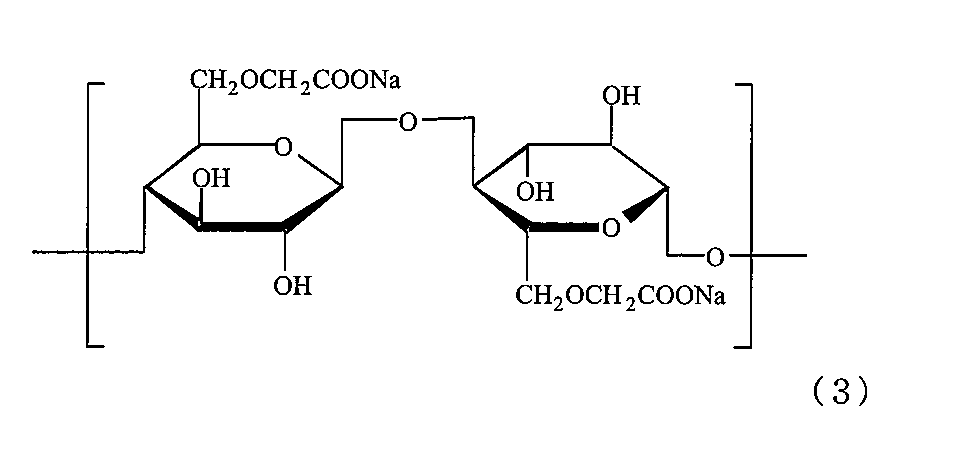
好ましいカルボキシメチルセルロースの具体的な構造式は下記式(3)
It is a carboxymethyl cellulose having a molecular weight of 5 × 10 3 to 5 × 10 6 .
In formula (1-a), R 1 , R 2 and R 3 are each independently selected from the following formulas (a), (b) and (c).
-H (a)
-CH 2 -COOH (b)
-CH 2 -COOX (c)
In the formula (c), X is an alkali metal. Examples of the alkali metal include sodium, potassium, and lithium.
When the equivalents of (a), (b) and (c) are E (a), E (b) and E (c), respectively, the total of E (a) + E (b) + E (c) is 3. is there. The sum of E (b) + E (c) is 0.3 to 3, preferably 0.5 to 1.5, and more preferably 0.6 to 1.0. That is, the sum of E (b) + E (c) is expressed by the formulas (b) and (c) when the total number of substituents R 1 , R 2 and R 3 in the component (X) is 3. The number of substituents to be made.
The weight average molecular weight of component (X) is 5 × 10 3 to 5 × 10 6 , preferably 5 × 10 4 to 5 × 10 6 , more preferably 5 × 10 4 to 1 × 10 6 .
Component (X) can be produced by dissolving pulp (cellulose) with a sodium hydroxide solution, etherifying with monochloroacetic acid (or sodium salt) and purifying.
A specific structural formula of preferable carboxymethyl cellulose is the following formula (3).
で示す通りであり、セルロース骨格におけるカルボキシメチル基の置換位置は、C−6位にあることが好ましい。 The substitution position of the carboxymethyl group in the cellulose skeleton is preferably in the C-6 position.
(成分(Y))
成分(Y)は、下記式(2)
(Ingredient (Y))
Component (Y) is represented by the following formula (2)
で表されるホスファチジルエタノールアミンである。
式(2)中、R4およびR5はそれぞれ独立に、炭素数10〜20のアルケニル基である。R 4 およびR5は、いずれもオレイル基であることがより好ましい。
成分(Y)は、動物組織から抽出したもの、または合成して製造したものどちらでも使用できる。ホスファチジルエタノールアミンとしては、例えばジオレオイルホスファチジルエタノールアミン、ジネルボノイルホスファチジルエタノールアミン、ジリノレノイルホスファチジルエタノールアミン、ジアラキドノイルホスファチジルエタノールアミン、ジドコサヘキサエノイルホスファチジルエタノールアミンを挙げることができる。その中でも、合成する際に使用する有機溶媒への溶解性の面からジオレオイルホスファチジルエタノールアミンが好ましい。
ホスファチジルエタノールアミンは、生体由来の安全な物質であり、本発明のセルロース誘導体において、セルロース誘導体分子間の疎水性相互作用を高めることができ、そのため、本発明のセルロース誘導体は、これらの疎水性相互作用によりハイドロゲルや、水に不溶性の成形体になる。
It is the phosphatidylethanolamine represented by these.
In the formula (2), the R 4 and R 5 each independently, Ru A alkenyl group Der carbon number 10-20. More preferably, R 4 and R 5 are both oleyl groups.
Component (Y) can be used either extracted from animal tissue or synthesized. The phosphatidylethanolamine, cited dioleoylphosphatidylethanolamine, di flannel Bono yl phosphatidylethanolamine Amin, di linolenoyl phosphatidylethanolamine Amin, di arachidonoyl phosphatidylethanolamine, di docosahexaenoyl phosphatidylethanolamine For example be able to. Among these, dioleoylphosphatidylethanolamine is preferable from the viewpoint of solubility in an organic solvent used for synthesis.
Phosphatidylethanolamine is a biologically safe substance, and can enhance the hydrophobic interaction between cellulose derivative molecules in the cellulose derivative of the present invention. Therefore, the cellulose derivative of the present invention has a hydrophobic interaction with each other. It becomes a hydrogel and a water-insoluble molded object by the effect | action.
(反応)
成分(X)と成分(Y)は、成分(X)のE(b)+E(c)の合計100当量に対し、成分(Y)0.1〜100当量、好ましくは5〜60当量、より好ましくは10〜50当量の割合で反応させる。0.1当量よりも少ないと生成するセルロース誘導体がハイドロゲルを形成しない。また、100当量より多いと生成するセルロース誘導体の疎水性が高くなり不溶物が発生し、ハイドロゲルを形成し難くなり、水性媒体に対し不溶性を示すようになる。
成分(X)と成分(Y)とは、水と有機溶媒とからなり水が20〜70容量%である混合溶媒に溶解させ、触媒の存在下、反応させる。
触媒は、カルボキシル基活性剤や縮合剤が好ましい。触媒として、N−ヒドロキシスクシンイミド、p−ニトロフェノール、N−ヒドロキシベンゾトリアゾール、N−ヒドロキシピペリジン、N−ヒドロキシスクシンアミド、2,4,5−トリクロロフェノール等が挙げられる。縮合剤として1−エチル−3−(ジメチルアミノプロピル)−カルボジイミドやその塩酸塩、ジシクロヘキシルカルボジイミド等が挙げられる。
混合溶媒は水と有機溶媒とからなり、水の含有量が20〜70容量%である。水の含有量が20容量%よりも少ないとカルボキシルメチルセルロースが溶解せず、また70容量%よりも高いとホスファチジルエタノールアミンが溶解しないため反応が進まない。水の含有量は、好ましくは30〜60容量%である。
(reaction)
The component (X) and the component (Y) are 0.1 to 100 equivalents, preferably 5 to 60 equivalents of the component (Y) with respect to 100 equivalents in total of E (b) + E (c) of the component (X). The reaction is preferably carried out at a ratio of 10 to 50 equivalents. When the amount is less than 0.1 equivalent, the produced cellulose derivative does not form a hydrogel. On the other hand, when the amount is more than 100 equivalents, the resulting cellulose derivative becomes highly hydrophobic and insoluble matter is generated, making it difficult to form a hydrogel and becoming insoluble in an aqueous medium.
Component (X) and component (Y) are dissolved in a mixed solvent composed of water and an organic solvent and containing 20 to 70% by volume of water, and reacted in the presence of a catalyst.
The catalyst is preferably a carboxyl group activator or a condensing agent. Examples of the catalyst include N-hydroxysuccinimide, p-nitrophenol, N-hydroxybenzotriazole, N-hydroxypiperidine, N-hydroxysuccinamide, 2,4,5-trichlorophenol and the like. Examples of the condensing agent include 1-ethyl-3- (dimethylaminopropyl) -carbodiimide, its hydrochloride, dicyclohexylcarbodiimide and the like.
The mixed solvent is composed of water and an organic solvent, and the water content is 20 to 70% by volume. If the water content is less than 20% by volume, carboxymethylcellulose will not dissolve, and if it exceeds 70% by volume, the reaction will not proceed because phosphatidylethanolamine will not dissolve. The water content is preferably 30 to 60% by volume.
有機溶媒として、テトラヒドロフラン、1,4−ジオキサン、1,3−ジオキサン、1,3−ジオキソラン、モルフォリン、ジメチルスルホキシド、ジメチルアセトアミド、ジメチルホルムアミド、メタノール、エタノール、エチレングリコール、グリセリン、ジエチレングリコール、トリエチレングリコール、N−メチル−2−ピロリドン、ピリジン、ピペリジン、ピペラジン、フェノールなどが挙げられる。有機溶媒は環状エーテルが好ましく、なかでも好ましくは、テトラヒドロフラン、ジオキサン、ジオキソランからなる群から選ばれる少なくとも一種である。ジオキサンとして1,4−ジオキサンおよび1,3−ジオキサンが挙げられる。ジオキソランとして1,3−ジオキソランが挙げられる。
反応温度は、好ましくは0〜60℃である。副生成物の生成を抑制するためには、反応を0〜10℃で行うことがより好ましい。反応環境は弱酸性下が好ましい。さらに好ましくはpH6〜7である。
As organic solvents, tetrahydrofuran, 1,4-dioxane, 1,3-dioxane, 1,3-dioxolane, morpholine, dimethyl sulfoxide, dimethylacetamide, dimethylformamide, methanol, ethanol, ethylene glycol, glycerin, diethylene glycol, triethylene glycol N-methyl-2-pyrrolidone, pyridine, piperidine, piperazine, phenol and the like. The organic solvent is preferably a cyclic ether, and more preferably at least one selected from the group consisting of tetrahydrofuran, dioxane, and dioxolane. Examples of dioxane include 1,4-dioxane and 1,3-dioxane. Examples of dioxolane include 1,3-dioxolane.
The reaction temperature is preferably 0 to 60 ° C. In order to suppress the production | generation of a by-product, it is more preferable to perform reaction at 0-10 degreeC. The reaction environment is preferably under weak acidity. More preferably, it is pH 6-7.
<ゲル状の癒着防止材>
本発明の癒着防止材は、式(1)で表されるセルロース誘導体を含有する。
本発明のゲル状の癒着防止材は、水100重量部に対し、式(1)で表されるセルロース誘導体を0.1〜5.0重量部、好ましくは0.3〜2.0重量部、より好ましくは0.5〜1.5重量部とを含むヒドロゲルである。
E(d)/{E(b)+E(c)}が、0.001〜0.552当量の場合、式(1)で表されるセルロース誘導体はゲルを形成し、0.552当量を超えると疎水性が高くなり不溶物が発生しゲルを形成し難くなる。よって、式(1)で表されるセルロース誘導体は、E(d)/{E(b)+E(c)}が、0.01〜0.552であることが好ましい。
<Gel-like adhesion prevention material>
The adhesion preventing material of the present invention contains a cellulose derivative represented by the formula (1).
The gel-like adhesion preventing material of the present invention is 0.1 to 5.0 parts by weight, preferably 0.3 to 2.0 parts by weight of the cellulose derivative represented by the formula (1) with respect to 100 parts by weight of water. More preferably, it is a hydrogel containing 0.5 to 1.5 parts by weight.
When E (d) / {E (b) + E (c)} is 0.001 to 0.552 equivalent, the cellulose derivative represented by the formula (1) forms a gel and exceeds 0.552 equivalent. And the hydrophobicity becomes high and insoluble matter is generated, making it difficult to form a gel. Therefore, the cellulose derivative represented by the formula (1) preferably has E (d) / {E (b) + E (c)} of 0.01 to 0.552 .
好ましいゲルの物性としては、水中に占めるポリマーの含量が0.1〜5%であるときに、ゲルの入った容器を傾けても流れ落ちない程度の粘弾性を有するものであり、スパテルなどの金属へらで触ると容易に変形することが可能で、患部に塗布することが容易な状態であるものがよい。
ゲルの好ましい粘弾性としては、水中におけるポリマー濃度が1wt%、温度37度の条件で、レオメーターと呼ばれる粘弾性測定装置を用い、角速度10rad/secで測定したときに、複素弾性率が100dyn/cm2以上が好ましく、更に好ましくは200dyn/cm2以上がよい。
E(d)/{E(b)+E(c)}が、大きくなるにつれ滞留性が向上し、癒着防止効果を長期にわたって発揮することができる。この点でE(d)/{E(b)+E(c)}は、0.3以上であることが好ましい。すなわち本発明のゲル状の癒着防止材において、E(d)/{E(b)+E(c)}は、0.3〜0.552であることが好ましい。
癒着防止材中に含まれる、水以外の他の成分としては、触媒として用いた縮合剤類、縮合剤が所定の化学反応を経由することで生成するウレアなどの副産物類、カルボキシル基活性化剤、未反応のホスファチジルエタノールアミン類、反応の各段階で混入するコンタミ物、pHの調整に用いたイオン類などが考えられる。いずれの化合物も、生体内に入れたときに異物反応として認識されない程度の含有量以下の低いレベルに抑えてあることが好ましい。
Preferred physical properties of the gel include viscoelasticity that does not run off even when the container containing the gel is tilted when the polymer content in water is 0.1 to 5%. It is preferable that it can be easily deformed when touched with a spatula and can be easily applied to the affected area.
As a preferred viscoelasticity of the gel, a complex elastic modulus is 100 dyn / when measured at an angular velocity of 10 rad / sec using a viscoelasticity measuring device called a rheometer under conditions of a polymer concentration in water of 1 wt% and a temperature of 37 degrees. cm 2 or more is preferable, and 200 dyn / cm 2 or more is more preferable.
As E (d) / {E (b) + E (c)} increases, the retention is improved, and the anti-adhesion effect can be exhibited over a long period of time. In this respect, E (d) / {E (b) + E (c)} is preferably 0.3 or more. That is, in the gel-like adhesion preventing material of the present invention, E (d) / {E (b) + E (c)} is preferably 0.3 to 0.552 .
The components other than water contained in the anti-adhesion material include condensing agents used as a catalyst, by-products such as urea produced when the condensing agent undergoes a predetermined chemical reaction, and a carboxyl group activator. , Unreacted phosphatidylethanolamines, contaminants mixed in each stage of the reaction, ions used for pH adjustment, and the like. It is preferable that any compound is suppressed to a low level that is not more than a content that is not recognized as a foreign body reaction when placed in a living body.
<固形状の癒着防止材>
セルロース誘導体のE(d)/{E(b)+E(c)}が、0.552を超えるとセルロース誘導体の疎水性が高くなり不溶物が発生し固形状となる。本発明の固形状の癒着防止材のE(d)/{E(b)+E(c)}は、0.01〜0.552である。
本発明の固形状の癒着防止材が水性媒体に不溶性であっても体内に埋入しすると体液より膨潤してゲルに変換することも可能である。ここで水性媒体とは、水、生理食塩水、緩衝液およびアルコールなどを含有する水溶液を意味する。また不溶性とは、一定期間、セルロース誘導体が生体内に滞留し、その後は徐々に分解が進み、最終的には生体内に吸収されることを意味する。
固形状の癒着防止材は、セルロース誘導体を、凍結乾燥、乾式製膜、湿式製膜、静電紡糸法、凝固紡糸、スパンボンド法、メルトブロー法、フラッシュ紡糸法などにより成形して製造することができる。固形状の癒着防止材の形状は、スポンジの如き多孔体、不織布、フィルム等の形状である。固形状の癒着防止材は、術後組織の癒着防止材あるいは皮膚の保湿剤等に使用することができる。
<Solid adhesion prevention material>
If E (d) / {E (b) + E (c)} of the cellulose derivative exceeds 0.552 , the hydrophobicity of the cellulose derivative becomes high, insoluble matter is generated, and it becomes solid. E solid-like antiadhesive material of the present invention (d) / {E (b ) + E (c)} is Ru der from 0.01 to 0.552.
Even if the solid anti-adhesion material of the present invention is insoluble in an aqueous medium, it can be swollen from a body fluid and converted into a gel when embedded in the body. Here, the aqueous medium means an aqueous solution containing water, physiological saline, buffer solution, alcohol and the like. The term “insoluble” means that the cellulose derivative stays in the living body for a certain period of time, then gradually decomposes and is finally absorbed into the living body.
The solid anti-adhesion material can be produced by molding a cellulose derivative by freeze drying, dry film formation, wet film formation, electrostatic spinning method, coagulation spinning, spunbond method, melt blow method, flash spinning method, etc. it can. The shape of the solid adhesion preventing material is a shape of a porous body such as a sponge, a nonwoven fabric, a film, or the like. The solid anti-adhesion material can be used as an anti-adhesion material for post-operative tissue or a skin moisturizer.
以下の実施例により本発明の詳細をより具体的に説明する。しかし、本発明はこれら実施例に限定されるものではない。 The details of the present invention will be described more specifically by the following examples. However, the present invention is not limited to these examples.
(1)実施例に使用した材料は以下の通りである。
(i)CMCNa:カルボキシメチルセルロースナトリウム(シグマ・アルドリッチ製、重量平均分子量700,000、置換度0.9)
(ii)テトラヒドロフラン(和光純薬工業(株)製)
(iii)0.1M HCl(和光純薬工業(株)製)、
(iv)0.1M NaOH(和光純薬工業(株)製)、
(v)EDC:1−Ethyl−3−[3−(dimethylamino)propyl]−carbodi−imide・HCl(和光純薬工業(株)製)、
(vi)HOBt・H2O:1−Hydroxybenzotriazole,monohydrate(和光純薬工業(株)製)、
(vii)L−α−ジオレオイルホスファチジルエタノールアミン(COATSOME ME−8181、日本油脂(株)製)、
(viii)消毒用エタノール(和光純薬工業(株)製)、
(ix)ペントバルビタールナトリウム(ネンブタール注射液、大日本製薬(株)製)、
(x)イソジン消毒液(明治製菓(株)製)、
(xi)生理食塩水(大塚製薬(株)製)。
(1) The materials used in the examples are as follows.
(I) CMCNa: sodium carboxymethyl cellulose (manufactured by Sigma-Aldrich, weight average molecular weight 700,000, substitution degree 0.9)
(Ii) Tetrahydrofuran (Wako Pure Chemical Industries, Ltd.)
(Iii) 0.1M HCl (manufactured by Wako Pure Chemical Industries, Ltd.)
(Iv) 0.1 M NaOH (manufactured by Wako Pure Chemical Industries, Ltd.)
(V) EDC: 1-Ethyl-3- [3- (dimethylamino) propyl] -carbodi-imide · HCl (manufactured by Wako Pure Chemical Industries, Ltd.),
(Vi) HOBt · H 2 O: 1-hydroxybenzotriazole, monohydrate (manufactured by Wako Pure Chemical Industries, Ltd.),
(Vii) L-α-dioleoylphosphatidylethanolamine (COATSOME ME-8181, manufactured by NOF Corporation),
(Viii) Disinfecting ethanol (manufactured by Wako Pure Chemical Industries, Ltd.),
(Ix) Pentobarbital sodium (Nembutal Injection, manufactured by Dainippon Pharmaceutical Co., Ltd.),
(X) Isodine disinfectant (Meiji Seika Co., Ltd.),
(Xi) Saline (manufactured by Otsuka Pharmaceutical Co., Ltd.).
(2)セルロース誘導体中のリン脂質含量の測定
セルロース誘導体中のリン脂質の割合は、リン・モリブデン法による全リン含量の分析により求めた。
(2) Measurement of phospholipid content in cellulose derivative The ratio of phospholipid in the cellulose derivative was determined by analyzing the total phosphorus content by the phosphorus-molybdenum method.
(3)ハイドロゲルの複素弾性率および粘性率の測定
ハイドロゲルの複素弾性率および粘性率は、Rheometer RFIII(TA Instrument)を使用し、37℃で測定した。複素弾性率とは弾性体の応力とひずみの比を表す定数のことである。
(3) Measurement of Complex Elastic Modulus and Viscosity of Hydrogel The complex elastic modulus and viscosity of the hydrogel were measured at 37 ° C. using Rheometer RFIII (TA Instrument). The complex elastic modulus is a constant representing the ratio of stress and strain of an elastic body.
(4)腹腔内癒着試験
腹腔内癒着モデルには、日本チャールス・リバー(株)製のラットを使用した。モデル作製日に30匹のラットの体重を測定し、各群の平均体重がほぼ均等になるように群分けした。TapariaらおよびSachdevaらの方法(1,2)に従って腹腔内癒着モデルを作製した。[1.S.Taparia,R.Sharma,S.N.Mathur and V.P.Sharma:Asian Med.J.28,58−64,1985、2.H.S.Sachdeva,L.V.Gutierrez and A.G.Cox:Br.J.Surg.,58,382−384,1971]。すなわち、ラットをペントバルビタールナトリウム(30mg/kg)の腹腔内投与麻酔下で背位に固定し、腹部を剃毛した後、消毒用エタノールで消毒した。さらにイソジン消毒液で手術領域を消毒した後、腹部正中線に沿って3〜4cm切開して盲腸を露出させた。露出させた盲腸の一定の面積(1〜2cm2)について、滅菌ガーゼを用いて点状出血が生じるまで擦過した。盲腸を戻した後、切開部の筋層は連続縫合した後、皮膚は4〜5針縫合した。創傷部をイソジン消毒液で消毒した後、ケージに戻した。モデル作製29日後に動物をペントバルビタールナトリウム麻酔下で開腹し、腹腔内癒着の程度を肉眼的に観察し、以下に示す基準に従ってスコア化した。
(4) Intraperitoneal adhesion test Rats manufactured by Charles River Japan Co., Ltd. were used as the intraperitoneal adhesion model. The body weights of 30 rats were measured on the day of model preparation, and the groups were divided so that the average body weight of each group was almost equal. An intraperitoneal adhesion model was created according to the method of Taparia et al. And Sachdeva et al. (1, 2). [1. S. Taparia, R.A. Sharma, S .; N. Mathur and V.M. P. Sharma: Asian Med. J. et al. 28, 58-64, 1985; H. S. Sachdeva, L .; V. Gutierrez and A. G. Cox: Br. J. et al. Surg. 58, 382-384, 1971]. That is, the rat was fixed in the dorsal position under anesthesia with intraperitoneal administration of sodium pentobarbital (30 mg / kg), shaved abdomen, and then disinfected with ethanol for disinfection. Further, after the surgical area was disinfected with isodine disinfectant, a 3-4 cm incision was made along the midline of the abdomen to expose the cecum. A certain area (1-2 cm 2 ) of the exposed cecum was abraded with sterilized gauze until punctate bleeding occurred. After returning the cecum, the muscle layer of the incision was continuously sutured, and the skin was sutured with 4 to 5 needles. The wound was disinfected with isodine disinfectant and then returned to the cage. 29 days after the model was created, the animals were opened under anesthesia with sodium pentobarbital, the degree of intraperitoneal adhesion was visually observed, and scored according to the criteria shown below.
(グレード分類)
グレード0(スコア0):癒着が認められない状態
グレード1(スコア1):細くて容易に分離できる程度の癒着
グレード2(スコア2):狭い範囲ではあるが、軽度の牽引に耐えられ得る程度
の弱い癒着
グレード3(スコア3):かなりしっかりとした癒着あるいは少なくとも2箇所に癒着が認められる状態
グレード4(スコア4):3箇所以上に癒着が認められる状態
(Grade classification)
Grade 0 (score 0): No adhesion observed Grade 1 (score 1):
実施例1
(セルロース誘導体)
CMCNa100mgを水20mlに溶解し、さらにテトラヒドロフラン20mlを加えた。この溶液に、L−α−ジオレオイルホスファチジルエタノールアミン55mg(0.000074mol)(CMCNaのカルボキシル基100当量に対し20当量)、EDC16mg(0.000082mol)、HOBt・H2O12mg(0.000082mol)を10mlのテトラヒドロフラン/水=1/1に溶解し反応系に添加した後、終夜攪拌を行った。攪拌後、透析により精製を行い、さらに凍結乾燥しセルロース誘導体を得た。1HNMR(日本電子 JNM−alpha400)により目的物の生成を確認した。得られたセルロース誘導体のリン脂質含量を測定した。(b)、(c)および(d)の仕込み当量とその割合を表1に、リン脂質含量の測定結果から求めた(b)、(c)および(d)の当量を表2に示す。
Example 1
(Cellulose derivative)
100 mg of CMCNa was dissolved in 20 ml of water, and 20 ml of tetrahydrofuran was further added. In this solution, 55 mg (0.000074 mol) of L-α-dioleoylphosphatidylethanolamine (20 equivalents relative to 100 equivalents of carboxyl group of CMCNa), 16 mg (0.000082 mol) of EDC, 12 mg (0.000082 mol) of HOBt · H 2 O Was dissolved in 10 ml of tetrahydrofuran / water = 1/1, added to the reaction system, and stirred overnight. After stirring, purification was performed by dialysis and further freeze-dried to obtain a cellulose derivative. The production | generation of the target object was confirmed by < 1 > HNMR (JEOL JNM-alpha400). The phospholipid content of the obtained cellulose derivative was measured. Table 1 shows the charged equivalents and ratios of (b), (c) and (d), and Table 2 shows the equivalents of (b), (c) and (d) obtained from the measurement results of the phospholipid content.
(ハイドロゲル)
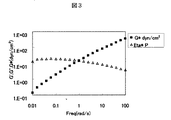
凍結乾燥したセルロース誘導体10mgをイオン交換水990mgに溶解し、濃度1wt%のハイドロゲルを調製した。得られたハイドロゲルの複素弾性率および粘性率を測定した。その結果を表3および図1に示す。
(Hydrogel)
10 mg of freeze-dried cellulose derivative was dissolved in 990 mg of ion-exchanged water to prepare a hydrogel having a concentration of 1 wt%. The complex elastic modulus and viscosity of the obtained hydrogel were measured. The results are shown in Table 3 and FIG.
実施例2
(セルロース誘導体)
L−α−ジオレオイルホスファチジルエタノールアミン111mg(0.000149mol)(CMCNaのカルボキシル基100当量に対し40当量)、EDC31mg(0.00016mol)、HOBt・H2O25mg(0.00016mol)とした以外は、実施例1と同様の操作を行いセルロース誘導体を得た。得られたセルロース誘導体のリン脂質含量を測定した。(b)、(c)および(d)の仕込み当量とその割合を表1に、リン脂質含量の測定結果から求めた(b)、(c)および(d)の当量を表2に示す。
Example 2
(Cellulose derivative)
L-α-dioleoylphosphatidylethanolamine 111 mg (0.000149 mol) (40 equivalents to 100 equivalents of CMCNa carboxyl group), EDC 31 mg (0.00016 mol), HOBt · H 2 O 25 mg (0.00016 mol) The same operation as in Example 1 was performed to obtain a cellulose derivative. The phospholipid content of the obtained cellulose derivative was measured. Table 1 shows the charged equivalents and ratios of (b), (c) and (d), and Table 2 shows the equivalents of (b), (c) and (d) obtained from the measurement results of the phospholipid content.
(ハイドロゲル)
次に、実施例1と同様の操作を行いハイドロゲルを得た。得られたハイドロゲルの複素弾性率および粘性率の測定結果を表3および図2に示す。
(Hydrogel)
Next, the same operation as in Example 1 was performed to obtain a hydrogel. The measurement results of the complex elastic modulus and viscosity of the obtained hydrogel are shown in Table 3 and FIG.
参考例3
L−α−ジオレオイルホスファチジルエタノールアミン222mg(0.000298mol)(CMCNaのカルボキシル基100当量に対し80当量)、EDC62mg(0.00032mol)、HOBt・H2O50mg(0.00032mol)とした以外は、実施例1と同様にセルロース誘導体を得た。得られたセルロース誘導体のリン脂質含量を測定した。(b)、(c)および(d)の仕込み当量とその割合を表1に、リン脂質含量の測定結果から求めた(b)、(c)および(d)の当量を表2および図3に示す。得られたセルロース誘導体は、スポンジ状で水に対し不溶性であった。
Reference example 3
L-α-dioleoylphosphatidylethanolamine 222 mg (0.000298 mol) (80 equivalents relative to 100 equivalents of carboxyl group of CMCNa), EDC 62 mg (0.00032 mol), HOBt · H 2 O 50 mg (0.00032 mol) In the same manner as in Example 1, a cellulose derivative was obtained. The phospholipid content of the obtained cellulose derivative was measured. The charged equivalents of (b), (c) and (d) and their proportions are shown in Table 1, and the equivalents of (b), (c) and (d) obtained from the measurement results of the phospholipid content are shown in Table 2 and FIG. Shown in The obtained cellulose derivative was sponge-like and insoluble in water.
比較例1
CMCNa10mgを、イオン交換水990mgに溶解し、実施例1と同様に粘弾性測定を行った。その結果を表3に示す。
Comparative Example 1
10 mg of CMCNa was dissolved in 990 mg of ion-exchanged water, and viscoelasticity measurement was performed in the same manner as in Example 1. The results are shown in Table 3.
実施例4
腹腔内癒着モデルのラットの盲腸を点状出血させ、腹腔内に戻した後、10匹に対して実施例1で調製したセルロース誘導体のヒドロゲル(1mL)を擦過部位に塗布した。29日後にラットをペントバルビタールナトリウム麻酔下で開腹し、腹腔内癒着の程度を肉眼的に観察しスコア化した。
Example 4
The cecum of rats of the intraperitoneal adhesion model was spotted and returned to the abdominal cavity, and then the hydrogel (1 mL) of the cellulose derivative prepared in Example 1 was applied to the rubbing site for 10 animals. After 29 days, the rats were laparotomized under pentobarbital sodium anesthesia, and the degree of intraperitoneal adhesion was visually observed and scored.
実施例5
実施例2で調製したセルロース誘導体のヒドロゲル(1mL)を用いる以外は、実施例4と同様の操作を行い、腹腔内癒着の程度を肉眼的に観察しスコア化した。
Example 5
The same operation as in Example 4 was performed except that the cellulose derivative hydrogel (1 mL) prepared in Example 2 was used, and the degree of intraperitoneal adhesion was visually observed and scored.
比較例2
ヒドロゲル(1mL)を擦過部位に塗布しない以外は実施例4と同様の操作を行い、腹腔内癒着の程度を肉眼的に観察しスコア化した。
各例の腹腔内癒着スコアは、平均値±標準誤差(mean±S.E.)で表記した。検定は実施例4、実施例5と、比較例2との群間の検定としてWilcoxonの順位和検定を行った。なお、統計ソフトはThe SAS(登録商標) System Release 8.2(TS2M0)for Windows(SAS Institute Inc.)、およびその連動システムEXSAS Version 7.10((株)アーム)を用いた。
ラットの腹腔内癒着モデルに対する各誘導体の29日間適用による効果を検討し、その結果を図4に示す。
図4に示されているとおり、実施例4は1.3±0.4の癒着スコアを示した。実施例5は0.5±0.3であった。一方、比較例2は2.3±0.4であった。実施例4は比較例2と比較して統計学的に有意な差はみられないものの、癒着スコアの減少傾向を示し、実施例5の癒着スコアは比較例2と比較して統計学的に有意に低値であったことを示した(P<0.05)。以上の結果より、実施例4、5で用いた誘導体は29日間適用において癒着防止効果を有することが分る。
Comparative Example 2
The same operation as in Example 4 was performed except that hydrogel (1 mL) was not applied to the scratched site, and the degree of intraperitoneal adhesion was visually observed and scored.
The intraperitoneal adhesion score in each case was expressed as an average value ± standard error (mean ± SE). As a test, Wilcoxon rank sum test was performed as a test between the groups of Example 4, Example 5, and Comparative Example 2. The statistical software used was The SAS (registered trademark) System Release 8.2 (TS2M0) for Windows (SAS Institute Inc.) and its interlocking system EXSAS Version 7.10 (arm).
The effect of application of each derivative to the rat intraperitoneal adhesion model for 29 days was examined, and the results are shown in FIG.
As shown in FIG. 4, Example 4 showed an adhesion score of 1.3 ± 0.4. Example 5 was 0.5 ± 0.3. On the other hand, Comparative Example 2 was 2.3 ± 0.4. Example 4 shows a decreasing tendency of the adhesion score, although no statistically significant difference is seen compared to Comparative Example 2, and the adhesion score of Example 5 is statistically lower than that of Comparative Example 2. It was shown to be significantly low (P <0.05). From the above results, it can be seen that the derivatives used in Examples 4 and 5 have an adhesion preventing effect when applied for 29 days.
本発明の癒着防止材は、脊椎、関節、腱、神経などに対する手術時に、損傷を受けた生体組織表面が癒着するのを防止するために用いることができる。さらに具体的には、脊椎手術の場合、たとえば、本発明の癒着防止材を硬膜と神経根周囲を隔離するために塗布することで癒着を防止することができる。
癒着が起きた場合、除痛、稼動部位の確保を目的として癒着剥離を行う必要がある。本発明の癒着防止材を塗布することにより、癒着を防止することができ、再手術を回避し、医療経済性の向上、さらには患者の生活の質を高めることが可能となる。
The anti-adhesion material of the present invention can be used to prevent adhesion of damaged biological tissue surfaces during surgery on spines, joints, tendons, nerves and the like. More specifically, in the case of spinal surgery, for example, adhesion can be prevented by applying the adhesion-preventing material of the present invention to isolate the dura mater from the nerve root.
When adhesion occurs, it is necessary to perform adhesion peeling for the purpose of removing pain and securing the working site. By applying the anti-adhesion material of the present invention, adhesion can be prevented, re-operation can be avoided, medical economics can be improved, and the quality of life of the patient can be improved.
また、婦人科手術では、開腹術又は腹腔鏡による子宮筋腫摘出術時などに用いることができる。手術後の創傷部位に本発明の癒着防止材を塗布することにより、癒着を防止することができる。
本発明の癒着防止材は体内での優れた滞留安定性を有し、癒着防止材として有用である。とくに癒着防止材がゲルの場合は、複雑な形状の部位にも適用でき、内視鏡を用いた手術に容易に適用可能である。
In gynecological surgery, it can be used at the time of laparotomy or laparoscopic hysterectomy. Adhesion can be prevented by applying the anti-adhesion material of the present invention to the wound site after surgery.
The anti-adhesion material of the present invention has excellent retention stability in the body and is useful as an anti-adhesion material. In particular, when the anti-adhesion material is a gel, it can be applied to a complex-shaped region and can be easily applied to an operation using an endoscope.
Claims (10)
下記式(a)、(b)、(c)および(d)からなる群より選ばれ、
式(d)中、R4およびR5はそれぞれ独立に炭素数10〜20のアルケニル基であり、
(a)、(b)、(c)および(d)の当量をそれぞれE(a)、E(b)、
E(c)およびE(d)とした場合、
E(b)+E(c)+E(d)=0.3〜3で、
E(d)/{E(b)+E(c)}=0.01〜0.552であり、
E(d)/{E(b)+E(c)+E(d)}=0.001〜1である、
で表される繰り返し単位からなり、分子量が5×10³〜5×10⁶のセルロース誘導体。Following formula (1)
Selected from the group consisting of the following formulas (a), (b), (c) and (d);
In formula (d), R 4 and R 5 are each independently an alkenyl group having 10 to 20 carbon atoms,
The equivalents of (a), (b), (c) and (d) are respectively E (a), E (b),
If E (c) and E (d),
E (b) + E (c) + E (d) = 0.3-3,
E (d) / {E (b) + E (c)} = 0.01 to 0.552,
E (d) / {E (b) + E (c) + E (d)} = 0.001-1
A cellulose derivative having a molecular weight of 5 × 10 3 to 5 × 10 6 .
下記式(a)、(b)および(c)から選ばれ、
−H (a)
−CH2−COOH (b)
−CH2−COOX (c)
式(c)中、Xはアルカリ金属であり、(a)、(b)および(c)の
当量をそれぞれE(a)、E(b)およびE(c)とした場合、
E(b)+E(c)=0.3〜3である、
で表される繰り返し単位からなり、分子量が5×10³〜5×10⁶のカルボキシメチルセルロースと、下記式(2)
で表されるホスファチジルエタノールアミンとを、
(ii)式(1−a)で表されるカルボキシメチルセルロースのE(b)+E(c)の合計100当量に対し、式(2)で表されるホスファチジルエタノールアミン0.1〜100当量の割合で、
(iii)水と有機溶媒とからなり水が20〜70容量%である混合溶媒に溶解し、触媒の存在下、反応させることを特徴とする請求項1記載のセルロース誘導体の製造方法。(I) The following formula (1-a)
Selected from the following formulas (a), (b) and (c):
-H (a)
-CH 2 -COOH (b)
-CH 2 -COOX (c)
In the formula (c), X is an alkali metal, and when the equivalents of (a), (b) and (c) are E (a), E (b) and E (c), respectively,
E (b) + E (c) = 0.3-3,
Carboxymethyl cellulose having a molecular weight of 5 × 10 3 to 5 × 10 6 , and the following formula (2):
Phosphatidylethanolamine represented by
(Ii) A ratio of 0.1 to 100 equivalents of phosphatidylethanolamine represented by formula (2) with respect to a total of 100 equivalents of E (b) + E (c) of carboxymethylcellulose represented by formula (1-a) so,
(Iii) The method for producing a cellulose derivative according to claim 1, wherein the cellulose derivative is dissolved in a mixed solvent composed of water and an organic solvent and containing 20 to 70% by volume of water and reacted in the presence of a catalyst.
Priority Applications (1)
| Application Number | Priority Date | Filing Date | Title |
|---|---|---|---|
| JP2007529614A JP5039552B2 (en) | 2005-08-04 | 2006-08-03 | Cellulose derivative |
Applications Claiming Priority (6)
| Application Number | Priority Date | Filing Date | Title |
|---|---|---|---|
| JP2005226545 | 2005-08-04 | ||
| JP2005226545 | 2005-08-04 | ||
| JP2005349144 | 2005-12-02 | ||
| JP2005349144 | 2005-12-02 | ||
| PCT/JP2006/315780 WO2007015579A1 (en) | 2005-08-04 | 2006-08-03 | Cellulose derivative |
| JP2007529614A JP5039552B2 (en) | 2005-08-04 | 2006-08-03 | Cellulose derivative |
Publications (2)
| Publication Number | Publication Date |
|---|---|
| JPWO2007015579A1 JPWO2007015579A1 (en) | 2009-02-19 |
| JP5039552B2 true JP5039552B2 (en) | 2012-10-03 |
Family
ID=37708850
Family Applications (1)
| Application Number | Title | Priority Date | Filing Date |
|---|---|---|---|
| JP2007529614A Expired - Fee Related JP5039552B2 (en) | 2005-08-04 | 2006-08-03 | Cellulose derivative |
Country Status (11)
| Country | Link |
|---|---|
| US (1) | US8378091B2 (en) |
| EP (1) | EP1911769B1 (en) |
| JP (1) | JP5039552B2 (en) |
| KR (1) | KR101294451B1 (en) |
| CN (1) | CN101238151B (en) |
| AU (1) | AU2006276435B2 (en) |
| CA (1) | CA2618253C (en) |
| DK (1) | DK1911769T3 (en) |
| ES (1) | ES2440240T3 (en) |
| PL (1) | PL1911769T3 (en) |
| WO (1) | WO2007015579A1 (en) |
Families Citing this family (11)
| Publication number | Priority date | Publication date | Assignee | Title |
|---|---|---|---|---|
| KR20090109120A (en) * | 2007-02-06 | 2009-10-19 | 데이진 가부시키가이샤 | Cellulose derivative and its preparation method |
| KR20100093086A (en) | 2007-12-17 | 2010-08-24 | 데이진 가부시키가이샤 | Cellulose derivative and hydrogel thereof |
| JP2010035744A (en) * | 2008-08-04 | 2010-02-18 | Teijin Ltd | Adheshion preventive material |
| CN102112496A (en) * | 2008-08-05 | 2011-06-29 | 帝人株式会社 | Hydrogel |
| MX2011008683A (en) * | 2009-02-19 | 2011-09-06 | Teijin Ltd | Hydrogel of polysaccharide derivatives. |
| JP2010209130A (en) * | 2009-03-06 | 2010-09-24 | Teijin Ltd | Alginic acid derivative and method for manufacturing the same |
| JP5406281B2 (en) * | 2009-04-17 | 2014-02-05 | 帝人株式会社 | Polysaccharide derivatives and hydrogels thereof |
| JP2011099029A (en) * | 2009-11-05 | 2011-05-19 | Teijin Ltd | Polysaccharide derivative |
| KR20130092408A (en) | 2010-04-22 | 2013-08-20 | 데이진 가부시키가이샤 | Hydrogel |
| JP5673756B2 (en) * | 2013-08-20 | 2015-02-18 | 東洋紡株式会社 | Medical materials |
| WO2015169319A1 (en) * | 2014-05-05 | 2015-11-12 | Steeper Energy Aps | Feed mixture for producing hydrocarbons |
Citations (9)
| Publication number | Priority date | Publication date | Assignee | Title |
|---|---|---|---|---|
| JPH0270703A (en) * | 1987-10-23 | 1990-03-09 | Yissum Res Dev Co Of Hebrew Univ Of Jerusalem | Phospholipase a2 inhibitor composition and its use |
| JPH09296005A (en) * | 1996-04-26 | 1997-11-18 | Kuraray Co Ltd | Anti-adhesion material |
| JP2002536323A (en) * | 1999-02-04 | 2002-10-29 | ジェンザイム コーポレーション | Prevent abscess formation |
| JP2003062057A (en) * | 2001-08-29 | 2003-03-04 | Next:Kk | Fine particles of biopolymer with hemostatic and anti-adhesion properties |
| JP2004014481A (en) * | 2002-06-12 | 2004-01-15 | Mitsubishi Electric Corp | Electric operating device for switchgear |
| JP2004051531A (en) * | 2002-07-19 | 2004-02-19 | Denki Kagaku Kogyo Kk | Anti-adhesion material containing poorly water-soluble carboxymethyl cellulose |
| JP2004107503A (en) * | 2002-09-19 | 2004-04-08 | Terumo Corp | Crosslinked carboxymethyl cellulose and method for producing the same |
| WO2005000374A1 (en) * | 2003-06-30 | 2005-01-06 | Denki Kagaku Kogyo Kabushiki Kaisha | Adhesion inhibiting material for vertebral/spinal operation |
| JP2005508827A (en) * | 2000-01-10 | 2005-04-07 | イッサム・リサーチ・ディベロップメント・カンパニー・オブ・ザ・ヘブルー・ユニバーシティ・オブ・エルサレム | Use of lipid conjugates in the treatment of disease |
Family Cites Families (16)
| Publication number | Priority date | Publication date | Assignee | Title |
|---|---|---|---|---|
| JPS60130601A (en) | 1983-12-15 | 1985-07-12 | バイオマトリツクス,インコ−ポレイテツド | Manufacture of hyaluronic acid water-insoluble composition |
| CA1238043A (en) | 1983-12-15 | 1988-06-14 | Endre A. Balazs | Water insoluble preparations of hyaluronic acid and processes therefor |
| US4582865A (en) * | 1984-12-06 | 1986-04-15 | Biomatrix, Inc. | Cross-linked gels of hyaluronic acid and products containing such gels |
| US4605691A (en) | 1984-12-06 | 1986-08-12 | Biomatrix, Inc. | Cross-linked gels of hyaluronic acid and products containing such gels |
| JP2538213B2 (en) | 1986-07-31 | 1996-09-25 | ダイセル化学工業株式会社 | Super absorbent composition |
| US6174999B1 (en) | 1987-09-18 | 2001-01-16 | Genzyme Corporation | Water insoluble derivatives of polyanionic polysaccharides |
| US6610669B1 (en) | 1987-09-18 | 2003-08-26 | Genzyme Corporation | Water insoluble derivatives of polyanionic polysaccharides |
| US5017229A (en) | 1990-06-25 | 1991-05-21 | Genzyme Corporation | Water insoluble derivatives of hyaluronic acid |
| JPH01301624A (en) | 1988-05-31 | 1989-12-05 | Nippon Zeon Co Ltd | Anti-adhesion material |
| JP3107488B2 (en) | 1993-09-29 | 2000-11-06 | 株式会社資生堂 | Sustained-release preparation and embolic agent using cross-linked hyaluronic acid |
| JP3792824B2 (en) | 1997-03-07 | 2006-07-05 | 第一工業製薬株式会社 | Method for producing aqueous gel substrate and aqueous gel substrate obtained thereby |
| US5906997A (en) * | 1997-06-17 | 1999-05-25 | Fzio Med, Inc. | Bioresorbable compositions of carboxypolysaccharide polyether intermacromolecular complexes and methods for their use in reducing surgical adhesions |
| EP1228771A4 (en) | 1999-11-09 | 2003-01-29 | Denki Kagaku Kogyo Kk | USE OF SOLUBLE CELLULOSE DERIVATIVES WHICH ARE HARDLY SOLUBILIZED IN WATER AND THE METHOD FOR THE PRODUCTION THEREOF |
| US7101859B2 (en) * | 2000-01-10 | 2006-09-05 | Yissum Research Development Company Of The Hebrew University Of Jerusalem | Use of lipid conjugates in the treatment of diseases |
| JP4340423B2 (en) * | 2002-06-20 | 2009-10-07 | 生化学工業株式会社 | Photoreactive sugar compound, labeled photoreactive sugar compound, and method for capturing and measuring sugar receptor |
| JP2005005113A (en) * | 2003-06-11 | 2005-01-06 | Toshiba Corp | Nonaqueous electrolyte secondary battery |
-
2006
- 2006-08-03 AU AU2006276435A patent/AU2006276435B2/en not_active Ceased
- 2006-08-03 WO PCT/JP2006/315780 patent/WO2007015579A1/en not_active Ceased
- 2006-08-03 EP EP06768443.1A patent/EP1911769B1/en not_active Expired - Lifetime
- 2006-08-03 ES ES06768443.1T patent/ES2440240T3/en not_active Expired - Lifetime
- 2006-08-03 PL PL06768443T patent/PL1911769T3/en unknown
- 2006-08-03 KR KR1020087002848A patent/KR101294451B1/en not_active Expired - Fee Related
- 2006-08-03 US US11/997,830 patent/US8378091B2/en not_active Expired - Fee Related
- 2006-08-03 CN CN200680028719XA patent/CN101238151B/en not_active Expired - Fee Related
- 2006-08-03 CA CA2618253A patent/CA2618253C/en not_active Expired - Fee Related
- 2006-08-03 DK DK06768443.1T patent/DK1911769T3/en active
- 2006-08-03 JP JP2007529614A patent/JP5039552B2/en not_active Expired - Fee Related
Patent Citations (9)
| Publication number | Priority date | Publication date | Assignee | Title |
|---|---|---|---|---|
| JPH0270703A (en) * | 1987-10-23 | 1990-03-09 | Yissum Res Dev Co Of Hebrew Univ Of Jerusalem | Phospholipase a2 inhibitor composition and its use |
| JPH09296005A (en) * | 1996-04-26 | 1997-11-18 | Kuraray Co Ltd | Anti-adhesion material |
| JP2002536323A (en) * | 1999-02-04 | 2002-10-29 | ジェンザイム コーポレーション | Prevent abscess formation |
| JP2005508827A (en) * | 2000-01-10 | 2005-04-07 | イッサム・リサーチ・ディベロップメント・カンパニー・オブ・ザ・ヘブルー・ユニバーシティ・オブ・エルサレム | Use of lipid conjugates in the treatment of disease |
| JP2003062057A (en) * | 2001-08-29 | 2003-03-04 | Next:Kk | Fine particles of biopolymer with hemostatic and anti-adhesion properties |
| JP2004014481A (en) * | 2002-06-12 | 2004-01-15 | Mitsubishi Electric Corp | Electric operating device for switchgear |
| JP2004051531A (en) * | 2002-07-19 | 2004-02-19 | Denki Kagaku Kogyo Kk | Anti-adhesion material containing poorly water-soluble carboxymethyl cellulose |
| JP2004107503A (en) * | 2002-09-19 | 2004-04-08 | Terumo Corp | Crosslinked carboxymethyl cellulose and method for producing the same |
| WO2005000374A1 (en) * | 2003-06-30 | 2005-01-06 | Denki Kagaku Kogyo Kabushiki Kaisha | Adhesion inhibiting material for vertebral/spinal operation |
Also Published As
| Publication number | Publication date |
|---|---|
| KR20080036597A (en) | 2008-04-28 |
| CN101238151A (en) | 2008-08-06 |
| US20100279982A1 (en) | 2010-11-04 |
| DK1911769T3 (en) | 2014-01-13 |
| ES2440240T3 (en) | 2014-01-28 |
| EP1911769B1 (en) | 2013-10-30 |
| PL1911769T3 (en) | 2014-03-31 |
| US8378091B2 (en) | 2013-02-19 |
| WO2007015579A1 (en) | 2007-02-08 |
| CN101238151B (en) | 2011-11-16 |
| EP1911769A4 (en) | 2011-11-02 |
| JPWO2007015579A1 (en) | 2009-02-19 |
| AU2006276435A1 (en) | 2007-02-08 |
| EP1911769A1 (en) | 2008-04-16 |
| CA2618253A1 (en) | 2007-02-08 |
| CA2618253C (en) | 2013-05-28 |
| AU2006276435B2 (en) | 2011-10-13 |
| KR101294451B1 (en) | 2013-08-07 |
Similar Documents
| Publication | Publication Date | Title |
|---|---|---|
| JP5059787B2 (en) | Cellulose derivative and method for producing the same | |
| JP5204786B2 (en) | Cellulose derivatives and hydrogels thereof | |
| JP5406281B2 (en) | Polysaccharide derivatives and hydrogels thereof | |
| KR101294451B1 (en) | Cellulose derivative | |
| JP2010209130A (en) | Alginic acid derivative and method for manufacturing the same | |
| JP5385368B2 (en) | Hydrogels of polysaccharide derivatives | |
| JP2010035744A (en) | Adheshion preventive material | |
| JP2005075815A (en) | Hemostatic tissue-repairing material | |
| JP2003019194A (en) | Co-crosslinked gel composition comprising hyaluronic acid and carboxymethyl cellulose |
Legal Events
| Date | Code | Title | Description |
|---|---|---|---|
| A131 | Notification of reasons for refusal |
Free format text: JAPANESE INTERMEDIATE CODE: A131 Effective date: 20110615 |
|
| A521 | Request for written amendment filed |
Free format text: JAPANESE INTERMEDIATE CODE: A523 Effective date: 20110810 |
|
| A131 | Notification of reasons for refusal |
Free format text: JAPANESE INTERMEDIATE CODE: A131 Effective date: 20120404 |
|
| A521 | Request for written amendment filed |
Free format text: JAPANESE INTERMEDIATE CODE: A523 Effective date: 20120525 |
|
| TRDD | Decision of grant or rejection written | ||
| A01 | Written decision to grant a patent or to grant a registration (utility model) |
Free format text: JAPANESE INTERMEDIATE CODE: A01 Effective date: 20120620 |
|
| A01 | Written decision to grant a patent or to grant a registration (utility model) |
Free format text: JAPANESE INTERMEDIATE CODE: A01 |
|
| A61 | First payment of annual fees (during grant procedure) |
Free format text: JAPANESE INTERMEDIATE CODE: A61 Effective date: 20120709 |
|
| FPAY | Renewal fee payment (event date is renewal date of database) |
Free format text: PAYMENT UNTIL: 20150713 Year of fee payment: 3 |
|
| R150 | Certificate of patent or registration of utility model |
Ref document number: 5039552 Country of ref document: JP Free format text: JAPANESE INTERMEDIATE CODE: R150 Free format text: JAPANESE INTERMEDIATE CODE: R150 |
|
| LAPS | Cancellation because of no payment of annual fees |