JP5028126B2 - Dielectric substrate manufacturing method - Google Patents
Dielectric substrate manufacturing method Download PDFInfo
- Publication number
- JP5028126B2 JP5028126B2 JP2007092829A JP2007092829A JP5028126B2 JP 5028126 B2 JP5028126 B2 JP 5028126B2 JP 2007092829 A JP2007092829 A JP 2007092829A JP 2007092829 A JP2007092829 A JP 2007092829A JP 5028126 B2 JP5028126 B2 JP 5028126B2
- Authority
- JP
- Japan
- Prior art keywords
- dielectric substrate
- conductive film
- hole
- conductor
- via hole
- Prior art date
- Legal status (The legal status is an assumption and is not a legal conclusion. Google has not performed a legal analysis and makes no representation as to the accuracy of the status listed.)
- Expired - Fee Related
Links
Images
Landscapes
- Printing Elements For Providing Electric Connections Between Printed Circuits (AREA)
Description
本発明は、高周波回路基板等として使用される誘電体基板の製造方法に関し、特に、ビアホールを備えた誘電体基板の製造方法に関する。 The present invention relates to a method for manufacturing a dielectric substrate used as a high-frequency circuit board or the like, and more particularly, to a method for manufacturing a dielectric substrate having via holes.
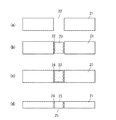
誘電体基板に導電体を充填したビアホールを形成する従来例を図3に示す。図3に示すように誘電体基板21の所定の位置にスルーホール22を形成する(図3a)。その後、スルーホール22内に導電体23を充填(例えばガラスメタル系導電性材料をスクリーン印刷法により充填)し、熱硬化させる(図3b)。このときスルーホール22の側壁と導電体23との間には、導電体23と誘電体基板21の膨張率の違いによって、隙間が生じてしまう。そこで、その隙間を電界メッキ法あるいは無電解メッキ法によるメッキ膜からなる導電層24で充填する(図3c)。その結果、スルーホール内は、導電体23及び導電層24によって密閉され、誘電体基板の表面と裏面の気密性が確保される。その後、必要に応じて、誘電体基板の表面を研磨し、所望の厚さの誘電体基板を形成することができる。(特許文献1参照)。
A conventional example of forming a via hole filled with a conductor on a dielectric substrate is shown in FIG. As shown in FIG. 3, a
またその他の方法として、スルーホールの内周面に導電被膜を形成し、少なくともスルーホールの直径よりも大きく、表面にハンダを被膜した球状導電体をスルーホールに圧入した後、ハンダの融点まで加熱し、溶融したハンダによってスルーホール内の導電被膜と球状導電体の間の空隙を充填する方法も提案されている(特許文献2参照)。
上記のような従来のビアホールの製造方法では、一般に、誘電体基板にスルーホールを形成する際、レーザ光の照射、ブラスト法、ドリル等を用いて加工するため、スルーホールの側壁は平坦となる。このように平坦な側壁では、隙間を埋めるために形成するメッキ膜との接着性が非常に弱い。また平坦な側壁に接着性の良い導電被膜を形成した場合でも、導電体を圧入する際、導電被膜の一部が剥離してしまい、接着性が弱くなってしまう場合があった。さらにまた導電被膜とハンダとの接着性は必ずしも十分でなかった。このように、誘電体基板と導電体との接着強度が低く、その後の工程で誘電体基板の表面を研磨する際、ビアホール内に充填した導電体や導電被膜等が脱落、剥離するなどの問題点があった。 In the conventional via hole manufacturing method as described above, generally, when a through hole is formed in a dielectric substrate, processing is performed using laser light irradiation, a blast method, a drill, or the like, so that the side wall of the through hole becomes flat. . In such a flat side wall, the adhesiveness with the plating film formed to fill the gap is very weak. Even when a conductive film with good adhesion is formed on a flat side wall, when the conductor is pressed in, a part of the conductive film may be peeled off, resulting in weak adhesion. Furthermore, the adhesion between the conductive film and the solder was not always sufficient. As described above, the adhesion strength between the dielectric substrate and the conductor is low, and when the surface of the dielectric substrate is polished in the subsequent process, the conductor or the conductive film filled in the via hole is dropped or peeled off. There was a point.
本発明は上記問題を解消し、ビアホール内でその側壁と導電体との密着性が良く、誘電体基板の一方の面と他方の面の気密性を保つことができる誘電体基板の形成方法を提供することを目的とする。 The present invention solves the above problems, and provides a method for forming a dielectric substrate that can provide good adhesion between the side wall and the conductor in the via hole, and can maintain the airtightness of the one surface and the other surface of the dielectric substrate. The purpose is to provide.
上記目的を達成するため本願請求項1に係る発明は、ビアホールを有する誘電体基板の製造方法において、誘電体基板にスルーホールを形成する工程と、該スルーホールの側壁および前記誘電体基板の表面に該誘電体基板に接着性の良い第1の導電膜を形成する工程と、該第1の導電膜で側壁が被覆された前記スルーホール内に導電体を充填する工程と、前記誘電体基板の一方の面上の前記第1の導電膜を除去した後、前記スルーホール内の前記第1の導電膜と前記導電体との隙間に、該第1の導電膜を電極として用いた電界メッキ法により該第1の導電膜と前記導電体のいずれとも接着性の良い第2の導電膜を形成し、前記スルーホール内を前記第1の導電膜、前記導電体及び前記第2の導電膜によって充填された前記ビアホールを形成する工程と、該ビアホールを形成後、少なくとも前記誘電体基板の他方の面上に残る前記第1の導電膜を除去する工程とを含むことを特徴とする。 In order to achieve the above object, according to the first aspect of the present invention, in a method for manufacturing a dielectric substrate having a via hole, a step of forming a through hole in the dielectric substrate, a sidewall of the through hole, and a surface of the dielectric substrate Forming a first conductive film having good adhesion on the dielectric substrate, filling a conductive material into the through hole whose side wall is covered with the first conductive film, and the dielectric substrate. After removing the first conductive film on one surface of the first electrode, electric field plating using the first conductive film as an electrode in the gap between the first conductive film and the conductor in the through hole A second conductive film having good adhesion to both the first conductive film and the conductor is formed by the method, and the first conductive film, the conductor, and the second conductive film are formed in the through hole. Forming the via hole filled with A step, after forming the via hole, characterized in that it comprises a step of removing the first conductive film remains at least on the dielectric on the other surface of the substrate.
本発明の誘電体基板の製造方法によれば、誘電体基板のビアホール側壁とその中に充填した導電体との隙間全体に第1及び第2の導電膜を充填している。この二重の導電膜により、誘電体基板と第1の導電膜の接着性を高め、さらに、第1の導電膜と第2の導電膜及び導電体間の接着性を高めることができる。その結果、ビアホール内に充填した導電体の脱落、剥離等がなくなり、また十分な気密性を確保した誘電体基板を提供することができる。 According to the dielectric substrate manufacturing method of the present invention, the first and second conductive films are filled in the entire gap between the via hole side wall of the dielectric substrate and the conductor filled therein. With this double conductive film, the adhesion between the dielectric substrate and the first conductive film can be enhanced, and further, the adhesion between the first conductive film, the second conductive film, and the conductor can be enhanced. As a result, it is possible to provide a dielectric substrate in which the conductor filled in the via hole is not dropped or peeled off and sufficient airtightness is ensured.
本発明より形成されたビアホールを備えた誘電体基板は、ビアホールの熱伝導性が優れており、サーマルビアとして好適となる。また導電性に優れているため、接地用ビアとして好適となり、高周波回路基板として用いた場合、特性の優れた高周波回路を提供することが可能となるという利点がある。 A dielectric substrate having a via hole formed according to the present invention is excellent in thermal conductivity of the via hole and is suitable as a thermal via. Further, since it is excellent in conductivity, it is suitable as a grounding via, and when used as a high-frequency circuit board, there is an advantage that it is possible to provide a high-frequency circuit with excellent characteristics.
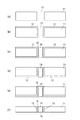
以下、本発明の誘電体基板の製造方法について、図1、図2を用いて実施例について詳細に説明する。 Hereinafter, a method for manufacturing a dielectric substrate according to the present invention will be described in detail with reference to FIG. 1 and FIG.
図1は、本発明の第1の実施例の説明図である。まず、誘電体基板11の所定の位置に、例えばレーザ光の照射、ブラスト法、ドリル等を用いる等の通常の方法により、誘電体基板11を貫通するスルーホール12を形成する(図1a)。
FIG. 1 is an explanatory diagram of a first embodiment of the present invention. First, a
次に、誘電体基板11の表面及びスルーホール12の側壁を被覆するように、蒸着法またはスパッタリング法により、チタン、白金、金などの導電物質からなる第1の導電膜13を形成する(図1b)。ここで第1の導電膜13は、誘電体基板11と接着性の良い導電物質を選択する。
Next, a first
その後、スルーホール12内にスクリーン印刷等により、銀、銀−パラジウム金属を含有したガラスメタル系導電性材料等の導電体14を充填する。充填した導電体14は、400〜850℃の温度で焼成し、硬化させる。この焼結によって図1(c)に示すように、第1の導電膜13と導電体14の間には、隙間が生じる。
Thereafter, the
次に、誘電体基板11の一方の面上の第1の導電膜13をイオンミリング装置等により除去する(図1d)。ここで、誘電体基板11の他方の面上の第1の導電膜13は残しておく。
Next, the first
その後、電界メッキ法により銅、金等のメッキを施し、第1の導電膜13と導電体14の間に第2の導電膜15を形成する。このとき、誘電体基板11の他方の面上に残した第1の導電膜13は、電界メッキ法の電極として用いられる。またメッキされる金属は、第1の導電膜13と導電体14のいずれとも接着性のよい金属を選択する。電界メッキ法によるため、スルーホール12内の誘電体基板11の厚さ方向の隙間全体にメッキ金属が析出し、第1の導電膜13と導電体14の間を隙間なく充填する(図1e)。この第2の導電膜15の充填により、スルーホール12の側壁と誘電体14が十分に接着するとともに、誘電体基板11の一方の面と他方の面の気密性が保たれることになる。
Thereafter, copper, gold, or the like is plated by an electroplating method to form a second
最後に、誘電体基板11の表面を研磨し、表面に残る第1の導電体13、導電体14、第2の導電膜15の一部を除去し、誘電体基板11の表面を露出させ、ビアホール16を備えた誘電体基板11が完成する。必要に応じて、誘電体基板11の表面を研磨し、所望の厚さの誘電体基板11を完成することもできる(図1f)。
Finally, the surface of the
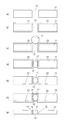
次に第2の実施例について説明する。図2は、本発明の第2の実施例の説明図である。まず第1の実施例同様、誘電体基板11の所定の位置に、例えばレーザ光の照射、ブラスト法、ドリル等を用いる等の通常の方法により、誘電体基板11を貫通するスルーホール12を形成する(図2a)。
Next, a second embodiment will be described. FIG. 2 is an explanatory diagram of the second embodiment of the present invention. First, as in the first embodiment, a
次に、誘電体基板11の表面及びスルーホール12の側壁を被覆するように、蒸着法またはスパッタリング法により、チタン、白金、金などの導電物質からなる第1の導電膜13を形成する(図2b)。ここで第1の導電膜13は、誘電体基板11と接着性の良い導電物質を選択する。
Next, a first
次に、スルーホール2に充填する導電体として、ハンダボール17をスルーホール12の上に配置する(図2c)。
Next, a
その後、ハンダボール17の融点以上に加熱し、溶融したハンダボール17をスルーホール12の中に充填する。ハンダボール17は、その表面張力により、図2(d)に示すようにスルーホール12内に充填される。ここで、ハンダボール17の充填は、圧入等の方法によらないため、第1の導電膜13はスルーホール12の側壁に被覆形成された接着力を保ったままとなる。
Thereafter, the
次に、第1の実施例同様、誘電体基板11の一方の面上の第1の導電膜13をイオンミリング装置等により除去する(図2e)。ここで、誘電体基板11の他方の面上の第1の導電膜13は残しておく。
Next, as in the first embodiment, the first
その後、電界メッキ法により銅、金等のメッキを施し、第1の導電膜13とハンダボール17の間に第2の導電膜15を形成する。このとき、誘電体基板11の他方の面上に残る第1の導電膜13は、電界メッキ法の電極として用いられる。またメッキされる金属は、第1の導電膜13とハンダボール17のいずれとも接着性のよい金属を選択する。電界メッキ法によるため、スルーホール12内の誘電体基板11の厚さ方向の隙間全体にメッキ金属が析出し、第1の導電膜13とハンダボール17の間を隙間なく充填する(図2f)。この第2の導電膜15の充填により、スルーホール12の側壁とハンダボール17が十分に接着するとともに、誘電体基板11の一方の面と他方の面の気密性が保たれることになる。
Thereafter, copper, gold, or the like is plated by electroplating to form a second
最後に、誘電体基板11の表面を研磨し、第1の導電体13、ハンダボール17、第2の導電膜15の一部を除去し、誘電体基板11の表面を露出させ、ビアホール16を備えた誘電体基板11を完成する。必要に応じて、誘電体基板11の表面を研磨し、所望の厚さの誘電体基板11が完成することもできる(図2g)。
Finally, the surface of the
11;誘電体基板
12;スルーホール
13;第1の導電膜
14;導電体
15;第2の導電膜
16;ビアホール
17;ハンダボール
21;誘電体基板
22;スルーホール
23;導電体
24;導電膜
11;
23;
Claims (1)
誘電体基板にスルーホールを形成する工程と、
該スルーホールの側壁および前記誘電体基板の表面に該誘電体基板に接着性の良い第1の導電膜を形成する工程と、
該第1の導電膜で側壁が被覆された前記スルーホール内に導電体を充填する工程と、
前記誘電体基板の一方の面上の前記第1の導電膜を除去した後、前記スルーホール内の前記第1の導電膜と前記導電体との隙間に、該第1の導電膜を電極として用いた電界メッキ法により該第1の導電膜と前記導電体のいずれとも接着性の良い第2の導電膜を形成し、前記スルーホール内を前記第1の導電膜、前記導電体及び前記第2の導電膜によって充填された前記ビアホールを形成する工程と、
該ビアホールを形成後、少なくとも前記誘電体基板の他方の面上に残る前記第1の導電膜を除去する工程とを含むことを特徴とする誘電体基板の製造方法。 In a method of manufacturing a dielectric substrate having a via hole,
Forming a through hole in the dielectric substrate;
Forming a first conductive film having good adhesion to the dielectric substrate on the side wall of the through hole and the surface of the dielectric substrate ;
Filling the through hole whose side wall is covered with the first conductive film with a conductor;
After removing the first conductive film on one surface of the dielectric substrate, the first conductive film is used as an electrode in the gap between the first conductive film and the conductor in the through hole. A second conductive film having good adhesion to both the first conductive film and the conductor is formed by the electroplating method used, and the first conductive film, the conductor, and the first conductive film are formed in the through hole. Forming the via hole filled with two conductive films;
And a step of removing the first conductive film remaining on at least the other surface of the dielectric substrate after forming the via hole .
Priority Applications (1)
| Application Number | Priority Date | Filing Date | Title |
|---|---|---|---|
| JP2007092829A JP5028126B2 (en) | 2007-03-30 | 2007-03-30 | Dielectric substrate manufacturing method |
Applications Claiming Priority (1)
| Application Number | Priority Date | Filing Date | Title |
|---|---|---|---|
| JP2007092829A JP5028126B2 (en) | 2007-03-30 | 2007-03-30 | Dielectric substrate manufacturing method |
Publications (2)
| Publication Number | Publication Date |
|---|---|
| JP2008251935A JP2008251935A (en) | 2008-10-16 |
| JP5028126B2 true JP5028126B2 (en) | 2012-09-19 |
Family
ID=39976513
Family Applications (1)
| Application Number | Title | Priority Date | Filing Date |
|---|---|---|---|
| JP2007092829A Expired - Fee Related JP5028126B2 (en) | 2007-03-30 | 2007-03-30 | Dielectric substrate manufacturing method |
Country Status (1)
| Country | Link |
|---|---|
| JP (1) | JP5028126B2 (en) |
Families Citing this family (2)
| Publication number | Priority date | Publication date | Assignee | Title |
|---|---|---|---|---|
| KR100968977B1 (en) * | 2008-10-17 | 2010-07-14 | 삼성전기주식회사 | Manufacturing method of non-condensation ceramic substrate and non-contraction ceramic substrate |
| KR101153492B1 (en) * | 2010-08-24 | 2012-06-11 | 삼성전기주식회사 | Manufacturing method for ceramic substrate for probe card and ceramic substrate for probe card |
Family Cites Families (2)
| Publication number | Priority date | Publication date | Assignee | Title |
|---|---|---|---|---|
| JP2001332650A (en) * | 2000-05-24 | 2001-11-30 | Tateyama Kagaku Kogyo Kk | Electronic element substrate, method of manufacturing the same, and electronic element and method of manufacturing the same |
| JP2007081100A (en) * | 2005-09-14 | 2007-03-29 | Tdk Corp | Wiring substrate, and manufacturing method thereof |
-
2007
- 2007-03-30 JP JP2007092829A patent/JP5028126B2/en not_active Expired - Fee Related
Also Published As
| Publication number | Publication date |
|---|---|
| JP2008251935A (en) | 2008-10-16 |
Similar Documents
| Publication | Publication Date | Title |
|---|---|---|
| US6815348B2 (en) | Method of plugging through-holes in silicon substrate | |
| US10790209B2 (en) | Wiring circuit substrate, semiconductor device, method of producing the wiring circuit substrate, and method of producing the semiconductor device | |
| EP3220417B1 (en) | Wiring circuit board, semiconductor device, wiring circuit board manufacturing method, and semiconductor device manufacturing method | |
| JP4904242B2 (en) | Wiring board and manufacturing method thereof | |
| CN100358114C (en) | Method for forming penetrating electrode and chip with penerating electrode | |
| WO2006082784A1 (en) | Multilayer printed wiring board | |
| WO2006082785A1 (en) | Multilayer printed wiring board | |
| JP2009088469A (en) | Printed circuit board and manufacturing method of same | |
| CN107567651B (en) | Wiring board with through-electrode and method of manufacturing the same | |
| JP4713602B2 (en) | Substrate module, method for manufacturing the same, and electronic device | |
| JP2017204527A (en) | Wiring circuit board and manufacturing method of the same | |
| KR20140020114A (en) | Metal heat-radiation substrate and manufacturing method thereof | |
| JP6566811B2 (en) | Solder chip, method for manufacturing glass substrate with terminal using solder chip | |
| KR101119259B1 (en) | Hybrid heat-radiating substrate and manufacturing method thereof | |
| JP2008251935A (en) | Dielectric substrate manufacturing method | |
| JP2017228727A (en) | Wiring board and manufacturing method of the same | |
| WO2006082783A1 (en) | Multilayer printed wiring board | |
| JP4471730B2 (en) | Double-sided wiring board and manufacturing method thereof | |
| KR20110088196A (en) | Preheating device for metal core PCB and soldering method for metal core PCB | |
| JP2006196599A (en) | Conduction method between both surfaces of substrate and wiring board | |
| JP6936965B2 (en) | Wiring board and its manufacturing method | |
| JP2003060343A (en) | Manufacturing method of wiring board | |
| JP2005129874A (en) | Semiconductor chip, semiconductor chip manufacturing method, semiconductor mounting substrate, electronic device, and electronic apparatus | |
| JP2003318507A (en) | Circuit board manufacturing method | |
| JP2757594B2 (en) | Film carrier equipment |
Legal Events
| Date | Code | Title | Description |
|---|---|---|---|
| A621 | Written request for application examination |
Free format text: JAPANESE INTERMEDIATE CODE: A621 Effective date: 20100122 |
|
| A977 | Report on retrieval |
Free format text: JAPANESE INTERMEDIATE CODE: A971007 Effective date: 20110914 |
|
| A131 | Notification of reasons for refusal |
Free format text: JAPANESE INTERMEDIATE CODE: A131 Effective date: 20110927 |
|
| A521 | Request for written amendment filed |
Free format text: JAPANESE INTERMEDIATE CODE: A523 Effective date: 20111121 |
|
| TRDD | Decision of grant or rejection written | ||
| A01 | Written decision to grant a patent or to grant a registration (utility model) |
Free format text: JAPANESE INTERMEDIATE CODE: A01 Effective date: 20120605 |
|
| A01 | Written decision to grant a patent or to grant a registration (utility model) |
Free format text: JAPANESE INTERMEDIATE CODE: A01 |
|
| A61 | First payment of annual fees (during grant procedure) |
Free format text: JAPANESE INTERMEDIATE CODE: A61 Effective date: 20120625 |
|
| FPAY | Renewal fee payment (event date is renewal date of database) |
Free format text: PAYMENT UNTIL: 20150629 Year of fee payment: 3 |
|
| R150 | Certificate of patent or registration of utility model |
Ref document number: 5028126 Country of ref document: JP Free format text: JAPANESE INTERMEDIATE CODE: R150 Free format text: JAPANESE INTERMEDIATE CODE: R150 |
|
| R250 | Receipt of annual fees |
Free format text: JAPANESE INTERMEDIATE CODE: R250 |
|
| R250 | Receipt of annual fees |
Free format text: JAPANESE INTERMEDIATE CODE: R250 |
|
| R250 | Receipt of annual fees |
Free format text: JAPANESE INTERMEDIATE CODE: R250 |
|
| LAPS | Cancellation because of no payment of annual fees |