JP4875366B2 - Process for producing iron alkali salt of polyaminopolycarboxylic acid - Google Patents
Process for producing iron alkali salt of polyaminopolycarboxylic acid Download PDFInfo
- Publication number
- JP4875366B2 JP4875366B2 JP2006010832A JP2006010832A JP4875366B2 JP 4875366 B2 JP4875366 B2 JP 4875366B2 JP 2006010832 A JP2006010832 A JP 2006010832A JP 2006010832 A JP2006010832 A JP 2006010832A JP 4875366 B2 JP4875366 B2 JP 4875366B2
- Authority
- JP
- Japan
- Prior art keywords
- acid
- polyaminopolycarboxylic acid
- alkali
- ferric
- salt
- Prior art date
- Legal status (The legal status is an assumption and is not a legal conclusion. Google has not performed a legal analysis and makes no representation as to the accuracy of the status listed.)
- Expired - Fee Related
Links
Landscapes
- Organic Low-Molecular-Weight Compounds And Preparation Thereof (AREA)
Description
本発明は、ポリアミノポリカルボン酸と第二鉄およびアルカリからなるポリアミノポリカルボン酸第二鉄アルカリ塩(以下、鉄アルカリ塩と表記することもある)の製造法に関する。鉄アルカリ塩は、写真用薬品および肥料用微量成分として有用な化合物である。 The present invention relates to a method for producing a polyaminopolycarboxylic acid ferric alkali salt (hereinafter sometimes referred to as iron alkali salt) comprising polyaminopolycarboxylic acid, ferric iron and alkali. Iron alkali salts are useful compounds as trace components for photographic chemicals and fertilizers.
エチレンジアミン四酢酸、ジエチレントリアミン五酢酸等に代表されるポリアミノポリカルボン酸の第二鉄アルカリ金属塩の製法は従来から多くの方法が知られている(例えば、特許文献1及び特許文献2)。これらの鉄アルカリ塩の製造は通常水溶液中で行われるが、輸送効率、塩を配合した製品の形態などから、粉体の製品形態が必要とされる場面が多い。
粉末を取得する手段としては鉄アルカリ塩を製造した後のアルカリ過剰の水溶液に硫酸などの鉱酸の塩を添加することにより鉄アルカリ塩の溶解度を下げて結晶化しやすくし、濃縮、分離、乾燥する方法が開示記載されている(特許文献3及び特許文献4)。これらの方法では、結晶に鉱酸の塩が含まれるため、洗浄工程が必要になり工程が煩雑になる上、ろ液に大量の鉱酸の塩が存在するため、ろ液のリサイクル使用が困難であり、収率の向上がはかれないという難点がある。
Many methods for producing ferric alkali metal salts of polyaminopolycarboxylic acid represented by ethylenediaminetetraacetic acid, diethylenetriaminepentaacetic acid and the like have been conventionally known (for example, Patent Document 1 and Patent Document 2). The production of these iron alkali salts is usually carried out in an aqueous solution, but there are many occasions where a powder product form is required due to the transport efficiency, the form of the product containing the salt, and the like.
As a means of obtaining the powder, by adding a salt of a mineral acid such as sulfuric acid to an aqueous solution containing excess alkali after the production of the iron alkali salt, the solubility of the iron alkali salt is lowered to facilitate crystallization, and concentration, separation and drying are performed. (Patent Document 3 and Patent Document 4). In these methods, since a salt of a mineral acid is contained in the crystal, a washing step is necessary, and the process becomes complicated. In addition, a large amount of a salt of mineral acid is present in the filtrate, so it is difficult to recycle the filtrate. Therefore, there is a problem that the yield cannot be improved.
また、ポリアミノポリカルボン酸のアルカリ部分中和物と酸化鉄との反応液を分子状酸素で酸化し、酸化後の反応液にポリアミノポリカルボン酸(仕込みのポリアミノポリカルボン酸と同一種類のもの)を添加することにより、反応液中のポリアミノポリカルボン酸第二鉄錯体Na塩の溶解度を下げ、塩を析出させる方法も開示されている(特許文献5)。しかし、この方法では、添加したポリアミノポリカルボン酸が、析出したポリアミノポリカルボン酸第二鉄錯体Na塩に混入するため、洗浄工程が必要になる。更に、この方法においては、ろ液をリサイクルしているが、最後の反応で、ポリアミノポリカルボン酸第二鉄錯体Na塩を析出するために使用するポリアミノポリカルボン酸がろ液とともに処分されることになり、工業的には著しく不利になる。 Also, the reaction solution of polyaminopolycarboxylic acid alkali partially neutralized product and iron oxide is oxidized with molecular oxygen, and the reaction solution after oxidation is polyaminopolycarboxylic acid (same type as the charged polyaminopolycarboxylic acid). A method is also disclosed in which the solubility of polyaminopolycarboxylic acid ferric complex Na salt in the reaction solution is reduced by adding, thereby precipitating the salt (Patent Document 5). However, in this method, since the added polyaminopolycarboxylic acid is mixed into the precipitated polyaminopolycarboxylic acid ferric complex Na salt, a cleaning step is required. Furthermore, in this method, the filtrate is recycled, but in the final reaction, the polyaminopolycarboxylic acid used to precipitate the polyaminopolycarboxylic acid ferric complex Na salt is disposed together with the filtrate. This is a significant disadvantage for the industry.
更に、S,S−エチレンジアミン −N,N‘−ジコハク 酸鉄 アンモニウム水溶液を減圧濃縮して一部を結晶化させ、スラリーとする第1工程と、前記スラリーを減圧濃縮しながら、これにS,S−エチレンジアミン −N,N‘−ジコハク 酸鉄 アンモニウム水溶液を供給して、S,S−エチレンジアミン −N,N‘−ジコハク 酸鉄 アンモニウムを連続的に結晶化させるとともに、スラリーの一部を抜き出してスラリー体積を常時略一定に維持する第2工程と、抜き出したスラリーを結晶と母液とに固液分離して、これらを回収する第3工程とを有する製造方法が開示されている(特許文献6)。しかし、この方法を実施するためには複雑な装置が必要になる上に、S,S−エチレンジアミン −N,N‘−ジコハク 酸鉄錯体水溶液の供給とスラリーの抜き出しは、処理容器内の物質収支を考慮して、処理容器内のスラリー体積が略一定となるように行うなどの煩雑な操作が必要になる。また、固液分離により得られた結晶には、遠心分離などの固液分離操作では十分に除去できないスラリー液由来の不純物が付着しているため、洗浄が必要になる。S,S−エチレンジアミン−N,N‘−ジコハク 酸鉄錯体自体も水に溶解するので、洗浄により、1バッチあたりの結晶回収率が大きく低下する。また、洗浄後の洗浄液を再度スラリーに戻して再使用すると、スラリー液由来の不純物が蓄積するため、洗浄水量が増加し1バッチあたりの結晶回収率さらに低下する。固液分離して回収された母液の適量も必要に応じてスラリーに供給して再使用できるが、回収母液には、S,S−エチレンジアミン−N,N‘−ジコハク 酸鉄錯体合成過程での副生成に由来するエチレンジアミンモノコハク酸などの有機不純物が含まれるため、再使用により有機不純物がスラリーに蓄積してスラリーの粘性が上昇したり、S,S−エチレンジアミン−N,N‘−ジコハク 酸鉄錯体結晶の晶癖が変わってハンドリング性の良い結晶が得られなくなったり、あるいは、エチレンジアミンモノコハク酸などの結晶が析出したりする欠点を有する。さらに、S,S−エチレンジアミン−N,N‘−ジコハク酸鉄錯体製造時に過剰に使用した無機塩が蓄積していくため、結晶の純度はさらに悪化する。 Furthermore, S, S-ethylenediamine-N, N′-iron succinate Ammonium aqueous solution is concentrated under reduced pressure to partially crystallize it into a slurry, and the slurry is concentrated under reduced pressure while adding S, S-ethylenediamine-N, N'-iron succinate ammonium aqueous solution was supplied to continuously crystallize S, S-ethylenediamine-N, N'-iron succinate ammonium and part of the slurry was extracted. A manufacturing method has been disclosed that includes a second step of maintaining the slurry volume at a substantially constant level and a third step of separating the extracted slurry into crystals and a mother liquor and recovering them (Patent Document 6). ). However, in order to carry out this method, a complicated apparatus is required, and the supply of the aqueous solution of S, S-ethylenediamine-N, N′-iron succinate complex and the extraction of the slurry require a material balance in the processing vessel. In view of the above, a complicated operation such as performing the slurry volume in the processing container to be substantially constant is required. Moreover, since the crystal | crystallization obtained by solid-liquid separation adheres the impurity derived from the slurry liquid which cannot fully be removed by solid-liquid separation operations, such as centrifugation, washing | cleaning is needed. Since the S, S-ethylenediamine-N, N′-disuccinate iron complex itself is also dissolved in water, the crystal recovery rate per batch is greatly reduced by washing. Further, when the cleaning liquid after cleaning is returned to the slurry again and reused, impurities derived from the slurry liquid accumulate, so the amount of cleaning water increases and the crystal recovery rate per batch further decreases. An appropriate amount of the mother liquor recovered by solid-liquid separation can also be supplied to the slurry and reused as necessary. However, the recovered mother liquor contains S, S-ethylenediamine-N, N'-disuccinate in the iron complex synthesis process. Since organic impurities such as ethylenediamine monosuccinic acid derived from by-products are contained, organic impurities accumulate in the slurry due to reuse, and the viscosity of the slurry increases, or S, S-ethylenediamine-N, N′-disuccinic acid There are disadvantages that the crystal habit of the iron complex crystal changes and crystals with good handling properties cannot be obtained, or crystals such as ethylenediamine monosuccinic acid are precipitated. Furthermore, since the inorganic salt used excessively at the time of manufacturing the S, S-ethylenediamine-N, N′-disuccinate iron complex accumulates, the purity of the crystal is further deteriorated.
このように従来は、ポリアミノポリカルボン酸第二鉄アルカリ塩の結晶を回収した後のろ液を、リサイクル再利用して、高純度、高収率に目的製品を得ることは容易には出来なかった。さらに本発明者らの検討によると、前記従来法で得られたポリアミノポリカルボン酸第二鉄アルカリ塩水溶液を濃縮して、この塩の結晶を析出させると、ろ液中に溶解しているポリアミノポリカルボン酸第二鉄アルカリ塩の一部が還元され、ポリアミノポリカルボン酸第一鉄アルカリ塩となって存在し、製品の純度と性能を低下させていることがわかった。
本発明は、上述した従来技術の課題を解決するものであり、その目的は、簡便な操作で、経済的に、少量の廃液排出量で環境負担が少なく、しかも高収率、高純度でポリアミノポリカルボン酸第二鉄アルカリ塩結晶を取得できる方法を提供することにある。 The object of the present invention is to solve the above-mentioned problems of the prior art. The object of the present invention is to reduce the burden on the environment with a small amount of waste liquid discharge by a simple operation, economically, and in a high yield and high purity. An object of the present invention is to provide a method capable of obtaining polycarboxylic acid ferric alkali salt crystals.
本発明者らは前記課題の解決のために鋭意研究した結果、特定の狭い範囲のスラリー濃度で結晶を回収すると高純度の製品結晶が得られ、しかもその分離母液を次回以降の製造にリサイクル使用しても何らの不都合なく利用でき、収率の向上と廃液の減少をもはかれることを見出して本発明に到達した。すなわち、本発明は水溶液中で、ポリアミノポリカルボン酸とアルカリおよび鉄化合物を反応させた後、分子状酸素で酸化処理を行って得たポリアミノポリカルボン酸第二鉄アルカリ塩水溶液を濃縮して、スラリー濃度が40〜65質量%になるようにこの塩の結晶を析出させ、次いで結晶と母液を分離回収するポリアミノポリカルボン酸第二鉄アルカリ塩の製造において、分離回収された母液の一部または全部を次回以後の製造にリサイクル使用することを特徴とするポリアミノポリカルボン酸第二鉄アルカリ塩の製造法に関する。 As a result of diligent research to solve the above-mentioned problems, the inventors of the present invention obtained high-purity product crystals when crystals are collected in a specific narrow range of slurry concentrations, and the separated mother liquor is recycled for subsequent production. However, the present invention has been found by finding that it can be used without any inconvenience, and can improve the yield and reduce the waste liquid. That is, in the present invention, after reacting polyaminopolycarboxylic acid with an alkali and an iron compound in an aqueous solution, an aqueous polyaminopolycarboxylic acid ferric alkali salt solution obtained by oxidizing with molecular oxygen is concentrated, In the production of polyaminopolycarboxylic acid ferric alkali salt in which crystals of this salt are precipitated so that the slurry concentration becomes 40 to 65% by mass, and then the crystals and the mother liquor are separated and recovered, a part of the separated mother liquor or The present invention relates to a method for producing a ferric alkali salt of polyaminopolycarboxylic acid, characterized in that the whole is recycled for the subsequent production.
本発明の製造法を用いることにより、簡便な操作で、経済的に、少量の廃液排出量で環境負担が少なく、しかも高収率、高純度でポリアミノポリカルボン酸第二鉄アルカリ塩結晶を取得できる。 By using the production method of the present invention, it is possible to obtain a polyaminopolycarboxylic acid ferric alkali salt crystal in a simple operation, economically, with a small amount of waste liquid discharge, with low environmental burden, and in high yield and high purity. it can.
本発明の製造方法はポリアミノポリカルボン酸とアルカリ及び鉄化合物の反応で得たポリアミノポリカルボン酸第二鉄アルカリ塩の結晶を特定スラリー濃度40〜65質量%で回収した後のろ液をリサイクル使用して、次回以降の新たにポリアミノポリカルボン酸第二鉄アルカリ塩を製造した反応液に添加して再利用することにより、高純度のポリアミノポリカルボン酸第二鉄アルカリ塩を効率よく回収することを特徴とするものである。
ポリアミノポリカルボン酸と鉄およびアルカリ塩の反応方法としては、公知のものが使用できる。たとえば、前述の特許文献1及び特許文献2に開示された方法などがあげられる。
ポリアミノポリカルボン酸の第二鉄アンモニウム塩の製造は、水、ポリアミノポリカルボン酸、アルカリ水溶液、酸化鉄を常温で仕込んで加熱することにより行なうことができる。ここで、ポリアミノポリカルボン酸とアルカリ水溶液の代わりに、ポリアミノポリカルボン酸とポリアミノポリカルボン酸の部分中和物の水溶液を混合して使用することもできる。
The production method of the present invention uses the filtrate after recycling crystals of polyaminopolycarboxylic acid ferric alkali salt obtained by reaction of polyaminopolycarboxylic acid with alkali and iron compound at a specific slurry concentration of 40 to 65% by mass. Then, it is possible to efficiently recover high-purity polyaminopolycarboxylic acid ferric alkali salt by adding it to the reaction liquid that has been newly produced and then reusing it. It is characterized by.
As the reaction method of polyaminopolycarboxylic acid, iron and alkali salts, known methods can be used. For example, the methods disclosed in Patent Document 1 and Patent Document 2 described above can be cited.
Manufacture of the ferric ammonium salt of polyamino polycarboxylic acid can be performed by charging and heating water, polyamino polycarboxylic acid, aqueous alkali solution, and iron oxide at normal temperature. Here, instead of the polyaminopolycarboxylic acid and the aqueous alkaline solution, an aqueous solution of a partially neutralized product of the polyaminopolycarboxylic acid and the polyaminopolycarboxylic acid may be mixed and used.
本発明に使用するポリアミノポリカルボン酸は特に限定されないが、分子構造中に窒素−水素結合を有しないポリアミノポリカルボン酸がより好ましく、例えば、エチレンジアミン四酢酸、ジエチレントリアミン五酢酸、1,3−プロパンジアミン四酢酸、1,4−ブタンジアミン四酢酸、1−メチルプロパンジアミン四酢酸、2−メチルプロパンジアミン四酢酸、2,2−ジメチルプロパンジアミン四酢酸、1,2−プロピレンジアミン四酢酸、などが挙げられる。塩としての安定性の点から、エチレンジアミン四酢酸、ジエチレントリアミン五酢酸、1,3−プロパンジアミン四酢酸が更に好ましく、ジエチレントリアミン五酢酸が特に好ましい。 The polyaminopolycarboxylic acid used in the present invention is not particularly limited, but polyaminopolycarboxylic acid having no nitrogen-hydrogen bond in the molecular structure is more preferable, for example, ethylenediaminetetraacetic acid, diethylenetriaminepentaacetic acid, 1,3-propanediamine. Tetraacetic acid, 1,4-butanediaminetetraacetic acid, 1-methylpropanediaminetetraacetic acid, 2-methylpropanediaminetetraacetic acid, 2,2-dimethylpropanediaminetetraacetic acid, 1,2-propylenediaminetetraacetic acid, etc. It is done. From the viewpoint of stability as a salt, ethylenediaminetetraacetic acid, diethylenetriaminepentaacetic acid, and 1,3-propanediaminetetraacetic acid are more preferable, and diethylenetriaminepentaacetic acid is particularly preferable.
分子構造中に窒素−水素結合を有するポリアミノポリカルボン酸では、ポリアミノポリカルボン酸第二鉄アルカリ塩製造時の分解物が多くなる傾向があり、ろ液の再使用の効果が低減することがある。また、分子構造中に窒素−水素結合を有するポリアミノポリカルボン酸や副生成物が存在すると、ポリアミノポリカルボン酸第二鉄アルカリ塩の結晶を回収した後のろ液中に溶解しているポリアミノポリカルボン酸第二鉄アルカリ塩の一部が還元され、ポリアミノポリカルボン酸第一鉄アルカリ塩を副生しやすくなる傾向がある。以上の理由から、出来る限り窒素−水素結合を有する化合物を含まない、ポリアミノポリカルボン酸を使用することが好ましい。 In the polyaminopolycarboxylic acid having a nitrogen-hydrogen bond in the molecular structure, there is a tendency that the decomposition product during the production of the ferric alkali salt of polyaminopolycarboxylic acid is increased, and the effect of reusing the filtrate may be reduced. . In addition, when polyaminopolycarboxylic acid having nitrogen-hydrogen bonds and by-products are present in the molecular structure, the polyaminopolycarboxylic acid dissolved in the filtrate after recovering the crystals of polyaminopolycarboxylic acid ferric alkali salt is recovered. There is a tendency that a part of the ferric carboxylic acid alkali salt is reduced, and the ferrous alkali salt of polyaminopolycarboxylic acid is easily produced as a by-product. For the above reasons, it is preferable to use a polyaminopolycarboxylic acid that does not contain a compound having a nitrogen-hydrogen bond as much as possible.
本発明で使用するアルカリとしては、アンモニア、アルカリ金属水酸化物などが挙げられるが、塩の結晶性の点から水酸化カリウム、水酸化ナトリウムまたはアンモニア水が好ましい。アルカリ量が少ない場合、反応時にポリアミノポリカルボン酸第二鉄アルカリ塩が分解したり、晶析時に分解物や未反応のポリアミノポリカルボン酸が析出しやすくなる傾向がある。ポリアミノポリカルボン酸第二鉄アルカリ塩の収率や純度の点から、反応時のアルカリ/ポリアミノポリカルボン酸モル比は0.9以上が好ましく、0.92以上がより好ましい。アルカリ成分が多いとポリアミノポリカルボン酸第二鉄アルカリ塩の結晶に分解物などの不純物が付着しやすくなることから、反応時のアルカリ/ポリアミノポリカルボン酸モル比は0.99以下が好ましく、0.98以下がより好ましい。この際、分離回収された母液の一部または全部を次回以後の製造バッチにリサイクル使用する際に、アルカリの使用量を母液のリサイクル使用を行わない初回製造時のモル比よりも小さくすることが収率の点から望ましい。また、以降のリサイクル使用時に、前のバッチよりアルカリのモル比を小さくすることがより望ましい。 Examples of the alkali used in the present invention include ammonia and alkali metal hydroxides, but potassium hydroxide, sodium hydroxide or aqueous ammonia is preferable from the viewpoint of crystallinity of the salt. When the amount of alkali is small, there is a tendency that the ferric alkali salt of polyaminopolycarboxylic acid is decomposed during the reaction, or a decomposition product or unreacted polyaminopolycarboxylic acid is likely to be precipitated during crystallization. In view of the yield and purity of the ferric alkali salt of polyaminopolycarboxylic acid, the alkali / polyaminopolycarboxylic acid molar ratio during the reaction is preferably 0.9 or more, and more preferably 0.92 or more. When the alkali component is large, impurities such as decomposition products are liable to adhere to the crystals of polyaminopolycarboxylic acid ferric alkali salt, and therefore the molar ratio of alkali / polyaminopolycarboxylic acid during the reaction is preferably 0.99 or less. .98 or less is more preferable. At this time, when part or all of the separated mother liquor is recycled for the next and subsequent production batches, the amount of alkali used may be made smaller than the molar ratio at the time of initial production when the mother liquor is not recycled. Desirable in terms of yield. Moreover, it is more desirable to make the molar ratio of alkali smaller than the previous batch at the time of subsequent recycling.
本発明に使用される鉄化合物としては、特に限定されないが、金属鉄、酸化第一鉄、酸化第二鉄、四三酸化鉄、水酸化第一鉄、水酸化第二鉄などが好ましい例としてあげられる。これらの鉄化合物は複数の種類を併用しても良い。硫酸や塩酸、硝酸などの鉱酸あるいは酢酸やクエン酸などの有機酸の鉄塩などの形態の鉄化合物は、これらの酸とアルカリとの塩がポリアミノポリカルボン酸第二鉄アルカリ塩に付着しやすくなり、純度面での効果が低減する場合がある。ポリアミノポリカルボン酸第二鉄アルカリ塩の収率の点から、反応時の鉄化合物/ポリアミノポリカルボン酸モル比は0.9以上が好ましく、0.95以上がより好ましい。過剰な鉄が存在するとろ液中で還元が進み、金属鉄となって沈殿する可能性があることから、反応時の鉄化合物/ポリアミノポリカルボン酸モル比は1.05以下が好ましく、0.98以下がより好ましい。 Although it does not specifically limit as an iron compound used for this invention, Metallic iron, ferrous oxide, ferric oxide, ferric tetroxide, ferrous hydroxide, ferric hydroxide etc. are preferable examples. can give. These iron compounds may be used in combination of a plurality of types. Iron compounds in the form of mineral acids such as sulfuric acid, hydrochloric acid and nitric acid, or iron salts of organic acids such as acetic acid and citric acid, and salts of these acids and alkalis adhere to polyaminopolycarboxylic acid ferric alkali salts. It becomes easy and the effect in terms of purity may be reduced. From the viewpoint of the yield of ferric alkali salt of polyaminopolycarboxylic acid, the molar ratio of iron compound / polyaminopolycarboxylic acid during the reaction is preferably 0.9 or more, and more preferably 0.95 or more. If excess iron is present, the reduction proceeds in the filtrate and may precipitate as metallic iron. Therefore, the iron compound / polyaminopolycarboxylic acid molar ratio during the reaction is preferably 1.05 or less, and 98 or less is more preferable.
ポリアミノポリカルボン酸とアルカリおよび鉄化合物とを反応させる場合には、反応を効率よく進めるために好ましくは50℃以上、より好ましくは70℃以上で加熱する。反応温度の上限は水溶液の沸点である。反応時間は、好ましくは0.1時間から10時間、更に好ましくは0.5時間から8時間である。 When the polyaminopolycarboxylic acid is reacted with an alkali and an iron compound, the reaction is preferably performed at 50 ° C. or higher, more preferably 70 ° C. or higher in order to advance the reaction efficiently. The upper limit of the reaction temperature is the boiling point of the aqueous solution. The reaction time is preferably 0.1 hour to 10 hours, more preferably 0.5 hour to 8 hours.
この反応により、鉄化合物は溶解し、ポリアミノポリカルボン酸第二鉄アルカリ塩とポリアミノポリカルボン酸第一鉄アルカリ塩になる。その後、反応液を公知の方法に従い分子状酸素で酸化する。この酸化は、一般的には空気により行なうことが好ましい。酸化反応を効率よく進めるために好ましくは20℃以上、より好ましくは30℃以上で加熱する。酸化反応時の分解反応を抑えるためには、75℃以下、より好ましくは65℃以下で加熱する。上記の酸化反応においては、酸化反応開始から酸化反応終了までの時間は、金属の酸化度合いの点から通常0.5時間以上、好ましくは1時間以上である。鉄錯体の分解抑制の点から通常24時間以下、好ましくは12時間以下である。 By this reaction, the iron compound is dissolved and becomes a polyaminopolycarboxylic acid ferric alkali salt and a polyaminopolycarboxylic acid ferrous alkali salt. Thereafter, the reaction solution is oxidized with molecular oxygen according to a known method. This oxidation is generally preferably performed with air. In order to advance the oxidation reaction efficiently, the heating is preferably performed at 20 ° C. or higher, more preferably 30 ° C. or higher. In order to suppress the decomposition reaction during the oxidation reaction, heating is performed at 75 ° C. or lower, more preferably 65 ° C. or lower. In the above oxidation reaction, the time from the start of the oxidation reaction to the end of the oxidation reaction is usually 0.5 hours or more, preferably 1 hour or more in view of the degree of oxidation of the metal. From the viewpoint of inhibiting decomposition of the iron complex, it is usually 24 hours or shorter, preferably 12 hours or shorter.
前回以前の製造で保存したろ液をリサイクル使用する際には、酸化反応は、リサイクルのため保存したろ液を加える前に実施しても、加えた後に実施しても良いが、ポリアミノポリカルボン酸第一鉄アルカリ塩の副生を低減するためには、保存したろ液を加えた後に実施する方がより好ましい。また、保存したろ液を加える前と加えた後に各々酸化反応を実施しても良いが、酸化反応時に分解反応も進行するため、過度な酸化反応は避けた方が良い。
酸化工程の後、ポリアミノポリカルボン酸第二鉄アルカリ塩水溶液を濃縮して、この塩の結晶を析出させ、結晶を回収する。このときの、スラリー濃度は、ポリアミノポリカルボン酸第二鉄アルカリ塩の回収率の点から40質量%以上が好ましく、45質量%以上がより好ましく、50質量%以上が特に好ましい。結晶中に分解物などの不純物が付着することを避ける目的で、スラリー濃度は、65質量%以下が好ましく、60質量%以下がより好ましく、55質量%以下が特に好ましい。濃縮は公知の各種濃縮法で行えるが、減圧濃縮がより好ましく、そのときの温度は、濃縮効率の点から濃縮温度は、10℃以上が好ましく、20℃以上がより好ましい。分解反応を抑制する点から、濃縮温度は80℃以下が好ましく、60℃以下がより好ましい。
When recycling the filtrate stored in the previous production, the oxidation reaction may be performed before or after adding the filtrate stored for recycling. In order to reduce the by-product of ferrous acid alkali salt, it is more preferable to carry out after adding the preserved filtrate. In addition, the oxidation reaction may be performed before and after the stored filtrate is added, but since the decomposition reaction also proceeds during the oxidation reaction, it is better to avoid excessive oxidation reaction.
After the oxidation step, the aqueous polyaminopolycarboxylic acid ferric alkali salt solution is concentrated to precipitate crystals of this salt, and the crystals are recovered. In this case, the slurry concentration is preferably 40% by mass or more, more preferably 45% by mass or more, and particularly preferably 50% by mass or more from the viewpoint of the recovery rate of the ferric alkali salt of polyaminopolycarboxylic acid. The slurry concentration is preferably 65% by mass or less, more preferably 60% by mass or less, and particularly preferably 55% by mass or less for the purpose of preventing impurities such as decomposition products from adhering to the crystal. Concentration can be performed by various known concentration methods, but concentration under reduced pressure is more preferable, and the temperature at that time is preferably 10 ° C. or higher, more preferably 20 ° C. or higher from the viewpoint of concentration efficiency. From the viewpoint of suppressing the decomposition reaction, the concentration temperature is preferably 80 ° C. or lower, and more preferably 60 ° C. or lower.
なお、濃縮前に、ポリアミノポリカルボン酸第二鉄アルカリ塩水溶液をろ過して未溶解の鉄などの不溶物を除去することが望ましい。ろ過には公知のろ過方法および手段を用いることができる。0.1〜10μm程度の目開きのフィルターを使用するのがより好ましい。
所定スラリー濃度まで濃縮した後、減圧ろ過、遠心分離等の方法で結晶を分離することにより、高純度のポリアミノポリカルボン酸第二鉄アルカリ塩を得ることができる。このポリアミノポリカルボン酸第二鉄アルカリ塩は、洗浄無しで十分に製品として使用可能であるが、より高純度なポリアミノポリカルボン酸第二鉄アルカリ塩を得たい場合は、少量の冷水で洗浄しても良い。
Prior to concentration, it is desirable to remove the insoluble matter such as undissolved iron by filtering the aqueous solution of ferric alkali salt of polyaminopolycarboxylic acid. For the filtration, known filtration methods and means can be used. It is more preferable to use a filter having an opening of about 0.1 to 10 μm.
After concentrating to a predetermined slurry concentration, high purity polyaminopolycarboxylic acid ferric alkali salt can be obtained by separating the crystals by a method such as vacuum filtration or centrifugation. This polyaminopolycarboxylic acid ferric alkali salt can be used as a product without washing, but if you want to obtain higher purity polyaminopolycarboxylic acid ferric alkali salt, wash with a small amount of cold water. May be.
結晶を回収するときの温度は、結晶の析出量の点から、50℃以下が好ましく、30℃以下がより好ましい。スラリーの粘度の点から温度は、0℃以上が好ましく、5℃以上がより好ましい。結晶回収後のろ液は保管し、次回以降、新たに同種のポリアミノポリカルボン酸とアルカリおよび鉄化合物を反応させた後に全量または一部を添加しリサイクル使用する。前述のように酸化反応の前または後に添加するのがより好ましい。 The temperature at which the crystals are recovered is preferably 50 ° C. or less, more preferably 30 ° C. or less, from the viewpoint of the amount of crystals deposited. From the viewpoint of the viscosity of the slurry, the temperature is preferably 0 ° C or higher, more preferably 5 ° C or higher. The filtrate after crystal recovery is stored, and from the next time, the same kind of polyaminopolycarboxylic acid is reacted with an alkali and an iron compound, and then added in whole or in part for recycling. As described above, it is more preferable to add it before or after the oxidation reaction.
以下、実施例により、本発明をさらに具体的に説明する。
なお、収率は高速液体クロマトグラフの分析結果から算出し、第一鉄イオンの量は分光光度計の分析結果から算出した。
Hereinafter, the present invention will be described more specifically with reference to examples.
The yield was calculated from the analysis result of the high performance liquid chromatograph, and the amount of ferrous ion was calculated from the analysis result of the spectrophotometer.
1)高速液体クロマトグラフ分析
(1)測定試料の調整:反応液2gを100mlのメスフラスコに入れ、水を加えて溶解させる。20%水酸化ナトリウム水溶液を20ml加え、超音波洗浄器で20分間振とうした後、水を加えて、メスアップし、ろ過する。ろ液を10mlとり、100mlのメスフラスコに入れ、試料希釈液を80ml加える。85%リン酸を添加し、pH3前後にした後、試料希釈液でメスアップする。
(2)試料の分析:高速液体クロマトグラフを使用し、波長254nmで測定する
(3)測定条件:カラム・・・Inertsil‐C4 4.6×150mm (GLサイエンス社製)、キャリア液流速・・・1ml/min、カラム温度・・・40℃
(4)キャリアの組成:0.2%トリ−n−プロピルアミン−40ppm硫酸銅水溶液(リン酸でpH 3.0に調整)。
(5)試料希釈液の組成:0.2%トリ−n−プロピルアミン−0.2%硫酸銅水溶液(リン酸でpH 3.0に調整)
1) High performance liquid chromatographic analysis (1) Preparation of measurement sample: 2 g of the reaction solution is put into a 100 ml volumetric flask, and water is added to dissolve it. Add 20 ml of 20% aqueous sodium hydroxide solution, shake with an ultrasonic cleaner for 20 minutes, add water, make up, and filter. Take 10 ml of the filtrate, put it in a 100 ml volumetric flask, and add 80 ml of the sample diluent. Add 85% phosphoric acid to adjust the pH to around 3, and then make up with a sample diluent.
(2) Sample analysis: Measure at a wavelength of 254 nm using a high-performance liquid chromatograph (3) Measurement conditions: Column: Inertsil-C4 4.6 × 150 mm (manufactured by GL Science), carrier liquid flow rate・ 1ml / min, column temperature ・ ・ ・ 40 ℃
(4) Carrier composition: 0.2% tri-n-propylamine-40 ppm copper sulfate aqueous solution (adjusted to pH 3.0 with phosphoric acid).
(5) Composition of sample diluent: 0.2% tri-n-propylamine-0.2% copper sulfate aqueous solution (adjusted to pH 3.0 with phosphoric acid)
2)鉄の分析
(1)試料溶液の調製:試料25gを75gの純水に溶解する。
(2)測定用検液の調製:試料溶液3gを精秤し、250 mlのメスフラスコに移し、純水でメスアップする。
(3)全鉄の測定:20ml蓋付きガラス瓶に発色液10mlと検液をマイクロシリンジで50μl取り、Lーアスコルビン酸0.01gを加える。蓋をして4〜5回強く振り60分間放置後、分光光度計で535 nmの吸光度を測定する。
(4)第一鉄イオンの測定:20ml蓋付きガラス瓶に発色液10mlと検液をマイクロシリンジで50μl取り、蓋をして4〜5回強く振り60分間放置後、分光光度計で535nmの吸光度を測定する。
(5)第一鉄イオン/全鉄比の計算下記の式を用いて第一鉄イオン/全鉄の比を計算する。
第一鉄イオン/全鉄(%)=D1/D2 ×100
D1・・・第一鉄イオンの吸光度測定からの定量値
D2・・・全鉄の測定の吸光度測定からの定量値
(6)発色液の調製:発色液は以下の組成で調整。
バソフェナントロリンジスルホン酸二ナトリウム(第一鉄イオン用)0.5 g
酢酸ナトリウム1.5 g
酢酸 1.0 g
以上を純水200 mlに溶解する。
2) Analysis of iron (1) Preparation of sample solution: 25 g of sample is dissolved in 75 g of pure water.
(2) Preparation of test solution for measurement: 3 g of sample solution is precisely weighed, transferred to a 250 ml volumetric flask, and made up with pure water.
(3) Measurement of total iron: 10 μl of the color developing solution and 50 μl of the test solution are taken with a microsyringe in a 20 ml glass bottle with a lid, and 0.01 g of L-ascorbic acid is added. Close the lid and shake 4-5 times for 60 minutes, then measure the absorbance at 535 nm with a spectrophotometer.
(4) Measurement of ferrous ion: 10 ml of the color developing solution and 50 μl of the test solution in a 20 ml glass bottle with a lid are taken with a microsyringe, shaken 4-5 times and shaken for 60 minutes, and then absorbance at 535 nm with a spectrophotometer. Measure.
(5) Calculation of ferrous ion / total iron ratio The ratio of ferrous ion / total iron is calculated using the following formula.
Ferrous ion / total iron (%) = D1 / D2 × 100
D1... Quantitative value from absorbance measurement of ferrous ion D2... Quantitative value from absorbance measurement of total iron measurement (6) Preparation of coloring solution: The coloring solution was adjusted with the following composition.
Bathophenanthroline disulphonate disodium (for ferrous ion) 0.5 g
Sodium acetate 1.5 g
Acetic acid 1.0 g
The above is dissolved in 200 ml of pure water.
<参考例1>
攪拌機、温度計、コンデンサーを備えた1Lのセパラブルフラスコ中に、常温下、水150g、99.6%ジエチレントリアミン五酢酸(DTPA)150g(0.38mol)、15%アンモニア水42.3g(0.373mol)、鉄含量71%の四三酸化鉄27.94g(0.355mol)、鉄粉0.279g(0.005mol)仕込み、攪拌しながら昇温し、85〜90℃で2.5時間熟成した。この反応液を目開き1μmのフィルターを使用し、ろ過して不溶物をろ別した。50〜55℃でボールフィルターを用いて空気を1.5L/分の流量で10時間吹き込むことにより、反応液中の錯体を酸化し、ジエチレントリアミン五酢酸第二鉄アンモニウム塩(DTPA・Fe・NH3塩)とした。この水溶液を攪拌しながら50℃で減圧濃縮した後、10℃まで冷却して3時間かけて、結晶を析出させた。このときのスラリー濃度は51%であった。この結晶を遠心分離して、結晶を回収し、ろ液129.6gを褐色瓶に保管した(室温で一日)。結晶を120℃で2時間減圧乾燥し、純度98.7%のDTPA・Fe・NH3塩一水和物結晶140.4g(DTPAベースの収率77.1%)を得た。全鉄イオンに対する第一鉄イオンの量は0.08%であった。
<Reference Example 1>
In a 1 L separable flask equipped with a stirrer, a thermometer, and a condenser, at room temperature, 150 g of water, 150 g (0.38 mol) of 99.6% diethylenetriaminepentaacetic acid (DTPA), 42.3 g of 15% aqueous ammonia (0.3%). 373 mol), 27.94 g (0.355 mol) of iron trioxide with an iron content of 71%, 0.279 g (0.005 mol) of iron powder, heated with stirring, and aged at 85 to 90 ° C. for 2.5 hours did. The reaction solution was filtered using a filter having an opening of 1 μm to separate insolubles. By blowing air at a flow rate of 1.5 L / min using a ball filter at 50 to 55 ° C. for 10 hours, the complex in the reaction solution was oxidized, and diethylenetriaminepentaacetic acid ferric ammonium salt (DTPA · Fe · NH3 salt) ). The aqueous solution was concentrated under reduced pressure at 50 ° C. with stirring, cooled to 10 ° C., and crystals were precipitated over 3 hours. The slurry concentration at this time was 51%. The crystals were centrifuged to recover the crystals, and 129.6 g of the filtrate was stored in a brown bottle (one day at room temperature). The crystals were dried under reduced pressure at 120 ° C. for 2 hours to obtain 140.4 g of DTPA · Fe · NH 3 salt monohydrate crystals having a purity of 98.7% (yield 77.1% based on DTPA). The amount of ferrous ion relative to total iron ion was 0.08%.
<実施例1>
15%アンモニア水を41.8g(0.369mol)に変えた以外は、参考例1と同様に仕込んで反応を行った。この反応液に参考例1で保管したろ液を少量の水と共に加え、目開き1μmのフィルターを使用し、ろ過して不溶物をろ別した。50〜55℃でボールフィルターを用いて空気を1.5L/分の流量で10時間吹き込むことにより、反応液中の錯体を酸化し、DTPA・Fe・NH3塩とした。以降、参考例1と同様に処理した。
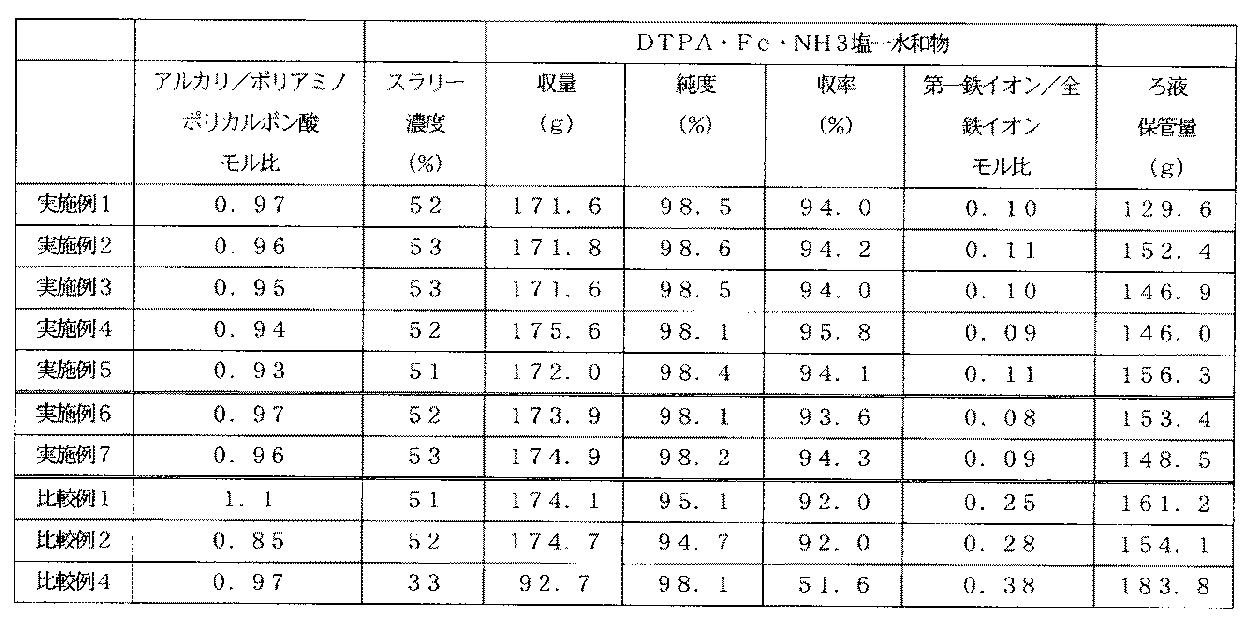
この結果を表1に示す。
<Example 1>
The reaction was carried out in the same manner as in Reference Example 1 except that 15% aqueous ammonia was changed to 41.8 g (0.369 mol). The filtrate stored in Reference Example 1 was added to this reaction solution together with a small amount of water, and filtered using a filter having an opening of 1 μm to separate insoluble matters. The complex in the reaction solution was oxidized by blowing air at a flow rate of 1.5 L / min for 10 hours using a ball filter at 50 to 55 ° C. to obtain a DTPA · Fe · NH 3 salt. Thereafter, the same processing as in Reference Example 1 was performed.
The results are shown in Table 1.
<実施例2>
15%アンモニア水を41.4g(0.365mol)に変えた以外は、実施例1と同様に仕込んで反応を行った。この反応液に実施例1で保管したろ液を少量の水と共に加え、実施例1と同様に処理した。
この結果を表1に示す。
<Example 2>
The reaction was carried out in the same manner as in Example 1 except that 15% aqueous ammonia was changed to 41.4 g (0.365 mol). The filtrate stored in Example 1 was added to this reaction solution together with a small amount of water and treated in the same manner as in Example 1.
The results are shown in Table 1.
<実施例3〜5>
15%アンモニア水の仕込み量を表1のように変えた以外は、実施例2と同様に反応、処理を行った。
この結果を表1に示す。
<Examples 3 to 5>
The reaction and treatment were performed in the same manner as in Example 2 except that the amount of 15% aqueous ammonia was changed as shown in Table 1.
The results are shown in Table 1.
<参考例2>
15%アンモニア水を30%水酸化ナトリウム水溶液49.73g(0.373mol)に変えた以外は、参考例1と同様に仕込んで反応、処理を行った。このときのスラリー濃度は51%、保管したろ液は131.0gであった。
その結果、純度98.4%のジエチレントリアミン五酢酸第二鉄ナトリウム塩(DTPA・Fe・Na塩)一水和物結晶141.0g(DTPAベースの収率76.2%)を得た。全鉄イオンに対する第一鉄イオンの量は0.06%であった。
<Reference Example 2>
The reaction and treatment were carried out in the same manner as in Reference Example 1 except that 15% aqueous ammonia was changed to 49.73 g (0.373 mol) of a 30% aqueous sodium hydroxide solution. The slurry concentration at this time was 51%, and the stored filtrate was 131.0 g.
As a result, 141.0 g of diethylenetriaminepentaacetic acid ferric sodium salt (DTPA • Fe • Na salt) monohydrate crystals having a purity of 98.4% (yield 76.2% based on DTPA) was obtained. The amount of ferrous ion relative to total iron ion was 0.06%.
<実施例6>
30%水酸化ナトリウム水溶液を49.15g(0.369mol)に変えた以外は、参考例2と同様に仕込んで反応を行った。この反応液に参考例2で保管したろ液を少量の水と共に加え、目開き1μmのフィルターを使用し、ろ過して不溶物をろ別した。50〜55℃でボールフィルターを用いて空気を1.5L/分の流量で10時間吹き込むことにより、反応液中の錯体を酸化し、DTPA・Fe・NH3塩とした。以降、参考例2と同様に処理した。
この結果を表1に示す。
<Example 6>
The reaction was carried out in the same manner as in Reference Example 2 except that the 30% aqueous sodium hydroxide solution was changed to 49.15 g (0.369 mol). The filtrate stored in Reference Example 2 was added to this reaction solution together with a small amount of water, and the mixture was filtered using a filter having an opening of 1 μm to separate insoluble matters. The complex in the reaction solution was oxidized by blowing air at a flow rate of 1.5 L / min for 10 hours using a ball filter at 50 to 55 ° C. to obtain a DTPA · Fe · NH 3 salt. Thereafter, the same processing as in Reference Example 2 was performed.
The results are shown in Table 1.
<実施例7>
30%水酸化ナトリウム水溶液を48.64g(0.365mol)に変えた以外は、実施例6と同様に仕込んで反応を行った。この反応液に実施例6で保管したろ液を少量の水と共に加え、実施例6と同様に処理した。
この結果を表1に示す。
<Example 7>
The reaction was carried out in the same manner as in Example 6 except that the 30% aqueous sodium hydroxide solution was changed to 48.64 g (0.365 mol). The filtrate stored in Example 6 was added to this reaction solution together with a small amount of water and treated in the same manner as in Example 6.
The results are shown in Table 1.
<参考例3>
15%アンモニア水を47.4g(0.418mol)に変えた以外は、参考例1と同様に仕込んで反応、処理を行った。
その結果、純度96.5%のDTPA・Fe・NH3塩一水和物結晶144.2g(DTPAベースの収率77.4%)を得た。全鉄イオンに対する第一鉄イオンの量は0.10%であった。このときのスラリー濃度は51%、保管したろ液は132.5gであった。
<Reference Example 3>
The reaction and treatment were performed in the same manner as in Reference Example 1 except that 15% aqueous ammonia was changed to 47.4 g (0.418 mol).
As a result, 144.2 g of a DTPA · Fe · NH 3 salt monohydrate crystal having a purity of 96.5% (yield 77.4% based on DTPA) was obtained. The amount of ferrous ion relative to total iron ion was 0.10%. The slurry concentration at this time was 51%, and the stored filtrate was 132.5 g.
<比較例1>
参考例3と同様に仕込み、反応を行った。この反応液を目開き1μmのフィルターを使用し、ろ過して不溶物をろ別した。50〜55℃でボールフィルターを用いて空気を1.5L/分の流量で10時間吹き込むことにより、反応液中の錯体を酸化し、DTPA・Fe・NH3塩とした。この水溶液に、参考例3で保管したろ液を少量の水と共に加えて、攪拌しながら50℃で減圧濃縮した後、10℃まで冷却して3時間かけて、結晶を析出させた。以降は参考例1と同様に処理を行った。
この結果を表1に示す。
<Comparative Example 1>
The same preparation and reaction as in Reference Example 3 were performed. The reaction solution was filtered using a filter having an opening of 1 μm to separate insolubles. The complex in the reaction solution was oxidized by blowing air at a flow rate of 1.5 L / min for 10 hours using a ball filter at 50 to 55 ° C. to obtain a DTPA · Fe · NH 3 salt. The filtrate stored in Reference Example 3 was added to this aqueous solution together with a small amount of water, concentrated under reduced pressure at 50 ° C. with stirring, cooled to 10 ° C., and crystals were precipitated over 3 hours. Thereafter, the same processing as in Reference Example 1 was performed.
The results are shown in Table 1.
<参考例4>
15%アンモニア水を36.6g(0.323mol)に変えた以外は、参考例1と同様に仕込んで反応、処理を行った。
その結果、純度95.1%のDTPA・Fe・NH3塩一水和物結晶147.1g(DTPAベースの収率77.7%)を得た。全鉄イオンに対する第一鉄イオンの量は0.10%であった。このときのスラリー濃度は51%、保管したろ液は135.7gであった。
<Reference Example 4>
The reaction and treatment were performed in the same manner as in Reference Example 1 except that 15% aqueous ammonia was changed to 36.6 g (0.323 mol).
As a result, 147.1 g of a DTPA · Fe · NH 3 salt monohydrate crystal having a purity of 95.1% (yield 77.7% based on DTPA) was obtained. The amount of ferrous ion relative to total iron ion was 0.10%. The slurry concentration at this time was 51%, and the stored filtrate was 135.7 g.
<比較例2>
参考例4と同様に仕込み、反応を行った。この反応液を目開き1μmのフィルターを使用し、ろ過して不溶物をろ別した。50〜55℃でボールフィルターを用いて空気を1.5L/分の流量で10時間吹き込むことにより、反応液中の錯体を酸化し、DTPA・Fe・NH3塩とした。この水溶液に、参考例4で保管したろ液を少量の水と共に加えて、攪拌しながら50℃で減圧濃縮した後、10℃まで冷却して3時間かけて、結晶を析出させた。以降は参考例1と同様に処理を行った。
この結果を表1に示す。
<Comparative example 2>
The same preparation and reaction as in Reference Example 4 were performed. The reaction solution was filtered using a filter having an opening of 1 μm to separate insolubles. The complex in the reaction solution was oxidized by blowing air at a flow rate of 1.5 L / min for 10 hours using a ball filter at 50 to 55 ° C. to obtain a DTPA · Fe · NH 3 salt. The filtrate stored in Reference Example 4 was added to this aqueous solution together with a small amount of water, concentrated under reduced pressure at 50 ° C. with stirring, cooled to 10 ° C., and crystals were precipitated over 3 hours. Thereafter, the same processing as in Reference Example 1 was performed.
The results are shown in Table 1.
<比較例3>
実施例1と同様の条件で反応を行い、この反応液に参考例1と同様の方法で取得し、保管したろ液を少量の水と共に加え、実施例1と同様に処理し、スラリー濃度68%になるようにこの水溶液を攪拌しながら50℃で減圧濃縮した。10℃まで冷却したところ、粘張性のスラッジとなりろ過できなかった。
<Comparative Example 3>
The reaction was carried out under the same conditions as in Example 1. The filtrate obtained in the same manner as in Reference Example 1 was added to this reaction solution, and the stored filtrate was added together with a small amount of water. The aqueous solution was concentrated under reduced pressure at 50 ° C. with stirring so that the concentration became 50%. When cooled to 10 ° C., it became viscous sludge and could not be filtered.
<比較例4>
実施例1と同様の条件で反応を行い、この反応液を目開き1μmのフィルターを使用し、ろ過して不溶物をろ別した。50〜55℃でボールフィルターを用いて空気を1.5L/分の流量で10時間吹き込むことにより、反応液中の錯体を酸化し、DTPA・Fe・NH3塩とした。この水溶液に、参考例1と同様の方法で取得し、保管したろ液を少量の水と共に加えて、攪拌しながら50℃で減圧濃縮した後、10℃まで冷却して3時間かけて、結晶を析出させた。このときのスラリー濃度は33%であった。以後、実施例1と同様に処理した。
この結果を表1に示す。
<Comparative example 4>
The reaction was carried out under the same conditions as in Example 1, and this reaction solution was filtered using a 1 μm aperture filter to separate insolubles. The complex in the reaction solution was oxidized by blowing air at a flow rate of 1.5 L / min for 10 hours using a ball filter at 50 to 55 ° C. to obtain a DTPA · Fe · NH 3 salt. To this aqueous solution, the filtrate obtained and stored in the same manner as in Reference Example 1 was added together with a small amount of water, concentrated under reduced pressure at 50 ° C. with stirring, cooled to 10 ° C., and crystallized over 3 hours. Was precipitated. The slurry concentration at this time was 33%. Thereafter, the same processing as in Example 1 was performed.
The results are shown in Table 1.
本発明の方法で製造されるポリアミノポリカルボン酸鉄アルカリ塩は、写真用薬品、肥料添加剤、分析試薬及び各種添加薬として使用される。 The polyaminopolycarboxylic acid iron alkali salt produced by the method of the present invention is used as a photographic chemical, a fertilizer additive, an analytical reagent, and various additives.
Claims (5)
Priority Applications (1)
| Application Number | Priority Date | Filing Date | Title |
|---|---|---|---|
| JP2006010832A JP4875366B2 (en) | 2006-01-19 | 2006-01-19 | Process for producing iron alkali salt of polyaminopolycarboxylic acid |
Applications Claiming Priority (1)
| Application Number | Priority Date | Filing Date | Title |
|---|---|---|---|
| JP2006010832A JP4875366B2 (en) | 2006-01-19 | 2006-01-19 | Process for producing iron alkali salt of polyaminopolycarboxylic acid |
Publications (2)
| Publication Number | Publication Date |
|---|---|
| JP2007191423A JP2007191423A (en) | 2007-08-02 |
| JP4875366B2 true JP4875366B2 (en) | 2012-02-15 |
Family
ID=38447403
Family Applications (1)
| Application Number | Title | Priority Date | Filing Date |
|---|---|---|---|
| JP2006010832A Expired - Fee Related JP4875366B2 (en) | 2006-01-19 | 2006-01-19 | Process for producing iron alkali salt of polyaminopolycarboxylic acid |
Country Status (1)
| Country | Link |
|---|---|
| JP (1) | JP4875366B2 (en) |
-
2006
- 2006-01-19 JP JP2006010832A patent/JP4875366B2/en not_active Expired - Fee Related
Also Published As
| Publication number | Publication date |
|---|---|
| JP2007191423A (en) | 2007-08-02 |
Similar Documents
| Publication | Publication Date | Title |
|---|---|---|
| JP2012091968A (en) | Method of recovering germanium from germanium-containing intermediate | |
| BE886326A (en) | PROCESS FOR THE MANUFACTURE OF TITANIUM COMPOUNDS USING A REDUCER | |
| RU2247112C2 (en) | Method for preparing 2-hydroxy-4-methylthiobutanoic acid | |
| CN110438347A (en) | Sodium cleans extraction vanadium method | |
| JP5852183B2 (en) | Method for the synthesis of azo compounds | |
| JP4875366B2 (en) | Process for producing iron alkali salt of polyaminopolycarboxylic acid | |
| JP2000211906A (en) | Production of aqueous solution of free hydroxylamine | |
| US4275041A (en) | Process for manufacturing a stable titanyl sulfate solution | |
| JPH0696455B2 (en) | Method for producing high-purity cobalt sulfate | |
| JPH07224334A (en) | Copper separation and recovery method | |
| JP3503116B2 (en) | Manufacturing method of high concentration free hydroxylamine aqueous solution | |
| JP4441802B2 (en) | Method for producing 2,3-pyridinedicarboxylic acid | |
| JP4322122B2 (en) | Method for purifying high-purity niobium compound and / or tantalum compound | |
| JPS60231647A (en) | Method of removing residual sulfuric acid from reaction mixture produced by sulfoxidation of paraffin | |
| JP4351912B2 (en) | Method for purifying niobium compound and / or tantalum compound | |
| CN111732133A (en) | Preparation method of tetraamminepalladium sulfate | |
| US4599223A (en) | Separation of tungsten from rhenium | |
| JP3503115B2 (en) | Method for producing free hydroxylamine aqueous solution | |
| RU2305066C2 (en) | Method for preparing potassium iodate and potassium iodide | |
| US6485700B1 (en) | Process for producing free hydroxylamine aqueous solution | |
| CN112830892A (en) | Synthesis method of pyridine-3-sulfonyl chloride | |
| CN111491916B (en) | Process for producing methionine | |
| JP3137226B2 (en) | Production method of high purity strontium chloride | |
| JPS589767B2 (en) | Potassium recovery method | |
| FI70563B (en) | FOERFARANDE FOER FRAMSTAELLNING AV TITANDIOXID GENOM ANVAENDNING AV REDUKTIONSMEDEL |
Legal Events
| Date | Code | Title | Description |
|---|---|---|---|
| A621 | Written request for application examination |
Free format text: JAPANESE INTERMEDIATE CODE: A621 Effective date: 20081226 |
|
| A977 | Report on retrieval |
Free format text: JAPANESE INTERMEDIATE CODE: A971007 Effective date: 20111109 |
|
| TRDD | Decision of grant or rejection written | ||
| A01 | Written decision to grant a patent or to grant a registration (utility model) |
Free format text: JAPANESE INTERMEDIATE CODE: A01 Effective date: 20111117 |
|
| A01 | Written decision to grant a patent or to grant a registration (utility model) |
Free format text: JAPANESE INTERMEDIATE CODE: A01 |
|
| A61 | First payment of annual fees (during grant procedure) |
Free format text: JAPANESE INTERMEDIATE CODE: A61 Effective date: 20111125 |
|
| FPAY | Renewal fee payment (event date is renewal date of database) |
Free format text: PAYMENT UNTIL: 20141202 Year of fee payment: 3 |
|
| R151 | Written notification of patent or utility model registration |
Ref document number: 4875366 Country of ref document: JP Free format text: JAPANESE INTERMEDIATE CODE: R151 |
|
| FPAY | Renewal fee payment (event date is renewal date of database) |
Free format text: PAYMENT UNTIL: 20141202 Year of fee payment: 3 |
|
| FPAY | Renewal fee payment (event date is renewal date of database) |
Free format text: PAYMENT UNTIL: 20141202 Year of fee payment: 3 |
|
| S531 | Written request for registration of change of domicile |
Free format text: JAPANESE INTERMEDIATE CODE: R313531 |
|
| FPAY | Renewal fee payment (event date is renewal date of database) |
Free format text: PAYMENT UNTIL: 20141202 Year of fee payment: 3 |
|
| R350 | Written notification of registration of transfer |
Free format text: JAPANESE INTERMEDIATE CODE: R350 |
|
| FPAY | Renewal fee payment (event date is renewal date of database) |
Free format text: PAYMENT UNTIL: 20141202 Year of fee payment: 3 |
|
| R250 | Receipt of annual fees |
Free format text: JAPANESE INTERMEDIATE CODE: R250 |
|
| R250 | Receipt of annual fees |
Free format text: JAPANESE INTERMEDIATE CODE: R250 |
|
| R250 | Receipt of annual fees |
Free format text: JAPANESE INTERMEDIATE CODE: R250 |
|
| S533 | Written request for registration of change of name |
Free format text: JAPANESE INTERMEDIATE CODE: R313533 |
|
| R350 | Written notification of registration of transfer |
Free format text: JAPANESE INTERMEDIATE CODE: R350 |
|
| R250 | Receipt of annual fees |
Free format text: JAPANESE INTERMEDIATE CODE: R250 |
|
| R250 | Receipt of annual fees |
Free format text: JAPANESE INTERMEDIATE CODE: R250 |
|
| LAPS | Cancellation because of no payment of annual fees |