JP4616552B2 - Cu-containing steel - Google Patents
Cu-containing steel Download PDFInfo
- Publication number
- JP4616552B2 JP4616552B2 JP2003429323A JP2003429323A JP4616552B2 JP 4616552 B2 JP4616552 B2 JP 4616552B2 JP 2003429323 A JP2003429323 A JP 2003429323A JP 2003429323 A JP2003429323 A JP 2003429323A JP 4616552 B2 JP4616552 B2 JP 4616552B2
- Authority
- JP
- Japan
- Prior art keywords
- mass
- less
- concentration
- steel
- steel material
- Prior art date
- Legal status (The legal status is an assumption and is not a legal conclusion. Google has not performed a legal analysis and makes no representation as to the accuracy of the status listed.)
- Expired - Fee Related
Links
Images


Landscapes
- Heat Treatment Of Steel (AREA)
Description
本発明は、Cuを含有する鋼材を製造するにあたり、溶鋼の鋳造時ならびに鋳片の加熱時に鋳片表面に形成する表面割れを防止するための鋼材の成分組成に関する。 The present invention relates to a component composition of a steel material for preventing surface cracks formed on the surface of a slab during casting of molten steel and heating of the slab when manufacturing a steel material containing Cu.
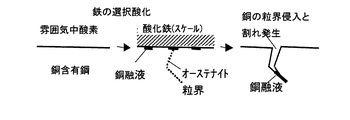
トランプエレメントであるCuを含有した鋼材を製造するにあたり、最大の問題は高温加熱ならびに加工する際に生じる表面割れの問題である。これは、図1に示すようにCuは鉄よりも貴な元素であるため、高温酸化されず地鉄/スケール界面に順次濃縮し、固溶限を越えるとCuが析出する。一般的に加熱温度はCuの融点よりも高いため、析出物はCu融液となり、加工時にオーステナイト粒界に沿って侵入し、顕著な割れを発生することになる。
また、トランプエレメントの一つであるSnは、単独では割れを発生することはないが、Cuと共存下ではCu起因の割れ疵をより顕著にする。これは、Snも鉄よりも貴なため、Cu同様、加熱時に順次濃化し、Cuのオーステナイト中での固溶限を低下させるとともにCu濃化相の融点を低くするためである。
When manufacturing steel material containing Cu, which is a playing card element, the biggest problem is the problem of surface cracks that occur during high-temperature heating and processing. This is because, as shown in FIG. 1, Cu is an element more noble than iron, so that it is not oxidized at high temperature but is concentrated successively at the base metal / scale interface, and Cu is deposited when the solid solubility limit is exceeded. In general, since the heating temperature is higher than the melting point of Cu, the precipitate becomes a Cu melt and penetrates along the austenite grain boundary during processing and generates remarkable cracks.
Sn, which is one of the trump elements, does not generate cracks by itself, but makes Cu-induced cracks more prominent in the presence of Cu. This is because Sn is nobler than iron, so that, like Cu, it is gradually concentrated during heating to lower the solid solubility limit of Cu in austenite and lower the melting point of the Cu concentrated phase.
このような割れ疵を防止するため、Cuのオーステナイト中での固溶限を増大し、Cu濃化相の融点を高くする効果があるNiを鋼中に添加することが、例えば特許文献1に開示されている。Ni添加量は、一般的には鋼中Cu濃度とほぼ等量、添加される。
その他、鋼中に含有するSiもCuによる割れ疵を防止する元素として有効であることが、例えば特許文献2に開示されている。これは、FeOとSiO2が加熱温度よりも低い低融点の酸化物を形成するため(融点1177℃)、スケール中へのCu融液の取り込みを顕著にすることによるとされている。
In addition, for example,
しかしながら、特許文献1に例示される方法等では、NiはCu同様、トランプエレメントの一つであることに加え、高価な金属であるため、添加量にも制限がある。加えて、Niは加熱時の粒界酸化を助長するため、Cu起因の割れ疵は防止できたとしても、スケールの剥離性を阻害することでスケール疵を発生することが知られている。このようにNi添加量はできるだけ低い方が好ましいといえる。また、全ての鋼種においてSi濃度を高くすることはできないため、特許文献2に開示されている方法の適用にも限界がある。
そのため、本発明は、Cu含有鋼の高温加熱時に形成する表面割れを防止する方策を提供することを目的としている。
However, in the method and the like exemplified in
Therefore, this invention aims at providing the policy which prevents the surface crack formed at the time of the high temperature heating of Cu containing steel.
本発明の構成は、以下の通りである。
(1) Cuを0.06mass%以上0.3mass%以下含有する鋼材において、
Nbの濃度が0.02mass%以上0.15mass%以下、Vの濃度が0.01mass%以上0.15mass%以下のいずれか一つ以上であり、
さらに、REM濃度が0.002mass%以上0.15mass%以下、Sの濃度が0.01mass%以上0.05mass%以下のいずれかの一つ以上であり、
Cの濃度が0.0031mass%以上1.5mass%以下、
Nの濃度が0.002mass%以上0.0045mass%以下、
Mnの濃度が0.01mass%以上2.5mass%以下、
Siの濃度が0.01mass%以上0.22mass%以下、
Alの濃度が0.04mass%以下
からなり、残部が鉄および不可避的不純物であることを特徴とするCu含有鋼片。
(2) (1)に記載のCu含有鋼片を、圧延前加熱処理した後の鋼材であって、粒径が10nm以上1μm以下の析出物の個数密度が105個/mm2以上であることを特徴とするCu含有鋼材。
(3) (1)に記載のCu含有鋼片を、圧延前加熱処理した後の鋼材であって、オーステナイト粒径が300μm以下であることを特徴とするCu含有鋼材。
(4) (1)に記載のCu含有鋼片を1100〜1300℃で1〜4時間加熱した後に、熱間圧延して得られた熱延鋼板。
(5) 粒径が10nm以上1μm以下の析出物の個数密度が105個/mm2以上であることを特徴とする(4)に記載の熱延鋼板。
The configuration of the present invention is as follows.
(1) In a steel material containing 0.06 mass% or more and 0.3 mass% or less of Cu,
The concentration of Nb is 0.02 mass% or more and 0.15 mass% or less, and the concentration of V is any one or more of 0.01 mass% or more and 0.15 mass% or less,
Further , the REM concentration is 0.002 mass% or more and 0.15 mass% or less, and the S concentration is one or more of 0.01 mass% or more and 0.05 mass% or less,
C concentration is 0.0031 mass% or more and 1.5 mass% or less,
The concentration of N is 0.002 mass% or more and 0.0045 mass% or less,
The concentration of Mn is 0.01 mass% or more and 2.5 mass% or less,
Si concentration is 0.01 mass% or more and 0.22 mass% or less,
A Cu-containing steel slab comprising an Al concentration of 0.04 mass% or less, and the balance being iron and inevitable impurities.
(2) A steel material after the Cu-containing steel slab described in (1) is heat-treated before rolling, and the number density of precipitates having a particle size of 10 nm or more and 1 μm or less is 10 5 pieces / mm 2 or more. A Cu-containing steel material characterized by that.
(3) A steel material obtained by subjecting the Cu-containing steel slab according to (1) to a heat treatment before rolling, wherein the austenite grain size is 300 μm or less.
(4) A hot-rolled steel sheet obtained by hot rolling the Cu-containing steel slab described in (1) at 1100 to 1300 ° C for 1 to 4 hours.
(5) The hot-rolled steel sheet according to (4) , wherein the number density of precipitates having a particle size of 10 nm or more and 1 μm or less is 10 5 pieces / mm 2 or more.
本発明の鋼材を用いることでCu起因の割れ疵をNiを添加することなく防止することができる。 By using the steel material of the present invention, Cu-induced cracks can be prevented without adding Ni.
本発明者らは、Cu含有鋼中の溶質成分を調整することで、Cu起因の高温脆化を抑制することに着目し、その溶質元素を種々変更したサンプルを用いた実験を行い、割れ発生との関係を調査した。具体的には、Cu含有鋼材を圧延前に行う加熱により生じる高温割れを模擬するために、各種試験片を切り出し、高温での引張実験を行った。 The inventors focused on suppressing high temperature embrittlement due to Cu by adjusting the solute components in the Cu-containing steel, and conducted experiments using samples in which the solute elements were variously changed to generate cracks. And investigated the relationship. Specifically, various test pieces were cut out and subjected to a tensile test at a high temperature in order to simulate a high temperature crack caused by heating performed before rolling the Cu-containing steel material.
その一例として、脱酸剤としてAl、Siを添加した0.14mass%C鋼をベースにCuを0.3mass%含有し、その溶質元素を表1に示す様に種々変更したサンプルを用いた鋳片を作成し、それから試験片を切り出したものについて高温での引張実験を行い、割れ発生との関係を調査した。具体的な加熱条件としては、圧延前の加熱を模擬するために、温度1150℃、雰囲気は水蒸気濃度12vol%、酸素濃度2vol%、残部窒素下において2時間加熱した後、同じ雰囲気で歪み速度5/secでサンプルを水平方向に5mm引張り、その後窒素雰囲気中で冷却した。
そして、各種サンプルの引っ張り変形が加えられた部位表面に見られる割れの深さを調査した。サンプルの分析結果と得られたサンプル表面性状を調査した結果を表1に示した。
As an example, a casting using a sample containing 0.1 mass% C steel added with Al and Si as a deoxidizer and containing 0.3 mass% Cu and variously changing the solute elements as shown in Table 1. A piece was prepared, and then a test piece cut out was subjected to a tensile test at a high temperature to investigate the relationship with crack generation. As specific heating conditions, in order to simulate heating before rolling, the temperature was 1150 ° C., the atmosphere was steam concentration 12 vol%,
And the depth of the crack seen in the site | part surface where the tensile deformation of various samples was added was investigated. Table 1 shows the results of examining the sample analysis results and the obtained sample surface properties.

上記の様な実験を、溶質成分を変更しながら繰り返した結果、Niを添加することなくCu起因の割れ疵を防止可能な溶質成分を新たに見出した。その結果を以下に示す。
まず、本発明の第一の形態として、Cuを0.06mass%以上含有する鋼材において、Ti、Nb、Vのいずれか一つ以上の溶質濃度が0.01mass%以上0.15mass%以下であり、さらにPの濃度が0.01mass%以上0.1mass%以下、REM濃度が0.002mass%以上0.15mass%以下、Sの濃度が0.01mass%以上0.05mass%以下のいずれか一種以上であるCu含有鋼材とすることで、Niを鋼中に添加することなくCu起因の割れ疵を防止できることが判明した。
As a result of repeating the above experiment while changing the solute component, a solute component that can prevent cracks caused by Cu without adding Ni was newly found. The results are shown below.
First, as a first embodiment of the present invention, in a steel material containing 0.06 mass% or more of Cu, the solute concentration of at least one of Ti, Nb, and V is 0.01 mass% or more and 0.15 mass% or less. Furthermore, P concentration is 0.01 mass% or more and 0.1 mass% or less, REM concentration is 0.002 mass% or more and 0.15 mass% or less, and S concentration is 0.01 mass% or more and 0.05 mass% or less. It was found that by using a Cu-containing steel material, it is possible to prevent cracks caused by Cu without adding Ni into the steel.
本発明がCuを0.06mass%以上含有する鋼材を対象とするのは、スクラップ鋼材またはスクラップ含有鋼材を用いるためである。スクラップを原料として使用する場合、Cuを含有することになるが、Cu濃度が0.06mass%以上になると、鋼種によってはCu起因の割れ疵に起因した表面欠陥が問題とされるようになる。そのため、下限値は0.06mass%とする。また、Cu濃度が高いと加工性に悪影響を及ぼすため、上限値は0.3mass%とする。 The reason why the present invention is intended for steel materials containing 0.06 mass% or more of Cu is to use scrap steel materials or scrap-containing steel materials. When scrap is used as a raw material, Cu is contained. However, when the Cu concentration is 0.06 mass% or more, surface defects due to cracks caused by Cu may be a problem depending on the steel type. Therefore, the lower limit is set to 0.06 mass%. Moreover , since the workability is adversely affected when the Cu concentration is high , the upper limit is set to 0.3 mass%.
まず、Cu起因の割れ疵を防止するために添加する元素として、Ti、Nb、Vが挙げられる。これらの元素を適量含有する鋼材について加熱処理を行うと、Ti、Nb、Vの炭化物、窒化物あるいは炭窒化物の微細な析出物を鋼中に数多く析出させることができる。これにより、粒成長を阻害することができ、オーステナイト粒径を微細な状態に保持できる。従って、スケール/地鉄界面の単位面積あたり多数の粒界を形成するため、オーステナイト粒界へのCu融液の侵入を分散させることができ、Cu起因の割れ疵を防止可能となる。
Nb、Vについては上記以外にも、これらの酸化物が鉄の酸化物と低融点の酸化物を形成するため(Nbを含有する酸化物の融点:1190℃、Vを含有する酸化物の融点:635℃)、スケール中へのCu融液の取込みを促進させることができ、地鉄/スケール界面に存在するCu融液量を低減することで、Cu起因の割れを防止することができる。
First, Ti, Nb, and V are mentioned as an element added in order to prevent the crack resulting from Cu. When heat treatment is performed on a steel material containing appropriate amounts of these elements, a large number of fine precipitates of Ti, Nb, V carbides, nitrides, or carbonitrides can be precipitated in the steel. Thereby, grain growth can be inhibited and the austenite grain size can be maintained in a fine state. Accordingly, since a large number of grain boundaries are formed per unit area of the scale / base metal interface, the intrusion of the Cu melt into the austenite grain boundaries can be dispersed, and cracks caused by Cu can be prevented.
For Nb and V, in addition to the above, these oxides form a low melting point oxide with an iron oxide (melting point of oxide containing Nb: 1190 ° C., melting point of oxide containing V) : 635 ° C.), it is possible to promote the uptake of the Cu melt into the scale, and it is possible to prevent the Cu-induced cracking by reducing the amount of the Cu melt present at the base metal / scale interface.
さらに、Cu起因の割れ疵を防止するために添加する元素として、P、REMが挙げられる。これらの元素はどちらも粒界に偏析する元素であり、粒界への偏析により粒界エネルギーは低下する。これにより、オーステナイト粒界へのCu濃化相の浸潤を抑制することが可能となるため、Cu起因の割れを防止することができる。
P、REMについては、オーステナイト粒径を微細にする作用も有する。その機構としては、Pはデンドライトに偏析するため粒成長を阻害することができ、またREMは炭化物、窒化物あるいは炭窒化物の微細な析出物を鋼中に数多く析出させることができるため、粒成長を阻害することができ、いずれもCu起因の割れを防止することができる。
Pについては、上記以外にも、この酸化物が鉄の酸化物と低融点の酸化物を形成するため(Pを含有する酸化物の融点:960℃)、スケール中へのCu融液の取込みを促進させることができ、地鉄/スケール界面に存在するCu融液量を低減することでCu起因の割れを防止することができる。
また、Sは、鉄よりも貴であるため高温加熱時にスケール/地鉄界面に界面に濃化する。さらに、Cuと低融点の硫化物(CuSの融点1067℃)を形成するため、スケール中へのCu融液の取り込みを促進する効果があるため、Cu起因の割れ疵を防止可能となる。
Furthermore, P and REM are mentioned as an element added in order to prevent the crack resulting from Cu. Both of these elements are segregated at the grain boundaries, and the grain boundary energy decreases due to segregation at the grain boundaries. Thereby, since it becomes possible to suppress the infiltration of the Cu concentrated phase into the austenite grain boundary, it is possible to prevent the cracks due to Cu.
About P and REM, it also has the effect | action which makes an austenite particle size fine. As its mechanism, P segregates into dendrites and can inhibit grain growth, and REM can precipitate a large number of fine precipitates of carbide, nitride or carbonitride in steel. Growth can be inhibited, and any cracks due to Cu can be prevented.
Regarding P, in addition to the above, since this oxide forms a low melting point oxide with an iron oxide (melting point of oxide containing P: 960 ° C.), the Cu melt is taken into the scale. Can be promoted, and Cu-induced cracks can be prevented by reducing the amount of Cu melt present at the iron / scale interface.
Further, since S is more noble than iron, it concentrates at the scale / base iron interface at high temperature heating. Furthermore, since Cu and a low melting point sulfide (CuS melting point: 1067 ° C.) are formed, there is an effect of accelerating the incorporation of the Cu melt into the scale, so that cracks caused by Cu can be prevented.
Ti、Nb、Vについては単独で用いても、任意に複数種同時に用いても、0.01mass%以上であればその効果を発揮するが、0.15mass%超でその効果は飽和するため、0.15mass%を上限値とする。
またこれと同時にP、REM、Sの一種以上を用いることも必要である。Pについては0.01mass%以上で上記効果を発現するが、P濃度が0.1mass%超となると加工性や延性が劣化するため、上限値は0.1mass%とする。
一方、REMについては、0.002mass%以上で上記効果を発現するが、0.15mass%超でその効果が飽和するため、0.15mass%を上限値とする。
S濃度は0.01mass%以上でその効果を発揮するが、S濃度が高くなると界面に濃化したSがFeと硫化物を形成し、その融点が940℃と低融点であるため、粒界脆化を引き起こす。S濃度が0.05mass%を越えると、FeSによる脆化が著しくなるため、S濃度は0.01mass%以上で0.05mass%以下とする。
Even if Ti, Nb, and V are used singly or optionally in combination with a plurality of types, the effect is exhibited if it is 0.01 mass% or more, but the effect is saturated at over 0.15 mass%. Let 0.15 mass% be the upper limit.
At the same time, it is necessary to use one or more of P, REM, and S. With respect to P, the above effect is exhibited at 0.01 mass% or more. However, when the P concentration exceeds 0.1 mass%, workability and ductility deteriorate, so the upper limit is set to 0.1 mass%.
On the other hand, for REM, the above effect is exhibited at 0.002 mass% or more, but since the effect is saturated at over 0.15 mass%, 0.15 mass% is set as the upper limit.
The effect is exhibited when the S concentration is 0.01 mass% or more, but when the S concentration increases, the concentrated S forms Fe and sulfide, and its melting point is 940 ° C., which is a low melting point. Causes embrittlement. When the S concentration exceeds 0.05 mass%, embrittlement due to FeS becomes significant, so the S concentration is set to 0.01 mass% or more and 0.05 mass% or less.
従来、圧延前の加熱温度については、Cu起因の高温割れを防止するにはできるだけ、1150℃あるいは1200℃以上の加熱温度としてスケール中にCuを取り込むことが望ましいとされていたが、本発明の鋼材を用いると1100℃程度の加熱温度でも上記結果を得ることができ、圧延前の加熱温度を低下できるという効果も享受できる。 Conventionally, with regard to the heating temperature before rolling, it has been desirable to incorporate Cu into the scale as a heating temperature of 1150 ° C. or 1200 ° C. or higher as much as possible in order to prevent high temperature cracking due to Cu. When steel is used, the above result can be obtained even at a heating temperature of about 1100 ° C., and the effect that the heating temperature before rolling can be reduced can also be enjoyed.
さらにCを0.0031mass%以上、Nを0.002mass%以上0.0045mass%以下、含有させることを特徴としたCu含有鋼材である。
溶鋼の脱炭脱窒処理等を行なっても、鋼中には不可避的に少量のC,Nが含有されるため、Ti,Nb,Vを前述の濃度にすることにより、Ti,Nb,Vの炭化物、窒化物、炭窒化物の微細な析出物によるオーステナイト粒の粗大化抑制効果が発現する。
特に、Cを0.0031mass%以上、Nを0.002mass%以上含有させることにより、この微細析出物の生成量が多くなり、オーステナイト粒の粗大化抑制効果が顕著になり、より容易にCuによる表面割れを防止することができるため好ましい。
但し、C濃度,N濃度が高すぎると靭性や加工性が劣化するため、C濃度は1.5mass%以下、N濃度は0.0045mass%以下とする。
Further, the Cu-containing steel material is characterized by containing C in an amount of 0.0031 mass% or more and N in an amount of 0.002 mass% or more and 0.0045 mass% or less.
Even if decarburization / denitrification treatment of molten steel is performed, since a small amount of C and N is inevitably contained in the steel, Ti, Nb, and V are made Ti, Nb, and V by adjusting the above concentrations. The effect of suppressing coarsening of austenite grains due to the fine precipitates of carbides, nitrides, and carbonitrides of the steel appears.
In particular, when C is contained in an amount of 0.0031 mass% or more and N is contained in an amount of 0.002 mass% or more, the amount of fine precipitates generated is increased, and the effect of suppressing the coarsening of austenite grains becomes remarkable. It is preferable because surface cracks can be prevented.
However, C concentration, since the N concentration is too high toughness and workability is deteriorated, C concentration is 1.5 mass% hereinafter, N concentration is less 0.0045mass%.
さらに、Mn濃度が、質量比でMn/S≧7である様なCu含有鋼材とすることで、Sによる脆化を緩和できるため、好ましい。
これは、Mnを鋼中に含有する場合、SをMnSとして固定するため、Sによる脆化を緩和できるためである。
ここで、鋼中のMn濃度としては、質量比でMn/S≧7とすることが好ましい。尚、Mn濃度の上限値は特に規定するものではなく、目的や用途等に応じて適宜設定すれば良いが、通常は2.5mass%以下であることが多い。
Furthermore , since the Mn concentration is a Cu-containing steel material in which the mass ratio is Mn / S ≧ 7, embrittlement due to S can be reduced, which is preferable.
This is because when Mn is contained in the steel, S is fixed as MnS, so that embrittlement due to S can be mitigated.
Here, the Mn concentration in the steel is preferably Mn / S ≧ 7 by mass ratio. The upper limit value of the Mn concentration is not particularly specified and may be set as appropriate according to the purpose and application, but is usually 2.5 mass% or less in many cases.
上記以外にも、MnSとして鋼中に析出することで、オーステナイト粒成長を抑制して、粒径を微細にする作用も有する。加えて、TiN等の窒化物が析出する場合には、先に析出した窒化物を核にしてMnSが析出するため、オーステナイト粒径のさらなる微細化が可能となる。その結果、Cu起因の割れを防止することができる。 In addition to the above, it precipitates in the steel as MnS, thereby suppressing the austenite grain growth and reducing the grain size. In addition, when a nitride such as TiN is precipitated, MnS is precipitated with the previously deposited nitride as a nucleus, so that the austenite grain size can be further refined. As a result, it is possible to prevent cracks caused by Cu.
さらに、上記の第一〜第三のいずれかの形態の成分に調整した鋼材を、圧延前加熱処理した後の鋼材については、粒径が10nm以上1μm以下の析出物の個数密度が105個/mm2以上とすることができる。ここで、圧延前加熱温度としては、通常は1100〜1300℃程度の温度で、予熱帯、加熱帯、均熱帯を含めた在炉時間は1〜4時間程度である。 Furthermore, about the steel material after heat-processing before rolling the steel material adjusted to said 1st-3rd component, the number density of the precipitate whose particle size is 10 nm or more and 1 micrometer or less is 10 < 5 >. / Mm 2 or more. Here, the heating temperature before rolling is usually about 1100 to 1300 ° C., and the in-furnace time including the pre-tropical zone, the heating zone, and the soaking zone is about 1 to 4 hours.
この様な加熱条件により熱処理した後の鋼について、10nm以上1μm以下の微細な析出物の個数密度を調査した。ここで行った調査方法は、透過電子顕微鏡による高倍率多視野観察(例えば、10万倍で100視野観察等)である。
その結果、10nm以上1μm以下の微細な析出物の個数密度が105個/mm2以上と多くなっていると、粒成長を阻害することができ、オーステナイト粒径を微細な状態に保持できることを知見した。ここで、析出物の粒径は、円相当径を意味している。
また、10nm以上1μm以下の微細な析出物の個数密度は多いほど良く、特に上限を規定するものではない。
The steel after heat treatment under such heating conditions was examined for the number density of fine precipitates of 10 nm or more and 1 μm or less. The investigation method performed here is high-magnification multi-field observation using a transmission electron microscope (for example, 100,000-field observation at 100,000 times).
As a result, when the number density of fine precipitates of 10 nm or more and 1 μm or less is increased to 10 5 pieces / mm 2 or more, grain growth can be inhibited, and the austenite grain size can be maintained in a fine state. I found out. Here, the particle diameter of the precipitate means an equivalent circle diameter.
Further, the higher the number density of fine precipitates of 10 nm or more and 1 μm or less, the better, and there is no particular upper limit.
具体的には、各種サンプルについて、先に述べた方法で鋼中に含まれる析出物の個数密度と割れの関係について調査した結果、図2に示す様に、10nm以上1μm以下の析出物の個数密度が105個/mm2以上となっていると、割れが抑制されることがわかった。
すなわち、析出物の個数密度が105個/mm2未満の場合、割れが抑制できないため、個数密度を105個/mm2以上とすることが重要であり、その際の析出物の粒径は、10nm以上1μm以下とすることで所望の個数密度が達成できる。
Specifically, as a result of investigating the relationship between the number density of precipitates and cracks contained in steel by the method described above for various samples, the number of precipitates of 10 nm to 1 μm as shown in FIG. It was found that cracking was suppressed when the density was 10 5 pieces / mm 2 or more.
That is, when the number density of precipitates is less than 10 5 pieces / mm 2 , cracking cannot be suppressed, so it is important that the number density is 10 5 pieces / mm 2 or more. The desired number density can be achieved by setting the thickness to 10 nm to 1 μm.
以上の様に、熱処理後の鋼について、粒径が10nm以上1μm以下の微細な析出物の個数密度が105個/mm2以上とすることで、割れが抑制できる。逆に言うと、割れを抑制するために析出物の粒径や個数密度を上記の様にするには、第一〜第三のいずれかの形態の成分に調整した鋼材を、圧延前加熱処理すれば良いということになる。
ちなみに、析出物は、EDXあるいはディフラクションパターンの解析を行い調査したところ、Ti、Nb、Vの炭化物、窒化物あるいは炭窒化物であることを併せて確認できた。
As described above, cracking can be suppressed by setting the number density of fine precipitates having a particle diameter of 10 nm or more and 1 μm or less to 10 5 pieces / mm 2 or more in the steel after heat treatment. In other words, in order to prevent the cracks from occurring, the grain size and number density of the precipitates are set as described above, and the steel material adjusted to the components in any one of the first to third forms is subjected to heat treatment before rolling. That's all you need to do.
Incidentally, when the precipitate was investigated by analyzing EDX or a diffraction pattern, it was confirmed that the precipitate was a carbide, nitride, or carbonitride of Ti, Nb, and V.
また、上記の第一〜第三のいずれかの形態の成分に調整した鋼材を加熱処理した後の鋼材については、オーステナイト粒径が300μm以下とすることができる。すなわち、熱処理後の鋼について、オーステナイト粒径が300μm以下と微細な状態に保持できることを知見した。オーステナイト粒径の下限は特に規定するものではなく、粒径が小さければその効果はより発揮される。ここで、オーステナイト粒の粒径は、円相当径を意味している。
また、オーステナイト粒径は小さいほど良く、特に下限を規定するものではない。
Moreover, about the steel material after heat-processing the steel material adjusted to the component of any one of said 1st-3rd form, an austenite particle size can be 300 micrometers or less. That is, it has been found that the austenite grain size can be maintained in a fine state of 300 μm or less with respect to the heat-treated steel. The lower limit of the austenite particle size is not particularly defined, and the effect is more exhibited if the particle size is small. Here, the particle diameter of the austenite grain means an equivalent circle diameter.
Further, the smaller the austenite particle size, the better, and there is no particular lower limit.
具体的には、各種サンプルについて、オーステナイト粒径と割れの関係について調査した結果、図3に示す通りであることがわかった。従って、熱処理後の鋼について、オーステナイト粒径を300μm以下とすることで、割れが抑制できる。逆に言うと、割れを抑制するためにオーステナイト粒径を上記の様にするには、第一〜第三のいずれかの形態の成分に調整した鋼材を、圧延前加熱処理すれば良いということになる。 Specifically, as a result of investigating the relationship between the austenite grain size and cracks for various samples, it was found that the results were as shown in FIG. Therefore, cracking can be suppressed by setting the austenite grain size to 300 μm or less in the heat-treated steel. In other words, in order to suppress the cracking in order to make the austenite grain size as described above, the steel material adjusted to the component in any of the first to third forms may be heat-treated before rolling. become.
このように、本発明では鋼中に添加する溶質元素を適切に選択することで、
(1)オーステナイト粒径を微細にし、Cu融液のオーステナイト粒界への侵入を分散させること(Ti、Nb、V、P、REM、S、Mn)、
(2)粒界偏析元素を活用することで、粒界エネルギーを低くしオーステナイト粒の微細化とCu融液の粒界への浸潤を抑制すること(P、REM)、
(3)低融点の酸化物を形成することで、スケール/地鉄界面に濃化するCu融液の生成量を減少すること(Nb、V、P、S)、
これらを組み合わせることで、Niを添加することなく、Cu起因の割れを防止できるというものである。
Thus, in the present invention, by appropriately selecting the solute element added to the steel,
(1) Making the austenite grain size fine and dispersing the penetration of Cu melt into the austenite grain boundaries (Ti, Nb, V, P, REM, S, Mn),
(2) Utilizing grain boundary segregation elements to lower grain boundary energy and suppress austenite grain refinement and infiltration of Cu melt into grain boundaries (P, REM);
(3) Reduce the amount of Cu melt produced at the scale / base metal interface by forming a low melting point oxide (Nb, V, P, S);
By combining these, it is possible to prevent cracking due to Cu without adding Ni.
また、本発明の第一〜第三のいずれかの形態の鋼材の製造方法は、転炉での精錬後、環流式真空脱ガス装置や取鍋精錬装置等での処理中の溶鋼に、合金等を添加することにより、必要な溶質成分を適宜添加し、その後、所望の成分の溶鋼を鋳造することで、Cu起因の割れのない鋳片が得られる。なお、C、Nの調整については、それぞれ0.03mass%程度以上、0.004mass%程度以上の場合は、上記の方法で調整でき、それ未満の濃度の場合は環流式真空脱ガス装置を用いて脱炭・脱窒処理を行うことにより所望の濃度に調整することができる。
また、得られた鋳片を圧延するに際し、加熱を行うが、その加熱後の鋳片については、微細な析出物の個数密度を多くでき、またオーステナイト粒径を小さくできるため、圧延してもCu起因の割れのない鋼材が得られる。
In addition, the method for producing a steel material according to any one of the first to third aspects of the present invention includes an alloy for molten steel being processed in a reflux vacuum degassing device or a ladle refining device after refining in a converter. By adding a necessary solute component as appropriate, and then casting a molten steel having a desired component, a slab free from cracks due to Cu can be obtained. In addition, about the adjustment of C and N, when it is about 0.03 mass% or more and about 0.004 mass% or more, respectively, it can adjust with said method, and in the case of the density | concentration less than that, use a recirculation-type vacuum degassing apparatus. By performing decarburization / denitrification treatment, it can be adjusted to a desired concentration.
In addition, when the obtained slab is rolled, heating is performed, but for the slab after the heating, the number density of fine precipitates can be increased and the austenite grain size can be reduced. A steel material free from cracks due to Cu is obtained.
なお、Cuを含有する鋳片が連鋳機内で曲げ変形を受けると表面割れが発生する場合があるが、連鋳機内の変形歪速度は、圧延時の歪速度に比べて非常に小さいため、割れも圧延時の割れに比べて軽微である。そのため、本発明の鋳片は圧延前加熱処理した後の鋼材に比べて、粒径が10nm以上1μm以下の析出物個数が少なく、オーステナイト粒径も大きいが、本発明の鋼成分に調整することでオーステナイト粒の粗大化防止効果、粒界偏析によるCu融液の粒界への浸潤防止効果、スケール低融点化によるCu融液量の低減効果により、Cu起因の表面割れを防止することができる。 In addition, if the slab containing Cu undergoes bending deformation in the continuous casting machine, surface cracks may occur, but the deformation strain rate in the continuous casting machine is very small compared to the strain rate during rolling, Cracks are also minor compared to cracks during rolling. Therefore, the slab of the present invention has a smaller number of precipitates having a particle size of 10 nm or more and 1 μm or less and a larger austenite particle size than the steel material after the heat treatment before rolling, but the steel composition of the present invention is adjusted. Therefore, Cu-induced surface cracking can be prevented by the effect of preventing coarsening of austenite grains, the effect of preventing Cu melt from infiltrating into grain boundaries due to grain boundary segregation, and the effect of reducing the amount of Cu melt by reducing the melting point of scale. .
転炉での精錬と環流式真空脱ガス装置での処理ならびに合金添加により、表2に示した成分に調整した溶鋼を溶製した。この溶鋼を連続鋳造方法で厚み250mm、幅1800mmのスラブに鋳造した。鋳造した鋳片は8500mm長さに切断し、1コイル単位とした。全量スラブの表面を観察し、表面欠陥の発生状況を評価した。結果を表2に示した。 The molten steel adjusted to the components shown in Table 2 was produced by refining in a converter, treatment in a reflux vacuum degassing apparatus, and addition of an alloy. This molten steel was cast into a slab having a thickness of 250 mm and a width of 1800 mm by a continuous casting method. The cast slab was cut to a length of 8500 mm to make one coil unit. The surface of all slabs was observed and the occurrence of surface defects was evaluated. The results are shown in Table 2.
スラブは、加熱温度1100〜1200℃×2時間加熱した後、熱間圧延を行い5mm厚みで幅1800mmコイルの熱延鋼板とした。加熱雰囲気は水蒸気濃度10〜15vol%、酸素は2〜5vol%、残部窒素であった。鋼板表面品質については、熱間圧延後の検査ラインで目視観察を行い、1コイルあたりに発生する表面欠陥の発生状況を評価した。結果を表2に併せて示した。 The slab was heated at a heating temperature of 1100 to 1200 ° C. for 2 hours and then hot rolled to form a hot rolled steel sheet having a thickness of 5 mm and a width of 1800 mm. The heating atmosphere was a water vapor concentration of 10 to 15 vol%, oxygen was 2 to 5 vol%, and the balance was nitrogen. Regarding the surface quality of the steel sheet, visual observation was performed on an inspection line after hot rolling, and the occurrence of surface defects generated per coil was evaluated. The results are also shown in Table 2.
本発明で述べた鋼中溶質元素の濃度に調整した鋼材(No.2〜11)においては、引っ張り実験で得られた結果と同様に、鋳片ならびに熱間圧延後の鋼板表面いずれにおいても割れは観察されなかった。
さらに、本発明の鋼中溶質元素の効果を、低炭Alキルド鋼(No.13〜22)、IF鋼(No.27、No.32)においても調査したが、本発明の鋼中溶質元素の濃度に調整することで、中炭鋼の場合(No.2〜11)と同様な結果を得ることができた。
No.13,17,21,24,32ではCuによる表面割れを助長することが知られているSnを含有しているが、この場合においても本発明の方法により、表面割れを防止することができた。
In the steel materials (Nos. 2 to 11) adjusted to the concentration of the solute element in the steel described in the present invention, cracks are observed on both the slab and the hot-rolled steel plate surface, similarly to the result obtained in the tensile experiment. Was not observed.
Furthermore, the effect of the solute element in the steel of the present invention was also investigated in the low-carbon Al killed steel ( No. 13-22) and the IF steel ( No. 27, No. 32 ), but the solute element in the steel of the present invention. By adjusting to the density | concentration of this, the result similar to the case (No. 2-11) of the medium charcoal steel was able to be obtained.
No. 13, 17, 21, 2, 4 , and 32 contain Sn, which is known to promote surface cracking by Cu. Even in this case, surface cracking can be prevented by the method of the present invention. did it.
尚、これらの条件において、オーステナイト粒径ならびに析出物の個数密度を調査したが、いずれの条件においてもオーステナイト粒径は300μm以下で粒径が10nm以上1μm以下の析出物の個数密度は105個/mm2以上であることも併せて確認した。 Under these conditions, the austenite particle size and the number density of precipitates were investigated. Under any condition, the number density of precipitates having an austenite particle size of 300 μm or less and a particle size of 10 nm to 1 μm was 10 5. / Mm 2 or more was also confirmed.
Claims (5)
Nbの濃度が0.02mass%以上0.15mass%以下、Vの濃度が0.01mass%以上0.15mass%以下のいずれか一つ以上であり、
さらに、REM濃度が0.002mass%以上0.15mass%以下、Sの濃度が0.01mass%以上0.05mass%以下のいずれかの一つ以上であり、
Cの濃度が0.0031mass%以上1.5mass%以下、
Nの濃度が0.002mass%以上0.0045mass%以下、
Mnの濃度が0.01mass%以上2.5mass%以下、
Siの濃度が0.01mass%以上0.22mass%以下、
Alの濃度が0.04mass%以下
からなり、残部が鉄および不可避的不純物であることを特徴とするCu含有鋼片。 In a steel material containing 0.06 mass% or more and 0.3 mass% or less of Cu,
The concentration of Nb is 0.02 mass% or more and 0.15 mass% or less, and the concentration of V is any one or more of 0.01 mass% or more and 0.15 mass% or less,
Further , the REM concentration is 0.002 mass% or more and 0.15 mass% or less, and the S concentration is one or more of 0.01 mass% or more and 0.05 mass% or less,
C concentration is 0.0031 mass% or more and 1.5 mass% or less,
The concentration of N is 0.002 mass% or more and 0.0045 mass% or less,
The concentration of Mn is 0.01 mass% or more and 2.5 mass% or less,
Si concentration is 0.01 mass% or more and 0.22 mass% or less,
A Cu-containing steel slab comprising an Al concentration of 0.04 mass% or less, and the balance being iron and inevitable impurities.
Priority Applications (1)
| Application Number | Priority Date | Filing Date | Title |
|---|---|---|---|
| JP2003429323A JP4616552B2 (en) | 2003-06-18 | 2003-12-25 | Cu-containing steel |
Applications Claiming Priority (2)
| Application Number | Priority Date | Filing Date | Title |
|---|---|---|---|
| JP2003173576 | 2003-06-18 | ||
| JP2003429323A JP4616552B2 (en) | 2003-06-18 | 2003-12-25 | Cu-containing steel |
Publications (2)
| Publication Number | Publication Date |
|---|---|
| JP2005029886A JP2005029886A (en) | 2005-02-03 |
| JP4616552B2 true JP4616552B2 (en) | 2011-01-19 |
Family
ID=34219971
Family Applications (1)
| Application Number | Title | Priority Date | Filing Date |
|---|---|---|---|
| JP2003429323A Expired - Fee Related JP4616552B2 (en) | 2003-06-18 | 2003-12-25 | Cu-containing steel |
Country Status (1)
| Country | Link |
|---|---|
| JP (1) | JP4616552B2 (en) |
Families Citing this family (1)
| Publication number | Priority date | Publication date | Assignee | Title |
|---|---|---|---|---|
| JPWO2024204437A1 (en) | 2023-03-29 | 2024-10-03 |
Family Cites Families (10)
| Publication number | Priority date | Publication date | Assignee | Title |
|---|---|---|---|---|
| JPH02290918A (en) * | 1989-04-28 | 1990-11-30 | Sumitomo Metal Ind Ltd | Production of hot rolled steel plate for working |
| JPH06293916A (en) * | 1993-04-07 | 1994-10-21 | Nippon Steel Corp | Production of low alloy steel plate for line pipe excellent in co2 corrosion resisrance |
| JPH07150237A (en) * | 1993-12-01 | 1995-06-13 | Kobe Steel Ltd | Method for producing high-strength hot-rolled steel sheet with excellent perforation and corrosion resistance |
| JPH1017992A (en) * | 1996-07-01 | 1998-01-20 | Sumitomo Metal Ind Ltd | Cold rolled steel sheet for enamel |
| JPH1025536A (en) * | 1996-07-11 | 1998-01-27 | Sumitomo Metal Ind Ltd | Steel material excellent in toughness of welded heat-affected zone and method for producing the same |
| JP4022958B2 (en) * | 1997-11-11 | 2007-12-19 | Jfeスチール株式会社 | High toughness thick steel plate with excellent weld heat affected zone toughness and method for producing the same |
| JP3577947B2 (en) * | 1998-05-12 | 2004-10-20 | Jfeスチール株式会社 | Thick steel plate excellent in laser cutability and method for producing the same |
| KR100482208B1 (en) * | 2000-11-17 | 2005-04-21 | 주식회사 포스코 | Method for manufacturing steel plate having superior toughness in weld heat-affected zone by nitriding treatment |
| DE60130788T2 (en) * | 2000-12-01 | 2008-07-17 | Posco, Pohang | TIN AND MNS EXTRACTIVE STEEL PLATE FOR SHELF STRUCTURES, HORIZONTAL PROCESSING THEREFOR, AND THESE USE OF WELDING INSERTS |
| US6966955B2 (en) * | 2000-12-14 | 2005-11-22 | Posco | Steel plate having TiN+ZrN precipitates for welded structures, method for manufacturing same and welded structure made therefrom |
-
2003
- 2003-12-25 JP JP2003429323A patent/JP4616552B2/en not_active Expired - Fee Related
Also Published As
| Publication number | Publication date |
|---|---|
| JP2005029886A (en) | 2005-02-03 |
Similar Documents
| Publication | Publication Date | Title |
|---|---|---|
| JP4363403B2 (en) | Steel for line pipe excellent in HIC resistance and line pipe manufactured using the steel | |
| JP5231042B2 (en) | Steel material excellent in toughness of weld heat-affected zone and method for producing the same | |
| JP3943021B2 (en) | Steel sheet for depositing TiN + CuS for welded structure, method for producing the same, and welded structure using the same | |
| JP4374357B2 (en) | High-strength wire rod excellent in wire drawing characteristics, manufacturing method thereof, and high-strength steel wire excellent in wire drawing properties | |
| JPWO2018021452A1 (en) | Machine structural steel | |
| JP2004514792A (en) | Steel plate depositing TiN + MnS for welded structure, method for producing the same, and welded structure using the same | |
| JP2011214058A (en) | High-strength stainless steel wire, and method for producing the same | |
| JP5452253B2 (en) | Forged steel and crankshaft | |
| JP4424503B2 (en) | Steel bar and wire rod | |
| JP6776469B1 (en) | Duplex stainless steel and its manufacturing method | |
| JP2005105322A (en) | Thick steel plate excellent in toughness of welded joint subjected to large heat input welding, and its production method | |
| JP4074536B2 (en) | Steel with excellent toughness of base metal and weld heat affected zone | |
| JP4646850B2 (en) | High carbon steel wire rod with excellent resistance to breakage of copper | |
| JP2012017484A (en) | Steel for bolt, bolt, and method for production of the bolt | |
| JP4289756B2 (en) | High strength metastable austenitic stainless steel wire | |
| CN101268208B (en) | Low-carbon sulfur-containing free-cutting steel with excellent cuttability | |
| JP2005232515A (en) | Thick steel plate having excellent high heat input welded join toughness | |
| JP2009179844A (en) | High tensile strength thick steel plate having excellent toughness in weld heat affected zone | |
| JP2005029886A (en) | Cu-containing steel | |
| KR101764993B1 (en) | STEEL IN WHICH Cu-Sn COEXIST, AND METHOD FOR MANUFACTURING SAME | |
| JP3971569B2 (en) | Hot rolled wire rod for high strength springs | |
| JPH108132A (en) | Manufacturing method of thick steel plate with excellent toughness | |
| JP5053187B2 (en) | Perlite high carbon steel rail with excellent ductility | |
| CN116323988A (en) | Steel plate and manufacturing method of steel plate | |
| TWI883700B (en) | Hot rolled steel and its manufacturing method |
Legal Events
| Date | Code | Title | Description |
|---|---|---|---|
| A621 | Written request for application examination |
Free format text: JAPANESE INTERMEDIATE CODE: A621 Effective date: 20050914 |
|
| A977 | Report on retrieval |
Free format text: JAPANESE INTERMEDIATE CODE: A971007 Effective date: 20071219 |
|
| A131 | Notification of reasons for refusal |
Free format text: JAPANESE INTERMEDIATE CODE: A131 Effective date: 20080108 |
|
| A521 | Request for written amendment filed |
Free format text: JAPANESE INTERMEDIATE CODE: A523 Effective date: 20080310 |
|
| A131 | Notification of reasons for refusal |
Free format text: JAPANESE INTERMEDIATE CODE: A131 Effective date: 20090721 |
|
| A521 | Request for written amendment filed |
Free format text: JAPANESE INTERMEDIATE CODE: A523 Effective date: 20090917 |
|
| A02 | Decision of refusal |
Free format text: JAPANESE INTERMEDIATE CODE: A02 Effective date: 20100518 |
|
| RD03 | Notification of appointment of power of attorney |
Free format text: JAPANESE INTERMEDIATE CODE: A7423 Effective date: 20100528 |
|
| A521 | Request for written amendment filed |
Free format text: JAPANESE INTERMEDIATE CODE: A523 Effective date: 20100805 |
|
| A911 | Transfer to examiner for re-examination before appeal (zenchi) |
Free format text: JAPANESE INTERMEDIATE CODE: A911 Effective date: 20100818 |
|
| A131 | Notification of reasons for refusal |
Free format text: JAPANESE INTERMEDIATE CODE: A131 Effective date: 20100908 |
|
| A521 | Request for written amendment filed |
Free format text: JAPANESE INTERMEDIATE CODE: A523 Effective date: 20100917 |
|
| TRDD | Decision of grant or rejection written | ||
| A01 | Written decision to grant a patent or to grant a registration (utility model) |
Free format text: JAPANESE INTERMEDIATE CODE: A01 Effective date: 20101012 |
|
| A01 | Written decision to grant a patent or to grant a registration (utility model) |
Free format text: JAPANESE INTERMEDIATE CODE: A01 |
|
| A61 | First payment of annual fees (during grant procedure) |
Free format text: JAPANESE INTERMEDIATE CODE: A61 Effective date: 20101022 |
|
| R151 | Written notification of patent or utility model registration |
Ref document number: 4616552 Country of ref document: JP Free format text: JAPANESE INTERMEDIATE CODE: R151 |
|
| FPAY | Renewal fee payment (event date is renewal date of database) |
Free format text: PAYMENT UNTIL: 20131029 Year of fee payment: 3 |
|
| S533 | Written request for registration of change of name |
Free format text: JAPANESE INTERMEDIATE CODE: R313533 |
|
| FPAY | Renewal fee payment (event date is renewal date of database) |
Free format text: PAYMENT UNTIL: 20131029 Year of fee payment: 3 |
|
| R350 | Written notification of registration of transfer |
Free format text: JAPANESE INTERMEDIATE CODE: R350 |
|
| S533 | Written request for registration of change of name |
Free format text: JAPANESE INTERMEDIATE CODE: R313533 |
|
| R350 | Written notification of registration of transfer |
Free format text: JAPANESE INTERMEDIATE CODE: R350 |
|
| LAPS | Cancellation because of no payment of annual fees |