JP3832002B2 - roller - Google Patents
roller Download PDFInfo
- Publication number
- JP3832002B2 JP3832002B2 JP34898396A JP34898396A JP3832002B2 JP 3832002 B2 JP3832002 B2 JP 3832002B2 JP 34898396 A JP34898396 A JP 34898396A JP 34898396 A JP34898396 A JP 34898396A JP 3832002 B2 JP3832002 B2 JP 3832002B2
- Authority
- JP
- Japan
- Prior art keywords
- roller
- resin
- solvent
- urethane
- surface layer
- Prior art date
- Legal status (The legal status is an assumption and is not a legal conclusion. Google has not performed a legal analysis and makes no representation as to the accuracy of the status listed.)
- Expired - Fee Related
Links
- 229920000642 polymer Polymers 0.000 claims description 41
- 239000002344 surface layer Substances 0.000 claims description 32
- 229920005989 resin Polymers 0.000 claims description 28
- 239000011347 resin Substances 0.000 claims description 28
- 239000010410 layer Substances 0.000 claims description 25
- 239000000203 mixture Substances 0.000 claims description 21
- 229920002803 thermoplastic polyurethane Polymers 0.000 claims description 21
- 125000003342 alkenyl group Chemical group 0.000 claims description 19
- 125000005702 oxyalkylene group Chemical group 0.000 claims description 18
- 239000003795 chemical substances by application Substances 0.000 claims description 13
- 239000011737 fluorine Substances 0.000 claims description 13
- 229910052731 fluorine Inorganic materials 0.000 claims description 13
- YCKRFDGAMUMZLT-UHFFFAOYSA-N Fluorine atom Chemical compound [F] YCKRFDGAMUMZLT-UHFFFAOYSA-N 0.000 claims description 12
- 238000006459 hydrosilylation reaction Methods 0.000 claims description 10
- 230000002093 peripheral effect Effects 0.000 claims description 9
- JOYRKODLDBILNP-UHFFFAOYSA-N Ethyl urethane Chemical compound CCOC(N)=O JOYRKODLDBILNP-UHFFFAOYSA-N 0.000 claims description 8
- 239000003054 catalyst Substances 0.000 claims description 8
- 239000002904 solvent Substances 0.000 claims description 8
- 239000011342 resin composition Substances 0.000 claims description 7
- 238000006243 chemical reaction Methods 0.000 claims description 5
- 238000001035 drying Methods 0.000 claims description 4
- 238000004519 manufacturing process Methods 0.000 claims description 4
- 125000001183 hydrocarbyl group Chemical group 0.000 claims 1
- 229920006395 saturated elastomer Polymers 0.000 claims 1
- -1 fluorine polyol Chemical class 0.000 description 11
- 150000002430 hydrocarbons Chemical group 0.000 description 11
- 229920001971 elastomer Polymers 0.000 description 10
- 239000005060 rubber Substances 0.000 description 10
- 239000000126 substance Substances 0.000 description 10
- 229930195734 saturated hydrocarbon Natural products 0.000 description 9
- 125000002496 methyl group Chemical group [H]C([H])([H])* 0.000 description 8
- ZMXDDKWLCZADIW-UHFFFAOYSA-N N,N-Dimethylformamide Chemical compound CN(C)C=O ZMXDDKWLCZADIW-UHFFFAOYSA-N 0.000 description 7
- 150000001875 compounds Chemical class 0.000 description 7
- 238000000034 method Methods 0.000 description 7
- 125000004435 hydrogen atom Chemical group [H]* 0.000 description 6
- LYCAIKOWRPUZTN-UHFFFAOYSA-N Ethylene glycol Chemical compound OCCO LYCAIKOWRPUZTN-UHFFFAOYSA-N 0.000 description 5
- 125000004432 carbon atom Chemical group C* 0.000 description 5
- 125000002947 alkylene group Chemical group 0.000 description 4
- 239000006229 carbon black Substances 0.000 description 4
- RTZKZFJDLAIYFH-UHFFFAOYSA-N ether Substances CCOCC RTZKZFJDLAIYFH-UHFFFAOYSA-N 0.000 description 4
- 238000002156 mixing Methods 0.000 description 4
- 125000001997 phenyl group Chemical group [H]C1=C([H])C([H])=C(*)C([H])=C1[H] 0.000 description 4
- BASFCYQUMIYNBI-UHFFFAOYSA-N platinum Chemical compound [Pt] BASFCYQUMIYNBI-UHFFFAOYSA-N 0.000 description 4
- 229920001451 polypropylene glycol Polymers 0.000 description 4
- 229910001220 stainless steel Inorganic materials 0.000 description 4
- 239000010935 stainless steel Substances 0.000 description 4
- 230000003746 surface roughness Effects 0.000 description 4
- XEEYBQQBJWHFJM-UHFFFAOYSA-N Iron Chemical compound [Fe] XEEYBQQBJWHFJM-UHFFFAOYSA-N 0.000 description 3
- KFZMGEQAYNKOFK-UHFFFAOYSA-N Isopropanol Chemical compound CC(C)O KFZMGEQAYNKOFK-UHFFFAOYSA-N 0.000 description 3
- 239000004721 Polyphenylene oxide Substances 0.000 description 3
- 239000002253 acid Substances 0.000 description 3
- 239000011248 coating agent Substances 0.000 description 3
- 238000000576 coating method Methods 0.000 description 3
- 229920001577 copolymer Polymers 0.000 description 3
- 125000001033 ether group Chemical group 0.000 description 3
- 239000000463 material Substances 0.000 description 3
- 229910052751 metal Inorganic materials 0.000 description 3
- 239000002184 metal Substances 0.000 description 3
- 108091008695 photoreceptors Proteins 0.000 description 3
- 229920000570 polyether Polymers 0.000 description 3
- 230000009257 reactivity Effects 0.000 description 3
- 239000007787 solid Substances 0.000 description 3
- PEDCQBHIVMGVHV-UHFFFAOYSA-N Glycerine Chemical compound OCC(O)CO PEDCQBHIVMGVHV-UHFFFAOYSA-N 0.000 description 2
- FXHOOIRPVKKKFG-UHFFFAOYSA-N N,N-Dimethylacetamide Chemical compound CN(C)C(C)=O FXHOOIRPVKKKFG-UHFFFAOYSA-N 0.000 description 2
- SECXISVLQFMRJM-UHFFFAOYSA-N N-Methylpyrrolidone Chemical compound CN1CCCC1=O SECXISVLQFMRJM-UHFFFAOYSA-N 0.000 description 2
- 239000004677 Nylon Substances 0.000 description 2
- GOOHAUXETOMSMM-UHFFFAOYSA-N Propylene oxide Chemical group CC1CO1 GOOHAUXETOMSMM-UHFFFAOYSA-N 0.000 description 2
- PPBRXRYQALVLMV-UHFFFAOYSA-N Styrene Chemical compound C=CC1=CC=CC=C1 PPBRXRYQALVLMV-UHFFFAOYSA-N 0.000 description 2
- 229910052782 aluminium Inorganic materials 0.000 description 2
- XAGFODPZIPBFFR-UHFFFAOYSA-N aluminium Chemical compound [Al] XAGFODPZIPBFFR-UHFFFAOYSA-N 0.000 description 2
- 239000002585 base Substances 0.000 description 2
- 230000000052 comparative effect Effects 0.000 description 2
- 238000009826 distribution Methods 0.000 description 2
- 238000005187 foaming Methods 0.000 description 2
- 229920001778 nylon Polymers 0.000 description 2
- 229910052697 platinum Inorganic materials 0.000 description 2
- 238000003860 storage Methods 0.000 description 2
- 238000012546 transfer Methods 0.000 description 2
- IBOFVQJTBBUKMU-UHFFFAOYSA-N 4,4'-methylene-bis-(2-chloroaniline) Chemical compound C1=C(Cl)C(N)=CC=C1CC1=CC=C(N)C(Cl)=C1 IBOFVQJTBBUKMU-UHFFFAOYSA-N 0.000 description 1
- NIXOWILDQLNWCW-UHFFFAOYSA-M Acrylate Chemical compound [O-]C(=O)C=C NIXOWILDQLNWCW-UHFFFAOYSA-M 0.000 description 1
- KAKZBPTYRLMSJV-UHFFFAOYSA-N Butadiene Chemical class C=CC=C KAKZBPTYRLMSJV-UHFFFAOYSA-N 0.000 description 1
- OKTJSMMVPCPJKN-UHFFFAOYSA-N Carbon Chemical compound [C] OKTJSMMVPCPJKN-UHFFFAOYSA-N 0.000 description 1
- LFQSCWFLJHTTHZ-UHFFFAOYSA-N Ethanol Chemical compound CCO LFQSCWFLJHTTHZ-UHFFFAOYSA-N 0.000 description 1
- VGGSQFUCUMXWEO-UHFFFAOYSA-N Ethene Chemical compound C=C VGGSQFUCUMXWEO-UHFFFAOYSA-N 0.000 description 1
- 239000005977 Ethylene Substances 0.000 description 1
- IAYPIBMASNFSPL-UHFFFAOYSA-N Ethylene oxide Chemical compound C1CO1 IAYPIBMASNFSPL-UHFFFAOYSA-N 0.000 description 1
- UFHFLCQGNIYNRP-UHFFFAOYSA-N Hydrogen Chemical compound [H][H] UFHFLCQGNIYNRP-UHFFFAOYSA-N 0.000 description 1
- VQTUBCCKSQIDNK-UHFFFAOYSA-N Isobutene Chemical group CC(C)=C VQTUBCCKSQIDNK-UHFFFAOYSA-N 0.000 description 1
- RRHGJUQNOFWUDK-UHFFFAOYSA-N Isoprene Chemical class CC(=C)C=C RRHGJUQNOFWUDK-UHFFFAOYSA-N 0.000 description 1
- 229910019142 PO4 Inorganic materials 0.000 description 1
- 206010034972 Photosensitivity reaction Diseases 0.000 description 1
- 239000005062 Polybutadiene Substances 0.000 description 1
- 229920002367 Polyisobutene Polymers 0.000 description 1
- KJTLSVCANCCWHF-UHFFFAOYSA-N Ruthenium Chemical compound [Ru] KJTLSVCANCCWHF-UHFFFAOYSA-N 0.000 description 1
- WYURNTSHIVDZCO-UHFFFAOYSA-N Tetrahydrofuran Chemical compound C1CCOC1 WYURNTSHIVDZCO-UHFFFAOYSA-N 0.000 description 1
- ATJFFYVFTNAWJD-UHFFFAOYSA-N Tin Chemical compound [Sn] ATJFFYVFTNAWJD-UHFFFAOYSA-N 0.000 description 1
- RTAQQCXQSZGOHL-UHFFFAOYSA-N Titanium Chemical compound [Ti] RTAQQCXQSZGOHL-UHFFFAOYSA-N 0.000 description 1
- XSTXAVWGXDQKEL-UHFFFAOYSA-N Trichloroethylene Chemical compound ClC=C(Cl)Cl XSTXAVWGXDQKEL-UHFFFAOYSA-N 0.000 description 1
- ZJCCRDAZUWHFQH-UHFFFAOYSA-N Trimethylolpropane Chemical compound CCC(CO)(CO)CO ZJCCRDAZUWHFQH-UHFFFAOYSA-N 0.000 description 1
- UKLDJPRMSDWDSL-UHFFFAOYSA-L [dibutyl(dodecanoyloxy)stannyl] dodecanoate Chemical compound CCCCCCCCCCCC(=O)O[Sn](CCCC)(CCCC)OC(=O)CCCCCCCCCCC UKLDJPRMSDWDSL-UHFFFAOYSA-L 0.000 description 1
- 238000010521 absorption reaction Methods 0.000 description 1
- 239000003513 alkali Substances 0.000 description 1
- XYLMUPLGERFSHI-UHFFFAOYSA-N alpha-Methylstyrene Chemical compound CC(=C)C1=CC=CC=C1 XYLMUPLGERFSHI-UHFFFAOYSA-N 0.000 description 1
- PNEYBMLMFCGWSK-UHFFFAOYSA-N aluminium oxide Inorganic materials [O-2].[O-2].[O-2].[Al+3].[Al+3] PNEYBMLMFCGWSK-UHFFFAOYSA-N 0.000 description 1
- 238000010539 anionic addition polymerization reaction Methods 0.000 description 1
- 239000002216 antistatic agent Substances 0.000 description 1
- IISBACLAFKSPIT-UHFFFAOYSA-N bisphenol A Chemical class C=1C=C(O)C=CC=1C(C)(C)C1=CC=C(O)C=C1 IISBACLAFKSPIT-UHFFFAOYSA-N 0.000 description 1
- 229910052799 carbon Inorganic materials 0.000 description 1
- 125000002843 carboxylic acid group Chemical group 0.000 description 1
- 230000003197 catalytic effect Effects 0.000 description 1
- 239000003518 caustics Substances 0.000 description 1
- 239000011247 coating layer Substances 0.000 description 1
- 230000006835 compression Effects 0.000 description 1
- 238000007906 compression Methods 0.000 description 1
- 239000000470 constituent Substances 0.000 description 1
- 238000011109 contamination Methods 0.000 description 1
- 238000005336 cracking Methods 0.000 description 1
- 238000004132 cross linking Methods 0.000 description 1
- 125000004122 cyclic group Chemical group 0.000 description 1
- 230000007423 decrease Effects 0.000 description 1
- 230000007547 defect Effects 0.000 description 1
- 230000000694 effects Effects 0.000 description 1
- 230000007613 environmental effect Effects 0.000 description 1
- 238000011156 evaluation Methods 0.000 description 1
- 239000012530 fluid Substances 0.000 description 1
- 125000000524 functional group Chemical group 0.000 description 1
- 239000011521 glass Substances 0.000 description 1
- 235000011187 glycerol Nutrition 0.000 description 1
- 229920000578 graft copolymer Polymers 0.000 description 1
- WGCNASOHLSPBMP-UHFFFAOYSA-N hydroxyacetaldehyde Natural products OCC=O WGCNASOHLSPBMP-UHFFFAOYSA-N 0.000 description 1
- 229910052742 iron Inorganic materials 0.000 description 1
- 239000012948 isocyanate Substances 0.000 description 1
- IQPQWNKOIGAROB-UHFFFAOYSA-N isocyanate group Chemical group [N-]=C=O IQPQWNKOIGAROB-UHFFFAOYSA-N 0.000 description 1
- 150000002513 isocyanates Chemical class 0.000 description 1
- NIMLQBUJDJZYEJ-UHFFFAOYSA-N isophorone diisocyanate Chemical compound CC1(C)CC(N=C=O)CC(C)(CN=C=O)C1 NIMLQBUJDJZYEJ-UHFFFAOYSA-N 0.000 description 1
- 239000007788 liquid Substances 0.000 description 1
- 229910001510 metal chloride Inorganic materials 0.000 description 1
- 238000012986 modification Methods 0.000 description 1
- 230000004048 modification Effects 0.000 description 1
- 150000002894 organic compounds Chemical class 0.000 description 1
- WXZMFSXDPGVJKK-UHFFFAOYSA-N pentaerythritol Chemical compound OCC(CO)(CO)CO WXZMFSXDPGVJKK-UHFFFAOYSA-N 0.000 description 1
- 239000010452 phosphate Substances 0.000 description 1
- 230000036211 photosensitivity Effects 0.000 description 1
- 239000004014 plasticizer Substances 0.000 description 1
- 150000003057 platinum Chemical class 0.000 description 1
- 229920002587 poly(1,3-butadiene) polymer Polymers 0.000 description 1
- 229920002857 polybutadiene Polymers 0.000 description 1
- 229920001195 polyisoprene Polymers 0.000 description 1
- 238000006116 polymerization reaction Methods 0.000 description 1
- 229920005862 polyol Polymers 0.000 description 1
- 229920001296 polysiloxane Polymers 0.000 description 1
- 229920002635 polyurethane Polymers 0.000 description 1
- 239000000843 powder Substances 0.000 description 1
- 125000001453 quaternary ammonium group Chemical group 0.000 description 1
- 239000002994 raw material Substances 0.000 description 1
- 238000011160 research Methods 0.000 description 1
- 229910052703 rhodium Inorganic materials 0.000 description 1
- 239000010948 rhodium Substances 0.000 description 1
- MHOVAHRLVXNVSD-UHFFFAOYSA-N rhodium atom Chemical compound [Rh] MHOVAHRLVXNVSD-UHFFFAOYSA-N 0.000 description 1
- 229910052707 ruthenium Inorganic materials 0.000 description 1
- 239000007858 starting material Substances 0.000 description 1
- 125000000542 sulfonic acid group Chemical group 0.000 description 1
- 229920001187 thermosetting polymer Polymers 0.000 description 1
- 229910052719 titanium Inorganic materials 0.000 description 1
- 239000010936 titanium Substances 0.000 description 1
- 230000000007 visual effect Effects 0.000 description 1
- XLYOFNOQVPJJNP-UHFFFAOYSA-N water Substances O XLYOFNOQVPJJNP-UHFFFAOYSA-N 0.000 description 1
Landscapes
- Dry Development In Electrophotography (AREA)
- Electrostatic Charge, Transfer And Separation In Electrography (AREA)
Description
【0001】
【発明の属する技術分野】
本発明は、複写機、プリンターあるいはファクシミリの受信装置など、電子写真方式を採用した装置に組み込まれるローラに関するものであり、特に主基材層として、柔軟な弾性体を使用するローラに関するものである。
【0002】
【従来の技術】
電子写真方式を採用する装置の感光体まわりには、帯電ローラ、現像ローラ、転写ローラなどの各種ローラが使用される。これらのローラの中で、現像ローラは、その表面にトナーを担持して搬送するという観点から、表面層の特性が重要なローラである。この現像ローラにおいては、ローラ表面のトナーのフィルミングを防ぐ目的で、その外周面に、表面エネルギーの小さいフッ素系樹脂を用いた表面層を設けることが従来から提案されている。しかしながら、▲1▼フッ素系樹脂は取扱い難く、表面層にピンホールが発生しやすい、▲2▼トナーをマイナス帯電させたい場合の帯電特性に問題がある。トナーをマイナスに帯電させたい場合は、表面層として、ナイロン系樹脂、ウレタン系樹脂が提案されているが、1)トナーのフィルミング、2)感光体と接触式の場合、柔軟なナイロン系樹脂、ウレタン樹脂は感光体を汚染する、3)ウレタン系樹脂の場合には表面性が粗い、などの課題を抱えている。
【0003】
【発明が解決しようとする課題】
本発明は、上記のような電子写真方式を採用した装置に使用されるローラとして、前記のような課題の解決された表面層を有するローラを提供せんとするものであり、特に、ローラの主要部分である弾性層が柔軟なローラにおいて、現像ローラに使用した場合に、イ)ピンホールの発生を少なくでき、ロ)トナーのフィルミングが少なく、ハ)トナーをマイナス帯電させやすく、ニ)感光体と接触式で使用する場合に感光体を汚染せず、ホ)表面粗さが小さい、などの特性を満たした表面層を有するローラを提供せんとするものである。さらに、ヘ)弾性層が柔軟で、現像ローラとして使用した場合にトナー割れなどが少なく、上記イ)〜ホ)のような表面層の特徴をより発揮しうるローラを提供せんとするものである。
【0004】
【課題を解決するための手段】
本発明者らは、上記の目的を達成するために鋭意研究の結果、表面層を構成する樹脂組成物として、ウレタン樹脂と反応しないフッソ系樹脂とウレタン系樹脂の混合物を主成分とするもの使用することによって、上記の目的を達成できるローラを得ることができることを見出し、さらに研究を重ねた結果、本発明を完成した。
【0005】
すなわち、本発明は、
電子写真方式による複写機やプリンターなどに使用するローラであって、シャフトのまわりに弾性層を設け、外周面を表面層で被覆してなり、前記表面層をウレタン樹脂と反応しない溶剤可溶性フッ素系樹脂とウレタン系樹脂を重量比50:50〜80:20の比率で含む混合物を主成分とする樹脂組成物から構成してなることを特徴とするローラ(請求項1)。
前記弾性層が、JIS A 硬度が30°以下の弾性体から構成されていることを特徴とするローラ(請求項2)。
弾性層を構成する、前記JIS A 硬度が30°以下の弾性体が、
(A)分子中に少なくとも1個のアルケニル基を有し、主鎖を構成する繰り返し単位が主にオキシアルキレン単位または飽和炭化水素単位からなる重合体、
(B)分子中に少なくとも2個のヒドロシリル基を有する硬化剤、
および、
(C)ヒドロシリル化触媒、
を主成分とする硬化性組成物の反応硬化物からなることを特徴とする請求項1記載のローラ(請求項3)。
前記硬化性組成物が、(D)導電性付与剤を含み、現像ローラとして使用される請求項3記載のローラ(請求項4)。
電子写真方式による複写機やプリンターなどに使用するローラであって、シャフトのまわりに弾性層を設け、外周面を表面層で被覆してなるローラの製造方法において、
前記表面層を、ウレタン樹脂と反応しない溶剤可溶性フッ素系樹脂を溶剤に溶解したフッ素系樹脂溶液とウレタン系樹脂を溶剤に溶解したウレタン系樹脂溶液とを、両樹脂が樹脂固形分で重量比50:50〜80:20の比率となるように混合してなる混合樹脂溶液をロール外周面に塗布乾燥して形成することを特徴とするローラの製造方法(請求項5)。
を内容とするものである。
【0006】
上記のような本発明に係るローラは、抵抗や膜厚を適宜設定することによって、現像ローラのみでなく、帯電ローラ、転写ローラにも利用できる。
【0007】
【発明の実施の形態】
本発明に係るローラは、直径1〜12mm程度のSUS(ステンレス鋼)やアルミニウムなどの金属製シャフトのまわりに、JIS A 硬度で5〜40°程度、好ましくは10〜30°程度で厚さが1〜15mm程度の弾性層を設け、外周面を表面層で被覆したものであり、弾性層との間に他の層を含んでもかまわない。
【0008】
このローラは、ローラ全体としての抵抗が、シャフトの両端に500gの荷重を加え100Vの直流電圧を印加した測定した値が103 〜109 Ω程度、さらには104 〜107 Ω程度が好ましい。
【0009】
前記、弾性層を構成する材料としては、EP系ゴム、ポリエーテル系化合物などが挙げられる。これらの化合物の中でも、請求項3に係るローラの硬化性組成物は、可塑剤を添加しなくとも低硬度で圧縮永久歪が小さく、材料自体の体積固有抵抗が低く、導電性付与剤を使用する場合でも少量で良いという利点を持つ。
【0010】
本発明に係るローラにおける表面層を構成する樹脂組成物について説明する。本発明では、表面層を溶剤可溶性フッ素系樹脂とウレタン系樹脂との混合物を主成分とする樹脂組成物で構成する。前記、溶剤可溶性フッ素樹脂は、DMF(ジメチルホルムアミド)、DMAC(ジメチルアセトアミド)、NMP(メチルピロリゾン)などに溶解してそれ自体でもコート層に塗布されるフッ素樹脂であり、充填用のフッ素微粒子や、ウレタン樹脂と反応する(例えばイソシアネート基と反応するフッ素ポリオール)含フッ素樹脂ではない。この溶剤可溶性フッ素樹脂は、低硬度であるためには、含フッ素量の小さい方が好ましく、トナー離型性の観点からは含フッ素量の大きい方が好ましく、弾性層の硬度などを考慮しながら前記のバランス点を選べば良い。また、ウレタン樹脂に関しては特に制限はないが、ウレタン結合の含有率が大きい方がトナーを帯電させやすいが、剛直になる傾向がある。一方、ウレタン系樹脂の骨格はポリエーテル骨格であることが低硬度の点で好ましく、熱硬化性である場合には架橋点間分子量が大きい方が低硬度になり好ましい。
【0011】
前記溶剤可溶性フッ素系樹脂とウレタン系樹脂との混合比率は、両者の合計100重量部中、そのいずれもが10重量部以上混合されていることが必要であり、好ましくはいずれも20重量部以上混合されていることである。溶剤可溶性フッ素系樹脂の混合比率が10重量部未満であると、表面粗さが大きくなるうえ、電気抵抗の環境依存性も大きくなるので好ましくない。また、ウレタン系樹脂の混合比率が10重量部未満であると、電気抵抗値が高くなりすぎることを防止するために表面層を薄く塗布しなければならなくなりピンホールが発生したり、また、トナーをマイナス帯電させたい場合の帯電性が悪くなり画像ムラが起こりやすくなる。さらに、安定して両樹脂の欠点を補うには、溶剤可溶性フッ素系樹脂とウレタン系樹脂とのいずれもが20重量部以上混合されていることが好ましい。なお、上記の樹脂組成物には、溶剤可溶性フッ素系樹脂およびウレタン系樹脂の他に、必要に応じてカーボンブラックなどの導電性付与剤などの成分を添加してもかまわない。本発明の現像ローラの表面層は、前記のような溶剤可溶性フッ素系を溶剤に溶解したフッ素系樹脂溶液と、ウレタン系樹脂を溶剤に溶解したウレタン系樹脂溶液とを、両樹脂が樹脂固形分で重量比50:50〜80:20の比率となるように混合し、この混合樹脂溶液を、ロール外周面に塗布乾燥することで形成される。
【0012】
次に、請求項3に係るローラにおける弾性層を構成する硬化性組成物について説明する。この硬化性組成物における(A)成分の重合体は、(B)成分とヒドロシリル化反応して硬化する成分であり、分子中に少なくとも1個のアルケニル基を有するため、ヒドロシリル化反応が起こって高分子状になり硬化する。(A)成分に含まれるアルケニル基の数は、(B)成分とヒドロシリル化反応するという点から少なくとも1個必要であるが、ゴム弾性の点からは、直鎖状分子の場合は、分子の両末端に2個のアルケニル基が存在し、分岐のある分子の場合には、分子末端に2個以上のアルケニル基が存在することが望ましい。(A)成分の主鎖を構成する主な繰り返し単位はオキシアルキレン単位または飽和炭化水素単位であるが、主鎖を構成する主な繰り返し単位がオキシアルキレン単位からなる重合体の場合、少量の導電性付与剤を添加するだけで体積抵抗が108 〜109 Ωcmとなるため好ましい。
【0013】
前記(A)成分の好ましい組成としては、硬化物の低硬度化の観点から、主鎖を構成する繰り返し単位がオキシアルキレン単位であるオキシアルキレン系重合体、さらには、主鎖を構成する主な繰り返し単位がオキシプロピレン単位であるオキシプロピレン系重合体が好ましい。
【0014】
ここで、前記オキシアルキレン系重合体とは、主鎖を構成する単位のうち30%以上、好ましくは50%以上がオキシアルキレン単位からなる重合体をいい、オキシアルキレン単位以外に含有される単位としては、重合体製造時の出発物質として使用される、活性水素を2個以上有する化合物、例えば、エチレングリコール、ビスフェノール系化合物、グリセリン、トリメチロールプロパン、ペンタエリスリトールなどからの単位が挙げられる。なお、オキシプロピレン系重合体の場合には、エチレンオキシド、ブチレンオキシドなどからなる単位との共重合体(グラフト共重合体も含む)であってもよい。
【0015】
上記のような(A)成分のオキシアルキレン系重合体の分子量としては、反応性および低硬度化のバランスをよくする観点から、数平均分子量(Mn)で500〜50,000、さらには1,000〜40,000であることが好ましい。特に、数平均分子量5,000以上のもの、さらには5,000〜40,000であるものが好ましい。数平均分子量が500未満の場合、この硬化性組成物を硬化させた場合に充分な機械的特性(ゴム硬度、伸び率)などが得られにくくなる。一方、数平均分子量があまり大きくなりすぎると、分子中に含まれるアルケニル基1個あたりの分子量が大きくなったり、立体障害で反応性が落ちたりするため、硬化が不充分になることが多く、また、粘度が高くなりすぎて加工性が悪くなる傾向にある。
【0016】
前記オキシアルキレン系重合体が有するアルケニル基に特に制限はないが 一般式、
【0017】
【化1】
【0018】
で示されるアルケニル基が硬化性に優れる点で特に好ましい。
【0019】
前記のようなアルケニル基を導入する前のオキシアルキレン系重合体は、アルキレンオキシドの通常の重合法(苛性アルカリを用いるアニオン重合法)や、この重合体を原料とした鎖延長反応法によって得ることができる。また、高分子量で分子量分布が狭く官能基を有するオキシアルキレン系重合体は、特開昭61−197631号公報、特開昭61−215622号公報、特開昭61−215623号公報、特開昭61−218632号公報、特公昭46−27250号公報および特公昭59−15336号公報などに記載された方法などによって得ることができる。
【0020】
また、この硬化性組成物の特徴の1つは、低硬度化に設定しやすいことであり、この特徴を発揮させるにはアルケニル基の数は分子末端に2個以上が好ましく、(A)成分の分子量に比してアルケニル基の数が多くなりすぎると剛直になり、良好なゴム弾性が得られにくくなる。
【0021】
(A)成分の代表例として、例えば、下記の構造式(2)、構造式(3)、構造式(4)、構造式(5)で表されるものが挙げられる。
【0022】
【化2】
【0023】
【化3】
【0024】
【化4】
【0025】
【化5】
【0026】
また、(A)成分が、主鎖を構成する主な繰り返し単位が飽和炭化水素単位である重合体の場合について説明する。この重合体の場合も、前記オキシアルキレン系重合体の場合と同様に、(B)成分とヒドロシリル化反応して硬化する成分であり、分子中に少なくとも1個のアルケニル基を有するため、ヒドロシリル化反応が起こって高分子状になり硬化するものであり、(A)成分に含まれるアルケニル基の数は、(B)成分とヒドロシリル化反応するという点から少なくとも1個必要であるが、ゴム弾性の点からは、直鎖状分子の場合、分子の両末端に2個存在することが好ましく、分岐を有する分子の場合には、分子末端に2個以上存在することが好ましい。
【0027】
前記(A)成分の主鎖を構成する主な繰り返し単位が飽和炭化水素単位である重合体の代表的な例としては、イソブチレン系重合体、水添イソプレン系重合体、水添ブタジエン系重合体が挙げられる。これら重合体は、共重合体などの他成分の繰り返し単位を含むものであってもかまわないが、少なくとも飽和炭化水素単位を50%以上、好ましくは70%以上、より好ましくは90%以上含有することが、飽和炭化水素系の、吸水率が低いという特徴を損なわないようにするうえで重要である。
【0028】
この主鎖を構成する主な繰り返し単位が飽和炭化水素単位である(A)成分の重合体の分子量としては、取扱やすさなどの点から、数平均分子両(Mn)で500〜50,000程度、さらには1,000〜15,000程度であって、常温において液状物で流動性を有するものが加工性の点で好ましい。
【0029】
この飽和炭化水素系重合体に導入されるアルケニル基については、前記オキシアルキレン系重合体の場合と同様である。
【0030】
したがって、(A)成分としての、分子中に少なくとも1個のアルケニル基を有し、主鎖を構成する主な繰り返し単位が飽和炭化水素系である重合体の好ましい具体例としては、両端末にアルケニル基を2個有する直鎖状の数平均分子量(Mn)が2,000〜15,000でMw/Mnが1.1〜1.2のポリイソブチレン系、水添ポリブタジエン系、水添ポリイソプレン系重合体などが挙げられる。
【0031】
また、硬化性組成物中の(B)成分は、分子中に少なくとも2個のヒドロシリル基を有する化合物であるかぎり特に制限はないが、分子中に含まれるヒドロシリル基の数が多すぎると硬化後も多量のヒドロシリル基が硬化物中に残存しやすくなり、ボイドやクラックの原因になるため、分子中に含まれるヒドロシリル基の数は50個以下がよい。さらには2〜30個、より好ましくは2〜20個であることが、硬化物のゴム弾性のコントロールや貯蔵安定性の点から好ましく、さらに、硬化時の発泡を容易に防ぐ点では、20個以下、ヒドロシリル基が失活しても硬化不良が発生しにくい点では3個が好ましく、最も好ましい範囲は3〜20個である。
【0032】
なお、本発明で、前記ヒドロシリル基を1個有するとは、Siに結合するHを1個有することをいい、SiH2 の場合にはヒドロシリル基を2個有することになるが、Siに結合するHは異なるSiに結合する方が硬化性が良く、ゴム弾性の点からも好ましい。
【0033】
(B)成分の分子量は、後述する導電性付与剤((D)成分)を添加する場合の分散性やローラー加工性などの点から数平均分子量(Mn)で30,000以下であるのが好ましく、さらには20,000以下、特には15,000以下が好ましい。(A)成分との反応性や相溶性まで考慮すると300〜10,000が好ましい。
【0034】
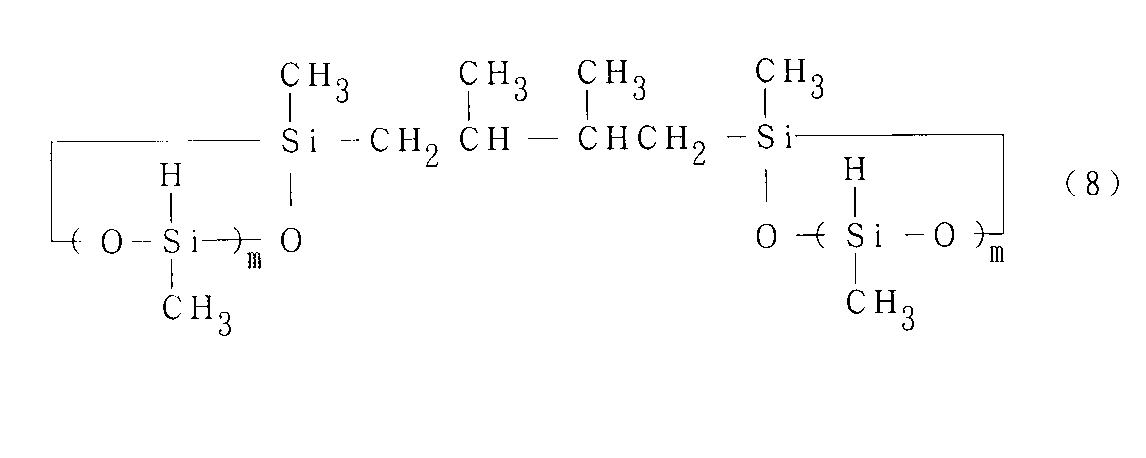
(B)成分の具体例としては、下記の構造式(6)〜(8)で示されるような、分子の末端にヒドロシリル基含有環状シロキサンを有するものが挙げられる。
【0035】
【化6】
【0036】
【化7】
【0037】
【化8】
【0038】
上記の構造式(6)〜(8)で表されるものの場合は、比較的低分子の両末端にヒドロシリル基含有環状シロキサンが存在しているが、高分子の末端や、さらには分岐を有する高分子の末端にヒドロシリル基含有環状シロキサンが存在しているものであってもよい。
【0039】
また、(B)成分の他の例としては、下記の構造式(9)〜(11)に示されるように、鎖状、環状のポリオルガノハイドロジェンシロキサン(ポリオキシアルキレン変性体、スチレン変性体、オレフィン変性体などを含む)が挙げられる。
【0040】
【化9】
【0041】
【化10】
【0042】
【化11】
【0043】
この(B)成分に関しては、(A)成分の凝集力が(B)成分の凝集力に比べて大きいために、相溶性の点でフェニル基含有変性が重要であり、(A)成分との相溶性、入手のしやすさの点でスチレン変性体などが好ましく、貯蔵安定性の点からα−メチルスチレン変性体が好ましい。
【0044】
(C)成分であるヒドロシリル化触媒としては、ヒドロシリル化触媒として使用しうるものである限り特に制限はない。白金単体、アルミナなどの単体に固体白金を担持させたもの、塩化白金酸(アルコールなどの錯体も含む)、白金の各種錯体、ロジウム、ルテニウム、鉄、アルミニウム、チタンなどの金属の塩化物などが挙げられる。これらの中でも、触媒活性の点から塩化白金酸、白金−オレフイン錯体、白金−ビニルシロキサン錯体が望ましい。これらの触媒は単独で使用しても良く、また2種以上併用してもよい。
【0045】
以上のような硬化性組成物中の(A)成分および(B)成分の使用割合は、(A)成分中のアルケニル基1モル当たり(B)成分中のヒドロシリル基が0.2〜5.0モル、さらには0.4〜2.5モルがゴム弾性の点から好ましい。
【0046】
また、(C)成分の使用量としては、(A)成分中のアルケニル基1モルに対して10-1〜10-8モル、さらには10-1〜10-6モル、特には10-3〜10-6モルの範囲で用いるのが好ましい。(C)成分の使用量が10-8モルに満たないと反応が進行しない。その一方で、ヒドロシリル化触媒は、一般に高価で、また腐食性を有し、しかも水素ガスが大量に発生して硬化物が発泡してしまう性質を有しているので、10-1モルを超えて用いない方が好ましい。
【0047】
さらに、上記のような硬化性組成物に、(D)成分として導電性付与剤を添加して導電性組成物とすれば、現像ローラとして好適である。この(D)成分の導電性付与剤としては、カーボンブラックや、金属微粉末、さらには第4級アンモニウム塩基、カルボン酸基、スルホン酸基、硫酸エステル基、リン酸エステル基などを有する有機化合物もしくは重合体、エーテルエステルアミド、もしくはエーテルイミド重合体、エチレンオキサイド−エピハロヒドリン共重合体、メトキシポリエチレングリコールアクリレートなどで代表される導電性ユニットを有する化合物、または高分子化合物などの帯電防止剤などの、導電性を付与できる化合物などが挙げられる。これらの導電性付与剤は、単独で使用しても、また、2種以上を併用してもかまわない。
【0048】
(D)成分である導電性付与剤の添加量は、(A)〜(C)成分の合計量に対して30重量%以下であり、硬化物の体積抵抗が103 〜1010Ωcmになるように加えられる。
【0049】
【実施例】
以下、本発明の実施例を比較例とともに挙げるが、本発明はこれらの実施例により、なんら限定されるものではない。
【0050】
以下に列記する3種類の導電性弾性層と、4種類の表面層を組み合わせて、直径10mmのSUS製シャフトのまわりりに、厚さ7.5mmの導電性弾性層を設け、その外周面を表面層で被覆した実施例および比較例の現像ローラを作製した。
【0051】
(導電性弾性層1)
(A−1)数平均分子量(Mn)8,000、分子量分布2の末端アリル化ポリオキシプロピレン系重合体:100重量部に対して、
(B−1)ポリシロキサン系硬化剤(SiH価0.36モル/100g):6.6重量部、
(C−1)塩化白金酸の10%イソプロピルアルコール溶液:0.06重量部、
(D) カーボンブラック3030B(三菱化学製):7重量部、
を混合し、減圧(10mmHg以下、120分)脱泡した。得られた組成物を10mm径のSUS製シャフトの周りに被覆し、金型内120℃の環境下で30分間静置して硬化させ、厚さ7.5mmのゴム弾性体を作製した。JIS K 6301 A法に記載された方法に準じて測定した弾性層のみのJIS A 硬度は15°であった。
【0052】
(導電性弾性層2)
(A−2)ジブチルスズラウレート触媒存在下、数平均分子量(Mn)8,000のポリプロピレングリコール(PPG)の両末端にイソホロンジイソシアネート(IPDI)を80℃、2時間反応させて、イソシアネート末端にしたプレポリマー(23℃、4rpmで350P):100部、
(B−2)数平均分子量(Mn)3,000のポリオキシプロピレントリオール(PPT):25部、
(C−2)スズ系触媒:0.01重量部、
および
(D)カーボンブラック3030B:7重量部、
を含む組成物を80℃、4時間で硬化させてゴム弾性体を作製した。弾性層のみのJIS A 硬度は約30°であった。
【0053】
(導電性弾性層3)
日本ポリウレタン株式会社製のC−4190(主鎖がポリエーテルでNCO含量4.5%、粘度700cps/75℃)が100g、4,4′メチレン−ビス−2クロロアニリンが12.9g、ケッチェンブラックECが0.8gよりなる組成物を、80℃、5時間硬化させてゴム弾性体を作製した。弾性層のみのJIS A 硬度は78°であった。
【0054】
(表面層1)
セフラルソフトG−180Y(セントラル硝子製の溶剤可溶性フッ素樹脂)15%DMF溶液をMEKで希釈し、5%溶液とした。
【0055】
(表面層2)
エーテル系ウレタン樹脂(大日精化製のハイムレンY−258)をDMF:MEK=4:1の溶媒で希釈し、固形分5%溶液とした。
【0056】
(表面層3)
表面層1で用いた溶液と表面層2で用いた溶液を重量比1:1で混合した。
【0057】
(表面層4)
表面層1で用いた溶液と表面層2で用いた溶液を重量比4:1で混合した。
【0058】
なお、上記の表面層の塗布は、すべてDIP塗布であり、乾燥(一部硬化)は、80℃1時間で実施した。
【0059】
(評価)
ローラに100Vの直流電圧をかけ、金属製板の上を回転させるピンホールチェック、表面粗さの測定(Rz)、市販6枚機プリンターの現像ローラとして装着し、5時間後の黒ベタ濃度とトナーフィルミングの目視チェックを行った。結果を表1に示した。
【0060】
【表1】
【発明の効果】
以上のように、本発明によれば、フッ素樹脂の欠点である、ローラ表面のピンホールの発生や帯電性の悪さを、ウレタン系樹脂とブレンドすることによって解決できる。また、ウレタン系樹脂の欠点である表面性の粗さ、柔軟にしたときの感光体汚染、多くのウレタン系樹脂で発生するトナーのフィルミングを解決できる。したがって、本発明によれば、フッ素系樹脂とウレタン系樹脂との両者の利点を併せ持つ表面層を有するローラとすることができる。[0001]
BACKGROUND OF THE INVENTION
The present invention relates to a roller incorporated in an apparatus using an electrophotographic method such as a copying machine, a printer or a facsimile receiver, and more particularly to a roller using a flexible elastic body as a main base material layer. .
[0002]
[Prior art]
Various rollers such as a charging roller, a developing roller, and a transfer roller are used around the photosensitive member of an apparatus employing an electrophotographic system. Among these rollers, the characteristics of the surface layer are important from the viewpoint of carrying and transporting toner on the surface of the developing roller. In the developing roller, for the purpose of preventing filming of toner on the roller surface, it has been conventionally proposed to provide a surface layer using a fluorine-based resin having a small surface energy on the outer peripheral surface thereof. However, (1) fluorine-based resins are difficult to handle, pinholes are likely to occur in the surface layer, and (2) there are problems with charging characteristics when the toner is to be negatively charged. Nylon resin and urethane resin have been proposed as the surface layer for negatively charging toner, but 1) toner filming, 2) flexible nylon resin for contact with photoconductor Urethane resins contaminate the photoreceptor, and 3) urethane resins have problems such as rough surface properties.
[0003]
[Problems to be solved by the invention]
The present invention is intended to provide a roller having a surface layer in which the above-mentioned problems are solved, as a roller used in an apparatus employing the above-described electrophotographic system. When a roller with a flexible elastic layer is used as a developing roller, a) the occurrence of pinholes can be reduced, b) toner filming is small, c) toner can be negatively charged, and d) photosensitivity. It is intended to provide a roller having a surface layer satisfying characteristics such as that the photoreceptor is not contaminated when used in contact with a body, and that the surface roughness is small. Further, f) an elastic layer is flexible, and when used as a developing roller, there is little toner cracking and the like, and a roller that can exhibit the characteristics of the surface layer as in the above a) to e) is provided. .
[0004]
[Means for Solving the Problems]
As a result of diligent research to achieve the above object, the present inventors use a resin composition comprising a mixture of a fluororesin and a urethane resin that does not react with a urethane resin as a resin composition constituting the surface layer. As a result of finding that it is possible to obtain a roller that can achieve the above-mentioned object and further researching it, the present invention has been completed.
[0005]
That is, the present invention
A roller used in electrophotographic copying machines, printers, etc., which is provided with an elastic layer around the shaft, and the outer peripheral surface is covered with a surface layer, and the surface layer does not react with urethane resin. A roller comprising a resin composition comprising as a main component a mixture containing a resin and a urethane-based resin in a weight ratio of 50:50 to 80:20 (Claim 1).
The roller is characterized in that the elastic layer is composed of an elastic body having a JIS A hardness of 30 ° or less (Claim 2).
The elastic body constituting the elastic layer and having a JIS A hardness of 30 ° or less,
(A) a polymer having at least one alkenyl group in the molecule, wherein the repeating units constituting the main chain are mainly oxyalkylene units or saturated hydrocarbon units,
(B) a curing agent having at least two hydrosilyl groups in the molecule;
and,
(C) a hydrosilylation catalyst,
The roller according to claim 1, wherein the roller is made of a reaction cured product of a curable composition containing as a main component.
The roller according to claim 3, wherein the curable composition contains (D) a conductivity imparting agent and is used as a developing roller.
In a method of manufacturing a roller for use in an electrophotographic copying machine or printer, in which an elastic layer is provided around a shaft and the outer peripheral surface is covered with a surface layer,
Said surface layer, a weight ratio of 50 the fluorinated resin solution and a urethane resin solvent-soluble fluorine-based resin which does not react with the urethane resin dissolved in a solvent and a urethane resin dissolved in a solvent, both resins at a resin solids : A method for producing a roller, comprising: forming a mixed resin solution mixed at a ratio of 50 to 80:20 on the outer peripheral surface of a roll by drying.
Is the content.
[0006]
The roller according to the present invention as described above can be used not only for the developing roller but also for the charging roller and the transfer roller by appropriately setting the resistance and the film thickness.
[0007]
DETAILED DESCRIPTION OF THE INVENTION
The roller according to the present invention has a JIS A hardness of about 5 to 40 °, preferably about 10 to 30 °, around a metal shaft such as SUS (stainless steel) or aluminum having a diameter of about 1 to 12 mm. An elastic layer of about 1 to 15 mm is provided and the outer peripheral surface is covered with a surface layer, and other layers may be included between the elastic layer.
[0008]
The resistance of the roller as a whole is preferably about 10 3 to 10 9 Ω, more preferably about 10 4 to 10 7 Ω, when a load of 500 g is applied to both ends of the shaft and a DC voltage of 100 V is applied. .
[0009]
Examples of the material constituting the elastic layer include EP rubbers and polyether compounds. Among these compounds, the curable composition for a roller according to claim 3 has a low hardness and a low compression set without adding a plasticizer, a low volume resistivity of the material itself, and a conductivity imparting agent is used. Even if you want to have the advantage that a small amount is enough.
[0010]
The resin composition constituting the surface layer in the roller according to the present invention will be described. In the present invention, the surface layer is composed of a resin composition mainly composed of a mixture of a solvent-soluble fluororesin and a urethane resin. The solvent-soluble fluororesin is a fluororesin that dissolves in DMF (dimethylformamide), DMAC (dimethylacetamide), NMP (methylpyrrolidone), etc., and is itself applied to the coating layer. It is not a fluorine-containing resin that reacts with a urethane resin (for example, a fluorine polyol that reacts with an isocyanate group). The solvent-soluble fluororesin preferably has a low fluorine content because of its low hardness, and preferably has a high fluorine content from the viewpoint of toner releasability, while taking into account the hardness of the elastic layer and the like. The balance point may be selected. The urethane resin is not particularly limited, but the toner having a larger urethane bond content is more likely to be charged, but tends to be rigid. On the other hand, the skeleton of the urethane-based resin is preferably a polyether skeleton from the viewpoint of low hardness, and when it is thermosetting, a higher molecular weight between cross-linking points is preferable because the hardness becomes low.
[0011]
The mixing ratio of the solvent-soluble fluorine-based resin and the urethane-based resin needs to be 10 parts by weight or more, and preferably 20 parts by weight or more, in total of 100 parts by weight of both. It is mixed. When the mixing ratio of the solvent-soluble fluororesin is less than 10 parts by weight, the surface roughness increases and the environmental dependency of electrical resistance also increases, which is not preferable. If the mixing ratio of the urethane resin is less than 10 parts by weight, the surface layer must be thinly applied to prevent the electric resistance value from becoming too high, and pinholes are generated. When it is desired to negatively charge the image, the chargeability is deteriorated and image unevenness is likely to occur. Furthermore, in order to compensate for the shortcomings of both resins stably, it is preferable that 20 parts by weight or more of both the solvent-soluble fluororesin and the urethane resin are mixed. In addition to the solvent-soluble fluorine-based resin and urethane-based resin, components such as a conductivity-imparting agent such as carbon black may be added to the above resin composition as necessary. The surface layer of the developing roller of the present invention comprises a fluororesin solution obtained by dissolving a solvent-soluble fluorine-based solvent as described above in a solvent and a urethane-based resin solution obtained by dissolving a urethane-based resin in a solvent. The weight ratio of 50:50 to 80:20 is mixed, and this mixed resin solution is formed on the outer peripheral surface of the roll by coating and drying.
[0012]
Next, the curable composition constituting the elastic layer in the roller according to claim 3 will be described. The polymer of the component (A) in this curable composition is a component that is cured by a hydrosilylation reaction with the component (B) and has at least one alkenyl group in the molecule, so that the hydrosilylation reaction occurs. It becomes polymer and hardens. The number of alkenyl groups contained in component (A) is at least one from the viewpoint of hydrosilylation reaction with component (B). From the viewpoint of rubber elasticity, in the case of a linear molecule, In the case of a branched molecule having two alkenyl groups at both ends, it is desirable that two or more alkenyl groups exist at the molecular end. The main repeating unit constituting the main chain of the component (A) is an oxyalkylene unit or a saturated hydrocarbon unit. However, in the case of a polymer in which the main repeating unit constituting the main chain is an oxyalkylene unit, a small amount of conductive The volume resistance is preferably 10 8 to 10 9 Ωcm simply by adding the property-imparting agent.
[0013]
As a preferred composition of the component (A), from the viewpoint of reducing the hardness of the cured product, an oxyalkylene polymer in which the repeating unit constituting the main chain is an oxyalkylene unit, and further the main constituent constituting the main chain. An oxypropylene polymer in which the repeating unit is an oxypropylene unit is preferred.
[0014]
Here, the oxyalkylene polymer refers to a polymer comprising 30% or more, preferably 50% or more, of oxyalkylene units among the units constituting the main chain. May be units used from compounds having two or more active hydrogens, such as ethylene glycol, bisphenol compounds, glycerin, trimethylolpropane, pentaerythritol, and the like, which are used as starting materials for polymer production. In the case of an oxypropylene polymer, it may be a copolymer (including a graft copolymer) with a unit composed of ethylene oxide, butylene oxide, or the like.
[0015]
The molecular weight of the oxyalkylene polymer as the component (A) as described above is from 500 to 50,000 in terms of number average molecular weight (Mn), from the viewpoint of improving the balance between reactivity and low hardness, It is preferable that it is 000-40,000. In particular, those having a number average molecular weight of 5,000 or more, more preferably 5,000 to 40,000 are preferred. When the number average molecular weight is less than 500, it becomes difficult to obtain sufficient mechanical properties (rubber hardness, elongation) and the like when the curable composition is cured. On the other hand, if the number average molecular weight is too large, the molecular weight per alkenyl group contained in the molecule increases or the reactivity decreases due to steric hindrance, so that curing is often insufficient. Also, the viscosity tends to be too high and the processability tends to deteriorate.
[0016]
There is no particular limitation on the alkenyl group of the oxyalkylene polymer, but the general formula,
[0017]
[Chemical 1]
[0018]
The alkenyl group represented by is particularly preferred from the viewpoint of excellent curability.
[0019]
The oxyalkylene polymer before the introduction of the alkenyl group as described above is obtained by a usual polymerization method of alkylene oxide (anionic polymerization method using caustic alkali) or a chain extension reaction method using this polymer as a raw material. Can do. Further, an oxyalkylene polymer having a high molecular weight and a narrow molecular weight distribution and having a functional group is disclosed in JP-A 61-197631, JP-A 61-215622, JP-A 61-215623, JP-A 6-215623. It can be obtained by the methods described in JP-B-61-261832, JP-B-46-27250 and JP-B-59-15336.
[0020]
In addition, one of the characteristics of this curable composition is that it is easy to set a low hardness, and in order to exhibit this characteristic, the number of alkenyl groups is preferably 2 or more at the molecular end. If the number of alkenyl groups is too large compared to the molecular weight of the polymer, it becomes rigid and it becomes difficult to obtain good rubber elasticity.
[0021]
(A) As a typical example of a component, what is represented by following Structural formula (2), Structural formula (3), Structural formula (4), Structural formula (5) is mentioned, for example.
[0022]
[Chemical 2]
[0023]
[Chemical 3]
[0024]
[Formula 4]
[0025]
[Chemical formula 5]
[0026]
The case where the component (A) is a polymer in which the main repeating unit constituting the main chain is a saturated hydrocarbon unit will be described. In the case of this polymer, as in the case of the oxyalkylene polymer, the component (B) is a component that is cured by a hydrosilylation reaction and has at least one alkenyl group in the molecule. The reaction takes place to form a polymer and cure. The number of alkenyl groups contained in component (A) is at least one from the viewpoint of hydrosilylation reaction with component (B). From the above point, in the case of a linear molecule, it is preferable that two exist at both ends of the molecule, and in the case of a molecule having a branch, it is preferable that two or more exist at the end of the molecule.
[0027]
Typical examples of the polymer in which the main repeating unit constituting the main chain of the component (A) is a saturated hydrocarbon unit include isobutylene polymers, hydrogenated isoprene polymers, and hydrogenated butadiene polymers. Is mentioned. These polymers may contain repeating units of other components such as a copolymer, but contain at least saturated hydrocarbon units of 50% or more, preferably 70% or more, more preferably 90% or more. This is important in order not to impair the characteristics of the saturated hydrocarbon system having a low water absorption rate.
[0028]
The molecular weight of the polymer of the component (A) in which the main repeating unit constituting the main chain is a saturated hydrocarbon unit is 500 to 50,000 in terms of both number average molecular weights (Mn) from the viewpoint of ease of handling. In terms of workability, it is preferably about 1,000 to 15,000, which is liquid and fluid at normal temperature.
[0029]
The alkenyl group introduced into the saturated hydrocarbon polymer is the same as in the case of the oxyalkylene polymer.
[0030]
Therefore, as a preferred specific example of the polymer having at least one alkenyl group in the molecule as the component (A) and the main repeating unit constituting the main chain being a saturated hydrocarbon type, both terminals are Polyisobutylene, hydrogenated polybutadiene, and hydrogenated polyisoprene having a linear number average molecular weight (Mn) of 2,000 to 15,000 and Mw / Mn of 1.1 to 1.2 having two alkenyl groups Examples thereof include a system polymer.
[0031]
Further, the component (B) in the curable composition is not particularly limited as long as it is a compound having at least two hydrosilyl groups in the molecule, but if the number of hydrosilyl groups contained in the molecule is too large, However, since a large amount of hydrosilyl groups are likely to remain in the cured product and cause voids and cracks, the number of hydrosilyl groups contained in the molecule is preferably 50 or less. Further, 2 to 30 and more preferably 2 to 20 are preferable from the viewpoint of rubber elasticity control and storage stability of the cured product, and 20 in terms of easily preventing foaming during curing. In the following, 3 is preferable in that it is difficult to cause poor curing even when the hydrosilyl group is deactivated, and the most preferable range is 3 to 20.
[0032]
In the present invention, having one hydrosilyl group means having one H bonded to Si. In the case of SiH 2 , it has two hydrosilyl groups, but bonded to Si. It is preferable that H is bonded to different Si because of better curability and rubber elasticity.
[0033]
The molecular weight of the component (B) is 30,000 or less in terms of number average molecular weight (Mn) from the viewpoint of dispersibility and roller processability when a conductivity imparting agent (component (D)) described later is added. It is preferably 20,000 or less, particularly 15,000 or less. In consideration of reactivity and compatibility with the component (A), 300 to 10,000 are preferable.
[0034]
Specific examples of the component (B) include those having a hydrosilyl group-containing cyclic siloxane at the end of the molecule as represented by the following structural formulas (6) to (8).
[0035]
[Chemical 6]
[0036]
[Chemical 7]
[0037]
[Chemical 8]
[0038]
In the case of those represented by the above structural formulas (6) to (8), the hydrosilyl group-containing cyclic siloxane exists at both ends of the relatively low molecule, but has a polymer end and further a branch. A polymer having a hydrosilyl group-containing cyclic siloxane at the terminal of the polymer may be used.
[0039]
In addition, as another example of the component (B), as shown in the following structural formulas (9) to (11), a linear or cyclic polyorganohydrogensiloxane (polyoxyalkylene-modified product, styrene-modified product) And olefin-modified products).
[0040]
[Chemical 9]
[0041]
[Chemical Formula 10]
[0042]
Embedded image
[0043]
Regarding the component (B), the cohesive force of the component (A) is larger than the cohesive force of the component (B), so that phenyl group-containing modification is important in terms of compatibility. A styrene modified body is preferable in terms of compatibility and availability, and an α-methylstyrene modified body is preferable in view of storage stability.
[0044]
The hydrosilylation catalyst as component (C) is not particularly limited as long as it can be used as a hydrosilylation catalyst. Solid platinum, simple platinum such as alumina, chloroplatinic acid (including complexes such as alcohol), various platinum complexes, metal chlorides such as rhodium, ruthenium, iron, aluminum, titanium, etc. Can be mentioned. Among these, chloroplatinic acid, platinum-olefin complex, and platinum-vinylsiloxane complex are preferable from the viewpoint of catalytic activity. These catalysts may be used alone or in combination of two or more.
[0045]
The use ratio of the component (A) and the component (B) in the curable composition as described above is such that the hydrosilyl group in the component (B) is 0.2 to 5 per mole of the alkenyl group in the component (A). 0 mol, more preferably 0.4 to 2.5 mol is preferable from the viewpoint of rubber elasticity.
[0046]
The amount of the component (C) used is 10 -1 to 10 -8 mol, more preferably 10 -1 to 10 -6 mol, particularly 10 -3 with respect to 1 mol of the alkenyl group in the component (A). It is preferably used in the range of -10 -6 mol. The reaction does not proceed unless the amount of component (C) used is less than 10 -8 mol. On the other hand, hydrosilylation catalysts are generally expensive and have a corrosive, and since the cured product hydrogen gas generate a large amount has a property that results in foaming greater than 10 -1 mol It is preferable not to use them.
[0047]
Furthermore, if a conductivity imparting agent is added as a component (D) to the curable composition as described above to obtain a conductive composition, it is suitable as a developing roller. Examples of the conductivity imparting agent of the component (D) include carbon black, metal fine powder, and organic compounds having a quaternary ammonium base, a carboxylic acid group, a sulfonic acid group, a sulfate ester group, a phosphate ester group, and the like. Alternatively, an antistatic agent such as a polymer, an ether ester amide, an ether imide polymer, an ethylene oxide-epihalohydrin copolymer, a compound having a conductive unit represented by methoxypolyethylene glycol acrylate, or a polymer compound, Examples thereof include compounds that can impart conductivity. These conductivity-imparting agents may be used alone or in combination of two or more.
[0048]
The addition amount of the conductivity imparting agent as component (D) is 30% by weight or less with respect to the total amount of components (A) to (C), and the volume resistance of the cured product is 10 3 to 10 10 Ωcm. Added as
[0049]
【Example】
Examples of the present invention will be described below together with comparative examples, but the present invention is not limited to these examples.
[0050]
Combining the three types of conductive elastic layers listed below and the four types of surface layers, a conductive elastic layer having a thickness of 7.5 mm is provided around a SUS shaft having a diameter of 10 mm. Example and comparative developing rollers coated with a surface layer were prepared.
[0051]
(Conductive elastic layer 1)
(A-1) Number average molecular weight (Mn) 8,000, terminal allylated polyoxypropylene polymer having molecular weight distribution 2: 100 parts by weight
(B-1) polysiloxane curing agent (SiH value 0.36 mol / 100 g): 6.6 parts by weight,
(C-1) 10% isopropyl alcohol solution of chloroplatinic acid: 0.06 parts by weight,
(D) Carbon black 3030B (Mitsubishi Chemical): 7 parts by weight,
Were degassed under reduced pressure (10 mmHg or less, 120 minutes). The obtained composition was coated around a 10 mm diameter SUS shaft and allowed to stand for 30 minutes in a mold at 120 ° C. for curing to produce a rubber elastic body having a thickness of 7.5 mm. The JIS A hardness of only the elastic layer measured in accordance with the method described in JIS K 6301 A method was 15 °.
[0052]
(Conductive elastic layer 2)
(A-2) In the presence of dibutyltin laurate catalyst, isophorone diisocyanate (IPDI) was reacted at both ends of polypropylene glycol (PPG) having a number average molecular weight (Mn) of 8,000 at 80 ° C. for 2 hours to form isocyanate ends. Prepolymer (23 ° C, 350P at 4 rpm): 100 parts,
(B-2) Number average molecular weight (Mn) 3,000 polyoxypropylene triol (PPT): 25 parts,
(C-2) Tin-based catalyst: 0.01 parts by weight,
And (D) carbon black 3030B: 7 parts by weight,
A rubber elastic body was produced by curing the composition containing at 80 ° C. for 4 hours. The JIS A hardness of only the elastic layer was about 30 °.
[0053]
(Conductive elastic layer 3)
C-4190 manufactured by Nippon Polyurethane Co., Ltd. (main chain is polyether, NCO content is 4.5%, viscosity is 700 cps / 75 ° C.) is 100 g, 4,4′methylene-bis-2chloroaniline is 12.9 g, Ketjen A composition composed of 0.8 g of black EC was cured at 80 ° C. for 5 hours to prepare a rubber elastic body. The JIS A hardness of only the elastic layer was 78 °.
[0054]
(Surface layer 1)
Cefral Soft G-180Y (a solvent-soluble fluororesin made by Central Glass) 15% DMF solution was diluted with MEK to obtain a 5% solution.
[0055]
(Surface layer 2)
An ether urethane resin (Haimuren Y-258 manufactured by Dainichi Seika) was diluted with a solvent of DMF: MEK = 4: 1 to obtain a 5% solid content solution.
[0056]
(Surface layer 3)
The solution used in the surface layer 1 and the solution used in the surface layer 2 were mixed at a weight ratio of 1: 1.
[0057]
(Surface layer 4)
The solution used in the surface layer 1 and the solution used in the surface layer 2 were mixed at a weight ratio of 4: 1.
[0058]
In addition, application | coating of said surface layer was all DIP application | coating, and drying (partial hardening) was implemented at 80 degreeC for 1 hour.
[0059]
(Evaluation)
Apply a 100V DC voltage to the roller, rotate the top of the metal plate, check the pinhole, measure the surface roughness (Rz), and install it as a developing roller for a commercially available six-sheet printer. A visual check for toner filming was performed. The results are shown in Table 1.
[0060]
[Table 1]
【The invention's effect】
As described above, according to the present invention, the occurrence of pinholes on the roller surface and poor charging properties, which are disadvantages of the fluororesin, can be solved by blending with the urethane resin. Further, it is possible to solve the surface roughness, which is a defect of the urethane resin, contamination of the photoreceptor when softened, and toner filming generated in many urethane resins. Therefore, according to this invention, it can be set as the roller which has a surface layer which has both the advantages of both fluororesin and urethane resin.
Claims (5)
Priority Applications (6)
| Application Number | Priority Date | Filing Date | Title |
|---|---|---|---|
| JP34898396A JP3832002B2 (en) | 1996-12-26 | 1996-12-26 | roller |
| PCT/JP1997/001481 WO1997041490A1 (en) | 1996-04-26 | 1997-04-25 | Developing roller |
| US09/171,669 US6035172A (en) | 1996-04-26 | 1997-04-25 | Developing roller |
| DE69734239T DE69734239T2 (en) | 1996-04-26 | 1997-04-25 | DEVELOPER ROLE |
| KR1019980708474A KR100317983B1 (en) | 1996-04-26 | 1997-04-25 | Developing roller |
| EP97919724A EP0911704B1 (en) | 1996-04-26 | 1997-04-25 | Developing roller |
Applications Claiming Priority (1)
| Application Number | Priority Date | Filing Date | Title |
|---|---|---|---|
| JP34898396A JP3832002B2 (en) | 1996-12-26 | 1996-12-26 | roller |
Publications (2)
| Publication Number | Publication Date |
|---|---|
| JPH10186835A JPH10186835A (en) | 1998-07-14 |
| JP3832002B2 true JP3832002B2 (en) | 2006-10-11 |
Family
ID=18400702
Family Applications (1)
| Application Number | Title | Priority Date | Filing Date |
|---|---|---|---|
| JP34898396A Expired - Fee Related JP3832002B2 (en) | 1996-04-26 | 1996-12-26 | roller |
Country Status (1)
| Country | Link |
|---|---|
| JP (1) | JP3832002B2 (en) |
Families Citing this family (1)
| Publication number | Priority date | Publication date | Assignee | Title |
|---|---|---|---|---|
| JP4514176B2 (en) * | 2000-12-21 | 2010-07-28 | バンドー化学株式会社 | Charging roller |
-
1996
- 1996-12-26 JP JP34898396A patent/JP3832002B2/en not_active Expired - Fee Related
Also Published As
| Publication number | Publication date |
|---|---|
| JPH10186835A (en) | 1998-07-14 |
Similar Documents
| Publication | Publication Date | Title |
|---|---|---|
| KR100317983B1 (en) | Developing roller | |
| WO1999001800A1 (en) | Developing roller and developing device using the roller | |
| US20040030032A1 (en) | Semiconductive resin composition and semiconductive member | |
| JP3426687B2 (en) | Conductive polyurethane elastomer composition | |
| JP3829454B2 (en) | Developing roller | |
| JP3832057B2 (en) | Developing roller manufacturing method | |
| JP3899756B2 (en) | Roller for electrophotography | |
| JP3800774B2 (en) | Developing roller having a sea-island structure on the surface | |
| JP3493914B2 (en) | Developing roller | |
| JP3605976B2 (en) | Developing roller | |
| JPH11351238A (en) | Conductive roller and method of manufacturing the same | |
| JP3794111B2 (en) | Developing roller | |
| JPH10186835A (en) | roller | |
| JP3539211B2 (en) | Developing roller | |
| JP4061777B2 (en) | Manufacturing method of rubber roller having coating layer | |
| JP2001100549A (en) | Transfer roller and method of manufacturing the same | |
| JPH10186834A (en) | Developing roller | |
| JP3565021B2 (en) | Developing roller | |
| JP2001100512A (en) | Developing roller and its manufacturing method | |
| JP3823606B2 (en) | Developing roller | |
| JP3800773B2 (en) | Roller used for electrophotography | |
| JP2000330372A (en) | Developing roller | |
| JP2000122405A (en) | Developing roller used for non-magnetic non-contact developing system | |
| JP5662823B2 (en) | Conductive roll for electrophotographic equipment | |
| JP4265770B2 (en) | Developing roller for electrophotographic apparatus |
Legal Events
| Date | Code | Title | Description |
|---|---|---|---|
| A131 | Notification of reasons for refusal |
Free format text: JAPANESE INTERMEDIATE CODE: A131 Effective date: 20051108 |
|
| A131 | Notification of reasons for refusal |
Free format text: JAPANESE INTERMEDIATE CODE: A131 Effective date: 20060131 |
|
| A521 | Written amendment |
Free format text: JAPANESE INTERMEDIATE CODE: A523 Effective date: 20060331 |
|
| A131 | Notification of reasons for refusal |
Free format text: JAPANESE INTERMEDIATE CODE: A131 Effective date: 20060425 |
|
| A521 | Written amendment |
Free format text: JAPANESE INTERMEDIATE CODE: A523 Effective date: 20060608 |
|
| TRDD | Decision of grant or rejection written | ||
| A01 | Written decision to grant a patent or to grant a registration (utility model) |
Free format text: JAPANESE INTERMEDIATE CODE: A01 Effective date: 20060627 |
|
| A61 | First payment of annual fees (during grant procedure) |
Free format text: JAPANESE INTERMEDIATE CODE: A61 Effective date: 20060710 |
|
| R150 | Certificate of patent (=grant) or registration of utility model |
Free format text: JAPANESE INTERMEDIATE CODE: R150 |
|
| LAPS | Cancellation because of no payment of annual fees |