JP3649872B2 - Bainite steel rail with excellent weldability - Google Patents
Bainite steel rail with excellent weldability Download PDFInfo
- Publication number
- JP3649872B2 JP3649872B2 JP25053497A JP25053497A JP3649872B2 JP 3649872 B2 JP3649872 B2 JP 3649872B2 JP 25053497 A JP25053497 A JP 25053497A JP 25053497 A JP25053497 A JP 25053497A JP 3649872 B2 JP3649872 B2 JP 3649872B2
- Authority
- JP
- Japan
- Prior art keywords
- steel
- rail
- present
- wear
- hardness
- Prior art date
- Legal status (The legal status is an assumption and is not a legal conclusion. Google has not performed a legal analysis and makes no representation as to the accuracy of the status listed.)
- Expired - Lifetime
Links
Images
Landscapes
- Heat Treatment Of Steel (AREA)
- Heat Treatment Of Articles (AREA)
- Metal Rolling (AREA)
Description
【0001】
【発明の属する技術分野】
本発明は、鉄道においてレールの寿命を左右する頭頂部ならびに頭部コーナー部に生じる転動疲労損傷に対する耐損傷性に優れていることに加えて、フラッシュバット溶接、ガス圧接した溶接部の接合性に優れたベイナイト鋼レールに関する。
【0002】
【従来の技術】
従来、レールは主に頭頂部及び頭部コーナー部の耐摩耗性重視の観点からパーライト鋼を用いてきた。しかし近年、鉄道による輸送量の増加に伴いレールの使用条件はますます厳しいものになってきている。特に日本国内においては使用者の利便性を考慮して在来線、新幹線共に高速化、ダイヤの過密化が進んでおり、年間の累積通tonが増大していることから転動疲労損傷も増加している。このため鉄道会社はレールのメンテナンス費用の削減の観点から、優れた耐転動疲労損傷性を有するレール鋼を要求するようになってきている。現状では転動疲労損傷が問題となっている区間には、JISに規格化された強度が800MPa級のパーライト型普通レールが用いられているが、この普通レールに頭部の摩耗を原因とする交換が発生することは少ない。従って耐摩耗特性の観点からは現状の転動疲労損傷が問題となる区間においてはパーライト鋼レールには過剰な耐摩耗特性が付与されていることになる。
一方、ベイナイト鋼はパーライト鋼に比べ耐転動疲労損傷性は優れているものの、合金元素を多量に添加しているため溶接部の接合性が劣るといわれている。
【0003】
【発明が解決しようとする課題】
ベイナイト組織のレールにおいては、特開平2−282448号公報に開示されているように疲労強度を高くし、また摩耗を促進して疲労層を除去することにより、耐転動疲労損傷性の向上を図っているものの、パーライト鋼レールに比べ合金元素の添加量が多く、フラッシュバット溶接、ガス圧接時の接合性に問題が生じる可能性があるが、これに関する検討はなされていない。
【0004】
本発明の目的は、このような従来の問題に鑑み、フラッシュバット溶接、ガス圧接といったレール溶接時の接合性を従来のパーライト型レール鋼と同等とした上で優れた転動疲労損傷性を有するベイナイト鋼レールを提供することにある。
【0005】
【課題を解決するための手段】
前記課題を解決し目的を達成するために、本発明は以下に示す手段を用いている。
(1)本発明のレールは、質量%で、C:0.15〜0.4%と、Si:0.1〜0.2%と、Mn:0.15〜1.1%と、P:0.035%以下と、S:0.035%以下と、Cr:0.05〜0.45%と、Nb:0.005〜0.15%と、Mo:0.05〜0.85%とを含有し、Mn%/Si%≦5.5を満たし、残部が実質的にFe及び不可避的不純物からなるレール鋼であって、レール頭部がベイナイト組織であり、レール頭頂部及び頭部コーナー部のいずれの位置においても均一な硬さ分布で、ビッカース硬度がHV230〜320であることを特徴とする、溶接部の接合性に優れたベイナイト鋼レールである。
【0006】
(2)本発明のレールは、鋼成分として、質量%でさらに、Ni:0.1〜1%を含有することを特徴とする、上記(1)に記載の溶接部の接合性に優れたベイナイト鋼レールである。
【0007】
(3)本発明のレールは、鋼成分として、質量%でさらに、V:0.01〜0.2%を含有することを特徴とする、上記(1)または(2)に記載の溶接部の接合性に優れたベイナイト鋼レールである。
【0009】
【発明の実施の形態】
本発明者らは、上記の課題を解決するために、ベイナイト鋼の化学成分、硬度と溶接接合性との関係について、鋭意研究を重ねた結果、以下の知見を得るに至った。
【0010】
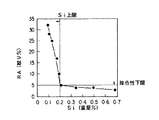
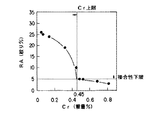
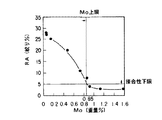
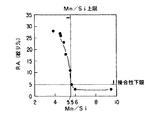
列車通過時の振動、騒音対策からすき間のある継ぎ目を低減する対策としてレールを溶接して使用する頻度が非常に高くなっており、この点から溶接時の接合性が要求される。レールの溶接方法にはフラッシュバット溶接、ガス圧接、エンクローズアーク溶接、テルミット溶接があるが、このうちフラッシュバット溶接、ガス圧接については、溶接金属を用いず、レール母材を直接接合することから母材自体の接合性が問題となる。このようなフラッシュバット溶接及びガス圧接時の接合性については、添加元素の酸化物生成能力、生成した酸化物の溶融温度、接合時の新生面による酸化物の除去能力等が影響する。表1に示す成分を有する硬さがHV320以下の供試鋼No.1a−1〜9,1b−1〜9,1c−1〜9,1d−1〜9の接合性におよぼすSi,Cr,Mo,Mn/Siの添加量の影響をそれぞれ図3〜6に示す。
【0011】
【表1】
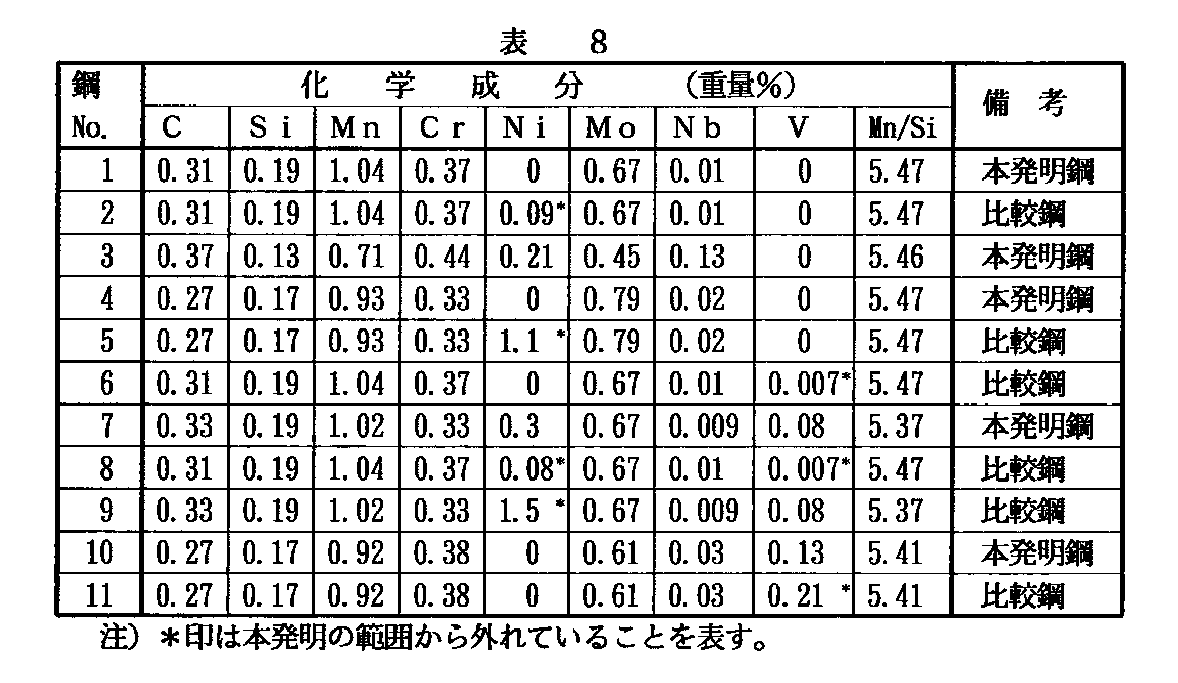
図3〜6の縦軸は、40φの丸棒を用いてフラッシュバット溶接及びガス圧接により溶接継手を作成し、継手の接合面が引張試験片の平行部中央になるように採取した試験片を用いて引張試験を行った時の破断部の絞り値の平均値を示しており、この値(RA)が大きいほど接合性が高いことを示している。図3〜6から理解できるように、Siが0.2%、Crが0.45%、Moが0.85%、Mn/Siが5.5を超えた場合には絞り値が5%以下となり、接合性の低下が著しい。この理由について以下に述べる。
【0013】
Si,Crは酸化しやすい元素であるため、フラッシュ電流もしくはガス炎による加熱で接合面に緻密な酸化皮膜を形成し、これがフラッシュバット溶接、ガス圧接時の最終のアプセットにおいても接合面から除去されない。Moはアプセット時の変形抵抗を高くするために充分に新生面が接合しない。Mn/Siは、Mn,Si,Feの複合酸化物の融点がMn/Siで5.5を超えた領域では著しく高温になり、接合面に残留する複合酸化物の粘性が相対的に高くなるためにアプセットにおいて除去され難い。従って、接合性の観点からSiは0.2%以下、Crは0.45%以下、Moは0.85%以下、またMn/Siは5.5以下とすることが必要である。
【0014】
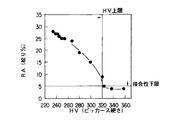
図7に溶接時の接合性に及ぼす硬さ(HV)の影響を調べた結果を示す。表2に供試鋼の化学成分、硬さを示す。図7から理解できるように、Si,Cr,Mo,Mn/Siの各々が本発明の請求範囲を満たしている場合でも硬さの上昇に伴い接合性は低下しており、特にHV320を超えた場合には絞り値が5%以下となり、実用上問題が生じる。
【0015】
またSi,Cr,Mo,Mn/Siのいずれかが本発明の請求範囲を満たさない場合は、HV230〜320の間でも接合性に問題がある。従って、十分な接合性を確保するためにはSiは0.2%以下、Crは0.45%以下、Moは0.85%以下、またMn/Siは5.5以下、さらにHV320以下であることが必要である。
【0016】
【表2】
以上の知見に基づき、本発明者は、鋼のSi,Cr,Mo及びMn/Si量と、熱間圧延における圧延仕上温度及び圧延後の冷却速度を一定範囲内に制御して、レール頭部の金属組織をベイナイトとし、且つレール頭頂部及び頭部コーナー部のビッカース硬度を一定範囲内に制御するようにして、溶接時の十分な接合性を確保しかつ優れた耐転動疲労損傷性を有するベイナイト鋼レール及びその製造方法を見出し、本発明を完成した。
【0018】
すなわち、本発明は、鋼組成、金属組織(ミクロ組織)、硬度及び製造条件を下記範囲に限定することにより、フラッシュバット溶接、ガス圧接といったレール溶接時の接合性を従来のパーライト型レール鋼と同等とした上で優れた耐転動疲労損傷性を有するベイナイト鋼レールを提供することができる。
【0019】
以下に本発明の成分添加理由、成分限定理由、金属組織の限定理由、硬度の限定理由及び製造条件の限定理由について説明する。
(1)成分組成範囲
C:0.15〜0.4%
Cは強度を確保するための必須元素であり、0.15%未満ではレール鋼としての硬さを安価に確保することが難しい。また0.4%を超えるとレール頭部に脆いマルテンサイトが生成しやすくなる。従って、その含有量は0.15〜0.4%である。
【0020】
Si:0.1〜0.2%
Siは脱酸剤として有効なだけでなく、固溶して強度を上昇させる元素であるが、0.1%未満ではその効果が認められない。一方、Siの有する高い酸素との結合力のため、添加量が0.2%を超えるとフラッシュバット溶接時、ガス圧接時に接合面に緻密な酸化物が生じ、新生面の接合を阻害することにより接合性を劣化させる。従って、その含有量は0.1〜0.2%である。
【0021】
Mn:0.15〜1.1%
Mnはベイナイト変態温度を低下させ焼入れ性を高めることにより、レールの高強度化に寄与する元素である。しかし、0.15%未満ではその効果が小さく、1.1%を超えると鋼のミクロ偏析によるマルテンサイト組織を生じ易く、熱処理時及び溶接時に硬化や脆化を生じ材質劣化をきたすので好ましくない。従って、その含有量は0.15〜1.1%である。
P:0.035%以下
Pは靭性を劣化することから、0.035%以下である。
【0022】
S:0.035%以下
Sは主に介在物の形態で鋼中に存在するが、0.035%を超えるとこの介在物量が著しく増加し、脆化による材質の劣化を引き起こすので、その含有量の上限は0.035%である。
【0023】
Cr:0.05〜0.45%
Crはベイナイト変態を促進する元素であり、本発明鋼のようにミクロ組織をベイナイト組織とするために重要な元素である。0.05%未満では変態促進効果が少なく、ミクロ組織が均一なベイナイト組織とならない。一方、0.45%を超えるとマルテンサイトが生成しやすくなるだけでなく、Crの有する高い酸素との結合力のため接合面に緻密な酸化皮膜を生成して新生面による接合を阻害する要因となる。従って、その含有量は0.05〜0.45%である。
Mo:0.05〜0.85%
Moはベイナイト変態を促進する元素であり、本発明鋼のようにミクロ組織をベイナイト組織とするために重要な元素である。0.05%未満では変態促進効果が低く、ミクロ組織が均一なベイナイト組織とならない。一方、0.85%を超えるとマルテンサイトが生成しやすくなるだけでなく、高温での変形抵抗を上昇させ、アプセット時の接合面における新生面の生成を阻害する要因となる。従って、その含有量は0.05〜0.85%である。
【0024】
Nb:0.005〜0.15%
Nbはベイナイト変態を促進するだけでなく、鋼中のCと結び付いて圧延後に析出することから、レール頭部の内部まで析出強化により硬度を高くし耐摩耗性を向上させ、レールの寿命を延ばすために有効である。ただし、この効果はNbで0.005%未満の添加では有効ではなく、また0.15%を超えて添加してもその効果は飽和してしまう。従って、その含有量は0.005〜0.15%である。
【0025】
Mn/Si≦5.5
Mn,Siはフラッシュバット溶接、ガス圧接時に接合面にFeと共に複合酸化物を形成して接合性を低下させるが、特にMn/Siが5.5を超えると複合酸化物の粘性、融点が高くなり、接合面からの除去が難しく、接合性が低下する。従って、接合性の観点からMn/Si≦5.5である。
【0026】
本発明では上記の添加元素のほかに、鋼材の強度、耐摩耗性を高めるためにNi、Vを含有してもよいが、以下にその成分の限定理由を述べる。
Ni:0.1〜1%
Niは、ベイナイト変態を促進し、高強度化するのに有効な元素であるが、0.1%未満ではその効果が認められず、一方、1%を超えた添加ではその効果が飽和してしまう。従って、その含有量は0.1〜1%である。
【0027】
V:0.01〜0.2%
Vは、Nbと同様に鋼中のCと結び付いて圧延後に析出することから、レール頭部の内部まで析出強化により硬度を高くし耐摩耗性を向上させ、レールの寿命を延ばすために有効である。ただし、この効果は0.01%未満の添加では有効ではなく、また0.2%を超えて添加してもその効果は飽和してしまう。従って、その含有量は0.01〜0.2%である。
【0028】
(2)金属組織
レール頭部がベイナイト組織である。
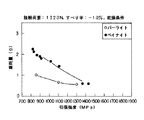
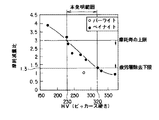
ベイナイト組織は従来レールのパーライト組織と比較して同一引張強度レベルで比較した場合、疲労強度が高く、転動疲労寿命を伸ばすことに有効であること、また図2に示すように摩耗量が多く疲労層の除去に有効であることから、金属組織をベイナイト組織とした。
【0029】
(3)硬度(耐摩耗性)
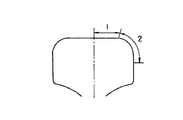
図1に示すレール頭部の頭頂部1、頭部コーナー部2いずれの位置においてもビッカース硬さがHV230〜320である。
【0030】
摩耗量については実敷設における摩耗量で評価することが最も望ましいが、西原式摩耗試験機を用いて実際の接触条件をシミュレートした比較試験により評価する方法も有効である。この試験法を用いれば短時間で耐摩耗性(硬度と摩耗減量比の関係)を評価することができる。
【0031】
図8に摩耗減量比に及ぼす硬度(HV)の影響を調査した結果を示す。供試鋼は表3に成分範囲を示すように、合金元素の添加量を種々変化させた成分で、1250℃に加熱し、本発明の圧延、冷却条件を満足する920℃で圧延を終了後、空冷した鋼から外径30mm、幅8mmの西原式摩耗試験片を採取し、接触荷重130kg、すべり率−10%、潤滑剤無しの条件で摩耗試験を行い、50万回転後の摩耗減量を測定した。評価においては、JISに規格化されているパーライト型普通レールの摩耗減量を測定し、パーライト型普通レールに対する供試鋼の摩耗減量比を求めた。パーライト型普通レールの硬度はHV280程度である。
【0032】
【表3】
図8から理解できるように、同一硬度においてはパーライト組織よりもベイナイト組織のほうが摩耗減量比が大きく、約2倍の値を示す。実敷設における頭部の摩耗による疲労層除去を考慮した場合、摩耗減量比は1.3倍以上が必要である。ベイナイト鋼において硬さの上昇に伴い摩耗減量比は低下するが、HV320までならば摩耗減量比は1.3倍以上の値を示すため、硬さの上限をHV320に限定した。また、HV230未満では摩耗減量比が3倍を超え、累積通tonに基づくレール交換寿命に比べて摩耗による交換寿命が著しく短くなり実用上問題が生じる。従って硬さの下限値はHV230に限定した。
【0034】
頭頂部、頭部コーナー部について、硬さを意図的に変えて車輪との接触状況をコントロールしようとする試みが行われているが、実路線においては車輪とレールの接触は状況によって常に変化しており、頭部の硬さを変化させて接触状況をコントロールしてレール寿命を伸ばすことは実質的に難しい。従って、頭頂部、頭部コーナー部いずれの位置においても均一な硬さ分布でその値をHV230〜320とした。なお、この均一な硬さ分布は、頭頂部及び頭部コーナー部のいずれも同じ条件の熱処理(本発明の冷却条件)を施すことにより得られる。
上記の成分組成範囲、金属組織及び硬度に調整することにより、フラッシュバット溶接、ガス圧接といったレール溶接時の接合性を従来のパーライト型レール鋼と同等とした上で優れた耐転動疲労損傷性を有するレール得ることが可能となる。
【0035】
このような特性を有するレールは、以下の製造方法により製造することができる。
(4)レール製造工程
(製造方法)
上記した成分組成を有する鋼を、圧延仕上温度が800〜1000℃となるように熱間圧延し、次いでベイナイト変態開始点以上の温度から、空冷〜5℃/秒の冷却速度で300℃以下まで冷却する。
【0036】
a.圧延仕上温度:800〜1000℃
圧延仕上温度が800℃未満以下ではフェライト変態が開始してしまい、強度が低下する。また、圧延仕上温度を1000℃超えにすると、熱間圧延後のベイナイト組織が著しく粗大化して靭性の確保が困難になる。従って、圧延仕上温度は800〜1000℃である。
【0037】
b.冷却速度:空冷〜5℃/秒
空冷でもベイナイト組織が得られ所望の強度、靭性が確保できる。しかし、5℃/秒を超えるとマルテンサイトが生成し靭性が著しく低下する。従って、冷却速度は空冷〜5℃/秒である。
【0038】
以下に本発明の実施例を挙げ、本発明の効果を立証する。
なお、本文、図、表中で、HVはビッカース硬さ、RAは接合性評価としてフラッシュバット溶接及びガス圧接後の接合面の引張試験における絞り値を表している。
【0039】
【実施例】
(実施例1)
表4に示す成分を有する供試鋼(本発明鋼:No.2〜4、比較鋼:No.1,5,6)を1250℃に加熱し、920℃で圧延を終了後、放冷した板厚12mmの鋼板を使用し、硬さ測定、摩耗試験、接合性評価試験を行った。摩耗試験については、外径30mm,幅8mmの試験片を圧延鋼板より採取し、鉄道車輪材から同一寸法のタイヤ試験片を採取して、これらを西原式摩耗試験機を用いて、すべり率−10%、接触荷重130kg、潤滑剤無しの条件で試験を行い、50万回転後の摩耗減量を測定した。なお、比較として行ったHV275のパーライト組織のレール鋼の摩耗減量との比をとることで摩耗減量比を求めている。硬さ、摩耗減量比、接合性を表5に示す。
【0040】
表5に示すように、本発明よりもC量が低い比較鋼No.1については、硬度がHV221と本発明の下限値未満であり、摩耗減量比も3.21と高く実用に適さない。また、本発明よりもC量が高い比較鋼No.5,6についてはミクロ組織がパーライト組織を呈しており、摩耗特性は優れているものの耐フレーキング損傷性に劣る。
【0041】
これに対し、成分が本発明の範囲を満たす本発明鋼No.2,3,4は硬度、摩耗減量比のいずれも本発明範囲内の値(硬度:HV230〜320、摩耗減量比:1.3〜3)を示している。接合性に関してはMn/Siはいずれも5.5未満であり、またHVも320以下であることから十分な値を示している。
【0042】
【表4】
【表5】
(実施例2)
表6に示す成分を有する供試鋼(本発明鋼:No.2〜6,9,10,13、比較鋼:No.1,7,8,11,12,14)について実施例1と同様に硬さ測定、摩耗試験、接合性評価試験を行った。硬さ、摩耗減量比、接合性を表7に示す。
【0045】
表7に示すように、供試鋼は全てベイナイト組織を呈している。Mn,Cr,Moの含有量が本発明の範囲よりも低い比較鋼No.1,8,12は接合性は高い値を示すものの硬度が低く、摩耗減量比がそれぞれ3.15、3.45、3.22と高い値を示す。
【0046】
それに対し、Mn、Cr、Moの含有量が本発明の範囲を満たす本発明鋼No.2〜6,9,10,13は硬さ、摩耗減量比、接合性のいずれも優れた値を示している。しかし、Mn、Cr、Moの含有量が本発明の範囲よりも高い比較鋼No.7,11,14では摩耗減量比が1.3以下となっている。また接合性も5%以下に低下している。
【0047】
【表6】
【表7】
(実施例3)
表8に示す成分を有する供試鋼(本発明鋼:No.1,3,4,7,10、比較鋼:No.2,5,6,8,9,11)について実施例1と同様に硬さ測定、摩耗試験、接合性評価試験を行った。硬さ、摩耗減量比、接合性を表9に示す。
【0050】
表9に示すように、供試鋼は全てベイナイト組織を呈している。本発明鋼No.1はNi,Vを添加していないが、本発明範囲内の成分であり、硬さ、摩耗減量比、接合性のいずれも本発明範囲内の値を示している。Ni,Vの含有量が本発明の範囲よりも低い比較鋼No.2,6,8はNi,Vを添加していない本発明鋼No.1に比べ硬さ、摩耗減量比、接合性のいずれもほとんど変化がなく、Ni,V添加の効果が現れていない。Niの添加量が本発明の範囲を満たしている本発明鋼No.3,4,7は硬さ、摩耗減量比、接合性のいずれも本発明範囲内の値を示しており、かつ本発明鋼No.1より優れた値を示している。Niの添加量が本発明範囲を超える比較鋼No.5,9は硬さ、摩耗減量比、接合性が本発明鋼No.4,7と同等であり、Ni添加の効果が飽和している。Vの添加量が本発明範囲を満たしている本発明鋼No.10は硬さ、摩耗減量比、接合性のいずれも本発明範囲内の値を示しており、かつ本発明鋼No.1より優れた値を示しているが、Vの添加量が本発明の範囲を超える比較鋼No.11は硬さ、摩耗減量比、接合性が本発明鋼No.10と同等であり、V添加の効果が飽和している。
【0051】
【表8】
【表9】
(実施例4)
表10に示す成分を有する供試鋼(本発明鋼:No.2,3,5,6、比較鋼:No.1,4,7,8)について実施例1と同様に硬さ測定、摩耗試験、接合性評価試験を行った。硬さ、摩耗減量比、接合性を表11に示す。
【0054】
表11に示すように、供試鋼は全てベイナイト組織を呈している。Si,Cr,Moの添加量がそれぞれ本発明の範囲を満たしており、かつMn/Siが5.5以下である本発明鋼No.2,3,5,6は硬さ、摩耗減量比、接合性のいずれも優れた値を示している。
【0055】
しかしSi,Cr,Moの添加量が単独で本発明範囲を満たす場合でもMn/Siが5.5を超える比較鋼No.1,4は接合性が劣っている。一方、Mn/Siが5.5以下を満足している場合においてもSiの単独の添加量が本発明範囲を超えている比較鋼No.7,8は、やはり接合性が劣っている。
【0056】
【表10】
【表11】
(実施例5)
表12に本発明の成分条件を満たす本発明鋼No.1,2を示す。表13に、この2鋼種について圧延仕上温度を760〜1030℃まで変化させ実際にレール形状に圧延し、その後冷却速度を空冷〜6.5℃/秒まで変化させ製造したレールの硬さ、摩耗減量比、接合性を示す(本発明例:No.2〜6,8〜10,12、比較例:No.1,7,11,13)。
【0059】
摩耗減量比は圧延材頭部から実施例1に示した摩耗試験用サンプルを採取し、実施例1と同様の試験法により評価している。
比較例No.1は冷却速度は本発明の条件を満足しているが、圧延仕上温度を満足していないために、接合性は良好なものの、HV220、摩耗減量比3.11と摩耗特性が劣っている。本発明例No.2〜6,8〜10,12は共に圧延仕上温度、冷却速度を満足しているため、HV230〜320、摩耗減量比1.3〜3と良好な値を示し、また接合性も優れている。
【0060】
比較例No.7,11は圧延仕上温度は条件を満足しているものの冷却速度が早すぎるためにHVが320超えの値となり、摩耗特性、接合性が劣化している。また比較例No.13は圧延仕上温度が高く、組織が粗いために焼入れ性が高くなり、HVが320を超えている。
【0061】
【表12】
【表13】
【発明の効果】
以上に示したように、本発明によれば鋼組成を特定することにより、溶接部の接合性に優れたベイナイト鋼レールを提供することができる。
【図面の簡単な説明】
【図1】本発明の実施の形態に係るレール頭部表面位置の呼称を示す横断面図。
【図2】本発明の実施の形態に係る鋼材の引張強度と摩耗量の関係を示す図。
【図3】本発明の実施の形態に係る鋼材のSi添加量と接合性との関係を示す図。
【図4】本発明の実施の形態に係る鋼材のCr添加量と接合性との関係を示す図。
【図5】本発明の実施の形態に係る鋼材のMo添加量と接合性との関係を示す図。
【図6】本発明の実施の形態に係る鋼材のMn/Si量と接合性との関係を示す図。
【図7】本発明の実施の形態に係る鋼材の硬度と接合性との関係を示す図。
【図8】本発明の実施の形態に係る鋼材の硬度と摩耗減量比との関係を示す図。
【符号の説明】
1…頭頂部、2…頭部コーナー部。[0001]
BACKGROUND OF THE INVENTION
In addition to being excellent in damage resistance against rolling fatigue damage occurring at the top and corners of the rail, which affects the life of rails in railroads, the present invention has the ability to join flash-butt welds and gas-welded welds. Relating to excellent bainite steel rails .
[0002]
[Prior art]
Conventionally, pearlite steel has been used for the rail mainly from the viewpoint of emphasizing wear resistance at the top and corners of the head. In recent years, however, the use conditions of rails have become increasingly severe as the amount of transportation by rail has increased. Especially in Japan, considering the convenience of users, both conventional and Shinkansen trains are increasing in speed and overcrowded with diamonds, and the annual cumulative total ton increases, so rolling fatigue damage increases. doing. For this reason, railway companies have come to demand rail steel having excellent rolling fatigue damage resistance from the viewpoint of reducing rail maintenance costs. At present, perlite-type normal rails with 800 MPa class strength standardized by JIS are used in sections where rolling fatigue damage is a problem, but this normal rail is caused by head wear. There are few exchanges. Accordingly, from the viewpoint of wear resistance, excessive wear resistance is imparted to the pearlite steel rail in the section where the current rolling fatigue damage is a problem.
On the other hand, although bainite steel is superior in rolling fatigue damage resistance to pearlite steel, it is said that weldability of welded parts is inferior due to the addition of a large amount of alloying elements.
[0003]
[Problems to be solved by the invention]
In rails with a bainite structure, as disclosed in JP-A-2-282448, the fatigue strength is increased, and the fatigue layer is removed by accelerating wear to improve rolling fatigue damage resistance. Although the amount of alloying elements added is larger than that of pearlite steel rails, there is a possibility of problems in the weldability during flash butt welding and gas pressure welding, but no investigation has been made on this.
[0004]
In view of such conventional problems, the object of the present invention is to have excellent rolling fatigue damage on the basis of joining properties at the time of rail welding such as flash butt welding and gas pressure welding equivalent to those of conventional pearlite rail steel. It is to provide a bainite steel rail .
[0005]
[Means for Solving the Problems]
In order to solve the above problems and achieve the object, the present invention uses the following means.
(1) The rail of the present invention is in mass% , C: 0.15 to 0.4%, Si: 0.1 to 0.2%, Mn: 0.15 to 1.1%, P : 0.035% or less, S: 0.035% or less, Cr: 0.05 to 0.45%, Nb: 0.005 to 0.15%, Mo: 0.05 to 0.85 %, Satisfying Mn% / Si% ≦ 5.5, the balance being substantially rail steel composed of Fe and inevitable impurities, the rail head having a bainite structure, the rail head and head It is a bainite steel rail excellent in weldability of the welded portion, characterized by having a uniform hardness distribution at any position of the corner portion and a Vickers hardness of HV230 to 320.
[0006]
(2) The rail of the present invention is excellent in the weldability of the welded part according to the above (1), characterized by further containing Ni: 0.1 to 1% by mass% as a steel component. Bainite steel rail.
[0007]
(3) The rail of the present invention further contains, as a steel component, V: 0.01 to 0.2% in mass% , and the welded portion according to (1) or (2) above It is a bainitic steel rail with excellent bondability.
[0009]
DETAILED DESCRIPTION OF THE INVENTION
In order to solve the above-mentioned problems, the present inventors have earnestly studied the chemical composition of bainite steel, the relationship between hardness and weldability, and as a result, have obtained the following knowledge.
[0010]
As a measure to reduce joints with gaps from vibration and noise measures when passing through trains, the frequency of welding rails is extremely high, and from this point, jointability during welding is required. The rail welding methods include flash butt welding, gas pressure welding, enclose arc welding, and thermite welding. Of these, flash butt welding and gas pressure welding are performed by directly joining the rail base material without using weld metal. The bondability of the base material itself becomes a problem. The bondability at the time of such flash butt welding and gas pressure welding is affected by the ability of the additive element to produce oxide, the melting temperature of the produced oxide, the ability to remove oxide by the new surface during joining, and the like. The hardness of the test steel No. HV320 or less having the components shown in Table 1. FIGS. 3 to 6 show the effects of addition amounts of Si, Cr, Mo, and Mn / Si on the bondability of 1a-1 to 9, 1b-1 to 9, 1c-1 to 9, and 1d-1 to 9, respectively. .
[0011]
[Table 1]
The vertical axis in FIGS. 3 to 6 is a test piece obtained by making a welded joint by flash butt welding and gas pressure welding using a 40φ round bar and collecting the joint surface of the joint at the center of the parallel part of the tensile test piece. It shows the average value of the squeezed values of the fractured portion when the tensile test was performed using this, and the larger this value (RA), the higher the bondability. As can be understood from FIGS. 3 to 6, when Si is 0.2%, Cr is 0.45%, Mo is 0.85% and Mn / Si exceeds 5.5, the aperture value is 5% or less. As a result, the bondability is significantly reduced. The reason for this will be described below.
[0013]
Since Si and Cr are easily oxidizable elements, a dense oxide film is formed on the joint surface by flash current or gas flame heating, and this is not removed from the joint surface even in the final upset during flash butt welding or gas pressure welding. . Mo does not sufficiently join the new surface in order to increase the deformation resistance during upsetting. Mn / Si becomes extremely high in the region where the melting point of the composite oxide of Mn, Si, and Fe exceeds 5.5 in terms of Mn / Si, and the viscosity of the composite oxide remaining on the joint surface becomes relatively high. Therefore, it is difficult to be removed in the upset. Therefore, from the viewpoint of bondability, it is necessary that Si is 0.2% or less, Cr is 0.45% or less, Mo is 0.85% or less, and Mn / Si is 5.5 or less.
[0014]
FIG. 7 shows the results of examining the effect of hardness (HV) on the bondability during welding. Table 2 shows the chemical composition and hardness of the test steel. As can be understood from FIG. 7, even when each of Si, Cr, Mo, and Mn / Si satisfies the claims of the present invention, the bondability decreases as the hardness increases, and particularly exceeds HV320. In this case, the aperture value becomes 5% or less, which causes a practical problem.
[0015]
Further, when any one of Si, Cr, Mo, and Mn / Si does not satisfy the claims of the present invention, there is a problem in the bonding property even between HV230 to 320. Therefore, in order to ensure sufficient bondability, Si is 0.2% or less, Cr is 0.45% or less, Mo is 0.85% or less, Mn / Si is 5.5 or less, and HV320 or less. It is necessary to be.
[0016]
[Table 2]
Based on the above knowledge, the inventor controls the amount of Si, Cr, Mo and Mn / Si in steel, the rolling finishing temperature in hot rolling and the cooling rate after rolling within a certain range, By using bainite as the metal structure and controlling the Vickers hardness of the rail head and head corners within a certain range, sufficient bondability during welding is ensured and excellent rolling fatigue damage resistance is achieved. The present invention was completed by finding a bainite steel rail and a method for producing the same.
[0018]
That is, the present invention limits the steel composition, metal structure (micro structure), hardness, and manufacturing conditions to the following ranges, thereby improving the bondability at the time of rail welding such as flash butt welding and gas pressure welding with the conventional pearlite rail steel. It is possible to provide a bainite steel rail having excellent rolling fatigue damage resistance while being equivalent.
[0019]
The reasons for adding the component, the reason for limiting the component, the reason for limiting the metal structure, the reason for limiting the hardness, and the reason for limiting the manufacturing conditions will be described below.
(1) Component composition range C: 0.15 to 0.4%
C is an essential element for ensuring strength, and if it is less than 0.15%, it is difficult to ensure the hardness as rail steel at low cost. On the other hand, if it exceeds 0.4%, brittle martensite tends to be generated in the rail head. Therefore, the content is 0.15 to 0.4%.
[0020]
Si: 0.1 to 0.2%
Si is an element that not only is effective as a deoxidizer but also increases the strength by solid solution, but if less than 0.1%, the effect is not recognized. On the other hand, due to the high bonding strength of Si with high oxygen, if the added amount exceeds 0.2%, a dense oxide is generated on the joint surface during flash butt welding and gas pressure welding, thereby inhibiting the joining of the new surface. Degradation of bondability. Therefore, the content is 0.1 to 0.2%.
[0021]
Mn: 0.15 to 1.1%
Mn is an element that contributes to increasing the strength of the rail by lowering the bainite transformation temperature and increasing the hardenability. However, if the content is less than 0.15%, the effect is small. If the content exceeds 1.1%, a martensite structure due to microsegregation of the steel tends to occur, and hardening and embrittlement occur during heat treatment and welding, which is not preferable. . Therefore, the content is 0.15 to 1.1%.
P: 0.035% or less P is 0.035% or less because P deteriorates toughness.
[0022]
S: 0.035% or less S is present in the steel mainly in the form of inclusions, but if it exceeds 0.035%, the amount of inclusions increases remarkably and causes deterioration of the material due to embrittlement. The upper limit of the amount is 0.035%.
[0023]
Cr: 0.05 to 0.45%
Cr is an element that promotes bainite transformation, and is an important element for making the microstructure a bainite structure as in the steel of the present invention. If it is less than 0.05%, the transformation promoting effect is small and the microstructure is not a uniform bainite structure. On the other hand, if it exceeds 0.45%, not only martensite is likely to be generated, but also a factor that inhibits bonding by the new surface by forming a dense oxide film on the bonding surface due to the binding force with high oxygen of Cr. Become. Therefore, the content is 0.05 to 0.45%.
Mo: 0.05 to 0.85%
Mo is an element that promotes bainite transformation, and is an important element for making the microstructure a bainite structure as in the steel of the present invention. If it is less than 0.05%, the transformation promoting effect is low and the microstructure is not a uniform bainite structure. On the other hand, if it exceeds 0.85%, not only martensite is likely to be generated, but also the deformation resistance at high temperature is increased, which becomes a factor that inhibits the generation of a new surface on the joint surface during upsetting. Therefore, the content is 0.05 to 0.85%.
[0024]
Nb: 0.005 to 0.15%
Nb not only promotes the transformation of bainite but also precipitates after rolling in combination with C in the steel, so that the inside of the rail head is hardened by precipitation strengthening to improve wear resistance and extend the life of the rail. It is effective for. However, this effect is not effective when Nb is added in an amount of less than 0.005%, and even if it exceeds 0.15%, the effect is saturated. Therefore, the content is 0.005 to 0.15%.
[0025]
Mn / Si ≦ 5.5
Mn and Si form a composite oxide with Fe on the joint surface during flash butt welding and gas pressure welding to lower the bondability. Particularly when Mn / Si exceeds 5.5, the composite oxide has a high viscosity and melting point. Therefore, it is difficult to remove from the joint surface, and the bondability is lowered. Therefore, Mn / Si ≦ 5.5 from the viewpoint of bondability.
[0026]
In the present invention, in addition to the additive elements described above, Ni and V may be contained in order to increase the strength and wear resistance of the steel material. The reasons for limiting the components will be described below.
Ni: 0.1 to 1%
Ni is an element effective for promoting the bainite transformation and increasing the strength, but the effect is not observed if it is less than 0.1%, while the effect is saturated if added over 1%. End up. Therefore, the content is 0.1 to 1%.
[0027]
V: 0.01 to 0.2%
V is combined with C in steel in the same way as Nb and precipitates after rolling, so it is effective for increasing the hardness by precipitation strengthening to the inside of the rail head, improving wear resistance, and extending the life of the rail. is there. However, this effect is not effective when added less than 0.01%, and the effect is saturated even if added over 0.2%. Therefore, the content is 0.01 to 0.2%.
[0028]
(2) The metal structure rail head has a bainite structure.
The bainite structure has high fatigue strength and is effective in extending the rolling fatigue life when compared at the same tensile strength level as compared with the pearlite structure of the conventional rail, and the amount of wear is large as shown in FIG. Since it is effective for removing the fatigue layer, the metal structure is a bainite structure.
[0029]
(3) Hardness (wear resistance)
The Vickers hardness is HV230 to 320 at any position of the top 1 and the
[0030]
Although it is most desirable to evaluate the amount of wear by the amount of wear in actual laying, a method of evaluating by a comparative test simulating actual contact conditions using a Nishihara type wear tester is also effective. By using this test method, wear resistance (relationship between hardness and wear loss ratio) can be evaluated in a short time.
[0031]
FIG. 8 shows the results of investigating the influence of hardness (HV) on the wear loss ratio. As shown in Table 3, the test steel is a component in which the addition amount of the alloy element is variously changed, heated to 1250 ° C., and after rolling at 920 ° C. satisfying the rolling and cooling conditions of the present invention. , Nishihara-style wear test specimens with an outer diameter of 30 mm and a width of 8 mm were sampled from air-cooled steel and subjected to wear tests under conditions of contact load of 130 kg, slip rate of -10% and no lubricant to reduce wear loss after 500,000 revolutions. It was measured. In the evaluation, the wear loss of the pearlite type ordinary rail standardized by JIS was measured, and the wear reduction ratio of the test steel with respect to the pearlite type ordinary rail was obtained. The hardness of the pearlite type ordinary rail is about HV280.
[0032]
[Table 3]
As can be understood from FIG. 8, at the same hardness, the bainite structure has a larger wear loss ratio than the pearlite structure, and shows a value about twice as large. When considering the removal of the fatigue layer due to head wear in actual laying, the wear loss ratio should be 1.3 times or more. In bainite steel, the wear weight loss ratio decreases as the hardness increases. However, since the wear weight loss ratio is 1.3 times or more up to HV320, the upper limit of hardness is limited to HV320. In addition, if it is less than HV230, the wear weight loss ratio exceeds three times, and the replacement life due to wear is remarkably shortened compared to the rail replacement life based on the cumulative total ton, causing a problem in practice. Therefore, the lower limit of hardness is limited to HV230.
[0034]
Attempts have been made to intentionally change the hardness of the top and corners of the head to control the contact status with the wheels, but in actual routes, the contact between the wheels and the rail always changes depending on the situation. Therefore, it is substantially difficult to extend the rail life by changing the hardness of the head to control the contact state. Therefore, the values were set to HV230 to 320 with a uniform hardness distribution at any position of the top of the head and the corner of the head. In addition, this uniform hardness distribution is obtained by performing the heat processing (cooling conditions of the present invention) under the same conditions for both the crown and head corners.
By adjusting to the above component composition range, metal structure and hardness, the rolling contact resistance at the time of rail welding such as flash butt welding and gas pressure welding is made equivalent to that of conventional pearlitic rail steel, and excellent rolling fatigue damage resistance It is possible to obtain a rail having
[0035]
A rail having such characteristics can be manufactured by the following manufacturing method.
(4) Rail manufacturing process (manufacturing method)
The steel having the above component composition is hot-rolled so that the rolling finishing temperature is 800 to 1000 ° C., and then from the temperature above the bainite transformation start point to 300 ° C. or less at a cooling rate of air cooling to 5 ° C./second. Cooling.
[0036]
a. Rolling finishing temperature: 800-1000 ° C
When the rolling finishing temperature is less than 800 ° C., the ferrite transformation starts and the strength decreases. On the other hand, when the rolling finishing temperature exceeds 1000 ° C., the bainite structure after hot rolling becomes extremely coarse and it becomes difficult to ensure toughness. Accordingly, the rolling finishing temperature is 800 to 1000 ° C.
[0037]
b. Cooling rate: A bainite structure is obtained even with air cooling to 5 ° C./second air cooling, and desired strength and toughness can be ensured. However, when it exceeds 5 ° C./second, martensite is generated and the toughness is remarkably lowered. Accordingly, the cooling rate is from air cooling to 5 ° C./second.
[0038]
Examples of the present invention will be given below to prove the effects of the present invention.
In the text, drawings, and tables, HV represents Vickers hardness, and RA represents a drawing value in a tensile test of a joint surface after flash butt welding and gas pressure welding as a bondability evaluation.
[0039]
【Example】
(Example 1)
Test steels having the components shown in Table 4 (invention steel: Nos. 2 to 4, comparative steels: Nos. 1, 5, and 6) were heated to 1250 ° C., and after rolling at 920 ° C., they were allowed to cool. A steel plate having a thickness of 12 mm was used, and hardness measurement, wear test, and bondability evaluation test were performed. For the wear test, specimens with an outer diameter of 30 mm and a width of 8 mm were taken from the rolled steel sheet, tire specimens of the same dimensions were taken from the railroad wheel material, and these were used to determine the slip rate— The test was conducted under the conditions of 10%, a contact load of 130 kg, and no lubricant, and the wear loss after 500,000 revolutions was measured. In addition, the wear weight loss ratio is calculated | required by taking ratio with the wear weight loss of the rail steel of the pearlite structure of HV275 performed as a comparison. Table 5 shows the hardness, the weight loss ratio, and the bondability.
[0040]
As shown in Table 5, comparative steel No. 1 having a C content lower than that of the present invention. For No. 1, the hardness is HV221, which is less than the lower limit of the present invention, and the wear weight loss ratio is 3.21, which is not suitable for practical use. Further, comparative steel No. having a higher C amount than the present invention. As for Nos. 5 and 6, the microstructure has a pearlite structure, which is excellent in wear characteristics but inferior in anti-flaking damage.
[0041]
On the other hand, the present steel No. 1 whose components satisfy the scope of the present invention. 2, 3 and 4 represent values within the scope of the present invention (hardness:
[0042]
[Table 4]
[Table 5]
(Example 2)
Sample steels having the components shown in Table 6 (steel of the present invention: Nos. 2-6, 9, 10, 13 and comparative steels: No. 1, 7, 8, 11, 12, 14) are the same as in Example 1. A hardness measurement, a wear test, and a bondability evaluation test were performed. Table 7 shows the hardness, the weight loss ratio, and the bondability.
[0045]
As shown in Table 7, all the test steels have a bainite structure. Comparative steel No. 2 with a content of Mn, Cr, Mo lower than the range of the present invention. Nos. 1, 8, and 12 show high values of bondability but low hardness and high wear loss ratios of 3.15, 3.45, and 3.22, respectively.
[0046]
On the other hand, the present steel No. 1 in which the contents of Mn, Cr and Mo satisfy the scope of the present invention. Nos. 2 to 6, 9, 10, and 13 show excellent values for hardness, wear loss ratio, and bondability. However, the comparative steel No. 1 in which the contents of Mn, Cr and Mo are higher than the range of the present invention. In 7, 11 and 14, the wear weight loss ratio is 1.3 or less. Also, the bondability is reduced to 5% or less.
[0047]
[Table 6]
[Table 7]
(Example 3)
Sample steels having the components shown in Table 8 (steel of the present invention: No. 1, 3, 4, 7, 10, comparative steel: No. 2, 5, 6, 8, 9, 11) are the same as in Example 1. A hardness measurement, a wear test, and a bondability evaluation test were performed. Table 9 shows the hardness, the weight loss ratio, and the bondability.
[0050]
As shown in Table 9, all the test steels have a bainite structure. Invention Steel No. Although 1 and Ni are not added, 1 is a component within the scope of the present invention, and the hardness, wear loss ratio, and bondability all show values within the scope of the present invention. Comparative steels No. 1 and Ni, whose contents of Ni and V are lower than the range of the present invention. Nos. 2, 6 and 8 are steels of the present invention to which Ni and V are not added. Compared to 1, the hardness, the weight loss ratio, and the bondability are almost unchanged, and the effects of adding Ni and V do not appear. Invented steel No. 1 in which the added amount of Ni satisfies the scope of the present invention. Nos. 3, 4 and 7 show values within the scope of the present invention in terms of hardness, wear loss ratio, and bondability. A value superior to 1 is shown. Comparative steel No. 2 in which the added amount of Ni exceeds the range of the present invention Nos. 5 and 9 have the hardness, wear loss ratio, and bondability of the present invention steel No. 5. 4 and 7, and the effect of adding Ni is saturated. Steel No. of the present invention in which the addition amount of V satisfies the scope of the present invention. No. 10 shows values within the scope of the present invention for hardness, wear loss ratio, and bondability. Although a value superior to 1 is shown, comparative steel No. 1 in which the addition amount of V exceeds the range of the present invention. No. 11 has the hardness, weight loss ratio, and bondability of the present invention steel No. 11. 10 and the effect of V addition is saturated.
[0051]
[Table 8]
[Table 9]
(Example 4)
Hardness measurement and wear in the same manner as in Example 1 for the test steels having the components shown in Table 10 (present steels: Nos. 2, 3, 5, 6 and comparative steels: Nos. 1, 4, 7, and 8) Tests and bondability evaluation tests were conducted. Table 11 shows hardness, wear loss ratio, and bondability.
[0054]
As shown in Table 11, all the test steels have a bainite structure. The steel No. 1 of the present invention in which the addition amounts of Si, Cr and Mo each satisfy the scope of the present invention, and Mn / Si is 5.5 or less. Nos. 2, 3, 5 and 6 show excellent values for hardness, wear loss ratio, and bondability.
[0055]
However, even when the addition amounts of Si, Cr, and Mo satisfy the scope of the present invention alone, the comparative steel No. with Mn / Si exceeding 5.5. 1 and 4 have poor bonding properties. On the other hand, even when Mn / Si satisfies 5.5 or less, comparative steel No. 1 in which the added amount of Si alone exceeds the range of the present invention. 7 and 8 are still inferior in bonding properties.
[0056]
[Table 10]
[Table 11]
(Example 5)
Table 12 shows the steel No. 1 of the present invention that satisfies the component conditions of the present invention. 1 and 2 are shown. Table 13 shows the hardness and wear of the rails produced by changing the rolling finish temperature from 760 to 1030 ° C. and rolling into a rail shape for these two steel types, and then changing the cooling rate from air cooling to 6.5 ° C./sec. The weight loss ratio and bondability are shown (invention examples: No. 2-6, 8-10, 12, comparative examples: No. 1, 7, 11, 13).
[0059]
The wear weight loss ratio is evaluated by the same test method as in Example 1 by collecting the sample for wear test shown in Example 1 from the head of the rolled material.
Comparative Example No. 1 has a cooling rate that satisfies the conditions of the present invention, but does not satisfy the rolling finishing temperature, but has good weldability, but is inferior in wear characteristics such as HV220 and wear loss ratio 3.11. Invention Example No. Since 2-6, 8-10, and 12 both satisfy the rolling finishing temperature and the cooling rate, HV230 to 320, wear loss ratio 1.3 to 3 are good values, and the bondability is also excellent. .
[0060]
Comparative Example No. In Nos. 7 and 11, although the rolling finishing temperature satisfies the conditions, the cooling rate is too fast, so the HV is over 320, and wear characteristics and bondability are deteriorated. Comparative Example No. No. 13 has a high rolling finishing temperature and a rough structure, so that the hardenability is high, and the HV exceeds 320.
[0061]
[Table 12]
[Table 13]
【The invention's effect】
As described above, according to the present invention, by specifying the steel composition, a bainite steel rail having excellent weldability can be provided .
[Brief description of the drawings]
FIG. 1 is a cross-sectional view showing names of rail head surface positions according to an embodiment of the present invention.
FIG. 2 is a diagram showing the relationship between the tensile strength and the amount of wear of a steel material according to an embodiment of the present invention.
FIG. 3 is a diagram showing the relationship between the amount of Si added to the steel material and the bondability according to the embodiment of the present invention.
FIG. 4 is a view showing the relationship between the amount of Cr added to the steel material and the bondability according to the embodiment of the present invention.
FIG. 5 is a diagram showing the relationship between the amount of Mo added to the steel material and the bondability according to the embodiment of the present invention.
FIG. 6 is a diagram showing the relationship between the amount of Mn / Si and the bondability of a steel material according to an embodiment of the present invention.
FIG. 7 is a view showing a relationship between hardness and bondability of a steel material according to an embodiment of the present invention.
FIG. 8 is a diagram showing the relationship between the hardness of the steel material and the wear loss ratio according to the embodiment of the present invention.
[Explanation of symbols]
1 ... top part, 2 ... head corner part.
Claims (3)
レール頭部がベイナイト組織であり、レール頭頂部及び頭部コーナー部のいずれの位置においても均一な硬さ分布で、ビッカース硬度がHV230〜320であることを特徴とする、溶接部の接合性に優れたベイナイト鋼レール。 In mass% , C: 0.15-0.4%, Si: 0.1-0.2%, Mn: 0.15-1.1%, P: 0.035% or less, S : 0.035% or less, Cr: 0.05 to 0.45%, Nb: 0.005 to 0.15%, Mo: 0.05 to 0.85%, Mn% / Rail steel satisfying Si% ≦ 5.5, the balance being substantially composed of Fe and inevitable impurities,
The rail head has a bainite structure, has a uniform hardness distribution at any position of the rail top and head corners, and has a Vickers hardness of HV230 to 320. Excellent bainite steel rail.
Priority Applications (2)
| Application Number | Priority Date | Filing Date | Title |
|---|---|---|---|
| JP25053497A JP3649872B2 (en) | 1997-09-16 | 1997-09-16 | Bainite steel rail with excellent weldability |
| CN98102489A CN1074058C (en) | 1997-09-16 | 1998-05-07 | Bainitic steel rail with high-quantity binding character in its welding area |
Applications Claiming Priority (1)
| Application Number | Priority Date | Filing Date | Title |
|---|---|---|---|
| JP25053497A JP3649872B2 (en) | 1997-09-16 | 1997-09-16 | Bainite steel rail with excellent weldability |
Publications (2)
| Publication Number | Publication Date |
|---|---|
| JPH1192866A JPH1192866A (en) | 1999-04-06 |
| JP3649872B2 true JP3649872B2 (en) | 2005-05-18 |
Family
ID=17209341
Family Applications (1)
| Application Number | Title | Priority Date | Filing Date |
|---|---|---|---|
| JP25053497A Expired - Lifetime JP3649872B2 (en) | 1997-09-16 | 1997-09-16 | Bainite steel rail with excellent weldability |
Country Status (2)
| Country | Link |
|---|---|
| JP (1) | JP3649872B2 (en) |
| CN (1) | CN1074058C (en) |
Families Citing this family (9)
| Publication number | Priority date | Publication date | Assignee | Title |
|---|---|---|---|---|
| FR2840628B1 (en) | 2002-06-05 | 2004-08-13 | Cogifer | RAIL TRACK COMPRISING A TRACK APPARATUS ELEMENT AND A WELDED RAIL SECTION WITHOUT MATERIAL SUPPLY |
| CN101921971B (en) * | 2010-09-08 | 2013-03-13 | 北京特冶工贸有限责任公司 | Bainite steel and bainite steel rail used for curve and heavy load steel rail, and production method thereof |
| CN102534403A (en) * | 2010-12-17 | 2012-07-04 | 鞍钢股份有限公司 | Bainite heat-treated steel rail and heat treatment method thereof |
| CN102534387A (en) * | 2011-12-12 | 2012-07-04 | 中国铁道科学研究院金属及化学研究所 | Bainite/martensite steel rail with 1,500 Mpa level of high toughness and manufacturing method thereof |
| CN102936700B (en) * | 2012-10-30 | 2014-07-23 | 燕山大学 | Full bainitic steel frog and manufacturing method thereof |
| CN103409693A (en) * | 2013-07-31 | 2013-11-27 | 内蒙古包钢钢联股份有限公司 | Steel used for bainite rail, and manufacturing method thereof |
| CN104152805A (en) * | 2014-07-25 | 2014-11-19 | 安徽霍山科皖特种铸造有限责任公司 | Alloy steel and thermal treatment method thereof |
| CN108385022B (en) * | 2018-03-30 | 2020-05-29 | 鞍钢股份有限公司 | High-strength, high-toughness, wear-resistant and corrosion-resistant bainite steel rail for heavy-duty railway and manufacturing method thereof |
| CN120715360B (en) * | 2025-07-10 | 2026-06-30 | 攀钢集团攀枝花钢铁研究院有限公司 | Control method for bainite steel rail welded joint softening zone |
Family Cites Families (1)
| Publication number | Priority date | Publication date | Assignee | Title |
|---|---|---|---|---|
| JP2620369B2 (en) * | 1989-04-20 | 1997-06-11 | 新日本製鐵株式会社 | Rails with excellent rolling fatigue resistance |
-
1997
- 1997-09-16 JP JP25053497A patent/JP3649872B2/en not_active Expired - Lifetime
-
1998
- 1998-05-07 CN CN98102489A patent/CN1074058C/en not_active Expired - Fee Related
Also Published As
| Publication number | Publication date |
|---|---|
| CN1211633A (en) | 1999-03-24 |
| CN1074058C (en) | 2001-10-31 |
| JPH1192866A (en) | 1999-04-06 |
Similar Documents
| Publication | Publication Date | Title |
|---|---|---|
| CA2222281C (en) | Low-alloy heat-treated pearlitic steel rail excellent in wear resistance and weldability and process for producing the same | |
| JP5532789B2 (en) | High hardness internal pearlitic steel rail with excellent flash butt weld joint characteristics and welding method thereof | |
| AU2021352012B2 (en) | Welded rail | |
| KR20130025947A (en) | Wear-resistant steel sheet having excellent welded part toughness and lagging destruction resistance properties | |
| WO1996015282A1 (en) | Perlite rail of high abrasion resistance and method of manufacturing the same | |
| JPH08246100A (en) | Perlite rail with excellent wear resistance and method for manufacturing the same | |
| JPH1192866A (en) | Bainite steel rail with excellent weldability and method of manufacturing the same | |
| JP3267124B2 (en) | High-strength rail excellent in delayed fracture resistance, wear resistance and toughness, and a method for manufacturing the same | |
| JP3631712B2 (en) | Heat-treated pearlitic rail with excellent surface damage resistance and toughness, and its manufacturing method | |
| JP2001152291A (en) | Bainite-based rail with excellent rolling fatigue damage resistance, internal fatigue damage resistance, and weld joint characteristics, and method of manufacturing the same | |
| JP4153650B2 (en) | Manufacturing method of high weldability rail | |
| JP3478174B2 (en) | Pearlitic steel rail with excellent wear resistance and ductility | |
| US20120241053A1 (en) | Use of intermediate piece for connecting molded articles of manganese steel with carbon steel, and method for connecting austenitic manganese steel casting pieces with standard rails | |
| JPH10158787A (en) | High-strength bainite rail excellent in gas pressure contact and method of manufacturing the same | |
| JP3117916B2 (en) | Manufacturing method of pearlitic rail with excellent wear resistance | |
| JP2005163086A (en) | Method for producing high carbon steel rails with excellent wear resistance and ductility | |
| JPH06248347A (en) | Manufacturing method of high strength rail with bainite structure and excellent surface damage resistance | |
| JP4336028B2 (en) | A pearlite rail with excellent wear resistance containing spheroidized carbides | |
| JP3117915B2 (en) | Manufacturing method of high wear resistant pearlite rail | |
| JP2021063248A (en) | rail | |
| JP2002194498A (en) | Bainitic rail with excellent surface damage resistance and abrasion resistance and a method of manufacturing the same | |
| JP2912118B2 (en) | Manufacturing method of high-strength bainite rail with excellent surface damage resistance | |
| JPH10251802A (en) | Perlite type rail with low coefficient of thermal expansion | |
| JP2001098342A (en) | High-strength bainite rail excellent in jointability of flash butt weld and method of manufacturing the same | |
| JPH11152521A (en) | Manufacturing method of high-strength pearlitic rail with excellent wear resistance |
Legal Events
| Date | Code | Title | Description |
|---|---|---|---|
| A621 | Written request for application examination |
Free format text: JAPANESE INTERMEDIATE CODE: A621 Effective date: 20040423 |
|
| A977 | Report on retrieval |
Free format text: JAPANESE INTERMEDIATE CODE: A971007 Effective date: 20041006 |
|
| A131 | Notification of reasons for refusal |
Free format text: JAPANESE INTERMEDIATE CODE: A131 Effective date: 20041109 |
|
| A521 | Written amendment |
Free format text: JAPANESE INTERMEDIATE CODE: A523 Effective date: 20050111 |
|
| TRDD | Decision of grant or rejection written | ||
| A01 | Written decision to grant a patent or to grant a registration (utility model) |
Free format text: JAPANESE INTERMEDIATE CODE: A01 Effective date: 20050208 |
|
| A61 | First payment of annual fees (during grant procedure) |
Free format text: JAPANESE INTERMEDIATE CODE: A61 Effective date: 20050216 |
|
| R150 | Certificate of patent or registration of utility model |
Free format text: JAPANESE INTERMEDIATE CODE: R150 |
|
| FPAY | Renewal fee payment (event date is renewal date of database) |
Free format text: PAYMENT UNTIL: 20080225 Year of fee payment: 3 |
|
| FPAY | Renewal fee payment (event date is renewal date of database) |
Free format text: PAYMENT UNTIL: 20090225 Year of fee payment: 4 |
|
| FPAY | Renewal fee payment (event date is renewal date of database) |
Free format text: PAYMENT UNTIL: 20100225 Year of fee payment: 5 |
|
| FPAY | Renewal fee payment (event date is renewal date of database) |
Free format text: PAYMENT UNTIL: 20100225 Year of fee payment: 5 |
|
| FPAY | Renewal fee payment (event date is renewal date of database) |
Free format text: PAYMENT UNTIL: 20110225 Year of fee payment: 6 |
|
| FPAY | Renewal fee payment (event date is renewal date of database) |
Free format text: PAYMENT UNTIL: 20120225 Year of fee payment: 7 |
|
| FPAY | Renewal fee payment (event date is renewal date of database) |
Free format text: PAYMENT UNTIL: 20120225 Year of fee payment: 7 |
|
| S533 | Written request for registration of change of name |
Free format text: JAPANESE INTERMEDIATE CODE: R313533 |
|
| FPAY | Renewal fee payment (event date is renewal date of database) |
Free format text: PAYMENT UNTIL: 20120225 Year of fee payment: 7 |
|
| R350 | Written notification of registration of transfer |
Free format text: JAPANESE INTERMEDIATE CODE: R350 |
|
| FPAY | Renewal fee payment (event date is renewal date of database) |
Free format text: PAYMENT UNTIL: 20120225 Year of fee payment: 7 |
|
| FPAY | Renewal fee payment (event date is renewal date of database) |
Free format text: PAYMENT UNTIL: 20130225 Year of fee payment: 8 |
|
| FPAY | Renewal fee payment (event date is renewal date of database) |
Free format text: PAYMENT UNTIL: 20130225 Year of fee payment: 8 |
|
| EXPY | Cancellation because of completion of term |