JP3628107B2 - Rubber composition for tire sidewall - Google Patents
Rubber composition for tire sidewall Download PDFInfo
- Publication number
- JP3628107B2 JP3628107B2 JP14166696A JP14166696A JP3628107B2 JP 3628107 B2 JP3628107 B2 JP 3628107B2 JP 14166696 A JP14166696 A JP 14166696A JP 14166696 A JP14166696 A JP 14166696A JP 3628107 B2 JP3628107 B2 JP 3628107B2
- Authority
- JP
- Japan
- Prior art keywords
- rubber
- rubber composition
- weight
- tire sidewall
- molecular weight
- Prior art date
- Legal status (The legal status is an assumption and is not a legal conclusion. Google has not performed a legal analysis and makes no representation as to the accuracy of the status listed.)
- Expired - Fee Related
Links
- 229920001971 elastomer Polymers 0.000 title claims description 21
- 239000005060 rubber Substances 0.000 title claims description 21
- 239000000203 mixture Substances 0.000 title claims description 18
- 238000002844 melting Methods 0.000 claims description 9
- 230000008018 melting Effects 0.000 claims description 9
- 239000005011 phenolic resin Substances 0.000 claims description 8
- 150000003505 terpenes Chemical class 0.000 claims description 8
- 235000007586 terpenes Nutrition 0.000 claims description 8
- 244000043261 Hevea brasiliensis Species 0.000 claims description 6
- 239000005062 Polybutadiene Substances 0.000 claims description 6
- 229920003052 natural elastomer Polymers 0.000 claims description 6
- 229920001194 natural rubber Polymers 0.000 claims description 6
- 229920002857 polybutadiene Polymers 0.000 claims description 6
- 229920003048 styrene butadiene rubber Polymers 0.000 claims description 4
- 230000000052 comparative effect Effects 0.000 description 9
- 239000011347 resin Substances 0.000 description 9
- 229920005989 resin Polymers 0.000 description 9
- 208000014674 injury Diseases 0.000 description 6
- 230000008733 trauma Effects 0.000 description 6
- 238000002156 mixing Methods 0.000 description 4
- 239000004636 vulcanized rubber Substances 0.000 description 4
- 229920003244 diene elastomer Polymers 0.000 description 3
- 230000000694 effects Effects 0.000 description 3
- PPBRXRYQALVLMV-UHFFFAOYSA-N Styrene Chemical compound C=CC1=CC=CC=C1 PPBRXRYQALVLMV-UHFFFAOYSA-N 0.000 description 2
- 238000005227 gel permeation chromatography Methods 0.000 description 2
- 238000000034 method Methods 0.000 description 2
- 238000004073 vulcanization Methods 0.000 description 2
- 239000013585 weight reducing agent Substances 0.000 description 2
- KXGFMDJXCMQABM-UHFFFAOYSA-N 2-methoxy-6-methylphenol Chemical class [CH]OC1=CC=CC([CH])=C1O KXGFMDJXCMQABM-UHFFFAOYSA-N 0.000 description 1
- 230000000903 blocking effect Effects 0.000 description 1
- 229920001577 copolymer Polymers 0.000 description 1
- 239000000446 fuel Substances 0.000 description 1
- 230000000704 physical effect Effects 0.000 description 1
- KAKZBPTYRLMSJV-UHFFFAOYSA-N vinyl-ethylene Natural products C=CC=C KAKZBPTYRLMSJV-UHFFFAOYSA-N 0.000 description 1
Landscapes
- Tires In General (AREA)
- Compositions Of Macromolecular Compounds (AREA)
Description
【0001】
【発明の属する技術分野】
本発明は、耐外傷性、剛性、柔軟性を高め、さらに加工性をも向上させたタイヤサイドウォール用ゴム組成物に関する。
【0002】
【従来の技術】
近年、低燃費性、操縦安定性の向上のためにタイヤの軽量化が求められるようになっている。そしてこの軽量化の一環としてタイヤサイドウォール部を薄肉化する試みがなされている。タイヤサイドウォール部の薄肉化のためには、耐外傷性、剛性を確保するために高硬度であって、かつ、耐疲労性のよい柔軟なゴム組成物でタイヤサイドウォール部を構成するのがよい。
【0003】
しかしながら、従来、例えば高硬度ゴム組成物を得る技術としてゴムにノボラック型変性フェノール樹脂を配合する技術が知られているが(特開昭55−54337号公報)、この技術ではゴム組成物に硬さを付与することができるもののその他の物性面では満足的ではなく、さらに未加硫時のゴム組成物のムーニー粘度を上昇させるので加工性が悪いという問題があった。
【0004】
【発明が解決しようとする課題】
本発明の目的は、耐外傷性、剛性、柔軟性を高めると共に、加工性をも向上させたタイヤサイドウォール用ゴム組成物を提供することにある。
【0005】
【課題を解決するための手段】
本発明のタイヤサイドウォール用ゴム組成物は、天然ゴム、ブタジエンゴム、又はスチレン−ブタジエン共重合体ゴムに対し、重量平均分子量Mwと数平均分子量Mnとの比Mw/Mnが1〜1.3 で融点が60〜80℃のテルペンフェノール樹脂を配合してなることを特徴とする。
このように特定のテルペンフェノール樹脂を天然ゴム、ブタジエンゴム、又はスチレン−ブタジエン共重合体ゴムに配合したため、上記目的の達成が可能となる。このため本発明によれば、タイヤサイドウォール部を薄肉化してタイヤの軽量化をはかることができる。
【0006】
【発明の実施の形態】
本発明ではジエン系ゴムとして、天然ゴム(NR)、スチレン−ブタジエン共重合体ゴム(SBR)又はブタジエンゴム(BR)を用いるのである。
【0007】
また、本発明で用いるテルペンフェノール樹脂は、重量平均分子量Mwと数平均分子量Mnとの比Mw/Mnが1〜1.3 で融点が60〜80℃のものである。Mw/Mnの値は分子量分布の指標であり、値が小さい程分布が狭い。融点は、樹脂の分子量とほぼ相関し、分子量分布が狭い樹脂は、その融点付近で急激に樹脂が軟化する。このため、特定の融点及び特定のMw/Mnを持った樹脂を選ぶことにより、加工時の高温域では軟らかく、加硫後の常温の使用温度域では硬いゴム組成物をえることができる。
【0008】
Mw/Mnが1.3 超では、樹脂の融解温度域が広くなり、狙った効果が得られない。Mw、Mnは、それぞれ、GPC(ゲルパーミエーションクロマトグラフィー)によって測定される。また、融点が80℃超では高温でゴム組成物の粘度が十分下がらず、一方、60℃未満では樹脂が保管中にブロッキングを起こす可能性があり、その取扱い性が悪化すると共に、ゴム組成物の加硫後の常温での十分な硬度が得られない。この融点は、示差熱走査熱量計(DSC、Differencial Scanning Calorimeter)によって測定される。
【0009】
配合量は、ジエン系ゴム100重量部に対し前記テルペンフェノール樹脂1〜20重量部であるのがよい。テルペンフェノール樹脂が1重量部未満では少な過ぎることになり、一方、20重量部を超えて配合してもその効果が十分に上がらないので、1〜20重量部が樹脂の性能を効果的に発揮できる範囲だからである。
【0010】
【実施例】
表1に示す配合内容(重量部)でゴム組成物を作製し(実施例1〜4、比較例1〜4)、下記によりムーニー粘度(ML1+4 (100℃))、引張強度(MPa)、引張伸び(%)、JIS硬度、およびギロチンカット深さを測定し評価した。この結果を表1に示す。
【0011】
ムーニー粘度(ML 1+4 (100 ℃ )):
未加硫ゴム組成物を、JIS K6300に従って測定した。この結果を、比較例1を100とする指数で表わす。数値の小さい方が加工性に優れている。
引張強度(MPa):
加硫ゴム組成物をJIS K6251に従って測定した。この結果を、比較例1を100とする指数で表わす。数値の大きい方が引張強度が高く剛性が高い。
【0012】
引張伸び(%):
加硫ゴム組成物をJIS K6251に従って測定した。この結果を、比較例1を100とする指数で示す。数値の大きい方が引張伸び(%)が大きく、変形に強く柔軟性が大である。
JIS硬度:
加硫ゴム組成物につき、JIS K6253に準拠してデュロメータ硬さ試験タイプAで測定した。この結果を、比較例1を100とする指数で示す。数値の大きい方が硬度が高く剛性が高い。
【0013】
ギロチンカット深さ:
加硫ゴムの試験片(幅40mm×長さ125mm×高さ9mm)に対し、刃物(先端角度20℃、幅80mm、高さ約40mm)を250mmの高さから落下させ、そのカット深さを測定することによった。この結果を、比較例1を100とする指数で示す。数値の小さい方が耐外傷性に優れている。
【0014】
【表1】
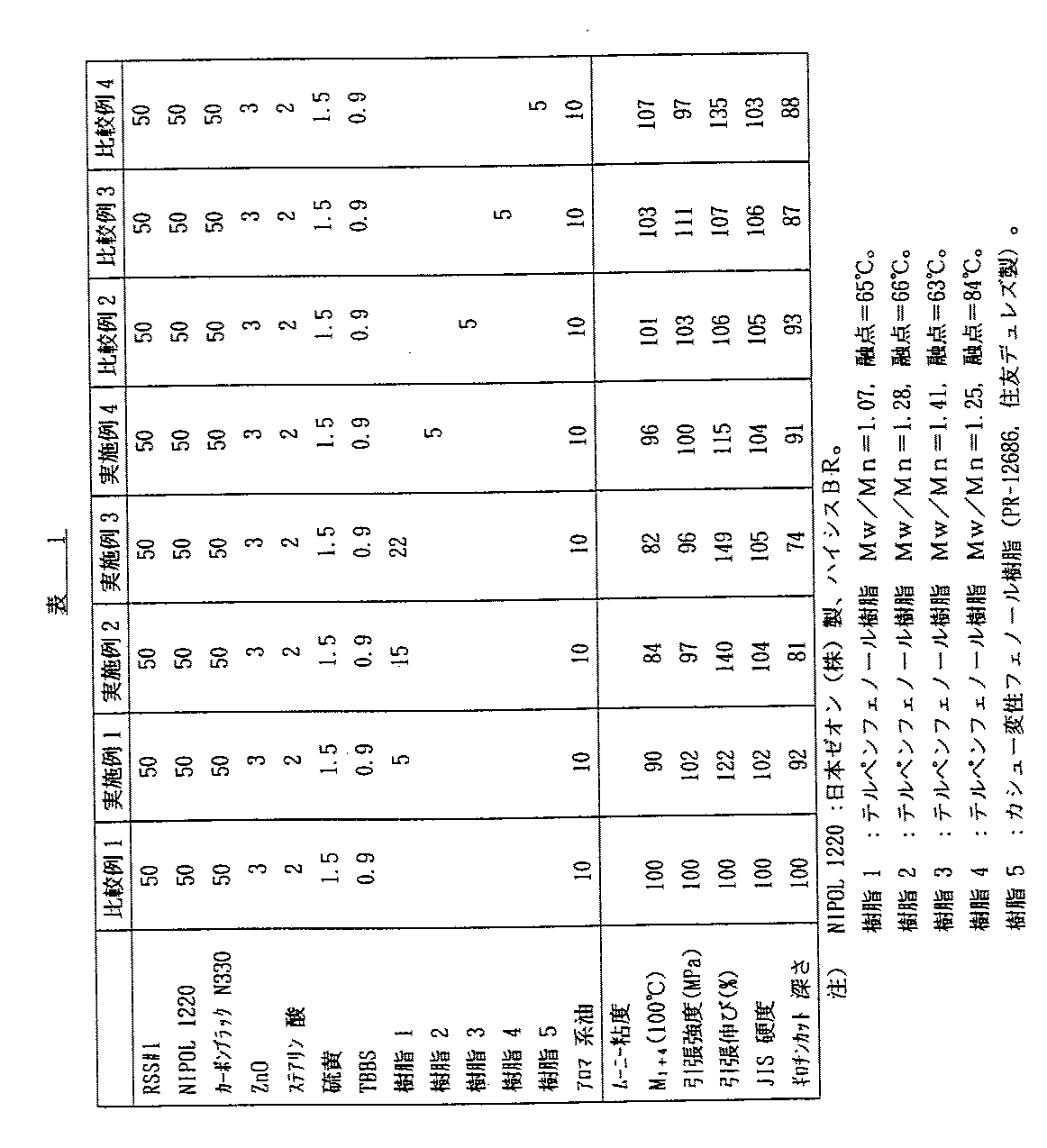
表1において、比較例1はいずれの樹脂をも含有しない場合であり、比較例2〜4はそれぞれ本発明範囲外の樹脂3、4、5を含有する場合である。表1から明らかなように、本発明のゴム組成物(実施例1〜4)は、比較例1〜4に比し、耐外傷性、剛性、柔軟性、および加工性に優れていることが判る。
【0016】
【発明の効果】
以上に説明した本発明によれば、ジエン系ゴムに対し特定のテルペンフェノール樹脂を配合したため、耐外傷性、剛性、柔軟性、および加工性を向上させることができる。このため、タイヤサイドウォール部を薄肉化してタイヤの軽量化をはかることが可能となる。[0001]
BACKGROUND OF THE INVENTION
The present invention relates to a rubber composition for a tire sidewall that has improved trauma resistance, rigidity, and flexibility, and has improved processability.
[0002]
[Prior art]
In recent years, there has been a demand for weight reduction of tires in order to improve fuel efficiency and driving stability. As part of this weight reduction, attempts have been made to reduce the thickness of the tire sidewall. In order to reduce the thickness of the tire sidewall portion, the tire sidewall portion should be composed of a flexible rubber composition that has high hardness and good fatigue resistance in order to ensure trauma resistance and rigidity. Good.
[0003]
However, for example, as a technique for obtaining a high-hardness rubber composition, a technique for blending a novolac-type modified phenolic resin with rubber is known (Japanese Patent Laid-Open No. 55-54337). However, the other physical properties are not satisfactory, and the Mooney viscosity of the unvulcanized rubber composition is increased, so that the processability is poor.
[0004]
[Problems to be solved by the invention]
An object of the present invention is to provide a rubber composition for a tire sidewall that has improved trauma resistance, rigidity, and flexibility and improved workability.
[0005]
[Means for Solving the Problems]
The rubber composition for a tire sidewall of the present invention has a melting point with a ratio Mw / Mn of a weight average molecular weight Mw to a number average molecular weight Mn of 1 to 1.3 relative to natural rubber, butadiene rubber, or styrene-butadiene copolymer rubber. Is formed by blending a terpene phenol resin at 60 to 80 ° C.
Thus, since the specific terpene phenol resin is blended with natural rubber, butadiene rubber, or styrene-butadiene copolymer rubber , the above object can be achieved. Therefore, according to the present invention, the tire sidewall can be thinned to reduce the weight of the tire.
[0006]
DETAILED DESCRIPTION OF THE INVENTION
As the diene rubber in the present invention, natural rubber (NR), styrene - is to use a butadiene copolymer rubber (SBR) or butadiene rubber (BR).
[0007]
The terpene phenol resin used in the present invention has a ratio Mw / Mn of the weight average molecular weight Mw to the number average molecular weight Mn of 1 to 1.3 and a melting point of 60 to 80 ° C. The value of Mw / Mn is an index of molecular weight distribution, and the smaller the value, the narrower the distribution. The melting point substantially correlates with the molecular weight of the resin, and in the case of a resin having a narrow molecular weight distribution, the resin suddenly softens in the vicinity of the melting point. For this reason, by selecting a resin having a specific melting point and a specific Mw / Mn, it is possible to obtain a rubber composition that is soft in the high temperature range during processing and hard in the normal temperature range after vulcanization.
[0008]
If Mw / Mn is more than 1.3, the melting temperature range of the resin becomes wide, and the targeted effect cannot be obtained. Mw and Mn are each measured by GPC (gel permeation chromatography). On the other hand, when the melting point exceeds 80 ° C., the viscosity of the rubber composition does not sufficiently decrease at high temperatures, whereas when it is less than 60 ° C., the resin may cause blocking during storage, and the handleability deteriorates, and the rubber composition Insufficient hardness at room temperature after vulcanization is not obtained. This melting point is measured by a differential scanning calorimeter (DSC).
[0009]
The blending amount is preferably 1 to 20 parts by weight of the terpene phenol resin with respect to 100 parts by weight of the diene rubber. If the amount of terpene phenol resin is less than 1 part by weight, it will be too little. On the other hand, if it exceeds 20 parts by weight, the effect will not be sufficiently improved, so 1 to 20 parts by weight will effectively demonstrate the performance of the resin. This is because it is possible.
[0010]
【Example】
Rubber compositions were prepared with the blending contents (parts by weight) shown in Table 1 (Examples 1 to 4, Comparative Examples 1 to 4), and Mooney viscosity (ML 1 + 4 (100 ° C.)), tensile strength (MPa), Tensile elongation (%), JIS hardness, and guillotine cut depth were measured and evaluated. The results are shown in Table 1.
[0011]
Mooney viscosity (ML 1 + 4 (100 ° C. )) :
The unvulcanized rubber composition was measured according to JIS K6300. This result is expressed as an index with Comparative Example 1 as 100. The smaller the value, the better the workability.
Tensile strength (MPa) :
The vulcanized rubber composition was measured according to JIS K6251. This result is expressed as an index with Comparative Example 1 as 100. The larger the value, the higher the tensile strength and the higher the rigidity.
[0012]
Tensile elongation (%) :
The vulcanized rubber composition was measured according to JIS K6251. This result is shown as an index with Comparative Example 1 as 100. The larger the value, the greater the tensile elongation (%), and the greater the resistance to deformation and the greater the flexibility.
JIS hardness :
The vulcanized rubber composition was measured with a durometer hardness test type A in accordance with JIS K6253. This result is shown as an index with Comparative Example 1 as 100. The larger the value, the higher the hardness and the higher the rigidity.
[0013]
Guillotine cut depth :
Drop the blade (tip angle 20 ° C, width 80 mm, height 40 mm) from a height of 250 mm against a vulcanized rubber test piece (width 40 mm x length 125 mm x height 9 mm), and set the cut depth. By measuring. This result is shown as an index with Comparative Example 1 as 100. The smaller the value, the better the trauma resistance.
[0014]
[Table 1]
In Table 1, Comparative Example 1 is a case where none of the resins is contained, and Comparative Examples 2 to 4 are cases where Resins 3, 4, and 5 outside the scope of the present invention are contained. As is clear from Table 1, the rubber compositions (Examples 1 to 4) of the present invention are superior in resistance to trauma, rigidity, flexibility and processability as compared with Comparative Examples 1 to 4. I understand.
[0016]
【The invention's effect】
According to the present invention described above, since the specific terpene phenol resin is blended with the diene rubber, the trauma resistance, rigidity, flexibility, and processability can be improved. For this reason, it is possible to reduce the tire weight by thinning the tire sidewall portion.
Claims (2)
Priority Applications (1)
| Application Number | Priority Date | Filing Date | Title |
|---|---|---|---|
| JP14166696A JP3628107B2 (en) | 1996-06-04 | 1996-06-04 | Rubber composition for tire sidewall |
Applications Claiming Priority (1)
| Application Number | Priority Date | Filing Date | Title |
|---|---|---|---|
| JP14166696A JP3628107B2 (en) | 1996-06-04 | 1996-06-04 | Rubber composition for tire sidewall |
Publications (2)
| Publication Number | Publication Date |
|---|---|
| JPH09324075A JPH09324075A (en) | 1997-12-16 |
| JP3628107B2 true JP3628107B2 (en) | 2005-03-09 |
Family
ID=15297364
Family Applications (1)
| Application Number | Title | Priority Date | Filing Date |
|---|---|---|---|
| JP14166696A Expired - Fee Related JP3628107B2 (en) | 1996-06-04 | 1996-06-04 | Rubber composition for tire sidewall |
Country Status (1)
| Country | Link |
|---|---|
| JP (1) | JP3628107B2 (en) |
Families Citing this family (1)
| Publication number | Priority date | Publication date | Assignee | Title |
|---|---|---|---|---|
| KR100475350B1 (en) * | 2002-11-22 | 2005-03-11 | 한국타이어 주식회사 | Rubber composition for white sidewall of pneumatic tire |
-
1996
- 1996-06-04 JP JP14166696A patent/JP3628107B2/en not_active Expired - Fee Related
Also Published As
| Publication number | Publication date |
|---|---|
| JPH09324075A (en) | 1997-12-16 |
Similar Documents
| Publication | Publication Date | Title |
|---|---|---|
| CA2054425C (en) | Tire with tread base rubber blend | |
| JP5132133B2 (en) | Rubber composition for inner liner and pneumatic tire | |
| EP1690895B1 (en) | Rubber composition and tire having tread comprising thereof | |
| JP6225447B2 (en) | Rubber composition for tire tread | |
| JPS586738B2 (en) | High hardness rubber composition | |
| JP3599215B2 (en) | Rubber composition | |
| WO2018198759A1 (en) | Studded tire and tire rubber composition | |
| JP3628107B2 (en) | Rubber composition for tire sidewall | |
| JP2018188503A (en) | Rubber composition for tire | |
| JP2014189695A (en) | Rubber composition for tire tread | |
| JP2020122109A (en) | Rubber composition for tire and pneumatic tire using the same | |
| JP2005133017A (en) | Rubber composition for sidewall | |
| JP7397292B2 (en) | Rubber composition for tires and pneumatic tires using the same | |
| JP7469589B2 (en) | Rubber composition for tires and pneumatic tire using same | |
| JP3193428B2 (en) | Rubber composition | |
| JP2018095703A (en) | Rubber composition for tire tread, and pneumatic tire | |
| JP2001247722A (en) | Rubber composition | |
| JPH09278944A (en) | High hysteresis loss rubber composition | |
| JP3594154B2 (en) | Rubber composition for tire tread | |
| JP4117987B2 (en) | Pneumatic tire | |
| JP4291055B2 (en) | Rubber composition for tread and pneumatic tire using the same | |
| JP7529960B2 (en) | Rubber composition for tires and pneumatic tire using same | |
| JPH11254904A (en) | Pneumatic tire | |
| JPH0551488A (en) | Rubber composition | |
| JP3649525B2 (en) | Rubber composition for tire tread |
Legal Events
| Date | Code | Title | Description |
|---|---|---|---|
| A977 | Report on retrieval |
Free format text: JAPANESE INTERMEDIATE CODE: A971007 Effective date: 20040426 |
|
| A131 | Notification of reasons for refusal |
Free format text: JAPANESE INTERMEDIATE CODE: A131 Effective date: 20040525 |
|
| A521 | Written amendment |
Free format text: JAPANESE INTERMEDIATE CODE: A523 Effective date: 20040712 |
|
| A131 | Notification of reasons for refusal |
Free format text: JAPANESE INTERMEDIATE CODE: A131 Effective date: 20040824 |
|
| TRDD | Decision of grant or rejection written | ||
| A01 | Written decision to grant a patent or to grant a registration (utility model) |
Free format text: JAPANESE INTERMEDIATE CODE: A01 Effective date: 20041130 |
|
| A61 | First payment of annual fees (during grant procedure) |
Free format text: JAPANESE INTERMEDIATE CODE: A61 Effective date: 20041207 |
|
| R150 | Certificate of patent or registration of utility model |
Free format text: JAPANESE INTERMEDIATE CODE: R150 |
|
| FPAY | Renewal fee payment (event date is renewal date of database) |
Free format text: PAYMENT UNTIL: 20071217 Year of fee payment: 3 |
|
| FPAY | Renewal fee payment (event date is renewal date of database) |
Free format text: PAYMENT UNTIL: 20081217 Year of fee payment: 4 |
|
| FPAY | Renewal fee payment (event date is renewal date of database) |
Free format text: PAYMENT UNTIL: 20081217 Year of fee payment: 4 |
|
| FPAY | Renewal fee payment (event date is renewal date of database) |
Free format text: PAYMENT UNTIL: 20091217 Year of fee payment: 5 |
|
| FPAY | Renewal fee payment (event date is renewal date of database) |
Free format text: PAYMENT UNTIL: 20101217 Year of fee payment: 6 |
|
| FPAY | Renewal fee payment (event date is renewal date of database) |
Free format text: PAYMENT UNTIL: 20101217 Year of fee payment: 6 |
|
| FPAY | Renewal fee payment (event date is renewal date of database) |
Free format text: PAYMENT UNTIL: 20111217 Year of fee payment: 7 |
|
| FPAY | Renewal fee payment (event date is renewal date of database) |
Free format text: PAYMENT UNTIL: 20111217 Year of fee payment: 7 |
|
| FPAY | Renewal fee payment (event date is renewal date of database) |
Free format text: PAYMENT UNTIL: 20111217 Year of fee payment: 7 |
|
| FPAY | Renewal fee payment (event date is renewal date of database) |
Free format text: PAYMENT UNTIL: 20121217 Year of fee payment: 8 |
|
| FPAY | Renewal fee payment (event date is renewal date of database) |
Free format text: PAYMENT UNTIL: 20121217 Year of fee payment: 8 |
|
| FPAY | Renewal fee payment (event date is renewal date of database) |
Free format text: PAYMENT UNTIL: 20121217 Year of fee payment: 8 |
|
| FPAY | Renewal fee payment (event date is renewal date of database) |
Free format text: PAYMENT UNTIL: 20131217 Year of fee payment: 9 |
|
| LAPS | Cancellation because of no payment of annual fees |