JP3596552B2 - Antistatic stretched film - Google Patents
Antistatic stretched film Download PDFInfo
- Publication number
- JP3596552B2 JP3596552B2 JP20308393A JP20308393A JP3596552B2 JP 3596552 B2 JP3596552 B2 JP 3596552B2 JP 20308393 A JP20308393 A JP 20308393A JP 20308393 A JP20308393 A JP 20308393A JP 3596552 B2 JP3596552 B2 JP 3596552B2
- Authority
- JP
- Japan
- Prior art keywords
- weight
- stretched film
- styrene
- poly
- antistatic
- Prior art date
- Legal status (The legal status is an assumption and is not a legal conclusion. Google has not performed a legal analysis and makes no representation as to the accuracy of the status listed.)
- Expired - Fee Related
Links
Classifications
-
- C—CHEMISTRY; METALLURGY
- C08—ORGANIC MACROMOLECULAR COMPOUNDS; THEIR PREPARATION OR CHEMICAL WORKING-UP; COMPOSITIONS BASED THEREON
- C08K—Use of inorganic or non-macromolecular organic substances as compounding ingredients
- C08K5/00—Use of organic ingredients
- C08K5/36—Sulfur-, selenium-, or tellurium-containing compounds
- C08K5/41—Compounds containing sulfur bound to oxygen
- C08K5/42—Sulfonic acids; Derivatives thereof
-
- C—CHEMISTRY; METALLURGY
- C08—ORGANIC MACROMOLECULAR COMPOUNDS; THEIR PREPARATION OR CHEMICAL WORKING-UP; COMPOSITIONS BASED THEREON
- C08J—WORKING-UP; GENERAL PROCESSES OF COMPOUNDING; AFTER-TREATMENT NOT COVERED BY SUBCLASSES C08B, C08C, C08F, C08G or C08H
- C08J5/00—Manufacture of articles or shaped materials containing macromolecular substances
- C08J5/18—Manufacture of films or sheets
-
- C—CHEMISTRY; METALLURGY
- C08—ORGANIC MACROMOLECULAR COMPOUNDS; THEIR PREPARATION OR CHEMICAL WORKING-UP; COMPOSITIONS BASED THEREON
- C08K—Use of inorganic or non-macromolecular organic substances as compounding ingredients
- C08K5/00—Use of organic ingredients
- C08K5/04—Oxygen-containing compounds
- C08K5/10—Esters; Ether-esters
- C08K5/101—Esters; Ether-esters of monocarboxylic acids
- C08K5/103—Esters; Ether-esters of monocarboxylic acids with polyalcohols
-
- C—CHEMISTRY; METALLURGY
- C08—ORGANIC MACROMOLECULAR COMPOUNDS; THEIR PREPARATION OR CHEMICAL WORKING-UP; COMPOSITIONS BASED THEREON
- C08J—WORKING-UP; GENERAL PROCESSES OF COMPOUNDING; AFTER-TREATMENT NOT COVERED BY SUBCLASSES C08B, C08C, C08F, C08G or C08H
- C08J2325/00—Characterised by the use of homopolymers or copolymers of compounds having one or more unsaturated aliphatic radicals, each having only one carbon-to-carbon double bond, and at least one being terminated by an aromatic carbocyclic ring; Derivatives of such polymers
- C08J2325/02—Homopolymers or copolymers of hydrocarbons
- C08J2325/04—Homopolymers or copolymers of styrene
Landscapes
- Chemical & Material Sciences (AREA)
- Health & Medical Sciences (AREA)
- Chemical Kinetics & Catalysis (AREA)
- Medicinal Chemistry (AREA)
- Polymers & Plastics (AREA)
- Organic Chemistry (AREA)
- Engineering & Computer Science (AREA)
- Manufacturing & Machinery (AREA)
- Materials Engineering (AREA)
- Compositions Of Macromolecular Compounds (AREA)
- Manufacture Of Macromolecular Shaped Articles (AREA)
- Shaping By String And By Release Of Stress In Plastics And The Like (AREA)
Description
【0001】
【産業上の利用分野】
本発明は、工業用粘着テープ基材,耐熱包装材料,医薬品用包装材料,食品包装材料等のフィルム,シートに有用な帯電防止性延伸フィルムに関する。
【0002】
【従来の技術】
高度なシンジオタクチック構造を有するスチレン系重合体(以下、SPSと記すことがある。)は、耐熱性及び耐溶剤性に優れ、また、その延伸フィルムは、これらの性能に加えて高弾性率,高透明性を有するため、種々の用途が期待されている。ところがSPS自体は、良誘電体であり、その延伸フィルムも静電気を帯びやすいという性質を有している。このため、成形時及び製品使用時の静電気による種々な障害が発生することがあり、さらなる用途展開を可能とするためには、この問題を解決する必要があった。
高分子フィルムを帯電防止する方法としては、▲1▼各種界面活性剤を溶融、混練する方法,▲2▼各種界面活性剤をフィルム表面に塗布する方法,▲3▼フィルム表面を化学的に処理することにより親水性基を導入する方法などが挙げられる。しかし、上記▲1▼の方法については、従来、ポリオレフィン等に用いられてきた添加剤では、SPSの成形温度(290〜320℃)で分解、気化等を起こしてしまい、その効果を発現させることは困難であり、さらにSPSは結晶性樹脂であり、そのガラス転移温度が室温より高いことから、高弾性率,高透明性でかつ帯電防止性を有する延伸フィルムを得ることは困難であった。また、上記▲2▼及び▲3▼の方法については、製造段階で新たに余分な工程を必要とするため生産性やコストの面で問題があり、材料の側から帯電防止性能を付与することが求められている。
【0003】
【発明が解決しようとする課題】
本発明は、上記従来技術の問題点を解消し、耐熱性,耐溶剤性,透明性,帯電防止性に優れ、かつ高い機械的特性を有する延伸フィルムを提供することを目的とする。
【0004】
【課題を解決するための手段】
本発明者らは、鋭意検討の結果、SPSに特定の多価アルコール脂肪酸エステル、又は更に有機スルホン酸金属塩を配合することによって上記課題を達成しうることを見出した。本発明は、かかる知見に基づいて完成したものである。
すなわち、本発明は、(A) 13 C−NMR法により測定されるダイアッドで75%以上の高度なシンジオタクチック構造を有するスチレン系重合体95〜99.5重量%及び(B)HLB6〜9のポリグリセリン脂肪酸エステル0.5〜5.0重量%を含有する樹脂組成物からなることを特徴とする帯電防止性延伸フィルム、並びに(A) 13 C−NMR法により測定されるダイアッドで75%以上の高度なシンジオタクチック構造を有するスチレン系重合体88.5〜99.475重量%,(B)HLB6〜9のポリグリセリン脂肪酸エステル0.5〜5.0重量%及び(C)有機スルホン酸金属塩0.025〜6.5重量%を含有する樹脂組成物からなることを特徴とする帯電防止性延伸フィルムを提供するものである。
【0005】
本発明に(A)成分として用いるスチレン系重合体は、高度なシンジオタクチック構造を有するものであるが、ここで高度なシンジオタクチック構造とは、立体化学構造が高度なシンジオタクチック構造、即ち炭素−炭素結合から形成される主鎖に対して側鎖であるフェニル基や置換フェニル基が交互に反対方向に位置する立体構造を有するものであり、そのタクティシティーは同位体炭素による核磁気共鳴法(13C−NMR法)により定量される。13C−NMR法により測定されるタクティシティーは、連続する複数個の構成単位の存在割合、例えば2個の場合はダイアッド,3個の場合はトリアッド,5個の場合はペンタッドによって示すことができるが、本発明に言うSPSとは、通常はダイアッドで75%以上、好ましくは85%以上、若しくはペンタッド(ラセミペンタッド)で30%以上、好ましくは50%以上のシンジオタクティシティーを有するポリスチレン,ポリ(アルキルスチレン),ポリ(ハロゲン化スチレン),ポリ(アルコキシスチレン),ポリ(ビニル安息香酸エステル)およびこれらの混合物、あるいはこれらを主成分とする共重合体を指称する。なお、ここでポリ(アルキルスチレン)としては、ポリ(メチルスチレン),ポリ(エチルスチレン),ポリ(イソプロピルスチレン),ポリ(ターシャリーブチルスチレン)などがあり、ポリ(ハロゲン化スチレン)としては、ポリ(クロロスチレン),ポリ(ブロモスチレン),ポリ(フルオロスチレン) などがある。また、ポリ(アルコキシスチレン)としては、ポリ(メトキシスチレン),ポリ(エトキシスチレン)などがある。これらのうち特に好ましいスチレン系重合体としては、ポリスチレン,ポリ(p−メチルスチレン),ポリ(m−メチルスチレン),ポリ(p−ターシャリーブチルスチレン),ポリ(p−クロロスチレン),ポリ(m−クロロスチレン),ポリ(p−フルオロスチレン) 、更にはスチレンとp−メチルスチレンとの共重合体をあげることができる。
【0006】
また、本発明に用いるSPSは、分子量については制限はないが、重量平均分子量が10,000以上のものが好ましく、とりわけ50,000以上のものが最適である。さらに、分子量分布についてもその広狭は制約がなく、様々なものを充当することが可能である。このSPSは、融点が200〜310℃であって、従来のアタクチック構造のスチレン系重合体に比べて耐熱性が格段に優れている。このようなSPSは、例えば不活性炭化水素溶媒中または溶媒の不存在下に、チタン化合物、及び水とトリアルキルアルミニウムの縮合生成物を触媒として、スチレン系単量体(上記スチレン系重合体に対応する単量体)を重合することにより製造することができる。
【0007】
本発明に用いる樹脂組成物は、さらに(B)成分として多価アルコール脂肪酸エステルを含有する。ここで、多価アルコール種としては、エチレングリコール,ジエチレングリコール,モノグリセリン,ポリグリセリン,トリメチロールプロパン,ペンタエリスリット,ソルビトールなどがあり、様々な脂肪酸とのエステルが考えられる。しかし、本発明に用いる樹脂組成物の構成成分としては、SPSの成形温度が290〜320℃と高温であることから耐熱性の高いものが要求される。そのためには、グリセリン脂肪酸エステル系であって、グリセリン重合度6を中心とした分布を持つポリグリセリンエステルが好適であり、さらにSPSとの相溶性,親水性,フィルム表面への移行性を考慮してHLB値は6〜9、特に7〜8のものが最適である。HLB値が6未満では、帯電防止性能を発現するに至らず、9を超えると添加量相応の効果を発現できない。
【0008】
ここでHLB値とは、化合物の親水性と親油性のバランスを示す指標であり、値が大きいほど親水性が強いことを示す。また、一般に多価アルコール系エステルのHLB値は、下記の Griffinの経験式から算出される。
HLB=20×(1−SV/NV)
〔式中、SVはエステルのケン化価、すなわちエステル1gを中和するのに必要な水酸化カリウムのミリグラム数を示し、NVは脂肪酸の中和価、すなわち脂肪酸1gを中和するのに必要な水酸化カリウムのミリグラム数を示す。〕
【0009】
また、多価アルコール脂肪酸エステルの添加量は、0.5〜5.0重量%、好ましくは1.5〜3.0重量%である。この添加量が0.5重量%未満であると、充分な帯電防止性能を発現せず、5.0重量%を超えると機械的強度の低下、フィルム表面のベトツキ,外観不良の原因となる。
【0010】
本発明に用いる樹脂組成物は、上記の(B)成分である多価アルコール脂肪酸エステルと共にあるいはその代わりに(C)成分として有機スルホン酸金属塩を含有する。
ここで有機スルホン酸種としては、アルカンスルホン酸,α−オレフィンスルホン酸,アルキルベンゼンスルホン酸,アルキルナフタレンスルホン酸,アルキルエーテルスルホン酸,アルキルフェニルエーテルスルホン酸,アルキルジフェニルジスルホン酸,スルホコハク酸,ジアルキルスルホコハク酸,メチルタウリン酸,β−ナフタレンスルホン酸ホルマリン縮合物などがあり、金属塩種としては、リチウム塩,ナトリウム塩,カリウム塩などがあるが、高耐熱性を要求されるため、炭素数10〜20の直鎖アルキルスルホン酸金属塩またはアルキルアリールスルホン酸金属塩の使用が好適であり、特に直鎖アルカンスルホン酸ナトリウム塩がより少量で効果を発現し好ましい。
こららの有機スルホン酸金属塩の添加量は、0.025〜6.5重量%、好ましくは0.1〜1.5重量%である。この添加量が0.025重量%未満であると、充分な帯電防止効果が得られず、また、6.5重量%を超えると、フィルム表面に過剰にブリードしてベタツキ等、外観不良を起こすだけでなく、フィルムの機械的特性をも損なう。
【0011】
上記のように、本発明において、(B)成分及び(C)成分を併用することも可能であり、またそうすることにより双方の添加量を記載した範囲内で低含量に抑えることができる。
本発明において、上記(A)〜(C)成分の他に、本発明の目的を阻害しない範囲で一般に使用されている熱可塑性樹脂,ゴム,各種酸化防止剤,難燃剤,無機充填剤,架橋剤,架橋助剤,核剤,可塑剤,相溶化剤,着色剤などを添加して組成物としてもよい。
【0012】
上記熱可塑性樹脂としては、例えばアタクチック構造のポリスチレン,アイソタクチック構造のポリスチレン,AS樹脂,ABS樹脂などのスチレン系重合体をはじめ、ポリエチレンテレフタレートなどのポリエステル,ポリカーボネート,ポリフェニレンオキサイド,ポリスルホン,ポリエーテルスルホンなどのポリエーテル,ポリアミド,ポリフェニレンスルフィド(PPS),ポリオキシメチレンなどの縮合系重合体、ポリアクリル酸,ポリアクリル酸エステル,ポリメチルメタクリレートなどのアクリル系重合体、ポリエチレン,ポリプロピレン,ポリブテン,ポリ4−メチルペンテン−1,エチレン−プロピレン共重合体などのポリオレフィン、あるいはポリ塩化ビニル,ポリ塩化ビニリデン,ポリ弗化ビニリデンなどの含ハロゲンビニル化合物重合体など、あるいはこれらの混合物が挙げられる。
【0013】
またゴムとしては、様々なものが使用可能であるが、最も好適なものはスチレン系化合物をその一成分として含むゴム状共重合体で、例えば、スチレン−ブタジエンブロック共重合体のブタジエン部分を一部あるいは完全に水素化したゴム(SEBS),スチレン−ブタジエン共重合体ゴム(SBR),アクリル酸メチル−ブタジエン−スチレン共重合体ゴム,アクリロニトリル−ブタジエン−スチレン共重合体ゴム(ABSゴム),アクリロニトリル−アルキルアクリレート−ブタジエン−スチレン共重合体ゴム(AABS),メタクリル酸メチル−アルキルアクリレート−スチレン共重合体ゴム(MAS),メタクリル酸メチル−アルキルアクリレート−ブタジエン−スチレン共重合体ゴム(MABS)など、あるいはこれらの混合物が挙げられる。これらのスチレン系化合物をその一成分として含むゴム状共重合体は、スチレン単位を有するため、高度なシンジオタクチック構造を有するスチレン系重合体に対する分散性が良好であり、その結果、物性の改善効果が著しい。
さらに用いることのできるゴムの他の例としては、天然ゴム,ポリブタジエン,ポリイソプレン,ポリイソブチレン,ネオプレン,エチレン−プロピレン共重合体ゴム,ポリスルフィドゴム,チオコールゴム,アクリルゴム,ウレタンゴム,シリコーンゴム,エピクロルヒドリンゴム,ポリエーテル・エステルゴム,ポリエステル・エステルゴムなど、あるいはこれらの混合物が挙げられる。
【0014】
酸化防止剤としては様々なものがあるが、特にトリス(2,4−ジ−t−ブチルフェニル)ホスファイト,トリス(モノおよびジ−ノニルフェニル)ホスファイト等のモノホスファイトやジホスファイト等のリン系酸化防止剤およびフェノール系酸化防止剤が好ましい。ジホスファイトとしては、一般式
【0015】
【化1】
(式中、R1 及びR2 はそれぞれ独立に炭素数1〜20のアルキル基,炭素数3〜20のシクロアルキル基あるいは炭素数6〜20のアリール基を示す。)
で表されるリン系化合物を用いることが好ましい。
上記一般式で表されるリン系化合物の具体例としては、ジステアリルペンタエリスリトールジホスファイト;ジオクチルペンタエリスリトールジホスファイト;ジフェニルペンタエリスリトールジホスファイト;ビス(2,4−ジ−t−ブチルフェニル)ペンタエリスリトールジホスファイト;ビス(2,6−ジ−t−ブチル−4−メチルフェニル)ペンタエリスリトールジホスファイト;ジシクロヘキシルペンタエリスリトールジホスファイトなどが挙げられる。
また、フェノール系酸化防止剤としては既知のものを使用することができ、その具体例としては、2,6−ジ−t−ブチル−4−メチルフェノール;2,6−ジフェニル−4−メトキシフェノール;2,2’−メチレンビス(6−t−ブチル−4−メチルフェノール);2,2’−メチレンビス−(6−t−ブチル−4−メチルフェノール);2,2’−メチレンビス〔4−メチル−6−(α−メチルシクロヘキシル)フェノール〕;1,1−ビス(5−t−ブチル−4−ヒドロキシ−2−メチルフェニル)ブタン;2,2’−メチレンビス(4−メチル−6−シクロヘキシルフェノール);2,2’−メチレンビス−(4−メチル−6−ノニルフェノール);1,1,3−トリス−(5−t−ブチル−4−ヒドロキシ−2−メチルフェニル)ブタン;2,2−ビス−(5−t−ブチル−4−ヒドロキシ−2−メチルフェニル)−4−n−ドデシルメルカプトブタン;エチレングリコール−ビス〔3,3−ビス(3−t−ブチル−4−ヒドロキシフェニル)ブチレート〕;1−1−ビス(3,5−ジメチル−2−ヒドロキシフェニル)−3−(n−ドデシルチオ)−ブタン;4,4’−チオビス(6−t−ブチル−3−メチルフェノール);1,3,5−トリス(3,5−ジ−t−ブチル−4−ヒドロキシベンジル)−2,4,6−トリメチルベンゼン;2,2−ビス(3,5−ジ−t−ブチル−4−ヒドロキシベンジル)マロン酸ジオクタデシルエステル;n−オクタデシル−3−(4−ヒドロキシ−3,5−ジ−t−ブチルフェニル)プロピオネート;テトラキス〔メチレン(3,5−ジ−t−ブチル−4−ヒドロキシハイドロシンナメート)〕メタンなどが挙げられる。
さらに、上記リン系酸化防止剤,フェノール系酸化防止剤の他に、アミン系酸化防止剤,硫黄系酸化防止剤などを単独で、あるいは混合して用いることができる。
【0017】
上記の酸化防止剤は、前記のSPS100重量部に対し、通常、0.0001〜1重量部である。ここで酸化防止剤の配合割合が0.0001重量部未満であると分子量低下が著しく、一方、1重量部を超えると機械的強度に影響があるため、いずれも好ましくない。
【0018】
さらに無機充填剤としては、繊維状のものであると、粒状,粉状のものであるとを問わない。繊維状無機充填材としてはガラス繊維,炭素繊維,アルミナ繊維等が挙げられる。一方、粒状,粉状無機充填材としてはタルク,カーボンブラック,グラファイト,二酸化チタン,シリカ,マイカ,炭酸カルシウム,硫酸カルシウム,炭酸バリウム,炭酸マグネシウム,硫酸マグネシウム,硫酸バリウム,オキシサルフェート,酸化スズ,アルミナ,カオリン,炭化ケイ素,金属粉末等が挙げられる。
【0019】
また架橋剤としては、t−ブチルヒドロペルオキシド;クメンヒドロペルオキシド;ジイソプロピルベンゼンペルオキシド;2,5−ジメチル−2,5−ジヒドロペロキシヘキサン;2,5−ジメチル−2,5−ジヒドロペロキシヘキサン−3などのヒドロペルオキシド類,ジアルキルペルオキシド類,ケトンペルオキシド類,ジアシルペルオキシド類,ペルオキシエステル類などを適量使用することができる。
架橋助剤としては、p−キノンジオキシム;p,p−ジベンゾイルキノンジオキシムなどのキノンジオキシム類、ポリエチレングリコールジメタクリレートなどのメタクリレート類、アリル系化合物,マレイミド系化合物などを適宜使用することができる。
【0020】
本発明の延伸フィルムの製造方法としては、様々なものが挙げられるが、例えば、SPSと上記の各成分を単軸,二軸スクリュー押出機あるいはニーダー等のミキサーで溶融、混練してペレット状の帯電防止性組成物とした後、T−ダイ,サーキュラーダイを用いた押出成形により作製することができる。延伸方法については、固定端一軸延伸,自由端一軸延伸,逐次二軸延伸,同時二軸延伸といった方法があり、特に限定されるものではない。T−ダイを用いた成形では、まず、未延伸フィルムあるいはシートを作製し、それを上述のような延伸に供する。また、サーキュラーダイを用いた成形では、インフレーション成形に代表される延伸製膜方法となる。フィルムの機械的性質をより高めるためには加熱ロール及びテンターを用いた逐次二軸延伸が好ましい。また、このようにして得られた延伸フィルムを200〜260℃の範囲内で熱処理してもよい。処理時間は、1〜30秒が好ましい。この熱処理により延伸フィルムの耐熱性,耐溶剤性,そして帯電防止性をより一層高めることができる。
【0021】
【実施例】
次に、本発明を参考例,製造例,実施例及び比較例によりさらに詳しく説明する。
参考例1
アルゴン置換した内容積500ミリリットルのガラス製容器に、硫酸銅5水塩(CuSO4 5H2 O)17g(71ミリモル),トルエン200ミリリットル及びトリメチルアルミニウム24ミリリットル(250ミリモル)を入れ、40℃で8時間反応させた。その後、固体部分を除去して接触生成物6.7gを得た。このものの凝固点降下法によって測定した分子量は610であった。
【0022】
製造例1
内容積2リットルの反応容器に、精製スチレン1リットル,参考例1で得られた接触生成物をアルミニウム原子として7.5ミリモル,トリイソブチルアルミニウム7.5ミリモル及びペンタメチルシクロペンタジエニルチタントリメトキシド0.038ミリモルを入れて90℃で5時間重合反応を行った。反応終了後、生成物を水酸化ナトリウムのメタノール溶液で接触生成物を分解後、メタノールで繰り返し洗浄し、乾燥して重合体466gを得た。
この重合体の重量平均分子量を、1,2,4−トリクロロベンゼンを溶媒として、130℃でゲルパーミエーションクロマトグラフィーにて測定したところ、290,000であり、また、重量平均分子量/数平均分子量は2.72であった。さらに、融点及び13C−NMRの測定により、この重合体は、シンジオタクチック構造のポリスチレン(SPS)であることが確認された。
【0023】
製造例2
製造例1において、原料モノマーとして、精製スチレン950ミリリットル及びp−メチルスチレン50ミリリットルを用いて共重合を行ったこと以外は、製造例1と同様の操作を行った。
その結果、得られた共重合体は、共シンジオタクチック構造であり、p−メチルスチレン単位を9.5モル%含むことが13C−NMRの測定により確認できた。また、重量平均分子量は438,000であり、重量平均分子量/数平均分子量は2.51であった。
【0024】
実施例1
製造例1で得られたスチレン系重合体パウダーを150℃で2時間攪拌しながら乾燥した後、添加剤としてグリセリン重合度6を中心とした分布を持ち、HLB=7であるポリグリセリンステアリン酸トリエステル(商品名SYグリスターTS−500;阪本薬品工業株式会社製)を3.0重量%になるように混合した。この混合物を先端にキャピラリーを複数個含むダイを取りつけた二軸スクリュー押出機で溶融押出後、冷却し、カットして組成物のペレットを作製した。このとき、溶融温度は300℃とした。得られたペレットを熱風中で攪拌しながら結晶化、乾燥を行った。このペレットを用いて単軸押出機の先端にT−ダイを取り付けた装置で押し出した。この時の押出温度は320℃であり、剪断応力は3×10⁵ dyne/cm2 であった。この溶融押出されたシートを静電印加により、金属冷却ロールに密着冷却させ、厚み300μmの未延伸シートを作製した。この時金属冷却ロールは、70℃に調整した。なお、冷却速度は70℃/秒であった。
得られた延伸シートを加熱ロール及びテンターを用いた逐次二軸延伸法で延伸フィルムとした。その際、縦延伸は、温度105℃で、倍率を3.0倍とし、また、横延伸は、温度110℃で、倍率を3.2倍とした。この延伸フィルムを横延伸後、直ちに240℃で5〜30秒熱処理し、所定のフィルムとした。
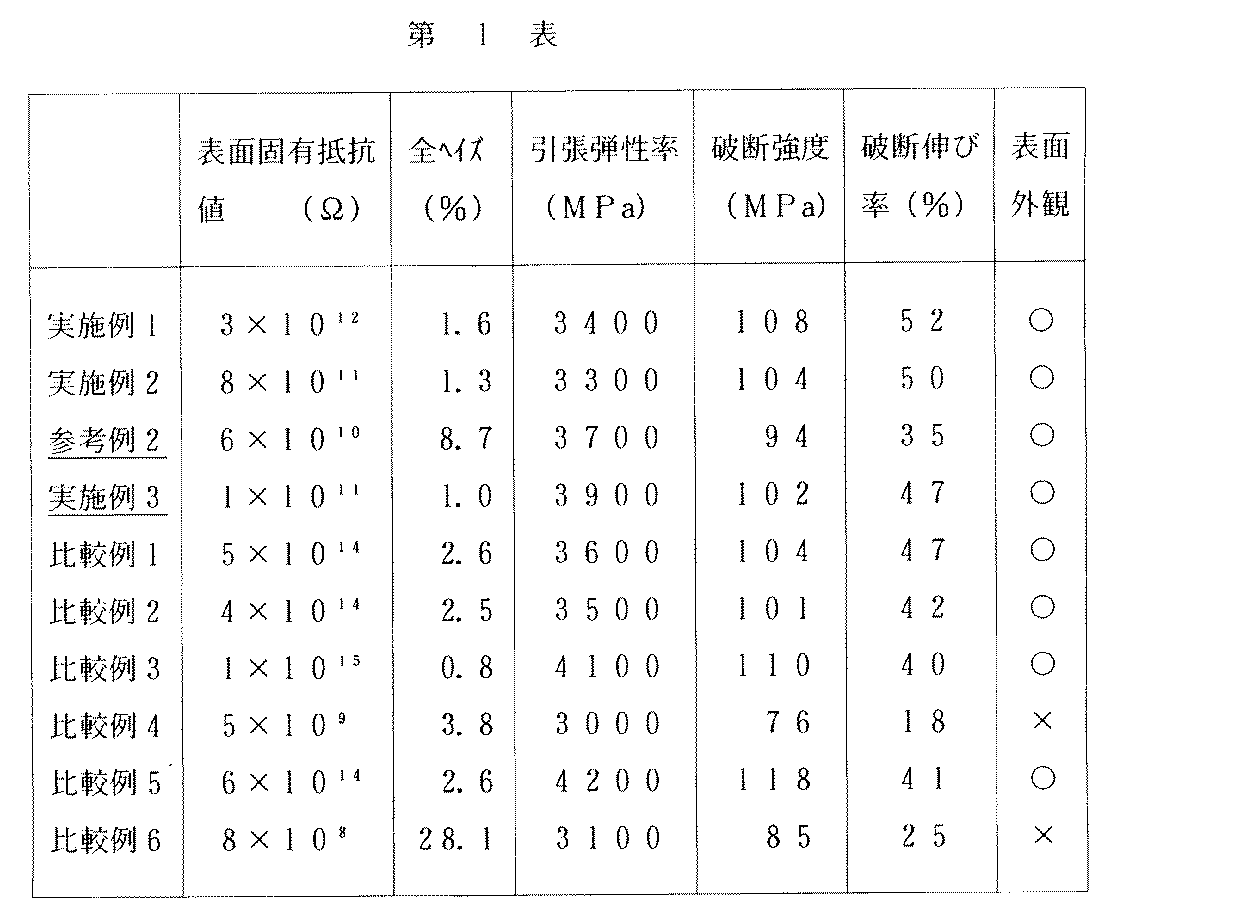
このようにして作製されたフィルムサンプルの表面固有抵抗値,引張特性,透明性及び表面外観を評価し、結果を第1表に示す。
【0025】
実施例2
製造例2で得られたスチレン系重合体パウダーを用いた以外は、全て実施例1に従って延伸フィルムを製造し、評価し、結果を第1表に示す。
【0026】
参考例2
添加剤として炭素数12の直鎖アルカンスルホン酸ナトリウム塩(東邦化学工業株式会社製、商品名ANSTEX-SAS)を1.5重量%になるように混合した以外は、全て実施例1に従って延伸フィルムを製造し、評価し、結果を第1表に示す。
【0027】
実施例3
添加剤として炭素数12の直鎖アルカンスルホン酸ナトリウム塩0.1重量%及びグリセリン重合度6を中心とした分布を持ち、HLB=7であるポリグリセリンステアリン酸エステル2.0重量%を同時に用いた以外は、全て実施例1に従って延伸フィルムを製造し、評価し、結果を第1表に示す。
【0028】
比較例1
添加剤としてグリセリン重合度6を中心とした分布を持ち、HLB=5であるポリグリセリンステアリン酸エステルが3.0重量%になるように混合した以外は全て実施例1に従って延伸フィルムを製造し、評価し、結果を第1表に示す。
【0029】
比較例2
添加剤としてグリセリン重合度6を中心とした分布を持ち、HLB=12であるポリグリセリンステアリン酸エステルが3.0重量%になるように混合した以外は、全て実施例1に従って延伸フィルムを製造し、評価し、結果を第1表に示す。
【0030】
比較例3
添加剤としてグリセリン重合度6を中心とした分布を持ち、HLB=7であるポリグリセリンステアリン酸エステルが0.3重量%になるように混合した以外は全て実施例1に従って延伸フィルムを製造し、評価し、結果を第1表に示す。
【0031】
比較例4
添加剤としてグリセリン重合度6を中心とした分布を持ち、HLB=7であるポリグリセリンステアリン酸エステルが7.0重量%になるように混合した以外は全て実施例1に従って延伸フィルムを製造し、評価し、結果を第1表に示す。
【0032】
比較例5
添加剤として炭素数12の直鎖アルカンスルホン酸ナトリウム塩を0.02重量%になるように混合した以外は、全て実施例1に従って延伸フィルムを製造し、評価し、結果を第1表に示す。
【0033】
比較例6
添加剤として炭素数12の直鎖アルカンスルホン酸ナトリウム塩を7.0重量%になるように混合した以外は、全て実施例1に従って延伸フィルムを製造し、評価し、結果を第1表に示す。
【0034】
なお、各種特性の評価は、下記の方法で行った。
▲1▼表面固有抵抗値
これは、材料の帯電防止性を評価するもので、値が低い物ほど良好とされる。一般に疎水性の樹脂材料の表面固有抵抗値は、1015Ωのレベルにある。これを埃付着防止等の静的状態での障害を防止するためには1012〜1013Ωの程度まで低下させる必要がある。さらに、常に摩擦などによる静電気発生雰囲気下、いわば動的状態での帯電防止をするには1010〜1011Ωのレベルが必要とされている。
実際の測定に際しては、ASTM D−257に従い、延伸フィルムを23℃、相対湿度50%の雰囲気下で24時間放置した後、横河−HEWLETT PACKARD 社製抵抗率測定器を用いて測定した。
【0035】
▲2▼機械的性質
JIS Z−1702に従って引張試験を行い、引張弾性率,破断強度,破断伸び率の評価を行った。
▲3▼透明性
ASTM D1003に従って測定した。
▲4▼表面外観
延伸フィルムの表面荒れ及び添加剤のベトツキの状況等の表面外観を目視で評価し、良好なものを○、不良なものを×と判定した。
【0036】
【表1】
【発明の効果】
上述の如く、本発明の延伸フィルムは、優れた帯電防止性を示すとともに、高い耐熱性,耐溶剤性,透明性及び機械的強度を有する。
したがって、本発明の帯電防止性延伸フィルムは、工業用粘着テープ基材,耐熱包装材料,医薬品用包装材料,食品包装材料等のフィルム,シートとして有効に利用される。[0001]
[Industrial applications]
The present invention relates to an antistatic stretched film useful for films and sheets of industrial adhesive tape base materials, heat-resistant packaging materials, pharmaceutical packaging materials, food packaging materials, and the like.
[0002]
[Prior art]
Styrene polymers having a high syndiotactic structure (hereinafter sometimes referred to as SPS) are excellent in heat resistance and solvent resistance, and the stretched film has a high elastic modulus in addition to these properties. Because of its high transparency, various uses are expected. However, SPS itself is a good dielectric, and its stretched film also has a property that it is easily charged with static electricity. For this reason, various obstacles may occur due to static electricity at the time of molding and at the time of using the product, and it is necessary to solve this problem in order to enable further application development.
As methods for preventing the charge of the polymer film, (1) a method of melting and kneading various surfactants, (2) a method of applying various surfactants to the film surface, and (3) a chemical treatment of the film surface. To introduce a hydrophilic group. However, in the above method (1), additives conventionally used in polyolefins and the like cause decomposition, vaporization, etc. at the SPS molding temperature (290 to 320 ° C.), and exhibit the effect. However, SPS is a crystalline resin, and its glass transition temperature is higher than room temperature. Therefore, it has been difficult to obtain a stretched film having high elastic modulus, high transparency and antistatic property. In addition, the above methods (2) and (3) require extra steps at the manufacturing stage, and therefore have problems in terms of productivity and cost. Therefore, it is necessary to provide antistatic performance from the material side. Is required.
[0003]
[Problems to be solved by the invention]
An object of the present invention is to solve the above-mentioned problems of the prior art, and to provide a stretched film having excellent heat resistance, solvent resistance, transparency, and antistatic properties and high mechanical properties.
[0004]
[Means for Solving the Problems]
Means for Solving the Problems As a result of intensive studies, the present inventors have found that the above object can be achieved by blending a specific polyhydric alcohol fatty acid ester or a metal salt of an organic sulfonic acid with SPS. The present invention has been completed based on such findings.
That is, the present invention relates to (A) 95 to 99.5% by weight of a styrene-based polymer having a high syndiotactic structure of 75% or more as measured by a 13 C-NMR method and (B) HLB 6 to 9 A stretched antistatic film comprising a resin composition containing 0.5 to 5.0% by weight of a polyglycerin fatty acid ester of (a), and (A) 75% by dyad measured by 13 C-NMR method. 88.5 to 99.475% by weight of the styrenic polymer having the above-mentioned highly syndiotactic structure, (B) 0.5 to 5.0% by weight of polyglycerol fatty acid ester of HLB 6 to 9, and (C) organic sulfone The present invention provides an antistatic stretched film comprising a resin composition containing 0.025 to 6.5% by weight of an acid metal salt.
[0005]
The styrenic polymer used as the component (A) in the present invention has a high syndiotactic structure. Here, the high syndiotactic structure is a syndiotactic structure having a high stereochemical structure. That is, a phenyl group or a substituted phenyl group which is a side chain with respect to a main chain formed from carbon-carbon bonds has a three-dimensional structure in which the phenyl group and the substituted phenyl group are alternately located in the opposite direction. It is quantified by a resonance method ( 13C -NMR method). Tacticity measured by the 13 C-NMR method can be represented by the abundance ratio of a plurality of continuous structural units, for example, a dyad for two, a triad for three, and a pentad for five. However, the SPS referred to in the present invention is generally a polystyrene having a syndiotacticity of 75% or more, preferably 85% or more in dyad, or 30% or more, preferably 50% or more in pentad (racemic pentad). Poly (alkyl styrene), poly (halogenated styrene), poly (alkoxy styrene), poly (vinyl benzoate), a mixture thereof, or a copolymer containing these as a main component. The poly (alkyl styrene) includes poly (methyl styrene), poly (ethyl styrene), poly (isopropyl styrene), poly (tertiary butyl styrene) and the like, and poly (halogenated styrene) includes Examples include poly (chlorostyrene), poly (bromostyrene), and poly (fluorostyrene). Examples of poly (alkoxystyrene) include poly (methoxystyrene) and poly (ethoxystyrene). Of these, particularly preferred styrene polymers include polystyrene, poly (p-methylstyrene), poly (m-methylstyrene), poly (p-tert-butylstyrene), poly (p-chlorostyrene), and poly (p-chlorostyrene). m-chlorostyrene), poly (p-fluorostyrene), and a copolymer of styrene and p-methylstyrene.
[0006]
The molecular weight of the SPS used in the present invention is not limited, but preferably has a weight average molecular weight of 10,000 or more, and most preferably 50,000 or more. Further, the molecular weight distribution is not limited in its width, and various types can be applied. This SPS has a melting point of 200 to 310 ° C., and is much more excellent in heat resistance than a conventional styrene polymer having an atactic structure. Such SPS is prepared, for example, by using a titanium compound and a condensation product of water and a trialkylaluminum as a catalyst in an inert hydrocarbon solvent or in the absence of a solvent, using a styrene-based monomer (the above-mentioned styrene-based polymer). (Corresponding monomer).
[0007]
The resin composition used in the present invention further contains a polyhydric alcohol fatty acid ester as the component (B). Here, polyhydric alcohol species include ethylene glycol, diethylene glycol, monoglycerin, polyglycerin, trimethylolpropane, pentaerythritol, sorbitol, and the like, and esters with various fatty acids can be considered. However, the components of the resin composition used in the present invention are required to have high heat resistance because the molding temperature of SPS is as high as 290 to 320 ° C. For this purpose, a glycerin fatty acid ester-based polyglycerin ester having a distribution centered on a glycerin polymerization degree of 6 is preferable, and further considering compatibility with SPS, hydrophilicity, and migration to the film surface. Therefore, an HLB value of 6 to 9, particularly 7 to 8, is optimal. If the HLB value is less than 6, no antistatic performance can be obtained, and if it is more than 9, the effect corresponding to the added amount cannot be exhibited.
[0008]
Here, the HLB value is an index indicating the balance between the hydrophilicity and the lipophilicity of the compound, and the larger the value, the stronger the hydrophilicity. In general, the HLB value of a polyhydric alcohol ester is calculated from the following Griffin's empirical formula.
HLB = 20 × (1−SV / NV)
[Where SV denotes the saponification value of the ester, ie, the number of milligrams of potassium hydroxide required to neutralize 1 g of the ester, and NV denotes the neutralization value of the fatty acid, ie, the neutralization value required to neutralize 1 g of the fatty acid. Shows the number of milligrams of potassium hydroxide. ]
[0009]
The amount of the polyhydric alcohol fatty acid ester is 0.5 to 5.0% by weight, preferably 1.5 to 3.0% by weight. If the amount is less than 0.5% by weight, sufficient antistatic performance is not exhibited. If the amount exceeds 5.0% by weight, mechanical strength is reduced, stickiness on the film surface and poor appearance are caused.
[0010]
The resin composition used in the present invention contains a metal salt of an organic sulfonic acid as the component (C) together with or instead of the polyhydric alcohol fatty acid ester as the component (B).
Here, organic sulfonic acid species include alkanesulfonic acid, α-olefinsulfonic acid, alkylbenzenesulfonic acid, alkylnaphthalenesulfonic acid, alkylethersulfonic acid, alkylphenylethersulfonic acid, alkyldiphenyldisulfonic acid, sulfosuccinic acid, and dialkylsulfosuccinic acid. , Methyltauric acid, β-naphthalenesulfonic acid formalin condensate, etc., and the metal salt species include lithium salt, sodium salt, potassium salt and the like. It is preferable to use a metal salt of a straight-chain alkyl sulfonic acid or a metal salt of an alkyl aryl sulfonic acid.
The addition amount of these metal salts of organic sulfonic acid is 0.025 to 6.5% by weight, preferably 0.1 to 1.5% by weight. If the amount is less than 0.025% by weight, a sufficient antistatic effect cannot be obtained. If the amount exceeds 6.5% by weight, the film surface excessively bleeds and causes poor appearance such as stickiness. Not only does it impair the mechanical properties of the film.
[0011]
As described above, in the present invention, the component (B) and the component (C) can be used in combination, and by doing so, the addition amount of both can be suppressed to a low content within the described range.
In the present invention, in addition to the above-mentioned components (A) to (C), thermoplastic resins, rubbers, various antioxidants, flame retardants, inorganic fillers, cross-linking, which are generally used without impairing the object of the present invention. The composition may be prepared by adding an agent, a crosslinking assistant, a nucleating agent, a plasticizer, a compatibilizer, a colorant, and the like.
[0012]
Examples of the thermoplastic resin include styrene-based polymers such as polystyrene having an atactic structure, polystyrene having an isotactic structure, AS resin and ABS resin, polyester such as polyethylene terephthalate, polycarbonate, polyphenylene oxide, polysulfone, and polyether sulfone. Such as polyethers, polyamides, condensation polymers such as polyphenylene sulfide (PPS) and polyoxymethylene; acrylic polymers such as polyacrylic acid, polyacrylate and polymethyl methacrylate; polyethylene, polypropylene, polybutene and poly4 Polyolefins such as -methylpentene-1, ethylene-propylene copolymer, or halogen-containing materials such as polyvinyl chloride, polyvinylidene chloride, and polyvinylidene fluoride; Vinyl compound polymer such as, or mixtures thereof.
[0013]
Various rubbers can be used, but the most preferable one is a rubber-like copolymer containing a styrene-based compound as one component, for example, a rubber-like copolymer containing a butadiene portion of a styrene-butadiene block copolymer. Partially or completely hydrogenated rubber (SEBS), styrene-butadiene copolymer rubber (SBR), methyl acrylate-butadiene-styrene copolymer rubber, acrylonitrile-butadiene-styrene copolymer rubber (ABS rubber), acrylonitrile -Alkyl acrylate-butadiene-styrene copolymer rubber (ABS), methyl methacrylate-alkyl acrylate-styrene copolymer rubber (MAS), methyl methacrylate-alkyl acrylate-butadiene-styrene copolymer rubber (MABS), etc. Or a mixture of these It is below. Since the rubbery copolymer containing these styrene compounds as one component has styrene units, it has good dispersibility in styrene polymers having a high syndiotactic structure, resulting in improved physical properties. The effect is remarkable.
Other examples of rubbers that can be used include natural rubber, polybutadiene, polyisoprene, polyisobutylene, neoprene, ethylene-propylene copolymer rubber, polysulfide rubber, thiochol rubber, acrylic rubber, urethane rubber, silicone rubber, epichlorohydrin rubber. , Polyether / ester rubber, polyester / ester rubber, and the like, and mixtures thereof.
[0014]
There are various antioxidants, and in particular, phosphorus such as monophosphite such as tris (2,4-di-t-butylphenyl) phosphite and tris (mono- and di-nonylphenyl) phosphite and diphosphite. An antioxidant and a phenolic antioxidant are preferred. The diphosphite has the general formula:
Embedded image
(In the formula, R 1 and R 2 each independently represent an alkyl group having 1 to 20 carbon atoms, a cycloalkyl group having 3 to 20 carbon atoms, or an aryl group having 6 to 20 carbon atoms.)
It is preferable to use a phosphorus compound represented by
Specific examples of the phosphorus compound represented by the above general formula include distearylpentaerythritol diphosphite; dioctylpentaerythritol diphosphite; diphenylpentaerythritol diphosphite; bis (2,4-di-t-butylphenyl) ) Pentaerythritol diphosphite; bis (2,6-di-t-butyl-4-methylphenyl) pentaerythritol diphosphite; dicyclohexylpentaerythritol diphosphite.
Known phenolic antioxidants can be used, and specific examples thereof include 2,6-di-t-butyl-4-methylphenol; and 2,6-diphenyl-4-methoxyphenol. 2,2'-methylenebis (6-t-butyl-4-methylphenol); 2,2'-methylenebis- (6-t-butyl-4-methylphenol); 2,2'-methylenebis [4-methyl -6- (α-methylcyclohexyl) phenol]; 1,1-bis (5-t-butyl-4-hydroxy-2-methylphenyl) butane; 2,2′-methylenebis (4-methyl-6-cyclohexylphenol ); 2,2'-methylenebis- (4-methyl-6-nonylphenol); 1,1,3-tris- (5-t-butyl-4-hydroxy-2-methylphenyl) butane 2,2-bis- (5-tert-butyl-4-hydroxy-2-methylphenyl) -4-n-dodecylmercaptobutane; ethylene glycol-bis [3,3-bis (3-tert-butyl-4 -Hydroxyphenyl) butyrate]; 1-1-bis (3,5-dimethyl-2-hydroxyphenyl) -3- (n-dodecylthio) -butane; 4,4'-thiobis (6-t-butyl-3- 1,3,5-tris (3,5-di-t-butyl-4-hydroxybenzyl) -2,4,6-trimethylbenzene; 2,2-bis (3,5-di-t -Butyl-4-hydroxybenzyl) malonic acid dioctadecyl ester; n-octadecyl-3- (4-hydroxy-3,5-di-t-butylphenyl) propionate; tetrakis [methylene (3,5-di -T-butyl-4-hydroxyhydrocinnamate)] methane and the like.
Further, in addition to the above-mentioned phosphorus-based antioxidants and phenol-based antioxidants, amine-based antioxidants, sulfur-based antioxidants and the like can be used alone or in combination.
[0017]
The above-mentioned antioxidant is usually 0.0001 to 1 part by weight based on 100 parts by weight of the SPS. Here, if the compounding ratio of the antioxidant is less than 0.0001 part by weight, the molecular weight is remarkably reduced, while if it exceeds 1 part by weight, the mechanical strength is affected, and neither is preferable.
[0018]
Further, the inorganic filler may be in a fibrous form, in a granular form or in a powder form. Examples of the fibrous inorganic filler include glass fiber, carbon fiber, and alumina fiber. On the other hand, talc, carbon black, graphite, titanium dioxide, silica, mica, calcium carbonate, calcium sulfate, barium carbonate, magnesium carbonate, magnesium sulfate, barium sulfate, oxysulfate, tin oxide, alumina are examples of granular and powdery inorganic fillers. , Kaolin, silicon carbide, metal powder and the like.
[0019]
Examples of the crosslinking agent include t-butyl hydroperoxide; cumene hydroperoxide; diisopropylbenzene peroxide; 2,5-dimethyl-2,5-dihydroperoxyhexane; 2,5-dimethyl-2,5-dihydroperoxyhexane- Suitable amounts of hydroperoxides such as 3, dialkyl peroxides, ketone peroxides, diacyl peroxides, peroxyesters, and the like can be used.
As the crosslinking aid, p-quinone dioxime; quinone dioximes such as p, p-dibenzoylquinone dioxime, methacrylates such as polyethylene glycol dimethacrylate, allyl compounds, and maleimide compounds are appropriately used. Can be.
[0020]
Various methods can be used for producing the stretched film of the present invention. For example, the SPS and each of the above components are melted and kneaded in a mixer such as a single-screw, twin-screw extruder or a kneader to form a pellet. After forming the antistatic composition, the composition can be produced by extrusion molding using a T-die and a circular die. The stretching method includes, for example, fixed-end uniaxial stretching, free-end uniaxial stretching, sequential biaxial stretching, and simultaneous biaxial stretching, and is not particularly limited. In molding using a T-die, first, an unstretched film or sheet is prepared, and is subjected to stretching as described above. In addition, molding using a circular die is a stretched film forming method represented by inflation molding. In order to further enhance the mechanical properties of the film, sequential biaxial stretching using a heating roll and a tenter is preferable. Moreover, you may heat-treat the stretched film obtained in this way within the range of 200-260 degreeC. The processing time is preferably from 1 to 30 seconds. By this heat treatment, the heat resistance, solvent resistance, and antistatic property of the stretched film can be further improved.
[0021]
【Example】
Next, the present invention will be described in more detail with reference examples, production examples, examples and comparative examples.
Reference Example 1
17 g (71 mmol) of copper sulfate pentahydrate (CuSO 4 5H 2 O), 200 ml of toluene, and 24 ml (250 mmol) of trimethylaluminum were placed in a 500 ml-volume glass container purged with argon. Allowed to react for hours. Thereafter, the solid portion was removed to obtain 6.7 g of a contact product. Its molecular weight measured by freezing point depression method was 610.
[0022]
Production Example 1
1 liter of purified styrene, 7.5 mmol of the contact product obtained in Reference Example 1 as aluminum atom, 7.5 mmol of triisobutylaluminum, and pentamethylcyclopentadienyltitanium trimethoxy in a 2 liter reaction vessel The polymerization reaction was carried out at 90 ° C. for 5 hours with the addition of 0.038 mmol. After the completion of the reaction, the product was decomposed with a methanol solution of sodium hydroxide to decompose the product, washed repeatedly with methanol, and dried to obtain 466 g of a polymer.
The weight average molecular weight of this polymer measured by gel permeation chromatography at 130 ° C. using 1,2,4-trichlorobenzene as a solvent was 290,000, and the weight average molecular weight / number average molecular weight was obtained. Was 2.72. Further, measurement of the melting point and 13 C-NMR confirmed that the polymer was polystyrene (SPS) having a syndiotactic structure.
[0023]
Production Example 2
In Production Example 1, the same operation as in Production Example 1 was performed, except that the copolymerization was performed using 950 ml of purified styrene and 50 ml of p-methylstyrene as the raw material monomers.
As a result, it was confirmed by 13 C-NMR measurement that the obtained copolymer had a co-syndiotactic structure and contained 9.5 mol% of p-methylstyrene units. In addition, the weight average molecular weight was 438,000, and the weight average molecular weight / number average molecular weight was 2.51.
[0024]
Example 1
The styrenic polymer powder obtained in Production Example 1 was dried while being stirred at 150 ° C. for 2 hours, and then, as an additive, polyglycerin tristearate having a distribution centering on glycerin polymerization degree 6 and HLB = 7. An ester (trade name: SY Glister TS-500; manufactured by Sakamoto Yakuhin Kogyo Co., Ltd.) was mixed at 3.0% by weight. This mixture was melt-extruded with a twin screw extruder equipped with a die having a plurality of capillaries at the tip, cooled, and cut to produce pellets of the composition. At this time, the melting temperature was 300 ° C. The obtained pellets were crystallized and dried while stirring in hot air. The pellet was extruded using a device equipped with a T-die at the tip of a single screw extruder. The extrusion temperature at this time was 320 ° C., and the shear stress was 3 × 10 5 dyne / cm 2 . The melt-extruded sheet was closely contacted with a metal cooling roll and cooled by applying static electricity to produce an unstretched sheet having a thickness of 300 μm. At this time, the temperature of the metal cooling roll was adjusted to 70 ° C. The cooling rate was 70 ° C./sec.
The obtained stretched sheet was formed into a stretched film by a sequential biaxial stretching method using a heating roll and a tenter. At that time, the longitudinal stretching was performed at a temperature of 105 ° C. and the magnification was 3.0 times, and the transverse stretching was performed at a temperature of 110 ° C. and the magnification was 3.2 times. Immediately after the transverse stretching, the stretched film was heat-treated at 240 ° C. for 5 to 30 seconds to obtain a predetermined film.
The film samples thus produced were evaluated for surface resistivity, tensile properties, transparency and surface appearance, and the results are shown in Table 1.
[0025]
Example 2
Except for using the styrene-based polymer powder obtained in Production Example 2, a stretched film was produced in accordance with Example 1 and evaluated. The results are shown in Table 1.
[0026]
Reference Example 2
Stretched film according to Example 1 except that sodium alkanesulfonic acid sodium salt having 12 carbon atoms (manufactured by Toho Chemical Industry Co., Ltd., trade name: ANSTEX-SAS) was mixed at 1.5% by weight as an additive. Was produced and evaluated, and the results are shown in Table 1.
[0027]
Example 3
As an additive, 0.1% by weight of a straight-chain alkanesulfonic acid sodium salt having 12 carbon atoms and 2.0% by weight of a polyglycerin stearate having a distribution centered on a glycerin polymerization degree of 6 and having an HLB of 7 are used simultaneously. Except for the case, a stretched film was manufactured and evaluated in accordance with Example 1, and the results are shown in Table 1.
[0028]
Comparative Example 1
A stretched film was produced in accordance with Example 1 except that as an additive, a polyglycerin stearate having a distribution centered on a glycerin polymerization degree of 6 and HLB = 5 was mixed so as to be 3.0% by weight, The results were evaluated and the results are shown in Table 1.
[0029]
Comparative Example 2
A stretched film was produced in accordance with Example 1 except that as an additive, a polyglycerin stearate having a distribution centered on a glycerin polymerization degree of 6 and HLB = 12 was mixed so as to be 3.0% by weight. , And the results are shown in Table 1.
[0030]
Comparative Example 3
A stretched film was produced in accordance with Example 1 except that polyglycerin stearate having a distribution centered on glycerin polymerization degree 6 as an additive and having HLB = 7 was mixed so as to be 0.3% by weight, The results were evaluated and the results are shown in Table 1.
[0031]
Comparative Example 4
A stretched film was produced according to Example 1 except that as an additive, a polyglycerin stearate having a distribution centered on a glycerin polymerization degree of 6 and HLB = 7 was mixed so as to be 7.0% by weight, The results were evaluated and the results are shown in Table 1.
[0032]
Comparative Example 5
A stretched film was produced and evaluated in accordance with Example 1 except that a linear alkanesulfonic acid sodium salt having 12 carbon atoms was mixed so as to be 0.02% by weight as an additive. The results are shown in Table 1. .
[0033]
Comparative Example 6
A stretched film was produced and evaluated in accordance with Example 1 except that sodium alkanesulfonic acid sodium salt having 12 carbon atoms was mixed so as to be 7.0% by weight as an additive, and the results are shown in Table 1. .
[0034]
Evaluation of various characteristics was performed by the following methods.
{Circle around (1)} Surface specific resistance value This is to evaluate the antistatic property of the material, and the lower the value, the better. Generally, the surface resistivity of a hydrophobic resin material is at a level of 10 15 Ω. In order to prevent this in a static state such as the prevention of dust adhesion, it is necessary to reduce this to about 10 12 to 10 13 Ω. Further, a level of 10 10 Ω to 10 11 Ω is required to prevent static electricity in a dynamic state, that is, in an atmosphere where static electricity is generated due to friction or the like.
In the actual measurement, the stretched film was left in an atmosphere of 23 ° C. and 50% relative humidity for 24 hours in accordance with ASTM D-257, and then measured using a resistivity meter manufactured by Yokogawa-HEWLETT PACKARD.
[0035]
{Circle around (2)} Mechanical properties A tensile test was performed in accordance with JIS Z-1702, and the tensile modulus, breaking strength, and elongation at break were evaluated.
(3) Transparency Measured according to ASTM D1003.
{Circle around (4)} Surface appearance The surface appearance of the stretched film, such as the surface roughness and the tackiness of the additive, was visually evaluated.
[0036]
[Table 1]
【The invention's effect】
As described above, the stretched film of the present invention has excellent antistatic properties and high heat resistance, solvent resistance, transparency, and mechanical strength.
Therefore, the stretched antistatic film of the present invention can be effectively used as films and sheets for industrial adhesive tape base materials, heat-resistant packaging materials, pharmaceutical packaging materials, food packaging materials, and the like.
Claims (2)
Priority Applications (3)
| Application Number | Priority Date | Filing Date | Title |
|---|---|---|---|
| JP20308393A JP3596552B2 (en) | 1993-08-17 | 1993-08-17 | Antistatic stretched film |
| JP5203082A JPH0753814A (en) | 1993-08-17 | 1993-08-17 | Antistatic resin composition |
| EP94120251A EP0718352B1 (en) | 1993-08-17 | 1994-12-21 | Antistatic resin composition and antistatic oriented film |
Applications Claiming Priority (3)
| Application Number | Priority Date | Filing Date | Title |
|---|---|---|---|
| JP20308393A JP3596552B2 (en) | 1993-08-17 | 1993-08-17 | Antistatic stretched film |
| JP5203082A JPH0753814A (en) | 1993-08-17 | 1993-08-17 | Antistatic resin composition |
| EP94120251A EP0718352B1 (en) | 1993-08-17 | 1994-12-21 | Antistatic resin composition and antistatic oriented film |
Publications (2)
| Publication Number | Publication Date |
|---|---|
| JPH0753735A JPH0753735A (en) | 1995-02-28 |
| JP3596552B2 true JP3596552B2 (en) | 2004-12-02 |
Family
ID=27235944
Family Applications (2)
| Application Number | Title | Priority Date | Filing Date |
|---|---|---|---|
| JP20308393A Expired - Fee Related JP3596552B2 (en) | 1993-08-17 | 1993-08-17 | Antistatic stretched film |
| JP5203082A Pending JPH0753814A (en) | 1993-08-17 | 1993-08-17 | Antistatic resin composition |
Family Applications After (1)
| Application Number | Title | Priority Date | Filing Date |
|---|---|---|---|
| JP5203082A Pending JPH0753814A (en) | 1993-08-17 | 1993-08-17 | Antistatic resin composition |
Country Status (2)
| Country | Link |
|---|---|
| EP (1) | EP0718352B1 (en) |
| JP (2) | JP3596552B2 (en) |
Families Citing this family (3)
| Publication number | Priority date | Publication date | Assignee | Title |
|---|---|---|---|---|
| US6093559A (en) * | 1996-10-24 | 2000-07-25 | Corning Incorporated | Producing low binding hydrophobic surfaces by treating with a low HLB number non-ionic surfactant |
| JP2004240292A (en) * | 2003-02-07 | 2004-08-26 | Wintech Polymer Ltd | Light reflector made of polybutylene terephthalate resin and method for producing the same |
| DE102006056780A1 (en) * | 2006-12-01 | 2008-06-05 | Schleicher, Franz, Dr. | Interlayer film for separating slices of food, e.g. sausage or cheese in the food processing industry or food trade, contains polystyrene as the main component and is preferably made from two different granulates |
Family Cites Families (3)
| Publication number | Priority date | Publication date | Assignee | Title |
|---|---|---|---|---|
| DE1669709B2 (en) * | 1967-07-11 | 1974-08-22 | Basf Ag, 6700 Ludwigshafen | Antistatic polystyrene molding compounds |
| JPS6230140A (en) * | 1985-07-31 | 1987-02-09 | Nippon Steel Chem Co Ltd | Styrenic resin composition |
| JP2812972B2 (en) * | 1989-02-02 | 1998-10-22 | 出光興産株式会社 | Styrene resin composition and method for producing molded article |
-
1993
- 1993-08-17 JP JP20308393A patent/JP3596552B2/en not_active Expired - Fee Related
- 1993-08-17 JP JP5203082A patent/JPH0753814A/en active Pending
-
1994
- 1994-12-21 EP EP94120251A patent/EP0718352B1/en not_active Expired - Lifetime
Also Published As
| Publication number | Publication date |
|---|---|
| EP0718352B1 (en) | 2000-05-03 |
| JPH0753735A (en) | 1995-02-28 |
| EP0718352A1 (en) | 1996-06-26 |
| JPH0753814A (en) | 1995-02-28 |
Similar Documents
| Publication | Publication Date | Title |
|---|---|---|
| JP2828982B2 (en) | Film, sheet or tape, and method for producing the same | |
| US5109068A (en) | Styrene-based polymer composition, stretched molding thereof and process for producing the same | |
| US5145950A (en) | Method of storing food or plant materials by wrapping with a stretched syndiotactic polystyrene film | |
| DE69902600T2 (en) | Styrene resin composition and process for its preparation, and process for the production of moldings from styrene resin | |
| JP2858786B2 (en) | Styrene polymer molded article and method for producing the same | |
| US5373031A (en) | Styrene-based polymer moldings and process for production thereof | |
| JPH11172061A (en) | Styrene resin composition | |
| JPH0267328A (en) | Raw material for food packaging | |
| JP2681643B2 (en) | Polystyrene resin composition | |
| JP2863223B2 (en) | Method for producing stretched film or sheet | |
| WO1996017889A1 (en) | Polystyrene resin composition and oriented polystyrene film | |
| JP2632538B2 (en) | Polystyrene resin composition | |
| JPH0753735A (en) | Antistatic stretched film | |
| JP3124323B2 (en) | Styrene resin molding | |
| JPH07138432A (en) | Styrene resin composition | |
| JP3027451B2 (en) | Transparent molded article and method for producing the same | |
| TWI851094B (en) | Styrene-based resin composition, molded article using the same, carrier tape for transporting electronic parts | |
| JPH0234647A (en) | Styrene polymer molding and its production | |
| JPH08157666A (en) | Polystyrene resin composition and polystyrene stretched film | |
| JP2923337B2 (en) | Extrusion molding method for styrenic polymer | |
| JPH11181227A (en) | Acrylonitrile / butadiene / styrene resin composition and method for producing the same | |
| JP2927753B2 (en) | Polystyrene resin composition | |
| JPH08187776A (en) | Stretched polystyrenic film, self-adhesive tape and easily tearing packing film | |
| JP4473430B2 (en) | Method for producing styrene resin laminate | |
| JPH08132538A (en) | Production of styrenic resin molding |
Legal Events
| Date | Code | Title | Description |
|---|---|---|---|
| A131 | Notification of reasons for refusal |
Free format text: JAPANESE INTERMEDIATE CODE: A131 Effective date: 20040601 |
|
| A521 | Request for written amendment filed |
Free format text: JAPANESE INTERMEDIATE CODE: A523 Effective date: 20040802 |
|
| TRDD | Decision of grant or rejection written | ||
| A01 | Written decision to grant a patent or to grant a registration (utility model) |
Free format text: JAPANESE INTERMEDIATE CODE: A01 Effective date: 20040824 |
|
| RD01 | Notification of change of attorney |
Free format text: JAPANESE INTERMEDIATE CODE: A7426 Effective date: 20040831 |
|
| A61 | First payment of annual fees (during grant procedure) |
Free format text: JAPANESE INTERMEDIATE CODE: A61 Effective date: 20040831 |
|
| R150 | Certificate of patent or registration of utility model |
Free format text: JAPANESE INTERMEDIATE CODE: R150 |
|
| FPAY | Renewal fee payment (event date is renewal date of database) |
Free format text: PAYMENT UNTIL: 20070917 Year of fee payment: 3 |
|
| FPAY | Renewal fee payment (event date is renewal date of database) |
Free format text: PAYMENT UNTIL: 20080917 Year of fee payment: 4 |
|
| FPAY | Renewal fee payment (event date is renewal date of database) |
Free format text: PAYMENT UNTIL: 20090917 Year of fee payment: 5 |
|
| FPAY | Renewal fee payment (event date is renewal date of database) |
Free format text: PAYMENT UNTIL: 20090917 Year of fee payment: 5 |
|
| FPAY | Renewal fee payment (event date is renewal date of database) |
Free format text: PAYMENT UNTIL: 20100917 Year of fee payment: 6 |
|
| LAPS | Cancellation because of no payment of annual fees |