JP2022166326A - cholestyramine granules, oral cholestyramine formulations, and uses thereof - Google Patents
cholestyramine granules, oral cholestyramine formulations, and uses thereof Download PDFInfo
- Publication number
- JP2022166326A JP2022166326A JP2022135754A JP2022135754A JP2022166326A JP 2022166326 A JP2022166326 A JP 2022166326A JP 2022135754 A JP2022135754 A JP 2022135754A JP 2022135754 A JP2022135754 A JP 2022135754A JP 2022166326 A JP2022166326 A JP 2022166326A
- Authority
- JP
- Japan
- Prior art keywords
- cholestyramine
- granules
- formulation
- acid
- colon
- Prior art date
- Legal status (The legal status is an assumption and is not a legal conclusion. Google has not performed a legal analysis and makes no representation as to the accuracy of the status listed.)
- Granted
Links
Images
Classifications
-
- A—HUMAN NECESSITIES
- A61—MEDICAL OR VETERINARY SCIENCE; HYGIENE
- A61K—PREPARATIONS FOR MEDICAL, DENTAL OR TOILETRY PURPOSES
- A61K31/00—Medicinal preparations containing organic active ingredients
- A61K31/74—Synthetic polymeric materials
- A61K31/785—Polymers containing nitrogen
-
- A—HUMAN NECESSITIES
- A61—MEDICAL OR VETERINARY SCIENCE; HYGIENE
- A61K—PREPARATIONS FOR MEDICAL, DENTAL OR TOILETRY PURPOSES
- A61K9/00—Medicinal preparations characterised by special physical form
- A61K9/14—Particulate form, e.g. powders, Processes for size reducing of pure drugs or the resulting products, Pure drug nanoparticles
- A61K9/16—Agglomerates; Granulates; Microbeadlets ; Microspheres; Pellets; Solid products obtained by spray drying, spray freeze drying, spray congealing,(multiple) emulsion solvent evaporation or extraction
- A61K9/1605—Excipients; Inactive ingredients
- A61K9/1629—Organic macromolecular compounds
- A61K9/1635—Organic macromolecular compounds obtained by reactions only involving carbon-to-carbon unsaturated bonds, e.g. polyvinyl pyrrolidone, poly(meth)acrylates
-
- A—HUMAN NECESSITIES
- A61—MEDICAL OR VETERINARY SCIENCE; HYGIENE
- A61K—PREPARATIONS FOR MEDICAL, DENTAL OR TOILETRY PURPOSES
- A61K9/00—Medicinal preparations characterised by special physical form
- A61K9/14—Particulate form, e.g. powders, Processes for size reducing of pure drugs or the resulting products, Pure drug nanoparticles
- A61K9/16—Agglomerates; Granulates; Microbeadlets ; Microspheres; Pellets; Solid products obtained by spray drying, spray freeze drying, spray congealing,(multiple) emulsion solvent evaporation or extraction
- A61K9/1605—Excipients; Inactive ingredients
- A61K9/1629—Organic macromolecular compounds
- A61K9/1652—Polysaccharides, e.g. alginate, cellulose derivatives; Cyclodextrin
-
- A—HUMAN NECESSITIES
- A61—MEDICAL OR VETERINARY SCIENCE; HYGIENE
- A61K—PREPARATIONS FOR MEDICAL, DENTAL OR TOILETRY PURPOSES
- A61K9/00—Medicinal preparations characterised by special physical form
- A61K9/48—Preparations in capsules, e.g. of gelatin, of chocolate
- A61K9/50—Microcapsules having a gas, liquid or semi-solid filling; Solid microparticles or pellets surrounded by a distinct coating layer, e.g. coated microspheres, coated drug crystals
- A61K9/5005—Wall or coating material
- A61K9/5021—Organic macromolecular compounds
- A61K9/5026—Organic macromolecular compounds obtained by reactions only involving carbon-to-carbon unsaturated bonds, e.g. polyvinyl pyrrolidone, poly(meth)acrylates
-
- A—HUMAN NECESSITIES
- A61—MEDICAL OR VETERINARY SCIENCE; HYGIENE
- A61K—PREPARATIONS FOR MEDICAL, DENTAL OR TOILETRY PURPOSES
- A61K9/00—Medicinal preparations characterised by special physical form
- A61K9/48—Preparations in capsules, e.g. of gelatin, of chocolate
- A61K9/50—Microcapsules having a gas, liquid or semi-solid filling; Solid microparticles or pellets surrounded by a distinct coating layer, e.g. coated microspheres, coated drug crystals
- A61K9/5005—Wall or coating material
- A61K9/5021—Organic macromolecular compounds
- A61K9/5036—Polysaccharides, e.g. gums, alginate; Cyclodextrin
-
- A—HUMAN NECESSITIES
- A61—MEDICAL OR VETERINARY SCIENCE; HYGIENE
- A61K—PREPARATIONS FOR MEDICAL, DENTAL OR TOILETRY PURPOSES
- A61K9/00—Medicinal preparations characterised by special physical form
- A61K9/48—Preparations in capsules, e.g. of gelatin, of chocolate
- A61K9/50—Microcapsules having a gas, liquid or semi-solid filling; Solid microparticles or pellets surrounded by a distinct coating layer, e.g. coated microspheres, coated drug crystals
- A61K9/5073—Microcapsules having a gas, liquid or semi-solid filling; Solid microparticles or pellets surrounded by a distinct coating layer, e.g. coated microspheres, coated drug crystals having two or more different coatings optionally including drug-containing subcoatings
-
- A—HUMAN NECESSITIES
- A61—MEDICAL OR VETERINARY SCIENCE; HYGIENE
- A61P—SPECIFIC THERAPEUTIC ACTIVITY OF CHEMICAL COMPOUNDS OR MEDICINAL PREPARATIONS
- A61P1/00—Drugs for disorders of the alimentary tract or the digestive system
-
- A—HUMAN NECESSITIES
- A61—MEDICAL OR VETERINARY SCIENCE; HYGIENE
- A61P—SPECIFIC THERAPEUTIC ACTIVITY OF CHEMICAL COMPOUNDS OR MEDICINAL PREPARATIONS
- A61P1/00—Drugs for disorders of the alimentary tract or the digestive system
- A61P1/12—Antidiarrhoeals
Landscapes
- Health & Medical Sciences (AREA)
- Engineering & Computer Science (AREA)
- Bioinformatics & Cheminformatics (AREA)
- Animal Behavior & Ethology (AREA)
- Public Health (AREA)
- Pharmacology & Pharmacy (AREA)
- Veterinary Medicine (AREA)
- Life Sciences & Earth Sciences (AREA)
- Chemical & Material Sciences (AREA)
- General Health & Medical Sciences (AREA)
- Medicinal Chemistry (AREA)
- Epidemiology (AREA)
- Chemical Kinetics & Catalysis (AREA)
- General Chemical & Material Sciences (AREA)
- Nuclear Medicine, Radiotherapy & Molecular Imaging (AREA)
- Organic Chemistry (AREA)
- Medicinal Preparation (AREA)
- Pharmaceuticals Containing Other Organic And Inorganic Compounds (AREA)
- Acyclic And Carbocyclic Compounds In Medicinal Compositions (AREA)
Abstract
Description
本発明は、コレスチラミンを含む小さな顆粒に関する。前記顆粒はコレスチラミン含量が高く、且つ1つ又は複数のコーティング層で被覆されるのに十分なほど安定である。本発明はまた、こうした顆粒を含む多粒子薬剤送達システムにも関する。本発明は更に、結腸放出コーティングで被覆された複数のコレスチラミン顆粒を含む、結腸へのコレスチラミンの標的送達のための経口製剤に関する。本発明はまた、胆汁酸吸収不良及び胆汁酸下痢の治療におけるこの製剤の使用にも関する。 The present invention relates to small granules containing cholestyramine. The granules are high in cholestyramine and stable enough to be coated with one or more coating layers. The invention also relates to multiparticulate drug delivery systems comprising such granules. The present invention further relates to an oral formulation for targeted delivery of cholestyramine to the colon comprising a plurality of cholestyramine granules coated with a colonic release coating. The invention also relates to the use of this formulation in the treatment of bile acid malabsorption and bile acid diarrhea.
胆汁酸吸収不良は結腸における胆汁酸の過剰を特徴とする病態であり、慢性下痢につながることも多い。胆汁酸は肝臓において合成され、且つ抱合されるステロイド酸である。胆汁酸は、肝臓から胆管系を通って小腸内に分泌され、そこで食物中の脂肪及び脂溶性ビタミンの可溶化及び吸収に関与する。回腸に到達すると、胆汁酸は門脈循環中に再吸収され、肝臓に戻る。分泌された胆汁酸のうち少量は回腸中で再吸収されずに結腸に到達する。ここで、細菌作用によって胆汁酸の脱抱合及び脱ヒドロキシル化が起こり、二次胆汁酸であるデオキシコール酸及びリトコール酸が生成する。 Bile acid malabsorption is a condition characterized by an excess of bile acids in the colon, often leading to chronic diarrhea. Bile acids are steroidal acids synthesized and conjugated in the liver. Bile acids are secreted from the liver through the biliary system into the small intestine where they are involved in the solubilization and absorption of dietary fats and fat-soluble vitamins. Upon reaching the ileum, bile acids are reabsorbed into the portal circulation and returned to the liver. A small amount of secreted bile acids reaches the colon without being reabsorbed in the ileum. Here, bacterial action causes deconjugation and dehydroxylation of bile acids to produce the secondary bile acids deoxycholic acid and lithocholic acid.
結腸において、胆汁酸(特に、脱ヒドロキシル化された胆汁酸であるケノデオキシコーレート及びデオキシコレート)は、電解質及び水の分泌を刺激する。これは結腸の運動性を高め、結腸通過時間を短縮する。胆汁酸は、過剰に存在すると、腹部膨満、便意切迫及び便失禁等の他の消化管症状を伴って、下痢を引き起こす。胆汁酸塩又は胆汁酸吸収不良、すなわちBAMのこの病態の理解においては、最近幾つかの進歩が見られている(Pattni及びWalters、Br. Med. Bull. 2009、vol 92、79~93頁; Islam及びDi Baise、Pract. Gastroenterol. 2012、vol. 36(10)、32~44頁)。遠位回腸の胆汁酸吸収不全の原因によって、胆汁酸吸収不良はタイプ1、タイプ2及びタイプ3 BAMに分類されうる。
In the colon, bile acids (particularly the dehydroxylated bile acids chenodeoxycholate and deoxycholate) stimulate electrolyte and water secretion. This increases colonic motility and reduces colonic transit time. Bile acids, when present in excess, cause diarrhea, along with other gastrointestinal symptoms such as bloating, urgency and fecal incontinence. Several recent advances have been made in understanding this pathology of bile salts or bile acid malabsorption, BAM (Pattni and Walters, Br. Med. Bull. 2009, vol 92, pp. 79-93; Islam and Di Baise, Pract. Gastroenterol. 2012, vol. 36(10), pp. 32-44). Depending on the cause of distal ileal bile acid malabsorption, bile acid malabsorption can be classified into Type 1,
下痢はまた、回腸胆汁酸吸収(IBAT)阻害剤による治療等、胆汁酸産生を増加させる及び/又は小腸による胆汁酸の再吸収に影響を与える薬剤による治療後の大腸における高胆汁酸濃度の結果でもありえる。 Diarrhea can also result from high bile acid concentrations in the colon after treatment with agents that increase bile acid production and/or affect reabsorption of bile acids by the small intestine, such as treatment with ileal bile acid absorption (IBAT) inhibitors. But it is possible.
胆汁酸吸収不良の現在の治療は、消化管中の過剰な胆汁酸を結合することを目的としており、小腸近位部から始まり、それによって胆汁酸による分泌性作用を低減する。この目的で、コレスチラミンは通常胆汁酸封鎖剤として使用される。コレスチラミン(cholestyramine又はcolestyramine; CAS番号11041-12-6)は、強塩基性のアニオン交換樹脂であり、実際のところ水に不溶であり、且つ消化管から吸収されない。それどころか、腸の中で胆汁酸を吸収して結合し、不溶性の複合体を形成する。胆汁酸の当該樹脂への結合時に形成される複合体は、糞便中に排泄される。それによって当該樹脂は、腸肝循環による胆汁酸の通常の再吸収を妨げ、再吸収から除外された分を置き換えるための、コレステロールの胆汁酸への変換の増大をもたらす。この変換は、主として低密度リポタンパク質(LDL)-コレステロールを低下させることによって、血漿コレステロール濃度を低下させる。 Current treatments for bile acid malabsorption aim to bind excess bile acids in the gastrointestinal tract, starting in the proximal small intestine, thereby reducing the secretory effects of bile acids. For this purpose, cholestyramine is commonly used as a bile acid sequestrant. Cholestyramine (cholestyramine or colestyramine; CAS number 11041-12-6) is a strongly basic anion exchange resin that is practically insoluble in water and not absorbed from the gastrointestinal tract. Instead, it absorbs and binds bile acids in the intestine to form an insoluble complex. Complexes formed upon binding of bile acids to the resin are excreted in the feces. The resin thereby interferes with the normal reabsorption of bile acids by the enterohepatic circulation, resulting in increased conversion of cholesterol to bile acids to replace what is excluded from reabsorption. This conversion lowers plasma cholesterol concentrations primarily by lowering low density lipoprotein (LDL)-cholesterol.
コレスチラミンはまた、高コレステロール血症、II型抗リポタンパク血症の治療及び2型糖尿病において、脂質低下剤としても使用される。更に、回腸切除、クローン病、迷走神経切離術、糖尿病性迷走神経障害及び放射線照射に関連する下痢の軽減、並びに胆汁うっ滞症患者における掻痒症の治療に使用される。
Cholestyramine is also used as a lipid-lowering agent in the treatment of hypercholesterolemia, type II antilipoproteinemia and
高脂血症及び下痢の現在の治療において、経口コレスチラミン用量は、1日当たり12から24gであり、単回用量として又は最大4回の分割用量として投与される。掻痒症の治療において、4から8gの用量で通常、十分である。コレスチラミンは、消化管への影響を最小限にするために、3から4週間にわたり段階的に導入されてよい。最も一般的な副作用は便秘であり、その他の消化管副作用は、腹部膨満、腹部の不快感及び疼痛、胸やけ、鼓腸及び吐気/嘔吐である。胆汁中のコレステロール濃度の上昇による胆石症のリスク上昇がある。高用量は、脂質の消化管吸収阻害及びそれに付随する脂溶性ビタミンの吸収低下による脂肪便を引き起こすことがある。慢性投与は、ビタミンKの欠乏に関連する低プロトロンビン血症により出血傾向の増大をもたらすことがあり、又はカルシウム及びビタミンDの吸収が障害されることにより骨粗鬆症につながることがある。また、時折、皮疹及び舌、皮膚及び肛門周囲部域の掻痒の報告がある。味及びテクスチャの悪さ並びに種々の副作用のために、患者の>50%が12カ月以内に治療を中止する。 In current treatment of hyperlipidemia and diarrhea, oral cholestyramine doses range from 12 to 24 g per day, administered as a single dose or up to four divided doses. A dose of 4 to 8 g is usually sufficient in treating pruritus. Cholestyramine may be phased in over 3 to 4 weeks to minimize gastrointestinal effects. The most common side effect is constipation, other gastrointestinal side effects are abdominal bloating, abdominal discomfort and pain, heartburn, flatulence and nausea/vomiting. There is an increased risk of cholelithiasis due to elevated cholesterol levels in bile. High doses can cause steatorrhea due to inhibition of gastrointestinal absorption of lipids and concomitant reduced absorption of fat-soluble vitamins. Chronic administration can lead to increased bleeding tendencies due to hypoprothrombinemia associated with vitamin K deficiency, or to osteoporosis due to impaired absorption of calcium and vitamin D. There are also occasional reports of rashes and itching of the tongue, skin and perianal area. >50% of patients discontinue treatment within 12 months due to poor taste and texture and various side effects.
コレスチラミンを使用する現在の治療のもう1つの欠点は、この剤が同時に投与された他の薬剤、例えばエストロゲン、チアジド系利尿薬、ジゴキシン及び関連のアルカロイド、ロペラミド、フェニルブタゾン、バルビツーレート、甲状腺ホルモン、ワルファリン及び幾つかの抗生物質等、の吸収を低減することである。したがって、他の薬剤はコレスチラミン投与の少なくとも1時間前又は4から6時間後に投与するべきである。同時投与する薬剤の用量調整を行うことが更に必要なこともある。 Another drawback of current therapy using cholestyramine is that it is co-administered with other drugs such as estrogens, thiazide diuretics, digoxin and related alkaloids, loperamide, phenylbutazone, barbiturates, To reduce the absorption of thyroid hormones, warfarin and some antibiotics. Therefore, other drugs should be administered at least 1 hour before or 4 to 6 hours after cholestyramine administration. It may also be necessary to adjust the dose of co-administered agents.
これらの副作用を考慮すると、コレスチラミンが結腸放出製剤として、すなわち結腸近位部におけるコレスチラミンの放出のために、製剤化されうるのであれば、望ましい。こうした製剤はより低用量のコレスチラミンを必要とする可能性があり、且つテクスチャ及び味に関してより良好な特性を有するはずであり、したがって患者に、より忍容されうる。より重要なことには、コレスチラミンの結腸放出は、増大した結腸の分泌及び運動性を低減するために依然として胆汁酸に結合する一方で、他の薬剤との相互作用を生じるべきではなく、且つ脂質及び脂溶性ビタミンの吸収不良のリスクを誘導すべきではない。患者のコンプライアンスのために、服用する錠剤の数を可能な限り少なく保つことは更に望ましい。したがって、各錠剤は可能な限り多量のコレスチラミンを含有すべきである。 Given these side effects, it would be desirable if cholestyramine could be formulated as a colonic release formulation, ie for release of cholestyramine in the proximal colon. Such formulations may require lower doses of cholestyramine and should have better properties in terms of texture and taste and thus may be better tolerated by patients. More importantly, colonic release of cholestyramine should not interact with other drugs while still binding bile acids to reduce increased colonic secretion and motility, and It should not induce the risk of malabsorption of lipids and fat-soluble vitamins. It is further desirable to keep the number of tablets taken as low as possible for patient compliance. Therefore, each tablet should contain as much cholestyramine as possible.
EP 1273307は、小腸下部から盲腸までの部域周辺での胆汁酸吸収剤の放出を可能にするようにポリマーで被覆された胆汁酸吸収剤を含む、胆汁酸下痢を防ぐための調製物を開示している。HPMCAS-HF又はエチルセルロースで被覆されたコレスチラミン顆粒が、胃環境を模擬する条件下で、広範な膨潤及び破裂を呈したことが示されている。 EP 1273307 discloses a preparation for preventing bile acid diarrhea comprising a bile acid absorber coated with a polymer to allow release of the bile acid absorber around the area from the lower small intestine to the cecum. is doing. It is shown that cholestyramine granules coated with HPMCAS-HF or ethylcellulose exhibited extensive swelling and rupture under conditions that mimic the gastric environment.
Jacobsen他(Br. Med. J. 1985、vol. 290、1315~1318頁)は、回腸切除を受けた患者が、酢酸フタル酸セルロースで被覆した500mgコレスチラミン錠剤を(1日12錠)投与された試験を記述している。この試験において、14名の患者のうち5名で、錠剤は所望の部位において崩壊しなかった。 Jacobsen et al. (Br. Med. J. 1985, vol. 290, pp. 1315-1318) reported that 500 mg cholestyramine tablets (12 daily) coated with cellulose acetate phthalate were administered to patients undergoing ileal resection. It describes a test that In this study, in 5 out of 14 patients the tablet did not disintegrate at the desired site.
WO 2017/138876は、少なくとも70%のコレスチラミンを含むコレスチラミンペレットを開示している。これらペレットは、結合剤として、より少量のビニルピロリドン系ポリマーを含む。 WO 2017/138876 discloses cholestyramine pellets containing at least 70% cholestyramine. These pellets contain a smaller amount of vinylpyrrolidone-based polymer as a binder.
WO 2017/138877及びWO 2017/138878は、結腸へのコレスチラミンの標的送達のための経口製剤を開示しており、これらの製剤は、複数の被覆されたコレスチラミンペレットを含む。 WO 2017/138877 and WO 2017/138878 disclose oral formulations for targeted delivery of cholestyramine to the colon, these formulations comprising a plurality of coated cholestyramine pellets.
この分野における進歩にも関わらず、更に改善されたコレスチラミン製剤に対するニーズは依然として存在する。特に、高コレスチラミン含有量を有し、且つコーティング過程の間に安定な、小さなコレスチラミン粒子へのニーズが存在する。 Despite advances in this field, there remains a need for further improved cholestyramine formulations. In particular, there is a need for small cholestyramine particles that have a high cholestyramine content and are stable during the coating process.
本発明は、少なくとも70%のコレスチラミン含有量を有し且つ1つ又は複数のコーティング層を塗布するために従来使用される条件に耐えるに十分なほど安定である、小さく且つ安定な顆粒を提供する。特に、本発明は、各顆粒が少なくとも70%w/wのコレスチラミン、並びに、
i.少なくとも7%w/wの結合剤;又は
ii.少なくとも6%w/wの結合剤及び少なくとも2%w/wのアクリレートコポリマーの組合せ;又は
iii.少なくとも5%w/wの結合剤及び少なくとも3%w/wのアクリレートコポリマーの組合せ;又は
iv.少なくとも6%w/wの結合剤、少なくとも1%w/wのアクリレートコポリマー及び5から15%w/wの微結晶セルロースの組合せ;
を含む、顆粒群を提供する。
The present invention provides small and stable granules that have a cholestyramine content of at least 70% and are stable enough to withstand the conditions conventionally used for applying one or more coating layers. do. In particular, the present invention provides each granule with at least 70% w/w of cholestyramine, and
i. at least 7% w/w binder; or
ii. a combination of at least 6% w/w binder and at least 2% w/w acrylate copolymer; or
iii. a combination of at least 5% w/w binder and at least 3% w/w acrylate copolymer; or
iv. a combination of at least 6% w/w binder, at least 1% w/w acrylate copolymer and 5 to 15% w/w microcrystalline cellulose;
to provide granules comprising
顆粒は、顆粒が結腸に到達するまでコレスチラミンの放出を妨げる1つ又は複数のコーティング層で被覆されていてよい。 The granules may be coated with one or more coating layers that prevent release of cholestyramine until the granules reach the colon.
別の一態様において、発明は、本明細書に記載の複数のコレスチラミン顆粒を含む多粒子薬剤送達システムを、より特にコレスチラミン顆粒が結腸標的送達のために製剤化されている薬剤送達システムを、提供する。 In another aspect, the invention provides a multiparticulate drug delivery system comprising a plurality of cholestyramine granules as described herein, more particularly a drug delivery system wherein the cholestyramine granules are formulated for colonic targeted delivery. ,offer.
更に別の一態様において、本発明は本明細書に記載の複数の顆粒及び前記顆粒の周囲の結腸放出コーティングを含む、コレスチラミンの結腸への標的送達のための経口製剤を提供する。小さなコレスチラミン顆粒と結腸放出コーティングの組合せはコレスチラミンの用量を例えば、1.5gを1日2回に低減することを可能にする。コレスチラミンのこの用量は結腸内の過剰な胆汁酸を結合するために十分であると考えられる。したがって、製剤は、胆汁酸吸収不良及び胆汁酸下痢の治療又は予防に使用することができる。 In yet another aspect, the invention provides an oral formulation for targeted delivery of cholestyramine to the colon comprising a plurality of granules as described herein and a colon release coating surrounding said granules. A combination of small cholestyramine granules and a colonic release coating allows the dose of cholestyramine to be reduced to eg 1.5 g twice daily. This dose of cholestyramine is believed to be sufficient to bind excess bile acids in the colon. Accordingly, the formulations can be used to treat or prevent bile acid malabsorption and bile acid diarrhea.
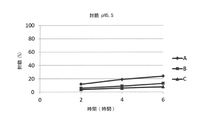
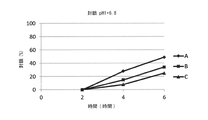
図1は、胃及び小腸のpHを模擬したアッセイにおける種々の製剤の封鎖プロファイルを示す図である。
コレスチラミンの小さく且つ安定な顆粒は、コレスチラミンと適切な結合剤とを含む混合物を顆粒化することによって得られることが見出されている。こうした顆粒は、コレスチラミンの含有量が高く且つ1つ又は複数のコーティング層を塗布するために従来使用される条件に耐えるに十分なほど安定である。 It has been found that small and stable granules of cholestyramine are obtained by granulating a mixture comprising cholestyramine and a suitable binder. Such granules have a high cholestyramine content and are stable enough to withstand the conditions conventionally used for applying one or more coating layers.
第一の態様において、本発明は、各顆粒が少なくとも70%w/wのコレスチラミン、並びに
i.少なくとも7%w/wの結合剤;又は
ii.少なくとも6%w/wの結合剤及び少なくとも2%w/wのアクリレートコポリマーの組合せ;又は
iii.少なくとも5%w/wの結合剤及び少なくとも3%w/wのアクリレートコポリマーの組合せ;又は
iv.少なくとも6%w/wの結合剤、少なくとも1%w/wのアクリレートコポリマー及び5から15%w/wの微結晶セルロースの組合せ;
を含み、
結合剤が、セルロースエーテル、ビニルピロリドン系ポリマー、ショ糖、乳糖、カラギーナン、デンプン、アルギン酸、アルギン酸ナトリウム、ベヘン酸グリセリル、ポリエチレンオキシド、キトサン、カルナウバロウ、ゼラチン、アカシア、グアーガム及びポリビニルアルコール-ポリエチレングリコール-グラフトコポリマー、又はそれらの混合物から成る群から選択される1つの剤を含む、顆粒群に関する。
In a first aspect, the present invention provides each granule with at least 70% w/w of cholestyramine, and
i. at least 7% w/w binder; or
ii. a combination of at least 6% w/w binder and at least 2% w/w acrylate copolymer; or
iii. a combination of at least 5% w/w binder and at least 3% w/w acrylate copolymer; or
iv. a combination of at least 6% w/w binder, at least 1% w/w acrylate copolymer and 5 to 15% w/w microcrystalline cellulose;
including
Binders include cellulose ether, vinylpyrrolidone-based polymer, sucrose, lactose, carrageenan, starch, alginic acid, sodium alginate, glyceryl behenate, polyethylene oxide, chitosan, carnauba wax, gelatin, acacia, guar gum and polyvinyl alcohol-polyethylene glycol-graft. It relates to a group of granules comprising one agent selected from the group consisting of copolymers, or mixtures thereof.
本明細書において使用される用語「顆粒」は、湿式造粒によって得られる顆粒を表す。 The term "granules" as used herein denotes granules obtained by wet granulation.
顆粒が、顆粒の乾燥及びコーティングの間等の取扱いの間の機械的ストレスに耐えるに十分なほど安定であることは不可欠である。顆粒の安定性は、固体物質(錠剤、顆粒、球体又はペレット等)が、例えば摩耗、破砕又は変形によって、より小さな小片に縮小される可能性である摩損度によって表すことができる。低度の摩損度は、固体物質が小片に壊れる程度がごくわずかであることを意味する。本明細書において使用される摩損度は、顆粒が、回転、振動、流動化等の機械的ストレスを受けた場合に発生する、顆粒の質量の減少として定義される。摩損度を測定する方法は、当技術分野において既知である(例えば、欧州薬局方第8版、試験2.9.41)。 It is essential that the granules are stable enough to withstand mechanical stress during handling, such as during drying and coating of the granules. The stability of granules can be expressed by friability, which is the likelihood that a solid substance (tablet, granule, sphere or pellet, etc.) will be reduced into smaller pieces by, for example, abrasion, crushing or deformation. A low degree of friability means that the degree to which a solid material breaks into small pieces is negligible. Friability, as used herein, is defined as the loss of mass of a granule that occurs when the granule is subjected to mechanical stress such as rotation, vibration, fluidization, and the like. Methods for measuring friability are known in the art (eg European Pharmacopoeia 8th edition, test 2.9.41).
前述したものよりも少量の結合剤及び/又はアクリレートコポリマーを含むことは、顆粒の収率低下及び摩損度上昇をもたらす。摩損度は好ましくは3.5%未満、例えば3.0%未満等、2.5%未満等、又は2.0%未満等、より好ましくは1.5%未満、更により好ましくは1.0%未満、更により好ましくは0.5%未満である。 Inclusion of binders and/or acrylate copolymers in lower amounts than those mentioned above results in lower yield and higher friability of the granules. The friability is preferably less than 3.5%, such as less than 3.0%, such as less than 2.5%, or such as less than 2.0%, more preferably less than 1.5%, even more preferably less than 1.0%, even more preferably less than 0.5% .
好ましい一実施形態において、本発明は各顆粒が少なくとも70%w/wのコレスチラミン、並びに
i.少なくとも7%w/wの結合剤;又は
ii.少なくとも6%w/wの結合剤及び少なくとも2%w/wのアクリレートコポリマーの組合せ;又は
iii.少なくとも5%w/wの結合剤及び少なくとも3%w/wのアクリレートコポリマーの組合せ;又は
iv.少なくとも6%w/wの結合剤、少なくとも1%w/wのアクリレートコポリマー及び5から15%w/wの微結晶セルロースの組合せ;
を含み、結合剤が、セルロースエーテル、ビニルピロリドン系ポリマー、又はそれらの組合せを含む、顆粒群に関する。
In one preferred embodiment, the present invention provides at least 70% w/w cholestyramine in each granule, and
i. at least 7% w/w binder; or
ii. a combination of at least 6% w/w binder and at least 2% w/w acrylate copolymer; or
iii. a combination of at least 5% w/w binder and at least 3% w/w acrylate copolymer; or
iv. a combination of at least 6% w/w binder, at least 1% w/w acrylate copolymer and 5 to 15% w/w microcrystalline cellulose;
and wherein the binder comprises a cellulose ether, a vinylpyrrolidone-based polymer, or a combination thereof.
セルロースエーテルは、医薬及び経口での使用に適したいかなるセルロースエーテルであってもよい。適切なセルロースエーテルの例には、メチルセルロース、エチルセルロース、エチルメチルセルロース、エチルヒドロキシエチルセルロース(エツロース)、ヒドロキシエチルセルロース、ヒドロキシエチルメチルセルロース、ヒドロキシプロピルセルロース(HPC)、ヒドロキシプロピルメチルセルロース(HPMC又はヒプロメロース)、カルボキシメチルセルロース(CMC)又はそれらのナトリウム塩(NaCMC)、及び前述のセルロースエーテルの2つ以上を含む混合物が含まれる。 The cellulose ether can be any cellulose ether suitable for pharmaceutical and oral use. Examples of suitable cellulose ethers include methylcellulose, ethylcellulose, ethylmethylcellulose, ethylhydroxyethylcellulose (Etulose), hydroxyethylcellulose, hydroxyethylmethylcellulose, hydroxypropylcellulose (HPC), hydroxypropylmethylcellulose (HPMC or hypromellose), carboxymethylcellulose (CMC). ) or their sodium salts (NaCMC), and mixtures containing two or more of the aforementioned cellulose ethers.
ビニルピロリドン系ポリマーは、ポリビニルピロリドン(ポビドン)又はビニルピロリドン-酢酸ビニルコポリマー(コポビドン)であってよい。ポビドンは、N-ビニルピロリドンから作られる、直鎖状、水溶性ポリマーである。コポビドンは(コポリビドンとしても知られ)、質量比6:4の1-ビニル-2-ピロリドン(ポビドン)と酢酸ビニルの直鎖状、水溶性コポリマーである。好ましい一実施形態において、ビニルピロリドン系ポリマーはコポビドンである。 The vinylpyrrolidone-based polymer may be polyvinylpyrrolidone (povidone) or vinylpyrrolidone-vinyl acetate copolymer (copovidone). Povidone is a linear, water-soluble polymer made from N-vinylpyrrolidone. Copovidone (also known as copolyvidone) is a linear, water-soluble copolymer of 1-vinyl-2-pyrrolidone (povidone) and vinyl acetate in a 6:4 weight ratio. In one preferred embodiment, the vinylpyrrolidone-based polymer is copovidone.
一実施形態において、結合剤はセルロースエーテルである(すなわち、結合剤はビニルピロリドン系ポリマーを含まない)。セルロースエーテルは好ましくは、メチルセルロース、ヒドロキシプロピルセルロース、ヒドロキシプロピルメチルセルロース若しくはカルボキシメチルセルロースナトリウム、又はこれらのセルロースエーテルの2つ以上を含む混合物である。 In one embodiment, the binder is a cellulose ether (ie, the binder does not contain a vinylpyrrolidone-based polymer). The cellulose ether is preferably methylcellulose, hydroxypropylcellulose, hydroxypropylmethylcellulose or sodium carboxymethylcellulose, or a mixture containing two or more of these cellulose ethers.
別の一実施形態において、結合剤はビニルピロリドン系ポリマーである(すなわち、結合剤はセルロースエーテルを含まない)。ビニルピロリドン系ポリマーは、好ましくはコポビドンである。 In another embodiment, the binder is a vinylpyrrolidone-based polymer (ie, the binder does not contain cellulose ethers). The vinylpyrrolidone-based polymer is preferably copovidone.
更に別の一実施形態において、結合剤はセルロースエーテル及びビニルピロリドン系ポリマーの両方を含む。セルロースエーテルは、好ましくはメチルセルロース、ヒドロキシプロピルセルロース、ヒドロキシプロピルメチルセルロース若しくはカルボキシメチルセルロースナトリウム、又はこれらのセルロースエーテルの2つ以上を含む混合物であり、ビニルピロリドン系ポリマーは、好ましくはコポビドンである。 In yet another embodiment, the binder includes both cellulose ether and vinylpyrrolidone-based polymers. The cellulose ether is preferably methylcellulose, hydroxypropylcellulose, hydroxypropylmethylcellulose or sodium carboxymethylcellulose, or a mixture containing two or more of these cellulose ethers, and the vinylpyrrolidone-based polymer is preferably copovidone.
アクリレートコポリマーは、アクリレートモノマーを含む、医薬品に許容されるいかなるコポリマーであってもよい。アクリレートモノマーの例は、アクリレート(アクリル酸)、アクリル酸メチル、アクリル酸エチル、メタクリル酸(メタクリレート)、メタクリル酸メチル、メタクリル酸ブチル、メタクリル酸トリメチルアンモニオエチル及びメタクリル酸ジメチルアンモニオエチルを含むが、これらに限定されるものではない。幾つかのアクリレートコポリマーが、Eudragit(登録商標)の商品名で知られている。 The acrylate copolymer can be any pharmaceutically acceptable copolymer comprising acrylate monomers. Examples of acrylate monomers include acrylate (acrylic acid), methyl acrylate, ethyl acrylate, methacrylic acid (methacrylate), methyl methacrylate, butyl methacrylate, trimethylammonioethyl methacrylate and dimethylammonioethyl methacrylate. , but not limited to these. Some acrylate copolymers are known under the trade name Eudragit®.
ポリ(アクリル酸エチル-co-メタクリル酸メチル-co-メタクリル酸トリメチルアンモニオエチルクロリド)は、アクリル酸エチル、メタクリル酸メチル及び低含有量のメタクリル酸トリメチルアンモニオエチルクロリド(第4級アンモニウム基を有するメタクリル酸エステル)のコポリマーである。コポリマーはまた、メタクリル酸アンモニオコポリマーとも称される。コポリマーは不溶性であるがアンモニウム塩の基の存在が、コポリマーを透過性にする。コポリマーは、1:2:0.2混合物(タイプA)として、又は1:2:0.1混合物(タイプB)として入手可能である。タイプA及びタイプBの30%水性分散体は、それぞれ、Eudragit(登録商標) RL 30 D及びEudragit(登録商標) RS 30 Dの商品名で販売されている。 Poly(ethyl acrylate-co-methyl methacrylate-co-trimethylammonioethyl methacrylate chloride) contains ethyl acrylate, methyl methacrylate and a low content of trimethylammonioethyl methacrylate (with quaternary ammonium groups). It is a copolymer of methacrylic acid ester with Copolymers are also referred to as ammonio methacrylate copolymers. Although the copolymer is insoluble, the presence of the ammonium salt groups renders the copolymer permeable. The copolymers are available as 1:2:0.2 mixtures (type A) or as 1:2:0.1 mixtures (type B). Type A and Type B 30% aqueous dispersions are marketed under the trade names Eudragit® RL 30 D and Eudragit® RS 30 D, respectively.
ポリ(アクリル酸メチル-co-メタクリル酸メチル-co-メタクリル酸)7:3:1は、アクリル酸メチル、メタクリル酸メチル及びメタクリル酸のコポリマーである。酸性媒体には不溶であるが、pH7.0超で塩形成によって溶解する。30%水性分散体は、Eudragit(登録商標) FS 30 Dの商品名で販売されている。 Poly(methyl acrylate-co-methyl methacrylate-co-methacrylic acid) 7:3:1 is a copolymer of methyl acrylate, methyl methacrylate and methacrylic acid. It is insoluble in acidic media, but dissolves by salt formation above pH 7.0. A 30% aqueous dispersion is sold under the trade name Eudragit® FS 30 D.
ポリ(メタクリル酸-co-アクリル酸エチル)1:1は、アクリル酸エチルとメタクリル酸のコポリマーである。pH5.5未満の酸性媒体には不溶であるが、このpH超で塩形成によって溶解する。30%水性分散体は、Eudragit(登録商標) L 30 D-55の商品名で販売されている。 Poly(methacrylate-co-ethyl acrylate) 1:1 is a copolymer of ethyl acrylate and methacrylic acid. It is insoluble in acidic media below pH 5.5, but dissolves above this pH by salt formation. A 30% aqueous dispersion is sold under the trade name Eudragit® L 30 D-55.
更に適切なアクリル酸コポリマーには、アクリル酸エチルとメタクリル酸メチルの水不溶性コポリマーである、ポリ(アクリル酸エチル-co-メタクリル酸メチル)2:1が含まれる。30%水性分散体は、Eudragit(登録商標) NE 30 D及びEudragit(登録商標) NM 30 Dの商品名で販売されている。 Further suitable acrylic acid copolymers include poly(ethyl acrylate-co-methyl methacrylate) 2:1, a water-insoluble copolymer of ethyl acrylate and methyl methacrylate. 30% aqueous dispersions are sold under the trade names Eudragit® NE 30 D and Eudragit® NM 30 D.
好ましいアクリレートコポリマーは、メタクリル酸アンモニオコポリマー、ポリ(アクリル酸メチル-co-メタクリル酸メチル-co-メタクリル酸)7:3:1、及びポリ(メタクリル酸-co-アクリル酸エチル)1:1である。より好ましくは、アクリレートポリマーは、メタクリル酸アンモニオコポリマーであり、最も好ましくは、アクリレートポリマーは、ポリ(アクリル酸エチル-co-メタクリル酸メチル-co-メタクリル酸トリメチルアンモニオエチルクロリド)1:2:0.2である。 A preferred acrylate copolymer is ammonio methacrylate copolymer, poly(methyl acrylate-co-methyl methacrylate-co-methacrylic acid) 7:3:1, and poly(methacrylate-co-ethyl acrylate) 1:1. be. More preferably, the acrylate polymer is an ammonio methacrylate copolymer, most preferably the acrylate polymer is poly(ethyl acrylate-co-methyl methacrylate-co-trimethylammonioethyl methacrylate chloride) 1:2: 0.2.
代替選択肢i~iiiによる顆粒は更に、微結晶セルロース等の賦形剤を含んでよい。微結晶セルロース、すなわちMCCは、より短い結晶性ポリマー鎖を有する、精製され、部分的に解重合されたセルロースである。その結合性能は、MCCを、薬剤処方において最も一般に使用されるフィラー及び結合剤の1つにしている。一実施形態において、代替選択肢i~iiiによる顆粒は、最大10%w/wの微結晶セルロースを、例えば、1、2、3、4、5、6、7、8、9又は10%w/w等の微結晶セルロースを含む。別の一実施形態において、代替選択肢i~iiiによる顆粒は、最大5%w/wの微結晶セルロースを含む。別の一実施形態において、代替選択肢i~iiiによる顆粒は、微結晶セルロースを含まない。 Granules according to alternatives i-iii may further comprise excipients such as microcrystalline cellulose. Microcrystalline cellulose, or MCC, is purified, partially depolymerized cellulose with shorter crystalline polymer chains. Its binding properties make MCC one of the most commonly used fillers and binders in pharmaceutical formulations. In one embodiment, the granules according to alternatives i-iii contain up to 10% w/w microcrystalline cellulose, for example 1, 2, 3, 4, 5, 6, 7, 8, 9 or 10% w/w Contains microcrystalline cellulose such as w. In another embodiment, granules according to alternatives i-iii comprise up to 5% w/w microcrystalline cellulose. In another embodiment, the granules according to alternatives i-iii do not contain microcrystalline cellulose.
代替選択肢ivによる顆粒は、5から15%w/wの微結晶セルロースを含み、好ましくは少なくとも10%w/wの微結晶セルロースを、すなわち10、11、12、13、14又は15%w/w等の微結晶セルロースを含む。 Granules according to alternative iv contain 5 to 15% w/w microcrystalline cellulose, preferably at least 10% w/w microcrystalline cellulose i.e. 10, 11, 12, 13, 14 or 15% w/w Contains microcrystalline cellulose such as w.
顆粒は、適切な粒度分布の顆粒分別物を得るために篩過される。コレスチラミン顆粒の直径は、好ましくは500μmから3000μm、より好ましくは750μmから2000μm、更により好ましくは1000から1600μmである。最も好ましい一実施形態において、顆粒の直径は1000から1400μmである。 The granules are sieved to obtain a granule fraction of suitable particle size distribution. The diameter of the cholestyramine granules is preferably 500 μm to 3000 μm, more preferably 750 μm to 2000 μm, still more preferably 1000 to 1600 μm. In one most preferred embodiment, the granules have a diameter of 1000 to 1400 μm.
その物理的性質のために、コレスチラミンパウダーは多量の水を吸収でき、それが材料のかなりの膨潤を引き起こす。したがって、乾燥コレスチラミンから湿潤塊を調製するためには、乾燥成分から湿潤塊を調製するのに通常使用されるよりも多くの水を添加する必要がある。好ましくは、水は、コレスチラミンの量(w/w)の少なくとも1.5倍の量で、より好ましくはコレスチラミンの量(w/w)の少なくとも1.75倍の量で、更により好ましくはコレスチラミンの量(w/w)の少なくとも2倍の量で、乾燥成分の混合物に添加される。 Due to its physical properties, cholestyramine powder can absorb large amounts of water, which causes considerable swelling of the material. Therefore, to prepare a wet mass from dry cholestyramine, it is necessary to add more water than is normally used to prepare a wet mass from dry ingredients. Preferably, the water is in an amount of at least 1.5 times the amount (w/w) of cholestyramine, more preferably in an amount of at least 1.75 times the amount (w/w) of cholestyramine, even more preferably in an amount of cholestyramine. It is added to the mixture of dry ingredients in an amount of at least twice the amount (w/w).
未被覆顆粒は、水性条件下では、迅速に崩壊する。しかし、未被覆顆粒は、1つ又は複数のコーティング層を顆粒に塗布するために必要な条件に耐えるに十分なほど安定である。 Uncoated granules disintegrate rapidly under aqueous conditions. However, the uncoated granules are sufficiently stable to withstand the conditions necessary to apply one or more coating layers to the granules.
コレスチラミン顆粒は、結腸内で過剰な胆汁酸と結合すべきであるところから、結腸標的送達のために製剤化されるべきである。これは、顆粒が結腸に到達するまでコレスチラミンの放出を遅らせる1つ又は複数の層によって、コレスチラミン顆粒をコーティングすることにより達成することができる。 Cholestyramine granules should be formulated for colonic targeted delivery as they should bind excess bile acids in the colon. This can be accomplished by coating the cholestyramine granules with one or more layers that delay the release of cholestyramine until the granules reach the colon.
したがって、別の一態様において、本発明は本発明の組成物は、本明細書に記載の複数のコレスチラミン顆粒を含む多粒子薬剤送達システムに関する。好ましい一実施形態において、コレスチラミン顆粒は結腸標的送達のために製剤化される。その場合に顆粒は、被覆された顆粒が大腸、特に近位結腸に到達するまで、顆粒からのコレスチラミンの放出を遅らせる1つ又は複数の層によって被覆される。一実施形態において、結腸標的送達は、顆粒の酵素-制御放出に基づいている。別の一実施形態において、結腸標的送達は、顆粒のpH-及び拡散-制御放出に基づいている。 Accordingly, in another aspect, the present invention relates to a multiparticulate drug delivery system comprising a plurality of cholestyramine granules as described herein. In one preferred embodiment, the cholestyramine granules are formulated for colonic targeted delivery. The granules are then coated with one or more layers that delay the release of cholestyramine from the granules until the coated granules reach the large intestine, especially the proximal colon. In one embodiment, colon-targeted delivery is based on enzyme-controlled release of granules. In another embodiment, colon-targeted delivery is based on pH- and diffusion-controlled release of granules.
コレスチラミンは、溶解性が非常に低いために、被覆されたコレスチラミン顆粒を含む製剤からは「放出」されず、製剤から腸の中に溶解し、拡散する。むしろ、コレスチラミンは、おそらくは、被覆された顆粒の徐々に分解する構造中に留まっている。したがって、本明細書において使用される用語、コレスチラミンの「放出」は、腸の中で構成成分(すなわち、胆汁酸)と結合するための、腸内容物に対するコレスチラミンの利用可能性を表す。 Due to its very low solubility, cholestyramine is not "released" from formulations containing coated cholestyramine granules, but dissolves and diffuses from the formulation into the intestine. Rather, cholestyramine presumably remains in the slowly degrading structures of the coated granules. Thus, the term “release” of cholestyramine as used herein refers to the availability of cholestyramine to intestinal contents for binding constituents (ie, bile acids) in the intestine.
別の一態様において、本発明は
a)本明細書に開示の複数の顆粒;及び
b)前記顆粒周囲の結腸放出コーティング
を含む、コレスチラミンの結腸への標的送達のための経口製剤に関する。
In another aspect, the invention provides
a) a plurality of granules as disclosed herein; and
b) An oral formulation for targeted delivery of cholestyramine to the colon comprising a colonic release coating around said granules.
別の一態様において、本発明は
a)各顆粒がコレスチラミンを含む、複数の顆粒;及び
b)コーティングが結腸におけるコレスチラミンの標的化放出の能力を有する、前記顆粒周囲のコーティング
を含む経口製剤であって、コレスチラミンの70%超が結腸において放出される経口製剤に関する。
In another aspect, the invention provides
a) a plurality of granules, each granule containing cholestyramine; and
b) An oral dosage form comprising a coating around said granules, wherein said coating is capable of targeted release of cholestyramine in the colon, wherein more than 70% of the cholestyramine is released in the colon.
幾つかの実施形態において、コレスチラミンの75%超が結腸において放出される。他の実施形態において、コレスチラミンの80%超が結腸において放出される。他の実施形態において、コレスチラミンの85%超が結腸において放出される。更に他の実施形態において、コレスチラミンの90%超が結腸において放出される。 In some embodiments, greater than 75% of cholestyramine is released in the colon. In other embodiments, greater than 80% of cholestyramine is released in the colon. In other embodiments, greater than 85% of cholestyramine is released in the colon. In still other embodiments, greater than 90% of the cholestyramine is released in the colon.
更に別の一態様において、本発明は、
a)各顆粒がコレスチラミンを含む、複数の顆粒;及び
b)コーティングが結腸におけるコレスチラミンの標的化放出の能力を有する、前記顆粒周囲のコーティング
を含む経口製剤であって、コレスチラミンの30%未満が小腸において放出される経口製剤に関する。
In yet another aspect, the present invention provides
a) a plurality of granules, each granule containing cholestyramine; and
b) An oral dosage form comprising a coating around said granules, wherein the coating is capable of targeted release of cholestyramine in the colon, wherein less than 30% of the cholestyramine is released in the small intestine.
幾つかの実施形態において、コレスチラミンの25%未満が小腸において放出される。他の実施形態において、コレスチラミンの20%未満が小腸において放出される。他の実施形態において、コレスチラミンの15%未満が小腸において放出される。更に他の実施形態において、コレスチラミンの10%未満が小腸において放出される。 In some embodiments, less than 25% of cholestyramine is released in the small intestine. In other embodiments, less than 20% of cholestyramine is released in the small intestine. In other embodiments, less than 15% of cholestyramine is released in the small intestine. In still other embodiments, less than 10% of cholestyramine is released in the small intestine.
別の一態様において、本発明は、
a)各顆粒がコレスチラミンを含む、複数の顆粒;及び
b)コーティングが結腸におけるコレスチラミンの標的化放出の能力を有する、前記顆粒周囲のコーティング、
を含む経口製剤であって、顆粒が、欧州薬局方第8版、試験2.9.41を用いて測定したとき3.5%未満の摩損度を呈する経口製剤に関する。
In another aspect, the present invention provides
a) a plurality of granules, each granule containing cholestyramine; and
b) a coating around said granules, wherein said coating is capable of targeted release of cholestyramine in the colon;
wherein the granules exhibit a friability of less than 3.5% as measured using European Pharmacopoeia 8th edition, test 2.9.41.
幾つかの実施形態において、顆粒は3.0%未満の摩損度を呈する。他の実施形態において、顆粒は2.5%未満の摩損度を呈する。他の実施形態において、顆粒は2.0%未満の摩損度を呈する。他の実施形態において、顆粒は1.5%未満の摩損度を呈する。他の実施形態において、顆粒は1.0%未満の摩損度を呈する。更に他の実施形態において、顆粒は0.5%未満の摩損度を呈する。 In some embodiments, the granules exhibit a friability of less than 3.0%. In other embodiments, the granules exhibit a friability of less than 2.5%. In other embodiments, the granules exhibit a friability of less than 2.0%. In other embodiments, the granules exhibit a friability of less than 1.5%. In other embodiments, the granules exhibit a friability of less than 1.0%. In still other embodiments, the granules exhibit a friability of less than 0.5%.
別の一態様において、本発明は、
a)各顆粒がコレスチラミンを含む、複数の顆粒;及び
b)コーティングが結腸におけるコレスチラミンの標的化放出の能力を有する、前記顆粒周囲のコーティング、
を含む経口製剤であって、米国薬局方溶解装置2(パドル)、欧州薬局方2.9.3を用いて測定したときpH5.5においてコレスチラミンの30%未満が6時間後に放出される経口製剤に関する。
In another aspect, the present invention provides
a) a plurality of granules, each granule containing cholestyramine; and
b) a coating around said granules, wherein said coating is capable of targeted release of cholestyramine in the colon;
wherein less than 30% of cholestyramine is released after 6 hours at pH 5.5 as measured using USP Dissolution Apparatus 2 (Paddle), European Pharmacopoeia 2.9.3 .
幾つかの実施形態において、米国薬局方溶解装置2(パドル)、欧州薬局方2.9.3を用いて測定したときpH5.5においてコレスチラミンの25%未満が6時間後に放出される。他の実施形態において、米国薬局方溶解装置2(パドル)、欧州薬局方2.9.3を用いて測定したときpH5.5においてコレスチラミンの20%未満が6時間後に放出される。他の実施形態において、米国薬局方溶解装置2(パドル)、欧州薬局方2.9.3を用いて測定したときpH5.5においてコレスチラミンの15%未満が6時間後に放出される。更に他の実施形態において、米国薬局方溶解装置2(パドル)、欧州薬局方2.9.3を用いて測定したときpH5.5においてコレスチラミンの10%未満が6時間後に放出される。 In some embodiments, less than 25% of the cholestyramine is released after 6 hours at pH 5.5 as measured using USP Dissolution Apparatus 2 (Paddle), European Pharmacopoeia 2.9.3. In other embodiments, less than 20% of the cholestyramine is released after 6 hours at pH 5.5 as measured using USP Dissolution Apparatus 2 (Paddle), European Pharmacopoeia 2.9.3. In other embodiments, less than 15% of the cholestyramine is released after 6 hours at pH 5.5 as measured using USP Dissolution Apparatus 2 (Paddle), European Pharmacopoeia 2.9.3. In still other embodiments, less than 10% of the cholestyramine is released after 6 hours at pH 5.5 as measured using USP Dissolution Apparatus 2 (Paddle), European Pharmacopoeia 2.9.3.
別の一態様において、本発明は、
a)各顆粒がコレスチラミンを含む、複数の顆粒;及び
b)コーティングが結腸におけるコレスチラミンの標的化放出の能力を有する、前記顆粒周囲のコーティング、
を含む経口製剤であって、米国薬局方溶解装置2(パドル)、欧州薬局方2.9.3を用いて測定したときpH5.5において6時間後に、コール酸の30%未満の封鎖を示す経口製剤に関する。
In another aspect, the present invention provides
a) a plurality of granules, each granule containing cholestyramine; and
b) a coating around said granules, wherein said coating is capable of targeted release of cholestyramine in the colon;
which exhibits less than 30% sequestration of cholic acid after 6 hours at pH 5.5 as measured using USP Dissolution Apparatus 2 (paddles), European Pharmacopoeia 2.9.3 Regarding.
幾つかの実施形態において、米国薬局方溶解装置2(パドル)、欧州薬局方2.9.3を用いて測定したときpH5.5において6時間後に、製剤はコール酸の25%未満の封鎖を示す。他の実施形態において、米国薬局方溶解装置2(パドル)、欧州薬局方2.9.3を用いて測定したときpH5.5において6時間後に、製剤はコール酸の20%未満の封鎖を示す。更に他の実施形態において、米国薬局方溶解装置2(パドル)、欧州薬局方2.9.3を用いて測定したときpH5.5において6時間後に、製剤はコール酸の15%未満の封鎖を示す。 In some embodiments, the formulation exhibits less than 25% sequestration of cholic acid after 6 hours at pH 5.5 as measured using USP Dissolution Apparatus 2 (Paddle), European Pharmacopoeia 2.9.3. In other embodiments, the formulation exhibits less than 20% sequestration of cholic acid after 6 hours at pH 5.5 as measured using USP Dissolution Apparatus 2 (Paddle), European Pharmacopoeia 2.9.3. In still other embodiments, the formulation exhibits less than 15% sequestration of cholic acid after 6 hours at pH 5.5 as measured using USP Dissolution Apparatus 2 (paddle), European Pharmacopoeia 2.9.3.
別の一態様において、本発明は、
a)各顆粒がコレスチラミンを含む、複数の顆粒;及び
b)コーティングが結腸におけるコレスチラミンの標的化放出の能力を有する、前記顆粒周囲のコーティング、
を含む経口製剤であって、米国薬局方溶解装置2(パドル)、欧州薬局方2.9.3を用いて測定したときpH1で2時間、それに続いてpH6.8で4時間の後に、コール酸の30%超の封鎖を示す経口製剤に関する。
In another aspect, the present invention provides
a) a plurality of granules, each granule containing cholestyramine; and
b) a coating around said granules, wherein said coating is capable of targeted release of cholestyramine in the colon;
of cholic acid after 2 hours at pH 1 followed by 4 hours at pH 6.8 as measured using USP Dissolution Apparatus 2 (paddles), European Pharmacopoeia 2.9.3 It relates to oral formulations that exhibit greater than 30% sequestration.
幾つかの実施形態において、米国薬局方溶解装置2(パドル)、欧州薬局方2.9.3を用いて測定したときpH1で2時間、それに続いてpH6.8で4時間の後に、製剤はコール酸の35%超の封鎖を示す。他の実施形態において、米国薬局方溶解装置2(パドル)、欧州薬局方2.9.3を用いて測定したときpH1で2時間、それに続いてpH6.8で4時間の後に、製剤はコール酸の40%超の封鎖を示す。更に他の実施形態において、米国薬局方溶解装置2(パドル)、欧州薬局方2.9.3を用いて測定したときpH1で2時間、それに続いてpH6.8で4時間の後に、製剤はコール酸の45%超の封鎖を示す。更に他の実施形態において、米国薬局方溶解装置2(パドル)、欧州薬局方2.9.3を用いて測定したときpH1で2時間、それに続いてpH6.8で4時間の後に、製剤はコール酸の50%超の封鎖を示す。 In some embodiments, the formulation is cholic acid after 2 hours at pH 1 followed by 4 hours at pH 6.8 as measured using USP Dissolution Apparatus 2 (Paddle), European Pharmacopoeia 2.9.3. >35% blockade of In other embodiments, the formulation is cholic acid after 2 hours at pH 1 followed by 4 hours at pH 6.8 as measured using USP Dissolution Apparatus 2 (Paddle), European Pharmacopoeia 2.9.3. Shows greater than 40% blockade. In still other embodiments, the formulation contains cholic acid after 2 hours at pH 1 followed by 4 hours at pH 6.8 as measured using USP Dissolution Apparatus 2 (Paddle), European Pharmacopoeia 2.9.3. >45% blockade of In still other embodiments, the formulation contains cholic acid after 2 hours at pH 1 followed by 4 hours at pH 6.8 as measured using USP Dissolution Apparatus 2 (Paddle), European Pharmacopoeia 2.9.3. shows greater than 50% blockade of
別の一態様において、本発明は、
a)各顆粒がコレスチラミンを含む、複数の顆粒;及び
b)コーティングが結腸におけるコレスチラミンの標的化放出の能力を有する、前記顆粒周囲のコーティング、
を含む経口製剤であって、米国薬局方溶解装置2(パドル)、欧州薬局方2.9.3を用いて測定したときpH1で2時間後に、コール酸の30%未満の封鎖を示す経口製剤に関する。
In another aspect, the present invention provides
a) a plurality of granules, each granule containing cholestyramine; and
b) a coating around said granules, wherein said coating is capable of targeted release of cholestyramine in the colon;
which exhibits less than 30% sequestration of cholic acid after 2 hours at pH 1 as measured using USP Dissolution Apparatus 2 (Paddle), European Pharmacopoeia 2.9.3.
幾つかの実施形態において、米国薬局方溶解装置2(パドル)、欧州薬局方2.9.3を用いて測定したときpH1で2時間後に、製剤はコール酸の25%未満の封鎖を示す。他の実施形態において、米国薬局方溶解装置2(パドル)、欧州薬局方2.9.3を用いて測定したときpH1で2時間後に、製剤はコール酸の20%未満の封鎖を示す。他の実施形態において、米国薬局方溶解装置2(パドル)、欧州薬局方2.9.3を用いて測定したときpH1で2時間後に、製剤はコール酸の15%未満の封鎖を示す。更に他の実施形態において、米国薬局方溶解装置2(パドル)、欧州薬局方2.9.3を用いて測定したときpH1で2時間後に、製剤はコール酸の10%未満の封鎖を示す。 In some embodiments, the formulation exhibits less than 25% sequestration of cholic acid after 2 hours at pH 1 as measured using USP Dissolution Apparatus 2 (paddle), European Pharmacopoeia 2.9.3. In other embodiments, the formulation exhibits less than 20% sequestration of cholic acid after 2 hours at pH 1 as measured using USP Dissolution Apparatus 2 (paddle), European Pharmacopoeia 2.9.3. In other embodiments, the formulation exhibits less than 15% sequestration of cholic acid after 2 hours at pH 1 as measured using USP Dissolution Apparatus 2 (Paddle), European Pharmacopoeia 2.9.3. In still other embodiments, the formulation exhibits less than 10% sequestration of cholic acid after 2 hours at pH 1 as measured using USP Dissolution Apparatus 2 (paddle), European Pharmacopoeia 2.9.3.
更に別の一態様において、本発明は、
a)各顆粒がコレスチラミンを含む、複数の顆粒;及び
b)コーティングが結腸におけるコレスチラミンの標的化放出の能力を有する、前記顆粒周囲のコーティング、
を含む経口製剤であって、米国薬局方溶解装置2(パドル)、欧州薬局方2.9.3を用いて測定したときpH1で2時間、それに続いてpH7.4で4時間の後に、コール酸の30%超の封鎖を示す経口製剤に関する。
In yet another aspect, the present invention provides
a) a plurality of granules, each granule containing cholestyramine; and
b) a coating around said granules, wherein said coating is capable of targeted release of cholestyramine in the colon;
of cholic acid after 2 hours at pH 1 followed by 4 hours at pH 7.4 as measured using USP Dissolution Apparatus 2 (paddles), European Pharmacopoeia 2.9.3 It relates to oral formulations that exhibit greater than 30% sequestration.
幾つかの実施形態において、米国薬局方溶解装置2(パドル)、欧州薬局方2.9.3を用いて測定したときpH1で2時間、それに続いてpH7.4で4時間の後に、製剤はコール酸の35%超の封鎖を示す。他の実施形態において、米国薬局方溶解装置2(パドル)、欧州薬局方2.9.3を用いて測定したときpH1で2時間、それに続いてpH7.4で4時間の後に、製剤はコール酸の40%超の封鎖を示す。他の実施形態において、米国薬局方溶解装置2(パドル)、欧州薬局方2.9.3を用いて測定したときpH1で2時間、それに続いてpH7.4で4時間の後に、製剤はコール酸の45%超の封鎖を示す。更に他の実施形態において、米国薬局方溶解装置2(パドル)、欧州薬局方2.9.3を用いて測定したときpH1で2時間、それに続いてpH7.4で4時間の後に、製剤はコール酸の50%超の封鎖を示す。 In some embodiments, the formulation is cholic acid after 2 hours at pH 1 followed by 4 hours at pH 7.4 as measured using USP Dissolution Apparatus 2 (Paddle), European Pharmacopoeia 2.9.3. >35% blockade of In other embodiments, the formulation is cholic acid after 2 hours at pH 1 followed by 4 hours at pH 7.4 as measured using USP Dissolution Apparatus 2 (Paddle), European Pharmacopoeia 2.9.3. Shows greater than 40% blockade. In other embodiments, the formulation is cholic acid after 2 hours at pH 1 followed by 4 hours at pH 7.4 as measured using USP Dissolution Apparatus 2 (Paddle), European Pharmacopoeia 2.9.3. Shows greater than 45% blockade. In still other embodiments, the formulation contains cholic acid after 2 hours at pH 1 followed by 4 hours at pH 7.4 as measured using USP Dissolution Apparatus 2 (Paddle), European Pharmacopoeia 2.9.3. shows greater than 50% blockade of
結腸放出コーティングはまた、コレスチラミン顆粒の破裂を防止すべきである。コーティングを通過して拡散する水がコレスチラミンによって吸収されるとき、コレスチラミンの体積の増加が顆粒の膨潤につながる。顆粒のコーティングは、そうした理由から、顆粒の膨潤に耐えるために、十分に弾性があるべきである。顆粒の破裂を防止することにより、コーティングはコレスチラミンの時期尚早な放出を回避する。 The colon release coating should also prevent rupture of the cholestyramine granules. An increase in the volume of cholestyramine leads to swelling of the granules when water diffusing through the coating is absorbed by cholestyramine. The granule coating should for that reason be elastic enough to resist swelling of the granules. By preventing granule rupture, the coating avoids premature release of cholestyramine.
結腸放出コーティングは、顆粒が結腸の所望の部位に到達するまで、腸内容物に対するコレスチラミンの利用可能性を遅らせる1つ又は複数のコーティング層から成る。細菌環境の変化に基づく(すなわち、酵素-制御放出)若しくはpH変化に基づく(すなわち、pH-制御放出)技術、コーティングの漸進的浸食に基づく(時間-制御放出)技術若しくは透過性フィルムを通過しての拡散に基づく(拡散-制御放出)技術、又は前述の技術の2つ以上の組合せが、顆粒の放出位置及び放出速度を制御するために使用されてよい。 A colonic release coating consists of one or more coating layers that delay the availability of cholestyramine to the intestinal contents until the granules reach the desired site in the colon. Technologies based on changes in the bacterial environment (i.e. enzyme-controlled release) or pH changes (i.e. pH-controlled release), techniques based on gradual erosion of coatings (time-controlled release) or through permeable films. Any diffusion-based (diffusion-controlled release) technique, or a combination of two or more of the foregoing techniques, may be used to control the release location and release rate of the granules.
酵素-制御放出コーティング
一実施形態において、顆粒周囲の結腸放出コーティングは、結腸におけるコレスチラミンの酵素-制御放出を可能にする。その場合にコーティング層は、結腸内に存在する細菌酵素により分解されるが消化管内に存在するヒト酵素によっては分解されない生分解性ポリマーを含む。顆粒からのコレスチラミンの放出は、細菌環境の変化によって誘発され、実質的には、被覆された顆粒が結腸に到達するまでは妨げられる。
Enzyme-Controlled Release Coating In one embodiment, a colonic release coating around the granules allows enzyme-controlled release of cholestyramine in the colon. The coating layer then comprises a biodegradable polymer that is degraded by the bacterial enzymes present in the colon but not by the human enzymes present in the gastrointestinal tract. Release of cholestyramine from the granules is induced by changes in the bacterial environment and substantially prevented until the coated granules reach the colon.
生分解性ポリマーは、アゾポリマー又は多糖であってよい。細菌によって分解されうる多糖類の例には、キトサン、ペクチン、グアーガム、デキストラン、イヌリン、デンプン及びアミロース、並びにそれらの誘導体が含まれる(Sinha及びKumria、Eur. J. Pharm. Sci. 2003、vol.18、3~18頁)。結腸放出コーティングは、好ましくはデンプンを含む。 Biodegradable polymers may be azopolymers or polysaccharides. Examples of polysaccharides that can be degraded by bacteria include chitosan, pectin, guar gum, dextran, inulin, starch and amylose, and derivatives thereof (Sinha and Kumria, Eur. J. Pharm. Sci. 2003, vol. 18, pp. 3-18). Colonic release coatings preferably include starch.
デンプンの構造は一般に、腸内細菌叢によってそれほど容易には分解されないアミロースを20~30%(w/w)含み、且つ腸内細菌叢によってより容易に分解されるアミロペクチンを70~80%(w/w)含む。したがって、構造中に存在するアミロース及びアミロペクチンの特定の量に依存して、種々のタイプのデンプンが種々の分解プロファイルを有する。難消化性デンプンは、高アミロース含有量を有し、一般に小腸における消化を逃れる。こうしたデンプンは、その代わりに、結腸において細菌によって消化される。デンプンの天然源及びどのように処理されたかによって、難消化性デンプンは4つのタイプ(RS1からRS4)に分類され、それぞれ異なる特性を有する。高アミローストウモロコシデンプン(すなわち、高アミロースコーンスターチ)等に含まれる難消化性デンプンタイプ2(RS2)は、デンプンの立体配座のために酵素にアクセスしにくい。コレスチラミン顆粒周囲の結腸放出コーティングは、好ましくは、難消化性デンプンタイプ2(RS2)を含む。RS2が調理されるか又は加熱される場合、レトログラデーションと呼ばれる過程においてアミロース及びアミロペクチン結晶構造の再整列が起こり、難消化性デンプンタイプ3(RS3)を生じる。 The structure of starch generally contains 20-30% (w/w) amylose, which is less readily degraded by the intestinal flora, and 70-80% (w/w) amylopectin, which is more readily degraded by the intestinal flora. /w) included. Therefore, different types of starch have different degradation profiles, depending on the specific amounts of amylose and amylopectin present in the structure. Resistant starch has a high amylose content and generally escapes digestion in the small intestine. These starches are instead digested by bacteria in the colon. Depending on the natural source of starch and how it has been processed, resistant starch is classified into four types (RS1 to RS4), each with different properties. Resistant starch type 2 (RS2), such as found in high amylose corn starch (ie, high amylose corn starch), is less accessible to enzymes due to the conformation of the starch. The colonic release coating around the cholestyramine granules preferably comprises resistant starch type 2 (RS2). When RS2 is cooked or heated, a rearrangement of the amylose and amylopectin crystal structures occurs in a process called retrogradation, yielding resistant starch type 3 (RS3).
生分解性ポリマーに加えて、コーティング層は、1つ又は複数の更なる有機ポリマーを含む。適切な有機ポリマーの例には、ポリ(アクリル酸メチル-co-メタクリル酸メチル-co-メタクリル酸)7:3:1(Eudragit(登録商標)FS 30 D)、ポリ(アクリル酸エチル-co-メタクリル酸メチル-co-メタクリル酸トリメチルアンモニオエチルクロリド)1:2:0.2(Eudragit(登録商標)RL 30 D)、ポリ(アクリル酸エチル-co-メタクリル酸メチル-co-メタクリル酸トリメチルアンモニオエチルクロリド)1:2:0.1(Eudragit(登録商標)RS 30 D)、ポリ(アクリル酸エチル-co-メタクリル酸メチル)2:1(Eudragit(登録商標)NE 30 D又はEudragit(登録商標)NM 30 D)及びポリ(酢酸ビニル)(例えば、Kollicoat(登録商標)SR 30 D)が含まれるがこれらに限定されるものではない。好ましくは、有機ポリマーは、ポリ(アクリル酸メチル-co-メタクリル酸メチル-co-メタクリル酸)7:3:1(Eudragit(登録商標)FS 30 D)である。 In addition to the biodegradable polymer, the coating layer contains one or more additional organic polymers. Examples of suitable organic polymers include poly(methyl acrylate-co-methyl methacrylate-co-methacrylic acid) 7:3:1 (Eudragit® FS 30 D), poly(ethyl acrylate-co- Methyl methacrylate-co-trimethylammonioethyl methacrylate chloride) 1:2:0.2 (Eudragit® RL 30 D), Poly(ethyl acrylate-co-methyl methacrylate-co-trimethylammonioethyl methacrylate) chloride) 1:2:0.1 (Eudragit® RS 30 D), poly(ethyl acrylate-co-methyl methacrylate) 2:1 (Eudragit® NE 30 D or Eudragit® NM 30 D) and poly(vinyl acetate) (eg Kollicoat® SR 30 D). Preferably, the organic polymer is poly(methyl acrylate-co-methyl methacrylate-co-methacrylic acid) 7:3:1 (Eudragit® FS 30 D).
pH-及び拡散-制御コーティング
別の一実施形態において、顆粒周囲の結腸放出コーティングは、結腸におけるコレスチラミンのpH-及び拡散-制御放出を可能にする。その場合にコーティングは、顆粒周囲の拡散-制御内部コーティング層及び腸溶性の(pH-制御)外部コーティング層を含む。
pH- and Diffusion-Controlled Coating In another embodiment, a colonic release coating around the granules allows pH- and diffusion-controlled release of cholestyramine in the colon. The coating then includes a diffusion-controlling inner coating layer around the granules and an enteric (pH-controlling) outer coating layer.
拡散-制御内部コーティング層は、コレスチラミンの放出改変を提供し、すなわちコレスチラミンを、即座に利用されるのではなく、長時間にわたって利用されるようにする。コーティングは、いかなるpH値においても不溶であるが水及びそこに溶解する小分子に対して透過性である、1つ又は複数のポリマーを含む。こうしたポリマーの例には、ポリ(アクリル酸エチル-co-メタクリル酸メチル-co-メタクリル酸トリメチルアンモニオエチルクロリド)1:2:0.2(Eudragit(登録商標)RL 30 D)、ポリ(アクリル酸エチル-co-メタクリル酸メチル-co-メタクリル酸トリメチルアンモニオエチルクロリド)1:2:0.1(Eudragit(登録商標)RS 30 D)、ポリ(アクリル酸エチル-co-メタクリル酸メチル)2:1(Eudragit(登録商標)NE 30 D又はEudragit(登録商標)NM 30 D)及びポリ酢酸ビニル(Kollicoat(登録商標)SR 30 D)が含まれるが、これらに限定されるものではない。拡散-制御内部コーティングは、好ましくは、ポリ(アクリル酸エチル-co-メタクリル酸メチル-co-メタクリル酸トリメチルアンモニオエチルクロリド)1:2:0.2(Eudragit(登録商標)RL 30 D)、ポリ(アクリル酸エチル-co-メタクリル酸メチル-co-メタクリル酸トリメチルアンモニオエチルクロリド)1:2:0.1(Eudragit(登録商標)RS 30 D)又はそれらの組合せを含み、最も好ましくは、ポリ(アクリル酸エチル-co-メタクリル酸メチル-co-メタクリル酸トリメチルアンモニオエチルクロリド)1:2:0.1を含む。 The diffusion-controlled inner coating layer provides modified release of cholestyramine, ie, makes cholestyramine available over an extended period of time rather than being immediately available. The coating comprises one or more polymers that are insoluble at any pH value but permeable to water and small molecules dissolved therein. Examples of such polymers include poly(ethyl acrylate-co-methyl methacrylate-co-trimethylammonioethyl methacrylate chloride) 1:2:0.2 (Eudragit® RL 30 D), poly(ethyl acrylate -co-methyl methacrylate-co-trimethylammonioethyl chloride methacrylate) 1:2:0.1 (Eudragit® RS 30 D), poly(ethyl acrylate-co-methyl methacrylate) 2:1 (Eudragit NE 30 D or Eudragit NM 30 D) and polyvinyl acetate (Kollicoat SR 30 D). The diffusion-controlling inner coating is preferably poly(ethyl acrylate-co-methyl methacrylate-co-trimethylammonioethyl chloride methacrylate) 1:2:0.2 (Eudragit® RL 30 D), poly( ethyl acrylate-co-methyl methacrylate-co-methacrylate trimethylammonioethyl chloride) 1:2:0.1 (Eudragit® RS 30 D) or combinations thereof, most preferably poly(acrylic acid ethyl-co-methyl methacrylate-co-trimethylammonioethyl methacrylate) 1:2:0.1.
腸溶性コーティング層は、胃において見られる酸性pH値(pH約1~3)において安定且つ不溶であるが、小腸において見られるpH値(pH約6~7)等のより酸性度の低いpH値においては速やかに分解するか又は溶解性となる、pH-感受性ポリマーを含む。こうしたpH-感受性ポリマーの例には、酢酸フタル酸セルロース、酢酸コハク酸セルロース、酢酸コハク酸ヒドロキシプロピルメチルセルロース、フタル酸ヒドロキシプロピルメチルセルロース、ポリ(メタクリル酸-co-メタクリル酸メチル)1:1(Eudragit(登録商標)L 100)、ポリ(メタクリル酸-co-メタクリル酸メチル)1:2(Eudragit(登録商標)S 100)、ポリ(メタクリル酸-co-アクリル酸エチル)1:1(Eudragit(登録商標)L 100-55)、ポリ(アクリル酸メチル-co-メタクリル酸メチル-co-メタクリル酸)7:3:1(Eudragit(登録商標)FS 30 D)、ポリ酢酸フタル酸ビニル、シェラック、アルギン酸ナトリウム、及びゼイン、並びにそれらの混合物が含まれるが、これらに限定されるものではない。腸溶性コーティングは、好ましくは、ポリ(メタクリル酸-co-メタクリル酸メチル)1:1、酢酸コハク酸ヒドロキシプロピルメチルセルロース及びポリ(メタクリル酸-co-メタクリル酸メチル)1:2を含む群から選択されるpH-感受性ポリマーを含む。腸溶性コーティングは、最も好ましくは、酢酸コハク酸ヒドロキシプロピルメチルセルロースを含む。 The enteric coating layer is stable and insoluble at acidic pH values found in the stomach (about pH 1-3), but less acidic pH values such as those found in the small intestine (about pH 6-7). contains pH-sensitive polymers that rapidly degrade or become soluble. Examples of such pH-sensitive polymers include cellulose acetate phthalate, cellulose acetate succinate, hydroxypropylmethylcellulose acetate succinate, hydroxypropylmethylcellulose phthalate, poly(methacrylate-co-methyl methacrylate) 1:1 (Eudragit ( L 100), poly(methacrylate-co-methyl methacrylate) 1:2 (Eudragit® S 100), poly(methacrylate-co-ethyl acrylate) 1:1 (Eudragit® )L 100-55), poly(methyl acrylate-co-methyl methacrylate-co-methacrylic acid) 7:3:1 (Eudragit® FS 30 D), polyvinyl acetate phthalate, shellac, sodium alginate , and zein, and mixtures thereof. The enteric coating is preferably selected from the group comprising poly(methacrylate-co-methyl methacrylate) 1:1, hydroxypropylmethylcellulose acetate succinate and poly(methacrylate-co-methyl methacrylate) 1:2. Contains pH-sensitive polymers that The enteric coating most preferably comprises hydroxypropylmethylcellulose acetate succinate.
水がコレスチラミンによって吸収されるとき、コレスチラミンの体積増大は、顆粒の膨潤につながる。したがって、酵素-制御コーティング層又は拡散-制御内部コーティング層は、弾性がある(すなわち、高い破断時伸び率を有する)べきである。コーティング層の弾性のために、コーティングはこの膨潤に耐えることができる。顆粒の破裂及びコレスチラミンの時期尚早な放出が、これにより回避される。コーティングの弾性は、有機ポリマー自体の弾性の結果である可能性があり、又は可塑剤の添加によって誘発されることがある。適切な可塑剤の例には、クエン酸トリエチル、トリ酢酸グリセリル、クエン酸トリブチル、フタル酸ジエチル、クエン酸アセチルトリブチル、フタル酸ジブチル及びセバシン酸ジブチルが含まれるが、これらに限定されるものではない。 When water is absorbed by cholestyramine, the volume increase of cholestyramine leads to swelling of the granules. Therefore, the enzyme-controlled coating layer or diffusion-controlled inner coating layer should be elastic (ie, have a high elongation at break). Due to the elasticity of the coating layer, the coating can withstand this swelling. Bursting of granules and premature release of cholestyramine is thereby avoided. The elasticity of the coating can be the result of the elasticity of the organic polymer itself, or it can be induced by the addition of plasticizers. Examples of suitable plasticizers include, but are not limited to, triethyl citrate, glyceryl triacetate, tributyl citrate, diethyl phthalate, acetyltributyl citrate, dibutyl phthalate and dibutyl sebacate. .
コレスチラミン顆粒へのコーティング層の付着性を改善するために、又は顆粒内でのコーティング層とコレスチラミンの間の相互作用を最低限にするために、顆粒とコーティング層の間に、追加のバリアコーティング層がまた、任意選択で存在してよい。バリアコーティング層はまた、2つの異なるコーティング層が、互いに物理的に分離されたままであるべき場合にも存在してよい。バリアコーティング層に特に適切な材料は、ヒドロキシプロピルメチルセルロース(HPMC)である。 An additional barrier between the granules and the coating layer to improve adhesion of the coating layer to the cholestyramine granules or to minimize interactions between the coating layer and cholestyramine within the granules. A coating layer may also optionally be present. A barrier coating layer may also be present where two different coating layers are to remain physically separated from each other. A particularly suitable material for the barrier coating layer is hydroxypropylmethylcellulose (HPMC).
制御放出コーティング層及び任意選択のバリアコーティング層は、酸及び塩基、可塑剤、流動化剤及び界面活性剤等の1つ又は複数の添加剤を含んでよい。適切な酸の例には、クエン酸、酢酸、トリフルオロ酢酸、プロピオン酸、コハク酸、グリコール酸、乳酸、リンゴ酸、酒石酸、アスコルビン酸、パモ酸、マレイン酸、ヒドロキシマレイン酸、フェニル酢酸、グルタミン酸、安息香酸、サリチル酸、メシル酸、エシル酸、ベシル酸、スルファニル酸、2-アセトキシ安息香酸、フマル酸、トルエンスルホン酸、メタスルホン酸、エタンジスルホン酸及びシュウ酸等の有機酸、並びに塩酸、臭化水素酸、硫酸、スルファミン酸、リン酸及び硝酸等の無機酸が含まれる。適切な塩基の例には、炭酸水素ナトリウム、水酸化ナトリウム及び水酸化アンモニウム等の無機塩基が含まれる。適切な可塑剤の例には、クエン酸トリエチル、トリ酢酸グリセリル、クエン酸トリブチル、フタル酸ジエチル、クエン酸アセチルトリブチル、フタル酸ジブチル及びセバシン酸ジブチルが含まれる。適切な流動化剤の例には、タルク、モノステアリン酸グリセリル、オレイン酸、中鎖トリグリセリド及びコロイド状二酸化ケイ素が含まれる。適切な界面活性剤の例には、トデシル硫酸ナトリウム、ポリソルベート80及びモノオレイン酸ソルビタンが含まれる。
The controlled release coating layer and optional barrier coating layer may contain one or more additives such as acids and bases, plasticizers, fluidizers and surfactants. Examples of suitable acids include citric acid, acetic acid, trifluoroacetic acid, propionic acid, succinic acid, glycolic acid, lactic acid, malic acid, tartaric acid, ascorbic acid, pamoic acid, maleic acid, hydroxymaleic acid, phenylacetic acid, glutamic acid. , benzoic acid, salicylic acid, mesylic acid, esylic acid, besylic acid, sulfanilic acid, 2-acetoxybenzoic acid, fumaric acid, toluenesulfonic acid, methasulfonic acid, ethanedisulfonic acid and oxalic acid, as well as hydrochloric acid, bromide Inorganic acids such as hydroacid, sulfuric acid, sulfamic acid, phosphoric acid and nitric acid are included. Examples of suitable bases include inorganic bases such as sodium bicarbonate, sodium hydroxide and ammonium hydroxide. Examples of suitable plasticizers include triethyl citrate, glyceryl triacetate, tributyl citrate, diethyl phthalate, acetyltributyl citrate, dibutyl phthalate and dibutyl sebacate. Examples of suitable glidants include talc, glyceryl monostearate, oleic acid, medium chain triglycerides and colloidal silicon dioxide. Examples of suitable surfactants include sodium todecyl sulfate,
粘着防止剤の薄層が、被覆された顆粒に最終的に塗布されてよい。この外層は、被覆された顆粒が、例えば保存中に、粘着し合うのを防止する。適切な粘着防止剤の例には、ヒュームドシリカ、タルク及びステアリン酸マグネシウムが含まれる。 A thin layer of anti-blocking agent may finally be applied to the coated granules. This outer layer prevents the coated granules from sticking together, eg during storage. Examples of suitable antiblocking agents include fumed silica, talc and magnesium stearate.
コーティング層は、有孔パン及び流動床を含むフィルムコーティングによるもの等の当技術分野において既知の方法によって、コレスチラミン顆粒に塗布されてよい。 The coating layer may be applied to the cholestyramine granules by methods known in the art, such as by film coating, including perforated pans and fluidized beds.
結腸放出コーティングは、顆粒が大腸に到達するまで、顆粒からのコレスチラミンの放出を実質的に妨げる。好ましくは、小腸においてコレスチラミンの暴露はあるべきではないが、暴露は、多粒子が回盲弁を通過したらすぐに起こるべきである。一実施形態において、コレスチラミンの30%未満が、例えば20%未満が、例えば10%未満が、小腸において放出される。より好ましい一実施形態において、コレスチラミンの5%未満が、小腸において放出される。別の一実施形態において、コレスチラミンの70%超が、例えば80%超が、例えば90%超が、結腸において放出される。より好ましい一実施形態において、コレスチラミンの95%超が、結腸において放出される。 A colon release coating substantially prevents release of cholestyramine from the granules until the granules reach the colon. Preferably, there should be no exposure of cholestyramine in the small intestine, but exposure should occur as soon as the multiparticulate has crossed the ileocecal valve. In one embodiment, less than 30%, such as less than 20%, such as less than 10% of cholestyramine is released in the small intestine. In a more preferred embodiment, less than 5% of cholestyramine is released in the small intestine. In another embodiment, more than 70%, such as more than 80%, such as more than 90% of the cholestyramine is released in the colon. In a more preferred embodiment, more than 95% of cholestyramine is released in the colon.
結腸放出コーティングは、顆粒に更なる質量及び体積を加える。顆粒のサイズが小さくなればなるほど、最終製剤の体積に対するコーティングの影響は大きくなる。しかし、患者のコンプライアンスのために、製剤の総体積を可能な限り小さく保つことが望ましい。したがってコーティング層は、可能な限り薄くあるべきである。好ましくは、最終製剤におけるコーティングの量は(乾燥質量ベースで)、50%w/w未満、より好ましくは45%w/w未満、より好ましくは40%w/w未満、更により好ましくは35%w/w未満である。 A colonic release coating adds additional mass and volume to the granules. The smaller the granule size, the greater the impact of the coating on the volume of the final formulation. However, for patient compliance it is desirable to keep the total volume of the formulation as small as possible. The coating layer should therefore be as thin as possible. Preferably, the amount of coating in the final formulation (on a dry mass basis) is less than 50% w/w, more preferably less than 45% w/w, more preferably less than 40% w/w, even more preferably 35% less than w/w.
顆粒のコレスチラミン含有量は、可能な限り高くあるべきである。したがって未被覆顆粒は、好ましくは少なくとも75%w/wのコレスチラミンを、より好ましくは少なくとも80%w/wのコレスチラミンを、更により好ましくは少なくとも85%w/wのコレスチラミンを、最も好ましくは少なくとも90%w/wのコレスチラミンを含む。最終製剤のコレスチラミン含有量は(乾燥質量ベースで)、好ましくは少なくとも50%w/w、より好ましくは少なくとも55%w/wである。 The cholestyramine content of the granules should be as high as possible. The uncoated granules therefore preferably contain at least 75% w/w cholestyramine, more preferably at least 80% w/w cholestyramine, even more preferably at least 85% w/w cholestyramine, most preferably contains at least 90% w/w cholestyramine. The cholestyramine content of the final formulation (on a dry mass basis) is preferably at least 50% w/w, more preferably at least 55% w/w.
本明細書に記載の経口製剤は、患者の年齢及び全般的身体状態等の要因に応じて、種々の形態で患者に投与されてよい。例えば、製剤は、被覆された顆粒が含まれる1つ又は複数のカプセルの形態で投与されてよい。こうしたカプセルは通常、ゼラチン、ヒドロキシプロピルメチルセルロース(HPMC)、プルラン又はデンプン等の胃において酸性条件下で容易に崩壊する分解性の材料を含む。被覆された顆粒は、それによって迅速に、胃の中に放出される。したがって、一態様において、本発明は本明細書において開示の経口製剤を含むカプセルに関する。 The oral formulations described herein may be administered to a patient in a variety of forms, depending on factors such as the patient's age and general physical condition. For example, the formulation may be administered in the form of one or more capsules containing coated granules. Such capsules usually contain degradable materials such as gelatin, hydroxypropylmethylcellulose (HPMC), pullulan or starch that readily disintegrate in the stomach under acidic conditions. The coated granules are thereby rapidly released into the stomach. Accordingly, in one aspect, the present invention relates to capsules containing the oral formulations disclosed herein.
別法として、被覆された顆粒は、内容物が液体又は柔らかい食物中に分散されていてよい、スプリンクル製剤として投与されてよい。こうした製剤は、より大きなカプセルを飲み込む必要がなく、したがって乳幼児及び高齢者に対して特に有用である。したがって、別の一態様において、本発明は、本明細書において開示の経口製剤を含むスプリンクル製剤に関する。こうした製剤において、被覆された顆粒は、カプセル、サシェ又はスティックパックに包含されてよい。 Alternatively, the coated granules may be administered as a sprinkle formulation, the contents of which may be dispersed in a liquid or soft food. Such formulations avoid the need to swallow larger capsules and are therefore particularly useful for infants and the elderly. Accordingly, in another aspect, the invention relates to sprinkle formulations comprising the oral formulations disclosed herein. In such formulations, the coated granules may be enclosed in capsules, sachets or stick packs.
本明細書において開示の経口製剤は、他の製剤に対する幾つかの優位点を提供する。本発明による被覆された小さな顆粒(多粒子)は、消化管を容易に通過することができる。これは、(胃において崩壊しない錠剤又はカプセル等の)モノリシック製剤が時として遭遇するような、製剤が胃において又は回盲弁において等、消化管中で一時的に停滞するリスクを排除する。更に、コレスチラミンは、結腸放出コーティングが消化管下部、特に回腸において分解され始めて、初めて、腸内容物に対して利用可能になる。したがって、胃及び小腸の内容物は、コレスチラミンから効果的に保護され、このことは胃又は小腸においてコレスチラミンを直接放出する製剤に比べて大きな改善である。コレスチラミンは、結腸に到達した後に初めて、腸内容物に対して利用可能になるため、本明細書において開示の経口製剤はまた、コレスチラミンと、他の薬剤又は栄養分等の消化管内の他の成分との望ましくない相互作用を低減する。 The oral formulations disclosed herein offer several advantages over other formulations. Small granules (multiparticulates) coated according to the invention can easily pass through the gastrointestinal tract. This eliminates the risk of the formulation temporarily lodging in the gastrointestinal tract, such as in the stomach or at the ileocecal valve, as is sometimes encountered with monolithic formulations (such as tablets or capsules that do not disintegrate in the stomach). Furthermore, cholestyramine becomes available to the intestinal contents only after the colonic release coating begins to degrade in the lower gastrointestinal tract, particularly the ileum. Thus, the contents of the stomach and small intestine are effectively protected from cholestyramine, which is a great improvement over formulations that release cholestyramine directly in the stomach or small intestine. Because cholestyramine becomes available to the intestinal contents only after it reaches the colon, the oral formulations disclosed herein also contain cholestyramine and other substances in the gastrointestinal tract, such as other drugs or nutrients. Reduces unwanted interactions with ingredients.
水性環境におけるコレスチラミンの低溶解性は、直接の測定対象である製剤からのコレスチラミンの放出を妨げる。腸内容物に対するコレスチラミンの経時的及び種々のpH値における利用可能性は、代わりに、消化管の模擬条件下での製剤の封鎖能を測定すること等によって、in vitroで決定されてよい。こうした方法には、実験セクションに記載のように、消化管に典型的な液状媒体中の遊離胆汁酸(すなわち、封鎖される化合物)の量の減少の測定が含まれる。コレスチラミン樹脂のオフィシャルモノグラフ(米国薬局方40、3404頁)も参照のこと。
The low solubility of cholestyramine in aqueous environments precludes release of cholestyramine from formulations that are directly measured. The availability of cholestyramine to intestinal contents over time and at different pH values may alternatively be determined in vitro, such as by measuring the sequestering capacity of the formulation under conditions that simulate the gastrointestinal tract. Such methods include measuring the reduction in the amount of free bile acids (ie sequestered compounds) in liquid media typical of the gastrointestinal tract, as described in the experimental section. See also The Official Monograph on Cholestyramine Resin (
例えば、コレスチラミン製剤の封鎖能は、ProDigest社(ベルギー、ゲント)によって開発されたSimulator of the Human Intestinal Microbial Ecosystem (SHIME(登録商標))を用いて試験されてよい。実験セクションにおいてより詳細に記述されるように、このモデルは、絶食した胃、小腸及び近位結腸の典型的な生理的条件下での、コレスチラミン製剤の胆汁酸結合能のin vitro評価を可能にする。コール酸(CA)、ケノデオキシコール酸(CDCA)及びデオキシコール酸(DCA)等の胆汁酸が、こうした試験において使用されてよく、又はこれら胆汁酸塩の2つ以上の混合物が使用されてもよい。好ましくはCA、CDCA及びDCAの40:40:20(w/w)混合物がヒト胆汁酸塩の典型的混合物として使用される。コレスチラミン製剤に関する実験は、アッセイにおいて使用される条件下での胆汁酸塩の分解をモニターするために、コレスチラミンを添加しない対照実験と同時に行われるべきである。各実験に関して、試料は選択された時間間隔で採取され、試料中の胆汁酸の濃度は、例えばHPLCによって決定される。これらデータから、各試験試料中の残存胆汁酸のパーセンテージは、相当するインキュベーション時間における試験試料の値の対照試料の値に対する比: For example, the sequestering ability of cholestyramine formulations may be tested using the Simulator of the Human Intestinal Microbial Ecosystem (SHIME®) developed by ProDigest (Ghent, Belgium). As described in more detail in the experimental section, this model allows in vitro assessment of the bile acid binding capacity of cholestyramine preparations under physiological conditions typical of the fasted stomach, small intestine and proximal colon. to Bile acids such as cholic acid (CA), chenodeoxycholic acid (CDCA) and deoxycholic acid (DCA) may be used in such tests, or mixtures of two or more of these bile salts may be used. Preferably a 40:40:20 (w/w) mixture of CA, CDCA and DCA is used as a typical mixture of human bile salts. Experiments with cholestyramine formulations should be run concurrently with control experiments without added cholestyramine to monitor the degradation of bile salts under the conditions used in the assay. For each experiment, samples are taken at selected time intervals and the concentration of bile acids in the samples is determined, for example, by HPLC. From these data, the percentage of residual bile acids in each test sample was determined by the ratio of the test sample value to the control sample value at the corresponding incubation time:

として算出することができる。 can be calculated as
残存胆汁酸のパーセンテージの時間に対するプロットは、小腸及び結腸インキュベーションの間、胆汁酸の減少、すなわちコレスチラミン製剤による胆汁酸の封鎖を示すことになる。 A plot of the percentage of remaining bile acids against time will show a decrease in bile acids during the small intestine and colonic incubation, ie sequestration of bile acids by the cholestyramine formulation.
別の一態様において、本発明は、
a)各顆粒がコレスチラミンを含む、複数の顆粒;及び
b)コーティングが結腸におけるコレスチラミンの標的化放出の能力を有する、各顆粒周囲のコーティング、
を含む経口製剤であって、
本明細書の経口製剤が、Simulator of the Human Intestinal Microbial Ecosystem(SHIME)モデルで測定して、2時間の小腸インキュベーション後に、コール酸、ケノデオキシコール酸、及びデオキシコール酸のうちの1つ又は複数の約30%未満の封鎖を示す経口製剤に関する。
In another aspect, the present invention provides
a) a plurality of granules, each granule containing cholestyramine; and
b) a coating around each granule, wherein the coating is capable of targeted release of cholestyramine in the colon;
An oral formulation comprising
The oral formulations herein contain about one or more of cholic acid, chenodeoxycholic acid, and deoxycholic acid after 2 hours of small intestine incubation, as measured in the Simulator of the Human Intestinal Microbial Ecosystem (SHIME) model. Concerning oral formulations showing less than 30% sequestration.
幾つかの実施形態において、経口製剤は、Simulator of the Human Intestinal Microbial Ecosystem(SHIME)モデルで測定して、2時間の小腸インキュベーション後に、コール酸、ケノデオキシコール酸、及びデオキシコール酸のうちの1つ又は複数の約25%未満の封鎖を示す。他の実施形態において、経口製剤は、Simulator of the Human Intestinal Microbial Ecosystem(SHIME)モデルで測定して、2時間の小腸インキュベーション後に、コール酸、ケノデオキシコール酸、及びデオキシコール酸のうちの1つ又は複数の約20%未満の封鎖を示す。更に他の実施形態において、経口製剤は、Simulator of the Human Intestinal Microbial Ecosystem(SHIME)モデルで測定して、2時間の小腸インキュベーション後に、コール酸、ケノデオキシコール酸、及びデオキシコール酸のうちの1つ又は複数の約15%未満の封鎖を示す。 In some embodiments, the oral formulation is one of cholic acid, chenodeoxycholic acid, and deoxycholic acid after 2 hours of small intestine incubation, as measured in the Simulator of the Human Intestinal Microbial Ecosystem (SHIME) model, or Multiple blockades of less than about 25% are shown. In other embodiments, the oral formulation exhibits one or more of cholic acid, chenodeoxycholic acid, and deoxycholic acid after 2 hours of small intestine incubation as measured in the Simulator of the Human Intestinal Microbial Ecosystem (SHIME) model. shows less than about 20% blockade of In still other embodiments, the oral formulation is one of cholic acid, chenodeoxycholic acid, and deoxycholic acid, or Multiple blockades of less than about 15% are shown.
別の一態様において、本発明は、胆汁酸吸収不良の治療又は予防における使用のための本明細書において開示の製剤に関する。 In another aspect, the invention relates to formulations disclosed herein for use in treating or preventing bile acid malabsorption.
本発明はまた、胆汁酸吸収不良の治療又は予防のための医薬の製造における本明細書において開示の製剤の使用に関する。本発明は更に、こうした治療又は予防を必要とする哺乳類に対して、治療的に有効な量の本明細書において開示の製剤を投与することを含む、胆汁酸吸収不良の治療又は予防のための方法にも関する。 The present invention also relates to the use of the formulations disclosed herein in the manufacture of a medicament for the treatment or prevention of bile acid malabsorption. The present invention further provides for the treatment or prevention of bile acid malabsorption, comprising administering a therapeutically effective amount of a formulation disclosed herein to a mammal in need of such treatment or prevention. It also relates to methods.
胆汁酸吸収不良は、遠位回腸の胆汁酸吸収不全の原因によって、3種類のタイプに分類することができる。タイプ1 BAMは、(末端)回腸疾患(クローン病等)又は(末端)回腸切除又はバイパスの結果である。タイプ2 BAMは、特発性胆汁酸吸収不良又は原発性胆汁酸下痢(BAD)を表すことが多く、胆汁酸の過剰産生の結果であるか又は肝臓の胆汁酸合成の不完全なフィードバック阻害に起因すると考えられる。このフィードバック制御は、ヒトにおいて、回腸ホルモン線維芽細胞成長因子19(FGF19)によって媒介される。最後に、タイプ3 BAMは、胆嚢摘出術、迷走神経切離術、小腸内細菌異常増殖(SIBO)、セリアック病、膵機能不全(慢性膵炎、嚢胞性線維症)、膵移植、放射線性腸炎、コラーゲン大腸炎、顕微鏡的大腸炎、リンパ球性大腸炎、潰瘍性大腸炎又は過敏性腸症候群(すなわち、下痢型過敏性腸症候群(IBS-D))の結果でありうる。
Bile acid malabsorption can be classified into three types according to the cause of distal ileal malabsorption. Type 1 BAM is the result of (terminal) ileal disease (such as Crohn's disease) or (terminal) ileal resection or bypass.
製剤はまた、回腸胆汁酸吸収(IBAT)阻害剤と組み合わせて使用されてよい。肝疾患、脂肪酸代謝異常又はグルコース利用異常の治療等における、IBAT阻害剤による治療は、胆汁酸レベルの増加をもたらすこと及び/又は小腸による胆汁酸の再吸収に影響を及ぼす結果となることがあり、大腸における胆汁酸の高濃度につながり、したがって下痢を引き起こす。IBAT阻害剤による治療のこの副作用は、本明細書において開示の製剤による治療によって対処又は予防されうる。製剤及びIBAT阻害剤は、同時に、連続的に又は別個に投与されてよい。 The formulation may also be used in combination with an ileal bile acid absorption (IBAT) inhibitor. Treatment with IBAT inhibitors, such as in the treatment of liver disease, fatty acid metabolism disorders, or glucose utilization disorders, can result in increased bile acid levels and/or affect bile acid reabsorption by the small intestine. , leading to high concentrations of bile acids in the large intestine and thus causing diarrhea. This side effect of treatment with an IBAT inhibitor may be addressed or prevented by treatment with the formulations disclosed herein. The formulation and IBAT inhibitor may be administered simultaneously, sequentially or separately.
したがって、別の一態様において、本発明は、IBAT阻害剤の経口投与時の下痢の治療又は予防における使用のための、本明細書において開示の製剤に関する。 Accordingly, in another aspect, the invention relates to formulations disclosed herein for use in treating or preventing diarrhea upon oral administration of an IBAT inhibitor.
本発明はまた、IBAT阻害剤の経口投与時の下痢の治療又は予防のための医薬の製造における、本明細書において開示の製剤に使用にも関する。本発明は更に、こうした治療又は予防を必要とする哺乳類に対して、治療的に有効な量のIBAT阻害剤及び本明細書において開示の製剤を投与することを含む、IBAT阻害剤の経口投与時の下痢の治療又は予防のための方法にも関する。 The present invention also relates to the use of the formulations disclosed herein in the manufacture of a medicament for the treatment or prevention of diarrhea upon oral administration of an IBAT inhibitor. The invention further provides for oral administration of an IBAT inhibitor, comprising administering a therapeutically effective amount of an IBAT inhibitor and a formulation disclosed herein to a mammal in need of such treatment or prevention. It also relates to a method for the treatment or prevention of diarrhea in
好ましい一実施形態において、本発明は、IBAT阻害剤の経口投与を含む、胆汁うっ滞性肝疾患等の肝疾患の治療時の胆汁酸下痢の治療又は予防における使用のための、本明細書において開示の製剤に関する。特に、本発明は、IBAT阻害剤の経口投与を含む、アラジール症候群(ALGS)、進行性家族性肝内胆汁うっ滞症(PFIC)、原発性胆汁性肝硬変(PBC)、原発性硬化性胆管炎(PSC)、自己免疫性肝炎、胆汁うっ滞性掻痒症、非アルコール性脂肪性肝疾患(NAFLD)又は非アルコール性脂肪性肝炎(NASH)の治療又は予防における使用のための、本明細書において開示の製剤に関する。 In one preferred embodiment, the present invention comprises oral administration of an IBAT inhibitor for use in the treatment or prevention of bile acid diarrhea during treatment of liver disease, such as cholestatic liver disease. It relates to the formulations of the disclosure. In particular, the present invention relates to Alagille syndrome (ALGS), progressive familial intrahepatic cholestasis (PFIC), primary biliary cirrhosis (PBC), primary sclerosing cholangitis, including oral administration of an IBAT inhibitor. (PSC), autoimmune hepatitis, cholestatic pruritus, non-alcoholic fatty liver disease (NAFLD) or non-alcoholic steatohepatitis (NASH), for use in the treatment or prevention of It relates to the formulations of the disclosure.
別の一実施形態において、本発明は、こうした治療又は予防を必要とする哺乳類に対して、治療的に有効な量の本明細書において開示の製剤を投与することを含む、IBAT阻害剤の経口投与を含む肝疾患の治療時の胆汁酸下痢の治療又は予防のための方法に関する。特に、本発明は、肝疾患がアラジール症候群(ALGS)、進行性家族性肝内胆汁うっ滞症(PFIC)、原発性胆汁性肝硬変(PBC)、原発性硬化性胆管炎(PSC)、自己免疫性肝炎、胆汁うっ滞性掻痒症、非アルコール性脂肪性肝疾患(NAFLD)又は非アルコール性脂肪性肝炎(NASH)である、下痢の治療又は予防のためのこうした方法に関する。 In another embodiment, the invention provides an oral IBAT inhibitor comprising administering to a mammal in need of such treatment or prevention a therapeutically effective amount of a formulation disclosed herein. Methods for the treatment or prevention of bile acid diarrhea during treatment of liver disease, including administration. In particular, the present invention provides that the liver disease is Alagille syndrome (ALGS), progressive familial intrahepatic cholestasis (PFIC), primary biliary cirrhosis (PBC), primary sclerosing cholangitis (PSC), autoimmune Such methods for the treatment or prevention of diarrhea, which is pruritus cholestatic, cholestatic pruritus, non-alcoholic fatty liver disease (NAFLD) or non-alcoholic steatohepatitis (NASH).
本明細書において定義の肝疾患は、肝臓及びそれに連結する臓器、例えば膵臓、門脈、肝実質、肝内胆管系、肝外胆管系、及び胆嚢等、における何らかの胆汁酸依存性疾患である。肝疾患には、肝臓の遺伝性代謝障害;先天性胆汁酸合成異常;先天性胆管異常;胆道閉鎖症;新生児肝炎;新生児胆汁うっ滞;遺伝性形態の胆汁うっ滞;脳腱黄色腫症;BA合成の二次欠損;ツェルベーガー症候群;嚢胞性線維症(肝臓における症状);α1-アンチトリプシン欠損症;アラジール症候群(ALGS);バイラー症候群;胆汁酸(BA)合成の一次欠損;PFIC-1、PFIC-2、PFIC-3及び非特定PFICを含む、進行性家族性肝内胆汁うっ滞症(PFIC);BRIC1、BRIC2及び非特定BRICを含む、良性反復性肝内胆汁うっ滞症(BRIC);自己免疫性肝炎;原発性胆汁性肝硬変(PBC);肝線維症;非アルコール性脂肪性肝疾患(NAFLD);非アルコール性脂肪性肝炎(NASH);門脈圧亢進症;一般的な胆汁うっ滞;妊娠中の黄疸;薬剤起因性黄疸;肝内胆汁うっ滞症;肝外肝内胆汁うっ滞症;原発性硬化性胆管炎(PSC);胆石及び総胆管結石;胆管系の閉塞を引き起こす悪性腫瘍;胆汁うっ滞又は黄疸に起因する掻痒症;膵炎;進行性胆汁うっ滞症につながる慢性自己免疫性肝疾患;脂肪肝;アルコール性肝炎;急性脂肪肝;妊娠性脂肪肝;薬剤誘発肝炎;鉄過剰症;肝線維症;肝硬変;アミロイドーシス;ウイルス性肝炎;並びに肝臓、胆道系及び膵臓の腫瘍及び新生物に起因する胆汁うっ滞に関連する問題、が含まれるが、これらに限定されるものではない。 Liver disease, as defined herein, is any bile acid dependent disease of the liver and associated organs such as the pancreas, portal vein, liver parenchyma, intrahepatic biliary system, extrahepatic biliary system, and gallbladder. Liver diseases include inherited metabolic disorders of the liver; congenital bile acid synthesis defects; congenital bile duct abnormalities; biliary atresia; neonatal hepatitis; neonatal cholestasis; hereditary forms of cholestasis; Secondary deficiency in BA synthesis; Zellweger syndrome; cystic fibrosis (a manifestation in the liver); α1-antitrypsin deficiency; Alagille syndrome (ALGS); Progressive familial intrahepatic cholestasis (PFIC), including PFIC-2, PFIC-3 and unspecified PFIC; Benign recurrent intrahepatic cholestasis (BRIC), including BRIC1, BRIC2 and unspecified BRIC autoimmune hepatitis; primary biliary cirrhosis (PBC); liver fibrosis; non-alcoholic fatty liver disease (NAFLD); non-alcoholic steatohepatitis (NASH); Stasis; jaundice of pregnancy; drug-induced jaundice; intrahepatic cholestasis; extrahepatic intrahepatic cholestasis; primary sclerosing cholangitis (PSC); pruritus due to cholestasis or jaundice; pancreatitis; chronic autoimmune liver disease leading to progressive cholestasis; fatty liver; alcoholic hepatitis; acute fatty liver; Hepatitis; iron overload; liver fibrosis; cirrhosis; amyloidosis; viral hepatitis; not something.
脂肪酸代謝異常及びグルコース利用異常には、高コレステロール血症、脂質異常症、メタボリックシンドローム、肥満症、脂肪酸代謝異常、グルコース利用異常、インスリン抵抗性が関与する疾患、及び1型及び2型糖尿病が含まれるが、これらに限定されるものではない。
Fatty acid metabolism disorders and glucose utilization disorders include hypercholesterolemia, dyslipidemia, metabolic syndrome, obesity, fatty acid metabolism disorders, glucose utilization disorders, diseases involving insulin resistance, and type 1 and
IBAT阻害剤は、別の名称で呼ばれることも多い。本明細書において使用される用語「IBAT阻害剤」は、頂端側ナトリウム依存性胆汁酸輸送体阻害剤(ASBTI)、胆汁酸輸送体(BAT)阻害剤、回腸ナトリウム/胆汁酸共輸送体系阻害剤、頂端側ナトリウム-胆汁酸共輸送体阻害剤、胆汁酸再吸収阻害剤(BARI)、及び胆汁酸ナトリウム輸送体(SBAT)阻害剤として、文献において既知の化合物をもまた包含するものと理解されるべきである。 IBAT inhibitors are often called by other names. The term "IBAT inhibitor" as used herein includes apical sodium-dependent bile acid transporter inhibitors (ASBTI), bile acid transporter (BAT) inhibitors, ileal sodium/bile acid cotransporter system inhibitors. , apical sodium-bile acid cotransporter inhibitors, bile acid reabsorption inhibitors (BARI), and sodium bile acid transporter (SBAT) inhibitors. should.
本明細書において開示の胆汁酸封鎖剤製剤と組み合わせて使用できるIBAT阻害剤には、ベンゾチアゼピン、ベンゾチエピン、1,4-ベンゾチアゼピン、1,5-ベンゾチアゼピン及び1,2,5-ベンゾチアゼピンが含まれるが、これらに限定されるものではない。 IBAT inhibitors that can be used in combination with the bile acid sequestrant formulations disclosed herein include benzothiazepines, benzothiepines, 1,4-benzothiazepines, 1,5-benzothiazepines and 1,2,5- Benzothiazepines include, but are not limited to.
本明細書において開示の胆汁酸封鎖剤製剤と組み合わせて使用できるIBAT阻害剤の適切な例には、WO 93/16055、WO 94/18183、WO 94/18184、WO 96/05188、WO 96/08484、WO 96/16051、WO 97/33882、WO 98/03818、WO 98/07449、WO 98/40375、WO 99/35135、WO 99/64409、WO 99/64410、WO 00/47568、WO 00/61568、WO 00/38725、WO 00/38726、WO 00/38727、WO 00/38728、WO 00/38729、WO 01/68096、WO 02/32428、WO 03/061663、WO 2004/006899、WO 2007/009655、WO 2007/009656、DE 19825804、EP 864582、EP 489423、EP 549967、EP 573848、EP 624593、EP 624594、EP 624595、EP 624596、EP 0864582、EP 1173205及びEP 1535913に開示された化合物が含まれるが、これらに限定されるものではない。 Suitable examples of IBAT inhibitors that can be used in combination with the bile acid sequestrant formulations disclosed herein include WO 93/16055, WO 94/18183, WO 94/18184, WO 96/05188, WO 96/08484 , WO 96/16051, WO 97/33882, WO 98/03818, WO 98/07449, WO 98/40375, WO 99/35135, WO 99/64409, WO 99/64410, WO 00/47568, WO 00/61568 , WO 00/38725, WO 00/38726, WO 00/38727, WO 00/38728, WO 00/38729, WO 01/68096, WO 02/32428, WO 03/061663, WO 2004/006899, WO 2007/009655 , WO 2007/009656, DE 19825804, EP 864582, EP 489423, EP 549967, EP 573848, EP 624593, EP 624594, EP 624595, EP 624596, EP 0864582, EP 1173205 and EP 153591 , but not limited to these.
特に適切なIBAT阻害剤は、WO 01/66533、WO 02/50051、WO 03/022286、WO 03/020710、WO 03/022825、WO 03/022830、WO 03/091232、WO 03/106482及びWO 2004/076430に開示されたIBAT阻害剤、特に、
1,1-ジオキソ-3,3-ジブチル-5-フェニル-7-メチルチオ-8-(N-{(R)-α-[N-(カルボキシメチル)カルバモイル]ベンジル}カルバモイルメトキシ)-2,3,4,5-テトラヒドロ-1,2,5-ベンゾチアジアゼピン;
1,1-ジオキソ-3,3-ジブチル-5-フェニル-7-メチルチオ-8-(N-{(R)-α-[N'-((S)-1-カルボキシエチル)カルバモイル]ベンジル}カルバモイルメトキシ)-2,3,4,5-テトラヒドロ-1,5-ベンゾチアゼピン;
1,1-ジオキソ-3,3-ジブチル-5-フェニル-7-メチルチオ-8-(N-{(R)-α-[N-((S)-1-カルボキシプロピル)カルバモイル]ベンジル}カルバモイルメトキシ)-2,3,4,5-テトラヒドロ-1,2,5-ベンゾチアジアゼピン;
1,1-ジオキソ-3,3-ジブチル-5-フェニル-7-メチルチオ-8-(N-{(R)-α-[N-((R)-1-カルボキシ-2-メチルチオエチル)カルバモイル]ベンジル}カルバモイルメトキシ)-2,3,4,5-テトラヒドロ-1,2,5-ベンゾチアジアゼピン;
1,1-ジオキソ-3,3-ジブチル-5-フェニル-7-メチルチオ-8-(N-{(R)-α-[N-((S)-1-カルボキシプロピル)カルバモイル]-4-ヒドロキシベンジル}カルバモイルメトキシ)-2,3,4,5-テトラヒドロ-1,2,5-ベンゾチアジアゼピン;
1,1-ジオキソ-3,3-ジブチル-5-フェニル-7-メチルチオ-8-(N-{(R)-α-[N-((R)-1-カルボキシ-2-メチルチオエチル)カルバモイル]-4-ヒドロキシベンジル}カルバモイルメトキシ)-2,3,4,5-テトラヒドロ-1,2,5-ベンゾチアジアゼピン;
1,1-ジオキソ-3,3-ジブチル-5-フェニル-7-メチルチオ-8-(N-{(R)-α-[N-((S)-1-カルボキシ-2-メチルプロピル)-カルバモイル]ベンジル}カルバモイルメトキシ)-2,3,4,5-テトラヒドロ-1,2,5-ベンゾチアジアゼピン;
1,1-ジオキソ-3,3-ジブチル-5-フェニル-7-メチルチオ-8-(N-{(R)-α-[N-((S)-1-カルボキシ-2-(R)-ヒドロキシプロピル)カルバモイル]-4-ヒドロキシベンジル}カルバモイルメトキシ)-2,3,4,5-テトラヒドロ-1,2,5-ベンゾチアジアゼピン;
1,1-ジオキソ-3,3-ジブチル-5-フェニル-7-メチルチオ-8-(N-{(R)-α-[N-((S)-1-カルボキシブチル)カルバモイル]-4-ヒドロキシベンジル}カルバモイルメトキシ)-2,3,4,5-テトラヒドロ-1,2,5-ベンゾチアジアゼピン;
1,1-ジオキソ-3,3-ジブチル-5-フェニル-7-メチルチオ-8-(N-{(R)-α-[N-((S)-1-カルボキシエチル)カルバモイル]ベンジル}カルバモイルメトキシ)-2,3,4,5-テトラヒドロ-1,2,5-ベンゾチアジアゼピン;
1,1-ジオキソ-3,3-ジブチル-5-フェニル-7-メチルチオ-8-(N-{(R)-α-[N'-((S)-1-カルボキシプロピル)カルバモイル]-4-ヒドロキシベンジル}カルバモイルメトキシ)-2,3,4,5-テトラヒドロ-1,5-ベンゾチアゼピン;
1,1-ジオキソ-3,3-ジブチル-5-フェニル-7-メチルチオ-8-(N-{(R)-α-[N-((S)-1-カルボキシエチル)カルバモイル]-4-ヒドロキシベンジル}カルバモイルメトキシ)-2,3,4,5-テトラヒドロ-1,2,5-ベンゾチアジアゼピン;
1,1-ジオキソ-3,3-ジブチル-5-フェニル-7-メチルチオ-8-(N-{(R)-α-[N-((S)-1-カルボキシ-2-メチルプロピル)カルバモイル]-4-ヒドロキシベンジル}カルバモイルメトキシ)-2,3,4,5-テトラヒドロ-1,2,5-ベンゾチアジアゼピン;及び
1,1-ジオキソ-3,3-ジブチル-5-フェニル-7-メチルチオ-8-(N-{(R)-1'-フェニル-1'-[N'-(カルボキシメチル)カルバモイル]メチル}カルバモイルメトキシ)-2,3,4,5-テトラヒドロ-1,5-ベンゾチアゼピン
から成る群から選択される化合物、
又は医薬品に許容されるその塩である。
Particularly suitable IBAT inhibitors are described in WO 01/66533, WO 02/50051, WO 03/022286, WO 03/020710, WO 03/022825, WO 03/022830, WO 03/091232, WO 03/106482 and WO 2004. IBAT inhibitors disclosed in /076430, in particular
1,1-dioxo-3,3-dibutyl-5-phenyl-7-methylthio-8-(N-{(R)-α-[N-(carboxymethyl)carbamoyl]benzyl}carbamoylmethoxy)-2,3 ,4,5-tetrahydro-1,2,5-benzothiadiazepine;
1,1-dioxo-3,3-dibutyl-5-phenyl-7-methylthio-8-(N-{(R)-α-[N'-((S)-1-carboxyethyl)carbamoyl]benzyl} carbamoylmethoxy)-2,3,4,5-tetrahydro-1,5-benzothiazepine;
1,1-dioxo-3,3-dibutyl-5-phenyl-7-methylthio-8-(N-{(R)-α-[N-((S)-1-carboxypropyl)carbamoyl]benzyl}carbamoyl Methoxy)-2,3,4,5-tetrahydro-1,2,5-benzothiadiazepine;
1,1-dioxo-3,3-dibutyl-5-phenyl-7-methylthio-8-(N-{(R)-α-[N-((R)-1-carboxy-2-methylthioethyl)carbamoyl ]benzyl}carbamoylmethoxy)-2,3,4,5-tetrahydro-1,2,5-benzothiadiazepine;
1,1-dioxo-3,3-dibutyl-5-phenyl-7-methylthio-8-(N-{(R)-α-[N-((S)-1-carboxypropyl)carbamoyl]-4- Hydroxybenzyl}carbamoylmethoxy)-2,3,4,5-tetrahydro-1,2,5-benzothiadiazepine;
1,1-dioxo-3,3-dibutyl-5-phenyl-7-methylthio-8-(N-{(R)-α-[N-((R)-1-carboxy-2-methylthioethyl)carbamoyl ]-4-hydroxybenzyl}carbamoylmethoxy)-2,3,4,5-tetrahydro-1,2,5-benzothiadiazepine;
1,1-dioxo-3,3-dibutyl-5-phenyl-7-methylthio-8-(N-{(R)-α-[N-((S)-1-carboxy-2-methylpropyl)- Carbamoyl]benzyl}carbamoylmethoxy)-2,3,4,5-tetrahydro-1,2,5-benzothiadiazepine;
1,1-dioxo-3,3-dibutyl-5-phenyl-7-methylthio-8-(N-{(R)-α-[N-((S)-1-carboxy-2-(R)- Hydroxypropyl)carbamoyl]-4-hydroxybenzyl}carbamoylmethoxy)-2,3,4,5-tetrahydro-1,2,5-benzothiadiazepine;
1,1-dioxo-3,3-dibutyl-5-phenyl-7-methylthio-8-(N-{(R)-α-[N-((S)-1-carboxybutyl)carbamoyl]-4- Hydroxybenzyl}carbamoylmethoxy)-2,3,4,5-tetrahydro-1,2,5-benzothiadiazepine;
1,1-dioxo-3,3-dibutyl-5-phenyl-7-methylthio-8-(N-{(R)-α-[N-((S)-1-carboxyethyl)carbamoyl]benzyl}carbamoyl Methoxy)-2,3,4,5-tetrahydro-1,2,5-benzothiadiazepine;
1,1-dioxo-3,3-dibutyl-5-phenyl-7-methylthio-8-(N-{(R)-α-[N'-((S)-1-carboxypropyl)carbamoyl]-4 -hydroxybenzyl}carbamoylmethoxy)-2,3,4,5-tetrahydro-1,5-benzothiazepine;
1,1-dioxo-3,3-dibutyl-5-phenyl-7-methylthio-8-(N-{(R)-α-[N-((S)-1-carboxyethyl)carbamoyl]-4- Hydroxybenzyl}carbamoylmethoxy)-2,3,4,5-tetrahydro-1,2,5-benzothiadiazepine;
1,1-dioxo-3,3-dibutyl-5-phenyl-7-methylthio-8-(N-{(R)-α-[N-((S)-1-carboxy-2-methylpropyl)carbamoyl) ]-4-hydroxybenzyl}carbamoylmethoxy)-2,3,4,5-tetrahydro-1,2,5-benzothiadiazepine; and
1,1-dioxo-3,3-dibutyl-5-phenyl-7-methylthio-8-(N-{(R)-1'-phenyl-1'-[N'-(carboxymethyl)carbamoyl]methyl} a compound selected from the group consisting of carbamoylmethoxy)-2,3,4,5-tetrahydro-1,5-benzothiazepines;
or a pharmaceutically acceptable salt thereof.
他の特に適切な、IBAT阻害剤は、WO 99/32478、WO 00/01687、WO 01/68637、WO 03/022804、WO 2008/058628及びWO 2008/058630に開示されたIBAT阻害剤、特に、
1-[4-[4-[(4R,5R)-3,3-ジブチル-7-(ジメチルアミノ)-2,3,4,5-テトラヒドロ-4-ヒドロキシ-1,1-ジオキシド-1-ベンゾチエピン-5-イル]フェノキシ]ブチル]4-アザ-1-アゾニアビシクロ[2.2.2]オクタンメタンスルホネート;
1-[[4-[[4-[3,3-ジブチル-7-(ジメチルアミノ)-2,3,4,5-テトラヒドロ-4-ヒドロキシ-1,1-ジオキシド-1-ベンゾチエピン-5-イル]フェノキシ]メチル]フェニル]メチル]-4-アザ-1-アゾニアザビシクロ[2.2.2]オクタンクロリド;
1-[[5-[[3-[(3S,4R,5R)-3-ブチル-7-(ジメチルアミノ)-3-エチル-2,3,4,5-テトラヒドロ-4-ヒドロキシ-1,1-ジオキシド-1-ベンゾチエピン-5-イル]フェニル]アミノ]-5-オキソペンチル]アミノ]-1-ジオキシ-D-グルシトール;及び
カリウム((2R,3R,4S,5R,6R)-4-ベンジルオキシ-6-{3-[3-((3S,4R,5R)-3-ブチル-7-ジメチルアミノ-3-エチル-4-ヒドロキシ-1,1-ジオキソ-2,3,4,5-テトラヒドロ-1H-ベンゾ[b]チエピン-5-イル)-フェニル]-ウレイド}-3,5-ジヒドロキシ-テトラヒドロ-ピラン-2-イルメチル)サルフェート、エタノレート、ハイドレート、
から成る群から選択される化合物である。
Other particularly suitable IBAT inhibitors are the IBAT inhibitors disclosed in WO 99/32478, WO 00/01687, WO 01/68637, WO 03/022804, WO 2008/058628 and WO 2008/058630, in particular
1-[4-[4-[(4R,5R)-3,3-dibutyl-7-(dimethylamino)-2,3,4,5-tetrahydro-4-hydroxy-1,1-dioxide-1- benzothiepin-5-yl]phenoxy]butyl]4-aza-1-azoniabicyclo[2.2.2]octane methanesulfonate;
1-[[4-[[4-[3,3-dibutyl-7-(dimethylamino)-2,3,4,5-tetrahydro-4-hydroxy-1,1-dioxide-1-benzothiepine-5- yl]phenoxy]methyl]phenyl]methyl]-4-aza-1-azoniazabicyclo[2.2.2]octane chloride;
1-[[5-[[3-[(3S,4R,5R)-3-butyl-7-(dimethylamino)-3-ethyl-2,3,4,5-tetrahydro-4-hydroxy-1, 1-Dioxido-1-benzothiepin-5-yl]phenyl]amino]-5-oxopentyl]amino]-1-dioxy-D-glucitol; and potassium ((2R,3R,4S,5R,6R)-4- Benzyloxy-6-{3-[3-((3S,4R,5R)-3-butyl-7-dimethylamino-3-ethyl-4-hydroxy-1,1-dioxo-2,3,4,5 -tetrahydro-1H-benzo[b]thiepin-5-yl)-phenyl]-ureido}-3,5-dihydroxy-tetrahydro-pyran-2-ylmethyl)sulfate, ethanolate, hydrate,
A compound selected from the group consisting of
本発明によるコレスチラミン製剤の有効量は、約100mg以上若しくは同量のコレスチラミン、例えば約250mg、500mg、750mg、1000mg、1250mg、1500mg、1750mg又は2000mg以上若しくは同量のコレスチラミンを含むいかなる量であってもよい。例えば、コレスチラミンの有効量は、100mgから5000mg、例えば、250mgから2500mg、250mgから2000mg、500mgから2500mg、500mgから2000mg、又は750mgから2000mg、であってよい。 An effective amount of a cholestyramine formulation according to the present invention is any amount containing greater than or equal to about 100 mg cholestyramine, such as about 250 mg, 500 mg, 750 mg, 1000 mg, 1250 mg, 1500 mg, 1750 mg or 2000 mg or greater than or equal to cholestyramine. There may be. For example, an effective amount of cholestyramine may be 100 mg to 5000 mg, such as 250 mg to 2500 mg, 250 mg to 2000 mg, 500 mg to 2500 mg, 500 mg to 2000 mg, or 750 mg to 2000 mg.
本発明によるコレスチラミン製剤の単位用量は、200から300mgのコレスチラミン、例えば、220から280mg等のコレスチラミン、240から260mg等のコレスチラミン、を含んでよい。単位用量は好ましくは、約250mgのコレスチラミンを含む。1日用量は、単回用量として又は1、2、3又はそれ以上の単位用量に分割して投与されてよい。 A unit dose of a cholestyramine formulation according to the invention may comprise 200 to 300 mg cholestyramine, such as 220 to 280 mg cholestyramine, such as 240 to 260 mg cholestyramine. A unit dose preferably contains about 250 mg of cholestyramine. The daily dose may be administered as a single dose or divided into 1, 2, 3 or more unit doses.
本明細書において開示の製剤の投与頻度は、患者に対していかなる有意な有害事象又は毒性をも起こすことなく胆汁酸吸収不良状態を低減するいかなる頻度であってもよい。投与頻度は、1週間に1回又は2回から1日数回まで、例えば1日1回又は1日2回等、変動してよい。投与頻度は更に、治療期間中、一定のままであっても可変であってもよい。 The frequency of administration of the formulations disclosed herein can be any frequency that reduces bile acid malabsorption without causing any significant adverse events or toxicity to the patient. Dosing frequency can vary from once or twice a week to several times a day, such as once or twice a day. Dosing frequency may also remain constant or vary during the treatment period.
治療される病態の重症度、治療期間、並びに治療を受ける患者の年齢、体重、性別、食事及び全身症状等の、幾つかの要因が、特定の適用に使用されるべき製剤の投与頻度及び有効量に影響を与える可能性がある。 Several factors, such as the severity of the condition being treated, the duration of treatment, and the age, weight, sex, diet and general condition of the patient being treated, determine the frequency and effectiveness of the formulation to be used for a particular application. volume may be affected.
本発明は、いかなる点においても本発明を限定することがない以下の実施例によって更に例証される。引用された全ての文書及び文献は、参照することにより本明細書に組み込まれる。 The invention is further illustrated by the following examples, which do not limit the invention in any way. All documents and documents cited are incorporated herein by reference.
(実施例1)
顆粒の調製
全ての実験は200gスケールで行われた。乾燥成分(コレスチラミン及びコポビドン;以下の表1の量を参照)をKenwood Patissierの中で1分間混合した。Eudragit(登録商標) RL 30 D(30%水性分散体)が実験に含まれた場合、適切な量の分散体を水で全質量が最大約300gになるよう希釈した。次いで、水、又は希釈Eudragit分散体を、約100gずつ3回に分けて、乾燥成分に添加し、各添加後に3分間、混合した。その後、追加分の純水(60から100g)を添加し、その結果、添加した水の総量はコレスチラミンの量(w/w)の約2.1倍に等しくなった。1分間、混合を継続した後、湿潤塊をステンレススチールトレイに移し、乾燥オーブン中、50℃で一晩、乾燥した。
(Example 1)
Preparation of granules All experiments were performed on the 200g scale. The dry ingredients (cholestyramine and copovidone; see amounts in Table 1 below) were mixed in a Kenwood Patissier for 1 minute. When Eudragit® RL 30 D (30% aqueous dispersion) was included in the experiment, the appropriate amount of dispersion was diluted with water to a total mass of up to about 300 g. Water, or diluted Eudragit dispersion, was then added to the dry ingredients in three portions of approximately 100 g, mixing for 3 minutes after each addition. Additional portions of pure water (60 to 100 g) were then added so that the total amount of water added was equal to about 2.1 times the amount of cholestyramine (w/w). After continuing to mix for 1 minute, the wet mass was transferred to a stainless steel tray and dried in a drying oven at 50°C overnight.
乾燥した材料を、4mmの篩を備え、1000rpm(毎分回転数)で作動しているQuadro Comil U5で粉砕した。顆粒を篩過し、1.0から1.6mmの分別物を回収した。1.6mm超の分別物は粉砕機に戻し、再度粉砕した。 The dried material was ground in a Quadro Comil U5 equipped with a 4 mm sieve and operating at 1000 rpm (revolutions per minute). The granules were sieved and a fraction of 1.0 to 1.6 mm was collected. Fractions larger than 1.6 mm were returned to the grinder and ground again.
摩損度試験は、欧州薬局方第8版、試験2.9.41に記載の装置及び手順を用いて行った。顆粒を秤量前に500μmの篩にかけて、いかなるルースダストをも除去した。結果を以下の表1に示す。 The friability test was performed using the apparatus and procedure described in European Pharmacopoeia 8th edition, test 2.9.41. The granules were passed through a 500 μm sieve before weighing to remove any loose dust. The results are shown in Table 1 below.
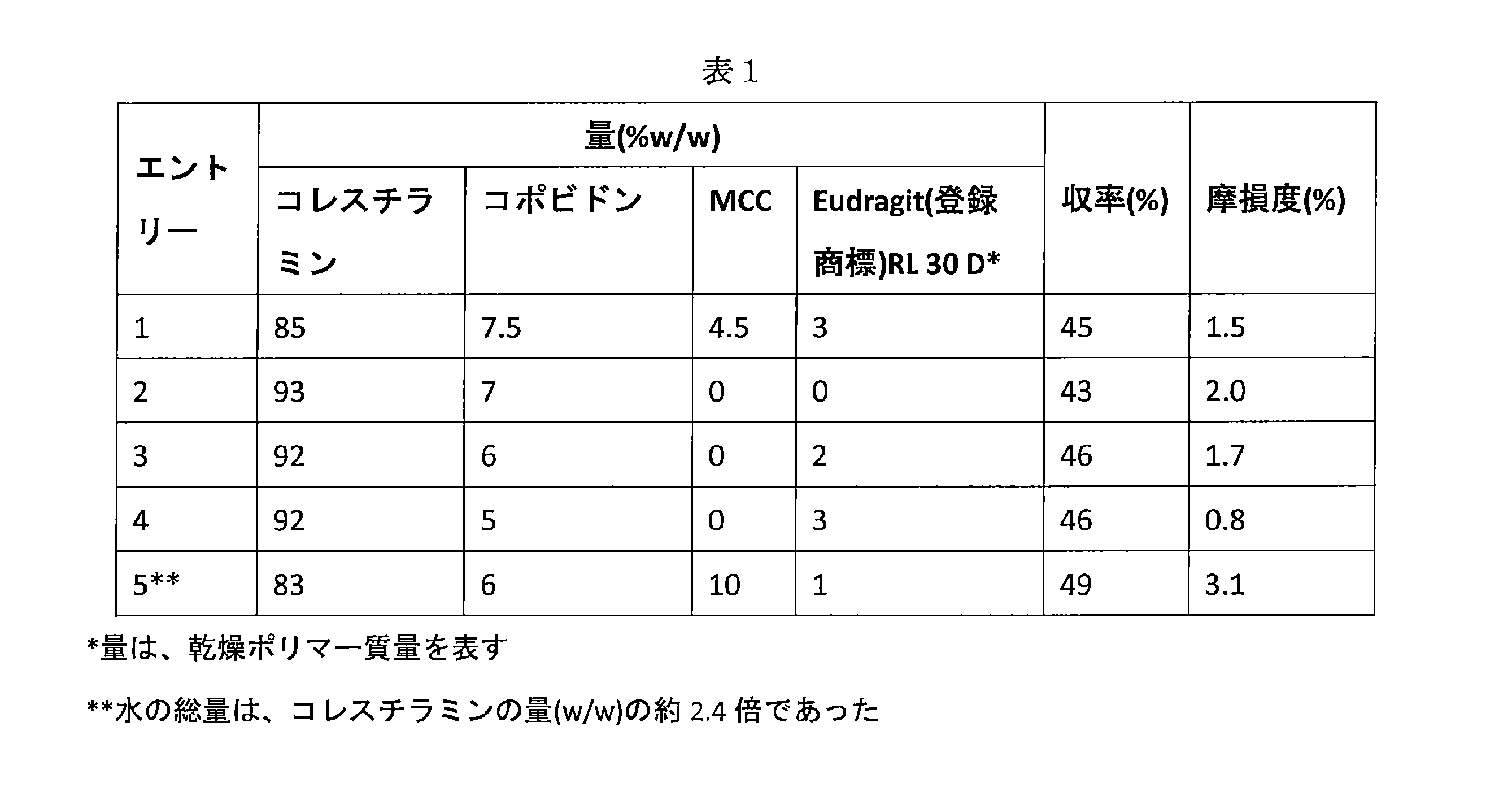
コーティング実験(以下の実施例3及び実施例4中のコーティング実験等)は、得られた顆粒が1つ又は複数のコーティング層で被覆されるのに十分なほど安定であることを裏付けた。 Coating experiments (such as those in Examples 3 and 4 below) confirmed that the granules obtained were sufficiently stable to be coated with one or more coating layers.
(実施例2)
コレスチラミン顆粒の崩壊試験
実施例1の顆粒(10g)を、プロペラ撹拌機を用いて300rpmで撹拌しながら、400mLのリン酸緩衝液(50mM、pH6.8)に加える。顆粒が完全に崩壊するまでの時間を測定する。
(Example 2)
Disintegration test of cholestyramine granules The granules of Example 1 (10 g) are added to 400 mL of phosphate buffer (50 mM, pH 6.8) while stirring at 300 rpm using a propeller stirrer. Measure the time until the granules are completely disintegrated.
(実施例3)
酵素-制御放出用の製剤A~C
実施例1、エントリー1のコレスチラミン顆粒を、Eudragit(登録商標)FS 30 D及び高アミロース天然トウモロコシデンプンをベースとする結腸放出コーティングにより製剤化した。
(Example 3)
Formulations A-C for enzyme-controlled release
The cholestyramine granules of Example 1, Entry 1 were formulated with a colonic release coating based on Eudragit® FS 30 D and high amylose native corn starch.
250mgのコレスチラミンを含む単位用量の顆粒の組成を以下に示す。 The composition of a unit dose granule containing 250 mg of cholestyramine is shown below.
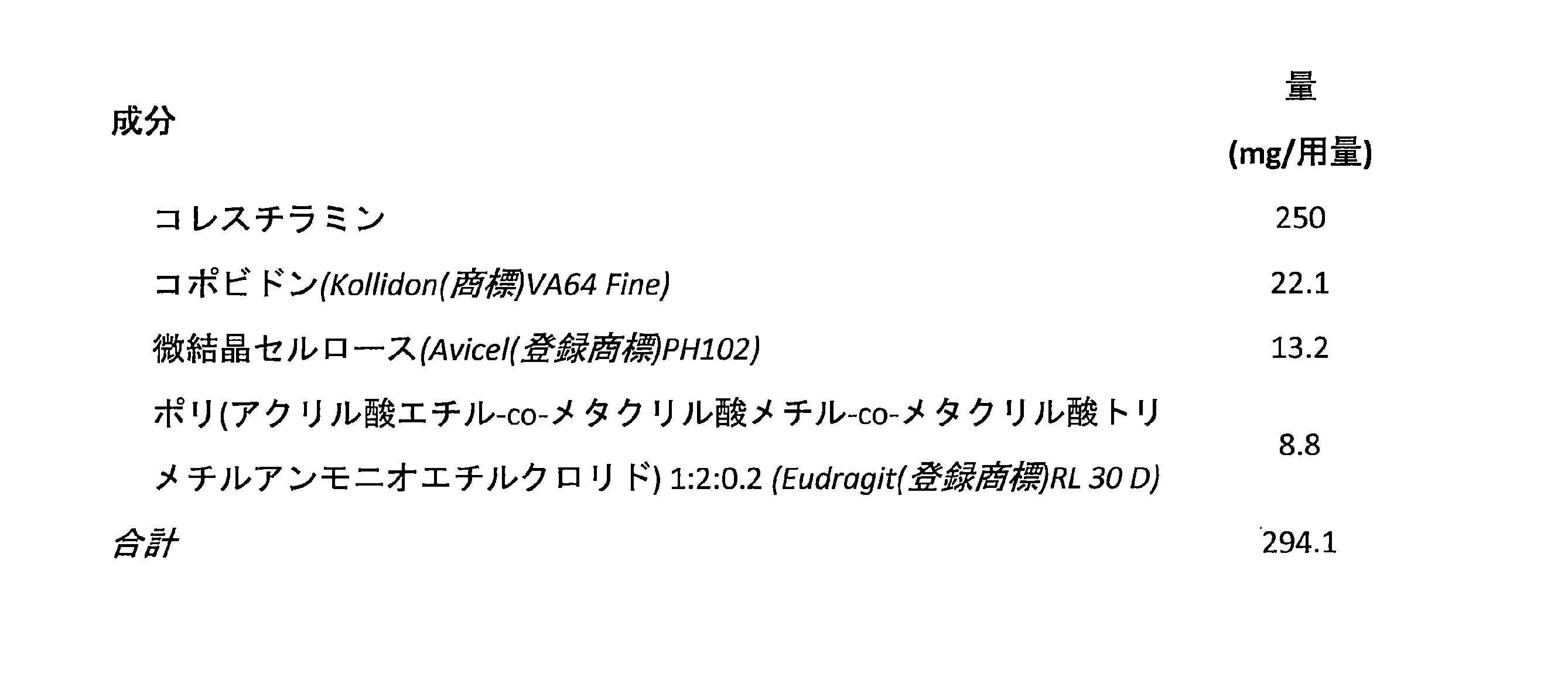
コーティング用に、モノステアリン酸グリセロール(GMS)、ポリソルベート80及びクエン酸トリエチル含有のGMSエマルションをEvonik社の一般説明書に従って調製した。次いでエマルションをEudragit(登録商標)FS 30 D(30%水性分散体)と混合した。Eudragit FS 30 Dコーティング分散体の組成を、乾燥質量に基づき、以下に示す。乾燥質量に基づく濃度は、19.8%(w/w)である。
For coating, a GMS emulsion containing glycerol monostearate (GMS),
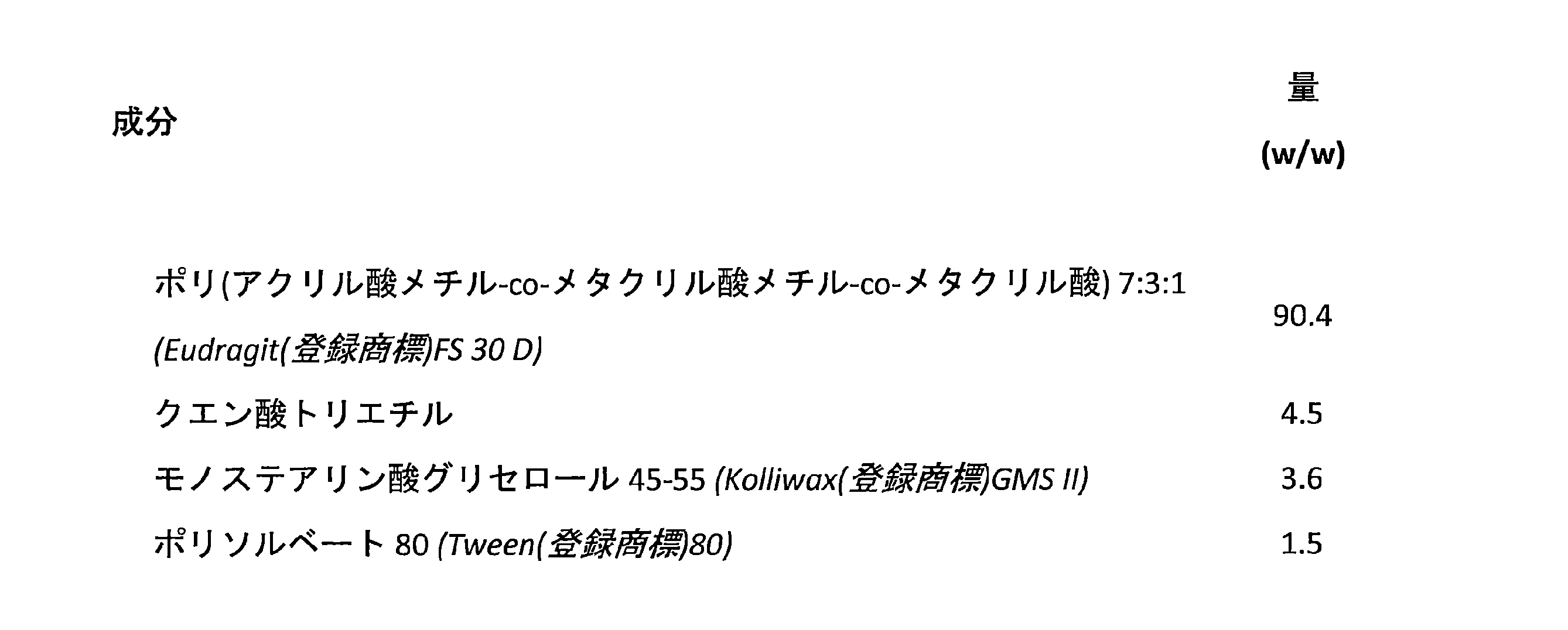
0.3M NaOH溶液を用いて、分散体のpHを5.5に調整した。分散体を、12.9%のデンプン含有の天然デンプン顆粒、0.1% Kolliphor(登録商標)SLS fine、及び水の懸濁液と混合した。Eudragit(登録商標)分散体は、最終フィルム中のポリマーフィルム対デンプンの比が、Eudragit(登録商標)FS 30 Dフィルム40%に対してデンプンが60%となるようにデンプン懸濁液と混合した。コーティングの組成を、乾燥質量に基づき、以下に示す。濃度は、適用された分散体の乾燥質量に基づいて、15%(w/w)である。 The pH of the dispersion was adjusted to 5.5 using 0.3M NaOH solution. The dispersion was mixed with a suspension of native starch granules containing 12.9% starch, 0.1% Kolliphor® SLS fine, and water. The Eudragit® dispersion was mixed with the starch suspension such that the ratio of polymer film to starch in the final film was 60% starch to 40% Eudragit® FS 30 D film. . The composition of the coating, based on dry weight, is shown below. The concentration is 15% (w/w), based on the dry weight of the dispersion applied.
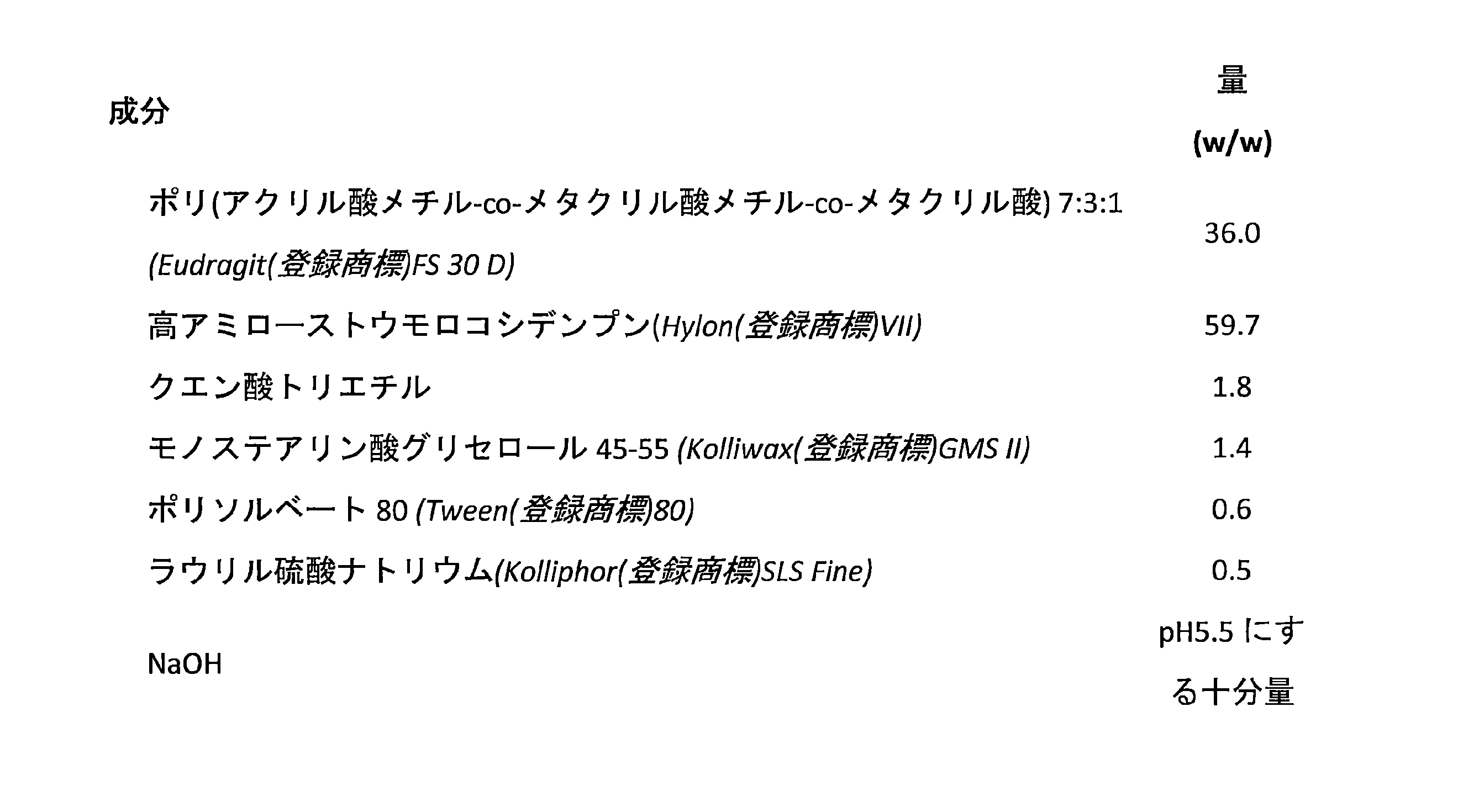
コーティング層を、Huttlin Kugelcoater HKC005を用いて塗布した。最初のバッチサイズは、65gであった。コーティング過程は、吸気口温度47~52℃で行われ、生成物温度は27~29℃となった。コーティングの間に顆粒の適切な流動化を達成するよう、気流を調整した。 The coating layer was applied using a Huttlin Kugelcoater HKC005. The initial batch size was 65g. The coating process was performed at an inlet temperature of 47-52°C, resulting in a product temperature of 27-29°C. The airflow was adjusted to achieve proper fluidization of the granules during coating.
コーティングは、コレスチラミン顆粒が~50%(製剤A)、~75%(製剤B)又は~100%(製剤C)の質量増を得るように塗布された。コーティング後に、顆粒を40℃で2時間加熱処理した。 Coatings were applied to obtain ˜50% (formulation A), ˜75% (formulation B) or ˜100% (formulation C) weight gain for the cholestyramine granules. After coating, the granules were heat treated at 40°C for 2 hours.
被覆された顆粒は、カプセル、例えばハードゼラチンカプセル、に包含されてよい。最終製剤の(乾燥質量ベースでの)詳細を以下に示す: Coated granules may be enclosed in capsules, such as hard gelatin capsules. Details of the final formulation (on a dry mass basis) are given below:
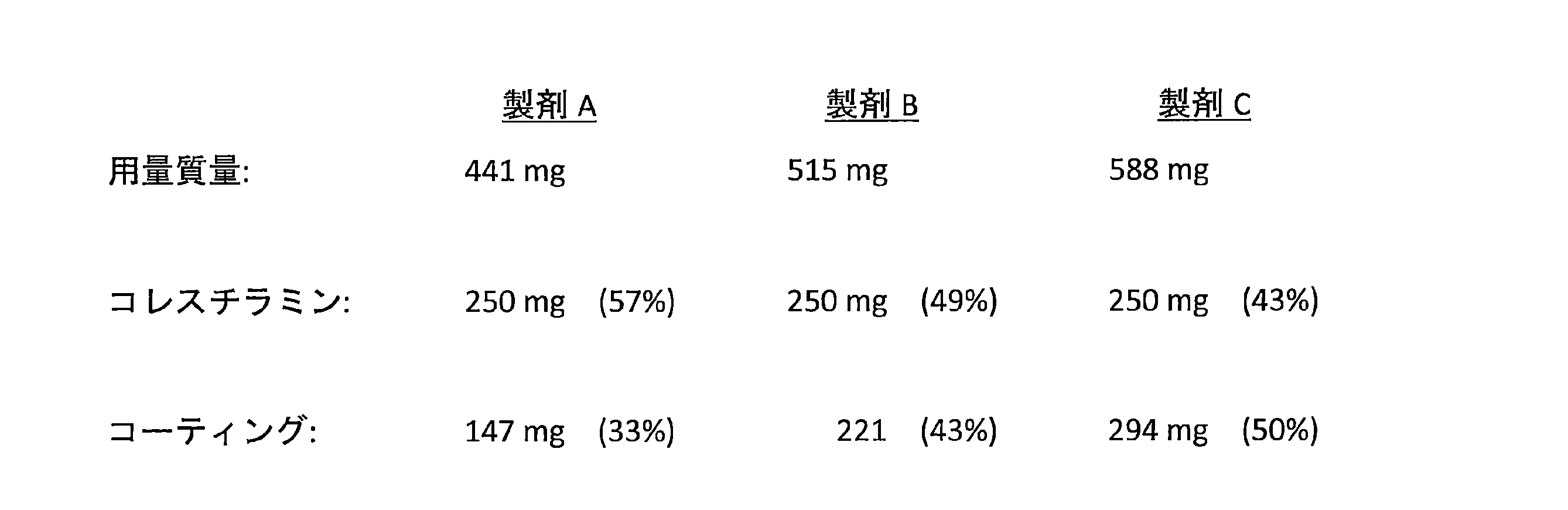
(実施例4)
pH-及び拡散-制御放出用の製剤D~F
実施例1のコレスチラミン顆粒を、ポリ(アクリル酸エチル-co-メタクリル酸メチル-co-メタクリル酸トリメチルアンモニオエチルクロリド)系拡散制御内部コーティング並びに酢酸コハク酸ヒドロキシプロピルメチルセルロース系腸溶性外部コーティングを含む結腸放出コーティングによって製剤化する。
(Example 4)
Formulations D to F for pH- and diffusion-controlled release
The cholestyramine granules of Example 1 contain a diffusion-controlling inner coating based on poly(ethyl acrylate-co-methyl methacrylate-co-trimethylammonioethyl methacrylate) and an outer enteric coating based on hydroxypropylmethylcellulose acetate succinate. It is formulated with a colonic release coating.
3つの製剤を、内部コーティングに、以下のような異なる量のポリ(アクリル酸エチル-co-メタクリル酸メチル-co-メタクリル酸トリメチルアンモニオエチルクロリド)を用いて製剤化する:
製剤D:100% Eudragit(登録商標) RL 30 D
製剤E:50% Eudragit(登録商標) RL 30 D+50% Eudragit(登録商標) RS 30 D
製剤F:100% Eudragit(登録商標) RS 30 D
Three formulations are formulated with different amounts of poly(ethyl acrylate-co-methyl methacrylate-co-trimethylammonioethyl methacrylate chloride) for the inner coating as follows:
Formulation D: 100% Eudragit® RL 30 D
Formulation E: 50% Eudragit® RL 30 D + 50% Eudragit® RS 30 D
Formulation F: 100% Eudragit® RS 30 D
250mgのコレスチラミンを含む単位用量の顆粒の組成を以下に示す。 The composition of a unit dose granule containing 250 mg of cholestyramine is shown below.
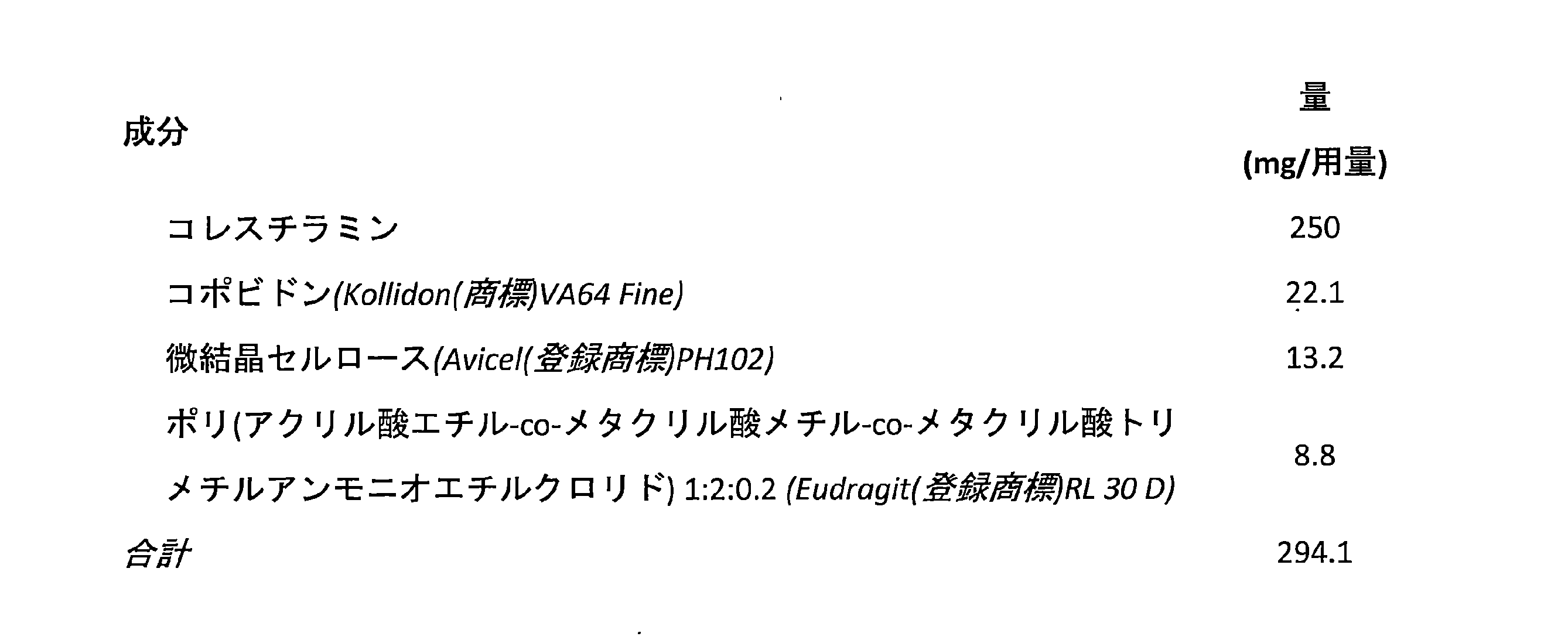
内部コーティング
モノステアリン酸グリセロール(GMS)、ポリソルベート80及びクエン酸トリエチル含有のGMSエマルションをEvonik社の一般説明書に従って調製する。エマルションをEudragit(登録商標)RL30D/Eudragit(登録商標)RS30D分散体(30%w/w)と混合する。内部コーティングフィルムの組成を、乾燥質量に基づき、以下に示す。濃度は、適用された分散体乾燥質量に基づいて、19.8%(w/w)である。
Internal Coating A GMS emulsion containing glycerol monostearate (GMS),

コーティング層を、Huttlin Kugelcoater HKC005を用いて塗布する;バッチサイズ75g。コーティング過程は、吸気口温度45℃で行われ、生成物温度は27~29℃となる。コーティングの間に顆粒の適切な流動化を達成するよう、気流を調整する。コーティングは、顆粒が10%の質量増を得るように塗布される。コーティング後に、顆粒を40℃で24時間加熱処理する。 The coating layer is applied using a Huttlin Kugelcoater HKC005; batch size 75g. The coating process is performed at an inlet temperature of 45°C, resulting in a product temperature of 27-29°C. Airflow is adjusted to achieve proper fluidization of the granules during coating. The coating is applied such that the granules obtain a 10% weight gain. After coating, the granules are heat treated at 40°C for 24 hours.
外部コーティング
7%w/w酢酸コハク酸ヒプロメロース、2.45%w/wクエン酸トリエチル、2.1%w/wタルク、0.21%w/wラウリル硫酸ナトリウム及び88.24%w/w水を<15℃の低温で、オーバーヘッドスターラーを用いて30分間混合することにより、腸溶性コーティングを調製する。外部コーティングフィルムの組成を、乾燥質量に基づき、以下に示す。コーティング液は、コーティング過程の間、15℃未満に維持する。
External coating
7% w/w hypromellose acetate succinate, 2.45% w/w triethyl citrate, 2.1% w/w talc, 0.21% w/w sodium lauryl sulfate and 88.24% w/w water at a low temperature of <15°C overhead. Prepare the enteric coating by mixing with a stirrer for 30 minutes. The composition of the outer coating film is shown below, based on dry weight. The coating liquid is maintained below 15°C during the coating process.
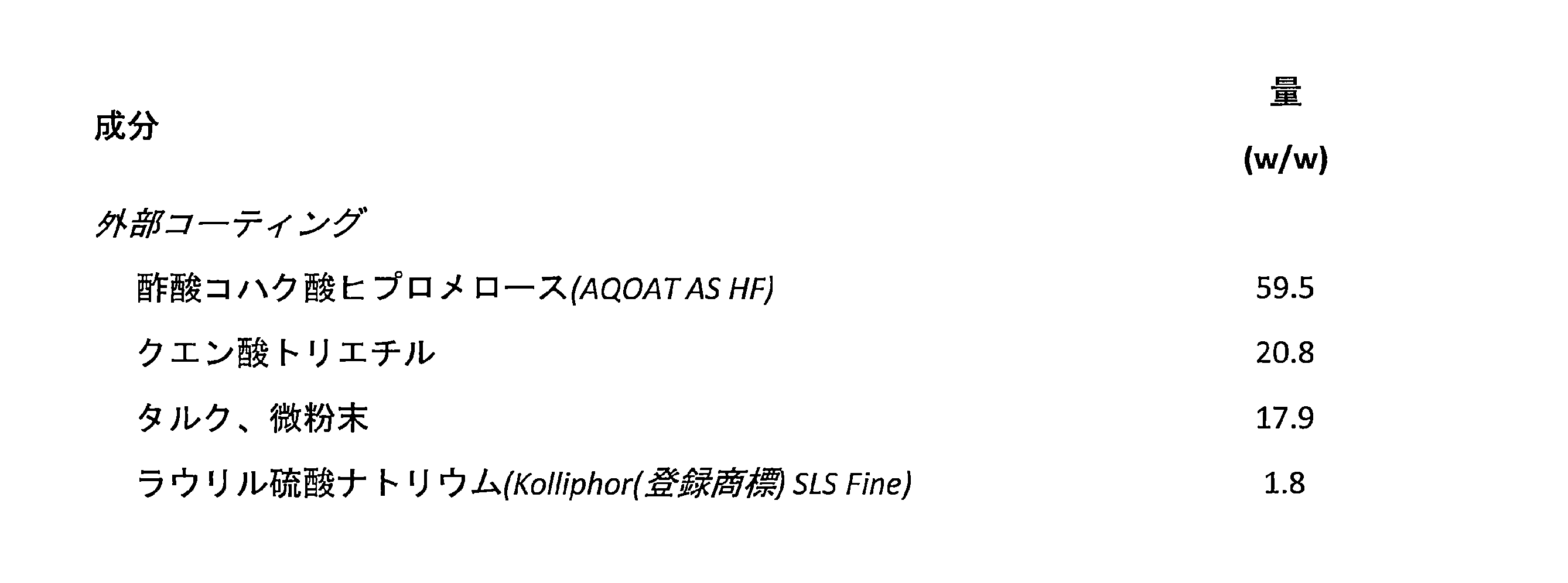
コーティング層を、Huttlin Kugelcoater HKC005を用いて塗布する;バッチサイズ75g。コーティング過程は、吸気口温度55℃で行われ、生成物温度は32℃となる。コーティングの間に顆粒の適切な流動化を達成するよう、気流を調整する。腸溶性コーティングは、顆粒が40%の質量増(内部コーティング塗布後の被覆された顆粒の質量に基づき)を得るように塗布される。コーティング後に、顆粒を40℃/75%RHで48時間加熱処理する。 The coating layer is applied using a Huttlin Kugelcoater HKC005; batch size 75g. The coating process is performed at an inlet temperature of 55°C, resulting in a product temperature of 32°C. Airflow is adjusted to achieve proper fluidization of the granules during coating. An enteric coating is applied such that the granules obtain a 40% weight gain (based on the weight of the coated granules after application of the inner coating). After coating, the granules are heat treated at 40°C/75%RH for 48 hours.
被覆された顆粒は、カプセル、例えばハードゼラチンカプセル、に包含されてよい。最終製剤の(乾燥質量ベースでの)詳細を以下に示す: Coated granules may be enclosed in capsules, such as hard gelatin capsules. Details of the final formulation (on a dry mass basis) are given below:
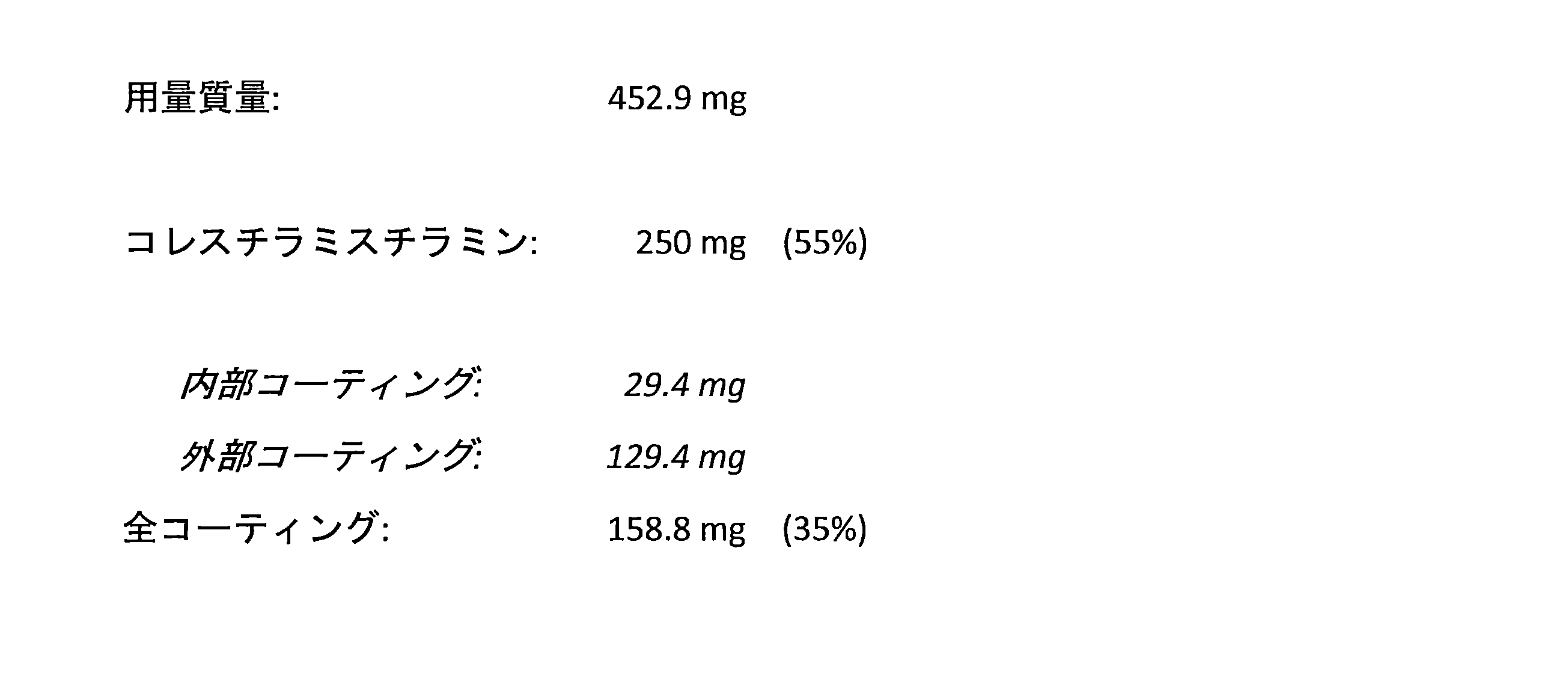
(実施例5)
封鎖アッセイ
製剤A、B及びCの封鎖能を胃及び小腸のpHを模擬した簡便なアッセイにおいて決定した。封鎖は、水溶液中のコール酸量の減少を測定することによって決定した。米国薬局方溶解装置2(パドル)、欧州薬局方2.9.3を用いた。
(Example 5)
Sequestration Assay The sequestration capacity of Formulations A, B and C was determined in a simple assay simulating the pH of the stomach and small intestine. Sequestration was determined by measuring the decrease in cholic acid content in aqueous solutions. USP Dissolution Apparatus 2 (paddle), European Pharmacopoeia 2.9.3 were used.
pH5.5における封鎖
250mgコレスチラミンに相当する量の製剤A、B及びCを、500mLのコール酸緩衝溶液(0.192mg/mL)、pH5.5が入った容器に加え、内容物を75rpmで6時間撹拌した。溶液の試料を、種々の時点で採取し、50mm×2.1mm、粒子径1.9μmのThermo Hypersil Goldカラムを用いて、カラム温度60℃、移動相30:70 アセトニトリル:リン酸緩衝液(pH3.0)、流速0.75mL/分で、HPLCによりコール酸の分析を行った。各製剤につき3つの反復用試料を分析し平均値を算出した。
Sequestration at pH 5.5
A quantity of Formulations A, B and C equivalent to 250 mg cholestyramine was added to a container containing 500 mL of cholate buffer solution (0.192 mg/mL), pH 5.5, and the contents were stirred at 75 rpm for 6 hours. Samples of the solution were taken at various time points using a 50 mm x 2.1 mm, 1.9 µm particle size Thermo Hypersil Gold column,
pH6.8における封鎖
250mgコレスチラミンに相当する量の製剤A、B及びCを、250mLの0.1M塩酸溶液(pH1)が入った容器に加え、内容物を75rpmで2時間撹拌した。次いで、水酸化カリウム/リン酸カリウム緩衝液中コール酸溶液250mLを容器に加え、pH6.8のコール酸の緩衝された溶液(0.192mg/mL)を得た。1分間混合した後、最初の試料を取り出した。その後pHを確認し、必要に応じて、適切な量の0.1M水酸化カリウム溶液を添加して6.8に調整した。その後溶液を更に6時間、混合した。溶液の試料を種々の時点で採取し、50mm×2.1mm、粒子径1.9μmのThermo Hypersil Goldカラムを用いて、カラム温度60℃、移動相30:70 アセトニトリル:リン酸緩衝液(pH3.0)、流速0.75mL/分で、HPLCによりコール酸の分析を行った。各製剤につき3つの反復用試料を分析し平均値を算出した。
Sequestration at pH 6.8
A quantity of formulations A, B and C corresponding to 250 mg cholestyramine was added to a container containing 250 mL of 0.1 M hydrochloric acid solution (pH 1) and the contents were stirred at 75 rpm for 2 hours. 250 mL of cholic acid solution in potassium hydroxide/potassium phosphate buffer was then added to the vessel to give a buffered solution of cholic acid at pH 6.8 (0.192 mg/mL). After mixing for 1 minute, the first sample was removed. The pH was then checked and, if necessary, adjusted to 6.8 by adding an appropriate amount of 0.1 M potassium hydroxide solution. The solution was then mixed for an additional 6 hours. Samples of the solution were taken at various time points using a 50 mm x 2.1 mm, 1.9 μm particle size Thermo Hypersil Gold column,
製剤A~Cの封鎖プロファイルを図1に示す。5.5というpHは、一部の患者及び健常者で発生することもあるが、十二指腸において通常観察されるpHよりもわずかに低い。このpHでは、全ての製剤に関して、封鎖は制限される(図1A)。pH6.8での封鎖は、回腸内の典型的な条件である。このpHにおいて、製剤Aは、4時間後に49%の封鎖を、製剤Bは34%の封鎖を、製剤Cは25%の封鎖を示した(図1B)。 The sequestration profiles of Formulations AC are shown in FIG. A pH of 5.5 may occur in some patients and healthy individuals, but is slightly lower than the pH normally observed in the duodenum. At this pH, sequestration is limited for all formulations (Fig. 1A). A sequestration at pH 6.8 is a typical condition in the ileum. At this pH, formulation A showed 49% sequestration, formulation B 34% sequestration, and formulation C 25% sequestration after 4 hours (Figure 1B).
(実施例6)
消化管の模擬条件下での製剤のコレスチラミン製剤の封鎖能のin vitroでの決定
コレスチラミン製剤の封鎖能を、ProDigest社(ベルギー、ゲント)によって開発されたSimulator of the Human Intestinal Microbial Ecosystem(SHIME(登録商標))を用いて試験する。シミュレーターを、絶食した胃、小腸及び近位結腸の典型的な生理的条件下での、胆汁酸塩を結合する封鎖能を評価するよう適合させる。絶食した胃及び小腸に典型的な液体媒体は、先に、Marzorati他(LWT-Food Sci. Technol. 2015、vol.60、544~551頁)によって記述されている。近位結腸についての液体媒体は、ヒト結腸に典型的な安定な微生物コミュニティを含むSHIME(登録商標)マトリックスを含む。ヒト腸の安定な微生物コミュニティを得るための方法は、Possemiers他(FEMS Microbiol. Ecol. 2004、vol. 49、495~507頁)及びその中の文献によって記述されている。封鎖は、水溶液中の胆汁酸の量の減少を測定することにより決定される。コール酸(CA)、ケノデオキシコール酸(CDCA)及びデオキシコール酸(DCA)の40:40:20(w/w)混合物が、ヒト胆汁酸の典型的混合物として使用される(Carulli他、Aliment. Pharmacol. Ther. 2000、vol.14、issue supplement s2、14~18頁)。
(Example 6)
In vitro determination of the sequestering capacity of formulations of cholestyramine preparations under simulated conditions of the gastrointestinal tract. (registered trademark)). The simulator is adapted to assess sequestering capacity to bind bile salts under physiological conditions typical of the fasted stomach, small intestine and proximal colon. A typical liquid medium for the fasted stomach and small intestine was previously described by Marzorati et al. (LWT-Food Sci. Technol. 2015, vol. 60, pp. 544-551). A liquid medium for the proximal colon comprises a SHIME® matrix containing a stable microbial community typical of the human colon. A method for obtaining a stable microbial community of the human gut is described by Possemiers et al. (FEMS Microbiol. Ecol. 2004, vol. 49, pp. 495-507) and references therein. Sequestration is determined by measuring the reduction in the amount of bile acids in aqueous solution. A 40:40:20 (w/w) mixture of cholic acid (CA), chenodeoxycholic acid (CDCA) and deoxycholic acid (DCA) is used as a typical mixture of human bile acids (Carulli et al., Aliment. Pharmacol. Ther. 2000, vol.14, issue supplement s2, pp. 14-18).
純粋な(非製剤化)コレスチラミンパウダーを添加する比較実験もまた実施する。コレスチラミンを添加しない対照実験を、アッセイで使用される結腸条件下での胆汁酸塩の分解をモニターするために、実施する。 A comparative experiment adding pure (non-formulated) cholestyramine powder is also performed. A control experiment without the addition of cholestyramine is performed to monitor the degradation of bile salts under the colonic conditions used in the assay.
各実験は、生物学的変動を明らかにするために、3回ずつ行う。 Each experiment is performed in triplicate to account for biological variation.
絶食胃
91mgのコレスチラミンに相当する量の製剤A、B及びC、並びに純粋なコレスチラミン(91mg)を、14mLの絶食胃液体媒体(pH1.8)に投与する。消化物を37℃で1時間、インキュベートする。
fasting stomach
Formulations A, B and C in amounts equivalent to 91 mg cholestyramine and pure cholestyramine (91 mg) are administered in 14 mL of fasted gastric fluid medium (pH 1.8). Incubate the digest for 1 hour at 37°C.
小腸
1時間の胃インキュベーションの後に、胆汁酸塩(46.7mM)の既定の40:40:20混合物を含む5.6mLの膵液(pH 6.8)を添加する。小腸消化物を37℃で2時間、インキュベートし、0、60及び120分後に試料を採取する。
small intestine
After 1 hour of gastric incubation, 5.6 mL of pancreatic juice (pH 6.8) containing a defined 40:40:20 mixture of bile salts (46.7 mM) is added. Intestinal digests are incubated at 37° C. for 2 hours and samples are taken after 0, 60 and 120 minutes.
近位結腸
2時間の腸インキュベーションの後に、SHIME(登録商標)システムの上行結腸由来の42mLの完全SHIME(登録商標)マトリックス(pH6.0)を添加する。結腸消化物を37℃で24時間、インキュベートし、最初の6時間は、1時間毎に、その後は19時間後及び24時間後に試料を採取する。
proximal colon
After 2 hours of intestinal incubation, 42 mL of complete SHIME® matrix (pH 6.0) from the ascending colon of the SHIME® system is added. Colonic digests are incubated at 37° C. for 24 hours and samples are taken every hour for the first 6 hours, then after 19 and 24 hours.
試料の分析
試料中の遊離胆汁酸の濃度を、HPLCを用いて評価する。試料中のCA、CDCA及びDCAの濃度を算出するために、検量線を用いた。1mLの各試料を5000gで2分間、遠心分離した。500μLの上清をメタノール及びリン酸緩衝液の80:20(v:v)混合物500μLと混合し、激しくボルテックスして、0.2μmのPTFEフィルターでろ過し、UV-Vis検出器を搭載したHitachi Chromaster HPLCに注入する。3種の胆汁酸塩を、逆相C18カラム(Synergi Hydro-RP、4μm、80Å、250×4.6mm)によって分離する。分離は、移動相としてメタノール及びリン酸緩衝液の80:20(v:v)混合物を用いて、室温、均一濃度条件下で行う。分析は、0.7mL/分で、23分間で行い、胆汁酸を210nmで検出する。注入量は胃及び小腸の試料については20μLに、結腸試料については50μLに設定する。
Analysis of Samples The concentration of free bile acids in samples is assessed using HPLC. A standard curve was used to calculate the concentrations of CA, CDCA and DCA in the samples. 1 mL of each sample was centrifuged at 5000 g for 2 minutes. 500 μL of supernatant was mixed with 500 μL of an 80:20 (v:v) mixture of methanol and phosphate buffer, vortexed vigorously, filtered through a 0.2 μm PTFE filter, and filtered using a Hitachi Chromaster equipped with a UV-Vis detector. Inject into HPLC. The three bile salts are separated by a reverse-phase C18 column (Synergi Hydro-RP, 4 μm, 80 Å, 250×4.6 mm). Separations are performed under isocratic conditions at room temperature using an 80:20 (v:v) mixture of methanol and phosphate buffer as the mobile phase. Analysis is performed at 0.7 mL/min for 23 minutes and bile acids are detected at 210 nm. The injection volume is set at 20 μL for stomach and small intestine samples and 50 μL for colon samples.
結腸インキュベーションに使用される完全SHIME(登録商標)マトリックスは、ウシ由来の脱水新鮮胆汁酸抽出物であるBD Difco(商標) Oxgall(カタログ番号212820)から生成された(分解)胆汁酸塩を含む。この混合物の正確な組成は未知であるが、結腸試料中には、より多量の遊離胆汁酸塩があることが見込まれうる。したがって、全SHIME(登録商標)マトリックス中に存在する遊離胆汁酸塩の「ベースライン」を考慮に入れるために、バックグラウンド(すなわち、胆汁酸塩混合物無添加のブランク試料)の値を、各試料から減算する。 The complete SHIME® matrix used for colonic incubations contains (degraded) bile salts produced from BD Difco® Oxgall (Cat#212820), a dehydrated fresh bile acid extract from bovine sources. Although the exact composition of this mixture is unknown, it can be expected that there is a higher amount of free bile salts in colonic samples. Therefore, in order to take into account the "baseline" of free bile salts present in the entire SHIME® matrix, the background (i.e., blank sample with no bile salt mixture added) values were added to each sample. Subtract from
対照試料中の各種胆汁酸の測定濃度は、腸、特に結腸における微生物塩代謝(例えば、脱抱合、脱水素、脱ヒドロキシル化)の効果及び程度を示すことになる。結腸試料におけるCA、CDCA及びDCAの濃度の突然且つ大きな減少は、小腸から結腸インキュベーションへの移行の間に観察されることがある。 Measured concentrations of various bile acids in control samples will indicate the effect and extent of microbial salt metabolism (eg, deconjugation, dehydrogenation, dehydroxylation) in the intestine, particularly the colon. A sudden and large decrease in concentrations of CA, CDCA and DCA in colonic samples can be observed during the transition from small intestine to colonic incubation.
試験した各試料中の残存胆汁酸のパーセンテージは、相当するインキュベーション時間における試験試料の値の対照試料の値に対する比として算出できる。残存胆汁酸のパーセンテージの時間に対するプロットは、小腸及び結腸インキュベーションの間の、胆汁酸の減少、すなわちコレスチラミン製剤による胆汁酸の封鎖を示すことになる。 The percentage of residual bile acids in each sample tested can be calculated as the ratio of the value of the test sample to the value of the control sample at the corresponding incubation time. A plot of the percentage of remaining bile acids against time will show the decrease in bile acids, ie the sequestration of bile acids by the cholestyramine formulation, during the small intestine and colonic incubations.
Claims (27)
i.少なくとも6%w/wの結合剤及び少なくとも2%w/wのアクリレートコポリマーの組合せ;又は
ii.少なくとも5%w/wの結合剤及び少なくとも3%w/wのアクリレートコポリマーの組合せ;又は
iii.少なくとも6%w/wの結合剤、少なくとも1%w/wのアクリレートコポリマー及び5から15%w/wの微結晶セルロースの組合せ;
を含み、
結合剤が、セルロースエーテル、ビニルピロリドン系ポリマー、又はそれらの組合せを含む、顆粒。 at least 70% w/w cholestyramine in each granule, and
i. a combination of at least 6% w/w binder and at least 2% w/w acrylate copolymer; or
ii. a combination of at least 5% w/w binder and at least 3% w/w acrylate copolymer; or
iii. a combination of at least 6% w/w binder, at least 1% w/w acrylate copolymer and 5 to 15% w/w microcrystalline cellulose;
including
Granules, wherein the binder comprises a cellulose ether, a vinylpyrrolidone-based polymer, or a combination thereof.
b)前記顆粒周囲の結腸放出コーティング
を含む、コレスチラミンの結腸への標的送達のための経口製剤。 a) a plurality of granules according to any one of claims 1 to 9; and
b) an oral formulation for targeted delivery of cholestyramine to the colon comprising a colonic release coating around said granules.
1,1-ジオキソ-3,3-ジブチル-5-フェニル-7-メチルチオ-8-(N-{(R)-α-[N-((S)-1-カルボキシプロピル)カルバモイル]-4-ヒドロキシベンジル}カルバモイルメトキシ)-2,3,4,5-テトラヒドロ-1,2,5-ベンゾチアジアゼピン;若しくは
1,1-ジオキソ-3,3-ジブチル-5-フェニル-7-メチルチオ-8-(N-{(R)-1'-フェニル-1'-[N'-(カルボキシメチル)カルバモイル]メチル}カルバモイルメトキシ)-2,3,4,5-テトラヒドロ-1,5-ベンゾチアゼピン;
又は医薬品に許容されるその塩
である、請求項26に記載の使用のための製剤。 IBAT inhibitor
1,1-dioxo-3,3-dibutyl-5-phenyl-7-methylthio-8-(N-{(R)-α-[N-((S)-1-carboxypropyl)carbamoyl]-4- hydroxybenzyl}carbamoylmethoxy)-2,3,4,5-tetrahydro-1,2,5-benzothiadiazepine; or
1,1-dioxo-3,3-dibutyl-5-phenyl-7-methylthio-8-(N-{(R)-1'-phenyl-1'-[N'-(carboxymethyl)carbamoyl]methyl} carbamoylmethoxy)-2,3,4,5-tetrahydro-1,5-benzothiazepine;
or a pharmaceutically acceptable salt thereof.
Applications Claiming Priority (4)
| Application Number | Priority Date | Filing Date | Title |
|---|---|---|---|
| SE1750978 | 2017-08-09 | ||
| SE1750978-7 | 2017-08-09 | ||
| JP2020506231A JP2020530448A (en) | 2017-08-09 | 2018-08-09 | Cholestyramine granules, oral cholestyramine preparations, and their use |
| PCT/SE2018/050802 WO2019032026A1 (en) | 2017-08-09 | 2018-08-09 | Cholestyramine granules, oral cholestyramine formulations and use thereof |
Related Parent Applications (1)
| Application Number | Title | Priority Date | Filing Date |
|---|---|---|---|
| JP2020506231A Division JP2020530448A (en) | 2017-08-09 | 2018-08-09 | Cholestyramine granules, oral cholestyramine preparations, and their use |
Publications (2)
| Publication Number | Publication Date |
|---|---|
| JP2022166326A true JP2022166326A (en) | 2022-11-01 |
| JP7422827B2 JP7422827B2 (en) | 2024-01-26 |
Family
ID=63259555
Family Applications (2)
| Application Number | Title | Priority Date | Filing Date |
|---|---|---|---|
| JP2020506231A Pending JP2020530448A (en) | 2017-08-09 | 2018-08-09 | Cholestyramine granules, oral cholestyramine preparations, and their use |
| JP2022135754A Active JP7422827B2 (en) | 2017-08-09 | 2022-08-29 | Cholestyramine granules, oral cholestyramine preparations, and their uses |
Family Applications Before (1)
| Application Number | Title | Priority Date | Filing Date |
|---|---|---|---|
| JP2020506231A Pending JP2020530448A (en) | 2017-08-09 | 2018-08-09 | Cholestyramine granules, oral cholestyramine preparations, and their use |
Country Status (6)
| Country | Link |
|---|---|
| US (1) | US10881685B2 (en) |
| EP (1) | EP3664781A1 (en) |
| JP (2) | JP2020530448A (en) |
| CN (1) | CN111032019B (en) |
| CA (1) | CA3071285A1 (en) |
| WO (1) | WO2019032026A1 (en) |
Families Citing this family (33)
| Publication number | Priority date | Publication date | Assignee | Title |
|---|---|---|---|---|
| ES2586931T3 (en) | 2010-11-04 | 2016-10-19 | Albireo Ab | IBAT inhibitors for the treatment of liver diseases |
| CN106659726A (en) | 2014-06-25 | 2017-05-10 | Ea制药株式会社 | Solid preparation and method for preventing or reducing coloration thereof |
| EP3413877B1 (en) | 2016-02-09 | 2021-04-07 | Albireo AB | Oral cholestyramine formulation and use thereof |
| EP3413878B1 (en) | 2016-02-09 | 2021-04-14 | Albireo AB | Oral cholestyramine formulation and use thereof |
| EP3413875B1 (en) | 2016-02-09 | 2020-01-29 | Albireo AB | Cholestyramine pellets and methods for preparation thereof |
| JP7391048B2 (en) | 2018-06-05 | 2023-12-04 | アルビレオ・アクチボラグ | Benzothia(di)azepine compounds and their use as bile acid modulators |
| MX2020013839A (en) | 2018-06-20 | 2021-03-25 | Albireo Ab | Pharmaceutical formulation of odevixibat. |
| US11801226B2 (en) | 2018-06-20 | 2023-10-31 | Albireo Ab | Pharmaceutical formulation of odevixibat |
| US10722457B2 (en) | 2018-08-09 | 2020-07-28 | Albireo Ab | Oral cholestyramine formulation and use thereof |
| US11007142B2 (en) * | 2018-08-09 | 2021-05-18 | Albireo Ab | Oral cholestyramine formulation and use thereof |
| US11549878B2 (en) | 2018-08-09 | 2023-01-10 | Albireo Ab | In vitro method for determining the adsorbing capacity of an insoluble adsorbant |
| RS63899B1 (en) | 2019-02-06 | 2023-02-28 | Albireo Ab | BENZOTHIADIAZEPIN COMPOUNDS AND THEIR USE AS BILE ACID MODULATORS |
| TWI835997B (en) | 2019-02-06 | 2024-03-21 | 瑞典商艾爾比瑞歐公司 | Benzothiazepine compounds and their use as bile acid modulators |
| MX2022001865A (en) | 2019-08-12 | 2022-03-11 | Massachusetts Inst Technology | ARTICLES AND METHODS FOR THE ADMINISTRATION OF THERAPEUTIC AGENTS. |
| AR120682A1 (en) | 2019-12-04 | 2022-03-09 | Albireo Ab | BENZOTHIADIAZEPINE COMPOUNDS AND THEIR USE AS BILE ACID MODULATORS |
| EP4069359B1 (en) | 2019-12-04 | 2024-01-03 | Albireo AB | Benzothia(di)azepine compounds and their use as bile acid modulators |
| WO2021110886A1 (en) | 2019-12-04 | 2021-06-10 | Albireo Ab | Benzothia(di)azepine compounds and their use as bile acid modulators |
| CA3158181A1 (en) | 2019-12-04 | 2021-06-10 | Albireo Ab | Benzothia(di)azepine compounds and their use as bile acid modulators |
| US11014898B1 (en) | 2020-12-04 | 2021-05-25 | Albireo Ab | Benzothiazepine compounds and their use as bile acid modulators |
| WO2021110887A1 (en) | 2019-12-04 | 2021-06-10 | Albireo Ab | Benzothiazepine compounds and their use as bile acid modulators |
| BR112022010505A2 (en) | 2019-12-04 | 2022-09-06 | Albireo Ab | BENZOTHYA(DI)AZEPINE COMPOUNDS AND THEIR USE AS BILIARY ACID MODULATION |
| TWI867107B (en) | 2019-12-04 | 2024-12-21 | 瑞典商艾爾比瑞歐公司 | Benzothia(di)azepine compounds and their use as bile acid modulators |
| AR120679A1 (en) | 2019-12-04 | 2022-03-09 | Albireo Ab | BENZOTHI(DI)AZEPINE COMPOUNDS AND THEIR USE AS BILE ACID MODULATORS |
| JP7665620B2 (en) | 2019-12-04 | 2025-04-21 | アルビレオ・アクチボラグ | Benzothiadiazepine compounds and their use as bile acid modulators - Patents.com |
| WO2022029101A1 (en) | 2020-08-03 | 2022-02-10 | Albireo Ab | Benzothia(di)azepine compounds and their use as bile acid modulators |
| AU2021379076A1 (en) | 2020-11-12 | 2023-06-08 | Albireo Ab | Odevixibat for treating progressive familial intrahepatic cholestasis (pfic) |
| AU2021390172A1 (en) | 2020-12-04 | 2023-06-22 | Albireo Ab | Benzothia(di)azepine compounds and their use as bile acid modulators |
| TW202313579A (en) | 2021-06-03 | 2023-04-01 | 瑞典商艾爾比瑞歐公司 | Benzothia(di)azepine compounds and their use as bile acid modulators |
| CN114146184A (en) * | 2021-12-03 | 2022-03-08 | 成都施桂行医药科技有限责任公司 | Use of cationic polymers for the preparation of medicaments |
| WO2023154547A1 (en) * | 2022-02-14 | 2023-08-17 | Axial Therapeutics, Inc. | Colon targeted drug delivery |
| JP2025521736A (en) | 2022-07-05 | 2025-07-10 | アルビレオ・アクチボラグ | Benzothia(di)azepine compounds and their use as bile acid modulators - Patents.com |
| WO2025146507A1 (en) | 2024-01-05 | 2025-07-10 | Albireo Ab | Benzothia(di)azepine compounds and their use as bile acid modulators |
| WO2025146508A1 (en) | 2024-01-05 | 2025-07-10 | Albireo Ab | Benzothia(di)azepine compounds and their use as bile acid modulators |
Citations (3)
| Publication number | Priority date | Publication date | Assignee | Title |
|---|---|---|---|---|
| JPS63290822A (en) * | 1987-02-09 | 1988-11-28 | ザ ダウ ケミカル カンパニー | Cholestyramine composition and manufacture |
| WO2001076635A1 (en) * | 2000-04-10 | 2001-10-18 | Shionogi & Co., Ltd. | Preparations for preventing bile acid diarrhea |
| JP2005536502A (en) * | 2002-07-13 | 2005-12-02 | アストラゼネカ アクチボラグ | Combination of an IBAT inhibitor and a metal salt for the treatment of diarrhea |
Family Cites Families (157)
| Publication number | Priority date | Publication date | Assignee | Title |
|---|---|---|---|---|
| NL86453C (en) * | 1951-10-07 | |||
| US3539380A (en) | 1968-01-08 | 1970-11-10 | Upjohn Co | Methylcellulose and polyalkylene glycol coating of solid medicinal dosage forms |
| GB1566609A (en) | 1977-03-10 | 1980-05-08 | Reckitt & Colmann Prod Ltd | Pharmaceutical compositions containing cholestyramine and alginic acid |
| GB1573487A (en) | 1977-05-23 | 1980-08-28 | Bristol Myers Co | Bile acid binding composition |
| DE3066728D1 (en) | 1979-04-30 | 1984-03-29 | Max Planck Gesellschaft | Tyrosine derivatives, process for their production and their use in the synthesis of peptides |
| JPS62290822A (en) * | 1986-06-09 | 1987-12-17 | Kawasaki Steel Corp | Production of thick-walled steel pipe |
| US5167965A (en) * | 1987-02-09 | 1992-12-01 | The Dow Chemical Company | Palatable cholestyramine granules, tablets and methods for preparation thereof |
| US4900757A (en) | 1988-12-08 | 1990-02-13 | Merrell Dow Pharmaceuticals Inc. | Hypocholesterolemic and antiatherosclerotic uses of bix(3,5-di-tertiary-butyl-4-hydroxyphenylthio)methane |
| DE3930168A1 (en) * | 1989-09-09 | 1991-03-14 | Knoll Ag | Pharmaceutical compsn. contg. colestyramine to reduce lipid - in micro:tablet form levels without unpleasant taste |
| IL95574A (en) | 1989-09-09 | 1994-11-11 | Knoll Ag | Colestyramine preparation |
| GB8926639D0 (en) | 1989-11-24 | 1990-01-17 | Agricultural & Food Res | Delayed release formulations |
| NZ240846A (en) | 1990-12-06 | 1994-04-27 | Hoechst Ag | Dimeric bile acid derivatives; preparatory processes and pharmaceutical compositions |
| AU653658B2 (en) | 1991-12-20 | 1994-10-06 | Hoechst Aktiengesellschaft | Polymers and oligomers of bile acid derivatives, process for their preparation and their use as pharmaceuticals |
| JPH05186357A (en) | 1991-12-31 | 1993-07-27 | Shigeo Ochi | Absorption-inhibitory means for digested product of food/ beverage |
| GB9203347D0 (en) | 1992-02-17 | 1992-04-01 | Wellcome Found | Hypolipidaemic compounds |
| IT1257793B (en) | 1992-05-18 | 1996-02-13 | PHARMACEUTICAL COMPOSITION BASED ON BILIARY ACIDS IN MICROGRANULES WITH CONTROLLED RELEASE | |
| ATE217789T1 (en) | 1992-06-04 | 2002-06-15 | Smithkline Beecham Corp | PLEASANT TASTING PHARMACEUTICAL COMPOSITIONS |
| DK0573848T3 (en) | 1992-06-12 | 1998-08-10 | Hoechst Ag | Bile acid derivatives, processes for their preparation and use of these compounds as pharmaceuticals |
| US5350584A (en) | 1992-06-26 | 1994-09-27 | Merck & Co., Inc. | Spheronization process using charged resins |
| IL108633A (en) | 1993-02-15 | 1998-07-15 | Wellcome Found | Hypolipidaemic benzothiazepine derivatives their preparation and pharmaceutical compositions containing them |
| IL108634A0 (en) | 1993-02-15 | 1994-05-30 | Wellcome Found | Hypolipidaemic heterocyclic compounds, their prepatation and pharmaceutical compositions containing them |
| PT621032E (en) | 1993-04-23 | 2001-01-31 | Novartis Ag | FARMACO CONTROLLED LIBERATION DISTRIBUTION DEVICE |
| EP0624593A3 (en) | 1993-05-08 | 1995-06-07 | Hoechst Ag | Bile acid derivatives, a process for their production and use as medicaments. |
| TW289757B (en) | 1993-05-08 | 1996-11-01 | Hoechst Ag | |
| TW289020B (en) | 1993-05-08 | 1996-10-21 | Hoechst Sktiengesellschaft | |
| TW289021B (en) | 1993-05-08 | 1996-10-21 | Hoechst Ag | |
| ZA956647B (en) | 1994-08-10 | 1997-02-10 | Wellcome Found | Hypolipidaemic compounds. |
| US5994391A (en) | 1994-09-13 | 1999-11-30 | G.D. Searle And Company | Benzothiepines having activity as inhibitors of ileal bile acid transport and taurocholate uptake |
| US6642268B2 (en) | 1994-09-13 | 2003-11-04 | G.D. Searle & Co. | Combination therapy employing ileal bile acid transport inhibiting benzothipines and HMG Co-A reductase inhibitors |
| BR9508916A (en) | 1994-09-13 | 1997-12-30 | Monsanto Co | "New benzothiepines having activity as inhibitors of ileal bile acid transport and absorption of taurocholate" |
| US6262277B1 (en) | 1994-09-13 | 2001-07-17 | G.D. Searle And Company | Intermediates and processes for the preparation of benzothiepines having activity as inhibitors of ileal bile acid transport and taurocholate uptake |
| GB9423172D0 (en) | 1994-11-17 | 1995-01-04 | Wellcom Foundation The Limited | Hypolipidemic benzothiazepines |
| US5811388A (en) | 1995-06-07 | 1998-09-22 | Cibus Pharmaceutical, Inc. | Delivery of drugs to the lower GI tract |
| US6069167A (en) | 1996-01-16 | 2000-05-30 | University Technology Corporation | Use of antioxidant agents to treat cholestatic liver disease |
| DE19608592A1 (en) | 1996-03-06 | 1997-09-11 | Hoechst Ag | Antibodies for the selective immunological determination of bile acids in biological matrices |
| NZ331813A (en) | 1996-03-11 | 2001-03-30 | G | Benzothiepine compounds having activity as inhibitors of ileal bile acid transport and taurocholate uptake |
| ATE394107T1 (en) | 1996-05-23 | 2008-05-15 | Novartis Pharma Gmbh | PREVENTION AND TREATMENT OF COLON ADENOMA OR COLON MICROADENOMA WITH 6-FLUORUROSODEOXYCHOLIC ACID |
| AU3940897A (en) | 1996-07-24 | 1998-02-10 | Zumtobel Staff Gmbh | Adapter for a retaining means used to secure a built-in lamp in a mounting hole,or retaining means or built-in lamp provided with such an adapter |
| DE19633268A1 (en) | 1996-08-19 | 1998-02-26 | Hoechst Ag | Polymeric bile acid absorption inhibitors with simultaneous bile acid adsorber action |
| GB9704208D0 (en) | 1997-02-28 | 1997-04-16 | Glaxo Group Ltd | Chemical compounds |
| NZ337830A (en) | 1997-03-11 | 2001-07-27 | G | Combination therapy employing ileal bile acid transport inhibiting benzothiepines and HMG Co-A reductase inhibitors |
| DK0864582T3 (en) | 1997-03-14 | 2003-09-29 | Aventis Pharma Gmbh | Hypolidemic 1,4-benzothiazepine-1,1-dioxides |
| US6635280B2 (en) | 1997-06-06 | 2003-10-21 | Depomed, Inc. | Extending the duration of drug release within the stomach during the fed mode |
| ES2248908T7 (en) | 1997-06-06 | 2014-11-24 | Depomed, Inc. | Dosage forms of drugs orally and gastric retention for continued release of highly soluble drugs |
| AU7552198A (en) | 1997-06-11 | 1998-12-30 | Sankyo Company Limited | Benzylamine derivatives |
| AUPO763197A0 (en) | 1997-06-30 | 1997-07-24 | Sigma Pharmaceuticals Pty Ltd | Health supplement |
| US5900233A (en) | 1997-10-16 | 1999-05-04 | Day; Charles E. | Epichlorohydrin and 1-(3-aminopropyl) imidazole copolymer and its use in treating irritable bowel syndrome |
| US20030153541A1 (en) | 1997-10-31 | 2003-08-14 | Robert Dudley | Novel anticholesterol compositions and method for using same |
| KR20010015884A (en) | 1997-12-19 | 2001-02-26 | 윌리암스 로저 에이 | Method of preparing enantiomerically-enriched tetrahydrobenzothiepine oxides |
| GB9800428D0 (en) | 1998-01-10 | 1998-03-04 | Glaxo Group Ltd | Chemical compounds |
| US6346527B1 (en) | 1998-04-24 | 2002-02-12 | Fujisawa Pharmaceutical Co., Ltd. | Guanidine derivatives |
| US6221897B1 (en) | 1998-06-10 | 2001-04-24 | Aventis Pharma Deutschland Gmbh | Benzothiepine 1,1-dioxide derivatives, a process for their preparation, pharmaceuticals comprising these compounds, and their use |
| DE19825804C2 (en) | 1998-06-10 | 2000-08-24 | Aventis Pharma Gmbh | 1,4-Benzothiepin-1,1-dioxide derivatives, processes for their preparation and medicaments containing these compounds |
| AU5194999A (en) | 1998-08-07 | 2000-02-28 | Takeda Chemical Industries Ltd. | Benzothiepin derivatives, process for the preparation of the same and uses thereof |
| MXPA01006472A (en) | 1998-12-23 | 2004-03-10 | Searle Llc | Combinations of ileal bile acid transport inhibitors and fibric acid derivatives for cardiovascular indications. |
| PT1140190E (en) | 1998-12-23 | 2003-02-28 | Searle Llc | COMBINATIONS OF ILEAL TRANSPORTATION INHIBITORS OF BILIARY ACIDS AND BILIARY ACID SEQUESTRANTS AGENTS USED FOR CARDIOVASCULAR PROBLEMS |
| EP1342475A1 (en) | 1998-12-23 | 2003-09-10 | G.D. Searle LLC. | Combinations of ileal bile acid transport inhibitors and cholesteryl ester transfer protein inhibitors for cardiovascular indications |
| CN1342091A (en) | 1998-12-23 | 2002-03-27 | G.D.瑟尔有限公司 | Combinations of cardiovascular indications |
| KR20010102963A (en) | 1998-12-23 | 2001-11-17 | 윌리암스 로저 에이 | Combinations of ileal bile acid transport inhibitors and nicotinic acid derivatives for cardiovascular indications |
| CA2362147A1 (en) | 1999-02-12 | 2000-08-17 | Steve A. Kolodziej | 1,2-benzothiazepines for the treatment of hyperlipidemic diseases |
| DE19915420A1 (en) | 1999-04-06 | 2000-10-12 | Basf Ag | Stabilized polyvinylpyrrolidone preparations |
| DE19916108C1 (en) | 1999-04-09 | 2001-01-11 | Aventis Pharma Gmbh | 1,4-Benzothiazepine-1,1-dioxide derivatives substituted with sugar residues, process for their preparation and their use |
| SE9901387D0 (en) | 1999-04-19 | 1999-04-19 | Astra Ab | New pharmaceutical foromaulations |
| US6287609B1 (en) | 1999-06-09 | 2001-09-11 | Wisconsin Alumni Research Foundation | Unfermented gel fraction from psyllium seed husks |
| US20020054903A1 (en) | 1999-10-19 | 2002-05-09 | Joseph Tyler | Direct compression polymer tablet core |
| AU1302301A (en) | 1999-11-08 | 2001-06-06 | Sankyo Company Limited | Nitrogenous heterocycle derivatives |
| GB9927088D0 (en) | 1999-11-17 | 2000-01-12 | Secr Defence | Use of poly(diallylamine) polymers |
| EP1259494A4 (en) | 2000-02-18 | 2004-09-15 | Merck & Co Inc | ARYLOXY ACETIC ACIDS FOR DIABETES AND LIPID DISEASES |
| SE0000772D0 (en) | 2000-03-08 | 2000-03-08 | Astrazeneca Ab | Chemical compounds |
| WO2001068096A2 (en) | 2000-03-10 | 2001-09-20 | Pharmacia Corporation | Combination therapy for the prophylaxis and treatment of hyperlipidemic conditions and disorders |
| EP1286984A2 (en) | 2000-03-10 | 2003-03-05 | Pharmacia Corporation | Method for the preparation of tetrahydrobenzothiepines |
| US6638498B2 (en) | 2000-06-30 | 2003-10-28 | Semorex Inc. | Molecularly imprinted polymers for the treatment and diagnosis of medical conditions |
| US20020183307A1 (en) | 2000-07-26 | 2002-12-05 | Tremont Samuel J. | Novel 1,4-benzothiazephine and 1,5-benzothiazepine compounds as inhibitors of apical sodium co-dependent bile acid transport and taurocholate uptake |
| CN100423715C (en) | 2000-07-28 | 2008-10-08 | 霍夫曼-拉罗奇有限公司 | new pharmaceutical composition |
| FR2812886B1 (en) | 2000-08-08 | 2002-11-08 | Assist Publ Hopitaux De Paris | SCREENING FOR A NEW HEPATIC SYNDROME AND ITS APPLICATIONS |
| SE0003766D0 (en) | 2000-10-18 | 2000-10-18 | Astrazeneca Ab | Novel formulation |
| EG26979A (en) | 2000-12-21 | 2015-03-01 | Astrazeneca Ab | Chemical compounds |
| WO2002053548A1 (en) | 2000-12-27 | 2002-07-11 | Banyu Pharmaceutical Co.,Ltd. | Benzothiazepine derivatives |
| US6506921B1 (en) | 2001-06-29 | 2003-01-14 | Virginia Tech Intellectual Properties, Inc. | Amine compounds and curable compositions derived therefrom |
| US20040077625A1 (en) | 2001-07-25 | 2004-04-22 | Tremont Samuel J. | Novel 1,4-benzothiazepine and 1,5-benzothiazepine compounds as inhibitors of apical sodium codependent bile acid transport abd taurocholate uptake |
| US20040038862A1 (en) | 2001-07-30 | 2004-02-26 | Goodwin Bryan James | Identification of new therapeutic targets for modulating bile acid synthesis |
| GB0121337D0 (en) | 2001-09-04 | 2001-10-24 | Astrazeneca Ab | Chemical compounds |
| GB0121621D0 (en) | 2001-09-07 | 2001-10-31 | Astrazeneca Ab | Chemical compounds |
| GB0121622D0 (en) | 2001-09-07 | 2001-10-31 | Astrazeneca Ab | Chemical compounds |
| PL216023B1 (en) | 2001-09-08 | 2014-02-28 | Astrazeneca Ab | Benzothiazepine and benzothiadiazepine derivatives with ileal bile acid transport (ibat) inhibitory activity for the treatment hyperlipidaemia |
| BR0212495A (en) | 2001-09-12 | 2004-08-24 | Searle Llc | Method for the preparation of crystalline tetrahydrobenzothiepines |
| US6740663B2 (en) | 2001-11-02 | 2004-05-25 | G.D. Searle, Llc | Mono- and di-fluorinated benzothiepine compounds as inhibitors of apical sodium co-dependent bile acid transport (ASBT) and taurocholate uptake |
| TW200300349A (en) | 2001-11-19 | 2003-06-01 | Sankyo Co | A 4-oxoqinoline derivative |
| GB0229931D0 (en) | 2002-12-21 | 2003-01-29 | Astrazeneca Ab | Therapeutic agents |
| SE0104334D0 (en) | 2001-12-19 | 2001-12-19 | Astrazeneca Ab | Therapeutic agents |
| GB0314079D0 (en) | 2003-06-18 | 2003-07-23 | Astrazeneca Ab | Therapeutic agents |
| AU2002351752A1 (en) | 2001-12-29 | 2003-07-30 | Novo Nordisk A/S | Combined use of a glp-1 compound and another drug for treating dyslipidemia |
| GB0201850D0 (en) | 2002-01-26 | 2002-03-13 | Astrazeneca Ab | Therapeutic treatment |
| US20040014806A1 (en) | 2002-03-08 | 2004-01-22 | Pharmacia Corporation | Methods and compositions for lowering levels of blood lipids |
| US20050089572A1 (en) | 2002-03-22 | 2005-04-28 | Manoj Kumar | Controlled release drug delivery system of pravastatin |
| GB0209467D0 (en) | 2002-04-25 | 2002-06-05 | Astrazeneca Ab | Chemical compounds |
| GB0213669D0 (en) | 2002-06-14 | 2002-07-24 | Astrazeneca Ab | Chemical compounds |
| CN100494185C (en) | 2002-08-28 | 2009-06-03 | 旭化成制药株式会社 | Novel quaternary ammonium compounds |
| US7312208B2 (en) | 2002-08-28 | 2007-12-25 | Asahi Kasei Pharma Corporation | Quaternary ammonium compounds |
| GB0304194D0 (en) | 2003-02-25 | 2003-03-26 | Astrazeneca Ab | Chemical compounds |
| CA2517245C (en) | 2003-02-28 | 2009-01-20 | Mcgill University | Cell and enzyme compositions for modulating bile acids, cholesterol and triglycerides |
| US20060210633A1 (en) | 2003-04-03 | 2006-09-21 | Sun Pharmaceutical Industries Limited | Programmed drug delivery system |
| GB0307918D0 (en) | 2003-04-05 | 2003-05-14 | Astrazeneca Ab | Therapeutic use |
| WO2005036971A1 (en) | 2003-10-16 | 2005-04-28 | Techcom Group, Llc | Reduced digestible carbohydrate food having reduced blood glucose response |
| KR20070026392A (en) | 2004-02-27 | 2007-03-08 | 아사히 가세이 파마 가부시키가이샤 | New Benzothiazepines and Benzothiene Compounds |
| US20050197376A1 (en) | 2004-03-02 | 2005-09-08 | Fujisawa Pharmaceutical Co. Ltd. | Concomitant drugs |
| EP1593671A1 (en) | 2004-03-05 | 2005-11-09 | Graffinity Pharmaceuticals AG | DPP-IV inhibitors |
| TWI415635B (en) | 2004-05-28 | 2013-11-21 | 必治妥施貴寶公司 | Coated tablet formulation and method |
| JP4896480B2 (en) | 2004-10-01 | 2012-03-14 | 第一三共ヘルスケア株式会社 | Particulate composition of anion exchange resin |
| US9149439B2 (en) | 2005-03-21 | 2015-10-06 | Sandoz Ag | Multi-particulate, modified-release composition |
| WO2006121861A2 (en) | 2005-05-05 | 2006-11-16 | Microbia, Inc. | Biphenylazetidinone cholesterol absorption inhibitors |
| WO2006125074A1 (en) | 2005-05-17 | 2006-11-23 | Brown University Research Foundation | Drug delivery formulations for targeted delivery |
| US20070237818A1 (en) | 2005-06-02 | 2007-10-11 | Malcolm Bruce A | Controlled-release formulation of HCV protease inhibitor and methods using the same |
| DE102005033100B3 (en) | 2005-07-15 | 2007-01-25 | Sanofi-Aventis Deutschland Gmbh | Novel 1,4-benzothiazepine-1,1-dioxide derivative with improved properties, drugs containing this compound and methods for their preparation |
| DE102005033099A1 (en) | 2005-07-15 | 2007-01-18 | Sanofi-Aventis Deutschland Gmbh | Novel 1,4-benzothiazepine 1,1-dioxide derivative with improved properties, process for its preparation, medicines containing it and its use |
| KR101368525B1 (en) | 2005-09-20 | 2014-03-06 | 노파르티스 아게 | Use of a dpp-iv inhibitor to reduce hypoglycemic events |
| EP2007395A1 (en) | 2006-04-10 | 2008-12-31 | Merck & Co., Inc. | Cgrp antagonist salt |
| GB0607534D0 (en) | 2006-04-13 | 2006-05-24 | Univ London Pharmacy | Colonic drug delivery formulation |
| US8048413B2 (en) | 2006-05-17 | 2011-11-01 | Helene Huguet | Site-specific intestinal delivery of adsorbents, alone or in combination with degrading molecules |
| DE102006053636B4 (en) | 2006-11-14 | 2008-09-18 | Sanofi-Aventis Deutschland Gmbh | New cyclohexyl substituted 1,4-benzothiepine 1,1-dioxide derivatives and their use |
| DE102006053635B4 (en) | 2006-11-14 | 2011-06-30 | Sanofi-Aventis Deutschland GmbH, 65929 | Novel benzyl-substituted 1,4-benzothiepine-1,1-dioxide derivatives, drugs containing these compounds and their use |
| WO2008058631A1 (en) | 2006-11-14 | 2008-05-22 | Sanofi-Aventis Deutschland Gmbh | Novel 1,4-benzothiepin-1,1-dioxide derivatives with improved properties, method for producing the same, drugs containing said compounds and use thereof |
| DE102006053637B4 (en) | 2006-11-14 | 2011-06-30 | Sanofi-Aventis Deutschland GmbH, 65929 | Novel fluorine-substituted 1,4-benzothiepine-1,1-dioxide derivatives, pharmaceutical compositions containing them and their use |
| JP5292310B2 (en) | 2007-01-19 | 2013-09-18 | インターセプト ファーマシューティカルズ, インコーポレイテッド | 23-substituted bile acids as TGR5 modulators and methods of use thereof |
| WO2008109462A2 (en) | 2007-03-02 | 2008-09-12 | Farnam Companies, Inc. | Sustained release pellets comprising wax-like material |
| SI2200588T1 (en) | 2007-09-25 | 2019-08-30 | Solubest Ltd. | Compositions comprising lipophilic active compounds and process for their preparation |
| US9295677B2 (en) | 2008-02-26 | 2016-03-29 | Qing Bile Therapeutics Inc. | Polyhydroxylated bile acids for treatment of biliary disorders |
| KR20110059750A (en) * | 2008-09-02 | 2011-06-03 | 유에스브이 리미티드 | Crosslinked polymer |
| EP2367554A4 (en) | 2008-11-26 | 2020-03-25 | Satiogen Pharmaceuticals, Inc. | BILIARY ACID RECYCLING INHIBITORS FOR THE TREATMENT OF OBESITY AND DIABETES |
| US20110152204A1 (en) | 2009-12-18 | 2011-06-23 | Satiogen Pharmaceuticals, Inc. | Treatment of Obesity or Diabetes with Bile Acid Sequestrants |
| ES2586135T3 (en) | 2010-02-23 | 2016-10-11 | Da Volterra | Formulations for the oral supply of adsorbents in the intestine |
| JO3131B1 (en) | 2010-04-27 | 2017-09-20 | Glaxosmithkline Llc | Chemical compounds |
| EP3593802A3 (en) | 2010-05-26 | 2020-03-25 | Satiogen Pharmaceuticals, Inc. | Bile acid recycling inhibitors and satiogens for treatment of diabetes, obesity, and inflammatory gastrointestinal conditions |
| ES2586931T3 (en) | 2010-11-04 | 2016-10-19 | Albireo Ab | IBAT inhibitors for the treatment of liver diseases |
| US20120114588A1 (en) | 2010-11-08 | 2012-05-10 | Albireo Ab | Ibat inhibitors for treatment of metabolic disorders and related conditions |
| EP2637667A4 (en) | 2010-11-08 | 2014-06-25 | Albireo Ab | Ibat inhibitors for treatment of metabolic disorders and related conditions |
| RU2619215C2 (en) | 2010-11-08 | 2017-05-12 | Альбирео Аб | Pharmaceutical combination comprising ibat-inhibitor and bile acid binder |
| BR112014010223B8 (en) | 2011-10-28 | 2021-02-23 | Lumena Pharmaceuticals Llc | use of a composition comprising bile acid recycling inhibitors and pediatric dosage form |
| KR102051031B1 (en) | 2011-10-28 | 2019-12-02 | 루메나 파마수티컬즈, 인코포레이티드 | Bile acid recycling inhibitors for treatment of hypercholemia and cholestatic liver disease |
| EP2968230A2 (en) | 2013-03-15 | 2016-01-20 | Lumena Pharmaceuticals, Inc. | Bile acid recycling inhibitors for treatment of primary sclerosing cholangitis and inflammatory bowel disease |
| JO3301B1 (en) | 2013-04-26 | 2018-09-16 | Albireo Ab | Crystal modifications of elobixibat |
| MX2016011063A (en) | 2014-02-27 | 2016-11-30 | Nusirt Sciences Inc | COMPOSITIONS AND METHODS FOR REDUCTION OR PREVENTION OF HEPATIC ESTEATOSIS. |
| EP3154523B1 (en) | 2014-06-16 | 2018-11-21 | Valpharma International S.P.A. | Formulation for oral administration containing mesalazine |
| CN106573033A (en) | 2014-06-25 | 2017-04-19 | Ea制药株式会社 | Solid preparation and method for stabilizing same |
| CN106659726A (en) | 2014-06-25 | 2017-05-10 | Ea制药株式会社 | Solid preparation and method for preventing or reducing coloration thereof |
| EP3012252A1 (en) | 2014-10-24 | 2016-04-27 | Ferring BV | Crystal modifications of elobixibat |
| US9684018B2 (en) | 2014-11-19 | 2017-06-20 | Texas Instruments Incorporated | Current sense circuit that operates over a wide range of currents |
| CN105985254B (en) | 2015-02-17 | 2018-03-16 | 上海中科绿碳化工科技有限公司 | A kind of method for preparing Carbox amide |
| EP3413878B1 (en) | 2016-02-09 | 2021-04-14 | Albireo AB | Oral cholestyramine formulation and use thereof |
| EP3413877B1 (en) | 2016-02-09 | 2021-04-07 | Albireo AB | Oral cholestyramine formulation and use thereof |
| EP3413875B1 (en) | 2016-02-09 | 2020-01-29 | Albireo AB | Cholestyramine pellets and methods for preparation thereof |
| CN110996915B (en) | 2017-08-09 | 2023-10-03 | 阿尔比里奥公司 | Cholestyramine pills, oral cholestyramine preparations and their uses |
| US10722457B2 (en) | 2018-08-09 | 2020-07-28 | Albireo Ab | Oral cholestyramine formulation and use thereof |
| US20200046757A1 (en) | 2018-08-09 | 2020-02-13 | Albireo Ab | Cholestyramine pellets, oral cholestyramine formulations, and uses thereof |
| US11549878B2 (en) | 2018-08-09 | 2023-01-10 | Albireo Ab | In vitro method for determining the adsorbing capacity of an insoluble adsorbant |
| US20200046758A1 (en) | 2018-08-09 | 2020-02-13 | Albireo Ab | Oral cholestyramine formulation and use thereof |
| US11007142B2 (en) | 2018-08-09 | 2021-05-18 | Albireo Ab | Oral cholestyramine formulation and use thereof |
-
2018
- 2018-08-09 JP JP2020506231A patent/JP2020530448A/en active Pending
- 2018-08-09 CA CA3071285A patent/CA3071285A1/en active Pending
- 2018-08-09 CN CN201880051581.8A patent/CN111032019B/en active Active
- 2018-08-09 EP EP18756513.0A patent/EP3664781A1/en not_active Withdrawn
- 2018-08-09 WO PCT/SE2018/050802 patent/WO2019032026A1/en not_active Ceased
- 2018-09-07 US US16/125,358 patent/US10881685B2/en active Active
-
2022
- 2022-08-29 JP JP2022135754A patent/JP7422827B2/en active Active
Patent Citations (3)
| Publication number | Priority date | Publication date | Assignee | Title |
|---|---|---|---|---|
| JPS63290822A (en) * | 1987-02-09 | 1988-11-28 | ザ ダウ ケミカル カンパニー | Cholestyramine composition and manufacture |
| WO2001076635A1 (en) * | 2000-04-10 | 2001-10-18 | Shionogi & Co., Ltd. | Preparations for preventing bile acid diarrhea |
| JP2005536502A (en) * | 2002-07-13 | 2005-12-02 | アストラゼネカ アクチボラグ | Combination of an IBAT inhibitor and a metal salt for the treatment of diarrhea |
Also Published As
| Publication number | Publication date |
|---|---|
| US10881685B2 (en) | 2021-01-05 |
| CN111032019A (en) | 2020-04-17 |
| CA3071285A1 (en) | 2019-02-14 |
| WO2019032026A1 (en) | 2019-02-14 |
| EP3664781A1 (en) | 2020-06-17 |
| RU2020109469A (en) | 2021-09-10 |
| CN111032019B (en) | 2022-07-05 |
| US20190070217A1 (en) | 2019-03-07 |
| JP2020530448A (en) | 2020-10-22 |
| JP7422827B2 (en) | 2024-01-26 |
| RU2020109469A3 (en) | 2022-01-14 |
Similar Documents
| Publication | Publication Date | Title |
|---|---|---|
| JP7422827B2 (en) | Cholestyramine granules, oral cholestyramine preparations, and their uses | |
| JP7328207B2 (en) | Cholestyramine pellets, oral cholestyramine preparations, and their uses | |
| US10493096B2 (en) | Oral cholestyramine formulation and use thereof | |
| US10864228B2 (en) | Oral cholestyramine formulation and use thereof | |
| US11007142B2 (en) | Oral cholestyramine formulation and use thereof | |
| US10722457B2 (en) | Oral cholestyramine formulation and use thereof | |
| ZA200208310B (en) | Preparations for preventing bile acid diarrhea. | |
| RU2783157C2 (en) | Cholestyramine granules, oral cholestyramine compositions and their use | |
| RU2782016C9 (en) | Cholestyramine pellets, oral cholestyramine compositions and their use | |
| RU2782016C2 (en) | Cholestyramine pellets, oral cholestyramine compositions and their use | |
| HK40001803B (en) | Oral cholestyramine formulation and use thereof |
Legal Events
| Date | Code | Title | Description |
|---|---|---|---|
| A621 | Written request for application examination |
Free format text: JAPANESE INTERMEDIATE CODE: A621 Effective date: 20220829 |
|
| A131 | Notification of reasons for refusal |
Free format text: JAPANESE INTERMEDIATE CODE: A131 Effective date: 20230731 |
|
| A521 | Request for written amendment filed |
Free format text: JAPANESE INTERMEDIATE CODE: A523 Effective date: 20231026 |
|
| TRDD | Decision of grant or rejection written | ||
| A01 | Written decision to grant a patent or to grant a registration (utility model) |
Free format text: JAPANESE INTERMEDIATE CODE: A01 Effective date: 20231218 |
|
| A61 | First payment of annual fees (during grant procedure) |
Free format text: JAPANESE INTERMEDIATE CODE: A61 Effective date: 20240116 |
|
| R150 | Certificate of patent or registration of utility model |
Ref document number: 7422827 Country of ref document: JP Free format text: JAPANESE INTERMEDIATE CODE: R150 |