JP2013075813A - Ammonium zirconium carbonate aqueous solution - Google Patents
Ammonium zirconium carbonate aqueous solution Download PDFInfo
- Publication number
- JP2013075813A JP2013075813A JP2012101809A JP2012101809A JP2013075813A JP 2013075813 A JP2013075813 A JP 2013075813A JP 2012101809 A JP2012101809 A JP 2012101809A JP 2012101809 A JP2012101809 A JP 2012101809A JP 2013075813 A JP2013075813 A JP 2013075813A
- Authority
- JP
- Japan
- Prior art keywords
- zirconium
- carbonate
- ammonium
- molar ratio
- aqueous solution
- Prior art date
- Legal status (The legal status is an assumption and is not a legal conclusion. Google has not performed a legal analysis and makes no representation as to the accuracy of the status listed.)
- Granted
Links
Images
Landscapes
- Inorganic Compounds Of Heavy Metals (AREA)
- Compositions Of Macromolecular Compounds (AREA)
- Processes Of Treating Macromolecular Substances (AREA)
Abstract
Description
本発明は、炭酸ジルコニウムアンモニウム水溶液に関する。 The present invention relates to an aqueous solution of ammonium zirconium carbonate.
ポリビニルアルコールやポリアクリル酸などの水溶性高分子化合物架橋用のジルコニウム水溶液として、炭酸ジルコニウムアンモニウム水溶液が市販されており、製紙、金属表面処理、接着剤および光学フィルムなどの分野で広く利用されている。
近年、環境への安全性が重視される趨勢にあって、有機系の架橋剤やホウ酸よりも毒性の低い炭酸ジルコニウムアンモニウム水溶液のニーズは増加しているが、架橋性能で劣るため、性能向上が求められている。Zirconium ammonium carbonate aqueous solution is commercially available as a zirconium aqueous solution for crosslinking water-soluble polymer compounds such as polyvinyl alcohol and polyacrylic acid, and is widely used in fields such as papermaking, metal surface treatment, adhesives and optical films. .
In recent years, there has been an increasing importance on environmental safety, and the need for organic cross-linking agents and zirconium ammonium carbonate aqueous solutions, which are less toxic than boric acid, has increased. Is required.
上記市販の炭酸ジルコニウムアンモニウム水溶液は、特許文献1に開示されるように、炭酸とジルコニウムの比が2.05以下となるように炭酸水素アンモニウムおよびアンモニアの混合水溶液に塩基性炭酸ジルコニウムを添加し、加熱して合成したものである。
この方法によって製造された炭酸ジルコニウムアンモニウム水溶液は、水溶液中に溶存するジルコニウム(IV)イオンが、巨大なジルコニウム(IV)イオンの重合体である塩基性炭酸ジルコニウムの解重合反応に由来するため、ジルコニウム(IV)イオンの重合度が高く、かつ、重合度にバラツキがある点で、架橋剤としての機能が妨げられていると考えられる。As disclosed in
Zirconium ammonium carbonate aqueous solution produced by this method is composed of zirconium (IV) ions dissolved in the aqueous solution due to the depolymerization reaction of basic zirconium carbonate, which is a polymer of huge zirconium (IV) ions. (IV) It is considered that the function as a crosslinking agent is hindered in that the degree of polymerization of ions is high and the degree of polymerization varies.
また、特許文献2には、炭酸ジルコニウムとアルカリ金属塩による水溶液を調製する際に、重炭酸塩のジルコニウムに対するモル比が少なくとも4の条件とすることによるポリビニルアルコール等の不溶化に優れた水性組成物の製造方法が開示されている。
この水性組成物は重合度と重合度のバラツキの点で改善されているが、この水性組成物と水溶性高分子化合物を架橋反応させた場合、架橋反応生成物に残留したアルカリ金属がこの組成物の溶出を促進することになるため、必ずしも架橋剤として最適とはいえない。
This aqueous composition is improved in terms of the degree of polymerization and the variation in the degree of polymerization. However, when this aqueous composition and a water-soluble polymer compound are subjected to a crosslinking reaction, the alkali metal remaining in the crosslinking reaction product is present in this composition. Since elution of the product is promoted, it is not necessarily optimal as a crosslinking agent.
本発明は上記の問題点を鑑みて成されたものであって、その目的は、水溶性高分子化合物架橋用として用いた場合、従来よりも高い架橋性能を示す炭酸ジルコニウムアンモニウム水溶液を提供することにある。 The present invention has been made in view of the above-mentioned problems, and its object is to provide an aqueous zirconium carbonate solution that exhibits higher crosslinking performance than before when used for water-soluble polymer compound crosslinking. It is in.
本発明者は、上記目的を達成するため鋭意検討した結果、炭酸ジルコニウムアンモニウム水溶液中に溶存するジルコニウム(IV)イオンの重合度が炭酸種とジルコニウムのモル比によって変化することを見出し、該モル比を特定の範囲に調整することで、その重合度を制御し、さらにキレート化剤と共存させることによって高い架橋性能が得られることを発見し、本発明に至った。
すなわち、本発明は、
(1)炭酸種およびキレート化剤を含有し、炭酸種とジルコニウムとのモル比が3〜9で、キレート化剤とジルコニウムのモル比が0.01〜1であることを特徴とする炭酸ジルコニウムアンモニウム水溶液。
(2)キレート化剤がエタノールアミン類、酒石酸、クエン酸、乳酸、グルコン酸およびグリコール酸ならびにこれらの塩から選ばれる1種または2種以上であることを特徴とする前記(1)記載の炭酸ジルコニウムアンモニウム水溶液。
(3)水溶性高分子化合物架橋用として用いられることを特徴とする前記(1)または前記(2)記載の炭酸ジルコニウムアンモニウム水溶液。
を提供する。As a result of intensive studies to achieve the above object, the present inventor has found that the degree of polymerization of zirconium (IV) ions dissolved in an aqueous ammonium zirconium carbonate solution varies depending on the molar ratio of carbonic acid species and zirconium. It was discovered that a high crosslinking performance can be obtained by adjusting the polymerization degree to a specific range and controlling the degree of polymerization and coexisting with a chelating agent, leading to the present invention.
That is, the present invention
(1) Zirconium carbonate containing a carbonic acid species and a chelating agent, wherein the molar ratio of the carbonic acid species and zirconium is 3 to 9, and the molar ratio of the chelating agent and zirconium is 0.01 to 1. Ammonium aqueous solution.
(2) The carbonic acid according to (1) above, wherein the chelating agent is one or more selected from ethanolamines, tartaric acid, citric acid, lactic acid, gluconic acid and glycolic acid, and salts thereof. Zirconium ammonium aqueous solution.
(3) The zirconium ammonium carbonate aqueous solution according to (1) or (2) above, which is used for crosslinking a water-soluble polymer compound.
I will provide a.
本発明の炭酸ジルコニウムアンモニウム水溶液は、水溶性高分子化合物架橋用として用いた場合、高い架橋性能を発揮するため、斯界において好適に使用できる。 The aqueous zirconium carbonate carbonate solution of the present invention exhibits high crosslinking performance when used for water-soluble polymer compound crosslinking, and can therefore be used suitably in this field.
以下に本発明の炭酸ジルコニウムアンモニウム水溶液について詳細に説明する。
炭酸ジルコニウムアンモニウム水溶液
本発明の炭酸ジルコニウムアンモニウム水溶液は、ジルコニウムに対するモル比が0.02以下のハフニウムを含有していてもよい。本発明の用途では上記の含有量においてハフニウムの悪影響は認められない。
本発明の炭酸ジルコニウムアンモニウム水溶液は、炭酸種とジルコニウムのモル比(炭酸種/ジルコニウム)が3〜9、好ましくは4〜8の炭酸種を含有する。炭酸種は、炭酸(H2CO3)、炭酸水素イオン(HCO3 −)および炭酸イオン(CO3 2−)のいずれでもよい。
上記モル比の範囲で炭酸種はジルコニウム(IV)イオンに配位し、例えば炭酸種がCO3 2−の場合は、モノマー[Zr(CO3)n](2n−4)−{9≧n≧4}またはダイマー[Zr2(OH)2(CO3)6]6−等を形成すると考えられる。The zirconium zirconium carbonate aqueous solution of the present invention will be described in detail below.
Zirconium ammonium carbonate aqueous solution The zirconium ammonium carbonate aqueous solution of the present invention may contain hafnium having a molar ratio to zirconium of 0.02 or less. In the use of the present invention, no adverse effect of hafnium is observed at the above content.
The aqueous ammonium zirconium carbonate solution of the present invention contains a carbonic acid species having a molar ratio of carbonic acid species to zirconium (carbonic acid species / zirconium) of 3 to 9, preferably 4 to 8. The carbonate species may be any of carbonic acid (H 2 CO 3 ), hydrogen carbonate ion (HCO 3 − ), and carbonate ion (CO 3 2− ).
Carbonic acid species are coordinated to zirconium (IV) ions within the above molar ratio range. For example, when the carbonic acid species is CO 3 2− , the monomer [Zr (CO 3 ) n ] (2n-4) − {9 ≧ n ≧ 4} or dimer [Zr 2 (OH) 2 (CO 3 ) 6 ] 6- etc.
炭酸種を配位子としたジルコニウム(IV)イオンと水溶性高分子化合物、例えば一般的なポリビニルアルコール(−CH2CH(OH)−)nとの架橋反応は、ジルコニウム(IV)イオンに配位した炭酸種とポリビニルアルコールの水酸基の配位子置換反応によると考えられる。
本発明の炭酸ジルコニウムアンモニウム水溶液が高い架橋反応活性を示す理由は、上記モノマーおよびダイマーでは、反応に関与できるジルコニウム(IV)イオンが多く、また、炭酸種の配位数が多いことによって水溶性高分子化合物との架橋反応サイトが多く存在することになるためと考えられる。A crosslinking reaction between zirconium (IV) ions having a carbonate species as a ligand and a water-soluble polymer compound such as general polyvinyl alcohol (—CH 2 CH (OH) —) n is arranged on the zirconium (IV) ions. This is thought to be due to the ligand substitution reaction between the carbonated species and the hydroxyl group of polyvinyl alcohol.
The reason why the aqueous ammonium zirconium carbonate solution of the present invention exhibits high crosslinking reaction activity is that the above monomers and dimers have many zirconium (IV) ions that can participate in the reaction, and also because the number of coordination of carbonic acid species is large, the water solubility is high. This is because there are many cross-linking reaction sites with the molecular compound.
炭酸種とジルコニウムのモル比が3未満では、ジルコニウム(IV)イオンは2重の水酸基を介して他のジルコニウム(IV)イオンと重合し、架橋反応サイトが減少するため好ましくない。このモル比が小さくなるほど重合は促進され、架橋反応サイトは減少していくと考えられる。
また、炭酸種とジルコニウムのモル比が9を越える場合は、ジルコニウム(IV)イオンに配位する炭酸種が飽和し、配位しない炭酸種が多くなり、それが架橋反応を妨害するため好ましくない。A molar ratio of carbonic acid species to zirconium of less than 3 is not preferable because zirconium (IV) ions are polymerized with other zirconium (IV) ions via a double hydroxyl group, and the crosslinking reaction sites are reduced. It is considered that the smaller the molar ratio is, the more the polymerization is promoted and the number of crosslinking reaction sites decreases.
Further, when the molar ratio of the carbonic acid species to zirconium exceeds 9, the carbonic acid species coordinated to the zirconium (IV) ion is saturated and the carbonic acid species not coordinated increases, which is not preferable because it interferes with the crosslinking reaction. .
次に、炭酸種とジルコニウムのモル比とジルコニウム(IV)イオンの構造の関係について説明する。
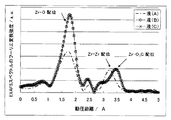
大型放射光施設SPring−8のビームラインBL14B2で測定した[Zr]=0.1mol/lであり、炭酸種とジルコニウムのモル比が1.6、6および8の炭酸ジルコニウムアンモニウム水溶液、それぞれ液(A)、(B)および(C)のZr−K吸収端(18.0keV)の拡張X線吸収微細構造(Extended X−ray Absorption Fine Structure、以下、EXAFSという)スペクトルを測定した。
そのスペクトルのフーリエ変換によって導出した液(A)、(B)および(C)のジルコニウム(IV)イオン周辺の動径分布関数を図1に示す。
これより、液(B)と液(C)の動径分布関数はピーク強度、位置、形状が一致していることから、両者のジルコニウム(IV)イオンが同じ構造を持っていることがわかる。Next, the relationship between the molar ratio of carbonic acid species and zirconium and the structure of zirconium (IV) ions will be described.
[Zr] measured at the beam line BL14B2 of the large synchrotron radiation facility SPring-8 = 0.1 mol / l, and each aqueous solution of ammonium zirconium carbonate having a carbon dioxide species / zirconium molar ratio of 1.6, 6 and 8 ( The extended X-ray absorption fine structure (hereinafter referred to as EXAFS) spectrum of the Zr-K absorption edge (18.0 keV) of A), (B) and (C) was measured.
FIG. 1 shows the radial distribution function around the zirconium (IV) ions of the liquids (A), (B), and (C) derived by Fourier transform of the spectrum.
Thus, the radial distribution functions of the liquid (B) and the liquid (C) have the same peak intensity, position, and shape, and thus it is understood that both zirconium (IV) ions have the same structure.
この動径分布関数の3.2Åのピークが2重の水酸基を介して重合したジルコニウム(IV)イオン(Zr−Zr配位)に帰属される成分であり、また、すぐ隣にある3.5Åの成分はジルコニウムに配位した炭酸種による成分である。動径分布関数の動径距離=2.7〜3.9Åの範囲で逆フーリエ変換を行い、上記2成分に関わるEXAFSスペクトルを抽出し、理論EXAFSスペクトルとのフィッティングを行った。
個々の配位成分の理論EXAFSスペクトルは、下記数式1で表される。The peak of 3.2Å of this radial distribution function is a component attributed to zirconium (IV) ions polymerized via a double hydroxyl group (Zr-Zr coordination), and 3.5Å These components are components of carbonic acid species coordinated to zirconium. The inverse Fourier transform was performed in the radial distance of the radial distribution function = 2.7 to 3.9 mm, the EXAFS spectrum related to the two components was extracted, and fitting with the theoretical EXAFS spectrum was performed.
The theoretical EXAFS spectrum of each coordination component is expressed by the following
この理論計算ではZr−Zr配位およびジルコニウム(IV)イオンへの炭酸種の配位の構造モデルとして炭酸ジルコニウムアンモニウム(NH4)3Zr(OH)(CO3)3・2H2Oの結晶構造(A.Clearfield,Inorganica Chimica Acta,4:1,March,166(1970))を参照した。
In this theoretical calculation, the crystal structure of ammonium zirconium carbonate (NH 4 ) 3 Zr (OH) (CO 3 ) 3 .2H 2 O as a structural model of Zr—Zr coordination and coordination of carbonic acid species to zirconium (IV) ions. (A. Clearfield, Inorganica Chimica Acta, 4: 1, March, 166 (1970)).
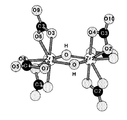
図2に上記炭酸ジルコニウムアンモニウム(NH4)3Zr(OH)(CO3)3・2H2O結晶のジルコニウム(IV)イオン周辺構造の模式図を示す。
水溶液中のジルコニウム(IV)イオンの重合度、構造および炭酸種の配位数によらず、個々の配位構造について見れば、Zr−Zr配位に関しては2重の水酸基を介した配位であること、炭酸種の配位については炭酸種が2つの酸素によって二座配位している構造は上記結晶と同様のものであるため、理論計算のためにこのモデル採用した前提は妥当なものである。
具体的には、Zr−Zr配位成分として図2におけるZr1−Zr2(距離3.498Å)、ジルコニウム(IV)イオンに配位した炭酸種の成分としてZr1−O5−C1−Zr1およびZr1−C2−O9−C2−Zr1(距離はともに3.898Å)の経路の光電子散乱による3つの理論EXAFSスペクトルを計算した。
そして、数式1におけるN;配位数、r:配位距離、σ:Debye−Waller因子およびk:光電子の波数をパラメータとして逆フーリエ変換によって導出した実スペクトルに対して、これら3つの理論EXAFSスペクトルを同時にフィッティングし、Zr−Zr配位数を決定した。
EXAFSスペクトルのフーリエ変換による動径分布関数の導出、逆フーリエ変換および理論計算スペクトルと実スペクトルのフィッティングには解析ソフトウェアREX2000(RIGAKU製)を使用した。FIG. 2 shows a schematic diagram of the peripheral structure of the zirconium (IV) ion of the ammonium ammonium carbonate (NH 4 ) 3 Zr (OH) (CO 3 ) 3 .2H 2 O crystal.
Regardless of the degree of polymerization of the zirconium (IV) ion in the aqueous solution, the structure, and the coordination number of the carbonic acid species, the Zr-Zr coordination is coordinated via a double hydroxyl group. As for the coordination of carbonic acid species, the structure in which the carbonic acid species are bidentately coordinated by two oxygens is the same as the above crystal, so the assumption that this model was adopted for the theoretical calculation is reasonable. It is.
Specifically, Zr1-Zr2 (distance: 3.498 mm) in FIG. 2 as a Zr-Zr coordination component, Zr1-O5-C1-Zr1 and Zr1-C2 as carbonic acid species components coordinated to zirconium (IV) ions. Three theoretical EXAFS spectra were calculated by photoelectron scattering along the path of -O9-C2-Zr1 (distance is 3.898 mm).
In addition, these three theoretical EXAFS spectra with respect to the actual spectrum derived by inverse Fourier transform using N: Coordination number, r: Coordination distance, σ: Debye-Waller factor and k: Photoelectron wave number as parameters in
Analysis software REX2000 (manufactured by RIGAKU) was used for the derivation of the radial distribution function by the Fourier transform of the EXAFS spectrum, the inverse Fourier transform, and the fitting of the theoretical calculation spectrum and the actual spectrum.
この定量的解析の結果、Zr−Zr配位数は液(A)で4、液(B)および液(C)では0であった。
Zr−Zr配位数が4であることの意味は、ひとつのジルコニウム(IV)イオンが2重の水酸基を介して4つのジルコニウム(IV)イオンと配位しているということである。この場合、少なくともジルコニウム(IV)イオンはモノマー(理論Zr−Zr配位数:0)およびダイマー(理論Zr−Zr配位数:1)ではありえず、従って液(A)の重合度は少なくとも3以上であると結論できる。
一方、Zr−Zr配位数が0であった液(B)および(C)はモノマー構造であると推定される。As a result of this quantitative analysis, the Zr—Zr coordination number was 4 for liquid (A) and 0 for liquid (B) and liquid (C).
A Zr—Zr coordination number of 4 means that one zirconium (IV) ion is coordinated with four zirconium (IV) ions via a double hydroxyl group. In this case, at least the zirconium (IV) ion cannot be a monomer (theoretical Zr-Zr coordination number: 0) and a dimer (theoretical Zr-Zr coordination number: 1), and therefore the degree of polymerization of the liquid (A) is at least 3 It can be concluded that this is the case.
On the other hand, the liquids (B) and (C) in which the Zr—Zr coordination number was 0 are presumed to have a monomer structure.
次に、FEFF6で計算したモノマーモデルとダイマーモデルによる理論計算スペクトルならびに液(A)、(B)および(C)の実スペクトルの視覚的な比較を行った。
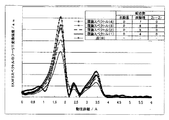
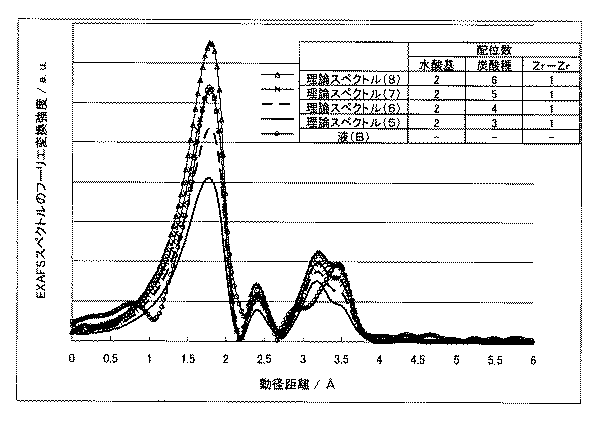
モノマーモデルにおいて炭酸種の配位数を変化させたときの理論計算EXAFSスペクトルおよび液(B)のEXAFSスペクトルのフーリエ変換によって導出した動径分布関数を図3に示す。
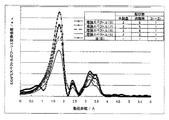
また、ダイマーモデルについても同様に図4に示す。ダイマーモデルでは図2のようにジルコニウム(IV)イオンが2重の水酸基を介して配位した構造を想定しているため、Zr−Zr配位数を1、水酸基の配位数を2とした。
図3より、液(B)の動径分布関数はモノマーの炭酸種の配位数6のモデルと最もよく一致していることがわかる。
一方、ダイマーモデルと比較では、特に3.2Å付近のZr−Zr配位成分での乖離が大きく、液(B)がZr−Zr配位を持たないことが裏付けられた。
この、視覚的な検証からも液(B)および(C)がモノマー構造であることが確認された。Next, a visual comparison was made between the theoretical calculation spectrum by the monomer model calculated by FEFF6 and the dimer model and the actual spectrum of the liquids (A), (B) and (C).
FIG. 3 shows a radial distribution function derived by Fourier transform of the theoretical calculation EXAFS spectrum and the EXAFS spectrum of the liquid (B) when the coordination number of carbonic acid species is changed in the monomer model.
The dimer model is also shown in FIG. Since the dimer model assumes a structure in which zirconium (IV) ions are coordinated via a double hydroxyl group as shown in FIG. 2, the Zr-Zr coordination number is 1, and the coordination number of the hydroxyl group is 2. .
From FIG. 3, it can be seen that the radial distribution function of the liquid (B) most closely matches the model of the
On the other hand, in comparison with the dimer model, the divergence in the Zr-Zr coordination component near 3.2 mm was particularly large, and it was confirmed that the liquid (B) does not have the Zr-Zr coordination.
This visual verification also confirmed that the liquids (B) and (C) had a monomer structure.
本発明の炭酸ジルコニウムアンモニウム水溶液はキレート化剤を含有する。キレート化剤とジルコニウムのモル比(キレート化剤/ジルコニウム)は、0.01〜1である。好ましい範囲はキレート化剤により異なるので、後述する。
炭酸種を配位子としたジルコニウム(IV)イオンと水溶性高分子化合物との架橋反応が起こる状況では、ジルコニウム(IV)イオン同士の重合反応も競合的に発生すると考えられる。理由は明らかではないが、キレート化剤はあらかじめジルコニウム(IV)イオンに配位しているか、または、炭酸種との置換によってジルコニウム(IV)イオンに配位することによって、このジルコニウム(IV)イオン同士の重合反応のみを抑制するように作用すると考えられる。
キレート化剤とジルコニウムのモル比が0.01未満では上記の効果が十分に得られず、1を超えると水溶性高分子化合物との架橋反応が妨害されるため好ましくない。
本発明に有効なキレート化剤としては、エタノールアミン類、酒石酸、クエン酸、乳酸、グルコン酸、グリコール酸ならびにこれらの塩等が挙げられ、これらの1種または2種以上を用いることができる。エタノールアミン類としては、モノエタノールアミン、ジエタノールアミンおよびトリエタノールアミンが例示される。
これらの中で、トリエタノールアミン、酒石酸、グルコン酸ならびにこれらの塩が高い架橋性能が得られる点で好ましく、グルコン酸ならびにその塩が特に好ましい。
キレート化剤として、グルコン酸ならびにその塩を用いた場合には、キレート化剤とジルコニウムのモル比は、好ましくは0.1〜0.9である。
キレート化剤として、グルコン酸ならびにその塩以外のものを用いた場合には、キレート化剤とジルコニウムのモル比は、好ましくは0.05〜0.2である。The aqueous ammonium zirconium carbonate solution of the present invention contains a chelating agent. The molar ratio of chelating agent to zirconium (chelating agent / zirconium) is 0.01-1. The preferable range varies depending on the chelating agent and will be described later.
In a situation where a crosslinking reaction between a zirconium (IV) ion having a carbonate species as a ligand and a water-soluble polymer compound occurs, it is considered that a polymerization reaction between zirconium (IV) ions also occurs competitively. The reason is not clear, but the chelating agent is pre-coordinated to the zirconium (IV) ion, or by coordinating to the zirconium (IV) ion by substitution with a carbonate species, this zirconium (IV) ion It is considered to act so as to suppress only the polymerization reaction between each other.
If the molar ratio of the chelating agent and zirconium is less than 0.01, the above effect cannot be obtained sufficiently, and if it exceeds 1, the crosslinking reaction with the water-soluble polymer compound is hindered.
Examples of the chelating agent effective in the present invention include ethanolamines, tartaric acid, citric acid, lactic acid, gluconic acid, glycolic acid, and salts thereof, and one or more of these can be used. Examples of ethanolamines include monoethanolamine, diethanolamine and triethanolamine.
Among these, triethanolamine, tartaric acid, gluconic acid and salts thereof are preferable in that high crosslinking performance is obtained, and gluconic acid and salts thereof are particularly preferable.
When gluconic acid or a salt thereof is used as the chelating agent, the molar ratio of the chelating agent to zirconium is preferably 0.1 to 0.9.
When a chelating agent other than gluconic acid or a salt thereof is used, the molar ratio of the chelating agent to zirconium is preferably 0.05 to 0.2.
本発明の炭酸ジルコニウムアンモニウム水溶液の濃度は[Zr]=0.1mol/l以上が好ましい。この濃度未満の場合は、ジルコニウム(IV)イオンに配位した炭酸種が脱離してしまい、モノマーまたはダイマーの構造を維持できない可能性がある。
なお、上限は特に限定されるものではないが、[Zr]= 2mol/l程度である。
また、本発明の炭酸ジルコニウムアンモニウム水溶液のpHは特に限定されないが、炭酸種の揮発を抑制するためpH7以上が望ましい。このpHの上限は特に限定されないが、通常、10〜11程度である。
本発明の炭酸ジルコニウムアンモニウム水溶液は、pHを7以上に制御するために塩基も含有する。塩基は、架橋反応の過程で揮発しやすく架橋反応を促進できるため、および、架橋反応後のジルコニウムと水溶性高分子化合物との反応生成物中に残留し難く、反応生成物の水への溶出を抑制できるため、アンモニアが望ましい。また、沸点の低いアミン類を使用してもよい。The concentration of the ammonium zirconium carbonate aqueous solution of the present invention is preferably [Zr] = 0.1 mol / l or more. If the concentration is less than this concentration, the carbonic acid species coordinated to the zirconium (IV) ion is eliminated, and the monomer or dimer structure may not be maintained.
The upper limit is not particularly limited, but is about [Zr] = 2 mol / l.
The pH of the aqueous ammonium zirconium carbonate solution of the present invention is not particularly limited, but is preferably pH 7 or higher in order to suppress volatilization of carbonate species. Although the upper limit of this pH is not specifically limited, Usually, it is about 10-11.
The aqueous ammonium zirconium carbonate solution of the present invention also contains a base in order to control the pH to 7 or higher. The base easily evaporates in the course of the cross-linking reaction and can promote the cross-linking reaction. Also, the base hardly remains in the reaction product of zirconium and the water-soluble polymer compound after the cross-linking reaction, and the reaction product is eluted into water. In view of this, ammonia is desirable. Moreover, you may use amines with a low boiling point.
ジルコニウム水溶液の製造方法
本発明の炭酸ジルコニウムアンモニウム水溶液は、最終的にジルコニウムに対する炭酸種のモル比が3〜9になればよいので、製造に用いるジルコニウム、炭酸種の原料種および使用量は特に限定されない。
本発明の炭酸ジルコニウムアンモニウム水溶液を製造するためのジルコニウム源としては、炭酸ジルコニウムアンモニウムの結晶(NH4)3Zr(OH)(CO3)3・2H2O、塩基性炭酸ジルコニウムZr(OH)(4−2n)(CO3)n・mH2O(n=0.4、m=7、第一稀元素化学工業株式会社製)、オキシ塩化ジルコニウムおよびオキシ硝酸ジルコニウム等が挙げられる。これらのジルコニウム源はジルコニウムに対するモル比が0.02以下のハフニウムを含有していてもよい。本発明の用途では上記の含有量においてハフニウムの悪影響は認められない。
炭酸種源としては、炭酸水素アンモニウム、炭酸アンモニウムおよび炭酸ガス等が挙げられる。
キレート化剤としては、エタノールアミン類、酒石酸、クエン酸、乳酸、グルコン酸およびグリコール酸ならびにこれらの塩等が挙げられ、これらの1種または2種以上を用いることができる。
これらの中で、トリエタノールアミン、酒石酸、グルコン酸ならびにこれらの塩が高い架橋性能が得られる点で好ましく、グルコン酸ならびにその塩が特に好ましい。
塩基源としてはアンモニア水、アンモニアガスおよびアミン類が挙げられる。 Method for Producing Zirconium Aqueous Solution Zirconium ammonium carbonate aqueous solution of the present invention only needs to have a molar ratio of carbonic acid species to zirconium of 3 to 9 in the end. Not.
The zirconium source for producing a zirconium ammonium carbonate aqueous solution of the present invention, the crystal of ammonium zirconium carbonate (NH 4) 3 Zr (OH ) (CO 3) 3 · 2H 2 O, zirconium basic carbonate Zr (OH) ( 4-2n) (CO 3 ) n · mH 2 O (n = 0.4, m = 7, manufactured by Daiichi Rare Element Chemical Industries, Ltd.), zirconium oxychloride, zirconium oxynitrate, and the like. These zirconium sources may contain hafnium having a molar ratio to zirconium of 0.02 or less. In the use of the present invention, no adverse effect of hafnium is observed at the above content.
Examples of the carbonic acid species source include ammonium hydrogen carbonate, ammonium carbonate, carbon dioxide gas, and the like.
Examples of the chelating agent include ethanolamines, tartaric acid, citric acid, lactic acid, gluconic acid, glycolic acid, and salts thereof, and one or more of these can be used.
Among these, triethanolamine, tartaric acid, gluconic acid and salts thereof are preferable in that high crosslinking performance is obtained, and gluconic acid and salts thereof are particularly preferable.
Examples of the base source include aqueous ammonia, ammonia gas, and amines.
本発明の炭酸ジルコニウムアンモニウム水溶液の具体的な製造方法としては、水に炭酸ジルコニウムアンモニウムの結晶(NH4)3Zr(OH)(CO3)3・2H2O、必要に応じてジルコニウムに対するモル比が6以下(0も含む)の炭酸水素アンモニウムおよびジルコニウムに対するモル比が0.01〜1のキレート化剤を添加し混合することで製造できる。
また、塩基性炭酸ジルコニウムZr(OH)(4−2n)(CO3)n・mH2O(n=0.4、m=7、第一稀元素化学工業製)、必要に応じてジルコニウムに対するモル比が2.6〜8.6の炭酸水素アンモニウムおよびジルコニウムに対するモル比が0.01〜1のキレート化剤を添加し、加熱することでも製造できる。
また、所定量のオキシ塩化ジルコニウム、オキシ硝酸ジルコニウム等の酸性塩、炭酸水素アンモニウムおよびキレート化剤を混合することで製造してもよい。Specific examples of the method for producing an aqueous ammonium zirconium carbonate solution of the present invention include crystals of ammonium ammonium carbonate (NH 4 ) 3 Zr (OH) (CO 3 ) 3 · 2H 2 O in water and, if necessary, a molar ratio to zirconium. Is 6 or less (including 0) ammonium hydrogen carbonate and a chelating agent having a molar ratio of 0.01 to 1 with respect to zirconium can be added and mixed.
Further, basic zirconium carbonate Zr (OH) (4-2n) (CO 3 ) n · mH 2 O (n = 0.4, m = 7, manufactured by 1st Rare Element Chemical Industries), if necessary, for zirconium It can also be produced by adding a chelating agent having a molar ratio of 0.01 to 1 to ammonium bicarbonate and zirconium having a molar ratio of 2.6 to 8.6 and heating.
Alternatively, it may be produced by mixing a predetermined amount of an acid salt such as zirconium oxychloride or zirconium oxynitrate, ammonium hydrogen carbonate and a chelating agent.
架橋性能の評価
本発明の炭酸ジルコニウムアンモニウム水溶液は、ポリビニルアルコール、アセトアセチル基変性ポリビニルアルコール、アミノ基変性ポリビニルアルコール、エポキシ変性ポリビニルアルコール、ポリアクリル酸、ポリアクリルアミド、ポリエステル、ポリウレタン、アルキッド樹脂、カルボキシメチルセルロース、ヒドロキシメチルセルロース、水溶性でんぷん等の多糖類、カゼイン、ゼラチン等のたんぱく類、イソブチレン/無水マレイン酸共重合体、スチレン/アクリル酸共重合体、スチレン/アクリル酸/アクリルアミド共重合体、カルボキシ変性スチレン/ブタジエン共重合体等の水溶性高分子化合物の架橋剤として高い効果を発揮する。
架橋反応はこれらの水溶性高分子化合物の親水性官能基である水酸基、カルボキシル基およびカルボニル基等の酸素が持つ非共有電子対がジルコニウムに配位することによると考えられるが、架橋反応の結果、上記親水基の親水性が低下するため、水溶性高分子化合物の水への溶解度は低下する。
本発明の炭酸ジルコニウムアンモニウム水溶液は、水溶性高分子化合物の固型分100重量部対して、ZrO2換算で0.1〜30重量部、好ましくは、1〜20重量部添加することで、最も水溶性高分子化合物を不溶化させる、即ち、効率よく架橋することができる。 Evaluation of cross-linking performance The aqueous solution of ammonium zirconium carbonate of the present invention comprises polyvinyl alcohol, acetoacetyl group-modified polyvinyl alcohol, amino group-modified polyvinyl alcohol, epoxy-modified polyvinyl alcohol, polyacrylic acid, polyacrylamide, polyester, polyurethane, alkyd resin, carboxymethyl cellulose. , Hydroxymethylcellulose, polysaccharides such as water-soluble starch, proteins such as casein and gelatin, isobutylene / maleic anhydride copolymer, styrene / acrylic acid copolymer, styrene / acrylic acid / acrylamide copolymer, carboxy-modified styrene / Highly effective as a crosslinking agent for water-soluble polymer compounds such as butadiene copolymers.
The crosslinking reaction is thought to be due to the coordination of unshared electron pairs of oxygen such as hydroxyl groups, carboxyl groups and carbonyl groups, which are the hydrophilic functional groups of these water-soluble polymer compounds, with the results of the crosslinking reaction. Since the hydrophilicity of the hydrophilic group is lowered, the solubility of the water-soluble polymer compound in water is lowered.
The aqueous solution of ammonium zirconium carbonate of the present invention is added in an amount of 0.1 to 30 parts by weight, preferably 1 to 20 parts by weight in terms of ZrO 2 with respect to 100 parts by weight of the solid component of the water-soluble polymer compound. The water-soluble polymer compound can be insolubilized, that is, can be efficiently crosslinked.
以下に、本発明の炭酸ジルコニウムアンモニウム水溶液の架橋性能の評価方法を示す。
ゴーセファイマーZ−200(アセトアセチル基変性ポリビニルアルコール、日本合成化学工業株式会社製)を純水に溶解し10wt%水溶液とした。ゴーセファイマーZ−200の10wt%水溶液12.8gにジルコニウム換算で0.001mol(0.1mol/l×10ml)の炭酸ジルコニウムアンモニウム水溶液を添加した混合液より、1.0gを取り、30mmの丸型平底シャーレの底部に均一に引き伸ばした。
このシャーレを室温で1週間静置後、70℃で30分加熱処理を行い、本発明のジルコニウム水溶液で架橋したゴーセファイマーZ−200フィルムを得た。このフィルムをシャーレごと80℃の水浴に1時間浸漬し、水浴に浸漬する前後での重量差から、浸漬後のフィルムの残存率を求めた。この評価方法においてフィルムの残存率が高いものほど架橋性能が高いといえる。Below, the evaluation method of the crosslinking performance of the ammonium zirconium carbonate aqueous solution of this invention is shown.
Goosefimomer Z-200 (acetoacetyl group-modified polyvinyl alcohol, manufactured by Nippon Synthetic Chemical Industry Co., Ltd.) was dissolved in pure water to give a 10 wt% aqueous solution. 1.0 g was taken from a mixed solution obtained by adding 0.001 mol (0.1 mol / l × 10 ml) of zirconium ammonium carbonate aqueous solution in terms of zirconium to 12.8 g of 10 wt% aqueous solution of GOHSEIMER Z-200, and a 30 mm round It was uniformly stretched to the bottom of the flat bottom petri dish.
The petri dish was allowed to stand at room temperature for 1 week and then heat-treated at 70 ° C. for 30 minutes to obtain a Goosefimmer Z-200 film crosslinked with the aqueous zirconium solution of the present invention. The film was immersed in a water bath at 80 ° C. for 1 hour together with the petri dish, and the residual ratio of the film after immersion was determined from the weight difference before and after being immersed in the water bath. In this evaluation method, it can be said that the higher the residual ratio of the film, the higher the crosslinking performance.
以下に実施例および比較例を示し、本発明をより具体的に説明する。但し、本発明はこれらに何ら限定されるものではない。
なお、大型放射光施設SPring−8のビームラインBL14B2のEXAFS測定で用いた[Zr]=0.1mol/lであり、炭酸種とジルコニウムのモル比が1.6、6および8の炭酸ジルコニウムアンモニウム水溶液、それぞれ液(A)、(B)および(C)の作製方法は、以下の通りである。
<液(A)(炭酸種/Zr モル比=1.6)>
塩基性炭酸ジルコニウムZr(OH)(4−2n)(CO3)n・mH2O(n=0.4、m=7、第一稀元素化学工業株式会社製)100gに炭酸水素アンモニウム32.2g、25%アンモニア水19.0gおよび純水30mlを混合し、50℃で12時間加熱し、炭酸ジルコニウムアンモニウム水溶液を得た。該水溶液5.3g(ジルコニウム換算で0.01mol)を取り分け、純水で希釈し100mlとして、0.1mol/lの炭酸ジルコニウムアンモニウム水溶液を得た。
<液(B)(炭酸種/Zr モル比=6)>
純水60mlに炭酸ジルコニウムアンモニウム結晶{(NH4)3Zr(OH)(CO3)3・2H2O、以下、同様。}(純度90%、ZrO2換算濃度29.53%)を4.17g、炭酸水素アンモニウム2.37gを添加、混合し、さらに100mlとなるように純水を加え、0.1mol/lの炭酸ジルコニウムアンモニウム水溶液を得た。
<液(C)(炭酸種/Zr モル比=8)>
純水60mlに炭酸ジルコニウムアンモニウム結晶(純度90%、ZrO2換算濃度29.53%)を4.17g、炭酸水素アンモニウム3.95gを添加、混合し、さらに100mlとなるように純水を加え、0.1mol/lの炭酸ジルコニウムアンモニウム水溶液を得た。Hereinafter, the present invention will be described in more detail with reference to Examples and Comparative Examples. However, the present invention is not limited to these.
In addition, [Zr] = 0.1 mol / l used in the EXAFS measurement of the beam line BL14B2 of the large synchrotron radiation facility SPring-8, and the molar ratio of carbonate species to zirconium is 1.6, 6 and 8 The preparation methods of the aqueous solutions and the liquids (A), (B), and (C) are as follows.
<Liquid (A) (carbonic acid species / Zr molar ratio = 1.6)>
Basic zirconium carbonate Zr (OH) (4-2n) (CO 3 ) n · mH 2 O (n = 0.4, m = 7, manufactured by Daiichi Rare Element Chemical Co., Ltd.) 100 g and ammonium hydrogen carbonate 32. 2 g, 19.0 g of 25% aqueous ammonia and 30 ml of pure water were mixed and heated at 50 ° C. for 12 hours to obtain an aqueous ammonium zirconium carbonate solution. 5.3 g (0.01 mol in terms of zirconium) of the aqueous solution was separated and diluted with pure water to make 100 ml to obtain a 0.1 mol / l zirconium ammonium carbonate aqueous solution.
<Liquid (B) (carbonic acid species / Zr molar ratio = 6)>
Ammonium zirconium carbonate crystals {(NH 4 ) 3 Zr (OH) (CO 3 ) 3 · 2H 2 O in 60 ml of pure water, and so on. } (Purity 90%, ZrO 2 equivalent concentration 29.53%) 4.17 g and ammonium hydrogen carbonate 2.37 g were added and mixed, and pure water was added to make 100 ml, and 0.1 mol / l carbonic acid carbonate was added. An aqueous zirconium ammonium solution was obtained.
<Liquid (C) (carbonic acid species / Zr molar ratio = 8)>
To 60 ml of pure water, 4.17 g of ammonium zirconium carbonate crystals (purity 90%, ZrO 2 equivalent concentration 29.53%) and 3.95 g of ammonium hydrogen carbonate were added and mixed, and pure water was further added to 100 ml, A 0.1 mol / l aqueous zirconium carbonate solution was obtained.
純水60mlに炭酸ジルコニウムアンモニウム結晶(純度90%、ZrO2換算濃度29.53%)4.17gおよびトリエタノールアミン0.075gを添加、混合し、さらに100mlとなるように純水を加え、0.1mol/lの炭酸ジルコニウムアンモニウム水溶液を得た。
該炭酸ジルコニウムアンモニウム水溶液の炭酸種とジルコニウムとのモル比は3で、トリエタノールアミンとジルコニウムのモル比は0.05であった。
該ジルコニウム水溶液の架橋性能を評価したところ、ゴーセファイマーZ−200の残存率は78%であった。To 60 ml of pure water, 4.17 g of ammonium zirconium carbonate crystals (purity 90%, ZrO 2 equivalent concentration 29.53%) and 0.075 g of triethanolamine were added and mixed, and pure water was further added to make 100 ml. A 1 mol / l aqueous solution of ammonium zirconium carbonate was obtained.
The molar ratio of the carbonic acid species and zirconium in the aqueous ammonium zirconium carbonate solution was 3, and the molar ratio of triethanolamine and zirconium was 0.05.
When the crosslinking performance of the zirconium aqueous solution was evaluated, the residual ratio of Gohsephimer Z-200 was 78%.
トリエタノールアミンとジルコニウムのモル比を0.1とした以外は、実施例1と同様にして、0.1mol/lの炭酸ジルコニウムアンモニウム水溶液を得た。
該ジルコニウム水溶液の架橋性能を評価したところ、ゴーセファイマーZ−200の残存率は81%であった。A 0.1 mol / l zirconium ammonium carbonate aqueous solution was obtained in the same manner as in Example 1 except that the molar ratio of triethanolamine to zirconium was 0.1.
When the crosslinking performance of the aqueous zirconium solution was evaluated, the residual ratio of Gohsephimer Z-200 was 81%.
トリエタノールアミンとジルコニウムのモル比を0.2とした以外は、実施例1と同様にして、0.1mol/lの炭酸ジルコニウムアンモニウム水溶液を得た。
該ジルコニウム水溶液の架橋性能を評価したところ、ゴーセファイマーZ−200の残存率は79%であった。A 0.1 mol / l zirconium ammonium carbonate aqueous solution was obtained in the same manner as in Example 1 except that the molar ratio of triethanolamine to zirconium was 0.2.
When the crosslinking performance of the aqueous zirconium solution was evaluated, the residual ratio of Goosephimer Z-200 was 79%.
純水60mlに炭酸ジルコニウムアンモニウム結晶(純度90%、ZrO2換算濃度29.53%)4.17g、炭酸水素アンモニウム2.37gおよびトリエタノールアミン0.075g添加、混合し、さらに100mlとなるように純水を加え、0.1mol/lの炭酸ジルコニウムアンモニウム水溶液を得た。
該炭酸ジルコニウムアンモニウム水溶液の炭酸種とジルコニウムとのモル比は6で、トリエタノールアミンとジルコニウムのモル比は0.05であった。
該ジルコニウム水溶液の架橋性能を評価したところ、ゴーセファイマーZ−200の残存率は80%であった。To 60 ml of pure water, 4.17 g of zirconium ammonium carbonate crystals (purity 90%, ZrO 2 conversion concentration 29.53%), 2.37 g of ammonium hydrogen carbonate and 0.075 g of triethanolamine were added and mixed, so that the volume became 100 ml. Pure water was added to obtain a 0.1 mol / l aqueous zirconium carbonate carbonate solution.
The molar ratio between the carbonic acid species and zirconium in the aqueous ammonium zirconium carbonate solution was 6, and the molar ratio between triethanolamine and zirconium was 0.05.
When the crosslinking performance of the zirconium aqueous solution was evaluated, the residual ratio of Gohsephimer Z-200 was 80%.
トリエタノールアミンとジルコニウムのモル比を0.1とした以外は、実施例4と同様にして、0.1mol/lの炭酸ジルコニウムアンモニウム水溶液を得た。
該ジルコニウム水溶液の架橋性能を評価したところ、ゴーセファイマーZ−200の残存率は82%であった。A 0.1 mol / l zirconium ammonium carbonate aqueous solution was obtained in the same manner as in Example 4 except that the molar ratio of triethanolamine to zirconium was 0.1.
When the crosslinking performance of the aqueous zirconium solution was evaluated, the residual ratio of Gohsephimer Z-200 was 82%.
トリエタノールアミンとジルコニウムのモル比を0.2とした以外は、実施例4と同様にして、0.1mol/lの炭酸ジルコニウムアンモニウム水溶液を得た。
該ジルコニウム水溶液の架橋性能を評価したところ、ゴーセファイマーZ−200の残存率は81%であった。A 0.1 mol / l zirconium ammonium carbonate aqueous solution was obtained in the same manner as in Example 4 except that the molar ratio of triethanolamine to zirconium was 0.2.
When the crosslinking performance of the aqueous zirconium solution was evaluated, the residual ratio of Gohsephimer Z-200 was 81%.
トリエタノールアミンの代わりに酒石酸アンモニウム0.092gを用いた以外は、実施例1と同様にして、0.1mol/lの炭酸ジルコニウムアンモニウム水溶液を得た。
該炭酸ジルコニウムアンモニウム水溶液の炭酸種とジルコニウムとのモル比は3で、酒石酸アンモニウムとジルコニウムのモル比は0.05であった。
該ジルコニウム水溶液の架橋性能を評価したところ、ゴーセファイマーZ−200の残存率は78%であった。A 0.1 mol / l zirconium ammonium carbonate aqueous solution was obtained in the same manner as in Example 1 except that 0.092 g of ammonium tartrate was used instead of triethanolamine.
The molar ratio between the carbonic acid species and zirconium in the aqueous ammonium zirconium carbonate solution was 3, and the molar ratio between ammonium tartrate and zirconium was 0.05.
When the crosslinking performance of the zirconium aqueous solution was evaluated, the residual ratio of Gohsephimer Z-200 was 78%.
酒石酸アンモニウムとジルコニウムのモル比を0.1とした以外は、実施例7と同様にして、0.1mol/lの炭酸ジルコニウムアンモニウム水溶液を得た。
該ジルコニウム水溶液の架橋性能を評価したところ、ゴーセファイマーZ−200の残存率は78%であった。A 0.1 mol / l zirconium ammonium carbonate aqueous solution was obtained in the same manner as in Example 7 except that the molar ratio of ammonium tartrate to zirconium was 0.1.
When the crosslinking performance of the zirconium aqueous solution was evaluated, the residual ratio of Gohsephimer Z-200 was 78%.
酒石酸アンモニウムとジルコニウムのモル比を0.2とした以外は、実施例7と同様にして、0.1mol/lの炭酸ジルコニウムアンモニウム水溶液を得た。
該ジルコニウム水溶液の架橋性能を評価したところ、ゴーセファイマーZ−200の残存率は77%であった。A 0.1 mol / l zirconium ammonium carbonate aqueous solution was obtained in the same manner as in Example 7 except that the molar ratio of ammonium tartrate to zirconium was 0.2.
When the crosslinking performance of the aqueous zirconium solution was evaluated, the residual ratio of Gohsephimer Z-200 was 77%.
トリエタノールアミンの代わりに酒石酸アンモニウム0.092gを用いた以外は、実施例4と同様にして、0.1mol/lの炭酸ジルコニウムアンモニウム水溶液を得た。
該炭酸ジルコニウムアンモニウム水溶液の炭酸種とジルコニウムとのモル比は6で、酒石酸アンモニウムとジルコニウムのモル比は0.05であった。
該ジルコニウム水溶液の架橋性能を評価したところ、ゴーセファイマーZ−200の残存率は76%であった。A 0.1 mol / l zirconium ammonium carbonate aqueous solution was obtained in the same manner as in Example 4 except that 0.092 g of ammonium tartrate was used instead of triethanolamine.
The molar ratio between the carbonic acid species and zirconium in the aqueous zirconium carbonate solution was 6, and the molar ratio between ammonium tartrate and zirconium was 0.05.
When the crosslinking performance of the aqueous zirconium solution was evaluated, the residual ratio of Gohsephimer Z-200 was 76%.
酒石酸アンモニウムとジルコニウムのモル比を0.1とした以外は、実施例10と同様にして、0.1mol/lの炭酸ジルコニウムアンモニウム水溶液を得た。
該ジルコニウム水溶液の架橋性能を評価したところ、ゴーセファイマーZ−200の残存率は75%であった。A 0.1 mol / l zirconium ammonium carbonate aqueous solution was obtained in the same manner as in Example 10 except that the molar ratio of ammonium tartrate to zirconium was 0.1.
When the crosslinking performance of the zirconium aqueous solution was evaluated, the residual ratio of Gohsephimer Z-200 was 75%.
トリエタノールアミンの代わりにグルコン酸0.10gを用いた以外は、実施例1と同様にして、0.1mol/lの炭酸ジルコニウムアンモニウム水溶液を得た。
該炭酸ジルコニウムアンモニウム水溶液の炭酸種とジルコニウムとのモル比は3で、グルコン酸とジルコニウムのモル比は0.05であった。
該ジルコニウム水溶液の架橋性能を評価したところ、ゴーセファイマーZ−200の残存率は74%であった。A 0.1 mol / l zirconium ammonium carbonate aqueous solution was obtained in the same manner as in Example 1 except that 0.10 g of gluconic acid was used instead of triethanolamine.
The molar ratio of carbonic acid species and zirconium in the aqueous zirconium carbonate solution was 3, and the molar ratio of gluconic acid and zirconium was 0.05.
When the crosslinking performance of the zirconium aqueous solution was evaluated, the residual ratio of Gohsephimer Z-200 was 74%.
グルコン酸とジルコニウムのモル比を0.1、0.2、0.4および0.6とした以外は、実施例12と同様にして、0.1mol/lの炭酸ジルコニウムアンモニウム水溶液を得た。
該ジルコニウム水溶液の架橋性能を評価したところ、ゴーセファイマーZ−200の残存率は、それぞれ、79%、85%および84%であった。A 0.1 mol / l zirconium ammonium carbonate aqueous solution was obtained in the same manner as in Example 12 except that the molar ratio of gluconic acid to zirconium was 0.1, 0.2, 0.4, and 0.6.
When the crosslinking performance of the zirconium aqueous solution was evaluated, the residual ratios of Goosephimer Z-200 were 79%, 85% and 84%, respectively.
トリエタノールアミンの代わりにグルコン酸0.10gを用いた以外は、実施例4と同様にして、0.1mol/lの炭酸ジルコニウムアンモニウム水溶液を得た。
該炭酸ジルコニウムアンモニウム水溶液の炭酸種とジルコニウムとのモル比は6で、グルコン酸とジルコニウムのモル比は0.05であった。
該ジルコニウム水溶液の架橋性能を評価したところ、ゴーセファイマーZ−200の残存率は76%であった。A 0.1 mol / l zirconium ammonium carbonate aqueous solution was obtained in the same manner as in Example 4 except that 0.10 g of gluconic acid was used instead of triethanolamine.
The molar ratio of the carbonic acid species and zirconium in the aqueous zirconium ammonium carbonate solution was 6, and the molar ratio of gluconic acid and zirconium was 0.05.
When the crosslinking performance of the aqueous zirconium solution was evaluated, the residual ratio of Gohsephimer Z-200 was 76%.
グルコン酸とジルコニウムのモル比を0.3、0.4、0.6、0.8および1.0とした以外は、実施例12と同様にして、0.1mol/lの炭酸ジルコニウムアンモニウム水溶液を得た。
該ジルコニウム水溶液の架橋性能を評価したところ、ゴーセファイマーZ−200の残存率は、それぞれ、83%、84%、91%、90%および78%であった。0.1 mol / l zirconium ammonium carbonate aqueous solution in the same manner as in Example 12, except that the molar ratio of gluconic acid to zirconium was 0.3, 0.4, 0.6, 0.8 and 1.0 Got.
When the crosslinking performance of the zirconium aqueous solution was evaluated, the residual ratios of GOHSEPHIMER Z-200 were 83%, 84%, 91%, 90% and 78%, respectively.
(比較例1)
塩基性炭酸ジルコニウムZr(OH)(4−2n)(CO3)n・mH2O(n=0.4、m=7、第一稀元素化学工業株式会社製)100gに炭酸水素アンモニウム32.2g、25%アンモニア水19.0g、トリエタノールアミン2.5gおよび純水30mlを混合し、50℃で12時間加熱し炭酸ジルコニウムアンモニウム水溶液を得た。該水溶液5.4g(ジルコニウム換算で0.01mol)を取り分け、純水で希釈し100mlとして、0.1mol/lの炭酸ジルコニウムアンモニウム水溶液を得た。
該ジルコニウム水溶液の炭酸種とジルコニウムとのモル比は1.6で、トリエタノールアミンとジルコニウムのモル比は0.05であった。
該ジルコニウム水溶液の架橋性能を評価したところ、ゴーセファイマーZ−200の残存率は68%であった。(Comparative Example 1)
Basic zirconium carbonate Zr (OH) (4-2n) (CO 3 ) n · mH 2 O (n = 0.4, m = 7, manufactured by Daiichi Rare Element Chemical Co., Ltd.) 100 g and ammonium hydrogen carbonate 32. 2 g, 25% aqueous ammonia 19.0 g, triethanolamine 2.5 g and 30 ml of pure water were mixed and heated at 50 ° C. for 12 hours to obtain an aqueous zirconium carbonate carbonate solution. 5.4 g (0.01 mol in terms of zirconium) of the aqueous solution was separated and diluted with pure water to make 100 ml to obtain a 0.1 mol / l zirconium ammonium carbonate aqueous solution.
The molar ratio of carbonic acid species and zirconium in the aqueous zirconium solution was 1.6, and the molar ratio of triethanolamine and zirconium was 0.05.
When the crosslinking performance of the aqueous zirconium solution was evaluated, the residual ratio of Goosephimer Z-200 was 68%.
(比較例2)
トリエタノールアミンとジルコニウムのモル比を0.1とした以外は、比較例1と同様にして、0.1mol/l炭酸ジルコニウムアンモニウム水溶液を得た。
該ジルコニウム水溶液の架橋性能を評価したところ、ゴーセファイマーZ−200の残存率は71%であった。(Comparative Example 2)
A 0.1 mol / l zirconium ammonium carbonate aqueous solution was obtained in the same manner as in Comparative Example 1 except that the molar ratio of triethanolamine to zirconium was 0.1.
When the crosslinking performance of the zirconium aqueous solution was evaluated, the residual ratio of Goosephimer Z-200 was 71%.
(比較例3)
トリエタノールアミンの代わりに酒石酸アンモニウム0.092gを用いた以外は、比較例1と同様にして、0.1mol/l炭酸ジルコニウムアンモニウム水溶液を得た。
該炭酸ジルコニウムアンモニウム水溶液の炭酸種とジルコニウムとのモル比は1.6で、酒石酸アンモニウムとジルコニウムのモル比は0.05であった。
該ジルコニウム水溶液の架橋性能を評価したところ、ゴーセファイマーZ−200の残存率は70%であった。(Comparative Example 3)
A 0.1 mol / l zirconium ammonium carbonate aqueous solution was obtained in the same manner as in Comparative Example 1 except that 0.092 g of ammonium tartrate was used instead of triethanolamine.
The molar ratio of the carbonic acid species and zirconium in the aqueous zirconium ammonium carbonate solution was 1.6, and the molar ratio of ammonium tartrate and zirconium was 0.05.
When the crosslinking performance of the zirconium aqueous solution was evaluated, the residual ratio of Gohsephimer Z-200 was 70%.
(比較例4)
酒石酸アンモニウムとジルコニウムのモル比を0.1とした以外は、比較例3と同様にして、0.1mol/l炭酸ジルコニウムアンモニウム水溶液を得た。
該ジルコニウム水溶液の架橋性能を評価したところ、ゴーセファイマーZ−200の残存率は68%であった。(Comparative Example 4)
A 0.1 mol / l zirconium ammonium carbonate aqueous solution was obtained in the same manner as in Comparative Example 3, except that the molar ratio of ammonium tartrate to zirconium was 0.1.
When the crosslinking performance of the aqueous zirconium solution was evaluated, the residual ratio of Goosephimer Z-200 was 68%.
(比較例5)
トリエタノールアミンの代わりにグルコン酸0.10gを用いた以外は、比較例1と同様にして、0.1mol/l炭酸ジルコニウムアンモニウム水溶液を得た。
該炭酸ジルコニウムアンモニウム水溶液の炭酸種とジルコニウムとのモル比は1.6で、グルコン酸とジルコニウムのモル比は0.05であった。
該ジルコニウム水溶液の架橋性能を評価したところ、ゴーセファイマーZ−200の残存率は69%であった。(Comparative Example 5)
A 0.1 mol / l zirconium ammonium carbonate aqueous solution was obtained in the same manner as in Comparative Example 1 except that 0.10 g of gluconic acid was used instead of triethanolamine.
The molar ratio of carbonic acid species and zirconium in the aqueous ammonium zirconium carbonate solution was 1.6, and the molar ratio of gluconic acid and zirconium was 0.05.
When the crosslinking performance of the aqueous zirconium solution was evaluated, the residual ratio of Gohsephimer Z-200 was 69%.
(比較例6)
グルコン酸とジルコニウムのモル比を0.1、0.2、0.4および0.6とした以外は、比較例5と同様にして、0.1mol/lの炭酸ジルコニウムアンモニウム水溶液を得た。
該ジルコニウム水溶液の架橋性能を評価したところ、ゴーセファイマーZ−200の残存率は、それぞれ、68%、64%、54%および45%であった。(Comparative Example 6)
A 0.1 mol / l zirconium ammonium carbonate aqueous solution was obtained in the same manner as in Comparative Example 5 except that the molar ratio of gluconic acid to zirconium was 0.1, 0.2, 0.4 and 0.6.
When the crosslinking performance of the aqueous zirconium solution was evaluated, the residual ratios of Gohsephimer Z-200 were 68%, 64%, 54% and 45%, respectively.
Claims (3)
Priority Applications (1)
| Application Number | Priority Date | Filing Date | Title |
|---|---|---|---|
| JP2012101809A JP6103818B2 (en) | 2011-09-12 | 2012-04-10 | Zirconium ammonium carbonate aqueous solution |
Applications Claiming Priority (3)
| Application Number | Priority Date | Filing Date | Title |
|---|---|---|---|
| JP2011218207 | 2011-09-12 | ||
| JP2011218207 | 2011-09-12 | ||
| JP2012101809A JP6103818B2 (en) | 2011-09-12 | 2012-04-10 | Zirconium ammonium carbonate aqueous solution |
Publications (2)
| Publication Number | Publication Date |
|---|---|
| JP2013075813A true JP2013075813A (en) | 2013-04-25 |
| JP6103818B2 JP6103818B2 (en) | 2017-03-29 |
Family
ID=48479586
Family Applications (1)
| Application Number | Title | Priority Date | Filing Date |
|---|---|---|---|
| JP2012101809A Active JP6103818B2 (en) | 2011-09-12 | 2012-04-10 | Zirconium ammonium carbonate aqueous solution |
Country Status (1)
| Country | Link |
|---|---|
| JP (1) | JP6103818B2 (en) |
Cited By (1)
| Publication number | Priority date | Publication date | Assignee | Title |
|---|---|---|---|---|
| WO2019049470A1 (en) * | 2017-09-11 | 2019-03-14 | 日東電工株式会社 | Conductive composition and biosensor |
Citations (10)
| Publication number | Priority date | Publication date | Assignee | Title |
|---|---|---|---|---|
| US3418073A (en) * | 1965-10-18 | 1968-12-24 | Nat Lead Co | Production of ammonium zirconyl carbonate |
| US3741782A (en) * | 1970-05-13 | 1973-06-26 | British Aluminium Co Ltd | Stabilized zirconium salts |
| JPS4851037A (en) * | 1971-10-22 | 1973-07-18 | ||
| US4061720A (en) * | 1972-10-13 | 1977-12-06 | Magnesium Elektron Limited | Preparation of ammonium and potassium zirconium carbonates |
| JPH08225767A (en) * | 1994-10-28 | 1996-09-03 | Hoechst Ag | Water-base dispersion for primer |
| JP2003220762A (en) * | 2002-01-30 | 2003-08-05 | Nippon Synthetic Chem Ind Co Ltd:The | Thin films and their uses |
| JP2003231775A (en) * | 2001-11-30 | 2003-08-19 | Matsumoto Seiyaku Kogyo Kk | Aqueous composition and crosslinking agent for water-soluble polymer |
| JP2004035276A (en) * | 2002-06-28 | 2004-02-05 | Nikkei Meru Kk | Ammonium zirconium carbonate aqueous solution |
| WO2010073916A1 (en) * | 2008-12-26 | 2010-07-01 | 日本パーカライジング株式会社 | Method of electrolytic ceramic coating for metal, electrolysis solution for electrolytic ceramic coating for metal, and metallic material |
| JP2011105580A (en) * | 2009-11-19 | 2011-06-02 | Daiichi Kigensokagaku Kogyo Co Ltd | SOL CONTAINING Zr-O-BASED PARTICLE AS DISPERSOID AND METHOD FOR PRODUCING THE SAME |
-
2012
- 2012-04-10 JP JP2012101809A patent/JP6103818B2/en active Active
Patent Citations (10)
| Publication number | Priority date | Publication date | Assignee | Title |
|---|---|---|---|---|
| US3418073A (en) * | 1965-10-18 | 1968-12-24 | Nat Lead Co | Production of ammonium zirconyl carbonate |
| US3741782A (en) * | 1970-05-13 | 1973-06-26 | British Aluminium Co Ltd | Stabilized zirconium salts |
| JPS4851037A (en) * | 1971-10-22 | 1973-07-18 | ||
| US4061720A (en) * | 1972-10-13 | 1977-12-06 | Magnesium Elektron Limited | Preparation of ammonium and potassium zirconium carbonates |
| JPH08225767A (en) * | 1994-10-28 | 1996-09-03 | Hoechst Ag | Water-base dispersion for primer |
| JP2003231775A (en) * | 2001-11-30 | 2003-08-19 | Matsumoto Seiyaku Kogyo Kk | Aqueous composition and crosslinking agent for water-soluble polymer |
| JP2003220762A (en) * | 2002-01-30 | 2003-08-05 | Nippon Synthetic Chem Ind Co Ltd:The | Thin films and their uses |
| JP2004035276A (en) * | 2002-06-28 | 2004-02-05 | Nikkei Meru Kk | Ammonium zirconium carbonate aqueous solution |
| WO2010073916A1 (en) * | 2008-12-26 | 2010-07-01 | 日本パーカライジング株式会社 | Method of electrolytic ceramic coating for metal, electrolysis solution for electrolytic ceramic coating for metal, and metallic material |
| JP2011105580A (en) * | 2009-11-19 | 2011-06-02 | Daiichi Kigensokagaku Kogyo Co Ltd | SOL CONTAINING Zr-O-BASED PARTICLE AS DISPERSOID AND METHOD FOR PRODUCING THE SAME |
Non-Patent Citations (1)
| Title |
|---|
| 高崎史進,外: "EXAFS分析法による炭酸ジルコニウムアンモニウム水溶液の溶存構造解析", 日本分析化学会第60年会講演要旨集, JPN6016020691, 31 August 2011 (2011-08-31), pages 245 - 1002, ISSN: 0003329856 * |
Cited By (4)
| Publication number | Priority date | Publication date | Assignee | Title |
|---|---|---|---|---|
| WO2019049470A1 (en) * | 2017-09-11 | 2019-03-14 | 日東電工株式会社 | Conductive composition and biosensor |
| JP2019048945A (en) * | 2017-09-11 | 2019-03-28 | 日東電工株式会社 | Conductive composition and biological sensor |
| US11217360B2 (en) | 2017-09-11 | 2022-01-04 | Nitto Denko Corporation | Electrically conductive composition and biosensor |
| US11837377B2 (en) | 2017-09-11 | 2023-12-05 | Nitto Denko Corporation | Electrically conductive composition and biosensor |
Also Published As
| Publication number | Publication date |
|---|---|
| JP6103818B2 (en) | 2017-03-29 |
Similar Documents
| Publication | Publication Date | Title |
|---|---|---|
| Lind et al. | Stereochemistry of ethylenediaminetetraacetato complexes. II. The structure of crystalline Rb [Fe (OH2) Y]. H2O. III. The structure of crystalline Li [Fe (OH2) Y. 2H2O | |
| US4085060A (en) | Sequestering compositions | |
| Stalick et al. | Structure of bis (tert-butyl isocyanide)(tetracyanoethylene) nickel (0), Ni ((CN) 2= C (CN) 2)(CH3) 3C-N. idn. C) 2 | |
| CN110627747A (en) | A kind of preparation method of epoxy quaternary ammonium salt | |
| Rajan et al. | Polymeric copper (II) complexes of hydroxy acids | |
| Scheidt | Crystallographic study of the structural trans effect. Molecular structure of oxoisopropoxobis (8-hydroxyquinolinato) vanadium (V) | |
| WO2008007497A1 (en) | Aqueous solutions of organic acid chromium(iii) salts and process for preparation thereof | |
| CN103553150A (en) | Preparation method of Co-Fe LDH (layered double hydroxide) | |
| JP6103818B2 (en) | Zirconium ammonium carbonate aqueous solution | |
| CN110818097A (en) | Phosphorus-free corrosion and scale inhibitor and preparation method thereof | |
| US5196456A (en) | Acrylate superabsorbent polymerization process | |
| Swift | The kinetics of structural transformation of hydrated cobalt (II) and zinc (II) ions in aqueous solution | |
| Blackburn et al. | Structure of hexaaquacopper (II) bromate | |
| Abu-Dari et al. | Coordination chemistry of microbial iron transport compounds. 18. Crystal and molecular structure of disodium triethylmethylammonium tris (thiobenzohydroximato) chromate (III) hemikis (sodium hydroxide hydrate), Na2 [(C2H5) 3 (CH3) N][Cr (PhC (S): N (O)) 3]. 1/2NaH3O2. 18H2O | |
| JP5674083B2 (en) | Iron oxyhydroxide sol and method for producing the same | |
| JP2677646B2 (en) | Method for producing colloidal silica | |
| JPH0859230A (en) | Production of aqueous solution of basic aluminum acetate | |
| Yamaguchi et al. | Crystal structure of (+) 589-. beta. 2-((R)-alaninato)(1, 7-bis (2 (S)-pyrrolidyl)-2, 6-diazaheptane) cobalt (III) perchlorate dihydrate | |
| JP3117614B2 (en) | Method for producing sterilizing purifying agent | |
| JP3134073B2 (en) | Water-soluble divalent and trivalent iron salt and method for producing the same | |
| Hoard et al. | Stereochemistry of dioxovanadium (V) complexes. I. Crystal and molecular structure of triammonium bis (oxalato) dioxovanadate (V) dihydrate | |
| JP2766990B2 (en) | New molybdic acid solution | |
| JPWO2022225049A5 (en) | ||
| CN114394681B (en) | Seawater desalination scale inhibitor and application thereof | |
| JPS63277511A (en) | Production of magnesium hydroxide and surface-treated magnesium hydroxide |
Legal Events
| Date | Code | Title | Description |
|---|---|---|---|
| A621 | Written request for application examination |
Free format text: JAPANESE INTERMEDIATE CODE: A621 Effective date: 20150129 |
|
| RD02 | Notification of acceptance of power of attorney |
Free format text: JAPANESE INTERMEDIATE CODE: A7422 Effective date: 20150129 |
|
| A977 | Report on retrieval |
Free format text: JAPANESE INTERMEDIATE CODE: A971007 Effective date: 20151028 |
|
| A131 | Notification of reasons for refusal |
Free format text: JAPANESE INTERMEDIATE CODE: A131 Effective date: 20151104 |
|
| A521 | Request for written amendment filed |
Free format text: JAPANESE INTERMEDIATE CODE: A523 Effective date: 20151216 |
|
| A131 | Notification of reasons for refusal |
Free format text: JAPANESE INTERMEDIATE CODE: A131 Effective date: 20160607 |
|
| A521 | Request for written amendment filed |
Free format text: JAPANESE INTERMEDIATE CODE: A523 Effective date: 20160803 |
|
| TRDD | Decision of grant or rejection written | ||
| A01 | Written decision to grant a patent or to grant a registration (utility model) |
Free format text: JAPANESE INTERMEDIATE CODE: A01 Effective date: 20170207 |
|
| A61 | First payment of annual fees (during grant procedure) |
Free format text: JAPANESE INTERMEDIATE CODE: A61 Effective date: 20170228 |
|
| R150 | Certificate of patent or registration of utility model |
Ref document number: 6103818 Country of ref document: JP Free format text: JAPANESE INTERMEDIATE CODE: R150 |
|
| R250 | Receipt of annual fees |
Free format text: JAPANESE INTERMEDIATE CODE: R250 |
|
| R250 | Receipt of annual fees |
Free format text: JAPANESE INTERMEDIATE CODE: R250 |
|
| R250 | Receipt of annual fees |
Free format text: JAPANESE INTERMEDIATE CODE: R250 |
|
| R250 | Receipt of annual fees |
Free format text: JAPANESE INTERMEDIATE CODE: R250 |
|
| R250 | Receipt of annual fees |
Free format text: JAPANESE INTERMEDIATE CODE: R250 |
|
| R250 | Receipt of annual fees |
Free format text: JAPANESE INTERMEDIATE CODE: R250 |
|
| R250 | Receipt of annual fees |
Free format text: JAPANESE INTERMEDIATE CODE: R250 |