JP2012201848A - Flat cable coating material and flat cable - Google Patents
Flat cable coating material and flat cable Download PDFInfo
- Publication number
- JP2012201848A JP2012201848A JP2011069555A JP2011069555A JP2012201848A JP 2012201848 A JP2012201848 A JP 2012201848A JP 2011069555 A JP2011069555 A JP 2011069555A JP 2011069555 A JP2011069555 A JP 2011069555A JP 2012201848 A JP2012201848 A JP 2012201848A
- Authority
- JP
- Japan
- Prior art keywords
- adhesive
- flat cable
- epoxy resin
- covering material
- adhesive layer
- Prior art date
- Legal status (The legal status is an assumption and is not a legal conclusion. Google has not performed a legal analysis and makes no representation as to the accuracy of the status listed.)
- Withdrawn
Links
Images

Landscapes
- Insulated Conductors (AREA)
- Insulating Bodies (AREA)
- Adhesives Or Adhesive Processes (AREA)
Abstract
【課題】硬化前であっても初期粘着性を有し、硬化後は、高温や摺動の厳しい環境下でも、密着性、柔軟性、耐熱性および難燃性に優れる粘接着剤を提供する。
【解決手段】基材と、前記基材の一方の面上に設けた粘接着層とを少なくとも含むフラットケーブル被覆材に使用される粘接着剤であって、アクリル系樹脂と、エポキシ系樹脂と、硬化剤と、水和金属化合物、リン酸化合物、メラミン系難燃剤、およびハロゲン系難燃剤からなる群から選択される少なくとも1種の難燃剤と、を含む構成とする。
【選択図】図1[Problem] To provide an adhesive having an initial adhesive property even before curing, and having excellent adhesion, flexibility, heat resistance and flame retardancy even after curing at high temperatures and severe sliding environments. To do.
An adhesive for use in a flat cable covering material including at least a base material and an adhesive layer provided on one surface of the base material, comprising an acrylic resin and an epoxy resin The resin, the curing agent, and at least one flame retardant selected from the group consisting of a hydrated metal compound, a phosphoric acid compound, a melamine flame retardant, and a halogen flame retardant are used.
[Selection] Figure 1
Description
本発明は、被覆材に使用される粘接着剤に関し、さらに詳しくは、電気機器、電子機器、その他等に使用されるフラットケーブルの被覆材に使用される、未硬化の状態で初期粘着性を有する粘接着剤に関する。 The present invention relates to an adhesive used for a covering material, and more particularly, an initial adhesive property in an uncured state used for a covering material for a flat cable used in electrical equipment, electronic equipment, etc. It relates to the adhesive which has.
従来、OA機器やゲーム機などの電子機器では、コンピューターと電子部品などの電気的な接続や種々の配線のためのフラットケーブルが使用されている。このフラットケーブルは、複数の導電体を配列させたものを、接着剤を塗布したPETフィルム等で挟持して被覆した構造を有する。 Conventionally, in electronic devices such as OA devices and game machines, flat cables are used for electrical connection between computers and electronic components and various wirings. This flat cable has a structure in which a plurality of conductors arranged are sandwiched and covered with a PET film coated with an adhesive.
フラットケーブルは、電子機器の狭い筐体内を引き回され、電子部品の移動に伴って摺動されたり、かつ、電子部品の発熱に伴う高温の環境下で使用される。このために、フラットケーブルを被覆している被覆材は、摺動に対する柔軟性、高温に対する耐熱性、および難燃性が要求される。さらに、使用後の廃棄処理において、環境破壊の元凶にもなり兼ねない。 The flat cable is routed in a narrow housing of the electronic device, slid as the electronic component moves, and used in a high-temperature environment accompanying heat generation of the electronic component. For this reason, the coating | covering material which coat | covers the flat cable is requested | required of the softness | flexibility with respect to sliding, the heat resistance with respect to high temperature, and a flame retardance. Furthermore, in the disposal process after use, it can be a cause of environmental destruction.
また、近年、自動車や生活家電などは軽量化、薄型化が進み、回路基盤同士の配線などにはフレキシブルフラットケーブルが広く使われており、フラットケーブルの使われ方も多様化している。例えば、自動車エンジン周りや、コピー機等の排熱部分、加熱炉などの耐熱性や、高温化での屈曲性などが必要とされる分野が増えてきている。 In recent years, automobiles and household appliances have become lighter and thinner, and flexible flat cables are widely used for wiring between circuit boards, and the use of flat cables is diversified. For example, there are an increasing number of fields that require heat resistance around automobile engines, exhaust heat parts such as copying machines, heating furnaces, and flexibility at high temperatures.
しかしながら、従来のフラットケーブルは、高温下で使用されることを想定していなかったため、接着剤としてポリエステル系樹脂などが一般的に使用されており、高温環境下フラットケーブルを使用すると、被覆材が剥がれて伝導体が露出したりするという欠点があった。また、自動車や生活家電等の分野では、フラットケーブルに難燃性が要求される。さらに、部品の移動に伴う摺動環境下でフラットケーブルを使用するような場合、導電体と被覆材との密着性に優れるとともに、十分な柔軟性と耐熱性をあわせもつことが必要である。 However, since conventional flat cables were not supposed to be used at high temperatures, polyester-based resins and the like are generally used as adhesives. There is a drawback that the conductor is exposed due to peeling. In the fields of automobiles and household appliances, flat cables are required to have flame retardancy. Furthermore, when a flat cable is used in a sliding environment accompanying the movement of parts, it is necessary to have excellent adhesion between the conductor and the covering material, and sufficient flexibility and heat resistance.
上記の問題に対し、ポリイミドフィルムとリン変性飽和ポリエステル共重合体からなる接着層によるノンハロゲンの難燃性フラットケーブル(特開平8−60108号公報)や熱可塑性ポリエステル樹脂とリン系難燃剤を含有する粘着層によるノンハロゲンの難燃性フラットケーブル(特開平9−221642号公報)が提案されている。また、フラットケーブルに使用される接着剤として、ポリエステル系樹脂とポリ燐酸系難燃剤と非ポリ燐酸系窒素含有有機難燃剤とからなるノンハロゲン系の難燃性接着剤が知られている(特開2001−89736号公報)。 In order to solve the above problem, it contains a non-halogen flame-retardant flat cable (Japanese Patent Laid-Open No. 8-60108) or a thermoplastic polyester resin and a phosphorus-based flame retardant with an adhesive layer comprising a polyimide film and a phosphorus-modified saturated polyester copolymer. A non-halogen flame retardant flat cable (Japanese Patent Laid-Open No. 9-221642) using an adhesive layer has been proposed. Further, as an adhesive used for a flat cable, a non-halogen flame retardant adhesive comprising a polyester resin, a polyphosphoric acid flame retardant, and a non-polyphosphoric nitrogen-containing organic flame retardant is known (Japanese Patent Application Laid-Open (JP-A)). 2001-89736).
しかしながら、フラットケーブルの基材フィルムとしては、ポリエステル系フィルムまたはポリイミド系フィルムが使用されており、ポリエステル系フィルムは単独では難燃性が不足し、ポリイミド系フィルムでは価格が高価である。また、接着層(粘着層と表現している公報もある)にハロゲン系の難燃剤を添加した被覆材を用いたフラットケーブルでは、フラットケーブルが電子機器とともに廃棄された後に、何らかの要因で難燃剤が外部に漏洩し、環境を汚染したり、人体に取り込まれて健康を害する恐れがあるという欠点がある。さらに、非ハロゲン系の難燃剤としてリン系、ポリ燐酸系、非ポリ燐酸系窒素含有有機物質などを用いた接着剤を使用したフラットケーブルでは、十分な難燃性を得るために多量の難燃剤を含有する必要があり、導電体と被覆材との接着力が低下する場合がある。 However, a polyester film or a polyimide film is used as the base film of the flat cable. The polyester film alone is insufficient in flame retardancy, and the polyimide film is expensive. In addition, in a flat cable using a coating material in which a halogen-based flame retardant is added to the adhesive layer (also referred to as an adhesive layer), the flame retardant for some reason after the flat cable is discarded together with the electronic device May leak to the outside, contaminating the environment, or being taken into the human body, which may harm health. Furthermore, in flat cables using adhesives using phosphorous, polyphosphoric acid, non-polyphosphoric nitrogen-containing organic substances as non-halogen flame retardants, a large amount of flame retardant is required to obtain sufficient flame retardancy. In some cases, the adhesive force between the conductor and the covering material may be reduced.
これに対し、難燃性と接着性とを両立したフラットケーブル用の被覆材も提案されている(実開平3−26008号公報や特開2006−40817号公報)。しかしながら、これら被覆材は比較的製造コストが高いという問題がある。すなわち、フラットケーブルは、一対の被覆材で導電体を挟持して被覆し、接着剤を硬化させることにより製造されるが、従来の被覆材に使用されている接着剤は、硬化前には初期粘着性を有していなかったため、フラットケーブルの製造工程において、被覆材の貼合せと接着とを同時に行う必要があり、作業効率性が悪く、そのため製造速度が著しく遅くなるという問題点もあった。 On the other hand, a covering material for a flat cable having both flame retardancy and adhesiveness has been proposed (Japanese Utility Model Laid-Open No. 3-26008 and Japanese Patent Application Laid-Open No. 2006-40817). However, these coating materials have a problem of relatively high manufacturing costs. That is, a flat cable is manufactured by sandwiching a conductor with a pair of covering materials and curing the adhesive, but the adhesive used in the conventional covering material is the initial before curing. Since it did not have stickiness, it was necessary to perform bonding and bonding of the covering material at the same time in the flat cable manufacturing process, resulting in poor work efficiency, and thus the manufacturing speed was significantly slowed down. .
本発明者らは、アクリル系樹脂とエポキシ系樹脂と、特定の難燃剤とを含有する粘接着剤とすることにより、硬化前であっても初期粘着性を有し、硬化後は、高温や摺動の厳しい環境下でも、密着性、耐熱性および難燃性に優れる粘接着剤を実現できる、との知見を得た。本発明はかかる知見に基づくものである。したがって、本発明の目的は、硬化前であっても初期粘着性を有し、硬化後は、高温や摺動の厳しい環境下でも、密着性、耐熱性および難燃性に優れる粘接着剤を提供することである。 The present inventors have an initial adhesiveness even before curing by making an adhesive containing an acrylic resin, an epoxy resin, and a specific flame retardant. In addition, it has been found that an adhesive having excellent adhesion, heat resistance and flame retardancy can be realized even in severe sliding environments. The present invention is based on such knowledge. Accordingly, an object of the present invention is to provide an adhesive having an initial adhesive property even before curing, and having excellent adhesion, heat resistance and flame retardancy even after curing in a high temperature or severe sliding environment. Is to provide.
また、本発明の別の目的は、上記粘接着剤を使用したフラットケーブル用被覆材、ならびに、その被覆材を使用したフラットケーブルおよびその製造方法を提供することである。 Another object of the present invention is to provide a flat cable covering material using the above adhesive, a flat cable using the covering material, and a method for manufacturing the flat cable.
本発明による粘接着剤は、基材と、前記基材の一方の面上に設けた粘接着層とを少なくとも含むフラットケーブル被覆材に使用される粘接着剤であって、
アクリル系樹脂と、エポキシ系樹脂と、硬化剤と、水和金属化合物、リン酸化合物、メラミン系難燃剤、およびハロゲン系難燃剤からなる群から選択される少なくとも1種の難燃剤と、を含んでなることを特徴とするものである。
The adhesive according to the present invention is an adhesive used for a flat cable covering material including at least a base material and an adhesive layer provided on one surface of the base material,
An acrylic resin, an epoxy resin, a curing agent, and at least one flame retardant selected from the group consisting of a hydrated metal compound, a phosphate compound, a melamine flame retardant, and a halogen flame retardant It is characterized by comprising.
また、本発明の好ましい態様として、前記水和金属化合物は、水酸化アルミニウムまたは水酸化マグネシウムである。 As a preferred embodiment of the present invention, the hydrated metal compound is aluminum hydroxide or magnesium hydroxide.
また、本発明の好ましい態様として、前記アクリル系樹脂が海、前記エポキシ系樹脂が島とする海島構造を有する。 In a preferred embodiment of the present invention, the acrylic resin has a sea-island structure in which the sea is the sea and the epoxy resin is an island.
また、本発明の好ましい態様として、前記アクリル系樹脂は、エチルアクリレート−ブチルアクリレート−アクリルニトリル共重合体からなる。 As a preferred embodiment of the present invention, the acrylic resin is composed of an ethyl acrylate-butyl acrylate-acrylonitrile copolymer.
また、本発明の好ましい態様として、前記エポキシ系樹脂は、ニトリルブタジエンゴム変性エポキシ樹脂とbis−A型エポキシ樹脂とからなる混合物である。 As a preferred embodiment of the present invention, the epoxy resin is a mixture of a nitrile butadiene rubber-modified epoxy resin and a bis-A type epoxy resin.
また、本発明の好ましい態様として、前記硬化剤がジシアンジアミド系の化合物である。 In a preferred embodiment of the present invention, the curing agent is a dicyandiamide compound.
また、本発明の別の態様であるフラットケーブル被覆材は、基材と、前記基材の一方の面上に設けた粘接着層とを少なくとも含むフラットケーブル被覆材であって、粘接着層が上記の粘接着剤からなることを特徴とする。 Further, the flat cable covering material according to another aspect of the present invention is a flat cable covering material including at least a base material and an adhesive layer provided on one surface of the base material, The layer is made of the above-mentioned adhesive.
また、本発明の別の態様であるフラットケーブルは、複数の導電体を同一平面内で配列した導電体列を、一対の被覆材で挟持したフラットケーブルであって、前記被覆材が、上記フラットケーブル被覆材であり、前記フラットケーブル被覆材の粘接着層どうしが対向するように、前記導電体列が一対の前記フラットケーブル被覆材で挟持されていることを特徴とするものである。 The flat cable according to another aspect of the present invention is a flat cable in which a conductor row in which a plurality of conductors are arranged in the same plane is sandwiched between a pair of covering materials, wherein the covering material is the flat cable. The cable covering material is characterized in that the conductor row is sandwiched between the pair of flat cable covering materials so that the adhesive layers of the flat cable covering material face each other.
さらに、本発明の別の態様であるフラットケーブルの製造方法は、一対の被覆材を準備し、
前記一方の被覆材の粘接着層上に、複数の導電体を同一平面内で配列した導電体列を仮固定し、
前記導電体列が仮固定された粘接着層と、他方の粘接着層とが対向するように、被覆材どうしを重ね合わせて積層体を形成し、
前記積層体を加熱して、前記粘接着層を硬化させる、
ことを含んでなり、
前記被覆材が、請求項7に記載のフラットケーブル被覆材からなることを特徴とするものである。
Furthermore, the flat cable manufacturing method according to another aspect of the present invention provides a pair of covering materials,
Temporarily fixing a conductor row in which a plurality of conductors are arranged in the same plane on the adhesive layer of the one covering material,
A laminate is formed by overlapping the covering materials so that the adhesive layer on which the conductor row is temporarily fixed and the other adhesive layer are opposed to each other,
Heating the laminate to cure the adhesive layer;
Comprising
The said coating | covering material consists of a flat cable coating | covering material of Claim 7. It is characterized by the above-mentioned.
本発明によれば、高温や摺動の厳しい環境下でも、導電体との密着性に優れ、かつ、高い耐熱性を併せ持ち、かつ、フラットケーブルの製造にあたっては、初期粘着力で導線を保持した後に、加熱し熱硬化させることで、貼合せと接着の工程を同時に行って製造速度を向上でき、低コストである効果を奏する。 According to the present invention, even in a high temperature and severe sliding environment, it has excellent adhesion to a conductor and has high heat resistance, and in the production of a flat cable, the conductor was held with an initial adhesive force. Later, by heating and thermosetting, the steps of laminating and adhering can be performed at the same time to improve the production speed, and the cost is reduced.
以下、本発明の実施形態について、図面を参照しながら、詳細に説明する。 Hereinafter, embodiments of the present invention will be described in detail with reference to the drawings.
<定義>
本明細書において、配合を示す「比」、「部」、「%」などは特に断わらない限り質量基準であり、「/」印は一体的に積層されていることを示す。また、「PET」は「ポリエチレンテレフタレート」、「FFC」は「フレキシブルフラットケーブル」の略語、機能的表現、通称、又は業界用語である。
<Definition>
In the present specification, “ratio”, “part”, “%” and the like indicating the composition are based on mass unless otherwise specified, and the “/” mark indicates that they are integrally laminated. “PET” is an abbreviation, functional expression, common name, or industry term for “polyethylene terephthalate” and “FFC” is “flexible flat cable”.
<粘接着剤>
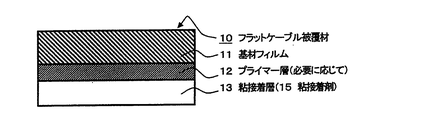
本発明による粘接着剤は、図1に示すような、基材11と、基材11の一方の面上に設けた粘接着層13とを少なくとも含むフラットケーブル被覆材10に使用される粘接着剤15であり、アクリル系樹脂と、エポキシ系樹脂と、硬化剤と、水和金属化合物、リン酸化合物、メラミン系難燃剤、およびハロゲン系難燃剤からなる群から選択される少なくとも1種の難燃剤とを、必須成分として含む。このように、粘着性を有するアクリル系樹脂と接着性を有するエポキシ系樹脂と、これらの樹脂と反応する硬化剤とを含むことにより、硬化前であっても初期粘着性を有し、かつ硬化後には、優れた密着性、耐熱性および難燃性を有する。
<Adhesive>
The adhesive agent by this invention is used for the flat cable coating | covering
本発明による粘接着剤に含有されるアクリル系樹脂としては、粘着性があれば特に限定されるものではなく、例えば、アクリル酸、メタクリル酸及びそれらのエステルモノマーを重合させたポリマーのほか、前記モノマーと共重合可能な不飽和単量体(例えば、酢酸ビニル、スチレン、アクリロニトリルなど)とを共重合させたコポリマーが使用できる。アクリル系樹脂としては、アクリル酸エステル共重合体が好ましく、アクリル酸、アクリル酸エステル、メタクリル酸エステルおよびアクリルニトリルのうち少なくとも1つをモノマー成分とした共重合体が挙げられる。この中でも、官能基としてエポキシ基、水酸基、カルボキシル基、二トリル基等を持つ化合物を有するアクリル酸エステル共重合体が好ましい。これにより、被着体への接着性がより向上する。具体的には、ナガセケムテックス社製、SG−P3などが例示できる。 The acrylic resin contained in the adhesive according to the present invention is not particularly limited as long as it has tackiness. For example, in addition to polymers obtained by polymerizing acrylic acid, methacrylic acid and ester monomers thereof, A copolymer obtained by copolymerizing an unsaturated monomer copolymerizable with the monomer (for example, vinyl acetate, styrene, acrylonitrile, etc.) can be used. As the acrylic resin, an acrylate copolymer is preferable, and a copolymer having at least one of acrylic acid, acrylic acid ester, methacrylic acid ester, and acrylonitrile as a monomer component is exemplified. Among these, an acrylate copolymer having a compound having an epoxy group, a hydroxyl group, a carboxyl group, a nitrile group, or the like as a functional group is preferable. Thereby, the adhesiveness to a to-be-adhered body improves more. Specific examples include SG-P3 manufactured by Nagase ChemteX Corporation.
本発明においては、アクリル系樹脂として、EA−BA−AN(エチルアクリレート−ブチルアクリレート−アクリルニトリルをもつモノマーをラジカル重合してなるアクリル酸エステル共重合体をより好ましく用いることができ、後記するエポキシ系樹脂との分散性や、粘接着層を形成する際の塗布性成膜性を向上させることができる。また、硬化前の初期粘着性を確保できる。 In the present invention, an acrylic ester copolymer obtained by radical polymerization of a monomer having EA-BA-AN (ethyl acrylate-butyl acrylate-acrylonitrile) can be more preferably used as the acrylic resin. It is possible to improve the dispersibility with a base resin, the coating property when forming an adhesive layer, and the initial tackiness before curing.
上記したアクリル酸エステル共重合体の重量平均分子量は、特に限定されないが、10万以上が好ましく、15万〜100万が特に好ましく、重量平均分子量がこの範囲内であると、粘接着層11の塗布性が向上する。また、凝集力を高めるために、ロジン樹脂、テルペン樹脂、クマロン樹脂、フェノール樹脂、脂肪族系や芳香族系石油樹脂等の粘着付与剤等を添加してもよい。
The weight average molecular weight of the acrylic ester copolymer described above is not particularly limited, but is preferably 100,000 or more, particularly preferably 150,000 to 1,000,000, and when the weight average molecular weight is within this range, the
本発明による粘接着剤は、上記したアクリル系樹脂に加えて、エポキシ系樹脂を含む。エポキシ系樹脂としては、例えば、ビスフェノールAエポキシ樹脂、ビスフェノールFエポキシ樹脂等のビスフェノール型エポキシ樹脂、ノボラックエポキシ樹脂、クレゾールノボラックエポキシ樹脂等のノボラック型エポキシ樹脂、ビフェニル型エポキシ樹脂、スチルベン型エポキシ樹脂、トリフェノールメタン型エポキシ樹脂、アルキル変性トリフェノールメタン型エポキシ樹脂、トリアジン核含有エポキシ樹脂、ジシクロペンタジエン変性フェノール型エポキシ樹脂等のエポキシ樹脂等が挙げられ、またフェノールノボラック樹脂、クレゾールノボラック樹脂、ビスフェノールAノボラック樹脂等のノボラック型フェノール樹脂、レゾールフェノール樹脂等のフェノール樹脂、ユリア(尿素)樹脂、メラミン樹脂等のトリアジン環を有する樹脂、不飽和ポリエステル樹脂、ビスマレイミド樹脂、ポリウレタン樹脂、ジアリルフタレート樹脂、シリコン樹脂、ベンゾオキサジン環を有する樹脂、シアネートエステル樹脂などが例示できる。 The adhesive according to the present invention includes an epoxy resin in addition to the acrylic resin described above. Examples of the epoxy resin include bisphenol type epoxy resins such as bisphenol A epoxy resin and bisphenol F epoxy resin, novolak type epoxy resins such as novolac epoxy resin and cresol novolac epoxy resin, biphenyl type epoxy resin, stilbene type epoxy resin, tri Examples include phenol methane type epoxy resins, alkyl-modified triphenol methane type epoxy resins, triazine nucleus-containing epoxy resins, dicyclopentadiene-modified phenol type epoxy resins and the like, and also phenol novolac resins, cresol novolac resins, bisphenol A novolacs. It has a triazine ring such as a novolac phenolic resin such as a resin, a phenolic resin such as a resole phenolic resin, a urea (urea) resin, and a melamine resin. That resins, unsaturated polyester resins, bismaleimide resins, polyurethane resins, diallyl phthalate resins, silicone resins, resins having a benzoxazine ring, cyanate ester resin, can be exemplified.
これらの樹脂から、少なくとも、比較的柔らかいエポキシ系樹脂と、硬いエポキシ系樹脂とを含ませるのが好ましい。ここで、「柔らかい」および「硬い」とは、相対比較であり、硬さに差のある柔らかいもの、硬いものを用いればよい。 From these resins, it is preferable to include at least a relatively soft epoxy resin and a hard epoxy resin. Here, “soft” and “hard” are relative comparisons, and a soft or hard material having a difference in hardness may be used.
硬いエポキシ系樹脂としては、結晶性エポキシ樹脂が好ましく、ビフェニル骨格、ビスフェノール骨格、スチルベン骨格などの剛直構造を主鎖にもち、比較的低分子量のものがよい。好ましくは、例えば、ビスフェノールAエポキシ樹脂、ビスフェノールFエポキシ樹脂等のビスフェノール型エポキシ樹脂で、特にビスフェノールA型エポキシ樹脂が好ましい。主鎖が1〜3のビスフェノールA型エポキシ樹脂は常温で液体、主鎖が2〜10のビスフェノールA型エポキシ樹脂は常温で固体である。結晶性エポキシ樹脂のうち、常温で結晶化して固体のものも、融点以上の温度になると、急速に融解して低粘度の液状に変化することで、粘接着層13の接着剤部分に被着体の裏面とを接合工程で、初期に密着し、更に接着して、接着強度を高めることができる。硬いエポキシ系樹脂は架橋密度が高くなるため、機械的強度が高く、耐薬品性がよく、硬化性が高く、吸湿性(自由体積が小さくなるため)が小さくなる特徴もある。
The hard epoxy resin is preferably a crystalline epoxy resin, and preferably has a rigid structure such as a biphenyl skeleton, a bisphenol skeleton, and a stilbene skeleton with a main chain and a relatively low molecular weight. Preferably, for example, bisphenol type epoxy resins such as bisphenol A epoxy resin and bisphenol F epoxy resin, and bisphenol A type epoxy resins are particularly preferable. A bisphenol A type epoxy resin having a main chain of 1 to 3 is liquid at normal temperature, and a bisphenol A type epoxy resin having a main chain of 2 to 10 is solid at normal temperature. Among the crystalline epoxy resins, those that are crystallized and solid at room temperature also rapidly melt and change to a low-viscosity liquid when the temperature reaches the melting point or higher, so that the adhesive portion of the
硬いエポキシ系樹脂として、ビスフェノールA型エポキシ樹脂が好ましいが、さらに、硬さの異なる複数を用いるのが更に好ましい。複数とは、剛直な構造であるビスフェノール骨格の主鎖の数の異なるものが例示でき、例えば、主鎖が1〜3のビスフェノールA型エポキシ樹脂と、主鎖が2〜10のビスフェノールA型エポキシ樹脂とを併用すればよい。併用することで、機械的強度を保ちつつ、若干の柔軟性を得ることが出来るため、密着性に優れる。固体のエポキシを混合することで、製膜性も向上させることができる。ここで、硬さ異なるとは相対比較であり、硬さに差があればよく、硬いもの、更に硬いものを用いればよい。具体的には、主鎖が1〜3のビスフェノールA型エポキシ樹脂としては、ジャパンエポキシレジン社製、JER828が、主鎖が2〜10のビスフェノールA型エポキシ樹脂としては、ジャパンエポキシレジン社製、JER1001などが例示できる。 As the hard epoxy resin, a bisphenol A type epoxy resin is preferable, but it is more preferable to use a plurality of different hardnesses. Examples of the plural include ones having different numbers of main chains of a bisphenol skeleton having a rigid structure. For example, a bisphenol A type epoxy resin having a main chain of 1 to 3 and a bisphenol A type epoxy having a main chain of 2 to 10 What is necessary is just to use resin together. By using together, since some softness | flexibility can be obtained, maintaining mechanical strength, it is excellent in adhesiveness. By mixing solid epoxy, the film forming property can be improved. Here, the difference in hardness is a relative comparison, and it is sufficient if there is a difference in hardness, and a harder one or a harder one may be used. Specifically, as a bisphenol A type epoxy resin having a main chain of 1 to 3, manufactured by Japan Epoxy Resin Co., Ltd., JER828 is used as a bisphenol A type epoxy resin having a main chain of 2 to 10 manufactured by Japan Epoxy Resin Co., Ltd. JER1001 etc. can be illustrated.
柔かいエポキシ樹脂としては、ゴム成分を含むように変性したエポキシ系樹脂が好ましい。特に、NBR(ニトリルブタジエンゴム)変性エポキシ系樹脂が、加熱による変色も少なく、硬いエポキシ樹脂である結晶性エポキシ樹脂と混ざり易さから好ましい。具体的には、ADEKA社製、EPR4030などが例示できる。被着体の熱膨張による寸法変化などに追従するため、耐熱性向上、耐衝撃性、柔軟性の点で優れる。 As the soft epoxy resin, an epoxy resin modified to include a rubber component is preferable. In particular, NBR (nitrile butadiene rubber) -modified epoxy resin is preferable because it is less likely to discolor due to heating and is easily mixed with a crystalline epoxy resin that is a hard epoxy resin. Specific examples include EPR4030 manufactured by ADEKA. In order to follow dimensional changes due to thermal expansion of the adherend, it is excellent in terms of improved heat resistance, impact resistance and flexibility.
上記したアクリル系樹脂およびエポキシ系樹脂を反応させて粘接着剤を硬化させるために、粘接着剤には硬化剤が含まれる。硬化剤としては、例えばジエチレントリアミン(DETA)、トリエチレンテトラミン(TETA)、メタキシレリレンジアミン(MXDA)などの脂肪族ポリアミン、ジアミノジフェニルメタン(DDM)、m−フェニレンジアミン(MPDA)、ジアミノジフェニルスルホン(DDS)などの芳香族ポリアミンのほか、ジシアンジアミド(DICY)、有機酸ジヒドララジドなどを含むポリアミン化合物等のアミン系硬化剤、ヘキサヒドロ無水フタル酸(HHPA)、メチルテトラヒドロ無水フタル酸(MTHPA)などの脂環族酸無水物(液状酸無水物)、無水トリメリット酸(TMA)、無水ピロメリット酸(PMDA)、ベンゾフェノンテトラカルボン酸(BTDA)等の芳香族酸無水物等の酸無水物系硬化剤、フェノール樹脂等のフェノール系硬化剤が例示できる。特に、ジシアンジアミド(DICY)は潜在性の硬化剤のため、保存安定性に優れ、室温保存でもポットライフが数週間もあるので好ましい。また、硬化促進剤としてイミダゾール類を含ませてもよい。イミダゾール類としては、例えば1−ベンジル−2−フェニルイミダゾールが挙げられる。また、エポキシ樹脂用潜在性硬化促進剤であるDBU(1,8−ジアザビシクロ(5,4,0)ウンデセン−7)系硬化促進剤を使用してもよい。DBU系硬化促進剤としてはDBU系テトラフェニルボレート塩等が挙げられる。 In order to cure the above-mentioned acrylic resin and epoxy resin to cure the adhesive, the adhesive contains a curing agent. Examples of the curing agent include aliphatic polyamines such as diethylenetriamine (DETA), triethylenetetramine (TETA), and metaxylylenediamine (MXDA), diaminodiphenylmethane (DDM), m-phenylenediamine (MPDA), diaminodiphenylsulfone ( In addition to aromatic polyamines such as DDS), amine curing agents such as polyamine compounds including dicyandiamide (DICY) and organic acid dihydralazide, and alicyclic rings such as hexahydrophthalic anhydride (HHPA) and methyltetrahydrophthalic anhydride (MTHPA) Acid anhydride curing agents such as aromatic acid anhydrides such as aromatic acid anhydrides (liquid acid anhydrides), trimellitic anhydride (TMA), pyromellitic anhydride (PMDA), benzophenone tetracarboxylic acid (BTDA), Phenolic resin, etc. Phenolic curing agent can be exemplified. In particular, dicyandiamide (DICY) is a latent curing agent, and thus is excellent in storage stability and has a pot life of several weeks even at room temperature storage. Moreover, you may include imidazoles as a hardening accelerator. Examples of imidazoles include 1-benzyl-2-phenylimidazole. Further, a DBU (1,8-diazabicyclo (5,4,0) undecene-7) type curing accelerator, which is a latent curing accelerator for epoxy resins, may be used. Examples of DBU curing accelerators include DBU tetraphenylborate salts.
上記したアクリル系樹脂およびエポキシ系樹脂は、粘背着剤中で、アクリル系樹脂が海、エポキシ系樹脂が島とする海島構造を有していることが好ましい。エポキシ系樹脂は複数種からなるが相溶状態であると推測される。この好ましい構造によって、アクリル系樹脂の海状態が初期粘着性を発現し、島状態のポキシ系樹脂が加圧加熱によって、被着体と接触し、接着すると推測される。さらに分散状態は、海と島どうしが接触しないある程度の距離(数μm)を保つことで、界面破壊を避けることが出来、接着強度も高く維持できるので好ましい。 The acrylic resin and epoxy resin described above preferably have a sea-island structure in the adhesive agent, where the acrylic resin is the sea and the epoxy resin is the island. Although epoxy resin consists of multiple types, it is presumed to be in a compatible state. With this preferable structure, it is presumed that the sea state of the acrylic resin develops initial tackiness, and the island-shaped poxy resin comes into contact with and adheres to the adherend by pressure heating. Further, the dispersed state is preferable because a certain distance (several μm) at which the sea and the islands do not come into contact with each other can be avoided, and the interface strength can be kept high.
粘接着剤中の、アクリル系樹脂、硬いエポキシ系樹脂および柔かいエポキシ系樹脂の含有量は、それぞれの含有量比が質量基準において、100:75〜175:10〜100:2〜20程度、好ましくは、100:100〜150:25〜75:5〜10である。なお、硬いエポキシ系樹脂を複数用いる場合にはその合計とする。アクリル酸エステル共重合体に対して、硬いエポキシ樹脂及び柔かいエポキシ系樹脂がこの範囲未満であると、粘着力が強すぎて、貼り替えが必要な場合に不良が起こったり、作業性の低下したりし、被着体との接着力が低下する。この範囲以上では、被着体との接着力は向上するが、粘着力が低く、仮固定を要して作業性が低下する。また、硬化剤の配合比がこの範囲未満であると、接合後の耐熱性が低く、また接着強度が温度変化で劣化しやすい。この範囲以上では、フラットケーブル被覆材10を被着体と接合するまで保管するが、その期間の保存性が低下し、また、未反応の硬化剤が残留することで、接着力が低下する問題点もある。
The content of the acrylic resin, the hard epoxy resin, and the soft epoxy resin in the adhesive is about 100: 75 to 175: 10 to 100: 2 to 20, with each content ratio based on mass. Preferably, it is 100: 100-150: 25-75: 5-10. In addition, when using two or more hard epoxy resins, it is set as the sum total. If the hard epoxy resin and the soft epoxy resin are less than this range with respect to the acrylic ester copolymer, the adhesive strength is too strong, resulting in defects when work needs to be replaced or reduced workability. In other words, the adhesive strength with the adherend is reduced. Above this range, the adhesive strength with the adherend is improved, but the adhesive strength is low, and temporary fixing is required and workability is reduced. Moreover, when the compounding ratio of the curing agent is less than this range, the heat resistance after joining is low, and the adhesive strength is likely to deteriorate due to a temperature change. Above this range, the flat
また、本発明においては、粘接着剤中にエポキシ系樹脂が含有されているため、それ自体が難燃性を有するものであるが、上記したアクリル系樹脂、エポキシ系樹脂および硬化剤に加えて、水和金属化合物、リン酸化合物、メラミン系難燃剤、またはハロゲン系難燃剤の少なくとも1種の難燃剤を添加することにより、粘接着剤に難燃性を付与することができる。過熱燃焼に対し、水和金属化合物は脱水分解することで吸熱反応を起こすため、水和金属化合物を含む粘接着剤は難燃性となる。また、有機リン化合物は、燃焼の際に不燃層を形成することにより空気の供給を遮断する。また、メラミン系難燃剤は、加熱分解によりガスを発生して酸素濃度を下げる。また、ハロゲン系難燃剤は、ラジカルトラップ効果による活性OHラジカルの安定化や酸素遮蔽効果を有する。 In the present invention, since the epoxy resin is contained in the adhesive, it itself has flame retardancy. In addition to the acrylic resin, epoxy resin and curing agent described above, By adding at least one flame retardant of a hydrated metal compound, a phosphate compound, a melamine flame retardant, or a halogen flame retardant, flame retardancy can be imparted to the adhesive. In contrast to overheating combustion, the hydrated metal compound undergoes an endothermic reaction by dehydrating and decomposing, so that the adhesive containing the hydrated metal compound becomes flame retardant. In addition, the organophosphorus compound blocks the supply of air by forming an incombustible layer during combustion. Melamine flame retardants generate gas by thermal decomposition to lower the oxygen concentration. In addition, the halogen flame retardant has an active OH radical stabilization and an oxygen shielding effect by a radical trap effect.
水和金属化合物としては、水酸化アルミニウム、水酸化マグネシウム、水酸化ジルコニウム、水酸化カルシウム、水酸化チタン、水酸化亜鉛などが適用できるが、難燃性に優れ、コストの点でも有利な水酸化アルミニウム、水酸化マグネシウムが好適である。該水和金属化合物は、単独でも、複数種を組み合わせも使用することもできる。例えば、ハイジライト(昭和電工(株))やマグシース(神島化学(株))等の市販の水和金属化合物難燃剤を使用してもよい。また、水和金属化合物に、酸化アンチモン系化合物、スズ酸亜鉛、ホウ酸亜鉛、酸化スズ、酸化モリブデン酸、酸化モリブデン、酸化ホウ素、二酸化珪素等の酸化金属化合物を添加してもよい。 As the hydrated metal compound, aluminum hydroxide, magnesium hydroxide, zirconium hydroxide, calcium hydroxide, titanium hydroxide, zinc hydroxide, and the like can be applied. However, the hydroxide is excellent in flame retardancy and advantageous in terms of cost. Aluminum and magnesium hydroxide are preferred. These hydrated metal compounds can be used alone or in combination of two or more. For example, a commercially available hydrated metal compound flame retardant such as Heidilite (Showa Denko Co., Ltd.) or Magsheath (Kamishima Chemical Co., Ltd.) may be used. In addition, metal oxide compounds such as antimony oxide compounds, zinc stannate, zinc borate, tin oxide, molybdate oxide, molybdenum oxide, boron oxide, and silicon dioxide may be added to the hydrated metal compound.
リン酸化合物としては、フォスフィン酸塩、リン酸エステル(ハロゲンリン酸エステルを含む)、縮合リン酸エステル、リン酸メラミン、ポリリン酸アンモニウム(イントメッセント系を含む)、赤リン、フォスファフェナントレン、ホスファゼン等が挙げられ、例えば、Exolot(クラリアント(株))、アデカスタブFP−600(株式会社ADEDKA)、DAIGUARDシリーズ(大八化学工業(株))等の市販の難燃剤を用いることもできる。 Examples of phosphoric acid compounds include phosphinates, phosphate esters (including halogen phosphate esters), condensed phosphate esters, melamine phosphate, ammonium polyphosphate (including intomesents), red phosphorus, phosphaphenanthrene, Phosphazene etc. are mentioned, For example, commercially available flame retardants, such as Exolot (Clariant Co., Ltd.), Adeka stab FP-600 (AEDKA Co., Ltd.), and DAIGUARD series (Daihachi Chemical Industry Co., Ltd.) can also be used.
メラミン系難燃剤としては、メラミンシアヌレート等を好適に使用でき、例えば、MC−4000等(日産化学工業(株))等の市販のものを使用してもよい。 As the melamine flame retardant, melamine cyanurate or the like can be suitably used. For example, commercially available products such as MC-4000 (Nissan Chemical Industry Co., Ltd.) may be used.
また、ハロゲン系難燃剤としては、テトラブロモビスフェノールA(TBBPA)、デカブロモジフェニルエタン(DBDPE)、ヘキサブロモシクロドデカン(HBCD)、エチレンビステトラブロモフタルイミド、TBBPAポリカーボネートオリゴマー、臭素化ポリスチレン、TBBPAエポキシオリゴマー、TBBPAビスジブロモプロピルエーテル、エチレンビスペンタブロモジフェニル、ペンタブロモベンジルアクリレート、ヘキサブロモベンゼン、臭素化芳香族トリアジン、塩素系、塩素化パラフィン、パークロロシクロペンタデカン等が挙げられる。 In addition, as halogen-based flame retardants, tetrabromobisphenol A (TBBPA), decabromodiphenylethane (DBDPE), hexabromocyclododecane (HBCD), ethylenebistetrabromophthalimide, TBBPA polycarbonate oligomer, brominated polystyrene, TBBPA epoxy oligomer , TBBPA bisdibromopropyl ether, ethylene bispentabromodiphenyl, pentabromobenzyl acrylate, hexabromobenzene, brominated aromatic triazine, chlorinated, chlorinated paraffin, perchlorocyclopentadecane and the like.
上記の難燃剤には、三酸化アンチモン、窒素化グアニジン、五酸化アンチモン等を併用して用いてもよい。 The flame retardant may be used in combination with antimony trioxide, nitrogenated guanidine, antimony pentoxide, or the like.
無機系難燃剤である水和金属化合物や酸化金属化合物等の粒子の大きさとしては、一次粒子として、約0.01μないし15μ位である。難燃性の性能からは、難燃剤成分が多いほど良いが、難燃剤が多いと合成樹脂成分が少なくなって、難燃性接着層を形成加工する際に成膜することができず、また、必要な接着性能が得られない。難燃性があり、加工性の良い組成としては、合成樹脂成分が20〜99質量%と難燃剤成分が1〜80質量%が好適である。 The size of particles such as hydrated metal compounds and metal oxide compounds that are inorganic flame retardants is about 0.01 μm to 15 μm as primary particles. In terms of flame retardant performance, the more flame retardant components are better, the more the flame retardants, the fewer synthetic resin components, and the film cannot be formed when forming and processing the flame retardant adhesive layer. The necessary adhesion performance cannot be obtained. As a composition having flame retardancy and good workability, 20 to 99% by mass of the synthetic resin component and 1 to 80% by mass of the flame retardant component are suitable.
本発明による粘接着剤は、上記したアクリル系樹脂、エポキシ系樹脂、硬化剤、および難燃剤に加えて、さらに必要に応じてその他の添加剤を加えてもよい。例えば、加工性、耐熱性、耐候性、機械的性質、寸法安定性、抗酸化性、滑り性、離形性、抗カビ性、電気的特性、強度、その他等を改良、改質する目的で、例えば、滑剤、可塑剤、充填剤、フィラー、帯電防止剤、アンチブロッキング剤、架橋剤、酸化防止剤、紫外線吸収剤、光安定剤、染料、顔料等の着色剤、金属腐食防止剤、樹脂と難燃剤との間の凝集力を上昇させる各種カップリング剤、架橋剤、架橋助剤、難燃触媒、その他等を適宜添加することができる。また、接着力や耐熱性をより向上させるために、添加剤としてポリビニルホルマール樹脂を添加してもよい。 In addition to the acrylic resin, epoxy resin, curing agent, and flame retardant described above, the adhesive according to the present invention may further contain other additives as necessary. For example, for the purpose of improving and modifying processability, heat resistance, weather resistance, mechanical properties, dimensional stability, antioxidant properties, slipping properties, mold release properties, antifungal properties, electrical properties, strength, etc. , For example, lubricants, plasticizers, fillers, fillers, antistatic agents, antiblocking agents, crosslinking agents, antioxidants, UV absorbers, light stabilizers, dyes, pigments and other colorants, metal corrosion inhibitors, resins Various coupling agents, cross-linking agents, cross-linking aids, flame retardant catalysts, etc. that increase the cohesive force between the flame retardant and the flame retardant can be appropriately added. Moreover, in order to improve adhesive force and heat resistance more, you may add polyvinyl formal resin as an additive.
上記した各成分を混合し、必要に応じて混練、分散して、粘接着剤を調製することができる。混合ないし分散方法は、特に限定されるものではなく、通常の混練分散機、例えば、二本ロールミル、三本ロールミル、ペブルミル、トロンミル、ツェグバリ(Szegvari)アトライター、高速インペラー分散機、高速ストーンミル、高速度衝撃ミル、デスパー、高速ミキサー、リボンブレンダー、コニーダー、インテンシブミキサー、タンブラー、ブレンダー、デスパーザー、ホモジナイザー、および超音波分散機などが適用できる。撹拌機を用いて、硬いエポキシ系樹脂として複数種を用いる場合は、先にこれらを混合撹拌し、次に硬化剤を混合撹拌し、溶媒で希釈した後に、柔かいエポキシ系樹脂を混合撹拌し、次いで、アクリル系樹脂を混合撹拌することが好ましい。 The above-mentioned components can be mixed and kneaded and dispersed as necessary to prepare an adhesive. The mixing or dispersing method is not particularly limited, and a usual kneading and dispersing machine such as a two-roll mill, a three-roll mill, a pebble mill, a tron mill, a Szegvari attritor, a high-speed impeller disperser, a high-speed stone mill, A high speed impact mill, a desper, a high speed mixer, a ribbon blender, a kneader, an intensive mixer, a tumbler, a blender, a desperser, a homogenizer, an ultrasonic disperser, and the like can be applied. When using multiple types as a hard epoxy resin using a stirrer, these are mixed and stirred first, then the curing agent is mixed and stirred, and after dilution with a solvent, the soft epoxy resin is mixed and stirred, Next, it is preferable to mix and stir the acrylic resin.
上記した粘接着剤は、エポキシ系樹脂に起因する強固な接着強度が得られ、導線との接着力も強力であり、その接着強度は温度変化でも劣化しにくい。また、アクリル系樹脂に起因するために脆質性が低く、優れた剪断強度と高い耐衝撃性、耐熱性を有するので、高温や摺動の厳しい環境下でも、導電体との密着性に優れ、かつ、高い耐熱性を実現することができる。 The above-mentioned adhesive has a strong adhesive strength resulting from the epoxy resin, has a strong adhesive strength with the conductive wire, and the adhesive strength is unlikely to deteriorate even with temperature changes. Also, due to acrylic resin, it has low brittleness and has excellent shear strength, high impact resistance, and heat resistance, so it has excellent adhesion to conductors even under high temperature and severe sliding environment. And high heat resistance is realizable.
<フラットケーブル被覆材>
本発明によるフラットケーブル被覆材10は、図1に示すように、基材11と、基材11の一方の面上に設けた粘接着層13とを少なくとも含む。本発明においては、基材11と粘接着層13との間に、接着力を向上させるために、必要に応じてプライマー層12を設けてもよい。また、フラットケーブル被覆材10は、使用時(すなわち、被覆材を貼り合わせてフラットケーブルを作製する際)までの保存や、使用時の取り扱い性の点から、粘接着層13面へ剥離紙(図示せず)を積層しておいてもよく、基材11/粘接着層13/剥離紙の構成としてもよい。
<Flat cable covering material>
As shown in FIG. 1, the flat
本発明においては、上記の粘接着剤を使用することにより、硬化前に初期粘着性をもった熱硬化型のフラットケーブル被覆材とすることができる。即ち、フラットケーブル被覆材10の粘接着層13は、初期粘着性を有するため、フラットケーブルを製造する際に、初期粘着力で導線等の導電体21からなる配列体を被覆材の粘接着層上に保持したまま、他方の被覆材を貼り合わせて、加熱し熱硬化(接着)させることができる。その結果、貼合せ工程と接着の工程とが別の工程とできるため、貼合せ工程の製造速度を速くでき、かつ、接着の工程も製造速度を速く、又はバッチ式でも大量に一括で加熱処理でき、結果的に低コストとすることができる。また、粘接着層13と導電体21とを熱硬化反応で接着させることで、導電体と被覆材との接着力も強力であり、その接着強度は温度変化で劣化しない効果があり、高温や摺動の厳しい環境下でも、導電体との密着性に優れ、かつ、高い耐熱性を併せ持つ被覆材となる。
In this invention, it can be set as the thermosetting type flat cable coating | covering material which had initial tackiness before hardening by using said adhesive agent. That is, since the
本発明によるフラットケーブル被覆材を構成する各層について、以下説明する。基材11としては、機械的強度に優れ、耐熱性、耐薬品性、耐溶剤性、屈曲性、絶縁性等に富む、例えば、ポリエチレンテレフタレート、ポリエチレンナフタレート、ポリブチレンテレフタレート等のポリエステル系フィルム、ナイロン6、ナイロン66、ナイロン610等のポリアミド系フィルム、ポリイミド、ポリアミドイミド、ポリエーテルイミド等のポリイミド系フィルム、フッ素系フィルム、ポリエーテルスルフォン、ポリエーテルケトン、ポリエーテルサルファイド、ポリアリレート、ポリエステルエーテル、全芳香族ポリアミド、ポリアラミド、ポリプロピレンフィルム、ポリカーボネートフィルムなどが適用できる。通常はポリエチレンテレフタレート、ポリエチレンナフタレート等のポリアルキレンテレフタレートが好適に使用される。
Each layer which comprises the flat cable coating | covering material by this invention is demonstrated below. The
基材11は、未延伸フィルム、または延伸フィルムが適用でき、強度を向上させる目的で延伸フィルムが好ましく、一軸方向または二軸方向に延伸したフィルムが、特に二軸延伸フィルムが好適である。また、基材フィルムの表面は、必要に応じて、例えば、コロナ処理、プラズマ処理、オゾン処理、その他の前処理を施しても良い。基材フィルムの厚さは、通常は5μm〜200μmが適用でき、10μm〜100μmが好適である。厚さが5μm未満であると機械的強度が不足し、またプライマー層12、粘接着層13など形成する適性が減ずる。厚さが200μm以上では可撓性が不足し摺動性が悪化するので、このような厚さにすることにより、フラットケーブル被覆材10に必要とされる強度を付与することができるとともに、フラットケーブル被覆材10に良好な可撓性を付与することができる。
As the
基材上には、粘背着層を設ける前に、必要に応じてプライマー層を設けることができる。プライマー層を介在させることにより、基材と粘接着層との密着性がより向上し、子機器への使用時の摺動に耐えて、層間の剥離などを抑制して、フラットケーブルの絶縁性、耐久性が向上する。プライマー層12の材料としては、例えば、イソシアネート基、ブロックイソシアネート基、および/またはカルボジイミド基を有する多官能化合物と、ガラス転移点が20℃〜120℃、好ましくは30℃〜100℃のポリエステル系樹脂、ポリウレタン系樹脂とを含むプライマー剤が適用できる。また、プライマー剤としては、ポリエチレンイミン系化合物、有機チタン系化合物、イソシアネート系化合物、ウレタン系化合物、ポリブタジエン系化合物などを主成分とするアンカーコート剤も適用することができる。
On the base material, a primer layer can be provided as necessary before the adhesive layer is provided. By interposing a primer layer, the adhesion between the base material and the adhesive layer is further improved, withstands sliding during use in slave devices, and suppresses delamination between layers, insulating flat cables. And durability are improved. Examples of the material of the
プライマー層12は、プライマー剤の希釈液をロールコート、リバースロールコート、グラビアコート、リバースグラビアコート、バーコート、ロッドコ−ト、キスコート、ナイフコート、ダイコート、コンマコート、フローコート、スプレーコートなどの方法で塗布し乾燥して、溶剤を除去してプライマー層を形成させることができる。また、乾燥後に温度30℃〜70℃でエージングしてもよい。プライマー層12の厚さは、通常は0.05μm〜10μm程度、好ましくは0.1μm〜5μm程度である。
The
粘接着層は、基材上、またはプライマー層上に形成される。粘接着層は、上記した粘接着剤を基材11またはプライマー層12の表面へ塗布することにより形成できる。塗布方法としては、特に限定されるものではなく、例えば、ロールコート、リバースロールコート、トランスファーロールコート、グラビアコート、グラビアリバースコート、コンマコート、ロッドコ−ト、ブレードコート、バーコート、ワイヤーバーコート、ダイコート、リップコート、ディップコートなどが適用できる。塗布法により基材(またはプライマー層)上へ粘接着剤を塗布するには、粘接着剤の粘度が1〜20000センチストークス(25℃)程度、好ましくは1〜200センチストークスに調整されていることが好ましい。
The adhesive layer is formed on the substrate or the primer layer. The adhesive layer can be formed by applying the above-mentioned adhesive to the surface of the
粘接着剤を基材(またはプライマー層)上に塗布した後、乾燥させることにより粘接着層が形成されるが、フラットケーブル被覆材の使用時までの保存や、使用時の取り扱い性の点から、粘接着層面の保護のために、粘接着層上に剥離紙を貼り合わせてもよい。剥離紙としては、離型フィルム、セパレート紙、セパレートフィルム、セパ紙、剥離フィルム、剥離紙とも呼ばれる。離型紙は、上質紙、コート紙、含浸紙、プラスチックフィルムなどの離型紙用基材の片面又は両面に離型層を有したものである。この離型層としては、離型性を有する材料であれば、特に限定されないが、例えば、シリコーン樹脂、有機樹脂変性シリコーン樹脂、フッ素樹脂、アミノアルキド樹脂、メラミン系樹脂、アクリル系樹脂、ポリエステル樹脂などがある。これらの樹脂は、エマルジョン型、溶剤型又は無溶剤型のいずれもが使用できる。 The adhesive layer is formed by applying the adhesive on the base material (or primer layer) and then drying it. From the standpoint, release paper may be bonded onto the adhesive layer in order to protect the adhesive layer surface. The release paper is also called a release film, a separate paper, a separate film, a separate paper, a release film, or a release paper. The release paper has a release layer on one or both sides of a release paper substrate such as fine paper, coated paper, impregnated paper, and plastic film. The release layer is not particularly limited as long as it is a material having releasability. For example, silicone resin, organic resin-modified silicone resin, fluororesin, aminoalkyd resin, melamine resin, acrylic resin, polyester resin and so on. These resins can be used in any of emulsion type, solvent type and solventless type.
離形層は、離形層成分を分散および/または溶解した塗液を、剥離紙用の基材フィルムの片面に塗布し、加熱乾燥および/または硬化させて形成する。塗液の塗布方法としては、公知で任意の塗布法が適用でき、例えば、ロールコート、グラビアコート、スプレーコートなどである。また、離型層は、必要に応じて、基材フィルムの少なくとも片面の、全面または一部に形成してもよい。 The release layer is formed by applying a coating liquid in which a release layer component is dispersed and / or dissolved on one side of a base film for a release paper, followed by heating and drying and / or curing. As a coating method of the coating liquid, a known and arbitrary coating method can be applied, for example, roll coating, gravure coating, spray coating and the like. Moreover, you may form a release layer in the whole surface or a part of at least single side | surface of a base film as needed.
なお、剥離紙ないし離形層の剥離力は、粘着剤テープに対し、1〜2000mN/cm程度、さらに100〜1000mN/cmであることが好ましい。剥離紙ないし離形層の剥離力が1mN/cm未満の場合は、粘着シートや被粘着材との剥離力が弱く、剥がれたり部分的に浮いたりする。また、2000mN/cmより大きい場合は、剥離紙ないし離形層の剥離力が強すぎて、剥離紙を剥離しにくい。安定した離形性や加工性の点で、ポリジメチルシロキサンを主成分とする付加及び/又は重縮合型の剥離紙用硬化型シリコーン樹脂が好ましい。 In addition, it is preferable that the peeling force of a release paper thru | or release layer is about 1-2000 mN / cm with respect to an adhesive tape, Furthermore, it is preferable that it is 100-1000 mN / cm. When the peel strength of the release paper or release layer is less than 1 mN / cm, the peel strength with the pressure-sensitive adhesive sheet or the material to be adhered is weak, and it peels off or partially floats. On the other hand, when it is larger than 2000 mN / cm, the release paper or the release layer has too strong peel strength, and the release paper is difficult to peel off. From the viewpoint of stable releasability and workability, addition and / or polycondensation-type curable silicone resins for release paper, which are mainly composed of polydimethylsiloxane, are preferred.
<フラットケーブル>
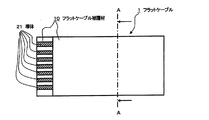
本発明によるフラットケーブルは、図2に示すように、複数の導電体21を同一平面内で配列した導電体列を、一対のフラットケーブル被覆材10で挟持して両面から被覆したものである。図3は図2のAA断面図であり、導電体21列は両面より被覆してなるフラットケーブル被覆材10の粘接着層13によって、埋め込まれるような状態で熱硬化されており、導電体21列は強固に接着されている。
<Flat cable>
As shown in FIG. 2, the flat cable according to the present invention is formed by sandwiching a conductor row in which a plurality of conductors 21 are arranged in the same plane with a pair of flat
上記のような構造を有するフラットケーブルは、一対のフラットケーブル被覆材を準備し、一方の被覆材の粘接着層上に、複数の導電体を同一平面内で配列した導電体列を仮固定し、前記導電体列が仮固定された粘接着層と、他方の粘接着層とが対向するように、被覆材どうしを重ね合わせて積層体を形成し、前記積層体を加熱して、前記粘接着層を硬化させることにより製造される。このように、本発明によるフラットケーブル被覆材を用いれば、フラットケーブルを製造する際に、初期粘着力で導線等の導電体21からなる配列体を被覆材の粘接着層上に保持したまま、他方の被覆材を貼り合わせて、加熱し熱硬化(接着)させることができる。その結果、貼合せ工程と接着の工程とが別の工程とできるため、貼合せ工程の製造速度を速くでき、かつ、接着の工程も製造速度を速く、又はバッチ式でも大量に一括で加熱処理でき、結果的に低コストとすることができる。 The flat cable having the structure as described above prepares a pair of flat cable covering materials, and temporarily fixes a conductor row in which a plurality of conductors are arranged in the same plane on the adhesive layer of one of the covering materials. Then, a laminate is formed by overlapping the covering materials so that the adhesive layer on which the conductor row is temporarily fixed and the other adhesive layer are opposed to each other, and the laminate is heated. It is manufactured by curing the adhesive layer. As described above, when the flat cable covering material according to the present invention is used, when the flat cable is manufactured, the array made of the conductors 21 such as the conductive wires is held on the adhesive layer of the covering material with the initial adhesive force. The other coating material can be bonded together and heated to be thermoset (adhered). As a result, the bonding process and the bonding process can be performed separately, so the manufacturing speed of the bonding process can be increased, the manufacturing process of the bonding process can also be increased, or batch processing can be performed in batches. As a result, the cost can be reduced.
フラットケーブル被覆材の粘接着層上に剥離紙を設けている場合は、予め、または導電体列を粘接着層上に仮固定する前に、フラットケーブル被覆材から剥離紙を剥離し除去すればよい。 If release paper is provided on the adhesive layer of the flat cable covering material, remove the release paper from the flat cable covering material in advance or before temporarily fixing the conductor row on the adhesive layer. do it.
従来の製造方法では、一対のフラットケーブル用被覆材の接着層の面を対向させて重ね合わせ、その層間に、導線等の導電体を同一平面内で配列した導電体列を介在させた状態で、フラットケーブル用被覆材と導電体とを加熱加圧してヒートシールすることにより、接着層と導電体21とを密接着させ、更に、対向した接着層自身も相互に接着させることにより、導電体列を接着層へ埋め込み、被覆材で被覆して、フラットケ−ブル被覆材と導電体列とを一体化してフラットケーブルを製造していた。この従来の製造方法に使用されていた接着剤はポリエステル系の樹脂などが一般的なものであり、初期粘着性を有しないものであったため、複数の導電体が所定の間隔で平行に配列するように導電体を接着剤上に配置することが困難であった。従って、被覆材の接着層上に導電体が配列するように配置してから他方の被覆材を重ね合わせることができず、同一走行中の工程内で、一方の被覆材に導電体を配置と同時に他方の被覆材を重ね合わせ、加熱加圧(ヒートシール)して接着剤を硬化させる必要があった。そのため、このヒートシール工程では、被覆材及び導電体を、接着剤が溶融する温度まで昇温するための熱エネルギーや、接着剤自体を溶融するための熱エネルギーなど、多大の熱エネルギーが必要となり、その結果、ヒートシール工程の速度は著しく遅くなり、作業効率性が低下する。一方、工程速度を早くするためにヒートシール温度を高くすると、接着剤への熱の影響により被覆材と導電体との密着性が不十分となり、高温での接着力が不足する場合があった。本発明においては、上記のように、貼合せ工程と接着の工程とが別の工程とできるため、貼合せ工程の製造速度を速くでき、かつ、接着の工程も製造速度を速く、又はバッチ式でも大量に一括で加熱処理でき、結果的に低コストとすることができる。 In the conventional manufacturing method, the surfaces of the adhesive layers of the pair of flat cable covering materials are overlapped with each other, and a conductor row in which conductors such as conducting wires are arranged in the same plane is interposed between the layers. The cover material for the flat cable and the conductor are heated and pressurized and heat-sealed to closely bond the adhesive layer and the conductor 21, and the opposing adhesive layer itself is also bonded to the conductor The flat cable was manufactured by embedding the row in the adhesive layer and covering with a covering material, and integrating the flat cable covering material and the conductor row. Since the adhesive used in this conventional manufacturing method is generally a polyester resin and does not have initial tackiness, a plurality of conductors are arranged in parallel at predetermined intervals. Thus, it was difficult to arrange the conductor on the adhesive. Therefore, after arranging the conductors to be arranged on the adhesive layer of the covering material, the other covering material cannot be overlapped, and the conductor is disposed on one covering material within the same traveling process. At the same time, the other coating material had to be superposed and heated and pressurized (heat sealed) to cure the adhesive. Therefore, in this heat sealing process, a great amount of heat energy is required, such as heat energy for raising the temperature of the covering material and the conductor to a temperature at which the adhesive melts and heat energy for melting the adhesive itself. As a result, the speed of the heat sealing process is remarkably slowed, and the working efficiency is lowered. On the other hand, if the heat seal temperature is increased in order to increase the process speed, the adhesiveness between the coating material and the conductor becomes insufficient due to the influence of heat on the adhesive, and the adhesive force at high temperature may be insufficient. . In the present invention, as described above, the laminating step and the bonding step can be performed separately, so that the production rate of the laminating step can be increased, and the bonding step can also be performed at a higher production rate, or batch type. However, it can be heat-treated in a large amount, resulting in a low cost.
粘接着層を硬化させる加熱工程は、加熱とともに加圧してもよい。また、加熱温度は、100〜300℃程度、好ましくは150〜250℃である。加熱時間は1〜240分間、好ましくは10〜60分間である。加熱工程は、被覆材どうしを重ね合わせて積層体としたものを一旦巻き取ってロール状とした後に、ロール状の形態で加熱してもよく、また、長尺状の積層体を所望の長さに切断して枚葉状の形態として加熱してもよい。 The heating process for curing the adhesive layer may be pressurized with heating. Moreover, heating temperature is about 100-300 degreeC, Preferably it is 150-250 degreeC. The heating time is 1 to 240 minutes, preferably 10 to 60 minutes. In the heating step, a laminate obtained by superimposing the covering materials may be wound up once to form a roll, and then heated in a roll form, or the long laminate may be formed into a desired length. It may be cut into pieces and heated as a sheet-like form.
本発明においては、上記のように、フラットケーブル被覆材の粘接着層が硬化させる前であっても初期粘着性を有するため、導電体を一定の間隔で平行に配列させた状態で粘接着層上に仮固定して、他方のフラットケーブル被覆材を重ね合わせて積層体を形成できる。そのため、導電体の仮固定や被覆材の重ね合わせ工程は高速で実施できるため、作業効率を著しく改善できる。また、被覆材どうしを重ね合わせて積層体としたものを一旦巻き取ってロール状にして、これらをまとめて加熱処理(粘接着剤の硬化処理)を行えるため、製造コストを低減することができる。 In the present invention, as described above, even before the adhesive layer of the flat cable covering material is cured, it has initial adhesiveness, so that the adhesive is in a state where the conductors are arranged in parallel at regular intervals. A laminated body can be formed by temporarily fixing on the layer and overlaying the other flat cable covering material. Therefore, the temporary fixing of the conductor and the overlaying process of the covering material can be performed at high speed, so that the working efficiency can be remarkably improved. In addition, since a laminate obtained by superimposing coating materials is wound up into a roll shape, and these can be combined and subjected to heat treatment (curing treatment for the adhesive), the manufacturing cost can be reduced. it can.
以下、実施例及び比較例により、本発明を更に詳細に説明するが、これに限定されるものではない。なお、溶媒を除き、各層の各組成物は固形分換算の質量部である。 EXAMPLES Hereinafter, although an Example and a comparative example demonstrate this invention further in detail, it is not limited to this. In addition, except a solvent, each composition of each layer is a mass part of solid content conversion.
実施例1
<粘接着剤の調製>
下記原料を攪拌機により混合し、粘接着剤を作製した。
・アクリル酸エステル共重合体 100部
・ビスフェノールA型エポキシ樹脂(主鎖のC=1〜3) 50部
・ビスフェノールA型エポキシ樹脂(主鎖のC=2〜10) 100部
・NBR変性エポキシ樹脂 50部
・ジシアンジアミド 7部
・フォスフィン酸塩 180部
・水酸化マグネシウム 300部
Example 1
<Preparation of adhesive>
The following raw materials were mixed with a stirrer to produce an adhesive.
・ Acrylic ester copolymer 100 parts ・ Bisphenol A type epoxy resin (main chain C = 1 to 3) 50 parts ・ Bisphenol A type epoxy resin (main chain C = 2 to 10) 100 parts ・ NBR modified epoxy resin 50 parts ・ 7 parts of dicyandiamide ・ 180 parts of phosphinate ・ 300 parts of magnesium hydroxide
<試験片の作製>
上記で得られた粘接着剤を、厚さ25μmのポリエチレンテレフタレート(ユニチカ株式会社、エンブレット)上に、乾燥後の重量が50g/m2になるように、コンマコーターにて塗布し乾燥して粘接着層を形成することにより、被覆材を作製した。
次いで、得られた被覆材を2枚準備し、それらを、粘接着層どうしが対向するように重ね合わせ、金属ロールとゴムロールとの間を、60℃に加熱しながら加圧して、30m/minのスピードで通過させて積層体とした。その後、積層体を、熱オーブンにて、180℃で1時間保持して、粘接着剤を加熱硬化させたものを試験片とした。
<Preparation of test piece>
The adhesive obtained above was applied onto a 25 μm thick polyethylene terephthalate (Unitika Ltd., Emblet) with a comma coater so that the weight after drying was 50 g / m 2 and dried. Then, a coating material was prepared by forming an adhesive layer.
Next, two sheets of the obtained coating material were prepared, and they were overlapped so that the adhesive layers were opposed to each other, and pressed between the metal roll and the rubber roll while heating to 60 ° C., and 30 m / The laminate was passed at a speed of min. Thereafter, the laminate was held in a heat oven at 180 ° C. for 1 hour, and the adhesive was heat-cured to obtain a test piece.
実施例2
粘接着剤の調製において、水酸化マグネシウムを加えなかった以外は実施例1と同様にして試験片を作製した。
Example 2
A test piece was prepared in the same manner as in Example 1 except that magnesium hydroxide was not added in the preparation of the adhesive.
実施例3
粘接着剤の調製において、フォスフィン酸塩を加えなかった以外は実施例1と同様にして試験片を作製した。
Example 3
A test piece was prepared in the same manner as in Example 1 except that phosphinate was not added in the preparation of the adhesive.
実施例4
粘接着剤の調製において、原料を下記のものに変更した以外は実施例1と同様にして試験片を作製した。
・アクリル酸エステル共重合体 100部
・ビスフェノールA型エポキシ樹脂(主鎖のC=1〜3) 95部
・ビスフェノールA型エポキシ樹脂(主鎖のC=2〜10) 100部
・ビニルホルマール 5部
・1−ベンジル−2−フェニルイミダゾール 7部
・DBU系テトラフェニルポレート塩 5部
・水酸化マグネシウム 50部
Example 4
A test piece was prepared in the same manner as in Example 1 except that the raw material was changed to the following in the preparation of the adhesive.
・ Acrylic ester copolymer 100 parts ・ Bisphenol A type epoxy resin (C = 1-3 of main chain) 95 parts ・ Bisphenol A type epoxy resin (C = 2-10 of main chain) 100 parts ・ Vinyl formal 5 parts 1-benzyl-2-phenylimidazole 7 parts DBU-based tetraphenylporate salt 5 parts magnesium hydroxide 50 parts
実施例5
粘接着剤の調製において、水酸化マグネシウムをメラミンシアヌレートに代えた以外は実施例4と同様にして試験片を作製した。
Example 5
A test piece was prepared in the same manner as in Example 4 except that magnesium hydroxide was replaced with melamine cyanurate in the preparation of the adhesive.
比較例1
粘接着剤の調製において、フォスフィン酸塩および水酸化マグネシウムを加えなかった以外は実施例1と同様にして試験片を作製した。
Comparative Example 1
A test piece was prepared in the same manner as in Example 1 except that phosphinate and magnesium hydroxide were not added in the preparation of the adhesive.
比較例2
粘接着剤の調製において、水酸化マグネシウムを加えなかった以外は実施例4と同様にして試験片を作製した。
Comparative Example 2
A test piece was prepared in the same manner as in Example 4 except that magnesium hydroxide was not added in the preparation of the adhesive.
<初期粘着力の評価>
上記で得られた被覆材を、23℃、50%RH雰囲気下に24時間静置し、幅25mm、長さ250mmに裁断し、試験サンプルとした。粘接着層が接触するように、洗浄した硝子板の上に試験サンプルを置き、その上から、手動式圧着装置(JIS0237)にて、圧着速さ約5mm/sec、1往復させ、貼り付けた。
硝子板に貼り付けた試験サンプルの片方を、テンシロン(オリエンテック製RTC1310A)にて、300mm/minの速さで引き剥がし、そのときの応力を粘着力とした。
<Evaluation of initial adhesive strength>
The coating material obtained above was allowed to stand in an atmosphere of 23 ° C. and 50% RH for 24 hours, and was cut into a width of 25 mm and a length of 250 mm to obtain a test sample. Place the test sample on the cleaned glass plate so that the adhesive layer is in contact with it, and then paste it with a manual crimping device (JIS0237), with a crimping speed of about 5 mm / sec, one reciprocation. It was.
One of the test samples attached to the glass plate was peeled off at a speed of 300 mm / min with Tensilon (Orientec RTC1310A), and the stress at that time was defined as adhesive strength.
<耐熱性評価>
150℃で24h静置後の剥離強度が10N/10mm幅以上の場合を、合格とし「○印」で示し、これ以下の場合を不合格とし「×印」で示す。
<Heat resistance evaluation>
A case where the peel strength after standing at 150 ° C. for 24 hours is 10 N / 10 mm width or more is indicated as “O”, and a case where the peel strength is less than this is indicated as “X”.
<難燃性評価>
上記で得られた各試験片について、難燃性試験を行った。酸素指数21以上であったものを○、それ未満を×とした。これらの評価結果は、下記の表1に示される通りであった。
<Flame retardance evaluation>
About each test piece obtained above, the flame retardance test was done. Those with an oxygen index of 21 or more were marked with ◯, and those less than that with x. These evaluation results were as shown in Table 1 below.

1:フラットケーブル
10:フラットケーブル被覆材
11:基材
13:粘接着層
15:粘接着剤
21:導線
1: Flat cable 10: Flat cable covering material 11: Base material 13: Adhesive layer 15: Adhesive 21: Conductor
Claims (9)
アクリル系樹脂と、エポキシ系樹脂と、硬化剤と、水和金属化合物、リン酸化合物、メラミン系難燃剤、およびハロゲン系難燃剤からなる群から選択される少なくとも1種の難燃剤と、を含んでなることを特徴とする、粘接着剤。 An adhesive used for a flat cable covering material including at least a base material and an adhesive layer provided on one surface of the base material,
An acrylic resin, an epoxy resin, a curing agent, and at least one flame retardant selected from the group consisting of a hydrated metal compound, a phosphate compound, a melamine flame retardant, and a halogen flame retardant An adhesive which is characterized by comprising:
一対の被覆材を準備し、
前記一方の被覆材の粘接着層上に、複数の導電体を同一平面内で配列した導電体列を仮固定し、
前記導電体列が仮固定された粘接着層と、他方の粘接着層とが対向するように、被覆材どうしを重ね合わせて積層体を形成し、
前記積層体を加熱して、前記粘接着層を硬化させる、
ことを含んでなり、
前記被覆材が、請求項7に記載のフラットケーブル被覆材からなることを特徴とする、方法。 A method of manufacturing a flat cable according to claim 8,
Prepare a pair of coating materials,
Temporarily fixing a conductor row in which a plurality of conductors are arranged in the same plane on the adhesive layer of the one covering material,
A laminate is formed by overlapping the covering materials so that the adhesive layer on which the conductor row is temporarily fixed and the other adhesive layer are opposed to each other,
Heating the laminate to cure the adhesive layer;
Comprising
The method according to claim 7, wherein the covering material comprises the flat cable covering material according to claim 7.
Priority Applications (1)
| Application Number | Priority Date | Filing Date | Title |
|---|---|---|---|
| JP2011069555A JP2012201848A (en) | 2011-03-28 | 2011-03-28 | Flat cable coating material and flat cable |
Applications Claiming Priority (1)
| Application Number | Priority Date | Filing Date | Title |
|---|---|---|---|
| JP2011069555A JP2012201848A (en) | 2011-03-28 | 2011-03-28 | Flat cable coating material and flat cable |
Publications (1)
| Publication Number | Publication Date |
|---|---|
| JP2012201848A true JP2012201848A (en) | 2012-10-22 |
Family
ID=47183173
Family Applications (1)
| Application Number | Title | Priority Date | Filing Date |
|---|---|---|---|
| JP2011069555A Withdrawn JP2012201848A (en) | 2011-03-28 | 2011-03-28 | Flat cable coating material and flat cable |
Country Status (1)
| Country | Link |
|---|---|
| JP (1) | JP2012201848A (en) |
-
2011
- 2011-03-28 JP JP2011069555A patent/JP2012201848A/en not_active Withdrawn
Similar Documents
| Publication | Publication Date | Title |
|---|---|---|
| US20150090922A1 (en) | Thermally conductive sheet | |
| TW200530360A (en) | Flame retardant adhesive composition, and adhesive sheet, coverlay film and flexible copper-clad laminate using same | |
| JP2008088302A (en) | Flame-retardant adhesive composition, and adhesive sheet, coverlay film and flexible copper-clad laminate using the same | |
| JP2006316234A (en) | Flame-retardant adhesive composition, and adhesive sheet, coverlay film and flexible copper-clad laminate using the same | |
| WO2019072016A1 (en) | Photovoltaic assembly bus-bar insulating tape, bus-bar containing same, and photovoltaic assembly | |
| TW200911944A (en) | Flame retardant adhesive composition, and coverlay film using same | |
| KR20210000675A (en) | Resin composition | |
| JP2012052083A (en) | Adhesive sheet and adhesion method using the same | |
| JP2008111102A (en) | Flame-retardant adhesive composition, and adhesive sheet, coverlay film and flexible copper-clad laminate using the same | |
| JP2008184591A (en) | Flame-retardant resin composition and flexible copper-clad laminate, cover-lay film and adhesive sheet each using the composition | |
| JP5482357B2 (en) | Flat cable covering material and flat cable | |
| KR20220077881A (en) | Resin composition | |
| JP2023024463A (en) | resin composition | |
| JP5560746B2 (en) | Adhesive sheet | |
| US20060264538A1 (en) | Flame retardant adhesive composition, and adhesive sheet, coverlay film and flexible copper-clad laminate using same | |
| JP2005248134A (en) | Flame-retardant adhesive composition, coverlay film and flexible copper-clad laminate using the same | |
| JP5540815B2 (en) | Flexible printed circuit board and reinforced flexible printed circuit board | |
| JP2006232985A (en) | Non-halogen adhesive composition and coverlay film and adhesive sheet using the same | |
| JP6064378B2 (en) | Flat cable covering material and flat cable using the same | |
| JP2005307152A (en) | Thermosetting adhesive composition and adhesive tape for electronic parts using the same | |
| JP5485720B2 (en) | Flame retardant adhesive composition and flame retardant adhesive tape using the composition | |
| JP2006328113A (en) | Flame-retardant adhesive composition, and adhesive sheet, coverlay film and flexible copper-clad laminate using the same | |
| JP2006328114A (en) | Flame-retardant adhesive composition, and adhesive sheet, coverlay film and flexible copper-clad laminate using the same | |
| JP2002012740A (en) | Flame-retardant epoxy resin composition and use thereof | |
| JP5233066B2 (en) | Adhesive sheet for electronic materials |
Legal Events
| Date | Code | Title | Description |
|---|---|---|---|
| A300 | Withdrawal of application because of no request for examination |
Free format text: JAPANESE INTERMEDIATE CODE: A300 Effective date: 20140603 |