JP2009166310A - Solid cursive and solid cursive set using the same - Google Patents
Solid cursive and solid cursive set using the same Download PDFInfo
- Publication number
- JP2009166310A JP2009166310A JP2008005514A JP2008005514A JP2009166310A JP 2009166310 A JP2009166310 A JP 2009166310A JP 2008005514 A JP2008005514 A JP 2008005514A JP 2008005514 A JP2008005514 A JP 2008005514A JP 2009166310 A JP2009166310 A JP 2009166310A
- Authority
- JP
- Japan
- Prior art keywords
- solid
- color
- solid cursive
- temperature
- reversible thermochromic
- Prior art date
- Legal status (The legal status is an assumption and is not a legal conclusion. Google has not performed a legal analysis and makes no representation as to the accuracy of the status listed.)
- Pending
Links
Images

Landscapes
- Pens And Brushes (AREA)
Abstract
【課題】 使用時に折れ難いと共に、筆跡は明瞭な色変化を示し、摩擦により変色させる際に筆記面の空白部分を汚染することのない利便性に富む固形筆記体及びそれを用いた固形筆記体セットを提供する。
【解決手段】 (イ)電子供与性呈色性有機化合物、(ロ)電子受容性化合物、(ハ)前記(イ)、(ロ)成分による電子授受反応を特定温度域において可逆的に生起させる反応媒体とから少なくともなる可逆熱変色性組成物を賦形性ワックスに分散状態に保持、成形してなる固形筆記体であって、前記筆記体の針入度が1〜30である固形筆記体、前記固形筆記体と摩擦体とからなる固形筆記体セット。
【選択図】 なしPROBLEM TO BE SOLVED: To provide a solid cursive material which is hard to be broken at the time of use and which has a clear color change and which does not contaminate a blank portion of a writing surface when it is discolored by friction, and a solid cursive material using the same. Provide set.
SOLUTION: (a) an electron donating color-forming organic compound, (b) an electron accepting compound, (c) causing an electron transfer reaction by the components (a) and (b) to occur reversibly in a specific temperature range. A solid writing material obtained by holding and molding a reversible thermochromic composition comprising at least a reaction medium in a formable wax in a dispersed state, wherein the writing material has a penetration of 1 to 30 A solid cursive set comprising the solid cursive body and a friction body.
[Selection figure] None
Description
本発明は固形筆記体及びそれを用いた固形筆記体セットに関する。詳細には、明瞭な熱変色性筆跡を形成することのできるクレヨン、色芯等の固形筆記体及びそれを用いた固形筆記体セットに関する。 The present invention relates to a solid cursive body and a solid cursive set using the same. In detail, it is related with solid cursives, such as a crayon and a color core which can form clear thermochromic handwriting, and a solid cursive set using the same.
従来、熱変色性筆跡を形成させる固形筆記体に関して、幾つかの提案が開示されている(例えば、特許文献1、2参照)。
前記固形筆記体は、温度変化により変色する筆跡を形成できるものの、該固形筆記体が硬すぎると筆記面に転移する可逆熱変色性組成物が少なくなり、明瞭な色変化を示さなくなる。また、固形筆記体が軟らかすぎると筆記時に折れたり、或いは、筆記面に可逆熱変色性組成物と賦形性ワックスが過剰に転移するため、筆跡を摩擦により変色させる場合は筆記面の空白部分を汚染したり、十分な摩擦熱を発生させることができないため、色変化を発現させ難いことがあった。
Although the solid cursive can form a handwriting that changes color due to a temperature change, if the solid cursive is too hard, the reversible thermochromic composition that is transferred to the writing surface decreases, and a clear color change is not exhibited. In addition, if the solid cursive is too soft, it will break during writing, or the reversible thermochromic composition and the shaping wax will be excessively transferred to the writing surface. In some cases, it is difficult to cause color change because it cannot be contaminated or sufficient frictional heat cannot be generated.
本発明は固形筆記体を用いて明瞭な筆跡を形成できると共に、形成された筆跡を摩擦という簡便な手段により変色させることができる固形筆記体及びそれを用いた固形筆記体セットを提供しようとするものである。 The present invention is intended to provide a solid cursive body that can form a clear handwriting using a solid cursive body and can discolor the formed handwriting by a simple means of friction, and a solid cursive set using the same. Is.
本発明は、(イ)電子供与性呈色性有機化合物、(ロ)電子受容性化合物、(ハ)前記(イ)、(ロ)成分による電子授受反応を特定温度域において可逆的に生起させる反応媒体とから少なくともなる可逆熱変色性組成物を賦形性ワックスに分散状態に保持、成形してなる固形筆記体であって、前記筆記体の針入度が1〜30である固形筆記体を要件とする。
更には、前記可逆熱変色性組成物をマイクロカプセルに内包した可逆熱変色性マイクロカプセル顔料を賦形性ワックスに分散状態に保持、成形してなること、非変色性染料又は顔料を含んでなること、摩擦部材を設けてなること等を要件とする。
更には、前記固形筆記体と、摩擦体とからなる固形筆記体セットを要件とする。
In the present invention, (a) an electron-donating color-forming organic compound, (b) an electron-accepting compound, and (c) an electron transfer reaction by the components (a) and (b) is reversibly caused in a specific temperature range. A solid writing material obtained by holding and molding a reversible thermochromic composition comprising at least a reaction medium in a formable wax in a dispersed state, wherein the writing material has a penetration of 1 to 30 Is a requirement.
Further, the reversible thermochromic microcapsule pigment in which the reversible thermochromic composition is encapsulated in microcapsules is held and molded in a dispersible state in a shapeable wax, and contains a non-color-changing dye or pigment. It is necessary to provide a friction member.
Furthermore, a solid cursive set consisting of the solid cursive body and a friction body is required.
本発明は、使用時に折れ難いと共に、筆跡は明瞭な色変化を示し、摩擦により変色させる際に筆記面の空白部分を汚染することのない利便性に富む固形筆記体及びそれを用いた固形筆記体セットを提供できる。 The present invention is not easily broken during use, and the handwriting shows a clear color change, and when it is discolored due to friction, the solid writing body having high convenience without contaminating the blank portion of the writing surface and the solid writing using the same Can provide body set.
本発明の固形筆記体は、(イ)電子供与性呈色性有機化合物、(ロ)電子受容性化合物、(ハ)前記(イ)、(ロ)成分による電子授受反応を特定温度域において可逆的に生起させる反応媒体とから少なくともなる発色状態の可逆熱変色性組成物、或いは、前記可逆熱変色性組成物をマイクロカプセルに内包させた可逆熱変色性マイクロカプセル顔料を賦形性ワックス中に分散して固めたものであり、賦形剤は汎用されているワックス類が有効である。
前記賦形剤として具体的には、融点40〜120℃のパラフィンワックス、マイクロクリスタリンワックス、ペトロラクタム、酸化パラフィンワックス、酸化ペトロラクタム等の石油系ワックス、酸化ポリエチレンワックス、モンタン酸ワックス、エチレン酢酸ビニル共重合ワックス、エチレンアクリル共重合ワックス、ビニールエーテルワックス等の合成ワックス、セラック、カルナバワックス、カスターワックス、牛脂硬化油等の動植物系ワックス、ベヘン酸ベヘニル、ベベン酸ステアリル、パルミチン酸ステアリル、ミリスチン酸ステアリル、ラウリン酸ステアリル、ステアリン酸ステアリル、ラウリルアルコール、ミリスチルアルコール、セチルアルコール、ステアリルアルコール、ベヘニルアルコール、ステアロン、ベヘン酸、ステアリン酸、パルミチン酸、ミリスチン酸、ラウリン酸、リグノモリン酸、セロチン酸等のエステル類、高級アルコール類、ケトン類、脂肪酸類、パーム油、流動パラフィン、ポリブテン、ポリブタジエン、スチレンオリゴマー等の油脂脂肪酸、液状炭化水素類が挙げられる。
なお、鉛筆芯やシャープペンシル用芯等の鉛芯の場合は、タルク、マイカ、カオリン、クレー、沈降性硫酸バリウム、炭酸カルシウム、窒化ホウ素、チタン酸カリウムウィスカー等の体質材を強度の向上や書き味を調整する目的で配合される。
The solid cursive of the present invention comprises (a) an electron-donating color-forming organic compound, (b) an electron-accepting compound, and (c) an electron-donating reaction by the components (a) and (b) in a specific temperature range. A reversible thermochromic composition in a colored state comprising at least a reaction medium that is generated, or a reversible thermochromic microcapsule pigment in which the reversible thermochromic composition is encapsulated in microcapsules in a shapeable wax. Widely used waxes are effective as they are dispersed and hardened.
Specific examples of the excipient include petroleum waxes such as paraffin wax, microcrystalline wax, petrolactam, oxidized paraffin wax and oxidized petrolactam having a melting point of 40 to 120 ° C., oxidized polyethylene wax, montanic acid wax, and ethylene vinyl acetate. Synthetic waxes such as copolymer wax, ethylene acrylic copolymer wax, vinyl ether wax, shellac, carnauba wax, castor wax, animal and plant waxes such as beef tallow oil, behenyl behenate, stearyl bebenate, stearyl palmitate, stearyl myristate , Stearyl laurate, stearyl stearate, lauryl alcohol, myristyl alcohol, cetyl alcohol, stearyl alcohol, behenyl alcohol, stearone, behenic acid, Fatty fatty acids such as esters, higher alcohols, ketones, fatty acids, palm oil, liquid paraffin, polybutene, polybutadiene, styrene oligomers, etc., liquids, such as esters of arylic acid, palmitic acid, myristic acid, lauric acid, lignomorinic acid, and serotic acid And hydrocarbons.
In the case of lead wicks such as pencil wicks and mechanical pencil wicks, build and improve strength such as talc, mica, kaolin, clay, precipitated barium sulfate, calcium carbonate, boron nitride, and potassium titanate whiskers. Blended for the purpose of adjusting taste.
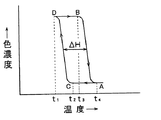
前記可逆熱変色性組成物は、特公昭51−44706号公報、特公昭51−44707号公報、特公平1−29398号公報等に記載された、所定の温度(変色点)を境としてその前後で変色し、高温側変色点以上の温度域で消色状態、低温側変色点以下の温度域で発色状態を呈し、前記両状態のうち常温域では特定の一方の状態しか存在せず、もう一方の状態は、その状態が発現するのに要した熱又は冷熱が適用されている間は維持されるが、前記熱又は冷熱の適用がなくなれば常温域で呈する状態に戻る、ヒステリシス幅が比較的小さい特性(ΔH=1〜7℃)を有する加熱消色型の可逆熱変色性組成物を適用できる(図1参照)。 The reversible thermochromic composition has a predetermined temperature (discoloration point) described in JP-B-51-44706, JP-B-51-44707, JP-B-1-29398, and the like. Discolored in the temperature range above the high temperature side discoloration point, color developed in the temperature range below the low temperature side discoloration point, and only one specific state exists in the normal temperature range among the two states, One state is maintained as long as the heat or cold necessary to develop the state is applied, but when the heat or cold is no longer applied, the state returns to the state exhibited in the normal temperature range. A heat-decolorable reversible thermochromic composition having a relatively small characteristic (ΔH = 1 to 7 ° C.) can be applied (see FIG. 1).
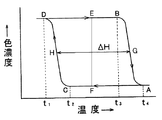
また、特公平4−17154号公報、特開平7−179777号公報、特開平7−33997号公報、特開平8−39936号公報、特開2005−1369号公報、特開2006−137886号公報、特開2006−188660号公報等に記載されている大きなヒステリシス特性(ΔH=8〜70℃)を示し、温度変化による着色濃度の変化をプロットした曲線の形状が、温度を変色温度域より低温側から上昇させていく場合と逆に変色温度域より高温側から下降させていく場合とで大きく異なる経路を辿って変色し、低温域での第一色相を呈する状態(発色状態)、又は、高温域での第二色相を呈する状態(消色状態)を特定温度域で保持できる色彩記憶性を有する加熱消色型の可逆熱変色性組成物を用いることもできる(図2参照)。 JP-B-4-17154, JP-A-7-179777, JP-A-7-33997, JP-A-8-39936, JP-A-2005-1369, JP-A-2006-137886, The large hysteresis characteristic (ΔH = 8 to 70 ° C.) described in Japanese Patent Application Laid-Open No. 2006-188660 is shown, and the shape of the curve in which the change in the color density due to the temperature change is plotted is lower than the color change temperature range. Contrary to the case where the temperature is raised from the color change temperature range, the color changes by following a very different path from the high temperature side than the color change temperature range, and the first hue in the low temperature range (coloring state) or high temperature It is also possible to use a heat-erasable reversible thermochromic composition having a color memory property that can maintain a state exhibiting the second hue in the region (decolored state) in a specific temperature range (see FIG. 2). .
以下に前記可逆熱変色性組成物の色濃度−温度曲線におけるヒステリシス特性を図2のグラフによって説明する。
図2において、縦軸に色濃度、横軸に温度が表されている。温度変化による色濃度の変化は矢印に沿って進行する。ここで、Aは完全に消色した状態に達する温度t4(以下、完全消色温度と称す)における濃度を示す点であり、Bは消色し始める温度t3(以下、消色開始温度と称す)における濃度を示す点であり、Cは発色し始める温度t2(以下、発色開始温度と称す)における濃度を示す点であり、Dは完全に発色した状態に達する温度t1(以下、完全発色温度と称す)における濃度を示す点である。
また、線分EFの長さが変色のコントラストを示す尺度であり、線分HGの長さがヒステリシスの程度を示す温度幅(以下、ヒステリシス幅ΔHと記す)であり、このΔH値が大きい程、変色前後の各状態の保持が容易である。
ここで、t4とt3の差、或いは、t2とt1の差(Δt)が変色の鋭敏性を示す尺度である。
The hysteresis characteristics in the color density-temperature curve of the reversible thermochromic composition will be described below with reference to the graph of FIG.
In FIG. 2, the vertical axis represents color density and the horizontal axis represents temperature. The change in color density due to the temperature change proceeds along the arrow. Here, A is a point indicating a density at a temperature t 4 (hereinafter referred to as a complete decoloring temperature) reaching a completely decolored state, and B is a temperature t 3 (hereinafter referred to as a decoloring start temperature) at which decoloring starts. C is a point indicating a density at a temperature t 2 at which color development starts (hereinafter referred to as a color development start temperature), and D is a temperature t 1 at which a fully colored state is reached (hereinafter referred to as a color development start temperature). , Referred to as a complete color development temperature).
The length of the line segment EF is a scale indicating the discoloration contrast, and the length of the line segment HG is a temperature width indicating the degree of hysteresis (hereinafter referred to as hysteresis width ΔH). It is easy to maintain each state before and after the color change.
Here, the difference between t 4 and t 3 , or the difference between t 2 and t 1 (Δt) is a scale indicating the sensitivity of discoloration.
更に、可逆熱変色性組成物の発消色状態のうち常温域では特定の一方の状態のみ存在させると共に、前記可逆熱変色性組成物による筆跡を摩擦により簡易に変色させるためには、完全消色温度(t4)が45〜90℃であり、且つ、発色開始温度(t2)が−30〜0℃である。
ここで、変色状態が常温域で保持でき、且つ、筆跡の摩擦による変色性を容易とするために何故完全消色温度(t4)が45〜95℃、且つ、発色開始温度(t2)が−30〜0℃以下であるかを説明すると、発色状態から消色開始温度(t3)を経て完全消色温度(t4)に達しない状態で加温を止めると、再び第一の状態に復する現象を生じること、及び、消色状態から発色開始温度(t2)を経て完全発色温度(t1)に達しない状態で冷却を中止しても発色を生じた状態が維持されることから、完全消色温度(t4)が常温域を越える45℃以上であれば、発色状態は通常の使用状態において維持されることになり、発色開始温度(t2)が常温域を下回る−30〜0℃の温度であれば消色状態は通常の使用において維持される。
更に、摩擦により筆跡を消去する場合、完全消色温度(t4)が95℃以下であれば、筆記面に形成された筆跡上を摩擦部材による数回の摩擦による摩擦熱で十分に変色できる。
完全消色温度(t4)が95℃を越える温度の場合、摩擦部材による摩擦で得られる摩擦熱が完全消色温度に達し難くなるため、容易に変色し難くなり、摩擦回数が増加したり、或いは、荷重をかけ過ぎて摩擦する傾向にあるため、筆記面を傷めてしまう虞がある。
よって、前記温度設定は筆記面に変色状態の筆跡を選択して択一的に視認させる熱消去性筆記具には重要な要件であり、利便性と実用性を満足させることができる。
前述の完全消色温度(t4)の温度設定において、発色状態が通常の使用状態において維持されるためにはより高い温度であることが好ましく、しかも、摩擦による摩擦熱が完全消色温度(t4)を越えるようにするためには低い温度であることが好ましい。
よって、完全消色温度(t4)は、好ましくは50〜90℃、より好ましくは60〜80℃である。
更に、前述の発色開始温度(t2)の温度設定において、消色状態が通常の使用状態において維持されるためにはより低い温度であることが好ましく、−30〜−3℃が好適であり、−30〜−5℃がより好適である。
なお、筆記体に分散された状態の可逆熱変色性組成物を予め発色状態にするためには冷却手段としては汎用の冷凍庫にて冷却することが好ましいが、冷凍庫の冷却能力を考慮すると、−30℃迄が限度であり、従って、完全発色温度(t1)は−30℃以上である。
本発明においてヒステシス幅(ΔH)は50℃乃至80℃の範囲であり、好ましくは55乃至80℃、更に好ましくは60乃至80℃である。
Furthermore, in order to allow only one specific state to exist in the normal temperature region among the color development / decoloration states of the reversible thermochromic composition, and to easily discolor the handwriting by the reversible thermochromic composition by friction, it is necessary to completely erase the color. The color temperature (t 4 ) is 45 to 90 ° C., and the color development start temperature (t 2 ) is −30 to 0 ° C.
Here, the discoloration state can be maintained in a normal temperature range, and in order to facilitate discoloration due to friction of handwriting, the complete decolorization temperature (t 4 ) is 45 to 95 ° C., and the color development start temperature (t 2 ). When There describing or less than -30 to 0 ° C., the stop warming in a state that does not reach from the colored state to the through decoloring starting temperature (t 3) complete decoloring temperature (t 4), the first re The phenomenon of returning to the state occurs, and even if the cooling is stopped in the state where the color development start temperature (t 2 ) has not reached the complete color development temperature (t 1 ) from the decolored state, the color developed state is maintained. Therefore, if the complete color erasing temperature (t 4 ) is 45 ° C. or more exceeding the normal temperature range, the color development state is maintained in the normal use state, and the color development start temperature (t 2 ) is within the normal temperature range. If the temperature is lower than -30 to 0 ° C, the decolored state is maintained in normal use. Is done.
Further, when the handwriting is erased by friction, if the complete color erasing temperature (t 4 ) is 95 ° C. or less, the handwriting formed on the writing surface can be sufficiently discolored by frictional heat due to several times of friction by the friction member. .
When the complete decolorization temperature (t 4 ) exceeds 95 ° C., the frictional heat obtained by friction with the friction member is difficult to reach the complete decolorization temperature, so that it is difficult to discolor easily and the number of friction increases. Alternatively, the writing surface tends to be damaged because the load tends to be excessively rubbed.
Therefore, the temperature setting is an important requirement for a heat erasable writing instrument that selectively displays a discolored handwriting on the writing surface and can satisfy convenience and practicality.
In the temperature setting of the complete color erasing temperature (t 4 ), a higher temperature is preferable in order to maintain the color development state in a normal use state, and the frictional heat due to friction is a complete color erasure temperature ( In order to exceed t 4 ), a low temperature is preferred.
Therefore, the complete decoloring temperature (t 4 ) is preferably 50 to 90 ° C., more preferably 60 to 80 ° C.
Furthermore, in the temperature setting of the color development start temperature (t 2 ) described above, a lower temperature is preferable in order to maintain the decolored state in a normal use state, and −30 to −3 ° C. is preferable. -30 to -5 ° C is more preferable.
In order to make the reversible thermochromic composition dispersed in the cursive body into a colored state in advance, it is preferable to cool in a general-purpose freezer as a cooling means, but considering the cooling capacity of the freezer,- Up to 30 ° C. is the limit, and therefore the complete color development temperature (t 1 ) is −30 ° C. or higher.
In the present invention, the hysteresis width (ΔH) is in the range of 50 ° C. to 80 ° C., preferably 55 to 80 ° C., more preferably 60 to 80 ° C.
以下に可逆熱変色性組成物を構成する(イ)、(ロ)、(ハ)成分について具体的に化合物を例示する。
本発明の(イ)成分、即ち電子供与性呈色性有機化合物としては、ジフェニルメタンフタリド類、フェニルインドリルフタリド類、インドリルフタリド類、ジフェニルメタンアザフタリド類、フェニルインドリルアザフタリド類、フルオラン類、スチリノキノリン類、ジアザローダミンラクトン類等を挙げることができ、以下にこれらの化合物を例示する。
3,3−ビス(p−ジメチルアミノフェニル)−6−ジメチルアミノフタリド、3−(4−ジエチルアミノフェニル)−3−(1−エチル−2−メチルインドール−3−イル)フタリド、3,3−ビス(1−n−ブチル−2−メチルインドール−3−イル)フタリド、3,3−ビス(2−エトキシ−4−ジエチルアミノフェニル)−4−アザフタリド、3−〔2−エトキシ−4−(N−エチルアニリノ)フェニル〕−3−(1−エチル−2−メチルインドール−3−イル)−4−アザフタリド、3,6−ジフェニルアミノフルオラン、3,6−ジメトキシフルオラン、3,6−ジ−n−ブトキシフルオラン、2−メチル−6−(N−エチル−N−p−トリルアミノ)フルオラン、3−クロロ−6−シクロヘキシルアミノフルオラン、2−メチル−6−シクロヘキシルアミノフルオラン、2−(2−クロロアニリノ)−6−ジ−n−ブチルアミノフルオラン、2−(3−トリフルオロメチルアニリノ)−6−ジエチルアミノフルオラン、2−(N−メチルアニリノ)−6−(N−エチル−N−p−トリルアミノ)フルオラン、1,3−ジメチル−6−ジエチルアミノフルオラン、2−クロロ−3−メチル−6−ジエチルアミノフルオラン、2−アニリノ−3−メチル−6−ジエチルアミノフルオラン、2−アニリノ−3−メチル−6−ジ−n−ブチルアミノフルオラン、2−キシリジノ−3−メチル−6−ジエチルアミノフルオラン、1,2−ベンツ−6−ジエチルアミノフルオラン、1,2−ベンツ−6−(N−エチル−N−イソブチルアミノ)フルオラン、1,2−ベンツ−6−(N−エチル−N−イソアミルアミノ)フルオラン、2−(3−メトキシ−4−ドデコキシスチリル)キノリン、スピロ〔5H−(1)ベンゾピラノ(2,3−d)ピリミジン−5,1′(3′H)イソベンゾフラン〕−3′−オン,2−(ジエチルアミノ)−8−(ジエチルアミノ)−4−メチル−、スピロ〔5H−(1)ベンゾピラノ(2,3−d)ピリミジン−5,1′(3′H)イソベンゾフラン〕−3′−オン,2−(ジ−n−ブチルアミノ)−8−(ジ−n−ブチルアミノ)−4−メチル−、スピロ〔5H−(1)ベンゾピラノ(2,3−d)ピリミジン−5,1′(3′H)イソベンゾフラン〕−3′−オン,2−(ジ−n−ブチルアミノ)−8−(ジエチルアミノ)−4−メチル−、スピロ〔5H−(1)ベンゾピラノ(2,3−d)ピリミジン−5,1′(3′H)イソベンゾフラン〕−3′−オン,2−(ジ−n−ブチルアミノ)−8−(N−エチル−N−i−アミルアミノ)−4−メチル−、スピロ〔5H−(1)ベンゾピラノ(2,3−d)ピリミジン−5,1′(3′H)イソベンゾフラン〕−3′−オン,2−(ジ−n−ブチルアミノ)−8−(ジ−n−ブチルアミノ)−4−フェニル、3−(2−メトキシ−4−ジメチルアミノフェニル)−3−(1−ブチル−2−メチルインドール−3−イル)−4,5,6,7−テトラクロロフタリド、3−(2−エトキシ−4−ジエチルアミノフェニル)−3−(1−エチル−2−メチルインドール−3−イル)−4,5,6,7−テトラクロロフタリド、3−(2−エトキシ−4−ジエチルアミノフェニル)−3−(1−ペンチル−2−メチルインドール−3−イル)−4,5,6,7−テトラクロロフタリド等を挙げることができる。
更には、蛍光性の黄色〜赤色の発色を発現させるのに有効な、ピリジン系、キナゾリン系、ビスキナゾリン系化合物等を挙げることができる。
Specific examples of the compounds (a), (b), and (c) constituting the reversible thermochromic composition are shown below.
As the component (a) of the present invention, that is, the electron-donating color-forming organic compound, diphenylmethane phthalides, phenyl indolyl phthalides, indolyl phthalides, diphenyl methane azaphthalides, phenyl indolyl azaphthalide , Fluorans, stylinoquinolines, diazarhodamine lactones, etc., and these compounds are exemplified below.
3,3-bis (p-dimethylaminophenyl) -6-dimethylaminophthalide, 3- (4-diethylaminophenyl) -3- (1-ethyl-2-methylindol-3-yl) phthalide, 3,3 -Bis (1-n-butyl-2-methylindol-3-yl) phthalide, 3,3-bis (2-ethoxy-4-diethylaminophenyl) -4-azaphthalide, 3- [2-ethoxy-4- ( N-ethylanilino) phenyl] -3- (1-ethyl-2-methylindol-3-yl) -4-azaphthalide, 3,6-diphenylaminofluorane, 3,6-dimethoxyfluorane, 3,6-di -N-butoxyfluorane, 2-methyl-6- (N-ethyl-Np-tolylamino) fluorane, 3-chloro-6-cyclohexylaminofluorane, 2-methyl -6-cyclohexylaminofluorane, 2- (2-chloroanilino) -6-di-n-butylaminofluorane, 2- (3-trifluoromethylanilino) -6-diethylaminofluorane, 2- (N- Methylanilino) -6- (N-ethyl-Np-tolylamino) fluorane, 1,3-dimethyl-6-diethylaminofluorane, 2-chloro-3-methyl-6-diethylaminofluorane, 2-anilino-3- Methyl-6-diethylaminofluorane, 2-anilino-3-methyl-6-di-n-butylaminofluorane, 2-xylidino-3-methyl-6-diethylaminofluorane, 1,2-benz-6-diethylamino Fluorane, 1,2-benz-6- (N-ethyl-N-isobutylamino) fluorane, 1,2-benz-6 N-ethyl-N-isoamylamino) fluorane, 2- (3-methoxy-4-dodecoxystyryl) quinoline, spiro [5H- (1) benzopyrano (2,3-d) pyrimidine-5,1 ′ (3 'H) isobenzofuran] -3'-one, 2- (diethylamino) -8- (diethylamino) -4-methyl-, spiro [5H- (1) benzopyrano (2,3-d) pyrimidine-5,1' (3′H) isobenzofuran] -3′-one, 2- (di-n-butylamino) -8- (di-n-butylamino) -4-methyl-, spiro [5H- (1) benzopyrano ( 2,3-d) pyrimidine-5,1 '(3'H) isobenzofuran] -3'-one, 2- (di-n-butylamino) -8- (diethylamino) -4-methyl-, spiro [ 5H- (1) benzopyrano (2, 3-d) Pyrimidine-5,1 '(3'H) isobenzofuran] -3'-one, 2- (di-n-butylamino) -8- (N-ethyl-Ni-amylamino) -4 -Methyl-, spiro [5H- (1) benzopyrano (2,3-d) pyrimidine-5,1 '(3'H) isobenzofuran] -3'-one, 2- (di-n-butylamino)- 8- (Di-n-butylamino) -4-phenyl, 3- (2-methoxy-4-dimethylaminophenyl) -3- (1-butyl-2-methylindol-3-yl) -4,5 6,7-tetrachlorophthalide, 3- (2-ethoxy-4-diethylaminophenyl) -3- (1-ethyl-2-methylindol-3-yl) -4,5,6,7-tetrachlorophthalide 3- (2-ethoxy-4-diethylaminophenyl) 3- (1-pentyl-2-methylindole-3-yl) -4,5,6,7 can be given tetrachloro phthalide like.
Furthermore, there can be mentioned pyridine-based, quinazoline-based, bisquinazoline-based compounds and the like that are effective in developing fluorescent yellow to red color development.
成分(ロ)の電子受容性化合物としては、活性プロトンを有する化合物群、偽酸性化合物群(酸ではないが、組成物中で酸として作用して成分(イ)を発色させる化合物群)、電子空孔を有する化合物群等がある。
活性プロトンを有する化合物を例示すると、フェノール性水酸基を有する化合物としては、モノフェノール類からポリフェノール類があり、さらにその置換基としてアルキル基、アリール基、アシル基、アルコキシカルボニル基、カルボキシ基及びそのエステル又はアミド基、ハロゲン基等を有するもの、及びビス型、トリス型フェノール等、フェノール−アルデヒド縮合樹脂等を挙げることができる。又、前記フェノール性水酸基を有する化合物の金属塩であってもよい。
As the electron-accepting compound of component (b), a group of compounds having active protons, a group of pseudo-acidic compounds (a group of compounds that are not acids but act as an acid in the composition and cause component (a) to develop color), electrons There is a group of compounds having pores.
Examples of compounds having active protons include monophenols to polyphenols as compounds having phenolic hydroxyl groups, and alkyl groups, aryl groups, acyl groups, alkoxycarbonyl groups, carboxy groups and esters thereof as substituents. Alternatively, those having an amide group, a halogen group, etc., and bis-type and tris-type phenols, phenol-aldehyde condensation resins and the like can be mentioned. Moreover, the metal salt of the compound which has the said phenolic hydroxyl group may be sufficient.
以下に具体例を挙げる。
フェノール、o−クレゾール、ターシャリーブチルカテコール、ノニルフェノール、n−オクチルフェノール、n−ドデシルフェノール、n−ステアリルフェノール、p−クロロフェノール、p−ブロモフェノール、o−フェニルフェノール、p−ヒドロキシ安息香酸n−ブチル、p−ヒドロキシ安息香酸n−オクチル、レゾルシン、没食子酸ドデシル、2,2−ビス(4−ヒドロキシフェニル)プロパン、4,4−ジヒドロキシジフェニルスルホン、1,1−ビス(4−ヒドロキシフェニル)エタン、2,2−ビス(4−ヒドロキシ−3−メチルフェニル)プロパン、ビス(4−ヒドロキシフェニル)スルフィド、1−フェニル−1,1−ビス(4−ヒドロキシフェニル)エタン、1,1−ビス(4−ヒドロキシフェニル)−3−メチルブタン、1,1−ビス(4−ヒドロキシフェニル)−2−メチルプロパン、1,1−ビス(4−ヒドロキシフェニル)n−ヘキサン、1,1−ビス(4−ヒドロキシフェニル)n−ヘプタン、1,1−ビス(4−ヒドロキシフェニル)n−オクタン、1,1−ビス(4−ヒドロキシフェニル)n−ノナン、1,1−ビス(4−ヒドロキシフェニル)n−デカン、1,1−ビス(4−ヒドロキシフェニル)n−ドデカン、2,2−ビス(4−ヒドロキシフェニル)ブタン、2,2−ビス(4−ヒドロキシフェニル)エチルプロピオネート、2,2−ビス(4−ヒドロキシフェニル)−4−メチルペンタン、2,2−ビス(4−ヒドロキシフェニル)ヘキサフルオロプロパン、2,2−ビス(4−ヒドロキシフェニル)n−ヘプタン、2,2−ビス(4−ヒドロキシフェニル)n−ノナン等がある。
前記フェノール性水酸基を有する化合物が最も有効な熱変色特性を発現させることができるが、芳香族カルボン酸及び炭素数2〜5の脂肪族カルボン酸、カルボン酸金属塩、酸性リン酸エステル及びそれらの金属塩、1、2、3−トリアゾール及びその誘導体から選ばれる化合物等であってもよい。
Specific examples are given below.
Phenol, o-cresol, tertiary butylcatechol, nonylphenol, n-octylphenol, n-dodecylphenol, n-stearylphenol, p-chlorophenol, p-bromophenol, o-phenylphenol, n-butyl p-hydroxybenzoate N-octyl p-hydroxybenzoate, resorcin, dodecyl gallate, 2,2-bis (4-hydroxyphenyl) propane, 4,4-dihydroxydiphenylsulfone, 1,1-bis (4-hydroxyphenyl) ethane, 2,2-bis (4-hydroxy-3-methylphenyl) propane, bis (4-hydroxyphenyl) sulfide, 1-phenyl-1,1-bis (4-hydroxyphenyl) ethane, 1,1-bis (4 -Hydroxyphenyl) -3-
The compound having a phenolic hydroxyl group can develop the most effective thermochromic property, but aromatic carboxylic acids and aliphatic carboxylic acids having 2 to 5 carbon atoms, carboxylic acid metal salts, acidic phosphate esters and their It may be a compound selected from metal salts, 1,2,3-triazole and derivatives thereof.
前記(イ)、(ロ)成分による電子授受反応を特定温度域において可逆的に生起させる反応媒体の(ハ)成分について説明する。前記(ハ)成分としては、アルコール類、エステル類、ケトン類、エーテル類、酸アミド類を挙げることができる。
前記(ハ)成分として好ましくは、色濃度−温度曲線に関し、大きなヒステリシス特性(温度変化による着色濃度の変化をプロットした曲線が、温度を低温側から高温側へ変化させる場合と、高温側から低温側へ変化させる場合で異なる)を示して変色する、色彩記憶性を示す可逆熱変色性組成物を形成できる5℃以上50℃未満のΔT値(融点−曇点)を示すカルボン酸エステル化合物、例えば、分子中に置換芳香族環を含むカルボン酸エステル、無置換芳香族環を含むカルボン酸と炭素数10以上の脂肪族アルコールのエステル、分子中にシクロヘキシル基を含むカルボン酸エステル、炭素数6以上の脂肪酸と無置換芳香族アルコール又はフェノールのエステル、炭素数8以上の脂肪酸と分岐脂肪族アルコール又はエステル、ジカルボン酸と芳香族アルコール又は分岐脂肪族アルコールのエステル、ケイ皮酸ジベンジル、ステアリン酸ヘプチル、アジピン酸ジデシル、アジピン酸ジラウリル、アジピン酸ジミリスチル、アジピン酸ジセチル、アジピン酸ジステアリル、トリラウリン、トリミリスチン、トリステアリン、ジミリスチン、ジステアリン等が用いられる。
The component (c) of the reaction medium that causes the electron transfer reaction by the components (a) and (b) to occur reversibly in a specific temperature range will be described. Examples of the component (c) include alcohols, esters, ketones, ethers, and acid amides.
The component (c) is preferably a large hysteresis characteristic regarding the color density-temperature curve (a curve plotting a change in color density due to a temperature change changes the temperature from the low temperature side to the high temperature side and the high temperature side to the low temperature side). A carboxylic acid ester compound that exhibits a ΔT value (melting point-cloud point) of 5 ° C. or higher and lower than 50 ° C., which can form a reversible thermochromic composition that exhibits color memory, and changes color when changing to the side) For example, a carboxylic acid ester having a substituted aromatic ring in the molecule, an ester of a carboxylic acid having an unsubstituted aromatic ring and an aliphatic alcohol having 10 or more carbon atoms, a carboxylic acid ester having a cyclohexyl group in the molecule, 6 carbon atoms Fatty acid and unsubstituted aromatic alcohol or phenol ester, fatty acid having 8 or more carbon atoms and branched aliphatic alcohol or ester, dicarboxylic acid And esters of aromatic alcohols or branched aliphatic alcohols, dibenzyl cinnamate, heptyl stearate, didecyl adipate, dilauryl adipate, dimyristyl adipate, dicetyl adipate, distearyl adipate, trilaurin, trimyristin, tristearin, Dimyristin, distearin and the like are used.
また、炭素数9以上の奇数の脂肪族一価アルコールと炭素数が偶数の脂肪族カルボン酸から得られる脂肪酸エステル化合物、n−ペンチルアルコール又はn−ヘプチルアルコールと炭素数10乃至16の偶数の脂肪族カルボン酸より得られる総炭素数17乃至23の脂肪酸エステル化合物も有効である。
具体的には、酢酸n−ペンタデシル、酪酸n−トリデシル、酪酸n−ペンタデシル、カプロン酸n−ウンデシル、カプロン酸n−トリデシル、カプロン酸n−ペンタデシル、カプリル酸n−ノニル、カプリル酸n−ウンデシル、カプリル酸n−トリデシル、カプリル酸n−ペンタデシル、カプリン酸n−ヘプチル、カプリン酸n−ノニル、カプリン酸n−ウンデシル、カプリン酸n−トリデシル、カプリン酸n−ペンタデシル、ラウリン酸n−ペンチル、ラウリン酸n−ヘプチル、ラウリン酸n−ノニル、ラウリン酸n−ウンデシル、ラウリン酸n−トリデシル、ラウリン酸n−ペンタデシル、ミリスチン酸n−ペンチル、ミリスチン酸n−ヘプチル、ミリスチン酸n−ノニル、ミリスチン酸n−ウンデシル、ミリスチン酸n−トリデシル、ミリスチン酸n−ペンタデシル、パルミチン酸n−ペンチル、パルミチン酸n−ヘプチル、パルミチン酸n−ノニル、パルミチン酸n−ウンデシル、パルミチン酸n−トリデシル、パルミチン酸n−ペンタデシル、ステアリン酸n−ノニル、ステアリン酸n−ウンデシル、ステアリン酸n−トリデシル、ステアリン酸n−ペンタデシル、エイコサン酸n−ノニル、エイコサン酸n−ウンデシル、エイコサン酸n−トリデシル、エイコサン酸n−ペンタデシル、ベヘニン酸n−ノニル、ベヘニン酸n−ウンデシル、ベヘニン酸n−トリデシル、ベヘニン酸n−ペンタデシル等を挙げることができる。
Also, fatty acid ester compounds obtained from an odd aliphatic monohydric alcohol having 9 or more carbon atoms and an aliphatic carboxylic acid having an even number of carbon atoms, n-pentyl alcohol or n-heptyl alcohol and an even fat having 10 to 16 carbon atoms. A fatty acid ester compound having a total carbon number of 17 to 23 obtained from a group carboxylic acid is also effective.
Specifically, n-pentadecyl acetate, n-tridecyl butyrate, n-pentadecyl butyrate, n-undecyl caproate, n-tridecyl caproate, n-pentadecyl caproate, n-nonyl caprylate, n-undecyl caprylate, N-tridecyl caprylate, n-pentadecyl caprylate, n-heptyl caprate, n-nonyl caprate, n-undecyl caprate, n-tridecyl caprate, n-pentadecyl caprate, n-pentyl laurate, lauric acid n-heptyl, n-nonyl laurate, n-undecyl laurate, n-tridecyl laurate, n-pentadecyl laurate, n-pentyl myristate, n-heptyl myristate, n-nonyl myristate, n-myristate Undecyl, n-tridecyl myristate, N-pentadecyl ristinate, n-pentyl palmitate, n-heptyl palmitate, n-nonyl palmitate, n-undecyl palmitate, n-tridecyl palmitate, n-pentadecyl palmitate, n-nonyl stearate, stearic acid n-undecyl, n-tridecyl stearate, n-pentadecyl stearate, n-nonyl eicosanoate, n-undecyl eicosanoate, n-tridecyl eicosanoate, n-pentadecyl eicosanoate, n-nonyl behenate, n-behenate Examples include undecyl, n-tridecyl behenate, and n-pentadecyl behenate.
また、ケトン類としては、総炭素数が10以上の脂肪族ケトン類が有効であり、2−デカノン、3−デカノン、4−デカノン、2−ウンデカノン、3−ウンデカノン、4−ウンデカノン、5−ウンデカノン、2−ドデカノン、3−ドデカノン、4−ドデカノン、5−ドデカノン、2−トリデカノン、3−トリデカノン、2−テトラデカノン、2−ペンタデカノン、8−ペンタデカノン、2−ヘキサデカノン、3−ヘキサデカノン、9−ヘプタデカノン、2−ペンタデカノン、2−オクタデカノン、2−ノナデカノン、10−ノナダカノン、2−エイコサノン、11−エイコサノン、2−ヘンエイコサノン、2-ドコサノン、ラウロン、ステアロン等を挙げることができる。
また、総炭素数が12乃至24のアリールアルキルケトン類、例えば、n−オクタデカノフェノン、n−ヘプタデカノフェノン、n−ヘキサデカノフェノン、n−ペンタデカノフェノン、n−テトラデカノフェノン、4−n−ドデカアセトフェノン、n−トリデカノフェノン、4−n−ウンデカノアセトフェノン、n−ラウロフェノン、4−n−デカノアセトフェノン、n−ウンデカノフェノン、4−n−ノニルアセトフェノン、n−デカノフェノン、4−n−オクチルアセトフェノン、n−ノナノフェノン、4−n−ヘプチルアセトフェノン、n−オクタノフェノン、4−n−ヘキシルアセトフェノン、4−n−シクロヘキシルアセトフェノン、4−tert−ブチルプロピオフェノン、n−ヘプタフェノン、4−n−ペンチルアセトフェノン、シクロヘキシルフェニルケトン、ベンジル−n−ブチルケトン、4−n−ブチルアセトフェノン、n−ヘキサノフェノン、4−イソブチルアセトフェノン、1−アセトナフトン、2−アセトナフトン、シクロペンチルフェニルケトン等を挙げることができる。
As the ketones, aliphatic ketones having a total carbon number of 10 or more are effective, and 2-decanone, 3-decanone, 4-decanone, 2-undecanone, 3-undecanone, 4-undecanone, and 5-undecanone. 2-dodecanone, 3-dodecanone, 4-dodecanone, 5-dodecanone, 2-tridecanone, 3-tridecanone, 2-tetradecanone, 2-pentadecanone, 8-pentadecanone, 2-hexadecanone, 3-hexadecanone, 9-heptadecanone, 2 -Pentadecanone, 2-octadecanone, 2-nonadecanone, 10-nonadacanone, 2-eicosanone, 11-eicosanone, 2-heneicosanone, 2-docosanone, laurone, stearone and the like.
Further, arylalkyl ketones having 12 to 24 carbon atoms in total, such as n-octadecanophenone, n-heptadecanophenone, n-hexadecanophenone, n-pentadecanophenone, n-tetradecano Phenone, 4-n-dodecanacetophenone, n-tridecanophenone, 4-n-undecanoacetophenone, n-laurophenone, 4-n-decanoacetophenone, n-undecanophenone, 4-n-nonylacetophenone, n -Decanophenone, 4-n-octylacetophenone, n-nonanophenone, 4-n-heptylacetophenone, n-octanophenone, 4-n-hexylacetophenone, 4-n-cyclohexylacetophenone, 4-tert-butylpropiophenone, n-heptaphenone, 4-n-pentylacetophene Emissions, cyclohexyl phenyl ketone, benzyl -n- butyl ketone, 4-n-butyl acetophenone, n- hexanophenone, 4-isobutyl acetophenone, 1-acetonaphthone, 2-acetonaphthone, may be mentioned cyclopentyl phenyl ketone.
また、エーテル類としては、総炭素数10以上の脂肪族エーテル類が有効であり、ジペンチルエーテル、ジヘキシルエーテル、ジヘプチルエーテル、ジオクチルエーテル、ジノニルエーテル、ジデシルエーテル、ジウンデシルエーテル、ジドデシルエーテル、ジトリデシルエーテル、ジテトラデシルエーテル、ジペンタデシルエーテル、ジヘキサデシルエーテル、ジオクタデシルエーテル、デカンジオールジメチルエーテル、ウンデカンジオールジメチルエーテル、ドデカンジオールジメチルエーテル、トリデカンジオールジメチルエーテル、デカンジオールジエチルエーテル、ウンデカンジオールジエチルエーテル等を挙げることができる。 As ethers, aliphatic ethers having a total carbon number of 10 or more are effective, and dipentyl ether, dihexyl ether, diheptyl ether, dioctyl ether, dinonyl ether, didecyl ether, diundecyl ether, didodecyl ether. , Ditridecyl ether, ditetradecyl ether, dipentadecyl ether, dihexadecyl ether, dioctadecyl ether, decanediol dimethyl ether, undecane diol dimethyl ether, dodecane diol dimethyl ether, tridecane diol dimethyl ether, decane diol diethyl ether, undecane diol diethyl ether Etc.
更に、前記(ハ)成分として、特開2006−137886号公報に記載されている下記一般式(1)で示される化合物、或いは、特開2006−188660号公報に記載されている下記一般式(2)で示される化合物が好適に用いられる。
前記式(1)で示される化合物のうち、R1が水素原子の場合、より広いヒステリシス幅を有する可逆熱変色性組成物が得られるため好適であり、更にR1が水素原子であり、且つ、mが0の場合がより好適である。
また、前記式(2)中のRは炭素数8以上のアルキル基又はアルケニル基を示すが、好ましくは炭素数10〜24のアルキル基、更に好ましくは炭素数12〜22のアルキル基である。
前記化合物としては、オクタン酸−4−ベンジルオキシフェニルエチル、ノナン酸−4−ベンジルオキシフェニルエチル、デカン酸−4−ベンジルオキシフェニルエチル、ウンデカン酸−4−ベンジルオキシフェニルエチル、ドデカン酸−4−ベンジルオキシフェニルエチル、トリデカン酸−4−ベンジルオキシフェニルエチル、テトラデカン酸−4−ベンジルオキシフェニルエチル、ペンタデカン酸−4−ベンジルオキシフェニルエチル、ヘキサデカン酸−4−ベンジルオキシフェニルエチル、ヘプタデカン酸−4−ベンジルオキシフェニルエチル、オクタデカン酸−4−ベンジルオキシフェニルエチル、オクタン酸1,1−ジフェニルメチル、ノナン酸1,1−ジフェニルメチル、デカン酸1,1−ジフェニルメチル、ウンデカン酸1,1−ジフェニルメチル、ドデカン酸1,1−ジフェニルメチル、トリデカン酸1,1−ジフェニルメチル、テトラデカン酸1,1−ジフェニルメチル、ペンタデカン酸1,1−ジフェニルメチル、ヘキサデカン酸1,1−ジフェニルメチル、ヘプタデカン酸1,1−ジフェニルメチル、オクタデカン酸1,1−ジフェニルメチル等を挙げることができる。
Among the compounds represented by the formula (1), when R 1 is a hydrogen atom, it is preferable because a reversible thermochromic composition having a wider hysteresis width can be obtained, and R 1 is a hydrogen atom, and , M is more preferably 0.
In the formula (2), R represents an alkyl group or alkenyl group having 8 or more carbon atoms, preferably an alkyl group having 10 to 24 carbon atoms, more preferably an alkyl group having 12 to 22 carbon atoms.
Examples of the compound include octanoic acid-4-benzyloxyphenylethyl, nonanoic acid-4-benzyloxyphenylethyl, decanoic acid-4-benzyloxyphenylethyl, undecanoic acid-4-benzyloxyphenylethyl, dodecanoic acid-4- Benzyloxyphenylethyl, tridecanoic acid-4-benzyloxyphenylethyl, tetradecanoic acid-4-benzyloxyphenylethyl, pentadecanoic acid-4-benzyloxyphenylethyl, hexadecanoic acid-4-benzyloxyphenylethyl, heptadecanoic acid-4- Benzyloxyphenylethyl, octadecanoic acid-4-benzyloxyphenylethyl, 1,1-diphenylmethyl octanoate, 1,1-diphenylmethyl nonanoate, 1,1-diphenylmethyl decanoate, 1,1-didecanoic acid Phenylmethyl,
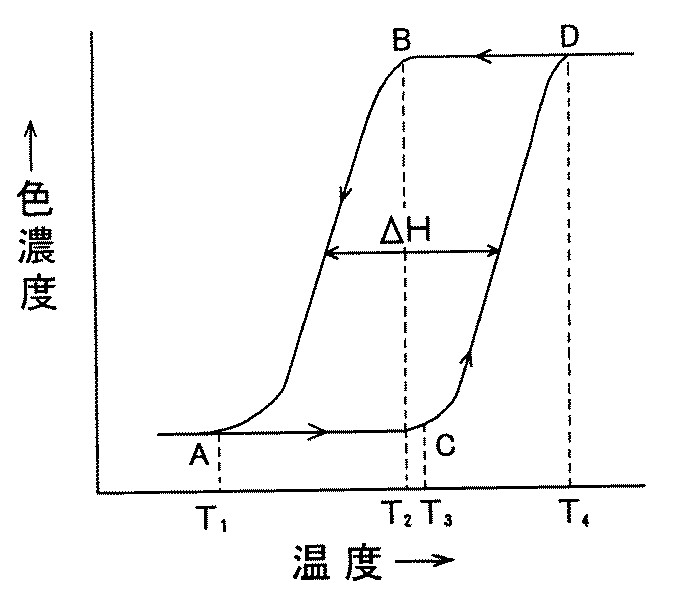
更に、電子受容性化合物として炭素数3乃至18の直鎖又は側鎖アルキル基を有する特定のアルコキシフェノール化合物(特開平11−129623号公報)、特定のヒドロキシ安息香酸エステル(特開2001−105732号公報)、没食子酸エステル(特開2003−253149号公報)等を用いた加熱発色型の可逆熱変色性組成物を適用することもできる(図3参照)。 Further, as an electron-accepting compound, a specific alkoxyphenol compound having a linear or side chain alkyl group having 3 to 18 carbon atoms (Japanese Patent Laid-Open No. 11-129623), a specific hydroxybenzoic acid ester (Japanese Patent Laid-Open No. 2001-105732). Gazette), gallic acid esters (Japanese Patent Laid-Open No. 2003-253149), and the like, and a heat-developing reversible thermochromic composition can also be applied (see FIG. 3).
前記(イ)、(ロ)、(ハ)成分の配合割合は、濃度、変色温度、変色形態や各成分の種類に左右されるが、一般的に所望の変色特性が得られる成分比は、(イ)成分1に対して、(ロ)成分0.1〜50、好ましくは0.5〜20、(ハ)成分1〜800、好ましくは5〜200の範囲である(前記割合はいずれも質量部である)。
The blending ratio of the components (a), (b), and (c) depends on the concentration, the color change temperature, the color change form, and the type of each component. In general, the component ratio at which a desired color change characteristic is obtained is as follows. (B)
前記(イ)、(ロ)、(ハ)成分の構成成分割合は、濃度、変色温度、変色形態や各成分の種類に左右されるが、一般的に所望の特性が得られる成分比は、(イ)成分1に対して、(ロ)成分0.1〜50、好ましくは0.5〜20、(ハ)成分1〜800、好ましくは5〜200の範囲である(前記割合はいずれも質量部である)。
又、各成分は各々二種以上の混合であってもよい。
The component ratios of the components (A), (B), and (C) depend on the concentration, the color change temperature, the color change form, and the type of each component. (B)
Each component may be a mixture of two or more.
前記三成分からなる可逆熱変色性組成物はマイクロカプセルに内包して使用することもでき、酸性物質、塩基性物質、過酸化物等の化学的に活性な物質又は他の溶剤成分と接触しても、その機能を低下させることがなく、耐熱安定性が保持できる。また、種々の使用条件において可逆熱変色性組成物は同一の組成に保たれ、同一の作用効果を奏することができる。
前記マイクロカプセルは、平均粒子径が0.5〜50μm、好ましくは1〜30μm、より好ましくは2〜20μmの範囲が実用性を満たす。
前記マイクロカプセルは最大外径の平均値が50μmを越えると分散安定性に欠けることがあり、また、最大外径の平均値が0.5μm未満では高濃度の発色性を示し難くなる。
また、前記マイクロカプセルは、内包物:壁膜=7:1〜1:1(質量比)、好ましくは6:1〜1:1(質量比)の範囲が有効であり、内包物の比率が前記範囲より小になると発色時の色濃度及び鮮明性の低下を免れず、内包物の比率が前記範囲より大になると、壁膜の厚みが肉薄となり過ぎ、圧力や熱に対する耐性の低下を生じ易くなる。
前記マイクロカプセル化は、イソシアネート系の界面重合法、メラミン−ホルマリン系等のin Situ重合法、液中硬化被覆法、水溶液からの相分離法、有機溶媒からの相分離法、融解分散冷却法、気中懸濁被覆法、スプレードライング法等があり、用途に応じて適宜選択される。更にマイクロカプセルの表面には、目的に応じて更に二次的な樹脂皮膜を設けて耐久性を付与させたり、表面特性を改質させて実用に供することもできる。
前記マイクロカプセル顔料の形態は円形断面の形態のものの適用を拒まないが、非円形断面の形態が効果的である。
筆記により形成される筆跡は、前記マイクロカプセル顔料が被筆記面に対して長径側(最大外径側)を密接させて濃密に配向、固着されており、高濃度の発色性を示すと共に、前記筆跡を摩擦体による摩擦による外力に対して、前記マイクロカプセル顔料は外力を緩和する形状に微妙に弾性変形し、マイクロカプセルの壁膜の破壊が抑制され、熱変色機能を損なうことなく有効に発現させることができる。
The reversible thermochromic composition comprising the above three components can also be used by being encapsulated in a microcapsule, and is in contact with a chemically active substance such as an acidic substance, a basic substance or a peroxide, or other solvent component. However, the heat resistance stability can be maintained without deteriorating its function. In addition, the reversible thermochromic composition can be maintained in the same composition under various usage conditions, and can exhibit the same effects.
The microcapsules have an average particle size of 0.5 to 50 μm, preferably 1 to 30 μm, more preferably 2 to 20 μm, satisfying practicality.
When the average value of the maximum outer diameter exceeds 50 μm, the microcapsules may lack dispersion stability, and when the average value of the maximum outer diameter is less than 0.5 μm, it is difficult to exhibit high density color development.
The microcapsule is effective in the range of inclusion: wall membrane = 7: 1 to 1: 1 (mass ratio), preferably 6: 1 to 1: 1 (mass ratio), and the ratio of inclusion is If the ratio is smaller than the above range, the color density and sharpness during color development are unavoidable, and if the ratio of inclusion is larger than the above range, the thickness of the wall film becomes too thin, resulting in a decrease in resistance to pressure and heat. It becomes easy.
The microencapsulation includes an isocyanate-based interfacial polymerization method, an in situ polymerization method such as melamine-formalin, a liquid curing coating method, a phase separation method from an aqueous solution, a phase separation method from an organic solvent, a melt dispersion cooling method, There are an air suspension coating method, a spray drying method, and the like, which are appropriately selected according to the application. Further, a secondary resin film may be provided on the surface of the microcapsule according to the purpose to impart durability, or the surface characteristics may be modified for practical use.
The form of the microcapsule pigment does not refuse application of a circular cross-section, but a non-circular cross-section is effective.
The handwriting formed by writing, the microcapsule pigment is closely oriented and fixed in close contact with the writing surface on the long diameter side (maximum outer diameter side), and exhibits a high concentration of color development. The microcapsule pigment is slightly elastically deformed into a shape that relaxes the external force against the external force caused by friction caused by the frictional material, and the destruction of the microcapsule wall film is suppressed, and it is effectively expressed without impairing the thermal discoloration function. Can be made.
前記固形筆記体には、一般の染顔料(非熱変色性)を配合し、有色(1)から有色(2)への変色挙動を呈することもできる。 The solid cursive can be blended with a general dye (non-thermochromic property) to exhibit a color change behavior from colored (1) to colored (2).
前記のようにして得られる固形筆記体は、針入度が1〜30、好ましくは1.5〜28、より好ましくは2〜25である。
針入度は、JIS K2207に規格化されており、固形筆記体に規定重量の針を温度25℃,荷重100g、貫入時間5秒にて垂直に進入させ、進入した長さを表したものであって、針入度の値は、0.1mmを針入度1と表す。従って、数字が小さいほど硬く、大きいほど柔らかい固形筆記体である。
針入度が1未満では、固形筆記体が硬すぎて筆跡がうすく、視認性に乏しくなる。一方、針入度が30を越えると、固形筆記体が柔らかすぎて筆記し難く、しかも、筆跡は乾きが悪いため筆記面の空白部分を汚染したり、他の紙への色移りや汚れを引き起こす。
The solid cursive obtained as described above has a penetration of 1 to 30, preferably 1.5 to 28, and more preferably 2 to 25.
The penetration is standardized in JIS K2207, and indicates the length of the pen that has entered the solid cursive body at a temperature of 25 ° C, a load of 100 g, and a penetration time of 5 seconds. The value of the penetration is 0.1 mm as the
When the penetration is less than 1, the solid cursive body is too hard and the handwriting is faint and the visibility is poor. On the other hand, if the penetration exceeds 30, the solid cursive is too soft to write, and the handwriting does not dry well, so it will contaminate the blank area of the writing surface, or cause color transfer and stains on other paper. cause.
本発明の固形筆記体により形成された筆跡を変色させるためには、筆跡を摩擦する別体の摩擦具を用いたり、固形筆記体に設けた摩擦部材を用いることができる。
前記固形筆記体に摩擦部材を設けることにより、携帯性に優れた筆記体が得られる。
また、前記摩擦具は固形筆記体と組み合わせて固形筆記体セットとすることもできる。
前記摩擦具や摩擦部材は、弾性感に富み、摩擦時に適度な摩擦を生じて摩擦熱を発生させることのできるエラストマー、プラスチック発泡体等の弾性体が好適であるが、プラスチック成形体や金属であってもよい。
なお、消しゴムを使用して筆跡を摩擦することもできるが、摩擦時に消しカスが発生するため、好ましくは前述のような摩擦具や摩擦部材が用いられる。
前記摩擦具や摩擦部材の材質としては、シリコーン樹脂やSEBS樹脂(スチレンエチレンブタジエンスチレンブロック共重合体)が好適に用いられる。
In order to change the color of the handwriting formed by the solid cursive of the present invention, a separate friction tool that rubs the handwriting or a friction member provided on the solid cursive can be used.
By providing a friction member on the solid cursive body, a cursive body excellent in portability can be obtained.
Further, the friction tool can be combined with a solid cursive body to form a solid cursive body set.
The friction tool and the friction member are preferably elastic bodies such as elastomers and plastic foams that are rich in elasticity and can generate frictional heat by generating appropriate friction during friction. There may be.
Although the eraser can be used to rub the handwriting, since erase scraps are generated at the time of friction, the above-described friction tool and friction member are preferably used.
As the material of the friction tool or the friction member, silicone resin or SEBS resin (styrene ethylene butadiene styrene block copolymer) is preferably used.
以下に本発明の実施例を示すが、本発明はこれに限定されるものではない。
尚、実施例中の部は質量部を示す。
実施例1
可逆熱変色性組成物の調製
(イ)成分として4,5,6,7−テトラクロロ−3−〔4−(ジエチルアミノ)−2−メチルフェニル〕−3−〔1−エチル−2−メチル−1H−インドール−3−イル〕−1(3H)−イソベンゾフラノン1.5部、(ロ)成分として4,4′−(2−メチルプロピリデン)ビスフェノール3部、(ハ)成分としてカプリン酸4−ベンジルオキシフェニルエチル15部を加温、溶解させて色彩記憶性を有する加熱消色型の可逆熱変色性組成物を得た。
Examples of the present invention are shown below, but the present invention is not limited thereto.
In addition, the part in an Example shows a mass part.
Example 1
Preparation of reversible thermochromic composition (a) 4,5,6,7-tetrachloro-3- [4- (diethylamino) -2-methylphenyl] -3- [1-ethyl-2-methyl- 1H-Indol-3-yl] -1 (3H) -isobenzofuranone 1.5 parts, (ro)
固形筆記体の調製
パラフィンワックス140F11部からなるワックス中に前記可逆熱変色性組成物1部を加えて、加熱混合溶融し、クレヨン成形金型に流し込み冷却させて固形筆記体(クレヨン)を得た。
前記固形筆記体の針入度を測定すると10であった。
前記固形筆記体を−16℃以下に冷却して可逆熱変色性組成物を青色に発色させた後、紙面上に筆記すると、青色の筆跡を形成することができた。
前記筆跡は、SEBS樹脂からなる摩擦体を用いて摩擦することにより消去でき、再び固形筆記体を用いて文字を描くことができた。
Preparation of solid
The penetration of the solid cursive was measured and found to be 10.
When the solid cursive was cooled to −16 ° C. or lower to cause the reversible thermochromic composition to develop a blue color and then written on paper, a blue handwriting could be formed.
The handwriting could be erased by rubbing with a friction body made of SEBS resin, and characters could be drawn again using a solid cursive body.
実施例2
可逆熱変色性マイクロカプセル顔料の調製
(イ)成分として4,5,6,7−テトラクロロ−3−〔4−(ジエチルアミノ)−2−メチルフェニル〕−3−〔1−エチル−2−メチル−1H−インドール−3−イル〕−1(3H)−イソベンゾフラノン1.5部、(ロ)成分として2,2−ビス(4′−ヒドロキシフェニル)ヘキサフルオロプロパン5.0部、4,4′−(2−メチルプロピリデン)ビスフェノール3.0部、(ハ)成分としてカプリン酸4−ベンジルオキシフェニルエチル50.0部からなる色彩記憶性を有する可逆熱変色性組成物を内包したマイクロカプセル顔料(T1:−16℃、T2:−8℃、T3:48℃、T4:58℃、ΔH:65℃、平均粒子径:2.5μm、可逆熱変色性組成物:壁膜=2.6:1.0、ピンク色から無色に色変化する)を得た。
Example 2
Preparation of reversible thermochromic microcapsule pigment (a) 4,5,6,7-tetrachloro-3- [4- (diethylamino) -2-methylphenyl] -3- [1-ethyl-2-methyl as component -1H-indol-3-yl] -1 (3H) -isobenzofuranone, (ro) component 2,2-bis (4'-hydroxyphenyl) hexafluoropropane 5.0 parts, 4 '-(2-Methylpropylidene) bisphenol 3.0 and a micro-encapsulating reversible thermochromic composition having color memory consisting of 50.0 parts of 4-benzyloxyphenylethyl caprate as component (c) Capsule pigment (T 1 : −16 ° C., T 2 : −8 ° C., T 3 : 48 ° C., T 4 : 58 ° C., ΔH: 65 ° C., average particle size: 2.5 μm, reversible thermochromic composition: wall Membrane = 2.6: 1. 0, the color changed from pink to colorless).
固形筆記体の調製
パラフィンワックス140F(融点61℃)〔日本精蝋(株)製〕11部からなるワックス中に前記可逆熱変色性マイクロカプセル顔料2部を加えて、加熱混合溶融し、クレヨン成形金型に流し込み冷却させて固形筆記体(クレヨン)を得た。
前記固形筆記体の針入度を測定すると10であった。
前記固形筆記体を−16℃以下に冷却して可逆熱変色性マイクロカプセル顔料を青色に発色させた後、紙面上に筆記すると、青色の筆跡を形成することができた。
前記筆跡は、SEBS樹脂からなる摩擦体を用いて摩擦することにより消去でき、再び固形筆記体を用いて文字を描くことができた。
Preparation of solid cursive material Paraffin wax 140F (melting point: 61 ° C.) [manufactured by Nippon Seiwa Co., Ltd.] 2 parts of the reversibly thermochromic microcapsule pigment is added to 11 parts of wax, heated, mixed and melted, and crayon molded It was poured into a mold and allowed to cool to obtain a solid cursive (crayon).
The penetration of the solid cursive was measured and found to be 10.
When the solid cursive was cooled to −16 ° C. or less to cause the reversible thermochromic microcapsule pigment to develop a blue color and then written on paper, a blue handwriting could be formed.
The handwriting could be erased by rubbing with a friction body made of SEBS resin, and characters could be drawn again using a solid cursive body.
以下の表に実施例3乃至8、比較例1乃至3の固形筆記体に使用するワックスを示す。
なお、適用する可逆熱変色性マイクロカプセル顔料は実施例2と同様である。
表中の括弧内の数字は質量部を示す。
The waxes used in the solid cursive materials of Examples 3 to 8 and Comparative Examples 1 to 3 are shown in the following table.
The reversible thermochromic microcapsule pigment to be applied is the same as in Example 2.
The numbers in parentheses in the table indicate parts by mass.
なお、表中の材料について以下に示す。
ポリプロピレンワックスA:サンワックス171P(三洋化成製)
ポリエチレンワックス:ビスコール550P(三洋化成製)
スチレン系オリゴマー:ピコラスチックA−75(理化ハーキュレス製)
ポリプロピレンワックス:Opti Pak210(Honeywell International Inc.社製)
マイクロクリスタリンワックス:Hi―Mic−1045(日本精鑞製)
In addition, it shows below about the material in a table | surface.
Polypropylene wax A: Sun wax 171P (manufactured by Sanyo Chemical)
Polyethylene wax: Biscol 550P (manufactured by Sanyo Chemical)
Styrene oligomer: Picolastic A-75 (Rika Hercules)
Polypropylene wax: OptiPak210 (Honeywell International Inc.)
Microcrystalline wax: Hi-Mic-1045 (Nippon Seiki)
前記実施例1乃至8、比較例1乃至3で得られた固形筆記体の筆跡濃度と針入度を以下の表に示す。
筆跡濃度は各実施例で得られた固形筆記体を500gの加重で白色上質紙上に筆跡を描き、筆跡をGretag Macbeth社製Spectro Eye分光光度計にて測定したDB値を示している。DB値は数字が大きければ筆跡濃度が濃いことを表し、小さければ筆跡濃度がうすいことを表す。
目視濃度は筆跡を目視による観察した。
裏移り性は筆跡上に白色紙を載置し、300gの加重で室温下で1分間放置した後、白色紙を剥がして筆跡が転移する程度を目視により観察した。
The handwriting density and penetration of the solid cursive materials obtained in Examples 1 to 8 and Comparative Examples 1 to 3 are shown in the following table.
The handwriting density represents a DB value obtained by drawing the handwriting of the solid handwriting obtained in each example on white fine paper with a weight of 500 g and measuring the handwriting with a Spectro Eye spectrophotometer manufactured by Gretag Macbeth. The DB value indicates that the handwriting density is high if the number is large, and that the handwriting density is light if the number is small.
The visual density was obtained by visually observing the handwriting.
For the show-off property, a white paper was placed on the handwriting, left at room temperature for 1 minute under a load of 300 g, and then the degree to which the handwriting was transferred by peeling off the white paper was visually observed.
以下に表中の目視濃度の評価に対する記号について記す。
目視濃度の評価
○:筆跡の視認性に優れる。
△:筆跡は若干薄いが視認できる。
×:筆跡の視認性に乏しい。
以下に表中の裏移り性の評価に対する記号について記す。
○:裏移りは見られない。
△:若干の裏移りが見られる。
×:著しく裏移りを生じる。
The symbols for visual density evaluation in the table are described below.
Evaluation of visual density ○: Excellent handwriting visibility.
Δ: The handwriting is slightly thin but visible.
×: Handwriting visibility is poor.
The symbols for the evaluation of set-off in the table are described below.
○: No setback is seen.
(Triangle | delta): Some offsetting is seen.
X: Significant settling occurs.
実施例9
固形筆記具の作製
実施例1で得たクレヨンをプラスチック製円筒状容器にセットして固形筆記具を得た。なお、容器の後端部にSEBS樹脂からなる摩擦体を設けてなる。
前記固形筆記具は紙面上に筆記すると、青色の筆跡を形成することができ、容器の後端部に設けた摩擦体を用いて筆跡を摩擦することにより消去でき、携帯性に優れた固形筆記体であった。
Example 9
Production of solid writing instrument The crayon obtained in Example 1 was set in a plastic cylindrical container to obtain a solid writing instrument. A friction body made of SEBS resin is provided at the rear end of the container.
When the solid writing instrument is written on paper, it can form a blue handwriting, and can be erased by rubbing the handwriting using a friction body provided at the rear end of the container. Met.
実施例10
可逆熱変色性マイクロカプセル顔料の調製
(イ)成分として1,2−ベンツ−6−(N−エチル−N−イソアミルアミノ)フルオラン1.0部、1,3−ジメチル−6−ジエチルアミノフルオラン2.0部、(ロ)成分として4,4′−(2−メチルプロピリデン)ビスフェノール4.5部、2,2−ビス(4′−ヒドロキシフェニル)ヘキサフルオロプロパン7.5部、(ハ)成分としてカプリン酸4−ベンジルオキシフェニルエチル50.0部からなる色彩記憶性を有する可逆熱変色性組成物を内包したマイクロカプセル顔料(T1:−20℃、T2:−9℃、T3:40℃、T4:57℃、ΔH:63℃、平均粒子径:2.5μm、可逆熱変色性組成物:壁膜=2.6:1.0、赤色から無色に色変化する)を得た。
Example 10
Preparation of reversible thermochromic microcapsule pigment (i) 1.0 part of 1,2-benz-6- (N-ethyl-N-isoamylamino) fluorane as
固形筆記体の調製
ポリエチレンワックス(軟化点107℃)〔三洋化成(株)製、商品名サンワックス131−P〕100部、エチレン酢酸ビニル共重合ワックス13部からなる賦形性ワックス中に、前記可逆熱変色性マイクロカプセル顔料13部を加えて加熱混合溶融させ、押出成形により、成形・冷却・乾燥させて、固形筆記体(鉛芯)を得た。
前記固形筆記体の針入度を測定すると7であった。
前記鉛芯を−20℃以下に冷却して可逆熱変色性マイクロカプセル顔料を赤色に発色させた後、軸内に内蔵して鉛筆を得た。なお、軸の後部にはSEBS樹脂からなる摩擦体を設けてなる。
前記鉛筆を用いて紙面上に筆記すると、赤色の筆跡を形成することができた。
前記筆跡は、軸の後部に設けた摩擦体を用いて摩擦することにより消去でき、再び鉛筆を用いて文字を描くことができた。
Preparation of solid cursive material In a formable wax comprising 100 parts of polyethylene wax (softening point 107 ° C.) (trade name Sun Wax 131-P, manufactured by Sanyo Chemical Co., Ltd.) and 13 parts of ethylene vinyl acetate copolymer wax, 13 parts of reversible thermochromic microcapsule pigment was added, heated, mixed and melted, and molded, cooled and dried by extrusion molding to obtain a solid cursive body (lead core).
The penetration of the solid cursive was measured and found to be 7.
The lead core was cooled to −20 ° C. or lower to cause the reversible thermochromic microcapsule pigment to develop a red color, and then incorporated into the shaft to obtain a pencil. A friction body made of SEBS resin is provided at the rear of the shaft.
When writing on the paper using the pencil, a red handwriting could be formed.
The handwriting could be erased by rubbing using a friction body provided at the rear of the shaft, and a character could be drawn again using a pencil.
実施例11
可逆熱変色性マイクロカプセル顔料の調製
(イ)成分として2−(2−クロロアニリノ)−6−ジブチルアミノフルオラン4.5部、(ロ)成分として4,4′−(2−メチルプロピリデン)ビスフェノール4.5部、2,2−ビス(4′−ヒドロキシフェニル)ヘキサフルオロプロパン7.5部、(ハ)成分としてカプリン酸4−ベンジルオキシフェニルエチル50.0部からなる色彩記憶性を有する可逆熱変色性組成物を内包したマイクロカプセル顔料(T1:−20℃、T2:−9℃、T3:40℃、T4:57℃、ΔH:63℃、平均粒子径:2.5μm、可逆熱変色性組成物:壁膜=2.6:1.0、黒色から無色に色変化する)を得た。
Example 11
Preparation of reversible thermochromic microcapsule pigment (ii) 4.5 parts of 2- (2-chloroanilino) -6-dibutylaminofluorane as component (4), 4,4 '-(2-methylpropylidene) as component (b) It has color memory consisting of 4.5 parts of bisphenol, 7.5 parts of 2,2-bis (4'-hydroxyphenyl) hexafluoropropane, and 50.0 parts of 4-benzyloxyphenylethyl caprate as component (c). Microcapsule pigment encapsulating a reversible thermochromic composition (T 1 : −20 ° C., T 2 : −9 ° C., T 3 : 40 ° C., T 4 : 57 ° C., ΔH: 63 ° C., average particle size: 2. 5 μm, reversible thermochromic composition: wall film = 2.6: 1.0, color change from black to colorless).
固形筆記体の調製
ポリエチレンワックス(軟化点107℃)〔三洋化成(株)製、商品名サンワックス151−P〕100部、蜜ろう13部からなる賦形性ワックス中に、前記可逆熱変色性マイクロカプセル顔料13部を加えて加熱混合溶融させ、押出成形により、成形・冷却・乾燥させて、固形筆記体(シャープペンシル用芯)を得た。
前記固形筆記体の針入度を測定すると10であった。
前記固形筆記体を−20℃以下に冷却して可逆熱変色性マイクロカプセル顔料を黒色に発色させた後、シャープペンシル本体に内蔵してシャープペンシルを得た。なお、軸の後部にはSEBS樹脂からなる摩擦体を設けてなる。
前記シャープペンシルを用いて紙面上に筆記すると、黒色の筆跡を形成することができた。
前記筆跡は、軸の後部に設けた摩擦体を用いて摩擦することにより消去でき、再びシャープペンシルを用いて文字を描くことができた。
Preparation of solid cursive material Polyethylene wax (softening point 107 ° C.) [manufactured by Sanyo Kasei Co., Ltd., trade name Sun Wax 151-P] 100 parts of beeswax 13 parts 13 parts of microcapsule pigment was added, heated, mixed and melted, and molded, cooled, and dried by extrusion molding to obtain a solid writing material (core for mechanical pencil).
The penetration of the solid cursive was measured and found to be 10.
The solid cursive was cooled to −20 ° C. or less to cause the reversible thermochromic microcapsule pigment to develop a black color, and then incorporated into a mechanical pencil body to obtain a mechanical pencil. A friction body made of SEBS resin is provided at the rear of the shaft.
When writing on the paper surface using the mechanical pencil, a black handwriting could be formed.
The handwriting could be erased by rubbing with a friction body provided at the rear of the shaft, and a character could be drawn again using a mechanical pencil.
実施例12
固形筆記体の調製
ポリエチレンワックス(軟化点107℃)〔三洋化成(株)製、商品名サンワックス151−P〕100部、蜜ろう13部からなる賦形性ワックス中に、実施例11で得られた可逆熱変色性マイクロカプセル顔料13部、蛍光ピンク色顔料〔エポカラーFP−112、日本触媒(株)製〕2部を加えて加熱混合溶融させ、押出成形により、成形・冷却・乾燥させて、固形筆記体(シャープペンシル用芯)を得た。
前記固形筆記体の針入度を測定すると10であった。
前記固形筆記体を−20℃以下に冷却して可逆熱変色性マイクロカプセル顔料を黒色に発色させた後、シャープペンシル本体に内蔵してシャープペンシルを得た。なお、軸の後部にはSEBS樹脂からなる摩擦体を設けてなる。
前記シャープペンシルを用いて紙面上に筆記すると、黒色の筆跡を形成することができた。
前記筆跡は、軸の後部に設けた摩擦体を用いて摩擦することによりピンク色に変化した。
Example 12
Preparation of solid cursive material Obtained in Example 11 in a shapeable wax consisting of 100 parts polyethylene wax (softening point 107 ° C.) (trade name Sun Wax 151-P, manufactured by Sanyo Chemical Co., Ltd.) and 13 parts beeswax Add 13 parts of the reversible thermochromic microcapsule pigment and 2 parts of fluorescent pink pigment [Epocolor FP-112, manufactured by Nippon Shokubai Co., Ltd.], heat, mix and melt, and mold, cool and dry by extrusion. A solid cursive body (core for mechanical pencil) was obtained.
The penetration of the solid cursive was measured and found to be 10.
The solid cursive was cooled to −20 ° C. or less to cause the reversible thermochromic microcapsule pigment to develop a black color, and then incorporated into a mechanical pencil body to obtain a mechanical pencil. A friction body made of SEBS resin is provided at the rear of the shaft.
When writing on the paper surface using the mechanical pencil, a black handwriting could be formed.
The handwriting turned pink by rubbing with a friction body provided at the rear of the shaft.
固形筆記具セットの作製
実施例2で得た固形筆記体とSEBS樹脂からなる摩擦体を組み合わせて固形筆記具セットを得た。
前記固形筆記具セットは固形筆記体を用いて紙面上に筆記すると、青色の筆跡を形成することができ、摩擦体を用いて筆跡を摩擦することにより無色になり、携帯性に優れた固形筆記体セットであった。
Production of Solid Writing Instrument Set A solid writing instrument set was obtained by combining the solid writing body obtained in Example 2 and the friction body made of SEBS resin.
The solid writing instrument set can form a blue handwriting when it is written on a paper surface using a solid writing body, and becomes colorless by rubbing the handwriting using a friction body, and is excellent in portability. It was a set.
t1 完全発色温度
t2 発色開始温度
t3 消色開始温度
t4 完全消色温度
T1 完全消色温度
T2 消色開始温度
T3 発色開始温度
T4 完全発色温度
ΔH ヒステリシス幅
t 1 complete color development temperature t 2 color development start temperature t 3 color erase start temperature t 4 complete color erase temperature T 1 complete color erase temperature T 2 color erase start temperature T 3 color development start temperature T 4 complete color development temperature ΔH hysteresis width
Claims (5)
Priority Applications (1)
| Application Number | Priority Date | Filing Date | Title |
|---|---|---|---|
| JP2008005514A JP2009166310A (en) | 2008-01-15 | 2008-01-15 | Solid cursive and solid cursive set using the same |
Applications Claiming Priority (1)
| Application Number | Priority Date | Filing Date | Title |
|---|---|---|---|
| JP2008005514A JP2009166310A (en) | 2008-01-15 | 2008-01-15 | Solid cursive and solid cursive set using the same |
Related Child Applications (1)
| Application Number | Title | Priority Date | Filing Date |
|---|---|---|---|
| JP2013152195A Division JP2013249475A (en) | 2013-07-23 | 2013-07-23 | Solid writing material and solid writing material set using the same |
Publications (1)
| Publication Number | Publication Date |
|---|---|
| JP2009166310A true JP2009166310A (en) | 2009-07-30 |
Family
ID=40968066
Family Applications (1)
| Application Number | Title | Priority Date | Filing Date |
|---|---|---|---|
| JP2008005514A Pending JP2009166310A (en) | 2008-01-15 | 2008-01-15 | Solid cursive and solid cursive set using the same |
Country Status (1)
| Country | Link |
|---|---|
| JP (1) | JP2009166310A (en) |
Cited By (13)
| Publication number | Priority date | Publication date | Assignee | Title |
|---|---|---|---|---|
| JP2012219253A (en) * | 2011-04-14 | 2012-11-12 | Pilot Ink Co Ltd | Solid writing instrument and solid writing instrument set using the same |
| WO2013061814A1 (en) | 2011-10-25 | 2013-05-02 | 株式会社パイロットコーポレーション | Reversibly thermochromic composition |
| JP2013133409A (en) * | 2011-12-27 | 2013-07-08 | Pilot Corporation | Method of manufacturing reversible thermochromic solid writing body |
| JP2013249475A (en) * | 2013-07-23 | 2013-12-12 | Pilot Ink Co Ltd | Solid writing material and solid writing material set using the same |
| JP2014015546A (en) * | 2012-07-10 | 2014-01-30 | Pilot Corporation | Solid writing body |
| JP2014051536A (en) * | 2012-09-05 | 2014-03-20 | Mitsubishi Pencil Co Ltd | Heat discoloration solid drawing set |
| JP2014118422A (en) * | 2012-12-13 | 2014-06-30 | Pilot Corporation | Solid writing material |
| WO2014126231A1 (en) | 2013-02-18 | 2014-08-21 | 株式会社パイロットコーポレーション | Solid writing material |
| WO2014178373A1 (en) | 2013-04-30 | 2014-11-06 | 株式会社パイロットコーポレーション | Solid writing material |
| EP2845747A1 (en) | 2013-09-09 | 2015-03-11 | Kabushiki Kaisha Pilot Corporation | Thermochromic solid writing instrument |
| WO2015190454A1 (en) * | 2014-06-10 | 2015-12-17 | 株式会社パイロットコーポレーション | Solid writing body and solid writing body set using same |
| JP2015232097A (en) * | 2014-06-10 | 2015-12-24 | 株式会社パイロットコーポレーション | Solid writing tool and solid writing tool set using the same |
| WO2018190229A1 (en) * | 2017-04-14 | 2018-10-18 | 富士フイルム株式会社 | Thermoresponsive composition and thermoresponsive material |
Citations (6)
| Publication number | Priority date | Publication date | Assignee | Title |
|---|---|---|---|---|
| JPS4962230A (en) * | 1972-09-14 | 1974-06-17 | ||
| JPS5144706A (en) * | 1974-10-14 | 1976-04-16 | Tokyo Shibaura Electric Co | TAABINBANE |
| JPH076248U (en) * | 1993-06-30 | 1995-01-27 | パイロットインキ株式会社 | Solid cursive |
| JP2002012809A (en) * | 2000-06-30 | 2002-01-15 | Pentel Corp | Solid drawing material |
| JP2006193638A (en) * | 2005-01-14 | 2006-07-27 | Pilot Corporation | Repetitive recording medium writing instrument and writing method |
| JP2007223302A (en) * | 2006-01-27 | 2007-09-06 | Pilot Ink Co Ltd | Friction body and writing instrument and writing instrument set including the same |
-
2008
- 2008-01-15 JP JP2008005514A patent/JP2009166310A/en active Pending
Patent Citations (6)
| Publication number | Priority date | Publication date | Assignee | Title |
|---|---|---|---|---|
| JPS4962230A (en) * | 1972-09-14 | 1974-06-17 | ||
| JPS5144706A (en) * | 1974-10-14 | 1976-04-16 | Tokyo Shibaura Electric Co | TAABINBANE |
| JPH076248U (en) * | 1993-06-30 | 1995-01-27 | パイロットインキ株式会社 | Solid cursive |
| JP2002012809A (en) * | 2000-06-30 | 2002-01-15 | Pentel Corp | Solid drawing material |
| JP2006193638A (en) * | 2005-01-14 | 2006-07-27 | Pilot Corporation | Repetitive recording medium writing instrument and writing method |
| JP2007223302A (en) * | 2006-01-27 | 2007-09-06 | Pilot Ink Co Ltd | Friction body and writing instrument and writing instrument set including the same |
Cited By (20)
| Publication number | Priority date | Publication date | Assignee | Title |
|---|---|---|---|---|
| JP2012219253A (en) * | 2011-04-14 | 2012-11-12 | Pilot Ink Co Ltd | Solid writing instrument and solid writing instrument set using the same |
| WO2013061814A1 (en) | 2011-10-25 | 2013-05-02 | 株式会社パイロットコーポレーション | Reversibly thermochromic composition |
| EP2772523A4 (en) * | 2011-10-25 | 2015-07-08 | Pilot Corp | THERMOCHROMICALLY REVERSIBLE COMPOSITION |
| EP2772523B1 (en) | 2011-10-25 | 2018-11-28 | Kabushiki Kaisha Pilot Corporation | Reversibly thermochromic composition |
| JP2013133409A (en) * | 2011-12-27 | 2013-07-08 | Pilot Corporation | Method of manufacturing reversible thermochromic solid writing body |
| JP2014015546A (en) * | 2012-07-10 | 2014-01-30 | Pilot Corporation | Solid writing body |
| JP2014051536A (en) * | 2012-09-05 | 2014-03-20 | Mitsubishi Pencil Co Ltd | Heat discoloration solid drawing set |
| JP2014118422A (en) * | 2012-12-13 | 2014-06-30 | Pilot Corporation | Solid writing material |
| WO2014126231A1 (en) | 2013-02-18 | 2014-08-21 | 株式会社パイロットコーポレーション | Solid writing material |
| JP2014214293A (en) * | 2013-04-30 | 2014-11-17 | 株式会社パイロットコーポレーション | Solid writing implement |
| US9976043B2 (en) | 2013-04-30 | 2018-05-22 | Kabushiki Kaisha Pilot Corporation | Solid writing material |
| WO2014178373A1 (en) | 2013-04-30 | 2014-11-06 | 株式会社パイロットコーポレーション | Solid writing material |
| JP2013249475A (en) * | 2013-07-23 | 2013-12-12 | Pilot Ink Co Ltd | Solid writing material and solid writing material set using the same |
| EP2845747A1 (en) | 2013-09-09 | 2015-03-11 | Kabushiki Kaisha Pilot Corporation | Thermochromic solid writing instrument |
| CN104417151A (en) * | 2013-09-09 | 2015-03-18 | 株式会社百乐 | Thermochromic Solid Writing Instrument |
| JP2015232096A (en) * | 2014-06-10 | 2015-12-24 | 株式会社パイロットコーポレーション | Solid writing tool and solid writing tool set using the same |
| JP2015232097A (en) * | 2014-06-10 | 2015-12-24 | 株式会社パイロットコーポレーション | Solid writing tool and solid writing tool set using the same |
| WO2015190454A1 (en) * | 2014-06-10 | 2015-12-17 | 株式会社パイロットコーポレーション | Solid writing body and solid writing body set using same |
| WO2018190229A1 (en) * | 2017-04-14 | 2018-10-18 | 富士フイルム株式会社 | Thermoresponsive composition and thermoresponsive material |
| JPWO2018190229A1 (en) * | 2017-04-14 | 2020-02-06 | 富士フイルム株式会社 | Thermo-responsive composition and thermo-responsive material |
Similar Documents
| Publication | Publication Date | Title |
|---|---|---|
| JP5276800B2 (en) | Solid cursive, solid cursive set | |
| JP6227892B2 (en) | Solid cursive | |
| JP5638445B2 (en) | Solid cursive and solid cursive set using the same | |
| CN105143367A (en) | Solid writing material | |
| JP2012193369A (en) | Solid writing body, and solid writing body set using the same | |
| JP6199132B2 (en) | Solid cursive set | |
| JP5814075B2 (en) | Solid cursive and solid cursive set using the same | |
| JP2016121344A (en) | Solid writing body and solid writing body set using the same | |
| JP6027424B2 (en) | Solid cursive | |
| JP6294173B2 (en) | Solid cursive and solid cursive set using the same | |
| JP6494904B2 (en) | Solid cursive | |
| JP2014141664A (en) | Solid writing material and solid writing material set using the same | |
| JP5956262B2 (en) | Solid cursive | |
| JP4510963B2 (en) | Reversible thermochromic microcapsule pigment | |
| JP2006263921A (en) | Thermochromic writing instrument set | |
| JP5945179B2 (en) | Solid cursive | |
| JP6067406B2 (en) | Solid cursive | |
| JP2014080453A (en) | Solid writing body and solid writing body setting using the same | |
| JP6199131B2 (en) | Solid cursive and solid cursive set using the same | |
| JP6168930B2 (en) | Solid cursive and solid cursive set using the same | |
| JP2013249475A (en) | Solid writing material and solid writing material set using the same | |
| JP5840483B2 (en) | Method for producing reversible thermochromic solid cursive | |
| JP5955666B2 (en) | Drawing set and drawing method using the same | |
| JP2012041459A (en) | Reversible thermochromic aqueous ink composition, and writing utensil and writing utensil set using the same | |
| JP6067472B2 (en) | Solid cursive |
Legal Events
| Date | Code | Title | Description |
|---|---|---|---|
| A621 | Written request for application examination |
Free format text: JAPANESE INTERMEDIATE CODE: A621 Effective date: 20101129 |
|
| A977 | Report on retrieval |
Free format text: JAPANESE INTERMEDIATE CODE: A971007 Effective date: 20120528 |
|
| A131 | Notification of reasons for refusal |
Free format text: JAPANESE INTERMEDIATE CODE: A131 Effective date: 20130604 |
|
| A521 | Written amendment |
Free format text: JAPANESE INTERMEDIATE CODE: A523 Effective date: 20130723 |
|
| A02 | Decision of refusal |
Free format text: JAPANESE INTERMEDIATE CODE: A02 Effective date: 20140430 |