JP2005515213A - A drinkable formulation comprising ketoprofen and its use in the simultaneous treatment of a group of animals for fever, inflammation and / or painful symptoms - Google Patents
A drinkable formulation comprising ketoprofen and its use in the simultaneous treatment of a group of animals for fever, inflammation and / or painful symptoms Download PDFInfo
- Publication number
- JP2005515213A JP2005515213A JP2003554187A JP2003554187A JP2005515213A JP 2005515213 A JP2005515213 A JP 2005515213A JP 2003554187 A JP2003554187 A JP 2003554187A JP 2003554187 A JP2003554187 A JP 2003554187A JP 2005515213 A JP2005515213 A JP 2005515213A
- Authority
- JP
- Japan
- Prior art keywords
- ketoprofen
- aqueous solution
- treatment
- group
- animals
- Prior art date
- Legal status (The legal status is an assumption and is not a legal conclusion. Google has not performed a legal analysis and makes no representation as to the accuracy of the status listed.)
- Pending
Links
Images
Classifications
-
- A—HUMAN NECESSITIES
- A61—MEDICAL OR VETERINARY SCIENCE; HYGIENE
- A61K—PREPARATIONS FOR MEDICAL, DENTAL OR TOILETRY PURPOSES
- A61K9/00—Medicinal preparations characterised by special physical form
- A61K9/0087—Galenical forms not covered by A61K9/02 - A61K9/7023
- A61K9/0095—Drinks; Beverages; Syrups; Compositions for reconstitution thereof, e.g. powders or tablets to be dispersed in a glass of water; Veterinary drenches
-
- A—HUMAN NECESSITIES
- A61—MEDICAL OR VETERINARY SCIENCE; HYGIENE
- A61K—PREPARATIONS FOR MEDICAL, DENTAL OR TOILETRY PURPOSES
- A61K31/00—Medicinal preparations containing organic active ingredients
- A61K31/185—Acids; Anhydrides, halides or salts thereof, e.g. sulfur acids, imidic, hydrazonic or hydroximic acids
- A61K31/19—Carboxylic acids, e.g. valproic acid
- A61K31/192—Carboxylic acids, e.g. valproic acid having aromatic groups, e.g. sulindac, 2-aryl-propionic acids, ethacrynic acid
-
- A—HUMAN NECESSITIES
- A61—MEDICAL OR VETERINARY SCIENCE; HYGIENE
- A61K—PREPARATIONS FOR MEDICAL, DENTAL OR TOILETRY PURPOSES
- A61K47/00—Medicinal preparations characterised by the non-active ingredients used, e.g. carriers or inert additives; Targeting or modifying agents chemically bound to the active ingredient
- A61K47/06—Organic compounds, e.g. natural or synthetic hydrocarbons, polyolefins, mineral oil, petrolatum or ozokerite
- A61K47/08—Organic compounds, e.g. natural or synthetic hydrocarbons, polyolefins, mineral oil, petrolatum or ozokerite containing oxygen, e.g. ethers, acetals, ketones, quinones, aldehydes, peroxides
- A61K47/10—Alcohols; Phenols; Salts thereof, e.g. glycerol; Polyethylene glycols [PEG]; Poloxamers; PEG/POE alkyl ethers
-
- A—HUMAN NECESSITIES
- A61—MEDICAL OR VETERINARY SCIENCE; HYGIENE
- A61K—PREPARATIONS FOR MEDICAL, DENTAL OR TOILETRY PURPOSES
- A61K47/00—Medicinal preparations characterised by the non-active ingredients used, e.g. carriers or inert additives; Targeting or modifying agents chemically bound to the active ingredient
- A61K47/06—Organic compounds, e.g. natural or synthetic hydrocarbons, polyolefins, mineral oil, petrolatum or ozokerite
- A61K47/08—Organic compounds, e.g. natural or synthetic hydrocarbons, polyolefins, mineral oil, petrolatum or ozokerite containing oxygen, e.g. ethers, acetals, ketones, quinones, aldehydes, peroxides
- A61K47/12—Carboxylic acids; Salts or anhydrides thereof
-
- A—HUMAN NECESSITIES
- A61—MEDICAL OR VETERINARY SCIENCE; HYGIENE
- A61K—PREPARATIONS FOR MEDICAL, DENTAL OR TOILETRY PURPOSES
- A61K47/00—Medicinal preparations characterised by the non-active ingredients used, e.g. carriers or inert additives; Targeting or modifying agents chemically bound to the active ingredient
- A61K47/06—Organic compounds, e.g. natural or synthetic hydrocarbons, polyolefins, mineral oil, petrolatum or ozokerite
- A61K47/16—Organic compounds, e.g. natural or synthetic hydrocarbons, polyolefins, mineral oil, petrolatum or ozokerite containing nitrogen, e.g. nitro-, nitroso-, azo-compounds, nitriles, cyanates
- A61K47/18—Amines; Amides; Ureas; Quaternary ammonium compounds; Amino acids; Oligopeptides having up to five amino acids
- A61K47/183—Amino acids, e.g. glycine, EDTA or aspartame
-
- A—HUMAN NECESSITIES
- A61—MEDICAL OR VETERINARY SCIENCE; HYGIENE
- A61K—PREPARATIONS FOR MEDICAL, DENTAL OR TOILETRY PURPOSES
- A61K9/00—Medicinal preparations characterised by special physical form
- A61K9/08—Solutions
-
- A—HUMAN NECESSITIES
- A61—MEDICAL OR VETERINARY SCIENCE; HYGIENE
- A61P—SPECIFIC THERAPEUTIC ACTIVITY OF CHEMICAL COMPOUNDS OR MEDICINAL PREPARATIONS
- A61P29/00—Non-central analgesic, antipyretic or antiinflammatory agents, e.g. antirheumatic agents; Non-steroidal antiinflammatory drugs [NSAID]
Landscapes
- Health & Medical Sciences (AREA)
- Chemical & Material Sciences (AREA)
- Life Sciences & Earth Sciences (AREA)
- Animal Behavior & Ethology (AREA)
- General Health & Medical Sciences (AREA)
- Veterinary Medicine (AREA)
- Medicinal Chemistry (AREA)
- Pharmacology & Pharmacy (AREA)
- Public Health (AREA)
- Epidemiology (AREA)
- Chemical Kinetics & Catalysis (AREA)
- General Chemical & Material Sciences (AREA)
- Engineering & Computer Science (AREA)
- Oil, Petroleum & Natural Gas (AREA)
- Proteomics, Peptides & Aminoacids (AREA)
- Rheumatology (AREA)
- Pain & Pain Management (AREA)
- Nuclear Medicine, Radiotherapy & Molecular Imaging (AREA)
- Organic Chemistry (AREA)
- Acyclic And Carbocyclic Compounds In Medicinal Compositions (AREA)
- Medicinal Preparation (AREA)
- Medicines That Contain Protein Lipid Enzymes And Other Medicines (AREA)
- Pharmaceuticals Containing Other Organic And Inorganic Compounds (AREA)
Abstract
本発明は、ケトプロフェンと、動物用飲料水又は哺乳子畜用人工乳と、を含む飲用可能な製剤に関する。本発明の製剤は、熱、炎症、及び/又は、痛みを伴う症状に対し、一群の動物を同時に経口的に治療するために使用することができる。The present invention relates to a drinkable formulation comprising ketoprofen and animal drinking water or suckling milk. The formulations of the present invention can be used to orally treat a group of animals simultaneously for fever, inflammation, and / or painful symptoms.
Description
本発明は、一群の動物に同時に摂取させるための、ケトプロフェン(ketoprofen)を添加した動物用飲料水又は哺乳子畜用人工乳を含む飲用製剤を用いた、一群の動物における、熱、炎症、及び/又は、痛みを生じる病的状態の経口的な同時的治療に関する。 The present invention relates to fever, inflammation, and in a group of animals using a drinking formulation comprising veterinary drinking water to which a group of animals are ingested simultaneously or ketoprofen or a breast milk artificial milk. And / or peroral simultaneous treatment of pathological conditions causing pain.
ケトプロフェン(2−(3−ベンゾイルフェニル)プロピオン酸)は、シクロオキシゲナーゼを阻害する、鎮痛性、抗炎症性、及び解熱性を持つ活性成分である。 Ketoprofen (2- (3-benzoylphenyl) propionic acid) is an active ingredient with analgesic, anti-inflammatory and antipyretic properties that inhibits cyclooxygenase.
ケトプロフェン(ラセミ体)は、獣医学的用途での使用が示されており、また、イヌ用の経口投与用錠剤や、畜牛、豚、馬用の注射可能な溶液として、ケトプロフェンを含む多くの獣医用製品が挙げられている。これらの製剤はいずれも全く個々に使用するものであり、1頭ずつ飼育されている場合でも群れで飼われている場合(農場)でも、動物を1頭ずつ治療しなければならない。 Ketoprofen (racemate) has been shown to be used in veterinary applications and has been used in many veterinary medicines, including ketoprofen, as an oral tablet for dogs and as an injectable solution for cattle, pigs and horses. Products are listed. All of these preparations are used individually, and animals must be treated one by one, whether they are kept individually or in groups (farm).
現代の集約的農場では、搾乳用以外の家畜、例えば、ブタ、肉牛、等は、数千頭もの大きな群れで飼育される。このような農場では動物の飼育密度が非常に高く、一旦感染症が発生すると、特に呼吸器感染症の場合、急速に群れ全体(又は、少なくとも放飼場全体)に広まってしまう。このような場合には群れ全体を同時に治療しなければならない。現在市場に出回っているケトプロフェン製品を用いて治療する場合、動物を1頭ずつ拘束して適量の医薬を投与し、この全ての作業を数日間繰り返さなければならない。これには非常に時間がかかり、夥しい人手を要するため、治療コストを大幅に上昇させ、更に同時に行われる抗生物質治療のコストも上乗せしなければならず、またこれにより動物にストレスがかかって病気の回復が著しく遅れるため、このような治療を実際に行うのは非現実的である。 In modern intensive farms, non-milking livestock, such as pigs, beef cattle, etc., are raised in large groups of thousands. In such farms, the breeding density of animals is very high, and once an infection occurs, it spreads rapidly to the entire herd (or at least the entire release area), especially in the case of respiratory infections. In such cases, the entire herd must be treated simultaneously. When treating with ketoprofen products currently on the market, animals must be restrained one by one and given the appropriate amount of medication, and all this work must be repeated for several days. This can be very time consuming and laborious, so the cost of treatment must be significantly increased, and the cost of antibiotic treatment performed at the same time must be added, and this can stress the animal and cause illness. It is impractical to actually perform such treatment because the recovery of the disease is significantly delayed.
本発明は、熱、炎症、及び/又は、痛みを生じる病的状態に対して、一群の動物を同時に治療する方法を開発する上での問題点の解決に関する。 The present invention relates to solving problems in developing a method for simultaneously treating a group of animals for pathological conditions that cause fever, inflammation, and / or pain.
本発明の提示する解決法は、群れの飲料水、又は、哺乳中の動物のための人工乳に、動物体重と飼育頭数に応じた適当量のケトプロフェン水溶液を加えることによって、一群の動物を容易に同時に治療できるという発明者らの観察に基づく。 The solution presented by the present invention is to facilitate the group of animals by adding an appropriate amount of ketoprofen aqueous solution according to the animal weight and the number of captive animals to the drinking water of the group or the artificial milk for the suckling animals. Based on the inventors' observation that they can be treated simultaneously.
本発明の提示するこのような方法は、治療を行うために一頭ずつ動物を拘束しなくても良く、製品の投与の遅れを無くし、人手のコストと動物へのストレスを減らすため、有益である。 Such a method presented by the present invention is beneficial because it does not require restraining the animals one by one for treatment, eliminates delays in the administration of the product, and reduces human costs and stress on the animals. .
本発明の目的は、ケトプロフェンを添加した、動物用飲料水又は哺乳子畜用人工乳を含む飲用製剤である。 The object of the present invention is a drinking preparation containing animal drinking water or milk for dairy animals to which ketoprofen is added.
本発明のもう一つの目的は、ケトプロフェンを含む前記飲用製剤の製造方法である。 Another object of the present invention is a method for producing the drink preparation containing ketoprofen.
更に本発明の目的は、一群の動物において、熱、炎症、及び/又は、痛みを生じる病的状態を同時に経口治療するための、ケトプロフェンを含むこの飲用製剤の製造におけるケトプロフェン水溶液の使用である。 A further object of the present invention is the use of an aqueous ketoprofen solution in the manufacture of this drinkable formulation containing ketoprofen for the simultaneous oral treatment of pathological conditions that cause fever, inflammation and / or pain in a group of animals.
本発明は、ケトプロフェンを添加した、動物用飲料水又は哺乳子畜用人工乳を含む飲用製剤に関する。 The present invention relates to a drinking preparation containing animal drinking water or suckling milk supplemented with ketoprofen.
本発明の提示するケトプロフェンを含む飲用製剤(以後、“本発明の飲用製剤”と呼ぶ)は、動物が飲むことのできる製剤である。 The drinking preparation containing ketoprofen proposed by the present invention (hereinafter referred to as “the drinking preparation of the present invention”) is a preparation that can be taken by animals.
動物用飲料水及び哺乳子畜用人工乳は公知の製品である。本発明の実用においては、どのような動物用飲料水又は哺乳子畜用人工乳も使用できる。 Animal drinking water and suckling milk are known products. In the practice of the present invention, any animal drinking water or dairy artificial milk can be used.
ケトプロフェンは、鎮痛剤、抗炎症剤、及び/又は、解熱剤として有用な市販品である。またこの物質は、米国特許第3,641,127号に記述の方法などで生成することができる。本発明の飲用製剤中では、ケトプロフェンは溶解している。本発明の飲用製剤は一群の動物を治療するよう設計されているため、前記飲用製剤に含まれるケトプロフェンの量は広い範囲で変えることができる。一般に本発明の飲用製剤は、この飲用製剤を摂取する動物に治療的有効量を与えるのに十分な量のケトプロフェンを含む。本明細書で用いられる“治療的有効量”とは、動物に治療的効果を与えるのに十分な量、例えば、この飲用製剤を1日に摂取する動物の体重1kg当たり1〜5mgの量のケトプロフェン(1〜5mg/kg/日)を指す。詳細な応用例では、本発明の飲用製剤は、この飲用製剤を摂取する動物に3mg/kg/日のケトプロフェンを与えるのに十分な量のケトプロフェンを含む。 Ketoprofen is a commercial product useful as an analgesic, anti-inflammatory and / or antipyretic. This substance can be produced by the method described in US Pat. No. 3,641,127. In the drinking preparation of the present invention, ketoprofen is dissolved. Since the drinking preparation of the present invention is designed to treat a group of animals, the amount of ketoprofen contained in the drinking preparation can vary within wide limits. In general, the drinking formulations of the present invention comprise an amount of ketoprofen sufficient to provide a therapeutically effective amount to an animal taking the drinking formulation. As used herein, a “therapeutically effective amount” is an amount sufficient to provide a therapeutic effect to an animal, for example, an amount of 1-5 mg / kg body weight of an animal taking the drink formulation daily. Refers to ketoprofen (1-5 mg / kg / day). In a detailed application, the drinking formulation of the present invention comprises an amount of ketoprofen sufficient to provide 3 mg / kg / day ketoprofen to an animal taking the drinking formulation.
本発明の飲用製剤は、一群の動物における、熱、炎症、及び/又は、痛みを生じる病的状態を同時に経口的に治療するために使用できる。本明細書で用いられる意味において、“熱、炎症、及び/又は、痛みを生じる病的状態”とは、これらの症状の全て又は一部を示す、感染性の又は非感染性の変化又は病気全てを指すことができる。また“一群の動物”とは、例えば、集約的家畜農場に見られるような動物の群れを指し、“同時に”とは、ケトプロフェンが飲料水又は哺乳子畜用人工乳に加えられているため、全ての動物が本発明の飲用製剤を同時に摂取するか否かに関わらず、一群の動物が同時にケトプロフェン治療を受けることを指している。 The drinking preparations of the present invention can be used to simultaneously orally treat pathological conditions that cause fever, inflammation, and / or pain in a group of animals. As used herein, “pathological condition causing fever, inflammation, and / or pain” refers to an infectious or non-infectious change or disease that indicates all or part of these symptoms. Can refer to everything. Also, “a group of animals” refers to a group of animals as found, for example, in an intensive livestock farm, and “at the same time” means that ketoprofen has been added to drinking water or milk for breastfeeding, It refers to a group of animals receiving ketoprofen treatment at the same time, regardless of whether all animals receive the drink formulation of the invention at the same time.
実施例2及び実施例3は、一群の子牛又は哺乳子牛におけるウシ呼吸器疾患(BRD)の抗生物質治療に対する補助的治療としての本発明の飲用製剤の臨床的効果を示す。実施例4は、一群の肥育中のブタにおけるブタ呼吸器疾患複合症(PRDC)の抗生物質治療に対する補助的治療としての本発明の飲用製剤の臨床的効果を示す。 Examples 2 and 3 demonstrate the clinical effect of the drinking formulation of the present invention as an adjunct treatment to antibiotic treatment of bovine respiratory disease (BRD) in a group of calves or mammal calves. Example 4 shows the clinical effect of the drinking formulation of the present invention as an adjunct treatment to antibiotic treatment of porcine respiratory disease complex (PRDC) in a group of fattening pigs.
本発明の飲用製剤は、ケトプロフェンの水溶液を、動物用飲料水又は哺乳子畜用人工乳と混合する工程を含む方法により生成することができる。飲料水又は人工乳と混合するケトプロフェン水溶液の量は、広い範囲で変えることができる。(i)ケトプロフェン水溶液と、(ii)飲料水又は人工乳と、の比は、ケトプロフェン水溶液中のケトプロフェン濃度、動物の飲む飲料水又は人工乳の量、各動物に投与すべきケトプロフェンの用量など、いくつかの要因によって決まる。動物の飲む水又は人工乳の量は大きく変動する因子で、特に動物の体重、気候条件、及び動物の臨床的状態によって変わる。例えば、ケトプロフェンの3%水溶液では、飲料水1リットル当たりこのケトプロフェン水溶液を0.5〜2mLの範囲の量で動物用飲料水に、あるいは、哺乳子畜用人工乳1リットル当たりこのケトプロフェン水溶液を1.5〜7.0mLの量で加えることができる。 The drinkable preparation of the present invention can be produced by a method comprising a step of mixing an aqueous solution of ketoprofen with animal drinking water or milk for suckling. The amount of ketoprofen aqueous solution to be mixed with drinking water or artificial milk can vary within wide limits. The ratio of (i) ketoprofen aqueous solution to (ii) drinking water or artificial milk includes the ketoprofen concentration in the ketoprofen aqueous solution, the amount of drinking water or artificial milk that animals drink, the dose of ketoprofen to be administered to each animal, etc. It depends on several factors. The amount of water or artificial milk consumed by an animal is a highly variable factor, especially depending on the animal's weight, climatic conditions, and the animal's clinical condition. For example, in the case of a 3% aqueous solution of ketoprofen, this aqueous solution of ketoprofen per liter of drinking water can be used in animal drinking water in an amount ranging from 0.5 to 2 mL, or 1 aqueous solution of this ketoprofen per liter of milk for artificial milk. Can be added in an amount of .5 to 7.0 mL.
この水溶液中のケトプロフェン濃度は広い範囲で変えることができる。下限は、その目的とする用途において、このケトプロフェン水溶液を製剤に加えることが実際に役立つようなケトプロフェンの最小量によって決まる。上限は特に、ケトプロフェンが沈殿し始める特定のpHにおける水溶液中のケトプロフェン濃度によって決まる。例えば、水溶液中のケトプロフェン濃度は1〜15%(w/v)、通常1〜5%(w/v)の範囲とすることができる。詳細な実施の形態では、水溶液中のケトプロフェン濃度は3%(w/v)である。 The ketoprofen concentration in this aqueous solution can be varied within a wide range. The lower limit is determined by the minimum amount of ketoprofen such that it is practically useful to add this ketoprofen aqueous solution to the formulation in its intended use. The upper limit is determined in particular by the ketoprofen concentration in the aqueous solution at the specific pH at which ketoprofen begins to precipitate. For example, the ketoprofen concentration in the aqueous solution can be in the range of 1-15% (w / v), usually 1-5% (w / v). In a detailed embodiment, the ketoprofen concentration in the aqueous solution is 3% (w / v).
ケトプロフェンは水に殆ど不溶であるため、水溶液の調製にはいくつかの方法を取ることができる。そのひとつは、共溶媒、例えば、ポリエチレングリコール400、1−メチル−2−ピロリドン、等を用いる方法で、もうひとつは、塩基性アミノ酸、例えば、リシン、アルギニン、等を用いてその場(in situ)で塩を形成させてケトプロフェンの溶解度を増大させるものである。 Since ketoprofen is almost insoluble in water, several methods can be used to prepare the aqueous solution. One is a method using a co-solvent such as polyethylene glycol 400, 1-methyl-2-pyrrolidone, etc. The other is a method using in situ (basic amino acid) such as lysine, arginine, etc. ) To form a salt to increase the solubility of ketoprofen.
詳細な実施の形態では、ケトプロフェン水溶液の調製に使用する共溶媒は、1−メチル−2−ピロリドンである。 In a detailed embodiment, the co-solvent used to prepare the ketoprofen aqueous solution is 1-methyl-2-pyrrolidone.
別の詳細な実施の形態では、ケトプロフェン水溶液にL−アルギニンを加え、その場でL−アルギニンとの対応する塩を生じさせてケトプロフェンの水への溶解度を増大させる。L−アルギニンの濃度は、ケトプロフェンの可溶化に必要なこの物質の等モル量を調整することにより、また、異なる品質の飲料水や異なる種類の人工乳においてケトプロフェン水溶液の使用管理を行い易くするための追加量によって決まる。水溶液中のL−アルギニン濃度は、ケトプロフェンの濃度に従って広範囲に変えることができる。例えば、水溶液中のL−アルギニン濃度は2〜30%(w/v)、通常2〜8%(w/v)の範囲とすることができる。詳細な実施の形態における水溶液中のL−アルギニン濃度は5.5%(w/v)である。 In another detailed embodiment, L-arginine is added to an aqueous ketoprofen solution to generate the corresponding salt with L-arginine in situ to increase the solubility of ketoprofen in water. The concentration of L-arginine is adjusted by adjusting the equimolar amount of this substance necessary for solubilization of ketoprofen, and to facilitate the use management of ketoprofen aqueous solution in different quality drinking water and different types of artificial milk. Depends on the amount of additional. The concentration of L-arginine in the aqueous solution can vary widely depending on the concentration of ketoprofen. For example, the concentration of L-arginine in the aqueous solution can be 2 to 30% (w / v), usually 2 to 8% (w / v). The L-arginine concentration in the aqueous solution in the detailed embodiment is 5.5% (w / v).
ケトプロフェン水溶液には更に、湿潤剤、pH調節剤、防腐剤等の、獣医学的に使用可能な添加剤を1種類以上加えることができる。 One or more additives that can be used in veterinary medicine such as a wetting agent, a pH adjusting agent, and a preservative can be further added to the ketoprofen aqueous solution.
湿潤剤としては、ケトプロフェンを水溶液中に溶け易くする化合物であればどのようなものでも使用可能で、例えば、ポリソルベート類(polysorbates)、ポロキサマ(poloxamer)407などのポロキサマ類、等である。 As the wetting agent, any compound that can easily dissolve ketoprofen in an aqueous solution can be used, and examples thereof include polysorbates, poloxamers such as poloxamer 407, and the like.
アセトニトリル/水(3/1)中でのケトプロフェンのpKaは5.02〜5.94の範囲であり、メタノール/水(3/1)中での平均値は約5.5であり、一方、アルギニンのpK1は2.18(カルボン酸体)及びpK2は9.09(アミノ体)、平均値は約5.6であり、pHを5.5又はそれ以上とした後は、両化合物とも十分にイオン化(解離)して反応し、ケトプロフェンを溶液中に保つことが知られている(インデックス・メルク(Index Merck), Analytical Profiles of Drug Substances)。水溶液とする場合には、この目的でpH調節剤を加えてpHを5.5〜7.0に調節する。実験を行ったところ、ケトプロフェンはpH5.5以下で沈殿した。 PK a of ketoprofen in acetonitrile / water (3/1) ranges from 5.02 to 5.94, the mean value of the in methanol / water (3/1) is approximately 5.5, whereas Arginine has a pK 1 of 2.18 (carboxylic acid form) and pK 2 of 9.09 (amino form), an average value of about 5.6, and after the pH is set to 5.5 or higher, It is known that the compound reacts with sufficient ionization (dissociation) to keep ketoprofen in solution (Index Merck, Analytical Profiles of Drug Substances). In the case of an aqueous solution, a pH adjusting agent is added for this purpose to adjust the pH to 5.5 to 7.0. As a result of experiments, ketoprofen was precipitated at pH 5.5 or lower.
このようにpH調節剤は、ケトプロフェン水溶液のpHを、ケトプロフェンがイオン化された形で存在するようなpH値、例えば5.5〜7.0、望ましくは6.5とする、酸性又は塩基性の化合物である。詳細な実施の形態では、ケトプロフェン水溶液が共溶媒として1−メチル−2−ピロリドンを含む場合、pH調節剤は、水溶液のpHを6.5とするために必要な量(適量)の無機塩基、例えば水酸化ナトリウムである。別の詳細な実施の形態では、ケトプロフェン水溶液が塩基性アミノ酸、例えばL−アルギニンを含む場合、pH調節剤は、ケトプロフェン水溶液のpHを5.5〜7.0とするために必要な量(適量)の、クエン酸、マレイン酸、塩酸、等の酸である。 Thus, the pH adjuster has an acidic or basic pH value that makes the ketoprofen aqueous solution have a pH value such that ketoprofen is present in an ionized form, for example, 5.5 to 7.0, preferably 6.5. A compound. In a detailed embodiment, when the aqueous ketoprofen solution contains 1-methyl-2-pyrrolidone as a co-solvent, the pH adjusting agent is an amount of an inorganic base necessary for making the pH of the aqueous solution 6.5 (appropriate amount); For example, sodium hydroxide. In another detailed embodiment, when the aqueous ketoprofen solution contains a basic amino acid, such as L-arginine, the pH adjusting agent is an amount necessary for adjusting the pH of the aqueous ketoprofen solution to 5.5 to 7.0 (appropriate amount). ) Such as citric acid, maleic acid, hydrochloric acid, and the like.
pH値(本件での使用における重要な因子)の僅かな変化により生じる、溶液の様相に関するケトプロフェン水溶液の安定性試験の結果、溶液中のケトプロフェンを保つという目的を完全に達成したことが示された。残留結果より、配合が成功であることを確認した。 A stability test of the aqueous ketoprofen solution with respect to the appearance of the solution caused by a slight change in pH value (an important factor in the use in this case) showed that the goal of keeping ketoprofen in solution was fully achieved. . From the residual results, it was confirmed that the blending was successful.
本発明の飲用製剤を調製するため、動物用飲料水又は哺乳子畜用人工乳を用いてケトプロフェン水溶液を希釈した後、製品を希釈してケトプロフェンの可溶化を促す。このためやや酸性の水(pH約5.0)でも本発明の飲用製剤は安定であり、48時間冷蔵した後でも全ての沈澱物が生成することが認められた。更に安定性試験の結果が示すように、追加処理を全く行わずに試料を直接用いても、推奨の用法に従ってケトプロフェン水溶液を飲料水に加えた場合もpHは変化せず、72時間後も化学的データは変わらないことが分かった。 In order to prepare the drinkable preparation of the present invention, after diluting the ketoprofen aqueous solution with animal drinking water or dairy artificial milk, the product is diluted to promote the solubilization of ketoprofen. For this reason, it was confirmed that the drink preparation of the present invention was stable even in slightly acidic water (pH about 5.0), and that all precipitates were formed even after refrigeration for 48 hours. Furthermore, as shown by the results of the stability test, even if the sample was used directly without any additional treatment, the pH did not change even when the ketoprofen aqueous solution was added to the drinking water according to the recommended usage, and the chemical was not changed after 72 hours. It was found that the target data did not change.
望ましくは、その目的とする使用の間の保存状態を保つため、ケトプロフェン水溶液に防腐剤を加える。防腐剤としては、本発明のケトプロフェン水溶液又は飲用製剤の保存状態を保つ試剤であればどのようなものでも使用可能であり、例えば、ベンジルアルコール、パラベン、等である。詳細な実施の形態では、化粧品、食品、また経口及び非経口製剤などの薬剤配合物で広く用いられている抗菌性防腐剤であるベンジルアルコールを、0.5%〜3%の濃度範囲、例えば0.5%〜2.5%で使用する。ベンジルアルコールはFDAの“Handbook of InactiveIngredients”(注射剤、カプセル剤、液剤及び経口錠剤、局所用及び膣用製剤)に挙げられている製品であり、英国で販売されている経口及び非経口用製品中にも存在する(Handbook of Pharmaceutical Excipients,第3版、42ページ)。 Desirably, a preservative is added to the aqueous ketoprofen solution to maintain its storage state during its intended use. Any preservative can be used as long as it is a reagent that maintains the storage state of the ketoprofen aqueous solution or drinking preparation of the present invention, and examples thereof include benzyl alcohol and parabens. In a detailed embodiment, benzyl alcohol, an antibacterial preservative widely used in cosmetics, foods, and pharmaceutical formulations such as oral and parenteral formulations, is in a concentration range of 0.5% to 3%, such as Used at 0.5% to 2.5%. Benzyl alcohol is a product listed in FDA's “Handbook of Inactive Ingredients” (injections, capsules, solutions and oral tablets, topical and vaginal formulations), and oral and parenteral products sold in the UK It is also present (Handbook of Pharmaceutical Excipients, 3rd edition, page 42).
ケトプロフェン水溶液は、その成分を適当な量で混合することにより生成可能である。詳細な実施の形態では、このケトプロフェン水溶液は次の組成を有する。
[成分]
ケトプロフェン 1〜15%(w/v)
L−アルギニン 2〜30%(w/v)
ベンジルアルコール 0.5〜3%
無水クエン酸(適量) pHを5.5〜7.0とする
精製水(適量) 全体を100%とする
An aqueous ketoprofen solution can be produced by mixing the components in appropriate amounts. In a detailed embodiment, the ketoprofen aqueous solution has the following composition:
[component]
Ketoprofen 1-15% (w / v)
L-arginine 2-30% (w / v)
Benzyl alcohol 0.5-3%
Anhydrous citric acid (appropriate amount) Adjust the pH to 5.5-7.0 Purified water (appropriate amount) 100%
別の詳細な実施の形態では、このケトプロフェン水溶液は次の組成を有する。
[成分]
ケトプロフェン 1〜5%(w/v)
L−アルギニン 2〜8%(w/v)
ベンジルアルコール 0.5〜2.5%
無水クエン酸(適量) pHを6.0〜7.0とする
精製水(適量) 全体を100%とする
In another detailed embodiment, the ketoprofen aqueous solution has the following composition:
[component]
Ketoprofen 1-5% (w / v)
L-Arginine 2-8% (w / v)
Benzyl alcohol 0.5-2.5%
Anhydrous citric acid (appropriate amount) Adjust pH to 6.0-7.0 Purified water (appropriate amount) 100%
次の実施例は本発明を説明するためのものであって、その出願範囲を制限しようとするものではない。 The following examples are intended to illustrate the present invention and are not intended to limit the scope of the application.
(実施例1)
<ケトプロフェン水溶液の調製>
ケトプロフェンは殆ど水に不溶であるため、この問題を解決するためいくつかの実験を行った。
Example 1
<Preparation of ketoprofen aqueous solution>
Since ketoprofen is almost insoluble in water, several experiments were conducted to solve this problem.
始めに予備実験を行って、1gのケトプロフェンを水性媒体中に溶解するために必要な共溶媒又は塩基性アミノ酸の割合を求め、次に、試料を強制環境下(5℃〜−20℃)に置いた。共溶媒としてポリエチレングリコール400と1−メチル−2−ピロリドンを、塩基性アミノ酸としてL−アルギニンとL−リシンを試験した。この予備実験より、ケトプロフェンはポリエチレングリコール400より1−メチル−2−ピロリドンに良く溶けたため、共溶媒として1−メチル−2−ピロリドンを、アミノ酸としてL−アルギニンを選定した。 Preliminary experiments are first performed to determine the proportion of co-solvent or basic amino acid required to dissolve 1 g of ketoprofen in an aqueous medium, and then the sample is placed in a forced environment (5 ° C. to −20 ° C.). placed. Polyethylene glycol 400 and 1-methyl-2-pyrrolidone were tested as co-solvents, and L-arginine and L-lysine were tested as basic amino acids. From this preliminary experiment, ketoprofen was better dissolved in 1-methyl-2-pyrrolidone than polyethylene glycol 400, so 1-methyl-2-pyrrolidone was selected as the co-solvent and L-arginine was selected as the amino acid.
次に、選定した共溶媒と塩基性アミノ酸を用いて更に実験を行った。湿潤剤(ポロキサマ407)の添加の可能性は、ケトプロフェンの可溶化に有益と考えられる。これより、表1に示す組成物(百分率)を調製して、予備配合工程を行った。 Next, further experiments were performed using the selected co-solvent and basic amino acid. The possibility of adding a wetting agent (poloxamer 407) is considered beneficial for solubilization of ketoprofen. From this, the composition (percentage) shown in Table 1 was prepared, and a preliminary blending step was performed.
pHは6.5に調整した。その場(in situ)で塩を生成する組成物にはpH依存性があり、希塩酸を加えてpH値を5.5以下にするとケトプロフェンの沈殿が起こることが示された。 The pH was adjusted to 6.5. It has been shown that compositions that generate salts in situ are pH dependent and that ketoprofen precipitation occurs when the pH value is reduced to 5.5 or less by the addition of dilute hydrochloric acid.
試験した組成物のうち、組成物2は溶解度が良好でなく、ポロキサマ407を含むもの(組成物4、5、及び6)は、この化合物が非イオン性界面活性剤であるために泡を生じ易かった。組成物1では共溶媒の含量が高い(60%)ため、次の実験では組成物3を用いた。 Of the compositions tested, composition 2 has poor solubility, and those containing poloxamer 407 (compositions 4, 5, and 6) produce foam because this compound is a nonionic surfactant. It was easy. Since composition 1 has a high cosolvent content (60%), composition 3 was used in the next experiment.
別の実験群では、処理すべき異なる水質と高い適合性を持つ溶液とするため、ケトプロフェンの可溶化に必要なL−アルギニンの量の調節と、異なる防腐剤の検討と、最後に、L−アルギニンを加えて適当な変更を行うこととした。選択した防腐剤はベンジルアルコールであった。これら全てを考慮に入れて、以下に示す組成物を得た。以後これを“EV溶液”と呼び、実施例2、3、及び4に述べる実験に使用した。
ケトプロフェン3%水溶液の組成(EV溶液)
[成分]
ケトプロフェン 3.000 g
L−アルギニン 5.500 g
ベンジルアルコール 2.000 g
無水クエン酸(適量) pHを6.5とする
精製水(適量) 全量を100mLとする
In another experimental group, adjustment of the amount of L-arginine required for solubilization of ketoprofen, examination of different preservatives, and finally L- Arginine was added to make appropriate changes. The preservative selected was benzyl alcohol. Taking all of these into consideration, the following compositions were obtained. This is hereinafter referred to as “EV solution” and used in the experiments described in Examples 2, 3, and 4.
Composition of ketoprofen 3% aqueous solution (EV solution)
[component]
Ketoprofen 3000 g
L-Arginine 5.500 g
Benzyl alcohol 2.000 g
Anhydrous citric acid (appropriate amount) Set pH to 6.5 Purified water (appropriate amount) Total amount to 100 mL
次に、EV溶液で試験的なバッチを作り、最大使用期間を求めるため、このバッチを用いて動物用飲料水(水道水及び精製水)及び哺乳子畜用人工乳中における0.1%(v/v)での安定性を確認した。得られた結果より、0.1%のケトプロフェン水溶液を含む飲料水の使用期間は72時間、0.1%のこのケトプロフェン水溶液を含む哺乳子畜用人工乳の使用期間は24時間であることがわかった。 Next, in order to make a test batch with the EV solution and to determine the maximum period of use, 0.1% in the drinking water for animals (tap water and purified water) and the artificial milk for dairy animals using this batch ( The stability at v / v) was confirmed. From the obtained results, it is found that the period of use of drinking water containing 0.1% ketoprofen aqueous solution is 72 hours, and the period of use of the artificial milk for mammals containing 0.1% ketoprofen aqueous solution is 24 hours. all right.
(実施例2)
<子牛における呼吸器疾患の抗生物質治療の補完として、飲料水に加えて経口的に投与したケトプロフェン水溶液の臨床的効果の検討>
殆どの感染症は、しばしば痛みを伴う軟組織の重度の炎症を引き起こすことが知られている。更にこの病気は通常、症状の中でも特に発熱を引き起こすエンドトキシンの放出を伴う。いずれもこのような症状は全て動物の臨床的状態を悪化させ、病気の経過を遅らせるものである(ラバル, A.(1992).Utilisation des anti-inflammatoires chez le porc. Rec. Med. Vet.,168(8/9):733-744)。このため、抗菌剤治療の補完として、非ステロイド系抗炎症剤(NSAIDs)を投与してこれらの症状を取り除くことは、獣医学において非常に有益な処置であることが述べられている(コプカ, M.ら,(1989).Experimental uses of flunixinmeglumine and phenylbutazone in food-producing animals.JAVMA,,194(1):45-49)。
(Example 2)
<Examination of clinical effects of ketoprofen aqueous solution administered orally in addition to drinking water as a supplement to antibiotic treatment of respiratory diseases in calves>
Most infections are known to cause severe inflammation of soft tissue, often painful. In addition, the disease is usually accompanied by the release of endotoxin that causes fever, among other symptoms. All of these symptoms worsen the clinical condition of the animal and delay the course of the disease (Laval, A. (1992). Utilization des anti-inflammatoires chez le porc. Rec. Med. Vet., 168 (8/9): 733-744). For this reason, as a supplement to antibacterial treatment, it has been stated that the administration of non-steroidal anti-inflammatory drugs (NSAIDs) to remove these symptoms is a very beneficial treatment in veterinary medicine (Coppa, M. et al., (1989). Experimental uses of flunixinmeglumine and phenylbutazone in food-producing animals. JAVMA, 194 (1): 45-49).
この治療的取り組みの応用の一つは、ウシ呼吸器疾患(BRD)の治療である。BRDは、病因、特に、Pasteurella multocida 及び Mycoplasma spp.(Merck Veterinary Manual (1998),第8版. Merck & Co., Inc., Whitehouse Station,NJ, USA, p.2188)が関与する、原因病理の異なる病理学的複合症である。より詳細には、この病気の抗菌剤治療の補完として、ケトプロフェンなどの選択したNSAIDsを用いると、動物の回復速度と、治療終了時における臨床的改善率が上がった(デレフォージ, J. ら,(1994). A field evaluation of the efficacyof tolfenamic acid and oxytetracycline in the treatmentof bovine respiratory disease. J. Vet. Pharmacol. Therap.17:43-47;バルマー, T.V. ら,(1997).Comparison of Carprofenand Flunixin Meglumineas adjunctive therapyin Bovine Respiratory Disease. The Veterinary Journal 154:233-241;ロックウッド, P. ら,(1998). Eficaciaclinica comparada de tres antiinflamatorios no esteroideos (NSAID),flunixin meglumine, carprofeno y ketoprofeno como complemento del tratamiento antibacteriano de la enfermedad respiratoria bovina. Albeitar16:15)。しかし、この治療の実行について述べている発表された研究の大部分において、NSAIDの投与は非経口的(筋肉内又は静脈内)に行なわれており、この目的で経口的経路を用いている研究は少ない。 One application of this therapeutic approach is the treatment of bovine respiratory disease (BRD). BRD is a causative pathology involving pathogenesis, particularly Pasteurella multocida and Mycoplasma spp. (Merck Veterinary Manual (1998), 8th edition. Merck & Co., Inc., Whitehouse Station, NJ, USA, p. 2188). Is a different pathological complex. More specifically, the use of selected NSAIDs such as ketoprofen as a complement to antibacterial treatment for this disease increased the rate of animal recovery and clinical improvement at the end of treatment (DeLeverge, J. et al., ( 1994). A field evaluation of the efficacy of tolfenamic acid and oxytetracycline in the treatment of bovine respiratory disease. J. Vet. Pharmacol. Therap. 17: 43-47; Ballmer, TV et al. (1997). Comparison of Carprofenand Flunixin Meglumineas adjunctive therapy Bovine Respiratory Disease. The Veterinary Journal 154: 233-241; Rockwood, P. et al. (1998). Eficaciaclinica comparada de tres antiinflamatorios no esteroideos (NSAID) bovina. Albeitar16: 15). However, in the majority of published studies describing the performance of this treatment, NSAIDs are administered parenterally (intramuscularly or intravenously) and studies using the oral route for this purpose There are few.
EV溶液の臨床的効果を評価するため、ウシ呼吸器疾患(BRD)の抗菌剤治療の補助的治療として、3%のケトプロフェン水溶液(実施例1)を子牛の群れの飲料水に加えて経口的に投与した。臨床試験は、臨床試験の実施基準の原則に則って行った。 To evaluate the clinical efficacy of EV solution, 3% ketoprofen aqueous solution (Example 1) was added orally to the calf herd drinking water as an adjunct treatment for antibacterial treatment of bovine respiratory disease (BRD). Was administered. Clinical trials were conducted in accordance with the principles of clinical trial performance standards.
この目的のため、臨床試験は、管理された多中心臨床試験(controlled multicentric clinical trial)として計画し、実行した(試験に用いる動物を2つの群れに分け、その一方には抗生物質+EV溶液を用いた治療を行い、もう一方には抗生物質+プラセボ(EV溶液の賦形剤)を用いた治療(すなわち、負の対照として働く)を行った)。試験は無作為化し、盲検法で行った。 For this purpose, the clinical trial was planned and carried out as a controlled multicentric clinical trial (dividing the animals used in the trial into two groups, one of which uses antibiotics + EV solution) The other was treated with antibiotics + placebo (EV solution excipient) (ie, served as a negative control). The trials were randomized and performed in a blinded manner.
1.材料及び方法
1.1 動物
必要なサンプルサイズに従って、合計350頭の肥育段階にある若い放牧肉牛を選んだ(各治療群175頭)。選定時、全ての子牛は中等度又は重度のBRDの臨床像を示していた。実験期間中、動物は離れ屋に収容し、2つの放飼場の一つに配分した(各治療群に対して一つ)。全ての動物に、医薬の添加されていない市販の標準飼料を与え、自動給水器より随時、飲料水を与えた。
1. Materials and Methods 1.1 Animals A total of 350 young grazing beef cattle at the fattening stage were selected according to the sample size required (175 in each treatment group). At the time of selection, all calves had a clinical picture of moderate or severe BRD. During the experimental period, the animals were housed in a hut and allocated to one of two release stations (one for each treatment group). All animals were given a commercial standard feed with no drug added and drinking water from time to time via an automatic water dispenser.
1.2 実験計画
実験期間は合計10日間であった。実験期間の第1日目(D1)に動物の選定を行った。肉用子牛肥育農場においてBRDの発生が認められた後、次の選定基準を満たす動物を選んだ。
(1)本試験用に定めた臨床的評価尺度上で、重症度1.1以上(>1.1:中等度又は重度の病気)の、BRDに該当する臨床的症状を呈し、かつ、
(2)選定の7日前より抗菌剤又は抗炎症剤の投与を受けていないもの。
1.2 Experimental design The experimental period was a total of 10 days. The animals were selected on the first day (D1) of the experimental period. After the occurrence of BRD on the beef calf fattening farm, animals that meet the following selection criteria were selected.
(1) On the clinical assessment scale established for this study, presenting clinical symptoms corresponding to BRD with a severity of 1.1 or higher (> 1.1: moderate or severe disease), and
(2) Those who have not received antibacterial or anti-inflammatory agents since 7 days before selection.
一群を選定後、動物を2つの均一で同じ大きさの群れに分けた。次に、各群を異なる放飼場に入れ、単純無作為法により、一方の群れを治療A(抗生物質+EV溶液)に、もう一方の群れを治療B(抗生物質+プラセボ)に割り当てた。 After selecting a group, the animals were divided into two uniform and equally sized groups. Next, each group was placed in a different release station and one group was assigned to Treatment A (antibiotics + EV solution) and the other group was assigned to Treatment B (antibiotics + placebo) by a simple random method.
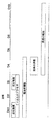
治療期間は、全ての動物について合計3日間(D1〜D3日目)であり、治療は、各群に2つの製品を投与するもので、両群に同じ抗生物質をD1及びD3日目に、EV溶液(A群)又はその賦形剤(B群)をD1、D2、及びD3日目に投与するものである(図1参照)。 The treatment period is a total of 3 days (D1-D3 days) for all animals, and the treatment consists of administering two products to each group, with the same antibiotic on both groups on days D1 and D3. The EV solution (Group A) or its excipient (Group B) is administered on D1, D2, and D3 days (see FIG. 1).
図1は、子牛におけるBRDの抗菌剤治療に補完的に使用される3%ケトプロフェン水溶液の臨床的効果を調べるための実験計画を線図で示したものである。 FIG. 1 is a diagrammatic representation of an experimental design for investigating the clinical efficacy of a 3% ketoprofen aqueous solution used complementary to BRD antimicrobial treatment in calves.
治療第1日目(D1日目)から最終日(D4日目)まで、動物の臨床的状態を観察した(図1)。この期間、次の操作を行った。
・臨床的指数(Clinical index)又は病気の重症度の測定(D1〜D4日目)
・体温の測定(D1〜D4日目)
・体重の測定(D1、D4、及びD10日目)
・起こり得る再発の観察(D4〜D10日目)
From the first day of treatment (D1 day) to the last day (D4 day), the clinical state of the animals was observed (FIG. 1). During this period, the following operations were performed.
-Measurement of clinical index or disease severity (Days D1-D4)
・ Measurement of body temperature (D1-D4 day)
-Body weight measurement (D1, D4 and D10 days)
-Observation of possible recurrence (D4-D10 days)
「臨床的指数又は病気の重症度の測定」
この指数は、D1〜D4日目の間、1日1回、各動物それぞれに対し、他の著者が以前用いたもの(レイノード, J.P.ら,(1986). Examen clinique standarise dans les broncho-pneumonies infectieuses enzootiques des bovins et essais de medicaments-methodologie et interpretation statistique. Proceedings of XIVth World Congresson Cattle Diseases.Dublin 26-29 August pp 435-439;デレフォージ(1992),前掲)に基づく評価尺度を用いて算出した。
"Measure clinical index or disease severity"
This index was previously used by other authors (Rainode, JP et al., (1986). Examen clinique standarise dans les broncho-pneumonies infectieuses once each day during days D1-D4). It was calculated using an evaluation scale based on enzootiques des bovins et essais de medicaments-methodologie et interpretation statistique. Proceedings of XIVth World Congress on Cattle Diseases. Dublin 26-29 August pp 435-439;
前述の著者により述べられた評価システムに従い、臨床的指数(Clinical Index:CI)1.1以上を中等度又は重度の病気の状態とする。一方、CIが1.1以下は、病気ではない、又は病気の状態は認められないとする。
CI≦1.1 病気ではない、又は病気は認められない
1.1<CI< 2 中等度の病気の状態
CI≧2 重度の病気の状態
According to the evaluation system described by the above-mentioned author, a clinical index (CI) of 1.1 or higher is assumed to be a moderate or severe disease state. On the other hand, when the CI is 1.1 or less, it is assumed that the patient is not ill or a disease state is not recognized.
CI ≦ 1.1 No illness or no illness 1.1 <CI <2 Moderate illness condition CI ≧ 2 Severe illness condition
このパラメータは、本研究の主要変数、治療終了時(D4日目)における“臨床的効果”を、次のカテゴリーから成る2つの尺度に評価するために用いた。
正の評価 = 治療は成功(CI≦1.1)、及び
負の評価 = 治療は失敗(CI>1.1)
This parameter was used to assess the main variable of the study, “clinical effect” at the end of treatment (day D4), on two scales consisting of the following categories:
Positive assessment = treatment successful (CI ≤ 1.1) and negative assessment = treatment failed (CI> 1.1)
「体温の測定」
このパラメータは、D1〜D4日目の朝に各動物について毎日測定した。このパラメータは本研究の2次変数の一つに相当する。
"Measurement of body temperature"
This parameter was measured daily for each animal in the morning of days D1-D4. This parameter corresponds to one of the secondary variables in this study.
「動物体重の測定」
大型動物計量用に特別に設計された秤(EziWeight−1/TRU−TEST(登録商標))を用いて、それぞれの動物の体重をD1(基準値)、D4、及びD10日目に記録した。
"Animal weight measurement"
The weight of each animal was recorded on day D1 (reference value), D4, and D10 using a scale designed specifically for large animal weighing (EziWeight-1 / TRU-TEST®).
「起こり得る再発の観察」
最後に、治療期間終了後7日間(D4〜D10日目)に亘って、起こり得る再発の発現を管理した(図1)。
“Observation of possible recurrence”
Finally, the occurrence of possible recurrence was managed for 7 days (D4 to D10 days) after the end of the treatment period (FIG. 1).
1.3 治療
1.3.1 製品の特徴
1.3.1.1 抗生物質
[NUFLOR(登録商標)]
薬剤形態 : 注射用溶液
組成(100mL) : フロルフェニコール(Florfenicol)30g
賦形剤(適量)
製造者 : シェリング・プロー株式会社(Schering-Plough, S.A.)
1.3 Treatment 1.3.1 Product features 1.3.1.1 Antibiotics
[NUFLOR (registered trademark)]
Drug form: Solution for injection Composition (100 mL): Florfenicol 30 g
Excipient (appropriate amount)
Manufacturer: Schering-Plough, SA
1.3.1.2 試験した製品
[EV溶液]
薬剤形態 : 経口用溶液
組成(100mL) : ケトプロフェン 3g(実施例1)
賦形剤(適量)
製造者 : ラボラトリオス Dr.エステベ株式会社(Laboratorios Dr.Esteve, S.A.)
[プラセボ]
薬剤形態 : 経口用溶液
組成(100mL) : 賦形剤(適量)(実施例1)
製造者 : ラボラトリオス Dr.エステベ株式会社(Laboratorios Dr.Esteve, S.A.)
1.3.1.2 Products tested
[EV solution]
Drug form: Oral solution Composition (100 mL): Ketoprofen 3 g (Example 1)
Excipient (appropriate amount)
Manufacturer: Laboratorios Dr. Esteve Corporation (Laboratorios Dr. Esteve, SA)
[placebo]
Drug form: Oral solution Composition (100 mL): Excipient (appropriate amount) (Example 1)
Manufacturer: Laboratorios Dr. Esteve Corporation (Laboratorios Dr. Esteve, SA)
1.3.2 投与量、治療計画、及び投与経路
1.3.2.1 抗生物質
抗生物質製剤は、製造者の推奨する投与量を首の筋肉に筋肉内注射することにより、両群(A群及びB群)に投与した。治療は、48時間の間隔(D1及びD3日目)で2回投与を行うものであった。
1.3.2 Dose, treatment plan, and route of administration 1.3.2.1 Antibiotics Antibiotic preparations can be administered to both groups by intramuscular injection of the manufacturer's recommended dose into the neck muscles ( (Group A and Group B). The treatment consisted of two doses at 48 hour intervals (D1 and D3 days).
1.3.2.2 試験した製品
A群の動物には体重10kg当たり平均1mLのEV溶液(ケトプロフェン3mg/kg/日に相当)を投与した。B群の動物には平均1mL/10kg/日のプラセボを投与した。両製品とも、飲料水に加えて、連続3日間毎日(D1、D2、及びD3日)、経口的に投与した。
1.3.2.2 Products tested Group A animals received an average of 1 mL of EV solution (equivalent to ketoprofen 3 mg / kg / day) per 10 kg of body weight. Group B animals received an average of 1 mL / 10 kg / day placebo. Both products were administered orally daily for 3 consecutive days (D1, D2, and D3 days) in addition to drinking water.
1.4 統計的処理
両群における臨床的指数、体温、及び体重の平均値及び変化は、スチューデントのt検定で比較し、正規性が基準に達しない場合はマン−ホイットニ(Mann-Whitney)検定を適用した。
1.4 Statistical treatment Means and changes in clinical index, body temperature, and body weight in both groups were compared by Student's t test, and Mann-Whitney test if normality was not met Applied.
それぞれの治療群において、正(成功)と評価された治療と、負(失敗)と評価されたものとの割合を、パーソンのχ2乗統計的検定を用いて比較することにより、主要評価変数である“治療効果”を検討した。 In each treatment group, by comparing the percentage of treatments rated positive (success) with those evaluated negative (failure) using the person's chi-square statistical test, A certain “therapeutic effect” was examined.
2. 結果及び討論
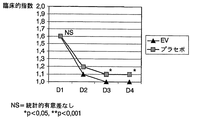
両群において臨床的指数の平均基準値はほぼ同じだったにも拘わらず、治療2日目(D2)に管理を行っている間に、この値は、A群(EV溶液で治療)においてB群(プラセボで治療)より有意に低くなり、この傾向は治療終了まで続いた(表2)。一方、A群では治療2日目(D2)までに平均臨床的指数が1.1以下(軽度の病気の状態、又は病気は認められないに相当)となったが、B群では、この指数は3日目(D3)までこの値より高いままであった(表2、図2)。
2. Results and Discussion Although the mean baseline value of the clinical index in both groups was approximately the same, this value was treated with group A (treated with EV solution) during administration on day 2 (D2). ) Significantly lower than group B (treated with placebo) and this trend continued until the end of treatment (Table 2). On the other hand, in group A, the mean clinical index was 1.1 or less (corresponding to mild illness or no illness observed) by the second day of treatment (D2). Remained higher than this value until day 3 (D3) (Table 2, FIG. 2).
この結果は、病気の症状がB群の動物より早くA群の動物で消失したことを示している。4日目の臨床的指数の平均値によれば、B群はこの時点で完全には回復していない(図2)。 This result indicates that the disease symptoms disappeared earlier in Group A animals than in Group B animals. According to the mean value of the clinical index on day 4, group B has not fully recovered at this point (FIG. 2).
プロトコールに従い、D4日目の管理群の各動物が示す臨床的指数を用いて、研究者はそれぞれの治療の効果(主要変数)を評価し、臨床的指数が1.1以下(軽度の病気の状態、又は病気は認められない)に下がったもののみを治療が成功したと判断した。この評価の結果を表3に詳細に示した。 According to the protocol, using the clinical index shown by each animal in the control group on day D4, the investigator evaluates the effect of each treatment (main variable), and the clinical index is 1.1 or less (for mild disease) Only those who fell to a state or disease were judged to have been successfully treated. The results of this evaluation are shown in detail in Table 3.
表3に反映されているように、治療が成功した動物の割合は、EV溶液で処置した群においてプラセボで処置した群より有意に高かった。その割合の差は12%であり、プラセボ群について予想した成功率が約85%であり、また実際にそうであったことを考えると、この数字は十分な臨床的関連性を示すものである。 As reflected in Table 3, the proportion of animals that were successfully treated was significantly higher in the group treated with EV solution than in the group treated with placebo. The difference in proportion is 12%, and the expected success rate for the placebo group is about 85%, and given that this was the case, this figure is sufficiently clinically relevant. .
この結果より、BRDの抗菌剤治療に対する補助的治療として飲料水に加えてEV溶液を投与すると、抗生物質のみでこの病気を治療する場合に比べて治療的効果が上がるといえる。 From this result, it can be said that when an EV solution is administered in addition to drinking water as an auxiliary treatment for BRD antibacterial agent treatment, the therapeutic effect is improved as compared with the case of treating this disease with antibiotics alone.
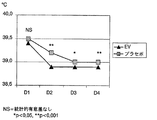
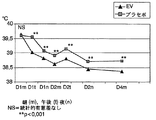
表4及び図3から分かるように、平均基準体温は両群においてほぼ同じであったにも拘わらず、治療2日目にはこの値はA群においてB群より有意に低くなり、この傾向は治療終了まで続いた。 As can be seen from Table 4 and FIG. 3, this value is significantly lower in group A than in group B on the second day of treatment, despite the fact that the average baseline body temperature was approximately the same in both groups, and this trend is Continued until the end of treatment.
図3から分かるように、A群での体温の低下は著しく、この低下は主に治療1日目に起きた。これに対しB群では、この体温の低下はA群ほどめざましくなく、治療の3日間に亘ってよりゆっくりと低下した。 As can be seen from FIG. 3, the decrease in body temperature in group A was significant, and this decrease occurred mainly on the first day of treatment. In contrast, in group B, this decrease in body temperature was not as dramatic as in group A, and decreased more slowly over the three days of treatment.
プラセボを投与したにも拘わらずB群で徐々に体温が下がったのは、抗菌剤の治療的効果によるものと説明できる。抗菌剤は細菌による負荷を軽くし、また感染に対する反応として生体に起こる発熱反応を小さくする。 The fact that the body temperature gradually decreased in group B despite the administration of placebo can be explained by the therapeutic effect of the antibacterial agent. Antibacterial agents lighten the burden of bacteria and reduce the exothermic reaction that occurs in the body as a response to infection.
研究者により治療が成功したと判断されたいずれの治療群の動物においても、治療終了後7日の間に(10日目までに)BRDの臨床的症状の再発は全くなかった。 None of the animals in any treatment group judged successful by the investigator had any recurrence of clinical symptoms of BRD within 7 days (by day 10) after the end of treatment.
3. 結論
この実験で得られた結果より、ウシ呼吸器疾患(BRD)に対する抗菌剤治療の補完として、EV溶液を1mL/体重10kg(活性成分であるケトプロフェン3mg/kgに相当)の投与量で飲料水に加えて、連続3日間経口的に投与すると、臨床的症状が急速に治まり、治療終了時に治癒した動物の割合は抗菌剤のみを投与した場合に得られた割合より有意に高いと結論できる。
3. Conclusion From the results obtained in this experiment, as a supplement to antibacterial treatment for bovine respiratory disease (BRD), drinking water with a dose of 1 mL / body weight 10 kg (corresponding to 3 mg / kg of the active ingredient ketoprofen) In addition, when administered orally for 3 consecutive days, it can be concluded that the clinical symptoms subsided rapidly and the proportion of animals cured at the end of treatment was significantly higher than the proportion obtained when the antimicrobial agent alone was administered.
(実施例3)
<哺乳子牛におけるウシ呼吸器疾患の抗菌剤治療の補完として、哺乳子畜用人工乳に加えて経口的に投与したケトプロフェン水溶液の臨床的効果の検討>
この臨床試験は、EV溶液、3%ケトプロフェン水溶液(実施例1)を、哺乳中の子牛の群れにおけるウシ呼吸器疾患(BRD)の抗菌剤治療の補助的治療として、哺乳子畜用人工乳(代用乳)に加えて経口的に投与した後の、臨床的効果を評価するために行った。
Example 3
<Examination of clinical effect of ketoprofen aqueous solution administered orally in addition to artificial milk for dairy animals as a supplement to antibacterial treatment of bovine respiratory disease in nursing calves>
This clinical trial is based on the use of EV solution, 3% ketoprofen aqueous solution (Example 1) as an adjunct treatment of antibacterial treatment of bovine respiratory disease (BRD) in a herd of suckling calves. This was performed to evaluate the clinical effect after oral administration in addition to (milk substitute).
この目的のため、臨床試験の実施基準の原則に則り、管理された多中心臨床試験を用い(検討に用いる動物を2つの群れに分け、一方には抗生物質+EV溶液を用いた治療を行い、もう一方には、抗生物質+プラセボ(EV溶液の賦形剤)を用いた治療(つまり、負の対照として働く)を行う)、無作為化し、盲検法で行った。 To this end, use controlled multicenter clinical trials in accordance with the principles of clinical trial practice (divide the animals used for the study into two groups, one with antibiotics + EV treatment, The other was treated with antibiotics + placebo (EV solution vehicle) (ie, served as a negative control), randomized and performed blinded.
1.材料及び方法
1.1 動物
本試験では、異なる血統と性別の哺乳中の子牛合計188頭を用いた。選定基準に従い、試験に加わる時点で、全ての子牛は中等度又は重度のBRDに該当する臨床像を示していた。
1. Materials and Methods 1.1 Animals In this study, a total of 188 suckling calves of different breeds and genders were used. According to the selection criteria, at the time of participation in the study, all calves had a clinical picture corresponding to moderate or severe BRD.
1.2 実験計画
この試験の実験計画は、実施例2の1.2章に記述のものと同様であった。
1.2 Experimental Design The experimental design for this test was similar to that described in Section 1.2 of Example 2.
1.3 治療
1.3.1 製品の特徴
抗生物質、NUFLOR(登録商標)(フロルフェニコール)と、試験した製品(EV溶液及びプラセボ)はいずれも、実施例2に示した試験で用いたものと同じであり、その特徴は、実施例2の1.3.1章に述べられている。EV溶液とプラセボは同一の外観に調製して、試験の盲検性を保った。
1.3 Treatment 1.3.1 Product Characteristics Both the antibiotic, NUFLOR® (florfenicol) and the products tested (EV solution and placebo) were used in the study shown in Example 2. The features are the same as those described in Section 1.3.1 of Example 2. EV solution and placebo were prepared to the same appearance to keep the study blind.
1.3.2 投与量、治療計画、及び投与経路
1.3.2.1 抗生物質
確立したプロトコールに従い、製造者の推奨する投与量を首の筋肉に筋肉内注射することにより、抗生物質製剤を全ての動物(A群及びB群)に投与した。治療は、48時間の間隔で(D1及びD3日目)2回投与を行うものであった。
1.3.2 Dose, treatment plan, and route of administration 1.3.2.1 Antibiotics In accordance with established protocols, antibiotics are administered by intramuscular injection of the manufacturer's recommended dose into the neck muscles. Was administered to all animals (Group A and Group B). The treatment consisted of two doses at 48 hour intervals (days D1 and D3).
1.3.2.2 試験した製品
抗生物質に加えて、A群の動物には更に体重10kg当たり平均投与量1mLのEV溶液(ケトプロフェン3mg/kg/日に相当)を投与し、B群の動物には平均1mL/10kg/日のプラセボを投与した。両製品とも代用乳に混ぜて、連続3日間毎日(D1、D2、及びD3)経口的に投与した。
1.3.2.2 Products tested In addition to the antibiotics, animals in group A were further administered with an average dose of 1 mL of EV solution (corresponding to ketoprofen 3 mg / kg / day) per 10 kg body weight. Animals received an average of 1 mL / 10 kg / day placebo. Both products were mixed with milk replacer and administered orally daily (D1, D2, and D3) for 3 consecutive days.
1.4 統計的処理
実施例2の1.4章に記述のものと同様の統計的処理を行った。
1.4 Statistical processing Statistical processing similar to that described in Section 1.4 of Example 2 was performed.
2. 結果及び討論
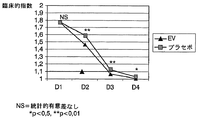
先に記述のパラメータから算出した臨床的指数の平均基準値は両群においてほぼ同じであったにも拘わらず、治療2日目に管理を行っている間に、この値は、A群(EV溶液で治療)においてB群(プラセボで治療)より有意に低くなり、この傾向は治療の終了まで続いた(表5)。
2. Results and Discussion While the mean baseline value of the clinical index calculated from the previously described parameters was approximately the same in both groups, this value was The group (treated with EV solution) was significantly lower than group B (treated with placebo), and this trend continued until the end of treatment (Table 5).
一方、A群では治療3日目(D3)に平均臨床的指数が1.1以下(軽度の病気の状態、又は病気は認められないに相当)となったが、B群では、この指数はD4日目までこの値より高いままであった(表5、図4)。 On the other hand, in Group A, the average clinical index was 1.1 or less (corresponding to mild illness or no illness observed) on the third day of treatment (D3). It remained higher than this value until day D4 (Table 5, FIG. 4).
この結果は、病気の症状が、B群の動物より早くA群の動物で消失したことを示している。ただし治療終了時(D4日目)には、両群の殆ど全ての動物が回復した(図4)。 This result indicates that the disease symptoms disappeared earlier in Group A animals than in Group B animals. However, at the end of treatment (D4 day), almost all animals in both groups recovered (FIG. 4).
表6及び図5から分かるように、平均基準体温は両群においてほぼ同じであったにも拘わらず、治療2日目にはこの値はA群においてB群より有意に低くなり、この傾向は治療終了時まで続いた。 As can be seen from Table 6 and FIG. 5, this value is significantly lower in group A than in group B on the second day of treatment, despite the fact that the average baseline body temperature was approximately the same in both groups, and this trend is Continued until the end of treatment.
図5から分かるように、A群で主に治療1日目に体温の著しい低下があった。 As can be seen from FIG. 5, there was a significant decrease in body temperature mainly on the first day of treatment in group A.
プラセボを投与したにも拘わらずB群で徐々に体温が下がったのは、抗菌剤の治療的効果によるものと説明できる。抗菌剤は細菌による負荷を軽くし、また感染に対する反応として生体に起こる発熱反応を小さくする。 The fact that the body temperature gradually decreased in group B despite the administration of placebo can be explained by the therapeutic effect of the antibacterial agent. Antibacterial agents lighten the burden of bacteria and reduce the exothermic reaction that occurs in the body as a response to infection.
表7より、D4日目の両方の動物群の示す平均体重に有意差は見られないことが分かる。しかしD10日目には、A群の動物はB群の動物より有意に高い平均体重を示した。これは、EV溶液で治療した動物の臨床的状態が著しく改善したことを示す。一方、A群における体重増加(10日目と1日目の体重差より算出)の平均値(8.55±1.18kg)も、B群のもの(7.50±1.40kg)よりも有意に(p<0.001)高かった。 From Table 7, it can be seen that there is no significant difference in the average body weights of both animal groups on the D4 day. However, on day D10, Group A animals showed significantly higher average body weight than Group B animals. This indicates that the clinical status of the animals treated with EV solution has improved significantly. On the other hand, the average value (8.55 ± 1.18 kg) of weight gain in group A (calculated from the difference in weight between day 10 and day 1) is also higher than that in group B (7.50 ± 1.40 kg). Significantly (p <0.001) higher.
研究者により治療が成功したと判断されたいずれの治療群の動物においても、治療終了後7日間に(10日目までに)BRDの臨床的症状の再発は全くなかった。 None of the animals in any treatment group judged successful by the investigator had any recurrence of clinical symptoms of BRD within 7 days (by day 10) after the end of treatment.
3. 結論
この試験で得た結果は、哺乳子牛におけるBRDの抗菌剤治療の補完として、代用乳に1mL/体重10kg(活性成分であるケトプロフェン3mg/kgに相当)の量で混合したEV溶液を3日間連続して経口投与すると、症状の緩和及び動物の回復の促進に有意に役立つことを示している。
3. CONCLUSION The results obtained in this study show that as a supplement to BRD antibacterial treatment in calves, 3 ml of EV solution mixed with milk replacer in an amount of 1 mL / body weight 10 kg (equivalent to 3 mg / kg of active ingredient ketoprofen). It has been shown that oral administration on consecutive days is significantly helpful in alleviating symptoms and promoting animal recovery.
これより、哺乳子牛におけるウシ呼吸器疾患の抗菌剤治療の補助的治療として、EV溶液は良好な臨床的効果を与えると結論できる。 From this, it can be concluded that the EV solution gives a good clinical effect as an adjunct treatment of antibacterial treatment of bovine respiratory disease in the calves.
(実施例4)
<ブタ呼吸器疾患複合症の抗菌剤治療の補完として、飲料水に加えて経口投与するケトプロフェン水溶液の臨床的効果の検討>
肥育期間中のブタの群れにおけるブタ呼吸器疾患複合症(PRDC)の抗生物質治療の補助的治療として、3%ケトプロフェンのEV溶液(実施例1)を飲料水に加えて経口投与した後の、臨床的効果の評価を目的として、臨床試験を行った。
(Example 4)
<Examination of clinical effects of ketoprofen aqueous solution administered orally in addition to drinking water as a supplement to antibacterial treatment for porcine respiratory disease complex>
As an adjunct treatment of antibiotic treatment of porcine respiratory disease complex (PRDC) in a herd of pigs during fattening period, an EV solution of 3% ketoprofen (Example 1) was orally administered in addition to drinking water, A clinical trial was conducted to evaluate the clinical effect.
1. 材料及び方法
1.1 動物
ブタ放飼場を試験に組み入れる前に、PRDCの流行の存在を確認した。この診断は、囲いの中で発見された、死んだ動物を解剖し、肺、リンパ節、及び胸腺の試料を取って行った。試験開始時に死んだ動物がない場合は、最も臨床的状態の悪い動物を解剖に供した。ブタ放飼場を選定後、次の基準を満たす動物を選んだ。
・肥育段階にあり、PRDCに感染していると診断され、39.5℃以上の直腸温を示すブタ、かつ、
・選択の7日前より、抗菌剤又は抗炎症薬の投与を受けていない動物。
1. Materials and Methods 1.1 Animals The presence of PRDC epidemics was confirmed before the pig shelter was incorporated into the study. The diagnosis was made by dissecting dead animals found in the cage and taking lung, lymph node, and thymus samples. If no animal died at the start of the study, the animal with the worst clinical condition was subjected to dissection. After selecting the pig release area, animals that meet the following criteria were selected.
A pig in fattening stage, diagnosed as infected with PRDC and having a rectal temperature of 39.5 ° C. or higher, and
-Animals that have not received antibacterial or anti-inflammatory drugs from 7 days prior to selection.
試験開始時、それぞれの群れが同じ頭数となるよう、印を付けた動物の群れを2つの治療群、A群とB群とに分けた。 At the start of the study, the marked groups of animals were divided into two treatment groups, Group A and Group B, so that each group had the same number of animals.
試験の間、全ての動物に、肥育段階用の標準的なブタ用飼料と、飲料水を与えた。水は、医薬製剤を定量供給するための特別な水タンクを繋げた自動給水器より供給した。 During the test, all animals were fed standard pig feed for the fattening stage and drinking water. Water was supplied from an automatic water dispenser connected to a special water tank for quantitatively supplying the pharmaceutical preparation.
1.2 治療
1.2.1 製品の特徴
1.2.1.1 抗生物質
[ALSIR(登録商標)5%]
薬剤形態 : 注射用溶液
組成(/mL) : エンロフロキサシン(Enrofloxacin) 50mg
賦形剤(適量)
製造者 : エステベ ベテリナリア、ラボラトリオス Dr.エステベ株式会社(ESTEVE VETERINARIA, Lab.Dr ESTEVE, S.A.)
1.2 Treatment 1.2.1 Product features 1.2.1.1 Antibiotics
[ALIR® 5%]
Drug form: Solution for injection Composition (/ mL): Enrofloxacin 50mg
Excipient (appropriate amount)
Manufacturer: Esteve Veterinaria, Laboratorios Dr. Esteve VETERINARIA, Lab.Dr ESTEVE, SA
1.2.1.2 評価した製品(A及びB)
[プラセボ(製品A)]
薬剤形態 : 経口用溶液
組成(100mL) : 賦形剤(適量)(実施例1)
製造者 : ラボラトリオス Dr.エステベ株式会社(Laboratorios Dr.Esteve, S.A.)
[EV溶液(製品B)]
薬剤形態 : 経口用溶液
組成(100mL) : ケトプロフェン 3g(実施例1)
賦形剤(適量)
製造者 : ラボラトリオス Dr.エステベ株式会社(Laboratorios Dr.Esteve, S.A.)
1.2.1.2 Products evaluated (A and B)
[Placebo (Product A)]
Drug form: Oral solution Composition (100 mL): Excipient (appropriate amount) (Example 1)
Manufacturer: Laboratorios Dr. Esteve Corporation (Laboratorios Dr. Esteve, SA)
[EV solution (Product B)]
Drug form: Oral solution Composition (100 mL): Ketoprofen 3 g (Example 1)
Excipient (appropriate amount)
Manufacturer: Laboratorios Dr. Esteve Corporation (Laboratorios Dr. Esteve, SA)
1.2.2 投与量、治療計画、及び投与経路
1.2.2.1 抗生物質
製造者の推奨する投与量及び治療計画に従って、抗生物質製剤を筋肉内に投与した。治療期間は3日間(D1、D2、及びD3日目)であった。
1.2.2 Dosage, Treatment Plan, and Route of Administration 1.2.2.1 Antibiotic Antibiotic preparations were administered intramuscularly according to the manufacturer's recommended dose and treatment plan. The treatment period was 3 days (D1, D2, and D3 days).
1.2.2.2 評価した製品(A及びB)
両製品は、次の投与量及び投与計画に従って、飲料水に加えて経口的に投与した。製品A又はBを、1mL/体重10kg(治療群の場合、ケトプロフェン3mg/体重kg/日に相当)投与。治療期間は3日間(D1、D2、及びD3日目)であった。
1.2.2.2 Products evaluated (A and B)
Both products were administered orally in addition to drinking water according to the following dosage and dosing schedule. Product A or B was administered at 1 mL / kg body weight (corresponding to ketoprofen 3 mg / kg body weight / day in the treatment group). The treatment period was 3 days (D1, D2, and D3 days).
1.3 実験計画
ブタ放飼場を選定後、印を付けた全ての動物にエンロフロキサシンを筋肉内投与し、抗生物質治療を行った。治療群の一方に割り振られた放飼場の動物には、その飲料水に加えたEV溶液を用いて更に経口的治療を行い、もう一方の群れには同じ経路でプラセボ(溶液賦形剤)を投与した。
1.3 Experimental design After selecting the pig release ground, enrofloxacin was administered intramuscularly to all the marked animals, and antibiotic treatment was performed. The animals in the abandonment area assigned to one of the treatment groups are further treated orally with the EV solution added to their drinking water, and the other group is given a placebo (solution vehicle) by the same route. Was administered.
全試験期間は4日間であった。治療は最初の3日間(D1、D2、及びD3)に行った。動物の臨床的観察は、治療開始(D1)から治療終了時(D4)まで行った。全試験期間に亘り、次に示す各日の朝に4回の臨床的管理を行った。
・管理D1、D2、及びD3:抗生物質+製品A又はBを用いた治療期間(管理D1は治療開始前に行い、これを基準管理と見ることができる)
・管理4日目:治療終了時
各管理において、いくつかの個体の及び群れのパラメータを測定した。
The total test period was 4 days. Treatment was performed during the first 3 days (D1, D2, and D3). Animal clinical observations were made from the start of treatment (D1) to the end of treatment (D4). Over the entire study period, four clinical administrations were performed each morning on the following days.
Management D1, D2, and D3: Treatment period with antibiotic + product A or B (Management D1 is performed before the start of treatment and can be viewed as reference management)
Management Day 4: At the end of treatment In each management, several individual and herd parameters were measured.
1.3.1 個体のパラメータ
・臨床的指数:このパラメータは、管理D1、D2、D3、及びD4において測定した。この指数は先に述べた方法(レイノード(1986), デレフォージ(1992),前掲)に基づく評価尺度により算出した。このパラメータは主要変数の測定に使用した(3.3.1章)。
・体温:このパラメータ(℃)は、管理D1、D2、D3、及びD4の間に測定した。
・体重:このパラメータ(kg)は、管理D1及びD4において測定した。
1.3.1 Individual parameters • Clinical index: This parameter was measured in controls D1, D2, D3, and D4. This index was calculated by the evaluation scale based on the method described previously (Raynode (1986), Deforge (1992), supra). This parameter was used to measure the main variables (Chapter 3.3.1).
Body temperature: This parameter (° C.) was measured during management D1, D2, D3, and D4.
-Body weight: This parameter (kg) was measured in controls D1 and D4.
1.3.2 集団のパラメータ
・放飼場の一般的状態:このパラメータは、管理D1〜D4において、一群の動物全体に関わる次の記録及び評価による順序尺度上で毎日測定した。
・餌の摂取:このパラメータは、各群の動物により消費される餌の量に対応する。
・死亡数:このパラメータは、試験期間中に各群について予測した死亡数に対応する。
1.3.2 Population parameters General status of the shelter: This parameter was measured daily on an order scale with the following records and assessments for the entire group of animals in controls D1-D4.
• Food intake: This parameter corresponds to the amount of food consumed by each group of animals.
Number of deaths: This parameter corresponds to the number of deaths predicted for each group during the study period.
1.3.3 検討変数の測定
1.3.3.1 主要変数
主要検討変数は、“臨床的指数の低下”(RCI)と定義することができる。
1.3.3 Measurement of study variables 1.3.3.1 Key variables Key study variables can be defined as “decrease in clinical index” (RCI).
1.3.3.2 2次変数
・直腸温:この変数は、記録された全ての管理で測定された温度パラメータの値と一致する。
・体重増加(WI):この変数は、次の式を適用して評価した。
WI:平均値(印を付けた動物)(D4での体重 − D1での体重)
1.3.3.2 Secondary variables Rectal temperature: This variable is consistent with the value of the temperature parameter measured in all recorded regimens.
Weight gain (WI): This variable was evaluated applying the following formula:
WI: mean value (marked animals) (body weight at D4-body weight at D1)
1.4 統計的処理
主要検討変数である“臨床的指数”は、有意水準α=0.05、検定力80%としたスチューデントのt検定により解析した。
1.4 Statistical Processing The “clinical index”, which is the main study variable, was analyzed by Student's t-test with a significance level α = 0.05 and a test power of 80%.
2次変数“体温”及び“体重”は、有意水準α=0.05、検定力80%とした繰り返し測定のためのANOVAにより測定した。 The secondary variables “body temperature” and “body weight” were measured by ANOVA for repeated measurement with a significance level α = 0.05 and a test power of 80%.
試験の間に測定したその他のパラメータは、記述的統計法により解析した。 Other parameters measured during the study were analyzed by descriptive statistical methods.
2. 結果及び討論
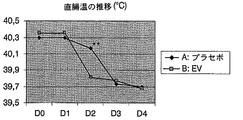
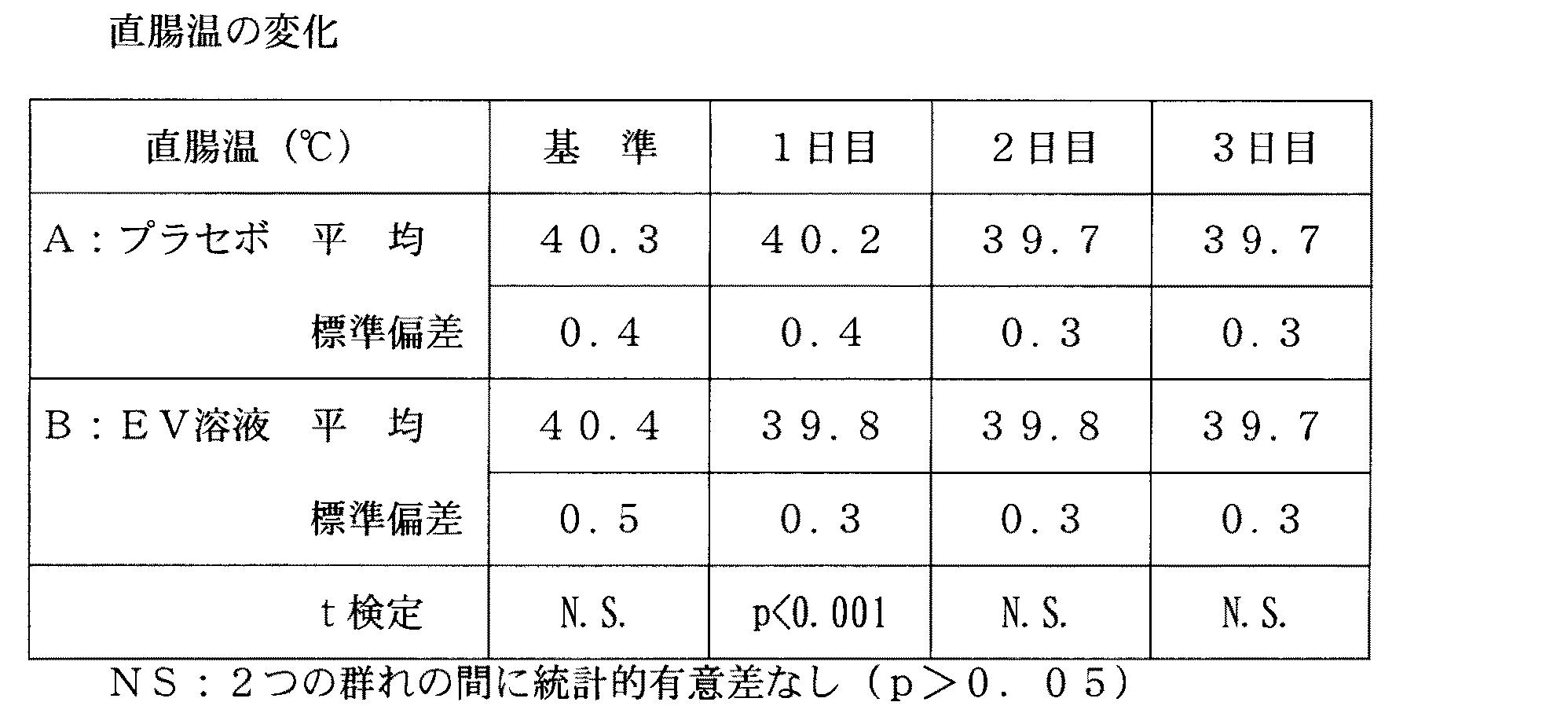
直腸温変化に対応する結果を表8及び図6に示した。
2. Results and Discussion The results corresponding to changes in rectal temperature are shown in Table 8 and FIG.
表8及び図6から分かるように、体温の平均基準値は両群においてほぼ同じであったにも拘わらず、治療2日目には、この値はB群(EV溶液)においてA群(プラセボ)より有意に低くなった。同様に図6でも、B群における体温の低下は著しく、この低下は主に治療第1日目に起きた。これに対しA群では、この低下はB群ほど著しいものではなく、治療期間に亘ってゆっくりと低下した。 As can be seen from Table 8 and FIG. 6, despite the fact that the mean reference value of body temperature was approximately the same in both groups, on the second day of treatment, this value was found in group B (EV solution) in group A (placebo). ) Significantly lower. Similarly, in FIG. 6, the decrease in body temperature in group B was remarkable, and this decrease occurred mainly on the first day of treatment. In contrast, in Group A, this decrease was not as significant as in Group B, but decreased slowly over the treatment period.
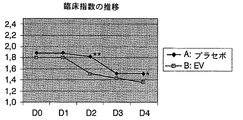
臨床的指数の推移から得られた結果を表9及び図7にまとめた。 The results obtained from the transition of the clinical index are summarized in Table 9 and FIG.
表9及び図7より、治療が成功した動物の割合は、プラセボで治療した群よりEV溶液で治療した群れにおいて有意に高かった。 From Table 9 and FIG. 7, the proportion of animals that were successfully treated was significantly higher in the group treated with EV solution than in the group treated with placebo.
3. 結論
これらの結果より、PRDCの抗菌剤治療の補助的治療として、飲料水に加えてEV溶液を投与すると、抗生物質のみでこの病気を治療する場合に比べて治療効果が上がることが示された。
3. Conclusion From these results, it was shown that when EV solution was administered in addition to drinking water as an adjunct treatment of antibacterial treatment of PRDC, the therapeutic effect was improved compared with the case of treating this disease with antibiotics alone. .
この試験の結果より、肥育中のブタにおけるブタ呼吸器疾患複合症の抗菌剤治療に対する補助的治療として、EV溶液は良好な臨床的効果を持つと言える。 From the results of this study, it can be said that the EV solution has a good clinical effect as an adjunct treatment to the antibacterial treatment of swine respiratory disease complex in fattening pigs.
この実験で得られた結果より、肥育中のブタにおけるブタ呼吸器疾患複合症(PRDC)に対する抗菌剤治療の補完として、EV溶液を1mL/体重10kg(活性成分であるケトプロフェン3mg/kgに相当)の投与量で飲料水に加えて、連続3日間経口的に投与すると、臨床的症状からの回復速度が上がり、またこのEV溶液は、肥育中のブタにおけるPRDCの抗菌剤治療の補助的治療として良好な臨床的効果を与えると結論できる。 From the results obtained in this experiment, as a supplement to antibacterial treatment for porcine respiratory disease complex (PRDC) in fattening pigs, 1 mL of EV solution / 10 kg body weight (corresponding to 3 mg / kg of active ingredient ketoprofen) Oral administration for 3 consecutive days in addition to drinking water increases the rate of recovery from clinical symptoms, and this EV solution is an adjunct to antibacterial treatment of PRDC in fattening pigs It can be concluded that it has a good clinical effect.
Claims (27)
前記飲用製剤は、前記製剤を摂取する動物に治療的有効量を投与するために十分な量のケトプロフェンを含むことを特徴とする飲用製剤。 A drinking preparation according to claim 1,
The drinking preparation, wherein the drinking preparation contains a sufficient amount of ketoprofen to administer a therapeutically effective amount to an animal taking the preparation.
前記飲用製剤は、前記製剤を摂取する動物の体重1kg当たり1日1〜5mgのケトプロフェン(ケトプロフェン1〜5mg/kg/日)を投与するために十分な量のケトプロフェンを含むことを特徴とする飲用製剤。 A drinking preparation according to claim 2,
The drinking preparation comprises a sufficient amount of ketoprofen to administer 1 to 5 mg of ketoprofen per day (kg of body weight of an animal taking the preparation) (1 to 5 mg / kg / day of ketoprofen) Formulation.
前記製造方法は、ケトプロフェン水溶液を、動物用飲料水又は哺乳子畜用人工乳と混合する工程を含むことを特徴とする製造方法。 A method for producing a drinkable preparation to which ketoprofen according to any one of claims 1 to 3 is added,
The said manufacturing method is a manufacturing method characterized by including the process of mixing ketoprofen aqueous solution with the drinking water for animals, or the artificial milk for mammals.
前記ケトプロフェン水溶液中のケトプロフェンの濃度範囲は1%〜15%(w/v)であることを特徴とする方法。 The method of claim 4, comprising:
The concentration range of ketoprofen in the ketoprofen aqueous solution is 1% to 15% (w / v).
前記水溶液は共溶媒を含むことを特徴とする方法。 The method of claim 4, comprising:
The method wherein the aqueous solution includes a co-solvent.
前記共溶媒は、ポリエチレングリコール400及び1−メチル−2−ピロリドンより選ばれることを特徴とする方法。 The method of claim 6, comprising:
The method according to claim 1, wherein the co-solvent is selected from polyethylene glycol 400 and 1-methyl-2-pyrrolidone.
前記水溶液は、その場でケトプロフェンと塩を形成してケトプロフェンの溶解度を増大させることのできる塩基性アミノ酸を含むことを特徴とする方法。 The method of claim 4, comprising:
The aqueous solution comprises a basic amino acid capable of increasing the solubility of ketoprofen by forming a salt with ketoprofen in situ.
前記塩基性アミノ酸は、L−リシン及びL−アルギニンより選ばれることを特徴とする方法。 The method according to claim 8, comprising:
The method wherein the basic amino acid is selected from L-lysine and L-arginine.
前記水溶液は、湿潤剤、pH調節剤、防腐剤、及びそれらの組み合わせより選ばれる、獣医学的に使用可能な添加剤を1種類以上含むことを特徴とする方法。 The method of claim 4, comprising:
The aqueous solution comprises one or more veterinary useable additives selected from wetting agents, pH adjusting agents, preservatives, and combinations thereof.
前記湿潤剤は、ポリソルベート又はポロキサマであることを特徴とする方法。 The method of claim 10, comprising:
The method of claim 1, wherein the wetting agent is polysorbate or poloxamer.
前記pH調節剤は、前記ケトプロフェン水溶液のpHを5.5〜7.0とする、酸又は塩基性の化合物であることを特徴とする方法。 The method of claim 10, comprising:
The said pH adjuster is an acid or a basic compound which makes pH of the said ketoprofen aqueous solution 5.5-7.0.
前記防腐剤は、ベンジルアルコール又はパラベンであることを特徴とする方法。 The method of claim 10, comprising:
The method, wherein the preservative is benzyl alcohol or paraben.
前記ケトプロフェン水溶液は、成分として、
1〜15%(w/v)のケトプロフェンと、
2〜30%(w/v)のL−アルギニンと、
0.5〜3%のベンジルアルコールと、
pHを5.5〜7.0とするための適量の無水クエン酸と、
全体を100%とするための適量の精製水と、
から成る組成を持つことを特徴とする方法。 The method of claim 4, comprising:
The ketoprofen aqueous solution has as components:
1-15% (w / v) ketoprofen;
2-30% (w / v) L-arginine;
0.5-3% benzyl alcohol,
an appropriate amount of anhydrous citric acid to adjust the pH to 5.5-7.0;
An appropriate amount of purified water to make the whole 100%,
A method characterized by having a composition consisting of:
前記ケトプロフェン水溶液は、成分として、
1〜5%(w/v)のケトプロフェンと、
2〜8%(w/v)のL−アルギニンと、
0.5〜2.5%のベンジルアルコールと、
pHを6〜7とするための適量の無水クエン酸と、
全体を100%とするための適量の精製水と、
から成る組成を持つことを特徴とする方法。 The method of claim 4, comprising:
The ketoprofen aqueous solution has as components:
1-5% (w / v) ketoprofen;
2-8% (w / v) L-arginine;
0.5-2.5% benzyl alcohol,
an appropriate amount of anhydrous citric acid to adjust the pH to 6-7,
An appropriate amount of purified water to make the whole 100%,
A method characterized by having a composition consisting of:
前記ケトプロフェン水溶液中のケトプロフェンの濃度範囲は1〜15%(w/v)であることを特徴とする使用方法。 The method of use according to claim 16, comprising:
The method of use, wherein the concentration range of ketoprofen in the aqueous ketoprofen solution is 1 to 15% (w / v).
前記水溶液は共溶媒を含むことを特徴とする使用方法。 The method of use according to claim 16, comprising:
The method according to claim 1, wherein the aqueous solution contains a cosolvent.
前記共溶媒は、ポリエチレングリコール400及び1−メチル−2−ピロリドンの中から選ばれることを特徴とする使用方法。 The method of use according to claim 18, wherein
The method of use, wherein the co-solvent is selected from polyethylene glycol 400 and 1-methyl-2-pyrrolidone.
前記水溶液は、その場でケトプロフェンと塩を形成してケトプロフェンの溶解度を増大させることのできる塩基性アミノ酸を含むことを特徴とする使用方法。 The method of use according to claim 16, comprising:
The method according to claim 1, wherein the aqueous solution contains a basic amino acid capable of increasing the solubility of ketoprofen by forming a salt with ketoprofen in situ.
前記塩基性アミノ酸は、L−リシン及びL−アルギニンより選ばれることを特徴とする使用方法。 The method of use according to claim 20, wherein
The method according to claim 1, wherein the basic amino acid is selected from L-lysine and L-arginine.
前記水溶液は、湿潤剤、pH調節剤、防腐剤、及びそれらの組み合わせより選ばれる、獣医学的に使用可能な添加剤を1種類以上含むことを特徴とする使用方法。 The method of use according to claim 16, comprising:
The method according to claim 1, wherein the aqueous solution contains at least one veterinary additive selected from a wetting agent, a pH adjusting agent, a preservative, and a combination thereof.
前記湿潤剤は、ポリソルベート又はポロキサマであることを特徴とする使用方法。 The method of use according to claim 22,
The method of use, wherein the wetting agent is polysorbate or poloxamer.
前記pH調節剤は、ケトプロフェン水溶液のpHを5.5〜7.0とする、酸又は塩基性の化合物であることを特徴とする使用方法。 The method of use according to claim 22,
The use method according to claim 1, wherein the pH adjuster is an acid or basic compound that adjusts the pH of the ketoprofen aqueous solution to 5.5 to 7.0.
前記防腐剤は、ベンジルアルコール又はパラベンであることを特徴とする使用方法。 The method of use according to claim 22,
The method according to claim 1, wherein the preservative is benzyl alcohol or paraben.
前記ケトプロフェン水溶液は、成分として、
1〜15%(w/v)のケトプロフェンと、
2〜30%(w/v)のL−アルギニンと、
0.5〜3%のベンジルアルコールと、
pHを5.5〜7.0とするための適量の無水クエン酸と、
全体を100%とするための適量の精製水と、
から成る組成を持つことを特徴とする使用方法。 Use according to claim 16, comprising:
The ketoprofen aqueous solution has as components:
1-15% (w / v) ketoprofen;
2-30% (w / v) L-arginine;
0.5-3% benzyl alcohol,
an appropriate amount of anhydrous citric acid to adjust the pH to 5.5-7.0;
An appropriate amount of purified water to make the whole 100%,
A method of use characterized in that it has a composition comprising:
前記ケトプロフェン水溶液は、成分として、
1〜5%(w/v)のケトプロフェンと、
2〜8%(w/v)のL−アルギニンと、
0.5〜2.5%のベンジルアルコールと、
pHを6〜7とするための適量の無水クエン酸と、
全体を100%とするための適量の精製水と、
から成る組成を持つことを特徴とする使用方法。 The method of use according to claim 16, comprising:
The ketoprofen aqueous solution has as components:
1-5% (w / v) ketoprofen;
2-8% (w / v) L-arginine;
0.5-2.5% benzyl alcohol,
an appropriate amount of anhydrous citric acid to adjust the pH to 6-7,
An appropriate amount of purified water to make the whole 100%,
A method of use characterized in that it has a composition comprising:
Applications Claiming Priority (2)
| Application Number | Priority Date | Filing Date | Title |
|---|---|---|---|
| ES200102744A ES2189682B1 (en) | 2001-12-11 | 2001-12-11 | DRINKABLE PREPARATION UNDERSTANDING KETOPROPHEN AND ITS EMPLOYMENT IN THE PROCESSING OF PROCESSES PROCESSING WITH FEVER, INFLAMMATION AND / OR PAIN, IN AN ANIMAL COLLECTIVE, SIMULTANEOUSLY. |
| PCT/ES2002/000590 WO2003053430A1 (en) | 2001-12-11 | 2002-12-11 | Drinkable preparation comprising ketoprofen and the use thereof in the simultaneous treatment of a group of animals for processes which are accompanied by fever, inflammation and/or pain |
Publications (2)
| Publication Number | Publication Date |
|---|---|
| JP2005515213A true JP2005515213A (en) | 2005-05-26 |
| JP2005515213A5 JP2005515213A5 (en) | 2006-02-09 |
Family
ID=8499705
Family Applications (1)
| Application Number | Title | Priority Date | Filing Date |
|---|---|---|---|
| JP2003554187A Pending JP2005515213A (en) | 2001-12-11 | 2002-12-11 | A drinkable formulation comprising ketoprofen and its use in the simultaneous treatment of a group of animals for fever, inflammation and / or painful symptoms |
Country Status (18)
| Country | Link |
|---|---|
| US (1) | US20040254243A1 (en) |
| EP (1) | EP1462101B1 (en) |
| JP (1) | JP2005515213A (en) |
| KR (1) | KR20040074999A (en) |
| CN (1) | CN1738612A (en) |
| AT (1) | ATE355835T1 (en) |
| AU (1) | AU2002361264B2 (en) |
| BR (1) | BR0215118A (en) |
| CA (1) | CA2470168C (en) |
| DE (1) | DE60218742T2 (en) |
| DK (1) | DK1462101T3 (en) |
| ES (2) | ES2189682B1 (en) |
| HU (1) | HUP0501189A3 (en) |
| MX (1) | MXPA04005649A (en) |
| NZ (1) | NZ533802A (en) |
| PL (1) | PL219130B1 (en) |
| WO (1) | WO2003053430A1 (en) |
| ZA (1) | ZA200405077B (en) |
Families Citing this family (18)
| Publication number | Priority date | Publication date | Assignee | Title |
|---|---|---|---|---|
| GB0207529D0 (en) * | 2002-04-02 | 2002-05-08 | Norbrook Lab Ltd | Injectable veterinary composition for small animals |
| WO2007142707A1 (en) * | 2006-02-06 | 2007-12-13 | Pharmaceutical Solutions, Inc. | Non-steroidal anti-inflammatory oral powder and liquid preparations for administration to animals |
| US20080268025A1 (en) * | 2007-04-25 | 2008-10-30 | Donald Spector | Compositions Useful for Preventing Pain and Soreness Resulting from Exercise and Methods of Use |
| US8435982B2 (en) * | 2007-11-30 | 2013-05-07 | Pharmathen S.A. | Pharmaceutical formulation containing lipophilic drugs and milk as a solubilizing/dispensing agent and method for the preparation thereof |
| CA2728727C (en) * | 2008-06-24 | 2018-01-23 | Intervet International B.V. | Pharmaceutical transdermal compositions and method for treating inflammation in cattle |
| ES2350670B1 (en) * | 2009-06-10 | 2011-12-07 | Polichem, S.L. | KETOPROPHENE VETERINARY COMPOSITION |
| WO2011055160A1 (en) | 2009-11-06 | 2011-05-12 | Laboratorio Jaer, S.A. | The use of xylitol for the economic improvement of intensive pig farming production |
| JP5841608B2 (en) | 2010-11-12 | 2016-01-13 | コルゲート・パーモリブ・カンパニーColgate−Palmolive Company | Oral care products and methods of use and manufacture thereof |
| CN102885766B (en) * | 2012-11-05 | 2014-06-18 | 西安德天药业股份有限公司 | Dexketoprofen injection and preparation method thereof |
| US10258585B2 (en) | 2014-03-13 | 2019-04-16 | Neuroderm, Ltd. | DOPA decarboxylase inhibitor compositions |
| PL3777833T3 (en) | 2014-03-13 | 2024-03-25 | Neuroderm Ltd. | Dopa decarboxylase inhibitor compositions |
| CN108478616A (en) * | 2018-06-29 | 2018-09-04 | 佛山市南海东方澳龙制药有限公司 | Compound ketoprofen medicinal composition, pharmaceutical preparation and its application |
| CN108451902A (en) * | 2018-06-29 | 2018-08-28 | 佛山市南海东方澳龙制药有限公司 | Treat the Ketoprofen dip and preparation method thereof of mammitis of animal |
| CN108653262B (en) * | 2018-06-29 | 2021-02-26 | 佛山市南海东方澳龙制药有限公司 | Ketoprofen external medicine and preparation method and application thereof |
| US11213502B1 (en) | 2020-11-17 | 2022-01-04 | Neuroderm, Ltd. | Method for treatment of parkinson's disease |
| US11844754B2 (en) | 2020-11-17 | 2023-12-19 | Neuroderm, Ltd. | Methods for treatment of Parkinson's disease |
| US11331293B1 (en) | 2020-11-17 | 2022-05-17 | Neuroderm, Ltd. | Method for treatment of Parkinson's disease |
| US12161612B2 (en) | 2023-04-14 | 2024-12-10 | Neuroderm, Ltd. | Methods and compositions for reducing symptoms of Parkinson's disease |
Citations (9)
| Publication number | Priority date | Publication date | Assignee | Title |
|---|---|---|---|---|
| JPS6064918A (en) * | 1983-08-05 | 1985-04-13 | メルクレ・ゲゼルシヤフト・ミツト・ベシユレンクテル・ハフツング | Antiinflammatory injection fluid |
| JPS6383022A (en) * | 1986-09-15 | 1988-04-13 | ザンボン エス ピー エー | Vetrinary remedy |
| JPH09502201A (en) * | 1993-09-07 | 1997-03-04 | ザ、プロクター、エンド、ギャンブル、カンパニー | Composition containing amino acid salt of propionic acid non-steroidal anti-inflammatory agent and at least one of decongestant, expectorant, antihistamine and antitussive agent |
| WO1997045113A1 (en) * | 1996-05-30 | 1997-12-04 | Sepracor Inc. | Nsaids for regulating the reproductive cycle of domesticated animals |
| JPH10167988A (en) * | 1996-10-09 | 1998-06-23 | Takeda Chem Ind Ltd | Oral liquid preparation |
| JP2000507207A (en) * | 1996-01-10 | 2000-06-13 | スプラコルト オイ | Complex injection |
| JP2001031562A (en) * | 1999-07-16 | 2001-02-06 | Taisho Pharmaceut Co Ltd | Oral solution |
| WO2001078724A1 (en) * | 2000-04-18 | 2001-10-25 | Pharmacia Corporation | Rapid-onset formulation of a selective cyclooxigenase-2 |
| JP2001302544A (en) * | 1999-12-10 | 2001-10-31 | Takeda Chem Ind Ltd | Pharmaceutical composition for oral administration |
Family Cites Families (9)
| Publication number | Priority date | Publication date | Assignee | Title |
|---|---|---|---|---|
| FR2660555B1 (en) * | 1990-04-06 | 1994-09-16 | Rhone Poulenc Sante | KETOPROFEN OIL CAPSULE. |
| IT1247138B (en) * | 1991-03-06 | 1994-12-12 | Dompe Farmaceutici Spa | HYDROPHILE PHARMACEUTICAL COMPOSITION CONTAINING KETOPROFENE LYSINE SALT FOR TOPICAL USE. |
| GB9316580D0 (en) * | 1993-08-10 | 1993-09-29 | Smithkline Beecham Plc | Pharmaceutical composition |
| US5703073A (en) * | 1995-04-19 | 1997-12-30 | Nitromed, Inc. | Compositions and methods to prevent toxicity induced by nonsteroidal antiinflammatory drugs |
| ATE210428T1 (en) * | 1995-10-17 | 2001-12-15 | Reckitt Benckiser Healthcare | FLAVOR-MASKED AQUEOUS SOLUTIONS CONTAINING IBUPROFEN AND MENTHOL |
| IT1277741B1 (en) * | 1995-12-28 | 1997-11-12 | Dompe Spa | PARENTERAL PHARMACEUTICAL COMPOSITIONS CONTAINING ALKYLAMMONIUM SALTS OF 2-ARYLPROPIONIC ACIDS |
| ITRM20010048A1 (en) * | 2001-01-30 | 2002-07-30 | Gregorio Mauro De | METHOD FOR PREPARING PHYSIOLOGICALLY ACCEPTABLE AQUEOUS SOLUTIONS SO OBTAINED. |
| US6995190B2 (en) * | 2001-03-09 | 2006-02-07 | Veterinary Solutions | Method and treatment with ketoprofen solution |
| US20020183366A1 (en) * | 2001-03-23 | 2002-12-05 | Garvey David S. | Cyclooxygenase-2 inhibitors, compositions and methods of use |
-
2001
- 2001-12-11 ES ES200102744A patent/ES2189682B1/en not_active Expired - Fee Related
-
2002
- 2002-12-11 DE DE60218742T patent/DE60218742T2/en not_active Expired - Lifetime
- 2002-12-11 CN CNA028273338A patent/CN1738612A/en active Pending
- 2002-12-11 NZ NZ533802A patent/NZ533802A/en not_active IP Right Cessation
- 2002-12-11 WO PCT/ES2002/000590 patent/WO2003053430A1/en not_active Ceased
- 2002-12-11 JP JP2003554187A patent/JP2005515213A/en active Pending
- 2002-12-11 BR BR0215118-9A patent/BR0215118A/en not_active Application Discontinuation
- 2002-12-11 KR KR10-2004-7008898A patent/KR20040074999A/en not_active Withdrawn
- 2002-12-11 DK DK02796784T patent/DK1462101T3/en active
- 2002-12-11 ES ES02796784T patent/ES2283638T3/en not_active Expired - Lifetime
- 2002-12-11 PL PL370434A patent/PL219130B1/en unknown
- 2002-12-11 MX MXPA04005649A patent/MXPA04005649A/en active IP Right Grant
- 2002-12-11 AU AU2002361264A patent/AU2002361264B2/en not_active Ceased
- 2002-12-11 CA CA2470168A patent/CA2470168C/en not_active Expired - Fee Related
- 2002-12-11 AT AT02796784T patent/ATE355835T1/en not_active IP Right Cessation
- 2002-12-11 EP EP02796784A patent/EP1462101B1/en not_active Revoked
- 2002-12-11 HU HU0501189A patent/HUP0501189A3/en unknown
-
2004
- 2004-06-10 US US10/866,317 patent/US20040254243A1/en not_active Abandoned
- 2004-06-25 ZA ZA2004/05077A patent/ZA200405077B/en unknown
Patent Citations (9)
| Publication number | Priority date | Publication date | Assignee | Title |
|---|---|---|---|---|
| JPS6064918A (en) * | 1983-08-05 | 1985-04-13 | メルクレ・ゲゼルシヤフト・ミツト・ベシユレンクテル・ハフツング | Antiinflammatory injection fluid |
| JPS6383022A (en) * | 1986-09-15 | 1988-04-13 | ザンボン エス ピー エー | Vetrinary remedy |
| JPH09502201A (en) * | 1993-09-07 | 1997-03-04 | ザ、プロクター、エンド、ギャンブル、カンパニー | Composition containing amino acid salt of propionic acid non-steroidal anti-inflammatory agent and at least one of decongestant, expectorant, antihistamine and antitussive agent |
| JP2000507207A (en) * | 1996-01-10 | 2000-06-13 | スプラコルト オイ | Complex injection |
| WO1997045113A1 (en) * | 1996-05-30 | 1997-12-04 | Sepracor Inc. | Nsaids for regulating the reproductive cycle of domesticated animals |
| JPH10167988A (en) * | 1996-10-09 | 1998-06-23 | Takeda Chem Ind Ltd | Oral liquid preparation |
| JP2001031562A (en) * | 1999-07-16 | 2001-02-06 | Taisho Pharmaceut Co Ltd | Oral solution |
| JP2001302544A (en) * | 1999-12-10 | 2001-10-31 | Takeda Chem Ind Ltd | Pharmaceutical composition for oral administration |
| WO2001078724A1 (en) * | 2000-04-18 | 2001-10-25 | Pharmacia Corporation | Rapid-onset formulation of a selective cyclooxigenase-2 |
Non-Patent Citations (8)
| Title |
|---|
| JPN6009031563; Singhai, A. K., et al.: 'Cosolvent solubilization and formulation of an aqueous injection of ketoprofen' Pharmazie Vol. 51, No. 10, 1996, p. 737-740 * |
| JPN6009031565; 日本医薬品添加剤協会編: 医薬品添加物事典 , 1994, p. 138-139, 株式会社薬事日報社 * |
| JPN6010026653; 伊藤哲夫: '豚呼吸器複合病とプルモチルプレミックスの有用性-それぞれの特性に対する理論的考察-' 畜産の研究 Vol. 54, No. 3, 2000, p. 386-392 * |
| JPN6010026655; Longo F, et al: 'Antipyretic effect of ketoprofen in the treatment of respiratory diseases in cattle' Proceedings of the XVIII World Buiatrics Congress , 1994, p. 1343-1346 * |
| JPN6010026658; Swinkels JM, et al: 'Effects of ketoprofen and flunixin in pigs experimentally infected with Actinobacillus pleuropneumon' Journal of veterinary pharmacology and therapeutics Vol. 17, No. 4, 1994, p. 299-303 * |
| JPN6011049643; Coghe J, et al.: 'Validation and prognostic value of plasma lactate measurement in bovine respiratory disease' The veterinary journal Vol. 160, No. 2, 200009, p. 139-146 |
| JPN6011049644; Williams JJ, et al.: 'Sensibilidad in vitro de cepas de Actinobacillus pleuropneumoniae y Pasteurella multocida tipo"A"a' Revista Biomedica Vol. 12, No. 3, 200107, p. 172-179 |
| JPN7010001466; Lockwood P, et al: 'Eficacia clinica comparadade tres antiinflamatorios no esteroideos (AINEs), flunixin meglumine, carp' Albeitar Vol. 16, 1998, p. 15 * |
Also Published As
| Publication number | Publication date |
|---|---|
| DK1462101T3 (en) | 2007-07-16 |
| CN1738612A (en) | 2006-02-22 |
| MXPA04005649A (en) | 2005-03-23 |
| HUP0501189A3 (en) | 2009-07-28 |
| AU2002361264A1 (en) | 2003-07-09 |
| ES2283638T3 (en) | 2007-11-01 |
| PL219130B1 (en) | 2015-03-31 |
| EP1462101A1 (en) | 2004-09-29 |
| US20040254243A1 (en) | 2004-12-16 |
| WO2003053430A1 (en) | 2003-07-03 |
| DE60218742T2 (en) | 2007-11-15 |
| ZA200405077B (en) | 2005-08-31 |
| DE60218742D1 (en) | 2007-04-19 |
| KR20040074999A (en) | 2004-08-26 |
| BR0215118A (en) | 2004-12-14 |
| EP1462101B1 (en) | 2007-03-07 |
| ATE355835T1 (en) | 2007-03-15 |
| PL370434A1 (en) | 2005-05-30 |
| ES2189682A1 (en) | 2003-07-01 |
| NZ533802A (en) | 2006-08-31 |
| CA2470168A1 (en) | 2003-07-03 |
| HUP0501189A2 (en) | 2006-04-28 |
| ES2189682B1 (en) | 2004-04-01 |
| CA2470168C (en) | 2011-04-05 |
| AU2002361264B2 (en) | 2007-07-26 |
Similar Documents
| Publication | Publication Date | Title |
|---|---|---|
| AU2002361264B2 (en) | Drinkable preparation comprising ketoprofen and the use thereof in the simultaneous treatment of a group of animals for processes which are accompanied by fever, inflammation and/or pain | |
| KR101233359B1 (en) | Use of meloxicam for the treatment of respiratory diseases in pigs | |
| EP2120860B1 (en) | Pharmaceutical compositions and method for treating inflammation in cattle and other animals | |
| EP2293777B1 (en) | Pharmaceutical transdermal compositions and method for treating inflammation in cattle | |
| KR20140012646A (en) | Injectable compositions for mastitis comprising an nsaid and an antibiotic in a non-aqueous solvent | |
| WO2001056610A1 (en) | Stabilised pharmaceutical compositions and process for their preparation comprising an antibiotic and an expectorant | |
| KR20210143874A (en) | Pregabalin formulations and uses thereof | |
| JP4469272B2 (en) | Use of ketoprofen-based compositions in the production of ketoprofen supplemented feed | |
| HK40060289A (en) | Pregabalin formulations and use thereof | |
| EA027791B1 (en) | Pharmaceutical compositions |
Legal Events
| Date | Code | Title | Description |
|---|---|---|---|
| A521 | Request for written amendment filed |
Free format text: JAPANESE INTERMEDIATE CODE: A523 Effective date: 20051212 |
|
| A621 | Written request for application examination |
Free format text: JAPANESE INTERMEDIATE CODE: A621 Effective date: 20051212 |
|
| A131 | Notification of reasons for refusal |
Free format text: JAPANESE INTERMEDIATE CODE: A131 Effective date: 20090630 |
|
| A521 | Request for written amendment filed |
Free format text: JAPANESE INTERMEDIATE CODE: A523 Effective date: 20090918 |
|
| A131 | Notification of reasons for refusal |
Free format text: JAPANESE INTERMEDIATE CODE: A131 Effective date: 20100518 |
|
| A601 | Written request for extension of time |
Free format text: JAPANESE INTERMEDIATE CODE: A601 Effective date: 20100713 |
|
| A602 | Written permission of extension of time |
Free format text: JAPANESE INTERMEDIATE CODE: A602 Effective date: 20100721 |
|
| A02 | Decision of refusal |
Free format text: JAPANESE INTERMEDIATE CODE: A02 Effective date: 20110308 |
|
| A521 | Request for written amendment filed |
Free format text: JAPANESE INTERMEDIATE CODE: A523 Effective date: 20110704 |
|
| A911 | Transfer to examiner for re-examination before appeal (zenchi) |
Free format text: JAPANESE INTERMEDIATE CODE: A911 Effective date: 20110720 |
|
| A912 | Re-examination (zenchi) completed and case transferred to appeal board |
Free format text: JAPANESE INTERMEDIATE CODE: A912 Effective date: 20110916 |