JP2005296870A - Detoxification method for dioxin contaminants - Google Patents
Detoxification method for dioxin contaminants Download PDFInfo
- Publication number
- JP2005296870A JP2005296870A JP2004119167A JP2004119167A JP2005296870A JP 2005296870 A JP2005296870 A JP 2005296870A JP 2004119167 A JP2004119167 A JP 2004119167A JP 2004119167 A JP2004119167 A JP 2004119167A JP 2005296870 A JP2005296870 A JP 2005296870A
- Authority
- JP
- Japan
- Prior art keywords
- dioxins
- contaminants
- detoxifying
- drying
- dried
- Prior art date
- Legal status (The legal status is an assumption and is not a legal conclusion. Google has not performed a legal analysis and makes no representation as to the accuracy of the status listed.)
- Pending
Links
Images

Landscapes
- Fire-Extinguishing Compositions (AREA)
- Processing Of Solid Wastes (AREA)
- Treatment Of Sludge (AREA)
Abstract
【課題】 高含水で、かつ触媒となる金属成分の含有量が少ない汚染物中のダイオキシン類汚染物を、効率良く確実に、かつ安価に無害化する方法を提供する。
【解決手段】 高含水で、かつ、触媒金属成分の含有量が少ないダイオキシン類汚染物を、含水量10質量%未満で、かつ、粒径5mm以下の粒状に破砕・乾燥して乾燥汚染物にした後、該乾燥汚染物に亜リン酸類及び/又は次亜リン酸類を含有する無害化薬剤を添加して、300℃〜600℃で低温加熱することを特徴とするダイオキシン類汚染物の無害化処理方法。
【選択図】 図1PROBLEM TO BE SOLVED: To provide a method for detoxifying dioxins pollutants in pollutants with high water content and low content of metal component as a catalyst efficiently and reliably at low cost.
SOLUTION: A dioxin pollutant having a high water content and a small content of a catalyst metal component is crushed and dried into granules having a water content of less than 10% by mass and a particle size of 5 mm or less to form dry pollutants. Then, a detoxifying agent containing phosphorous acid and / or hypophosphorous acid is added to the dried pollutant and heated at a low temperature of 300 ° C. to 600 ° C. Processing method.
[Selection] Figure 1
Description
本発明は、河川、港湾の底質や下水汚泥等のような高含水のダイオキシン類で汚染された汚染物を、効率よく無害化するための処理方法に関する。 The present invention relates to a treatment method for efficiently detoxifying pollutants contaminated with high water content dioxins such as riverbed and harbor sediments and sewage sludge.
従来より、焼却炉で発生するダイオキシン類が問題となっており、特に飛灰中のダイオキシン類については、その無害化技術が検討されてきた。例えば、特許文献1に開示されている無害化技術は、汚染物に含まれる触媒となる金属の存在下で酸素欠乏状態、かつ、200〜550℃に加熱することによってダイオキシン類を無害化する方法が提案されている。この方法では、Cu、Fe、Pb、Zn等の重金属およびその誘導体を用いることによって、簡単かつ経済的に、そして比較的低い温度でハロゲン化芳香族(ダイオキシン類を含む)を分解することができる。従って、予め汚染物中にこれらの触媒金属成分が含まれている場合には、ダイオキシン類の無害化が可能であるが、触媒金属成分が含まれない場合やその量が少ない場合は、触媒となる金属を添加する必要がある。
Conventionally, dioxins generated in incinerators have been a problem. Particularly, dioxins in fly ash have been studied for detoxification techniques. For example, the detoxification technique disclosed in
しかしながら、触媒金属類を添加すると、加熱処理後の冷却段階でダイオキシン類の再合成が促進されてしまう。そして添加された触媒金属類が、無害化処理後に溶出すると、地下水、河川、海水等の二次汚染のおそれがあった。 However, when catalytic metals are added, resynthesis of dioxins is promoted in the cooling stage after the heat treatment. When the added catalytic metals are eluted after detoxification treatment, there is a risk of secondary contamination of groundwater, rivers, seawater and the like.
一方、触媒金属を用いないダイオキシン類の無害化技術が、非特許文献1に開示されている。この無害化技術は汚染物に亜リン酸類及び/又は次亜リン酸類の無害化薬剤を添加し、100〜1000℃に加熱することによって発生するフォスフィンや水素ガスによって、ダイオキシン類を脱塩素化して安価で安全に処理することができると報告されている。
On the other hand, Non-Patent
また、特許文献2には、亜リン酸類及び/又は次亜リン酸類を含有する固体状廃棄物処理剤を添加して混錬し、固体状廃棄物を無害化する方法が開示されており、有害な金属類やダイオキシン類を確実に無害化できるとされている。
非特許文献1および特許文献2の無害化技術は、無害化薬剤を添加して加熱することにより発生する還元性ガスによってダイオキシン類を脱塩素化して分解する方法であるため、触媒となる金属成分の含有量が少ない汚染物についても、効率良く無害化ができるという利点がある。
本発明では河川、港湾の底質や下水汚泥等のダイオキシン類で汚染された汚染物の無害化処理を対象としている。これらの汚染物は高含水であること、および前記の触媒となる金属成分の含有量が少ないため、従来技術の無害化技術を適用した場合、下記の課題があった。 The present invention is intended for detoxification of pollutants contaminated with dioxins such as river and harbor sediments and sewage sludge. Since these contaminants have a high water content and the content of the metal component serving as the catalyst is small, there have been the following problems when applying the conventional detoxification technology.
特許文献1の従来技術を適用した場合、触媒金属成分が少ないため、触媒となる金属を添加する必要があるが、加熱処理後の冷却段階でダイオキシン類の再合成が促進されてしまう問題がある。また無害化処理済の汚染物を再び河川、港湾、地下水路、下水路などに戻した場合、添加された触媒金属類が溶出して地下水、河川、海水等の二次汚染のおそれがあった。
When the prior art of
また、非特許文献1および特許文献2の従来技術に係る無害化薬剤を添加加熱する無害化処理方法を適用する場合、処理対象の汚染物が高含水であるため、添加した無害化薬剤が汚染物に吸湿されて分解効率が低下してしまう課題があった。
Moreover, when applying the detoxification treatment method of adding and heating the detoxification agent according to the prior arts of Non-Patent
そこで、本発明は、このような課題を解決して、高含水でかつ、触媒金属成分の含有量が少ない汚染物中のダイオキシン類を、効率良く確実に、かつ安価に無害化する方法を提供することを目的とする。 Accordingly, the present invention provides a method for solving such problems and detoxifying dioxins in pollutants with high water content and low content of catalytic metal components efficiently, reliably and inexpensively. The purpose is to do.
本発明の要旨とするところは、下記(1)〜(7)の通りである。 The gist of the present invention is as follows (1) to (7).
(1)高含水で、かつ、触媒金属成分の含有量が少ないダイオキシン類汚染物を、含水量10質量%未満で、かつ、粒径5mm以下の粒状に破砕・乾燥して乾燥汚染物にした後、該乾燥汚染物に亜リン酸類及び/又は次亜リン酸類を含有する無害化薬剤を添加して、300℃〜600℃で低温加熱することを特徴とするダイオキシン類汚染物の無害化処理方法。 (1) Dioxins pollutants with high water content and low catalyst metal component content were crushed and dried into granules having a water content of less than 10% by mass and a particle size of 5 mm or less to form dry pollutants. Then, a detoxifying treatment for dioxins contaminated by adding a detoxifying agent containing phosphorous acid and / or hypophosphorous acid to the dried contaminant and heating at a low temperature of 300 ° C. to 600 ° C. Method.
(2)汚染物を破砕・乾燥する手段は、気流乾燥装置によって乾燥温度100℃以上、150℃以下の熱風または過熱蒸気で処理することを特徴とする上記(1)に記載のダイオキシン類汚染物の無害化処理方法。 (2) The means for crushing and drying the contaminant is treated with hot air or superheated steam having a drying temperature of 100 ° C. or higher and 150 ° C. or lower by an airflow dryer, and the dioxin contaminant as described in (1) above Detoxification treatment method.
(3)無害化薬剤を添加した乾燥汚染物を低温加熱する手段は、混合用パドルを備えた円筒横置型加熱装置を用いて、該混合用パドルの回転速度を0.5〜5rpmの範囲として行うことを特徴とする上記(1)または(2)に記載のダイオキシン類汚染物の無害化処理方法。 (3) The means for heating the dry contaminants to which the detoxifying agent is added at a low temperature uses a cylindrical horizontal heating device equipped with a mixing paddle, and the rotational speed of the mixing paddle is in the range of 0.5 to 5 rpm. The detoxification treatment method for dioxins contaminants according to the above (1) or (2), which is performed.
(4)高含水のダイオキシン類汚染物を受け入れ破砕乾燥する破砕・乾燥部と、破砕乾燥した乾燥汚染物に無害化薬剤を添加する無害化薬剤添加部と、乾燥汚染物からダイオキシン類を分解処理する加熱処理部と、処理済みの汚染物を排出する排出処理部と、加熱処理部からの排ガスを処理する排ガス処理部と、を備えたダイオキシン類の無害化処理設備であって、前記前記加熱処理部として、0.5〜5rpmの範囲で回転速度を調整可能な混合用パドルを備えた円筒横置型の加熱装置を設けてなることを特徴とするダイオキシン類の無害化処理設備。 (4) A crushing / drying unit that receives and crushes high-moisture dioxin contaminants, a detoxification agent addition unit that adds a detoxifying agent to the crushed and dried dry contaminants, and decomposes dioxins from the dried contaminants A detoxification treatment facility for dioxins, comprising: a heat treatment unit that performs a discharge treatment unit that discharges treated contaminants; and an exhaust gas treatment unit that treats exhaust gas from the heat treatment unit, A detoxification treatment facility for dioxins comprising a cylindrical horizontal heating device provided with a mixing paddle capable of adjusting a rotation speed in a range of 0.5 to 5 rpm as a processing unit.
(5)前記破砕・乾燥部が、投入ホッパー1、気流乾燥装置2、コンベヤ3及び乾燥汚染物ホッパー4を有し、前記無害化薬剤添加部が、無害化薬剤タンク5、計量供給装置5aを有し、加熱処理部が、円筒横置型の加熱装置7を有し、排出処理部が、排出コンベア8を有し、排ガス処理部が、排ガス処理装置10を有することを特徴とする上記(4)に記載のダイオキシン類の無害化処理設備。
(5) The crushing / drying unit has a
(6)前記円筒横置型の加熱装置7が、装置内部の被加熱対象物を300℃〜600℃の低温で加熱する手段を設けてなることを特徴とする上記(4)または(5)に記載のダイオキシン類の無害化処理設備。
(6) In the above (4) or (5), the cylindrical
(7)前記気流乾燥装置2が、装置内部の被乾燥対象物に、気流として100〜150℃の熱風または過熱蒸気を供給して、乾燥処理する手段を設けてなることを特徴とする上記(5)または(6)に記載のダイオキシン類の無害化処理設備。
(7) The
高含水で、かつ、触媒金属成分の含有量が少ないダイオキシン類汚染物であっても、気流乾燥装置の如き破砕乾燥手段を用いて、含水量10質量%未満で、かつ、粒径5mm以下の粒状に破砕・乾燥して乾燥汚染物にした後、該乾燥汚染物に亜リン酸類及び/又は次亜リン酸類を含有する無害化薬剤を添加して、300℃〜600℃で低温加熱することによってダイオキシン類汚染物の無害化処理を行なうため、以下の効果を奏する。 Even dioxins pollutants with high water content and low content of catalytic metal components have a water content of less than 10% by mass and a particle size of 5 mm or less using a crushing and drying means such as an air flow dryer. After crushing and drying into granules to form dry contaminants, a detoxifying agent containing phosphorous acid and / or hypophosphorous acid is added to the dry contaminants and heated at a low temperature of 300 ° C. to 600 ° C. Therefore, the following effects can be obtained.
(i)新たに触媒金属を添加しないため加熱処理後のダイオキシン類の再合成が促進されることがなく、また二次汚染を起こすおそれのある触媒を極力少ない状態で処理できる。 (I) Since no catalyst metal is newly added, the re-synthesis of dioxins after the heat treatment is not promoted, and a catalyst that may cause secondary contamination can be treated in a state as small as possible.
(ii)高含水の汚染物を破砕・乾燥して、含水量10質量%未満かつ、粒径5mm以下の粒状物にした後、無害化薬剤を添加して加熱処理を行なうため汚染物の表面から内部まで均等に無害化薬剤を反応させることができ、含有するダイオキシンを効率よく確実に分解処理できる。 (Ii) Crushing and drying high water content contaminants to form granules with a water content of less than 10% by mass and a particle size of 5 mm or less, and then adding a detoxifying agent to perform heat treatment for the surface of the contaminants Can be made to react evenly from the inside to the inside, and the contained dioxin can be efficiently and reliably decomposed.
(iii)また、本発明のダイオキシン無害化処理設備において、加熱装置を0.5〜5rpmの低速範囲で回転速度を調整可能な混合用パドルを備えた円筒横置型としたことにより、乾燥汚染物と無害化薬剤を穏やかに混合することができ発塵・飛散することがない。 (Iii) Further, in the dioxin detoxification treatment facility of the present invention, the heating device is a cylindrical horizontal type equipped with a mixing paddle capable of adjusting the rotation speed in a low speed range of 0.5 to 5 rpm, thereby causing dry contaminants. Can be mixed gently and detoxifying chemicals, and no dust or scattering occurs.
以上の如く、河川や港湾の底質や下水汚泥等のように水分が多く触媒となる金属成分の含有量が少ないダイオキシン類で汚染された汚染物を、効率よく確実に無害化することができる。 As described above, pollutants contaminated with dioxins with a high content of water and a small amount of metal components, such as bottom sediments of rivers and harbors, and sewage sludge can be efficiently and reliably rendered harmless. .
以下、本発明について詳細に説明する。 Hereinafter, the present invention will be described in detail.
本発明者らは、河川や港湾の底質のように、含水量が50質量%以上と高く、かつ、触媒となる触媒金属成分の含有量が少ないダイオキシン類の汚染物を無害化薬剤を用いて処理する場合に、無害化薬剤の効果が有効に作用する汚染物の性状について、数多くの実験を繰り返した。 The present inventors use a detoxifying agent for pollutants of dioxins having a high water content of 50% by mass or more and a low content of catalytic metal components as a catalyst, such as bottom sediments of rivers and harbors. In the treatment, many experiments were repeated on the properties of the contaminants for which the effect of the detoxifying agent works effectively.
その結果、高含水の汚染物から水分を取り除くために、通常の手段で汚染物を脱水した後に乾燥装置で乾燥した場合、汚染物は塊状となってしまうため、添加した無害化薬剤から発生した無害化ガスが塊状の汚染物の表面にしか作用せず、内部のダイオキシン分解処理ができないという課題があることが判明した。また、ダイオキシン類は、水に溶けにくく、油や溶剤には溶けやすい性質を持った化学物質であり、常温では安定しているが、高温(800℃以上)ではほとんど分解することが知られている。しかしながら、上記非特許文献1や特許文献2のように無害化薬剤を添加し、100〜1000℃の範囲で加熱しても、塊状の汚染物内部のダイオキシン類は、分解されずに残留することを見出した。
As a result, in order to remove moisture from pollutants with high water content, if the pollutants are dehydrated by usual means and then dried with a drying device, the pollutants will be agglomerated and generated from the added detoxifying chemical. It has been found that the detoxification gas acts only on the surface of the massive contaminants, and there is a problem that the internal dioxin decomposition treatment cannot be performed. Dioxins are chemical substances that are difficult to dissolve in water and easily dissolve in oils and solvents, and are stable at room temperature, but are known to decompose almost at high temperatures (above 800 ° C). Yes. However, even if a detoxifying agent is added as in
そこで、こうした課題も含めて、含水量が50質量%以上と高く、かつ、触媒となる触媒金属成分の含有量が少ないダイオキシン類の汚染物を無害化薬剤を用いて処理する方法につき更なる実験を重ねた結果、汚染物を乾燥した後の含水量が10質量%未満で、かつ、乾燥した汚染物を粒径5mm以下の粒状にして、無害化薬剤を添加して300℃〜600℃の低温で加熱することによりダイオキシン類を効率良く分解処理して無害化できることを見出した。 Therefore, including these problems, further experiments were conducted on a method for treating dioxin contaminants with a high water content of 50% by mass or more and a low content of catalytic metal components as a catalyst using a detoxifying agent. As a result, the moisture content after drying the pollutant is less than 10% by mass, and the dried pollutant is granulated to have a particle size of 5 mm or less, and a detoxifying agent is added to a temperature of 300 ° C. to 600 ° C. It was found that dioxins can be efficiently decomposed and made harmless by heating at low temperatures.
その詳細は、実施例により後述する。以下、本発明の無害化処理方法につき説明する。 Details thereof will be described later with reference to examples. Hereinafter, the detoxification processing method of the present invention will be described.
(1)適用対象となるダイオキシン類汚染物について
まず、本発明のダイオキシン類汚染物の無害化処理方法の適用対象となり得るダイオキシン類汚染物は、高含水で、かつ、触媒金属成分の含有量が少ないものであればよい。
(1) Dioxins pollutants to be applied First, dioxins pollutants that can be applied to the detoxification method for dioxins pollutants according to the present invention are high in water content and have a catalytic metal component content. It is sufficient if there are few.
ここで、高含水としたのは、上記したように河川、港湾の底質や下水汚泥等の汚染物を主な対象としており、通常、その含水量は60質量%以上であるためである。ただし、本発明では、含水量が60質量%未満のものを排除するものではなく、ダイオキシン類汚染物の含水量が10質量%以上であれば、本発明の対象となり得るものである。よって、後述するように、破砕・乾燥する前に、脱水処理や予備乾燥等により、所望の含水量に調整したものを用いてもよい。 Here, the reason why the water content is high is that, as described above, the main object is pollutants such as river and harbor sediments and sewage sludge, and the water content is usually 60% by mass or more. However, the present invention does not exclude the case where the water content is less than 60% by mass. If the water content of the dioxin contaminant is 10% by mass or more, the present invention can be an object of the present invention. Therefore, as will be described later, before crushing and drying, those adjusted to a desired water content by dehydration or preliminary drying may be used.
また、触媒金属成分の含有量が少ないとしたのは、上記したように河川、港湾の底質や下水汚泥等の汚染物では、通常、汚染物の固形分中の触媒金属成分の含有量が1質量%以下と低いためである。但し、本発明では、汚染物の固形分中の触媒金属成分の含有量が1質量%を超える場合であっても、ダイオキシン類の再合成が促進されない程度であれば本発明の適用対象となりえるものである。 In addition, the content of the catalytic metal component is low because, as described above, in the pollutants such as river and harbor sediments and sewage sludge, the content of the catalytic metal component in the solid content of the pollutant is usually low. This is because the content is as low as 1% by mass or less. However, in the present invention, even if the content of the catalytic metal component in the solid content of the contaminant exceeds 1% by mass, the present invention can be applied as long as the resynthesis of dioxins is not promoted. Is.
また、本発明のダイオキシン類汚染物中のダイオキシン類の濃度は、特に制限されるものではないが、通常、法定基準を超える量のダイオキシン類を含有するものが対象となり得る。ただし、法定基準以下であっても、ダイオキシン類を含有するものであれば、本発明を方法及び設備を用いることで、よりクリーンな状態に無害化可能であるため、こうしたものも本発明の適用対象から排除するものではない。 In addition, the concentration of dioxins in the dioxins contaminants of the present invention is not particularly limited, but those containing dioxins in an amount exceeding the legal standard can be targeted. However, even if it is less than the legal standard, if it contains dioxins, the present invention can be rendered harmless to a cleaner state by using the method and equipment. It is not excluded from the target.
(2)汚染物の破砕・乾燥する手段について
次に、上記したダイオキシン類汚染物を、含水量10質量%未満で、かつ、粒径5mm以下の粒状に破砕・乾燥して乾燥汚染物にする。
(2) Means for crushing and drying pollutants Next, the above-mentioned dioxins pollutants are crushed and dried into granules having a water content of less than 10% by mass and a particle size of 5 mm or less to form dry pollutants. .
ここで、乾燥汚染物の含水量が10質量%未満であれば、無害化薬剤の無害化効果を減衰させることがなく、しかも、400℃程度に低温加熱した場合は、水分の蒸発潜熱による熱量の損失もあまり大きくない。 Here, if the moisture content of the dried contaminant is less than 10% by mass, the detoxifying effect of the detoxifying agent is not attenuated, and when heated at a low temperature of about 400 ° C., the amount of heat generated by the latent heat of vaporization of moisture. The loss is not too big.
また、汚染乾燥物の粒径が5mm以下であれば、その後、無害化薬剤を添加し、300℃〜600℃の低温で、好ましくはゆっくりと撹拌しながら加熱することで、汚染物の表面だけでなく、その中心部に至るまで、ガス状の無害化薬剤を均一に流入させ、汚染物全体に略均等に含有(分布)するダイオキシン類と反応させて無害化できる。 If the particle size of the contaminated dried product is 5 mm or less, then a detoxifying agent is added and heated at a low temperature of 300 ° C. to 600 ° C., preferably while slowly stirring, so that only the surface of the contaminated material is obtained. Instead, it can be rendered harmless by uniformly flowing a gaseous detoxifying agent into the central part and reacting with dioxins contained (distributed) substantially uniformly throughout the entire contaminant.
さらに、本発明者らは、含水量50質量%以上の高含水で、かつ、触媒金属成分の含有量が少ないダイオキシン類汚染物を、含水量10質量%未満で、かつ、粒径5mm以下の粒状に破砕・乾燥処理するための最適な乾燥方法について研究を行った。 Furthermore, the present inventors have found that dioxins pollutants having a high water content of 50% by mass or more and a small content of the catalytic metal component have a water content of less than 10% by mass and a particle size of 5 mm or less. The optimal drying method for crushing and drying into granules was studied.
その結果、静置型通気乾燥方式や溝型攪拌方式の乾燥手段を用いた場合は、乾燥物が7〜20mm径の塊状となり、目的の粒径にするためには、乾燥物をさらに破砕機で砕く必要があり、装置費用や破砕のための電気代、磨耗による整備費が増大することがわかった。一方、熱風または過熱蒸気を用いて汚染物を乾燥する気流乾燥装置を用いると、乾燥工程のみで目標の粒径以下に破砕された乾燥物を得ることができた。 As a result, when a stationary aeration drying method or a grooved stirring method drying means is used, the dried product becomes a mass of 7 to 20 mm in diameter. It was necessary to crush, and it was found that equipment costs, electricity costs for crushing, and maintenance costs due to wear increased. On the other hand, when an airflow drying apparatus that dries contaminants using hot air or superheated steam, a dried product crushed to a target particle size or less could be obtained only by the drying process.
なお、気流乾燥装置における汚染物の乾燥工程は空気雰囲気で行われるため、高温になるとダイオキシン類が新たに発生するなどの二次汚染のおそれがあった。そこで、乾燥温度についても研究を行った結果、熱風または過熱空気の温度を100℃以上150℃以下とすることで、新たなダイオキシン類の発生がなく目標とする乾燥物が得られた。即ち、熱風または過熱空気の温度が100℃未満の場合には、含水量10質量%未満にするのが容易でない。一方、150℃を超える場合には、エネルギーのロスが多いほか、新たなダイオキシン類の発生のおそれがある。なお、過熱蒸気とは、乾き飽和蒸気のことである。 In addition, since the drying process of the contaminants in the airflow drying apparatus is performed in an air atmosphere, there is a risk of secondary contamination such as dioxins newly generated at a high temperature. Therefore, as a result of studying the drying temperature, the target dry matter was obtained without generating new dioxins by setting the temperature of hot air or superheated air to 100 ° C. or higher and 150 ° C. or lower. That is, when the temperature of hot air or superheated air is less than 100 ° C., it is not easy to make the water content less than 10% by mass. On the other hand, when the temperature exceeds 150 ° C., there is a lot of energy loss and there is a risk of generation of new dioxins. The superheated steam is dry saturated steam.
(3)乾燥汚染物の加熱(無害化)手段について
次に、粒状化した乾燥汚染物に、無害化薬剤を添加して300℃〜600℃の低温で加熱する。
(3) Means for heating (detoxifying) dried contaminants Next, a detoxifying agent is added to the granulated dried contaminants and heated at a low temperature of 300 ° C to 600 ° C.
加熱の際、300℃〜600℃の低温で行うことで、ダイオキシン類の多くはガス化も分解もされず汚染物内部の残留しており、汚染物内部から水分が抜けた後の細孔を通じてその内部にまで無害化薬剤から発生した無害化ガス(還元性ガス)が流入され、脱塩素化反応(固体−気体接触反応)によるダイオキシン類の分解(無害化)が進行しやすい。また、300℃〜600℃の加熱により、汚染物から気化されて出てくるダイオキシン類は周辺雰囲気中のガス状の無害化薬剤と気体−気体接触反応により速やかに無害化される。即ち、粒径5mm以下の粒状の乾燥汚染物に無害化薬剤を添加し、300℃〜600℃の低温で、ゆっくりと撹拌しながら加熱することで、汚染物に含有するダイオキシン類に無害化薬剤から発生した無害化ガス(還元性ガス)を均一に反応させ無害化できる。 By heating at a low temperature of 300 ° C. to 600 ° C., most dioxins remain inside the pollutant without being gasified or decomposed, and through the pores after moisture escapes from the pollutant. The detoxification gas (reducing gas) generated from the detoxification agent flows into the inside, and the decomposition (detoxification) of dioxins by the dechlorination reaction (solid-gas contact reaction) easily proceeds. In addition, dioxins that are vaporized from contaminants by heating at 300 ° C. to 600 ° C. are quickly detoxified by a gaseous detoxifying agent and a gas-gas contact reaction in the surrounding atmosphere. That is, a detoxifying agent is added to a granular dry pollutant having a particle size of 5 mm or less and heated at a low temperature of 300 ° C. to 600 ° C. while slowly stirring, thereby detoxifying the dioxins contained in the pollutant. It can be rendered harmless by uniformly reacting the detoxified gas (reducing gas) generated from the gas.
また、低温で加熱するとしたのは、無害化ガスを発生させて無害化処理を行うと同時にダイオキシン類の再合成を抑制するためである。即ち、加熱温度が300℃未満の場合には、乾燥汚染物と共に添加した無害化薬剤からすばやく無害化ガスを発生するのが困難となるおそれがある。一方、600℃を超える場合には、ダイオキシン類の再合成が促進されるほか、高温加熱に要するコストに見合うだけの更なる作用効果が発現できないため不経済である。 Further, the reason for heating at a low temperature is to generate a detoxifying gas to perform the detoxifying process and at the same time to suppress the resynthesis of dioxins. That is, when the heating temperature is less than 300 ° C., it may be difficult to quickly generate the detoxifying gas from the detoxifying chemical added together with the dry contaminants. On the other hand, when the temperature exceeds 600 ° C., the re-synthesis of dioxins is promoted, and it is not economical because a further action and effect corresponding to the cost required for high-temperature heating cannot be expressed.
更に、上記したように、ゆっくりと攪拌しながら低温加熱することが好ましいが、かかる攪拌加熱処理を行う上で有効な手段としては、混合用パドルを備えた円筒横置型加熱装置を用いて、該混合用パドルの回転速度を0.5〜5rpmの範囲として攪拌加熱を行う方法が挙げられる。混合用パドルの回転速度が0.5rpm未満の場合には、乾燥汚染物が発塵・飛散することはないが、汚染物と無害化薬剤とが均一に混合されにくく、ダイオキシン類の低減効果が十分に得られない恐れがある。また加熱処理時間が長くなり、長持間の加熱に要するコストに見合うだけの更なる作用効果が発現できないため不経済となる。一方、混合用パドルの回転速度が5rpmを超える場合には、汚染物と無害化薬剤との混合は十分であるが、乾燥汚染物が発塵・飛散し易くなるため、粉塵対策を施す必要がある。上記汚染乾燥物および無害化薬剤の混合物は、上記300℃〜600℃の低温加熱下、上記回転速度で攪拌しながら、上記円筒横置型加熱装置内を移動(搬送)させるものであるが、円筒横置型の加熱装置内の通過時間(加熱攪拌時間)は、通常1時間以上、好ましくは1〜2時間である。加熱攪拌時間が上記範囲内であれば、無害化薬剤から発生した無害化ガスが汚染乾燥物粒子の表面及び内部に流入(到達)し、脱塩素化反応によりダイオキシン類を分解し無害化することができる。一方、1時間未満の場合には、十分な接触反応時間が確保できず、汚染乾燥物粒子の内部に存在するダイオキシン類の分解(無害化処理)が十分に行われない恐れがある。一方、上記加熱攪拌時間の上限値は、特に制限されないが、2時間を超える場合には、更なる加熱攪拌に要するコストに見合うだけのダイオキシン類の低減効果が得られず、処理コストが増大し不経済である。 Further, as described above, it is preferable to heat at a low temperature while slowly stirring, but as an effective means for performing such a stirring heat treatment, using a cylindrical horizontal heating apparatus equipped with a paddle for mixing, A method of performing stirring and heating with the rotational speed of the paddle for mixing in the range of 0.5 to 5 rpm can be mentioned. When the rotational speed of the mixing paddle is less than 0.5 rpm, the dried contaminants do not generate dust or scatter, but the contaminants and the detoxifying agent are difficult to be uniformly mixed, and dioxins can be reduced. There is a risk of not being able to get enough. In addition, the heat treatment time becomes long, and it becomes uneconomical because a further function and effect corresponding to the cost required for heating for a long time cannot be realized. On the other hand, when the rotational speed of the mixing paddle exceeds 5 rpm, mixing of the contaminant and the detoxifying chemical is sufficient, but it is necessary to take measures against dust because dry contaminants are likely to be generated and scattered. is there. The mixture of the contaminated dried product and the detoxifying chemical is moved (conveyed) in the cylindrical horizontal heating device while being stirred at the rotational speed under the low-temperature heating of 300 to 600 ° C. The passing time (heating stirring time) in the horizontal heating apparatus is usually 1 hour or longer, preferably 1 to 2 hours. If the heating and stirring time is within the above range, the detoxification gas generated from the detoxification agent flows into (arrives) the surface and inside of the contaminated dry matter particles, and decomposes and detoxifies dioxins by dechlorination reaction. Can do. On the other hand, if it is less than 1 hour, sufficient contact reaction time cannot be ensured, and there is a possibility that the decomposition (detoxification treatment) of dioxins present inside the contaminated dry matter particles may not be sufficiently performed. On the other hand, the upper limit value of the heating and stirring time is not particularly limited, but if it exceeds 2 hours, the effect of reducing dioxins sufficient to meet the cost required for further heating and stirring cannot be obtained, and the processing cost increases. It is uneconomical.
次に、本発明に係るダイオキシン類汚染物の無害化処理設備及びこれを用いた本発明のダイオキシン類汚染物の無害化処理方法の代表的な実施形態につき、図面を用いて詳しく説明する。 Next, typical embodiments of the detoxification treatment facility for dioxins contaminants according to the present invention and the detoxification treatment method for dioxins contaminants of the present invention using the same will be described in detail with reference to the drawings.
図1は、本発明に係るダイオキシン類汚染物の無害化処理設備の全体構成を模式的に表したものである。 FIG. 1 schematically shows the overall configuration of a detoxification treatment facility for dioxin contaminants according to the present invention.
図1に示すように、本発明のダイオキシン類汚染物の無害化処理設備は、
高含水のダイオキシン類汚染物を受け入れ破砕乾燥する投入ホッパー1、気流乾燥装置2、コンベヤ3、乾燥汚染物ホッパー4、更には乾燥汚染物ホッパーから定量切り出しされた乾燥汚染物を加熱装置の投入口まで搬送するスクリューコンベア6を有する破砕・乾燥部(1)と、
加熱装置の投入口に投入される乾燥汚染物に無害化薬剤を添加するための無害化薬剤タンク5及び計量供給装置5aを有する無害化薬剤添加部(2)と、
乾燥汚染物からダイオキシン類を分解処理する円筒横置型の加熱装置7を有する加熱処理部(3)と、
加熱装置排出部からの処理済みの汚染物を搬送し、系外に排出する排出コンベア8を有する処理済汚染物の排出処理部(4)と、
排ガスブロワ9及び排ガス処理装置10を有する排ガス処理部(5)と、
を備えて構成されている。
As shown in FIG. 1, the detoxification treatment facility for dioxins contaminants of the present invention is
A detoxifying agent addition section (2) having a
A heat treatment section (3) having a cylindrical
A treated contaminant discharge processing section (4) having a
An exhaust gas treatment section (5) having an exhaust gas blower 9 and an exhaust
It is configured with.
前記円筒横置型の加熱装置7には、可変式の回転駆動用モータによりパドルの回転速度を任意に調整することのできる混合用パドル11を備えている。本発明の加熱装置7では、0.5〜5rpmの範囲で回転速度を調整可能な混合用パドル11を用いている。
The cylindrical
汚染物のダイオキシン類無害化処理は以下の手順で行なう。 Dioxins are detoxified by the following procedure.
まず、上記破砕・乾燥部(1)において、図示しない凝集沈澱や各種の脱水手段を用いた前処理で含水量50質量%程度に脱水した汚染物を、投入ホッパー1に入れた後、気流乾燥装置2で100〜150℃の熱風または過熱蒸気を供給し乾燥処理して、含水量10質量%未満で、かつ、粒径5mm以下の粒状に破砕・乾燥する。破砕・乾燥した乾燥汚染物は、コンベヤ3によって乾燥汚染物ホッパー4に一時貯留し、スクリューコンベヤ6に定量切り出し、加熱装置7の投入口7aに送る。同時に、無害化薬剤添加部(2)により、無害化薬剤タンク5に貯留された無害化薬剤が計量供給装置5aにより所定量切り出され、前記乾燥汚染物と共に加熱装置7の投入口7aへ供給される。
First, in the crushing / drying section (1), a pollutant which has been dehydrated to a water content of about 50% by pretreatment using agglomerated precipitate or various dehydrating means (not shown) is placed in the
次に加熱処理部(3)では、加熱装置7に送られた乾燥汚染物と無害化薬剤を混合用パドル11で0.5〜5rpmで撹拌しながら、300〜600℃の温度で加熱処理して含有ダイオキシン類を分解処理する。
Next, in the heat treatment unit (3), the dry contaminants and the detoxifying chemicals sent to the
なお、上記破砕・乾燥部(1)では、汚染物の含水量が80質量%以上のスラリー状である場合、投入ホッパー1に投入することなく、スラリー状の汚染物をポンプ等により直接気流乾燥装置2に供給してもよい。また、上記破砕・乾燥部(1)及び無害化薬剤添加部(2)での、投入ホッパー1、直接気流乾燥装置2、コンベヤ3、乾燥汚染物ホッパー4、スクリューコンベヤ6、無害化薬剤タンク5及び計量供給装置5aに関しては、特に制限されるものではなく、いずれも従来公知のものを適宜利用することができる。
In the crushing / drying unit (1), when the moisture content of the contaminant is in the form of a slurry of 80% by mass or more, the slurry-like contaminant is directly air-dried by a pump or the like without being charged into the
尚、上記無害化薬剤添加部(2)では、無害化薬剤を投下する形で添加しているが、本発明では、かかる添加形態に特に制限されるものではなく、必要があれば、予備加熱して、無害化ガスを発生させておき、これを供給(噴霧、吹き付けなど)してもよい。また加熱装置に加える前に、乾燥汚染物と無害化薬剤とを適当な攪拌機を用いて常温にて均一混合した後に、加熱装置7に投入してもよいなど、特に限定されない。また、無害化薬剤の形態も特に制限されない。上記した天下形態にあわせて、粉末や顆粒などの固体状態でもよいし、噴霧ないし吹付けしやすいように適当な溶媒ないし分散媒に加えた溶液状態でもよい、予熱して気体状態にしてもよい。固体状態の場合の大きさも、加熱装置内ですばやく無害化ガスを発生できるものであればよく、特に制限されない。
In addition, in the said detoxification chemical | medical agent addition part (2), although it adds in the form which drops the detoxification chemical | medical agent, in this invention, it does not restrict | limit especially in this addition form, If necessary, it preheats Then, detoxified gas may be generated and supplied (sprayed, sprayed, etc.). Moreover, before adding to a heating apparatus, after mixing a dry contaminant and a detoxification chemical | medical agent uniformly at normal temperature using a suitable stirrer, you may throw in into the
上記加熱処理部(3)での前記加熱装置7は、円筒横置型を用い円筒の中央軸にパドル型の撹拌装置を備えており、粒状の乾燥汚染物と無害化薬剤とを混合反応させる。この時、パドルの回転速度は乾燥汚染物が飛散しないようにし、かつ無害化薬剤と十分混合させるため、0.5rpm〜5rpmの緩やかな速度で運転して撹拌混合を行う必要がある。
The
次に、排出処理部(4)では、上記加熱装置7内部を通過する間に無害化された処理済汚染物は、加熱装置7の排出口7bから、排出コンベヤ8を通じて系外に排出され、自然放冷され、河川・港湾の水底や、陸上の処分場等に排出される。
Next, in the discharge processing section (4), the processed contaminants that have been rendered harmless while passing through the inside of the
一方、排ガス処理部(5)では、加熱装置7の排気口7cから排気される排出ガスを、排ガスブロワ9で誘引し、排気管9aを通じて、フィルター、活性炭、場合によってはダイオキシン類無害化触媒を装備した排ガス処理装置10によって無害化した後に大気排出する。なお、本発明では、上記加熱装置7の投入口7aから排出先の基準に合わせた目標処理濃度になるように、無害化薬剤使用量を調整して投入するものである。しかしながら、排ガス処理装置10でダイオキシン類が検知された場合には、必要に応じて、投入口7aからの無害化薬剤の投入量を増量してもよい。あるいは加熱装置7の中央部近傍に無害化薬剤を補充するための投入部を設けておき、該投入部より無害化薬剤を補充してもよい。これは加熱装置7の投入口近傍では、無害化薬剤から発生した無害化ガスの濃度が高く、ダイオキシン類の一部がガス中に放出されても迅速且つ完全に無害化できるが、加熱装置7を通過する間に、該無害化ガスがダイオキシン類との反応に供され、その濃度が漸減する傾向にある。こうした中、ダイオキシン類の一部がガス中に放出された場合、低濃度化した無害化ガスと迅速かつ十分に反応できず(無害化されず)に排ガス側からダイオキシン類が検出されることになる。そのため、加熱装置7の中央部近傍ないし後方部に無害化薬剤を補充できるようにしておけば、消費(消耗)された無害化ガスの一部を補填でき、十分な無害化ガス濃度を保持することができる。その結果、排ガス側へのダイオキシン類の漏出を防止することができ、排ガス処理装置10の小型化、簡素化を図ることができる。
On the other hand, in the exhaust gas treatment part (5), exhaust gas exhausted from the
ここで、本発明に用いることのできる亜リン酸類及び/又は次亜リン酸類を含有する無害化薬剤としては、公知のものを使用することができる。例えば、特開平11−290824号公報に開示されている亜リン酸類及び/又は次亜リン酸類を含有する固体状廃棄物処理剤の使用が適している。亜リン酸類としては、亜リン酸や亜リン酸塩が挙げられる。亜リン酸塩としては、例えば、亜リン酸ナトリウム、亜リン酸カリウム、亜リン酸カルシウム、亜リン酸マグネシウム、亜リン酸アンモニウム、亜リン酸水素ナトリウム、亜リン酸水素カリウム、亜リン酸水素カルシウム、亜リン酸マグネシウム等が挙げられる。次亜リン酸類としては、次亜リン酸や次亜リン酸塩が挙げられる。次亜リン酸塩としては、例えば、次亜リン酸ナトリウム、次亜リン酸カリウム、次亜リン酸カルシウム、次亜リン酸マグネシウム、次亜リン酸アンモニウム等が挙げられる。これらの亜リン酸類と次亜リン酸類とは、どちらか一方のみを用いても、両方を混合して用いても良い。 Here, as a detoxifying agent containing phosphorous acid and / or hypophosphorous acid that can be used in the present invention, a known one can be used. For example, the use of a solid waste treatment agent containing phosphorous acid and / or hypophosphorous acid disclosed in JP-A-11-290824 is suitable. Examples of phosphorous acids include phosphorous acid and phosphites. Examples of phosphites include sodium phosphite, potassium phosphite, calcium phosphite, magnesium phosphite, ammonium phosphite, sodium hydrogen phosphite, potassium hydrogen phosphite, calcium hydrogen phosphite, And magnesium phosphite. Hypophosphorous acid includes hypophosphorous acid and hypophosphite. Examples of hypophosphites include sodium hypophosphite, potassium hypophosphite, calcium hypophosphite, magnesium hypophosphite, and ammonium hypophosphite. These phosphorous acids and hypophosphorous acids may be used either alone or in combination.
本発明の無害化薬剤では、上記亜リン酸類及び/又は次亜リン酸類のほか、更にアルミニウム化合物及び/又はチタン化合物を含有するものであっても良い。アルミニウム化合物としては、例えば硫酸アルミニウム、水酸化アルミニウム、酸化アルミニウム、リン酸アルミニウム、硝酸アルミニウム、アルミノシリカゲル等が挙げられる。チタン化合物としては酸化チタン、窒化チタン、硫酸チタン等が挙げられる。これらの化合物のうち、特にリン酸アルミニウム、硫酸アルミニウムが好ましい。 The detoxifying agent of the present invention may further contain an aluminum compound and / or a titanium compound in addition to the above phosphorous acids and / or hypophosphorous acids. Examples of the aluminum compound include aluminum sulfate, aluminum hydroxide, aluminum oxide, aluminum phosphate, aluminum nitrate, and alumino silica gel. Examples of the titanium compound include titanium oxide, titanium nitride, and titanium sulfate. Of these compounds, aluminum phosphate and aluminum sulfate are particularly preferable.
本発明の無害化薬剤において、亜リン酸類及び/又は次亜リン酸類と、上記アルミニウム化合物及び/又はチタン化合物との混合比は、重量比で亜リン酸類及び/又は次亜リン酸類:アルミニウム化合物及び/又はチタン化合物=99.99〜60:0.01〜40が好ましい。亜リン酸類及び/又は次亜リン酸類と、アルミニウム化合物及び/又はチタン化合物とを併用すると、ダイオキシン類の無害化処理の効果が更に向上する点で有利である。亜リン酸類及び/又は次亜リン酸類と、アルミニウム化合物及び/又はチタン化合物とを併用する場合、更にケイ素化合物、バナジウム化合物、モリブデン化合物、タングステン化合物、セリウム化合物の少なくとも1種を併用すると、上記した効果が更に向上する。 In the detoxifying agent of the present invention, the mixing ratio of phosphorous acid and / or hypophosphorous acid to the above aluminum compound and / or titanium compound is phosphorous acid and / or hypophosphorous acid: aluminum compound by weight ratio. And / or titanium compound = 99.99-60: 0.01-40 is preferable. Use of phosphorous acid and / or hypophosphorous acid together with an aluminum compound and / or a titanium compound is advantageous in that the effect of detoxification treatment of dioxins is further improved. When using phosphorous acid and / or hypophosphorous acid in combination with an aluminum compound and / or a titanium compound, when at least one of a silicon compound, a vanadium compound, a molybdenum compound, a tungsten compound, and a cerium compound is used in combination, The effect is further improved.
上記ケイ素化合物としては、ケイ酸、ケイ酸カルシウム、ケイ酸ナトリウム、ケイ酸カリウム、メタケイ酸ナトリウム、ケイタングステン酸、二ケイ酸ナトリウム等が、バナジウム化合物としては、酸化バナジウム、オキシ硫酸バナジウム等が、モリブデン化合物としては、酸化モリブデン、モリブデン酸カルシウム、モリブデン酸ナトリウム、モリブデン酸バリウム、リンモリブデン酸、リンモリブデン酸ナトリウム等が、タングステン化合物としては、酸化タングステン、タングステン酸カルシウム、タングステン酸ナトリウム、リンタングステン酸、リンタングステン酸ナトリウム等が、セリウム化合物としては、酸化セリウム、硝酸セリウム、炭酸セリウム、硫酸セリウム、リン酸セリウム等が挙げられる。これらの化合物の少なくとも1種を、上記亜リン酸類及び/又は次亜リン酸類と、アルミニウム化合物及び/又はチタン化合物との混合物に更に併用する場合、これらの化合物の使用量は、亜リン酸類及び/又は次亜リン酸類100重量部当たり、0.01〜20重量部が好ましい。 Examples of the silicon compound include silicic acid, calcium silicate, sodium silicate, potassium silicate, sodium metasilicate, silicotungstic acid, and sodium disilicate.Vanadium compounds include vanadium oxide and vanadium oxysulfate. Molybdenum compounds include molybdenum oxide, calcium molybdate, sodium molybdate, barium molybdate, phosphomolybdic acid, and sodium phosphomolybdate, and tungsten compounds include tungsten oxide, calcium tungstate, sodium tungstate, and phosphotungstic acid. Examples of the cerium compound such as sodium phosphotungstate include cerium oxide, cerium nitrate, cerium carbonate, cerium sulfate, and cerium phosphate. When at least one of these compounds is further used in a mixture of the above phosphorous acid and / or hypophosphorous acid and an aluminum compound and / or a titanium compound, the amount of these compounds used is the amount of phosphorous acid and The amount is preferably 0.01 to 20 parts by weight per 100 parts by weight of hypophosphorous acid.
本発明の無害化薬剤においては、更に必要に応じて、水ガラス、消石灰、セメント等の副成分と混合して用いることができる。副成分は本発明の無害化薬剤の重量の、5〜100重量%程度併用することが好ましい。副成分としては、水ガラス、消石灰、セメントの他に、無機吸着剤、中和剤、金属捕集剤、リン酸類等を用いることができる。 In the detoxifying agent of the present invention, it can be further mixed with subcomponents such as water glass, slaked lime, cement and the like, if necessary. The subcomponent is preferably used in combination of about 5 to 100% by weight of the detoxifying agent of the present invention. As subcomponents, in addition to water glass, slaked lime, and cement, inorganic adsorbents, neutralizers, metal scavengers, phosphoric acids, and the like can be used.
上記無機吸着剤としては、例えば、ゼオライト、ベントナイト、活性白土、カオリンが挙げられる。中和剤としては、例えば硫酸、塩化鉄等が挙げられる。また金属捕集剤としては、例えば、ジチオカルバミン酸型の官能基やチオ尿素型の官能基を有する公知の金属捕集剤を用いることができる。リン酸類としては、リン酸、リン酸ナトリウム、リン酸カリウム、リン酸カルシウム、リン酸アンモニウム等が挙げられる。 Examples of the inorganic adsorbent include zeolite, bentonite, activated clay, and kaolin. Examples of the neutralizing agent include sulfuric acid and iron chloride. As the metal scavenger, for example, a known metal scavenger having a dithiocarbamic acid type functional group or a thiourea type functional group can be used. Examples of phosphoric acids include phosphoric acid, sodium phosphate, potassium phosphate, calcium phosphate, and ammonium phosphate.
これらの副成分を併用すると、加熱装置7内部を通過する間に乾燥汚染物中の金属の固定化により乾燥汚染物の無害化処理効果が更に高められる。また中和剤は、河川や港湾等のダイオキシン類で汚染された底質(底泥)や下水汚泥等のうち、アルカリ性の汚染物に用いると効果的である。
When these subcomponents are used in combination, the effect of detoxifying the dried contaminants is further enhanced by immobilizing the metal in the dried contaminants while passing through the
上記無害化薬剤のうち、亜リン酸類及び/又は次亜リン酸類以外の任意成分に関しては、加熱装置7内部でガス化せずに無害化された乾燥汚染物中に残留するものについても、排出先の基準に適合し得るものを適宜選択する必要がある。また、加熱装置7内部でガス化するものについては、大気中への排出基準に適合し得るものを選択するか、あるいは排ガス処理装置10で処理可能なものを選択する必要があることはいうまでもない。
Among the above-mentioned detoxifying agents, optional components other than phosphorous acids and / or hypophosphorous acids are discharged even if they remain in the decontaminated dry pollutants without being gasified inside the
上記無害化薬剤の添加量は、汚染物のダイオキシン類濃度と、無害化処理後のダイオキシン類濃度の目標値に応じ、適量を添加する必要がある。本発明において対象とする汚染物は触媒金属含有量が少ないため、無害化薬剤の添加量が不足すると、十分な無害化効果が得られない結果となる。 It is necessary to add an appropriate amount of the detoxifying agent depending on the dioxin concentration of the contaminant and the target value of the dioxin concentration after the detoxification treatment. Since the contaminants targeted in the present invention have a low catalytic metal content, if the amount of the detoxifying agent added is insufficient, a sufficient detoxifying effect cannot be obtained.
また、無害化処理後のダイオキシン類濃度は処理後泥土の排出先によって基準が異なる。即ち、処理後の泥土を河川・港湾に排出する場合は、魚介類への影響を考慮した厳しい基準とされているが、陸上の処分場への排出の場合は基準値が異なるため、排出先の基準に合わせた目標処理濃度にすると無害化薬剤の使用量を適切にすることができ、コストを抑えることができる。 Moreover, the standard of dioxins concentration after detoxification differs depending on the destination of the treated mud. In other words, when discharging mud soil after treatment to rivers / ports, it is a strict standard that considers the impact on seafood. However, when discharging to land disposal sites, the standard value is different, so If the target treatment concentration is adjusted to the standard, the amount of the detoxifying chemical used can be made appropriate, and the cost can be reduced.
例えば、含水量50質量%以上の汚染物を、含水量10質量%未満で、かつ、粒径5mm径以下の粒状に破砕・乾燥した汚染物中のダイオキシン類濃度が2,000pg−TEQ/g程度の汚染物を、処理後のダイオキシン類濃度150pg−TEQ/g未満にするためには無害化薬剤(具体的には、亜リン酸類及び/又は次亜リン酸類の含有量)を約4質量%添加量すればよい。 For example, a pollutant having a water content of 50% by mass or more and having a water content of less than 10% by mass and crushed and dried into particles having a particle size of 5 mm or less has a dioxin concentration of 2,000 pg-TEQ / g. About 4 mass of detoxifying agent (specifically, the content of phosphorous acid and / or hypophosphorous acid) in order to reduce the level of contamination to a dioxin concentration after treatment of less than 150 pg-TEQ / g % May be added.
なお、本発明において、乾燥処理前の汚染物及び無害化処理後の汚染物中のダイオキシン類濃度の測定は、ダイオキシン類に係る底質調査測定マニュアル(平成12年5月環境庁編)により行った。 In the present invention, the concentration of dioxins in the pollutant before the drying treatment and the pollutant after the detoxification treatment is measured according to the bottom sediment investigation manual for dioxins (edited by the Environment Agency, May 2000). It was.
また、乾燥汚染物の粒径は、JIS Z 8801−1に定める金属製網ふるいを用いて篩分法により行った。 Moreover, the particle size of the dried contaminants was determined by a sieving method using a metal mesh sieve defined in JIS Z8801-1.
また、乾燥処理前の汚染物及び乾燥汚染物の含水量は、昭和63年環水管 第127号II.4により行った。 In addition, the water content of the contaminant before the drying treatment and the dried contaminant was 1985. 4 was performed.
以下、本発明の実施例を説明する。 Examples of the present invention will be described below.
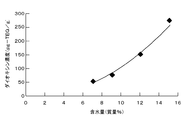
前記実施形態にて説明した図1に示す本発明のダイオキシン類の無害化処理設備を用いて表1に示す高含水(含水量52質量%)で触媒金属成分の含有量が少ない(触媒金属成分含有量1質量%)濃度550pg−TEQ/gに汚染されたダイオキシン類汚染物に亜リン酸類及び/又は次亜リン酸類を含有する無害化薬剤(ミヨシ油脂株式会社製「ダイオカット A−10」)を2質量%添加し、400℃で1時間の加熱条件(加熱装置の混合用パドルの回転速度は1rpmとした)で加熱処理したもので、表2および図2は、乾燥汚染物を最大粒径5mm未満に破砕し、15質量%〜7質量%の含水量に乾燥した実験条件1のケース1〜ケース4における各ケース毎の無害化処理後の汚染物中のダイオキシン濃度の結果である。なお、15質量%〜7質量%の含水量の乾燥汚染物は、図1の直接気流乾燥装置2の乾燥温度及び時間を100〜150℃で3〜30分の範囲で適宜調整することで、同一粒度(最大粒径5mm)の乾燥汚染物を作製することができる。
Using the dioxin detoxification facility of the present invention shown in FIG. 1 described in the above embodiment, the catalyst metal component content is low (catalyst metal component) with high water content (water content 52 mass%) shown in Table 1 Detoxification agent ("Diocut A-10" manufactured by Miyoshi Oil & Fats Co., Ltd.) containing phosphorous acid and / or hypophosphorous acid in dioxins contaminated to a concentration of 550 pg-TEQ / g. 2% by mass) and heated at 400 ° C. for 1 hour under the heating conditions (the rotation speed of the mixing paddle of the heating device was 1 rpm). Table 2 and FIG. It is the result of the dioxin concentration in the pollutant after the detoxification treatment for each case in the
この結果によると、汚染物の含水量が低くなるに従ってダイオキシンの濃度が低くなり、含水量15質量%のケース1において処理後のダイオキシン濃度279pg−TEQ/gであったものが、含水量12質量%のケース2では同150pg−TEQ/gとなっている。更に含水量を低下させたケース3、ケース4では76pg−TEQ/g、53pg−TEQ/gに低下している。
According to this result, the dioxin concentration decreased as the water content of the pollutant decreased, and in
上記の実験結果より汚染物の含水量の上限を12質量%にすれば底質の環境基準である150pg−TEQ/gを一応クリヤできることが解ったが、本発明では安全率を考慮して、確実に環境基準値をクリヤ可能な含水量として10質量%未満とした。この含水量による処理後のダイオキシン濃度は、図2に示すように約100pg−TEQ/gとなる。 From the above experimental results, it was found that if the upper limit of the moisture content of the contaminant is 12% by mass, 150 pg-TEQ / g, which is the environmental standard for sediments, can be cleared once. However, in the present invention, considering the safety factor, The environmental standard value was reliably set to less than 10% by mass as the water content that can be cleared. The dioxin concentration after treatment with this water content is about 100 pg-TEQ / g as shown in FIG.
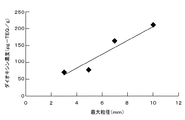
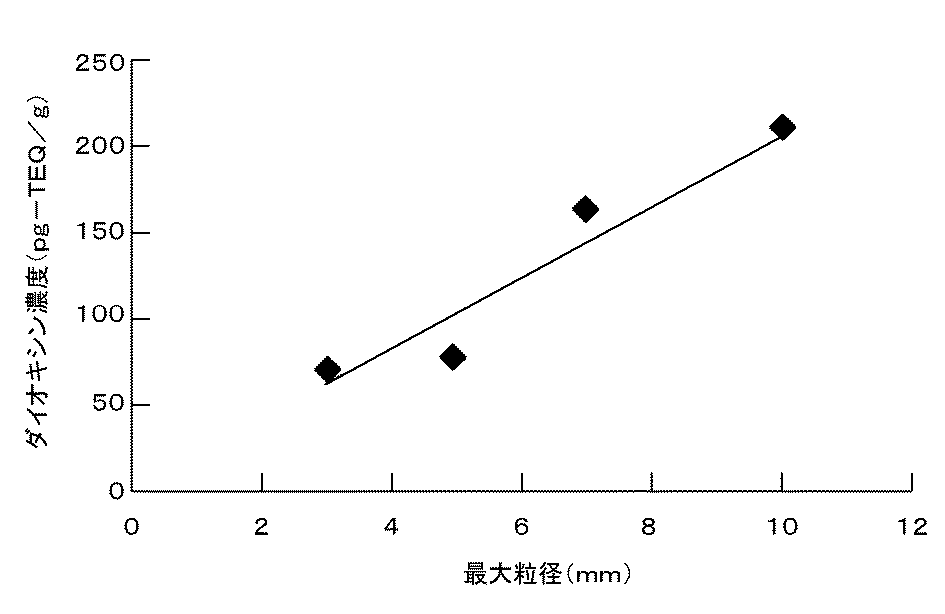
表3および図3に示すものは前記実験条件1と同様なダイオキシン類汚染物を9質量%の同一含水量において、破砕状態を最大粒径10mm〜3mmの範囲に変化させた実験条件2のケース5〜ケース8における各ケース毎の無害化処理後の汚染物中のダイオキシン濃度の結果である。なお、最大粒径10mm〜3mmの範囲の乾燥汚染物は、図1の直接気流乾燥装置2の乾燥温度及び時間を100〜150℃で3〜30分の範囲で適宜調整することで、同一含水量(9質量%)の乾燥汚染物を作製することができる。
Table 3 and FIG. 3 show the case of
この結果によると、汚染物の粒径が小さくなるに従ってダイオキシンの濃度が低くなり、粒径5mm以下になると底質の環境基準である150pg−TEQ/gを安全確実にクリヤできる。 According to this result, the concentration of dioxins decreases as the particle size of contaminants decreases, and when the particle size is 5 mm or less, 150 pg-TEQ / g, which is an environmental standard for sediment, can be safely and reliably cleared.
以上の実験条件1および実験条件2の結果より、含水量10質量%未満で、かつ、粒径5mm以下の粒状に破砕・乾燥して乾燥汚染物にした後、該乾燥汚染物に無害化薬剤を添加して、低温加熱することにより高含水汚染物に含有するダイオキシン類を効率よく、しかも確実に分解処理して無害化することができる。
From the results of the above
ダイオキシン類の汚染物で、河川や港湾の底質(底泥)や下水汚泥の様に含水量が多く、かつ、触媒金属含有量が少ない汚染物の無害化方法を提供することができる。 It is possible to provide a detoxification method for pollutants that are pollutants of dioxins and have high water content and low catalyst metal content such as bottom sediment (bottom mud) of rivers and harbors and sewage sludge.
1 高含水汚染物の投入ホッパー、
2 気流乾燥装置、
3 コンベヤ、
4 乾燥汚染物ホッパー、
5 無害化薬剤タンク、
5a 計量供給装置、
6 スクリューコンベヤ、
7 加熱装置、
7a 投入口、
7b 排出口、
7c 排気口、
8 排出コンベヤ、
9 排ガスブロワ、
9a パイプ、
10 排ガス処理装置、
11 混合用パドル。
1 Input hopper for high water content contaminants,
2 Airflow drying device,
3 conveyor,
4 Dry contaminant hopper,
5 Detoxification chemical tank,
5a metering device,
6 Screw conveyor,
7 Heating device,
7a inlet,
7b outlet,
7c exhaust port,
8 discharge conveyor,
9 Exhaust gas blower,
9a pipe,
10 exhaust gas treatment equipment,
11 Paddle for mixing.
Claims (7)
該乾燥汚染物に亜リン酸類及び/又は次亜リン酸類を含有する無害化薬剤を添加して、300℃〜600℃で低温加熱することを特徴とするダイオキシン類汚染物の無害化処理方法。 After dioxin contaminants with high water content and low catalyst metal component content are crushed and dried into granules having a water content of less than 10% by mass and a particle size of 5 mm or less,
A method for detoxifying dioxin contaminants, comprising adding a detoxifying agent containing phosphorous acid and / or hypophosphorous acid to the dried contaminants and heating at low temperature at 300 to 600 ° C.
破砕乾燥した乾燥汚染物に無害化薬剤を添加する無害化薬剤添加部と、
乾燥汚染物からダイオキシン類を分解処理する加熱処理部と、
処理済みの汚染物を排出する排出処理部と、
加熱処理部からの排ガスを処理する排ガス処理部と、を備えたダイオキシン類の無害化処理設備であって、
前記加熱処理部として、0.5〜5rpmの範囲で回転速度を調整可能な混合用パドルを備えた円筒横置型加熱装置を設けてなることを特徴とするダイオキシン類の無害化処理設備。 A crushing / drying unit that accepts high water content dioxin contaminants and crushes and dries them,
A detoxifying agent addition section for adding a detoxifying agent to crushed and dried dry contaminants;
A heat treatment unit that decomposes dioxins from dry contaminants;
A discharge processing section for discharging treated contaminants;
An exhaust gas treatment part for treating exhaust gas from the heat treatment part, and a detoxification treatment facility for dioxins,
A detoxification treatment facility for dioxins comprising a cylindrical horizontal heating device provided with a mixing paddle capable of adjusting a rotation speed in a range of 0.5 to 5 rpm as the heat treatment section.
前記無害化薬剤添加部が、無害化薬剤タンク5、計量供給装置5aを有し、
加熱処理部が、加熱装置7を有し、
排出処理部が、排出コンベア8を有し、
排ガス処理部が、排ガス処理装置10を有することを特徴とする請求項4に記載のダイオキシン類の無害化処理設備。 The crushing / drying unit has a charging hopper 1, an airflow drying device 2, a conveyor 3, and a dry contaminant hopper 4.
The detoxifying chemical addition unit has a detoxifying chemical tank 5 and a metering supply device 5a,
The heat treatment unit has a heating device 7,
The discharge processing unit has a discharge conveyor 8,
The detoxification treatment facility for dioxins according to claim 4, wherein the exhaust gas treatment unit includes an exhaust gas treatment device 10.
Priority Applications (1)
| Application Number | Priority Date | Filing Date | Title |
|---|---|---|---|
| JP2004119167A JP2005296870A (en) | 2004-04-14 | 2004-04-14 | Detoxification method for dioxin contaminants |
Applications Claiming Priority (1)
| Application Number | Priority Date | Filing Date | Title |
|---|---|---|---|
| JP2004119167A JP2005296870A (en) | 2004-04-14 | 2004-04-14 | Detoxification method for dioxin contaminants |
Publications (1)
| Publication Number | Publication Date |
|---|---|
| JP2005296870A true JP2005296870A (en) | 2005-10-27 |
Family
ID=35329061
Family Applications (1)
| Application Number | Title | Priority Date | Filing Date |
|---|---|---|---|
| JP2004119167A Pending JP2005296870A (en) | 2004-04-14 | 2004-04-14 | Detoxification method for dioxin contaminants |
Country Status (1)
| Country | Link |
|---|---|
| JP (1) | JP2005296870A (en) |
Cited By (8)
| Publication number | Priority date | Publication date | Assignee | Title |
|---|---|---|---|---|
| JP2005305302A (en) * | 2004-04-21 | 2005-11-04 | Kurita Water Ind Ltd | Thermal decomposition apparatus and thermal decomposition method for dioxins in mud |
| JP2007296410A (en) * | 2006-02-22 | 2007-11-15 | Nishimatsu Constr Co Ltd | Gasification apparatus, hardly decomposable organic compound processing apparatus and processing method |
| JP2008246390A (en) * | 2007-03-30 | 2008-10-16 | Kobelco Eco-Solutions Co Ltd | Heat treatment method of PCB with high water content |
| JP2010201286A (en) * | 2009-02-27 | 2010-09-16 | Dowa Eco-System Co Ltd | Soil treating method |
| CN101603772B (en) * | 2009-06-11 | 2011-02-16 | 山东省科学院生物研究所 | Technology and equipment for product drying and solvent recovery |
| JP2014048168A (en) * | 2012-08-31 | 2014-03-17 | Fuji Electric Co Ltd | Radioactive contaminant decontamination method and device |
| JP7082733B1 (en) * | 2021-01-29 | 2022-06-09 | 生態環境部南京環境科学研究所 | Ectopic repair equipment and methods for POPs-based pesticide-contaminated soil |
| CN115155648A (en) * | 2022-07-25 | 2022-10-11 | 中国科学院沈阳应用生态研究所 | A kind of preparation method of soil pollutant purification material |
Citations (9)
| Publication number | Priority date | Publication date | Assignee | Title |
|---|---|---|---|---|
| JPH11337040A (en) * | 1998-05-21 | 1999-12-10 | Hitachi Zosen Corp | Sludge incineration method |
| JP2000279702A (en) * | 1999-01-28 | 2000-10-10 | Shinko Pantec Co Ltd | Method for obtaining by-products from liquid to be treated and container therefor |
| JP2000334414A (en) * | 1999-05-28 | 2000-12-05 | Minoru Sawachi | Detoxification method for dioxin solids |
| JP2001025726A (en) * | 1999-07-14 | 2001-01-30 | Miyoshi Oil & Fat Co Ltd | Detoxification method of solid waste |
| JP2002045833A (en) * | 2000-07-31 | 2002-02-12 | Kawasaki Heavy Ind Ltd | Method and apparatus for solidifying and stabilizing combustion ash etc. |
| JP2002045820A (en) * | 2000-08-02 | 2002-02-12 | Sintokogio Ltd | Method and system for decomposing dioxins in incineration residue and / or molten fly ash |
| JP2002192110A (en) * | 2000-12-26 | 2002-07-10 | Nkk Corp | Powdery waste treatment equipment |
| JP2003095990A (en) * | 2001-09-20 | 2003-04-03 | Shinko Pantec Co Ltd | Organic pollutant thermal decomposition apparatus and thermal decomposition method |
| JP2004174372A (en) * | 2002-11-27 | 2004-06-24 | Penta Ocean Constr Co Ltd | Detoxification method for organic chlorine compounds |
-
2004
- 2004-04-14 JP JP2004119167A patent/JP2005296870A/en active Pending
Patent Citations (9)
| Publication number | Priority date | Publication date | Assignee | Title |
|---|---|---|---|---|
| JPH11337040A (en) * | 1998-05-21 | 1999-12-10 | Hitachi Zosen Corp | Sludge incineration method |
| JP2000279702A (en) * | 1999-01-28 | 2000-10-10 | Shinko Pantec Co Ltd | Method for obtaining by-products from liquid to be treated and container therefor |
| JP2000334414A (en) * | 1999-05-28 | 2000-12-05 | Minoru Sawachi | Detoxification method for dioxin solids |
| JP2001025726A (en) * | 1999-07-14 | 2001-01-30 | Miyoshi Oil & Fat Co Ltd | Detoxification method of solid waste |
| JP2002045833A (en) * | 2000-07-31 | 2002-02-12 | Kawasaki Heavy Ind Ltd | Method and apparatus for solidifying and stabilizing combustion ash etc. |
| JP2002045820A (en) * | 2000-08-02 | 2002-02-12 | Sintokogio Ltd | Method and system for decomposing dioxins in incineration residue and / or molten fly ash |
| JP2002192110A (en) * | 2000-12-26 | 2002-07-10 | Nkk Corp | Powdery waste treatment equipment |
| JP2003095990A (en) * | 2001-09-20 | 2003-04-03 | Shinko Pantec Co Ltd | Organic pollutant thermal decomposition apparatus and thermal decomposition method |
| JP2004174372A (en) * | 2002-11-27 | 2004-06-24 | Penta Ocean Constr Co Ltd | Detoxification method for organic chlorine compounds |
Cited By (8)
| Publication number | Priority date | Publication date | Assignee | Title |
|---|---|---|---|---|
| JP2005305302A (en) * | 2004-04-21 | 2005-11-04 | Kurita Water Ind Ltd | Thermal decomposition apparatus and thermal decomposition method for dioxins in mud |
| JP2007296410A (en) * | 2006-02-22 | 2007-11-15 | Nishimatsu Constr Co Ltd | Gasification apparatus, hardly decomposable organic compound processing apparatus and processing method |
| JP2008246390A (en) * | 2007-03-30 | 2008-10-16 | Kobelco Eco-Solutions Co Ltd | Heat treatment method of PCB with high water content |
| JP2010201286A (en) * | 2009-02-27 | 2010-09-16 | Dowa Eco-System Co Ltd | Soil treating method |
| CN101603772B (en) * | 2009-06-11 | 2011-02-16 | 山东省科学院生物研究所 | Technology and equipment for product drying and solvent recovery |
| JP2014048168A (en) * | 2012-08-31 | 2014-03-17 | Fuji Electric Co Ltd | Radioactive contaminant decontamination method and device |
| JP7082733B1 (en) * | 2021-01-29 | 2022-06-09 | 生態環境部南京環境科学研究所 | Ectopic repair equipment and methods for POPs-based pesticide-contaminated soil |
| CN115155648A (en) * | 2022-07-25 | 2022-10-11 | 中国科学院沈阳应用生态研究所 | A kind of preparation method of soil pollutant purification material |
Similar Documents
| Publication | Publication Date | Title |
|---|---|---|
| WO2001056939A1 (en) | Method for treating oil-containing sludge | |
| JP5311007B2 (en) | Heat treatment system and heat treatment method | |
| KR102040735B1 (en) | Soil remediation equipment for remediating soil contaminated with mercury and persistent organic pollutants | |
| KR102061828B1 (en) | Soil remediation method for remediating soil contaminated with mercury and persistent organic pollutants | |
| JP2010069391A (en) | Decontamination method and decontaminating apparatus for contaminated soil | |
| JPH05295347A (en) | Process, system and composition for rendering waste substance harmless | |
| JP2004141774A (en) | Soil or sediment purification method | |
| JP2007215552A (en) | Method for treating organohalogen compounds | |
| JP2004114003A (en) | Phosphorus adsorbent and method of forming the same, method of recovering phosphorus, method of treating phosphorus adsorbent, and method of treating water containing phosphorus content | |
| JP5634961B2 (en) | Sludge treatment method | |
| JP2004197047A (en) | Soil modifier | |
| JP2006247483A (en) | Treatment method of contaminated soil | |
| JP5008945B2 (en) | Contaminant disposal method | |
| JP4107056B2 (en) | Method and agent for decomposing halogenated organic compounds | |
| JP4179599B2 (en) | Detoxification method for organochlorine compounds | |
| JP2010247047A (en) | Method and apparatus for purification of contaminated soil | |
| JP2010259975A (en) | Purification equipment for contaminated soil | |
| KR100337367B1 (en) | Food refuse treatment and apparatus | |
| JP2006263530A (en) | Method for treating sulfate pitch | |
| Wei | Leaching study of thermally treated cadmium-doped soils | |
| KR20000007831A (en) | Method for treating food waste and device thereof | |
| JP5599574B2 (en) | Soil improver from incinerated ash and method for producing the same | |
| JP3793361B2 (en) | Waste disposal method | |
| JP5140880B2 (en) | Pollutant detoxification method | |
| JP2004160440A (en) | Decomposition method and decomposition agent for halogenated organic compounds |
Legal Events
| Date | Code | Title | Description |
|---|---|---|---|
| A711 | Notification of change in applicant |
Free format text: JAPANESE INTERMEDIATE CODE: A712 Effective date: 20060804 |
|
| RD03 | Notification of appointment of power of attorney |
Free format text: JAPANESE INTERMEDIATE CODE: A7423 Effective date: 20060825 |
|
| A621 | Written request for application examination |
Free format text: JAPANESE INTERMEDIATE CODE: A621 Effective date: 20070222 |
|
| A711 | Notification of change in applicant |
Free format text: JAPANESE INTERMEDIATE CODE: A711 Effective date: 20070222 |
|
| A521 | Request for written amendment filed |
Free format text: JAPANESE INTERMEDIATE CODE: A821 Effective date: 20070223 |
|
| A977 | Report on retrieval |
Free format text: JAPANESE INTERMEDIATE CODE: A971007 Effective date: 20091216 |
|
| A131 | Notification of reasons for refusal |
Free format text: JAPANESE INTERMEDIATE CODE: A131 Effective date: 20091222 |
|
| A02 | Decision of refusal |
Free format text: JAPANESE INTERMEDIATE CODE: A02 Effective date: 20100420 |