JP2005295952A - Method for reducing nitric acid concentration of plant under cultivation and liquid therefor - Google Patents
Method for reducing nitric acid concentration of plant under cultivation and liquid therefor Download PDFInfo
- Publication number
- JP2005295952A JP2005295952A JP2004120097A JP2004120097A JP2005295952A JP 2005295952 A JP2005295952 A JP 2005295952A JP 2004120097 A JP2004120097 A JP 2004120097A JP 2004120097 A JP2004120097 A JP 2004120097A JP 2005295952 A JP2005295952 A JP 2005295952A
- Authority
- JP
- Japan
- Prior art keywords
- plant
- water
- concentration
- nitric acid
- adjusted
- Prior art date
- Legal status (The legal status is an assumption and is not a legal conclusion. Google has not performed a legal analysis and makes no representation as to the accuracy of the status listed.)
- Pending
Links
Landscapes
- Cultivation Of Plants (AREA)
Abstract
Description
本願発明は、葉菜類、果菜類、根菜類等の栽培植物の体内に含まれる硝酸の濃度を低減させる方法及び栽培植物に施すべき硝酸濃度低減用液に関する。 The present invention relates to a method for reducing the concentration of nitric acid contained in cultivated plants such as leaf vegetables, fruit vegetables, and root vegetables, and a solution for reducing nitric acid concentration to be applied to the cultivated plants.
従来、野菜類の栽培において、これまで大量の窒素肥料を施用した結果、これら野菜類の高濃度の硝酸が含まれていることが判明した。
これらの硝酸は、直接人や家畜に害を及ぼすことは少いが、これを摂取すると、消化器官で亜硝酸に還元されると呼吸阻害を生じ、又アミンと反応してニトロソアミンを生成し、さらにジアゾアルカンに変化して発ガン性をもつに至る。又インシュリン依存性糖尿病やアトピー性皮膚炎の原因になるともいわれている。
Conventionally, in the cultivation of vegetables, as a result of applying a large amount of nitrogen fertilizer, it has been found that high concentrations of nitric acid in these vegetables are contained.
These nitric acids have little direct harm to humans and livestock, but when ingested, they reduce respiratory activity when reduced to nitrous acid in the digestive tract, react with amines to produce nitrosamines, Furthermore, it changes to diazoalkane and has carcinogenic properties. It is also said to cause insulin-dependent diabetes and atopic dermatitis.
そのためWHOヨーロッパ委員会では、硝酸の最大摂取源が野菜であることから、ホウレンソウとレタスの硝酸上限値を、ホウレンソウ(生鮮)3,000ppm、同(冷凍)2,000ppm、レタス2,500ppmと定めているが、我国の野菜類の硝酸含有量は、上記の上限値を大きく超えるものもあり、2002年農林水産省消費技術センターの暫定分析値によれば、ホウレンソウ1,300〜9,200ppm、レタス200〜2,800ppmと報告されている。 Therefore, the WHO European Commission has set the upper limit of nitrate for spinach and lettuce as 3,000 ppm for spinach (fresh), 2,000 ppm for the same (frozen), and 2,500 ppm for lettuce because the maximum source of nitric acid is vegetable. The nitrate content of vegetables in Japan greatly exceeds the above upper limit, and according to the provisional analysis values of the Ministry of Agriculture, Forestry and Fisheries Consumption Technology Center in 2002, spinach 1,300-9,200ppm, lettuce 200-2,800ppm It has been reported.
そこで、従来、植物の硝酸濃度を低減させる方法として、植物を硝酸態窒素肥料で生育し、収穫の所要期間前にアンモニア態窒素肥料に切り替える方法(1996年塩見等)、硝酸態とアンモニア態の混合肥料で生育し、収穫を所要期間遅らせる方法(2002年須賀等)、緩効性肥料等の機能性肥料による方法、その他種々の方法が提案され、試行されているが、十分な収量を維持しつつ硝酸濃度を低減でき、しかも低コストで実施できる方法は未だ開発されていない。 Therefore, conventionally, as a method of reducing the nitrate concentration of plants, the method is to grow plants with nitrate nitrogen fertilizer and switch to ammonia nitrogen fertilizer before the harvest period (1996 Shiomi, etc.) Growing with mixed fertilizer and delaying harvesting (Suga in 2002), method using functional fertilizer such as slow-release fertilizer, and various other methods have been proposed and tried, but sufficient yield is maintained However, a method that can reduce the nitric acid concentration and can be carried out at a low cost has not been developed yet.
本願発明は、十分な収量を確保しつつ硝酸濃度を低減でき、しかも低コストで実施できる栽培植物の硝酸濃度低減方法及び硝酸濃度低減用液を提供することを課題とする。 This invention makes it a subject to provide the nitric acid concentration reduction method and the liquid for nitric acid concentration reduction of the cultivation plant which can reduce nitric acid concentration, ensuring sufficient yield, and can be implemented at low cost.
上記課題を達成する手段を得るため、本発明者は、これまで多くの研究実験を重ねた結果、この度、海洋深層水に植物の硝酸濃度を低減する働きがあることを見い出し、これをもって栽培植物の硝酸濃度低減を可能にしたのである。 In order to obtain the means for achieving the above-mentioned problems, the present inventor has conducted many research experiments so far and has found that the deep sea water has a function of reducing the nitrate concentration of the plant. This made it possible to reduce the concentration of nitric acid.
そこで、まず海洋深層水についてみると、その成分は〔表1〕(静岡工業技術センター発表)に示されるように、多くの栄養分を含んだ有用なものであるが、これをそのまま植物に施用することはできない。海洋深層水は高い塩素濃度と高いEC(電気伝導度)を有し、高濃度の塩素は植物の枯死等を招き、高いECは植物の葉やけ、心やけ、尻ぐされ等の障害をひき起す危険があるからである。
そこで、本発明者は、さらに研究を進め、上記塩素濃度及びECが海洋深層水の植物に及ぼす害を評価しうる基準になりうることを確かめた上で、該塩素濃度及びECの植物に対する安全基準値は、植物の種類により変動があるが、耐塩性種等の特別種を除いた一般的栽培植物に対しては、平均的にみて、塩素濃度が約1000ppm以下、ECが約2.5ms/cm以下であることを確認した。 Therefore, the present inventor has further researched and confirmed that the chlorine concentration and EC can be used as a standard for evaluating the damage to deep-sea water plants, and the safety of the chlorine concentration and EC to plants. The reference value varies depending on the type of plant, but for general cultivated plants excluding special species such as salt-tolerant species, on average, the chlorine concentration is about 1000 ppm or less, and EC is about 2.5 ms / It confirmed that it was below cm.
一般的栽培植物としては、コマツナ、キャベツ、ダイコン、ハクサイ等のアブラナ科、トマト、ナス等のナス科、ホウレンソウ等のアガサ科、ネギ等のユリ科、メロン、キュウリ等のウリ科がある。 Commonly cultivated plants include Brassicaceae such as Komatsuna, cabbage, Japanese radish, Chinese cabbage, solanaceae such as tomato and eggplant, Agassa such as spinach, lily such as leek, and cucurbitaceae such as melon and cucumber.
上記海洋深層水の塩素濃度の実際の調整には、好ましくは電気透析法による脱塩処理方法がある。しかし一般的には、逆浸透膜法や井戸水による希釈法が用いられ、これらの一般的方法では、深層水に含まれる有用成分を可能な限り残しながら調整することが望ましい。 For the actual adjustment of the chlorine concentration in the deep sea water, there is preferably a desalting method by electrodialysis. However, generally, a reverse osmosis membrane method or a dilution method using well water is used. In these general methods, it is desirable to adjust while leaving as much useful components as possible in the deep water.
又、上記ECの場合は、上記各方法により塩素濃度を調整したとき、同時にECをも自動的に低下させる。 In the case of the EC, when the chlorine concentration is adjusted by the above methods, the EC is automatically lowered at the same time.
なお、海洋深層水の塩素濃度及びECを上記安全基準値以下に調整したものを以下「調整深層水」と称する。 In addition, what adjusted the chlorine concentration of deep sea water and EC below the said safety standard value is called "adjusted deep water" below.
(試験1)
上記調整深層水による栽培植物の硝酸濃度低減効果を試験を通じて明らかにする。本試験には、蒸留水により海洋深層水原水を希釈してなる塩素濃度40ppm(EC0.1ms/cm)、同200ppm(EC0.5ms/cm)、同1000ppm(EC2.5ms/cm)の3種の調整深層水を使用する。
(Test 1)
The nitrate concentration reduction effect of cultivated plants by the adjusted deep water will be clarified through tests. In this test, three kinds of chlorine concentration 40ppm (EC0.1ms / cm), 200ppm (EC0.5ms / cm), 1000ppm (EC2.5ms / cm) obtained by diluting the raw deep sea water with distilled water. Use adjusted deep water.
4個の鉢(ノイバイエルポット)にそれぞれ入れた土壌にコマツナの苗を植え、そして平成15年8月23日から同年9月11日までの試験期間において、尿素、過リン酸石灰、塩化カリの各肥料をそれぞれ土壌100gに対し25mg施肥し、又第1の鉢に蒸留水を、第2、第3、第4の鉢に上記3種の調整深層水を別々に灌水した。灌水は、それぞれ20ml/回で収穫までに7回行った。各鉢のコマツナの葉茎部内の硝酸イオン濃度を測定した値を〔表2〕に示す。
さらに、上記3種の調整深層水を使用した場合のコマツナの収量を、蒸留水を使用した場合の収量を100としたときの収量指数で〔表3〕に示す。〔表3〕から明らかなように、蒸留水使用の収量に対し、塩素濃度40ppmの調整深層水使用の収量は変らないが、塩素濃度200ppm及び1000ppmの調整深層水使用の収量は増大する。
(試験2)
海洋深層水原水を井戸水で希釈した塩素濃度200ppm(EC0.5ms/cm)の調整深層水を使用する。
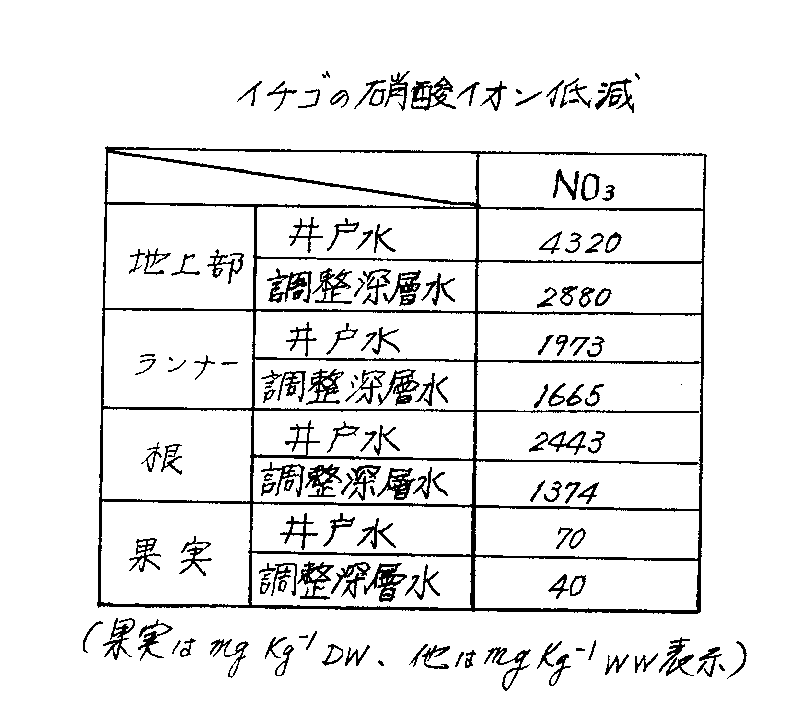
イチゴの高設栽培において、慣行区と深層水区を設定し、試験期間平成14年9月25日から同15年5末日までに、両区に肥料大塚水耕用液肥を施すと共に、慣行区に井戸水を、深層水区に上記調整深層水を1日当りそれぞれ50ml/回で4回灌水した。慣行区及び深層水区の各イチゴの試験終了時の地上部、ランナー、根、及び各収穫時の果実内の硝酸イオン濃度を測定した平均値を〔表4〕に示す。
Adjusted deep water with a chlorine concentration of 200 ppm (EC 0.5 ms / cm) obtained by diluting deep ocean water with well water.
In the cultivation of strawberries, the customary ward and the deep water ward are set, and from the test period from September 25, 2002 to the end of May 2015, the fertilizer Otsuka hydroponic fertilizer is applied to both wards, and the customary ward The well water was irrigated 4 times, and the above-mentioned adjusted deep water was irrigated 4 times at a daily rate of 50 ml / dose. Table 4 shows the average values of nitrate concentration in the above-ground part, runners, roots, and fruits at the time of harvesting at the end of the test for each strawberry in the customary and deep water zones.
上記の各試験結果から、井戸水を施したときの植物の硝酸イオン濃度に対し、調整深層水を施したときの植物の硝酸イオン濃度が大幅に低減することが明らかとなった。それと共に、調整深層水を施したときの栽培植物の収量は不変又は増大することも明らかとなった。このような海洋深層水のもつ硝酸濃度低減機能は該深層水に含まれるいかなる物質に由来するものであるのか、未だ確証がない。本発明者は、その点につき、引き続き鋭意究明中である。 From the above test results, it has been clarified that the nitrate ion concentration of the plant when the adjusted deep water is applied is greatly reduced with respect to the nitrate ion concentration of the plant when the well water is applied. At the same time, it was also revealed that the yield of cultivated plants remained unchanged or increased when adjusted deep water was applied. There is still no proof that the function of reducing the concentration of nitric acid possessed by such deep ocean water is derived from any substance contained in the deep ocean water. The present inventor continues to intensively investigate this point.
以上の試験に基づき、本願第1発明は、
海洋深層水に含まれる各成分を残しつつ該深層水の塩素濃度及び電気伝導度を、栽培すべき植物の健全生育を保証する安全基準値以下に調整した調整深層水を準備することと、
上記植物の栽培において、植物の発芽から生育の過程の一部又は全部の過程において上記調整深層水を植物に施用することと、
からなる栽培植物の硝酸濃度低減方法を提案し、
Based on the above test, the first invention of the present application is
Preparing adjusted deep water in which the chlorine concentration and electrical conductivity of the deep water are adjusted to a safety standard value or less that guarantees the healthy growth of the plant to be cultivated while leaving each component contained in the deep sea water;
In the cultivation of the plant, applying the adjusted deep water to the plant in part or all of the process of germination from plant germination,
Proposed a method for reducing nitrate concentration in cultivated plants,
本願第2発明は、
海洋深層水に含まれる各成分を残しつつ該深層水の塩素濃度及び電気伝導度を、栽培すべき植物の健全生育を保証する安全基準値以下に調整してなる、栽培植物の硝酸濃度低減用液を提案する。
The second invention of the present application is
For reducing the nitrate concentration of cultivated plants, leaving the components contained in the deep ocean water, and adjusting the chlorine concentration and electrical conductivity of the deep water below the safety standard value that guarantees the healthy growth of the plant to be cultivated Suggest a liquid.
本願第1発明によれば、植物の栽培過程において植物体内の硝酸濃度を低減することができ、それにより栽培植物の安全を確保することができ、しかも海洋深層水のもつ豊富な各種栄養分を植物に供給することにより、十分な収量をあげることができると共に、安価大量に得られる海洋深層水の利用により低コストで本方法を実施できるのである。 According to the first invention of the present application, the concentration of nitric acid in the plant body can be reduced during the cultivation process of the plant, thereby ensuring the safety of the cultivated plant, and the abundant various nutrients possessed by deep ocean water In addition to increasing the yield, it is possible to carry out the present method at low cost by utilizing deep ocean water obtained in large quantities at a low cost.
本願第2発明によれば、これを用いて上記第1発明を有効かつ経済的に実施することができ、しかも栽培植物に対して安全であるから、灌水、散水等の通常の方法で栽培植物に施用することができるのである。 According to the second invention of the present application, the above-mentioned first invention can be effectively and economically implemented using this, and is safe for the cultivated plant. It can be applied to.
本願第1発明において、調整深層水を植物に「施用する」方法には、土壌栽培の場合は調整深層水の灌水、散水等があり、水耕栽培の場合は調整深層水の培養液への添加がある。又、各栽培において葉面散布も有効である。
以下本発明の実施例について説明する。
In the first invention of the present application, the method of “applying” adjusted deep water to plants includes irrigation, watering, etc. of adjusted deep water in the case of soil cultivation, and to the culture solution of adjusted deep water in the case of hydroponics. There is an addition. Moreover, foliar spraying is also effective in each cultivation.
Examples of the present invention will be described below.
(実施例1)
海洋深層水原水を井戸水で希釈して塩素濃度500ppm、EC1.3ms/cmのコマツナ用調整深層水を準備した。
コマツナ苗を土壌に植え、これに尿素、過リン酸石灰、塩化カリを従来どおり十分施肥し、ついで上記調整深層水を3日置きに1日20ml/鉢(ノイバイエルポット)灌水した。
(Example 1)
Deep sea water was diluted with well water to prepare adjusted deep water for Komatsuna with chlorine concentration of 500ppm and EC1.3ms / cm.
Komatsuna seedlings were planted in soil, and urea, superphosphate, and potassium chloride were sufficiently fertilized as before, and then the above-mentioned adjusted deep water was irrigated at a rate of 20 ml / pot (Neubayer pot) every 3 days.
成長したコマツナの葉茎部の硝酸イオンをイオンクロマトグラフにより測定したところ、従来の約3400ppmに対し約2600ppmと大幅に低減した。又収量は、従来の収量を100とした収量指数で約118%の増収となった。 The nitrate ion in the leaf stem of the grown komatsuna was measured by ion chromatography, and it was significantly reduced to about 2600ppm compared to the conventional about 3400ppm. In addition, the yield increased by about 118% with a yield index based on the conventional yield of 100.
(実施例2)
海洋深層水原水を井戸水で希釈して塩素濃度1000ppm、EC2.5ms/cmのトマト用調整深層水を準備した。
トマト苗を、土壌を充填した1/2000aワグネルポットに植え、これに有機配合肥料(窒素20kg/10a)を施し、ついで上記調整深層水を1個当り1000ml/鉢灌水した。
(Example 2)
Deep sea water was diluted with well water to prepare adjusted deep water for tomatoes with a chlorine concentration of 1000 ppm and an EC of 2.5 ms / cm.
Tomato seedlings were planted in a 1 / 2000a Wagner pot filled with soil, and organic fertilizer (nitrogen 20kg / 10a) was applied thereto, and then the above-mentioned adjusted deep water was irrigated at 1000ml per pot.
元来、果実に蓄積される硝酸の濃度は低いものであるが、本例で得られた第1果房の硝酸イオンは、従来の乾物当り約46ppmに対し27ppm、第2果房は、従来の48ppmに対し21ppm、第3果房は、従来の43ppmに対し30ppmと低減した。又収量は、第1果房で従来600gに対し924g、第2果房で従来324gに対し870gと増大した。さらに、従来より早期に収穫できた。
Originally, the concentration of nitric acid accumulated in the fruit is low, but the nitrate concentration in the first fruit bunches obtained in this example is 27 ppm, compared to about 46 ppm per conventional dry matter, and the second fruit bunches are conventional. The third fruit bunch was reduced to 30 ppm compared to the conventional 43 ppm. Yield increased to 924g compared to 600g for the first tress and 870g to 324g for the second tress. Furthermore, it was able to harvest earlier than before.
Claims (2)
上記植物の栽培において、植物の発芽から生育の過程の一部又は全部の過程において上記調整深層水を植物に施用することと、
からなる栽培植物の硝酸濃度低減方法。 Preparing adjusted deep water in which the chlorine concentration and electrical conductivity of the deep water are adjusted to a safety standard value or less that guarantees the healthy growth of the plant to be cultivated while leaving each component contained in the deep sea water;
In the cultivation of the plant, applying the adjusted deep water to the plant in part or all of the process of germination from plant germination,
A method for reducing the concentration of nitric acid in a cultivated plant.
For reducing the nitrate concentration of cultivated plants, leaving the components contained in the deep ocean water, and adjusting the chlorine concentration and electrical conductivity of the deep water below the safety standard value that guarantees the healthy growth of the plant to be cultivated liquid.
Priority Applications (1)
| Application Number | Priority Date | Filing Date | Title |
|---|---|---|---|
| JP2004120097A JP2005295952A (en) | 2004-04-15 | 2004-04-15 | Method for reducing nitric acid concentration of plant under cultivation and liquid therefor |
Applications Claiming Priority (1)
| Application Number | Priority Date | Filing Date | Title |
|---|---|---|---|
| JP2004120097A JP2005295952A (en) | 2004-04-15 | 2004-04-15 | Method for reducing nitric acid concentration of plant under cultivation and liquid therefor |
Publications (1)
| Publication Number | Publication Date |
|---|---|
| JP2005295952A true JP2005295952A (en) | 2005-10-27 |
Family
ID=35328246
Family Applications (1)
| Application Number | Title | Priority Date | Filing Date |
|---|---|---|---|
| JP2004120097A Pending JP2005295952A (en) | 2004-04-15 | 2004-04-15 | Method for reducing nitric acid concentration of plant under cultivation and liquid therefor |
Country Status (1)
| Country | Link |
|---|---|
| JP (1) | JP2005295952A (en) |
Cited By (1)
| Publication number | Priority date | Publication date | Assignee | Title |
|---|---|---|---|---|
| JP2019000096A (en) * | 2017-06-14 | 2019-01-10 | カンウォン ナショナル ユニバーシティ−インダストリー コーポレーション ファウンデーション | Method for cultivating coffee beans using deep sea water and development of high quality coffee using the same |
-
2004
- 2004-04-15 JP JP2004120097A patent/JP2005295952A/en active Pending
Cited By (1)
| Publication number | Priority date | Publication date | Assignee | Title |
|---|---|---|---|---|
| JP2019000096A (en) * | 2017-06-14 | 2019-01-10 | カンウォン ナショナル ユニバーシティ−インダストリー コーポレーション ファウンデーション | Method for cultivating coffee beans using deep sea water and development of high quality coffee using the same |
Similar Documents
| Publication | Publication Date | Title |
|---|---|---|
| KR101352628B1 (en) | Mineral nutrition solution and method for cultivating functional plant using thereof | |
| CA2985824C (en) | Nutrient system | |
| RU2013104363A (en) | ELECTROCHEMICALLY PROCESSED NUTRIENT SOLUTIONS | |
| KR101732080B1 (en) | A Manufacturing Method Of Composition Of Fluid Fertilizer | |
| JP2001190154A (en) | Crop cultivation method and crop quality improving agent | |
| JP2002138004A (en) | Material for agriculture and horticulture | |
| JP6714233B2 (en) | Production method of leafy vegetables | |
| Huang et al. | Responses of squash to salinity, waterlogging, and subsequent drainage: I. Gas exchange, water relations, and nitrogen status | |
| KR20120112278A (en) | A composition of complex fertilizer for plant nutrition comprising atca as an effective component | |
| JP5405714B2 (en) | Organic fertilizer | |
| JP6689310B2 (en) | Method for reducing mass ratio of calcium / magnesium in agricultural products using seawater and method for cultivating agricultural products | |
| Chohura et al. | Suitability of some nitrogen fertilizers for the cultivation of early cabbage | |
| Güler et al. | Yield and elemental composition of cucumber as affected by drip and furrow irrigation | |
| JP2008273774A (en) | Fertilizer and cultivating method | |
| WO1997008951A1 (en) | Improving the yield of plants | |
| Asao et al. | Horticultural Research in Japan: production of vegetables and ornamentals in hydroponics, constraints and control measures | |
| JP2003102259A (en) | Method for effectively utilizing marine deep water to plant cultivation, and effectively utilized liquid used for the same | |
| EP2896286B1 (en) | Method for increasing the content of useful components in edible plants | |
| Dorais et al. | Fertilisation management for organic cucumber grown in raised demarcated beds | |
| Soni et al. | Assessment of different irrigation levels on quality production of headed back guava cv. Lalit under high density plantation. | |
| Fumuro | Effects of light intensity, soil acidity, and nitrogen concentration on the vegetative growth of pitaya seedlings© | |
| Neocleous et al. | Assessment of different strategies to balance high Mg levels in the irrigation water when preparing nutrient solution for soilless strawberry crops | |
| Nukaya et al. | EFFECTS OF NO3, SO4 AND C1 RATIOS ON TOMATOES GROWN IN RECIRCULATING SYSTEM | |
| KR20250087668A (en) | Compositions, systems, and methods for improving plant quality | |
| JP2006191848A (en) | New method for cultivating fruit vegetable crop in undernutrition condition |
Legal Events
| Date | Code | Title | Description |
|---|---|---|---|
| A977 | Report on retrieval |
Free format text: JAPANESE INTERMEDIATE CODE: A971007 Effective date: 20060404 |
|
| A131 | Notification of reasons for refusal |
Free format text: JAPANESE INTERMEDIATE CODE: A131 Effective date: 20060425 |
|
| A02 | Decision of refusal |
Free format text: JAPANESE INTERMEDIATE CODE: A02 Effective date: 20060718 |