EP4582886A1 - Steuerungsverfahren für elektrischen rollstuhl und zugehörige vorrichtung - Google Patents
Steuerungsverfahren für elektrischen rollstuhl und zugehörige vorrichtung Download PDFInfo
- Publication number
- EP4582886A1 EP4582886A1 EP24812056.0A EP24812056A EP4582886A1 EP 4582886 A1 EP4582886 A1 EP 4582886A1 EP 24812056 A EP24812056 A EP 24812056A EP 4582886 A1 EP4582886 A1 EP 4582886A1
- Authority
- EP
- European Patent Office
- Prior art keywords
- energy storage
- group
- storage batteries
- components
- power consumption
- Prior art date
- Legal status (The legal status is an assumption and is not a legal conclusion. Google has not performed a legal analysis and makes no representation as to the accuracy of the status listed.)
- Pending
Links
Images


Classifications
-
- A—HUMAN NECESSITIES
- A61—MEDICAL OR VETERINARY SCIENCE; HYGIENE
- A61G—TRANSPORT, PERSONAL CONVEYANCES, OR ACCOMMODATION SPECIALLY ADAPTED FOR PATIENTS OR DISABLED PERSONS; OPERATING TABLES OR CHAIRS; CHAIRS FOR DENTISTRY; FUNERAL DEVICES
- A61G5/00—Chairs or personal conveyances specially adapted for patients or disabled persons, e.g. wheelchairs
- A61G5/04—Chairs or personal conveyances specially adapted for patients or disabled persons, e.g. wheelchairs motor-driven
-
- A—HUMAN NECESSITIES
- A61—MEDICAL OR VETERINARY SCIENCE; HYGIENE
- A61G—TRANSPORT, PERSONAL CONVEYANCES, OR ACCOMMODATION SPECIALLY ADAPTED FOR PATIENTS OR DISABLED PERSONS; OPERATING TABLES OR CHAIRS; CHAIRS FOR DENTISTRY; FUNERAL DEVICES
- A61G5/00—Chairs or personal conveyances specially adapted for patients or disabled persons, e.g. wheelchairs
- A61G5/10—Parts, details or accessories
-
- B—PERFORMING OPERATIONS; TRANSPORTING
- B60—VEHICLES IN GENERAL
- B60L—PROPULSION OF ELECTRICALLY-PROPELLED VEHICLES; SUPPLYING ELECTRIC POWER FOR AUXILIARY EQUIPMENT OF ELECTRICALLY-PROPELLED VEHICLES; ELECTRODYNAMIC BRAKE SYSTEMS FOR VEHICLES IN GENERAL; MAGNETIC SUSPENSION OR LEVITATION FOR VEHICLES; MONITORING OPERATING VARIABLES OF ELECTRICALLY-PROPELLED VEHICLES; ELECTRIC SAFETY DEVICES FOR ELECTRICALLY-PROPELLED VEHICLES
- B60L58/00—Methods or circuit arrangements for monitoring or controlling batteries or fuel cells, specially adapted for electric vehicles
- B60L58/10—Methods or circuit arrangements for monitoring or controlling batteries or fuel cells, specially adapted for electric vehicles for monitoring or controlling batteries
- B60L58/12—Methods or circuit arrangements for monitoring or controlling batteries or fuel cells, specially adapted for electric vehicles for monitoring or controlling batteries responding to state of charge [SoC]
- B60L58/14—Preventing excessive discharging
-
- B—PERFORMING OPERATIONS; TRANSPORTING
- B60—VEHICLES IN GENERAL
- B60L—PROPULSION OF ELECTRICALLY-PROPELLED VEHICLES; SUPPLYING ELECTRIC POWER FOR AUXILIARY EQUIPMENT OF ELECTRICALLY-PROPELLED VEHICLES; ELECTRODYNAMIC BRAKE SYSTEMS FOR VEHICLES IN GENERAL; MAGNETIC SUSPENSION OR LEVITATION FOR VEHICLES; MONITORING OPERATING VARIABLES OF ELECTRICALLY-PROPELLED VEHICLES; ELECTRIC SAFETY DEVICES FOR ELECTRICALLY-PROPELLED VEHICLES
- B60L58/00—Methods or circuit arrangements for monitoring or controlling batteries or fuel cells, specially adapted for electric vehicles
- B60L58/10—Methods or circuit arrangements for monitoring or controlling batteries or fuel cells, specially adapted for electric vehicles for monitoring or controlling batteries
- B60L58/18—Methods or circuit arrangements for monitoring or controlling batteries or fuel cells, specially adapted for electric vehicles for monitoring or controlling batteries of two or more battery modules
-
- G—PHYSICS
- G05—CONTROLLING; REGULATING
- G05B—CONTROL OR REGULATING SYSTEMS IN GENERAL; FUNCTIONAL ELEMENTS OF SUCH SYSTEMS; MONITORING OR TESTING ARRANGEMENTS FOR SUCH SYSTEMS OR ELEMENTS
- G05B19/00—Program-control systems
- G05B19/02—Program-control systems electric
- G05B19/04—Program control other than numerical control, i.e. in sequence controllers or logic controllers
-
- A—HUMAN NECESSITIES
- A61—MEDICAL OR VETERINARY SCIENCE; HYGIENE
- A61G—TRANSPORT, PERSONAL CONVEYANCES, OR ACCOMMODATION SPECIALLY ADAPTED FOR PATIENTS OR DISABLED PERSONS; OPERATING TABLES OR CHAIRS; CHAIRS FOR DENTISTRY; FUNERAL DEVICES
- A61G2203/00—General characteristics of devices
- A61G2203/10—General characteristics of devices characterised by specific control means, e.g. for adjustment or steering
- A61G2203/22—General characteristics of devices characterised by specific control means, e.g. for adjustment or steering for automatically guiding movable devices, e.g. stretchers or wheelchairs in a hospital
-
- A—HUMAN NECESSITIES
- A61—MEDICAL OR VETERINARY SCIENCE; HYGIENE
- A61G—TRANSPORT, PERSONAL CONVEYANCES, OR ACCOMMODATION SPECIALLY ADAPTED FOR PATIENTS OR DISABLED PERSONS; OPERATING TABLES OR CHAIRS; CHAIRS FOR DENTISTRY; FUNERAL DEVICES
- A61G2203/00—General characteristics of devices
- A61G2203/70—General characteristics of devices with special adaptations, e.g. for safety or comfort
- A61G2203/72—General characteristics of devices with special adaptations, e.g. for safety or comfort for collision prevention
-
- B—PERFORMING OPERATIONS; TRANSPORTING
- B60—VEHICLES IN GENERAL
- B60L—PROPULSION OF ELECTRICALLY-PROPELLED VEHICLES; SUPPLYING ELECTRIC POWER FOR AUXILIARY EQUIPMENT OF ELECTRICALLY-PROPELLED VEHICLES; ELECTRODYNAMIC BRAKE SYSTEMS FOR VEHICLES IN GENERAL; MAGNETIC SUSPENSION OR LEVITATION FOR VEHICLES; MONITORING OPERATING VARIABLES OF ELECTRICALLY-PROPELLED VEHICLES; ELECTRIC SAFETY DEVICES FOR ELECTRICALLY-PROPELLED VEHICLES
- B60L2200/00—Type of vehicles
- B60L2200/34—Wheel chairs
-
- B—PERFORMING OPERATIONS; TRANSPORTING
- B60—VEHICLES IN GENERAL
- B60L—PROPULSION OF ELECTRICALLY-PROPELLED VEHICLES; SUPPLYING ELECTRIC POWER FOR AUXILIARY EQUIPMENT OF ELECTRICALLY-PROPELLED VEHICLES; ELECTRODYNAMIC BRAKE SYSTEMS FOR VEHICLES IN GENERAL; MAGNETIC SUSPENSION OR LEVITATION FOR VEHICLES; MONITORING OPERATING VARIABLES OF ELECTRICALLY-PROPELLED VEHICLES; ELECTRIC SAFETY DEVICES FOR ELECTRICALLY-PROPELLED VEHICLES
- B60L2240/00—Control parameters of input or output; Target parameters
- B60L2240/60—Navigation input
- B60L2240/64—Road conditions
- B60L2240/642—Slope of road
-
- B—PERFORMING OPERATIONS; TRANSPORTING
- B60—VEHICLES IN GENERAL
- B60L—PROPULSION OF ELECTRICALLY-PROPELLED VEHICLES; SUPPLYING ELECTRIC POWER FOR AUXILIARY EQUIPMENT OF ELECTRICALLY-PROPELLED VEHICLES; ELECTRODYNAMIC BRAKE SYSTEMS FOR VEHICLES IN GENERAL; MAGNETIC SUSPENSION OR LEVITATION FOR VEHICLES; MONITORING OPERATING VARIABLES OF ELECTRICALLY-PROPELLED VEHICLES; ELECTRIC SAFETY DEVICES FOR ELECTRICALLY-PROPELLED VEHICLES
- B60L2260/00—Operating Modes
- B60L2260/40—Control modes
- B60L2260/50—Control modes by future state prediction
Definitions
- the present disclosure relates to the field of normal control technology, and in particular, to a control method for an electric wheelchair and a related apparatus.
- the disclosure provides a control method for an electric wheelchair and a related apparatus.
- an auxiliary operation of a wheelchair and an auxiliary component corresponding to the auxiliary operation under special scenarios are determined, and a corresponding energy storage battery is selected from multiple energy storage batteries to supply power to the auxiliary component, so as to perform the corresponding auxiliary operation.
- a corresponding energy storage battery is selected from multiple energy storage batteries to supply power to the auxiliary component, so as to perform the corresponding auxiliary operation.
- the disclosure provides a control method for an electric wheelchair, and the method is applicable to a controller of a wheelchair control system.
- the wheelchair control system further includes a camera module and an energy storage device, the energy storage device includes multiple energy storage batteries, and the method includes the following.
- a target image is received from the camera module, where the target image is an image of a road condition in front of a wheelchair shot by the camera module.
- a first execution operation corresponding to a target path and a first group of components corresponding to the first execution operation are determined if a current path is determined as the target path based on the target image, where the first group of components includes at least one target component.
- a first group of energy storage batteries is determined based on the first execution operation and the first group of components, where the first group of energy storage batteries includes at least one energy storage battery in the multiple energy storage batteries.
- the first group of energy storage batteries is controlled to supply power to the at least one target component in the first group of components, and the at least one target component in the first group of components is controlled to operate based on the first execution operation.
- the first group of energy storage batteries corresponding to the first execution operation and the first group of components is determined from the multiple energy storage batteries, and the first group of energy storage batteries supplies power to the at least one target component in the first group of components.
- This process can ensure that the power provided by the energy storage batteries meets the requirement of the first execution operation (high-power-consumption operation required by the wheelchair under special scenarios), and avoids excessive battery consumption that may occur due to the mismatch between the battery level of a single battery and the requirement of the first execution operation.
- This process improves the efficiency of executing operations by the wheelchair and improves the service life of the battery.
- the first group of components corresponding to the first execution operation is determined as follows. A remaining battery level of the energy storage device is obtained, where the remaining battery level of the energy storage device includes a sum of remaining battery levels of the multiple energy storage batteries. At least one first component is determined as the first group of components corresponding to the first execution operation if the remaining battery level of the energy storage device is less than a first preset threshold.
- At least one second component is determined as the first group of components corresponding to the first execution operation if the remaining battery level of the energy storage device is not less than the first preset threshold, where the at least one second component includes the at least one first component and at least one third component, the first component is a necessary auxiliary component for executing the first execution operation, and the third component is a non-necessary auxiliary component for executing the first execution operation.
- target components corresponding to the battery level of the energy storage battery are determined based on the battery level, which not only provides assistance to the wheelchair, but also avoids a malfunction of the wheelchair caused by high power consumption.
- the first group of energy storage batteries is determined as follows. At least one group of associated components in the first group of components and non-associated components in the first group of components are determined based on the first execution operation, where the associated components include multiple first target components connected by an associated operation, and the non-associated components are target components in the first group of components other than the multiple first target components.
- a predicted group power consumption corresponding to each group of the at least one group of associated components is determined based on an associated operation corresponding to each group of associated components, where the predicted group power consumption corresponding to each group of associated components constitutes a first predicted power consumption corresponding to the at least one group of associated components, and a second predicted power consumption corresponding to the non-associated components is determined based on the first execution operation.
- a first sub-group of energy storage batteries corresponding to the first predicted power consumption is determined, and a second sub-group of energy storage batteries corresponding to the second predicted power consumption is determined, where the first sub-group of energy storage batteries and the second sub-group of energy storage batteries constitute the first group of energy storage batteries.
- a power supply that simultaneously satisfies the associated components should be provided, so as to avoid affecting the entire associated operation due to insufficient power of a single component.
- a power supply of each non-associated component may be considered separately. In this way, the efficiency of selecting the first group of energy storage batteries corresponding to the first group of components from the multiple energy storage batteries may be improved.
- the predicted group power consumption corresponding to each group of the at least one group of associated components is determined as follows, and based on the first execution operation, the second predicted power consumption corresponding to the non-associated components is determined as follows.
- a first unit power consumption corresponding to each group of associated components and a second unit power consumption corresponding to each of the non-associated components are determined.
- a first duration of an associated operation corresponding to each group of associated components is determined based on the target path, and the predicted group power consumption corresponding to each group of associated components is determined based on the first unit power consumption and the first duration.
- An execution duration of the first execution operation is determined based on the target path, and a second duration is determined based on a number of the non-associated components, where a larger number of the non-associated components corresponds to a shorter second duration, and the second duration is shorter than the execution duration.
- the second predicted power consumption is determined based on the second unit power consumption corresponding to each of the non-associated components and the second duration.
- the predicted power consumption of the associated components is determined based on the first duration of the associated operation on the target path.
- the duration corresponding to the non-associated components is comprehensively determined based on the duration of the first execution operation and the number of the non-associated components, and the predicted power consumption of the non-associated components is determined.
- the power consumption of the associated component may be precisely predicted and the power consumption of the non-associated component may be approximately predicted, thereby ensuring, on one hand, the power supply of associated operations with greater influence, and improving the efficiency of predicting the power consumption on the other hand.
- the first sub-group of energy storage batteries corresponding to the first predicted power consumption and the second sub-group of energy storage batteries corresponding to the second predicted power consumption are preferably determined from the energy storage batteries not-in-use in the multiple energy storage batteries through the above method.
- the first sub-group of energy storage batteries and the second sub-group of energy storage batteries can satisfy the power demand of the at least one group of associated components and the non-associated components when executing the first execution operation, and a situation where the wheelchair is unable to be used normally due to power consumption of executing the first execution operation may be avoided. Further, it is beneficial to improving the efficiency of selecting the corresponding energy storage battery from the multiple energy storage batteries.
- a corresponding energy storage battery is determined from the multiple energy storage batteries to supply power to the extra power-consumption component.
- the battery level and the output power of a single battery failing to satisfy the required power consumption of the electrical wheelchair that is moving under the special scenario may be avoided, and the normal usage of the electric wheelchair will be less affected. Meanwhile, the efficiency of executing operations by the electric wheelchair is improved, thereby improving the service life of the battery.
- the first group of components includes at least one target component.
- the target path may include an uphill path, a downhill path, a bumpy path.
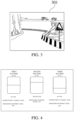
- FIG. 3 is a schematic structural diagram of a target image provided in an embodiment of the disclosure.
- a target image 301 is illustrated in FIG. 3 .
- the current path is the uphill path included in the target path.
- Each path corresponds to a first execution operation
- the first execution operation is an operation used for assisting the wheelchair to move on the target path.
- the target path is an uphill path
- the first execution operation refers to an operation of assisting the wheelchair to move uphill.
- the operation is to assist the wheelchair to move by an auxiliary wheel
- the first group of components corresponding to the first execution operation includes the auxiliary wheel, a slider, and a sliding rod.
- the slider and the sliding rod are components used to move the auxiliary wheel to a corresponding position, that is, the auxiliary wheel is moved to the rear side of the wheelchair through the slider and the sliding rod.
- the wheelchair is driven to move forward by the auxiliary wheel on the rear side, and the auxiliary wheel may prevent the wheelchair from tilting backwards during the movement.
- the first execution operation refers to an operation used for assisting the wheelchair to move downhill.
- the operation is to adjust the wheelchair main body to prevent the wheelchair from tilting forward
- the first group of components corresponding to the first execution operation includes a backrest and a pedal. That is, the angle or the height of the backrest and the pedal is adjusted to lower the center of gravity of the wheelchair main body, thereby preventing the wheelchair from tilting forwards when going downhill.
- the backrest and the pedal are used to lower the center of gravity of the wheelchair main body, while the auxiliary wheel, the slider, and the sliding rod are used to move the auxiliary wheel to the front of the wheelchair for support.
- the backrest and pedal may be set as necessary components for the current first execution operation, and the auxiliary wheel, the slider, and the sliding pod are non-necessary components for the current first execution operation.
- corresponding target components for executing the first execution operation are determined by determining the current remaining battery level of the energy storage device in the wheelchair. When the remaining battery level is sufficient, all the auxiliary components in the wheelchair that can execute the first execution operation are determined as the target components. When the remaining battery level is insufficient, the necessary auxiliary components in the wheelchair for executing the first execution operation are determined as the target components. In this way, the target components corresponding to the battery level of the energy storage battery are determined based on the battery level, which not only provides assistance to the wheelchair, but also avoids a malfunction of the wheelchair caused by high power consumption.
- the first group of energy storage batteries include at least one energy storage battery in the multiple energy storage batteries.
- One group of associated components includes multiple first target components connected by an associated operation.
- the associated operation refers to an operation completed together by the multiple first target components, where execution purposes of execution operations corresponding to the multiple first target components are the same.
- the slider and the sliding rod may be determined as one group of associated components, and the auxiliary wheel is the non-associated component.
- a predicted power consumption of the associated operation corresponding to the multiple target components included in one group of associated components may be determined based on the power consumption of the entire associated operation. This is because the energy storage device needs to supply power to the multiple target components in one group of associated components to ensure that the entire associated operation corresponding to the multiple target components can be executed. Therefore, determining the predicted power consumption of one group of associated components as a whole is beneficial to determining the energy storage batteries that supply power to the group of associated components. For the non-associated components, in order to facilitate statistics, the second predicted power consumption corresponding to all the non-associated components is determined based on the first execution operation.
- the first sub-group of energy storage batteries supplies power to the at least one group of associated components
- the second sub-group of energy storage batteries supplies power to the non-associated components.
- the first sub-group of energy storage batteries is determined based on the first predicted power consumption, which ensures that the remaining battery level of the first sub-group of energy storage batteries can support the power consumption of the at least one group of associated components.
- the second sub-group of energy storage batteries is determined based on the second predicted power consumption, which ensures that the remaining battery level of the second sub-group of energy storage batteries can support the power consumption of the non-associated components.
- a power supply that simultaneously satisfies the associated components should be provided, so as to avoid affecting the entire associated operation due to insufficient power of a single component.
- a power supply of each non-associated component may be considered separately. In this way, the efficiency of selecting the first group of energy storage batteries corresponding to the first group of components from the multiple energy storage batteries may be improved.
- the predicted group power consumption corresponding to each group of the at least one group of associated components is determined based on the associated operation corresponding to each group of associated components, and the second predicted power consumption corresponding to the non-associated components is determined based on the first execution operation" in the above embodiment is provided in the following.
- the predicted group power consumption corresponding to each group of the at least one group of associated components is determined as follows, and based on the first execution operation, the second predicted power consumption corresponding to the non-associated components is determined as follows.
- a first unit power consumption corresponding to each group of associated components and a second unit power consumption corresponding to each of the non-associated components are determined.
- a first duration of an associated operation corresponding to each group of associated components is determined based on the target path, and the predicted group power consumption corresponding to each group of associated components is determined based on the first unit power consumption and the first duration.
- An execution duration of the first execution operation is determined based on the target path, and a second duration is determined based on a number of the non-associated components, where a larger number of the non-associated components corresponds to a shorter second duration, and the second duration is shorter than the execution duration.
- the second predicted power consumption is determined based on the second unit power consumption corresponding to each of the non-associated components and the second duration.
- the predicted group power consumption corresponding to each group of associated components may be determined based on the duration of the associated operation corresponding to each group of associated components.
- the non-associated components it is memory-consuming to separately determine the duration of execution operation corresponding to each non-associated component. Therefore, in the disclosure, the second duration corresponding to each non-associated component is determined based on the execution duration of the first execution operation and the number of the non-associated components, and the second predicted power consumption is determined based on the second duration and the second unit power consumption corresponding to each non-associated component. This is because in the non-associated components, the duration of the execution operation corresponding to each non-associated component may not be the same as the execution duration of the first execution operation.
- the second predicted power consumption is determined based on the execution duration of the first execution operation, it will result in an excessive second predicted power consumption and have an impact on the subsequent determination of the corresponding energy storage battery. Moreover, a greater number of the non-associated components leads to a greater error in the second predicted power consumption, and a greater impact on the subsequent determination of the corresponding energy storage battery.
- the second duration corresponding to each non-associated component is determined mainly based on the number of the non-associated components. A greater number of the non-associated components corresponds to a shorter second duration, which may prevent a large error in the second predicted power consumption caused by a large number of the non-associated components.
- the predicted power consumption of the associated component is determined based on the first duration of the associated operation on the target path.
- the duration corresponding to the non-associated components is comprehensively determined based on the duration of the first execution operation and the number of the non-associated components, and the predicted power consumption of the non-associated components is determined.
- the power consumption of the associated component may be precisely predicted and the power consumption of the non-associated component may be approximately predicted, thereby ensuring, on one hand, the power supply of associated operations with greater influence, and improving the efficiency of predicting the power consumption on the other hand.
- the first sub-group of energy storage batteries corresponding to the first predicted power consumption and the second sub-group of energy storage batteries corresponding to the second predicted power consumption are determined as follows.
- a usage status of each of the multiple energy storage batteries is determined, where the usage status includes in-use and not-in-use.
- a first energy storage battery corresponding to each group of the at least one group of associated components and the second sub-group energy storage batteries corresponding to the non-associated components are determined from the energy storage batteries not-in-use based on the remaining battery levels of the energy storage batteries not-in-use, the predicted group power consumption corresponding to each group of the at least one group of associated components, and the second predicted power consumption, to make a remaining battery level of the first energy storage battery not less than the predicted group power consumption, and a sum of remaining battery levels of energy storage batteries included in the second sub-group of energy storage batteries not less than the second predicted battery level, where the first sub-group of energy storage batteries include first energy storage batteries corresponding to the at least one group of associated components, and the third predicted battery level is a sum of the first predicted battery level and the second predicted battery level.
- the in-use energy storage batteries need to maintain the normal operation of the wheelchair, the in-use energy storage batteries only need to supply a power equal to the third predicted power consumption minus the sum of remaining battery levels of the energy storage batteries not-in-use.
- the second predicted power consumption of the non-associated components is mainly determined based on the duration of the first execution operation and the number of the non-associated components, the second predicted power consumption cannot fully represent the power supply duration corresponding to the non-associated components.
- the predicted group power consumption for each group of associated components can reflect the power supply duration corresponding to each group of associated components. Therefore, when determining the first energy storage batteries respectively corresponding to the at least one group of associated components in the first sub-group of energy storage batteries, the power allocated from the in-use energy storage batteries is preferably allocated to the group of associated components with the smallest predicted group power consumption.
- the predicted group power consumption corresponding to the group A of associated components is 10
- the predicted group power consumption corresponding to the group B of associated components is 20
- the second predicted power consumption corresponding to the non-associated component C is 40. If the sum of remaining battery levels of the energy storage batteries not-in-use is 60, it can be determined that the remaining battery level of 60 is less than the third predicted power consumption of 70 (10+20+40).
- FIG. 4 is a schematic structural diagram of an energy storage battery status display provided in an embodiment of the disclosure.
- a first battery there are a first battery, a second battery, and a third battery, where the usage statuses of the first battery and the third battery are in-use.
- a power supply target of the first battery is XSXX
- a power supply target of the third battery is XSSS.
- the usage status of the second battery is not-in-use.
- the remaining battery level of the first battery is 50%, the remaining battery level of the second battery is 70%, and the remaining battery level of the third battery is 30%.
- the first sub-group of energy storage batteries corresponding to the first predicted power consumption and the second sub-group of energy storage batteries corresponding to the second predicted power consumption are preferably determined from the energy storage batteries not-in-use in the multiple energy storage batteries through the above method.
- the first sub-group of energy storage batteries and the second sub-group of energy storage batteries can satisfy the power demand of the at least one group of associated components and the non-associated components when executing the first execution operation, and a situation where the wheelchair is unable to be used normally due to power consumption of executing the first execution operation may be avoided. Further, it is beneficial to improving the efficiency of selecting the corresponding energy storage battery from the multiple energy storage batteries.
- the controller controls the first group of energy storage batteries to supply power to the at least one target component in the first group of components, and controls the at least one target component in the first group of components to operate based on the first execution operation.
- the first group of energy storage batteries is controlled to supply power to the first group of components, so that the first group of components can assist the wheelchair to move on the target path, thereby improving the safety of the wheelchair when moving on the target path.
- the first group of energy storage batteries is controlled to supply power to the at least one target component in the first group of components as follows.
- a first energy storage battery in the first sub-group of energy storage batteries is controlled to supply power to a corresponding group of associated components in the at least one group of associated components.
- the second sub-group of energy storage batteries is controlled to supply power to the non-associated components, where each of the non-associated components is supplied by at least one energy storage battery, and the at least one energy storage battery is determined based on the number of energy storage batteries in the second sub-group of energy storage batteries and a remaining battery level of each energy storage battery, to make a remaining battery level of the at least one energy storage battery that supplies power to each of the non-associated component within a preset range.
- Each group of the at least one group of associated components is powered by the first energy storage battery corresponding to each group of associated components. In this way, the entire associated operation being unable to be completed due to insufficient power of a single component in each group of associate components may be avoided.
- each non-associated component needs to be powered separately. Therefore, when allocating an energy storage battery to supply each non-associated component, it needs to ensure that the remaining battery level of the energy storage battery corresponding to each non-associated component is within a preset range.
- one non-associated component may be powered by one or more energy storage batteries.
- the first group of energy storage batteries is controlled to supply power to the at least one target component in the first group of components through the above method, which is beneficial to improving the efficiency of supplying power to the at least one target component by the energy storage device.
- the method further includes the following. If there is a second energy storage battery that is unable to supply power in the first group of energy storage batteries, whether there is a third energy storage battery in the multiple energy storage batteries is determined, where a usage status of the third energy storage battery is not-in-use, and a remaining battery level of the third energy storage battery is greater than a second preset threshold, and the second energy storage battery corresponds to a fourth component in the first group of components.
- the third energy storage battery is controlled to supply power to the fourth component if there is the third energy storage battery in the multiple energy storage batteries.
- a fourth energy storage battery is determined in the multiple energy storage batteries, and the fourth energy storage battery is controlled to supply power to the fourth component, where a powered device corresponding to the fourth energy storage battery is a non-necessary device of the wheelchair when moving forward in the target path.
- the third energy storage battery in the multiple energy storage batteries that supplies power to the fourth component in the first group of components is unable to continue to supply power due to a malfunction or other issues, other energy storage batteries are needed to supply power to the fourth component.
- the second preset threshold may be determined based on storage battery capacity of the energy storage battery, for example, one percent of the storage battery capacity may be determined as the second preset threshold. If there is the third energy storage battery, the third energy storage battery may be directly controlled to supply power to the fourth component.
- an energy storage battery that supplies power to the fourth component needs to be determined from the in-use energy storage batteries. In this case, it may be determined that during the movement on the target path, there is a non-necessary device in the powered devices corresponding to the multiple energy storage batteries, for example, a camera module.
- the fourth energy storage battery that supplies power to this non-necessary device is controlled to supply power to the fourth component.
- the fourth component when the fourth component is unable to be used due to power supply issues, other batteries are selected to supply power to the fourth component through the above method. In this way, a situation where components are unable to provide assistance to the wheelchair due to power supply issues may be avoided, thereby improving the stability of power supply by the energy storage batteries.
- a first execution operation corresponding to the target path and a first group of components corresponding to the first execution operation are determined.
- a first group of energy storage batteries is determined from multiple energy storage batteries based on the first execution operation and the first group of components.
- the first group of energy storage batteries is controlled to supply power to at least one target component in the first group of components, and the at least one target component is controlled to operate based on the first execution operation. In this way, assistance may be provided to the wheelchair under special scenarios, thereby improving the safety of the wheelchair during operation.
- the determining unit 502 is further configured to: determine whether there is a third energy storage battery in the multiple energy storage batteries if there is a second energy storage battery that is unable to supply power in the first group of energy storage batteries, where a usage status of the third energy storage battery is not-in-use, and a remaining battery level of the third energy storage battery is greater than a second preset threshold, and the second energy storage battery corresponds to a fourth component in the first group of components; control the third energy storage battery to supply power to the fourth component if there is the third energy storage battery in the multiple energy storage batteries; if there is no third energy storage battery in the multiple energy storage batteries, determine a fourth energy storage battery in the multiple energy storage batteries, and control the fourth energy storage battery to supply power to the fourth component, where a powered device corresponding to the fourth energy storage battery is a non-necessary device of the wheelchair
- the processing module 612 may be a processor or controller, for example, may be a central processing unit (CPU), a general-purpose processor, a digital signal processor (DSP), an application-specific integrated circuit (ASIC), a field-programmable gate array (FPGA) or another programmable logic device, a transistor logic device, a hardware component, or any combination thereof.
- the processing unit 612 may implement or execute various example logical blocks, modules, and circuits described with reference to content disclosed in the present disclosure.
- the processor may be a combination of processors implementing a computing function, for example, a combination of one or more microprocessors, or a combination of a DSP and a microprocessor.
- the communication module 611 may be a transceiver, a radio frequency (RF) circuit, a communication interface, or the like.
- the storage module 613 may be a memory.
- control application apparatus 60 for an electric wheelchair can execute the control method for an electric wheelchair as illustrated in FIG. 2 .
- All or some of the foregoing embodiments may be implemented by using software, hardware, firmware, or any combination thereof.
- a software program is used to implement the embodiments, the embodiments may be implemented completely or partially in a form of a computer program product.
- the computer program product includes one or more computer instructions.
- the computer program instructions When the computer program instructions are loaded or executed on a computer, the procedures or functions according to the embodiments of this application are completely or partially generated.
- the computer may be a general-purpose computer, a dedicated computer, a computer network, or another programmable apparatus.
- the computer instructions may be stored in a computer-readable storage medium or may be transmitted from a computer-readable storage medium to another computer-readable storage medium.
- the computer instructions may be transmitted from a website, computer, server, or data center to another website, computer, server, or data center in a wired or wireless manner.
- the computer-readable storage medium may be any usable medium accessible by a computer, or a data storage device, such as a server or a data center, integrating one or more usable media.
- the usable medium may be a magnetic medium (for example, a floppy disk, a hard disk, or a magnetic tape), an optical medium (for example, a DVD), a semiconductor medium.
- the semiconductor medium may be a solid state disk (SSD).
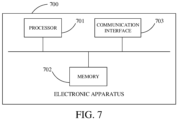
- FIG. 7 is an assembly block diagram of an electronic apparatus provided in an embodiment of the disclosure.
- an electronic apparatus 700 may include one or more components as follows: a processor 701, a memory 702, and a communication interface 703.
- the processor 701, the memory 702, and the communication interface 703 are interconnected and perform communication with each other.
- the memory 702 may store one or more computer programs, and the one or more computer programs may be configured to, when executed by one or more processor 701, implement the methods described in the above embodiments.
- the processor 701 may include one or more processing cores.
- the processor 701 connects various parts within the electronic apparatus 700 through various interfaces and lines, for performing various functions of the electronic apparatus 700 and processing data by running or executing at least one instruction stored in the memory 702, and by calling data stored in the memory 702.
- the processor 701 may be implemented with at least one of the following hardware forms: a DSP, an FPGA, a programmable logic array (PLA).
- the processor 701 may integrate one or a combination of some of a CPU, a graphics processing unit (GPU), a neural-network processing unit (NPU), and a modem. It is to be understood that the modem may be implemented by a separate chip without being integrated into the processor 701.
- the memory 702 may include a random access memory (RAM) and read-only memory (ROM).
- the memory 702 may be configured to store an instruction, a program, a code, a code set, or an instruction set.
- the memory 802 may include a program storage area and a data storage area, where the program storage area may store an instruction for realizing an operating system, an instruction for realizing at least one function (such as a touch function, a sound playing function, an image playing function), an instruction for realizing the above-mentioned various method embodiments.
- the data storage area may also store data created by the electronic apparatus 700 in use.
- the structure of the electronic apparatus 700 may include more or fewer components than illustrated in the above structural diagram.
- the electronic apparatus 700 may include a power module, a physical button, a WiFi (Wireless Fidelity) module, a speaker, a Bluetooth module, a sensor, and other components, which will not be limited herein.
- the above electronic apparatus 700 may be a part of the controller of the wheelchair control system or an apparatus separated from the controller.
- An embodiment of the disclosure provides a computer-readable storage medium.
- the computer-readable storage medium stores program data which, when executed by a processor, implements part or all of the operations of any one of the control methods for an electric wheelchair described in the above method embodiments.
Landscapes
- Engineering & Computer Science (AREA)
- Life Sciences & Earth Sciences (AREA)
- Health & Medical Sciences (AREA)
- Veterinary Medicine (AREA)
- Public Health (AREA)
- General Health & Medical Sciences (AREA)
- Animal Behavior & Ethology (AREA)
- Power Engineering (AREA)
- Mechanical Engineering (AREA)
- Transportation (AREA)
- Sustainable Energy (AREA)
- Sustainable Development (AREA)
- General Physics & Mathematics (AREA)
- Automation & Control Theory (AREA)
- Physics & Mathematics (AREA)
- Charge And Discharge Circuits For Batteries Or The Like (AREA)
Applications Claiming Priority (2)
| Application Number | Priority Date | Filing Date | Title |
|---|---|---|---|
| CN202311516553.8A CN117234115B (zh) | 2023-11-15 | 2023-11-15 | 电动轮椅的控制方法及相关装置 |
| PCT/CN2024/107026 WO2025102807A1 (zh) | 2023-11-15 | 2024-07-23 | 电动轮椅的控制方法及相关装置 |
Publications (2)
| Publication Number | Publication Date |
|---|---|
| EP4582886A1 true EP4582886A1 (de) | 2025-07-09 |
| EP4582886A4 EP4582886A4 (de) | 2025-11-05 |
Family
ID=95657921
Family Applications (1)
| Application Number | Title | Priority Date | Filing Date |
|---|---|---|---|
| EP24812056.0A Pending EP4582886A4 (de) | 2023-11-15 | 2024-07-23 | Steuerungsverfahren für elektrischen rollstuhl und zugehörige vorrichtung |
Country Status (3)
| Country | Link |
|---|---|
| US (1) | US20250152436A1 (de) |
| EP (1) | EP4582886A4 (de) |
| JP (1) | JP2025540551A (de) |
Family Cites Families (3)
| Publication number | Priority date | Publication date | Assignee | Title |
|---|---|---|---|---|
| AU2089699A (en) * | 1997-12-23 | 1999-07-12 | Amerigon, Inc. | Radio frequency energy management system |
| CN112566603B (zh) * | 2018-09-07 | 2023-04-11 | 苏州金瑞麒智能科技有限公司 | 一种轮椅结构参数自适应调节方法、系统及存储介质 |
| US12296717B2 (en) * | 2021-12-17 | 2025-05-13 | Sustainable Energy Technologies, Inc. | Intelligent hybrid power system for electrical vehicles |
-
2024
- 2024-07-23 JP JP2025504651A patent/JP2025540551A/ja active Pending
- 2024-07-23 EP EP24812056.0A patent/EP4582886A4/de active Pending
- 2024-12-13 US US18/980,379 patent/US20250152436A1/en active Pending
Also Published As
| Publication number | Publication date |
|---|---|
| EP4582886A4 (de) | 2025-11-05 |
| JP2025540551A (ja) | 2025-12-16 |
| US20250152436A1 (en) | 2025-05-15 |
Similar Documents
| Publication | Publication Date | Title |
|---|---|---|
| US20220285969A1 (en) | Battery charging method and electronic device | |
| US20210288835A1 (en) | Dormancy controlling method for on board computing platform, device and readable storage medium | |
| EP3916727B1 (de) | Sprachaufnahmeverfahren und -vorrichtung für intelligenten rückspiegel | |
| CN115123245B (zh) | 驾驶模式切换方法、装置和车辆 | |
| US11605954B2 (en) | Asymmetrical power output direct current fast charger | |
| JP7145035B2 (ja) | 学習装置、学習方法、及びプログラム | |
| CN109305170B (zh) | 电动汽车的换挡控制方法、装置、系统及存储介质 | |
| US11511748B2 (en) | Velocity trajectory generation method, apparatus, and storage medium | |
| US20210370964A1 (en) | Information processing device, non-transitory storage medium, and information processing method | |
| US20210284278A1 (en) | Control system, server, control method and program | |
| US11199893B2 (en) | Method, device for processing data of bluetooth speaker, and bluetooth speaker | |
| US20140217962A1 (en) | Charging apparatus and charging method | |
| CN112660103B (zh) | 一种车辆控制模式的确定方法、装置和整车控制系统 | |
| EP4582886A1 (de) | Steuerungsverfahren für elektrischen rollstuhl und zugehörige vorrichtung | |
| WO2025102807A1 (zh) | 电动轮椅的控制方法及相关装置 | |
| CN111756428B (zh) | 中继装置以及计算机可读存储介质 | |
| CN105691327B (zh) | 智能设备的车载系统、智能设备和车载底座 | |
| CN113329286B (zh) | 无线耳机和无线耳机系统 | |
| CN118457280A (zh) | 放电控制系统、放电控制方法以及飞行车辆 | |
| JP7469353B2 (ja) | 制御装置、プログラム及び制御方法 | |
| CN112537212B (zh) | 高压充电匹配装置、方法、系统以及车辆 | |
| US20150227387A1 (en) | Method and apparatus of adaptive application performance | |
| JP2022147422A (ja) | 移動体制御システム、移動体、制御方法及びプログラム | |
| CN119590423B (zh) | 车辆控制方法、控制器、车辆及程序产品 | |
| US20250201874A1 (en) | Apparatus and method for controlling water emission of a vehicle |
Legal Events
| Date | Code | Title | Description |
|---|---|---|---|
| STAA | Information on the status of an ep patent application or granted ep patent |
Free format text: STATUS: UNKNOWN |
|
| STAA | Information on the status of an ep patent application or granted ep patent |
Free format text: STATUS: THE INTERNATIONAL PUBLICATION HAS BEEN MADE |
|
| PUAI | Public reference made under article 153(3) epc to a published international application that has entered the european phase |
Free format text: ORIGINAL CODE: 0009012 |
|
| STAA | Information on the status of an ep patent application or granted ep patent |
Free format text: STATUS: REQUEST FOR EXAMINATION WAS MADE |
|
| 17P | Request for examination filed |
Effective date: 20241202 |
|
| AK | Designated contracting states |
Kind code of ref document: A1 Designated state(s): AL AT BE BG CH CY CZ DE DK EE ES FI FR GB GR HR HU IE IS IT LI LT LU LV MC ME MK MT NL NO PL PT RO RS SE SI SK SM TR |
|
| A4 | Supplementary search report drawn up and despatched |
Effective date: 20251007 |
|
| RIC1 | Information provided on ipc code assigned before grant |
Ipc: G05B 19/04 20060101AFI20250930BHEP Ipc: A61G 5/04 20130101ALI20250930BHEP Ipc: B60L 58/14 20190101ALI20250930BHEP Ipc: B60L 58/21 20190101ALI20250930BHEP Ipc: B60L 58/18 20190101ALI20250930BHEP |