EP4582606A1 - Composite lengthy body - Google Patents
Composite lengthy body Download PDFInfo
- Publication number
- EP4582606A1 EP4582606A1 EP25150950.1A EP25150950A EP4582606A1 EP 4582606 A1 EP4582606 A1 EP 4582606A1 EP 25150950 A EP25150950 A EP 25150950A EP 4582606 A1 EP4582606 A1 EP 4582606A1
- Authority
- EP
- European Patent Office
- Prior art keywords
- polymeric resin
- lengthy body
- fibres
- lengthy
- hppe
- Prior art date
- Legal status (The legal status is an assumption and is not a legal conclusion. Google has not performed a legal analysis and makes no representation as to the accuracy of the status listed.)
- Pending
Links
Images
Classifications
-
- A—HUMAN NECESSITIES
- A01—AGRICULTURE; FORESTRY; ANIMAL HUSBANDRY; HUNTING; TRAPPING; FISHING
- A01K—ANIMAL HUSBANDRY; AVICULTURE; APICULTURE; PISCICULTURE; FISHING; REARING OR BREEDING ANIMALS, NOT OTHERWISE PROVIDED FOR; NEW BREEDS OF ANIMALS
- A01K75/00—Accessories for fishing nets; Details of fishing nets, e.g. structure
-
- A—HUMAN NECESSITIES
- A01—AGRICULTURE; FORESTRY; ANIMAL HUSBANDRY; HUNTING; TRAPPING; FISHING
- A01K—ANIMAL HUSBANDRY; AVICULTURE; APICULTURE; PISCICULTURE; FISHING; REARING OR BREEDING ANIMALS, NOT OTHERWISE PROVIDED FOR; NEW BREEDS OF ANIMALS
- A01K91/00—Lines
-
- A—HUMAN NECESSITIES
- A01—AGRICULTURE; FORESTRY; ANIMAL HUSBANDRY; HUNTING; TRAPPING; FISHING
- A01K—ANIMAL HUSBANDRY; AVICULTURE; APICULTURE; PISCICULTURE; FISHING; REARING OR BREEDING ANIMALS, NOT OTHERWISE PROVIDED FOR; NEW BREEDS OF ANIMALS
- A01K91/00—Lines
- A01K91/03—Connecting devices
- A01K91/04—Connecting devices for connecting lines to hooks or lures
-
- C—CHEMISTRY; METALLURGY
- C08—ORGANIC MACROMOLECULAR COMPOUNDS; THEIR PREPARATION OR CHEMICAL WORKING-UP; COMPOSITIONS BASED THEREON
- C08J—WORKING-UP; GENERAL PROCESSES OF COMPOUNDING; AFTER-TREATMENT NOT COVERED BY SUBCLASSES C08B, C08C, C08F, C08G or C08H
- C08J5/00—Manufacture of articles or shaped materials containing macromolecular substances
- C08J5/04—Reinforcing macromolecular compounds with loose or coherent fibrous material
-
- C—CHEMISTRY; METALLURGY
- C08—ORGANIC MACROMOLECULAR COMPOUNDS; THEIR PREPARATION OR CHEMICAL WORKING-UP; COMPOSITIONS BASED THEREON
- C08J—WORKING-UP; GENERAL PROCESSES OF COMPOUNDING; AFTER-TREATMENT NOT COVERED BY SUBCLASSES C08B, C08C, C08F, C08G or C08H
- C08J5/00—Manufacture of articles or shaped materials containing macromolecular substances
- C08J5/04—Reinforcing macromolecular compounds with loose or coherent fibrous material
- C08J5/046—Reinforcing macromolecular compounds with loose or coherent fibrous material with synthetic macromolecular fibrous material
-
- D—TEXTILES; PAPER
- D04—BRAIDING; LACE-MAKING; KNITTING; TRIMMINGS; NON-WOVEN FABRICS
- D04C—BRAIDING OR MANUFACTURE OF LACE, INCLUDING BOBBIN-NET OR CARBONISED LACE; BRAIDING MACHINES; BRAID; LACE
- D04C1/00—Braid or lace, e.g. pillow-lace; Processes for the manufacture thereof
- D04C1/02—Braid or lace, e.g. pillow-lace; Processes for the manufacture thereof made from particular materials
-
- D—TEXTILES; PAPER
- D04—BRAIDING; LACE-MAKING; KNITTING; TRIMMINGS; NON-WOVEN FABRICS
- D04C—BRAIDING OR MANUFACTURE OF LACE, INCLUDING BOBBIN-NET OR CARBONISED LACE; BRAIDING MACHINES; BRAID; LACE
- D04C1/00—Braid or lace, e.g. pillow-lace; Processes for the manufacture thereof
- D04C1/06—Braid or lace serving particular purposes
- D04C1/12—Cords, lines, or tows
-
- D—TEXTILES; PAPER
- D06—TREATMENT OF TEXTILES OR THE LIKE; LAUNDERING; FLEXIBLE MATERIALS NOT OTHERWISE PROVIDED FOR
- D06M—TREATMENT, NOT PROVIDED FOR ELSEWHERE IN CLASS D06, OF FIBRES, THREADS, YARNS, FABRICS, FEATHERS OR FIBROUS GOODS MADE FROM SUCH MATERIALS
- D06M15/00—Treating fibres, threads, yarns, fabrics, or fibrous goods made from such materials, with macromolecular compounds; Such treatment combined with mechanical treatment
- D06M15/19—Treating fibres, threads, yarns, fabrics, or fibrous goods made from such materials, with macromolecular compounds; Such treatment combined with mechanical treatment with synthetic macromolecular compounds
- D06M15/21—Macromolecular compounds obtained by reactions only involving carbon-to-carbon unsaturated bonds
- D06M15/227—Macromolecular compounds obtained by reactions only involving carbon-to-carbon unsaturated bonds of hydrocarbons, or reaction products thereof, e.g. afterhalogenated or sulfochlorinated
-
- D—TEXTILES; PAPER
- D07—ROPES; CABLES OTHER THAN ELECTRIC
- D07B—ROPES OR CABLES IN GENERAL
- D07B1/00—Constructional features of ropes or cables
- D07B1/02—Ropes built-up from fibrous or filamentary material, e.g. of vegetable origin, of animal origin, regenerated cellulose, plastics
- D07B1/025—Ropes built-up from fibrous or filamentary material, e.g. of vegetable origin, of animal origin, regenerated cellulose, plastics comprising high modulus, or high tenacity, polymer filaments or fibres, e.g. liquid-crystal polymers
-
- D—TEXTILES; PAPER
- D07—ROPES; CABLES OTHER THAN ELECTRIC
- D07B—ROPES OR CABLES IN GENERAL
- D07B1/00—Constructional features of ropes or cables
- D07B1/14—Ropes or cables with incorporated auxiliary elements, e.g. for marking, extending throughout the length of the rope or cable
- D07B1/141—Ropes or cables with incorporated auxiliary elements, e.g. for marking, extending throughout the length of the rope or cable comprising liquid, pasty or powder agents, e.g. lubricants or anti-corrosive oils or greases
- D07B1/142—Ropes or cables with incorporated auxiliary elements, e.g. for marking, extending throughout the length of the rope or cable comprising liquid, pasty or powder agents, e.g. lubricants or anti-corrosive oils or greases for ropes or rope components built-up from fibrous or filamentary material
-
- D—TEXTILES; PAPER
- D07—ROPES; CABLES OTHER THAN ELECTRIC
- D07B—ROPES OR CABLES IN GENERAL
- D07B1/00—Constructional features of ropes or cables
- D07B1/16—Ropes or cables with an enveloping sheathing or inlays of rubber or plastics
- D07B1/162—Ropes or cables with an enveloping sheathing or inlays of rubber or plastics characterised by a plastic or rubber enveloping sheathing
-
- D—TEXTILES; PAPER
- D07—ROPES; CABLES OTHER THAN ELECTRIC
- D07B—ROPES OR CABLES IN GENERAL
- D07B5/00—Making ropes or cables from special materials or of particular form
- D07B5/12—Making ropes or cables from special materials or of particular form of low twist or low tension by processes comprising setting or straightening treatments
-
- C—CHEMISTRY; METALLURGY
- C08—ORGANIC MACROMOLECULAR COMPOUNDS; THEIR PREPARATION OR CHEMICAL WORKING-UP; COMPOSITIONS BASED THEREON
- C08J—WORKING-UP; GENERAL PROCESSES OF COMPOUNDING; AFTER-TREATMENT NOT COVERED BY SUBCLASSES C08B, C08C, C08F, C08G or C08H
- C08J2323/00—Characterised by the use of homopolymers or copolymers of unsaturated aliphatic hydrocarbons having only one carbon-to-carbon double bond; Derivatives of such polymers
- C08J2323/02—Characterised by the use of homopolymers or copolymers of unsaturated aliphatic hydrocarbons having only one carbon-to-carbon double bond; Derivatives of such polymers not modified by chemical after treatment
- C08J2323/04—Homopolymers or copolymers of ethene
-
- C—CHEMISTRY; METALLURGY
- C08—ORGANIC MACROMOLECULAR COMPOUNDS; THEIR PREPARATION OR CHEMICAL WORKING-UP; COMPOSITIONS BASED THEREON
- C08J—WORKING-UP; GENERAL PROCESSES OF COMPOUNDING; AFTER-TREATMENT NOT COVERED BY SUBCLASSES C08B, C08C, C08F, C08G or C08H
- C08J2323/00—Characterised by the use of homopolymers or copolymers of unsaturated aliphatic hydrocarbons having only one carbon-to-carbon double bond; Derivatives of such polymers
- C08J2323/02—Characterised by the use of homopolymers or copolymers of unsaturated aliphatic hydrocarbons having only one carbon-to-carbon double bond; Derivatives of such polymers not modified by chemical after treatment
- C08J2323/04—Homopolymers or copolymers of ethene
- C08J2323/06—Polyethene
-
- C—CHEMISTRY; METALLURGY
- C08—ORGANIC MACROMOLECULAR COMPOUNDS; THEIR PREPARATION OR CHEMICAL WORKING-UP; COMPOSITIONS BASED THEREON
- C08J—WORKING-UP; GENERAL PROCESSES OF COMPOUNDING; AFTER-TREATMENT NOT COVERED BY SUBCLASSES C08B, C08C, C08F, C08G or C08H
- C08J2323/00—Characterised by the use of homopolymers or copolymers of unsaturated aliphatic hydrocarbons having only one carbon-to-carbon double bond; Derivatives of such polymers
- C08J2323/02—Characterised by the use of homopolymers or copolymers of unsaturated aliphatic hydrocarbons having only one carbon-to-carbon double bond; Derivatives of such polymers not modified by chemical after treatment
- C08J2323/10—Homopolymers or copolymers of propene
-
- C—CHEMISTRY; METALLURGY
- C08—ORGANIC MACROMOLECULAR COMPOUNDS; THEIR PREPARATION OR CHEMICAL WORKING-UP; COMPOSITIONS BASED THEREON
- C08J—WORKING-UP; GENERAL PROCESSES OF COMPOUNDING; AFTER-TREATMENT NOT COVERED BY SUBCLASSES C08B, C08C, C08F, C08G or C08H
- C08J2323/00—Characterised by the use of homopolymers or copolymers of unsaturated aliphatic hydrocarbons having only one carbon-to-carbon double bond; Derivatives of such polymers
- C08J2323/02—Characterised by the use of homopolymers or copolymers of unsaturated aliphatic hydrocarbons having only one carbon-to-carbon double bond; Derivatives of such polymers not modified by chemical after treatment
- C08J2323/10—Homopolymers or copolymers of propene
- C08J2323/12—Polypropene
-
- D—TEXTILES; PAPER
- D07—ROPES; CABLES OTHER THAN ELECTRIC
- D07B—ROPES OR CABLES IN GENERAL
- D07B2201/00—Ropes or cables
- D07B2201/20—Rope or cable components
- D07B2201/2001—Wires or filaments
- D07B2201/2009—Wires or filaments characterised by the materials used
-
- D—TEXTILES; PAPER
- D07—ROPES; CABLES OTHER THAN ELECTRIC
- D07B—ROPES OR CABLES IN GENERAL
- D07B2201/00—Ropes or cables
- D07B2201/20—Rope or cable components
- D07B2201/2001—Wires or filaments
- D07B2201/201—Wires or filaments characterised by a coating
- D07B2201/2012—Wires or filaments characterised by a coating comprising polymers
-
- D—TEXTILES; PAPER
- D07—ROPES; CABLES OTHER THAN ELECTRIC
- D07B—ROPES OR CABLES IN GENERAL
- D07B2205/00—Rope or cable materials
- D07B2205/20—Organic high polymers
- D07B2205/201—Polyolefins
-
- D—TEXTILES; PAPER
- D07—ROPES; CABLES OTHER THAN ELECTRIC
- D07B—ROPES OR CABLES IN GENERAL
- D07B2205/00—Rope or cable materials
- D07B2205/20—Organic high polymers
- D07B2205/201—Polyolefins
- D07B2205/2014—High performance polyolefins, e.g. Dyneema or Spectra
-
- D—TEXTILES; PAPER
- D07—ROPES; CABLES OTHER THAN ELECTRIC
- D07B—ROPES OR CABLES IN GENERAL
- D07B2207/00—Rope or cable making machines
- D07B2207/40—Machine components
- D07B2207/404—Heat treating devices; Corresponding methods
- D07B2207/4059—Heat treating devices; Corresponding methods to soften the filler material
Definitions
- the present invention concerns a method for producing an lengthy body comprising high performance polyethylene fibres and a polymeric resin and such composite lengthy body.
- Lengthy bodies such as ropes and ribbons are amongst others especially adapted to be used as load-bearing element in many applications such as mooring lines, lifting ropes, sutures, pressure vessels and fishing lines.
- Typical applications of ropes and ribbons involve repeated bending, amongst which bend-over-sheave applications. During such application the rope is frequently pulled over drums, bitts, pulleys, sheaves, etc., a.o. resulting in rubbing and bending of the rope. When exposed to such frequent bending or flexing, a rope may fail due to rope and fiber damage resulting from external and internal abrasion, frictional heat, etc.; such fatigue failure is often referred to as bend fatigue or flex fatigue.
- HPPE fibre ropes with improved bending fatigue have been described in for example WO2007/062803 and WO2011/015485 .
- WO2007/062803 describes a rope constructed from high performance polyethylene fibers and polytetrafluoroethylene fibers. These ropes can contain 3-18 mass% of fluid polyorganosiloxanes.
- WO2011/015485 describes ropes comprising HPPE fibres coated with a cross-linked silicone rubber.
- silicone compositions alone or in combination with low friction fibres such as PTFE, to reduce the frictional behaviour of the HPPE fibres during bending applications.
- WO2011/015485 describes a technology that has since been established in the field of high end bending applications.
- Ropes as described in WO2007/062803 and WO2011/015485 have several drawbacks amongst which the presence of substantial amounts of non-load bearing components in the rope in the form of PTFE filaments or silicone compositions.
- the manufacturing process is complex in view of material combinations or chemical reactions being involved and often results in discoloured products.
- Other drawbacks are that the increased lubricity of the rope composition leads to technical handling issues during amongst others traction winding processes, splicing and knotting of the ropes.
- the described ropes are prone to leaching of materials, whilst rope foreign components such as splinters, dirt, dust and water may intrude the rope structure and enhance deterioration. This is often compensated by the addition of a protective layer or additional coating which adversely affects the handling but also bending performance of the product.
- the present invention solves this need by the manufacturing the lengthy body comprising high performance polyethylene fibres and a polymeric resin in a process comprising the steps of providing high performance polyethylene (HPPE) fibres, applying an aqueous suspension of the polymeric resin to the HPPE fibres before, during or after assembling the HPPE fibres to form a lengthy body and at least partially drying the aqueous suspension of the polymeric resin applied to the HPPE fibres to obtain a lengthy body comprising the HPPE fibres and the polymeric resin throughout the lengthy body, optionally applying a temperature in the range from the melting temperature of the resin to 153°C to the lengthy body before, during and/or after at least partially drying the suspension to at least partially melt the polymeric resin and optionally applying a pressure and/or a tension to the lengthy body before, during and/or after at least partially melting the polymeric resin to at least partially compact and/or elongate the lengthy body, wherein the polymeric resin is a homopolymer or copolymer of ethylene and/or propylene and where
- the lengthy body manufactured according to the method of the present invention show good repeated bending over sheave performance, matching and even exceeding the number of cycles of cross-linked silicone rubber coated fibres while at least partly overcoming above mentioned problems.
- the inventors found that the good bending properties came combined with other improved mechanical properties. Said improvement was seen for example with the tenacity and the knot slippage force of a lengthy body according to the invention. It was also observed that although the weight of the lengthy body was increased by the presence of the polymeric resin, the force at break and even the tenacity of the lengthy body has increased.
- the lengthy bodies according to the invention may show a unitary character of the lengthy body itself or the HPPE yarns which reduces the risk of rope damages through rope foreign materials.
- fibre is herein understood an elongated body, the length dimension of which is much greater than the transverse dimensions of width and thickness.
- fiber includes filament, strip, band, tape, and the like having regular or irregular cross-sections.
- the fiber may have continuous lengths, known in the art as filament or continuous filament, or discontinuous lengths, known in the art as staple fibers.
- a yarn for the purpose of the invention is an elongated body containing many individual fibers.
- individual fiber is herein understood the fiber as such.
- the HPPE fibres of the present invention are HPPE tapes, HPPE filaments or HPPE staple fibres.
- the expression 'substantially consisting of' has the meaning of 'may comprise a minor amount of further species' wherein minor is up to 5 wt%, preferably of up to 2wt% of said further species or in other words 'comprising more than 95 wt% of' preferably 'comprising more than 98 wt% of' HMWPE and/or UHMWPE.
- It may comprise the various forms of polyethylene, ethylene-propylene co-polymers, other ethylene copolymers with co-monomers such as 1-butene, isobutylene, as well as with hetero atom containing monomers such as acrylic acid, methacrylic acid, vinyl acetate, maleic anhydride, ethyl acrylate, methyl acrylate; generally ⁇ -olefin and cyclic olefin homopolymers and copolymers, or blends thereof.
- the suspension is substantially free of additives that may act as solvents for the polymeric resin.
- Such suspension may also be referred to as solvent-free.
- solvent is herein understood a liquid in which at room temperature the polymeric resin is soluble in an amount of more than 1 wt% whereas a non-solvent is understood a liquid in which at room temperature the polymeric resin is soluble in an amount of less than 0.1 wt%.
- the polymeric resin is a semi-crystalline polyolefin having a peak melting temperature in the range from 40 to 140°C and a heat of fusion of at least 5 J/g, measured in accordance with ASTM E793 and ASTM E794, considering the second heating curve at a heating rate of 10 K/min, on a dry sample.
- the polymeric resin has a heat of fusion of at least 10 J/g, preferably at least 15 J/g, more preferably at least 20 J/g, even more preferably at least 30 J/g and most preferably at least 50 J/g.
- the inventors surprisingly found that with the increase heat of fusion the lengthy body showed improved monofilament like character.
- the polymeric resin may have more than one peak melting temperatures. In such case at least one of said melting temperatures falls within the above ranges. A second and/or further peak melting temperature of the polymeric resin may fall within or outside the temperature ranges. Such may for example be the case when the polymeric resin is a blend of polymers.
- the lengthy body is at least partially compacted and/or elongated by applying a pressure and/or a tension to the lengthy body before, during and/or after the optional step of at least partially melting the polymeric resin.
- Said pressure may be applied by compression means known in the art, which may amongst others be a calender, a smoothing unit of flat, oblong or circular geometry.
- the compression means form a gap through which the lengthy body will be processed.
- Pressure for compaction generally ranges from 100 kPa to 10 MPa, preferably from 110 to 500 kPa.
- a compression of the lengthy body may be achieved by passing the impregnated lengthy body during or after the impregnation step or the partial drying step over at least one sheave, whereby the sheave has preferably a U or V-shaped groove.
- the lengthy body is comprised of a thread of 2 or more fibres lying side by side without being twisted about each other.
- Such thread of untwisted fibres may also be called a bundle and as elaborated above may have a variety of cross-sectional shapes.
- the fibres in a bundle will substantially be oriented in a single direction, the length direction of the lengthy body.
- a thread may be comprised of two or more twisted fibres, generally referred to as a yarn.
- Several yarns may be laid in same or different directions to produce a so-called composite bundle or a strand, which again may be aggregated together or in combination with other fibre arrangements to complex fibre assemblies such as ropes or ribbons.
- the arrangement of the fibres one to another in the lengthy body of the invention may be of different types amongst which a parallel, laid, braided or woven fibre or yarn arrangement, or others as may be known to the person skilled in the field.
- a rope in the context of the present invention is a lengthy body comprising HPPE fibres with the lengthy body having a cross-section that is about circular or round, but also an oblong cross-section, meaning that the cross-section of a tensioned rope shows a flattened, oval, or even (depending on the number of primary strands) an almost rectangular form.
- Such oblong cross-section preferably has an aspect ratio, i.e. the ratio of the larger to the smaller diameter (or width to thickness ratio), in the range of from 1.2 to 4.0.
- the rope according to the invention is of a braided construction, to provide a robust and torque-balanced rope that retains its coherency during use.
- braid types known, each generally distinguished by the method that forms the rope. Suitable constructions include soutache braids, tubular braids, and flat braids.
- Tubular or circular braids are the most common braids for rope applications and generally consist of two sets of strands that are intertwined, with different patterns possible.
- the number of strands in a tubular braid may vary widely. Especially if the number of strands is high, and/or if the strands are relatively thin, the tubular braid may have a hollow core; and the braid may collapse into an oblong shape.
- the number of strands in a braided rope according to the invention is preferably at least 3. There is no upper limit to the number of strands, although in practice ropes will generally have no more than 32 strands. Particularly suitable are ropes of an 8- or 12-strand braided construction. Such ropes provide a favourable combination of tenacity and resistance to bend fatigue, and can be made economically on relatively simple machines.
- the rope according to the invention can be of a construction wherein the lay length (the length of one turn of a strand in a laid construction) or the braiding period (the pitch length related to the width of a braided rope) is not specifically critical. Suitable lay lengths and braiding periods are in the range of from 4 to 20 times the diameter of the rope. A higher lay length or braiding period may result in a more loose rope having higher strength efficiency, but which is less robust and more difficult to splice. Too low a lay length or braiding period would reduce tenacity too much. Preferably therefore, the lay length or braiding period is about 5 - 15 times the diameter of the rope, more preferably 6 -10 times the diameter of the rope.
- a ribbon in the context of the present invention is a lengthy body having a thickness and a width, wherein thickness is much smaller than width.
- the ribbon has a width to thickness ratio of at least 5:1, more preferably at least 10:1, the width to thickness ratio preferably being at most 200:1, and even more preferably at most 50:1.
- a ribbon may as well be called a narrow weave, a strip, a strap, a band or a flat band.
- a ribbon of the invention has a width from 2 mm to 200 mm, more preferably from 4 mm to 100 mm and most preferably from 5 mm to 50 mm and a thickness form 20 micrometer to 5 mm, preferably from 30 micrometer to 4 mm and most preferably from 40 micrometer to 2 mm.
- the ribbon may be formed by a parallel arrangement of at least 2, preferably at least 10 most preferably at least 100 fibres forming the ribbon while the array of parallel fibres are interconnected through the polymeric resin present in the lengthy body of the invention, forming a unitary ribbon.
- the ribbon is an interlaced structure of fibres for example by weaving, plaiting or knitting yarns by constructions known in the art, e.g.
- the lengthy bodies can be used in the manufacture of a net, such as a fishing net, a roundsling, a belt, a splice or a synthetic chain link. It has been shown that the lengthy body according to the invention has a better knot strength to other lengthy bodies which makes the use of the present invention especially suitable. Accordingly is an embodiment of the present invention an article comprising the lengthy body, preferably a net, sling, a splice or a synthetic chain link.
- an aqueous polymeric suspension whereby the polymeric resin present in said suspension is according to above described embodiments is providing products with improved properties.
- the polyolefin resin of the suspension softens or melts at higher temperatures. So far such suspensions have not yet been applied in combination with HPPE fibres. Surprisingly, they provide improved performance in various products especially products comprising oriented UHMWPE fibres.
- the liquid After impregnation, the liquid is evaporated and thus the remainder of the impregnated material is present in a lower amount and/or with an increased homogeneity throughout the lengthy body.
- the polymeric resin covers at least 50% of the total surface of the HPPE fibers of the lengthy body, preferably 70 and most preferably 90% of the total surface of the HPPE fibers.
- the suspension and the therewith prepared lengthy body may contain at least one surface active ingredient such as ionic or non-ionic surfactant.
- HPPE fibres coated with a polymer having ethylene or propylene crystallinity are described in EP0091547 , whereby mono- or multifilament fibers are treated at high temperatures with solutions of the polymer in hydrocarbon solvents at a concentration of up to 12 g/L.
- the fibers may contain residual amounts of the employed hydrocarbon solvent negatively affecting fiber properties.
- the treatment of the HPPE fiber at high temperature with a hydrocarbon solvent may affect structural properties of the fibers, especially through diffusion of the hydrocarbon solvent and/or polymer into the HPPE filaments.
- the fiber-polymer interface may be modified by partial etching and dissolution of the HPPE which may affected amongst others the interface as well as the bulk properties of the HPPE fibers.
- a preferred field of application of the lengthy body of the invention is in the field of ropes and ribbons with increased knot slippage forces and tenacities of the lengthy body. It was surprisingly found that by the addition of non-loadbearing polymer resin to a rope construction the overall tenacity of the rope could be attained. Addition of the same amount of non-loadbearing polymeric resin as an overmolded layer or as individual fibres or yarns would result in a reduction of the tenacity.
- Suspension 1 was purchased from Dow Chemical company under the trade name HYPOD1000 and is a 56 wt% polyolefin aqueous suspension with melting peaks at 51°C and 139°C and a heat of fusion of 28 J/g.
- Suspension 2 was purchased from Michelman under the trade name of Michem ® Prime 5931 and is a 28 wt% suspension of an acrylate modified polyolefin with a melting peak at 78°C and a heat of fusion of 29 J/g in water.
- 16 ends of commercial yarn (Dyneema ® 1760 SK78, tenacity 35.1 cN/dtex, modulus1160 cN/dtex) have been braided to form a rope with a pitch length of about 2.5.
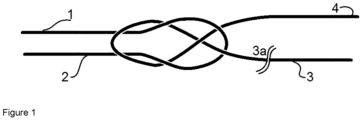
- Five knots have been prepared, each knot comprising 2 lengths of said rope knotted together according to Figure 1 .
- a first knot was wetted with suspension 1, and subsequently dried under ambient conditions (Example 5).
- a second knot was wetted with suspension 2, and subsequently dried under ambient conditions (Example 6).
- a third knot was wetted with suspension 4, and subsequently dried (Com. Ex. D).
- a fourth knot was left untreated (Comp. Ex. E).
- a fifth knot (Comp. Ex. F) was prepared from a rope comparable to the one of Example 5 with the difference that the SK78-1760 yarn to prepare the rope was the cross-linked silicone coated yarn of Comparative Experiment C.
Landscapes
- Chemical & Material Sciences (AREA)
- Life Sciences & Earth Sciences (AREA)
- Engineering & Computer Science (AREA)
- Environmental Sciences (AREA)
- Chemical Kinetics & Catalysis (AREA)
- Manufacturing & Machinery (AREA)
- Animal Husbandry (AREA)
- Biodiversity & Conservation Biology (AREA)
- Textile Engineering (AREA)
- Crystallography & Structural Chemistry (AREA)
- Materials Engineering (AREA)
- Health & Medical Sciences (AREA)
- Medicinal Chemistry (AREA)
- Polymers & Plastics (AREA)
- Organic Chemistry (AREA)
- Oil, Petroleum & Natural Gas (AREA)
- Marine Sciences & Fisheries (AREA)
- Ropes Or Cables (AREA)
- Treatments For Attaching Organic Compounds To Fibrous Goods (AREA)
- Yarns And Mechanical Finishing Of Yarns Or Ropes (AREA)
- Artificial Filaments (AREA)
Applications Claiming Priority (3)
| Application Number | Priority Date | Filing Date | Title |
|---|---|---|---|
| EP15189133 | 2015-10-09 | ||
| EP16778382.8A EP3359718B1 (en) | 2015-10-09 | 2016-10-07 | Composite lengthy body |
| PCT/EP2016/074052 WO2017060461A1 (en) | 2015-10-09 | 2016-10-07 | Composite lengthy body |
Related Parent Applications (2)
| Application Number | Title | Priority Date | Filing Date |
|---|---|---|---|
| EP16778382.8A Division EP3359718B1 (en) | 2015-10-09 | 2016-10-07 | Composite lengthy body |
| EP16778382.8A Division-Into EP3359718B1 (en) | 2015-10-09 | 2016-10-07 | Composite lengthy body |
Publications (1)
| Publication Number | Publication Date |
|---|---|
| EP4582606A1 true EP4582606A1 (en) | 2025-07-09 |
Family
ID=54359725
Family Applications (2)
| Application Number | Title | Priority Date | Filing Date |
|---|---|---|---|
| EP25150950.1A Pending EP4582606A1 (en) | 2015-10-09 | 2016-10-07 | Composite lengthy body |
| EP16778382.8A Active EP3359718B1 (en) | 2015-10-09 | 2016-10-07 | Composite lengthy body |
Family Applications After (1)
| Application Number | Title | Priority Date | Filing Date |
|---|---|---|---|
| EP16778382.8A Active EP3359718B1 (en) | 2015-10-09 | 2016-10-07 | Composite lengthy body |
Country Status (10)
| Country | Link |
|---|---|
| US (2) | US20190040556A1 (enExample) |
| EP (2) | EP4582606A1 (enExample) |
| JP (3) | JP2018529853A (enExample) |
| KR (1) | KR102783284B1 (enExample) |
| CN (3) | CN114645374A (enExample) |
| BR (1) | BR112018006789B1 (enExample) |
| CA (1) | CA3000799A1 (enExample) |
| ES (1) | ES3024208T3 (enExample) |
| PL (1) | PL3359718T3 (enExample) |
| WO (1) | WO2017060461A1 (enExample) |
Families Citing this family (7)
| Publication number | Priority date | Publication date | Assignee | Title |
|---|---|---|---|---|
| CA3000801C (en) | 2015-10-09 | 2023-09-12 | Dsm Ip Assets B.V. | High performance fibres composite sheet |
| US20210095397A1 (en) | 2017-12-21 | 2021-04-01 | Dsm Ip Assets B.V. | Hybrid fabrics of high performance polyethylene fiber |
| WO2019219744A1 (en) * | 2018-05-18 | 2019-11-21 | Teijin Aramid B.V. | Netting for aquaculture |
| KR102041722B1 (ko) * | 2018-08-27 | 2019-11-07 | 삼성염직(주) | 고하중 운반용 슬링원단의 제조방법 |
| US11306432B2 (en) | 2018-11-05 | 2022-04-19 | Honeywell International Inc. | HMPE fiber with improved bending fatigue performance |
| CN117916415A (zh) * | 2021-09-07 | 2024-04-19 | 埃万特防护材料有限公司 | 复合拉长体 |
| KR20240053640A (ko) * | 2021-09-07 | 2024-04-24 | 아비엔트 프로텍티브 머티리얼스 비.브이. | 복합 연장체 |
Citations (15)
| Publication number | Priority date | Publication date | Assignee | Title |
|---|---|---|---|---|
| GB2042414A (en) | 1979-02-08 | 1980-09-24 | Stamicarbon | Dry-spinning polymer filaments |
| GB2051667A (en) | 1979-06-27 | 1981-01-21 | Stamicarbon | Preparing polyethylene filaments |
| EP0091547A1 (en) | 1982-03-19 | 1983-10-19 | Allied Corporation | Coated extended chain polyolefin fiber |
| EP0205960A2 (en) | 1985-06-17 | 1986-12-30 | AlliedSignal Inc. | Very low creep, ultra high moduls, low shrink, high tenacity polyolefin fiber having good strength retention at high temperatures and method to produce such fiber |
| EP0269151A1 (en) | 1986-10-31 | 1988-06-01 | Dyneema V.O.F. | Process for preparing polyethylene articles of high tensile strength and modulus and low creep and articles thus obtained |
| US5091133A (en) | 1988-12-21 | 1992-02-25 | Nippon Oil Co., Ltd. | Continuous production process of high-strength and high-modulus polyolefin material |
| WO2001073173A1 (en) | 2000-03-27 | 2001-10-04 | Honeywell International Inc. | High tenacity, high modulus filament |
| WO2007062803A1 (en) | 2005-12-02 | 2007-06-07 | Dsm Ip Assets B.V. | Rope containing high-performance polyethylene fibres |
| WO2008128708A1 (en) * | 2007-04-18 | 2008-10-30 | Dsm Ip Assets B.V. | Method of producing a filament wound curved product and product obtained thereby |
| WO2011015485A1 (en) | 2009-08-04 | 2011-02-10 | Dsm Ip Assets B.V. | Coated high strength fibers |
| WO2011154383A1 (en) * | 2010-06-08 | 2011-12-15 | Dsm Ip Assets B.V. | Protected hmpe rope |
| WO2011154415A1 (en) | 2010-06-08 | 2011-12-15 | Dsm Ip Assets B.V. | Hybrid rope |
| EP2481847A1 (en) * | 2011-01-31 | 2012-08-01 | DSM IP Assets B.V. | UV-Stabilized high strength fiber |
| WO2013092622A1 (en) * | 2011-12-19 | 2013-06-27 | Dsm Ip Assets B.V. | Rope comprising at least one fibrillated film tape |
| WO2013131996A1 (en) * | 2012-03-09 | 2013-09-12 | Dsm Ip Assets B.V. | Composite panel |
Family Cites Families (16)
| Publication number | Priority date | Publication date | Assignee | Title |
|---|---|---|---|---|
| JPH0261146A (ja) * | 1988-08-19 | 1990-03-01 | Mitsui Petrochem Ind Ltd | 被覆網体 |
| US5901632A (en) * | 1997-06-10 | 1999-05-11 | Puget Sound Rope Corporation | Rope construction |
| US6083243A (en) * | 1998-09-01 | 2000-07-04 | Ethicon, Inc. | Ethylene-propylene coatings for sutures |
| JP3734077B2 (ja) * | 2000-12-11 | 2006-01-11 | 東洋紡績株式会社 | 高強度ポリエチレン繊維 |
| WO2005073309A1 (en) * | 2004-01-26 | 2005-08-11 | The Procter & Gamble Company | Fibers and nonwovens comprising polypropylene blends and mixtures |
| AU2006329039B2 (en) * | 2005-12-22 | 2012-02-09 | Dsm Ip Assets B.V. | Heavy-duty roundsling |
| US9005753B2 (en) * | 2007-10-05 | 2015-04-14 | Dsm Ip Assets B.V. | Fibers of UHMWPE and a process for producing thereof |
| US7985802B2 (en) * | 2008-04-18 | 2011-07-26 | Exxonmobil Chemical Patents Inc. | Synthetic fabrics, components thereof, and methods for making the same |
| EP2112259A1 (en) * | 2008-04-22 | 2009-10-28 | DSM IP Assets B.V. | Abrasion resistant fabric |
| US7858180B2 (en) * | 2008-04-28 | 2010-12-28 | Honeywell International Inc. | High tenacity polyolefin ropes having improved strength |
| US8658244B2 (en) * | 2008-06-25 | 2014-02-25 | Honeywell International Inc. | Method of making colored multifilament high tenacity polyolefin yarns |
| US8883302B2 (en) * | 2008-10-23 | 2014-11-11 | Polteco, Inc. | Abrasion resistant cords and ropes |
| US8389426B2 (en) * | 2010-01-04 | 2013-03-05 | Trevira Gmbh | Bicomponent fiber |
| US9163335B2 (en) * | 2011-09-06 | 2015-10-20 | Honeywell International Inc. | High performance ballistic composites and method of making |
| KR20150036076A (ko) * | 2012-07-17 | 2015-04-07 | 디에스엠 아이피 어셋츠 비.브이. | Uhmwpe 섬유를 포함하는 내마모성 제품 |
| TWI602671B (zh) * | 2013-01-28 | 2017-10-21 | 東邦特耐克絲歐洲股份有限公司 | 浸漬強化纖維紗及其於製造複合材料之用途 |
-
2016
- 2016-10-07 JP JP2018516541A patent/JP2018529853A/ja active Pending
- 2016-10-07 KR KR1020187012636A patent/KR102783284B1/ko active Active
- 2016-10-07 CA CA3000799A patent/CA3000799A1/en active Pending
- 2016-10-07 PL PL16778382.8T patent/PL3359718T3/pl unknown
- 2016-10-07 US US15/764,973 patent/US20190040556A1/en not_active Abandoned
- 2016-10-07 CN CN202210299569.7A patent/CN114645374A/zh active Pending
- 2016-10-07 ES ES16778382T patent/ES3024208T3/es active Active
- 2016-10-07 CN CN201680058395.8A patent/CN108138402B/zh active Active
- 2016-10-07 CN CN202210017508.7A patent/CN114381858B/zh active Active
- 2016-10-07 WO PCT/EP2016/074052 patent/WO2017060461A1/en not_active Ceased
- 2016-10-07 EP EP25150950.1A patent/EP4582606A1/en active Pending
- 2016-10-07 EP EP16778382.8A patent/EP3359718B1/en active Active
- 2016-10-07 BR BR112018006789-0A patent/BR112018006789B1/pt active IP Right Grant
-
2022
- 2022-09-07 JP JP2022142219A patent/JP2023012456A/ja active Pending
-
2023
- 2023-12-15 US US18/542,077 patent/US20240125018A1/en active Pending
-
2024
- 2024-06-03 JP JP2024090026A patent/JP2024113025A/ja active Pending
Patent Citations (15)
| Publication number | Priority date | Publication date | Assignee | Title |
|---|---|---|---|---|
| GB2042414A (en) | 1979-02-08 | 1980-09-24 | Stamicarbon | Dry-spinning polymer filaments |
| GB2051667A (en) | 1979-06-27 | 1981-01-21 | Stamicarbon | Preparing polyethylene filaments |
| EP0091547A1 (en) | 1982-03-19 | 1983-10-19 | Allied Corporation | Coated extended chain polyolefin fiber |
| EP0205960A2 (en) | 1985-06-17 | 1986-12-30 | AlliedSignal Inc. | Very low creep, ultra high moduls, low shrink, high tenacity polyolefin fiber having good strength retention at high temperatures and method to produce such fiber |
| EP0269151A1 (en) | 1986-10-31 | 1988-06-01 | Dyneema V.O.F. | Process for preparing polyethylene articles of high tensile strength and modulus and low creep and articles thus obtained |
| US5091133A (en) | 1988-12-21 | 1992-02-25 | Nippon Oil Co., Ltd. | Continuous production process of high-strength and high-modulus polyolefin material |
| WO2001073173A1 (en) | 2000-03-27 | 2001-10-04 | Honeywell International Inc. | High tenacity, high modulus filament |
| WO2007062803A1 (en) | 2005-12-02 | 2007-06-07 | Dsm Ip Assets B.V. | Rope containing high-performance polyethylene fibres |
| WO2008128708A1 (en) * | 2007-04-18 | 2008-10-30 | Dsm Ip Assets B.V. | Method of producing a filament wound curved product and product obtained thereby |
| WO2011015485A1 (en) | 2009-08-04 | 2011-02-10 | Dsm Ip Assets B.V. | Coated high strength fibers |
| WO2011154383A1 (en) * | 2010-06-08 | 2011-12-15 | Dsm Ip Assets B.V. | Protected hmpe rope |
| WO2011154415A1 (en) | 2010-06-08 | 2011-12-15 | Dsm Ip Assets B.V. | Hybrid rope |
| EP2481847A1 (en) * | 2011-01-31 | 2012-08-01 | DSM IP Assets B.V. | UV-Stabilized high strength fiber |
| WO2013092622A1 (en) * | 2011-12-19 | 2013-06-27 | Dsm Ip Assets B.V. | Rope comprising at least one fibrillated film tape |
| WO2013131996A1 (en) * | 2012-03-09 | 2013-09-12 | Dsm Ip Assets B.V. | Composite panel |
Also Published As
| Publication number | Publication date |
|---|---|
| JP2023012456A (ja) | 2023-01-25 |
| CN114381858B (zh) | 2024-06-04 |
| KR102783284B1 (ko) | 2025-03-17 |
| PL3359718T3 (pl) | 2025-06-23 |
| JP2024113025A (ja) | 2024-08-21 |
| BR112018006789B1 (pt) | 2022-07-05 |
| BR112018006789A2 (pt) | 2018-10-16 |
| KR20180067569A (ko) | 2018-06-20 |
| US20240125018A1 (en) | 2024-04-18 |
| JP2018529853A (ja) | 2018-10-11 |
| EP3359718A1 (en) | 2018-08-15 |
| CN108138402A (zh) | 2018-06-08 |
| ES3024208T3 (en) | 2025-06-04 |
| CN108138402B (zh) | 2022-04-26 |
| CN114645374A (zh) | 2022-06-21 |
| US20190040556A1 (en) | 2019-02-07 |
| EP3359718B1 (en) | 2025-02-19 |
| CN114381858A (zh) | 2022-04-22 |
| EP3359718C0 (en) | 2025-02-19 |
| WO2017060461A1 (en) | 2017-04-13 |
| CA3000799A1 (en) | 2017-04-13 |
Similar Documents
| Publication | Publication Date | Title |
|---|---|---|
| US20240125018A1 (en) | Composite lengthy body | |
| US9334587B2 (en) | Fluoropolymer fiber composite bundle | |
| EP1799887B1 (en) | Process for making a monofilament -like product | |
| JP7598431B2 (ja) | 切断抵抗性である充填された長尺体 | |
| CN102933763A (zh) | 混杂绳索 | |
| AU2007220840A1 (en) | High tenacity polyolefin ropes having improved cyclic bend over sheave performance | |
| CN101389804A (zh) | 具有改进的滑轮上循环弯曲性能的绳索 | |
| EP4399356B1 (en) | Composite elongated body | |
| CN117916415A (zh) | 复合拉长体 | |
| CA3230493A1 (en) | Composite elongated body |
Legal Events
| Date | Code | Title | Description |
|---|---|---|---|
| PUAI | Public reference made under article 153(3) epc to a published international application that has entered the european phase |
Free format text: ORIGINAL CODE: 0009012 |
|
| STAA | Information on the status of an ep patent application or granted ep patent |
Free format text: STATUS: THE APPLICATION HAS BEEN PUBLISHED |
|
| AC | Divisional application: reference to earlier application |
Ref document number: 3359718 Country of ref document: EP Kind code of ref document: P |
|
| AK | Designated contracting states |
Kind code of ref document: A1 Designated state(s): AL AT BE BG CH CY CZ DE DK EE ES FI FR GB GR HR HU IE IS IT LI LT LU LV MC MK MT NL NO PL PT RO RS SE SI SK SM TR |
|
| STAA | Information on the status of an ep patent application or granted ep patent |
Free format text: STATUS: REQUEST FOR EXAMINATION WAS MADE |
|
| 17P | Request for examination filed |
Effective date: 20260108 |