EP4582145A2 - Festkörperformen von ixazomib-citrat - Google Patents
Festkörperformen von ixazomib-citrat Download PDFInfo
- Publication number
- EP4582145A2 EP4582145A2 EP25164570.1A EP25164570A EP4582145A2 EP 4582145 A2 EP4582145 A2 EP 4582145A2 EP 25164570 A EP25164570 A EP 25164570A EP 4582145 A2 EP4582145 A2 EP 4582145A2
- Authority
- EP
- European Patent Office
- Prior art keywords
- ixazomib citrate
- ppm
- less
- acetone
- temperature
- Prior art date
- Legal status (The legal status is an assumption and is not a legal conclusion. Google has not performed a legal analysis and makes no representation as to the accuracy of the status listed.)
- Pending
Links
Images

Classifications
-
- C—CHEMISTRY; METALLURGY
- C07—ORGANIC CHEMISTRY
- C07F—ACYCLIC, CARBOCYCLIC OR HETEROCYCLIC COMPOUNDS CONTAINING ELEMENTS OTHER THAN CARBON, HYDROGEN, HALOGEN, OXYGEN, NITROGEN, SULFUR, SELENIUM OR TELLURIUM
- C07F5/00—Compounds containing elements of Groups 3 or 13 of the Periodic Table
- C07F5/02—Boron compounds
- C07F5/025—Boronic and borinic acid compounds
-
- A—HUMAN NECESSITIES
- A61—MEDICAL OR VETERINARY SCIENCE; HYGIENE
- A61K—PREPARATIONS FOR MEDICAL, DENTAL OR TOILETRY PURPOSES
- A61K31/00—Medicinal preparations containing organic active ingredients
- A61K31/69—Boron compounds
-
- A—HUMAN NECESSITIES
- A61—MEDICAL OR VETERINARY SCIENCE; HYGIENE
- A61P—SPECIFIC THERAPEUTIC ACTIVITY OF CHEMICAL COMPOUNDS OR MEDICINAL PREPARATIONS
- A61P35/00—Antineoplastic agents
-
- C—CHEMISTRY; METALLURGY
- C07—ORGANIC CHEMISTRY
- C07B—GENERAL METHODS OF ORGANIC CHEMISTRY; APPARATUS THEREFOR
- C07B2200/00—Indexing scheme relating to specific properties of organic compounds
- C07B2200/13—Crystalline forms, e.g. polymorphs
Definitions
- the present disclosure encompasses solid state forms of Ixazomib Citrate and pharmaceutical compositions thereof.
- the invention further relates to processes for preparation of Ixazomib Citrate.
- Ixazomib Citrate is the citrate ester of Ixazomib.
- NINLARO ® is described in the prescribing information as 1,3,2-dioxaborolane-4,4-diacetic acid, 2-[(1 R )-1-[[2-[(2,5dichlorobenzoyl)amino]acetyl]amino]-3-methylbutyl]-5-oxo, having the following chemical structure:
- NINLARO ® is a proteasome inhibitor indicated in combination with lenalidomide and dexamethasone for the treatment of patients with multiple myeloma who have received at least one prior therapy.
- Polymorphism the occurrence of different crystalline forms, is a property of some molecules and molecular complexes.
- a single molecule may give rise to a variety of polymorphs having distinct crystal structures and physical properties like melting point, thermal behaviors (e.g., measured by thermogravimetric analysis - "TGA”, or differential scanning calorimetry - “DSC”), X-ray diffraction pattern, infrared absorption fingerprint, and solid state (13C) NMR spectrum.
- TGA thermogravimetric analysis -
- DSC differential scanning calorimetry -
- Different salts and solid state forms (including solvated forms) of an active pharmaceutical ingredient may possess different properties. Such variations in the properties of different salts and solid state forms and solvates may provide a basis for improving formulation, for example, by facilitating better processing or handling characteristics, changing the dissolution profile in a favorable direction, or improving stability (polymorph as well as chemical stability) and shelf-life. These variations in the properties of different salts and solid state forms may also offer improvements to the final dosage form, for instance, if they serve to improve bioavailability. Different salts and solid state forms and solvates of an active pharmaceutical ingredient may also give rise to a variety of polymorphs or crystalline forms, which may in turn provide additional opportunities to assess variations in the properties and characteristics of a solid active pharmaceutical ingredient.
- Discovering new solid state forms and solvates of a pharmaceutical product may yield materials having desirable processing properties, such as ease of handling, ease of processing, storage stability, and ease of purification or as desirable intermediate crystal forms that facilitate conversion to other polymorphic forms.
- New solid state forms of a pharmaceutically useful compound can also provide an opportunity to improve the performance characteristics of a pharmaceutical product. It enlarges the repertoire of materials that a formulation scientist has available for formulation optimization, for example by providing a product with different properties, e.g., a different crystal habit, higher crystallinity, or polymorphic stability, which may offer better processing or handling characteristics, improved dissolution profile, or improved shelf-life (chemical/physical stability). For at least these reasons, there is a need for additional solid state forms (including solvated forms) of Ixazomib Citrate.
- the present disclosure provides solid state forms of Ixazomib Citrate, processes for preparation thereof, and pharmaceutical compositions thereof. These solid state forms can be used to prepare other solid state forms of Ixazomib Citrate, Ixazomib Citrate salts and solid state forms thereof.
- the present disclosure provides solid state forms of Ixazomib Citrate for use in the preparation of pharmaceutical compositions comprising Ixazomib Citrate.
- the present disclosure also encompasses the use of the Ixazomib Citrate solid state forms of the present disclosure for the preparation of pharmaceutical compositions of Ixazomib Citrate.
- the present disclosure comprises processes for preparing the above mentioned pharmaceutical compositions.
- the processes comprise combining the Ixazomib Citrate solid state forms with at least one pharmaceutically acceptable excipient.
- the solid state forms and the pharmaceutical compositions of Ixazomib Citrate of the present disclosure can be used as medicaments, particularly for the treatment of multiple myeloma.
- the present disclosure also provides methods of treating multiple myeloma comprising administering a therapeutically effective amount of a Ixazomib Citrate solid state form of the present disclosure, or at least one of the above pharmaceutical compositions, to a subject in need of the treatment.
- the present disclosure encompasses solid state forms of Ixazomib Citrate.
- Solid state properties of Ixazomib Citrate can be influenced by controlling the conditions under which the Ixazomib Citrate is obtained in solid form.
- the present disclosure further encompasses novel processes for preparation of Ixazomib Citrate from 2,5-Dichloro-N-[2-[[(1R)-1-[(3aS,4S,6S,7aR)-hexahydro-3a,5,5-trimethyl-4,6-methano-1,3,2-benzodioxaborol-2-yl]-3-methylbutyl] amino]-2-oxoethyl] benzamide.
- WO 2009/154737 discloses a two steps process wherein 2,5-Dichloro-N-[2-[[(1R)-1-[(3aS,4S,6S,7aR)-hexahydro-3a,5,5-trimethyl-4,6-methano-1,3,2-benzodioxaborol-2-yl]-3-methylbutyl] amino]-2-oxoethyl] benzamide is firstly hydrolyzed using equimolar amounts of HCl and in the presence of excess of isobutylboronic acid (as a boronic acid acceptor for pinanediol leaving group) in a two phase system. The process includes a step of isolation of the hydrolyzed product which is thereafter converted to Ixazomib Citrate in a separate condensation reaction with citric acid.
- WO 2016/155684 discloses a one step process wherein 2,5-Dichloro-N-[2-[[(1R)-1-[(3aS,4S,6S,7aR)-hexahydro-3a,5,5-trimethyl-4,6-methano-1,3,2-benzodioxaborol-2-yl]-3-methylbutyl] amino]-2-oxoethyl] benzamide is directly converted to Ixazomib Citrate. Elimination of pinanediol group is performed by using boric acid instead of isobutylboronic acid.
- citric acid which reacts at the same time with the product of elimination to form Ixazomib Citrate; and presence of mineral acid is not required.
- This process is performed in a one phase system, however the combination of citric acid and boronic acid in the reaction mixture may result in the formation of citrato or bis(citrato) borate impurities which are difficult to determine/quantify.
- WO 2016/165677 and WO 2017/046815 disclose crystallization of Ixazomib Citrate in the presence of alcoholic solvents which may esterify the citric acid and thereby result in formation of more impurities.
- the process of the present disclosure uses only catalytic amounts of mineral acid, and avoids the use of organic boronic acid or boric acid as acceptors in the pinanediol elimination step. Instead, according to the present disclosure, the elimination reaction is performed in the presence of a ketone solvent that serves also as the acceptor of the pinanediol leaving group. Further according to the process of the present disclosure, Ixazomib Citrate can be directly isolated in high yield from the one pot reaction in the one phase system, by direct crystallization that does not require addition of anti-solvent or solvent exchange. Therefore, the processes of the present disclosure can be easily adapted to production in an industrial scale, i.e., greater than 1 kilogram scale.
- Prior art Ixazomib Citrate /Ixazomib Citrate pharmaceutical compositions comprising form 2 of Ixazomib Citrate may typically either contain high levels of residual solvents or are provided as mixtures with other forms, such as form 1.
- Ixazomib Citrate preferably form 2 of Ixazomib Citrate, which contains low levels of residual solvents and is substantially free of any other forms of Ixazomib Citrate, or of specified forms of Ixazomib Citrate, for example form 1.
- the crystalline forms of Ixazomib Citrate of the disclosure are substantially free of any other forms of Ixazomib Citrate, or of specified polymorphic forms of Ixazomib Citrate, respectively.
- the solid state forms of the present disclosure contain 20% (w/w) or less of polymorphs, or of a specified polymorph of Ixazomib Citrate.
- the salts and solid state forms of the present disclosure contain 10% (w/w) or less, 5% (w/w) or less, 2% (w/w) or less, or 1% (w/w) or less of polymorphs, or of a specified polymorph of Ixazomib Citrate.
- solid state forms of Ixazomib Citrate of the present disclosure contain from 1% to 20% (w/w), from 5% to 20% (w/w), or from 5% to 10% (w/w) of any solid state forms or of a specified polymorph of Ixazomib Citrate.
- the crystalline forms of Ixazomib Citrate of the present disclosure have advantageous properties selected from at least one of the following: chemical purity, flowability, solubility, dissolution rate, morphology or crystal habit, stability- such as chemical stability as well as thermal and mechanical stability with respect to polymorphic conversion, stability towards dehydration and/or storage stability, low content of residual solvent, a lower degree of hygroscopicity, flowability, and advantageous processing and handling characteristics such as compressibility, and bulk density.
- a solid state form such as a crystal form or amorphous form, may be referred to herein as being characterized by graphical data "as depicted in” or “as substantially depicted in” a Figure.
- Such data include, for example, powder X-ray diffractograms and solid state NMR spectra.
- the graphical data potentially provides additional technical information to further define the respective solid state form (a so-called "fingerprint") which cannot necessarily be described by reference to numerical values or peak positions alone.
- a crystal form of Ixazomib Citrate referred to herein as being characterized by graphical data "as depicted in” or “as substantially depicted in” a Figure will thus be understood to include any crystal forms of Ixazomib Citrate characterized with the graphical data having such small variations, as are well known to the skilled person, in comparison with the Figure.
- anhydrous in relation to crystalline forms of Ixazomib Citrate, relates to a crystalline form of Ixazomib Citrate which does not include any crystalline water (or other solvents) in a defined, stoichiometric amount within the crystal. Moreover, an “anhydrous” form would typically not contain more than 1% (w/w), of either water or organic solvents as measured for example by TGA.
- solvate refers to a crystal form that incorporates a solvent in the crystal structure.
- the solvent is water, the solvate is often referred to as a "hydrate.”
- the solvent in a solvate may be present in either a stoichiometric or in a non-stoichiometric amount.
- wet crystalline form refers to a polymorph that was not dried using any conventional techniques to remove residual solvent. Examples for such conventional techniques can be, but not limited to, evaporation, vacuum drying, oven drying, drying under nitrogen flow etc.
- dry crystalline form refers to a polymorph that was dried using any conventional techniques to remove residual solvent. Examples for such conventional techniques can be, but not limited to, evaporation, vacuum drying, oven drying, drying under nitrogen flow etc.
- Ixazomib Citrate of the present disclosure corresponds to a solid state form of Ixazomib Citrate that is physically separated from the reaction mixture in which it is formed.
- the XRPD measurements are taken using copper K ⁇ radiation wavelength 1.5418 ⁇ .
- a thing e.g., a reaction mixture
- room temperature or “ambient temperature”, often abbreviated as "RT.”
- RT room temperature
- room temperature is from about 20°C to about 30°C, or about 22°C to about 27°C, or about 25°C.
- the amount of solvent employed in a chemical process may be referred to herein as a number of "volumes” or “vol” or “V.”
- a material may be referred to as being suspended in 10 volumes (or 10 vol or 10V) of a solvent.
- this expression would be understood to mean milliliters of the solvent per gram of the material being suspended, such that suspending a 5 grams of a material in 10 volumes of a solvent means that the solvent is used in an amount of 10 milliliters of the solvent per gram of the material that is being suspended or, in this example, 50 mL of the solvent.
- v/v may be used to indicate the number of volumes of a solvent that are added to a liquid mixture based on the volume of that mixture. For example, adding solvent X (1.5 v/v) to a 100 ml reaction mixture would indicate that 150 mL of solvent X was added.
- a process or step may be referred to herein as being carried out “overnight.” This refers to a time interval, e.g., for the process or step, that spans the time during the night, when that process or step may not be actively observed. This time interval is from about 8 to about 20 hours, or about 10-18 hours, typically about 16 hours.
- reduced pressure refers to a pressure that is less than atmospheric pressure.
- reduced pressure is about 10 mbar to about 200 mbar.
- ambient conditions refer to atmospheric pressure, 22-24°C.
- low levels of residual solvents refers to levels which are lower than the levels specified in the ICH (INTERNATIONAL COUNCIL FOR HARMONISATION OF TECHNICAL REQUIREMENTS FOR PHARMACEUTICALS FOR HUMAN USE) guidelines published for example in http://www.ich.org/fileadmin/Public_Web_Site/ICH_Products/Guidelines/Quality/Q3C/Q3C _R6_Step_4.pdf.
- solvents include but are not limited to acetone, ethyl acetate, THF, acetonitrile, methyl isobutyl ketone MIBK, 2-MeTHF, n-heptane, n-butyl acetate and combinations thereof.
- crystalline forms 1 and 2 of Ixazomib Citrate refer to forms 1 and 2 as described in US 8859504 .
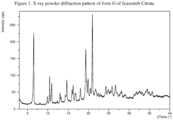
- the present disclosure comprises a crystalline form of Ixazomib Citrate, designated form G.
- the crystalline form G of Ixazomib Citrate may be characterized by data selected from one or more of the following: an X-ray powder diffraction pattern substantially as depicted in Figure 1 ; an X-ray powder diffraction pattern having peaks at 6.5, 9.9, 10.5, 16.0 and 16.2 degrees 2-theta ⁇ 0.2 degrees 2-theta; and combinations of these data.
- Crystalline form G of Ixazomib Citrate may be further characterized by an X-ray powder diffraction pattern having peaks as described above and also having any one, two, three, four or five additional peaks selected from the group consisting of 11.0, 13.0, 14.7, 19.3 and 21.0 degrees 2-theta ⁇ 0.2 degrees 2-theta.
- Crystalline form G of Ixazomib Citrate may be characterized by each of the above characteristics alone/or by all possible combinations, e.g., an XRPD pattern having peaks at 6.5, 9.9, 10.5, 16.0 and 16.2 degrees 2-theta ⁇ 0.2 degrees 2-theta; an XRPD pattern as depicted in Figure 1 , and combinations thereof.
- form G of Ixazomib Citrate is isolated.
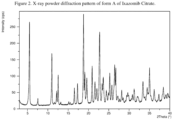
- the present disclosure relates to a crystalline form of Ixazomib Citrate, designated form A.
- the crystalline form A of Ixazomib Citrate may be characterized by data selected from one or more of the following: an X-ray powder diffraction pattern substantially as depicted in Figure 2 ; an X-ray powder diffraction pattern having peaks at 5.5, 11.0, 12.2, 12.5 and 18.8 degrees 2-theta ⁇ 0.2 degrees 2-theta, and combinations of these data.
- Crystalline form A of Ixazomib Citrate may be further characterized by an X-ray powder diffraction pattern having peaks as described above and also having any one, two, three, four or five additional peaks selected from the group consisting of 17.3, 19.1, 19.6, 22.7 and 25.2 degrees 2-theta ⁇ 0.2 degrees 2-theta.
- Crystalline form A of Ixazomib Citrate may be characterized by each of the above characteristics alone/or by all possible combinations, e.g., an XRPD pattern having peaks at 5.5, 11.0, 12.2, 12.5 and 18.8 degrees 2-theta ⁇ 0.2 degrees 2-theta; an XRPD pattern as depicted in Figure 2 , and combinations thereof.
- form A of Ixazomib Citrate is isolated.
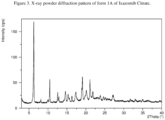
- the present disclosure relates to a crystalline form of Ixazomib Citrate, designated form 1A.
- the crystalline form 1A of Ixazomib Citrate may be characterized by data selected from one or more of the following: an X-ray powder diffraction pattern substantially as depicted in Figure 3 ; an X-ray powder diffraction pattern having peaks at 12.6, 12.9, 14.8, 15.3 and 16.4 degrees 2-theta ⁇ 0.2 degrees 2-theta, and combinations of these data.
- Crystalline form 1A of Ixazomib Citrate may be further characterized by an X-ray powder diffraction pattern having peaks as described above and also having any one, two, three, four or five additional peaks selected from the group consisting of 6.3, 8.2, 10.5, 19.1 and 21.1 degrees 2-theta ⁇ 0.2 degrees 2-theta.
- Crystalline form 1A of Ixazomib Citrate may be characterized by each of the above characteristics alone/or by all possible combinations, e.g., an XRPD pattern having peaks at 12.6, 12.9, 14.8, 15.3 and 16.4 degrees 2-theta ⁇ 0.2 degrees 2-theta; an XRPD pattern as depicted in Figure 3 , and combinations thereof.
- form 1A of Ixazomib Citrate is isolated.
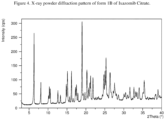
- the present disclosure relates to a crystalline form of Ixazomib Citrate, designated form 1B.
- the crystalline form 1B of Ixazomib Citrate may be characterized by data selected from one or more of the following: an X-ray powder diffraction pattern substantially as depicted in Figure 4 ; an X-ray powder diffraction pattern having peaks at 10.2, 10.4, 10.6, 13.3, 14.8 and 15.2 degrees 2-theta ⁇ 0.2 degrees 2-theta, and combinations of these data.
- Crystalline form 1B of Ixazomib Citrate may be further characterized by an X-ray powder diffraction pattern having peaks as described above and also having any one, two, three, four or five additional peaks selected from the group consisting of 6.3, 8.1, 12.6, 17.9 and 19.0 degrees 2-theta ⁇ 0.2 degrees 2-theta.
- Crystalline form 1B of Ixazomib Citrate may be characterized by each of the above characteristics alone/or by all possible combinations, e.g., an XRPD pattern having peaks at 10.2, 10.4, 10.6, 13.3, 14.8 and 15.2 degrees 2-theta ⁇ 0.2 degrees 2-theta; an XRPD pattern as depicted in Figure 4 , and combinations thereof.
- form 1B of Ixazomib Citrate is isolated.
- the present disclosure relates to a crystalline form of Ixazomib Citrate, designated form F.
- the crystalline form F of Ixazomib Citrate may be characterized by data selected from one or more of the following: an X-ray powder diffraction pattern substantially as depicted in Figure 5 ; an X-ray powder diffraction pattern having peaks at 6.3, 7.8, 13.2, 14.1 and 17.2 degrees 2-theta ⁇ 0.2 degrees 2-theta, and combinations of these data.
- Crystalline form F of Ixazomib Citrate may be further characterized by an X-ray powder diffraction pattern having peaks as described above and also having any one, two, three, four or five additional peaks selected from the group consisting of 10.0, 11.3, 14.8, 15.5 and 21.3 degrees 2-theta ⁇ 0.2 degrees 2-theta.
- Crystalline form F of Ixazomib Citrate may be characterized by each of the above characteristics alone/or by all possible combinations, e.g., an XRPD pattern having peaks at 6.3, 7.8, 13.2, 14.1 and 17.2 degrees 2-theta ⁇ 0.2 degrees 2-theta; an XRPD pattern as depicted in Figure 5 , and combinations thereof.
- form F of Ixazomib Citrate is isolated.
- the present disclosure relates to a process for preparation of Ixazomib Citrate comprising a) providing of citric acid, a suitable ketone, optionally one or more solvents and compound 2:
- R1 and R2 together form a chiral moiety.
- reaction is performed in the absence of an organic boronic acid or boric acid acceptor.
- Suitable ketones may include, but are not limited to, C3-C9 ketones, preferably C3-C6 ketones, such as acetone or MIBK; more preferably, the ketone is acetone.
- the reaction is performed in a ketone solvent, preferably acetone as a single solvent.
- the step of isolating Ixazomib Citrate may be performed by crystallization.
- the above described processes may be a one pot process.
- the amount of HCl in step b is a catalytic amount, i.e. less than an equimolar amount.
- the amount required is about 50 mol% or less, about 30 mol% or less, about 20 mol% or less, about 10 mol% or less, about 5 mol% or with respect to the amount of starting material compound 2, preferably 2,5-Dichloro-N-[2-[[(1R)-1-[(3aS,4S,6S,7aR)-hexahydro-3a,5,5-trimethyl-4,6-methano-1,3,2-benzodioxaborol-2-yl]-3-methylbutyl] amino]-2-oxoethyl] benzamide.
- steps a) and b) may be interchangeable or all the components provided in step a) and b) may be provided together.
- the reaction may typically be performed at elevated temperature (up to reflux temperature) under stirring, for about 1 to about 5 hours.
- the steps a) and b) may be performed at about 40 to about 55 °C.
- the present disclosure relates to a process for preparation of Ixazomib Citrate comprising a) providing a mixture of 2,5-Dichloro-N-[2-[[(1R)-1-[(3aS,4S,6S,7aR)-hexahydro-3a,5,5-trimethyl-4,6-methano-1,3,2-benzodioxaborol-2-yl]-3-methylbutyl] amino]-2-oxoethyl] benzamide, citric acid and a suitable ketone and optionally one or more solvents; b) adding a strong acid, preferably HCl, to afford Ixazomib Citrate; and c) optionally isolating Ixazomib Citrate, wherein the reaction is performed in the absence of an organic boronic acid or boric acid acceptor.
- the present disclosure relates to a process for preparation of Ixazomib Citrate comprising deprotection of 2,5-Dichloro-N-[2-[[(1R)-1-[(3aS,4S,6S,7aR)-hexahydro-3a,5,5-trimethyl-4,6-methano-1,3,2-benzodioxaborol-2-yl]-3-methylbutyl] amino]-2-oxoethyl] benzamide in a one phase system, comprising a ketone, and optionally one or more solvents, in the absence of a boronic acid or boric acid acceptor.
- the process is performed in the presence of an inorganic acid.
- the one phase system may comprise of a ketone and optionally one or more solvents.
- Suitable lower ketones may include, but are not limited to C3-C9 ketones preferably C3-C6 ketones such as acetone or MIBK; more preferably, the ketone is acetone.
- the reaction is performed in a ketone solvent, preferably acetone as a single solvent.
- the deprotection step comprises use of HCl in catalytic amounts.
- the deprotection step may be accomplished by formation of pinanediol ketals, preferably acetone ketals (i.e. acetonide of pinanediol).
- Ketals may include, but are not limited to, C3-C9 ketals, preferably C3-C6 ketals such as acetone or MIBK ketals; more preferably, the ketal is an acetone ketal.
- the deprotection step may preferably be carried out in the absence of an organic boronic acid or boric acid acceptor.
- the present disclosure provides processes for preparation of Ixazomib citrate, preferably form 2 of Ixazomib citrate, more preferably form 2 that is substantially free of form 1 of Ixazomib Citrate, having low levels of residual solvents, as described above, comprising A) providing crystalline form F of Ixazomib Citrate and B) converting crystalline form F of Ixazomib Citrate to Ixazomib Citrate having low levels of residual solvents.
- Ixazomib Citrate formed in step B is form 2, more preferably form 2 that is substantially free of any other form of Ixazomib Citrate of Ixazomib Citrate.
- crystalline form F is converted to form 2, more preferably form 2 that is substantially free of form 1 of Ixazomib Citrate, by drying of form F for a sufficient time under appropriate conditions to afford crystalline form 2.
- the drying is performed at a temperature of about 40 to about 60 °C and a pressure of about 50 mbar to about 300 mbar.
- the above process comprises a step of filtering the reaction mixture and drying preferably below 100 mbar and at a temperature of about 50 to about 60 °C to afford form 2 of Ixazomib Citrate.
- the present disclosure provides processes for preparation of form F of Ixazomib Citrate.
- Form F may be prepared as according to the following processes.
- the amount of HCl may be less than equimolar amount, preferably, less than about 50 mol%, less than about 30 mol%, less than about 20 mol%, less than about 10 mol%, less than about 5 mol% with respect to the starting material, 2,5-Dichloro-N-[2-[[(1R)-1-[(3aS,4S,6S,7aR)-hexahydro-3a,5,5-trimethyl-4,6-methano-1,3,2-benzodioxaborol-2-yl]-3-methylbutyl] amino]-2-oxoethyl] benzamide.
- the dilution solvent is preferably acetone.
- the reaction mixture may be stirred for about 1 to about 4 hours at a temperature of about 40 to about 55 °C.
- step v) the reaction mixture may be cooled to a temperature of about (-20) to about 15 °C, preferably the reaction may be cooled to a temperature of about (-5) to about 5°C. The reaction may be kept at this temperature over-night.
- the present disclosure also provides methods of treating multiple myeloma comprising administering a therapeutically effective amount of a Ixazomib Citrate solid state form of the present disclosure, or at least one of the above pharmaceutical compositions, to a subject in need of the treatment.
- Powder X-ray Diffraction (PXRD) method
- Residual solvents content was determined by gas chromatography using Agilent 7890 gas chromatograph with FID detector and headspace sampler Agilent 7697.
- the gas chromatograph was equipped with a column Agilent RES-SOLV, Part No. 19095V-420, 30m x 0.53mm i.d. x 1 ⁇ m, the oven was heated at 40 °C for 4.2 minutes and then was the temperature increased onto 200 °C at rate of 25°C/min and the constant flow of carrier-gas (He) was 4.8 mL/min.
- the headspace vials were equilibrated at 90 °C for 20 minutes. Split was 1:6.
- Samples were prepared by weighing exactly about 50.0 mg of the solid sample into a 20-mL headspace vial, exactly 0.50 mL of DMSO was added by a gas tight syringe and the vial was sealed immediately. After temperature incubation and equilibration, 1.0 mL of gaseous phase was injected for analysis.
- Ixazomib Citrate (form 2, 1 g) was suspended in ethanol (14.4 ml) and heated up to 70 °C during 30 min. After dissolution of the crystalline material, the solution was cooled down to 20 °C during 30 min. At this temperature, the solution was seeded with Ixazomib Citrate form 2 (16 mg); after seeding, the suspension was stirred at this temperature for 30 min. and then cooled down to 0°C during 1 hour. At this temperature n-heptane (8 ml) was added and the suspension was stirred for 3 hours. After this time the crystal was filtered off, washed with n-heptane (1 ml) and dried at 45°C for 5 hours under a stream of nitrogen to provide Form G (as confirmed by XRPD).
- Ixazomib Citrate (form 2, 1 g) was suspended in n-propanol (15.0 ml) and heated up to 90 °C during 30 min. After dissolution of the crystalline material, the solution was cooled down to 25 °C during 30 min. At this temperature, the solution was given to evaporator and concentrated to 27% of the original weight. Then the solution was cooled down from 25 °C to 0 °C during 1 hour. The crystallization is completed in the end of the cooling. While keeping the suspension at 0 °C, n-heptane (8 ml) was added and the suspension was stirred for 2 hours.
- the reaction mixture concentrated under reduced pressure (30 - 50 kPa, process temperature 25 - 35 °C, internal temperature about 45 °C) to about half of the original volume.
- Concentrated solution was diluted with ethyl acetate (1030 mL) and subsequently concentrated under reduced pressure (30 - 50 kPa, process temperature 25 - 35 °C, internal temperature about 45 °C) to about 1 L (crystallization started during the concentration).
- Obtained mixture was again diluted with ethyl acetate (1030 mL) and concentrated under reduced pressure (30 - 50 kPa, process temperature 25 - 35 °C, internal temperature about 45 °C) to about 1 L.
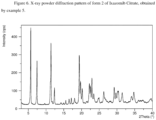
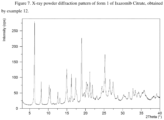
- a double jacket glass reactor was charged with Ixazomib citrate form 2 (100 g, 727 ppm of acetone, 1 % of ethyl acetate, obtained by example 6) and tetrahydrofuran (2.2 L). Obtained suspension was warmed to about 60 °C and stirred at this temperature until dissolution. The solution was concentrated under reduce pressure (about 500 mbars) to minimal volume at 30 - 45 °C (jacket temperature was about 55 °C). Obtained viscous non-crystalline compound was dissolved in acetone (2.0 L) at temperature about 20 °C. The solution was seeded with Ixazomib citrate Form 1 (3.0 g) and the mixture was stirred about 20 minutes at about 20 °C.
- the solution was filtered through filtration capsule (mesh size 0.2 micron) and used filtration capsule was rinsed with acetone (about 5 L). Primary filtrate was combined with filtrate from the rinsing and the solution was seeded with suspension of Ixazomib Citrate form 1 (28 g) in acetone (0.6 L) at about 20 °C. Obtained mixture was stirred about 20 minutes at 20 - 25 °C. The mixture was cooled during about 1 hour to about 0 °C and then it was warmed during about 1.5 hour to about 55 °C. After about 1 hour treatment at about 55 °C, the mixture was cooled during about 1.5 hour back to about 0 °C and it was treated at about 0 °C for about 15 minutes.
Landscapes
- Chemical & Material Sciences (AREA)
- Organic Chemistry (AREA)
- Health & Medical Sciences (AREA)
- Life Sciences & Earth Sciences (AREA)
- Pharmacology & Pharmacy (AREA)
- Medicinal Chemistry (AREA)
- Animal Behavior & Ethology (AREA)
- General Health & Medical Sciences (AREA)
- Public Health (AREA)
- Veterinary Medicine (AREA)
- Epidemiology (AREA)
- Chemical Kinetics & Catalysis (AREA)
- General Chemical & Material Sciences (AREA)
- Nuclear Medicine, Radiotherapy & Molecular Imaging (AREA)
- Pharmaceuticals Containing Other Organic And Inorganic Compounds (AREA)
Applications Claiming Priority (5)
| Application Number | Priority Date | Filing Date | Title |
|---|---|---|---|
| US201662352787P | 2016-06-21 | 2016-06-21 | |
| US201662438073P | 2016-12-22 | 2016-12-22 | |
| EP17739381.6A EP3471734B1 (de) | 2016-06-21 | 2017-06-08 | Feste formen von ixazomibcitrat |
| PCT/US2017/036482 WO2017222819A2 (en) | 2016-06-21 | 2017-06-08 | Solid state forms of ixazomib citrate |
| EP20207885.3A EP3798224B1 (de) | 2016-06-21 | 2017-06-08 | Feste formen von ixazomibcitrat |
Related Parent Applications (2)
| Application Number | Title | Priority Date | Filing Date |
|---|---|---|---|
| EP17739381.6A Division EP3471734B1 (de) | 2016-06-21 | 2017-06-08 | Feste formen von ixazomibcitrat |
| EP20207885.3A Division EP3798224B1 (de) | 2016-06-21 | 2017-06-08 | Feste formen von ixazomibcitrat |
Publications (2)
| Publication Number | Publication Date |
|---|---|
| EP4582145A2 true EP4582145A2 (de) | 2025-07-09 |
| EP4582145A3 EP4582145A3 (de) | 2025-09-17 |
Family
ID=59325629
Family Applications (3)
| Application Number | Title | Priority Date | Filing Date |
|---|---|---|---|
| EP20207885.3A Active EP3798224B1 (de) | 2016-06-21 | 2017-06-08 | Feste formen von ixazomibcitrat |
| EP17739381.6A Active EP3471734B1 (de) | 2016-06-21 | 2017-06-08 | Feste formen von ixazomibcitrat |
| EP25164570.1A Pending EP4582145A3 (de) | 2016-06-21 | 2017-06-08 | Festkörperformen von ixazomib-citrat |
Family Applications Before (2)
| Application Number | Title | Priority Date | Filing Date |
|---|---|---|---|
| EP20207885.3A Active EP3798224B1 (de) | 2016-06-21 | 2017-06-08 | Feste formen von ixazomibcitrat |
| EP17739381.6A Active EP3471734B1 (de) | 2016-06-21 | 2017-06-08 | Feste formen von ixazomibcitrat |
Country Status (6)
| Country | Link |
|---|---|
| US (4) | US10604537B2 (de) |
| EP (3) | EP3798224B1 (de) |
| ES (2) | ES2836050T3 (de) |
| HR (1) | HRP20250660T1 (de) |
| IL (1) | IL263526A (de) |
| WO (1) | WO2017222819A2 (de) |
Families Citing this family (4)
| Publication number | Priority date | Publication date | Assignee | Title |
|---|---|---|---|---|
| EP3798224B1 (de) | 2016-06-21 | 2025-03-19 | Assia Chemical Industries LTD | Feste formen von ixazomibcitrat |
| CN116396312A (zh) * | 2022-12-26 | 2023-07-07 | 重庆迈德凯医药有限公司 | 一种枸橼酸艾沙佐米的制备方法 |
| CN117964650B (zh) * | 2024-03-28 | 2024-06-07 | 成都硕德药业有限公司 | 一种枸橼酸伊沙佐米的制备方法 |
| CN120643554A (zh) * | 2025-08-12 | 2025-09-16 | 暨南大学 | 枸橼酸伊沙佐米在制备预防或治疗引起肺水肿及肺部炎性细胞浸润相关疾病药物中的应用 |
Citations (4)
| Publication number | Priority date | Publication date | Assignee | Title |
|---|---|---|---|---|
| WO2009154737A1 (en) | 2008-06-17 | 2009-12-23 | Millennium Pharmaceuticals, Inc. | Boronate ester compounds and pharmaceutical compositions thereof |
| WO2016155684A1 (en) | 2015-04-03 | 2016-10-06 | Zentiva, K.S. | A process of preparing ixazomib citrate |
| WO2016165677A1 (en) | 2015-04-15 | 2016-10-20 | Zentiva, K.S. | New forms of ixazomib citrate |
| WO2017046815A1 (en) | 2015-09-16 | 2017-03-23 | Mylan Laboratories Limited | Polymorphs of ixazomib citrate and processes for the preparation thereof |
Family Cites Families (5)
| Publication number | Priority date | Publication date | Assignee | Title |
|---|---|---|---|---|
| US5384410A (en) * | 1993-03-24 | 1995-01-24 | The Du Pont Merck Pharmaceutical Company | Removal of boronic acid protecting groups by transesterification |
| DE102015104693B4 (de) | 2015-03-27 | 2017-06-29 | Sartorius Lab Instruments Gmbh & Co. Kg | Waage mit Lastwechseleinrichtung und Verfahren zu deren Betrieb |
| CN106608883A (zh) * | 2015-10-21 | 2017-05-03 | 北京大学 | 蛋白酶体抑制剂mln9708的合成方法 |
| RS62496B1 (sr) * | 2016-04-01 | 2021-11-30 | Signal Pharm Llc | (1s,4s)-4-(2-(((3s,4r)-3-fluorotetrahidro-2h-piran-4-il)amino)-8-((2,4,6-trihlorofenil)amino)-9h-purin-9-il)-1-metilcikloheksan-1-karboksamid i postupci za njegovu upotrebu |
| EP3798224B1 (de) | 2016-06-21 | 2025-03-19 | Assia Chemical Industries LTD | Feste formen von ixazomibcitrat |
-
2017
- 2017-06-08 EP EP20207885.3A patent/EP3798224B1/de active Active
- 2017-06-08 EP EP17739381.6A patent/EP3471734B1/de active Active
- 2017-06-08 US US16/309,177 patent/US10604537B2/en active Active
- 2017-06-08 EP EP25164570.1A patent/EP4582145A3/de active Pending
- 2017-06-08 ES ES17739381T patent/ES2836050T3/es active Active
- 2017-06-08 WO PCT/US2017/036482 patent/WO2017222819A2/en not_active Ceased
- 2017-06-08 HR HRP20250660TT patent/HRP20250660T1/hr unknown
- 2017-06-08 ES ES20207885T patent/ES3032365T3/es active Active
-
2018
- 2018-12-05 IL IL263526A patent/IL263526A/en unknown
-
2020
- 2020-02-26 US US16/801,514 patent/US11053261B2/en active Active
-
2021
- 2021-06-14 US US17/346,597 patent/US12338258B2/en active Active
-
2025
- 2025-03-05 US US19/071,039 patent/US20250243223A1/en active Pending
Patent Citations (5)
| Publication number | Priority date | Publication date | Assignee | Title |
|---|---|---|---|---|
| WO2009154737A1 (en) | 2008-06-17 | 2009-12-23 | Millennium Pharmaceuticals, Inc. | Boronate ester compounds and pharmaceutical compositions thereof |
| US8859504B2 (en) | 2008-06-17 | 2014-10-14 | Millennium Pharmaceuticals, Inc. | Boronate ester compounds and pharmaceutical compositions thereof |
| WO2016155684A1 (en) | 2015-04-03 | 2016-10-06 | Zentiva, K.S. | A process of preparing ixazomib citrate |
| WO2016165677A1 (en) | 2015-04-15 | 2016-10-20 | Zentiva, K.S. | New forms of ixazomib citrate |
| WO2017046815A1 (en) | 2015-09-16 | 2017-03-23 | Mylan Laboratories Limited | Polymorphs of ixazomib citrate and processes for the preparation thereof |
Also Published As
| Publication number | Publication date |
|---|---|
| IL263526A (en) | 2019-01-31 |
| US12338258B2 (en) | 2025-06-24 |
| EP3471734B1 (de) | 2020-11-18 |
| US10604537B2 (en) | 2020-03-31 |
| US11053261B2 (en) | 2021-07-06 |
| EP4582145A3 (de) | 2025-09-17 |
| HRP20250660T1 (hr) | 2025-08-01 |
| ES2836050T3 (es) | 2021-06-23 |
| WO2017222819A3 (en) | 2018-04-19 |
| EP3471734A2 (de) | 2019-04-24 |
| US20210300950A1 (en) | 2021-09-30 |
| WO2017222819A2 (en) | 2017-12-28 |
| US20200190119A1 (en) | 2020-06-18 |
| EP3798224A1 (de) | 2021-03-31 |
| US20190330243A1 (en) | 2019-10-31 |
| ES3032365T3 (en) | 2025-07-17 |
| US20250243223A1 (en) | 2025-07-31 |
| EP3798224B1 (de) | 2025-03-19 |
Similar Documents
| Publication | Publication Date | Title |
|---|---|---|
| US20250243223A1 (en) | Solid state forms of ixazomib citrate | |
| EP3190102B1 (de) | Kristalle von (s)-1-(2-hydroxyethyl)-4-methyl-n- [4-(methylsulfonyl)phenyl]-5-[2-(trifluoromethyl) phenyl]- 1h-pyrrol-3-carboxamid | |
| KR101019451B1 (ko) | 이마티닙 메실레이트의 다형 및 신규한 결정형과 비결정형및 α형의 제조 방법 | |
| EP3710465B1 (de) | Salze und kristallformen von positivem allosterischem gabaa-modulator | |
| EP3218351B1 (de) | Verfahren zur herstellung, isolierung und reinigung von pharmazeutisch anwendbaren formen von ahu-377 | |
| HUE028620T2 (en) | Tetrahydroisoquinoline derivative salt and solvates | |
| CA3167093A1 (en) | Crystalline form c of 3-(imidazo[1,2-b]pyridazin-3-ylethynyl)-4-methyl-n-{4-[(4-methylpiperazin-1-yl)methyl)-3-(trifluoromethyl)phenyl}benzamide mono hydrochloride | |
| EP2448945B1 (de) | Kristalline formen von prasugrelsalzen | |
| WO2019228485A1 (zh) | 一种甲磺酸乐伐替尼新晶型及其制备方法 | |
| US12384784B2 (en) | Polymorphs of Acalabrutinib, a Bruton's tyrosine kinase inhibitor | |
| JP2009538904A (ja) | 新規結晶形 | |
| EP4211136B1 (de) | Festkörperformen von at-001 und verfahren zur herstellung davon | |
| JP2020535192A (ja) | レナリドミドの結晶形 | |
| HK40037178A (en) | Salts and crystal forms of gabaa positive allosteric modulator | |
| HK40037178B (en) | Salts and crystal forms of gabaa positive allosteric modulator | |
| HK1241358B (en) | Crystal of (s)-1-(2-hydroxyethyl)-4-methyl-n- [4-(methylsulfonyl)phenyl]-5-[2-(trifluoromethyl)phenyl]- 1h-pyrrole-3-carboxamide |
Legal Events
| Date | Code | Title | Description |
|---|---|---|---|
| PUAI | Public reference made under article 153(3) epc to a published international application that has entered the european phase |
Free format text: ORIGINAL CODE: 0009012 |
|
| STAA | Information on the status of an ep patent application or granted ep patent |
Free format text: STATUS: THE APPLICATION HAS BEEN PUBLISHED |
|
| AC | Divisional application: reference to earlier application |
Ref document number: 3471734 Country of ref document: EP Kind code of ref document: P Ref document number: 3798224 Country of ref document: EP Kind code of ref document: P |
|
| AK | Designated contracting states |
Kind code of ref document: A2 Designated state(s): AL AT BE BG CH CY CZ DE DK EE ES FI FR GB GR HR HU IE IS IT LI LT LU LV MC MK MT NL NO PL PT RO RS SE SI SK SM TR |
|
| REG | Reference to a national code |
Ref country code: DE Ref legal event code: R079 Free format text: PREVIOUS MAIN CLASS: A61P0035000000 Ipc: C07F0005040000 |
|
| PUAL | Search report despatched |
Free format text: ORIGINAL CODE: 0009013 |
|
| AK | Designated contracting states |
Kind code of ref document: A3 Designated state(s): AL AT BE BG CH CY CZ DE DK EE ES FI FR GB GR HR HU IE IS IT LI LT LU LV MC MK MT NL NO PL PT RO RS SE SI SK SM TR |
|
| RIC1 | Information provided on ipc code assigned before grant |
Ipc: C07F 5/04 20060101AFI20250812BHEP Ipc: A61K 31/69 20060101ALI20250812BHEP Ipc: A61P 35/00 20060101ALI20250812BHEP |
|
| STAA | Information on the status of an ep patent application or granted ep patent |
Free format text: STATUS: REQUEST FOR EXAMINATION WAS MADE |
|
| 17P | Request for examination filed |
Effective date: 20260303 |