EP4580259A1 - Zugangsumschaltverfahren für vorrichtung und elektronische vorrichtung - Google Patents
Zugangsumschaltverfahren für vorrichtung und elektronische vorrichtung Download PDFInfo
- Publication number
- EP4580259A1 EP4580259A1 EP23870834.1A EP23870834A EP4580259A1 EP 4580259 A1 EP4580259 A1 EP 4580259A1 EP 23870834 A EP23870834 A EP 23870834A EP 4580259 A1 EP4580259 A1 EP 4580259A1
- Authority
- EP
- European Patent Office
- Prior art keywords
- router
- identifier
- electronic device
- user
- partition
- Prior art date
- Legal status (The legal status is an assumption and is not a legal conclusion. Google has not performed a legal analysis and makes no representation as to the accuracy of the status listed.)
- Pending
Links
Images









Classifications
-
- H—ELECTRICITY
- H04—ELECTRIC COMMUNICATION TECHNIQUE
- H04W—WIRELESS COMMUNICATION NETWORKS
- H04W36/00—Hand-off or reselection arrangements
- H04W36/08—Reselecting an access point
-
- H—ELECTRICITY
- H04—ELECTRIC COMMUNICATION TECHNIQUE
- H04L—TRANSMISSION OF DIGITAL INFORMATION, e.g. TELEGRAPHIC COMMUNICATION
- H04L12/00—Data switching networks
- H04L12/28—Data switching networks characterised by path configuration, e.g. LAN [Local Area Networks] or WAN [Wide Area Networks]
- H04L12/2803—Home automation networks
-
- H—ELECTRICITY
- H04—ELECTRIC COMMUNICATION TECHNIQUE
- H04M—TELEPHONIC COMMUNICATION
- H04M1/00—Substation equipment, e.g. for use by subscribers
- H04M1/72—Mobile telephones; Cordless telephones, i.e. devices for establishing wireless links to base stations without route selection
- H04M1/724—User interfaces specially adapted for cordless or mobile telephones
- H04M1/72448—User interfaces specially adapted for cordless or mobile telephones with means for adapting the functionality of the device according to specific conditions
- H04M1/72454—User interfaces specially adapted for cordless or mobile telephones with means for adapting the functionality of the device according to specific conditions according to context-related or environment-related conditions
-
- H—ELECTRICITY
- H04—ELECTRIC COMMUNICATION TECHNIQUE
- H04M—TELEPHONIC COMMUNICATION
- H04M1/00—Substation equipment, e.g. for use by subscribers
- H04M1/72—Mobile telephones; Cordless telephones, i.e. devices for establishing wireless links to base stations without route selection
- H04M1/724—User interfaces specially adapted for cordless or mobile telephones
- H04M1/72448—User interfaces specially adapted for cordless or mobile telephones with means for adapting the functionality of the device according to specific conditions
- H04M1/72457—User interfaces specially adapted for cordless or mobile telephones with means for adapting the functionality of the device according to specific conditions according to geographic location
-
- H—ELECTRICITY
- H04—ELECTRIC COMMUNICATION TECHNIQUE
- H04W—WIRELESS COMMUNICATION NETWORKS
- H04W36/00—Hand-off or reselection arrangements
-
- H—ELECTRICITY
- H04—ELECTRIC COMMUNICATION TECHNIQUE
- H04W—WIRELESS COMMUNICATION NETWORKS
- H04W36/00—Hand-off or reselection arrangements
- H04W36/24—Reselection being triggered by specific parameters
- H04W36/30—Reselection being triggered by specific parameters by measured or perceived connection quality data
-
- H—ELECTRICITY
- H04—ELECTRIC COMMUNICATION TECHNIQUE
- H04W—WIRELESS COMMUNICATION NETWORKS
- H04W36/00—Hand-off or reselection arrangements
- H04W36/24—Reselection being triggered by specific parameters
- H04W36/30—Reselection being triggered by specific parameters by measured or perceived connection quality data
- H04W36/305—Handover due to radio link failure
-
- H—ELECTRICITY
- H04—ELECTRIC COMMUNICATION TECHNIQUE
- H04W—WIRELESS COMMUNICATION NETWORKS
- H04W40/00—Communication routing or communication path finding
- H04W40/34—Modification of an existing route
- H04W40/36—Modification of an existing route due to handover
-
- H—ELECTRICITY
- H04—ELECTRIC COMMUNICATION TECHNIQUE
- H04W—WIRELESS COMMUNICATION NETWORKS
- H04W76/00—Connection management
- H04W76/10—Connection setup
- H04W76/11—Allocation or use of connection identifiers
-
- H—ELECTRICITY
- H04—ELECTRIC COMMUNICATION TECHNIQUE
- H04L—TRANSMISSION OF DIGITAL INFORMATION, e.g. TELEGRAPHIC COMMUNICATION
- H04L41/00—Arrangements for maintenance, administration or management of data switching networks, e.g. of packet switching networks
- H04L41/22—Arrangements for maintenance, administration or management of data switching networks, e.g. of packet switching networks comprising specially adapted graphical user interfaces [GUI]
-
- H—ELECTRICITY
- H04—ELECTRIC COMMUNICATION TECHNIQUE
- H04M—TELEPHONIC COMMUNICATION
- H04M2250/00—Details of telephonic subscriber devices
- H04M2250/06—Details of telephonic subscriber devices including a wireless LAN interface
Definitions
- This application relates to the field of terminal technologies, and in particular, to a device access switching method and an electronic device.
- this application provides a device access switching method, applied to a first electronic device or a chip system, where the method includes: displaying a first interface, where the first interface includes an identifier of at least one second electronic device; receiving an operation of a user on an identifier of a first target device in the at least one second electronic device; and sending a switching request in response to the operation, where the switching request is used to request to switch the first target device from a source access point to which the first target device is currently connected to a target access point.
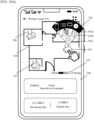
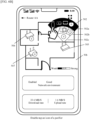
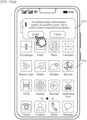
- a mobile phone displays an interface 50b (an example of the first interface), and the interface 50b includes identifiers of devices (the at least one second electronic device) such as a purifier, a projector, and a tablet.
- the mobile phone when detecting a double-tap operation of the user on an identifier of the purifier (the first target device), the mobile phone sends a switching request, where the switching request is used to request to switch the purifier from a currently connected router 505 (the source access point) to a router (the target access point) with a better signal.
- the user in comparison with a case in which a device is accidentally disconnected from a network in a network access process of the user, resulting in poor network access experience of the user, in the technical solution in embodiments of this application, the user actively controls the device to complete access point switching through the first interface, which means that interruption of a service of the device in a switching process can be predicted by the user. In this way, network access experience of the user is generally not affected.
- the first interface includes a first display component, the first display component includes a first partition, and the first partition includes an identifier of a second electronic device that is connected to the source access point and whose communication quality is within a first range; and/or the first partition includes an identifier of a second electronic device that is not connected to the source access point, whose signal can be detected by the source access point, and whose communication quality is within the first range.
- the first partition includes the identifier of the at least one second electronic device.
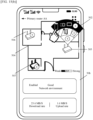
- the mobile phone displays the interface 50b (an example of the first interface), the interface 50b includes a component 502 (an example of the first display component), the component 502 includes a recommendation partition 502a (the first partition), and the recommendation partition includes an identifier of a device (the second electronic device) like a purifier, a projector, or a tablet that is connected to the router 505 (the source access point) and whose communication quality is within the first range; and/or the recommendation partition includes an identifier of another device that is not connected to the router 505, whose signal can be detected, and whose communication quality is within the first range.
- the first interface further includes a second partition, and communication quality of an electronic device in the first partition is lower than communication quality of an electronic device in the second partition.
- a user interface UI effect of the first partition is different from a UI effect of the second partition.
- a UI effect of the partition 502a is different from a UI effect of the partition 502b.
- the user can clearly and intuitively learn of communication quality of each device in a whole house.
- the user can control the first interface based on communication quality of a corresponding device, to control the device to complete access point switching, so as to improve network connection quality of the device, and improve network access experience of the user.
- the first partition includes an identifier of an electronic device whose communication quality is within the first range within a specified space range.
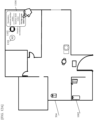
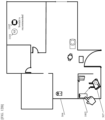
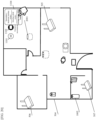
- the mobile phone may display, in the floor plan, an identifier of a device with medium communication quality or an identifier of a device with good communication quality in the whole house.
- the mobile phone may display, in the floor plan, all online devices in the whole house.
- the mobile phone may be further configured to display, in the floor plan, an identifier of a device in specific space at home.
- a control may be set in an interface of the mobile phone, and the user may select, through the control, to view an identifier of a device in specific space (for example, a living room) at home.
- the mobile phone may detect space in which the user is currently located, and display, in an interface, an identifier of a device in the current space (for example, a living room). In this way, the user may perform access point switching management on one or more devices in the interface through the interface displayed by the mobile phone, to improve communication quality of the corresponding devices.
- the method further includes:
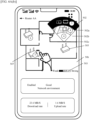
- the mobile phone may display a display component 1003 (an example of the second display component) shown in FIG. 10A(a) .
- the display component 1003 includes a partition 1003a (the third partition) corresponding to the recommendation partition, and the partition 1003a includes an identifier of a device (the identifier of the at least one second electronic device) in the partition 502a and an identifier of at least one other electronic device (for example, a camera, a watch, or a switch) whose communication quality is within the first range.
- the first electronic device can display identifiers of more devices whose communication quality is within the first range, so that the user can control, based on the identifiers of these devices, a corresponding device to perform access point switching.
- the method further includes:
- a hidden identifier of an electronic device for example, a watch
- a communication quality is within the second range
- the first interface further includes an identifier of at least one access point, and the at least one access point includes the target access point; and the receiving an operation of a user on an identifier of a first target device in the at least one second electronic device includes: receiving an operation of dragging, by the user, the identifier of the first target device to a target region, where the target region is a region in which the identifier of the target access point is located.
- the first electronic device may prompt the user of this case, to reduce a probability of switching the device to a router with a poorer signal.
- this application provides a device switching apparatus, applied to a first electronic device or a chip system, where the apparatus includes:
- the foregoing content is merely an example of the system to which the technical solutions in embodiments of this application are applicable.
- the system may further include more or fewer devices, or there may be different device layout locations.
- Specific forms of the access point 100, the electronic device 200, and the electronic device 300 are not limited in this embodiment of this application.
- FIG. 3 is a diagram of a structure of an electronic device.
- FIG. 3 is a diagram of a hardware structure of an electronic device according to an embodiment of this application.
- the electronic device includes at least one processor 201, a memory 202, a display 204, and at least one transceiver 203.
- the processor 201 may be a general-purpose central processing unit (central processing unit, CPU), a microprocessor, an application-specific integrated circuit (application-specific integrated circuit, ASIC), or one or more integrated circuits configured to control execution of programs in the solutions in this application.
- CPU central processing unit
- ASIC application-specific integrated circuit
- the foregoing components may include a communication line, configured to transmit information between the foregoing components.
- the memory 202 is configured to store computer-executable instructions for implementing the solutions of this application, and the processor 201 controls the execution.
- the processor 201 is configured to execute the computer-executable instructions stored in the memory 202, to implement methods provided in the following embodiments of this application.
- the computer-executable instructions in embodiments of this application may also be referred to as application program code, instructions, computer programs, or another name. This is not specifically limited in embodiments of this application.
- the processor 201 may include one or more CPUs.
- the electronic device may include a plurality of processors.
- Each of the processors may be a single-core (single-CPU) processor, or may be a multicore (multi-CPU) processor.
- the processor herein may be one or more devices, circuits, and/or processing cores configured to process data (for example, computer program instructions).
- the display 204 is configured to display a network setting interface, and the user may control the electronic device through the network setting interface, to control the electronic device or another electronic device to switch to an access point with a better network signal.
- a software system of the electronic device 300 may use a layered architecture, an event-driven architecture, a microkernel architecture, a microservice architecture, or a cloud architecture.
- an Android ® system with a layered architecture is used as an example to illustrate the software structure of the electronic device 300.
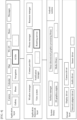
- FIG. 4 is a block diagram of a possible software structure of the electronic device 300 according to an embodiment of this application.
- the layered architecture software is divided into several layers, and each layer has a clear role and task.
- the layers communicate with each other through a software interface.
- the Android system is divided into four layers: an application layer, an application framework layer, an Android runtime (Android runtime) and system library, and a kernel layer from top to bottom.
- the application layer may include a series of applications.
- the applications may include applications (application, APP) such as Phone, Memo, Browser, Contacts, Camera, Gallery, Calendar, Map, Bluetooth, Music, Video, and Messages.
- applications application, APP
- the applications may further include an application related to access point switching by a control device.
- the application used by the control device to perform access point switching may be pre-installed when the electronic device 300 is delivered from a factory, or may be downloaded and installed from an application store when the user uses the electronic device 300.
- the application used by the control device to perform switching includes but is not limited to an AI life application.
- the AI life application may provide a network setting interface, and the user may control, through the network setting interface, a current device with a weak signal to switch to another access point, to improve network access experience of using the device by the user.
- the application framework layer provides an application programming interface (application programming interface, API) and a programming framework for an application at the application layer.
- the application framework layer includes some predefined functions.
- the application framework layer may include a window manager, a content provider, a view system, a resource manager, a notification manager, and the like.
- the window manager is configured to manage a window program.
- the window manager may obtain a size of the display, determine whether there is a status bar, perform screen locking, take a screenshot, and the like.
- the content provider is configured to: store and obtain data, and enable the data to be accessed by an application.
- the data may include a video, an image, an audio, calls that are made and answered, a browsing history and bookmarks, an address book, and the like.
- the view system includes a visual control, for example, a control for displaying a text and a control for displaying an image.
- the view system may be configured to construct an application.
- a display interface may include one or more views.
- the resource manager provides various resources such as a localized character string, an icon, an image, a layout file, and a video file for an application.
- the notification manager enables an application to display notification information in a status bar, and may be configured to convey a notification message.
- the notification manager may automatically disappear after a short pause without requiring user interaction.
- the notification manager is configured to: notify download completion, give a message notification, and the like.
- the notification manager may alternatively be a notification that appears in a top status bar of the system in a form of a graph or a scroll bar text, for example, a notification of an application that is run on a background, or may be a notification that appears on the display in a form of a dialog window. For example, text information is prompted in the status bar, an alert tone is made, the electronic device vibrates, or an indicator light blinks.
- the kernel library includes two parts: a function that needs to be called in Java language and a kernel library of Android.
- the mobile phone may present, in the device status card 502 corresponding to the child router 505, a quantity of devices connected to the child router 505.
- the mobile phone may present, in the device status card 502 based on communication quality of the devices, quantities of devices with different communication quality. For example, as shown in FIG. 5(b) , a quantity (6) of devices with poor communication quality (a communication quality score of the communication quality is within the first score interval) is presented in the partition 502a, a quantity (4) of devices with medium communication quality (a communication quality score of the communication quality is within the second score interval) is presented in the partition 502b, and a quantity (4) of devices with good communication quality (a communication quality score of the communication quality is within the third score interval) is presented in the partition 502c.
- the prompt message is used to prompt to switch the router to which the device is connected. For example, as shown in FIG. 15(a) , after receiving the notification message from the mother router, the mobile phone displays a prompt message 1502.
- S204 The mobile phone detects an operation of indicating to start a first interface.
- the operation of indicating to start the first interface may be an operation of tapping the prompt message 1502 by the user, and the first interface is used to switch the router.
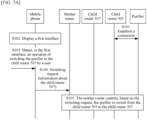
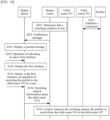
- S102 The mobile phone displays the first interface.
- S103 The mobile phone detects an operation intention of switching the purifier to the child router 507 by the user.
- S104 The mobile phone sends a switching request to the mother router 506.
- S105 may be implemented as follows: The mother router sends, based on the switching request, a connection rejection instruction to a router (for example, the child router 505) other than the target router, and sends a switching instruction to the purifier, so that the connection between the purifier and the child router 505 is disconnected. In addition, the mother router rejects, based on the switching request, establishing a connection to the purifier. After the connection between the purifier and the child router 505 is disconnected, the purifier may attempt to establish a connection to the router other than the child router 505, for example, may establish a communication connection to the child router 507 serving as the target router.
- An embodiment of this application further provides a device access switching method.
- S105a mentioned above may be implemented as follows: S105a1: The mother router sends, based on the switching request, the connection rejection instruction when a first condition is met.
- S105b mentioned above may be implemented as follows: S105b1: Send the switching instruction when the first condition is met.
- the mother router triggers a switching process and controls a corresponding to-be-switched device to perform router switching only when the first condition is met.
- the first condition may include any one of the following conditions: The device currently does not execute a network-connected service; the device completes execution of the current network-connected service; and the device completes execution of the current network-connected service, and the device does not execute another network-connected service in a first time period.
- the network-connected service may be a service executed by accessing a network. For example, to view current information (for example, a filter element life and indoor humidity) of the purifier through the AI life application, the network needs to be used. For another example, a service like a video, a game, and an online course needs to use the network.
- the switching process occurs in a time period in which the to-be-switched device does not execute the network-connected service, and a current service of the to-be-switched device does not need the network, even if the to-be-switched device is temporarily disconnected from the network in a router switching process, the current service of the to-be-switched device is not affected.
- the mother router learns that the purifier needs to switch from the currently connected router to the target router.
- the mother router may determine whether the purifier is currently performing a network-connected service. If it is learned that the purifier is currently returning information like the filter element life to the mobile phone, the mother router temporarily does not send the connection rejection instruction, but may send the connection rejection instruction and the switching instruction when the purifier completes the network-connected service. In this way, the purifier can successfully send the information like the filter element life to the mobile phone, and the user can view the information like the filter element life of the water purifier through the mobile phone. This improves human-machine interaction efficiency.
- the mother router determines that a sound box needs to switch to the target router.
- the mother router may determine whether the sound box is currently performing a network-connected service. As shown in (a) in FIG. 17 , if the sound box is currently performing the network-connected service, for example, playing music through network connection, the mother router may wait for the sound box to stop playing the music. After the sound box stops playing the music, if the network-connected service is not executed within a period of time, as shown in (b) in FIG. 17 , the mother router may send a switching instruction to the sound box, and send a connection rejection instruction to a router (including a router currently connected to the sound box) other than the target router.
- the sound box may disconnect the connection to the current router based on the switching instruction.
- the router other than the target router may reject a connection to the sound box based on the connection rejection instruction.
- the sound box may attempt to re-establish a connection, to be connected to the target router.
- the mother router may alternatively immediately send the switching instruction to the sound box after receiving the switching request from the mobile phone, without waiting for the current service to end.
- the foregoing mainly uses a device like the purifier that is in a fixed location in the whole house as an example.
- the technical solutions in embodiments of this application are further applicable to a device that has strong mobility and is in an unfixed location, for example, a mobile phone or a wearable device that is often carried by the user and whose location changes with movement of the user.
- the foregoing devices with fixed locations and unfixed locations may be devices that support the 802.11k/v/r protocol, or may be devices that do not support the protocol.
- An embodiment of this application further provides a device access switching method.
- a mobile phone may prompt the user to hold a device to move in a whole house, to determine an optimal router to which the device needs to be connected at a corresponding location in the whole house.
- FIG. 18 shows some content in an interface of the AI life application.
- the mobile phone may display a tag 1103 in a floor plan 504. If the user taps the tag 1103, the mobile phone may display all devices in the whole house in the floor plan 504. The user can select a device from all the devices in the whole house as a target device. For example, as shown in FIG. 18 , the user selects a tablet as the target device.
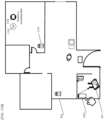
- the user may hold the tablet to move in the whole house, and the mobile phone may obtain a location of the tablet in the whole house, and display an identifier of the tablet at a corresponding location in the floor plan 504.
- the mobile phone may further display a prompt box 1801, where the prompt box 1801 indicates an optimal router that can be connected to the tablet at a corresponding location in the whole house. For example, as shown in FIG. 19 , when a location of the tablet in the whole house is shown in a dashed-line box, the router that can provide optimal communication quality for the tablet in the whole house is a living-room child router.
- the user may tap a "tap to save” button, and in response to the operation of the user, the mobile phone may establish an association relationship between the location of the tablet and the optimal router (namely, the living-room child router) that can be connected to the tablet at the location.
- the optimal router namely, the living-room child router
- the mobile phone may directly notify the tablet of the association relationship between the location of the tablet and the optimal router.
- the tablet stores network connection information of a router (including the living-room child router) that has historically been connected to the tablet.
- the network connection information that is of the router and that is stored in the tablet includes but is not limited to: an SSID, an address, an IP address, authentication information, a key, and the like.
- the tablet may determine, based on the foregoing association relationship, an optimal child router associated with the location, and automatically switch to the optimal child router based on the stored network connection information of the optimal child router, thereby reducing a switching delay.
- the mobile phone may further indicate the tablet to establish a connection to the living-room child router.
- the tablet may store network connection information of the living-room child router. In this way, when the tablet moves to a corresponding location in the whole house again subsequently, the tablet may determine, based on the foregoing association relationship, an optimal child router associated with the location, and automatically switch to the optimal child router based on the stored network connection information of the optimal child router, thereby reducing a switching delay.
- optimal routers associated with locations of the tablet in the whole house may be shown in Table 1.
- Table 1 Location of a tablet in a whole house Optimal router that can be connected to the tablet in the location Location 1 Living-room child router Location 2 Secondary-bedroom mother router Location 3 Kitchen child router ... ...
- the mobile phone may further present, in the floor plan, an identifier of a device whose signal can be detected but is not connected to the router.
- an identifier of a device connected to the router and an identifier of a device that is not connected to the router but whose signal can be detected may have different display effects.
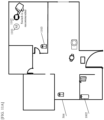
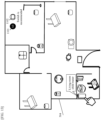
- the mobile phone may display, in the floor plan 504, an identifier of a device connected to the living-room child router, for example, identifiers of the purifier 1002, the camera, the smart switch, the watch, the tablet, and the projector.
- the mobile phone may further display, in the floor plan 504, an identifier of a device that is not connected to the living-room child router but whose signal can be detected, for example, an identifier of a sound box 2001.
- the identifier of the sound box 2001 and the identifier of the purifier 1002 may have different display effects, so that the user can identify that the sound box 2001 is not currently connected to the living-room child router, and the purifier 1002 is currently connected to the living-room child router.
- the user may drag a corresponding identifier of a device in the floor plan shown in FIG. 20 to trigger a switching process of the device. For example, when it is detected that the user drags the identifier of the sound box 2001 to collide with the living-room child router 505, the mobile phone may send a switching request to the mother router (for example, the secondary-bedroom mother router 506), and the mother router controls to switch the sound box 2001 to the living-room child router 505.
- the mother router for example, the secondary-bedroom mother router 506
- the mother router may dynamically control, based on a real-time location of the tablet, the tablet to switch to a corresponding optimal router. For example, after the tablet is connected to a router A, the user moves with the tablet, and after the tablet moves to a new location 1, the mother router detects that a signal becomes worse, and may send a notification message to the tablet, to notify the tablet that the tablet can switch the router. After receiving the notification message, the tablet may prompt the user to switch the router.
- the tablet may prompt, by presenting a corresponding interface, the user to switch the router. After the user agrees to switch the router, the tablet may send a switching request to the mother router, and the mother router controls the tablet to switch from the router A to an optimal router associated with the location 1.
- the networking manner may alternatively be another manner, for example, a primary/secondary route networking manner is used, or a non-cascaded networking manner is used.
- a router that executes switching decision management among the plurality of routers may be determined based on a scenario and an architecture.
- the router that executes switching decision management may be a router installed with a switching decision module among the plurality of routers; or if a plurality of or all of the plurality of routers are installed with the switching decision module, the router that executes switching decision management may be determined dynamically according to a preset rule.
- the switching may be implemented directly by separately notifying the router A and the router B through a switching decision router C, without performing switching logic of rejecting a connection and then reconnecting a connection described in S105a to S105e; or the switching of the router may be implemented through directly negotiating between the router A and the router B without an intermediate router.
- interfaces are all examples, and there may alternatively be another interface design manner.
- a specific interface design manner and a manner of switching between interfaces are not limited in this application.
- steps in the method embodiments may be equivalently replaced with other possible steps.
- some steps in the method embodiments may be optional, and may be deleted in some use scenarios.
- another possible step may be added to the method embodiments.
- execution bodies for example, a functional module of some steps in the method embodiments may be replaced with other execution bodies.
- the apparatus may be the first electronic device, the third electronic device, or the like.
- the apparatus may include a display, a memory, and one or more processors.
- the display and the memory are coupled to the processor.
- the memory is configured to store computer program code, and the computer program code includes computer instructions.
- the apparatus may perform functions or steps performed by the mobile phone in the foregoing method embodiments.
- the electronic device apparatus shown in FIG. 21 .
- a core structure of the apparatus may be represented as a structure shown in FIG. 21 .
- the apparatus includes a processing module 1301, an input module 1302, a storage module 1303, and a display module 1304.
- the processing module 1301 may include at least one of a central processing unit (CPU), an application processor (Application Processor, AP), or a communication processor (Communication Processor, CP).
- the processing module 1301 may perform an operation or data processing related to control and/or communication of at least one of other elements of an electronic device of a user.
- the processing module 1301 may be configured to control, based on a specific trigger condition, content displayed on a primary screen.
- the processing module 1301 is further configured to process input instructions or data, and determine a display style based on processed data.
- the input module 1302 is configured to obtain an instruction or data entered by the user, and transmit the obtained instructions or data to another module of the electronic device.
- an input manner of the input module 1302 may include a touch, a gesture, proximity to the display, or the like, or may be voice input.
- the input module may be the display of the electronic device, and may obtain an input operation of the user, generate an input signal based on the obtained input operation, and transmit the input signal to the processing module 1301.
- the storage module 1303 may include a volatile memory and/or a non-volatile memory.
- the storage module is configured to store instructions or data related to at least one of other modules of an apparatus device of the user. Specifically, the storage module may record a location of an interface in which an apparatus interface element UI is located.
- the display module 1304 may include, for example, a liquid crystal display (LCD), a light-emitting diode (LED) display, an organic light-emitting diode (OLED) display, a micro-electro-mechanical system (MEMS) display, or an electronic paper display.
- the display module is configured to display content (for example, a text, an image, a video, an icon, or a symbol) that can be viewed by the user.
- the apparatus further includes a communication module 1305, configured to support a personal apparatus in communicating with another personal apparatus (through a communication network).
- the communication module may be connected to a network through wireless communication or wired communication, to communicate with another personal apparatus or a network server.
- the wireless communication may use at least one of cellular communication protocols, for example, long term evolution (LTE), long term evolution advanced (LTE-A), code division multiple access (CDMA), wideband code division multiple access (WCDMA), universal mobile telecommunications system (UMTS), wireless broadband (WiBro), or a global system for mobile communications (GSM).
- LTE long term evolution
- LTE-A long term evolution advanced
- CDMA code division multiple access
- WCDMA wideband code division multiple access
- UMTS universal mobile telecommunications system
- WiBro wireless broadband
- GSM global system for mobile communications
- the wireless communication may include, for example, short-range communication.
- the short-range communication may include at least one of wireless fidelity (Wi-Fi), Bluetooth, near field communication (
- each functional module of the apparatus may perform one or more steps in the foregoing method embodiments.
- the chip system includes at least one processor 1401 and at least one interface circuit 1402.
- the processor 1401 and the interface circuit 1402 may be connected to each other through a line.
- the interface circuit 1402 may be configured to receive a signal from another apparatus (for example, a memory of an electronic device).
- the interface circuit 1402 may be configured to send a signal to another apparatus (for example, the processor 1401).
- the interface circuit 1402 may read instructions stored in the memory, and send the instructions to the processor 1401.
- the electronic device is enabled to perform the steps in the foregoing embodiments.
- the chip system may further include another discrete component. This is not specifically limited in embodiments of this application.
- An embodiment of this application further provides a computer storage medium.
- the computer storage medium includes computer instructions.
- the computer instructions When the computer instructions are run on the electronic device, the electronic device is enabled to perform the functions or the steps performed by the mobile phone in the method embodiments.
- the disclosed apparatus and method may be implemented in other manners.
- the described apparatus embodiments are merely examples.
- division into the modules or units is merely logical function division, and may be other division in an actual implementation.
- a plurality of units or components may be combined or may be integrated into another apparatus, or some features may be ignored or not performed.
- the displayed or discussed mutual couplings or direct couplings or communication connections may be implemented through some interfaces.
- the indirect couplings or communication connections between the apparatuses or units may be implemented in electronic, mechanical, or other forms.
- the units described as separate parts may or may not be physically separate, and parts displayed as units may be one or more physical units, may be located in one place, or may be distributed on different places. Some or all of the units may be selected based on actual requirements to achieve the objectives of the solutions of embodiments.
- the integrated unit When the integrated unit is implemented in the form of a software functional unit and sold or used as an independent product, the integrated unit may be stored in a readable storage medium. Based on such an understanding, the technical solutions of this application essentially, or the part contributing to the conventional technology, or all or some of the technical solutions may be implemented in the form of a software product.
- the software product is stored in a storage medium and includes several instructions for instructing a device (which may be a single-chip microcomputer, a chip or the like) or a processor (processor) to perform all or some of the steps of the methods described in embodiments of this application.
- the storage medium includes various media that can store program code, such as a USB flash drive, a removable hard disk, a read-only memory (read-only memory, ROM), a random access memory (random access memory, RAM), a magnetic disk, or an optical disc.
- program code such as a USB flash drive, a removable hard disk, a read-only memory (read-only memory, ROM), a random access memory (random access memory, RAM), a magnetic disk, or an optical disc.
Landscapes
- Engineering & Computer Science (AREA)
- Computer Networks & Wireless Communication (AREA)
- Signal Processing (AREA)
- Environmental & Geological Engineering (AREA)
- Human Computer Interaction (AREA)
- Automation & Control Theory (AREA)
- Telephone Function (AREA)
- Mobile Radio Communication Systems (AREA)
Applications Claiming Priority (2)
| Application Number | Priority Date | Filing Date | Title |
|---|---|---|---|
| CN202211215693.7A CN117812655A (zh) | 2022-09-30 | 2022-09-30 | 设备的接入切换方法及电子设备 |
| PCT/CN2023/121625 WO2024067606A1 (zh) | 2022-09-30 | 2023-09-26 | 设备的接入切换方法及电子设备 |
Publications (2)
| Publication Number | Publication Date |
|---|---|
| EP4580259A1 true EP4580259A1 (de) | 2025-07-02 |
| EP4580259A4 EP4580259A4 (de) | 2025-12-24 |
Family
ID=90427537
Family Applications (1)
| Application Number | Title | Priority Date | Filing Date |
|---|---|---|---|
| EP23870834.1A Pending EP4580259A4 (de) | 2022-09-30 | 2023-09-26 | Zugangsumschaltverfahren für vorrichtung und elektronische vorrichtung |
Country Status (3)
| Country | Link |
|---|---|
| EP (1) | EP4580259A4 (de) |
| CN (1) | CN117812655A (de) |
| WO (1) | WO2024067606A1 (de) |
Family Cites Families (7)
| Publication number | Priority date | Publication date | Assignee | Title |
|---|---|---|---|---|
| DE10142392A1 (de) * | 2001-08-30 | 2003-03-20 | Philips Corp Intellectual Pty | Digitales Hausnetzwerk und Verfahren zur Zuordnung drahtloser Endgeräte zu Basisstationen |
| KR100575447B1 (ko) * | 2003-02-11 | 2006-05-03 | 주식회사 플레넷 | 홈 오토메이션을 위한 가전기기 제어방법 |
| CN102999251B (zh) * | 2012-10-31 | 2016-02-10 | 东莞宇龙通信科技有限公司 | 终端和设备连接管理方法 |
| US20160117086A1 (en) * | 2014-10-22 | 2016-04-28 | Grand Mate Co., Ltd. | Method of setting user interface of remote control system |
| CN108370599B (zh) * | 2015-12-24 | 2022-07-26 | 索尼公司 | 信息处理方法、计算机可读存储介质和信息处理系统 |
| EP3408971A1 (de) * | 2016-01-27 | 2018-12-05 | Starry, Inc. | Geländevernetzungsvorrichtung und verfahren zum betrieb davon |
| CN114615660B (zh) * | 2020-12-04 | 2024-10-18 | 华为技术有限公司 | 接入方法、系统及电子设备 |
-
2022
- 2022-09-30 CN CN202211215693.7A patent/CN117812655A/zh active Pending
-
2023
- 2023-09-26 EP EP23870834.1A patent/EP4580259A4/de active Pending
- 2023-09-26 WO PCT/CN2023/121625 patent/WO2024067606A1/zh not_active Ceased
Also Published As
| Publication number | Publication date |
|---|---|
| WO2024067606A1 (zh) | 2024-04-04 |
| CN117812655A (zh) | 2024-04-02 |
| EP4580259A4 (de) | 2025-12-24 |
Similar Documents
| Publication | Publication Date | Title |
|---|---|---|
| EP2887194B1 (de) | Verfahren zur Steuerung einer Zusammensetzung eines Bildschirms und elektronische Vorrichtung dafür | |
| US10983749B2 (en) | Electronic device and method for sharing screen | |
| JP7359907B2 (ja) | コントローラ及び制御方法 | |
| US9967388B2 (en) | Mirrored interface navigation of multiple user interfaces | |
| KR20210014693A (ko) | Nsa 및 sa 네트워킹 모드 선택 방법 및 단말 기기 | |
| KR102087010B1 (ko) | 무선 통신에 기반한 데이터 송수신 방법 및 장치 | |
| EP4583481A1 (de) | Netzwerksystem und -verfahren für mehrere vorrichtungen und endgerätevorrichtungen | |
| CN113489700B (zh) | 一种获取媒资数据的方法、服务器及终端设备 | |
| KR20140031468A (ko) | 휴대 단말 및 이의 컨텐츠 공유 방법 | |
| AU2014293763A1 (en) | Method and apparatus for providing Graphic User Interface | |
| CN116804854A (zh) | 智能设备控制方法及电子设备 | |
| KR20150019863A (ko) | 무선 통신에 기반한 데이터 송수신 방법 및 장치 | |
| KR20150042318A (ko) | 근접 기능 운용 방법 및 이를 지원하는 전자 장치 | |
| KR101717584B1 (ko) | 휴대 단말기의 통신 설정 제어 방법 및 이를 기반으로 운용되는 휴대 단말기 | |
| CN113727399A (zh) | 一种目标小区确定方法及装置 | |
| JP7592175B2 (ja) | リダイレクト失敗の処理方法、装置、電子機器及び可読記憶媒体 | |
| EP4580259A1 (de) | Zugangsumschaltverfahren für vorrichtung und elektronische vorrichtung | |
| CN105306725A (zh) | 一种信息处理方法和电子设备 | |
| US20250224965A1 (en) | Intelligent device control method, electronic device, and system | |
| CN110213319B (zh) | 接入方法及装置、终端、服务器及存储介质 | |
| CN105703965A (zh) | 接入网络的检测方法、装置及终端 | |
| US12223219B2 (en) | Screen combination method and apparatus | |
| CN115834416B (zh) | 设备管理方法、装置、存储介质及电子设备 | |
| CN105867889A (zh) | 路由器的ui界面的展示方法、装置及用户设备 | |
| CN115150265B (zh) | 一种双系统数据的处理方法、设备及装置 |
Legal Events
| Date | Code | Title | Description |
|---|---|---|---|
| STAA | Information on the status of an ep patent application or granted ep patent |
Free format text: STATUS: THE INTERNATIONAL PUBLICATION HAS BEEN MADE |
|
| PUAI | Public reference made under article 153(3) epc to a published international application that has entered the european phase |
Free format text: ORIGINAL CODE: 0009012 |
|
| STAA | Information on the status of an ep patent application or granted ep patent |
Free format text: STATUS: REQUEST FOR EXAMINATION WAS MADE |
|
| 17P | Request for examination filed |
Effective date: 20250326 |
|
| AK | Designated contracting states |
Kind code of ref document: A1 Designated state(s): AL AT BE BG CH CY CZ DE DK EE ES FI FR GB GR HR HU IE IS IT LI LT LU LV MC ME MK MT NL NO PL PT RO RS SE SI SK SM TR |
|
| A4 | Supplementary search report drawn up and despatched |
Effective date: 20251124 |
|
| RIC1 | Information provided on ipc code assigned before grant |
Ipc: H04W 36/08 20090101AFI20251118BHEP Ipc: H04W 36/30 20090101ALI20251118BHEP Ipc: H04W 40/36 20090101ALI20251118BHEP Ipc: H04W 76/11 20180101ALI20251118BHEP Ipc: H04M 1/72454 20210101ALI20251118BHEP Ipc: H04M 1/72457 20210101ALI20251118BHEP Ipc: H04L 12/28 20060101ALI20251118BHEP Ipc: H04L 41/0668 20220101ALI20251118BHEP Ipc: H04L 41/22 20220101ALI20251118BHEP Ipc: H04W 36/00 20090101ALI20251118BHEP |
|
| DAV | Request for validation of the european patent (deleted) | ||
| DAX | Request for extension of the european patent (deleted) |