EP4579290A1 - Wire grid polarizing element and method for producing same - Google Patents
Wire grid polarizing element and method for producing same Download PDFInfo
- Publication number
- EP4579290A1 EP4579290A1 EP23857056.8A EP23857056A EP4579290A1 EP 4579290 A1 EP4579290 A1 EP 4579290A1 EP 23857056 A EP23857056 A EP 23857056A EP 4579290 A1 EP4579290 A1 EP 4579290A1
- Authority
- EP
- European Patent Office
- Prior art keywords
- concave groove
- groove portion
- side wall
- substrate
- wall surfaces
- Prior art date
- Legal status (The legal status is an assumption and is not a legal conclusion. Google has not performed a legal analysis and makes no representation as to the accuracy of the status listed.)
- Pending
Links
Images



Classifications
-
- G—PHYSICS
- G02—OPTICS
- G02B—OPTICAL ELEMENTS, SYSTEMS OR APPARATUS
- G02B5/00—Optical elements other than lenses
- G02B5/30—Polarising elements
- G02B5/3025—Polarisers, i.e. arrangements capable of producing a definite output polarisation state from an unpolarised input state
- G02B5/3058—Polarisers, i.e. arrangements capable of producing a definite output polarisation state from an unpolarised input state comprising electrically conductive elements, e.g. wire grids, conductive particles
Definitions
- the present invention relates to a wire grid polarizing element that is prepared mainly using plating means and can be expected to be applied to optical products such as a display, a camera, sunglasses, or an optical measuring instrument using an electromagnetic wave such as visible light or near infrared light, and a method for producing the same.
- the wire grid polarizing element includes a layer where wire-shaped objects made of metal or the like are arranged in a striped pattern at a specific period and uses the following phenomenon: when the period is sufficiently smaller than a wavelength of an incident electromagnetic wave (light), light of an electric field component parallel to the wire-shaped objects is reflected or absorbed, and transmission of light of an electric field component perpendicular to the wire-shaped objects is allowed.
- This polarizing element is advantageous in that it has excellent optical characteristics capable of exhibiting a polarization function for visible light to near infrared light and high durability.
- a hot embossing method or a nanoimprinting method is known, and a method for depositing a conductor using an oblique deposition method on a convex portion-side surface of a substrate having an uneven shape on a surface is known.
- Patent Literature 1 discloses a wire grid polarizing element having excellent polarization characteristics that is obtained by causing particles to be incident on an uneven structure surface of a grid structure layer on a transparent substrate having a one-dimensional lattice-shaped uneven structure from an oblique direction using a dry process such as sputtering or vacuum deposition to form an Al-Si alloy layer having a Si content of 0.05 to 1.5 wt% on a convex portion of the uneven structure, and a method for producing the same.
- a dry process such as sputtering or vacuum deposition
- Patent Literature 2 discloses a wire grid polarizer where a fine metallic wire is formed on an underlayer with an oblique deposition method using a vacuum deposition method and a method for producing the same, the underlayer being made of a metal oxide layer that is formed on the entire surface of top portions of ridges of a transparent substrate having an uneven structure and side surfaces thereof, and the fine metallic wire being made of a metal layer present in 70% or more of the area of at least the top portions of the ridges and further the side surfaces of the ridges.
- Patent Literature 3 discloses an optical functional body that is formed by filling a substrate having a fine uneven pattern with particles having a smaller particle size than a width of a concave portion using an electroless plating method.
- Non-Patent Literature 1 Low-reflective wire grid polarizing elements with an absorptive layer formed by glancing angle deposition, Journal of Institute of Image Information and Television Engineers, Vol. 65, No. 10, pp. 1440-1445 (2011 )
- an object of the invention disclosed in Patent Literature 1 is to solve the problem that, when pure Al is used as a metal forming a wire grid, pure Al particles formed in the convex portion of the substrate through the dry process cannot be refined such that polarization characteristics cannot be obtained as designed.
- the invention disclosed in Patent Literature 1 by using an Al-Si alloy having a Si content of 0.05 to 1.5 wt% as the metal for forming the wire grid, the particles formed in the convex portion are refined to improve the polarization characteristics. Accordingly, the application of this invention is limited to a technology that is applicable when an Al-based metal as a metal for forming a wire grid is formed on a substrate through a dry process.
- a wire grid polarizing element having an excellent polarization degree while maintaining a necessary transmittance is required, and a method for reliably producing the above-described wire grid polarizing element through a simple process using various means or the like is also required.
- a wire-grid polarizing plate that can be used in a wide wavelength range from visible light to near infrared light or the like is required not only for a liquid projector but also for LiDAR (technology of irradiating an object with laser light to measure the distance to the object, the shape of the object, or the like based on information of the reflected light), a vehicle-mounted camera, an industrial inspection camera, an optical instrument for measurement, polarized sunglasses, or the like, and the ripple effect obtained by realizing this wire-grid polarizing plate is high.
- a wire grid polarizing element having an excellent polarization degree while maintaining a necessary light transmittance can be obtained by preparing a substrate where a plurality of concave groove portions where side wall surfaces facing each other are formed parallel to each other are periodically arranged in one direction, and disposing a conductor layer on both of the side wall surfaces of the concave groove portion in a state where the conductor layers of the side wall surfaces face each other through a gap such that the concave groove portion is not completely filled with the conductor layer and a ratio (average depth/average thickness) of an average depth (or thickness) in a back surface direction of the concave groove portion to an average thickness (or average width) in a direction perpendicular to the surfaces of the conductor layers formed on the side wall surfaces can increase. Based on this finding, the present invention has been completed.
- the present invention is summarized as the following (1) to (7) inventions.
- each of the two conductor layers formed on both of the side wall surfaces of one concave groove portion through the gap exhibits the polarization function. Accordingly, the two conductor layers are obtained for one concave groove portion in the structure. Therefore, apparently, the conductor having the average period that is 1/2 the average period of the concave groove portion in the structure can be obtained, and the conductor can be formed along the surface of the substrate.
- the ratio (depth/thickness) of the average depth (or thickness) from the sheet surface to the back surface side to the average thickness (or width) in the direction perpendicular to the surfaces of the conductor layers formed on the side wall surfaces can increase, and thus a high polarization degree can be realized.
- the conductor layer is formed not only the side wall surfaces of the concave groove portion in the uneven structure but also the bottom portion of the concave groove portion, a high polarization degree can be obtained, and a necessary light transmittance can also be obtained.
- the substrate made of the uneven structure is molded by hot embossing (or nanoimprinting), and subsequently the conductor layer is uniformly formed on the substrate surface of the uneven structure using an electroless plating method. Therefore, the production method according to the present invention is a simple and inexpensive process.
- the conductor layer is formed not only the side wall surfaces of the concave groove portion in the uneven structure but also the bottom portion of the concave groove portion and/or the upper surface of the convex portion between the concave groove portions, that is, in the structure where the surface of the specific uneven structure can be covered with the conductor layer with the specific thickness, a necessary light transmittance and a high polarization degree can be obtained. Therefore, the step of removing the conductor in the unnecessary portion after forming the conductor is not necessary. Thus, eco-friendliness can be obtained, device costs or process costs required for the production can be reduced, and the productivity can be improved.
- the method for producing the wire grid polarizing element according to the present invention for example, film insert molding or cast molding can be used for the molding step. Therefore, a three-dimensional curved molded product from which a specific polarization component can be extracted can also be realized.
- a wire grid polarizing element having excellent environment resistance, bendability, and elasticity can be easily obtained by selecting a material used for the substrate sheet.
- the conductor layer can be formed by using a general electroless plating method. Therefore, by using a molding method such as an injection molding method in combination, a molded product including a polarizing element as a part can be realized, and thus market expansion such as the application to an optical member that is difficult to implement in the related art can be expected.
- the shape of a conductor may be a shape other than a so-called "wire shape", for example, a shape where a cross-section is square wave.
- wire shape for example, a shape where a cross-section is square wave.
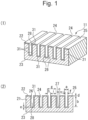
- a wire grid polarizing element including:
- a plurality of concave groove portions 24 extending in parallel are periodically provided in one direction on a transparent sheet surface 22, and in a shape of the plurality of concave groove portions, side wall surfaces 26 facing each other are parallel to each other.
- a conductor layer 31 formed in the concave groove portion is disposed on both of side wall surfaces 26 of the concave groove portion 24 is disposed with a substantially uniform thickness in a state where the conductor layers 31 of the side wall surfaces face each other through a gap 28.
- the substrate 21 used in the wire grid polarizing element according to the present invention may be a substrate that is transparent with respect to an electromagnetic wave having a target wavelength in a visible range, an infrared range, or the like, and examples thereof include: an amorphous thermoplastic resin such as a polymethyl methacrylate resin, a polycarbonate resin, a polystyrene resin, a cycloolefin polymer resin, a crosslinked polyethylene resin, a polyvinyl chloride resin, a polyarylate resin, a polyphenylene ether resin, a modified polyphenylene ether resin, a polyether imide resin, a polyether sulfone resin, a polysulfone resin, or a polyether ketone resin; a crystalline thermoplastic resin such as a polyethylene terephthalate resin, a polyethylene naphthalate resin, a polyethylene resin, a polypropylene resin, a polybutylene terephthalate resin, an aromatic polyester resin
- the substrate 21 forming the wire grid polarizing element according to the present invention has a front surface 22 side and a back surface 23 side.
- the plurality of concave groove portions 24 where the side wall surfaces 26 facing each other are parallel to each other extend in parallel and are periodically formed in one direction.
- the external shape of the substrate 21 is not particularly limited as long as the period (g), the average width (a), and the average depth (b) of the concave groove portion 24 having a high polarization degree while maintaining a necessary transmittance can be formed.
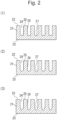
- Examples of a cross-sectional shape perpendicular to a periodic direction include a substantially rectangular shape as a whole illustrated in Figure 2(1) where a base is parallel to a substrate surface, a substantially pentagonal shape as a whole illustrated in Figure 2(2) where a base portion has an inverted triangular shape, and an U-shape as a whole illustrated in Figure 2(3) where a base portion has a substantially U-shape.
- the convex portion 25 surface does not need to be flat.
- the convex portion 25 is present between the concave groove portions 24, and the side wall surfaces 26 and the bottom portions 27 are present in the concave groove portion 24.
- the period (g) of the concave groove portions 24 of the substrate 21 may be less than or equal to a wavelength of a target electromagnetic wave. That is, in a polarizing element for a visible range, the period (g) is preferably 50 to 400 nm and more preferably 50 to 200 nm. As the average width (a) of the concave groove portion 24 decreases with respect to the period, the transmittance increases.
- the average width (a) is preferably in a range of 0.2 to 0.6 times the period, and when the target electromagnetic wave is visible light and light in a near infrared range, the average width (a) is preferably 30 to 130 nm.
- the average depth (b) is preferably 5 times or more the average width (a), and in consideration of a mechanical strength for preventing fracture, breakage, and the like and moldability using a mold or the like, the average depth (b) is preferably in a range of 5 to 15 times the average width (a).
- the average depth (b) varies depending on the material of the conductor, and is preferably 400 nm or more.
- the cross-sectional shape of the substrate is the shape where the base portion is not parallel to the substrate surface as illustrated in Figures 2(2) and 2(3) , the average value of the depths in the cross-sectional shape is the average depth (b).
- the wire grid polarizing element according to the present invention is prepared by forming the conductor layer 31 in the concave groove portion 24 or the like on the front surface 22 side of the substrate 21.
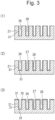
- the conductor layer 31 needs to be provided on at least both of the side wall surfaces 26 of the concave groove portion 24 through the gap 28 as illustrated in Figure 3(1) .
- the conductor layer 31 can be provided on both of the side wall surfaces 26 and the bottom portion 27 of the concave groove portion 24 as illustrated in Figure 3(2) , or can be provided on both of the side wall surfaces 26 and the bottom portion 27 of the concave groove portion 24 and the surface of the convex portion 25 between the concave groove portions 24 as illustrated in Figure 3(3) .
- the material of the conductor layer 31 used in the present invention may be any material that functions as a conductor in the wavelength range to be used, and examples thereof include aluminum, gold, silver, copper, platinum, molybdenum, nickel, chromium, titanium, tungsten, tantalum, zirconium, iron, niobium, hafnium, and cobalt.
- a semiconductor or an alloy or a compound thereof can also be used.
- an underlayer 32 made of a dielectric such as silicon oxide, titanium oxide, or hafnium oxide may be formed in advance.
- a coating layer 33 made of a transparent member of an organic material or an inorganic material can be formed.
- the gap in the concave groove portion 24 may be embedded with the coating layer 33 as illustrated in Figure 5(1) or may be hollow as illustrated in Figure 5(2) .
- the average thickness (c) of the conductor layers 31 formed on both of the side wall surfaces 26 in the concave groove portion 24, that is, an average thickness of a portion corresponding to the average width of the conductors of the wire grid polarizing element is preferably 0.15 to 0.30 times of the average width (a) of the concave groove portions 24 formed on the substrate.
- the average thickness (c) is preferably 5 to 20 nm.
- an average width (f) of the gap 28 is preferably in a range of 0.40 to 0.70 times the average width (a) of the concave groove portion 24 formed on the substrate.
- a ratio (depth/thickness (c)) of the average depth in the back surface direction of the conductor layers 31 formed on both of the side wall surfaces 26 of the concave groove portion 24 in the polarizing element to the average thickness (or the average width) of the conductor layers is more than a ratio (b/a) of the average depth (b) of the concave groove portion 24 to the average width (a) thereof in the substrate.
- a period (h) of the conductor layers 31 formed on the side wall surfaces 26 of the concave groove portion 24 can be set to be about 0.5 times the period of the concave groove portions 24, which contributes to a decrease in the target wavelength that can be used in the wire grid polarizing element.
- the average depth in the back surface direction of the conductor layer 31 varies to some extent depending on whether or not the conductor layer 31 is formed on the bottom portion 27 of the concave groove portion 24 and the convex portion 25 between the concave groove portions 24.
- the average thickness (c) of the conductor layers 31 of the side wall surfaces 26 of the concave groove portion 24 is preferably more on average than the average thickness (d) of the convex portion 25 surface between the concave groove portions 24 or the average thickness (e) of the bottom portion 27.
- Each of ratios between the average thicknesses (c), (d), and (e) in the direction perpendicular to each of the surfaces of the conductor layer 31 is not particularly limited. That is, the conductor layer 31 having substantially the same average thickness may be uniformly formed on each of the side wall surfaces 26 of the concave groove portion 24 and the convex portion 25, and the bottom portion 27.
- the average thicknesses (((d) and (e)) of the conductor layers 31 on the convex portion 25 surface between the concave groove portions 24 and the bottom portion 27 may be more than the average thickness (c) of the conductor layers 31 on the side wall surfaces 26 of the concave groove portion 24.
- a method for producing a wire grid polarizing element including:
- the production method includes, for example, a step (first step: Figure 6(1) ) of preparing a mold 41 for providing the concave groove portion 24 on the front surface 22 side of the substrate 21, a step (second step: Figure 6(2) ) of performing thermal nanoimprinting (hot embossing) or photo nanoimprinting, a step (third step: Figure 6(3) ) of preparing the substrate 21 where the concave groove portion 24 is provided, and a step (fourth step: Figure 6(4) ) of forming the conductor layer 31 on each of at least the side wall surfaces 26 of the concave groove portion 24.
- the wire grid polarizing element according to the present invention can be obtained only in the third step and the fourth step, and means for providing the concave groove portion 24 on the substrate 21 prepared in the third step is not particularly limited.
- the mold 41 As a method for preparing the mold 41 including a convex portion 42 corresponding to the shape of the concave groove portion 24 in the first step, for example, an exposure technology such as electron beam lithography, a focused ion beam, or interference exposure, a self-organization technology using nanoparticles, or dry etching or wet etching is preferably used, and the mold 41 may be prepared by transfer from a master mold prepared using this technology.
- the material of the mold 41 is preferably silicon, but may be glass such as quartz, a ceramic such as alumina and silicon carbide, or a metal such as nickel and stainless steel, or may be a multilayer material in which a metal, a semiconductor, or a dielectric is deposited on the above-described material.
- a fluorine-based mold releasing agent is applied to or a low friction inorganic film is formed on the surface of the mold 41.
- a silicon-based mold releasing agent can also be applied.
- the transfer is performed by adopting a thermal nanoimprinting (hot embossing) method or a photo nanoimprinting method.
- a molding method such as injection molding or cast molding can also be used.
- the form of the mold that can be used is not limited to a flat shape and may be a roll shape.
- the substrate 21 is prepared in the first step and the second step.
- the substrate 21 can also be prepared with an exposure technology such as electron beam lithography, a focused ion beam, or interference exposure, a self-organization technology using nanoparticles, an etching technology, or the like.
- the substrate 21 is not limited to a single-layer structure and may have a multilayer structure. Layers to be formed on the surface of the concave groove portion may be formed using different materials such as an ultraviolet-curable resin.
- an electroless plating method is used in consideration of mass productivity.
- a physical deposition method such as vacuum deposition or sputtering but also a chemical deposition method or an atomic layer deposition method can also be used, and means including a combination thereof can also be used.
- the electroless plating method it is preferable that (i) degreasing and cleaning using a surfactant and an alkaline aqueous solution are performed to remove contamination of the surface, (ii) after etching with an aqueous solution of an inorganic acid such as chromic acid, sulfuric acid, or hydrochloric acid to improve adhesiveness, a neutralization treatment is performed in this order, and (iii) subsequently, the substrate surface is dipped in a liquid containing tin ions (Sn 2+ ) and a liquid containing palladium ions (Pd 2+ ) as an activation treatment of a chemical plating reaction.
- a sensitizer-activator process in which an operation of dipping the substrate surface to be chemically plated in the liquid containing tin ions (Sn 2+ ) and then dipping the substrate surface in the liquid of containing palladium ions (Pd 2+ ) is performed once or twice, or a catalyser-accelerator process in which a palladium colloid liquid is prepared by mixing the liquid containing tin ions (Sn 2+ ) and the liquid containing palladium ions (Pd 2+ ), the substrate surface is dipped in the palladium colloid liquid, and the substrate surface is dipped in a hydrochloric acid solution to accelerate the chemical plating reaction can be used.
- the conductor layer is formed using an electroless plating method on both of the side wall surfaces of the concave groove portion in a state where the conductor layers of the side wall surfaces face each other through the gap.
- the activation treatment of adding the palladium catalyst to the wall surface on which electroless plating is to be performed using the liquid containing tin ions (Sn 2+ ) and the liquid containing palladium ions (Pd 2+ ) is most important.
- the surfaces of the substrate surface where the conductor layer is formed for example, at least both of the side wall surfaces of the concave groove portion can be used, and the bottom portion of the concave groove portion and convex portion surface between the concave groove portions can be used as optical places.
- means for forming the conductor layer at any one of the positions masking, etching, or the like can be used.
- examples of means for controlling the thickness of the conductor layer formed on the substrate surface include a plating treatment time, a plating liquid temperature, a component concentration in the plating liquid, and control of a diffusion layer that is a layer having a concentration gradient in the plating liquid during plating.
- an underlayer 32 made of a dielectric such as silicon oxide, titanium oxide, or hafnium oxide may be formed in advance.
- the coating layer 33 of an organic material or an inorganic material may be provided on the surface of the conductor layer 31 as illustrated in Figures 5(1) and 5(2) .
- the coating is not limited to a transparent material and may be a transparent material having a tint, for example, a dye containing a pigment or the like.
- the shape of the conductor can also be controlled by dry etching with an Ar ion beam or the like.
- a substrate where concave groove portions where side wall surfaces facing each other are parallel to each other are periodically provided in one direction on a transparent sheet surface is molded, and subsequently a conductor layer is formed with a substantially uniform thickness on at least both of the side wall surfaces of the concave groove portion provided on the substrate in a state where the conductor layers of the side wall surfaces face each other through a gap.
- the cross-sectional shape along the periodic direction of the concave groove portion is a substantially rectangular shape, a substantially pentagonal shape where a base has an inverted triangular shape, or an U-shape
- the period (g) in one direction of the concave groove portion is 50 to 400 nm
- the average width (a) of the concave groove portion is 0.2 to 0.6 times the period (g) or is 30 to 130 nm
- the average depth (b) of the concave groove portion is 5 to 15 times the average width (a).
- the average thickness (c) of the conductor layers formed on both of the side wall surfaces of the concave groove portion of the substrate is 0.15 to 0.30 times the average width (a) of the concave groove portion or is 5 to 20 nm
- the average gap (f) between the conductor layers formed on both of the side wall surfaces of the concave groove portion is 0.40 to 0.70 times the average width (a) of the concave groove portion.
- a polarization degree and a light transmittance of a prepared test piece were measured using the following device.
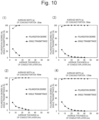
- a spectrophotometer (model: SolidSpec-3700) manufactured by Shimadzu Corporation was used. Incident light of an electric field component vibrating in directions parallel to and perpendicular to the conductor layer (concave groove portion) of the prepared wire grid polarizing element was used. Polarization characteristics were evaluated based on the polarization degree.
- Tp a luminous transmittance with respect to polarized light in the direction parallel to the conductor layer (concave groove portion)
- Tv a luminous transmittance with respect to polarized light in the direction perpendicular to the conductor layer (concave groove portion)
- the luminous transmittance with respect to each of the polarization components can be obtained from a transmittance (transmittance spectrum) for each of wavelengths 380 to 780 nm (every 1 nm) and a visibility curve.
- a transmittance with respect to polarized light in the direction parallel to the conductor (concave groove portion) is represented by Tp0
- a transmittance with respect to polarized light in the direction perpendicular to the conductor layer (concave groove portion) is represented by Tv0
- a polarization degree V0 at one wavelength is obtained from the following formula.
- Polarization Degree V 0 Tv 0 ⁇ Tp 0 / Tv 0 + Tp 0 1 / 2
- a substrate having a fine concave groove portion structure was formed on a thermoplastic resin sheet surface with a thermal nanoimprinting method using a mold.
- a nickel layer was formed by electroless plating on the surface including the concave groove portion such that the concave groove portion was not completely filled with the conductor.
- a polarizing element test piece illustrated in Figure 3(3) was prepared.
- a polycarbonate sheet manufactured by Mitsubishi Gas Chemical Co., Inc., trade name: FE-2000, thickness: 300 ⁇ m
- the used mold was obtained by performing microfabrication on a 4-inch silicon wafer.
- the treatment in the electroless nickel-boron plating liquid was performed at room temperature (23°C) for a predetermined time, and cleaning with water and drying were performed.
- a polarizing element test piece where the conductor layer was formed on both of the side wall surfaces of the concave groove portion, the convex portion surface between the concave groove portions, and the bottom portion of the concave groove portion was prepared.
- Figure 8(1) is an SEM image obtained by observing a substantial cross-section of the wire grid polarizing element prepared in Example 1 after a plating time of 120 seconds
- Figure 8(2) is an enlarged image of Figure 8(1) .
- the average width of the concave groove portion was 58 nm
- the average width of the conductor layers formed on both of the side wall surfaces of the concave groove portion was 17 nm
- the average gap between the conductor layers formed on both of the side wall surfaces of the concave groove portion was 24 nm.
- the conductor layers formed on both of the side wall surfaces of the concave groove portion were able to be formed along the substrate surface such that the concave groove portion of the substrate was not completely filled with the conductor, that is, two conductor wires were present in one concave groove portion through a gap. Focusing on the conductor portion formed along the concave groove portion side wall surfaces exhibiting the polarization function, the aspect ratio reached about 20, and it was verified that the structure that is thin when seen from the optical axis direction and includes the thick conductor can be formed, and a high polarization degree can be obtained while maintaining a necessary transmittance.
- Example 2 as in Example 1, a substrate having a fine concave groove portion structure was formed with a thermal nanoimprinting method using a mold. Next, a nickel layer was formed by electroless plating on the surface including the side wall surfaces of the concave groove portion such that the concave groove portion was not completely filled with the conductor. As a result, a polarizing element test piece was prepared.
- Example 2 The same sheet and the same mold as those used in Example 1 were used. After adjusting the mold temperature to 175°C, the fine concave structure was transferred to the sheet surface using a thermal nanoimprinting method to prepare a substrate.
- the same pretreatment step as the step of Example 1 was performed, the same electroless plating liquid as the liquid of Example 1 was used, the plating liquid temperature was set to 16.5°C, 17.8°C, 18.8°C, 20.0°C, and 21.0°C, the plating time was set to 150 seconds, and electroless plating was performed to form a nickel layer on the side wall surfaces of the concave groove portion, the convex portion surface, and the bottom portion, and a polarizing element test piece was prepared.
- Example 2 a substrate having a fine concave groove portion structure on the surface was prepared with a thermal nanoimprinting method using a mold. Next, nickel was formed by electroless plating on the surface including the concave groove portion. As a result, a polarizing element test piece was prepared.
- Example 2 The same sheet and the same mold as those used in Example 1 were used.
- the fine concave structure was transferred to the sheet surface using a thermal nanoimprinting method to prepare a substrate.
- Example 2 Next, the same pretreatment step as the step of Example 1 was performed, the same electroless plating liquid as the liquid of Example 1 at room temperature (23°C) was used, and the conductor was formed on the substrate surface by electroless plating for a plating time of 15 minutes. As a result, a polarizing element test piece was prepared.
- a polarization degree and a single transmittance were measured.
- the concave groove portion of the substrate was completely filled with the conductor, and the thick conductor was also formed on the convex portion surface. Therefore, a single transmittance was 0%, and a necessary transmittance was not obtained. It was found from the above that, when the conductor layer is formed on the substrate surface, the amount of the conductor formed is important, and when the concave groove portion of the substrate is completely filled with the conductor, the amount of the conductor formed on the convex portion surface also increases, and the single transmittance significantly decreases.
- a substrate having a fine concave groove portion structure on the sheet surface was prepared with a thermal nanoimprinting method using a mold.
- a nickel layer was formed by electroless plating on the surface including the concave groove portion.
- a test piece was prepared.
- the obtained test piece was further etched with an argon ion beam from the test piece upper surface.
- a polarizing element test piece was prepared.
- the same sheet and the same mold as those used in Comparative Example 1 were used.
- the fine concave structure was transferred to the sheet surface using a thermal nanoimprinting method to prepare a substrate.
- the concave groove portion was completely filled with the conductor in the electroless plating step, and the argon ion beam etching was performed on a sample where the thick conductor was formed on the convex portion to remove the nickel layer that was excessively formed.
- a polarizing element test piece illustrated in Figure 11 was able to be obtained.
- the polarization degree was 99.1%
- the single transmittance was 14.3%
- the excellent polarization degree and the excellent single transmittance were obtained.
- Example 1 when Example 1 is compared to Comparative Example 2 from the viewpoints of productivity and optical characteristics, the results are as follows. In Example 1, the treatment was completed until the electroless plating step. On the other hand, in Comparative Example 2, after the electroless plating step, the step of removing the nickel layer that was excessively formed by the argon ion beam etching step or the like was further necessary, and the productivity significantly decreased. In addition, when the optical characteristics were compared, in both of the examples, a high polarization degree of 99% or more was achieved while maintaining a necessary transmittance. Therefore, substantially the same effects can be obtained. However, from the viewpoint of productivity, the superiority of the wire grid polarizing element according to the present invention was verified.
- Example 1 Example 2 Comparative Example 1 (1) Preparation of Substrate Sheet Material Polycarbonate Polycarbonate Same in Example 1 Metal concave Portion Average Width (a') nm 54 54 Average Depth (b') nm 586 586 Average Period (g') nm 140 140 (2) Preparation of Polarizer Means for Forming Conductor Layer Electroless Plating Electroless Plating Same in Example 1 Conductor Material Nickel Nickel Plating Time Sec 60 90 105 120 150 15 (min) Plating Temperature °C 23 16.5 17.8 18.8 20.0 21.0 23 Average Width of Concave Groove Portion (a) nm 58 58 58 58 58 58 58 58 - Average Depth of Conductor Layer (b + d) nm 441 443 447 456 - - 446 - - - Average Thickness of Conductor Layer Average Thickness of Side Wall Portions (c) nm 9 12 15 17 - - 15 -
- the thickness (c) of the conductor layer was 10 nm
- the average width (a) of the concave groove portion was 20 nm to 130 nm
- a polarization degree of 98% or more was obtained
- the average width (a) of the concave groove portion was 40 nm or more
- a polarization degree of 99% or more was obtained
- the single transmittance was also at least 12%.
- the average thickness (c) of the conductor layer was 15 nm
- the average width (a) of the concave groove portion was 30 nm to 130 nm
- a polarization degree of 99% or more was obtained, and a single transmittance was also at least 6%.
- the average thickness (c) of the conductor layer was 20 nm
- the average width (a) of the concave groove portion was 40 nm to 130 nm
- a polarization degree of 99% or more was obtained, and a single transmittance fell below 5% and was about 3% to 5%.
- the average width (a) of the concave groove portion was 60 nm
- the thickness (c) of the conductor layer was 15 nm
- a polarization degree of 99% or more and a single transmittance of 8% were obtained
- the thickness (c) of the conductor layer was 20 nm
- a polarization degree of 99% or more and a single transmittance of 5% were obtained
- the thickness (c) of the conductor layer was 30 nm, a polarization degree of 99% or more and a single transmittance of 1% were obtained.
- the average width (a) of the concave groove portion was 90 nm
- the thickness (c) of the conductor layer was 15 nm
- a polarization degree of 99% or more and a single transmittance of 6% were obtained
- the thickness (c) of the conductor layer was 20 nm
- a polarization degree of 99% or more and a single transmittance of 3% were obtained
- the thickness (c) of the conductor layer was 40 nm, a single transmittance was 0%.
- the average width (a) of the concave groove portion was 120 nm
- the thickness (c) of the conductor layer was 15 nm
- a polarization degree of 99% or more and a single transmittance of 8% were obtained
- the thickness (c) of the conductor layer was 20 nm
- a polarization degree of 99% or more and a single transmittance of 4% were obtained
- the thickness (c) of the conductor layer was 60 nm, a single transmittance was 0%.
- the wire grid polarizing element according to the present invention that has a high polarization degree while maintaining a necessary light transmittance can be inexpensively prepared. Therefore, the wire grid polarizing element according to the present invention can be expected to be applied to optical products such as a liquid projector, LiDAR, a vehicle-mounted camera, an industrial inspection camera, an optical instrument for measurement, or polarized sunglasses.
- optical products such as a liquid projector, LiDAR, a vehicle-mounted camera, an industrial inspection camera, an optical instrument for measurement, or polarized sunglasses.
Landscapes
- Physics & Mathematics (AREA)
- General Physics & Mathematics (AREA)
- Optics & Photonics (AREA)
- Polarising Elements (AREA)
Applications Claiming Priority (2)
| Application Number | Priority Date | Filing Date | Title |
|---|---|---|---|
| JP2022135198 | 2022-08-26 | ||
| PCT/JP2023/026756 WO2024042940A1 (ja) | 2022-08-26 | 2023-07-21 | ワイヤグリッド型偏光素子、およびその製造方法 |
Publications (1)
| Publication Number | Publication Date |
|---|---|
| EP4579290A1 true EP4579290A1 (en) | 2025-07-02 |
Family
ID=90013221
Family Applications (1)
| Application Number | Title | Priority Date | Filing Date |
|---|---|---|---|
| EP23857056.8A Pending EP4579290A1 (en) | 2022-08-26 | 2023-07-21 | Wire grid polarizing element and method for producing same |
Country Status (5)
| Country | Link |
|---|---|
| EP (1) | EP4579290A1 (https=) |
| JP (1) | JPWO2024042940A1 (https=) |
| CN (1) | CN120077305A (https=) |
| TW (1) | TWI895762B (https=) |
| WO (1) | WO2024042940A1 (https=) |
Family Cites Families (12)
| Publication number | Priority date | Publication date | Assignee | Title |
|---|---|---|---|---|
| JP2001323383A (ja) * | 2000-05-12 | 2001-11-22 | Okuno Chem Ind Co Ltd | 無電解めっき用触媒付与方法 |
| CN101080656B (zh) * | 2004-12-16 | 2011-04-20 | 东丽株式会社 | 偏振光片、其制造方法和使用该偏振光片的液晶显示装置 |
| JP5303928B2 (ja) * | 2006-12-26 | 2013-10-02 | 東レ株式会社 | 反射型偏光板及びその製造方法、それを用いた液晶表示装置 |
| JP2009204894A (ja) | 2008-02-28 | 2009-09-10 | Sony Corp | ワイヤグリッド偏光素子及びその製造方法、液晶ディスプレイ |
| WO2009123290A1 (ja) * | 2008-04-03 | 2009-10-08 | 旭硝子株式会社 | ワイヤグリッド型偏光子およびその製造方法 |
| JP5459210B2 (ja) | 2008-07-10 | 2014-04-02 | 旭硝子株式会社 | ワイヤグリッド型偏光子およびその製造方法 |
| JP2010117634A (ja) * | 2008-11-14 | 2010-05-27 | Sony Corp | ワイヤグリッド偏光子及びその製造方法 |
| JP6042642B2 (ja) | 2012-06-15 | 2016-12-14 | 旭化成株式会社 | 光学機能体及び、ワイヤグリッド偏光板 |
| KR102358584B1 (ko) * | 2013-05-22 | 2022-02-04 | 시-위안 왕 | 마이크로구조-증강 흡수 감광성 디바이스 |
| JP2015222444A (ja) * | 2015-08-24 | 2015-12-10 | 旭化成イーマテリアルズ株式会社 | ワイヤグリッド偏光板の製造方法 |
| CN108957615A (zh) * | 2018-07-25 | 2018-12-07 | 深圳市华星光电技术有限公司 | 金属线栅偏光片的制作方法及金属线栅偏光片 |
| JP2022135198A (ja) | 2021-03-04 | 2022-09-15 | 株式会社リコー | 画像形成システム、画像形成装置およびプログラム |
-
2023
- 2023-07-21 CN CN202380062339.1A patent/CN120077305A/zh active Pending
- 2023-07-21 WO PCT/JP2023/026756 patent/WO2024042940A1/ja not_active Ceased
- 2023-07-21 EP EP23857056.8A patent/EP4579290A1/en active Pending
- 2023-07-21 JP JP2024542660A patent/JPWO2024042940A1/ja active Pending
- 2023-07-25 TW TW112127718A patent/TWI895762B/zh active
Also Published As
| Publication number | Publication date |
|---|---|
| TW202409656A (zh) | 2024-03-01 |
| WO2024042940A1 (ja) | 2024-02-29 |
| CN120077305A (zh) | 2025-05-30 |
| TWI895762B (zh) | 2025-09-01 |
| JPWO2024042940A1 (https=) | 2024-02-29 |
Similar Documents
| Publication | Publication Date | Title |
|---|---|---|
| CN102597332B (zh) | 模具和模具的制造方法以及防反射膜 | |
| EP2090909B1 (en) | Wire grid polarizer and manufacturing method of the same | |
| US8927056B2 (en) | Method of manufacturing a wire grid polarizer | |
| JP5797334B2 (ja) | 型基材、型基材の製造方法、型の製造方法および型 | |
| KR20070044017A (ko) | 반사 방지재, 광학 소자, 및 표시 장치 및 스탬퍼의 제조방법 및 스탬퍼를 이용한 반사 방지재의 제조 방법 | |
| JP5615971B2 (ja) | 型の製造方法 | |
| US20190226113A1 (en) | Transparent and colorless hardcoating films for optical materials with a tunable index of refraction and scratch resistance, as formed from anodic aluminum films | |
| EP4579290A1 (en) | Wire grid polarizing element and method for producing same | |
| WO2016047032A1 (ja) | 光学部材、その製造方法及び撮像装置 | |
| EP4579291A1 (en) | Wire grid type polarizing element and manufacturing method thereof | |
| JP5471125B2 (ja) | 無反射防塵構造を有する光学素子成形型、及び、無反射防塵構造を有する光学素子成形型の製造方法 | |
| JP5476142B2 (ja) | ワイヤグリッド偏光板 | |
| JP2020076996A (ja) | モスアイ転写型及びモスアイ転写型の製造方法 | |
| KR20190141689A (ko) | 모스아이 전사형, 모스아이 전사형의 제조방법 및 모스아이 구조의 전사방법 | |
| US20090022900A1 (en) | Method for manufacturing wire grid device | |
| US12189162B2 (en) | Wire-grid polarizer and process for producing the same | |
| JP2011221334A (ja) | ワイヤグリッド偏光板及びその製造方法 | |
| JP2010182791A (ja) | 金属線を有する基板及びその製造方法 | |
| JP2011022493A (ja) | ワイヤグリッド偏光板 | |
| JP2013020182A (ja) | ワイヤグリッド偏光板及びワイヤグリッド偏光板の製造方法 | |
| JP2014078042A (ja) | ワイヤグリッド偏光板 | |
| JP2021004928A5 (https=) | ||
| JP2013178555A (ja) | ワイヤグリッド偏光板 |
Legal Events
| Date | Code | Title | Description |
|---|---|---|---|
| STAA | Information on the status of an ep patent application or granted ep patent |
Free format text: STATUS: THE INTERNATIONAL PUBLICATION HAS BEEN MADE |
|
| PUAI | Public reference made under article 153(3) epc to a published international application that has entered the european phase |
Free format text: ORIGINAL CODE: 0009012 |
|
| STAA | Information on the status of an ep patent application or granted ep patent |
Free format text: STATUS: REQUEST FOR EXAMINATION WAS MADE |
|
| 17P | Request for examination filed |
Effective date: 20250227 |
|
| AK | Designated contracting states |
Kind code of ref document: A1 Designated state(s): AL AT BE BG CH CY CZ DE DK EE ES FI FR GB GR HR HU IE IS IT LI LT LU LV MC ME MK MT NL NO PL PT RO RS SE SI SK SM TR |
|
| DAV | Request for validation of the european patent (deleted) | ||
| DAX | Request for extension of the european patent (deleted) |