EP4579019A1 - Verfahren zur herstellung eines geprägten vliesstoffes - Google Patents
Verfahren zur herstellung eines geprägten vliesstoffes Download PDFInfo
- Publication number
- EP4579019A1 EP4579019A1 EP24222786.6A EP24222786A EP4579019A1 EP 4579019 A1 EP4579019 A1 EP 4579019A1 EP 24222786 A EP24222786 A EP 24222786A EP 4579019 A1 EP4579019 A1 EP 4579019A1
- Authority
- EP
- European Patent Office
- Prior art keywords
- roller
- bonding
- embossing
- substrate
- temperature
- Prior art date
- Legal status (The legal status is an assumption and is not a legal conclusion. Google has not performed a legal analysis and makes no representation as to the accuracy of the status listed.)
- Pending
Links
Images



Classifications
-
- D—TEXTILES; PAPER
- D04—BRAIDING; LACE-MAKING; KNITTING; TRIMMINGS; NON-WOVEN FABRICS
- D04H—MAKING TEXTILE FABRICS, e.g. FROM FIBRES OR FILAMENTARY MATERIAL; FABRICS MADE BY SUCH PROCESSES OR APPARATUS, e.g. FELTS, NON-WOVEN FABRICS; COTTON-WOOL; WADDING ; NON-WOVEN FABRICS FROM STAPLE FIBRES, FILAMENTS OR YARNS, BONDED WITH AT LEAST ONE WEB-LIKE MATERIAL DURING THEIR CONSOLIDATION
- D04H1/00—Non-woven fabrics formed wholly or mainly of staple fibres or like relatively short fibres
- D04H1/40—Non-woven fabrics formed wholly or mainly of staple fibres or like relatively short fibres from fleeces or layers composed of fibres without existing or potential cohesive properties
- D04H1/54—Non-woven fabrics formed wholly or mainly of staple fibres or like relatively short fibres from fleeces or layers composed of fibres without existing or potential cohesive properties by welding together the fibres, e.g. by partially melting or dissolving
Definitions
- NWF nonwoven fabric
- the first step in the production of a nonwoven fabric is the formation of a substrate of unbonded fibers (also known as unbonded substrate or web), starting from the staple fibers or the continuous fiber filaments.
- the unbonded substrate can be formed by carding the staple fiber material.
- the bonding by means of thermal treatment typically occurs by exploiting the thermoplastic properties of some synthetic fibers which form fixing points in the substrate when the substrate is heated until reaching the melting temperature of said fibers.
- the bonding in particular, can occur by means of a calender composed of two heated counter-rotating metal rollers between which the nonwoven fabric substrate passes. Sometimes this step is used to finish the nonwoven fabric with geometric patterns such as to confer given mechanical bonding properties together with embossing characteristics.
- the upper roller can be provided with positive reliefs (for example, having a honeycomb pattern) so that the combined action of the pressure exerted by means of these reliefs, the speed and the temperature produces fixing points in the substrate; once solidified, these fixing points cause bonding of the fibers.
- the bicomponent fibers of this type are fibers in which the core and sheath are made of materials with different melting points.
- the core has a high melting point and provides structural rigidity while the coating has a low melting point, thus melting easily to bond the fibers.
- JP 2020 039518 A describes a method for producing a nonwoven fabric with uneven surface for an absorbent article which has: a step of forming an upper layer nonwoven web and of forming an upper layer nonwoven fabric by means of an air-through process; a step of superimposing a lower web containing thermocontracting fibers on the upper layer nonwoven fabric and partially bonding it; and an unevenness shaping step to form an uneven nonwoven fabric with protrusions on the upper layer nonwoven fabric, thermally treating a laminate of the partially bonded upper layer nonwoven fabric and the lower web, and performing heat contracting in the lower web.
- JP 2011 137249 A describes a method for producing the nonwoven fabric with uneven surface that comprises forming a web bonded by means of hot air with an air-through bond method on a web containing a thermally extensible fiber composed of a conjugate fiber containing a component with high melting point and a component with low melting point with melting point lower than that of the component with high melting point, extending the length by heating, and embossing the bonded web using an embossing device having an embossing roller and a flat roller.
- the temperature of the hot air blown onto the web is set at a temperature not lower than the melting point of the component with low melting point and lower than the melting point of the component with high melting point.
- the surface blown with hot air in the bonded web is brought into contact with the embossing roller and the opposite surface of the surface blown with hot air is brought into contact with the flat roller.
- An in-line production process of a nonwoven fabric indicates a continuous production process in which the various component steps are carried out in a continuous sequential manner, namely one after the other.
- the steps are performed in continuous sequence by passage of the product being processed from one point to another of the production line, namely from one step to the next step, without interruption. This improves efficiency and reduces production costs and times.
- the embossing is carried out by means of a calender, composed of two metal rollers, typically both made of iron or metal alloy, in which the upper roller has a relief pattern to be transferred onto the substrate. Both rollers are typically heated to a temperature near to the melting temperature of the fibers.
- a high productivity process line of a nonwoven fabric with short fibers can produce, depending on the basis weight, from approximately 80 meters per minute to approximately 300 meters per minute with roll heights that can reach approximately 4.2 meters and diameters up to approximately 3 meters.
- the metal rollers of the calender used in the state-of-the-art systems for in-line embossing of nonwoven fabrics typically have heights between 2 meters and 3 meters. If the heights are greater, it is difficult to maintain the temperature of the roller constant, both longitudinally and radially. If the temperature is not uniform, the embossing can be compromised and likewise the mechanical and chemical-physical properties of the resulting nonwoven fabric. It is therefore clear that the embossing process, in particular three-dimensional embossing, carried out as above, is disadvantageously not suitable for inclusion in high productivity process lines, namely in process lines that require roll heights exceeding 3 meters.
- the term "height" referring to a roller or a cylinder or a roll will indicate the longitudinal dimension of said roller or cylinder or roll.
- Table 1 shows some examples of substrates comprising bicomponent fibers or blends with bicomponent fibers used to provide an embossed nonwoven fabric according to the present invention.
- the first column shows the type of synthetic fibers used or the blend of synthetic fibers used and the features of the substrate in terms of basis weight (in gsm, namely grams per square meter) and linear density or thread count (in dtex).
- the second column shows the low-melting component of the fibers considered and the third column shows the melting temperature range of the low-melting component.
- the bonding temperature Tc (namely, in these examples, the maximum temperature reached in the oven) is near to the melting temperature of the low-melting component of the bicomponent fibers, whereas if the blend comprising 50% of PET/CoPET bicomponent fibers and 50% PET fibers is used, the bonding temperature Tc is much higher than the melting temperature of the PET/CoPET bicomponent fibers comprised in the blend.
- the overall PET part for which the melting temperature range is between 260°C and 280°C) is approximately 75% and the remaining material is CoPET.
- the line speed is increased up to 160 m/min to increase productivity.
- the bonding temperature Tc must be increased to 200°C to allow bonding of the substrate by melting of the CoPET. From the above, it is clear that the fine setting of the bonding temperature Tc and, in the specific case described above, of the temperatures of the various oven sections, and of the blowers' speed is closely linked to the characteristics of the substrate considered and the line feed rate.
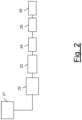
- the method comprises an embossing step 103 of the product provided by the oven 23 to obtain the nonwoven fabric according to the present invention.
- the embossing step 103 is performed by means of the embossing apparatus 24, which will be described below.
- the method can comprise a cooling step, between the bonding step 102 and the embossing step 103.
- the cooling step can be performed partly in the bonding apparatus.
- the oven of the bonding apparatus can comprise a cooling cylinder through which the bonded substrate is passed if said cooling step is envisaged.
- the system can comprise a cooling device such as, for example, a cooling suction belt configured to cool the bonded substrate by the passage of air at ambient temperature.
- the optional cooling apparatus can be configured to bring the bonded substrate to ambient temperature (for example, approximately 25°C) or to maintain the bonded substrate at a temperature higher than the ambient temperature by, for example, approximately 10°C.
- the cooling step allows control of the bonded substrate temperature before it undergoes the embossing step.
- maintaining the bonded substrate at the embossing apparatus inlet at a temperature higher than the ambient temperature constitutes a pre-heating which can facilitate the subsequent embossing step.
- the first roller 31 preferably comprises a cylinder made of a thermally conductive material.
- the material of the first roller 31 has thermal conductivity greater than 5 W ⁇ m -1 ⁇ K -1 .
- the material of the first roller 31 is made of metal or metal alloy, for example iron or steel.
- the first roller 31 preferably comprises, at the external surface thereof, an embossing artwork or pattern corresponding to a three-dimensional design to be imprinted on the nonwoven fabric.
- the embossing pattern is engraved on the first roller 31 in low relief, namely such that the nonwoven fabric is negatively embossed; in this case the contact points with the nonwoven fabric are defined by the contour of the pattern.
- the first roller 31 is preferably engraved in low relief with a percentage between 40% and 90%, more preferably between 60% and 80%.
- the engraving depth is preferably between approximately 0.5 mm and 2.5 mm.
- the first roller 31 has preferably a height between 3 m and 5 m, for example 3.7 m, and a diameter preferably between 20 cm and 120 cm, for example 50 cm.
- the first roller 31 is configured to perform also a perforation of the bonded substrate of the nonwoven fabric.
- the first roller 31 can comprise, on the external surface thereof, protuberances or positive reliefs with height between approximately 0.2 mm and approximately 4 mm in order to provide holes in the bonded substrate having variable dimension and shape, with density of the holes between 4 holes/cm 2 and 25 holes/cm 2 .
- the second roller 32 comprises, at the external surface thereof, a material having a lower hardness than the material of the first roller 31.
- the material of the second roller 32 (in particular, the material present at the external surface thereof) is a polymer material.
- the second roller 32 comprises a hollow cylinder, for example made of a metallic material, coated by a sheath comprising one or more layers of polymer material.
- the second roller 32 can comprise a solid cylinder made of a polymer material.
- the external surface of the second roller 32 is preferably smooth. Alternatively, it can comprise bristles.
- the polymer material is preferably selected from: rubber, EVA (ethylene vinyl acetate), TPU (thermoplastic polyurethane), TPE (thermoplastic elastomer), PTFE (polytetrafluoroethylene), D3O (elastomeric expansion polymer), or is a mixture of one or more of the above-mentioned materials (for example a mixture of rubber and EVA).
- the second roller 32 comprises a polymer material which has a hardness preferably between 35 and 75 on the Shore A scale, more preferably between 50 and 60.
- the presence of a sheath with several layers of different materials allows the characteristics of the second roller to be modified according to the process: for example, the second roller can be provided with an antifriction external layer, for example made of PTFE, to improve resistance to abrasion, particularly useful if the first roller comprises positive reliefs for providing holes in the bonded substrate.
- an antifriction external layer for example made of PTFE
- the second roller 32 preferably has a height between 3 m and 5 m, for example 3.7 m, and an overall diameter between 30 cm and 120 cm.
- the first roller 31 and the second roller 32 of the calender 24 rotate preferably at a speed between 80 m/min and 140 m/min.
- the pressure between the first roller 31 and the second roller 32 (namely, the pressure along the contact line, indicated also as crushing pressure or calendering pressure) can be between approximately 7.5 kN/m and approximately 100 kN/m, in particular between approximately 25 kN/m and approximately 70 kN/m.
- the first roller 31 is preferably heated so that its surface temperature (which corresponds to the temperature transferred to the bonded substrate from this embossing apparatus 24 during the embossing step 103, namely the embossing temperature Te) is lower than the bonding temperature Tc.
- the surface temperature of the first roller 31 is the temperature of the external surface of the roller.
- the difference between the bonding temperature Tc and the embossing temperature Te is between 10°C and 80°C, more preferably between 13°C and 45°C.
- Table 3 shows the embossing temperature Te (second column) and the calendering pressure (third column) for the example substrates mentioned above. Both for the embossing temperature and for the calendering pressure, possible value ranges are shown for the examples considered.
- Table 3 Substrate Temperature Te Pressure [kN/m] 1 115°C - 120°C 25 - 40 2 115°C - 120°C 25 - 40 3 120°C - 150°C 25 - 50 4 120°C - 150°C 25 - 50
- the first roller 31 can be heated by means of a diathermic oil circuit or by means of electric resistances (not shown in the drawings), which provide a constant temperature over the whole external surface of the first roller 31. Due to the thermal dissipation of the cylinder (which also depends on the embossing pattern engraved in it), the heating temperature of the diathermic oil is preferably set to a value higher than the desired value of the surface temperature of the first roller 31; for example, the value set for the heating temperature of the oil can be approximately 20°C higher than the desired surface temperature value to be reached.
- the second roller 32 is preferably at ambient temperature and can undergo induction heating by the first roller 31.
- the second roller 32 can be provided with an external cooling system, by means of air, or internal cooling system, by water, to counter the deterioration of the polymer material due to the heating thereof.
- the embossing temperature Te is lower than that obtained during the bonding with melting of the fibers.
- the embossing temperature Te is preferably selected so as not to re-induce a bonding effect in the nonwoven fabric substrate, namely so as not to induce new melting of the material of the fibers that would tend to stick together. This would cause a deterioration of the properties of the nonwoven fabric in terms of softness to touch and "visual" fluffiness.
- the embossing temperature Te is lower than the bonding temperature Tc and the melting temperature of the substrate fibers.
- the embossing temperature Te is lower than the bonding temperature Tc (200°C) but can be higher than the melting temperature of the bicomponent fibers of the blend. This depends on the other process parameters. In this case, in fact, given the conditions of the substrate considered (which has thick fibers at 4.4 dtex) and the speed of the line, the embossing temperature selected in the range indicated does not cause further bonding of the fibers.
- the second roller 32 having a lower hardness inferior than the first roller 31, allows transfer onto the substrate of the negative pattern engraved on the first roller 31, because it allows indentation and therefore penetration of the substrate by the first roller 31, which would not be possible if it were also made of metal or of equal hardness.
- the nonwoven fabric substrate undergoes two different thermal actions in which it is heated to a certain temperature transferred by convection by means of blowers into the oven 23 and then by conduction by means of cylinder pressure into the calender 24, and the temperature transfer occurs as a function of the feed rate of the substrate along the production line.
- the heating of the unbonded substrate during the bonding step allows the fibers to be bonded while the subsequent heating during the embossing step allows the material to be softened and deformed.
- the different process parameters can vary according to the thermal conductivity of the materials and the specific heat of the component fibers. For example, a material with a high specific heat can absorb a large quantity of heat without a significant increase in temperature. This means that, if a substrate has a high specific heat, it could take longer to heat up when exposed to a heat source, compared to a substrate with a low specific heat.
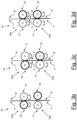
- Figures 3b, 3c and 3d show an embossing apparatus 24 according to other embodiments of the present invention, comprising a first calender 24a and a second calender 24b.
- Each calender comprises a first roller, engraved with an embossing pattern, and a second roller and is identical to the one described with reference to Figure 3a.
- the addition of a second calender means that the side on which to perform the embossing can be selected or embossing effects can be conferred to the bonded substrate on both sides.
- the embossing pattern of the rollers of the two calenders can be different, thus obtaining a nonwoven fabric embossed with different patterns on the two opposite sides.
- the second calender 24b is configured to carry out embossing on side B of the bonded substrate and is brought into contact with the bonded substrate (after passing through the calender 24b, the letter B' indicates the side of the nonwoven fabric on which the embossing pattern is imprinted, and the letter A' indicates the opposite side). According to these embodiments of the present invention, therefore, the embossing apparatus 24 can be configured to carry out alternate embossing of side A or side B of the bonded substrate.
- the embossed nonwoven fabric can be conveyed to the winding device 25, where it can be wound in rolls (step 104) with height up to 3.6 m and diameter up to 2.5 m.
- the winding device 25 can comprise winding rollers.
- the rolls can be conveyed to the cutting apparatus 26 (for example a cutter) where they can be cut, before transportation, according to customer requirements.
Landscapes
- Engineering & Computer Science (AREA)
- Textile Engineering (AREA)
- Treatment Of Fiber Materials (AREA)
Applications Claiming Priority (1)
| Application Number | Priority Date | Filing Date | Title |
|---|---|---|---|
| IT102023000028353A IT202300028353A1 (it) | 2023-12-29 | 2023-12-29 | Metodo per fornire un tessuto non tessuto goffrato |
Publications (1)
| Publication Number | Publication Date |
|---|---|
| EP4579019A1 true EP4579019A1 (de) | 2025-07-02 |
Family
ID=90363779
Family Applications (1)
| Application Number | Title | Priority Date | Filing Date |
|---|---|---|---|
| EP24222786.6A Pending EP4579019A1 (de) | 2023-12-29 | 2024-12-23 | Verfahren zur herstellung eines geprägten vliesstoffes |
Country Status (2)
| Country | Link |
|---|---|
| EP (1) | EP4579019A1 (de) |
| IT (1) | IT202300028353A1 (de) |
Citations (4)
| Publication number | Priority date | Publication date | Assignee | Title |
|---|---|---|---|---|
| WO2009083560A1 (en) * | 2007-12-28 | 2009-07-09 | Union Industries S.P.A. | Method for manufacturing perforated nonwoven fabrics |
| JP2011137249A (ja) | 2009-12-25 | 2011-07-14 | Kao Corp | 不織布の製造方法 |
| CN107201621A (zh) * | 2017-07-25 | 2017-09-26 | 昆山科立隆非织造布有限公司 | 3d压花无纺布高速成型设备及其成型工艺 |
| JP2020039518A (ja) | 2018-09-07 | 2020-03-19 | 花王株式会社 | 吸収性物品用凹凸不織布の製造方法 |
-
2023
- 2023-12-29 IT IT102023000028353A patent/IT202300028353A1/it unknown
-
2024
- 2024-12-23 EP EP24222786.6A patent/EP4579019A1/de active Pending
Patent Citations (4)
| Publication number | Priority date | Publication date | Assignee | Title |
|---|---|---|---|---|
| WO2009083560A1 (en) * | 2007-12-28 | 2009-07-09 | Union Industries S.P.A. | Method for manufacturing perforated nonwoven fabrics |
| JP2011137249A (ja) | 2009-12-25 | 2011-07-14 | Kao Corp | 不織布の製造方法 |
| CN107201621A (zh) * | 2017-07-25 | 2017-09-26 | 昆山科立隆非织造布有限公司 | 3d压花无纺布高速成型设备及其成型工艺 |
| JP2020039518A (ja) | 2018-09-07 | 2020-03-19 | 花王株式会社 | 吸収性物品用凹凸不織布の製造方法 |
Also Published As
| Publication number | Publication date |
|---|---|
| IT202300028353A1 (it) | 2025-06-29 |
Similar Documents
| Publication | Publication Date | Title |
|---|---|---|
| US9481954B2 (en) | Processing apparatus for hot-air treatment of fiber constituting nonwoven fabric to produce nonwoven fabric, and processing process for the same | |
| KR101194359B1 (ko) | 폴리에스테르계 부직포, 이의 제조 방법, 및 이를 포함하는 카페트 기포지 | |
| EP3555353B1 (de) | Hydraulisch behandelte vliesstoffe und verfahren zur herstellung davon | |
| BRPI0520319B1 (pt) | manta fibrosa com tufos, artigo absorvente descartável, manta multicamada com tufos, aparelho para formação de uma manta fibrosa de material e método para fabricação de uma manta com tufos | |
| KR102444372B1 (ko) | 기모 피혁풍 시트 및 그 제조 방법 | |
| CN103261503B (zh) | 无纺布及其制造方法和装置、以及无纺布制造用支承体 | |
| WO2018190342A1 (ja) | ニードルパンチ不織布の製造方法 | |
| KR20130035414A (ko) | 폴리에스테르계 부직포 및 그 제조 방법 | |
| JP5762091B2 (ja) | 伸縮性シートの製造方法 | |
| CN103946434A (zh) | 无纺布及其制造方法 | |
| EP2135984A1 (de) | Verfahren zur Herstellung eines weichen und absorbierenden Faservlieses | |
| US6136124A (en) | Process for producing a structured, voluminous nonwoven | |
| JP4744920B2 (ja) | 繊維シートの加工方法 | |
| TW201732107A (zh) | 親水性蓬鬆不織布 | |
| JP2007276285A (ja) | 凹凸模様を有する車輌の座席用表皮材及びその製造方法。 | |
| KR20140042379A (ko) | 폴리에스테르계 부직포, 그 제조 방법, 및 그것을 포함하는 카페트용 기포지 | |
| KR101970630B1 (ko) | 감성품질 향상을 위한 자동차 시트용 원단 합포방법 | |
| US20250066966A1 (en) | Multilayer fabric including a non-woven fabric | |
| JP7567478B2 (ja) | スパンボンド不織布及び積層不織布 | |
| KR20170001319A (ko) | 형태안정성이 향상된 부직포 및 이의 제조방법 | |
| TWI717037B (zh) | 抑制熱熔透印之不織布 | |
| WO2015056618A1 (ja) | 複合不織布 | |
| JPH1112912A (ja) | 2層フェルトの製造方法 | |
| IT202300028353A1 (it) | Metodo per fornire un tessuto non tessuto goffrato | |
| KR102163071B1 (ko) | 신율이 향상된 부직포 및 이의 제조방법 |
Legal Events
| Date | Code | Title | Description |
|---|---|---|---|
| PUAI | Public reference made under article 153(3) epc to a published international application that has entered the european phase |
Free format text: ORIGINAL CODE: 0009012 |
|
| STAA | Information on the status of an ep patent application or granted ep patent |
Free format text: STATUS: THE APPLICATION HAS BEEN PUBLISHED |
|
| AK | Designated contracting states |
Kind code of ref document: A1 Designated state(s): AL AT BE BG CH CY CZ DE DK EE ES FI FR GB GR HR HU IE IS IT LI LT LU LV MC ME MK MT NL NO PL PT RO RS SE SI SK SM TR |
|
| STAA | Information on the status of an ep patent application or granted ep patent |
Free format text: STATUS: REQUEST FOR EXAMINATION WAS MADE |
|
| STAA | Information on the status of an ep patent application or granted ep patent |
Free format text: STATUS: EXAMINATION IS IN PROGRESS |
|
| 17P | Request for examination filed |
Effective date: 20251222 |
|
| 17Q | First examination report despatched |
Effective date: 20260113 |