EP4577012A1 - Solar cell element coating composition, and solar cell module and production method therefor - Google Patents
Solar cell element coating composition, and solar cell module and production method therefor Download PDFInfo
- Publication number
- EP4577012A1 EP4577012A1 EP23854795.4A EP23854795A EP4577012A1 EP 4577012 A1 EP4577012 A1 EP 4577012A1 EP 23854795 A EP23854795 A EP 23854795A EP 4577012 A1 EP4577012 A1 EP 4577012A1
- Authority
- EP
- European Patent Office
- Prior art keywords
- solar cell
- cell element
- coating composition
- sio
- group
- Prior art date
- Legal status (The legal status is an assumption and is not a legal conclusion. Google has not performed a legal analysis and makes no representation as to the accuracy of the status listed.)
- Pending
Links
Images
Classifications
-
- C—CHEMISTRY; METALLURGY
- C09—DYES; PAINTS; POLISHES; NATURAL RESINS; ADHESIVES; COMPOSITIONS NOT OTHERWISE PROVIDED FOR; APPLICATIONS OF MATERIALS NOT OTHERWISE PROVIDED FOR
- C09D—COATING COMPOSITIONS, e.g. PAINTS, VARNISHES OR LACQUERS; FILLING PASTES; CHEMICAL PAINT OR INK REMOVERS; INKS; CORRECTING FLUIDS; WOODSTAINS; PASTES OR SOLIDS FOR COLOURING OR PRINTING; USE OF MATERIALS THEREFOR
- C09D5/00—Coating compositions, e.g. paints, varnishes or lacquers, characterised by their physical nature or the effects produced; Filling pastes
-
- C—CHEMISTRY; METALLURGY
- C08—ORGANIC MACROMOLECULAR COMPOUNDS; THEIR PREPARATION OR CHEMICAL WORKING-UP; COMPOSITIONS BASED THEREON
- C08G—MACROMOLECULAR COMPOUNDS OBTAINED OTHERWISE THAN BY REACTIONS ONLY INVOLVING UNSATURATED CARBON-TO-CARBON BONDS
- C08G77/00—Macromolecular compounds obtained by reactions forming a linkage containing silicon with or without sulfur, nitrogen, oxygen or carbon in the main chain of the macromolecule
- C08G77/70—Siloxanes defined by use of the MDTQ nomenclature
-
- C—CHEMISTRY; METALLURGY
- C08—ORGANIC MACROMOLECULAR COMPOUNDS; THEIR PREPARATION OR CHEMICAL WORKING-UP; COMPOSITIONS BASED THEREON
- C08K—Use of inorganic or non-macromolecular organic substances as compounding ingredients
- C08K5/00—Use of organic ingredients
- C08K5/56—Organo-metallic compounds, i.e. organic compounds containing a metal-to-carbon bond
-
- C—CHEMISTRY; METALLURGY
- C09—DYES; PAINTS; POLISHES; NATURAL RESINS; ADHESIVES; COMPOSITIONS NOT OTHERWISE PROVIDED FOR; APPLICATIONS OF MATERIALS NOT OTHERWISE PROVIDED FOR
- C09D—COATING COMPOSITIONS, e.g. PAINTS, VARNISHES OR LACQUERS; FILLING PASTES; CHEMICAL PAINT OR INK REMOVERS; INKS; CORRECTING FLUIDS; WOODSTAINS; PASTES OR SOLIDS FOR COLOURING OR PRINTING; USE OF MATERIALS THEREFOR
- C09D183/00—Coating compositions based on macromolecular compounds obtained by reactions forming in the main chain of the macromolecule a linkage containing silicon, with or without sulfur, nitrogen, oxygen, or carbon only; Coating compositions based on derivatives of such polymers
- C09D183/04—Polysiloxanes
-
- C—CHEMISTRY; METALLURGY
- C09—DYES; PAINTS; POLISHES; NATURAL RESINS; ADHESIVES; COMPOSITIONS NOT OTHERWISE PROVIDED FOR; APPLICATIONS OF MATERIALS NOT OTHERWISE PROVIDED FOR
- C09D—COATING COMPOSITIONS, e.g. PAINTS, VARNISHES OR LACQUERS; FILLING PASTES; CHEMICAL PAINT OR INK REMOVERS; INKS; CORRECTING FLUIDS; WOODSTAINS; PASTES OR SOLIDS FOR COLOURING OR PRINTING; USE OF MATERIALS THEREFOR
- C09D7/00—Features of coating compositions, not provided for in group C09D5/00; Processes for incorporating ingredients in coating compositions
- C09D7/40—Additives
- C09D7/60—Additives non-macromolecular
- C09D7/63—Additives non-macromolecular organic
-
- H—ELECTRICITY
- H10—SEMICONDUCTOR DEVICES; ELECTRIC SOLID-STATE DEVICES NOT OTHERWISE PROVIDED FOR
- H10K—ORGANIC ELECTRIC SOLID-STATE DEVICES
- H10K30/00—Organic devices sensitive to infrared radiation, light, electromagnetic radiation of shorter wavelength or corpuscular radiation
- H10K30/80—Constructional details
- H10K30/88—Passivation; Containers; Encapsulations
-
- H—ELECTRICITY
- H10—SEMICONDUCTOR DEVICES; ELECTRIC SOLID-STATE DEVICES NOT OTHERWISE PROVIDED FOR
- H10K—ORGANIC ELECTRIC SOLID-STATE DEVICES
- H10K71/00—Manufacture or treatment specially adapted for the organic devices covered by this subclass
- H10K71/40—Thermal treatment, e.g. annealing in the presence of a solvent vapour
-
- H—ELECTRICITY
- H10—SEMICONDUCTOR DEVICES; ELECTRIC SOLID-STATE DEVICES NOT OTHERWISE PROVIDED FOR
- H10K—ORGANIC ELECTRIC SOLID-STATE DEVICES
- H10K71/00—Manufacture or treatment specially adapted for the organic devices covered by this subclass
- H10K71/811—Controlling the atmosphere during processing
-
- C—CHEMISTRY; METALLURGY
- C08—ORGANIC MACROMOLECULAR COMPOUNDS; THEIR PREPARATION OR CHEMICAL WORKING-UP; COMPOSITIONS BASED THEREON
- C08G—MACROMOLECULAR COMPOUNDS OBTAINED OTHERWISE THAN BY REACTIONS ONLY INVOLVING UNSATURATED CARBON-TO-CARBON BONDS
- C08G77/00—Macromolecular compounds obtained by reactions forming a linkage containing silicon with or without sulfur, nitrogen, oxygen or carbon in the main chain of the macromolecule
- C08G77/04—Polysiloxanes
- C08G77/12—Polysiloxanes containing silicon bound to hydrogen
-
- C—CHEMISTRY; METALLURGY
- C08—ORGANIC MACROMOLECULAR COMPOUNDS; THEIR PREPARATION OR CHEMICAL WORKING-UP; COMPOSITIONS BASED THEREON
- C08G—MACROMOLECULAR COMPOUNDS OBTAINED OTHERWISE THAN BY REACTIONS ONLY INVOLVING UNSATURATED CARBON-TO-CARBON BONDS
- C08G77/00—Macromolecular compounds obtained by reactions forming a linkage containing silicon with or without sulfur, nitrogen, oxygen or carbon in the main chain of the macromolecule
- C08G77/04—Polysiloxanes
- C08G77/20—Polysiloxanes containing silicon bound to unsaturated aliphatic groups
-
- C—CHEMISTRY; METALLURGY
- C08—ORGANIC MACROMOLECULAR COMPOUNDS; THEIR PREPARATION OR CHEMICAL WORKING-UP; COMPOSITIONS BASED THEREON
- C08K—Use of inorganic or non-macromolecular organic substances as compounding ingredients
- C08K5/00—Use of organic ingredients
- C08K5/54—Silicon-containing compounds
- C08K5/541—Silicon-containing compounds containing oxygen
- C08K5/5415—Silicon-containing compounds containing oxygen containing at least one Si—O bond
- C08K5/5419—Silicon-containing compounds containing oxygen containing at least one Si—O bond containing at least one Si—C bond
-
- C—CHEMISTRY; METALLURGY
- C08—ORGANIC MACROMOLECULAR COMPOUNDS; THEIR PREPARATION OR CHEMICAL WORKING-UP; COMPOSITIONS BASED THEREON
- C08K—Use of inorganic or non-macromolecular organic substances as compounding ingredients
- C08K5/00—Use of organic ingredients
- C08K5/54—Silicon-containing compounds
- C08K5/549—Silicon-containing compounds containing silicon in a ring
-
- H—ELECTRICITY
- H10—SEMICONDUCTOR DEVICES; ELECTRIC SOLID-STATE DEVICES NOT OTHERWISE PROVIDED FOR
- H10K—ORGANIC ELECTRIC SOLID-STATE DEVICES
- H10K30/00—Organic devices sensitive to infrared radiation, light, electromagnetic radiation of shorter wavelength or corpuscular radiation
- H10K30/40—Organic devices sensitive to infrared radiation, light, electromagnetic radiation of shorter wavelength or corpuscular radiation comprising a p-i-n structure, e.g. having a perovskite absorber between p-type and n-type charge transport layers
-
- H—ELECTRICITY
- H10—SEMICONDUCTOR DEVICES; ELECTRIC SOLID-STATE DEVICES NOT OTHERWISE PROVIDED FOR
- H10K—ORGANIC ELECTRIC SOLID-STATE DEVICES
- H10K30/00—Organic devices sensitive to infrared radiation, light, electromagnetic radiation of shorter wavelength or corpuscular radiation
- H10K30/50—Photovoltaic [PV] devices
-
- H—ELECTRICITY
- H10—SEMICONDUCTOR DEVICES; ELECTRIC SOLID-STATE DEVICES NOT OTHERWISE PROVIDED FOR
- H10K—ORGANIC ELECTRIC SOLID-STATE DEVICES
- H10K85/00—Organic materials used in the body or electrodes of devices covered by this subclass
- H10K85/50—Organic perovskites; Hybrid organic-inorganic perovskites [HOIP], e.g. CH3NH3PbI3
-
- Y—GENERAL TAGGING OF NEW TECHNOLOGICAL DEVELOPMENTS; GENERAL TAGGING OF CROSS-SECTIONAL TECHNOLOGIES SPANNING OVER SEVERAL SECTIONS OF THE IPC; TECHNICAL SUBJECTS COVERED BY FORMER USPC CROSS-REFERENCE ART COLLECTIONS [XRACs] AND DIGESTS
- Y02—TECHNOLOGIES OR APPLICATIONS FOR MITIGATION OR ADAPTATION AGAINST CLIMATE CHANGE
- Y02E—REDUCTION OF GREENHOUSE GAS [GHG] EMISSIONS, RELATED TO ENERGY GENERATION, TRANSMISSION OR DISTRIBUTION
- Y02E10/00—Energy generation through renewable energy sources
- Y02E10/50—Photovoltaic [PV] energy
- Y02E10/549—Organic PV cells
Definitions
- the present invention relates to a solar cell element coating composition and to a solar cell module and a method of production.
- perovskite solar cells that are both low-cost and highly efficient.
- perovskite solar cells can be inexpensively manufactured and have a high energy conversion efficiency.
- a perovskite solar cell element can be obtained by arranging, as successive layers from the light-receiving side: a light-transmitting substrate or light-transmitting film, a transparent conductive film, an electron-transporting layer, a power-generating layer, a hole-transporting layer and a back electrode.
- a light-transmitting substrate or light-transmitting film a transparent conductive film
- an electron-transporting layer a power-generating layer
- a hole-transporting layer and a back electrode.
- perovskite compounds are sensitive to water vapor and that solar cells are exposed outdoors for a long time to a harsh environment, there exists a desire for perovskite solar cell modules to shut out water vapor to a high degree.
- Patent Document 1 discloses art relating to a three-layer barrier coat that includes silicon, oxygen and carbon. It forms a water-vapor barrier film having flexibility and mechanical strength by means of plasma chemical vapor deposition (CVD).
- CVD plasma chemical vapor deposition
- plasma CVD forms the film under a vacuum in a CVD unit. Because this requires the device to be placed within a vacuum chamber and treatment to be carried out in a vacuum environment, increasing the size of the device is difficult.
- vacuum processes and processes open to the atmosphere are both involved, and so process complexity and cost increases are unavoidable.
- Patent Document 2 discloses art which forms a ZnO-SiO 2 -Al 2 O film by a direct-current (DC) sputtering process.
- DC sputtering also requires a vacuum environment and thus poses similar challenges in terms of process complexity.
- the object of the invention is to provide a solar cell element coating composition which, in organic thin-film solar cells, perovskite solar cells and the like, can be coated directly onto a solar cell element and cured under atmospheric pressure to form a protective film having high water-vapor barrier properties.
- the inventors have conducted intensive investigations aimed at achieving the above objects. As a result, they have discovered that the solar cell element coating composition described below can be coated directly onto a solar cell element and cures under atmospheric pressure, providing a protective film having high water-vapor barrier properties.
- the invention provides:
- the solar cell element coating composition of the invention can be applied directly onto a solar cell element and, when cured under atmospheric pressure, gives a cured product having high water-vapor barrier properties.
- the solar cell element coating composition of the invention having such properties is useful as a protective film in organic thin-film solar cells and perovskite solar cells.
- Component (A) in the solar cell element coating composition of the invention is an organopolysiloxane represented by the following average unit formula (1). (R 1 R 3 2 SiO 1/2 ) 2 (Ar 2 SiO 2/2 ) a (R 2 2 SiO 2/2 ) b (1)
- each R 1 is independently an alkenyl group
- each R 2 is independently a substituted or unsubstituted monovalent saturated hydrocarbon group
- each R 3 is independently a substituted or unsubstituted monovalent saturated hydrocarbon group or a substituted or unsubstituted aryl group
- each Ar is independently a substituted or unsubstituted aryl group.
- the alkenyl groups of R 1 are ones having preferably from 2 to 10 carbon atoms, and more preferably from 2 to 6 carbon atoms. Specific examples include vinyl, allyl, butenyl, pentenyl and hexenyl groups. Vinyl groups are especially preferred.
- the monovalent saturated hydrocarbon groups of R 2 are ones having preferably from 1 to 12 carbon atoms, more preferably from 1 to 6 carbon atoms, and even more preferably from 1 to 3 carbon atoms. They may be linear, branched or cyclic. Specific examples include linear or branched alkyl groups such as methyl, ethyl, n-propyl, isopropyl, n-butyl, sec-butyl, tert-butyl, n-pentyl, n-hexyl and n-heptyl groups; and cycloalkyl groups such as the cyclohexyl group.
- Some or all hydrogen atoms on these groups may be substituted with halogen atoms such as chlorine, fluorine or bromine.
- halogen atoms such as chlorine, fluorine or bromine.
- Specific examples include halogenated alkyl groups such as chloromethyl, 3-chloropropyl and 3,3,3-trifluoropropyl groups.
- the monovalent saturated hydrocarbon groups of R 3 are ones having preferably from 1 to 12 carbon atoms, more preferably from 1 to 6 carbon atoms, and even more preferably from 1 to 3 carbon atoms. They may be linear, branched or cyclic. Specific examples include the same groups as those mentioned for R 2 .
- the aryl groups of R 3 are ones having preferably from 6 to 20 carbon atoms, and more preferably from 6 to 10 carbon atoms. Specific examples include phenyl, naphthyl, tolyl, xylyl and mesityl groups. Some or all of the hydrogen atoms on these groups may be substituted with halogen atoms such as chlorine, fluorine or bromine. Examples include halogen-substituted aryl groups such as the chlorophenyl group.
- the aryl groups of Ar are ones having preferably from 6 to 20 carbon atoms, and more preferably from 6 to 10 carbon atoms. Specific examples include the same groups as those mentioned for R 3 . Phenyl groups are preferred.
- the methyl group content is preferably from 20 to 99 mol%, more preferably from 40 to 97 mol%, and even more preferably from 60 to 95 mol%. Within such a range, a cured product of excellent heat resistance can be obtained.
- the subscript 'a' is an integer from 1 to 100, preferably an integer from 1 to 50, and more preferably an integer from 20 to 40.
- the subscript 'b' is an integer from 0 to 1,000, preferably an integer from 1 to 1,000, more preferably an integer from 1 to 500, and even more preferably an integer from 100 to 400.
- a/(a+b) is a number from 0.01 to 1.0, preferably a number from 0.01 to 0.4, and more preferably a number from 0.05 to 0.3.
- the molecular weight of component (A) is not particularly limited, although the standard polystyrene-equivalent weight-average molecular weight (Mw) measured by gel permeation chromatography (GPC) using tetrahydrofuran (THF) as the solvent is preferably from 500 to 100,000, more preferably from 700 to 50,000, and even more preferably from 1,000 to 30,000.
- component (A) examples include, but are not limited to, those represented by the following formulas. In the formulas below and elsewhere in this Specification, “Me” stands for a methyl group, “Ph” stands for a phenyl group, and “Vi” stands for a vinyl group. Component (A) may be of one type used alone or two or more may be used in combination.
- silane compound may also be used as component (B).
- the kinematic viscosity of component (iii) is not particularly limited, although the kinematic viscosity as measured with an Ostwald viscometer at 23°C is preferably from 0.1 to 100,000 mm 2 /s, and more preferably from 0.5 to 500 mm 2 /s.
- Component (B) of the invention may be of one type used alone or two or more may be used in combination.
- the platinum group metal catalyst for component (C) hydrosilylation which is a catalyst for promoting hydrosilylation between addition-reactive carbon-carbon double bonds in component (A) and silicon-bonded hydrogen atoms in component (B), is inert when shielded from light and changes to an active platinum catalyst when irradiated with light having a wavelength of between 200 and 500 nm.
- Bis( ⁇ -diketonato)platinum compounds are also suitable examples of component (C). Of these, bis(acetylacetonato)platinum compounds and derivatives in which these acetylacetonato groups have been modified are especially suitable.
- the amount of component (C) included in the composition is not particularly limited so long as it is an amount that promotes curing (hydrosilylation) of the composition, although the amount of platinum group metal atoms in this component, expressed in terms of weight units relative to the sum of the weights of components (A) and (B) in the composition, is preferably from 0.01 to 500 ppm, more preferably from 0.05 to 100 ppm, and even more preferably from 0.01 to 50 ppm.
- Component (C) may be of one type used alone or two or more may be used in combination.
- 1-ethynylcyclohexanol ethynylmethyldecylcarbinol
- 3-methyl-1-butyn-3-ol and bis(2,2-dimethyl-3-butynoxy)dimethylsilane are preferred.
- component (D) When component (D) is included, the content thereof per 100 parts by weight of components (A) and (B) combined is preferably from 0.01 to 2.0 parts by weight, and more preferably from 0.01 to 0.1 part by weight. Within such a range, reaction regulating effects are fully exhibited.
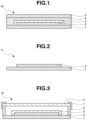
- FIG. 1 shows an example of a perovskite solar cell module according to an embodiment of the invention.
- Water white glass, soda-lime glass or the like may be used as the back-side substrate 5.
- Examples of the back-side film 5 include films in which water vapor transmission is controlled, such as laminated films combining a fluoroplastic film with a polyethylene terephthalate (PET) film, laminated films combining a metal thin-film with a PET film, and films composed of a thin metal layer vapor-deposited on a polyethylene naphthalate (PEN) film or the like.
- films in which water vapor transmission is controlled such as laminated films combining a fluoroplastic film with a polyethylene terephthalate (PET) film, laminated films combining a metal thin-film with a PET film, and films composed of a thin metal layer vapor-deposited on a polyethylene naphthalate (PEN) film or the like.
- PET polyethylene terephthalate
- PEN polyethylene naphthalate
- the resulting solar cell module is a see-through type, enabling the range of application to be expanded.
- activation of the platinum group metal catalyst is carried out by irradiating light having a wavelength of between 200 and 500 nm, preferably between 200 to 370 nm.
- a UV-LED lamp, metal halide lamp, mercury vapor lamp or the like may be used for light irradiation.
- the irradiation intensity is preferably from 30 to 2,000 mW/cm 2 and the irradiation dose is preferably from 3,000 to 100,000 mJ/cm 2 .
- the temperature at the time of irradiation is not particularly limited, so long as it is a temperature that does not adversely affect the solar cell element.
- the temperature is preferably between 10°C and 60°C, and more preferably between 20°C and 40°C.
- Solar cell element coating compositions were prepared by mixing together components (A) to (D) below in the amounts (parts by weight) shown in Table 1.
- solar cell modules were produced in the following manner.
- a fluoropolymer pressure-sensitive tape (thickness, 0.25 mm; 3 mm wide ⁇ 3 mm; from Chukyo Chemical Industries, Ltd.) was provided as a dam material 6 on the outer periphery of the light-receiving-side light-transmitting substrate 1.
- the solar cell element coating composition was subsequently applied to a thickness of 0.1 mm onto the perovskite solar cell element 2.
- Examples 1-1 to 1-5 after applying the solar cell element coating composition onto the perovskite solar cell element 2, the composition was irradiated from above with ultraviolet light at 25°C using a metal halide lamp (HANDY UV-100, from ORC Manufacturing Co., Ltd.) at a UV intensity of 100 mW/cm 2 and to a cumulative dose of 3,000 mJ/cm 2 . This was followed by 1 hour of heating at 60°C, curing the solar cell element coating composition and thus giving a water-vapor barrier layer 3.
- HANDY UV-100 from ORC Manufacturing Co., Ltd.
- a glass substrate (size, 50 ⁇ 50 mm; thickness, 3.2 mm) as the back-side substrate 5 was placed on top of the dam material 6, and the back surface was secured with polyimide tape 7 so as to hold the back-side substrate 5 in place, giving a sample perovskite solar cell module 12.
- the solar cell element coating composition was applied on top of the perovskite solar cell element 2 and subsequently heated for 1 hour at 100°C, thereby curing the solar cell element coating composition.
- a glass substrate (size, 50 ⁇ 50 mm; thickness, 3.2 mm) as the back-side substrate 5 was placed on top of the dam material 6, and the back surface was secured with polyimide tape 7 so as to hold the back-side substrate 5 in place, giving a sample perovskite solar cell module 12.
- the initial output retention (%) was computed from the output (W 1 ) of the sample perovskite solar cell module 12 and the output (W c ) of the sample perovskite solar cell 11 prior to modularization. Cases in which the initial output retention was 95% or more were rated as " ⁇ "; cases in which it was less than 95% were rated as " ⁇ .” The results are shown in Table 2.
- Initial output retention % W 1 / W c ⁇ 100
- perovskite solar cells having a water-vapor barrier layer made of the cured form of the solar cell element coating compositions of Examples 1-1 to 1-5 exhibit good output retentions even when exposed for 500 hours to a 60°C, 90% RH environment.
Landscapes
- Chemical & Material Sciences (AREA)
- Organic Chemistry (AREA)
- Chemical Kinetics & Catalysis (AREA)
- Engineering & Computer Science (AREA)
- Health & Medical Sciences (AREA)
- Medicinal Chemistry (AREA)
- Polymers & Plastics (AREA)
- Electromagnetism (AREA)
- Physics & Mathematics (AREA)
- Life Sciences & Earth Sciences (AREA)
- Materials Engineering (AREA)
- Wood Science & Technology (AREA)
- Manufacturing & Machinery (AREA)
- Paints Or Removers (AREA)
- Photovoltaic Devices (AREA)
Applications Claiming Priority (2)
| Application Number | Priority Date | Filing Date | Title |
|---|---|---|---|
| JP2022129649 | 2022-08-16 | ||
| PCT/JP2023/028087 WO2024038760A1 (ja) | 2022-08-16 | 2023-08-01 | 太陽電池素子コーティング組成物ならびに太陽電池モジュールおよびその製造方法 |
Publications (1)
| Publication Number | Publication Date |
|---|---|
| EP4577012A1 true EP4577012A1 (en) | 2025-06-25 |
Family
ID=89941560
Family Applications (1)
| Application Number | Title | Priority Date | Filing Date |
|---|---|---|---|
| EP23854795.4A Pending EP4577012A1 (en) | 2022-08-16 | 2023-08-01 | Solar cell element coating composition, and solar cell module and production method therefor |
Country Status (6)
| Country | Link |
|---|---|
| US (1) | US20260047263A1 (https=) |
| EP (1) | EP4577012A1 (https=) |
| JP (1) | JPWO2024038760A1 (https=) |
| KR (1) | KR20250050935A (https=) |
| CN (1) | CN119732211A (https=) |
| WO (1) | WO2024038760A1 (https=) |
Family Cites Families (6)
| Publication number | Priority date | Publication date | Assignee | Title |
|---|---|---|---|---|
| WO2007120905A2 (en) * | 2006-04-18 | 2007-10-25 | Dow Corning Corporation | Cadmium telluride-based photovoltaic device and method of preparing the same |
| EP2530741B1 (en) * | 2010-01-25 | 2018-07-25 | LG Chem, Ltd. | Photovoltaic module |
| WO2011107592A1 (en) * | 2010-03-05 | 2011-09-09 | Momentive Performance Materials Gmbh | Curable polyorganosiloxane composition for use as an encapsulant for a solar cell module |
| JP5776563B2 (ja) | 2012-01-20 | 2015-09-09 | 三菱マテリアル株式会社 | 透明膜およびその製造方法並びに透明膜形成用スパッタリングターゲット |
| JP5837474B2 (ja) * | 2012-10-18 | 2015-12-24 | 信越化学工業株式会社 | 太陽電池モジュールの製造方法 |
| JP2014100806A (ja) | 2012-11-16 | 2014-06-05 | Konica Minolta Inc | ガスバリア性フィルムおよびその製造方法 |
-
2023
- 2023-08-01 CN CN202380059785.7A patent/CN119732211A/zh active Pending
- 2023-08-01 EP EP23854795.4A patent/EP4577012A1/en active Pending
- 2023-08-01 WO PCT/JP2023/028087 patent/WO2024038760A1/ja not_active Ceased
- 2023-08-01 JP JP2024541486A patent/JPWO2024038760A1/ja active Pending
- 2023-08-01 KR KR1020257008055A patent/KR20250050935A/ko active Pending
- 2023-08-01 US US19/101,829 patent/US20260047263A1/en active Pending
Also Published As
| Publication number | Publication date |
|---|---|
| JPWO2024038760A1 (https=) | 2024-02-22 |
| WO2024038760A1 (ja) | 2024-02-22 |
| KR20250050935A (ko) | 2025-04-15 |
| CN119732211A (zh) | 2025-03-28 |
| US20260047263A1 (en) | 2026-02-12 |
Similar Documents
| Publication | Publication Date | Title |
|---|---|---|
| US9991406B2 (en) | Curable polyorganosiloxane composition for use as an encapsulant for a solar cell module | |
| EP2324079B1 (en) | Curable organopolysiloxane composition, optical semiconductor element sealant, and optical semiconductor device | |
| TW201411868A (zh) | 太陽能電池模組之製造方法 | |
| KR20100124812A (ko) | 광전지 모듈과 이를 형성하는 방법 | |
| EP2530741B1 (en) | Photovoltaic module | |
| EP2352794A1 (en) | Curable organopolysiloxane composition, optical semiconductor element sealant, and optical semiconductor device | |
| TWI575768B (zh) | Method for manufacturing solar cell module | |
| EP2530740B1 (en) | Photovoltaic module | |
| CN112752822A (zh) | 紫外线固化型有机硅粘接剂组合物和层叠体的制造方法 | |
| EP3919567A1 (en) | Ultraviolet ray-curable silicone adhesive agent composition, and method for producing laminate | |
| JP5983549B2 (ja) | 太陽電池モジュールの製造方法 | |
| TW202335110A (zh) | 太陽能電池模組及其製造方法、以及太陽能電池密封材料 | |
| CN116348556A (zh) | 紫外线固化性聚有机硅氧烷组合物及其用途 | |
| EP2530732B1 (en) | Sheet for photovoltaic cells | |
| EP4577012A1 (en) | Solar cell element coating composition, and solar cell module and production method therefor | |
| TWI578559B (zh) | Method for manufacturing solar cell module | |
| JP7697363B2 (ja) | 太陽電池モジュール | |
| JP2013112719A (ja) | 太陽電池封止用シリコーン組成物 | |
| JP6070527B2 (ja) | 太陽電池モジュールの製造方法 | |
| WO2014061318A1 (ja) | 太陽電池セル封止用シリコーンゲル組成物及び太陽電池モジュール |
Legal Events
| Date | Code | Title | Description |
|---|---|---|---|
| STAA | Information on the status of an ep patent application or granted ep patent |
Free format text: STATUS: THE INTERNATIONAL PUBLICATION HAS BEEN MADE |
|
| PUAI | Public reference made under article 153(3) epc to a published international application that has entered the european phase |
Free format text: ORIGINAL CODE: 0009012 |
|
| STAA | Information on the status of an ep patent application or granted ep patent |
Free format text: STATUS: REQUEST FOR EXAMINATION WAS MADE |
|
| 17P | Request for examination filed |
Effective date: 20250314 |
|
| AK | Designated contracting states |
Kind code of ref document: A1 Designated state(s): AL AT BE BG CH CY CZ DE DK EE ES FI FR GB GR HR HU IE IS IT LI LT LU LV MC ME MK MT NL NO PL PT RO RS SE SI SK SM TR |
|
| DAV | Request for validation of the european patent (deleted) | ||
| DAX | Request for extension of the european patent (deleted) |