EP4576249A1 - Negativelektrodenfolie, sekundärbatterie und elektronische vorrichtung - Google Patents
Negativelektrodenfolie, sekundärbatterie und elektronische vorrichtung Download PDFInfo
- Publication number
- EP4576249A1 EP4576249A1 EP22956806.8A EP22956806A EP4576249A1 EP 4576249 A1 EP4576249 A1 EP 4576249A1 EP 22956806 A EP22956806 A EP 22956806A EP 4576249 A1 EP4576249 A1 EP 4576249A1
- Authority
- EP
- European Patent Office
- Prior art keywords
- negative electrode
- active material
- electrode active
- secondary battery
- satisfies
- Prior art date
- Legal status (The legal status is an assumption and is not a legal conclusion. Google has not performed a legal analysis and makes no representation as to the accuracy of the status listed.)
- Pending
Links
Images
Classifications
-
- H—ELECTRICITY
- H01—ELECTRIC ELEMENTS
- H01M—PROCESSES OR MEANS, e.g. BATTERIES, FOR THE DIRECT CONVERSION OF CHEMICAL ENERGY INTO ELECTRICAL ENERGY
- H01M4/00—Electrodes
- H01M4/02—Electrodes composed of, or comprising, active material
- H01M4/13—Electrodes for accumulators with non-aqueous electrolyte, e.g. for lithium-accumulators; Processes of manufacture thereof
- H01M4/133—Electrodes based on carbonaceous material, e.g. graphite-intercalation compounds or CFx
-
- H—ELECTRICITY
- H01—ELECTRIC ELEMENTS
- H01M—PROCESSES OR MEANS, e.g. BATTERIES, FOR THE DIRECT CONVERSION OF CHEMICAL ENERGY INTO ELECTRICAL ENERGY
- H01M4/00—Electrodes
- H01M4/02—Electrodes composed of, or comprising, active material
- H01M4/36—Selection of substances as active materials, active masses, active liquids
- H01M4/58—Selection of substances as active materials, active masses, active liquids of inorganic compounds other than oxides or hydroxides, e.g. sulfides, selenides, tellurides, halogenides or LiCoFy; of polyanionic structures, e.g. phosphates, silicates or borates
- H01M4/583—Carbonaceous material, e.g. graphite-intercalation compounds or CFx
- H01M4/587—Carbonaceous material, e.g. graphite-intercalation compounds or CFx for inserting or intercalating light metals
-
- H—ELECTRICITY
- H01—ELECTRIC ELEMENTS
- H01M—PROCESSES OR MEANS, e.g. BATTERIES, FOR THE DIRECT CONVERSION OF CHEMICAL ENERGY INTO ELECTRICAL ENERGY
- H01M10/00—Secondary cells; Manufacture thereof
- H01M10/05—Accumulators with non-aqueous electrolyte
- H01M10/052—Li-accumulators
- H01M10/0525—Rocking-chair batteries, i.e. batteries with lithium insertion or intercalation in both electrodes; Lithium-ion batteries
-
- H—ELECTRICITY
- H01—ELECTRIC ELEMENTS
- H01M—PROCESSES OR MEANS, e.g. BATTERIES, FOR THE DIRECT CONVERSION OF CHEMICAL ENERGY INTO ELECTRICAL ENERGY
- H01M4/00—Electrodes
- H01M4/02—Electrodes composed of, or comprising, active material
- H01M2004/021—Physical characteristics, e.g. porosity, surface area
-
- H—ELECTRICITY
- H01—ELECTRIC ELEMENTS
- H01M—PROCESSES OR MEANS, e.g. BATTERIES, FOR THE DIRECT CONVERSION OF CHEMICAL ENERGY INTO ELECTRICAL ENERGY
- H01M4/00—Electrodes
- H01M4/02—Electrodes composed of, or comprising, active material
- H01M2004/026—Electrodes composed of, or comprising, active material characterised by the polarity
- H01M2004/027—Negative electrodes
-
- H—ELECTRICITY
- H01—ELECTRIC ELEMENTS
- H01M—PROCESSES OR MEANS, e.g. BATTERIES, FOR THE DIRECT CONVERSION OF CHEMICAL ENERGY INTO ELECTRICAL ENERGY
- H01M4/00—Electrodes
- H01M4/02—Electrodes composed of, or comprising, active material
- H01M4/36—Selection of substances as active materials, active masses, active liquids
- H01M4/58—Selection of substances as active materials, active masses, active liquids of inorganic compounds other than oxides or hydroxides, e.g. sulfides, selenides, tellurides, halogenides or LiCoFy; of polyanionic structures, e.g. phosphates, silicates or borates
- H01M4/5825—Oxygenated metallic salts or polyanionic structures, e.g. borates, phosphates, silicates, olivines
-
- Y—GENERAL TAGGING OF NEW TECHNOLOGICAL DEVELOPMENTS; GENERAL TAGGING OF CROSS-SECTIONAL TECHNOLOGIES SPANNING OVER SEVERAL SECTIONS OF THE IPC; TECHNICAL SUBJECTS COVERED BY FORMER USPC CROSS-REFERENCE ART COLLECTIONS [XRACs] AND DIGESTS
- Y02—TECHNOLOGIES OR APPLICATIONS FOR MITIGATION OR ADAPTATION AGAINST CLIMATE CHANGE
- Y02E—REDUCTION OF GREENHOUSE GAS [GHG] EMISSIONS, RELATED TO ENERGY GENERATION, TRANSMISSION OR DISTRIBUTION
- Y02E60/00—Enabling technologies; Technologies with a potential or indirect contribution to GHG emissions mitigation
- Y02E60/10—Energy storage using batteries
Definitions
- This application relates to the field of energy storage, and in particular, to a negative electrode plate, a secondary battery, and an electronic apparatus.
- a secondary battery needs to have high performance, for example, a high discharge rate, at low temperatures.
- a lithium intercalation path of active ions is shortened mainly by reducing a particle size of an active material, and rate performance at low temperatures is improved mainly through modification by coating.
- these two methods lead to great loss of compacted density, gram capacity, and the like of a negative electrode active material, as well as high costs.
- this application provides a negative electrode plate and a secondary battery including the negative electrode plate.
- the negative electrode plate of this application has excellent kinetic performance, and can effectively improve charge and discharge performance of a secondary battery at low temperatures.
- this application provides a negative electrode plate.
- the negative electrode plate includes a negative electrode current collector and a negative electrode active material layer disposed on the negative electrode current collector.
- the negative electrode active material layer includes a negative electrode active material.
- the negative electrode active material includes negative electrode active material particles, the negative electrode active material particles including a first particle having a pore.
- the negative electrode active material satisfies 0.10 ⁇ TD-0.05 ⁇ (1/X) ⁇ 0.40, where X represents a ratio of an average cross-sectional area of the pore in the first particle to an average cross-sectional area of the first particle and 4.0% ⁇ X ⁇ 15%, and TD represents a tap density of the negative electrode active material, in g/cm 3 .
- the negative electrode active material particles have pores, especially having pores inside, which can greatly enlarge a contact surface between the negative electrode plate and an electrolyte.
- the tap density of the negative electrode active material and a ratio of an average cross-sectional area of the pore in the first particle having the pore in the negative electrode active material to an average cross-sectional area of the first particle are controlled to be within the foregoing ranges, so that the tap density of the negative electrode active material well matches the pore structure.
- the proper pore structure obviously increases the number of lithium intercalation channels inside the negative electrode plate and allows the active ions to diffuse more easily, which facilitates rapid intercalation and deintercalation of the active ions and improves the rate performance of the negative electrode plate, thereby improving the charge and discharge performance of the secondary battery at low temperatures.
- the proper tap density improves processing performance of the material and also improves the rate performance of the secondary battery at low temperatures to some extent.
- a proportion of the cross-sectional area of the pore is within the foregoing range, so that the secondary battery has relatively high rate performance at low temperatures.
- the proportion of the cross-sectional area of the pore is too low, the electrolyte has poor wettability inside the negative electrode plate, the active ions are relatively difficult to diffuse, and the rate performance of the secondary battery at low temperatures is barely improved.
- the proportion of the cross-sectional area of the pore is too high, the side reaction between the negative electrode active material and the electrolyte is intensified, which in turn affects the initial coulombic efficiency and storage performance of the secondary battery and reduces the rate performance of the secondary battery at low temperatures.
- the negative electrode material in the 200 ⁇ m ⁇ 200 ⁇ m region of a cross section of the negative electrode active material layer, the negative electrode material satisfies 0.40 ⁇ 2 ⁇ BET-L/D ⁇ 1.50 and L/D ⁇ 2.50, where L represents a largest cross-sectional length of the negative electrode active material particles, in ⁇ m, D represents a smallest cross-sectional length of the negative electrode active material particles, in ⁇ m, and BET represents a specific surface area of the negative electrode active material, in m 2 /g.
- L represents a largest cross-sectional length of the negative electrode active material particles, in ⁇ m
- D represents a smallest cross-sectional length of the negative electrode active material particles, in ⁇ m
- BET represents a specific surface area of the negative electrode active material, in m 2 /g.
- the negative electrode active material particles are ellipsoidal with high mechanical strength.
- the active ions have many intercalation and deintercalation directions and short intercalation and deintercalation paths, helping to improve kinetic performance.
- the moderate specific surface area of the negative electrode active material allows for high wettability of the electrolyte inside the negative electrode plate, which can further improve the rate performance of the secondary battery at low temperatures. In some embodiments, 0.50 ⁇ 2 ⁇ BET-L/D ⁇ 1.30.
- 1.0 ⁇ L/D ⁇ 2.2 When L/D is too large, the negative electrode active material particles are elongated in shape, which makes the particles prone to break during a pressing process and is not conducive to intercalation and deintercalation of the active ions along all directions, resulting in poor kinetic performance of the negative electrode active material, and reducing the rate performance of the secondary battery at low temperatures.
- the negative electrode active material has high reaction activity on the surface, and easily reacts with the electrolyte, adversely affecting the storage performance of the secondary battery.
- an average maximum Feret diameter F of the negative electrode active material particles satisfies 4 ⁇ m ⁇ F ⁇ 55 ⁇ m.
- a size of the negative electrode active material particles is too small, compacted density of the particles is relatively low, which reduces compacted density of the negative electrode plate and intensifies reaction between small particles and the electrolyte, affecting storage and cycling performance of the secondary battery.
- the size of the negative electrode active material particles is too large, the intercalation and deintercalation paths of the active ions in the particles are relatively long, which affects rate performance of the secondary battery.
- a single-side thickness H of the negative electrode active material layer satisfies H ⁇ 90 ⁇ m. In some embodiments, 25 ⁇ m ⁇ H ⁇ 60 ⁇ m.
- a thickness of the negative electrode active material layer is too large, a transmission path of the active ions in the negative electrode plate is too long, and the active ions are difficult to diffuse, which intensifies polarization of the secondary battery, leaving the secondary battery prone to lithium precipitation and reducing its rate performance.
- a single-side energy density E of the negative electrode active material layer satisfies 0.01 mAh/mm 2 ⁇ E ⁇ 0.07 mAh/mm 2 .
- the energy density of the negative electrode active material layer is directly proportional to its stacking density. When the energy density of the negative electrode active material layer is too low, its stacking density is too low accordingly. Although low stacking density is beneficial to the rate performance of the secondary battery, it will cause excessive energy density loss. When the energy density of the negative electrode active material layer is too high, its stacking density is too high accordingly. A high stacking density seriously affects the rate performance of the secondary battery, especially rate performance at low temperatures.
- the negative electrode active material in Raman test, satisfies ID/IG ⁇ 0.6, where ID is an intensity of a peak at 1350 cm -1 in a Raman spectra; and IG is an intensity of a peak at 1580 cm -1 in the Raman spectra. In some embodiments, 0.15 ⁇ ID/IG ⁇ 0.5.
- a value of ID/IG can characterize a defect degree of the negative electrode active material. A larger value of ID/IG represents a higher defect degree. An excessively high defect degree of the negative electrode active material is not conducive to formation of SEI films, affecting the rate performance of the secondary battery.
- an orientation index OI of the negative electrode active material satisfies OI ⁇ 25. In some embodiments, 5 ⁇ OI ⁇ 25.
- An OI value represents the orientation index of the negative electrode active material.
- An excessively large OI value represents an excessively high orientation index of the negative electrode active material, which is not conducive to the intercalation and deintercalation of the active ions, affecting the rate performance of the secondary battery.
- the negative electrode active material includes graphite. In some embodiments, the negative electrode active material includes natural graphite.
- this application provides a secondary battery.
- the secondary battery includes the negative electrode plate of the first aspect.
- a discharge ratio of the secondary battery at 0°C satisfies Q1/Q2 ⁇ 0.8, where Q1 is a discharge capacity at 1C at 0°C and Q2 is a discharge capacity at 1C at 25°C.
- this application provides an electronic apparatus.
- the electronic apparatus includes the secondary battery of the second aspect.
- the negative electrode active material in the negative electrode plate of this application has proper tap density and porosity, so that the negative electrode plate has excellent kinetic performance, thereby improving the charge and discharge performance of the secondary battery effectively.
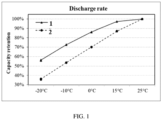
- FIG. 1 shows discharge rates of secondary batteries in Example 6 and Comparative Example 3 at different temperatures, where 1 represents Example 6 and 2 represents Comparative Example 3.
- any lower limit may be combined with any upper limit to form a range not expressly recorded; any lower limit may be combined with any other lower limit to form a range not expressly recorded; and any upper limit may be combined with any other upper limit to form a range not expressly recorded.
- each individually disclosed point or individual single numerical value may itself be a lower limit or an upper limit which ca be combined with any other point or individual numerical value or combined with another lower limit or upper limit to form a range not expressly recorded.
- a list of items connected by the terms “at least one of”, “at least one piece of”, “at least one type of”, or the like may mean any combination of the listed items. For example, if items A and B are listed, the phrase “at least one of A or B” means only A; only B; or A and B. In another example, if items A, B, and C are listed, the phrase “at least one of A, B, or C” means only A, only B, only C, A and B (excluding C), A and C (excluding B), B and C (excluding A), or all of A, B, and C.
- the item A may contain a single composition or a plurality of compositions.
- the item B may contain a single composition or a plurality of compositions.
- the item C may contain a single composition or a plurality of compositions.
- this application provides a negative electrode plate.
- the negative electrode plate includes a negative electrode current collector and a negative electrode active material layer disposed on the negative electrode current collector.
- the negative electrode active material layer includes a negative electrode active material.
- the negative electrode active material includes negative electrode active material particles, the negative electrode active material particles including a first particle having a pore.
- the negative electrode active material satisfies 0.10 ⁇ TD-0.05 ⁇ (1/X) ⁇ 0.40, where X represents a ratio of an average cross-sectional area of the pore in the first particle to an average cross-sectional area of the first particle and 4.0% ⁇ X ⁇ 15%, and TD represents a tap density of the negative electrode active material, in g/cm 3 .
- the negative electrode active material particles have pores, especially having pores inside, which can greatly enlarge a contact surface between the negative electrode plate and an electrolyte.
- the tap density of the negative electrode active material and a ratio of an average cross-sectional area of the pore in the first particle having the pore in the negative electrode active material to an average cross-sectional area of the first particle are controlled to be within the foregoing ranges, so that the tap density of the negative electrode active material well matches the pore structure.
- the proper pore structure obviously increases the number of lithium intercalation channels inside the negative electrode plate and allows the active ions to diffuse more easily, which facilitates rapid intercalation and deintercalation of the active ions and improves the rate performance of the negative electrode plate, thereby improving the charge and discharge performance of the secondary battery at low temperatures.
- the proper tap density improves processing performance of the material and also improves the rate performance of the secondary battery at low temperatures to some extent.
- the "cross section of the negative electrode active material layer” may be a cross section along a thickness direction of the negative electrode active material layer.
- TD-0.05 ⁇ 1/X is 0.11, 0.12, 0.13, 0.14, 0.15, 0.16, 0.17, 0.18, 0.19, 0.20, 0.21, 0.22, 0.23, 0.24, 0.25, 0.26, 0.27, 0.28, 0.29, 0.30, 0.31, 0.32, 0.33, 0.34, 0.35, 0.36, 0.37, 0.38, or 0.39, or within a range defined by any two values thereof.
- the tap density of the negative electrode active material and the ratio of the average cross-sectional area of the pore in the first particle to the average cross-sectional area of the first particle are within the foregoing ranges, which can further improve the rate performance of the secondary battery at low temperatures.
- X is 4.5%, 5%, 5.5%, 6%, 6.5%, 7%, 7.5%, 8%, 8.5%, 9%, 9.5%, 10%, 10.5%, 11%, 11.5%, 12%, 12.5%, 13%, 13.5%, 14%, or 14.5%, or within a range defined by any two values thereof.
- a proportion of the cross-sectional area of the pore is within the foregoing range, so that the secondary battery has relatively high rate performance at low temperatures.
- the proportion of the cross-sectional area of the pore When the proportion of the cross-sectional area of the pore is too low, the electrolyte has poor wettability inside the negative electrode plate, the active ions are relatively difficult to diffuse, and the rate performance of the secondary battery at low temperatures is barely improved.
- the proportion of the cross-sectional area of the pore is too high, the side reaction between the negative electrode active material and the electrolyte is intensified, which in turn affects the initial coulombic efficiency and storage performance of the secondary battery and reduces the rate performance of the secondary battery at low temperatures.
- TD is 0.6, 0.65, 0.7, 0.75, 0.8, 0.85, 0.9, 0.95, 1.0, 1.05, 1.1, 1.15, 1.2, 1.25, 1.3, 1.35, 1.4, or 1.45, or within a range defined by any two values thereof.
- the negative electrode material in the 200 ⁇ m ⁇ 200 ⁇ m region of a cross section of the negative electrode active material layer, the negative electrode material satisfies 0.40 ⁇ 2 ⁇ BET-L/D ⁇ 1.50 and L/D ⁇ 2.50, where L represents the largest cross-sectional length of the negative electrode active material particles, in ⁇ m, D represents the smallest cross-sectional length of the negative electrode active material particles, in ⁇ m, and BET represents a specific surface area of the negative electrode active material, in m 2 /g.
- L represents the largest cross-sectional length of the negative electrode active material particles, in ⁇ m
- D represents the smallest cross-sectional length of the negative electrode active material particles, in ⁇ m
- BET represents a specific surface area of the negative electrode active material, in m 2 /g.
- the negative electrode active material particles are ellipsoidal with high mechanical strength.
- 2 ⁇ BET-L/D is 0.45, 0.5, 0.6, 0.65, 0.7, 0.75, 0.8, 0.85, 0.9, 0.95, 1.0, 1.05, 1.1, 1.15, 1.2, 1.25, 1.3, 1.35, 1.4, or 1.45, or within a range defined by any two values thereof.
- 0.50 ⁇ 2 ⁇ BET-L/D ⁇ 1.30.
- L/D is 1.1, 1.15, 1.2, 1.25, 1.3, 1.35, 1.4, 1.45, 1.5, 1.55, 1.6, 1.65, 1.7, 1.75, 1.8, 1.85, 1.9, 1.95, 2.0, 2.05, 2.1, or 2.15, or within a range defined by any two values thereof.
- BET is 0.6, 0.7, 0.8, 0.9, 1.0, 1.1, 1.2, 1.3, 1.4, 1.5, 1.6, 1.7, 1.8, 1.9, 2.0, 2.1, 2.2, 2.3, or 2.4, or within a range defined by any two values thereof. In some embodiments, 0.5 ⁇ BET ⁇ 2.5. When the specific surface area is too large, the negative electrode active material has high reaction activity on the surface, and easily reacts with the electrolyte, adversely affecting the storage performance of the secondary battery.
- an average maximum Feret diameter F of the negative electrode active material particles satisfies 4 ⁇ m ⁇ F ⁇ 55 ⁇ m.
- F is 5 ⁇ m, 10 ⁇ m, 15 ⁇ m, 20 ⁇ m, 25 ⁇ m, 30 ⁇ m, 35 ⁇ m, 35 ⁇ m, 40 ⁇ m, 45 ⁇ m, or 50 ⁇ m, or within a range defined by any two values thereof.
- a single-side thickness H of the negative electrode active material layer satisfies H ⁇ 90 ⁇ m.
- H is 20 ⁇ m, 25 ⁇ m, 30 ⁇ m, 35 ⁇ m, 40 ⁇ m, 45 ⁇ m, 50 ⁇ m, 55 ⁇ m, 60 ⁇ m, 65 ⁇ m, 70 ⁇ m, 75 ⁇ m, 80 ⁇ m, or 85 ⁇ m.
- a single-side energy density E of the negative electrode active material layer satisfies 0.01 mAh/mm 2 ⁇ E ⁇ 0.07 mAh/mm 2 .
- E is 0.015 mAh/mm 2 , 0.02 mAh/mm 2 , 0.025 mAh/mm 2 , 0.03 mAh/mm 2 , 0.035mAh/mm 2 , 0.04 mAh/mm 2 , 0.045 mAh/mm 2 , 0.05 mAh/mm 2 , 0.055 mAh/mm 2 , 0.06 mAh/mm 2 , or 0.065 mAh/mm 2 , or within a range defined by any two values thereof.
- 0.013 mAh/mm 2 ⁇ E ⁇ 0.056 mAh/mm 2 The energy density of the negative electrode active material layer is directly proportional to its stacking density. When the energy density of the negative electrode active material layer is too low, its stacking density is too low accordingly. Although low stacking density is beneficial to the rate performance of the secondary battery, it will cause excessive energy density loss. When the energy density of the negative electrode active material layer is too high, its stacking density is too high accordingly. A high stacking density seriously affects the rate performance of the secondary battery, especially rate performance at low temperatures.
- an orientation index OI of the negative electrode active material satisfies OI ⁇ 25.
- OI is 6, 8, 10, 12, 14, 16, 18, 20, 22, or 24, or within a range defined by any two values thereof.
- An OI value represents the orientation index of the negative electrode active material.
- An excessively large OI value represents an excessively high orientation index of the negative electrode active material, which is not conducive to the intercalation and deintercalation of the active ions, affecting the rate performance of the secondary battery.
- this application provides a secondary battery.
- the secondary battery includes the negative electrode plate of the first aspect.
- a discharge ratio of the secondary battery at 0°C satisfies Q1/Q2 ⁇ 0.8, where Q1 is a discharge capacity at 1C at 0°C and Q2 is a discharge capacity at 1C at 25°C.
- the negative electrode current collector includes copper foil, aluminum foil, nickel foil, stainless steel foil, titanium foil, foamed nickel, foamed copper, polymer substrate coated with conductive metal, or any combination thereof.
- the negative electrode active material layer further includes a binder and a conductive agent.
- the binder includes, but is not lomited to, polyvinyl alcohol, hydroxypropyl cellulose, diacetyl cellulose, polyvinyl chloride, carboxylated polyvinyl chloride, polyvinyl fluoride, a polymer containing ethylene oxide, polyvinylpyrrolidone, polyurethane, polytetrafluoroethylene, polyvinylidene 1,1-difluoride, polyethylene, polypropylene, styrene-butadiene rubber, acrylic styrene-butadiene rubber, epoxy resin, nylon, or the like.
- the conductive agent includes, but is not limited to, a carbon-based material, a metal-based material, a conductive polymer, and a mixture thereof.
- the carbon-based material is selected from natural graphite, artificial graphite, carbon black, acetylene black, Ketjen black, carbon fiber, or any combination thereof.
- the metal-based material is selected from metal powder, metal fiber, copper, nickel, aluminum, or silver.
- the conductive polymer is a polyphenylene derivative.
- the secondary battery of this application further includes a positive electrode, where the positive electrode includes a positive electrode current collector and a positive electrode active material layer, and the positive electrode active material layer includes a positive electrode active material, a binder, and a conductive agent.
- the positive electrode current collector may be a metal foil or composite current collector.
- an aluminum foil can be used.
- a composite current collector may be formed by forming a metal material (copper, copper alloy, nickel, nickel alloy, titanium, titanium alloy, silver, silver alloy, or the like) on a polymer material matrix.
- the positive electrode active material includes at least one of lithium cobalt oxide, lithium nickel cobalt manganate, lithium nickel manganese aluminate, lithium iron phosphate, lithium vanadium phosphate, lithium cobalt phosphate, lithium manganese phosphate, lithium manganese iron phosphate, lithium iron silicate, lithium vanadium silicate, lithium cobalt silicate, lithium manganese silicate, spinel-type lithium manganese oxide, spinel-type lithium nickel manganese oxide, or lithium titanate.
- the binder includes a binder polymer, for example, at least one of polyvinylidene fluoride, polytetrafluoroethylene, polyolefin, sodium carboxymethyl cellulose, lithium carboxymethyl cellulose, modified polyvinylidene fluoride, modified SBR rubber, or polyurethane.
- a polyolefin binder includes at least one of polyethylene, polypropylene, polyene ester, polyvinyl alcohol, or polyacrylic acid.
- the conductive agent includes: a carbon-based material such as natural graphite, artificial graphite, carbon black, acetylene black, Ketjen black, or carbon fiber; a metal-based material such as metal powder or metal fiber of copper, nickel, aluminum, silver; a conductive polymer such as a polyphenylene derivative; or a mixture thereof.
- a carbon-based material such as natural graphite, artificial graphite, carbon black, acetylene black, Ketjen black, or carbon fiber
- a metal-based material such as metal powder or metal fiber of copper, nickel, aluminum, silver
- a conductive polymer such as a polyphenylene derivative
- the secondary battery of this application further includes a separator.
- the separator used in the secondary battery according to this application is not particularly limited to any material or shape, and may be based on any technology disclosed in the prior art.
- the separator includes a polymer or an inorganic substance formed by a material stable to the electrolyte of this application.
- the separator may include a substrate layer and a surface treatment layer.
- the substrate layer is a non-woven fabric, a membrane, or a composite membrane having a porous structure, and a material of the substrate layer is selected from at least one of polyethylene, polypropylene, polyethylene terephthalate, or polyimide.
- a polypropylene porous membrane, a polyethylene porous membrane, a polypropylene non-woven fabric, a polyethylene non-woven fabric, or a polypropylene-polyethylene-polypropylene porous composite membrane may be selected.
- the surface treatment layer is provided on at least one surface of the substrate layer, and the surface treatment layer may be a polymer layer or an inorganic substance layer, or may be a layer formed by a mixed polymer and an inorganic substance.
- the inorganic substance layer includes inorganic particles and a binder.
- the inorganic particles are selected from at least one of aluminum oxide, silicon oxide, magnesium oxide, titanium oxide, hafnium oxide, tin oxide, ceria oxide, nickel oxide, zinc oxide, calcium oxide, zirconium oxide, yttrium oxide, silicon carbide, boehmite, aluminum hydroxide, magnesium hydroxide, calcium hydroxide, or barium sulfate.
- the binder is selected from at least one of polyvinylidene fluoride, a vinylidene fluoride-hexafluoropropylene copolymer, polyamide, polyacrylonitrile, polyacrylate, polyacrylic acid, polyacrylate, polyvinylpyrrolidone, polyvinyl ether, polymethyl methacrylate, polytetrafluoroethylene, or polyhexafluoropropylene.
- a polymer layer includes a polymer, and a material of the polymer is selected from at least one of polyamide, polyacrylonitrile, an acrylate polymer, polyacrylic acid, polyacrylate, polyvinylpyrrolidone, polyvinyl ether, polyvinylidene fluoride, or poly(vinylidene fluoride-hexafluoropropylene).
- the secondary battery of this application further includes an electrolyte.
- An electrolyte that can be used in this application may be an electrolyte known in the prior art.
- the electrolyte includes an organic solvent, lithium salt, and an optional additive.
- the organic solvent in the electrolyte of this application can be any organic solvent known in the prior art that can be used as a solvent of an electrolyte.
- Electrolyte used in the electrolyte according to this application is not limited, and may be any electrolyte known in the prior art.
- the additive of the electrolyte according to this application can be any additive known in the prior art that can be used as an additive of the electrolyte.
- the organic solvent includes, but is not limited to, ethylene carbonate (EC), propylene carbonate (PC), diethyl carbonate (DEC), ethyl methyl carbonate (EMC), dimethyl carbonate (DMC), propylene carbonate, or ethyl propionate.
- the organic solvent includes an ether solvent, for example, including at least one of 1,3-dioxolane (DOL) or ethylene glycol dimethyl ether (DME).
- the lithium salt includes at least one of organic lithium salt or inorganic lithium salt.
- the lithium salt includes, but is not limited to, lithium hexafluorophosphate (LiPF 6 ), lithium tetrafluoroborate (LiBF 4 ), lithium difluorophosphate (LiPO 2 F 2 ), lithium difluoromethane sulfonamide LiN(CF 3 SO 2 ) 2 (LiTFSI), lithium bis (fluorosulfonyl) imine Li(N(SO 2 F) 2 ) (LiFSI), lithium bis(oxalate)borate LiB(C 2 O 4 ) 2 (LiBOB), or lithium difluoro(oxalato)borate LiBF 2 (C 2 O 4 ) (LiDFOB).
- the additive includes at least one of fluoroethylene carbonate or adiponitrile.
- the secondary battery of this application includes, but is not limited to, a lithium-ion battery or a sodium-ion battery. In some embodiments, the secondary battery includes a lithium-ion battery.
- This application further provides an electronic apparatus.
- the electronic apparatus includes the secondary battery in the second aspect of this application.
- the electronic device or apparatus in this application is not particularly limited.
- the electronic device in this application includes, but is not limited to: a notebook computer, a pen-input computer, a mobile computer, an electronic book player, a portable phone, a portable fax machine, a portable copier, a portable printer, a stereo headset, a video recorder, a liquid crystal television, a portable cleaner, a portable CD player, a mini-disc, a transceiver, an electronic notebook, a calculator, a memory card, a portable recorder, a radio, a standby power supply, a motor, an automobile, a motorcycle, an assisted bicycle, a bicycle, a lighting appliance, a toy, a game console, a clock, an electric tool, a flashlight, a camera, a large household battery, a lithium-ion capacitor, or the like.
- Natural large flake graphite from Jixi City, Heilongjiang province was selected as raw material.
- the graphite was pulverized to 10 ⁇ m first, and then an oxidant solution was prepared (5 mol/L sulfuric acid solution and 3 mol/L nitric acid solution were mixed at a mass ratio of 2:1).
- the oxidant solution was added into the pulverized flake graphite at a mass ratio of 1:10.
- the oxidant solution and the flake graphite were fully stirred for 3 h for oxidation.
- surface oxidation treatment was performed on the flake graphite to increase organic groups
- spheroidization treatment was performed. Specifically, the stirred mixture was dried.
- the dried flake graphite was placed in a ball mill for ball milling for 30min, and after it was curled and transformed into spherical graphite, treatment at a high temperature of 800°C was performed to obtain a negative electrode active material.
- a high temperature 800°C was performed to obtain a negative electrode active material.
- organic oxidized groups introduced into the interior of the particles during the spheroidization treatment decomposed intensively and generated gas quickly, so that pores were formed due to substance volatilization and gas expansion inside the spherical graphite obtained through curling.
- a ratio X of a cross-sectional area of the pores to a cross-sectional area of the particles is 5.0%
- TD of the active material is 1.13 g/cm 3
- the value of TD-0.05 ⁇ (1/X) is 0.13.
- the foregoing negative electrode active material, an additive, a binder styrene-butadiene rubber (SBR for short), and a thickener sodium carboxymethyl cellulose (CMC for short) at a weight ratio of 95.7:1.5:1.8:1 were thoroughly stirred and mixed in an appropriate amount of deionized water solvent to obtain a uniform negative electrode slurry, and the slurry was applied onto a current collector Cu foil with a coating weight of 0.165mg/mm 2 per unit area. Then, drying and cold pressing were performed to obtain the foregoing negative electrode plate.
- Lithium iron phosphate (chemical formula: LiFePO 4 ), a conductive agent acetylene black, and a binder polyvinylidene fluoride (PVDF for short) at a weight ratio of 96.3:2.2:1.5 were thoroughly stirred in an appropriate amount of N-methylpyrrolidone (NMP for short) solvent to obtain a uniform positive electrode slurry, and the positive electrode slurry was applied onto a current collector Al foil. Then, drying and cold pressing were performed to obtain a positive electrode plate.
- NMP N-methylpyrrolidone
- fluoroethylene carbonate and 1,3-propanesulfolactone were added and dissolved.
- lithium salt LiPF 6 was added, and the foregoing substances were fully mixed to obtain an electrolyte.
- the mass percentage of LiPF 6 was 12.5%
- the mass percentage of fluoroethylene carbonate was 2%
- the mass percentage of 1,3-propanesulfolactone was 2%.
- the mass percentage of each substance was calculated based on the mass of the electrolyte.
- a polyethylene porous polymer film was used as a separator.
- the positive electrode, the separator, and the negative electrode were sequentially stacked, so that the separator was located between the positive electrode and the negative electrode for separation. Then the stack was wound to obtain an electrode assembly.
- the electrode assembly was placed into an outer package aluminum-plastic foil film after being welded with tabs, and the prepared electrolyte was injected into the dried electrode assembly, followed by processes such as vacuum packaging, standing, formation, shaping, and capacity test, to obtain a soft pouch lithium-ion battery.
- Example 1 Preparation of the negative electrode active material was similar to that in Example 1 except that the corresponding negative electrode active material was prepared by adjusting parameters such as proportion and concentration of acid and temperature of high-temperature treatment. Specific preparation parameters are shown in Table a. Table a Example Concentration of sulfuric acid solution (mol/L) Concentration of nitric acid solution (mol/L) Mass of sulfuric acid solution:mass of nitric acid solution Mass of oxidant solution:mass of flake graphite Temperature of high-temperature treatment (°C) Example 1 5 3 2:1 1:10 800 Example 2 4 3 2:1 1:10 800 Example 3 5 4 2:1 1:10 800 Example 4 5 3 1:1 1:10 800 Example 5 5 3 2:1 1:8 800 Example 6 5 3 2:1 1:5 800 Example 7 5 3 2:1 1:10 850 Example 8 5 3 2:1 1:10 900 Example 9 5 3 1:1 1:8 900 Example 10 3 5 2:1 1:8 800 Comparative Example 1 0 3 0:1 1:10 800 Comparative Example 2 5 0 1:0 1:10 800 Comparative Example 3 5 3 2:1 1:1
- Preparation of the negative electrode active material was similar to that in Example 6 except that the aspect ratio and specific surface area of the negative electrode active material were adjusted by adjusting the pulverization size of flake graphite.
- the pulverization sizes of flake graphite were 15.2 ⁇ m, 14.5 ⁇ m, 13.5 ⁇ m, 12.0 ⁇ m, 9.5 ⁇ m, and 8.2 ⁇ m, respectively.
- Preparation of the negative electrode active material was similar to that in Example 13 except that the average maximum Feret diameter of the negative electrode active material was adjusted by adjusting ball milling time.
- the ball milling time was 32 min, 37 min, 40 min, 45 min, 50 min, 55 min, 63 min, and 70 min, respectively.
- the scanning electron microscope used in this application was model JSM-6360LV of JEOL.
- Cross-sectional area of negative electrode active material particles having a pore (that is, first particles):
- the CP sample of the negative electrode active material layer was observed and it was found that there were some particles having a pore structure within the 200 ⁇ m ⁇ 200 ⁇ m region on the cross section of the negative electrode active material layer along the thickness direction.
- the cross sections of these particles were irregular in shape, and their color contrasts were different from those around the particles. Based on their contrast characteristics, the cross-sectional areas of the particles could be calculated.
- the average cross-sectional area of all particles having pore characteristics within the 200 ⁇ m ⁇ 200 ⁇ m region of the negative electrode active material layer along the thickness direction was obtained through statistics and calculation, thereby obtaining the cross-sectional area of the first particles.
- Cross-sectional area of pores in the first particles There were some particles having a pore structure within the 200 ⁇ m ⁇ 200 ⁇ m region on the cross section of the negative electrode active material layer.
- the cross sections of the pores in the cross sections of these particles were irregular in shape, and their color contrasts were different from that of cross section of the active material. Areas of these cross sections of the pores were calculated based on contrast characteristics.
- the average cross-sectional area of the pores in all first particles within the 200 ⁇ m ⁇ 200 ⁇ m region of the negative electrode active material layer along the thickness direction was obtained through statistics and calculation, thereby obtaining the cross-sectional area of the pores in the first particles.
- Test of proportion of the cross-sectional area of the pores in the cross-sectional area of the particles A value of X was obtained by dividing the foregoing cross-sectional area of the pores in the first particles by the foregoing cross-sectional area of the first particles.
- Tap density is a mass per unit volume measured after powder in a container is compacted by vibration under specified conditions, measured in g/cm 3 .
- the test method is as follows: A graduated cylinder containing a certain mass of powder was fastened on a mechanical vibration apparatus, and a vibration motor drove the mechanical vibration apparatus to vibrate vertically up and down.
- the graduated cylinder containing the powder vibrated rhythmically with the mechanical vibration apparatus.
- the powder in the graduated cylinder was gradually compacted by vibration.
- the mechanical vibration apparatus stopped vibrating, and a volume in the graduated cylinder was read.
- density of the powder compacted by vibration was obtained by dividing the mass by the volume.
- Specific process parameters vibration times: 5000 times; vibration frequency: 250 ⁇ 15 times/min; and ambient temperature: 15°C to 28°C.
- a lithium-ion secondary battery was discharged to 0% SOC and disassembled to obtain a negative electrode plate which was then subjected to high-temperature treatment at 400°C for 2 h (in nitrogen atmosphere), so that a negative electrode active material was peeled off from the current collector.
- the negative electrode active material was collected for Raman test.
- the negative electrode active material was scanned using a laser microscopic confocal Raman spectrometer (Raman, HR Evolution, HORIBA Scientific) to obtain D peaks and G peaks of all particles in the area range. Data was processed using LabSpec software to obtain peak intensities of the D peak and G peak of each particle, which were ID and IG, respectively.
- Frequency of ID/ID was counted with a step of 0.02 to obtain a normal distribution graph. (ID/ID)max and (ID/ID)min of these particles were counted, and the average value of ID/ID was calculated to obtain the ID/IG value of the negative electrode active material.
- a laser wavelength of the Raman spectrometer could be within the range of 532 nm to 785 nm.
- a D peak is generally near 1350 cm -1 and caused by a symmetric stretching vibration radial breathing mode of sp2 carbon atoms in an aromatic ring (structural defect).
- a G peak appears near 1580 cm -1 . It is caused by tensile vibration between sp2 carbon atoms and corresponds to vibration (in-plane vibration of carbon atoms) of E2g optical phonon at the center of Brillouin zone.
- a lithium-ion secondary battery was discharged to 0% SOC and disassembled to obtain a negative electrode plate which was then subjected to high-temperature treatment at 400°C for 2 h (in nitrogen atmosphere), so that a negative electrode active material was peeled off from the current collector.
- the negative electrode active material was collected for OI value test.
- a diffraction line pattern of a (004) plane and a diffraction line pattern of a (110) plane in the X-ray diffraction pattern of the negative electrode active material were tested according to the mechanical industry standard JB/T 4220-2011 "Determination method of artificial graphite lattice parameter" of the People's Republic of China.
- Discharge rate of the lithium-ion battery at 0°C discharge capacity at 0°C/discharge capacity at 25°C ⁇ 100%.
- Table 1 shows influence on performance of the lithium-ion battery by the ratio X of the average cross-sectional area of the pores in the first particles having the pores to the average cross-sectional area of the first particles within the 200 ⁇ m ⁇ 200 ⁇ m region on the cross section of the negative electrode active material layer, and by the tap density TD, in g/m 3 , of the negative electrode active material.
- Example 1 Examples and comparative examples Ratio of average cross-sectional area of pores to average cross-sectional area of particles X
- Example 1 4.5% 1.21 0.10 81.1%
- Example 2 5.0% 1.13 0.13 82.0%
- Example 3 7.0% 0.86 0.15 83.3%
- Example 4 8.0% 0.73 0.10 84.5%
- Example 5 7.0% 0.90 0.19 86.5%
- Example 6 11.0% 0.74 0.29 85.3%
- Example 7 13.0% 0.73 0.35 84.0%
- Example 8 15.0% 0.73 0.40 83.8%
- Example 9 5.2% 1.34 0.38 81.0%
- Example 10 4.3% 1.26 0.10 82.8% Comparative Example 1 4.3% 1.25 0.09 75.5%
- Comparative Example 2 16.0% 0.74 0.43 74.0%
- Comparative Example 3 18.0% 0.83 0.55 70.1% Comparative Example 4 20.
- Table 2 shows influence on the performance of the lithium-ion battery by the largest cross-sectional length L, in ⁇ m, and the smallest cross-sectional length D, in ⁇ m, of negative electrode active material particles, and the specific surface area BET, in m 2 /g, of the negative electrode active material within the 200 ⁇ m ⁇ 200 ⁇ m region on the cross section of the negative electrode active material layer. Except the parameters listed in Table 2, the remaining parameters in Examples 11 to 16 are the same as those in Example 6.
- Table 3 shows influence on the performance of the lithium-ion battery by the average maximum Feret diameters F, in ⁇ m, of the negative electrode active material particles within the 200 ⁇ m ⁇ 200 ⁇ m region on the cross section of the negative electrode active material layer. Except the parameters listed in Table 3, the remaining parameters in Examples 17 to 24 are the same as those in Example 13. Table 3 Example Average maximum Feret diameter F of negative electrode active material particles ( ⁇ m) Discharge ratio at 0°C Example 13 4 88.1% Example 17 5 88.5% Example 18 10 88.8% Example 19 15 89.0% Example 20 20 89.2% Example 21 30 89.8% Example 22 40 89.5% Example 23 50 89.1% Example 24 55 88.6%
- the lithium-ion battery has a high discharge ratio. This means that lithium ion deintercalation and intercalation can be guaranteed by controlling the thickness and energy density of the active material layer, thereby effectively improving the rate performance of the lithium-ion battery at low temperatures.
- Table 5 shows influence on the performance of the lithium-ion battery by the tap density TD, defect degree ID/IG, and orientation index OI of the negative electrode active material. Except the parameters listed in Table 5, the remaining parameters in Examples 40 to 50 are the same as those in Example 33. Table 5 Example Tap density TD of negative electrode active material (g/cm 3 ) ID/IG of negative electrode active material OI value of negative electrode active material Discharge ratio at 0°C Example 33 0.49 0.53 18 92.5% Example 34 0.60 0.51 16 92.8% Example 35 0.80 0.56 18 93.0% Example 36 1.30 0.60 22 92.9% Example 37 0.55 0.20 16 92.6% Example 38 0.58 0.26 17 92.9% Example 39 0.58 0.35 23 93.0% Example 40 1.32 0.48 25 92.9% Example 41 0.55 0.52 5 93.2% Example 42 0.59 0.55 8 93.0% Example 43 1.33 0.60 13 93.4% Example 44 0.65 0.17 5 93.9% Example 45 0.78 0.20 8 94.5% Example 46 0.88
Landscapes
- Chemical & Material Sciences (AREA)
- Chemical Kinetics & Catalysis (AREA)
- Electrochemistry (AREA)
- General Chemical & Material Sciences (AREA)
- Engineering & Computer Science (AREA)
- Materials Engineering (AREA)
- Inorganic Chemistry (AREA)
- Battery Electrode And Active Subsutance (AREA)
- Secondary Cells (AREA)
Applications Claiming Priority (1)
| Application Number | Priority Date | Filing Date | Title |
|---|---|---|---|
| PCT/CN2022/115902 WO2024044974A1 (zh) | 2022-08-30 | 2022-08-30 | 负极极片、二次电池和电子装置 |
Publications (2)
| Publication Number | Publication Date |
|---|---|
| EP4576249A1 true EP4576249A1 (de) | 2025-06-25 |
| EP4576249A4 EP4576249A4 (de) | 2026-01-28 |
Family
ID=90100163
Family Applications (1)
| Application Number | Title | Priority Date | Filing Date |
|---|---|---|---|
| EP22956806.8A Pending EP4576249A4 (de) | 2022-08-30 | 2022-08-30 | Negativelektrodenfolie, sekundärbatterie und elektronische vorrichtung |
Country Status (4)
| Country | Link |
|---|---|
| US (1) | US20250201807A1 (de) |
| EP (1) | EP4576249A4 (de) |
| CN (1) | CN118043991B (de) |
| WO (1) | WO2024044974A1 (de) |
Families Citing this family (1)
| Publication number | Priority date | Publication date | Assignee | Title |
|---|---|---|---|---|
| WO2026011870A1 (zh) * | 2024-11-28 | 2026-01-15 | 贝特瑞新材料集团股份有限公司 | 负极材料、负极片和二次电池 |
Family Cites Families (9)
| Publication number | Priority date | Publication date | Assignee | Title |
|---|---|---|---|---|
| CN101309859B (zh) * | 2005-12-14 | 2011-03-09 | 日本焦化工业株式会社 | 石墨粒子、碳-石墨复合粒子及其制造方法 |
| JP6201425B2 (ja) * | 2013-05-23 | 2017-09-27 | 日立化成株式会社 | リチウムイオン二次電池用負極材、リチウムイオン二次電池用負極及びリチウムイオン二次電池 |
| JP2013179101A (ja) * | 2013-06-28 | 2013-09-09 | Mitsubishi Chemicals Corp | 非水系二次電池用複合黒鉛粒子、それを含有する負極材料、負極及び非水系二次電池 |
| KR20170002302A (ko) * | 2015-06-29 | 2017-01-06 | 신닛테츠 수미킨 가가쿠 가부시키가이샤 | 리튬이온 이차전지용 부극 및 이차전지 |
| US11127945B2 (en) * | 2016-06-14 | 2021-09-21 | Nexeon Limited | Electrodes for metal-ion batteries |
| JP7318517B2 (ja) * | 2019-12-19 | 2023-08-01 | トヨタ自動車株式会社 | 負極活物質用複合粒子 |
| CN113086978B (zh) * | 2021-03-30 | 2023-08-15 | 宁德新能源科技有限公司 | 负极材料及包含其的电化学装置和电子设备 |
| CN113471419A (zh) * | 2021-06-09 | 2021-10-01 | 济南精智方正新材料有限公司 | 一种硅碳复合材料及其制备方法和应用 |
| CN114122329A (zh) * | 2021-11-11 | 2022-03-01 | 珠海冠宇电池股份有限公司 | 一种负极片和包括该负极片的锂离子电池 |
-
2022
- 2022-08-30 CN CN202280058229.3A patent/CN118043991B/zh active Active
- 2022-08-30 EP EP22956806.8A patent/EP4576249A4/de active Pending
- 2022-08-30 WO PCT/CN2022/115902 patent/WO2024044974A1/zh not_active Ceased
-
2025
- 2025-02-27 US US19/065,131 patent/US20250201807A1/en active Pending
Also Published As
| Publication number | Publication date |
|---|---|
| EP4576249A4 (de) | 2026-01-28 |
| US20250201807A1 (en) | 2025-06-19 |
| CN118043991A (zh) | 2024-05-14 |
| WO2024044974A1 (zh) | 2024-03-07 |
| CN118043991B (zh) | 2026-01-16 |
Similar Documents
| Publication | Publication Date | Title |
|---|---|---|
| EP4693499A1 (de) | Negativelektrodenaktivmaterial und herstellungsverfahren dafür sowie sekundärbatterie und elektronische vorrichtung | |
| CN114730883A (zh) | 一种负极复合材料及其应用 | |
| EP4254548A1 (de) | Negativelektrodenplatte, elektrochemische vorrichtung mit negativelektrodenplatte und elektronische vorrichtung | |
| CN116344766A (zh) | 一种二次电池和电子装置 | |
| CN117317137A (zh) | 电化学装置和电子装置 | |
| CN116802841A (zh) | 正极材料、电化学装置和电子装置 | |
| US20250391865A1 (en) | Negative electrode active material, secondary battery, and electronic apparatus | |
| EP4579814A1 (de) | Negativelektrodenmaterial, sekundärbatterie und elektronische vorrichtung | |
| EP3951938A1 (de) | Negatives elektrodenmaterial, elektrochemische vorrichtung damit und elektronische vorrichtung | |
| US20250201807A1 (en) | Negative electrode plate, secondary battery, and electronic apparatus | |
| EP4207371A1 (de) | Positivelektrode, elektrochemische vorrichtung und elektronische vorrichtung | |
| US20250201808A1 (en) | Negative electrode plate, secondary battery, and electronic apparatus | |
| CN119725524B (zh) | 一种硬碳材料、二次电池及电子装置 | |
| EP4439759A1 (de) | Elektrochemische vorrichtung und elektronische vorrichtung | |
| JP2025510736A (ja) | 電気化学装置及び電子装置 | |
| EP4471904A1 (de) | Sekundärbatterie und elektronische vorrichtung | |
| EP4297124A1 (de) | Negatives aktivmaterial, sekundärbatterie und elektronische vorrichtung | |
| JP2023538140A (ja) | 正極材料、並びにそれを含む電気化学装置及び電子装置 | |
| CN113517442A (zh) | 负极材料、电化学装置和电子装置 | |
| EP4485564A1 (de) | Negativelektrode und elektrochemische vorrichtung und elektronische vorrichtung damit | |
| EP4579797A1 (de) | Negativelektrodenmaterial, sekundärbatterie und elektronische vorrichtung | |
| CN117882218B (zh) | 电化学装置和电子设备 | |
| EP4531134A1 (de) | Elektrochemische vorrichtung und elektrische vorrichtung | |
| EP4535465A1 (de) | Positivelektrodenmaterial, elektrochemische vorrichtung und elektrische vorrichtung | |
| CN119542410A (zh) | 正极材料及其制备方法、电化学装置及电子装置 |
Legal Events
| Date | Code | Title | Description |
|---|---|---|---|
| STAA | Information on the status of an ep patent application or granted ep patent |
Free format text: STATUS: THE INTERNATIONAL PUBLICATION HAS BEEN MADE |
|
| PUAI | Public reference made under article 153(3) epc to a published international application that has entered the european phase |
Free format text: ORIGINAL CODE: 0009012 |
|
| STAA | Information on the status of an ep patent application or granted ep patent |
Free format text: STATUS: REQUEST FOR EXAMINATION WAS MADE |
|
| 17P | Request for examination filed |
Effective date: 20250321 |
|
| AK | Designated contracting states |
Kind code of ref document: A1 Designated state(s): AL AT BE BG CH CY CZ DE DK EE ES FI FR GB GR HR HU IE IS IT LI LT LU LV MC MK MT NL NO PL PT RO RS SE SI SK SM TR |
|
| DAV | Request for validation of the european patent (deleted) | ||
| DAX | Request for extension of the european patent (deleted) | ||
| A4 | Supplementary search report drawn up and despatched |
Effective date: 20260107 |
|
| RIC1 | Information provided on ipc code assigned before grant |
Ipc: H01M 4/36 20060101AFI20251222BHEP Ipc: H01M 4/587 20100101ALI20251222BHEP Ipc: H01M 10/0525 20100101ALI20251222BHEP Ipc: H01M 4/02 20060101ALI20251222BHEP Ipc: H01M 4/133 20100101ALI20251222BHEP Ipc: H01M 4/58 20100101ALI20251222BHEP |