EP4579797A1 - Negativelektrodenmaterial, sekundärbatterie und elektronische vorrichtung - Google Patents
Negativelektrodenmaterial, sekundärbatterie und elektronische vorrichtung Download PDFInfo
- Publication number
- EP4579797A1 EP4579797A1 EP22960224.8A EP22960224A EP4579797A1 EP 4579797 A1 EP4579797 A1 EP 4579797A1 EP 22960224 A EP22960224 A EP 22960224A EP 4579797 A1 EP4579797 A1 EP 4579797A1
- Authority
- EP
- European Patent Office
- Prior art keywords
- negative electrode
- electrode material
- peak
- test
- lithium
- Prior art date
- Legal status (The legal status is an assumption and is not a legal conclusion. Google has not performed a legal analysis and makes no representation as to the accuracy of the status listed.)
- Pending
Links
Images
Classifications
-
- H—ELECTRICITY
- H01—ELECTRIC ELEMENTS
- H01M—PROCESSES OR MEANS, e.g. BATTERIES, FOR THE DIRECT CONVERSION OF CHEMICAL ENERGY INTO ELECTRICAL ENERGY
- H01M4/00—Electrodes
- H01M4/02—Electrodes composed of, or comprising, active material
- H01M4/36—Selection of substances as active materials, active masses, active liquids
- H01M4/58—Selection of substances as active materials, active masses, active liquids of inorganic compounds other than oxides or hydroxides, e.g. sulfides, selenides, tellurides, halogenides or LiCoFy; of polyanionic structures, e.g. phosphates, silicates or borates
- H01M4/583—Carbonaceous material, e.g. graphite-intercalation compounds or CFx
-
- H—ELECTRICITY
- H01—ELECTRIC ELEMENTS
- H01M—PROCESSES OR MEANS, e.g. BATTERIES, FOR THE DIRECT CONVERSION OF CHEMICAL ENERGY INTO ELECTRICAL ENERGY
- H01M10/00—Secondary cells; Manufacture thereof
- H01M10/05—Accumulators with non-aqueous electrolyte
- H01M10/052—Li-accumulators
- H01M10/0525—Rocking-chair batteries, i.e. batteries with lithium insertion or intercalation in both electrodes; Lithium-ion batteries
-
- H—ELECTRICITY
- H01—ELECTRIC ELEMENTS
- H01M—PROCESSES OR MEANS, e.g. BATTERIES, FOR THE DIRECT CONVERSION OF CHEMICAL ENERGY INTO ELECTRICAL ENERGY
- H01M4/00—Electrodes
- H01M4/02—Electrodes composed of, or comprising, active material
- H01M4/13—Electrodes for accumulators with non-aqueous electrolyte, e.g. for lithium-accumulators; Processes of manufacture thereof
- H01M4/133—Electrodes based on carbonaceous material, e.g. graphite-intercalation compounds or CFx
-
- H—ELECTRICITY
- H01—ELECTRIC ELEMENTS
- H01M—PROCESSES OR MEANS, e.g. BATTERIES, FOR THE DIRECT CONVERSION OF CHEMICAL ENERGY INTO ELECTRICAL ENERGY
- H01M4/00—Electrodes
- H01M4/02—Electrodes composed of, or comprising, active material
- H01M4/36—Selection of substances as active materials, active masses, active liquids
- H01M4/58—Selection of substances as active materials, active masses, active liquids of inorganic compounds other than oxides or hydroxides, e.g. sulfides, selenides, tellurides, halogenides or LiCoFy; of polyanionic structures, e.g. phosphates, silicates or borates
- H01M4/583—Carbonaceous material, e.g. graphite-intercalation compounds or CFx
- H01M4/587—Carbonaceous material, e.g. graphite-intercalation compounds or CFx for inserting or intercalating light metals
-
- H—ELECTRICITY
- H01—ELECTRIC ELEMENTS
- H01M—PROCESSES OR MEANS, e.g. BATTERIES, FOR THE DIRECT CONVERSION OF CHEMICAL ENERGY INTO ELECTRICAL ENERGY
- H01M4/00—Electrodes
- H01M4/02—Electrodes composed of, or comprising, active material
- H01M2004/021—Physical characteristics, e.g. porosity, surface area
-
- H—ELECTRICITY
- H01—ELECTRIC ELEMENTS
- H01M—PROCESSES OR MEANS, e.g. BATTERIES, FOR THE DIRECT CONVERSION OF CHEMICAL ENERGY INTO ELECTRICAL ENERGY
- H01M4/00—Electrodes
- H01M4/02—Electrodes composed of, or comprising, active material
- H01M2004/026—Electrodes composed of, or comprising, active material characterised by the polarity
- H01M2004/027—Negative electrodes
-
- Y—GENERAL TAGGING OF NEW TECHNOLOGICAL DEVELOPMENTS; GENERAL TAGGING OF CROSS-SECTIONAL TECHNOLOGIES SPANNING OVER SEVERAL SECTIONS OF THE IPC; TECHNICAL SUBJECTS COVERED BY FORMER USPC CROSS-REFERENCE ART COLLECTIONS [XRACs] AND DIGESTS
- Y02—TECHNOLOGIES OR APPLICATIONS FOR MITIGATION OR ADAPTATION AGAINST CLIMATE CHANGE
- Y02E—REDUCTION OF GREENHOUSE GAS [GHG] EMISSIONS, RELATED TO ENERGY GENERATION, TRANSMISSION OR DISTRIBUTION
- Y02E60/00—Enabling technologies; Technologies with a potential or indirect contribution to GHG emissions mitigation
- Y02E60/10—Energy storage using batteries
Definitions
- This application relates to the field of energy storage, and in particular, to a negative electrode material, a secondary battery, and an electronic apparatus.
- this application provides a negative electrode material and a secondary battery including such negative electrode material, so as to improve kinetics of a carbon-based negative electrode material, thereby improving discharge rate performance of the secondary battery including such negative electrode material.
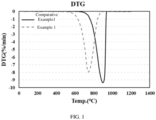
- this application provides a negative electrode material, including a carbon-based material, where in a thermogravimetric test, the negative electrode material has an exothermic peak within a temperature range of 600°C to 800°C in an air atmosphere.
- the exothermic peak of the negative electrode material within the temperature range of 600°C to 800°C is related to reactivity of the negative electrode material with active ions such as lithium ions.
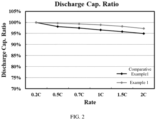
- the negative electrode material of this application having the exothermic peak within the foregoing range can react with lithium ions faster, facilitating improvement in rate performance of a secondary battery.
- the negative electrode material has an exothermic peak within a temperature range of 650°C to 750°C.
- a preparation method of the carbon-based material includes: sequentially performing graphite composite material preparation, spheroidization, coating, and carbonization on a graphite material, where the graphite material includes at least one of natural graphite or artificial graphite.
- the preparation process of the graphite composite material includes: dissolving one or more of natural graphite and artificial graphite and polymethyl methacrylate (PMMA) in N-N dimethylformamide (DMF), stirring the mixture for 10 h to 14 h at 50°C to 80°C, filtering and collecting a precipitate, washing the precipitate with deionized water and ethanol for 2 to 4 times, and fully drying the precipitate at 60°C to 90°C to obtain a graphite composite material precursor; and heating the graphite composite material precursor to 1000°C to 1200°C at a temperature rise velocity of 8°C/min to 16°C/min in a tube furnace, introducing a gas mixture of CH 4 /C 2 H 2 /H 2 (at a ratio of (5-10):(5-10):(80-85)) into the tube furnace, maintaining at that temperature for 8 h to 12 h, and then cooling naturally to room temperature to obtain the graphite composite material.
- PMMA polymethyl methacrylate
- DMF
- the process of spheroidization includes: applying continuous impact forces, compressive forces, and shear forces between a rotating disc, an inner wall, and particles to a mixture containing the graphite composite material and a dispersant solution, so as to spheroidize the graphite composite material.
- a spheroidization time is 10 min to 20 min.
- a spheroidization apparatus is used to apply the impact forces, compressive forces, and shear forces to the mixture, so as to implement collision, friction, shearing, bending, and folding of the mixture, thereby fixing micropowder onto large particles while removing edges and corners of the graphite composite material.
- the secondary battery can exhibit good kinetics without significant degradation in performance such as initial coulombic efficiency and cycling performance.
- a ratio of area C004 of a 004 crystal plane diffraction peak to area C110 of a 110 crystal plane diffraction peak of the negative electrode material satisfies 1 ⁇ C004/C110 ⁇ 6.
- the value of C004/C110 is a parameter reflecting a crystal orientation degree of the negative electrode material.
- a larger value of C004/C110 means a higher crystal orientation degree, resulting in a more limited surface for active ions to be deintercalated from and intercalated into the negative electrode material.
- a smaller value of C004/C110 means a lower crystal orientation degree, allowing active ions to be deintercalated from and intercalated into the negative electrode material in multiple directions.
- an X-ray diffraction pattern of the negative electrode material exhibits a diffraction peak a at 2 ⁇ of 43° to 44° and a diffraction peak b at 2 ⁇ of 45° to 47°, where a peak intensity of the diffraction peak a is I a , and a peak intensity of the diffraction peak b is I b , where 2 ⁇ I a /I b ⁇ 6.
- the diffraction peak a and diffraction peak b of the negative electrode material are related to a stacking sequence of rhombic (3R) graphene layers in graphite.
- the diffraction peak a and the diffraction peak b appear in the negative electrode material of this application, and the diffraction peak a has a higher peak intensity than the diffraction peak b, which means that an rhombohedral structure is present in the formed graphite, allowing for easier lithium deintercalation and intercalation.
- the ratio of the peak intensity of the diffraction peak a to the peak intensity of the diffraction peak b in the negative electrode material of this application falls within the foregoing range, direct current internal resistance of the negative electrode material significantly decreases, thereby further improving the discharge rate performance of the secondary battery.
- a specific surface area of the negative electrode material is 4 cm 2 /g to 20 cm 2 /g.
- a smaller specific surface area of the negative electrode material means a smaller contact area with an electrolyte, so that fewer active ions are consumed during initial formation of an SEI film in the secondary battery, improving the initial coulombic efficiency.
- the specific surface area is excessively small, electrolyte infiltration and active diffusion become difficult, thereby affecting the kinetic performance of the secondary battery.
- the specific surface area of the negative electrode material of this application falls within the foregoing range, the secondary battery exhibits high initial coulombic efficiency without significant degradation in kinetic performance.
- the specific surface area of the negative electrode material is 4 cm 2 /g to 10 cm 2 /g.
- D v 50 of the negative electrode material satisfies 5 ⁇ m ⁇ D v 50 ⁇ 25 ⁇ m. Larger D v 50 of the negative electrode material means a higher corresponding gram capacity, but excessively large D v 50 affects the kinetic performance of the negative electrode material. D v 50 of the negative electrode material of this application falling within the foregoing range can ensure that the negative electrode material exhibits a high gram capacity without significant degradation in kinetic performance. In some embodiments, 10 ⁇ m ⁇ D v 50 ⁇ 20 ⁇ m.
- a graphitization degree of the negative electrode material is 94% to 96%.
- the graphitization degree of the negative electrode material falls within the foregoing range, the negative electrode material exhibits high capacity and high compacted density, thereby further increasing the gram capacity of the negative electrode material.
- the graphitization degree of the negative electrode material is 94.5% to 96%.
- this application provides a secondary battery, including a negative electrode, where the negative electrode includes a negative electrode current collector and a negative electrode active material layer disposed on at least one surface of the negative electrode current collector, where the negative electrode active material layer includes the negative electrode material according to the first aspect.
- this application provides an electronic apparatus including the secondary battery according to the second aspect.
- any lower limit may be combined with any upper limit to form a range not expressly recorded; any lower limit may be combined with any other lower limit to form a range not expressly recorded; and any upper limit may be combined with any other upper limit to form a range not expressly recorded.
- each individually disclosed point or individual numerical value may itself be a lower limit or an upper limit which can be combined with any other point or individual numerical value or combined with another lower limit or upper limit to form a range not expressly recorded.
- a list of items connected by the terms “at least one of”, “at least one piece of”, and “at least one kind of” or other similar terms may mean any combination of the listed items.
- the phrase “at least one of A or B” means only A, only B, or A and B.
- the phrase “at least one of A, B, or C” means only A, only B, only C, A and B (excluding C), A and C (excluding B), B and C (excluding A), or all of A, B, and C.
- the item A may include a single element or a plurality of elements.
- the item B may include a single element or a plurality of elements.
- the item C may include a single element or a plurality of elements.
- the negative electrode material provided in this application includes a carbon-based material, where in a thermogravimetric test, the negative electrode material has an exothermic peak within a temperature range of 600°C to 800°C in an air atmosphere.
- the exothermic peak of the negative electrode material within the temperature range of 600°C to 800°C is related to reactivity of the negative electrode material with active ions such as lithium ions.
- the negative electrode material of this application having the exothermic peak within the foregoing range can react with lithium ions more easily, facilitating improvement in rate performance of a secondary battery.
- the negative electrode material has an exothermic peak at 610°C, 620°C, 630°C, 640°C, 660°C, 670°C, 680°C, 690°C, 700°C, 710°C, 720°C, 730°C, 740°C, 760°C, 770°C, 780°C, 790°C, or within a range defined by any two of these values.
- the negative electrode material has an exothermic peak within a temperature range of 650°C to 750°C.
- the negative electrode material having an exothermic peak within a temperature range of 600°C to 800°C means that a peak top temperature of the exothermic peak is within the temperature range of 600°C to 800°C.
- a preparation method of the carbon-based material includes: sequentially performing graphite composite material preparation, spheroidization, coating, and carbonization on one or more materials of natural graphite and artificial graphite.
- the preparation process of the graphite composite material includes: dissolving one or more of natural graphite and artificial graphite and polymethyl methacrylate (PMMA) in N-N dimethylformamide (DMF), stirring the mixture for 10 h to 14 h at 50°C to 80°C, filtering and collecting a precipitate, washing the precipitate with deionized water and ethanol for 2 to 4 times, and fully drying the precipitate at 60°C to 90°C to obtain a graphite composite material precursor; and heating the graphite composite material precursor to 1000°C to 1200°C at a temperature rise velocity of 8°C/min to 16°C/min in a tube furnace, introducing a gas mixture of CH 4 /C 2 H 2 /H 2 (at a ratio of (5-10):(5-10):(80-85)) into the tube furnace, maintaining at that temperature for 8 h to 12 h, and then cooling naturally to room temperature to obtain the final graphite composite material.
- PMMA polymethyl methacrylate
- the process of spheroidization includes: applying continuous impact forces, compressive forces, and shear forces between a rotating disc, an inner wall, and particles to a mixture containing the graphite composite material and a dispersant solution, so as to spheroidize the graphite composite material.
- a spheroidization time is 10 min to 20 minn, for example, 12 min, 14 min, 16 min, or 18 min.
- a spheroidization apparatus is used to apply the impact forces, compressive forces, and shear forces to the mixture, so as to implement collision, friction, shearing, bending, and folding of the mixture, thereby fixing micropowder onto large particles while removing edges and corners of the graphite composite material.
- the spheroidization apparatus is a mixing granulator.
- a rotation speed of the spheroidization apparatus is 30 Hz to 50 Hz, for example, 35 Hz, 40 Hz, or 45 Hz.
- the dispersant solution is an aqueous solution of carboxymethyl cellulose (CMC).
- CMC carboxymethyl cellulose
- a mass percentage of the carboxymethyl cellulose in the dispersant solution is 0.5% to 2%, for example, 0.7%, 1.0%, 1.3%, 1.5%, or 1.7%.
- a mass percentage of the dispersant solution is 5% to 20%, for example, 7%, 10%, 13%, 15%, 17%, or 19%.
- the process of coating includes: coating the spheroidized graphite composite material with asphalt.
- a mass percentage of the asphalt is 2% to 15%, for example, 3%, 4%, 5%, 6%, 7%, 8%, 9%, 10%, 11%, 12%, 13%, or 14%.
- a carbonization temperature is 900°C to 1500°C, for example, 950°C, 1000°C, 1050°C, 1100°C, 1150°C, 1200°C, 1250°C, 1300°C, 1350°C, 1400°C, or 1450°C.
- a carbonization time is 3 h to 10 h, for example, 4 h, 5 h, 6 h, 7 h, 8 h, or 9 h.
- the negative electrode material in a Raman test, satisfies 0.2 ⁇ Id/Ig ⁇ 0.5, where Id is an intensity of a peak at 1350 cm -1 in a Raman spectrum, and Ig is an intensity of a peak at 1580 cm -1 in the Raman spectrum.
- the value of Id/Ig can represent a defect degree of the negative electrode material, and a larger value of Id/Ig means a higher defect degree.
- a high defect degree can increase deintercalation and intercalation channels for active ions and increase deintercalation and intercalation speeds of active ions, thereby improving the kinetic performance of the negative electrode material.
- a ratio of area C004 of a 004 crystal plane diffraction peak to area C110 of a 110 crystal plane diffraction peak of the negative electrode material satisfies 1 ⁇ C004/C110 ⁇ 6.
- the value of C004/C110 is a parameter reflecting a crystal orientation degree of the negative electrode material.
- a larger value of C004/C110 means a higher crystal orientation degree, resulting in a more limited surface for active ions to be deintercalated from and intercalated into the negative electrode material.
- a smaller value of C004/C110 means a lower crystal orientation degree, allowing active ions to be deintercalated from and intercalated into the negative electrode material in multiple directions.
- a specific surface area of the negative electrode material is 4 cm 2 /g to 20 cm 2 /g.
- a smaller specific surface area of the negative electrode material means a smaller contact area with an electrolyte, so that fewer active ions are consumed during initial formation of an SEI film in the secondary battery, improving the initial coulombic efficiency.
- the specific surface area is excessively small, electrolyte infiltration and active diffusion become difficult, thereby affecting the kinetic performance of the secondary battery.
- the specific surface area of the negative electrode material of this application falls within the foregoing range, the secondary battery exhibits high initial coulombic efficiency without significant degradation in kinetic performance.
- the negative electrode further includes a conductive coating located between the negative electrode active material layer and the negative electrode current collector.
- the conductive coating includes at least one of carbon fiber, Ketjen black, acetylene black, carbon nanotubes, or graphene.
- the conductive coating can conduct electrons, leading to significantly decreased charge transfer impedance, thereby further improving the kinetic performance of the secondary battery.
- thickness of the conductive coating is 0.5 ⁇ m to 1.2 ⁇ m. In some embodiments, the thickness of the conductive coating is 0.6 ⁇ m, 0.7 ⁇ m, 0.8 ⁇ m, 0.9 ⁇ m, 1.0 ⁇ m, 1.1 ⁇ m, or within a range defined by any two of these values.
- the negative electrode current collector includes copper foil, aluminum foil, nickel foil, stainless steel foil, titanium foil, nickel foam, copper foam, a polymer substrate coated with conductive metal, or any combination thereof.
- the negative electrode active material layer further includes a binder and a conductive agent.
- the binder includes but is not limited to polyvinyl alcohol, hydroxypropyl cellulose, diacetyl cellulose, polyvinyl chloride, carboxylated polyvinyl chloride, polyvinyl fluoride, a polymer containing ethylene oxide, polyvinylpyrrolidone, polyurethane, polytetrafluoroethylene, poly(1,1-difluoroethylene), polyethylene, polypropylene, styrene-butadiene rubber, acrylic styrene-butadiene rubber, epoxy resin, or nylon.
- the conductive agent includes but is not limited to a carbon-based material, a metal-based material, a conductive polymer, and a mixture thereof.
- the carbon-based material is selected from natural graphite, artificial graphite, carbon black, acetylene black, Ketjen black, carbon fiber, or any combination thereof.
- the metal-based material is selected from metal powder, metal fiber, copper, nickel, aluminum, or silver.
- the conductive polymer is a polyphenylene derivative.
- the secondary battery of this application further includes a positive electrode, where the positive electrode includes a positive electrode current collector and a positive electrode active material layer, and the positive electrode active material layer includes a positive electrode active material, a binder, and a conductive agent.
- the positive electrode current collector may be a metal foil current collector or a composite current collector.
- a metal foil current collector For example, an aluminum foil may be used.
- the composite current collector may be formed by forming a metal material (copper, copper alloy, nickel, nickel alloy, titanium, titanium alloy, silver, silver alloy, or the like) on a polymer matrix.
- the positive electrode active material includes at least one of lithium cobalt oxide, lithium nickel manganese cobalt oxide, lithium nickel manganese aluminate, lithium iron phosphate, lithium vanadium phosphate, lithium cobalt phosphate, lithium manganese phosphate, lithium manganese iron phosphate, lithium iron silicate, lithium vanadium silicate, lithium cobalt silicate, lithium manganese silicate, spinel-type lithium manganate, spinel-type lithium nickel manganate, or lithium titanate.
- the organic solvent includes but is not limited to ethylene carbonate (EC), propylene carbonate (PC), diethyl carbonate (DEC), ethyl methyl carbonate (EMC), dimethyl carbonate (DMC), propylene carbonate, or ethyl propionate.
- the organic solvent includes an ether solvent, for example, including at least one of 1,3-dioxolane (DOL) or dimethoxyethane (DME).
- the lithium salt includes at least one of an organic lithium salt or an inorganic lithium salt.
- the preparation process of the negative electrode material was similar to that in Example 1 except that the value of Id/Ig of the negative electrode material was adjusted by adjusting the percentage of residual carbon in the coating asphalt.
- the percentages of residual carbon in the coating asphalt were 8%, 11%, 2%, 15%, 5%, 14%, 12.5%, 3.5%, 6.5%, and 9.5% respectively.
- the preparations of the positive electrode, electrolyte, and lithium-ion battery were the same as those in Example 1.
- the preparation process of the negative electrode material was similar to that in Example 16 except that the cumulative volume value of pores from 3 nm to 35 nm of the negative electrode material was adjusted by adjusting the temperature rise velocity during carbonization.
- the temperature rise velocities during carbonization were 2.5°C/min, 9.5°C/min, 8°C/min, 9°C/min, 6.5°C/min, 5°C/min, 1.5°C/min, 8.5°C/min, 10°C/min, and 2.5% respectively.
- the preparation process of the negative electrode material was similar to that in Example 23 except that the value of C004/C110 of the negative electrode material was adjusted by adjusting the solid content of the CMC solution, the value of I a /I b of the negative electrode material was adjusted by adjusting the spheroidization time, and the value of the specific surface area of the negative electrode material was adjusted by adjusting the coking value of the asphalt.
- the preparations of the positive electrode, electrolyte, and lithium-ion battery were the same as those in Example 23.
- Negative electrode material powder was put into a thermogravimetric tester, with temperature set to 20°C to 1000°C, a temperature rise velocity of 10°C/min, and a gas atmosphere of air.
- Peak g located around 1580 cm -1 , which is caused by stretching vibration of sp2 carbon atoms and corresponds to vibration of E2g optical phonon at the center of Brillouin zone (in-plane vibration of carbon atoms).
- High-purity silicon powder was used as a standard sample.
- the negative electrode material sample and the silicon standard sample were mixed at a weight ratio of 5:1 for testing to obtain the 002 peak of the negative electrode material and the 111 peak of the silicon.
- the 002 peak of the negative electrode material obtained from the test was calibrated, and the graphitization degree of the negative electrode material was indirectly calculated based on the calibrated spacing d002 of the 002 crystal plane.
- X-ray powder diffractometer instrument model: Bruker D8 ADVANCE
- XRD X-ray powder diffractometer
- the peak a was located at a diffraction angle 2 ⁇ of 43° to 44°
- the peak b was located at a diffraction angle 2 ⁇ of 45° to 47°
- I a and I b were the highest intensity values of the diffraction peak a and diffraction peak b respectively.
- the diffraction peak of the (004) crystal plane (the 004 peak in the XRD pattern of the negative electrode material) was located at a diffraction angle 2 ⁇ of 52° to 57°, and the diffraction peak of the (110) crystal plane (the 110 peak in the XRD pattern of the negative electrode material) was located at a diffraction angle 2 ⁇ of 75° to 80°.
- the peak area value of the 004 peak in integral calculation was denoted as C004
- the peak area value of the 110 peak in integral calculation was denoted as C110, so as to calculate the value of C004/C110 of the negative electrode material.
- Table 1 shows the influences of the peak value temperature of the exothermic peak on the performance of the lithium-ion battery in the thermogravimetric test of the negative electrode material.
- Id/Ig is 0.254
- the cumulative volume of pores from 3 nm to 35 nm is 2.18 ⁇ 10 -3 cm 3 /g
- C004/C110 is 4.77
- I a /I b is 1.89.
- Example and Comparative Example Peak value of exothermic peak (°C) Discharge capacity retention rate at 2C (%) Example 1 691.7 96.3
- Example 3 686.6 96.4
- Example 4 694.1 96.3
- Example 5 714.8 96.2
- Example 6 661.4 97
- Example 7 719.2 96.3
- Example 8 682.9 96.5
- Example 9 727.3
- Example 10 704.8 96.2 Comparative Example 1 879.5 93.8 Comparative Example 2 550 92.2
- Example 2 Example Id/Ig Discharge capacity retention rate at 2C (%) Example 1 0.254 96.3 Example 11 0.389 97.1 Example 12 0.423 97.3 Example 13 0.349 96.4 Example 14 0.470 97.8 Example 15 0.382 97.1 Example 16 0.467 97.6 Example 17 0.464 97.4 Example 18 0.375 96.6 Example 19 0.386 97.1 Example 20 0.419 97.2
- Example 3 Example Cumulative volume of pores from 3 nm to 35 nm (10 -3 cm 3 /g) Gram capacity (mAh/g) Discharge capacity retention rate at 2C (%)
- Example 16 2.18 350.1 97.6
- Example 21 24.63 353.2 98.2
- Example 22 7.63 351.8 97.8
- Example 23 15.51 352.9 97.9
- Example 24 12.34 352.2 97.8
- Example 25 17.39 353.0 98.0
- Example 26 19.59 353.1 98.1
- Example 27 32.34 353.7 98.4
- Example 28 15.13 352.4 97.9
- Example 29 5.56 351.6 97.8
- Example 30 20.02 353.1 98.2
- I a /I b of the negative electrode active substance falls within the range of 2 to 6, so the resistance DCR is also reduced to some extent compared with that in Example 26.
- the BET of the negative electrode active substance falls within the range of 4 m 2 /g to 10 m 2 /g, so the initial coulombic efficiency in these examples is improved, and the discharge rate performance is also improved to some extent.
- D v 50 of the negative electrode material falls within the range of 10 ⁇ m to 20 ⁇ m, so the discharge capacity retention rate in these examples is also increased to some extent compared with that in Example 26.
- the graphitization degree of the negative electrode material falls within the range of 94.5% to 96%, so the discharge capacity retention rate in these examples is also increased.
Landscapes
- Chemical & Material Sciences (AREA)
- Engineering & Computer Science (AREA)
- Chemical Kinetics & Catalysis (AREA)
- Electrochemistry (AREA)
- General Chemical & Material Sciences (AREA)
- Materials Engineering (AREA)
- Manufacturing & Machinery (AREA)
- Inorganic Chemistry (AREA)
- Battery Electrode And Active Subsutance (AREA)
Applications Claiming Priority (1)
| Application Number | Priority Date | Filing Date | Title |
|---|---|---|---|
| PCT/CN2022/123058 WO2024065596A1 (zh) | 2022-09-30 | 2022-09-30 | 负极材料、二次电池和电子装置 |
Publications (2)
| Publication Number | Publication Date |
|---|---|
| EP4579797A1 true EP4579797A1 (de) | 2025-07-02 |
| EP4579797A4 EP4579797A4 (de) | 2025-08-20 |
Family
ID=90475546
Family Applications (1)
| Application Number | Title | Priority Date | Filing Date |
|---|---|---|---|
| EP22960224.8A Pending EP4579797A4 (de) | 2022-09-30 | 2022-09-30 | Negativelektrodenmaterial, sekundärbatterie und elektronische vorrichtung |
Country Status (4)
| Country | Link |
|---|---|
| US (1) | US20250226410A1 (de) |
| EP (1) | EP4579797A4 (de) |
| CN (1) | CN117882209B (de) |
| WO (1) | WO2024065596A1 (de) |
Family Cites Families (9)
| Publication number | Priority date | Publication date | Assignee | Title |
|---|---|---|---|---|
| CN1276531C (zh) * | 1998-05-21 | 2006-09-20 | 三星电管株式会社 | 锂二次电池用的负极活性材料和用该料的锂二次电池 |
| TW200723579A (en) * | 2005-09-09 | 2007-06-16 | Kureha Corp | Negative electrode material for nonaqueous electrolyte secondary battery, process for producing the same, negative electrode and nonaqueous electrolyte secondary battery |
| CN100583541C (zh) * | 2005-12-13 | 2010-01-20 | 索尼株式会社 | 电池 |
| CN101150210A (zh) * | 2006-09-22 | 2008-03-26 | 索尼株式会社 | 电池 |
| WO2012015054A1 (ja) * | 2010-07-30 | 2012-02-02 | 日立化成工業株式会社 | リチウムイオン二次電池用負極材、リチウムイオン二次電池用負極及びリチウムイオン二次電池 |
| WO2018207333A1 (ja) * | 2017-05-11 | 2018-11-15 | 日立化成株式会社 | リチウムイオン二次電池用負極材、リチウムイオン二次電池用負極材の製造方法、リチウムイオン二次電池用負極及びリチウムイオン二次電池 |
| KR102426797B1 (ko) * | 2018-04-04 | 2022-07-29 | 주식회사 엘지에너지솔루션 | 리튬 이차전지용 음극 활물질, 이의 제조방법, 이를 포함하는 리튬 이차전지용 음극, 및 리튬 이차전지 |
| JP7388109B2 (ja) * | 2019-03-28 | 2023-11-29 | 三菱ケミカル株式会社 | 非水系二次電池用負極材、非水系二次電池用負極及び非水系二次電池 |
| JP7547753B2 (ja) * | 2019-03-28 | 2024-09-10 | 三菱ケミカル株式会社 | 非水系二次電池用負極材、非水系二次電池用負極及び非水系二次電池 |
-
2022
- 2022-09-30 WO PCT/CN2022/123058 patent/WO2024065596A1/zh not_active Ceased
- 2022-09-30 EP EP22960224.8A patent/EP4579797A4/de active Pending
- 2022-09-30 CN CN202280058224.0A patent/CN117882209B/zh active Active
-
2025
- 2025-03-27 US US19/092,510 patent/US20250226410A1/en active Pending
Also Published As
| Publication number | Publication date |
|---|---|
| WO2024065596A1 (zh) | 2024-04-04 |
| CN117882209A (zh) | 2024-04-12 |
| CN117882209B (zh) | 2025-12-12 |
| EP4579797A4 (de) | 2025-08-20 |
| US20250226410A1 (en) | 2025-07-10 |
Similar Documents
| Publication | Publication Date | Title |
|---|---|---|
| JP7585314B2 (ja) | 二次電池、装置、人造黒鉛及び製造方法 | |
| TWI620372B (zh) | 鋰離子蓄電池用負極材料,鋰離子蓄電池用負極及鋰離子蓄電池 | |
| JP2026508770A (ja) | 負極活物質およびその調製方法、二次電池、ならびに電子装置 | |
| JP2022550793A (ja) | 二次電池、装置、人造黒鉛及び製造方法 | |
| JP2022545912A (ja) | 人造黒鉛、二次電池、製造方法及び装置 | |
| CN114223073B (zh) | 负极活性材料、其制备方法、二次电池及包含二次电池的装置 | |
| CN113795947A (zh) | 负极活性材料及包含其的负极、电化学装置和电子装置 | |
| JP7273182B2 (ja) | 複合黒鉛材料、二次電池、装置及び製造方法 | |
| US20250226409A1 (en) | Negative electrode material, secondary battery, and electronic apparatus | |
| US20220052324A1 (en) | Negative electrode material and electrochemical apparatus and electronic apparatus containing the negative electrode material | |
| US20250132339A1 (en) | Secondary battery and electronic apparatus | |
| US20250201808A1 (en) | Negative electrode plate, secondary battery, and electronic apparatus | |
| US20250201807A1 (en) | Negative electrode plate, secondary battery, and electronic apparatus | |
| JP2025510736A (ja) | 電気化学装置及び電子装置 | |
| EP4131498A1 (de) | Negativelektrodenaktivmaterial, elektrochemische vorrichtung damit und elektronische vorrichtung | |
| EP4297124A1 (de) | Negatives aktivmaterial, sekundärbatterie und elektronische vorrichtung | |
| EP4579797A1 (de) | Negativelektrodenmaterial, sekundärbatterie und elektronische vorrichtung | |
| CN113517442A (zh) | 负极材料、电化学装置和电子装置 | |
| EP4579770A1 (de) | Negativelektrodenmaterial, sekundärbatterie und elektrische vorrichtung | |
| CN118103999B (zh) | 负极材料、二次电池和电子装置 | |
| JP2023509150A (ja) | 負極、並びにそれを含む電気化学装置及び電子装置 | |
| US20250006889A1 (en) | Negative electrode and electrochemical apparatus and electronic apparatus using same | |
| CN115842111B (zh) | 负极活性材料、包含其的二次电池及用电装置 | |
| US20240304811A1 (en) | Negative electrode material, negative electrode plate, secondary battery, and electric apparatus |
Legal Events
| Date | Code | Title | Description |
|---|---|---|---|
| STAA | Information on the status of an ep patent application or granted ep patent |
Free format text: STATUS: THE INTERNATIONAL PUBLICATION HAS BEEN MADE |
|
| PUAI | Public reference made under article 153(3) epc to a published international application that has entered the european phase |
Free format text: ORIGINAL CODE: 0009012 |
|
| STAA | Information on the status of an ep patent application or granted ep patent |
Free format text: STATUS: REQUEST FOR EXAMINATION WAS MADE |
|
| 17P | Request for examination filed |
Effective date: 20250326 |
|
| AK | Designated contracting states |
Kind code of ref document: A1 Designated state(s): AL AT BE BG CH CY CZ DE DK EE ES FI FR GB GR HR HU IE IS IT LI LT LU LV MC MK MT NL NO PL PT RO RS SE SI SK SM TR |
|
| A4 | Supplementary search report drawn up and despatched |
Effective date: 20250723 |
|
| RIC1 | Information provided on ipc code assigned before grant |
Ipc: H01M 4/36 20060101AFI20250717BHEP Ipc: H01M 4/133 20100101ALI20250717BHEP Ipc: H01M 4/587 20100101ALI20250717BHEP Ipc: H01M 10/0525 20100101ALI20250717BHEP Ipc: H01M 4/02 20060101ALN20250717BHEP |
|
| DAV | Request for validation of the european patent (deleted) | ||
| DAX | Request for extension of the european patent (deleted) |