EP4574703A2 - Anordnung mit einer damenbinde und einer hülle - Google Patents
Anordnung mit einer damenbinde und einer hülle Download PDFInfo
- Publication number
- EP4574703A2 EP4574703A2 EP25168692.9A EP25168692A EP4574703A2 EP 4574703 A2 EP4574703 A2 EP 4574703A2 EP 25168692 A EP25168692 A EP 25168692A EP 4574703 A2 EP4574703 A2 EP 4574703A2
- Authority
- EP
- European Patent Office
- Prior art keywords
- sanitary napkin
- wrapper
- folded
- strip
- width
- Prior art date
- Legal status (The legal status is an assumption and is not a legal conclusion. Google has not performed a legal analysis and makes no representation as to the accuracy of the status listed.)
- Pending
Links
Images


Classifications
-
- A—HUMAN NECESSITIES
- A61—MEDICAL OR VETERINARY SCIENCE; HYGIENE
- A61F—FILTERS IMPLANTABLE INTO BLOOD VESSELS; PROSTHESES; DEVICES PROVIDING PATENCY TO, OR PREVENTING COLLAPSING OF, TUBULAR STRUCTURES OF THE BODY, e.g. STENTS; ORTHOPAEDIC, NURSING OR CONTRACEPTIVE DEVICES; FOMENTATION; TREATMENT OR PROTECTION OF EYES OR EARS; BANDAGES, DRESSINGS OR ABSORBENT PADS; FIRST-AID KITS
- A61F13/00—Bandages or dressings; Absorbent pads
- A61F13/15—Absorbent pads, e.g. sanitary towels, swabs or tampons for external or internal application to the body; Supporting or fastening means therefor; Tampon applicators
- A61F13/45—Absorbent pads, e.g. sanitary towels, swabs or tampons for external or internal application to the body; Supporting or fastening means therefor; Tampon applicators characterised by the shape
- A61F13/47—Sanitary towels, incontinence pads or napkins
-
- A—HUMAN NECESSITIES
- A61—MEDICAL OR VETERINARY SCIENCE; HYGIENE
- A61F—FILTERS IMPLANTABLE INTO BLOOD VESSELS; PROSTHESES; DEVICES PROVIDING PATENCY TO, OR PREVENTING COLLAPSING OF, TUBULAR STRUCTURES OF THE BODY, e.g. STENTS; ORTHOPAEDIC, NURSING OR CONTRACEPTIVE DEVICES; FOMENTATION; TREATMENT OR PROTECTION OF EYES OR EARS; BANDAGES, DRESSINGS OR ABSORBENT PADS; FIRST-AID KITS
- A61F13/00—Bandages or dressings; Absorbent pads
- A61F13/15—Absorbent pads, e.g. sanitary towels, swabs or tampons for external or internal application to the body; Supporting or fastening means therefor; Tampon applicators
- A61F13/15577—Apparatus or processes for manufacturing
- A61F13/15707—Mechanical treatment, e.g. notching, twisting, compressing, shaping
- A61F13/15739—Sealing, e.g. involving cutting
-
- A—HUMAN NECESSITIES
- A61—MEDICAL OR VETERINARY SCIENCE; HYGIENE
- A61F—FILTERS IMPLANTABLE INTO BLOOD VESSELS; PROSTHESES; DEVICES PROVIDING PATENCY TO, OR PREVENTING COLLAPSING OF, TUBULAR STRUCTURES OF THE BODY, e.g. STENTS; ORTHOPAEDIC, NURSING OR CONTRACEPTIVE DEVICES; FOMENTATION; TREATMENT OR PROTECTION OF EYES OR EARS; BANDAGES, DRESSINGS OR ABSORBENT PADS; FIRST-AID KITS
- A61F13/00—Bandages or dressings; Absorbent pads
- A61F13/15—Absorbent pads, e.g. sanitary towels, swabs or tampons for external or internal application to the body; Supporting or fastening means therefor; Tampon applicators
- A61F13/15577—Apparatus or processes for manufacturing
- A61F13/15707—Mechanical treatment, e.g. notching, twisting, compressing, shaping
- A61F13/15747—Folding; Pleating; Coiling; Stacking; Packaging
-
- A—HUMAN NECESSITIES
- A61—MEDICAL OR VETERINARY SCIENCE; HYGIENE
- A61F—FILTERS IMPLANTABLE INTO BLOOD VESSELS; PROSTHESES; DEVICES PROVIDING PATENCY TO, OR PREVENTING COLLAPSING OF, TUBULAR STRUCTURES OF THE BODY, e.g. STENTS; ORTHOPAEDIC, NURSING OR CONTRACEPTIVE DEVICES; FOMENTATION; TREATMENT OR PROTECTION OF EYES OR EARS; BANDAGES, DRESSINGS OR ABSORBENT PADS; FIRST-AID KITS
- A61F13/00—Bandages or dressings; Absorbent pads
- A61F13/15—Absorbent pads, e.g. sanitary towels, swabs or tampons for external or internal application to the body; Supporting or fastening means therefor; Tampon applicators
- A61F13/45—Absorbent pads, e.g. sanitary towels, swabs or tampons for external or internal application to the body; Supporting or fastening means therefor; Tampon applicators characterised by the shape
- A61F13/47—Sanitary towels, incontinence pads or napkins
- A61F13/4704—Sanitary towels, incontinence pads or napkins having preferential bending zones, e.g. fold lines or grooves
-
- A—HUMAN NECESSITIES
- A61—MEDICAL OR VETERINARY SCIENCE; HYGIENE
- A61F—FILTERS IMPLANTABLE INTO BLOOD VESSELS; PROSTHESES; DEVICES PROVIDING PATENCY TO, OR PREVENTING COLLAPSING OF, TUBULAR STRUCTURES OF THE BODY, e.g. STENTS; ORTHOPAEDIC, NURSING OR CONTRACEPTIVE DEVICES; FOMENTATION; TREATMENT OR PROTECTION OF EYES OR EARS; BANDAGES, DRESSINGS OR ABSORBENT PADS; FIRST-AID KITS
- A61F13/00—Bandages or dressings; Absorbent pads
- A61F13/15—Absorbent pads, e.g. sanitary towels, swabs or tampons for external or internal application to the body; Supporting or fastening means therefor; Tampon applicators
- A61F13/551—Packaging before or after use
-
- A—HUMAN NECESSITIES
- A61—MEDICAL OR VETERINARY SCIENCE; HYGIENE
- A61F—FILTERS IMPLANTABLE INTO BLOOD VESSELS; PROSTHESES; DEVICES PROVIDING PATENCY TO, OR PREVENTING COLLAPSING OF, TUBULAR STRUCTURES OF THE BODY, e.g. STENTS; ORTHOPAEDIC, NURSING OR CONTRACEPTIVE DEVICES; FOMENTATION; TREATMENT OR PROTECTION OF EYES OR EARS; BANDAGES, DRESSINGS OR ABSORBENT PADS; FIRST-AID KITS
- A61F13/00—Bandages or dressings; Absorbent pads
- A61F13/15—Absorbent pads, e.g. sanitary towels, swabs or tampons for external or internal application to the body; Supporting or fastening means therefor; Tampon applicators
- A61F13/551—Packaging before or after use
- A61F13/5513—Packaging before or after use packaging of feminine sanitary napkins
-
- A—HUMAN NECESSITIES
- A61—MEDICAL OR VETERINARY SCIENCE; HYGIENE
- A61F—FILTERS IMPLANTABLE INTO BLOOD VESSELS; PROSTHESES; DEVICES PROVIDING PATENCY TO, OR PREVENTING COLLAPSING OF, TUBULAR STRUCTURES OF THE BODY, e.g. STENTS; ORTHOPAEDIC, NURSING OR CONTRACEPTIVE DEVICES; FOMENTATION; TREATMENT OR PROTECTION OF EYES OR EARS; BANDAGES, DRESSINGS OR ABSORBENT PADS; FIRST-AID KITS
- A61F13/00—Bandages or dressings; Absorbent pads
- A61F13/15—Absorbent pads, e.g. sanitary towels, swabs or tampons for external or internal application to the body; Supporting or fastening means therefor; Tampon applicators
- A61F13/551—Packaging before or after use
- A61F13/5513—Packaging before or after use packaging of feminine sanitary napkins
- A61F13/55135—Packaging before or after use packaging of feminine sanitary napkins before use
- A61F13/5514—Packaging before or after use packaging of feminine sanitary napkins before use each item packaged single
-
- A—HUMAN NECESSITIES
- A61—MEDICAL OR VETERINARY SCIENCE; HYGIENE
- A61F—FILTERS IMPLANTABLE INTO BLOOD VESSELS; PROSTHESES; DEVICES PROVIDING PATENCY TO, OR PREVENTING COLLAPSING OF, TUBULAR STRUCTURES OF THE BODY, e.g. STENTS; ORTHOPAEDIC, NURSING OR CONTRACEPTIVE DEVICES; FOMENTATION; TREATMENT OR PROTECTION OF EYES OR EARS; BANDAGES, DRESSINGS OR ABSORBENT PADS; FIRST-AID KITS
- A61F13/00—Bandages or dressings; Absorbent pads
- A61F13/15—Absorbent pads, e.g. sanitary towels, swabs or tampons for external or internal application to the body; Supporting or fastening means therefor; Tampon applicators
- A61F13/551—Packaging before or after use
- A61F13/5513—Packaging before or after use packaging of feminine sanitary napkins
- A61F13/55135—Packaging before or after use packaging of feminine sanitary napkins before use
- A61F13/55145—Packaging before or after use packaging of feminine sanitary napkins before use multiple packaged items
Definitions
- the disclosure pertains to the technical field of absorbent articles for hygiene products and the packaging of such absorbent articles.
- the present disclosure relates to individually packaged absorbent articles selected from sanitary napkins, adult incontinence pads or panty liners, which are configured to collect and contain blood, menses, urine, vaginal fluids and avoid leakage.
- the present disclosure also pertains to the packaging process to wrap or enclose such absorbent articles.
- Absorbent articles selected from sanitary napkins, adult incontinence pads or pantyliners, used to collect vaginal discharges are well known in the art.
- these absorbent articles commonly comprise a topsheet, a backsheet and an absorbent core arranged in-between said topsheet and backsheet and are typically individually enclosed, or packaged, in a wrapper also commonly called a pouch.
- wrappers or pouches are made out of plastic films such as a polypropylene or polyethylene films since these material have several beneficial physical properties such as flexibility, deformability, etc. as well as for cost reasons.
- these wrappers are always made from petroleum-derived materials and thus are not environment-friendly.
- the invention thereto aims to provide an environmentally friendly packaging for absorbent articles selected from sanitary napkins, adult incontinence pads or pantyliners.
- the present invention relates to an assembly comprising a sanitary napkin and a wrapper, the sanitary napkin being maintained in a folded configuration by the wrapper, the wrapper extends in longitudinal, transversal and vertical directions and comprises a corresponding length, width and thickness respectively, the sanitary napkin in a folded state also extends in said longitudinal, transversal and vertical directions, meaning in the same directions as defined by the wrapper, and comprises a corresponding length, width and thickness, the wrapper comprises an upper strip and a lower strip, the upper strip and lower strip each comprising a respective length and width, the upper and lower strips being bonded together at each of, or both, their longitudinal ends characterized in that the length of at least one of the upper or lower strips is greater than the length of the sanitary napkin in a folded state and the width of the upper strip and the width of the lower strips of the wrapper are both lesser than the width of the sanitary napkin in a folded state.
- the sanitary napkin comprises in a folded state a top surface and a bottom surface, the upper strip being in contact with a top surface of the folded sanitary napkin and a lower strip being in contact with the bottom surface of the folded sanitary napkin with respect to the vertical direction.
- the width of the upper strip and the width of the lower strips of the wrapper are both comprised between 5 % to 70 % of the width of the sanitary napkin, preferably between 10 % to 60 % of the width of the sanitary napkin, most preferably between 15 % and 50 % of the width of the sanitary napkin.
- the length of the upper strip and the length of the lower strips of the wrapper are both greater than the length of the sanitary napkin in a folded state, both strips being bonded together at each of their longitudinal ends in a sealing portion protruding beyond the folded sanitary napkin with respect to the longitudinal direction.
- the length of one the upper or lower strips is greater than the length of the sanitary napkin in a folded state and the length of the other strip is equal to or lesser than the length of the sanitary napkin, both strips being bonded together at each of their longitudinal end edges in a sealed portion that does not protrudes from the folded sanitary napkin with respect to the longitudinal direction.
- the upper and lower strips of the wrapper are made of plastic, bioplastic or paper.
- the upper and lower strips of the wrapper are bonded together at the sealing portions by means of embossing and/or adhesive and/or ultrasonic bonding.
- the wrapper comprises pre-cuts.
- the sanitary napkin in a folded state comprises a top surface and a bottom surface, the upper strip being in contact directly and/or indirectly, at least partially, with the top surface of the folded sanitary napkin and the lower strip being in contact directly or indirectly, at least partially, with the bottom surface of the folded sanitary napkin with respect to the vertical direction, an adhesive being arranged at least partially between the top surface and the upper strip and/or between the bottom surface and the lower strip.
- the adhesive is for example applied in dots in, or along, a portion of the upper and/or lower strips.
- the upper strip and/or lower strip can be in direct contact with the folded sanitary napkin and/or in contact indirectly with the folded sanitary napkin for example with a layer of adhesive arranged between the folded sanitary napkin and the upper and/or lower strips.
- the adhesive can be applied along the entire length of the wrapper or along a portion of the length of the wrapper.
- the present disclosure also pertains to a container comprising a plurality of assemblies comprising a folded sanitary napkin and a wrapper as described herein.
- the method further comprises a separation step wherein the individual assemblies are separated from one another, the separation step taking place after the cutting step.
- the upper and lower strips are applied in the cross direction or the Machine Direction.
- the present invention concerns the packaging of individually packaged absorbent articles selected from sanitary napkins, adult incontinence pads or pantyliners.
- the value to which the modifier "about” refers is itself also specifically disclosed.
- absorbent as used herein is intended to refer to any suitable hot melt, water or solvent borne adhesive that can be applied to a surface of a film layer in the required pattern or network of adhesive areas to form the film-nonwoven laminate of the present disclosure.
- suitable adhesives include conventional hot melt adhesives, pressure-sensitive adhesives and reactive adhesives (i.e., polyurethane).
- the absorbent article can comprise different kinds of adhesive.
- the absorbent article can comprise hot melt adhesive for bonding the topsheet to the backsheet and non-structural adhesive for bonding the absorbent article to the wrapper.
- non-structural adhesive refers to any adhesive with a low bonding strength usually demonstrating a load-carrying capacity of less than 1000 pound-force per square inch (psi).
- non-structural adhesives comprise for example vinyls, polychloropene and polyurethane.
- adhesive bonding means a bonding process which forms a bond by application of an adhesive.
- adhesive may be by various processes such as slot coating, spray coating and other topical applications. Further, such adhesive may be applied within a product component and then exposed to pressure such that contact of a second product component with the adhesive containing product component forms an adhesive bond between the two components.
- topsheet and backsheet can be affixed directly to each other by attachment means such as an adhesive, sonic bonds, thermal bonds or any other attachment means known in the art.
- attachment means such as an adhesive, sonic bonds, thermal bonds or any other attachment means known in the art.
- a uniform continuous layer of adhesive, a patterned layer of adhesive, a sprayed pattern of adhesive or an array of separate lines, swirls or spots of construction adhesive may be used to affix topsheet to backsheet.
- attachment means may also be employed to interconnect and assemble together the various other component parts of the article described herein.
- backsheet refers to a material forming the outer cover of the absorbent article.
- the backsheet prevents the exudates contained in the absorbent structure from wetting articles such as bedsheets and overgarments which contact the disposable absorbent article.
- the backsheet may be a unitary layer of material or may be a composite layer composed of multiple components assembled side-by-side or laminated.
- the backsheet may be the same or different in different parts of the absorbent article.
- the backsheet comprises a liquid impervious material in the form of a thin plastic film, e.g.
- a polyethylene or polypropylene film a nonwoven material coated with a liquid impervious material, a hydrophobic nonwoven material, which resists liquid penetration, or a laminate of a plastic film and a nonwoven material.
- the backsheet material may be breathable so as to allow vapor to escape from the absorbent material, while still preventing liquids from passing there through. Examples of breathable backsheet materials are porous polymeric films, nonwoven laminates of spunbond and meltblown layers and laminates of porous polymeric films and nonwoven materials.
- Basis weight refers to an average weight, or a range of weight, of the component in question, namely the layer of cellulosic fibers or the layer of peeling agent, per square meter.
- Term such as “grammage” is equivalent to “basis weight” and is expressed in grams per square meter, g/m 2 or gsm.
- the basis weight of the layer of cellulosic fibers is preferably measured according to the ISO 536 standard or any standard method.
- the amount of peeling agent or sealing agent on the wrapper can be measured by taking a sample of the wrapper where the peeling agent or the sealing agent is arranged, weighing said sample before and after removal of the peeling agent or sealing agent (in grams) the difference giving the weight of the peeling agent or sealing agent, and dividing the weight of peeling agent or sealing agent by the area of the sample (in m2) thereby obtaining the amount of peeling agent or sealing agent in gsm.
- body-facing means that surface of the article or component which is intended to be disposed toward or placed adjacent to the body of the wearer during ordinary use, while the "outward”, “outward-facing” or “garment-facing” side or surface is on the opposite side, and is intended to be disposed to face away from the wearer's body during ordinary use.
- Such outward surface may be arranged to face toward or placed adjacent to the wearer's undergarments when the absorbent article is worn.
- Binded refers to the joining, adhering, connecting, attaching, or the like, of at least two elements. Two elements will be considered to be bonded together when they are bonded directly to one another or indirectly to one another, such as when each is directly bonded to intermediate elements.
- Carded web (or layer(s) or nonwoven) refers to webs that are made from staple fibers that are sent through a combing or carding unit, which opens and aligns the staple fibers in the machine direction to form a generally machine direction-oriented fibrous nonwoven web. The web is then bonded by one or more of several known bonding methods.
- Bonding of nonwoven webs may be achieved by a number of methods; powder bonding, wherein a powdered adhesive or a binder is distributed through the web and then activated, usually by heating the web and adhesive with hot air; pattern bonding, wherein heated calendar rolls or ultrasonic bonding equipment are used to bond the fibers together, usually in a localized bond pattern, though the web can be bonded across its entire surface if so desired; through-air bonding, wherein air which is sufficiently hot to soften at least one component of the web is directed through the web; chemical bonding using, for example, latex adhesives that are deposited onto the web by, for example, spraying; and consolidation by mechanical methods such as needling and hydroentanglement.
- Carded thermobonded nonwoven thus refers to a carded nonwoven wherein the bonding is achieved by use of heat.
- cellulosic or “cellulosic fibers” is meant to include any material having cellulose as a major constituent, and specifically comprising at least 50 percent by weight cellulose or a cellulose derivative.
- the term includes cotton, typical wood pulps, nonwoody cellulosic fibers, kraft paper, cellulose acetate, cellulose triacetate, rayon, thermomechanical wood pulp, chemical wood pulp, debonded chemical wood pulp, milkweed, or bacterial cellulose.
- compositions consisting essentially of' does not exclude the presence of additional materials which do not significantly affect the desired characteristics of a given composition or product.
- exemplary materials of this sort would include, without limitation, pigments, antioxidants, stabilizers, surfactants, waxes, flow promoters, solvents, particulates and materials added to enhance processability of the composition.
- configuration As used herein "configuration”, “conformation”, “state” are synonymous and interchangeable and means an arrangement of an element, such as the sanitary napkin, in a particular form, figure, or combination.
- absorbent articles that generally are not intended to be laundered or otherwise restored or reused as an absorbent article (i.e., they are intended to be discarded after a single use and, preferably, to be recycled, composted or otherwise disposed of in an environmentally compatible manner).
- the term "garment” means any type of apparel which may be worn. This includes diapers, training pants, incontinence products, surgical gowns, industrial workwear and coveralls, undergarments, pants, shirts, jackets and the like.
- graphics or “graphic element” includes, but is not limited to, any type of design, image, mark, figure, codes, words, patterns, or the like.
- hydrophilic describes fibers or the surfaces of fibers which are wetted by the aqueous liquids in contact with the fibers.
- the degree of wetting of the materials can, in turn, be described in terms of the contact angles and the surface tensions of the liquids and materials involved.
- wettable is meant to refer to a fiber which exhibits a liquid, such as water, synthetic urine, or a 0.9 weight percent aqueous saline solution, in air contact angle of less than 90°, whereas “hydrophobic” or “non-wettable” describes fibers having contact angles equal to or greater than 90°.
- the term "impermeable” generally refers to articles and/or elements that are substantially not penetrated by aqueous fluid through the entire thickness thereof under a pressure of 1.0 kPa or less.
- the impermeable article or element is not penetrated by aqueous fluid under pressures of 3.4 kPa or less. More preferably, the impermeable article or element is not penetrated by fluid under pressures of 6.8 kPa or less.
- An article or element that is not impermeable is permeable.
- Join when used in describing the relationship between two or more elements, means that the elements can be connected together in any suitable manner, such as by heat sealing, ultrasonic bonding, thermal bonding, by adhesives, stitching, or the like. Further, the elements can be joined directly together, or may have one or more elements interposed between them, all of which are connected together.
- Laminate refers to elements being attached together in a layered arrangement.
- a layer can refer, but is not limited, to any type of substrate, such as a woven web, nonwoven web, films, laminates, composites, elastomeric materials, cellulosic material or the like.
- a layer can be liquid and air permeable, permeable to air but impermeable to liquids, impermeable both to air and liquid, or the like. When used in the singular, it can have the dual meaning of a single element or a plurality of elements.
- a “layer” refers to a single material or a plurality of materials forming a sheet with a given thickness and extending in length and width. The material(s) forming the layer can be arranged in a continuous or discontinuous area, region or zone.
- the wrapper defines the longitudinal, transversal and vertical directions.
- the term “in the direction” as used herein means along that direction, e.g. in the longitudinal direction means along the longitudinal direction.
- a length corresponds to the dimension extending in the longitudinal direction and is preferably longer than the width, said width being the dimension extending in the transversal direction.
- top, bottom, “upper” and “lower” are all in reference to said vertical direction.
- All length, width, and height or thickness can measured with a caliper preferably a micrometer caliper gauge by taking the largest distance separating two points along one direction as defined herein for a given element, e.g. the sanitary napkin in a folded state, the wrapper or the upper strip or the lower strip, or in other words, measuring the distance between two edges of said element along one direction.
- Liquid means a nongaseous substance and/or material that flows and can assume the interior shape of a container into which it is poured or placed.
- nonwoven fabric means a sheet material having a structure of individual fibers or threads which are interlaid, but not in a regular manner such as occurs with knitting or weaving processes.
- Nonwoven fabrics, layer or webs have been formed from many processes such as for example, meltblowing processes, spunbonding processes, and bonded carded web processes.
- the material is generally in the form of discrete units.
- the units can comprise granules, powders, spheres, pulverized materials or the like, as well as combinations thereof.
- the particles can have any desired shape such as, for example, cubic, rod-like, polyhedral, spherical or semi-spherical, rounded or semi-rounded, angular, irregular, etc. Shapes having a large greatest dimension/smallest dimension ratio, like needles, flakes and fibers, are also contemplated for inclusion herein.
- particle or “particulate” may also include an agglomeration comprising more than one individual particle, particulate or the like. Additionally, a particle, particulate or any desired agglomeration thereof may be composed of more than one type of material.
- polymer generally includes, but is not limited to, homopolymers, copolymers, such as, for example, block, graft, random and alternating copolymers, terpolymers, etc. and blends and modifications thereof. Furthermore, unless otherwise specifically limited, the term “polymer” shall include all possible geometrical configurations of the material. These configurations include, but are not limited to, isotactic, syndiotactic and random symmetries.
- Pulp refers to a material made up of cellulose fibers, or cellulosic fibers.
- the fibers can be either natural or synthetic, or a combination thereof.
- Pulp fluff or "fluff” or “fluff pulp” refers to a material made up of cellulose fibers made from softwood. The material is typically lightweight and has absorbent properties.
- channels it is meant that the structure referred to (e.g. the absorbent core) comprises recessed regions forming visible conduits or passages typically extending along the longitudinal axis of the core and having a depth in a direction perpendicular to said longitudinal axis.
- visible it is herein intended clearly visible by naked eye and typically that the channels have a width generally greater than 1mm, preferably from 5mm to 50 mm, more preferably from 8mm to 40mm, more preferably from 10mm to 30mm, even more preferably from greater than 10mm to less than 25mm.
- substrate includes, but is not limited to, woven or nonwoven webs, porous films, ink permeable films, cellulosic pulp, paper, composite structures, or the like.
- Superabsorbent materials suitable for use in the present disclosure are known to those skilled in the art, and may be in any operative form, such as particulate form, fibers and mixtures thereof.
- the "superabsorbent material” can be a water-swellable, generally water-insoluble, hydrogel-forming polymeric absorbent material, which is capable of absorbing at least about 15, suitably about 30, and possibly about 60 times or more its weight in physiological saline (e.g. saline with 0.9 wt % NaCl).
- the superabsorbent material may be biodegradable or bipolar.
- Superabsorbent polymer particles or “SAPs” refer to water-swellable, water-insoluble organic or inorganic materials capable, under the most favorable conditions, of absorbing at least about 10 times their weight, or at least about 15 times their weight, or at least about 25 times their weight in an aqueous solution containing 0.9 weight percent sodium chloride.
- the particle size is typically ranging between 100 to 800 ⁇ m, preferably between 300 to 600 ⁇ m, more preferably between 400 to 500 ⁇ m.
- topsheet refers to a liquid permeable material sheet forming the inner cover of the absorbent article and which in use is placed in direct contact with the skin of the wearer.
- the topsheet is typically employed to help isolate the wearer's skin from liquids held in the absorbent structure.
- Suitable nonwoven materials can be composed of man-made fibers, such as polyester, polyethylene, polypropylene, viscose, rayon etc. or natural fibers, such as wood pulp or cotton fibers, or from a mixture of natural and man-made fibers.
- the topsheet material may further be composed of two fibers, which may be bonded to each other in a bonding pattern.
- the topsheet fabrics may be composed of a substantially hydrophobic material, and the hydrophobic material may optionally be treated with a surfactant or otherwise processed to impart a desired level of wettability and hydrophilicity.
- Ultrasonic welding refers to a technology which joins two materials by melting them with heat generated from ultrasonic oscillation and then laminating them together, such that the molten materials flow and fill the gap between the two unaffected portions of the two materials, respectively. Upon cooling and shaping, the two materials are joined together.
- biodegradable refers to a material that when disposed of after use will physically and biologically decompose using known degradation procedures including aerobic, anaerobic, and microbial digestion processes within a specified timeframe, leaving no toxic substances or residue.
- the sanitary napkin 10 comprises on the garment facing side of the backsheet 16 a layer of adhesive 20 so that the sanitary napkin 10 can adhere onto a garment, the layer of adhesive 20 ensuring that the absorbent article 10 stays fastened and secured on the underwear.
- the sanitary napkin 10 comprises a release paper 22 corresponding to a peelable layer destined to protect the adhesive 20.
- the release paper 22 is preferably a siliconized paper acting as a release liner.
- the release paper 22 comprises a paper layer, comprising cellulosic fibers, and a peeling layer comprising a peeling agent selected from silicon resin series, fluororesin series, octadecilisocyanate series.
- the release paper 22 is a paper layer coated with a derivative of silicon, fluororesin or isocyanate.
- the peeling layer comprises a basis weight comprised between 0,3 gsm and 3 gsm, preferably between 0,5 gsm and 1 gsm and the paper layer comprises a basis weight comprised between 10 gsm and 40 gsm. This release paper 22 is recyclable.
- Sanitary napkins 10 are sold in a folded state, either in a three-time fold, meaning comprising two folding lines or that the sanitary napkin has been folded twice, or in a two-time fold, meaning comprising one folding line or that the sanitary napkin has been folded once. Such folding enables to fit more articles in a rectangular carboard box or plastic bag.
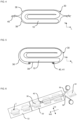
- the width W 36 of the upper strip 36 and the width W 38 of the lower strips 38 of the wrapper 30 are both lesser than the width W 10 of the folded sanitary napkin 10 with respect to the transversal direction T as defined herein by the wrapper 30 and the upper and lower strips 36,38 whereas the length L 36 of the upper strip 36 and/or the length L 38 of the lower strips 38 of the wrapper 30 is/are both greater than the length L 10 of the folded sanitary napkin 10 with respect to the longitudinal direction L as defined herein by the wrapper 30 and the upper and lower strips 36,38.
- the width W 10 of the sanitary napkin is greater than the width W 36,38 of the upper and lower strips 36,38 whereas the length L 36,38 of the upper and lower strips 36,38 is greater than the length L 10 of the sanitary napkin 10 in reference to the transversal direction L defined by the wrapper 30.
- the width W 36 ,W 38 of the upper and lower strips 36,38 are both inferior to the width W 10 of the sanitary napkin 10 in a folded state.
- both length L 36 ,L 38 of the upper and lower strips 36,38 is greater than the length L 10 of the sanitary napkin 10 in a folded state. Both strips 36,38 are bonded together at their respective longitudinal ends in a sealing region 40 that is protruding from the folded sanitary napkin 10 with respect to the longitudinal direction L.
- the wrapper 30 and upper and lower strips 36,38 still acts as a clamping mean, or a holding mean, for the sanitary napkin 10 and keeps it in a folded configuration while saving on material and thus being more environmentally friendly. Additionally, by not using a conventional pouch, there is no need to add a closing tape with the present assembly 1 again saving on material.
- the wrapper 30, for example the upper strip 36 comprises a layer of paper and the lower strip 38 comprises a layer consisting essentially of bioplastic.
- the upper and lower strip 36,38 can be made out of a same material or be made of different materials or comprise a laminate of two or more materials.
- the release paper 22 and/or backsheet 16 can comprise a pattern printed upon its outer surface whereas the wrapper comprises one or more words printed upon its outer surface or the example the release paper 22 and/or backsheet 16 and the wrapper can all comprise a drawing printed upon its surface.
- the release paper 22, the backsheet 16 and the wrapper 30 each comprises a graphic element.
- the wrapper 30 as described herein is dimensioned to cover the entirety of the release paper 22, meaning the width of the upper strip W36 and/or lower strip W38 is equal to the width of the release paper 22 and the wrapper 30 covers only a portion or the backsheet 16.
- "Equal" as used herein encompasses substantially equal meaning that the width of the upper strip 36 and/or lower strip 38 can be a little bit greater or lesser than the width of the release paper 22, for example up to 10 % greater or lesser, e.g. the width of the upper strip 36 is 5% greater than the width of the release paper 22. This enables to save on raw material.
- the release paper 22 is removed, meaning the release paper 22 is absent from the assembly 1, also meaning that the wrapper 30 as described herein is directly covering the adhesive layer 20.
- the wrapper 30 has the same width, it can be larger, as the release paper 22 so that it protects the layer of adhesive 20 to be applied on the garment.
- the wrapper 30 preferably comprises heat-sealable material at its longitudinal ends to enable a sealing of the wrapper 30 in sealing portions 40, or sealing regions 40, and a peeling material such as siliconized paper in between the sealing portions 40 to enable an easy removal of the wrapper 30 without damaging the layer of adhesive 20 and ensure a better securing of the sanitary napkin 10 to the garment. Sealing regions 40 and sealing portions 40 are interchangeable terms.
- the wrapper 30 comprises two halves with respect to the longitudinal direction L forming a continuity of matter, meaning the wrapper 30 comprises a monolithic structure.
- One half corresponds to the upper strip 36 and covers the top surface of the sanitary napkin 10 and the other half corresponds to the lower strip 38 and covers the bottom surface of the sanitary napkin with respect to the vertical direction.
- Each half are equal in length and width.
- the two halves are bonded together by the closing tape 46.
- the length of the unique strip is greater than the length of the sanitary napkin 10 in a folded state and the width of the unique strip is lesser than the width of the sanitary napkin 10 in a folded state.
- the upper strip 36 and the lower strip 38 are joined together at both their longitudinal ends each in a sealing portion 40.
- a longitudinal end of the upper strip 36 is joined to a longitudinal end of the bottom strip 38 and the other longitudinal end, i.e. the end arranged at the opposite end with respect to the longitudinal direction L, of the upper strip 36 is joined to the other longitudinal end of the bottom strip 38.
- the upper strip 36 and the lower strip 38 are superposed, meaning arranged in a facing relationship, and are affixed directly to each other at their longitudinal ends.
- the upper and lower strips 36, 38 of the wrapper 30 are bonded together at sealing portions 40 by means of thermo-sealing and/or pressure embossing and/or adhesive and/or ultrasonic bonding.
- Thermo-sealing is carried out by applying heat to a heat-sealable material.
- Pressure embossing is carried out by embossing rollers which apply pressure on the wrapper 30, i.e. on the upper and lower strips 36, 38, the compression leading to an entanglement of the fibers.
- the pressure embossing, or mechanical embossing can be carried without adhesive preferably by apply a stronger pressure to promote the intertwining, or entanglement, of fibers as schematically illustrated in FIG. 4 .
- the pressure embossing can also be applied with an adhesive 41 to better secure the strips together.
- An adhesive 41 can also be applied on one or both of the strips 36,38, namely on the side of the strip 36,38 that is facing the other strip 36,38.
- the adhesive is applied on the bottom side of the upper strip 36 and on the top side of the lower strip 38.
- the adhesive 41 is applied on the top side of the longitudinal end of the upper strip 36 and on the bottom side of the lower strip 38 with respect to the vertical direction.
- the adhesive and/or heat-sealable material preferably comes from a sustainable source, or bio-based or bioplastic, and is biodegradable and/or compostable.
- the adhesive 41 used for joining the upper and lower strips 36,38 is the same as the adhesive 20 used for bonding the backsheet 26 and the release paper 22.
- the wrapper 30, e.g. the upper strip 36 and/or the lower strip 38, comprise pre-cuts 43 so that a user can tear the wrapper 30 more easily before unfolding and applying the sanitary napkin 10 in a garment.
- the wrapper 30 comprises a weakened division line 43 so that a user can induce a rip along the weakened division line 43 in a tearing motion.
- Weakened division lines 43 can be applied by cutting, perforating, stretching, scratching such as with the use of a die cutter or a knife cutter, and the like.
- Weakened division lines 43 can also be applied by chemical treatment such as the application of acid or thermal treatment such as a heating, partial burning or freezing.
- the sanitary napkin 10 in a folded state comprises a top surface 32 and a bottom surface 34, the upper strip 36 being in contact with the top surface 34 of the folded sanitary napkin 10 and the lower strip 38 being in contact with the bottom surface 34 of the folded sanitary napkin 10 with respect to the vertical direction, an adhesive 42 being arranged at least partially between the top surface 32 and the upper strip 36 and/or between the bottom surface 34 and the lower strip 38.
- the adhesive 42 is for example applied in dots in, or along, a portion, with respect to the longitudinal direction, of the upper and/or lower strips 36,38.
- the upper strip 36 and/or lower strip 38 can be in direct contact with the folded sanitary napkin 10 and/or in contact indirectly with the folded sanitary napkin 10 for example with a layer of adhesive 42 being arranged between the folded sanitary napkin 10 and the upper and/or lower strips 36,38.
- the adhesive 42 can be applied along the entire length of the wrapper or along a portion of the length of the wrapper.
- the adhesive 42 can be the same as the adhesive 20 for the release paper 22 or the same as the adhesive 41 used for the sealing portion 40.
- the adhesive 42 enables to maintain or hold the upper and/or lower strip 36,38 onto the folded sanitary napkin 10 and avoid that said strips slip off.
- a wrapper 30 can comprise a graphic element congruent or matching the graphic element of the release paper 22 and pre-cuts 43 i.e. a weakened division line 43.
- a wrapper 30 can comprise a closing tape 46 and a graphic element.
- the wrapper 30 can be arranged, or applied, in the cross direction and comprise pre-cuts 43 and/or a graphic element.
- the method can further comprises one or more gluing steps, where the adhesives 21,42 are applied on the lower strip 36 and/or upper strip 38.
- the method further comprises a printing step where a graphic element is printed on said wrapper 30.
- the method can comprise a wrapping step as described hereabove where the upper and/or lower strips 36,38 are pre-printed, meaning already printed with a graphic element.
- the sealing step can be carried out at a bonding station, the bonding station comprising for example two embossment rollers, an applicator of adhesive eventually combined with two rollers, a sonotrode with an anvil or an embossment roller.
- the cutting step can be carried out at a cutting station, the cutting station comprising for example two rollers, one roller comprising a knife and the other roller acting as an anvil.
- the printing step can be carried out at a printing station for example using flexography or ink jet printing as a printing method.
- the separation step can be carried out at a separation station, the separation station comprising for example a first and second conveying belts 50,52.
- the second conveying belt 52 is arranged downstream, with respect to the machine direction, or conveyance flow, of the assemblies 1, of the first conveying belt 50 and goes at a faster speed than the first conveying belt 50 so to induce a gap between two successive assemblies 1 as described herein.
- the upper and lower strips 36,38 are applied in the cross-direction CD to form an assembly 1 as illustrated in FIG. 3 or in the Machine Direction MD to form an assembly 1 as illustrated in FIG. 2 .
- the ultrasonic bonding is executed by an ultrasonic welding device, such as a sonotrode, inducing vibrations at a frequency between 10 kHz and 50 kHz, apply an energy on the wrapper.
- the ultrasonic welding device can be associated with an embossing roller. Material such as plastics or bioplastics can melt at lower temperatures than paper however it is possible to use two strips made out of paper and add a sealing agent in between that will melt thereby binding the two strips.
- the ultrasonic welding device comprises a vibration generator, for example and not limited to, a magnetostrictive or piezoelectric transducer, said generator is attached to a tapering rod or probe commonly called a sonotrode usually made out of metal, such as and not limited to titanium, aluminum or steel.
Landscapes
- Health & Medical Sciences (AREA)
- Engineering & Computer Science (AREA)
- Epidemiology (AREA)
- Life Sciences & Earth Sciences (AREA)
- Heart & Thoracic Surgery (AREA)
- Vascular Medicine (AREA)
- Biomedical Technology (AREA)
- Animal Behavior & Ethology (AREA)
- General Health & Medical Sciences (AREA)
- Public Health (AREA)
- Veterinary Medicine (AREA)
- Mechanical Engineering (AREA)
- Manufacturing & Machinery (AREA)
- Absorbent Articles And Supports Therefor (AREA)
Applications Claiming Priority (2)
| Application Number | Priority Date | Filing Date | Title |
|---|---|---|---|
| EP22214316 | 2022-12-16 | ||
| EP23154539.3A EP4385476B1 (de) | 2022-12-16 | 2023-02-01 | Anordnung mit einer damenbinde und einer hülle |
Related Parent Applications (1)
| Application Number | Title | Priority Date | Filing Date |
|---|---|---|---|
| EP23154539.3A Division EP4385476B1 (de) | 2022-12-16 | 2023-02-01 | Anordnung mit einer damenbinde und einer hülle |
Publications (2)
| Publication Number | Publication Date |
|---|---|
| EP4574703A2 true EP4574703A2 (de) | 2025-06-25 |
| EP4574703A3 EP4574703A3 (de) | 2025-07-02 |
Family
ID=84537703
Family Applications (2)
| Application Number | Title | Priority Date | Filing Date |
|---|---|---|---|
| EP23154539.3A Active EP4385476B1 (de) | 2022-12-16 | 2023-02-01 | Anordnung mit einer damenbinde und einer hülle |
| EP25168692.9A Pending EP4574703A3 (de) | 2022-12-16 | 2023-02-01 | Anordnung mit einer damenbinde und einer hülle |
Family Applications Before (1)
| Application Number | Title | Priority Date | Filing Date |
|---|---|---|---|
| EP23154539.3A Active EP4385476B1 (de) | 2022-12-16 | 2023-02-01 | Anordnung mit einer damenbinde und einer hülle |
Country Status (3)
| Country | Link |
|---|---|
| US (1) | US20240225924A1 (de) |
| EP (2) | EP4385476B1 (de) |
| ES (1) | ES3029911T3 (de) |
Families Citing this family (1)
| Publication number | Priority date | Publication date | Assignee | Title |
|---|---|---|---|---|
| EP4616834A1 (de) * | 2024-03-14 | 2025-09-17 | Ontex BV | Gefalteter absorbierender artikel |
Family Cites Families (5)
| Publication number | Priority date | Publication date | Assignee | Title |
|---|---|---|---|---|
| US3665923A (en) * | 1970-02-05 | 1972-05-30 | Kimberly Clark Co | Flushable sanitary napkin |
| US4701156A (en) * | 1982-09-29 | 1987-10-20 | Paper-Pak Products, Inc. | Method and apparatus for fabricating three-fold pads |
| JP5697342B2 (ja) * | 2010-02-03 | 2015-04-08 | ユニ・チャーム株式会社 | 吸収性物品の包装構造及び包装構造の製造方法 |
| JP5922969B2 (ja) * | 2012-03-30 | 2016-05-24 | ユニ・チャーム株式会社 | 吸収性物品の包装体 |
| JP6097075B2 (ja) * | 2012-12-28 | 2017-03-15 | ユニ・チャーム株式会社 | 吸収性物品の個包装体及び吸収性物品の個包装体の製造方法 |
-
2023
- 2023-02-01 EP EP23154539.3A patent/EP4385476B1/de active Active
- 2023-02-01 ES ES23154539T patent/ES3029911T3/es active Active
- 2023-02-01 EP EP25168692.9A patent/EP4574703A3/de active Pending
- 2023-12-15 US US18/541,835 patent/US20240225924A1/en active Pending
Also Published As
| Publication number | Publication date |
|---|---|
| EP4385476B1 (de) | 2025-04-09 |
| US20240225924A1 (en) | 2024-07-11 |
| ES3029911T3 (en) | 2025-06-25 |
| EP4574703A3 (de) | 2025-07-02 |
| EP4385476C0 (de) | 2025-04-09 |
| EP4385476A1 (de) | 2024-06-19 |
Similar Documents
| Publication | Publication Date | Title |
|---|---|---|
| EP4162907A1 (de) | Umhüllung für absorbierenden artikel | |
| EP1833444B2 (de) | Saugfähige artikel und/oder verpackungskomponenten mit unterschiedlichen mustern in einem einzelnen behälter | |
| EP3065684B1 (de) | Saugfähiger artikel mit mehr als einem gestapelten saugkissen | |
| US20240315892A1 (en) | Sanitary napkin | |
| EP3552591B1 (de) | Saugfähiger kern, artikel mit besagtem kern und verfahren zur herstellung | |
| US20240225924A1 (en) | Assembly comprising a sanitary napkin and a wrapper | |
| JP2007527778A (ja) | 個別に包装された使い捨て吸収性物品の製造プロセス及び装置 | |
| KR101869124B1 (ko) | 주름이 감소된, 기계 방향으로 배향된 신체 접착 흡수 물품의 제조 방법 | |
| JP5329358B2 (ja) | 母乳パッド | |
| JP2002053170A (ja) | 個装吸収性物品 | |
| EP4620445A1 (de) | Gefaltete hygienevorlage | |
| EP4616834A1 (de) | Gefalteter absorbierender artikel | |
| US20040261939A1 (en) | Cutting method and apparatus having a resilient insert | |
| EP4494617A1 (de) | Absorptionsanordnung | |
| EP4082495A1 (de) | Laminat für einen absorbierenden artikel, absorbierender artikel mit diesem laminat und verfahren zur herstellung eines solchen laminats | |
| JP7032559B2 (ja) | フレキソ印刷デバイスおよび印刷方法 | |
| JPH06319769A (ja) | 発泡性材料バッフルを備えた吸収性製品 | |
| US11207222B2 (en) | Absorbent article including reinforced backsheet | |
| CN120201979A (zh) | 单独包装吸收性物品 | |
| GB2608695A (en) | Apparatus and method | |
| CN119997912A (zh) | 单独包装吸收性物品和包装片材 | |
| SE520687C2 (sv) | Absorberande alster med sidoflikar mekaniskt förbundna till ytskiktet |
Legal Events
| Date | Code | Title | Description |
|---|---|---|---|
| PUAI | Public reference made under article 153(3) epc to a published international application that has entered the european phase |
Free format text: ORIGINAL CODE: 0009012 |
|
| STAA | Information on the status of an ep patent application or granted ep patent |
Free format text: STATUS: THE APPLICATION HAS BEEN PUBLISHED |
|
| REG | Reference to a national code |
Ref country code: DE Ref legal event code: R079 Free format text: PREVIOUS MAIN CLASS: B65D0065400000 Ipc: A61F0013470000 |
|
| PUAL | Search report despatched |
Free format text: ORIGINAL CODE: 0009013 |
|
| AC | Divisional application: reference to earlier application |
Ref document number: 4385476 Country of ref document: EP Kind code of ref document: P |
|
| AK | Designated contracting states |
Kind code of ref document: A2 Designated state(s): AL AT BE BG CH CY CZ DE DK EE ES FI FR GB GR HR HU IE IS IT LI LT LU LV MC ME MK MT NL NO PL PT RO RS SE SI SK SM TR |
|
| AK | Designated contracting states |
Kind code of ref document: A3 Designated state(s): AL AT BE BG CH CY CZ DE DK EE ES FI FR GB GR HR HU IE IS IT LI LT LU LV MC ME MK MT NL NO PL PT RO RS SE SI SK SM TR |
|
| RIC1 | Information provided on ipc code assigned before grant |
Ipc: B65D 65/40 20060101ALI20250526BHEP Ipc: A61F 13/551 20060101ALI20250526BHEP Ipc: A61F 13/47 20060101AFI20250526BHEP |
|
| STAA | Information on the status of an ep patent application or granted ep patent |
Free format text: STATUS: REQUEST FOR EXAMINATION WAS MADE |
|
| 17P | Request for examination filed |
Effective date: 20260102 |