EP3552591B1 - Saugfähiger kern, artikel mit besagtem kern und verfahren zur herstellung - Google Patents
Saugfähiger kern, artikel mit besagtem kern und verfahren zur herstellung Download PDFInfo
- Publication number
- EP3552591B1 EP3552591B1 EP18167187.6A EP18167187A EP3552591B1 EP 3552591 B1 EP3552591 B1 EP 3552591B1 EP 18167187 A EP18167187 A EP 18167187A EP 3552591 B1 EP3552591 B1 EP 3552591B1
- Authority
- EP
- European Patent Office
- Prior art keywords
- sheet
- absorbent
- layer
- core
- fibers
- Prior art date
- Legal status (The legal status is an assumption and is not a legal conclusion. Google has not performed a legal analysis and makes no representation as to the accuracy of the status listed.)
- Active
Links
Images





Classifications
-
- A—HUMAN NECESSITIES
- A61—MEDICAL OR VETERINARY SCIENCE; HYGIENE
- A61F—FILTERS IMPLANTABLE INTO BLOOD VESSELS; PROSTHESES; DEVICES PROVIDING PATENCY TO, OR PREVENTING COLLAPSING OF, TUBULAR STRUCTURES OF THE BODY, e.g. STENTS; ORTHOPAEDIC, NURSING OR CONTRACEPTIVE DEVICES; FOMENTATION; TREATMENT OR PROTECTION OF EYES OR EARS; BANDAGES, DRESSINGS OR ABSORBENT PADS; FIRST-AID KITS
- A61F13/00—Bandages or dressings; Absorbent pads
- A61F13/15—Absorbent pads, e.g. sanitary towels, swabs or tampons for external or internal application to the body; Supporting or fastening means therefor; Tampon applicators
- A61F13/53—Absorbent pads, e.g. sanitary towels, swabs or tampons for external or internal application to the body; Supporting or fastening means therefor; Tampon applicators characterised by the absorbing medium
- A61F13/534—Absorbent pads, e.g. sanitary towels, swabs or tampons for external or internal application to the body; Supporting or fastening means therefor; Tampon applicators characterised by the absorbing medium having an inhomogeneous composition through the thickness of the pad
- A61F13/53409—Absorbent pads, e.g. sanitary towels, swabs or tampons for external or internal application to the body; Supporting or fastening means therefor; Tampon applicators characterised by the absorbing medium having an inhomogeneous composition through the thickness of the pad having a folded core
-
- A—HUMAN NECESSITIES
- A61—MEDICAL OR VETERINARY SCIENCE; HYGIENE
- A61F—FILTERS IMPLANTABLE INTO BLOOD VESSELS; PROSTHESES; DEVICES PROVIDING PATENCY TO, OR PREVENTING COLLAPSING OF, TUBULAR STRUCTURES OF THE BODY, e.g. STENTS; ORTHOPAEDIC, NURSING OR CONTRACEPTIVE DEVICES; FOMENTATION; TREATMENT OR PROTECTION OF EYES OR EARS; BANDAGES, DRESSINGS OR ABSORBENT PADS; FIRST-AID KITS
- A61F13/00—Bandages or dressings; Absorbent pads
- A61F13/15—Absorbent pads, e.g. sanitary towels, swabs or tampons for external or internal application to the body; Supporting or fastening means therefor; Tampon applicators
- A61F13/15577—Apparatus or processes for manufacturing
- A61F13/15707—Mechanical treatment, e.g. notching, twisting, compressing, shaping
-
- A—HUMAN NECESSITIES
- A61—MEDICAL OR VETERINARY SCIENCE; HYGIENE
- A61F—FILTERS IMPLANTABLE INTO BLOOD VESSELS; PROSTHESES; DEVICES PROVIDING PATENCY TO, OR PREVENTING COLLAPSING OF, TUBULAR STRUCTURES OF THE BODY, e.g. STENTS; ORTHOPAEDIC, NURSING OR CONTRACEPTIVE DEVICES; FOMENTATION; TREATMENT OR PROTECTION OF EYES OR EARS; BANDAGES, DRESSINGS OR ABSORBENT PADS; FIRST-AID KITS
- A61F13/00—Bandages or dressings; Absorbent pads
- A61F13/15—Absorbent pads, e.g. sanitary towels, swabs or tampons for external or internal application to the body; Supporting or fastening means therefor; Tampon applicators
- A61F13/53—Absorbent pads, e.g. sanitary towels, swabs or tampons for external or internal application to the body; Supporting or fastening means therefor; Tampon applicators characterised by the absorbing medium
- A61F13/534—Absorbent pads, e.g. sanitary towels, swabs or tampons for external or internal application to the body; Supporting or fastening means therefor; Tampon applicators characterised by the absorbing medium having an inhomogeneous composition through the thickness of the pad
- A61F13/53409—Absorbent pads, e.g. sanitary towels, swabs or tampons for external or internal application to the body; Supporting or fastening means therefor; Tampon applicators characterised by the absorbing medium having an inhomogeneous composition through the thickness of the pad having a folded core
- A61F13/53418—Absorbent pads, e.g. sanitary towels, swabs or tampons for external or internal application to the body; Supporting or fastening means therefor; Tampon applicators characterised by the absorbing medium having an inhomogeneous composition through the thickness of the pad having a folded core having a C-folded cross-section
-
- A—HUMAN NECESSITIES
- A61—MEDICAL OR VETERINARY SCIENCE; HYGIENE
- A61F—FILTERS IMPLANTABLE INTO BLOOD VESSELS; PROSTHESES; DEVICES PROVIDING PATENCY TO, OR PREVENTING COLLAPSING OF, TUBULAR STRUCTURES OF THE BODY, e.g. STENTS; ORTHOPAEDIC, NURSING OR CONTRACEPTIVE DEVICES; FOMENTATION; TREATMENT OR PROTECTION OF EYES OR EARS; BANDAGES, DRESSINGS OR ABSORBENT PADS; FIRST-AID KITS
- A61F13/00—Bandages or dressings; Absorbent pads
- A61F13/15—Absorbent pads, e.g. sanitary towels, swabs or tampons for external or internal application to the body; Supporting or fastening means therefor; Tampon applicators
- A61F13/53—Absorbent pads, e.g. sanitary towels, swabs or tampons for external or internal application to the body; Supporting or fastening means therefor; Tampon applicators characterised by the absorbing medium
- A61F13/534—Absorbent pads, e.g. sanitary towels, swabs or tampons for external or internal application to the body; Supporting or fastening means therefor; Tampon applicators characterised by the absorbing medium having an inhomogeneous composition through the thickness of the pad
- A61F13/53409—Absorbent pads, e.g. sanitary towels, swabs or tampons for external or internal application to the body; Supporting or fastening means therefor; Tampon applicators characterised by the absorbing medium having an inhomogeneous composition through the thickness of the pad having a folded core
- A61F13/53427—Absorbent pads, e.g. sanitary towels, swabs or tampons for external or internal application to the body; Supporting or fastening means therefor; Tampon applicators characterised by the absorbing medium having an inhomogeneous composition through the thickness of the pad having a folded core having an e-folded cross-section
-
- A—HUMAN NECESSITIES
- A61—MEDICAL OR VETERINARY SCIENCE; HYGIENE
- A61F—FILTERS IMPLANTABLE INTO BLOOD VESSELS; PROSTHESES; DEVICES PROVIDING PATENCY TO, OR PREVENTING COLLAPSING OF, TUBULAR STRUCTURES OF THE BODY, e.g. STENTS; ORTHOPAEDIC, NURSING OR CONTRACEPTIVE DEVICES; FOMENTATION; TREATMENT OR PROTECTION OF EYES OR EARS; BANDAGES, DRESSINGS OR ABSORBENT PADS; FIRST-AID KITS
- A61F13/00—Bandages or dressings; Absorbent pads
- A61F13/15—Absorbent pads, e.g. sanitary towels, swabs or tampons for external or internal application to the body; Supporting or fastening means therefor; Tampon applicators
- A61F13/53—Absorbent pads, e.g. sanitary towels, swabs or tampons for external or internal application to the body; Supporting or fastening means therefor; Tampon applicators characterised by the absorbing medium
- A61F2013/530437—Absorbent pads, e.g. sanitary towels, swabs or tampons for external or internal application to the body; Supporting or fastening means therefor; Tampon applicators characterised by the absorbing medium having a part with elevated absorption means
Definitions
- the disclosure pertains to the technical field of absorbent personal hygiene products.
- the present disclosure relates to an absorbent core that can be used within an article for absorbing body fluids and exudates, such as urine and fecal material, or blood, menses, and vaginal fluids.
- body fluids and exudates such as urine and fecal material, or blood, menses, and vaginal fluids.
- the present disclosure relates to absorbent articles, such as disposable diapers or diaper pants, disposable incontinence diapers or pants, and which are configured to collect and contain fecal material and avoid leakage, or sanitary napkins or panty liners, which are configured to collect and contain blood, menses, urine, vaginal fluids and avoid leakage.
- Absorbent articles for personal hygiene such as disposable diapers, feminine protection pads and adult incontinence undergarments, are designed to absorb and contain body exudates, in particular but not limited to urine.
- These absorbent articles usually comprise several layers having different functions, for example a topsheet, a backsheet and inbetween an absorbent core, among other layers.
- the absorbent core's function is to absorb and retain the exudates for a prolonged amount of time, for example overnight for a diaper, minimize re-wet to keep the wearer dry and avoid soiling of clothes or bed sheets.
- Absorbent cores can expand several times their initial volumes when wet. It is desirable that the cores in this expanded state maintain their structural integrity and do not break or burst even when submitted to a shock such as a child sitting heavily on his diaper. It is generally also desirable that absorbent cores should be thin (at least when dry) and require as little material as possible for costs and environmental reasons.
- absorbent cores for diapers comprise as absorbent material a blend of comminuted wood pulp (fluff) with superabsorbent polymer particles (SAP), also called absorbent gelling materials (AGM), see for example US 5,151,092 .
- SAP superabsorbent polymer particles
- AGM absorbent gelling materials
- US2008/0312621 and US2008/0312622 describe a disposable absorbent article comprising a chassis including a topsheet and a backsheet, a substantially cellulose free absorbent core located between the topsheet and the backsheet and having a wearer facing side oriented toward a wearer when the article is being worn and an opposed garment facing side, and a liquid acquisition system comprising chemically cross-linked cellulosic fibers disposed between the liquid permeable topsheet and the wearer facing side of the absorbent core.
- the liquid acquisition system may comprise a nonwoven as an upper acquisition layer and a lower acquisition layer which may comprise chemically cross-linked cellulose fibers. In such a design the lower acquisition layer contacts the upper substrate of the cellulose free absorbent core.
- a typical process to make such a liquid acquisition system is airlaying the unbound chemically cross-linked cellulose fibers onto the upper acquisition layer nonwoven: in this case, the upper acquisition layer nonwoven always fully covers the lower acquisition layer comprising the chemically cross-linked cellulose fibers.
- the disclosure relates to a process for making an anatomical absorbent core as defined in Claim 1.
- the disclosure relates to a process for making an absorbent article comprising the steps of: making an anatomical absorbent core; providing a first web of material; providing a second web and/or film of material, wherein said first web is liquid permeable and said second web and/or film is liquid impermeable; conveying said core, said first web and said second web and/or film along a machine direction to a joining station; joining said core to said first web and said second web and/or film to form a laminate.
- an anatomical absorbent core as defined in claim 7.
- Said absorbent core comprises: a front portion; a back portion ; and an intermediate portion extending between the front and back portions, wherein said intermediate portion is defined by at least, preferably only, two voids also positioned between the front and back portions and extending outboard of the intermediate portion on opposite sides thereof, wherein the entire anatomical absorbent core is capable of absorbing and retaining liquid therein and wherein front and back portions have a first and second absorption capacity per unit area respectively and the intermediate portion has a third absorption capacity per unit area, as measured according to ISO 11948-1, and wherein the first and second absorption capacities are substantially the same and the third absorption capacity per unit area is at least about two times greater than the first absorption capacity per unit area.
- the disclosure relates to absorbent articles comprising anatomical cores as described herein.
- the sheet-like layer as described herein comprises superasbsorbent polymer in the form of superabsorbent polymer particles (SAP) or superabsorbent polymer fibers (SAF), preferably consists of SAF.
- SAF superabsorbent polymer particles
- SAF superabsorbent polymer fibers
- fibers made from superabsorbent polymers are selected from those of Example 1, Example 2, Example 3, and/or Example 4 (page 5, lines 1-46) of EP3190216A1 .
- Said fibers typically being used to form nonwoven webs or substrates according to the same referenced application.
- the cutting and folding described herein is typically applied only on the absorbent sheet-like/form layer (i.e. the core of the absorbent article) and no other portions of the absorbent article are so cut and folded.
- a compartment refers to one or more than one compartment.
- the value to which the modifier "about” refers is itself also specifically disclosed.
- % by weight refers to the relative weight of the respective component based on the overall weight of the formulation or element referred to.
- Absorbent article refers to devices that absorb and contain liquid, and more specifically, refers to devices that are placed against or in proximity to the body of the wearer to absorb and contain the various exudates discharged from the body.
- Absorbent articles include but are not limited to diapers, adult incontinence briefs, training pants, diaper holders and liners, sanitary napkins and the like, as well as surgical bandages and sponges.
- Absorbent articles preferably comprise a longitudinal axis and a transversal axis perpendicular to said longitudinal axis.
- Disposable absorbent articles can include a liquid pervious top sheet, a back sheet joined to the top sheet, and an absorbent core positioned and held between the top sheet and the back sheet.
- the top sheet is operatively permeable to the liquids that are intended to be held or stored by the absorbent article, and the back sheet may or may not be substantially impervious or otherwise operatively impermeable to the intended liquids.
- the absorbent article may also include other components, such as liquid wicking layers, liquid intake layers, liquid distribution layers, transfer layers, barrier layers, wrapping layers and the like, as well as combinations thereof. Disposable absorbent articles and the components thereof can operate to provide a body-facing surface and a garment-facing surface.
- a diaper comprises a liquid permeable "top sheet”, a liquid impermeable “back sheet”, and an "absorbent medium or core” disposed between the top sheet and the back sheet.
- the top sheet, back sheet and the absorbent medium could be made from any suitable material known to the person skilled in the art.
- the top sheet is generally located at or near the bodyside surface of the article, while the back sheet is generally located at or near the garment-side surface of the article.
- the article may comprise one or more separate layers which are in addition to the back sheet and are interposed between the back sheet and the absorbent medium. Top sheet and back sheet are connected or otherwise associated together in an operable manner.
- the "absorbent medium” or “absorbent core” or “absorbent body” is the absorbent structure disposed between the top sheet and the back sheet of the absorbent article in at least the crotch region of the absorbent article and is capable of absorbing and retaining liquid body exudates.
- the size and the absorbent capacity of the absorbent medium should be compatible with the size of the intended wearer and the liquid loading imparted by the intended use of the absorbent article. Further, the size and the absorbent capacity of the absorbent medium can be varied to accommodate wearers ranging from infants through adults.
- absorbent material may be manufactured in a wide variety of shapes (for example, rectangular, trapezoidal, T-shape, l-shape, hourglass shape, etc.) and from a wide variety of materials.
- absorbent materials are cellulosic fluff pulp, tissue layers, highly absorbent polymers (so called superabsorbent polymer particles (SAP)), absorbent foam materials, absorbent nonwoven materials or the like. It is common to combine cellulosic fluff pulp with superabsorbent polymers in an absorbent material.
- Acquisition and distribution layer refers to a sublayer which preferably is a nonwoven wicking layer under the top sheet of an absorbent product, which speeds up the transport and improves distribution of fluids throughout the absorbent core.
- the surge management portion is typically less hydrophilic than the retention portion, and has the ability to quickly collect and temporarily hold liquid surges, and to transport the liquid from its initial entrance point to other parts of the absorbent structure, particularly the retention portion. This configuration can help prevent the liquid from pooling and collecting on the portion of the absorbent garment positioned against the wearer's skin, thereby reducing the feeling of wetness by the wearer.
- the surge management portion is positioned between the top sheet and the retention portion.
- adhesive as used herein is intended to refer to any suitable hot melt, water or solvent borne adhesive that can be applied to a surface of a film layer in the required pattern or network of adhesive areas to form the film-nonwoven laminate of the present invention.
- suitable adhesives include conventional hot melt adhesives, pressuresensitive adhesives and reactive adhesives (i.e., polyurethane).
- adhesive bonding means a bonding process which forms a bond by application of an adhesive.
- adhesive may be by various processes such as slot coating, spray coating and other topical applications. Further, such adhesive may be applied within a product component and then exposed to pressure such that contact of a second product component with the adhesive containing product component forms an adhesive bond between the two components.
- top sheet and back sheet can be affixed directly to each other by attachment means such as an adhesive, sonic bonds, thermal bonds or any other attachment means known in the art.
- a uniform continuous layer of adhesive may be used to affix top sheet to back sheet.
- a patterned layer of adhesive may be used to affix top sheet to back sheet.
- a sprayed pattern of adhesive may be used to affix top sheet to back sheet.
- attachment means may also be employed to interconnect and assemble together the various other component parts of the article described herein.
- back portion refers to the area of the absorbent article which is contact with the back of the wearer when the absorbent article is worn.
- backsheet refers to a material forming a liquid impermeable cover of the absorbent article.
- the back sheet prevents the exudates contained in the absorbent structure from wetting articles such as bedsheets and overgarments which contact the disposable absorbent article.
- the back sheet may be a unitary layer of material or may be a composite layer composed of multiple components assembled side-by-side or laminated.
- the back sheet may be the same or different in different parts of the absorbent article.
- the back sheet comprises a liquid impervious material in the form of a thin plastic film, e.g.
- a polyethylene or polypropylene film a nonwoven material coated with a liquid impervious material, a hydrophobic nonwoven material, which resists liquid penetration, or a laminate of a plastic film and a nonwoven material.
- the back sheet material may be breathable so as to allow vapour to escape from the absorbent material, while still preventing liquids from passing there through. Examples of breathable back sheet materials are porous polymeric films, nonwoven laminates of spunbond and meltblown layers and laminates of porous polymeric films and nonwoven materials.
- front portion refers to the area of the absorbent article which is contact with the belly of the wearer when the absorbent article is worn.
- the "body-facing” or “bodyside” surface means that surface of the article or component which is intended to be disposed toward or placed adjacent to the body of the wearer during ordinary use, while the "outward”, “outward-facing”, “garment-facing” or “garment-side” surface is on the opposite side, and is intended to be disposed to face away from the wearer's body during ordinary use.
- Such outward surface may be arranged to face toward or placed adjacent to the wearer's undergarments when the absorbent article is worn.
- Binded refers to the joining, adhering, connecting, attaching, or the like, of at least two elements. Two elements will be considered to be bonded together when they are bonded directly to one another or indirectly to one another, such as when each is directly bonded to intermediate elements.
- breathable refers to layers, preferably films or elastic laminates, having a water vapor transmission rate (WVTR) of at least 300 grams/m 2 - 24 hours.
- WVTR water vapor transmission rate
- compositions consisting essentially of
- materials that do not significantly affect the desired characteristics of a given composition or product.
- Exemplary materials of this sort would include, without limitation, pigments, antioxidants, stabilizers, surfactants, waxes, flow promoters, solvents, particulates and materials added to enhance processability of the composition.
- an absorbent article can comprise "containment flaps" or “barrier cuffs".
- the containment flaps are generally thought to be particularly well suited for the containment of fecal matter and to prevent the lateral flow of liquid waste until such time as the liquid waste can be absorbed by the absorbent article.
- Many constructions of containment flaps are known.
- Such containment flaps generally comprise a proximal edge, intended to be attached to the absorbent article, and an opposite distal edge which is generally not attached to the absorbent article along at least a portion of its length.
- An elastic member is generally located adjacent the distal edge to assist in maintaining the containment flap in an upright condition and in maintaining a sealing relationship between the distal edge of the containment flap and the body of a wearer during use.
- the elastic member is generally located between two layers of material so that the elastic does not come into contact with the body of a wearer.
- the containment flaps may be manufactured from a wide variety of materials such as polypropylene, polyester, rayon, nylon, foams, plastic films, formed films, and elastic foams. A number of manufacturing techniques may be used to manufacture the containment flaps. For example, the containment flaps may be woven, non-woven, spunbonded, carded, cast, blown or the like.
- An absorbent article can comprise leg containment gaskets (also broadly referred to as "cuffs").
- Leg “containment gaskets” help prevent leakage of bodily exudates when the wearer exerts compressive forces on the absorbent article.
- the stiffness of the leg containment gaskets prevents twisting and bunching of the leg openings of the absorbent article which can lead to leaks.
- the elasticity and conformability of the leg containment gaskets ensures that the bodyfacing surface of the leg containment gaskets provides an adequate seal against the body of the wearer.
- the physical properties of the leg containment gaskets, such as the thickness and stiffness also function to space the bodyside liner, outer cover and absorbent core away from the wearer's body when in use. As such, void volume is created between the wearer's body and the bodyside liner and absorbent core of the absorbent article to help contain body exudates.
- Mechanical bond is an attachment between two or more elements, components, regions, or webs and may comprise heat bonds, pressure bonds, ultrasonic bonds, dynamic mechanical bonds, or any other suitable non-adhesive attachment means or combinations of these attachment means.
- Hotmelt adhesive means a formulation that generally comprises several components. These components typically include one or more polymers to provide cohesive strength (e.g., aliphatic polyolefins such as poly (ethylene-co-propylene) copolymer; ethylene vinyl acetate copolymers; styrene-butadiene or styrene- isoprene block copolymers; etc.); a resin or analogous material (sometimes called a tackifier) to provide adhesive strength (e.g., hydrocarbons distilled from petroleum distillates; rosins and/or rosin esters; terpenes derived, for example, from wood or citrus, etc.); perhaps waxes, plasticizers or other materials to modify viscosity (i.e., flowability) (examples of such materials include, but are not limited to, mineral oil, polybutene, paraffin oils, ester oils, and the like); and/or other additives including, but not limited to, antioxidants or other
- a typical hot-melt adhesive formulation might contain from about 15 to about 35 weight percent cohesive strength polymer or polymers; from about 50 to about 65 weight percent resin or other tackifier or tackifiers; from more than zero to about 30 weight percent plasticizer or other viscosity modifier; and optionally less than about 1 weight percent stabilizer or other additive. It should be understood that other adhesive formulations comprising different weight percentages of these components are possible.
- absorbent articles that generally are not intended to be laundered or otherwise restored or reused as an absorbent article (i.e., they are intended to be discarded after a single use and, preferably, to be recycled, composted or otherwise disposed of in an environmentally compatible manner).
- the terms "elastic”, “elastomeric”, “elasticity” or derivations thereof are used to describe the ability of various materials and objects comprised of such to reversibly undergo deformation under stress, e.g., become stretched or extended, in at least one direction when a force is applied to the material and to resume substantially to their original dimensions upon relaxing, i.e., when the force is released, without rupture or breakage.
- it refers to a material or composite which can be elongated in at least one direction by at least 50% of its relaxed length, i.e., elongated to at least 150% of its relaxed length, and which will recover upon release of the applied tension at least 40% of its elongation.
- elastomer materials include polyether-polyamide block copolymers, polyurethanes, synthetic linear A-B-A and A-B block copolymers, chlorinated rubber/EVA (ethylene-vinyl acetate) blends, EPDM (ethylene-propylene diene monomer) rubbers, EPM (ethylene-propylene monomer) rubbers, blends of EPDM/EPM/EVA, and the like.
- elasticized or “elastified” refers to a material, layer, or substrate that is naturally non-elastic, but which has been rendered elastic by, for example, suitably joining an elastic material, layer, or substrate thereto.
- finished or “final”, when used with reference to a product, means that the product has been suitably manufactured for its intended purpose.
- the term "impermeable” generally refers to articles and/or elements that are substantially not penetrated by aqueous fluid through the entire thickness thereof under a pressure of 1.0 kPa or less.
- the impermeable article or element is not penetrated by aqueous fluid under pressures of 3.4 kPa or less. More preferably, the impermeable article or element is not penetrated by fluid under pressures of 6.8 kPa or less.
- An article or element that is not impermeable is permeable.
- Integral is used to refer to various portions of a single unitary element rather than separate structures bonded to or placed with or placed near one another.
- Join when used in describing the relationship between two or more elements, means that the elements can be connected together in any suitable manner, such as by heat sealing, ultrasonic bonding, thermal bonding, by adhesives, stitching, or the like. Further, the elements can be joined directly together, or may have one or more elements interposed between them, all of which are connected together.
- said-flat state or “fully stretched state” or “extended state” is intended to refer to the article when it is flattened into a plane or is substantially flattened into a plane and is used in contrast to when the article otherwise positioned, such as when the article is folded or shaped in or for use by a wearer.
- a layer can refer, but is not limited, to any type of substrate, such as a woven web, nonwoven web, films, laminates, composites, elastomeric materials, or the like, or even formulations, such as adhesives, that form a substrate upon a change in conditions (e.g. solidification of a hotmelt adhesive when the temperature drops below a predetermined amount).
- a layer can be liquid and air permeable, permeable to air but impermeable to liquids, impermeable both to air and liquid, or the like. When used in the singular, it can have the dual meaning of a single element or a plurality of elements.
- nonwoven fabric or web means a sheet material having a structure of individual fibers or threads which are interlaid, but not in a regular manner such as occurs with knitting or weaving processes.
- Nonwoven fabrics or webs have been formed from many processes such as for example, meltblowing processes, spunbonding processes, and bonded carded web processes.
- the material is generally in the form of discrete units.
- the units can comprise granules, powders, spheres, pulverized materials or the like, as well as combinations thereof.
- the particles can have any desired shape such as, for example, cubic, rod-like, polyhedral, spherical or semi-spherical, rounded or semi-rounded, angular, irregular, etc. Shapes having a large greatest dimension/smallest dimension ratio, like needles, flakes and fibers, are also contemplated for inclusion herein.
- particle or “particulate” may also include an agglomeration comprising more than one individual particle, particulate or the like. Additionally, a particle, particulate or any desired agglomeration thereof may be composed of more than one type of material.
- substrate includes, but is not limited to, woven or nonwoven webs, porous films, ink permeable films, paper, composite structures, or the like.
- Superabsorbent materials suitable for use in the present disclosure are known to those skilled in the art, and may be in any operative form, such as particulate form, fibers and mixtures thereof.
- the "superabsorbent material” can be a water-swellable, generally water-insoluble, hydrogel-forming polymeric absorbent material, which is capable of absorbing at least about 15, suitably about 30, and possibly about 60 times or more its weight in physiological saline (e.g. saline with 0.9 wt % NaCl).
- the superabsorbent material may be biodegradable or bipolar.
- the hydrogel-forming polymeric absorbent material may be formed from organic hydrogel-forming polymeric material, which may include natural material such as agar, pectin, and guar gum; modified natural materials such as carboxymethyl cellulose, carboxyethyl cellulose, and hydroxypropyl cellulose; and synthetic hydrogel-forming polymers.
- Synthetic hydrogel-forming polymers include, for example, alkali metal salts of polyacrylic acid, polyacrylamides, polyvinyl alcohol, ethylene maleic anhydride copolymers, polyvinyl ethers, polyvinyl morpholinone, polymers and copolymers of vinyl sulfonic acid, polyacrylates, polyacrylamides, polyvinyl pyridine, and the like.
- hydrogel-forming polymers include hydrolyzed acrylonitrile grafted starch, acrylic acid grafted starch, and isobutylene maleic anhydride copolymers and mixtures thereof.
- the hydrogel-forming polymers may be lightly crosslinked to render the material substantially water insoluble. Crosslinking may, for example, be by irradiation or covalent, ionic, Van der Waals, or hydrogen bonding.
- the superabsorbent material may suitably be included in an appointed storage or retention portion of the absorbent system, and may optionally be employed in other components or portions of the absorbent article.
- the superabsorbent material may be included in the absorbent layer or other fluid storage layer of the absorbent article of the present invention in an amount up to 100% by weight. Typically, the superabsorbent material, when present, will be included in an amount of from about 30% to about 70% by weight, based on the total weight of the absorbent layer.
- Superabsorbent polymer particles or “SAPs” refer to water-swellable, water-insoluble organic or inorganic materials capable, under the most favorable conditions, of absorbing at least about 10 times their weight, or at least about 15 times their weight, or at least about 25 times their weight in an aqueous solution containing 0.9 weight percent sodium chloride.
- the particle size is typically ranging between 100 to 800 ⁇ m, preferably between 300 to 600 ⁇ m, more preferably between 400 to 500 ⁇ m.
- topsheet refers to a liquid permeable material sheet forming the inner cover of the absorbent article and which in use is placed in direct contact with the skin of the wearer.
- the top sheet is typically employed to help isolate the wearer's skin from liquids held in the absorbent structure.
- the top sheet can comprise a nonwoven material, e.g. spunbond, meltblown, carded, hydroentangled, wetlaid etc.
- Suitable nonwoven materials can be composed of man-made fibres, such as polyester, polyethylene, polypropylene, viscose, rayon etc. or natural fibers, such as wood pulp or cotton fibres, or from a mixture of natural and man-made fibres.
- the top sheet material may further be composed of two fibres, which may be bonded to each other in a bonding pattern. Further examples of top sheet materials are porous foams, apertured plastic films, laminates of nonwoven materials and apertured plastic films etc. The materials suited as top sheet materials should be soft and non-irritating to the skin and be readily penetrated by body fluid, e.g. urine or menstrual fluid.
- the inner coversheet may further be different in different parts of the absorbent article.
- the top sheet fabrics may be composed of a substantially hydrophobic material, and the hydrophobic material may optionally be treated with a surfactant or otherwise processed to impart a desired level of wettability and hydrophilicity.
- transverse refers to a line, axis, or direction which lies within the plane of the absorbent article and is generally perpendicular to the longitudinal direction (i.e. is parallel to the x-axis).
- substantially perpendicular (or parallel) refers to an element extending at an angle of not more than 35°, preferably less than 25°, more preferably less than 20°, even more preferably less than 15°, even more preferably less than 10°, most preferably less than 5°, from the referred perpendicular (or parallel) axis.
- differentiate cellulosic fibers By the term “distinct cellulosic fibers” as used herein, is meant cellulosic fibers that are not part of a substrate (e.g. a nonwoven layer) and are rather distinct thereof and/or physically separated therefrom (i.e. what is typically referred to as fluff, fluff-pulp, or tow fibers), and typically are in the form of cellulosic fibers that are for example enclosed though kept separate from said substrate (i.e. not integral). For sake of clarity, cellulosic fibers that may be present within and/or integral to a substrate (e.g. a cellulosic nonwoven layer) are not encompassed within its meaning.
- spunbond fibers refers to fibers formed by extruding molten thermoplastic polymers as filaments or fibers from a plurality of relatively fine, usually circular, capillaries of a spinneret, and then rapidly drawing the extruded filaments by an eductive or other well-known drawing mechanism to impart molecular orientation and physical strength to the filaments.
- the average diameter of spunbond fibers is typically in the range of from 5-60 ⁇ m, preferably from 10-30 ⁇ m.
- the spinneret can either be a large spinneret having several thousand holes per meter of width or be banks of smaller spinnerets, for example, containing as few as 40 holes.
- SMS nonwoven fabric refers to a multi-layer composite sheet comprising a web of meltblown fibers sandwiched between and bonded to two spunbond layers.
- a SMS nonwoven fabric can be formed in-line by sequentially depositing a first layer of spunbond fibers, a layer of meltblown fibers, and a second layer of spunbond fibers on a moving porous collecting surface. The assembled layers can be bonded by passing them through a nip formed between two rolls that can be heated or unheated and smooth or patterned. Alternately, the individual spunbond and meltblown layers can be pre-formed and optionally bonded and collected individually such as by winding the fabrics on wind-up rolls.
- the individual layers can be assembled by layering at a later time and bonded together to form a SMS nonwoven fabric. Additional spunbond and/or meltblown layers can be incorporated in the SMS fabric, for example spunbond-meltblown-meltblown-spunbond (SMMS), etc.
- SMSMS spunbond-meltblown-meltblown-spunbond
- “Staple fibers” refer to commercially available fibers having diameters ranging from less than about 0.001 mm to more than about 0.2 mm; they come in several different forms such as short fibers ranging from about 10 to 50 mm in length and long fibers with a length higher than 50 mm, preferably up to 100 mm.
- Hydroentanglement process refers to the manufacturing of nonwoven webs. The process involves directing a series of water jets towards a fibrous web which is supported on a moving porous belt. The water jets pass downwards through the mass of fibres and on making contact with the surface of the belt, the jets rebound, and break up: the energy released causes entanglement of the mass of fibres.
- Absorption capacity per unit area also referred to as “absorbency”, as used herein means absorption capacity as measured according to ISO 11948-1 [known also as “the Rothwell method”] divided by the surface area (taken about a plane parallel to both the length, being parallel to the machine direction MD, and the width of the sheet-like layer) of the component referred to.
- the absorption capacity per unit area of the intermediate portion is the absorption capacity of the intermediate portion according to the test method procedure of ISO 11948-1 divided by the surface area of said intermediate portion, with unit of g/cm 2 .
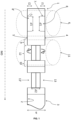
- the absorbent core 21 obtainable from (preferably obtained directly and/or made according to) the below described processes comprises: a front portion 29 ; a back portion 210 ; and an intermediate portion 12 extending between the front and back portions 29, 210 , wherein said intermediate portion 12 is defined by at least, preferably only, two voids 13, 13' also positioned between the front and back portions 29, 210 and extending outboard of the intermediate portion 12 on opposite sides thereof, wherein the entire anatomical absorbent core 21 is capable of absorbing and retaining liquid therein and wherein front and back portions 29, 210 have a first and second absorption capacity per unit area respectively and the intermediate portion 12 has a third absorption capacity per unit area, as defined herein above, and wherein the first and second absorption capacities are substantially the same and the third absorption capacity per unit area is at least about 2, preferably at least about 2.5, more preferably at least about 3, times greater than the first absorption capacity per unit area.
- the entire core has a
- the thickness of the intermediate portion 12 is at least about twice, preferably at least three times, the thickness of the front and back portions 29, 210 , as measured according to ISO 9073-2 [method A in particular]. Increasing absorbency by simply folding (and increasing the thickness) of the central crotch region has been found to be very costeffective.
- the intermediate portion 12 does not extend beyond the voids 13,13' along the length of the absorbent core (parallel to the machine direction MD ). It has been found that having an abrupt demarcation between the intermediate portion 12 and each of the front and back portions 29, 210 folding lines are formed in the transverse direction that help shaping of said front and back portions and improve fluid handling.
- the core is composed of a sheet-form layer 1 of absorbent material comprising fibers (typically selected from the group consisting of polyester fibers, polyethylene terephthalate (PET) fibers, polyethylene (PE) fibers, polypropylene (PP) fibers, cellulose fibers, and mixtures thereof, most preferably cellulose fibers) and/or superabsorbent polymer, said sheet-form layer 1 comprising oppositely disposed top and bottom surfaces 2, 3 , first and second longitudinal sides 4, 5 and a width w extending between said sides 4, 5 , and wherein portions of the first and second longitudinal sides 4, 5 are folded over the top or bottom surface 2, 3 of the sheet-form layer 1 to form the intermediate portion 12 , preferably wherein said portions of the first and second longitudinal sides 4, 5 are folded over said top or bottom surface 2, 3 a plurality of times, typically wherein said portions are the intermediate flaps 8, 8' .
- An advantage of this arrangement is to further increase absorption capacity per unit area without adding any further material and further limiting scrap.
- the sheet-form layer 1 comprises, preferably consists of, compressed cellulose fibers and immobilized superabsorbent polymer particles therein and/or thereon.
- Such material can be easily and cheaply made into a continuous sheet of material that can be rolled up into reels for subsequent processing (sometimes also referred to as "SAP paper") according to the processes described herein below.
- the anatomical absorbent core 21 has a perimeter shape selected from substantially H-shaped, T-shaped or hour-glass shaped.
- the sheet-form layer 1 comprises, preferably consists of, a nonwoven carrier (that may selected from the group consisting of polyester fibers, polyethylene terephthalate (PET) fibers, polyethylene (PE) fibers, polypropylene (PP) fibers, cellulose fibers, and mixtures thereof, most preferably cellulose fibers) and superabsorbent polymer particles immobilized therein and/or thereon, preferably wherein the carrier comprises a nonwoven top layer, penetrable by the particles and a nonwoven bottom layer, said top layer being mechanically bonded by hydroentanglement to the bottom layer, wherein said carrier, the bottom layer and the top layer are hydrophilic, and wherein the bottom layer is porous with a pore size smaller than said particles.
- a nonwoven carrier that may selected from the group consisting of polyester fibers, polyethylene terephthalate (PET) fibers, polyethylene (PE) fibers, polypropylene (PP) fibers, cellulose fibers, and mixtures thereof, most preferably cellulose
- the top layer is a carded nonwoven made of staple fibers which are hydroentangled to the bottom layer and wherein the bottom layer is a spunbond meltblown spunbond fabric.
- This arrangement has been found particularly useful to ensure that the SAP is securely immobilized and is not displaced during the high speed production process.
- the anatomical absorbent core 21 described herein is free of fluff (also referred to as pulp-fluff) or distinct cellulosic fibers.
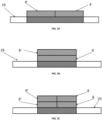
- the flaps 8, 8' may be folded such that they abut each other, or can be folded one on top of the other ( Fig.3B ), or can be folded on themselves ( Fig.3C ).
- the flaps 8, 8' are folded on themselves such to form a Z-fold, as exemplified on Fig.4 .
- An advantage of this arrangement is that further absorption capacity per unit area is added to the central portion of the crotch section.
- the intermediate flaps 8, 8' are folded such that an exudate-retaining basin is formed between the top or bottom surface 2, 3 of the intermediate portion 12 of the sheet-form layer 1 and the top or bottom surface of the intermediate flaps 8, 8' respectively.
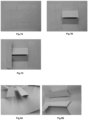
- An exemplary core formed by such process arrangement is shown on Fig. 8A-B .
- Advantageously such allows the formation of a pocket for exudate, especially liquid stool, collection.
- cores described herein above are not enclosed within a core wrap and are preferably directly laminated between a liquid impermeable backsheet and a further liquid permeable layer that may be selected from an acquisition distribution layer (ADL), a topsheet and combinations thereof.
- ADL acquisition distribution layer
- core wraps are used to enclose the absorbent layer therein and are made of common materials such as tissue and/or nonwoven webs the purpose of which is to retain the core therein prior to laminating with other components such as topsheet and backsheet to form the absorbent article.
- the core wrap may inhibit full exploitation of the benefits of the core arrangements described herein, such as the formation of an exudate retaining basin, by rather holding the flaps in a folded configuration in both dry and wet conditions and preventing partial unfolding which has rather been found beneficial in the present disclosure.
- the absorbent article 31 may comprise an anatomical absorbent core 21 as described herein, wherein the super absorbent polymer particles have a size distribution and being dispersed in the carrier according to their particle size distribution gradient along a depth direction or z-direction of said absorbent core, and wherein the smaller super absorbent polymer particles are located on a garment-facing side of the absorbent article and the larger super absorbent polymer particles are located on the opposite side of the absorbent article on a body-facing side thereof.
- An advantage of this arrangement is that graded absorbency is further achieved in the thickness direction of the core.
- the absorbent article 31 may further comprise other known components in the art such as but not limited to longitudinal cuffs, transversal cuffs, elastic waistband (front and/or back), elastic or non-elastic side panels (front and/or back), frontal tape (or landing zone, sometimes referred to as female mechanical fastener or looped fastener) typically joined to the front garment facing surface of the belly section, back tapes (or male fastener with hooks and/or adhesive) typically joined to each of the back side panels, leg elastics, wetness indicator, and the like.
- other known components in the art such as but not limited to longitudinal cuffs, transversal cuffs, elastic waistband (front and/or back), elastic or non-elastic side panels (front and/or back), frontal tape (or landing zone, sometimes referred to as female mechanical fastener or looped fastener) typically joined to the front garment facing surface of the belly section, back tapes (or male fastener with hooks and/or adhesive) typically joined to each of
- the intermediate flaps (8, 8') are folded such that an exudate-retaining basin is formed in the core between the top or bottom surface (2, 3) of the intermediate portion (12) of the sheet-form layer (1) and the top or bottom surface of the intermediate flaps (8, 8') respectively.
- An exemplary core formed by such process arrangement is shown on Fig. 8A-B .
- the core is sandwiched between a liquid impermeable backsheet and a liquid permeable topsheet, wherein the topsheet comprises macro-apertures (typically of 100 to 3000 microns, preferably 500 to 2000 microns in diameter) arranged to allow passage of liquid stool therethrough.
- macro-apertures typically of 100 to 3000 microns, preferably 500 to 2000 microns in diameter
- the disclosure herein further contemplates a process of making absorbent cores and absorbent articles described herein.
- the process for making an anatomical absorbent core comprises the steps of: providing a continuous sheet-form layer 1 of absorbent material comprising fibers (preferably selected from the group consisting of polyester fibers, polyethylene terephthalate (PET) fibers, polyethylene (PE) fibers, polypropylene (PP) fibers, cellulose fibers, and mixtures thereof, most preferably cellulose fibers) and/or superabsorbent polymer, said sheet-form layer 1 comprising oppositely disposed top and bottom surfaces 2, 3 , and first and second longitudinal sides 4, 5 and a width w extending between said sides 4, 5 , said sides 4, 5 extending substantially parallel to each other throughout the entire sheet-form layer 1 length extending along a machine direction MD ; advancing said sheet-form layer 1 along a machine direction MD to a cutting station 6 ; applying at least two cuts 7 to said sheet-form layer 1 at each of the first and second longitudinal sides 4, 5 along a cutting axis being substantially perpen
- a further advantage of this arrangement is that the absorbent sheet-form layer may be manufactured in a separate process (e.g. by a raw material supplier) and rolled into reels, that can be unwound and processed according to the above described steps. This has the further advantage of no longer needing a drum forming section in the production line and thus also reduces floor space usage and energy consumption as well as increasing production speeds.
- a further advantage is that the sheet of absorbing material is fully utilized with no scrap being generated in the core formation.
- each intermediate portion 12 is separated by at least one of the upstream and downstream portions 9, 10 of said sheet-form layer 1 such that the intermediate flaps 8, 8' are intermittently formed along the machine direction MD (i.e. said flaps do not continuously extend along the machine direction MD of said layer). Such ensures abrupt demarcations are formed therebetween forming folding lines as described herein above.
- the cutting axis is at an angle ⁇ to the machine direction MD , typically said angle ⁇ being from 25° to 90°, more preferably from 30° to 85°, even more preferably from 35° to 80°, even more preferably from 40° to 75°, most preferably from 45° to 70°.
- An advantage of cutting at an angle is that a more hour-glass shaped core can be achieved rather than solely H-shaped, however applying a cut below the lower limit has the disadvantage of reducing production speeds (bottleneck at the folding station) and/or increasing the risk of tearing and damaging the core during the folding step.
- the cuts may be linear (as shown in Fig. 1 ) or may be curved, or a combination of the two (such as shown in Fig. 6B , E and F).
- each cut 7 applied on the first longitudinal side 4 has a first cut length l1 and each cut applied on the second longitudinal side 5 has a second cut length l2 and wherein the following formula is satisfied: l 1 + l 2 ⁇ d 2
- An advantage of the above arrangement is that it permits to achieve a multiplier of original absorbency when later folded vs the flat sheet, and this where it is most needed.
- the folded intermediate flaps 8, 8' substantially abut each other when in the folded position.
- the folded intermediate flaps 8, 8' substantially overlap one another when in the folded position. This arrangement allows for the anatomical shape being formed as well as the graded absorption capacity per unit area.
- the folded intermediate flaps 8, 8' are spaced apart along the width direction w (i.e. do not abut each other) such that a channel is formed in the intermediate portion 12 , preferably only in the intermediate portion 12 . It has been found that such a channel improves initial fluid burst distribution, however it is desirable for it not to extend into the front and back portions of the absorbent core hence intermittent channels along the machine direction MD are rather desirable.
- the intermediate flaps 8, 8' are folded such that an exudate-retaining basin is formed between the top or bottom surface 2, 3 of the intermediate portion 12 of the sheet-form layer 1 and the top or bottom surface of the intermediate flaps 8, 8' respectively.
- An exemplary core formed by such process arrangement is shown on Fig. 8A-B .
- Advantageously such allows the formation of a pocket for exudate, especially liquid stool, collection.
- the sheet-form (or sheet-like) layer 1 is further folded along the width w thereof in the upstream and/or downstream portions thereof (between which the intermediate portions lie). Advantages of this embodiment is to further provide added absorption and/or cushioning support to the back and/or belly region of the subject when wearing the article.
- the cutting station may comprise one or more linear or shearing knives or one or more rotating drums comprising one or more knives on the perimetral surface thereof. Said knives may be timed for cutting the sheet either mechanically (via the use of cams and gears) or electromechanically via the use of servomotors and a virtual master reference acting as a metronome to provide the cutting signal. Nevertheless, other cutting means achieving the same end result of the process steps described herein may equally be used.
- the cutting station may comprise one or more laser cutters arranged to cut the sheet-like layer, in the manner disclosed herein.
- the folding station may comprise a combination of stationary and kinetic lifting and/or folding means.
- the station may comprise protruding elements (preferably fixed and/or not moveable) arranged to lift the flaps as the sheet-like material is fed in the machine direction and downstream therefrom an actuated folding apparatus (e.g. servo-actuated, cam-driven or the like) arranged to force the lifted flaps to fold over the sheet-like layer.
- an actuated folding apparatus e.g. servo-actuated, cam-driven or the like
- the fixed protrusions may be replaced with a blowing apparatus comprising nozzles arranged to eject compressed air (generally forming a reverse vacuum), preferably only, in the region of the flaps in order to lift them away from the plane of the sheet-like layer that is typically retained onto a conveyor belt by static force and/or vacuum suction.
- a blowing apparatus comprising nozzles arranged to eject compressed air (generally forming a reverse vacuum), preferably only, in the region of the flaps in order to lift them away from the plane of the sheet-like layer that is typically retained onto a conveyor belt by static force and/or vacuum suction.
- the cutting and folding may be carried at the same station and/or substantially concurrently.
- the cutting station may comprise a rotating roller 40 comprising one or more knives 41 shaped according to the needs described herein (e.g. straight, curved or angled about one or more planes).
- the roller 40 comprises at least two spaced apart knives 41 in a thickness direction (perpendicular to the machine direction MD ) and said spacing being substantially equal to the width of the sheet-like layer, and preferably at least two spaced apart knives 41 in the machine direction MD being substantially equal to d1 .
- the roller may comprise openings on an outer surface thereof in proximity to a receiving surface of the sheet-form layer, these openings may preferably be located between two consecutive knives 41 , and said openings being in fluid communication with an under pressure source such to form a vacuum force V arranged to lift the flap formed on the sheet-form layer substantially concurrently to the cutting thereof.
- a deflector 43 Downstream said roller 40 , along the machine direction MD , a deflector 43 (stationary or kinetic) may be arranged to grip the lifted flap and fold it according to the embodiments described herein.
- a vacuum belt 44 may be arranged proximal to, and preferably below, the deflector 43 such that the folded sheet-like layer is conveyed further along the machine direction MD .
- a glue application step is carried out wherein an adhesive is applied on portions of the sheet-like layer (i.e. on the intermediate portion) where the flaps are to be joined thereto.
- Such step may be carried out via adhesive spray nozzles common in the art, such as those described in US5,474,540 and/or EP1593848A2 .
- Such glue/adhesive applicator(s) may be positioned just prior (i.e. upstream) to the folding station or within the folding station provided that the adhesive is applied to the intermediate portion of the sheet-like layer prior to the actual folding of the flaps.
- such step is carried out downstream of the folding station typically within a sealing station (not shown) that may comprise an ultrasonic or heat sealing apparatus.
- the bonding formed is temporary such that upon contact with liquid the flaps are released from their folded position, preferably to a semi-folded position.
- temporary it is intended herein that the bonding strength is sufficiently strong to hold the flaps in a folded position during the process of making the absorbent cores and/or articles (i.e. in dry-state), and at least partly release when in contact with liquid exudates (i.e. in wetstate).
- the latter may be achieved by selecting the appropriate adhesive or use of mechanical bonding especially ultrasonic spot-bonding.
- the sheet-form layer 1 comprises super absorbent polymer particles immobilized over or through the fibers that are arranged in the form of a sheet or web, preferably wherein said immobilization is attained by an adhesive or by mechanical locking.
- the mechanical locking may be achieved by applying ultrasound to force the particles to penetrate within the fibrous layer and lock/entangle with the fibers.
- the voids 13, 13' form indentations in the sheet-form layer 1 extending in a widthwise direction thereof such that the intermediate portion 12 has a width that is less than that of the upstream and downstream portions 9, 10 , preferably to form one or more H-shaped, T-shaped or hourglass-shaped cores. Such further enables the desired anatomical shape.
- a further plurality of cuts may be applied at each longitudinal edge thereof, after the intermediate flaps 8, 8' are folded, such to form shaping sub-flaps arranged to conform with the anatomical shape of the body when worn.
- Such further cuts may be linear, curved or a combination thereof.
- the cuts may follow the transversal axis (i.e. straight cuts) along the width w of the sheet-like layer or core; or be at an angle ⁇ therefrom (i.e. angled cuts) typically being from 25° to 90°, more preferably from 30° to 85°, even more preferably from 35° to 80°, even more preferably from 40° to 75°, most preferably from 45° to 70°; or a combination thereof.
- An advantage is better shaping of the core is achieved and added flexibility aiding cup formation of the core and absorbent article.
- a process for making an absorbent article comprises the steps of: making an anatomical absorbent core according to the above described process steps (typically either in-line or preferably in a separate pre-production batch or process); providing a first web of material; providing a second web and/or film of material, wherein said first web is liquid permeable and said second web and/or film is liquid impermeable; conveying said core, said first web and said second web and/or film along a machine direction MD to a joining station; joining said core to said first web and said second web and/or film to form a laminate; optionally applying one or more add-ons to the laminate, said add-ons preferable selected from the group consisting of transversal and/or longitudinal cuffs, elastic or inelastic front and/or back side panels, female and/or male fasteners, and one or more elastic materials; optionally severing the laminate along an axis perpendicular to the machine direction MD to form a plurality of distinct absorbent articles.
- further layers are conveyed and subsequently joined between the first web of material and the core.
- ADL acquisition distribution layers
- ADL may be conveyed and adhered in a facing relationship to the top or bottom surface of the sheet-like layer prior to the cutting and/or folding station such that upon cutting and folding said intermediate flaps said ADL is at least partly enwrapped by at least a portion of said flaps.
- Conveying means and joining means as known in the art may be used to move the substrate and adhere them together to form the resulting laminates.
- any absorbent core and absorbent article arrangement resulting from embodiments discussed herein the context of the process of making may be directly generalized and applied, or can be combinable, to the core and article features and description according to the disclosure herein.
Landscapes
- Health & Medical Sciences (AREA)
- Engineering & Computer Science (AREA)
- Life Sciences & Earth Sciences (AREA)
- Biomedical Technology (AREA)
- Heart & Thoracic Surgery (AREA)
- Vascular Medicine (AREA)
- Epidemiology (AREA)
- Animal Behavior & Ethology (AREA)
- General Health & Medical Sciences (AREA)
- Public Health (AREA)
- Veterinary Medicine (AREA)
- Mechanical Engineering (AREA)
- Manufacturing & Machinery (AREA)
- Absorbent Articles And Supports Therefor (AREA)
Claims (15)
- Verfahren zur Herstellung eines anatomischen absorbierenden Kerns (21), die folgenden Schritte umfassend:Bereitstellen einer durchgehenden folienförmigen Schicht (1) aus absorbierendem Material, einen Vliesträger umfassend, der Natur- und/oder Synthetikfasern und superabsorbierende Polymerpartikel, die darin und/oder daran immobilisiert sind, aufweist, wobei die folienförmige Schicht (1) eine Ober- und eine Unterseite (2, 3), die gegenüberliegend angeordnet sind, und eine erste und eine zweite Längsseite (4, 5) umfasst und eine Breite (w), die sich zwischen den Seiten (4, 5) erstreckt, und sich die Seiten (4, 5) über die gesamte Länge der folienförmigen Schicht (1), die sich entlang einer Maschinenrichtung (MD) erstreckt, im Wesentlichen parallel zueinander erstrecken,Befördern der folienförmigen Schicht (1) entlang der Maschinenrichtung (MD) zu einer Schneidestation (6),Setzen mindestens zweier Schnitte (7) an der folienförmigen Schicht (1) an jeder der ersten und der zweiten Längsseite (4, 5) entlang einer Schneidachse, wobei jeder der Schnitte (7) um eine Distanz (d1) entlang einer Längsachse, die parallel zu der Maschinenrichtung (MD) und senkrecht zu der Breite (w) verläuft, beabstandet ist, wobei die Schnitte (7) mittlere Klappen (8, 8') zwischen prozessaufwärtigen und prozessabwärtigen Abschnitten (9, 10) der folienförmigen Schicht (1) bilden, wobei sich die Schneidachse nur parallel zu der Breite (w) oder in einem Winkel (α) dazu erstreckt, sodass keine Schnitte gesetzt werden, die sich parallel zu der Maschinenrichtung (MD) erstrecken,Befördern der folienförmigen Schicht (1) entlang einer Maschinenrichtung (MD) zu einer Falzstation (11),Falzen der mittleren Klappen (8, 8') über die Ober- oder Unterseite (2, 3) der folienförmigen Schicht (1), um einen mittleren Abschnitt (12) zu bilden, der zwei oder mehr Leerräume (13, 13') umfasst, die gegenüberliegend an jeder der Längsseiten (4, 5) angeordnet sind und um eine Distanz (d2) entlang der Breite (w) beabstandet sind,optional Anheften der mittleren Klappen (8, 8') an mindestens einen Abschnitt der Ober- oder Unterseite (2, 3),optional Trennen der folienförmigen Schicht (1) entlang der Breite (w) zwischen zwei aufeinanderfolgenden Leerräumen (13, 13`), die entlang derselben ersten oder zweiten Längsseite (4, 5) angeordnet sind, um einzelne anatomische absorbierende Kerne zu bilden,und wobei der absorbierende Kern (21) frei von Flockenzellstoff oder einzelnen Zellulosefasern ist, undwobei jeder Schnitt (7), der an der ersten Längsseite (4) gesetzt wird, eine erste Schnittlänge (11) aufweist und jeder Schnitt, der an der zweiten Längsseite (5) gesetzt wird, eine zweite Schnittlänge (l2) aufweist und wobei die folgende Formel erfüllt ist:

- Verfahren nach Anspruch 1, wobei die gefalzten mittleren Klappen (8, 8') im Wesentlichen aneinander anliegen, wenn sie in der gefalzten Position sind.
- Verfahren nach Anspruch 1, wobei die gefalzten mittleren Klappen (8, 8') einander im Wesentlichen überlappen, wenn sie in der gefalzten Position sind.
- Verfahren nach einem der vorhergehenden Ansprüche, wobei die folienförmige Schicht (1) superabsorbierende Polymerpartikel umfasst, die über den Fasern, die in Form einer Folie oder einer Bahn angeordnet sind, oder durch diese hindurch immobilisiert sind, vorzugsweise wobei die Immobilisierung durch einen Klebstoff oder eine mechanische Blockierung erreicht wird.
- Verfahren nach einem der vorhergehenden Ansprüche, wobei die Leerräume (13, 13') Einkerbungen in der folienförmigen Schicht (1) bilden, die sich in einer Breitenrichtung davon derart erstrecken, dass der mittlere Abschnitt (12) eine Breite aufweist, die kleiner ist als die der prozessaufwärtigen und prozessabwärtigen Abschnitte (9, 10), vorzugsweise um einen oder mehrere H-förmige, T-förmige oder sanduhrförmige Kerne zu bilden.
- Verfahren zum Herstellen eines absorbierenden Artikels, die folgenden Schritte umfassend:Herstellen eines anatomischen absorbierenden Kerns gemäß dem Verfahren nach den Ansprüchen 1 bis 5,Bereitstellen einer ersten Bahn von Material,Bereitstellen einer zweiten Bahn und/oder eines zweiten Films von Material, wobei die erste Bahn flüssigkeitsdurchlässig ist und die zweite Bahn und/oder der zweite Film flüssigkeitsundurchlässig ist,Transportieren des Kerns, der ersten Bahn und der zweiten Bahn und/oder des zweiten Films entlang einer Maschinenrichtung (MD) zu einer Zusammenfügungsstation,Zusammenfügen des Kerns mit der ersten Bahn und der zweiten Bahn und/oder dem zweiten Film, um ein Laminat zu bilden,optional Anbringen eines oder mehrerer Zusätze an dem Laminat, wobei die Zusätze vorzugsweise aus der Gruppe ausgewählt werden, die aus Quer- und/oder Längsbündchen, elastischen oder unelastischen vorder- und/oder rückseitigen Feldern, aufnehmenden und/oder steckerartigen Befestigungsmitteln und einem oder mehreren elastischen Materialien besteht,optional Trennen des Laminats entlang einer Achse, die senkrecht zu der Maschinenrichtung (MD) liegt, um mehrere einzelne absorbierende Artikel zu bilden.
- Anatomischer absorbierender Kern (21), wobei der Kern Folgendes umfasst:einen vorderen Abschnitt (29),einen hinteren Abschnitt (210) undeinen mittleren Abschnitt (12), der sich zwischen dem vorderen und dem hinteren Abschnitt (29, 210) erstreckt, wobei der mittlere Abschnitt (12) definiert ist durch mindestens, vorzugsweise nur, zwei Leerräume (13, 13`), die ebenfalls zwischen dem vorderen und dem hinteren Abschnitt (29, 210) positioniert sind und sich von dem mittleren Abschnitt (12) an gegegnüberliegenden Seiten davon auswärts erstrecken, wobei die Leerräume (13, 13') gegenüberliegend an jeder Längsseite (4, 5) des mittleren Abschnitts (12) angeordnet und um eine Distanz (d2) entlang der Breite (w), die sich zwischen den Seiten (4, 5) erstreckt, beabstandet sind,wobei der gesamte anatomische absorbierende Kern (21) in der Lage ist, Flüssigkeit darin zu absorbieren und zu halten, und wobei der vordere und der hintere Abschnitt (29, 210) ein erstes beziehungsweise ein zweites Absorptionsvermögen pro Flächeneinheit aufweisen und der mittlere Abschnitt (12) ein drittes Absorptionsvermögen pro Flächeneinheit aufweist, gemessen gemäß dem hierin beschriebenen Testverfahren, wobei das dritte Absorptionsvermögen pro Flächeneinheit mindestens ungefähr zweimal größer ist als das erste Absorptionsvermögen pro Flächeneinheit und vorzugsweise wobei das erste und das zweite Absorptionsvermögen im Wesentlichen gleich sind, und wobei der absorbierende Kern (21) eine folienförmige Schicht (1) umfasst, die einen Vliesträger umfasst, der Natur- und/oder Synthetikfasern und superabsorbierende Polymerpartikel aufweist, die darin und/oder daran immobilisiert sind, und wobei der absorbierende Kern (21) frei von Flockenzellstoff oder einzelnen Zellulosefasern ist,wobei die erste Längsseite (4) eine erste Schnittlänge (11) aufweist und die zweite Längsseite (5) eine zweite Schnittlänge (l2) aufweist und wobei die folgende Formel erfüllt ist:

- Anatomischer absorbierender Kern (21) nach Anspruch 7, wobei die Dicke des mittleren Abschnitts (12) ungefähr das Zweifache oder mehr der Dicke des vorderen und/oder des hinteren Abschnitts (29, 210) beträgt, gemessen nach ISO 9073-2.
- Anatomischer absorbierender Kern (21) nach den Ansprüchen 7 bis 8, wobei der Kern aus einer folienförmigen Schicht (1) aus absorbierendem Material besteht, das Natur- und/oder Synthetikfasern, die vorzugsweise aus der Gruppe ausgewählt sind, die aus Polyethylenfasern, Polypropylenfasern, Polyethylenterephthalatfasern, Cellulosefasern und Mischungen daraus besteht, und/oder superabsorbierende Polymerpartikel umfasst, wobei die folienförmige Schicht (1) eine Ober- und eine Unterseite (2, 3), die gegenüberliegend angeordnet sind, eine erste und eine zweite Längsseite (4, 5) und eine Breite (w) umfasst, die sich zwischen den Seiten (4, 5) erstreckt, und wobei Abschnitte der ersten und der zweiten Längsseite (4, 5) über die Ober- oder Unterseite (2, 3) der folienförmigen Schicht (1) gefalzt sind, um einen mittleren Abschnitt (12) zu bilden, vorzugsweise wobei die Abschnitte der ersten und der zweiten Längsseite (4, 5) mehrmals über die Ober- oder Unterseite (2, 3) gefalzt sind, typischerweise wobei die Abschnitte die mittleren Klappen (8, 8') sind.
- Anatomischer absorbierender Kern (21) nach den Ansprüchen 7 bis 9, einen im Wesentlichen H-förmigen, T-förmigen oder sanduhrförmigen Umfang aufweisend.
- Anatomischer absorbierender Kern (21) nach den Ansprüchen 9 bis 10, wobei die folienförmige Schicht (1) einen Vliesträger umfasst, vorzugsweise daraus besteht, der die Fasern und superabsorbierende Polymerpartikel umfasst, die darin und/oder daran immobilisiert sind, vorzugsweise wobei der Träger eine obere Vliesschicht, die von den Partikeln durchdrungen werden kann, und eine untere Vliesschicht umfasst, wobei die obere Schicht durch Wasserstrahlverfestigung mechanisch an die untere Schicht gebunden ist, wobei der Träger, die untere Schicht und die obere Schicht hydrophil sind und wobei die untere Schicht porös mit einer Porengröße ist, die kleiner ist als die Partikel.
- Anatomischer absorbierender Kern (21) nach Anspruch 11, wobei die obere Schicht ein kardiertes Vlies ist, das aus Stapelfasern besteht, die an die untere Schicht wasserstrahlverfestigt ist, und wobei die untere Schicht ein Spunbond-Meltblown-Spunbond-Flächengebilde ist.
- Anatomischer absorbierender Kern (21) nach einem der vorhergehenden Ansprüche, wobei der Kern frei von Flockenzellstoff oder einzelnen Zellulosefasern ist.
- Anatomischer absorbierender Kern (21) nach einem der vorhergehenden Ansprüche, wobei die mittleren Klappen (8, 8') derart gefalzt sind, dass ein Absonderungen haltendes Becken zwischen der Ober- oder Unterseite (2, 3) des mittleren Abschnitts (12) der folienförmigen Schicht (1) und der Oberbeziehungsweise der Unterseite der mittleren Klappen (8, 8') gebildet ist.
- Absorbierender Artikel (31), umfassend einen anatomischen absorbierenden Kern (21) nach den Ansprüchen 11 bis 14, wobei die superabsorbierenden Polymerpartikel ferner eine Größenverteilung aufweisen und gemäß ihrem Gradienten der Partikelgrößenverteilung entlang einer Tiefenrichtung oder Z-Richtung des absorbierende Kerns (21) in dem Träger verteilt sind, und wobei sich die kleineren superabsorbierenden Polymerpartikel auf einer zur Kleidung weisenden Seite des absorbierenden Artikels befinden und sich die größeren superabsorbierenden Polymerpartikel auf der gegenüberliegenden Seite des absorbierenden Artikels auf einer zum Körper weisenden Seite desselben befinden.
Priority Applications (1)
| Application Number | Priority Date | Filing Date | Title |
|---|---|---|---|
| EP18167187.6A EP3552591B1 (de) | 2018-04-13 | 2018-04-13 | Saugfähiger kern, artikel mit besagtem kern und verfahren zur herstellung |
Applications Claiming Priority (1)
| Application Number | Priority Date | Filing Date | Title |
|---|---|---|---|
| EP18167187.6A EP3552591B1 (de) | 2018-04-13 | 2018-04-13 | Saugfähiger kern, artikel mit besagtem kern und verfahren zur herstellung |
Publications (2)
| Publication Number | Publication Date |
|---|---|
| EP3552591A1 EP3552591A1 (de) | 2019-10-16 |
| EP3552591B1 true EP3552591B1 (de) | 2023-09-27 |
Family
ID=61972428
Family Applications (1)
| Application Number | Title | Priority Date | Filing Date |
|---|---|---|---|
| EP18167187.6A Active EP3552591B1 (de) | 2018-04-13 | 2018-04-13 | Saugfähiger kern, artikel mit besagtem kern und verfahren zur herstellung |
Country Status (1)
| Country | Link |
|---|---|
| EP (1) | EP3552591B1 (de) |
Families Citing this family (6)
| Publication number | Priority date | Publication date | Assignee | Title |
|---|---|---|---|---|
| JP2021083543A (ja) * | 2019-11-26 | 2021-06-03 | ユニ・チャーム株式会社 | 吸収性物品 |
| CN116782958A (zh) * | 2020-12-23 | 2023-09-19 | 斯莱克有限公司 | 制剂、可生物降解膜、包括可生物降解膜的产品和制造方法 |
| EP4108219B1 (de) | 2021-06-24 | 2024-09-25 | Fameccanica.Data S.p.A. | Maschine und verfahren zur herstellung von sanitärprodukten |
| ES2987847T3 (es) * | 2021-06-24 | 2024-11-18 | Fameccanica Data Spa | Máquina y procedimiento para fabricar productos sanitarios |
| IT202200005171A1 (it) | 2022-03-16 | 2023-09-16 | Fameccanica Data Spa | Procedimento per la produzione di strutture assorbenti per articoli sanitari |
| EP4245276A1 (de) * | 2022-03-16 | 2023-09-20 | Fameccanica.Data S.p.A. | Absorbierende struktur für hygieneartikel, absorbierender hygieneartikel und diese absorbierende struktur enthaltender gips |
Family Cites Families (12)
| Publication number | Priority date | Publication date | Assignee | Title |
|---|---|---|---|---|
| US2852026A (en) * | 1954-11-22 | 1958-09-16 | Marguerite M Karr | Sanitary pad |
| US4670011A (en) * | 1983-12-01 | 1987-06-02 | Personal Products Company | Disposable diaper with folded absorbent batt |
| US5151092A (en) | 1991-06-13 | 1992-09-29 | The Procter & Gamble Company | Absorbent article with dynamic elastic waist feature having a predisposed resilient flexural hinge |
| US5474540A (en) | 1994-03-25 | 1995-12-12 | Micromedics, Inc. | Fluid separation control attachment for physiologic glue applicator |
| US8147472B2 (en) * | 2003-11-24 | 2012-04-03 | Kimberly-Clark Worldwide, Inc. | Folded absorbent product |
| DE202004007183U1 (de) | 2004-05-05 | 2005-09-29 | Nordson Corporation, Westlake | Vorrichtung zum Versorgen von Fluid-Abgabegeräten mit einem Fluid |
| GB2454303B (en) | 2007-06-18 | 2012-03-21 | Procter & Gamble | Disposable absorbant article with improved acquisition system with substantially continously distributed absorbant particulate polymer material |
| US20080312622A1 (en) | 2007-06-18 | 2008-12-18 | Harald Hermann Hundorf | Disposable Absorbent Article With Improved Acquisition System |
| ES2443535T3 (es) | 2007-06-18 | 2014-02-19 | The Procter & Gamble Company | Artículo absorbente desechable con material polimérico absorbente en forma de partículas distribuido de forma sustancialmente continua y método |
| EP2671554B1 (de) | 2012-06-08 | 2016-04-27 | The Procter & Gamble Company | Absorbierender Kern zur Verwendung in saugfähigen Artikeln |
| EP2740449B1 (de) | 2012-12-10 | 2019-01-23 | The Procter & Gamble Company | Saugfähiger artikel mit hohem anteil an absorptionsmaterial |
| KR101929450B1 (ko) | 2015-09-04 | 2018-12-14 | 주식회사 엘지화학 | 고흡수성 수지 섬유의 제조 방법 |
-
2018
- 2018-04-13 EP EP18167187.6A patent/EP3552591B1/de active Active
Also Published As
| Publication number | Publication date |
|---|---|
| EP3552591A1 (de) | 2019-10-16 |
Similar Documents
| Publication | Publication Date | Title |
|---|---|---|
| EP3760176B1 (de) | Saugfähiger kern, artikel mit besagtem kern und verfahren zur herstellung | |
| EP3711732B1 (de) | Absorbierender artikel und verfahren zur herstellung | |
| EP4042994B1 (de) | Absorbierende artikel und verfahren zur herstellung | |
| US11998433B2 (en) | Absorbent core and absorbent articles comprising said core | |
| EP3552591A1 (de) | Saugfähiger kern, artikel mit besagtem kern und verfahren zur herstellung | |
| WO2018122117A1 (en) | Absorbent core, articles comprising said core, and methods of making | |
| US20240041671A1 (en) | Absorbent articles and methods of making | |
| EP3842017A1 (de) | Absorptionsartikel mit einwegeinlage | |
| EP3752115B1 (de) | Saugfähiger kern und saugfähige artikel mit besagtem kern | |
| WO2007040606A2 (en) | Absorbent article with c-foldedd moisture barrier and methods of manufacturing same | |
| US20240207108A1 (en) | Laminate for an absorbent article, absorbent article comprising said laminate and process for making such laminate | |
| EP3842016B1 (de) | Inkontinenzartikel für männer |
Legal Events
| Date | Code | Title | Description |
|---|---|---|---|
| PUAI | Public reference made under article 153(3) epc to a published international application that has entered the european phase |
Free format text: ORIGINAL CODE: 0009012 |
|
| STAA | Information on the status of an ep patent application or granted ep patent |
Free format text: STATUS: THE APPLICATION HAS BEEN PUBLISHED |
|
| AK | Designated contracting states |
Kind code of ref document: A1 Designated state(s): AL AT BE BG CH CY CZ DE DK EE ES FI FR GB GR HR HU IE IS IT LI LT LU LV MC MK MT NL NO PL PT RO RS SE SI SK SM TR |
|
| AX | Request for extension of the european patent |
Extension state: BA ME |
|
| STAA | Information on the status of an ep patent application or granted ep patent |
Free format text: STATUS: REQUEST FOR EXAMINATION WAS MADE |
|
| 17P | Request for examination filed |
Effective date: 20200327 |
|
| RBV | Designated contracting states (corrected) |
Designated state(s): AL AT BE BG CH CY CZ DE DK EE ES FI FR GB GR HR HU IE IS IT LI LT LU LV MC MK MT NL NO PL PT RO RS SE SI SK SM TR |
|
| RAP1 | Party data changed (applicant data changed or rights of an application transferred) |
Owner name: ONTEX GROUP NV Owner name: ONTEX BV |
|
| STAA | Information on the status of an ep patent application or granted ep patent |
Free format text: STATUS: EXAMINATION IS IN PROGRESS |
|
| 17Q | First examination report despatched |
Effective date: 20220203 |
|
| GRAP | Despatch of communication of intention to grant a patent |
Free format text: ORIGINAL CODE: EPIDOSNIGR1 |
|
| STAA | Information on the status of an ep patent application or granted ep patent |
Free format text: STATUS: GRANT OF PATENT IS INTENDED |
|
| INTG | Intention to grant announced |
Effective date: 20230414 |
|
| P01 | Opt-out of the competence of the unified patent court (upc) registered |
Effective date: 20230527 |
|
| GRAS | Grant fee paid |
Free format text: ORIGINAL CODE: EPIDOSNIGR3 |
|
| GRAA | (expected) grant |
Free format text: ORIGINAL CODE: 0009210 |
|
| STAA | Information on the status of an ep patent application or granted ep patent |
Free format text: STATUS: THE PATENT HAS BEEN GRANTED |
|
| AK | Designated contracting states |
Kind code of ref document: B1 Designated state(s): AL AT BE BG CH CY CZ DE DK EE ES FI FR GB GR HR HU IE IS IT LI LT LU LV MC MK MT NL NO PL PT RO RS SE SI SK SM TR |
|
| REG | Reference to a national code |
Ref country code: GB Ref legal event code: FG4D |
|
| REG | Reference to a national code |
Ref country code: CH Ref legal event code: EP |
|
| REG | Reference to a national code |
Ref country code: DE Ref legal event code: R096 Ref document number: 602018058141 Country of ref document: DE |
|
| REG | Reference to a national code |
Ref country code: IE Ref legal event code: FG4D |
|
| REG | Reference to a national code |
Ref country code: LT Ref legal event code: MG9D |
|
| PG25 | Lapsed in a contracting state [announced via postgrant information from national office to epo] |
Ref country code: GR Free format text: LAPSE BECAUSE OF FAILURE TO SUBMIT A TRANSLATION OF THE DESCRIPTION OR TO PAY THE FEE WITHIN THE PRESCRIBED TIME-LIMIT Effective date: 20231228 |
|
| PG25 | Lapsed in a contracting state [announced via postgrant information from national office to epo] |
Ref country code: SE Free format text: LAPSE BECAUSE OF FAILURE TO SUBMIT A TRANSLATION OF THE DESCRIPTION OR TO PAY THE FEE WITHIN THE PRESCRIBED TIME-LIMIT Effective date: 20230927 Ref country code: RS Free format text: LAPSE BECAUSE OF FAILURE TO SUBMIT A TRANSLATION OF THE DESCRIPTION OR TO PAY THE FEE WITHIN THE PRESCRIBED TIME-LIMIT Effective date: 20230927 Ref country code: NO Free format text: LAPSE BECAUSE OF FAILURE TO SUBMIT A TRANSLATION OF THE DESCRIPTION OR TO PAY THE FEE WITHIN THE PRESCRIBED TIME-LIMIT Effective date: 20231227 Ref country code: LV Free format text: LAPSE BECAUSE OF FAILURE TO SUBMIT A TRANSLATION OF THE DESCRIPTION OR TO PAY THE FEE WITHIN THE PRESCRIBED TIME-LIMIT Effective date: 20230927 Ref country code: LT Free format text: LAPSE BECAUSE OF FAILURE TO SUBMIT A TRANSLATION OF THE DESCRIPTION OR TO PAY THE FEE WITHIN THE PRESCRIBED TIME-LIMIT Effective date: 20230927 Ref country code: HR Free format text: LAPSE BECAUSE OF FAILURE TO SUBMIT A TRANSLATION OF THE DESCRIPTION OR TO PAY THE FEE WITHIN THE PRESCRIBED TIME-LIMIT Effective date: 20230927 Ref country code: GR Free format text: LAPSE BECAUSE OF FAILURE TO SUBMIT A TRANSLATION OF THE DESCRIPTION OR TO PAY THE FEE WITHIN THE PRESCRIBED TIME-LIMIT Effective date: 20231228 Ref country code: FI Free format text: LAPSE BECAUSE OF FAILURE TO SUBMIT A TRANSLATION OF THE DESCRIPTION OR TO PAY THE FEE WITHIN THE PRESCRIBED TIME-LIMIT Effective date: 20230927 |
|
| REG | Reference to a national code |
Ref country code: NL Ref legal event code: MP Effective date: 20230927 |
|
| REG | Reference to a national code |
Ref country code: AT Ref legal event code: MK05 Ref document number: 1614692 Country of ref document: AT Kind code of ref document: T Effective date: 20230927 |
|
| PG25 | Lapsed in a contracting state [announced via postgrant information from national office to epo] |
Ref country code: NL Free format text: LAPSE BECAUSE OF FAILURE TO SUBMIT A TRANSLATION OF THE DESCRIPTION OR TO PAY THE FEE WITHIN THE PRESCRIBED TIME-LIMIT Effective date: 20230927 |
|
| PG25 | Lapsed in a contracting state [announced via postgrant information from national office to epo] |
Ref country code: IS Free format text: LAPSE BECAUSE OF FAILURE TO SUBMIT A TRANSLATION OF THE DESCRIPTION OR TO PAY THE FEE WITHIN THE PRESCRIBED TIME-LIMIT Effective date: 20240127 |
|
| PG25 | Lapsed in a contracting state [announced via postgrant information from national office to epo] |
Ref country code: AT Free format text: LAPSE BECAUSE OF FAILURE TO SUBMIT A TRANSLATION OF THE DESCRIPTION OR TO PAY THE FEE WITHIN THE PRESCRIBED TIME-LIMIT Effective date: 20230927 |
|
| PG25 | Lapsed in a contracting state [announced via postgrant information from national office to epo] |
Ref country code: ES Free format text: LAPSE BECAUSE OF FAILURE TO SUBMIT A TRANSLATION OF THE DESCRIPTION OR TO PAY THE FEE WITHIN THE PRESCRIBED TIME-LIMIT Effective date: 20230927 |
|
| PG25 | Lapsed in a contracting state [announced via postgrant information from national office to epo] |
Ref country code: SM Free format text: LAPSE BECAUSE OF FAILURE TO SUBMIT A TRANSLATION OF THE DESCRIPTION OR TO PAY THE FEE WITHIN THE PRESCRIBED TIME-LIMIT Effective date: 20230927 Ref country code: RO Free format text: LAPSE BECAUSE OF FAILURE TO SUBMIT A TRANSLATION OF THE DESCRIPTION OR TO PAY THE FEE WITHIN THE PRESCRIBED TIME-LIMIT Effective date: 20230927 Ref country code: IS Free format text: LAPSE BECAUSE OF FAILURE TO SUBMIT A TRANSLATION OF THE DESCRIPTION OR TO PAY THE FEE WITHIN THE PRESCRIBED TIME-LIMIT Effective date: 20240127 Ref country code: ES Free format text: LAPSE BECAUSE OF FAILURE TO SUBMIT A TRANSLATION OF THE DESCRIPTION OR TO PAY THE FEE WITHIN THE PRESCRIBED TIME-LIMIT Effective date: 20230927 Ref country code: EE Free format text: LAPSE BECAUSE OF FAILURE TO SUBMIT A TRANSLATION OF THE DESCRIPTION OR TO PAY THE FEE WITHIN THE PRESCRIBED TIME-LIMIT Effective date: 20230927 Ref country code: CZ Free format text: LAPSE BECAUSE OF FAILURE TO SUBMIT A TRANSLATION OF THE DESCRIPTION OR TO PAY THE FEE WITHIN THE PRESCRIBED TIME-LIMIT Effective date: 20230927 Ref country code: AT Free format text: LAPSE BECAUSE OF FAILURE TO SUBMIT A TRANSLATION OF THE DESCRIPTION OR TO PAY THE FEE WITHIN THE PRESCRIBED TIME-LIMIT Effective date: 20230927 Ref country code: PT Free format text: LAPSE BECAUSE OF FAILURE TO SUBMIT A TRANSLATION OF THE DESCRIPTION OR TO PAY THE FEE WITHIN THE PRESCRIBED TIME-LIMIT Effective date: 20240129 Ref country code: SK Free format text: LAPSE BECAUSE OF FAILURE TO SUBMIT A TRANSLATION OF THE DESCRIPTION OR TO PAY THE FEE WITHIN THE PRESCRIBED TIME-LIMIT Effective date: 20230927 |
|
| PG25 | Lapsed in a contracting state [announced via postgrant information from national office to epo] |
Ref country code: PL Free format text: LAPSE BECAUSE OF FAILURE TO SUBMIT A TRANSLATION OF THE DESCRIPTION OR TO PAY THE FEE WITHIN THE PRESCRIBED TIME-LIMIT Effective date: 20230927 Ref country code: IT Free format text: LAPSE BECAUSE OF FAILURE TO SUBMIT A TRANSLATION OF THE DESCRIPTION OR TO PAY THE FEE WITHIN THE PRESCRIBED TIME-LIMIT Effective date: 20230927 |
|
| REG | Reference to a national code |
Ref country code: DE Ref legal event code: R097 Ref document number: 602018058141 Country of ref document: DE |
|
| PGFP | Annual fee paid to national office [announced via postgrant information from national office to epo] |
Ref country code: GB Payment date: 20240423 Year of fee payment: 7 |
|
| PGFP | Annual fee paid to national office [announced via postgrant information from national office to epo] |
Ref country code: DE Payment date: 20240429 Year of fee payment: 7 |
|
| PG25 | Lapsed in a contracting state [announced via postgrant information from national office to epo] |
Ref country code: DK Free format text: LAPSE BECAUSE OF FAILURE TO SUBMIT A TRANSLATION OF THE DESCRIPTION OR TO PAY THE FEE WITHIN THE PRESCRIBED TIME-LIMIT Effective date: 20230927 |
|
| PG25 | Lapsed in a contracting state [announced via postgrant information from national office to epo] |
Ref country code: DK Free format text: LAPSE BECAUSE OF FAILURE TO SUBMIT A TRANSLATION OF THE DESCRIPTION OR TO PAY THE FEE WITHIN THE PRESCRIBED TIME-LIMIT Effective date: 20230927 |
|
| PGFP | Annual fee paid to national office [announced via postgrant information from national office to epo] |
Ref country code: FR Payment date: 20240430 Year of fee payment: 7 |
|
| PLBE | No opposition filed within time limit |
Free format text: ORIGINAL CODE: 0009261 |
|
| STAA | Information on the status of an ep patent application or granted ep patent |
Free format text: STATUS: NO OPPOSITION FILED WITHIN TIME LIMIT |
|
| 26N | No opposition filed |
Effective date: 20240628 |
|
| PG25 | Lapsed in a contracting state [announced via postgrant information from national office to epo] |
Ref country code: SI Free format text: LAPSE BECAUSE OF FAILURE TO SUBMIT A TRANSLATION OF THE DESCRIPTION OR TO PAY THE FEE WITHIN THE PRESCRIBED TIME-LIMIT Effective date: 20230927 |
|
| PG25 | Lapsed in a contracting state [announced via postgrant information from national office to epo] |
Ref country code: SI Free format text: LAPSE BECAUSE OF FAILURE TO SUBMIT A TRANSLATION OF THE DESCRIPTION OR TO PAY THE FEE WITHIN THE PRESCRIBED TIME-LIMIT Effective date: 20230927 |
|
| PG25 | Lapsed in a contracting state [announced via postgrant information from national office to epo] |
Ref country code: BG Free format text: LAPSE BECAUSE OF FAILURE TO SUBMIT A TRANSLATION OF THE DESCRIPTION OR TO PAY THE FEE WITHIN THE PRESCRIBED TIME-LIMIT Effective date: 20230927 |
|
| PG25 | Lapsed in a contracting state [announced via postgrant information from national office to epo] |
Ref country code: MC Free format text: LAPSE BECAUSE OF FAILURE TO SUBMIT A TRANSLATION OF THE DESCRIPTION OR TO PAY THE FEE WITHIN THE PRESCRIBED TIME-LIMIT Effective date: 20230927 |
|
| PG25 | Lapsed in a contracting state [announced via postgrant information from national office to epo] |
Ref country code: MC Free format text: LAPSE BECAUSE OF FAILURE TO SUBMIT A TRANSLATION OF THE DESCRIPTION OR TO PAY THE FEE WITHIN THE PRESCRIBED TIME-LIMIT Effective date: 20230927 Ref country code: BG Free format text: LAPSE BECAUSE OF FAILURE TO SUBMIT A TRANSLATION OF THE DESCRIPTION OR TO PAY THE FEE WITHIN THE PRESCRIBED TIME-LIMIT Effective date: 20230927 |
|
| REG | Reference to a national code |
Ref country code: CH Ref legal event code: PL |
|
| PG25 | Lapsed in a contracting state [announced via postgrant information from national office to epo] |
Ref country code: LU Free format text: LAPSE BECAUSE OF NON-PAYMENT OF DUE FEES Effective date: 20240413 |
|
| REG | Reference to a national code |
Ref country code: BE Ref legal event code: MM Effective date: 20240430 |
|
| PG25 | Lapsed in a contracting state [announced via postgrant information from national office to epo] |
Ref country code: LU Free format text: LAPSE BECAUSE OF NON-PAYMENT OF DUE FEES Effective date: 20240413 |
|
| PG25 | Lapsed in a contracting state [announced via postgrant information from national office to epo] |
Ref country code: BE Free format text: LAPSE BECAUSE OF NON-PAYMENT OF DUE FEES Effective date: 20240430 |
|
| PG25 | Lapsed in a contracting state [announced via postgrant information from national office to epo] |
Ref country code: BE Free format text: LAPSE BECAUSE OF NON-PAYMENT OF DUE FEES Effective date: 20240430 Ref country code: CH Free format text: LAPSE BECAUSE OF NON-PAYMENT OF DUE FEES Effective date: 20240430 |
|
| PG25 | Lapsed in a contracting state [announced via postgrant information from national office to epo] |
Ref country code: IE Free format text: LAPSE BECAUSE OF NON-PAYMENT OF DUE FEES Effective date: 20240413 |
|
| PG25 | Lapsed in a contracting state [announced via postgrant information from national office to epo] |
Ref country code: CY Free format text: LAPSE BECAUSE OF FAILURE TO SUBMIT A TRANSLATION OF THE DESCRIPTION OR TO PAY THE FEE WITHIN THE PRESCRIBED TIME-LIMIT; INVALID AB INITIO Effective date: 20180413 |
|
| PG25 | Lapsed in a contracting state [announced via postgrant information from national office to epo] |
Ref country code: HU Free format text: LAPSE BECAUSE OF FAILURE TO SUBMIT A TRANSLATION OF THE DESCRIPTION OR TO PAY THE FEE WITHIN THE PRESCRIBED TIME-LIMIT; INVALID AB INITIO Effective date: 20180413 |
|
| REG | Reference to a national code |
Ref country code: DE Ref legal event code: R119 Ref document number: 602018058141 Country of ref document: DE |
|
| GBPC | Gb: european patent ceased through non-payment of renewal fee |
Effective date: 20250413 |
|
| PG25 | Lapsed in a contracting state [announced via postgrant information from national office to epo] |
Ref country code: DE Free format text: LAPSE BECAUSE OF NON-PAYMENT OF DUE FEES Effective date: 20251104 |
|
| PG25 | Lapsed in a contracting state [announced via postgrant information from national office to epo] |
Ref country code: GB Free format text: LAPSE BECAUSE OF NON-PAYMENT OF DUE FEES Effective date: 20250413 |
|
| PG25 | Lapsed in a contracting state [announced via postgrant information from national office to epo] |
Ref country code: FR Free format text: LAPSE BECAUSE OF NON-PAYMENT OF DUE FEES Effective date: 20250430 |
|
| PG25 | Lapsed in a contracting state [announced via postgrant information from national office to epo] |
Ref country code: TR Free format text: LAPSE BECAUSE OF FAILURE TO SUBMIT A TRANSLATION OF THE DESCRIPTION OR TO PAY THE FEE WITHIN THE PRESCRIBED TIME-LIMIT Effective date: 20230927 |