EP4567204A1 - Work machine - Google Patents
Work machine Download PDFInfo
- Publication number
- EP4567204A1 EP4567204A1 EP23922940.4A EP23922940A EP4567204A1 EP 4567204 A1 EP4567204 A1 EP 4567204A1 EP 23922940 A EP23922940 A EP 23922940A EP 4567204 A1 EP4567204 A1 EP 4567204A1
- Authority
- EP
- European Patent Office
- Prior art keywords
- actuators
- actuator
- overload
- bucket
- hydraulic fluid
- Prior art date
- Legal status (The legal status is an assumption and is not a legal conclusion. Google has not performed a legal analysis and makes no representation as to the accuracy of the status listed.)
- Pending
Links
Images







Classifications
-
- E—FIXED CONSTRUCTIONS
- E02—HYDRAULIC ENGINEERING; FOUNDATIONS; SOIL SHIFTING
- E02F—DREDGING; SOIL-SHIFTING
- E02F9/00—Component parts of dredgers or soil-shifting machines, not restricted to one of the kinds covered by groups E02F3/00 - E02F7/00
- E02F9/20—Drives; Control devices
- E02F9/22—Hydraulic or pneumatic drives
- E02F9/2246—Control of prime movers, e.g. depending on the hydraulic load of work tools
-
- E—FIXED CONSTRUCTIONS
- E02—HYDRAULIC ENGINEERING; FOUNDATIONS; SOIL SHIFTING
- E02F—DREDGING; SOIL-SHIFTING
- E02F9/00—Component parts of dredgers or soil-shifting machines, not restricted to one of the kinds covered by groups E02F3/00 - E02F7/00
- E02F9/20—Drives; Control devices
-
- E—FIXED CONSTRUCTIONS
- E02—HYDRAULIC ENGINEERING; FOUNDATIONS; SOIL SHIFTING
- E02F—DREDGING; SOIL-SHIFTING
- E02F9/00—Component parts of dredgers or soil-shifting machines, not restricted to one of the kinds covered by groups E02F3/00 - E02F7/00
- E02F9/20—Drives; Control devices
- E02F9/22—Hydraulic or pneumatic drives
-
- E—FIXED CONSTRUCTIONS
- E02—HYDRAULIC ENGINEERING; FOUNDATIONS; SOIL SHIFTING
- E02F—DREDGING; SOIL-SHIFTING
- E02F9/00—Component parts of dredgers or soil-shifting machines, not restricted to one of the kinds covered by groups E02F3/00 - E02F7/00
- E02F9/20—Drives; Control devices
- E02F9/22—Hydraulic or pneumatic drives
- E02F9/2221—Control of flow rate; Load sensing arrangements
- E02F9/2232—Control of flow rate; Load sensing arrangements using one or more variable displacement pumps
- E02F9/2235—Control of flow rate; Load sensing arrangements using one or more variable displacement pumps including an electronic controller
-
- E—FIXED CONSTRUCTIONS
- E02—HYDRAULIC ENGINEERING; FOUNDATIONS; SOIL SHIFTING
- E02F—DREDGING; SOIL-SHIFTING
- E02F9/00—Component parts of dredgers or soil-shifting machines, not restricted to one of the kinds covered by groups E02F3/00 - E02F7/00
- E02F9/20—Drives; Control devices
- E02F9/22—Hydraulic or pneumatic drives
- E02F9/2278—Hydraulic circuits
- E02F9/2282—Systems using center bypass type changeover valves
-
- E—FIXED CONSTRUCTIONS
- E02—HYDRAULIC ENGINEERING; FOUNDATIONS; SOIL SHIFTING
- E02F—DREDGING; SOIL-SHIFTING
- E02F9/00—Component parts of dredgers or soil-shifting machines, not restricted to one of the kinds covered by groups E02F3/00 - E02F7/00
- E02F9/26—Indicating devices
- E02F9/264—Sensors and their calibration for indicating the position of the work tool
- E02F9/265—Sensors and their calibration for indicating the position of the work tool with follow-up actions (e.g. control signals sent to actuate the work tool)
-
- B—PERFORMING OPERATIONS; TRANSPORTING
- B60—VEHICLES IN GENERAL
- B60Y—INDEXING SCHEME RELATING TO ASPECTS CROSS-CUTTING VEHICLE TECHNOLOGY
- B60Y2200/00—Type of vehicle
- B60Y2200/40—Special vehicles
- B60Y2200/41—Construction vehicles, e.g. graders, excavators
- B60Y2200/412—Excavators
-
- F—MECHANICAL ENGINEERING; LIGHTING; HEATING; WEAPONS; BLASTING
- F15—FLUID-PRESSURE ACTUATORS; HYDRAULICS OR PNEUMATICS IN GENERAL
- F15B—SYSTEMS ACTING BY MEANS OF FLUIDS IN GENERAL; FLUID-PRESSURE ACTUATORS, e.g. SERVOMOTORS; DETAILS OF FLUID-PRESSURE SYSTEMS, NOT OTHERWISE PROVIDED FOR
- F15B20/00—Safety arrangements for fluid actuator systems; Applications of safety devices in fluid actuator systems; Emergency measures for fluid actuator systems
- F15B20/007—Overload
-
- F—MECHANICAL ENGINEERING; LIGHTING; HEATING; WEAPONS; BLASTING
- F15—FLUID-PRESSURE ACTUATORS; HYDRAULICS OR PNEUMATICS IN GENERAL
- F15B—SYSTEMS ACTING BY MEANS OF FLUIDS IN GENERAL; FLUID-PRESSURE ACTUATORS, e.g. SERVOMOTORS; DETAILS OF FLUID-PRESSURE SYSTEMS, NOT OTHERWISE PROVIDED FOR
- F15B2211/00—Circuits for servomotor systems
- F15B2211/50—Pressure control
- F15B2211/505—Pressure control characterised by the type of pressure control means
- F15B2211/50509—Pressure control characterised by the type of pressure control means the pressure control means controlling a pressure upstream of the pressure control means
- F15B2211/50518—Pressure control characterised by the type of pressure control means the pressure control means controlling a pressure upstream of the pressure control means using pressure relief valves
-
- F—MECHANICAL ENGINEERING; LIGHTING; HEATING; WEAPONS; BLASTING
- F15—FLUID-PRESSURE ACTUATORS; HYDRAULICS OR PNEUMATICS IN GENERAL
- F15B—SYSTEMS ACTING BY MEANS OF FLUIDS IN GENERAL; FLUID-PRESSURE ACTUATORS, e.g. SERVOMOTORS; DETAILS OF FLUID-PRESSURE SYSTEMS, NOT OTHERWISE PROVIDED FOR
- F15B2211/00—Circuits for servomotor systems
- F15B2211/50—Pressure control
- F15B2211/505—Pressure control characterised by the type of pressure control means
- F15B2211/50509—Pressure control characterised by the type of pressure control means the pressure control means controlling a pressure upstream of the pressure control means
- F15B2211/50536—Pressure control characterised by the type of pressure control means the pressure control means controlling a pressure upstream of the pressure control means using unloading valves controlling the supply pressure by diverting fluid to the return line
-
- F—MECHANICAL ENGINEERING; LIGHTING; HEATING; WEAPONS; BLASTING
- F15—FLUID-PRESSURE ACTUATORS; HYDRAULICS OR PNEUMATICS IN GENERAL
- F15B—SYSTEMS ACTING BY MEANS OF FLUIDS IN GENERAL; FLUID-PRESSURE ACTUATORS, e.g. SERVOMOTORS; DETAILS OF FLUID-PRESSURE SYSTEMS, NOT OTHERWISE PROVIDED FOR
- F15B2211/00—Circuits for servomotor systems
- F15B2211/50—Pressure control
- F15B2211/515—Pressure control characterised by the connections of the pressure control means in the circuit
- F15B2211/5157—Pressure control characterised by the connections of the pressure control means in the circuit being connected to a pressure source and a return line
-
- F—MECHANICAL ENGINEERING; LIGHTING; HEATING; WEAPONS; BLASTING
- F15—FLUID-PRESSURE ACTUATORS; HYDRAULICS OR PNEUMATICS IN GENERAL
- F15B—SYSTEMS ACTING BY MEANS OF FLUIDS IN GENERAL; FLUID-PRESSURE ACTUATORS, e.g. SERVOMOTORS; DETAILS OF FLUID-PRESSURE SYSTEMS, NOT OTHERWISE PROVIDED FOR
- F15B2211/00—Circuits for servomotor systems
- F15B2211/50—Pressure control
- F15B2211/52—Pressure control characterised by the type of actuation
- F15B2211/526—Pressure control characterised by the type of actuation electrically or electronically
-
- F—MECHANICAL ENGINEERING; LIGHTING; HEATING; WEAPONS; BLASTING
- F15—FLUID-PRESSURE ACTUATORS; HYDRAULICS OR PNEUMATICS IN GENERAL
- F15B—SYSTEMS ACTING BY MEANS OF FLUIDS IN GENERAL; FLUID-PRESSURE ACTUATORS, e.g. SERVOMOTORS; DETAILS OF FLUID-PRESSURE SYSTEMS, NOT OTHERWISE PROVIDED FOR
- F15B2211/00—Circuits for servomotor systems
- F15B2211/50—Pressure control
- F15B2211/55—Pressure control for limiting a pressure up to a maximum pressure, e.g. by using a pressure relief valve
-
- F—MECHANICAL ENGINEERING; LIGHTING; HEATING; WEAPONS; BLASTING
- F15—FLUID-PRESSURE ACTUATORS; HYDRAULICS OR PNEUMATICS IN GENERAL
- F15B—SYSTEMS ACTING BY MEANS OF FLUIDS IN GENERAL; FLUID-PRESSURE ACTUATORS, e.g. SERVOMOTORS; DETAILS OF FLUID-PRESSURE SYSTEMS, NOT OTHERWISE PROVIDED FOR
- F15B2211/00—Circuits for servomotor systems
- F15B2211/60—Circuit components or control therefor
- F15B2211/63—Electronic controllers
- F15B2211/6303—Electronic controllers using input signals
- F15B2211/633—Electronic controllers using input signals representing a state of the prime mover, e.g. torque or rotational speed
-
- F—MECHANICAL ENGINEERING; LIGHTING; HEATING; WEAPONS; BLASTING
- F15—FLUID-PRESSURE ACTUATORS; HYDRAULICS OR PNEUMATICS IN GENERAL
- F15B—SYSTEMS ACTING BY MEANS OF FLUIDS IN GENERAL; FLUID-PRESSURE ACTUATORS, e.g. SERVOMOTORS; DETAILS OF FLUID-PRESSURE SYSTEMS, NOT OTHERWISE PROVIDED FOR
- F15B2211/00—Circuits for servomotor systems
- F15B2211/80—Other types of control related to particular problems or conditions
- F15B2211/86—Control during or prevention of abnormal conditions
Definitions
- the present invention relates to a work machine.
- Patent Document 1 Disclosed in Patent Document 1 is a construction machine that performs excavation work by driving a boom, an arm, and a bucket.
- the construction machine has a boom angle sensor that senses an angle of the boom, an arm angle sensor that senses an angle of the arm, a bucket angle sensor that senses an angle of the bucket, a storage device that stores data on earth's characteristics of earth to be excavated, and a controller that controls excavating operation.
- the controller computes an excavation reaction force acting on the bucket from the earth, based on the sensed boom angle, the sensed arm angle, the sensed bucket angle, and the earth's characteristics stored in the storage device, judges whether the computed excavation reaction force is greater than an upper limit set beforehand, and determines whether the excavating operation should be modified.
- Patent Document 2 Disclosed in Patent Document 2 is a backhoe work vehicle, which is provided with a first sensor that senses a vertical angle of a boom relative to a machine body and a second sensor that senses an angle of the arm relative to the boom, is provided with a computing section that computes the position of a tip of the arm or the bucket relative to the machine body, based on information from the first and second sensors, and is also provided with a generator that compares information from the computing section with information from a setting section and generates signals to operate individual actuators such that the tip of the arm or the bucket is allowed to move along a predetermined locus.
- the backhoe work vehicle is provided with an overload judging section that, based on the information from the computing section, judges an overload when the tip of the arm or the bucket has not moved over a set distance or longer within a set period of time.
- the maximum excavating power that a hydraulic excavator can generate varies according to variations in the posture of a work device, because the maximum excavating power depends on maximum thrusts of cylinders, geometric layouts (geometric structure and joint angles) of the work device, and the like.
- a need for a modification to excavating operation may be determined despite the work device actually being able to still afford to generate power to the maximum excavating power, in a case where whether a modification to the excavating operation is needed is determined based on a maximum excavating force (upper limit) set beforehand as in Patent Document 1 cited above.
- a stop state of a front work implement does not necessarily occur from only an overload by an excavation reaction force.
- a need for a modification to excavating operation may hence be determined in a case where light excavation is performed at a velocity equal to or lower than a threshold or in a like case, for example, during precision land-leveling work or like work.
- the present invention has as an object thereof the provision of a work machine that can perform excavating operation more efficiently by appropriately controlling operations of actuators depending on the velocity of a work device and the load states of the actuators.
- the present application includes a plurality of types of means for solving the above-described problem. Described as an example thereof, it is a work machine including a work device including a plurality of construction elements, a plurality of actuators that respectively drive the plurality of construction elements of the work device, overload sensors that respectively sense overload states of the plurality of actuators, angle and velocity sensors that respectively sense operation angles and angular velocities of the plurality of construction elements of the work device, operation devices that operate the plurality of actuators, and a controller that controls supply amounts of hydraulic fluid to be supplied to the actuators, depending on operating amounts of the operation devices.
- the controller judges, based on sensing results of the overload sensors, whether there are overload states on the plurality of actuators, and based on sensing results of the angle and angular velocity sensors, whether there are stop states with respect to the plurality of actuators, and when among the plurality of actuators, any actuator in the overload state and the stop state is judged, corrects the supply amount of the hydraulic fluid to be supplied to the actuator selected based on a result of the judgement.
- excavating operation can be performed more efficiently by appropriately controlling operations of the actuators depending on a velocity of the work device and load states of the actuators.
- an alphabet letter may be added to the end of a reference character (numeral) in the following description in a case where there are a plurality of elements that are the same, but the plurality of elements may also be written together with omission of the alphabet character.
- a reference character number of elements that are the same
- the plurality of elements may also be written together with omission of the alphabet character.
- the angle and angular velocity sensors 20 when there are three angle and angular velocity sensors 20a, 20b, and 20c, for example, they may collectively be referred to as the angle and angular velocity sensors 20.
- illustration may be omitted for simplification regarding each signal line or the like the connection relation of which is evident from the description.
- FIGS. 1 through 12 A first embodiment of the present invention will be described with reference to FIGS. 1 through 12 .
- FIG. 1 is a perspective view illustrating an appearance of a hydraulic excavator presented as an example of a work machine in this embodiment.
- a hydraulic excavator 1 includes a lower track structure 1C, an upper swing structure 1B pivotally mounted on the lower track structure 1C via a swing device 4 and configuring a machine body together with the lower track structure 1C, and a front work implement 1A attached to a front portion of the upper swing structure 1B and configuring a work device.
- the front work implement 1A is mainly configured by a boom 8 as a construction element attached pivotally in an up-down direction to the front portion of the upper swing structure 1B, an arm 9 as a construction element attached pivotally in the up-down direction to a tip (succeeding stage) of the boom 8, a bucket 10 as a construction element attached pivotally in the up-down direction to a tip (succeeding stage) of the arm 9, a bucket link 13 pivotally attached to the arm 9 and the bucket 10, a boom cylinder 5 that is connected to the upper swing structure 1B and the boom 8 and changes the pivot angle of the boom 8 with respect to the upper swing structure 1B by driving the boom 8 in the up-down direction relative to the upper swing structure 1B, an arm cylinder 6 that is connected to the boom 8 and the arm 9 and changes the pivot angle of the arm 9 with respect to the boom 8 by driving the arm 9 in the up-down direction relative to the boom 8, and a bucket cylinder 7 that is connected to the arm 9 and the bucket link 13 and changes the pivot angle of the bucket
- the lower track structure 1C includes left and right track devices 3 of the crawler type (the left track device 3 alone is illustrated in FIG. 1 ), and the left and right track devices 3 are driven by left and right track motors 3a (the left track motor 3a alone is illustrated in FIG. 1 ) and can move the hydraulic excavator 1 to a desired location.
- the swing device 4 includes a swing motor 11 that changes the pivot angle of the upper swing structure 1B with respect to the lower track structure 1C.
- a cabin 12 that forms an operator's cab is arranged on the front portion of the upper swing structure 1B and beside the front work implement 1A.
- a controller 22 that controls the entirety of operations of the hydraulic excavator 1 is arranged on a rear side of an operator's seat, in which an operator sits, in the cabin 12.
- operation devices 2 that generate operation signals to give an instruction on operations (velocities and directions) of the boom 8, the arm 9, the bucket 10, and the upper swing structure 1B by operator's operation are arranged left and right in a front space of the operator's seat in the cabin 12.
- a further operation device that generates operation signals to give an instruction on operations (speeds and directions) of the left and right track devices 3 is also arranged on a front side of the operator's seat.
- the boom 8, the arm 9, and the bucket 10 are provided with a boom angle and angular velocity sensor 20a, an arm angle and angular velocity sensor 20b, and a bucket angle and angular velocity sensor 20c, respectively, to sense their angles (operation angles) with respect to a horizontal plane and their angular velocities by operations.
- the bucket angle and angular velocity sensor 20c may be one arranged on the bucket link 13 instead of the bucket 10.
- the boom angle and angular velocity sensor 20a, the arm angle and angular velocity sensor 20b, and the bucket angle and angular velocity sensor 20c may hereinafter collectively be called the "angle and angular velocity sensors 20.”
- the angle and angular velocity sensors 20 are, for example, IMUs (Inertial Measurement Units). As the angle and angular velocity sensors 20, however, it is sufficient if angles and angular velocities can be measured and computed. Use can be made, for example, of devices that directly measure angles and angular velocities like gyro potentiometers, devices that subject measured angular velocities to numerical differentiation and integral operation, or a combined configuration thereof.
- the boom cylinder 5 is provided with a pressure sensor 25a that senses a pressure on a bottom side (bottom pressure) and a pressure on a rod side (rod pressure) of the boom cylinder 5.
- the arm cylinder 6 is provided with a pressure sensor 25b that senses a pressure on a bottom side (bottom pressure) and a pressure on a rod side (rod pressure) of the arm cylinder 6.
- the bucket cylinder 7 is provided with a pressure sensor 25c that senses a pressure on a bottom side (bottom pressure) and a pressure on a rod side (rod pressure) of the bucket cylinder 7.
- the pressure sensors 25a, 25b, and 25c configure, together with a functional section (not illustrated) disposed in the controller 22, a boom overload sensor 61a, an arm overload sensor 61b, and a bucket overload sensor 61c, which respectively sense overload states of the boom cylinder 5, the arm cylinder 6, and the bucket cylinder 7, from thrusts of the boom cylinder 5, the arm cylinder 6, and the bucket cylinder 7 and pressure resistance specifications as device performances of these cylinders, or limit values (pressure) for hydraulic circuits that drive these cylinders.
- the boom overload sensor 61a, the arm overload sensor 61b, and the bucket overload sensor 61c may hereinafter collectively be called "overload sensors 61.”
- P i_btm and P i_rod represent measured pressures by the pressure sensors 25, P sat_i denotes a pressure specification, and i indicates which of the boom cylinder 5, the arm cylinder 6, or the bucket cylinder 7 is targeted, respectively.
- P bm_btm ⁇ P sat_bm see the above-described (Formula 1)
- P bm_rod ⁇ P sat_bm see the above-described (Formula 2)
- the pressure resistance specification to be used in computation at the overload sensors 61 lower one of the pressure resistance specification or a relief-valve set pressure as a limit value for the hydraulic circuit may be used in a case where a relief valve (what is generally called an overload relief valve) connected to the bottom side or the rod side in the configuration of the hydraulic circuit is disposed.
- a relief valve what is generally called an overload relief valve
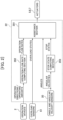
- FIG. 2 is a functional block diagram illustrating processing functions of the controller along with related configurations.
- the controller 22 has an operation flow rate computing section 202 that computes operation flow rates, which are supply rates of hydraulic fluid to be supplied to the boom cylinder 5, the arm cylinder 6, and the bucket cylinder 7, based on operation states (operating directions and operating amounts) of the operation devices 2, a stop state computing section 203 that based on angular velocities sensed at the angle and angular velocity sensors 20, judges whether individual construction elements, such as the boom 8, the arm 9, and the bucket 10 operated by the boom cylinder 5, the arm cylinder 6, and the bucket cylinder 7 (which may hereinafter collectively be called the" actuators"), and construction elements on their preceding stages (for example, the boom 8 relative to the arm 9) are in stop states, and an assistance section 201 that, based on the operation flow rates from the operation flow rate computing section 202, overload states (information indicating whether there are overload states) from the overload sensors 61, angles from the angle and angular velocity sensors 20, and stop states (information indicating whether there are stop states) from the stop state computing section 203
- the operation flow rates computed at the operation flow rate computing section 202 are only required to include information on the operation flow rates, and may give an instruction on the operation flow rates, for example, from an external discrete system such as a remote operation device or an automated system on a server.
- FIG. 3 is a functional block diagram illustrating processing functions of the assistance section of the controller along with related configurations.
- the assistance section 201 has an upward direction specifying section 301, a claw tip position computing section 302, an all overload-time operable direction computing section 303, a to-be-modified actuator computing section 304, an overload-time operable direction computing section 305, an operating direction determining section 306, and a command flow rate computing section 307.
- the upward direction specifying section 301 specifies an opposite direction of the gravity vector (a vertically upward direction), for example, by an advance input at the operating device 2. It is to be noted that, instead of the advance input at the operating device 2, a configuration may be made, for example, such that a direction, which corresponds to an upper side of the upper swing structure 1B is specified, by arranging an inertial measurement unit (IMU) on the upper swing structure 1B and performing an automated input based on its sensing result.
- IMU inertial measurement unit
- the claw tip position computing section 302 computes position coordinates of the claw tip of the bucket 10 in a machine body coordinate system, based on sensing results (angles) from the angle and angular velocity sensors 20.
- the all overload-time operable direction computing section 303 computes an all overload-time target velocity vector, which indicates the target direction and the target velocity of movement of the claw tip of the bucket 10 at an all overload time, based on specified details (vertically upward direction) from the upward direction specifying section 301 and computation results (the coordinates of the claw tip) from the claw tip position computing section 302.
- the to-be-modified actuator computing section 304 judges one or more of the actuators 5, 6, and 7 for which the supply amount of hydraulic fluid is to be corrected by modifying the operation flow rate based on computation results (information indicating whether the construction elements and the construction elements on their preceding stages are in stop states) from the stop state computing section 203 and sensing results (information indicating whether there are overloads) from the overload sensors 61.
- the overload-time operable direction computing section 305 computes an overload-time target velocity vector, which indicates the target direction and the target velocity of movement of the claw tip of the bucket 10 at an overload time, based on sensing results (angles) from the angle and angular velocity sensors 20 and computation results (information on any actuator to be modified) from the to-be-modified actuator computing section 304.
- the operating direction determining section 306 computes a target velocity vector of the claw tip of the bucket 10, based on a computation result (all overload-time target velocity vector) from the all overload-time operable direction computing section 303, a computation result (overload-time target velocity vector) from the overload-time operable direction computing section 305, and a computation result (information on any actuator to be modified) from the to-be-modified actuator computing section.
- the command flow rate computing section 307 computes and determines command flow rates for the actuators 5, 6, and 7, based on the computation result (target velocity vector) from the operating direction determining section 306, computation results (operation flow rates) from the operation flow rate computing section 202, and sensing results (angles) from the angle and angular velocity sensors 20, and outputs the command flow rates to the actuators 5, 6, and 7.
- the command flow rates are computed by applying a Jacobian matrix or the like to the target velocity vector of the claw tip of the bucket 10 from the operating direction determining section 306 and transforming it to target velocities of the cylinders.
- FIG. 4 is a flowchart illustrating processing details by the controller.
- the controller 22 first computes actuators satisfying conditions (conditions A) representing that the respective actuators 5, 6, and 7 are in overload states and the construction elements (the boom 8, the arm 9, the bucket 10) corresponding to the individual actuators 5, 6, and 7 are in stop states (Step S100).
- Step S110 judgements are made whether actuators satisfying the conditions A are absent (Step S110), and if the judgement results are YES, in other words, if all the actuators (boom cylinder 5, arm cylinder 6, and bucket cylinder 7) do not satisfy the conditions A, computation results (operation flow rates) of the operation flow rate computing section 202 are outputted as command flow rates to the actuators 5, 6, and 7 without being corrected (Step S111), and the processing is ended.
- Step S111 it is assured to improve the efficiency of the processing by performing no correction of the operation flow rates if an actuator satisfying the conditions A is absent (see Step S111).
- Step S110 if judged that there is any actuator satisfying the conditions A, a judgement is made whether the actuator judged to satisfy the conditions A has continuously satisfied the conditions A for a time set beforehand (predetermined time) or longer (in other words, whether the predetermined time or longer has elapsed from the time when the actuator satisfied the conditions A) (Step S120).
- the processing of Step S120 is performed to assure improvements in the processing by interrupting the correction to the operation flow rate and giving a notification (presenting a display) to the operator to urge the operator to confirm the current situation and to make a response action, because the state of the actuator is not improvable even by the correction of the flow rate.
- Step S120 If the judgement results in Step S120 are YES, that is, if judged that the conditions A have continuously been satisfied for the predetermined time or longer (in other words, the predetermined time has elapsed from the time when the actuator satisfied the conditions A), the computation results (operation flow rates) of the operation flow rate computing section 202 are outputted to the actuators 5, 6, and 7 without being corrected, and at the same time, a notification is given to the operator by displaying on a display device 23 to the effect that the correction of the operation flow rates is interrupted (Step S121), and the processing is ended.
- Step S100 a subsequent return to the processing in Step S100 after the interruption of the processing in Step S121 is considered to use, as a trigger, that all the operation flow rates are once allowed to decrease to zero (0) (bringing the operation devices to neutral), lifting lock levers, making a key-off, or the like.
- Step S120 judges whether all the actuators satisfy the conditions A (Step S130).
- Step S130 If the judgement results are YES in Step S130, in other words, if all the actuators have been judged to satisfy the conditions A, all the actuators are selected as those for which the operation flow rates are to be corrected, command flow rates, as corrected operation flow rates of all the actuators, are computed and outputted to the actuators 5, 6, and 7 (Step S131), and the processing is ended. If the judgement results in Step S130 are NO, on the other hand, the process proceeds to Step S140 as will be mentioned below, in which each actuator that does not satisfy the conditions A is selected as a correction target actuator, a correction of the operation flow rate of the actuator is performed, and the processing is ended.
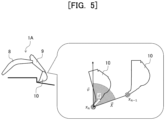
- FIG. 5 is a diagram describing the fundamental concept of computation of a command flow rate by correction of an operation flow rate.
- the position x of the claw tip of the bucket 10 at a given time n is indicated by a claw tip position x n
- the suffix n in the claw tip positions x n and x n-1 defines a variable representing time steps of the controller 22, and varies like ..., n-1, n, n+1, ... (n: positive integer), but is only required to allow referring to a past tip position x, and may retroactively go back, for example, by a predetermined time or distance.
- Step S131 of FIG. 4 the operation flow rates of the boom cylinder 5, the arm cylinder 6, and the bucket cylinder 7 are corrected to compute command flow rates, for example, such that the advancing direction (vector x) of the claw tip position x n of the bucket 10 falls between an opposite direction (a direction that is directed toward the position already passed and extends in an opposite direction along the vector X) and the vertically upward direction (vector v) specified at the upward direction specifying section 301 (specifically a range indicated by diagonal lines in FIG. 5 ).
- the computation of the command flow rates by the correction of the operation flow rates is intended, as one of its purposes, to operate the front work implement 1A such that the loads on the respective actuators 5, 6, and 7 decrease (overload states are eliminated), and the command flow rates are computed (in other words, the operation flow rates are corrected) such that the moving direction of the point of action of force from the front work implement 1A on an excavation target such as the ground (here, the claw tip position of the bucket 10) is a direction where excavation has been conducted and no earth exists, specifically falls in the range indicated by the diagonal lines in FIG. 5 .
- the operation flow rates of the respective actuators 5, 6, and 7 may be corrected to compute command flow rates such that the moving direction of the claw tip position of the bucket 10 becomes a direction to make the excavation depth shallower, in other words, becomes a direction between the vertical direction to the ground surface of the excavation target and the vertically upward direction.
- Step S130 of FIG. 4 If the judgement results in Step S130 of FIG. 4 are NO, in other words, if there is any actuator not satisfying the conditions A, with respect to each actuator not satisfying the conditions A, the operation flow rate is corrected to compute a command flow rate, the command flow rate is outputted to the actuator 5, 6, or 7 (Step S140), and the processing is ended. Specifically, if there is any actuator not satisfying the conditions A, in other words, if at least one of the boom cylinder 5, the arm cylinder 6, and the bucket cylinder 7 does not satisfy the conditions A, with respect to each of the remaining actuator or actuators satisfying the conditions A, the operation flow rate as the computation result at the operation flow rate computing section 202 is outputted as a command flow rate to the actuator.
- the operation flow rate of the actuator or actuators not satisfying the conditions A is corrected to compute a command flow rate such that the advancing direction of the claw tip position of the bucket by the actuator or actuators not satisfying the conditions A becomes a direction perpendicular to the advancing direction of the claw tip position by the remaining actuator or actuators satisfying the conditions, and the command flow rate is outputted to the actuator or actuators not satisfying the conditions A.
- Step S140 of FIG. 4 specifically a determination method of the moving direction (assistance direction) of the claw tip position of the bucket 10 in the computation of the command flow rate or rates by the correction of the operation flow rate or rates.
- the front work implement 1A exemplified in this embodiment, there are believed to exist, as states that are assumable in Step S140, a case where a plurality of (two) actuators satisfy the conditions A and another case where a single (one) actuator satisfies the conditions A.
- FIGS. 6 through 8 are diagrams describing examples of a determination method of an assistance direction in the case where a single actuator satisfies the conditions A and exemplify a case where a boom cylinder alone satisfies the conditions A.
- "BM,” “AM,” and “BK” in FIGS. 6 through 8 represent, in short, the boom 8, the arm 9, and the bucket 10.
- the motion of the claw tip of the bucket 10 by an actuator in the front work implement 1A is motion rotated about an axis by the actuator.
- the target velocity vector of the claw tip of the bucket 10 by the actuator that satisfies the conditions A is a vector connecting an axis of rotation, which is on a preceding side of the construction element operated by the actuator satisfying the conditions A (a proximal end side of the boom 8 in the case of the boom 8) and the claw tip of the bucket 10.
- Selection Method 1 As the first selection method (hereinafter called "Selection Method 1"), a possible case is one where a selection is made in such a manner as to intervene in a predetermined direction. In this case, setting is made beforehand which one of +90 (deg) or -90 (deg) is to be selected for each of the actuators (the boom 8, the arm 9, the bucket 10) satisfying the conditions A.
- Selection Method 2 As the second selection method (hereinafter called "Selection Method 2"), a possible case is one where a selection is made in such a manner as to conform to the current operating direction.
- the angular velocities of the arm 9 and the bucket 10, which are to be intervened are measured, a direction velocity vector of the claw tip by the angular velocities of the arm 9 and the bucket 10 is computed (see FIG. 7 ), and one of the two solutions, the one solution being smaller in the angle formed with the direction velocity vector of the claw tip, is selected (see FIG. 8 ).
- Selection Method 1 and Selection Method 2 can also similarly be applied in a case where the single actuator satisfying the conditions A is the arm 9 or the bucket 10.
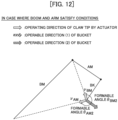
- FIGS. 9 through 12 are diagrams describing examples of a determination method of an assistance direction in a case where a plurality of actuators satisfy the conditions A and exemplify a case where the boom cylinder and the arm cylinder satisfy the conditions A.
- "BM,” “AM,” and “BK” in FIGS. 9 through 12 represent, in short, the boom 8, the arm 9, and the bucket 10.
- the target velocity vector of the claw tip of the bucket 10 by the actuators satisfying the conditions A is determined with respect to each of the actuators satisfying the conditions A.
- FIGS. 9 and 10 there are two operating directions, that is, an operating direction v BM by the boom cylinder 5 and another operating direction v AM by the arm cylinder 6, and assistance is performed by the remaining actuator, which does not satisfy the conditions A, such that the claw tip of the bucket 10 is moved in a direction in which the sum of angles formed between the respective ones of those two vectors and a velocity vector with which the claw tip is operable by the remaining actuator (here, the bucket cylinder 7) is minimum.
- ⁇ BM1 , ⁇ BM2 , ⁇ AM1 , and ⁇ AM2 as angles formable by the individual vectors, and these formed angles are determined by the following (Formula 3) to (Formula 6) using functions f which are determined by the definition of inner product of vectors and the law of cosines.
- ⁇ BM 1 f v BK 1
- V BM ⁇ BM 2 f v BK 2
- V BM ⁇ AM 1 f v BK 1
- V AM ⁇ AM 2 f v BK 2 , V AM
- An assistance operation is performed by setting a target velocity vector depending on the relation of the respective angles.
- the vector v BK1 is set as the target velocity vector when the following (Formula 7) is satisfied.
- the vector V BK2 is set as the target velocity vector when the following (Formula 8) is satisfied.
- FIGS. 13 through 16 A second embodiment of the present invention will be described with reference to FIGS. 13 through 16. It is to be noted that, in this embodiment, members similar to those in the first embodiment are described using the same reference characters, and their description is omitted as appropriate.
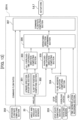
- FIG. 13 is a functional block diagram illustrating processing functions of an assistance section of a controller according to this embodiment along with related configurations.
- an assistance section 201A has the upward direction specifying section 301, the claw tip position computing section 302, the all overload-time operable direction computing section 303, the to-be-modified actuator computing section 304, the overload-time operable direction computing section 305, a time-norm relation recording section 701, an operating direction determining section 306A, and the command flow rate computing section 307.
- the upward direction specifying section 301 specifies an opposite direction of the gravity vector (a vertically upward direction), for example, by advance inputs at the operating devices 2. It is to be noted that, instead of the advance inputs at the operating devices 2, a configuration may be made such that a direction, which corresponds to an upper side of the upper swing structure 1B is specified, for example, by arranging an inertial measurement unit (IMU) on the upper swing structure 1B and performing an automated input based on its sensing result.
- IMU inertial measurement unit
- the claw tip position computing section 302 computes position coordinates of the claw tip of the bucket 10 in a machine body coordinate system, based on sensing results (angles) from the angle and angular velocity sensors 20.
- the all overload-time operable direction computing section 303 computes an all overload-time target velocity vector, which indicates the target direction and the target velocity of movement of the claw tip of the bucket 10 at an all overload time, based on specified details (vertically upward direction) from the upward direction specifying section 301 and computation results (the coordinates of the claw tip) from the claw tip position computing section 302.
- the to-be-modified actuator computing section 304 judges one or more of the actuators 5, 6, and 7 for which the operation flow rate is to be corrected, based on computation results (information indicating whether there are stop states) from the stop state computing section 203 and sensing results (information indicating whether there are overloads) from the overload sensors 61.
- the overload-time operable direction computing section 305 computes an overload-time target velocity vector, which indicates the target direction and the target velocity of movement of the claw tip of the bucket 10 at an overload time, based on sensing results (angles) from the angle and angular velocity sensors 20 and computation results (information on any actuator to be modified in operation flow rate) from the to-be-modified actuator computing section 304.
- the time-norm relation recording section 701 has a record of a norm computation table specifying beforehand the relation between the elapsed time from satisfaction of the conditions for overload state and stop state (the conditions A) and the norm (magnitude) of the target velocity vector of the claw tip of the bucket 10.
- FIG. 14 is a diagram illustrating an example of the norm computation table specifying the relation between elapsed time and norm in a case where the arm cylinder has satisfied the conditions A.
- the norm computation table it is set such that, as illustrated in FIG. 14 , the norm of the target velocity vector of the claw tip of the bucket 10 increases as the elapsed time (t) from satisfaction of the conditions A increases.
- the norm of the target velocity vector is assumed to be k n at time t n .
- the norm of the targe velocity vector also increases to be k m .
- the norm computation table is only required to be set such that the norm of a target velocity increases with the increase in the elapsed time, and hence, a norm computation table representing a non-linear (non-proportional) curved relation may be set, for example.
- the operating direction determining section 306A computes a target velocity vector of the claw tip of the bucket 10 based on a computation result (all overload-time target velocity vector) from the all overload-time operable direction computing section 303, a computation result (overload-time target velocity vector) from the overload-time operable direction computing section 305, a computation result (information on any actuator to be modified) from the to-be-modified actuator computing section, and the norm computation table in the time-norm relation recording section 701.
- a holding time from the time when each actuator judged to be a target to be modified at the to-be-modified actuator computing section 304 has been brought into an operation state (true state) is recorded, and based on the norm computation table, the norm of the target velocity vector of the claw tip of the bucket 10 is increased depending on the elapsed time. It is to be noted that the count of the holding time is reset in a case where the target actuator has been brought into a non-operation state (false state).
- FIG. 15 is a diagram illustrating states of the target velocity vector of the claw tip of the bucket after corrections of operation flow rates in a case where the norm computation table is applied.
- BM "AM,” and “BK” in FIG. 15 represent, in short, the boom 8, the arm 9, and the bucket 10.
- the target velocity vector is set such that the norm tm in the case of the elapsed time tm is greater than the norm kn in the case of the elapsed time tn. It can hence be said that the magnitude of the target velocity vector after the correction of the operation flow rate of each actuator increases depending on the elapsed time from the time when the actuator has come into the overload state and the stop state.
- a command flow rate computing section 307A computes and determines command flow rates for the actuators 5, 6, and 7, based on the computation result (target velocity vector) from the operating direction determining section 306, computation results (operation flow rates) from the operation flow rate computing section 202, and sensing results (angles) from the angle and angular velocity sensors 20, and outputs the command flow rates to the actuators 5, 6, and 7.
- the command flow rates are computed by applying a Jacobian matrix or the like to the target velocity vector of the claw tip of the bucket 10 from the operating direction determining section 306 and transforming it into target velocities of the cylinders.
- stop state of each construction element caused by an overload can be eliminated quicker, since a correction is performed such that the supply rate (operation flow rate) of hydraulic fluid to the actuator increases depending on the elapsed time from the satisfaction of the conditions A for the overload state and the stop state.
- the present invention is not limited to the above-described embodiments, and various modifications and combinations within the scope not departing from the spirit of the present invention are embraced. Further, the present invention is not limited to those including all of the configurations described in the above-described embodiments, and those in which some of the configurations are deleted are also included.
- the above-described individual configurations, functions, and the like may be realized partly or wholly, for example, by designing an integrated circuit or the like. Moreover, the above-described individual configurations, functions, and the like may also be realized by allowing a processor to interpret and execute programs that realize the respective functions.
Landscapes
- Engineering & Computer Science (AREA)
- General Engineering & Computer Science (AREA)
- Mining & Mineral Resources (AREA)
- Civil Engineering (AREA)
- Structural Engineering (AREA)
- Physics & Mathematics (AREA)
- Fluid Mechanics (AREA)
- Chemical & Material Sciences (AREA)
- Analytical Chemistry (AREA)
- Mechanical Engineering (AREA)
- Operation Control Of Excavators (AREA)
Applications Claiming Priority (2)
| Application Number | Priority Date | Filing Date | Title |
|---|---|---|---|
| JP2023020335 | 2023-02-13 | ||
| PCT/JP2023/045569 WO2024171607A1 (ja) | 2023-02-13 | 2023-12-19 | 作業機械 |
Publications (1)
| Publication Number | Publication Date |
|---|---|
| EP4567204A1 true EP4567204A1 (en) | 2025-06-11 |
Family
ID=92421439
Family Applications (1)
| Application Number | Title | Priority Date | Filing Date |
|---|---|---|---|
| EP23922940.4A Pending EP4567204A1 (en) | 2023-02-13 | 2023-12-19 | Work machine |
Country Status (5)
| Country | Link |
|---|---|
| EP (1) | EP4567204A1 (https=) |
| JP (1) | JPWO2024171607A1 (https=) |
| KR (1) | KR20250044417A (https=) |
| CN (1) | CN119816644A (https=) |
| WO (1) | WO2024171607A1 (https=) |
Family Cites Families (4)
| Publication number | Priority date | Publication date | Assignee | Title |
|---|---|---|---|---|
| JPS61146929A (ja) | 1984-12-20 | 1986-07-04 | Kubota Ltd | バツクホウ作業車 |
| JP5519414B2 (ja) | 2010-06-03 | 2014-06-11 | 住友重機械工業株式会社 | 建設機械 |
| JP2018044305A (ja) * | 2016-09-12 | 2018-03-22 | 日立建機株式会社 | 油圧ショベル |
| JP7683286B2 (ja) * | 2021-04-06 | 2025-05-27 | コベルコ建機株式会社 | 作業システム |
-
2023
- 2023-12-19 JP JP2025500680A patent/JPWO2024171607A1/ja active Pending
- 2023-12-19 WO PCT/JP2023/045569 patent/WO2024171607A1/ja not_active Ceased
- 2023-12-19 KR KR1020257007007A patent/KR20250044417A/ko active Pending
- 2023-12-19 CN CN202380063605.2A patent/CN119816644A/zh active Pending
- 2023-12-19 EP EP23922940.4A patent/EP4567204A1/en active Pending
Also Published As
| Publication number | Publication date |
|---|---|
| JPWO2024171607A1 (https=) | 2024-08-22 |
| CN119816644A (zh) | 2025-04-11 |
| KR20250044417A (ko) | 2025-03-31 |
| WO2024171607A1 (ja) | 2024-08-22 |
Similar Documents
| Publication | Publication Date | Title |
|---|---|---|
| KR102443900B1 (ko) | 작업 기계 | |
| EP4257754B1 (en) | Work machinery | |
| CN109689978B (zh) | 作业机械 | |
| EP3779068B1 (en) | Working machine | |
| EP3604693B1 (en) | Construction machinery | |
| CN108779614B (zh) | 作业机械 | |
| CN111032969B (zh) | 作业机械 | |
| KR20180102137A (ko) | 작업 기계 | |
| EP3992371A1 (en) | Hydraulic excavator | |
| CN105745381A (zh) | 作业机械、以及作业机械的工作装置参数修正方法 | |
| WO2018056289A1 (ja) | 建設機械 | |
| EP4166725B1 (en) | Construction machine | |
| WO2023100689A1 (ja) | 建設機械の駆動装置、これを備えた建設機械及び建設機械システム | |
| KR20220086672A (ko) | 작업 기계의 제어 시스템, 작업 기계, 및 작업 기계의 제어 방법 | |
| JP6615058B2 (ja) | 作業機械 | |
| EP4039892B1 (en) | Work machine | |
| EP4008842B1 (en) | Work machine | |
| EP4567204A1 (en) | Work machine | |
| EP4389991A1 (en) | Swivel work machine | |
| CN116917578B (zh) | 作业机械 | |
| JP2018003513A (ja) | 作業機械 | |
| EP4317611A1 (en) | Work machine | |
| EP4194620A1 (en) | Work machine | |
| KR102378805B1 (ko) | 건설 기계 | |
| EP3789542B1 (en) | Work machine |
Legal Events
| Date | Code | Title | Description |
|---|---|---|---|
| STAA | Information on the status of an ep patent application or granted ep patent |
Free format text: STATUS: THE INTERNATIONAL PUBLICATION HAS BEEN MADE |
|
| PUAI | Public reference made under article 153(3) epc to a published international application that has entered the european phase |
Free format text: ORIGINAL CODE: 0009012 |
|
| STAA | Information on the status of an ep patent application or granted ep patent |
Free format text: STATUS: REQUEST FOR EXAMINATION WAS MADE |
|
| 17P | Request for examination filed |
Effective date: 20250303 |
|
| AK | Designated contracting states |
Kind code of ref document: A1 Designated state(s): AL AT BE BG CH CY CZ DE DK EE ES FI FR GB GR HR HU IE IS IT LI LT LU LV MC ME MK MT NL NO PL PT RO RS SE SI SK SM TR |