EP4557351A1 - Coating apparatus and coating method - Google Patents
Coating apparatus and coating method Download PDFInfo
- Publication number
- EP4557351A1 EP4557351A1 EP23925612.6A EP23925612A EP4557351A1 EP 4557351 A1 EP4557351 A1 EP 4557351A1 EP 23925612 A EP23925612 A EP 23925612A EP 4557351 A1 EP4557351 A1 EP 4557351A1
- Authority
- EP
- European Patent Office
- Prior art keywords
- coating
- nozzles
- coating liquid
- nozzle
- bar
- Prior art date
- Legal status (The legal status is an assumption and is not a legal conclusion. Google has not performed a legal analysis and makes no representation as to the accuracy of the status listed.)
- Pending
Links
Images

Classifications
-
- B—PERFORMING OPERATIONS; TRANSPORTING
- B05—SPRAYING OR ATOMISING IN GENERAL; APPLYING FLUENT MATERIALS TO SURFACES, IN GENERAL
- B05C—APPARATUS FOR APPLYING FLUENT MATERIALS TO SURFACES, IN GENERAL
- B05C1/00—Apparatus in which liquid or other fluent material is applied to the surface of the work by contact with a member carrying the liquid or other fluent material, e.g. a porous member loaded with a liquid to be applied as a coating
- B05C1/04—Apparatus in which liquid or other fluent material is applied to the surface of the work by contact with a member carrying the liquid or other fluent material, e.g. a porous member loaded with a liquid to be applied as a coating for applying liquid or other fluent material to work of indefinite length
- B05C1/06—Apparatus in which liquid or other fluent material is applied to the surface of the work by contact with a member carrying the liquid or other fluent material, e.g. a porous member loaded with a liquid to be applied as a coating for applying liquid or other fluent material to work of indefinite length by rubbing contact, e.g. by brushes, by pads
-
- H—ELECTRICITY
- H10—SEMICONDUCTOR DEVICES; ELECTRIC SOLID-STATE DEVICES NOT OTHERWISE PROVIDED FOR
- H10P—GENERIC PROCESSES OR APPARATUS FOR THE MANUFACTURE OR TREATMENT OF DEVICES COVERED BY CLASS H10
- H10P72/00—Handling or holding of wafers, substrates or devices during manufacture or treatment thereof
- H10P72/04—Apparatus for manufacture or treatment
- H10P72/0448—Apparatus for applying a liquid, a resin, an ink or the like
-
- B—PERFORMING OPERATIONS; TRANSPORTING
- B05—SPRAYING OR ATOMISING IN GENERAL; APPLYING FLUENT MATERIALS TO SURFACES, IN GENERAL
- B05C—APPARATUS FOR APPLYING FLUENT MATERIALS TO SURFACES, IN GENERAL
- B05C1/00—Apparatus in which liquid or other fluent material is applied to the surface of the work by contact with a member carrying the liquid or other fluent material, e.g. a porous member loaded with a liquid to be applied as a coating
- B05C1/04—Apparatus in which liquid or other fluent material is applied to the surface of the work by contact with a member carrying the liquid or other fluent material, e.g. a porous member loaded with a liquid to be applied as a coating for applying liquid or other fluent material to work of indefinite length
- B05C1/08—Apparatus in which liquid or other fluent material is applied to the surface of the work by contact with a member carrying the liquid or other fluent material, e.g. a porous member loaded with a liquid to be applied as a coating for applying liquid or other fluent material to work of indefinite length using a roller or other rotating member which contacts the work along a generating line
-
- B—PERFORMING OPERATIONS; TRANSPORTING
- B05—SPRAYING OR ATOMISING IN GENERAL; APPLYING FLUENT MATERIALS TO SURFACES, IN GENERAL
- B05C—APPARATUS FOR APPLYING FLUENT MATERIALS TO SURFACES, IN GENERAL
- B05C1/00—Apparatus in which liquid or other fluent material is applied to the surface of the work by contact with a member carrying the liquid or other fluent material, e.g. a porous member loaded with a liquid to be applied as a coating
- B05C1/04—Apparatus in which liquid or other fluent material is applied to the surface of the work by contact with a member carrying the liquid or other fluent material, e.g. a porous member loaded with a liquid to be applied as a coating for applying liquid or other fluent material to work of indefinite length
- B05C1/08—Apparatus in which liquid or other fluent material is applied to the surface of the work by contact with a member carrying the liquid or other fluent material, e.g. a porous member loaded with a liquid to be applied as a coating for applying liquid or other fluent material to work of indefinite length using a roller or other rotating member which contacts the work along a generating line
- B05C1/0804—Apparatus in which liquid or other fluent material is applied to the surface of the work by contact with a member carrying the liquid or other fluent material, e.g. a porous member loaded with a liquid to be applied as a coating for applying liquid or other fluent material to work of indefinite length using a roller or other rotating member which contacts the work along a generating line the material being applied without contact with the roller
-
- B—PERFORMING OPERATIONS; TRANSPORTING
- B05—SPRAYING OR ATOMISING IN GENERAL; APPLYING FLUENT MATERIALS TO SURFACES, IN GENERAL
- B05C—APPARATUS FOR APPLYING FLUENT MATERIALS TO SURFACES, IN GENERAL
- B05C1/00—Apparatus in which liquid or other fluent material is applied to the surface of the work by contact with a member carrying the liquid or other fluent material, e.g. a porous member loaded with a liquid to be applied as a coating
- B05C1/04—Apparatus in which liquid or other fluent material is applied to the surface of the work by contact with a member carrying the liquid or other fluent material, e.g. a porous member loaded with a liquid to be applied as a coating for applying liquid or other fluent material to work of indefinite length
- B05C1/08—Apparatus in which liquid or other fluent material is applied to the surface of the work by contact with a member carrying the liquid or other fluent material, e.g. a porous member loaded with a liquid to be applied as a coating for applying liquid or other fluent material to work of indefinite length using a roller or other rotating member which contacts the work along a generating line
- B05C1/0813—Apparatus in which liquid or other fluent material is applied to the surface of the work by contact with a member carrying the liquid or other fluent material, e.g. a porous member loaded with a liquid to be applied as a coating for applying liquid or other fluent material to work of indefinite length using a roller or other rotating member which contacts the work along a generating line characterised by means for supplying liquid or other fluent material to the roller
-
- B—PERFORMING OPERATIONS; TRANSPORTING
- B05—SPRAYING OR ATOMISING IN GENERAL; APPLYING FLUENT MATERIALS TO SURFACES, IN GENERAL
- B05C—APPARATUS FOR APPLYING FLUENT MATERIALS TO SURFACES, IN GENERAL
- B05C11/00—Component parts, details or accessories not specifically provided for in groups B05C1/00 - B05C9/00
- B05C11/10—Storage, supply or control of liquid or other fluent material; Recovery of excess liquid or other fluent material
-
- B—PERFORMING OPERATIONS; TRANSPORTING
- B05—SPRAYING OR ATOMISING IN GENERAL; APPLYING FLUENT MATERIALS TO SURFACES, IN GENERAL
- B05C—APPARATUS FOR APPLYING FLUENT MATERIALS TO SURFACES, IN GENERAL
- B05C11/00—Component parts, details or accessories not specifically provided for in groups B05C1/00 - B05C9/00
- B05C11/10—Storage, supply or control of liquid or other fluent material; Recovery of excess liquid or other fluent material
- B05C11/1002—Means for controlling supply, i.e. flow or pressure, of liquid or other fluent material to the applying apparatus, e.g. valves
-
- B—PERFORMING OPERATIONS; TRANSPORTING
- B05—SPRAYING OR ATOMISING IN GENERAL; APPLYING FLUENT MATERIALS TO SURFACES, IN GENERAL
- B05D—PROCESSES FOR APPLYING FLUENT MATERIALS TO SURFACES, IN GENERAL
- B05D1/00—Processes for applying liquids or other fluent materials
- B05D1/26—Processes for applying liquids or other fluent materials performed by applying the liquid or other fluent material from an outlet device in contact with, or almost in contact with, the surface
-
- B—PERFORMING OPERATIONS; TRANSPORTING
- B05—SPRAYING OR ATOMISING IN GENERAL; APPLYING FLUENT MATERIALS TO SURFACES, IN GENERAL
- B05D—PROCESSES FOR APPLYING FLUENT MATERIALS TO SURFACES, IN GENERAL
- B05D1/00—Processes for applying liquids or other fluent materials
- B05D1/28—Processes for applying liquids or other fluent materials performed by transfer from the surfaces of elements carrying the liquid or other fluent material, e.g. brushes, pads, rollers
-
- B—PERFORMING OPERATIONS; TRANSPORTING
- B05—SPRAYING OR ATOMISING IN GENERAL; APPLYING FLUENT MATERIALS TO SURFACES, IN GENERAL
- B05D—PROCESSES FOR APPLYING FLUENT MATERIALS TO SURFACES, IN GENERAL
- B05D1/00—Processes for applying liquids or other fluent materials
- B05D1/40—Distributing applied liquids or other fluent materials by members moving relatively to surface
-
- B—PERFORMING OPERATIONS; TRANSPORTING
- B05—SPRAYING OR ATOMISING IN GENERAL; APPLYING FLUENT MATERIALS TO SURFACES, IN GENERAL
- B05D—PROCESSES FOR APPLYING FLUENT MATERIALS TO SURFACES, IN GENERAL
- B05D7/00—Processes, other than flocking, specially adapted for applying liquids or other fluent materials to particular surfaces or for applying particular liquids or other fluent materials
- B05D7/02—Processes, other than flocking, specially adapted for applying liquids or other fluent materials to particular surfaces or for applying particular liquids or other fluent materials to macromolecular substances, e.g. rubber
- B05D7/04—Processes, other than flocking, specially adapted for applying liquids or other fluent materials to particular surfaces or for applying particular liquids or other fluent materials to macromolecular substances, e.g. rubber to surfaces of films or sheets
-
- H—ELECTRICITY
- H10—SEMICONDUCTOR DEVICES; ELECTRIC SOLID-STATE DEVICES NOT OTHERWISE PROVIDED FOR
- H10K—ORGANIC ELECTRIC SOLID-STATE DEVICES
- H10K30/00—Organic devices sensitive to infrared radiation, light, electromagnetic radiation of shorter wavelength or corpuscular radiation
- H10K30/50—Photovoltaic [PV] devices
-
- B—PERFORMING OPERATIONS; TRANSPORTING
- B05—SPRAYING OR ATOMISING IN GENERAL; APPLYING FLUENT MATERIALS TO SURFACES, IN GENERAL
- B05C—APPARATUS FOR APPLYING FLUENT MATERIALS TO SURFACES, IN GENERAL
- B05C3/00—Apparatus in which the work is brought into contact with a bulk quantity of liquid or other fluent material
- B05C3/18—Apparatus in which the work is brought into contact with a bulk quantity of liquid or other fluent material only one side of the work coming into contact with the liquid or other fluent material
-
- B—PERFORMING OPERATIONS; TRANSPORTING
- B05—SPRAYING OR ATOMISING IN GENERAL; APPLYING FLUENT MATERIALS TO SURFACES, IN GENERAL
- B05C—APPARATUS FOR APPLYING FLUENT MATERIALS TO SURFACES, IN GENERAL
- B05C5/00—Apparatus in which liquid or other fluent material is projected, poured or allowed to flow on to the surface of the work
- B05C5/02—Apparatus in which liquid or other fluent material is projected, poured or allowed to flow on to the surface of the work the liquid or other fluent material being discharged through an outlet orifice by pressure, e.g. from an outlet device in contact or almost in contact, with the work
- B05C5/027—Coating heads with several outlets, e.g. aligned transversally to the moving direction of a web to be coated
- B05C5/0275—Coating heads with several outlets, e.g. aligned transversally to the moving direction of a web to be coated flow controlled, e.g. by a valve
Definitions
- Embodiments of the present invention relate to a coating device and a coating method that can be used for device formation.
- Organic thin-film solar cells using an organic semiconductor and organic/inorganic hybrid solar cells are expected as low-cost solar cells because an inexpensive coating method can be applied to form an active layer.
- it is required to uniformly apply a coating material for forming an organic active layer and other layers.
- the thickness of each layer is about several nm to several 100 nm, and it is required to form such a very thin layer with a large area and high uniformity.
- a meniscus coating method is known as one of roll-to-roll (R2R) coating methods capable of forming an extremely thin layer over a large area at low cost.
- a method of supplying a liquid to a coating bar head from a plurality of nozzles to obtain a single large-area coating film is simple, and a structure of an instrument is also simple. However, it may be difficult to obtain a uniform thickness, and a coating device capable of forming a more uniform coating film is desired.
- Patent Literature 1 JP 2006-167532 A
- Embodiments of the present invention provide a coating device and a coating method that are capable of forming a uniform coating film by a meniscus coating method and enable simple maintenance at the same time.
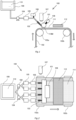
- Fig. 1 is a schematic side view illustrating a coating device according to a first embodiment.
- Fig. 2 is a schematic top view illustrating the coating device according to the first embodiment.
- a coating device 100 includes a nozzle position adjustment member 108, a coating bar 101, a mechanism 107 that detects a distance to nozzles 103, a coating liquid supply member 104 such as a liquid feeding pump that supplies a coating liquid 110 stored in a liquid reservoir or the like, and equipment material conveyance members such as conveyance rollers 102a and 102b that convey a base material 102.
- a coating liquid supply amount adjustment member 105 such as an adjustment valve is arranged upstream of each nozzle.
- the number of nozzles 103 is plural.
- the number of coating liquid supply members such as the liquid feeding pumps 104 can also be plural.
- the total number of nozzles can be larger than the total number of liquid feeding pumps. In this case, a pipe from one pump to each nozzle is branched, and it is preferable that a coating liquid pipe is branched into two.
- the coating liquid supply amount adjustment member 105 is installed at a position upstream of the nozzle 103.
- the plurality of nozzles 103 can face the coating bar 101. As illustrated in Fig. 2 , the plurality of nozzles 103 can supply the coating liquid 110 toward the coating bar 101.
- the plurality of nozzles 103 are arranged in a first direction.
- the first direction is, for example, a Y-axis direction.
- One direction perpendicular to the Y-axis direction is defined as an X-axis direction.
- the movement direction of the base material can coincide with an X axis.
- a direction perpendicular to the Y-axis direction and the X-axis direction is defined as a Z-axis direction.
- the coating bar 101 extends, for example, in the Y-axis direction.
- a meniscus 110M of the coating liquid 110 can be formed between the base material 102 and the coating bar 101.
- the meniscus 110M is in contact with the base material 102, and the base material 102 is moved in a movement direction (an arrow direction in the drawing), whereby the coating film 111 is formed on the base material 102.
- An intended film (solid film) is obtained by solidifying the coating film 111 by, for example, drying.
- the coating film 111 having a large area can be formed on the base material 102 by, for example, moving the base material 102 in the movement direction.
- the coating bar applies the coating liquid 110 onto almost the entire surface of the base material 102, but in a case where a general coating method according to a related art is used, the thickness or the like may not be uniform.
- an ejection amount may vary between the nozzles 103.
- a liquid supply amount of each nozzle is roughly determined by the liquid feeding pump and varies depending on the number of pipes, a length of the pipe, a height of the pipe, a diameter of the pipe or nozzle, or a clogging state.
- the coating liquid supply amount adjustment member such as the liquid amount adjustment valve 105 can adjust the liquid supply amount, and it is possible to reduce the variation in the ejection amount of the coating liquid between the nozzles. In particular, in a case where the number of liquid feeding pumps is smaller than the number of nozzles, there is a tendency that the variation becomes small, which is preferable.
- a ball valve As the adjustment valve 105, a ball valve, a globe valve, a gate valve, a butterfly valve, a needle valve, a diaphragm valve, an electric valve, or the like can be used.
- a flow rate can also be adjusted by crushing a resin pipe with pressure.
- the coating device according to the embodiment preferably further includes a coating bar position adjustment member 106 that controls an interval between the coating bar 101 and the base material 102.
- a coating bar position adjustment member 106 that controls an interval between the coating bar 101 and the base material 102.
- this member a gap ring, a micrometer, or the like can be used.
- the number of plurality of nozzles 103 may be three or more. As a result, the coating film 111 having a large area can be stably formed.
- the number of plurality of nozzles 103 is four. In the embodiment, the number may be an arbitrary integer of 3 or more.
- the nozzle can be a slot die or can have a needle shape.
- a discharge amount of the coating liquid 110 can be controlled with high accuracy by using the plurality of needle-shaped nozzles 103.
- the nozzle has the needle shape, for example, tips of the nozzles are easily brought into contact with the coating bar 101 even in a case where the number of nozzles is considerably large.
- the needle-shaped nozzle has high flexibility. Due to the high flexibility, for example, damage to the nozzle due to vibration of the coating bar 101 or the like can be suppressed.
- a length of the nozzle is, for example, 10 mm or more and 100 mm or less, and an inner diameter of the nozzle is, for example, 0.5 mm or more and 2 mm or less.
- An angle between an end surface of the tip of the nozzle and an extending direction of the nozzle is, for example, about 90 degrees (for example, 75 degrees or more and 105 degrees or less). With such a shape, for example, occurrence of scratches on the coating bar 101 can be suppressed.
- the nozzle position adjustment member 108 that adjusts the position of each nozzle and the nozzle position detection member 107 that detects the distance between the coating bar 101 and each nozzle 103 are provided as illustrated in Figs. 1 and 2 , it is possible to reduce variation in the position and the distance between the tip of each nozzle and the coating bar, and to achieve uniform coating. Specifically, the position of each nozzle detected by the nozzle position detection member such as a camera is adjusted by the nozzle position adjustment member that physically adjusts the position of each nozzle.
- a member that detects contact between the coating bar and each nozzle can be further provided.
- the contact is easily detected by, for example, a method of measuring an electric resistance between the nozzle and the coating bar, and thus, the variation can be reduced by adjusting a coating condition based on the contact.
- the coating liquid can be directly applied to the coating bar, and repelling of the coating liquid hardly occurs.
- a member that measures the electric resistance between each nozzle and the coating bar can be provided as the member that detects the contact between the coating bar and each nozzle. If each nozzle and the coating bar are made of conductive stainless steel or the like, and the nozzles are insulated from each other, when the electric resistance between the coating bar and each nozzle is measured, the electric resistance is drastically reduced at a moment of contact. In addition, since the electric resistance changes as a contact state changes, the contact state can be monitored. For example, in a state in which the nozzle is pressed against the coating bar so strongly as to be greatly curved, the coating bar comes into contact with not only the tip of the nozzle but also a side surface of the nozzle, and the electric resistance becomes very low.
- the coating liquid is easily ejected from the tip of the nozzle to a portion other than the coating bar, and uneven coating is likely to occur. Since an optimum electric resistance varies depending on a shape and material of the nozzle and the coating bar, it is desirable to measure the optimum electric resistance in advance.
- each nozzle can be moved to confirm the contact with the coating bar before coating. If the electric resistance is also measured during the coating, it is possible to detect a case where there is an abnormality in the contact between the nozzle and the coating bar.
- the electric resistance measuring instrument can also be an external device separate from the coating device.
- the nozzle is preferably detachable.
- the nozzle is likely to be clogged due to a small opening.
- an ejection amount from each nozzle can be adjusted by the coating liquid supply member and a coating liquid supply amount adjustment member, but when clogging becomes severe or the ejection becomes completely impossible, it is necessary to perform cleaning or replacement. In such a case, it is preferable that the nozzle is detachable to facilitate maintenance.
- the coating device 100 may further include a drying member 112.
- the drying member 112 can dry the coating liquid 111 applied to the base material 102.
- the drying member 112 may include, for example, an air nozzle or a far-infrared lamp.
- a cross-sectional shape of the coating bar 101 is arbitrary.
- the cross-sectional shape is, for example, a circular shape, a flat circular shape, or a polygonal shape.
- a portion of the cross-sectional shape that corresponds to a meniscus forming portion may be curved, and the other portion may be linear.
- a cross-sectional shape of a surface of the coating bar 101 that faces the base material 102 may be curved.
- the coating bar can be arranged so as not to rotate. As the coating bar does not rotate like a roller, stability of the meniscus is improved.
- the coating bar 101 contains, for example, at least one selected from the group consisting of stainless steel, aluminum, titanium, and glass. Therefore, processing is facilitated when preparing the coating bar 101.
- the surface of the coating bar 101 is a mirror surface. In another example, the surface of the coating bar 101 may have an uneven structure.
- a second embodiment relates to a coating method.
- coating is performed using the coating device 100 (and a modification thereof) described in the first embodiment.
- Fig. 3 is a flowchart illustrating the coating method (S30) according to the second embodiment.
- the coating method according to the embodiment is a coating method in which a meniscus of a coating liquid is formed between a coating bar and a base material, the base material is conveyed, and the coating liquid is applied to a surface of the base material. Then, the coating liquid is supplied to a plurality of nozzles, and the coating liquid is supplied to the surface of the base material from the plurality of nozzles to a surface of the coating bar. At this time, a supply amount of the coating liquid to be supplied to each of the plurality of nozzles is adjusted upstream of each nozzle.
- the supply amount of the coating liquid to each nozzle is adjusted (S31)".
- the supply amount of the coating liquid can be adjusted by a coating liquid supply member such as a pump or a coating liquid supply amount adjustment member arranged upstream of the nozzle.
- a distance between the coating bar and each nozzle is detected, and the distance is adjusted as necessary (S32).
- the distance can be detected by a nozzle position detection member or the like.
- the distance can be adjusted by a coating bar position adjustment member or a nozzle position adjustment member.
- a step (S33) of supplying the coating liquid to perform coating on the base material can be performed.
- a solar cell can be formed by coating with the coating device 100.
- the number of pumps is four.
- a pipe connected to one pump is connected to four nozzles.
- the total number of nozzles is 16.
- the nozzle is installed on one cantilever bar.
- An actuator for movement and a wiring for measuring the electric resistance are installed in each nozzle.
- the liquid amount adjustment valve is installed in each nozzle.
- the wiring is connected to the electric resistance measuring instrument.
- the nozzle position detection member such as a camera for observing a positional relationship between the nozzle and the coating bar is installed.
- the base material 102 is a roll-shaped PET film.
- a width of the PET film is, for example, 330 mm.
- a light-transmissive electrode having a width of 300 mm is formed on the PET film by a roll-to-roll sputtering device.
- a sheet resistance of the electrode is, for example, 10 ⁇ / ⁇ .
- the electrode has, for example, a laminated structure of ITO film/Ag alloy/ITO film.
- a plurality of electrodes are provided. A length of one of the plurality of electrodes is, for example, about 10 mm. An interval between the plurality of electrodes is, for example, 50 ⁇ m.
- the coating bar 101 has a circular cross-sectional shape. A radius of the circle is 10 mm. A length of the coating bar 101 is 300 mm.
- the coating bar 101 contains, for example, stainless steel (for example, SUS303).
- the nozzle includes a stainless steel locking base.
- the length of the nozzle is 50 mm.
- a pipe for the coating liquid is a polytetrafluoroethylene tube.
- the liquid amount control valve is installed between the tube and the nozzle. The valve and the pipe are connected by a detachable joint. The pipe is connected to the pump.
- a hole transport layer is formed by the coating liquid 110.
- the coating liquid 110 is an aqueous solution containing PEDOT and PSS.
- a gap ring or an actuator controls a relative positional relationship between the coating bar 101 and the base material 102.
- the nozzle is brought into a horizontal state.
- the coating liquid 110 is supplied, and air in the nozzle is discharged.
- the pump and the liquid amount adjustment valve are adjusted to uniformly discharge the coating liquid from each nozzle.
- the tip of the needle nozzle is lowered and inclined by, for example, 20° from the horizontal state.
- the cantilever is brought close to the coating bar.
- each nozzle is brought close to and into contact with the coating bar one by one such that the electric resistance becomes 10 to 50 ⁇ .
- the coating liquid 110 is continuously supplied by the pump while the base material 102 is conveyed.
- a movement speed of the base material 102 is, for example, 5 m/min.
- the drying member 112 blows heated dry air to the applied coating liquid 110.
- a solidified coating film is obtained from the coating liquid 110.
- another coating liquid may be further applied after the above coating.
- the another coating liquid contains, for example, a semiconductor material.
- the another coating liquid contains, for example, PTB7 ([poly ⁇ 4,8-bis[(2-ethylhexyl)oxy]benzo[1,2-b:4,5-b']dithiophene-2,6-diyl-1t-alt-3-fluoro-2-[(2-ethylhexyl)carbonyl]thieno[3,4-b]thiophene-4,6-diyl ⁇ ]) and PC70BM ([6,6]-phenyl-C71-butyric acid methylester).
- PTB7 is, for example, a p-type semiconductor.
- PC70BM is, for example, an n-type semiconductor.
- the another coating liquid further contains, for example, monochlorobenzene.
- An amount of PTB7 is 8 mg for 1 mL of monochlorobenzene.
- An amount of PC70BM is 12 mg for 1 mL of monochlorobenzene.
- the another coating liquid is a dispersion liquid containing an organic semiconductor.
- the another coating liquid is, for example, a semiconductor film of a solar cell.
- a minimum distance between the coating bar 101 and the base material 102 is 300 ⁇ m.
- a movement speed of the base material 102 is, for example, 5 m/min. After the coating, drying is performed by the drying member 112.
- an organic thin-film solar cell using an organic semiconductor and an organic/inorganic hybrid solar cell By preparing such solar cells by the coating method, a high-performance solar cell can be prepared.
- the coating liquid 110 may be applied to the base material 102 at a position where the base material 102 is conveyed in a vertical direction.
- an effect of gravity is applied to the meniscus, and a uniform film is easily obtained even at high speed.
- the coating device and the coating method capable of forming a uniform coating film are provided.
Landscapes
- Life Sciences & Earth Sciences (AREA)
- Engineering & Computer Science (AREA)
- Wood Science & Technology (AREA)
- Physics & Mathematics (AREA)
- Electromagnetism (AREA)
- Coating Apparatus (AREA)
Applications Claiming Priority (1)
| Application Number | Priority Date | Filing Date | Title |
|---|---|---|---|
| PCT/JP2023/008874 WO2024185086A1 (ja) | 2023-03-08 | 2023-03-08 | 塗布装置および塗布方法 |
Publications (1)
| Publication Number | Publication Date |
|---|---|
| EP4557351A1 true EP4557351A1 (en) | 2025-05-21 |
Family
ID=92674338
Family Applications (1)
| Application Number | Title | Priority Date | Filing Date |
|---|---|---|---|
| EP23925612.6A Pending EP4557351A1 (en) | 2023-03-08 | 2023-03-08 | Coating apparatus and coating method |
Country Status (5)
| Country | Link |
|---|---|
| US (1) | US20250178015A1 (https=) |
| EP (1) | EP4557351A1 (https=) |
| JP (1) | JPWO2024185086A1 (https=) |
| CN (1) | CN119768899A (https=) |
| WO (1) | WO2024185086A1 (https=) |
Families Citing this family (1)
| Publication number | Priority date | Publication date | Assignee | Title |
|---|---|---|---|---|
| US12533703B2 (en) * | 2020-11-11 | 2026-01-27 | Panasonic Intellectual Property Management Co., Ltd. | Electrode mixture slurry coating device |
Family Cites Families (4)
| Publication number | Priority date | Publication date | Assignee | Title |
|---|---|---|---|---|
| JP4691979B2 (ja) | 2004-12-14 | 2011-06-01 | 凸版印刷株式会社 | スリットダイ及びスリット隙間調節方法並びに塗布装置 |
| JP6084648B2 (ja) * | 2015-03-24 | 2017-02-22 | 株式会社東芝 | 光電変換素子および光電変換素子の製造方法 |
| JP7145342B2 (ja) * | 2020-03-04 | 2022-09-30 | 株式会社東芝 | デバイス形成に用いることができる塗布方法および塗布装置 |
| EP4119237B1 (en) * | 2020-03-09 | 2025-12-24 | Kabushiki Kaisha Toshiba | Coating head, coating device, and coating method |
-
2023
- 2023-03-08 JP JP2025504999A patent/JPWO2024185086A1/ja active Pending
- 2023-03-08 EP EP23925612.6A patent/EP4557351A1/en active Pending
- 2023-03-08 WO PCT/JP2023/008874 patent/WO2024185086A1/ja not_active Ceased
- 2023-03-08 CN CN202380061904.2A patent/CN119768899A/zh active Pending
-
2025
- 2025-02-10 US US19/049,192 patent/US20250178015A1/en active Pending
Also Published As
| Publication number | Publication date |
|---|---|
| JPWO2024185086A1 (https=) | 2024-09-12 |
| CN119768899A (zh) | 2025-04-04 |
| US20250178015A1 (en) | 2025-06-05 |
| WO2024185086A1 (ja) | 2024-09-12 |
Similar Documents
| Publication | Publication Date | Title |
|---|---|---|
| US20240399406A1 (en) | Coating device, meniscus head, and coating method | |
| US20250178015A1 (en) | Coating device and coating method | |
| US12233432B2 (en) | Coating apparatus and coating method | |
| CN113631277B (zh) | 涂布头、涂布装置及涂布方法 | |
| US8534222B2 (en) | Delivery unit, coating apparatus, and coating method | |
| US20210408378A1 (en) | Coating process and coating apparatus usable for device formation | |
| JP5622440B2 (ja) | 回転型高圧水噴射式洗浄方法と同装置 | |
| US20250187034A1 (en) | Coating head, coating device, and coating method | |
| EP4557352A1 (en) | Coating apparatus and coating method | |
| US11623238B2 (en) | Coating method, coating bar head and coating apparatus | |
| US8733271B2 (en) | Method and apparatus for continuous coating | |
| JP7560681B2 (ja) | 塗布装置及び塗布方法 | |
| WO2012002423A1 (ja) | 有機薄膜層の形成方法、有機エレクトロルミネッセンス素子の製造方法 | |
| JP6134942B2 (ja) | 塗膜材塗布装置、長尺部材への塗膜材の塗布方法 | |
| CN121496349A (zh) | 用于多孔薄膜的真空镀膜设备及方法 | |
| KR20160069799A (ko) | 대면적 박막 제조 방법 및 장치 |
Legal Events
| Date | Code | Title | Description |
|---|---|---|---|
| STAA | Information on the status of an ep patent application or granted ep patent |
Free format text: STATUS: UNKNOWN |
|
| STAA | Information on the status of an ep patent application or granted ep patent |
Free format text: STATUS: THE INTERNATIONAL PUBLICATION HAS BEEN MADE |
|
| PUAI | Public reference made under article 153(3) epc to a published international application that has entered the european phase |
Free format text: ORIGINAL CODE: 0009012 |
|
| STAA | Information on the status of an ep patent application or granted ep patent |
Free format text: STATUS: REQUEST FOR EXAMINATION WAS MADE |
|
| 17P | Request for examination filed |
Effective date: 20250214 |
|
| AK | Designated contracting states |
Kind code of ref document: A1 Designated state(s): AL AT BE BG CH CY CZ DE DK EE ES FI FR GB GR HR HU IE IS IT LI LT LU LV MC ME MK MT NL NO PL PT RO RS SE SI SK SM TR |