EP4553643A1 - Spin-orbit torque-based random number generator and fabricating method thereof - Google Patents
Spin-orbit torque-based random number generator and fabricating method thereof Download PDFInfo
- Publication number
- EP4553643A1 EP4553643A1 EP24191984.4A EP24191984A EP4553643A1 EP 4553643 A1 EP4553643 A1 EP 4553643A1 EP 24191984 A EP24191984 A EP 24191984A EP 4553643 A1 EP4553643 A1 EP 4553643A1
- Authority
- EP
- European Patent Office
- Prior art keywords
- torque
- spin
- layer
- random number
- magnetization
- Prior art date
- Legal status (The legal status is an assumption and is not a legal conclusion. Google has not performed a legal analysis and makes no representation as to the accuracy of the status listed.)
- Pending
Links
Images





Classifications
-
- G—PHYSICS
- G06—COMPUTING OR CALCULATING; COUNTING
- G06F—ELECTRIC DIGITAL DATA PROCESSING
- G06F7/00—Methods or arrangements for processing data by operating upon the order or content of the data handled
- G06F7/58—Random or pseudo-random number generators
- G06F7/588—Random number generators, i.e. based on natural stochastic processes
Definitions
- the present disclosure relates a spin-orbit torque-based random number generator and a fabricating method thereof. More particularly, the present disclosure relates to technology for implementing a random number generator being capable of spin-orbit torque switching based on a spin torque layer and having a low switching current value and a high-entropy random number generation function by controlling the ratio of damping-like torque (DLT) and field-like torque (FLT) among spin-orbit torque components.
- DLT damping-like torque
- FLT field-like torque
- the magnetic tunnel junction may consist of a non-magnetic spin torque generation layer (hereinafter referred to as spin torque layer), a first magnetic layer (magnetization-free layer, hereinafter referred to as free layer), a tunnel barrier layer, and a second magnetic layer (magnetization pinned layer, hereinafter referred to as pinned layer).
- spin torque layer non-magnetic spin torque generation layer
- free layer first magnetic layer
- tunnel barrier layer second magnetic layer
- pinned layer magnetization pinned layer
- TMR tunneling magnetoresistance
- a magnetic tunnel junction In order to realize a high tunneling magnetoresistance ratio, low recording current, and high integration, a magnetic tunnel junction must have perpendicular magnetic anisotropy (PMA) characteristics.
- PMA perpendicular magnetic anisotropy
- Perpendicular magnetic anisotropy means that the magnetization direction of the magnetic layer is perpendicular to the plane of the magnetic layer.
- the above technology is attracting attention as a technology that enables faster switching than the conventional spin-transfer torque (STT) recording method.
- STT spin-transfer torque
- a random number generator is a device that generates a theoretically unpredictable series of numbers or symbols.
- a random number generation function is a standard for systematically generating and applying random numbers, and may be a function that generates numbers applicable to encryption technology.
- the key to implementing a spin-orbit torque-based random number generator is to maintain high entropy of a random number column and achieve low recording current by using specific materials and structures in a spin torque layer.
- the related art ( Appl. Phys. Lett. 118, 052401 (2021 )) exemplifies a spin-orbit torque type random number generator based on Ta/CoFeB/MgO/Ta for random number generation in an artificial neural network.
- the present disclosure has been made in view of the above problems, and it is an object of the present disclosure to implement a spin-orbit torque-based random number generator being capable of spin-orbit torque (SOT) switching based on a spin torque layer and having a low switching current value and a high-entropy random number generation function by controlling the ratio of damping-like torque (DLT) and field-like torque (FLT) among spin-orbit torque components.
- SOT spin-orbit torque
- DLT damping-like torque
- FLT field-like torque
- a spin-orbit torque-based random number generator including a spin torque generation layer including a first spin torque layer and a second spin torque layer, a magnetization-free layer, a tunnel barrier layer, and a magnetization pinned layer, wherein the second spin torque layer is disposed between the magnetization-free layer and the first spin torque layer and generates field-like torque (FLT) and damping-like torque (DLT) related to a magnetization direction of the magnetization-free layer; the first spin torque layer adjusts a torque ratio according to a size of field-like torque to a size of damping-like torque in conjunction with a thickness of the second spin torque layer; in the magnetization-free layer, a magnetization direction is randomly aligned up or down based on the adjusted torque ratio; and a random number is generated based on current that is switched and output based on the randomly aligned magnetization direction.
- FLT field-like torque
- DLT damping-like torque
- the torque ratio may increase as a magnitude of the damping-like torque decreases in a state where a magnitude of the field-like torque is maintained.
- the torque ratio may decrease as a magnitude of the damping-like torque increases in a state where a magnitude of the field-like torque is maintained.
- the first spin torque layer may be formed of any one of Ta, W, and Pt, and the second spin torque layer may be formed of Nb.
- the second spin torque layer may be formed to have a thickness of 1 nm to 15 nm.
- a magnitude of switching current switching the magnetization direction may decrease, and switching efficiency of switching the magnetization direction may be increased.
- the spin-orbit torque-based random number generator may implement a random number generation function.
- a method of fabricating a spin-orbit torque-based random number generator including forming a spin torque generation layer including a first spin torque layer and a second spin torque layer; forming a magnetization-free layer on the spin torque generation layer; forming a tunnel barrier layer on the magnetization-free layer; and forming a magnetization pinned layer on the tunnel barrier layer to form a spin-orbit torque-based random number generator, wherein the second spin torque layer is disposed between the magnetization-free layer and the first spin torque layer and generates field-like torque (FLT) and damping-like torque (DLT) related to a magnetization direction of the magnetization-free layer; the first spin torque layer adjusts a torque ratio according to a size of field-like torque to a size of damping-like torque in conjunction with a thickness of the second spin torque layer; in the magnetization-free layer, a magnetization direction is randomly aligned up or down based on the adjusted torque ratio; and the spin-
- FLT field-like torque
- DLT damping-
- the torque ratio may increase as a magnitude of the damping-like torque decreases in a state where a magnitude of the field-like torque is maintained.
- the torque ratio may decrease as a magnitude of the damping-like torque increases in a state where a magnitude of the field-like torque is maintained.
- the forming of the spin torque generation layer may include forming the first spin torque layer using any one of Ta, W, and Pt; and forming the second spin torque layer using Nb.
- the second spin torque layer may be formed to have a thickness of 1 nm to 15 nm.
- first when an element (e.g., first) is referred to as being "connected to” or “coupled to” another element (e.g., second), the first element may be directly connected to the second element or may be connected to the second element via an intervening element (e.g., third).
- the expression “device configured to” may mean that the device “may do ⁇ " with other devices or components.
- the processor may refer to a general purpose processor (e.g., CPU or application processor) capable of performing corresponding operation by running a dedicated processor (e.g., embedded processor) for performing the corresponding operation, or one or more software programs stored in a memory device.
- a general purpose processor e.g., CPU or application processor
- a dedicated processor e.g., embedded processor
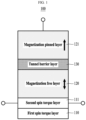
- FIG. 1 is a diagram explaining the structure and configuration of a spin-orbit torque-based random number generator according to an embodiment of the present disclosure.
- FIG. 1 illustrates the structure and configuration of the spin-orbit torque-based random number generator according to an embodiment of the present disclosure.
- a spin-orbit torque-based random number generator 100 includes a first spin torque layer 110, a second spin torque layer 111, a magnetization-free layer 120, a magnetization pinned layer 121, and a tunnel barrier layer 130 disposed between the magnetization-free layer 120 and the magnetization pinned layer 121.
- the spin-orbit torque-based random number generator 100 may be referred to as true random number generator (TRNG).
- TRNG true random number generator
- first spin torque layer 110 and the second spin torque layer 111 may be configured as a spin torque generation layer.
- a method of fabricating the spin-orbit torque-based random number generator 100 may include a step of forming a spin torque generation layer including the first spin torque layer 110 and the second spin torque layer 111, a step of forming the magnetization-free layer 120 on the spin torque generation layer, a step of forming the tunnel barrier layer 130 on the magnetization-free layer 120, and a step of forming the magnetization pinned layer 121 on the tunnel barrier layer 130 to form the spin-orbit torque-based random number generator 100.
- the second spin torque layer 111 may be located between the magnetization-free layer 120 and the first spin torque layer 110, and may generate field-like torque (FLT) and damping-like torque (DLT) related to the magnetization direction of the magnetization-free layer 120.
- FLT field-like torque
- DLT damping-like torque
- the first spin torque layer 110 may adjust a torque ratio according to the size of field-like torque to the size of damping-like torque in conjunction with the thickness of the second spin torque layer 111.
- a magnetization direction is randomly aligned up or down based on the adjusted torque ratio.
- the spin-orbit torque-based random number generator 100 may generate a random number based on current that is switched and output based on the randomly aligned magnetization direction.
- the resistance state of the spin-orbit torque-based random number generator 100 may be a high impedance state or a low impedance state. As a random number is determined based on current output according to the determined state, the spin-orbit torque-based random number generator 100 may generate a random number.
- the torque ratio may increase as the magnitude of the damping-like torque decreases in a state where the magnitude of the field-like torque is maintained.
- the torque ratio may decrease as the magnitude of the damping-like torque increases in a state where the magnitude of the field-like torque is maintained.
- the first spin torque layer 110 may be formed of any one of Ta, W, and Pt.
- the second spin torque layer 111 may be formed of Nb.
- the first spin torque layer 110 may be formed of a metal with high damping-like torque efficiency.
- the second spin torque layer 111 may be formed of a metal with high field-like torque efficiency, and may be formed of a material whose damping-like torque efficiency is lower than that of the first spin torque layer 110.
- the material forming the first spin torque layer 110 and the material forming the second spin torque layer 111 are not limited to the above examples and may be replaced with materials that may achieve the same performance.
- the second spin torque layer 111 may be formed to have a thickness of 1 nm to 15 nm.
- the magnitude of switching current switching the magnetization direction may decrease, and the switching efficiency of switching the magnetization direction may be increased.
- the spin-orbit torque-based random number generator may implement a random number generation function.
- the present disclosure may implement a spin-orbit torque-based random number generator being capable of spin-orbit torque (SOT) switching based on a spin torque layer and having a low switching current value and a high-entropy random number generation function by controlling the ratio of damping-like torque (DLT) and field-like torque (FLT) among spin-orbit torque components.
- SOT spin-orbit torque
- DLT damping-like torque
- FLT field-like torque
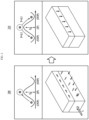
- FIG. 2 is a diagram explaining the random number generation operation of the spin-orbit torque-based random number generator according to an embodiment of the present disclosure.
- FIG. 2 illustrates the principle by which a spin-orbit torque device operates as a random number generator in relation to the random number generation operation of the spin-orbit torque-based random number generator according to an embodiment of the present disclosure.
- a first state 200 illustrates the state of the spin-orbit torque device when current is applied (On state)
- a second state 210 illustrates the state of the spin-orbit torque device when current is not applied (Off state).
- the spindle In the first state 200, when in-plane current is applied to the spin torque generation layer, the spindle is classified as upper or lower, and there are two types of torque caused by spin current.
- the two torques are damping-like torque and field-like torque.
- the magnetization of the magnetization-free layer is initially vertical due to the two torques, but when torque is applied, the magnetization is determined to be in the in-plane direction, which is the X direction.
- the magnetization which was standing in a stable vertical direction, lies in the X direction and sticks in-plane.
- the energy state is fixed to a specific location.
- the energy state is not fixed at a specific location but changes randomly in one of two directions.
- the ratio determined as "1" or "0" and the efficiency of switching are influenced by the ratio of field-like torque to damping-like torque.
- the proportion of field-like torque is higher compared to damping-like torque, so it can be applied as a low switching current value and a high-entropy random number generation function.
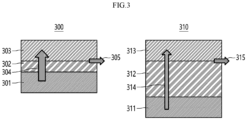
- FIG. 3 is a diagram explaining the ratio control structure of the damping-like torque and field-like torque of the spin-orbit torque-based random number generator according to an embodiment of the present disclosure.
- FIG. 3 illustrates the ratio of damping-like torque and field-like torque depending on the thickness of the second spin torque layer in relation to the ratio control structure of the damping-like torque and field-like torque of the spin-orbit torque-based random number generator according to an embodiment of the present disclosure.
- a first structure 300 of the spin-orbit torque-based random number generator includes a first spin torque layer 301, a second spin torque layer 302, and a magnetization-free layer 303.
- a second structure 310 of the spin-orbit torque-based random number generator includes a first spin torque layer 311, a second spin torque layer 312, and a magnetization-free layer 313.
- the torque ratio of the second structure 310 is smaller than that of the first structure 300.
- the thickness of the second spin torque layer 312 is larger than that of the second spin torque layer 302, and the torque ratio is small.
- the spin-orbit torque-based random number generator may control the torque ratio by adjusting the thickness of the second spin torque layer, and may maintain perpendicular magnetic anisotropy and high entropy and have low switching current based on torque ratio control.
- the present disclosure may implement a spin-orbit torque-based random number generator having low switching current by maintaining perpendicular magnetic anisotropy and high entropy by laminating materials with different spin-orbit coupling sizes on a spin torque layer that contacts a free layer and provides in-plane current.
- FIGS. 4A to 4C are diagrams explaining the three-dimensional structure of the spin-orbit torque-based random number generator according to an embodiment of the present disclosure.
- FIGS. 4A and 4B illustrate a three-dimensional structure of the spin-orbit torque-based random number generator according to an embodiment of the present disclosure.
- a three-dimensional structure 400 of the spin-orbit torque-based random number generator is a structure for measuring spin-orbit torque (SOT) efficiency and has a magnetization-free layer formed on a spin torque generation layer.
- Sputtering may be used as thin film deposition necessary to fabricate the device structure of the spin-orbit torque-based random number generator according to an embodiment of the present disclosure.
- the base pressure is 5 ⁇ 10 -9 Torr or less, and deposition is performed in an argon (Ar) atmosphere.
- the thickness of each layer of the spin-orbit torque-based random number generator may be adjusted using deposition time and sputtering power.
- the three-dimensional structure 400 of the spin-orbit torque-based random number generator includes a first spin torque layer 401, a second spin torque layer 402, and a magnetization-free layer 403.
- the first spin torque layer 401 may be formed on a substrate, and a natural oxide layer may be formed on the substrate.
- the substrate may be formed of Si, and the natural oxide layer may be formed of SiO 2 and may be amorphous.
- the first spin torque layer 401 and the second spin torque layer 402 may be deposited and formed using direct current magnetron sputtering.
- the size of a target used for thin film production may be 2 inches in diameter, and the power may be 50 W.
- the magnetization-free layer 403 may be formed of CoFeB, and the composition of the sputtering target may be Co40Fe40B20 (at%).
- an insulating layer may be formed of MgO, and a capping layer may be formed of Ta.
- heat treatment may be performed at a temperature of 300 °C for 1 hour.
- base pressure may be in a range of 10 -6 Torr, and an external magnetic field of 6 k Oe may be applied in a direction perpendicular to the thin film during heat treatment.
- the three-dimensional structure 400 of the spin-orbit torque-based random number generator may be formed as a cross-shaped Hall bar with a size of 5 ⁇ 35 ⁇ m 2 .
- a three-dimensional structure 410 of the spin-orbit torque-based random number generator may be a structure for measuring spin-orbit torque (SOT) efficiency, and may be a structure with a magnetization-free layer formed on a spin torque generation layer.
- SOT spin-orbit torque
- the three-dimensional structure 410 of the spin-orbit torque-based random number generator may include a first spin torque layer 411, a second spin torque layer 412, and a magnetization-free layer 413.
- the three-dimensional structure 410 of the spin-orbit torque-based random number generator has an island shape for confirming SOT switching characteristics and may be formed to have a diameter of 5 ⁇ m.
- the three-dimensional structure 410 of the spin-orbit torque-based random number generator may be a structure for measuring spin-orbit torque (SOT) efficiency, and may have a structure with a magnetization-free layer formed on a spin torque generation layer.
- SOT spin-orbit torque
- FIG. 4C illustrates random number generation in the three-dimensional structure of the spin-orbit torque-based random number generator according to an embodiment of the present disclosure.
- a first state 420 shows the magnetization direction of the magnetization-free layer where the spin-orbit torque-based random number generator is "On”
- a second state 421 shows an "Off” operation that causes the magnetization-free layer of the spin-orbit torque-based random number generator to have a magnetization direction corresponding to "1" or "0".
- the magnetization is placed in the in-plane direction, and when the current supply is stopped, the magnetization is randomly aligned in the z-direction corresponding to the vertical direction.
- the switching probability distribution corresponding to the horizontal Hall voltage may be read.
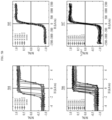
- FIGS. 5A and 5B are graphs explaining the perpendicular magnetic anisotropy of the spin-orbit torque-based random number generator according to an embodiment of the present disclosure.
- FIGS. 5A and 5B illustrate magnetic hysteresis curves measured in the plane perpendicular direction using a vibrating sample magnetometer (VSM) in relation to the perpendicular magnetic anisotropy of the spin-orbit torque-based random number generator according to an embodiment of the present disclosure.
- VSM vibrating sample magnetometer
- graph 500 shows a first embodiment in which the spin torque generation layer consists of the second spin torque layer formed of niobium (Nb) without the first spin torque layer and the thickness is adjusted to 5 nm to 15 nm
- graph 501 shows magnetic hysteresis curves measured by applying a magnetic field in the thin film in-plane direction in the structure according to the first embodiment described above.
- Graph 502 shows a second embodiment in which the spin torque generation layer consists of the first spin torque layer formed of tantalum (Ta) and having a thickness of about 3 nm and the second spin torque layer formed of niobium (Nb) and the thickness is adjusted to 5 nm to 15 nm, and graph 503 shows magnetic hysteresis curves measured by applying a magnetic field in the thin film in-plane direction in the structure according to the second embodiment described above.
- the spin torque generation layer consists of the first spin torque layer formed of tantalum (Ta) and having a thickness of about 3 nm and the second spin torque layer formed of niobium (Nb) and the thickness is adjusted to 5 nm to 15 nm
- graph 503 shows magnetic hysteresis curves measured by applying a magnetic field in the thin film in-plane direction in the structure according to the second embodiment described above.
- Graph 504 shows a third embodiment in which the spin torque generation layer consists of the first spin torque layer formed of tungsten (W) and having a thickness of about 3 nm and the second spin torque layer formed of niobium (Nb) and the thickness is adjusted to 5 nm to 15 nm, and graph 505 shows magnetic hysteresis curves measured by applying a magnetic field in the thin film in-plane direction in the structure according to the third embodiment described above.
- Graph 506 shows a fourth embodiment in which the spin torque generation layer consists of the first spin torque layer formed of platinum (Pt) and having a thickness of about 3 nm and the second spin torque layer formed of niobium (Nb) and the thickness is adjusted to 1 nm to 15 nm, and graph 507 shows magnetic hysteresis curves measured by applying a magnetic field in the thin film in-plane direction in the structure according to the fourth embodiment described above.
- the spin torque generation layer consists of the first spin torque layer formed of platinum (Pt) and having a thickness of about 3 nm and the second spin torque layer formed of niobium (Nb) and the thickness is adjusted to 1 nm to 15 nm
- graph 507 shows magnetic hysteresis curves measured by applying a magnetic field in the thin film in-plane direction in the structure according to the fourth embodiment described above.
- FIGS. 6 and 7 are graphs explaining measurement results for ratio control of the damping-like torque and field-like torque of the spin-orbit torque-based random number generator according to an embodiment of the present disclosure.
- FIG. 6 shows the measurement results for the efficiency of damping-like torque ( ⁇ DL) and field-like torque ( ⁇ FL) according to the niobium thickness measured using the harmonic measurement method in the Nb/CoFeB/MgO/Ta and Ta (W, Pt)/Nb/CoFeB/MgO/Ta structures (In the case of Pt, the thickness may change) in relation to the ratio control of damping-like torque and field-like torque, regarding the ratio control of the damping-like torque and field-like torque of the spin-orbit torque-based random number generator according to an embodiment of the present disclosure.
- graph 600 shows the measurement results of the efficiency of damping-like torque and field-like torque for a first embodiment in which the spin torque generation layer is formed only of Nb.
- Graph 601 shows the measurement results of the efficiency of damping-like torque and field-like torque for a second embodiment in which the spin torque generation layer consists of the first spin torque layer formed of Ta and the second spin torque layer formed of Nb.
- Graph 602 shows the measurement results of the efficiency of damping-like torque and field-like torque for a third embodiment in which the spin torque generation layer consists of the first spin torque layer formed of W and the second spin torque layer formed of Nb.
- Graph 603 shows the measurement results of the efficiency of damping-like torque and field-like torque for a fourth embodiment in which the spin torque generation layer consists of the first spin torque layer formed of Pt and the second spin torque layer formed of Nb.
- the efficiency of damping-like torque is about -0.03, which is lower than other heavy metals (W: -0.33, Ta: -0.12, Pt: 0.09, etc.), but the efficiency of field-like torque is 0.09, and the field-like torque/damping-like torque ratio (hereinafter ⁇ ) is about 3, showing a high ratio.
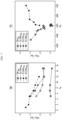
- FIG. 7 shows the ratio of field-like torque and damping-like torque according to the niobium thickness measured using the harmonic measurement method in the Nb/CoFeB/MgO/Ta and Ta(W, Pt)/Nb/CoFeB/MgO/Ta (unit: nm) structures, regarding the ratio control of the damping-like torque and field-like torque of the spin-orbit torque-based random number generator according to an embodiment of the present disclosure.
- graph 700 and graph 701 show the ratio ( ⁇ ) of field-like torque to damping-like torque of each structure according to the thickness of niobium confirmed in FIG. 6 .
- the ratio ( ⁇ ) shows a value that varies from -0.5 to -3, and the Nb structure in graph 700 may show the highest ratio ( ⁇ ) among the four structures.
- FIGS. 8A to 10 are graphs explaining switching operation and efficiency related to ratio control of damping-like torque and field-like torque in the spin-orbit torque-based random number generator according to an embodiment of the present disclosure.
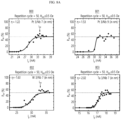
- FIGS. 8A and 8B show the switching probability distribution (Psw) and the corresponding switching operation current (Isw) of eight devices with different ratios ( ⁇ ) in relation to switching operation and efficiency related to the ratio control of damping-like torque and field-like torque in the spin-orbit torque-based random number generator according to an embodiment of the present disclosure.
- graph 800 illustrates the switching probability distribution and switching operation current when the ratio ( ⁇ ) is -1.22
- graph 801 illustrates the switching probability distribution and switching operation current when the ratio ( ⁇ ) is -1.53
- graph 802 illustrates the switching probability distribution and switching operation current when the ratio ( ⁇ ) is -1.63
- graph 803 illustrates the switching probability distribution and switching operation current when the ratio ( ⁇ ) is -2.02.
- graph 804 illustrates the switching probability distribution and switching operation current when the ratio ( ⁇ ) is -2.18
- graph 805 illustrates the switching probability distribution and switching operation current when the ratio ( ⁇ ) is -2.24
- graph 806 illustrates the switching probability distribution and switching operation current when the ratio ( ⁇ ) is -2.40
- graph 807 illustrates the switching probability distribution and switching operation current when the ratio ( ⁇ ) is -3.03.
- graphs 800 to 807 show the results of switching probability distribution (Psw) and switching operation current (Isw) measured using a four-point probe.
- the switching probability is 0 because the SOT caused by small size pulses is not enough to completely lay down the free layer.
- FIG. 9 illustrates the trend for the ratio ( ⁇ ) of the values when the switching current density (J sw ) of eight devices with different ratios ( ⁇ ) related to the ratio control of damping-like torque and field-like torque is normalized with the coercive field (H c ) in the spin-orbit torque-based random number generator according to an embodiment of the present disclosure.
- the switching current density of a spin-orbit torque device with a multi-domain magnetic layer tends to be proportional to the size of the coercive field.
- the present disclosure may provide a candidate material that is an SOT material for a random number generator, is a spin torque layer material with low DLT and high FLT efficiency, and has a high ratio of FLT to DLT.
- FIG. 10 illustrates the results of Fokker-Planck calculations using macrospin approximation showing the effect of the size of ratio ( ⁇ ) related to the ratio control of damping-like torque and field-like torque on switching current density in the spin-orbit torque-based random number generator according to an embodiment of the present disclosure.
- graphs 1000 and 1001 show the effect of the size of ratio ( ⁇ ) on switching current density as a result of Fokker-Planck calculation using macrospin approximation.
- the charging current flowing through the first spin torque layer may have a pulse width of 50 ns and an increase time of 2 ns.
- Graph 1001 shows the switching current density (Jsw).
- the switching probability (P SW ) is 50 %.
- FIG. 11 includes graphs explaining entropy test results of the switching probability and random number column of the spin-orbit torque-based random number generator according to an embodiment of the present disclosure.
- FIG. 11 illustrates the entropy test results of the switching probability and random number column of the spin-orbit torque-based random number generator according to an embodiment of the present disclosure.
- graph 1100 shows the switching probability of a spin-orbit torque-based random number generator including a spin torque generation layer that includes only a second spin torque layer and a spin-orbit torque-based random number generator including a spin torque generation layer including first and second spin torque layers.
- a random number column is created by selecting three elements with different ratio ( ⁇ ) sizes, and the randomness of each string is checked.
- the second spin torque layer is formed of Nb.
- the second spin torque layer is formed of Nb and the first spin torque layer is formed of W.
- the second spin torque layer is formed of Nb and the first spin torque layer is formed of Pt.
- the ratio ( ⁇ ) in the first device is -3.03
- the ratio ( ⁇ ) in the second device is -2.18
- the ratio ( ⁇ ) in the third device is -1.53.
- the method for obtaining random numbers from each device is as follows. First, it is confirmed whether SOT switching is secured under an external magnetic field.
- the random number column generated until each device fails to perform a switching operation due to deterioration due to repetitive current injection may be 308,683 bits for the first device, 188,406 bits for the second device, and 392,156 bits for the third device.
- the switching probability of the devices may be 49.93 %, 49.99 %, and 49.79 %, respectively.
- Graph 1101 shows the minimum entropy test results of random number columns generated in a spin-orbit torque-based random number generator including a spin torque generation layer that includes only a second spin torque layer and a spin-orbit torque-based random number generator including a spin torque generation layer including first and second spin torque layers.
- Graph 1101 shows the results of the NIST SP 800-90B test provided by NIST (Institute of Standards and Technology) to check the randomness of the random number column.
- test results and low values (Min-entropy) of each random number column using the estimator are shown for the first device (Device #1), the second device (Device #2), and the third device (Device #3).
- the first device has a structure in which the spin torque generation layer is formed of Nb.
- the spin torque generation layer consists of the first spin torque layer and the second spin torque layer.
- the first spin torque layer is formed of W
- the second spin torque layer is formed of Nb.
- the first spin torque layer is formed of Pt and the second spin torque layer is formed of Nb.
- entropy n When the entropy value is n (0 ⁇ n ⁇ 1), it means that 1/n operations are required to generate a 1-bit random number. In the case of a perfect random number generator, entropy n may be 1.
- the NIST SP800-90B test results for each random number column may be shown in FIG. 10 .
- the Min-entropy values of the three devices are 0.825407, 0.825778, and 0.891471, respectively, so high entropy values may be secured regardless of the size of ⁇ .
- the present disclosure may implement a spin-orbit torque-based random number generator having low switching current while maintaining a random number generation function by adjusting the ratio of FLT to DLT and entropy based on the structure of a spin torque layer and magnetic layer based on a candidate material that increases the ratio of FLT to DLT.
- the present disclosure can implement a spin-orbit torque-based random number generator being capable of spin-orbit torque (SOT) switching based on a spin torque layer and having a low switching current value and a high-entropy random number generation function by controlling the ratio of damping-like torque (DLT) and field-like torque (FLT) among spin-orbit torque components.
- SOT spin-orbit torque
- DLT damping-like torque
- FLT field-like torque
- the present disclosure can implement a spin-orbit torque-based random number generator having low switching current by maintaining perpendicular magnetic anisotropy and high entropy by laminating materials with different spin-orbit coupling sizes on a spin torque layer that contacts a free layer and provides in-plane current.
- the present disclosure can provide a candidate material that is an SOT material for a random number generator, is a spin torque layer material with low DLT and high FLT efficiency, and has a high ratio of FLT to DLT.
- the present disclosure can implement a spin-orbit torque-based random number generator having low switching current while maintaining a random number generation function with high entropy by adjusting the ratio of FLT to DLT based on the structure of a spin torque layer and magnetic layer based on a candidate material that increases the ratio of FLT to DLT.
- constituent elements expressed in plural may be composed of a single number, and constituent elements expressed in singular form may be composed of a plurality of elements.
Landscapes
- Engineering & Computer Science (AREA)
- Physics & Mathematics (AREA)
- General Physics & Mathematics (AREA)
- Theoretical Computer Science (AREA)
- Computational Mathematics (AREA)
- Mathematical Analysis (AREA)
- Mathematical Optimization (AREA)
- Pure & Applied Mathematics (AREA)
- General Engineering & Computer Science (AREA)
- Hall/Mr Elements (AREA)
- Mram Or Spin Memory Techniques (AREA)
- Manufacturing & Machinery (AREA)
Applications Claiming Priority (1)
| Application Number | Priority Date | Filing Date | Title |
|---|---|---|---|
| KR1020230153395A KR102746798B1 (ko) | 2023-11-08 | 2023-11-08 | 스핀궤도토크 난수발생기 및 이의 제조 방법 |
Publications (1)
| Publication Number | Publication Date |
|---|---|
| EP4553643A1 true EP4553643A1 (en) | 2025-05-14 |
Family
ID=92172089
Family Applications (1)
| Application Number | Title | Priority Date | Filing Date |
|---|---|---|---|
| EP24191984.4A Pending EP4553643A1 (en) | 2023-11-08 | 2024-07-31 | Spin-orbit torque-based random number generator and fabricating method thereof |
Country Status (4)
| Country | Link |
|---|---|
| US (1) | US20250147731A1 (ja) |
| EP (1) | EP4553643A1 (ja) |
| JP (1) | JP7737118B2 (ja) |
| KR (1) | KR102746798B1 (ja) |
Families Citing this family (1)
| Publication number | Priority date | Publication date | Assignee | Title |
|---|---|---|---|---|
| KR102940692B1 (ko) | 2025-02-28 | 2026-03-19 | 고려대학교 산학협력단 | 물리적 복제 불가능 함수 소자 및 이를 이용한 암호 키 생성 장치 |
Citations (2)
| Publication number | Priority date | Publication date | Assignee | Title |
|---|---|---|---|---|
| US20170330070A1 (en) * | 2016-02-28 | 2017-11-16 | Purdue Research Foundation | Spin orbit torque based electronic neuron |
| US9824735B1 (en) * | 2016-08-15 | 2017-11-21 | Qualcomm Incorporated | System and method to generate a random number |
Family Cites Families (10)
| Publication number | Priority date | Publication date | Assignee | Title |
|---|---|---|---|---|
| JP3641255B2 (ja) | 2002-06-24 | 2005-04-20 | 株式会社東芝 | 乱数生成装置 |
| KR101348503B1 (ko) | 2012-06-29 | 2014-01-07 | 리켄 | 난수 발생기 및 이의 제조방법 |
| JP6200471B2 (ja) | 2015-09-14 | 2017-09-20 | 株式会社東芝 | 磁気メモリ |
| JP5985728B1 (ja) | 2015-09-15 | 2016-09-06 | 株式会社東芝 | 磁気メモリ |
| JP2017216286A (ja) | 2016-05-30 | 2017-12-07 | 学校法人慶應義塾 | スピントロニクスデバイス及びこれを用いた記憶装置 |
| JP2021051629A (ja) | 2019-09-26 | 2021-04-01 | Tdk株式会社 | 乱数発生器、ニューロモルフィックデバイス、センサ信号処理回路および乱数発生方法 |
| EP3809413B1 (en) | 2019-10-16 | 2023-09-06 | Korea University Research and Business Foundation | Method of fabricating a spin-orbit torque-based switching device |
| KR102298399B1 (ko) * | 2019-10-16 | 2021-09-07 | 고려대학교 산학협력단 | 스핀궤도토크 기반의 스위칭 소자 및 그 제조방법 |
| KR102298837B1 (ko) | 2020-03-19 | 2021-09-06 | 고려대학교 산학협력단 | 텅스텐 질화물을 가지는 스핀궤도토크 스위칭 소자 |
| KR102564956B1 (ko) * | 2021-11-25 | 2023-08-08 | 재단법인대구경북과학기술원 | 사파이어 미스컷 기판을 이용한 무자기장 스핀궤도토크 스위칭 소자 |
-
2023
- 2023-11-08 KR KR1020230153395A patent/KR102746798B1/ko active Active
-
2024
- 2024-07-19 US US18/777,997 patent/US20250147731A1/en active Pending
- 2024-07-25 JP JP2024119392A patent/JP7737118B2/ja active Active
- 2024-07-31 EP EP24191984.4A patent/EP4553643A1/en active Pending
Patent Citations (2)
| Publication number | Priority date | Publication date | Assignee | Title |
|---|---|---|---|---|
| US20170330070A1 (en) * | 2016-02-28 | 2017-11-16 | Purdue Research Foundation | Spin orbit torque based electronic neuron |
| US9824735B1 (en) * | 2016-08-15 | 2017-11-21 | Qualcomm Incorporated | System and method to generate a random number |
Non-Patent Citations (2)
| Title |
|---|
| APPL. PHYS. LETT., vol. 118, 2021, pages 052401 |
| KIM YUSUNG ET AL: "Spin-Orbit-Torque-Based Spin-Dice: A True Random-Number Generator", IEEE MAGNETICS LETTERS, vol. 6, 1 January 2015 (2015-01-01), pages 1 - 4, XP011594253, ISSN: 1949-307X, [retrieved on 20151210], DOI: 10.1109/LMAG.2015.2496548 * |
Also Published As
| Publication number | Publication date |
|---|---|
| JP7737118B2 (ja) | 2025-09-10 |
| US20250147731A1 (en) | 2025-05-08 |
| KR102746798B1 (ko) | 2024-12-26 |
| JP2025078575A (ja) | 2025-05-20 |
Similar Documents
| Publication | Publication Date | Title |
|---|---|---|
| US9087593B2 (en) | Random bit generator that applies alternating current (AC) to magnetic tunnel junction to generate a random bit | |
| EP2163984B1 (en) | Random number generating device | |
| US9620562B2 (en) | Voltage-controlled magnetic anisotropy switching device using an external ferromagnetic biasing film | |
| KR102426415B1 (ko) | 대칭 고정 층을 갖는 수직 자기 메모리 | |
| EP2503614A2 (en) | High-speed low-power magnetic devices based on current-induced spin-momentum transfer | |
| US11641782B2 (en) | Spin-orbit torque-based switching device and method of fabricating the same | |
| WO2019005544A1 (en) | MRAM WITH MAGNETIC FIELDS REDUCED PARASITES | |
| CN101896976A (zh) | 基于电流感应自旋动量转移的高速低功率磁性装置 | |
| KR20120030155A (ko) | 전류-유도 스핀-모멘텀 전달에 기초한 고속 저전력 자기 장치 | |
| JP7549891B2 (ja) | 乱数発生ユニット及びコンピューティングシステム | |
| US20250147731A1 (en) | Spin-orbit torque-based random number generator and fabricating method thereof | |
| KR102499682B1 (ko) | 확률론적 자기터널접합구조를 이용한 랜덤 넘버 발생기 | |
| JP2011175987A (ja) | スピンバルブ素子および記憶装置 | |
| US11195989B2 (en) | Ferromagnetic tunnel junction element and method of manufacturing the same | |
| TWI643367B (zh) | 形成磁性裝置的自由層的材料組成、自由層與磁性元件 | |
| JP2019144812A (ja) | 乱数発生器及び集積素子 | |
| KR20210045279A (ko) | 스핀궤도토크 기반의 스위칭 소자 및 그 제조방법 | |
| Wang et al. | Different dielectric breakdown mechanisms for RF-MgO and naturally oxidized MgO | |
| Lee et al. | A thermodynamic core using voltage-controlled spin–orbit-torque magnetic tunnel junctions | |
| CN115809044A (zh) | 概率可控的自旋随机数发生器 | |
| CN116521132A (zh) | 真随机数发生器 | |
| TW202541686A (zh) | 磁性記憶體裝置及包括其之電子裝置 | |
| WO2023017714A1 (ja) | 超常磁性磁気トンネル接合素子、及びコンピューティングシステム | |
| You et al. | Study on magnetic tunnel junction |
Legal Events
| Date | Code | Title | Description |
|---|---|---|---|
| PUAI | Public reference made under article 153(3) epc to a published international application that has entered the european phase |
Free format text: ORIGINAL CODE: 0009012 |
|
| STAA | Information on the status of an ep patent application or granted ep patent |
Free format text: STATUS: REQUEST FOR EXAMINATION WAS MADE |
|
| 17P | Request for examination filed |
Effective date: 20240731 |
|
| AK | Designated contracting states |
Kind code of ref document: A1 Designated state(s): AL AT BE BG CH CY CZ DE DK EE ES FI FR GB GR HR HU IE IS IT LI LT LU LV MC ME MK MT NL NO PL PT RO RS SE SI SK SM TR |
|
| GRAP | Despatch of communication of intention to grant a patent |
Free format text: ORIGINAL CODE: EPIDOSNIGR1 |
|
| STAA | Information on the status of an ep patent application or granted ep patent |
Free format text: STATUS: GRANT OF PATENT IS INTENDED |
|
| RIC1 | Information provided on ipc code assigned before grant |
Ipc: G06F 7/58 20060101AFI20260112BHEP |
|
| INTG | Intention to grant announced |
Effective date: 20260128 |
|
| GRAS | Grant fee paid |
Free format text: ORIGINAL CODE: EPIDOSNIGR3 |
|
| GRAA | (expected) grant |
Free format text: ORIGINAL CODE: 0009210 |
|
| STAA | Information on the status of an ep patent application or granted ep patent |
Free format text: STATUS: THE PATENT HAS BEEN GRANTED |