EP4550293A2 - Fahrzeugbetrieb - Google Patents
Fahrzeugbetrieb Download PDFInfo
- Publication number
- EP4550293A2 EP4550293A2 EP25157098.2A EP25157098A EP4550293A2 EP 4550293 A2 EP4550293 A2 EP 4550293A2 EP 25157098 A EP25157098 A EP 25157098A EP 4550293 A2 EP4550293 A2 EP 4550293A2
- Authority
- EP
- European Patent Office
- Prior art keywords
- vehicle
- vehicles
- certified
- record
- radio transmission
- Prior art date
- Legal status (The legal status is an assumption and is not a legal conclusion. Google has not performed a legal analysis and makes no representation as to the accuracy of the status listed.)
- Pending
Links
Images


Classifications
-
- G—PHYSICS
- G08—SIGNALLING
- G08G—TRAFFIC CONTROL SYSTEMS
- G08G1/00—Traffic control systems for road vehicles
- G08G1/09—Arrangements for giving variable traffic instructions
- G08G1/0962—Arrangements for giving variable traffic instructions having an indicator mounted inside the vehicle, e.g. giving voice messages
- G08G1/0967—Systems involving transmission of highway information, e.g. weather, speed limits
- G08G1/096708—Systems involving transmission of highway information, e.g. weather, speed limits where the received information might be used to generate an automatic action on the vehicle control
- G08G1/096725—Systems involving transmission of highway information, e.g. weather, speed limits where the received information might be used to generate an automatic action on the vehicle control where the received information generates an automatic action on the vehicle control
-
- B—PERFORMING OPERATIONS; TRANSPORTING
- B60—VEHICLES IN GENERAL
- B60W—CONJOINT CONTROL OF VEHICLE SUB-UNITS OF DIFFERENT TYPE OR DIFFERENT FUNCTION; CONTROL SYSTEMS SPECIALLY ADAPTED FOR HYBRID VEHICLES; ROAD VEHICLE DRIVE CONTROL SYSTEMS FOR PURPOSES NOT RELATED TO THE CONTROL OF A PARTICULAR SUB-UNIT
- B60W50/00—Details of control systems for road vehicle drive control not related to the control of a particular sub-unit, e.g. process diagnostic or vehicle driver interfaces
- B60W50/02—Ensuring safety in case of control system failures, e.g. by diagnosing, circumventing or fixing failures
- B60W50/029—Adapting to failures or work around with other constraints, e.g. circumvention by avoiding use of failed parts
-
- B—PERFORMING OPERATIONS; TRANSPORTING
- B60—VEHICLES IN GENERAL
- B60W—CONJOINT CONTROL OF VEHICLE SUB-UNITS OF DIFFERENT TYPE OR DIFFERENT FUNCTION; CONTROL SYSTEMS SPECIALLY ADAPTED FOR HYBRID VEHICLES; ROAD VEHICLE DRIVE CONTROL SYSTEMS FOR PURPOSES NOT RELATED TO THE CONTROL OF A PARTICULAR SUB-UNIT
- B60W50/00—Details of control systems for road vehicle drive control not related to the control of a particular sub-unit, e.g. process diagnostic or vehicle driver interfaces
- B60W50/02—Ensuring safety in case of control system failures, e.g. by diagnosing, circumventing or fixing failures
- B60W50/0205—Diagnosing or detecting failures; Failure detection models
-
- B—PERFORMING OPERATIONS; TRANSPORTING
- B60—VEHICLES IN GENERAL
- B60W—CONJOINT CONTROL OF VEHICLE SUB-UNITS OF DIFFERENT TYPE OR DIFFERENT FUNCTION; CONTROL SYSTEMS SPECIALLY ADAPTED FOR HYBRID VEHICLES; ROAD VEHICLE DRIVE CONTROL SYSTEMS FOR PURPOSES NOT RELATED TO THE CONTROL OF A PARTICULAR SUB-UNIT
- B60W50/00—Details of control systems for road vehicle drive control not related to the control of a particular sub-unit, e.g. process diagnostic or vehicle driver interfaces
- B60W50/02—Ensuring safety in case of control system failures, e.g. by diagnosing, circumventing or fixing failures
- B60W50/0225—Failure correction strategy
-
- G—PHYSICS
- G05—CONTROLLING; REGULATING
- G05D—SYSTEMS FOR CONTROLLING OR REGULATING NON-ELECTRIC VARIABLES
- G05D1/00—Control of position, course, altitude or attitude of land, water, air or space vehicles, e.g. using automatic pilots
- G05D1/02—Control of position or course in two dimensions
- G05D1/021—Control of position or course in two dimensions specially adapted to land vehicles
- G05D1/0212—Control of position or course in two dimensions specially adapted to land vehicles with means for defining a desired trajectory
- G05D1/0214—Control of position or course in two dimensions specially adapted to land vehicles with means for defining a desired trajectory in accordance with safety or protection criteria, e.g. avoiding hazardous areas
-
- G—PHYSICS
- G05—CONTROLLING; REGULATING
- G05D—SYSTEMS FOR CONTROLLING OR REGULATING NON-ELECTRIC VARIABLES
- G05D1/00—Control of position, course, altitude or attitude of land, water, air or space vehicles, e.g. using automatic pilots
- G05D1/60—Intended control result
- G05D1/617—Safety or protection, e.g. defining protection zones around obstacles or avoiding hazards
-
- G—PHYSICS
- G08—SIGNALLING
- G08G—TRAFFIC CONTROL SYSTEMS
- G08G1/00—Traffic control systems for road vehicles
- G08G1/09—Arrangements for giving variable traffic instructions
- G08G1/0962—Arrangements for giving variable traffic instructions having an indicator mounted inside the vehicle, e.g. giving voice messages
- G08G1/0967—Systems involving transmission of highway information, e.g. weather, speed limits
- G08G1/096766—Systems involving transmission of highway information, e.g. weather, speed limits where the system is characterised by the origin of the information transmission
- G08G1/096791—Systems involving transmission of highway information, e.g. weather, speed limits where the system is characterised by the origin of the information transmission where the origin of the information is another vehicle
-
- G—PHYSICS
- G08—SIGNALLING
- G08G—TRAFFIC CONTROL SYSTEMS
- G08G1/00—Traffic control systems for road vehicles
- G08G1/16—Anti-collision systems
- G08G1/161—Decentralised systems, e.g. inter-vehicle communication
-
- G—PHYSICS
- G08—SIGNALLING
- G08G—TRAFFIC CONTROL SYSTEMS
- G08G1/00—Traffic control systems for road vehicles
- G08G1/16—Anti-collision systems
- G08G1/161—Decentralised systems, e.g. inter-vehicle communication
- G08G1/163—Decentralised systems, e.g. inter-vehicle communication involving continuous checking
-
- B—PERFORMING OPERATIONS; TRANSPORTING
- B60—VEHICLES IN GENERAL
- B60W—CONJOINT CONTROL OF VEHICLE SUB-UNITS OF DIFFERENT TYPE OR DIFFERENT FUNCTION; CONTROL SYSTEMS SPECIALLY ADAPTED FOR HYBRID VEHICLES; ROAD VEHICLE DRIVE CONTROL SYSTEMS FOR PURPOSES NOT RELATED TO THE CONTROL OF A PARTICULAR SUB-UNIT
- B60W50/00—Details of control systems for road vehicle drive control not related to the control of a particular sub-unit, e.g. process diagnostic or vehicle driver interfaces
- B60W2050/0062—Adapting control system settings
- B60W2050/0075—Automatic parameter input, automatic initialising or calibrating means
-
- B—PERFORMING OPERATIONS; TRANSPORTING
- B60—VEHICLES IN GENERAL
- B60W—CONJOINT CONTROL OF VEHICLE SUB-UNITS OF DIFFERENT TYPE OR DIFFERENT FUNCTION; CONTROL SYSTEMS SPECIALLY ADAPTED FOR HYBRID VEHICLES; ROAD VEHICLE DRIVE CONTROL SYSTEMS FOR PURPOSES NOT RELATED TO THE CONTROL OF A PARTICULAR SUB-UNIT
- B60W50/00—Details of control systems for road vehicle drive control not related to the control of a particular sub-unit, e.g. process diagnostic or vehicle driver interfaces
- B60W50/02—Ensuring safety in case of control system failures, e.g. by diagnosing, circumventing or fixing failures
- B60W50/0205—Diagnosing or detecting failures; Failure detection models
- B60W2050/0215—Sensor drifts or sensor failures
-
- B—PERFORMING OPERATIONS; TRANSPORTING
- B60—VEHICLES IN GENERAL
- B60W—CONJOINT CONTROL OF VEHICLE SUB-UNITS OF DIFFERENT TYPE OR DIFFERENT FUNCTION; CONTROL SYSTEMS SPECIALLY ADAPTED FOR HYBRID VEHICLES; ROAD VEHICLE DRIVE CONTROL SYSTEMS FOR PURPOSES NOT RELATED TO THE CONTROL OF A PARTICULAR SUB-UNIT
- B60W2556/00—Input parameters relating to data
- B60W2556/45—External transmission of data to or from the vehicle
Definitions
- One or more operations of a vehicle may be controlled autonomously (including semi-autonomously) on the basis of outputs of one or more sensors.
- the inventors for the present application have identified that erroneous sensor outputs (caused e.g. by sensor failures or one or more external interferences) are causing road accidents; and a need for a technique which reduces the risk of such road accidents.
- a method comprising: controlling an operation of a first vehicle at least partly on the basis of information about one or more sensor outputs of one or more other vehicles recovered from one or more radio transmissions each verifiable as a radio transmission by a vehicle included in a record of certified vehicles.
- said record of certified vehicles comprises a local copy of a distributed ledger stored in memory at the first vehicle, or a copy of a distributed ledger stored in remote memory accessible by the first vehicle via a communications network.
- the method further comprises: controlling the addition of one or more new blocks to a blockchain based at least partly on said information about said one or more sensor outputs.
- the method further comprises: controlling the addition of a new block to the block chain for each radio transmission verifiable as a radio transmission by a vehicle recorded on a distributed ledger.
- the method further comprises: controlling the addition of a new block to the block chain for a bundle of radio transmissions each verifiable as a radio transmission by a vehicle recorded on a distributed ledger.
- the method further comprises controlling the addition to a blockchain of one or more new blocks based on information about said one or more sensor outputs of one or more other vehicles recovered from said one or more radio transmissions each verifiable as said radio transmission by said vehicle included in said record of said certified vehicles; and wherein said controlling said operation of said first vehicle comprises identifying from said information about said one or more sensor outputs a consensus between said one or more certified vehicles about one or more external conditions.
- said consensus between said one or more certified vehicles about one or more external conditions comprises a consensus about how to co-operatively proceed in a traffic system.
- controlling the radio transmission from a vehicle of data including information about a sensor output comprising: controlling the radio transmission from a vehicle of data including information about a sensor output, wherein controlling the radio transmission comprises creating a digital signature of at least part of the data using a private key of a private-public key pair whose corresponding public key is included in a record of certified public keys.
- the record of certified public keys is included in a distributed ledger.
- an apparatus comprising: a processor and memory including computer program code, wherein the memory and computer program code are configured to, with the processor, cause the apparatus to: control an operation of a first vehicle at least partly on the basis of information about one or more sensor outputs of one or more other vehicles recovered from one or more radio transmissions each verifiable as a radio transmission by a vehicle included in a record of certified vehicles.
- said record of certified vehicles comprises a local copy of a distributed ledger stored in memory at the first vehicle, or a copy of a distributed ledger stored in remote memory accessible by the first vehicle via a communications network.
- the memory and computer program code are further configured to, with the processor, cause the apparatus to: control the addition of one or more new blocks to a blockchain based at least partly on said information about said one or more sensor outputs.
- the memory and computer program code are further configured to, with the processor, cause the apparatus to: control the addition of a new block to the block chain for each radio transmission verifiable as a radio transmission by a vehicle recorded on a distributed ledger.
- the memory and computer program code are further configured to, with the processor, cause the apparatus to: control the addition of a new block to the block chain for a bundle of radio transmissions each verifiable as a radio transmission by a vehicle recorded on a distributed ledger.
- the memory and computer program code are further configured to, with the processor, cause the apparatus to: control the addition to a blockchain of one or more new blocks based on information about said one or more sensor outputs of one or more other vehicles recovered from said one or more radio transmissions each verifiable as said radio transmission by said vehicle included in said record of said certified vehicles; and to identify from said information about said one or more sensor outputs a consensus between said one or more certified vehicles about one or more external conditions.
- said consensus between said one or more certified vehicles about one or more external conditions comprises a consensus about how to co-operatively proceed in a traffic system.
- an apparatus comprising: a processor and memory including computer program code, wherein the memory and computer program code are configured to, with the processor, cause the apparatus to: control the radio transmission from a vehicle of data including information about a sensor output, and create a digital signature of at least part of the data using a private key of a private-public key pair whose corresponding public key is included in a record of certified public keys.
- the record of certified public keys is included in a distributed ledger.
- an apparatus comprising: means for controlling an operation of a first vehicle at least partly on the basis of information about one or more sensor outputs of one or more other vehicles recovered from one or more radio transmissions each verifiable as a radio transmission by a vehicle included in a record of certified vehicles.
- an apparatus comprising: means for controlling the radio transmission from a vehicle of data including information about a sensor output, wherein controlling the radio transmission comprises creating a digital signature of at least part of the data using a private key of a private-public key pair whose corresponding public key is included in a record of certified public keys.
- a computer program product comprising program code means which when loaded into a computer controls the computer to: control an operation of a first vehicle at least partly on the basis of information about one or more sensor outputs of one or more other vehicles recovered from one or more radio transmissions each verifiable as a radio transmission by a vehicle included in a record of certified vehicles.
- a computer program product comprising program code means which when loaded into a computer controls the computer to: control the radio transmission from a vehicle of data including information about a sensor output, and to create a digital signature of at least part of the data using a private key of a private-public key pair whose corresponding public key is included in a record of certified public keys.
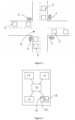
- a plurality of vehicles such as autonomous, semi- autonomous, or conventional (i.e. manually operated) vehicles, are operating in the vicinity of a road junction 4 served by a traffic control signal system 6.
- the traffic control signal system may include visual-based control signal devices such as traffic lights that emit light of different colours, each colour indicating a respective signal such as green for "go” and red for "stop”.
- Figure 2 shows a schematic view of an example of apparatus for each vehicle 2.
- the apparatus also includes one or more sensors 16 whose outputs are saved in memory 12 and may be used as inputs for the one or more processors 10 to control the operation of the actuators 14.
- the one or more sensors 16 may include one or more video or still image cameras configured to capture visual data about the environment of the vehicle, from which the one or more processors 10 may e.g. make a determination, e.g.
- the one or more sensors 16 may include one or more positioning sensors, such as global navigation satellite system (GNSS) sensors, acceleration sensors, compass sensors, speed sensors, microphones, LIDAR (Light Detection And Ranging) sensors, radar sensors, break sensors, steering angle sensors, any vehicle part specific sensor, or any combination thereof.
- GNSS global navigation satellite system
- LIDAR Light Detection And Ranging
- the one or more processors 10 also control the generation, transmission, and reception of radio signals via one or more radio transceiver devices 18.
- a radio transceiver device 18 may comprise a radio-frequency (RF) front end 20 and antenna 22.
- the RF front end 20 may include one or more analogue and/or digital transceivers, filters, duplexers, and antenna switches. Also, the combination of the radio transceiver 18 and one or more processors 10 also recovers data/information from radio signals reaching the vehicle 2 from e.g. other vehicles.
- the one or more processors 10 may comprise a baseband processor dedicated to (i) controlling the generation and transmission of radio signals communicating data generated by another one of the processors 10, and (ii) recovering data from radio transmissions received via a radio transceiver device 18, for use by another one of the processors 10.
- the apparatus may include separate one or more radio transceivers and separate baseband processors for each of a plurality of different radio communication technologies, including e.g.
- LTE Long Term Evolution
- 4G Long Term Evolution
- 5G 5th generation mobile networks
- V2V Vehicle-to-vehicle
- V2X Vehicle-to-everything
- Bluetooth Wireless Fidelity
- WiFi Wireless Fidelity
- the one or more processors 10 also control the generation, communication and presentation of video and/or audio user interface signals with one or more rendering devices, such as a vehicle infotainment system, a HUD (Head-up Display), a dashboard display, or an external display device, or any combination thereof, in order to render information to a user of the vehicle 2 relating to the control of the vehicle 2.
- one or more rendering devices such as a vehicle infotainment system, a HUD (Head-up Display), a dashboard display, or an external display device, or any combination thereof, in order to render information to a user of the vehicle 2 relating to the control of the vehicle 2.
- the one or more processors 10 may be implemented as separate chips or combined into a single chip.
- the memory 12 may be implemented as one or more chips.
- the memory 12 may include both read-only memory and random-access memory. The above elements may be provided on one or more circuit boards.
- figure 2 shows a schematic view of an example of a mobile communication device (such as a mobile phone, a tablet computer, a navigation device, a laptop computer, a still/video camera device, or any combination thereof) or an on-board diagnostics (OBD) device, or any combination thereof.
- a mobile communication device such as a mobile phone, a tablet computer, a navigation device, a laptop computer, a still/video camera device, or any combination thereof
- OBD on-board diagnostics
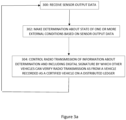
- Figure 3a illustrates one example of operations at the one or more processors 10 of Figure 2 according to an example embodiment of the invention.
- processor 10 In response to processor 10 making a determination about the current state of a traffic on a specific location, a system and/or a situation, for example a traffic control signal system, 6 based on the output of one or more sensors 16 (STEPS 300 and 302 of Figure 3a ), the processor controls the storing of the determination result in the memory 12, and additionally controls the transmission of the determination result via the one or more radio transceivers 18 (STEP 304 of Figure 3a ).
- the determination result may take the form shown below, which includes: (i) a unique vehicle identifier, such as e.g. a public key of a private-public key pair; (ii) information about one or more observations (determinations) based on sensor outputs, such as e.g. the state of a traffic signal uniquely identified by position coordinates for a road junction uniquely identified by position coordinates; and (iii) information about the current position of the vehicle when the observation was made.
- the determination result can comprise one or more unique sensor identifiers for each sensor data that is transmitted, for example identifier for a positioning sensor and/or a camera sensor.
- the vehicle 2 has a unique vehicle identifier number which is recorded on a distributed ledger (e.g. blockchain), that is stored in the vehicle 2, as a certified identifier; and the radio transmission is made in a way such that it can be verified as a radio transmission from a vehicle recorded on the distributed ledger as a certified vehicle.
- the radio transmission may include a digital signature of part or all of the data, e.g. plaintext, communicated by radio transmission using a private key of a private-public key pair for which the public key is recorded on the distributed ledger in association with the vehicle identifier (as mentioned above, the vehicle identifier itself may be the public key).
- the private key of a possibly additional private-public key pair can be used for digitally signing transactions and communications, where the corresponding public key of the pair can act as the vehicle identifier, or be directly related to it.
- the private key(s) may, for example, be securely incorporated into the processor 10 and/or memory 12 at the time of manufacture.
- the processor 10 in response to the processor 10 making a determination about the current state of the output of the one or more sensors 16, additionally or alternatively to the determination of the current state of the traffic, (STEPS 300 and 302 of Figure 3a ), the processor controls the storing of the determination result in the memory 12, and additionally controls the transmission of the determination result via the one or more radio transceivers 18 (STEP 304 of Figure 3a ).
- Figure 3b illustrates another example of operations at the one or more processors 10 of Figure 2 for a vehicle 2 in Figure 1 .
- the one or more processors 10 recover data from one or more radio transmissions made by one or more other vehicles 2 in the vicinity of the road junction 4 (STEP 306 of Figure 3b ). For each data message recovered from the one or more radio transmissions, the processor 10 looks for a vehicle identifier in the message; checks whether the vehicle identifier is an identifier recorded on the distributed ledger that is stored in the other vehicle 2; obtains the public key recorded on the distributed ledger for the vehicle identifier; and checks whether the digital signature is consistent with the plaintext and the public key (STEP 308 of Figure 3a ).
- the processor If the digital signature is verified, the processor considers the data message as a message from a trusted vehicle, and stores the content of the message in memory 12 (STEP 310 of Figure 3b ). On the other hand, if the digital signature is not consistent with the plaintext and the public key (i.e. the digital signature cannot be verified), the processor discards the message (STEP 312 of Figure 3b ).
- the local memory 12 may include a local copy of a recent version of the distributed ledger (e.g. updated at the start of the day before commencing any driving operation of the autonomous vehicle 2); and the processor 10 uses this local copy to check whether the vehicle identifier indicated in the message is an identifier recorded on the distributed ledger, and to obtain the public key recorded on the distributed ledger for the vehicle identifier.
- the processor 10 controls the generation and transmission of a message via the one or more transceiver devices 18 requesting this information from a remote memory, such as a distributed ledger, located outside of the vehicles 2 (not shown), via e.g. a radio access network.
- the memory 12 becomes stored with information from a plurality of trusted vehicles in the vicinity of the road junction 4 about the current state of the traffic on a specific location, a system and/or a situation, for example the traffic control signal system 6. From this information stored in the memory 12, the processor 10 determines a consensus about the state of the traffic on the specific location, the system and/or the situation, for example the traffic control signal system 6, and controls the operation of the one or more actuators 14 on the basis of the determined consensus, even if the determined consensus happens not to be consistent with the output of the vehicle's own sensors 16 (STEP 314 of Figure 3b ).
- the autonomous vehicles can operate with the traffic control signal system 6 without any visible traffic lights at the road junction 4 based on the systems described on figures 3a and 3b .
- sensors for traditional traffic light and signs could be removed from a road junctions, e.g. the road junction 4, wherein the one or more autonomous vehicles operate co-operatively at e.g. the road junction 4 based on a consensus established between the one or more vehicles and one or more fixed control points.
- the one or more control points do not have to be blockchain nodes - one or more of the control points may be equipped with signal devices configured for local and independent operation without participating in the consensus process.
- the one or more control points such as a crossing, e.g.
- a road crossing, pedestrian crossing, or railroad crossing, etc. may comprise one or more fixed traffic nodes of their own local blockchains establishing consensus for the one or more approaching vehicles and the one or more control points. These fixed traffic nodes may observe the traffic nearby and emit transactions to the local chain in consequence. In order to improve security in any event of malevolent hacking of fixed traffic nodes, the fixed traffic nodes may also be recorded as certified nodes (e.g. nodes having been certified by a government authority) on the same distributed ledger (or another distributed ledger), so that consensus votes by these fixed traffic nodes can be verified by means of digital signature using public keys recorded on the distributed ledger. These fixed traffic nodes may participate differently to vehicle nodes in the consensus mechanism.
- certified nodes e.g. nodes having been certified by a government authority
- a vote by a fixed traffic node may solely determine the consensus for vehicles to follow (irrespective of how many other vehicle nodes may vote differently), or a vote by a fixed traffic node may have greater weight than a vote by a vehicle node, so that more than a majority of vehicle nodes is required to establish a consensus contrary to the vote of a fixed traffic node. More functionality may be incorporated into the fixed traffic nodes such as a capability to mine information into the distributed ledger.
- the fixed traffic node comprises one or more similar functionalities and elements as the example of the apparatus illustrated in the figure 2 .
- the same technique described relating to the figs 3a and 3b can be used to establish a consensus between vehicles about the order of arrival at a road junction for which the order or arrival dictates which vehicle has priority.
- information about the consensus may be communicated to the user of the vehicle via one or more rendering devices.
- a fully autonomous vehicle there may be no need to communicate the consensus to a user of the vehicle; instead one or more processors automatedly control the operation the vehicle, without monitoring or intervention by a user of the vehicle) on the basis of the consensus itself, by controlling the operation of, for example, brakes, steering, speed control, etc. or any combination thereof.
- the distributed ledger and the main distributed ledger mentioned above may be a permissioned ledger taking the form of a blockchain, for which the addition of new blocks, for example an output of a sensor, a current state of a traffic, or an established consensus, requires the approval of a predetermined number of legal entities recorded in or more blocks of the blockchain as certifying legal entities.
- Secure and trusted voting about the addition of new blocks to the blockchain can be achieved e.g. using public-private key pairs, for which the public keys are recorded in one or more existing blocks of the blockchain, and by means of which each legal entity can verify whether a vote is a vote by another legal entity with voting rights.
- a certification scheme is a genesis certification scheme, according to which a genesis block of the blockchain identifies the administrators of the blockchain.
- the genesis block may include a smart contract that specifies that no new administrators may be added.
- the genesis block may include a smart contract permitting the addition of new administrators and/or the removal of existing administrators subject to one or more conditions, such as the approval of the majority of existing administrators.
- secure and trusted voting on the addition of new blocks to the blockchain can be achieved e.g. using public-private key pairs, for which the public keys are already recorded in one or more existing blocks of the blockchain, and by which each administrator can verify a vote as a vote by another administrator with voting rights.
- a certification scheme is a hierarchical certification scheme according to which the blockchain specifies a collaboration of government bodies as a top layer of administrators, each with rights to add a new block to the blockchain nominating one or more chosen entities as certification authorities with rights to add vehicles and/or remove vehicles from the record of certified vehicles.
- a certification scheme is a user-invite based certification scheme, in which only invited users are allowed to add vehicles to and/or remove vehicles from the record of certified vehicles.
- vehicle manufacturers may establish a public blockchain where administration rights are kept privately. Each vehicle manufacturer may control one or more private keys that allow them to add vehicles to and/or remove vehicles from the record of certified vehicles.
- government authorities control private keys whose public keys are recorded in one or more blocks of the block chain as giving rights over any aspect of the administration of the blockchain, and vehicle manufacturers control private keys whose public keys are recorded as keys giving limited rights such as e.g. rights limited to add vehicles to and/or remove vehicles from the record of certified vehicles.
- Consensus about the extension of the blockchain may be achieved by using a majority or Byzantine fault tolerant consensus mechanism.
- This consensus mechanism is energy efficient, and ensures that participation in maintaining the blockchain is limited to parties with an interest in the system functioning properly.
- Figure 4 illustrates a set of operations at a processor of a node, associated with e.g. a car manufacturer, controlling a private key for which the public key counterpart is recorded on the blockchain as giving rights to add vehicles to and/or remove vehicles from the record of certified vehicles.
- the node processor controls the generation and sending to other certifying nodes in the blockchain network of one or more digitally signed messages publishing one or more transactions involving certifying one or more public keys associated with one or more respective unique vehicle identifiers (STEP 400 of Figure 4 ).
- a digital signature is created from all or part of the plaintext of the message using a private key that is controlled by the node processor and for which the public key counterpart is recorded on the blockchain as being associated with a node having rights to add vehicles to and/or remove vehicles from the record of certified vehicles.
- Each certifying node receiving the digitally signed message checks the validity of the certification by verifying that the digital signature is consistent with the plaintext of the message and the public key recorded on the blockchain for the identified sender of the message. If the verification is successful, the certification is considered to be valid, and the certifying node sends out a digitally signed message indicating the certification(s) to be valid, and constituting a vote for the certifications to be added to the distributed ledger.
- all observations received at a vehicle from trusted vehicles are recorded in a new block of a local blockchain maintained by the processor 10 for the vehicle.
- the proof-of-majority (“proof” in Figure 5 ) consists of a Merkle tree of observations received from other autonomous vehicles. Each observation serves as a consensus vote, and the recordal of the observations in the form of a blockchain with each block linked to the previous one by a one-way function such as a hashing function, later serves as an immutable record of the consensus that determined the operation of the vehicle.
- the observations may be bundled into blocks based on time stamps.
- each observation is recorded in a respective block of the blockchain.
- the "observation hash” is a hash of the current state of the local ledger; the hash may, for example, be computed by updating key-value pairs based on the observations found in the "proof” Merkle tree.
- the method used to update the observation tree may either be predefined in the ledger code itself or done via a smart contract.
- the observation records maintained by each trusted vehicle in the form of individual blockchains may be later linked into the main chain of the distributed ledger that forms the record of public keys for certified vehicles.
- the main chain of the distributed ledger may include blocks that record a Merkle hash generated from a Merkle tree of individual blockchains (side chains) maintained by a plurality of trusted vehicles.
- blocks from the local blockchains rather than the full chain itself are added to the main chain.
- Figure 6 also shows the recordal in the same main chain of the distributed ledger of the above-mentioned certification transactions involving certification of vehicle identifiers and their associated public keys.
- the "certification hash” is a field of the blocks of the main chain of the distributed ledger, and contains a Merkle hash of all the certification transactions.
- a different field of the blocks called the “sidechain hash” contains a Merkle hash of all side chains linked into the main chain of the distributed ledger.
- Recordal of information (in the form of a blockchain or otherwise) about the observations that determined the operation of a vehicle may be useful for identifying consistently poor sensor systems in autonomous vehicles, for example one or more poor or faulty sensors in a vehicle, and/or one or more poor or faulty vehicles in the system.
- One or more blocks of the main chain of the distributed ledger may record one or more smart contracts that specify recordal on the blockchain of the removal of certification for any vehicle identifier, and/or any sensor identifier, (and associated public key) for which there the records of observations maintained by each vehicle together indicate poor or faulty sensor performance (e.g. as evidenced by observations that do not agree with the consensus). This can facilitate the removal from the roads of faulty vehicles until if and when they undergo maintenance to remedy the faults evidenced by the observation records.
- An embodiment of the invention has been described above for the example of establishing a consensus about the state of a traffic signal at a traffic junction. However, the same technique is also applicable, for example, to (a) establish a consensus about which one of a plurality of vehicles at a traffic junction (crossing) has priority to proceed at the traffic junction (crossing), (b) establish a consensus about which one of a plurality of vehicles in a traffic lane is to allow another car outside the lane to join the lane ahead of it (e.g. in order to move between lanes of a multi-lane highway/motorway); (c) establish a consensus about how to interpret other traffic signal or sign; and (d) establish a consensus about reporting a traffic incident or other irregularity, such as a failed sensor.
- An autonomous vehicle typically follows a pre-determined route, which may include any number of control points (e.g. traffic lights, crossings, etc.) at each of which a local chain is established amongst the incoming vehicles. This local chain may establish the order in which the vehicles proceed at the control point.
- the control points may be considered as pauses in operation of the autonomous vehicle along a pre-determined route.
- a blockchain determines when this pause can end and the vehicle can again proceed along the determined route. There is no limit to the rate at which vehicles proceed across a control point; regardless of how many vehicles arrive at the control point in a unit time, the arrival of a vehicle at the control point can be treated as a discrete event, and the above-mentioned consensus protocol can be effective.
- the consensus blockchain can supplement existing traffic rules. Wherever there is a control point where there is choice about the order in which a plurality of vehicles are to proceed, the decision process can be quickened by negotiating in advance. Regardless of whether the control point is at a location of a traffic light, crossing, etc., each control point is seen by a vehicle as a trigger for a particular driving procedure. For example, the function of a traffic light, or existence of a traffic sign, such as a stop sign or a yield sign, to dictate the operation of a vehicle (i.e. whether to proceed or not) can be simulated in the above-mentioned consensus technique using a blockchain.
- a vehicle also takes into account the consensus (in addition to or instead of its own observation about the state of the traffic light).
- the above-mentioned consensus technique using a blockchain resolves potential conflict between two or more vehicles by achieving a consensus about order in which vehicles proceed at a location where cooperation between vehicles is necessary.
- Some reliance on the vehicle's own sensor output may still be needed.
- an autonomous vehicle may decide to take action against the consensus (e.g. to not proceed even though the established consensus indicates priority for the vehicle) in order to avoid an accident. Punishment can be taken against the another vehicle, or the operator of the another vehicle that are observed to not obey the consensus, in order to incentivise the use of the protocol.
- Appropriately adapted computer program code product may be used for implementing the various embodiments, when loaded to a computer.
- the program code product for providing the operation may be stored on and provided by means of a carrier or storage medium such as a carrier disc, card or tape. A possibility is to download the program code product via a data network. Implementation may be provided with appropriate software in a server.
- the carrier or storage medium can be a non-transitory computer-readable storage medium carrying one or more sequences of one or more instructions which, when executed by one or more processors, cause an apparatus or system to at least perform according to the program code product.
- Example embodiments of the invention may be practiced separately or in any combinations thereof to provide additional features and/or more complex systems when necessary to ensure adequate solutions for broad and complex problems.
- Example embodiments of the invention may be practiced in various components such as integrated circuit modules.
- the design of integrated circuits is by and large a highly automated process.
- Complex and powerful software tools are available for converting a logic level design into a semiconductor circuit design ready to be etched and formed on a semiconductor substrate.
- Programs such as those provided by Synopsys, Inc. of Mountain View, California and Cadence Design, of San Jose, California automatically route conductors and locate components on a semiconductor chip using well established rules of design as well as libraries of pre stored design modules.
- the resultant design in a standardized electronic format (e.g., Opus, GDSII, or the like) may be transmitted to a semiconductor fabrication facility or "fab" for fabrication.
Landscapes
- Engineering & Computer Science (AREA)
- Automation & Control Theory (AREA)
- Physics & Mathematics (AREA)
- General Physics & Mathematics (AREA)
- Mechanical Engineering (AREA)
- Human Computer Interaction (AREA)
- Transportation (AREA)
- Remote Sensing (AREA)
- Radar, Positioning & Navigation (AREA)
- Aviation & Aerospace Engineering (AREA)
- Life Sciences & Earth Sciences (AREA)
- Atmospheric Sciences (AREA)
- Traffic Control Systems (AREA)
- Time Recorders, Dirve Recorders, Access Control (AREA)
Priority Applications (1)
| Application Number | Priority Date | Filing Date | Title |
|---|---|---|---|
| EP25157098.2A EP4550293A3 (de) | 2017-05-18 | 2017-05-18 | Fahrzeugbetrieb |
Applications Claiming Priority (2)
| Application Number | Priority Date | Filing Date | Title |
|---|---|---|---|
| EP17171622.8A EP3404639B1 (de) | 2017-05-18 | 2017-05-18 | Fahrzeugbetrieb |
| EP25157098.2A EP4550293A3 (de) | 2017-05-18 | 2017-05-18 | Fahrzeugbetrieb |
Related Parent Applications (1)
| Application Number | Title | Priority Date | Filing Date |
|---|---|---|---|
| EP17171622.8A Division EP3404639B1 (de) | 2017-05-18 | 2017-05-18 | Fahrzeugbetrieb |
Publications (2)
| Publication Number | Publication Date |
|---|---|
| EP4550293A2 true EP4550293A2 (de) | 2025-05-07 |
| EP4550293A3 EP4550293A3 (de) | 2025-07-09 |
Family
ID=58765698
Family Applications (2)
| Application Number | Title | Priority Date | Filing Date |
|---|---|---|---|
| EP17171622.8A Active EP3404639B1 (de) | 2017-05-18 | 2017-05-18 | Fahrzeugbetrieb |
| EP25157098.2A Pending EP4550293A3 (de) | 2017-05-18 | 2017-05-18 | Fahrzeugbetrieb |
Family Applications Before (1)
| Application Number | Title | Priority Date | Filing Date |
|---|---|---|---|
| EP17171622.8A Active EP3404639B1 (de) | 2017-05-18 | 2017-05-18 | Fahrzeugbetrieb |
Country Status (4)
| Country | Link |
|---|---|
| US (2) | US12071147B2 (de) |
| EP (2) | EP3404639B1 (de) |
| CN (2) | CN110892463B (de) |
| WO (1) | WO2018210778A1 (de) |
Families Citing this family (10)
| Publication number | Priority date | Publication date | Assignee | Title |
|---|---|---|---|---|
| WO2019051429A1 (en) | 2017-09-08 | 2019-03-14 | ULedger, Inc. | SYSTEMS AND METHODS FOR PROVIDING IMMUABLE RECORDINGS |
| EP3688741A1 (de) * | 2017-09-29 | 2020-08-05 | 3M Innovative Properties Company | Infrastrukturqualitätsmetrik aus einem fahrzeug |
| US10902140B2 (en) * | 2018-06-18 | 2021-01-26 | CBRE, Inc. | Services platform for managing a verifiable permissioned ledger in a distributed database management system |
| US20200014542A1 (en) | 2018-07-03 | 2020-01-09 | ULedger, Inc. | Detection of anomalies in a computer system |
| US20200184404A1 (en) | 2018-12-06 | 2020-06-11 | Ford Global Technologies, Llc | Fleet Trigger-Based Incentives With Blockchain |
| CN111681438A (zh) * | 2020-06-05 | 2020-09-18 | 青海师范大学 | 一种交通灯车速引导系统 |
| DE102020207283A1 (de) * | 2020-06-10 | 2021-12-16 | Volkswagen Aktiengesellschaft | Kontrollzentrum, Fahrzeug, Verfahren, Vorrichtung und Computerprogramm zur Übernahme der Kontrolle über ein zu kontrollierendes Fahrzeug |
| CN111885073B (zh) * | 2020-07-29 | 2022-06-10 | 中国联合网络通信集团有限公司 | 车辆赠予方法及服务器 |
| WO2022149121A1 (en) * | 2021-01-07 | 2022-07-14 | Red Bend Ltd. | Establishing trust by a community of vehicles |
| WO2025127288A1 (ko) * | 2023-12-14 | 2025-06-19 | 숙명여자대학교산학협력단 | 분산 원장 기술을 이용한 이벤트 데이터 관리 시스템을 위한 전자 장치들 및 그 동작 방법들 |
Family Cites Families (65)
| Publication number | Priority date | Publication date | Assignee | Title |
|---|---|---|---|---|
| CA2266208C (en) | 1999-03-19 | 2008-07-08 | Wenking Corp. | Remote road traffic data exchange and intelligent vehicle highway system |
| US6721632B2 (en) * | 2002-02-05 | 2004-04-13 | International Business Machines Corporation | Wireless exchange between vehicle-borne communications systems |
| US7983835B2 (en) * | 2004-11-03 | 2011-07-19 | Lagassey Paul J | Modular intelligent transportation system |
| DE102005050277A1 (de) | 2005-10-20 | 2007-04-26 | Robert Bosch Gmbh | Abstands- und Geschwindigkeitsregler mit Stauerkennung |
| US20090179775A1 (en) * | 2008-01-10 | 2009-07-16 | Gm Global Technology Operations, Inc. | Secure information system |
| JP4424425B2 (ja) * | 2008-02-04 | 2010-03-03 | 株式会社デンソー | 車車間通信装置 |
| US9461827B2 (en) | 2008-04-11 | 2016-10-04 | Toyota Motor Engineering & Manufacturing North America, Inc. | Method for distributing a list of certificate revocations in a vanet |
| JP5613398B2 (ja) * | 2009-10-29 | 2014-10-22 | 富士重工業株式会社 | 交差点運転支援装置 |
| US8296030B2 (en) * | 2010-07-07 | 2012-10-23 | Robert Bosch Gmbh | System and method for controlling the engine of a vehicle |
| US20120109505A1 (en) | 2010-11-02 | 2012-05-03 | Research In Motion Limited | Traffic information based on trusted group behaviour |
| US8447804B2 (en) * | 2010-12-21 | 2013-05-21 | GM Global Technology Operations LLC | Information gathering system using multi-radio telematics devices |
| US8855900B2 (en) | 2011-07-06 | 2014-10-07 | International Business Machines Corporation | System and method for self-optimizing traffic flow using shared vehicle information |
| US8923147B2 (en) * | 2011-10-03 | 2014-12-30 | Qualcomm Incorporated | Method and apparatus for filtering and processing received vehicle peer transmissions based on reliability information |
| WO2013123057A1 (en) | 2012-02-13 | 2013-08-22 | Intertrust Technologies Corporation | Trusted connected vehicle systems and methods |
| US20130278441A1 (en) * | 2012-04-24 | 2013-10-24 | Zetta Research and Development, LLC - ForC Series | Vehicle proxying |
| US8718906B2 (en) * | 2012-05-14 | 2014-05-06 | Ford Global Technologies, Llc | Method for analyzing traffic flow at an intersection |
| US9218739B2 (en) * | 2012-05-14 | 2015-12-22 | Ford Global Technologies, Llc | Method for analyzing traffic flow at an intersection |
| US9276743B2 (en) | 2012-11-07 | 2016-03-01 | Universidade Do Porto | Probabilistic key distribution in vehicular networks with infrastructure support |
| US9224293B2 (en) | 2013-03-16 | 2015-12-29 | Donald Warren Taylor | Apparatus and system for monitoring and managing traffic flow |
| SE540269C2 (sv) | 2013-03-19 | 2018-05-22 | Scania Cv Ab | Anordning och metod för att reglera ett autonomt fordon |
| US9327693B2 (en) * | 2013-04-10 | 2016-05-03 | Magna Electronics Inc. | Rear collision avoidance system for vehicle |
| US9403482B2 (en) | 2013-11-22 | 2016-08-02 | At&T Intellectual Property I, L.P. | Enhanced view for connected cars |
| US9547989B2 (en) | 2014-03-04 | 2017-01-17 | Google Inc. | Reporting road event data and sharing with other vehicles |
| CN107004091B (zh) | 2014-09-26 | 2021-07-13 | 英特尔公司 | 安全地交换车辆传感器信息 |
| EP3204927B1 (de) * | 2014-10-10 | 2021-01-13 | Continental Teves AG & Co. OHG | Verfahren zum betreiben eines zentralen servers und verfahren zum handhaben einer regelkarte |
| CN104376735B (zh) * | 2014-11-21 | 2016-10-12 | 中国科学院合肥物质科学研究院 | 一种盲区路口车辆行驶安全预警系统及其预警方法 |
| DE102014224202A1 (de) * | 2014-11-27 | 2016-06-02 | Robert Bosch Gmbh | Verfahren zum Bereitstellen von Fahrzeugdaten eines Fahrzeugs, Verfahren zum Auswerten von Fahrzeugdaten zumindest eines Fahrzeugs und Verfahren zum Überwachen eines Verkehrsgeschehens |
| US20180299284A1 (en) * | 2014-12-02 | 2018-10-18 | Kevin Sunlin Wang | Method and System For Avoidance of Accidents |
| JP2016143092A (ja) * | 2015-01-29 | 2016-08-08 | 住友電気工業株式会社 | 運転支援システム及び車載情報処理装置 |
| JP6451353B2 (ja) * | 2015-01-29 | 2019-01-16 | 住友電気工業株式会社 | 運転支援システム及び車載情報処理装置 |
| US20180017392A1 (en) | 2015-02-20 | 2018-01-18 | King Abdullah University Of Science And Technology | Apparatus, system, and method for traffic |
| US10158492B2 (en) | 2015-02-25 | 2018-12-18 | Guardtime Ip Holdings Limited | Blockchain-supported device location verification with digital signatures |
| US9436923B1 (en) * | 2015-02-26 | 2016-09-06 | Skuchain, Inc. | Tracking unitization occurring in a supply chain |
| CN107438989B (zh) | 2015-03-27 | 2020-08-11 | 亚马逊技术有限公司 | 无人载具之间的认证消息 |
| CN108140137A (zh) * | 2015-06-04 | 2018-06-08 | 编年史公司 | 用于事物身份的开放式注册表 |
| CN104935657A (zh) * | 2015-06-15 | 2015-09-23 | 清华大学深圳研究生院 | 主动推送信息的方法和嵌入式节点操作系统 |
| DK3320457T3 (da) | 2015-07-10 | 2021-06-14 | Whether or Knot LLC | System og fremgangsmåde til elektronisk datadistribution |
| US10586219B2 (en) * | 2015-08-13 | 2020-03-10 | The Toronto-Dominion Bank | Automated implementation of provisioned services based on captured sensor data |
| US20170070778A1 (en) | 2015-09-04 | 2017-03-09 | Joshua Ryan Zerlan | Personal Secure Event Recording Device |
| CN106603586B (zh) * | 2015-10-14 | 2020-09-29 | 阿里巴巴集团控股有限公司 | 一种生成设备标识的方法、装置和系统 |
| DE202016008801U1 (de) * | 2015-10-14 | 2019-11-04 | Alok Bhargava | Systeme zur Verwaltung digitaler Identitäten |
| US9607454B1 (en) | 2015-11-02 | 2017-03-28 | Volkswagen Ag | System for distinguishing between traffic jam and parked vehicles |
| EP3179212A1 (de) * | 2015-12-11 | 2017-06-14 | C.R.F. Società Consortile Per Azioni | Kraftfahrzeug-fahrerassistenz zum durchfahren eines kreisverkehrs |
| CN105430767B (zh) * | 2016-01-17 | 2019-04-16 | 罗轶 | 智行包 |
| US20190139047A1 (en) | 2016-05-09 | 2019-05-09 | Nokia Technologies Oy | Block chain based resource management |
| CN106209777A (zh) | 2016-06-24 | 2016-12-07 | 韩磊 | 一种无人驾驶车车载信息交互系统及安全通信方法 |
| CN106130779B (zh) | 2016-07-18 | 2019-09-17 | 布比(北京)网络技术有限公司 | 一种物联设备及用该设备的物联网构建方法 |
| JP6727980B2 (ja) * | 2016-08-08 | 2020-07-22 | 株式会社東芝 | 通信装置および通信方法 |
| WO2018037148A1 (en) | 2016-08-22 | 2018-03-01 | Nokia Technologies Oy | Method and apparatus for blockchain verification of healthcare prescriptions |
| US9824589B1 (en) * | 2016-09-15 | 2017-11-21 | Ford Global Technologies, Llc | Vehicle collision risk detection |
| EP3520318A4 (de) | 2016-09-29 | 2020-04-29 | Nokia Technologies Oy | Verfahren und vorrichtung für sichere datenverarbeitung |
| CN106411901B (zh) * | 2016-10-08 | 2018-01-23 | 北京三未信安科技发展有限公司 | 一种数字身份标识管理方法及系统 |
| WO2018073482A1 (en) | 2016-10-18 | 2018-04-26 | Nokia Technologies Oy | Accession control for network nodes |
| US10573178B2 (en) * | 2016-10-31 | 2020-02-25 | Veniam, Inc. | Systems and methods for tracking and fault detection, for example among autonomous vehicles, in a network of moving things |
| US10490068B2 (en) * | 2016-10-31 | 2019-11-26 | Veniam, Inc. | Systems and methods for achieving road action consensus, for example among autonomous vehicles, in a network of moving things |
| EP3538915B1 (de) * | 2016-11-09 | 2020-07-15 | Volvo Truck Corporation | Verfahren zur steuerung eines fahrzeugs |
| US20210312558A1 (en) * | 2016-11-23 | 2021-10-07 | State Farm Mutual Automobile Insurance Company | Systems and methods for maintaining a distributed ledger of transactions pertaining to one or more smart contracts |
| US10862959B2 (en) * | 2016-11-28 | 2020-12-08 | Keir Finlow-Bates | Consensus system and method for adding data to a blockchain |
| WO2018115567A1 (en) | 2016-12-19 | 2018-06-28 | Nokia Technologies Oy | Method and apparatus for private data transfer between parties |
| WO2018135869A1 (ko) * | 2017-01-19 | 2018-07-26 | 주식회사 만도 | 지능형 운전자 보조 시스템을 위한 카메라 시스템, 및 운전자 보조 시스템 및 방법 |
| US10062277B2 (en) * | 2017-01-24 | 2018-08-28 | International Business Machines Corporation | Information sharing among mobile apparatus |
| EP3583530B1 (de) | 2017-02-17 | 2022-10-19 | Nokia Technologies Oy | Verteilter ledger mit abstimmungskonsens |
| US11196573B2 (en) | 2017-03-06 | 2021-12-07 | Nokia Technologies Oy | Secure de-centralized domain name system |
| US20220012780A1 (en) * | 2017-04-05 | 2022-01-13 | State Farm Mutual Automobile Insurance Company | Systems and methods for estimating vehicle value via blockchain |
| EP3401891B1 (de) * | 2017-05-09 | 2022-12-28 | Deutsche Telekom AG | Distributed consensus networks mit mobile edge computing unterstützung |
-
2017
- 2017-05-18 EP EP17171622.8A patent/EP3404639B1/de active Active
- 2017-05-18 EP EP25157098.2A patent/EP4550293A3/de active Pending
-
2018
- 2018-05-15 CN CN201880044259.2A patent/CN110892463B/zh active Active
- 2018-05-15 US US16/613,270 patent/US12071147B2/en active Active
- 2018-05-15 WO PCT/EP2018/062431 patent/WO2018210778A1/en not_active Ceased
- 2018-05-15 CN CN202211446171.8A patent/CN115691190B/zh active Active
-
2024
- 2024-08-12 US US18/800,771 patent/US20240400074A1/en active Pending
Also Published As
| Publication number | Publication date |
|---|---|
| EP3404639B1 (de) | 2025-02-12 |
| CN110892463B (zh) | 2022-11-22 |
| CN115691190B (zh) | 2025-12-16 |
| CN115691190A (zh) | 2023-02-03 |
| EP3404639A1 (de) | 2018-11-21 |
| US20200139984A1 (en) | 2020-05-07 |
| US12071147B2 (en) | 2024-08-27 |
| US20240400074A1 (en) | 2024-12-05 |
| CN110892463A (zh) | 2020-03-17 |
| WO2018210778A1 (en) | 2018-11-22 |
| EP4550293A3 (de) | 2025-07-09 |
Similar Documents
| Publication | Publication Date | Title |
|---|---|---|
| US20240400074A1 (en) | Vehicle operation | |
| US11402853B2 (en) | Method for controlling platooning and autonomous vehicle based on blockchain | |
| US11785463B2 (en) | Device provisioning and authentication | |
| JP7609582B2 (ja) | 航空機の位置情報を検証するためのシステムおよび方法 | |
| CN109416871B (zh) | 车辆通信系统和方法 | |
| KR102379110B1 (ko) | 차량용 프로세서의 안전한 부트 | |
| US20190385269A1 (en) | Embedding blockchain information in digital images | |
| US10839682B1 (en) | Method and system for traffic behavior detection and warnings | |
| DE112023003620T5 (de) | Interne Zertifizierungsstelle für elektronische Steuereinheit | |
| US20140032800A1 (en) | Vehicle message filter | |
| JP2020517144A (ja) | V2x通信装置、及びそのデータ通信方法 | |
| JP2023178378A (ja) | 検証方法、検証装置、生成方法、生成装置およびプログラム | |
| US20200409678A1 (en) | Vehicle software update network | |
| US10243955B2 (en) | Securely establishing time values at connected devices | |
| WO2018211757A1 (ja) | 検証方法、検証装置およびプログラム | |
| CN108702808B (zh) | 用于接收和处理车辆控制信息和/或交通状况信息的基站 | |
| CN118660280A (zh) | 动态mec辅助技术不可知通信 | |
| US12323893B2 (en) | Method and apparatus for relaying emergency related data using blockchain | |
| CN115226060B (zh) | 数据传输方法及数据处理装置 | |
| CN119865391B (zh) | 数据报文处理方法、系统、电子设备及存储介质 | |
| DE112023003619T5 (de) | Fahrzeug-DCM-Routing-Management | |
| CN112469000A (zh) | 5g网络上车辆网络服务的系统和方法 | |
| CN121999545A (zh) | 用于记载车辆事件的系统和方法 | |
| KR20250138150A (ko) | 차량 기반 교통법규 위반 자동 탐지 및 신고 시스템 | |
| CN118487745A (zh) | 一种通信密钥更新方法及装置 |
Legal Events
| Date | Code | Title | Description |
|---|---|---|---|
| PUAI | Public reference made under article 153(3) epc to a published international application that has entered the european phase |
Free format text: ORIGINAL CODE: 0009012 |
|
| STAA | Information on the status of an ep patent application or granted ep patent |
Free format text: STATUS: THE APPLICATION HAS BEEN PUBLISHED |
|
| AC | Divisional application: reference to earlier application |
Ref document number: 3404639 Country of ref document: EP Kind code of ref document: P |
|
| AK | Designated contracting states |
Kind code of ref document: A2 Designated state(s): AL AT BE BG CH CY CZ DE DK EE ES FI FR GB GR HR HU IE IS IT LI LT LU LV MC MK MT NL NO PL PT RO RS SE SI SK SM TR |
|
| REG | Reference to a national code |
Ref country code: DE Ref legal event code: R079 Free format text: PREVIOUS MAIN CLASS: G08G0001160000 Ipc: G08G0001096700 |
|
| PUAL | Search report despatched |
Free format text: ORIGINAL CODE: 0009013 |
|
| AK | Designated contracting states |
Kind code of ref document: A3 Designated state(s): AL AT BE BG CH CY CZ DE DK EE ES FI FR GB GR HR HU IE IS IT LI LT LU LV MC MK MT NL NO PL PT RO RS SE SI SK SM TR |
|
| RIC1 | Information provided on ipc code assigned before grant |
Ipc: G08G 1/16 20060101ALI20250530BHEP Ipc: G08G 1/0967 20060101AFI20250530BHEP |
|
| STAA | Information on the status of an ep patent application or granted ep patent |
Free format text: STATUS: REQUEST FOR EXAMINATION WAS MADE |
|
| 17P | Request for examination filed |
Effective date: 20260109 |