EP4549461A2 - Antikörper zur neutralisierung des humanen immundefizienzvirus (hiv) - Google Patents
Antikörper zur neutralisierung des humanen immundefizienzvirus (hiv) Download PDFInfo
- Publication number
- EP4549461A2 EP4549461A2 EP24215148.8A EP24215148A EP4549461A2 EP 4549461 A2 EP4549461 A2 EP 4549461A2 EP 24215148 A EP24215148 A EP 24215148A EP 4549461 A2 EP4549461 A2 EP 4549461A2
- Authority
- EP
- European Patent Office
- Prior art keywords
- seq
- pgt
- amino acid
- antibody
- acid sequence
- Prior art date
- Legal status (The legal status is an assumption and is not a legal conclusion. Google has not performed a legal analysis and makes no representation as to the accuracy of the status listed.)
- Pending
Links
Images




















Classifications
-
- C—CHEMISTRY; METALLURGY
- C07—ORGANIC CHEMISTRY
- C07K—PEPTIDES
- C07K16/00—Immunoglobulins [IG], e.g. monoclonal or polyclonal antibodies
- C07K16/08—Immunoglobulins [IG], e.g. monoclonal or polyclonal antibodies against material from viruses
- C07K16/10—RNA viruses
- C07K16/112—Retroviridae (F), e.g. leukemia viruses
- C07K16/114—Lentivirus (G), e.g. human immunodeficiency virus [HIV], feline immunodeficiency virus [FIV] or simian immunodeficiency virus [SIV]
- C07K16/1145—Env proteins, e.g. gp41, gp110/120, gp160, V3, principal neutralising domain [PND] or CD4-binding site
-
- A—HUMAN NECESSITIES
- A61—MEDICAL OR VETERINARY SCIENCE; HYGIENE
- A61K—PREPARATIONS FOR MEDICAL, DENTAL OR TOILETRY PURPOSES
- A61K39/00—Medicinal preparations containing antigens or antibodies
- A61K39/12—Viral antigens
- A61K39/21—Retroviridae, e.g. equine infectious anemia virus
-
- C—CHEMISTRY; METALLURGY
- C07—ORGANIC CHEMISTRY
- C07K—PEPTIDES
- C07K16/00—Immunoglobulins [IG], e.g. monoclonal or polyclonal antibodies
- C07K16/08—Immunoglobulins [IG], e.g. monoclonal or polyclonal antibodies against material from viruses
- C07K16/10—RNA viruses
- C07K16/112—Retroviridae (F), e.g. leukemia viruses
- C07K16/114—Lentivirus (G), e.g. human immunodeficiency virus [HIV], feline immunodeficiency virus [FIV] or simian immunodeficiency virus [SIV]
-
- A—HUMAN NECESSITIES
- A61—MEDICAL OR VETERINARY SCIENCE; HYGIENE
- A61K—PREPARATIONS FOR MEDICAL, DENTAL OR TOILETRY PURPOSES
- A61K39/00—Medicinal preparations containing antigens or antibodies
- A61K2039/505—Medicinal preparations containing antigens or antibodies comprising antibodies
-
- A—HUMAN NECESSITIES
- A61—MEDICAL OR VETERINARY SCIENCE; HYGIENE
- A61P—SPECIFIC THERAPEUTIC ACTIVITY OF CHEMICAL COMPOUNDS OR MEDICINAL PREPARATIONS
- A61P31/00—Antiinfectives, i.e. antibiotics, antiseptics, chemotherapeutics
- A61P31/12—Antivirals
- A61P31/14—Antivirals for RNA viruses
- A61P31/18—Antivirals for RNA viruses for HIV
-
- C—CHEMISTRY; METALLURGY
- C07—ORGANIC CHEMISTRY
- C07K—PEPTIDES
- C07K2317/00—Immunoglobulins specific features
- C07K2317/20—Immunoglobulins specific features characterized by taxonomic origin
- C07K2317/21—Immunoglobulins specific features characterized by taxonomic origin from primates, e.g. man
-
- C—CHEMISTRY; METALLURGY
- C07—ORGANIC CHEMISTRY
- C07K—PEPTIDES
- C07K2317/00—Immunoglobulins specific features
- C07K2317/30—Immunoglobulins specific features characterized by aspects of specificity or valency
- C07K2317/33—Crossreactivity, e.g. for species or epitope, or lack of said crossreactivity
-
- C—CHEMISTRY; METALLURGY
- C07—ORGANIC CHEMISTRY
- C07K—PEPTIDES
- C07K2317/00—Immunoglobulins specific features
- C07K2317/30—Immunoglobulins specific features characterized by aspects of specificity or valency
- C07K2317/34—Identification of a linear epitope shorter than 20 amino acid residues or of a conformational epitope defined by amino acid residues
-
- C—CHEMISTRY; METALLURGY
- C07—ORGANIC CHEMISTRY
- C07K—PEPTIDES
- C07K2317/00—Immunoglobulins specific features
- C07K2317/50—Immunoglobulins specific features characterized by immunoglobulin fragments
- C07K2317/51—Complete heavy chain or Fd fragment, i.e. VH + CH1
-
- C—CHEMISTRY; METALLURGY
- C07—ORGANIC CHEMISTRY
- C07K—PEPTIDES
- C07K2317/00—Immunoglobulins specific features
- C07K2317/50—Immunoglobulins specific features characterized by immunoglobulin fragments
- C07K2317/515—Complete light chain, i.e. VL + CL
-
- C—CHEMISTRY; METALLURGY
- C07—ORGANIC CHEMISTRY
- C07K—PEPTIDES
- C07K2317/00—Immunoglobulins specific features
- C07K2317/50—Immunoglobulins specific features characterized by immunoglobulin fragments
- C07K2317/56—Immunoglobulins specific features characterized by immunoglobulin fragments variable (Fv) region, i.e. VH and/or VL
-
- C—CHEMISTRY; METALLURGY
- C07—ORGANIC CHEMISTRY
- C07K—PEPTIDES
- C07K2317/00—Immunoglobulins specific features
- C07K2317/50—Immunoglobulins specific features characterized by immunoglobulin fragments
- C07K2317/56—Immunoglobulins specific features characterized by immunoglobulin fragments variable (Fv) region, i.e. VH and/or VL
- C07K2317/565—Complementarity determining region [CDR]
-
- C—CHEMISTRY; METALLURGY
- C07—ORGANIC CHEMISTRY
- C07K—PEPTIDES
- C07K2317/00—Immunoglobulins specific features
- C07K2317/70—Immunoglobulins specific features characterized by effect upon binding to a cell or to an antigen
- C07K2317/76—Antagonist effect on antigen, e.g. neutralization or inhibition of binding
-
- C—CHEMISTRY; METALLURGY
- C07—ORGANIC CHEMISTRY
- C07K—PEPTIDES
- C07K2317/00—Immunoglobulins specific features
- C07K2317/90—Immunoglobulins specific features characterized by (pharmaco)kinetic aspects or by stability of the immunoglobulin
- C07K2317/92—Affinity (KD), association rate (Ka), dissociation rate (Kd) or EC50 value
-
- C—CHEMISTRY; METALLURGY
- C12—BIOCHEMISTRY; BEER; SPIRITS; WINE; VINEGAR; MICROBIOLOGY; ENZYMOLOGY; MUTATION OR GENETIC ENGINEERING
- C12N—MICROORGANISMS OR ENZYMES; COMPOSITIONS THEREOF; PROPAGATING, PRESERVING, OR MAINTAINING MICROORGANISMS; MUTATION OR GENETIC ENGINEERING; CULTURE MEDIA
- C12N2740/00—Reverse transcribing RNA viruses
- C12N2740/00011—Details
- C12N2740/10011—Retroviridae
- C12N2740/16011—Human Immunodeficiency Virus, HIV
- C12N2740/16111—Human Immunodeficiency Virus, HIV concerning HIV env
-
- C—CHEMISTRY; METALLURGY
- C12—BIOCHEMISTRY; BEER; SPIRITS; WINE; VINEGAR; MICROBIOLOGY; ENZYMOLOGY; MUTATION OR GENETIC ENGINEERING
- C12N—MICROORGANISMS OR ENZYMES; COMPOSITIONS THEREOF; PROPAGATING, PRESERVING, OR MAINTAINING MICROORGANISMS; MUTATION OR GENETIC ENGINEERING; CULTURE MEDIA
- C12N2740/00—Reverse transcribing RNA viruses
- C12N2740/00011—Details
- C12N2740/10011—Retroviridae
- C12N2740/16011—Human Immunodeficiency Virus, HIV
- C12N2740/16111—Human Immunodeficiency Virus, HIV concerning HIV env
- C12N2740/16122—New viral proteins or individual genes, new structural or functional aspects of known viral proteins or genes
Definitions
- the present invention relates generally to therapy, diagnosis and monitoring of human immunodeficiency virus (HIV) infection.
- the invention is more specifically related to human neutralizing monoclonal antibodies specific for HIV-1, such as broad and potent neutralizing monoclonal antibodies specific for HIV-1 and their manufacture and use. Broad neutralization suggests that the antibodies can neutralize HIV-1 isolates from different individuals.
- Such antibodies are useful in pharmaceutical compositions for the prevention and treatment of HIV, and for the diagnosis and monitoring of HIV infection and for design of HIV vaccine immunogens.
- HIV human immunodeficiency virus
- opportunistic infections are caused by microbes such as viruses or bacteria that usually do not make healthy people sick. HIV is spread most often through unprotected sex with an infected partner. HIV also is spread through contact with infected blood.
- the human immunodeficiency virus is the cause of acquired immune deficiency syndrome (AIDS) ( Barre-Sinoussi, F., et al., 1983, Science 220:868-870 ; Gallo, R., et al., 1984, Science 224:500-503 ).
- AIDS acquired immune deficiency syndrome
- the epidemic is growing most rapidly among minority populations and is a leading killer of African-American males ages 25 to 44. According, AIDS affects nearly seven times more African Americans and three times more Hispanics than whites.
- an increasing number of African-American women and children are being affected by HIV/AIDS. With over 40 million people infected worldwide, the current global HIV pandemic ranks among the greatest infectious disease scourges in human history.
- the present invention provides a novel method for isolating potent, broadly neutralizing monoclonal antibodies against HIV.
- Peripheral Blood Mononuclear Cells PBMCs
- PBMCs Peripheral Blood Mononuclear Cells
- the B cell culture supernatants may then be screened by a primary neutralization assay in a high throughput format, and B cell cultures exhibiting neutralizing activity may be selected for rescue of monoclonal antibodies. It is surprisingly observed that neutralizing antibodies obtained by this method do not always exhibit gp120 or gp41 binding at levels that correlate with neutralization activity.
- the method of the invention therefore allows identification of novel antibodies with cross-clade neutralization properties.
- the present invention provides human monoclonal antibodies specifically directed against HIV.
- the invention provides human anti-HIV monoclonal antibodies including, but not limited to, 1443_C16 (PG16) (TCN-116), 1503 H05 (PG16) (TCN-119), 1456 A12 (PG16) (TCN-117), 1469 M23 (PG16) (TCN-118), 1489 _I13 (PG16) (TCN-120), 1480_I08 (PG16), 1456_P20 (PG20), 1460_G14 (PGG14), 1495_C14 (PGC14), 1496_C09 (PG9) (TCN-109), 4838_L06 (PGT-121), 4873_E03 (PGT-121), 4877_D15 (PGT-122), 4858_P08 (PGT-123), 6123_A06 (PGT-125), 5141_B17 (PGT-126), 5145_B14 (PGT-127), 5114_A19 (PGT-128), 5147
- an exemplary sister clone of the 1443_C16 (PG16) (TCN-116) antibody is the 1503 H05 (PG16) (TCN-119) antibody, the 1456 A12 (PG16) (TCN-117) antibody, the 1469 M23 (PG16) (TCN-118) antibody, the 1489_I13 (PG16) (TCN-120) antibody, or the 1480_I08 (PG16) antibody.
- the invention provides an isolated anti-HIV antibody, wherein said antibody may have heavy chain with three CDRs which may comprise an amino acid sequence selected from the group consisting of the amino acid sequences of KYGMH (SEQ ID NO: 88), LISDDGMRKYHSDSMWG (SEQ ID NO: 89), and EAGGPIWHDDVKYYDFNDGYYNYHYMDV (SEQ ID NO: 6), and a light chain with three CDRs that include an amino acid sequence selected from the group consisting of the amino acid sequences of NGTSSDVGGFDSVS (SEQ ID NO: 97), DVSHRPS (SEQ ID NO: 95), and SSLTDRSHRI (SEQ ID NO: 41).
- said antibody may have heavy chain with three CDRs which may comprise an amino acid sequence selected from the group consisting of the amino acid sequences of KYGMH (SEQ ID NO: 88), LISDDGMRKYHSDSMWG (SEQ ID NO: 89), and EAGGPIWHDDVKYYDFNDGY
- the invention provides an isolated anti-HIV antibody, wherein said antibody may have a heavy chain with three CDRs which may comprise an amino acid sequence selected from the group consisting of the amino acid sequences of GFTFHK (SEQ ID NO: 266), LISDDGMRKY (SEQ ID NO: 267), and EAGGPIWHDDVKYYDFNDGYYNYHYMDV (SEQ ID NO: 6), and a light chain with three CDRs that include an amino acid sequence selected from the group consisting of the amino acid sequences of NGTSSDVGGFDSVS (SEQ ID NO: 97), DVSHRPS (SEQ ID NO: 95), and SSLTDRSHRI (SEQ ID NO: 41).
- a heavy chain with three CDRs which may comprise an amino acid sequence selected from the group consisting of the amino acid sequences of GFTFHK (SEQ ID NO: 266), LISDDGMRKY (SEQ ID NO: 267), and EAGGPIWHDDVKYYDFNDGYYNYHYMDV (
- the invention provides an isolated anti-HIV antibody, wherein said antibody may have a heavy chain with three CDRs which may comprise an amino acid sequence selected from the group consisting of the amino acid sequences of KYGMH (SEQ ID NO: 88), LISDDGMRKYHSDSMWG (SEQ ID NO: 89), and EAGGPIWHDDVKYYDFNDGYYNYHYMDV (SEQ ID NO: 6), and a light chain with three CDRs that include an amino acid sequence selected from the group consisting of the amino acid sequences of NGTRSDVGGFDSVS (SEQ ID NO: 92), DVSHRPS (SEQ ID NO: 95), and SSLTDRSHRI (SEQ ID NO: 41).
- a heavy chain with three CDRs which may comprise an amino acid sequence selected from the group consisting of the amino acid sequences of KYGMH (SEQ ID NO: 88), LISDDGMRKYHSDSMWG (SEQ ID NO: 89), and EAGGPIWHDDVKYYDFNDGY
- the invention provides an isolated anti-HIV antibody, wherein said antibody may have a heavy chain with three CDRs which may comprise an amino acid sequence selected from the group consisting of the amino acid sequences of GFTFHK (SEQ ID NO: 266), LISDDGMRKY (SEQ ID NO: 267), and EAGGPIWHDDVKYYDFNDGYYNYHYMDV (SEQ ID NO: 6), and a light chain with three CDRs that include an amino acid sequence selected from the group consisting of the amino acid sequences of NGTRSDVGGFDSVS (SEQ ID NO: 92), DVSHRPS (SEQ ID NO: 95), and SSLTDRSHRI (SEQ ID NO: 41).
- a heavy chain with three CDRs which may comprise an amino acid sequence selected from the group consisting of the amino acid sequences of GFTFHK (SEQ ID NO: 266), LISDDGMRKY (SEQ ID NO: 267), and EAGGPIWHDDVKYYDFNDGYYNYHYMDV (
- the invention provides an isolated anti-HIV antibody, wherein said antibody may have a heavy chain with three CDRs which may comprise an amino acid sequence selected from the group consisting of the amino acid sequences of KYGMH (SEQ ID NO: 88), LISDDGMRKYHSDSMWG (SEQ ID NO: 89), and EAGGPIWHDDVKYYDFNDGYYNYHYMDV (SEQ ID NO: 6), and a light chain with three CDRs that include an amino acid sequence selected from the group consisting of the amino acid sequences of NGTSRDVGGFDSVS (SEQ ID NO: 93), DVSHRPS (SEQ ID NO: 95), and SSLTDRSHRI (SEQ ID NO: 41).
- a heavy chain with three CDRs which may comprise an amino acid sequence selected from the group consisting of the amino acid sequences of KYGMH (SEQ ID NO: 88), LISDDGMRKYHSDSMWG (SEQ ID NO: 89), and EAGGPIWHDDVKYYDFNDGY
- the invention provides an isolated anti-HIV antibody, wherein said antibody may have a heavy chain with three CDRs which may comprise an amino acid sequence selected from the group consisting of the amino acid sequences of GFTFHK (SEQ ID NO: 266), LISDDGMRKY (SEQ ID NO: 267), and EAGGPIWHDDVKYYDFNDGYYNYHYMDV (SEQ ID NO: 6), and a light chain with three CDRs that include an amino acid sequence selected from the group consisting of the amino acid sequences of NGTSRDVGGFDSVS (SEQ ID NO: 93), DVSHRPS (SEQ ID NO: 95), and SSLTDRSHRI (SEQ ID NO: 41).
- the invention provides an isolated anti-HIV antibody, wherein said antibody may have a heavy chain with three CDRs cwhich may comprise an amino acid sequence selected from the group consisting of the amino acid sequences of KYGMH (SEQ ID NO: 88), LISDDGMRKYHSNSMWG (SEQ ID NO: 98), and EAGGPIWHDDVKYYDFNDGYYNYHYMDV (SEQ ID NO: 6), and a light chain with three CDRs that include an amino acid sequence selected from the group consisting of the amino acid sequences of NGTSSDVGGFDSVS (SEQ ID NO: 97), DVSHRPS (SEQ ID NO: 95), and SSLTDRSHRI (SEQ ID NO: 41).
- the invention provides an isolated anti-HIV antibody, wherein said antibody may have a heavy chain with three CDRs which may comprise an amino acid sequence selected from the group consisting of the amino acid sequences of SYAFT (SEQ ID NO: 104), MVTPIFGEAKYSQRFEG (SEQ ID NO: 105), and DRRAVPIATDNWLDP (SEQ ID NO: 9), and a light chain with three CDRs that include an amino acid sequence selected from the group consisting of the amino acid sequences of RASQTINNYLN (SEQ ID NO: 107), GASNLQN (SEQ ID NO: 108), and QQSFSTPRT (SEQ ID NO: 42).
- SYAFT SEQ ID NO: 104
- MVTPIFGEAKYSQRFEG SEQ ID NO: 105
- DRRAVPIATDNWLDP SEQ ID NO: 9
- RASQTINNYLN SEQ ID NO: 107
- GASNLQN SEQ ID NO: 108
- the invention provides an isolated anti-HIV antibody, wherein said antibody may have a heavy chain with three CDRs which may comprise an amino acid sequence selected from the group consisting of the amino acid sequences of GGTFSS (SEQ ID NO: 268), MVTPIFGEAK (SEQ ID NO: 269), and DRRAVPIATDNWLDP (SEQ ID NO: 9), and a light chain with three CDRs that include an amino acid sequence selected from the group consisting of the amino acid sequences of RASQTINNYLN (SEQ ID NO: 107), GASNLQN (SEQ ID NO: 108), and QQSFSTPRT (SEQ ID NO: 42).
- the invention provides an isolated anti-HIV antibody, wherein said antibody may have a heavy chain with three CDRs which may comprise an amino acid sequence selected from the group consisting of the amino acid sequences of SYAFS (SEQ ID NO: 110), MITPVFGETKYAPRFQG (SEQ ID NO: 111), and DRRVVPMATDNWLDP (SEQ ID NO: 8), and a light chain with three CDRs that include an amino acid sequence selected from the group consisting of the amino acid sequences of RASQTIHTYLN (SEQ ID NO: 113), GASTLQS (SEQ ID NO: 114), and QQSYSTPRT (SEQ ID NO: 43).
- SYAFS SEQ ID NO: 110
- MITPVFGETKYAPRFQG SEQ ID NO: 111
- DRRVVPMATDNWLDP SEQ ID NO: 8
- a light chain with three CDRs that include an amino acid sequence selected from the group consisting of the amino acid sequences of RASQTIHTYLN (
- the invention provides an isolated anti-HIV antibody, wherein said antibody may have a heavy chain with three CDRs which may comprise an amino acid sequence selected from the group consisting of the amino acid sequences of GGAFSS (SEQ ID NO: 270), MITPVFGETK (SEQ ID NO: 271), DRRVVPMATDNWLDP (SEQ ID NO: 8), and a light chain with three CDRs that include an amino acid sequence selected from the group consisting of the amino acid sequences of RASQTIHTYLN (SEQ ID NO: 113), GASTLQS (SEQ ID NO: 114), and QQSYSTPRT (SEQ ID NO: 43).
- GGAFSS SEQ ID NO: 270
- MITPVFGETK SEQ ID NO: 271
- DRRVVPMATDNWLDP SEQ ID NO: 8
- a light chain with three CDRs that include an amino acid sequence selected from the group consisting of the amino acid sequences of RASQTIHTYLN (SEQ ID NO: 113
- the invention provides an isolated anti-HIV antibody, wherein said antibody may have a heavy chain with three CDRs which may comprise an amino acid sequence selected from the group consisting of the amino acid sequences of DYYLH (SEQ ID NO: 116), LIDPENGEARYAEKFQG (SEQ ID NO: 117), GAVGADSGSWFDP (SEQ ID NO: 10), and a light chain with three CDRs that include an amino acid sequence selected from the group consisting of the amino acid sequences of SGSKLGDKYVS (SEQ ID NO: 120), ENDRRPS (SEQ ID NO: 121), QAWETTTTTFVF (SEQ ID NO: 44).
- a heavy chain with three CDRs which may comprise an amino acid sequence selected from the group consisting of the amino acid sequences of DYYLH (SEQ ID NO: 116), LIDPENGEARYAEKFQG (SEQ ID NO: 117), GAVGADSGSWFDP (SEQ ID NO: 10), and a light chain with three C
- the invention provides an isolated anti-HIV antibody, wherein said antibody may have a heavy chain with three CDRs which may comprise an amino acid sequence selected from the group consisting of the amino acid sequences of GYSFID (SEQ ID NO: 102), LIDPENGEAR (SEQ ID NO: 103), GAVGADSGSWFDP (SEQ ID NO: 10), and a light chain with three CDRs that include an amino acid sequence selected from the group consisting of the amino acid sequences of SGSKLGDKYVS (SEQ ID NO: 120), ENDRRPS (SEQ ID NO: 121), QAWETTTTTFVF (SEQ ID NO: 44).
- a heavy chain with three CDRs which may comprise an amino acid sequence selected from the group consisting of the amino acid sequences of GYSFID (SEQ ID NO: 102), LIDPENGEAR (SEQ ID NO: 103), GAVGADSGSWFDP (SEQ ID NO: 10), and a light chain with three CDRs that include an amino acid sequence selected from the group consisting
- the invention provides an isolated anti-HIV antibody, wherein said antibody may have a heavy chain with three CDRs which may comprise an amino acid sequence selected from the group consisting of the amino acid sequences of RQGMH (SEQ ID NO: 123), FIKYDGSEKYHADSVWG (SEQ ID NO: 124), and EAGGPDYRNGYNYYDFYDGYYNYHYMDV (SEQ ID NO: 7), and a light chain with three CDRs that include an amino acid sequence selected from the group consisting of the amino acid sequences of NGTSNDVGGYESVS (SEQ ID NO: 126), DVSKRPS (SEQ ID NO: 127), and KSLTSTRRRV (SEQ ID NO: 45).
- RQGMH SEQ ID NO: 123
- FIKYDGSEKYHADSVWG SEQ ID NO: 124
- EAGGPDYRNGYNYYDFYDGYYNYHYMDV SEQ ID NO: 7
- a light chain with three CDRs that
- the invention provides an isolated anti-HIV antibody, wherein said antibody may have a heavy chain with three CDRs which may comprise an amino acid sequence selected from the group consisting of the amino acid sequences of GFDFSR (SEQ ID NO: 118), FIKYDGSEKY (SEQ ID NO: 272), and EAGGPDYRNGYNYYDFYDGYYNYHYMDV (SEQ ID NO: 7), and a light chain with three CDRs that include an amino acid sequence selected from the group consisting of the amino acid sequences of NGTSNDVGGYESVS (SEQ ID NO: 126), DVSKRPS (SEQ ID NO: 127), and KSLTSTRRRV (SEQ ID NO: 45).
- GFDFSR SEQ ID NO: 118
- FIKYDGSEKY SEQ ID NO: 272
- EAGGPDYRNGYNYYDFYDGYYNYHYMDV SEQ ID NO: 7
- a light chain with three CDRs that include an amino acid sequence selected from the
- the invention provides an isolated anti-HIV antibody, wherein said antibody may have a heavy chain with three CDRs including an amino acid sequence selected from the group consisting of the amino acid sequences of DSYWS (SEQ ID NO: 90), YVHKSGDTNYSPSLKS (SEQ ID NO: 265), TLHGRRIYGIVAFNEWFTYFYMDV (SEQ ID NO: 143), and a light chain with three CDRs that include an amino acid sequence selected from the group consisting of the amino acid sequences of GEKSLGSRAVQ (SEQ ID NO: 150), NNQDRPS (SEQ ID NO: 151), HIWDSRVPTKWV (SEQ ID NO: 152).
- the invention provides an isolated anti-HIV antibody, wherein said antibody may have a heavy chain with three CDRs including an amino acid sequence selected from the group consisting of the amino acid sequences of GASISD (SEQ ID NO: 144), YVHKSGDTN (SEQ ID NO: 145), TLHGRRIYGIVAFNEWFTYFYMDV (SEQ ID NO: 143), and a light chain with three CDRs that include an amino acid sequence selected from the group consisting of the amino acid sequences of GEKSLGSRAVQ (SEQ ID NO: 150), NNQDRPS (SEQ ID NO: 151), HIWDSRVPTKWV (SEQ ID NO: 152).
- the invention provides an isolated anti-HIV antibody, wherein said antibody may have a heavy chain with three CDRs including an amino acid sequence selected from the group consisting of the amino acid sequences of DNYWS (SEQ ID NO: 261), YVHDSGDTNYNPSLKS (SEQ ID NO: 157), and TKHGRRIYGVVAFKEWFTYFYMDV (SEQ ID NO: 262), and a light chain with three CDRs that include an amino acid sequence selected from the group consisting of the amino acid sequences of GEESLGSRSVI (SEQ ID NO: 162), NNNDRPS (SEQ ID NO: 163), and HIWDSRRPTNWV (SEQ ID NO: 164).
- DNYWS SEQ ID NO: 261
- YVHDSGDTNYNPSLKS SEQ ID NO: 157
- TKHGRRIYGVVAFKEWFTYFYMDV SEQ ID NO: 262
- a light chain with three CDRs that include an amino acid sequence selected from the
- the invention provides an isolated anti-HIV antibody, wherein said antibody may have a heavy chain with three CDRs including an amino acid sequence selected from the group consisting of the amino acid sequences of GTLVRD (SEQ ID NO: 263), YVHDSGDTN (SEQ ID NO: 264), and TKHGRRIYGVVAFKEWFTYFYMDV (SEQ ID NO: 262), and a light chain with three CDRs that include an amino acid sequence selected from the group consisting of the amino acid sequences of GEESLGSRSVI (SEQ ID NO: 162), NNNDRPS (SEQ ID NO: 163), and HIWDSRRPTNWV (SEQ ID NO: 164).
- GTLVRD SEQ ID NO: 263
- YVHDSGDTN SEQ ID NO: 264
- TKHGRRIYGVVAFKEWFTYFYMDV SEQ ID NO: 262
- a light chain with three CDRs that include an amino acid sequence selected from the group consisting of the amino
- the invention provides an isolated anti-HIV antibody, wherein said antibody may have a heavy chain with three CDRs including an amino acid sequence selected from the group consisting of the amino acid sequences of DAYWS (SEQ ID NO: 169), YVHHSGDTNYNPSLKR (SEQ ID NO: 170), and ALHGKRIYGIVALGELFTYFYMDV (SEQ ID NO: 171), and a light chain with three CDRs that include an amino acid sequence selected from the group consisting of the amino acid sequences of GKESIGSRAVQ (SEQ ID NO: 178), NNQDRPA (SEQ ID NO: 179), and HIYDARGGTNWV (SEQ ID NO: 180).
- the invention provides an isolated anti-HIV antibody, wherein said antibody may have a heavy chain with three CDRs including an amino acid sequence selected from the group consisting of the amino acid sequences of GASIND (SEQ ID NO: 172), YVHHSGDTN (SEQ ID NO: 173), and ALHGKRIYGIVALGELFTYFYMDV (SEQ ID NO: 171), and a light chain with three CDRs that include an amino acid sequence selected from the group consisting of the amino acid sequences of GKESIGSRAVQ (SEQ ID NO: 178), NNQDRPA (SEQ ID NO: 179), and HIYDARGGTNWV (SEQ ID NO: 180).
- GASIND SEQ ID NO: 172
- YVHHSGDTN SEQ ID NO: 173
- ALHGKRIYGIVALGELFTYFYMDV SEQ ID NO: 171
- a light chain with three CDRs that include an amino acid sequence selected from the group consisting of the amino acid sequences of
- the invention provides an isolated anti-HIV antibody, wherein said antibody may have a heavy chain with three CDRs including an amino acid sequence selected from the group consisting of the amino acid sequences of ACTYFWG (SEQ ID NO: 185), SLSHCQSFWGSGWTFHNPSLKS (SEQ ID NO: 186), and FDGEVLVYNHWPKPAWVDL (SEQ ID NO: 187), and a light chain with three CDRs that include an amino acid sequence selected from the group consisting of the amino acid sequences of NGTATNFVS (SEQ ID NO: 194), GVDKRPP (SEQ ID NO: 195), and GSLVGNWDVI (SEQ ID NO: 196).
- ACTYFWG SEQ ID NO: 185
- SLSHCQSFWGSGWTFHNPSLKS SEQ ID NO: 186
- FDGEVLVYNHWPKPAWVDL SEQ ID NO: 187
- NGTATNFVS SEQ ID NO: 194
- the invention provides an isolated anti-HIV antibody, wherein said antibody may have a heavy chain with three CDRs including an amino acid sequence selected from the group consisting of the amino acid sequences of GESTGACT (SEQ ID NO: 188), SLSHCQSFWGSGWTF (SEQ ID NO: 189), and FDGEVLVYNHWPKPAWVDL (SEQ ID NO: 187), and a light chain with three CDRs that include an amino acid sequence selected from the group consisting of the amino acid sequences of NGTATNFVS (SEQ ID NO: 194), GVDKRPP (SEQ ID NO: 195), and GSLVGNWDVI (SEQ ID NO: 196).
- GESTGACT SEQ ID NO: 188
- SLSHCQSFWGSGWTF SEQ ID NO: 189
- FDGEVLVYNHWPKPAWVDL SEQ ID NO: 187
- NGTATNFVS SEQ ID NO: 194
- GVDKRPP SEQ ID NO: 195
- the invention provides an isolated anti-HIV antibody, wherein said antibody may have a heavy chain with three CDRs including an amino acid sequence selected from the group consisting of the amino acid sequences of ACDYFWG (SEQ ID NO: 201), GLSHCAGYYNTGWTYHNPSLKS (SEQ ID NO: 202), and FDGEVLVYHDWPKPAWVDL (SEQ ID NO: 203), and a light chain with three CDRs that include an amino acid sequence selected from the group consisting of the amino acid sequences of TGTSNRFVS (SEQ ID NO: 210), GVNKRPS (SEQ ID NO: 211), and SSLVGNWDVI (SEQ ID NO: 212).
- the invention provides an isolated anti-HIV antibody, wherein said antibody may have a heavy chain with three CDRs including an amino acid sequence selected from the group consisting of the amino acid sequences of GDSTAACD (SEQ ID NO: 204), GLSHCAGYYNTGWTY (SEQ ID NO: 205), and FDGEVLVYHDWPKPAWVDL (SEQ ID NO: 203), and a light chain with three CDRs that include an amino acid sequence selected from the group consisting of the amino acid sequences of TGTSNRFVS (SEQ ID NO: 210), GVNKRPS (SEQ ID NO: 211), and SSLVGNWDVI (SEQ ID NO: 212).
- the invention provides an isolated anti-HIV antibody, wherein said antibody may have a heavy chain with three CDRs including an amino acid sequence selected from the group consisting of the amino acid sequences of TGHYYWG (SEQ ID NO: 217), HIHYTTAVLHNPSLKS (SEQ ID NO: 218), and SGGDILYYYEWQKPHWFSP (SEQ ID NO: 219), and a light chain with three CDRs that include an amino acid sequence selected from the group consisting of the amino acid sequences of NGTSSDIGGWNFVS (SEQ ID NO: 226), EVNKRPS (SEQ ID NO: 227), and SSLFGRWDVV (SEQ ID NO: 228).
- the invention provides an isolated anti-HIV antibody, wherein said antibody may have a heavy chain with three CDRs including an amino acid sequence selected from the group consisting of the amino acid sequences of GESINTGH (SEQ ID NO: 220), HIHYTTAVL (SEQ ID NO: 221), and SGGDILYYYEWQKPHWFSP (SEQ ID NO: 219), and a light chain with three CDRs that include an amino acid sequence selected from the group consisting of the amino acid sequences of NGTSSDIGGWNFVS (SEQ ID NO: 226), EVNKRPS (SEQ ID NO: 227), and SSLFGRWDVV (SEQ ID NO: 228).
- GESINTGH SEQ ID NO: 220
- HIHYTTAVL SEQ ID NO: 221
- SGGDILYYYEWQKPHWFSP SEQ ID NO: 219
- a light chain with three CDRs that include an amino acid sequence selected from the group consisting of the amino acid sequences
- the invention provides an isolated anti-HIV antibody, wherein said antibody may have a heavy chain with three CDRs including an amino acid sequence selected from the group consisting of the amino acid sequences of GGEWGDKDYHWG (SEQ ID NO: 233), SIHWRGTTHYKESLRR (SEQ ID NO: 234), and HRHHDVFMLVPIAGWFDV (SEQ ID NO: 235), and a light chain with three CDRs that include an amino acid sequence selected from the group consisting of the amino acid sequences of RASQNINKNLA (SEQ ID NO: 243), ETYSKIA (SEQ ID NO: 244), and QQYEEWPRT (SEQ ID NO: 245).
- said antibody may have a heavy chain with three CDRs including an amino acid sequence selected from the group consisting of the amino acid sequences of GGEWGDKDYHWG (SEQ ID NO: 233), SIHWRGTTHYKESLRR (SEQ ID NO: 234), and HRHHDVFMLVPIAGWFDV
- the invention provides an isolated anti-HIV antibody, wherein said antibody may have a heavy chain with three CDRs including an amino acid sequence selected from the group consisting of the amino acid sequences of GDSIRGGEWGDKD (SEQ ID NO: 236), SIHWRGTTH (SEQ ID NO: 237), and HRHHDVFMLVPIAGWFDV (SEQ ID NO: 235), and a light chain with three CDRs that include an amino acid sequence selected from the group consisting of the amino acid sequences of RASQNINKNLA (SEQ ID NO: 243), ETYSKIA (SEQ ID NO: 244), and QQYEEWPRT (SEQ ID NO: 245).
- the invention provides an isolated anti-HIV antibody, wherein said antibody may have a heavy chain with three CDRs including an amino acid sequence selected from the group consisting of the amino acid sequences of GTDWGENDFHYG (SEQ ID NO: 250), SIHWRGRTTHYKTSFRS (SEQ ID NO: 251), HKYHDIFRVVPVAGWFDP (SEQ ID NO: 252), and a light chain with three CDRs that include an amino acid sequence selected from the group consisting of the amino acid sequences of RASQNVKNNLA (SEQ ID NO: 259), DASSRAG (SEQ ID NO: 260), QQYEEWPRT (SEQ ID NO: 245).
- the invention provides an isolated anti-HIV antibody, wherein said antibody may have a heavy chain with three CDRs including an amino acid sequence selected from the group consisting of the amino acid sequences of GGSMRGTDWGEND (SEQ ID NO: 253), SIHWRGRTTH (SEQ ID NO: 254), HKYHDIFRVVPVAGWFDP (SEQ ID NO: 252), and a light chain with three CDRs that include an amino acid sequence selected from the group consisting of the amino acid sequences of RASQNVKNNLA (SEQ ID NO: 259), DASSRAG (SEQ ID NO: 260), QQYEEWPRT (SEQ ID NO: 245).
- the invention provides an isolated anti-HIV antibody, wherein said antibody may have a heavy chain with three CDRs which may comprise an amino acid sequence selected from the group consisting of the amino acid sequences of KYDVH (SEQ ID NO: 277), WMSHEGDKTESAQRFKG (SEQ ID NO: 278), and GSKHRLRDYVLYDDYGLINYQEWNDYLEFLDV (SEQ ID NO: 279), and a light chain with three CDRs that include an amino acid sequence selected from the group consisting of the amino acid sequences of SSTQSLRHSNGANYLA (SEQ ID NO: 286), LGSQRAS (SEQ ID NO: 287), and MQGLNRPWT (SEQ ID NO: 288).
- a heavy chain with three CDRs which may comprise an amino acid sequence selected from the group consisting of the amino acid sequences of KYDVH (SEQ ID NO: 277), WMSHEGDKTESAQRFKG (SEQ ID NO: 278), and GSKHRLRDYVLYDD
- the invention provides an isolated anti-HIV antibody, wherein said antibody may have a heavy chain with three CDRs which may comprise an amino acid sequence selected from the group consisting of the amino acid sequences of GNTFSK (SEQ ID NO: 280), WMSHEGDKTE (SEQ ID NO: 281), GSKHRLRDYVLYDDYGLINYQEWNDYLEFLDV (SEQ ID NO: 279), and a light chain with three CDRs that include an amino acid sequence selected from the group consisting of the amino acid sequences of SSTQSLRHSNGANYLA (SEQ ID NO: 286), LGSQRAS (SEQ ID NO: 287), and MQGLNRPWT (SEQ ID NO: 288).
- GNTFSK SEQ ID NO: 280
- WMSHEGDKTE SEQ ID NO: 281
- GSKHRLRDYVLYDDYGLINYQEWNDYLEFLDV SEQ ID NO: 279
- a light chain with three CDRs that include an amino acid sequence
- the invention provides an isolated anti-HIV antibody, wherein said antibody may have a heavy chain with three CDRs which may comprise an amino acid sequence selected from the group consisting of the amino acid sequences of KYDVH (SEQ ID NO: 277), WISHERDKTESAQRFKG (SEQ ID NO: 293), GSKHRLRDYVLYDDYGLINYQEWNDYLEFLDV (SEQ ID NO: 279), and a light chain with three CDRs that include an amino acid sequence selected from the group consisting of the amino acid sequences of SSTQSLRHSNGANYLA (SEQ ID NO: 286), LGSQRAS (SEQ ID NO: 287), and MQGLNRPWT (SEQ ID NO: 288).
- a heavy chain with three CDRs which may comprise an amino acid sequence selected from the group consisting of the amino acid sequences of KYDVH (SEQ ID NO: 277), WISHERDKTESAQRFKG (SEQ ID NO: 293), GSKHRLRDYVLYDDYG
- the invention provides an isolated anti-HIV antibody, wherein said antibody may have a heavy chain with three CDRs which may comprise an amino acid sequence selected from the group consisting of the amino acid sequences of GNTFSK (SEQ ID NO: 280), WISHERDKTE (SEQ ID NO: 294), GSKHRLRDYVLYDDYGLINYQEWNDYLEFLDV (SEQ ID NO: 279), and a light chain with three CDRs that include an amino acid sequence selected from the group consisting of the amino acid sequences of SSTQSLRHSNGANYLA (SEQ ID NO: 286), LGSQRAS (SEQ ID NO: 287), and MQGLNRPWT (SEQ ID NO: 288).
- GNTFSK SEQ ID NO: 280
- WISHERDKTE SEQ ID NO: 294
- GSKHRLRDYVLYDDYGLINYQEWNDYLEFLDV SEQ ID NO: 279
- a light chain with three CDRs that include an amino acid sequence
- the invention provides an isolated anti-HIV antibody, wherein said antibody may have a heavy chain with three CDRs which may comprise an amino acid sequence selected from the group consisting of the amino acid sequences of KYDVH (SEQ ID NO: 277), WMSHEGDKTESAQRFKG (SEQ ID NO: 278), and GSKHRLRDYVLYDDYGLINYQEWNDYLEFLDV (SEQ ID NO: 279), and a light chain with three CDRs that include an amino acid sequence selected from the group consisting of the amino acid sequences of TSTQSLRHSNGANYLA (SEQ ID NO: 303), LGSQRAS (SEQ ID NO: 287), and MQGLNRPWT (SEQ ID NO: 288).
- a heavy chain with three CDRs which may comprise an amino acid sequence selected from the group consisting of the amino acid sequences of KYDVH (SEQ ID NO: 277), WMSHEGDKTESAQRFKG (SEQ ID NO: 278), and GSKHRLRDYVLYDD
- the invention provides an isolated anti-HIV antibody, wherein said antibody may have a heavy chain with three CDRs which may comprise an amino acid sequence selected from the group consisting of the amino acid sequences of GNTFSK (SEQ ID NO: 280), WMSHEGDKTE (SEQ ID NO: 281), GSKHRLRDYVLYDDYGLINYQEWNDYLEFLDV (SEQ ID NO: 279), and a light chain with three CDRs that include an amino acid sequence selected from the group consisting of the amino acid sequences of TSTQSLRHSNGANYLA (SEQ ID NO: 303), LGSQRAS (SEQ ID NO: 287), and MQGLNRPWT (SEQ ID NO: 288).
- GNTFSK SEQ ID NO: 280
- WMSHEGDKTE SEQ ID NO: 281
- GSKHRLRDYVLYDDYGLINYQEWNDYLEFLDV SEQ ID NO: 279
- a light chain with three CDRs that include an amino acid sequence
- the invention provides an isolated anti-HIV antibody, wherein said antibody may have a heavy chain with three CDRs which may comprise an amino acid sequence selected from the group consisting of the amino acid sequences of KYDVH (SEQ ID NO: 277), WMSHEGDKTESAQRFKG (SEQ ID NO: 278), GSKHRLRDYVLYDDYGLINQQEWNDYLEFLDV (SEQ ID NO: 308), and a light chain with three CDRs that include an amino acid sequence selected from the group consisting of the amino acid sequences of TSTQSLRHSNGANYLA (SEQ ID NO: 303), LGSQRAS (SEQ ID NO: 287), and MQGLNRPWT (SEQ ID NO: 288).
- the invention provides an isolated anti-HIV antibody, wherein said antibody may have a heavy chain with three CDRs which may comprise an amino acid sequence selected from the group consisting of the amino acid sequences of GNTFRK (SEQ ID NO: 309), WMSHEGDKTE (SEQ ID NO: 281), and GSKHRLRDYVLYDDYGLINQQEWNDYLEFLDV (SEQ ID NO: 308), and a light chain with three CDRs that include an amino acid sequence selected from the group consisting of the amino acid sequences of TSTQSLRHSNGANYLA (SEQ ID NO: 303), LGSQRAS (SEQ ID NO: 287), and MQGLNRPWT (SEQ ID NO: 288).
- a heavy chain with three CDRs which may comprise an amino acid sequence selected from the group consisting of the amino acid sequences of GNTFRK (SEQ ID NO: 309), WMSHEGDKTE (SEQ ID NO: 281), and GSKHRLRDYVLYDDYGLINQ
- the invention provides an isolated anti-HIV antibody, wherein said antibody may have a heavy chain with three CDRs which may comprise an amino acid sequence selected from the group consisting of the amino acid sequences of RCNYFWG (SEQ ID NO: 320), SLSHCRSYYNTDWTYHNPSLKS (SEQ ID NO: 321), and FGGEVLVYRDWPKPAWVDL (SEQ ID NO: 322), and a light chain with three CDRs that include an amino acid sequence selected from the group consisting of the amino acid sequences of TGTSNNFVS (SEQ ID NO: 325), EVNKRPS (SEQ ID NO: 227), and SSLVGNWDVI (SEQ ID NO: 212).
- the invention provides an isolated anti-HIV antibody, wherein said antibody may have a heavy chain with three CDRs which may comprise an amino acid sequence selected from the group consisting of the amino acid sequences of GDSTGRCN (SEQ ID NO: 323), SLSHCRSYYNTDWTY (SEQ ID NO: 324), and FGGEVLVYRDWPKPAWVDL (SEQ ID NO: 322), and a light chain with three CDRs that include an amino acid sequence selected from the group consisting of the amino acid sequences of TGTSNNFVS (SEQ ID NO: 325), EVNKRPS (SEQ ID NO: 227), and SSLVGNWDVI (SEQ ID NO: 212).
- the invention provides an isolated anti-HIV antibody, wherein said antibody may have a heavy chain with three CDRs which may comprise an amino acid sequence selected from the group consisting of the amino acid sequences of ACNSFWG (SEQ ID NO: 326), SLSHCASYWNRGWTYHNPSLKS (SEQ ID NO: 335), and FGGEVLRYTDWPKPAWVDL (SEQ ID NO: 336), and a light chain with three CDRs that include an amino acid sequence selected from the group consisting of the amino acid sequences of TGTSNNFVS (SEQ ID NO: 325), (SEQ ID NO: 343), and (SEQ ID NO: 196).
- the invention provides an isolated anti-HIV antibody, wherein said antibody may have a heavy chain with three CDRs which may comprise an amino acid sequence selected from the group consisting of the amino acid sequences of GDSTAACN (SEQ ID NO: 337), SLSHCASYWNRGWTY (SEQ ID NO: 338), and FGGEVLRYTDWPKPAWVDL (SEQ ID NO: 336), and a light chain with three CDRs that include an amino acid sequence selected from the group consisting of the amino acid sequences of TGTSNNFVS (SEQ ID NO: 325), DVNKRPS (SEQ ID NO: 343), and GSLVGNWDVI (SEQ ID NO: 196).
- the invention provides an isolated anti-HIV antibody, wherein said antibody may have a heavy chain with three CDRs which may comprise an amino acid sequence selected from the group consisting of the amino acid sequences of TGHHYWG (SEQ ID NO: 348), HIHYNTAVLHNPALKS (SEQ ID NO: 349), and SGGDILYYIEWQKPHWFYP (SEQ ID NO: 350), and a light chain with three CDRs that include an amino acid sequence selected from the group consisting of the amino acid sequences of SGTGSDIGSWNFVS (SEQ ID NO: 357), EVNRRRS (SEQ ID NO: 358), and SSLSGRWDIV (SEQ ID NO: 359).
- a heavy chain with three CDRs which may comprise an amino acid sequence selected from the group consisting of the amino acid sequences of TGHHYWG (SEQ ID NO: 348), HIHYNTAVLHNPALKS (SEQ ID NO: 349), and SGGDILYYIEWQKPHWF
- the invention provides an isolated anti-HIV antibody, wherein said antibody may have a heavy chain with three CDRs which may comprise an amino acid sequence selected from the group consisting of the amino acid sequences of GDSINTGH (SEQ ID NO: 351), HIHYNTAVL (SEQ ID NO: 352), and SGGDILYYIEWQKPHWFYP (SEQ ID NO: 350), and a light chain with three CDRs that include an amino acid sequence selected from the group consisting of the amino acid sequences of SGTGSDIGSWNFVS (SEQ ID NO: 357), EVNRRRS (SEQ ID NO: 358), and SSLSGRWDIV (SEQ ID NO: 359).
- GDSINTGH SEQ ID NO: 351
- HIHYNTAVL SEQ ID NO: 352
- SGGDILYYIEWQKPHWFYP SEQ ID NO: 350
- a light chain with three CDRs that include an amino acid sequence selected from the group consisting of the amino acid sequences of
- the invention provides an isolated anti-HIV antibody, wherein said antibody may have a heavy chain with three CDRs which may comprise an amino acid sequence selected from the group consisting of the amino acid sequences of GGEWGDSDYHWG (SEQ ID NO: 364), SIHWRGTTHYNAPFRG (SEQ ID NO: 365), and HKYHDIVMVVPIAGWFDP (SEQ ID NO: 366), and a light chain with three CDRs that include an amino acid sequence selected from the group consisting of the amino acid sequences of RASQSVKNNLA (SEQ ID NO: 372), DTSSRAS (SEQ ID NO: 373), and QQYEEWPRT (SEQ ID NO: 245).
- a heavy chain with three CDRs which may comprise an amino acid sequence selected from the group consisting of the amino acid sequences of GGEWGDSDYHWG (SEQ ID NO: 364), SIHWRGTTHYNAPFRG (SEQ ID NO: 365), and HKYHDIVMVVPIAGWF
- the invention provides an isolated anti-HIV antibody, wherein said antibody may have a heavy chain with three CDRs which may comprise an amino acid sequence selected from the group consisting of the amino acid sequences of NHDVH (SEQ ID NO: 378), WMSHEGDKTGLAQKFQG (SEQ ID NO: 379), and GSKHRLRDYFLYNEYGPNYEEWGDYLATLDV (SEQ ID NO: 380), and a light chain with three CDRs that include an amino acid sequence selected from the group consisting of the amino acid sequences of KCSHSLQHSTGANYLA (SEQ ID NO: 387), LATHRAS (SEQ ID NO: 388), and MQGLHSPWT (SEQ ID NO: 389).
- a heavy chain with three CDRs which may comprise an amino acid sequence selected from the group consisting of the amino acid sequences of NHDVH (SEQ ID NO: 378), WMSHEGDKTGLAQKFQG (SEQ ID NO: 379), and GSKHRLRDY
- the invention provides an isolated anti-HIV antibody, wherein said antibody may have a heavy chain with three CDRs which may comprise an amino acid sequence selected from the group consisting of the amino acid sequences of GNSFSN (SEQ ID NO: 381), WMSHEGDKTG (SEQ ID NO: 382), and GSKHRLRDYFLYNEYGPNYEEWGDYLATLDV (SEQ ID NO: 380), and a light chain with three CDRs that include an amino acid sequence selected from the group consisting of the amino acid sequences of KCSHSLQHSTGANYLA (SEQ ID NO: 387), LATHRAS (SEQ ID NO: 388), and MQGLHSPWT (SEQ ID NO: 389).
- GNSFSN SEQ ID NO: 381
- WMSHEGDKTG SEQ ID NO: 382
- GSKHRLRDYFLYNEYGPNYEEWGDYLATLDV SEQ ID NO: 380
- KCSHSLQHSTGANYLA SEQ ID NO: 387
- the invention provides an isolated anti-HIV antibody, wherein said antibody may comprise a V H CDR1 region which may comprise the amino acid sequence of NYYWT (SEQ ID NO: 406); a V H CDR2 region which may comprise the amino acid sequence of YISDRETTTYNPSLNS (SEQ ID NO: 407); a V H CDR3 region which may comprise the amino acid sequence of ARRGQRIYGVVSFGEFFYYYYMDV (SEQ ID NO: 408); a V L CDR1 region which may comprise the amino acid sequence of GRQALGSRAVQ (SEQ ID NO: 415); a V L CDR2 region which may comprise the amino acid sequence of NNQDRPS (SEQ ID NO: 151); and a V L CDR3 region which may comprise the amino acid sequence of HMWDSRSGFSWS (SEQ ID NO: 416).
- V H CDR1 region which may comprise the amino acid sequence of NYYWT (SEQ ID NO: 406)
- V H CDR2 region which
- the invention provides an isolated anti-HIV antibody, wherein said antibody may comprise a V H CDR1 region which may comprise the amino acid sequence of GRFWS (SEQ ID NO: 421); a V H CDR2 region which may comprise the amino acid sequence of YFSDTDRSEYNPSLRS (SEQ ID NO: 422); a V H CDR3 region which may comprise the amino acid sequence of AQQGKRIYGIVSFGEFFYYYYMDA (SEQ ID NO: 423); a V L CDR1 region which may comprise the amino acid sequence of GERSRGSRAVQ (SEQ ID NO: 430); a V L CDR2 region which may comprise the amino acid sequence of NNQDRPA (SEQ ID NO: 179); and a V L CDR3 region which may comprise the amino acid sequence of HYWDSRSPISWI (SEQ ID NO: 431).
- V H CDR1 region which may comprise the amino acid sequence of GRFWS (SEQ ID NO: 421); a V H CDR2 region which may
- the invention provides an isolated anti-HIV antibody, wherein said antibody may comprise a V H CDR1 region which may comprise the amino acid sequence of GRFWS (SEQ ID NO: 421); a V H CDR2 region which may comprise the amino acid sequence of YFSDTDRSEYNPSLRS (SEQ ID NO: 422); a V H CDR3 region which may comprise the amino acid sequence of AQQGKRIYGIVSFGELFYYYYMDA (SEQ ID NO: 436); a V L CDR1 region which may comprise the amino acid sequence of GERSRGSRAVQ (SEQ ID NO: 430); a V L CDR2 region which may comprise the amino acid sequence of NNQDRPA (SEQ ID NO: 179); and a V L CDR3 region which may comprise the amino acid sequence of HYWDSRSPISWI (SEQ ID NO: 431).
- V H CDR1 region which may comprise the amino acid sequence of GRFWS (SEQ ID NO: 421); a V H CDR2 region which may
- the invention provides an isolated anti-HIV antibody, wherein said antibody may comprise a V H CDR1 region which may comprise the amino acid sequence of TGHHYWG (SEQ ID NO: 348); a V H CDR2 region which may comprise the amino acid sequence of HIHYNTAVLHNPALKS (SEQ ID NO: 349); a V H CDR3 region which may comprise the amino acid sequence of SGGDILYYNEWQKPHWFYP (SEQ ID NO: 445); a V L CDR1 region which may comprise the amino acid sequence of SGTASDIGSWNFVS (SEQ ID NO: 450); a V L CDR2 region which may comprise the amino acid sequence of EVNRRRS (SEQ ID NO: 358); and a V L CDR3 region which may comprise the amino acid sequence of SSLSGRWDIV (SEQ ID NO: 359).
- V H CDR1 region which may comprise the amino acid sequence of TGHHYWG (SEQ ID NO: 348); a V H CDR2 region which may
- the invention provides an isolated anti-HIV antibody, wherein said antibody may comprise a V H CDR1 region which may comprise the amino acid sequence of ACDYFWG (SEQ ID NO: 201); a V H CDR2 region which may comprise the amino acid sequence of SLSHCAGYYNSGWTYHNPSLKS (SEQ ID NO: 455); a V H CDR3 region which may comprise the amino acid sequence of FGGDVLVYHDWPKPAWVDL (SEQ ID NO: 456); a V L CDR1 region which may comprise the amino acid sequence of TGNINNFVS (SEQ ID NO: 458); a V L CDR2 region which may comprise the amino acid sequence of GVNKRPS (SEQ ID NO: 211); and a V L CDR3 region which may comprise the amino acid sequence of GSLAGNWDVV (SEQ ID NO: 459).
- V H CDR1 region which may comprise the amino acid sequence of ACDYFWG (SEQ ID NO: 201); a V H CDR2 region which may comprise
- the invention provides an isolated anti-HIV antibody, wherein said antibody may comprise a V H CDR1 region which may comprise the amino acid sequence of GCDYFWG (SEQ ID NO: 464); a V H CDR2 region which may comprise the amino acid sequence of GLSHCAGYYNTGWTYHNPSLKS (SEQ ID NO: 202); a V H CDR3 region which may comprise the amino acid sequence of FDGEVLVYNDWPKPAWVDL (SEQ ID NO: 465); a V L CDR1 region which may comprise the amino acid sequence of TGTSNNFVS (SEQ ID NO: 325); a V L CDR2 region which may comprise the amino acid sequence of GVNKRPS (SEQ ID NO: 211); and a V L CDR3 region which may comprise the amino acid sequence of GSLVGNWDVI (SEQ ID NO: 196).
- V H CDR1 region which may comprise the amino acid sequence of GCDYFWG (SEQ ID NO: 464); a V H CDR2 region which may
- the invention provides an isolated anti-HIV antibody, wherein said antibody may comprise a V H CDR1 region which may comprise the amino acid sequence of KYPMY (SEQ ID NO: 475); a V H CDR2 region which may comprise the amino acid sequence of AISGDAWHVVYSNSVQG (SEQ ID NO: 476); a V H CDR3 region which may comprise the amino acid sequence of MFQESGPPRLDRWSGRNYYYYSGMDV (SEQ ID NO: 477); a V L CDR1 region which may comprise the amino acid sequence of KSSESLRQSNGKTSLY (SEQ ID NO: 484); a V L CDR2 region which may comprise the amino acid sequence of EVSNRFS (SEQ ID NO: 485); and a V L CDR3 region which may comprise the amino acid sequence of MQSKDFPLT (SEQ ID NO: 486).
- V H CDR1 region which may comprise the amino acid sequence of KYPMY (SEQ ID NO: 475
- V H CDR2 region
- the invention provides an isolated anti-HIV antibody, wherein said antibody may comprise a V H CDR1 region which may comprise the amino acid sequence of KYPMY (SEQ ID NO: 475); a V H CDR2 region which may comprise the amino acid sequence of AISADAWHVVYSGSVQG (SEQ ID NO: 491); a V H CDR3 region which may comprise the amino acid sequence of MFQESGPPRFDSWSGRNYYYYSGMDV (SEQ ID NO: 492); a V L CDR1 region which may comprise the amino acid sequence of KSSQSLRQSNGKTSLY (SEQ ID NO: 498); a V L CDR2 region which may comprise the amino acid sequence of EVSNRFS (SEQ ID NO: 485); and a V L CDR3 region which may comprise the amino acid sequence of (MQSKDFPLT (SEQ ID NO: 486).
- V H CDR1 region which may comprise the amino acid sequence of KYPMY (SEQ ID NO: 475
- the invention provides an isolated anti-HIV antibody, wherein said antibody may comprise a V H CDR1 region which may comprise the amino acid sequence of KYPMY (SEQ ID NO: 475); a V H CDR2 region which may comprise the amino acid sequence of AISADAWHVDYAASVKD (SEQ ID NO: 518); a V H CDR3 region which may comprise the amino acid sequence of NIEEFSVPQFDSWSGRSYYHYFGMDV (SEQ ID NO: 519); a V L CDR1 region which may comprise the amino acid sequence of SSSESLGRGDGRTYLH (SEQ ID NO: 526); a V L CDR2 region which may comprise the amino acid sequence of EVSTRFS (SEQ ID NO: 527); and a V L CDR3 region which may comprise the amino acid sequence of MQSRDFPIT (SEQ ID NO: 528).
- V H CDR1 region which may comprise the amino acid sequence of KYPMY (SEQ ID NO: 475
- V H CDR2 region which may
- the invention provides an isolated anti-HIV antibody, wherein said antibody may comprise a V H CDR1 region which may comprise the amino acid sequence of EYPMY (SEQ ID NO: 533); a V H CDR2 region which may comprise the amino acid sequence of AISADAWHVDYAGSVRG (SEQ ID NO: 534); a V H CDR3 region which may comprise the amino acid sequence of DGEEHKVPQLHSWSGRNLYHYTGFDV (SEQ ID NO: 535); a V L CDR1 region which may comprise the amino acid sequence of KSSQSVRQSDGKTFLY (SEQ ID NO: 541); a V L CDR2 region which may comprise the amino acid sequence of EGSSRFS (SEQ ID NO: 542); and a V L CDR3 region which may comprise the amino acid sequence of LQTKDFPLT (SEQ ID NO: 543).
- the invention provides an isolated anti-HIV antibody, wherein said antibody may comprise a V H CDR1 region which may comprise the amino acid sequence of QYPMY (SEQ ID NO: 548); a V H CDR2 region which may comprise the amino acid sequence of AISADAWHVDYPGSVRG (SEQ ID NO: 549); a V H CDR3 region which may comprise the amino acid sequence of DGEEHKVPQLHSWSGRNLYHYTGFDV (SEQ ID NO: 535); a V L CDR1 region which may comprise the amino acid sequence of KSSQTVRQSDGKTFLY (SEQ ID NO: 555); a V L CDR2 region which may comprise the amino acid sequence of EGSNRFS (SEQ ID NO: 556); and a V L CDR3 region which may comprise the amino acid sequence of LQTKDFPLT (SEQ ID NO: 543).
- V H CDR1 region which may comprise the amino acid sequence of QYPMY (SEQ ID NO: 548); a V H CDR2
- the invention provides an isolated anti-HIV antibody, wherein said antibody may comprise a V H CDR1 region which may comprise the amino acid sequence of QYPMY (SEQ ID NO: 548); a V H CDR2 region which may comprise the amino acid sequence of AISADAWHVDYAGSVRG (SEQ ID NO: 534); a V H CDR3 region which may comprise the amino acid sequence of DGEEHEVPQLHSWSGRNLYHYTGVDI (SEQ ID NO: 561); a V L CDR1 region which may comprise the amino acid sequence of KSSQSLRQSDGKTFLY (SEQ ID NO: 567); a V L CDR2 region which may comprise the amino acid sequence of EASNRFS (SEQ ID NO: 568); and a V L CDR3 region which may comprise the amino acid sequence of MQTKDFPLT (SEQ ID NO: 569).
- V H CDR1 region which may comprise the amino acid sequence of QYPMY (SEQ ID NO: 548); a V H CDR
- the invention provides an isolated anti-HIV antibody, wherein said antibody may comprise a V H CDR1 region which may comprise the amino acid sequence of KYPMY (SEQ ID NO: 475); a V H CDR2 region which may comprise the amino acid sequence of AISADAWHVDYPGSVRG (SEQ ID NO: 549); a V H CDR3 region which may comprise the amino acid sequence of DGEEHEVPQLHSWSGRNLYHYTGVDV (SEQ ID NO: 574); a V L CDR1 region which may comprise the amino acid sequence of KSSQSVRQSDGKTFLY (SEQ ID NO: 541); a V L CDR2 region which may comprise the amino acid sequence of EASKRFS (SEQ ID NO: 580); and a V L CDR3 region which may comprise the amino acid sequence of MQTKDFPLT (SEQ ID NO: 569).
- V H CDR1 region which may comprise the amino acid sequence of KYPMY (SEQ ID NO: 475
- V H CDR2 region which
- the invention also provides an isolated anti-HIV antibody, wherein said antibody has a heavy chain with three CDRs including an amino acid sequence selected from the group consisting of the amino acid sequences of KYGMH (SEQ ID NO: 88), LISDDGMRKYHSDSMWG (SEQ ID NO: 89), EAGGPIWHDDVKYYDFNDGYYNYHYMDV (SEQ ID NO: 6), SYAFT (SEQ ID NO: 104), MVTPIFGEAKYSQRFEG (SEQ ID NO: 105), DRRAVPIATDNWLDP (SEQ ID NO: 9), SYAFS (SEQ ID NO: 110), MITPVFGETKYAPRFQG (SEQ ID NO: 111), DRRVVPMATDNWLDP (SEQ ID NO: 8), DYYLH (SEQ ID NO: 116), LIDPENGEARYAEKFQG (SEQ ID NO: 117), GAVGADSGSWFDP (SEQ ID NO: 10), RQGMH (SEQ ID NO
- this antibody has a light chain with three CDRs that include an amino acid sequence selected from the group consisting of the amino acid sequences of NGTSSDVGGFDSVS (SEQ ID NO: 97), DVSHRPS (SEQ ID NO: 95), SSLTDRSHRI (SEQ ID NO: 41), RASQTINNYLN (SEQ ID NO: 107), GASNLQN (SEQ ID NO: 108), QQSFSTPRT (SEQ ID NO: 42), RASQTIHTYLN (SEQ ID NO: 113), GASTLQS (SEQ ID NO: 114), QQSYSTPRT (SEQ ID NO: 43), SGSKLGDKYVS (SEQ ID NO: 120), ENDRRPS (SEQ ID NO: 121), QAWETTTTTFVF (SEQ ID NO: 44), NGTSNDVGGYESVS (SEQ ID NO: 126), DVSKRPS (SEQ ID NO: 127), KSLTSTRRRV (SEQ ID NO: 45), NG
- the invention provides an isolated anti-HIV antibody, wherein said antibody has a light chain with three CDRs that include an amino acid sequence selected from the group consisting of the amino acid sequences of NGTSSDVGGFDSVS (SEQ ID NO: 97), DVSHRPS (SEQ ID NO: 95), SSLTDRSHRI (SEQ ID NO: 41), RASQTINNYLN (SEQ ID NO: 107), GASNLQN (SEQ ID NO: 108), QQSFSTPRT (SEQ ID NO: 42), RASQTIHTYLN (SEQ ID NO: 113), GASTLQS (SEQ ID NO: 114), QQSYSTPRT (SEQ ID NO: 43), SGSKLGDKYVS (SEQ ID NO: 120), ENDRRPS (SEQ ID NO: 121), QAWETTTTTFVF (SEQ ID NO: 44), NGTSNDVGGYESVS (SEQ ID NO: 126), DVSKRPS (SEQ ID NO: 127), KSLTSTRRR
- the invention provides an isolated anti-HIV antibody, wherein said antibody has a heavy chain with three CDRs which may comprise an amino acid sequence selected from the group consisting of the amino acid sequences of GFTFHK (SEQ ID NO: 266), LISDDGMRKY (SEQ ID NO: 267), and EAGGPIWHDDVKYYDFNDGYYNYHYMDV (SEQ ID NO: 6), GGTFSS (SEQ ID NO: 268), MVTPIFGEAK (SEQ ID NO: 269), and DRRAVPIATDNWLDP (SEQ ID NO: 9), GGAFSS (SEQ ID NO: 270), MITPVFGETK (SEQ ID NO: 271), DRRVVPMATDNWLDP (SEQ ID NO: 8), GYSFID (SEQ ID NO: 102), LIDPENGEAR (SEQ ID NO: 103), GAVGADSGSWFDP (SEQ ID NO: 10), GFDFSR (SEQ ID NO: 118), FIKYDGSEKY (S
- this antibody has a light chain with three CDRs that include an amino acid sequence selected from the group consisting of the amino acid sequences of NGTSSDVGGFDSVS (SEQ ID NO: 97), DVSHRPS (SEQ ID NO: 95), SSLTDRSHRI (SEQ ID NO: 41), RASQTINNYLN (SEQ ID NO: 107), GASNLQN (SEQ ID NO: 108), QQSFSTPRT (SEQ ID NO: 42), RASQTIHTYLN (SEQ ID NO: 113), GASTLQS (SEQ ID NO: 114), QQSYSTPRT (SEQ ID NO: 43), SGSKLGDKYVS (SEQ ID NO: 120), ENDRRPS (SEQ ID NO: 121), QAWETTTTTFVF (SEQ ID NO: 44), NGTSNDVGGYESVS (SEQ ID NO: 126), DVSKRPS (SEQ ID NO: 127), KSLTSTRRRV (SEQ ID NO: 45), NG
- the invention provides an isolated anti-HIV antibody or fragment thereof, wherein said antibody includes: (a) a V H CDR1 region including the amino acid sequence of SEQ ID NO: 88, 104, 110, 116, 123, 90, 261, 169, 185, 201, 217, 233, 250, or 277; (b) a V H CDR2 region including the amino acid sequence of SEQ ID NO: 98, 89, 105, 111, 117, 124, 265, 157, 170, 186, 202, 218, 234, 251, 278, or 293; and (c) a V H CDR3 region including the amino acid sequence of SEQ ID NO: 6, 9, 8, 10, 7, 143, 262, 171, 187, 203, 219, 235, 252, 279, or 308; wherein said antibody binds to and neutralizes HIV-1.
- V H CDR1 region including the amino acid sequence of SEQ ID NO: 88, 104, 110, 116, 123, 90, 26
- This antibody may further includes: (a) a V L CDR1 region including the amino acid sequence of SEQ ID NO: 93, 92, 97, 94, 107, 113, 120, 126, 150, 162, 178, 194, 210, 226, 243, 259, 286 or 303; (b) a V L CDR2 region including the amino acid sequence of SEQ ID NO: 95, 108, 114, 121, 127, 151, 163, 179, 195, 211, 227, 244, 260, or 287; and (c) a V L CDR3 region including the amino acid sequence of SEQ ID NO: 41, 42, 43, 44, 45, 152, 164, 180, 196, 212, 228, 245, or 288.
- the invention provides an isolated anti-HIV antibody or fragment thereof, wherein said antibody includes: (a) a V H CDR1 region including the amino acid sequence of SEQ ID NO: 266, 268, 270, 201, 118, 144, 263, 172, 188, 204, 220, 236, 253, 280 or 309; (b) a V H CDR2 region including the amino acid sequence of SEQ ID NO: 267, 269, 271, 103, 272, 145, 264, 173, 189, 205, 221, 237, 254, 281, or 294; and (c) a V H CDR3 region including the amino acid sequence of SEQ ID NO: 6, 9, 8, 10, 7, 143, 262, 171, 187, 203, 219, 235, 252, 279, or 308; wherein said antibody binds to and neutralizes HIV-1.
- V H CDR1 region including the amino acid sequence of SEQ ID NO: 266, 268, 270, 201, 118, 144, 263, 172
- This antibody may further include: (a) a V L CDR1 region including the amino acid sequence of SEQ ID NO: 93, 92, 97, 94, 107, 113, 120, 126, 150, 162, 178, 194, 210, 226, 243, 259, 286 or 303; (b) a V L CDR2 region including the amino acid sequence of SEQ ID NO: 95, 108, 114, 121, 127, 151, 163, 179, 195, 211, 227, 244, 260, or 287; and (c) a V L CDR3 region including the amino acid sequence of SEQ ID NO: 41, 42, 43, 44, 45, 152, 164, 180, 196, 212, 228, 245, or 288.
- the invention provides an isolated fully human monoclonal anti-HIV antibody including: a) a heavy chain sequence including the amino acid sequence of SEQ ID NO: 31 and a light chain sequence including amino acid sequence SEQ ID NO: 32, or b) a heavy chain sequence including the amino acid sequence of SEQ ID NO: 33 and a light chain sequence including amino acid sequence SEQ ID NO: 34, or c) a heavy chain sequence including the amino acid sequence of SEQ ID NO: 35 and a light chain sequence which may comprise amino acid sequence SEQ ID NO: 36, or d) a heavy chain sequence including the amino acid sequence of SEQ ID NO: 37 and a light chain sequence including amino acid sequence SEQ ID NO: 38, or e) a heavy chain sequence including the amino acid sequence of SEQ ID NO: 39 and a light chain sequence including amino acid sequence SEQ ID NO: 40, or f) a heavy chain sequence including the amino acid sequence of SEQ ID NO: 140 and a light chain sequence including amino acid sequence SEQ ID NO: 96, or g) a
- the invention provides a composition including any one of the isolated anti-HIV antibodies described herein.
- an anti-HIV human monoclonal antibody of the invention is isolated from a B-cell from an HIV-1-infected human donor.
- the antibody is effective in neutralizing a plurality of different clades of HIV.
- the antibody is effective in neutralizing a plurality of different strain within the same clade of HIV-1.
- the neutralizing antibody binds to the HIV envelope proteins gp120, or gp41 or envelope protein on HIV-1 pseudovirions or expressed on transfected or infected cell surfaces.
- the neutralizing antibody does not bind to recombinant or monomeric envelope proteins gp120, or gp41 or envelope protein on HIV-1 pseudovirions or expressed on transfected or infected cell surfaces but binds to natural trimeric forms of the HIV-1 Env proteins.
- the present invention provides human monoclonal antibodies wherein the antibodies are potent, broadly neutralizing antibody (bNAb).
- a broadly neutralizing antibody is defined as a bNAb that neutralizes HIV-1 species belonging to two or more different clades.
- the different clades are selected from the group consisting of clades A, B, C, D, E, AE, AG, G or F.
- the HIV-1 strains from two or more clades comprise virus from non-B clades.
- a broadly neutralizing antibody is defined as a bNAb that neutralizes at least 60% of the HIV-1 strains listed in Tables 18A-18F. In some embodiments, at least 70%, or at least 80%, or at least 90% of the HIV-1 strains listed in Tables 18A-18F are neutralized.
- a potent, broadly neutralizing antibody is defined as a bNAb that displays a potency of neutralization of at least a plurality of HIV-1 species with an IC50 value of less than 0.2 ⁇ g/mL. In some embodiments the potency of neutralization of the HIV-1 species has an IC50 value of less than 0.15 ⁇ g/mL, or less than 0.10 ⁇ g/mL, or less than 0.05 ⁇ g/mL.
- a potent, broadly neutralizing antibody is also defined as a bNAb that displays a potency of neutralization of at least a plurality of HIV-1 species with an IC90 value of less than 2.0 ⁇ g/mL. In some embodiments the potency of neutralization of the HIV-1 species has an IC90 value of less than 1.0 ⁇ g/mL, or less than 0.5 ⁇ g/mL.
- Exemplary monoclonal antibodies that neutralize HIV-1 include 1443_C16 (PG16) (TCN-116), 1503 H05 (PG16) (TCN-119), 1456 A12 (PG16) (TCN-117), 1469 M23 (PG16) (TCN-118), 1489 _I13 (PG16) (TCN-120), 1480_I08 (PG16), 1456_P20 (PG20), 1460_G14 (PGG14), 1495_C14 (PGC14), 1496_C09 (PG9) (TCN-109), 4838_L06 (PGT-121), 4873_E03 (PGT-121), 4877_D15 (PGT-122), 4858_P08 (PGT-123), 6123_A06 (PGT-125), 5141_B17 (PGT-126), 5145_B14 (PGT-127), 5114_A19 (PGT-128), 5147_N06 (PGT-130), 5136_H01 (PGT-131), 5343_B08 (
- the invention provides a number of isolated human monoclonal antibodies, wherein each said monoclonal antibody binds to HIV-1 infected or transfected cells; and binds to HIV-1 virus.
- a neutralizing antibody having potency in neutralizing HIV-1, or a fragment thereof is provided.
- a neutralizing antibody of the invention exhibits higher neutralization index and/or a higher affinity for binding to the envelope proteins gp120, or gp41 than anti-HIV mAbs known in the art, such as the mAb b12. ( Burton DR et al., Science Vol. 266. no. 5187, pp. 1024 - 1027 ).
- monoclonal antibodies 1496_C09 (PG9), 1443_C16 (PG16), 1456_P20 (PG20), 1460_G14 (PGG14), and 1495_C14 (PGC14) exhibit binding to the envelope glycoprotein gp120, but not gp41, in an ELISA assay, however gp120 binding does not always correlate with neutralization activity against specific strains of HIV-1.
- monoclonal antibodies for example 1443_C16 (PG16) and 1496_C09 (PG9), display none or weak gp120 binding activity against a particular strain but bind to HIV-1 trimer on transfected or infected cell surface and/or virion and exhibit broad and potent neutralization activity against that strain of HIV-1.
- the antibody is a monoclonal antibody which may comprise one or more polypeptides selected from the group consisting of 1443_C16 (PG16) (TCN-116), 1503 H05 (PG16) (TCN-119), 1456 A12 (PG16) (TCN-117), 1469 M23 (PG16) (TCN-118), 1489 _I13 (PG16) (TCN-120), 1480_I08 (PG16), 1456_P20 (PG20), 1460_G14 (PGG14), 1495_C14 (PGC14), 1496_C09 (PG9) (TCN-109), 4838_L06 (PGT-121), 4873_E03 (PGT-121), 4877_D15 (PGT-122), 4858_P08 (PGT-123), 6123_A06 (PGT-125), 5141_B17 (PGT-126), 5145_B14 (PGT-127), 5114_A19 (PGT-128), 5147_N06 (PGT-130), 5
- the invention relates to an antibody or a fragment thereof, such as Fab, Fab', F(ab')2 and Fv fragments that binds to an epitope or immunogenic polypeptide capable of binding to an antibody selected from 1443_C16 (PG16) (TCN-116), 1503 H05 (PG16) (TCN-119), 1456 A12 (PG16) (TCN-117), 1469 M23 (PG16) (TCN-118), 1489 _I13 (PG16) (TCN-120), 1480_I08 (PG16), 1456_P20 (PG20), 1460_G14 (PGG14), 1495_C14 (PGC14), 1496_C09 (PG9) (TCN-109), 4838_L06 (PGT-121), 4873_E03 (PGT-121), 4877_D15 (PGT-122), 4858_P08 (PGT-123), 6123_A06 (PGT-125), 5141_B17 (PGT-126), 5145_B14 (
- the invention also relates to immunogenic polypeptides encoding such epitopes.
- the invention relates to a pharmaceutical composition which may comprise at least one antibody or fragment as recited herein, together with a pharmaceutically acceptable carrier.
- the invention relates to a method of immunizing, preventing or inhibiting HIV infection or an HIV-related disease which may comprise the steps of identifying a patient in need of such treatment and administering to said patient a therapeutically effective amount of at least one monoclonal antibody as recited herein.
- HIV antibodies according to the invention are linked to a therapeutic agent or a detectable label.
- the invention provides methods for stimulating an immune response, treating, preventing or alleviating a symptom of an HIV viral infection by administering an HIV antibody to a subject
- the invention provides methods of administering the HIV antibody of the invention to a subject prior to, and/or after exposure to an HIV virus.
- the HIV antibody of the invention is used to treat or prevent HIV infection.
- the HIV antibody is administered at a dose sufficient to promote viral clearance or eliminate HIV infected cells.
- Also included in the invention is a method for determining the presence of an HIV virus infection in a patient, by contacting a biological sample obtained from the patient with an HIV antibody; detecting an amount of the antibody that binds to the biological sample; and comparing the amount of antibody that binds to the biological sample to a control value.
- the invention further provides a diagnostic kit which may comprise an HIV monoclonal antibody.
- the invention relates to a broadly neutralizing antibody (bNAb) wherein the antibody neutralizes at least one member of each clade with a potency greater than that of the bNAbs b12, 2G12, 2F5 and 4E10 respectively.
- bNAb broadly neutralizing antibody
- the invention relates to a broadly neutralizing antibody (bNAb) wherein the antibody binds or does not bind monomeric gp120 or gp41 proteins of the HIV-1 env gene.
- the antibody binds with higher affinity to trimeric forms of the HIV-1 Env expressed on a cell surface than to the monomeric gp120 or artificially trimerized gp140.
- the antibody binds with high affinity to uncleaved HIV-1 gp160 trimers on a cell surface.
- the invention relates to a broadly neutralizing antibody (bNAb) wherein the antibody binds an epitope within the variable loop of gp120, wherein the epitope may comprise the conserved regions of V2 and V3 loops of gp120, wherein the epitope may comprise N-glycosylation site at residue Asn-160 within the V2 loop of gp120, wherein the antibody binds an epitope presented by a trimeric spike of gp120 on a cell surface, wherein the epitope is not presented when gp120 is artificially trimerized.
- the antibody does not neutralize the HIV-1 in the absence of N-glycosylation site at residue Asn-160 within the V2 loop of gp120.
- the invention relates to a broadly neutralizing antibody (bNAb) selected from the group consisting of PG16 and PG9. Moreover, the invention relates to a broadly neutralizing antibody (bNAb) selected from the group consisting of 1443_C16 (PG16) (TCN-116), 1503 H05 (PG16) (TCN-119), 1456 A12 (PG16) (TCN-117), 1469 M23 (PG16) (TCN-118), 1489 _I13 (PG16) (TCN-120), 1480_I08 (PG16), 1456_P20 (PG20), 1460_G14 (PGG14), 1495_C14 (PGC14), 1496_C09 (PG9) (TCN-109), 4838_L06 (PGT-121), 4873_E03 (PGT-121), 4877_D15 (PGT-122), 4858_P08 (PGT-123), 6123_A06 (PGT-125), 5141_B17 (PGT-126), 5145_B14 (PG
- the invention relates to an antigen or an immunogenic polypeptide, or a vaccine which may comprise such antigen or immunogenic polypeptide, for producing a broadly neutralizing antibody (bNAb) by an immune response, the antigen which may comprise an epitope within the variable loop of gp120 according to the invention.
- bNAb broadly neutralizing antibody
- the invention relates to method for passive or active immunization of an individual against a plurality of HIV-1 species across one or more clades, the method which may comprise: providing a broadly neutralizing antibody (bNAb) wherein the bNAb neutralizes HIV-1 species belonging to two or more clades, and further wherein the potency of neutralization of at least one member of each clade is determined by an IC50 value of less than 0.005 ⁇ g/mL.
- the antibody is selected from the group consisting of PG9 and PG16.
- the antibody is selected from the group consisting of 1443_C16 (PG16) (TCN-116), 1503 H05 (PG16) (TCN-119), 1456 A12 (PG16) (TCN-117), 1469 M23 (PG16) (TCN-118), 1489 _I13 (PG16) (TCN-120), 1480_I08 (PG16), 1456_P20 (PG20), 1460_G14 (PGG14), 1495_C14 (PGC14), 1496_C09 (PG9) (TCN-109), 4838_L06 (PGT-121), 4873_E03 (PGT-121), 4877_D15 (PGT-122), 4858_P08 (PGT-123), 6123_A06 (PGT-125), 5141 B17 (PGT-126), 5145_B14 (PGT-127), 5114_A19 (PGT-128), 5147_N06 (PGT-130), 5136_H01 (PGT-131), 5343_B
- the antibody is produced by active immunization with an antigen which may comprise an epitope within the variable loop of gp120, wherein the epitope may comprise the conserved regions of V2 and V3 loops of gp120 or, wherein the epitope may comprise an N-glycosylation site at residue Asn-160 within the V2 loop of gp120.
- the epitope is presented by a trimeric spike of gp120 on a cell surface, and the epitope is not presented when gp120 is monomeric or artificially trimerized.
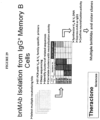
- the invention provides a method for obtaining a broadly neutralizing human monoclonal antibody, the method including: (a) screening memory B cell cultures from a donor PBMC sample for a broad neutralization activity against a plurality of HIV-1 species; (b) cloning a memory B cell that exhibits broad neutralization activity; and then (c) rescuing the monoclonal antibody from the clonal memory B cell culture that exhibits broad neutralization activity.
- the screening step includes screening polyclonal transfectants for neutralization activity prior to the cloning step of monoclonal transfection.
- the screening step is optionally repeated following monoclonal transfection.
- the DNA sequence of the monoclonal antibody is determined as part of the rescue step.
- Exemplary antibodies that are generated using this embodiment include, but are not limited to, 1443_C16 (PG16) (TCN-116), 1503 H05 (PG16) (TCN-119), 1456 A12 (PG16) (TCN-117), 1469 M23 (PG16) (TCN-118), 1489_I13 (PG16) (TCN-120), 1480_I08 (PG16), 1456_P20 (PG20), 1460_G14 (PGG14), 1495_C14 (PGC14), 1496_C09 (PG9) (TCN-109), 4838_L06 (PGT-121), 4873_E03 (PGT-121), 4877_D15 (PGT-122), 4858_P08 (PGT-123), 6123_A06 (PGT-125), 5141_B17 (PGT-126), 5145_B14 (PGT-127), 5114_A19 (PGT-128), 5147_N06 (PGT-130), 5136_H01 (PGT-131), 5343_
- the screening step includes determining variable gene sequences from selected B cell wells by deep sequencing, which is optionally followed by sequence alignment to cluster related antibodies.
- a monoclonal transfection is performed as part of the cloning step.
- monoclonal transfectants are screened for neutralization activity against an HIV virus from one or more clades.
- Exemplary antibodies that are generated using this embodiment include, but are not limited to, 1443_C16 (PG16) (TCN-116), 1503 H05 (PG16) (TCN-119), 1456 A12 (PG16) (TCN-117), 1469 M23 (PG16) (TCN-118), 1489 _I13 (PG16) (TCN-120), 1480_I08 (PG16), 1456_P20 (PG20), 1460_G14 (PGG14), 1495_C14 (PGC14), 1496_C09 (PG9) (TCN-109), 4838_L06 (PGT-121), 4873_E03 (PGT-121), 4877_D15 (PGT-122), 4858_P08 (PGT-123), 6123_A06 (PGT-125), 5141_B17 (PGT-126), 5145_B14 (PGT-127), 5114_A19 (PGT-128), 5147_N06 (PGT-130), 5136_H01 (PGT-131), 5343
- HIV-1 human immunodeficiency virus type 1
- AIDS acquired immunodeficiency syndrome
- B-cells B-cells are used as fusion partners for the generation of human monoclonal anti-HIV antibodies.
- One major drawback to finding a vaccine composition suitable for more reliable prevention of human individuals from HIV-1 infection and/or for more successful therapeutic treatment of infected patients is the ability of the HIV-1 virus to escape antibody capture by genetic variation, which very often renders the remarkable efforts of the researchers almost useless.
- escape mutants may be characterized by a change of only one or several of the amino acids within one of the targeted antigenic determinants and may occur, for example, as a result of spontaneous or induced mutation.
- certain other properties of the HIV-1 envelope glycoprotein makes it difficult to elicit neutralizing antibodies making generation of undesirable non-neutralizing antibodies a major concern (see, Phogat SK and Wyatt RT, Curr Pharm Design 2007; 13(2):213-227 ).
- HIV-1 is among the most genetically diverse viral pathogens.
- group M viruses are the most widespread, accounting for over 99% of global infections.
- This group is presently divided into nine distinct genetic subtypes, or clades (A through K), based on full-length sequences.
- Env is the most variable HIV-1 gene, with up to 35% sequence diversity between clades, 20% sequence diversity within clades, and up to 10% sequence diversity in a single infected person ( Shankarappa, R. et al. 1999. J. Virol. 73:10489-10502 ).
- Clade B is dominant in Europe, the Americas, and Australia.
- Clade C is common in southern Africa, China, and India and presently infects more people worldwide than any other clade ( McCutchan, FE. 2000. Understanding the genetic diversity of HIV-1. AIDS 14(Suppl. 3):S31-S44 ). Clades A and D are prominent in central and eastern Africa.
- Neutralizing antibodies (NAbs) against viral envelope proteins (Env) provide adaptive immune defense against human immunodeficiency virus type 1 (HIV-1) exposure by blocking the infection of susceptible cells ( Kwong PD et al., 2002. Nature 420: 678-682 ).
- HIV-1 human immunodeficiency virus type 1
- the efficacy of vaccines against several viruses has been attributed to their ability to elicit NAbs.
- there has been limited progress toward an effective immunogen for HIV-1. Burton, D. R. 2002. Nat. Rev. Immunol. 2:706-713 ).
- HIV-1 has evolved with an extensive array of strategies to evade antibody-mediated neutralization.
- bNAbs broadly neutralizing antibodies
- PBLs peripheral blood lymphocytes
- Human B cell immortalization was used to isolate the cross-clade neutralizing monoclonal antibodies 2G12, 2F5, and 4E10 from HIV-infected individuals.
- the monoclonal antibody 2G12 binds to a glycotope on the gp120 surface glycoprotein of HIV-1 and had been shown to display broad neutralizing patterns. ( Trkola A., et al., J. Virol. 70(2):1100-1108 (1996 ), Buchacher, A., et al., 1994. AIDS Res. Hum. Retroviruses 10:359-369 ).
- the monoclonal antibody 2F5 which had been shown to bind a sequence within the external domain of the gp41 envelope glycoprotein of HIV-1 was found to have broad neutralization properties.
- bNAbs broadly neutralizing antibodies
- existing immunogens often designed based on these bNAbs, have failed to elicit NAb responses of the required breadth and potency. Therefore, it is of high priority to identify new bNAbs that bind to epitopes that may be more amenable to incorporation into immunogens for elicitation of NAb responses.
- the present invention provides a novel method for isolating novel broad and potent neutralizing monoclonal antibodies against HIV.
- the method involves selection of a PBMC donor with high neutralization titer of antibodies in the plasma. B cells are screened for neutralization activity prior to rescue of antibodies. Novel broadly neutralizing antibodies are obtained by emphasizing neutralization as the initial screen.
- the invention relates to potent, broadly neutralizing antibody (bNAb) wherein the antibody neutralizes HIV-1 species belonging to two or more clades, and further wherein the potency of neutralization of at least one member of each clade is determined by an IC50 value of less than 0.2 ⁇ g/mL.
- the clades are selected from Clade A, Clade B, Clade C, Clade D and Clade AE.
- the HIV-1 belonging two or more clades are non-Clade B viruses.
- the broadly neutralizing antibody neutralizes at least 60% of the HIV-1 strains listed in Tables 18A-18F. In some embodiments, at least 70%, or at least 80%, or at least 90% of the HIV-1 strains listed in Tables 18A-18F are neutralized.
- the invention relates to potent, broadly neutralizing antibody (bNAb) wherein the antibody neutralizes HIV-1 species with a potency of neutralization of at least a plurality of HIV-1 species with an IC50 value of less than 0.2 ⁇ g/mL.
- the potency of neutralization of the HIV-1 species has an IC50 value of less than 0.15 ⁇ g/mL, or less than 0.10 ⁇ g/mL, or less than 0.05 ⁇ g/mL.
- a potent, broadly neutralizing antibody is defined as a bNAb that displays a potency of neutralization of at least a plurality of HIV-1 species with an IC90 value of less than 2.0 ⁇ g/mL.
- the potency of neutralization of the HIV-1 species has an IC90 value of less than 1.0 ⁇ g/mL, or less than 0.5 ⁇ g/mL.
- PBMCs Peripheral Blood Mononuclear Cells
- Memory B cells were isolated and B cell culture supernatants were subjected to a primary screen of neutralization assay in a high throughput format.
- HIV antigen binding assays using ELISA or like methods were also used as a screen.
- B cell lysates corresponding to supernatants exhibiting neutralizing activity were selected for rescue of monoclonal antibodies by standard recombinant methods.
- the recombinant rescue of the monoclonal antibodies involves use of a B cell culture system as described in Weitcamp J-H et al., J. Immunol. 171:4680-4688 (2003 ).
- Any other method for rescue of single B cells clones known in the art also may be employed such as EBV immortalization of B cells ( Traggiai E., et al., Nat. Med. 10(8):871-875 (2004 )), electrofusion ( Buchacher, A., et al., 1994. AIDS Res. Hum. Retroviruses 10:359-369 ), and B cell hybridoma ( Karpas A. et al., Proc. Natl. Acad. Sci. USA 98:1799-1804 (2001 ).
- monoclonal antibodies were rescued from the B cell cultures using variable chain gene-specific RT-PCR, and transfectant with combinations of H and L chain clones were screened again for neutralization and HIV antigen binding activities. mAbs with neutralization properties were selected for further characterization.
- a novel high-throughput strategy was used to screen IgG-containing culture screening supernatants from approximately 30,000 activated memory B cells from a clade A infected donor for recombinant, monomeric gp120JR-CSF and gp41HxB2 (Env) binding as well as neutralization activity against HIV-1JR-CSF and HIV-1SF162 (See Table 1).
- Table 1 Memory B cell Screening. Total number of wells screened 23,328 Number of sIgG + memory B cells screened 30,300 gp120 ELISA hits 411 (1.36%) gp41 ELISA hits 167 (0.55%) SF162 neutralization hits 401 (1.32%) JR-CSF neutralization hits 401 (1.32%)
- the antibodies were isolated from a human sample obtained through International AIDS Vaccine Initiative's (IAVI's) Protocol G, and are produced by the B cell cultures referred to as 1443_C16 (PG16) (TCN-116), 1503 H05 (PG16) (TCN-119), 1456 A12 (PG16) (TCN-117), 1469 M23 (PG16) (TCN-118), 1489 _I13 (PG16) (TCN-120), 1480_I08 (PG16), 1456_P20 (PG20), 1460_G14 (PGG14), 1495_C14 (PGC14), 1496_C09 (PG9) (TCN-109), 4838_L06 (PGT-121), 4873_E03 (PGT-121), 4877_D15 (PGT-122), 4858_P08 (PGT-123), 6123_A06 (PGT-125), 5141_B17 (PGT-126), 5145_B14 (PGT-127), 5114_A19 (PGT-128),
- Table 2 Sequence Analysis of mAb Variable Genes Clone Germline IGVL a Germline IGVH a CDRL 3 b SEQ ID NO: CDRH3 b SEQ ID NO: PG16 VL2-14*01 VH3-33*05 1 6 PG9 VL2-14*01 VH3-33*05 2 7 PGG1 4 VK1-39*01 VH1-69*12 3 8 PG20 VK2-14*01 VH1-69*12 4 9 PGC1 4 VL3-1*01 VH1-24*01 5 GAVGADSGSWFDP 10 a Germ line gene sequences were determined using the IMGT database, which is publicly available at imgt.cines.fr.
- SSLTDRSHRI 41 1456_P20 gp120 IGKV1-39*01, or IGKV1D -39*01 92.11% (257/27 9 nt) IGKJ5*01 92.11% (35/38 nt)
- QQSFSTPRT 42 1460_G1 4 gp120 IGKV1-39*01, or IGKV1D -39*01 92.11% (257/27 9 nt) IGKJ5*01 89.47% (34/38 nt)
- QQSYSTPRT 43 1495_C1 4 gp120 IGLV3-1*01 88.89% (248/27 9 nt) IGLJ2*01 .
- the broadly neutralizing antibodies from 1443_C16 (PG16) and 1496_C09 (PG9) clones obtained by this method did not exhibit soluble gp120 or gp41 binding at levels that correlate with neutralization activity.
- the method of the invention therefore allows identification of novel antibodies with broad cross-clade neutralization properties regardless of binding activities in an ELISA screen. Further characterization of PG16 and PG9 is disclosed herein.
- Table 17A shows neutralization profiles (IC50 values) of monoclonal antibodies 1443_C16 (PG16), 1456_P20 (PG20), 1460_G14 (PGG14), 1495_C14 (PGC14) and 1496_C09 (PG9) and the known cross-clade neutralizing antibodies b12, 2G12, 2F5 and 4E10 on a diverse panel of 16 HIV pseudoviruses from different clades.
- 1443_C16 (PG16) and 1496_C09 (PG9) neutralize HIV-1 species from Clades A, B, C, D and CRF01_AE with better potency for most viral strains tested than known and generally accepted broad and potent neutralizing antibodies.
- Figure 4 shows neutralization activities of monoclonal antibodies 1443_C16 (PG16) and 1496_C09 (PG9) to six other HIV pseudoviruses (YU2, Bal, ADA, DU172, DU422, and ZM197) for clades B and C not included in Tables 17A and 17B.
- PG9, PG16, and PGC14 were next evaluated on a large multi-clade pseudovirus panel consisting of 162 viruses to further assess the neutralization breadth and potency of these three antibodies (Tables 5A-5B, Tables 18A-18F and Tables 19A-19B).
- PG9 neutralized 127 out of 162 and PG16 neutralized 119 out of 162 viruses with a potency that frequently considerably exceeded that noted for the four control bNAbs.
- PG9 neutralized HIV-16535.30 approximately 185 times more potently than PG16
- PG16 neutralized HIV-1MGRM-AG-001 approximately 440 times more potently than PG9.
- the two antibodies also differed in neutralization breadth; PG9 neutralized nine viruses that were not affected by PG16, and PG16 neutralized two viruses that were not affected by PG9.
- broad serum neutralization might be mediated by somatic antibody variants that recognize slightly different epitopes and display varying degrees of neutralization breadth and potency against any given virus. In the face of an evolving viral response, it seems reasonable that the immune system might select for these types of antibodies.
- PG9 and PG16 are somatic variants, they exhibited different degrees of potency against a number of the viruses tested. For instance, PG9 neutralized the virus 6535.30 about 100 times more potently than PG16, and PG16 neutralized the virus MGRM-AG-001 about 3000 times more potently than PG9.
- the two antibodies also differed in neutralization breadth; PG9 neutralized seven viruses that were not neutralized by PG16, and PG16 neutralized three viruses that were not neutralized by PG9.
- broad serum neutralization might be mediated by somatic variants that recognize slightly different epitopes and display varying degrees of neutralization breadth and potency against any given virus. In the face of an evolving viral response, the immune system likely selects for these types of antibodies.
- FIG. 5 shows dose response curves of 1456_P20 (PG20), 1495_C14 (PGC14) and 1460_G14 (PGG14) binding to recombinant gp120 in ELISA as compared to control anti-gp120 (b12).
- Figure 6 shows ELISA binding assays of monoclonal antibodies 1443_C16 (PG16) and 1496_C09 (PG9) to HIV-1 strain YU2 gp140 and JR-CSF gp120, the membrane proximal region (MPER) of HIV-1 envelope glycoprotein gp41, and the V3 polypeptide.
- PG-9 binds to YU2 gp140 (IC 50 ⁇ 20-40 nM), YU2 gp120 and weakly binds to JR-CSF gp120.
- PG16 weakly binds Yu2 gp120, but not the soluble form of HIV-1 envelope glycoprotein, gp120 JR-CSF.
- mAb binds to JR-FL gp120, JR-FL gp140, MPER peptide of gp41 or V3 peptide.
- Figure 7 shows binding of monoclonal antibodies 1443_C16 (PG16) and 1496_C09 (PG9) to HIV-1 YU2 gp160 expressed on the cell surface in the presence and absence of sCD4.
- Competitive inhibition of the binding by sCD4 indicates that the binding of monoclonal antibody 1496_C09 to HIV-1 envelope protein gp160 expressed on the cell surface is presumably affected due to the conformational changes induced by sCD4.
- the data further suggest that 1443_C16 (PG16) and 1496_C09 (PG9) exhibit relatively stronger binding to trimeric forms of the HIV-1 Env (gp160 and gp140) than to the monomeric gp120.
- Figure 8 shows binding of monoclonal antibodies 1443_C16 (PG16) and 1496_C09 (PG9) to HIV-1 transfected cells.
- PG9 and PG16 do not bind untransfected cells.
- PG9 and PG16 bind JR-CSF, ADA, and YU2 gp160 transfected cells.
- PG9 and PG16 do not bind JR-FL gp160 transfected cells (cleaved or uncleaved).
- PG9 and PG16 do not bind ADA ⁇ V1/ ⁇ V2 transfected cells.
- PG9 and PG16 binding to JR-CSF gp160 transfected cells is inhibited by sCD4.
- Figure 9 shows the capturing of entry-competent JR-CSF pseudovirus by neutralizing monoclonal antibodies 1443_C16 (PG16) and 1496_C09 (PG9) in a dose-dependent manner.
- the ability of both antibodies to capture JR-CSF pseudovirus is higher than IgG b12 but comparable to IgG 2G12. It is postulated that the capture may be mediated by the binding of the mAbs to the HIV-1 Env on the virions.
- FIG 10A shows that sCD4, PG16 and PG9 compete for the binding of monoclonal antibody 1443_C16 (PG16) to JR-CSF pseudovirus but b12, 2G12, 2F5 and 4E10 do not.
- Figure 10B shows sCD4, PG16 and PG9 compete for the binding of monoclonal antibody 1496_C09 (PG9) to JR-CSF pseudovirus but b12, 2G12, 2F5 and 4E10 do not.
- PG16 and PG9 mAbs bind gp120 at a site different from those bound by b12 and 2G12.
- PG9 and PG16 binding to HIV-1 envelope protein is competitively inhibited by sCD4.
- the epitopes recognized by PG9 and PG16 were investigated. Since the PG9 and PG16 antibodies are somatic variants, they recognize the same or overlapping epitopes. Both antibodies cross-competed for binding to HIV-1JR-CSF transfected cells ( Fig. 13A ). Ligation of monomeric gp120 or cell surface Env with soluble CD4 diminished binding of both PG9 and PG16, although neither antibody competed with CD4-binding site antibodies for trimer binding ( Fig. 13A-13C ). This result suggests that CD4-induced conformational changes cause a loss of the epitope targeted by the antibodies.
- residues that form the epitopes recognized by PG9 and PG16 appear to be located in conserved regions of the V2 and V3 loops of gp120. Certain co-receptor binding site mutations also had an effect on PG9 and PG16 neutralization, albeit to a lesser extent. Generally, PG9 and PG16 were dependent on the same residues, although PG16 was more sensitive to mutations located in the tip of the V3 loop than PG9. Interestingly, although neither antibody bound to wild-type HIV-1JR-FL transfected cells, a D to K mutation at position 168 in the V2 loop of HIV-1JR-FL generated high-affinity PG9 and PG16 recognition (Tables 18A-18F).
- N156 and N160 sites of V2 N-glycosylation, also appear to be critical in forming the epitope since substitutions at these positions resulted in escape from PG9 and PG16 neutralization.
- Deglycosylation of gp120 abolished binding of PG9 ( Fig. 16 ), confirming that certain glycans may be important in forming the epitope.
- HIV-1 SF162 contains a rare N to K polymorphism at position 160, and mutation of this residue to an Asn renders this isolate sensitive to PG9 and PG16 ( Fig. 17 ).
- the invention is based on novel monoclonal antibodies and antibody fragments that broadly and potently neutralize HIV infection.
- these monoclonal antibodies and antibody fragments have a particularly high potency in neutralizing HIV infection in vitro across multiple clades or across a large number of different HIV species.
- Such antibodies are desirable, as only low concentrations are required to neutralize a given amount of virus. This facilitates higher levels of protection while administering lower amounts of antibody.
- Human monoclonal antibodies and the immortalized B cell clones that secrete such antibodies are included within the scope of the invention.
- the invention provides methods for using high throughput functional screening to select neutralizing antibodies with unprecedented breadth and potency.
- the invention relates to other potent and broadly neutralizing antibodies that can be developed using the same methods.
- the invention relates to potent, broadly neutralizing antibodies against different strains of HIV, wherein the bNAbs bind poorly to recombinant forms of Env.
- the invention provides two neutralizing antibodies, PG9 and PG16, with broad neutralizing activities particularly against non-clade B isolates.
- the invention provides vaccine-induced antibodies of high specificity that provide protection against a diverse range of the most prevalent isolates of HIV circulating worldwide.
- the invention provides antibodies with very high and broad neutralization potency, such as that exhibited by PG9 and PG16 in vitro, which provides protection at relatively modest serum concentrations, and are generated by vaccination unlike the broad NAbs known in the art.
- the invention provides immunogens that can be designed that focus the immune response on conserved regions of variable loops in the context of the trimeric spike of the gp120 subunit of the Env protein.
- the invention also relates to the characterization of the epitope to which the antibodies bind and the use of that epitope in raising an immune response.
- the invention also relates to various methods and uses involving the antibodies of the invention and the epitopes to which they bind.
- monoclonal antibodies according to the invention can be used as therapeutics.
- the monoclonal antibodies are used for adjuvant therapy.
- Adjuvant therapy refers to treatment with the therapeutic monoclonal antibodies, wherein the adjuvant therapy is administered after the primary treatment to increase the chances of a cure or reduce the statistical risk of relapse.
- the invention provides novel monoclonal or recombinant antibodies having particularly high potency in neutralizing HIV.
- the invention also provides fragments of these recombinant or monoclonal antibodies, particularly fragments that retain the antigen-binding activity of the antibodies, for example which retain at least one complementarity determining region (CDR) specific for HIV proteins.
- CDR complementarity determining region
- the antibody molecule of the present invention can neutralize at a concentration of 0.16 ⁇ g/ml or lower (i.e. 0.15, 0.125, 0.1, 0.075, 0.05, 0.025, 0.02, 0.016, 0.015, 0.0125, 0.01, 0.0075, 0.005, 0.004 or lower), preferably 0.016 ⁇ g/ml or lower (an antibody concentration of 10 -8 or lower, preferably 10 -9 M or lower, preferably 10 -10 M or lower, i.e. 10 -11 M, 10 -12 M, 10 -13 M or lower).
- the antibodies of the invention are able to neutralize HIV.
- Monoclonal antibodies can be produced by known procedures, e.g., as described by R. Kennet et al. in "Monoclonal Antibodies and Functional Cell Lines; Progress and Applications”. Plenum Press (New York), 1984 . Further materials and methods applied are based on known procedures, e.g., such as described in J. Virol. 67:6642-6647, 1993 .
- These antibodies can be used as prophylactic or therapeutic agents upon appropriate formulation, or as a diagnostic tool.
- a “neutralizing antibody” is one that can neutralize the ability of that pathogen to initiate and/or perpetuate an infection in a host and/or in target cells in vitro.
- the invention provides a neutralizing monoclonal human antibody, wherein the antibody recognizes an antigen from HIV.
- an antibody according to the invention is a novel monoclonal antibody referred to herein as 1443_C16 (PG16) (TCN-116), 1503 H05 (PG16) (TCN-119), 1456 A12 (PG16) (TCN-117), 1469 M23 (PG16) (TCN-118), 1489 _I13 (PG16) (TCN-120), 1480_I08 (PG16), 1456_P20 (PG20), 1460_G14 (PGG14), 1495_C14 (PGC14), 1496_C09 (PG9) (TCN-109), 4838_L06 (PGT-121), 4873_E03 (PGT-121), 4877_D15 (PGT-122), 4858_P08 (PGT-123), 6123_A06 (PGT-125), 5141_B17 (PGT-126), 5145_B14 (PGT-127), 5114_A19 (PGT-128), 5147_N06 (PGT-130), 5136_H01 (PG16)
- the CDRs of the antibody heavy chains are referred to as CDRH1, CDRH2 and CDRH3, respectively.
- the CDRs of the antibody light chains are referred to as CDRL1, CDRL2 and CDRL3, respectively.
- the position of the CDR amino acids is defined according to the IMGT numbering system as: CDR1--IMGT positions 27 to 38, CDR2--IMGT positions 56 to 65 and CDR3--IMGT positions 105 to 117.
- amino acid sequences of the CDR3 regions of the light and heavy chains of the antibodies are shown in Tables 3A and 3B.
- a phylogram is a branching diagram (tree) assumed to be an estimate of phylogeny, branch lengths are proportional to the amount of inferred evolutionary change.
- Tree diagrams of the five heavy chains and the five light chains were prepared using ClustalW ( Larkin M.A., Blackshields G., Brown N.P., Chenna R., McGettigan P.A., McWilliam H., Valentin F., Wallace I.M., Wilm A., Lopez R., Thompson J.D., Gibson T.J. and Higgins D.G. Bioinformatics 23(21): 2947-2948 (2007 ); Higgins DG et al. Nucleic Acids Research 22: 4673-4680. (1994 )) and are shown in Figures 1A and 1B respectively.
- sequences of the antibodies were determined, including the sequences of the variable regions of the Gamma heavy and Kappa or Lambda light chains of the antibodies designated 1496_C09 (PG9), 1443_C16 (PG16), 1456_P20 (PG20), 1460_G14 (PGG14), and 1495_C14 (PGC14).
- sequence of each of the polynucleotides encoding the antibody sequences was determined.
- the 1443_C16 (PG16) antibody includes a heavy chain variable region (SEQ ID NO: 31), encoded by the nucleic acid sequence shown in SEQ ID NO: 99, and a light chain variable region (SEQ ID NO: 32) encoded by the nucleic acid sequence shown in SEQ ID NO: 100.
- the heavy chain CDRs of the 1443_C16 (PG16) antibody have the following sequences per Kabat definition: KYGMH (SEQ ID NO: 88), LISDDGMRKYHSDSMWG (SEQ ID NO: 89), and EAGGPIWHDDVKYYDFNDGYYNYHYMDV (SEQ ID NO: 6).
- the light chain CDRs of the 1443_C16 (PG16) antibody have the following sequences per Kabat definition: NGTSSDVGGFDSVS (SEQ ID NO: 97), DVSHRPS (SEQ ID NO: 95), and SSLTDRSHRI (SEQ ID NO: 41).
- the heavy chain CDRs of the 1443_C16 (PG16) antibody have the following sequences per Chothia definition: GFTFHK (SEQ ID NO: 266), LISDDGMRKY (SEQ ID NO: 267), and EAGGPIWHDDVKYYDFNDGYYNYHYMDV (SEQ ID NO: 6).
- the light chain CDRs of the 1443_C16 (PG16) antibody have the following sequences per Chothia definition: NGTSSDVGGFDSVS (SEQ ID NO: 97), DVSHRPS (SEQ ID NO: 95), and SSLTDRSHRI (SEQ ID NO: 41).
- the 1456_ P20 (PG20) antibody includes a heavy chain variable region (SEQ ID NO: 33), encoded by the nucleic acid sequence shown in SEQ ID NO: 101, and a light chain variable region (SEQ ID NO: 34) encoded by the nucleic acid sequence shown in SEQ ID NO: 106.
- the heavy chain CDRs of the 1456_ P20 (PG20) antibody have the following sequences per Kabat definition: SYAFT (SEQ ID NO: 104), MVTPIFGEAKYSQRFEG (SEQ ID NO: 105), and DRRAVPIATDNWLDP (SEQ ID NO: 9).
- the light chain CDRs of the 1456_ P20 (PG20) antibody have the following sequences per Kabat definition: RASQTINNYLN (SEQ ID NO: 107), GASNLQN (SEQ ID NO: 108), and QQSFSTPRT (SEQ ID NO: 42).
- the heavy chain CDRs of the 1456_ P20 (PG20) antibody have the following sequences per Chothia definition: GGTFSS (SEQ ID NO: 268), MVTPIFGEAK (SEQ ID NO: 269), and DRRAVPIATDNWLDP (SEQ ID NO: 9).
- the light chain CDRs of the 1456_ P20 (PG20) antibody have the following sequences per Chothia definition: RASQTINNYLN (SEQ ID NO: 107), GASNLQN (SEQ ID NO: 108), and QQSFSTPRT (SEQ ID NO: 42).
- the 1460_G14 (PGG14) antibody includes a heavy chain variable region (SEQ ID NO: 35), encoded by the nucleic acid sequence shown in SEQ ID NO: 109, and a light chain variable region (SEQ ID NO: 36) encoded by the nucleic acid sequence shown in SEQ ID NO: 112.
- the heavy chain CDRs of the 1460_G14 (PGG14) antibody have the following sequences per Kabat definition: SYAFS (SEQ ID NO: 110), MITPVFGETKYAPRFQG (SEQ ID NO: 111), and DRRVVPMATDNWLDP (SEQ ID NO: 8).
- the light chain CDRs of the 1460_G14 (PGG14) antibody have the following sequences per Kabat definition: RASQTIHTYLN (SEQ ID NO: 113), GASTLQS (SEQ ID NO: 114), QQSYSTPRT (SEQ ID NO: 43).
- the heavy chain CDRs of the 1460_G14 (PGG14) antibody have the following sequences per Chothia definition: GGAFSS (SEQ ID NO: 270), MITPVFGETK (SEQ ID NO: 271), DRRVVPMATDNWLDP (SEQ ID NO: 8).
- the light chain CDRs of the 1460_G14 (PGG14) antibody have the following sequences per Chothia definition: RASQTIHTYLN (SEQ ID NO: 113), GASTLQS (SEQ ID NO: 114), QQSYSTPRT (SEQ ID NO: 43).
- the 1495_C14 (PGC14) antibody includes a heavy chain variable region (SEQ ID NO: 37), encoded by the nucleic acid sequence shown in SEQ ID NO: 115, and a light chain variable region (SEQ ID NO: 38) encoded by the nucleic acid sequence shown in SEQ ID NO: 119.
- the heavy chain CDRs of the 1495_C14 (PGC14) antibody have the following sequences per Kabat definition: DYYLH (SEQ ID NO: 116), LIDPENGEARYAEKFQG (SEQ ID NO: 117), GAVGADSGSWFDP (SEQ ID NO: 10).
- the light chain CDRs of the 1495_C14 (PGC14) antibody have the following sequences per Kabat definition: SGSKLGDKYVS (SEQ ID NO: 120), ENDRRPS (SEQ ID NO: 121), and QAWETTTTTFVF (SEQ ID NO: 44).
- the heavy chain CDRs of the 1495_C14 (PGC14) antibody have the following sequences per Chothia definition: GYSFID (SEQ ID NO: 102), LIDPENGEAR (SEQ ID NO: 103), GAVGADSGSWFDP (SEQ ID NO: 10).
- the light chain CDRs of the 1495_C14 (PGC14) antibody have the following sequences per Chothia definition: SGSKLGDKYVS (SEQ ID NO: 120), ENDRRPS (SEQ ID NO: 121), and QAWETTTTTFVF (SEQ ID NO: 44).
- the 1496_C09 (PG9) antibody includes a heavy chain variable region (SEQ ID NO: 39), encoded by the nucleic acid sequence shown in SEQ ID NO: 122, and a light chain variable region (SEQ ID NO: 40) encoded by the nucleic acid sequence shown in SEQ ID NO: 125.
- the heavy chain CDRs of the 1496_C09 (PG9) antibody have the following sequences per Kabat definition: RQGMH (SEQ ID NO: 123), FIKYDGSEKYHADSVWG (SEQ ID NO: 124), and EAGGPDYRNGYNYYDFYDGYYNYHYMDV (SEQ ID NO: 7).
- the light chain CDRs of the 1496_C09 (PG9) antibody have the following sequences per Kabat definition: NGTSNDVGGYESVS (SEQ ID NO: 126), DVSKRPS (SEQ ID NO: 127), and KSLTSTRRRV (SEQ ID NO: 45).
- the heavy chain CDRs of the 1496_C09 (PG9) antibody have the following sequences per Chothia definition: GFDFSR (SEQ ID NO: 118), FIKYDGSEKY (SEQ ID NO: 272), and EAGGPDYRNGYNYYDFYDGYYNYHYMDV (SEQ ID NO: 7).
- the light chain CDRs of the 1496_C09 (PG9) antibody have the following sequences per Chothia definition: NGTSNDVGGYESVS (SEQ ID NO: 126), DVSKRPS (SEQ ID NO: 127), and KSLTSTRRRV (SEQ ID NO: 45).
- sequences of sister clones to human monoclonal antibody 1443_C16 were determined, including the sequences of the variable regions of the Gamma heavy and Kappa or Lambda light chains.
- sequence of each of the polynucleotides encoding the antibody sequences was determined. Shown below are the polypeptide and polynucleotide sequences of the gamma heavy chains and kappa light chains, with the signal peptides at the N-terminus (or 5' end) and the constant regions at the C-terminus (or 3' end) of the variable regions, which are shown in bolded text.
- 1503_H05 (PG16) (TCN-119) gamma heavy chain nucleotide sequence: 1503_H05 ⁇ 3 coding sequence (variable region in bold)
- 1503_H05 (PG16) (TCN-119) lambda light chain nucleotide sequence: 1503_H05 ⁇ 2 coding sequence (variable region in bold)
- the 1469_M23 (PG16) antibody includes a heavy chain variable region (SEQ ID NO: 139), encoded by the nucleic acid sequence shown in SEQ ID NO: 128, and a light chain variable region (SEQ ID NO: 142) encoded by the nucleic acid sequence shown in SEQ ID NO: 129.
- the heavy chain CDRs of the 1469_M23 (PG16) antibody have the following sequences per Kabat and Chothia definitions: KYGMH (SEQ ID NO: 88), LISDDGMRKYHSDSMWG (SEQ ID NO: 89), and EAGGPIWHDDVKYYDFNDGYYNYHYMDV (SEQ ID NO: 6).
- the light chain CDRs of the 1469_M23 (PG16) antibody have the following sequences per Kabat and Chothia definitions: NGTRSDVGGFDSVS (SEQ ID NO: 92), DVSHRPS (SEQ ID NO: 95), and SSLTDRSHRI (SEQ ID NO: 41).
- the 1456_A12 (PG16) antibody includes a heavy chain variable region (SEQ ID NO: 47), encoded by the nucleic acid sequence shown in SEQ ID NO: 130, and a light chain variable region (SEQ ID NO: 50) encoded by the nucleic acid sequence shown in SEQ ID NO: 131.
- the heavy chain CDRs of the 1456_A12 (PG16) antibody have the following sequences per Kabat and Chothia definitions: KYGMH (SEQ ID NO: 88), LISDDGMRKYHSDSMWG (SEQ ID NO: 89), and EAGGPIWHDDVKYYDFNDGYYNYHYMDV (SEQ ID NO: 6).
- the light chain CDRs of the 1456_A12 (PG16) antibody have the following sequences per Kabat and Chothia definitions: NGTSRDVGGFDSVS (SEQ ID NO: 93), DVSHRPS (SEQ ID NO: 95), and SSLTDRSHRI (SEQ ID NO: 41).
- the 1503_H05 (PG16) antibody includes a heavy chain variable region (SEQ ID NO: 53), encoded by the nucleic acid sequence shown in SEQ ID NO: 132, and a light chain variable region (SEQ ID NO: 56) encoded by the nucleic acid sequence shown in SEQ ID NO: 133.
- the heavy chain CDRs of the 1503_H05 (PG16) antibody have the following sequences per Kabat and Chothia definitions: KYGMH (SEQ ID NO: 88), LISDDGMRKYHSDSMWG (SEQ ID NO: 89), and EAGGPIWHDDVKYYDFNDGYYNYHYMDV (SEQ ID NO: 6).
- the light chain CDRs of the 1503_H05 (PG16) antibody have the following sequences per Kabat and Chothia definitions: NGTRSDVGGFDSVS (SEQ ID NO: 92), DVSHRPS (SEQ ID NO: 95), and SSLTDRSHRI (SEQ ID NO: 41).
- the 1489_I13 (PG16) antibody includes a heavy chain variable region (SEQ ID NO: 59), encoded by the nucleic acid sequence shown in SEQ ID NO: 134, and a light chain variable region (SEQ ID NO: 14) encoded by the nucleic acid sequence shown in SEQ ID NO: 135.
- the heavy chain CDRs of the 1489_I13 (PG16) antibody have the following sequences per Kabat and Chothia definitions: KYGMH (SEQ ID NO: 88), LISDDGMRKYHSNSMWG (SEQ ID NO: 98), and EAGGPIWHDDVKYYDFNDGYYNYHYMDV (SEQ ID NO: 6).
- the light chain CDRs of the 1489_I13 (PG16) antibody have the following sequences per Kabat and Chothia definitions: NGTSSDVGGFDSVS (SEQ ID NO: 97), DVSHRPS (SEQ ID NO: 95), and SSLTDRSHRI (SEQ ID NO: 41).
- the 1480_I08 (PG16) antibody includes a heavy chain variable region (SEQ ID NO: 65), encoded by the nucleic acid sequence shown in SEQ ID NO: 136, and a light chain variable region (SEQ ID NO: 14) encoded by the nucleic acid sequence shown in SEQ ID NO: 137.
- the heavy chain CDRs of the 1480_108 (PG16) antibody have the following sequences per Kabat and Chothia definitions: KYGMH (SEQ ID NO: 88), LISDDGMRKYHSDSMWG (SEQ ID NO: 89), and EAGGPIWHDDVKYYDFNDGYYNYHYMDV (SEQ ID NO: 6).
- the light chain CDRs of the 1480_108 (PG16) antibody have the following sequences per Kabat and Chothia definitions: NGTSSDVGGFDSVS (SEQ ID NO: 97), DVSHRPS (SEQ ID NO: 95), and SSLTDRSHRI (SEQ ID NO: 41).
- sequences of additional human monoclonal antibodies were determined, including the sequences of the variable regions of the Gamma heavy and Kappa or Lambda light chains.
- sequence of each of the polynucleotides encoding the antibody sequences was determined. Shown below are the polypeptide and polynucleotide sequences of the gamma heavy chains and kappa light chains, with the signal peptides at the N-terminus (or 5' end) and the constant regions at the C-terminus (or 3' end) of the variable regions, which are shown in bolded text.
- PTT-122 lambda light chain nucleotide sequence: coding sequence (variable region in bold)
- gamma heavy chain nucleotide sequence coding sequence (variable region in bold)
- PTT-125 gamma heavy chain amino acid sequence: expressed protein with variable region in bold.
- PTT-125 gamma heavy chain variable region amino acid sequence: (Kabat CDRs underlined, Chothia CDRs in bold italics)
- PTT-125 lambda light chain nucleotide sequence: coding sequence (variable region in bold)
- 5141_B17 (PGT-126) gamma heavy chain nucleotide sequence: coding sequence (variable region in bold)
- 5141_B17 (PGT-126) gamma heavy chain amino acid sequence: expressed protein with variable region in bold.
- 5141_B17 (PGT-126) gamma heavy chain variable region amino acid sequence: (Kabat CDRs underlined, Chothia CDRs in bold italics)
- PTT-130 lambda light chain nucleotide sequence: coding sequence (variable region in bold)
- 4964_G22 (PGT-141) gamma heavy chain amino acid sequence: expressed protein with leader sequence in italics and variable region in bold.
- 4964_G22 (PGT-141) gamma heavy chain variable region amino acid sequence: (Kabat CDRs underlined, Chothia CDRs in bold italics)
- 4964_G22 (PGT-141) kappa light chain nucleotide sequence: coding sequence (variable region in bold)
- 4964_G22 (PGT-141) kappa light chain amino acid sequence: expressed protein with leader sequence in italics and variable region in bold.
- 4993_K13 (PGT-141) gamma heavy chain nucleotide sequence: coding sequence (variable region in bold)
- 4993_K13 (PGT-141) gamma heavy chain amino acid sequence: expressed protein with leader sequence in italics and variable region in bold.
- 4993_K13 (PGT-141) gamma heavy chain variable region amino acid sequence: (Kabat CDRs underlined, Chothia CDRs in bold italics)
- 4993_K13 (PGT-141) kappa light chain nucleotide sequence: coding sequence (variable region in bold)
- 4993_K13 (PGT-141) kappa light chain amino acid sequence: expressed protein with leader sequence in italics and variable region in bold.
- 4993_K13 (PGT-141) kappa light chain variable region amino acid sequence: (Kabat CDRs underlined, Chothia CDRs in bold italics)
- 4995_E20 (PGT-142) gamma heavy chain amino acid sequence: expressed protein with leader sequence in italics and variable region in bold.
- 4995_E20 (PGT-142) gamma heavy chain variable region amino acid sequence: (Kabat CDRs underlined, Chothia CDRs in bold italics)
- 4995_E20 (PGT-142) kappa light chain nucleotide sequence: coding sequence (variable region in bold)
- 4995_E20 (PGT-142) kappa light chain amino acid sequence: expressed protein with leader sequence in italics and variable region in bold.
- 4995_E20 (PGT-142) kappa light chain variable region amino acid sequence: (Kabat CDRs underlined, Chothia CDRs in bold italics)
- 4980_N08 (PGT-143) gamma heavy chain nucleotide sequence: coding sequence (variable region in bold)
- 4980_N08 (PGT-143) gamma heavy chain amino acid sequence: expressed protein with leader sequence in italics and variable region in bold.
- 4980_N08 (PGT-143) gamma heavy chain variable region amino acid sequence: (Kabat CDRs underlined, Chothia CDRs in bold italics)
- 4980_N08 (PGT-143) kappa light chain nucleotide sequence: coding sequence (variable region in bold)
- 4980_N08 (PGT-143) kappa light chain variable region nucleotide sequence:
- 4980_N08 (PGT-143) kappa light chain amino acid sequence: expressed protein with leader sequence in italics and variable region in bold.
- 4980_N08 (PGT-143) kappa light chain variable region amino acid sequence: (Kabat CDRs underlined, Chothia CDRs in bold italics)
- 4970_K22 (PGT-144) gamma heavy chain nucleotide sequence: coding sequence (variable region in bold)
- 4970_K22 (PGT-144) gamma heavy chain amino acid sequence: expressed protein with leader sequence in italics and variable region in bold.
- 4970_K22 (PGT-144) gamma heavy chain variable region amino acid sequence: (Kabat CDRs underlined, Chothia CDRs in bold italics)
- 4970_K22 (PGT-144) kappa light chain nucleotide sequence: coding sequence (variable region in bold)
- 4970_K22 (PGT-144) kappa light chain variable region nucleotide sequence:
- 4970_K22 (PGT-144) kappa light chain amino acid sequence: expressed protein with leader sequence in italics and variable region in bold.
- 4970_K22 (PGT-144) kappa light chain variable region amino acid sequence: (Kabat CDRs underlined, Chothia CDRs in bold italics)
- the 4838_L06 (PGT-121) antibody includes a heavy chain variable region (SEQ ID NO: 79), encoded by the nucleic acid sequence shown in SEQ ID NO: 63, and a light chain variable region (SEQ ID NO: 149) encoded by the nucleic acid sequence shown in SEQ ID NO: 147.
- the heavy chain CDRs of the 4838_L06 (PGT-121) antibody have the following sequences per Kabat definition: DSYWS (SEQ ID NO: 90), YVHKSGDTNYSPSLKS (SEQ ID NO: 265), and TLHGRRIYGIVAFNEWFTYFYMDV (SEQ ID NO: 143).
- the light chain CDRs of the 4838_L06 (PGT-121) antibody have the following sequences per Kabat definition: GEKSLGSRAVQ (SEQ ID NO: 150), NNQDRPS (SEQ ID NO: 151), and HIWDSRVPTKWV (SEQ ID NO: 152).
- the heavy chain CDRs of the 4838_L06 (PGT-121) antibody have the following sequences per Chothia definition: GASISD (SEQ ID NO: 144), YVHKSGDTN (SEQ ID NO: 145), and TLHGRRIYGIVAFNEWFTYFYMDV (SEQ ID NO: 143).
- the light chain CDRs of the 4838_L06 (PGT-121) antibody have the following sequences per Chothia definition: GEKSLGSRAVQ (SEQ ID NO: 150), NNQDRPS (SEQ ID NO: 151), and HIWDSRVPTKWV (SEQ ID NO: 152).
- the 4873_E03 (PGT-121) antibody includes a heavy chain variable region (SEQ ID NO: 79), encoded by the nucleic acid sequence shown in SEQ ID NO: 63, and a light chain variable region (SEQ ID NO: 149) encoded by the nucleic acid sequence shown in SEQ ID NO: 147.
- the heavy chain CDRs of the 4873_E03 (PGT-121) antibody have the following sequences per Kabat definition: DSYWS (SEQ ID NO: 90), YVHKSGDTNYSPSLKS (SEQ ID NO: 265), and TLHGRRIYGIVAFNEWFTYFYMDV (SEQ ID NO: 143).
- the light chain CDRs of the 4873_E03 (PGT-121) antibody have the following sequences per Kabat definition: GEKSLGSRAVQ (SEQ ID NO: 150), NNQDRPS (SEQ ID NO: 151), and HIWDSRVPTKWV (SEQ ID NO: 152).
- the heavy chain CDRs of the 4873_E03 (PGT-121) antibody have the following sequences per Chothia definition: GASISD (SEQ ID NO: 144), YVHKSGDTN (SEQ ID NO: 145), and TLHGRRIYGIVAFNEWFTYFYMDV (SEQ ID NO: 143).
- the light chain CDRs of the 4873_E03 (PGT-121) antibody have the following sequences per Chothia definition: GEKSLGSRAVQ (SEQ ID NO: 150), NNQDRPS (SEQ ID NO: 151), and HIWDSRVPTKWV (SEQ ID NO: 152).
- the 4877_D15 (PGT-122) antibody includes a heavy chain variable region (SEQ ID NO: 156), encoded by the nucleic acid sequence shown in SEQ ID NO: 154, and a light chain variable region (SEQ ID NO: 161) encoded by the nucleic acid sequence shown in SEQ ID NO: 159.
- the heavy chain CDRs of the 4877_D15 (PGT-122) antibody have the following sequences per Kabat definition: DNYWS (SEQ ID NO: 261), YVHDSGDTNYNPSLKS (SEQ ID NO: 157), and TKHGRRIYGVVAFKEWFTYFYMDV (SEQ ID NO: 262).
- the light chain CDRs of the 4877_D15 (PGT-122) antibody have the following sequences per Kabat definition: GEESLGSRSVI (SEQ ID NO: 162), NNNDRPS (SEQ ID NO: 163), and HIWDSRRPTNWV (SEQ ID NO: 164).
- the heavy chain CDRs of the 4877_D15 (PGT-122) antibody have the following sequences per Chothia definition: GTLVRD (SEQ ID NO: 263), YVHDSGDTN (SEQ ID NO: 264), and TKHGRRIYGVVAFKEWFTYFYMDV (SEQ ID NO: 262).
- the light chain CDRs of the 4877_D15 (PGT-122) antibody have the following sequences per Chothia definition: GEESLGSRSVI (SEQ ID NO: 162), NNNDRPS (SEQ ID NO: 163), and HIWDSRRPTNWV (SEQ ID NO: 164).
- the 4858_P08 (PGT-123) antibody includes a heavy chain variable region (SEQ ID NO: 168), encoded by the nucleic acid sequence shown in SEQ ID NO: 166, and a light chain variable region (SEQ ID NO: 177) encoded by the nucleic acid sequence shown in SEQ ID NO: 175.
- the heavy chain CDRs of the 4858_P08 (PGT-123) antibody have the following sequences per Kabat definition: DAYWS (SEQ ID NO: 169), YVHHSGDTNYNPSLKR (SEQ ID NO: 170), ALHGKRIYGIVALGELFTYFYMDV (SEQ ID NO: 171).
- the light chain CDRs of the 4858_P08 (PGT-123) antibody have the following sequences per Kabat definition: GKESIGSRAVQ (SEQ ID NO: 178), NNQDRPA (SEQ ID NO: 179), and HIYDARGGTNWV (SEQ ID NO: 180).
- the heavy chain CDRs of the 4858_P08 (PGT-123) antibody have the following sequences per Chothia definition: GASIND (SEQ ID NO: 172), YVHHSGDTN (SEQ ID NO: 173), ALHGKRIYGIVALGELFTYFYMDV (SEQ ID NO: 171).
- the light chain CDRs of the 4858_P08 (PGT-123) antibody have the following sequences per Chothia definition: GKESIGSRAVQ (SEQ ID NO: 178), NNQDRPA (SEQ ID NO: 179), HIYDARGGTNWV (SEQ ID NO: 180).
- the 5123_A06 (PGT-125) antibody includes a heavy chain variable region (SEQ ID NO: 164), encoded by the nucleic acid sequence shown in SEQ ID NO: 182, and a light chain variable region (SEQ ID NO: 193) encoded by the nucleic acid sequence shown in SEQ ID NO: 191.
- the heavy chain CDRs of the 5123_A06 (PGT-125) antibody have the following sequences per Kabat definition: ACTYFWG (SEQ ID NO: 185), SLSHCQSFWGSGWTFHNPSLKS (SEQ ID NO: 186), and FDGEVLVYNHWPKPAWVDL (SEQ ID NO: 187).
- the light chain CDRs of the 5123_A06 (PGT-125) antibody have the following sequences per Kabat definition: NGTATNFVS (SEQ ID NO: 194), GVDKRPP (SEQ ID NO: 195), and GSLVGNWDVI (SEQ ID NO: 196).
- the heavy chain CDRs of the 5123_A06 (PGT-125) antibody have the following sequences per Chothia definition: GESTGACT (SEQ ID NO: 188), SLSHCQSFWGSGWTF (SEQ ID NO: 189), and FDGEVLVYNHWPKPAWVDL (SEQ ID NO: 187).
- the light chain CDRs of the 5123_A06 (PGT-125) antibody have the following sequences per Chothia definition: NGTATNFVS (SEQ ID NO: 194), GVDKRPP (SEQ ID NO: 195), and GSLVGNWDVI (SEQ ID NO: 196).
- the heavy chain CDRs of the 5141_B17 (PGT-126) antibody have the following sequences per Chothia definition: GDSTAACD (SEQ ID NO: 204), GLSHCAGYYNTGWTY (SEQ ID NO: 205), and FDGEVLVYHDWPKPAWVDL (SEQ ID NO: 203).
- the light chain CDRs of the 5141_B17 (PGT-126) antibody have the following sequences per Chothia definition: TGTSNRFVS (SEQ ID NO: 210), GVNKRPS (SEQ ID NO: 211), and SSLVGNWDVI (SEQ ID NO: 212).
- the 5147_N06 (PGT-130) antibody includes a heavy chain variable region (SEQ ID NO: 216), encoded by the nucleic acid sequence shown in SEQ ID NO: 214, and a light chain variable region (SEQ ID NO: 225) encoded by the nucleic acid sequence shown in SEQ ID NO: 223.
- the heavy chain CDRs of the 5147_N06 (PGT-130) antibody have the following sequences per Kabat definition: TGHYYWG (SEQ ID NO: 217), HIHYTTAVLHNPSLKS (SEQ ID NO: 218), and SGGDILYYYEWQKPHWFSP (SEQ ID NO: 219).
- the light chain CDRs of the 5147_N06 (PGT-130) antibody have the following sequences per Kabat definition: NGTSSDIGGWNFVS (SEQ ID NO: 226), EVNKRPS (SEQ ID NO: 227), and SSLFGRWDVV (SEQ ID NO: 228).
- the heavy chain CDRs of the 5147_N06 (PGT-130) antibody have the following sequences per Chothia definition: GESINTGH (SEQ ID NO: 220), HIHYTTAVL (SEQ ID NO: 221), and SGGDILYYYEWQKPHWFSP (SEQ ID NO: 219).
- the light chain CDRs of the 5147_N06 (PGT-130) antibody have the following sequences per Chothia definition: NGTSSDIGGWNFVS (SEQ ID NO: 226), EVNKRPS (SEQ ID NO: 227), and SSLFGRWDVV (SEQ ID NO: 228).
- the 5343_B08 (PGT-135) antibody includes a heavy chain variable region (SEQ ID NO: 232), encoded by the nucleic acid sequence shown in SEQ ID NO: 230, and a light chain variable region (SEQ ID NO: 242) encoded by the nucleic acid sequence shown in SEQ ID NO: 239.
- the heavy chain CDRs of the 5343_B08 (PGT-135) antibody have the following sequences per Kabat definition: GGEWGDKDYHWG (SEQ ID NO: 233), SIHWRGTTHYKESLRR (SEQ ID NO: 234), and HRHHDVFMLVPIAGWFDV (SEQ ID NO: 235).
- the light chain CDRs of the 5343_B08 (PGT-135) antibody have the following sequences per Kabat definition: RASQNINKNLA (SEQ ID NO: 243), ETYSKIA (SEQ ID NO: 244), and QQYEEWPRT (SEQ ID NO: 245).
- the heavy chain CDRs of the 5343_B08 (PGT-135) antibody have the following sequences per Chothia definition: GDSIRGGEWGDKD (SEQ ID NO: 236), SIHWRGTTH (SEQ ID NO: 237), and HRHHDVFMLVPIAGWFDV (SEQ ID NO: 235).
- the light chain CDRs of the 5343_B08 (PGT-135) antibody have the following sequences per Chothia definition: RASQNINKNLA (SEQ ID NO: 243), ETYSKIA (SEQ ID NO: 244), and QQYEEWPRT (SEQ ID NO: 245).
- the 5344_E16 (PGT-135) antibody includes a heavy chain variable region (SEQ ID NO: 232), encoded by the nucleic acid sequence shown in SEQ ID NO: 230, and a light chain variable region (SEQ ID NO: 242) encoded by the nucleic acid sequence shown in SEQ ID NO: 239.
- the heavy chain CDRs of the 5344_E16 (PGT-135) antibody have the following sequences per Kabat definition: GGEWGDKDYHWG (SEQ ID NO: 233), SIHWRGTTHYKESLRR (SEQ ID NO: 234), and HRHHDVFMLVPIAGWFDV (SEQ ID NO: 235).
- the light chain CDRs of the 5344_E16 (PGT-135) antibody have the following sequences per Kabat definition: RASQNINKNLA (SEQ ID NO: 243), ETYSKIA (SEQ ID NO: 244), and QQYEEWPRT (SEQ ID NO: 245).
- the heavy chain CDRs of the 5344_E16 (PGT-135) antibody have the following sequences per Chothia definition: GDSIRGGEWGDKD (SEQ ID NO: 236), SIHWRGTTH (SEQ ID NO: 237), and HRHHDVFMLVPIAGWFDV (SEQ ID NO: 235).
- the light chain CDRs of the 5344_E16 (PGT-135) antibody have the following sequences per Chothia definition: RASQNINKNLA (SEQ ID NO: 243), ETYSKIA (SEQ ID NO: 244), and QQYEEWPRT (SEQ ID NO: 245).
- the 5329_C19 (PGT-136) antibody includes a heavy chain variable region (SEQ ID NO: 249), encoded by the nucleic acid sequence shown in SEQ ID NO: 247, and a light chain variable region (SEQ ID NO: 258) encoded by the nucleic acid sequence shown in SEQ ID NO: 256.
- the heavy chain CDRs of the 5329_C19 (PGT-136) antibody have the following sequences per Kabat definition: GTDWGENDFHYG (SEQ ID NO: 250), SIHWRGRTTHYKTSFRS (SEQ ID NO: 251), and HKYHDIFRVVPVAGWFDP (SEQ ID NO: 252).
- the light chain CDRs of the 5329_C19 (PGT-136) antibody have the following sequences per Kabat definition: RASQNVKNNLA (SEQ ID NO: 259), DASSRAG (SEQ ID NO: 260), and QQYEEWPRT (SEQ ID NO: 245).
- the heavy chain CDRs of the 5329_C19 (PGT-136) antibody have the following sequences per Chothia definition: GGSMRGTDWGEND (SEQ ID NO: 253), SIHWRGRTTH (SEQ ID NO: 254), and HKYHDIFRVVPVAGWFDP (SEQ ID NO: 252).
- the light chain CDRs of the 5329_C19 (PGT-136) antibody have the following sequences per Chothia definition: RASQNVKNNLA (SEQ ID NO: 259), DASSRAG (SEQ ID NO: 260), and QQYEEWPRT (SEQ ID NO: 245).
- the heavy chain CDRs of the 5366_P21 (PGT-136) antibody have the following sequences per Kabat definition: GTDWGENDFHYG (SEQ ID NO: 250), SIHWRGRTTHYKTSFRS (SEQ ID NO: 251), and HKYHDIFRVVPVAGWFDP (SEQ ID NO: 252).
- the light chain CDRs of the 5366_P21 (PGT-136) antibody have the following sequences per Kabat definition: RASQNVKNNLA (SEQ ID NO: 259), DASSRAG (SEQ ID NO: 260), and QQYEEWPRT (SEQ ID NO: 245).
- the heavy chain CDRs of the 5366_P21 (PGT-136) antibody have the following sequences per Chothia definition: GGSMRGTDWGEND (SEQ ID NO: 253), SIHWRGRTTH (SEQ ID NO: 254), and HKYHDIFRVVPVAGWFDP (SEQ ID NO: 252).
- the light chain CDRs of the 5366_P21 (PGT-136) antibody have the following sequences per Chothia definition: RASQNVKNNLA (SEQ ID NO: 259), DASSRAG (SEQ ID NO: 260), and QQYEEWPRT (SEQ ID NO: 245).
- the 5964_G22 (PGT-141) antibody includes a heavy chain variable region (SEQ ID NO: 276), encoded by the nucleic acid sequence shown in SEQ ID NO: 274, and a light chain variable region (SEQ ID NO: 285) encoded by the nucleic acid sequence shown in SEQ ID NO: 283.
- the heavy chain CDRs of the 5964_G22 (PGT-141) antibody have the following sequences per Kabat definition: KYDVH (SEQ ID NO: 277), WMSHEGDKTESAQRFKG (SEQ ID NO: 278), and GSKHRLRDYVLYDDYGLINYQEWNDYLEFLDV (SEQ ID NO: 279).
- the light chain CDRs of the 5964_G22 (PGT-141) antibody have the following sequences per Kabat definition: SSTQSLRHSNGANYLA (SEQ ID NO: 286), LGSQRAS (SEQ ID NO: 287), and MQGLNRPWT (SEQ ID NO: 288).
- the heavy chain CDRs of the 5964_G22 (PGT-141) antibody have the following sequences per Chothia definition: GNTFSK (SEQ ID NO: 280), WMSHEGDKTE (SEQ ID NO: 281), and GSKHRLRDYVLYDDYGLINYQEWNDYLEFLDV (SEQ ID NO: 279).
- the light chain CDRs of the 5964_G22 (PGT-141) antibody have the following sequences per Chothia definition: SSTQSLRHSNGANYLA (SEQ ID NO: 286), LGSQRAS (SEQ ID NO: 287), and MQGLNRPWT (SEQ ID NO: 288).
- the 4993_K13 (PGT-141) antibody includes a heavy chain variable region (SEQ ID NO: 276), encoded by the nucleic acid sequence shown in SEQ ID NO: 290, and a light chain variable region (SEQ ID NO: 285) encoded by the nucleic acid sequence shown in SEQ ID NO: 283.
- the heavy chain CDRs of the 4993_K13 (PGT-141) antibody have the following sequences per Kabat definition: KYDVH (SEQ ID NO: 277), WMSHEGDKTESAQRFKG (SEQ ID NO: 278), and GSKHRLRDYVLYDDYGLINYQEWNDYLEFLDV (SEQ ID NO: 279).
- the light chain CDRs of the 4993_K13 (PGT-141) antibody have the following sequences per Kabat definition: SSTQSLRHSNGANYLA (SEQ ID NO: 286), LGSQRAS (SEQ ID NO: 287), and MQGLNRPWT (SEQ ID NO: 288).
- the heavy chain CDRs of the 4995_E20 (PGT-142) antibody have the following sequences per Kabat definition: KYDVH (SEQ ID NO: 277), WISHERDKTESAQRFKG (SEQ ID NO: 293), and GSKHRLRDYVLYDDYGLINYQEWNDYLEFLDV (SEQ ID NO: 279).
- the light chain CDRs of the 4995_E20 (PGT-142) antibody have the following sequences per Kabat definition: SSTQSLRHSNGANYLA (SEQ ID NO: 286), LGSQRAS (SEQ ID NO: 287), and MQGLNRPWT (SEQ ID NO: 288).
- the heavy chain CDRs of the 4995_E20 (PGT-142) antibody have the following sequences per Chothia definition: GNTFSK (SEQ ID NO: 280), WISHERDKTE (SEQ ID NO: 294), and GSKHRLRDYVLYDDYGLINYQEWNDYLEFLDV (SEQ ID NO: 279).
- the light chain CDRs of the 4995_E20 (PGT-142) antibody have the following sequences per Chothia definition: SSTQSLRHSNGANYLA (SEQ ID NO: 286), LGSQRAS (SEQ ID NO: 287), and MQGLNRPWT (SEQ ID NO: 288).
- the 4980_N08 (PGT-143) antibody includes a heavy chain variable region (SEQ ID NO: 298), encoded by the nucleic acid sequence shown in SEQ ID NO: 296, and a light chain variable region (SEQ ID NO: 302) encoded by the nucleic acid sequence shown in SEQ ID NO: 300.
- the heavy chain CDRs of the 4980_N08 (PGT-143) antibody have the following sequences per Kabat definition: KYDVH (SEQ ID NO: 277), WMSHEGDKTESAQRFKG (SEQ ID NO: 278), and GSKHRLRDYVLYDDYGLINYQEWNDYLEFLDV (SEQ ID NO: 279).
- the light chain CDRs of the 4980_N08 (PGT-143) antibody have the following sequences per Kabat definition: TSTQSLRHSNGANYLA (SEQ ID NO: 303), LGSQRAS (SEQ ID NO: 287), and MQGLNRPWT (SEQ ID NO: 288).
- the heavy chain CDRs of the 4980_N08 (PGT-143) antibody have the following sequences per Chothia definition: GNTFSK (SEQ ID NO: 280), WMSHEGDKTE (SEQ ID NO: 281), and GSKHRLRDYVLYDDYGLINYQEWNDYLEFLDV (SEQ ID NO: 279).
- the light chain CDRs of the 4980_N08 (PGT-143) antibody have the following sequences per Chothia definition: TSTQSLRHSNGANYLA (SEQ ID NO: 303), LGSQRAS (SEQ ID NO: 287), and MQGLNRPWT (SEQ ID NO: 288).
- the 4970_K22 (PGT-144) antibody includes a heavy chain variable region (SEQ ID NO: 307), encoded by the nucleic acid sequence shown in SEQ ID NO: 305, and a light chain variable region (SEQ ID NO: 313) encoded by the nucleic acid sequence shown in SEQ ID NO: 311.
- the heavy chain CDRs of the 4970_K22 (PGT-144) antibody have the following sequences per Kabat definition: KYDVH (SEQ ID NO: 277), WMSHEGDKTESAQRFKG (SEQ ID NO: 278), and GSKHRLRDYVLYDDYGLINQQEWNDYLEFLDV (SEQ ID NO: 308).
- the light chain CDRs of the 4970_K22 (PGT-144) antibody have the following sequences per Kabat definition: TSTQSLRHSNGANYLA (SEQ ID NO: 303), LGSQRAS (SEQ ID NO: 287), and MQGLNRPWT (SEQ ID NO: 288).
- the heavy chain CDRs of the 4970_K22 (PGT-144) antibody have the following sequences per Chothia definition: GNTFRK (SEQ ID NO: 309), WMSHEGDKTE (SEQ ID NO: 281), and GSKHRLRDYVLYDDYGLINQQEWNDYLEFLDV (SEQ ID NO: 308).
- the light chain CDRs of the 4970_K22 (PGT-144) antibody have the following sequences per Chothia definition: TSTQSLRHSNGANYLA (SEQ ID NO: 303), LGSQRAS (SEQ ID NO: 287), and MQGLNRPWT (SEQ ID NO: 288).
- sequences of additional human monoclonal antibodies were determined, including the sequences of the variable regions of the Gamma heavy and Kappa or Lambda light chains.
- sequence of each of the polynucleotides encoding the antibody sequences was determined. Shown below are the polypeptide and polynucleotide sequences of the gamma heavy chains and kappa light chains, with the signal peptides at the N-terminus (or 5' end) and the constant regions at the C-terminus (or 3' end) of the variable regions, which are shown in bolded text.
- gamma heavy chain nucleotide sequence coding sequence (variable region in bold)
- PTT-127 gamma heavy chain amino acid sequence: expressed protein with leader sequence in italics and variable region in bold.
- 5145_B14 (PGT-127) gamma heavy chain variable region amino acid sequence: (Kabat CDRs underlined, Chothia CDRs in bold italics)
- PTT-127 lambda light chain nucleotide sequence: coding sequence (variable region in bold)
- PKT-127 lambda light chain amino acid sequence: expressed protein with leader sequence in italics and variable region in bold.
- 5114_A19 (PGT-128) gamma heavy chain nucleotide sequence: coding sequence (variable region in bold)
- PTT-128 gamma heavy chain amino acid sequence: expressed protein with leader sequence in italics and variable region in bold.
- PTT-128 gamma heavy chain variable region amino acid sequence: (Kabat CDRs underlined, Chothia CDRs in bold italics)
- 5114_A19 (PGT-128) lambda light chain nucleotide sequence: coding sequence (variable region in bold)
- PTT-128 lambda light chain amino acid sequence: expressed protein with leader sequence in italics and variable region in bold.
- PTT-128 lambda light chain variable region amino acid sequence: (Kabat CDRs underlined, Chothia CDRs in bold italics)
- 5136_H01 (PGT-131) gamma heavy chain nucleotide sequence: coding sequence (variable region in bold)
- 5136_H01 (PGT-131) gamma heavy chain amino acid sequence: expressed protein with leader sequence in italics and variable region in bold.
- 5136_H01 (PGT-131) gamma heavy chain variable region amino acid sequence: (Kabat CDRs underlined, Chothia CDRs in bold italics)
- 5136_H01 (PGT-131) lambda light chain nucleotide sequence: coding sequence (variable region in bold)
- PTT-131 lambda light chain amino acid sequence: expressed protein with leader sequence in italics and variable region in bold.
- PTT-137 gamma heavy chain nucleotide sequence: coding sequence (variable region in bold)
- PTT-137 gamma heavy chain amino acid sequence: expressed protein with leader sequence in italics and variable region in bold.
- PTT-137 kappa light chain nucleotide sequence: coding sequence (variable region in bold)
- PTT-137 kappa light chain amino acid sequence: expressed protein with leader sequence in italics and variable region in bold.
- PTT-137 kappa light chain variable region amino acid sequence: (Kabat CDRs underlined, Chothia CDRs in bold italics)
- 4995_P16 (PGT-145) gamma heavy chain amino acid sequence: expressed protein with leader sequence in italics and variable region in bold.
- 4995_P16 (PGT-145) gamma heavy chain variable region amino acid sequence: (Kabat CDRs underlined, Chothia CDRs in bold italics)
- 4995_P16 (PGT-145) kappa light chain nucleotide sequence: coding sequence (variable region in bold)
- 4995_P16 (PGT-145) kappa light chain amino acid sequence: expressed protein with leader sequence in italics and variable region in bold.
- 4995_P16 (PGT-145) kappa light chain variable region amino acid sequence: (Kabat CDRs underlined, Chothia CDRs in bold italics)
- the 5145_B14 (PGT-127) antibody includes a heavy chain variable region (SEQ ID NO: 319), encoded by the nucleic acid sequence shown in SEQ ID NO: 317, and a light chain variable region (SEQ ID NO: 330) encoded by the nucleic acid sequence shown in SEQ ID NO: 328.
- the heavy chain CDRs of the 5145_B14 (PGT-127) antibody have the following sequences per Kabat definition: RCNYFWG (SEQ ID NO: 320), SLSHCRSYYNTDWTYHNPSLKS (SEQ ID NO: 321), and FGGEVLVYRDWPKPAWVDL (SEQ ID NO: 322).
- the light chain CDRs of the 5145_B14 (PGT-127) antibody have the following sequences per Kabat definition: TGTSNNFVS (SEQ ID NO: 325), EVNKRPS (SEQ ID NO: 227), and SSLVGNWDVI (SEQ ID NO: 212).
- the heavy chain CDRs of the 5145_B14 (PGT-127) antibody have the following sequences per Chothia definition: GDSTGRCN (SEQ ID NO: 323), SLSHCRSYYNTDWTY (SEQ ID NO: 324), and FGGEVLVYRDWPKPAWVDL (SEQ ID NO: 322).
- the light chain CDRs of the 5145_B14 (PGT-127) antibody have the following sequences per Chothia definition: TGTSNNFVS (SEQ ID NO: 325), EVNKRPS (SEQ ID NO: 227), and SSLVGNWDVI (SEQ ID NO: 212).
- the 5114_A19 (PGT-128) antibody includes a heavy chain variable region (SEQ ID NO: 334), encoded by the nucleic acid sequence shown in SEQ ID NO: 332, and a light chain variable region (SEQ ID NO: 393) encoded by the nucleic acid sequence shown in SEQ ID NO: 391.
- the heavy chain CDRs of the 5114_A19 (PGT-128) antibody have the following sequences per Kabat definition: ACNSFWG (SEQ ID NO: 326), SLSHCASYWNRGWTYHNPSLKS (SEQ ID NO: 335), and FGGEVLRYTDWPKPAWVDL (SEQ ID NO: 336).
- the light chain CDRs of the 5114_A19 (PGT-128) antibody have the following sequences per Kabat definition: TGTSNNFVS (SEQ ID NO: 325), DVNKRPS (SEQ ID NO: 343), GSLVGNWDVI (SEQ ID NO: 196).
- the heavy chain CDRs of the 5114_A19 (PGT-128) antibody have the following sequences per Chothia definition: GDSTAACN (SEQ ID NO: 337), SLSHCASYWNRGWTY (SEQ ID NO: 338), FGGEVLRYTDWPKPAWVDL (SEQ ID NO: 336)
- the light chain CDRs of the 5114_A19 (PGT-128) antibody have the following sequences per Chothia definition: TGTSNNFVS (SEQ ID NO: 325), DVNKRPS (SEQ ID NO: 343), GSLVGNWDVI (SEQ ID NO: 196).
- the 5136_H01 (PGT-131) antibody includes a heavy chain variable region (SEQ ID NO: 347), encoded by the nucleic acid sequence shown in SEQ ID NO: 345, and a light chain variable region (SEQ ID NO: 356) encoded by the nucleic acid sequence shown in SEQ ID NO: 354.
- the heavy chain CDRs of the 5136_H01 (PGT-131) antibody have the following sequences per Kabat definition: TGHHYWG (SEQ ID NO: 348), HIHYNTAVLHNPALKS (SEQ ID NO: 349), and SGGDILYYIEWQKPHWFYP (SEQ ID NO: 350).
- the light chain CDRs of the 5136_H01 (PGT-131) antibody have the following sequences per Kabat definition: SGTGSDIGSWNFVS (SEQ ID NO: 357), EVNRRRS (SEQ ID NO: 358), and SSLSGRWDIV (SEQ ID NO: 359).
- the heavy chain CDRs of the 5136_H01 (PGT-131) antibody have the following sequences per Chothia definition: GDSINTGH (SEQ ID NO: 351), HIHYNTAVL (SEQ ID NO: 352), and SGGDILYYIEWQKPHWFYP (SEQ ID NO: 350).
- the light chain CDRs of the 5136_H01 (PGT-131) antibody have the following sequences per Chothia definition: SGTGSDIGSWNFVS (SEQ ID NO: 357), EVNRRRS (SEQ ID NO: 358), and SSLSGRWDIV (SEQ ID NO: 359).
- the 5345_I01 (PGT-137) antibody includes a heavy chain variable region (SEQ ID NO: 363), encoded by the nucleic acid sequence shown in SEQ ID NO: 361, and a light chain variable region (SEQ ID NO: 397) encoded by the nucleic acid sequence shown in SEQ ID NO: 395.
- the heavy chain CDRs of the 5345_I01 (PGT-137) antibody have the following sequences per Kabat definition: GGEWGDSDYHWG (SEQ ID NO: 364), SIHWRGTTHYNAPFRG (SEQ ID NO: 365), and HKYHDIVMVVPIAGWFDP (SEQ ID NO: 366).
- the light chain CDRs of the 5345_I01 (PGT-137) antibody have the following sequences per Kabat definition: RASQSVKNNLA (SEQ ID NO: 372), DTSSRAS (SEQ ID NO: 373), and QQYEEWPRT (SEQ ID NO: 245).
- the heavy chain CDRs of the 5345_I01 (PGT-137) antibody have the following sequences per Chothia definition: GGSIRGGEWGDSD (SEQ ID NO: 367), SIHWRGTTH (SEQ ID NO: 237), and HKYHDIVMVVPIAGWFDP (SEQ ID NO: 366).
- the light chain CDRs of the 5345_I01 (PGT-137) antibody have the following sequences per Chothia definition: RASQSVKNNLA (SEQ ID NO: 372), DTSSRAS (SEQ ID NO: 373), and QQYEEWPRT (SEQ ID NO: 245).
- the 4995_P16 (PGT-145) antibody includes a heavy chain variable region (SEQ ID NO: 401), encoded by the nucleic acid sequence shown in SEQ ID NO: 399, and a light chain variable region (SEQ ID NO: 386) encoded by the nucleic acid sequence shown in SEQ ID NO: 384.
- the heavy chain CDRs of the 4995_P16 (PGT-145) antibody have the following sequences per Kabat definition: NHDVH (SEQ ID NO: 378), WMSHEGDKTGLAQKFQG (SEQ ID NO: 379), and GSKHRLRDYFLYNEYGPNYEEWGDYLATLDV (SEQ ID NO: 380).
- the light chain CDRs of the 4995_P16 (PGT-145) antibody have the following sequences per Kabat definition: KCSHSLQHSTGANYLA (SEQ ID NO: 387), LATHRAS (SEQ ID NO: 388), and MQGLHSPWT (SEQ ID NO: 389).
- the heavy chain CDRs of the 4995_P16 (PGT-145) antibody have the following sequences per Chothia definition: GNSFSN (SEQ ID NO: 381), WMSHEGDKTG (SEQ ID NO: 382), and GSKHRLRDYFLYNEYGPNYEEWGDYLATLDV (SEQ ID NO: 380).
- the light chain CDRs of the 4995_P16 (PGT-145) antibody have the following sequences per Chothia definition: KCSHSLQHSTGANYLA (SEQ ID NO: 387), LATHRAS (SEQ ID NO: 388), and MQGLHSPWT (SEQ ID NO: 389).
- sequences of additional human monoclonal antibodies were determined, including the sequences of the variable regions of the Gamma heavy and Kappa or Lambda light chains.
- sequence of each of the polynucleotides encoding the antibody sequences was determined. Shown below are the polypeptide and polynucleotide sequences of the gamma heavy chains and kappa light chains, with the signal peptides at the N-terminus (or 5' end) and the constant regions at the C-terminus (or 3' end) of the variable regions, which are shown in bolded text.
- PTT-132 gamma heavy chain nucleotide sequence: coding sequence (variable region in bold)
- PTT-132 gamma heavy chain amino acid sequence: expressed protein with leader sequence in italics and variable region in bold.
- PTT-132 gamma heavy chain variable region amino acid sequence: (Kabat CDRs underlined, Chothia CDRs in bold italics)
- PTT-132 light chain nucleotide sequence: coding sequence (variable region in bold)
- PTT-132 light chain amino acid sequence: expressed protein with leader sequence in italics and variable region in bold.
- PTT-132 light chain variable region amino acid sequence: (Kabat CDRs underlined, Chothia CDRs in bold italics)
- 5138_G07 (PGT-138) gamma heavy chain nucleotide sequence: coding sequence (variable region in bold)
- 5138_G07 (PGT-138) gamma heavy chain amino acid sequence: expressed protein with leader sequence in italics and variable region in bold.
- 5138_G07 (PGT-138) gamma heavy chain variable region amino acid sequence: (Kabat CDRs underlined, Chothia CDRs in bold italics)
- 5138_G07 (PGT-138) light chain nucleotide sequence: coding sequence (variable region in bold)
- 5138_G07 (PGT-138) light chain amino acid sequence: expressed protein with leader sequence in italics and variable region in bold.
- 5120_N10 (PGT-139) gamma heavy chain nucleotide sequence: coding sequence (variable region in bold)
- 5120_N10 (PGT-139) gamma heavy chain variable region nucleotide sequence:
- 5120_N10 (PGT-139) gamma heavy chain amino acid sequence: expressed protein with leader sequence in italics and variable region in bold.
- 5120_N10 (PGT-139) gamma heavy chain variable region amino acid sequence: (Kabat CDRs underlined, Chothia CDRs in bold italics)
- 5120_N10 (PGT-139) light chain nucleotide sequence: coding sequence (variable region in bold)
- 5120_N10 (PGT-139) light chain amino acid sequence: expressed protein with leader sequence in italics and variable region in bold.
- PTT-139 light chain variable region amino acid sequence: (Kabat CDRs underlined, Chothia CDRs in bold italics)
- the 4835_F12 (PGT-124) antibody includes a heavy chain variable region (SEQ ID NO: 405), encoded by the nucleic acid sequence shown in SEQ ID NO: 403, and a light chain variable region (SEQ ID NO: 414) encoded by the nucleic acid sequence shown in SEQ ID NO: 412.
- the heavy chain CDRs of the 4835_F12 (PGT-124) antibody have the following sequences per Kabat definition: NYYWT (SEQ ID NO: 406), YISDRETTTYNPSLNS (SEQ ID NO: 407), and ARRGQRIYGVVSFGEFFYYYYMDV (SEQ ID NO: 408).
- the light chain CDRs of the 4835_F12 (PGT-124) antibody have the following sequences per Kabat definition: GRQALGSRAVQ (SEQ ID NO: 415), NNQDRPS (SEQ ID NO: 151), and HMWDSRSGFSWS (SEQ ID NO: 416).
- the heavy chain CDRs of the 4835_F12 (PGT-124) antibody have the following sequences per Chothia definition: GGSISN (SEQ ID NO: 409), YISDRETTT (SEQ ID NO: 410), and ARRGQRIYGVVSFGEFFYYYYMDV (SEQ ID NO: 408).
- the light chain CDRs of the 4835_F12 (PGT-124) antibody have the following sequences per Chothia definition: GRQALGSRAVQ (SEQ ID NO: 415), NNQDRPS (SEQ ID NO: 151), and HMWDSRSGFSWS (SEQ ID NO: 416).
- the 4869_K15 (PGT-133) antibody includes a heavy chain variable region (SEQ ID NO: 420), encoded by the nucleic acid sequence shown in SEQ ID NO: 418, and a light chain variable region (SEQ ID NO: 429) encoded by the nucleic acid sequence shown in SEQ ID NO: 427.
- the heavy chain CDRs of the 4869_K15 (PGT-133) antibody have the following sequences per Kabat definition: GRFWS (SEQ ID NO: 421), YFSDTDRSEYNPSLRS (SEQ ID NO: 422), and AQQGKRIYGIVSFGEFFYYYYMDA (SEQ ID NO: 423).
- the light chain CDRs of the 4869_K15 (PGT-133) antibody have the following sequences per Kabat definition: GERSRGSRAVQ (SEQ ID NO: 430), NNQDRPA (SEQ ID NO: 179), and HYWDSRSPISWI (SEQ ID NO: 431).
- the heavy chain CDRs of the 4869_K15 (PGT-133) antibody have the following sequences per Chothia definition: NGSVSG (SEQ ID NO: 424), YFSDTDRSE (SEQ ID NO: 425), and AQQGKRIYGIVSFGEFFYYYYMDA (SEQ ID NO: 423).
- the light chain CDRs of the 4869_K15 (PGT-133) antibody have the following sequences per Chothia definition: GERSRGSRAVQ (SEQ ID NO: 430), NNQDRPA (SEQ ID NO: 179), and HYWDSRSPISWI (SEQ ID NO: 431).
- the 4876_M06 (PGT-134) antibody includes a heavy chain variable region (SEQ ID NO: 435), encoded by the nucleic acid sequence shown in SEQ ID NO: 433, and a light chain variable region (SEQ ID NO: 440) encoded by the nucleic acid sequence shown in SEQ ID NO: 438.
- the heavy chain CDRs of the 4876_M06 (PGT-134) antibody have the following sequences per Kabat definition: GRFWS (SEQ ID NO: 421), YFSDTDRSEYNPSLRS (SEQ ID NO: 422), and AQQGKRIYGIVSFGELFYYYYMDA (SEQ ID NO: 436).
- the light chain CDRs of the 4876_M06 (PGT-134) antibody have the following sequences per Kabat definition: GERSRGSRAVQ (SEQ ID NO: 430), NNQDRPA (SEQ ID NO: 179), and HYWDSRSPISWI (SEQ ID NO: 431).
- the heavy chain CDRs of the 4876_M06 (PGT-134) antibody have the following sequences per Chothia definition: NGSVSG (SEQ ID NO: 424), YFSDTDRSE (SEQ ID NO: 425), and AQQGKRIYGIVSFGELFYYYYMDA (SEQ ID NO: 436).
- the light chain CDRs of the 4876_M06 (PGT-134) antibody have the following sequences per Chothia definition: GERSRGSRAVQ (SEQ ID NO: 430), NNQDRPA (SEQ ID NO: 179), and HYWDSRSPISWI (SEQ ID NO: 431).
- the 5131_A17 (PGT-132) antibody includes a heavy chain variable region (SEQ ID NO: 444), encoded by the nucleic acid sequence shown in SEQ ID NO: 442, and a light chain variable region (SEQ ID NO: 449) encoded by the nucleic acid sequence shown in SEQ ID NO: 447.
- the heavy chain CDRs of the 5131_A17 (PGT-132) antibody have the following sequences per Kabat definition: TGHHYWG (SEQ ID NO: 348), HIHYNTAVLHNPALKS (SEQ ID NO: 349), and SGGDILYYNEWQKPHWFYP (SEQ ID NO: 445).
- the light chain CDRs of the 5131_A17 (PGT-132) antibody have the following sequences per Kabat definition: SGTASDIGSWNFVS (SEQ ID NO: 450), EVNRRRS (SEQ ID NO: 358), and SSLSGRWDIV (SEQ ID NO: 359).
- the heavy chain CDRs of the 5131_A17 (PGT-132) antibody have the following sequences per Chothia definition: GDSINTGH (SEQ ID NO: 351), HIHYNTAVL (SEQ ID NO: 352), and SGGDILYYNEWQKPHWFYP (SEQ ID NO: 445).
- the light chain CDRs of the 5131_A17 (PGT-132) antibody have the following sequences per Chothia definition: SGTASDIGSWNFVS (SEQ ID NO: 450), EVNRRRS (SEQ ID NO: 358), and SSLSGRWDIV (SEQ ID NO: 359).
- the 5138_G07 (PGT-138) antibody includes a heavy chain variable region (SEQ ID NO: 454), encoded by the nucleic acid sequence shown in SEQ ID NO: 452, and a light chain variable region (SEQ ID NO: 461) encoded by the nucleic acid sequence shown in SEQ ID NO: 459.
- the heavy chain CDRs of the 5138_G07 (PGT-138) antibody have the following sequences per Kabat definition: ACDYFWG (SEQ ID NO: 201), SLSHCAGYYNSGWTYHNPSLKS (SEQ ID NO: 455), and FGGDVLVYHDWPKPAWVDL (SEQ ID NO: 456).
- the light chain CDRs of the 5138_G07 (PGT-138) antibody have the following sequences per Kabat definition: TGNINNFVS (SEQ ID NO: 458), GVNKRPS (SEQ ID NO: 211), and GSLAGNWDVV (SEQ ID NO: 459).
- the heavy chain CDRs of the 5138_G07 (PGT-138) antibody have the following sequences per Chothia definition: GDSTAACD (SEQ ID NO: 204), SLSHCAGYYNSGWTY (SEQ ID NO: 457), and FGGDVLVYHDWPKPAWVDL (SEQ ID NO: 456).
- the light chain CDRs of the 5138_G07 (PGT-138) antibody have the following sequences per Chothia definition: TGNINNFVS (SEQ ID NO: 458), GVNKRPS (SEQ ID NO: 211), and GSLAGNWDVV (SEQ ID NO: 459).
- the 5120_N10 (PGT-139) antibody includes a heavy chain variable region (SEQ ID NO: 463), encoded by the nucleic acid sequence shown in SEQ ID NO: 461, and a light chain variable region (SEQ ID NO: 470) encoded by the nucleic acid sequence shown in SEQ ID NO: 468.
- the heavy chain CDRs of the 5120_N10 (PGT-139) antibody have the following sequences per Kabat definition: GCDYFWG (SEQ ID NO: 464), GLSHCAGYYNTGWTYHNPSLKS (SEQ ID NO: 202), and FDGEVLVYNDWPKPAWVDL (SEQ ID NO: 465).
- the light chain CDRs of the 5120_N10 (PGT-139) antibody have the following sequences per Kabat definition: TGTSNNFVS (SEQ ID NO: 325), GVNKRPS (SEQ ID NO: 211), and GSLVGNWDVI (SEQ ID NO: 196).
- the heavy chain CDRs of the 5120_N10 (PGT-139) antibody have the following sequences per Chothia definition: GDSTAGCD (SEQ ID NO: 466), GLSHCAGYYNTGWTY (SEQ ID NO: 205), and FDGEVLVYNDWPKPAWVDL (SEQ ID NO: 465).
- the light chain CDRs of the 5120_N10 (PGT-139) antibody have the following sequences per Chothia definition: TGTSNNFVS (SEQ ID NO: 325), GVNKRPS (SEQ ID NO: 211), and GSLVGNWDVI (SEQ ID NO: 196).
- sequences of additional human monoclonal antibodies were determined, including the sequences of the variable regions of the Gamma heavy and Kappa or Lambda light chains.
- sequence of each of the polynucleotides encoding the antibody sequences was determined. Shown below are the polypeptide and polynucleotide sequences of the gamma heavy chains and kappa light chains, with the signal peptides at the N-terminus (or 5' end) and the constant regions at the C-terminus (or 3' end) of the variable regions, which are shown in bolded text.
- 6831_A21 (PGT-151) gamma heavy chain nucleotide sequence: coding sequence (leader sequence in italics, variable region in bold)
- 6831_A21 (PGT-151) gamma heavy chain amino acid sequence: expressed protein with leader sequence in italics and variable region in bold.
- 6889_I17 (PGT-152) gamma heavy chain amino acid sequence: expressed protein with leader sequence in italics and variable region in bold.
- 6891_F06 (PGT-153) gamma heavy chain nucleotide sequence: coding sequence (leader sequence in italics, variable region in bold)
- 6891_F06 (PGT-153) gamma heavy chain amino acid sequence: expressed protein with leader sequence in italics and variable region in bold.
- 6843_G20 (PGT-154) gamma heavy chain amino acid sequence: expressed protein with leader sequence in italics and variable region in bold.
- gamma heavy chain nucleotide sequence coding sequence (leader sequence in italics, variable region in bold)
- 6892_D19 (PGT-155) gamma heavy chain amino acid sequence: expressed protein with leader sequence in italics and variable region in bold.
- 6808_B09 (PGT-156) gamma heavy chain nucleotide sequence: coding sequence (variable region in bold)
- 6808_B09 (PGT-156) gamma heavy chain amino acid sequence: expressed protein with leader sequence in italics and variable region in bold.
- gamma heavy chain nucleotide sequence coding sequence (leader sequence in italics, variable region in bold)
- gamma heavy chain amino acid sequence expressed protein with leader sequence in italics and variable region in bold.
- 6881_N05 (PGT-158) gamma heavy chain amino acid sequence: expressed protein with leader sequence in italics and variable region in bold.
- the 6831_A21 (PGT-151) antibody includes a heavy chain variable region (SEQ ID NO: 474), encoded by the nucleic acid sequence shown in SEQ ID NO: 472, and a light chain variable region (SEQ ID NO: 483) encoded by the nucleic acid sequence shown in SEQ ID NO: 481.
- the heavy chain CDRs of the 6831_A21 (PGT-151) antibody have the following sequences per Kabat definition: KYPMY (SEQ ID NO: 475), AISGDAWHVVYSNSVQG (SEQ ID NO: 476), and MFQESGPPRLDRWSGRNYYYYSGMDV (SEQ ID NO: 477).
- the light chain CDRs of the 6831_A21 (PGT-151) antibody have the following sequences per Kabat definition: KSSESLRQSNGKTSLY (SEQ ID NO: 484), EVSNRFS (SEQ ID NO: 485), and MQSKDFPLT (SEQ ID NO: 486).
- the heavy chain CDRs of the 6831_A21 (PGT-151) antibody have the following sequences per Chothia definition: DFPFSK (SEQ ID NO: 478), AISGDAWHVV (SEQ ID NO: 479), and MFQESGPPRLDRWSGRNYYYYSGMDV (SEQ ID NO: 477).
- the light chain CDRs of the 6831_A21 (PGT-151) antibody have the following sequences per Chothia definition: KSSESLRQSNGKTSLY (SEQ ID NO: 484), EVSNRFS (SEQ ID NO: 485), and MQSKDFPLT (SEQ ID NO: 486).
- the 6889_I17 (PGT-152) antibody includes a heavy chain variable region (SEQ ID NO: 490), encoded by the nucleic acid sequence shown in SEQ ID NO: 488, and a light chain variable region (SEQ ID NO: 497) encoded by the nucleic acid sequence shown in SEQ ID NO: 495.
- the heavy chain CDRs of the 6889_I17 (PGT-152) antibody have the following sequences per Kabat definition: KYPMY (SEQ ID NO: 475), AISADAWHVVYSGSVQG (SEQ ID NO: 491), and MFQESGPPRFDSWSGRNYYYYSGMDV (SEQ ID NO: 492).
- the light chain CDRs of the 6889_I17 (PGT-152) antibody have the following sequences per Kabat definition: KSSQSLRQSNGKTSLY (SEQ ID NO: 498), EVSNRFS (SEQ ID NO: 485), and MQSKDFPLT (SEQ ID NO: 486).
- the heavy chain CDRs of the 6889_I17 (PGT-152) antibody have the following sequences per Chothia definition: DFPFSK (SEQ ID NO: 478), AISADAWHVV (SEQ ID NO: 493), and MFQESGPPRFDSWSGRNYYYYSGMDV (SEQ ID NO: 492).
- the light chain CDRs of the 6889_I17 (PGT-152) antibody have the following sequences per Chothia definition: KSSQSLRQSNGKTSLY (SEQ ID NO: 498), EVSNRFS (SEQ ID NO: 485), and MQSKDFPLT (SEQ ID NO: 486).
- the 6891_F06 (PGT-153) antibody includes a heavy chain variable region (SEQ ID NO: 502), encoded by the nucleic acid sequence shown in SEQ ID NO: 500, and a light chain variable region (SEQ ID NO: 511) encoded by the nucleic acid sequence shown in SEQ ID NO: 509.
- the heavy chain CDRs of the 6891_F06 (PGT-153) antibody have the following sequences per Kabat definition: KRHMH (SEQ ID NO: 503), VISSDAIHVDYASSVRG (SEQ ID NO: 504), and DRDGYGPPQIQTWSGRYLHLYSGIDA (SEQ ID NO: 505).
- the light chain CDRs of the 6891_F06 (PGT-153) antibody have the following sequences per Kabat definition: KSSQSLRQSNGKTYLY (SEQ ID NO: 512), EVSIRFS (SEQ ID NO: 513), and MQSKDFPLT (SEQ ID NO: 486).
- the heavy chain CDRs of the 6891_F06 (PGT-153) antibody have the following sequences per Chothia definition: NFLFNK (SEQ ID NO: 506), VISSDAIHVD (SEQ ID NO: 507), and DRDGYGPPQIQTWSGRYLHLYSGIDA (SEQ ID NO: 505).
- the light chain CDRs of the 6891_F06 (PGT-153) antibody have the following sequences per Chothia definition: KSSQSLRQSNGKTYLY (SEQ ID NO: 512), EVSIRFS (SEQ ID NO: 513), and MQSKDFPLT (SEQ ID NO: 486).
- the 6843_G20 (PGT-154) antibody includes a heavy chain variable region (SEQ ID NO: 517), encoded by the nucleic acid sequence shown in SEQ ID NO: 515, and a light chain variable region (SEQ ID NO: 525) encoded by the nucleic acid sequence shown in SEQ ID NO: 523.
- the heavy chain CDRs of the 6843_G20 (PGT-154) antibody have the following sequences per Kabat definition: KYPMY (SEQ ID NO: 475), AISADAWHVDYAASVKD (SEQ ID NO: 518), and NIEEFSVPQFDSWSGRSYYHYFGMDV (SEQ ID NO: 519).
- the light chain CDRs of the 6843_G20 (PGT-154) antibody have the following sequences per Kabat definition: SSSESLGRGDGRTYLH (SEQ ID NO: 526), EVSTRFS (SEQ ID NO: 527), and MQSRDFPIT (SEQ ID NO: 528).
- the heavy chain CDRs of the 6843_G20 (PGT-154) antibody have the following sequences per Chothia definition: NFIFNK (SEQ ID NO: 520), AISADAWHVD (SEQ ID NO: 521), and NIEEFSVPQFDSWSGRSYYHYFGMDV (SEQ ID NO: 519).
- the light chain CDRs of the 6843_G20 (PGT-154) antibody have the following sequences per Chothia definition: SSSESLGRGDGRTYLH (SEQ ID NO: 526), EVSTRFS (SEQ ID NO: 527), and MQSRDFPIT (SEQ ID NO: 528).
- the 6892_D19 (PGT-155) antibody includes a heavy chain variable region (SEQ ID NO: 532), encoded by the nucleic acid sequence shown in SEQ ID NO: 530, and a light chain variable region (SEQ ID NO: 540) encoded by the nucleic acid sequence shown in SEQ ID NO: 538.
- the heavy chain CDRs of the 6892_D19 (PGT-155) antibody have the following sequences per Kabat definition: EYPMY (SEQ ID NO: 533), AISADAWHVDYAGSVRG (SEQ ID NO: 534), and DGEEHKVPQLHSWSGRNLYHYTGFDV (SEQ ID NO: 535).
- the light chain CDRs of the 6892_D19 (PGT-155) antibody have the following sequences per Kabat definition: KSSQSVRQSDGKTFLY (SEQ ID NO: 541), EGSSRFS (SEQ ID NO: 542), and LQTKDFPLT (SEQ ID NO: 543).
- the heavy chain CDRs of the 6892_D19 (PGT-155) antibody have the following sequences per Chothia definition: GFIFNE (SEQ ID NO: 536), AISADAWHVD (SEQ ID NO: 521), and DGEEHKVPQLHSWSGRNLYHYTGFDV (SEQ ID NO: 535).
- the light chain CDRs of the 6892_D19 (PGT-155) antibody have the following sequences per Chothia definition: KSSQSVRQSDGKTFLY (SEQ ID NO: 541), EGSSRFS (SEQ ID NO: 542), and LQTKDFPLT (SEQ ID NO: 543).
- the 6808_B09 (PGT-156) antibody includes a heavy chain variable region (SEQ ID NO: 547), encoded by the nucleic acid sequence shown in SEQ ID NO: 545, and a light chain variable region (SEQ ID NO: 554) encoded by the nucleic acid sequence shown in SEQ ID NO: 552.
- the heavy chain CDRs of the 6808_B09 (PGT-156) antibody have the following sequences per Kabat definition: QYPMY (SEQ ID NO: 548), AISADAWHVDYPGSVRG (SEQ ID NO: 549), and DGEEHKVPQLHSWSGRNLYHYTGFDV (SEQ ID NO: 535).
- the light chain CDRs of the 6808_B09 (PGT-156) antibody have the following sequences per Kabat definition: KSSQTVRQSDGKTFLY (SEQ ID NO: 555), EGSNRFS (SEQ ID NO: 556), and LQTKDFPLT (SEQ ID NO: 543).
- the heavy chain CDRs of the 6808_B09 (PGT-156) antibody have the following sequences per Chothia definition: GFIFNQ (SEQ ID NO: 550), AISADAWHVD (SEQ ID NO: 521), and DGEEHKVPQLHSWSGRNLYHYTGFDV (SEQ ID NO: 535).
- the light chain CDRs of the 6808_B09 (PGT-156) antibody have the following sequences per Chothia definition: KSSQTVRQSDGKTFLY (SEQ ID NO: 555), EGSNRFS (SEQ ID NO: 556), and LQTKDFPLT (SEQ ID NO: 543).
- the 6892_C23 (PGT-157) antibody includes a heavy chain variable region (SEQ ID NO: 560), encoded by the nucleic acid sequence shown in SEQ ID NO: 558, and a light chain variable region (SEQ ID NO: 566) encoded by the nucleic acid sequence shown in SEQ ID NO: 564.
- the heavy chain CDRs of the 6892_C23 (PGT-157) antibody have the following sequences per Kabat definition: QYPMY (SEQ ID NO: 548), AISADAWHVDYAGSVRG (SEQ ID NO: 534), and DGEEHEVPQLHSWSGRNLYHYTGVDI (SEQ ID NO: 561).
- the light chain CDRs of the 6892_C23 (PGT-157) antibody have the following sequences per Kabat definition: KSSQSLRQSDGKTFLY (SEQ ID NO: 567), EASNRFS (SEQ ID NO: 568), and MQTKDFPLT (SEQ ID NO: 569).
- the heavy chain CDRs of the 6892_C23 (PGT-157) antibody have the following sequences per Chothia definition: GFIFKQ (SEQ ID NO: 562), AISADAWHVD (SEQ ID NO: 521), and DGEEHEVPQLHSWSGRNLYHYTGVDI (SEQ ID NO: 561).
- the light chain CDRs of the 6892_C23 (PGT-157) antibody have the following sequences per Chothia definition: KSSQSLRQSDGKTFLY (SEQ ID NO: 567), EASNRFS (SEQ ID NO: 568), and MQTKDFPLT (SEQ ID NO: 569).
- the 6881_N05 (PGT-158) antibody includes a heavy chain variable region (SEQ ID NO: 573), encoded by the nucleic acid sequence shown in SEQ ID NO: 571, and a light chain variable region (SEQ ID NO: 579) encoded by the nucleic acid sequence shown in SEQ ID NO: 577.
- the heavy chain CDRs of the 6881_N05 (PGT-158) antibody have the following sequences per Kabat definition: KYPMY (SEQ ID NO: 475), AISADAWHVDYPGSVRG (SEQ ID NO: 549), and DGEEHEVPQLHSWSGRNLYHYTGVDV (SEQ ID NO: 574).
- the light chain CDRs of the 6881_N05 (PGT-158) antibody have the following sequences per Kabat definition: KSSQSVRQSDGKTFLY (SEQ ID NO: 541), EASKRFS (SEQ ID NO: 580), and MQTKDFPLT (SEQ ID NO: 569).
- the heavy chain CDRs of the 6881_N05 (PGT-158) antibody have the following sequences per Chothia definition: GFIFKK (SEQ ID NO: 575), AISADAWHVD (SEQ ID NO: 521), and DGEEHEVPQLHSWSGRNLYHYTGVDV (SEQ ID NO: 574).
- the light chain CDRs of the 6881_N05 (PGT-158) antibody have the following sequences per Chothia definition: KSSQSVRQSDGKTFLY (SEQ ID NO: 541), EASKRFS (SEQ ID NO: 580), and MQTKDFPLT (SEQ ID NO: 569).
- an antibody according to the invention contains a heavy chain having the amino acid sequence of SEQ ID NOs: 12, 16, 20, 24, 28, 139, 47, 53, 59, 65, 62, 153, 165, 181, 197, 213, 229, 246, 275, 291, 297, 306, 318, 333, 346, 362, 400, 404, 419, 434, 443, 453, 462, 473, 489, 501, 516, 531, 546, 559, or 572, and a light chain having the amino acid sequence of SEQ ID NOs: 14, 18, 22, 26, 30, 142, 50, 56, 148, 158, 174, 190, 206, 222, 238, 255, 284, 301, 312, 329, 392, 355, 396, 385, 413, 428, 439, 448, 583, 469, 482, 496, 510, 524, 539, 553, 565, or 578.
- an antibody according to the invention contains a heavy chain variable region having the amino acid sequence of SEQ ID NOs: 31, 33, 35, 37, 39, 140, 48, 54, 60, 79, 156, 168, 184, 200, 216, 232, 149, 276, 292, 298, 307, 319, 334, 347, 363, 401, 405, 420, 435, 444, 454, 463, 474, 490, 502, 517, 532, 547, 560, or 573, and a light chain variable region having the amino acid sequence of SEQ ID NOs: 32, 34, 36, 38, 40, 96, 51, 57, 149, 161, 177, 193, 209, 225, 242, 258, 285, 302, 313, 330, 393, 356, 397, 386, 414, 429, 440, 449, 584, 470, 483, 497, 511, 525, 540, 554, 566, or 579.
- an antibody according to the invention contains a heavy chain having the amino acid sequence encoded by the nucleic acid sequence of SEQ ID NOs: 11, 15, 19, 23, 27, 138, 46, 52, 58, 64, 66, 166, 167, 183, 199, 215, 231, 248, 273, 289, 295, 304, 314, 316, 331, 344, 360, 398, 402, 417, 432, 441, 451, 460, 471, 487, 499, 514, 529, 544, 557, or 570, and a light chain having the amino acid sequence encoded by the nucleic acid sequence of SEQ ID NOs: 13, 17, 21, 25, 29, 141, 49, 55, 61, 67, 146, 160, 176, 192, 208, 224, 240, 257, 282, 299, 310, 327, 390, 353, 394, 383, 411, 426, 437, 446, 581, 467, 480, 494, 508, 522
- an antibody according to the invention contains a heavy chain variable region having the amino acid sequence encoded by the nucleic acid sequence of SEQ ID NOs: 99, 101, 109, 115, 122, 128, 130, 132, 134, 136, 63, 154, 166, 182, 198, 214, 230, 247, 274, 290, 296, 305, 315, 317, 332, 345, 361, 399, 403, 418, 433, 442, 452, 461, 472, 488, 500, 515, 530, 545, 558, or 571, and a light chain variable region having the amino acid sequence encoded by the nucleic acid sequence of SEQ ID NOs: 100, 106, 112, 119, 125, 129, 131, 133, 135, 137, 147, 159, 175, 191, 207, 223, 239, 256, 283, 300, 311, 328, 391, 354, 395, 384, 412, 427, 438, 447,
- an antibody according to the invention contains a heavy chain having the amino acid sequence encoded by a nucleic acid sequence of SEQ ID NOs: 11, 15, 19, 23, 27, 138, 46, 52, 58, 64, 66, 166, 167, 183, 199, 215, 231, 248, 273, 289, 295, 304, 314, 316, 331, 344, 360, 398, 402, 417, 432, 441, 451, 460, 471, 487, 499, 514, 529, 544, 557, or 570, which contains a silent or degenerate mutation, and a light chain having the amino acid sequence encoded by the nucleic acid sequence of SEQ ID NOs: 13, 17, 21, 25, 29, 141, 49, 55, 61, 67, 146, 160, 176, 192, 208, 224, 240, 257, 282, 299, 310, 327, 390, 353, 394, 383, 411, 426, 437, 446, 581, 467
- the three heavy chain CDRs include an amino acid sequence of at least 90%, 92%, 95%, 97%, 98%, 99%, or more identical to the amino acid sequence of KYGMH (SEQ ID NO: 88), LISDDGMRKYHSDSMWG (SEQ ID NO: 89), EAGGPIWHDDVKYYDFNDGYYNYHYMDV (SEQ ID NO: 6), SYAFT (SEQ ID NO: 104), MVTPIFGEAKYSQRFEG (SEQ ID NO: 105), DRRAVPIATDNWLDP (SEQ ID NO: 9), SYAFS (SEQ ID NO: 110), MITPVFGETKYAPRFQG (SEQ ID NO: 111), DRRVVPMATDNWLDP (SEQ ID NO: 8), DYYLH (SEQ ID NO: 116), LIDPENGEARYAEKFQG (SEQ ID NO: 117), GAVGADSGSWFDP (SEQ ID NO: 10), RQGMH (SEQ ID NO: 88
- the heavy chain of the anti-HIV monoclonal antibody is derived from a germ line variable (V) gene such as, for example, the IGHV1, IGHV3, or IGHV4 germline gene or an allele thereof.
- V germ line variable
- the anti-HIV antibodies of the invention include a variable heavy chain (V H ) region encoded by a human IGHV1, IGHV3, or IGHV4 germline gene sequence or an allele thereof.
- Antibodies of the invention are derived from the IGHV1-2, IGHV1-8, or IGHV1-46 genes, or an allele thereof.
- Exemplary alleles of the IGHV1 germline gene include, but are not limited to, IGHV1-2*02, IGHV1-2*04, IGHV1-8*01, IGHV1-46*01, IGHV1-46*02, or IGHV1-46*03.
- Exemplary alleles of the IGHV4 germline gene include, but are not limited to, IGHV4-59*01, IGHV4-59*07, IGHV4-59*02, IGHV4-59*03, IGHV4-59*04, IGHV4-61*08, IGHV4-b*02, IGHV4-b*01, IGHV4-39*07, IGHV4-39*03, IGHV4-39*06, IGHV4-39*01, IGHV4-39*02, or IGHV4-28*05.
- IGHV4 germline gene sequences are shown, e.g ., in Accession numbers AB019439, L10094, X05715, X92259, X92297, M95116, Z14236, AM940222, X54447, X56362, Z14075, Z75352, AB019438, M29812, M95114, M95117, M95118, M95119, X56360, X87091, Z75359, Z14243, L10088, U03896, X56355, X56359, X92248, X92296, Z12371, M29811, L10097, X92230, X92250, X56356, Z75347, Z75348, AB019437, M95111, X92249, X92251, Z12366, Z75346, Z75361, Z12367, X56365, and X92289.
- the anti-HIV antibodies of the invention include a V H region that is encoded by a nucleic acid sequence that is at least 80% homologous to the IGHV1, IGHV3, or IGHV4 germline gene sequence or an allele thereof.
- the nucleic acid sequence is at least 90%, 95%, 96%, 97% homologous to the IGHV1, IGHV3, or IGHV4 germline gene sequence, and more preferably, at least 98%, 99% homologous to the IGHV1, IGHV3, or IGHV4 germline gene sequence or an allele thereof.
- the V H region of the anti-HIV antibody is at least 80% homologous to the amino acid sequence of the V H region encoded by the IGHV1, IGHV3, or IGHV4 germline gene sequence or an allele thereof.
- the amino acid sequence of V H region of the anti-HIV antibody is at least 90%, 95%, 96%, 97% homologous to the amino acid sequence encoded by the IGHV1, IGHV3, or IGHV4 germline gene sequence or an allele thereof, and more preferably, at least 98%, 99% homologous to the sequence encoded by the IGHV1, IGHV3, or IGHV4 germline gene sequence or an allele thereof.
- the light chain of the anti-HIV monoclonal antibody is derived from a germ line variable (V) gene such as, for example, the IGLV2, IGLV3, IGKV1, IGKV2, IGKV2D, or IGKV3 germline gene or an allele thereof.
- V germ line variable
- the anti-HIV antibodies of the invention also include a variable light chain (V L ) region encoded by a human IGLV2, IGLV3, IGKV1, IGKV2, IGKV2D, IGKV3, or IGKV3D germline gene or an allele thereof.
- V L variable light chain
- a human IGLV2 V L germline gene sequence is shown, e.g ., Accession numbers Z73664, L27822, Y12412, and Y12413.
- a human IGLV3 V L germline gene sequence is shown, e.g ., Accession number X57826.
- Antibodies of the invention are derived from the IGLV2-8 germline gene, or an allele thereof.
- Exemplary alleles of the IGLV2-8 germline gene include, but are not limited to, IGLV2-8*01 and IGLV2-8*02.
- Antibodies of the invention are derived from the IGLV3-21 germline gene, or an allele thereof.
- Exemplary alleles of the IGLV3-21 germline gene include, but are not limited to, IGLV3-21*01, IGLV3-21*02, and IGLV3-21*03.
- Antibodies of the invention are derived from the IGKV2-28 and IGKV2D-28 germline genes, or an allele thereof.
- Exemplary alleles of the IGKV2-28 and IGKV2D-28 germline genes include, but are not limited to, IGKV2-28*01 and IGKV2D-28*01.
- Antibodies of the invention are derived from the IGKV3-15 and IGKV3D-15 germline genes, or an allele thereof.
- Exemplary alleles of the IGKV3-15 and IGKV3D-15 germline genes include, but are not limited to, IGKV3-15*01, IGKV3D-15*01, and IGKV3D-15*02(P).
- a human IGLV2 V L germline gene sequence is shown, e.g ., Accession numbers Z73657, Z73664, Z73642, X14616, X97466, Z73643, D87013, Z73641, X97462, D87021, Y12417, L27695, and Z22209.
- a human IGLV3 V L germline gene sequence is shown, e.g ., Accession numbers X57826, X97464, Z73658, X97463, D87015, X97471, X97472, X56178, X97468, X71966, D87007, M94115, Z73666, X71968, X97474, X97467, D86994, Z73644, Z73646, X97469, Z73645, D87024, X97465, X97470, and X97473.
- a human IGKV1 V L germline gene sequence is shown, e.g.
- a human IGKV3 V L germline gene sequence is shown, e.g., Accession numbers X01668, M23090, X12686, X06583, X71883, X71891, X02725, L37728, L37727, L37730, L19271, L19272, X17264, X72815, X12687, X71886, X71896, X71895, X72820.
- the anti-HIV antibodies include a V L region that is encoded by a nucleic acid sequence that is at least 80% homologous to the IGLV2, IGLV3, IGKV1, IGKV2, IGKV2D, IGKV3, or IGKV3D germline gene or an allele thereof.
- the nucleic acid sequence is at least 90%, 95%, 96%, 97% homologous to the IGLV2, IGLV3, IGKV1, IGKV2, IGKV2D, IGKV3, or IGKV3D germline gene or an allele thereof, and more preferably, at least 98%, 99% homologous to the IGLV2, IGLV3, IGKV1, IGKV2, IGKV2D, IGKV3, or IGKV3D germline gene or an allele thereof.
- the V L region of the anti-HIV antibody is at least 80% homologous to the amino acid sequence of the V L region encoded the IGLV2, IGLV3, IGKV1, IGKV2, IGKV2D, IGKV3, or IGKV3D germline gene or an allele thereof.
- the amino acid sequence of V L region of the anti-HIV antibody is at least 90%, 95%, 96%, 97% homologous to the amino acid sequence encoded by the IGLV2, IGLV3, IGKV1, IGKV2, IGKV2D, IGKV3, or IGKV3D germline gene or an allele thereof, and more preferably, at least 98%, 99% homologous to the sequence encoded by the IGLV2, IGLV3, IGKV1, IGKV2, IGKV2D, IGKV3, or IGKV3D germline gene or an allele thereof.
- Table 11 Consensus nucleotide sequences of Kabat CDRs of heavy chains of 1443 PG16 sister clones.
- CDR1 (kabat): 1443 C16 AAATATGGCATGCAC (SEQ ID NO: 68) 1469 M23 AAATATGGCATGCAC (SEQ ID NO: 68) 1456 A12 AAATATGGCATGCAC (SEQ ID NO: 68) 1503 H05 AAATATGGCATGCAC (SEQ ID NO: 68) 1489 I13 AAATATGGCATGCAC (SEQ ID NO: 68) 1480 I08 AAATATGGCATGCAC (SEQ ID NO: 68) Consensus AAATATGGCATGCAC (SEQ ID NO: 68) CDR1 (chothia): 1443 C16 TCTGGATTCAC G TTTCACAAA (SEQ ID NO: 69) 1469 M23 TCTGGATTCAC C TTTCACAAA (SEQ ID NO: 70) 1456 A12 TCTGGATTCAC G TTTCACAAA (SEQ ID NO: 69) 1503 H05 TCTGGATTCAC C TTTCACAAA (SEQ ID NO: 70
- CDR2 1443 C16 1469 M23 1456 A12 1503 H05 1489 I13 1480 I08 Consensus* Variation1 Variation2 * Wherein X is A or G.
- CDR3 1443 C16 (SEQ ID NO: 75) 1469 M23 (SEQ ID NO: 75) 1456 A12 (SEQ ID NO: 77) 1503 H05 (SEQ ID NO:79) 1489 I13 (SEQ ID NO: 75) 1480 I08 (SEQ ID NO: 75) Consensus (SEQ ID NO: 76) Variation1 (SEQ ID NO: 78) Variation2 (SEQ ID NO: 77) * Wherein X is T, C or G. Table 12.
- X 2 is C or A.
- CDR2 1443 C16 GATGTCAGTCATCGGCCCTCA (SEQ ID NO: 84) 1469 M23 GATGTCAGTCATCGGCCCTCA (SEQ ID NO: 84) 1456 A12 GATGTCAGTCATCGGCCCTCA (SEQ ID NO: 84) 1503 H05 GATGTCAGTCATCGGCCCTCA (SEQ ID NO: 84) 1489 I13 GATGTCAGTCATCGGCCCTCA (SEQ ID NO: 84) 1480 I08 GATGTCAGTCATCGGCCCTCA (SEQ ID NO: 84) Consensus GATGTCAGTCATCGGCCCTCA (SEQ ID NO: 84) CDR3: 1443 C16 TCTTCA C TGACAGACAGAAGCCATCGCATA (SEQ ID NO: 85) 1469 M23 TCTTCA C TGACAGACAGAAGCCATCGCATA (SEQ ID NO: 85) 1456 A12 TCTTCA T TG
- Consensus protein sequences of Kabat CDRs of Heavy chains of 1443 PG16 sister clones CDR1: 1443 C16 KYGMH (SEQ ID NO: 88) 1469 M23 KYGMH (SEQ ID NO: 88) 1456 A12 KYGMH (SEQ ID NO: 88) 1503 H05 KYGMH (SEQ ID NO: 88) 1489 I13 KYGMH (SEQ ID NO: 88) 1480 I08 KYGMH (SEQ ID NO: 88) Consensus KYGMH (SEQ ID NO: 88) CDR2: 1443 C16 LISDDGMRKYHS D SMWG (SEQ ID NO: 89) 1469 M23 LISDDGMRKYHS D SMWG (SEQ ID NO: 89) 1456 A12 LISDDGMRKYHS D SMWG (SEQ ID NO: 89) 1503 H05 LISDDGMRKYHS D SMWG (SEQ ID NO: 89) 1489 I13 LISDDGMRKY
- X 2 is S or R, or wherein X 2 is an amino acid with similar physical properties to either S or R.
- Monoclonal and recombinant antibodies are particularly useful in identification and purification of the individual polypeptides or other antigens against which they are directed.
- the antibodies of the invention have additional utility in that they may be employed as reagents in immunoassays, radioimmunoassays (RIA) or enzyme-linked immunosorbent assays (ELISA).
- the antibodies can be labeled with an analytically-detectable reagent such as a radioisotope, a fluorescent molecule or an enzyme.
- the antibodies may also be used for the molecular identification and characterization (epitope mapping) of antigens.
- the antibodies of the invention can be used to map the epitopes to which they bind.
- Applicants have discovered that the antibodies 1443_C16 (PG16) (TCN-116), 1503 H05 (PG16) (TCN-119), 1456 A12 (PG16) (TCN-117), 1469 M23 (PG16) (TCN-118), 1489 _I13 (PG16) (TCN-120), 1480_I08 (PG16), 1456_P20 (PG20), 1460_G14 (PGG14), 1495_C14 (PGC14), 1496_C09 (PG9) (TCN-109), 4838_L06 (PGT-121), 4873_E03 (PGT-121), 4877_D15 (PGT-122), 4858_P08 (PGT-123), 6123_A06 (PGT-125), 5141_B17 (PGT-126), 5145_B14 (PGT-127), 5114_A19 (PGT-128), 5147_N06 (PGT-130
- HIV-1 strains SF162 and JR-CSF both belong to HIV clade B.
- Each clonal monoclonal antibody was screened for neutralization activity and for anti-gp120, anti-gp41 and total IgG in quantitative ELISA.
- 1456_P20, 1495_C14, and 1460_G14 anti-gp120 antigen-specific binding was detected.
- Neutralizing activity against SF162, but not JR-CSF was detected for 1456_P20 (PG20), 1495_C14 (PGC14), and 1460_G14 (PGG14).
- 1443_C16 (PG16) and 1496_C09 (PG9) high quantities of human IgG were determined to be present in the assay.
- 1443_C16 (PG16) and 1496_C09 (PG9) both were found to exhibit neutralizing activity against HIV-1 strain JR-CSF, but not against strain SF162.
- 1443_C16 (PG16) and 1496_C09 (PG9) also were found to lack gp41 binding activity in the ELISA assay.
- the epitopes recognized by these antibodies may have a number of uses.
- the epitopes and mimotopes in purified or synthetic form can be used to raise immune responses (i.e. as a vaccine, or for the production of antibodies for other uses) or for screening patient serum for antibodies that immunoreact with the epitopes or mimotopes.
- such an epitope or mimotope, or antigen comprising such an epitope or mimotope is used as a vaccine for raising an immune response.
- the antibodies of the invention can also be used in a method to monitor the quality of vaccines in particular to check that the antigen in a vaccine contains the correct immunogenic epitope in the correct conformation.
- the epitopes may also be useful in screening for ligands that bind to said epitopes. Such ligands preferably block the epitopes and thus prevent infection. Such ligands are encompassed within the scope of the invention.
- Standard techniques of molecular biology may be used to prepare DNA sequences coding for the antibodies or fragments of the antibodies of the present invention. Desired DNA sequences may be synthesized completely or in part using oligonucleotide synthesis techniques. Site-directed mutagenesis and polymerase chain reaction (PCR) techniques may be used as appropriate.
- PCR polymerase chain reaction
- Any suitable host cell/vector system may be used for expression of the DNA sequences encoding the antibody molecules of the present invention or fragments thereof.
- Bacterial, for example E. coli, and other microbial systems may be used, in part, for expression of antibody fragments such as Fab and F(ab') 2 fragments, and especially Fv fragments and single chain antibody fragments, for example, single chain Fvs.
- Eukaryotic, e.g. mammalian, host cell expression systems may be used for production of larger antibody molecules, including complete antibody molecules.
- Suitable mammalian host cells include CHO, HEK293T, PER.C6, myeloma or hybridoma cells.
- the present invention also provides a process for the production of an antibody molecule according to the present invention comprising culturing a host cell comprising a vector of the present invention under conditions suitable for leading to expression of protein from DNA encoding the antibody molecule of the present invention, and isolating the antibody molecule.
- the antibody molecule may comprise only a heavy or light chain polypeptide, in which case only a heavy chain or light chain polypeptide coding sequence needs to be used to transfect the host cells.
- the cell line may be transfected with two vectors, a first vector encoding a light chain polypeptide and a second vector encoding a heavy chain polypeptide.
- a single vector may be used, the vector including sequences encoding light chain and heavy chain polypeptides.
- antibodies according to the invention may be produced by i) expressing a nucleic acid sequence according to the invention in a cell, and ii) isolating the expressed antibody product. Additionally, the method may include iii) purifying the antibody. Transformed B cells are screened for those producing antibodies of the desired antigen specificity, and individual B cell clones can then be produced from the positive cells. The screening step may be carried out by ELISA, by staining of tissues or cells (including transfected cells), a neutralization assay or one of a number of other methods known in the art for identifying desired antigen specificity. The assay may select on the basis of simple antigen recognition, or may select on the additional basis of a desired function e.g.
- the cloning step for separating individual clones from the mixture of positive cells may be carried out using limiting dilution, micromanipulation, single cell deposition by cell sorting or another method known in the art.
- the cloning is carried out using limiting dilution.
- the immortalized B cell clones of the invention can be used in various ways e.g. as a source of monoclonal antibodies, as a source of nucleic acid (DNA or mRNA) encoding a monoclonal antibody of interest, for research, etc.
- antibody as used herein includes monoclonal antibodies, polyclonal antibodies, multispecific antibodies (e.g., bispecific antibodies), and antibody fragments, as long as they exhibit the desired biological activity.
- immunoglobulin immunoglobulin
- Ig immunoglobulin
- a “neutralizing antibody” may inhibit the entry of HIV-1 virus for example SF162 and/or JR-CSF with a neutralization index >1.5 or >2.0.
- broad and potent neutralizing antibodies are meant antibodies that neutralize more than one HIV-1 virus species (from diverse clades and different strains within a clade) in a neutralization assay.
- a broad neutralizing antibody may neutralize at least 2, 3, 4, 5, 6, 7, 8, 9 or more different strains of HIV-1, the strains belonging to the same or different clades.
- a broad neutralizing antibody may neutralize multiple HIV-1 species belonging to at least 2, 3, 4, 5, or 6 different clades.
- the inhibitory concentration of the monoclonal antibody may be less than about 25 mg/ml to neutralize about 50% of the input virus in the neutralization assay.
- an "isolated antibody” is one that has been separated and/or recovered from a component of its natural environment. Contaminant components of its natural environment are materials that would interfere with diagnostic or therapeutic uses for the antibody, and may include enzymes, hormones, and other proteinaceous or nonproteinaceous solutes.
- the antibody is purified: (1) to greater than 95% by weight of antibody as determined by the Lowry method, and most preferably more than 99% by weight; (2) to a degree sufficient to obtain at least 15 residues of N-terminal or internal amino acid sequence by use of a spinning cup sequenator; or (3) to homogeneity by SDS-PAGE under reducing or non-reducing conditions using Coomassie blue or, preferably, silver stain.
- Isolated antibody includes the antibody in situ within recombinant cells since at least one component of the antibody's natural environment will not be present. Ordinarily, however, isolated antibody will be prepared by at least one purification step.
- the basic four-chain antibody unit is a heterotetrameric glycoprotein composed of two identical light (L) chains and two identical heavy (H) chains.
- An IgM antibody consists of 5 basic heterotetramer units along with an additional polypeptide called J chain, and therefore contain 10 antigen binding sites, while secreted IgA antibodies can polymerize to form polyvalent assemblages comprising 2-5 of the basic 4-chain units along with J chain.
- the 4-chain unit is generally about 150,000 daltons.
- Each L chain is linked to an H chain by one covalent disulfide bond, while the two H chains are linked to each other by one or more disulfide bonds depending on the H chain isotype.
- Each H and L chain also has regularly spaced intrachain disulfide bridges.
- Each H chain has at the N-terminus, a variable region (V H ) followed by three constant domains (C H ) for each of the ⁇ and ⁇ chains and four C H domains for ⁇ and ⁇ isotypes.
- Each L chain has at the N-terminus, a variable region (V L ) followed by a constant domain (C L ) at its other end.
- the V L is aligned with the V H and the C L is aligned with the first constant domain of the heavy chain (C H 1). Particular amino acid residues are believed to form an interface between the light chain and heavy chain variable regions.
- the pairing of a V H and V L together forms a single antigen-binding site.
- immunoglobulins can be assigned to different classes or isotypes. There are five classes of immunoglobulins: IgA, IgD, IgE, IgG, and IgM, having heavy chains designated alpha ( ⁇ ), delta ( ⁇ , epsilon ( ⁇ ), gamma ( ⁇ ) and mu ( ⁇ , respectively.
- the ⁇ and ⁇ classes are further divided into subclasses on the basis of relatively minor differences in C H sequence and function, e.g., humans express the following subclasses: IgG1, IgG2, IgG3, IgG4, IgA1, and IgA2.
- variable refers to the fact that certain segments of the V domains differ extensively in sequence among antibodies.
- the V domain mediates antigen binding and defines specificity of a particular antibody for its particular antigen.
- variability is not evenly distributed across the 110-amino acid span of the variable regions.
- the V regions consist of relatively invariant stretches called framework regions (FRs) of 15-30 amino acids separated by shorter regions of extreme variability called “hypervariable regions” that are each 9-12 amino acids long.
- FRs framework regions
- hypervariable regions that are each 9-12 amino acids long.
- the variable regions of native heavy and light chains each comprise four FRs, largely adopting a ⁇ -sheet configuration, connected by three hypervariable regions, which form loops connecting, and in some cases forming part of, the ⁇ -sheet structure.
- the hypervariable regions in each chain are held together in close proximity by the FRs and, with the hypervariable regions from the other chain, contribute to the formation of the antigen-binding site of antibodies (see Kabat et al., Sequences of Proteins of Immunological Interest, 5th Ed. Public Health Service, National Institutes of Health, Bethesda, Md. (1991 )).
- the constant domains are not involved directly in binding an antibody to an antigen, but exhibit various effector functions, such as participation of the antibody in antibody dependent cellular cytotoxicity (ADCC).
- hypervariable region when used herein refers to the amino acid residues of an antibody that are responsible for antigen binding.
- the hypervariable region generally comprises amino acid residues from a "complementarity determining region" or "CDR" (e.g., around about residues 24-34 (L1), 50-56 (L2) and 89-97 (L3) in the V L , and around about 31-35 (H1), 50-65 (H2) and 95-102 (H3) in the V H when numbered in accordance with the Kabat numbering system; Kabat et al., Sequences of Proteins of Immunological Interest, 5th Ed. Public Health Service, National Institutes of Health, Bethesda, Md.
- CDR complementarity determining region
- residues from a "hypervariable loop” e.g ., residues 24-34 (L1), 50-56 (L2) and 89-97 (L3) in the V L , and 26-32 (H1), 52-56 (H2) and 95-101 (H3) in the V H when numbered in accordance with the Chothia numbering system; Chothia and Lesk, J. Mol. Biol.
- residues from a "hypervariable loop"/CDR e.g ., residues 27-38 (L1), 56-65 (L2) and 105-120 (L3) in the V L , and 27-38 (H1), 56-65 (H2) and 105-120 (H3) in the V H when numbered in accordance with the IMGT numbering system; Lefranc, M.P. et al. Nucl. Acids Res. 27:209-212 (1999 ), Ruiz, M. e al. Nucl. Acids Res. 28:219-221 (2000 )).
- the antibody has symmetrical insertions at one or more of the following points 28, 36 (L1), 63, 74-75 (L2) and 123 (L3) in the V L , and 28, 36 (H1), 63, 74-75 (H2) and 123 (H3) in the V H when numbered in accordance with AHo; Honneger, A. and Plunkthun, A. J. Mol. Biol. 309:657-670 (2001 )).
- germline nucleic acid residue is meant the nucleic acid residue that naturally occurs in a germline gene encoding a constant or variable region.
- Germline gene is the DNA found in a germ cell ( i.e., a cell destined to become an egg or in the sperm).
- a “germline mutation” refers to a heritable change in a particular DNA that has occurred in a germ cell or the zygote at the single-cell stage, and when transmitted to offspring, such a mutation is incorporated in every cell of the body.
- a germline mutation is in contrast to a somatic mutation which is acquired in a single body cell.
- nucleotides in a germline DNA sequence encoding for a variable region are mutated (i.e., a somatic mutation) and replaced with a different nucleotide.
- the term "monoclonal antibody” as used herein refers to an antibody obtained from a population of substantially homogeneous antibodies, i.e., the individual antibodies comprising the population are identical except for possible naturally occurring mutations that may be present in minor amounts. Monoclonal antibodies are highly specific, being directed against a single antigenic site. Furthermore, in contrast to polyclonal antibody preparations that include different antibodies directed against different determinants (epitopes), each monoclonal antibody is directed against a single determinant on the antigen. In addition to their specificity, the monoclonal antibodies are advantageous in that they may be synthesized uncontaminated by other antibodies. The modifier "monoclonal" is not to be construed as requiring production of the antibody by any particular method.
- the monoclonal antibodies useful in the present invention may be prepared by the hybridoma methodology first described by Kohler et al., Nature, 256:495 (1975 ), or may be made using recombinant DNA methods in bacterial, eukaryotic animal or plant cells (see, e.g., U.S. Pat. No. 4,816,567 ).
- the "monoclonal antibodies” may also be isolated from phage antibody libraries using the techniques described in Clackson et al., Nature, 352:624-628 (1991 ) and Marks et al., J. Mol. Biol., 222:581-597 (1991 ), for example.
- the alternative EBV immortalization method described in WO2004/076677 is used.
- B-cells producing the antibody of the invention can be transformed with EBV in the presence of a polyclonal B cell activator. Transformation with EBV is a standard technique and can easily be adapted to include polyclonal B cell activators. Additional stimulants of cellular growth and differentiation may be added during the transformation step to further enhance the efficiency. These stimulants may be cytokines such as IL-2 and IL-15. In a particularly preferred aspect, IL-2 is added during the immortalization step to further improve the efficiency of immortalization, but its use is not essential.
- the monoclonal antibodies herein include "chimeric" antibodies in which a portion of the heavy and/or light chain is identical with or homologous to corresponding sequences in antibodies derived from a particular species or belonging to a particular antibody class or subclass, while the remainder of the chain(s) is identical with or homologous to corresponding sequences in antibodies derived from another species or belonging to another antibody class or subclass, as well as fragments of such antibodies, so long as they exhibit the desired biological activity (see U.S. Pat. No. 4,816,567 ; and Morrison et al., Proc. Natl. Acad. Sci. USA, 81:6851-6855 (1984 )).
- the present invention provides variable region antigen-binding sequences derived from human antibodies.
- chimeric antibodies of primary interest herein include antibodies having one or more human antigen binding sequences (e.g ., CDRs) and containing one or more sequences derived from a non-human antibody, e.g ., an FR or C region sequence.
- chimeric antibodies of primary interest herein include those comprising a human variable region antigen binding sequence of one antibody class or subclass and another sequence, e.g., FR or C region sequence, derived from another antibody class or subclass.
- Chimeric antibodies of interest herein also include those containing variable region antigen-binding sequences related to those described herein or derived from a different species, such as a non-human primate (e.g., Old World Monkey, Ape, etc).
- Chimeric antibodies also include primatized and humanized antibodies.
- chimeric antibodies may comprise residues that are not found in the recipient antibody or in the donor antibody. These modifications are made to further refine antibody performance. For further details, see Jones et al., Nature 321:522-525 (1986 ); Riechmann et al., Nature 332:323-329 (1988 ); and Presta, Curr. Op. Struct. Biol. 2:593-596 (1992 ).
- a “humanized antibody” is generally considered to be a human antibody that has one or more amino acid residues introduced into it from a source that is non-human. These non-human amino acid residues are often referred to as "import” residues, which are typically taken from an "import” variable region. Humanization is traditionally performed following the method of Winter and co-workers ( Jones et al., Nature, 321:522-525 (1986 ); Reichmann et al., Nature, 332:323-327 (1988 ); Verhoeyen et al., Science, 239:1534-1536 (1988 )), by substituting import hypervariable region sequences for the corresponding sequences of a human antibody. Accordingly, such "humanized” antibodies are chimeric antibodies ( U.S. Pat. No. 4,816,567 ), wherein substantially less than an intact human variable region has been substituted by the corresponding sequence from a non-human species.
- human antibody is an antibody containing only sequences present in an antibody naturally produced by a human. However, as used herein, human antibodies may comprise residues or modifications not found in a naturally occurring human antibody, including those modifications and variant sequences described herein. These are typically made to further refine or enhance antibody performance.
- an “intact” antibody is one that comprises an antigen-binding site as well as a C L and at least heavy chain constant domains, C H 1, C H 2 and C H 3.
- the constant domains may be native sequence constant domains (e.g ., human native sequence constant domains) or amino acid sequence variant thereof.
- the intact antibody has one or more effector functions.
- antibody fragment comprises a portion of an intact antibody, preferably the antigen binding or variable region of the intact antibody.
- antibody fragments include Fab, Fab', F(ab') 2 , and Fv fragments; diabodies; linear antibodies (see U.S. Pat. No. 5,641,870 ; Zapata et al., Protein Eng. 8(10): 1057-1062 [1995] ); single-chain antibody molecules; and multispecific antibodies formed from antibody fragments.
- a functional fragment or analog of an antibody is a compound having qualitative biological activity in common with a full-length antibody.
- a functional fragment or analog of an anti-IgE antibody is one that can bind to an IgE immunoglobulin in such a manner so as to prevent or substantially reduce the ability of such molecule from having the ability to bind to the high affinity receptor, Fc ⁇ RI.
- Papain digestion of antibodies produces two identical antigen-binding fragments, called “Fab” fragments, and a residual "Fc” fragment, a designation reflecting the ability to crystallize readily.
- the Fab fragment consists of an entire L chain along with the variable region domain of the H chain (V H ), and the first constant domain of one heavy chain (C H 1).
- Each Fab fragment is monovalent with respect to antigen binding, i.e., it has a single antigen-binding site.
- Pepsin treatment of an antibody yields a single large F(ab') 2 fragment that roughly corresponds to two disulfide linked Fab fragments having divalent antigen-binding activity and is still capable of cross-linking antigen.
- Fab' fragments differ from Fab fragments by having additional few residues at the carboxy terminus of the C H 1 domain including one or more cysteines from the antibody hinge region.
- Fab'-SH is the designation herein for Fab' in which the cysteine residue(s) of the constant domains bear a free thiol group.
- F(ab') 2 antibody fragments originally were produced as pairs of Fab' fragments that have hinge cysteines between them. Other chemical couplings of antibody fragments are also known.
- the “Fc” fragment comprises the carboxy-terminal portions of both H chains held together by disulfides.
- the effector functions of antibodies are determined by sequences in the Fc region, which region is also the part recognized by Fc receptors (FcR) found on certain types of cells.
- Fv is the minimum antibody fragment that contains a complete antigen-recognition and -binding site. This fragment consists of a dimer of one heavy- and one light-chain variable region domain in tight, non-covalent association. From the folding of these two domains emanate six hypervariable loops (three loops each from the H and L chain) that contribute the amino acid residues for antigen binding and confer antigen binding specificity to the antibody. However, even a single variable region (or half of an Fv comprising only three CDRs specific for an antigen) has the ability to recognize and bind antigen, although at a lower affinity than the entire binding site.
- Single-chain Fv also abbreviated as “sFv” or “scFv” are antibody fragments that comprise the V H and V L antibody domains connected into a single polypeptide chain.
- the sFv polypeptide further comprises a polypeptide linker between the V H and V L domains that enables the sFv to form the desired structure for antigen binding.
- diabodies refers to small antibody fragments prepared by constructing sFv fragments (see preceding paragraph) with short linkers (about 5-10 residues) between the V H and V L domains such that inter-chain but not intra-chain pairing of the V domains is achieved, resulting in a bivalent fragment, i.e., fragment having two antigen-binding sites.
- Bispecific diabodies are heterodimers of two "crossover" sFv fragments in which the V H and V L domains of the two antibodies are present on different polypeptide chains.
- Diabodies are described more fully in, for example, EP 404,097 ; WO 93/11161 ; and Hollinger et al., Proc. Natl. Acad. Sci. USA, 90:6444-6448 (1993 ).
- dAbs Domain antibodies
- VH and VL immunoglobulins
- dAbs are bioactive as monomers and, owing to their small size and inherent stability, can be formatted into larger molecules to create drugs with prolonged serum half-lives or other pharmacological activities. Examples of this technology have been described in WO9425591 for antibodies derived from Camelidae heavy chain Ig, as well in US20030130496 describing the isolation of single domain fully human antibodies from phage libraries.
- an antibody that "internalizes" is one that is taken up by ( i.e., enters) the cell upon binding to an antigen on a mammalian cell (e.g., a cell surface polypeptide or receptor).
- the internalizing antibody will of course include antibody fragments, human or chimeric antibody, and antibody conjugates.
- internalization in vivo is contemplated.
- the number of antibody molecules internalized will be sufficient or adequate to kill a cell or inhibit its growth, especially an infected cell.
- the uptake of a single antibody molecule into the cell is sufficient to kill the target cell to which the antibody binds.
- certain toxins are highly potent in killing such that internalization of one molecule of the toxin conjugated to the antibody is sufficient to kill the infected cell.
- an antibody is said to be “immunospecific,” “specific for” or to “specifically bind” an antigen if it reacts at a detectable level with the antigen, preferably with an affinity constant, K a , of greater than or equal to about 10 4 M -1 , or greater than or equal to about 10 5 M -1 , greater than or equal to about 10 6 M -1 , greater than or equal to about 10 7 M -1 , or greater than or equal to 10 8 M -1 .
- Affinity of an antibody for its cognate antigen is also commonly expressed as a dissociation constant K D , and in certain embodiments, HIV1 antibody specifically binds to an HIV1 polypeptide if it binds with a K D of less than or equal to 10 -4 M, less than or equal to about 10 -5 M, less than or equal to about 10 -6 M, less than or equal to 10 -7 M, or less than or equal to 10 -8 M.
- Affinities of antibodies can be readily determined using conventional techniques, for example, those described by Scatchard et al. (Ann. N.Y. Acad. Sci. USA 51:660 (1949 )).
- Binding properties of an antibody to antigens, cells or tissues thereof may generally be determined and assessed using immunodetection methods including, for example, immunofluorescence-based assays, such as immuno-histochemistry (IHC) and/or fluorescence-activated cell sorting (FACS).
- immunodetection methods including, for example, immunofluorescence-based assays, such as immuno-histochemistry (IHC) and/or fluorescence-activated cell sorting (FACS).
- an antibody having a "biological characteristic" of a designated antibody is one that possesses one or more of the biological characteristics of that antibody which distinguish it from other antibodies.
- an antibody with a biological characteristic of a designated antibody will bind the same epitope as that bound by the designated antibody and/or have a common effector function as the designated antibody.
- antagonist antibody is used in the broadest sense, and includes an antibody that partially or fully blocks, inhibits, or neutralizes a biological activity of an epitope, polypeptide, or cell that it specifically binds.
- Methods for identifying antagonist antibodies may comprise contacting a polypeptide or cell specifically bound by a candidate antagonist antibody with the candidate antagonist antibody and measuring a detectable change in one or more biological activities normally associated with the polypeptide or cell.
- an “antibody that inhibits the growth of infected cells” or a “growth inhibitory” antibody is one that binds to and results in measurable growth inhibition of infected cells expressing or capable of expressing an HIV1 epitope bound by an antibody.
- Preferred growth inhibitory antibodies inhibit growth of infected cells by greater than 20%, preferably from about 20% to about 50%, and even more preferably, by greater than 50% ( e.g., from about 50% to about 100%) as compared to the appropriate control, the control typically being infected cells not treated with the antibody being tested.
- Growth inhibition can be measured at an antibody concentration of about 0.1 to 30 ⁇ g/ml or about 0.5 nM to 200 nM in cell culture, where the growth inhibition is determined 1-10 days after exposure of the infected cells to the antibody. Growth inhibition of infected cells in vivo can be determined in various ways known in the art.
- the antibody is growth inhibitory in vivo if administration of the antibody at about 1 ⁇ g/kg to about 100 mg/kg body weight results in reduction the percent of infected cells or total number of infected cells within about 5 days to 3 months from the first administration of the antibody, preferably within about 5 to 30 days.
- An antibody that "induces apoptosis" is one which induces programmed cell death as determined by binding of annexin V, fragmentation of DNA, cell shrinkage, dilation of endoplasmic reticulum, cell fragmentation, and/or formation of membrane vesicles (called apoptotic bodies).
- the cell is an infected cell.
- phosphatidyl serine (PS) translocation can be measured by annexin binding; DNA fragmentation can be evaluated through DNA laddering; and nuclear/chromatin condensation along with DNA fragmentation can be evaluated by any increase in hypodiploid cells.
- PS phosphatidyl serine
- the antibody that induces apoptosis is one that results in about 2 to 50 fold, preferably about 5 to 50 fold, and most preferably about 10 to 50 fold, induction of annexin binding relative to untreated cell in an annexin binding assay.
- Antibody effector functions refer to those biological activities attributable to the Fc region (a native sequence Fc region or amino acid sequence variant Fc region) of an antibody, and vary with the antibody isotype. Examples of antibody effector functions include: C1q binding and complement dependent cytotoxicity; Fc receptor binding; antibody-dependent cell-mediated cytotoxicity (ADCC); phagocytosis; down regulation of cell surface receptors ( e.g., B cell receptor); and B cell activation.
- ADCC antibody-dependent cell-mediated cytotoxicity
- FcRs Fc receptors
- cytotoxic cells e.g., Natural Killer (NK) cells, neutrophils, and macrophages
- NK cells Natural Killer cells
- neutrophils neutrophils
- macrophages cytotoxic cells
- the antibodies “arm” the cytotoxic cells and are required for such killing.
- the primary cells for mediating ADCC, NK cells express Fc ⁇ RIII only, whereas monocytes express Fc ⁇ RI, Fc ⁇ RII and Fc ⁇ RIII.
- FcR expression on hematopoietic cells is summarized in Table 4 on page 464 of Ravetch and Kinet, Annu. Rev. Immunol 9:457-92 (1991 ).
- an in vitro ADCC assay such as that described in U.S. Pat. No. 5,500,362 or U.S. Pat. No. 5,821,337 may be performed.
- Useful effector cells for such assays include peripheral blood mononuclear cells (PBMC) and Natural Killer (NK) cells.
- ADCC activity of the molecule of interest may be assessed in vivo, e.g., in a animal model such as that disclosed in Clynes et al., Proc. Natl. Acad. Sci. (USA) 95:652-656 (1998 ).
- Fc receptor or “FcR” describes a receptor that binds to the Fc region of an antibody.
- the FcR is a native sequence human FcR.
- a preferred FcR is one that binds an IgG antibody (a gamma receptor) and includes receptors of the Fc ⁇ RI, Fc ⁇ RII, and Fc ⁇ RIII subclasses, including allelic variants and alternatively spliced forms of these receptors.
- FC ⁇ RII receptors include Fc ⁇ RIIA (an “activating receptor”) and Fc ⁇ RIIB (an “inhibiting receptor”), which have similar amino acid sequences that differ primarily in the cytoplasmic domains thereof.
- Activating receptor Fc ⁇ RIIA contains an immunoreceptor tyrosine-based activation motif (ITAM) in its cytoplasmic domain.
- Inhibiting receptor Fc ⁇ RIIB contains an immunoreceptor tyrosine-based inhibition motif (ITIM) in its cytoplasmic domain.
- ITAM immunoreceptor tyrosine-based activation motif
- ITIM immunoreceptor tyrosine-based inhibition motif
- FcR FcR
- FcRn neonatal receptor
- Human effector cells are leukocytes that express one or more FcRs and perform effector functions. Preferably, the cells express at least Fc ⁇ RIII and perform ADCC effector function. Examples of human leukocytes that mediate ADCC include PBMC, NK cells, monocytes, cytotoxic T cells and neutrophils; with PBMCs and NK cells being preferred.
- the effector cells may be isolated from a native source, e.g., from blood.
- “Complement dependent cytotoxicity” or “CDC” refers to the lysis of a target cell in the presence of complement. Activation of the classical complement pathway is initiated by the binding of the first component of the complement system (C1q) to antibodies (of the appropriate subclass) that are bound to their cognate antigen.
- C1q first component of the complement system
- a CDC assay e.g., as described in Gazzano-Santoro et al., J. Immunol. Methods 202:163 (1996 ), may be performed.
- a "mammal” for purposes of treating an infection refers to any mammal, including humans, domestic and farm animals, and zoo, sports, or pet animals, such as dogs, cats, cattle, horses, sheep, pigs, goats, rabbits, etc.
- the mammal is human.
- Treating” or “treatment” or “alleviation” refers to both therapeutic treatment and prophylactic or preventative measures; wherein the object is to prevent or slow down (lessen) the targeted pathologic condition or disorder.
- Those in need of treatment include those already with the disorder as well as those prone to have the disorder or those in whom the disorder is to be prevented.
- a subject or mammal is successfully "treated" for an infection if, after receiving a therapeutic amount of an antibody according to the methods of the present invention, the patient shows observable and/or measurable reduction in or absence of one or more of the following: reduction in the number of infected cells or absence of the infected cells; reduction in the percent of total cells that are infected; and/or relief to some extent, one or more of the symptoms associated with the specific infection; reduced morbidity and mortality, and improvement in quality of life issues.
- the above parameters for assessing successful treatment and improvement in the disease are readily measurable by routine procedures familiar to a physician.
- terapéuticaally effective amount refers to an amount of an antibody or a drug effective to "treat" a disease or disorder in a subject or mammal. See preceding definition of “treating.”
- Chronic administration refers to administration of the agent(s) in a continuous mode as opposed to an acute mode, so as to maintain the initial therapeutic effect (activity) for an extended period of time.
- Intermittent administration is treatment that is not consecutively done without interruption, but rather is cyclic in nature.
- Administration "in combination with” one or more further therapeutic agents includes simultaneous (concurrent) and consecutive administration in any order.
- Carriers as used herein include pharmaceutically acceptable carriers, excipients, or stabilizers that are nontoxic to the cell or mammal being exposed thereto at the dosages and concentrations employed. Often the physiologically acceptable carrier is an aqueous pH buffered solution.
- physiologically acceptable carriers include buffers such as phosphate, citrate, and other organic acids; antioxidants including ascorbic acid; low molecular weight (less than about 10 residues) polypeptide; proteins, such as serum albumin, gelatin, or immunoglobulins; hydrophilic polymers such as polyvinylpyrrolidone; amino acids such as glycine, glutamine, asparagine, arginine or lysine; monosaccharides, disaccharides, and other carbohydrates including glucose, mannose, or dextrins; chelating agents such as EDTA; sugar alcohols such as mannitol or sorbitol; salt-forming counterions such as sodium; and/or nonionic surfactants such as TWEEN TM polyethylene glycol (PEG), and PLURONICS TM .
- buffers such as phosphate, citrate, and other organic acids
- antioxidants including ascorbic acid
- proteins such as serum album
- cytotoxic agent refers to a substance that inhibits or prevents the function of cells and/or causes destruction of cells.
- the term is intended to include radioactive isotopes (e.g. , At 211 , I 131 , I 125 , Y 90 , Re 186 , Re 188 , Sm 153 , Bi 212 , P 32 and radioactive isotopes of Lu), chemotherapeutic agents e.g., methotrexate, adriamicin, vinca alkaloids (vincristine, vinblastine, etoposide), doxorubicin, melphalan, mitomycin C, chlorambucil, daunorubicin or other intercalating agents, enzymes and fragments thereof such as nucleolytic enzymes, antibiotics, and toxins such as small molecule toxins or enzymatically active toxins of bacterial, fungal, plant or animal origin, including fragments and/or variants thereof, and the radioactive isotop
- a “growth inhibitory agent” when used herein refers to a compound or composition which inhibits growth of a cell, either in vitro or in vivo.
- growth inhibitory agents include agents that block cell cycle progression, such as agents that induce G1 arrest and M-phase arrest.
- Classical M-phase blockers include the vinca alkaloids (vincristine, vinorelbine and vinblastine), taxanes, and topoisomerase II inhibitors such as doxorubicin, epirubicin, daunorubicin, etoposide, and bleomycin.
- DNA alkylating agents such as tamoxifen, prednisone, dacarbazine, mechlorethamine, cisplatin, methotrexate, 5-fluorouracil, and ara-C.
- DNA alkylating agents such as tamoxifen, prednisone, dacarbazine, mechlorethamine, cisplatin, methotrexate, 5-fluorouracil, and ara-C.
- DNA alkylating agents such as tamoxifen, prednisone, dacarbazine, mechlorethamine, cisplatin, methotrexate, 5-fluorouracil, and ara-C.
- Docetaxel (TAXOTERE TM , Rhone-Poulenc Rorer), derived from the European yew, is a semisynthetic analogue of paclitaxel (TAXOL ® , Bristol-Myers Squibb). Paclitaxel and docetaxel promote the assembly of microtubules from tubulin dimers and stabilize microtubules by preventing depolymerization, which results in the inhibition of mitosis in cells.
- Label refers to a detectable compound or composition that is conjugated directly or indirectly to the antibody so as to generate a "labeled" antibody.
- the label may be detectable by itself (e.g., radioisotope labels or fluorescent labels) or, in the case of an enzymatic label, may catalyze chemical alteration of a substrate compound or composition that is detectable.
- epitope tagged refers to a chimeric polypeptide comprising a polypeptide fused to a "tag polypeptide.”
- the tag polypeptide has enough residues to provide an epitope against which an antibody can be made, yet is short enough such that it does not interfere with activity of the polypeptide to which it is fused.
- the tag polypeptide is also preferably fairly unique so that the antibody does not substantially cross-react with other epitopes.
- Suitable tag polypeptides generally have at least six amino acid residues and usually between about 8 and 50 amino acid residues (preferably, between about 10 and 20 amino acid residues).
- a "small molecule” is defined herein to have a molecular weight below about 500 Daltons.
- nucleic acid and “polynucleotide” are used interchangeably herein to refer to single- or double-stranded RNA, DNA, or mixed polymers.
- Polynucleotides may include genomic sequences, extra-genomic and plasmid sequences, and smaller engineered gene segments that express, or may be adapted to express polypeptides.
- isolated nucleic acid is a nucleic acid that is substantially separated from other genome DNA sequences as well as proteins or complexes such as ribosomes and polymerases, which naturally accompany a native sequence.
- the term embraces a nucleic acid sequence that has been removed from its naturally occurring environment, and includes recombinant or cloned DNA isolates and chemically synthesized analogues or analogues biologically synthesized by heterologous systems.
- a substantially pure nucleic acid includes isolated forms of the nucleic acid. Of course, this refers to the nucleic acid as originally isolated and does not exclude genes or sequences later added to the isolated nucleic acid by the hand of man.
- polypeptide is used in its conventional meaning, i.e., as a sequence of amino acids.
- the polypeptides are not limited to a specific length of the product.
- Peptides, oligopeptides, and proteins are included within the definition of polypeptide, and such terms may be used interchangeably herein unless specifically indicated otherwise.
- This term also does not refer to or exclude post-expression modifications of the polypeptide, for example, glycosylations, acetylations, phosphorylations and the like, as well as other modifications known in the art, both naturally occurring and non-naturally occurring.
- a polypeptide may be an entire protein, or a subsequence thereof.
- Particular polypeptides of interest in the context of this invention are amino acid subsequences comprising CDRs and being capable of binding an antigen or HIV-infected cell.
- isolated polypeptide is one that has been identified and separated and/or recovered from a component of its natural environment.
- the isolated polypeptide will be purified (1) to greater than 95% by weight of polypeptide as determined by the Lowry method, and most preferably more than 99% by weight, (2) to a degree sufficient to obtain at least 15 residues of N-terminal or internal amino acid sequence by use of a spinning cup sequenator, or (3) to homogeneity by SDS-PAGE under reducing or non-reducing conditions using Coomassie blue or, preferably, silver stain.
- Isolated polypeptide includes the polypeptide in situ within recombinant cells since at least one component of the polypeptide's natural environment will not be present. Ordinarily, however, isolated polypeptide will be prepared by at least one purification step.
- a “native sequence” polynucleotide is one that has the same nucleotide sequence as a polynucleotide derived from nature.
- a “native sequence” polypeptide is one that has the same amino acid sequence as a polypeptide (e.g., antibody) derived from nature (e.g., from any species).
- Such native sequence polynucleotides and polypeptides can be isolated from nature or can be produced by recombinant or synthetic means.
- a polynucleotide "variant,” as the term is used herein, is a polynucleotide that typically differs from a polynucleotide specifically disclosed herein in one or more substitutions, deletions, additions and/or insertions. Such variants may be naturally occurring or may be synthetically generated, for example, by modifying one or more of the polynucleotide sequences of the invention and evaluating one or more biological activities of the encoded polypeptide as described herein and/or using any of a number of techniques well known in the art.
- a polypeptide "variant,” as the term is used herein, is a polypeptide that typically differs from a polypeptide specifically disclosed herein in one or more substitutions, deletions, additions and/or insertions. Such variants may be naturally occurring or may be synthetically generated, for example, by modifying one or more of the above polypeptide sequences of the invention and evaluating one or more biological activities of the polypeptide as described herein and/or using any of a number of techniques well known in the art.
- Modifications may be made in the structure of the polynucleotides and polypeptides of the present invention and still obtain a functional molecule that encodes a variant or derivative polypeptide with desirable characteristics.
- a functional molecule that encodes a variant or derivative polypeptide with desirable characteristics.
- one skilled in the art will typically change one or more of the codons of the encoding DNA sequence.
- amino acids may be substituted for other amino acids in a protein structure without appreciable loss of its ability to bind other polypeptides (e.g ., antigens) or cells. Since it is the binding capacity and nature of a protein that defines that protein's biological functional activity, certain amino acid sequence substitutions can be made in a protein sequence, and, of course, it's underlying DNA coding sequence, and nevertheless obtain a protein with like properties. It is thus contemplated that various changes may be made in the peptide sequences of the disclosed compositions, or corresponding DNA sequences that encode said peptides without appreciable loss of their biological utility or activity.
- a polypeptide variant will contain one or more conservative substitutions.
- a "conservative substitution” is one in which an amino acid is substituted for another amino acid that has similar properties, such that one skilled in the art of peptide chemistry would expect the secondary structure and hydropathic nature of the polypeptide to be substantially unchanged.
- the hydropathic index of amino acids may be considered.
- the importance of the hydropathic amino acid index in conferring interactive biologic function on a protein is generally understood in the art (Kyte and Doolittle, 1982). It is accepted that the relative hydropathic character of the amino acid contributes to the secondary structure of the resultant protein, which in turn defines the interaction of the protein with other molecules, for example, enzymes, substrates, receptors, DNA, antibodies, antigens, and the like.
- Each amino acid has been assigned a hydropathic index on the basis of its hydrophobicity and charge characteristics (Kyte and Doolittle, 1982).
- hydrophilicity values have been assigned to amino acid residues: arginine (+3.0); lysine (+3.0); aspartate (+3.0 ⁇ 1); glutamate (+3.0 ⁇ 1); serine (+0.3); asparagine (+0.2); glutamine (+0.2); glycine (0); threonine (-0.4); proline (-0.5 ⁇ 1); alanine (-0.5); histidine (-0.5); cysteine (-1.0); methionine (-1.3); valine (-1.5); leucine (-1.8); isoleucine (-1.8); tyrosine (-2.3); phenylalanine (-2.5); tryptophan (-3.4).
- an amino acid can be substituted for another having a similar hydrophilicity value and still obtain a biologically equivalent, and in particular, an immunologically equivalent protein.
- substitution of amino acids whose hydrophilicity values are within ⁇ 2 is preferred, those within ⁇ 1 are particularly preferred, and those within ⁇ 0.5 are even more particularly preferred.
- amino acid substitutions are generally therefore based on the relative similarity of the amino acid side-chain substituents, for example, their hydrophobicity, hydrophilicity, charge, size, and the like.
- Exemplary substitutions that take various of the foregoing characteristics into consideration are well known to those of skill in the art and include: arginine and lysine; glutamate and aspartate; serine and threonine; glutamine and asparagine; and valine, leucine and isoleucine.
- Amino acid substitutions may further be made on the basis of similarity in polarity, charge, solubility, hydrophobicity, hydrophilicity and/or the amphipathic nature of the residues.
- negatively charged amino acids include aspartic acid and glutamic acid
- positively charged amino acids include lysine and arginine
- amino acids with uncharged polar head groups having similar hydrophilicity values include leucine, isoleucine and valine; glycine and alanine; asparagine and glutamine; and serine, threonine, phenylalanine and tyrosine.
- variant polypeptides differ from a native sequence by substitution, deletion or addition of five amino acids or fewer.
- Variants may also (or alternatively) be modified by, for example, the deletion or addition of amino acids that have minimal influence on the immunogenicity, secondary structure and hydropathic nature of the polypeptide.
- Polypeptides may comprise a signal (or leader) sequence at the N-terminal end of the protein, which co-translationally or post-translationally directs transfer of the protein.
- the polypeptide may also be conjugated to a linker or other sequence for ease of synthesis, purification or identification of the polypeptide (e.g., poly-His), or to enhance binding of the polypeptide to a solid support.
- a polypeptide may be conjugated to an immunoglobulin Fc region.
- two sequences are said to be “identical” if the sequence of nucleotides or amino acids in the two sequences is the same when aligned for maximum correspondence, as described below. Comparisons between two sequences are typically performed by comparing the sequences over a comparison window to identify and compare local regions of sequence similarity.
- a “comparison window” as used herein refers to a segment of at least about 20 contiguous positions, usually 30 to about 75, 40 to about 50, in which a sequence may be compared to a reference sequence of the same number of contiguous positions after the two sequences are optimally aligned.
- Optimal alignment of sequences for comparison may be conducted using the Megalign program in the Lasergene suite of bioinformatics software (DNASTAR, Inc., Madison, WI), using default parameters.
- This program embodies several alignment schemes described in the following references: Dayhoff, M.O. (1978) A model of evolutionary change in proteins - Matrices for detecting distant relationships. In Dayhoff, M.O. (ed.) Atlas of Protein Sequence and Structure, National Biomedical Research Foundation, Washington DC Vol. 5, Suppl. 3, pp. 345-358 ; Hein J. (1990) Unified Approach to Alignment and Phylogenes pp. 626-645 Methods in Enzymology vol. 183, Academic Press, Inc., San Diego, CA; Higgins, D.G. and Sharp, P.M .
- optimal alignment of sequences for comparison may be conducted by the local identity algorithm of Smith and Waterman (1981) Add. APL. Math 2:482 , by the identity alignment algorithm of Needleman and Wunsch (1970) J. Mol. Biol. 48:443 , by the search for similarity methods of Pearson and Lipman (1988) Proc. Natl. Acad. Sci. USA 85: 2444 , by computerized implementations of these algorithms (GAP, BESTFIT, BLAST, FASTA, and TFASTA in the Wisconsin Genetics Software Package, Genetics Computer Group (GCG), 575 Science Dr., Madison, WI), or by inspection.
- BLAST and BLAST 2.0 are described in Altschul et al. (1977) Nucl. Acids Res. 25:3389-3402 and Altschul et al. (1990) J. Mol. Biol. 215:403-410 , respectively.
- BLAST and BLAST 2.0 can be used, for example with the parameters described herein, to determine percent sequence identity for the polynucleotides and polypeptides of the invention.
- Software for performing BLAST analyses is publicly available through the National Center for Biotechnology Information.
- cumulative scores can be calculated using, for nucleotide sequences, the parameters M (reward score for a pair of matching residues; always >0) and N (penalty score for mismatching residues; always ⁇ 0). Extension of the word hits in each direction are halted when: the cumulative alignment score falls off by the quantity X from its maximum achieved value; the cumulative score goes to zero or below, due to the accumulation of one or more negative-scoring residue alignments; or the end of either sequence is reached.
- the BLAST algorithm parameters W, T and X determine the sensitivity and speed of the alignment.
- a scoring matrix can be used to calculate the cumulative score. Extension of the word hits in each direction are halted when: the cumulative alignment score falls off by the quantity X from its maximum achieved value; the cumulative score goes to zero or below, due to the accumulation of one or more negative-scoring residue alignments; or the end of either sequence is reached.
- the BLAST algorithm parameters W, T and X determine the sensitivity and speed of the alignment.
Landscapes
- Life Sciences & Earth Sciences (AREA)
- Health & Medical Sciences (AREA)
- Chemical & Material Sciences (AREA)
- Virology (AREA)
- Organic Chemistry (AREA)
- General Health & Medical Sciences (AREA)
- Medicinal Chemistry (AREA)
- Immunology (AREA)
- Molecular Biology (AREA)
- Genetics & Genomics (AREA)
- Biophysics (AREA)
- Proteomics, Peptides & Aminoacids (AREA)
- Biochemistry (AREA)
- Veterinary Medicine (AREA)
- Animal Behavior & Ethology (AREA)
- Communicable Diseases (AREA)
- Pharmacology & Pharmacy (AREA)
- Public Health (AREA)
- AIDS & HIV (AREA)
- Epidemiology (AREA)
- Hematology (AREA)
- Mycology (AREA)
- Microbiology (AREA)
- Tropical Medicine & Parasitology (AREA)
- Oncology (AREA)
- Chemical Kinetics & Catalysis (AREA)
- General Chemical & Material Sciences (AREA)
- Nuclear Medicine, Radiotherapy & Molecular Imaging (AREA)
- Peptides Or Proteins (AREA)
- Medicines Containing Antibodies Or Antigens For Use As Internal Diagnostic Agents (AREA)
- Medicines That Contain Protein Lipid Enzymes And Other Medicines (AREA)
Applications Claiming Priority (11)
| Application Number | Priority Date | Filing Date | Title |
|---|---|---|---|
| US37860410P | 2010-08-31 | 2010-08-31 | |
| US38694010P | 2010-09-27 | 2010-09-27 | |
| US201161476978P | 2011-04-19 | 2011-04-19 | |
| US201161515548P | 2011-08-05 | 2011-08-05 | |
| EP19156884.9A EP3556396B1 (de) | 2010-08-31 | 2011-08-31 | Antikörper zur neutralisierung des humanen immundefizienzvirus (hiv) |
| PCT/US2011/049880 WO2012030904A2 (en) | 2010-08-31 | 2011-08-31 | Human immunodeficiency virus (hiv)-neutralizing antibodies |
| EP16206293.9A EP3178489B1 (de) | 2010-08-31 | 2011-08-31 | Antikörper zur neutralisierung des humanen immundefizienzvirus (hiv) |
| EP11822530.9A EP2611465A4 (de) | 2010-08-31 | 2011-08-31 | Antikörper zur neutralisierung des humanen immundefizienzvirus (hiv) |
| EP23163985.7A EP4226935A3 (de) | 2010-08-31 | 2011-08-31 | Antikörper zur neutralisierung des humanen immundefizienzvirus (hiv) |
| EP14004015.5A EP2926830B1 (de) | 2010-08-31 | 2011-08-31 | Antikörper zur neutralisierung des humanen immundefizienz-virus (hiv) |
| EP22168900.3A EP4085924A1 (de) | 2010-08-31 | 2011-08-31 | Antikörper zur neutralisierung des humanen immundefizienzvirus (hiv) |
Related Parent Applications (6)
| Application Number | Title | Priority Date | Filing Date |
|---|---|---|---|
| EP14004015.5A Division EP2926830B1 (de) | 2010-08-31 | 2011-08-31 | Antikörper zur neutralisierung des humanen immundefizienz-virus (hiv) |
| EP11822530.9A Division EP2611465A4 (de) | 2010-08-31 | 2011-08-31 | Antikörper zur neutralisierung des humanen immundefizienzvirus (hiv) |
| EP16206293.9A Division EP3178489B1 (de) | 2010-08-31 | 2011-08-31 | Antikörper zur neutralisierung des humanen immundefizienzvirus (hiv) |
| EP19156884.9A Division EP3556396B1 (de) | 2010-08-31 | 2011-08-31 | Antikörper zur neutralisierung des humanen immundefizienzvirus (hiv) |
| EP23163985.7A Division EP4226935A3 (de) | 2010-08-31 | 2011-08-31 | Antikörper zur neutralisierung des humanen immundefizienzvirus (hiv) |
| EP22168900.3A Division EP4085924A1 (de) | 2010-08-31 | 2011-08-31 | Antikörper zur neutralisierung des humanen immundefizienzvirus (hiv) |
Publications (2)
| Publication Number | Publication Date |
|---|---|
| EP4549461A2 true EP4549461A2 (de) | 2025-05-07 |
| EP4549461A3 EP4549461A3 (de) | 2025-08-06 |
Family
ID=45773488
Family Applications (7)
| Application Number | Title | Priority Date | Filing Date |
|---|---|---|---|
| EP19156884.9A Active EP3556396B1 (de) | 2010-08-31 | 2011-08-31 | Antikörper zur neutralisierung des humanen immundefizienzvirus (hiv) |
| EP14004015.5A Active EP2926830B1 (de) | 2010-08-31 | 2011-08-31 | Antikörper zur neutralisierung des humanen immundefizienz-virus (hiv) |
| EP24215148.8A Pending EP4549461A3 (de) | 2010-08-31 | 2011-08-31 | Antikörper zur neutralisierung des humanen immundefizienzvirus (hiv) |
| EP11822530.9A Withdrawn EP2611465A4 (de) | 2010-08-31 | 2011-08-31 | Antikörper zur neutralisierung des humanen immundefizienzvirus (hiv) |
| EP16206293.9A Active EP3178489B1 (de) | 2010-08-31 | 2011-08-31 | Antikörper zur neutralisierung des humanen immundefizienzvirus (hiv) |
| EP23163985.7A Pending EP4226935A3 (de) | 2010-08-31 | 2011-08-31 | Antikörper zur neutralisierung des humanen immundefizienzvirus (hiv) |
| EP22168900.3A Withdrawn EP4085924A1 (de) | 2010-08-31 | 2011-08-31 | Antikörper zur neutralisierung des humanen immundefizienzvirus (hiv) |
Family Applications Before (2)
| Application Number | Title | Priority Date | Filing Date |
|---|---|---|---|
| EP19156884.9A Active EP3556396B1 (de) | 2010-08-31 | 2011-08-31 | Antikörper zur neutralisierung des humanen immundefizienzvirus (hiv) |
| EP14004015.5A Active EP2926830B1 (de) | 2010-08-31 | 2011-08-31 | Antikörper zur neutralisierung des humanen immundefizienz-virus (hiv) |
Family Applications After (4)
| Application Number | Title | Priority Date | Filing Date |
|---|---|---|---|
| EP11822530.9A Withdrawn EP2611465A4 (de) | 2010-08-31 | 2011-08-31 | Antikörper zur neutralisierung des humanen immundefizienzvirus (hiv) |
| EP16206293.9A Active EP3178489B1 (de) | 2010-08-31 | 2011-08-31 | Antikörper zur neutralisierung des humanen immundefizienzvirus (hiv) |
| EP23163985.7A Pending EP4226935A3 (de) | 2010-08-31 | 2011-08-31 | Antikörper zur neutralisierung des humanen immundefizienzvirus (hiv) |
| EP22168900.3A Withdrawn EP4085924A1 (de) | 2010-08-31 | 2011-08-31 | Antikörper zur neutralisierung des humanen immundefizienzvirus (hiv) |
Country Status (9)
| Country | Link |
|---|---|
| US (7) | US9464131B2 (de) |
| EP (7) | EP3556396B1 (de) |
| AU (6) | AU2011296065B2 (de) |
| CA (5) | CA3201524C (de) |
| ES (2) | ES2920140T3 (de) |
| PL (1) | PL3556396T3 (de) |
| PT (1) | PT3556396T (de) |
| SI (1) | SI3556396T1 (de) |
| WO (1) | WO2012030904A2 (de) |
Families Citing this family (104)
| Publication number | Priority date | Publication date | Assignee | Title |
|---|---|---|---|---|
| SMT202000101T1 (it) | 2008-10-10 | 2020-03-13 | Childrens Medical Center | Vaccino con trimero di env di hiv-1 stabilizzato biochimicamente |
| AU2009333559B2 (en) | 2008-12-09 | 2015-03-12 | Gilead Sciences, Inc. | Modulators of toll-like receptors |
| SI3260136T1 (sl) * | 2009-03-17 | 2021-05-31 | Theraclone Sciences, Inc. | Humani imunodeficientni virus (HIV)-nevtralizirajoča protitelesa |
| CA2807552A1 (en) | 2010-08-06 | 2012-02-09 | Moderna Therapeutics, Inc. | Engineered nucleic acids and methods of use thereof |
| EP3556396B1 (de) * | 2010-08-31 | 2022-04-20 | Theraclone Sciences, Inc. | Antikörper zur neutralisierung des humanen immundefizienzvirus (hiv) |
| ES3005233T3 (en) | 2010-10-01 | 2025-03-14 | Modernatx Inc | Modified nucleosides, nucleotides, and nucleic acids, and uses thereof |
| JP2014511687A (ja) | 2011-03-31 | 2014-05-19 | モデルナ セラピューティクス インコーポレイテッド | 工学操作された核酸の送達および製剤 |
| US9464124B2 (en) | 2011-09-12 | 2016-10-11 | Moderna Therapeutics, Inc. | Engineered nucleic acids and methods of use thereof |
| EP2763701B1 (de) | 2011-10-03 | 2018-12-19 | Moderna Therapeutics, Inc. | Modifizierte nukleoside, nukleotide und nukleinsäuren und verwendungen davon |
| JP2015501844A (ja) | 2011-12-16 | 2015-01-19 | モデルナ セラピューティクス インコーポレイテッドModerna Therapeutics,Inc. | 修飾ヌクレオシド、ヌクレオチドおよび核酸組成物 |
| WO2013151663A1 (en) | 2012-04-02 | 2013-10-10 | modeRNA Therapeutics | Modified polynucleotides for the production of membrane proteins |
| US9572897B2 (en) | 2012-04-02 | 2017-02-21 | Modernatx, Inc. | Modified polynucleotides for the production of cytoplasmic and cytoskeletal proteins |
| US9283287B2 (en) | 2012-04-02 | 2016-03-15 | Moderna Therapeutics, Inc. | Modified polynucleotides for the production of nuclear proteins |
| US9254311B2 (en) | 2012-04-02 | 2016-02-09 | Moderna Therapeutics, Inc. | Modified polynucleotides for the production of proteins |
| US20150239961A1 (en) * | 2012-09-26 | 2015-08-27 | Duke University | Adcc-mediating antibodies, combinations and uses thereof |
| EA035012B1 (ru) | 2012-10-18 | 2020-04-17 | Рокфеллер Юниверсити (Дзе) | Нейтрализующие анти-вич-антитела широкого спектра действия |
| ES2921623T3 (es) | 2012-11-26 | 2022-08-30 | Modernatx Inc | ARN modificado terminalmente |
| AP2015008634A0 (en) | 2013-01-07 | 2015-07-31 | Beth Israel Hospital | Stabilized human immunodeficiency virus 'hiv' env elope 'env' trimer vaccines and methods of using same |
| CN111925437A (zh) | 2013-03-14 | 2020-11-13 | 宏观基因有限公司 | 与表达激活受体的免疫效应细胞具有免疫反应性的双特异性分子 |
| US8980864B2 (en) | 2013-03-15 | 2015-03-17 | Moderna Therapeutics, Inc. | Compositions and methods of altering cholesterol levels |
| CA2954168C (en) * | 2013-08-02 | 2023-09-19 | The Regents Of The University Of California | Engineering antiviral t cell immunity through stem cells and chimeric antigen receptors |
| EP2848937A1 (de) | 2013-09-05 | 2015-03-18 | International Aids Vaccine Initiative | Verfahren zur Identifizierung neuartiger HIV-1-Immunogene |
| WO2015048744A2 (en) | 2013-09-30 | 2015-04-02 | Moderna Therapeutics, Inc. | Polynucleotides encoding immune modulating polypeptides |
| EP3052132B1 (de) * | 2013-09-30 | 2020-07-29 | Beth Israel Deaconess Medical Center, Inc. | Antikörpertherapien für den humanen immundefizienzvirus (hiv) |
| KR20160067219A (ko) | 2013-10-03 | 2016-06-13 | 모더나 세라퓨틱스, 인코포레이티드 | 저밀도 지단백질 수용체를 암호화하는 폴리뉴클레오타이드 |
| EP3052518B1 (de) | 2013-10-04 | 2020-01-08 | Beth Israel Deaconess Medical Center, Inc. | Stabilisierte humane immundefizienzvirus-c-hüllen-trimer-impfstoffe und verfahren zur verwendung davon |
| GB2540694A (en) * | 2014-04-29 | 2017-01-25 | Seattle Children's Hospital (Dba Seattle Children's Res Institute) | CCR5 disruption of cells expressing anti-hiv chimeric antigen receptor (CAR) derived from broadly neutralizing antibodies |
| US10093720B2 (en) * | 2014-06-11 | 2018-10-09 | International Aids Vaccine Initiative | Broadly neutralizing antibody and uses thereof |
| EP3160513B1 (de) | 2014-06-30 | 2020-02-12 | Glykos Finland Oy | Saccharidderivat einer toxischen nutzlast und antikörperkonjugate davon |
| TWI733652B (zh) | 2014-07-11 | 2021-07-21 | 美商基利科學股份有限公司 | 用於治療HIV之toll樣受體調節劑 |
| WO2016037154A1 (en) | 2014-09-04 | 2016-03-10 | The United States Of America, As Represented By The Secretary, Department Of Health & Human Services | Recombinant hiv-1 envelope proteins and their use |
| JP2017526730A (ja) | 2014-09-16 | 2017-09-14 | ギリアード サイエンシーズ, インコーポレイテッド | Toll様受容体モジュレーターの固体形態 |
| HUE053585T2 (hu) | 2014-09-26 | 2021-07-28 | Beth Israel Deaconess Medical Ct Inc | Eljárások és készítmények humán immundeficiencia vírus fertõzés elleni védõ immunválasz indukálására |
| EP3201227A4 (de) | 2014-09-29 | 2018-04-18 | Duke University | Bispezifische moleküle mit einem hiv-1-hüll-targeting-arm |
| WO2016054053A2 (en) * | 2014-09-29 | 2016-04-07 | Duke University | Hiv-1 antibodies and uses thereof (adcc and bispecific abs) |
| WO2016191675A2 (en) * | 2015-05-27 | 2016-12-01 | La Jolla Biologics, Inc. | Antibodies against glypican-3 and their uses in cancer diagnosis and treatment |
| JP2018527366A (ja) | 2015-09-15 | 2018-09-20 | ギリアード サイエンシーズ, インコーポレイテッド | HIVを処置するためのtoll様レセプターのモジュレーター |
| PH12018500645B1 (en) | 2015-09-24 | 2022-10-21 | Abvitro Llc | Hiv antibody compositions and methods of use |
| CN108779168A (zh) | 2015-12-05 | 2018-11-09 | 沃迪奥斯大学医院中心 | Hiv结合剂 |
| PL3390441T3 (pl) * | 2015-12-15 | 2022-01-10 | Gilead Sciences, Inc. | Przeciwciała neutralizujące ludzki wirus niedoboru odporności |
| PL3390430T3 (pl) | 2015-12-15 | 2020-03-31 | Janssen Vaccines & Prevention B.V. | Antygeny ludzkiego wirusa niedoboru odporności, wektory, kompozycje i sposoby ich zastosowania |
| CN107022027B (zh) * | 2016-02-02 | 2022-03-08 | 中国疾病预防控制中心性病艾滋病预防控制中心 | Hiv-1广谱中和抗体及其用途 |
| CN107033241B (zh) * | 2016-02-03 | 2022-03-08 | 中国疾病预防控制中心性病艾滋病预防控制中心 | Hiv-1广谱中和抗体及其用途 |
| US20190069528A1 (en) * | 2016-03-21 | 2019-03-07 | The George Washington University | Engineered human hookworms as a novel biodelivery system for vaccines and biologicals |
| US11326182B2 (en) | 2016-04-29 | 2022-05-10 | Voyager Therapeutics, Inc. | Compositions for the treatment of disease |
| WO2017189964A2 (en) | 2016-04-29 | 2017-11-02 | Voyager Therapeutics, Inc. | Compositions for the treatment of disease |
| KR102389489B1 (ko) | 2016-06-16 | 2022-04-22 | 얀센 백신스 앤드 프리벤션 비.브이. | Hiv 백신 제형 |
| WO2018005558A1 (en) | 2016-06-27 | 2018-01-04 | The United States Of America, As Represented By The Secretary, Department Of Health And Human Services | Self-assembling insect ferritin nanoparticles for display of co-assembled trimeric antigens |
| US10307477B2 (en) | 2016-09-02 | 2019-06-04 | Janssen Vaccines & Prevention B.V. | Methods for inducing an immune response against human immunodeficiency virus infection in subjects undergoing antiretroviral treatment |
| SG10202001956UA (en) | 2016-09-15 | 2020-04-29 | Janssen Vaccines & Prevention Bv | Trimer stabilizing hiv envelope protein mutations |
| US11230572B2 (en) | 2016-10-17 | 2022-01-25 | Beth Israel Deaconess Medical Center, Inc. | Signature-based human immunodeficiency virus (HIV) envelope (Env) trimer vaccines and methods of using the same |
| WO2018075564A1 (en) | 2016-10-17 | 2018-04-26 | University Of Maryland, College Park | Multispecific antibodies targeting human immunodeficiency virus and methods of using the same |
| BR112019026126A2 (pt) | 2017-06-15 | 2020-06-30 | Janssen Vaccines & Prevention B.V. | vetores de poxvírus que codificam antígenos do hiv e métodos de uso dos mesmos |
| TWI728250B (zh) * | 2017-06-21 | 2021-05-21 | 美商基利科學股份有限公司 | 靶向hiv gp120及cd3之多特異性抗體 |
| EP3655032A1 (de) | 2017-07-19 | 2020-05-27 | Janssen Vaccines & Prevention B.V. | Trimerstabilisierende hiv-hüllproteinmutationen |
| US10510575B2 (en) | 2017-09-20 | 2019-12-17 | Applied Materials, Inc. | Substrate support with multiple embedded electrodes |
| EP3697440A1 (de) | 2017-10-16 | 2020-08-26 | The United States of America, as represented by the Secretary, Department of Health and Human Services | Rekombinante hiv-1-hüllproteine und deren verwendung |
| JP2021505637A (ja) | 2017-12-12 | 2021-02-18 | マクロジェニクス,インコーポレーテッド | 二重特異性cd16結合分子、及び疾患の治療におけるその使用 |
| US10555412B2 (en) | 2018-05-10 | 2020-02-04 | Applied Materials, Inc. | Method of controlling ion energy distribution using a pulse generator with a current-return output stage |
| WO2019226829A1 (en) | 2018-05-22 | 2019-11-28 | Beth Israel Deaconess Medical Center, Inc. | Antibody therapies for human immunodeficiency virus (hiv) |
| HUE071524T2 (hu) | 2018-07-03 | 2025-09-28 | Gilead Sciences Inc | HIV GP120-at célzó antitestek és alkalmazási eljárások |
| WO2020012435A1 (en) | 2018-07-13 | 2020-01-16 | Lausanne University Hospital | Hiv binding agents |
| CN109251246B (zh) * | 2018-09-14 | 2022-01-28 | 南开大学 | Hiv-1广谱中和抗体及其用途 |
| CN121021680A (zh) | 2018-09-14 | 2025-11-28 | 洛克菲勒大学 | 抗hiv抗体10-1074变体 |
| WO2020086782A1 (en) * | 2018-10-24 | 2020-04-30 | The Wistar Institute Of Anatomy And Biology | Dna antibody constructs for use against hiv |
| CN113423731B (zh) * | 2018-10-29 | 2024-05-14 | 株式会社免疫生物研究所 | 抗hiv抗体及其制造方法 |
| US11476145B2 (en) | 2018-11-20 | 2022-10-18 | Applied Materials, Inc. | Automatic ESC bias compensation when using pulsed DC bias |
| US12459989B2 (en) | 2018-11-21 | 2025-11-04 | Beth Israel Deaconess Medical Center, Inc. | Antibody therapies for human immunodeficiency virus (HIV) |
| CN118315254A (zh) | 2019-01-22 | 2024-07-09 | 应用材料公司 | 用于控制脉冲电压波形的反馈回路 |
| US11508554B2 (en) | 2019-01-24 | 2022-11-22 | Applied Materials, Inc. | High voltage filter assembly |
| WO2020190750A1 (en) | 2019-03-15 | 2020-09-24 | Modernatx, Inc. | Hiv rna vaccines |
| TWI762925B (zh) | 2019-05-21 | 2022-05-01 | 美商基利科學股份有限公司 | 鑑別對使用gp120 v3聚醣導向之抗體的治療敏感之hiv病患的方法 |
| KR20220011685A (ko) | 2019-05-22 | 2022-01-28 | 길리애드 사이언시즈, 인코포레이티드 | Tlr7 조절 화합물과 hiv 백신의 조합 |
| EP3996815A2 (de) | 2019-07-15 | 2022-05-18 | Lausanne University Hospital | Hiv-bindemittel |
| AU2020315598B2 (en) | 2019-07-16 | 2024-12-12 | Gilead Sciences, Inc. | HIV vaccines and methods of making and using |
| WO2021086953A1 (en) * | 2019-10-28 | 2021-05-06 | Georgia Tech Research Corporation | Compositions and methods for prophylaxis of hiv |
| US11462389B2 (en) | 2020-07-31 | 2022-10-04 | Applied Materials, Inc. | Pulsed-voltage hardware assembly for use in a plasma processing system |
| AU2021333577B2 (en) | 2020-08-25 | 2025-09-11 | Gilead Sciences, Inc. | Multi-specific antigen binding molecules targeting HIV and methods of use |
| TW202406932A (zh) | 2020-10-22 | 2024-02-16 | 美商基利科學股份有限公司 | 介白素2-Fc融合蛋白及使用方法 |
| JP7659628B2 (ja) | 2020-11-11 | 2025-04-09 | ギリアード サイエンシーズ, インコーポレイテッド | gp120 CD4結合部位指向性抗体による治療に感受性のHIV患者を特定する方法 |
| US11798790B2 (en) | 2020-11-16 | 2023-10-24 | Applied Materials, Inc. | Apparatus and methods for controlling ion energy distribution |
| US11901157B2 (en) | 2020-11-16 | 2024-02-13 | Applied Materials, Inc. | Apparatus and methods for controlling ion energy distribution |
| CN116973566A (zh) * | 2021-02-03 | 2023-10-31 | 广东菲鹏生物有限公司 | 一种鉴别结合突变型抗原的抗体的方法及试剂 |
| US11495470B1 (en) | 2021-04-16 | 2022-11-08 | Applied Materials, Inc. | Method of enhancing etching selectivity using a pulsed plasma |
| US11948780B2 (en) | 2021-05-12 | 2024-04-02 | Applied Materials, Inc. | Automatic electrostatic chuck bias compensation during plasma processing |
| US11791138B2 (en) | 2021-05-12 | 2023-10-17 | Applied Materials, Inc. | Automatic electrostatic chuck bias compensation during plasma processing |
| US11967483B2 (en) | 2021-06-02 | 2024-04-23 | Applied Materials, Inc. | Plasma excitation with ion energy control |
| US12525433B2 (en) | 2021-06-09 | 2026-01-13 | Applied Materials, Inc. | Method and apparatus to reduce feature charging in plasma processing chamber |
| US12394596B2 (en) | 2021-06-09 | 2025-08-19 | Applied Materials, Inc. | Plasma uniformity control in pulsed DC plasma chamber |
| US11984306B2 (en) | 2021-06-09 | 2024-05-14 | Applied Materials, Inc. | Plasma chamber and chamber component cleaning methods |
| US11810760B2 (en) | 2021-06-16 | 2023-11-07 | Applied Materials, Inc. | Apparatus and method of ion current compensation |
| US11569066B2 (en) | 2021-06-23 | 2023-01-31 | Applied Materials, Inc. | Pulsed voltage source for plasma processing applications |
| US11776788B2 (en) | 2021-06-28 | 2023-10-03 | Applied Materials, Inc. | Pulsed voltage boost for substrate processing |
| US11476090B1 (en) | 2021-08-24 | 2022-10-18 | Applied Materials, Inc. | Voltage pulse time-domain multiplexing |
| US12106938B2 (en) | 2021-09-14 | 2024-10-01 | Applied Materials, Inc. | Distortion current mitigation in a radio frequency plasma processing chamber |
| US11694876B2 (en) | 2021-12-08 | 2023-07-04 | Applied Materials, Inc. | Apparatus and method for delivering a plurality of waveform signals during plasma processing |
| US11972924B2 (en) | 2022-06-08 | 2024-04-30 | Applied Materials, Inc. | Pulsed voltage source for plasma processing applications |
| US12315732B2 (en) | 2022-06-10 | 2025-05-27 | Applied Materials, Inc. | Method and apparatus for etching a semiconductor substrate in a plasma etch chamber |
| KR20250036855A (ko) | 2022-07-12 | 2025-03-14 | 길리애드 사이언시즈, 인코포레이티드 | Hiv 면역원성 폴리펩타이드 및 백신, 및 이들의 용도 |
| US12586768B2 (en) | 2022-08-10 | 2026-03-24 | Applied Materials, Inc. | Pulsed voltage compensation for plasma processing applications |
| WO2024044477A1 (en) | 2022-08-26 | 2024-02-29 | Gilead Sciences, Inc. | Dosing and scheduling regimen for broadly neutralizing antibodies |
| US12272524B2 (en) | 2022-09-19 | 2025-04-08 | Applied Materials, Inc. | Wideband variable impedance load for high volume manufacturing qualification and on-site diagnostics |
| US12111341B2 (en) | 2022-10-05 | 2024-10-08 | Applied Materials, Inc. | In-situ electric field detection method and apparatus |
| WO2026039311A1 (en) | 2024-08-10 | 2026-02-19 | Vectorgen | Lentiviral vector for treating human immunodeficiency virus infection |
Citations (84)
| Publication number | Priority date | Publication date | Assignee | Title |
|---|---|---|---|---|
| US3773919A (en) | 1969-10-23 | 1973-11-20 | Du Pont | Polylactide-drug mixtures |
| US3896111A (en) | 1973-02-20 | 1975-07-22 | Research Corp | Ansa macrolides |
| US4137230A (en) | 1977-11-14 | 1979-01-30 | Takeda Chemical Industries, Ltd. | Method for the production of maytansinoids |
| US4151042A (en) | 1977-03-31 | 1979-04-24 | Takeda Chemical Industries, Ltd. | Method for producing maytansinol and its derivatives |
| EP0003089A1 (de) | 1978-01-06 | 1979-07-25 | Bernard David | Trockner für durch Siebdruck bedruckte Bogen |
| US4248870A (en) | 1978-10-27 | 1981-02-03 | Takeda Chemical Industries, Ltd. | Maytansinoids and use |
| US4256746A (en) | 1978-11-14 | 1981-03-17 | Takeda Chemical Industries | Dechloromaytansinoids, their pharmaceutical compositions and method of use |
| US4260608A (en) | 1978-11-14 | 1981-04-07 | Takeda Chemical Industries, Ltd. | Maytansinoids, pharmaceutical compositions thereof and methods of use thereof |
| WO1981001145A1 (en) | 1979-10-18 | 1981-04-30 | Univ Illinois | Hydrolytic enzyme-activatible pro-drugs |
| US4265814A (en) | 1978-03-24 | 1981-05-05 | Takeda Chemical Industries | Matansinol 3-n-hexadecanoate |
| US4294757A (en) | 1979-01-31 | 1981-10-13 | Takeda Chemical Industries, Ltd | 20-O-Acylmaytansinoids |
| US4307016A (en) | 1978-03-24 | 1981-12-22 | Takeda Chemical Industries, Ltd. | Demethyl maytansinoids |
| US4308268A (en) | 1979-06-11 | 1981-12-29 | Takeda Chemical Industries, Ltd. | Maytansinoids, pharmaceutical compositions thereof and method of use thereof |
| US4308269A (en) | 1979-06-11 | 1981-12-29 | Takeda Chemical Industries, Ltd. | Maytansinoids, pharmaceutical compositions thereof and method of use thereof |
| US4309428A (en) | 1979-07-30 | 1982-01-05 | Takeda Chemical Industries, Ltd. | Maytansinoids |
| US4313946A (en) | 1981-01-27 | 1982-02-02 | The United States Of America As Represented By The Secretary Of Agriculture | Chemotherapeutically active maytansinoids from Trewia nudiflora |
| US4315929A (en) | 1981-01-27 | 1982-02-16 | The United States Of America As Represented By The Secretary Of Agriculture | Method of controlling the European corn borer with trewiasine |
| US4317821A (en) | 1979-06-08 | 1982-03-02 | Takeda Chemical Industries, Ltd. | Maytansinoids, their use and pharmaceutical compositions thereof |
| US4322348A (en) | 1979-06-05 | 1982-03-30 | Takeda Chemical Industries, Ltd. | Maytansinoids |
| US4331598A (en) | 1979-09-19 | 1982-05-25 | Takeda Chemical Industries, Ltd. | Maytansinoids |
| US4362663A (en) | 1979-09-21 | 1982-12-07 | Takeda Chemical Industries, Ltd. | Maytansinoid compound |
| US4364866A (en) | 1979-09-21 | 1982-12-21 | Takeda Chemical Industries, Ltd. | Maytansinoids |
| US4371533A (en) | 1980-10-08 | 1983-02-01 | Takeda Chemical Industries, Ltd. | 4,5-Deoxymaytansinoids, their use and pharmaceutical compositions thereof |
| EP0073657A1 (de) | 1981-08-31 | 1983-03-09 | Genentech, Inc. | Herstellung von Oberflächen-Hepatitis-B-Antigen in Hefe |
| US4424219A (en) | 1981-05-20 | 1984-01-03 | Takeda Chemical Industries, Ltd. | 9-Thiomaytansinoids and their pharmaceutical compositions and use |
| US4450254A (en) | 1980-11-03 | 1984-05-22 | Standard Oil Company | Impact improvement of high nitrile resins |
| US4485045A (en) | 1981-07-06 | 1984-11-27 | Research Corporation | Synthetic phosphatidyl cholines useful in forming liposomes |
| US4544545A (en) | 1983-06-20 | 1985-10-01 | Trustees University Of Massachusetts | Liposomes containing modified cholesterol for organ targeting |
| US4554101A (en) | 1981-01-09 | 1985-11-19 | New York Blood Center, Inc. | Identification and preparation of epitopes on antigens and allergens on the basis of hydrophilicity |
| EP0183070A2 (de) | 1984-10-30 | 1986-06-04 | Phillips Petroleum Company | Transformation von Hefe des Genus Pichia |
| US4676980A (en) | 1985-09-23 | 1987-06-30 | The United States Of America As Represented By The Secretary Of The Department Of Health And Human Services | Target specific cross-linked heteroantibodies |
| US4683202A (en) | 1985-03-28 | 1987-07-28 | Cetus Corporation | Process for amplifying nucleic acid sequences |
| EP0244234A2 (de) | 1986-04-30 | 1987-11-04 | Alko Group Ltd. | Transformation von Trichoderma |
| WO1988007378A1 (en) | 1987-03-09 | 1988-10-06 | Cancer Research Campaign Technology Ltd. | Improvements relating to drug delivery systems |
| US4816567A (en) | 1983-04-08 | 1989-03-28 | Genentech, Inc. | Recombinant immunoglobin preparations |
| DD266710A3 (de) | 1983-06-06 | 1989-04-12 | Ve Forschungszentrum Biotechnologie | Verfahren zur biotechnischen Herstellung van alkalischer Phosphatase |
| WO1990013646A1 (fr) | 1989-04-28 | 1990-11-15 | Transgene S.A. | Application de nouveaux fragments d'adn en tant que sequence codant pour un peptide signal pour la secretion de proteines matures par des levures recombinantes, cassettes d'expression, levures transformees et procede de preparation de proteines correspondant |
| US4975278A (en) | 1988-02-26 | 1990-12-04 | Bristol-Myers Company | Antibody-enzyme conjugates in combination with prodrugs for the delivery of cytotoxic agents to tumor cells |
| EP0402226A1 (de) | 1989-06-06 | 1990-12-12 | Institut National De La Recherche Agronomique | Transformationsvektoren für Hefe Yarrowia |
| EP0404097A2 (de) | 1989-06-22 | 1990-12-27 | BEHRINGWERKE Aktiengesellschaft | Bispezifische und oligospezifische, mono- und oligovalente Rezeptoren, ihre Herstellung und Verwendung |
| WO1991000360A1 (en) | 1989-06-29 | 1991-01-10 | Medarex, Inc. | Bispecific reagents for aids therapy |
| US5013556A (en) | 1989-10-20 | 1991-05-07 | Liposome Technology, Inc. | Liposomes with enhanced circulation time |
| US5053394A (en) | 1988-09-21 | 1991-10-01 | American Cyanamid Company | Targeted forms of methyltrithio antitumor agents |
| WO1992002551A1 (en) | 1990-08-02 | 1992-02-20 | B.R. Centre Limited | Methods for the production of proteins with a desired function |
| US5208020A (en) | 1989-10-25 | 1993-05-04 | Immunogen Inc. | Cytotoxic agents comprising maytansinoids and their therapeutic use |
| WO1993008829A1 (en) | 1991-11-04 | 1993-05-13 | The Regents Of The University Of California | Compositions that mediate killing of hiv-infected cells |
| WO1993011161A1 (en) | 1991-11-25 | 1993-06-10 | Enzon, Inc. | Multivalent antigen-binding proteins |
| US5229275A (en) | 1990-04-26 | 1993-07-20 | Akzo N.V. | In-vitro method for producing antigen-specific human monoclonal antibodies |
| WO1993016185A2 (en) | 1992-02-06 | 1993-08-19 | Creative Biomolecules, Inc. | Biosynthetic binding protein for cancer marker |
| WO1993021232A1 (en) | 1992-04-10 | 1993-10-28 | Research Development Foundation | IMMUNOTOXINS DIRECTED AGAINST c-erbB-2 (HER-2/neu) RELATED SURFACE ANTIGENS |
| WO1994004690A1 (en) | 1992-08-17 | 1994-03-03 | Genentech, Inc. | Bispecific immunoadhesins |
| WO1994011026A2 (en) | 1992-11-13 | 1994-05-26 | Idec Pharmaceuticals Corporation | Therapeutic application of chimeric and radiolabeled antibodies to human b lymphocyte restricted differentiation antigen for treatment of b cell lymphoma |
| WO1994025591A1 (en) | 1993-04-29 | 1994-11-10 | Unilever N.V. | PRODUCTION OF ANTIBODIES OR (FUNCTIONALIZED) FRAGMENTS THEREOF DERIVED FROM HEAVY CHAIN IMMUNOGLOBULINS OF $i(CAMELIDAE) |
| US5500362A (en) | 1987-01-08 | 1996-03-19 | Xoma Corporation | Chimeric antibody with specificity to human B cell surface antigen |
| WO1996016673A1 (en) | 1994-12-02 | 1996-06-06 | Chiron Corporation | Method of promoting an immune response with a bispecific antibody |
| US5545806A (en) | 1990-08-29 | 1996-08-13 | Genpharm International, Inc. | Ransgenic non-human animals for producing heterologous antibodies |
| US5545807A (en) | 1988-10-12 | 1996-08-13 | The Babraham Institute | Production of antibodies from transgenic animals |
| EP0425235B1 (de) | 1989-10-25 | 1996-09-25 | Immunogen Inc | Maytansinoid enthaltende cytotoxische Mittel und ihre therapeutische Anwendung |
| US5567610A (en) | 1986-09-04 | 1996-10-22 | Bioinvent International Ab | Method of producing human monoclonal antibodies and kit therefor |
| US5569825A (en) | 1990-08-29 | 1996-10-29 | Genpharm International | Transgenic non-human animals capable of producing heterologous antibodies of various isotypes |
| US5571894A (en) | 1991-02-05 | 1996-11-05 | Ciba-Geigy Corporation | Recombinant antibodies specific for a growth factor receptor |
| US5587458A (en) | 1991-10-07 | 1996-12-24 | Aronex Pharmaceuticals, Inc. | Anti-erbB-2 antibodies, combinations thereof, and therapeutic and diagnostic uses thereof |
| US5591669A (en) | 1988-12-05 | 1997-01-07 | Genpharm International, Inc. | Transgenic mice depleted in a mature lymphocytic cell-type |
| WO1997017852A1 (de) | 1995-11-15 | 1997-05-22 | Hoechst Schering Agrevo Gmbh | Synergistische herbizide mischungen |
| US5641870A (en) | 1995-04-20 | 1997-06-24 | Genentech, Inc. | Low pH hydrophobic interaction chromatography for antibody purification |
| US5648237A (en) | 1991-09-19 | 1997-07-15 | Genentech, Inc. | Expression of functional antibody fragments |
| WO1997038731A1 (en) | 1996-04-18 | 1997-10-23 | The Regents Of The University Of California | Immunoliposomes that optimize internalization into target cells |
| WO1998002463A1 (en) | 1996-07-11 | 1998-01-22 | Medarex, Inc. | THERAPEUTIC MULTISPECIFIC COMPOUNDS COMPRISED OF ANTI-FCα RECEPTOR ANTIBODIES |
| US5712374A (en) | 1995-06-07 | 1998-01-27 | American Cyanamid Company | Method for the preparation of substantiallly monomeric calicheamicin derivative/carrier conjugates |
| US5714586A (en) | 1995-06-07 | 1998-02-03 | American Cyanamid Company | Methods for the preparation of monomeric calicheamicin derivative/carrier conjugates |
| US5731168A (en) | 1995-03-01 | 1998-03-24 | Genentech, Inc. | Method for making heteromultimeric polypeptides |
| US5739277A (en) | 1995-04-14 | 1998-04-14 | Genentech Inc. | Altered polypeptides with increased half-life |
| US5739116A (en) | 1994-06-03 | 1998-04-14 | American Cyanamid Company | Enediyne derivatives useful for the synthesis of conjugates of methyltrithio antitumor agents |
| US5770710A (en) | 1987-10-30 | 1998-06-23 | American Cyanamid Company | Antitumor and antibacterial substituted disulfide derivatives prepared from compounds possessing a methlytrithio group |
| US5770701A (en) | 1987-10-30 | 1998-06-23 | American Cyanamid Company | Process for preparing targeted forms of methyltrithio antitumor agents |
| US5789199A (en) | 1994-11-03 | 1998-08-04 | Genentech, Inc. | Process for bacterial production of polypeptides |
| US5821337A (en) | 1991-06-14 | 1998-10-13 | Genentech, Inc. | Immunoglobulin variants |
| US5837234A (en) | 1995-06-07 | 1998-11-17 | Cytotherapeutics, Inc. | Bioartificial organ containing cells encapsulated in a permselective polyether suflfone membrane |
| US5840523A (en) | 1995-03-01 | 1998-11-24 | Genetech, Inc. | Methods and compositions for secretion of heterologous polypeptides |
| US5869046A (en) | 1995-04-14 | 1999-02-09 | Genentech, Inc. | Altered polypeptides with increased half-life |
| US20030130496A1 (en) | 1988-11-11 | 2003-07-10 | Medical Research Council | Single domain ligands, receptors comprising said ligands, methods for their production, and use of said ligands and receptors |
| WO2004076677A2 (en) | 2003-02-26 | 2004-09-10 | Institute For Research In Biomedicine | Monoclonal antibody production by ebv transformation of b cells |
| US6824780B1 (en) | 1999-10-29 | 2004-11-30 | Genentech, Inc. | Anti-tumor antibody compositions and methods of use |
| US7112439B2 (en) | 2003-01-09 | 2006-09-26 | Macrogenics, Inc. | Dual expression vector system for antibody expression in bacterial and mammalian cells |
Family Cites Families (8)
| Publication number | Priority date | Publication date | Assignee | Title |
|---|---|---|---|---|
| US7041293B1 (en) * | 1990-04-03 | 2006-05-09 | Genentech, Inc. | HIV env antibodies |
| ATE204902T1 (de) | 1990-06-29 | 2001-09-15 | Large Scale Biology Corp | Melaninproduktion durch transformierte mikroorganismen |
| WO1992020373A1 (en) | 1991-05-14 | 1992-11-26 | Repligen Corporation | Heteroconjugate antibodies for treatment of hiv infection |
| US20080279879A1 (en) * | 2006-11-17 | 2008-11-13 | New York University | INDUCTION OF BROADLY REACTIVE NEUTRALIZING ANTIBODIES BY FOCUSING THE IMMUNE RESPONSE ON V3 EPITOPES OF THE HIV-1 gp120 ENVELOPE |
| CN102272158B (zh) | 2008-11-12 | 2014-05-07 | 乔治·K·刘易斯 | 源自记忆b细胞的人单克隆抗体的快速表达克隆 |
| EP2398496B1 (de) * | 2009-02-20 | 2015-08-05 | International AIDS Vaccine Initiative | Vektoren des vesicular stomatitis virus, welche für epitope aus hiv env kodieren |
| SI3260136T1 (sl) | 2009-03-17 | 2021-05-31 | Theraclone Sciences, Inc. | Humani imunodeficientni virus (HIV)-nevtralizirajoča protitelesa |
| EP3556396B1 (de) * | 2010-08-31 | 2022-04-20 | Theraclone Sciences, Inc. | Antikörper zur neutralisierung des humanen immundefizienzvirus (hiv) |
-
2011
- 2011-08-31 EP EP19156884.9A patent/EP3556396B1/de active Active
- 2011-08-31 EP EP14004015.5A patent/EP2926830B1/de active Active
- 2011-08-31 EP EP24215148.8A patent/EP4549461A3/de active Pending
- 2011-08-31 ES ES19156884T patent/ES2920140T3/es active Active
- 2011-08-31 EP EP11822530.9A patent/EP2611465A4/de not_active Withdrawn
- 2011-08-31 EP EP16206293.9A patent/EP3178489B1/de active Active
- 2011-08-31 PT PT191568849T patent/PT3556396T/pt unknown
- 2011-08-31 CA CA3201524A patent/CA3201524C/en active Active
- 2011-08-31 CA CA2809837A patent/CA2809837C/en active Active
- 2011-08-31 EP EP23163985.7A patent/EP4226935A3/de active Pending
- 2011-08-31 WO PCT/US2011/049880 patent/WO2012030904A2/en not_active Ceased
- 2011-08-31 EP EP22168900.3A patent/EP4085924A1/de not_active Withdrawn
- 2011-08-31 SI SI201132061T patent/SI3556396T1/sl unknown
- 2011-08-31 CA CA3109036A patent/CA3109036C/en active Active
- 2011-08-31 ES ES16206293T patent/ES2774369T3/es active Active
- 2011-08-31 PL PL19156884.9T patent/PL3556396T3/pl unknown
- 2011-08-31 AU AU2011296065A patent/AU2011296065B2/en active Active
- 2011-08-31 CA CA3059961A patent/CA3059961C/en active Active
- 2011-08-31 CA CA3249351A patent/CA3249351A1/en active Pending
-
2013
- 2013-02-28 US US13/780,776 patent/US9464131B2/en active Active
-
2016
- 2016-04-21 AU AU2016202543A patent/AU2016202543B2/en active Active
- 2016-05-12 US US15/152,630 patent/US10087239B2/en active Active
-
2017
- 2017-09-12 US US15/701,679 patent/US10836811B2/en active Active
-
2018
- 2018-01-04 AU AU2018200064A patent/AU2018200064B2/en active Active
-
2019
- 2019-10-02 US US16/591,175 patent/US11319362B2/en active Active
-
2020
- 2020-06-11 AU AU2020203853A patent/AU2020203853C1/en active Active
-
2021
- 2021-07-15 US US17/376,276 patent/US11845789B2/en active Active
-
2023
- 2023-08-18 US US18/452,002 patent/US12410243B2/en active Active
- 2023-09-26 AU AU2023237056A patent/AU2023237056B2/en active Active
-
2024
- 2024-05-30 AU AU2024203628A patent/AU2024203628A1/en active Pending
-
2025
- 2025-01-18 US US19/031,993 patent/US20250320281A1/en active Pending
Patent Citations (92)
| Publication number | Priority date | Publication date | Assignee | Title |
|---|---|---|---|---|
| US3773919A (en) | 1969-10-23 | 1973-11-20 | Du Pont | Polylactide-drug mixtures |
| US3896111A (en) | 1973-02-20 | 1975-07-22 | Research Corp | Ansa macrolides |
| US4151042A (en) | 1977-03-31 | 1979-04-24 | Takeda Chemical Industries, Ltd. | Method for producing maytansinol and its derivatives |
| US4137230A (en) | 1977-11-14 | 1979-01-30 | Takeda Chemical Industries, Ltd. | Method for the production of maytansinoids |
| EP0003089A1 (de) | 1978-01-06 | 1979-07-25 | Bernard David | Trockner für durch Siebdruck bedruckte Bogen |
| US4361650A (en) | 1978-03-24 | 1982-11-30 | Takeda Chemical Industries, Ltd. | Fermentation process of preparing demethyl maytansinoids |
| US4265814A (en) | 1978-03-24 | 1981-05-05 | Takeda Chemical Industries | Matansinol 3-n-hexadecanoate |
| US4307016A (en) | 1978-03-24 | 1981-12-22 | Takeda Chemical Industries, Ltd. | Demethyl maytansinoids |
| US4248870A (en) | 1978-10-27 | 1981-02-03 | Takeda Chemical Industries, Ltd. | Maytansinoids and use |
| US4256746A (en) | 1978-11-14 | 1981-03-17 | Takeda Chemical Industries | Dechloromaytansinoids, their pharmaceutical compositions and method of use |
| US4260608A (en) | 1978-11-14 | 1981-04-07 | Takeda Chemical Industries, Ltd. | Maytansinoids, pharmaceutical compositions thereof and methods of use thereof |
| US4294757A (en) | 1979-01-31 | 1981-10-13 | Takeda Chemical Industries, Ltd | 20-O-Acylmaytansinoids |
| US4322348A (en) | 1979-06-05 | 1982-03-30 | Takeda Chemical Industries, Ltd. | Maytansinoids |
| US4317821A (en) | 1979-06-08 | 1982-03-02 | Takeda Chemical Industries, Ltd. | Maytansinoids, their use and pharmaceutical compositions thereof |
| US4308269A (en) | 1979-06-11 | 1981-12-29 | Takeda Chemical Industries, Ltd. | Maytansinoids, pharmaceutical compositions thereof and method of use thereof |
| US4308268A (en) | 1979-06-11 | 1981-12-29 | Takeda Chemical Industries, Ltd. | Maytansinoids, pharmaceutical compositions thereof and method of use thereof |
| US4309428A (en) | 1979-07-30 | 1982-01-05 | Takeda Chemical Industries, Ltd. | Maytansinoids |
| US4331598A (en) | 1979-09-19 | 1982-05-25 | Takeda Chemical Industries, Ltd. | Maytansinoids |
| US4364866A (en) | 1979-09-21 | 1982-12-21 | Takeda Chemical Industries, Ltd. | Maytansinoids |
| US4362663A (en) | 1979-09-21 | 1982-12-07 | Takeda Chemical Industries, Ltd. | Maytansinoid compound |
| WO1981001145A1 (en) | 1979-10-18 | 1981-04-30 | Univ Illinois | Hydrolytic enzyme-activatible pro-drugs |
| US4371533A (en) | 1980-10-08 | 1983-02-01 | Takeda Chemical Industries, Ltd. | 4,5-Deoxymaytansinoids, their use and pharmaceutical compositions thereof |
| US4450254A (en) | 1980-11-03 | 1984-05-22 | Standard Oil Company | Impact improvement of high nitrile resins |
| US4554101A (en) | 1981-01-09 | 1985-11-19 | New York Blood Center, Inc. | Identification and preparation of epitopes on antigens and allergens on the basis of hydrophilicity |
| US4315929A (en) | 1981-01-27 | 1982-02-16 | The United States Of America As Represented By The Secretary Of Agriculture | Method of controlling the European corn borer with trewiasine |
| US4313946A (en) | 1981-01-27 | 1982-02-02 | The United States Of America As Represented By The Secretary Of Agriculture | Chemotherapeutically active maytansinoids from Trewia nudiflora |
| US4424219A (en) | 1981-05-20 | 1984-01-03 | Takeda Chemical Industries, Ltd. | 9-Thiomaytansinoids and their pharmaceutical compositions and use |
| US4485045A (en) | 1981-07-06 | 1984-11-27 | Research Corporation | Synthetic phosphatidyl cholines useful in forming liposomes |
| EP0073657A1 (de) | 1981-08-31 | 1983-03-09 | Genentech, Inc. | Herstellung von Oberflächen-Hepatitis-B-Antigen in Hefe |
| US6331415B1 (en) | 1983-04-08 | 2001-12-18 | Genentech, Inc. | Methods of producing immunoglobulins, vectors and transformed host cells for use therein |
| US4816567A (en) | 1983-04-08 | 1989-03-28 | Genentech, Inc. | Recombinant immunoglobin preparations |
| DD266710A3 (de) | 1983-06-06 | 1989-04-12 | Ve Forschungszentrum Biotechnologie | Verfahren zur biotechnischen Herstellung van alkalischer Phosphatase |
| US4544545A (en) | 1983-06-20 | 1985-10-01 | Trustees University Of Massachusetts | Liposomes containing modified cholesterol for organ targeting |
| EP0183070A2 (de) | 1984-10-30 | 1986-06-04 | Phillips Petroleum Company | Transformation von Hefe des Genus Pichia |
| US4683202B1 (de) | 1985-03-28 | 1990-11-27 | Cetus Corp | |
| US4683202A (en) | 1985-03-28 | 1987-07-28 | Cetus Corporation | Process for amplifying nucleic acid sequences |
| US4676980A (en) | 1985-09-23 | 1987-06-30 | The United States Of America As Represented By The Secretary Of The Department Of Health And Human Services | Target specific cross-linked heteroantibodies |
| EP0244234A2 (de) | 1986-04-30 | 1987-11-04 | Alko Group Ltd. | Transformation von Trichoderma |
| US5567610A (en) | 1986-09-04 | 1996-10-22 | Bioinvent International Ab | Method of producing human monoclonal antibodies and kit therefor |
| US5500362A (en) | 1987-01-08 | 1996-03-19 | Xoma Corporation | Chimeric antibody with specificity to human B cell surface antigen |
| WO1988007378A1 (en) | 1987-03-09 | 1988-10-06 | Cancer Research Campaign Technology Ltd. | Improvements relating to drug delivery systems |
| US5770701A (en) | 1987-10-30 | 1998-06-23 | American Cyanamid Company | Process for preparing targeted forms of methyltrithio antitumor agents |
| US5770710A (en) | 1987-10-30 | 1998-06-23 | American Cyanamid Company | Antitumor and antibacterial substituted disulfide derivatives prepared from compounds possessing a methlytrithio group |
| US4975278A (en) | 1988-02-26 | 1990-12-04 | Bristol-Myers Company | Antibody-enzyme conjugates in combination with prodrugs for the delivery of cytotoxic agents to tumor cells |
| US5053394A (en) | 1988-09-21 | 1991-10-01 | American Cyanamid Company | Targeted forms of methyltrithio antitumor agents |
| US5545807A (en) | 1988-10-12 | 1996-08-13 | The Babraham Institute | Production of antibodies from transgenic animals |
| US20030130496A1 (en) | 1988-11-11 | 2003-07-10 | Medical Research Council | Single domain ligands, receptors comprising said ligands, methods for their production, and use of said ligands and receptors |
| US5591669A (en) | 1988-12-05 | 1997-01-07 | Genpharm International, Inc. | Transgenic mice depleted in a mature lymphocytic cell-type |
| WO1990013646A1 (fr) | 1989-04-28 | 1990-11-15 | Transgene S.A. | Application de nouveaux fragments d'adn en tant que sequence codant pour un peptide signal pour la secretion de proteines matures par des levures recombinantes, cassettes d'expression, levures transformees et procede de preparation de proteines correspondant |
| EP0402226A1 (de) | 1989-06-06 | 1990-12-12 | Institut National De La Recherche Agronomique | Transformationsvektoren für Hefe Yarrowia |
| EP0404097A2 (de) | 1989-06-22 | 1990-12-27 | BEHRINGWERKE Aktiengesellschaft | Bispezifische und oligospezifische, mono- und oligovalente Rezeptoren, ihre Herstellung und Verwendung |
| WO1991000360A1 (en) | 1989-06-29 | 1991-01-10 | Medarex, Inc. | Bispecific reagents for aids therapy |
| US5013556A (en) | 1989-10-20 | 1991-05-07 | Liposome Technology, Inc. | Liposomes with enhanced circulation time |
| US5208020A (en) | 1989-10-25 | 1993-05-04 | Immunogen Inc. | Cytotoxic agents comprising maytansinoids and their therapeutic use |
| EP0425235B1 (de) | 1989-10-25 | 1996-09-25 | Immunogen Inc | Maytansinoid enthaltende cytotoxische Mittel und ihre therapeutische Anwendung |
| US5416064A (en) | 1989-10-25 | 1995-05-16 | Immunogen, Inc. | Cytotoxic agents comprising maytansinoids and their therapeutic use |
| US5229275A (en) | 1990-04-26 | 1993-07-20 | Akzo N.V. | In-vitro method for producing antigen-specific human monoclonal antibodies |
| WO1992002551A1 (en) | 1990-08-02 | 1992-02-20 | B.R. Centre Limited | Methods for the production of proteins with a desired function |
| US5627052A (en) | 1990-08-02 | 1997-05-06 | B.R. Centre, Ltd. | Methods for the production of proteins with a desired function |
| US5569825A (en) | 1990-08-29 | 1996-10-29 | Genpharm International | Transgenic non-human animals capable of producing heterologous antibodies of various isotypes |
| US5545806A (en) | 1990-08-29 | 1996-08-13 | Genpharm International, Inc. | Ransgenic non-human animals for producing heterologous antibodies |
| US5571894A (en) | 1991-02-05 | 1996-11-05 | Ciba-Geigy Corporation | Recombinant antibodies specific for a growth factor receptor |
| US5821337A (en) | 1991-06-14 | 1998-10-13 | Genentech, Inc. | Immunoglobulin variants |
| US5648237A (en) | 1991-09-19 | 1997-07-15 | Genentech, Inc. | Expression of functional antibody fragments |
| US5587458A (en) | 1991-10-07 | 1996-12-24 | Aronex Pharmaceuticals, Inc. | Anti-erbB-2 antibodies, combinations thereof, and therapeutic and diagnostic uses thereof |
| WO1993008829A1 (en) | 1991-11-04 | 1993-05-13 | The Regents Of The University Of California | Compositions that mediate killing of hiv-infected cells |
| WO1993011161A1 (en) | 1991-11-25 | 1993-06-10 | Enzon, Inc. | Multivalent antigen-binding proteins |
| WO1993016185A2 (en) | 1992-02-06 | 1993-08-19 | Creative Biomolecules, Inc. | Biosynthetic binding protein for cancer marker |
| WO1993021232A1 (en) | 1992-04-10 | 1993-10-28 | Research Development Foundation | IMMUNOTOXINS DIRECTED AGAINST c-erbB-2 (HER-2/neu) RELATED SURFACE ANTIGENS |
| WO1994004690A1 (en) | 1992-08-17 | 1994-03-03 | Genentech, Inc. | Bispecific immunoadhesins |
| WO1994011026A2 (en) | 1992-11-13 | 1994-05-26 | Idec Pharmaceuticals Corporation | Therapeutic application of chimeric and radiolabeled antibodies to human b lymphocyte restricted differentiation antigen for treatment of b cell lymphoma |
| WO1994025591A1 (en) | 1993-04-29 | 1994-11-10 | Unilever N.V. | PRODUCTION OF ANTIBODIES OR (FUNCTIONALIZED) FRAGMENTS THEREOF DERIVED FROM HEAVY CHAIN IMMUNOGLOBULINS OF $i(CAMELIDAE) |
| US5773001A (en) | 1994-06-03 | 1998-06-30 | American Cyanamid Company | Conjugates of methyltrithio antitumor agents and intermediates for their synthesis |
| US5877296A (en) | 1994-06-03 | 1999-03-02 | American Cyanamid Company | Process for preparing conjugates of methyltrithio antitumor agents |
| US5739116A (en) | 1994-06-03 | 1998-04-14 | American Cyanamid Company | Enediyne derivatives useful for the synthesis of conjugates of methyltrithio antitumor agents |
| US5767285A (en) | 1994-06-03 | 1998-06-16 | American Cyanamid Company | Linkers useful for the synthesis of conjugates of methyltrithio antitumor agents |
| US5789199A (en) | 1994-11-03 | 1998-08-04 | Genentech, Inc. | Process for bacterial production of polypeptides |
| WO1996016673A1 (en) | 1994-12-02 | 1996-06-06 | Chiron Corporation | Method of promoting an immune response with a bispecific antibody |
| US5840523A (en) | 1995-03-01 | 1998-11-24 | Genetech, Inc. | Methods and compositions for secretion of heterologous polypeptides |
| US5731168A (en) | 1995-03-01 | 1998-03-24 | Genentech, Inc. | Method for making heteromultimeric polypeptides |
| US5869046A (en) | 1995-04-14 | 1999-02-09 | Genentech, Inc. | Altered polypeptides with increased half-life |
| US5739277A (en) | 1995-04-14 | 1998-04-14 | Genentech Inc. | Altered polypeptides with increased half-life |
| US5641870A (en) | 1995-04-20 | 1997-06-24 | Genentech, Inc. | Low pH hydrophobic interaction chromatography for antibody purification |
| US5712374A (en) | 1995-06-07 | 1998-01-27 | American Cyanamid Company | Method for the preparation of substantiallly monomeric calicheamicin derivative/carrier conjugates |
| US5837234A (en) | 1995-06-07 | 1998-11-17 | Cytotherapeutics, Inc. | Bioartificial organ containing cells encapsulated in a permselective polyether suflfone membrane |
| US5714586A (en) | 1995-06-07 | 1998-02-03 | American Cyanamid Company | Methods for the preparation of monomeric calicheamicin derivative/carrier conjugates |
| WO1997017852A1 (de) | 1995-11-15 | 1997-05-22 | Hoechst Schering Agrevo Gmbh | Synergistische herbizide mischungen |
| WO1997038731A1 (en) | 1996-04-18 | 1997-10-23 | The Regents Of The University Of California | Immunoliposomes that optimize internalization into target cells |
| WO1998002463A1 (en) | 1996-07-11 | 1998-01-22 | Medarex, Inc. | THERAPEUTIC MULTISPECIFIC COMPOUNDS COMPRISED OF ANTI-FCα RECEPTOR ANTIBODIES |
| US6824780B1 (en) | 1999-10-29 | 2004-11-30 | Genentech, Inc. | Anti-tumor antibody compositions and methods of use |
| US7112439B2 (en) | 2003-01-09 | 2006-09-26 | Macrogenics, Inc. | Dual expression vector system for antibody expression in bacterial and mammalian cells |
| WO2004076677A2 (en) | 2003-02-26 | 2004-09-10 | Institute For Research In Biomedicine | Monoclonal antibody production by ebv transformation of b cells |
Non-Patent Citations (159)
| Title |
|---|
| "Controlled Drug Delivery", 1987, MARCEL DEKKER, INC., article "Antibodies for Drug Delivery", pages: 623 - 653 |
| "Monoclonal Antibodies for Cancer Detection and Therapy", 1985, ACADEMIC PRESS, article "Analysis, Results, and Future Prospective of the Therapeutic Use of Radiolabeled Antibody in Cancer Therapy", pages: 303 - 316 |
| "Remingion's Pharmaceutical Sciences", 1980 |
| A. PINTER ET AL., J VIROL, vol. 79, June 2005 (2005-06-01), pages 6909 |
| ALBERT J. ET AL., AIDS, vol. 4, 1990, pages 107 - 112 |
| ALTSCHUL ET AL., J. MOL. BIOL., vol. 215, 1990, pages 403 - 410 |
| ALTSCHUL ET AL., NUCL. ACIDS RES., vol. 25, 1977, pages 3389 - 3402 |
| ARNON ET AL.: "Monoclonal Antibodies and Cancer Therapy", 1985, ALAN R. LISS, INC., article "Monoclonal Antibodies for Immunotargeting of Drugs in Cancer Therapy", pages: 243 - 256 |
| BABCOOK ET AL., PROC. NATL. ACAD. SCI. USA, vol. 93, 1996, pages 7843 - 8623 |
| BARBAS CF ET AL., PROC. NATL. ACAD. SCI. USA, vol. 89, 1992, pages 9339 - 9343 |
| BAROUCH, D.H., NATURE, vol. 455, 2008, pages 613 - 619 |
| BARRE-SINOUSSI, F. ET AL., SCIENCE, vol. 220, 1983, pages 868 - 870 |
| BINLEY JM ET AL., J. VIROL., vol. 78, no. 23, 2004, pages 13232 - 13252 |
| BOLTONHUNTER, BIOCHEM J., vol. 133, 1973, pages 529 |
| BRENNAN ET AL., SCIENCE, vol. 229, 1985, pages 81 |
| BROGLIE, R. ET AL., SCIENCE, vol. 224, 1984, pages 838 - 843 |
| BRUGGEMANN ET AL., YEAR IN IMMUNO., vol. 7, 1993, pages 33 |
| BUCHACHER A ET AL., VACCINES, vol. 92, 1992, pages 191 - 195 |
| BUCHACHER, A. ET AL., AIDS RES. HUM. RETROVIRUSES, vol. 10, 1994, pages 359 - 369 |
| BURTON DP ET AL., PROC. NATL. ACAD. SCI. USA, vol. 88, 1991, pages 10134 - 10137 |
| BURTON, D. R., NAT. REV. IMMUNOL., vol. 2, 2002, pages 706 - 713 |
| BURTON, D.R. ET AL., SCIENCE, vol. 266, no. 5187, 1994, pages 1024 - 1027 |
| CAPEL ET AL., IMMUNOMETHODS, vol. 113, 1994, pages 269 - 315 |
| CARLSSON ET AL., BIOCHEM. J., vol. 173, 1978, pages 723 - 737 |
| CARON ET AL., J. EXP MED., vol. 176, 1992, pages 1191 - 1195 |
| CARTER ET AL., BIO/TECHNOLOGY, vol. 10, 1992, pages 163 - 167 |
| CHARI ET AL., CANCER RESEARCH, vol. 52, 1992, pages 127 - 131 |
| CHOTHIALESK, J. MOL. BIOL., vol. 196, 1987, pages 901 - 917 |
| CHOURLAUB ET AL., PROC. NATL. ACAD. SCI. USA, vol. 77, 1980, pages 4216 |
| CLACKSON ET AL., NATURE, vol. 352, 1991, pages 624 - 628 |
| CLYNES ET AL., PROC. NATL. ACAD. SCI. (USA, vol. 95, 1998, pages 652 - 656 |
| COLBERE-GARAPIN, F. ET AL., J. MOL. BIOL., vol. 150, 1981, pages 1 - 14 |
| CONLEY AJ, PROC. NATL. ACAD. SCI. USA, vol. 91, 1994, pages 3348 - 3352 |
| CORUZZI, G. ET AL., EMBO J., vol. 3, 1984, pages 1671 - 1680 |
| CUNNINGHAMWELLS, SCIENCE, vol. 244, 1989, pages 1081 - 1085 |
| DARBHA, R. ET AL., BIOCHEMISTRY, vol. 43, 2004, pages 1410 - 1417 |
| DAYHOFF, M.O.: "Atlas of Protein Sequence and Structure", vol. 5, 1978, NATIONAL BIOMEDICAL RESEARCH FOUNDATION, article "A model of evolutionary change in proteins - Matrices for detecting distant relationships", pages: 345 - 358 |
| DE HAAS ET AL., J. LAB. CLIN. MED., vol. 126, 1995, pages 330 - 41 |
| ENGELHARD, E. K. ET AL., PROC. NATL. ACAD. SCI., vol. 91, 1994, pages 3224 - 3227 |
| EPSTEIN ET AL., PROC. NATL. ACAD. SCI. USA, vol. 82, 1985, pages 3688 |
| FRAKER ET AL., BIOCHEM. BIOPHYS. RES. COMMUN., vol. 80, 1978, pages 49 - 57 |
| GABIZON ET AL., J. NATIONAL CANCER INST., vol. 81, no. 19, 1989, pages 1484 |
| GAZZANO-SANTORO ET AL., J. IMMUNOL. METHODS, vol. 202, 1996, pages 163 |
| GORNY, M.K. ET AL., J VIROL, vol. 79, 2005, pages 5232 - 5237 |
| GRAHAM ET AL., J. GEN VIROL., vol. 36, 1977, pages 59 |
| GRANT ET AL., METHODS ENZYMOL., vol. 153, 1987, pages 516 - 544 |
| GRUBER ET AL., J. IMMUNOL., vol. 152, 1994, pages 5368 |
| GUSS ET AL., EMBO J., vol. 5, 1986, pages 15671575 |
| GUYER ET AL., J. IMMUNOL., vol. 117, 1976, pages 587 |
| HAMPTON, R. ET AL.: "Serological Methods, a Laboratory Manual", 1990, APS PRESS |
| HARTMAN, S. C.R. C. MULLIGAN, PROC. NATL. ACAD. SCI., vol. 85, 1988, pages 8047 - 51 |
| HEIN J.: "Methods in Enzymology", vol. 183, 1990, ACADEMIC PRESS, INC., article "Unified Approach to Alignment and Phylogenes", pages: 626 - 645 |
| HENIKOFFHENIKOFF, PROC. NATL. ACAD. SCI. USA, vol. 89, 1989, pages 10915 |
| HESSELL, A.J. ET AL., PLOS PATHOG, vol. 5, 2009, pages 1000433 |
| HIGGINS DG ET AL., NUCLEIC ACIDS RESEARCH, vol. 22, 1994, pages 4673 - 4680 |
| HIGGINS, D.G., SHARP, P.M., CABIOS, vol. 5, 1989, pages 151 - 153 |
| HOBBS, S.MURRY, L. E.: "McGraw Hill Yearbook of Science and Technology", January 1999, MCGRAW HILL, pages: 191 - 196 |
| HONNEGER, APLUNKTHUN, A., J. MOL. BIOL., vol. 309, 2001, pages 657 - 670 |
| HONNEN, W.J. ET AL., J VIROL, vol. 81, 2007, pages 1424 - 1432 |
| HWANG ET AL., PROC. NATL ACAD. SCI. USA, vol. 77, 1980, pages 4030 |
| ICHIYOSHI, Y.CASALI, P., J EXP MED, vol. 180, 1994, pages 885 - 895 |
| JAKOBOVITS ET AL., NATURE, vol. 362, 1993, pages 255 - 258 |
| JAKOBOVITS ET AL., PROC. NATL. ACAD. SCI. USA, vol. 90, 1993, pages 2551 - 6448 |
| JOHNSTON, M.I.FAUCI, A.S., N ENGL J MED, vol. 356, 2007, pages 2073 - 2081 |
| JONES ET AL., NATURE, vol. 321, 1986, pages 522 - 525 |
| KARLSSON HEDESTAM, G.B. ET AL., NAT REV MICROBIOL, vol. 6, 2008, pages 143 - 155 |
| KARPAS A. ET AL., PROC. NATL. ACAD. SCI. USA, vol. 98, 2001, pages 1799 - 1804 |
| KOHLER ET AL., NATURE, vol. 256, 1975, pages 495 |
| KOSTELNY ET AL., J. IMMUNOL., vol. 148, no. 5, 1992, pages 2918 - 2922 |
| KOSTRIKIS LG ET AL., J VIROL., vol. 70, no. 1, 1996, pages 445 - 458 |
| KROLL, D. J. ET AL., DNA CELL BIOL., vol. 12, 1993, pages 441 - 453 |
| KWONG PD ET AL., NATURE, vol. 420, 2002, pages 678 - 682 |
| KWONG, P.D.WILSON, I.A., NAT IMMUNOL, vol. 10, 2009, pages 573 - 578 |
| LARKIN M.A.BLACKSHIELDS G.BROWN N.P.CHENNA R.MCGETTIGAN P.A.MCWILLIAM H.VALENTIN F.WALLACE I.M.WILM A.LOPEZ R., BIOINFORMATICS, vol. 23, no. 21, 2007, pages 2947 - 2948 |
| LASKY LA ET AL., CELL, vol. 50, 1987, pages 975 - 985 |
| LEFRANC, M P. ET AL.: "IMGT unique numbering for immunoglobulin and T cell receptor variable regions and Ig superfamily V-like domains", DEV COMP IMMUNOL., vol. 27, no. 1, 2003, pages 55 - 77 |
| LEFRANC, M P.: "The IMGT unique numbering for Immunoglobulins, T cell receptors and Ig-like domains", THE IMMUNOLOGIST, vol. 7, 1999, pages 132 - 136 |
| LEFRANC, M P.: "Unique database numbering system for immunogenetic analysis", IMMUNOLOGY TODAY, vol. 18, 1997, pages 509, XP004093509, DOI: 10.1016/S0167-5699(97)01163-8 |
| LEFRANC, M.P. ET AL., NUCL. ACIDS RES., vol. 27, 1999, pages 209 - 212 |
| LEONIDAS STAMATATOS, L.M.DENNIS R BURTONJOHN MASCOLA, NATURE MEDICINE, 14 June 2009 (2009-06-14) |
| LINDMARK ET AL., J. IMMUNOL. METH., vol. 62, 1983, pages 1 - 13 |
| LOGAN, J., SHENK, T., PROC. NATL. ACAD. SCI., vol. 81, 1984, pages 3655 - 3659 |
| LOWY, I. ET AL., CELL, vol. 22, 1990, pages 817 - 23 |
| M., DAERON, ANNU. REV. IMMUNOL., vol. 15, 1997, pages 203 - 234 |
| MADDOX, D. E. ET AL., J. EXP. MED., vol. 158, 1983, pages 1211 - 1216 |
| MARKS ET AL., J. MOL. BIOL., vol. 222, 1991, pages 581 - 597 |
| MARTIN ET AL., J. BIOL. CHEM., vol. 257, 1982, pages 286 - 288 |
| MASCOLA, J.R. ET AL., J VIROL, vol. 73, 1999, pages 4009 - 4018 |
| MASCOLA, J.R. ET AL., NAT MED, vol. 6, 2000, pages 207 - 210 |
| MASCOLA, J.R., VACCINE, vol. 20, 2002, pages 1922 - 1925 |
| MASSEY, NATURE, vol. 328, 1987, pages 457 - 458 |
| MATHER ET AL., ANNALS N.Y. ACAD. SCI., vol. 383, 1982, pages 44 - 68 |
| MCCUTCHAN, FE.: "Understanding the genetic diversity of HIV-1", AIDS, vol. 14, 2000, pages S31 - S44 |
| MILLSTEIN ET AL., NATURE, vol. 305, 1983, pages 537 - 539 |
| MONTERO, M.VAN HOUTEN, N.E.WANG, X.SCOTT, J.K., MICROBIOL MOL BIOL REV, vol. 72, 2008, pages 54 - 84 |
| MORIMOTO ET AL., JOURNAL OF BIOCHEMICAL AND BIOPHYSICAL METHODS, vol. 24, 1992, pages 107 - 117 |
| MORRISON ET AL., PROC. NATL. ACAD. SCI. USA, vol. 81, 1984, pages 6851 - 6855 |
| MORRISON, METHODS IN ENZYMOLOGY, vol. 32, 1974, pages 103 |
| MURAKAMI ET AL., W B SAUNDERS, 1995 |
| MUSTER T ET AL., J. VIROL., vol. 67, no. 11, 1993, pages 6642 - 6647 |
| MYERS, E.W.MULLER W., CABIOS, vol. 4, 1988, pages 11 - 17 |
| NARA, P. L. ET AL., FASEB J., vol. 5, 1991, pages 2437 - 2455 |
| NEEDLEMANWUNSCH, J. MOL. BIOL., vol. 48, 1970, pages 443 |
| NEUBERGER ET AL., NATURE, vol. 312, 1984, pages 604 - 608 |
| PANCERA, M.WYATT, R., VIROLOGY, vol. 332, 2005, pages 145 - 156 |
| PANTOPHLET, R. ET AL., J VIROL, vol. 77, 2003, pages 642 - 658 |
| PANTOPHLET, R. ET AL., J VIROL, vol. 83, 2009, pages 1649 - 1659 |
| PARREN, P.W. ET AL., J VIROL, vol. 75, 2001, pages 8340 - 8347 |
| PARREN, PW ET AL., AIDS, vol. 13, 1999, pages S137 - S162 |
| PEARSONLIPMAN, PROC. NATL. ACAD. SCI. USA, vol. 85, 1988, pages 2444 |
| PHOGAT, S.WYATT, R., CURR PHARM DESIGN, vol. 13, no. 2, 2007, pages 213 - 227 |
| PLUCKTHUN ET AL., METHODS ENZYMOL., vol. 178, 1989, pages 497 - 515 |
| POIGNARD, P. ET AL., ANN. REV. IMMUNOL., vol. 19, 2001, pages 253 - 274 |
| PORATH, J. ET AL., PROT. EXP. PURIF., vol. 3, 1992, pages 263 - 281 |
| PRESTA, CURR. OP. STRUCT. BIOL., vol. 2, 1992, pages 593 - 596 |
| RAVETCHKINET, ANNU. REV. IMMUNOL, vol. 9, 1991, pages 457 - 92 |
| REICHMANN ET AL., NATURE, vol. 332, 1988, pages 323 - 327 |
| RHODES, C. A. ET AL., METHODS MOL. BIOL., vol. 55, 1995, pages 121 - 131 |
| ROBEN P ET AL., J. VIROL., vol. 68, no. 8, 1994, pages 4821 - 4828 |
| ROBINSON, E.D., COMB. THEOR, vol. 11, 1971, pages 105 |
| RUIZ, M., NUCL. ACIDS RES., vol. 28, 2000, pages 219 - 221 |
| SANGER ET AL., PROC. NATL. ACAD. SCI. USA, vol. 74, 1977, pages 5463 |
| SANTOU, N. NES, M., MOL. BIOL. EVOL., vol. 4, 1987, pages 406 - 425 |
| SCANLAN, C.N. ET AL., J VIROL, vol. 76, 2002, pages 7306 - 7321 |
| SCANLAN, C.N.OFFER, J.ZITZMANN, N.DWEK, R.A., NATURE, vol. 446, 2007, pages 1038 - 1045 |
| SCATCHARD ET AL., ANN. N.Y. ACAD. SCI. USA, vol. 51, 1949, pages 660 |
| SHALABY ET AL., J. EXP. MED., vol. 175, 1992, pages 217 - 225 |
| SHANKARAPPA, R. ET AL., J. VIROL., vol. 73, 1999, pages 10489 - 10502 |
| SMITHWATERMAN, ADD. APL. MATH, vol. 2, 1981, pages 482 |
| STEVENSON ET AL., ANTI-CANCER DRUG DESIGN, vol. 3, 1989, pages 219 - 230 |
| STIEGLER, G. ET AL., AIDS RES HUM RETROVIRUSES, vol. 17, 2001, pages 1757 - 1765 |
| STIEGLER, G. ET AL., AIDS RES. HUM. RETROVIRUSES, vol. 17, no. 18, 2001, pages 1757 - 1765 |
| SUN N. ET AL., J. VIROL., vol. 63, 1989, pages 3579 - 3585 |
| SURESH ET AL., METHODS IN ENZYMOLOGY, vol. 121, 1986, pages 210 |
| SYVANEN ET AL., J. BIOL. CHEM., vol. 284, 1973, pages 3762 |
| TAKAMATSU, N., EMBO J., vol. 6, 1987, pages 307 - 311 |
| THORPE ET AL., IMMUNOL. REV., vol. 62, 1982, pages 119 - 158 |
| THORPE ET AL.: "Monoclonal Antibodies '84: Biological and Clinical Applications", 1985, EDITRICE KURTIS, article "Antibody Carriers of Cytotoxic Agents in Cancer Therapy: A Review", pages: 475 - 506 |
| TM4MATHER, BIOL. REPROD., vol. 23, 1980, pages 243 - 251 |
| TRAGGIAI E. ET AL., NAT. MED., vol. 10, no. 8, 2004, pages 871 - 875 |
| TRAUNECKER ET AL., EMBO J., vol. 10, 1991, pages 3655 - 3659 |
| TRKOLA A. ET AL., J. VIROL., vol. 70, no. 2, 1996, pages 1100 - 1108 |
| TRKOLA, A. ET AL., J VIROL, vol. 69, 1995, pages 6609 - 6617 |
| TUTT ET AL., J. IMMUNOL., vol. 147, 1991, pages 60 |
| VAN HEEKE, G.S. M. SCHUSTER, J. BIOL. CHEM., vol. 264, 1989, pages 5503 - 5509 |
| VEAZEY, R.S. ET AL., NAT MED, vol. 9, 2003, pages 343 - 346 |
| VERHOEYEN ET AL., SCIENCE, vol. 242, 1988, pages 1534 - 1536 |
| VITETTA ET AL., SCIENCE, vol. 238, 1987, pages 1098 |
| W. J. HONNEN, J VIROL, vol. 81, February 2007 (2007-02-01), pages 1424 |
| WALKER LM ET AL., PLOS PATHOGEN, 2010 |
| WALKER, B.D.BURTON, D.R., SCIENCE, vol. 320, 2008, pages 760 - 764 |
| WEITCAMP J-H ET AL., J. IMMUNOL., vol. 171, 2003, pages 4680 - 4688 |
| WIGLER, M. ET AL., PROC. NATL. ACAD. SCI., vol. 77, 1980, pages 3567 - 70 |
| WIGLER, M., CELL, vol. 11, 1977, pages 223 - 32 |
| WILBUR, W.J.LIPMAN, D.J., PROC. NATL. ACAD., SCI. USA, vol. 80, 1983, pages 726 - 730 |
| WINTER, J. ET AL., RESULTS PROBL. CELL DIFFER., vol. 17, 1991, pages 85 - 105 |
| WOLFF ET AL., CANCER RESEARCH, vol. 53, 1993, pages 2560 - 2565 |
| YANIV, NATURE, vol. 297, 1982, pages 17 - 18 |
| ZAPATA ET AL., PROTEIN ENG., vol. 8, no. 10, 1995, pages 1057 - 1062 |
Also Published As
Similar Documents
| Publication | Publication Date | Title |
|---|---|---|
| US12410243B2 (en) | Methods of treating HIV-1 infection utilizing broadly neutralizing human immunodeficiency virus type 1 (HIV-1) GP120-specific monoclonal antibodies | |
| US12312396B2 (en) | Monoclonal antibodies directed against trimeric forms of the HIV-1 envelope glycoprotein with broad and potent neutralizing activity | |
| HK40123786A (en) | Human immunodeficiency virus (hiv)-neutralizing antibodies | |
| HK40101330A (en) | Human immunodeficiency virus (hiv)-neutralizing antibodies | |
| HK40076894A (en) | Human immunodeficiency virus (hiv)-neutralizing antibodies | |
| HK1240077A1 (en) | Human immunodeficiency virus (hiv)-neutralizing antibodies | |
| HK1240077B (en) | Human immunodeficiency virus (hiv)-neutralizing antibodies |
Legal Events
| Date | Code | Title | Description |
|---|---|---|---|
| PUAI | Public reference made under article 153(3) epc to a published international application that has entered the european phase |
Free format text: ORIGINAL CODE: 0009012 |
|
| STAA | Information on the status of an ep patent application or granted ep patent |
Free format text: STATUS: THE APPLICATION HAS BEEN PUBLISHED |
|
| AC | Divisional application: reference to earlier application |
Ref document number: 2611465 Country of ref document: EP Kind code of ref document: P Ref document number: 2926830 Country of ref document: EP Kind code of ref document: P Ref document number: 3178489 Country of ref document: EP Kind code of ref document: P Ref document number: 3556396 Country of ref document: EP Kind code of ref document: P Ref document number: 4085924 Country of ref document: EP Kind code of ref document: P Ref document number: 4226935 Country of ref document: EP Kind code of ref document: P |
|
| AK | Designated contracting states |
Kind code of ref document: A2 Designated state(s): AL AT BE BG CH CY CZ DE DK EE ES FI FR GB GR HR HU IE IS IT LI LT LU LV MC MK MT NL NO PL PT RO RS SE SI SK SM TR |
|
| REG | Reference to a national code |
Ref country code: DE Ref legal event code: R079 Free format text: PREVIOUS MAIN CLASS: C07K0016100000 Ipc: A61K0039000000 |
|
| PUAL | Search report despatched |
Free format text: ORIGINAL CODE: 0009013 |
|
| AK | Designated contracting states |
Kind code of ref document: A3 Designated state(s): AL AT BE BG CH CY CZ DE DK EE ES FI FR GB GR HR HU IE IS IT LI LT LU LV MC MK MT NL NO PL PT RO RS SE SI SK SM TR |
|
| RIC1 | Information provided on ipc code assigned before grant |
Ipc: A61K 39/00 20060101AFI20250630BHEP Ipc: A61P 31/18 20060101ALI20250630BHEP Ipc: C07K 16/10 20060101ALI20250630BHEP |
|
| REG | Reference to a national code |
Ref country code: HK Ref legal event code: DE Ref document number: 40123786 Country of ref document: HK |
|
| RIN1 | Information on inventor provided before grant (corrected) |
Inventor name: CHAN-HUI, PO-YING Inventor name: DOORES, KATHERINE Inventor name: HUBER, MICHAEL Inventor name: KAMINSKY, STEPHEN Inventor name: FREY, STEVEN Inventor name: OLSEN, OLE Inventor name: MITCHAM, JENNIFER Inventor name: MOYLE. MATTHEW Inventor name: PHOGAT, SANJAY K. Inventor name: BURTON, DENNIS R. Inventor name: WALKER, LAURA MARJORIE Inventor name: POIGNARD, PASCAL RAYMOND GEORGES Inventor name: KOFF, WAYNE Inventor name: SIMEK-LEMOS, MELISSA DANIELLE,DE JEAN DE ST.MARCEL |
|
| STAA | Information on the status of an ep patent application or granted ep patent |
Free format text: STATUS: REQUEST FOR EXAMINATION WAS MADE |
|
| STAA | Information on the status of an ep patent application or granted ep patent |
Free format text: STATUS: EXAMINATION IS IN PROGRESS |
|
| 17P | Request for examination filed |
Effective date: 20260205 |
|
| 17Q | First examination report despatched |
Effective date: 20260212 |