EP4545623A2 - Mineralölfreies schmiermittel - Google Patents
Mineralölfreies schmiermittel Download PDFInfo
- Publication number
- EP4545623A2 EP4545623A2 EP25156216.1A EP25156216A EP4545623A2 EP 4545623 A2 EP4545623 A2 EP 4545623A2 EP 25156216 A EP25156216 A EP 25156216A EP 4545623 A2 EP4545623 A2 EP 4545623A2
- Authority
- EP
- European Patent Office
- Prior art keywords
- mixture
- koh
- ester
- added
- lubricant
- Prior art date
- Legal status (The legal status is an assumption and is not a legal conclusion. Google has not performed a legal analysis and makes no representation as to the accuracy of the status listed.)
- Pending
Links
Images


Classifications
-
- C—CHEMISTRY; METALLURGY
- C10—PETROLEUM, GAS OR COKE INDUSTRIES; TECHNICAL GASES CONTAINING CARBON MONOXIDE; FUELS; LUBRICANTS; PEAT
- C10M—LUBRICATING COMPOSITIONS; USE OF CHEMICAL SUBSTANCES EITHER ALONE OR AS LUBRICATING INGREDIENTS IN A LUBRICATING COMPOSITION
- C10M159/00—Lubricating compositions characterised by the additive being of unknown or incompletely defined constitution
- C10M159/12—Reaction products
- C10M159/20—Reaction mixtures having an excess of neutralising base, e.g. so-called overbasic or highly basic products
- C10M159/24—Reaction mixtures having an excess of neutralising base, e.g. so-called overbasic or highly basic products containing sulfonic radicals
-
- C—CHEMISTRY; METALLURGY
- C10—PETROLEUM, GAS OR COKE INDUSTRIES; TECHNICAL GASES CONTAINING CARBON MONOXIDE; FUELS; LUBRICANTS; PEAT
- C10M—LUBRICATING COMPOSITIONS; USE OF CHEMICAL SUBSTANCES EITHER ALONE OR AS LUBRICATING INGREDIENTS IN A LUBRICATING COMPOSITION
- C10M105/00—Lubricating compositions characterised by the base-material being a non-macromolecular organic compound
- C10M105/08—Lubricating compositions characterised by the base-material being a non-macromolecular organic compound containing oxygen
- C10M105/32—Esters
- C10M105/34—Esters of monocarboxylic acids
-
- C—CHEMISTRY; METALLURGY
- C10—PETROLEUM, GAS OR COKE INDUSTRIES; TECHNICAL GASES CONTAINING CARBON MONOXIDE; FUELS; LUBRICANTS; PEAT
- C10M—LUBRICATING COMPOSITIONS; USE OF CHEMICAL SUBSTANCES EITHER ALONE OR AS LUBRICATING INGREDIENTS IN A LUBRICATING COMPOSITION
- C10M105/00—Lubricating compositions characterised by the base-material being a non-macromolecular organic compound
- C10M105/08—Lubricating compositions characterised by the base-material being a non-macromolecular organic compound containing oxygen
- C10M105/32—Esters
- C10M105/36—Esters of polycarboxylic acids
-
- C—CHEMISTRY; METALLURGY
- C10—PETROLEUM, GAS OR COKE INDUSTRIES; TECHNICAL GASES CONTAINING CARBON MONOXIDE; FUELS; LUBRICANTS; PEAT
- C10M—LUBRICATING COMPOSITIONS; USE OF CHEMICAL SUBSTANCES EITHER ALONE OR AS LUBRICATING INGREDIENTS IN A LUBRICATING COMPOSITION
- C10M105/00—Lubricating compositions characterised by the base-material being a non-macromolecular organic compound
- C10M105/08—Lubricating compositions characterised by the base-material being a non-macromolecular organic compound containing oxygen
- C10M105/32—Esters
- C10M105/38—Esters of polyhydroxy compounds
-
- C—CHEMISTRY; METALLURGY
- C10—PETROLEUM, GAS OR COKE INDUSTRIES; TECHNICAL GASES CONTAINING CARBON MONOXIDE; FUELS; LUBRICANTS; PEAT
- C10M—LUBRICATING COMPOSITIONS; USE OF CHEMICAL SUBSTANCES EITHER ALONE OR AS LUBRICATING INGREDIENTS IN A LUBRICATING COMPOSITION
- C10M125/00—Lubricating compositions characterised by the additive being an inorganic material
- C10M125/10—Metal oxides, hydroxides, carbonates or bicarbonates
-
- C—CHEMISTRY; METALLURGY
- C10—PETROLEUM, GAS OR COKE INDUSTRIES; TECHNICAL GASES CONTAINING CARBON MONOXIDE; FUELS; LUBRICANTS; PEAT
- C10M—LUBRICATING COMPOSITIONS; USE OF CHEMICAL SUBSTANCES EITHER ALONE OR AS LUBRICATING INGREDIENTS IN A LUBRICATING COMPOSITION
- C10M135/00—Lubricating compositions characterised by the additive being an organic non-macromolecular compound containing sulfur, selenium or tellurium
- C10M135/08—Lubricating compositions characterised by the additive being an organic non-macromolecular compound containing sulfur, selenium or tellurium containing a sulfur-to-oxygen bond
- C10M135/10—Sulfonic acids or derivatives thereof
-
- C—CHEMISTRY; METALLURGY
- C10—PETROLEUM, GAS OR COKE INDUSTRIES; TECHNICAL GASES CONTAINING CARBON MONOXIDE; FUELS; LUBRICANTS; PEAT
- C10M—LUBRICATING COMPOSITIONS; USE OF CHEMICAL SUBSTANCES EITHER ALONE OR AS LUBRICATING INGREDIENTS IN A LUBRICATING COMPOSITION
- C10M2201/00—Inorganic compounds or elements as ingredients in lubricant compositions
- C10M2201/06—Metal compounds
- C10M2201/062—Oxides; Hydroxides; Carbonates or bicarbonates
-
- C—CHEMISTRY; METALLURGY
- C10—PETROLEUM, GAS OR COKE INDUSTRIES; TECHNICAL GASES CONTAINING CARBON MONOXIDE; FUELS; LUBRICANTS; PEAT
- C10M—LUBRICATING COMPOSITIONS; USE OF CHEMICAL SUBSTANCES EITHER ALONE OR AS LUBRICATING INGREDIENTS IN A LUBRICATING COMPOSITION
- C10M2207/00—Organic non-macromolecular hydrocarbon compounds containing hydrogen, carbon and oxygen as ingredients in lubricant compositions
- C10M2207/28—Esters
- C10M2207/2805—Esters used as base material
-
- C—CHEMISTRY; METALLURGY
- C10—PETROLEUM, GAS OR COKE INDUSTRIES; TECHNICAL GASES CONTAINING CARBON MONOXIDE; FUELS; LUBRICANTS; PEAT
- C10M—LUBRICATING COMPOSITIONS; USE OF CHEMICAL SUBSTANCES EITHER ALONE OR AS LUBRICATING INGREDIENTS IN A LUBRICATING COMPOSITION
- C10M2207/00—Organic non-macromolecular hydrocarbon compounds containing hydrogen, carbon and oxygen as ingredients in lubricant compositions
- C10M2207/28—Esters
- C10M2207/281—Esters of (cyclo)aliphatic monocarboxylic acids
- C10M2207/2815—Esters of (cyclo)aliphatic monocarboxylic acids used as base material
-
- C—CHEMISTRY; METALLURGY
- C10—PETROLEUM, GAS OR COKE INDUSTRIES; TECHNICAL GASES CONTAINING CARBON MONOXIDE; FUELS; LUBRICANTS; PEAT
- C10M—LUBRICATING COMPOSITIONS; USE OF CHEMICAL SUBSTANCES EITHER ALONE OR AS LUBRICATING INGREDIENTS IN A LUBRICATING COMPOSITION
- C10M2207/00—Organic non-macromolecular hydrocarbon compounds containing hydrogen, carbon and oxygen as ingredients in lubricant compositions
- C10M2207/28—Esters
- C10M2207/282—Esters of (cyclo)aliphatic oolycarboxylic acids
- C10M2207/2825—Esters of (cyclo)aliphatic oolycarboxylic acids used as base material
-
- C—CHEMISTRY; METALLURGY
- C10—PETROLEUM, GAS OR COKE INDUSTRIES; TECHNICAL GASES CONTAINING CARBON MONOXIDE; FUELS; LUBRICANTS; PEAT
- C10M—LUBRICATING COMPOSITIONS; USE OF CHEMICAL SUBSTANCES EITHER ALONE OR AS LUBRICATING INGREDIENTS IN A LUBRICATING COMPOSITION
- C10M2207/00—Organic non-macromolecular hydrocarbon compounds containing hydrogen, carbon and oxygen as ingredients in lubricant compositions
- C10M2207/28—Esters
- C10M2207/283—Esters of polyhydroxy compounds
- C10M2207/2835—Esters of polyhydroxy compounds used as base material
-
- C—CHEMISTRY; METALLURGY
- C10—PETROLEUM, GAS OR COKE INDUSTRIES; TECHNICAL GASES CONTAINING CARBON MONOXIDE; FUELS; LUBRICANTS; PEAT
- C10M—LUBRICATING COMPOSITIONS; USE OF CHEMICAL SUBSTANCES EITHER ALONE OR AS LUBRICATING INGREDIENTS IN A LUBRICATING COMPOSITION
- C10M2207/00—Organic non-macromolecular hydrocarbon compounds containing hydrogen, carbon and oxygen as ingredients in lubricant compositions
- C10M2207/28—Esters
- C10M2207/30—Complex esters, i.e. compounds containing at leasst three esterified carboxyl groups and derived from the combination of at least three different types of the following five types of compounds: monohydroxyl compounds, polyhydroxy xompounds, monocarboxylic acids, polycarboxylic acids or hydroxy carboxylic acids
- C10M2207/301—Complex esters, i.e. compounds containing at leasst three esterified carboxyl groups and derived from the combination of at least three different types of the following five types of compounds: monohydroxyl compounds, polyhydroxy xompounds, monocarboxylic acids, polycarboxylic acids or hydroxy carboxylic acids used as base material
-
- C—CHEMISTRY; METALLURGY
- C10—PETROLEUM, GAS OR COKE INDUSTRIES; TECHNICAL GASES CONTAINING CARBON MONOXIDE; FUELS; LUBRICANTS; PEAT
- C10M—LUBRICATING COMPOSITIONS; USE OF CHEMICAL SUBSTANCES EITHER ALONE OR AS LUBRICATING INGREDIENTS IN A LUBRICATING COMPOSITION
- C10M2207/00—Organic non-macromolecular hydrocarbon compounds containing hydrogen, carbon and oxygen as ingredients in lubricant compositions
- C10M2207/40—Fatty vegetable or animal oils
- C10M2207/401—Fatty vegetable or animal oils used as base material
-
- C—CHEMISTRY; METALLURGY
- C10—PETROLEUM, GAS OR COKE INDUSTRIES; TECHNICAL GASES CONTAINING CARBON MONOXIDE; FUELS; LUBRICANTS; PEAT
- C10M—LUBRICATING COMPOSITIONS; USE OF CHEMICAL SUBSTANCES EITHER ALONE OR AS LUBRICATING INGREDIENTS IN A LUBRICATING COMPOSITION
- C10M2219/00—Organic non-macromolecular compounds containing sulfur, selenium or tellurium as ingredients in lubricant compositions
- C10M2219/04—Organic non-macromolecular compounds containing sulfur, selenium or tellurium as ingredients in lubricant compositions containing sulfur-to-oxygen bonds, i.e. sulfones, sulfoxides
- C10M2219/046—Overbased sulfonic acid salts
-
- C—CHEMISTRY; METALLURGY
- C10—PETROLEUM, GAS OR COKE INDUSTRIES; TECHNICAL GASES CONTAINING CARBON MONOXIDE; FUELS; LUBRICANTS; PEAT
- C10N—INDEXING SCHEME ASSOCIATED WITH SUBCLASS C10M RELATING TO LUBRICATING COMPOSITIONS
- C10N2010/00—Metal present as such or in compounds
- C10N2010/04—Groups 2 or 12
-
- C—CHEMISTRY; METALLURGY
- C10—PETROLEUM, GAS OR COKE INDUSTRIES; TECHNICAL GASES CONTAINING CARBON MONOXIDE; FUELS; LUBRICANTS; PEAT
- C10N—INDEXING SCHEME ASSOCIATED WITH SUBCLASS C10M RELATING TO LUBRICATING COMPOSITIONS
- C10N2020/00—Specified physical or chemical properties or characteristics, i.e. function, of component of lubricating compositions
- C10N2020/01—Physico-chemical properties
- C10N2020/02—Viscosity; Viscosity index
-
- C—CHEMISTRY; METALLURGY
- C10—PETROLEUM, GAS OR COKE INDUSTRIES; TECHNICAL GASES CONTAINING CARBON MONOXIDE; FUELS; LUBRICANTS; PEAT
- C10N—INDEXING SCHEME ASSOCIATED WITH SUBCLASS C10M RELATING TO LUBRICATING COMPOSITIONS
- C10N2020/00—Specified physical or chemical properties or characteristics, i.e. function, of component of lubricating compositions
- C10N2020/01—Physico-chemical properties
- C10N2020/04—Molecular weight; Molecular weight distribution
-
- C—CHEMISTRY; METALLURGY
- C10—PETROLEUM, GAS OR COKE INDUSTRIES; TECHNICAL GASES CONTAINING CARBON MONOXIDE; FUELS; LUBRICANTS; PEAT
- C10N—INDEXING SCHEME ASSOCIATED WITH SUBCLASS C10M RELATING TO LUBRICATING COMPOSITIONS
- C10N2030/00—Specified physical or chemical properties which is improved by the additive characterising the lubricating composition, e.g. multifunctional additives
- C10N2030/40—Low content or no content compositions
-
- C—CHEMISTRY; METALLURGY
- C10—PETROLEUM, GAS OR COKE INDUSTRIES; TECHNICAL GASES CONTAINING CARBON MONOXIDE; FUELS; LUBRICANTS; PEAT
- C10N—INDEXING SCHEME ASSOCIATED WITH SUBCLASS C10M RELATING TO LUBRICATING COMPOSITIONS
- C10N2030/00—Specified physical or chemical properties which is improved by the additive characterising the lubricating composition, e.g. multifunctional additives
- C10N2030/52—Base number [TBN]
-
- C—CHEMISTRY; METALLURGY
- C10—PETROLEUM, GAS OR COKE INDUSTRIES; TECHNICAL GASES CONTAINING CARBON MONOXIDE; FUELS; LUBRICANTS; PEAT
- C10N—INDEXING SCHEME ASSOCIATED WITH SUBCLASS C10M RELATING TO LUBRICATING COMPOSITIONS
- C10N2030/00—Specified physical or chemical properties which is improved by the additive characterising the lubricating composition, e.g. multifunctional additives
- C10N2030/64—Environmental friendly compositions
-
- C—CHEMISTRY; METALLURGY
- C10—PETROLEUM, GAS OR COKE INDUSTRIES; TECHNICAL GASES CONTAINING CARBON MONOXIDE; FUELS; LUBRICANTS; PEAT
- C10N—INDEXING SCHEME ASSOCIATED WITH SUBCLASS C10M RELATING TO LUBRICATING COMPOSITIONS
- C10N2030/00—Specified physical or chemical properties which is improved by the additive characterising the lubricating composition, e.g. multifunctional additives
- C10N2030/66—Hydrolytic stability
-
- C—CHEMISTRY; METALLURGY
- C10—PETROLEUM, GAS OR COKE INDUSTRIES; TECHNICAL GASES CONTAINING CARBON MONOXIDE; FUELS; LUBRICANTS; PEAT
- C10N—INDEXING SCHEME ASSOCIATED WITH SUBCLASS C10M RELATING TO LUBRICATING COMPOSITIONS
- C10N2050/00—Form in which the lubricant is applied to the material being lubricated
- C10N2050/10—Form in which the lubricant is applied to the material being lubricated semi-solid; greasy
-
- C—CHEMISTRY; METALLURGY
- C10—PETROLEUM, GAS OR COKE INDUSTRIES; TECHNICAL GASES CONTAINING CARBON MONOXIDE; FUELS; LUBRICANTS; PEAT
- C10N—INDEXING SCHEME ASSOCIATED WITH SUBCLASS C10M RELATING TO LUBRICATING COMPOSITIONS
- C10N2070/00—Specific manufacturing methods for lubricant compositions
Definitions
- the invention relates to a lubricant comprising at least one ester composition, calcium carbonate and at least one overbased alkylbenzenesulfonate.
- Lubricants are used to reduce friction and wear, to dampen vibrations, for sealing, and as corrosion protection for tools, machines, engines, as well as motor vehicles, aircraft, ships, and their parts.
- Lubricating greases typically consist of a lubricating oil, a thickener, and auxiliary substances and additives. Lubricating greases generally contain approximately 80% lubricating oil, 5-10% thickener, and 10-15% additives. Examples of lubricating oils include mineral oils, natural or synthetic ester oils, polyalphaolefins, or silicone oils.
- Synthetic ester oils include, for example, monocarboxylic acid esters, dicarboxylic acid esters, polyol esters, and complex esters.
- various soaps or inorganic substances e.g. bentonite
- calcium sulfonates are often used as thickeners, which, in addition to their thickening effect in the grease, also have a corrosion-inhibiting effect due to their basic properties.
- Calcium sulfonate greases currently available on the market are based exclusively on mineral oils or synthetic base oils such as polyalphaolefins (PAO). Mineral oils and PAOs account for up to 80% of the grease.
- the core components for producing a calcium sulfonate grease are the so-called overbased calcium sulfonates, which are produced by reacting alkylbenzenesulfonic acids with calcium hydroxide and calcium oxide by introducing carbon dioxide into a mineral carrier oil.
- the commercially available overbased Calcium sulfonates typically contain more than 50% mineral oil. These components make it impossible to produce rapidly biodegradable calcium sulfonate greases.
- solubilizers such as water, organic solvents, and acids must also be added, which then have to be removed after production. Filtration is often also necessary to remove non-dispersed solid particles.
- Biodegradability refers to the decomposition of a lubricant into inorganic substances such as water, salts, carbon dioxide, and biomass with the help of microorganisms. According to the current state of the art, the complete biodegradability of lubricants is determined exclusively by the OECD 301 test methods, which are based on the production of CO2 . Biodegradability is determined at the end of a "10-day test window" and after 28 days of testing. If the lubricant has achieved the required degree of degradation of at least 60% both at the end of the 10-day window and after 28 days of incubation, it is classified as “readily biodegradable” and can be awarded, for example, the EU Ecolabel (EEL).
- EEL EU Ecolabel
- the WO 2004/106474 A1 describes lubricants with enhanced biodegradability based on a biodegradable oil, such as a polyol ester (C5-C8) or a polyalkylene glycol, a calcium sulfonate-based thickener, and a naturally occurring phospholipid.
- a biodegradable oil such as a polyol ester (C5-C8) or a polyalkylene glycol, a calcium sulfonate-based thickener, and a naturally occurring phospholipid.
- the thickener used is a mixture of overbased magnesium and calcium sulfonates based on mineral oil. Due to the significant mineral oil content, complete biodegradability according to OECD-301 is not possible at the WO 2004/106474 A1 described lubricants cannot be achieved.
- the object of the invention is to create a lubricant that is completely biodegradable.
- a lubricant comprising at least one ester composition comprising at least one ester, calcium carbonate, and at least one overbased mono-, di-, or tri-alkylbenzenesulfonate, wherein at least one alkyl group of the mono-, di-, or tri-alkylbenzenesulfonate is a (C3-C30) alkyl group.
- the lubricant according to the invention is mineral oil-free and contains exclusively esters as the oil component, so that it is readily biodegradable according to the requirements of the OECD 301 test method. Since it contains exclusively esters as the oil component instead of mineral oil, the lubricant according to the invention is still flowable even at very low temperatures (-10°C to -20°C) and also has a very high pressure absorption capacity.
- the at least one alkyl group of the mono-, di-, or tri-alkylbenzenesulfonate can be linear, branched, and/or cyclic alkyl groups.
- at least one alkyl group of the mono-, di-, or tri-alkylbenzenesulfonate is a (C10-C18) alkyl group.
- the ester composition can, for example, comprise a synthetic ester and/or a native (organic) ester.
- suitable esters include mono- and dicarboxylic acid esters, polyol esters, and complex esters, as well as native ester oils such as rapeseed oil.
- the ester composition can consist of a single ester or a mixture of two or more different esters.
- the ester composition should preferably have a viscosity in the range of 2 mm 2 /s to 1,200 mm 2 /s, preferably 10 mm 2 /s to 500 mm 2 /s.
- the mineral oil-free lubricant comprises 30 wt.% to 80 wt.% of the ester composition, 5 wt.% to 20 wt.% calcium carbonate and 5 wt.% to 25 wt.% of the overbased mono-, di- or tri-alkylbenzenesulfonate.
- the mineral oil-free lubricant contains 50 wt.% to 65 wt.% of the ester composition, 10 wt% to 15 wt% calcium carbonate and 12 wt% to 20 wt% of the overbased mono-, di- or tri-alkylbenzenesulfonate.
- the lubricant according to the invention may additionally comprise at least one additive.
- additives that may be present are phenolic antioxidants (e.g., Irganox® L 107, BASF), amine antioxidants (e.g., Irganox® L 57, BASF), and/or dimercaptothiadiazole derivatives ( ADDITIN® RC 8213 (Lanxess)).
- the process is particularly notable in that both the calcium sulfonate and the grease containing it are produced exclusively on an ester basis, so that the end product contains no mineral oil and is therefore easily and completely biodegradable.
- the lubricant according to the invention achieves the required degree of degradation of at least 60% at the end of the so-called 10-day window and after 28 days, thus meeting the requirements of the OECD 301 test method.
- replacing mineral oil with organic or synthetic esters eliminates the need for solubilizers, eliminating the need for laborious removal at the end of the manufacturing process.
- the process also ensures that the overbased calcium sulfonates are fully dispersed in the reaction mixture, thus eliminating the need for filtration at the end of the process.
- the conditions for producing the lubricant are chosen so that the ester composition is not decomposed under these conditions.
- the base number (TBN The "Total Base Number” is determined, which is a measure of the basicity of the reaction mixture, i.e., the ability of the substances contained in the mixture to neutralize acid.
- the unit [mg KOH/g] refers to the basicity of potassium hydroxide (KOH).
- the basicity of the mixture in step a) is limited to a maximum TBN of 550 mg KOH/g and in step b) to a maximum TBN of 450 mg KOH/g.
- Controlling, adjusting, or limiting the basicity of the mixture advantageously prevents the esters in the mixture from saponifying, particularly under the influence of the high temperatures in steps b) and c).
- the moderate addition of water also contributes to this.
- Adjusting the mixture to a water content in the range of 2 wt.% to 20 wt.% in step b) significantly reduces the possibility of ester hydrolysis.
- Selecting the lowest possible temperatures, particularly in steps a) and b), also advantageously ensures that the esters remain stable in the mixture. In this way, a mineral oil-free, biodegradable calcium sulfonate grease can be produced in a particularly advantageous manner.
- the at least one alkyl group of the mono-, di-, or tri-alkylbenzenesulfonic acid can be linear, branched, and/or cyclic alkyl groups.
- at least one alkyl group of the mono-, di-, or tri-alkylbenzenesulfonic acid is a (C10-C18) alkyl group.
- the ester composition can, for example, comprise a synthetic ester and/or a native (organic) ester.
- suitable esters include mono- and dicarboxylic acid esters, polyol esters, and complex esters, as well as native ester oils such as rapeseed oil.
- the ester composition can consist of a single ester or a mixture of two or more different esters.
- the ester composition should preferably have a viscosity in the range of 2 mm 2 /s to 1,200 mm 2 /s, preferably 10 mm 2 /s to 500 mm 2 /s.
- the mixture can be adjusted in step a) to a base number (TBN) in the range of 150 to 550 mg KOH/g, preferably 210 to 450 mg KOH/g or 320 to 420 mg KOH/g, in particular 211 to 399 mg KOH/g.
- TBN base number
- the The base number of the mixture in step a) can also be adjusted to a TBN in the range of 200 to 500 mg KOH/g or 300 to 500 mg KOH/g or 400 to 500 mg KOH/g or 150 to 450 mg KOH/g or 250 to 450 mg KOH/g or 350 to 450 mg KOH/g or 200 to 400 mg KOH/g or 300 to 400 mg KOH/g.
- the mixture can also be adjusted in step b) to a base number (TBN) in the range of 50 to 450 mg KOH/g, preferably 70 to 350 mg KOH/g or 100 to 250 mg KOH/g, in particular 80 to 220 mg KOH/g.
- TBN base number
- the base number of the mixture in step b) can also be adjusted to a TBN in the range of 100 to 450 mg KOH/g or 200 to 450 mg KOH/g or 300 to 450 mg KOH/g or 350 to 450 mg KOH/g or 50 to 300 mg KOH/g or 100 to 300 mg KOH/g or 200 to 300 mg KOH/g or 150 to 250 mg KOH/g.
- the mixture can be further heated in step a) to a temperature in the range of 35°C to 85°C or 45°C to 60°C, in particular 40°C to 82°C.
- the mixture can also be heated in step a) to a temperature in the range of 45°C to 85°C or 55°C to 85°C or 65°C to 85°C or 75°C to 85°C or 40°C to 70°C or 50°C to 70°C or 60°C to 70°C or 50°C to 80°C or 55°C to 75°C.
- the mixture can be heated in step b) to a temperature in the range of 87°C to 102°C or 85°C to 100°C, in particular 88°C to 99°C.
- the mixture can also be heated in step b) to a temperature in the range of 90°C to 102°C or 95°C to 102°C or 87°C to 100°C or 90°C to 100°C.
- the mixture can be heated in step c) to a temperature in the range of 100°C to 180°C or 110°C to 170°C, in particular 125°C to 160°C.
- the mixture in step c) can also be heated to a temperature in the range of 120°C to 180°C or 130°C to 180°C or 140°C to 180°C or 150°C to 180°C or 160°C to 180°C or 150°C to 170°C or 100°C to 160°C or 110°C to 160°C or 120°C to 160°C or 130°C to 160°C or 140°C to 160°C or 170°C to 180°C.
- the water content of the mixture can be adjusted in step b) to a proportion in the range of 5 wt.% to 18 wt.%, in particular 7 wt.% to 15 wt.%.
- the water content of the mixture in step b) can also be adjusted to a proportion in the range of 5 to 15 wt.%, or 10 to 15 wt.%, or 7 to 18 wt.%, or 10 to 18 wt.%, or 9 to 13 wt.%.
- step b) To adjust the basicity of the reaction mixture in step b) to a desired TBN, calcium hydroxide and/or at least one mono-, di-, or tri-alkylbenzenesulfonic acid, wherein at least one alkyl group is a (C3-C30) alkyl group, and/or at least one ester composition, wherein the ester composition comprises at least one ester, can be added to the mixture. Furthermore, the addition of one or more of the above-mentioned substances can positively influence the conversion from the vaterite form to the calcite form with regard to the completeness of the conversion.
- auxiliaries and/or additives can be added to the reaction mixture.
- acetic acid can be added, preferably in step b), to optionally adjust the desired basicity and to increase the dropping point through the resulting calcium acetate.
- 12-hydroxystearic acid can be added, preferably after conversion to the calcite form, to optimize the lubricant with regard to its hydrophobic properties, i.e. to increase its resistance to water.
- phenolic antioxidants e.g. Irganox® L 107, BASF
- aminic antioxidants e.g.
- Irganox® L 57, BASF dimercaptothiadiazole derivatives
- ADDITIN® RC 8213 (Lanxess) dimercaptothiadiazole derivatives
- all common additives that improve the consistency and properties of the lubricant according to the invention can be added.
- neopentyl glycol diisostearate saturated ester, 243 g Benzoic acid C10-14-alkyl, 21 g acetic acid, 72 g Ca(OH) 2 , and 65 g water are added to the mixture.
- the mixture is heated to 92 °C.
- the calcium carbonate has been converted from the vaterite to the calcite form, the mixture is dehydrated at 110 °C.
- the TBN is now 188 mg KOH/g.
- the mixture is then heated to 160 °C and held at this temperature for one hour. After cooling, the grease has a consistency (according to ASTM D217) of 272 mm/10 after 60 double strokes. Further technical data can be found in Table 2.
- 322 g of C10-18-alkyl benzoic acid are dissolved in 600 g of rapeseed oil (V40: 35 mm2 /s).
- 140 g of calcium oxide and 80 g of Ca(OH) 2 are then added, and the mixture is homogenized by further stirring.
- the temperature is then increased to 40 °C. 62 ml of water are then added, and carbon dioxide is passed through the mixture.
- the mixture now has a TBN of 211 mg KOH/g. 240 g of rapeseed oil (V40: 35 mm2/s), 288 g of C10-14-alkyl benzoic acid, 24 g of acetic acid, 70 g of Ca(OH) 2 , and 49 g of water are then added to the mixture.
- the mixture is heated to 88 °C. After the calcium carbonate has been converted from the vaterite to the calcite form, 167 g of 12-hydroxystearic acid are added. is added, and the mixture is dehydrated at 110 °C. The TBN is now 80 mg KOH/g. The mixture is then heated to 125 °C and held at this temperature for 15 minutes. After cooling, the grease has a consistency (according to ASTM D217) of 299 mm/10 after 60 double strokes. Further technical data can be found in Table 2.
Landscapes
- Chemical & Material Sciences (AREA)
- Chemical Kinetics & Catalysis (AREA)
- General Chemical & Material Sciences (AREA)
- Oil, Petroleum & Natural Gas (AREA)
- Organic Chemistry (AREA)
- Health & Medical Sciences (AREA)
- Emergency Medicine (AREA)
- Inorganic Chemistry (AREA)
- Lubricants (AREA)
Abstract
Description
- Die Erfindung betrifft ein Schmiermittel, das mindestens eine Ester-Zusammensetzung, Calciumcarbonat und mindestens ein überbasisches Alkylbenzolsulfonat umfasst.
- Schmiermittel bzw. Schmierstoffe werden zur Verringerung von Reibung und Verschleiß, zur Schwingungsdämpfung, zum Abdichten und als Korrosionsschutz für Werkzeuge, Maschinen, Motoren sowie Kraftfahrzeuge, Flugzeuge, Schiffe und deren Teile eingesetzt. Man unterscheidet dabei flüssige (Schmieröle), pastöse (Schmierfette) und feste (Festschmierstoffe wie z. B. Graphit) Schmiermittel. Schmierfette bestehen üblicherweise aus einem Schmieröl, einem Verdicker sowie Hilfs- und Zusatzstoffen (Additiven). In der Regel enthalten Schmierfette ca. 80 % Schmieröl, 5-10 % Verdicker und 10-15 % Additive. Als Schmieröle können dabei beispielsweise Mineralöle, natürliche oder synthetische Esteröle, Polyalphaolefine oder Silikonöle verwendet werden. Synthetische Esteröle umfassen beispielsweise Monocarbonsäureester, Dicarbonsäureester, Polyolester und Komplexester. Als Verdicker werden neben unterschiedlichen Seifen oder anorganischen Substanzen (z. B. Bentonit) häufig Calciumsulfonate verwendet, die zusätzlich zu ihrer verdickenden Wirkung in dem Fett aufgrund ihrer basischen Eigenschaften auch korrosionshemmend wirken.
- Derzeit auf dem Markt erhältliche Calciumsulfonatfette basieren ausschließlich auf Mineralölen oder synthetischen Basisölen wie Polyalphaolefinen (PAO). Dabei machen Mineralöle und PAO bis zu 80 % des Fettes aus. Die Kernkomponenten zur Herstellung eines Calciumsulfonatfettes sind die sogenannten überbasischen Calciumsulfonate, die durch Reaktion von Alkylbenzolsulfonsäuren mit Calciumhydroxid und Calciumoxid durch Einleitung von Kohlendioxid in einem mineralischen Trägeröl dargestellt werden. Die handelsüblichen überbasischen Calciumsulfonate enthalten in der Regel mehr als 50 % Mineralöl. Mit diesen Bestandteilen ist es nicht möglich, biologisch schnell abbaubare Calciumsulfonatfette herzustellen. Da eine vollständige Dispergierung von Calciumsulfonaten in der Regel in Mineralölen oder PAO nicht vollständig gelingt, müssen zudem Lösevermittler wie Wasser, organische Lösemittel und Säuren zugesetzt werden, die dann nach der Herstellung wieder entfernt werden müssen. Oft ist auch eine Filtration notwendig, um nicht dispergierte feste Teilchen zu entfernen.
- Unter "biologischer Abbaubarkeit" wird die Zersetzung eines Schmiermittels in anorganische Substanzen wie Wasser, Salze, Kohlendioxid und Biomasse mit Hilfe von Mikroorganismen verstanden. Nach dem derzeitigen Stand der Technik wird die vollständige biologische Abbaubarkeit von Schmiermitteln ausschließlich durch die OECD-301-Testmethoden bestimmt, die auf der Produktion von CO2 basieren. Am Ende eines "10-Tage-Test-Fensters" und nach 28 Tagen Testdauer wird die biologische Abbaubarkeit bestimmt. Hat das Schmiermittel sowohl am Ende des 10-Tage-Fensters als auch nach 28 Tagen Inkubation den erforderlichen Abbaugrad von mindestens 60% erreicht, wird es als "leicht biologisch abbaubar" eingestuft und kann beispielsweise mit dem EU-Ecolabel (EEL) ausgezeichnet werden.
- Die
WO 2004/106474 A1 beschreibt Schmiermittel mit verbesserter biologischer Abbaubarkeit, die auf einem biologisch abbaubaren Öl, wie beispielsweise einem Polyolester (C5-C8) oder einem Polyalkylenglycol, einem auf Calciumsulfonat basierenden Verdicker und einem natürlich vorkommenden Phospholipid basieren. Als Verdicker wird dabei allerdings ein Gemisch aus überbasischen Magnesium- und Calcium-Sulfonaten eingesetzt, die auf Mineralöl basieren. Aufgrund des nicht unerheblichen Mineralöl-Anteils ist eine vollständige biologische Abbaubarkeit gemäß OECD-301 bei dem in derWO 2004/106474 A1 beschriebenen Schmiermittel also nicht zu erreichen. - Es ist Aufgabe der Erfindung ein Schmiermittel zu schaffen, das vollständig biologisch abbaubar ist.
- Die Aufgabe wird durch ein Schmiermittel gelöst, das mindestens eine Ester-Zusammensetzung, die mindestens einen Ester umfasst, Calciumcarbonat und mindestens ein überbasisches Mono-, Di- oder Tri-Alkylbenzolsulfonat umfasst, wobei mindestens eine Alkylgruppe des Mono-, Di- oder Tri-Alkylbenzolsulfonat eine (C3-C30)-Alkylgruppe ist, und wobei das erfindungsgemäße Schmiermittel mineralölfrei ist und als Ölkomponente ausschließlich Ester enthält, so dass es gemäß den Anforderungen des OECD-301-Testverfahrens leicht biologisch abbaubar ist. Da anstelle von Mineralöl ausschließlich Ester als Ölbestandteil enthalten sind, ist das erfindungsgemäße Schmiermittel auch bei sehr niedrigen Temperaturen (-10°C bis -20°C) noch fließfähig und hat ferner ein sehr hohes Druckaufnahmevermögen.
- Bei der mindestens einen Alkylgruppe des Mono-, Di- oder Tri-Alkylbenzolsulfonats kann es sich um lineare, verzweigte und/oder zyklische Alkylgruppen handeln. In vorteilhafter Ausgestaltung der Erfindung ist dabei vorgesehen, dass mindestens eine Alkylgruppe des Mono-, Di- oder Tri-Alkylbenzolsulfonats eine (C10-C18)-Alkylgruppe ist.
- Die Ester-Zusammensetzung kann beispielsweise einen synthetischen Ester und/oder einen nativen (organischen) Ester umfassen. Als Ester kommen beispielsweise Mono- und Dicarbonsäureester, Polyolester und Komplexester, aber auch native Esteröle wie z. B. Rapsöl in Frage. Die Ester-Zusammensetzung kann dabei aus einem Ester oder einem Gemisch zweier oder mehrerer unterschiedlicher Ester bestehen. Vorzugsweise sollte die Ester-Zusammensetzung eine Viskosität im Bereich von 2 mm2/s bis 1.200 mm2/s, vorzugsweise 10 mm2/s bis 500 mm2/s, aufweisen.
- In vorteilhafter Ausgestaltung der Erfindung ist vorgesehen, dass das mineralölfreie Schmiermittel 30 Gew.-% bis 80 Gew.-% der Ester-Zusammensetzung, 5 Gew.-% bis 20 Gew.-% Calciumcarbonat und 5 Gew.-% bis 25 Gew.-% des überbasischen Mono-, Di- oder Tri-Alkylbenzolsulfonats umfasst.
- In besonders vorteilhafter Ausgestaltung der Erfindung ist vorgesehen, dass das mineralölfreie Schmiermittel 50 Gew.-% bis 65 Gew.-% der Ester-Zusammensetzung, 10 Gew.-% bis 15 Gew.-% Calciumcarbonat und 12 Gew.-% bis 20 Gew.-% des überbasischen Mono-, Di- oder Tri-Alkylbenzolsulfonats umfasst.
- Das erfindungsgemäße Schmiermittel kann zusätzlich mindestens ein Additiv umfassen. Als Additive können beispielsweise phenolische Antioxidantien (z. B. Irganox® L 107, BASF), aminische Antioxidantien (z. B. Irganox® L 57, BASF) und/oder Dimercaptothiadiazolderivate (ADDITIN® RC 8213 (Lanxess)) enthalten sein.
- Eine beispielhafte Zusammensetzung einer vorteilhaften Ausführungsform des erfindungsgemäßen Schmiermittels ist in Tabelle 1 angegeben.

- Das erfindungsgemäße Schmiermittel kann durch ein Verfahren hergestellt werden, welches die folgenden Schritte umfasst:
- a) Darstellung eines überbasischen Calciumsulfonats, die folgende Schritte umfasst:
- Lösen mindestens einer Mono-, Di- oder Tri-Alkylbenzolsulfonsäure, wobei mindestens eine Alkylgruppe eine (C3-C30)-Alkylgruppe ist, in mindestens einer Ester-Zusammensetzung, wobei die Ester-Zusammensetzung mindestens einen Ester umfasst;
- Beimischen von Calciumhydroxid und Calciumoxid;
- Erwärmen der Mischung auf eine Temperatur im Bereich von 30°C bis 90°C und Einleiten von Kohlendioxid in die Mischung, wobei die Mischung auf eine Basenzahl (TBN) von maximal 550 mg KOH/g eingestellt wird;
- b) Umwandlung des überbasischen Calciumsulfonats von der Vaterit-Form in die Calcit-Form, die folgende Schritte umfasst:
- Einstellen der Mischung auf einen Wassergehalt im Bereich von 2 Gew.-% bis Gew.-20%;
- Erhitzen der Mischung auf eine Temperatur im Bereich von 80°C bis 105°C, wobei die Mischung auf eine Basenzahl von maximal 450 mg KOH/g eingestellt wird; und
- c) Herstellen eines Calciumsulfonatfettes durch Erhitzen der Mischung auf eine Temperatur im Bereich von 90°C bis 200°C.
- Das Verfahren zeichnet sich insbesondere dadurch aus, dass sowohl das Calciumsulfonat als auch dieses enthaltende Fett ausschließlich auf Ester-Basis hergestellt werden, so dass das Endprodukt keinerlei Mineralöl enthält und somit leicht und vollständig biologisch abbaubar ist. Das erfindungsgemäße Schmiermittel erreicht am Ende des sogenannten 10-Tage-Fensters als auch nach 28 Tagen den erforderlichen Abbaugrad von mindestens 60% und erfüllt somit die Anforderungen OECD-301-Testverfahrens. Darüber hinaus ermöglicht das Ersetzen von Mineralöl durch organische oder synthetische Ester auf den Zusatz von Lösungsvermittlern zu verzichten, so dass diese am Ende des Herstellungsprozesses nicht mehr aufwändig entfernt werden müssen. Das Verfahren stellt ferner sicher, dass die überbasischen Calciumsulfonate im Reaktionsgemisch vollständig dispergiert sind, so dass am Ende des Prozesses auch auf eine Filtration verzichtet werden kann.
- Die Bedingungen zur Herstellung des Schmiermittels werden derart gewählt, dass die Ester-Zusammensetzung unter diesen Bedingungen nicht zersetzt wird. Zu diesem Zweck wird während des Herstellungsprozesses die Basenzahl (TBN = "Total Base Number") bestimmt, die ein Maß für die Basizität des Reaktionsgemisches ist, d. h. die Fähigkeit der in der Mischung enthaltenen Stoffe Säure zu neutralisieren. Die Einheit [mg KOH/g] bezieht sich dabei auf die Basizität von Kaliumhydroxid (KOH). Die Basizität der Mischung in Schritt a) wird auf eine TBN von maximal 550 mg KOH/g und in Schritt b) auf eine TBN von maximal 450 mg KOH/g begrenzt. Das Kontrollieren und Einstellen bzw. Begrenzen der Basizität der Mischung führt in vorteilhafter Weise dazu, dass die Ester im Gemisch nicht verseifen, insbesondere auch nicht unter Einfluss der hohen Temperaturen in den Schritten b) und c). Dazu trägt auch die moderate Wasserzugabe bei. Das Einstellen der Mischung auf einen Wassergehalt im Bereich von 2 Gew.-% bis Gew.-20% in Schritt b) reduziert die die Möglichkeit einer Hydrolyse der Ester signifikant. Auch die Wahl möglichst geringer Temperaturen, insbesondere in den Schritten a) und b), führt in vorteilhafter Weise dazu, dass die Ester in der Mischung stabil bleiben. Auf diese Weise kann in besonders vorteilhafter Weise ein mineralölfreies, biologisch abbaubares Calciumsulfonatfett hergestellt werden.
- Bei der mindestens einen Alkylgruppe der Mono-, Di- oder Tri-Alkylbenzolsulfonsäure kann es sich um lineare, verzweigte und/oder zyklische Alkylgruppen handeln. In vorteilhafter Ausgestaltung der Erfindung ist dabei vorgesehen, dass mindestens eine Alkylgruppe der Mono-, Di- oder Tri-Alkylbenzolsulfonsäure eine (C10-C18)-Alkylgruppe ist.
- Die Ester-Zusammensetzung kann beispielsweise einen synthetischen Ester und/oder einen nativen (organischen) Ester umfassen. Als Ester kommen beispielsweise Mono- und Dicarbonsäureester, Polyolester und Komplexester, aber auch native Esteröle wie z. B. Rapsöl in Frage. Die Ester-Zusammensetzung kann dabei aus einem Ester oder einem Gemisch zweier oder mehrerer unterschiedlicher Ester bestehen. Vorzugsweise sollte die Ester-Zusammensetzung eine Viskosität im Bereich von 2 mm2/s bis 1.200 mm2/s, vorzugsweise 10 mm2/s bis 500 mm2/s, aufweisen.
- Die Mischung kann in Schritt a) auf eine Basenzahl (TBN) im Bereich von 150 bis 550 mg KOH/g, vorzugsweise 210 bis 450 mg KOH/g oder 320 bis 420 mg KOH/g, insbesondere 211 bis 399 mg KOH/g, eingestellt werden. Alternativ kann die Basenzahl der Mischung in Schritt a) auch auf eine TBN im Bereich von 200 bis 500 mg KOH/g oder 300 bis 500 mg KOH/g oder 400 bis 500 mg KOH/g oder 150 bis 450 mg KOH/g oder 250 bis 450 mg KOH/g oder 350 bis 450 mg KOH/g oder 200 bis 400 mg KOH/g oder 300 bis 400 mg KOH/g eingestellt werden.
- Die Mischung kann in Schritt b) auch auf eine Basenzahl (TBN) im Bereich von 50 bis 450 mg KOH/g, vorzugsweise 70 bis 350 mg KOH/g oder 100 bis 250 mg KOH/g, insbesondere 80 bis 220 mg KOH/g, eingestellt werden. Alternativ kann die Basenzahl der Mischung in Schritt b) auch auf eine TBN im Bereich von 100 bis 450 mg KOH/g oder 200 bis 450 mg KOH/g oder 300 bis 450 mg KOH/g oder 350 bis 450 mg KOH/g oder 50 bis 300 mg KOH/g oder 100 bis 300 mg KOH/g oder 200 bis 300 mg KOH/g oder 150 bis 250 mg KOH/g eingestellt werden.
- Die Mischung kann in Schritt a) ferner auf eine Temperatur im Bereich von 35°C bis 85°C oder 45°C bis 60°C, insbesondere 40°C bis 82°C, erwärmt werden. Alternativ kann die Mischung in Schritt a) auch auf eine Temperatur im Bereich von 45°C bis 85°C oder 55°C bis 85°C oder 65°C bis 85°C oder 75°C bis 85°C oder 40°C bis 70°C oder 50°C bis 70 °C oder 60°C bis 70 °C oder 50°C bis 80°C oder 55°C bis 75°C erwärmt werden.
- Die Mischung kann in Schritt b) auf eine Temperatur im Bereich von 87°C bis 102°C oder 85°C bis 100°C, insbesondere 88°C bis 99°C, erhitzt werden. Alternativ kann die Mischung in Schritt b) auch auf eine Temperatur im Bereich von 90°C bis 102°C oder 95°C bis 102°C oder 87°C bis 100°C oder 90°C bis 100°C erhitzt werden.
- Die Mischung kann in Schritt c) auf eine Temperatur im Bereich von 100°C bis 180°C oder 110°C bis 170°C, insbesondere 125°C bis 160°C, erhitzt werden. Alternativ kann die Mischung in Schritt c) auch auf eine Temperatur im Bereich von 120°C bis 180°C oder 130°C bis 180°C oder 140°C bis 180°C oder 150°C bis 180°C oder 160°C bis 180°C oder 150°C bis 170°C oder 100°C bis 160°C oder 110°C bis 160°C oder 120°C bis 160°C oder 130°C bis 160°C oder 140°C bis 160°C oder 170°C bis 180°C erhitzt werden.
- Der Wassergehalt der Mischung kann in Schritt b) auf einen Anteil im Bereich von 5 Gew.-% bis 18 Gew.-%, insbesondere 7 Gew.-% bis 15 Gew.-%, eingestellt werden. Alternativ kann der Wassergehalt der Mischung in Schritt b) auch auf einen Anteil im Bereich von 5 bis 15 Gew.-% oder 10 bis 15 Gew.-% oder 7 bis 18 Gew.-% oder 10 bis 18 Gew.-% oder 9 bis 13 Gew.-% eingestellt werden.
- Um die Basizität des Reaktionsgemisches in Schritt b) auf eine gewünschte TBN einzustellen, kann der Mischung Calciumhydroxid und/oder mindestens eine Mono-, Di- oder Tri-Alkylbenzolsulfonsäure, wobei mindestens eine Alkylgruppe eine (C3-C30)-Alkylgruppe ist, und/oder mindestens eine Ester-Zusammensetzung, wobei die Ester-Zusammensetzung mindestens einen Ester umfasst, beigemischt werden. Darüber hinaus kann durch die Zugabe eines oder mehrerer der genannten Substanzen die Umwandlung von der Vaterit-Form zur Calcit-Form bezüglich der Vollständigkeit der Umwandlung positiv beeinflusst werden.
- Zur weiteren Verbesserung der Eigenschaften des erfindungsgemäßen Schmiermittels können dem Reaktionsgemisch zusätzlich Hilfsstoffe und/oder Additive beigemischt werden. Beispielsweise kann, vorzugsweise in Schritt b), Essigsäure zugegeben werden, um ggf. die gewünschte Basizität einzustellen und durch das entstehende Calciumacetat eine Erhöhung des Tropfpunktes zu erreichen. Ferner kann, vorzugsweise nach der Umwandlung in die Calcit-Form, 12-Hydroxystearinsäure beigemischt werden, um das Schmiermittel hinsichtlich seiner hydrophoben Eigenschaften zu optimieren, d. h. dessen Widerstandfähigkeit gegenüber Wasser zu erhöhen. Um den Korrosionsschutz des Schmiermittels weiter zu verbessern können ferner beispielsweise phenolische Antioxidantien (z. B. Irganox® L 107, BASF), aminische Antioxidantien (z. B. Irganox® L 57, BASF) und/oder Dimercaptothiadiazolderivate (ADDITIN® RC 8213 (Lanxess)) zugegeben werden. Grundsätzlich können alle gängigen Additive, die die Konsistenz und Eigenschaften des erfindungsgemäßen Schmiermittels verbessern, zugegeben werden.
- Weitere Vorteile und Merkmale der Erfindung ergeben sich aus den Abbildungen und den nachfolgenden Beispielen, die beispielhafte und bevorzugte Ausführungsformen der Erfindung zeigen.
-
-
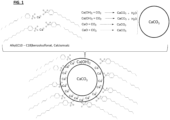
Figur 1 zeigt die Entstehung von überbasischem Calciumsulfonat, wobei zunächst Calciumcarbonat-Mizellen aus Calciumhydroxid, Calciumoxid und CO2 entstehen, an die sich dann Alkylbenzolsulfonate mit ihren polaren Gruppen anlagern. Die unpolaren (lipophilen) Alkylreste sind dabei nach außen gerichtet und umgeben somit die CaCO3-Mizellen, so dass diese vollständig in einem Basisöl (Ester-Zusammensetzung) dispergiert werden können. -
Figur 2 zeigt die Struktur von überbasischem Calciumsulfonat nach Zugabe von Ca(OH)2. -
Figur 3 zeigt die Struktur einer Mischung aus überbasischem Calciumsulfonat, Ca(OH)2, Benzoesulfonsäure (di- oder mono-Alkyl, C10 - C18) und Essigsäure. - Die folgenden Beispiele repräsentieren beispielhafte Ausführungsformen des Verfahrens zur Herstellung des erfindungsgemäßen Schmiermittels, wobei hier beschriebene oder gezeigte Merkmale einzeln oder in beliebiger Kombination miteinander einen Gegenstand der Erfindung darstellen können, sofern sich aus dem Kontext der obigen Beschreibung nichts eindeutig Gegenteiliges ergibt.
- 284 g Benzoesulfonsäure C10-18-alkyl-Derivat werden in 500 g Bis(2-ethylhexyl)sebacat (V40: 10 mm2/s) gelöst. Anschließend werden 10 g Calciumhydroxid zugefügt und für 30 min bei 50 °C gerührt. Dann werden 133 g Calciumoxid und 115 g Ca(OH)2 zugesetzt und die Mischung durch weiteres Rühren homogenisiert. Nachfolgend wird die Temperatur auf 60 °C gesteigert. Dann werden 110 ml Wasser zugegeben und Kohlendioxid durch die Mischung geleitet. Das Gemisch besitzt nun eine TBN von 367 mg KOH/g. Danach werden 300 g Bis(2-ethylhexyl)sebacat, 200 g Benzoesulfonsäure C10-18-alkyl-Derivat und 120 g Wasser zum Ansatz gegeben. Der Ansatz wird auf 99 °C aufgeheizt. Nach erfolgter Umwandlung des Calciumcarbonats von der Vaterit- in die Calcite-Form wird der Ansatz bei 110 °C entwässert. Die TBN liegt nun bei 162 mg KOH/g. Anschließend wird der Ansatz auf 160 °C aufgeheizt und bei dieser Temperatur eine Stunde gehalten. Nach dem Erkalten besitzt das Fett eine Konsistenz (gemäß ASTM D217) von 331 mm/10 nach 60 Doppelhüben. Weitere technische Daten sind der Tabelle 2 zu entnehmen.
- 280 g Benzoesulfonsäure C10-14-alkyl-Derivat werden in 700 g eines Komplexesters (Fettsäuren, C18-ungesättigt, dimerisiert, Polymer mit 2-Ethylhexanol und Neopentylglykol) (V40: 110,5 mm2/s) gelöst. Anschließend werden 11 g Calciumhydroxid zugefügt und für 45 Minuten bei 50 °C gerührt. Dann werden 151 g Calciumoxid und 151 g Ca(OH)2 zugesetzt und die Mischung durch weiteres Rühren homogenisiert. Nachfolgend wird die Temperatur auf 82 °C gesteigert. Dann werden 130 g Wasser zugegeben und Kohlendioxid durch die Mischung geleitet. Das Gemisch besitzt nun eine TBN von 399 mg KOH/g. Danach werden 300 g Komplexester (Fettsäuren, C18-ungesättigt, dimerisiert, Polymer mit 2-Ethylhexanol und Neopentylglykol), 220 g Benzoesulfonsäure C10-14-alkyl, 21 g Essigsäure, 72 g Ca(OH)2 und 180 g Wasser zum Ansatz gegeben. Der Ansatz wird auf 92 °C aufgeheizt. Nach erfolgter Umwandlung des Calciumcarbonats von der Vaterit- in die Calcite-Form wird der Ansatz bei 110 °C entwässert. Die TBN liegt nun bei 220 mg KOH/g. Anschließend wird der Ansatz auf 160 °C aufgeheizt und bei dieser Temperatur eine Stunde gehalten. Nach dem Erkalten besitzt das Fett eine Konsistenz (gemäß ASTM D217) von 292 mm/10 nach 60 Doppelhüben. Weitere technische Daten sind der Tabelle 2 zu entnehmen.
- 280 g Benzoesulfonsäure C10-14-alkyl-Derivat werden in 500 g Neopentylglykoldiisostearat (gesättigter Ester) (V40: 48 mm2/s) gelöst. Anschließend werden 11 g Calciumhydroxid zugefügt und für 45 Minuten bei 50 °C gerührt. Dann werden 151 g Calciumoxid und 131 g Ca(OH)2 zugesetzt und die Mischung durch weiteres Rühren homogenisiert. Nachfolgend wird die Temperatur auf 62 °C gesteigert. Dann werden 130 ml Wasser zugegeben und Kohlendioxid durch die Mischung geleitet. Das Gemisch besitzt nun eine TBN von 369 mg KOH/g. Danach werden 300 g Neopentylglykoldiisostearat (gesättigter Ester, 243 g Benzoesulfonsäure C10-14-alkyl, 21 g Essigsäure, 72 g Ca(OH)2 und 65 g Wasser zum Ansatz gegeben. Der Ansatz wird auf 92 °C aufgeheizt. Nach erfolgter Umwandlung des Calciumcarbonats von der Vaterit- in die Calcite-Form wird der Ansatz bei 110 °C entwässert. Die TBN liegt nun bei 188 mg KOH/g. Anschließend wird der Ansatz auf 160 °C aufgeheizt und bei dieser Temperatur eine Stunde gehalten. Nach dem Erkalten besitzt das Fett eine Konsistenz (gemäß ASTM D217) von 272 mm/10 nach 60 Doppelhüben. Weitere technische Daten sind der Tabelle 2 zu entnehmen.
- 260 g Benzoesulfonsäure C10-18-alkyl werden in 1000 g Komplexester (Pentaerythritol-sebacinsäure-Isostearinsäure Copolymer) (V40: 1200 mm2/s) gelöst. Anschließend werden 9 g Calciumhydroxid zugefügt und für 30 min bei 50 °C gerührt. Dann werden 101 g Calciumoxid und 104 g Ca(OH)2 zugesetzt und die Mischung durch weiteres Rühren homogenisiert. Nachfolgend wird die Temperatur auf 60 °C gesteigert. Dann werden 130 ml Wasser zugegeben und Kohlendioxid durch die Mischung geleitet. Das Gemisch besitzt eine TBN von 335 mg KOH/g eingestellt. Danach werden 400 g Bis(2-ethylhexyl)sebacat (V40: 12,5 mm2/s), 270 g Benzoesulfonsäure C10-14-alkyl, 75 g Ca(OH)2 und 195 g Wasser zum Ansatz gegeben. Der Ansatz wird auf 92 °C aufgeheizt. Nach erfolgter Umwandlung des Calciumcarbonats von der Vaterit- in die Calcite-Form wird 150 g 12-Hydroxystearinsäure zugesetzt und der Ansatz bei 110 °C entwässert. Die TBN liegt nun bei 159 mg KOH/g. Anschließend wird der Ansatz auf 160 °C aufgeheizt und bei dieser Temperatur eine Stunde gehalten. Nach dem Erkalten besitzt das Fett eine Konsistenz (gemäß ASTM D217) von 261 mm/10 nach 60 Doppelhüben. Weitere technische Daten sind der Tabelle 2 zu entnehmen.
- 300 g Benzoesulfonsäure C10-18-alkyl werden in 550 g Trimethylolpropantrioleat (V40: 46 mm2/s) gelöst. Dann werden 120 g Calciumoxid und 100 g Ca(OH)2 zugesetzt und die Mischung durch weiteres Rühren homogenisiert. Nachfolgend wird die Temperatur auf 60 °C gesteigert. Dann werden 80 ml Wasser zugegeben und Kohlendioxid durch die Mischung geleitet. Das Gemisch besitzt nun eine TBN von 297 mg KOH/g. Danach werden 280 g Trimethylolpropantrioleat, 280 g Benzoesulfonsäure C10-14-alkyl, 72 g Ca(OH)2 und 75 g Wasser zum Ansatz gegeben. Der Ansatz wird auf 92 °C aufgeheizt. Nach erfolgter Umwandlung des Calciumcarbonats von der Vaterit- in die Calcite-Form wird der Ansatz bei 110 °C entwässert. Die TBN liegt nun bei 180 mg KOH/g. Anschließend wird der Ansatz auf 150 °C aufgeheizt und bei dieser Temperatur eine halbe Stunde gehalten. Nach dem Erkalten besitzt das Fett eine Konsistenz (gemäß ASTM D217) von 299 mm/10 nach 60 Doppelhüben. Weitere technische Daten sind der Tabelle 2 zu entnehmen.
- 310 g Benzoesulfonsäure C8-C22-alkyl werden in 550 g Trimethylolpropantrioleat (V40: 46 mm2/s) gelöst. Dann werden 120 g Calciumoxid und 100 g Ca(OH)2 zugesetzt und die Mischung durch weiteres Rühren homogenisiert. Nachfolgend wird die Temperatur auf 60 °C gesteigert. Dann werden 80 ml Wasser zugegeben und Kohlendioxid durch die Mischung geleitet. Das Gemisch besitzt nun eine TBN von 297 mg KOH/g. Danach werden 280 g Trimethylolpropantrioleat, 254 g Benzoesulfonsäure C8-C22-alkyl, 75 g Ca(OH)2, 25 g Essigsäure und 70 g Wasser zum Ansatz gegeben. Der Ansatz wird auf 92 °C aufgeheizt. Nach erfolgter Umwandlung des Calciumcarbonats von der Vaterit- in die Calcite-Form wird der Ansatz bei 110 °C entwässert und 100 g Capronsäure zugesetzt. Die TBN liegt nun bei 161 mg KOH/g. Anschließend wird der Ansatz auf 150 °C aufgeheizt und bei dieser Temperatur eine halbe Stunde gehalten. Nach dem Erkalten besitzt das Fett eine Konsistenz (gemäß ASTM D217) von 287 mm/10 nach 60 Doppelhüben. Weitere technische Daten sind der Tabelle 2 zu entnehmen.
- 322 g Benzoesulfonsäure C10-18-alkyl werden in 600 g Rapsöl (V40: 35 mm2/s) gelöst. Dann werden 140 g Calciumoxid und 80 g Ca(OH)2 zugesetzt und die Mischung durch weiteres Rühren homogenisiert. Nachfolgend wird die Temperatur auf 40 °C gesteigert. Dann werden 62 ml Wasser zugegeben und Kohlendioxid durch die Mischung geleitet. Das Gemisch besitzt nun eine TBN von 211 mg KOH/g. Danach werden 240 g Rapsöl (V40: 35 mm2/s), 288 g Benzoesulfonsäure C10-14-alkyl, 24 g Essigsäure, 70 g Ca(OH)2 und 49 g Wasser zum Ansatz gegeben. Der Ansatz wird auf 88 °C aufgeheizt. Nach erfolgter Umwandlung des Calciumcarbonats von der Vaterit- in die Calcite-Form wird 167 g 12-Hydroxystearinsäure zugesetzt und der Ansatz bei 110 °C entwässert. Die TBN liegt nun bei 80 mg KOH/g. Anschließend wird der Ansatz auf 125 °C aufgeheizt und bei dieser Temperatur 15 Minuten gehalten. Nach dem Erkalten besitzt das Fett eine Konsistenz (gemäß ASTM D217) von 299 mm/10 nach 60 Doppelhüben. Weitere technische Daten sind der Tabelle 2 zu entnehmen.
Tabelle 2: Eindringtiefe (ASTM D217) [mm/10] Tropfpunkt (IP 396) [°C] Resistenz gegen Sprühwasser (ASTM D 4049) [%] Beispiel 1 331 222 97 Beispiel 2 292 299 81 Beispiel 3 272 280 87 Beispiel 4 261 244 52 Beispiel 5 299 224 93 Beispiel 6 287 287 81 Beispiel 7 299 288 78
Claims (5)
- Schmiermittel, das mindestens eine Ester-Zusammensetzung, die mindestens einen Ester umfasst, Calciumcarbonat und mindestens ein überbasisches Mono-, Di- oder Tri-Alkylbenzolsulfonat umfasst, wobei mindestens eine Alkylgruppe des Mono-, Di- oder Tri-Alkylbenzolsulfonat eine (C3-C30)-Alkylgruppe ist, und das mineralölfrei ist und als Ölkomponente ausschließlich Ester enthält.
- Schmiermittel nach Anspruch 1, dadurch gekennzeichnet, dass es 30 Gew.-% bis 80 Gew.-% der Ester-Zusammensetzung, 5 Gew.-% bis 20 Gew.-% Calciumcarbonat und 5 Gew.-% bis 25 Gew.-% des überbasischen Mono-, Di- oder Tri-Alkylbenzolsulfonats umfasst.
- Schmiermittel nach Anspruch 1 oder 2, dadurch gekennzeichnet, dass 50 Gew.-% bis 65 Gew.-% der Ester-Zusammensetzung, 10 Gew.-% bis 15 Gew.-% Calciumcarbonat und 12 Gew.-% bis 20 Gew.-% des überbasischen Mono-, Di- oder Tri-Alkylbenzolsulfonats umfasst.
- Schmiermittel nach einem der Ansprüche 1 bis 3, dadurch gekennzeichnet, dass mindestens eine Alkylgruppe des Mono-, Di- oder Tri-Alkylbenzolsulfonats eine (C10-C18)-Alkylgruppe ist.
- Schmiermittel nach einem der Ansprüche 1 bis 4, dadurch gekennzeichnet, dass es gemäß den Anforderungen des OECD-301-Testverfahrens leicht biologisch abbaubar ist.
Applications Claiming Priority (3)
| Application Number | Priority Date | Filing Date | Title |
|---|---|---|---|
| DE102018133586.5A DE102018133586B4 (de) | 2018-12-24 | 2018-12-24 | Mineralölfreies Schmierfett und Verfahren zur Herstellung eines mineralölfreien Schmierfetts |
| PCT/EP2019/086264 WO2020136075A1 (de) | 2018-12-24 | 2019-12-19 | Mineralölfreies schmiermittel und verfahren zur herstellung eines mineralölfreien schmiermittels |
| EP19829548.7A EP3902896B1 (de) | 2018-12-24 | 2019-12-19 | Mineralölfreies schmiermittel und verfahren zur herstellung eines mineralölfreien schmiermittels |
Related Parent Applications (2)
| Application Number | Title | Priority Date | Filing Date |
|---|---|---|---|
| EP19829548.7A Division EP3902896B1 (de) | 2018-12-24 | 2019-12-19 | Mineralölfreies schmiermittel und verfahren zur herstellung eines mineralölfreien schmiermittels |
| EP19829548.7A Division-Into EP3902896B1 (de) | 2018-12-24 | 2019-12-19 | Mineralölfreies schmiermittel und verfahren zur herstellung eines mineralölfreien schmiermittels |
Publications (2)
| Publication Number | Publication Date |
|---|---|
| EP4545623A2 true EP4545623A2 (de) | 2025-04-30 |
| EP4545623A3 EP4545623A3 (de) | 2025-06-25 |
Family
ID=69063775
Family Applications (2)
| Application Number | Title | Priority Date | Filing Date |
|---|---|---|---|
| EP19829548.7A Active EP3902896B1 (de) | 2018-12-24 | 2019-12-19 | Mineralölfreies schmiermittel und verfahren zur herstellung eines mineralölfreien schmiermittels |
| EP25156216.1A Pending EP4545623A3 (de) | 2018-12-24 | 2019-12-19 | Mineralölfreies schmiermittel |
Family Applications Before (1)
| Application Number | Title | Priority Date | Filing Date |
|---|---|---|---|
| EP19829548.7A Active EP3902896B1 (de) | 2018-12-24 | 2019-12-19 | Mineralölfreies schmiermittel und verfahren zur herstellung eines mineralölfreien schmiermittels |
Country Status (14)
| Country | Link |
|---|---|
| US (1) | US11920103B2 (de) |
| EP (2) | EP3902896B1 (de) |
| JP (2) | JP2022515776A (de) |
| KR (2) | KR102778769B1 (de) |
| CN (1) | CN113366096B (de) |
| AU (1) | AU2019412475B2 (de) |
| CA (1) | CA3123499A1 (de) |
| DE (1) | DE102018133586B4 (de) |
| ES (1) | ES3026661T3 (de) |
| HR (1) | HRP20250487T1 (de) |
| PL (1) | PL3902896T3 (de) |
| SG (1) | SG11202106821YA (de) |
| WO (1) | WO2020136075A1 (de) |
| ZA (1) | ZA202105074B (de) |
Families Citing this family (1)
| Publication number | Priority date | Publication date | Assignee | Title |
|---|---|---|---|---|
| WO2025147703A1 (en) * | 2024-01-05 | 2025-07-10 | Vgp Ipco Llc | Lithium/calcium sulfonate mixed base lubricating grease |
Citations (1)
| Publication number | Priority date | Publication date | Assignee | Title |
|---|---|---|---|---|
| WO2004106474A1 (en) | 2003-05-22 | 2004-12-09 | Anderol, Inc. | Biodegradable lubricants |
Family Cites Families (11)
| Publication number | Priority date | Publication date | Assignee | Title |
|---|---|---|---|---|
| GB1399092A (en) * | 1971-05-27 | 1975-06-25 | Cooper & Co Ltd Edwin | Lubricant additives |
| GB1547376A (en) * | 1975-03-17 | 1979-06-13 | Snam Progetti | Ubricants and process for producing lubricating greases |
| US4981602A (en) * | 1988-06-13 | 1991-01-01 | The Lubrizol Corporation | Lubricating oil compositions and concentrates |
| USH1536H (en) * | 1995-04-11 | 1996-06-04 | The Lubrizol Corporation | Overbased materials in ester media |
| US6015778A (en) * | 1998-03-27 | 2000-01-18 | The Lubrizol Corporation | Process for making overbased calcium sulfonate detergents using calcium oxide and a less than stoichiometric amount of water |
| JP2002265969A (ja) * | 2001-03-07 | 2002-09-18 | Nippon Koyu:Kk | グリース組成物 |
| PE20141377A1 (es) * | 2011-10-31 | 2014-10-10 | Nch Corp | Composiciones de grasa de sulfonato de calcio a base de carbonato de calcio y metodo de manufactura |
| JP6051097B2 (ja) * | 2013-04-26 | 2016-12-27 | 出光興産株式会社 | グリースの製造方法 |
| CN104293449B (zh) * | 2013-07-17 | 2016-08-10 | 中国石油化工股份有限公司 | 一种复合环烷酸钙基润滑脂及其制备方法 |
| CN105037222A (zh) * | 2015-06-25 | 2015-11-11 | 锦州惠发天合化学有限公司 | 高碱值结晶型磺酸钙的制备方法 |
| CN105503670A (zh) * | 2016-01-12 | 2016-04-20 | 安徽金桐精细化学有限公司 | 一种高碱值的合成烷基苯磺酸钙纳米清净剂及其制备方法 |
-
2018
- 2018-12-24 DE DE102018133586.5A patent/DE102018133586B4/de active Active
-
2019
- 2019-12-19 CA CA3123499A patent/CA3123499A1/en active Pending
- 2019-12-19 PL PL19829548.7T patent/PL3902896T3/pl unknown
- 2019-12-19 JP JP2021536094A patent/JP2022515776A/ja active Pending
- 2019-12-19 KR KR1020217022694A patent/KR102778769B1/ko active Active
- 2019-12-19 AU AU2019412475A patent/AU2019412475B2/en active Active
- 2019-12-19 HR HRP20250487TT patent/HRP20250487T1/hr unknown
- 2019-12-19 CN CN201980086020.6A patent/CN113366096B/zh active Active
- 2019-12-19 EP EP19829548.7A patent/EP3902896B1/de active Active
- 2019-12-19 KR KR1020247038551A patent/KR20240169721A/ko active Pending
- 2019-12-19 ES ES19829548T patent/ES3026661T3/es active Active
- 2019-12-19 WO PCT/EP2019/086264 patent/WO2020136075A1/de not_active Ceased
- 2019-12-19 US US17/417,673 patent/US11920103B2/en active Active
- 2019-12-19 SG SG11202106821YA patent/SG11202106821YA/en unknown
- 2019-12-19 EP EP25156216.1A patent/EP4545623A3/de active Pending
-
2021
- 2021-07-19 ZA ZA2021/05074A patent/ZA202105074B/en unknown
-
2024
- 2024-06-06 JP JP2024092270A patent/JP2024127889A/ja active Pending
Patent Citations (1)
| Publication number | Priority date | Publication date | Assignee | Title |
|---|---|---|---|---|
| WO2004106474A1 (en) | 2003-05-22 | 2004-12-09 | Anderol, Inc. | Biodegradable lubricants |
Also Published As
| Publication number | Publication date |
|---|---|
| DE102018133586A1 (de) | 2020-06-25 |
| SG11202106821YA (en) | 2021-07-29 |
| CN113366096A (zh) | 2021-09-07 |
| KR20240169721A (ko) | 2024-12-03 |
| EP3902896C0 (de) | 2025-03-26 |
| JP2022515776A (ja) | 2022-02-22 |
| ZA202105074B (en) | 2022-08-31 |
| EP4545623A3 (de) | 2025-06-25 |
| BR112021012304A2 (pt) | 2021-09-08 |
| CA3123499A1 (en) | 2020-07-02 |
| KR20210107054A (ko) | 2021-08-31 |
| US11920103B2 (en) | 2024-03-05 |
| WO2020136075A1 (de) | 2020-07-02 |
| DE102018133586B4 (de) | 2022-03-03 |
| EP3902896A1 (de) | 2021-11-03 |
| ES3026661T3 (en) | 2025-06-11 |
| HRP20250487T1 (hr) | 2025-06-20 |
| EP3902896B1 (de) | 2025-03-26 |
| PL3902896T3 (pl) | 2025-06-23 |
| KR102778769B1 (ko) | 2025-03-10 |
| AU2019412475A1 (en) | 2021-07-08 |
| US20220056365A1 (en) | 2022-02-24 |
| JP2024127889A (ja) | 2024-09-20 |
| CN113366096B (zh) | 2023-03-17 |
| AU2019412475B2 (en) | 2025-08-14 |
Similar Documents
| Publication | Publication Date | Title |
|---|---|---|
| DE69525657T2 (de) | Verwendung von biologisch abbaubarem synthetischen verzweigten ester in einem zwei-takt motor öl um die herstellung von rauch in einem zwei-takt motor zu reduzieren | |
| DE102010006745A1 (de) | Schmierfette enthaltend Ligninsulfonat, deren Herstellung und Verwendung | |
| DE112009000808T5 (de) | Schmiermittelzusammensetzung und direkt wirkende Vorrichtungen mit der Schmiermittelzusammensetzung | |
| EP3959296B1 (de) | Schmierfette umfassend metallseifen und metallkomplexseifen auf basis von r-10- hydroxyoctadecansäure | |
| DE3401149C2 (de) | ||
| DE69924714T2 (de) | Schmierfettzusammensetzung und ihre herstellung | |
| EP3902896B1 (de) | Mineralölfreies schmiermittel und verfahren zur herstellung eines mineralölfreien schmiermittels | |
| EP4222236B1 (de) | Verfahren zur herstellung von lithiumkomplexseifen- und lithium-calciumkomplexseifen-schmierfetten | |
| EP2796447B1 (de) | Neue schwefelbrückenhaltige Verbindungen, Verfahren zu deren Herstellung und deren Verwendung | |
| DE102024116319B3 (de) | Schmierfett-Zusammensetzungen enthaltend pentacyclische Triterpene als Co-Verdicker, deren Verwendung und Verfahren zu deren Herstellung | |
| DE69105788T2 (de) | Methode zur Schmierung von Alkoholbasiskraftstoffmotoren. | |
| EP4176027B1 (de) | Polyharnstoff-schmierfette enthaltend carbonate und deren verwendung | |
| EP0557839B1 (de) | Nieder- und hochmolekulare Korrosionsschutzadditive auf Basis von Epoxiden | |
| WO2024175811A1 (de) | Schmierfett | |
| EP4467632A1 (de) | Schmierfett | |
| DE102023108177A1 (de) | Herstellung polyharnstoffverdickter Schmierfette mit verbesserten Schmierungseigenschaften und Alterungsstabilität | |
| WO2025233106A1 (de) | Polyolester als basisöl für schmierstoffzusammensetzungen | |
| DE102023004246A1 (de) | Herstellung polyharnstoffverdickter Schmierfette mit verbesserten Schmierungseigenschaften und Alterungsstabilität | |
| DE102023113449A1 (de) | Schmierfett | |
| WO2020038737A1 (de) | Schmiermittelzusammensetzung | |
| DE1594604A1 (de) | Schmiermittel und Verfahren zu seiner Herstellung | |
| CH361350A (de) | Schmiermittel |
Legal Events
| Date | Code | Title | Description |
|---|---|---|---|
| PUAI | Public reference made under article 153(3) epc to a published international application that has entered the european phase |
Free format text: ORIGINAL CODE: 0009012 |
|
| STAA | Information on the status of an ep patent application or granted ep patent |
Free format text: STATUS: THE APPLICATION HAS BEEN PUBLISHED |
|
| AC | Divisional application: reference to earlier application |
Ref document number: 3902896 Country of ref document: EP Kind code of ref document: P |
|
| AK | Designated contracting states |
Kind code of ref document: A2 Designated state(s): AL AT BE BG CH CY CZ DE DK EE ES FI FR GB GR HR HU IE IS IT LI LT LU LV MC MK MT NL NO PL PT RO RS SE SI SK SM TR |
|
| REG | Reference to a national code |
Ref country code: DE Ref legal event code: R079 Free format text: PREVIOUS MAIN CLASS: C10N0070000000 Ipc: C10M0159240000 |
|
| PUAL | Search report despatched |
Free format text: ORIGINAL CODE: 0009013 |
|
| AK | Designated contracting states |
Kind code of ref document: A3 Designated state(s): AL AT BE BG CH CY CZ DE DK EE ES FI FR GB GR HR HU IE IS IT LI LT LU LV MC MK MT NL NO PL PT RO RS SE SI SK SM TR |
|
| RIC1 | Information provided on ipc code assigned before grant |
Ipc: C10N 30/00 20060101ALN20250522BHEP Ipc: C10N 70/00 20060101ALN20250522BHEP Ipc: C10N 50/10 20060101ALN20250522BHEP Ipc: C10N 20/02 20060101ALN20250522BHEP Ipc: C10N 10/04 20060101ALN20250522BHEP Ipc: C10M 159/24 20060101AFI20250522BHEP |
|
| STAA | Information on the status of an ep patent application or granted ep patent |
Free format text: STATUS: REQUEST FOR EXAMINATION WAS MADE |
|
| 17P | Request for examination filed |
Effective date: 20251211 |