EP4545481A1 - Kohlendioxidfixierungsvorrichtung und batterie - Google Patents
Kohlendioxidfixierungsvorrichtung und batterie Download PDFInfo
- Publication number
- EP4545481A1 EP4545481A1 EP24207757.6A EP24207757A EP4545481A1 EP 4545481 A1 EP4545481 A1 EP 4545481A1 EP 24207757 A EP24207757 A EP 24207757A EP 4545481 A1 EP4545481 A1 EP 4545481A1
- Authority
- EP
- European Patent Office
- Prior art keywords
- carbon dioxide
- fixation device
- aqueous solution
- dioxide fixation
- less
- Prior art date
- Legal status (The legal status is an assumption and is not a legal conclusion. Google has not performed a legal analysis and makes no representation as to the accuracy of the status listed.)
- Pending
Links
Images


Classifications
-
- C—CHEMISTRY; METALLURGY
- C25—ELECTROLYTIC OR ELECTROPHORETIC PROCESSES; APPARATUS THEREFOR
- C25B—ELECTROLYTIC OR ELECTROPHORETIC PROCESSES FOR THE PRODUCTION OF COMPOUNDS OR NON-METALS; APPARATUS THEREFOR
- C25B5/00—Electrogenerative processes, i.e. processes for producing compounds in which electricity is generated simultaneously
-
- C—CHEMISTRY; METALLURGY
- C01—INORGANIC CHEMISTRY
- C01B—NON-METALLIC ELEMENTS; COMPOUNDS THEREOF; METALLOIDS OR COMPOUNDS THEREOF NOT COVERED BY SUBCLASS C01C
- C01B32/00—Carbon; Compounds thereof
- C01B32/60—Preparation of carbonates or bicarbonates in general
-
- B—PERFORMING OPERATIONS; TRANSPORTING
- B01—PHYSICAL OR CHEMICAL PROCESSES OR APPARATUS IN GENERAL
- B01D—SEPARATION
- B01D53/00—Separation of gases or vapours; Recovering vapours of volatile solvents from gases; Chemical or biological purification of waste gases, e.g. engine exhaust gases, smoke, fumes, flue gases, aerosols
- B01D53/34—Chemical or biological purification of waste gases
- B01D53/74—General processes for purification of waste gases; Apparatus or devices specially adapted therefor
- B01D53/77—Liquid phase processes
- B01D53/78—Liquid phase processes with gas-liquid contact
-
- B—PERFORMING OPERATIONS; TRANSPORTING
- B01—PHYSICAL OR CHEMICAL PROCESSES OR APPARATUS IN GENERAL
- B01D—SEPARATION
- B01D53/00—Separation of gases or vapours; Recovering vapours of volatile solvents from gases; Chemical or biological purification of waste gases, e.g. engine exhaust gases, smoke, fumes, flue gases, aerosols
- B01D53/14—Separation of gases or vapours; Recovering vapours of volatile solvents from gases; Chemical or biological purification of waste gases, e.g. engine exhaust gases, smoke, fumes, flue gases, aerosols by absorption
- B01D53/1456—Removing acid components
- B01D53/1475—Removing carbon dioxide
-
- B—PERFORMING OPERATIONS; TRANSPORTING
- B01—PHYSICAL OR CHEMICAL PROCESSES OR APPARATUS IN GENERAL
- B01D—SEPARATION
- B01D53/00—Separation of gases or vapours; Recovering vapours of volatile solvents from gases; Chemical or biological purification of waste gases, e.g. engine exhaust gases, smoke, fumes, flue gases, aerosols
- B01D53/14—Separation of gases or vapours; Recovering vapours of volatile solvents from gases; Chemical or biological purification of waste gases, e.g. engine exhaust gases, smoke, fumes, flue gases, aerosols by absorption
- B01D53/1493—Selection of liquid materials for use as absorbents
-
- B—PERFORMING OPERATIONS; TRANSPORTING
- B01—PHYSICAL OR CHEMICAL PROCESSES OR APPARATUS IN GENERAL
- B01D—SEPARATION
- B01D53/00—Separation of gases or vapours; Recovering vapours of volatile solvents from gases; Chemical or biological purification of waste gases, e.g. engine exhaust gases, smoke, fumes, flue gases, aerosols
- B01D53/32—Separation of gases or vapours; Recovering vapours of volatile solvents from gases; Chemical or biological purification of waste gases, e.g. engine exhaust gases, smoke, fumes, flue gases, aerosols by electrical effects other than those provided for in group B01D61/00
- B01D53/326—Separation of gases or vapours; Recovering vapours of volatile solvents from gases; Chemical or biological purification of waste gases, e.g. engine exhaust gases, smoke, fumes, flue gases, aerosols by electrical effects other than those provided for in group B01D61/00 in electrochemical cells
-
- B—PERFORMING OPERATIONS; TRANSPORTING
- B01—PHYSICAL OR CHEMICAL PROCESSES OR APPARATUS IN GENERAL
- B01D—SEPARATION
- B01D53/00—Separation of gases or vapours; Recovering vapours of volatile solvents from gases; Chemical or biological purification of waste gases, e.g. engine exhaust gases, smoke, fumes, flue gases, aerosols
- B01D53/34—Chemical or biological purification of waste gases
- B01D53/46—Removing components of defined structure
- B01D53/62—Carbon oxides
-
- C—CHEMISTRY; METALLURGY
- C01—INORGANIC CHEMISTRY
- C01G—COMPOUNDS CONTAINING METALS NOT COVERED BY SUBCLASSES C01D OR C01F
- C01G9/00—Compounds of zinc
-
- C—CHEMISTRY; METALLURGY
- C25—ELECTROLYTIC OR ELECTROPHORETIC PROCESSES; APPARATUS THEREFOR
- C25B—ELECTROLYTIC OR ELECTROPHORETIC PROCESSES FOR THE PRODUCTION OF COMPOUNDS OR NON-METALS; APPARATUS THEREFOR
- C25B1/00—Electrolytic production of inorganic compounds or non-metals
- C25B1/01—Products
-
- C—CHEMISTRY; METALLURGY
- C25—ELECTROLYTIC OR ELECTROPHORETIC PROCESSES; APPARATUS THEREFOR
- C25B—ELECTROLYTIC OR ELECTROPHORETIC PROCESSES FOR THE PRODUCTION OF COMPOUNDS OR NON-METALS; APPARATUS THEREFOR
- C25B11/00—Electrodes; Manufacture thereof not otherwise provided for
- C25B11/04—Electrodes; Manufacture thereof not otherwise provided for characterised by the material
- C25B11/042—Electrodes formed of a single material
- C25B11/043—Carbon, e.g. diamond or graphene
-
- C—CHEMISTRY; METALLURGY
- C25—ELECTROLYTIC OR ELECTROPHORETIC PROCESSES; APPARATUS THEREFOR
- C25B—ELECTROLYTIC OR ELECTROPHORETIC PROCESSES FOR THE PRODUCTION OF COMPOUNDS OR NON-METALS; APPARATUS THEREFOR
- C25B11/00—Electrodes; Manufacture thereof not otherwise provided for
- C25B11/04—Electrodes; Manufacture thereof not otherwise provided for characterised by the material
- C25B11/042—Electrodes formed of a single material
- C25B11/046—Alloys
-
- C—CHEMISTRY; METALLURGY
- C25—ELECTROLYTIC OR ELECTROPHORETIC PROCESSES; APPARATUS THEREFOR
- C25B—ELECTROLYTIC OR ELECTROPHORETIC PROCESSES FOR THE PRODUCTION OF COMPOUNDS OR NON-METALS; APPARATUS THEREFOR
- C25B15/00—Operating or servicing cells
- C25B15/08—Supplying or removing reactants or electrolytes; Regeneration of electrolytes
-
- H—ELECTRICITY
- H01—ELECTRIC ELEMENTS
- H01M—PROCESSES OR MEANS, e.g. BATTERIES, FOR THE DIRECT CONVERSION OF CHEMICAL ENERGY INTO ELECTRICAL ENERGY
- H01M10/00—Secondary cells; Manufacture thereof
- H01M10/36—Accumulators not provided for in groups H01M10/05-H01M10/34
-
- H—ELECTRICITY
- H01—ELECTRIC ELEMENTS
- H01M—PROCESSES OR MEANS, e.g. BATTERIES, FOR THE DIRECT CONVERSION OF CHEMICAL ENERGY INTO ELECTRICAL ENERGY
- H01M10/00—Secondary cells; Manufacture thereof
- H01M10/42—Methods or arrangements for servicing or maintenance of secondary cells or secondary half-cells
- H01M10/4235—Safety or regulating additives or arrangements in electrodes, separators or electrolyte
-
- B—PERFORMING OPERATIONS; TRANSPORTING
- B01—PHYSICAL OR CHEMICAL PROCESSES OR APPARATUS IN GENERAL
- B01D—SEPARATION
- B01D2257/00—Components to be removed
- B01D2257/50—Carbon oxides
- B01D2257/504—Carbon dioxide
-
- B—PERFORMING OPERATIONS; TRANSPORTING
- B01—PHYSICAL OR CHEMICAL PROCESSES OR APPARATUS IN GENERAL
- B01D—SEPARATION
- B01D2258/00—Sources of waste gases
- B01D2258/06—Polluted air
-
- H—ELECTRICITY
- H01—ELECTRIC ELEMENTS
- H01M—PROCESSES OR MEANS, e.g. BATTERIES, FOR THE DIRECT CONVERSION OF CHEMICAL ENERGY INTO ELECTRICAL ENERGY
- H01M2300/00—Electrolytes
- H01M2300/0002—Aqueous electrolytes
- H01M2300/0014—Alkaline electrolytes
-
- Y—GENERAL TAGGING OF NEW TECHNOLOGICAL DEVELOPMENTS; GENERAL TAGGING OF CROSS-SECTIONAL TECHNOLOGIES SPANNING OVER SEVERAL SECTIONS OF THE IPC; TECHNICAL SUBJECTS COVERED BY FORMER USPC CROSS-REFERENCE ART COLLECTIONS [XRACs] AND DIGESTS
- Y02—TECHNOLOGIES OR APPLICATIONS FOR MITIGATION OR ADAPTATION AGAINST CLIMATE CHANGE
- Y02E—REDUCTION OF GREENHOUSE GAS [GHG] EMISSIONS, RELATED TO ENERGY GENERATION, TRANSMISSION OR DISTRIBUTION
- Y02E60/00—Enabling technologies; Technologies with a potential or indirect contribution to GHG emissions mitigation
- Y02E60/10—Energy storage using batteries
Definitions
- the present invention relates to a carbon dioxide fixation device and a battery including the carbon dioxide fixation device.
- negative emission systems technologies that aim to mitigate an increase in atmospheric carbon dioxide concentration and to reduce the concentration are collectively referred to as negative emission systems.
- BECCS technology for capturing and storing, in the underground, carbon dioxide emitted when biomass fuels are used
- DACCS technology for directly capturing and storing carbon dioxide already existing in the air
- Patent Literature 1 discloses, as a means for fixing atmospheric carbon dioxide as an alkali earth metal carbonate, a method including: providing an aqueous solution having a metal ion and a polyamine dissolved in advance; exposing the aqueous solution to the air; and absorbing (dissolving) and then precipitating atmospheric carbon dioxide as a carbonate.
- Patent Literature 2 discloses a method including: bringing carbon dioxide-containing gas into contact with an alkanolamine aqueous solution in an absorption tower to absorb the carbon dioxide gas; and then heating the carbon dioxide-containing solution to desorb and recover the carbon dioxide gas in a desorption tower.
- the purpose of the present invention is to provide a carbon dioxide fixation device capable of efficiently fixing atmospheric carbon dioxide while extracting energy.
- a carbon dioxide fixation device includes an aqueous solution containing a water-soluble polymer compound and positive and negative electrode materials, and is capable of producing carbon dioxide-derived carbonate after discharge between the electrode materials, energy can be extracted during carbon dioxide fixation.
- the present invention is based on these findings and has been completed.
- energy can be extracted while atmospheric carbon dioxide is precipitated as a carbonate and fixed.
- the water-soluble polymer compound has two or more amino groups in the molecule, has a weight-average molecular weight of not less than 500 and not more than 50,000, and is a non-volatile polyamine.
- the above configuration of the water-soluble polymer compound allows for efficient carbon dioxide absorption and excellent safety.
- the concentration of the water-soluble polymer compound in the aqueous solution is not less than 1 mass ppm and less than 1000 mass ppm.
- concentration of the water-soluble polymer compound in the aqueous solution is not less than 1 mass ppm and less than 1000 mass ppm.
- the aqueous solution immediately after preparation preferably has a pH of not less than 8.6 and not more than 14.
- the pH within the above range facilitates the absorption of carbon dioxide into the aqueous solution.
- the aqueous solution is preferably substantially free of metal ions.
- a liquid surface of the aqueous solution is preferably in contact with air.
- the aqueous solution is highly safe, and can thus be exposed directly to the air.
- atmospheric carbon dioxide is preferably optionally dissolved to a saturated concentration in the aqueous solution.
- the negative electrode material preferably comprises a metal element other than alkali metals.
- the negative electrode material preferably comprises one or more metal elements selected from the group consisting of zinc, iron, and magnesium.
- the positive electrode material preferably comprises a material with a relatively higher standard Gibbs energy of formation than the negative electrode material.
- electrical energy is preferably capable of being extracted therefrom.
- the aqueous solution preferably has a pH of not less than 5.8 and less than 8.6.
- the present invention also provides a battery including the carbon dioxide fixation device.
- the carbon dioxide fixation device of the present invention is capable of efficiently fixing atmospheric carbon dioxide while extracting energy.
- a carbon dioxide fixation device of the present invention includes at least an aqueous solution containing a water-soluble polymer compound and positive and negative electrode materials. Inclusion of the water-soluble polymer compound in the above aqueous solution makes it possible to efficiently absorb atmospheric carbon dioxide and generate a carbonate ion.
- the above carbon dioxide fixation device when discharging between the above electrode materials, energy can be extracted while atmospheric carbon dioxide is fixed.
- the above carbon dioxide fixation device is configured such that the above positive and negative electrode materials are connected to an external circuit to form a circuit via the aqueous solution. This can flow a current, which can be extracted, as energy, through, for instance, an LED included in the external circuit.
- the atmospheric carbon dioxide absorbed in the aqueous solution can react to produce the atmospheric carbon dioxide-derived carbonate for fixation.
- air includes gases such as air present in an open system and/or exhaust gas if it contains carbon dioxide.
- the above carbon dioxide fixation device is capable of fixing atmospheric carbon dioxide while extracting energy.
- the above carbon dioxide fixation device can be used as a negative emission system that fixes and recovers atmospheric carbon dioxide while at the same time extracting energy.
- the carbon dioxide fixation device preferably includes a separator to separate the above positive electrode material from the negative electrode material. Including the separator facilitates use as a battery.
- a separator any known separator used for batteries can be used without particular limitation, but it is preferable to use a resin separator.
- the above carbon dioxide fixation device includes an aqueous solution containing a water-soluble polymer compound (hereinafter, sometimes referred to as “aqueous solution” or “electrolytic liquid”). Inclusion of the water-soluble polymer compound in the above aqueous solution makes it possible to efficiently absorb atmospheric carbon dioxide as a carbonate ion. Only one kind of the above water-soluble polymer compound in the above aqueous solution may be used, or two or more kinds thereof may be used.
- the above water-soluble polymer compound is preferably a nitrogen atom-containing water-soluble polymer compound, and more preferably a polyamine and/or a salt thereof.
- the weight-average molecular weight of the above water-soluble polymer compound is preferably not less than 500 and not more than 150,000, more preferably not less than 1000 and not more than 100,000, and still more preferably not less than 1500 and not more than 50,000.
- the upper limit is particularly preferably 40,000 or less, and may be 30,000 or less, 20,000 or less, or 15,000 or less.
- the weight-average molecular weight of 500 or more makes the compound less volatile.
- the weight-average molecular weight of 150,000 or less can suppress the attenuation of atmospheric carbon dioxide absorption capacity due to the desorption of the above water-soluble polymer compound as a precipitate from the aqueous solution by the increase in hydrophobicity of the entire molecule as caused by the formation of carboxylates or esters of the above water-soluble polymer compound with the dissolved carbon dioxide.
- the above weight-average molecular weight can be measured, for example, under the following conditions.
- the above water-soluble polymer compound preferably has, in the molecule, two or more amino groups, more preferably three or more amino groups, and still more preferably four or more amino groups.
- the above water-soluble polymer compound may have two or more amino groups in the molecule. This can facilitate the formation of a carbamate compound with atmospheric carbon dioxide and enables efficient absorption of atmospheric carbon dioxide into the aqueous solution. In addition, spontaneous hydrolysis of the generated carbamate can be induced to promote production of carbonate ions in the aqueous solution.
- the above water-soluble polymer compound is preferably non-volatile. Since the above water-soluble polymer compound is non-volatile, the above aqueous solution is excellent in safety even in contact with the air. Note that as used herein, the term “non-volatile” means that the compound is non-volatile at room temperature (25°C) and normal pressure (1 atm).
- the content of the above water-soluble polymer compound in the above aqueous solution as based on 100 mass% of the above aqueous solution is preferably not less than 1 mass ppm and less than 1000 mass ppm, more preferably not less than 3 mass ppm and not more than 900 mass ppm, still more preferably not less than 5 mass ppm and not more than 800 mass ppm, particularly preferably not less than 10 mass ppm and not more than 700 mass ppm, and most preferably not less than 15 mass ppm and not more than 600 mass ppm.
- carbon dioxide can be easily absorbed.
- the content of less than 1000 mass ppm is safe enough and facilitates wastewater treatment.
- the amino group of the above polyamine may comprise any of a primary amine, secondary amine, or tertiary amine.
- polyamine examples include a polyamine represented by the following formula (1): wherein m indicates an integer from 0 to 1000, and R 1 and R 2 each independently represent a C 2-8 linear or branched alkylene group, provided that when m is 2 or more, a plurality of R 1 may be the same or different.
- R 1 and R 2 each preferably represent a C 2-6 linear or branched alkylene group, and more preferably a C 3-5 linear or branched alkylene group.
- m indicates more preferably an integer from 1 to 500, still more preferably an integer from 2 to 100, particularly preferably an integer from 3 to 50, and especially preferably an integer from 5 to 10.
- examples of the polyamine where m is 1 or more include: spermidine, spermine; polyethyleneamine (e.g., diethylenetriamine, triethylenetetraamine, tetraethylenepentamine, pentaethylenehexamine, hexaethyleneheptamine, heptaethyleneoctamine, octaethylene nonamine, nonaethylene decamine); or polypropylene polyamine (e.g., dipropylene triamine, tripropylene tetramine, tetrapropylene pentamine, pentapropylene hexamine, hexapropylene heptamine, heptapropylene octamine, octapropylene nonamine, nonapropyl decamine).
- polyethyleneamine e.g., diethylenetriamine, triethylenetetraamine, tetraethylenepentamine, pentaethylenehexamine, hexaethyleneheptamine, heptaethyleneoctamine, o
- polyamines may each be used as a polyamine represented by the above formula (1). Examples of the commercially available product are shown in Table 1.
- polymer A examples include a polymer having a structural unit derived from a cyclic amine represented by the following formula (2) (hereinafter, sometimes referred to as "polymer A").
- This polymer A is obtained by ring-opening polymerization of a cyclic amine represented by the following formula (2): wherein R 3 , R 4 , R 5 , and R 6 each independently represent a hydrogen atom or a methyl group.
- Examples of the cyclic amine represented by the above formula (2) include aziridine (ethyleneimine), 2-methylaziridine, 2,2-dimethylaziridine, or 2,3-dimethylaziridine.
- Examples of a homopolymer among the polymers A include, polyethyleneimine, poly(2-methylaziridine), poly(2,2-dimethylaziridine), or poly(2,3-dimethylaziridine).
- examples of the above polyamine include a polymer having a structural unit derived from an unsaturated amine represented by the following formula (3) (hereinafter, sometimes referred to as "polymer B").
- This polymer B is obtained by polymerization of an unsaturated group of an unsaturated amine represented by the following formula (3): wherein n indicates an integer of 0 to 2, p indicates an integer of 1 to 3, and R 7 , R 8 , and R 9 each independently represent a hydrogen atom or a methyl group.
- Examples of the unsaturated amine represented by the above formula (3) include vinylamine, divinylamine, trivinylamine, allylamine, diallylamine, triallylamine, metallylamine, dimethallylamine, trimethallylamine, crotylamine, dicrotylamine, tricrotylamine, 3-methyl-2-butenylamine, or 3-butenylamine.
- Examples of a homopolymer among the above polymers B include polyvinylamine, polydivinylamine, polyallylamine, polydiallylamine, polytriallylamine, polymethacrylamine, polycrotylamine, or poly(3-butenylamine).
- the above polymer A or B may be a copolymer.
- the copolymer above may be any of a statistical, random, alternating, or periodic copolymer, and may be either a block copolymer or graft copolymer in terms of the polymer chain linkage.
- the above polymer A may be a copolymer of two or more cyclic amines represented by the above formula (2).
- the above polymer B may be a copolymer of two or more unsaturated amines represented by the above formula (3) or a copolymer of one or two or more unsaturated amines represented by the above formula (3) and another monomer copolymerizable with the unsaturated amine represented by the formula (3).
- Examples of the other monomer copolymerizable with the unsaturated amine represented by the above formula (3) include sulfur dioxide, (meth)acrylamide, (meth)acrylic ester, (meth)acrylic acid, or maleic acid.
- the percentage of the structural unit derived from the unsaturated amine represented by the above formula (3) (including those in which a substituent is introduced into the amino group or those in which a salt is formed) as based on the entire copolymer is, for example, 20 mass% or higher, preferably 40 mass% or higher, more preferably 60 mass% or higher, still more preferably 80 mass% or higher, and particularly preferably 90 mass% or higher.
- the percentage of the structural unit derived from the unsaturated amine represented by the above formula (3), in which structural unit no substituent is introduced into the amino group, (including those in which an amino group forms a salt) as based on the entire copolymer is, for example, 20 mass% or higher, preferably 40 mass% or higher, more preferably 60 mass% or higher, still more preferably 80 mass% or higher, and particularly preferably 90 mass% or higher.
- Typical examples of a polymer having a structural unit derived from an unsaturated amine represented by the above formula (3), namely polymer B include a homopolymer (e.g., polyvinylamine, poly(divinylamine), polyallylamine, polydiallylamine, polytriallylamine, polymethallylamine, poly(crotylamine), poly(3-butenylamine), a diallylamine polymer, poly(N,N-dimethylallylamine), poly(N-acetylallylamine)); or a copolymer (e.g., an allylamine-diallylamine copolymer, an allylamine-dimethylallylamine copolymer, a partially methoxycarbonylated allylamine copolymer, a partial ureaization allylamine polymer, a diallylamine-sulfur dioxide copolymer, a methyl diallylamine-sulfur dioxide copolymer, a dially
- amino group in the molecule of any of the polyamine represented by the above formula (1), the above polymer A, or the above polymer B may or may not have a substituent.
- substituents examples include a C 1-4 alkyl group (e.g., a methyl or ethyl group); a C 1-4 acyl group (e.g., a formyl, acetyl, or propionyl group); a C 1-4 alkoxycarbonyl group (e.g., a methoxycarbonyl or ethoxycarbonyl group); or a carbamoyl group.
- substituents may each be introduced at the monomer stage or after polymerization. Only one kind of the above substituent may be used, or two or more kinds thereof may be used.
- the above polyamine is preferably at least one compound selected from the group consisting of polyamines represented by the above formula (1), the above polymers A, and the above polymers B.
- the above polyamine is more preferably any of the above polymer A and/or the above polymer B, and most preferably the above polymer B.
- the above polyamine salt may be either an acid salt or a quaternary ammonium salt.
- the above acid include an inorganic acid (e.g., hydrochloric acid, sulfuric acid, nitric acid, phosphoric acid, boric acid); a monovalent aliphatic carboxylic acid (e.g., formic acid, acetic acid, propionic acid, butyric acid, isobutyric acid, pentanoic acid, hexanoic acid, octanoic acid, decanoic acid, dodecanoic acid); a divalent aliphatic carboxylic acid (e.g., oxalic acid, malonic acid, succinic acid, glutaric acid, adipic acid); a hydroxycarboxylic acid (e.g., glycolic acid, lactic acid, malic acid, tartaric acid); or an organic acid (e.g., sulfonic acid (e.g., methane sulfonic acid
- aqueous solution may contain various additives as other components as long as the effects of the present invention are not impaired.
- additives for example, one or two or more of organic solvents, thickening stabilizers, viscosity modifiers, preservatives, surfactants, and/or quality stabilizers may be blended.
- the aqueous solution above is preferably substantially free of lithium ions, and more preferably substantially free of metal ions.
- wastewater treatment after use is easy.
- substantially free of metal ions means that no metal element-containing raw materials other than those for immersing an electrode material are actively immersed and that, for example, the metal ion concentration in the above aqueous solution is 1.0 mol/L or less.
- the content of components other than water, the polyamine, and the polyamine salt in the above aqueous solution as based on 100 mass% of the above aqueous solution is preferably less than 5 mass%, more preferably less than 3 mass%, still more preferably less than 1 mass%, and particularly preferably zero.
- the content of the above other components is less than 5 mass%, the effect of the polyamine and/or a salt thereof is more effective because of no interference with the other components in the aqueous solution.
- the aqueous solution above contains a polyamine and/or a salt thereof as a functional component, and the total content of water, the polyamine, and the polyamine salt as based on 100 mass% of the above aqueous solution is, for example, 95 mass% or higher, preferably 98 mass% or higher or 99 mass% or higher, more preferably 99.5 mass% or higher, still more preferably 99.95 mass% or higher, particularly preferably 99.98 mass% or higher, and most preferably 100 mass%.
- the pH of the above aqueous solution immediately after preparation is preferably not less than 8.6 and not more than 14, more preferably not less than 9 and not more than 13, and still more preferably not less than 9.5 and not more than 12.
- a pH of 8.6 or more allows for sufficient absorption of carbon dioxide, and a pH of 14 or less makes it safe enough as an aqueous solution and facilitates wastewater treatment.
- the above aqueous solution preferably is able to dissolve atmospheric carbon dioxide to a saturated concentration. With the above configuration, atmospheric carbon dioxide can be efficiently fixed.
- the above aqueous solution is preferably allowed to stand for 100 hours or more at room temperature and normal pressure in order to dissolve atmospheric carbon dioxide to a saturated concentration.
- the pH of the above aqueous solution after being allowed to stand in air is preferably not less than 7.5 and not more than 10, more preferably not less than 7.7 and not more than 9.5, and still more preferably not less than 8.1 and not more than 9.0.
- Sufficient absorption of carbon dioxide can be checked by whether the pH of the above polymer compound-containing aqueous solution after being allowed to stand is within the above range.
- the above carbon dioxide fixation device includes positive and negative electrode materials.
- Each of the above positive and negative electrode materials may consist of only one type of raw material or may contain two or more types of raw materials.
- the above negative electrode material is preferably provided such that the standard Gibbs energy of formation of carbonate is lower than that of hydroxide. It is easier to produce a carbonate after discharge in the above carbon dioxide fixation device if the standard Gibbs energy of formation of carbonate in the above negative electrode material is lower than that of hydroxide.
- the above negative electrode material contains a metal element other than alkali metals, and it is more preferable that it contains one or more metal elements selected from the group consisting of zinc, iron, copper, and magnesium, and it is still more preferable that it contains one or more metal elements selected from the group consisting of zinc, iron, and magnesium. It is particularly preferable to contain zinc.
- the above negative electrode material is free of alkali metals, it is easier to ensure safety.
- the inclusion of one or more metal elements selected from the group consisting of zinc, iron, and magnesium makes it easy to fix as a carbonate after discharge.
- the content of metals other than alkali metals in the above negative electrode material as based on 100 mass% of the above negative electrode material is preferably 90 mass% or higher, more preferably 95 mass% or higher, and still more preferably 100 mass%.
- the standard Gibbs energy of formation of hydroxide resulting from the above negative electrode material is preferably -200 kJ/mol or less, more preferably -300 kJ/mol or less, and still more preferably -400 kJ/mol or less.
- the lower limit is not particularly limited, but is preferably -1000 kJ/mol or higher.
- the standard Gibbs energy of formation of carbonate produced from the above negative electrode material is preferably -500 kJ/mol or less, more preferably -600 kJ/mol or less, and still more preferably -700 kJ/mol or less.
- the standard Gibbs energy of formation of the carbonate is -500 kJ/mol or less, the carbonate is easily produced.
- the lower limit is not particularly limited, but is preferably - 3000 kJ/mol or higher.
- the standard Gibbs energy of formation of the carbonate is preferably at least 100 kJ/mol, more preferably at least 150 kJ/mol, and still more preferably at least 200 kJ/mol less than the standard Gibbs energy of formation of the above hydroxide.
- the standard Gibbs energy of formation of substance produced from the above negative electrode material is preferably -300 kJ/mol or less, more preferably -400 kJ/mol or less, and still more preferably -500 kJ/mol or less. When the above range is satisfied, the use as a negative electrode is easy.
- the shape of the above negative electrode material is not particularly limited and may be used, for instance, in a plate, bar, or particle form, depending on the shape of the carbon dioxide fixation device.
- the positive electrode material in particular, preferably comprises a material with a relatively higher standard Gibbs energy of formation than the negative electrode material.
- the positive electrode material as a whole may have a higher standard Gibbs energy of formation than the negative electrode material.
- it is preferable to be free of the material. The above configuration makes it easy to extract energy when a current flows through the above carbon dioxide fixation device.
- manganese dioxide or carbon may be used as the positive electrode material above. Note that when carbon is used as the positive electrode material, an air electrode that uses oxygen in the air as a positive electrode is formed.
- the standard Gibbs energy of formation of substance produced from the above positive electrode material is preferably -500 kJ/mol or higher, more preferably -400 kJ/mol or higher, and still more preferably -300 kJ/mol or higher.
- the use as a positive electrode is easy.
- the standard Gibbs energy of formation of the substance produced from oxygen in air preferably satisfy the above range.
- the difference in change of the standard Gibbs energy of formation between the above negative electrode material and the above positive electrode material is preferably 200 kJ/mol or higher, more preferably 250 kJ/mol or higher, and still more preferably 300 kJ/mol or higher.
- the difference in change of the standard Gibbs energy of formation is 200 kJ/mol or higher, it is easy to provide sufficient electromotive force as a battery.
- the upper limit is not particularly limited, but is preferably 2000 kJ/mol or less.
- the shape of the above positive electrode material is not particularly limited and may be used, for instance, in a plate, bar, or particle form.
- the combination of the above negative electrode material and the above positive electrode material is not particularly limited. It is preferable to use zinc or magnesium as the negative electrode material and manganese dioxide as the positive electrode material, or to use zinc or magnesium as the negative electrode material and carbon as the positive electrode material.
- a liquid surface of the above aqueous solution should be in contact with air.
- the above aqueous solution is highly safe and can be used even in contact with air. If the above water-soluble polymer compound is non-volatile, it does not volatilize even if the aqueous solution comes into contact with air and can efficiently absorb atmospheric carbon dioxide.
- the above carbon dioxide fixation device should be allowed to stand before discharge so as to stabilize the initial voltage.
- the carbon dioxide fixation device is connected to an external circuit and a current flows therethrough.
- carbon dioxide in the aqueous solution reacts, and is fixed as a carbonate and precipitated while extracting energy.
- the carbonate above depends on the material of the negative electrode material used, but is preferably a basic carbonate.
- Specific examples include zinc carbonate, iron carbonate, magnesium carbonate, magnesium carbonate trihydrate, magnesium carbonate pentahydrate, copper carbonate, or a basic carbonate thereof.
- Particularly preferred is zinc carbonate or a basic zinc carbonate.
- the pH of the above aqueous solution after discharge is preferably not less than 5.8 and less than 8.6, more preferably not less than 6.0 and not more than 8.4, and still more preferably not less than 6.2 and not more than 8.2. If the pH of the aqueous solution after discharge meets the above range, drainage into, for instance, rivers or public sewers is easy and the safety may be high.
- the above-described configuration of the above carbon dioxide fixation device allows for atmospheric carbon dioxide fixation and energy extraction. Electrical energy is preferred as the above energy.
- the charge is preferably 108 C or higher, more preferably 150 C or higher, and still more preferably 200 C or higher. Because 108 C or more of the above electrical energy can be extracted, it is suitable for use as a battery.
- the carbon dioxide fixation device after discharge continuously absorbs atmospheric carbon dioxide into the above aqueous solution. In this way, the energy can be extracted by continuously fixing and precipitating carbon dioxide.
- the above carbonate is precipitated in the above aqueous solution, they can be easily recovered from the above carbon dioxide fixation device.
- the aqueous solution after carbonate recovery above contains only low concentrations of polyamine and electrode-derived components, and is therefore highly safe. Besides, wastewater treatment is also easy.
- One embodiment of the present invention provides a battery including the above carbon dioxide fixation device.
- the above battery can be used as a battery that can fix and recover atmospheric carbon dioxide while using the above aqueous solution as an electrolytic liquid. Further, the above battery can be recycled by reabsorbing atmospheric carbon dioxide into the above electrolytic liquid. Therefore, the battery can function as a negative emission system for fixing atmospheric carbon dioxide. Furthermore, even without external energy input, it is possible to extract electrical energy as a battery.
- aqueous solution of a water-soluble polymer compound containing polyallylamine with a concentration of 100 mass ppm and a molecular weight of 1600 was prepared in a glass beaker, and its pH was measured to be 10.18.
- the above aqueous solution was allowed to stand in contact with the air under conditions at 18-22°C for 150 hours.
- the pH was measured again and found to be 8.22, suggesting that atmospheric carbon dioxide was absorbed into the above water-soluble polymer aqueous solution.
- Example 1 Instead of the water-soluble polymer aqueous solution in Example 1, 10 ⁇ concentrated (concentration: 1000 mass ppm) polyallylamine water-soluble polymer aqueous solution was prepared, and its pH was measured to be 11.19. When the same test was conducted on the concentrated solution of Reference Example 1, the pH was found to decrease to 8.60.
- Example 1 and Reference Example 1 showed a decrease in pH after standing, demonstrating that atmospheric carbon dioxide was absorbed.
- Example 1 and Reference Example 1 were compared, the error between the pH of Example 1 and that assumed from the concentration of atmospheric carbon dioxide was smaller. Thus, the aqueous solution of Example 1 was used for testing below.
- a positive electrode material As a positive electrode material, a carbon rod, a terminal, and an electrode plate holder from the carbon rod set for electrolysis (trade name: "B10-2064", manufactured by NARIKA CORPORATION) were used, and set in a separating cup (trade name: "Daniel Battery DT-B", manufactured by NARIKA CORPORATION). Next, a mixture of granular manganese oxide (IV) (manufactured by Hayashi Pure Chemical Ind., Ltd.) crushed to 3 mm and powdered graphite (trade name "FK-300", manufactured by Monami Co., Ltd.) was spread in a separating cup to produce a positive electrode.
- a carbon rod, a terminal, and an electrode plate holder from the carbon rod set for electrolysis (trade name: "B10-2064", manufactured by NARIKA CORPORATION) were used, and set in a separating cup (trade name: "Daniel Battery DT-B”, manufactured by NARIKA CORPORATION).
- the above positive electrode was set in a 100-ml beaker (trade name "PB-100", Niigata Seiki Co., Ltd.), and a zinc plate was set as the negative electrode on the negative electrode side, which was separated from the positive electrode side by using the above separating cup. Then, about 50 ml of the aqueous solution of Example 1 above was added to prepare a carbon dioxide fixation device of Example 1.
- a red light-emitting diode (hereinafter, referred to as "LED”), which enabled visualization of electric energy flow, was used as a load.
- the circuit was a series circuit including an LED and a 326.9 Q (measured value) LED current-limiting resistor (hereinafter referred to as "R”) .
- the two data acquired were the voltage between the terminals of the carbon dioxide fixation device and the voltage between both ends of R.
- the current value was set to the value obtained by dividing the voltage between both ends of R by the resistance of 326.9 Q (measured value).
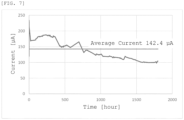
- FIGS. 2 and 3 and Tables 1 and 2 show the results.
- the zinc plate of the negative electrode after the above discharge test was subjected to powder X-ray diffraction.
- the results showed that a basic zinc carbonate Zn 5 (OH) 6 (CO 3 ) 2 was identified, while zinc oxide was not.
- the carbon dioxide fixation device of Example 2 was produced in the same manner as in Example 1, except that activated carbon (trade name: “Granular Activated Carbon for Gas Phase 4GG", manufactured by AS ONE Corporation) was used instead of granular manganese oxide (IV) (manufactured by Hayashi Pure Chemical Ind., Ltd.) crushed to 3 mm and powdered graphite (trade name: "FK-300", manufactured by Monami Co., Ltd.) as the positive electrode material.
- activated carbon trade name: "Granular Activated Carbon for Gas Phase 4GG", manufactured by AS ONE Corporation
- granular manganese oxide (IV) manufactured by Hayashi Pure Chemical Ind., Ltd. crushed to 3 mm
- powdered graphite trade name: "FK-300", manufactured by Monami Co., Ltd.
- the discharge continued for 1824 hours (76 days), and the average voltage during discharge was 1.614 V (maximum value: 1.630 V, minimum value: 1.578 V).
- the average current was 157.1 ⁇ A
- the pH of the electrolytic liquid at the end of discharge was 7.27
- the electric charge was 1031.5 C.
- the zinc plate of the carbon dioxide fixation device of Example 2 after the above discharge test was subjected to powder X-ray diffraction, and a basic zinc carbonate Zn 5 (OH) 6 (CO 3 ) 2 was detected. Therefore, in the carbon dioxide fixation device of Example 2, the energy was able to be extracted as a battery. In addition, it was confirmed that atmospheric carbon dioxide was absorbed into the above aqueous solution and fixed while acting as a component of the electrolytic liquid of the battery.
- the carbon dioxide fixation device of Comparative Example 1 was produced in the same manner as in Example 2, except that the above potassium hydroxide aqueous solution was used instead of the aqueous solution of Example 2.
- the discharge continued for 1800 hours (75 days), and the average voltage during discharge was 1.594 V (maximum value: 1.660 V, minimum value: 1.560 V).
- the average current was 142.4 ⁇ A
- the pH of the electrolytic liquid at the end of discharge was 7.08
- the electric charge was 900 C.
- the zinc plate of the carbon dioxide fixation device of Comparative Example 1 after the above discharge test was subjected to powder X-ray diffraction, and a basic zinc carbonate Zn 5 (OH) 6 (CO 3 ) 2 was detected. Therefore, in the carbon dioxide fixation device of Comparative Example 1, the energy was able to be extracted as a battery. In addition, it was confirmed that atmospheric carbon dioxide was absorbed into the above aqueous solution and fixed while acting as a component of the electrolytic liquid of the battery.
Landscapes
- Chemical & Material Sciences (AREA)
- Engineering & Computer Science (AREA)
- Chemical Kinetics & Catalysis (AREA)
- Organic Chemistry (AREA)
- Electrochemistry (AREA)
- General Chemical & Material Sciences (AREA)
- Metallurgy (AREA)
- Materials Engineering (AREA)
- Oil, Petroleum & Natural Gas (AREA)
- Analytical Chemistry (AREA)
- Inorganic Chemistry (AREA)
- Environmental & Geological Engineering (AREA)
- Health & Medical Sciences (AREA)
- Biomedical Technology (AREA)
- Manufacturing & Machinery (AREA)
- Hybrid Cells (AREA)
- Gas Separation By Absorption (AREA)
- Inorganic Compounds Of Heavy Metals (AREA)
- Treating Waste Gases (AREA)
Applications Claiming Priority (1)
| Application Number | Priority Date | Filing Date | Title |
|---|---|---|---|
| JP2023182152A JP7489679B1 (ja) | 2023-10-23 | 2023-10-23 | 二酸化炭素固定化装置及び電池 |
Publications (1)
| Publication Number | Publication Date |
|---|---|
| EP4545481A1 true EP4545481A1 (de) | 2025-04-30 |
Family
ID=91128504
Family Applications (1)
| Application Number | Title | Priority Date | Filing Date |
|---|---|---|---|
| EP24207757.6A Pending EP4545481A1 (de) | 2023-10-23 | 2024-10-21 | Kohlendioxidfixierungsvorrichtung und batterie |
Country Status (4)
| Country | Link |
|---|---|
| US (1) | US20250129490A1 (de) |
| EP (1) | EP4545481A1 (de) |
| JP (2) | JP7489679B1 (de) |
| CN (1) | CN119869191A (de) |
Citations (4)
| Publication number | Priority date | Publication date | Assignee | Title |
|---|---|---|---|---|
| JP2006240966A (ja) | 2005-03-07 | 2006-09-14 | Research Institute Of Innovative Technology For The Earth | 排ガス中の二酸化炭素を吸収及び脱離して回収する方法 |
| JP2010194378A (ja) | 2009-02-20 | 2010-09-09 | Toshiba Corp | 炭酸ガス吸収剤及び炭酸ガス回収方法 |
| KR20210044453A (ko) * | 2019-10-15 | 2021-04-23 | 울산과학기술원 | 이산화탄소 활용 시스템 |
| JP2023106331A (ja) * | 2022-01-20 | 2023-08-01 | 学校法人北里研究所 | 二酸化炭素の固定化方法及び固定化システム並びに炭酸塩の製造方法 |
Family Cites Families (3)
| Publication number | Priority date | Publication date | Assignee | Title |
|---|---|---|---|---|
| CN1924100B (zh) * | 2006-08-29 | 2010-12-29 | 华北电力大学 | 一种同时生产H2、FeCO3的热电联供方法及其装置 |
| JP2020069414A (ja) * | 2018-10-30 | 2020-05-07 | 東ソー株式会社 | 二酸化炭素の分離組成物 |
| JP6708764B1 (ja) * | 2019-01-28 | 2020-06-10 | 久保田 徹 | 機能水 |
-
2023
- 2023-10-23 JP JP2023182152A patent/JP7489679B1/ja active Active
-
2024
- 2024-05-02 JP JP2024074643A patent/JP2025071756A/ja active Pending
- 2024-10-21 US US18/921,103 patent/US20250129490A1/en active Pending
- 2024-10-21 EP EP24207757.6A patent/EP4545481A1/de active Pending
- 2024-10-22 CN CN202411479092.6A patent/CN119869191A/zh active Pending
Patent Citations (4)
| Publication number | Priority date | Publication date | Assignee | Title |
|---|---|---|---|---|
| JP2006240966A (ja) | 2005-03-07 | 2006-09-14 | Research Institute Of Innovative Technology For The Earth | 排ガス中の二酸化炭素を吸収及び脱離して回収する方法 |
| JP2010194378A (ja) | 2009-02-20 | 2010-09-09 | Toshiba Corp | 炭酸ガス吸収剤及び炭酸ガス回収方法 |
| KR20210044453A (ko) * | 2019-10-15 | 2021-04-23 | 울산과학기술원 | 이산화탄소 활용 시스템 |
| JP2023106331A (ja) * | 2022-01-20 | 2023-08-01 | 学校法人北里研究所 | 二酸化炭素の固定化方法及び固定化システム並びに炭酸塩の製造方法 |
Non-Patent Citations (2)
| Title |
|---|
| XIA QING ET AL: "Integration of CO 2 Capture and Electrochemical Conversion : Focus Review", ACS ENERGY LETTERS, vol. 8, no. 6, 1 June 2023 (2023-06-01), American Chemical Society, pages 2840 - 2857, XP093257770, ISSN: 2380-8195, Retrieved from the Internet <URL:https://pubs.acs.org/doi/pdf/10.1021/acsenergylett.3c00738> DOI: 10.1021/acsenergylett.3c00738 * |
| ZHENG ZHI ET AL: "Electrolyte additives toward practical aqueous zinc-ion batteries: recent advances and future challenges", NEXT ENERGY, vol. 1, no. 4, 17 October 2023 (2023-10-17), pages 100073, XP093257733, ISSN: 2949-821X, DOI: 10.1016/j.nxener.2023.100073 * |
Also Published As
| Publication number | Publication date |
|---|---|
| JP2025071756A (ja) | 2025-05-08 |
| CN119869191A (zh) | 2025-04-25 |
| JP2025071727A (ja) | 2025-05-08 |
| US20250129490A1 (en) | 2025-04-24 |
| JP7489679B1 (ja) | 2024-05-24 |
Similar Documents
| Publication | Publication Date | Title |
|---|---|---|
| Georgin et al. | Current status of advancement in remediation technologies for the toxic metal mercury in the environment: A critical review | |
| JP5659675B2 (ja) | 空気電池 | |
| CN101809693A (zh) | 高电压电解质 | |
| JP6028862B2 (ja) | レドックスフロー電池 | |
| US20190020033A1 (en) | Ionomer electrode manufacturing slurry | |
| JP5243824B2 (ja) | 白金コロイド溶液及びその製造方法 | |
| JP2018022669A (ja) | 使用済みリチウムイオン電池の電解質除去方法 | |
| US20250129490A1 (en) | Carbon dioxide fixation device and battery | |
| CN110898649A (zh) | 酸性气体吸收剂、酸性气体的除去方法及酸性气体除去装置 | |
| US20240356081A1 (en) | Electrolytic solution for zinc battery and zinc battery | |
| WO2023140336A1 (ja) | 二酸化炭素の固定化方法及び固定化システム並びに炭酸塩の製造方法 | |
| JP5662327B2 (ja) | 二酸化炭素吸収液 | |
| JP5478953B2 (ja) | 燃料電池の水処理装置 | |
| Divekar et al. | Kinetic equilibrium study of CO2 poisoning observed in anion exchange membranes when exposed to ambient air and varying levels of CO2 ppm | |
| Soysüren et al. | Polymer-enhanced ultrafiltration–electrodeionization hybrid system for the removal of boron | |
| US20210292194A1 (en) | Working medium and water treatment system | |
| KR20060070459A (ko) | 수소의 전기분해성 제조방법, 그의 관련 시스템 및 전해질 | |
| US20160351872A2 (en) | Separator | |
| US20170054177A1 (en) | Electrolyte composition, and sodium secondary battery employing the same | |
| JPWO2014030230A1 (ja) | 電力貯蔵電池 | |
| Morais et al. | Electrochemical systems for renewable energy conversion from salinity and proton gradients | |
| CN116190739A (zh) | 一种水系有机液流电池的正极电解液及其应用 | |
| WO2007078688A1 (en) | Method and apparatus for reducing water loss | |
| CN118161992A (zh) | 纳滤膜改性剂及其改性方法和应用 | |
| US12570556B2 (en) | Selective lithium extraction chemistry for geothermal brine |
Legal Events
| Date | Code | Title | Description |
|---|---|---|---|
| PUAI | Public reference made under article 153(3) epc to a published international application that has entered the european phase |
Free format text: ORIGINAL CODE: 0009012 |
|
| STAA | Information on the status of an ep patent application or granted ep patent |
Free format text: STATUS: THE APPLICATION HAS BEEN PUBLISHED |
|
| AK | Designated contracting states |
Kind code of ref document: A1 Designated state(s): AL AT BE BG CH CY CZ DE DK EE ES FI FR GB GR HR HU IE IS IT LI LT LU LV MC ME MK MT NL NO PL PT RO RS SE SI SK SM TR |
|
| REG | Reference to a national code |
Ref country code: HK Ref legal event code: DE Ref document number: 40121989 Country of ref document: HK |
|
| STAA | Information on the status of an ep patent application or granted ep patent |
Free format text: STATUS: REQUEST FOR EXAMINATION WAS MADE |
|
| 17P | Request for examination filed |
Effective date: 20251022 |