EP4538354A1 - Pi-feinstpulver als schmiermitteladditive - Google Patents
Pi-feinstpulver als schmiermitteladditive Download PDFInfo
- Publication number
- EP4538354A1 EP4538354A1 EP23203459.5A EP23203459A EP4538354A1 EP 4538354 A1 EP4538354 A1 EP 4538354A1 EP 23203459 A EP23203459 A EP 23203459A EP 4538354 A1 EP4538354 A1 EP 4538354A1
- Authority
- EP
- European Patent Office
- Prior art keywords
- lubricant
- particles
- particle size
- plastic
- oils
- Prior art date
- Legal status (The legal status is an assumption and is not a legal conclusion. Google has not performed a legal analysis and makes no representation as to the accuracy of the status listed.)
- Withdrawn
Links
Images

Classifications
-
- C—CHEMISTRY; METALLURGY
- C10—PETROLEUM, GAS OR COKE INDUSTRIES; TECHNICAL GASES CONTAINING CARBON MONOXIDE; FUELS; LUBRICANTS; PEAT
- C10M—LUBRICATING COMPOSITIONS; USE OF CHEMICAL SUBSTANCES EITHER ALONE OR AS LUBRICATING INGREDIENTS IN A LUBRICATING COMPOSITION
- C10M149/00—Lubricating compositions characterised by the additive being a macromolecular compound containing nitrogen
- C10M149/12—Macromolecular compounds obtained otherwise than by reactions only involving carbon-to-carbon unsaturated bonds
- C10M149/14—Macromolecular compounds obtained otherwise than by reactions only involving carbon-to-carbon unsaturated bonds a condensation reaction being involved
-
- C—CHEMISTRY; METALLURGY
- C10—PETROLEUM, GAS OR COKE INDUSTRIES; TECHNICAL GASES CONTAINING CARBON MONOXIDE; FUELS; LUBRICANTS; PEAT
- C10M—LUBRICATING COMPOSITIONS; USE OF CHEMICAL SUBSTANCES EITHER ALONE OR AS LUBRICATING INGREDIENTS IN A LUBRICATING COMPOSITION
- C10M149/00—Lubricating compositions characterised by the additive being a macromolecular compound containing nitrogen
- C10M149/12—Macromolecular compounds obtained otherwise than by reactions only involving carbon-to-carbon unsaturated bonds
- C10M149/14—Macromolecular compounds obtained otherwise than by reactions only involving carbon-to-carbon unsaturated bonds a condensation reaction being involved
- C10M149/18—Polyamides
-
- C—CHEMISTRY; METALLURGY
- C10—PETROLEUM, GAS OR COKE INDUSTRIES; TECHNICAL GASES CONTAINING CARBON MONOXIDE; FUELS; LUBRICANTS; PEAT
- C10M—LUBRICATING COMPOSITIONS; USE OF CHEMICAL SUBSTANCES EITHER ALONE OR AS LUBRICATING INGREDIENTS IN A LUBRICATING COMPOSITION
- C10M2203/00—Organic non-macromolecular hydrocarbon compounds and hydrocarbon fractions as ingredients in lubricant compositions
- C10M2203/10—Petroleum or coal fractions, e.g. tars, solvents, bitumen
- C10M2203/1006—Petroleum or coal fractions, e.g. tars, solvents, bitumen used as base material
-
- C—CHEMISTRY; METALLURGY
- C10—PETROLEUM, GAS OR COKE INDUSTRIES; TECHNICAL GASES CONTAINING CARBON MONOXIDE; FUELS; LUBRICANTS; PEAT
- C10M—LUBRICATING COMPOSITIONS; USE OF CHEMICAL SUBSTANCES EITHER ALONE OR AS LUBRICATING INGREDIENTS IN A LUBRICATING COMPOSITION
- C10M2207/00—Organic non-macromolecular hydrocarbon compounds containing hydrogen, carbon and oxygen as ingredients in lubricant compositions
- C10M2207/10—Carboxylix acids; Neutral salts thereof
- C10M2207/12—Carboxylix acids; Neutral salts thereof having carboxyl groups bound to acyclic or cycloaliphatic carbon atoms
- C10M2207/125—Carboxylix acids; Neutral salts thereof having carboxyl groups bound to acyclic or cycloaliphatic carbon atoms having hydrocarbon chains of eight up to twenty-nine carbon atoms, i.e. fatty acids
- C10M2207/126—Carboxylix acids; Neutral salts thereof having carboxyl groups bound to acyclic or cycloaliphatic carbon atoms having hydrocarbon chains of eight up to twenty-nine carbon atoms, i.e. fatty acids monocarboxylic
- C10M2207/1265—Carboxylix acids; Neutral salts thereof having carboxyl groups bound to acyclic or cycloaliphatic carbon atoms having hydrocarbon chains of eight up to twenty-nine carbon atoms, i.e. fatty acids monocarboxylic used as thickening agent
-
- C—CHEMISTRY; METALLURGY
- C10—PETROLEUM, GAS OR COKE INDUSTRIES; TECHNICAL GASES CONTAINING CARBON MONOXIDE; FUELS; LUBRICANTS; PEAT
- C10M—LUBRICATING COMPOSITIONS; USE OF CHEMICAL SUBSTANCES EITHER ALONE OR AS LUBRICATING INGREDIENTS IN A LUBRICATING COMPOSITION
- C10M2207/00—Organic non-macromolecular hydrocarbon compounds containing hydrogen, carbon and oxygen as ingredients in lubricant compositions
- C10M2207/40—Fatty vegetable or animal oils
- C10M2207/401—Fatty vegetable or animal oils used as base material
-
- C—CHEMISTRY; METALLURGY
- C10—PETROLEUM, GAS OR COKE INDUSTRIES; TECHNICAL GASES CONTAINING CARBON MONOXIDE; FUELS; LUBRICANTS; PEAT
- C10M—LUBRICATING COMPOSITIONS; USE OF CHEMICAL SUBSTANCES EITHER ALONE OR AS LUBRICATING INGREDIENTS IN A LUBRICATING COMPOSITION
- C10M2217/00—Organic macromolecular compounds containing nitrogen as ingredients in lubricant compositions
- C10M2217/04—Macromolecular compounds from nitrogen-containing monomers obtained otherwise than by reactions only involving carbon-to-carbon unsaturated bonds
- C10M2217/041—Macromolecular compounds from nitrogen-containing monomers obtained otherwise than by reactions only involving carbon-to-carbon unsaturated bonds involving a condensation reaction
-
- C—CHEMISTRY; METALLURGY
- C10—PETROLEUM, GAS OR COKE INDUSTRIES; TECHNICAL GASES CONTAINING CARBON MONOXIDE; FUELS; LUBRICANTS; PEAT
- C10M—LUBRICATING COMPOSITIONS; USE OF CHEMICAL SUBSTANCES EITHER ALONE OR AS LUBRICATING INGREDIENTS IN A LUBRICATING COMPOSITION
- C10M2217/00—Organic macromolecular compounds containing nitrogen as ingredients in lubricant compositions
- C10M2217/04—Macromolecular compounds from nitrogen-containing monomers obtained otherwise than by reactions only involving carbon-to-carbon unsaturated bonds
- C10M2217/044—Polyamides
-
- C—CHEMISTRY; METALLURGY
- C10—PETROLEUM, GAS OR COKE INDUSTRIES; TECHNICAL GASES CONTAINING CARBON MONOXIDE; FUELS; LUBRICANTS; PEAT
- C10N—INDEXING SCHEME ASSOCIATED WITH SUBCLASS C10M RELATING TO LUBRICATING COMPOSITIONS
- C10N2010/00—Metal present as such or in compounds
- C10N2010/02—Groups 1 or 11
-
- C—CHEMISTRY; METALLURGY
- C10—PETROLEUM, GAS OR COKE INDUSTRIES; TECHNICAL GASES CONTAINING CARBON MONOXIDE; FUELS; LUBRICANTS; PEAT
- C10N—INDEXING SCHEME ASSOCIATED WITH SUBCLASS C10M RELATING TO LUBRICATING COMPOSITIONS
- C10N2010/00—Metal present as such or in compounds
- C10N2010/04—Groups 2 or 12
-
- C—CHEMISTRY; METALLURGY
- C10—PETROLEUM, GAS OR COKE INDUSTRIES; TECHNICAL GASES CONTAINING CARBON MONOXIDE; FUELS; LUBRICANTS; PEAT
- C10N—INDEXING SCHEME ASSOCIATED WITH SUBCLASS C10M RELATING TO LUBRICATING COMPOSITIONS
- C10N2010/00—Metal present as such or in compounds
- C10N2010/06—Groups 3 or 13
-
- C—CHEMISTRY; METALLURGY
- C10—PETROLEUM, GAS OR COKE INDUSTRIES; TECHNICAL GASES CONTAINING CARBON MONOXIDE; FUELS; LUBRICANTS; PEAT
- C10N—INDEXING SCHEME ASSOCIATED WITH SUBCLASS C10M RELATING TO LUBRICATING COMPOSITIONS
- C10N2020/00—Specified physical or chemical properties or characteristics, i.e. function, of component of lubricating compositions
- C10N2020/01—Physico-chemical properties
- C10N2020/055—Particles related characteristics
- C10N2020/06—Particles of special shape or size
-
- C—CHEMISTRY; METALLURGY
- C10—PETROLEUM, GAS OR COKE INDUSTRIES; TECHNICAL GASES CONTAINING CARBON MONOXIDE; FUELS; LUBRICANTS; PEAT
- C10N—INDEXING SCHEME ASSOCIATED WITH SUBCLASS C10M RELATING TO LUBRICATING COMPOSITIONS
- C10N2030/00—Specified physical or chemical properties which is improved by the additive characterising the lubricating composition, e.g. multifunctional additives
- C10N2030/06—Oiliness; Film-strength; Anti-wear; Resistance to extreme pressure
-
- C—CHEMISTRY; METALLURGY
- C10—PETROLEUM, GAS OR COKE INDUSTRIES; TECHNICAL GASES CONTAINING CARBON MONOXIDE; FUELS; LUBRICANTS; PEAT
- C10N—INDEXING SCHEME ASSOCIATED WITH SUBCLASS C10M RELATING TO LUBRICATING COMPOSITIONS
- C10N2040/00—Specified use or application for which the lubricating composition is intended
- C10N2040/02—Bearings
-
- C—CHEMISTRY; METALLURGY
- C10—PETROLEUM, GAS OR COKE INDUSTRIES; TECHNICAL GASES CONTAINING CARBON MONOXIDE; FUELS; LUBRICANTS; PEAT
- C10N—INDEXING SCHEME ASSOCIATED WITH SUBCLASS C10M RELATING TO LUBRICATING COMPOSITIONS
- C10N2040/00—Specified use or application for which the lubricating composition is intended
- C10N2040/04—Oil-bath; Gear-boxes; Automatic transmissions; Traction drives
-
- C—CHEMISTRY; METALLURGY
- C10—PETROLEUM, GAS OR COKE INDUSTRIES; TECHNICAL GASES CONTAINING CARBON MONOXIDE; FUELS; LUBRICANTS; PEAT
- C10N—INDEXING SCHEME ASSOCIATED WITH SUBCLASS C10M RELATING TO LUBRICATING COMPOSITIONS
- C10N2050/00—Form in which the lubricant is applied to the material being lubricated
- C10N2050/015—Dispersions of solid lubricants
-
- C—CHEMISTRY; METALLURGY
- C10—PETROLEUM, GAS OR COKE INDUSTRIES; TECHNICAL GASES CONTAINING CARBON MONOXIDE; FUELS; LUBRICANTS; PEAT
- C10N—INDEXING SCHEME ASSOCIATED WITH SUBCLASS C10M RELATING TO LUBRICATING COMPOSITIONS
- C10N2050/00—Form in which the lubricant is applied to the material being lubricated
- C10N2050/10—Form in which the lubricant is applied to the material being lubricated semi-solid; greasy
Definitions
- the invention relates to the use of PI particles as lubricant additives, in particular lubricating grease additives.
- Lubricants especially lubricating greases and lubricating oils, are well known and widely used.
- Lubricating greases sometimes also referred to as “fats,” are solid to semi-liquid substances that are produced by dispersing a thickener in a liquid lubricant (base fluid).
- base fluid liquid lubricant
- Other additives that impart special properties may be included.
- the basic consistency of a lubricating grease is determined by the combination of base fluid and thickener.
- the base fluid is usually a base oil commonly used in the lubricant industry, such as mineral oil, synthetic oil, or vegetable oil.
- Alkali metal or alkaline earth metal soaps are used as thickeners.
- Non-soap-based thickeners such as bentonite (clay-based) or polyurea, are also known.
- Lubricants especially greases and oils, can be produced in batch processes or by continuous processes.
- Lubricants and their manufacturing processes are known from the state of the art and are commercially available in numerous compositions.
- the current lubricants are therefore unsatisfactory.
- the challenge is therefore to provide lubricants that offer advantages over the current lubricants.
- Suitable PI powders are known to the person skilled in the art, for example from the publication DE 10 2005 034 969 A1 .
- a lubricant containing PI particles (approximately 5 ⁇ m) has advantages over a conventional lubricant preparation in the plastic/metal system both at room temperature (RT) and at elevated temperature of 100°C.
- PI-modified lubricants according to the invention can be used in various applications.
- a primary application is in the automotive sector.
- Another area of application is the lubrication of machine elements (e.g., gears or bearings) in various industries.
- Ultrafine PI powders are produced directly during the precipitation process.
- the resulting ultrafine PI powders are dispersed in lubricating greases and lubricants using commercially available dispersing equipment, such as planetary mixers.
- PI is a thermally very stable polymer and exhibits significantly lower creep behavior than PTFE. Surprisingly, it was found that, although PI proves to be spherically stable under pressure and thus does not adapt to the friction geometry, the wear of the lubricated surfaces is reduced compared to the unfilled grease. Furthermore, it is assumed that PTFE could "grind down” over time under high pressure loads and become ineffective. Thus, a longer service life could be achieved with the invention.
- Figure 1 shows the particle size distribution in a first PI powder, measured by laser diffraction particle size analysis.
- the D 10 value is 1.3 ⁇ m
- the D 50 value is 4.3 ⁇ m
- the D 90 value is 9.8 ⁇ m
- the D 100 value is 23.0 ⁇ m.
- Figure 2 shows a device for performing an HFRR method.
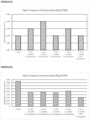
- Figures 3a and 3b each show the results of an HFRR procedure.
- the invention relates to a lubricant, preferably a lubricating grease, which contains PI particles with a particle size D 50 of up to 15 ⁇ m (ie a PI powder or ultrafine PI powder), formulated for lubrication between at least two surfaces.
- a lubricant preferably a lubricating grease, which contains PI particles with a particle size D 50 of up to 15 ⁇ m (ie a PI powder or ultrafine PI powder), formulated for lubrication between at least two surfaces.
- a lubricating grease can be understood as a lubricant, lubricant, or lubricating material. These terms can be used synonymously.
- a lubricating grease is a specific embodiment of a lubricant.
- the lubricant according to the invention is a lubricating grease.
- the lubricant or lubricating grease according to the invention is/are not to be regarded as lubricating oil.
- polyimides also include polyetherimides (PEI) and/or polyamideimides (PAI).
- PEI polyetherimides
- PAI polyamideimides
- At least two surfaces are adjacent to one another, i.e. they have a common contact surface.
- At least one of the surfaces is non-metallic.
- non-metallic preferably means that the corresponding surface contains at most 5 wt.% of metals, based on the total weight of the surface, and particularly preferably contains 0 wt.% of metals, based on the total weight of the surface.
- Preferred metals are steel, aluminum, zinc, copper, gold, silver, platinum and alloys containing these metals.
- At least one of the non-metallic surfaces contains or consists of plastic and at least one of the remaining surfaces contains or consists of metal; or at least two of the non-metallic surfaces contain or consist of plastic and at least two of the remaining surfaces contain or consist of metal; or all of the non-metallic surfaces contain or consist of plastic and all of the remaining surfaces contain or consist of metal; or exactly two surfaces are present, one of the surfaces containing or consisting of plastic and the other of the surfaces containing or consisting of metal.
- Suitable plastics include, for example, thermoplastics, thermosets, and elastomers known to those skilled in the art.
- at least one of the non-metallic surfaces contains or consists of polyetheretherketone (PEEK) and/or polyoxymethylenes (POM). or consists of, and/or UHMWPE (ultra-high molecular weight polyethylene, preferably with a molecular weight of 3.5 to 7.5 million g/mol), or consists of, and/or PA66 or consists of, and/or PA6G (cast polyamide 6), or consists of, and/or PA12G (cast polyamide 12), or consists of, and/or PPAs or consists of.
- PPAs are "semi-aromatic" nylon-type polyamides, i.e., either aromatic diamine or aromatic diacid.
- the particle size D50 is determined by laser diffraction particle size analysis.
- the particle size D50 is preferably determined according to ISO 13320:2020.
- One possible system for determining the particle size D50 is "LB (laser diffraction) wet, aqueous system with dispersant, ultrasound, Malvern Mastersizer 3000.”
- the lubricant used according to the invention usually contains a base oil which is preferably selected from the group consisting of mineral oils, synthetic oils, vegetable oils and any combination of two or more of these oils.
- the lubricant contains the base oil in an amount of about 65% to about 90% by weight, based on the total weight of the lubricant.
- base oil and “base oil” can be used synonymously.
- Suitable base oils are known to the person skilled in the art and are commercially available.
- base oils All known materials commonly used in the manufacture of lubricants can be used as base oils.
- base oils include mineral oils, lubricating oils of vegetable or animal origin, or synthetic oils.
- the latter include, in particular, hydrocarbon oils, including halogenated hydrocarbon oils, as well as non-hydrocarbon oils such as polyalkylene glycols, polyether oils, ester oils such as oils based on phosphoric acid esters, and silicone oils.
- Compound oils, such as mixtures of mineral oils and synthetic oils can also be used as base oils. Mixtures of different base oils can also be used.
- base oils examples include lubricating oils made from mineral oils, synthetic oils, and natural oils.
- Mineral lubricating oils include mineral oils that have been purified by a suitable combination of purification operations, such as vacuum distillation, solvent deasphalting, solvent extraction, hydrogenolysis, solvent dewaxing, sulfuric acid treatment, clay treatment, and/or hydrorefining.
- base oils are synthetic lubricating oils. These include hydrocarbon oils, aromatic oils, ester oils, and ether oils. include poly-alpha-olefins, such as n-paraffins, isoparaffins, polybutene, polyisobutylene, 1-decene oligomers, 1-decene/ethylene co-oligomers, and hydrogenation products thereof.
- the aromatic oils include alkylbenzenes, e.g., mono-, di-, or polyalkylbenzenes; and alkylnaphthalenes, such as mono-, di-, or polyalkylnaphthalenes.
- the ester oils include di-, tri-, or tetraesters of carboxylic acids, such as dibutyl sebacate, di-2-ethylhexyl sebacate, dioctyl adipate, diisodecyl adipate, ditridecyl adipate, ditridecyl glutarate, methyl acetyllicinolate, trioctyl trimesitate, tridecyl trimesitate, and tetraoctylpyrromelitate; or they include polyol esters of carboxylic acids, such as trimethylolpropane caprylate, trimethylolpropane pelargonate, pentaerythritol 2-ethylhexanoate, and pentaerythritol pelargonate; or they include complex esters, which are oligoesters between a polyhydroxy alcohol and a mixed mono- or dibasic fatty acid.
- the ether oils include polyglycols, such as polyethylene glycol, polypropylene glycol, polyethylene glycol monoether, and polypropylene glycol monoether; as well as phenyl ethers, such as alkylated diphenyl, triphenyl, and polyphenyl ethers of varying degrees of alkylation, or dialkyl ethers.
- phosphoric acid esters such as tricresyl phosphate, silicone oils, and perfluoroalkyl ether oils (fluoro oils), can be used as synthetic oils.
- Base oils used in the invention are not subject to any specific restrictions, and any base oil commonly used in lubricating oils and greases can be used.
- Base oils typically have a kinematic viscosity of 1 to 4000 mm 2 /s at 40°C (determined using a glass capillary tube viscometer).
- the base oils used in the present invention can be used either individually or in the form of a mixture thereof.
- the kinetic viscosity of the base oils to be used is usually adjusted to the preferred range specified above.
- Typical viscosity indices of base oils are in the range of 90-110 for mineral oils, 120-200 for synthetic hydrocarbon oils, 150-300 for polyalkylene glycols, 100-180 for ester oils, 190-500 for silicone oils and 50 to 400 for perfluoroalkyl ether oils (PFPE oils).
- PFPE oils perfluoroalkyl ether oils
- Petroleum fractions containing paraffinic, naphthenic and/or aromatic hydrocarbons are preferably used.
- Synthetic oils in particular poly-alphaolefins, polyalkylene glycols, polyalkylene glycol ethers, dialkyl ethers, acetals, natural ester oils, perfluoropolyether oils and silicone oils are also preferred.
- an ester oil especially a polyol ester oil
- the lubricant used according to the invention usually contains a thickener, in particular a soap thickener.
- thickener and “thickening agent” can be used synonymously.
- a soap thickener is a specific form of a thickener.
- Suitable thickeners are known to the person skilled in the art and are commercially available.
- thickeners examples include urea compounds, amide compounds, imide compounds, condensed aromatic hydrocarbons such as indanthrene dyes, fluoropolymers, polyolefins, metal soaps, metal complex soaps, and inorganic substances such as silica gels, bentonites, carbon blacks, graphites or aerosils.
- Preferred thickeners are metal soaps or metal complex soaps derived from carboxylic acids, sulfonic acids, phosphoric acids, with mono- or polyvalent metal cations, in particular with aluminum, alkali metal (preferably lithium), alkaline earth metal, titanium, and/or zirconium cations, or finely divided organic polymeric compounds, such as polytetrafluoroethylene, polyethylene or waxes.
- Other preferred soap thickeners are lithium 12-hydroxystearate, lithium soaps, lithium complex soaps, aluminum soaps, aluminum complex soaps, calcium soaps and calcium complex soaps.
- the soap thickener is particularly preferably a lithium soap or a lithium complex soap.
- the lubricant according to the invention preferably contains about 2% to about 20% by weight of a thickener or a mixture of thickeners, in each case based on the total weight of the lubricant.
- the lubricant according to the invention particularly preferably contains about 2% by weight to about 20% by weight of a lithium soap or a lithium complex soap or a combination thereof, in each case based on the total weight of the lubricant.
- the lubricant contains a thickener, in particular a soap thickener selected from the group consisting of lithium soaps, lithium complex soaps, aluminum soaps, aluminum complex soaps, calcium soaps, calcium complex soaps and any combinations thereof.
- a soap thickener selected from the group consisting of lithium soaps, lithium complex soaps, aluminum soaps, aluminum complex soaps, calcium soaps, calcium complex soaps and any combinations thereof.
- the lubricant contains a soap thickener which contains or consists of a lithium soap or a lithium complex soap.
- the lubricant used according to the invention usually contains an additive, in particular selected from the group consisting of antioxidants, metal deactivators, corrosion inhibitors, extreme pressure additives, wear protection additives, solid lubricants, adhesion additives, dyes and any combinations thereof.
- the lubricant contains the additive in an amount of more than 0 wt.% up to about 15 wt.%, based on the total weight of the lubricant.
- the lubricant according to the invention may contain one or more further optional additives.
- Suitable additional optional additives are known to the person skilled in the art and are commercially available.
- Useful additives include antioxidants such as amines, phenols, sulfur compounds, and zinc dithiophosphate; rust inhibitors such as petroleum sulfonates, dinonyl naphthalene sulfonate, and sorbitan esters; lubricity-enhancing additives such as fatty acids and vegetable oils; metal deactivators such as benzotriazole and sodium sulfite; extreme pressure additives such as chlorine-, sulfur-, or phosphorus-containing inorganic compounds, zinc dithiophosphate, and organomolybdenum compounds; viscosity index improvers such as polymethacrylate, polyisobutylene, and polystyrene; and solid lubricants such as polytetrafluoroethylene (“PTFE”), bentonites, tungsten disulfide, molybdenum disulfide, or other layered phosphates, oxides, sulfides, and sulfates.
- PTFE polytetrafluoro
- the lubricant according to the invention preferably contains up to about 15% by weight of one or more additives, each based on the total weight of the lubricant.
- the lubricant contains the PI particles in an amount of more than 0 wt.% up to about 15 wt.%, based on the total weight of the lubricant, and/or the PI particles have a particle size D 50 of up to 7 ⁇ m.
- the lubricant does not contain the PI particles in an amount of more than 0.8 wt% to 1.2 wt%, based on the total weight of the lubricant.
- the PI particles have a particle size D 10 of up to 3.0 ⁇ m, and/or a particle size D 50 of up to 6.0 ⁇ m, and/or a particle size D 90 of up to 13.0 ⁇ m and/or a particle size D 100 of up to 47.0 ⁇ m.
- the particle size D 10 , D 50 , D 90 and/or D 100 is determined by means of laser diffraction particle size analysis.
- the particle size D 10 , D 50 , D 90 and/or D 100 is determined in accordance with ISO 13320:2020.
- the lubricant contains tetrafluoroethylene and/or polytetrafluoroethylene (PTFE) in an amount of at most about 1.0 wt.%, in each case based on the total weight of the lubricant, particularly preferably in an amount of 0 wt.%, in each case based on the total weight of the lubricant.
- PTFE polytetrafluoroethylene
- the lubricant contains compounds that release toxic fluorine compounds at high temperatures generated by friction, in an amount of at most about 1.0 wt.%, based on the total weight of the lubricant, particularly preferably in an amount of 0 wt.%, based on the total weight of the lubricant.
- a temperature is considered high depends on the specific application of the lubricant and can be determined by the person skilled in the art.
- the determination of the friction coefficient is carried out by an MTM tribometer, preferably carried out according to the experimental part of the present application.
- the wear or wear coefficient is determined via the HFRR test, preferably carried out according to the experimental part of the present application.
- the vehicle is an automobile and/or the machine element is a gear or bearing.
- the invention relates to a use of PI particles having a particle size D 50 of up to 15 ⁇ m or up to 8 ⁇ m for improving tribological properties (in particular with regard to the coefficient of friction, wear and/or the required lubrication between mutually interacting surfaces in relative motion) of a lubricant according to the invention for lubricating between at least two surfaces, at least one of which is non-metallic.
- the number of (required) PI particles is determined by their proportion in the lubricant, preferably by their proportion in the lubricant in wt.%, based on the total weight of the lubricant.
- the lubricants according to the invention can be used in a wide variety of applications.
- the lubricant according to the invention can be a rolling bearing grease, high-temperature grease, plain bearing grease, lubricant for food applications, fitting grease, assembly grease, contact lubricant, fluid grease (especially for gears), high-speed grease, extreme pressure grease, grease for plastics lubrication, or long-life grease.
- the lubricants according to the invention are particularly suitable for use in or for vehicles, gears, bearings, constant velocity joints, rolling bearings and transmissions.
- a lithium grease manufactured by AXEL Christiernsson
- AXEL Christiernsson AXEL Christiernsson
- the lubricant was then drained and used for the tests.
- Figures 3a and 3b show, among other things, that PI particles have approximately the same effect on the friction coefficient as PTFE particles (5 ⁇ m), but without exhibiting their negative properties according to paragraph [0010].
- Figures 3a and 3b also show, among other things, that PI particles reduce the wear coefficient compared to empty grease.
Landscapes
- Chemical & Material Sciences (AREA)
- Chemical Kinetics & Catalysis (AREA)
- General Chemical & Material Sciences (AREA)
- Oil, Petroleum & Natural Gas (AREA)
- Organic Chemistry (AREA)
- Lubricants (AREA)
Abstract
Die Erfindung betrifft PI-Partikel als Schmiermitteladditive.
Description
- Die Erfindung betrifft die Verwendung von PI-Partikeln als Schmiermitteladditive, insbesondere Schmierfettadditive.
- Schmiermittel, insbesondere Schmierfette und Schmieröle, sind an sich bekannt und werden vielfach eingesetzt. Schmierfette, manchmal auch als "Fette" bezeichnet, sind feste bis halbflüssige Stoffe, die durch Dispersion eines Eindickungsmittels (bzw. Verdickers) in einem flüssigen Schmierstoff (Grundflüssigkeit) entstehen. Andere Zusatzstoffe (Additive), die besondere Eigenschaften verleihen, können enthalten sein. In diesem Zusammenhang kann z. B. auf die Veröffentlichung
DE 10 2012 215145 verwiesen werden. - Die grundlegende Konsistenz eines Schmierfetts wird von der Kombination aus Grundflüssigkeit und Eindickungsmittel bestimmt. Die Grundflüssigkeit ist in der Regel ein in der Schmierstoffindustrie übliches Grundöl, z.B. Mineralöl, Syntheseöl oder Pflanzenöl.
- Als Verdicker kommen z.B. Alkalimetall- oder Erdakalimetallseifen zum Einsatz. Außerdem sind nicht-seifenbasierte Verdicker bekannt, wie z.B. Bentonit (Tonbasis) oder Polyharnstoff.
- Schmiermittel, insbesondere Schmierfette und Schmieröle, können in Chargenverfahren oder durch kontinuierliche Prozesse hergestellt werden.
- Schmiermittel und deren Herstellungsverfahren sind aus dem Stand der Technik bekannt und in zahlreichen Zusammensetzungen kommerziell erhältlich.
- Die Schmierung von Maschinenelementen (z.B. Zahnräder oder Lager) stellt eine besondere Herausforderung hinsichtlich des Verschleißes und der Reibung dar. Deswegen werden in Schmierölen und -fetten unterschiedliche Additive eingesetzt um u.a. diese zwei Haupteigenschaften zu verbessern bzw. diesen gerecht zu werden. Der tribologische Kontakt wird zudem durch deren Reibpartner beeinflusst. Dies kann ein anorganischer (z.B. Stahl/Stahl), ein organischer (z.B. Kunststoff/Kunststoff) oder ein Mischkontakt (z.B. Stahl/Kunststoff) sein. Die eingesetzten Additive sind daher auf diese tribologische Paarung abzustimmen. Mit anderen Worten: Unterschiedliche tribologische Paarungen (Metall/Metall, Metall/Kunststoff, Kunststoff/Kunststoff, etc.) erfordern unterschiedliche Schmierstoffeigenschaften. Bisher sind nicht für alle Paarungen optimierte Schmierstoffe erhältlich.
- Die Veröffentlichung
JP 2002/363589 - Die Veröffentlichungen
GB 2192896 B US 4,787,993 undJP S63/172794 - PTFE ist fluorhaltig und wird in recht großen Mengen in Schmiermitteln (15-40%) eingesetzt. Möglicherweise entstehen bei hohen Temperaturen, erzeugt durch Reibung, giftige Fluorverbindungen. Ferner sind PFOA (Perfluoroctansäure) und andere zwischenzeitlich verbotene PFAS (per- und polyfluorierten Alkylverbindungen) Nebenbestandteile, die in PTFE in kleinen Mengen enthalten sind/waren. Es gibt mittlerweile PFOA-freies PTFE, aber auch ein Verbot von PTFE wird in der EU diskutiert (Bund für Umwelt und Naturschutz Deutschland e.V., "Praktisch, langlebig und giftig"; https://www.bmuv.de/faq/welche-pfas-wurden-bislang-verboten; https://echa.europa.eu/restrictions-under-consideration/-/substance-rev/72301/term; https://echa.europa.eu/documents/10162/f605d4b5-7c17-7414-8823-b49b9fd43aea). Über das tribologische Verhalten in Metall/Kunststoff- oder Kunststoff/Kunststoff-Reibpaarungen liegen keine Informationen vor.
- Die bekannten Schmiermittel sind somit nicht zufriedenstellend. Es besteht daher die Aufgabe, Schmiermittel bereitzustellen, welche Vorteile gegenüber den bekannten Schmiermitteln aufweisen.
- Diese Aufgabe wird durch den Gegenstand der Patentansprüche gelöst.
- Es wurde überraschend gefunden, dass mit PI-Pulvern, also Polyimid-Pulvern, einer bestimmten Korngröße (circa 5 µm) für vorgenannte Kontaktpaarungen eine signifikante Reduzierung des Verschleiß- und/oder des Reibungskoeffizienten erreicht werden kann.
- Beispiele für geeignete PI-Pulver sind dem Fachmann bekannt, beispielsweise aus der Veröffentlichung
DE 10 2005 034 969 A1 . - Vorzugsweise ist oder enthält das PI-Pulver ein Polyimid-Polyimid-Blockcopolymer, aufgebaut aus folgenden Struktureinheiten:

- wobei gilt: n, m = jeweils 2 bis 20, vorzugsweise 8 bis 15,
- und x = 1 bis 300, vorzugsweise 75 bis 200, besonders bevorzugt 100 bis 175,
- wobei ferner gilt:
- R1 und R3 haben, unabhängig voneinander, die folgenden Bedeutungen


- mit X =

- und R2 und R4 haben, unabhängig voneinander, folgenden Bedeutungen:


- R1 und R3 haben, unabhängig voneinander, die folgenden Bedeutungen
- mit Z= H, CH3, CF3, OCH3
- mit X =


- mit n = 1 bis 12, vorzugsweise 4 bis 9.
- mit X =
- In einer weiteren bevorzugten Ausführungsform enthält das PI-Pulver Polyimide mit endständigen Dicarbonsäureanhydridgruppen als Blöcke zur Herstellung von Blockcopolymeren, aufgebaut wie folgt:
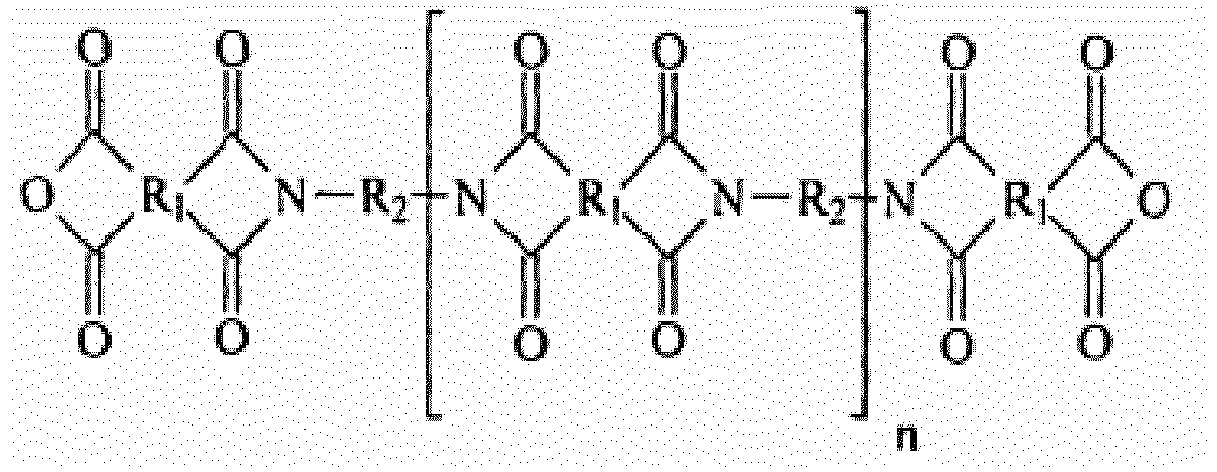
- In einer weiteren bevorzugten Ausführungsform enthält das PI-Pulver ein Polyimid-Polyamidcarbonsäure-Blockcopolymer, aufgebaut wie folgt:

- wobei gilt: n, m = jeweils 2 bis 20, vorzugsweise 8 bis 15, besonders bevorzugt 9 bis 12,
- und x = 1 bis 300, vorzugsweise 75 bis 200, besonders bevorzugt 100 bis 175,
- Es wurde überraschend gefunden, dass durch Zusatz geringer Mengen, insbesondere im Bereich von 0,5-2 Gew.-% PI-Feinstpulver mit einer durchschnittlichen Partikelgröße von circa 5 µm, die tribologischen Eigenschaften von Schmierstoffen bzw. -fetten verbessert werden können.
- Es wurde überraschend gefunden, dass ein PI-Partikel (circa 5 µm) enthaltendes Schmiermittel gegenüber einer konventionellen Schmiermittelzubereitung im System Kunststoff/Metall sowohl bei Raumtemperatur (RT) als auch bei erhöhter Temperatur von 100°C Vorteile aufweist.
- Erfindungsgemäße PI-modifizierte Schmierstoffe können in verschiedenen Anwendungsbereichen eingesetzt werden. Eine Hauptanwendung wird im Automobilbereich gesehen. Ein weiterer Anwendungsbereich ist die Schmierung von Maschinenelementen (z.B. Zahnräder oder Lager) in verschiedenen Industriezweigen.
- PI-Feinstpulver entstehen direkt während des Fällimidiserungsprozesses. Dispergierung der so hergestellten PI-Feinstpulvern in Schmierfetten und -mitteln erfolgt z.B. mittels handelsüblichen Dispergiergeräten, wie z.B. Planetenmischern.
- PI ist ein thermisch sehr stabiles Polymer und weist ein deutlich geringeres Kriechverhalten als PTFE auf. Es wurde überraschend gefunden, dass - obwohl PI sich unter Druck sphärisch als stabil erweist und sich damit nicht an die Reibungsgeometrie anpasst - die Abnutzung der geschmierten Flächen gegenüber dem nicht gefüllten Fett sinkt. Ferner ist davon auszugehen, dass sich PTFE über die Zeit bei hoher Druckbelastung "zermahlt" und wirkungslos werden könnte. Somit könnte erfindungsgemäß eine längere Standzeit erzielt werden.
-
Abbildung 1 zeigt die Partikelgrößenverteilung in einem ersten PI-Pulver, gemessen durch Laserbeugungs-Partikelgrößenanalyse. Der D10-Wert beträgt 1,3 µm, der D50-Wert beträgt 4,3 µm, der D90-Wert beträgt 9,8 µm und der D100-Wert beträgt 23,0 µm. -
Abbildung 2 zeigt eine Vorrichtung zum Durchführen eines HFRR-Verfahrens. - Abbildungen 3a und 3b zeigen jeweils die Ergebnisse eines HFRR-Verfahrens.
- Die Erfindung betrifft in einem ersten Aspekt ein Schmiermittel, vorzugsweise ein Schmierfett, welches PI-Partikel mit einer Partikelgröße D50 von bis zu 15 µm enthält (d.h. ein PI-Pulver oder PI-Feinstpulver), konfektioniert zum Schmieren zwischen mindestens zwei Oberflächen.
- Im Sinne der Erfindung kann ein Schmierfett als Schmiermittel, Schmierstoff oder Schmiermaterial aufgefasst werden. Die Begriffe können synonym verwendet werden.
- Im Sinne der Erfindung ist ein Schmierfett eine spezifische Ausführungsform eines Schmiermittels. In einer bevorzugten Ausführungsform ist das erfindungsgemäße Schmiermittel ein Schmierfett.
- In einer bevorzugten Ausführungsform ist/sind das erfindungsgemäße Schmiermittel oder Schmierfett nicht als Schmieröl aufzufassen.
- In einer bevorzugten Ausführungsform umfassen Polyimide (PI) auch Polyetherimide (PEI) und/oder Polyamidimide (PAI).
- In einer bevorzugten Ausführungsform grenzen mindestens zwei Oberflächen, besonders bevorzugt sämtliche Oberflächen, aneinander, d.h. sie weisen eine gemeinsame Kontaktfläche auf.
- In einer bevorzugten Ausführungsform ist mindestens eine der Oberflächen nicht-metallisch.
- Im Sinne der Erfindung bedeutet "nicht-metallisch" vorzugsweise, dass die entsprechende Oberfläche höchstens 5 Gew.-% an Metallen enthält, bezogen auf das Gesamtgewicht der Oberfläche, und besonders bevorzugt 0 Gew.-% an Metallen enthält, bezogen auf das Gesamtgewicht der Oberfläche.
- Bevorzugte Metalle sind Stahl, Aluminium, Zink, Kupfer, Gold, Silber, Platin sowie Legierungen enthaltend diese Metalle.
- In einer bevorzugten Ausführungsform enthält oder besteht mindestens eine der nicht-metallischen Oberflächen aus Kunststoff und mindestens eine der übrigen Oberflächen enthält oder besteht aus Metall; oder mindestens zwei der nicht-metallischen Oberflächen enthalten oder bestehen aus Kunststoff und mindestens zwei der übrigen Oberflächen enthalten oder bestehen aus Metall; oder sämtliche der nicht-metallischen Oberflächen enthalten oder bestehen aus Kunststoff und sämtliche der übrigen Oberflächen enthalten oder bestehen aus Metall; oder exakt zwei Oberflächen liegen vor, wobei eine der Oberflächen Kunststoff enthält oder daraus besteht und die andere der Oberflächen Metall enthält oder daraus besteht.
- Geeignete Kunststoffe sind zum Beispiel dem Fachmann bekannte Thermoplaste, Duroplaste und Elastomere. Vorzugsweise enthält mindestens eine der nicht-metallischen Oberflächen Polyetheretherketon (PEEK) oder besteht daraus, und/oder Polyoxymethylene (POM) oder besteht daraus, und/oder UHMWPE (Ultrahochmolekulargewichtiges Polyethylen, vorzugsweise mit einer Molekülmasse von 3,5 bis 7,5 Millionen g/mol) oder besteht daraus, und/oder PA66 oder besteht daraus, und/oder PA6G (Gusspolyamid 6) oder besteht daraus, und/oder PA12G (Gusspolyamid 12) oder besteht daraus, und/oder PPAs oder besteht daraus. PPAs sind "semiaromatische" Polyamide vom Nylon-Typ, also entweder aromatisches Diamin oder aromatische Disäure.
- In einer weiteren bevorzugten Ausführungsform wird die Partikelgröße D50 mittels Laserbeugungs-Partikelgrößenanalyse bestimmt. Vorzugsweise erfolgt die Bestimmung der Partikelgröße D50 gemäß ISO 13320:2020. Ein mögliches System zur Bestimmung der Partikelgröße D50 ist "LB (Laserbeugung) nass, wässriges System mit Dispergiermittel, Ultraschall, Malvern Mastersizer 3000".
- Das erfindungsgemäß verwendete Schmiermittel enthält üblicherweise ein Grundöl, welches bevorzugt ausgewählt ist aus der Gruppe bestehend aus Mineralölen, Syntheseölen, Pflanzenölen und beliebigen Kombinationen aus zwei oder mehr dieser Öle.
- In einer bevorzugten Ausführungsform enthält das Schmiermittel das Grundöl in einer Menge von etwa 65 Gew.-% bis etwa 90 Gew.-%, bezogen auf das Gesamtgewicht des Schmiermittels.
- Im Sinne der vorliegenden Erfindung können die Begriffe "Grundöl" und "Basisöl" synonym verwendet werden.
- Geeignete Grundöle sind dem Fachmann bekannt und kommerziell erhältlich.
- Als Grundöle können alle an sich dafür bekannten Materialien eingesetzt werden, die üblicherweise zur Herstellung von Schmiermitteln Verwendung finden. Beispiele dafür sind Mineralöle, Schmieröle pflanzlichen oder tierischen Ursprungs oder synthetische Öle. Zu den letzteren zählen insbesondere Kohlenwasserstofföle, einschließlich der halogenierten Kohlenwasserstofföle, sowie Nicht-Kohlenwasserstofföle, wie Polyalkylenglykole, Polyetheröle, Esteröle, wie Öle auf der Basis von Phosphorsäureestern, und Siliconöle. Als Grundöle lassen sich auch Compoundöle einsetzen, wie Gemische aus Mineralölen und Syntheseölen. Es können auch Gemische unterschiedlicher Grundöle eingesetzt werden.
- Beispiele für Grundöle sind Schmieröle aus Mineralölen, synthetischen Ölen und natürlichen Ölen. Die Mineral-Schmieröle umfassen Mineralöle, die durch eine geeignete Kombination von Reinigungsoperationen, wie Vakuumdestillation, Lösungsmittelentasphaltierung, Lösungsmittel-extraktion, Hydrogenolyse, Lösungsmittelentwachsung, Schwefelsäurebehandlung, Tonbehandlung und/oder Hydroraffinierung gereinigt worden sind.
- Weitere Beispiele für Grundöle sind synthetische Schmieröle. Diese umfassen Kohlenwasserstofföle, aromatische Öle, Esteröle und Etheröle. Die Kohlenwasserstofföle umfassen Poly-alpha-olefine, wie n-Paraffine, Isoparaffine, Polybuten, Polyisobutylen, 1-Decen-Oligomere, 1-Decen/Ethylen-Co-Oligomere und Hydrierungsprodukte davon. Die aromatischen Öle umfassen Alkylbenzole, z. B. Mono-, Di- oder Polyalkylbenzole; und Alkylnaphthaline, wie Mono-, Di- oder Polyalkyl-naphthaline. Die Esteröle umfassen Di-, Tri- oder Tetraester von Carbonsäuren, wie Dibutylsebacat, Di-2-ethylhexylsebacat, Dioctyladipat, Diisodecyladipat, Ditridecyladipat, Ditridecylglutarat, Methylacetyllicinolat, Trioctyltrimesitat, Tridecyltrimesitat und Tetraoctylpyrromelitat; oder sie umfassen Polyolester von Carbonsäuren, wie Trimethylolpropancaprylat, Trimethylolpropanpelargonat, Pentaerythrit-2-ethylhexanoat und Pentaerythritpelargonat, oder sie umfassen komplexe Ester, bei denen es sich um Oligoester zwischen einem Polyhydroxyalkohol und einer gemischten mono- oder dibasischen Fettsäure handelt. Die Etheröle umfassen Polyglykole, wie Polyethylenglykol, Polypropylenglykol, Polyethylenglykolmonoether und Polypropylenglykolmonoether; sowie Phenylether, wie alkylierte Diphenyl-, Triphenyl- und Polyphenylether unterschiedlichen Alkylierungsgrads, oder Dialkylether. Des weiteren sind Phosphorsäureester, wie Trikresylphosphat, Siliconöle und Perfluoralkyletheröle (Fluoröle) als synthetische Öle verwendbar.
- Die erfindungsgemäß eingesetzten Grundöle unterliegen keinen speziellen Beschränkungen und es ist jedes beliebige Grundöl verwendbar, wie es üblicherweise in Schmierölen und -fetten eingesetzt wird. Typischerweise besitzen Grundöle bei 40°C eine kinematische Viskosität von 1 bis 4000 mm2/s (bestimmt mit einem Glaskapillarrohr-Viskosimeter).
- Die erfindungsgemäß eingesetzten Grundöle können entweder einzeln oder in Form einer Mischung derselben verwendet werden. Die kinetische Viskosität der Grundöle, die verwendet werden sollen, wird üblicherweise auf den vorstehend angegeben bevorzugten Bereich eingestellt.
- Typische Viskositätsindizes von Grundölen liegen bei Mineralölen im Bereich von 90-110, bei synthetischen Kohlenwasserstoffölen im Bereich von 120-200, bei Polyalkylenglykolen im Bereich von 150-300, bei Esterölen im Bereich von 100-180, bei Silikonölen im Bereich von 190-500 und bei Perfluoralkyletherölen (PFPEÖlen) im Bereich von 50 bis 400.
- Bevorzugt eingesetzt werden Erdölfraktionen, die paraffinische, naphthenische und/oder aromatische Kohlenwasserstoffe enthalten.
- Ebenfalls bevorzugt eingesetzt werden synthetische Öle, insbesondere Poly-alphaolefine, Polyalkylenglykole, Polyalkylenglykolether, Dialkylether, Acetale, natürliche Esteröle, Perfluorpolyetheröle und Silikonöle.
- Für die Erzielung einer verlängerten Schmierlebensdauer ist es besonders bevorzugt, mindestens 10 Gew.-%, bezogen auf das Gewicht des Grundöls, eines Esteröls (insbesondere eines Polyolesteröls) zu verwenden.
- In weiteren bevorzugten Ausführungsform enthält das Grundöl mindestens eine Substanz gemäß mindestens einer der Gruppen I bis V gemäß der Klassifikation des American Petroleum Institute (API) von 1993:
- Gruppe I: "Grundsubstanzen, die weniger als 90 Prozent gesättigte Verbindungen und/oder mehr als 0,03 Prozent Schwefel enthalten und einen Viskositätsindex von mindestens 80 und maximal 120 haben".
- Gruppe II: "Grundsubstanz mit mindestens 90 Prozent gesättigten Verbindungen und maximal 0,03 Prozent Schwefel sowie einen Viskositätsindex von mindestens 80 und weniger als 120".
- Gruppe III: "Grundsubstanz mit mindestens 90 Prozent gesättigten Verbindungen und maximal 0,03 Prozent Schwefel sowie einen Viskositätsindex von mindestens 120".
- Gruppe IV: Synthetische Öle, hergestellt aus Polyalphaolefinen (PAO), mit einem Viskositätsindex im Bereich von 125 bis 200.
- Gruppe V: Jede andere Art von Grundöl, z.B. naphthenische Öle und Ester.
- Das erfindungsgemäß verwendete Schmiermittel enthält üblicherweise einen Verdicker, insbesondere einen Seifenverdicker.
- Im Sinne der vorliegenden Erfindung können die Begriffe "Verdickungsmittel" und "Eindickungsmittel" synonym verwendet werden. Ein Seifenverdicker ist eine spezifische Form eines Verdickungsmittels bzw. Eindickungsmittels.
- Geeignete Verdickungsmittel sind dem Fachmann bekannt und kommerziell erhältlich.
- Beispiele für geeignete Verdickungsmittel sind Harnstoffverbindungen, Amidverbindungen, Imidverbindungen, kondensierte aromatische Kohlenwasserstoffe, wie Indanthrenfarbstoffe, Fluorpolymere, Polyolefine, Metallseifen, Metallkomplexseifen, und anorganische Substanzen, wie Kieselgele, Bentonite, Ruße, Graphite oder Aerosile.
- Bevorzugte Verdickungsmittel sind Metallseifen oder Metallkomplexseifen abgeleitet von Carbonsäuren, Sulfonsäuren, Phosphorsäuren, mit ein- oder mehrwertigen Metallkationen, insbesondere mit Aluminium-, Alkalimetall- (bevorzugt Lithium), Erdalkalimetall-, Titan-, und/oder Zirkonkationen, oder feinteilige organische polymere Verbindungen, wie Polytetrafluorethylen, Polyethylen oder Wachse.
- Weitere bevorzugte Seifenverdicker sind Lithium-12-hydroxystearat, Lithium-Seifen, Lithium-Komplexseifen, Aluminium-Seifen, Aluminium-Komplexseifen, Calcium-Seifen und Calcium-Komplexseifen.
- Besonders bevorzugt ist der Seifenverdicker eine Lithium-Seife oder eine Lithium-Komplexseife.
- Das erfindungsgemäße Schmiermittel enthält bevorzugt etwa 2 Gew.-% bis etwa 20 Gew.-% eines Verdickungsmittels oder einer Mischung von Verdickungsmitteln, jeweils bezogen auf das Gesamtgewicht des Schmiermittels.
- Das erfindungsgemäße Schmiermittel enthält besonders bevorzugt etwa 2 Gew.-% bis etwa 20 Gew.-% einer Lithium-Seife oder einer Lithium-Komplexseife oder einer Kombination davon, jeweils bezogen auf das Gesamtgewicht des Schmiermittels.
- In einer weiteren bevorzugten Ausführungsform enthält das Schmiermittel einen Verdicker, insbesondere einen Seifenverdicker ausgewählt aus der Gruppe bestehend aus Lithium-Seifen, Lithium-Komplexseifen, Aluminium-Seifen, Aluminium-Komplexseifen, Calcium-Seifen, Calcium-Komplexseifen und beliebigen Kombinationen davon.
- In einer besonders bevorzugten Ausführungsform enthält das Schmiermittel einen Seifenverdicker, welcher eine Lithium-Seife oder eine Lithium-Komplexseife enthält oder daraus besteht.
- Das erfindungsgemäß verwendete Schmiermittel enthält üblicherweise ein Additiv, insbesondere ausgewählt aus der Gruppe bestehend aus Antioxidantien, Metalldesaktivatoren, Korrosionsinhibitoren, Extreme-Pressure-Additiven, Verschleißschutz-Zusätzen, Festschmierstoffen, Haftzusätzen, Farbstoffen und beliebigen Kombinationen davon.
- In einer weiteren bevorzugten Ausführungsform enthält das Schmiermittel das Additiv in einer Menge von mehr als 0 Gew.-% bis zu etwa 15 Gew.-%, bezogen auf das Gesamtgewicht des Schmiermittels.
- Das erfindungsgemäße Schmiermittel kann ein oder mehrere weitere optionale Additive enthalten.
- Geeignete weitere optionale Additive sind dem Fachmann bekannt und kommerziell erhältlich.
- Zu verwendbaren Additiven gehören Antioxidationsmittel, wie Amine, Phenole, Schwefelverbindungen und Zinkdithiophosphat; Rostschutzmittel, wie Petrolsulfonate, Dinonylnaphthalin-sulfonat und Sorbitanester; die Schlüpfrigkeit verbessernde Zusätze, wie Fettsäuren und pflanzliche Öle; Metalldesaktivatoren, wie Benzotriazol und Natriumsulfit; Extremdruckzusatzstoffe, wie Chlor, Schwefel oder Phosphor enthaltende anorganische Verbindungen, Zinkdithiophosphat und Organomolybdän-Verbindungen; Viskositätsindex-Verbesserungsmittel, wie Polymethacrylat, Polyisobutylen und Polystyrol; und Festschmierstoffe, wie Polytetrafluorethylen ("PTFE"), Bentonite, Wolframdisulfid, Molybdändisulfid, oder andere schichtförmig strukturierte Phosphate, Oxide, Sulfide und Sulfate.
- Das erfindungsgemäße Schmiermittel enthält bevorzugt bis zu etwa 15 Gew.-% eines oder mehrerer Additive, jeweils bezogen auf das Gesamtgewicht des Schmiermittels.
- In einer weiteren bevorzugten Ausführungsform enthält das Schmiermittel die PI-Partikel in einer Menge von mehr als 0 Gew.-% bis zu etwa 15 Gew.-%, bezogen auf das Gesamtgewicht des Schmiermittels, und/oder die PI-Partikel weisen eine Partikelgröße D50 von bis zu 7 µm auf.
- In einer weiteren bevorzugten Ausführungsform
- enthält das Schmiermittel die PI-Partikel in einer Menge von mehr als 0 Gew.-% oder von etwa 0,25 Gew.-%, jeweils bis zu etwa 14 Gew.-% oder bis zu etwa 13 Gew.-% oder bis zu etwa 12 Gew.-% oder bis zu etwa 11 Gew.-% oder bis zu etwa 10 Gew.-% oder bis zu etwa 9 Gew.-% oder bis zu etwa 8 Gew.-% oder bis zu etwa 7 Gew.-% oder bis zu etwa 6 Gew.-% oder bis zu etwa 5 Gew.-% oder bis zu etwa 4 Gew.-% oder bis zu etwa 3 Gew.-%, jeweils bezogen auf das Gesamtgewicht des Schmiermittels; und/oder
- weisen die PI-Partikel eine Partikelgröße D50 von bis zu 14 µm oder von bis zu 13 µm oder von bis zu 12 µm oder von bis zu 11 µm oder von bis zu 10 µm oder von bis zu 9 µm oder von bis zu 8 µm oder von bis zu 7 µm oder von bis zu 6 µm oder von bis zu 5,5 µm oder von bis zu 5,25 µm auf; und/oder
- weisen die PI-Partikel eine Partikelgröße D50 von mindestens 0,1 µm oder mindestens 0,5 µm oder mindestens 1,0 µm oder mindestens 1,5 µm oder mindestens 2,0 µm oder mindestens 2,5 µm oder mindestens 3,0 µm auf.
- In einer weiteren bevorzugten Ausführungsform
- weisen die PI-Partikel eine Partikelgröße D50 von bis zu 7 µm auf und das Schmiermittel enthält die PI-Partikel in einer Menge von mehr als 0 Gew.-% bis zu etwa 1 Gew.-%, bezogen auf das Gesamtgewicht des Schmiermittels; oder
- weisen die PI-Partikel eine Partikelgröße D50 von bis zu 12 µm auf und das Schmiermittel enthält die PI-Partikel in einer Menge von mehr als etwa 1 Gew.-% bis zu etwa 3 Gew.-%, bezogen auf das Gesamtgewicht des Schmiermittels.
- In einer weiteren bevorzugten Ausführungsform enthält das Schmiermittel die PI-Partikel nicht in einer Menge von mehr als 0,8 Gew.-% bis 1,2 Gew.-%, bezogen auf das Gesamtgewicht des Schmiermittels.
- In einer weiteren bevorzugten Ausführungsform weisen die PI-Partikel eine Partikelgröße D10 von bis zu 3,0 µm, und/oder eine Partikelgröße D50 von bis zu 6,0 µm, und/oder eine Partikelgröße D90 von bis zu 13,0 µm und/oder eine Partikelgröße D100 von bis zu 47,0 µm auf.
- In einer weiteren bevorzugten Ausführungsform wird die Partikelgröße D10, D50, D90 und/oder D100 jeweils mittels Laserbeugungs-Partikelgrößenanalyse bestimmt.
- In einer weiteren bevorzugten Ausführungsform wird die Partikelgröße D10, D50, D90 und/oder D100 jeweils gemäß ISO 13320:2020 bestimmt.
- In einer weiteren bevorzugten Ausführungsform enthält das Schmiermittel Tetrafluorethylen und/oder Polytetrafluorethylen (PTFE) in einer Menge von höchstens etwa 1,0 Gew.-%, jeweils bezogen auf das Gesamtgewicht des Schmiermittels, besonders bevorzugt in einer Menge von 0 Gew.-%, jeweils bezogen auf das Gesamtgewicht des Schmiermittels.
- In einer weiteren bevorzugten Ausführungsform enthält das Schmiermittel Verbindungen, welche bei hohen Temperaturen, erzeugt durch Reibung, giftige Fluorverbindungen freisetzen, in einer Menge von höchstens etwa 1,0 Gew.-%, bezogen auf das Gesamtgewicht des Schmiermittels, besonders bevorzugt in einer Menge von 0 Gew.-%, bezogen auf das Gesamtgewicht des Schmiermittels. Wann eine Temperatur als hoch gilt, richtet sich nach der konkreten Anwendungssituation des Schmiermittels und ist für den Fachmann ermittelbar.
- In einer weiteren bevorzugten Ausführungsform erfolgt die Bestimmung des Reibungskoeffizienten durch ein MTM-Tribometer, vorzugsweise durchgeführt gemäß dem experimentellen Teil der vorliegenden Anmeldung.
- Entsprechende Verfahren sind dem Fachmann bekannt, beispielsweise aus den Veröffentlichungen
DE 10 2012 215145 undWO 2012/123192 A1 . - In einer weiteren bevorzugten Ausführungsform erfolgt die Bestimmung des Verschleißes bzw. des Verschleißkoeffizienten über den HFRR-Test, vorzugsweise durchgeführt gemäß dem experimentellen Teil der vorliegenden Anmeldung.
- Entsprechende Verfahren sind dem Fachmann bekannt, beispielsweise aus der Veröffentlichung
WO 2012/123192 A1 . - Die Erfindung betrifft in einem weiteren Aspekt eine Verwendung eines erfindungsgemäßen Schmiermittels zum Schmieren zwischen mindestens zwei Oberflächen, von denen mindestens eine nicht-metallisch ist, und welche sich in oder an einem Fahrzeug und/oder in oder an einem Maschinenelement befinden.
- In einer bevorzugten Ausführungsform ist das Fahrzeug ein Automobil und/oder das Maschinenelement ist ein Zahnrad oder Lager.
- Die Erfindung betrifft in einem weiteren Aspekt eine Verwendung von PI-Partikeln mit einer Partikelgröße D50 von bis zu 15 µm oder bis zu 8 µm zur Verbesserung tribologischer Eigenschaften (insbesondere im Hinblick auf den Reibungskoeffizienten, den Verschleiß und/oder die erforderliche Schmierung zwischen aufeinander einwirkenden, in Relativbewegung befindlichen Oberflächen) eines erfindungsgemäßen Schmiermittels für das Schmieren zwischen mindestens zwei Oberflächen, von denen mindestens eine nicht-metallisch ist.
- In einer bevorzugten Ausführungsform wird die Anzahl der (benötigten) PI-Partikel über deren Anteil im Schmiermittel bestimmt, vorzugsweise über deren Anteil im Schmiermittel in Gew.-%, bezogen auf das Gesamtgewicht des Schmiermittels.
- Die erfindungsgemäßen Schmiermittel lassen sich in unterschiedlichsten Anwendungen einsetzen. Zum Beispiel kann das erfindungsgemäße Schmiermittel ein Wälzlagerfett, Hochtemperaturfett, Gleitlagerfett, Schmiermittel für Lebensmittelanwendungen, Armaturenfett, Montagefett, Kontaktschmiermittel, Fließfett (insbesondere für Getriebe), Hochgeschwindigkeitsfett, Hochdruckfett, Fett für die Kunststoffschmierung oder Langzeitfett sein.
- Die erfindungsgemäßen Schmiermittel sind besonders geeignet zur Verwendung in oder für Fahrzeuge, Zahnräder, Lager, Gleichlaufgelenkwellen, Wälzlager und Getriebe.
- Die nachfolgenden Beispiele dienen der Erläuterung der Erfindung, sind jedoch nicht einschränkend auszulegen.
- Für die Herstellung der erfindungsgemäßen Schmiermittel wurde ein Lithiumfett (Hersteller AXEL Christiernsson) mit dem jeweiligen Anteil der PI-Partikel bei 2000 U/min für 5 min ohne weitere Additive gemischt. Anschließend wurde das Schmiermittel entleert und für die Tests herangezogen.
- Abbildungen 3a und 3b zeigen u.a., dass PI-Partikel in etwa dieselbe Wirkung auf den Reibungskoeffizienten haben wie PTFE-Partikel (5 µm), jedoch ohne deren negative Eigenschaften gemäß Absatz [0010] aufzuweisen.
- Abbildungen 3a und 3b zeigen ferner u.a., dass PI-Partikel im Vergleich zu einem Leerfett eine Reduzierung des Verschleißkoeffizienten bewirken.
- Die Ermittlung der Ergebnisse des HFRR-Verfahrens gemäß Abbildungen 3a und 3b erfolgte mittels der Vorrichtung gemäß
Abbildung 2 und bei folgenden Parametern: Temperatur: 80 °C; Kontakt-Druck (GPa): 0.9; "Stroke" (mm): 15; Frequenz (Hz): 15; Test-Zylinder: AISI 52100; und Test-Scheibe: AISI 52100.
Claims (15)
- Ein Schmiermittel, welches PI-Partikel mit einer Partikelgröße D50 von bis zu 15 µm enthält.
- Das Schmiermittel gemäß Anspruch 1, wobei die Partikelgröße D50 mittels Laserbeugungs-Partikelgrößenanalyse bestimmt wird, vorzugsweise gemäß ISO 13320:2020.
- Das Schmiermittel gemäß Anspruch 1 oder 2, wobei das Schmiermittel einen Verdicker enthält, vorzugsweise einen Seifenverdicker, vorzugsweise ausgewählt aus der Gruppe bestehend aus Lithium-Seifen, Lithium-Komplexseifen, Aluminium-Seifen, Aluminium-Komplexseifen, Calcium-Seifen, Calcium-Komplexseifen und Kombinationen davon.
- Das Schmiermittel gemäß Anspruch 3, wobei das Schmiermittel einen Seifenverdicker enthält, welcher eine Lithium-Seife oder eine Lithium-Komplexseife enthält oder daraus besteht.
- Das Schmiermittel gemäß Anspruch 3 oder 4, wobei das Schmiermittel den Verdicker, vorzugsweise Seifenverdicker, in einer Menge von etwa 2 Gew.-% bis etwa 20 Gew.-% enthält, bezogen auf das Gesamtgewicht des Schmiermittels.
- Das Schmiermittel gemäß einem oder mehreren der vorherigen Ansprüche, wobei das Schmiermittel ein Grundöl enthält, vorzugsweise ausgewählt aus der Gruppe bestehend aus Mineralölen, Syntheseölen, Pflanzenölen und Kombinationen davon.
- Das Schmiermittel gemäß Anspruch 6, wobei das Schmiermittel das Grundöl in einer Menge von etwa 65 Gew.-% bis etwa 90 Gew.-% enthält, bezogen auf das Gesamtgewicht des Schmiermittels.
- Das Schmiermittel gemäß einem oder mehreren der vorherigen Ansprüche, wobei das Schmiermittel ein Additiv enthält, vorzugsweise ausgewählt aus der Gruppe bestehend aus Antioxidantien, Metalldesaktivatoren, Korrosionsinhibitoren, Extreme-Pressure-Additiven, Verschleißschutz-Zusätzen, Festschmierstoffen, Haftzusätzen, Farbstoffen und Kombinationen davon.
- Das Schmiermittel gemäß Anspruch 8, wobei das Schmiermittel das Additiv in einer Menge von mehr als 0 Gew.-% bis zu etwa 15 Gew.-% enthält, bezogen auf das Gesamtgewicht des Schmiermittels.
- Das Schmiermittel gemäß einem oder mehreren der vorherigen Ansprüche, wobei- die PI-Partikel eine Partikelgröße D50 von 5±4 µm, 5±3 µm, 5t2 µm oder 5t1 µm aufweisen;
oder- das Schmiermittel die PI-Partikel in einer Menge von mehr als 0 Gew.-% bis zu etwa 15 Gew.-% enthält, bezogen auf das Gesamtgewicht des Schmiermittels, und/oder die Pl-Partikel eine Partikelgröße D50 von bis zu 12 µm aufweisen;
oder- das Schmiermittel die PI-Partikel in einer Menge von mehr als 0 Gew.-% bis zu etwa 7 Gew.-% enthält, bezogen auf das Gesamtgewicht des Schmiermittels, und/oder die Pl-Partikel eine Partikelgröße D50 von 2 µm bis zu 8 µm aufweisen;
oder- das Schmiermittel die PI-Partikel in einer Menge von etwa 0,25 Gew.-% bis zu etwa 3.5 Gew.-% enthält, bezogen auf das Gesamtgewicht des Schmiermittels, und/oder die Pl-Partikel eine Partikelgröße D50 von 3 µm bis zu 6 µm aufweisen;
oder- das Schmiermittel ein Schmierfett ist, welches vorzugsweise einen Seifenverdicker enthält, welcher eine Lithium-Seife oder eine Lithium-Komplexseife enthält oder daraus besteht, und/oder das Schmierfett die PI-Partikel vorzugsweise in einer Menge von etwa 0,25 Gew.-% bis zu etwa 3,0 Gew.-% enthält, bezogen auf das Gesamtgewicht des Schmierfetts, und/oder die PI-Partikel vorzugsweise eine Partikelgröße D50 von 3 µm bis zu 5,5 µm aufweisen. - Verwendung eines Schmiermittels, definiert wie in einem oder mehreren der vorherigen Ansprüche, zum Schmieren zwischen mindestens zwei Oberflächen, welche sich vorzugsweise in oder an einem Fahrzeug und/oder in oder an einem Maschinenelement befinden.
- Die Verwendung gemäß Anspruch 11, wobei das Fahrzeug ein Automobil ist und/oder das Maschinenelement ein Zahnrad oder Lager ist.
- Die Verwendung gemäß Anspruch 11 oder 12, wobei- mindestens eine Oberfläche nicht-metallisch ist; oder- sämtliche Oberflächen Metall enthalten oder daraus bestehen; oder- sämtliche Oberflächen Kunststoff enthalten oder daraus bestehen; oder- sämtliche Oberflächen nicht-metallisch sind und Kunststoff enthalten oder daraus bestehen; oder- sämtliche Oberflächen Metall enthalten oder daraus bestehen und keinen Kunststoff enthalten; oder- mindestens eine der Oberflächen nicht-metallisch ist und Kunststoff enthält oder daraus besteht und mindestens eine der übrigen Oberflächen Metall enthält oder daraus besteht und keinen Kunststoff enthält; oder- mindestens zwei der Oberflächen nicht-metallisch sind und Kunststoff enthalten oder daraus bestehen und mindestens zwei der übrigen Oberflächen Metall enthalten oder daraus bestehen und keinen Kunststoff enthalten; oder- exakt zwei Oberflächen vorliegen, wobei eine der Oberflächen Kunststoff enthält oder daraus besteht und die andere der Oberflächen Metall enthält oder daraus besteht.
- Die Verwendung gemäß Anspruch 11, 12 oder 13, wobei der Kunststoff jeweils Polyetheretherketon (PEEK) enthält oder daraus besteht, und/oder Polyoxymethylene (POM) enthält oder daraus besteht, und/oder UHMWPE (Ultrahochmolekulargewichtiges Polyethylen) enthält oder daraus besteht, und/oder PA66 enthält oder daraus besteht, und/oder PA6G (Gusspolyamid 6) enthält oder daraus besteht, und/oder PA12G (Gusspolyamid 12) enthält oder daraus besteht, und/oder PPAs enthält oder daraus besteht.
- Verwendung von PI-Partikeln mit einer Partikelgröße D50 von bis zu 15 µm, vorzugsweise bis zu 8 µm oder bis zu 6 µm, zur Verbesserung tribologischer Eigenschaften eines Schmiermittels, definiert wie in einem oder mehreren der Ansprüche 1 bis 10, für das Schmieren zwischen mindestens zwei Oberflächen, definiert wie in einem oder mehreren der Ansprüche 11 bis 14.
Priority Applications (2)
| Application Number | Priority Date | Filing Date | Title |
|---|---|---|---|
| EP23203459.5A EP4538354A1 (de) | 2023-10-13 | 2023-10-13 | Pi-feinstpulver als schmiermitteladditive |
| PCT/EP2024/078661 WO2025078584A1 (de) | 2023-10-13 | 2024-10-11 | Pi-feinstpulver als schmiermitteladditive |
Applications Claiming Priority (1)
| Application Number | Priority Date | Filing Date | Title |
|---|---|---|---|
| EP23203459.5A EP4538354A1 (de) | 2023-10-13 | 2023-10-13 | Pi-feinstpulver als schmiermitteladditive |
Publications (1)
| Publication Number | Publication Date |
|---|---|
| EP4538354A1 true EP4538354A1 (de) | 2025-04-16 |
Family
ID=88412185
Family Applications (1)
| Application Number | Title | Priority Date | Filing Date |
|---|---|---|---|
| EP23203459.5A Withdrawn EP4538354A1 (de) | 2023-10-13 | 2023-10-13 | Pi-feinstpulver als schmiermitteladditive |
Country Status (2)
| Country | Link |
|---|---|
| EP (1) | EP4538354A1 (de) |
| WO (1) | WO2025078584A1 (de) |
Citations (10)
| Publication number | Priority date | Publication date | Assignee | Title |
|---|---|---|---|---|
| JPS63172794A (ja) | 1987-01-09 | 1988-07-16 | Amuni Kk | 潤滑剤 |
| US4787993A (en) | 1986-07-17 | 1988-11-29 | Mitsui Toatsu Chemicals, Incorporated | Lubricant |
| GB2192896B (en) | 1986-07-17 | 1990-07-04 | Mitsui Toatsu Chemicals | Lubricant |
| JP2002363589A (ja) | 2001-06-12 | 2002-12-18 | Koyo Seiko Co Ltd | 潤滑グリース組成物 |
| US20030008782A1 (en) * | 2001-07-02 | 2003-01-09 | Satoshi Endou | High-lubricity grease and modifier for lubricating grease |
| DE102005034969A1 (de) | 2005-07-22 | 2007-02-08 | Inspec Fibres Gmbh | Verfahren zur Herstellung eines Blockcopolymeren aus Polyimiden und Verwendung des Blockcopolymeren zur Herstellung von Pulvern und Formteilen |
| WO2012123192A1 (de) | 2011-03-14 | 2012-09-20 | Evonik Rohmax Additives Gmbh | Estergruppen-umfassende copolymere und deren verwendung in schmiermitteln |
| US20130289204A1 (en) * | 2011-01-14 | 2013-10-31 | Chikao Kanazawa | Polyimide powder, polyimide solution, and method for producing polyimide powder |
| DE102012215145A1 (de) | 2012-08-27 | 2014-05-15 | Evonik Industries Ag | Verwendung von blockcopolymeren Polyalkylenoxiden als Reibminderer in synthetischen Schmierstoffen |
| DE102021130746A1 (de) * | 2021-11-24 | 2023-05-25 | Klüber Lubrication München Se & Co. Kg | Schmierfett |
Family Cites Families (1)
| Publication number | Priority date | Publication date | Assignee | Title |
|---|---|---|---|---|
| JP7298916B2 (ja) * | 2020-02-07 | 2023-06-27 | 株式会社ニッペコ | グリース組成物 |
-
2023
- 2023-10-13 EP EP23203459.5A patent/EP4538354A1/de not_active Withdrawn
-
2024
- 2024-10-11 WO PCT/EP2024/078661 patent/WO2025078584A1/de active Pending
Patent Citations (10)
| Publication number | Priority date | Publication date | Assignee | Title |
|---|---|---|---|---|
| US4787993A (en) | 1986-07-17 | 1988-11-29 | Mitsui Toatsu Chemicals, Incorporated | Lubricant |
| GB2192896B (en) | 1986-07-17 | 1990-07-04 | Mitsui Toatsu Chemicals | Lubricant |
| JPS63172794A (ja) | 1987-01-09 | 1988-07-16 | Amuni Kk | 潤滑剤 |
| JP2002363589A (ja) | 2001-06-12 | 2002-12-18 | Koyo Seiko Co Ltd | 潤滑グリース組成物 |
| US20030008782A1 (en) * | 2001-07-02 | 2003-01-09 | Satoshi Endou | High-lubricity grease and modifier for lubricating grease |
| DE102005034969A1 (de) | 2005-07-22 | 2007-02-08 | Inspec Fibres Gmbh | Verfahren zur Herstellung eines Blockcopolymeren aus Polyimiden und Verwendung des Blockcopolymeren zur Herstellung von Pulvern und Formteilen |
| US20130289204A1 (en) * | 2011-01-14 | 2013-10-31 | Chikao Kanazawa | Polyimide powder, polyimide solution, and method for producing polyimide powder |
| WO2012123192A1 (de) | 2011-03-14 | 2012-09-20 | Evonik Rohmax Additives Gmbh | Estergruppen-umfassende copolymere und deren verwendung in schmiermitteln |
| DE102012215145A1 (de) | 2012-08-27 | 2014-05-15 | Evonik Industries Ag | Verwendung von blockcopolymeren Polyalkylenoxiden als Reibminderer in synthetischen Schmierstoffen |
| DE102021130746A1 (de) * | 2021-11-24 | 2023-05-25 | Klüber Lubrication München Se & Co. Kg | Schmierfett |
Also Published As
| Publication number | Publication date |
|---|---|
| WO2025078584A1 (de) | 2025-04-17 |
Similar Documents
| Publication | Publication Date | Title |
|---|---|---|
| EP2164935B1 (de) | Schmierfettzusammensetzung | |
| JP5411454B2 (ja) | 潤滑剤組成物 | |
| EP3372659B1 (de) | Hochtemperaturschmierstoffe | |
| DE112009005504B4 (de) | Verwendung einer fluorhaltigen Diamid-Verbindung als Rostschutzzusatz einer Schmiermittelzusammensetzung | |
| EP2239313B1 (de) | Verwendung einer Schmiermittelzusammensetzung in mechanischen Elementen | |
| DE112017003959B4 (de) | Schmierfettzusammensetzung und deren Verwendung | |
| DE112019006379B4 (de) | Schmierfettzusammensetzungen und deren verwendungen | |
| KR20110031482A (ko) | 그리스 조성물 | |
| KR102370955B1 (ko) | 낮은 마찰계수와 높은 마모 방지 기능을 갖춘 하이브리드 그리스 | |
| EP2824167A1 (de) | Schmierfettzusammensetzung | |
| DE112009000808T5 (de) | Schmiermittelzusammensetzung und direkt wirkende Vorrichtungen mit der Schmiermittelzusammensetzung | |
| JP4464495B2 (ja) | 樹脂用グリース組成物 | |
| Puhan | Lubricant and lubricant additives | |
| DE102021130746A1 (de) | Schmierfett | |
| DE102004021812A1 (de) | Schmierfett, Verfahren zu dessen Herstellung und dessen Verwendung | |
| EP4186966A1 (de) | Hochtemperaturschmierfett | |
| EP3971268B1 (de) | Prüfverfahren für eine schmierölzusammensetzung und herstellungsverfahren für diese schmierölzusammensetzung | |
| JP5390849B2 (ja) | ポリアミドまたはポリアセタール樹脂製ギヤ潤滑用ウレアグリース組成物。 | |
| WO2025078584A1 (de) | Pi-feinstpulver als schmiermitteladditive | |
| Silverstein et al. | Additives for grease applications | |
| EP4538355A1 (de) | Paek-feinstpulver als schmiermitteladditive | |
| Rawat et al. | Exploration of bio-greases for tribological applications | |
| RU2673067C2 (ru) | Улучшенная стабильность качения в смазочной композиции | |
| WO2023094321A1 (de) | Hochtemperaturschmierfett | |
| JP5476076B2 (ja) | 樹脂潤滑用グリース組成物 |
Legal Events
| Date | Code | Title | Description |
|---|---|---|---|
| PUAI | Public reference made under article 153(3) epc to a published international application that has entered the european phase |
Free format text: ORIGINAL CODE: 0009012 |
|
| STAA | Information on the status of an ep patent application or granted ep patent |
Free format text: STATUS: THE APPLICATION HAS BEEN PUBLISHED |
|
| AK | Designated contracting states |
Kind code of ref document: A1 Designated state(s): AL AT BE BG CH CY CZ DE DK EE ES FI FR GB GR HR HU IE IS IT LI LT LU LV MC ME MK MT NL NO PL PT RO RS SE SI SK SM TR |
|
| STAA | Information on the status of an ep patent application or granted ep patent |
Free format text: STATUS: THE APPLICATION IS DEEMED TO BE WITHDRAWN |
|
| 18D | Application deemed to be withdrawn |
Effective date: 20251017 |