EP4538232A1 - Perowskitverbindung und fotoelektrisches umwandlungselement - Google Patents
Perowskitverbindung und fotoelektrisches umwandlungselement Download PDFInfo
- Publication number
- EP4538232A1 EP4538232A1 EP23819838.6A EP23819838A EP4538232A1 EP 4538232 A1 EP4538232 A1 EP 4538232A1 EP 23819838 A EP23819838 A EP 23819838A EP 4538232 A1 EP4538232 A1 EP 4538232A1
- Authority
- EP
- European Patent Office
- Prior art keywords
- perovskite
- layer
- photoelectric conversion
- type compound
- conversion element
- Prior art date
- Legal status (The legal status is an assumption and is not a legal conclusion. Google has not performed a legal analysis and makes no representation as to the accuracy of the status listed.)
- Pending
Links
Images


Classifications
-
- C—CHEMISTRY; METALLURGY
- C01—INORGANIC CHEMISTRY
- C01G—COMPOUNDS CONTAINING METALS NOT COVERED BY SUBCLASSES C01D OR C01F
- C01G21/00—Compounds of lead
- C01G21/006—Compounds containing lead, with or without oxygen or hydrogen, and containing two or more other elements
-
- C—CHEMISTRY; METALLURGY
- C03—GLASS; MINERAL OR SLAG WOOL
- C03C—CHEMICAL COMPOSITION OF GLASSES, GLAZES OR VITREOUS ENAMELS; SURFACE TREATMENT OF GLASS; SURFACE TREATMENT OF FIBRES OR FILAMENTS MADE FROM GLASS, MINERALS OR SLAGS; JOINING GLASS TO GLASS OR OTHER MATERIALS
- C03C17/00—Surface treatment of glass, not in the form of fibres or filaments, by coating
- C03C17/22—Surface treatment of glass, not in the form of fibres or filaments, by coating with other inorganic material
-
- C—CHEMISTRY; METALLURGY
- C01—INORGANIC CHEMISTRY
- C01P—INDEXING SCHEME RELATING TO STRUCTURAL AND PHYSICAL ASPECTS OF SOLID INORGANIC COMPOUNDS
- C01P2002/00—Crystal-structural characteristics
- C01P2002/30—Three-dimensional structures
- C01P2002/34—Three-dimensional structures perovskite-type (ABO3)
-
- Y—GENERAL TAGGING OF NEW TECHNOLOGICAL DEVELOPMENTS; GENERAL TAGGING OF CROSS-SECTIONAL TECHNOLOGIES SPANNING OVER SEVERAL SECTIONS OF THE IPC; TECHNICAL SUBJECTS COVERED BY FORMER USPC CROSS-REFERENCE ART COLLECTIONS [XRACs] AND DIGESTS
- Y02—TECHNOLOGIES OR APPLICATIONS FOR MITIGATION OR ADAPTATION AGAINST CLIMATE CHANGE
- Y02E—REDUCTION OF GREENHOUSE GAS [GHG] EMISSIONS, RELATED TO ENERGY GENERATION, TRANSMISSION OR DISTRIBUTION
- Y02E10/00—Energy generation through renewable energy sources
- Y02E10/50—Photovoltaic [PV] energy
- Y02E10/549—Organic PV cells
Definitions
- the present invention relates to a perovskite-type compound and a photoelectric conversion element.
- the perovskite solar cell has a so-called p-i-n type laminated structure in which a hole transport layer made of a p-type semiconductor, a perovskite layer, and an electron transport layer made of an n-type semiconductor are arranged in this order from the light-receiving side.
- the perovskite layer contains a compound having a perovskite type crystal structure.
- the compound having the perovskite-type crystal structure is represented by the general formula A-B-X 3 .
- Non Patent Literature 1 Non Patent Literature 2, and Non Patent Literature 3
- translucency means that 10% or more of light having any wavelength of 200 nm to 2000 nm is transmitted.
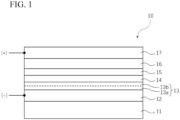
- the first conductive layer 12, the electron transport layer 13, the light absorbing layer 14, the hole transport layer 15, the second conductive layer 16, and the third conductive layer 17 are described later.
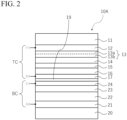
- Fig. 2 is a thickness direction cross-sectional view illustrating another example of the photoelectric conversion element according to the embodiment.
- the photoelectric conversion element shown in Fig. 2 may be a perovskite-type solar cell including a light absorbing layer that comprises a compound having a perovskite structure.
- the photoelectric conversion element illustrated in Fig. 2 is a so-called multi-junction photoelectric conversion element.
- a multi-junction photoelectric conversion element includes a plurality of photoelectric conversion cells laminated on each other. That is, the multi-junction photoelectric conversion element may include a plurality of light absorbing layers.
- the photoelectric conversion element 10A has a laminated structure in which a top cell TC and a bottom cell BC are laminated on each other.
- light enters the photoelectric conversion element 10A from the top cell TC side (upper side in the drawing).
- the top cell TC side upper side in the drawing.
- the incident light light on a short wavelength side is photoelectrically converted by the top cell TC.
- the bottom cell BC light on the long wavelength side that has passed through the top cell TC is photoelectrically converted by the bottom cell BC.
- the bottom cell BC may include a substrate 20, a first electrode layer 21, a photoelectric conversion layer (light absorbing layer) 22, a buffer layer 23, and a second electrode layer 24.
- the first electrode layer 21 may be provided on the substrate 20.
- the photoelectric conversion layer 22 may be provided on the first electrode layer 21.
- the buffer layer 23 may be provided on the photoelectric conversion layer 22.
- the second electrode layer 24 may be provided on the buffer layer 23.
- the bottom cell BC for example, a configuration of a known photoelectric conversion element (for example, a solar cell) such as a compound photoelectric conversion element such as a CZTS photoelectric conversion element, a CIGS photoelectric conversion element, a CdTe photoelectric conversion element, or a GaAs photoelectric conversion element, or a silicon photoelectric conversion element or an organic photoelectric conversion element can be applied. Therefore, any explanation regarding the configuration of the bottom cell BC is omitted.
- the buffer layer 23 of the bottom cell BC may be omitted.
- the photoelectric conversion element 10A illustrated in Fig. 2 has a so-called four-terminal tandem structure including four terminals including two positive electrodes and two negative electrodes.
- the photoelectric conversion element 10A may have an intermediate layer 19 between the top cell TC and the bottom cell BC.
- the intermediate layer 19 may be a transparent insulating layer.
- the photoelectric conversion element may have a two-terminal tandem structure.
- the photoelectric conversion element may not include at least the second conductive layer 16, the third conductive layer 17, and the second electrode layer 24 illustrated in Fig. 2 .
- the first conductive layer 12, the electron transport layer 13, the light absorbing layer 14, the hole transport layer 15, the second conductive layer 16, and the third conductive layer 17 described above are described in detail.
- the first conductive layer 12 may be a layer that acts as an anode of the photoelectric conversion element.
- Examples of the material of the first conductive layer 12 include: conductive transparent materials such as copper iodide (CuI), indium tin oxide (ITO), tin oxide (SnO 2 ), fluorine doped tin oxide (FTO), aluminum doped zinc oxide (AZO), indium zinc oxide (IZO), and gallium doped zinc oxide (GZO); metal sodium; a sodium-potassium alloy; metal lithium; metal magnesium; metal aluminum; a magnesium-silver mixture; a magnesium-indium mixture; an aluminum-lithium alloy; an aluminum-aluminum oxide (Al/Al 2 O 3 ) mixture; and an aluminum-lithium fluoride (Al/LiF) mixture.
- the above materials may be used singly or as a mixture of two or more kinds thereof.
- the electron transport layer 13 has a function of transporting electrons generated by photoexcitation of the light absorbing layer 14 to the first conductive layer 12. Therefore, the electron transport layer 13 is preferably formed of a material having characteristics in which electrons generated in the light absorbing layer 14 can easily move to the electron transport layer 13 and in which electrons of the electron transport layer 13 can easily move to the first conductive layer 12.
- the dense layer 13a has a denser structure than the porous layer 13b. In other words, the number of voids in the dense layer 13a is smaller than the number of voids in the porous layer 13b.
- the dense layer 13a is a layer in which a solution or the like used for forming the light absorbing layer 14 hardly infiltrates.
- the dense layer 13a has a function of preventing contact between the first conductive layer 12 and the second conductive layer 16 and has a function of preventing contact between the first conductive layer 12 and the hole transport layer 15, the contacts causing a decrease in photovoltaic power. Therefore, reduction in photovoltaic power can be suppressed by the dense layer 13a.
- the porous layer 13b can be formed by the following method. First, for example, a coating liquid containing titanium oxide particles is prepared, and the coating liquid is coated onto the dense layer 13a by a film forming method such as a spin coating method, a screen printing method, a spray pyrolysis method, or an aerosol deposition method. Thereafter, the porous layer 13b containing titanium oxide is formed by firing. Although not particularly limited, when the porous layer 13b is formed of titanium oxide, anatase type titanium oxide particles are preferably used.
- the hole transport layer 15 is positioned between the light absorbing layer 14 and the second conductive layer 16.
- the hole transport layer 15 has a function of capturing holes generated in the light absorbing layer 14 and has a function of moving the holes to the second conductive layer 16 as a cathode.
- the hole transport layer 15 may contain a matrix component composed of, for example, 2,2',7,7'-tetrakis-(N,N-di-p-methoxyphenylamine)9,9'-spirobifluorene (Spiro-OMeTAD) or poly[bis(4-phenyl) (2,4,6-trimethylphenyl)amine] (PTAA), or may contain an organic low molecular weight thin film that preferentially captures holes such as [2-(9Hcarbazol-9-yl)ethyl] phosphonic acid (2PACz).
- a passivate layer (not illustrated) made of a metal oxide or an organic thin film may be provided between the light absorbing layer 14 and the hole transport layer 15.
- the thickness of the hole transport layer 15 is preferably in a range of 1 nm to 500 nm, and more preferably in a range of 1 nm or more and 130 nm or less.
- the hole transport layer 15 may be an amorphous layer.
- the hole transport layer 15 may contain an organic binder resin or a plasticizer, and the like.
- the hole transport layer 15 can be formed by, for example, the following manufacturing method. First, a compound of said matrix component is dissolved in an organic solvent to prepare a coating liquid, and the coating liquid is coated onto the light absorbing layer 14 (or the passivate layer). Thereafter, the organic solvent is removed to form the hole transport layer 15.
- the organic solvent used for forming the hole transport layer 15 is preferably a solvent that does not disturb the crystal structure of the organic-inorganic hybrid compound because the organic solvent is coated onto the light absorbing layer 14. Examples of the solvent include chlorobenzene, toluene and isopropanol, and so on.
- the coating method of the coating liquid is not particularly limited, and examples thereof include a spin coating method, a screen printing method, and a dip coating method.
- the second conductive layer 16 is a transparent conductive layer having translucency, and acts as an cathode of the photoelectric conversion element.
- the second conductive layer 16 is formed on the hole transport layer 15 and is in contact with the hole transport layer 15.
- any conductive transparent material can be used.
- the material of the second conductive layer 16 is preferably a metal oxide containing, for example, any of indium, zinc and tin.
- Examples of the material of the second conductive layer 16 include conductive transparent materials and conductive transparent polymers such as copper iodide (CuI), indium tin oxide (ITO), tin oxide (SnO 2 ), fluorine-doped tin oxide (FTO), aluminum-doped zinc oxide (AZO), indium zinc oxide (IZO), and gallium-doped zinc oxide (GZO).
- a buffer layer (not illustrated) may be formed between the second conductive layer 16 and the hole transport layer 15.
- the buffer layer may be formed of, for example, molybdenum oxide or the like.
- the third conductive layer 17 is an auxiliary electrode layer laminated on the second conductive layer 16.
- the third conductive layer 17 has a function of reducing electric resistance of a whole cathode.
- the third conductive layer 17 may be a transparent electrode or a collecting electrode such as a metal grid.
- the material thereof may be the same as the material of the second conductive layer 16 or different from the material of the second conductive layer 16.
- Examples of the material of the third conductive layer 17 include: metal materials such as gold, silver, copper, aluminum and nickel; conductive transparent materials; and conductive transparent polymers such as copper iodide (CuI), indium tin oxide (ITO), tin oxide (SnO 2 ), fluorine-doped tin oxide (FTO), aluminum-doped zinc oxide (AZO), indium zinc oxide (IZO), and gallium-doped zinc oxide (GZO).
- CuI copper iodide
- ITO indium tin oxide
- SnO 2 tin oxide
- FTO fluorine-doped tin oxide
- AZO aluminum-doped zinc oxide
- IZO indium zinc oxide
- GZO gallium-doped zinc oxide
- the third conductive layer 17 can be produced, for example, by forming a film of an anode material on the second conductive layer 16 by a method such as vapor deposition or printing.
- the third conductive layer 17 may be formed in a mesh shape or a grid shape using a vapor deposition mask or the like.
- the light absorbing layer 14 contains a compound having a perovskite structure (perovskite-type compound), and has a function of generating electrons and holes by absorption of incident light.
- perovskite-type compound a compound having a perovskite structure
- the light absorbing layer 14 low-energy electrons in a substance constituting the light absorbing layer are photoexcited by incident light, and higher-energy electrons and holes are generated. Electrons generated by photoexcitation move to the electron transport layer 13, and holes generated by photoexcitation move to the hole transport layer 15.
- the perovskite-type compound is represented by the composition formula A-B-X 3 .
- the element A is disposed at each vertex of the unit cell.
- the element B is disposed near each body center of the unit cell.
- the element X is disposed near each face center of the unit cell.
- x in the composition formula is a real number of 0 or more and 1 or less.
- y in the composition formula is a real number of 0 or more and 3 or less. A more specific range of x and y is described later. Since the perovskite-type compound having the present composition formula does not contain organic molecules, the perovskite-type compound tends to have high heat resistance.
- x and y in the composition formula are as follows. In a range where "0.0 ⁇ x ⁇ 0.0125" is satisfied, "1.8 ⁇ y ⁇ 3.0" is preferably satisfied, and "2.0 ⁇ y ⁇ 3.0" is more preferably satisfied.
- y is preferably 0.8 or more, more preferably 0.9 or more, and still preferably 1.0 or more. In a range where "0.5 ⁇ x ⁇ 0.7" is satisfied, y is preferably 2.6 or less, more preferably 2.4 or less, still preferably 2.2 or less, and still more preferably 1.8 or less. Furthermore, in a range where "0.5 ⁇ x ⁇ 0.7" is satisfied, y may be 1.5 or less.
- y is preferably 0.8 or more, more preferably 0.9 or more, and still preferably 1.0 or more. In a range where "0.7 ⁇ x ⁇ 0.8" is satisfied, y is preferably 1.7 or less, more preferably 1.6 or less, and still preferably 1.5 or less.
- Each line drawn in the diagram means a location where the energy gap (Eg) of the perovskite-type compound corresponds to 1.4 eV, 1.5 eV, 1.6 eV, 1.7 eV, 1.8 eV, 1.9 eV, 2.0 eV, 2.1 eV or 2.2 eV, respectively.
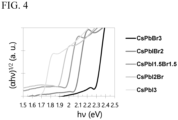
- the energy gap illustrated in Fig. 3 can be calculated by using an absorption coefficient ⁇ measured by ultraviolet-visible spectroscopy.
- the absorption coefficient ⁇ can be measured and calculated by ultraviolet-visible spectroscopy, for example, by a method in accordance with JISK0115:2020.
- the absorption coefficient ⁇ actually measured by ultraviolet-visible spectroscopy may vary depending on the frequency ⁇ of light.
- the value of "(h ⁇ ) 1/2 " increases little by little or is maintained almost unchanged as the energy hv of the incident light increases, and draws an ascending curve that sharply increases in the vicinity of the band gap.
- the value of the energy hv at the intersection of the tangent passing through the inflection point of the steep rising curve and the baseline of the Tauc plot is the band gap Eg.
- the baseline can be determined by a known method.
- the baseline may be defined by an approximate straight line obtained by a least squares method from a plurality of measurement points on a sufficiently lower energy side than a sharp rising curve in the vicinity of the band gap.
- the perovskite-type compound was produced by the following procedure.
- a CsPbI 3 solution at a concentration of 0.4M (molar), a CsPbBr 3 solution at the same concentration, a CsSnI 3 solution at the same concentration, and a CsSnBr 3 solution at the same concentration were prepared.
- the solvent is dimethyl sulfoxide (DMSO).
- the solution coated onto the glass substrate was sintered to form a thin film of the perovskite-type compound.
- the sintering was performed at a temperature of 300°C for 2 minutes.
- Table 1 thin films of a large number of perovskite-type compounds in which the combination of x and y in the composition formula was changed were produced.
- the thin film of the perovskite-type compound was placed on the heater together with the glass substrate, and was heated at 150°C for 500 hours under a nitrogen atmosphere. Then, an X-ray diffraction experiment was performed on the thin film of the perovskite-type compound after heating, and the position of the X-ray diffraction peak of the perovskite-type compound was measured.
- Fig. 5 is a graph showing results of X-ray diffraction experiments for some perovskite-type compounds.
- the result of the X-ray diffraction experiment on the perovskite-type compound before heating is indicated by a broken line.
- the result of the X-ray diffraction experiment on the perovskite-type compound after heating is shown by a solid line. From the graph shown in Fig. 5 , it can be seen that in some compounds, an X-ray diffraction peak derived from a perovskite structure in which a diffraction angle 2 ⁇ is observed at 13 to 16° from a state before heating is not observed.
- the corresponding composition (corresponding to specific values of x and y) is very unstable, and the perovskite structure cannot be maintained at room temperature.
- the position of the X-ray diffraction peak derived from the perovskite structure in which the diffraction angle 2 ⁇ is found to be 13 to 16° varies before and after heating. This is considered to be because the perovskite compound having the corresponding composition was decomposed or phase-separated by heating.
- Table 1 below is a plot showing experimental results of heat resistance in some perovskite-type compounds.
- the evaluation of the heat resistance is clearly indicated for each composition of the perovskite-type compound (values of x and y).
- the evaluation of "good” in heat resistance is defined by the fact that a perovskite structure is confirmed before heating in the X-ray diffraction peak described above, and the deviation ( ⁇ 2 ⁇ ) of peak positions before heating and after heating is 0.05° or less.
- the evaluation of "poor” in heat resistance is defined by the fact that a perovskite structure is not confirmed in the X-ray diffraction peak before heating, or the deviation ( ⁇ 2 ⁇ ) of the peak position of the X-ray diffraction peak before and after heating is larger than 0.05°.
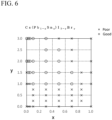
- Fig. 6 is a plot showing experimental results of heat resistance in some perovskite-type compounds.
- Fig. 6 is a diagram showing the experimental results shown in Table 1.
- the horizontal axis represents the value of x in the composition formula
- the vertical axis represents the value of y in the composition formula.
- the evaluation "good” in the heat resistance is indicated by " ⁇ ”
- the evaluation "poor” in the heat resistance is indicated by " ⁇ ”.
- the region having high heat resistance extends from a region where x is approximately middle and y is middle to a region where x is small and y is large.
- y is preferably a desired value or more and 3 or less.
- the value of y is also preferably middle. As x is larger than a middle value, the range of values that y can take is narrower.
- a perovskite-type compound having higher heat resistance can be obtained more reliably, when x and y preferably belong to any of the following ranges (1) to (5).
Landscapes
- Chemical & Material Sciences (AREA)
- Organic Chemistry (AREA)
- Life Sciences & Earth Sciences (AREA)
- Engineering & Computer Science (AREA)
- Chemical Kinetics & Catalysis (AREA)
- General Chemical & Material Sciences (AREA)
- Geochemistry & Mineralogy (AREA)
- Materials Engineering (AREA)
- Inorganic Chemistry (AREA)
- Photovoltaic Devices (AREA)
Applications Claiming Priority (2)
| Application Number | Priority Date | Filing Date | Title |
|---|---|---|---|
| JP2022092813A JP2023179899A (ja) | 2022-06-08 | 2022-06-08 | ペロブスカイト型化合物及び光電変換素子 |
| PCT/JP2023/020980 WO2023238858A1 (ja) | 2022-06-08 | 2023-06-06 | ペロブスカイト型化合物及び光電変換素子 |
Publications (1)
| Publication Number | Publication Date |
|---|---|
| EP4538232A1 true EP4538232A1 (de) | 2025-04-16 |
Family
ID=89118357
Family Applications (1)
| Application Number | Title | Priority Date | Filing Date |
|---|---|---|---|
| EP23819838.6A Pending EP4538232A1 (de) | 2022-06-08 | 2023-06-06 | Perowskitverbindung und fotoelektrisches umwandlungselement |
Country Status (4)
| Country | Link |
|---|---|
| EP (1) | EP4538232A1 (de) |
| JP (1) | JP2023179899A (de) |
| CN (1) | CN119255966A (de) |
| WO (1) | WO2023238858A1 (de) |
Family Cites Families (6)
| Publication number | Priority date | Publication date | Assignee | Title |
|---|---|---|---|---|
| WO2021021911A1 (en) * | 2019-07-31 | 2021-02-04 | The Board Of Regents Of The University Of Oklahoma | Dichalcogenide composite electrode and solar cell and uses |
| KR102303840B1 (ko) * | 2019-08-26 | 2021-09-17 | 중앙대학교 산학협력단 | 무기물 페로브스카이트 화합물, 이의 제조방법, 및 이를 포함하는 태양전지 |
| JP2021082726A (ja) * | 2019-11-20 | 2021-05-27 | 国立大学法人電気通信大学 | 量子ドット、これを用いた光デバイス、及び量子ドットの作製方法 |
| CN111253942A (zh) * | 2020-03-04 | 2020-06-09 | 长春工业大学 | 具有钙钛矿结构的上转换纳米发光材料及其制备方法与应用 |
| KR102486603B1 (ko) * | 2020-09-04 | 2023-01-10 | 경희대학교 산학협력단 | 페로브스카이트-고분자 복합체 입자의 제조 방법 및 이를 통하여 제조된 페로브스카이트-고분자 복합체 입자 |
| JP7590757B2 (ja) | 2020-12-11 | 2024-11-27 | ユニパルス株式会社 | 測距回路、測距装置、測定装置及び倣い制御装置 |
-
2022
- 2022-06-08 JP JP2022092813A patent/JP2023179899A/ja active Pending
-
2023
- 2023-06-06 EP EP23819838.6A patent/EP4538232A1/de active Pending
- 2023-06-06 CN CN202380045626.1A patent/CN119255966A/zh active Pending
- 2023-06-06 WO PCT/JP2023/020980 patent/WO2023238858A1/ja not_active Ceased
Also Published As
| Publication number | Publication date |
|---|---|
| WO2023238858A1 (ja) | 2023-12-14 |
| JP2023179899A (ja) | 2023-12-20 |
| CN119255966A (zh) | 2025-01-03 |
Similar Documents
| Publication | Publication Date | Title |
|---|---|---|
| Yang et al. | Highly efficient perovskite solar modules by scalable fabrication and interconnection optimization | |
| EP3381070B1 (de) | Perowskit mit gemischten kationen | |
| EP3347502B1 (de) | Bildung von bleifreiem perowskitfilm | |
| Mali et al. | pin/nip type planar hybrid structure of highly efficient perovskite solar cells towards improved air stability: synthetic strategies and the role of p-type hole transport layer (HTL) and n-type electron transport layer (ETL) metal oxides | |
| Niu et al. | Oxygen doping in nickel oxide for highly efficient planar perovskite solar cells | |
| Liu et al. | Reduced open-circuit voltage loss for highly efficient low-bandgap perovskite solar cells via suppression of silver diffusion | |
| KR20210107529A (ko) | 멕신-변형 하이브리드 광변환기 | |
| Lyu et al. | Counter electrodes for perovskite solar cells: materials, interfaces and device stability | |
| JP7429881B2 (ja) | 太陽電池 | |
| US20250048822A1 (en) | Photoelectric conversion element and manufacturing method of photoelectric conversion element | |
| US20140060639A1 (en) | Copper oxide core/shell nanocrystals for use in photovoltaic cells | |
| US12520652B2 (en) | Multilayer back contacts for perovskite photovoltaic devices | |
| Chang et al. | Preparation and characterization of MoSe2/CH3NH3PbI3/PMMA perovskite solar cells using polyethylene glycol solution | |
| JP7357247B2 (ja) | 太陽電池 | |
| WO2016158838A1 (ja) | 光電変換装置、光電変換装置の製造方法および光電変換モジュール | |
| EP4665124A1 (de) | Solarzelle und herstellungsverfahren dafür | |
| Jiang et al. | Recent advances of monolithic all‐perovskite tandem solar cells: from materials to devices | |
| Goje et al. | Advancements and challenges in lead-free flexible perovskite solar cells for sustainable energy solutions | |
| Garg et al. | Performance of ZnF e 2 O 4 as a photoabsorber in solution-processed all-oxide planar photovoltaics | |
| EP4538232A1 (de) | Perowskitverbindung und fotoelektrisches umwandlungselement | |
| EP4084104A1 (de) | Solarzelle | |
| WO2021131428A1 (ja) | 太陽電池 | |
| JP7656838B2 (ja) | 太陽電池および光電変換素子 | |
| Kartikay et al. | Hole transport layer free stable perovskite solar cell with low temperature processed carbon electrodes | |
| KR102919669B1 (ko) | 탠덤 태양전지 및 이의 제조방법 |
Legal Events
| Date | Code | Title | Description |
|---|---|---|---|
| STAA | Information on the status of an ep patent application or granted ep patent |
Free format text: STATUS: THE INTERNATIONAL PUBLICATION HAS BEEN MADE |
|
| PUAI | Public reference made under article 153(3) epc to a published international application that has entered the european phase |
Free format text: ORIGINAL CODE: 0009012 |
|
| STAA | Information on the status of an ep patent application or granted ep patent |
Free format text: STATUS: REQUEST FOR EXAMINATION WAS MADE |
|
| 17P | Request for examination filed |
Effective date: 20250107 |
|
| AK | Designated contracting states |
Kind code of ref document: A1 Designated state(s): AL AT BE BG CH CY CZ DE DK EE ES FI FR GB GR HR HU IE IS IT LI LT LU LV MC ME MK MT NL NO PL PT RO RS SE SI SK SM TR |
|
| DAV | Request for validation of the european patent (deleted) | ||
| DAX | Request for extension of the european patent (deleted) |