EP4537697A1 - Schuhwerk - Google Patents
Schuhwerk Download PDFInfo
- Publication number
- EP4537697A1 EP4537697A1 EP22951074.8A EP22951074A EP4537697A1 EP 4537697 A1 EP4537697 A1 EP 4537697A1 EP 22951074 A EP22951074 A EP 22951074A EP 4537697 A1 EP4537697 A1 EP 4537697A1
- Authority
- EP
- European Patent Office
- Prior art keywords
- cushioning
- sole
- foot
- sandal
- wearer
- Prior art date
- Legal status (The legal status is an assumption and is not a legal conclusion. Google has not performed a legal analysis and makes no representation as to the accuracy of the status listed.)
- Pending
Links
Images








Classifications
-
- A—HUMAN NECESSITIES
- A43—FOOTWEAR
- A43B—CHARACTERISTIC FEATURES OF FOOTWEAR; PARTS OF FOOTWEAR
- A43B13/00—Soles; Sole-and-heel integral units
- A43B13/14—Soles; Sole-and-heel integral units characterised by the constructive form
- A43B13/18—Resilient soles
- A43B13/181—Resiliency achieved by the structure of the sole
-
- A—HUMAN NECESSITIES
- A43—FOOTWEAR
- A43B—CHARACTERISTIC FEATURES OF FOOTWEAR; PARTS OF FOOTWEAR
- A43B13/00—Soles; Sole-and-heel integral units
- A43B13/14—Soles; Sole-and-heel integral units characterised by the constructive form
- A43B13/18—Resilient soles
- A43B13/181—Resiliency achieved by the structure of the sole
- A43B13/186—Differential cushioning region, e.g. cushioning located under the ball of the foot
-
- A—HUMAN NECESSITIES
- A43—FOOTWEAR
- A43B—CHARACTERISTIC FEATURES OF FOOTWEAR; PARTS OF FOOTWEAR
- A43B17/00—Insoles for insertion, e.g. footbeds or inlays, for attachment to the shoe after the upper has been joined
- A43B17/003—Insoles for insertion, e.g. footbeds or inlays, for attachment to the shoe after the upper has been joined characterised by the material
-
- A—HUMAN NECESSITIES
- A43—FOOTWEAR
- A43B—CHARACTERISTIC FEATURES OF FOOTWEAR; PARTS OF FOOTWEAR
- A43B17/00—Insoles for insertion, e.g. footbeds or inlays, for attachment to the shoe after the upper has been joined
- A43B17/02—Insoles for insertion, e.g. footbeds or inlays, for attachment to the shoe after the upper has been joined wedge-like or resilient
-
- A—HUMAN NECESSITIES
- A43—FOOTWEAR
- A43B—CHARACTERISTIC FEATURES OF FOOTWEAR; PARTS OF FOOTWEAR
- A43B23/00—Uppers; Boot legs; Stiffeners; Other single parts of footwear
- A43B23/02—Uppers; Boot legs
- A43B23/0205—Uppers; Boot legs characterised by the material
- A43B23/0215—Plastics or artificial leather
-
- A—HUMAN NECESSITIES
- A43—FOOTWEAR
- A43B—CHARACTERISTIC FEATURES OF FOOTWEAR; PARTS OF FOOTWEAR
- A43B23/00—Uppers; Boot legs; Stiffeners; Other single parts of footwear
- A43B23/02—Uppers; Boot legs
- A43B23/04—Uppers made of one piece; Uppers with inserted gussets
-
- A—HUMAN NECESSITIES
- A43—FOOTWEAR
- A43B—CHARACTERISTIC FEATURES OF FOOTWEAR; PARTS OF FOOTWEAR
- A43B3/00—Footwear characterised by the shape or the use
- A43B3/10—Low shoes, e.g. comprising only a front strap; Slippers
- A43B3/101—Slippers, e.g. flip-flops or thong sandals
-
- A—HUMAN NECESSITIES
- A43—FOOTWEAR
- A43B—CHARACTERISTIC FEATURES OF FOOTWEAR; PARTS OF FOOTWEAR
- A43B3/00—Footwear characterised by the shape or the use
- A43B3/10—Low shoes, e.g. comprising only a front strap; Slippers
- A43B3/101—Slippers, e.g. flip-flops or thong sandals
- A43B3/106—Disposable slippers; One-piece slippers
-
- B—PERFORMING OPERATIONS; TRANSPORTING
- B33—ADDITIVE MANUFACTURING TECHNOLOGY
- B33Y—ADDITIVE MANUFACTURING, i.e. MANUFACTURING OF THREE-DIMENSIONAL [3D] OBJECTS BY ADDITIVE DEPOSITION, ADDITIVE AGGLOMERATION OR ADDITIVE LAYERING, e.g. BY 3D PRINTING, STEREOLITHOGRAPHY OR SELECTIVE LASER SINTERING
- B33Y80/00—Products made by additive manufacturing
-
- B—PERFORMING OPERATIONS; TRANSPORTING
- B29—WORKING OF PLASTICS; WORKING OF SUBSTANCES IN A PLASTIC STATE IN GENERAL
- B29C—SHAPING OR JOINING OF PLASTICS; SHAPING OF MATERIAL IN A PLASTIC STATE, NOT OTHERWISE PROVIDED FOR; AFTER-TREATMENT OF THE SHAPED PRODUCTS, e.g. REPAIRING
- B29C64/00—Additive manufacturing, i.e. manufacturing of three-dimensional [3D] objects by additive deposition, additive agglomeration or additive layering, e.g. by 3D printing, stereolithography or selective laser sintering
- B29C64/10—Processes of additive manufacturing
- B29C64/106—Processes of additive manufacturing using only liquids or viscous materials, e.g. depositing a continuous bead of viscous material
- B29C64/124—Processes of additive manufacturing using only liquids or viscous materials, e.g. depositing a continuous bead of viscous material using layers of liquid which are selectively solidified
Definitions
- the present invention relates to a footwear such as a sandal and a shoe, a sandal and a shoe fitted with a sockliner, and the like.
- Patent Literature 1 discloses a footwear sole manufactured by a three-dimensional additive manufacturing method.
- the sole disclosed in this publication is constituted of a three-dimensional mesh structure using a three-dimensional lattice structure as a unit structure.
- a recovery shoe used for purposes such as fatigue recovery through foot pressure dispersion, support of foot arch, and support against heel collapse known as pronation
- high deformability is required in a footbed portion of the recovery shoe.
- the high deformability is not achieved simply by making the footbed portion soft; bottoming out (a state where, upon landing, the footbed portion is substantially compressed to its maximum due to deformation, making further deformation difficult) must not occur, and the footbed portion must be able to stably support a wearer's foot even in a deformed state.
- the cushioning portion is constituted of a three-dimensional mesh structure in which a three-dimensional lattice structure is a unit structure, as disclosed in the above-described publication.
- the sole disclosed in the above-described publication is designed to ensure high durability and good wearing feeling for athletic use and has not been examined from the viewpoint of suppressing bottoming out.
- the performance of having such high deformability while suppressing bottoming out and being able to stably support the wearer's foot is not only required for footwears used for the above-described recovery purposes, but may also be required for footwears used for other purposes depending on the usage scenario, etc.
- the footwear according to the present invention includes a footbed portion that supports a sole of a wearer's foot and has a ground contact surface.
- the footbed portion includes a cushioning portion consisting of a single member made of an elastic material with an elastic modulus which is greater than or equal to 0.1 MPa and less than or equal to 100 MPa, and the cushioning portion is constituted of a three-dimensional mesh structure, where a plurality of unit structures, each of which is a three-dimensional lattice structure formed by a plurality of columnar portions which are interconnected, is repeatedly arranged.
- Each of the plurality of the columnar portions has an extending direction and a maximum outer dimension which is greater than or equal to 1.0 mm and less than or equal to 1.8 mm in a cross-section perpendicular to the extending direction, and a thickness of the cushioning portion in a direction perpendicular to the ground contact surface is greater than or equal to 25.0 mm.
- Fig. 1 is a perspective view of a sandal according to Embodiment 1, viewed from a front right oblique upper side
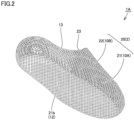
- Fig. 2 is a perspective view of the sandal shown in Fig. 1 , viewed from a rear left oblique lower side
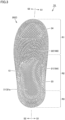
- Fig. 3 is a plan view of the sandal shown in Fig. 1
- Fig. 4 is a side view of the sandal shown in Fig. 1 , viewed from a lateral foot side.
- the sandal 1A includes a sandal body 20 that includes a sole portion 21 and a belt portion 22.
- the sandal body 20 consists of a single member and is constituted of an additively manufactured product 2 manufactured by an optical molding method of a three-dimensional additive manufacturing method (i.e., a stereolithography-type three-dimensional additive manufacturing method), which will be described later.
- the sole portion 21 constitutes a footbed portion 10A that supports the wearer's foot.
- An upper surface 21a of the sole portion 21 defines a supporting surface 11 that supports a sole of the wearer's foot during wear, and a lower surface 21b of the sole portion 21 defines a ground contact surface 12 that contacts a ground, a floor, etc. during wear.
- the sandal 1A is configured so that a periphery on the upper surface 21a side of the sole portion 21 rises to position the wearer's foot on the supporting surface 11 during wear. Therefore, the upper surface 21a of the sole portion 21 has an overall concave shape, and a portion defining a bottom portion of the upper surface 21a of the concave shape corresponds to the supporting surface 11.
- the supporting surface 11 is made of a material that provides a non-slip and flexible wearing feeling
- the ground contact surface 12 is made of a non-slip material.
- the supporting surface 11 and the ground contact surface 12 are formed with parts of the sandal body 20, which is a single member, and thus, the supporting surface 11 and the ground contact surface 12 are each made of a non-slip and flexible material.
- the supporting surface 11 and the ground contact surface 12 may be formed separately using members made of different materials or having different hardnesses.
- the entire sole portion 21 as the footbed portion 10A is configured to be flexible, so that the entire sole portion 21 functions as a cushioning portion 13.
- the cushioning portion 13 is not only soft but also has improved performance to stably support the wearer's foot in a deformed state without causing bottoming out; the details thereof will be described later.
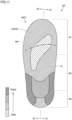
- the sole portion 21 of the sandal 1A is divided in a front-rear direction which matches a lengthwise direction of the wearer's foot (up-down direction in Fig. 3 , left-right direction in Fig. 4 ) into a forefoot portion R1 that supports a toe portion and a ball portion of the wearer's foot, a midfoot portion R2 that supports an arch portion of the wearer's foot, and a rearfoot portion R3 that supports a heel portion of the wearer's foot.
- the front end of the sole portion 21 is defined as a reference
- a position corresponding to 30% of the dimension in the front-rear direction of the sole portion 21 from the front end is defined as a first boundary position
- a position corresponding to 80% of the dimension in the front-rear direction of the sole portion 21 from the front end is defined as a second boundary position
- the forefoot portion R1 corresponds to a portion included between the front end and the first boundary position in the front-rear direction
- the midfoot portion R2 corresponds to a portion included between the first boundary position and the second boundary position in the front-rear direction
- the rearfoot portion R3 corresponds to a portion included between the second boundary position and a rear end of the sole in the front-rear direction.
- the belt portion 22 constitutes a foot cover portion 10B that covers an instep of the wearer's foot and is positioned above the sole portion 21.
- the belt portion 22 has a strap-like shape.
- the belt portion 22 extends in the left-right direction so as to have a generally arched shape when viewed in the front-rear direction.
- One end of the belt portion 22 is connected to the medial foot side end of the sole portion 21, and the other end of the belt portion 22 is connected to the lateral foot side end of the sole portion 21.
- the periphery of the upper surface 21a of the portion of the sole portion 21 located behind the belt portion 22 and the rear end of the belt portion 22 form a footwear opening 23, and a hollow space is provided between the sole portion 21 and the belt portion 22. Therefore, by inserting the wearer's foot into the hollow space through the footwear opening 23, the sandal 1A can be worn.
- the sandal 1A in addition to the above-described footwear opening 23, has a front opening portion 24 formed by the periphery of the upper surface 21a of the portion of the sole portion 21 located in front of the belt portion 22 and the front end of the belt portion 22. During wear, the toes of the wearer's foot are exposed to the outside through the front opening portion 24.
- the material of the sandal body 20 is not particularly limited, but it is preferable that the material can be additively manufactured by an optical molding method of a three-dimensional additive manufacturing method and that the material is a resin or rubber material so that the sandal body 20 has appropriate flexibility, elasticity, durability, resilience, stability, and so on after additively manufacturing. More specifically, when the sandal body 20 is made of resin, it can be made of, for example, polyolefin resin, ethylene-vinyl acetate copolymer (EVA), polyamide-based thermoplastic elastomer (TPA, TPAE), thermoplastic polyurethane (TPU), or polyester-based thermoplastic elastomer (TPEE). On the other hand, when the sandal body 20 is made of rubber, it can be made of, for example, butadiene rubber (BR).
- BR butadiene rubber
- the sandal body 20 can also be made of a polymer composition.
- polymers contained in the polymer composition include olefin polymers such as olefin elastomers and olefin resins.
- olefin polymers include polyolefins such as polyethylene (e.g., linear low-density polyethylene (LLDPE), high-density polyethylene (HDPE), etc.), polypropylene, ethylene-propylene copolymers, propylene-1-hexene copolymers, propylene-4-methyl-1-pentene copolymers, propylene-1-butene copolymers, ethylene-1-hexene copolymers, ethylene-4-methylpentene copolymers, ethylene-1-butene copolymers, 1-butene-1-hexene copolymers, 1-butene-4-methyl-pentene, ethylene-methacrylic acid copolymers, ethylene-methyl methacryl
- the above polymers may also be amide polymers such as amide elastomers and amide resins.
- amide polymers include polyamide 6, polyamide 11, polyamide 12, polyamide 66, polyamide 610.
- ester polymers such as ester elastomers and ester resins.
- ester polymers include polyethylene terephthalate, polybutylene terephthalate.
- the above polymers may be urethane polymers such as urethane elastomers and urethane resins.
- urethane polymers include polyester-based polyurethane, and polyether-based polyurethane.
- the above polymers may be styrene polymers such as styrene elastomers and styrene resins.
- styrene elastomers include styrene-ethylene-butylene copolymers (SEB), styrene-butadiene-styrene copolymers (SBS), hydrogenated SBS (styrene-ethylene-butylene-styrene copolymers (SEBS)), styreneisoprene-styrene copolymers (SIS), hydrogenated SIS (styrene-ethylene-propylene-styrene copolymers (SEPS)), styrene-isobutylene-styrene copolymers (SIBS), styrene-butadiene-styrene-butadiene (SBSB), and styrene-butadiene-styrene
- the above polymers may be, for example, acrylic polymers such as polymethyl methacrylate, urethane-based acrylic polymers, polyester-based acrylic polymers, polyether-based acrylic polymers, polycarbonate-based acrylic polymers, epoxy-based acrylic polymers, conjugated diene polymer-based acrylic polymers and the hydrogenated products thereof, urethane-based methacrylic polymers, polyester-based methacrylic polymers, polyether-based methacrylic polymers, polycarbonate-based methacrylic polymers, polyester-based urethane acrylates, polycarbonate-based urethane acrylates, polyether-based urethane acrylates, epoxy-based methacrylic polymers, conjugated diene polymer-based methacrylic polymers and the hydrogenated products thereof, polyvinyl chloride resins, silicone elastomers, butadiene rubber, isoprene rubber (IR), chloroprene rubber (CR), natural rubber (NR), styrene-butadiene rubber
- the sandal body 20 is made of a material that provides a non-slip and flexible wearing feeling, and thus, among the above-described materials, it is particularly preferable that the sandal body 20 is made of urethane acrylate.
- the sandal body 20 is made of urethane acrylate, the sandal body 20 not only has excellent durability and elasticity but also has sufficient resilience.
- the sandal body 20 is manufactured using the optical molding method of the three-dimensional additive manufacturing method, and thus, the sandal body 20 contains a curing agent as a secondary component.
- the sandal 1A has improved performance not only in material aspects as described above but also in structural aspects. More specifically, it is configured that in the sandal 1A, the sole portion 21 as the footbed portion 10A which functions as the cushioning portion 13 is constituted of a three-dimensional mesh structure as described later, and by ensuring that a portion of the three-dimensional mesh structure constituting the cushioning portion 13 satisfies predetermined shape and dimensional conditions, the sole portion 21 can stably support the wearer's foot in a deformed state without causing bottoming out.
- Fig. 5(A) is a schematic diagram for describing a three-dimensional structure of the cushioning portion of the sandal shown in Fig. 1
- Fig. 5(B) is a schematic diagram for describing a three-dimensional structure of a cushioning portion having a configuration based on the structure shown in Fig. 5(A) .
- the sole portion 21 functioning as the cushioning portion 13 of the sandal 1A is constituted of a three-dimensional mesh structure 3A, in which a plurality of unit structures 4A each having a three-dimensional lattice structure is repeatedly arranged. More specifically, the plurality of unit structures 4A is regularly and continuously arranged repeatedly along each of a width direction (X direction shown in the drawing), a depth direction (Y direction in the drawing), and a height direction (Z direction in the drawing). In Fig. 5(A) , only a few adjacent unit structures 4A in the width direction, the depth direction, and the height direction respectively are extracted and shown.
- the unit structure 4A having the three-dimensional lattice structure has a three-dimensional shape formed by a plurality of columnar portions 6 extending in predetermined directions and interconnected.
- the plurality of the columnar portions 6 is configured so that the extending directions thereof intersect with those of adjacent columnar portions 6, thereby forming the three-dimensional lattice structure.
- the illustrated unit structure 4A is known as fluorite-type lattice. Note that a unit space 5A occupied by the unit structure 4A has a polyhedral shape; in the illustrated unit structure 4A, the unit space 5A has a hexahedral shape.
- each of the plurality of the columnar portions 6 is configured to have a substantially cylindrical outer shape. Therefore, the cross-sectional shape perpendicular to the extending direction of each of the plurality of the columnar portions 6 is substantially circular. Additionally, in the illustrated three-dimensional mesh structure 3A, the thickness of each of the plurality of the columnar portions 6 is configured to change continuously in the extending direction thereof; specifically, it is configured that the thickness is greater at a connection portion between adjacent columnar portions 6 and becomes less as the distance from the connection portion increases. With this configuration, it is possible to increase the durability while maintaining the flexibility.
- a three-dimensional mesh structure 3A' shown in Fig. 5(B) has a three-dimensional structure with a configuration based on the structure shown in Fig. 5(A) , a unit structure 4A' is a fluorite-type lattice, and a unit space 5A' occupied by the unit structure 4A' has a hexahedral shape.
- the thickness of each of the plurality of the columnar portions 6 is uniform in the extending direction thereof.
- the three-dimensional mesh structure 3A' having such a configuration may be applied to the cushioning portion 13 of the sandal 1A according to the present embodiment instead of the three-dimensional mesh structure 3A shown in Fig. 5(A) .
- various other structures can be used as the unit structure 4A, such as rectangular lattices, diamond lattices, octahedral lattices, double pyramid lattices, or structures with various supports added to these lattices.
- the cushioning portion 13 is made of an elastic material with an elastic modulus which is greater than or equal to 0.1 MPa and less than or equal to 100 MPa.
- the cushioning portion 13 when a load is applied to the cushioning portion 13 (i.e., during landing or stepping off), the cushioning portion 13 can exhibit high cushioning performance to effectively disperse foot pressure.
- the elastic modulus of the material constituting the cushioning portion 13 may be greater than or equal to 1 MPa and less than or equal to 50 MPa.
- each of the above-described plurality of the columnar portions 6 has an extending direction and a maximum outer dimension, which is greater than or equal to 1.0 mm and less than or equal to 1.8 mm, in a cross-section perpendicular to the extending direction. Furthermore, a thickness T of the cushioning portion 13 in the direction perpendicular to the ground contact surface 12 (see Fig. 4 ) is greater than or equal to 25.0 mm.
- a symbol T indicating the thickness is attached to the thickest portion of the sole portion 21 as the cushioning portion 13.
- the thinnest portion of the cushioning portion 13 satisfies the condition that the thickness is greater than or equal to 25.0 mm.
- the rigidity of the cushioning portion 13 becomes excessively high, and thus, necessary deformability cannot be provided to the cushioning portion 13.
- the rigidity of the cushioning portion 13 may significantly decrease and cause bottoming out.
- problems such as reduced durability or difficulty in manufacturing using the three-dimensional additive manufacturing method in the first place may arise.
- the thickness T of the cushioning portion 13 in the direction perpendicular to the ground contact surface 12 is less than the above-described range, in a case where a load is applied to the cushioning portion 13 (i.e., during landing, stepping off, standing, etc.), there will be a lack of sufficient deformation margin for the cushioning portion 13 to deform, which will result in a high risk of bottoming out.
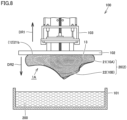
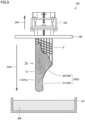
- Figs. 6 to 8 are schematic diagrams illustrating the manufacturing method of the sandal shown in Fig. 1 , showing the initial state, intermediate state, and final state of additively manufacturing the sandal body using the three-dimensional additive manufacturing method, respectively.
- Figs. 6 to 8 the specific manufacturing method for manufacturing the sandal 1A according to the present embodiment will be described.
- the sandal body 20 which includes the sole portion 21 and the belt portion 22, is constituted of the additively manufactured product 2 consisting of a single member manufactured using the optical molding method of the three-dimensional additive manufacturing method.
- the sandal body 20 can be additively manufactured, for example, using a three-dimensional additive manufacturing apparatus 100, as shown in Figs. 6 to 8 .
- the three-dimensional additive manufacturing apparatus 100 includes a light source (not shown), a reservoir 101, a platform 102, and an elevating mechanism 103.
- the reservoir 101 is a portion that stores a liquid resin 200, etc. as raw materials.
- the platform 102 is used to hold and move the additively manufactured product 2.
- the elevating mechanism 103 moves the platform 102 in the up-down direction.
- the platform 102 is first moved by the elevating mechanism 103 so that a lower surface of the platform 102 is in contact with a liquid surface of the liquid resin 200, etc., and in this state, light of a specific wavelength emitted from the light source is irradiated onto the vicinity of the liquid surface of the liquid resin 200, etc. in a predetermined pattern to expose the liquid.
- the portion of the liquid resin 200, etc. in the vicinity of the liquid surface cures in layers while adhering to the lower surface of the platform 102, forming a first cured layer.
- the platform 102 is moved upward by a predetermined amount (i.e., in the direction of arrow DR1 in the drawing) by the elevating mechanism 103, so that a lower surface of the first cured layer is in contact with the liquid surface of the liquid resin 200, etc., and in this state, light of the specific wavelength emitted from the light source is irradiated onto the vicinity of the liquid surface of the liquid resin 200, etc. in the predetermined pattern to expose the liquid.
- the portion of the liquid resin 200, etc. in the vicinity of the liquid surface cures in layers while adhering to the lower surface of the first cured layer, forming a second cured layer.
- a plurality of cured layers is sequentially stacked downward (i.e., in the direction of arrow DR2 in the drawing), thereby advancing the additive manufacturing of the sandal body 20.
- the additive manufacturing of the sole portion 21 and the additive manufacturing of the belt portion 22 continue.
- the platform 102 is further lifted upward by the elevating mechanism 103, and the sandal body 20 is separated from the liquid resin 200, etc. stored in the reservoir 101 and removed from three-dimensional additive manufacturing apparatus 100.
- the sandal body 20 after completion of additive manufacturing has not yet fully cured and is in a relatively soft state. Therefore, the extracted sandal body 20 undergoes additional washing and heat treatments for full curing, followed by washing and drying treatments to complete the manufacturing of the sandal 1A.
- the sole portion 21 is sequentially additively manufactured in the direction perpendicular to the ground contact surface 12 from the ground contact surface 12 side, and subsequently, the belt portion 22 is sequentially additively manufactured. That is, in the manufacturing method of the sandal 1A according to the present embodiment, the direction perpendicular to the ground contact surface 12 of the sandal 1A matches the direction in which the plurality of cured layers is sequentially stacked and the sandal 1A is additively manufactured (i.e., the direction of arrow DR2 in the drawing).
- Fig. 9 is a schematic diagram showing another manufacturing method of the sandal shown in Fig. 1 .
- the another specific manufacturing method for manufacturing the sandal 1A according to the present embodiment will be described.
- the sandal 1A is manufactured by manufacturing the sandal body 20, which consists of a single member, using the optical molding method of the three-dimensional additive manufacturing method with the three-dimensional additive manufacturing apparatus 100, similar to the manufacturing method of the sandal 1A according to the present embodiment described above (i.e., the manufacturing method of the sandal 1A described with reference to Figs. 6 to 8 ).
- the direction in which the sandal body 20 is additively manufactured differs from that in the manufacturing method of the sandal 1A according to the present embodiment described above.
- the sandal body 20 is sequentially additively manufactured from the forefoot portion R1 (see Fig. 3 , Fig. 4 , etc.) side toward the rearfoot portion R3 (see Fig. 3 , Fig. 4 , etc.) side in the front-rear direction. That is, in the another manufacturing method of the sandal 1A according to the present embodiment, the front-rear direction of the sandal body 20 matches the direction in which the plurality of cured layers is sequentially 1 stacked (the direction of arrow DR2 in the drawing).
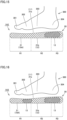
- Fig. 10(A) and Fig. 10(B) are schematic diagrams showing states of the sole portion during landing and stepping off of the sandal shown in Fig. 1 , respectively.
- Fig. 10(A) and Fig. 10(B) the performance of the cushioning portion 13 of the sandal 1A according to the present embodiment will be described. Note that illustration of the belt portion 22 is omitted in Fig. 10(A) and Fig. 10(B) .
- the sole portion 21 includes the cushioning portion 13 consisting of a single member made of an elastic material with an elastic modulus which is greater than or equal to 0.1 MPa and less than or equal to 100 MPa.
- the cushioning portion 13 is constituted of the three-dimensional mesh structure 3A, where a plurality of the unit structures 4A, each of which is a three-dimensional lattice structure formed by a plurality of the columnar portions 6 which are interconnected, is repeatedly arranged.
- Each of the plurality of the columnar portions 6 has an extending direction and a maximum outer dimension which is greater than or equal to 1.0 mm and less than or equal to 1.8 mm in a cross-section perpendicular to the extending direction (in the present embodiment, since each of the plurality of the columnar portions 6 is substantially cylindrical, the maximum outer dimension is equal to the diameter), and the thickness T (see Fig. 4 ) of the cushioning portion 13 in the direction perpendicular to the ground contact surface 12 is greater than or equal to 25.0 mm.
- the flexibility of the cushioning portion 13 is sufficiently ensured while the thickness of the cushioning portion 13 is sufficiently ensured, and thus, bottoming out (a state where, upon landing, the sole portion 21 is substantially compressed to its maximum due to deformation, making further deformation difficult) does not occur, and the wearer's foot pressure is dispersed, providing the wearer with a flexible stepping feeling.
- the portion of the sole portion 21 corresponding to an arch portion 303 of the wearer's foot 300 does not receive a large load compared to the portion of the sole portion 21 corresponding to the heel portion 304 of the wearer's foot 300, as the portion of the sole portion 21 corresponding to the heel portion 304 of the wearer's foot 300 deforms significantly and locally, the sunken heel portion 304 of the wearer's foot 300 is held in a manner of being wrapped by the sole portion 21, and thus, even in a state where the sole portion 21 is deformed, the wearer's foot 300 is stably supported.
- a large deformation occurs in a portion of the sole portion 21 (i.e., the cushioning portion 13) corresponding to a ball portion 302 of the wearer's foot 300 (i.e., from the rear end vicinity portion of the forefoot portion R1 to the front end side portion of the midfoot portion R2), which is the portion where the greatest load is applied.
- the upper surface 21a of the sole portion 21, which serves as the supporting surface 11 is displaced toward the lower surface 21b side, which serves as the ground contact surface 12, causing the ball portion 302 of the wearer's foot 300 to sink.
- the flexibility of the cushioning portion 13 is sufficiently ensured while the thickness of the cushioning portion 13 is sufficiently ensured, and thus, bottoming out does not occur, and the wearer's foot pressure is dispersed, providing the wearer with a flexible stepping feeling.
- the portions of the sole portion 21 corresponding to a toe portion 301 and the arch portion 303 of the wearer's foot 300 do not receive a large load compared to the portion of the sole portion 21 corresponding to the ball portion 302 of the wearer's foot 300, as the portion of the sole portion 21 corresponding to the ball portion 302 of the wearer's foot 300 deforms significantly and locally, the sunken ball portion 302 of the wearer's foot 300 is held in a manner of being wrapped by the sole portion 21, and thus, even in a state where the sole portion 21 is deformed, the wearer's foot 300 is stably supported.
- Such a stepping feeling is unique and unprecedented, making the footwear particularly suitable for recovery uses or relaxation uses, such as fatigue recovery through foot pressure dispersion, support of foot arch, and support against heel collapse known as pronation.
- the sandal 1A it is possible to provide a sandal that can stably support the wearer's foot in a deformed state without causing bottoming out during wear.
- the thickness T of the cushioning portion 13 in the direction perpendicular to the ground contact surface 12 is set to be greater than or equal to 25.0 mm as described above, to set an occupancy rate of the cushioning portion 13 to be greater than or equal to 10% and less than or equal to 45%.
- the length of one side of the unit space 5A which is a polyhedral space occupied by each of the unit structures 4A, to be greater than or equal to 3.0 mm and less than or equal to 20.0 mm, it becomes difficult for foreign matters to enter the interior of the cushioning portion 13, and it becomes possible to prevent foreign matters from entering the cushioning portion 13 and inhibiting the deformability.
- the three-dimensional lattice structure as the unit structure 4A where all of the plurality of the columnar portions 6 included therein extends non-parallel to the direction perpendicular to the ground contact surface 12, buckling of the columnar portions 6 when a load is applied can be suppressed, which helps to ensure high deformability and prevent bottoming out.
- the maximum outer dimension in the cross-section perpendicular to the extending direction of each of the plurality of the columnar portions 6 described above may be the same throughout the cushioning portion 13, the maximum outer dimension may also vary depending on the portion of the sole portion 21.
- the maximum outer dimension is non-uniform across different portions of the sole portion 21; specifically, the maximum outer dimension is configured to have a distribution within the range of being greater than or equal to 1.0 mm and less than or equal to 1.8 mm.
- Fig. 11 is a schematic diagram showing a distribution of thicknesses of columnar portions in the cushioning portion of the sandal shown in Fig. 1 .
- Fig. 11 the distribution of the thicknesses of the columnar portions 6 in the cushioning portion 13 of the sandal 1A according to the present embodiment will be described.
- the thicknesses of the columnar portions 6 are configured to be smaller than the thicknesses of the columnar portions 6 in the adjacent regions.
- the thicknesses of the columnar portions 6 are configured to be larger than the thicknesses of the columnar portions 6 in the regions adjacent in the front-rear direction. Additionally, the thicknesses of the columnar portions 6 in both outer regions in the width direction from the rear end of the midfoot portion R2 to the front end of the rearfoot portion R3 are configured to be larger than the thicknesses of the columnar portions 6 in the substantially central region in the width direction.
- Fig. 12 is a graph showing the results of the first verification test
- Fig. 13 is a graph showing the results of the second verification test.
- the diameters of the columnar portions included in the unit structure constituting the cushioning portion were changed in various ways, while other conditions were kept the same.
- the size and shape of the cushioning portion were a rectangular shape with a dimension of 35.0 mm in a direction of load application and dimensions of 50.0 mm in both of the two axial directions perpendicular to the direction of load application.
- the diameters of the columnar portions included in the unit structure were 1.6 mm, 1.4 mm, 1.2 mm, 1.1 mm, 1.0 mm, and 0.9 mm in verification examples 1 to 6, respectively.
- the diameter of the columnar portion i.e., the maximum outer dimension in the cross-section perpendicular to the extending direction of each of the plurality of the columnar portions 6 described above
- setting the diameter of the columnar portion i.e., the maximum outer dimension in the cross-section perpendicular to the extending direction of each of the plurality of the columnar portions 6 described above
- setting the diameter of the columnar portion i.e., the maximum outer dimension in the cross-section perpendicular to the extending direction of each of the plurality of the columnar portions 6 described above
- the thickness of the cushioning portion was changed in various ways, while other conditions were kept the same.
- the size and shape of the cushioning portion were a rectangular shape with dimensions of 50.0 mm in both of the two axial directions perpendicular to the direction of load application.
- the thickness of the cushioning portion was set to 40.0 mm, 35.0 mm, 30.0 mm, 25.0 mm, 20.0 mm, and 15.0 mm in verification examples 7 to 12, respectively.
- the diameters of the columnar portions included in the unit structure constituting the cushioning portion were all 1.2 mm.
- the thickness of the cushioning portion 13 is set to be greater than or equal to 25.0 mm allows for a cushioning portion with excellent deformability that prevents bottoming out during wear.
- the entire sole portion 21 as the footbed portion 10A satisfies the above-described predetermined conditions (i.e., the basic structure of the three-dimensional mesh structure that constitutes the sole portion 21 and the elastic modulus of the material that constitutes the sole portion 21, the maximum outer dimension in the cross-section perpendicular to the extending direction of each of the plurality of the columnar portions included therein, and the thickness in the direction perpendicular to the ground contact surface, etc.), and thus, although the example has been described in a case where the entire sole portion 21 is configured as the cushioning portion 13, it is not necessary that the entire sole portion 21 is configured as the cushioning portion 13 that satisfies the above-described predetermined conditions, and only a part of the sole portion 21 may be configured as the cushioning portion 13.
- the above-described predetermined conditions i.e., the basic structure of the three-dimensional mesh structure that constitutes the sole portion 21 and the elastic modulus of the material that constitutes the sole portion 21, the maximum outer dimension in the cross-section perpendic
- the thickness can be set to be less than or equal to 25.0 mm, the basic structure of the three-dimensional mesh structure which constitutes that portion can be made different from the structure described above, and various other configuration changes can be made.
- a guideline for the portion of the sole portion 21 where the cushioning portion 13 should be arranged is that, considering that the total load applied to the sole portion 21 when standing on both feet is approximately less than or equal to 500 N, and that the portion receiving the highest pressure at that time has a pressure of approximately 200 kPa, it is possible to adopt a configuration in which the cushioning portion 13 is arranged, for example, only in portions that are frequently subjected to pressures which are greater than or equal to 150 kPa, or only in portions that are frequently subjected to pressures which are greater than or equal to 100 kPa.
- Fig. 14 is a schematic diagram showing a distribution of thicknesses of columnar portions in a cushioning portion of a sandal according to the first modification. Below, with reference to Fig. 14 , a sandal 1A1 according to the first modification based on Embodiment 1 described above will be described.
- the sandal 1A1 according to the first modification differs in its configuration from the sandal 1A according to Embodiment 1 described above only in that the distribution of the thicknesses of the columnar portions 6 of the cushioning portion 13 is different.
- the thicknesses of the columnar portions 6 are configured to be larger than the thicknesses of the columnar portions 6 in the adjacent regions.
- Fig. 15 to Fig. 17 are schematic cross-sectional views of footbed portions of sandals according to the second to fourth modifications, respectively.
- the sandals 1A2 to 1A4 according to the second to fourth modifications based on Embodiment 1 described above will be described.
- the sandals 1A2 to 1A4 according to the second to fourth modifications differ in their configurations from the sandal 1A according to Embodiment 1 described above only in that the position of the cushioning portion 13 provided in the footbed portion 10A is different. More specifically, in the sandal 1A according to Embodiment 1 described above, the entire footbed portion 10A is configured as the cushioning portion 13, however, in the sandals 1A2 to 1A4 according to the second to fourth modifications, the cushioning portion 13 is partially provided in the footbed portion 10A.
- the cushioning portion 13 is provided only in the portion of the footbed portion 10A corresponding to the heel portion 304 of the wearer's foot 300 (i.e., from the rear end side portion of the midfoot portion R2 to the front end vicinity portion of the rearfoot portion R3).
- the cushioning portion 13 is provided separately and independently in both the portion corresponding to the ball portion 302 of the wearer's foot 300 (i.e., from the rear end vicinity portion of the forefoot portion R1 to the front end side portion of the midfoot portion R2) and the portion of the footbed portion 10A corresponding to the heel portion 304 of the wearer's foot 300.
- the cushioning portion 13 is provided in a manner of extending from the portion of the footbed portion 10A corresponding to the ball portion 302 of the wearer's foot 300, through the portion of the footbed portion 10A corresponding to the arch portion 303, to the portion of the footbed portion 10A corresponding to the heel portion 304 (i.e., reaching from the rear end vicinity portion of the forefoot portion R1 to the front end vicinity portion of the rearfoot portion R3).
- the cushioning portions 13 provided therein all satisfy the same conditions as those described for the sandal 1A according to Embodiment 1 described above (the basic structure of the three-dimensional mesh structure constituting the cushioning portion 13 and the elastic modulus of the material constituting the cushioning portion 13, the maximum outer dimension in the cross-section perpendicular to the extending direction of each of the plurality of the columnar portions 6, the thickness of the cushioning portion 13 in the direction perpendicular to the ground contact surface 12, etc.).
- the sandals 1A2 to 1A4 exemplify a case where the cushioning portion 13 is configured to be embedded in the footbed portion 10A.
- the case assumes that the entire footbed portion 10A consists of the single additively manufactured product 2 manufactured by t the optical molding method of the three-dimensional additive manufacturing method, where the portions corresponding to the cushioning portion 13 are formed to satisfy the above-described conditions, and the portions other than the portions corresponding to the cushioning portion 13 are formed in a manner of not satisfying the above-described conditions.
- the cushioning portion 13 may be constituted of the single additively manufactured product 2 manufactured by three-dimensional additive manufacturing method, and the footbed portion 10A may be constituted by embedding the cushioning portion 13 in a member made of another material (such as a general midsole member, etc.). Also, the cushioning portion 13 does not necessarily need to be embedded in the footbed portion 10A, and the upper surface, lower surface, or peripheral surface of the cushioning portion 13 may be exposed from the footbed portion 10A.
- Fig. 18 is a schematic diagram for describing a three-dimensional structure of a cushioning portion of a sandal according to a fifth modification. Below, with reference to Fig. 18 , a sandal 1A5 according to the fifth modification based on Embodiment 1 described above will be described.
- the sandal 1A5 according to the fifth modification differs in its configuration from the sandal 1A according to Embodiment 1 described above only in that the cushioning portion 13 has a different three-dimensional structure.
- the three-dimensional mesh structure 3A constituting the cushioning portion 13 is constituted by regularly and continuously arranging the unit structure 4A called fluorite-type lattice repeatedly.
- a three-dimensional mesh structure 3B constituting the cushioning portion 13 is constituted of unit structures 4B, which are rectangular lattices with central supports added, by regularly and continuously arranging the unit structures 4B repeatedly.
- the unit structure 4B consisting of the three-dimensional lattice structure has a three-dimensional shape formed by the plurality of columnar portions 6 which extend in predetermined directions and are interconnected, and a unit space 5B occupied by the unit structure 4B has a hexahedral shape.
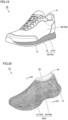
- Fig. 19 is a perspective view of a shoe according to Embodiment 2. Below, with reference to Fig. 19 , a shoe 1B according to the present embodiment will be described.
- the shoe 1B includes a sole 30 and an upper 40.
- the sole 30 has an overall substantially flat shape and constitutes the footbed portion 10A that supports the wearer's foot.
- the upper 40 has a bag-like shape covering portions of the wearer's foot excluding the sole of the foot, thereby constituting the foot cover portion 10B that covers the instep of the wearer's foot.
- the upper 40 is positioned above the sole 30.
- the sole 30 includes a sole body 31 and an outsole 32, with the outsole 32 fixed to a lower surface of the sole body 31 by, for example, adhesion.
- the lower surface of the outsole 32 constitutes a ground contact surface
- the sole body 31 is the portion that primarily supports the wearer's foot. It is preferable that the outsole 32 has excellent wear resistance and grip, and the outsole 32 may be constituted of, for example, a rubber member.
- the upper 40 has a footwear opening 41 at its upper portion through which the wearer's foot is inserted, and a space is formed inside the upper 40 where the wearer's foot is inserted during wear.
- a lower surface of the upper 40 is fixed to an upper surface of the sole body 31 by, for example, adhesion, and an inner bottom surface of the upper 40 constitutes a supporting surface that supports the sole of the wearer's foot during wear.
- Materials such as woven fabrics, knitted fabrics, non-woven fabrics, synthetic leather, resin, etc., are used for the upper 40, and for shoes particularly requiring breathability and lightness, double raschel warp knit fabric woven with polyester yarn is used.
- the sole body 31 consists of a single member and is constituted of the additively manufactured product 2 manufactured by the optical molding method of the three-dimensional additive manufacturing method. More specifically, the sole body 31 is constituted of the three-dimensional mesh structure 3A as shown in Fig. 5(A) . Thus, the above-described entire sole body 31 of the sole 30 as the footbed portion 10A functions as the cushioning portion 13.
- the material of the sole body 31 is not particularly limited and may be the same as the material of the sandal body 20 described in Embodiment 1 described above.
- the cushioning portions 13 provided in the shoe 1B according to the present embodiment satisfies the same conditions as those described in Embodiment 1 described above (i.e., the basic structure of the three-dimensional mesh structure constituting the cushioning portion and the elastic modulus of the material constituting the cushioning portion, the maximum outer dimension in the cross-section perpendicular to the extending direction of each of the plurality of the columnar portions, the thickness of the cushioning portion in the direction perpendicular to the ground contact surface, etc.).
- Fig. 20 is a perspective view of a shoe according to Embodiment 3
- Fig. 21 is a schematic cross-sectional view along line XXI-XXI shown in Fig. 20 .
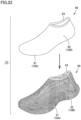
- Fig. 22 is an exploded view of the shoe shown in Fig. 20 . Below, with reference to Fig. 20 to Fig. 22 , a shoe 1C according to the present embodiment will be described.
- the shoe 1C is a sock-like shoe that covers almost the entire wearer's foot (i.e., the portion from the ankle to the end of the foot) and includes a shell 50 and an upper body 60. Both the shell 50 and the upper body 60 have bag-like shapes.
- the shell 50 includes a sole portion 51 and an outer upper portion 52.
- the sole portion 51 has a substantially flat shape, and a lower surface 51b thereof constitutes the ground contact surface 12.
- the outer upper portion 52 stands upright from the periphery of the sole portion 51.
- An opening portion 53 is provided at an upper portion of the outer upper portion 52.
- the upper body 60 includes a bottom portion 61 and an inner upper portion 62.
- the bottom portion 61 has a substantially flat shape, and an upper surface 61a thereof constitutes the supporting surface 11 that supports the sole of the wearer's foot during wear.
- the inner upper portion 62 stands upright from the periphery of the bottom portion 61.
- a footwear opening 63 through which the wearer's foot is inserted is provided at an upper portion of the inner upper portion 62.
- the upper body 60 is accommodated in the shell 50 such that the bottom portion 61 of the upper body 60 is arranged on the sole portion 51 of the shell 50 and the inner upper portion 62 overlaps with the outer upper portion 52 of the shell 50.
- the footbed portion 10A that supports the foot of the wearer's foot is constituted of the sole portion 51 of the shell 50 and the bottom portion 61 of the upper body 60
- the foot cover portion 10B that covers the instep of the wearer's foot is constituted of a part of the outer upper portion 52 of the shell 50 and a part of the inner upper portion 62 of the upper body 60.
- the upper body 60 constitutes the portion that contacts the wearer's foot, it is preferable that the upper body 60 is constituted of a member that is flexibly deformable, and the upper body 60 may be made of, for example, woven or knitted fabric, nonwoven fabric, synthetic leather, resin, etc. Particularly, as described later, if woven or knitted fabric, non-woven fabric or the like of synthetic fibers with heat shrinkability is used, the upper body 60 can be made to better fit the wearer's foot.
- synthetic fibers with heat shrinkability include those mainly composed of polyester, polyurethane, etc.
- the upper body 60 when the upper body 60 is constituted of woven or knitted fabric, non-woven fabric, or the like of synthetic fibers with heat shrinkability, the upper body 60 is pre-formed into a bag shape, and heat treatment is performed with a last, which is to be described later, inserted into the upper body 60, and thereby, the upper body 60 changes shape by thermally shrinking due to heating in a state that the upper body 60 is in close contact with the shaping surface of the last, and the shape after the change is maintained.
- the upper body 60 that fits the wearer's foot can be manufactured. Furthermore, by performing the heat treatment using the above-described last with the upper body 60 assembled into the shell 50, the upper body 60 will also fit the shell 50, thereby further improving the fit.
- the shell 50 consists of a single member and is constituted of the additively manufactured product 2 manufactured by the optical molding method of the three-dimensional additive manufacturing method.
- the sole portion 51 of the shell 50 is constituted of the three-dimensional mesh structure 3A as shown in Fig. 5(A) .
- the entire sole portion 51 as the footbed portion 10A functions as the cushioning portion 13.
- the material of the shell 50 is not particularly limited and may be the same as the material of the sandal body 20 described in Embodiment 1 described above.
- the cushioning portions 13 provided in the shoe 1C according to the present embodiment satisfies the same conditions as those described in Embodiment 1 described above (i.e., the basic structure of the three-dimensional mesh structure constituting the cushioning portion and the elastic modulus of the material constituting the cushioning portion, the maximum outer dimension in the cross-section perpendicular to the extending direction of each of the plurality of the columnar portions, the thickness of the cushioning portion in the direction perpendicular to the ground contact surface, etc.).
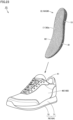
- Fig. 23 is a perspective view of a shoe and a sockliner provided therein, according to Embodiment 4. Below, with reference to Fig. 23 , a shoe 1D according to the present embodiment will be described.
- the shoe 1D includes a sole 70, the upper 40, and a sockliner 80.
- the sole 70 has an overall substantially flat shape.
- the upper 40 has a bag-like shape covering portions of the wearer's foot excluding the sole of the foot and is positioned above the sole 70.
- the sockliner 80 has an overall substantially flat shape and is provided in the shoe 1D by being inserted into the upper 40.
- the sole 70 includes a midsole 71 and an outsole 72, with the outsole 72 fixed to a lower surface of the midsole 71 by, for example, adhesion.
- the lower surface of the outsole 72 constitutes a ground contact surface
- the midsole 71 is the portion that primarily supports the wearer's foot.
- the midsole 71 uses, for example, a resin-based foam material containing a resin material as the main component and a foaming agent or a crosslinking agent as a secondary component. It is preferable that the outsole 72 has excellent wear resistance and grip, and the outsole 72 may be constituted of, for example, a rubber member.
- the upper 40 has a footwear opening 41 at its upper portion through which the wearer's foot is inserted, and a space is formed inside the upper 40 where the wearer's foot is inserted during wear.
- the lower surface of the upper 40 is fixed to the upper surface of the sole body 31 by, for example, adhesion.
- Materials such as woven fabrics, knitted fabrics, non-woven fabrics, synthetic leather, resin, etc., are used for the upper 40, and for shoes particularly requiring breathability and lightness, double raschel warp knit fabric woven with polyester yarn is used.
- the sockliner 80 consists of a single member and is constituted of the additively manufactured product 2 manufactured by the optical molding method of the three-dimensional additive manufacturing method.
- the sockliner 80 has a two-layered structure including a base layer portion 81 and an upper layer portion 82, each configured to form a layer, with the upper layer portion 82 positioned above the base layer portion 81.
- an upper surface 82a of the upper layer portion 82 constitutes the supporting surface 11 that supports the sole of the wearer's foot during wear.
- the base layer portion 81 is the portion that constitutes the cushioning portion 13, as will be described later, and the upper layer portion 82 is the portion that covers the base layer portion 81 to improve foot comfort. If a liner made of, for example, woven fabric or non-woven fabric is provided on the sockliner 80 to further cover the upper layer portion 82, the wearer's foot can be inserted more smoothly into the shoe 1D during wear.
- the base layer portion 81 is constituted of the three-dimensional mesh structure 3A as shown in Fig. 5(A) .
- the base layer portion 81 functions as the cushioning portion 13 as described above.
- the upper layer portion 82 is constituted of a sheet-like structure, and a plurality of holes penetrating in the thickness direction of the upper layer portion 82 is provided in the upper layer portion 82. The plurality of holes is provided in the upper layer portion from the viewpoint of reducing weight and the viewpoint of improving the additive manufacturing accuracy of the sockliner.
- the sockliner 80 is provided in the shoe 1D by being inserted into the upper 40; more specifically, the sockliner 80 is arranged on the inner bottom surface of the upper 40.
- the footbed portion 10A that supports the foot of the wearer's foot is constituted of the sole 70 and the sockliner 80
- the foot cover portion 10B that covers the instep of the wearer's foot is constituted of the upper 40.
- the sockliner 80 consists of a single member and is constituted of the additively manufactured product 2 manufactured by the optical molding method of the three-dimensional additive manufacturing method.
- the base layer portion 81 of the sockliner 80 is constituted of the three-dimensional mesh structure 3A as shown in Fig. 5(A) , as described above.
- the above-described entire base layer portion 81 of the sole 70 and the sockliner 80 as the footbed portion 10A functions as the cushioning portion 13.
- the material of the sockliner 80 is not particularly limited and may be the same as the material of the sandal body 20 described in Embodiment 1 described above.
- the cushioning portions 13 provided in the shoe 1D according to the present embodiment satisfies the same conditions as those described in Embodiment 1 described above (i.e., the basic structure of the three-dimensional mesh structure constituting the cushioning portion and the elastic modulus of the material constituting the cushioning portion, the maximum outer dimension in the cross-section perpendicular to the extending direction of each of the plurality of the columnar portions, the thickness of the cushioning portion in the direction perpendicular to the ground contact surface, etc.).
- a footwear including: a footbed portion that supports a sole of a wearer's foot and has a ground contact surface, in which
- a length of one side of the unit space is greater than or equal to 3.0 mm and less than or equal to 20.0 mm.
- each of the plurality of the columnar portions extends non-parallel to a direction perpendicular to the ground contact surface.
- the cushioning portion consists of a single additively manufactured product manufactured by an optical molding method of a three-dimensional additive manufacturing method.
- the three-dimensional mesh structure constituting the cushioning portion has been described as being constituted of a plurality of unit structures of a single type arranged repeatedly, but it is also possible to constitute the three-dimensional mesh structure of different types of unit structures.
- a part of the cushioning portion may be constituted of the above-described fluorite-type lattices, while another part of the cushioning portion may be constituted of the above-described rectangular lattices with central supports added. It is preferable that when constituting the three-dimensional mesh structure of different types of unit structures in this way, the shape of the three-dimensional mesh structure changes continuously so that the shape transitions smoothly in the arrangement direction of the unit structures.
- the cushioning portion provided in the footbed portion is manufactured by the optical molding method of the three-dimensional additive manufacturing method, but it is of course possible to manufacture the cushioning portion by other types of three-dimensional additive manufacturing methods, and the cushioning portion may also be manufactured by methods other than three-dimensional additive manufacturing methods such as injection molding.
- the present invention has been described as being applied to sandals, shoes, sockliners attached thereto, etc., but the present invention can of course be applied to other types of footwears.
Landscapes
- Chemical & Material Sciences (AREA)
- Engineering & Computer Science (AREA)
- Materials Engineering (AREA)
- Life Sciences & Earth Sciences (AREA)
- Wood Science & Technology (AREA)
- Manufacturing & Machinery (AREA)
- Footwear And Its Accessory, Manufacturing Method And Apparatuses (AREA)
Applications Claiming Priority (1)
| Application Number | Priority Date | Filing Date | Title |
|---|---|---|---|
| PCT/JP2022/027470 WO2024013860A1 (ja) | 2022-07-12 | 2022-07-12 | フットウェア |
Publications (2)
| Publication Number | Publication Date |
|---|---|
| EP4537697A1 true EP4537697A1 (de) | 2025-04-16 |
| EP4537697A4 EP4537697A4 (de) | 2025-07-30 |
Family
ID=89536215
Family Applications (1)
| Application Number | Title | Priority Date | Filing Date |
|---|---|---|---|
| EP22951074.8A Pending EP4537697A4 (de) | 2022-07-12 | 2022-07-12 | Schuhwerk |
Country Status (4)
| Country | Link |
|---|---|
| EP (1) | EP4537697A4 (de) |
| JP (1) | JPWO2024013860A1 (de) |
| CN (1) | CN119546204A (de) |
| WO (1) | WO2024013860A1 (de) |
Family Cites Families (10)
| Publication number | Priority date | Publication date | Assignee | Title |
|---|---|---|---|---|
| JP2004267238A (ja) * | 2003-03-05 | 2004-09-30 | Mizuno Corp | シューズのミッドソール構造体 |
| JP6511150B2 (ja) * | 2014-10-31 | 2019-05-15 | アールエスプリント エヌ.ヴィ. | インソールの設計 |
| US10010133B2 (en) * | 2015-05-08 | 2018-07-03 | Under Armour, Inc. | Midsole lattice with hollow tubes for footwear |
| DE102015212099B4 (de) * | 2015-06-29 | 2022-01-27 | Adidas Ag | Sohlen für Sportschuhe |
| US10932521B2 (en) | 2017-03-27 | 2021-03-02 | Adidas Ag | Footwear midsole with warped lattice structure and method of making the same |
| JP7396892B2 (ja) * | 2019-12-27 | 2023-12-12 | 株式会社アシックス | 靴底および靴 |
| JP2021186337A (ja) * | 2020-06-01 | 2021-12-13 | 株式会社アシックス | 緩衝材、靴底および靴 |
| US11805843B2 (en) * | 2020-03-06 | 2023-11-07 | Alexander Louis Gross | Midsole of a shoe |
| JP7474092B2 (ja) * | 2020-03-30 | 2024-04-24 | 美津濃株式会社 | シューズ用ソール構造体およびその製造方法、ならびに当該ソール構造体を備えたシューズ |
| JP7082385B1 (ja) * | 2021-08-27 | 2022-06-08 | 慶應義塾 | 三次元構造体 |
-
2022
- 2022-07-12 CN CN202280098027.1A patent/CN119546204A/zh active Pending
- 2022-07-12 JP JP2024533377A patent/JPWO2024013860A1/ja active Pending
- 2022-07-12 WO PCT/JP2022/027470 patent/WO2024013860A1/ja not_active Ceased
- 2022-07-12 EP EP22951074.8A patent/EP4537697A4/de active Pending
Also Published As
| Publication number | Publication date |
|---|---|
| CN119546204A (zh) | 2025-02-28 |
| EP4537697A4 (de) | 2025-07-30 |
| WO2024013860A1 (ja) | 2024-01-18 |
| JPWO2024013860A1 (de) | 2024-01-18 |
Similar Documents
| Publication | Publication Date | Title |
|---|---|---|
| US12364309B2 (en) | Footwear and method of manufacturing the same | |
| CN114080168B (zh) | 带有嵌入式板的鞋类鞋底结构和鞋面 | |
| US20230248114A1 (en) | Sole system for an article of footwear incorporating a knitted component | |
| CN115413853B (zh) | 具有竖直延伸的鞋跟稳定器的鞋类 | |
| US11517074B2 (en) | Sole structure for article of footwear | |
| US10045587B2 (en) | Footwear including lightweight outsole structure and method of forming outsole structure | |
| EP4135549B1 (de) | Schuh- und sohlenstrukturanordnungen mit geteilten zwischensohlen mit peripheriewänden für seitliche stabilität | |
| CN109068798B (zh) | 具有自适应配合的鞋类物品 | |
| CN108135329B (zh) | 具有可压缩流体填充室的鞋 | |
| US10499706B2 (en) | Molded footwear upper and method of making same | |
| EP4257001A1 (de) | Schuhsohle und schuh | |
| US20250288054A1 (en) | Article of footwear with extended plate for toe-off | |
| EP4353114B1 (de) | Schuhwerk | |
| EP4537697A1 (de) | Schuhwerk | |
| CN112118758A (zh) | 用于使用牺牲条带构造鞋类物品的制造系统和过程 | |
| EP4302628B1 (de) | Sockenauskleidung und verfahren zu deren herstellung | |
| CN115315207A (zh) | 用于鞋类物品的闭合机构 | |
| JP7470841B1 (ja) | ソールおよびこれを備えた靴 | |
| CN119547954A (zh) | 鞋 | |
| WO2025074802A1 (ja) | 靴底 | |
| JP2026019460A (ja) | フットウェア | |
| EP4337054A1 (de) | Systeme und verfahren für gepolstertes schuhwerk |
Legal Events
| Date | Code | Title | Description |
|---|---|---|---|
| STAA | Information on the status of an ep patent application or granted ep patent |
Free format text: STATUS: THE INTERNATIONAL PUBLICATION HAS BEEN MADE |
|
| PUAI | Public reference made under article 153(3) epc to a published international application that has entered the european phase |
Free format text: ORIGINAL CODE: 0009012 |
|
| STAA | Information on the status of an ep patent application or granted ep patent |
Free format text: STATUS: REQUEST FOR EXAMINATION WAS MADE |
|
| 17P | Request for examination filed |
Effective date: 20250110 |
|
| AK | Designated contracting states |
Kind code of ref document: A1 Designated state(s): AL AT BE BG CH CY CZ DE DK EE ES FI FR GB GR HR HU IE IS IT LI LT LU LV MC MK MT NL NO PL PT RO RS SE SI SK SM TR |
|
| A4 | Supplementary search report drawn up and despatched |
Effective date: 20250627 |
|
| RIC1 | Information provided on ipc code assigned before grant |
Ipc: A43B 13/14 20060101AFI20250623BHEP |
|
| DAV | Request for validation of the european patent (deleted) | ||
| DAX | Request for extension of the european patent (deleted) | ||
| STAA | Information on the status of an ep patent application or granted ep patent |
Free format text: STATUS: EXAMINATION IS IN PROGRESS |
|
| 17Q | First examination report despatched |
Effective date: 20251024 |