EP4535696A2 - Ratenanpassungsschema für polare codes - Google Patents
Ratenanpassungsschema für polare codes Download PDFInfo
- Publication number
- EP4535696A2 EP4535696A2 EP25158066.8A EP25158066A EP4535696A2 EP 4535696 A2 EP4535696 A2 EP 4535696A2 EP 25158066 A EP25158066 A EP 25158066A EP 4535696 A2 EP4535696 A2 EP 4535696A2
- Authority
- EP
- European Patent Office
- Prior art keywords
- bits
- encoded
- encoded stream
- stream
- circular buffer
- Prior art date
- Legal status (The legal status is an assumption and is not a legal conclusion. Google has not performed a legal analysis and makes no representation as to the accuracy of the status listed.)
- Pending
Links
Images






Classifications
-
- H—ELECTRICITY
- H04—ELECTRIC COMMUNICATION TECHNIQUE
- H04L—TRANSMISSION OF DIGITAL INFORMATION, e.g. TELEGRAPHIC COMMUNICATION
- H04L1/00—Arrangements for detecting or preventing errors in the information received
- H04L1/004—Arrangements for detecting or preventing errors in the information received by using forward error control
- H04L1/0056—Systems characterized by the type of code used
- H04L1/0067—Rate matching
-
- H—ELECTRICITY
- H04—ELECTRIC COMMUNICATION TECHNIQUE
- H04L—TRANSMISSION OF DIGITAL INFORMATION, e.g. TELEGRAPHIC COMMUNICATION
- H04L1/00—Arrangements for detecting or preventing errors in the information received
- H04L1/004—Arrangements for detecting or preventing errors in the information received by using forward error control
- H04L1/0041—Arrangements at the transmitter end
-
- H—ELECTRICITY
- H04—ELECTRIC COMMUNICATION TECHNIQUE
- H04L—TRANSMISSION OF DIGITAL INFORMATION, e.g. TELEGRAPHIC COMMUNICATION
- H04L1/00—Arrangements for detecting or preventing errors in the information received
- H04L1/004—Arrangements for detecting or preventing errors in the information received by using forward error control
- H04L1/0056—Systems characterized by the type of code used
- H04L1/0057—Block codes
-
- H—ELECTRICITY
- H04—ELECTRIC COMMUNICATION TECHNIQUE
- H04L—TRANSMISSION OF DIGITAL INFORMATION, e.g. TELEGRAPHIC COMMUNICATION
- H04L1/00—Arrangements for detecting or preventing errors in the information received
- H04L1/004—Arrangements for detecting or preventing errors in the information received by using forward error control
- H04L1/0056—Systems characterized by the type of code used
- H04L1/0067—Rate matching
- H04L1/0068—Rate matching by puncturing
- H04L1/0069—Puncturing patterns
-
- H—ELECTRICITY
- H04—ELECTRIC COMMUNICATION TECHNIQUE
- H04L—TRANSMISSION OF DIGITAL INFORMATION, e.g. TELEGRAPHIC COMMUNICATION
- H04L1/00—Arrangements for detecting or preventing errors in the information received
- H04L1/08—Arrangements for detecting or preventing errors in the information received by repeating transmission, e.g. Verdan system
Definitions
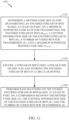
- the method generally includes means for determining a mother code size (N), for transmitting an encoded stream of bits based, at least in part, on a minimum supported code rate for transmitting the encoded stream of bits (R min ), a control information size of the encoded stream of bits (K), a number of coded bits for transmission (E), and a maximum supported mother code size (N max ), means for encoding a stream of bits using a polar code of size (N,K) and storing the encoded stream of bits in a circular buffer, and means for performing rate-matching on the stored encoded stream of bits based, at least in part, on a comparison among the mother code size (N), the control information size of the encoded stream of bits (K), and the number of coded bits for transmission (E).
- the apparatus also includes means for transmitting the rate-matched encoded stream of bits using the RAT.
- aspects of the present disclosure provide apparatus, methods, processing systems, and computer readable mediums for multi-slice networks, such as new radio (NR) (new radio access technology or 5G technology).
- NR new radio access technology
- 5G technology new radio access technology
- NR may support various wireless communication services, such as Enhanced mobile broadband (eMBB) targeting wide bandwidth (e.g. 80 MHz beyond), millimeter wave (mmW) targeting high carrier frequency (e.g. 60 GHz), massive MTC (mMTC) targeting non-backward compatible MTC techniques, and/or mission critical targeting ultra reliable low latency communications (URLLC).
- eMBB Enhanced mobile broadband
- mmW millimeter wave
- mMTC massive MTC
- URLLC ultra reliable low latency communications
- These services may include latency and reliability requirements.
- These services may also have different transmission time intervals (TTI) to meet respective quality of service (QoS) requirements.
- TTI transmission time intervals
- QoS quality of service
- these services may co-exist in the same subframe.
- a CDMA network may implement a radio technology such as universal terrestrial radio access (UTRA), cdma2000, etc.
- UTRA includes wideband CDMA (WCDMA), time division synchronous CDMA (TD-SCDMA), and other variants of CDMA.
- cdma2000 covers IS-2000, IS-95 and IS-856 standards.
- a TDMA network may implement a radio technology such as global system for mobile communications (GSM).
- GSM global system for mobile communications
- An OFDMA network may implement a radio technology such as evolved UTRA (E-UTRA), ultra mobile broadband (UMB), IEEE 802.11 (Wi-Fi), IEEE 802.16 (WiMAX), IEEE 802.20, Flash-OFDM ® , etc.
- E-UTRA evolved UTRA
- UMB ultra mobile broadband
- IEEE 802.11 Wi-Fi
- WiMAX IEEE 802.16
- IEEE 802.20 Flash-OFDM ®
- UTRA and E-UTRA are part of universal mobile telecommunication system (UMTS).
- 3GPP Long Term Evolution (LTE) and LTE-Advanced (LTE-A), in both frequency division duplex (FDD) and time division duplex (TDD), are new releases of UMTS that use E-UTRA, which employs OFDMA on the downlink and SC-FDMA on the uplink.
- LTE Long Term Evolution
- LTE-A LTE-Advanced
- FDD frequency division duplex
- TDD time division duplex
- UTRA, E-UTRA, UMTS, LTE, LTE-A and GSM are described in documents from an organization named "3rd Generation Partnership Project” (3GPP).
- cdma2000 and UMB are described in documents from an organization named “3rd Generation Partnership Project 2" (3GPP2).
- the techniques described herein may be used for the wireless networks and radio technologies mentioned above as well as other wireless networks and radio technologies, such as a 5G nextgen/NR network.
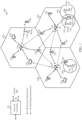
- the base stations may be interconnected to one another and/or to one or more other base stations or network nodes (not shown) in the wireless network 100 through various types of backhaul interfaces such as a direct physical connection, a virtual network, or the like using any suitable transport network.
- any number of wireless networks may be deployed in a given geographic area.
- Each wireless network may support a particular radio access technology (RAT) and may operate on one or more frequencies.
- a RAT may also be referred to as a radio technology, an air interface, etc.
- a frequency may also be referred to as a carrier, a frequency channel, etc.
- Each frequency may support a single RAT in a given geographic area in order to avoid interference between wireless networks of different RATs.
- NR or 5G RAT networks may be deployed, employing a multi-slice network architecture.
- Certain wireless networks utilize orthogonal frequency division multiplexing (OFDM) on the downlink and single-carrier frequency division multiplexing (SC-FDM) on the uplink.
- OFDM and SC-FDM partition the system bandwidth into multiple (K) orthogonal subcarriers, which are also commonly referred to as tones, bins, etc.
- K orthogonal subcarriers
- Each subcarrier may be modulated with data.
- modulation symbols are sent in the frequency domain with OFDM and in the time domain with SC-FDM.
- the spacing between adjacent subcarriers may be fixed, and the total number of subcarriers (K) may be dependent on the system bandwidth.
- the UE is functioning as a scheduling entity, and other UEs utilize resources scheduled by the UE for wireless communication.
- a UE may function as a scheduling entity in a peer-to-peer (P2P) network, and/or in a mesh network.
- P2P peer-to-peer
- UEs may optionally communicate directly with one another in addition to communicating with the scheduling entity.
- a scheduling entity and one or more subordinate entities may communicate utilizing the scheduled resources.
- NR BSs may transmit downlink signals to UEs indicating the cell type. Based on the cell type indication, the UE may communicate with the NR BS. For example, the UE may determine NR BSs to consider for cell selection, access, handover, and/or measurement based on the indicated cell type.
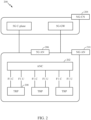
- a dynamic configuration of split logical functions may be present within the distributed RAN 200.
- the Radio Resource Control (RRC) layer, Packet Data Convergence Protocol (PDCP) layer, Radio Link Control (RLC) layer, Medium Access Control (MAC) layer, and a Physical (PHY) layers may be adaptably placed at the DU or CU (e.g., TRP or ANC, respectively).
- a BS may include a central unit (CU) (e.g., ANC 202) and/or one or more distributed units (e.g., one or more TRPs 208).
- CU central unit
- distributed units e.g., one or more TRPs 208.
- FIG. 4 illustrates example components of the BS 110 and UE 120 illustrated in FIG. 1 , which may be used to implement aspects of the present disclosure.
- the BS may include a TRP.
- One or more components of the BS 110 and UE 120 may be used to practice aspects of the present disclosure.
- antennas 452, Tx/Rx 222, processors 466, 458, 464, and/or controller/processor 480 of the UE 120 and/or antennas 434, processors 440, 420, 438, and/or controller/processor 440 of the BS 110 may be used to perform the operations described herein and illustrated with reference to FIGs. 12 .
- the antennas 452a through 452r may receive the downlink signals from the base station 110 and may provide received signals to the demodulators (DEMODs) 454a through 454r, respectively.
- Each demodulator 454 may condition (e.g., filter, amplify, downconvert, and digitize) a respective received signal to obtain input samples.
- Each demodulator 454 may further process the input samples (e.g., for OFDM, etc.) to obtain received symbols.
- a MIMO detector 456 may obtain received symbols from all the demodulators 454a through 454r, perform MIMO detection on the received symbols if applicable, and provide detected symbols.
- the uplink signals from the UE 120 may be received by the antennas 434, processed by the modulators 432, detected by a MIMO detector 436 if applicable, and further processed by a receive processor 438 to obtain decoded data and control information sent by the UE 120.
- the receive processor 438 may provide the decoded data to a data sink 439 and the decoded control information to the controller/processor 440.
- the wireless communications device 602 may include a processor 604 which controls operation of the wireless communications device 602.
- the processor 604 may also be referred to as a central processing unit (CPU).
- Memory 606 which may include both read-only memory (ROM) and random access memory (RAM), provides instructions and data to the processor 604.
- a portion of the memory 606 may also include non-volatile random access memory (NVRAM).
- the processor 604 typically performs logical and arithmetic operations based on program instructions stored within the memory 606.
- the instructions in the memory 606 may be executable to implement the methods described herein.
- the wireless communications device 602 may also include a housing 608 that may include a transmitter 610 and a receiver 612 to allow transmission and reception of data between the wireless communications device 602 and a remote location.
- the transmitter 610 and receiver 612 may be combined into a transceiver 614.
- a single or a plurality of transmit antennas 616 may be attached to the housing 608 and electrically coupled to the transceiver 614.
- the wireless communications device 602 may also include (not shown) multiple transmitters, multiple receivers, and multiple transceivers.
- the encoded bitstream 708 may then be stored in circular buffer and rate-matching may be performed on the stored encoded bitstream, for example, according to aspects presented below. After the encoded bitstream 708 is rate-matched, the encoded bitstream 708 may then be provided to a mapper 710 that generates a sequence of Tx symbols 712 that are modulated, amplified and otherwise processed by Tx chain 714 to produce an RF signal 716 for transmission through antenna 718.
- the DL-centric subframe may also include a common UL portion 906.
- the common UL portion 906 may sometimes be referred to as an UL burst, a common UL burst, and/or various other suitable terms.
- the common UL portion 906 may include feedback information corresponding to various other portions of the DL-centric subframe.
- the common UL portion 906 may include feedback information corresponding to the control portion 902.
- Non-limiting examples of feedback information may include an ACK signal, a NACK signal, a HARQ indicator, and/or various other suitable types of information.
- the common UL portion 906 may include additional or alternative information, such as information pertaining to random access channel (RACH) procedures, scheduling requests (SRs), and various other suitable types of information.
- RACH random access channel
- SRs scheduling requests
- the end of the DL data portion 904 may be separated in time from the beginning of the common UL portion 906.
- This time separation may sometimes be referred to as a gap, a guard period, a guard interval, and/or various other suitable terms.
- This separation provides time for the switch-over from DL communication (e.g., reception operation by the subordinate entity (e.g., UE)) to UL communication (e.g., transmission by the subordinate entity (e.g., UE)).
- DL communication e.g., reception operation by the subordinate entity (e.g., UE)
- UL communication e.g., transmission by the subordinate entity (e.g., UE)
- the UL portion may refer to the communication resources utilized to communicate UL data from the subordinate entity (e.g., UE) to the scheduling entity (e.g., UE or BS).
- the control portion 1002 may be a physical DL control channel (PDCCH).
- two or more subordinate entities may communicate with each other using sidelink signals.
- Real-world applications of such sidelink communications may include public safety, proximity services, UE-to-network relaying, vehicle-to-vehicle (V2V) communications, Internet of Everything (IoE) communications, IoT communications, mission-critical mesh, and/or various other suitable applications.
- a sidelink signal may refer to a signal communicated from one subordinate entity (e.g., UE1) to another subordinate entity (e.g., UE2) without relaying that communication through the scheduling entity (e.g., UE or BS), even though the scheduling entity may be utilized for scheduling and/or control purposes.
- the sidelink signals may be communicated using a licensed spectrum (unlike wireless local area networks, which typically use an unlicensed spectrum).
- Each receiving network access device may be configured to receive and measure pilot signals transmitted on the common set of resources, and also receive and measure pilot signals transmitted on dedicated sets of resources allocated to the UEs for which the network access device is a member of a monitoring set of network access devices for the UE.
- One or more of the receiving network access devices, or a CU to which receiving network access device(s) transmit the measurements of the pilot signals may use the measurements to identify serving cells for the UEs, or to initiate a change of serving cell for one or more of the UEs.
- tail biting convolutional codes of rate 1/3 are used for rate matching control channels.
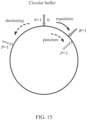
- Rate matching in LTE is typically performed using a circular buffer 1100 as shown in FIG. 11 .
- the resultant coded bits from the three polynomials e.g., required for TBCC of rate 1/3
- the circular buffer 1100 is typically performed using a circular buffer 1100 as shown in FIG. 11 .
- code bits from a first polynomial are placed in the circular buffer in the range of [0, K).
- code bits from a second polynomial are placed in the circular buffer in the range of [K, 2K)
- code bits from a third polynomial are placed in the circular buffer in the range of [2K, 3K).
- a UE may include one or more components as illustrated in FIG. 4 which may be configured to perform the operations described herein.
- the antenna 452, demodulator/modulator 454, controller/processor 480, and/or memory 482 as illustrated in FIG. 4 may perform the operations described herein.
- a base station may include one or more components as illustrated in FIG. 4 which may be configured to perform the operations described herein.
- the antenna 434, demodulator/modulator 432, controller/processor 440, and/or memory 442 as illustrated in FIG. 4 may perform the operations described herein.
- the wireless communications device may determine mother code size (N) for transmitting the stream of bits.
- the mother code size (N) may be based, at least in part on a minimum supported code rate for transmitting the encoded stream of bits (R min ), a control information size of the encoded stream of bits (K), and a number of coded bits for transmission (E), allocated to the wireless communications device (e.g., by the wireless communication network) for transmitting data, and a maximum supported mother code size (N max ) that is supported by the wireless communications network (e.g., 512, 1024, etc.).
- the wireless communications device may first determine the mother code size, N. To determine N, the wireless communications device may first determine N R to be 256 as 256 represents the minimum power of two integer that is not less than 192 (i.e., K/R min , or 32*6). Additionally, the wireless communications device may determine N E to be 128 as 128 represents the minimum power of 2 integer that is not less than E (i.e., 120). Thus, the wireless communications device may determine the mother code size, N, to be equal to 128 as 128 is the minimum of (256, 128, 512) (i.e., min(N R , N E , N max )).
- the wireless communications device may then determine that a plurality of encoded bits need to be punctured in the circular buffer. For example, since E ⁇ N (i.e., 120 ⁇ 128) and K/E ⁇ 7/16 (i.e., 32/120 ⁇ 7/16), the wireless communications device may determine that 8 bits (e.g., N-E) need to be punctured. Thus, as illustrated in FIG. 16 , the wireless communication device punctures the encoded bits stored in the circular buffer based on the Polar code (128,32) starting from the zeroth position in the circular buffer and proceeding clockwise around the circular buffer until position 7.
- the wireless communications device may first determine the mother code size (N). To determine N, the wireless communications device may first determine N R to be 256 as 256 represents the minimum power of two integer that is not less than 192 (i.e., K/R min , or 32*6). Additionally, the wireless communications device may determine N E to be 512 as 512 represents the minimum power of 2 integer that is not less than E (i.e., 384). Thus, the wireless communications device may determine the mother code size, N, to be equal to 256 as 256 is the minimum of (256, 512, 512) (i.e., min(N R , N E , N max )).
- a software module may comprise a single instruction, or many instructions, and may be distributed over several different code segments, among different programs, and across multiple storage media.
- the computer-readable media may comprise a number of software modules.
- the software modules include instructions that, when executed by an apparatus such as a processor, cause the processing system to perform various functions.
- the software modules may include a transmission module and a receiving module. Each software module may reside in a single storage device or be distributed across multiple storage devices.
- a software module may be loaded into RAM from a hard drive when a triggering event occurs.
- the processor may load some of the instructions into cache to increase access speed.
- One or more cache lines may then be loaded into a general register file for execution by the processor.
- Clause 2 The method of clause 1, wherein performing rating-matching on the stored encoded stream of bits comprises repeating a first number of stored encoded bits if E ⁇ N.
- Clause 4 The method of clause 2, wherein the first number of stored encoded bits is repeated at the end of the encoded stream of bits stored in the circular buffer.
- Clause 6 The method of clause 5, wherein the second number of stored encoded bits is equal to N-E bits, starting from a zeroth position in the circular buffer and proceeding clockwise around the circular buffer.
- Clause 7 The method of clause 1, wherein performing rating-matching on the stored encoded stream of bits comprises shortening a third number of stored encoded bits if E ⁇ N and if K/E> ⁇ , wherein ⁇ is a real value ranging from 0 to 1.
- Clause 13 The apparatus of clause 12, wherein the first number of stored encoded bits is equal to E-N bits, starting from a zeroth position in the circular buffer and proceeding clockwise around the circular buffer.
- Clause 16 The apparatus of clause 15, wherein the second number of stored encoded bits is equal to N-E bits, starting from a zeroth position in the circular buffer and proceeding clockwise around the circular buffer.
- Clause 18 The apparatus of clause 17, wherein the third number of stored encoded bits is equal to N-E bits, starting from position N-1 in the circular buffer and proceeding counter-clockwise around the circular buffer.
- Clause 25 The apparatus of clause 21, wherein the means for performing rating-matching on the stored encoded stream of bits are configured to shorten a third number of stored encoded bits if E ⁇ N and if K/E> ⁇ , wherein ⁇ is a real value ranging from 0 to 1.
- Clause 27 The non-transitory computer-readable medium of clause 26, wherein the instructions that configure the at least one processor to perform rating-matching on the stored encoded stream of bits are configure the at least one processor to repeat a first number of stored encoded bits if E ⁇ N.
- Clause 28 The non-transitory computer-readable medium of clause 27, wherein the first number of stored encoded bits is equal to E-N bits, starting from a zeroth position in the circular buffer and proceeding clockwise around the circular buffer.
- Clause 30 The non-transitory computer-readable medium of clause 26, wherein the instructions that configure the at least one processor to perform rating-matching on the stored encoded stream of bits configure the at least one processor to shorten a third number of stored encoded bits if E ⁇ N and if K/E> ⁇ , wherein ⁇ is a real value ranging from 0 to 1.
Landscapes
- Engineering & Computer Science (AREA)
- Computer Networks & Wireless Communication (AREA)
- Signal Processing (AREA)
- Mobile Radio Communication Systems (AREA)
- Error Detection And Correction (AREA)
- Detection And Prevention Of Errors In Transmission (AREA)
- Digital Transmission Methods That Use Modulated Carrier Waves (AREA)
Applications Claiming Priority (3)
| Application Number | Priority Date | Filing Date | Title |
|---|---|---|---|
| PCT/CN2017/083365 WO2018205051A1 (en) | 2017-05-06 | 2017-05-06 | Rate-matching scheme for polar codes |
| PCT/CN2018/082085 WO2018205777A1 (en) | 2017-05-06 | 2018-04-06 | Rate-matching scheme for polar codes |
| EP18797950.5A EP3619852B1 (de) | 2017-05-06 | 2018-04-06 | Ratenanpassungsschema für polare codes |
Related Parent Applications (2)
| Application Number | Title | Priority Date | Filing Date |
|---|---|---|---|
| EP18797950.5A Division EP3619852B1 (de) | 2017-05-06 | 2018-04-06 | Ratenanpassungsschema für polare codes |
| EP18797950.5A Division-Into EP3619852B1 (de) | 2017-05-06 | 2018-04-06 | Ratenanpassungsschema für polare codes |
Publications (2)
| Publication Number | Publication Date |
|---|---|
| EP4535696A2 true EP4535696A2 (de) | 2025-04-09 |
| EP4535696A3 EP4535696A3 (de) | 2025-06-18 |
Family
ID=64104095
Family Applications (2)
| Application Number | Title | Priority Date | Filing Date |
|---|---|---|---|
| EP25158066.8A Pending EP4535696A3 (de) | 2017-05-06 | 2018-04-06 | Ratenanpassungsschema für polare codes |
| EP18797950.5A Active EP3619852B1 (de) | 2017-05-06 | 2018-04-06 | Ratenanpassungsschema für polare codes |
Family Applications After (1)
| Application Number | Title | Priority Date | Filing Date |
|---|---|---|---|
| EP18797950.5A Active EP3619852B1 (de) | 2017-05-06 | 2018-04-06 | Ratenanpassungsschema für polare codes |
Country Status (8)
| Country | Link |
|---|---|
| US (2) | US11489625B2 (de) |
| EP (2) | EP4535696A3 (de) |
| JP (1) | JP7138659B2 (de) |
| KR (1) | KR102647948B1 (de) |
| CN (2) | CN110582961A (de) |
| BR (1) | BR112019023004A2 (de) |
| TW (1) | TWI835727B (de) |
| WO (2) | WO2018205051A1 (de) |
Families Citing this family (10)
| Publication number | Priority date | Publication date | Assignee | Title |
|---|---|---|---|---|
| WO2018205051A1 (en) | 2017-05-06 | 2018-11-15 | Qualcomm Incorporated | Rate-matching scheme for polar codes |
| WO2019099318A1 (en) * | 2017-11-15 | 2019-05-23 | Idac Holdings, Inc. | Urllc transmissions with polar codes |
| CN110391870B (zh) * | 2018-04-16 | 2022-04-29 | 华为技术有限公司 | 速率匹配的方法和装置,以及解速率匹配的方法和装置 |
| WO2020039069A1 (en) * | 2018-08-24 | 2020-02-27 | Telefonaktiebolaget Lm Ericsson (Publ) | Enhancements to limited buffer rate-matching |
| US11374704B2 (en) * | 2020-05-07 | 2022-06-28 | Cisco Technology, Inc. | Mapping bit positions using predicted error values |
| CN119892299A (zh) * | 2020-09-07 | 2025-04-25 | 华为技术有限公司 | 一种通信方法及装置 |
| EP4354775A4 (de) * | 2021-06-10 | 2025-05-21 | LG Electronics Inc. | Verfahren, kommunikationsvorrichtung, verarbeitungsvorrichtung und speichermedium zur kanalcodierung sowie verfahren und kommunikationsvorrichtung zur kanaldecodierung |
| EP4550698A4 (de) * | 2022-08-08 | 2025-08-27 | Huawei Tech Co Ltd | Datenverarbeitungsverfahren, -vorrichtung und -einrichtung |
| WO2025118454A1 (en) * | 2023-12-05 | 2025-06-12 | Huawei Technologies Co., Ltd. | Rate matching method and apparatuses |
| WO2026000230A1 (en) * | 2024-06-26 | 2026-01-02 | Qualcomm Incorporated | Block segmentation for polar codes |
Family Cites Families (21)
| Publication number | Priority date | Publication date | Assignee | Title |
|---|---|---|---|---|
| JP3795743B2 (ja) * | 2000-11-17 | 2006-07-12 | 株式会社エヌ・ティ・ティ・ドコモ | データ伝送方法、データ伝送システム、送信装置および受信装置 |
| AU2003214677B2 (en) * | 2002-03-27 | 2005-12-22 | Samsung Electronics Co., Ltd. | Apparatus and Method for Receiving Packet Data Control Channel in a Mobile Communication System |
| US9281917B2 (en) * | 2007-01-03 | 2016-03-08 | Nokia Technologies Oy | Shared control channel structure |
| US9686044B2 (en) | 2007-03-27 | 2017-06-20 | Qualcomm Incorporated | Rate matching with multiple code block sizes |
| US9071402B2 (en) * | 2008-03-24 | 2015-06-30 | Telefonaktiebolaget L M Ericsson (Publ) | Selection of retransmission settings for HARQ in WCDMA and LTE networks |
| US8724636B2 (en) * | 2008-03-31 | 2014-05-13 | Qualcomm Incorporated | Methods of reliably sending control signal |
| CN105164956B (zh) | 2013-11-04 | 2019-05-24 | 华为技术有限公司 | Polar码的速率匹配方法和设备、无线通信装置 |
| CN105453466B (zh) * | 2013-12-30 | 2020-01-21 | 华为技术有限公司 | 极化码的速率匹配方法及装置 |
| CN105493424B (zh) * | 2013-12-31 | 2019-02-01 | 华为技术有限公司 | 一种Polar码的处理方法、系统及无线通信装置 |
| EP3799314B1 (de) | 2014-02-20 | 2023-07-26 | Huawei Technologies Co., Ltd. | Ratenanpassung mit sub-block-verschachtelung und virtuellem puffer für polar kodes |
| BR112016021434A2 (pt) * | 2014-03-19 | 2017-08-15 | Huawei Tech Co Ltd | Método de equiparação de taxa de código polar e aparelho de equiparação de taxa |
| WO2015139297A1 (zh) | 2014-03-21 | 2015-09-24 | 华为技术有限公司 | 极性码的速率匹配方法和速率匹配装置 |
| CA2972655C (en) * | 2014-03-24 | 2020-10-20 | Huawei Technologies Co., Ltd. | Polar code rate matching method and polar code rate matching apparatus |
| CN105337684B (zh) * | 2014-07-25 | 2019-09-13 | 华为技术有限公司 | 一种传输、存储下行数据的方法、基站及终端 |
| US10506245B2 (en) * | 2015-11-18 | 2019-12-10 | Cybrook Inc. | Video data processing using a ring buffer |
| CN107342843B (zh) | 2017-01-05 | 2023-10-20 | 华为技术有限公司 | 速率匹配方法、编码装置和通信装置 |
| WO2018174615A1 (en) * | 2017-03-23 | 2018-09-27 | Samsung Electronics Co., Ltd. | Method and apparatus for rate-matching of polar codes |
| CN109412608B (zh) * | 2017-03-24 | 2019-11-05 | 华为技术有限公司 | Polar编码方法和编码装置、译码方法和译码装置 |
| WO2018205051A1 (en) | 2017-05-06 | 2018-11-15 | Qualcomm Incorporated | Rate-matching scheme for polar codes |
| CN109245852B (zh) | 2017-07-11 | 2022-02-11 | 华为技术有限公司 | Polar码的速率匹配方法及装置 |
| CN109600194B (zh) | 2017-09-30 | 2024-06-18 | 华为技术有限公司 | Polar编码方法和编码装置、译码方法和译码装置 |
-
2017
- 2017-05-06 WO PCT/CN2017/083365 patent/WO2018205051A1/en not_active Ceased
-
2018
- 2018-04-06 KR KR1020197032669A patent/KR102647948B1/ko active Active
- 2018-04-06 US US16/604,060 patent/US11489625B2/en active Active
- 2018-04-06 WO PCT/CN2018/082085 patent/WO2018205777A1/en not_active Ceased
- 2018-04-06 CN CN201880029513.1A patent/CN110582961A/zh active Pending
- 2018-04-06 EP EP25158066.8A patent/EP4535696A3/de active Pending
- 2018-04-06 CN CN202310944699.6A patent/CN116805895B/zh active Active
- 2018-04-06 BR BR112019023004A patent/BR112019023004A2/pt unknown
- 2018-04-06 JP JP2019559704A patent/JP7138659B2/ja active Active
- 2018-04-06 EP EP18797950.5A patent/EP3619852B1/de active Active
- 2018-04-09 TW TW107112086A patent/TWI835727B/zh active
-
2022
- 2022-09-06 US US17/929,942 patent/US11956079B2/en active Active
Also Published As
| Publication number | Publication date |
|---|---|
| CN116805895A (zh) | 2023-09-26 |
| US11956079B2 (en) | 2024-04-09 |
| BR112019023004A2 (pt) | 2020-05-19 |
| TWI835727B (zh) | 2024-03-21 |
| KR102647948B1 (ko) | 2024-03-14 |
| CN110582961A (zh) | 2019-12-17 |
| EP4535696A3 (de) | 2025-06-18 |
| US20210119735A1 (en) | 2021-04-22 |
| WO2018205051A1 (en) | 2018-11-15 |
| US20220416942A1 (en) | 2022-12-29 |
| JP7138659B2 (ja) | 2022-09-16 |
| CN116805895B (zh) | 2026-03-24 |
| EP3619852A4 (de) | 2021-01-27 |
| EP3619852B1 (de) | 2025-11-05 |
| EP3619852C0 (de) | 2025-11-05 |
| EP3619852A1 (de) | 2020-03-11 |
| CA3058689A1 (en) | 2018-11-15 |
| TW201907682A (zh) | 2019-02-16 |
| WO2018205777A1 (en) | 2018-11-15 |
| KR20200006051A (ko) | 2020-01-17 |
| JP2020521355A (ja) | 2020-07-16 |
| US11489625B2 (en) | 2022-11-01 |
Similar Documents
| Publication | Publication Date | Title |
|---|---|---|
| CA3046964C (en) | Control channel code rate selection | |
| US11956079B2 (en) | Rate-matching scheme for polar codes | |
| US11533128B2 (en) | Rate-matching scheme for control channels using polar codes | |
| EP3568920B1 (de) | Dynamische gefrorene polare codes | |
| EP3711167B1 (de) | Segmentierung von uplink-steuerungsinformationen für polare codes | |
| EP3721571B1 (de) | Zeitbasierte redundanzversionsbestimmung für berechtigungsfreie signalisierung | |
| EP3665780B1 (de) | Vereinheitlichtes muster zur punktion und verkürzung von polaren codes | |
| EP3714564B1 (de) | Ringpufferbasierte hybride automatische neuübertragungsanforderung für polare codes | |
| EP3957012B1 (de) | Anpassung von m für design zur polarcode-raten-angleichung | |
| CA3058689C (en) | Rate-matching scheme for polar codes |
Legal Events
| Date | Code | Title | Description |
|---|---|---|---|
| PUAI | Public reference made under article 153(3) epc to a published international application that has entered the european phase |
Free format text: ORIGINAL CODE: 0009012 |
|
| STAA | Information on the status of an ep patent application or granted ep patent |
Free format text: STATUS: THE APPLICATION HAS BEEN PUBLISHED |
|
| AC | Divisional application: reference to earlier application |
Ref document number: 3619852 Country of ref document: EP Kind code of ref document: P |
|
| AK | Designated contracting states |
Kind code of ref document: A2 Designated state(s): AL AT BE BG CH CY CZ DE DK EE ES FI FR GB GR HR HU IE IS IT LI LT LU LV MC MK MT NL NO PL PT RO RS SE SI SK SM TR |
|
| PUAL | Search report despatched |
Free format text: ORIGINAL CODE: 0009013 |
|
| AK | Designated contracting states |
Kind code of ref document: A3 Designated state(s): AL AT BE BG CH CY CZ DE DK EE ES FI FR GB GR HR HU IE IS IT LI LT LU LV MC MK MT NL NO PL PT RO RS SE SI SK SM TR |
|
| RIC1 | Information provided on ipc code assigned before grant |
Ipc: H04L 1/08 20060101ALI20250514BHEP Ipc: H04L 1/00 20060101AFI20250514BHEP |
|
| STAA | Information on the status of an ep patent application or granted ep patent |
Free format text: STATUS: REQUEST FOR EXAMINATION WAS MADE |
|
| 17P | Request for examination filed |
Effective date: 20251205 |
|
| STAA | Information on the status of an ep patent application or granted ep patent |
Free format text: STATUS: EXAMINATION IS IN PROGRESS |
|
| 17Q | First examination report despatched |
Effective date: 20260323 |