EP4531328A2 - Sicheres dynamisches schwellensignaturschema mit zuverlässiger hardware - Google Patents
Sicheres dynamisches schwellensignaturschema mit zuverlässiger hardware Download PDFInfo
- Publication number
- EP4531328A2 EP4531328A2 EP25156036.3A EP25156036A EP4531328A2 EP 4531328 A2 EP4531328 A2 EP 4531328A2 EP 25156036 A EP25156036 A EP 25156036A EP 4531328 A2 EP4531328 A2 EP 4531328A2
- Authority
- EP
- European Patent Office
- Prior art keywords
- signature
- group
- computer
- node
- nodes
- Prior art date
- Legal status (The legal status is an assumption and is not a legal conclusion. Google has not performed a legal analysis and makes no representation as to the accuracy of the status listed.)
- Pending
Links
Images




Classifications
-
- H—ELECTRICITY
- H04—ELECTRIC COMMUNICATION TECHNIQUE
- H04L—TRANSMISSION OF DIGITAL INFORMATION, e.g. TELEGRAPHIC COMMUNICATION
- H04L63/00—Network architectures or network communication protocols for network security
- H04L63/10—Network architectures or network communication protocols for network security for controlling access to devices or network resources
-
- H—ELECTRICITY
- H04—ELECTRIC COMMUNICATION TECHNIQUE
- H04L—TRANSMISSION OF DIGITAL INFORMATION, e.g. TELEGRAPHIC COMMUNICATION
- H04L63/00—Network architectures or network communication protocols for network security
- H04L63/12—Applying verification of the received information
-
- H—ELECTRICITY
- H04—ELECTRIC COMMUNICATION TECHNIQUE
- H04L—TRANSMISSION OF DIGITAL INFORMATION, e.g. TELEGRAPHIC COMMUNICATION
- H04L9/00—Cryptographic mechanisms or cryptographic arrangements for secret or secure communications; Network security protocols
- H04L9/08—Key distribution or management, e.g. generation, sharing or updating, of cryptographic keys or passwords
- H04L9/0816—Key establishment, i.e. cryptographic processes or cryptographic protocols whereby a shared secret becomes available to two or more parties, for subsequent use
- H04L9/085—Secret sharing or secret splitting, e.g. threshold schemes
-
- H—ELECTRICITY
- H04—ELECTRIC COMMUNICATION TECHNIQUE
- H04L—TRANSMISSION OF DIGITAL INFORMATION, e.g. TELEGRAPHIC COMMUNICATION
- H04L9/00—Cryptographic mechanisms or cryptographic arrangements for secret or secure communications; Network security protocols
- H04L9/32—Cryptographic mechanisms or cryptographic arrangements for secret or secure communications; Network security protocols including means for verifying the identity or authority of a user of the system or for message authentication, e.g. authorization, entity authentication, data integrity or data verification, non-repudiation, key authentication or verification of credentials
- H04L9/3236—Cryptographic mechanisms or cryptographic arrangements for secret or secure communications; Network security protocols including means for verifying the identity or authority of a user of the system or for message authentication, e.g. authorization, entity authentication, data integrity or data verification, non-repudiation, key authentication or verification of credentials using cryptographic hash functions
- H04L9/3239—Cryptographic mechanisms or cryptographic arrangements for secret or secure communications; Network security protocols including means for verifying the identity or authority of a user of the system or for message authentication, e.g. authorization, entity authentication, data integrity or data verification, non-repudiation, key authentication or verification of credentials using cryptographic hash functions involving non-keyed hash functions, e.g. modification detection codes [MDCs], MD5, SHA or RIPEMD
-
- H—ELECTRICITY
- H04—ELECTRIC COMMUNICATION TECHNIQUE
- H04L—TRANSMISSION OF DIGITAL INFORMATION, e.g. TELEGRAPHIC COMMUNICATION
- H04L9/00—Cryptographic mechanisms or cryptographic arrangements for secret or secure communications; Network security protocols
- H04L9/32—Cryptographic mechanisms or cryptographic arrangements for secret or secure communications; Network security protocols including means for verifying the identity or authority of a user of the system or for message authentication, e.g. authorization, entity authentication, data integrity or data verification, non-repudiation, key authentication or verification of credentials
- H04L9/3247—Cryptographic mechanisms or cryptographic arrangements for secret or secure communications; Network security protocols including means for verifying the identity or authority of a user of the system or for message authentication, e.g. authorization, entity authentication, data integrity or data verification, non-repudiation, key authentication or verification of credentials involving digital signatures
- H04L9/3252—Cryptographic mechanisms or cryptographic arrangements for secret or secure communications; Network security protocols including means for verifying the identity or authority of a user of the system or for message authentication, e.g. authorization, entity authentication, data integrity or data verification, non-repudiation, key authentication or verification of credentials involving digital signatures using DSA or related signature schemes, e.g. elliptic based signatures, ElGamal or Schnorr schemes
-
- H—ELECTRICITY
- H04—ELECTRIC COMMUNICATION TECHNIQUE
- H04L—TRANSMISSION OF DIGITAL INFORMATION, e.g. TELEGRAPHIC COMMUNICATION
- H04L9/00—Cryptographic mechanisms or cryptographic arrangements for secret or secure communications; Network security protocols
- H04L9/32—Cryptographic mechanisms or cryptographic arrangements for secret or secure communications; Network security protocols including means for verifying the identity or authority of a user of the system or for message authentication, e.g. authorization, entity authentication, data integrity or data verification, non-repudiation, key authentication or verification of credentials
- H04L9/3247—Cryptographic mechanisms or cryptographic arrangements for secret or secure communications; Network security protocols including means for verifying the identity or authority of a user of the system or for message authentication, e.g. authorization, entity authentication, data integrity or data verification, non-repudiation, key authentication or verification of credentials involving digital signatures
- H04L9/3255—Cryptographic mechanisms or cryptographic arrangements for secret or secure communications; Network security protocols including means for verifying the identity or authority of a user of the system or for message authentication, e.g. authorization, entity authentication, data integrity or data verification, non-repudiation, key authentication or verification of credentials involving digital signatures using group based signatures, e.g. ring or threshold signatures
-
- H—ELECTRICITY
- H04—ELECTRIC COMMUNICATION TECHNIQUE
- H04L—TRANSMISSION OF DIGITAL INFORMATION, e.g. TELEGRAPHIC COMMUNICATION
- H04L2209/00—Additional information or applications relating to cryptographic mechanisms or cryptographic arrangements for secret or secure communication H04L9/00
- H04L2209/12—Details relating to cryptographic hardware or logic circuitry
- H04L2209/127—Trusted platform modules [TPM]
-
- H—ELECTRICITY
- H04—ELECTRIC COMMUNICATION TECHNIQUE
- H04L—TRANSMISSION OF DIGITAL INFORMATION, e.g. TELEGRAPHIC COMMUNICATION
- H04L9/00—Cryptographic mechanisms or cryptographic arrangements for secret or secure communications; Network security protocols
- H04L9/50—Cryptographic mechanisms or cryptographic arrangements for secret or secure communications; Network security protocols using hash chains, e.g. blockchains or hash trees
Definitions
- This invention relates generally to computer-implemented security techniques, including the use of cryptographic signatures to secure, and enforce the security of, resources that are exchanged or transmitted via a computer network. It also relates to distributed ledger (blockchain) technology, and more particularly to methods and systems for providing decentralized control over exchanges and/or transfers that are associated with and/or performed via a digital ledger.
- the invention is particularly suited, but not limited to, allowing a threshold number of members of a group to generate a valid cryptographic signature on behalf of that group.
- 'blockchain' to include all forms of electronic, computer-based, distributed ledgers. These include, but are not limited to blockchain and transaction-chain technologies, permissioned and un-permissioned ledgers, shared ledgers and variations thereof.
- the most widely known application of blockchain technology is the Bitcoin ledger, although other blockchain implementations have been proposed and developed. While Bitcoin may be referred to herein for the purpose of convenience and illustration, it should be noted that the invention is not limited to use with the Bitcoin blockchain and alternative blockchain implementations and protocols fall within the scope of the present invention.
- a blockchain is a consensus-based, electronic ledger which is implemented as a computer-based decentralised, distributed system made up of blocks which in turn are made up of transactions and other information.
- each transaction is a data structure that encodes the transfer of control of a digital asset between participants in the blockchain system, and includes at least one input and at least one output.
- Each block contains a hash of the previous block to that blocks become chained together to create a permanent, unalterable record of all transactions which have been written to the blockchain since its inception.
- Transactions contain small programs known as scripts embedded into their inputs and outputs, which specify how and by whom the outputs of the transactions can be accessed. On the Bitcoin platform, these scripts are written using a stack-based scripting language.
- Validation In order for a transaction to be written to the blockchain, it must be "validated". Some network nodes act as miners and perform work to ensure that each transaction is valid, with invalid transactions rejected from the network. For example, software clients installed on the nodes perform this validation work on transactions that reference unspent transaction outputs (UTXO). Validation may be performed by executing a transaction's locking and unlocking scripts. If execution of the locking and unlocking scripts evaluate to TRUE and, if certain other conditions are met, the transaction is valid and the transaction may be written to the blockchain.
- a transaction in order for a transaction to be written to the blockchain, it must be i) validated by a node that receives the transaction - if the transaction is validated, the node relays it to the other nodes in the network; and ii) added to a new block built by a miner; and iii) mined, i.e. added to the public ledger of past transactions.
- the transaction is considered to be confirmed when a sufficient number of blocks are added to the blockchain to make the transaction practically irreversible.
- Blockchain protocols sometimes provide for multi-party signing features that require signatures from a number of nodes or parties before removing an encumbrance on an unspent output (UTXO).
- UTXO unspent output
- Multi-signature scripts may set a condition in which N public keys are recorded in a locking script and at least M private keys, each associated with a respective one of the N public keys, must provide signatures to release an encumbrance i.e. to unlock the UTXO.
- Such signature schemes offer advantageous security benefits, and provide enhanced control over the UTXO by enabling a more granular and sophisticated degree of control over locking/unlocking of the UTXO.
- known multi-sig techniques offer limited functionality since they do not allow the parties who must contribute to signature generation to change after the locking script is configured. Therefore, there is a need for improved security mechanisms for controlling electronic resources such as those transferred via blockchain and other networks.
- a dynamic multiparty threshold signature scheme allows control of a resource (e.g. a blockchain transaction output, UTXO) to be shared among a group of participants under a single public key but with each group member holding a private secret.
- a threshold subset of the participants are required to collectively sign in order to spend the output.
- a digital signature scheme is described that allows a valid signature to be generated without requiring any of the participants who contribute to signature generation to reveal their respective private secrets. Trusted execution environments may be used to offer security to the threshold signature scheme.
- a computer-implemented method It may be described as a security or control method. It may be arranged to secure or control a resource. It may be arranged to control access to the resource.
- the controlled resource may be an electronic resource, entity or item stored on or transmitted via a computer or network. It may be, in some cases, referred to as a "digital asset", an "output", "a portion of cryptocurrency” and/or a "UTXO"
- the invention may be arranged to control access to and/or transfer of the resource.
- the invention may be arranged to lock or unlock access to/control of the resource. In some cases, the term "spend” may be used to refer to unlocking of the resource i.e. permitting control of or access to it.
- the method may be a cryptographically-enforced method. Additionally or alternatively, it may be described as a method for generating an elliptic curve digital signature algorithm signature.
- the signature may comprise a first signature component, r, and a second signature component, w.
- the method may be implemented by one or more nodes in a network such as, for example, a blockchain network.
- the method may include: i) forming, by a node, a signing group with other nodes; ii) obtaining, by the node, based on a secure random number: a) a multiplicative inverse of the secure random number; and b) the first signature component, r, wherein the first signature component is determined based on the secure random number and an elliptic curve generator point; iii) determining, by the node, a partial signature based on a private secret share, the multiplicative inverse of the secure random number and the first signature component; iv) receiving, by the node, partial signatures from other nodes of the signing group; and v) generating, by the node, the second signature component, w, based on determined and received partial signatures.
- the method may comprise the step of using the signature to control access to and/or transfer of a resource over a computer-implemented network.
- This may be a blockchain network.
- obtaining includes generating the multiplicative inverse and the first signature component.
- the method may also include sending the multiplicative inverse to the other nodes.
- obtaining includes provisioning an enclave associated with a trusted execution environment (TEE) of the node to generate the secure random number.
- TEE trusted execution environment
- obtaining comprises receiving the multiplicative inverse and the first signature component from one of the other nodes.
- the method includes, prior to forming the signing group, signalling an intention to participate in distributed signature generation.
- the partial signature is determined within an enclave associated with a trusted execution environment of the node.
- the partial signature is determined by performing Lagrangian interpolation.
- the second signature component is generated within an enclave associated with a trusted execution environment and the method further includes, after generating the second signature component, sending the elliptic curve digital signature algorithm from the enclave to a host portion of the node.
- the method further includes adding the signature to a blockchain transaction and broadcasting it to a blockchain network.
- the method further includes, prior to forming the signing group, obtaining the secret share by based on secret share data received from a plurality of existing members of a group.
- the secret share is determined within an enclave associated with a trusted execution environment of the node.
- an electronic device Any feature described above in relation to a method of the invention may also be applicable to a device arranged in accordance with the invention.
- the device may be arranged to implement or execute any embodiment of the method described above.
- the electronic device may include an interface device, a processor coupled to the interface device and a memory coupled to the processor.
- the memory may have stored thereon computer executable instructions which, when executed, configure the processor to perform a method described herein.
- the computer readable storage medium includes computer-executable instructions which, when executed, configure a processor to perform a method described herein.
- the invention relates to improved security solutions. These can be used for the enhanced security of controlled resources on a computer network.
- a blockchain network e.g. Bitcoin
- Blockchains can be used to transfer control of an electronic resource such as a token or a portion of cryptocurrency, between nodes on the network.
- an electronic resource such as a token or a portion of cryptocurrency
- the invention has benefits and applications beyond that of blockchain transactions, and is not limited for use in relation to financially-oriented contexts, but has a broader applicability.
- the blockchain example provided below is only provided for illustration.
- FIG. 1 illustrates, in block diagram form, an example blockchain network 100 associated with a blockchain.
- the blockchain network may be a public blockchain network, which is a peer-to-peer open membership network which may be joined by anyone, without invitation or without consent from other members.
- Distributed electronic devices running an instance of the blockchain protocol under which the blockchain network 100 operates may participate in the blockchain network 100. Such distributed electronic devices may be referred to as nodes 102.
- the blockchain protocol may be a Bitcoin protocol, for example.
- the electronic devices that run the blockchain protocol and that form the nodes 102 of the blockchain network 100 may be of various types including, for example, computers such as desktop computers, laptop computers, tablet computers, servers, mobile devices such as smartphones, wearable computers such as smart watches or other electronic devices.
- Nodes 102 maintain a (possibly global) ledger of all transactions on the blockchain.
- the ledger is a de-centralised, distributed ledger.
- Each node 102 may store a complete copy or a partial copy of the global ledger.
- transactions by a node 102 affecting the global ledger are verified by other nodes 102 so that the validity of the global ledger is maintained.
- blocks are also verified by checking the proof-of-work submitted with the block.
- the blockchain network 100 of FIG. 1 is a proof-of-work block chain in which miners 104 perform expensive computations in order to facilitate transactions on the blockchain.
- the proof-of-work blockchain may require miners to solve a cryptographic problem.
- the miners 104 find a nonce such that a block header hashes, with SHA-256, to a number that is less than a value defined by the current difficultly.
- the hashing power required for the proof-of-work algorithm means that a transaction is considered practically irreversible after a certain number of blocks have been mined on top of it.
- a miner 104 who solves the cryptographic problem creates a new block for the blockchain and broadcasts the new block to other nodes 102.
- the other nodes 102 verify that the miner 104 has, in fact, solved the cryptographic problem and has, therefore, demonstrated sufficient proof-of-work before accepting that the block should be added to the blockchain.
- the block is added to the blockchain (i.e., to the distributed global ledger) by consensus of the nodes 102.
- the block created by the miner 104 includes transactions (TXs) which had been broadcast to the block chain by nodes 102.
- the block may include transactions from an address associated with one of the nodes 102 to an address associated with another of the nodes 102.
- the block serves as a record of a transfer from one address to another.
- the party which requested that the transaction be included in the block proves that they are authorized to initiate the transfer (e.g., in the case of Bitcoin, to spend the output) by signing the request using a private key corresponding to their public key. The transfer may only be added to the block if the request is validly signed.
- Some of the nodes 102 may not operate as miners and may, instead, participate as validating nodes. Validation of transactions may involve checking signature(s), confirming reference to valid UTXO, etc.
- various nodes 102 may cooperate to form a group 110 which may cooperatively generate a digital signature under a threshold signature scheme.
- a group 110 which may cooperatively generate a digital signature under a threshold signature scheme.
- three nodes 102 are shown as taking part in the group 110.
- the actual number of group 110 members may be much larger.
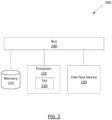
- FIG. 2 is a block diagram illustrating components of an example electronic device 200 which may serve as a node 102 ( FIG. 1 ) in a peer-to-peer blockchain network 100 ( FIG. 1 ).
- the example electronic device 200 may also be referred to as a processing device.
- the electronic device may take various forms including, for example, a desktop computer, laptop computer, tablet computer, server, mobile device such a smartphone, wearable computer such as a smart watch, or a form of another type.
- the electronic device 200 includes a processor 210, a memory 220 and an interface device 230. These components may be coupled directly or indirectly to one another and may communicate with one another.
- the processor 210, memory 220 and interface device 230 may communicate with each other via a bus 240.
- the memory 220 stores a computer software program comprising machine-readable instructions and data for performing functions described herein.
- the memory may include processor-executable instructions which, when executed by the processor 210, cause the electronic device to perform a method described herein.
- the processor-executable instructions may include instructions which, when executed by the processor 210, cause the electronic device to implement a protocol associated with the blockchain network 100 ( FIG. 1 ).
- the instructions may include instructions for implementing the Bitcoin protocol.
- the memory 220 may store the global ledger of the blockchain network 100 ( FIG. 1 ) or a portion thereof. That is, the memory 220 may store all blocks of the blockchain or a portion of the blocks, such as the most recent blocks, or a portion of the information in some blocks.
- the electronic device 200 may include multiple memory components.
- the memory components may be of various types including, for example, RAM, HDD, SSD, flash drives, etc. Different types of memory may be suited to different purposes.
- the memory 220 is illustrated separately from the processor 210, the processor 210 may include embedded memory.
- the processor 210 may include a secure area such as a Trusted Execution Environment (TEE) 250.
- the TEE 250 is an isolated execution environment which provides additional security to the electronic device 200 such as isolated execution, integrity of Trusted Applications and asset confidentiality.
- the TEE 250 provides execution space which guarantees that the computer instructions and data loaded inside the TEE 250 are protected in terms of confidentiality and integrity.
- the TEE 250 may be used to protect the integrity and confidentiality of important resources, such as keys.
- the TEE 250 is implemented, at least in part, at a hardware level so that instructions and data executed within the TEE 250 are protected against access and manipulation from the rest of the electronic device 200 and from external parties such as the owner of the electronic device.
- the data and computations within the TEE 250 are secured from the party operating the node 102 that includes the TEE 250.
- the TEE 250 may operate to instantiate an enclave and then add pages of memory one at a time, while cumulatively hashing. A similar operation may also be performed on a remote machine (which may be a developer machine or another machine) so that the remote machine determines and stores the hash that is expected. The contents of an enclave can, therefore, be verified by any remote machine to ensure that the enclave is running an approved algorithm. This verification may be performed by comparing hashes. When an enclave is fully built, it is locked down. It is possible to run the code in the TEE 250 and to send secrets to the code, but the code cannot be changed. A final hash may be signed by an attestation key and may be made available to a data owner to verify it before the data owner sends any secrets to the enclave.
- Enclaves are physically secure from access via a host system's architecture, including the system memory, BIOS and operating system of the host system. Enclaves, therefore, allow for secure and verifiable execution of software on a remote computer that is owned and controlled by an untrusted party.
- the memory of a process running on an enclave is only accessible to that process and is only accessible when the enclave software is running.
- the memory contents are encrypted if they are transmitted from the enclave to either a remote computer or to the host system itself.
- the decryption of enclave data relies upon keys that are only available to code that hashes to a particular value. If the enclave code was modified, it would no longer have access to these keys. Therefore, the enclave code cannot be modified to access its data.
- the TEE 250 may enable remote attestation which may be used by a node 102 ( FIG. 1 ) to prove to other nodes 102 that a TEE 250 is authentic and is running approved computer executable instructions for a protocol that is implemented by a group 110.
- Remote attestation may be provided by the TEE 250 by running a particular piece of code and sending a hash of the code, internal to the enclave, signed by an internal attestation key for the enclave. Effectively, remote attestation allows an enclave of a TEE 250 to prove to any remote system that the enclave is executing computer-executable instructions that hash to a particular value.
- Remote attestation enables code running within a secure enclave to obtain a signed certificate from the enclave that the code is executing within that that enclave with a given hash of an enclave page cache.
- the hash of the enclave page cache may be referred to as a quote and the enclave page cache is a section of protected memory in which designated code and data exist during execution of such code.
- the TEE 250 may be equipped with a secure random number generator, which is internal to an enclave of the TEE, which can be used to generate private keys, random challenges, or other random data.
- the TEE 250 may also be configured to read data from external memory and may be configured to write data to the external memory. Such data may be encrypted with a secret key held only inside the enclave. ("Random” may be interpreted herein as including “pseudo-random").
- the TEE 250 may be implemented using Intel Software Guard Extensions (SGX), for example.
- SGX supports remote attestation.
- a third-party attestation service such as Intel Attestation Service (IAS) may certify that these signed statements originate from authentic CPUs conforming to the SGX specification.
- IAS Intel Attestation Service
- the electronic device 200 acts as a node 102 ( FIG. 1 ) in the blockchain network 100 ( FIG. 1 ) and may join and otherwise take part in a group 110 ( FIG. 1 ).
- group members which may also be referred to as participants or nodes herein, cooperate to generate a valid signature to unlock an encumbrance associated with a group public key.
- the group 110 may be a permissioned or non-permissioned group.
- the group 110 may be joined by any node 102 ( FIG. 1 ) in the blockchain network 100 ( FIG. 1 ) (i.e., by any node that monitors and stores at least a portion of the information in the blockchain).
- the group 110 is associated with a public key which may be referred to as a group public key.
- This group public key may control access to and encumber resources such as tokens, cryptocurrency etc that are transferred to the group public key.
- a locking script of a transaction may lock a resource using the group public key so that such resources cannot be transferred or "spent" without approval of the group 110.
- the member nodes hold distributively-generated private secrets (i.e., private secrets that are generated at the nodes themselves). As will be described in greater detail below, these private secrets may be used to generate a valid signature for a transaction without a member node having to reveal their private secret to other member nodes.
- private secrets may be used to generate a valid signature for a transaction without a member node having to reveal their private secret to other member nodes.
- a threshold signature scheme that allows members nodes to join and leave the group without having to change a group public key will now be described.
- a plurality of nodes 102 ( FIG. 1 ) in the blockchain network 100 ( FIG. 1 ) may implement a threshold signature scheme protocol as described herein.
- Such nodes 102 may include computer-executable instructions stored in memory 220 ( FIG. 2 ) which implement the threshold signature scheme protocol.
- Such instructions when executed by a processor 210 ( FIG. 2 ), cause a node 102 (such as an electronic device 200 of the type described with reference to FIG. 2 ) to perform one or more methods of the threshold signature scheme protocol.
- Such methods may include any one or combination of the methods 300, 400, 500 and 600 of FIGs 3 to 6 .
- the methods may be performed by a node cooperatively with other nodes associated with other group members.
- the group is initialized for use with a threshold signature scheme. That is, the group is initialized to allow member nodes to cooperatively generate a valid digital signature to remove an encumbrance of a digital asset.
- the encumbrance that is removed by the valid digital signature is an encumbrance that is based on the group public key.
- the nodes 102 that are to form the group establish secure communication channels with one another and all agree on a signature threshold ( t+1 ).
- Each node and enclave can privately communicate point-to-point after establishing secure channels (for example, using Diffie-Hellman exchange) and can also securely broadcast information to the other participants.
- the participants also collectively determine an elliptic curve generator point, G , and order p . Operations described below are performed using this elliptic curve generator point, G , and order p. For example, references to mod p describe modulo operations performed according to this order p .
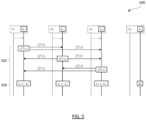
- the nodes After communication setup, the nodes then perform dealer-free polynomial generation according to the method 300 described below.
- each of the participants, P i provision their enclave, E i , to generate a random degree t polynomial f i ( x ), where x is a variable of the polynomial function.
- a random degree t polynomial is a polynomial of degree t (in the integer finite field mod p) with each of the coefficients of the polynomial being randomly selected.
- attestation is performed so that each enclave confirms to each of the other enclaves that they are running an approved initialization instruction set.
- each enclave may send a quote to each of the other enclaves and each enclave, therefore, receives quotes from each of the other enclaves. Each of these received quotes are evaluated to determine whether the attestation is successful.
- each enclave determines a secret share S i . More particularly, at operation 306, each enclave, E i sums all the received points, f 1 ( i ) + f 2 ( i ) + ⁇ +f n ( i ) mod p, to determine a shared polynomial, f(x). That is, the shared polynomial is the sum of all of the participant's randomly generated polynomials.
- each secret share is determined as the sum of the points (i.e., the values) of all of other participant's random polynomials.
- Each participant only has a different point on the shared polynomial and so the polynomial (and shared secret ( a 0 ) can be reconstructed (with interpolation) with t+1 points.
- each secret share, s i is secured in its respective enclave, E i .
- Each enclave, E i may also attest to the other of the enclaves that it has executed approved instructions in order to generate the secret share. Remote attestation may, therefore, be performed at operation 306 to ensure the secret share is appropriately generated.
- G is the elliptic curve generator point and s i is the secret share for participant, P i (i.e., it is the P i point on the shared polynomial).
- the public key shares are broadcast by the participants to all other participants.
- Remote attestation may be used to confirm that the public key shares have been appropriately generated.
- the initialisation phase proceeds in a trustless manner and there is no single point of failure as there is no trusted dealer.
- Performing polynomial generation and subsequent processing within the enclaves protects the secret share which allows disenrollment (which will be described below with reference to FIG. 5 ) to remain secure.
- the enrolment method 400 may be performed to allow a node to join a pre-existing group that has been initialized for use with a threshold signature scheme without having to issue a new group public key.
- the method 400 is performed after a group has already been initialized (such initialization may be in accordance with the method 300 of FIG. 3 ).
- FIG. 4 illustrates a method that is performed by a plurality of nodes, in cooperation with one another. More particularly, nodes that are existing group members perform at least some operations of the method 400 described below and a prospective member performs at least some operations of the method 400.
- a prospective member (which may be designated P n + 1 ) is a node attempting to enrol in the group.
- At least a threshold group of participants ( t + 1 ) signal to one another that they wish to enrol a prospective member. These participants form an enrolment group, U E .
- the nodes that make up the enrolment group and the prospective member establish secure communication channels.
- the prospective member may also authenticate themselves to the nodes of the enrolment group.
- n 3
- a different number of nodes may be used to form the enrolment group, as long as the number of nodes forming the enrolment group is at least the threshold (t+1) number of nodes.
- the prospective member, P n+1 is denoted as P 4 .
- the nodes that perform the method 400 each include a certified TEE implementing an SGX enclave, E i .
- the prospective member, P 4 provides an attestation quote to all members of the enrolment group, U E, to confirm that the prospective member is running an authenticated protocol.
- This attestation quote is received by the enrolment group members and each of the enrolment group members evaluate the attestation quote to confirm that the prospective member is running an approved protocol.
- Each enclave E i retains a secret share part, s i,i , and exchanges the rest of the secret share parts with the other t enclaves of the enrolment group, U E , such that each enclave E i then has the following secret share parts: s i , 1 , s i , 2 , ... , s i , t + 1
- each enclave, E i then sends secret share data to the prospective member's enclave, E n+1 . More particularly, at operation 406, each of the enrolment group participants, P i , then provisions its associated enclave, E i , , to privately transmit this secret share sum, v j , to the prospective member's enclave, E n +1 .
- the new secret share is denoted s 4 since n is equal to 3.
- the prospective member has obtained a new secret share based on secret share data received from a plurality of existing members of a group. More particularly, the prospective member has obtained a new secret share based on secret share data from at least a threshold of existing members of the group.
- operation 308 of the method 300 may be performed after operation 406 of the method 400 to generate the group public key.
- the participants may then confirm that the group public key has not changed from its previous value (i.e., the value before the method 400 of FIG. 4 was performed).
- Group members may occasionally be disenrolled from a group.
- Disenrolling refers to the releasing or removal of a member from membership in a group. Such disenrollment may occur at the request of the member being disenrolled or at the request of other members (e.g., if the member to be disenrolled has not participated in group activities in accordance with defined standards).
- FIG. 5 an example method 500 of disenrolling a member is illustrated. The method may be performed by a node 102 in cooperation with other nodes 102 of the group. The method may be used to disenrol a member without modifying a group public key.
- the invention provides an improved, cryptographically secure method which provides enhanced control over a resource compared to what has been previously possible within the prior art.
- a threshold, n-1 of existing group members cooperate to perform the method 500 of FIG. 5 . More particularly, all group members that are to remain in the group take part in the method 500 of FIG. 5 .
- the group member that is to be disenrolled does not, however, take part in the method. In some instances, more than one group member may be disenrolled at a time as long as the number of disenrollments, d n , is less than or equal to the difference between the number of existing group members and the threshold for the threshold signature scheme i.e., d n ⁇ n - ( t + 1).
- the number of group members that are not leaving the group must be at least equal to the threshold, t+1, for the threshold signature scheme.
- the existing group of four members will be modified to exclude one of the participants, P 4 , so that only three group members remain.
- Remote attestation may be employed to ensure all the enclaves of the disenrollment group, U D , are operating an approved disenrollment instruction set. More particularly, each member of the disenrollment group confirms that other members of the disenrollment group are operating the approved disenrollment instruction set.
- Each of the enclaves authenticates the other of the enclaves with remote attestation.
- operation 308 of the method 300 may be performed after operation 504 of the method 500 to generate the group public key.
- the participants may then confirm that the group public key has not changed from its previous value (i.e., the value before the method 500 of FIG. 5 was performed).
- the previous secret share may be overwritten with the new secret share, effectively invalidating the secret share in the enclave of the participant to be disenrolled, P n .
- the member is now disenrolled from the group.
- the security of the scheme is only reliant on n - t participants verifiably overwriting their expired key shares with new values. Therefore, a threshold of t + 1 enclaves would need to be breached to impact security. Even if the disenrolled participant (who now has nothing to lose) may be able to breach their own enclave to recover their key share, as long as at least n - t enclaves are operating correctly then that share is of no use in collusion attacks.
- the secret shares held by members of a group may be used to allow a valid ECDSA signature to be generated for a transaction. More particularly, at least a threshold number of secret shares may be used to allow group participants to generate a valid signature.
- the signature may be applied to a transaction that spends digital assets that were previously encumbered by the group public key. That is, the valid signature removes the encumbrance previously placed on the resource(s).
- the ECDSA signature includes two components - a first component, r, and a second component, w.
- the method 600 may be performed by nodes 102 in cooperation with other nodes 102 of a previously-formed group.
- the members of the group i.e., the nodes that cooperatively perform the method 600
- a plurality of participants (i.e., members) in a group may signal to other participants that they wish to participate in a distributed signature generation to authorize a particular transaction, Tx. That is, nodes may signal an intention to participate in distributed signature generation for the transaction, Tx.
- the transaction, Tx is a transaction that would spend outputs encumbered by the group public key. That is, the effect of the transaction would be to remove an encumbrance that is based on the group public key from outputs.
- the transaction, Tx may be proposed by one of the participants of the group, for example.
- the nodes that form the signing group determine a hash, z , for the transaction, Tx.
- the hash is determined by consensus of the signing group. For example, the hash may be proposed by one of the participants of the signing group and other members may confirm their agreement with the hash.
- the nodes that form the signing group obtain, based on a secure random number, k : a) a multiplicative inverse, k -1 , of the secure random number; and b) the first signature component, r .
- the first signature component, r is determined based on the secure random number k and an elliptic curve generator point, G . More particularly, at operation 604, one of the participants, for example P 1 , provisions their enclave E 1 (which is associated with a trusted execution environment of the node that is the participant P 1 ,) to generate a secure random number, k , and calculates the multiplicative inverse, k -1 , of this secure random number and also calculates the first signature component, r.
- the enclave E 1 that calculated the multiplicative inverse, k -1 , of this secure random number and the first signature component, r sends these values (e.g., the multiplicative inverse, k -1 , of this secure random number and the first signature component, r) to enclaves E 2 , ... , E t +1 associated with other participants in the signing group.
- the enclave E 1 that sends these values remotely attests to their integrity and that they have been generated using an approved instruction set.
- the enclaves E 2 , ... , E t +1 that did not generate these values receive them from the enclave E 1 that did generate these values and confirm the integrity of the values (e.g., by confirming that the instruction set used to generate these values is the approved instruction set).
- each node of the signing group determines a partial signature, v i , based on a private secret share, the multiplicative inverse of the secure random number and the first signature component.
- each node of the signing group may generate the second signature component, w , based on the partial signatures determined and received at operation 606.
- each node of the signing group may send the ECDSA signature, including the first signature component and the second signature component, from its enclave to a host portion of the node (i.e., a portion of the node that is not the enclave) and the node may verify the signature against the transaction hash, z , and the group public key, A.
- Any participant in the signing group may then add the signature to the corresponding transaction and broadcast it to the blockchain network.
- the security of the signature scheme described above is dependent on the value of the ephemeral private key which is the secure random number, k , which is generated by one enclave and secretly distributed to the other enclaves in the signing group, remaining hidden. If this value were to be extracted by breaching just one of the enclaves, the shared private key can be determined from the signature of the transaction, and could then be used to sign a completely different transaction. The impact of this is, however, minimal, since a physical breach of an enclave must occur within a very small time window: the confirmation time of the transaction on the blockchain.
- the invention may be implemented by means of hardware comprising several distinct elements, and by means of a suitably programmed computer.
- a device claim enumerating several means several of these means may be embodied by one and the same item of hardware.
- the mere fact that certain measures are recited in mutually different dependent claims does not indicate that a combination of these measures cannot be used to advantage.
Landscapes
- Engineering & Computer Science (AREA)
- Computer Security & Cryptography (AREA)
- Computer Networks & Wireless Communication (AREA)
- Signal Processing (AREA)
- Computer Hardware Design (AREA)
- Computing Systems (AREA)
- General Engineering & Computer Science (AREA)
- Storage Device Security (AREA)
- Financial Or Insurance-Related Operations Such As Payment And Settlement (AREA)
Applications Claiming Priority (4)
| Application Number | Priority Date | Filing Date | Title |
|---|---|---|---|
| GBGB1707168.9A GB201707168D0 (en) | 2017-05-05 | 2017-05-05 | Computer-implemented system and method |
| EP21211789.9A EP3985916B1 (de) | 2017-05-05 | 2018-04-26 | Sicheres dynamisches schwellensignaturschema unter verwendung von vertrauenswürdiger hardware |
| PCT/IB2018/052885 WO2018203186A1 (en) | 2017-05-05 | 2018-04-26 | Secure dynamic threshold signature scheme employing trusted hardware |
| EP18723070.1A EP3619884B1 (de) | 2017-05-05 | 2018-04-26 | Sicheres dynamisches schwellensignaturschema unter verwendung von vertrauenswürdiger hardware |
Related Parent Applications (2)
| Application Number | Title | Priority Date | Filing Date |
|---|---|---|---|
| EP21211789.9A Division EP3985916B1 (de) | 2017-05-05 | 2018-04-26 | Sicheres dynamisches schwellensignaturschema unter verwendung von vertrauenswürdiger hardware |
| EP18723070.1A Division EP3619884B1 (de) | 2017-05-05 | 2018-04-26 | Sicheres dynamisches schwellensignaturschema unter verwendung von vertrauenswürdiger hardware |
Publications (2)
| Publication Number | Publication Date |
|---|---|
| EP4531328A2 true EP4531328A2 (de) | 2025-04-02 |
| EP4531328A3 EP4531328A3 (de) | 2025-05-21 |
Family
ID=59065506
Family Applications (3)
| Application Number | Title | Priority Date | Filing Date |
|---|---|---|---|
| EP21211789.9A Active EP3985916B1 (de) | 2017-05-05 | 2018-04-26 | Sicheres dynamisches schwellensignaturschema unter verwendung von vertrauenswürdiger hardware |
| EP25156036.3A Pending EP4531328A3 (de) | 2017-05-05 | 2018-04-26 | Sicheres dynamisches schwellensignaturschema mit zuverlässiger hardware |
| EP18723070.1A Active EP3619884B1 (de) | 2017-05-05 | 2018-04-26 | Sicheres dynamisches schwellensignaturschema unter verwendung von vertrauenswürdiger hardware |
Family Applications Before (1)
| Application Number | Title | Priority Date | Filing Date |
|---|---|---|---|
| EP21211789.9A Active EP3985916B1 (de) | 2017-05-05 | 2018-04-26 | Sicheres dynamisches schwellensignaturschema unter verwendung von vertrauenswürdiger hardware |
Family Applications After (1)
| Application Number | Title | Priority Date | Filing Date |
|---|---|---|---|
| EP18723070.1A Active EP3619884B1 (de) | 2017-05-05 | 2018-04-26 | Sicheres dynamisches schwellensignaturschema unter verwendung von vertrauenswürdiger hardware |
Country Status (7)
| Country | Link |
|---|---|
| US (3) | US11228447B2 (de) |
| EP (3) | EP3985916B1 (de) |
| JP (3) | JP7272960B2 (de) |
| CN (2) | CN116112184A (de) |
| GB (1) | GB201707168D0 (de) |
| TW (2) | TWI793899B (de) |
| WO (1) | WO2018203186A1 (de) |
Families Citing this family (51)
| Publication number | Priority date | Publication date | Assignee | Title |
|---|---|---|---|---|
| EP4235479A1 (de) * | 2017-12-15 | 2023-08-30 | nChain Licensing AG | Computerimplementierte systeme und verfahren zur autorisierung von blockchain-transaktionen mit niederentropiepasswörtern |
| US12093908B2 (en) * | 2018-03-22 | 2024-09-17 | NEC Laboratories Europe GmbH | System and method for secure transaction verification in a distributed ledger system |
| GB2576081A (en) * | 2018-06-03 | 2020-02-05 | Vvow Company Ltd | Peer-to-peer cryptocurrency and crypto asset trading platform |
| US11444779B2 (en) | 2018-08-02 | 2022-09-13 | Paypal, Inc. | Techniques for securing application programming interface requests using multi-party digital signatures |
| CN111768304A (zh) | 2018-08-06 | 2020-10-13 | 阿里巴巴集团控股有限公司 | 区块链交易方法及装置、电子设备 |
| JP7216881B2 (ja) * | 2018-10-19 | 2023-02-02 | 日本電信電話株式会社 | コンテンツ契約システム、コンテンツ契約方法、権利者端末、譲受人端末、制御端末、コンテンツ蓄積サーバ、権利者プログラム、譲受人プログラム、制御プログラムおよびコンテンツ蓄積プログラム |
| US10700850B2 (en) | 2018-11-27 | 2020-06-30 | Alibaba Group Holding Limited | System and method for information protection |
| PL3549303T3 (pl) | 2018-11-27 | 2021-11-22 | Advanced New Technologies Co., Ltd. | System i sposób ochrony informacji |
| MY188126A (en) | 2018-11-27 | 2021-11-23 | Advanced New Technologies Co Ltd | System and method for information protection |
| MY197480A (en) | 2018-11-27 | 2023-06-19 | Advanced New Technologies Co Ltd | System and method for information protection |
| SG11201903419WA (en) | 2018-11-27 | 2019-05-30 | Alibaba Group Holding Ltd | System and method for information protection |
| BR112019007232B1 (pt) | 2018-11-27 | 2022-02-15 | Advanced New Technologies Co., Ltd | Métodos implementados por computador para proteção da informação, sistemas para proteção da informação e meio de armazenamento legível por computador não transitório |
| US10795644B2 (en) * | 2019-01-08 | 2020-10-06 | Moac Blockchain Tech Inc | Decentralized random number generator |
| TWI689194B (zh) * | 2019-01-22 | 2020-03-21 | 開曼群島商現代財富控股有限公司 | 基於無分派者秘密共享的門檻式簽章系統及其方法 |
| EP3696670B1 (de) * | 2019-02-13 | 2025-05-14 | UVUE Limited | Verteiltes computersystem und verfahren zum betrieb davon |
| US12034873B2 (en) * | 2019-04-01 | 2024-07-09 | Intel Corporation | Privacy protected autonomous attestation |
| KR102194077B1 (ko) | 2019-04-26 | 2020-12-23 | 어드밴스드 뉴 테크놀로지스 씨오., 엘티디. | 신뢰 실행 환경을 위한 분산 키 관리 |
| GB2584154A (en) * | 2019-05-24 | 2020-11-25 | Nchain Holdings Ltd | Knowledge proof |
| GB201907392D0 (en) | 2019-05-24 | 2019-07-10 | Nchain Holdings Ltd | Proof-of-work |
| GB201907396D0 (en) | 2019-05-24 | 2019-07-10 | Nchain Holdings Ltd | Hash function attacks |
| CN110336673B (zh) * | 2019-06-03 | 2022-03-08 | 江苏科技大学 | 一种基于隐私保护的区块链设计方法 |
| CN110224813B (zh) * | 2019-06-17 | 2021-02-09 | 北京瑞策科技有限公司 | 基于区块链的出块方法及装置 |
| US20220173910A1 (en) * | 2019-08-16 | 2022-06-02 | Hewlett-Packard Development Company, L.P. | Remote commands |
| CN110380869B (zh) * | 2019-08-27 | 2022-04-08 | 郑州师范学院 | 一种安全多方签名方法、装置、服务器及介质 |
| GB2587201A (en) | 2019-09-17 | 2021-03-24 | Nchain Holdings Ltd | Multi-criteria blockchain protocol |
| US11134112B2 (en) | 2019-11-21 | 2021-09-28 | Visa International Service Association | Secure multi-party random bit generation |
| CN113055177B (zh) * | 2019-12-27 | 2022-08-16 | 深圳市迅雷网络技术有限公司 | 区块链系统及数值信息传输方法、系统、装置、介质 |
| CN111064581B (zh) * | 2019-12-28 | 2022-11-08 | 西安工业大学 | 一种有连接能力的隐私保护方法及系统 |
| CN111327426B (zh) * | 2020-01-21 | 2021-06-25 | 腾讯科技(深圳)有限公司 | 数据共享方法及相关装置、设备及系统 |
| CN111277412B (zh) * | 2020-02-18 | 2023-03-24 | 暨南大学 | 基于区块链密钥分发的数据安全共享系统及方法 |
| WO2021225573A1 (en) * | 2020-05-04 | 2021-11-11 | Hewlett-Packard Development Company, L.P. | Partial signatures based on environmental characteristics |
| GB2596072A (en) | 2020-06-15 | 2021-12-22 | Nchain Holdings Ltd | Generating secret shares |
| CN111478772B (zh) * | 2020-06-22 | 2020-10-16 | 杭州趣链科技有限公司 | 一种流水线友好的签名和验签方法、设备及存储介质 |
| US20220051240A1 (en) * | 2020-08-11 | 2022-02-17 | Gk8 Ltd | Transferring cryptocurrency from a remote limited access wallet |
| EP3955110A1 (de) | 2020-08-12 | 2022-02-16 | UVUE Limited | Verteiltes rechensystem und verfahren zum betrieb davon |
| WO2022051706A1 (en) * | 2020-09-06 | 2022-03-10 | David Chaum | Computation mixing |
| US11632244B2 (en) * | 2020-09-14 | 2023-04-18 | Paypal, Inc. | Techniques for single round multi-party computation for digital signatures |
| GB2603495A (en) | 2021-02-05 | 2022-08-10 | Nchain Holdings Ltd | Generating shared keys |
| CN112799636B (zh) * | 2021-04-14 | 2021-08-27 | 北京百度网讯科技有限公司 | 随机数生成方法、装置、设备和存储介质 |
| GB2606169A (en) | 2021-04-27 | 2022-11-02 | Nchain Licensing Ag | Nested threshold signatures |
| WO2022256053A1 (en) * | 2021-06-05 | 2022-12-08 | Hewlett-Packard Development Company, L.P. | Generation of signing keys |
| US20220408245A1 (en) * | 2021-06-21 | 2022-12-22 | Motional Ad Llc | Session key generation for autonomous vehicle operation |
| US11792644B2 (en) * | 2021-06-21 | 2023-10-17 | Motional Ad Llc | Session key generation for autonomous vehicle operation |
| GB2608179A (en) * | 2021-06-25 | 2022-12-28 | Nchain Licensing Ag | Multi-level blockchain |
| GB2609908B (en) | 2021-08-09 | 2023-10-18 | Nchain Licensing Ag | Generating Digital signatures |
| WO2023048711A1 (en) * | 2021-09-22 | 2023-03-30 | Visa International Service Association | Threshold secret share generation for distributed symmetric cryptography |
| GB2612309A (en) | 2021-10-26 | 2023-05-03 | Nchain Licensing Ag | Threshold signature scheme |
| CN114070556B (zh) * | 2021-11-15 | 2023-07-25 | 成都卫士通信息产业股份有限公司 | 一种门限环签名方法、装置、电子设备及可读存储介质 |
| CN116545631B (zh) * | 2023-04-27 | 2025-12-02 | 山东海量信息技术研究院 | 一种数据签名方法、装置、设备及计算机可读存储介质 |
| CN116915416B (zh) * | 2023-09-14 | 2023-12-15 | 北京信安世纪科技股份有限公司 | 一种证书签名方法、装置以及一种证书获取方法、装置 |
| US20250317302A1 (en) * | 2024-04-03 | 2025-10-09 | Unit 410, LLC | Multisignature verification for decentralized network operations |
Family Cites Families (102)
| Publication number | Priority date | Publication date | Assignee | Title |
|---|---|---|---|---|
| US5625692A (en) | 1995-01-23 | 1997-04-29 | International Business Machines Corporation | Method and system for a public key cryptosystem having proactive, robust, and recoverable distributed threshold secret sharing |
| CA2228185C (en) | 1997-01-31 | 2007-11-06 | Certicom Corp. | Verification protocol |
| US7599491B2 (en) * | 1999-01-11 | 2009-10-06 | Certicom Corp. | Method for strengthening the implementation of ECDSA against power analysis |
| TW424371B (en) * | 1999-02-26 | 2001-03-01 | Qic Systems Corp | Group signature method for group message transmission in unsafe communication channel |
| JP3560860B2 (ja) * | 1999-07-23 | 2004-09-02 | 株式会社東芝 | 秘密分散システム、装置及び記憶媒体 |
| US7249259B1 (en) | 1999-09-07 | 2007-07-24 | Certicom Corp. | Hybrid signature scheme |
| US7167565B2 (en) * | 2001-03-06 | 2007-01-23 | Arcot Systems, Inc. | Efficient techniques for sharing a secret |
| US7581107B2 (en) * | 2004-05-28 | 2009-08-25 | International Business Machines Corporation | Anonymity revocation |
| US7936869B2 (en) * | 2005-01-07 | 2011-05-03 | First Data Corporation | Verifying digital signature based on shared knowledge |
| US7490239B2 (en) * | 2005-01-07 | 2009-02-10 | First Data Corporation | Facilitating digital signature based on ephemeral private key |
| US7593527B2 (en) * | 2005-01-07 | 2009-09-22 | First Data Corporation | Providing digital signature and public key based on shared knowledge |
| US20060153364A1 (en) * | 2005-01-07 | 2006-07-13 | Beeson Curtis L | Asymmetric key cryptosystem based on shared knowledge |
| US7869593B2 (en) * | 2005-01-07 | 2011-01-11 | First Data Corporation | Software for providing based on shared knowledge public keys having same private key |
| US20060156013A1 (en) * | 2005-01-07 | 2006-07-13 | Beeson Curtis L | Digital signature software using ephemeral private key and system |
| CA2592875C (en) * | 2005-01-18 | 2016-09-06 | Blackberry Limited | Accelerated verification of digital signatures and public keys |
| US7602907B2 (en) * | 2005-07-01 | 2009-10-13 | Microsoft Corporation | Elliptic curve point multiplication |
| CA2662675C (en) * | 2006-09-08 | 2016-05-24 | Blackberry Limited | Authenticated radio frequency identification and key distribution system therefor |
| EP2080314A2 (de) * | 2006-10-25 | 2009-07-22 | Spyrus, Inc. | Verfahren und system für den einsatz erweiterter kryptografischer algorithmen |
| US8139763B2 (en) * | 2007-10-10 | 2012-03-20 | Spansion Llc | Randomized RSA-based cryptographic exponentiation resistant to side channel and fault attacks |
| WO2011120125A1 (en) * | 2010-03-31 | 2011-10-06 | Irdeto Canada Corporation | System and method for protecting cryptographic assets from a white-box attack |
| CN102238146B (zh) | 2010-04-27 | 2014-10-08 | 中国移动通信集团公司 | 认证方法、装置、认证中心及系统 |
| JP2013539295A (ja) * | 2010-10-15 | 2013-10-17 | サーティコム コーポレーション | メッセージ復元を伴うデジタル署名の認証された暗号化 |
| US9087196B2 (en) * | 2010-12-24 | 2015-07-21 | Intel Corporation | Secure application attestation using dynamic measurement kernels |
| GB2490483B (en) * | 2011-04-26 | 2019-05-29 | Hewlett Packard Entpr Dev Lp | Digital signature method and system |
| ES2400894B1 (es) * | 2011-05-13 | 2014-03-11 | Telefónica, S.A. | Procedimiento para una firma digital múltiple |
| US8782420B2 (en) * | 2011-07-22 | 2014-07-15 | Netflix, Inc | System and method for obfuscation initiation values of a cryptography protocol |
| JP5447544B2 (ja) * | 2012-01-27 | 2014-03-19 | 沖電気工業株式会社 | 委託パラメータ情報生成装置、共有鍵合成装置、署名情報合成装置、通信装置、鍵共有被計算委託装置、署名情報生成被計算委託装置、被計算委託装置、鍵共有システム、署名情報検証システム及び通信システム |
| DE102012221288A1 (de) * | 2012-11-21 | 2014-05-22 | Siemens Aktiengesellschaft | Verfahren, Vorrichtung und Dienstleistungsmittel zur Authentifizierung eines Kunden für eine durch ein Dienstleistungsmittel zu erbringende Dienstleistung |
| US9489522B1 (en) * | 2013-03-13 | 2016-11-08 | Hrl Laboratories, Llc | Method for secure and resilient distributed generation of elliptic curve digital signature algorithm (ECDSA) based digital signatures with proactive security |
| US10366386B2 (en) | 2013-09-12 | 2019-07-30 | Paypal, Inc. | Electronic wallet fund transfer system |
| US9710808B2 (en) | 2013-09-16 | 2017-07-18 | Igor V. SLEPININ | Direct digital cash system and method |
| US20160012465A1 (en) | 2014-02-08 | 2016-01-14 | Jeffrey A. Sharp | System and method for distributing, receiving, and using funds or credits and apparatus thereof |
| EP2905922A1 (de) * | 2014-02-10 | 2015-08-12 | Thomson Licensing | Signierungsverfahren zur Bereitstellung einer partiellen Signatur für eine Nachricht, Schwellwertsignierungsverfahren, Signaturverifizierungsverfahren, sowie ein entsprechendes Computerprogramm und elektronische Vorrichtungen |
| FR3018378A1 (fr) | 2014-03-12 | 2015-09-11 | Enrico Maim | Systeme et procede transactionnels a architecture repartie fondees sur des transactions de transferts d'unites de compte entre adresses |
| CN106664205B (zh) * | 2014-04-17 | 2020-06-05 | 赫尔实验室有限公司 | 生成数字签名的系统和方法、非瞬时计算机可读存储介质 |
| US20150302400A1 (en) | 2014-04-18 | 2015-10-22 | Ebay Inc. | Distributed crypto currency reputation system |
| US9946858B2 (en) * | 2014-05-05 | 2018-04-17 | Analog Devices, Inc. | Authentication system and device including physical unclonable function and threshold cryptography |
| US11196566B2 (en) | 2014-05-09 | 2021-12-07 | Reginald Middleton | Devices, systems, and methods for facilitating low trust and zero trust value transfers |
| US9949115B2 (en) * | 2014-06-10 | 2018-04-17 | Qualcomm Incorporated | Common modulus RSA key pairs for signature generation and encryption/decryption |
| US10396992B2 (en) | 2014-06-30 | 2019-08-27 | Vescel, Llc | Authentication of a user and/or a device through parallel synchronous update of immutable hash histories |
| US9602290B2 (en) * | 2014-10-16 | 2017-03-21 | Infineon Technologies Ag | System and method for vehicle messaging using a public key infrastructure |
| US9798559B2 (en) * | 2014-12-27 | 2017-10-24 | Mcafee, Inc. | Trusted binary translation |
| KR101660627B1 (ko) | 2015-02-03 | 2016-09-28 | 한양대학교 에리카산학협력단 | 암호화 화폐의 거래를 보호하는 방법 및 장치 |
| US11687885B2 (en) | 2015-02-27 | 2023-06-27 | Visa International Service Association | Transaction signing utilizing asymmetric cryptography |
| CN107615317A (zh) | 2015-03-31 | 2018-01-19 | 纳斯达克公司 | 区块链交易记录的系统和方法 |
| US20160321435A1 (en) * | 2015-05-01 | 2016-11-03 | Monegraph, Inc. | Managing digital content via block chain registers |
| FR3035986B1 (fr) * | 2015-05-06 | 2018-07-27 | Morpho | Procede de generation d'une signature de message a partir d'un jeton de signature chiffre a l'aide d'une fonction de chiffrement homomorphique |
| US20170011460A1 (en) | 2015-07-09 | 2017-01-12 | Ouisa, LLC | Systems and methods for trading, clearing and settling securities transactions using blockchain technology |
| US20170109735A1 (en) * | 2015-07-14 | 2017-04-20 | Fmr Llc | Computationally Efficient Transfer Processing and Auditing Apparatuses, Methods and Systems |
| US11488147B2 (en) | 2015-07-14 | 2022-11-01 | Fmr Llc | Computationally efficient transfer processing and auditing apparatuses, methods and systems |
| US20170085545A1 (en) | 2015-07-14 | 2017-03-23 | Fmr Llc | Smart Rules and Social Aggregating, Fractionally Efficient Transfer Guidance, Conditional Triggered Transaction, Datastructures, Apparatuses, Methods and Systems |
| KR101661930B1 (ko) | 2015-08-03 | 2016-10-05 | 주식회사 코인플러그 | 블록체인을 기반으로 하는 공인인증서 발급시스템 |
| US10402792B2 (en) | 2015-08-13 | 2019-09-03 | The Toronto-Dominion Bank | Systems and method for tracking enterprise events using hybrid public-private blockchain ledgers |
| US10937023B2 (en) | 2015-10-15 | 2021-03-02 | Paypal, Inc. | Crypto currency chargeback system |
| GB2543359B (en) * | 2015-10-16 | 2020-04-01 | Samsung Electronics Co Ltd | Methods and apparatus for secure communication |
| US20170132625A1 (en) | 2015-11-05 | 2017-05-11 | Mastercard International Incorporated | Method and system for use of a blockchain in a transaction processing network |
| US20170132626A1 (en) | 2015-11-05 | 2017-05-11 | Mastercard International Incorporated | Method and system for processing of a blockchain transaction in a transaction processing network |
| US11941588B2 (en) | 2015-11-06 | 2024-03-26 | Cable Television Laboratories, Inc. | Systems and methods for blockchain virtualization and scalability |
| US20170140408A1 (en) | 2015-11-16 | 2017-05-18 | Bank Of America Corporation | Transparent self-managing rewards program using blockchain and smart contracts |
| KR101590076B1 (ko) | 2015-11-18 | 2016-02-01 | 주식회사 웨이브스트링 | 개인정보 관리 방법 |
| US10423938B1 (en) | 2015-11-20 | 2019-09-24 | United Services Automobile Association | Identifying negotiable instrument fraud using distributed ledger systems |
| WO2017091530A1 (en) | 2015-11-24 | 2017-06-01 | Gartland & Mellina Group | Blockchain solutions for financial services and other transaction-based industries |
| US10230756B2 (en) | 2015-11-25 | 2019-03-12 | International Business Machines Corporation | Resisting replay attacks efficiently in a permissioned and privacy-preserving blockchain network |
| US9948467B2 (en) | 2015-12-21 | 2018-04-17 | Mastercard International Incorporated | Method and system for blockchain variant using digital signatures |
| US10108812B2 (en) | 2016-01-28 | 2018-10-23 | Nasdaq, Inc. | Systems and methods for securing and disseminating time sensitive information using a blockchain |
| WO2017134281A1 (en) | 2016-02-04 | 2017-08-10 | Nasdaq Technology Ab | Systems and methods for storing and sharing transactional data using distributed computer systems |
| US11354658B2 (en) | 2016-02-11 | 2022-06-07 | Mastercard International Incorporated | Method and system for offline blockchain exchanges |
| US10693658B2 (en) | 2016-02-12 | 2020-06-23 | Visa International Service Association | Methods and systems for using digital signatures to create trusted digital asset transfers |
| EP3420507A1 (de) | 2016-02-23 | 2019-01-02 | Nchain Holdings Limited | Tokenisierungsverfahren und system zur implementierung von vermittlungen auf einer blockkette |
| AU2017222468B2 (en) | 2016-02-23 | 2023-01-12 | nChain Holdings Limited | Agent-based turing complete transactions integrating feedback within a blockchain system |
| SG11201806711QA (en) | 2016-02-23 | 2018-09-27 | Nchain Holdings Ltd | Method and system for efficient transfer of cryptocurrency associated with a payroll on a blockchain that leads to An Automated payroll method and system based on smart contracts |
| CN105809062B (zh) | 2016-03-01 | 2019-01-25 | 布比(北京)网络技术有限公司 | 一种合约构建、执行方法及装置 |
| US10546296B2 (en) | 2016-04-13 | 2020-01-28 | Paypal, Inc. | Public ledger authentication system |
| US10803537B2 (en) | 2016-04-18 | 2020-10-13 | R3 Ltd. | System and method for managing transactions in dynamic digital documents |
| US20190149337A1 (en) | 2016-04-29 | 2019-05-16 | nChain Holdings Limited | Implementing logic gate functionality using a blockchain |
| EP4102431A1 (de) | 2016-04-29 | 2022-12-14 | nChain Licensing AG | Implementierung einer logic-gate-funktionalität unter verwendung einer blockchain |
| CN106022917A (zh) | 2016-05-08 | 2016-10-12 | 杭州复杂美科技有限公司 | 区块链撮合交易所方案 |
| US10135622B2 (en) * | 2016-06-03 | 2018-11-20 | Intel Corporation | Flexible provisioning of attestation keys in secure enclaves |
| JP6939791B2 (ja) | 2016-07-28 | 2021-09-22 | 日本電気株式会社 | 掲示板情報管理システム |
| US10491402B2 (en) | 2016-07-29 | 2019-11-26 | Magic Leap, Inc. | Secure exchange of cryptographically signed records |
| US10417217B2 (en) | 2016-08-05 | 2019-09-17 | Chicago Mercantile Exchange Inc. | Systems and methods for blockchain rule synchronization |
| US10878522B2 (en) | 2016-08-18 | 2020-12-29 | First American Financial Corporation | Systems and methods for using blockchains to record, manage, and transfer ownership rights to land titles |
| US10523443B1 (en) | 2016-08-24 | 2019-12-31 | Bruce Kleinman | Devices, methods, and systems for cryptographic authentication and provenance of physical assets |
| CN116910785A (zh) | 2016-09-09 | 2023-10-20 | 微软技术许可有限责任公司 | 跨不同方来跟踪对象 |
| US10832247B2 (en) | 2016-09-15 | 2020-11-10 | American Express Travel Related Services Company, Inc. | Systems and methods for blockchain based payment networks |
| US10540652B2 (en) * | 2016-11-18 | 2020-01-21 | Intel Corporation | Technology for secure partitioning and updating of a distributed digital ledger |
| CN106598549B (zh) | 2016-12-08 | 2019-02-01 | 天津米游科技有限公司 | 一种基于区块链的智能合约系统及实现方法 |
| US11165565B2 (en) * | 2016-12-09 | 2021-11-02 | Microsoft Technology Licensing, Llc | Secure distribution private keys for use by untrusted code |
| US10372945B2 (en) * | 2017-01-24 | 2019-08-06 | Microsoft Technology Licensing, Llc | Cross-platform enclave identity |
| US20180260921A1 (en) | 2017-03-08 | 2018-09-13 | Bsquare Corp. | Remote machine operation through distributed permissioning |
| CN110603557B (zh) | 2017-03-16 | 2024-04-12 | 香港物流及供应链管理应用技术研发中心 | 控制交易账本的系统和方法 |
| EP3379767B1 (de) | 2017-03-24 | 2021-01-13 | Hewlett-Packard Development Company, L.P. | Verteilte authentifizierung |
| US20180285996A1 (en) | 2017-04-03 | 2018-10-04 | FutureLab Consulting Inc. | Methods and system for managing intellectual property using a blockchain |
| US10832230B2 (en) | 2017-04-04 | 2020-11-10 | International Business Machines Corporation | Scalable and distributed shared ledger transaction management |
| EP3396608A1 (de) | 2017-04-24 | 2018-10-31 | BlockSettle AB | Verfahren und system zur abwicklung einer blockkettentransaktion |
| KR102599738B1 (ko) | 2017-05-22 | 2023-11-09 | 엔체인 홀딩스 리미티드 | 미결정 소스로부터 미결정 데이터를 블록체인 트랜잭션의 잠금 스크립트에 안전하게 제공하는 기법 |
| GB201709760D0 (en) | 2017-06-19 | 2017-08-02 | Nchain Holdings Ltd | Computer-Implemented system and method |
| EP3422221A1 (de) | 2017-06-29 | 2019-01-02 | Nokia Technologies Oy | Steuerung des zugriffs auf elektronische gesundheitsdaten |
| US20190172026A1 (en) | 2017-12-02 | 2019-06-06 | Alchemy Limited LLC | Cross blockchain secure transactions |
| WO2019139678A1 (en) | 2018-01-14 | 2019-07-18 | Robot Cache, Inc. | Methods and systems for media distribution employing contracts implemented in a distributed ledger |
| CN111612446A (zh) | 2018-01-19 | 2020-09-01 | 阿里巴巴集团控股有限公司 | 区块链余额的调整方法及装置、电子设备 |
| US11257081B2 (en) | 2018-05-08 | 2022-02-22 | Oracle International Corporation | Integrating a blockchain ledger with an application external to the blockchain ledger |
-
2017
- 2017-05-05 GB GBGB1707168.9A patent/GB201707168D0/en not_active Ceased
-
2018
- 2018-04-25 TW TW110145773A patent/TWI793899B/zh not_active IP Right Cessation
- 2018-04-25 TW TW107113961A patent/TWI754046B/zh not_active IP Right Cessation
- 2018-04-26 JP JP2019558683A patent/JP7272960B2/ja active Active
- 2018-04-26 EP EP21211789.9A patent/EP3985916B1/de active Active
- 2018-04-26 US US16/611,201 patent/US11228447B2/en active Active
- 2018-04-26 CN CN202310140019.5A patent/CN116112184A/zh active Pending
- 2018-04-26 WO PCT/IB2018/052885 patent/WO2018203186A1/en not_active Ceased
- 2018-04-26 EP EP25156036.3A patent/EP4531328A3/de active Pending
- 2018-04-26 EP EP18723070.1A patent/EP3619884B1/de active Active
- 2018-04-26 CN CN201880029952.2A patent/CN110603783B/zh active Active
-
2022
- 2022-01-14 US US17/576,779 patent/US12034865B2/en active Active
-
2023
- 2023-04-27 JP JP2023072981A patent/JP7544357B2/ja active Active
-
2024
- 2024-05-30 US US18/679,367 patent/US12513004B2/en active Active
- 2024-08-13 JP JP2024134741A patent/JP2024160343A/ja active Pending
Also Published As
| Publication number | Publication date |
|---|---|
| CN110603783B (zh) | 2023-02-28 |
| TW202215812A (zh) | 2022-04-16 |
| JP2023099091A (ja) | 2023-07-11 |
| TWI754046B (zh) | 2022-02-01 |
| US12513004B2 (en) | 2025-12-30 |
| JP7544357B2 (ja) | 2024-09-03 |
| JP7272960B2 (ja) | 2023-05-12 |
| TWI793899B (zh) | 2023-02-21 |
| TW201843978A (zh) | 2018-12-16 |
| EP4531328A3 (de) | 2025-05-21 |
| EP3619884A1 (de) | 2020-03-11 |
| CN110603783A (zh) | 2019-12-20 |
| US20240414011A1 (en) | 2024-12-12 |
| CN116112184A (zh) | 2023-05-12 |
| EP3985916B1 (de) | 2025-02-19 |
| EP3985916A1 (de) | 2022-04-20 |
| US11228447B2 (en) | 2022-01-18 |
| WO2018203186A1 (en) | 2018-11-08 |
| GB201707168D0 (en) | 2017-06-21 |
| EP3619884B1 (de) | 2022-01-12 |
| US12034865B2 (en) | 2024-07-09 |
| JP2020518850A (ja) | 2020-06-25 |
| US20220247572A1 (en) | 2022-08-04 |
| JP2024160343A (ja) | 2024-11-13 |
| US20200145231A1 (en) | 2020-05-07 |
Similar Documents
| Publication | Publication Date | Title |
|---|---|---|
| US12513004B2 (en) | Secure dynamic threshold signature scheme employing trusted hardware | |
| US20230131970A1 (en) | Computer-implemented systems and methods for authorising blockchain transactions with low-entropy passwords | |
| Bera et al. | Designing blockchain-based access control protocol in IoT-enabled smart-grid system | |
| US10790976B1 (en) | System and method of blockchain wallet recovery | |
| CN109478279B (zh) | 区块链实现的方法和系统 | |
| CN110832519A (zh) | 提高区块链网络与外部数据源之间的通信的完整性 | |
| CN110999204A (zh) | 区块链实施的事件锁加密的方法和系统 | |
| CN111131336A (zh) | 多方授权场景下的资源访问方法、装置、设备及存储介质 | |
| CN116506134B (zh) | 数字证书管理方法、装置、设备、系统及可读存储介质 | |
| Raj et al. | A blockchain assisted secure and scalable group key protocol for IoT Network | |
| CN121864333A (zh) | 交易签名方法、装置、电子设备及存储介质 | |
| HK40095774A (en) | Computer-implemented systems and methods for authorising blockchain transactions with low-entropy passwords | |
| CN117675244A (zh) | 基于集群环境下任务密钥分发方法及装置 | |
| HK40029744B (en) | Computer-implemented systems and methods for authorising blockchain transactions with low-entropy passwords | |
| HK40029744A (en) | Computer-implemented systems and methods for authorising blockchain transactions with low-entropy passwords |
Legal Events
| Date | Code | Title | Description |
|---|---|---|---|
| PUAI | Public reference made under article 153(3) epc to a published international application that has entered the european phase |
Free format text: ORIGINAL CODE: 0009012 |
|
| STAA | Information on the status of an ep patent application or granted ep patent |
Free format text: STATUS: THE APPLICATION HAS BEEN PUBLISHED |
|
| AC | Divisional application: reference to earlier application |
Ref document number: 3619884 Country of ref document: EP Kind code of ref document: P Ref document number: 3985916 Country of ref document: EP Kind code of ref document: P |
|
| AK | Designated contracting states |
Kind code of ref document: A2 Designated state(s): AL AT BE BG CH CY CZ DE DK EE ES FI FR GB GR HR HU IE IS IT LI LT LU LV MC MK MT NL NO PL PT RO RS SE SI SK SM TR |
|
| REG | Reference to a national code |
Ref country code: DE Ref legal event code: R079 Free format text: PREVIOUS MAIN CLASS: H04L0009000000 Ipc: H04L0009080000 |
|
| PUAL | Search report despatched |
Free format text: ORIGINAL CODE: 0009013 |
|
| AK | Designated contracting states |
Kind code of ref document: A3 Designated state(s): AL AT BE BG CH CY CZ DE DK EE ES FI FR GB GR HR HU IE IS IT LI LT LU LV MC MK MT NL NO PL PT RO RS SE SI SK SM TR |
|
| RIC1 | Information provided on ipc code assigned before grant |
Ipc: H04L 9/40 20220101ALI20250416BHEP Ipc: H04L 9/32 20060101ALI20250416BHEP Ipc: H04L 9/08 20060101AFI20250416BHEP |
|
| P01 | Opt-out of the competence of the unified patent court (upc) registered |
Free format text: CASE NUMBER: APP_20143/2025 Effective date: 20250428 |
|
| STAA | Information on the status of an ep patent application or granted ep patent |
Free format text: STATUS: REQUEST FOR EXAMINATION WAS MADE |
|
| 17P | Request for examination filed |
Effective date: 20250806 |
|
| STAA | Information on the status of an ep patent application or granted ep patent |
Free format text: STATUS: EXAMINATION IS IN PROGRESS |
|
| 17Q | First examination report despatched |
Effective date: 20260211 |