EP4527436A2 - Vorrichtungen und verfahren zur punktierung einer kapsel zur freisetzung eines pulverförmigen medikaments daraus - Google Patents
Vorrichtungen und verfahren zur punktierung einer kapsel zur freisetzung eines pulverförmigen medikaments daraus Download PDFInfo
- Publication number
- EP4527436A2 EP4527436A2 EP25156645.1A EP25156645A EP4527436A2 EP 4527436 A2 EP4527436 A2 EP 4527436A2 EP 25156645 A EP25156645 A EP 25156645A EP 4527436 A2 EP4527436 A2 EP 4527436A2
- Authority
- EP
- European Patent Office
- Prior art keywords
- capsule
- dome
- puncturing
- surface area
- hole
- Prior art date
- Legal status (The legal status is an assumption and is not a legal conclusion. Google has not performed a legal analysis and makes no representation as to the accuracy of the status listed.)
- Pending
Links
Images




Classifications
-
- A—HUMAN NECESSITIES
- A61—MEDICAL OR VETERINARY SCIENCE; HYGIENE
- A61M—DEVICES FOR INTRODUCING MEDIA INTO, OR ONTO, THE BODY; DEVICES FOR TRANSDUCING BODY MEDIA OR FOR TAKING MEDIA FROM THE BODY; DEVICES FOR PRODUCING OR ENDING SLEEP OR STUPOR
- A61M15/00—Inhalators
- A61M15/0028—Inhalators using prepacked dosages, one for each application, e.g. capsules to be perforated or broken-up
-
- A—HUMAN NECESSITIES
- A61—MEDICAL OR VETERINARY SCIENCE; HYGIENE
- A61M—DEVICES FOR INTRODUCING MEDIA INTO, OR ONTO, THE BODY; DEVICES FOR TRANSDUCING BODY MEDIA OR FOR TAKING MEDIA FROM THE BODY; DEVICES FOR PRODUCING OR ENDING SLEEP OR STUPOR
- A61M15/00—Inhalators
- A61M15/0028—Inhalators using prepacked dosages, one for each application, e.g. capsules to be perforated or broken-up
- A61M15/003—Inhalators using prepacked dosages, one for each application, e.g. capsules to be perforated or broken-up using capsules, e.g. to be perforated or broken-up
- A61M15/0033—Details of the piercing or cutting means
- A61M15/0035—Piercing means
-
- A—HUMAN NECESSITIES
- A61—MEDICAL OR VETERINARY SCIENCE; HYGIENE
- A61M—DEVICES FOR INTRODUCING MEDIA INTO, OR ONTO, THE BODY; DEVICES FOR TRANSDUCING BODY MEDIA OR FOR TAKING MEDIA FROM THE BODY; DEVICES FOR PRODUCING OR ENDING SLEEP OR STUPOR
- A61M15/00—Inhalators
- A61M15/0028—Inhalators using prepacked dosages, one for each application, e.g. capsules to be perforated or broken-up
- A61M15/003—Inhalators using prepacked dosages, one for each application, e.g. capsules to be perforated or broken-up using capsules, e.g. to be perforated or broken-up
- A61M15/0033—Details of the piercing or cutting means
- A61M15/0041—Details of the piercing or cutting means with movable piercing or cutting means
-
- A—HUMAN NECESSITIES
- A61—MEDICAL OR VETERINARY SCIENCE; HYGIENE
- A61P—SPECIFIC THERAPEUTIC ACTIVITY OF CHEMICAL COMPOUNDS OR MEDICINAL PREPARATIONS
- A61P25/00—Drugs for disorders of the nervous system
- A61P25/14—Drugs for disorders of the nervous system for treating abnormal movements, e.g. chorea, dyskinesia
- A61P25/16—Anti-Parkinson drugs
-
- A—HUMAN NECESSITIES
- A61—MEDICAL OR VETERINARY SCIENCE; HYGIENE
- A61M—DEVICES FOR INTRODUCING MEDIA INTO, OR ONTO, THE BODY; DEVICES FOR TRANSDUCING BODY MEDIA OR FOR TAKING MEDIA FROM THE BODY; DEVICES FOR PRODUCING OR ENDING SLEEP OR STUPOR
- A61M2202/00—Special media to be introduced, removed or treated
- A61M2202/06—Solids
- A61M2202/064—Powder
Definitions
- the present invention relates to devices and methods for puncturing a capsule to release a powdered medicament therefrom.
- medication In the medical field, it is often desirable to administer various forms of medication to patients.
- Well known methods of introducing medication into the human body include, for example, the oral ingestion of capsules and tablets, and intravenous injection through hypodermic needles.
- medications are inhaled into a patient's respiratory tract and lungs through the nose or mouth.
- Certain ones of these medications such as those for the treatment of asthma and/or other respiratory anomalies (e.g., bronchodilators, corticosteroids, etc.), may be aimed at the respiratory tract directly.
- Others may be inhaled for purposes of systemic treatment, i.e., for treatment of any area of the body through absorption from the respiratory tract through the lung tissue, into the deep lungs, and into the bloodstream.
- Each of these medications comes in a variety of forms, including fluids, which are commonly administered as an aerosol vapor or mist, as well as solids.
- Inhalable solids typically take the form of fine, dry powders.
- Specialized devices, such as inhalers, may be provided to assist the patient in directing these fine powder medications into the respiratory tract.
- the dry powder medicament is initially contained in a capsule.
- the inhaler In order for the powder to be emitted from the capsule, the inhaler must first create a passage through the capsule film. This is generally done through the use of sharpened pins or staples that pierce the capsule.
- the capsule film is typically thin and made of a material that has relatively low strength properties, thereby facilitating the piercing of the capsule.
- a traditional inhalation powder made through dry blending of an active drug substance with lactose carrier particles are included in a capsule.
- the volume of this powder is typically low, however, due to the density of the powder generally being on the order of 1 g/cm 3 . Because the volume is low, the required capsule size is also small. For example, a lactose blend product can be easily accommodated in a size 3 (i.e., 0.30 cm 3 ) or lower (i.e., smaller) capsule. In practice, however, the final decision on capsule size is more often than not related to patient convenience than to the volumetric requirements, as capsules that are too small can be difficult for patients to handle.
- the required volumetric flow rate of the powder i.e., the required volume of powder delivered per unit time
- the required volumetric flow rate is also very modest.
- a powder density of approximately 1 g/cm 3 a 25 mg fill of a lactose blend with a total active drug load of 0.20 mg has a volume of approximately 0.025 cm 3 .
- the required volumetric flow rate is just 0.005 cm 3 /s.
- capsules are required. For example, 25 mg of powder with a density of 0.04 g/cm 3 has a volume of 0.625 cm 3 . This volume of powder requires at least a size 0 (i.e., 0.68 cm 3 ) capsule, and possibly even a size 00 (i.e., 0.95 cm 3 ) capsule to allow for a reasonable commercial filling process.
- an improved approach is required in order to produce enough hole area in a capsule to allow for a full dose emission of a low density powder without the capsule being collapsed.
- the inhalation device allows for high doses of low-density inhalation powders to be delivered.
- the inhalation device accomplishes this by strategically piercing the highest strength region of the capsule (i.e., the domes) and by positioning the piercing elements towards the perimeter of the domed regions.
- the piercing elements e.g., the individual prongs or tines
- the inhalation device can incorporate pins or staples with large cross-sectional areas, which results in a substantial increase in the total hole area available for dose emission from the capsule.
- the preferred location for the center of each puncture hole is in an annular region on the dome's surface that is positioned at no less than 40% (e.g., between about 40% and about 80%, or between about 40% and about 60%) of the dome's radius away from a central axis of the dome.
- the preferred total surface area of all puncture holes is between about 0.5% and about 2.2% of the total surface area of the capsule, or between about 3% and about 15% of the total surface area of a single dome. It has been determined that these particular combinations of puncture hole location and puncture hole surface area advantageously avoid the capsule collapsing upon itself when punctured.
- such a puncture hole surface area allows for a full dose of a low-density (i.e., below 0.10 g/cm 3 ) powder to be emitted from a capsule at a sufficient volumetric flow rate and an achievable magnitude of volumetric flux so as to be consumed in a single breath by a typical adult patient.
- a low-density powder i.e., below 0.10 g/cm 3
- embodiments of the invention feature a device for puncturing a capsule to release a powdered medicament therefrom.
- the device includes a chamber for receiving the capsule.
- the capsule includes opposing domes and a cylindrical wall portion defined by a capsule wall radius r.
- the device further includes a mechanism for puncturing at least one hole in at least one dome.
- a center of each hole is located within an annular puncture region situated at no less than 0.4r, and a total surface area of all puncture holes is between about 0.5% and about 2.2% of a total surface area of the capsule.
- the annular puncture region may, for example, be situated between about 0.4r and about 0.8r, or between about 0.4r and about 0.6r.
- embodiments of the invention feature a method for puncturing a capsule to release a powdered medicament therefrom.
- the method includes receiving, within a chamber, a capsule that itself includes opposing domes and a cylindrical wall portion defined by a capsule wall radius r.
- the method also includes puncturing at least one hole in at least one dome.
- a center of each hole is located within an annular puncture region situated at no less than 0.4r, and a total surface area of all puncture holes is between about 0.5% and about 2.2% of a total surface area of the capsule.
- the annular puncture region may, for example, be situated between about 0.4r and about 0.8r, or between about 0.4r and about 0.6r.
- the puncturing mechanism (which may include a plurality of prongs and which may be moveable between a non-puncturing position and a puncturing position) is configured to puncture only a single dome.
- the total surface area of all puncture holes is between about 3% and about 15% of a total surface area of the single dome.
- the capsule has a volume of at least 0.50 cm 3 .
- the capsule may house a powdered medicament, which may have a density below 0.10 g/cm 3 and/or contain levodopa as an active drug. Puncturing the capsule's dome causes the powdered medicament to be released from the capsule.
- an outer surface of the capsule is between about 0.08 mm and about 0.12 mm thick.
- the capsule i.e., the opposing domes and the cylindrical wall portion thereof
- the device further includes an inhalation portion that is coupled to the chamber.
- the inhalation portion may define, for example, at least one aperture for emitting the powdered medicament therethrough.
- the chamber may include a wall defining a plurality of vents for introducing air into the chamber to disperse the powdered medicament released from the capsule.
- embodiments of the invention feature a punctured capsule.
- the punctured capsule includes opposing domes (at least one of which is punctured with at least one hole) and a cylindrical wall portion defined by a radius r.
- a center of each hole is located within an annular region situated at no less than 0.4r, and a total surface area of all puncture holes is between about 0.5% and about 2.2% of a total surface area of the capsule.
- the annular region may, for example, be situated between about 0.4r and about 0.8r, or between about 0.4r and about 0.6r.
- the punctured capsule has a volume of at least 0.50 cm 3 .
- the punctured capsule may include therein a powdered medicament, which may have a density below 0.10 g/cm 3 and/or contain levodopa as an active drug.
- an outer surface of the punctured capsule may be between about 0.08 mm and about 0.12 mm thick.
- the opposing domes and the cylindrical wall portion of the punctured capsule may each be made from a material such as, for example, hydroxy propyl methyl cellulose or gelatin.
- the present invention features devices and methods for puncturing a capsule to release a powdered medicament therefrom.
- the capsule is punctured in a specific region with sufficiently-sized puncture holes so as to allow a full dose of a low-density (i.e., below 0.10 g/cm 3 ) powder to be emitted from the capsule and be consumed by a typical adult patient in a single breath (i.e., emitted at a sufficient volumetric flow rate and an achievable magnitude of volumetric flux), while, at the same time, not causing the capsule to collapse upon itself.
- a low-density i.e., below 0.10 g/cm 3
- FIG. 1 depicts a front view of an inhalation device 100 in accordance with one embodiment of the invention.
- a rear view of the device 100 is substantially identical to the front view.
- the device 100 includes a first or lower casing portion 120 and a second or upper casing portion 130 removably coupled to the first casing portion 120.
- the upper casing portion 130 and lower casing portion 120 each include a flattened region 132 and 122, respectively, to facilitate gripping of the casing by a patient.
- the lower casing portion 120 includes an outer casing 126 and an inner casing 124 movably received within the outer casing 126.
- a removable cap 110 is provided at the user or inhalation end of the device 100.
- Preferred materials for the device 100 include Food and Drug Administration (“FDA”) approved, and United States Pharmacopeia (“USP”) tested, plastics.
- FDA Food and Drug Administration
- USP United States Pharmacopeia
- the device 100 is manufactured using an injection molding process, the details of which would be readily apparent to one of ordinary skill in the art.
- FIG. 2 is a cross-sectional view of the device 100 depicted in FIG. 1 along the line 2-2.
- the device 100 includes an inhalation or emitter portion 220.
- the inhalation portion 220 includes a hemispheric region 222 that defines a plurality of apertures 224. It should be understood, however, that the present invention is not limited to a particular number of apertures 224, and can be configured such that at least one aperture 224 is provided.
- An inhalation piece 226 is provided to allow for inhalation of the medicament by a user.
- the inhalation piece 226 can be configured as a mouth piece for inhalation through a user's mouth.
- the inhalation piece 226 can be configured as a nose piece for inhalation through a user's nose.
- the device 100 also includes a cylindrical chamber 210 that is defined by a straight wall 212 of circular cross-section.
- the chamber 210 has a proximal end 214 that is coupled to the inhalation portion 220, and an opposite, distal end 216.
- the proximal end 214 of the chamber 210 is in fluid communication with the inhalation portion 220.
- the chamber 210 may receive therein a capsule 219.
- a plurality of vents 218 are defined by the wall 212, and are configured for introducing air into the chamber 210 to disperse powdered medicament released from the capsule 219. It should be understood that the present invention is not limited to a particular number of vents 218, and can be configured such that at least one vent 218 is provided. Powder released from the capsule 219 is dispersed in the chamber 210 and inhaled through the apertures 224 and inhalation piece 226 by the user.
- FIG. 3 depicts a table 300 of standard capsule sizes.
- the capsule 219 employed in connection with the inhalation device 100 has a volume of at least 0.50 cm 3 .
- a size 1 capsule is the minimum capsule size employed.
- the capsule 219 may be at least of size 0 (i.e., 0.68 cm 3 ), size 0E (i.e., 0.70 cm 3 ), size 00 (i.e., 0.95 cm 3 ), or size 000 (i.e., 1.37 cm 3 ).
- Suitable capsules 219 can be obtained, for example, from Shionogi, Inc. of Florham Park, New Jersey.
- the capsule 219 stores or encloses particles, also referred to herein as powders.
- the capsule 219 may be filled with powder in any manner known to one skilled in the art. For example, vacuum filling or tamping technologies may be used.
- the capsule 219 is filled with a powdered medicament having a density below 0.10 g/cm 3 .
- the powdered medicament housed by the capsule 219 may also include any of a variety of active drugs, including, for example, levodopa.
- the powder housed within the capsule 219 has a mass of at least 20 mg. In another embodiment, the mass of the powder is at least 25 mg, and up to approximately 30 mg.
- the inhalation device 100 also includes a puncturing mechanism 230 that is used to puncture at least one hole in at least one dome of the capsule 219 to release the powdered medicament contained therein into the chamber 210.
- the puncturing mechanism 230 is configured as a substantially U-shaped staple having two prongs 232.
- each of prongs 232 is configured with a square cross-section 234, thereby providing a sharp point and two cutting edges.
- one, or a plurality of, straight needle-like implements may be used as the puncturing mechanism 230.
- Further exemplary puncturing mechanisms suitable for use in connection with the inhalation device 100 are described in detail in, for example, United States Patent No.
- the puncturing mechanism 230 can be configured to puncture one or, alternatively, multiple hole(s) (through a single or, alternatively, multiple piercing point(s)) in the capsule 219. As described below, however, the total surface area of all puncture holes is of greater importance than the actual number of puncture holes.
- the puncturing mechanism 230 is preferably configured to be movable between a non-puncturing position (as depicted in FIG. 2 ) and a puncturing position. In the puncturing position, the prongs 232 pierce or puncture the capsule 219 to make holes therein.
- a biasing mechanism is provided that biases the puncturing mechanism 230 in the non-puncturing position.
- the biasing mechanism is configured as a first spring 242 that biases the substantially U-shaped staple 230 in the non-puncturing position.
- the lower casing portion 120 of the device 100 includes the inner casing 124 and the outer casing 126.
- a second spring 244 is disposed in the lower casing portion 120.
- the second spring 244 biases the inner casing 124 in an outward position.
- the inner casing 124 moves from the outward position to an inward position, thereby drawing the lower casing portion 120 toward the upper casing portion 130.
- Compression of the second spring 244 also causes compression of the first spring 242, thereby causing the puncturing mechanism 230 to move upward to the puncturing position and to pierce or puncture the capsule 219 to make holes therein.
- the first and second springs 242, 244 Upon release of compression, the first and second springs 242, 244 return to their biased state, thereby returning the puncturing mechanism 230 to its non-puncturing position, and the inner casing 124 to its outward position.
- the capsule 219 is stripped from the prongs 232 of the puncturing mechanism 230 as the first spring 242 returns to its biased state.
- the second spring 244 may act as a backup to strip the capsule 219 from the prongs 232 of the puncturing mechanism 230 in the event that the first spring 242 fails to do so.
- the puncturing mechanism 230 of the inhalation device 100 depicted in FIG. 2 is configured to puncture only a single dome of the capsule 219, other designs are also within the scope of the invention.
- the puncturing mechanism 230 may also be designed to (or a second puncturing mechanism may be employed to) puncture both domes of the capsule 219.
- a pair of flanges 252 is disposed on the lower casing portion 120.
- a pair of grooves 254 is disposed on the upper casing portion 130, so that the flanges 252 can be received within the grooves 254 to thereby couple the lower and upper casing portions 120, 130.
- the lower and upper casing portions 120, 130 are coupled with a friction-fit engagement.
- a friction-fit engagement may be achieved using the groove 254 and flange 252 arrangement depicted in FIG. 2 .
- Other alternative configurations for a friction-fit engagement will be readily apparent to one skilled in the art.
- FIG. 4 depicts a side view of a capsule 219 that may be punctured using the exemplary inhalation device 100 described above.
- the capsule 219 includes a first dome 404, a second, opposing dome 408, and a cylindrical wall portion 412 that is defined by a radius r.
- the cylindrical wall portion 412 extends between first and second ends 416 and 420, where it meets the first and second domes 404 and 408, respectively.
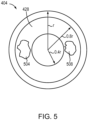
- FIG. 5 depicts a top view of the first dome 404 (i.e., a view of the dome 404 when it is observed in the direction of arrow 424).
- the first dome 404 features two puncture holes 504, 508 within an annular region 428.
- the annular puncture region 428 represents the preferred region on an outer surface 432 of the first dome 404 in which to puncture the holes 504, 508.
- the puncturing mechanism 230 of the inhalation device 100 is configured to puncture a center of each hole 504, 508 within the annular puncture region 428.
- a full dose of a low-density (i.e., below 0.10 g/cm 3 ) powder may be emitted from the capsule 219 and consumed by a typical adult patient in a single breath (i.e., emitted at a sufficient volumetric flow rate and an achievable magnitude of volumetric flux) where the combined total surface area of all puncture holes is between about 3% and about 15% of a total surface area of a single dome 404 or, equivalently, where the combined total surface area of all puncture holes is between about 0.5% and about 2.2% of a total surface area of the entire capsule 219.
- the preferred total surface area for all puncture holes 504, 508 is between about 0.03 cm 2 and 0.14 cm 2 .
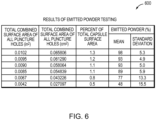
- the percentage of powder emitted in a single patient breath increases with increasing puncture hole area, it does so generally asymptotically. It has been found that it is undesirable for the combined total surface area of all the puncture holes to be greater than about 2.2% of the total surface area of the entire capsule, because the puncturing force that results from producing puncture holes greater than that size can approach or exceed the loading limits for typical capsule materials, such as hydroxy propyl methyl cellulose and gelatin. Moreover, it is typically unnecessary for the combined total surface area of all the puncture holes to be greater than about 2.2% of the total surface area of the entire capsule because, as can be seen from the table 600 of FIG. 6 and the graph 700 of FIG. 7 , the percentage of powder emitted from the capsule approaches 100% generally asymptotically and little to no appreciable benefit (in terms of the percentage of powder emitted from the capsule) exists for puncture hole areas beyond that size.
- puncture holes having a combined total surface area in narrower ranges between about 0.5% and about 2.2% of the total surface area of the entire capsule (e.g., with minimum values of about 0.5%, about 0.8%, about 1.1%, and/or about 1.3% of the total surface area of the entire capsule in any combination with maximum values of about 1.6%, about 1.8%, about 2.0%, and/or about 2.2% of the total surface area of the entire capsule) is also contemplated and within the scope of the present invention.
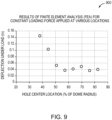
- the analysis predicts, as can be observed from FIGS. 8 and 9 , that a change in degree of deflection in response to a constant loading force similar to that imparted to the capsule material during puncturing will occur between 40% to 50% of the dome radius.
- the change as one moves from a puncture hole centered at 50% of the dome radius towards a puncture hole centered at 40% of the dome radius, is a transition from minor bending (which is recoverable or elastic deformation) to plastic or irreversible deformation. This transition occurs when the capsule material begins to yield under load. Once this transition point is reached, the efficiency of puncture hole generation is significantly reduced as the capsule's dome will continue to deflect under increasing load rather than being penetrated.
- the preferred location for the center of each puncture hole is in an annular region of the capsule's dome that is situated at no less than 0.4r (and, in some embodiments, at no less than 0.5r).
- the annular puncture region may be situated between about 0.4r and about 0.6r, or between about 0.4r and about 0.8r.
- the annular puncture region may be situated in any region on the capsule's dome having a minimum value of about 0.4r, about 0.5r, and/or about 0.6r in any combination with a maximum value of about 0.6r, about 0.7r, and/or about 0.8r. Attempting to puncture the capsule's dome in a region greater than 0.8r is undesirable for several reasons.
- the prong of the puncturing mechanism could slip off the capsule's dome and/or tear down the cylindrical wall portion of the capsule. Tearing down the cylindrical wall portion of the capsule could leave too great a hole in the capsule and/or cause portions of the capsule to be ripped apart and (potentially) be inhaled by the patient. Attempting to puncture the capsule's dome in a region greater than 0.8r could also create a side load on the capsule, causing it to detrimentally deflect within the inhaler's chamber.
- a user places the capsule 219 containing a powdered medicament within the cylindrical chamber 210.
- the puncturing mechanism 230 is moved toward the capsule 219, thereby puncturing the capsule 219 and causing the release of powdered medicament into the chamber 210.
- the powdered medicament is then inhaled by the user through the apertures 224 and the inhalation piece 226.
- the inhalation piece 226 can be configured as either a mouth piece or a nose piece.
- the user merely replaces the emptied capsule 219 with another capsule 219 that contains a new supply of the powdered medicament.
Landscapes
- Health & Medical Sciences (AREA)
- Engineering & Computer Science (AREA)
- Biomedical Technology (AREA)
- Bioinformatics & Cheminformatics (AREA)
- Animal Behavior & Ethology (AREA)
- Veterinary Medicine (AREA)
- Public Health (AREA)
- General Health & Medical Sciences (AREA)
- Life Sciences & Earth Sciences (AREA)
- Hematology (AREA)
- Heart & Thoracic Surgery (AREA)
- Anesthesiology (AREA)
- Pulmonology (AREA)
- Neurology (AREA)
- Neurosurgery (AREA)
- Psychology (AREA)
- Pharmacology & Pharmacy (AREA)
- Organic Chemistry (AREA)
- Nuclear Medicine, Radiotherapy & Molecular Imaging (AREA)
- Medicinal Chemistry (AREA)
- General Chemical & Material Sciences (AREA)
- Chemical Kinetics & Catalysis (AREA)
- Chemical & Material Sciences (AREA)
- Medicinal Preparation (AREA)
- Medical Preparation Storing Or Oral Administration Devices (AREA)
- Acyclic And Carbocyclic Compounds In Medicinal Compositions (AREA)
- Infusion, Injection, And Reservoir Apparatuses (AREA)
Applications Claiming Priority (6)
| Application Number | Priority Date | Filing Date | Title |
|---|---|---|---|
| US201261733117P | 2012-12-04 | 2012-12-04 | |
| US13/719,598 US20140150787A1 (en) | 2012-12-04 | 2012-12-19 | Devices and methods for puncturing a capsule to release a powdered medicament therefrom |
| EP16167547.5A EP3090773B1 (de) | 2012-12-04 | 2013-12-03 | Vorrichtungen und verfahren zur punktierung einer kapsel zur freisetzung eines pulverförmigen medikaments daraus |
| PCT/US2013/072769 WO2014089018A2 (en) | 2012-12-04 | 2013-12-03 | Devices and methods for puncturing a capsule to release a powdered medicament therefrom |
| EP13812285.8A EP2928530A2 (de) | 2012-12-04 | 2013-12-03 | Vorrichtungen und verfahren zur punktierung einer kapsel zur freisetzung eines pulverförmigen medikaments daraus |
| EP19197088.8A EP3607986B1 (de) | 2012-12-04 | 2013-12-03 | Vorrichtungen und verfahren zur punktierung einer kapsel zur freisetzung eines pulverförmigen medikaments daraus |
Related Parent Applications (3)
| Application Number | Title | Priority Date | Filing Date |
|---|---|---|---|
| EP13812285.8A Division EP2928530A2 (de) | 2012-12-04 | 2013-12-03 | Vorrichtungen und verfahren zur punktierung einer kapsel zur freisetzung eines pulverförmigen medikaments daraus |
| EP16167547.5A Division EP3090773B1 (de) | 2012-12-04 | 2013-12-03 | Vorrichtungen und verfahren zur punktierung einer kapsel zur freisetzung eines pulverförmigen medikaments daraus |
| EP19197088.8A Division EP3607986B1 (de) | 2012-12-04 | 2013-12-03 | Vorrichtungen und verfahren zur punktierung einer kapsel zur freisetzung eines pulverförmigen medikaments daraus |
Publications (2)
| Publication Number | Publication Date |
|---|---|
| EP4527436A2 true EP4527436A2 (de) | 2025-03-26 |
| EP4527436A3 EP4527436A3 (de) | 2025-09-03 |
Family
ID=50824204
Family Applications (4)
| Application Number | Title | Priority Date | Filing Date |
|---|---|---|---|
| EP13812285.8A Withdrawn EP2928530A2 (de) | 2012-12-04 | 2013-12-03 | Vorrichtungen und verfahren zur punktierung einer kapsel zur freisetzung eines pulverförmigen medikaments daraus |
| EP16167547.5A Active EP3090773B1 (de) | 2012-12-04 | 2013-12-03 | Vorrichtungen und verfahren zur punktierung einer kapsel zur freisetzung eines pulverförmigen medikaments daraus |
| EP25156645.1A Pending EP4527436A3 (de) | 2012-12-04 | 2013-12-03 | Vorrichtungen und verfahren zur punktierung einer kapsel zur freisetzung eines pulverförmigen medikaments daraus |
| EP19197088.8A Active EP3607986B1 (de) | 2012-12-04 | 2013-12-03 | Vorrichtungen und verfahren zur punktierung einer kapsel zur freisetzung eines pulverförmigen medikaments daraus |
Family Applications Before (2)
| Application Number | Title | Priority Date | Filing Date |
|---|---|---|---|
| EP13812285.8A Withdrawn EP2928530A2 (de) | 2012-12-04 | 2013-12-03 | Vorrichtungen und verfahren zur punktierung einer kapsel zur freisetzung eines pulverförmigen medikaments daraus |
| EP16167547.5A Active EP3090773B1 (de) | 2012-12-04 | 2013-12-03 | Vorrichtungen und verfahren zur punktierung einer kapsel zur freisetzung eines pulverförmigen medikaments daraus |
Family Applications After (1)
| Application Number | Title | Priority Date | Filing Date |
|---|---|---|---|
| EP19197088.8A Active EP3607986B1 (de) | 2012-12-04 | 2013-12-03 | Vorrichtungen und verfahren zur punktierung einer kapsel zur freisetzung eines pulverförmigen medikaments daraus |
Country Status (18)
| Country | Link |
|---|---|
| US (4) | US20140150787A1 (de) |
| EP (4) | EP2928530A2 (de) |
| JP (5) | JP2015536765A (de) |
| KR (2) | KR102416895B1 (de) |
| CN (1) | CN104981264B (de) |
| AU (5) | AU2013356299B2 (de) |
| BR (1) | BR112015013017B1 (de) |
| CA (2) | CA3209510A1 (de) |
| DK (1) | DK3090773T3 (de) |
| ES (2) | ES2760606T3 (de) |
| FR (1) | FR20C1011I1 (de) |
| MX (2) | MX373731B (de) |
| NZ (1) | NZ708449A (de) |
| PL (2) | PL3607986T3 (de) |
| PT (1) | PT3090773T (de) |
| RU (1) | RU2677766C2 (de) |
| SG (1) | SG11201504387UA (de) |
| WO (1) | WO2014089018A2 (de) |
Families Citing this family (12)
| Publication number | Priority date | Publication date | Assignee | Title |
|---|---|---|---|---|
| US20150080786A1 (en) * | 2013-09-16 | 2015-03-19 | Robert E. King | Compact Consciousness Arousing Device |
| US11491288B2 (en) | 2014-01-08 | 2022-11-08 | Seroton, Inc. | Dispenser for dry-powder inhalation devices |
| US10238820B2 (en) | 2014-01-08 | 2019-03-26 | Seroton, Inc. | Dry-powder inhalation device |
| USD752734S1 (en) * | 2014-03-10 | 2016-03-29 | Civitas Therapeutics, Inc. | Inhaler grip |
| USD755367S1 (en) | 2014-03-10 | 2016-05-03 | Civitas Therapeutics, Inc. | Indicator for an inhaler |
| USD752204S1 (en) | 2014-03-10 | 2016-03-22 | Civitas Therapeutics, Inc. | Indicator for an inhaler |
| CN109922851B (zh) * | 2016-11-30 | 2022-05-27 | 菲利普莫里斯生产公司 | 具有经大小设定的腔的吸入器 |
| CN106542161B (zh) * | 2017-01-19 | 2018-04-20 | 朱兴春 | 一种收集胶囊药物的方法 |
| KR20200023285A (ko) * | 2017-06-28 | 2020-03-04 | 필립모리스 프로덕츠 에스.에이. | 흡입기와 함께 사용하기 위한 입자를 가진 컨테이너 |
| DE102018108958A1 (de) * | 2018-04-16 | 2019-10-17 | Emphasys Importadora Exportadora E Distribuidora Ltda. | Trockenpulverinhalator |
| PL4259248T3 (pl) * | 2020-12-11 | 2024-12-16 | Philip Morris Products, S.A. | Układ inhalatorowy z przesuniętym przebiciem |
| WO2022123488A1 (en) * | 2020-12-11 | 2022-06-16 | Philip Morris Products S.A. | Inhaler system with single plane piercing element |
Citations (2)
| Publication number | Priority date | Publication date | Assignee | Title |
|---|---|---|---|---|
| US6732732B2 (en) | 2001-04-16 | 2004-05-11 | Advanced Inhalation Research, Inc. | Inhalation device and method |
| US20090025721A1 (en) | 2007-06-12 | 2009-01-29 | Alkermes, Inc. | Powder inhaler devices |
Family Cites Families (28)
| Publication number | Priority date | Publication date | Assignee | Title |
|---|---|---|---|---|
| GB1182779A (en) * | 1966-09-17 | 1970-03-04 | Fisons Pharmaceuticals Ltd | Inhalation Device |
| US4069819A (en) * | 1973-04-13 | 1978-01-24 | Societa Farmaceutici S.P.A. | Inhalation device |
| US3927195A (en) * | 1974-01-31 | 1975-12-16 | Lilly Industries Ltd | Production of capsules |
| IT1228460B (it) * | 1989-02-23 | 1991-06-19 | Phidea S R L | Inalatore monouso con capsula pre-forata |
| FR2668451B1 (fr) * | 1990-10-31 | 1994-12-16 | Cofea Sa | Procede de preparation d'un produit liquide et dispositif pour sa mise en óoeuvre. |
| DK0781540T3 (da) | 1991-05-31 | 2002-05-27 | Scherer Technologies Inc R P | Fremgangsmåde og anordning til fremstilling af farmaceutiske cellulosekapsler med tørring af kapslen |
| PT101450B (pt) * | 1994-02-02 | 1999-11-30 | Hovione Produtos Farmaceuticos | Novo dispositivo para inalacao |
| US6007843A (en) * | 1995-09-29 | 1999-12-28 | Lam Pharmaceuticals Corp. | Sustained release delivery system |
| US5897880A (en) * | 1995-09-29 | 1999-04-27 | Lam Pharmaceuticals, Llc. | Topical drug preparations |
| EP0973743B1 (de) * | 1997-02-21 | 2004-08-25 | Targacept, Inc. | Pharmazeutische zusammensetzungen welche aryl-substituierte olefinische amin-verbindungen enthalten |
| EP0998271B3 (de) * | 1997-06-06 | 2014-10-29 | Depomed, Inc. | Im magen verweilende orale dosierungsformen von wasserlöslichen arzneistoffen mit kontrollierter freisetzung |
| ITMI20020078A1 (it) * | 2002-01-16 | 2003-07-16 | Fabrizio Niccolai | Dispositivo utilizzabile nel tratamento di affezzioni delle vie respiratorie |
| JP4897198B2 (ja) * | 2002-03-20 | 2012-03-14 | アルカームズ,インコーポレイテッド | 吸入装置で使用する穿孔手段 |
| SI2630954T1 (sl) | 2002-03-20 | 2017-02-28 | Civitas Therapeutics, Inc. | Pulmonalno dovajanje za levodopo |
| US20040206350A1 (en) * | 2002-12-19 | 2004-10-21 | Nektar Therapeutics | Aerosolization apparatus with non-circular aerosolization chamber |
| US20050081852A1 (en) * | 2002-12-30 | 2005-04-21 | Nektar Therapeutics (Formely Inhale Therapeutic System Inc.) | Package for an aerosolization apparatus and pharmaceutical formulation receptacle |
| US20050056280A1 (en) * | 2002-12-31 | 2005-03-17 | Nektar Therapeutics | Receptacle for an aerosolizable pharmaceutical formulation |
| US7878193B2 (en) | 2003-01-14 | 2011-02-01 | Boehringer Ingelheim International Gmbh | Capsule for taking an active substance which can be inhaled |
| DE602004014909D1 (de) * | 2003-03-20 | 2008-08-21 | Galephar M F | Verbessertes trockenpulver-inhalationssystem |
| EP1635762B1 (de) * | 2003-06-13 | 2021-03-03 | Civitas Therapeutics, Inc. | Niedrigdosierte pharmazeutische pulver zur inhalation |
| DE602004010435T2 (de) * | 2004-10-25 | 2008-10-16 | Nestec S.A. | Kapsel mit Dichtungseinrichtung |
| RU2369411C2 (ru) * | 2005-04-21 | 2009-10-10 | Бёрингер Ингельхайм Интернациональ Гмбх | Порошковый ингалятор |
| US8360057B2 (en) * | 2006-03-10 | 2013-01-29 | Dose One, Llc | Medication inhaler for dispensing multiple capsules |
| US20110277752A1 (en) * | 2007-12-05 | 2011-11-17 | Novartis Ag | Receptacle for an aerosolizable pharmaceutical formulation |
| EP2234963B1 (de) * | 2007-12-28 | 2020-04-08 | Impax Laboratories, LLC | Levodopa-formulierungen mit gesteuerter freisetzung und ihre verwendung |
| EP2082768A1 (de) * | 2008-01-24 | 2009-07-29 | Vectura Delivery Devices Limited | Inhalator |
| MY169949A (en) * | 2009-08-28 | 2019-06-19 | Keurig Green Mountain Inc | Beverage cartridge and method for beverage formation using filter aid |
| JP7236257B2 (ja) * | 2018-11-30 | 2023-03-09 | 三星電子株式会社 | 衣類乾燥機 |
-
2012
- 2012-12-19 US US13/719,598 patent/US20140150787A1/en not_active Abandoned
-
2013
- 2013-12-03 PT PT161675475T patent/PT3090773T/pt unknown
- 2013-12-03 JP JP2015546548A patent/JP2015536765A/ja active Pending
- 2013-12-03 NZ NZ70844913A patent/NZ708449A/en unknown
- 2013-12-03 PL PL19197088.8T patent/PL3607986T3/pl unknown
- 2013-12-03 CA CA3209510A patent/CA3209510A1/en active Pending
- 2013-12-03 EP EP13812285.8A patent/EP2928530A2/de not_active Withdrawn
- 2013-12-03 ES ES16167547T patent/ES2760606T3/es active Active
- 2013-12-03 KR KR1020217012872A patent/KR102416895B1/ko active Active
- 2013-12-03 PL PL16167547T patent/PL3090773T3/pl unknown
- 2013-12-03 EP EP16167547.5A patent/EP3090773B1/de active Active
- 2013-12-03 EP EP25156645.1A patent/EP4527436A3/de active Pending
- 2013-12-03 KR KR1020157017677A patent/KR102248068B1/ko active Active
- 2013-12-03 MX MX2015007115A patent/MX373731B/es active IP Right Grant
- 2013-12-03 BR BR112015013017-8A patent/BR112015013017B1/pt active IP Right Grant
- 2013-12-03 RU RU2015126657A patent/RU2677766C2/ru active
- 2013-12-03 ES ES19197088T patent/ES3021222T3/es active Active
- 2013-12-03 CN CN201380069870.8A patent/CN104981264B/zh active Active
- 2013-12-03 SG SG11201504387UA patent/SG11201504387UA/en unknown
- 2013-12-03 EP EP19197088.8A patent/EP3607986B1/de active Active
- 2013-12-03 AU AU2013356299A patent/AU2013356299B2/en active Active
- 2013-12-03 WO PCT/US2013/072769 patent/WO2014089018A2/en not_active Ceased
- 2013-12-03 CA CA2894031A patent/CA2894031C/en active Active
- 2013-12-03 DK DK16167547T patent/DK3090773T3/da active
-
2015
- 2015-06-04 MX MX2020004877A patent/MX2020004877A/es unknown
-
2017
- 2017-11-15 US US15/813,870 patent/US20180289904A1/en not_active Abandoned
-
2018
- 2018-02-23 JP JP2018030415A patent/JP2018118062A/ja active Pending
- 2018-06-28 AU AU2018204682A patent/AU2018204682B2/en active Active
-
2019
- 2019-06-26 AU AU2019204497A patent/AU2019204497B2/en active Active
-
2020
- 2020-03-17 FR FR20C1011C patent/FR20C1011I1/fr active Active
- 2020-05-07 JP JP2020081723A patent/JP2020127773A/ja active Pending
- 2020-09-30 US US17/038,564 patent/US20210244895A1/en not_active Abandoned
- 2020-10-07 AU AU2020250224A patent/AU2020250224B2/en active Active
-
2022
- 2022-04-28 AU AU2022202802A patent/AU2022202802B2/en active Active
- 2022-07-08 JP JP2022110143A patent/JP2022133450A/ja active Pending
-
2023
- 2023-07-31 US US18/362,449 patent/US20240198020A1/en active Pending
-
2024
- 2024-02-26 JP JP2024026136A patent/JP2024057017A/ja active Pending
Patent Citations (2)
| Publication number | Priority date | Publication date | Assignee | Title |
|---|---|---|---|---|
| US6732732B2 (en) | 2001-04-16 | 2004-05-11 | Advanced Inhalation Research, Inc. | Inhalation device and method |
| US20090025721A1 (en) | 2007-06-12 | 2009-01-29 | Alkermes, Inc. | Powder inhaler devices |
Also Published As
Similar Documents
| Publication | Publication Date | Title |
|---|---|---|
| AU2022202802B2 (en) | Devices and methods for puncturing a capsule to release a powdered medicament therefrom | |
| US7146978B2 (en) | Inhalation device and method | |
| AU2002255808A1 (en) | Inhalation device and method | |
| HK40020970A (en) | Devices and methods for puncturing a capsule to release a powdered medicament therefrom | |
| HK40020970B (en) | Devices and methods for puncturing a capsule to release a powdered medicament therefrom | |
| HK1226012B (en) | Devices and methods for puncturing a capsule to release a powdered medicament therefrom |
Legal Events
| Date | Code | Title | Description |
|---|---|---|---|
| PUAI | Public reference made under article 153(3) epc to a published international application that has entered the european phase |
Free format text: ORIGINAL CODE: 0009012 |
|
| STAA | Information on the status of an ep patent application or granted ep patent |
Free format text: STATUS: THE APPLICATION HAS BEEN PUBLISHED |
|
| AC | Divisional application: reference to earlier application |
Ref document number: 2928530 Country of ref document: EP Kind code of ref document: P Ref document number: 3090773 Country of ref document: EP Kind code of ref document: P Ref document number: 3607986 Country of ref document: EP Kind code of ref document: P |
|
| AK | Designated contracting states |
Kind code of ref document: A2 Designated state(s): AL AT BE BG CH CY CZ DE DK EE ES FI FR GB GR HR HU IE IS IT LI LT LU LV MC MK MT NL NO PL PT RO RS SE SI SK SM TR |
|
| RIC1 | Information provided on ipc code assigned before grant |
Ipc: A61M 15/00 20060101AFI20250401BHEP |
|
| PUAL | Search report despatched |
Free format text: ORIGINAL CODE: 0009013 |
|
| AK | Designated contracting states |
Kind code of ref document: A3 Designated state(s): AL AT BE BG CH CY CZ DE DK EE ES FI FR GB GR HR HU IE IS IT LI LT LU LV MC MK MT NL NO PL PT RO RS SE SI SK SM TR |
|
| RIC1 | Information provided on ipc code assigned before grant |
Ipc: A61M 15/00 20060101AFI20250728BHEP |
|
| REG | Reference to a national code |
Ref country code: HK Ref legal event code: DE Ref document number: 40124719 Country of ref document: HK |