EP4524569A2 - Verfahren, zusammensetzungen und vorrichtungen zur behandlung von krebs mit illudofulvenen - Google Patents
Verfahren, zusammensetzungen und vorrichtungen zur behandlung von krebs mit illudofulvenen Download PDFInfo
- Publication number
- EP4524569A2 EP4524569A2 EP24212492.3A EP24212492A EP4524569A2 EP 4524569 A2 EP4524569 A2 EP 4524569A2 EP 24212492 A EP24212492 A EP 24212492A EP 4524569 A2 EP4524569 A2 EP 4524569A2
- Authority
- EP
- European Patent Office
- Prior art keywords
- chr
- illudofulvene
- seq
- gene
- cyclopropane
- Prior art date
- Legal status (The legal status is an assumption and is not a legal conclusion. Google has not performed a legal analysis and makes no representation as to the accuracy of the status listed.)
- Pending
Links
Images


Classifications
-
- A—HUMAN NECESSITIES
- A61—MEDICAL OR VETERINARY SCIENCE; HYGIENE
- A61K—PREPARATIONS FOR MEDICAL, DENTAL OR TOILETRY PURPOSES
- A61K31/00—Medicinal preparations containing organic active ingredients
- A61K31/33—Heterocyclic compounds
- A61K31/395—Heterocyclic compounds having nitrogen as a ring hetero atom, e.g. guanethidine or rifamycins
- A61K31/535—Heterocyclic compounds having nitrogen as a ring hetero atom, e.g. guanethidine or rifamycins having six-membered rings with at least one nitrogen and one oxygen as the ring hetero atoms, e.g. 1,2-oxazines
- A61K31/5375—1,4-Oxazines, e.g. morpholine
-
- G—PHYSICS
- G01—MEASURING; TESTING
- G01N—INVESTIGATING OR ANALYSING MATERIALS BY DETERMINING THEIR CHEMICAL OR PHYSICAL PROPERTIES
- G01N33/00—Investigating or analysing materials by specific methods not covered by groups G01N1/00 - G01N31/00
- G01N33/48—Biological material, e.g. blood, urine; Haemocytometers
- G01N33/50—Chemical analysis of biological material, e.g. blood, urine; Testing involving biospecific ligand binding methods; Immunological testing
- G01N33/53—Immunoassay; Biospecific binding assay; Materials therefor
- G01N33/574—Immunoassay; Biospecific binding assay; Materials therefor for cancer
-
- A—HUMAN NECESSITIES
- A61—MEDICAL OR VETERINARY SCIENCE; HYGIENE
- A61K—PREPARATIONS FOR MEDICAL, DENTAL OR TOILETRY PURPOSES
- A61K31/00—Medicinal preparations containing organic active ingredients
- A61K31/045—Hydroxy compounds, e.g. alcohols; Salts thereof, e.g. alcoholates
- A61K31/047—Hydroxy compounds, e.g. alcohols; Salts thereof, e.g. alcoholates having two or more hydroxy groups, e.g. sorbitol
-
- A—HUMAN NECESSITIES
- A61—MEDICAL OR VETERINARY SCIENCE; HYGIENE
- A61K—PREPARATIONS FOR MEDICAL, DENTAL OR TOILETRY PURPOSES
- A61K31/00—Medicinal preparations containing organic active ingredients
- A61K31/12—Ketones
- A61K31/121—Ketones acyclic
-
- A—HUMAN NECESSITIES
- A61—MEDICAL OR VETERINARY SCIENCE; HYGIENE
- A61K—PREPARATIONS FOR MEDICAL, DENTAL OR TOILETRY PURPOSES
- A61K31/00—Medicinal preparations containing organic active ingredients
- A61K31/12—Ketones
- A61K31/122—Ketones having the oxygen directly attached to a ring, e.g. quinones, vitamin K1, anthralin
-
- A—HUMAN NECESSITIES
- A61—MEDICAL OR VETERINARY SCIENCE; HYGIENE
- A61K—PREPARATIONS FOR MEDICAL, DENTAL OR TOILETRY PURPOSES
- A61K31/00—Medicinal preparations containing organic active ingredients
- A61K31/13—Amines
- A61K31/135—Amines having aromatic rings, e.g. ketamine, nortriptyline
-
- A—HUMAN NECESSITIES
- A61—MEDICAL OR VETERINARY SCIENCE; HYGIENE
- A61K—PREPARATIONS FOR MEDICAL, DENTAL OR TOILETRY PURPOSES
- A61K31/00—Medicinal preparations containing organic active ingredients
- A61K31/13—Amines
- A61K31/15—Oximes (>C=N—O—); Hydrazines (>N—N<); Hydrazones (>N—N=) ; Imines (C—N=C)
-
- A—HUMAN NECESSITIES
- A61—MEDICAL OR VETERINARY SCIENCE; HYGIENE
- A61K—PREPARATIONS FOR MEDICAL, DENTAL OR TOILETRY PURPOSES
- A61K31/00—Medicinal preparations containing organic active ingredients
- A61K31/16—Amides, e.g. hydroxamic acids
-
- A—HUMAN NECESSITIES
- A61—MEDICAL OR VETERINARY SCIENCE; HYGIENE
- A61K—PREPARATIONS FOR MEDICAL, DENTAL OR TOILETRY PURPOSES
- A61K31/00—Medicinal preparations containing organic active ingredients
- A61K31/16—Amides, e.g. hydroxamic acids
- A61K31/18—Sulfonamides
-
- A—HUMAN NECESSITIES
- A61—MEDICAL OR VETERINARY SCIENCE; HYGIENE
- A61K—PREPARATIONS FOR MEDICAL, DENTAL OR TOILETRY PURPOSES
- A61K31/00—Medicinal preparations containing organic active ingredients
- A61K31/185—Acids; Anhydrides, halides or salts thereof, e.g. sulfur acids, imidic, hydrazonic or hydroximic acids
- A61K31/19—Carboxylic acids, e.g. valproic acid
- A61K31/195—Carboxylic acids, e.g. valproic acid having an amino group
- A61K31/197—Carboxylic acids, e.g. valproic acid having an amino group the amino and the carboxyl groups being attached to the same acyclic carbon chain, e.g. gamma-aminobutyric acid [GABA], beta-alanine, epsilon-aminocaproic acid or pantothenic acid
- A61K31/198—Alpha-amino acids, e.g. alanine or edetic acid [EDTA]
-
- A—HUMAN NECESSITIES
- A61—MEDICAL OR VETERINARY SCIENCE; HYGIENE
- A61K—PREPARATIONS FOR MEDICAL, DENTAL OR TOILETRY PURPOSES
- A61K31/00—Medicinal preparations containing organic active ingredients
- A61K31/33—Heterocyclic compounds
- A61K31/335—Heterocyclic compounds having oxygen as the only ring hetero atom, e.g. fungichromin
- A61K31/35—Heterocyclic compounds having oxygen as the only ring hetero atom, e.g. fungichromin having six-membered rings with one oxygen as the only ring hetero atom
- A61K31/351—Heterocyclic compounds having oxygen as the only ring hetero atom, e.g. fungichromin having six-membered rings with one oxygen as the only ring hetero atom not condensed with another ring
-
- A—HUMAN NECESSITIES
- A61—MEDICAL OR VETERINARY SCIENCE; HYGIENE
- A61K—PREPARATIONS FOR MEDICAL, DENTAL OR TOILETRY PURPOSES
- A61K31/00—Medicinal preparations containing organic active ingredients
- A61K31/33—Heterocyclic compounds
- A61K31/335—Heterocyclic compounds having oxygen as the only ring hetero atom, e.g. fungichromin
- A61K31/357—Heterocyclic compounds having oxygen as the only ring hetero atom, e.g. fungichromin having two or more oxygen atoms in the same ring, e.g. crown ethers, guanadrel
-
- A—HUMAN NECESSITIES
- A61—MEDICAL OR VETERINARY SCIENCE; HYGIENE
- A61K—PREPARATIONS FOR MEDICAL, DENTAL OR TOILETRY PURPOSES
- A61K31/00—Medicinal preparations containing organic active ingredients
- A61K31/33—Heterocyclic compounds
- A61K31/395—Heterocyclic compounds having nitrogen as a ring hetero atom, e.g. guanethidine or rifamycins
- A61K31/40—Heterocyclic compounds having nitrogen as a ring hetero atom, e.g. guanethidine or rifamycins having five-membered rings with one nitrogen as the only ring hetero atom, e.g. sulpiride, succinimide, tolmetin, buflomedil
- A61K31/401—Proline; Derivatives thereof, e.g. captopril
-
- C—CHEMISTRY; METALLURGY
- C12—BIOCHEMISTRY; BEER; SPIRITS; WINE; VINEGAR; MICROBIOLOGY; ENZYMOLOGY; MUTATION OR GENETIC ENGINEERING
- C12Q—MEASURING OR TESTING PROCESSES INVOLVING ENZYMES, NUCLEIC ACIDS OR MICROORGANISMS; COMPOSITIONS OR TEST PAPERS THEREFOR; PROCESSES OF PREPARING SUCH COMPOSITIONS; CONDITION-RESPONSIVE CONTROL IN MICROBIOLOGICAL OR ENZYMOLOGICAL PROCESSES
- C12Q1/00—Measuring or testing processes involving enzymes, nucleic acids or microorganisms; Compositions therefor; Processes of preparing such compositions
- C12Q1/68—Measuring or testing processes involving enzymes, nucleic acids or microorganisms; Compositions therefor; Processes of preparing such compositions involving nucleic acids
- C12Q1/6876—Nucleic acid products used in the analysis of nucleic acids, e.g. primers or probes
- C12Q1/6883—Nucleic acid products used in the analysis of nucleic acids, e.g. primers or probes for diseases caused by alterations of genetic material
- C12Q1/6886—Nucleic acid products used in the analysis of nucleic acids, e.g. primers or probes for diseases caused by alterations of genetic material for cancer
-
- C—CHEMISTRY; METALLURGY
- C12—BIOCHEMISTRY; BEER; SPIRITS; WINE; VINEGAR; MICROBIOLOGY; ENZYMOLOGY; MUTATION OR GENETIC ENGINEERING
- C12Q—MEASURING OR TESTING PROCESSES INVOLVING ENZYMES, NUCLEIC ACIDS OR MICROORGANISMS; COMPOSITIONS OR TEST PAPERS THEREFOR; PROCESSES OF PREPARING SUCH COMPOSITIONS; CONDITION-RESPONSIVE CONTROL IN MICROBIOLOGICAL OR ENZYMOLOGICAL PROCESSES
- C12Q2600/00—Oligonucleotides characterized by their use
- C12Q2600/106—Pharmacogenomics, i.e. genetic variability in individual responses to drugs and drug metabolism
-
- C—CHEMISTRY; METALLURGY
- C12—BIOCHEMISTRY; BEER; SPIRITS; WINE; VINEGAR; MICROBIOLOGY; ENZYMOLOGY; MUTATION OR GENETIC ENGINEERING
- C12Q—MEASURING OR TESTING PROCESSES INVOLVING ENZYMES, NUCLEIC ACIDS OR MICROORGANISMS; COMPOSITIONS OR TEST PAPERS THEREFOR; PROCESSES OF PREPARING SUCH COMPOSITIONS; CONDITION-RESPONSIVE CONTROL IN MICROBIOLOGICAL OR ENZYMOLOGICAL PROCESSES
- C12Q2600/00—Oligonucleotides characterized by their use
- C12Q2600/158—Expression markers
-
- C—CHEMISTRY; METALLURGY
- C12—BIOCHEMISTRY; BEER; SPIRITS; WINE; VINEGAR; MICROBIOLOGY; ENZYMOLOGY; MUTATION OR GENETIC ENGINEERING
- C12Q—MEASURING OR TESTING PROCESSES INVOLVING ENZYMES, NUCLEIC ACIDS OR MICROORGANISMS; COMPOSITIONS OR TEST PAPERS THEREFOR; PROCESSES OF PREPARING SUCH COMPOSITIONS; CONDITION-RESPONSIVE CONTROL IN MICROBIOLOGICAL OR ENZYMOLOGICAL PROCESSES
- C12Q2600/00—Oligonucleotides characterized by their use
- C12Q2600/16—Primer sets for multiplex assays
-
- G—PHYSICS
- G01—MEASURING; TESTING
- G01N—INVESTIGATING OR ANALYSING MATERIALS BY DETERMINING THEIR CHEMICAL OR PHYSICAL PROPERTIES
- G01N2800/00—Detection or diagnosis of diseases
- G01N2800/52—Predicting or monitoring the response to treatment, e.g. for selection of therapy based on assay results in personalised medicine; Prognosis
Definitions
- DNA microarrays have been used to measure gene expression in samples from patients and to facilitate diagnosis of disease. Gene expression can reveal the presence of cancer in a patient in addition to the type, stage, and origin of the cancer. Gene expression may even have a role in predicting the efficacy of cancer therapies.
- NCI National Cancer Institute
- the NCI has tested cancer therapeutics for their effect in limiting the growth of 60 human cancer cell lines. The NCI has also measured gene expression in those 60 cancer cell lines using DNA microarrays.
- Various studies have explored the relationship between gene expression and therapeutic effect using the NCI datasets.
- Illudofulvenes have been proposed as medicants for Affinity Drug Conjugates in U.S. Patent No. 9,381,178 issued July 5, 2016 to M. Kelner entitled Affinity Medicant Conjugates, U.S. Patent No 9,980,926 issued May 29, 2018 to M. Kelner entitled Affinity Medicant Conjugates and U.S. Patent No. 10,285,955 issued May 14, 2019 to M. Kelner entitled Affinity Medicant Conjugates.
- chemotherapeutic agents for which tumors do not have a medicant resistant phenotype and which inhibit tumor growth, especially solid tumor growth, and which have an adequate therapeutic index to be effective for in vivo treatment.
- the illudofulvenes of the present invention have shown efficacy in humans and animals for a wide range of therapeutic applications including: cancer, adenocarcinoma, carcinoma, breast cancer, prostate cancer, ovarian cancer, endometrial cancer, and neuroendocrine tumors.
- veterinary and agricultural applications can include treatment of cancer, adenocarcinoma, carcinoma, ovarian cancer, endometrial cancer, and neuroendocrine tumors in farmyard and/or companion animals.
- the invention features methods for detecting expression of a biomarker (e.g., one, two, three, four, five, ten, or all of the biomarkers shown in Tables 1-8, such as Excision Repair Cross-Complementation (ERCC) e.g., ERCC2 (SEQ ID NO:21)) in a patient having cancer, such as a human patient having cancer that is resistant to one or more cancer therapies other than an Illudofulvene Analog (e.g., a patient with prostate cancer, ovarian cancer, or hepatocellular carcinoma (HCC) that is resistant to one or more cancer therapies including radiation therapy and/or chemotherapy based on Other Drugs as set forth herein), and for determining responsiveness of a cancer patient (e.g., a patient with prostate cancer, ovarian cancer, or HCC) to treatment with an Illudofulvene Analog.
- a biomarker e.g., one, two, three, four, five, ten, or all of the bio
- the invention also features methods of treating cancer in a patient in need thereof (e.g., a patient with prostate cancer, ovarian cancer, or HCC or a treatment resistant form thereof) that include administering an Illudofulvene Analog to the patient, in which the patient is or has been determined to be responsive to an Illudofulvene Analog according to the diagnostic methods described herein.
- a patient in need thereof e.g., a patient with prostate cancer, ovarian cancer, or HCC or a treatment resistant form thereof
- an Illudofulvene Analog to the patient, in which the patient is or has been determined to be responsive to an Illudofulvene Analog according to the diagnostic methods described herein.
- sensitivity to Illudofulvene Analog treatment in patients can be caused by a deficiency in a component of the transcription-coupled repair (TCR) pathway or the post-replication repair pathway (e.g.
- TCR transcription-coupled repair
- ERCC or RAD18 E3 Ubiquitin Protein Ligase (RAD18)), or alternatively sensitivity to Illudofulvene Analogs can be caused by an upregulation or increase in a gene product (i.e., protein, e.g., MYC Proto-Oncogene (MYC), and/or Prostaglandin Reductase (PTGR), e.g., PTGR1, and /or PTGR2).
- MYC Proto-Oncogene MYC Proto-Oncogene
- PTGR Prostaglandin Reductase
- a Southern blot, a northern blot, mRNA/RNA microarray, protein array, gene sequencing, immunohistochemical staining requiring additional tissue sampling and a readout by a competent pathologist can be utilized to identify the patient population.
- the methods of this invention include predicting the sensitivity of illudofulvenes, preferably in the form of a pharmaceutical composition, to an animal in need thereof.
- pharmaceutical compositions are disclosed containing illudofulvenes of the present invention in combination with a pharmaceutically acceptable carrier.
- an illudofulvenes can target cancer cells with reduced toxicity to normal cells.
- these compounds are useful in treatment of tumors in which a marker is expressed.
- pharmaceutical compositions comprising the illudofulvene compounds are used in the treatment of tumors in which the marker is expressed.
- methods of using the pharmaceutical compositions comprise these compounds to treat tumors in which the marker is expressed.
- pharmaceutical compositions comprising these compounds are used in the treatment of one or more of the following diseases: cancer, adenocarcinoma, carcinoma, breast cancer, prostate cancer, ovarian cancer, endometrial cancer.
- the invention relates to an illudofulvene analog for use in the treatment of a cancerous tumor expressing a PTGR gene, a MYC gene or one or more TCR genes in a patient, wherein said expression comprises:
- One or more TCR genes can be selected from the group consisting of one or more ERCC genes, a XPA gene, a GTF series gene, a UV gene, and a USP gene.
- the one or more PTGR genes can be selected from the group consisting of PTGR1 and PTGR2.
- the one or more housekeeping genes can be selected from the group consisting of beta actin (ACTB), transferrin receptor (TFRC) and glyceraldehyde-3-phosphate dehydrogenase (GAPD) and ubiquitin.
- the illudofulvene analog of the invention can be selected from the group consisting of 002, 008, 012, 039, 040, 041, 042, 043, 044, 046, 075, 076, 077, 078, 079, 088, 090, 094, 103, 104, 108, 110, 112, 113, 114, 115, 116, 119, 120, 121, 122, 123, 124, 125, 126, 127, 128, 130, 141, 142, 146, 149, 150, 160, 164, 165, 177, 178, 184.
- the gene expression can be measured by means selected from the group consisting of (i) quantification of gene mRNA expression by probe analysis, (ii) microarray analysis, (iii) Real Time-Polymerase Chain Reaction (RT-PCR), (iv) Transcription Coupled Repair (TCR) Tumor Mutation Panel and (v) primary tumor cell sensitivity.
- the primers selected to hybridize with the one or more nucleic acid molecules may be selected from the group consisting of SEQ ID NO:251-261, SEQ ID NO:264-274, SEQ ID NO:307-308, SEQ ID NO:309-310, SEQ ID NO: 329-440, SEQ ID NO: 451-475, SEQ ID NO:682-696, SEQ ID NO: 715-727, SEQ ID NO:897-899, SEQ ID NO:900-902.
- Increased expression of PTGR or MYC may relate to increased messenger RNA and/or gene product (protein) of one or more PTGR genes or the MYC gene increased above a basal level of a housekeeping gene by at least approximately one point nine (1.9) standard deviations in the cancerous tumor and wherein said decreased expression comprises messenger RNA and/or gene product (protein) of one or more TCR genes decreased below a basal level of a housekeeping gene by at least approximately one point nine (1.9) standard deviations.
- the invention further relates to an illudofulvene analog for use in a method of treating a patient with cancer, wherein the method comprises:
- the one or more TCR genes may be selected from the group consisting of one or more ERCC genes, a XPA gene, a GTF series gene, a UV gene, and a USP gene.
- the one or more PTGR genes may be selected from the group consisting of PTGR1 and PTGR2.
- the ratio of gene expression can be measured by means selected from the group consisting of (i) quantification of gene mRNA expression by probe analysis, (ii) microarray analysis, (iii) Real Time-Polymerase Chain Reaction (RT-PCR), (iv) Transcription Coupled Repair (TCR) Tumor Mutation Panel and (v) primary tumor cell sensitivity.
- Primers selected to hybridize with the one or more PTGR, MYC or TCT nucleic acid molecules may be selected from the group consisting of SEQ ID NO:251-261, SEQ ID NO:264-274, SEQ ID NO:307-308, SEQ ID NO:309-310, SEQ ID NO: 329-440, SEQ ID NO: 451-475, SEQ ID NO:682-696, SEQ ID NO: 715-727, SEQ ID NO:897-899, SEQ ID NO:900-902.
- the illudofulvene analog may be used in an effective amount, which may be administered in a dosage between: a lower limit of approximately 0.1 mg of the illudofulvene per kilogram of body weight of the patient; and an upper limit of approximately 5 mg of the illudofulvene per kilogram of body weight of the patient.
- the illudofulvene analog may be selected from the group consisting of 002, 008, 012, 039, 040, 41, 42, 43, 44, 46, 75, 76, 77, 78, 79, 88, 90, 94, 103, 104, 108, 110, 112, 113, 114, 115, 116, 119, 120, 121, 122, 123, 124, 125, 126, 127, 128, 130, 141, 142, 146, 149, 150, 160, 164, 165, 177, 178, 184.
- the term 'upregulated' means that the messenger RNA and/or the gene product (protein) is increased above basal level of a housekeeping gene by at least approximately one point nine (1.9) standard deviations which corresponds with ninety (90) per cent confidence assuming a normal distribution.
- the phrase 'increased expression' means that the messenger RNA and/or the gene product (protein) is increased above a basal level of a housekeeping gene by at least approximately one point nine (1.9) standard deviations which corresponds with ninety (90) per cent confidence assuming a normal distribution.
- the term 'downregulated' means that the messenger RNA and/or the gene product (protein) is decreased below basal levels of a housekeeping gene by at least approximately one point nine (1.9) standard deviations which corresponds with ninety (90) per cent confidence assuming a normal distribution.
- the phrase 'decreased expression' means that the messenger RNA and/or the gene product (protein) is decreased below a basal level of a housekeeping gene by at least approximately one point nine (1.9) standard deviations which corresponds with ninety (90) per cent confidence assuming a normal distribution.
- approximately means plus or minus ten (10) per cent.
- the phrase ⁇ not upregulated' means that the messenger RNA and/or the gene product (protein) are within the normal range of the basal level of a housekeeping gene.
- a basal expression level is the expression level of an mRNA or a protein under normal circumstances.
- the phrase ⁇ determining if a cancerous tumor is sensitive to an illudofulvene analog' means that the indicated gene is either upregulated or downregulated as specified.
- the phrase ⁇ using a selected technique' means a technique selected from the group consisting of (i) quantification of gene mRNA expression by probe analysis, (ii) microarray analysis, (iii) Real Time-Polymerase Chain Reaction (RT-PCR), (iv) Transcription Coupled Repair (TCR) Tumor Mutation Panel and (v) primary tumor cell sensitivity.
- the phrase ⁇ determining the regulation of expression of a PTGR gene' means probing the level of expression of the PTGR gene in the (tissue) sample using a selected technique.
- the phrase 'determining the regulation of expression of a MYC gene' means probing the level of expression of the MYC gene in the (tissue) sample using a selected technique.
- the phrase ⁇ determining the regulation of expression of a TCR gene' means probing the level of expression of the TCR gene in the (tissue) sample using a selected technique.
- the phrase ⁇ determining the regulation of expression of a Housekeeping gene' means probing the level of expression of the Housekeeping gene in the (tissue) sample using a selected technique.
- the phrase 'determining a relative ratio of expression of a gene is high' means calculating that the determined regulation of the gene is 1.9 standard deviations above the determined regulation of a housekeeping gene.
- the phrase ⁇ determining a relative ratio of expression of a gene is deficient' means calculating that the determined regulation of the gene is 1.9 standard deviations below the determined regulation of a housekeeping gene.
- the phrase 'Other Drugs' means docetaxel, cabazitaxel, mitoxantrone, estramustine, prednisone, carboplatin, bevacizumab, paclitaxel, gemcitabine, doxorubicin, topotecan, etoposide, tamoxifen, letrozole, sorafenib, fluorouracil, capecitabine, oxaliplatin, interferon-alpha, 5-fluorouracil (5-FU), a histone deacetylase (HDAC) inhibitor, ipilimumab, bortezomib, carfilzomib, thalidomide, lenalidomide, pomalidomide, dexamethasone, cyclophosphamide, vincristine, melphalan, tegafur, irinotecan, cetuximab, leucovorin, SN-38, everolimus
- 'Acylfulvene' means an Illudofulvene subgroup with the following structural molecular formula: where R 1 , R 2 , R 3 , R 8 , R 9 , R 10 , R 11 , are as set forth in Formula P1, as given herein.
- An 'Illudin' which includes illudin M (where R 1 , and R 3 are CH 3 , and R 2 is OH), illudin S (where R 1 is CH 2 OH, R 2 is OH, and R 3 is CH 3 ) and syn-illudins (which include an illudin ring derivative (where R 2 is the site of derivatization) or an illudin alkyl derivative (where R 1 is the site of derivatization) means an Illudofulvene subgroup with the following structural molecular formula: where R 1 , R 2 , R 3 , are as set forth in Formula P2, as given herein.
- Syn-Illudins are semi-synthetic derivatives of Illudins.
- Acylfulvenes are also semi-synthetic derivatives of Illudins.
- Syn-Illudins and Acylfulvenes have each been chemically modified at select sites to allow their use as medicants.
- the modifications in the Syn-Illudins do not alter any of the cyclic rings (cyclopropane, cyclopentane, cyclohexane) of the basic Illudin chemical structure.
- the modifications of Acylfulvenes differ from Syn-Illudins in that an additional double bond (an unsaturated bond) has been created in the 5 membered (cyclopentane) ring.
- Table 14 is a listing of IUPAC names of the Illudofulvene Analog according to various embodiments of the present invention.
- Exemplary types of cancer that can be diagnosed or treated with the methods include, e.g., prostate cancer, ovarian cancer (e.g., ovarian adenocarcinoma or embryonal carcinoma), liver cancer (e.g., HCC or hepatoma), myeloma (e.g., multiple myeloma), colorectal cancer (e.g., colon cancer and rectal cancer), leukemia (e.g., acute myeloid leukemia, acute lymphoid leukemia, chronic myeloid leukemia, chronic lymphocytic leukemia, acute myeloblastic leukemia, acute promyelocytic leukemia, acute myelomonocytic leukemia, acute monocytic leukemia, acute erythroleukemia, and chronic leukemia), myelodysplastic syndrome, lymphoma (e.g., diffuse large B-cell lymphoma, cutaneous T-cell lymphoma, peripheral T-cell lymphom
- a first aspect of the invention features a method for detecting expression of a biomarker (e.g., one, two, three, four, five, ten, or all of the biomarkers shown in Tables 1-8, such as ERCC2 (SEQ ID NO:21)) in a patient having cancer (e.g., prostate cancer, ovarian cancer, or HCC), such as a patient having cancer that is resistant to one or more cancer therapies other than an illudofulvene (e.g., a patient with prostate cancer, ovarian cancer, or HCC that is resistant to one or more cancer therapies other than an illudofulvene).
- a biomarker e.g., one, two, three, four, five, ten, or all of the biomarkers shown in Tables 1-8, such as ERCC2 (SEQ ID NO:21)
- cancer e.g., prostate cancer, ovarian cancer, or HCC
- cancer e.g., prostate cancer, ovarian cancer, or H
- the method includes (a) contacting a sample (e.g., a tumor sample) from the patient including one or more nucleic acid molecules with a device (e.g., a microarray) including: i) one or more single-stranded nucleic acid molecules capable of specifically hybridizing with the nucleotides of one or more biomarkers of sensitivity selected from the biomarkers of Tables 1-8 (e.g., ERCC2 (SEQ ID NO:21)); and (b) detecting a level of expression of one or more of the biomarker(s) of sensitivity by performing microarray analysis or quantitative reverse transcriptase polymerase chain reaction (qRT-PCR).
- a device e.g., a microarray
- a device e.g., a microarray
- a device including: i) one or more single-stranded nucleic acid molecules capable of specifically hybridizing with the nucleotides of one or more biomarkers of sensitivity selected from the biomarkers of
- the patient is determined to be responsive to an illudofulvene if: i) the level of expression of the biomarkers of sensitivity is substantially similar to the level of expression of the biomarkers of sensitivity (e.g., ERCC2 (SEQ ID NO:21)) in a cell (e.g., a cancer cell) or tissue (e.g., a tumor tissue) known to be sensitive to an illudofulvene.
- a cell e.g., a cancer cell
- tissue e.g., a tumor tissue
- the invention also features a method of treating cancer in a patient in need thereof (e.g., one of the cancers noted above, such as prostate cancer, ovarian cancer, or HCC) that includes administering an illudofulvene to the patient, in which the patient has been determined to be responsive to an illudofulvene according to the method of the first or second aspect of the invention.
- the patient may have a cancer that is resistant to one or more cancer therapies other than an Illudofulvene Analog selected from Table 14 (e.g., a patient with prostate cancer, ovarian cancer, or HCC that is resistant to one or more cancer therapies other than an illudofulvene).
- the method includes a) contacting a sample (e.g., a tumor sample) from the patient including one or more nucleic acid molecules with a device (e.g., a microarray or a device for performing a qRT-PCR reaction) including: i) one or more single-stranded nucleic acid molecules capable of specifically hybridizing with the nucleotides of one or more biomarkers of sensitivity selected from the biomarkers of Tables 1-8 (e.g., ERCC2 (SEQ ID NO:21)) ; and b) measuring hybridization, or an amplification product resulting from hybridization, between the one or more nucleic acid molecules from the patient and the single-stranded nucleic acid molecules of the device to detect a level of expression of one or more of the biomarkers of sensitivity and c) administering an Illudofulvene Analog selected from Table 14 to the patient if: i) the level of expression of the biomarkers of sensitivity is substantially similar to the level of expression of
- the method of the third aspect of the invention may further include administering one or more additional therapies (e.g., surgery, radiation, or a therapeutic agent) to the patient prior to, concurrently with, or after administration of an Illudofulvene Analog selected from Table 14.
- the therapeutic agent may be selected from the group consisting of Other Drugs as set forth herein.
- the therapeutic agent can be administered parenterally (e.g. intravenously, intramuscularly, transdermally, intradermally, intra-arterially, intracranially, subcutaneously, intraorbitally, intraventricularly, intraspinally, intraperitoneally, or intranasally), enterally, or topically.
- an illudofulvene may be administered parenterally (e.g. intravenously, intramuscularly, transdermally, intradermally, intra-arterially, intracranially, subcutaneously, intraorbitally, intraventricularly, intraspinally, intraperitoneally, or intranasally), enterally, or topically.
- parenterally e.g. intravenously, intramuscularly, transdermally, intradermally, intra-arterially, intracranially, subcutaneously, intraorbitally, intraventricularly, intraspinally, intraperitoneally, or intranasally
- enterally or topically.
- an illudofulvene is administered by intravenous injection.
- An illudofulvene analog selected from Table 14 may be administered to the patient two or more times, such as one or more times daily, weekly, every two weeks, every three weeks, or monthly (e.g., one or more times per week for two weeks or more).
- a second dose of an illudofulvene analog selected from Table 14 may be administered to the patient two weeks, three weeks, four weeks, or five weeks after administration of a prior dose of an illudofulvene.
- an illudofulvene analog selected from Table 14 is administered in a 3 week treatment regimen in which the illudofulvene analog selected from Table 14 is administered on day 1 an day 8.
- the treatment regimen may be repeated two to twenty times or more, as needed.
- an illudofulvene analog selected from Table 14 may be administered to the patient at a dose of about 0.05 mg/kg to 6 mg/kg, such as at a dose of about 0.1 mg/kg to 1 mg/kg.
- an illudofulvene may be administered at a dose of about 0.15 mg/kg, 0.20 mg/kg, 0.25 mg/kg, 0.30 mg/kg, 0.35 mg/kg, 0.40 mg/kg, 0.45 mg/kg, 0.55 mg/kg, 0.60 mg/kg, 0.65 mg/kg, 0.70 mg/kg, 0.75 mg/kg, 0.80 mg/kg, 0.85 mg/kg, 0.90 mg/kg, or 0.95 mg/kg.
- An illudofulvene may be administered to the patient in a treatment regimen at least once per week for at least two weeks and/or on day 1 and day 8 of a 3 week treatment regimen, in which the treatment regimen occurs one or more times (e.g., the treatment regimen is repeated two to twenty times).
- an illudofulvene is administered to the patient at a dose of about 0.1 mg/kg to 1 mg/kg, such as a dose of about 0.2 mg/kg to about 0.6 mg/kg (e.g., a dose of about 0.45 mg/kg).
- This dosage of an illudofulvene can be administered in a 3 week treatment regimen, in which an illudofulvene is administered on day 1 and day 8.
- the contacting step (a) and the measuring step (b) may occur prior to, concurrent with, or after administration of an illudofulvene analog selected from Table 14 to the patient. Additionally, the contacting step (a) and the measuring step (b) may occur two or more times, e.g., during treatment with an illudofulvene. For example, the contacting step (a) and the measuring step (b) may occur two or more times to assess the continued sensitivity of the patient to the Illudofulvene Analog selected from Table 14.
- the device can include at least two, at least three, at least four, at least five, at least six, at least seven, at least eight, at least nine, at least ten, or more single-stranded nucleic acid molecules capable of specifically hybridizing with the nucleotides of one or more biomarkers of sensitivity selected from the biomarkers of Tables 1-8 (e.g., ERCC2 (SEQ ID NO:21)). Any of these aspects can be used individually or in any combination with other aspects.
- one or more of the single-stranded nucleic acid molecules of the device have a length in the range of 10 to 100 nucleotides in length (e.g., .a length in the range of 20 to 60 nucleotides).
- the method may include converting the level of expression of one or more of the biomarkers of sensitivity (e.g., one, two, three, four, five, ten, or all of the biomarkers shown in Tables 1-8, such as ERCC2 (SEQ ID NO:21)) into a mean score, in which the mean score indicates the responsiveness of the patient to an Illudofulvene Analog selected from Table 14.
- the mean score and/or the difference score above a cutoff value indicates that the patient is responsive to an illudofulvene, such as if the cutoff value is above a specific numeric value.
- the biomarkers of sensitivity may include ERCC8 (SEQ ID NOS:1-2) and ERCC6 (SEQ ID NOS:3-4).
- the biomarkers of sensitivity may include ERCC8 (SEQ ID NOS:1-2), ERCC6 (SEQ ID NOS:3-4), and GTF2H1 (SEQ ID NOS:5-6).
- the biomarkers of sensitivity may include ERCC8 (SEQ ID NOS:1-2), ERCC6 (SEQ ID NOS:3-4), GTF2H1 (SEQ ID NOS:5-6), and GTF2H2 (SEQ ID NOS:7-8).
- the biomarkers of sensitivity may include ERCC8 (SEQ ID NOS:1-2), ERCC6 (SEQ ID NOS:3-4), GTF2H1 (SEQ ID NOS:5-6), GTF2H2 (SEQ ID NOS:7-8) and GTF2H3 (SEQ ID NOS:9-10).
- the biomarkers of sensitivity may include ERCC8 (SEQ ID NOS:1-2), ERCC6 (SEQ ID NOS:3-4), GTF2H1 (SEQ ID NOS:5-6), GTF2H2 (SEQ ID NOS:7-8), GTF2H3 (SEQ ID NOS:9-10) and GTF2H4 (SEQ ID NOS: 11-12).
- the biomarkers of sensitivity may include ERCC8 (SEQ ID NOS:1-2), ERCC6 (SEQ ID NOS:3-4), GTF2H1 (SEQ ID NOS:5-6), GTF2H2 (SEQ ID NOS:7-8), GTF2H3 (SEQ ID NOS:9-10), GTF2H4 (SEQ ID NOS:11-12) and GTF2H5 (SEQ ID NOS:13-14).
- the biomarkers of sensitivity may include ERCC8 (SEQ ID NOS:1-2), ERCC6 (SEQ ID NOS:3-4), GTF2H1 (SEQ ID NOS:5-6), GTF2H2 (SEQ ID NOS:7-8), GTF2H3 (SEQ ID NOS:9-10), GTF2H4 (SEQ ID NOS: 11-12), GTF2H5 (SEQ ID NOS: 13-14), and USP7 (SEQ ID NOS:15-16).
- ERCC8 SEQ ID NOS:1-2
- ERCC6 SEQ ID NOS:3-4
- GTF2H1 SEQ ID NOS:5-6
- GTF2H2 SEQ ID NOS:7-8
- GTF2H3 SEQ ID NOS:9-10
- GTF2H4 SEQ ID NOS: 11-12
- GTF2H5 SEQ ID NOS: 13-14
- USP7 SEQ ID NOS:15-16
- the biomarkers of sensitivity may include ERCC8 (SEQ ID NOS:1-2), ERCC6 (SEQ ID NOS:3-4), GTF2H1 (SEQ ID NOS:5-6), GTF2H2 (SEQ ID NOS:7-8), GTF2H3 (SEQ ID NOS:9-10), GTF2H4 (SEQ ID NOS:11-12), GTF2H5 (SEQ ID NOS:13-14), USP7 (SEQ ID NOS:15-16), and UVSSA (SEQ ID NOS:17-18).
- the biomarkers of sensitivity may include ERCC8 (SEQ ID NOS:1-2), ERCC6 (SEQ ID NOS:3-4), GTF2H1 (SEQ ID NOS:5-6), GTF2H2 (SEQ ID NOS:7-8), GTF2H3 (SEQ ID NOS:9-10), GTF2H4 (SEQ ID NOS:11-12), GTF2H5 (SEQ ID NOS:13-14), USP7 (SEQ ID NOS:15-16), UVSSA (SEQ ID NOS:17-18) and ERCC3 (SEQ ID NOS:19-20).
- ERCC8 SEQ ID NOS:1-2
- ERCC6 SEQ ID NOS:3-4
- GTF2H1 SEQ ID NOS:5-6
- GTF2H2 SEQ ID NOS:7-8
- GTF2H3 SEQ ID NOS:9-10
- GTF2H4 SEQ ID NOS:11-12
- GTF2H5 SEQ ID NOS:13-14
- the biomarkers of sensitivity may include ERCC8 (SEQ ID NOS:1-2), ERCC6 (SEQ ID NOS:3-4), GTF2H1 (SEQ ID NOS:5-6), GTF2H2 (SEQ ID NOS:7-8), GTF2H3 (SEQ ID NOS:9-10), GTF2H4 (SEQ ID NOS:11-12), GTF2H5 (SEQ ID NOS:13-14), USP7 (SEQ ID NOS:15-16), UVSSA (SEQ ID NOS:17-18), ERCC3 (SEQ ID NOS:19-20), ERCC2 (SEQ ID NOS:21-22), ERCC4 (SEQ ID NOS:23-24) and ERCC5 (SEQ ID NOS:25-26).
- ERCC8 SEQ ID NOS:1-2
- ERCC6 SEQ ID NOS:3-4
- GTF2H1 SEQ ID NOS:5-6
- GTF2H2 SEQ ID NOS:7-8
- the biomarkers of sensitivity may include ERCC8 (SEQ ID NOS:1-2), ERCC6 (SEQ ID NOS:3-4), GTF2H1 (SEQ ID NOS:5-6), GTF2H2 (SEQ ID NOS:7-8), GTF2H3 (SEQ ID NOS:9-10), GTF2H4 (SEQ ID NOS:11-12), GTF2H5 (SEQ ID NOS:13-14), USP7 (SEQ ID NOS:15-16), UVSSA (SEQ ID NOS:17-18), ERCC3 (SEQ ID NOS:19-20), ERCC2 (SEQ ID NOS:21-22), ERCC4 (SEQ ID NOS:23-24), ERCC5 (SEQ ID NOS:25-26) and XPA (SEQ ID NOS:27-28).
- ERCC8 SEQ ID NOS:1-2
- ERCC6 SEQ ID NOS:3-4
- GTF2H1 SEQ ID NOS:5-6
- the biomarkers of sensitivity may include ERCC8 (SEQ ID NOS:1-2), ERCC6 (SEQ ID NOS:3-4), GTF2H1 (SEQ ID NOS:5-6), GTF2H2 (SEQ ID NOS:7-8), GTF2H3 (SEQ ID NOS:9-10), GTF2H4 (SEQ ID NOS:11-12), GTF2H5 (SEQ ID NOS:13-14), USP7 (SEQ ID NOS:15-16), UVSSA (SEQ ID NOS:17-18), ERCC3 (SEQ ID NOS:19-20), ERCC2 (SEQ ID NOS:21-22), ERCC4 (SEQ ID NOS:23-24), ERCC5 (SEQ ID NOS:25-26), XPA (SEQ ID NOS:27-28) and RAD18 (SEQ ID NOS:29-30).
- ERCC8 SEQ ID NOS:1-2
- ERCC6 SEQ ID NOS:3-4
- GTF2H1
- the biomarkers of sensitivity may include ERCC8 (SEQ ID NOS: 1-2), ERCC6 (SEQ ID NOS:3-4), GTF2H1 (SEQ ID NOS:5-6), GTF2H2 (SEQ ID NOS:7-8), GTF2H3 (SEQ ID NOS:9-10), GTF2H4 (SEQ ID NOS:11-12), GTF2H5 (SEQ ID NOS:13-14), USP7 (SEQ ID NOS:15-16), UVSSA (SEQ ID NOS:17-18), ERCC3 (SEQ ID NOS:19-20), ERCC2 (SEQ ID NOS:21-22), ERCC4 (SEQ ID NOS:23-24), ERCC5 (SEQ ID NOS:25-26), XPA (SEQ ID NOS:27-28), RAD18 (SEQ ID NOS:29-30) and ERCC6L (SEQ ID NOS:31-32).
- ERCC8 SEQ ID NOS: 1-2
- the biomarkers of sensitivity may include ERCC8 (SEQ ID NOS:1-2), ERCC6 (SEQ ID NOS:3-4), GTF2H1 (SEQ ID NOS:5-6), GTF2H2 (SEQ ID NOS:7-8), GTF2H3 (SEQ ID NOS:9-10), GTF2H4 (SEQ ID NOS:11-12), GTF2H5 (SEQ ID NOS:13-14), USP7 (SEQ ID NOS:15-16), UVSSA (SEQ ID NOS:17-18), ERCC3 (SEQ ID NOS:19-20), ERCC2 (SEQ ID NOS:21-22), ERCC4 (SEQ ID NOS:23-24), ERCC5 (SEQ ID NOS:25-26), XPA (SEQ ID NOS:27-28), RAD18 (SEQ ID NOS:29-30), ERCC6L(SEQ ID NOS:31-32) and ERCC6L2 (SEQ ID NOS:33-34).
- the biomarkers of sensitivity may include ERCC8 (SEQ ID NOS:1-2), ERCC6 (SEQ ID NOS:3-4), GTF2H1 (SEQ ID NOS:5-6), GTF2H2 (SEQ ID NOS:7-8), GTF2H3 (SEQ ID NOS:9-10), GTF2H4 (SEQ ID NOS:11-12), GTF2H5 (SEQ ID NOS:13-14), USP7 (SEQ ID NOS:15-16), UVSSA (SEQ ID NOS:17-18), ERCC3 (SEQ ID NOS:19-20), ERCC2 (SEQ ID NOS:21-22), ERCC4 (SEQ ID NOS:23-24), ERCC5 (SEQ ID NOS:25-26), XPA (SEQ ID NOS:27-28), RAD18 (SEQ ID NOS:29-30), ERCC6L (SEQ ID NOS:31-32), ERCC6L2 (SEQ ID NOS:33-34),
- the biomarkers of sensitivity may include ERCC8 (SEQ ID NOS:1-2), ERCC6 (SEQ ID NOS:3-4), GTF2H1 (SEQ ID NOS:5-6), GTF2H2 (SEQ ID NOS:7-8), GTF2H3 (SEQ ID NOS:9-10), GTF2H4 (SEQ ID NOS:11-12), GTF2H5 (SEQ ID NOS:13-14), USP7 (SEQ ID NOS:15-16), UVSSA (SEQ ID NOS:17-18), ERCC3 (SEQ ID NOS:19-20), ERCC2 (SEQ ID NOS:21-22), ERCC4 (SEQ ID NOS:23-24), ERCC5 (SEQ ID NOS:25-26), XPA (SEQ ID NOS:27-28), RAD18 (SEQ ID NOS:29-30), ERCC6L (SEQ ID NOS:31-32), ERCC6L2 (SEQ ID NOS:33-34),
- the device can be a microarray, such as a deoxyribonucleic acid (DNA)-based platform.
- the device can be for performing a qRT-PCR reaction (e.g., the device is used with a system for detecting the amplification product, for example, by fluorescence or by another method).
- the methods may also utilize both a microarray and a qRT-PCR.
- the expression level of the biomarkers of sensitivity e.g., one, two, three, four, five, ten, or all of the biomarkers shown in Tables 1-8, such as ERCC2 (SEQ ID NO:21)
- the level of expression of one or more of the biomarkers of sensitivity is determined by detecting the level of mRNA transcribed from one or more genes encoding one or more of the biomarkers of Tables 1-8.
- the cancer is selected from a solid tumor cancer and a hematological cancer.
- the cancer is prostate cancer, ovarian cancer, HCC, multiple myeloma, breast cancer, acute myelogenous leukemia (AML), acute lympho-blastic leukemia (ALL), chronic lymphocytic leukemia (CLL), myelodysplastic syndrome (MDS), chronic myelogenous leukemia-chronic phase (CMLCP), diffuse large B-cell lymphoma (DLBCL), cutaneous T-cell lymphoma (CTCL), peripheral T-cell lymphoma (PTCL), Hodgkin's lymphoma, cervical cancer, renal cell carcinoma (RCC), esophageal cancer, melanoma, glioma, pancreatic cancer, gastrointestinal stromal tumors (GIST), sarcoma, estrogen receptor-positive (ERpos) breast cancer, non-small cell lung carcinoma (NSCLC), colon cancer, bladder cancer, or
- AML acute myelogenous
- the cancer is prostate cancer, such as prostate cancer that is resistant to one or more cancer therapies other than an illudofulvene.
- the cancer may also be ovarian cancer, such as ovarian cancer that is resistant to one or more cancer therapies other than an illudofulvene.
- the cancer may be HCC, such as HCC that is resistant to one or more cancer therapies other than an illudofulvene.
- the patient may exhibit cancer relapse (e.g., relapse of prostate cancer, ovarian cancer, or HCC), such as relapse after treatment with a therapeutic agent other than an illudofulvene.
- cancer relapse e.g., relapse of prostate cancer, ovarian cancer, or HCC
- the patient may exhibit cancer relapse prior to treatment with an illudofulvene.
- the patient may have not been administered a treatment for cancer.
- a device such as a microarray, with one or more single-stranded oligonucleotide probes that have substantial identity (e.g., at least 85%, 90%, 95%, 99%, or 100% sequence identity) to a sequence that is complementary or identical to the nucleic acid sequence of one or more biomarkers shown in Tables 1-8 can be used according to the methods described herein to assess the responsiveness of a cancer patient to treatment with an illudofulvene.
- substantial identity e.g., at least 85%, 90%, 95%, 99%, or 100% sequence identity
- the probes can be used to detect one or more (e.g., two, three, four, five, ten, or all of the biomarkers shown in Tables 1-8, such as ERCC2 (SEQ ID NO:21) or ERCC3 (SEQ ID NO: 19) in a sample (e.g., a tumor sample) from a patient having cancer (e.g., prostate cancer, ovarian cancer, or hepatocellular carcinoma (HCC)).
- a sample e.g., a tumor sample
- cancer e.g., prostate cancer, ovarian cancer, or hepatocellular carcinoma (HCC)
- the invention features individual biomarkers (e.g. ERCC2 (SEQ ID NO:21) or ERCC3 (SEQ ID NO: 19)) and sets of biomarkers shown in Tables 1-8 that can be used to determine the responsiveness of a cancer patient to an illudofulvene at various stages of disease progression (e.g., patients diagnosed with cancer or patients after cancer recurrence) and at different times during the treatment process (e.g., prior to administration of any cancer treatment, after administration of one or more cancer treatments other than an illudofulvene, prior to administration of an illudofulvene, or during administration of an illudofulvene).
- stages of disease progression e.g., patients diagnosed with cancer or patients after cancer recurrence
- the treatment process e.g., prior to administration of any cancer treatment, after administration of one or more cancer treatments other than an illudofulvene, prior to administration of an illudofulvene, or during administration of an
- the methods can be used to determine the an illudofulvene responsiveness of a patient with cancer that is resistant to one or more cancer therapies other than an illudofulvene, such as Other Drugs as set forth herein.
- the invention provides methods of determination for assessing whether a patient with a cancer may be responsive to treatment with illudofulvenes by detecting the expression magnitude of either mRNA, or the corresponding protein produced from this mRNA, of one or more of the biomarkers shown in Table 6 (e.g. ERCC2 (SEQ ID NO:21) in a biological sample (e.g. a direct tumor biopsy or alternatively collection of free circulating tumor cells in peripheral blood) obtained from the patient using a device (e.g.
- Table 6 also contains components of the TCR post-replication repair pathway, PTGR1, PTGR2, and Myc.
- the expression level of one or more of these biomarkers can be compared to the expression level of the same biomarker(s) in a cell or tissue known to be sensitive to illudofulvenes based on a known defect in the TCR-NER pathway.
- the patient may be responsive to illudofulvene treatment if the expression level of one or more of the biomarkers (e.g. the Select Sensitive Genes) are similar to the expression levels of the corresponding biomarker in a cell or tissue known to be sensitive to an Illudofulvene Analog.
- the biomarkers e.g. the Select Sensitive Genes
- the invention features methods for identifying biomarkers (e.g., one or more of the biomarkers of Tables 1-8) for determining the responsiveness of a cancer patient to a cancer treatment, such as an Illudofulvene Analog selected from Table 14.
- biomarkers e.g., one or more of the biomarkers of Tables 1-8) for determining the responsiveness of a cancer patient to a cancer treatment, such as an Illudofulvene Analog selected from Table 14.
- Such methods can involve, for example, an algorithm based on growth inhibition (GI50), tumor growth inhibition (TGI), and lethal concentration (LD50) values derived from an In vitro Cancer Growth Inhibition Screen that was performed using a tumor obtained from a patient that was subjected to treatment with an Illudofulvene.
- GI50 growth inhibition
- TGI tumor growth inhibition
- LD50 lethal concentration
- genes associated with the TCR-NER pathway in this tumor can be measured (e.g., using a microarray (e.g., an Affymetrix HG-U133A or HG-U133_Plus_2 array)) and their expression compared to expression of a control or housekeeping gene (e.g. beta actin (ACTB), transferrin receptor (TFRC), glyceraldehyde-3-phosphate dehydrogenase (GAPD), or ubiquitin) to determine the responsiveness of a cancer patient to a cancer treatment, such as an Illudofulvene.
- ACTB beta actin
- TFRC transferrin receptor
- GPD glyceraldehyde-3-phosphate dehydrogenase
- ubiquitin e.g., ubiquitin
- the methods described can be used to identify cancer patients who can be predicted to respond to illudofulvenes, such as patients having , e.g., prostate cancer, ovarian cancer, hepatocellular carcinoma (HCC), cervical cancer, renal cell carcinoma (RCC), esophageal cancer, melanoma, glioma, pancreatic cancer, gastrointestinal stromal tumors (GIST), sarcoma, estrogen receptor-positive (ERpos) breast cancer, non-small cell lung carcinoma (NSCLC), colon cancer, bladder cancer, squamous cell carcinoma of the head and neck (SCCHN), acute myelogenous leukemia (AML), acute lympho-blastic leukemia (ALL), chronic lymphocytic leukemia (CLL), myelodysplastic syndrome (MDS), chronic myelogenous leukemia-chronic phase (CMLCP), diffuse large B-cell lymphoma (DLBCL), cutaneous T-cell lymphoma (CTCL), peripheral T-cell lympho
- the invention features diagnostic methods for the detection and screening of cancer patients (e.g., a patient having cancer that is resistant to one or more cancer therapies other than an illudofulvene) that may be responsive to an illudofulvene analog selected from Table 14 using one or more of the biomarkers shown in Tables 1-8 (e.g. ERCC2 (SEQ ID NO:21) or ERCC3 (SEQ ID NO: 19)).
- the methods of the invention may be used for predicting a patient's responsiveness to an illudofulvene, and optionally, treating the cancer patient throughout the progression of cancer and/or in cases of recurrence (e.g., after a first line treatment, a second line treatment, and/or a third line treatment).
- the invention provides individual biomarkers (e.g. ERCC2 (SEQ ID NO:21) and sets of biomarkers (e.g., two or more of the biomarkers listed in Tables 1-8), the expression levels of which, as detected in a biological sample (e.g., a tumor sample, such as a biopsy) obtained from a cancer patient (e.g., a human with cancer), are indicative of responsiveness to an Illudofulvene Analog.
- a biological sample e.g., a tumor sample, such as a biopsy
- a cancer patient e.g., a human with cancer
- the biomarkers were identified using methods similar to those previously described in, e.g., W Yang, et al. Genomics of drug sensitivity in cancer (GDSC): a resource for therapeutic biomarker discovery in cancer cells. Nucleic Acids Research, 41(D1): D955, 2013 .
- an algorithm based on the obtained in vitro cell culture values i.e. growth inhibition values (GI50), or the total growth inhibition (TGI), or the lethal concentration (LC50)
- cell lines e.g., NCI60 cells
- gene expression is determined in these same cell lines (e.g., by microarray analysis, reverse transcriptase polymerase chain reaction (RT-PCR), quantitative real-time PCR (qPCR), or next generation sequencing).
- RT-PCR reverse transcriptase polymerase chain reaction
- qPCR quantitative real-time PCR
- genes with, e.g., a Pearson correlation coefficient greater than about 0.5 or below about -0.5 to one of the obtained in vitro cell culture values can be classified as biomarkers of sensitivity or resistance, respectively.
- a probability or significance value can also be calculated for the correlation between the obtained in vitro cell culture values (i.e. growth inhibition values (GI50), or the total growth inhibition (TGI), or the lethal concentration (LC50)) and the normalized expression of a specific gene
- the expression levels of one or more biomarkers of Tables 1-8 can be used to determine cancer patient responsiveness to treatment with an illudofulvene. Once determined to be responsive, the patient can be treated with an illudofulvene.
- the biomarker ERCC8 (SEQ ID NO: 1) may be used to assess a cancer patient's (e.g., a patient having cancer that is resistant to one or more cancer therapies other than an illudofulvene) responsiveness to an illudofulvene.
- the expression level of the biomarker ERCC8 (SEQ ID NO:1) may be assessed using nucleic acid amplification methods (e.g., PCR) or a device (e.g., a microarray).
- the expression level of ERCC8 (SEQ ID NO:1) in the patient sample may then be compared, e.g., to the expression level of ERCC8 (SEQ ID NO:1) in a cell (e.g., a cancer cell) or tissue (e.g., a tumor tissue) known to be sensitive or resistant to treatment with an illudofulvene and used to determine the cancer patient's responsiveness to an illudofulvene.
- a cell e.g., a cancer cell
- tissue e.g., a tumor tissue
- the biomarker ERCC8 (SEQ ID NO:1) may be used alone to predict cancer patient responsiveness to treatment with an illudofulvene or in combination with one or more additional biomarkers (e.g., one, two, three, four, five, ten, or all of the biomarkers shown in Tables 1-8), such as ERCC6 (SEQ ID NOS:3-4), GTF2H1 (SEQ ID NOS:5-6), GTF2H2 (SEQ ID NOS:7-8), GTF2H3 (SEQ ID NOS:9-10), GTF2H4 (SEQ ID NOS:11-12), GTF2H5 (SEQ ID NOS:13-14), USP7 (SEQ ID NOS:15-16), UVSSA (SEQ ID NOS:17-18), ERCC3 (SEQ ID NOS:19-20), ERCC2 (SEQ ID NOS:21-22), ERCC4 (SEQ ID NOS:23-24), ERCC5 (SEQ ID NOS:25-26),
- the expression level of the biomarker(s) may be determined using, e.g., a microarray, PCR, or other techniques described herein, for example, using a nucleic acid probe sequence based on the target sequences shown in Tables 1-8.
- the expression level of the biomarker ERCC6 may be assessed using nucleic acid amplification methods (e.g., PCR) or a device (e.g., a microarray). As is described above, the expression level of ERCC6 (SEQ ID NO:3) in the patient sample may then be compared, e.g., to the expression level of ERCC6 (SEQ ID NO:3) in a cell (e.g., a cancer cell) or tissue (e.g., a tumor tissue) known to be sensitive or resistant to treatment with an illudofulvene and used to determine the cancer patient's responsiveness to an illudofulvene.
- a cell e.g., a cancer cell
- tissue e.g., a tumor tissue
- the biomarker ERCC6 (SEQ ID NO:3) may be used alone to predict cancer patient responsiveness to treatment with an illudofulvene or in combination with one or more additional biomarkers (e.g., one, two, three, four, five, ten, or all of the biomarkers shown in Tables 1-8), such as the Select Sensitive Genes.
- the expression level of the biomarker(s) may be determined using, e.g., a microarray, PCR, or other techniques described herein, for example, using a nucleic acid probe sequence based on the target sequences shown in Tables 1-8.
- the biomarker GTF2H1 may be used to assess a cancer patient's (e.g., a patient having cancer that is resistant to one or more cancer therapies other than an illudofulvene) responsiveness to an illudofulvene.
- the expression level of the biomarker GTF2H1 may be assessed using nucleic acid amplification methods (e.g., PCR) or a device (e.g., a microarray).
- the expression level of GTF2H1 (SEQ ID NO:5) in the patient sample may then be compared, e.g., to the expression level of GTF2H1 (SEQ ID NO:5) in a cell (e.g., a cancer cell) or tissue (e.g., a tumor tissue) known to be sensitive or resistant to treatment with an illudofulvene and used to determine the cancer patient's responsiveness to an illudofulvene.
- a cell e.g., a cancer cell
- tissue e.g., a tumor tissue
- the biomarker GTF2H1 (SEQ ID NO:5) may be used alone to predict cancer patient responsiveness to treatment with an illudofulvene or in combination with one or more additional biomarkers (e.g., one, two, three, four, five, ten, or all of the biomarkers shown in Tables 1-8), such as the Select Sensitive Genes.
- the expression level of the biomarker(s) may be determined using, e.g., a microarray, PCR, or other techniques described herein, for example, using a nucleic acid probe sequence based on the target sequences shown in Tables 1-8.
- the expression level of GTF2H2 (SEQ ID NO:7) in the patient sample may then be compared, e.g., to the expression level of GTF2H2 (SEQ ID NO:7) in a cell (e.g., a cancer cell) or tissue (e.g., a tumor tissue) known to be sensitive or resistant to treatment with an illudofulvene and used to determine the cancer patient's responsiveness to an illudofulvene.
- a cell e.g., a cancer cell
- tissue e.g., a tumor tissue
- the biomarker GTF2H2 (SEQ ID NO:7) may be used alone to predict cancer patient responsiveness to treatment with an illudofulvene or in combination with one or more additional biomarkers (e.g., one, two, three, four, five, ten, or all of the biomarkers shown in Tables 1-8), such as the Select Sensitive Genes.
- the expression level of the biomarker(s) may be determined using, e.g., a microarray, PCR, or other techniques described herein, for example, using a nucleic acid probe sequence based on the target sequences shown in Tables 1-8.
- the expression level of GTF2H3 (SEQ ID NO:9) in the patient sample may then be compared, e.g., to the expression level of GTF2H3 (SEQ ID NO:9) in a cell (e.g., a cancer cell) or tissue (e.g., a tumor tissue) known to be sensitive or resistant to treatment with an illudofulvene and used to determine the cancer patient's responsiveness to an illudofulvene.
- a cell e.g., a cancer cell
- tissue e.g., a tumor tissue
- the biomarker GTF2H3 (SEQ ID NO:9) may be used alone to predict cancer patient responsiveness to treatment with an illudofulvene or in combination with one or more additional biomarkers (e.g., one, two, three, four, five, ten, or all of the biomarkers shown in Tables 1-8), such as the Select Sensitive Genes.
- the expression level of the biomarker(s) may be determined using, e.g., a microarray, PCR, or other techniques described herein, for example, using a nucleic acid probe sequence based on the target sequences shown in Tables 1-8.
- the biomarker GTF2H4 may be used to assess a cancer patient's (e.g., a patient having cancer that is resistant to one or more cancer therapies other than an illudofulvene) responsiveness to an illudofulvene.
- the expression level of the biomarker GTF2H4 may be assessed using nucleic acid amplification methods (e.g., PCR) or a device (e.g., a microarray).
- the expression level of GTF2H4 (SEQ ID NO:11) in the patient sample may then be compared, e.g., to the expression level of GTF2H4 (SEQ ID NO:11) in a cell (e.g., a cancer cell) or tissue (e.g., a tumor tissue) known to be sensitive or resistant to treatment with an illudofulvene and used to determine the cancer patient's responsiveness to an illudofulvene.
- a cell e.g., a cancer cell
- tissue e.g., a tumor tissue
- the biomarker GTF2H4 (SEQ ID NO:11) may be used alone to predict cancer patient responsiveness to treatment with an illudofulvene or in combination with one or more additional biomarkers (e.g., one, two, three, four, five, ten, or all of the biomarkers shown in Tables 1-8), such as the Select Sensitive Genes.
- the expression level of the biomarker(s) may be determined using, e.g., a microarray, PCR, or other techniques described herein, for example, using a nucleic acid probe sequence based on the target sequences shown in Tables 1-8.
- the biomarker GTF2H5 may be used to assess a cancer patient's (e.g., a patient having cancer that is resistant to one or more cancer therapies other than an illudofulvene) responsiveness to an illudofulvene.
- the expression level of the biomarker GTF2H5 may be assessed using nucleic acid amplification methods (e.g., PCR) or a device (e.g., a microarray).
- the expression level of GTF2H5 (SEQ ID NO: 13) in the patient sample may then be compared, e.g., to the expression level of GTF2H5 (SEQ ID NO: 13) in a cell (e.g., a cancer cell) or tissue (e.g., a tumor tissue) known to be sensitive or resistant to treatment with an illudofulvene and used to determine the cancer patient's responsiveness to an illudofulvene.
- a cell e.g., a cancer cell
- tissue e.g., a tumor tissue
- the biomarker GTF2H5 (SEQ ID NO: 13) may be used alone to predict cancer patient responsiveness to treatment with an illudofulvene or in combination with one or more additional biomarkers (e.g., one, two, three, four, five, ten, or all of the biomarkers shown in Tables 1-8), such as the Select Sensitive Genes.
- the expression level of the biomarker(s) may be determined using, e.g., a microarray, PCR, or other techniques described herein, for example, using a nucleic acid probe sequence based on the target sequences shown in Tables 1-8.
- the expression level of USP7 (SEQ ID NO: 15) in the patient sample may then be compared, e.g., to the expression level of USP7 (SEQ ID NO: 15) in a cell (e.g., a cancer cell) or tissue (e.g., a tumor tissue) known to be sensitive or resistant to treatment with an illudofulvene and used to determine the cancer patient's responsiveness to an illudofulvene.
- a cell e.g., a cancer cell
- tissue e.g., a tumor tissue
- the biomarker USP7 (SEQ ID NO: 15) may be used alone to predict cancer patient responsiveness to treatment with an illudofulvene or in combination with one or more additional biomarkers (e.g., one, two, three, four, five, ten, or all of the biomarkers shown in Tables 1-8), such as the Select Sensitive Genes.
- the expression level of the biomarker(s) may be determined using, e.g., a microarray, PCR, or other techniques described herein, for example, using a nucleic acid probe sequence based on the target sequences shown in Tables 1-8.
- the biomarker UVSSA may be used to assess a cancer patient's (e.g., a patient having cancer that is resistant to one or more cancer therapies other than an illudofulvene) responsiveness to an illudofulvene.
- the expression level of the biomarker UVSSA may be assessed using nucleic acid amplification methods (e.g., PCR) or a device (e.g., a microarray).
- the expression level of UVSSA (SEQ ID NO: 17) in the patient sample may then be compared, e.g., to the expression level of UVSSA (SEQ ID NO: 17) in a cell (e.g., a cancer cell) or tissue (e.g., a tumor tissue) known to be sensitive or resistant to treatment with an illudofulvene and used to determine the cancer patient's responsiveness to an illudofulvene.
- a cell e.g., a cancer cell
- tissue e.g., a tumor tissue
- the biomarker UVSSA (SEQ ID NO: 17) may be used alone to predict cancer patient responsiveness to treatment with an illudofulvene or in combination with one or more additional biomarkers (e.g., one, two, three, four, five, ten, or all of the biomarkers shown in Tables 1-8), such as the Select Sensitive Genes.
- the expression level of the biomarker(s) may be determined using, e.g., a microarray, PCR, or other techniques described herein, for example, using a nucleic acid probe sequence based on the target sequences shown in Tables 1-8.
- the biomarker ERCC3 may be used to assess a cancer patient's (e.g., a patient having cancer that is resistant to one or more cancer therapies other than an illudofulvene) responsiveness to an illudofulvene.
- the expression level of the biomarker ERCC3 may be assessed using nucleic acid amplification methods (e.g., PCR) or a device (e.g., a microarray).
- the expression level of ERCC3 (SEQ ID NO: 19) in the patient sample may then be compared, e.g., to the expression level of ERCC3 (SEQ ID NO: 19) in a cell (e.g., a cancer cell) or tissue (e.g., a tumor tissue) known to be sensitive or resistant to treatment with an illudofulvene and used to determine the cancer patient's responsiveness to an illudofulvene.
- a cell e.g., a cancer cell
- tissue e.g., a tumor tissue
- the biomarker ERCC3 (SEQ ID NO:19) may be used alone to predict cancer patient responsiveness to treatment with an illudofulvene or in combination with one or more additional biomarkers (e.g., one, two, three, four, five, ten, or all of the biomarkers shown in Tables 1-8), such as the Select Sensitive Genes.
- the expression level of the biomarker(s) may be determined using, e.g., a microarray, PCR, or other techniques described herein, for example, using a nucleic acid probe sequence based on the target sequences shown in Tables 1-8.
- the biomarker ERCC2 may be used to assess a cancer patient's (e.g., a patient having cancer that is resistant to one or more cancer therapies other than an illudofulvene) responsiveness to an illudofulvene.
- the expression level of the biomarker ERCC2 may be assessed using nucleic acid amplification methods (e.g., PCR) or a device (e.g., a microarray).
- the expression level of ERCC2 (SEQ ID NO:21) in the patient sample may then be compared, e.g., to the expression level of ERCC2 (SEQ ID NO:21) in a cell (e.g., a cancer cell) or tissue (e.g., a tumor tissue) known to be sensitive or resistant to treatment with an illudofulvene and used to determine the cancer patient's responsiveness to an illudofulvene.
- a cell e.g., a cancer cell
- tissue e.g., a tumor tissue
- the biomarker ERCC2 (SEQ ID NO:21) may be used alone to predict cancer patient responsiveness to treatment with an illudofulvene or in combination with one or more additional biomarkers (e.g., one, two, three, four, five, ten, or all of the biomarkers shown in Tables 1-8), such as the Select Sensitive Genes.
- the expression level of the biomarker(s) may be determined using, e.g., a microarray, PCR, or other techniques described herein, for example, using a nucleic acid probe sequence based on the target sequences shown in Tables 1-8.
- the biomarker ERCC4 may be used to assess a cancer patient's (e.g., a patient having cancer that is resistant to one or more cancer therapies other than an illudofulvene) responsiveness to an illudofulvene.
- the expression level of the biomarker ERCC4 may be assessed using nucleic acid amplification methods (e.g., PCR) or a device (e.g., a microarray).
- the expression level of ERCC4 (SEQ ID NO:23) in the patient sample may then be compared, e.g., to the expression level of ERCC4 (SEQ ID NO:23) in a cell (e.g., a cancer cell) or tissue (e.g., a tumor tissue) known to be sensitive or resistant to treatment with an illudofulvene and used to determine the cancer patient's responsiveness to an illudofulvene.
- a cell e.g., a cancer cell
- tissue e.g., a tumor tissue
- the biomarker ERCC4 (SEQ ID NO:23) may be used alone to predict cancer patient responsiveness to treatment with an illudofulvene or in combination with one or more additional biomarkers (e.g., one, two, three, four, five, ten, or all of the biomarkers shown in Tables 1-8), such as the Select Sensitive Genes.
- the expression level of the biomarker(s) may be determined using, e.g., a microarray, PCR, or other techniques described herein, for example, using a nucleic acid probe sequence based on the target sequences shown in Tables 1-8.
- the biomarker ERCC5 may be used to assess a cancer patient's (e.g., a patient having cancer that is resistant to one or more cancer therapies other than an illudofulvene) responsiveness to an illudofulvene.
- the expression level of the biomarker ERCC5 may be assessed using nucleic acid amplification methods (e.g., PCR) or a device (e.g., a microarray).
- the expression level of ERCC5 (SEQ ID NO:25) in the patient sample may then be compared, e.g., to the expression level of ERCC5 (SEQ ID NO:25) in a cell (e.g., a cancer cell) or tissue (e.g., a tumor tissue) known to be sensitive or resistant to treatment with an illudofulvene and used to determine the cancer patient's responsiveness to an illudofulvene.
- a cell e.g., a cancer cell
- tissue e.g., a tumor tissue
- the biomarker ERCC5 (SEQ ID NO:25) may be used alone to predict cancer patient responsiveness to treatment with an illudofulvene or in combination with one or more additional biomarkers (e.g., one, two, three, four, five, ten, or all of the biomarkers shown in Tables 1-8), such as the Select Sensitive Genes.
- the expression level of the biomarker(s) may be determined using, e.g., a microarray, PCR, or other techniques described herein, for example, using a nucleic acid probe sequence based on the target sequences shown in Tables 1-8.
- the biomarker XPA may be used to assess a cancer patient's (e.g., a patient having cancer that is resistant to one or more cancer therapies other than an illudofulvene) responsiveness to an illudofulvene.
- the expression level of the biomarker XPA (SEQ ID NO:27) may be assessed using nucleic acid amplification methods (e.g., PCR) or a device (e.g., a microarray).
- the expression level of XPA (SEQ ID NO:27) in the patient sample may then be compared, e.g., to the expression level of XPA (SEQ ID NO:27) in a cell (e.g., a cancer cell) or tissue (e.g., a tumor tissue) known to be sensitive or resistant to treatment with an illudofulvene and used to determine the cancer patient's responsiveness to an illudofulvene.
- a cell e.g., a cancer cell
- tissue e.g., a tumor tissue
- the biomarker ERCC6/L may be used alone to predict cancer patient responsiveness to treatment with an illudofulvene or in combination with one or more additional biomarkers (e.g., one, two, three, four, five, ten, or all of the biomarkers shown in Tables 1-8), such as the Select Sensitive Genes.
- the expression level of the biomarker(s) may be determined using, e.g., a microarray, PCR, or other techniques described herein, for example, using a nucleic acid probe sequence based on the target sequences shown in Tables 1-8.
- the biomarker ERCC6/L2 may be used to assess a cancer patient's (e.g., a patient having cancer that is resistant to one or more cancer therapies other than an illudofulvene) responsiveness to an illudofulvene.
- the expression level of the biomarker ERCC6/L2 may be assessed using nucleic acid amplification methods (e.g., PCR) or a device (e.g., a microarray).
- the expression level of ERCC6/L2 (SEQ ID NO:33) in the patient sample may then be compared, e.g., to the expression level of ERCC6/L2 (SEQ ID NO:33) in a cell (e.g., a cancer cell) or tissue (e.g., a tumor tissue) known to be sensitive or resistant to treatment with an illudofulvene and used to determine the cancer patient's responsiveness to an illudofulvene.
- a cell e.g., a cancer cell
- tissue e.g., a tumor tissue
- the biomarker ERCC6/L2 may be used alone to predict cancer patient responsiveness to treatment with an illudofulvene or in combination with one or more additional biomarkers (e.g., one, two, three, four, five, ten, or all of the biomarkers shown in Tables 1-8), such as the Select Sensitive Genes.
- the expression level of the biomarker(s) may be determined using, e.g., a microarray, PCR, or other techniques described herein, for example, using a nucleic acid probe sequence based on the target sequences shown in Tables 1-8.
- the expression level of PTGR1 (SEQ ID NO:249) in the patient sample may then be compared, e.g., to the expression level of PTGR1 (SEQ ID NO:249) in a cell (e.g., a cancer cell) or tissue (e.g., a tumor tissue) known to be sensitive or resistant to treatment with an illudofulvene and used to determine the cancer patient's responsiveness to an illudofulvene.
- a cell e.g., a cancer cell
- tissue e.g., a tumor tissue
- the biomarker MYC (SEQ ID NO:222) may be used alone to predict cancer patient responsiveness to treatment with an illudofulvene or in combination with one or more additional biomarkers (e.g., one, two, three, four, five, ten, or all of the biomarkers shown in Tables 1-8), such as the Select Sensitive Genes.
- the expression level of the biomarker(s) may be determined using, e.g., a microarray, PCR, or other techniques described herein, for example, using a nucleic acid probe sequence based on the target sequences shown in Tables 1-8.
- TCR Transcription-coupled repair
- TCR genes means Excision Repair Cross-Complementation (ERCC) 1 (ERCC1), ERCC2, ERCC3, ERCC4, ERCC5, ERCC6, ERCC6L, ERCC6L2, DNA Damage Recognition and Repair Factor (XPA), Ubiquitin Specific Peptidase7 (USP7), UV Stimulated Scaffold Protein A (UVSSA), E3 ubiquitin-protein ligase RAD18 (RAD18), General Transcription Factor IIH (GTF2H) Subunit 1 (GTF2H1), GTF2H2, GTF2H2, GTF2H3, GTF2H4, GTF2H5 genes.
- biomarkers of sensitivity to an Illudofulvene were identified using gene expression data derived by DNA chip analysis of the 60 cancer cell lines of the NCI60 data set.
- Illudofulvene Analog 002 Analysis of the cell growth inhibition values for the Illudofulvene Analog 002 confirmed that a deficiency in expression of components of TCR-pathway confers sensitivity to Illudofulvene Analog 002 (Table 16) including ERCC2, ERCC8, GTF2H1, USP7, and XPC. However, there was no correlation with components of other DNA repair pathways such as double strand repair (RAD50), NER (XPC), X-ray repair (XRCC1), etc.
- RAD50 double strand repair
- NER NER
- XRCC1 X-ray repair
- biomarkers were identified whose expression caused sensitivity to Illudofulvene Analog 002.
- phage display technology was used to identify peptides capable of binding to the drug and utilized this information to identify potential target proteins for Illudofulvene Analog 002 binding.
- the proto-oncogene c-myc (Gene Symbol MYC) was identified as a putative target, and its role in sensitizing tumor cells to an Illudofulvene Analog was confirmed.
- the in vitro cell culture values i.e. growth inhibition values (GI50), or the total growth inhibition (TGI), or the lethal concentration (LC50) obtained for Illudofulvene Analog 002 from cell lines contained in the NCI 60 cell line panel were inputted and screened with CELLMINER for correlation against the normalized expression of genes in cell lines in the NCI 60 cell line panel.
- GI50 growth inhibition values
- TGI total growth inhibition
- LC50 lethal concentration
- genes with, e.g., a Pearson correlation coefficient greater than about 0.2 or below about -0.2 can be classified as biomarkers of sensitivity or resistance, respectively.
- a correlation coefficient of about 0.2 or greater is a statistically significant cut-off known in the art for establishing whether the expression level of A GENE, e.g., the genes shown in Tables 1-8, correlate with the likelihood of cancer treatment sensitivity, such as sensitivity to Illudofulvene Analog 002.
- a correlation coefficient of about 0.2 or greater or about -0.2 or lower can be used to estimate the statistical significance of the expression level of the genes of Tables 1-8 for predicting patient responsiveness to treatment with an Illudofulvene Analog according to the methods described herein.
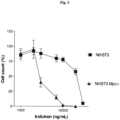
- FIG. 3 shows the influence of c-myc expression on Illudofulvene Analog 002 cytotoxicity in a comparison of Cell Count (%) as a function of Analog 002 concentration for a paired c-myc expressing (NIH3T3 MYC+) cell line and a c-myc nonexpressing (NIH3T3) or null cell line.
- Expression of cellular c-myc conferred a greater than 10 fold increase in sensitivity to illudofulvene Analog 002 to the daughter NIH3T3 MYC+ cell line as compared to the parental c-myc null or nonexpressing NIH3T3 cell line, based on the decrease in cell count.
- c-myc expression was also studied.
- the expression of c-myc did not alter cellular sensitivity towards a variety of other anticancer agents (including mithramycin, mitomycin C, topotecan (as shown in FIG. 4B - FIG. 4D ) or cisplatin (data not shown) as compared to Illudofulvene Analog 002 (see FIG. 4A ).
- Illudofulvene Analog 002 activity was found to be independent of common resistance mechanisms such as the multi-medicant resistance phenotype, anti-apoptotic B-cell lymphoma 2 (Bcl-2) over expression, as well as tumor protein 53 (p53) and cyclin dependent kinase inhibitor 1 (p21 / WAF1) mutations (see Tables 7 and 11).
- Growth factors including peptides and proteins are critical mediators of a wide range of cell-cell communication. They are important endocrine, paracrine and autocrine messengers. Growth factors function as neurotransmitters and neuromodulators, regulate chemotaxis, immune function, development, cell growth, and can influence tumor cells.
- the receptors that recognize growth factors are highly selective and define specific cell populations. As a result, growth factor receptors are a large and important class of medicant (including drug) targets. In addition to physiologic noncancerous cell populations, these receptors can also be expressed in various cancer cell populations.
- FIG. 1 shows the ability of the illudofulvene Analog 002 to induce tumor regression in the MV522 cell line (a lung-derived adenocarcinoma cell line) compared with other alternative compounds (i.e., Fludarabine, Cytarabine and Doxorubicin).
- the MV522 cell line represents a "target" cell line. That is an illudofulvene analog that exhibits toxicity against this solid tumor cell line shows a desirable result.
- the 8392B cell line represents a hematopoietic cell line. In various embodiments of the invention, the 8392B cell line is considered a "nontarget" cell line.
- the two hour toxicity data represents the concentration of a given analog for which a two hour exposure will inhibit 50% of the DNA synthesis activity in a given cell line.
- the 48 hour exposure data represents the concentration at which a given analog with a 48 hour exposure will inhibit the growth or viability in a given cell line as defined by the standard Trypan Blue Exclusion assay.
- Illudofulvene Analog 002 will inhibit the target MV522 cell line at 110 nM with only a 2 hour exposure but has no inhibitory effect on the nontarget 8392B cell line at 26,000 nM (26 ⁇ M), see Table 13.
- Illudofulvene Analog 002 with a prolonged exposure period e.g.
- Illudofulvene Analog 224 displayed minimal toxicity as well as no differential toxicity between the target and nontarget cell line indicating it can have minimal properties as a monotherapeutic anticancer agent, see Table 13.
- Table 10 indicates that Illudofulvene Analog 001 or Illudofulvene Analog 002 have a novel mechanism of action versus chemotherapeutic agents including Other Drugs as set forth herein.
- compositions including an effective amount of an illudofulvene and a pharmaceutically acceptable carrier or vehicle.
- the compositions are suitable for veterinary or human administration.
- compositions can be in any form that allows for the composition to be administered to a patient.
- the composition can be in the form of a solid or liquid.
- Typical routes of administration include, without limitation, parenteral, ocular and intra-tumor.
- Parenteral administration includes subcutaneous injections, intravenous, intramuscular or intrasternal injection or infusion techniques.
- the compositions are administered
- Pharmaceutical compositions can be formulated so as to allow an illudofulvene to be bioavailable upon administration of the composition to a patient.
- Compositions can take the form of one or more dosage units, where for example, a tablet can be a single dosage unit, and a container of an illudofulvene in liquid form can hold a plurality of dosage units.
- compositions can be non-toxic in the amounts used. It will be evident to those of ordinary skill in the art that the optimal dosage of the active ingredient(s) in the pharmaceutical composition will depend on a variety of factors. Relevant factors include, without limitation, the type of animal (e.g., human), the particular form of the illudofulvene, the manner of administration, and the composition employed.
- the pharmaceutically acceptable carrier or vehicle can be solid or particulate, so that the compositions are, for example, in tablet or powder form.
- the carrier(s) can be liquid.
- the carrier(s) can be particulate.
- the composition can be in the form of a liquid, e.g., a solution, emulsion or suspension.
- a surfactant e.g., a surfactant, preservative, wetting agent, dispersing agent, suspending agent, buffer, stabilizer and isotonic agent can also be included.
- the liquid compositions can also include one or more of the following: sterile diluents such as water for injection, saline solution, preferably physiological saline, Ringer's solution, isotonic sodium chloride, fixed oils such as synthetic mono or digylcerides which can serve as the solvent or suspending medium, polyethylene glycols, glycerin, cyclodextrin, propylene glycol or other solvents; antibacterial agents such as benzyl alcohol or methyl paraben; antioxidants such as ascorbic acid or sodium bisulfite; chelating agents such as ethylenediamine tetraacetic acid; buffers such as acetates, citrates, phosphates or amino acids and agents for the adjustment of tonicity such as sodium chloride or dextrose.
- sterile diluents such as water for injection, saline solution, preferably physiological saline, Ringer's solution, isotonic sodium chloride
- fixed oils such as synthetic mono or
- a parenteral composition can be enclosed in ampoule, a disposable syringe or a multiple-dose vial made of glass, plastic or other material.
- Physiological saline is an exemplary adjuvant.
- An injectable composition is preferably sterile.
- the amount of the illudofulvene that is effective in the treatment of a particular disorder or condition will depend on the nature of the disorder or condition, and can be determined by standard clinical techniques. In addition, in vitro or in vivo assays can optionally be employed to help identify optimal dosage ranges. The precise dose to be employed in the compositions will also depend on the route of administration, and the seriousness of the disease or disorder, and can be decided according to the judgment of the practitioner and each patient's circumstances.
- compositions comprise an effective amount of an illudofulvene such that a suitable dosage will be obtained. Typically, this amount can be at least about 0.01% of an illudofulvene by weight of the composition.
- pharmaceutical compositions are prepared so that a parenteral dosage unit (actual powder) dissolved and used to inject the patient was 98% drug by weight, although once diluted in an IV the dose contains from about 0.01% to about 2% by weight).
- the composition can comprise from about 0.01 to about 100 mg of an illudofulvene per kg of the patient's body weight. In one aspect, the composition can include from about 1 to about 100 mg of an illudofulvene per kg of the patient's body weight. In another aspect, the amount administered will be in the range from about 0.1 to about 25 mg/kg of body weight of the illudofulvene.
- the dosage of an illudofulvene administered to a patient is typically about 0.01 mg/kg to about 20 mg/kg of the patient's body weight. In one aspect, the dosage administered to a patient is between about 0.01 mg/kg to about 10 mg/kg of the patient's body weight. In another aspect, the dosage administered to a patient is between about 0.1 mg/kg and about 10 mg/kg of the patient's body weight. In yet another aspect, the dosage administered to a patient is between about 0.1 mg/kg and about 5 mg/kg of the patient's body weight. In yet another aspect the dosage administered is between about 0.1 mg/kg to about 3 mg/kg of the patient's body weight. In yet another aspect, the dosage administered is between about 1 mg/kg to about 3 mg/kg of the patient's body weight.
- the illudofulvene can be administered by any convenient route, for example by infusion or bolus injection. Administration can be systemic or local. Various delivery systems are known, e.g., encapsulation in liposomes, micro-particles, microcapsules, capsules, etc., and can be used to administer an illudofulvene. In certain embodiments, more than one illudofulvene can be administered to a patient.
- This can be achieved, for example, and not by way of limitation, by local infusion during surgery; topical application, e.g., in conjunction with a wound dressing after surgery; by injection; by means of a catheter; or by means of an implant, the implant being of a porous, non-porous, or gelatinous material, including membranes, such as sialastic membranes, or fibers.
- administration can be by direct injection at the site (or former site) of a cancer, tumor or neoplastic or pre-neoplastic tissue.
- administration can be by direct injection at the site (or former site) of a manifestation of an autoimmune disease.
- the illudofulvene can be delivered in a controlled release system, such as but not limited to, a pump or various polymeric materials can be used.
- a controlled-release system can be placed in proximity of the target of the illudofulvene, e.g., the liver, thus requiring only a fraction of the systemic dose.
- compositions can take the form of solutions, pellets, powders, sustained-release formulations, or any other form suitable for use.
- a tumor sample from a patient can be harvested and processed to identify the relative expression of genes encoding the biomarkers described in this application that predict the responsiveness of the patient to Illudofulvenes. Once the relative expression of the biomarkers has been determined, the responsiveness of the cancer patient to treatment with Illudofulvenes, can be determined as outlined in the Scheme 1.
- Tumor tissue can be harvested and total RNA can be purified using Trizol Reagent (Invitrogen Life Technology, 15596-018, Waltham, MA) and the RNeasy Mini Kit (Qiagen, 74104, Germantown, MD). The mRNA can then be purified (from the total RNA) using an Oliogotex mRNA kit (Qiagen, 70022, Germantown, MD). The isolated tissue mRNA can then be fixed to a nylon membrane (ThermoFisher, AM10102, Waltham, MA), by UV crosslinking (Stratagene, UC Crosslinker 2400, La Jolla, CA), for subsequent analysis of the relative quantity expressed by a specific gene. Probes can then be prepared by PCR labeling.
- the specificity of the probe can be determined by the two PCR primers utilized.
- the result can be a highly labeled, highly specific and sensitive hybridization probe for quantifying the amount of corresponding mRNA in a tissue sample.
- the hybridization of the probe to the membrane can be performed normally in roller bottles in a hybridization oven, followed by high stringency washes at elevated temperatures up to 70 °C, to remove nonspecific binding and background signal.
- the digoxigen labeled probes are detected using labeled anti-digoxigen antibody (Abcam product number 420) or Fab fragments (Sigma Aldrich, 11207733910, St Louis, MO). If another label is utilized for probe labeling, such as biotin, then an anti-biotin labeled antibody can be used.
- Visualization and quantification of signal can be performed using a phosphoimager (Storm, 860 imager, Ramsey, MN) or a fluoroimager, depending upon the type of label used in the detection antibody.
- the cDNA genes under investigation were isolated internally (by applicant) from a lambda gt1 1 expression vector using primers above, then cloned into a plasmid. All sequences were confirmed by nucleotide sequencing. The genes at the time were not available from commercial sources.
- Tumor tissue can be harvested and total RNA can be purified using Trizol Reagent (Invitrogen Life Technology, 15596-018, Waltham, MA) and the RNeasy Mini Kit (Qiagen, 74104, Germantown, MD). The mRNA can then be purified (from the total RNA) using an Oliogotex mRNA kit (Qiagen, 70022, Germantown, MD).
- the Oliogotex mRNA kit (Qiagen, 70022, Germantown, MD) is the preferred method for preparing mRNA for Genechip ® analysis such as the Affymetrix ® platform.
- the purified mRNA ( ⁇ 1 to 2 ⁇ g) can be first reverse transcribed using a T7-Oligo(dT) Promoter Primer (Affymetrix GeneChip T7-Oligo(dT) Promoter Primer Kit 900375, Waltham, MA) in the first-strand cDNA synthesis reaction.
- T7-Oligo(dT) Promoter Primer Affymetrix GeneChip T7-Oligo(dT) Promoter Primer Kit 900375, Waltham, MA
- total RNA (10 ⁇ g to 15 ⁇ g) can be used if of high quality.
- an RNase H-mediated second-strand cDNA synthesis can be performed, the double-stranded cDNA can be purified, and this double-strand cDNA serves as the template in a subsequent in vitro transcription (IVT) reaction (Affymetrix GeneChip IVT kit 900688, Waltham, MA).
- IVT in vitro transcription
- the IVT reaction can be carried out in the presence of provided T7 RNA Polymerase and a biotinylated nucleotide analog/ribonucleotide mix for complementary RNA (cRNA) amplification and biotin labeling.
- cRNA complementary RNA
- the biotinylated cRNA targets are then cleaned up and fragmented using the buffer provided in the kit.
- the cRNA under study and a control oligonucleotide are prepared in a hybridization solution (Affymetrix, 900454, Waltham, MA) and added to the Affymetrix HG-U133 Plus 2 array cartridge, then placed in the hybridization oven at 45C° with rotation at 60 RPM, for 16 hours.
- the HG-U133 cartridge can be then washed and stained using the appropriate Fluidics station per manufacturer's protocol.
- the array can then be scanned using an appropriate device such as the Affymetrix GeneChip scanner or a generic scanner such as the Agilent GeneArray scanner. Normalization and analysis of data can be accomplished using the NetAffx Software (Thermo Fisher, Waltham, MA), the Gene Spring GX 9 software (Agilent, Santa Clara, CA) or open source academic software such as R/Bioconductor.
- the tumor tissue is harvested and the relative expression of the individual gene products, as well as the mRNA expression for the three "housekeeping" genes (ACTB, TFRC, GAPD), is quantified by a microarray apparatus using the specific probes for each gene product (see Tables 2 and 3).
- a "relative ratio of expression” is determined for each of the gene products under s investigation versus the individual "housekeeping genes” (e.g. ERCC6 expression/ACTB expression). This is accomplished by dividing the raw value of expression for each gene product under study by the raw value of expression for the desired "housekeeping gene”.
- the ERCC6/ACTB, ERCC6/TFRC, and the ERRC6/GAPD expression ratios for the tumor under study are calculated.
- an analysis is performed by comparing each relative ratio for each gene using each housekeeping gene, and comparing the ratio to the same ratio for a cell known to be sensitive to an Illudofulvene as well as a cell know to be resistant to an Illudofulvene.
- the ERCC6/ACTB, ERCC6/TFRC, and the ERRC6/GAPD expression ratios for the tumor under study are compared to the same ratios in a cell known to be sensitive to an Illudofulvene as well as a cell know to be resistant to an Illudofulvene.
- the ratios for the individual expression of PTGR1, PTGR2, and MYC to the three "housekeeping" genes can be derived and each ratio can be compared to the same ratio in a cell known to be sensitive to an Illudofulvene as well as a cell know to be resistant to an Illudofulvene.
- the RT-PCR Analysis can be carried out using the Hydrolysis Taqman Fluorescent probe approach.
- Tumor tissue can be harvested and total RNA can be purified using Trizol Reagent (Invitrogen Life Technology, 15596-018, Waltham, MA) and the RNeasy Mini Kit (Qiagen, 74104, Germantown, MD).
- the mRNA can then be purified (from the total RNA) using an Oliogotex mRNA kit (Qiagen, 70022, Germantown, MD).
- reverse transcription can be performed using oligo(dT) and random hexamers and SuperScript ® II (ThermoFisher, #18064014, Waltham, MA) to produce cDNA.
- Each reaction mixture contains approximately 50 ng of tumor-derived cDNA.
- the desired gene primers, and associated hydrolysis oligonucleotide probe (see Table 4) with a 5' fluorescent reporter and a 3' quencher, are obtained from Integrated DNA Technologies.
- RT-PCR reaction conditions are an initial denaturation for 2 minutes at 95°C and 45 cycles of 94°C for 15 seconds, annealing at 56°C for 15 seconds and 72°C for 30 seconds, with final extension at 72°C for 10 minutes.
- the hydrolysis probe for the gene under study can be labeled at the 5' end with the fluorophore FAM (fluorescein).
- a control gene can be amplified as an internal control to check the specificity of the reaction.
- the hydrolysis probe can be labeled at the 5' end with the fluorophore HEX (555) to allow for differentiation of fluorescence arising from the biomarker hydrolysis probe and the internal control probe. All RT-PCR assays are run in triplicate using TaqMan ® Gene Expression Master Mix (ThermoFisher, #4369016, Waltham, MA).
- Quantitative results are obtained by monitoring the increase in fluorescence (which occurs upon release of the fluorescent reporter molecule from the hydrolysis probe and the associated quencher) and can be proportional to the amount of amplified product produced, using a Roche Light cycle Model 2.0 (or later version).
- the tumor tissue is harvested and the relative expression of the individual gene products, as well as the mRNA expression for the three "housekeeping" genes (ACTB, TFRC, GAPD), is quantified by RT-PCR using the desired primers (Table 4) specific for each gene product or "housekeeping gene”.
- a "relative ratio of expression” is determined for each of the gene products under s investigation versus the individual "housekeeping genes” as described above in the Microarray Analysis section. These ratios are then compared to ratios obtained for a cell known to be sensitive to an Illudofulvene as well as to ratios for a cell know to be resistant to an Illudofulvene.
- a PTGR gene is upregulated, or (ii) the MYC gene is upregulated and (iii) there is a deficiency in at least one specific TCR gene.
- the tumor can then be classified as either sensitive, or resistant, to Illudofulvenes based on this analysis.
- the TCR Tumor Mutation Panel targets a total of 22 clinically relevant genes. Specifically, the panel interrogates all exons of 22 genes known to be associated with sensitivity to Illudofulvenes.
- the TCR Tumor Mutation Panel (see Table 5) is a highly multiplexed targeted re-sequencing assay for detecting somatic variants across key genes in cancer genomes [see (i) Illumina HiSeq ® 2500 System User Guide. Illumina Proprietary Part # 15035786 Rev. D, November 2014; (ii) HiSeq Rapid SBS Kit v2 Reagent Prep Guide. Illumina Proprietary Part # 15058772 Rev. A, November 2014; (iii) HiSeq Rapid Cluster Kit v2 Reagent Prep Guide. Illumina Proprietary Part # 15059131 Rev. A, November 2014; (iv) Sequencing Analysis Viewer Software User Guide. Illumina Proprietary Part # 15020619 Rev.
- the analysis entails hybridization-based capture of 513 probes (custom mix synthesis from Integrative DNA Technologies) covering 47,848 base pairs that encompass the 281 exons and regulatory regions of these 22 genes.
- the generation of a library of multiplexed, enriched genomic regions can be followed by a sequencing-by-synthesis assay using massively parallel 100 base pair sequence reads. Once data are generated, a series of bioinformatics tools are used to align the reads to the genome, call variants, and annotate variants with respect to somatic status and functional predictions.
- This analysis can detect single nucleotide variants, short insertion/deletions, and splice variants predicted to be deleterious. In addition, the analysis can detect a set of targeted fusions or rearrangement.
- Genomic DNA extracted from tumor tissue can be sheared, end repaired, A-tailed, adapter ligated, amplified, hybridized to the capture (bait) library primers, then re-amplified per the HiSeq Reagent Pre Guides (Illumina #15058772 and #15059131).
- the subsequent sample pool can then be sequenced to a depth of 300X on an Illumina HiSeq 2500 workstation per the user guide (Illumina #15035786).
- the primary data analysis can be accomplished by the on-board software (Real Time Analysis).
- Secondary analysis can be accomplished by uploading base call files (*.bcl) to a genomics server designed to generate reads and read alignments, followed by comparison to the DNA sequence for the 22 genes as listed in the latest version of the Genomic Reference Consortium Human (current build 37).
- This allows identification of tumors that are deficient in TCR capacity, on the basis of a deficiency in one (or more) of the components of the TCR pathways, and which can be responsive to treatment with an Illudofulvene.
- tumors that are deficient in PTGR metabolic activity can also be identified, and such tumors excluded from treatment based on the expected lack of response to therapy.
- a tumor sample is obtained from a patient, prepared, and the genomic DNA isolated and processed as described in this application.
- the TCR 22 gene mutation panel (Table 5) is then obtained by sequencing in entirety these genes, and results analyzed versus the latest version of the Genomic Reference Consortium Human (current build 37, Table 6), as described in this application. Tumors deficient in TCR capacity, on the basis of a deficiency in one (or more) of the components of the TCR pathways due to a mutation, and which can be responsive to treatment with an Illudofulvene, can then be identified.
- Tumors that are deficient in PTGR metabolic activity can also be identified, and such tumors excluded from treatment based on the expected lack of response to therapy, subject to the flow chart of Scheme 1. It can also be determined whether MYC is upregulated or downregulated. Table 5.
- Gene (HGNC Symbol) Gene Aliases Representative mRNA Sequence SEQ ID NO Representative Protein Sequence SEQ ID NO ERCC8 CSA, CKN1, UVSS2 NM_001290285 1 NP_000073 2 ERCC6 CSB, ARMD5, CKN2, COFS, COFS1, RAD26 POF 11, UVSS1 NM_001277058.1 3 NP_000115.1 4 GTF2H1 P62, BTF2P62,TFB 1, TFIIH SUBUNIT 1 NM_001142307.1 5 NP_005307.1 6 GTF2H2 BTF2P44.
- ERCC3 XPB 1 18 ERCC3 XPB, RAD25, TTD2, BFT2 NM_00130341 8.1 19 NP_001290347.
- a list of biomarkers that when upregulated (expression increased) confer sensitivity to illudofulvenes according to various embodiments of the invention.
- Table 9 The toxicity of Illudofulvene Analog 001 / Analog 002 to either 2 hour or 48 hour incubation, according to various embodiments of the invention. Tumor cell line Cytotoxicity?
- the ability of Illudofulvene analogs to inhibit tumor cell growth according to various embodiments of the invention.
- Illudofulvene Analog 1 001 (R)-6'-hydroxy-2',4',6'-trimethylspiro[cyclopropane-1,5'-inden]-7'(6'H)-one 2 002 (6' R )-6'-hydroxy-3'-(hydroxymethyl)-2',4',6'-trimethylspiro[cyclopropane-1,5'-inden]-7'(6' H )-one 3 003 (6'R,6"'R)-3',3"'-methylenebis(6'-hydroxy-2',4',6'-trimethylspiro[cyclopropane-1,5'-inden]-7'(6'H)-one) 4 004 (R)-3'-bromo-6'-hydroxy-2',4',6'-trimethylspiro[cyclopropane-1,
- NCI DTP 60 Cell Line showing Growth Inhibition (GI), Total Growth Inhibition (TGI, the concentration of test drug where 100 ⁇ (T - T0)/(C - T0) 0, i.e. TGI signifies a cytostatic effect) and Lethal Concentration Dose (a cytotoxic effect, LD) Data for selected Other Drugs, naturally occurring illudins, and Illudofulvene Analogs.
- GI Growth Inhibition
- TGI Total Growth Inhibition
- Lethal Concentration Dose a cytotoxic effect, LD
- a portion of the harvested adherent tumor cells are plated into 6 well tissue culture plates containing Primary Cancer Cell Medium D-ACF. Cells are allowed to adhere overnight. An illudofulvene is then added at: 0 ng/mL (control), 30 ng/mL, 100 ng/mL, 300 ng/mL, 1000 ng/mL, 3000 ng/mL. Cell viability at each concentration can then be determined and compared to the control population at 48 hours later by using a viability dye such as MTT, trypan blue or Sulforhodamine B.
- a viability dye such as MTT, trypan blue or Sulforhodamine B.
- Tumor cell populations with an IC50 less than 300 ng/mL can be considered sensitive to the illudofulvene, whereas those with an IC50 greater than 3,000 ng/mL can be considered resistant.
- the illudofulvene can be administered to the patient based on the sensitivity.
- the tumor sample can be exposed to the desired Illudofulvene Analog under study at half-log internal concentrations from 1 ng/mL to 10,000 ng/mL, and cell viability determined using a viability dye (MTT, trypan blue, Sulforhodamine B, etc.) after 48 hours of exposure to the Illudofulvene Analog, and the IC50 determined.
- a viability dye MTT, trypan blue, Sulforhodamine B, etc.
- Embodiments contemplated herein include Embodiments P1-P125 following.
- Embodiment P An illudofulvene for use in the treatment of a cancer expressing an attenuated TCR biomarker, wherein said expression includes: (a) contacting a sample from a patient comprising one or more nucleic acid molecules with a device comprising single-stranded nucleic acid molecules capable of specifically hybridizing with the nucleotides of a TCR gene; (b) detecting a level of expression of a TCR biomarker by performing microarray analysis or quantitative reverse transcriptase polymerase chain reaction (qRT-PCR) of the sample; and (c) determining that the TCR biomarker is attenuated.
- qRT-PCR quantitative reverse transcriptase polymerase chain reaction
- Embodiment P2 The illudofulvene of Embodiment P1, where the TCR gene is selected from the group consisting of an ERCC gene, a XPA gene, a GTF series gene, a UV gene, and a USP gene.
- Embodiment P3 The illudofulvene of Embodiment P2, where the ERCC gene is selected from the group consisting of ERCC1 gene, ERCC2 gene, ERCC3 gene, ERCC4 gene, ERCC5 gene, ERCC6 gene, ERCC6L gene, ERCC6L2 gene, and ERCC8 gene.
- Embodiment P4 The illudofulvene of Embodiment P1, where the illudofulvene is an acylfulvene.
- Embodiment P5 The illudofulvene of Embodiment P1, where the illudofulvene is an illudin.
- Embodiment P6 An illudofulvene for use in a method of treating a patient with cancer, wherein the method includes: (a) determining whether a test sample from a patient has an attenuated TCR biomarker; and (b) if the test sample from the patient includes the attenuated TCR biomarker, then administer an effective amount of the illudofulvene.
- Embodiment P7 The illudofulvene of Embodiment P6, where the effective amount is administered in a dosage between: a lower limit of approximately 0.1 mg of the illudofulvene per kilogram of body weight of the patient; and an upper limit of approximately 5 mg of the illudofulvene per kilogram of body weight of the patient.
- Embodiment P8 The illudofulvene of Embodiment P6, where the test sample includes one or more nucleic acid molecules.
- Embodiment P9 The illudofulvene of Embodiment P6, where the test sample hybridized specifically with the nucleotides of a TCR gene.
- Embodiment P10 The illudofulvene of Embodiment P9, where the TCR gene is selected from the group consisting of ERCC gene, XPA gene, GTF series gene, UV gene, and USP gene.
- Embodiment P11 The illudofulvene of Embodiment P6, where the TCR biomarker is determined to be attenuated by performing microarray analysis or quantitative reverse transcriptase polymerase chain reaction (qRT-PCR) of the test sample.
- qRT-PCR quantitative reverse transcriptase polymerase chain reaction
- Embodiment P12 The illudofulvene of Embodiment P6, where the illudofulvene is an acylfulvene.
- Embodiment P13 The illudofulvene of Embodiment P6, where the illudofulvene is an illudin.
- Embodiment P14 An illudofulvene for use in the treatment of a cancer expressing an enhanced MYC biomarker, wherein said expression includes: (a) contacting a sample from a patient comprising one or more nucleic acid molecules with a device comprising single-stranded nucleic acid molecules capable of specifically hybridizing with the nucleotides of a MYC gene; (b) detecting a level of expression of a MYC biomarker by performing microarray analysis or quantitative reverse transcriptase polymerase chain reaction (qRT-PCR) of the sample; and (c) determining that the MYC biomarker is enhanced.
- qRT-PCR quantitative reverse transcriptase polymerase chain reaction
- Embodiment P15 The illudofulvene of Embodiment P14, further comprising where a PTGR biomarker is enhanced in the sample.
- Embodiment P16 The illudofulvene of Embodiment P14, further comprising where a TCR biomarker is attenuated in the sample.
- Embodiment P17 The illudofulvene of Embodiment P14, where the illudofulvene is an acylfulvene.
- Embodiment P18 The illudofulvene of Embodiment P14, where the illudofulvene is an illudin.
- Embodiment P19 An illudofulvene for use in a method of treating a patient with cancer, wherein the method includes: (a) determining whether a test sample from a patient has a MYC biomarker that is enhanced; and (b) if the test sample from the patient includes the enhanced MYC biomarker, then administer an effective amount of the illudofulvene.
- Embodiment P20 The illudofulvene of Embodiment P18, where the effective amount is administered in a dosage between: a lower limit of approximately 0.1 mg of the illudofulvene per kilogram of body weight of the patient; and an upper limit of approximately 5 mg of the illudofulvene per kilogram of body weight of the patient.
- Embodiment P21 The illudofulvene of Embodiment P19, where the test sample includes one or more nucleic acid molecules.
- Embodiment P22 The illudofulvene of Embodiment P19, where the test sample hybridized specifically with the nucleotides of a MYC gene.
- Embodiment P23 The illudofulvene of Embodiment P19, where the MYC biomarker is determined to be enhanced by performing microarray analysis or quantitative reverse transcriptase polymerase chain reaction (qRT-PCR) of the test sample.
- qRT-PCR quantitative reverse transcriptase polymerase chain reaction
- Embodiment P24 The illudofulvene of Embodiment P19, where the illudofulvene is an acylfulvene.
- Embodiment P25 The illudofulvene of Embodiment P19, where the illudofulvene is an illudin.
- Embodiment P26 The illudofulvene of Embodiment P19, further comprising where a PTGR biomarker is enhanced in the test sample.
- Embodiment P27 The illudofulvene of Embodiment P26, further comprising where a TCR biomarker is attenuated in the test sample.
- Embodiment P28 An illudofulvene for use in the treatment of a cancer expressing an enhanced MYC biomarker and an attenuated TCR biomarker, wherein said expression includes: (a) contacting a sample from a patient comprising one or more nucleic acid molecules with a device comprising single-stranded nucleic acid molecules capable of specifically hybridizing with the nucleotides of a TCR gene and a MYC gene; (b) detecting a level of expression of a TCR biomarker and a MYC biomarker by performing microarray analysis or quantitative reverse transcriptase polymerase chain reaction (qRT-PCR) of the sample; and (c) determining that the MYC biomarker is enhanced and the TCR biomarker is attenuated.
- qRT-PCR quantitative reverse transcriptase polymerase chain reaction
- Embodiment P29 The illudofulvene of Embodiment P28, further comprising where a PTGR biomarker is enhanced in the sample.
- Embodiment P30 The illudofulvene of Embodiment P28, where the illudofulvene is an acylfulvene.
- Embodiment P31 The illudofulvene of Embodiment P28, where the illudofulvene is an illudin.
- Embodiment P39 The illudofulvene of Embodiment P35, where the test sample hybridized specifically with the nucleotides of a TCR gene.
- Embodiment P40 The illudofulvene of Embodiment P35, where the MYC biomarker is determined to be enhanced by performing microarray analysis or quantitative reverse transcriptase polymerase chain reaction (qRT-PCR) of the test sample.
- qRT-PCR quantitative reverse transcriptase polymerase chain reaction
- Embodiment P44 The illudofulvene of Embodiment P35, further comprising where a PTGR biomarker is enhanced in the test sample.
- Embodiment P45 The illudofulvene of Embodiment P35, further comprising where the TCR gene is selected from the group consisting of ERCC gene, XPA gene, GTF series gene, UV gene, and USP gene.
- Embodiment P47 An illudofulvene for use in the treatment of a cancer expressing an enhanced PTGR biomarker, wherein said expression includes: (a) contacting a sample from a patient comprising one or more nucleic acid molecules with a device comprising single-stranded nucleic acid molecules capable of specifically hybridizing with the nucleotides of a PTGR gene; (b) detecting a level of expression of a PTGR biomarker by performing microarray analysis or quantitative reverse transcriptase polymerase chain reaction (qRT-PCR) of the sample; and (c) determining that the PTGR biomarker is attenuated.
- qRT-PCR quantitative reverse transcriptase polymerase chain reaction
- Embodiment P48 The illudofulvene of Embodiment P47, where the PTGR gene is selected from the group consisting of PTGR1 and PTGR2.
- Embodiment P52 An illudofulvene for use in a method of treating a patient with cancer, wherein the method includes: (a) determining whether a test sample from a patient has an enhanced PTGR biomarker; and (b) if the test sample from the patient includes the enhanced PTGR biomarker, then administer an effective amount of the illudofulvene.
- Embodiment P54 The illudofulvene of Embodiment P53, where the test sample includes one or more nucleic acid molecules.
- Embodiment P58 The illudofulvene of Embodiment P53, where the illudofulvene is an acylfulvene.
- Embodiment P60 The illudofulvene of Embodiment P53, where the PTGR gene includes PTGR1 and PTGR2.
- Embodiment P62 An illudofulvene for use in the treatment of a cancer expressing an enhanced MYC biomarker, an enhanced PTGR biomarker, and an attenuated TCR biomarker, wherein said expression includes: (a) contacting a sample from a patient comprising one or more nucleic acid molecules with a device comprising single-stranded nucleic acid molecules capable of specifically hybridizing with the nucleotides of a TCR gene, a PTGR gene, and a MYC gene; (b) detecting a level of expression of a TCR biomarker, a PTGR biomarker, and a MYC biomarker by performing microarray analysis or quantitative reverse transcriptase polymerase chain reaction (qRT-PCR) of the sample; and (c) determining that the MYC biomarker is enhanced, the PTGR biomarker is enhanced, and the TCR biomarker is attenuated.
- qRT-PCR quantitative reverse transcriptase polyme
- Embodiment P63 The illudofulvene of Embodiment P62, where the PTGR gene is selected from the group consisting of PTGR1 and PTGR2.
- Embodiment P65 The illudofulvene of Embodiment P62, where the TCR biomarker is attenuated due to truncating mutations, mutations abolishing enzyme activity, deletions or other chromosomal, transcription, translational and post translation event that interfering with ERCC gene expression and subsequent gene activity.
- Embodiment P69 The illudofulvene of Embodiment P62, where the illudofulvene is an illudin.
- Embodiment P70 An illudofulvene for use in a method of treating a patient with cancer, wherein the method includes: (a) determining whether a test sample from a patient has an enhanced MYC biomarker; (b) determining whether the test sample from a patient has an attenuated TCR biomarker; (c) determining whether the test sample from a patient has an enhanced PTGR biomarker; (d) if the test sample from the patient includes the enhanced MYC biomarker, the enhanced PTGR biomarker, and the attenuated TCR biomarker, then administer an effective amount of the illudofulvene.
- Embodiment P71 The illudofulvene of Embodiment P70, where the effective amount is administered in a dosage between: a lower limit of approximately 0.1 mg of the illudofulvene per kilogram of body weight of the patient; and an upper limit of approximately 5 mg of the illudofulvene per kilogram of body weight of the patient.
- Embodiment P72 The illudofulvene of Embodiment P70, where the test sample includes one or more nucleic acid molecules.
- Embodiment P75 The illudofulvene of Embodiment P70, where the test sample hybridized specifically with the nucleotides of a PTGR gene.
- Embodiment P76 The illudofulvene of Embodiment P70, where the MYC biomarker is determined to be enhanced by performing microarray analysis or quantitative reverse transcriptase polymerase chain reaction (qRT-PCR) of the test sample.
- qRT-PCR quantitative reverse transcriptase polymerase chain reaction
- Embodiment P77 The illudofulvene of Embodiment P70, where the TCR biomarker is determined to be attenuated by performing microarray analysis or quantitative reverse transcriptase polymerase chain reaction (qRT-PCR) of the test sample.
- qRT-PCR quantitative reverse transcriptase polymerase chain reaction
- Embodiment P78 The illudofulvene of Embodiment P70, where the illudofulvene is an acylfulvene.
- Embodiment P79 The illudofulvene of Embodiment P70, where the illudofulvene is an illudin.
- Embodiment P80 The illudofulvene of Embodiment P70, further comprising where the TCR gene is selected from the group consisting of ERCC gene, XPA gene, GTF series gene, UV gene, and USP gene.
- Embodiment P81 The illudofulvene of Embodiment P70, where the PTGR gene is selected from the group consisting of PTGR1 and PTGR2.
- Embodiment P82 The illudofulvene of Embodiment P70, where the MYC biomarker is enhanced when cells transform from a normal state to cancer cells, or when the cells are exposed to prior anticancer drug treatment and become upregulated as a response to the prior anticancer drug treatment.
- Embodiment P83 The illudofulvene of Embodiment P70, where the TCR biomarker is attenuated due to truncating mutations, mutations abolishing enzyme activity, deletions or other chromosomal, transcription, translational and/or post translation event that interfering with TCR gene expression and/or subsequent TCR gene activity.
- Embodiment P84 The illudofulvene of Embodiment P70, where the PTGR biomarker is enhanced when cells transform from a normal state to cancer cells, or when the cells are exposed to prior anticancer drug treatment and become upregulated as a response to the prior anticancer drug treatment.
- Embodiment P85 An illudofulvene for use in the treatment of a cancer expressing an enhanced PTGR biomarker, and an attenuated TCR biomarker, wherein said expression includes: (a) contacting a sample from a patient comprising one or more nucleic acid molecules with a device comprising single-stranded nucleic acid molecules capable of specifically hybridizing with the nucleotides of a TCR gene, and a PTGR gene; (b) detecting a level of expression of a TCR biomarker and a PTGR biomarker by performing microarray analysis or quantitative reverse transcriptase polymerase chain reaction (qRT-PCR) of the sample; and (c) determining that the PTGR biomarker is enhanced, and the TCR biomarker is attenuated.
- qRT-PCR quantitative reverse transcriptase polymerase chain reaction
- Embodiment P86 The illudofulvene of Embodiment P85, where the PTGR gene is selected from the group consisting of PTGR1 and PTGR2.
- Embodiment P87 The illudofulvene of Embodiment P85, where the TCR gene is selected from the group consisting of ERCC gene, XPA gene, GTF series gene, UV gene, and USP gene.
- Embodiment P88 The illudofulvene of Embodiment P85, where the TCR biomarker is attenuated due to truncating mutations, mutations abolishing enzyme activity, deletions or other chromosomal, transcription, translational and post translation event that interfering with ERCC gene expression and subsequent gene activity.
- Embodiment P89 The illudofulvene of Embodiment P85, where the PTGR biomarker is enhanced when cells transform from a normal state to cancer cells, or when the cells are exposed to prior anticancer drug treatment and become upregulated as a response to the prior anticancer drug treatment.
- Embodiment P90 The illudofulvene of Embodiment P85, where the illudofulvene is an acylfulvene.
- Embodiment P91 The illudofulvene of Embodiment P85, where the illudofulvene is an illudin.
- Embodiment P92 An illudofulvene for use in a method of treating a patient with cancer, wherein the method includes: (a) determining whether the test sample from a patient has an attenuated TCR biomarker; (b) determining whether the test sample from a patient has an enhanced PTGR biomarker; (c) if the test sample from the patient includes the enhanced PTGR biomarker, and the attenuated TCR biomarker, then administer an effective amount of the illudofulvene.
- Embodiment P93 The illudofulvene of Embodiment P92, where the effective amount is administered in a dosage between: a lower limit of approximately 0.1 mg of the illudofulvene per kilogram of body weight of the patient; and an upper limit of approximately 5 mg of the illudofulvene per kilogram of body weight of the patient.
- Embodiment P94 The illudofulvene of Embodiment P92, where the test sample includes one or more nucleic acid molecules.
- Embodiment P95 The illudofulvene of Embodiment P92, where the test sample hybridized specifically with the nucleotides of a TCR gene.
- Embodiment P96 The illudofulvene of Embodiment P92, where the test sample hybridized specifically with the nucleotides of a PTGR gene.
- Embodiment P98 The illudofulvene of Embodiment P92, where the illudofulvene is an acylfulvene.
- Embodiment P99 The illudofulvene of Embodiment P92, where the illudofulvene is an illudin.
- Embodiment P100 The illudofulvene of Embodiment P92, further comprising where the TCR gene is selected from the group consisting of ERCC gene, XPA gene, GTF series gene, UV gene, and USP gene.
- Embodiment P101 The illudofulvene of Embodiment P92, where the PTGR gene is selected from the group consisting of PTGR1 and PTGR2.
- Embodiment P102 The illudofulvene of Embodiment P92, where the TCR biomarker is attenuated due to truncating mutations, mutations abolishing enzyme activity, deletions or other chromosomal, transcription, translational and/or post translation event that interfering with TCR gene expression and/or subsequent TCR gene activity.
- Embodiment P103 The illudofulvene of Embodiment P92, where the PTGR biomarker is enhanced when cells transform from a normal state to cancer cells, or when the cells are exposed to prior anticancer drug treatment and become upregulated as a response to the prior anticancer drug treatment.
- Embodiment P104 An illudofulvene for use in the treatment of a cancer expressing an enhanced MYC biomarker, and an enhanced PTGR biomarker, wherein said expression includes: (a) contacting a sample from a patient comprising one or more nucleic acid molecules with a device comprising single-stranded nucleic acid molecules capable of specifically hybridizing with the nucleotides of a PTGR gene, and a MYC gene; (b) detecting a level of expression of a PTGR biomarker and a MYC biomarker by performing microarray analysis or quantitative reverse transcriptase polymerase chain reaction (qRT-PCR) of the sample; and (c) determining that the MYC biomarker is enhanced, and the PTGR biomarker is enhanced.
- qRT-PCR quantitative reverse transcriptase polymerase chain reaction
- Embodiment P105 The illudofulvene of Embodiment P104, where the PTGR gene is selected from the group consisting of PTGR1 and PTGR2.
- Embodiment P106 The illudofulvene of Embodiment P104, where the PTGR biomarker is enhanced when cells transform from a normal state to cancer cells, or when the cells are exposed to prior anticancer drug treatment and become upregulated as a response to the prior anticancer drug treatment.
- Embodiment P107 The illudofulvene of Embodiment P104, where the MYC biomarker is enhanced when cells transform from a normal state to cancer cells, or when the cells are exposed to prior anticancer drug treatment and become upregulated as a response to the prior anticancer drug treatment.
- Embodiment P108 The illudofulvene of Embodiment P104, where the illudofulvene is an acylfulvene.
- Embodiment P109 The illudofulvene of Embodiment P104, where the illudofulvene is an illudin.
- Embodiment P110 An illudofulvene for use in a method of treating a patient with cancer, wherein the method includes: (a) determining whether a test sample from a patient has an enhanced MYC biomarker; (b) determining whether the test sample from a patient has an enhanced PTGR biomarker; (c) if the test sample from the patient includes the enhanced MYC biomarker, and the enhanced PTGR biomarker, then administer an effective amount of the illudofulvene.
- Embodiment P 111 The illudofulvene of Embodiment P 110, where the effective amount is administered in a dosage between: a lower limit of approximately 0.1 mg of the illudofulvene per kilogram of body weight of the patient; and an upper limit of approximately 5 mg of the illudofulvene per kilogram of body weight of the patient.
- Embodiment P112 The illudofulvene of Embodiment P110, where the test sample includes one or more nucleic acid molecules.
- Embodiment P113 The illudofulvene of Embodiment P110, where the test sample hybridized specifically with the nucleotides of a MYC gene.
- Embodiment P114 The illudofulvene of Embodiment P110, where the test sample hybridized specifically with the nucleotides of a PTGR gene.
- Embodiment P 115 The illudofulvene of Embodiment P 110, where the MYC biomarker is determined to be enhanced by performing microarray analysis or quantitative reverse transcriptase polymerase chain reaction (qRT-PCR) of the test sample.
- qRT-PCR quantitative reverse transcriptase polymerase chain reaction
- Embodiment P116 The illudofulvene of Embodiment P110, where the illudofulvene is an acylfulvene.
- Embodiment P117 The illudofulvene of Embodiment P110, where the illudofulvene is an illudin.
- Embodiment P118 The illudofulvene of Embodiment P110, where the PTGR gene is selected from the group consisting of PTGR1 and PTGR2.
- Embodiment P119 The illudofulvene of Embodiment P110, where the MYC biomarker is enhanced when cells transform from a normal state to cancer cells, or when the cells are exposed to prior anticancer drug treatment and become upregulated as a response to the prior anticancer drug treatment.
- Embodiment P120 The illudofulvene of Embodiment P110, where the PTGR biomarker is enhanced when cells transform from a normal state to cancer cells, or when the cells are exposed to prior anticancer drug treatment and become upregulated as a response to the prior anticancer drug treatment.
- Embodiment P121 An illudofulvene for use in the treatment of a cancer that is resistant to one or more Other Drugs, comprising: (a) contacting a sample from a patient comprising one or more nucleic acid molecules with a device comprising single-stranded nucleic acid molecules capable of specifically hybridizing with the nucleotides selected from the group consisting of ERCC8 (SEQ ID NOS:1, 2, 35-45), ERCC6 (SEQ ID NOS:3, 4, 46-56), GTF2H1 (SEQ ID NOS:5, 6, 57-67), GTF2H2 (SEQ ID NOS:7, 8, 68-78), GTF2H3 (SEQ ID NOS:9, 10, 79-89), GTF2H4 (SEQ ID NOS:11, 12, 90-100), GTF2H5 (SEQ ID NOS:13, 14, 101-111), USP7 (SEQ ID NOS:15, 16, 112-122), UVSSA (SEQ ID NOS:17,
- Embodiment P122 The illudofulvene of Embodiment P121, further comprising administering one or more additional therapies prior to, concurrently with, or after administration of the illudofulvene.
- Embodiment P123 The illudofulvene of Embodiment P122, where one or more additional therapies includes surgery, radiation, or one or more Other Drugs.
- Embodiment P124 The illudofulvene of Embodiment P121, where the cancer is selected from the group consisting of prostate cancer, ovarian cancer, hepatocellular carcinoma (HCC), cervical cancer, renal cell carcinoma (RCC), esophageal cancer, melanoma, glioma, pancreatic cancer, gastrointestinal stromal tumors (GIST), sarcoma, estrogen receptor-positive (ERpos) breast cancer, non-small cell lung carcinoma (NSCLC), colon cancer, bladder cancer, squamous cell carcinoma of the head and neck (SCCHN), acute myelogenous leukemia (AML), acute lympho-blastic leukemia (ALL), chronic lymphocytic leukemia (CLL), myelodysplastic syndrome (MDS), chronic myelogenous leukemia-chronic phase (CMLCP), diffuse large B-cell lymphoma (DLBCL), cutaneous T-cell lymphoma (CTCL), peripheral T-cell lymphoma (PTCL
- Embodiment P125 The illudofulvene of Embodiment P121, where the biomarker profile includes (c) calculating a difference score by subtracting the mean expression levels of one or more of the plurality of biomarkers from the mean expression levels of the one or more of the plurality of biomarkers of sensitivity.
- Embodiments contemplated herein further include Embodiments Q1-Q54 following.
- Embodiment Q1 An illudofulvene for use in the treatment of a cancer expressing an attenuated TCR biomarker, wherein said expression includes: (a) contacting a sample from a human patient with a means for determining the regulation of a PTGR gene, where the means is selected from the group consisting of (i) quantification of gene mRNA expression by probe analysis, (ii) microarray analysis, (iii) Real Time-Polymerase Chain Reaction (RT-PCR), (iv) Transcription Coupled Repair (TCR) Tumor Mutation Panel and (v) primary tumor cell sensitivity; (b) determining the level of regulation of the PTGR gene; (b) determining the level of regulation of the PTGR gene; (c) analyzing the sample from the human patient with a means for determining the regulation of a MYC gene, where the means is selected from the group consisting of (i) quantification of gene mRNA expression by probe analysis, (ii) microarray analysis, (i
- Embodiment Q2 The illudofulvene of Embodiment Q1, where the TCR gene is selected from the group consisting of an ERCC gene, a XPA gene, a GTF series gene, a UV gene, and a USP gene.
- Embodiment Q3 The illudofulvene of Embodiment Q1, where the PTGR gene upregulated is PTGR1, where the process of analysis is quantification of gene mRNA expression by probe analysis, where the primers selected to hybridize with the one or more nucleic acid molecules are selected from the group consisting of SEQ ID NO:307-308.
- Embodiment Q4 An illudofulvene for use in a method of treating a patient with cancer, wherein the method includes: (a) determining whether a test sample from a patient has an upregulated PTGR gene; (b) analyzing the sample with a means for determining that at least one TCR gene is downregulated, where the test sample is analyzed with one or more methods selected from the group consisting of (i) quantification of gene mRNA expression by probe analysis, (ii) microarray analysis, (iii) Real Time-Polymerase Chain Reaction (RT-PCR), (iv) Transcription Coupled Repair (TCR) Tumor Mutation Panel and (v) primary tumor cell sensitivity; and (c) if the test sample from the patient includes the upregulated PTGR gene and at least one downregulated TCR gene, then administer an effective amount of the illudofulvene.
- RT-PCR Real Time-Polymerase Chain Reaction
- TCR Transcription Coupled Repair
- Embodiment Q5 The illudofulvene of Embodiment Q4, where the TCR gene is selected from the group consisting of an ERCC gene, a XPA gene, a GTF series gene, a UV gene, and a USP gene.
- Embodiment Q6 The illudofulvene of Embodiment Q4, where the PTGR gene upregulated is PTGR1, where the process of analysis is quantification of gene mRNA expression by probe analysis, where the primers selected to hybridize with the one or more nucleic acid molecules are selected from the group consisting of SEQ ID NO:307-308.
- Embodiment Q7 The illudofulvene of Embodiment Q4, where the PTGR gene upregulated is PTGR1, where the process of analysis is microarray analysis, where the primers selected to hybridize with the one or more nucleic acid molecules are selected from the group consisting of SEQ ID NO:251-261.
- Embodiment Q8 The illudofulvene of Embodiment Q4, where the PTGR gene upregulated is PTGR1, where the process of analysis is RT-PCR, where one or both the primers and probe are selected to hybridize with the one or more nucleic acid molecules are selected from the group consisting of SEQ ID NO:897-899.
- Embodiment Q9 The illudofulvene of Embodiment Q4, where the PTGR gene upregulated is PTGR1, where the process of analysis is TCR Tumor Mutation panel, where the primers selected to hybridize with the one or more nucleic acid molecules are selected from the group consisting of SEQ ID NO:682-696.
- Embodiment Q10 The illudofulvene of Embodiment Q4, where the PTGR gene upregulated is PTGR1, where the process of analysis is primary tumor cell sensitivity.
- Embodiment Q11 The illudofulvene of Embodiment Q4, where the PTGR gene upregulated is PTGR2, where the process of analysis is quantification of gene mRNA expression by probe analysis, where the primers selected to hybridize with the one or more nucleic acid molecules are selected from the group consisting of SEQ ID NO:309-310.
- Embodiment Q12 The illudofulvene of Embodiment Q4, where the PTGR gene upregulated is PTGR2, where the process of analysis is microarray analysis, where the primers selected to hybridize with the one or more nucleic acid molecules are selected from the group consisting of SEQ ID NO:264-274.
- Embodiment Q13 The illudofulvene of Embodiment Q4, where the PTGR gene upregulated is PTGR2, where the process of analysis is RT-PCR, where one or both the primers and probe are selected to hybridize with the one or more nucleic acid molecules are selected from the group consisting of SEQ ID NO:900-902.
- Embodiment Q14 The illudofulvene of Embodiment Q4, where the PTGR gene upregulated is PTGR2, where the process of analysis is TCR Tumor Mutation panel, where the primers selected to hybridize with the one or more nucleic acid molecules are selected from the group consisting of SEQ ID NO: 715-727.
- Embodiment Q15 The illudofulvene of Embodiment Q4, where the PTGR gene upregulated is PTGR2, where the process of analysis is primary tumor cell sensitivity.
- Embodiment Q16 The illudofulvene of Embodiment Q4, where the one or more TCR genes determined to be downregulated are analyzed using the TCR Tumor Mutation panel, where the primers selected to hybridize with the one or more nucleic acid molecules are selected from the group consisting of SEQ ID NO: 329-440, and 451-851.
- Embodiment Q17 An illudofulvene for use in treating cancer in a human patient in need thereof including administering the illudofulvene to the human patient, where the human patient has been determined to be responsive to the illudofulvene according to a process including: (a) contacting a sample from the human patient including one or more nucleic acid molecules with a device including single-stranded nucleic acid molecules capable of specifically hybridizing with nucleotides of a PTGR gene; (b) detecting a level of expression of a PTGR mRNA by performing microarray analysis or quantitative reverse transcriptase polymerase chain reaction (qRT-PCR) of the sample; (c) determining that the PTGR mRNA is upregulated in the human patient; (d) contacting a sample from the human patient including one or more nucleic acid molecules with a device including single-stranded nucleic acid molecules capable of specifically hybridizing with nucleotides of a TCR gene; (e) detecting
- Embodiment Q18 An illudofulvene for use in treating cancer in a human patient in need thereof including administering the illudofulvene to the human patient, where the human patient has been determined to be responsive to the illudofulvene according to a process including: (a) contacting a sample from the human patient including one or more nucleic acid molecules with a device including a plurality of primers capable of specifically hybridizing with nucleotides of a PTGR gene selected from the group consisting of SEQ ID NO:307-310; (b) detecting a level of expression of a PTGR mRNA by performing microarray analysis or quantitative reverse transcriptase polymerase chain reaction (qRT-PCR) of the sample; (c) determining that the PTGR gene is upregulated in the human patient; (d) contacting a sample from the human patient including one or more nucleic acid molecules with a device including a plurality of primers capable of specifically hybridizing with nucleotides of a T
- Embodiment Q19 An illudofulvene for use in treating cancer in a human patient in need thereof including administering the illudofulvene to the human patient, where the human patient has been determined to be responsive to the illudofulvene according to a process including: (a) analyzing a sample from the human patient with a means for determining the regulation of a PTGR gene, where the means is selected from the group consisting of (i) quantification of gene mRNA expression by probe analysis, (ii) microarray analysis, (iii) Real Time-Polymerase Chain Reaction (RT-PCR), (iv) Transcription Coupled Repair (TCR) Tumor Mutation Panel and (v) primary tumor cell sensitivity; (b) determining that the PTGR gene is not upregulated; (c) analyzing a sample from the human patient with a means for determining the regulation of a MYC gene, where the means is selected from the group consisting of (i) quantification of gene mRNA expression by probe
- Embodiment Q20 The illudofulvene of Embodiment Q19, where the MYC gene determined to be upregulated is analyzed using the TCR Tumor Mutation panel, where the primers selected to hybridize with one or more nucleic acid molecules are selected from the group consisting of SEQ ID NO:669-681.
- Embodiment Q21 The illudofulvene of Embodiment Q19, where the process of analysis to determine that the PTGR gene is not upregulated is quantification of gene mRNA expression by probe analysis, where the primers selected to hybridize with one or more nucleic acid molecules are selected from the group consisting of SEQ ID NO:307-310.
- Embodiment Q22 The illudofulvene of Embodiment Q19, where the process of analysis to determine that the PTGR gene is not upregulated is microarray analysis, where the primers selected to hybridize with one or more nucleic acid molecules are selected from the group consisting of SEQ ID NO:251-261, 264-274.
- Embodiment Q23 The illudofulvene of Embodiment Q19, where the process of analysis to determine that the PTGR gene is not upregulated is RT-PCR, where one or both the primers and probe selected to hybridize with one or more nucleic acid molecules are selected from the group consisting of SEQ ID NO:897-902.
- Embodiment Q24 The illudofulvene of Embodiment Q19, where the process of analysis to determine that the PTGR gene is not upregulated is TCR Tumor Mutation panel, where the primers selected to hybridize with one or more nucleic acid molecules are selected from the group consisting of SEQ ID NO:682-696, 715-727.
- Embodiment Q25 The illudofulvene of Embodiment Q19, where the process of analysis to determine that the PTGR gene is not upregulated is primary tumor cell sensitivity.
- Embodiment Q26 The illudofulvene of Embodiment Q19, where the process of analysis to determine that one or more TCR genes are downregulated is quantification of gene mRNA expression by probe analysis, where the primers selected to hybridize with one or more nucleic acid molecules are selected from the group consisting of SEQ ID NO:275-304 and 311-322.
- Embodiment Q27 The illudofulvene of Embodiment Q19, where the process of analysis to determine that one or more TCR genes are downregulated is microarray analysis, where the primers selected to hybridize with one or more nucleic acid molecules are selected from the group consisting of SEQ ID NO:35-248.
- Embodiment Q28 The illudofulvene of Embodiment Q19, where the process of analysis to determine that one or more TCR genes are downregulated is RT-PCR, where one or both the primers and probe selected to hybridize with one or more nucleic acid molecules are selected from the group consisting of SEQ ID NO:852-893 and 903-917.
- Embodiment Q29 The illudofulvene of Embodiment Q19, where the process of analysis to determine that one or more TCR genes are downregulated is TCR Tumor Mutation panel, where the primers selected to hybridize with one or more nucleic acid molecules are selected from the group consisting of SEQ ID NO:329-440, and 451-851.
- Embodiment Q30 The illudofulvene of Embodiment Q19, where the process of analysis to determine that one or more TCR genes are downregulated is primary tumor cell sensitivity.
- Embodiment Q31 An illudofulvene for use in treating cancer in a human patient in need thereof including administering the illudofulvene to the human patient, where the human patient has been determined to be responsive to the illudofulvene according to a process including: (a) contacting a sample from the human patient including one or more nucleic acid molecules with one or more methods selected from the group consisting of (i) quantification of gene mRNA expression by probe analysis, (ii) microarray analysis, (iii) Real Time-Polymerase Chain Reaction (RT-PCR), (iv) Transcription Coupled Repair (TCR) Tumor Mutation Panel and (v) primary tumor cell sensitivity to determine the level of expression of PTGR genes; (b) determining that the PTGR gene is not upregulated;
- Embodiment Q32 An illudofulvene for use in treating cancer in a human patient in need thereof including administering the illudofulvene to the human patient, where the human patient has been determined to be responsive to the illudofulvene according to a process including: (a) contacting a sample from the human patient including one or more nucleic acid molecules with a device including single-stranded nucleic acid molecules capable of specifically hybridizing with nucleotides of a PTGR gene; (b) detecting a level of expression of a PTGR mRNA by performing microarray analysis or quantitative reverse transcriptase polymerase chain reaction (qRT-PCR) of the sample; (c) determining that the level of expression of the PTGR mRNA is not upregulated in the human patient; (d) contacting a sample from the human patient including one or more nucleic acid molecules with a device including single-stranded nucleic acid molecules capable of specifically hybridizing with nucleotides of a MYC
- Embodiment Q33 An illudofulvene for use in treating cancer in a human patient in need thereof including administering the illudofulvene to the human patient, where the human patient has been determined to be responsive to the illudofulvene according to a process including: (a) contacting a sample from the human patient including one or more nucleic acid molecules with a device including single-stranded nucleic acid molecules capable of specifically hybridizing with nucleotides of a PTGR gene selected from the group consisting of SEQ ID NO:307-310; (b) detecting a level of expression of a PTGR mRNA by performing microarray analysis or quantitative reverse transcriptase polymerase chain reaction (qRT-PCR) of the sample; (c) determining that the level of expression of the PTGR mRNA is NOT upregulated in the human patient; (d) contacting a sample from the human patient including one or more nucleic acid molecules with a device including single-stranded nucleic acid molecules capable
- Embodiment Q34 An illudofulvene for use in treating cancer in a human patient in need thereof including administering the illudofulvene to the human patient, where the human patient has been determined to be responsive to the illudofulvene according to a process including: (a) analyzing a sample from the human patient with a means for determining the regulation of a PTGR gene, where the means is selected from the group consisting of (i) quantification of gene mRNA expression by probe analysis, (ii) microarray analysis, (iii) Real Time-Polymerase Chain Reaction (RT-PCR), (iv) Transcription Coupled Repair (TCR) Tumor Mutation Panel and (v) primary tumor cell sensitivity; (b) determining that the PTGR gene is not upregulated; (c) analyzing a sample from the human patient with a means for determining the regulation of a MYC gene, where the means is selected from the group consisting of (i) quantification of gene mRNA expression by probe
- Embodiment Q35 The illudofulvene of Embodiment Q34, where the MYC gene determined to not be upregulated is analyzed using the TCR Tumor Mutation panel, where the primers selected to hybridize with one or more nucleic acid molecules are selected from the group consisting of SEQ ID NO:669-681.
- Embodiment Q36 The illudofulvene of Embodiment Q34, where the process of analysis to determine that the PTGR gene is not upregulated is quantification of gene mRNA expression by probe analysis, where the primers selected to hybridize with one or more nucleic acid molecules are selected from the group consisting of SEQ ID NO:307-310.
- Embodiment Q37 The illudofulvene of Embodiment Q34, where the process of analysis to determine that the PTGR gene is not upregulated is microarray analysis, where the primers selected to hybridize with one or more nucleic acid molecules are selected from the group consisting of SEQ ID NO:251-261, 264-274.
- Embodiment Q38 The illudofulvene of Embodiment Q34, where the process of analysis to determine that the PTGR gene is not upregulated is RT-PCR, where one or both the primers and probe selected to hybridize with one or more nucleic acid molecules are selected from the group consisting of SEQ ID NO:897-902.
- Embodiment Q39 The illudofulvene of Embodiment Q34, where the process of analysis to determine that the PTGR gene is not upregulated is TCR Tumor Mutation panel, where the primers selected to hybridize with one or more nucleic acid molecules are selected from the group consisting of SEQ ID NO:682-696, 715-727.
- Embodiment Q40 The illudofulvene of Embodiment Q34, where the process of analysis to determine that the PTGR gene is not upregulated is primary tumor cell sensitivity.
- Embodiment Q41 The illudofulvene of Embodiment Q34, where the process of analysis to determine that one or more TCR genes are downregulated is quantification of gene mRNA expression by probe analysis, where the primers selected to hybridize with one or more nucleic acid molecules are selected from the group consisting of SEQ ID NO:275-304 and 311-322.
- Embodiment Q42 The illudofulvene of Embodiment Q34, where the process of analysis to determine that one or more TCR genes are downregulated is microarray analysis, where the primers selected to hybridize with one or more nucleic acid molecules are selected from the group consisting of SEQ ID NO:35-248.
- Embodiment Q44 The illudofulvene of Embodiment Q34, where the process of analysis to determine that one or more TCR genes are downregulated is TCR Tumor Mutation panel, where the primers selected to hybridize with one or more nucleic acid molecules are selected from the group consisting of SEQ ID NO:329-440, and 451-851.
- Embodiment Q45 The illudofulvene of Embodiment Q34, where the process of analysis to determine that one or more TCR genes are downregulated is primary tumor cell sensitivity.
- Embodiment Q46 An illudofulvene for use in treating cancer in a human patient in need thereof including administering the illudofulvene to the human patient, where the human patient has been determined to be responsive to the illudofulvene according to a process including: (a) contacting a sample from the human patient including one or more nucleic acid molecules with one or more methods selected from the group consisting of (i) quantification of gene mRNA expression by probe analysis, (ii) microarray analysis, (iii) Real Time-Polymerase Chain Reaction (RT-PCR), (iv) Transcription Coupled Repair (TCR) Tumor Mutation Panel and (v) primary tumor cell sensitivity to determine the level of expression of PTGR genes; (b) determining that the level of expression of the PTGR gene is not upregulated; (c) contacting a sample from the human patient including one or more nucleic acid molecules with one or more methods selected from the group consisting of (i) quantification of gene mRNA expression
- Embodiment Q47 An illudofulvene for use in treating cancer in a human patient in need thereof including administering the illudofulvene to the human patient, where the human patient has been determined to be responsive to the illudofulvene according to a process including: (a) contacting a sample from the human patient including one or more nucleic acid molecules with a device including single-stranded nucleic acid molecules capable of specifically hybridizing with nucleotides of a PTGR gene; (b) detecting a level of expression of a PTGR mRNA by performing microarray analysis or quantitative reverse transcriptase polymerase chain reaction (qRT-PCR) of the sample; (c) determining that the level of expression of the PTGR mRNA is not upregulated in the human patient; (d) contacting a sample from the human patient including one or more nucleic acid molecules with a device including single-stranded nucleic acid molecules capable of specifically hybridizing with nucleotides of a MYC
- Embodiment Q48 An illudofulvene for use in treating cancer in a human patient in need thereof including administering the illudofulvene to the human patient, where the human patient has been determined to be responsive to the illudofulvene according to a process including: (a) contacting a sample from the human patient including one or more nucleic acid molecules with a device including single-stranded nucleic acid molecules capable of specifically hybridizing with nucleotides of a PTGR gene selected from the group consisting of SEQ ID NO:307-310; (b) detecting a level of expression of a PTGR mRNA by performing microarray analysis or quantitative reverse transcriptase polymerase chain reaction (qRT-PCR) of the sample; (c) determining that the level of expression of the PTGR mRNA is not upregulated in the human patient; (d) contacting a sample from the human patient including one or more nucleic acid molecules with a device including single-stranded nucleic acid molecules capable
- Embodiment Q49 An illudofulvene for use in treating cancer in a human patient in need thereof including administering the illudofulvene to the human patient, where the human patient has been determined to be responsive to the illudofulvene according to a process including: (a) contacting a sample from the human patient including one or more nucleic acid molecules with a device including single-stranded nucleic acid molecules capable of specifically hybridizing with nucleotides of a PTGR gene; (b) detecting a level of expression of a PTGR mRNA by performing microarray analysis or quantitative reverse transcriptase polymerase chain reaction (qRT-PCR) of the sample; (c) determining that the level of expression of the PTGR mRNA is not upregulated in the human patient; (d) contacting a sample from the human patient including one or more nucleic acid molecules with a device including single-stranded nucleic acid molecules capable of specifically hybridizing with nucleotides of a MYC
- Embodiment Q50 An illudofulvene for use in treating cancer in a human patient in need thereof including administering the illudofulvene to the human patient, where the human patient has been determined to be responsive to the illudofulvene according to a process including: (a) analyzing a sample from the human patient with a means for determining that a PTGR gene is upregulated; (b) analyzing a sample from the human patient with a means for determining that at least one of the TCR genes is downregulated; and (c) administering the illudofulvene to the human patient, thereby treating cancer in the human patient.
- Embodiment Q51 The illudofulvene of Embodiment Q19, where the MYC gene determined to be upregulated is not upregulated is RT-PCR, where one or both the primers and probe selected to hybridize with one or more nucleic acid molecules are selected from the group consisting of SEQ ID NO:894-896.
- Embodiment Q52 The illudofulvene of Embodiment Q19, where the MYC gene determined to be upregulated is microarray analysis, where the primers selected to hybridize with one or more nucleic acid molecules are selected from the group consisting of SEQ ID NO:224-235.
- Embodiment Q53 The illudofulvene of Embodiment Q19, where the process of analysis to determine that the MYC gene is upregulated is primary tumor cell sensitivity.
- Embodiment Q54 The illudofulvene of Embodiment Q19, where the MYC gene determined to be upregulated is quantification of gene mRNA expression by probe analysis, where the primers selected to hybridize with one or more nucleic acid molecules are selected from the group consisting of SEQ ID NO:305-306.
- Embodiments contemplated herein further include Embodiments R1-R82 following.
- Embodiment R1 An illudofulvene for use in the treatment of a cancer expressing an upregulated PTGR gene and an upregulated MYC gene, wherein said expression includes: (a) contacting a sample from a patient comprising one or more nucleic acid molecules with one or more means for determining the regulation of expression of one or more PTGR genes; (b) contacting the sample from the patient with one or more means for determining the regulation of expression of a MYC gene; (c) contacting the sample from the patient with one or more means for determining the regulation of expression of one or more TCR genes; (d) detecting a level of expression of the one or more PTGR genes that are upregulated; (e) detecting a level of expression of the MYC gene that is upregulated; and (f) detecting a deficiency in a level of expression of one or more TCR genes.
- Embodiment R2 The illudofulvene of Embodiment R1, where the one or more TCR genes are selected from the group consisting of an ERCC gene, a XPA gene, a GTF series gene, a UV gene, and a USP gene.
- Embodiment R3 The illudofulvene of Embodiments R1 or R2, where the one or more PTGR genes are selected from the group consisting of PTGR1 and PTGR2.
- Embodiment R4 The illudofulvene of Embodiments R1-R3, where the one or more PTGR genes include PTGR1.
- Embodiment R5. The illudofulvene of Embodiments R1-R4, where the means is selected from the group consisting of (i) quantification of gene mRNA expression by probe analysis, (ii) microarray analysis, (iii) Real Time-Polymerase Chain Reaction (RT-PCR), (iv) Transcription Coupled Repair (TCR) Tumor Mutation Panel and (v) primary tumor cell sensitivity.
- the means is selected from the group consisting of (i) quantification of gene mRNA expression by probe analysis, (ii) microarray analysis, (iii) Real Time-Polymerase Chain Reaction (RT-PCR), (iv) Transcription Coupled Repair (TCR) Tumor Mutation Panel and (v) primary tumor cell sensitivity.
- Embodiment R6 The illudofulvene of Embodiments R1-R5, where one or more primers selected to hybridize with the one or more nucleic acid molecules used to quantify expression of one or more PTGR genes, the MYC gene and the one or more TCR genes are selected from the group consisting of SEQ ID NO:251-261, SEQ ID NO:264-274, SEQ ID NO:307-308, SEQ ID NO:309-310, SEQ ID NO: 329-440, SEQ ID NO: 451-475, SEQ ID NO:682-696, SEQ ID NO: 715-727, SEQ ID NO:897-899, and SEQ ID NO:900-902.
- Embodiment R7 The illudofulvene of Embodiments R1-R3, where the one or more PTGR genes include PTGR2.
- Embodiment R8 The illudofulvene of Embodiments R1-R3 or R7, where the means is selected from the group consisting of (i) quantification of gene mRNA expression by probe analysis, (ii) microarray analysis, (iii) Real Time-Polymerase Chain Reaction (RT-PCR), (iv) Transcription Coupled Repair (TCR) Tumor Mutation Panel and (v) primary tumor cell sensitivity.
- the means is selected from the group consisting of (i) quantification of gene mRNA expression by probe analysis, (ii) microarray analysis, (iii) Real Time-Polymerase Chain Reaction (RT-PCR), (iv) Transcription Coupled Repair (TCR) Tumor Mutation Panel and (v) primary tumor cell sensitivity.
- Embodiment R9 The illudofulvene of Embodiments R1-R3 or R7-R8, where one or more primers selected to hybridize with the one or more nucleic acid molecules used to quantify expression of one or more PTGR genes, the MYC gene and the one or more TCR genes are selected from the group consisting of SEQ ID NO:251-261, SEQ ID NO:264-274, SEQ ID NO:307-308, SEQ ID NO:309-310, SEQ ID NO: 329-440, SEQ ID NO: 451-475, SEQ ID NO:682-696, SEQ ID NO: 715-727, SEQ ID NO:897-899, and SEQ ID NO:900-902.
- Embodiment R10 Embodiment R10.
- An illudofulvene for use in a method of treating a patient with cancer includes: (a) determining whether a test sample from a patient has a level of expression of one or more PTGR genes that are upregulated, a level of expression of a MYC gene that is upregulated, and a deficiency in a level of expression of one or more TCR genes; and (b) if the test sample from the patient includes the one or more upregulated PTGR genes, the upregulated MYC gene, and the deficiency in the level of expression of one or more TCR genes, then administer an effective amount of the illudofulvene.
- Embodiment R14 The illudofulvene of Embodiments R10-R13, where one or more primers selected to hybridize with the one or more nucleic acid molecules used to quantify expression of one or more PTGR genes, the MYC gene and the one or more TCR genes are selected from the group consisting of SEQ ID NO:251-261, SEQ ID NO:264-274, SEQ ID NO:307-308, SEQ ID NO:309-310, SEQ ID NO: 329-440, SEQ ID NO: 451-475, SEQ ID NO:682-696, SEQ ID NO: 715-727, SEQ ID NO:897-899, and SEQ ID NO:900-902.
- Embodiment R15 The illudofulvene of Embodiments R10-R14, where the effective amount is administered in a dosage between: a lower limit of approximately 0.1 mg of the illudofulvene per kilogram of body weight of the patient; and an upper limit of approximately 5 mg of the illudofulvene per kilogram of body weight of the patient.
- Embodiment R16 An illudofulvene for use in the treatment of a cancer expressing a PTGR gene and one or more TCR genes, wherein said expression includes: (a) contacting a sample from a patient comprising one or more nucleic acid molecules with one or more means for determining the regulation of expression of one or more PTGR genes; (b) contacting the sample from the patient with one or more means for determining the regulation of expression of one or more TCR genes; (c) detecting a level of expression of the one or more PTGR genes that are upregulated; and (d) detecting a deficiency in a level of expression of one or more TCR genes.
- Embodiment R17 The illudofulvene of Embodiment R16, where the one or more TCR genes are selected from the group consisting of an ERCC gene, a XPA gene, a GTF series gene, a UV gene, and a USP gene.
- Embodiment R19 The illudofulvene of Embodiments R16-R8, where the one or more PTGR genes include PTGR1.
- Embodiment R22 The illudofulvene of Embodiments R16-R18, where the one or more PTGR genes include PTGR2.
- Embodiment R29 The illudofulvene of Embodiments R25-R28, where the means is selected from the group consisting of (i) quantification of gene mRNA expression by probe analysis, (ii) microarray analysis, (iii) Real Time-Polymerase Chain Reaction (RT-PCR), (iv) Transcription Coupled Repair (TCR) Tumor Mutation Panel and (v) primary tumor cell sensitivity.
- the means is selected from the group consisting of (i) quantification of gene mRNA expression by probe analysis, (ii) microarray analysis, (iii) Real Time-Polymerase Chain Reaction (RT-PCR), (iv) Transcription Coupled Repair (TCR) Tumor Mutation Panel and (v) primary tumor cell sensitivity.
- Embodiment R30 The illudofulvene of Embodiments R25-R29, where one or more primers selected to hybridize with the one or more nucleic acid molecules used to quantify expression of one or more PTGR genes, the MYC gene and the one or more TCR genes are selected from the group consisting of SEQ ID NO:251-261, SEQ ID NO:264-274, SEQ ID NO:307-308, SEQ ID NO:309-310, SEQ ID NO: 329-440, SEQ ID NO: 451-475, SEQ ID NO:682-696, SEQ ID NO: 715-727, SEQ ID NO:897-899, and SEQ ID NO:900-902.
- Embodiment R32 The illudofulvene of Embodiments R25-R27 or R31, where the means is selected from the group consisting of (i) quantification of gene mRNA expression by probe analysis, (ii) microarray analysis, (iii) Real Time-Polymerase Chain Reaction (RT-PCR), (iv) Transcription Coupled Repair (TCR) Tumor Mutation Panel and (v) primary tumor cell sensitivity.
- the means is selected from the group consisting of (i) quantification of gene mRNA expression by probe analysis, (ii) microarray analysis, (iii) Real Time-Polymerase Chain Reaction (RT-PCR), (iv) Transcription Coupled Repair (TCR) Tumor Mutation Panel and (v) primary tumor cell sensitivity.
- Embodiment R33 The illudofulvene of Embodiments R25-R27 or R31-R32, where one or more primers selected to hybridize with the one or more nucleic acid molecules used to quantify expression of one or more PTGR genes, the MYC gene and the one or more TCR genes are selected from the group consisting of SEQ ID NO:251-261, SEQ ID NO:264-274, SEQ ID NO:307-308, SEQ ID NO:309-310, SEQ ID NO: 329-440, SEQ ID NO: 451-475, SEQ ID NO:682-696, SEQ ID NO: 715-727, SEQ ID NO:897-899, and SEQ ID NO:900-902.
- Embodiment R37 The illudofulvene of Embodiments R34-R36, where the one or more PTGR genes include PTGR1.
- Embodiment R38 The illudofulvene of Embodiments R34-R37, where the means is selected from the group consisting of (i) quantification of gene mRNA expression by probe analysis, (ii) microarray analysis, (iii) Real Time-Polymerase Chain Reaction (RT-PCR), (iv) Transcription Coupled Repair (TCR) Tumor Mutation Panel and (v) primary tumor cell sensitivity.
- the means is selected from the group consisting of (i) quantification of gene mRNA expression by probe analysis, (ii) microarray analysis, (iii) Real Time-Polymerase Chain Reaction (RT-PCR), (iv) Transcription Coupled Repair (TCR) Tumor Mutation Panel and (v) primary tumor cell sensitivity.
- Embodiment R39 The illudofulvene of Embodiments R34-R38, where one or more primers selected to hybridize with the one or more nucleic acid molecules used to quantify expression of one or more PTGR genes, the MYC gene and the one or more TCR genes are selected from the group consisting of SEQ ID NO:251-261, SEQ ID NO:264-274, SEQ ID NO:307-308, SEQ ID NO:309-310, SEQ ID NO: 329-440, SEQ ID NO: 451-475, SEQ ID NO:682-696, SEQ ID NO: 715-727, SEQ ID NO:897-899, and SEQ ID NO:900-902.
- Embodiment R40 The illudofulvene of Embodiments R34-R37, where the one or more PTGR genes include PTGR2.
- Embodiment R44 The illudofulvene of Embodiment R43, where the three or more TCR genes are selected from the group consisting of one or more ERCC genes, a XPA gene, a GTF series gene, a UV gene, and a USP gene.
- Embodiment R45 The illudofulvene of Embodiments R43 or R44, where the means is selected from the group consisting of (i) quantification of gene mRNA expression by probe analysis, (ii) microarray analysis, (iii) Real Time-Polymerase Chain Reaction (RT-PCR), (iv) Transcription Coupled Repair (TCR) Tumor Mutation Panel and (v) primary tumor cell sensitivity.
- the means is selected from the group consisting of (i) quantification of gene mRNA expression by probe analysis, (ii) microarray analysis, (iii) Real Time-Polymerase Chain Reaction (RT-PCR), (iv) Transcription Coupled Repair (TCR) Tumor Mutation Panel and (v) primary tumor cell sensitivity.
- Embodiment R46 An illudofulvene for use in the treatment of a cancer expressing a PTGR gene, a MYC gene and one or more TCR genes, wherein said expression includes: (a) contacting a sample from a patient comprising one or more nucleic acid molecules with one or more means for determining the regulation of expression of one or more PTGR genes; (b) contacting the sample from the patient with one or more means for determining the regulation of expression of a MYC gene; (c) contacting the sample from the patient with one or more means for determining the regulation of expression of one or more TCR genes; (d) detecting either a level of expression of the one or more PTGR genes that are upregulated, or detecting a level of expression of the MYC gene that is upregulated; (e) if one or more PTGR genes are upregulated then detecting a deficiency in a level of expression of one or more TCR genes; and (f) if the MYC gene is upregulated then
- Embodiment R48 The illudofulvene of Embodiment R46 or R47, where the one or more PTGR genes are selected from the group consisting of PTGR1 and PTGR2.
- Embodiment R49 The illudofulvene of Embodiment R46 to R48, where the one or more PTGR genes include PTGR1.
- Embodiment R50 The illudofulvene of Embodiment R46 to R49, where the means is selected from the group consisting of (i) quantification of gene mRNA expression by probe analysis, (ii) microarray analysis, (iii) Real Time-Polymerase Chain Reaction (RT-PCR), (iv) Transcription Coupled Repair (TCR) Tumor Mutation Panel and (v) primary tumor cell sensitivity.
- the means is selected from the group consisting of (i) quantification of gene mRNA expression by probe analysis, (ii) microarray analysis, (iii) Real Time-Polymerase Chain Reaction (RT-PCR), (iv) Transcription Coupled Repair (TCR) Tumor Mutation Panel and (v) primary tumor cell sensitivity.
- Embodiment R51 The illudofulvene of Embodiment R46 to R50, where one or more primers selected to hybridize with the one or more nucleic acid molecules used to quantify expression of one or more PTGR genes, the MYC gene and the one or more TCR genes are selected from the group consisting of SEQ ID NO:251-261, SEQ ID NO:264-274, SEQ ID NO:307-308, SEQ ID NO:309-310, SEQ ID NO: 329-440, SEQ ID NO: 451-475, SEQ ID NO:682-696, SEQ ID NO: 715-727, SEQ ID NO:897-899, and SEQ ID NO:900-902.
- Embodiment R52 The illudofulvene of Embodiment R46 to R48, where the one or more PTGR genes include PTGR2.
- Embodiment R53 The illudofulvene of Embodiment R46 to R48 or R52, where the means is selected from the group consisting of (i) quantification of gene mRNA expression by probe analysis, (ii) microarray analysis, (iii) Real Time-Polymerase Chain Reaction (RT-PCR), (iv) Transcription Coupled Repair (TCR) Tumor Mutation Panel and (v) primary tumor cell sensitivity.
- Embodiment R54 The illudofulvene of Embodiment R46 to R48 or R52 to 53, where one or more primers selected to hybridize with the one or more nucleic acid molecules used to quantify expression of one or more PTGR genes, the MYC gene and the one or more TCR genes are selected from the group consisting of SEQ ID NO:251-261, SEQ ID NO:264-274, SEQ ID NO:307-308, SEQ ID NO:309-310, SEQ ID NO: 329-440, SEQ ID NO: 451-475, SEQ ID NO:682-696, SEQ ID NO: 715-727, SEQ ID NO:897-899, and SEQ ID NO:900-902.
- Embodiment R55 An illudofulvene for use in a method of treating a patient with cancer, wherein the method includes: (a) determining whether a test sample from a patient has a level of expression of one or more PTGR genes that are upregulated, a level of expression of a MYC gene that is upregulated, and a deficiency in a level of expression of one or more TCR genes; (b) if the test sample from the patient includes the one or more upregulated PTGR genes, and the deficiency in the level of expression of one or more TCR genes, then administer an effective amount of the illudofulvene; or (c) if the test sample from the patient includes the upregulated MYC gene, and the deficiency in the level of expression of two or more TCR genes, then administer an effective amount of the illudofulvene.
- Embodiment R56 The illudofulvene of Embodiment R55, where the one or more TCR genes are selected from the group consisting of one or more ERCC genes, a XPA gene, a GTF series gene, a UV gene, and a USP gene.
- Embodiment R57 The illudofulvene of Embodiment R55 or R56, where the one or more PTGR genes are selected from the group consisting of PTGR1 and PTGR2.
- Embodiment R58 The illudofulvene of Embodiment R55 to R57, where the means is where the means is selected from the group consisting of (i) quantification of gene mRNA expression by probe analysis, (ii) microarray analysis, (iii) Real Time-Polymerase Chain Reaction (RT-PCR), (iv) Transcription Coupled Repair (TCR) Tumor Mutation Panel and (v) primary tumor cell sensitivity.
- RT-PCR Real Time-Polymerase Chain Reaction
- TCR Transcription Coupled Repair
- Embodiment R59 The illudofulvene of Embodiment R55 to R58, where one or more primers selected to hybridize with the one or more nucleic acid molecules used to quantify expression of one or more PTGR genes, the MYC gene and the one or more TCR genes are selected from the group consisting of SEQ ID NO:251-261, SEQ ID NO:264-274, SEQ ID NO:307-308, SEQ ID NO:309-310, SEQ ID NO: 329-440, SEQ ID NO: 451-475, SEQ ID NO:682-696, SEQ ID NO: 715-727, SEQ ID NO:897-899, and SEQ ID NO:900-902.
- Embodiment R60 The illudofulvene of Embodiment R55 to R59, where the effective amount is administered in a dosage between: a lower limit of approximately 0.1 mg of the illudofulvene per kilogram of body weight of the patient; and an upper limit of approximately 5 mg of the illudofulvene per kilogram of body weight of the patient.
- Embodiment R61 An illudofulvene analog for use in the treatment of a cancerous tumor expressing a PTGR gene, a MYC gene or one or more TCR genes, wherein said expression includes: (a) contacting a sample from a patient comprising one or more nucleic acid molecules with one or more means for determining the regulation of expression of one or more PTGR genes, the regulation of expression of a MYC gene, and the regulation of expression of one or more TCR genes; and (b) determining if a cancerous tumor is sensitive to an illudofulvene analog based on a first relative ratio of expression of the one or more PTGR gene compared with a housekeeping gene and a second relative ratio of expression of the TCR genes compared with a housekeeping gene, or a third relative ratio of expression of the MYC gene compared with a housekeeping gene and the second relative ratio of expression.
- Embodiment R62 The illudofulvene of Embodiment R61, where the one or more TCR genes are selected from the group consisting of one or more ERCC genes, a XPA gene, a GTF series gene, a UV gene, and a USP gene.
- Embodiment R63 The illudofulvene of Embodiment R61 or 62, where the one or more PTGR genes are selected from the group consisting of PTGR1 and PTGR2.
- Embodiment R64 The illudofulvene of Embodiment R61 to 63, where the one or more housekeeping genes are selecting from the group consisting of beta actin (ACTB), transferrin receptor (TFRC) and glyceraldehyde-3-phosphate dehydrogenase (GAPD).
- ACTB beta actin
- TFRC transferrin receptor
- GAPD glyceraldehyde-3-phosphate dehydrogenase
- Embodiment R65 The illudofulvene of Embodiment R61 to 64, where the one or more PTGR genes include PTGR1.
- Embodiment R66 The illudofulvene of Embodiment R61 to 65, where the means is selected from the group consisting of (i) quantification of gene mRNA expression by probe analysis, (ii) microarray analysis, (iii) Real Time-Polymerase Chain Reaction (RT-PCR), (iv) Transcription Coupled Repair (TCR) Tumor Mutation Panel and (v) primary tumor cell sensitivity.
- the means is selected from the group consisting of (i) quantification of gene mRNA expression by probe analysis, (ii) microarray analysis, (iii) Real Time-Polymerase Chain Reaction (RT-PCR), (iv) Transcription Coupled Repair (TCR) Tumor Mutation Panel and (v) primary tumor cell sensitivity.
- Embodiment R67 The illudofulvene of Embodiment R61 to 66, where one or more primers selected to hybridize with the one or more nucleic acid molecules used to quantify expression of one or more PTGR genes, the MYC gene and the one or more TCR genes are selected from the group consisting of SEQ ID NO:251-261, SEQ ID NO:264-274, SEQ ID NO:307-308, SEQ ID NO:309-3 10, SEQ ID NO: 329-440, SEQ ID NO: 451-475, SEQ ID NO:682-696, SEQ ID NO: 715-727, SEQ ID NO:897-899, and SEQ ID NO:900-902.
- Embodiment R68 The illudofulvene of Embodiment R61 to 64, where the one or more PTGR genes include PTGR2.
- Embodiment R69 The illudofulvene of Embodiment R61 to 44 or 68, where the means is selected from the group consisting of (i) quantification of gene mRNA expression by probe analysis, (ii) microarray analysis, (iii) Real Time-Polymerase Chain Reaction (RT-PCR), (iv) Transcription Coupled Repair (TCR) Tumor Mutation Panel and (v) primary tumor cell sensitivity.
- the means is selected from the group consisting of (i) quantification of gene mRNA expression by probe analysis, (ii) microarray analysis, (iii) Real Time-Polymerase Chain Reaction (RT-PCR), (iv) Transcription Coupled Repair (TCR) Tumor Mutation Panel and (v) primary tumor cell sensitivity.
- Embodiment R70 An illudofulvene for use in a method of treating a patient with cancer, wherein the method includes: (a) determining from a patient test sample a first relative ratio of expression of the one or more PTGR genes compared with at least one of the one or more housekeeping genes or determining a second relative ratio of expression of the MYC gene compared with at least one of the one or more housekeeping genes; (b) determining a third relative ratio of expression of the TCR genes compared with at least one of the one or more housekeeping genes; (c) if the first relative ratio of expression is high and the third relative ratio of expression is deficient or the second relative ratio of expression is high and the third relative ratio of expression is deficient, then administer an effective amount of the illudofulvene.
- Embodiment R71 The illudofulvene of Embodiment R70, where the one or more TCR genes are selected from the group consisting of one or more ERCC genes, a XPA gene, a GTF series gene, a UV gene, and a USP gene.
- Embodiment R72 The illudofulvene of Embodiment R70 or R71, where the one or more PTGR genes are selected from the group consisting of PTGR1 and PTGR2.
- Embodiment R73 The illudofulvene of Embodiment R70 to R72, where the means is where the means is selected from the group consisting of (i) quantification of gene mRNA expression by probe analysis, (ii) microarray analysis, (iii) Real Time-Polymerase Chain Reaction (RT-PCR), (iv) Transcription Coupled Repair (TCR) Tumor Mutation Panel and (v) primary tumor cell sensitivity.
- RT-PCR Real Time-Polymerase Chain Reaction
- TCR Transcription Coupled Repair
- Embodiment R74 The illudofulvene of Embodiment R70 to R73, where one or more primers selected to hybridize with the one or more nucleic acid molecules used to quantify expression of one or more PTGR genes, the MYC gene and the one or more TCR genes are selected from the group consisting of SEQ ID NO:251-261, SEQ ID NO:264-274, SEQ ID NO:307-308, SEQ ID NO:309-310, SEQ ID NO: 329-440, SEQ ID NO: 451-475, SEQ ID NO:682-696, SEQ ID NO: 715-727, SEQ ID NO:897-899, and SEQ ID NO:900-902.
- Embodiment R75 The illudofulvene of Embodiment R70 to R74, where the effective amount is administered in a dosage between: a lower limit of approximately 0.1 mg of the illudofulvene per kilogram of body weight of the patient; and an upper limit of approximately 5 mg of the illudofulvene per kilogram of body weight of the patient.
- Embodiment R76 An illudofulvene analog selected from the group consisting of illudin ring derivatives, illudin alkyl derivatives and acyl-fulvenes for use in the treatment of a cancerous tumor expressing a PTGR gene, a MYC gene or one or more TCR genes, wherein said expression includes: (a) contacting a sample from a patient comprising one or more nucleic acid molecules with one or more means for determining: (i) the regulation of expression of one or more PTGR genes; (ii) the regulation of expression of at least one TCR gene; (iii) the regulation of expression of at least one housekeeping gene; (b) determining if a cancerous tumor is sensitive to an illudofulvene analog based on a first relative ratio of expression of the one or more PTGR genes compared with the at least one housekeeping gene, when the first relative ratio of expression is high, and a second relative ratio of expression of the at least one TCR gene compared with the
- Embodiment R77 An illudofulvene analog selected from the group consisting of illudin ring derivatives and illudin alkyl derivatives for use in the treatment of a cancerous tumor expressing a PTGR gene, a MYC gene or one or more TCR genes, wherein said expression includes: (a) contacting a sample from a patient comprising one or more nucleic acid molecules with one or more means for determining: (i) the regulation of expression of one or more PTGR genes; (ii) the regulation of expression of at least one TCR gene; (iii) the regulation of expression of at least one housekeeping gene; (b) determining if a cancerous tumor is sensitive to an illudofulvene analog based on a first relative ratio of expression of the one or more PTGR genes compared with the at least one housekeeping gene, when the first relative ratio of expression is high, and a second relative ratio of expression of the at least one TCR gene compared with the at least one housekeeping gene, when
- Embodiment R78 An illudofulvene analog selected from the group consisting of illudins and acyl-fulvenes for use in the treatment of a cancerous tumor expressing a PTGR gene, a MYC gene or one or more TCR genes, wherein said expression includes: (a) contacting a sample from a patient comprising one or more nucleic acid molecules with one or more means for determining: (i) the regulation of expression of one or more PTGR genes; (ii) the regulation of expression of at least one TCR gene; (iii) the regulation of expression of at least one housekeeping gene; (b) determining if a cancerous tumor is sensitive to an illudofulvene analog based on a first relative ratio of expression of the one or more PTGR genes compared with the at least one housekeeping gene, when the first relative ratio of expression is high, and a second relative ratio of expression of the at least one TCR gene compared with the at least one housekeeping gene, when the second relative ratio of
- Embodiment R79 An illudofulvene analog selected from the group consisting of illudin ring derivatives, illudin alkyl derivatives and acyl-fulvenes for use in a method of treating a patient with cancer, wherein the method includes: (a) determining from a patient test sample a first relative ratio of expression based on expression of the one or more PTGR genes compared with expression of at least one housekeeping gene; (b) determining from the patient test sample a second relative ratio of expression based on expression of at least one TCR genes compared with expression of at least one housekeeping gene; (c) determining that the patient is sensitive, if the first relative ratio of expression is high and the second relative ratio of expression is deficient, then administer an effective amount of the illudofulvene; or (d) determining from a patient test sample a third relative ratio of expression based on expression of a MYC gene compared with at least one of the housekeeping genes; (e) determining from a patient test sample
- Embodiment R80 An illudofulvene analog selected from the group consisting of illudin ring derivatives and illudin alkyl derivatives for use in a method of treating a patient with cancer, wherein the method includes: (a) determining from a patient test sample a first relative ratio of expression based on expression of the one or more PTGR genes compared with expression of at least one housekeeping gene; (b) determining from the patient test sample a second relative ratio of expression based on expression of at least one TCR genes compared with expression of at least one housekeeping gene; (c) determining that the patient is sensitive, if the first relative ratio of expression is high and the second relative ratio of expression is deficient, then administer an effective amount of the illudofulvene; or (d) determining from a patient test sample a third relative ratio of expression based on expression of a MYC gene compared with at least one of the housekeeping genes; (e) determining from a patient test sample a fourth relative ratio of expression based
- Embodiment R81 An illudofulvene analog selected from the group consisting of illudins and acyl-fulvenes for use in a method of treating a patient with cancer, wherein the method includes: (a) determining from a patient test sample a first relative ratio of expression based on expression of the one or more PTGR genes compared with expression of at least one housekeeping gene; (b) determining from the patient test sample a second relative ratio of expression based on expression of at least one TCR genes compared with expression of at least one housekeeping gene; (c) determining that the patient is sensitive, if the first relative ratio of expression is high and the second relative ratio of expression is deficient, then administer an effective amount of the illudofulvene; or (d) determining from a patient test sample a third relative ratio of expression based on expression of a MYC gene compared with at least one of the housekeeping genes; (e) determining from a patient test sample a fourth relative ratio of expression based on expression of two or
- Embodiment R82 An illudofulvene analog selected from the group consisting of illudin ring derivatives, illudin alkyl derivatives and acyl-fulvenes for in the treatment of a cancerous tumor expressing a PTGR gene, a MYC gene or one or more TCR genes, wherein said expression includes: (a) contacting a sample from a patient comprising one or more nucleic acid molecules with one or more means for determining: (i) the regulation of expression of one or more PTGR genes; (ii) the regulation of expression of at least one TCR gene; (iii) the regulation of expression of at least one housekeeping gene; (b) determining if a cancerous tumor is sensitive to an illudofulvene analog based on a first relative ratio of expression of the one or more PTGR genes compared with the at least one housekeeping gene, when the first relative ratio of expression is high, and a second relative ratio of expression of the at least one TCR gene compared with the at
- Embodiments contemplated herein further include Embodiments S1-S16 following.
- Embodiment S2 The illudofulvene analog of Embodiment S1, where the illudofulvene is selected from the group consisting of 002, 008, 012, 039, 040, 41, 42, 43, 44, 46, 75, 76, 77, 78, 79, 88, 90, 94, 103, 104, 108, 110, 112, 113, 114, 115, 116, 119, 120, 121, 122, 123, 124, 125, 126, 127, 128, 130, 141, 142, 146, 149, 150, 160, 164, 165, 177, 178, 184.
- Embodiment S9 The illudofulvene analog of Embodiment S8, where the primers selected to hybridize with the one or more nucleic acid molecules are selected from the group consisting of SEQ ID NO:251-261, SEQ ID NO:264-274, SEQ ID NO:307-308, SEQ ID NO:309-310, SEQ ID NO: 329-440, SEQ ID NO: 451-475, SEQ ID NO:682-696, SEQ ID NO: 715-727, SEQ ID NO:897-899, SEQ ID NO:900-902.
Landscapes
- Health & Medical Sciences (AREA)
- Chemical & Material Sciences (AREA)
- Life Sciences & Earth Sciences (AREA)
- General Health & Medical Sciences (AREA)
- Medicinal Chemistry (AREA)
- Veterinary Medicine (AREA)
- Public Health (AREA)
- Animal Behavior & Ethology (AREA)
- Epidemiology (AREA)
- Pharmacology & Pharmacy (AREA)
- Engineering & Computer Science (AREA)
- Immunology (AREA)
- Proteomics, Peptides & Aminoacids (AREA)
- Organic Chemistry (AREA)
- Analytical Chemistry (AREA)
- Pathology (AREA)
- Wood Science & Technology (AREA)
- Zoology (AREA)
- Genetics & Genomics (AREA)
- Molecular Biology (AREA)
- Biochemistry (AREA)
- Physics & Mathematics (AREA)
- Biotechnology (AREA)
- Microbiology (AREA)
- Oncology (AREA)
- Hospice & Palliative Care (AREA)
- General Engineering & Computer Science (AREA)
- Biophysics (AREA)
- Bioinformatics & Cheminformatics (AREA)
- Biomedical Technology (AREA)
- Hematology (AREA)
- Urology & Nephrology (AREA)
- Cell Biology (AREA)
- Food Science & Technology (AREA)
- General Physics & Mathematics (AREA)
- Measuring Or Testing Involving Enzymes Or Micro-Organisms (AREA)
- Pharmaceuticals Containing Other Organic And Inorganic Compounds (AREA)
- Medicines That Contain Protein Lipid Enzymes And Other Medicines (AREA)
Applications Claiming Priority (4)
| Application Number | Priority Date | Filing Date | Title |
|---|---|---|---|
| US201862777774P | 2018-12-11 | 2018-12-11 | |
| US201962796409P | 2019-01-24 | 2019-01-24 | |
| US201962940081P | 2019-11-25 | 2019-11-25 | |
| EP19214360.0A EP3667323B1 (de) | 2018-12-11 | 2019-12-09 | Verfahren, zusammensetzungen und vorrichtungen zur behandlung von krebs mit illudofulvenen |
Related Parent Applications (1)
| Application Number | Title | Priority Date | Filing Date |
|---|---|---|---|
| EP19214360.0A Division EP3667323B1 (de) | 2018-12-11 | 2019-12-09 | Verfahren, zusammensetzungen und vorrichtungen zur behandlung von krebs mit illudofulvenen |
Publications (2)
| Publication Number | Publication Date |
|---|---|
| EP4524569A2 true EP4524569A2 (de) | 2025-03-19 |
| EP4524569A3 EP4524569A3 (de) | 2025-06-18 |
Family
ID=68835086
Family Applications (2)
| Application Number | Title | Priority Date | Filing Date |
|---|---|---|---|
| EP24212492.3A Pending EP4524569A3 (de) | 2018-12-11 | 2019-12-09 | Verfahren, zusammensetzungen und vorrichtungen zur behandlung von krebs mit illudofulvenen |
| EP19214360.0A Active EP3667323B1 (de) | 2018-12-11 | 2019-12-09 | Verfahren, zusammensetzungen und vorrichtungen zur behandlung von krebs mit illudofulvenen |
Family Applications After (1)
| Application Number | Title | Priority Date | Filing Date |
|---|---|---|---|
| EP19214360.0A Active EP3667323B1 (de) | 2018-12-11 | 2019-12-09 | Verfahren, zusammensetzungen und vorrichtungen zur behandlung von krebs mit illudofulvenen |
Country Status (3)
| Country | Link |
|---|---|
| US (3) | US11160807B1 (de) |
| EP (2) | EP4524569A3 (de) |
| ES (1) | ES3010129T3 (de) |
Families Citing this family (8)
| Publication number | Priority date | Publication date | Assignee | Title |
|---|---|---|---|---|
| US11135182B2 (en) | 2014-04-10 | 2021-10-05 | Af Chemicals, Llc | Affinity medicant conjugates |
| EP4524569A3 (de) | 2018-12-11 | 2025-06-18 | AF Chemical LLC | Verfahren, zusammensetzungen und vorrichtungen zur behandlung von krebs mit illudofulvenen |
| MX2023005830A (es) * | 2020-11-18 | 2023-06-02 | Lantern Pharma Inc | Marcadores para determinar la sensibilidad a farmacos del cancer. |
| WO2022150851A2 (en) * | 2021-01-08 | 2022-07-14 | Lantern Pharma Inc. | Treatment of brain metastases and cns metastases using illudins or hydroxylureamethyl acylfulvene |
| CN115353534B (zh) * | 2021-12-31 | 2024-06-07 | 郑州大学第一附属医院 | 一种秋水仙碱衍生物及其制备和其应用 |
| WO2024085603A1 (ko) * | 2022-10-18 | 2024-04-25 | 이화여자대학교 산학협력단 | USP47 (Ubiquitin-specific protease 47) 발현 억제를 통한 c-Myc 관련 질병의 예방 또는 치료용 조성물 및 이의 용도 |
| CN116287275B (zh) * | 2023-04-10 | 2024-04-05 | 广州市第一人民医院(广州消化疾病中心、广州医科大学附属市一人民医院、华南理工大学附属第二医院) | Ptgr1作为cdk4/6抑制剂与二甲双胍联合用药指导标志物的应用 |
| WO2025064461A1 (en) * | 2023-09-18 | 2025-03-27 | Lantern Pharma Inc. | Lyophilized hydroxyureamethyl acylfulvene |
Citations (2)
| Publication number | Priority date | Publication date | Assignee | Title |
|---|---|---|---|---|
| US9381178B2 (en) | 2014-04-10 | 2016-07-05 | Af Chemicals Llc | Affinity medicant conjugate |
| US10285955B2 (en) | 2014-04-10 | 2019-05-14 | Af Chemicals, Llc | Affinity medicant conjugate |
Family Cites Families (18)
| Publication number | Priority date | Publication date | Assignee | Title |
|---|---|---|---|---|
| NL108142C (de) | 1960-05-31 | |||
| ES2091249T3 (es) | 1989-10-03 | 1996-11-01 | Univ California | Analogos de iludina utilizables como agentes antitumorales. |
| US5439936A (en) | 1989-10-03 | 1995-08-08 | The Regents Of The University Of California | Method of treating certain tumors using illudin analogs |
| US5932553A (en) | 1996-07-18 | 1999-08-03 | The Regents Of The University Of California | Illudin analogs useful as antitumor agents |
| US5723632A (en) | 1996-08-08 | 1998-03-03 | Mgi Pharma, Inc. | Total synthesis of antitumor acylfulvenes |
| US7141603B2 (en) | 1999-02-19 | 2006-11-28 | The Regents Of The University California | Antitumor agents |
| US6025328A (en) | 1998-02-20 | 2000-02-15 | The Regents Of The University Of California | Antitumor agents |
| BRPI0516284A (pt) | 2004-09-23 | 2008-09-02 | Genentech Inc | anticorpo construìdo com cisteìna, método de selecionar anticorpos, compostos conjugados de droga-anticorpo, composição farmacêutica, método para matar ou inibir a proliferação de células de tumor, métodos de inibir a proliferação celular e o crescimento de células de tumor, artigo manufaturado e método para produzir um composto |
| JP4989648B2 (ja) | 2005-08-03 | 2012-08-01 | ザ リージェンツ オブ ザ ユニバーシティ オブ カリフォルニア | 抗癌剤として有用なイルジン類似体 |
| AU2008312457B2 (en) | 2007-10-19 | 2014-04-17 | Genentech, Inc. | Cysteine engineered anti-TENB2 antibodies and antibody drug conjugates |
| US20110033378A1 (en) | 2008-01-18 | 2011-02-10 | Medlmmune, Llc. | Cysteine Engineered Antibodies For Site-Specific Conjugation |
| US9725769B1 (en) * | 2016-10-07 | 2017-08-08 | Oncology Venture ApS | Methods for predicting drug responsiveness in cancer patients |
| AU2019200325A1 (en) | 2018-01-31 | 2019-08-15 | Liplasome Pharma Aps | Methods for treating cancer and predicting drug responsiveness in cancer patients |
| JP2021522848A (ja) | 2018-05-15 | 2021-09-02 | オンコロジー ベンチャー アーペーエス | 癌患者における薬物応答性を予測する方法 |
| CA3111772A1 (en) | 2018-09-04 | 2020-03-12 | Lantern Pharma Inc. | Illudin analogs, uses thereof, and methods for synthesizing the same |
| US20210230662A1 (en) | 2018-10-14 | 2021-07-29 | Lantern Pharma Inc. | Methods for the Treatment of Solid Tumor Cancers Using Illudins and Biomarkers |
| EP4524569A3 (de) | 2018-12-11 | 2025-06-18 | AF Chemical LLC | Verfahren, zusammensetzungen und vorrichtungen zur behandlung von krebs mit illudofulvenen |
| US11591295B2 (en) | 2019-11-25 | 2023-02-28 | Af Chemicals Llc | Affinity illudofulvene conjugates |
-
2019
- 2019-12-09 EP EP24212492.3A patent/EP4524569A3/de active Pending
- 2019-12-09 US US16/708,005 patent/US11160807B1/en active Active
- 2019-12-09 ES ES19214360T patent/ES3010129T3/es active Active
- 2019-12-09 EP EP19214360.0A patent/EP3667323B1/de active Active
-
2021
- 2021-10-22 US US17/508,729 patent/US12023339B2/en active Active
-
2024
- 2024-06-26 US US18/755,609 patent/US20240358710A1/en active Pending
Patent Citations (3)
| Publication number | Priority date | Publication date | Assignee | Title |
|---|---|---|---|---|
| US9381178B2 (en) | 2014-04-10 | 2016-07-05 | Af Chemicals Llc | Affinity medicant conjugate |
| US9980926B1 (en) | 2014-04-10 | 2018-05-29 | Af Chemicals, Llc | Affinity medicant conjugate |
| US10285955B2 (en) | 2014-04-10 | 2019-05-14 | Af Chemicals, Llc | Affinity medicant conjugate |
Non-Patent Citations (4)
| Title |
|---|
| JASPERS ET AL., DNA REPAIR, vol. 1, 2002, pages 1027 - 38 |
| KELNER ET AL., CANCER RESEARCH, vol. 55, 1995, pages 4936 - 40 |
| TSIGELNY ISHARIKOV YKELNER MJTEN EYCK LF.: "Protein structure prediction on the basis of combinatorial peptide libraries screening. In: Protein Structure Prediction: A Bioinformatics Approach", 2001, INTERNATIONAL UNIVERSITY LINE PUBLISHING |
| W YANG ET AL.: "Genomics of drug sensitivity in cancer (GDSC): a resource for therapeutic biomarker discovery in cancer cells", NUCLEIC ACIDS RESEARCH, vol. 41, no. D1, 2013, pages D955, XP055795266, DOI: 10.1093/nar/gks1111 |
Also Published As
| Publication number | Publication date |
|---|---|
| US12023339B2 (en) | 2024-07-02 |
| EP3667323C0 (de) | 2024-11-13 |
| ES3010129T3 (en) | 2025-04-01 |
| EP3667323B1 (de) | 2024-11-13 |
| EP4524569A3 (de) | 2025-06-18 |
| US11160807B1 (en) | 2021-11-02 |
| US20240358710A1 (en) | 2024-10-31 |
| US20220040191A1 (en) | 2022-02-10 |
| EP3667323A1 (de) | 2020-06-17 |
Similar Documents
| Publication | Publication Date | Title |
|---|---|---|
| EP3667323B1 (de) | Verfahren, zusammensetzungen und vorrichtungen zur behandlung von krebs mit illudofulvenen | |
| US8288369B2 (en) | Delta-tocotrienol treatment and prevention of pancreatic cancer | |
| CN113226318A (zh) | 用于癌症疗法的生物标记物 | |
| WO2016138473A1 (en) | Inflammasome activation in myelodysplastic syndromes | |
| JP7698680B2 (ja) | 多発性骨髄腫治療 | |
| WO2014197835A2 (en) | Methods and compositions for the treatment of cancer | |
| Ding et al. | Ref-1/APE1 as a transcriptional regulator and novel therapeutic target in pediatric T-cell leukemia | |
| Stapleton et al. | Using omics to explore complications of kidney transplantation | |
| WO2012170640A1 (en) | Methods and compositions for trail-drug combination therapy | |
| WO2024215699A1 (en) | Treatment of t-cell lymphoma | |
| WO2021155581A1 (en) | Combination therapies and biomarkers for treating b-cell lymphomas | |
| EP1971690B1 (de) | Auf translationaler fehlfunktion beruhende therapeutika | |
| Xie et al. | Tegaserod maleate exhibits antileukemic activity by targeting TRPM8 | |
| EP4329745A1 (de) | Kombinationstherapie unter verwendung einer akr1c3-aktivierten verbindung mit einem immuncheckpoint-inhibitor | |
| Jiménez-Cortegana et al. | Cytofluorometric assessment of cell cycle progression in irradiated cells | |
| US20250188545A1 (en) | Methods for predicting responsiveness of lymphoma to drug and methods for treating lymphoma | |
| WO2019103456A2 (ko) | Pmvk를 유효성분으로 포함하는 방사선 저항성 암 진단용 또는 방사선 치료 예후 예측용 바이오마커 조성물 | |
| Zhu et al. | CC1007, a small molecular compound, suppresses multiple myeloma via upregulation of Nur77 | |
| Li et al. | Effects of Bisphenol a on the Proliferation and Tumor Growth of Human Uterine Leiomyoma Cell: In Vitro and in Vivo Evaluation with Mechanistic Insights Related to Xbp1 | |
| HK40057755A (en) | Biomarkers for cancer therapy | |
| WO2024148008A1 (en) | Treatment of neuroendocrine prostate cancer | |
| Chen et al. | PS1125 LINKING MICROENVIRONMENTAL SIGNALS TO METABOLIC SWITCHES AND IBRUTINIB RESPONSE IN CHRONIC LYMPHOCYTIC LEUKEMIA | |
| KR20240052222A (ko) | 건선의 중증도 진단용 바이오마커 | |
| KR20230118040A (ko) | 비알코올 지방간염 환자에서 miR-4449 억제제를 유효성분으로 포함하는 간 섬유화의 예방 또는 치료용 약학적 조성물 | |
| Rivas‐Delgado et al. | PF522 MUTATIONAL LANDSCAPE OF PRIMARY MEDIASTINAL B‐CELL LYMPHOMA (PMBCL) BY MEANS OF CIRCULATING TUMOR DNA ANALYSIS |
Legal Events
| Date | Code | Title | Description |
|---|---|---|---|
| PUAI | Public reference made under article 153(3) epc to a published international application that has entered the european phase |
Free format text: ORIGINAL CODE: 0009012 |
|
| STAA | Information on the status of an ep patent application or granted ep patent |
Free format text: STATUS: THE APPLICATION HAS BEEN PUBLISHED |
|
| AC | Divisional application: reference to earlier application |
Ref document number: 3667323 Country of ref document: EP Kind code of ref document: P |
|
| AK | Designated contracting states |
Kind code of ref document: A2 Designated state(s): AL AT BE BG CH CY CZ DE DK EE ES FI FR GB GR HR HU IE IS IT LI LT LU LV MC MK MT NL NO PL PT RO RS SE SI SK SM TR |
|
| PUAL | Search report despatched |
Free format text: ORIGINAL CODE: 0009013 |
|
| AK | Designated contracting states |
Kind code of ref document: A3 Designated state(s): AL AT BE BG CH CY CZ DE DK EE ES FI FR GB GR HR HU IE IS IT LI LT LU LV MC MK MT NL NO PL PT RO RS SE SI SK SM TR |
|
| RIC1 | Information provided on ipc code assigned before grant |
Ipc: A61K 45/06 20060101ALI20250514BHEP Ipc: G01N 33/574 20060101AFI20250514BHEP |