EP4521776A1 - Audiomodul und fahrzeug - Google Patents
Audiomodul und fahrzeug Download PDFInfo
- Publication number
- EP4521776A1 EP4521776A1 EP23881485.9A EP23881485A EP4521776A1 EP 4521776 A1 EP4521776 A1 EP 4521776A1 EP 23881485 A EP23881485 A EP 23881485A EP 4521776 A1 EP4521776 A1 EP 4521776A1
- Authority
- EP
- European Patent Office
- Prior art keywords
- diffusing
- groove
- audio module
- sound
- loudspeaker
- Prior art date
- Legal status (The legal status is an assumption and is not a legal conclusion. Google has not performed a legal analysis and makes no representation as to the accuracy of the status listed.)
- Pending
Links
Images





Classifications
-
- H—ELECTRICITY
- H04—ELECTRIC COMMUNICATION TECHNIQUE
- H04R—LOUDSPEAKERS, MICROPHONES, GRAMOPHONE PICK-UPS OR LIKE ACOUSTIC ELECTROMECHANICAL TRANSDUCERS; ELECTRIC HEARING AIDS; PUBLIC ADDRESS SYSTEMS
- H04R9/00—Transducers of moving-coil, moving-strip, or moving-wire type
- H04R9/06—Loudspeakers
-
- H—ELECTRICITY
- H04—ELECTRIC COMMUNICATION TECHNIQUE
- H04R—LOUDSPEAKERS, MICROPHONES, GRAMOPHONE PICK-UPS OR LIKE ACOUSTIC ELECTROMECHANICAL TRANSDUCERS; ELECTRIC HEARING AIDS; PUBLIC ADDRESS SYSTEMS
- H04R1/00—Details of transducers, loudspeakers or microphones
- H04R1/20—Arrangements for obtaining desired frequency or directional characteristics
- H04R1/32—Arrangements for obtaining desired frequency or directional characteristics for obtaining desired directional characteristic only
- H04R1/34—Arrangements for obtaining desired frequency or directional characteristics for obtaining desired directional characteristic only by using a single transducer with sound reflecting, diffracting, directing or guiding means
- H04R1/345—Arrangements for obtaining desired frequency or directional characteristics for obtaining desired directional characteristic only by using a single transducer with sound reflecting, diffracting, directing or guiding means for loudspeakers
-
- H—ELECTRICITY
- H04—ELECTRIC COMMUNICATION TECHNIQUE
- H04R—LOUDSPEAKERS, MICROPHONES, GRAMOPHONE PICK-UPS OR LIKE ACOUSTIC ELECTROMECHANICAL TRANSDUCERS; ELECTRIC HEARING AIDS; PUBLIC ADDRESS SYSTEMS
- H04R1/00—Details of transducers, loudspeakers or microphones
- H04R1/02—Casings; Cabinets ; Supports therefor; Mountings therein
- H04R1/025—Arrangements for fixing loudspeaker transducers, e.g. in a box, furniture
-
- H—ELECTRICITY
- H04—ELECTRIC COMMUNICATION TECHNIQUE
- H04R—LOUDSPEAKERS, MICROPHONES, GRAMOPHONE PICK-UPS OR LIKE ACOUSTIC ELECTROMECHANICAL TRANSDUCERS; ELECTRIC HEARING AIDS; PUBLIC ADDRESS SYSTEMS
- H04R9/00—Transducers of moving-coil, moving-strip, or moving-wire type
- H04R9/02—Details
-
- H—ELECTRICITY
- H04—ELECTRIC COMMUNICATION TECHNIQUE
- H04R—LOUDSPEAKERS, MICROPHONES, GRAMOPHONE PICK-UPS OR LIKE ACOUSTIC ELECTROMECHANICAL TRANSDUCERS; ELECTRIC HEARING AIDS; PUBLIC ADDRESS SYSTEMS
- H04R2400/00—Loudspeakers
- H04R2400/11—Aspects regarding the frame of loudspeaker transducers
-
- H—ELECTRICITY
- H04—ELECTRIC COMMUNICATION TECHNIQUE
- H04R—LOUDSPEAKERS, MICROPHONES, GRAMOPHONE PICK-UPS OR LIKE ACOUSTIC ELECTROMECHANICAL TRANSDUCERS; ELECTRIC HEARING AIDS; PUBLIC ADDRESS SYSTEMS
- H04R2499/00—Aspects covered by H04R or H04S not otherwise provided for in their subgroups
- H04R2499/10—General applications
- H04R2499/13—Acoustic transducers and sound field adaptation in vehicles
Definitions
- This application relates to the field of terminal technologies, and in particular, to an audio module and a vehicle.
- the audio module is disposed at a control panel or a corner of a joint between an A-pillar and a windshield of the vehicle cockpit.
- a difference of the sounds is not large in a height direction, but is large in a horizontal direction.
- hearing at different positions of the vehicle cockpit is inconsistent. This affects user experience.
- This application provides an audio module and a vehicle, to optimize horizontal uniformity of a sound and improve hearing experience of a user.
- this application provides an audio module and a vehicle.
- the audio module may be applied to a scenario in which a high requirement on sound horizontal uniformity is imposed, for example, a vehicle scenario.
- the audio module includes a base, a loudspeaker, and a diffuser.
- the loudspeaker and the diffuser are installed on the base, and the base may support the loudspeaker and the diffuser.
- the loudspeaker may emit sounds, and the diffuser is disposed on a sound-emitting side of the loudspeaker, to diffuse the sounds emitted by the loudspeaker.
- the diffuser has a first inclined surface inclined toward the loudspeaker, and an included angle between the first inclined surface and a sound-emitting surface of the loudspeaker herein should be an acute angle, so that the sound emitted by the loudspeaker can be projected onto the first inclined surface.
- the diffuser is provided with a plurality of diffusing grooves with openings located on the first inclined surface, an extension direction of each diffusing groove is perpendicular to the first direction, and the first direction is parallel to the base. Both the first inclined surface and each diffusing groove may reflect an incident sound, so that the first inclined surface and an inner wall of each diffusing groove can form a diffusing surface to reflect the sound. A phase of the sound reflected by the diffusing surface changes.
- the plurality of diffusing grooves include a central diffusing groove group and two side diffusing groove groups.
- the two side diffusing groove groups are the same and symmetrically disposed on two sides of the central diffusing groove group.
- the central diffusing groove group corresponds to a central position of the loudspeaker.
- the diffusing groove is disposed as a left-right symmetric structure in the first direction, so that the sound is symmetrically distributed in the first direction. This further improves horizontal uniformity of the sound.
- a maximum groove depth of the diffusing groove in the central diffusing groove group is greater than a maximum groove depth of the diffusing groove in the side diffusing groove group.
- a quantity of diffusing grooves may be an even or odd number.
- the central diffusing groove group includes two same diffusing grooves, and distances from the two diffusing grooves to the central position of the loudspeaker are equal.
- the central diffusing groove group includes one diffusing groove, and a central position of the diffusing groove corresponds to the central position of the loudspeaker.
- a larger quantity of diffusing grooves indicates higher horizontal diffusion efficiency of the diffuser to a sound.
- the groove depth of the diffusing groove determines a lower limit of a frequency of the sound emitted by the loudspeaker. That is, the groove depth of the diffusing groove is related to a minimum frequency of the sound. Specifically, the maximum groove depth of the diffusing groove in the central diffusing groove group is less than 4.9 cm.
- the inner wall of the diffusing groove includes a bottom wall and two side walls, and the two side walls are respectively located on two sides of the bottom wall in the first direction.
- the side wall has a first side edge connected to the bottom wall and a second side edge located on the first inclined surface. It should be understood that the first side edge may be a curve or a straight line, and the second side edge may also be a curve or a straight line.
- both the first side edge and the second side edge are straight lines, and the first side edge and the second side edge are inclined at an included angle.
- the included angle between the first side edge and the second side edge is 0°
- the first side edge and the second side edge are parallel to each other, and groove depths of the diffusing groove at different positions are consistent.
- the included angle between the first side edge and the second side edge is greater than 0°
- the groove depth of the diffusing groove changes linearly. Possibly, the included angle between the first side edge and the second side edge is less than 60°.
- first side edges and second side edges of all diffusing grooves are equal, and different diffusing grooves form a more neat appearance.
- the groove depth of the diffusing groove may not change linearly, that is, the second side edge and the first side edge may not simply form an included angle relationship. In this way, a richer phase change can be brought to the sound on the basis of ensuring horizontal diffusing of the sound, and improve auditory experience.
- a joint between the bottom wall and the side wall of the diffusing groove may be a fold angle.
- a chamfer may be disposed at a joint between the bottom wall and the side wall, so that there is a smooth transition between the bottom wall and the side wall.
- the width of the diffusing groove determines an upper limit of the sound frequency, and the groove depth of the diffusing groove is related to the minimum frequency of the sound.
- a distance between an end that is of one side diffusing groove group and that is away from the central diffusing groove group and an end that is of the other side diffusing groove group and that is away from the central diffusing groove group is 3.5 cm to 10 cm.
- the groove width of each diffusing groove may be equal or not equal.
- a groove length of each diffusing groove is greater than 2 cm, and the groove length of the diffusing groove is a length of the bottom wall of the diffusing groove in the extension direction of the diffusing groove.
- an included angle between the first inclined surface and a normal line of a sound-emitting surface of the loudspeaker is 30° to 70°.
- sounds emitted by the loudspeaker are distributed in a small range in a direction perpendicular to the base, so that the sounds can be concentrated in a listening height range of a user.
- the first inclined surface may be a plane, or may be a curved surface. This is not limited herein, provided that a requirement for diffusing a sound can be met.
- an included angle between the sound-emitting surface of the loudspeaker and the base is 0° to 60°. This provides more possibilities for a sound propagation direction. It should be understood that, regardless of an angle relationship between the sound-emitting surface of the loudspeaker and the base, a requirement of the foregoing technical solution needs to be met between the first inclined surface and the sound-emitting surface of the loudspeaker.
- this application provides a vehicle, including a vehicle body and any audio module in the foregoing technical solutions.
- the audio module is disposed on the vehicle body, so that better sound sense experience can be provided for a passenger taking the vehicle.
- the audio module is disposed at a central position of a vehicle dashboard of the vehicle body; or the audio module is disposed at a corner of a joint between an A-pillar and a windshield of the vehicle body.
- inventions of this application provide an audio module, an electronic device, and a vehicle.
- the audio module can improve horizontal uniformity of a treble sound, and improve hearing experience.
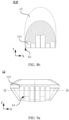
- FIG. 2a shows a left view of a simple diagram of a structure of the audio module 1.
- the audio module 1 When the audio module 1 is installed in a vehicle cockpit, the audio module 1 has high uniformity in a horizontal direction, so that any position in the cockpit can have near-identical sounds, and passengers at any position in the cockpit can have near-identical hearing, to obtain good hearing experience.
- the audio module 1 includes a loudspeaker 11, a diffuser 12, and a base 13, and both the loudspeaker 11 and the diffuser 12 are disposed on the base 13.
- the loudspeaker 11 is configured to convert electric energy into sound energy and make a sound.
- the sound As a mechanical wave, the sound has a phase, and the sound may also be referred to as a sound wave. Based on a phase characteristic of the sound wave, sound waves of different phases may be superimposed or reduced when the sound waves meet. Superimposition of the sound waves may enhance a sound, and reduction of the sound waves may weaken a sound.
- the diffuser 12 in embodiments of this application is configured to reflect an emitted sound wave. The sound wave is incident to different positions of the diffuser 12 and is reflected at different angles. When reflected sound waves meet, the sound waves are superposed or reduced to change a phase of the sound wave. A sound reflected by the diffuser 12 is more uniform in different directions.
- a sound emitted by the loudspeaker 11 includes a high-frequency sound.
- the high-frequency sound is characterized by short wavelength and strong directivity.
- the diffuser 12 is disposed on a sound-emitting side of the loudspeaker 11, and is configured to diffuse sounds emitted by the loudspeaker 11, to improve sound uniformity in a horizontal direction.
- the sound-emitting surface B of the loudspeaker 11 may be parallel to the base 13.
- the sound-emitting surface B of the loudspeaker 11 is level with an upper surface of the base 13.
- the sound emitted by the loudspeaker 11 is a beam-shaped sound wave with strong directivity, and the beam-shaped sound wave with strong directivity is perpendicular to a surface, where the surface may be, for example, the sound-emitting surface B in FIG. 2a . Therefore, it may be considered that the sound emitted by the loudspeaker 11 is emitted from the sound-emitting surface B.
- the diffuser 12 is fastened to the base 13 and is located on the sound-emitting side of the loudspeaker 11, and the diffuser 12 has a first inclined surface A1 inclined toward the loudspeaker 11.
- the diffuser 12 further has a bottom end surface A3 for contacting the base 13 and a top end surface A2 away from the base 13. There is an acute angle ⁇ between the first inclined surface A1 and the sound-emitting surface B of the loudspeaker 11.
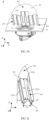
- FIG. 2b is a diagram of a three-dimensional structure of the audio module 1.
- a three-dimensional coordinate system including a first direction X, a second direction Y, and a third direction Z is defined by using the base 13 as a reference.
- a plane including the first direction X and the second direction Y is parallel to the base 13, and is also parallel to the sound-emitting surface B of the loudspeaker 11.
- the third direction Z is perpendicular to the first direction X and the second direction Y, and is also perpendicular to the base 13 and the sound-emitting surface B of the loudspeaker 11.
- the diffuser 12 is provided with a plurality of diffusing grooves 121 with openings located on the first inclined surface A1.
- the opening of each diffusing groove 121 is located on the first inclined surface A1, and two ends of each diffusing groove 121 in a length direction are respectively on the top end surface A2 and the bottom end surface A3 of the diffuser 121.
- the bottom end surface A3 is in contact with the base 13, so that an end that is of the diffusing groove 121 and that is away from the top end surface A2 is located on the base 13.
- the first inclined surface A1 is disposed inclined toward the base 13, and the plurality of diffusing grooves 121 are arranged in the first direction X.
- top end surface A2 and the bottom end surface A3 of the diffuser 12 are merely structural descriptions of the shape of the diffuser 12 shown in FIG. 2b , and only relative positions the top end surface A2 and the bottom end surface A3 are described, and features such as a shape of the surface are not limited.
- the sound emitted by the loudspeaker 11 can be projected onto the diffuser 12, and the first inclined surface A1 of the diffuser 12 and inner walls of the plurality of diffusing grooves 121 can form a diffusing surface of the sound, to reflect the sound.
- the inner wall of the diffusing groove 121 includes two side walls 1211 and a bottom wall 1212 located between the two side walls 1211.
- the diffusing surface of the diffuser 12 for diffusing a sound includes the first inclined surface A1, the bottom wall 1212 of each diffusing groove 121, and the two side walls 1211.
- two ends of the diffusing groove 121 are respectively located on the top end surface A2 and the bottom end surface A3 of the diffuser 12.
- a length of the bottom wall 1212 in the extension direction of the diffusing groove 121 is a groove length H of the diffusing groove 121.
- a distance between the two side walls 1211 is a groove width w1 of the diffusing groove 121, and a thickness of a partition between two adjacent diffusing grooves 121 is w2.
- a distance between the bottom wall 1212 and the first inclined surface A1 is a groove depth d of the diffusing groove 121.
- a schematic direction of the groove depth d is perpendicular to the bottom wall 1212.
- the groove depth d of the diffusing groove 121 may change in the extension direction of the diffusing groove 121.
- the groove depth d remains unchanged in the extension direction of the diffusing groove 121.
- the plurality of diffusing grooves 121 are arranged in the first direction X, the first direction X is parallel to the base 13, and an extension direction of each diffusing groove 121 is perpendicular to the first direction X.
- an example quantity of the diffusing grooves 121 is six.
- the sound emitted by the loudspeaker 11 is projected onto the first inclined surface A1, and the first inclined surface A1 can reflect the sound.
- the sound emitted by the loudspeaker 11 enters the diffusing groove 121, the inner wall of the diffusing groove 121 can reflect the sound and change a phase, and the diffusing groove 121 at a different position can change the phase of the sound to be different.
- the sound emitted by the loudspeaker 11 may be diffused.
- the diffusing grooves 121 are arranged in the first direction X, and the base 13 is configured to support the loudspeaker 11 and the diffuser 12, it may be considered that the first direction X is approximately a horizontal direction.
- the diffusing groove 121 can enable different phase changes of the sound in the horizontal direction, to implement diffusing of the sound in the horizontal direction, and improve uniformity of the sound in the horizontal direction.
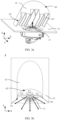
- FIG. 3a is a diagram of a three-dimensional structure of the audio module 1 from another angle.
- the sound emitted by the loudspeaker 11 is emitted into each diffusing groove 121, and the diffusing groove 121 changes the phase of the sound.
- sounds processed by the diffusing groove 121 can interact with each other, and reflected sounds that are evenly diffused are generated in the horizontal direction, so that the sounds are evenly distributed in the horizontal direction. This improves horizontal uniformity of the sound.
- FIG. 3b shows a top view of the audio module 1, namely, a view of the audio module 1 observed right above the base 13.
- the plurality of diffusing grooves 121 include a central diffusing groove group C1 and two side diffusing groove groups C2.
- the two side diffusing groove groups C2 are the same, and the two side diffusing groove groups C2 are symmetrically disposed on two sides of the central diffusing groove group C1 in the first direction X.
- the central diffusing groove group C1 and the side diffusing groove group C2 are divided based on a position relative to the loudspeaker 11, so that the plurality of diffusing grooves 121 are in a left-to-right symmetric structure.
- the central diffusing groove group C1 corresponds to a central position of the loudspeaker 11, and a distance of the sound emitted by the loudspeaker 11 reaching the central diffusing groove group C1 is the shortest. It may be understood that the left-right symmetry herein is based on the first direction X. For a center surface of the plurality of diffusing grooves 121 that is symmetrical left and right, refer to a center of the loudspeaker 11, and the center of the loudspeaker 11 is located on the center surface. Sounds emitted by the loudspeaker 11 are emitted into diffusing grooves 121, and are diffused out after phases of the sounds are changed by the diffusing grooves 121.
- the diffused sound may also be symmetrical on a horizontal plane. This further improves uniformity in the horizontal direction. That is, after being diffused by the diffuser 12, the sounds emitted by the loudspeaker 11 are uniformly distributed in the horizontal direction, so that horizontal uniformity of the sound can be improved.
- the audio module 1 provided in this embodiment of this application has wider directivity in the horizontal direction, has stronger hearing consistency at different angle positions, and a treble part is brighter and more transparent.
- horizontal uniformity of sounds obtained after diffusing by the diffuser 12 is improved by 35.9% compared with horizontal uniformity of sounds from an existing audio module, and is improved by 7.5% compared with horizontal uniformity of sounds from an acoustic prism.
- a quantity of diffusing grooves 121 on the diffuser 12 is not limited. However, based on a setting of the central diffusing groove group C1 and the side diffusing groove groups C2 symmetrically disposed on two sides of the central diffusing groove group C1, there are at least three diffusing grooves 121.
- the central diffusing groove group C1 includes two same diffusing grooves 121, and distances from the two diffusing grooves 121 to the central position of the loudspeaker 11 are equal.
- the central diffusing groove group C1 includes one diffusing groove 121.
- FIG. 4a is a main view of the audio module 1, namely, a view of the audio module 1 observed from a perspective that is parallel to the base 13 and from which the diffusing groove 121 can be observed.
- the central diffusing groove group C1 includes two same diffusing grooves 121, and distances from the two diffusing grooves 121 to the central position of the loudspeaker 11 are equal.
- Any one side diffusing groove group C2 includes two diffusing grooves 121, and the diffusing grooves 121 in two side diffusing groove groups C2 are symmetrical about the central diffusing groove group C1.
- FIG. 4b is a main view of the audio module 1, namely, a view of the audio module 1 observed from a perspective that is parallel to the base 13 and from which the diffusing groove 121 can be observed.
- the central diffusing groove group C1 includes one diffusing groove 121
- the diffusing groove 121 corresponds to a central position of the loudspeaker 11.
- Any one side diffusing groove group C2 includes two diffusing grooves 121, and the diffusing grooves 121 in two side diffusing groove groups C2 are symmetrical about the central diffusing groove group C1.
- the diffusing groove 121 in the central diffusing groove group C1 has a same center distance to the loudspeaker 11 and the center distance is shorter than center distances of other diffusing grooves 121 to the loudspeaker 11.
- the center distance of the diffusing groove 121 to the loudspeaker 11 is a distance from a center of an opening of the diffusing groove 121 on the first inclined surface A1 to the center of the loudspeaker 11.
- a maximum groove depth of the central diffusing groove group C1 is set to be greater than a maximum groove depth of the side diffusing groove group C2, to optimize a frequency response curve of a sound field, and prevent an obvious peak and valley.
- a maximum groove depth of the diffusing groove 121 in the central diffusing groove group C1 may be specifically less than 4.9 cm, for example, 4.5 cm, 3 cm, or 2 cm.
- a maximum groove depth of the diffusing groove 121 in the side diffusing groove C2 is less than the maximum groove depth of the diffusing groove 121 in the central diffusing groove group C1.
- a maximum groove depth of the diffusing groove 121 is a groove depth d that is a farthest distance from the bottom wall 1212 of the diffusing groove 121 to the first inclined surface A1.
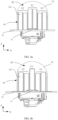
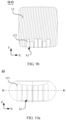
- FIG. 5a and FIG. 5b each show a top view of the diffuser 12, namely, a structure of the diffuser 12 observed perpendicular to an upper part of the base 13. An example in which a groove depth d of each diffusing groove 121 remains unchanged in the extension direction of the diffusing groove 121 is used to describe the diffuser 12.
- an even quantity of diffusing grooves 121 is used as an example for description.
- the diffusing grooves 121 in the central diffusing groove group C1 have groove depths d1
- the diffusing grooves 121 that are in the side diffusing groove groups C2 and that are farthest from the central diffusing groove group C1 have groove depths d2
- the diffusing grooves 121 that are in the side diffusing groove groups C2 and that are adjacent to the central diffusing groove group C1 have groove depths d3.
- a groove depth of the diffusing groove 121 in the central diffusing groove group C1 is the largest, that is, the groove depth d1 is greater than the groove depth d2, and d1 is greater than d3.
- the groove depth d3 of the diffusing groove 121 that is in the side diffusing groove group C2 and that is adjacent to the central diffusing groove group C1 is less than the groove depth d2 of the diffusing groove 121 that is farthest from the central diffusing groove group C1, that is, d2 is greater than d3.
- a diffusing groove 121 in the central diffusing groove group C1 has a groove depth d1
- diffusing grooves 121 that are in the side diffusing groove group C2 and that are farthest from the central diffusing groove group C1 have groove depths d2
- diffusing grooves 121 that are in the side diffusing groove group C2 and that are adjacent to the central diffusing groove group C1 have groove depths d3.
- a groove depth of the diffusing groove 121 in the central diffusing groove group C1 is the largest, that is, the groove depth d1 is greater than the groove depth d2, and the groove depth d1 is greater than the groove depth d3.
- the groove depth d3 of the diffusing groove 121 that is in the side diffusing groove group C2 and that is adjacent to the central diffusing groove group C1 is less than the groove depth d2 of the diffusing groove 121 that is farthest from the central diffusing groove group C1, that is, d2 is greater than d3.
- a groove depth d of the diffusing groove 121 in the central diffusing groove group C1 is greater than a groove depth d of the diffusing groove 121 in the side diffusing groove group C2.
- a frequency response of a diffused sound field may be optimized.
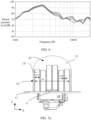
- FIG. 6 shows a curve of a relationship between a frequency and a sound pressure level of a sound is diffused by the diffuser 12. A frequency response of the sound changes slowly, and there is no obvious peak and valley. This is equivalent to weakening a sound intensity change. In this way, user experience can be improved.
- the groove depth d of the diffusing groove 121 determines a lower limit of the frequency of the sound emitted by the loudspeaker 11, that is, the groove depth d of the diffusing groove 121 is related to a minimum frequency of the sound.
- a total groove width W of the plurality of diffusing grooves 121 approximately ranges from 3.5 cm to 12 cm.
- the total groove width W is equivalent to a sum of groove widths w1 of the plurality of diffusing grooves 121 and thicknesses w2 of partitions each between any two adjacent diffusing grooves 121. It may also be considered that the total groove width W is a distance between an end that is of one side diffusing groove group C2 and that is away from the central diffusing groove group C1 and an end of that is the other side diffusing groove group C2 and that is away from the central diffusing groove group C1.
- the groove widths w1 of the diffusing grooves 121 may be equal, or may be unequal.
- a specific implementation may be set according to a specific manufacturing process and an application scenario. This is not limited herein.
- a diagram of a cross-sectional structure shown in FIG. 7b may be obtained by cutting the audio module 1 in a direction perpendicular to a plane formed by the second direction Y and the third direction Z.
- a groove length H of the diffusing groove 121 in the central diffusing groove group C1 is greater than 2 cm.
- groove lengths H of the diffusing grooves 121 are different.
- the sound-emitting surface B of the loudspeaker 11 is parallel to an upper surface of the base 13, an included angle between a normal direction of the sound-emitting surface B and the first inclined surface A1 is ⁇ , and ⁇ ranges from 30° to 70°.
- FIG. 10a In a main view of the diffuser 12 shown in FIG. 10a , a structure of the diffuser 12 is in a drum shape, and in the direction perpendicular to the base 13, both a top size and a bottom size of the diffuser 12 are less than a waist size.
- FIG. 10b is a cross-sectional view obtained through cutting of the diffuser 12 in FIG. 10a along a plane on which R-R is located, and the first inclined surface A1 of the diffuser 12 is a curved surface. In the direction perpendicular to the base 13, the diffuser 12 is in a circular shape.
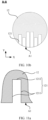
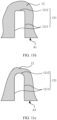
- the bottom wall 1212 of the diffusing groove 121 is a plane, and a cross section that is of the diffusing groove 121 and that is perpendicular to an extension direction is a rectangle. Shapes of the diffusing groove 121 are shown in FIG. 11a to FIG. 11d .
- the bottom wall 1212 of the diffusing groove 121 shown in FIG. 11a is a plane, and the bottom wall 1212 and the side wall 1211 are perpendicular to each other.
- the bottom wall 1212 of the diffusing groove 121 shown in FIG. 11c is an arc surface, and there is a smooth transition between the bottom wall 1212 and the side wall 1211. There is an included angle ⁇ between the bottom wall 1212 and the side wall 1211 of the diffusing groove 121 shown in FIG.
- a shape of the diffusing groove 121 facilitates a draft operation.
- processing performed by the diffusing groove 121 on a sound is changing a phase of the sound
- a shape change of the diffusing groove 121 may correspondingly change effect of changing the phase of the sound.
- the groove length H, the groove width w1, and the groove depth d of the diffusing groove 121 are correspondingly adjusted, to meet a use requirement.
- FIG. 12 is another diagram of a three-dimensional structure of the audio module 1.
- a groove depth d of the diffusing groove 121 in the diffuser 12 gradually increases in a direction away from the loudspeaker 11.
- the diffuser 12 in the audio module 1 is the diffuser 12 shown in FIG. 9a .
- the diffusing groove 121 has a bottom wall 1212 and two side walls 1211. Due to a limitation of a view angle, only one of the side walls 1211 is shown.
- the bottom wall 1212 is shown by using an oblique shadow, and the side wall 1211 is shown by using a dot shadow.
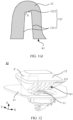
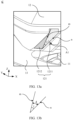
- a side edge that is of the side wall 1211 and that is in contact with the bottom wall 1212 is a first side edge m, and a side edge that is of the side wall 1212 and that is located on the first inclined surface A1 is a second side edge n.
- a distance from the second side edge n to the first side edge m may be considered as a groove depth d of the diffusing groove 121, namely, a distance from the first inclined surface A1 to the bottom wall 1212.
- the first side edge m may be a curve or a straight line
- the second side edge n may also be a curve or a straight line. This is not limited.
- both the first side edge m and the second side edge n are straight lines.
- an included angle between the first side edge m and the second side edge n is less than 60°.
- the included angle between the first side edge m and the second side edge n is 0°, the first side edge m and the second side edge n are parallel to each other, and groove depths d of the diffusing groove 121 at different positions are consistent.
- the groove depth d of the diffusing groove 121 changes linearly.
- the first side edge m and the second side edge n are not parallel, and an included angle ⁇ exists between the first side edge m and the second side edge n.
- the included angle ⁇ exists between the first side edge m and the second side edge n, and a range of the included angle ⁇ is less than 60°.
- a perpendicular distance from the second side edge n to the first side edge m is the groove depth d of the diffusing groove 121.
- the perpendicular distance from the second side edge n to the first side edge m gradually increases, that is, the groove depth d of the diffusing groove 12 gradually increases.
- a phase of a sound emitted by the loudspeaker 11 changes in the diffusing groove 121, and then sounds of a plurality of phases are reflected.
- a change of the groove depth d of the diffusing groove 121 can provide more possibilities for a phase change of the sound, that is, the reflected sound may have richer phase changes. Therefore, there are more possible changes.
- included angles ⁇ between the first side edge m and the second side edge n of the side wall 1211 in the diffusing grooves 121 may be set to a same value, or may be set to different values. This is not limited herein. When the included angles between the first side edge m and the second side edge n of the diffusing grooves 121 are equal, different diffusing grooves 121 form a more neat appearance.
- the groove depth d of the diffusing groove 121 may not change linearly, that is, the first side edge m and the second side edge n may not simply form an included angle relationship. In this way, a richer phase change can be brought to a sound on the basis of ensuring horizontal diffusing of the sound, and improve auditory experience.
- the first side edge m of the side wall 1211 may be a straight line, and the second side edge n may be a curve.
- the first inclined surface A1 of the diffuser 12 having the diffusing groove 121 of this structure is a surface on which the second side edge n is located. Therefore, the first inclined surface A1 may also be a curved surface.
- the sound-emitting surface B of the loudspeaker 11 is parallel to the base 13.
- the base 13 may be disposed on different bearing surfaces as required.
- the bearing surface is parallel to a horizontal direction
- the sound-emitting plane B of the loudspeaker 11 is parallel to the horizontal plane.
- there is a specific included angle between the bearing surface and the horizontal plane there is a specific included angle between the sound-emitting plane B of the loudspeaker 11 and the horizontal plane. The included angle ranges from 0° to 60°.
- the diffuser 12 diffuses sounds emitted by the loudspeaker 11, so that negative impact caused by a short wavelength and strong directivity of a treble sound is weakened, and a treble sound field in the horizontal direction in the vehicle cockpit is more uniform.
- a sound field in the cockpit is more bright and transparent, and user experience can be improved.
Landscapes
- Physics & Mathematics (AREA)
- Engineering & Computer Science (AREA)
- Acoustics & Sound (AREA)
- Signal Processing (AREA)
- Health & Medical Sciences (AREA)
- Otolaryngology (AREA)
- Obtaining Desirable Characteristics In Audible-Bandwidth Transducers (AREA)
- Fittings On The Vehicle Exterior For Carrying Loads, And Devices For Holding Or Mounting Articles (AREA)
- Vehicle Interior And Exterior Ornaments, Soundproofing, And Insulation (AREA)
- Details Of Audible-Bandwidth Transducers (AREA)
Applications Claiming Priority (2)
| Application Number | Priority Date | Filing Date | Title |
|---|---|---|---|
| CN202211329617.9A CN117278913B (zh) | 2022-10-27 | 2022-10-27 | 音频模组及车辆 |
| PCT/CN2023/117724 WO2024087904A1 (zh) | 2022-10-27 | 2023-09-08 | 音频模组及车辆 |
Publications (2)
| Publication Number | Publication Date |
|---|---|
| EP4521776A1 true EP4521776A1 (de) | 2025-03-12 |
| EP4521776A4 EP4521776A4 (de) | 2025-11-05 |
Family
ID=89209318
Family Applications (1)
| Application Number | Title | Priority Date | Filing Date |
|---|---|---|---|
| EP23881485.9A Pending EP4521776A4 (de) | 2022-10-27 | 2023-09-08 | Audiomodul und fahrzeug |
Country Status (5)
| Country | Link |
|---|---|
| US (1) | US20250159403A1 (de) |
| EP (1) | EP4521776A4 (de) |
| JP (1) | JP2025525396A (de) |
| CN (4) | CN121645095A (de) |
| WO (1) | WO2024087904A1 (de) |
Families Citing this family (2)
| Publication number | Priority date | Publication date | Assignee | Title |
|---|---|---|---|---|
| CN223182276U (zh) * | 2024-08-26 | 2025-08-01 | 华为技术有限公司 | 波导管、扬声器组件及电子设备 |
| CN121037742B (zh) * | 2025-10-27 | 2026-03-17 | 苏州上声电子股份有限公司 | 车载音频装置 |
Family Cites Families (13)
| Publication number | Priority date | Publication date | Assignee | Title |
|---|---|---|---|---|
| US4800983A (en) * | 1987-01-13 | 1989-01-31 | Geren David K | Energized acoustic labyrinth |
| KR20000067321A (ko) * | 1999-04-27 | 2000-11-15 | 정완진 | 스피커의 광대역 음향파 정형 및 제어시스템 |
| TWI247550B (en) * | 2002-03-05 | 2006-01-11 | Audio Products Int Corp | Loudspeaker, loudspeaker system and method of directing sound waves from a driver of a loudspeaker |
| WO2005115050A1 (en) * | 2004-05-19 | 2005-12-01 | Harman International Industries, Incorporated | Vehicle loudspeaker array |
| JP2006220937A (ja) * | 2005-02-10 | 2006-08-24 | Nippon Sheet Glass Environment Amenity Co Ltd | 音響調節装置 |
| JP5387234B2 (ja) * | 2009-08-28 | 2014-01-15 | マツダ株式会社 | 車両のスピーカ取付け構造 |
| KR101974664B1 (ko) * | 2010-10-21 | 2019-05-02 | 오쿠스틱 3디 홀딩스 리미티드 | 음향 확산 발생기 |
| JP5786732B2 (ja) * | 2011-04-14 | 2015-09-30 | 株式会社Jvcケンウッド | 音場生成装置、音場生成システム、及び音場生成方法 |
| CN106101938B (zh) * | 2015-10-13 | 2018-03-23 | 北京小鸟听听科技有限公司 | 一种扬声器及扬声器系统 |
| ES2901159T3 (es) * | 2016-04-25 | 2022-03-21 | Gwf Messsysteme Ag | Transductor acústico compacto de ángulo amplio |
| CN205961397U (zh) * | 2016-07-27 | 2017-02-15 | 微鲸科技有限公司 | 一种折射式音箱 |
| KR102214788B1 (ko) * | 2020-02-25 | 2021-02-10 | 홍익대학교 산학협력단 | 음파 송출 방향 제어를 위한 빔 형성 부재 및 이를 이용한 음파 제어 시스템 |
| KR102431641B1 (ko) * | 2020-08-21 | 2022-08-11 | 홍익대학교 산학협력단 | 가변 초점을 갖는 음파 집속 장치 |
-
2022
- 2022-10-27 CN CN202511588137.8A patent/CN121645095A/zh active Pending
- 2022-10-27 CN CN202511590527.9A patent/CN121645096A/zh active Pending
- 2022-10-27 CN CN202511596445.5A patent/CN121645097A/zh active Pending
- 2022-10-27 CN CN202211329617.9A patent/CN117278913B/zh active Active
-
2023
- 2023-09-08 JP JP2024575601A patent/JP2025525396A/ja active Pending
- 2023-09-08 EP EP23881485.9A patent/EP4521776A4/de active Pending
- 2023-09-08 WO PCT/CN2023/117724 patent/WO2024087904A1/zh not_active Ceased
-
2025
- 2025-01-16 US US19/024,135 patent/US20250159403A1/en active Pending
Also Published As
| Publication number | Publication date |
|---|---|
| JP2025525396A (ja) | 2025-08-05 |
| CN121645096A (zh) | 2026-03-10 |
| CN117278913B (zh) | 2025-09-23 |
| US20250159403A1 (en) | 2025-05-15 |
| CN117278913A (zh) | 2023-12-22 |
| EP4521776A4 (de) | 2025-11-05 |
| CN121645097A (zh) | 2026-03-10 |
| CN121645095A (zh) | 2026-03-10 |
| WO2024087904A1 (zh) | 2024-05-02 |
Similar Documents
| Publication | Publication Date | Title |
|---|---|---|
| US20250159403A1 (en) | Audio module and vehicle | |
| US8567558B2 (en) | Partition panel | |
| JPS5939960B2 (ja) | スピ−カキヤビネツト | |
| CN207854146U (zh) | 用于扬声器的辐射体及音响系统 | |
| TWI804286B (zh) | 光學膜片、光學膜片組、背光模組及顯示裝置 | |
| US20250256497A1 (en) | Support component and lamination device | |
| CN110751906A (zh) | 一种显示面板 | |
| US11962971B2 (en) | Acoustic lens and speaker system | |
| US11061173B2 (en) | Prism sheet, prism assembly and display device | |
| CN216820035U (zh) | 平面波导号角 | |
| CN118042361A (zh) | 一种定向发声单元、矩阵和汽车 | |
| JP2010124078A (ja) | ラインアレイスピーカの設置方法、部屋、ラインアレイスピーカ | |
| CN104902407A (zh) | 一种号筒式微型扬声器及终端设备 | |
| WO2019200979A1 (zh) | 透声幕及其制造方法 | |
| CN119091756B (zh) | 显示模组及显示设备 | |
| CN221177868U (zh) | 一种防声干扰音响 | |
| CN221043226U (zh) | 扩音装置 | |
| CN210927967U (zh) | 一种单片磁体型具有蝶形磁路的气动式高频扬声器 | |
| CN116403483B (zh) | 支撑板和柔性显示装置 | |
| JP3238418U (ja) | パーテーション | |
| CN222736303U (zh) | 一种白噪音用二次声音扩散装置 | |
| CN216623627U (zh) | 电源设备 | |
| CN218006503U (zh) | 一种非对称号角及喇叭 | |
| CN112492479B (zh) | 微型麦克风防尘装置及mems麦克风 | |
| CN204652654U (zh) | 一种号筒式微型扬声器及终端设备 |
Legal Events
| Date | Code | Title | Description |
|---|---|---|---|
| STAA | Information on the status of an ep patent application or granted ep patent |
Free format text: STATUS: THE INTERNATIONAL PUBLICATION HAS BEEN MADE |
|
| PUAI | Public reference made under article 153(3) epc to a published international application that has entered the european phase |
Free format text: ORIGINAL CODE: 0009012 |
|
| STAA | Information on the status of an ep patent application or granted ep patent |
Free format text: STATUS: REQUEST FOR EXAMINATION WAS MADE |
|
| 17P | Request for examination filed |
Effective date: 20241202 |
|
| AK | Designated contracting states |
Kind code of ref document: A1 Designated state(s): AL AT BE BG CH CY CZ DE DK EE ES FI FR GB GR HR HU IE IS IT LI LT LU LV MC ME MK MT NL NO PL PT RO RS SE SI SK SM TR |
|
| A4 | Supplementary search report drawn up and despatched |
Effective date: 20251008 |
|
| RIC1 | Information provided on ipc code assigned before grant |
Ipc: H04R 9/06 20060101AFI20251001BHEP Ipc: H04R 1/34 20060101ALI20251001BHEP Ipc: H04R 1/28 20060101ALI20251001BHEP |
|
| DAV | Request for validation of the european patent (deleted) | ||
| DAX | Request for extension of the european patent (deleted) |