EP4520701A1 - Transferfahrzeug - Google Patents
Transferfahrzeug Download PDFInfo
- Publication number
- EP4520701A1 EP4520701A1 EP24195568.1A EP24195568A EP4520701A1 EP 4520701 A1 EP4520701 A1 EP 4520701A1 EP 24195568 A EP24195568 A EP 24195568A EP 4520701 A1 EP4520701 A1 EP 4520701A1
- Authority
- EP
- European Patent Office
- Prior art keywords
- rod
- push
- outer rod
- material receiving
- vehicle body
- Prior art date
- Legal status (The legal status is an assumption and is not a legal conclusion. Google has not performed a legal analysis and makes no representation as to the accuracy of the status listed.)
- Pending
Links
- 238000003032 molecular docking Methods 0.000 claims abstract description 74
- 239000000463 material Substances 0.000 claims abstract description 55
- 230000007246 mechanism Effects 0.000 claims abstract description 52
- 230000007423 decrease Effects 0.000 claims description 3
- 230000003287 optical effect Effects 0.000 description 3
- 238000010586 diagram Methods 0.000 description 2
- 238000007380 fibre production Methods 0.000 description 2
- 239000000126 substance Substances 0.000 description 2
- 238000005516 engineering process Methods 0.000 description 1
- 230000003993 interaction Effects 0.000 description 1
- 239000003550 marker Substances 0.000 description 1
- 239000002184 metal Substances 0.000 description 1
Images
Classifications
-
- B—PERFORMING OPERATIONS; TRANSPORTING
- B65—CONVEYING; PACKING; STORING; HANDLING THIN OR FILAMENTARY MATERIAL
- B65H—HANDLING THIN OR FILAMENTARY MATERIAL, e.g. SHEETS, WEBS, CABLES
- B65H67/00—Replacing or removing cores, receptacles, or completed packages at paying-out, winding, or depositing stations
- B65H67/06—Supplying cores, receptacles, or packages to, or transporting from, winding or depositing stations
- B65H67/064—Supplying or transporting cross-wound packages, also combined with transporting the empty core
-
- B—PERFORMING OPERATIONS; TRANSPORTING
- B60—VEHICLES IN GENERAL
- B60P—VEHICLES ADAPTED FOR LOAD TRANSPORTATION OR TO TRANSPORT, TO CARRY, OR TO COMPRISE SPECIAL LOADS OR OBJECTS
- B60P1/00—Vehicles predominantly for transporting loads and modified to facilitate loading, consolidating the load, or unloading
- B60P1/36—Vehicles predominantly for transporting loads and modified to facilitate loading, consolidating the load, or unloading using endless chains or belts thereon
-
- B—PERFORMING OPERATIONS; TRANSPORTING
- B65—CONVEYING; PACKING; STORING; HANDLING THIN OR FILAMENTARY MATERIAL
- B65G—TRANSPORT OR STORAGE DEVICES, e.g. CONVEYORS FOR LOADING OR TIPPING, SHOP CONVEYOR SYSTEMS OR PNEUMATIC TUBE CONVEYORS
- B65G67/00—Loading or unloading vehicles
- B65G67/02—Loading or unloading land vehicles
- B65G67/24—Unloading land vehicles
-
- D—TEXTILES; PAPER
- D01—NATURAL OR MAN-MADE THREADS OR FIBRES; SPINNING
- D01H—SPINNING OR TWISTING
- D01H9/00—Arrangements for replacing or removing bobbins, cores, receptacles, or completed packages at paying-out or take-up stations ; Combination of spinning-winding machine
- D01H9/02—Arrangements for replacing or removing bobbins, cores, receptacles, or completed packages at paying-out or take-up stations ; Combination of spinning-winding machine for removing completed take-up packages and replacing by bobbins, cores, or receptacles at take-up stations; Transferring material between adjacent full and empty take-up elements
- D01H9/08—Doffing arrangements independent of spinning or twisting machines
- D01H9/10—Doffing carriages ; Loading carriages with cores
-
- B—PERFORMING OPERATIONS; TRANSPORTING
- B65—CONVEYING; PACKING; STORING; HANDLING THIN OR FILAMENTARY MATERIAL
- B65H—HANDLING THIN OR FILAMENTARY MATERIAL, e.g. SHEETS, WEBS, CABLES
- B65H2701/00—Handled material; Storage means
- B65H2701/30—Handled filamentary material
- B65H2701/31—Textiles threads or artificial strands of filaments
- B65H2701/313—Synthetic polymer threads
- B65H2701/3132—Synthetic polymer threads extruded from spinnerets
Definitions
- the present disclosure relates to the field of chemical fiber production technology, and in particular to a transfer vehicle.
- the yarn spindles produced by a winder need to be dropped and transferred.
- a material receiving rod with the same width as the yarn spindles of the whole rod is required to dock with the yarn rod of the winder in the same direction.
- the size of the entire yarn receiving and transferring mechanism or the transfer vehicle is too wide, and the working channel is seriously occupied during operation, making it impossible for personnel and other material receiving mechanisms to pass through.
- the embodiments of the present disclosure provide a transfer vehicle, to solve or alleviate one or more technical problems in the prior art.
- an embodiment of the present disclosure provides a transfer vehicle, including:
- a lug boss is provided at a rear end of the outer rod; and when the material receiving rod rotates to the docking station, the front end of the push-pull rod corresponds to a position of the lug boss, and the second driving device drives the front end of the push-pull rod to extend horizontally and push the lug boss, to drive the outer rod to move horizontally.
- the outer rod includes a plurality of expansion pieces with arc-shaped cross-sections, the expansion pieces have rear ends connected to each other and front ends separated from each other, and the rear ends of the expansion pieces are connected to the lug boss; when the outer rod and the inner rod are in a first state relative to each other, the front ends of the plurality of expansion pieces shrink and draw close; when the outer rod and the inner rod are in a second state relative to each other, the front ends of the plurality of expansion pieces move away from each other to increase a diameter of the outer rod.
- the inner rod has a conical portion at its front end, the conical portion is slidably arranged inside the outer rod, and a diameter of the conical portion gradually increases from its front end to rear end; and a thickness of the expansion piece gradually decreases from its front end to rear end, so that an inner diameter of the front end is less than an inner diameter of the rear end in the outer rod; where: when the rear end of the outer rod slides to the conical portion of the inner rod, the outer rod and the inner rod are in the first state relative to each other; when the front end of the outer rod slides to the conical portion of the inner rod, the outer rod and the inner rod are in the second state relative to each other.
- the pushing device further includes a push-pull groove arranged at the front end of the push-pull rod, the push-pull groove is arranged parallel to a movement direction of a material receiving rod at the docking station, and a lower part of the lug boss of the material receiving rod is placed in the push-pull groove when the material receiving rod moves to the docking station.
- the docking auxiliary mechanism includes a first box body, the pushing device and the positioning device are arranged in the first box body, and the first box body is arranged between the vehicle body and the rotating mechanism.
- a mounting groove is arranged on a side of the first box body close to a front end of the outer rod
- the positioning device is arranged on a first inclined surface of the mounting groove, the first inclined surface is arranged toward the front end of the outer rod, and the positioning device includes a camera.
- a first connecting column is provided between inner circles of the annular track, and the first connecting column is connected to the vehicle body through a second connecting column.
- the first driving device is arranged in a second box body between the vehicle body and the rotating mechanism.
- the above-mentioned technical solution used in the embodiment of the present disclosure can reduce the size of the transfer vehicle and reduce the occupancy of the working channel.
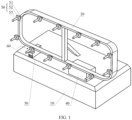
- FIG. 1 is a perspective structural diagram of a transfer vehicle according to an embodiment of the present disclosure. As shown in FIG. 1 , the transfer vehicle includes: A vehicle body 10.
- the vehicle body may be an Automated Guided Vehicle (AGV), for example, an inertial navigation AGV, a QR code navigation AGV, a laser navigation AGV, a GPS navigation AGV, etc.
- AGV Automated Guided Vehicle
- the vehicle body 10 is configured to move to a designated material receiving position according to a material receiving instruction, and any vehicle body having this capability can be used as the vehicle body in the embodiment of the present disclosure.
- the material receiving position is also called the target docking position, and is usually the material drop position of the material to be transferred.
- the target docking position is the doffing position of the winder in the chemical fiber production equipment.
- the long side of the rotating mechanism 20 is arranged in the same direction as the long side of the vehicle body 10 and is close to the end edge on the short side of the vehicle body 10, so that the rotating mechanism 20 is closer to the direction of the target docking position when receiving the material to be transferred.
- This direction is called the docking direction.
- the long side direction of the vehicle body 10 and the rotating mechanism 20 is perpendicular to the direction of the screw rod of the winder, that is, the docking direction is the short side direction of the vehicle body, reducing the size and space occupancy of the vehicle body in the docking direction.
- the shape of the annular track 21 in the rotating mechanism 20 may be a rounded rectangle, a straight-sided ellipse, a circle or other annular shape.
- the vertical arrangement of the annular track 21 can make full use of the vertical space and reduce the length of the transfer vehicle, so as to reduce the obstruction of the doffing positions of other winders by the previous transfer vehicle during operation when a plurality of adjacent winders need to unload materials at the same time.
- the annular track 21 has an inner layer and an outer layer, and the crawler belt 22 is sandwiched between the inner layer and the outer layer of the annular track 21.
- the crawler belt 22 is disposed on the inner circle or the outer circle of the annular track 21.
- the crawler belt 22 may slide on the annular track 21 without being separated therefrom.
- the crawler belt 22 includes a plurality of links (also called plates or chain rings) connected end to end, and these links are connected together to form a ring. Each link has a certain curvature to adapt to the curved portion of the annular track 21. These links may be made of metal, rubber, or other materials.
- a plurality of material receiving rods 50 are arranged at intervals on a side of the rotating mechanism 20, the material receiving rod 50 includes an inner rod 51 and an outer rod 53 sleeved on the inner rod 51, and the inner rod 51 is connected to the crawler belt 22.
- the plurality of material receiving rods are arranged at equal intervals on the side of the rotating mechanism 20 and specifically on one side in the docking direction.
- the inner rod 51 is fixedly connected to the crawler belt 22.
- the number of material receiving rods 50 matches the number of materials to be transferred at one time.
- the winder can produce 12 yarn spindles at the same time, that is, 12 yarn spindles need to be transferred at one time, so the number of material receiving rods 50 is at least 12.
- a docking auxiliary mechanism 30 is arranged beside a docking station 60 on the side of the rotating mechanism 20, and includes a pushing device 31 and a positioning device 32.
- the positioning device 32 is configured to determine the orientation of a target docking position.
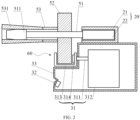
- the pushing device 31 includes a push-pull rod 311 and a second driving device 312, and a rear end of the push-pull rod 311 is connected to the second driving device 312.
- the second driving device 312 drives a front end of the push-pull rod 311 to push the outer rod 53 to move horizontally together, so that the outer rod 53 moves to the target docking position to receive the materials to be transferred.
- the docking station 60 refers to a preparation area for docking the material receiving rod 50 with the target docking position. Specifically, the docking station 60 is arranged at the position where the docking auxiliary mechanism 30 is located. Under the drive of the rotating mechanism 20, one of the material receiving rods 50 reaches the position where the docking auxiliary mechanism 30 is located, and is further docked with the target docking position with the assistance of the docking auxiliary mechanism 30.
- the pushing device 31 is configured to drive the outer rod 53 to move forward and backward in the above-mentioned docking direction.
- the positioning device 32 can determine the orientation of the target docking position by optical means, and a marker that facilitates optical positioning can be set at the target docking position.
- a control mechanism is electrically connected to the vehicle body 10 and the positioning device 32 respectively, and is configured to control the movement of the vehicle body 10 and adjust a position of the vehicle body 10 according to the orientation of the target docking position determined by the positioning device 32, so that the docking station 60 is aligned with the target docking position.
- the control mechanism determines the orientation information of the target docking position through the positioning device 32, generates a position adjustment instruction and sends it to the vehicle body 10; and the vehicle body 10 further adjusts its own position to align the docking station 60 with the target docking position.
- the transfer vehicle for receiving yarns is changed from receiving yarns in the longitudinal direction of the screw rod of the winder to receiving yarns one by one in the vertical direction, thereby reducing the lateral size of the transfer vehicle for receiving yarns, and reducing the occupancy of the working channel by the transfer vehicle for receiving yarns.
- the material receiving rods are rotated circularly in the vertical direction through the rotating mechanism, also reducing the longitudinal size of the transfer vehicle, and greatly reducing the overall size of the transfer vehicle to make it more flexible to move in the limited space.
- a lug boss 52 is provided at a rear end of the outer rod 53; and when the material receiving rod 50 rotates to the docking station 60, the front end of the push-pull rod 311 corresponds to a position of the lug boss 52, and the second driving device 312 drives the front end of the push-pull rod 311 to extend horizontally and push the lug boss 52, to drive the outer rod 53 to move horizontally.
- front end, rear end, front side and rear side in the following are described relative to the docking direction.
- the direction toward the target docking position is the front end, and the opposite direction is the rear end.
- the lug boss 52 is configured to cooperate with the push-pull rod 311 to obtain the driving force of the second driving device 312.
- a magnetic switch, an optical switch, a limit switch or the like may be arranged on the docking station 50 to detect whether the lug boss 52 has reached the docking station 50.
- the outer rod 53 includes a plurality of expansion pieces 531 with arc-shaped cross-sections, the expansion pieces 531 have rear ends connected to each other and front ends separated from each other, and the rear ends of the expansion pieces 531 are connected to the lug boss 52.
- the front ends of the plurality of expansion pieces 531 shrink and draw close.
- the front ends of the plurality of expansion pieces 531 move away from each other to increase the diameter of the outer rod 53.
- the yarn spindle is in the shape of a disc with a circular hole in the center.
- the diameter of the front end of the outer rod can be enlarged in order to prevent the yarn spindle from slipping.
- the diameter of the front end of the outer rod should be less than the diameter of the round hole of the yarn spindle; when the outer rod is retracted (the second state), the diameter of the front end of the outer rod should be greater than or equal to the diameter of the circular hole of the yarn spindle, thereby restricting the yarn spindle on the material receiving rod 50.
- the inner rod 51 has a conical portion 511 at its front end, the conical portion 511 is slidably arranged inside the outer rod 53, and the diameter of the conical portion 511 gradually increases from the front end to the rear end.
- the thickness of the expansion piece 531 gradually decreases from the front end to the rear end, so that the inner diameter of the front end of the outer rod 53 is less than the inner diameter of the rear end.
- the expansion piece of the outer rod cooperates with the conical portion of the inner rod to open and close the expansion piece, thereby changing the diameter of the front end of the outer rod, so that the material receiving rod can fix the yarn spindle on the material receiving rod after obtaining the yarn spindle.
- the pushing device 31 further includes a push-pull groove 313 arranged at the front end of the push-pull rod 311, the push-pull groove 313 is arranged parallel to a movement direction of a material receiving rod 50 at the docking station 60, and a lower part of the lug boss 52 of the material receiving rod 50 is placed in the push-pull groove 313 when the material receiving rod 50 moves to the docking station 60.
- the lower part of the lug boss 52 is placed in the push-pull groove 313, so that the push-pull rod can drive the lug boss and the outer rod more stably.
- the direction of the groove body of the push-pull groove 313 is parallel to the movement direction of the crawler belt at the docking station, and a limit block 314 may be arranged at a downstream position of the push-pull groove in the movement direction of the crawler belt.
- the limit block 314 is arranged on the front side or the rear side of the inner surface of the push-pull groove 313, and an opening larger than the width of the lug boss 52 is reserved between the limit block and the opposite side of the push-pull groove.
- the front and rear positions of the push-pull groove 313 can be changed so that the limit block 314 is located on or not on the moving route of the lug boss, to block or release the material receiving rod 50, or to keep the material receiving rod 50 in a fixed position at the docking station 60 to facilitate accurate docking.
- the docking auxiliary mechanism 30 includes a first box body 33, the pushing device 31 and the positioning device 32 are arranged in the first box body 33, and the first box body 33 is arranged between the vehicle body 10 and the rotating mechanism 20.
- the first box body 33 is used to accommodate the pushing device and the positioning device, and also serves as a supporting component of the rotating mechanism.
- a mounting groove is arranged on a side of the first box body 33 close to a front end of the outer rod 53, the positioning device 32 is arranged on a first inclined surface of the mounting groove, the first inclined surface is arranged toward the front end of the outer rod 53, and the positioning device 32 includes a camera.
- the first inclined surface faces the front end of the outer rod 53, so that the camera installed thereon also faces the front end of the outer rod 53 and thus has a more convenient observation angle and a better field of view when photographing and identifying the target docking position.
- a first connecting column is provided between inner circles of the annular track 21, and the first connecting column is connected to the vehicle body 10 through a second connecting column.
- the first connecting column is used to enhance the structural strength of the upper and lower parts of the annular track
- the second connecting column is used to enhance the stability of the entire rotating mechanism in the vertical direction.
- one group including a rotating mechanism 20, a docking auxiliary mechanism 30, a first driving device 40 and a plurality of material receiving rods 50 is arranged on each of both sides of the vehicle body 10 in the short side direction, so that both the left and right sides of the vehicle body 10 can be used for receiving materials, and the material receiving capacity of the transfer vehicle is doubled.
- the rotating mechanisms 20 in two groups may be connected by a connecting column.
- the first driving device 40 is arranged in a second box body between the vehicle body 10 and the rotating mechanism 20.
- the second box body is used to accommodate the first driving device 40, and also serves as a supporting component of the rotating mechanism 20.
- the annular track 21 and the second box body are opened at the connection position of them, so that the crawler belt 22 is connected to the first driving device 40.
- control mechanism may be arranged in the first box body 33, and the control mechanism is electrically connected to the first driving device 40 and the second driving device 312.
- first and second are only for the purpose of description, and cannot be construed to indicate or imply the relative importance or implicitly point out the number of technical features indicated. Therefore, the feature defined with “first” or “second” may explicitly or implicitly include one or more features. In the description of the present disclosure, "a plurality of means two or more than two, unless otherwise expressly and specifically defined.
- install should be understood in broad sense.
- it may be fixed connection or detachable connection or integral connection; may be mechanical connection or electrical connection or communication connection; may be direct connection, or indirect connection through an intermediate medium; may be internal communication between two elements or interaction relationship between two elements.
- install may be fixed connection or detachable connection or integral connection; may be mechanical connection or electrical connection or communication connection; may be direct connection, or indirect connection through an intermediate medium; may be internal communication between two elements or interaction relationship between two elements.
- a first feature “above” or “below” a second feature may include: the first and second features are in direct contact, or the first and second features are not in direct contact but in contact through other feature between them.
- the first feature “above”, “on” and “over” the second feature includes: the first feature is directly above and diagonally above the second feature, or simply means that the first feature is higher in level than the second feature.
- the first feature “below”, “under” and “underneath” the second feature includes: the first feature is directly below and diagonally below the second feature, or simply means that the first feature is lower in level than the second feature.
Landscapes
- Engineering & Computer Science (AREA)
- Mechanical Engineering (AREA)
- Aviation & Aerospace Engineering (AREA)
- Transportation (AREA)
- Textile Engineering (AREA)
- Handcart (AREA)
- Replacing, Conveying, And Pick-Finding For Filamentary Materials (AREA)
Applications Claiming Priority (2)
| Application Number | Priority Date | Filing Date | Title |
|---|---|---|---|
| CN202311162858.3A CN117284877A (zh) | 2023-09-08 | 2023-09-08 | 转运车 |
| CN202322450135.5U CN220702897U (zh) | 2023-09-08 | 2023-09-08 | 转运车 |
Publications (1)
| Publication Number | Publication Date |
|---|---|
| EP4520701A1 true EP4520701A1 (de) | 2025-03-12 |
Family
ID=92503661
Family Applications (1)
| Application Number | Title | Priority Date | Filing Date |
|---|---|---|---|
| EP24195568.1A Pending EP4520701A1 (de) | 2023-09-08 | 2024-08-21 | Transferfahrzeug |
Country Status (3)
| Country | Link |
|---|---|
| US (1) | US20250083584A1 (de) |
| EP (1) | EP4520701A1 (de) |
| JP (1) | JP7767538B2 (de) |
Citations (6)
| Publication number | Priority date | Publication date | Assignee | Title |
|---|---|---|---|---|
| US4039092A (en) * | 1975-04-16 | 1977-08-02 | Rieter Machine Works, Ltd. | Bobbin package storage box |
| US4669942A (en) * | 1984-11-02 | 1987-06-02 | Murata Kikai Kabushiki Kaisha | Device for supplying packages to warper creels |
| DE9111142U1 (de) * | 1991-09-07 | 1991-11-28 | Hacoba Textilmaschinen Gmbh & Co Kg, 5600 Wuppertal | Vorrichtung zum Bestücken eines Spulengatters mit vollen Garnspulen und zum Entfernen seiner ganz oder teilweise vom abgelaufenen Spulengarn befreiten Spulenhülsen |
| EP0628648A2 (de) * | 1990-07-03 | 1994-12-14 | Hacoba Textilmaschinen GmbH & Co KG | Vorrichtung zum Bestücken der Spulendorne eines Spulengatters |
| EP0678469A2 (de) * | 1994-04-20 | 1995-10-25 | Sucker-Müller-Hacoba GmbH & Co. | Bestückungsvorrichtung für Spulengatter |
| CN111776878A (zh) * | 2020-07-01 | 2020-10-16 | 兴惠化纤集团有限公司 | 一种海岛复合丝生产设备及其生产工艺 |
-
2024
- 2024-08-21 EP EP24195568.1A patent/EP4520701A1/de active Pending
- 2024-09-05 JP JP2024153089A patent/JP7767538B2/ja active Active
- 2024-09-07 US US18/827,687 patent/US20250083584A1/en active Pending
Patent Citations (6)
| Publication number | Priority date | Publication date | Assignee | Title |
|---|---|---|---|---|
| US4039092A (en) * | 1975-04-16 | 1977-08-02 | Rieter Machine Works, Ltd. | Bobbin package storage box |
| US4669942A (en) * | 1984-11-02 | 1987-06-02 | Murata Kikai Kabushiki Kaisha | Device for supplying packages to warper creels |
| EP0628648A2 (de) * | 1990-07-03 | 1994-12-14 | Hacoba Textilmaschinen GmbH & Co KG | Vorrichtung zum Bestücken der Spulendorne eines Spulengatters |
| DE9111142U1 (de) * | 1991-09-07 | 1991-11-28 | Hacoba Textilmaschinen Gmbh & Co Kg, 5600 Wuppertal | Vorrichtung zum Bestücken eines Spulengatters mit vollen Garnspulen und zum Entfernen seiner ganz oder teilweise vom abgelaufenen Spulengarn befreiten Spulenhülsen |
| EP0678469A2 (de) * | 1994-04-20 | 1995-10-25 | Sucker-Müller-Hacoba GmbH & Co. | Bestückungsvorrichtung für Spulengatter |
| CN111776878A (zh) * | 2020-07-01 | 2020-10-16 | 兴惠化纤集团有限公司 | 一种海岛复合丝生产设备及其生产工艺 |
Also Published As
| Publication number | Publication date |
|---|---|
| JP7767538B2 (ja) | 2025-11-11 |
| US20250083584A1 (en) | 2025-03-13 |
| JP2025039547A (ja) | 2025-03-21 |
Similar Documents
| Publication | Publication Date | Title |
|---|---|---|
| KR101839865B1 (ko) | 릴 부설 시스템 | |
| EP4520701A1 (de) | Transferfahrzeug | |
| US9670004B1 (en) | Article transport facility | |
| US6024005A (en) | Formation stabilizing guide for braider | |
| US7306398B2 (en) | Highway marker transfer vehicle | |
| CN220702897U (zh) | 转运车 | |
| EP0932155B1 (de) | Bandanfangsvorrichtung und Aufwickelspule für Magnetbandtransportsystem | |
| GB2082510A (en) | Automatic recording instrument | |
| US6574173B1 (en) | Total axis, self adjusting pass-through port | |
| NL1008267C2 (nl) | Inrichting voor het opslaan van pijpen. | |
| CN117284877A (zh) | 转运车 | |
| CN113883164A (zh) | 传动机构、收线装置及医疗设备 | |
| JP6363302B2 (ja) | タイヤ用のビードエイペックスを製造するためのドラムセット及びツーリングを含むアセンブリ | |
| US4598882A (en) | Low profile deployment/retrieval system | |
| JPH0252838B2 (de) | ||
| JP5150003B1 (ja) | ロール体取扱システム、ロール体供給方法およびロール体搬送装置 | |
| WO2025180367A1 (zh) | 一种搬运装置及搬运机器人 | |
| JP2024095960A (ja) | ドローンバッテリー交換用グリッパー | |
| CN113599721B (zh) | 一种手术导航与放射性植入系统用定位反光小球机构及使用方法 | |
| CN116490416A (zh) | 高架输送车 | |
| US4596505A (en) | Automatic loader/unloader for slitter | |
| US20040265111A1 (en) | Device for moving a machine | |
| CN113148731B (zh) | 卷材转移机台及其对接方法 | |
| KR101969700B1 (ko) | 원자로 튜브 교체 조립체 | |
| CN221587056U (zh) | 顶升定位装置以及物料转运系统 |
Legal Events
| Date | Code | Title | Description |
|---|---|---|---|
| PUAI | Public reference made under article 153(3) epc to a published international application that has entered the european phase |
Free format text: ORIGINAL CODE: 0009012 |
|
| STAA | Information on the status of an ep patent application or granted ep patent |
Free format text: STATUS: REQUEST FOR EXAMINATION WAS MADE |
|
| 17P | Request for examination filed |
Effective date: 20240821 |
|
| AK | Designated contracting states |
Kind code of ref document: A1 Designated state(s): AL AT BE BG CH CY CZ DE DK EE ES FI FR GB GR HR HU IE IS IT LI LT LU LV MC ME MK MT NL NO PL PT RO RS SE SI SK SM TR |