EP4520520A2 - Rückkopplungspresse mit geschlossenem regelkreis - Google Patents
Rückkopplungspresse mit geschlossenem regelkreis Download PDFInfo
- Publication number
- EP4520520A2 EP4520520A2 EP25152148.0A EP25152148A EP4520520A2 EP 4520520 A2 EP4520520 A2 EP 4520520A2 EP 25152148 A EP25152148 A EP 25152148A EP 4520520 A2 EP4520520 A2 EP 4520520A2
- Authority
- EP
- European Patent Office
- Prior art keywords
- platen
- article
- press
- temperature
- top platen
- Prior art date
- Legal status (The legal status is an assumption and is not a legal conclusion. Google has not performed a legal analysis and makes no representation as to the accuracy of the status listed.)
- Pending
Links
Images





Classifications
-
- B—PERFORMING OPERATIONS; TRANSPORTING
- B29—WORKING OF PLASTICS; WORKING OF SUBSTANCES IN A PLASTIC STATE IN GENERAL
- B29C—SHAPING OR JOINING OF PLASTICS; SHAPING OF MATERIAL IN A PLASTIC STATE, NOT OTHERWISE PROVIDED FOR; AFTER-TREATMENT OF THE SHAPED PRODUCTS, e.g. REPAIRING
- B29C33/00—Moulds or cores; Details thereof or accessories therefor
- B29C33/38—Moulds or cores; Details thereof or accessories therefor characterised by the material or the manufacturing process
- B29C33/40—Plastics, e.g. foam or rubber
-
- B—PERFORMING OPERATIONS; TRANSPORTING
- B29—WORKING OF PLASTICS; WORKING OF SUBSTANCES IN A PLASTIC STATE IN GENERAL
- B29C—SHAPING OR JOINING OF PLASTICS; SHAPING OF MATERIAL IN A PLASTIC STATE, NOT OTHERWISE PROVIDED FOR; AFTER-TREATMENT OF THE SHAPED PRODUCTS, e.g. REPAIRING
- B29C43/00—Compression moulding, i.e. applying external pressure to flow the moulding material; Apparatus therefor
- B29C43/02—Compression moulding, i.e. applying external pressure to flow the moulding material; Apparatus therefor of articles of definite length, i.e. discrete articles
- B29C43/18—Compression moulding, i.e. applying external pressure to flow the moulding material; Apparatus therefor of articles of definite length, i.e. discrete articles incorporating preformed parts or layers, e.g. compression moulding around inserts or for coating articles
-
- B—PERFORMING OPERATIONS; TRANSPORTING
- B29—WORKING OF PLASTICS; WORKING OF SUBSTANCES IN A PLASTIC STATE IN GENERAL
- B29C—SHAPING OR JOINING OF PLASTICS; SHAPING OF MATERIAL IN A PLASTIC STATE, NOT OTHERWISE PROVIDED FOR; AFTER-TREATMENT OF THE SHAPED PRODUCTS, e.g. REPAIRING
- B29C43/00—Compression moulding, i.e. applying external pressure to flow the moulding material; Apparatus therefor
- B29C43/32—Component parts, details or accessories; Auxiliary operations
- B29C43/36—Moulds for making articles of definite length, i.e. discrete articles
- B29C43/3642—Bags, bleeder sheets or cauls for isostatic pressing
-
- B—PERFORMING OPERATIONS; TRANSPORTING
- B29—WORKING OF PLASTICS; WORKING OF SUBSTANCES IN A PLASTIC STATE IN GENERAL
- B29C—SHAPING OR JOINING OF PLASTICS; SHAPING OF MATERIAL IN A PLASTIC STATE, NOT OTHERWISE PROVIDED FOR; AFTER-TREATMENT OF THE SHAPED PRODUCTS, e.g. REPAIRING
- B29C43/00—Compression moulding, i.e. applying external pressure to flow the moulding material; Apparatus therefor
- B29C43/32—Component parts, details or accessories; Auxiliary operations
- B29C43/58—Measuring, controlling or regulating
-
- B—PERFORMING OPERATIONS; TRANSPORTING
- B29—WORKING OF PLASTICS; WORKING OF SUBSTANCES IN A PLASTIC STATE IN GENERAL
- B29C—SHAPING OR JOINING OF PLASTICS; SHAPING OF MATERIAL IN A PLASTIC STATE, NOT OTHERWISE PROVIDED FOR; AFTER-TREATMENT OF THE SHAPED PRODUCTS, e.g. REPAIRING
- B29C65/00—Joining or sealing of preformed parts, e.g. welding of plastics materials; Apparatus therefor
- B29C65/02—Joining or sealing of preformed parts, e.g. welding of plastics materials; Apparatus therefor by heating, with or without pressure
-
- B—PERFORMING OPERATIONS; TRANSPORTING
- B29—WORKING OF PLASTICS; WORKING OF SUBSTANCES IN A PLASTIC STATE IN GENERAL
- B29D—PRODUCING PARTICULAR ARTICLES FROM PLASTICS OR FROM SUBSTANCES IN A PLASTIC STATE
- B29D35/00—Producing footwear
- B29D35/0054—Producing footwear by compression moulding, vulcanising or the like; Apparatus therefor
-
- B—PERFORMING OPERATIONS; TRANSPORTING
- B29—WORKING OF PLASTICS; WORKING OF SUBSTANCES IN A PLASTIC STATE IN GENERAL
- B29D—PRODUCING PARTICULAR ARTICLES FROM PLASTICS OR FROM SUBSTANCES IN A PLASTIC STATE
- B29D35/00—Producing footwear
- B29D35/12—Producing parts thereof, e.g. soles, heels, uppers, by a moulding technique
- B29D35/126—Uppers
-
- B—PERFORMING OPERATIONS; TRANSPORTING
- B30—PRESSES
- B30B—PRESSES IN GENERAL
- B30B15/00—Details of, or accessories for, presses; Auxiliary measures in connection with pressing
-
- B—PERFORMING OPERATIONS; TRANSPORTING
- B30—PRESSES
- B30B—PRESSES IN GENERAL
- B30B15/00—Details of, or accessories for, presses; Auxiliary measures in connection with pressing
- B30B15/0029—Details of, or accessories for, presses; Auxiliary measures in connection with pressing means for adjusting the space between the press slide and the press table, i.e. the shut height
-
- B—PERFORMING OPERATIONS; TRANSPORTING
- B30—PRESSES
- B30B—PRESSES IN GENERAL
- B30B15/00—Details of, or accessories for, presses; Auxiliary measures in connection with pressing
- B30B15/0094—Press load monitoring means
-
- B—PERFORMING OPERATIONS; TRANSPORTING
- B30—PRESSES
- B30B—PRESSES IN GENERAL
- B30B15/00—Details of, or accessories for, presses; Auxiliary measures in connection with pressing
- B30B15/06—Platens or press rams
- B30B15/062—Press plates
-
- B—PERFORMING OPERATIONS; TRANSPORTING
- B30—PRESSES
- B30B—PRESSES IN GENERAL
- B30B15/00—Details of, or accessories for, presses; Auxiliary measures in connection with pressing
- B30B15/06—Platens or press rams
- B30B15/062—Press plates
- B30B15/064—Press plates with heating or cooling means
-
- B—PERFORMING OPERATIONS; TRANSPORTING
- B30—PRESSES
- B30B—PRESSES IN GENERAL
- B30B15/00—Details of, or accessories for, presses; Auxiliary measures in connection with pressing
- B30B15/26—Program-control arrangements
-
- B—PERFORMING OPERATIONS; TRANSPORTING
- B32—LAYERED PRODUCTS
- B32B—LAYERED PRODUCTS, i.e. PRODUCTS BUILT-UP OF STRATA OF FLAT OR NON-FLAT, e.g. CELLULAR OR HONEYCOMB, FORM
- B32B15/00—Layered products comprising a layer of metal
- B32B15/04—Layered products comprising a layer of metal comprising metal as the main or only constituent of a layer, which is next to another layer of the same or of a different material
- B32B15/08—Layered products comprising a layer of metal comprising metal as the main or only constituent of a layer, which is next to another layer of the same or of a different material of synthetic resin
-
- B—PERFORMING OPERATIONS; TRANSPORTING
- B32—LAYERED PRODUCTS
- B32B—LAYERED PRODUCTS, i.e. PRODUCTS BUILT-UP OF STRATA OF FLAT OR NON-FLAT, e.g. CELLULAR OR HONEYCOMB, FORM
- B32B27/00—Layered products comprising a layer of synthetic resin
- B32B27/06—Layered products comprising a layer of synthetic resin as the main or only constituent of a layer, which is next to another layer of the same or of a different material
- B32B27/08—Layered products comprising a layer of synthetic resin as the main or only constituent of a layer, which is next to another layer of the same or of a different material of synthetic resin
-
- B—PERFORMING OPERATIONS; TRANSPORTING
- B32—LAYERED PRODUCTS
- B32B—LAYERED PRODUCTS, i.e. PRODUCTS BUILT-UP OF STRATA OF FLAT OR NON-FLAT, e.g. CELLULAR OR HONEYCOMB, FORM
- B32B27/00—Layered products comprising a layer of synthetic resin
- B32B27/12—Layered products comprising a layer of synthetic resin next to a fibrous or filamentary layer
-
- B—PERFORMING OPERATIONS; TRANSPORTING
- B32—LAYERED PRODUCTS
- B32B—LAYERED PRODUCTS, i.e. PRODUCTS BUILT-UP OF STRATA OF FLAT OR NON-FLAT, e.g. CELLULAR OR HONEYCOMB, FORM
- B32B27/00—Layered products comprising a layer of synthetic resin
- B32B27/34—Layered products comprising a layer of synthetic resin comprising polyamides
-
- B—PERFORMING OPERATIONS; TRANSPORTING
- B32—LAYERED PRODUCTS
- B32B—LAYERED PRODUCTS, i.e. PRODUCTS BUILT-UP OF STRATA OF FLAT OR NON-FLAT, e.g. CELLULAR OR HONEYCOMB, FORM
- B32B27/00—Layered products comprising a layer of synthetic resin
- B32B27/36—Layered products comprising a layer of synthetic resin comprising polyesters
-
- B—PERFORMING OPERATIONS; TRANSPORTING
- B32—LAYERED PRODUCTS
- B32B—LAYERED PRODUCTS, i.e. PRODUCTS BUILT-UP OF STRATA OF FLAT OR NON-FLAT, e.g. CELLULAR OR HONEYCOMB, FORM
- B32B37/00—Methods or apparatus for laminating, e.g. by curing or by ultrasonic bonding
- B32B37/06—Methods or apparatus for laminating, e.g. by curing or by ultrasonic bonding characterised by the heating method
- B32B37/065—Methods or apparatus for laminating, e.g. by curing or by ultrasonic bonding characterised by the heating method resulting in the laminate being partially bonded
-
- B—PERFORMING OPERATIONS; TRANSPORTING
- B32—LAYERED PRODUCTS
- B32B—LAYERED PRODUCTS, i.e. PRODUCTS BUILT-UP OF STRATA OF FLAT OR NON-FLAT, e.g. CELLULAR OR HONEYCOMB, FORM
- B32B37/00—Methods or apparatus for laminating, e.g. by curing or by ultrasonic bonding
- B32B37/10—Methods or apparatus for laminating, e.g. by curing or by ultrasonic bonding characterised by the pressing technique, e.g. using action of vacuum or fluid pressure
-
- B—PERFORMING OPERATIONS; TRANSPORTING
- B32—LAYERED PRODUCTS
- B32B—LAYERED PRODUCTS, i.e. PRODUCTS BUILT-UP OF STRATA OF FLAT OR NON-FLAT, e.g. CELLULAR OR HONEYCOMB, FORM
- B32B37/00—Methods or apparatus for laminating, e.g. by curing or by ultrasonic bonding
- B32B37/12—Methods or apparatus for laminating, e.g. by curing or by ultrasonic bonding characterised by using adhesives
-
- B—PERFORMING OPERATIONS; TRANSPORTING
- B32—LAYERED PRODUCTS
- B32B—LAYERED PRODUCTS, i.e. PRODUCTS BUILT-UP OF STRATA OF FLAT OR NON-FLAT, e.g. CELLULAR OR HONEYCOMB, FORM
- B32B38/00—Ancillary operations in connection with laminating processes
- B32B38/0012—Mechanical treatment, e.g. roughening, deforming, stretching
-
- B—PERFORMING OPERATIONS; TRANSPORTING
- B32—LAYERED PRODUCTS
- B32B—LAYERED PRODUCTS, i.e. PRODUCTS BUILT-UP OF STRATA OF FLAT OR NON-FLAT, e.g. CELLULAR OR HONEYCOMB, FORM
- B32B41/00—Arrangements for controlling or monitoring lamination processes; Safety arrangements
-
- B—PERFORMING OPERATIONS; TRANSPORTING
- B32—LAYERED PRODUCTS
- B32B—LAYERED PRODUCTS, i.e. PRODUCTS BUILT-UP OF STRATA OF FLAT OR NON-FLAT, e.g. CELLULAR OR HONEYCOMB, FORM
- B32B5/00—Layered products characterised by the non- homogeneity or physical structure, i.e. comprising a fibrous, filamentary, particulate or foam layer; Layered products characterised by having a layer differing constitutionally or physically in different parts
- B32B5/02—Layered products characterised by the non- homogeneity or physical structure, i.e. comprising a fibrous, filamentary, particulate or foam layer; Layered products characterised by having a layer differing constitutionally or physically in different parts characterised by structural features of a fibrous or filamentary layer
- B32B5/022—Non-woven fabric
-
- B—PERFORMING OPERATIONS; TRANSPORTING
- B32—LAYERED PRODUCTS
- B32B—LAYERED PRODUCTS, i.e. PRODUCTS BUILT-UP OF STRATA OF FLAT OR NON-FLAT, e.g. CELLULAR OR HONEYCOMB, FORM
- B32B5/00—Layered products characterised by the non- homogeneity or physical structure, i.e. comprising a fibrous, filamentary, particulate or foam layer; Layered products characterised by having a layer differing constitutionally or physically in different parts
- B32B5/02—Layered products characterised by the non- homogeneity or physical structure, i.e. comprising a fibrous, filamentary, particulate or foam layer; Layered products characterised by having a layer differing constitutionally or physically in different parts characterised by structural features of a fibrous or filamentary layer
- B32B5/024—Woven fabric
-
- B—PERFORMING OPERATIONS; TRANSPORTING
- B32—LAYERED PRODUCTS
- B32B—LAYERED PRODUCTS, i.e. PRODUCTS BUILT-UP OF STRATA OF FLAT OR NON-FLAT, e.g. CELLULAR OR HONEYCOMB, FORM
- B32B5/00—Layered products characterised by the non- homogeneity or physical structure, i.e. comprising a fibrous, filamentary, particulate or foam layer; Layered products characterised by having a layer differing constitutionally or physically in different parts
- B32B5/02—Layered products characterised by the non- homogeneity or physical structure, i.e. comprising a fibrous, filamentary, particulate or foam layer; Layered products characterised by having a layer differing constitutionally or physically in different parts characterised by structural features of a fibrous or filamentary layer
- B32B5/026—Knitted fabric
-
- B—PERFORMING OPERATIONS; TRANSPORTING
- B32—LAYERED PRODUCTS
- B32B—LAYERED PRODUCTS, i.e. PRODUCTS BUILT-UP OF STRATA OF FLAT OR NON-FLAT, e.g. CELLULAR OR HONEYCOMB, FORM
- B32B5/00—Layered products characterised by the non- homogeneity or physical structure, i.e. comprising a fibrous, filamentary, particulate or foam layer; Layered products characterised by having a layer differing constitutionally or physically in different parts
- B32B5/22—Layered products characterised by the non- homogeneity or physical structure, i.e. comprising a fibrous, filamentary, particulate or foam layer; Layered products characterised by having a layer differing constitutionally or physically in different parts characterised by the presence of two or more layers which are next to each other and are fibrous, filamentary, formed of particles or foamed
- B32B5/24—Layered products characterised by the non- homogeneity or physical structure, i.e. comprising a fibrous, filamentary, particulate or foam layer; Layered products characterised by having a layer differing constitutionally or physically in different parts characterised by the presence of two or more layers which are next to each other and are fibrous, filamentary, formed of particles or foamed one layer being a fibrous or filamentary layer
- B32B5/26—Layered products characterised by the non- homogeneity or physical structure, i.e. comprising a fibrous, filamentary, particulate or foam layer; Layered products characterised by having a layer differing constitutionally or physically in different parts characterised by the presence of two or more layers which are next to each other and are fibrous, filamentary, formed of particles or foamed one layer being a fibrous or filamentary layer another layer next to it also being fibrous or filamentary
-
- B—PERFORMING OPERATIONS; TRANSPORTING
- B32—LAYERED PRODUCTS
- B32B—LAYERED PRODUCTS, i.e. PRODUCTS BUILT-UP OF STRATA OF FLAT OR NON-FLAT, e.g. CELLULAR OR HONEYCOMB, FORM
- B32B7/00—Layered products characterised by the relation between layers; Layered products characterised by the relative orientation of features between layers, or by the relative values of a measurable parameter between layers, i.e. products comprising layers having different physical, chemical or physicochemical properties; Layered products characterised by the interconnection of layers
- B32B7/04—Interconnection of layers
- B32B7/12—Interconnection of layers using interposed adhesives or interposed materials with bonding properties
-
- B—PERFORMING OPERATIONS; TRANSPORTING
- B32—LAYERED PRODUCTS
- B32B—LAYERED PRODUCTS, i.e. PRODUCTS BUILT-UP OF STRATA OF FLAT OR NON-FLAT, e.g. CELLULAR OR HONEYCOMB, FORM
- B32B9/00—Layered products comprising a layer of a particular substance not covered by groups B32B11/00 - B32B29/00
- B32B9/02—Layered products comprising a layer of a particular substance not covered by groups B32B11/00 - B32B29/00 comprising animal or vegetable substances, e.g. cork, bamboo, starch
- B32B9/025—Layered products comprising a layer of a particular substance not covered by groups B32B11/00 - B32B29/00 comprising animal or vegetable substances, e.g. cork, bamboo, starch comprising leather
-
- B—PERFORMING OPERATIONS; TRANSPORTING
- B32—LAYERED PRODUCTS
- B32B—LAYERED PRODUCTS, i.e. PRODUCTS BUILT-UP OF STRATA OF FLAT OR NON-FLAT, e.g. CELLULAR OR HONEYCOMB, FORM
- B32B9/00—Layered products comprising a layer of a particular substance not covered by groups B32B11/00 - B32B29/00
- B32B9/04—Layered products comprising a layer of a particular substance not covered by groups B32B11/00 - B32B29/00 comprising such particular substance as the main or only constituent of a layer, which is next to another layer of the same or of a different material
- B32B9/045—Layered products comprising a layer of a particular substance not covered by groups B32B11/00 - B32B29/00 comprising such particular substance as the main or only constituent of a layer, which is next to another layer of the same or of a different material of synthetic resin
-
- B—PERFORMING OPERATIONS; TRANSPORTING
- B32—LAYERED PRODUCTS
- B32B—LAYERED PRODUCTS, i.e. PRODUCTS BUILT-UP OF STRATA OF FLAT OR NON-FLAT, e.g. CELLULAR OR HONEYCOMB, FORM
- B32B9/00—Layered products comprising a layer of a particular substance not covered by groups B32B11/00 - B32B29/00
- B32B9/04—Layered products comprising a layer of a particular substance not covered by groups B32B11/00 - B32B29/00 comprising such particular substance as the main or only constituent of a layer, which is next to another layer of the same or of a different material
- B32B9/047—Layered products comprising a layer of a particular substance not covered by groups B32B11/00 - B32B29/00 comprising such particular substance as the main or only constituent of a layer, which is next to another layer of the same or of a different material made of fibres or filaments
-
- B—PERFORMING OPERATIONS; TRANSPORTING
- B29—WORKING OF PLASTICS; WORKING OF SUBSTANCES IN A PLASTIC STATE IN GENERAL
- B29C—SHAPING OR JOINING OF PLASTICS; SHAPING OF MATERIAL IN A PLASTIC STATE, NOT OTHERWISE PROVIDED FOR; AFTER-TREATMENT OF THE SHAPED PRODUCTS, e.g. REPAIRING
- B29C43/00—Compression moulding, i.e. applying external pressure to flow the moulding material; Apparatus therefor
- B29C43/02—Compression moulding, i.e. applying external pressure to flow the moulding material; Apparatus therefor of articles of definite length, i.e. discrete articles
- B29C43/18—Compression moulding, i.e. applying external pressure to flow the moulding material; Apparatus therefor of articles of definite length, i.e. discrete articles incorporating preformed parts or layers, e.g. compression moulding around inserts or for coating articles
- B29C2043/185—Compression moulding, i.e. applying external pressure to flow the moulding material; Apparatus therefor of articles of definite length, i.e. discrete articles incorporating preformed parts or layers, e.g. compression moulding around inserts or for coating articles using adhesives
- B29C2043/186—Compression moulding, i.e. applying external pressure to flow the moulding material; Apparatus therefor of articles of definite length, i.e. discrete articles incorporating preformed parts or layers, e.g. compression moulding around inserts or for coating articles using adhesives hot-melt or heat activated adhesives
-
- B—PERFORMING OPERATIONS; TRANSPORTING
- B29—WORKING OF PLASTICS; WORKING OF SUBSTANCES IN A PLASTIC STATE IN GENERAL
- B29C—SHAPING OR JOINING OF PLASTICS; SHAPING OF MATERIAL IN A PLASTIC STATE, NOT OTHERWISE PROVIDED FOR; AFTER-TREATMENT OF THE SHAPED PRODUCTS, e.g. REPAIRING
- B29C43/00—Compression moulding, i.e. applying external pressure to flow the moulding material; Apparatus therefor
- B29C43/32—Component parts, details or accessories; Auxiliary operations
- B29C43/36—Moulds for making articles of definite length, i.e. discrete articles
- B29C43/3642—Bags, bleeder sheets or cauls for isostatic pressing
- B29C2043/3652—Elastic moulds or mould parts, e.g. cores or inserts
-
- B—PERFORMING OPERATIONS; TRANSPORTING
- B29—WORKING OF PLASTICS; WORKING OF SUBSTANCES IN A PLASTIC STATE IN GENERAL
- B29C—SHAPING OR JOINING OF PLASTICS; SHAPING OF MATERIAL IN A PLASTIC STATE, NOT OTHERWISE PROVIDED FOR; AFTER-TREATMENT OF THE SHAPED PRODUCTS, e.g. REPAIRING
- B29C43/00—Compression moulding, i.e. applying external pressure to flow the moulding material; Apparatus therefor
- B29C43/32—Component parts, details or accessories; Auxiliary operations
- B29C43/58—Measuring, controlling or regulating
- B29C2043/5808—Measuring, controlling or regulating pressure or compressing force
-
- B—PERFORMING OPERATIONS; TRANSPORTING
- B29—WORKING OF PLASTICS; WORKING OF SUBSTANCES IN A PLASTIC STATE IN GENERAL
- B29C—SHAPING OR JOINING OF PLASTICS; SHAPING OF MATERIAL IN A PLASTIC STATE, NOT OTHERWISE PROVIDED FOR; AFTER-TREATMENT OF THE SHAPED PRODUCTS, e.g. REPAIRING
- B29C43/00—Compression moulding, i.e. applying external pressure to flow the moulding material; Apparatus therefor
- B29C43/32—Component parts, details or accessories; Auxiliary operations
- B29C43/58—Measuring, controlling or regulating
- B29C2043/5816—Measuring, controlling or regulating temperature
-
- B—PERFORMING OPERATIONS; TRANSPORTING
- B29—WORKING OF PLASTICS; WORKING OF SUBSTANCES IN A PLASTIC STATE IN GENERAL
- B29C—SHAPING OR JOINING OF PLASTICS; SHAPING OF MATERIAL IN A PLASTIC STATE, NOT OTHERWISE PROVIDED FOR; AFTER-TREATMENT OF THE SHAPED PRODUCTS, e.g. REPAIRING
- B29C43/00—Compression moulding, i.e. applying external pressure to flow the moulding material; Apparatus therefor
- B29C43/32—Component parts, details or accessories; Auxiliary operations
- B29C43/58—Measuring, controlling or regulating
- B29C2043/5833—Measuring, controlling or regulating movement of moulds or mould parts, e.g. opening or closing, actuating
-
- B—PERFORMING OPERATIONS; TRANSPORTING
- B29—WORKING OF PLASTICS; WORKING OF SUBSTANCES IN A PLASTIC STATE IN GENERAL
- B29C—SHAPING OR JOINING OF PLASTICS; SHAPING OF MATERIAL IN A PLASTIC STATE, NOT OTHERWISE PROVIDED FOR; AFTER-TREATMENT OF THE SHAPED PRODUCTS, e.g. REPAIRING
- B29C33/00—Moulds or cores; Details thereof or accessories therefor
- B29C33/02—Moulds or cores; Details thereof or accessories therefor with incorporated heating or cooling means
-
- B—PERFORMING OPERATIONS; TRANSPORTING
- B29—WORKING OF PLASTICS; WORKING OF SUBSTANCES IN A PLASTIC STATE IN GENERAL
- B29C—SHAPING OR JOINING OF PLASTICS; SHAPING OF MATERIAL IN A PLASTIC STATE, NOT OTHERWISE PROVIDED FOR; AFTER-TREATMENT OF THE SHAPED PRODUCTS, e.g. REPAIRING
- B29C33/00—Moulds or cores; Details thereof or accessories therefor
- B29C33/38—Moulds or cores; Details thereof or accessories therefor characterised by the material or the manufacturing process
- B29C33/40—Plastics, e.g. foam or rubber
- B29C33/405—Elastomers, e.g. rubber
-
- B—PERFORMING OPERATIONS; TRANSPORTING
- B29—WORKING OF PLASTICS; WORKING OF SUBSTANCES IN A PLASTIC STATE IN GENERAL
- B29C—SHAPING OR JOINING OF PLASTICS; SHAPING OF MATERIAL IN A PLASTIC STATE, NOT OTHERWISE PROVIDED FOR; AFTER-TREATMENT OF THE SHAPED PRODUCTS, e.g. REPAIRING
- B29C43/00—Compression moulding, i.e. applying external pressure to flow the moulding material; Apparatus therefor
- B29C43/02—Compression moulding, i.e. applying external pressure to flow the moulding material; Apparatus therefor of articles of definite length, i.e. discrete articles
- B29C43/20—Making multilayered or multicoloured articles
- B29C43/203—Making multilayered articles
-
- B—PERFORMING OPERATIONS; TRANSPORTING
- B29—WORKING OF PLASTICS; WORKING OF SUBSTANCES IN A PLASTIC STATE IN GENERAL
- B29C—SHAPING OR JOINING OF PLASTICS; SHAPING OF MATERIAL IN A PLASTIC STATE, NOT OTHERWISE PROVIDED FOR; AFTER-TREATMENT OF THE SHAPED PRODUCTS, e.g. REPAIRING
- B29C43/00—Compression moulding, i.e. applying external pressure to flow the moulding material; Apparatus therefor
- B29C43/32—Component parts, details or accessories; Auxiliary operations
- B29C43/52—Heating or cooling
-
- B—PERFORMING OPERATIONS; TRANSPORTING
- B29—WORKING OF PLASTICS; WORKING OF SUBSTANCES IN A PLASTIC STATE IN GENERAL
- B29C—SHAPING OR JOINING OF PLASTICS; SHAPING OF MATERIAL IN A PLASTIC STATE, NOT OTHERWISE PROVIDED FOR; AFTER-TREATMENT OF THE SHAPED PRODUCTS, e.g. REPAIRING
- B29C65/00—Joining or sealing of preformed parts, e.g. welding of plastics materials; Apparatus therefor
- B29C65/02—Joining or sealing of preformed parts, e.g. welding of plastics materials; Apparatus therefor by heating, with or without pressure
- B29C65/18—Joining or sealing of preformed parts, e.g. welding of plastics materials; Apparatus therefor by heating, with or without pressure using heated tools
-
- B—PERFORMING OPERATIONS; TRANSPORTING
- B29—WORKING OF PLASTICS; WORKING OF SUBSTANCES IN A PLASTIC STATE IN GENERAL
- B29C—SHAPING OR JOINING OF PLASTICS; SHAPING OF MATERIAL IN A PLASTIC STATE, NOT OTHERWISE PROVIDED FOR; AFTER-TREATMENT OF THE SHAPED PRODUCTS, e.g. REPAIRING
- B29C65/00—Joining or sealing of preformed parts, e.g. welding of plastics materials; Apparatus therefor
- B29C65/48—Joining or sealing of preformed parts, e.g. welding of plastics materials; Apparatus therefor using adhesives, i.e. using supplementary joining material; solvent bonding
- B29C65/4805—Joining or sealing of preformed parts, e.g. welding of plastics materials; Apparatus therefor using adhesives, i.e. using supplementary joining material; solvent bonding characterised by the type of adhesives
- B29C65/481—Non-reactive adhesives, e.g. physically hardening adhesives
- B29C65/4815—Hot melt adhesives, e.g. thermoplastic adhesives
-
- B—PERFORMING OPERATIONS; TRANSPORTING
- B29—WORKING OF PLASTICS; WORKING OF SUBSTANCES IN A PLASTIC STATE IN GENERAL
- B29C—SHAPING OR JOINING OF PLASTICS; SHAPING OF MATERIAL IN A PLASTIC STATE, NOT OTHERWISE PROVIDED FOR; AFTER-TREATMENT OF THE SHAPED PRODUCTS, e.g. REPAIRING
- B29C66/00—General aspects of processes or apparatus for joining preformed parts
- B29C66/006—Preventing damaging, e.g. of the parts to be joined
-
- B—PERFORMING OPERATIONS; TRANSPORTING
- B29—WORKING OF PLASTICS; WORKING OF SUBSTANCES IN A PLASTIC STATE IN GENERAL
- B29C—SHAPING OR JOINING OF PLASTICS; SHAPING OF MATERIAL IN A PLASTIC STATE, NOT OTHERWISE PROVIDED FOR; AFTER-TREATMENT OF THE SHAPED PRODUCTS, e.g. REPAIRING
- B29C66/00—General aspects of processes or apparatus for joining preformed parts
- B29C66/01—General aspects dealing with the joint area or with the area to be joined
- B29C66/05—Particular design of joint configurations
- B29C66/10—Particular design of joint configurations particular design of the joint cross-sections
- B29C66/11—Joint cross-sections comprising a single joint-segment, i.e. one of the parts to be joined comprising a single joint-segment in the joint cross-section
- B29C66/112—Single lapped joints
- B29C66/1122—Single lap to lap joints, i.e. overlap joints
-
- B—PERFORMING OPERATIONS; TRANSPORTING
- B29—WORKING OF PLASTICS; WORKING OF SUBSTANCES IN A PLASTIC STATE IN GENERAL
- B29C—SHAPING OR JOINING OF PLASTICS; SHAPING OF MATERIAL IN A PLASTIC STATE, NOT OTHERWISE PROVIDED FOR; AFTER-TREATMENT OF THE SHAPED PRODUCTS, e.g. REPAIRING
- B29C66/00—General aspects of processes or apparatus for joining preformed parts
- B29C66/01—General aspects dealing with the joint area or with the area to be joined
- B29C66/347—General aspects dealing with the joint area or with the area to be joined using particular temperature distributions or gradients; using particular heat distributions or gradients
- B29C66/3474—General aspects dealing with the joint area or with the area to be joined using particular temperature distributions or gradients; using particular heat distributions or gradients perpendicular to the plane of the joint
-
- B—PERFORMING OPERATIONS; TRANSPORTING
- B29—WORKING OF PLASTICS; WORKING OF SUBSTANCES IN A PLASTIC STATE IN GENERAL
- B29C—SHAPING OR JOINING OF PLASTICS; SHAPING OF MATERIAL IN A PLASTIC STATE, NOT OTHERWISE PROVIDED FOR; AFTER-TREATMENT OF THE SHAPED PRODUCTS, e.g. REPAIRING
- B29C66/00—General aspects of processes or apparatus for joining preformed parts
- B29C66/40—General aspects of joining substantially flat articles, e.g. plates, sheets or web-like materials; Making flat seams in tubular or hollow articles; Joining single elements to substantially flat surfaces
- B29C66/47—Joining single elements to sheets, plates or other substantially flat surfaces
- B29C66/472—Joining single elements to sheets, plates or other substantially flat surfaces said single elements being substantially flat
- B29C66/4724—Joining single elements to sheets, plates or other substantially flat surfaces said single elements being substantially flat said single elements being appliques, e.g. in the form of a text or drawing
-
- B—PERFORMING OPERATIONS; TRANSPORTING
- B29—WORKING OF PLASTICS; WORKING OF SUBSTANCES IN A PLASTIC STATE IN GENERAL
- B29C—SHAPING OR JOINING OF PLASTICS; SHAPING OF MATERIAL IN A PLASTIC STATE, NOT OTHERWISE PROVIDED FOR; AFTER-TREATMENT OF THE SHAPED PRODUCTS, e.g. REPAIRING
- B29C66/00—General aspects of processes or apparatus for joining preformed parts
- B29C66/70—General aspects of processes or apparatus for joining preformed parts characterised by the composition, physical properties or the structure of the material of the parts to be joined; Joining with non-plastics material
- B29C66/71—General aspects of processes or apparatus for joining preformed parts characterised by the composition, physical properties or the structure of the material of the parts to be joined; Joining with non-plastics material characterised by the composition of the plastics material of the parts to be joined
-
- B—PERFORMING OPERATIONS; TRANSPORTING
- B29—WORKING OF PLASTICS; WORKING OF SUBSTANCES IN A PLASTIC STATE IN GENERAL
- B29C—SHAPING OR JOINING OF PLASTICS; SHAPING OF MATERIAL IN A PLASTIC STATE, NOT OTHERWISE PROVIDED FOR; AFTER-TREATMENT OF THE SHAPED PRODUCTS, e.g. REPAIRING
- B29C66/00—General aspects of processes or apparatus for joining preformed parts
- B29C66/70—General aspects of processes or apparatus for joining preformed parts characterised by the composition, physical properties or the structure of the material of the parts to be joined; Joining with non-plastics material
- B29C66/72—General aspects of processes or apparatus for joining preformed parts characterised by the composition, physical properties or the structure of the material of the parts to be joined; Joining with non-plastics material characterised by the structure of the material of the parts to be joined
- B29C66/729—Textile or other fibrous material made from plastics
- B29C66/7294—Non woven mats, e.g. felt
-
- B—PERFORMING OPERATIONS; TRANSPORTING
- B29—WORKING OF PLASTICS; WORKING OF SUBSTANCES IN A PLASTIC STATE IN GENERAL
- B29C—SHAPING OR JOINING OF PLASTICS; SHAPING OF MATERIAL IN A PLASTIC STATE, NOT OTHERWISE PROVIDED FOR; AFTER-TREATMENT OF THE SHAPED PRODUCTS, e.g. REPAIRING
- B29C66/00—General aspects of processes or apparatus for joining preformed parts
- B29C66/80—General aspects of machine operations or constructions and parts thereof
- B29C66/82—Pressure application arrangements, e.g. transmission or actuating mechanisms for joining tools or clamps
- B29C66/824—Actuating mechanisms
- B29C66/8242—Pneumatic or hydraulic drives
-
- B—PERFORMING OPERATIONS; TRANSPORTING
- B29—WORKING OF PLASTICS; WORKING OF SUBSTANCES IN A PLASTIC STATE IN GENERAL
- B29C—SHAPING OR JOINING OF PLASTICS; SHAPING OF MATERIAL IN A PLASTIC STATE, NOT OTHERWISE PROVIDED FOR; AFTER-TREATMENT OF THE SHAPED PRODUCTS, e.g. REPAIRING
- B29C66/00—General aspects of processes or apparatus for joining preformed parts
- B29C66/80—General aspects of machine operations or constructions and parts thereof
- B29C66/83—General aspects of machine operations or constructions and parts thereof characterised by the movement of the joining or pressing tools
- B29C66/832—Reciprocating joining or pressing tools
- B29C66/8322—Joining or pressing tools reciprocating along one axis
-
- B—PERFORMING OPERATIONS; TRANSPORTING
- B29—WORKING OF PLASTICS; WORKING OF SUBSTANCES IN A PLASTIC STATE IN GENERAL
- B29C—SHAPING OR JOINING OF PLASTICS; SHAPING OF MATERIAL IN A PLASTIC STATE, NOT OTHERWISE PROVIDED FOR; AFTER-TREATMENT OF THE SHAPED PRODUCTS, e.g. REPAIRING
- B29C66/00—General aspects of processes or apparatus for joining preformed parts
- B29C66/90—Measuring or controlling the joining process
- B29C66/91—Measuring or controlling the joining process by measuring or controlling the temperature, the heat or the thermal flux
- B29C66/914—Measuring or controlling the joining process by measuring or controlling the temperature, the heat or the thermal flux by controlling or regulating the temperature, the heat or the thermal flux
- B29C66/9141—Measuring or controlling the joining process by measuring or controlling the temperature, the heat or the thermal flux by controlling or regulating the temperature, the heat or the thermal flux by controlling or regulating the temperature
- B29C66/91421—Measuring or controlling the joining process by measuring or controlling the temperature, the heat or the thermal flux by controlling or regulating the temperature, the heat or the thermal flux by controlling or regulating the temperature of the joining tools
- B29C66/91423—Measuring or controlling the joining process by measuring or controlling the temperature, the heat or the thermal flux by controlling or regulating the temperature, the heat or the thermal flux by controlling or regulating the temperature of the joining tools using joining tools having different temperature zones or using several joining tools with different temperatures
-
- B—PERFORMING OPERATIONS; TRANSPORTING
- B29—WORKING OF PLASTICS; WORKING OF SUBSTANCES IN A PLASTIC STATE IN GENERAL
- B29C—SHAPING OR JOINING OF PLASTICS; SHAPING OF MATERIAL IN A PLASTIC STATE, NOT OTHERWISE PROVIDED FOR; AFTER-TREATMENT OF THE SHAPED PRODUCTS, e.g. REPAIRING
- B29C66/00—General aspects of processes or apparatus for joining preformed parts
- B29C66/90—Measuring or controlling the joining process
- B29C66/91—Measuring or controlling the joining process by measuring or controlling the temperature, the heat or the thermal flux
- B29C66/919—Measuring or controlling the joining process by measuring or controlling the temperature, the heat or the thermal flux characterised by specific temperature, heat or thermal flux values or ranges
-
- B—PERFORMING OPERATIONS; TRANSPORTING
- B29—WORKING OF PLASTICS; WORKING OF SUBSTANCES IN A PLASTIC STATE IN GENERAL
- B29C—SHAPING OR JOINING OF PLASTICS; SHAPING OF MATERIAL IN A PLASTIC STATE, NOT OTHERWISE PROVIDED FOR; AFTER-TREATMENT OF THE SHAPED PRODUCTS, e.g. REPAIRING
- B29C66/00—General aspects of processes or apparatus for joining preformed parts
- B29C66/90—Measuring or controlling the joining process
- B29C66/92—Measuring or controlling the joining process by measuring or controlling the pressure, the force, the mechanical power or the displacement of the joining tools
- B29C66/922—Measuring or controlling the joining process by measuring or controlling the pressure, the force, the mechanical power or the displacement of the joining tools by measuring the pressure, the force, the mechanical power or the displacement of the joining tools
- B29C66/9221—Measuring or controlling the joining process by measuring or controlling the pressure, the force, the mechanical power or the displacement of the joining tools by measuring the pressure, the force, the mechanical power or the displacement of the joining tools by measuring the pressure, the force or the mechanical power
-
- B—PERFORMING OPERATIONS; TRANSPORTING
- B29—WORKING OF PLASTICS; WORKING OF SUBSTANCES IN A PLASTIC STATE IN GENERAL
- B29C—SHAPING OR JOINING OF PLASTICS; SHAPING OF MATERIAL IN A PLASTIC STATE, NOT OTHERWISE PROVIDED FOR; AFTER-TREATMENT OF THE SHAPED PRODUCTS, e.g. REPAIRING
- B29C66/00—General aspects of processes or apparatus for joining preformed parts
- B29C66/90—Measuring or controlling the joining process
- B29C66/92—Measuring or controlling the joining process by measuring or controlling the pressure, the force, the mechanical power or the displacement of the joining tools
- B29C66/924—Measuring or controlling the joining process by measuring or controlling the pressure, the force, the mechanical power or the displacement of the joining tools by controlling or regulating the pressure, the force, the mechanical power or the displacement of the joining tools
- B29C66/9241—Measuring or controlling the joining process by measuring or controlling the pressure, the force, the mechanical power or the displacement of the joining tools by controlling or regulating the pressure, the force, the mechanical power or the displacement of the joining tools by controlling or regulating the pressure, the force or the mechanical power
- B29C66/92441—Measuring or controlling the joining process by measuring or controlling the pressure, the force, the mechanical power or the displacement of the joining tools by controlling or regulating the pressure, the force, the mechanical power or the displacement of the joining tools by controlling or regulating the pressure, the force or the mechanical power the pressure, the force or the mechanical power being non-constant over time
- B29C66/92443—Measuring or controlling the joining process by measuring or controlling the pressure, the force, the mechanical power or the displacement of the joining tools by controlling or regulating the pressure, the force, the mechanical power or the displacement of the joining tools by controlling or regulating the pressure, the force or the mechanical power the pressure, the force or the mechanical power being non-constant over time following a pressure-time profile
- B29C66/92445—Measuring or controlling the joining process by measuring or controlling the pressure, the force, the mechanical power or the displacement of the joining tools by controlling or regulating the pressure, the force, the mechanical power or the displacement of the joining tools by controlling or regulating the pressure, the force or the mechanical power the pressure, the force or the mechanical power being non-constant over time following a pressure-time profile by steps
-
- B—PERFORMING OPERATIONS; TRANSPORTING
- B29—WORKING OF PLASTICS; WORKING OF SUBSTANCES IN A PLASTIC STATE IN GENERAL
- B29C—SHAPING OR JOINING OF PLASTICS; SHAPING OF MATERIAL IN A PLASTIC STATE, NOT OTHERWISE PROVIDED FOR; AFTER-TREATMENT OF THE SHAPED PRODUCTS, e.g. REPAIRING
- B29C66/00—General aspects of processes or apparatus for joining preformed parts
- B29C66/90—Measuring or controlling the joining process
- B29C66/96—Measuring or controlling the joining process characterised by the method for implementing the controlling of the joining process
- B29C66/961—Measuring or controlling the joining process characterised by the method for implementing the controlling of the joining process involving a feedback loop mechanism, e.g. comparison with a desired value
-
- B—PERFORMING OPERATIONS; TRANSPORTING
- B29—WORKING OF PLASTICS; WORKING OF SUBSTANCES IN A PLASTIC STATE IN GENERAL
- B29K—INDEXING SCHEME ASSOCIATED WITH SUBCLASSES B29B, B29C OR B29D, RELATING TO MOULDING MATERIALS OR TO MATERIALS FOR MOULDS, REINFORCEMENTS, FILLERS OR PREFORMED PARTS, e.g. INSERTS
- B29K2105/00—Condition, form or state of moulded material or of the material to be shaped
- B29K2105/0097—Glues or adhesives, e.g. hot melts or thermofusible adhesives
-
- B—PERFORMING OPERATIONS; TRANSPORTING
- B29—WORKING OF PLASTICS; WORKING OF SUBSTANCES IN A PLASTIC STATE IN GENERAL
- B29K—INDEXING SCHEME ASSOCIATED WITH SUBCLASSES B29B, B29C OR B29D, RELATING TO MOULDING MATERIALS OR TO MATERIALS FOR MOULDS, REINFORCEMENTS, FILLERS OR PREFORMED PARTS, e.g. INSERTS
- B29K2105/00—Condition, form or state of moulded material or of the material to be shaped
- B29K2105/06—Condition, form or state of moulded material or of the material to be shaped containing reinforcements, fillers or inserts
-
- B—PERFORMING OPERATIONS; TRANSPORTING
- B29—WORKING OF PLASTICS; WORKING OF SUBSTANCES IN A PLASTIC STATE IN GENERAL
- B29K—INDEXING SCHEME ASSOCIATED WITH SUBCLASSES B29B, B29C OR B29D, RELATING TO MOULDING MATERIALS OR TO MATERIALS FOR MOULDS, REINFORCEMENTS, FILLERS OR PREFORMED PARTS, e.g. INSERTS
- B29K2883/00—Use of polymers having silicon, with or without sulfur, nitrogen, oxygen, or carbon only, in the main chain, as mould material
-
- B—PERFORMING OPERATIONS; TRANSPORTING
- B29—WORKING OF PLASTICS; WORKING OF SUBSTANCES IN A PLASTIC STATE IN GENERAL
- B29L—INDEXING SCHEME ASSOCIATED WITH SUBCLASS B29C, RELATING TO PARTICULAR ARTICLES
- B29L2009/00—Layered products
-
- B—PERFORMING OPERATIONS; TRANSPORTING
- B29—WORKING OF PLASTICS; WORKING OF SUBSTANCES IN A PLASTIC STATE IN GENERAL
- B29L—INDEXING SCHEME ASSOCIATED WITH SUBCLASS B29C, RELATING TO PARTICULAR ARTICLES
- B29L2031/00—Other particular articles
- B29L2031/48—Wearing apparel
-
- B—PERFORMING OPERATIONS; TRANSPORTING
- B29—WORKING OF PLASTICS; WORKING OF SUBSTANCES IN A PLASTIC STATE IN GENERAL
- B29L—INDEXING SCHEME ASSOCIATED WITH SUBCLASS B29C, RELATING TO PARTICULAR ARTICLES
- B29L2031/00—Other particular articles
- B29L2031/48—Wearing apparel
- B29L2031/50—Footwear, e.g. shoes or parts thereof
- B29L2031/504—Soles
-
- B—PERFORMING OPERATIONS; TRANSPORTING
- B29—WORKING OF PLASTICS; WORKING OF SUBSTANCES IN A PLASTIC STATE IN GENERAL
- B29L—INDEXING SCHEME ASSOCIATED WITH SUBCLASS B29C, RELATING TO PARTICULAR ARTICLES
- B29L2031/00—Other particular articles
- B29L2031/48—Wearing apparel
- B29L2031/50—Footwear, e.g. shoes or parts thereof
- B29L2031/505—Uppers
-
- B—PERFORMING OPERATIONS; TRANSPORTING
- B32—LAYERED PRODUCTS
- B32B—LAYERED PRODUCTS, i.e. PRODUCTS BUILT-UP OF STRATA OF FLAT OR NON-FLAT, e.g. CELLULAR OR HONEYCOMB, FORM
- B32B2250/00—Layers arrangement
- B32B2250/02—2 layers
-
- B—PERFORMING OPERATIONS; TRANSPORTING
- B32—LAYERED PRODUCTS
- B32B—LAYERED PRODUCTS, i.e. PRODUCTS BUILT-UP OF STRATA OF FLAT OR NON-FLAT, e.g. CELLULAR OR HONEYCOMB, FORM
- B32B2250/00—Layers arrangement
- B32B2250/03—3 layers
-
- B—PERFORMING OPERATIONS; TRANSPORTING
- B32—LAYERED PRODUCTS
- B32B—LAYERED PRODUCTS, i.e. PRODUCTS BUILT-UP OF STRATA OF FLAT OR NON-FLAT, e.g. CELLULAR OR HONEYCOMB, FORM
- B32B2262/00—Composition or structural features of fibres which form a fibrous or filamentary layer or are present as additives
- B32B2262/06—Vegetal fibres
- B32B2262/062—Cellulose fibres, e.g. cotton
-
- B—PERFORMING OPERATIONS; TRANSPORTING
- B32—LAYERED PRODUCTS
- B32B—LAYERED PRODUCTS, i.e. PRODUCTS BUILT-UP OF STRATA OF FLAT OR NON-FLAT, e.g. CELLULAR OR HONEYCOMB, FORM
- B32B2307/00—Properties of the layers or laminate
- B32B2307/50—Properties of the layers or laminate having particular mechanical properties
- B32B2307/536—Hardness
-
- B—PERFORMING OPERATIONS; TRANSPORTING
- B32—LAYERED PRODUCTS
- B32B—LAYERED PRODUCTS, i.e. PRODUCTS BUILT-UP OF STRATA OF FLAT OR NON-FLAT, e.g. CELLULAR OR HONEYCOMB, FORM
- B32B2437/00—Clothing
-
- B—PERFORMING OPERATIONS; TRANSPORTING
- B32—LAYERED PRODUCTS
- B32B—LAYERED PRODUCTS, i.e. PRODUCTS BUILT-UP OF STRATA OF FLAT OR NON-FLAT, e.g. CELLULAR OR HONEYCOMB, FORM
- B32B2437/00—Clothing
- B32B2437/02—Gloves, shoes
-
- B—PERFORMING OPERATIONS; TRANSPORTING
- B32—LAYERED PRODUCTS
- B32B—LAYERED PRODUCTS, i.e. PRODUCTS BUILT-UP OF STRATA OF FLAT OR NON-FLAT, e.g. CELLULAR OR HONEYCOMB, FORM
- B32B37/00—Methods or apparatus for laminating, e.g. by curing or by ultrasonic bonding
- B32B37/06—Methods or apparatus for laminating, e.g. by curing or by ultrasonic bonding characterised by the heating method
Definitions
- aspects hereof relate to a system and method for pressing a stack of material in a closed loop feedback press.
- a press compresses two or more materials to join the materials. Heat may optionally be applied to further aid in the bonding of the materials during the pressing operation.
- the bond between materials may be formed with an adhesive that responds to the pressure and/or thermal energy from the press.
- aspects hereof provide a method for pressing an article formed from two or more materials in a closed loop feedback press.
- the method includes compressing the article between a top platen having a top platen contacting surface and a bottom platen having a bottom platen contacting surface.
- the article is compressed at a first force and such that a temperature of the top platen contacting surface is less than a temperature of the bottom platen contacting surface.
- the method also includes maintaining the article in compression at the first force between the top platen and the bottom platen for a first time period.
- the first force is measured a plurality of times during the first time period and at least one of the top platen or the bottom platen are positionally adjusted to maintain the first force.
- the method also includes reducing the compression of the article between the top platen and the bottom platen to a second pressure after the first time period and then maintaining the article in compression at the second pressure between the top platen and the bottom platen for a second time period.
- the second pressure is measured during the second time period and at least one of the top platen or the bottom platen are positionally adjusted to maintain the second pressure.
- a press comprising a frame and a top platen positionally adjustable to the frame by an actuator.
- the top platen has a top platen contacting surface formed from a first material.
- the press also includes a top platen heating element that is associated with the top platen.
- the press further includes a load cell that is coupled with at least one of the actuator, the top platen, or the frame such that the load cell is effective to measure a force applied by the actuator through the top platen.
- the press also includes a bottom platen maintained by the frame such that the bottom platen has a bottom platen contacting surface formed from a second material.
- the press also includes a controller having a processor and memory that are effective to adjust an amount of force applied by the actuator through the top platen based on the load cell.
- aspects hereof provide apparatuses, systems and/or methods to press an article in a press using a closed loop feedback system.
- the press determines an amount of pressure being applied to the materials and adjusts a position of one or both platens of the press to maintain a constant pressure.
- the press is a closed loop feedback press because it measures the force applied and adjusts a position of one or both platens in response to the measured force. This constant measure of force and adjustment of platen position is beneficial when a state-changing material is included in the collection of materials being pressed.
- a thermal-melt adhesive e.g., hot-melt, low-melt polymer adhesive
- a thermal-melt adhesive may be a film-like state at ambient conditions, but under pressure and/or thermal energy from the press may change states to a liquid-like state or deformed solid state.
- an amount of pressure experienced by the materials may reduce, which prevents the press from providing a constant pressure over time.
- a closed feedback loop measuring the pressure and adjusting a position of one or both platens as the state-changing material changes states is beneficial to maintain constant pressure, as will be discussed herein.
- a cycle time is an amount of time required to complete a process cycle.
- the cycle time includes a material transport time into the press, a pressing time, and a transport out of the press time.
- the pressing time may be broken down into additional increments, such as a press time at a first pressure, a press time at a second pressure, and the like.
- the press time may be influenced, at least in part, by an amount of time to transfer thermal energy to the thermally-responsive material such that the thermally-responsive material achieves at least a target temperature (e.g., 115 - 135 degrees C), such as a deformation temperature or a melt temperature, for a sufficient period of time (e.g., 2-20 seconds).
- the press time may also be influenced by an amount of time it takes for the thermally-responsive material to reduce in temperature below the target (or any specified) temperature. This cooling period allows the thermally-responsive material form a sufficient tack or bond with the other pressed material(s).
- a pressure variable may be adjusted, an order of operations may be adjusted, and/or a thermal energy variable may be adjusted.
- the thermal energy producing portion of a press e.g., heating element
- the press elements may be relatively slow to adjust a temperature of a press portion relative to an amount of time that pressure can be adjusted. Therefore, the amount of pressure exerted on the materials is adjusted in this example.
- a greater amount of pressure is applied initially to enhance thermal conductivity through the materials, but as the materials increase in temperature, the amount of pressure applied is reduced to prevent deforming or otherwise damaging the materials being pressed.
- This varied pressure is effective, in this example, to reduce the press time of the cycle time through efficient conduction of thermal energy by increased pressure and reducing pressure as the material approaches a target temperature to prevent deforming or damaging the material at the elevated temperatures.
- Defects may be formed in a pressing operation through an unintentional deformation or deterioration of the material(s) being pressed.
- Defects may alternatively be formed when a thermally-responsive material, such as an adhesive, is pressed such that it is exposed on one or more materials in an unintended location.
- a thermal-melt adhesive may be sandwiched between two materials to be bonded. During the pressing of the three materials, the adhesive may melt and bleed beyond a perimeter of one or more of the to-be-bonded materials to an exposed surface. This exposure of the thermal-melt adhesive may form an aesthetic defect causing the article to be rejected. As such, prevention of this unintended bleeding is a goal in some aspects.
- Prevention of bleeding of adhesive is accomplished, in an example, through varied pressure application at different portions of a press time. For example, while an adhesive is in a stable geometric shape (e.g., in a film-like state before approaching a target temperature) a greater amount of pressure is applied as the adhesive will not bleed while in the stable geometric state. However, as the adhesive approaches a target temperature and may begin transitioning to a less stable geometric state (e.g., flowing characteristic), the pressure is reduced to lessen the potential bleeding effect of the adhesive outside of the intended coverage area on the one or more materials. Therefore, the closed loop feedback press that adjusts a position of one or both platens in response to a detected pressure (e.g., force) applied to the materials is effective to reduce defects through a reduction in material bleeding.
- a detected pressure e.g., force
- aspects herein contemplate a conforming surface on one or both platens.
- a transition between thicknesses of a material stack may result in an uneven distribution of pressure with a rigid platen surface.
- a higher concentration of force and therefore a greater pressure may be applied to a raised (e.g., thicker) portion of the material stack when using a non-conforming surface on the platens.
- This lack of conformance may cause bleeding (e.g., flowing of material outside of an intended location) of material from the raised portion experiencing a higher pressure than intended.
- aspects contemplate a conforming surface for at least one platen.
- the conforming surface may be a resilient polymeric composition, such as a silicon-based material.
- a silicon-based material is a foamed composition having a durometer in a Shore 'A' hardness range of 0 to 40, in an example. This durometer allows for sufficient compliance while still effectively conducting pressure from the platen through the material.
- the conformance of a compliant material may also be influenced by a thickness of the material.
- the conforming material is sufficiently thick to conform around the anticipated varied thicknesses of the materials to be pressed, but not so thick that the material is ineffective to transfer the compression force and/or thermal energy in a heat press configuration. Therefore, in the use of forming portions of an article of footwear or an article of apparel, it is contemplated that the conforming material on a platen has an uncompressed thickness in a range of 2 mm to 8 mm, in an example. Within this range, the conforming material may have a compressed thickness that is 30%-70% that of the uncompressed thickness when pressing a component for use in an article of footwear to achieve a sufficient compression and/or heat transfer to the pressed materials.
- the closed loop feedback system is capable of maintaining a consistent pressure, and in the case of a heat press, a consistent temperature.
- sensors such as a load cell and/or thermal coupler, measure a variable and provide that reading to a computing device that instructs one or more changes to be made.
- a load cell measure an amount of force being applied through an actuator to a platen.
- the system in an exemplary aspect, is effective to maintain a desired pressure, even with a state-changing material under compression, within plus or minus 0.025 PSI of the target pressure. This narrow range of pressure deviation aids in achieving a short cycle time and a reduction in material defects from the pressing operation.
- the closed feedback loop on a heat press system is effective for maintaining a temperature of a platen within plus or minus 0.025 degrees Celsius. This narrow range of temperature deviation aids in achieving a short cycle time and a reduction in material defects from the pressing operation.
- aspects contemplate methods and system for pressing an article with a closed-loop feedback press to quickly and effectively join two or more materials.
- FIG. 1 depicts an example of a system 100 for pressing an article with a closed loop feedback system, in accordance with exemplary aspects hereof.
- the system 100 is comprise of a hot press 102, a cold press 104, and a controller 106 logically coupled thereto by one or more logical couplings 108. While the system 100 is depicted with both the hot press 102 and the cold press 104, it is understood that either of the presses may be omitted from the system 100. Additionally, it contemplated that the system 100 may be comprised of any number of the hot press 102 and/or the cold press 104.
- a material flow direction extends from the hot press 102 to the cold press 104 such that an article is first pressed in the hot press 102 and then pressed or maintained compressed in the cold press 104.
- This order of operation may be adjusted, in an example the order of operation allows for efficient use of the system 100 through a quick thermal activation of an adhesive in the hot press 102 followed by a setting (e.g., curing, cooling) of the thermally-activated adhesive while under compression in the cold press.
- the system 100 of FIG. 1 includes both the hot press 102 and the cold press 104.
- the hot press 102 is a closed-loop feedback press in both a pressure system and a temperature system. Stated differently, the hot press 102 adjusts a position of one or more platens in response to a measured pressure applied to the platens without human intervention, which allows for tighter pressure tolerance maintenance and real-time adjustments. Additionally, the hot press 102 leverages a thermometer or other thermal measuring device (e.g., infrared thermometer, thermocouple) to determine a temperature of one or more portions of the hot press and appropriately adjust a thermal generation (e.g., heating element) to maintain an intended or desired temperature in real time without human intervention, which allows for tighter temperature tolerances to be maintained during a pressing operation than a non-closed-loop feedback system
- a thermometer or other thermal measuring device e.g., infrared thermometer, thermocouple
- a thermal generation e.g., heating element
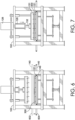
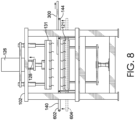
- the hot press 102 is comprised of a frame 110 from which the other components are supported.
- the hot press 102 is comprised of both a top platen 131 and a bottom platen 121.
- One or both of the top platen 131 and the bottom platen 121 adjust positions to converge on one another to generate the pressure used to compress the article for the pressing operation. This adjustment of position is accomplished from an actuator, such as an actuator 126, as will be discussed in greater detail hereinafter.
- a base 112 is joined with the frame 110 to support the bottom platen 121 and the forces transferred therethrough.
- the base 112 extends into a bottom member 114, which may optionally be a load cell.
- the bottom member 114 as a load cell may be omitted in some examples as a top load cell 132 may be solely used. Alternatively, the bottom member 114 as a load cell may be exclusively used and the top load cell 132 may be omitted in some examples.
- a load cell is a mechanism capable of measuring a force (e.g., load) exerted through the load cell.
- a load cell is a transducer that creates an electrical signal whose magnitude is directly proportional to a force being measured.
- Examples of a load cell include, but are not limited to, a hydraulic load cell, a pneumatic load cell, a strain gauge load cell, a piezoelectric load cell, and/or a capacitive load cell.
- a load cell is effective to capture an amount of force being transferred therethrough to an article being pressed.
- the force measured at a load cell may be converted to a pressure experienced by the article based on a distribution area (e.g., platen size) over which the pressure is spread.
- a thickness of the article may change (e.g., reduce) causing a reduced compression on the article between the top platen 131 and the bottom platen 121.
- a load cell is capable of detecting a change in the compression through a deviation in force transferring through the load cell.
- a signal may be communicated from the load cell to the controller 106.
- the controller 106 in response may instruct the actuator 126 to change a position (e.g., lower) of the top platen 131 that increases the force exerted through the load cell as the top platen 131 and the bottom platen 121 compress the article therebetween.
- a single load cell may be implemented, such as the top load cell 132 or the bottom member 114 as load cell.
- two or more load cells may be implemented to measure a force passing therethrough and a resulting compression on the article may be determined.
- the top platen 131 is moveably positioned by an actuator, but other aspects contemplate the bottom platen 121 also (or exclusively) being positioned by an actuator. Therefore, any combination (e.g., number, position, collection) of actuators and/or load cells are contemplated to achieve a closed-loop feedback system for applying a compressive force to an article.
- the bottom member 114 joins with a bottom consolidation plate 116.
- the bottom consolidation plate consolidates forces transmitted through supports 118 from the bottom platen 121.
- supports 118 are rigid members.
- the supports 118 may be positioned at periphery locations of the bottom platen 121 to provide a stable platform.
- the supports 118 transfer a load from the bottom platen 121 to the bottom consolidation plate 116.
- the consolidation plate allows for the collective force transmitted from the supports 118 to be measured by the bottom member 114 as an optional load cell through the consolidation effect provided by the bottom consolidation plate 116.
- the consolidation plate is a rigid material, such as steel, that has minimal deformation and flex that could skew force measurements by the bottom 114 when a load cell in those scenarios where a bottom load cell is implemented.
- the supports 118 extend from the bottom platen 121.
- the bottom platen 121 is comprised of a bottom plate 120, a bottom heating plate 122, and a bottom contacting material 124.
- the bottom plate 120 may be a rigid plate, similar to the bottom consolidation plate 116, and effective to support the bottom heating plate 122 and the bottom contacting material 124 during a compression of the hot press 102.
- the bottom plate 120 may be formed from a metal, such as steel.
- the bottom heating plate 122 is a thermal source.
- the bottom heating plate may be comprised of one or more heating elements.
- a heating element may be effective to convert electrical energy to thermal energy through resistance or induction.
- One or more heating elements may be included in the bottom heating plate 122. It is contemplated that a plurality (i.e., 2 or more) of heating elements may be included in the bottom heating plate 122.
- the plurality of heating elements allows for zonal control of heating in the bottom platen 121.
- the zonal control may be used to maintain an equal temperature across a surface area of the bottom platen 121 or it may be used to provide a differential temperature across a surface area of the bottom platen 121.
- the differential temperature may be leveraged for an article having different thicknesses at different locations and/or for an article constructed from different materials having different deformation temperatures (e.g., melt temperature, state-change temperature, glass-transition temperature, ignition temperature).
- the bottom platen 121 may provide a homogenous temperature across a surface area or it may provide an intentionally varied temperature across a surface area.
- the closed-loop feedback for temperature comprises a thermometer.
- a thermometer is a mechanism for measuring a thermal energy or temperature of a component of the system. Examples of a thermometer contemplated include, but are not limited to, thermocouple, resistance thermometer, thermistor, quart thermometer, infrared thermometer, and/or thermal expansion thermometer.
- the bottom platen 121 is comprised of a thermometer. The thermometer is effective to measure a temperature of the bottom platen 121 at one or more locations. For example, a temperature of the bottom platen 121 at a material contacting surface of the bottom contacting material 124 may be measured to account for thermal loss from the heating elements through the bottom contacting material 124.
- the temperature may be measured at the heating elements or at the bottom heating plate 122.
- a plurality of thermometers may be used in connection with one or more of the zones.
- each heating zone may have a dedicated thermometer allowing for a one-to-one closed-loop feedback between a heating element and a thermometer.
- the bottom contacting material 124 forms a material contacting surface and overlays the bottom heating plate 122 on an opposite side to the material contacting surface.
- the material contacting surface is a surface presented to an article (e.g., a portion of a shoe upper) that is intended to be pressed.
- the bottom contacting material 124 may be a sacrificial, removable, and/or disposable material.
- the bottom contacting material 124 may be removable such that contaminants (e.g., adhesive, deformed material) that could damage or interfere with the processing of future articles could be removed from the press by removing of the bottom contacting material 124 from the press.
- the bottom contacting material 124 is maintained to other portions of the bottom platen 121 through a heat-activated adhesive.
- the heat-activated adhesive may be activated at temperature that is above a traditional temperature of operation for the hot press 102 while pressing an article.
- the heat-activated adhesive joining the bottom contacting material 124 may be activated at temperatures 50 degrees Celsius, 100 degrees Celsius or more above an operating temperature of the hot press 102 when pressing an article.
- the bottom contacting material 124 is a polymeric material.
- the bottom contacting material 124 is formed from polytetrafluoroethylene (PTFE).
- the bottom contacting material 124 is a substantially non-compressible material in a first example.
- the bottom contacting material 124 is a resilient compressible material, such as will be discussed in connection with a top contacting material 138.
- the hot press 102 as depicted in FIG. 1 has a statically positioned bottom platen 121.
- a positionable bottom platen such as through an actuator.
- the ability to position the bottom platen may allow for a removal of one or more moveable elements on the conveyance system that will be discussed hereinafter.
- the hot press 102 is also comprised of the top platen 131.
- the top platen 131 is comprised of a top plate 134, a top heating plate 136, and a top contacting material 138.
- the top contacting material forms a material contacting surface of the top platen 131.
- a material contacting surface is a surface of the platen exposed to and forming a surface for contacting an article to be compressed between the platens.
- the top contacting material 138 may be any material, such as a polymer-based material.
- the top contacting material 138 is a foam material.
- the top contacting material 138 is a silicon-based composition.
- the top contacting material 138 is a silicone-based material, such as a silicone-based foam material.
- the top contacting material 138 may be resilient and compressible.
- the compressibility of the material translates to a conformance to varied thicknesses of the article to be compressed, as seen in FIG. 4 hereinafter.
- the conformability of the top contacting material 138 aids in the effectiveness of the hot press 102 to press the article without unintentionally deforming or otherwise marking the article while still achieving an effective bonding.
- having the top contacting material 138 a conforming material a more uniform pressure may be applied a varied thickness surface as the top contacting material 138 compresses and conforms to areas of greater thickness such that the top contacting material 138 contacts the surface of the article as the article thickness transitions.
- a conforming material allows for more uniform and complete contact and pressure across a varied thickness article than a non-conforming material contacting surface.
- a suitable amount of conformance of the top contacting material 138 is represented through a durometer measure.
- a durometer measure In specific examples that are appropriate for hot pressing of an article for use in an article of footwear and/or an article of apparel, include a Shore 'A' hardness of 0 to 40. Shore 'A' hardness durometer type as provided herein is measured using the ASTM D2240-15e1 standard for the Durometer type 'A'. In a specific example, the durometer of the top contacting material 138 has a Shore 'A' hardness of 10 to 20. These durometer ranges are effective to conform to the article being pressed by the hot press 102 while still effectively transferring the compression force.
- the top contacting material 138 has a thickness of 2 millimeters (mm) to 8 mm. This thickness of the top contacting material 138 allows for sufficient deformation and conformance to the article being pressed. For example, it is contemplated that the top contacting material 138 has a compressed thickness that ranges from 30% to 70% of the uncompressed thickness when an article is being pressed by the hot press 102. This level of compressibility provide sufficient conformance without sacrificing the thermal conductivity of the top platen 131 from the top contacting material 138. As the top contacting material 138 is thicker, additional insulation results from the conveyance of thermal energy from the top heating plate 136 towards the article being pressed.
- the thermal insulating aspect of the top contacting material 138 is intentional.
- an intended temperature differential between the top platen 131 and the bottom platen 121 is provided.
- the temperature differential may be achieved through varied outputs of thermal energy from the respective heating plates.
- the temperature differential is achieved through an insulation attribute of the top contacting material 138 relative to the bottom contacting material 124.
- the top contacting material 138 is less thermally conductive than the bottom contacting material 124, in an example. This lower thermal conductivity allows for a thermal difference to be maintained between the material contacting surfaces of the top platen 131 and the bottom platen 121.
- a temperature differential between the top platen 131 and the bottom platen 121 is advantageous in aspects.
- the article may be positioned in the hot press 102 such that materials having a lower temperature tolerance (e.g., lower deformation temperature, lower melt temperature, lower deterioration temperature) are oriented toward the top contacting material 138 than material in closer proximity to the bottom contacting material 124.
- a shoe upper component having an exterior surface of the to-be-formed shoe may be formed from an aesthetically pleasing material (e.g., cosmetic material) that is more susceptible to damage or defects caused by heat than a more interior material of the to-be-formed shoe, such as an intermediate material or a shoe liner material.
- the top platen material contacting surface is 5 degrees Celsius to 15 degrees Celsius less than the bottom platen material contacting surface.
- the top platen material contacting surface and the bottom platen material contacting surface are both at a temperature above a temperature at which an adhesive layer of the to-be-pressed article bonds with another material (e.g., a melting temperature). It is contemplated that the bottom platen material contacting surface is maintained below a deformation temperature (e.g., melt temperature, deterioration temperature, glass transition temperature) of the portion of the article in contact with the bottom platen material contacting surface.
- a deformation temperature e.g., melt temperature, deterioration temperature, glass transition temperature
- the top heating plate 136 is similar to the bottom heating plate 122, in an example.
- the top heating plate 136 includes one or more heating elements.
- the heating elements are effective to generate thermal energy in the form of heat that is effective to raise a temperature of an article being pressed by the hot press 102.
- the heating elements are controllable through the closed-loop feedback system in a manner similar to that described with respect to the bottom platen 121.
- one or more thermometers may monitor and provide feedback to a controller to adjust a temperature of the top heating plate 136.
- two or more heating zones may exist in the top heating plate 136 that are individually or uniformly controlled.
- a consistent temperature is maintained at the material contacting surfaces of the platens.
- a consistent temperature for purposes of the present disclosure is in a range of plus or minus 0.025 degrees Celsius.
- This level of consistency is achieved by having the closed-loop feedback system of a thermometer monitoring the temperatures and a controller controlling the heating elements in response to the measured temperature(s).
- This level of consistency allows for temperature closer to deformation temperature or critical temperatures of the article to be used without causing a deformation or deterioration of the article materials as the temperature is controlled within a tight temperature range.
- An ability to operate with this level of consistency near the critical temperatures of the material allows the system to operate with faster cycle times that increase the throughput of the system.
- Systems not having a closed-loop feedback system may instead only maintain a temperature that is within a range of target that is plus or minus 3 degrees C, which is insufficient for aspects contemplated herein.
- the top plate 134 provides a rigid structure for transferring the force applied through the actuator 126 to the article being pressed without excessive flexing or deformation. This rigidity may be achieved with a metallic material, such as steel.
- the top plate 134 serves as a connection of the top platen 131 with the force generation of the actuator 126.
- the top plate 134 also may serve as a connection for one or more stabilizers.
- the stabilizers aid in maintaining a parallel travel of the top platen 131 through stages of compression.
- the stabilizers are depicted as rod-like elements extending from the top plate 134 through the frame 110 that provide parallel travel of the stabilizers, which translates to a parallel positioning of the top platen 131 as it moves through a range of vertical positions.
- the stabilizers aid in ensuring a consistent application of force across the article being pressed even when the article has varied thicknesses or is oriented in an offset manner to the top platen 131.
- the stabilizers are referred to a linear bearings.
- a load cell 132 is depicted as extending between the top platen 131 and a consolidation plate 130 that is joined with a piston 128 (or pistons) of the actuator 126.
- the load cell 132 is similar to the load cell previously discussed.
- the load cell 132 is effective to measure an amount of force transferred from the actuator 126 to the top platen 131.
- the consolidation plate 130 is optional in some examples. However, in the configuration of FIG. 1 , the actuator 126 has more than one piston 128 and therefore the consolidation plate 130 is effective to consolidate the forces of the various pistons to be measured by a common load cell.
- the actuator may have a single piston applying a force. In a single piston example, the load cell may be positioned in line with the piston and the top platen 131 without the consolidation plate 130, for example.
- the actuator 126 is capable of generating a linear movement that is converted into a force for compression.
- the actuator 126 may be hydraulic, pneumatic, or mechanical actuator.
- the actuator 126 is a screw actuator that converts a rotational force to a linear force through a screw mechanism.
- the screw actuator may be a standard planetary roller screws, inverted roller screws, ball screws, and the like.
- a screw actuator is used having a high tolerance nut assembly that allows for a reduced backlash due to the high precision between the screw and nut mating.
- one or the screw or the nut (or both) are coated in a friction reducing materials, such as PTFE.
- a lower backlash from the high precision mating of the screw and nut provides for greater control of the force applied by the actuator to the top platen 131. For example, if there is rotational movement of the screw (or the nut) by a servo motor before the screw engages with the nut because of low tolerances, the rotational energy is not converted into linear movement that affects the amount of pressure applied. Similarly, if after applying rotational energy a low tolerance between the screw and the nut allows for a change in near position with affecting the rotational position of the screw (or nut). As such, when achieving a consistent pressure through a closed-loop feedback system of a controller and a load cell, minimizing of backlash of the actuator additionally allows for greater consistency of the force.
- Multiple pistons 128 may be used in connection with the actuator 126.
- the multiple pistons aids in a reduction in backlash in one example, allows for greater control over linear motion as the piston diameters may be smaller while achieving a similar force than when done with a single piston.
- the hot press 102 is effective to compress an article with a force up to 15 pounds per square inch (psi).
- the press operates in a pressure range of 6-10 psi. At this range, an effective compression of an article of footwear or an article of apparel may be bonded without over compressing that may cause bleeding or other defects resulting from over compression.
- the closed-loop feedback system including the load cell 132 and the controller 106 in connection with the actuator 126 allows for a force tolerance range of plus or minus 0.025 psi, in an example. As with the temperature tolerance range, a consistent pressure allows the system to operate at maximum pressures without causing defects, which increases the system throughput.
- the closed-loop feedback system of the force generation able to maintain a plus/minus pressure range of 0.025 psi is advantageous to the system.
- the press operates at 8 psi or less with a compression of the top contacting material 138 of 2-3 mm while having a durometer of Shore 'A' type 12-18 range. With this configuration an effective bond between an article without causing bleeding is achieved in an example.
- the hot press 102 is also comprised of a conveyance system effective to convey and position an article within the system 100.
- the conveyance system and the article in an example, are configured to use a frame for conveying and positioning the article.
- the conveyance system includes a conveyor 140 having a first end 142 and a second end 144 with a material flow direction traditionally extending from the first end 142 to the second end 144.
- the conveyance system is configured to adjust vertically relative to the bottom platen 121 by motion of actuators 146. The vertical positioning allows the article to be placed on and supported, at least in part, by the bottom platen 121 for effective pressing by the system. Additional details of the conveyance system will be provided in connection with FIGs. 2 and 6-8 hereinafter.
- the system 100 is depicted as including the cold press 104 in a material flow downstream position from the hot press 102.
- a hot press is a press effective to transfer thermal energy to the article being pressed.
- a cold press is a press that is not actively adding thermal energy to the article being pressed, but it provides a compression force.
- the difference between the hot press 102 and the cold press 104 is an active heating element. Therefore, a hot press may be considered a cold press when heating elements, such as the top heating plate 136 and the bottom heating plate 122, are not activated.
- a cold press may be similar in structure and design to a hot press with the heating elements, such as the heating plates, omitted altogether, as is shown in the cold press 104.
- the cold press 104 includes similar components as previously discussed in connection with the hot press 102, but labeled with a "b" for differentiation purposes. Absent from the cold press 104 relative to the hot press 102 is a top heating plate and a bottom heating plate. As the cold press 104 is intended to provide a compressive force on the article while one or more thermally-activated adhesive cool, heating elements are not included in the cold press. Also absent are the associated thermometers of the temperature regulating closed-feedback loop system of the hot press 102. In this example, the cold press operates at ambient temperature, which may be at least 80 degrees C less than the top platen.
- the cold press 104 is formed from components as similarly discussed in connection with the hot press 102.
- the cold press 104 is comprised of a base 112b, a bottom member 114b, a bottom consolidation plate 116b, support 118b, a bottom platen 152, a bottom plate 158, a bottom contacting material 160, a top platen 150, a top contacting material 156, a top plate 154, a load cell 132b, a top consolidating plate 130b, pistons 128b, and actuator 126b, and a conveyor140b having a first end 142b and a second end 144b.
- the top platen 150 and the bottom platen 152 of the cold press 104 are similar to the top platen 131 and the bottom platen 121 of the hot press 102 except for the omission of the hot plates and associated components, such as thermometers.
- the bottom plate 158 is similar to the bottom plate 120 in function and material.
- the bottom contacting material 160 and the bottom contacting material 124 are similar in function and material.
- the top contacting material 156 and the top contacting material are similar in function and material.
- the top plate 154 and the top plate 134 are similar in function and material. However, it is contemplated that dimensions, size, material, and connections may be altered between the hot press configuration and the cold press configuration.
- the controller 106 and the logical couplings 108 are depicted as connecting the hot press 102 and the cold press 104. It is depicted in this manner for illustration purposes, but it is understood that the couplings could be wireless or in other configurations. Further, while a single controller 106 is depicted, it is contemplated that any number of controllers logically coupled or not logically coupled may also be included.
- the controller 106 includes a computing processor and memory that are effective to receive inputs from one or more components and to send instructions to one or more components. For example, the controller 106 receives measurements from the load cell 132 and directs the actuator 126 to adjust a position of the top platen 131 and therefore pressure exerted by the top platen 131 according to a recipe for the article.
- a graphical representation of a recipe will be depicted in FIG. 9 hereinafter.
- Another example of an implementation of the controller 106 is receiving one or more measurements from a thermometer and then instructing one or more heating elements, such as heating elements of the top heating plate 136 and the bottom heating plate 122 to adjust accordingly to maintain a temperature as prescribed by the recipe.
- the controller 106 is also effective to control the conveyance mechanisms for conveying and positioning the article.
- the conveyance mechanism may start and stop at various locations in response to a detected or known location of the article, as controlled by the controller 106.
- the conveyance mechanism may adjust a vertical position of the article in response to a processing step sequence or a position of the article, as controlled by the controller 106 instructing one or more actuators, such as the actuators 146.
- the logical coupling 108 is connection for communicating information.
- the logical coupling may be wired or wireless.
- a wired logical coupling may be any communication format, such as a local area network.
- a wireless logical coupling may implement any communication protocol, such as those commonly used over Wi-Fi, Bluetooth, and the like. As such, it is contemplated that any communication standards may be used in connection with the logical couplings that connect, logically, one component with another component in the system.
- FIG. 2 depicts a plan view of a conveyance portion of the system 100 from FIG. 1 , in accordance with aspects hereof.
- the first conveyor having the first end 142 and the second end 144 is comprised of a first track 202 and a second track 204.
- a track is a belt, chain, mesh, links, or other surface that is effective to move an article through a press.
- the first track 202 and the second track 204 are contemplated to operate in unison such that as one track conveys, the second track similarly conveys. This may be accomplished through a common drive motor, such as a servo or other stepper motor configuration whose drive force is distributed to both the first track 202 and the second track 204.
- first drive sources such as a separate servos or stepper motors may independently drive each track, but their movements may be coordinated.
- the coordinated movement of the first track 202 and the second track 204 allows for the parallel movement of the article relative to the platens, as represented by the bottom contacting material 124.
- the first track 202 and the second track 204 are associated with the hot press from FIG. 1 .
- a first track 202b and a second track 204b are associated with the cold press of FIG. 1 .
- the first track 202 and the first track 202b are linearly aligned in the depicted example to serve as a substantially continuous movement mechanism.
- the second track 204 and the second track 204b are linearly aligned in the depicted example to serve as a substantially continuous movement mechanism.
- the track associated with a first press and the track associated with a second press are separate tracks, in an example, to allow independent vertical movement of the track in connection with the individual presses, as will be discussed in connections with FIGs. 6-8 .
- first track 202 and the second track 204 may be in a lowered configuration allowing an article to be pressed on the bottom contacting material 124 while the first track 202b and the second track 204b are in a raised configuration in preparation for receiving the article from the first track 202 and the second track 204 after the pressing operation.
- the first track 202 and the second track 204 are spaced apart a width 206.
- the platens that the conveyance mechanisms convey over have a width 208.
- the width 206 is greater than the width 208 to allow the conveyance mechanism to raise and lower above and below the platens to position an article for pressing.
- the first track 202 and the second track 204 have a length in the material flow direction between the first end 142 and the second end 144 that is greater than a length of the platen having a length 210. This greater length of the conveyance mechanism allows for the conveyance and positioning of the article into, through and out of the press without interference with the platen.
- FIG. 3 depicts an example of a frame assembly 300 having an article as a shoe upper 305, in accordance with aspects hereof.
- the frame assembly 300 is effective to be conveyed through a press by a conveyance system, such as the first track 202 and the second track 204 of FIG. 2 . Further, the frame assembly 300 is effective to aid in positioning and maintaining the article at a platen for pressing and the automated movement of the article into the press, through the press, and out of the press.
- the frame assembly 300 is comprised of a frame 302 formed from a plurality of frame members 314, 316, 318, and 320.
- the frame members may be portions of a continuous (i.e., monolithic) material or they may be discreet members that are joined together to form the frame 302.
- the frame 302 may be formed from any material, such as a polymer composition or a metallic composition.
- the frame 302 may be rigid and able to withstand a plurality of duty cycles for different articles.
- the size of the frame 302 is correlated with the size of the platens and the conveyance system of FIGs. 1 and 2 , in an example.
- the frame 302 has an outside width 322 and an inside width 326.
- the frame 302 has an inside length of 323 and an outside length 324.
- the inside width 326 and the inside length 323 are contemplated as being greater than the platen width and length, respectively.
- the frame 302 is sized such that a platen may extend into an interior space of the frame such that the frame does not interfere with a pressing of an article between two platens while the article is associated with the frame.
- the outside width 322 is sized such that the frame 302 is supported by the conveyance system as depicted in FIG. 2 .
- the outside width 322 is similar to the conveyor width 206 of FIG. 2 .
- the frame assembly in an aspect, includes a foundation material 304.
- the foundation material 304 may be part of the frame assembly 300 independent of the article to be pressed.
- the foundation material 304 is present with the frame when the article is maintained with the frame.
- the foundation material 304 may either be part of the frame independent of the article or the foundation material 304 may be part of the article to be pressed and associated with the frame only when using the frame to convey the article.
- the foundation material 304 may be any materials, such as a textile, a film, a sheet, or the like.
- the foundation material is a non-woven textile formed from a material having a higher deformation temperature (e.g., melt temperature) than an operating temperature of a hot press and/or the material of the article to be thermally activated by the hot press.
- the foundation material 304 provides a surface onto which the article is supported and maintained during transportation through one or more presses.
- the foundation material 304 provides a surface to which the article is temporarily or permanently secured to maintain a consistent position relative to the frame 302 during transit and/or pressing operations.
- the article is depicted as an upper 305.
- An upper is the portion of an article of footwear (e.g., a shoe) effective to secure a wearer's foot to a sole of the article of footwear.
- the uppers is a textile, polymer film, leather or other traditional materials that extend above a sole portion of the footwear.
- the upper 305 may be formed from any material.
- the upper 305 may be a textile in the form of a woven, braided, non-woven, or knit material.
- the upper 305 may be formed from any material composition.
- the material compositions include, but are not limited to, polymer materials (e.g., nylon, polyester), organic materials (e.g., cotton, wool), leather, and the like.
- the upper 305 may be formed from a variety of materials at different locations.
- the upper 305 may be permanently secured with the foundation material 304, temporarily secured with the foundation material 304, or not secured with the foundation material 304. It is contemplate that the entirety of the article to be pressed is maintained within the frame 302 in an example. Alternatively, it is contemplated that less than a whole of the article to be pressed is maintained within the frame 302, but the portion maintained within the frame is a portion to be pressed.
- the article is contemplated as comprising a plurality of material layers that are to be joined through a pressing activity.
- the article is the upper 305 formed from a base material 306 having a plurality of overlays. Any number of overlays in any shape, size, orientation, and/or location are contemplated.
- the overlay may be a similar material to the underlying material or it may be a different material to the underlying material.
- the overlay may be formed from a polymeric composition, an organic composition, and/or a metallic composition.
- the overlay may be aesthetic and/or functional (e.g., cushioning, rigidity, tension transferring, stiffening).
- the overlay may be intended to be bonded to another material or the overlay may be intended to integrate Further, as will be shown in FIGs.
- an adhesive may be present between one or more layers of the article. It is this adhesive that may be activated to join the materials in the presence of heat and/or pressure from a pressing operation.
- a first overlay 308, a second overlay 310, and a third overlay 312 are depicted.
- FIG. 4 depicts a cross sectional view of the frame assembly 300 from FIG. 3 along a cut line A-A, in accordance with aspects hereof.
- the frame is depicted as having a top frame portion and a bottom frame portion.
- the members 316 and 318 form a portion of the top frame.
- the two-part frame is option.
- a two-part frame as depicted in FIG. 4 provides an example of securing the foundation material 304 with the frame through a compression between the top frame and the bottom frame, as depicted in FIG. 4 .
- the frame does not have separate top and bottom portions and the foundation material, when used, is secured my other means, such a hooks, snaps, adhesive, and/or other compression arrangements (e.g., channel and fill).
- the foundation material 304 is depicted as being maintained in a taut configuration within the frame such that the foundation material 304 supports the article (i.e., upper 305).
- the upper 305 has a first collection of overlays positioned on the base material 306. This first collection is depicted as including the first overlay 308 and the second overlay 310.
- additional layers of bonding material such as a thermally-activated adhesive, are positioned between the base material 306, the first overlay 308 and the second overlay 310.
- a bonding material may also be referred to as an adhesive material herein.
- a bonding material is a material effective to bond a first material with a second material.
- the bonding material may be activated by heat and/or pressure in an example. Therefore, in response to heat and pressure from a hot press, the bonding material is effective to bond one or more materials together.
- Examples of a bonding material include, but are not limited to, a polymeric material having a deformation temperature (e.g., melting temperature) that is able to be obtained within a heat press.
- the deformation temperature of the bonding material is less than a deformation temperature of the materials to be bonded by the bonding material in an example. This difference in deformation temperatures between the to-be-bonded materials and the bonding material allows for the to-be-bonded materials to be bonded without unintentionally deforming.
- the bonding material may be referred to as a "hot-melt adhesive.”
- a hot-melt adhesive is a polymeric composition that changes from a firsts ate (e.g., sheet-like configuration in a solid state) to a more viscous fluid-like state in the presence of thermal energy. Stated differently, the polymeric composition melts or otherwise changes to a more fluid state in response to a pressing operation contemplated herein. Following the pressing operation or following a portion of the pressing operation (e.g., removal of excess thermal energy), the polymeric composition solidifies and captures or adheres to portions of the to-be-bonded material.
- the bonding material is elevated to a temperature of 117-130 degrees C for at least 10 seconds to achieve a suitable bond for the upper 305 to be effective as an article of footwear.
- This temperature of the bonding material may be in contrast to a deformation temperature of the base material 306 that deforms at around 185 degrees C. Therefore, it is desirable in an example, to keep the material contacting surfaces of the platens below the deformation temperature of the base material, but above the target temperature for the bonding material (e.g., above 117 degrees C).
- FIG. 4 illustrates a thickness difference across the upper 305 resulting from the various overlay stacks.
- the first overlay stack comprised of the first overlay 308 and the second overlay 310 shows a stepped thickness difference created by the different shape/size/orientations of the stacked overlays.
- the conformance allows the press to conform to the stepped thickness to uniformly apply pressure to the article as a whole even with a greater thickness caused by the overlay s tack in a specific location of the article. But for the conformance, the pressure applied by the press would be concentrated at the greatest thickness location of the article and would therefore potentially overly compress that portion of the article without sufficiently compressing other portions of the article having less thickness.
- the conformance allows for effective conduction of thermal energy from the platen through contact between the conforming material and the less thick portions of the article. Therefore, the conforming quality of the material of the platen can aid in apply a more uniform pressure and temperature, which can limit bleeding and other defects when pressing an article having variable thicknesses.
- FIG. 5 depicts a magnified portion of FIG. 4 , in accordance with aspects hereof.
- the bonding material 328 and 330 may be the same bonding material or it may be a different bonding material.
- the bonding material may be different based on the material to be bonded (e.g., compatibility of materials to be bonded).
- the bonding material may be different such that they activate in response to different conditions, such as different deformation temperatures.
- the bonding material 330 may have a higher melting temperature of the bonding material 328 as a result of a bottom platen operating at a higher temperature than the top platen and therefore different temperatures are achieved throughout the thickness of the article.
- the bonding material may be the same for the bonding material 328 and the bonding material 330, such that a uniform temperature or narrow temperature range is targeted through a thickness of the article.
- FIG. 5 illustrates an absence of a bonding material between the base material 306 and the foundation material 304.
- the article is not secured to the foundation material.
- alternative examples contemplate the article being adhered or otherwise bonded with the foundation material to ensure a consistent position of the article during conveyance and pressing. It is contemplated that any combination of materials (e.g., overlays, bonding materials) may be used at any location in any number.
- FIG. 6 depicts the hot press 102 from FIG. 1 in a first configuration, in accordance with exemplary aspects hereof.
- the first configuration includes the conveyor lowered by the actuators 146 from a first position 602 to a second position 604.
- the lowering of the conveyor 140 allows the frame assembly 300 to be positioned relative to the bottom platen 121.
- the positioning of the frame assembly 300 may include supporting the frame assembly 300 by the bottom platen 121, as is depicted in FIG. 6 .
- the foundation material or article are resting on and supported directly by the contacting surface of the bottom platen 121 such that during a pressing operation the frame assembly does not interfere with a positioning change of one or more of the platens.
- the conveyor 140 lowers to a position such that the bottom platen 121 may contact the article or the foundation material of the frame assembly 300, but the frame is still in contact with the conveyor 140.
- the conveyor 140 supports the weight of the frame (e.g., frame members 314, 316, 318, and 320 of FIG. 3 ), while the article may be supported or contacting the bottom platen 121.
- thermal energy is also depicted in FIG. 6 .
- this thermal energy in connection with a compression allows for a bonding to occur between materials forming the article being pressed.
- FIG. 7 depicts the hot press 102 of FIG. 6 in a second configuration, in accordance with aspects hereof.
- a position of the top platen 131 is adjusted to create a compression of the article between the bottom platen 121 and the top platen 131.
- the position of the top platen 131 is changed by the actuator 126 causing an extension of the pistons 128 that moves the top platen into a pressure-generating positions to compress the article associated with the frame assembly 300.
- the amount of positional change created by the actuator 126 is adjusted, in part, by the force measured by the load cell 132. As previously discussed, the force created by the actuator may be determined from a recipe or program for the given article.
- Measuring of the force generated by the load cell 132 as part of a closed-loop feedback system allows for the relative position of the top platen 131 to be adjusted to achieve a desired force.
- An amount of time that the hot press 102 maintains this configuration may vary.
- the hot press 102 maintains this configuration for 15 to 45 second when pressing a shoe upper.
- variations in pressure may occur during this configuration to have an initial accelerated heating through higher pressure and then a reduced pressure portion as the materials approach a target temperature.
- FIG. 8 depicts the hot press 102 of FIG. 7 in a third configuration, in accordance with aspects hereof.
- the conveyor 140 returns to the first position 602 from the second position 604, which elevates the frame assembly 300 from the bottom platen 121 such that the frame assembly 300 may be conveyed out of the hot press 102 by the conveyor 140.
- the top platen 131 is raised in position by the actuator 126 retracting the pistons (e.g., screws in an actuator or members extending from a screw). The retraction of the top platen 131 further clears a pathway for the conveyance of the frame assembly 300 out of the hot press 102.
- FIGs. 6-8 depict an example series of steps, it is contemplated that additional steps could be depicted.
- variations in pressure applied during a pressing operation could be depicted with slight, if not noticeable by human perception, position changes of the top platen 131.
- the conveyor 140 may be positioned at different locations, depending on the amount of support the conveyor 140 is to provide the frame or frame assembly 300 during various stages of the pressing operation.
- FIG. 9 depicts a process chart 900 for an example pressing operation, in accordance with aspects hereof.
- the chart includes a vertical axis 902 on a left side representing an amount of pressure applied.
- the chart includes a vertical axis on a right side representing a temperature variable.
- the chart includes a horizontal axis on a bottom representing a time variable.
- the pressure axis 902 has a higher pressure 908 at the top and a lower pressure 910 at the bottom.
- the temperature axis 906 has a higher temperature 918 at the top and a lower temperature 916 at the bottom.
- the time axis has an earlier point 912 and a later point 914.
- a line 920 represents a temperature of a bottom platen over time.
- a line 922 represents a temperature of a top platen over time.
- a line 924 represent a pressure experienced between the top platen and the bottom platen over time.
- a line 926 represent a temperature over time of a bottom material (e.g., base material 306 of FIG. 4 ) forming the article being pressed.
- a line 928 represent a temperature over time of a top material (e.g., second overlay 310 of FIG. 4 ) forming the article being pressed.
- a line 930 represent a point in time associated with a position change of a top platen that causes a reduction in pressure experienced by the pressed article.
- the line 924 demonstrates a multi-phased pressured application during the pressing operation.
- a pressure experienced by an article at the beginning of the operation is at a level represented by number 932.
- the pressure is reduced to a level represented by a number 934.
- This second pressure may be accomplished through a movement of one or more platens. The movement may not be measurable, but a position change of an actuator causes a position change as measured by a change in pressure experienced by the article.
- the pressure may be reduced to a third pressure 936 at a future time in the pressing operation. Any number of pressure variations may occur over a pressing operation. In an example for an article of footwear, the pressure is changed 1-3 times during a pressing operation.
- This temperature may be maintained for at least 10 seconds, in an example, to ensure sufficient state change of a bonding material occur, to ensure sufficient bonding occurs, and/or to ensure a uniform temperature is achieved. It is contemplated that the bottom material and the top material may not converge on a common temperature in an example. It is contemplated that the top material and the bottom material may follow a similar temperature line throughout the pressing operation in another example.
- FIG. 10 depicts a method as a diagram 1000 for pressing an article, in accordance with aspects hereof.
- the method includes a block 1002 representing a compression of an article at a first force or pressure.
- force is used in an example as the amount of force applied by the actuator to the top platen may be measured as a force by the load cell as opposed to as a pressure.
- the top platen has a set size in an example and therefore the pressure resulting from the force is able to be calculated. Therefore, for purposes of the present application, the term force when describing amount of compression applied is synonymous with an amount of pressure.
- the top platen and or the bottom platen may have a temperature that is above ambient conditions.
- the platen or platens are not heated.
- the material contacting surface of each platen may have a temperature differential relative to the other platen.
- the temperature differential may be a result of different thermal characteristics of the platens, such as a thermal insulation or thermal conduction different between the contacting materials of each platen.
- the top plate includes a silicon foam material as a contacting material that is less thermally conductive of heat generated by the top platen as compared to a contacting material associated with the bottom platen.
- the top platen may generate less thermal energy than the top platen (e.g., set to achieve a lower elevated temperature from ambient as compared to the top platen). Combinations of the characteristics of the contacting material and the setting of the thermal energy generation may be used to achieve a temperature differential between the top platen material contacting surface and the bottom platen material contacting surface.
- the temperature differential between the two surfaces may be 1-20 degrees C, 5-15 degrees C, and/or 8-12 degrees C, in examples.
- the method of FIG. 10 provides for maintaining the article in compression at the force established at the block 1002 for a first period of time.
- This compression force is measured during the first period of time continuously, in an example, by a load cell.
- the force is maintained by adjusting a position of the actuator and as a result one or more platens to ensure the force is consistently applied during the first period.
- An example as to why the force may change during the first period of time is because of a state change of one or more material of the article under compression.
- a bonding material that is intended to have a state change (e.g., deform, melt, viscosity change) under pressure and/or heat may undergo that state change during the first time period.
- the thickness of the article may diminish as the bonding material is deformed and absorbed, transferred, or integrated into the other materials of the article. This deformation redistributes the volume of material previously consumed by the bonding material such that a thickness of the article may change. As the thickness changes between the top platen and the bottom platen during the first time, a distance between the top platen and the bottom platen may need to be adjusted to maintain a consistent force.
- the force that is maintained for the first period of time may be expressed as a pressure for a specific top platen and a bottom platen.
- the force therefore may be in a range of 6-10 psi for a given platen size, such as a 32 inch by 19 inch platen.
- the force may also be in a range of 4-15 psi as measured between the top platen and the bottom platen with a non-compressible (e.g., nickel plated steel that may for plates of the platens) surface.
- the force may also be in a range of 3,000 pounds to 9,000 pounds as measured at the load cell from the actuator, in an example.
- the force is maintained within the prescribed force by a range of plus/minus 0.025 psi through a continuous or frequent automated monitoring of the force/pressure and then adjustment by the actuator to maintain the prescribed pressure.
- the force applied to the platens producing the compressive force is reduced after the first time period.
- the first time period may be any length of time, such as 5 second, 10 seconds, 15 seconds, 20 second, 30 seconds, or anything therebetween.
- the first timer period at the first force allows for an accelerated heating of the article to bring the article closer to an activation temperature for one or more bonding materials.
- the reduction in compression after this first time period limits bleeding of the bonding material from the article edges (e.g., prevents the bonding material from extending beyond a perimeter of an overlay onto an underlying material, such as a base material).
- the reduction in pressure can reduce or prevent a deformation of a material forming the article, such as a cosmetic material forming an exposed surface of the article.
- the second force is maintained for a second period of time.
- This second period of time may be any length of time, such as 5 second, 10 seconds, 15 seconds, 20 second, 30 seconds, or anything therebetween.
- the second force is less than the first force.
- the second force may be 10%, 15%, 20%, 25%, 30%, 40%, 45%, 50%, 55%, 60%, 70%, 75%, or anything therebetween reduction in force from the first compressive force.
- the system continuously or frequently measures the force applied during the second time period and adjusts the actuator to maintain the force in an automated manner during the second period.
- any number of phases may be implemented in connection with aspects hereof. As more layers are combined to form the article to be pressed, the more phases may be implemented. For example, if there are two material layers with one bonding layer therebetween, 1-2 phases may be leveraged. If there are three layers with a different bonding layer between each, 2-3 phases may be leveraged. If there are four layer or more, some aspects contemplated 3 phases may be leveraged. Additional variables include a thickness of each material, a composition of each material, a bonding material composition, a deformation or critical temperature for each of the materials to be bonded, and any combination thereof are all contemplated.
- substance or substantially means at least 80 percent, 85 percent, 90 percent, 95 percent, or more, as determined based on weight, volume, or unit.
- first, second, third, etc. can be used herein to describe various elements, components, regions, layers and/or sections. These elements, components, regions, layers and/or sections should not be limited by these terms. These terms can be only used to distinguish one element, component, region, layer or section from another region, layer or section. Terms such as “first,” “second,” and other numerical terms do not imply a sequence or order unless clearly indicated by the context. Thus, a first element, component, region, layer or section discussed below could be termed a second element, component, region, layer or section without departing from the teachings of the example configurations.
- receiving such as for “receiving an upper for an article of footwear”, when recited in the claims, is not intended to require any particular delivery or receipt of the received item. Rather, the term “receiving” is merely used to recite items that will be referred to in subsequent elements of the claim(s), for purposes of clarity and ease of readability.
- ratios, concentrations, amounts, and other numerical data can be expressed herein in a range format. Where the stated range includes one or both of the limits, ranges excluding either or both of those included limits are also included in the disclosure, e.g. the phrase "x to y" includes the range from ⁇ x' to ⁇ y' as well as the range greater than 'x' and less than ⁇ y'. The range can also be expressed as an upper limit, e.g.
- 'about x, y, z, or less' should be interpreted to include the specific ranges of 'about x', 'about y', and 'about z' as well as the ranges of 'less than x', less than y', and 'less than z'.
- the phrase 'about x, y, z, or greater' should be interpreted to include the specific ranges of 'about x', 'about y', and 'about z' as well as the ranges of 'greater than x', greater than y', and 'greater than z'.
- a numerical range of "about 0.1% to 5%” should be interpreted to include not only the explicitly recited values of about 0.1percent to about 5 percent, but also include individual values (e.g., 1 percent, 2 percent, 3 percent, and 4 percent) and the sub-ranges (e.g., 0.5 percent, 1.1 percent, 2.4 percent, 3.2 percent, and 4.4 percent) within the indicated range.
- the terms "optional” or “optionally” means that the subsequently described component, event or circumstance can or cannot occur, and that the description includes instances where said component, event or circumstance occurs and instances where it does not.
- temperatures referred to herein are based on atmospheric pressure (i.e. one atmosphere).
- an exemplary clause 4 may indicate the method/apparatus of any of clauses 1 through 3, which is intended to be interpreted such that features of clause 1 and clause 4 may be combined, elements of clause 2 and clause 4 may be combined, elements of clause 3 and 4 may be combined, elements of clauses 1, 2, and 4 may be combined, elements of clauses 2, 3, and 4 may be combined, elements of clauses 1, 2, 3, and 4 may be combined, and/or other variations.
- the terminology “any of clauses” or similar variations of said terminology is intended to include “any one of clauses” or other variations of such terminology, as indicated by some of the examples provided above.
Landscapes
- Engineering & Computer Science (AREA)
- Mechanical Engineering (AREA)
- Textile Engineering (AREA)
- Ceramic Engineering (AREA)
- Physics & Mathematics (AREA)
- Fluid Mechanics (AREA)
- Manufacturing & Machinery (AREA)
- Casting Or Compression Moulding Of Plastics Or The Like (AREA)
- Control Of Presses (AREA)
- Press Drives And Press Lines (AREA)
Applications Claiming Priority (4)
| Application Number | Priority Date | Filing Date | Title |
|---|---|---|---|
| US201962821271P | 2019-03-20 | 2019-03-20 | |
| US16/820,990 US11524495B2 (en) | 2019-03-20 | 2020-03-17 | Closed loop feedback press |
| EP20723594.6A EP3941746B1 (de) | 2019-03-20 | 2020-03-18 | Presse mit geschlossenem regelkreis |
| PCT/US2020/023424 WO2020191094A1 (en) | 2019-03-20 | 2020-03-18 | Closed loop feedback press |
Related Parent Applications (2)
| Application Number | Title | Priority Date | Filing Date |
|---|---|---|---|
| EP20723594.6A Division EP3941746B1 (de) | 2019-03-20 | 2020-03-18 | Presse mit geschlossenem regelkreis |
| EP20723594.6A Division-Into EP3941746B1 (de) | 2019-03-20 | 2020-03-18 | Presse mit geschlossenem regelkreis |
Publications (2)
| Publication Number | Publication Date |
|---|---|
| EP4520520A2 true EP4520520A2 (de) | 2025-03-12 |
| EP4520520A3 EP4520520A3 (de) | 2025-05-21 |
Family
ID=72513562
Family Applications (2)
| Application Number | Title | Priority Date | Filing Date |
|---|---|---|---|
| EP20723594.6A Active EP3941746B1 (de) | 2019-03-20 | 2020-03-18 | Presse mit geschlossenem regelkreis |
| EP25152148.0A Pending EP4520520A3 (de) | 2019-03-20 | 2020-03-18 | Rückkopplungspresse mit geschlossenem regelkreis |
Family Applications Before (1)
| Application Number | Title | Priority Date | Filing Date |
|---|---|---|---|
| EP20723594.6A Active EP3941746B1 (de) | 2019-03-20 | 2020-03-18 | Presse mit geschlossenem regelkreis |
Country Status (4)
| Country | Link |
|---|---|
| US (2) | US11524495B2 (de) |
| EP (2) | EP3941746B1 (de) |
| CN (2) | CN118927768A (de) |
| WO (1) | WO2020191094A1 (de) |
Families Citing this family (13)
| Publication number | Priority date | Publication date | Assignee | Title |
|---|---|---|---|---|
| US11524495B2 (en) * | 2019-03-20 | 2022-12-13 | Nike, Inc. | Closed loop feedback press |
| CA3160612C (en) * | 2019-12-04 | 2024-04-16 | West Liberty Foods, L.L.C. | Automated food preparation and packaging systems, methods, and apparatus |
| CN122253480A (zh) * | 2021-01-27 | 2026-06-23 | 克里卡特股份有限公司 | 热压机以及用于热压机的方法 |
| US11919270B2 (en) * | 2021-07-07 | 2024-03-05 | Brown Llc | Methods and systems for producing pressware |
| US12269234B2 (en) | 2021-07-07 | 2025-04-08 | Brown Llc | Methods and systems for producing pressware |
| CN114670387B (zh) * | 2022-03-03 | 2023-10-20 | 晋江市火炬油压机械有限公司 | 一种双层多色自动橡胶鞋底成型机组及其成型工艺 |
| BE1030539B1 (nl) * | 2022-05-18 | 2023-12-19 | Vaneflon Nv | Werkwijze voor het persen van een fluorpolymeer en/of polyether ether keton product |
| US12214579B2 (en) * | 2022-09-21 | 2025-02-04 | Intel Corporation | Dry film lamination with dynamic feedback control |
| CN115648196B (zh) * | 2022-10-26 | 2024-07-23 | 清华大学 | 气动供压系统及其驱动方法、软体机器人 |
| CN115891019B (zh) * | 2022-11-08 | 2026-06-30 | 延锋海纳川汽车饰件系统有限公司 | 一种模具用的无级可调拉紧系统 |
| CN115847991A (zh) * | 2022-12-08 | 2023-03-28 | 山西秋林机械有限公司佛山分公司 | 一种双梁定厚自动进出料平板热压机 |
| TWI845400B (zh) * | 2023-08-18 | 2024-06-11 | 豐泰企業股份有限公司 | 具有即時溫度量測系統的鞋材製作設備及鞋材製作方法 |
| CN119567576B (zh) * | 2025-02-06 | 2025-04-18 | 福建鑫瑞新材料科技股份有限公司 | 一种超临界流体珠粒发泡鞋材贴膜设备 |
Family Cites Families (22)
| Publication number | Priority date | Publication date | Assignee | Title |
|---|---|---|---|---|
| JPS57110421A (en) * | 1980-12-29 | 1982-07-09 | Sakushin Kogyo Kk | Apparatus for molding long synthetic resin plate or sheet |
| JP3225210B2 (ja) | 1997-06-13 | 2001-11-05 | 住友重機械工業株式会社 | 貼合せシートの成形方法および成形装置 |
| FI982123A0 (fi) * | 1998-09-30 | 1998-09-30 | Partek Paroc Oy Ab | Laminointilaite |
| WO2008117711A1 (ja) | 2007-03-27 | 2008-10-02 | Panasonic Electric Works Co., Ltd. | 金属張り積層板と多層積層板並びにその製造方法 |
| US8544191B2 (en) | 2007-04-10 | 2013-10-01 | Reebok International Limited | Smooth shoe uppers and methods for producing them |
| US8469074B2 (en) | 2008-05-19 | 2013-06-25 | Kwangwoo Michael Ko | Pressure control mechanism for adhesive thermal compression bonding machines |
| WO2009155701A1 (en) * | 2008-06-27 | 2009-12-30 | Mario Antonio Rago | Continuous press and method for manufacturing composite materials with progressive symmetrical pressure |
| BRPI0919468B1 (pt) * | 2008-09-26 | 2019-04-02 | Nike Innovate C.V | Dispositivos de alinhamento unitário de múltiplos usos para produção de sapato |
| CN201613576U (zh) | 2009-12-02 | 2010-10-27 | 中国林业科学研究院木材工业研究所 | 一种人造板用热压冷压衔接进给设备 |
| US9028643B2 (en) * | 2010-08-30 | 2015-05-12 | Corning Incorporated | Methods of bonding and articles formed thereby |
| TWI564106B (zh) | 2011-03-28 | 2017-01-01 | 山田尖端科技股份有限公司 | 接合裝置以及接合方法 |
| CN102512880B (zh) * | 2011-12-20 | 2014-11-05 | 天津利达丰科技有限公司 | 过滤板的制造方法 |
| JP5984109B2 (ja) | 2012-02-16 | 2016-09-06 | Eco−A株式会社 | 通電加熱接合装置及び方法 |
| US10569530B2 (en) * | 2012-03-06 | 2020-02-25 | Stahls' Inc. | Threadable heat transfer press with heated lower platen |
| US9320312B2 (en) * | 2012-08-30 | 2016-04-26 | Nike, Inc. | Composite upper for shoe with selectively disposed bonding agent |
| CN203611323U (zh) * | 2013-10-09 | 2014-05-28 | 陈军强 | 一种人造板热压机 |
| US9781819B2 (en) | 2015-07-31 | 2017-10-03 | Laird Technologies, Inc. | Multifunctional components for electronic devices and related methods of providing thermal management and board level shielding |
| CN205197188U (zh) | 2015-11-24 | 2016-05-04 | 台州市盈晶工贸有限公司 | 鞋面无缝热压设备 |
| US10524530B2 (en) * | 2016-02-16 | 2020-01-07 | Nike, Inc. | Upper for an article of footwear with at least one molded thermoplastic polymer element |
| CN108951304B (zh) * | 2018-07-27 | 2023-08-25 | 厦门中乾机械有限公司 | 一种全自动节能纸模包装左右定型干燥的生产设备及工艺 |
| CN109482703B (zh) * | 2018-12-28 | 2019-12-24 | 哈尔滨工业大学 | 一种大截面差钛合金管件差温气压成形方法及装置 |
| US11524495B2 (en) | 2019-03-20 | 2022-12-13 | Nike, Inc. | Closed loop feedback press |
-
2020
- 2020-03-17 US US16/820,990 patent/US11524495B2/en active Active
- 2020-03-18 EP EP20723594.6A patent/EP3941746B1/de active Active
- 2020-03-18 WO PCT/US2020/023424 patent/WO2020191094A1/en not_active Ceased
- 2020-03-18 CN CN202410992060.XA patent/CN118927768A/zh active Pending
- 2020-03-18 EP EP25152148.0A patent/EP4520520A3/de active Pending
- 2020-03-18 CN CN202080011685.3A patent/CN113382868A/zh active Pending
-
2022
- 2022-11-14 US US17/986,608 patent/US11872796B2/en active Active
Also Published As
| Publication number | Publication date |
|---|---|
| US11524495B2 (en) | 2022-12-13 |
| EP3941746A1 (de) | 2022-01-26 |
| US20230076942A1 (en) | 2023-03-09 |
| US20200298548A1 (en) | 2020-09-24 |
| CN118927768A (zh) | 2024-11-12 |
| CN113382868A (zh) | 2021-09-10 |
| EP4520520A3 (de) | 2025-05-21 |
| EP3941746B1 (de) | 2025-02-26 |
| US11872796B2 (en) | 2024-01-16 |
| WO2020191094A1 (en) | 2020-09-24 |
Similar Documents
| Publication | Publication Date | Title |
|---|---|---|
| US11872796B2 (en) | Closed loop feedback press | |
| TW200804075A (en) | Apparatus and method for press forming | |
| US20130112332A1 (en) | Ultrasonic welding system with dynamic pressure control | |
| US10483229B2 (en) | Sintering device | |
| US10906262B2 (en) | Method for controlling a ceramic or metal powder press, and ceramic or metal powder press | |
| WO2004108341A3 (en) | Method of induction weld forming with shear displacement step | |
| CN220004751U (zh) | 一种电池模组胶黏剂加压、加热快速固化装置 | |
| KR102605183B1 (ko) | 압력분포 조절이 가능한 브레이징 용접용 지그 | |
| US20030075275A1 (en) | IC-card manufacturing apparatus | |
| US20170305071A1 (en) | Electric heating device | |
| US20140150979A1 (en) | Pressure control mechanism for adhesive thermal compression bonding machines | |
| CN115674692A (zh) | 一种层压过程中的压力自动控制机构及控制方法 | |
| JP2021100802A (ja) | 積層システムおよび積層システムの制御方法 | |
| TWI669107B (zh) | 加工裝置與加工方法 | |
| CN118719491A (zh) | 一种电池模组胶黏剂加压、加热快速固化的方法和系统 | |
| US20050006371A1 (en) | Heat sealer | |
| CN110836217A (zh) | 用于连接构件的接合方法和系统 | |
| CN212643221U (zh) | 压力缸、加压装置及热压烧结设备 | |
| CN203717681U (zh) | 轴承单元、具备该轴承单元的冲压装置以及层叠接合体制造装置 | |
| CN109070537A (zh) | 载体释脱技术 | |
| CN2490709Y (zh) | 聚合物锂电池热压复合机 | |
| US20200180240A1 (en) | Method and device for consolidating a composite fiber structure | |
| JP2011165952A5 (de) | ||
| TW202346081A (zh) | 積層成形系統之控制方法及積層成形系統 | |
| CN104425770A (zh) | 挤压装置和利用挤压装置制造柔性显示装置的方法 |
Legal Events
| Date | Code | Title | Description |
|---|---|---|---|
| PUAI | Public reference made under article 153(3) epc to a published international application that has entered the european phase |
Free format text: ORIGINAL CODE: 0009012 |
|
| STAA | Information on the status of an ep patent application or granted ep patent |
Free format text: STATUS: THE APPLICATION HAS BEEN PUBLISHED |
|
| AC | Divisional application: reference to earlier application |
Ref document number: 3941746 Country of ref document: EP Kind code of ref document: P |
|
| AK | Designated contracting states |
Kind code of ref document: A2 Designated state(s): AL AT BE BG CH CY CZ DE DK EE ES FI FR GB GR HR HU IE IS IT LI LT LU LV MC MK MT NL NO PL PT RO RS SE SI SK SM TR |
|
| REG | Reference to a national code |
Ref country code: DE Ref legal event code: R079 Free format text: PREVIOUS MAIN CLASS: B32B0005260000 Ipc: B32B0041000000 |
|
| PUAL | Search report despatched |
Free format text: ORIGINAL CODE: 0009013 |
|
| AK | Designated contracting states |
Kind code of ref document: A3 Designated state(s): AL AT BE BG CH CY CZ DE DK EE ES FI FR GB GR HR HU IE IS IT LI LT LU LV MC MK MT NL NO PL PT RO RS SE SI SK SM TR |
|
| RIC1 | Information provided on ipc code assigned before grant |
Ipc: B29C 43/20 20060101ALI20250415BHEP Ipc: B32B 38/00 20060101ALI20250415BHEP Ipc: B32B 37/12 20060101ALI20250415BHEP Ipc: B32B 27/36 20060101ALI20250415BHEP Ipc: B32B 27/34 20060101ALI20250415BHEP Ipc: B32B 27/12 20060101ALI20250415BHEP Ipc: B29D 35/12 20100101ALI20250415BHEP Ipc: B32B 27/08 20060101ALI20250415BHEP Ipc: B32B 15/08 20060101ALI20250415BHEP Ipc: B32B 9/04 20060101ALI20250415BHEP Ipc: B32B 9/02 20060101ALI20250415BHEP Ipc: B32B 7/12 20060101ALI20250415BHEP Ipc: B32B 5/26 20060101ALI20250415BHEP Ipc: B32B 5/02 20060101ALI20250415BHEP Ipc: B29D 35/00 20100101ALI20250415BHEP Ipc: B29C 43/36 20060101ALI20250415BHEP Ipc: B29C 65/00 20060101ALI20250415BHEP Ipc: B30B 15/26 20060101ALI20250415BHEP Ipc: B29C 43/18 20060101ALI20250415BHEP Ipc: B29C 43/58 20060101ALI20250415BHEP Ipc: B32B 41/00 20060101AFI20250415BHEP |
|
| P01 | Opt-out of the competence of the unified patent court (upc) registered |
Free format text: CASE NUMBER: APP_24993/2025 Effective date: 20250526 |
|
| STAA | Information on the status of an ep patent application or granted ep patent |
Free format text: STATUS: REQUEST FOR EXAMINATION WAS MADE |
|
| 17P | Request for examination filed |
Effective date: 20251113 |