EP4520337A2 - Oligonukleotide mit modifizierten nukleosiden - Google Patents
Oligonukleotide mit modifizierten nukleosiden Download PDFInfo
- Publication number
- EP4520337A2 EP4520337A2 EP24213799.0A EP24213799A EP4520337A2 EP 4520337 A2 EP4520337 A2 EP 4520337A2 EP 24213799 A EP24213799 A EP 24213799A EP 4520337 A2 EP4520337 A2 EP 4520337A2
- Authority
- EP
- European Patent Office
- Prior art keywords
- aptamer
- position modified
- target
- aptamers
- modified
- Prior art date
- Legal status (The legal status is an assumption and is not a legal conclusion. Google has not performed a legal analysis and makes no representation as to the accuracy of the status listed.)
- Pending
Links
Images











Classifications
-
- C—CHEMISTRY; METALLURGY
- C12—BIOCHEMISTRY; BEER; SPIRITS; WINE; VINEGAR; MICROBIOLOGY; ENZYMOLOGY; MUTATION OR GENETIC ENGINEERING
- C12N—MICROORGANISMS OR ENZYMES; COMPOSITIONS THEREOF; PROPAGATING, PRESERVING, OR MAINTAINING MICROORGANISMS; MUTATION OR GENETIC ENGINEERING; CULTURE MEDIA
- C12N15/00—Mutation or genetic engineering; DNA or RNA concerning genetic engineering, vectors, e.g. plasmids, or their isolation, preparation or purification; Use of hosts therefor
- C12N15/09—Recombinant DNA-technology
- C12N15/11—DNA or RNA fragments; Modified forms thereof; Non-coding nucleic acids having a biological activity
- C12N15/115—Aptamers, i.e. nucleic acids binding a target molecule specifically and with high affinity without hybridising therewith ; Nucleic acids binding to non-nucleic acids, e.g. aptamers
-
- A—HUMAN NECESSITIES
- A61—MEDICAL OR VETERINARY SCIENCE; HYGIENE
- A61K—PREPARATIONS FOR MEDICAL, DENTAL OR TOILETRY PURPOSES
- A61K31/00—Medicinal preparations containing organic active ingredients
- A61K31/70—Carbohydrates; Sugars; Derivatives thereof
- A61K31/7088—Compounds having three or more nucleosides or nucleotides
-
- A—HUMAN NECESSITIES
- A61—MEDICAL OR VETERINARY SCIENCE; HYGIENE
- A61K—PREPARATIONS FOR MEDICAL, DENTAL OR TOILETRY PURPOSES
- A61K31/00—Medicinal preparations containing organic active ingredients
- A61K31/70—Carbohydrates; Sugars; Derivatives thereof
- A61K31/7088—Compounds having three or more nucleosides or nucleotides
- A61K31/7115—Nucleic acids or oligonucleotides having modified bases, i.e. other than adenine, guanine, cytosine, uracil or thymine
-
- A—HUMAN NECESSITIES
- A61—MEDICAL OR VETERINARY SCIENCE; HYGIENE
- A61K—PREPARATIONS FOR MEDICAL, DENTAL OR TOILETRY PURPOSES
- A61K47/00—Medicinal preparations characterised by the non-active ingredients used, e.g. carriers or inert additives; Targeting or modifying agents chemically bound to the active ingredient
- A61K47/50—Medicinal preparations characterised by the non-active ingredients used, e.g. carriers or inert additives; Targeting or modifying agents chemically bound to the active ingredient the non-active ingredient being chemically bound to the active ingredient, e.g. polymer-drug conjugates
- A61K47/51—Medicinal preparations characterised by the non-active ingredients used, e.g. carriers or inert additives; Targeting or modifying agents chemically bound to the active ingredient the non-active ingredient being chemically bound to the active ingredient, e.g. polymer-drug conjugates the non-active ingredient being a modifying agent
- A61K47/62—Medicinal preparations characterised by the non-active ingredients used, e.g. carriers or inert additives; Targeting or modifying agents chemically bound to the active ingredient the non-active ingredient being chemically bound to the active ingredient, e.g. polymer-drug conjugates the non-active ingredient being a modifying agent the modifying agent being a protein, peptide or polyamino acid
-
- A—HUMAN NECESSITIES
- A61—MEDICAL OR VETERINARY SCIENCE; HYGIENE
- A61P—SPECIFIC THERAPEUTIC ACTIVITY OF CHEMICAL COMPOUNDS OR MEDICINAL PREPARATIONS
- A61P3/00—Drugs for disorders of the metabolism
- A61P3/06—Antihyperlipidemics
-
- A—HUMAN NECESSITIES
- A61—MEDICAL OR VETERINARY SCIENCE; HYGIENE
- A61P—SPECIFIC THERAPEUTIC ACTIVITY OF CHEMICAL COMPOUNDS OR MEDICINAL PREPARATIONS
- A61P9/00—Drugs for disorders of the cardiovascular system
- A61P9/10—Drugs for disorders of the cardiovascular system for treating ischaemic or atherosclerotic diseases, e.g. antianginal drugs, coronary vasodilators, drugs for myocardial infarction, retinopathy, cerebrovascula insufficiency, renal arteriosclerosis
-
- C—CHEMISTRY; METALLURGY
- C12—BIOCHEMISTRY; BEER; SPIRITS; WINE; VINEGAR; MICROBIOLOGY; ENZYMOLOGY; MUTATION OR GENETIC ENGINEERING
- C12N—MICROORGANISMS OR ENZYMES; COMPOSITIONS THEREOF; PROPAGATING, PRESERVING, OR MAINTAINING MICROORGANISMS; MUTATION OR GENETIC ENGINEERING; CULTURE MEDIA
- C12N15/00—Mutation or genetic engineering; DNA or RNA concerning genetic engineering, vectors, e.g. plasmids, or their isolation, preparation or purification; Use of hosts therefor
- C12N15/09—Recombinant DNA-technology
- C12N15/10—Processes for the isolation, preparation or purification of DNA or RNA
- C12N15/1034—Isolating an individual clone by screening libraries
- C12N15/1048—SELEX
-
- C—CHEMISTRY; METALLURGY
- C12—BIOCHEMISTRY; BEER; SPIRITS; WINE; VINEGAR; MICROBIOLOGY; ENZYMOLOGY; MUTATION OR GENETIC ENGINEERING
- C12N—MICROORGANISMS OR ENZYMES; COMPOSITIONS THEREOF; PROPAGATING, PRESERVING, OR MAINTAINING MICROORGANISMS; MUTATION OR GENETIC ENGINEERING; CULTURE MEDIA
- C12N15/00—Mutation or genetic engineering; DNA or RNA concerning genetic engineering, vectors, e.g. plasmids, or their isolation, preparation or purification; Use of hosts therefor
- C12N15/09—Recombinant DNA-technology
- C12N15/11—DNA or RNA fragments; Modified forms thereof; Non-coding nucleic acids having a biological activity
- C12N15/111—General methods applicable to biologically active non-coding nucleic acids
-
- C—CHEMISTRY; METALLURGY
- C12—BIOCHEMISTRY; BEER; SPIRITS; WINE; VINEGAR; MICROBIOLOGY; ENZYMOLOGY; MUTATION OR GENETIC ENGINEERING
- C12Q—MEASURING OR TESTING PROCESSES INVOLVING ENZYMES, NUCLEIC ACIDS OR MICROORGANISMS; COMPOSITIONS OR TEST PAPERS THEREFOR; PROCESSES OF PREPARING SUCH COMPOSITIONS; CONDITION-RESPONSIVE CONTROL IN MICROBIOLOGICAL OR ENZYMOLOGICAL PROCESSES
- C12Q1/00—Measuring or testing processes involving enzymes, nucleic acids or microorganisms; Compositions therefor; Processes of preparing such compositions
- C12Q1/68—Measuring or testing processes involving enzymes, nucleic acids or microorganisms; Compositions therefor; Processes of preparing such compositions involving nucleic acids
- C12Q1/6804—Nucleic acid analysis using immunogens
-
- C—CHEMISTRY; METALLURGY
- C12—BIOCHEMISTRY; BEER; SPIRITS; WINE; VINEGAR; MICROBIOLOGY; ENZYMOLOGY; MUTATION OR GENETIC ENGINEERING
- C12Q—MEASURING OR TESTING PROCESSES INVOLVING ENZYMES, NUCLEIC ACIDS OR MICROORGANISMS; COMPOSITIONS OR TEST PAPERS THEREFOR; PROCESSES OF PREPARING SUCH COMPOSITIONS; CONDITION-RESPONSIVE CONTROL IN MICROBIOLOGICAL OR ENZYMOLOGICAL PROCESSES
- C12Q1/00—Measuring or testing processes involving enzymes, nucleic acids or microorganisms; Compositions therefor; Processes of preparing such compositions
- C12Q1/68—Measuring or testing processes involving enzymes, nucleic acids or microorganisms; Compositions therefor; Processes of preparing such compositions involving nucleic acids
- C12Q1/6876—Nucleic acid products used in the analysis of nucleic acids, e.g. primers or probes
-
- G—PHYSICS
- G01—MEASURING; TESTING
- G01N—INVESTIGATING OR ANALYSING MATERIALS BY DETERMINING THEIR CHEMICAL OR PHYSICAL PROPERTIES
- G01N33/00—Investigating or analysing materials by specific methods not covered by groups G01N1/00 - G01N31/00
- G01N33/48—Biological material, e.g. blood, urine; Haemocytometers
- G01N33/50—Chemical analysis of biological material, e.g. blood, urine; Testing involving biospecific ligand binding methods; Immunological testing
- G01N33/53—Immunoassay; Biospecific binding assay; Materials therefor
- G01N33/5308—Immunoassay; Biospecific binding assay; Materials therefor for analytes not provided for elsewhere, e.g. nucleic acids, uric acid, worms, mites
-
- C—CHEMISTRY; METALLURGY
- C12—BIOCHEMISTRY; BEER; SPIRITS; WINE; VINEGAR; MICROBIOLOGY; ENZYMOLOGY; MUTATION OR GENETIC ENGINEERING
- C12N—MICROORGANISMS OR ENZYMES; COMPOSITIONS THEREOF; PROPAGATING, PRESERVING, OR MAINTAINING MICROORGANISMS; MUTATION OR GENETIC ENGINEERING; CULTURE MEDIA
- C12N2310/00—Structure or type of the nucleic acid
- C12N2310/10—Type of nucleic acid
- C12N2310/16—Aptamers
-
- C—CHEMISTRY; METALLURGY
- C12—BIOCHEMISTRY; BEER; SPIRITS; WINE; VINEGAR; MICROBIOLOGY; ENZYMOLOGY; MUTATION OR GENETIC ENGINEERING
- C12N—MICROORGANISMS OR ENZYMES; COMPOSITIONS THEREOF; PROPAGATING, PRESERVING, OR MAINTAINING MICROORGANISMS; MUTATION OR GENETIC ENGINEERING; CULTURE MEDIA
- C12N2310/00—Structure or type of the nucleic acid
- C12N2310/30—Chemical structure
- C12N2310/33—Chemical structure of the base
- C12N2310/334—Modified C
-
- C—CHEMISTRY; METALLURGY
- C12—BIOCHEMISTRY; BEER; SPIRITS; WINE; VINEGAR; MICROBIOLOGY; ENZYMOLOGY; MUTATION OR GENETIC ENGINEERING
- C12N—MICROORGANISMS OR ENZYMES; COMPOSITIONS THEREOF; PROPAGATING, PRESERVING, OR MAINTAINING MICROORGANISMS; MUTATION OR GENETIC ENGINEERING; CULTURE MEDIA
- C12N2310/00—Structure or type of the nucleic acid
- C12N2310/30—Chemical structure
- C12N2310/33—Chemical structure of the base
- C12N2310/334—Modified C
- C12N2310/3341—5-Methylcytosine
-
- C—CHEMISTRY; METALLURGY
- C12—BIOCHEMISTRY; BEER; SPIRITS; WINE; VINEGAR; MICROBIOLOGY; ENZYMOLOGY; MUTATION OR GENETIC ENGINEERING
- C12N—MICROORGANISMS OR ENZYMES; COMPOSITIONS THEREOF; PROPAGATING, PRESERVING, OR MAINTAINING MICROORGANISMS; MUTATION OR GENETIC ENGINEERING; CULTURE MEDIA
- C12N2310/00—Structure or type of the nucleic acid
- C12N2310/30—Chemical structure
- C12N2310/33—Chemical structure of the base
- C12N2310/335—Modified T or U
-
- C—CHEMISTRY; METALLURGY
- C12—BIOCHEMISTRY; BEER; SPIRITS; WINE; VINEGAR; MICROBIOLOGY; ENZYMOLOGY; MUTATION OR GENETIC ENGINEERING
- C12N—MICROORGANISMS OR ENZYMES; COMPOSITIONS THEREOF; PROPAGATING, PRESERVING, OR MAINTAINING MICROORGANISMS; MUTATION OR GENETIC ENGINEERING; CULTURE MEDIA
- C12N2330/00—Production
- C12N2330/30—Production chemically synthesised
- C12N2330/31—Libraries, arrays
-
- C—CHEMISTRY; METALLURGY
- C12—BIOCHEMISTRY; BEER; SPIRITS; WINE; VINEGAR; MICROBIOLOGY; ENZYMOLOGY; MUTATION OR GENETIC ENGINEERING
- C12Q—MEASURING OR TESTING PROCESSES INVOLVING ENZYMES, NUCLEIC ACIDS OR MICROORGANISMS; COMPOSITIONS OR TEST PAPERS THEREFOR; PROCESSES OF PREPARING SUCH COMPOSITIONS; CONDITION-RESPONSIVE CONTROL IN MICROBIOLOGICAL OR ENZYMOLOGICAL PROCESSES
- C12Q2525/00—Reactions involving modified oligonucleotides, nucleic acids, or nucleotides
- C12Q2525/10—Modifications characterised by
- C12Q2525/117—Modifications characterised by incorporating modified base
-
- C—CHEMISTRY; METALLURGY
- C12—BIOCHEMISTRY; BEER; SPIRITS; WINE; VINEGAR; MICROBIOLOGY; ENZYMOLOGY; MUTATION OR GENETIC ENGINEERING
- C12Q—MEASURING OR TESTING PROCESSES INVOLVING ENZYMES, NUCLEIC ACIDS OR MICROORGANISMS; COMPOSITIONS OR TEST PAPERS THEREFOR; PROCESSES OF PREPARING SUCH COMPOSITIONS; CONDITION-RESPONSIVE CONTROL IN MICROBIOLOGICAL OR ENZYMOLOGICAL PROCESSES
- C12Q2525/00—Reactions involving modified oligonucleotides, nucleic acids, or nucleotides
- C12Q2525/10—Modifications characterised by
- C12Q2525/205—Aptamer
Definitions
- the present disclosure relates generally to the field of oligonucleotides comprising modified nucleosides, such as aptamers that are capable of binding to target molecules.
- the present disclosure relates to oligonucleotides, such as aptamers, that comprise more than one type of base-modified nucleoside, and methods of making and using such aptamers.
- Modified nucleosides have been used as therapeutic agents, diagnostic agents, and for incorporation into oligonucleotides to improve their properties (e.g., stability).
- SELEX Systematic Evolution of Ligands for Exponential Enrichment
- aptamers oligonucleotides that selectively bind target molecules.
- the SELEX process is described, for example, in U.S. Patent No. 5,270,163 .
- the SELEX method involves the selection and identification of oligonucleotides from a random mixture of oligonucleotides to achieve virtually any desired criterion of binding affinity and selectivity.
- nuclease stability, net charge, hydrophilicity or lipophilicity may be altered to provide differences in the three dimensional structure and target binding capabilities of the oligonucleotides.
- an aptamer comprising at least one first 5-position modified pyrimidine and at least one second 5-position modified pyrimidine is provided, wherein the first 5-position modified pyrimidine and the second 5-position modified pyrimidine are different.
- the first 5-position modified pyrimidine is a 5-position modified uridine and wherein the second 5-position modified pyrimidine is a 5-position modified cytidine.
- the first 5-position modified pyrimidine is a 5-position modified cytidine and wherein the second 5-position modified pyrimidine is a 5-position modified uridine.
- the 5-position modified uridine comprises a moiety at the 5-position selected from a naphthyl moiety, a benzyl moiety, a tyrosyl moiety, an indole moiety and a morpholino moiety.
- the 5-position modified cytidine comprises a moiety at the 5-position selected from a naphthyl moiety, a benzyl moiety, a tyrosyl moiety, and a morpholino moiety.
- the moiety is covalently linked to the 5-position of the base via a linker comprising a group selected from an amide linker, a carbonyl linker, a propynyl linker, an alkyne linker, an ester linker, a urea linker, a carbamate linker, a guanidine linker, an amidine linker, a sulfoxide linker, and a sulfone linker.
- the 5-position modified cytidine is selected from NapdC, 2NapdC, TyrdC, and PPdC.
- the 5-position modified uridine is selected from NapdU, 2NapdU, PPdU, MOEdU, TyrdU, TrpdU, and ThrdU.
- the at least one first 5-position modified pyrimidine is a NapdC and the at least one second 5-position modified pyrimidine is selected from NapdU, 2NapdU, PPdU, MOEdU, TyrdU, and ThrdU.
- the at least one first 5-position modified pyrimidine is a PPdC and the at least one second 5-position modified pyrimidine is selected from NapdU, 2NapdU, PPdU, MOEdU, TyrdU, TrpdU, and ThrdU.
- the at least one second 5-position modified pyrimidine is a TyrdU.
- the first 5-position modified pyrimidine and the second 5-position modified pyrimidine are capable of being incorporated by a polymerase enzyme.
- the first 5-position modified pyrimidine and the second 5-position modified pyrimidine are capable of being incorporated by a KOD DNA polymerase.
- the aptamer binds a target protein selected from PCSK9, PSMA, ErbB1, ErbB2, FXN, KDM2A, IGF1R, pIGFIR, a1-Antritrypsin, CD99, MMP28 and PPIB.
- the aptamer comprises a region at the 5' end of the aptamer that is at least 10, at least 15, at least 20, at least 25 or at least 30 nucleotides in length, or 5 to 30, 10 to 30, 15 to 30, 5 to 20, or 10 to 20 nucleotides in length, wherein the region at the 5' end of the aptamer lacks 5-position modified pyrimidines.
- the aptamer comprises a region at the 3' end of the aptamer that is at least 10, at least 15, at least 20, at least 25 or at least 30 nucleotides in length, or 5 to 30, 10 to 30, 15 to 30, 5 to 20, or 10 to 20 nucleotides in length, wherein the region at the 3' end of the aptamer lacks 5-position modified pyrimidines.
- the aptamer is 20 to 100, or 20 to 90, or 20 to 80, or 20 to 70, or 20 to 60, or 20 to 50, or 30 to 100, or 30 to 90, or 30 to 80, or 30 to 70, or 30 to 60, or 30 to 50, or 40 to 100, or 40 to 90, or 40 to 80, or 40 to 70, or 40 to 60, or 40 to 50 nucleotides in length.
- the aptamer has improved nuclease stability compared to an aptamer of the same length and nucleobase sequence that comprises an unmodified pyrimidine in place of each of the first 5-position modified pyrimidines and/or an unmodified pyrimidine in place of each of the second 5-position modified pyrimidine.
- the aptamer has a longer half-life in human serum compared to an aptamer of the same length and nucleobase sequence that comprises an unmodified pyrimidine in place of each of the first 5-position modified pyrimidines or an unmodified pyrimidine in place of each of the second 5-position modified pyrimidine.
- a composition comprising a plurality of polynucleotides, wherein each polynucleotide comprises at least one first 5-position modified pyrimidine and at least one second 5-position modified pyrimidine, wherein the first 5-position modified pyrimidine and the second 5-position modified pyrimidine are different.
- each polynucleotide comprises a fixed region at the 5' end of the polynucleotide.
- the fixed region at the 5' end of each polynucleotide is at least 10, at least 15, at least 20, at least 25 or at least 30 nucleotides in length, or 5 to 30, 10 to 30, 15 to 30, 5 to 20, or 10 to 20 nucleotides in length.
- each polynucleotide comprises a fixed region at the 3' end of the polynucleotide.
- the fixed region at the 3' end of the polynucleotide is at least 10 , at least 15, at least 20, at least 25 or at least 30 nucleotides in length, or 5 to 30, 10 to 30, 15 to 30, 5 to 20, or 10 to 20 nucleotides in length.
- the first 5-position modified pyrimidine is a 5-position modified uridine and wherein the second 5-position modified pyrimidine is a 5-position modified cytidine.
- the first 5-position modified pyrimidine is a 5-position modified cytidine and wherein the second 5-position modified pyrimidine is a 5-position modified uridine.
- the 5-position modified uridine comprises a moiety at the 5-position selected from a naphthyl moiety, a benzyl moiety, a tyrosyl moiety, a tryptophanyl moiety, an indole moiety and a morpholino moiety.
- the 5-position modified cytidine comprises a moiety at the 5-position selected from a naphthyl moiety, a benzyl moiety, a tyrosyl moiety and a morpholino moiety.
- the moiety is covalently linked to the 5-position of the base via a linker comprising a group selected from an amide linker, a carbonyl linker, a propynyl linker, an alkyne linker, an ester linker, a urea linker, a carbamate linker, a guanidine linker, an amidine linker, a sulfoxide linker, and a sulfone linker.
- the 5-position modified cytidine is selected from NapdC, 2NapdC, TyrdC, and PPdC.
- the 5-position modified uridine is selected from NapdU, PPdU, MOEdU, TyrdU, TrpdU, and ThrdU.
- the at least one first 5-position modified pyrimidine is a NapdC and the at least one second 5-position modified pyrimidine is selected from NapdU, 2NapdU, PPdU, MOEdU, TyrdU, TrpdU, and ThrdU.
- the at least one first 5-position modified pyrimidine is a PPdC and the at least one second 5-position modified pyrimidine is selected from NapdU, 2NapdU, PPdU, MOEdU, TrydU, TrpdU, and ThrdU.
- the at least one second 5-position modified pyrimidine is a TyrdU.
- the first 5-position modified pyrimidine and the second 5-position modified pyrimidine are capable of being incorporated by a polymerase enzyme.
- the first 5-position modified pyrimidine and the second 5-position modified pyrimidine are capable of being incorporated by a KOD DNA polymerase.
- each polynucleotide of the composition comprises a random region.
- the random region is 20 to 100, or 20 to 90, or 20 to 80, or 20 to 70, or 20 to 60, or 20 to 50, or 20 to 40, or 30 to 100, or 30 to 90, or 30 to 70, or 30 to 60, or 30 to 50, or 30 to 40 nucleotides in length.
- each polynucleotide is 20 to 100, or 20 to 90, or 20 to 80, or 20 to 70, or 20 to 60, or 20 to 50, or 30 to 100, or 30 to 90, or 30 to 80, or 30 to 70, or 30 to 60, or 30 to 50, or 40 to 100, or 40 to 90, or 40 to 80, or 40 to 70, or 40 to 60, or 40 to 50 nucleotides in length.
- a composition comprising a first aptamer, a second aptamer, and a target, wherein the first aptamer comprises at least one first 5-position modified pyrimidine and at least one second 5-position modified pyrimidine; wherein the second aptamer comprises at least one third 5-position modified pyrimidine or wherein the second aptamer comprises at least one third 5-position modified pyrimidine and at least one fourth 5-position modified pyrimidine; wherein the first aptamer, second aptamer and the target are capable of forming a trimer complex; and wherein the first 5-position modified pyrimidine and the second 5-position modified pyrimidine are different 5-position modified pyrimidines.
- the first 5-position modified pyrimidine is a 5-position modified uridine and wherein the second 5-position modified pyrimidine is a 5-position modified cytidine.
- the first 5-position modified pyrimidine is a 5-position modified cytidine and wherein the second 5-position modified pyrimidine is a 5-position modified uridine.
- the 5-position modified uridine comprises a moiety at the 5-position selected from a naphthyl moiety, a benzyl moiety, a tyrosyl moiety, an indole moiety and a morpholino moiety.
- the 5-position modified cytidine comprises a moiety at the 5-position selected from a naphthyl moiety, a benzyl moiety, a tyrosyl moiety and a morpholino moiety.
- the moiety is covalently linked to the 5-position of the base via a linker comprising a group selected from an amide linker, a carbonyl linker, a propynyl linker, an alkyne linker, an ester linker, a urea linker, a carbamate linker, a guanidine linker, an amidine linker, a sulfoxide linker, and a sulfone linker.
- the 5-position modified cytidine is selected from NapdC, 2NapdC, TyrdC, and PPdC.
- the 5-position modified uridine is selected from NapdU, 2NapdU, PPdU, MOEdU, TyrdU, TrpdU, and ThrdU.
- the at least one first 5-position modified pyrimidine is a NapdC and the at least one second 5-position modified pyrimidine is selected from NapdU, 2NapdU, PPdU, MOEdU, TyrdU, TrpdU, and ThrdU.
- the at least one first 5-position modified pyrimidine is a PPdC and the at least one second 5-position modified pyrimidine is selected from NapdU, 2NapdU, PPdU, MOEdU, TyrdU, TrpdU, and ThrdU.
- the at least one second 5-position modified pyrimidine is a TyrdU.
- the first 5-position modified pyrimidine and the second 5-position modified pyrimidine are capable of being incorporated by a polymerase enzyme.
- the first 5-position modified pyrimidine and the second 5-position modified pyrimidine are capable of being incorporated by a KOD DNA polymerase.
- the third 5-position modified pyrimidine is selected from a 5-position modified cytidine and a 5-position modified pyrimidine. In some embodiments, the third 5-position modified pyrimidine and the fourth 5-position modified pyrimidine are different 5-position modified pyrimidines. In some embodiments, third 5-position modified pyrimidine is a 5-position modified cytidine and the fourth 5-position modified pyrimidine is a 5-position modified uridine. In some embodiments, the third 5-position modified cytidine is selected from BndC, PEdC, PPdC, NapdC, 2NapdC, NEdC, 2NEdC, and TyrdC.
- the 5-position modified uridine is selected from BNdU, NapdU, PEdU, IbdU, FBndU, 2NapdU, NEdU, MBndU, BFdU, BTdU, PPdU, MOEdU, TyrdU, TrpdU, and ThrdU.
- the target is selected from a protein, a peptide, a carbohydrate, a small molecule, a cell and a tissue.
- a method comprising:
- a method for detecting a target in a sample comprising
- the first 5-position modified pyrimidine is a 5-position modified uridine and wherein the second 5-position modified pyrimidine is a 5-position modified cytidine.
- the first 5-position modified pyrimidine is a 5-position modified cytidine and wherein the second 5-position modified pyrimidine is a 5-position modified uridine.
- the 5-position modified uridine comprises a moiety at the 5-position selected from a naphthyl moiety, a benzyl moiety, a tyrosyl moiety, an indole moiety and a morpholino moiety.
- the 5-position modified cytidine comprises a moiety at the 5-position selected from a naphthyl moiety, a benzyl moiety, a tyrosyl moiety and a morpholino moiety.
- the moiety is covalently linked to the 5-position of the base via a linker comprising a group selected from an amide linker, a carbonyl linker, a propynyl linker, an alkyne linker, an ester linker, a urea linker, a carbamate linker, a guanidine linker, an amidine linker, a sulfoxide linker, and a sulfone linker.
- the 5-position modified cytidine is selected from NapdC, 2NapdC, TyrdC, and PPdC.
- the 5-position modified uridine is selected from NapdU, 2NapdU, PPdU, MOEdU, TyrdU, TrpdU, and ThrdU.
- the at least one first 5-position modified pyrimidine is a NapdC and the at least one second 5-position modified pyrimidine is selected from NapdU, 2NapdU, PPdU, MOEdU, TyrdU, and ThrdU.
- the at least one first 5-position modified pyrimidine is a PPdC and the at least one second 5-position modified pyrimidine is selected from NapdU, 2NapdU, PPdU, MOEdU, TyrdU, TrpdU, and ThrdU.
- the at least one second 5-position modified pyrimidine is a TyrdU.
- the first 5-position modified pyrimidine and the second 5-position modified pyrimidine are capable of being incorporated by a polymerase enzyme.
- the first 5-position modified pyrimidine and the second 5-position modified pyrimidine are capable of being incorporated by a KOD DNA polymerase.
- the third 5-position modified pyrimidine is selected from a 5-position modified cytidine and a 5-position modified pyrimidine. In some embodiments, the third 5-position modified pyrimidine and the fourth 5-position modified pyrimidine are different 5-position modified pyrimidines. In some embodiments, third 5-position modified pyrimidine is a 5-position modified cytidine and the fourth 5-position modified pyrimidine is a 5-position modified uridine. In some embodiments, the third 5-position modified cytidine is selected from BndC, PEdC, PPdC, NapdC, 2NapdC, NEdC, 2NEdC, and TyrdC.
- the 5-position modified uridine is selected from BNdU, NapdU, PedU, IbdU, FbndU, 2NapdU, NedU, MbndU, BfdU, BtdU, PpdU, MOEdU, TyrdU, TrpdU, and ThrdU.
- the target molecule is selected from a protein, a peptide, a carbohydrate, a small molecule, a cell and a tissue.
- the first aptamer, second aptamer and the target are capable of forming a trimer complex.
- a method for identifying one or more aptamers capable of binding to a target molecule comprising:
- the one or more aptamers capable of binding to the target molecule are amplified.
- the mixture comprises a polyanionic competitor molecule.
- the polyanionic competitor is selected from an oligonucleotide, poly dextran, DNA, heparin and dNTPs.
- polydextran is dextran sulfate; and DNA is herring sperm DNA or salmon sperm DNA.
- the target molecule is selected from a protein, a peptide, a carbohydrate, a small molecule, a cell and a tissue.
- each polynucleotide comprises a fixed region at the 5' end of the polynucleotide.
- the fixed region at the 5' end of each polynucleotide is at least 10, at least 15, at least 20, at least 25 or at least 30 nucleotides in length, or 5 to 30, 10 to 30, 15 to 30, 5 to 20, or 10 to 20 nucleotides in length.
- each polynucleotide comprises a fixed region at the 3' end of the polynucleotide.
- the fixed region at the 3' end of the polynucleotide is at least 10 , at least 15, at least 20, at least 25 or at least 30 nucleotides in length, or 5 to 30, 10 to 30, 15 to 30, 5 to 20, or 10 to 20 nucleotides in length.
- each polynucleotide comprises a random region.
- the random region is 20 to 100, or 20 to 90, or 20 to 80, or 20 to 70, or 20 to 60, or 20 to 50, or 20 to 40, or 30 to 100, or 30 to 90, or 30 to 70, or 30 to 60, or 30 to 50, or 30 to 40 nucleotides in length.
- each polynucleotide is an aptamer that binds a target, and wherein the library comprises at least 1000 aptamers, wherein each aptamer comprises a different nucleotide sequence.
- an aptamer that binds PCSK9 comprises the sequence 5'-F n pppAAGRJrpRppW m -3' (SEQ ID NO: 81), wherein F is selected from r and G; each R is independently selected from G and A; J is selected from r and A; W is selected from r, G, and A; n is 0 or 1; m is 0 or 1; r is PpdC; and p is NapdU. In some embodiments, m is 1. In some embodiments, F is r. In some embodiments, J is r. In some embodiments, W is G.
- an aptamer that binds PCSK9 comprises the sequence 5'-TTppGGpp-3', wherein each p is a NapdC.
- an aptamer that binds PCSK9 is 20 to 100, or 20 to 90, or 20 to 80, or 20 to 70, or 20 to 60, or 20 to 50, or 30 to 100, or 30 to 90, or 30 to 80, or 30 to 70, or 30 to 60, or 30 to 50, or 40 to 100, or 40 to 90, or 40 to 80, or 40 to 70, or 40 to 60, or 40 to 50 nucleotides in length.
- the aptamer inhibits PCSK9 binding to LDL-R. In some embodiments, the aptamer inhibits PCSK9 binding to LDL-R with an IC 50 of less than 30 nM, less than 20 nM, or less than 15 nM.
- a method of lowering cholesterol in a subject comprising administering to a subject in need thereof an aptamer that binds PCSK9.
- the aptamer that binds PCSK9 is an aptamer provided herein.
- the cholesterol is low-density lipoprotein (LDL) cholesterol (LDL-C).
- the subject has heterozygous familial hypercholesterolemia or clinical atherosclerotic cardiovascular disease (CVD).
- ranges provided herein are understood to be shorthand for all of the values within the range.
- a range of 1 to 50 is understood to include any number, combination of numbers, or sub-range from the group consisting 1, 2, 3, 4, 5, 6, 7, 8, 9, 10, 11, 12, 13, 14, 15, 16, 17, 18, 19, 20, 21, 22, 23, 24, 25, 26, 27, 28, 29, 30, 31, 32, 33, 34, 35, 36, 37, 38, 39, 40, 41, 42, 43, 44, 45, 46, 47, 48, 49, or 50 (as well as fractions thereof unless the context clearly dictates otherwise).
- any concentration range, percentage range, ratio range, or integer range is to be understood to include the value of any integer within the recited range and, when appropriate, fractions thereof (such as one tenth and one hundredth of an integer), unless otherwise indicated.
- any number range recited herein relating to any physical feature, such as polymer subunits, size or thickness are to be understood to include any integer within the recited range, unless otherwise indicated.
- “about” or “consisting essentially of” mean ⁇ 20% of the indicated range, value, or structure, unless otherwise indicated.
- the terms “include” and “comprise” are open ended and are used synonymously.
- nucleotide refers to a ribonucleotide or a deoxyribonucleotide, or a modified form thereof, as well as an analog thereof.
- Nucleotides include species that include purines (e.g., adenine, hypoxanthine, guanine, and their derivatives and analogs) as well as pyrimidines (e.g., cytosine, uracil, thymine, and their derivatives and analogs).
- cytidine is used generically to refer to a ribonucleotide, deoxyribonucleotide, or modified ribonucleotide comprising a cytosine base, unless specifically indicated otherwise.
- cytidine includes 2'-modified cytidines, such as 2'-fluoro, 2'-methoxy, etc.
- modified cytidine or a specific modified cytidine also refers to a ribonucleotide, deoxyribonucleotide, or modified ribonucleotide (such as 2'-fluoro, 2'-methoxy, etc.) comprising the modified cytosine base, unless specifically indicated otherwise.
- modified cytidine or a specific modified cytidine also refers to a ribonucleotide, deoxyribonucleotide, or modified ribonucleotide (such as 2'-fluoro, 2'-methoxy, etc.) comprising the modified cytosine base, unless specifically indicated otherwise.
- uridine is used generically to refer to a ribonucleotide, deoxyribonucleotide, or modified ribonucleotide comprising a uracil base, unless specifically indicated otherwise.
- uridine includes 2'-modified uridines, such as 2
- modified uridine or a specific modified uridine also refers to a ribonucleotide, deoxyribonucleotide, or modified ribonucleotide (such as 2'-fluoro, 2'-methoxy, etc.) comprising the modified uracil base, unless specifically indicated otherwise.
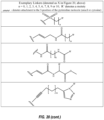
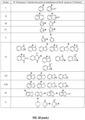
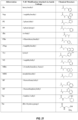
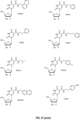
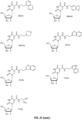
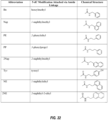
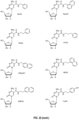
- 5-position modified cytidine or "C-5 modified cytidine” refers to a cytidine with a modification at the C-5 position of the cytidine, e.g., as shown in Figure 20 .
- Nonlimiting exemplary 5-position modified cytidines include those shown in Figure 22 .
- Nonlimiting exemplary 5-position modified cytidines include, but are not limited to, 5-(N-benzylcarboxamide)-2'-deoxycytidine (referred to as “BndC” and shown in Figure 21 ); 5-(N-2-phenylethylcarboxamide)-2'-deoxycytidine (referred to as “PEdC” and shown in Figure 21 ); 5-(N-3-phenylpropylcarboxamide)-2'-deoxycytidine (referred to as "PPdC” and shown in Figure 21 ); 5-(N-1-naphthylmethylcarboxamide)-2'-deoxycytidine (referred to as "NapdC” and shown in Figure 21 ); 5-(N-2-naphthylmethylcarboxamide)-2'-deoxycytidine (referred to as "2NapdC” and shown in Figure 21 ); 5-(N-1-naphthyl-2-ethylcarboxamide)-2'-deoxyc
- the C5-modified cytidines e.g., in their triphosphate form, are capable of being incorporated into an oligonucleotide by a polymerase (e.g., KOD DNA polymerase).
- a polymerase e.g., KOD DNA polymerase
- C-5 modified uridine or “5-position modified uridine” refers to a uridine (typically a deoxyuridine) with a modification at the C-5 position of the uridine, e.g., as shown in Figure 20 .
- the C5-modified uridines e.g., in their triphosphate form, are capable of being incorporated into an oligonucleotide by a polymerase (e.g., KOD DNA polymerase).
- Nonlimiting exemplary 5-position modified uridines include those shown in Figure 21 .
- Nonlimiting exemplary 5-position modified uridines include:
- the terms "modify,” “modified,” “modification,” and any variations thereof, when used in reference to an oligonucleotide means that at least one of the four constituent nucleotide bases (i.e., A, G, T/U, and C) of the oligonucleotide is an analog or ester of a naturally occurring nucleotide.
- the modified nucleotide confers nuclease resistance to the oligonucleotide. Additional modifications can include backbone modifications, methylations, unusual base-pairing combinations such as the isobases isocytidine and isoguanidine, and the like. Modifications can also include 3' and 5' modifications, such as capping.
- modifications can include substitution of one or more of the naturally occurring nucleotides with an analog, internucleotide modifications such as, for example, those with uncharged linkages (e.g., methyl phosphonates, phosphotriesters, phosphoamidates, carbamates, etc.) and those with charged linkages (e.g., phosphorothioates, phosphorodithioates, etc.), those with intercalators (e.g., acridine, psoralen, etc.), those containing chelators (e.g., metals, radioactive metals, boron, oxidative metals, etc.), those containing alkylators, and those with modified linkages (e.g., alpha anomeric nucleic acids, etc.).
- internucleotide modifications such as, for example, those with uncharged linkages (e.g., methyl phosphonates, phosphotriesters, phosphoamidates, carbamates, etc.) and those with charged linkages
- any of the hydroxyl groups ordinarily present on the sugar of a nucleotide may be replaced by a phosphonate group or a phosphate group; protected by standard protecting groups; or activated to prepare additional linkages to additional nucleotides or to a solid support.
- the 5' and 3' terminal OH groups can be phosphorylated or substituted with amines, organic capping group moieties of from about 1 to about 20 carbon atoms, polyethylene glycol (PEG) polymers in one embodiment ranging from about 10 to about 80 kDa, PEG polymers in another embodiment ranging from about 20 to about 60 kDa, or other hydrophilic or hydrophobic biological or synthetic polymers.
- nucleic acid As used herein, “nucleic acid,” “oligonucleotide,” and “polynucleotide” are used interchangeably to refer to a polymer of nucleotides and include DNA, RNA, DNA/RNA hybrids and modifications of these kinds of nucleic acids, oligonucleotides and polynucleotides, wherein the attachment of various entities or moieties to the nucleotide units at any position are included.
- polynucleotide “oligonucleotide,” and “nucleic acid” include double- or single-stranded molecules as well as triple-helical molecules.
- nucleic acid, oligonucleotide, and polynucleotide are broader terms than the term aptamer and, thus, the terms nucleic acid, oligonucleotide, and polynucleotide include polymers of nucleotides that are aptamers but the terms nucleic acid, oligonucleotide, and polynucleotide are not limited to aptamers.
- Polynucleotides can also contain analogous forms of ribose or deoxyribose sugars that are generally known in the art, including 2'-O-methyl, 2'-O-allyl, 2'-O-ethyl, 2'-O-propyl, 2'-O-CH 2 CH 2 OCH 3 , 2'-fluoro, 2'-NH 2 or 2'-azido, carbocyclic sugar analogs, ⁇ -anomeric sugars, epimeric sugars such as arabinose, xyloses or lyxoses, pyranose sugars, furanose sugars, sedoheptuloses, acyclic analogs and abasic nucleoside analogs such as methyl riboside.
- analogous forms of ribose or deoxyribose sugars that are generally known in the art, including 2'-O-methyl, 2'-O-allyl, 2'-O-ethyl, 2'-O-propy
- one or more phosphodiester linkages may be replaced by alternative linking groups.
- alternative linking groups include embodiments wherein phosphate is replaced by P(O)S ("thioate”), P(S)S ("dithioate”), (O)NR X 2 ("amidate"), P(O) R X , P(O)OR X ', CO or CH 2 (“formacetal”), in which each R X or R X ' are independently H or substituted or unsubstituted alkyl (C1-C20) optionally containing an ether (-O-) linkage, aryl, alkenyl, cycloalky, cycloalkenyl or araldyl.
- Polynucleotides can also contain analogous forms of carbocyclic sugar analogs, ⁇ -anomeric sugars, epimeric sugars such as arabinose, xyloses or lyxoses, pyranose sugars, furanose sugars, sedoheptuloses, acyclic analogs and abasic nucleoside analogs such as methyl riboside.
- a modification to the nucleotide structure can be imparted before or after assembly of a polymer.
- a sequence of nucleotides can be interrupted by non-nucleotide components.
- a polynucleotide can be further modified after polymerization, such as by conjugation with a labeling component.
- the term "at least one nucleotide” when referring to modifications of a nucleic acid refers to one, several, or all nucleotides in the nucleic acid, indicating that any or all occurrences of any or all of A, C, T, G or U in a nucleic acid may be modified or not.
- nucleic acid ligand As used herein, “nucleic acid ligand,” “aptamer,” “SOMAmer,” and “clone” are used interchangeably to refer to a non-naturally occurring nucleic acid that has a desirable action on a target molecule.
- a desirable action includes, but is not limited to, binding of the target, catalytically changing the target, reacting with the target in a way that modifies or alters the target or the functional activity of the target, covalently attaching to the target (as in a suicide inhibitor), and facilitating the reaction between the target and another molecule.
- the action is specific binding affinity for a target molecule, such target molecule being a three dimensional chemical structure other than a polynucleotide that binds to the aptamer through a mechanism which is independent of Watson/Crick base pairing or triple helix formation, wherein the aptamer is not a nucleic acid having the known physiological function of being bound by the target molecule.
- Aptamers to a given target include nucleic acids that are identified from a candidate mixture of nucleic acids, where the aptamer is a ligand of the target, by a method comprising: (a) contacting the candidate mixture with the target, wherein nucleic acids having an increased affinity to the target relative to other nucleic acids in the candidate mixture can be partitioned from the remainder of the candidate mixture; (b) partitioning the increased affinity nucleic acids from the remainder of the candidate mixture; and (c) amplifying the increased affinity nucleic acids to yield a ligand-enriched mixture of nucleic acids, whereby aptamers of the target molecule are identified.
- an aptamer for its target means that the aptamer binds to its target generally with a much higher degree of affinity than it binds to other, non-target, components in a mixture or sample.
- An "aptamer,” “SOMAmer,” or “nucleic acid ligand” is a set of copies of one type or species of nucleic acid molecule that has a particular nucleotide sequence.
- An aptamer can include any suitable number of nucleotides.
- “Aptamers” refer to more than one such set of molecules. Different aptamers can have either the same or different numbers of nucleotides.
- Aptamers may be DNA or RNA and may be single stranded, double stranded, or contain double stranded or triple stranded regions.
- the aptamers are prepared using a SELEX process as described herein, or known in the art.
- a "SOMAmer” or Slow Off-Rate Modified Aptamer refers to an aptamer having improved off-rate characteristics. SOMAmers can be generated using the improved SELEX methods described in U.S. Patent No. 7,947,447 , entitled “Method for Generating Aptamers with Improved Off-Rates.”
- an aptamer comprising two different types of 5-position modified pyrimidines or C-5 modified pyrimidines may be referred to as “dual modified aptamers", aptamers having "two modified bases”, aptamers having "two base modifications” or “two bases modified”, aptamer having “double modified bases”, all of which may be used interchangeably.
- a library of aptamers or aptamer library may also use the same terminology.
- an aptamer comprises two different 5-position modified pyrimidines wherein the two different 5-position modified pyrimidines are selected from a NapdC and a NapdU, a NapdC and a PPdU, a NapdC and a MOEdU, a NapdC and a TyrdU, a NapdC and a ThrdU, a PPdC and a PPdU, a PPdC and a NapdU, a PPdC and a MOEdU, a PPdC and a TyrdU, a PPdC and a ThrdU, a NapdC and a 2NapdU, a NapdC and a TrpdU, a 2NapdC and a NapdU, and 2NapdC and a 2NapdU, a 2NapdC and a PPdU, a 2Na
- an aptamer comprises at least one modified uridine and/or thymidine and at least one modified cytidine, wherein the at least one modified uridine and/or thymidine is modified at the 5-position with a moiety selected from a naphthyl moiety, a benzyl moiety, a fluorobenzyl moiety, a tyrosyl moiety, an indole moiety a morpholino moiety , an isobutyl moiety, a 3,4-methylenedioxy benzyl moiety, a benzothiophenyl moiety, and a benzofuranyl moiety, and wherein the at least one modified cytidine is modified at the 5-position with a moiety selected from a naphthyl moiety, a tyrosyl moiety, and a benzyl moiety.
- the moiety is covalently linked to the 5-position of the base via a linker comprising a group selected from an amide linker, a carbonyl linker, a propynyl linker, an alkyne linker, an ester linker, a urea linker, a carbamate linker, a guanidine linker, an amidine linker, a sulfoxide linker, and a sulfone linker.
- a linker comprising a group selected from an amide linker, a carbonyl linker, a propynyl linker, an alkyne linker, an ester linker, a urea linker, a carbamate linker, a guanidine linker, an amidine linker, a sulfoxide linker, and a sulfone linker.
- an aptamer comprising a single type of 5-position modified pyrimidine or C-5 modified pyrimidine may be referred to as "single modified aptamers", aptamers having a “single modified base”, aptamers having a “single base modification” or “single bases modified”, all of which may be used interchangeably.
- a library of aptamers or aptamer library may also use the same terminology.
- protein is used synonymously with “peptide,” “polypeptide,” or “peptide fragment.”
- a “purified” polypeptide, protein, peptide, or peptide fragment is substantially free of cellular material or other contaminating proteins from the cell, tissue, or cell-free source from which the amino acid sequence is obtained, or substantially free from chemical precursors or other chemicals when chemically synthesized.
- an aptamer comprises a first 5-position modified pyrimidine and a second 5-position modified pyrimidine, wherein the first 5-position modified pyrimidine comprises a tryosyl moiety at the 5-position of the first 5-position modified pyrimidine, and the second 5-position modified pyrimidine comprises a naphthyl moiety or benzyl moiety at the 5-position at the second 5-position modified pyrimidine.
- the first 5-position modified pyrimidine is a uracil.
- the second 5-position modified pyrimidine is a cytosine.
- At least 10%, 15%, 20%, 25%, 30%, 35%, 40%, 45%, 50%, 55%, 60%, 65%, 70%, 75%, 80%, 85%, 90%, 95%, or 100% of the uracils of the aptamer are modified at the 5-position.
- at least 10%, 15%, 20%, 25%, 30%, 35%, 40%, 45%, 50%, 55%, 60%, 65%, 70%, 75%, 80%, 85%, 90%, 95%, or 100% of the cytosine of the aptamer are modified at the 5-position.
- the disclosure provides oligonucleotides, such as aptamers, which comprise two different types of base-modified nucleotides.
- the oligonucleotides comprise two different types of 5-position modified pyrimidines.
- the oligonucleotide comprises at least one C5- modified cytidine and at least one CS-modified uridine.
- the oligonucleotide comprises two different CS-modified cytidines.
- the oligonucleotide comprises two different CS-modified uridines.
- Nonlimiting exemplary CS-modified uridines and cytidines are shown, for example, in Formula I below, and in Figure 20 .
- Certain nonlimiting exemplary CS-modified uridines are shown in Figure 21
- certain nonlimiting exemplary CS-modified cytidines are shown in Figure 22 .
- the oligonucleotide comprises at least one pyrimidine of Formula I: wherein
- the oligonucleotide comprises at least one modified pyrimidine shown in Figure 21 , wherein each X is independently selected from -H, -OH, - OMe, -O-allyl, -F, -OEt, -OPr, -OCH 2 CH 2 OCH 3 , NH 2 and -azido.
- the oligonucleotide comprises at least one modified pyrimidine shown in Figure 22 , wherein each X is independently selected from -H, -OH, - OMe, -O-allyl, -F, -OEt, -OPr, -OCH 2 CH 2 OCH 3 , NH 2 and -azido.
- the oligonucleotide comprises at least one modified pyrimidine shown in Figure 21 and at least one modified pyrimidine shown in Figure 22 , wherein each X is independently selected from -H, -OH, -OMe, -O-allyl, -F, -OEt, -OPr, - OCH 2 CH 2 OCH 3 , NH 2 and -azido.
- X is independently selected from -H, -OH, -OMe, -O-allyl, -F, -OEt, -OPr, - OCH 2 CH 2 OCH 3 , NH 2 and -azido.
- the oligonucleotide comprises at least one modified pyrimidine shown in Figure 20 , wherein the 2' position of the ribose is independently selected from -H, -OH, -OMe, -O-allyl, -F, -OEt, -OPr, -OCH 2 CH 2 OCH 3 , NH 2 and -azido.
- the oligonucleotide comprises at least two modified pyrimidines shown in Figure 20 , wherein the 2' position of the ribose is independently selected from -H, -OH, -OMe, -O-allyl, -F, -OEt, -OPr, -OCH 2 CH 2 OCH 3 , NH 2 and -azido.
- the oligonucleotide comprises at least one modified pyrimidine shown in Figure 20 and at least one modified pyrimidine shown in Figure 21 or Figure 22 , wherein the 2' position of the ribose is independently selected from -H, -OH, -OMe, -O-allyl, -F, -OEt, -OPr, -OCH 2 CH 2 OCH 3 , NH 2 and -azido.
- Certain nonlimiting exemplary pairs of modified pyrimidines are shown in the Examples described herein.
- the oligonucleotide may be an aptamer.
- the oligonucleotide is an aptamer that specifically binds a target polypeptide.
- oligodeoxynucleosides are routine practice in many laboratories (see e.g., Matteucci, M. D. and Caruthers, M. H., (1990) J. Am. Chem. Soc., 103:3185-3191 , the contents of which are hereby incorporated by reference in their entirety). Synthesis of oligoribonucleosides is also well known (see e.g. Scaringe, S. A., et al., (1990) Nucleic Acids Res. 18:5433-5441 , the contents of which are hereby incorporated by reference in their entirety).
- the phosphoramidites are useful for incorporation of the modified nucleoside into an oligonucleotide by chemical synthesis
- the triphosphates are useful for incorporation of the modified nucleoside into an oligonucleotide by enzymatic synthesis.
- SELEX and “SELEX process” are used interchangeably herein to refer generally to a combination of (1) the selection of nucleic acids that interact with a target molecule in a desirable manner, for example binding with high affinity to a protein, with (2) the amplification of those selected nucleic acids.
- the SELEX process can be used to identify aptamers with high affinity to a specific target molecule or biomarker.
- SELEX generally includes preparing a candidate mixture of nucleic acids, binding of the candidate mixture to the desired target molecule to form an affinity complex, separating the affinity complexes from the unbound candidate nucleic acids, separating and isolating the nucleic acid from the affinity complex, purifying the nucleic acid, and identifying a specific aptamer sequence.
- the process may include multiple rounds to further refine the affinity of the selected aptamer.
- the process can include amplification steps at one or more points in the process. See, e.g. , U.S. Pat. No.
- the SELEX process can be used to identify high-affinity aptamers containing modified nucleotides that confer improved characteristics on the aptamer, such as, for example, improved in vivo stability or improved delivery characteristics. Examples of such modifications include chemical substitutions at the ribose and/or phosphate and/or base positions. SELEX process-identified aptamers containing modified nucleotides are described in U.S. Pat. No. 5,660,985 , entitled "High Affinity Nucleic Acid Ligands Containing Modified Nucleotides," which describes oligonucleotides containing nucleotide derivatives chemically modified at the 5'- and 2'-positions of pyrimidines. U.S. Pat. No.
- SELEX can also be used to identify aptamers that have desirable off-rate characteristics. See U.S. Patent No. 7,947,447 , entitled “Method for Generating Aptamers with Improved Off-Rates,” which is incorporated herein by reference in its entirety, describes improved SELEX methods for generating aptamers that can bind to target molecules. Methods for producing aptamers and photoaptamers having slower rates of dissociation from their respective target molecules are described.
- the methods involve contacting the candidate mixture with the target molecule, allowing the formation of nucleic acid-target complexes to occur, and performing a slow off-rate enrichment process wherein nucleic acid-target complexes with fast dissociation rates dissociate and do not reform, while complexes with slow dissociation rates remain intact. Additionally, the methods include the use of modified nucleotides in the production of candidate nucleic acid mixtures to generate aptamers with improved off-rate performance (see U.S. Patent No. 8,409,795 , entitled “SELEX and PhotoSELEX”). (See also U.S. Patent No. 7,855,054 and U.S. Patent Publication No. 20070166740 ). Each of these applications is incorporated herein by reference in its entirety.
- Target or “target molecule” or “target” refers herein to any compound upon which a nucleic acid can act in a desirable manner.
- a target molecule can be a protein, peptide, nucleic acid, carbohydrate, lipid, polysaccharide, glycoprotein, hormone, receptor, antigen, antibody, virus, pathogen, toxic substance, substrate, metabolite, transition state analog, cofactor, inhibitor, drug, dye, nutrient, growth factor, cell, tissue, any portion or fragment of any of the foregoing, etc., without limitation. Virtually any chemical or biological effector may be a suitable target. Molecules of any size can serve as targets.
- a target can also be modified in certain ways to enhance the likelihood or strength of an interaction between the target and the nucleic acid.
- a target can also include any minor variation of a particular compound or molecule, such as, in the case of a protein, for example, minor variations in amino acid sequence, disulfide bond formation, glycosylation, lipidation, acetylation, phosphorylation, or any other manipulation or modification, such as conjugation with a labeling component, which does not substantially alter the identity of the molecule.
- a "target molecule” or “target” is a set of copies of one type or species of molecule or multimolecular structure that is capable of binding to an aptamer.
- “Target molecules” or “targets” refer to more than one such set of molecules.
- a target is a protein.
- competitive molecule and “competitor” are used interchangeably to refer to any molecule that can form a non-specific complex with a non-target molecule.
- non - target molecules include free aptamers, where, for example, a competitor can be used to inhibit the aptamer from binding (rebinding), non-specifically, to another non-target molecule.
- a “competitor molecule” or “competitor” is a set of copies of one type or species of molecule.
- “Competitor molecules” or “competitors” refer to more than one such set of molecules.
- Competitor molecules include, but are not limited to oligonucleotides, polyanions (e.g., heparin, herring sperm DNA, salmon sperm DNA, tRNA, dextran sulfate, poly dextran, abasic phosphodiester polymers, dNTPs, and pyrophosphate). In various embodiments, a combination of one or more competitor can be used.
- polyanions e.g., heparin, herring sperm DNA, salmon sperm DNA, tRNA, dextran sulfate, poly dextran, abasic phosphodiester polymers, dNTPs, and pyrophosphate.
- a combination of one or more competitor can be used.
- non-specific complex refers to a non-covalent association between two or more molecules other than an aptamer and its target molecule.
- a non-specific complex represents an interaction between classes of molecules.
- Non-specific complexes include complexes formed between an aptamer and a non-target molecule, a competitor and a non-target molecule, a competitor and a target molecule, and a target molecule and a non-target molecule.
- slow off-rate enrichment process refers to a process of altering the relative concentrations of certain components of a candidate mixture such that the relative concentration of aptamer affinity complexes having slow dissociation rates is increased relative to the concentration of aptamer affinity complexes having faster, less desirable dissociation rates.
- the slow off-rate enrichment process is a solution-based slow off-rate enrichment process.
- a solution-based slow off-rate enrichment process takes place in solution, such that neither the target nor the nucleic acids forming the aptamer affinity complexes in the mixture are immobilized on a solid support during the slow off-rate enrichment process.
- the slow - off rate enrichment process can include one or more steps, including the addition of and incubation with a competitor molecule, dilution of the mixture, or a combination of these (e.g., dilution of the mixture in the presence of a competitor molecule).
- the duration of the slow off-rate enrichment process is selected so as to retain a high proportion of aptamer affinity complexes having slow dissociation rates while substantially reducing the number of aptamer affinity complexes having fast dissociation rates.
- the slow off-rate enrichment process may be used in one or more cycles during the SELEX process. When dilution and the addition of a competitor are used in combination, they may be performed simultaneously or sequentially, in any order.
- the slow-off rate enrichment process can be used when the total target (protein) concentration in the mixture is low.
- the slow off-rate enrichment process includes dilution, the mixture can be diluted as much as is practical, keeping in mind that the aptamer retained nucleic acids are recovered for subsequent rounds in the SELEX process.
- the slow off-rate enrichment process includes the use of a competitor as well as dilution, permitting the mixture to be diluted less than might be necessary without the use of a competitor.
- the slow off-rate enrichment process includes the addition of a competitor, and the competitor is a polyanion (e.g., heparin or dextran sulfate (dextran)).
- heparin or dextran have been used in the identification of specific aptamers in prior SELEX selections. In such methods, however, heparin or dextran is present during the equilibration step in which the target and aptamer bind to form complexes. In such methods, as the concentration of heparin or dextran increases, the ratio of high affinity target/aptamer complexes to low affinity target/aptamer complexes increases.
- heparin or dextran can reduce the number of high affinity target/aptamer complexes at equilibrium due to competition for target binding between the nucleic acid and the competitor.
- the presently described methods add the competitor after the target/aptamer complexes have been allowed to form and therefor does not affect the number of complexes formed. Addition of competitor after equilibrium binding has occurred between target and aptamer creates a non-equilibrium state that evolves in time to a new equilibrium with fewer target/aptamer complexes. Trapping target/aptamer complexes before the new equilibrium has been reached enriches the sample for slow off-rateaptamers since fast off-rate complexes will dissociate first.
- a polyanionic competitor e.g., dextran sulfate or another polyanionic material
- polyanionic refractory aptamer is an aptamer that is capable of forming an aptamer/target complex that is less likely to dissociate in the solution that also contains the polyanionic refractory material than an aptamer/target complex that includes a nonpolyanionic refractory aptamer.
- polyanionic refractory aptamers can be used in the performance of analytical methods to detect the presence or amount or concentration of a target in a sample, where the detection method includes the use of the polyanionic material (e.g. dextran sulfate) to which the aptamer is refractory.
- the polyanionic material e.g. dextran sulfate
- a method for producing a polyanionic refractory aptamer is provided.
- a candidate mixture of nucleic acids with the target.
- the target and the nucleic acids in the candidate mixture are allowed to come to equilibrium.
- a polyanionic competitor is introduced and allowed to incubate in the solution for a period of time sufficient to insure that most of the fast off rate aptamers in the candidate mixture dissociate from the target molecule.
- aptamers in the candidate mixture that may dissociate in the presence of the polyanionic competitor will be released from the target molecule.
- the mixture is partitioned to isolate the high affinity, slow off-rate aptamers that have remained in association with the target molecule and to remove any uncomplexed materials from the solution.
- the aptamer can then be released from the target molecule and isolated.
- the isolated aptamer can also be amplified and additional rounds of selection applied to increase the overall performance of the selected aptamers. This process may also be used with a minimal incubation time if the selection of slow off-rate aptamers is not needed for a specific application.
- a modified SELEX process for the identification or production of aptamers having slow (long) off rates wherein the target molecule and candidate mixture are contacted and incubated together for a period of time sufficient for equilibrium binding between the target molecule and nucleic acids contained in the candidate mixture to occur.
- an excess of competitor molecule e.g., polyanion competitor
- a significant proportion of aptamers having off rates that are less than this predetermined incubation period will dissociate from the target during the predetermined incubation period.
- a dissociation step can be used to dissociate the slow off-rate aptamers from their target and allows for isolation, identification, sequencing, synthesis and amplification of slow off-rate aptamers (either of individual aptamers or of a group of slow off-rate aptamers) that have high affinity and specificity for the target molecule.
- the aptamer sequences identified from one round of the modified SELEX process can be used in the synthesis of a new candidate mixture such that the steps of contacting, equilibrium binding, addition of competitor molecule, incubation with competitor molecule and partitioning of slow off-rateaptamers can be iterated/repeated as many times as desired.
- the candidate mixture may be incubated with the target for at least about 5 minutes, or at least about 15 minutes, about 30 minutes, about 45 minutes, about 1 hour, about 2 hours, about 3 hours, about 4 hours, about 5 hours or about 6 hours.
- the predetermined incubation period of competitor molecule with the mixture of the candidate mixture and target molecule may be selected as desired, taking account of the factors such as the nature of the target and known off rates (if any) of known aptamers for the target.
- Predetermined incubation periods may be chosen from: at least about 5 minutes, at least about 10 minutes, at least about 20 minutes, at least about 30 minutes, at least 45 about minutes, at least about 1 hour, at least about 2 hours, at least about 3 hours, at least about 4 hours, at least about 5 hours, at least about 6 hours.
- a dilution is used as an off rate enhancement process and incubation of the diluted candidate mixture, target molecule/aptamer complex may be undertaken for a predetermined period of time, which may be chosen from: at least about 5 minutes, at least about 10 minutes, at least about 20 minutes, at least about 30 minutes, at least about 45 minutes, at least about 1 hour, at least about 2 hours, at least about 3 hours, at least about 4 hours, at least about 5 hours, at least about 6 hours.
- Embodiments of the present disclosure are concerned with the identification, production, synthesis and use of slow off-rate aptamers.
- aptamers which have a rate of dissociation (t 1/2 ) from a non-covalent aptamer-target complex that is higher than that of aptamers normally obtained by conventional SELEX.
- the t 1/2 represents the time taken for half of the aptamers to dissociate from the aptamer-target complexes.
- the t 1/2 of slow dissociation rate aptamers according to the present disclosure is chosen from one of: greater than or equal to about 30 minutes; between about 30 minutes and about 240 minutes; between about 30 minutes to about 60 minutes; between about 60 minutes to about 90 minutes, between about 90 minutes to about 120 minutes; between about 120 minutes to about 150 minutes; between about 150 minutes to about 180 minutes; between about 180 minutes to about 210 minutes; between about 210 minutes to about 240 minutes.
- a characterizing feature of an aptamer identified by a SELEX procedure is its high affinity for its target.
- An aptamer will have a dissociation constant (k d ) for its target that is chosen from one of: less than about 1 ⁇ M, less than about 100nM, less than about 10nM, less than about 1nM, less than about 100pM, less than about 10 pM, less than about 1pM.
- each oligonucleotide of a library of oligonucleotides comprises a number of randomized positions, such as at least 20, 25, 30, 35, 40, 45, or 50, or 20-100, 20-80, 20-70, 20-60, 20-50, 20-40, or 30-40 randomized positions.
- each oligonucleotide of a library of oligonucleotides comprises fixed sequences flanking the randomized positions.
- Such fixed flanking sequences may be the same or different from one another (i.e., the 5' flanking sequence and the 3' flanking sequence may be the same or different), and may, in some embodiments, be the same for all members of the library (i.e., all members of the library may have the same 5' flanking sequence, and/or all members of the library may have the same 3' flanking sequence).
- the randomized positions may be made up of four or more different nucleotide bases, one or more of which is modified. In some embodiments, all of one type of nucleotide base is modified or unmodified (e.g., all of the cytidines in the randomized region or modified, or all are unmodified). In some embodiments, one type of nucleotide base in the randomized region is present in both modified and unmodified forms. In some such embodiments, the randomized positions are made up of two modified and two unmodified nucleotide bases. In some such embodiments, the randomized positions are made up of adenine, guanine, CS-modified cytidine, and CS-modified uridine.
- Nonlimiting exemplary CS-modified cytidines and CS-modified uridines are shown in Figures 19 to 21 .
- Libraries of oligonucleotides and methods of making them are further described, e.g., in the Examples herein.
- aptamers that bind a target molecule are provided.
- the target molecule is a target protein.
- aptamers that bind PCSK9 are provided.
- an aptamer that binds PCSK9 inhibits binding of PCSK9 to LDL-R.
- the aptamer comprises the sequence 5'-yGpppG-3', wherein each y is a TyrdU and each p is a NapdC.
- the aptamer further comprises the sequence 5'-yEAyGA n pAp-3', wherein E is selected from y, A, and G; and n is 0 or 1.
- n is 0.
- the sequence 5'-yEAyGA n pAp-3' is located 5' of the sequence 5'-yGpppG-3'.
- E is y.
- an aptamer that binds PCSK9 comprises the sequence 5'-F n pppAAGRJrpRppW m -3' (SEQ ID NO: 81), wherein F is selected from r and G; each R is independently selected from G and A; J is selected from r and A; W is selected from r, G, and A; n is 0 or 1; m is 0 or 1; r is PpdC; and p is NapdU. In some embodiments, m is 1. In some embodiments, F is r. In some embodiments, J is r. In some embodiments, W is G.
- an aptamer that binds PCSK9 comprises the sequence 5'-TTppGGpp-3', wherein each p is a NapdC.
- an aptamer that binds PCSK9 is 20 to 100, or 20 to 90, or 20 to 80, or 20 to 70, or 20 to 60, or 20 to 50, or 30 to 100, or 30 to 90, or 30 to 80, or 30 to 70, or 30 to 60, or 30 to 50, or 40 to 100, or 40 to 90, or 40 to 80, or 40 to 70, or 40 to 60, or 40 to 50 nucleotides in length.
- the aptamer inhibits PCSK9 binding to LDL-R. In some embodiments, the aptamer inhibits PCSK9 binding to LDL-R with an IC 50 of less than 30 nM, less than 20 nM, or less than 15 nM.
- a method of lowering cholesterol in a subject comprising administering to a subject in need thereof an aptamer that binds PCSK9.
- the aptamer that binds PCSK9 is an aptamer provided herein.
- the cholesterol is low-density lipoprotein (LDL) cholesterol (LDL-C).
- the subject has heterozygous familial hypercholesterolemia or clinical atherosclerotic cardiovascular disease (CVD).
- a salt may be formed with a suitable cation.
- suitable inorganic cations include, but are not limited to, alkali metal ions such as Na + and K + , alkaline earth cations such as Ca 2+ and Mg 2+ , and other cations such as Al +3 .
- Suitable organic cations include, but are not limited to, ammonium ion (i.e., NH 4 + ) and substituted ammonium ions (e.g., NH 3 R X+ , NH 2 R X 2 + , NHR X 3 + , NR X 4 + ).
- Examples of some suitable substituted ammonium ions are those derived from: ethylamine, diethylamine, dicyclohexylamine, triethylamine, butylamine, ethylenediamine, ethanolamine, diethanolamine, piperizine, benzylamine, phenylbenzylamine, choline, meglumine, and tromethamine, as well as amino acids, such as lysine and arginine.
- An example of a common quaternary ammonium ion is N(CH 3 ) 4 + .
- a salt may be formed with a suitable anion.
- suitable inorganic anions include, but are not limited to, those derived from the following inorganic acids: hydrochloric, hydrobromic, hydroiodic, sulfuric, sulfurous, nitric, nitrous, phosphoric, and phosphorous.
- Suitable organic anions include, but are not limited to, those derived from the following organic acids: 2-acetyoxybenzoic, acetic, ascorbic, aspartic, benzoic, camphorsulfonic, cinnamic, citric, edetic, ethanedisulfonic, ethanesulfonic, fumaric, glucheptonic, gluconic, glutamic, glycolic, hydroxymaleic, hydroxynaphthalene carboxylic, isethionic, lactic, lactobionic, lauric, maleic, malic, methanesulfonic, mucic, oleic, oxalic, palmitic, pamoic, pantothenic, phenylacetic, phenylsulfonic, propionic, pyruvic, salicylic, stearic, succinic, sulfanilic, tartaric, toluenesulfonic, and valeric.
- a reference to a particular compound also includes salt forms thereof.
- Each of the 18 libraries contained 30 randomized nucleotides, allowing for ⁇ 10 15 different sequences.
- the libraries were enzymatically synthesized using natural and/or modified nucleotide triphosphates using KOD DNA polymerase, Exo- (data not shown).
- a total of 18 enzymatically synthesized libraries comprising single modified dU (Nap-dU,PP-dU, MOE-dU, Tyr-dU and /Thr-dU) with unmodified dT as a control; single modified dC (Nap-dC and PP-dC) with unmodified dC as a control; and combination of two modified bases: either Nap-dC or PP-dC, with all possible modified dUs (Nap-dU, PP-dU, MOE-dU, Tyr-dU and Thr-dU).
- the qualitative primer extension reactions were carried out using antisense template, radio-labeled 5' primer with natural or modified nucleotide tri-phosphates and KOD polymerase (Exo-) in solution, as follows.
- 20 pmoles of biotinylated anti-sense library was mixed with 40 pmoles of 5' cold primer (2X) and trace amounts of 32 P labeled 5' primer, 0.5 mM natural or modified dNTP in 1X SQ20 buffer (120 mM Tris-HCl, pH 7.8; 10 mM KCl; 6 mM (NH 4 ) 2 SO 4 ; 7 mM MgSO 4 , 0.1% Triton X-100 and 0.1 mg/mL BSA) and 0.25 U/mL KOD Polymerase (Exo-).
- the initial random single base and two base modified libraries were enzymatically synthesized in large scale reaction and used in selection experiments. These libraries were sequenced along with the enriched pools and nucleotide frequencies were plotted with total 100% for all four bases in 30N random region. No significant bias was observed in the nucleotide frequencies when base composition of libraries was determined using deep sequencing compared with starting synthetic natural DNA template library and enzymatically synthesized unmodified DNA control initial library (data not shown).
- the selected complexes were partitioned on magnetic His-tag capture Dynabeads ® , unbound sequences were washed, selected aptamers were eluted and PCR amplified using all natural nucleotides and 3' biotin-primer.
- the natural double-stranded DNA biotinylated at 3' end was captured on Dynabeads ® MyOne TM Streptavidin C1 beads, sense strands eliminated by alkali denaturation and replaced with modified dC and or dU in primer extension reactions to regenerate enriched pool and selection cycle was repeated with diluted protein.
- the concentration of protein for the next round of SELEX was determined based on signal to background ratio calculated from critical cycle time (Ct) value for each sample.
- the 5' primer for amplification comprised a (AT4)-tail and the 3' primer comprised a (A-biotin)2-T8-tail (SEQ ID NO: 82), which avoids addition of modified dC or dU when modified libraries are synthesized.
- Table 2 Sequence of natural DNA template, primers used in SELEX Name Sequence Anti-AB2-30N41.36 SEQ ID NO: 1 (Ab2)TTTTTTTTCTCTTTCTCTTCTCTCTCC 30N GACCCACCCAGCGTGG (AT)4-5P41 SEQ ID NO: 2 ATATATATCCACGCTGGGTGGGTC (AB)2(T)8-3P3 SEQ ID NO: 3 (Ab2)TTTTTTTTCTCTCTCTTCTCTCTTTCC
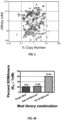
- aptamers containing natural nucleotides were deep sequenced using Ion Torrent PGM instrument. Sequence analysis was performed using custom software using local batch alignment. The data from sequence analysis of all the enriched pools demonstrated that the two modified library combinations resulted in higher diversity in enriched sequences compared with single modified libraries (data not shown). To test binding affinity of aptamers, an extensive set of sequences was chose representing not just high copy unique sequences but also low copy sequences from distinct families (data not shown). All the aptamers were chemically synthesized by standard solid phase phosphoramidite chemistry using modified/unmodified phoshoramidites reagents.
- aptamers were initially screened as truncated 40mers containing 30 nucleotide random region and additional 5 nucleotides from fixed primer regions from 5' and 3' ends for their PCSK9 binding affinities in solution with radio-labeled filter-binding assays.
- the truncated aptamers (40mers) comprised 10 nucleotides from the fixed regions.
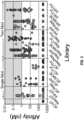
- the unmodified control DNA library (dC/dT) did not result in any active sequences (K d ⁇ 32 nM), which was expected as pool affinity for this library was flat (data not shown) and also deep sequencing data did not yield any enriched multi-copy sequences (data not shown).
- the percent of all single modified aptamers assayed that showed no binding was 62%. No binding is defined as an aptamer having a Kd of 320 nM or greater. The percent of all single modified aptamers with a Kd ⁇ 10 nM was less than 21%, and the average Kd for all single modified aptamers was 5,2 nM. In contrast, the percent of all two modified (dual mod.) aptamers assayed that showed no binding was 43%. Further, the percent of all two modified aptamers with a Kd ⁇ 10 nM was 47%, and the average Kd for all two modified aptamers was 0.12 nM.
- PCSK9 aptamers to various other proprotein convertases (PCs) was also evaluated.
- SELEX method sometimes yields aptamers that preferentially bind to a dominant "aptagenic" epitopes on the target surface. Therefore, reports on aptamer sandwich pairs are limited in the literature.
- Modifications in the selection method may be employed to search for the aptamers that can bind to different epitopes on the target protein, such as multivalent aptamer isolation (MAI-SELEX), array-based discovery platform for multivalent aptamer (AD-MAP) sandwich selections, in which primary aptamer is used in excess to block the first epitope in an effort to discover second aptamer binding to a non-competing signaling epitope.
- MAI-SELEX multivalent aptamer isolation
- AD-MAP array-based discovery platform for multivalent aptamer
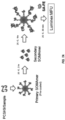
- individual aptamers (0.05 pmoles per sample) with were captured on single MagPlex Avidin bead type and mixed together (24 beads in one experiment, 1000 beads per sample) and captured for 20 min at room temperature with shaking at 1850 rpm. Beads were washed with 1X SBT for 2 min followed with 0.5 mM free biotin wash for 5 min in 1XSBT, followed by 3 washes of 1X SBT for 2 min each. Beads were blocked with free Streptavidin for 5 min and washed again for 2 min with 1X SBT. The 24 different bead types with individual aptamers were mixed together for screening of sandwich partner for each of the capture aptamer.
- a detection or secondary aptamer was diluted to 500 nM in 1XSBT, heat-cooled and mixed with PCSK9 (final 10 nM), incubated at 25°C for 1 hr. 1000 capture beads were added and incubated further for 1 hr with shaking. Beads were then captured on a magnet, washed three times with 1X SBT for 2 min each and re-suspended in 75 ⁇ L 1X SBT with 0.1% BSA and 100 uM DxSO4. To this 75 ⁇ L of Streptavidin phycoerythrin (final 5 ⁇ g/mL) was added and incubated at 25°C for 20 min with shaking. Beads were finally washed again for 2 min with 1X SBT and read on Luminex 3D xMAP machine.
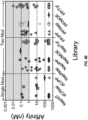
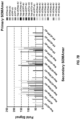
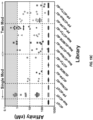
- the single base modified libraries generated few sandwich pairs (three), while adding aptamers from two base modified libraries in combination with single base modified aptamers resulted in more sandwich pairs (22 pairs). Moreover, the number of sandwich pairs per library was dramatically increased when both partners (capture and detection) aptamers came from the two base modified libraries (45 pairs, Fig. 7C , Fig. 7B ).
- the multiple epitope binding results from the sandwich screening suggested that the increase in the chemical diversity in initial random library resulted in modified aptamers that can bind to non-competing sites on the target surface.
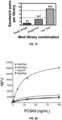
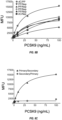
- the sandwich pairs that resulted in highest signals (10 nM PCSK9 concentration; 0.75% of all pairs tested, 70 pairs out of 9216; Fig. 7C ) were measured for PCSK9 concentration dependent responses with a subset of results shown in Figs.
- 8A the concentration dependent signals are shown for the single base modified primary aptamer dC/PP-dU and the best secondary that worked well was the two base modified aptamer Nap-dC/Nap-dU [triangles]
- 8B the concentration dependent signals are shown for the two base modified secondary aptamer Nap-dC/Nap-dU and the best primary that worked well was the single base modified aptamer dC/PP-dU [closed squares]).
- the specificity of an aptamer sandwich pair was also measured by lack of endogenous signal when recombinant human PCSK9 was spiked into newborn calf serum (NBCS) compared to human plasma (data not shown).
- This sandwich pair was further characterized to develop an aptamer sandwich assay to detect circulating concentrations of plasma PCSK9 in human clinical samples.
- the performance of the sandwich assay was evaluated by conducting studies such as sensitivity ( Fig. 9A and 9B and Tables 5 and 6 ), precision ( Tables 7 and 8 ), accuracy ( Table 9 ) and plasma dilution linearity measurements ( Fig. 10 ), all of which confirmed a robust assay window.
- LLC limit of detection
- LLoQ lower limit of quantification
- ULoQ upper limit of quantification
- the sandwich assay was developed using a capture or primary SOMAmer (11723-5) as a single base modified aptamer (PP-dU/dC) and a secondary or detection aptamer (11727-20) as a two base modified aptamer (Nap-dC/Nap-dU).
- PCSK9 was over-expressed in HepG2 cells using the SBI System Biosciences LentiViral system (LV300A-1).
- the HepG2 cell line was transduced with lentiviral expression clone for wild type human PCSK9 obtained from Origene (RC220000L1) for the generation of stable cell line.
- R220000L1 lentiviral expression clone for wild type human PCSK9 obtained from Origene
- the relative amount of PCSK9 secreted in the medium was measured by the aptamer sandwich assay for each clone and was compared with expression from wild-type HepG2 cells.
- the number of cells used to produce recombinant protein was normalized using the Cell Titer-Glo ® Luminescent cell viability assay. Clone number 45 secreted ⁇ 100-fold more PCSK9 than wild-type HepG2 cells.
- Table 5 Sensitivity of sandwich assay (lower limit of detection) LLoD Quantitation No.
- the biotinylated PCSK9 (Aero Biosystems, Avi-tagged) and aptamer were mixed together and incubated at room temperature for 1 hr, then added to the ELISA plate and further incubated for 2 hrs at room temperature with shaking.
- the top PCSK9 concentration was 0.5 nM and the top concentration for aptamer was 100 nM, and these were then serially diluted by 1 ⁇ 2 log for the inhibition curve.
- Streptavidin conjugated HRP (Invitrogen, 1 ⁇ g/ml) was added to the wells and incubated for 30 min at room temperature with shaking, Pico-sensitive chemiluminescence substrates (Invitrogen) were added, luminescence was measured in Luminometer (Hidex Plate Chameleon), and data were plotted in Graph Pad Prism 6.0 software to calculate the EC 50 values.
- a PCSK9 neutralizing antibody (BPS Bioscience) was used as the control.
- 11733-91_5 (11733-198) was chosen for measurement of target affinity to PCSK9's from various species.
- This aptamer had affinity of 14.7, 11.3, 5.2, 77 and 165 pM to human (wild-type), rhesus monkey, human (GOF mutant D374Y), mouse, and rat PCSK9, respectively ( Fig. 15A ).
- This aptamer also blocked the wild-type human PCSK9 LDL-R interaction with an EC 50 of 2.1 nM and the GOF mutant PCSK9 D374Y LDL-R interaction with an EC 50 of 3.6 nM ( Fig. 15B ).
- the specificity of this aptamer for PCSK9 compared with other PCs was evaluated, and results showed that this aptamer bound to only PCSK9 and not to other PCs (data not shown).
- a PP-dC/Nap-dU aptamer was tested in an LDL uptake reversal assay in which wild-type HepG2 cells were incubated for 16 hrs with recombinant PCSK9, and then cells were washed and fluorescently-labeled LDL was added for 3 hrs.
- the results showed that the aptamer can reverse LDL-uptake with an EC 50 of 159 nM ( Fig. 16 and Fig. 17 ).
- aptamer treatment can increase the LDL-R levels in PCSK9 over-expressing HepG2 cells as measured by FACS ( Fig. 17 .
- the 40 ⁇ L aliquot mix was diluted with 100 ⁇ L H 2 O and extracted with 150 ⁇ L 25:24:1 phenol:chloroform:isoamyl alcohol. The samples were centrifuged and 16,100 xg for 15 minutes, and the aptamer-containing aqueous phase was removed and stored at -20°C until gel analysis.
- the aptamer samples were loaded on a 15% TBE PAGE denaturing gel (8 M urea), and the aptamer stained with 1X ( ⁇ 2 ⁇ M) SYBR Gold for 10 minutes. The amount of full-length aptamer at each time point was quantified using FluorChemQ analysis software (AlphaInnotech).
- Table 10 shows the composition of the aptamers tested in that experiment, the percentage of full-length aptamer remaining after 96 hours in 90% human serum and the half-life of each aptamer, which was calculated by linear regression fit using gel quantified data in GraphPad Prism 7 software.
- Fig. 18 shows the percentage of full-length aptamer remaining over time.
- dual modified aptamers demonstrated greater stability in human serum over time than the single modified aptamers.
- Table 10 Aptamer composition.
- Example 1 The libraries described in Example 1 were used to select aptamers that bind to ErbB2, ErbB3, and PSMA. The selections were carried out for each target substantially as described in Example 1. For ErbB2 and ErbB3, the single-modified Nap-dC/dT; PP-dC/dT; and dC/Tyr-dU libraries; and the dual-modified Nap-dC/Tyr-dU, and PP-dC/Tyr-dU libraries were used.
- the unmodified dC/dT library For PSMA, the unmodified dC/dT library; the single-modified Nap-dC/dT; PP-dC/dT; dC/Nap-dU, dC-PP-dU, dC-MOE-dU, and dC/Tyr-dU libraries; and the dual-modified Nap-dC/Nap-dU, Nap-dC/PP-dU, Nap-dC/MOE-dU, Nap-dC/Tyr-dU, PP-dC/PP-dU, PP-dC/Nap-dU, and PP-dC/Tyr-dU libraries were used.
- the unmodified control DNA library (dC/dT), which was used for PSMA, did not result in any aptamers that bound to PSMA.
- the percent of all single modified aptamers assayed that showed no binding was 71%. No binding is defined as an aptamer having a Kd of 320 nM or greater. The percent of all single modified aptamers with a Kd ⁇ 10 nM was 12%, and the average Kd for all single modified aptamers was 12.3 nM. In contrast, the percent of all two modified (dual mod.) aptamers assayed that showed no binding was 54%. Further, the percent of all two modified aptamers with a Kd ⁇ 10 nM was 20%, and the average Kd for all two modified aptamers was 6.6 nM. Table 12.
- N.T. N.T. N.T. N.T. N.T. NapdC/TyrdU 28% 32 0.65 nM 10 31% NapdC/ThrdU N.T. N.T. N.T. N.T. N.T. PPdC/PPdU N.T. N.T. N.T. N.T. N.T. PPdC/NapdU N.T. N.T. N.T. N.T. N.T. PPdC/MOEdU N.T. N.T. N.T. N.T. N.T. PPdC/TyrdU 20% 20 0.74 nM 13 65% PPdC/ThrdU N.T. N.T. N.T. N.T. N.T.
- the percent of all single modified aptamers assayed that showed no binding was 70%. No binding is defined as an aptamer having a Kd of 320 nM or greater. The percent of all single modified aptamers with a Kd ⁇ 10 nM was less than 2%, and the average Kd for all single modified aptamers was 15.1 nM. In contrast, the percent of all two modified (dual mod.) aptamers assayed that showed no binding was 44%. Further, the percent of all two modified aptamers with a Kd ⁇ 10 nM was 25%, and the average Kd for all two modified aptamers was 0.7 nM. Table 13.
- the percent of all single modified aptamers assayed that showed no binding was 38%. No binding is defined as an aptamer having a Kd of 320 nM or greater. The percent of all single modified aptamers with a Kd ⁇ 10 nM was 40%, and the average Kd for all single modified aptamers was 6 nM. In contrast, the percent of all two modified (dual mod.) aptamers assayed that showed no binding was 24%. Further, the percent of all two modified aptamers with a Kd ⁇ 10 nM was 69%, and the average Kd for all two modified aptamers was 0.02 nM.
- each library contains 40 or more randomized nucleotides. In some embodiments, each library contains 30 randomized nucleotides, allowing for ⁇ 10 15 different sequences.
- the libraries may be enzymatically synthesized using natural and/or modified nucleotide triphosphates using KOD DNA polymerase, Exo-.
- the random region is flanked with fixed sequences for hybridizing PCR amplification primers, with or without additional spacers at the 5' end and at the 3' end.
- the master synthetic template is used to generate modified libraries with all dU and or dC positions uniformly modified in replacement primer extension reactions.
- the library synthesis may be performed substantially as described in Example 1.
- Table 14 Dual modified aptamer libraries Library 1 dC/dT (DNA Control) 2 Nap-dC/dT 3 2Nap-dC/dT 4 PP-dC/dT 5 Tyr-dC/dT 6 dC/Nap-dU 7 dC/2Nap-dU 8 dC/PPdU 9 dC/Trp-dU 10 dC/Tyr-dU 11 Nap-dC/Nap-dU 12 Nap-dC/2Nap-dU 13 Nap-dC/PP-dU 14 Nap-dC/Trp-dU 15 Nap-dC/Tyr-dU 16 2Nap-dC/Nap-dU 17 2Nap-dC/2Nap-dU 18 2Nap-dC/PP-dU 19 2Nap-dC/Trp-dU 20 2Nap-dC
- One or more of the libraries in Table 14 may be used to select aptamers that bind to a target, such as a protein target.
- the libraries comprising two modified bases typically yield aptamers having greater specificity and/or affinity for the target.
- Table 15 Aptamers from pool 11720 SEQ ID No Copies Random Region Sequence 4 401 AAG TTppGGpp GppTpGGGGTpppTGppAA 5 21 ATAppTGGGA TTppGGpp ATTTGpGpAGTT 6 4 TGAAG TTppGGpp GTGpGpATGGTApppAT 7 3 TTTGTGp TTppGGpp TAGpGpAGATATppT 8 1 ATAGG TTppGGpp TTGpGpTGTTTAGApA 9 1 TAGATGppTGGTAT TTppGGpp TTGpGpAT 10 2 TAGTGpppTGATpTA TTppGGpp AAGpppA 11 3 TTTGppppppTGGTTApG TTppGGpp TGGpGpA 12 2 ATGppG TTppGGpp TAGpGpTpGTTApppA 13 1 TGAppAppTGTppAA TTppGGpp TAGpGpA 14 1 TAppAGGTA TTppGGpp GAGpGpTG
- Table 16 Aptamers from pool 11730 SEQ ID No Copies Random Region Sequence 27 680 GyyAypGpAAyGyGpGpppGGG yGpppG pp 28 163 yG yGpppG GAyAyyAApyGyyppGAGpAGy 29 56 yGyyyAyGpApA yGpppG pGAyGApAGyAA 30 44 AGyGyGAyyAyGpApy yGpppG pAyyyGGy 31 15 yAyAGAApAyAAyGpApA yGpppG pAyApy 32 15 yAypAGyyyAyGpApG yGpppG pGAyGApy 33 13 GApyApGAGGGAyGAyGpApA yGpppG pAy 34 11 AyAAyGAyAyGpApA yGpppG pA
- Table 17 aptamers from pool 11733 SEQ ID No Copies Random Region Sequence 44 1041 AArGpA rpppAAGGrrpAppG AGGAAArpr 45 969 rA rpppAAGArrpAppG rGGAGArrrpGGG 46 340 rGpG rpppAAGArrpGppG AGApGrGrprA 47 204 A rpppAAGArrpGppG AGGGrrprGGGAAp 48 158 GrrGGp GpppAAGAArpGppG GGGrArppr 49 154 GrGrA rpppAAGArrpAppG GGGAGAArpr 50 127 pppAAGGrrpGppG AGGArrprGGrApGAA 51 105 rAA rpppAA
Landscapes
- Health & Medical Sciences (AREA)
- Life Sciences & Earth Sciences (AREA)
- Engineering & Computer Science (AREA)
- Chemical & Material Sciences (AREA)
- Genetics & Genomics (AREA)
- Organic Chemistry (AREA)
- Biomedical Technology (AREA)
- Bioinformatics & Cheminformatics (AREA)
- Wood Science & Technology (AREA)
- Zoology (AREA)
- Molecular Biology (AREA)
- Biotechnology (AREA)
- General Engineering & Computer Science (AREA)
- General Health & Medical Sciences (AREA)
- Biochemistry (AREA)
- Physics & Mathematics (AREA)
- Microbiology (AREA)
- Biophysics (AREA)
- Plant Pathology (AREA)
- Proteomics, Peptides & Aminoacids (AREA)
- Immunology (AREA)
- Medicinal Chemistry (AREA)
- Analytical Chemistry (AREA)
- Animal Behavior & Ethology (AREA)
- Veterinary Medicine (AREA)
- Public Health (AREA)
- Pharmacology & Pharmacy (AREA)
- Urology & Nephrology (AREA)
- Hematology (AREA)
- Nuclear Medicine, Radiotherapy & Molecular Imaging (AREA)
- General Chemical & Material Sciences (AREA)
- Chemical Kinetics & Catalysis (AREA)
- Bioinformatics & Computational Biology (AREA)
- Crystallography & Structural Chemistry (AREA)
- Pathology (AREA)
- Cardiology (AREA)
- Diabetes (AREA)
- Heart & Thoracic Surgery (AREA)
- Obesity (AREA)
- Vascular Medicine (AREA)
Applications Claiming Priority (5)
| Application Number | Priority Date | Filing Date | Title |
|---|---|---|---|
| US201662357623P | 2016-07-01 | 2016-07-01 | |
| US201662437592P | 2016-12-21 | 2016-12-21 | |
| EP17740201.3A EP3478843B1 (de) | 2016-07-01 | 2017-06-30 | Oligonukleotide mit modifizierten nukleosiden |
| EP21174810.8A EP3913058B1 (de) | 2016-07-01 | 2017-06-30 | Oligonukleotide mit modifizierten nukleosiden |
| PCT/US2017/040299 WO2018005974A1 (en) | 2016-07-01 | 2017-06-30 | Oligonucleotides comprising modified nucleosides |
Related Parent Applications (3)
| Application Number | Title | Priority Date | Filing Date |
|---|---|---|---|
| EP21174810.8A Division EP3913058B1 (de) | 2016-07-01 | 2017-06-30 | Oligonukleotide mit modifizierten nukleosiden |
| EP21174810.8A Division-Into EP3913058B1 (de) | 2016-07-01 | 2017-06-30 | Oligonukleotide mit modifizierten nukleosiden |
| EP17740201.3A Division EP3478843B1 (de) | 2016-07-01 | 2017-06-30 | Oligonukleotide mit modifizierten nukleosiden |
Publications (2)
| Publication Number | Publication Date |
|---|---|
| EP4520337A2 true EP4520337A2 (de) | 2025-03-12 |
| EP4520337A3 EP4520337A3 (de) | 2025-08-13 |
Family
ID=59351104
Family Applications (3)
| Application Number | Title | Priority Date | Filing Date |
|---|---|---|---|
| EP24213799.0A Pending EP4520337A3 (de) | 2016-07-01 | 2017-06-30 | Oligonukleotide mit modifizierten nukleosiden |
| EP17740201.3A Active EP3478843B1 (de) | 2016-07-01 | 2017-06-30 | Oligonukleotide mit modifizierten nukleosiden |
| EP21174810.8A Active EP3913058B1 (de) | 2016-07-01 | 2017-06-30 | Oligonukleotide mit modifizierten nukleosiden |
Family Applications After (2)
| Application Number | Title | Priority Date | Filing Date |
|---|---|---|---|
| EP17740201.3A Active EP3478843B1 (de) | 2016-07-01 | 2017-06-30 | Oligonukleotide mit modifizierten nukleosiden |
| EP21174810.8A Active EP3913058B1 (de) | 2016-07-01 | 2017-06-30 | Oligonukleotide mit modifizierten nukleosiden |
Country Status (16)
| Country | Link |
|---|---|
| US (4) | US10927380B2 (de) |
| EP (3) | EP4520337A3 (de) |
| JP (3) | JP7203613B2 (de) |
| KR (2) | KR20230031972A (de) |
| CN (2) | CN109312346B (de) |
| AU (1) | AU2017290804B2 (de) |
| BR (1) | BR112018075869A8 (de) |
| DK (1) | DK3478843T3 (de) |
| ES (2) | ES2886639T3 (de) |
| IL (3) | IL291931B2 (de) |
| MX (1) | MX2018014771A (de) |
| PL (1) | PL3478843T3 (de) |
| RU (2) | RU2763470C2 (de) |
| SG (2) | SG10201911369PA (de) |
| TW (1) | TWI770036B (de) |
| WO (1) | WO2018005974A1 (de) |
Families Citing this family (7)
| Publication number | Priority date | Publication date | Assignee | Title |
|---|---|---|---|---|
| US10481155B2 (en) * | 2018-03-09 | 2019-11-19 | Somalogic, Inc. | Proteomic assay using quantum sensors |
| WO2021202376A1 (en) | 2020-03-30 | 2021-10-07 | The United States Of America, As Represented By The Secretary, Department Of Health And Human Services | Method for blocking uptake of prostate-specific membrane antigen (psma)-targeted radionuclides by exocrine organs |
| EP4204566A1 (de) | 2020-08-28 | 2023-07-05 | Galderma Holding SA | Neue x-aptamere zur verwendung beim nachweis von snap25 |
| EP4377463A4 (de) * | 2021-07-30 | 2025-07-16 | Univ California | Funktionell erweiterte xna |
| WO2024237012A1 (ja) | 2023-05-16 | 2024-11-21 | コニカミノルタ株式会社 | 分子認識能を有する化合物の獲得方法、試料の識別方法、及び分子認識能を有する化合物を予測するための学習済みモデル |
| WO2025235440A1 (en) | 2024-05-07 | 2025-11-13 | Somalogic Operating Co., Inc. | Nucleic acid translator gates for protein measurement |
| WO2026003215A1 (fr) | 2024-06-27 | 2026-01-02 | Commissariat A L'energie Atomique Et Aux Energies Alternatives | Bases modifiées chimiquement avec un groupement clivable et méthodes de sélection d'acides nucléiques fonctionnels les comprenant |
Citations (10)
| Publication number | Priority date | Publication date | Assignee | Title |
|---|---|---|---|---|
| US5270163A (en) | 1990-06-11 | 1993-12-14 | University Research Corporation | Methods for identifying nucleic acid ligands |
| US5475096A (en) | 1990-06-11 | 1995-12-12 | University Research Corporation | Nucleic acid ligands |
| US5580737A (en) | 1990-06-11 | 1996-12-03 | Nexstar Pharmaceuticals, Inc. | High-affinity nucleic acid ligands that discriminate between theophylline and caffeine |
| US5660985A (en) | 1990-06-11 | 1997-08-26 | Nexstar Pharmaceuticals, Inc. | High affinity nucleic acid ligands containing modified nucleotides |
| US5705337A (en) | 1990-06-11 | 1998-01-06 | Nexstar Pharmaceuticals, Inc. | Systematic evolution of ligands by exponential enrichment: chemi-SELEX |
| US6376190B1 (en) | 2000-09-22 | 2002-04-23 | Somalogic, Inc. | Modified SELEX processes without purified protein |
| US20070166740A1 (en) | 2006-01-17 | 2007-07-19 | Somalogic, Incorporated | Multiplexed analyses of test samples |
| US20090098549A1 (en) | 2007-07-17 | 2009-04-16 | Somalogic, Inc. | Selex and photoselex |
| US7855054B2 (en) | 2007-01-16 | 2010-12-21 | Somalogic, Inc. | Multiplexed analyses of test samples |
| US7947447B2 (en) | 2007-01-16 | 2011-05-24 | Somalogic, Inc. | Method for generating aptamers with improved off-rates |
Family Cites Families (21)
| Publication number | Priority date | Publication date | Assignee | Title |
|---|---|---|---|---|
| US5719273A (en) * | 1993-06-14 | 1998-02-17 | Nexstar Pharmaceuticals, Inc. | Palladium catalyzed nucleoside modifications methods using nucleophiles and carbon monoxide |
| US5945527A (en) * | 1996-05-30 | 1999-08-31 | Nexstar Pharmaceuticals, Inc. | Palladium catalyzed nucleoside modification methods using nucleophiles and carbon monoxide |
| WO2003078623A1 (en) | 2002-03-19 | 2003-09-25 | Fujitsu Limited | Functional molecule and process for producing the same |
| ES2397715T3 (es) | 2006-11-14 | 2013-03-08 | Ribomic Inc | Aptámero contra midkina y uso del mismo |
| JP5750209B2 (ja) | 2007-03-16 | 2015-07-15 | アプタ バイオサイエンス リミテッド | 機能性分子、機能性分子合成用アミダイド、及び標的物質解析方法 |
| WO2009028345A1 (ja) | 2007-08-31 | 2009-03-05 | Fujitsu Limited | 核酸合成用ダイマーアミダイド及び核酸合成方法 |
| JP4499141B2 (ja) | 2007-09-05 | 2010-07-07 | 富士通株式会社 | 修飾核酸合成用アミダイド及び修飾核酸合成方法 |
| RU2401306C2 (ru) | 2008-12-17 | 2010-10-10 | Научно-исследовательский институт Физико-химической биологии имени А.Н. Белозерского Московского Государственного Университета имени М.В. Ломоносова | Аптамерный олигонуклеотид - прямой ингибитор тромбина |
| US8569252B2 (en) | 2009-04-15 | 2013-10-29 | Postech Academy-Industry Foundation | Nucleolin specific aptamer and use thereof |
| AU2011223527B2 (en) * | 2010-03-03 | 2014-11-13 | Somalogic Operating Co., Inc. | Aptamers to 4-1BB and their use in treating diseases and disorders |
| KR20140015455A (ko) * | 2011-03-10 | 2014-02-06 | 소마로직, 인크. | 클로스트리디움 디피실 진단을 위한 압타머 |
| CN104379764B (zh) * | 2012-03-28 | 2018-04-06 | 私募蛋白质体公司 | Pdgf和vegf的适体及它们在治疗pdgf和vegf介导的病状中的用途 |
| CA2902186C (en) | 2013-03-14 | 2023-04-11 | Somalogic, Inc. | Aptamers that bind to il-6 and their use in treating or diagnosing il-6 mediated conditions |
| KR102348283B1 (ko) | 2013-09-24 | 2022-01-10 | 소마로직, 인크. | 멀티앱타머 표적 검출 |
| AU2014331783A1 (en) * | 2013-10-11 | 2016-04-07 | Dow Agrosciences Llc | Aqueous herbicidal concentrates |
| CA2928207C (en) * | 2013-11-21 | 2020-09-15 | Somalogic, Inc. | Cytidine-5-carboxamide modified nucleotide compositions and methods related thereto |
| ES2707727T3 (es) * | 2014-02-18 | 2019-04-04 | Somalogic Inc | Composiciones y métodos para la detección de microorganismos |
| WO2015153860A1 (en) * | 2014-04-04 | 2015-10-08 | Somalogic, Inc. | Glomerular filtration rate biomarkers and uses thereof |
| NO2718257T3 (de) * | 2014-05-30 | 2018-04-14 | ||
| US20170335395A1 (en) | 2014-10-27 | 2017-11-23 | The Trustees Of The University Of Pennsylvania | A parkinson's disease diagnostic biomarker panel |
| RU2708170C2 (ru) | 2014-11-24 | 2019-12-04 | Сомалоджик, Инк. | Соединения нуклеиновой кислоты для связывания ростового фактора дифференцировки 11 |
-
2017
- 2017-06-30 SG SG10201911369PA patent/SG10201911369PA/en unknown
- 2017-06-30 PL PL17740201T patent/PL3478843T3/pl unknown
- 2017-06-30 BR BR112018075869A patent/BR112018075869A8/pt active Search and Examination
- 2017-06-30 EP EP24213799.0A patent/EP4520337A3/de active Pending
- 2017-06-30 EP EP17740201.3A patent/EP3478843B1/de active Active
- 2017-06-30 IL IL291931A patent/IL291931B2/en unknown
- 2017-06-30 CN CN201780036021.0A patent/CN109312346B/zh active Active
- 2017-06-30 DK DK17740201.3T patent/DK3478843T3/da active
- 2017-06-30 RU RU2019102588A patent/RU2763470C2/ru active
- 2017-06-30 MX MX2018014771A patent/MX2018014771A/es unknown
- 2017-06-30 AU AU2017290804A patent/AU2017290804B2/en active Active
- 2017-06-30 RU RU2021137915A patent/RU2021137915A/ru unknown
- 2017-06-30 KR KR1020237005478A patent/KR20230031972A/ko not_active Ceased
- 2017-06-30 EP EP21174810.8A patent/EP3913058B1/de active Active
- 2017-06-30 JP JP2018566956A patent/JP7203613B2/ja active Active
- 2017-06-30 ES ES17740201T patent/ES2886639T3/es active Active
- 2017-06-30 US US16/307,520 patent/US10927380B2/en active Active
- 2017-06-30 KR KR1020187036330A patent/KR102501963B1/ko active Active
- 2017-06-30 CN CN202410982376.0A patent/CN118910063A/zh active Pending
- 2017-06-30 ES ES21174810T patent/ES3013534T3/es active Active
- 2017-06-30 TW TW106121878A patent/TWI770036B/zh active
- 2017-06-30 SG SG11201811199QA patent/SG11201811199QA/en unknown
- 2017-06-30 WO PCT/US2017/040299 patent/WO2018005974A1/en not_active Ceased
- 2017-06-30 IL IL311294A patent/IL311294A/en unknown
-
2018
- 2018-12-20 IL IL263852A patent/IL263852B/en unknown
-
2020
- 2020-12-18 US US17/126,330 patent/US11578330B2/en active Active
-
2022
- 2022-12-27 JP JP2022209677A patent/JP7531574B2/ja active Active
-
2023
- 2023-01-12 US US18/153,428 patent/US12180482B2/en active Active
-
2024
- 2024-07-30 JP JP2024122953A patent/JP2024147814A/ja active Pending
- 2024-11-19 US US18/952,065 patent/US20250129373A1/en active Pending
Patent Citations (11)
| Publication number | Priority date | Publication date | Assignee | Title |
|---|---|---|---|---|
| US5270163A (en) | 1990-06-11 | 1993-12-14 | University Research Corporation | Methods for identifying nucleic acid ligands |
| US5475096A (en) | 1990-06-11 | 1995-12-12 | University Research Corporation | Nucleic acid ligands |
| US5580737A (en) | 1990-06-11 | 1996-12-03 | Nexstar Pharmaceuticals, Inc. | High-affinity nucleic acid ligands that discriminate between theophylline and caffeine |
| US5660985A (en) | 1990-06-11 | 1997-08-26 | Nexstar Pharmaceuticals, Inc. | High affinity nucleic acid ligands containing modified nucleotides |
| US5705337A (en) | 1990-06-11 | 1998-01-06 | Nexstar Pharmaceuticals, Inc. | Systematic evolution of ligands by exponential enrichment: chemi-SELEX |
| US6376190B1 (en) | 2000-09-22 | 2002-04-23 | Somalogic, Inc. | Modified SELEX processes without purified protein |
| US20070166740A1 (en) | 2006-01-17 | 2007-07-19 | Somalogic, Incorporated | Multiplexed analyses of test samples |
| US7855054B2 (en) | 2007-01-16 | 2010-12-21 | Somalogic, Inc. | Multiplexed analyses of test samples |
| US7947447B2 (en) | 2007-01-16 | 2011-05-24 | Somalogic, Inc. | Method for generating aptamers with improved off-rates |
| US20090098549A1 (en) | 2007-07-17 | 2009-04-16 | Somalogic, Inc. | Selex and photoselex |
| US8409795B2 (en) | 2007-07-17 | 2013-04-02 | Somalogic, Inc. | Selex and photoSELEX |
Non-Patent Citations (8)
| Title |
|---|
| "Molecular Biology and Biotechnology: a Comprehensive Desk Reference", 1995, VCH PUBLISHERS, INC. |
| BENJAMIN LEWIN: "The Encyclopedia of Molecular Biology", vol. V, 1994, OXFORD UNIVERSITY PRESS |
| BERGE ET AL.: "Pharmaceutically Acceptable Salts", J. PHARM. SCI., vol. 66, 1977, pages 1 - 19 |
| HERDEWIJN, P: "Oligonucleotide Synthesis a practical approach", 2005, HUMANA PRESS |
| MATTEUCCI, M. DCARUTHERS, M. H., J. AM. CHEM. SOC., vol. 103, 1990, pages 3185 - 3191 |
| SCARINGE, S. A. ET AL., NUCLEIC ACIDS RES., vol. 18, 1990, pages 5433 - 5441 |
| VAUGHT, J. D. ET AL., J. AM. CHEM. SOC., vol. 126, 2004, pages 11231 - 11237 |
| VAUGHT, J. V ET AL., J. AM. CHEM. SOC., vol. 132, 2010, pages 4141 - 4151 |
Also Published As
Similar Documents
| Publication | Publication Date | Title |
|---|---|---|
| US12180482B2 (en) | Oligonucleotides comprising modified nucleosides | |
| KR102348283B1 (ko) | 멀티앱타머 표적 검출 | |
| US20250283094A1 (en) | Modified Nucleosides | |
| HK40121627A (en) | Oligonucleotides comprising modified nucleosides | |
| HK40055415A (en) | Oligonucleotides comprising modified nucleosides | |
| HK40055415B (en) | Oligonucleotides comprising modified nucleosides | |
| CA3027626C (en) | Oligonucleotides comprising modified nucleosides | |
| HK40006356B (en) | Oligonucleotides comprising modified nucleosides | |
| NZ749251A (en) | Oligonucleotides comprising modified nucleosides | |
| HK40003636A (en) | Oligonucleotides comprising modified nucleosides | |
| HK40003636B (zh) | 包含修饰核苷的寡核苷酸 |
Legal Events
| Date | Code | Title | Description |
|---|---|---|---|
| PUAI | Public reference made under article 153(3) epc to a published international application that has entered the european phase |
Free format text: ORIGINAL CODE: 0009012 |
|
| STAA | Information on the status of an ep patent application or granted ep patent |
Free format text: STATUS: THE APPLICATION HAS BEEN PUBLISHED |
|
| AC | Divisional application: reference to earlier application |
Ref document number: 3478843 Country of ref document: EP Kind code of ref document: P Ref document number: 3913058 Country of ref document: EP Kind code of ref document: P |
|
| AK | Designated contracting states |
Kind code of ref document: A2 Designated state(s): AL AT BE BG CH CY CZ DE DK EE ES FI FR GB GR HR HU IE IS IT LI LT LU LV MC MK MT NL NO PL PT RO RS SE SI SK SM TR |
|
| REG | Reference to a national code |
Ref country code: DE Ref legal event code: R079 Free format text: PREVIOUS MAIN CLASS: A61K0031711500 Ipc: C12N0015115000 |
|
| PUAL | Search report despatched |
Free format text: ORIGINAL CODE: 0009013 |
|
| AK | Designated contracting states |
Kind code of ref document: A3 Designated state(s): AL AT BE BG CH CY CZ DE DK EE ES FI FR GB GR HR HU IE IS IT LI LT LU LV MC MK MT NL NO PL PT RO RS SE SI SK SM TR |
|
| RIC1 | Information provided on ipc code assigned before grant |
Ipc: C12N 15/115 20100101AFI20250709BHEP Ipc: C12N 15/11 20060101ALI20250709BHEP Ipc: A61K 31/7115 20060101ALI20250709BHEP |
|
| REG | Reference to a national code |
Ref country code: HK Ref legal event code: DE Ref document number: 40121627 Country of ref document: HK |
|
| STAA | Information on the status of an ep patent application or granted ep patent |
Free format text: STATUS: REQUEST FOR EXAMINATION WAS MADE |